Cambridge IGCSE Travel and Tourism 0471 — 2022 Oct/Nov Paper 1 · Variant 3
0471/13/O/N/22 · 100 marks · ≈113 min
The question paper and its mark scheme, free to read here and free to download. This is Cambridge’s own paper, exactly as it was sat.
Question paper12 pages



Mark scheme12 pages
Answers below. Sit the paper first if you are practising.

Paper as text
Question paper, page 1
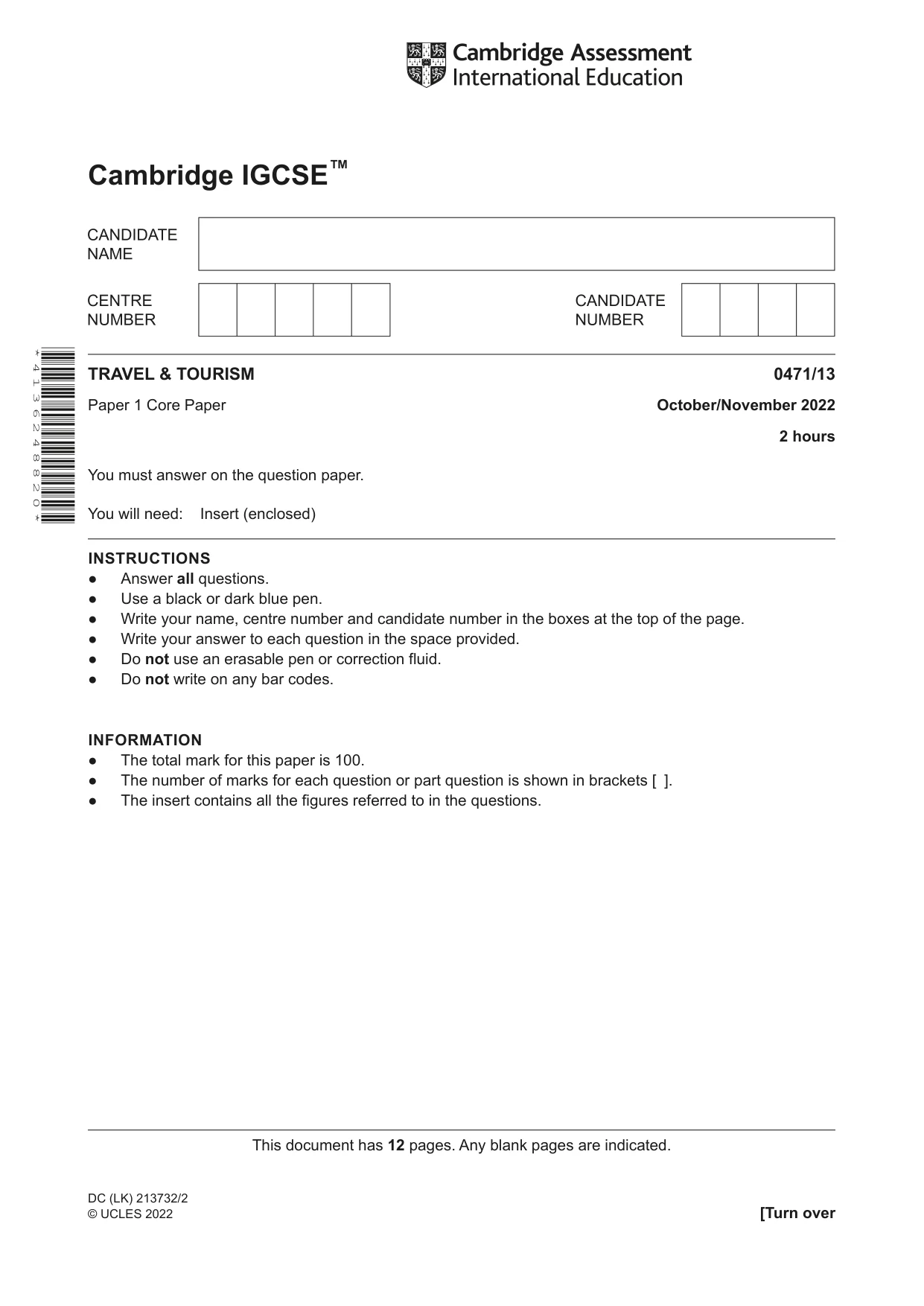
This document has 12 pages. Any blank pages are indicated. [Turn over Cambridge IGCSE™ * 4 1 3 6 2 4 8 8 2 0 * TRAVEL & TOURISM 0471/13 Paper 1 Core Paper October/November 2022 2 hours You must answer on the question paper. You will need: Insert (enclosed) INSTRUCTIONS ● Answer all questions. ● Use a black or dark blue pen. ● Write your name, centre number and candidate number in the boxes at the top of the page. ● Write your answer to each question in the space provided. ● Do not use an erasable pen or correction fluid. ● Do not write on any bar codes. INFORMATION ● The total mark for this paper is 100. ● The number of marks for each question or part question is shown in brackets [ ]. ● The insert contains all the figures referred to in the questions. DC (LK) 213732/2 © UCLES 2022
Question paper, page 2
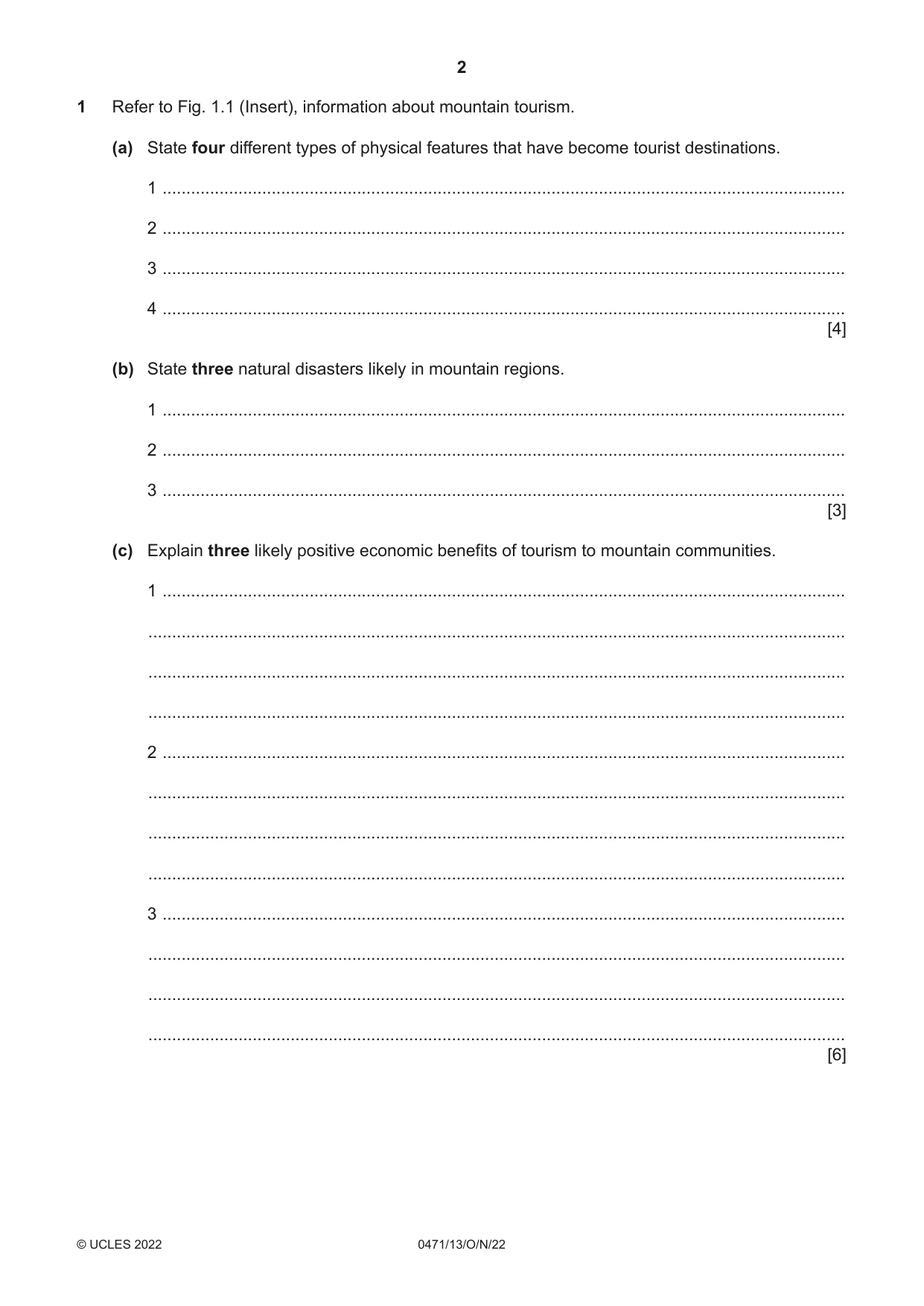
2 0471/13/O/N/22 © UCLES 2022 1 Refer to Fig. 1.1 (Insert), information about mountain tourism. (a) State four different types of physical features that have become tourist destinations. 1 … 2 … 3 … 4 … [4] (b) State three natural disasters likely in mountain regions. 1 … 2 … 3 … [3] (c) Explain three likely positive economic benefits of tourism to mountain communities. 1 … … … … 2 … … … … 3 … … … … [6]
Question paper, page 3
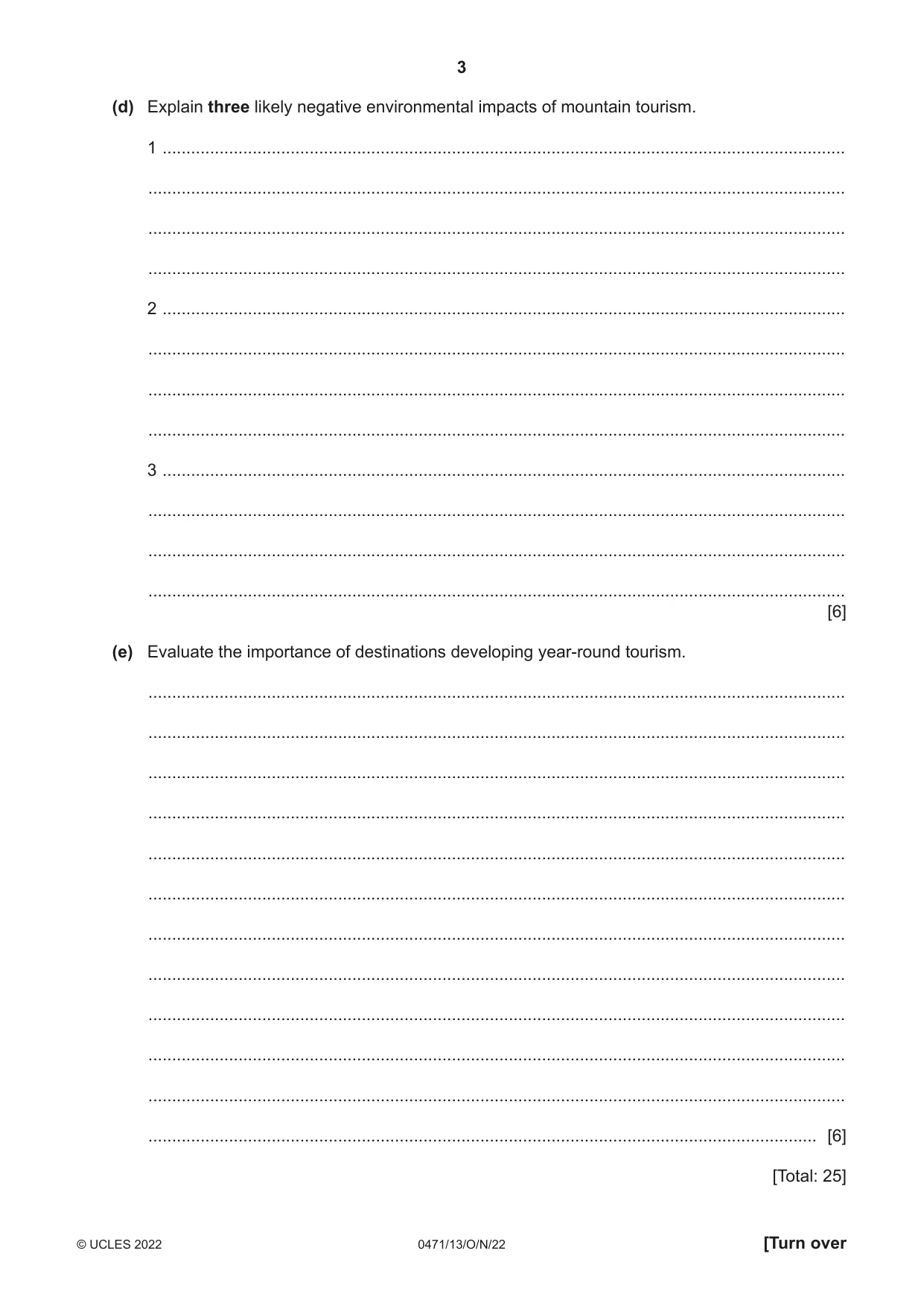
3 0471/13/O/N/22 © UCLES 2022 [Turn over (d) Explain three likely negative environmental impacts of mountain tourism. 1 … … … … 2 … … … … 3 … … … … [6] (e) Evaluate the importance of destinations developing year-round tourism. … … … … … … … … … … … … [6] [Total: 25]
Question paper, page 4
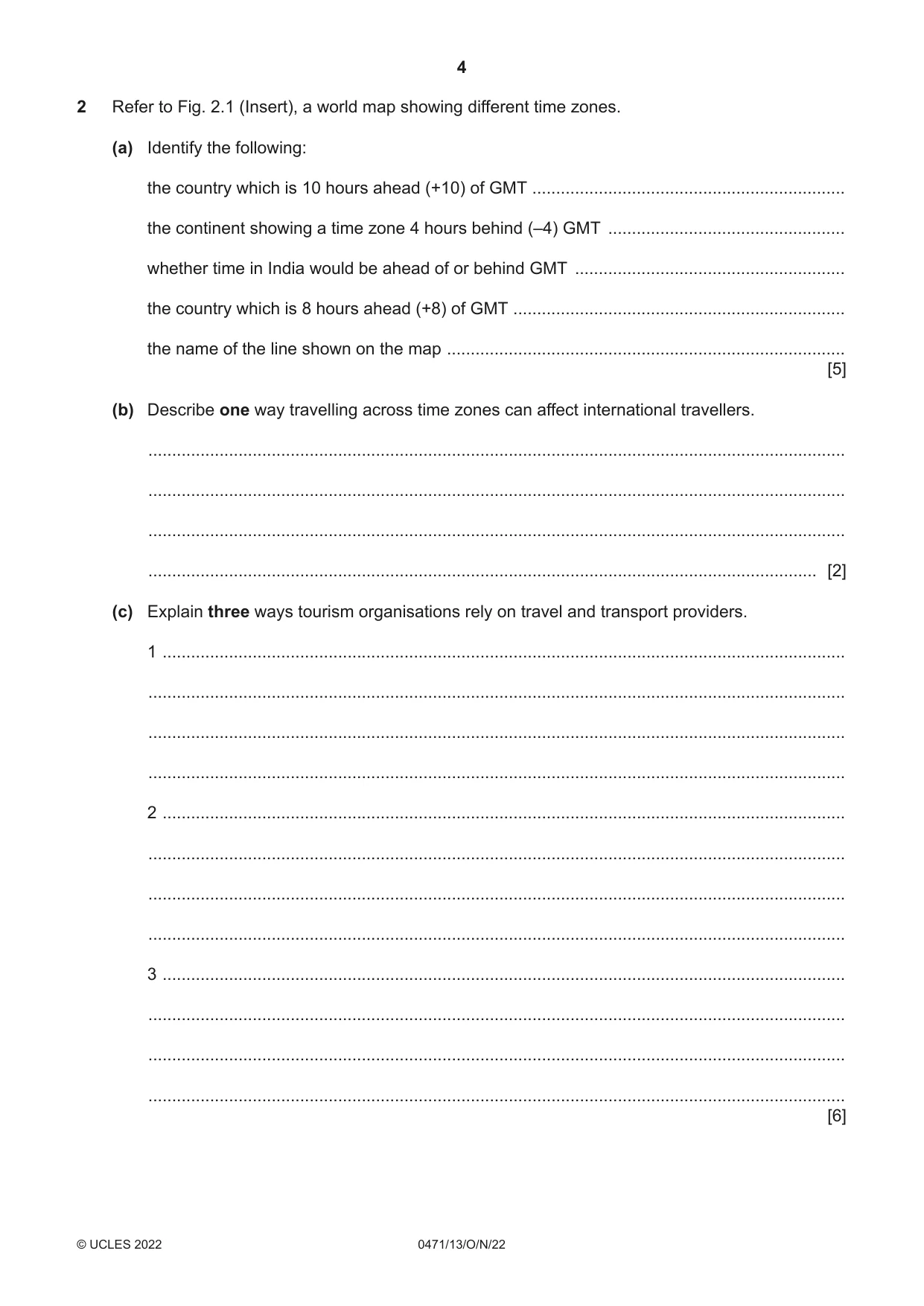
4 0471/13/O/N/22 © UCLES 2022 2 Refer to Fig. 2.1 (Insert), a world map showing different time zones. (a) Identify the following: the country which is 10 hours ahead (+10) of GMT … the continent showing a time zone 4 hours behind (–4) GMT … whether time in India would be ahead of or behind GMT … the country which is 8 hours ahead (+8) of GMT … the name of the line shown on the map … [5] (b) Describe one way travelling across time zones can affect international travellers. … … … … [2] (c) Explain three ways tourism organisations rely on travel and transport providers. 1 … … … … 2 … … … … 3 … … … … [6]
Question paper, page 5
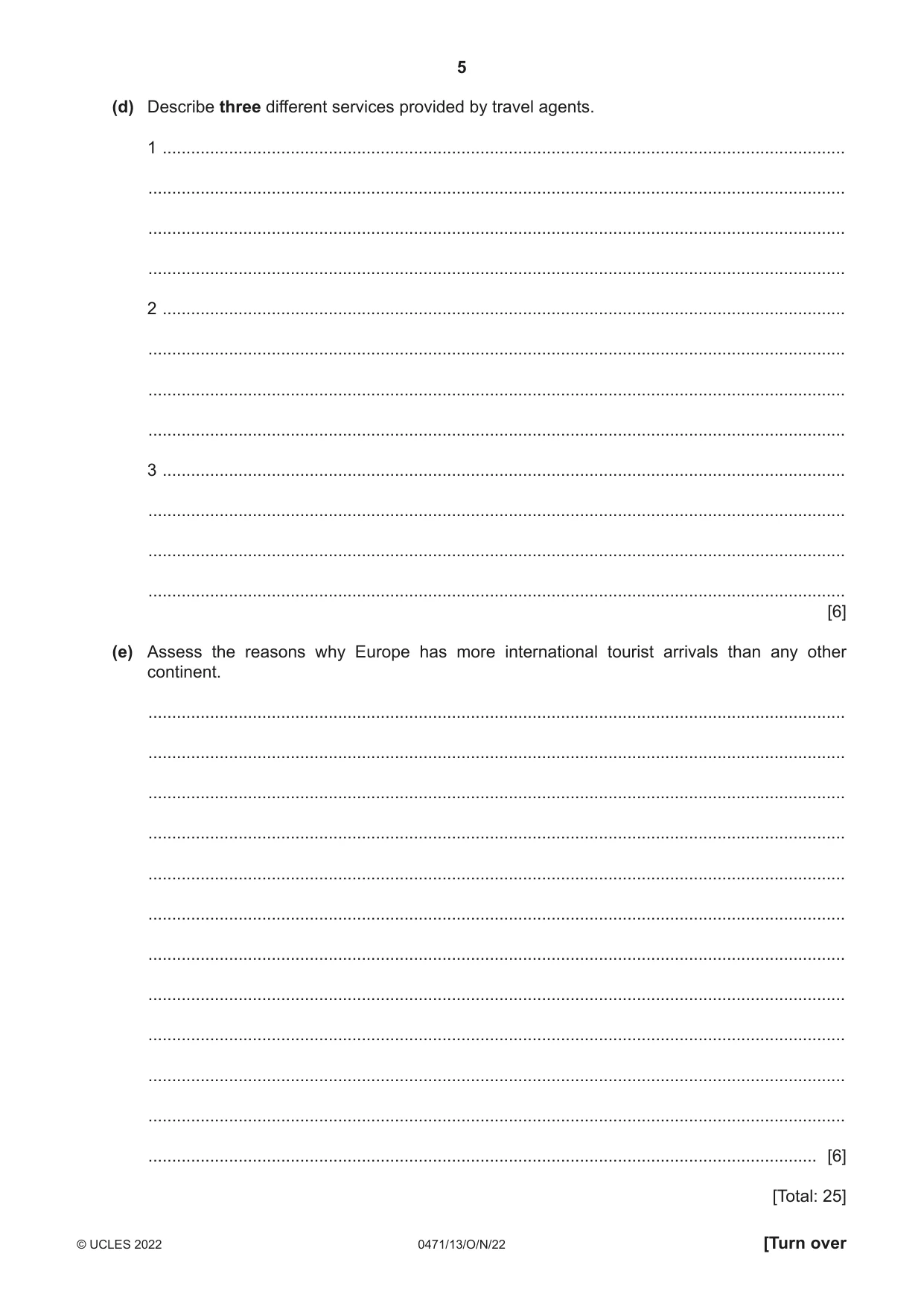
5 0471/13/O/N/22 © UCLES 2022 [Turn over (d) Describe three different services provided by travel agents. 1 … … … … 2 … … … … 3 … … … … [6] (e) Assess the reasons why Europe has more international tourist arrivals than any other continent. … … … … … … … … … … … … [6] [Total: 25]
Question paper, page 6
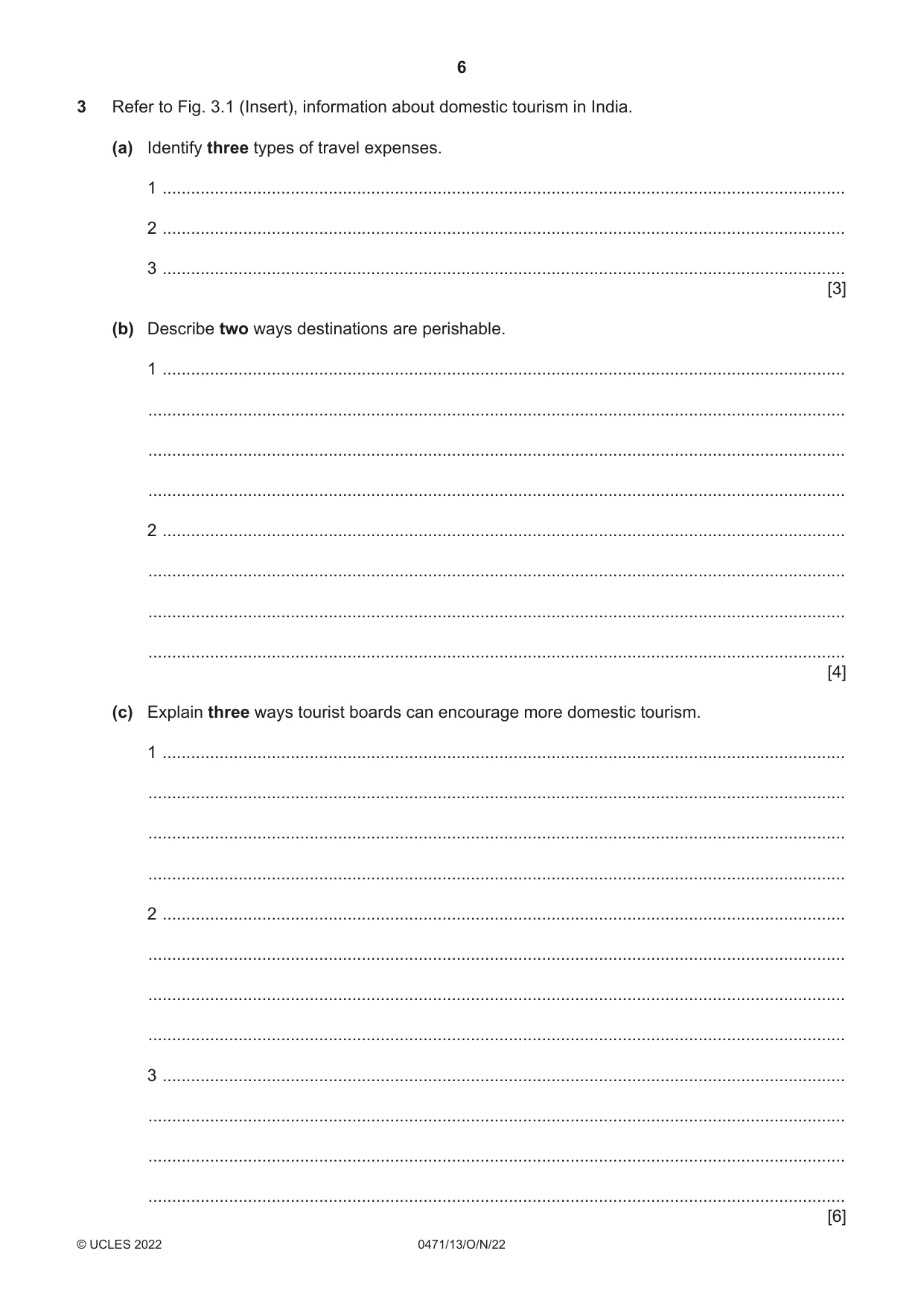
6 0471/13/O/N/22 © UCLES 2022 3 Refer to Fig. 3.1 (Insert), information about domestic tourism in India. (a) Identify three types of travel expenses. 1 … 2 … 3 … [3] (b) Describe two ways destinations are perishable. 1 … … … … 2 … … … … [4] (c) Explain three ways tourist boards can encourage more domestic tourism. 1 … … … … 2 … … … … 3 … … … … [6]
Question paper, page 7
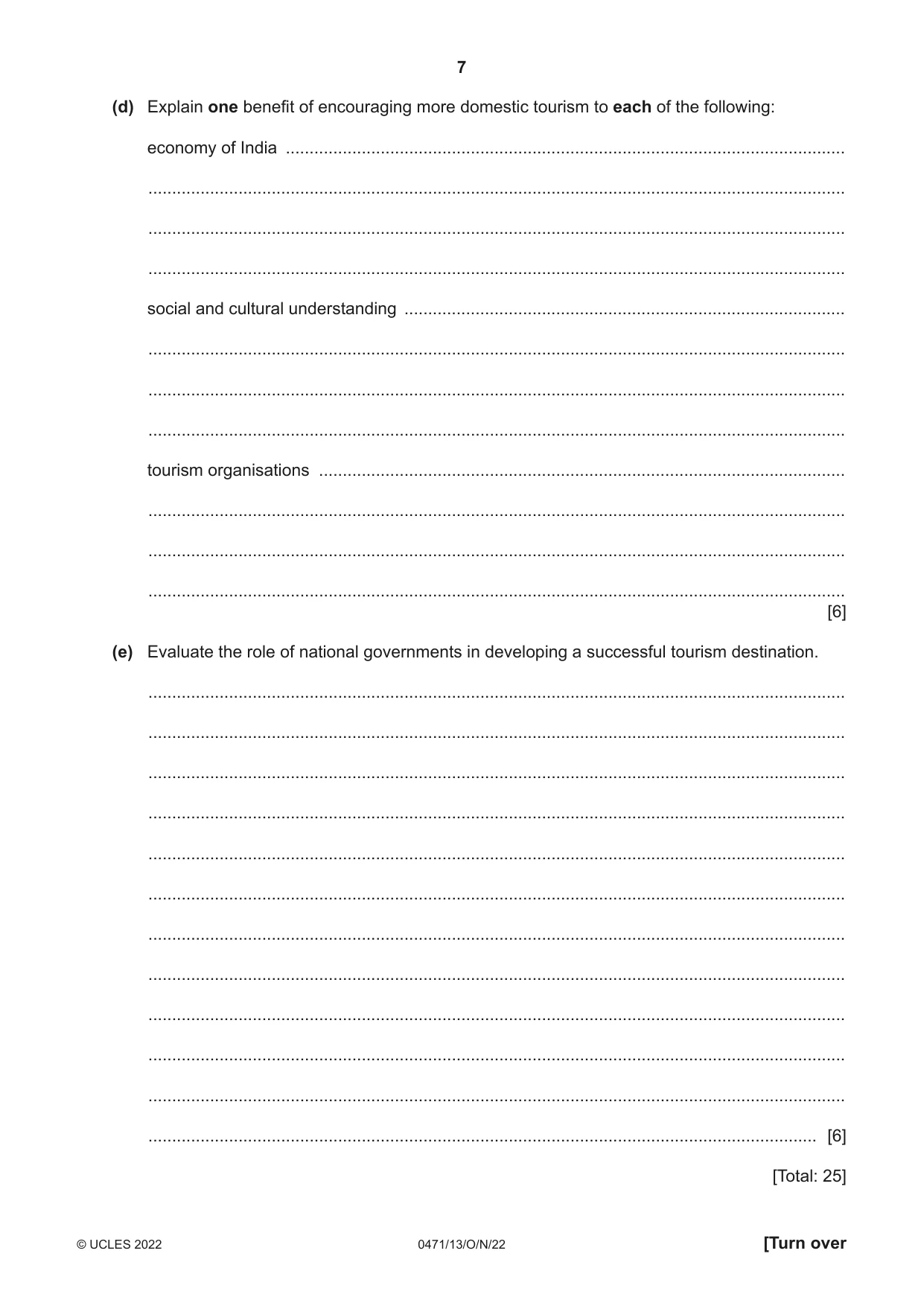
7 0471/13/O/N/22 © UCLES 2022 [Turn over (d) Explain one benefit of encouraging more domestic tourism to each of the following: economy of India … … … … social and cultural understanding … … … … tourism organisations … … … … [6] (e) Evaluate the role of national governments in developing a successful tourism destination. … … … … … … … … … … … … [6] [Total: 25]
Question paper, page 8
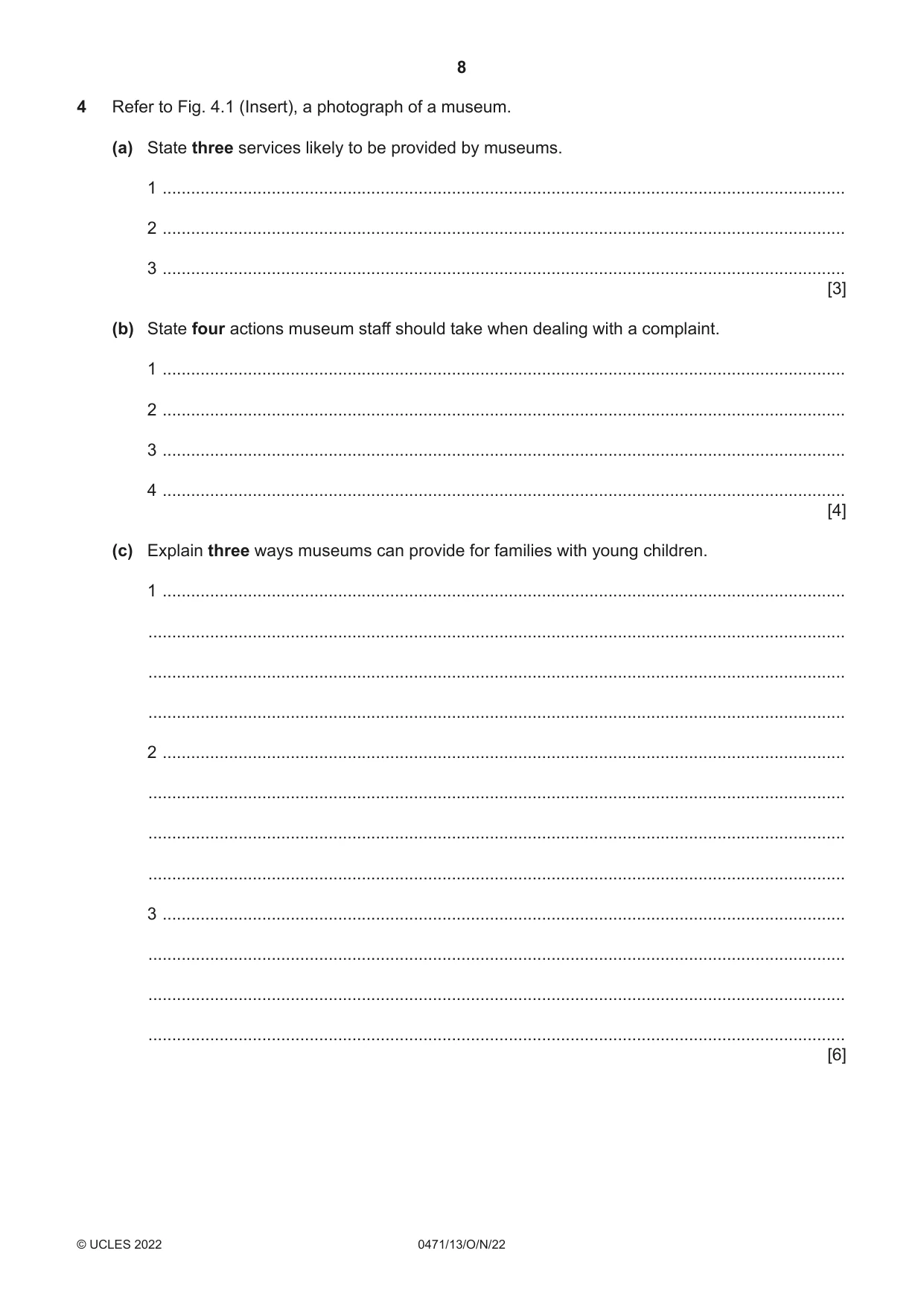
8 0471/13/O/N/22 © UCLES 2022 4 Refer to Fig. 4.1 (Insert), a photograph of a museum. (a) State three services likely to be provided by museums. 1 … 2 … 3 … [3] (b) State four actions museum staff should take when dealing with a complaint. 1 … 2 … 3 … 4 … [4] (c) Explain three ways museums can provide for families with young children. 1 … … … … 2 … … … … 3 … … … … [6]
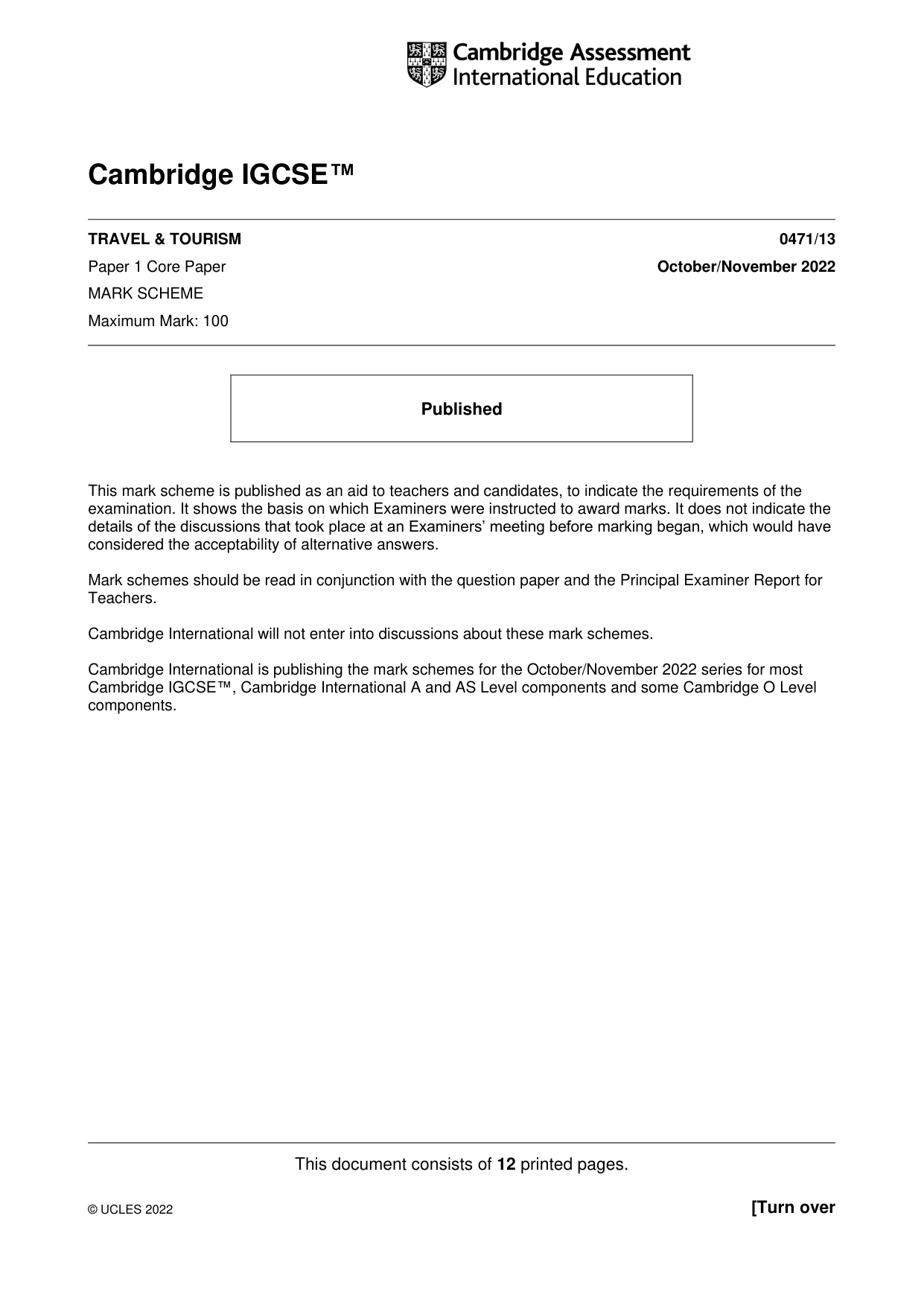
Question paper, page 9
9 0471/13/O/N/22 © UCLES 2022 (d) Explain three reasons why good personal presentation is important for museum staff. 1 … … … … 2 … … … … 3 … … … … [6] (e) Evaluate the role of museums in the travel and tourism industry. … … … … … … … … … … … … [6] [Total: 25]
Question paper, page 10
10 0471/13/O/N/22 © UCLES 2022 BLANK PAGE
Question paper, page 11
11 0471/13/O/N/22 © UCLES 2022 BLANK PAGE
Question paper, page 12
12 0471/13/O/N/22 © UCLES 2022 The boundaries and names shown, the designations used and the presentation of material on any maps contained in this question paper/insert do not imply official endorsement or acceptance by Cambridge Assessment International Education concerning the legal status of any country, territory, or area or any of its authorities, or of the delimitation of its frontiers or boundaries. Permission to reproduce items where third-party owned material protected by copyright is included has been sought and cleared where possible. Every reasonable effort has been made by the publisher (UCLES) to trace copyright holders, but if any items requiring clearance have unwittingly been included, the publisher will be pleased to make amends at the earliest possible opportunity. To avoid the issue of disclosure of answer-related information to candidates, all copyright acknowledgements are reproduced online in the Cambridge Assessment International Education Copyright Acknowledgements Booklet. This is produced for each series of examinations and is freely available to download at www.cambridgeinternational.org after the live examination series. Cambridge Assessment International Education is part of Cambridge Assessment. Cambridge Assessment is the brand name of the University of Cambridge Local Examinations Syndicate (UCLES), which is a department of the University of Cambridge. BLANK PAGE
Mark scheme, page 1
This document consists of 12 printed pages. © UCLES 2022 [Turn over Cambridge IGCSE™ TRAVEL & TOURISM 0471/13 Paper 1 Core Paper October/November 2022 MARK SCHEME Maximum Mark: 100 Published This mark scheme is published as an aid to teachers and candidates, to indicate the requirements of the examination. It shows the basis on which Examiners were instructed to award marks. It does not indicate the details of the discussions that took place at an Examiners’ meeting before marking began, which would have considered the acceptability of alternative answers. Mark schemes should be read in conjunction with the question paper and the Principal Examiner Report for Teachers. Cambridge International will not enter into discussions about these mark schemes. Cambridge International is publishing the mark schemes for the October/November 2022 series for most Cambridge IGCSE™, Cambridge International A and AS Level components and some Cambridge O Level components.
Mark scheme, page 2
0471/13 Cambridge IGCSE – Mark Scheme PUBLISHED October/November 2022 © UCLES 2022 Page 2 of 12 Generic Marking Principles These general marking principles must be applied by all examiners when marking candidate answers. They should be applied alongside the specific content of the mark scheme or generic level descriptors for a question. Each question paper and mark scheme will also comply with these marking principles. GENERIC MARKING PRINCIPLE 1: Marks must be awarded in line with: • the specific content of the mark scheme or the generic level descriptors for the question • the specific skills defined in the mark scheme or in the generic level descriptors for the question • the standard of response required by a candidate as exemplified by the standardisation scripts. GENERIC MARKING PRINCIPLE 2: Marks awarded are always whole marks (not half marks, or other fractions). GENERIC MARKING PRINCIPLE 3: Marks must be awarded positively: • marks are awarded for correct/valid answers, as defined in the mark scheme. However, credit is given for valid answers which go beyond the scope of the syllabus and mark scheme, referring to your Team Leader as appropriate • marks are awarded when candidates clearly demonstrate what they know and can do • marks are not deducted for errors • marks are not deducted for omissions • answers should only be judged on the quality of spelling, punctuation and grammar when these features are specifically assessed by the question as indicated by the mark scheme. The meaning, however, should be unambiguous. GENERIC MARKING PRINCIPLE 4: Rules must be applied consistently, e.g. in situations where candidates have not followed instructions or in the application of generic level descriptors. GENERIC MARKING PRINCIPLE 5: Marks should be awarded using the full range of marks defined in the mark scheme for the question (however; the use of the full mark range may be limited according to the quality of the candidate responses seen). GENERIC MARKING PRINCIPLE 6: Marks awarded are based solely on the requirements as defined in the mark scheme. Marks should not be awarded with grade thresholds or grade descriptors in mind.
Mark scheme, page 3
0471/13 Cambridge IGCSE – Mark Scheme PUBLISHED October/November 2022 © UCLES 2022 Page 3 of 12 Social Science-Specific Marking Principles (for point-based marking) 1 Components using point-based marking: • Point marking is often used to reward knowledge, understanding and application of skills. We give credit where the candidate’s answer shows relevant knowledge, understanding and application of skills in answering the question. We do not give credit where the answer shows confusion. From this it follows that we: a DO credit answers which are worded differently from the mark scheme if they clearly convey the same meaning (unless the mark scheme requires a specific term) b DO credit alternative answers/examples which are not written in the mark scheme if they are correct c DO credit answers where candidates give more than one correct answer in one prompt/numbered/scaffolded space where extended writing is required rather than list-type answers. For example, questions that require n reasons (e.g. State two reasons …). d DO NOT credit answers simply for using a ‘key term’ unless that is all that is required. (Check for evidence it is understood and not used wrongly.) e DO NOT credit answers which are obviously self-contradicting or trying to cover all possibilities f DO NOT give further credit for what is effectively repetition of a correct point already credited unless the language itself is being tested. This applies equally to ‘mirror statements’ (i.e. polluted/not polluted). g DO NOT require spellings to be correct, unless this is part of the test. However spellings of syllabus terms must allow for clear and unambiguous separation from other syllabus terms with which they may be confused (e.g. Corrasion/Corrosion) 2 Presentation of mark scheme: • Slashes (/) or the word ‘or’ separate alternative ways of making the same point. • Semi colons (;) bullet points (•) or figures in brackets (1) separate different points. • Content in the answer column in brackets is for examiner information/context to clarify the marking but is not required to earn the mark (except Accounting syllabuses where they indicate negative numbers). 3 Calculation questions: • The mark scheme will show the steps in the most likely correct method(s), the mark for each step, the correct answer(s) and the mark for each answer • If working/explanation is considered essential for full credit, this will be indicated in the question paper and in the mark scheme. In all other instances, the correct answer to a calculation should be given full credit, even if no supporting working is shown. • Where the candidate uses a valid method which is not covered by the mark scheme, award equivalent marks for reaching equivalent stages. • Where an answer makes use of a candidate’s own incorrect figure from previous working, the ‘own figure rule’ applies: full marks will be given if a correct and complete method is used. Further guidance will be included in the mark scheme where necessary and any exceptions to this general principle will be noted.
Mark scheme, page 4
0471/13 Cambridge IGCSE – Mark Scheme PUBLISHED October/November 2022 © UCLES 2022 Page 4 of 12 4 Annotation: • For point marking, ticks can be used to indicate correct answers and crosses can be used to indicate wrong answers. There is no direct relationship between ticks and marks. Ticks have no defined meaning for levels of response marking. • For levels of response marking, the level awarded should be annotated on the script. • Other annotations will be used by examiners as agreed during standardisation, and the meaning will be understood by all examiners who marked that paper.
Mark scheme, page 5
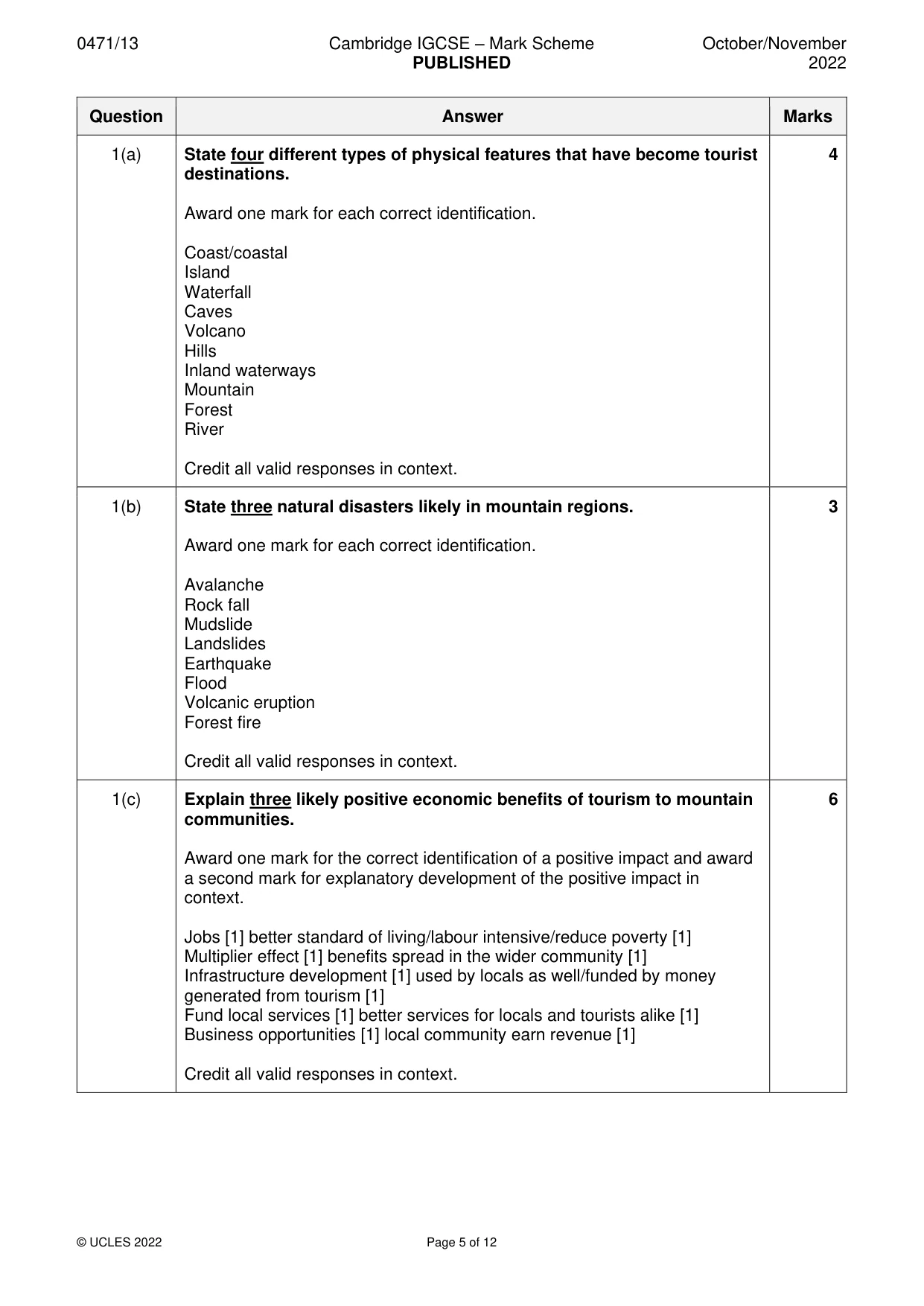
0471/13 Cambridge IGCSE – Mark Scheme PUBLISHED October/November 2022 © UCLES 2022 Page 5 of 12 Question Answer Marks 1(a) State four different types of physical features that have become tourist destinations. Award one mark for each correct identification. Coast/coastal Island Waterfall Caves Volcano Hills Inland waterways Mountain Forest River Credit all valid responses in context. 4 1(b) State three natural disasters likely in mountain regions. Award one mark for each correct identification. Avalanche Rock fall Mudslide Landslides Earthquake Flood Volcanic eruption Forest fire Credit all valid responses in context. 3 1(c) Explain three likely positive economic benefits of tourism to mountain communities. Award one mark for the correct identification of a positive impact and award a second mark for explanatory development of the positive impact in context. Jobs [1] better standard of living/labour intensive/reduce poverty [1] Multiplier effect [1] benefits spread in the wider community [1] Infrastructure development [1] used by locals as well/funded by money generated from tourism [1] Fund local services [1] better services for locals and tourists alike [1] Business opportunities [1] local community earn revenue [1] Credit all valid responses in context. 6
Mark scheme, page 6
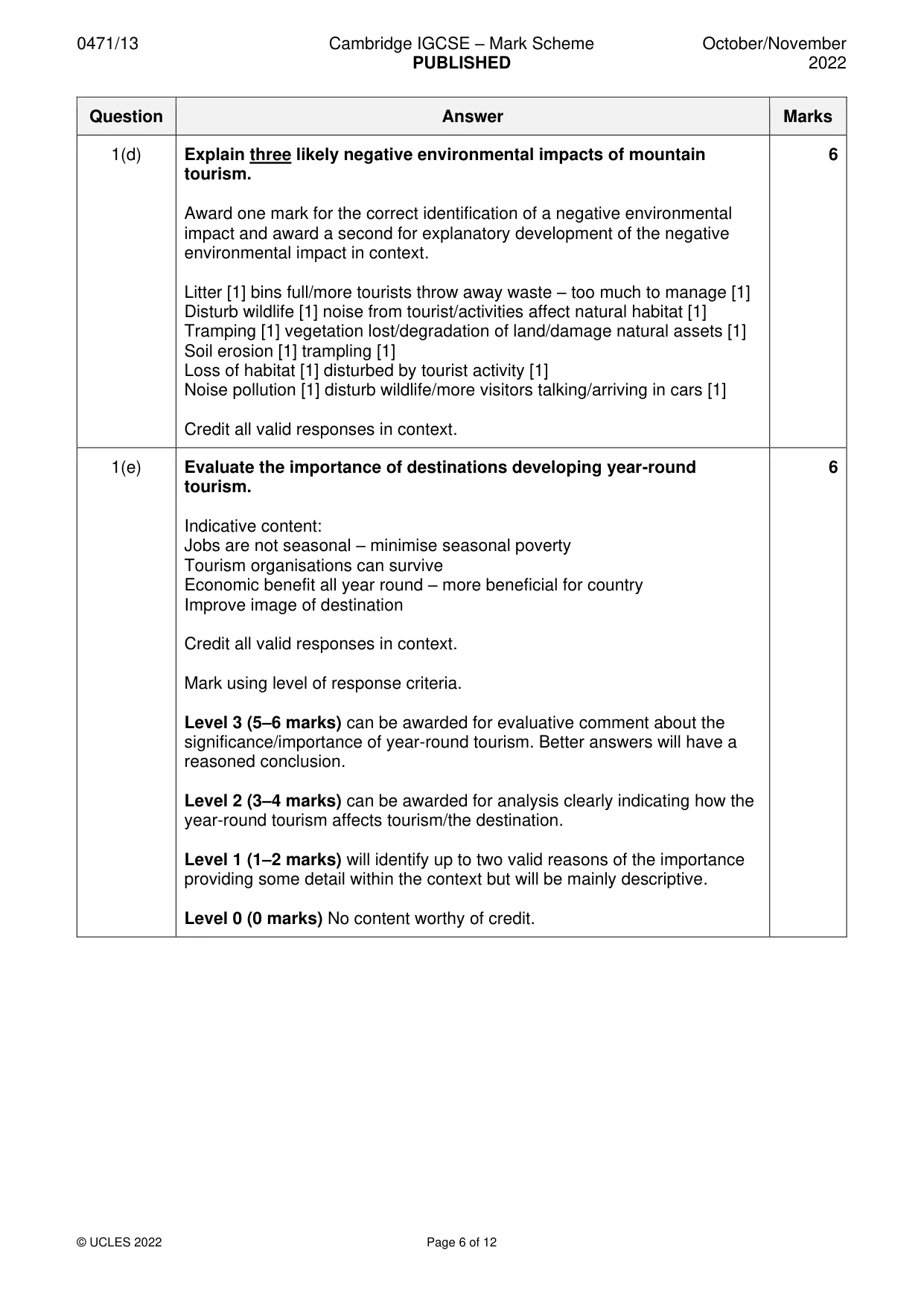
0471/13 Cambridge IGCSE – Mark Scheme PUBLISHED October/November 2022 © UCLES 2022 Page 6 of 12 Question Answer Marks 1(d) Explain three likely negative environmental impacts of mountain tourism. Award one mark for the correct identification of a negative environmental impact and award a second for explanatory development of the negative environmental impact in context. Litter [1] bins full/more tourists throw away waste – too much to manage [1] Disturb wildlife [1] noise from tourist/activities affect natural habitat [1] Tramping [1] vegetation lost/degradation of land/damage natural assets [1] Soil erosion [1] trampling [1] Loss of habitat [1] disturbed by tourist activity [1] Noise pollution [1] disturb wildlife/more visitors talking/arriving in cars [1] Credit all valid responses in context. 6 1(e) Evaluate the importance of destinations developing year-round tourism. Indicative content: Jobs are not seasonal – minimise seasonal poverty Tourism organisations can survive Economic benefit all year round – more beneficial for country Improve image of destination Credit all valid responses in context. Mark using level of response criteria. Level 3 (5–6 marks) can be awarded for evaluative comment about the significance/importance of year-round tourism. Better answers will have a reasoned conclusion. Level 2 (3–4 marks) can be awarded for analysis clearly indicating how the year-round tourism affects tourism/the destination. Level 1 (1–2 marks) will identify up to two valid reasons of the importance providing some detail within the context but will be mainly descriptive. Level 0 (0 marks) No content worthy of credit. 6
Mark scheme, page 7
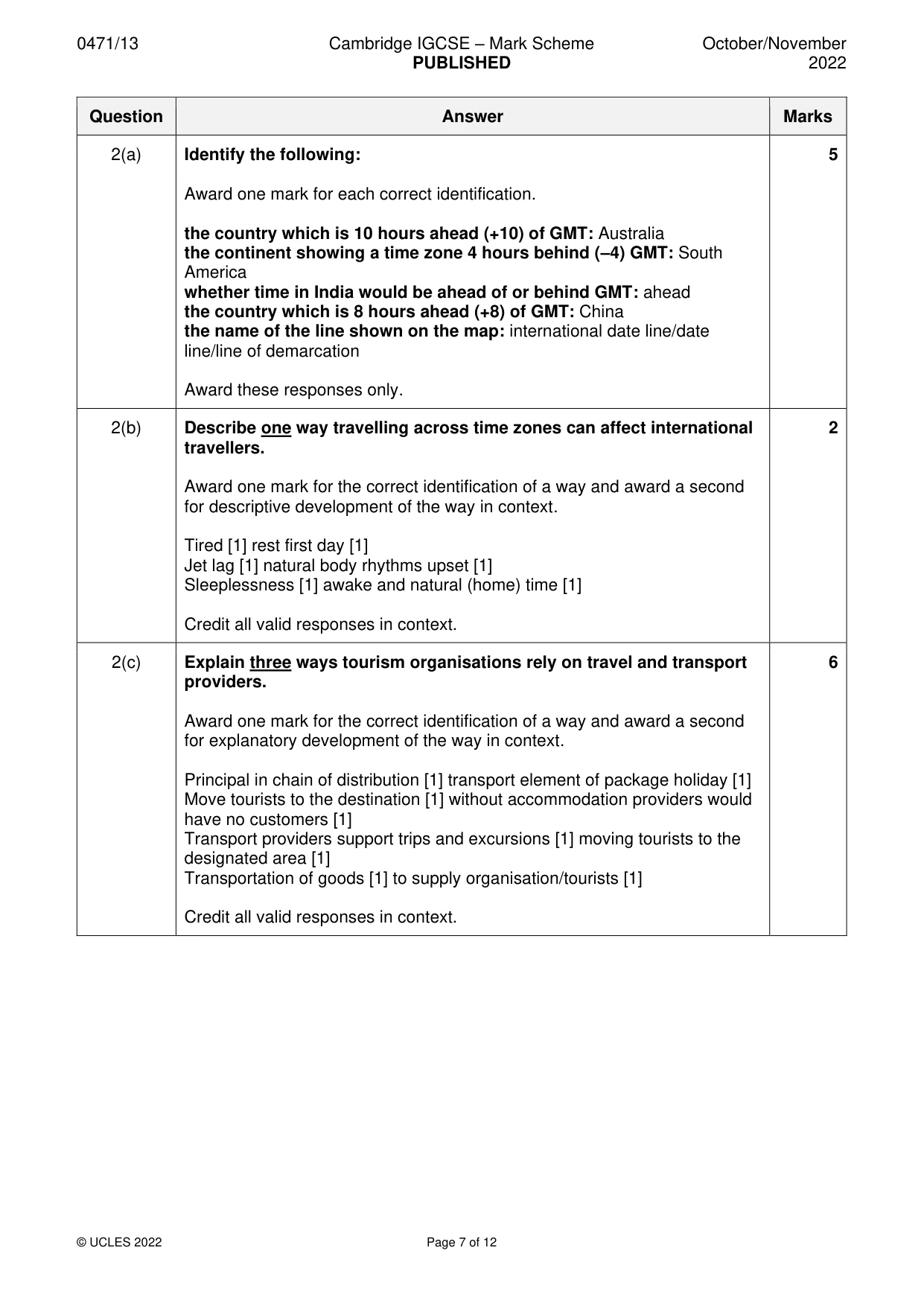
0471/13 Cambridge IGCSE – Mark Scheme PUBLISHED October/November 2022 © UCLES 2022 Page 7 of 12 Question Answer Marks 2(a) Identify the following: Award one mark for each correct identification. the country which is 10 hours ahead (+10) of GMT: Australia the continent showing a time zone 4 hours behind (–4) GMT: South America whether time in India would be ahead of or behind GMT: ahead the country which is 8 hours ahead (+8) of GMT: China the name of the line shown on the map: international date line/date line/line of demarcation Award these responses only. 5 2(b) Describe one way travelling across time zones can affect international travellers. Award one mark for the correct identification of a way and award a second for descriptive development of the way in context. Tired [1] rest first day [1] Jet lag [1] natural body rhythms upset [1] Sleeplessness [1] awake and natural (home) time [1] Credit all valid responses in context. 2 2(c) Explain three ways tourism organisations rely on travel and transport providers. Award one mark for the correct identification of a way and award a second for explanatory development of the way in context. Principal in chain of distribution [1] transport element of package holiday [1] Move tourists to the destination [1] without accommodation providers would have no customers [1] Transport providers support trips and excursions [1] moving tourists to the designated area [1] Transportation of goods [1] to supply organisation/tourists [1] Credit all valid responses in context. 6
Mark scheme, page 8
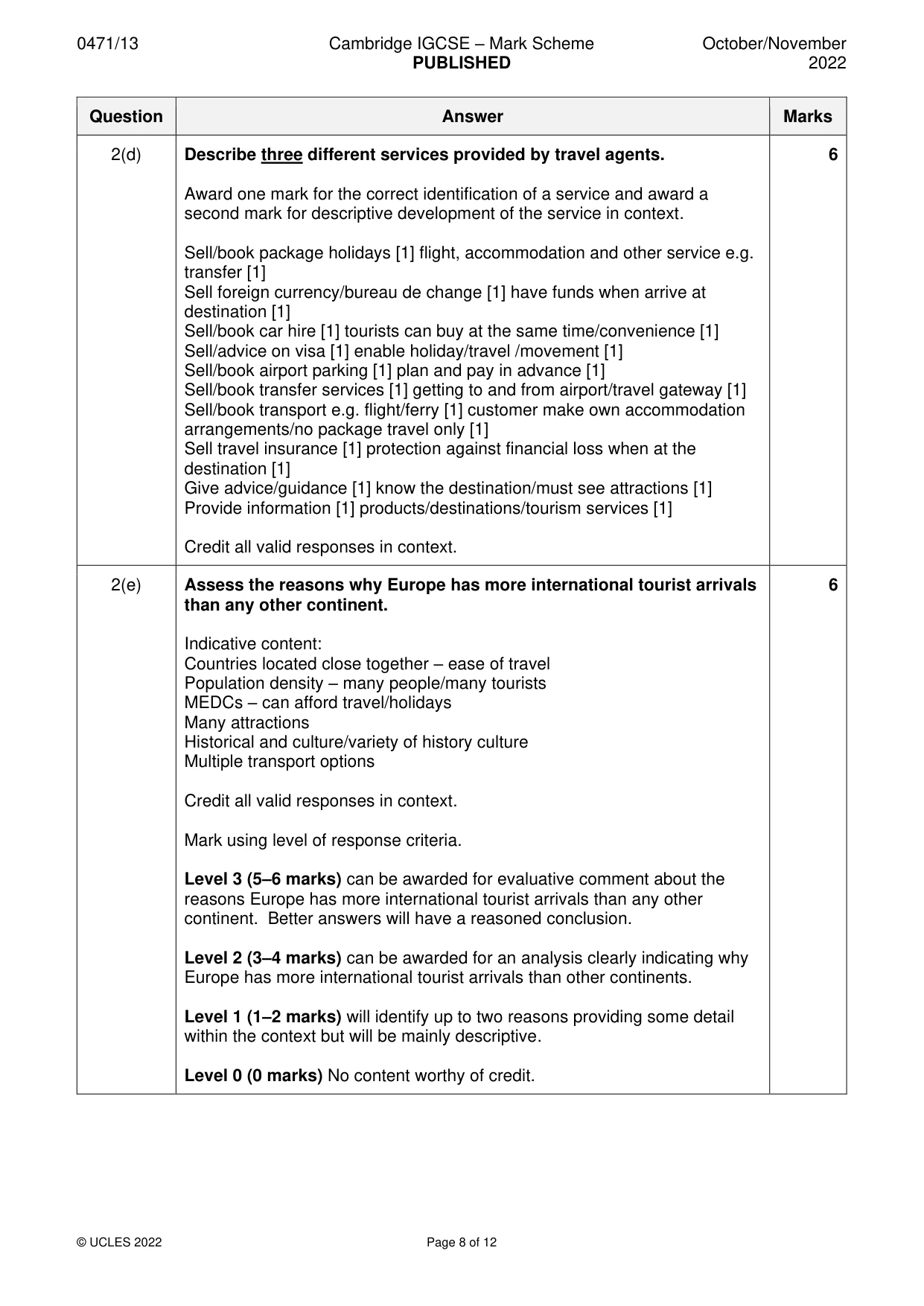
0471/13 Cambridge IGCSE – Mark Scheme PUBLISHED October/November 2022 © UCLES 2022 Page 8 of 12 Question Answer Marks 2(d) Describe three different services provided by travel agents. Award one mark for the correct identification of a service and award a second mark for descriptive development of the service in context. Sell/book package holidays [1] flight, accommodation and other service e.g. transfer [1] Sell foreign currency/bureau de change [1] have funds when arrive at destination [1] Sell/book car hire [1] tourists can buy at the same time/convenience [1] Sell/advice on visa [1] enable holiday/travel /movement [1] Sell/book airport parking [1] plan and pay in advance [1] Sell/book transfer services [1] getting to and from airport/travel gateway [1] Sell/book transport e.g. flight/ferry [1] customer make own accommodation arrangements/no package travel only [1] Sell travel insurance [1] protection against financial loss when at the destination [1] Give advice/guidance [1] know the destination/must see attractions [1] Provide information [1] products/destinations/tourism services [1] Credit all valid responses in context. 6 2(e) Assess the reasons why Europe has more international tourist arrivals than any other continent. Indicative content: Countries located close together – ease of travel Population density – many people/many tourists MEDCs – can afford travel/holidays Many attractions Historical and culture/variety of history culture Multiple transport options Credit all valid responses in context. Mark using level of response criteria. Level 3 (5–6 marks) can be awarded for evaluative comment about the reasons Europe has more international tourist arrivals than any other continent. Better answers will have a reasoned conclusion. Level 2 (3–4 marks) can be awarded for an analysis clearly indicating why Europe has more international tourist arrivals than other continents. Level 1 (1–2 marks) will identify up to two reasons providing some detail within the context but will be mainly descriptive. Level 0 (0 marks) No content worthy of credit. 6
Mark scheme, page 9
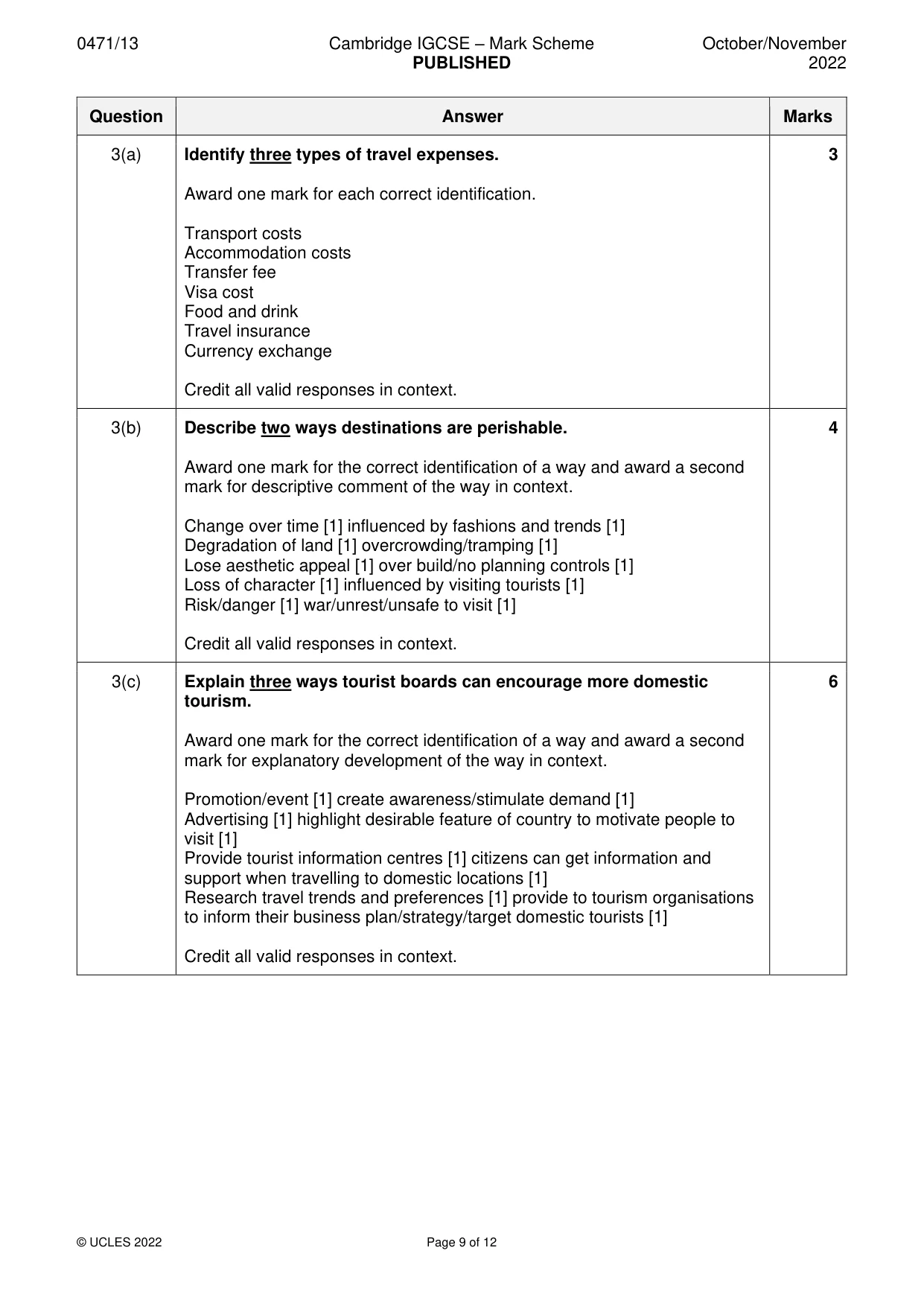
0471/13 Cambridge IGCSE – Mark Scheme PUBLISHED October/November 2022 © UCLES 2022 Page 9 of 12 Question Answer Marks 3(a) Identify three types of travel expenses. Award one mark for each correct identification. Transport costs Accommodation costs Transfer fee Visa cost Food and drink Travel insurance Currency exchange Credit all valid responses in context. 3 3(b) Describe two ways destinations are perishable. Award one mark for the correct identification of a way and award a second mark for descriptive comment of the way in context. Change over time [1] influenced by fashions and trends [1] Degradation of land [1] overcrowding/tramping [1] Lose aesthetic appeal [1] over build/no planning controls [1] Loss of character [1] influenced by visiting tourists [1] Risk/danger [1] war/unrest/unsafe to visit [1] Credit all valid responses in context. 4 3(c) Explain three ways tourist boards can encourage more domestic tourism. Award one mark for the correct identification of a way and award a second mark for explanatory development of the way in context. Promotion/event [1] create awareness/stimulate demand [1] Advertising [1] highlight desirable feature of country to motivate people to visit [1] Provide tourist information centres [1] citizens can get information and support when travelling to domestic locations [1] Research travel trends and preferences [1] provide to tourism organisations to inform their business plan/strategy/target domestic tourists [1] Credit all valid responses in context. 6
Mark scheme, page 10
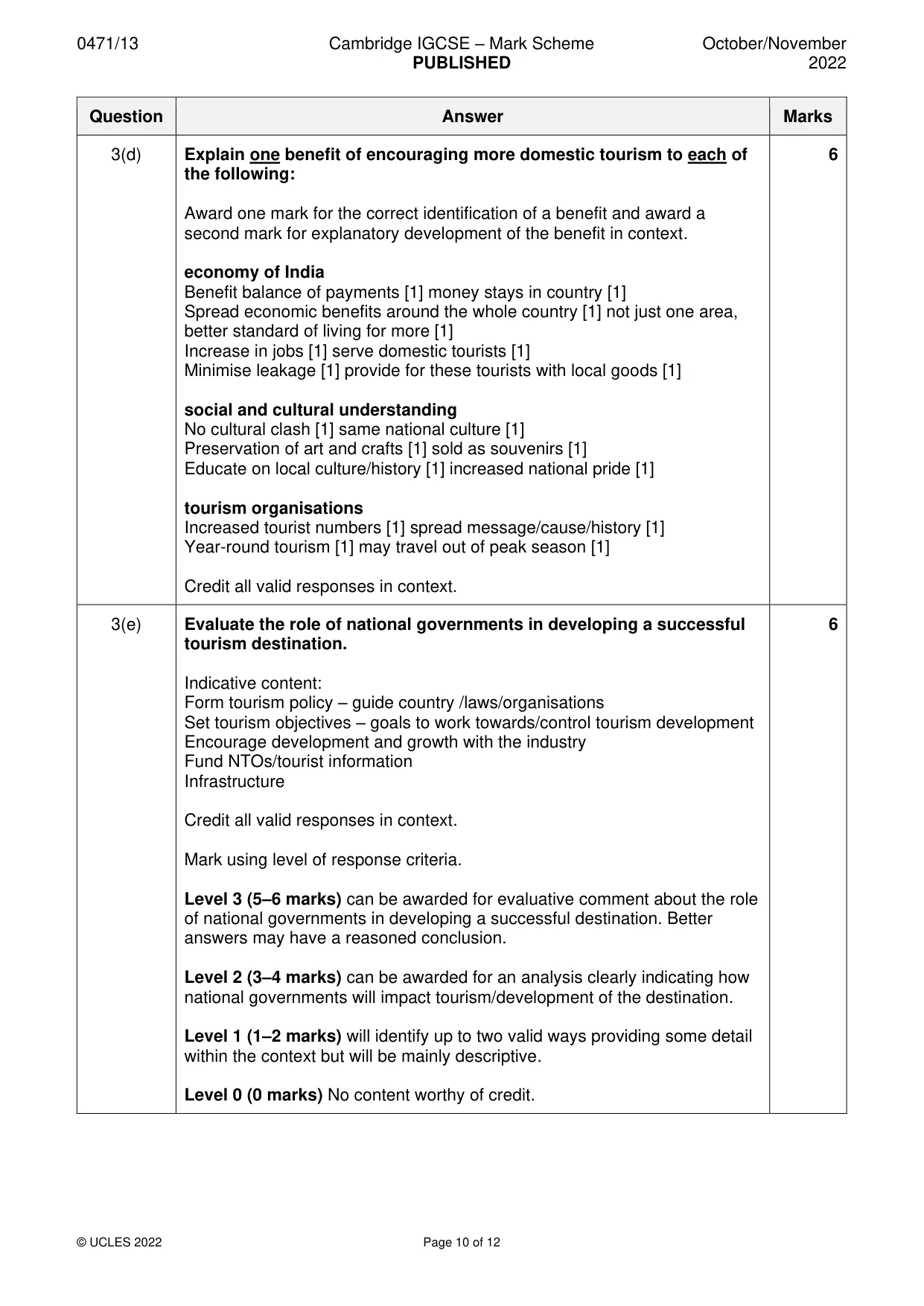
0471/13 Cambridge IGCSE – Mark Scheme PUBLISHED October/November 2022 © UCLES 2022 Page 10 of 12 Question Answer Marks 3(d) Explain one benefit of encouraging more domestic tourism to each of the following: Award one mark for the correct identification of a benefit and award a second mark for explanatory development of the benefit in context. economy of India Benefit balance of payments [1] money stays in country [1] Spread economic benefits around the whole country [1] not just one area, better standard of living for more [1] Increase in jobs [1] serve domestic tourists [1] Minimise leakage [1] provide for these tourists with local goods [1] social and cultural understanding No cultural clash [1] same national culture [1] Preservation of art and crafts [1] sold as souvenirs [1] Educate on local culture/history [1] increased national pride [1] tourism organisations Increased tourist numbers [1] spread message/cause/history [1] Year-round tourism [1] may travel out of peak season [1] Credit all valid responses in context. 6 3(e) Evaluate the role of national governments in developing a successful tourism destination. Indicative content: Form tourism policy – guide country /laws/organisations Set tourism objectives – goals to work towards/control tourism development Encourage development and growth with the industry Fund NTOs/tourist information Infrastructure Credit all valid responses in context. Mark using level of response criteria. Level 3 (5–6 marks) can be awarded for evaluative comment about the role of national governments in developing a successful destination. Better answers may have a reasoned conclusion. Level 2 (3–4 marks) can be awarded for an analysis clearly indicating how national governments will impact tourism/development of the destination. Level 1 (1–2 marks) will identify up to two valid ways providing some detail within the context but will be mainly descriptive. Level 0 (0 marks) No content worthy of credit. 6
Mark scheme, page 11
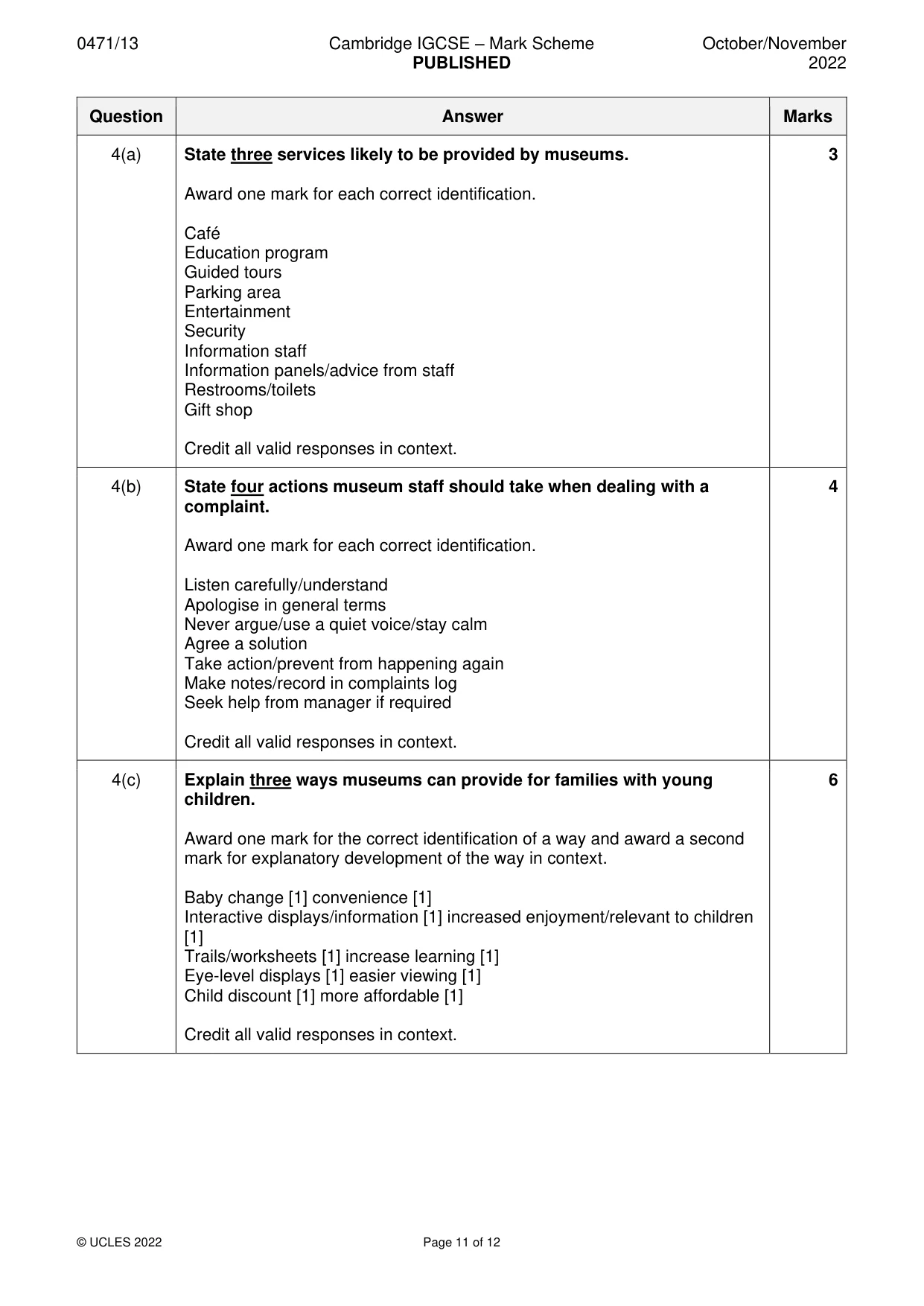
0471/13 Cambridge IGCSE – Mark Scheme PUBLISHED October/November 2022 © UCLES 2022 Page 11 of 12 Question Answer Marks 4(a) State three services likely to be provided by museums. Award one mark for each correct identification. Café Education program Guided tours Parking area Entertainment Security Information staff Information panels/advice from staff Restrooms/toilets Gift shop Credit all valid responses in context. 3 4(b) State four actions museum staff should take when dealing with a complaint. Award one mark for each correct identification. Listen carefully/understand Apologise in general terms Never argue/use a quiet voice/stay calm Agree a solution Take action/prevent from happening again Make notes/record in complaints log Seek help from manager if required Credit all valid responses in context. 4 4(c) Explain three ways museums can provide for families with young children. Award one mark for the correct identification of a way and award a second mark for explanatory development of the way in context. Baby change [1] convenience [1] Interactive displays/information [1] increased enjoyment/relevant to children [1] Trails/worksheets [1] increase learning [1] Eye-level displays [1] easier viewing [1] Child discount [1] more affordable [1] Credit all valid responses in context. 6
Mark scheme, page 12
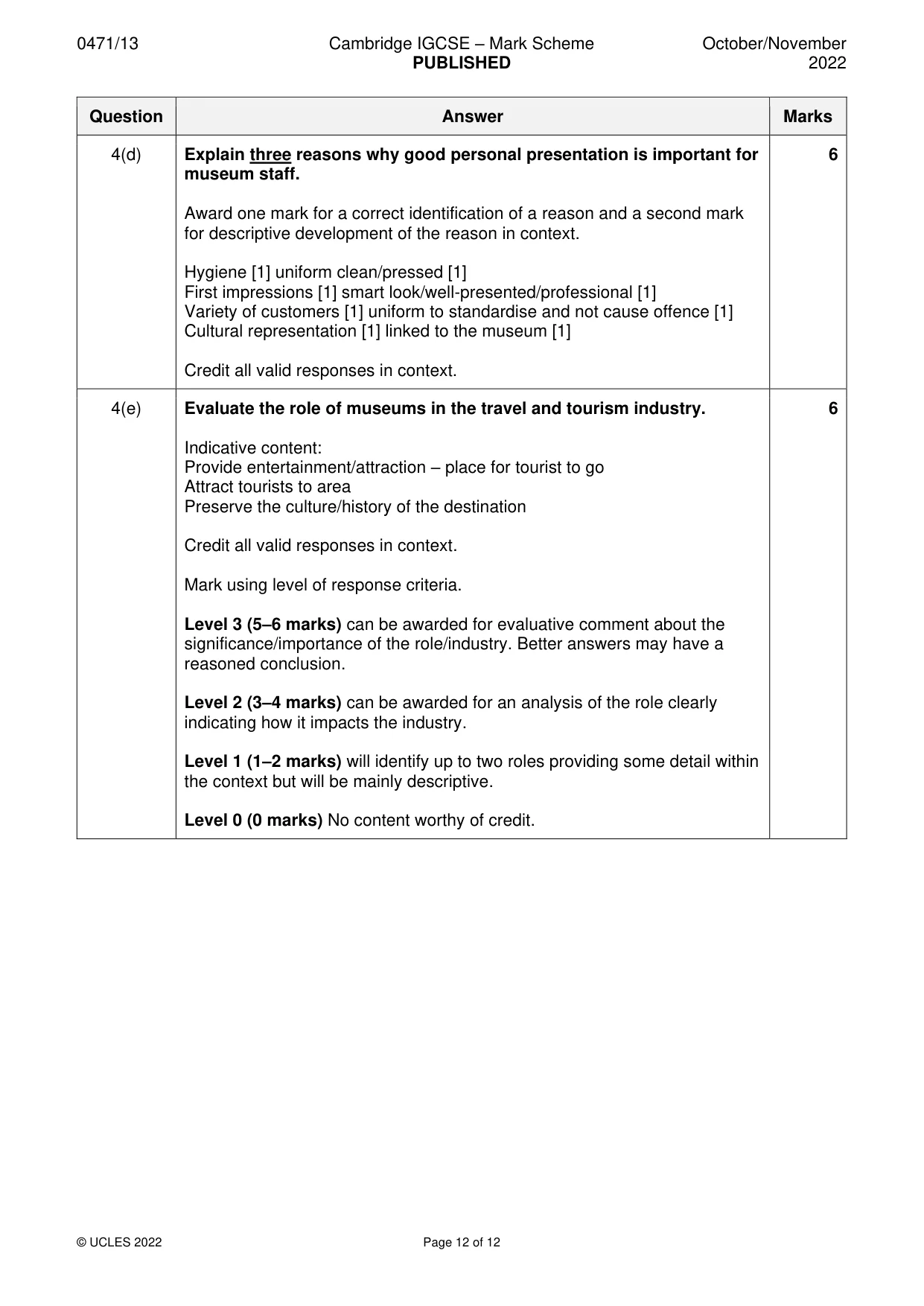
0471/13 Cambridge IGCSE – Mark Scheme PUBLISHED October/November 2022 © UCLES 2022 Page 12 of 12 Question Answer Marks 4(d) Explain three reasons why good personal presentation is important for museum staff. Award one mark for a correct identification of a reason and a second mark for descriptive development of the reason in context. Hygiene [1] uniform clean/pressed [1] First impressions [1] smart look/well-presented/professional [1] Variety of customers [1] uniform to standardise and not cause offence [1] Cultural representation [1] linked to the museum [1] Credit all valid responses in context. 6 4(e) Evaluate the role of museums in the travel and tourism industry. Indicative content: Provide entertainment/attraction – place for tourist to go Attract tourists to area Preserve the culture/history of the destination Credit all valid responses in context. Mark using level of response criteria. Level 3 (5–6 marks) can be awarded for evaluative comment about the significance/importance of the role/industry. Better answers may have a reasoned conclusion. Level 2 (3–4 marks) can be awarded for an analysis of the role clearly indicating how it impacts the industry. Level 1 (1–2 marks) will identify up to two roles providing some detail within the context but will be mainly descriptive. Level 0 (0 marks) No content worthy of credit. 6
What you needed in this session
Cambridge’s own grade thresholds for 2022 Oct/Nov, Paper 1 · Variant 3. A higher threshold means an easier paper — the bar moves with how the cohort did.