Cambridge IGCSE Travel and Tourism 0471 — 2021 Oct/Nov Paper 1 · Variant 2
0471/12/O/N/21 · 100 marks · ≈113 min
The question paper and its mark scheme, free to read here and free to download. This is Cambridge’s own paper, exactly as it was sat.
Question paper12 pages

Mark scheme13 pages
Answers below. Sit the paper first if you are practising.
Paper as text
Question paper, page 1
This document has 12 pages. Any blank pages are indicated. Cambridge IGCSE™ DC (CE) 204547/3 © UCLES 2021 [Turn over * 9 0 9 7 4 1 1 6 3 8 * TRAVEL & TOURISM 0471/12 Paper 1 Core Paper October/November 2021 2 hours You must answer on the question paper. You will need: Insert (enclosed) INSTRUCTIONS ● Answer all questions. ● Use a black or dark blue pen. ● Write your name, centre number and candidate number in the boxes at the top of the page. ● Write your answer to each question in the space provided. ● Do not use an erasable pen or correction fluid. ● Do not write on any bar codes. INFORMATION ● The total mark for this paper is 100. ● The number of marks for each question or part question is shown in brackets [ ]. ● The insert contains all the figures referred to in the questions.
Question paper, page 2
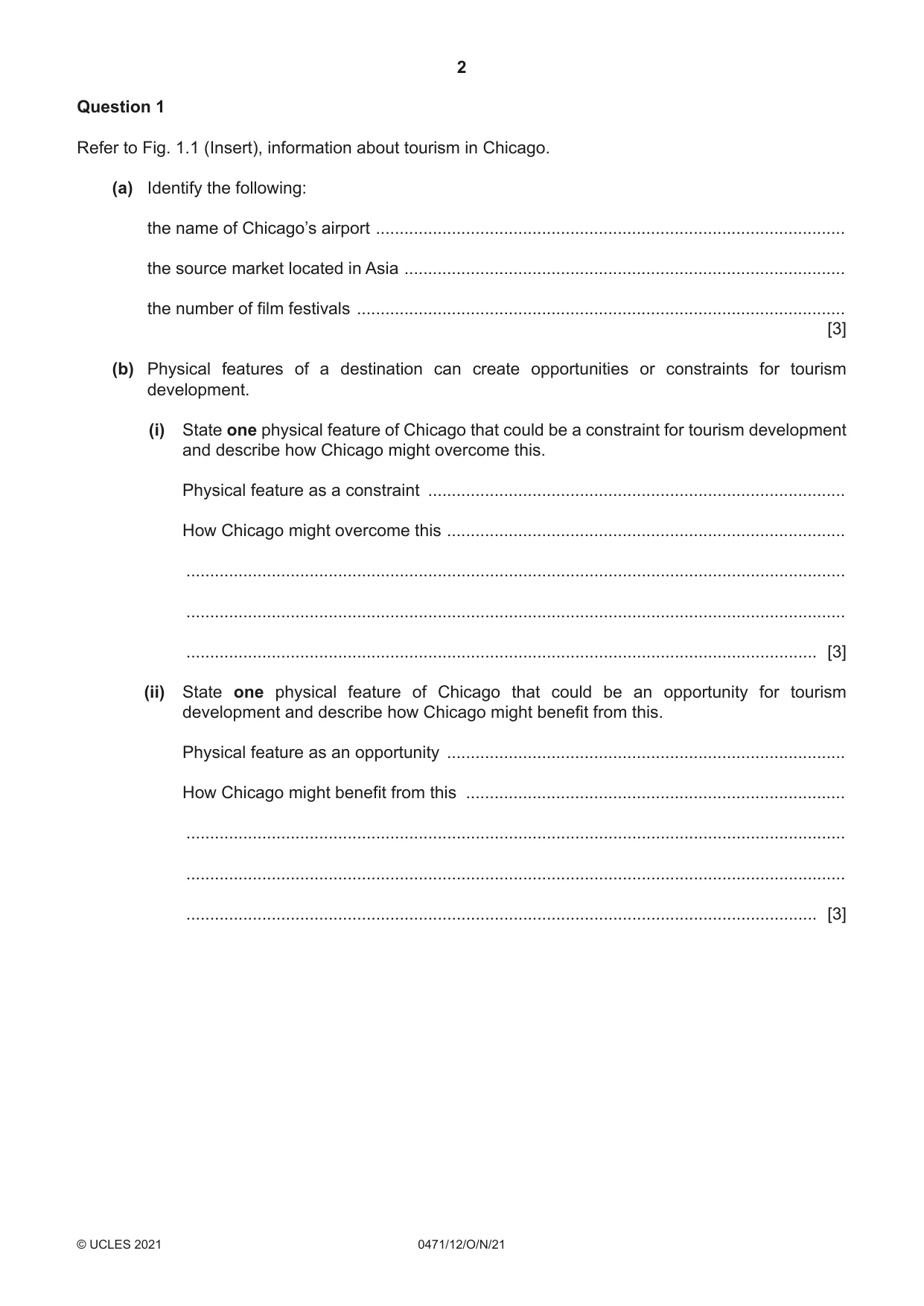
2 0471/12/O/N/21 © UCLES 2021 Question 1 Refer to Fig. 1.1 (Insert), information about tourism in Chicago. (a) Identify the following: the name of Chicago’s airport … the source market located in Asia … the number of film festivals … [3] (b) Physical features of a destination can create opportunities or constraints for tourism development. (i) State one physical feature of Chicago that could be a constraint for tourism development and describe how Chicago might overcome this. Physical feature as a constraint … How Chicago might overcome this … … … … [3] (ii) State one physical feature of Chicago that could be an opportunity for tourism development and describe how Chicago might benefit from this. Physical feature as an opportunity … How Chicago might benefit from this … … … … [3]
Question paper, page 3
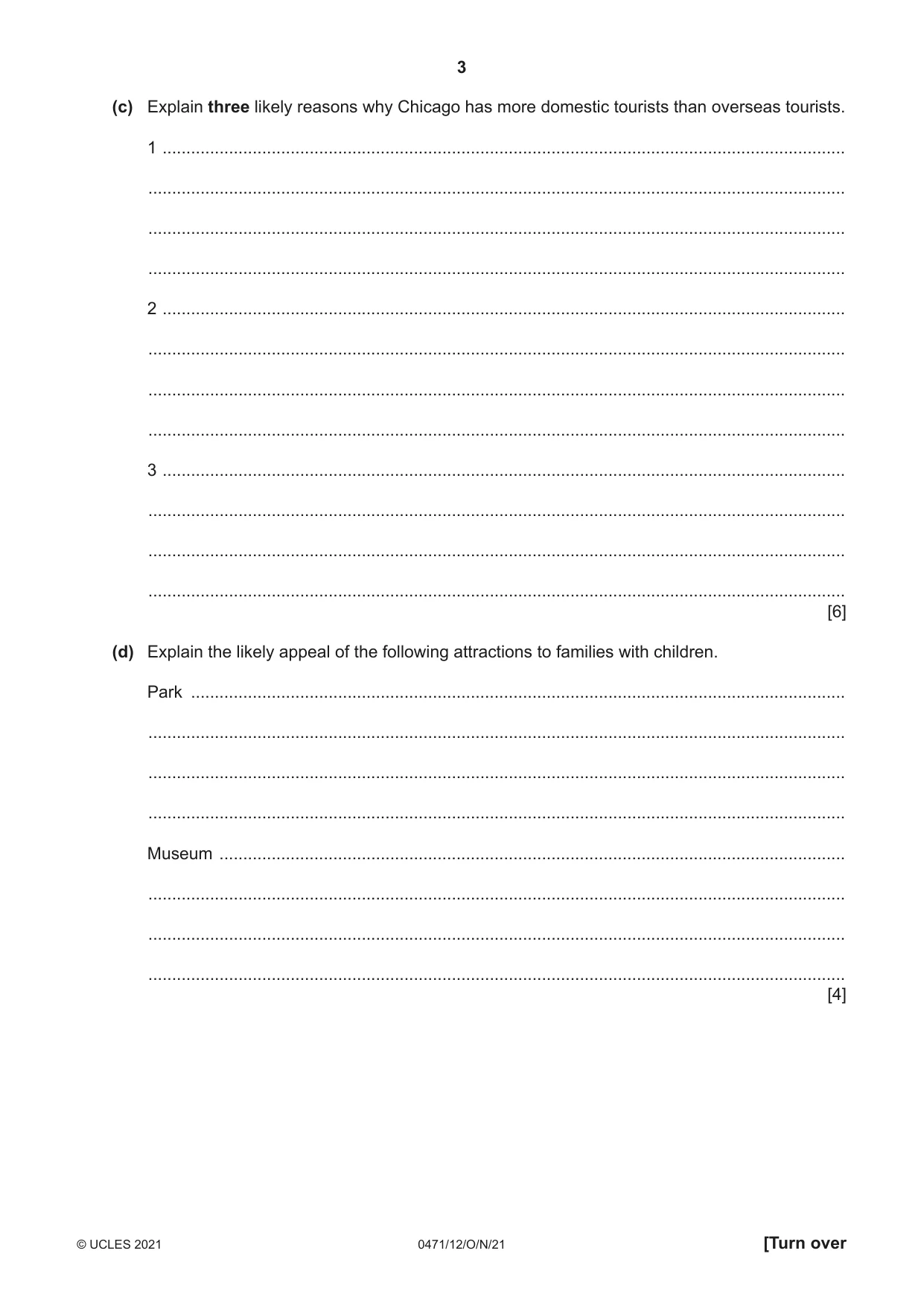
3 0471/12/O/N/21 © UCLES 2021 [Turn over (c) Explain three likely reasons why Chicago has more domestic tourists than overseas tourists. 1 … … … … 2 … … … … 3 … … … … [6] (d) Explain the likely appeal of the following attractions to families with children. Park … … … … Museum … … … … [4]
Question paper, page 4
4 0471/12/O/N/21 © UCLES 2021 (e) Discuss the economic benefits to Chicago of attracting more domestic tourists than overseas tourists. … … … … … … … … … … … … [6] [Total: 25]
Question paper, page 5
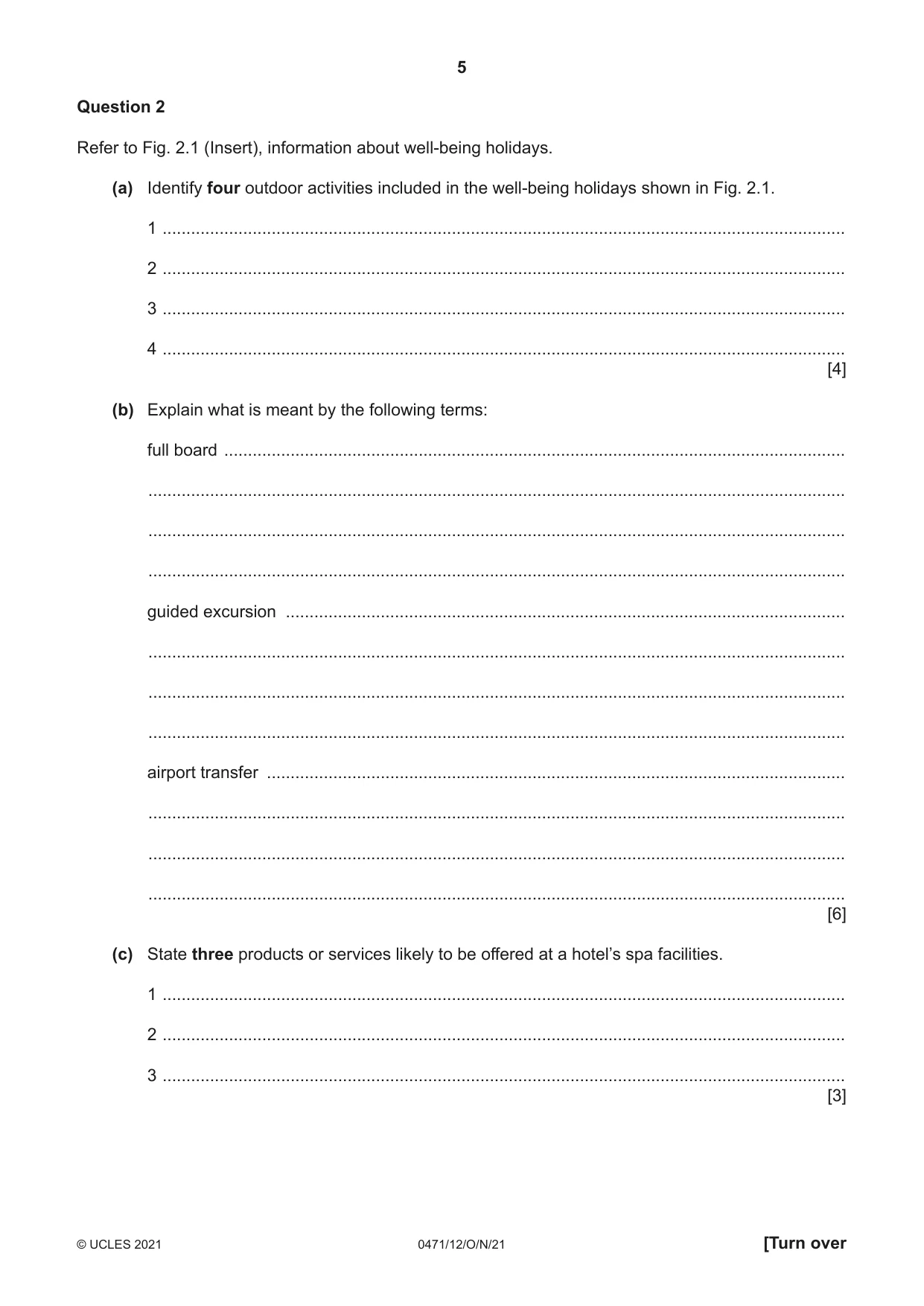
5 0471/12/O/N/21 © UCLES 2021 [Turn over Question 2 Refer to Fig. 2.1 (Insert), information about well-being holidays. (a) Identify four outdoor activities included in the well-being holidays shown in Fig. 2.1. 1 … 2 … 3 … 4 … [4] (b) Explain what is meant by the following terms: full board … … … … guided excursion … … … … airport transfer … … … … [6] (c) State three products or services likely to be offered at a hotel’s spa facilities. 1 … 2 … 3 … [3]
Question paper, page 6
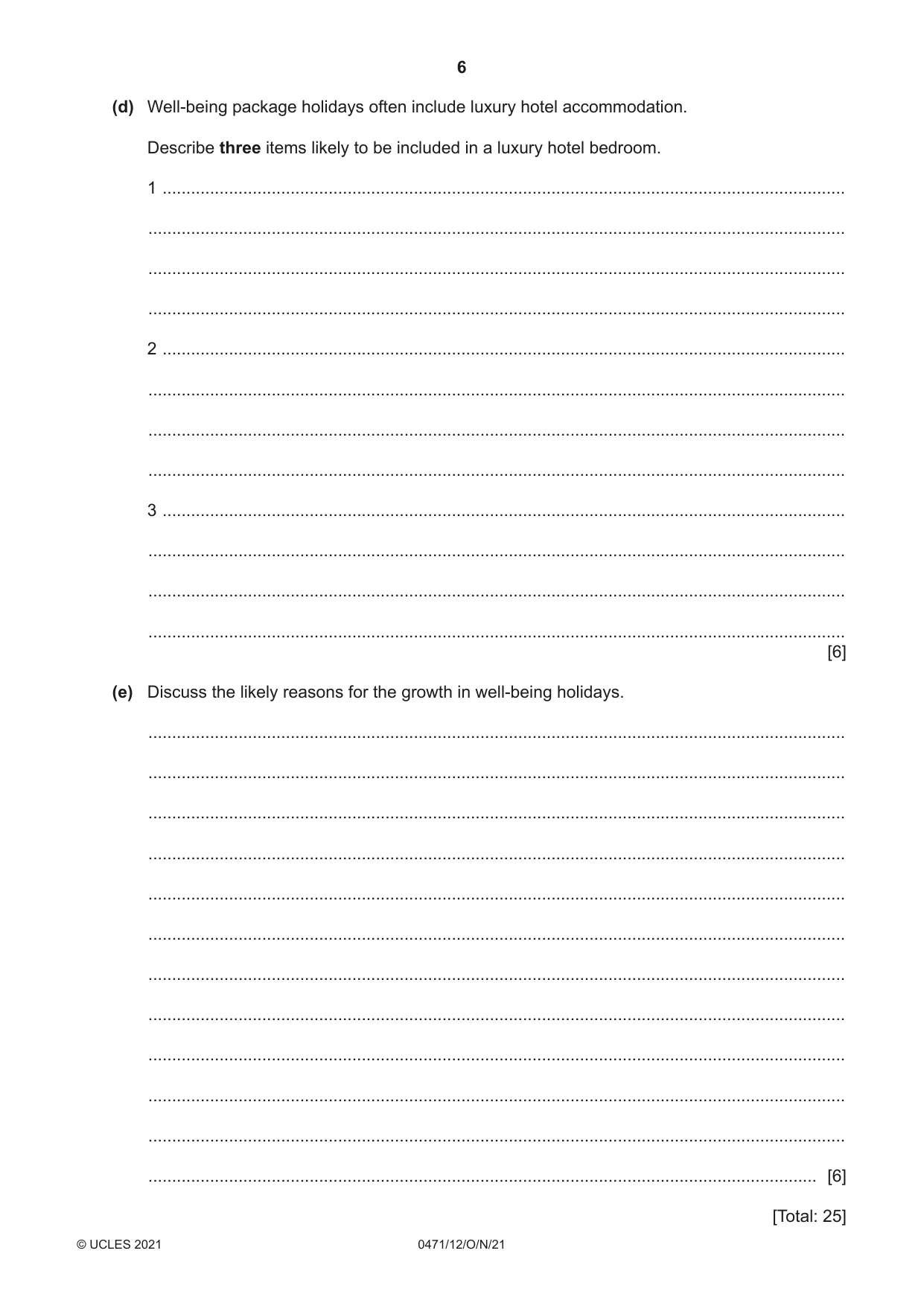
6 0471/12/O/N/21 © UCLES 2021 (d) Well-being package holidays often include luxury hotel accommodation. Describe three items likely to be included in a luxury hotel bedroom. 1 … … … … 2 … … … … 3 … … … … [6] (e) Discuss the likely reasons for the growth in well-being holidays. … … … … … … … … … … … … [6] [Total: 25]
Question paper, page 7
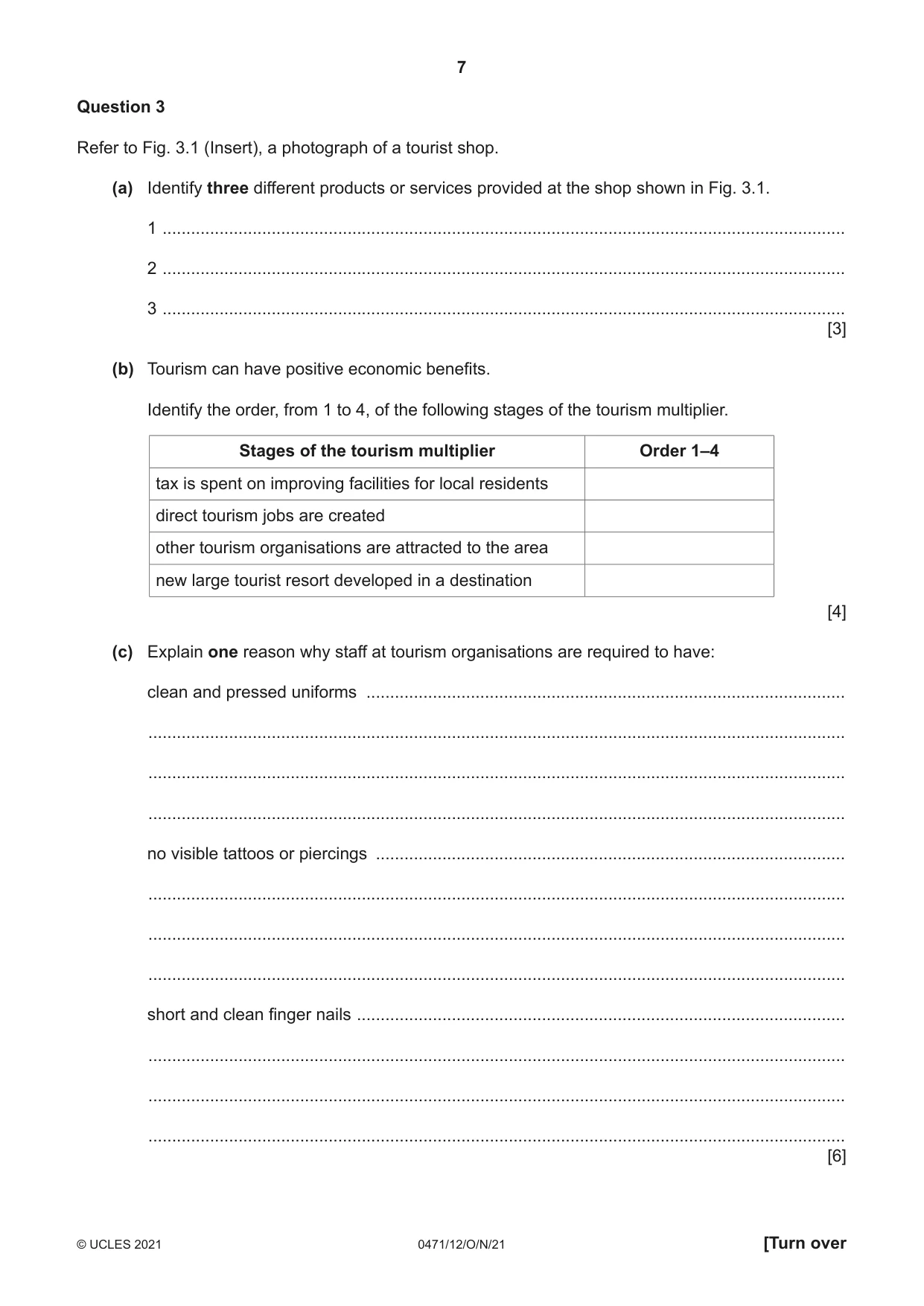
7 0471/12/O/N/21 © UCLES 2021 [Turn over Question 3 Refer to Fig. 3.1 (Insert), a photograph of a tourist shop. (a) Identify three different products or services provided at the shop shown in Fig. 3.1. 1 … 2 … 3 … [3] (b) Tourism can have positive economic benefits. Identify the order, from 1 to 4, of the following stages of the tourism multiplier. Stages of the tourism multiplier Order 1–4 tax is spent on improving facilities for local residents direct tourism jobs are created other tourism organisations are attracted to the area new large tourist resort developed in a destination [4] (c) Explain one reason why staff at tourism organisations are required to have: clean and pressed uniforms … … … … no visible tattoos or piercings … … … … short and clean finger nails … … … … [6]
Question paper, page 8
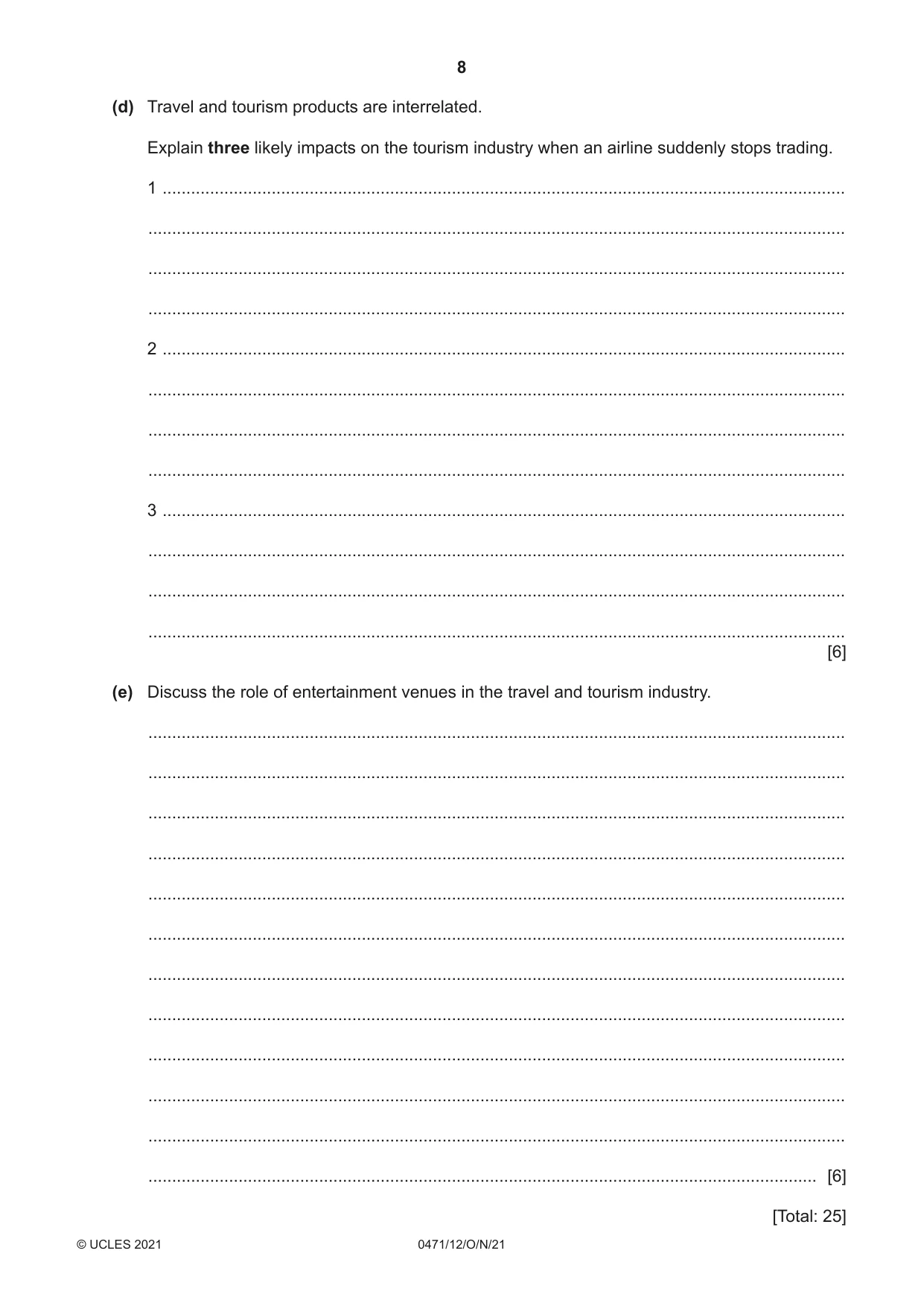
8 0471/12/O/N/21 © UCLES 2021 (d) Travel and tourism products are interrelated. Explain three likely impacts on the tourism industry when an airline suddenly stops trading. 1 … … … … 2 … … … … 3 … … … … [6] (e) Discuss the role of entertainment venues in the travel and tourism industry. … … … … … … … … … … … … [6] [Total: 25]
Question paper, page 9
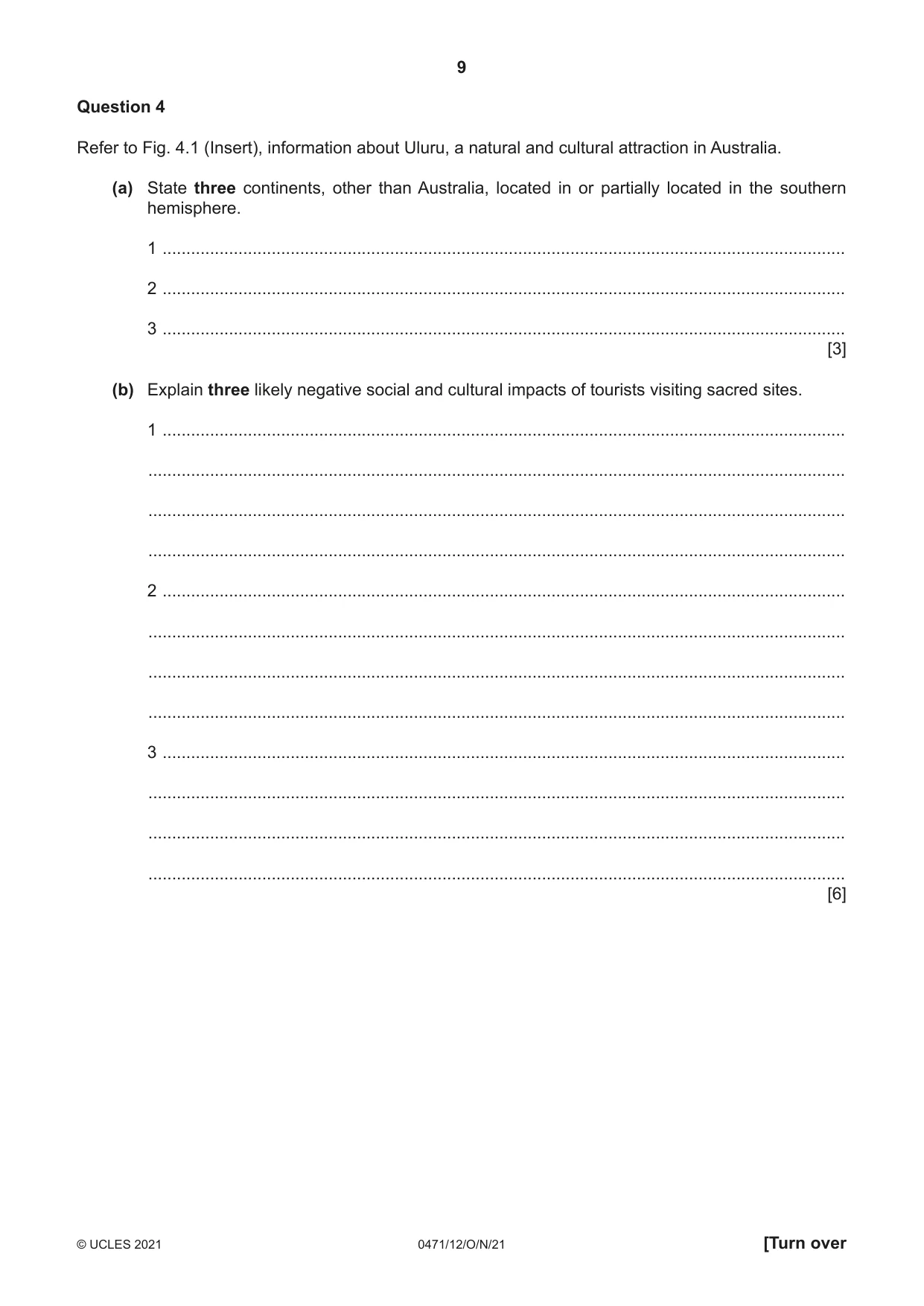
9 0471/12/O/N/21 © UCLES 2021 [Turn over Question 4 Refer to Fig. 4.1 (Insert), information about Uluru, a natural and cultural attraction in Australia. (a) State three continents, other than Australia, located in or partially located in the southern hemisphere. 1 … 2 … 3 … [3] (b) Explain three likely negative social and cultural impacts of tourists visiting sacred sites. 1 … … … … 2 … … … … 3 … … … … [6]
Question paper, page 10
10 0471/12/O/N/21 © UCLES 2021 (c) Explain three ways, other than banning direct access, natural attractions can be protected. 1 … … … … 2 … … … … 3 … … … … [6] (d) Explain two ways tourists can be informed about responsible behaviour when visiting sacred cultural attractions. 1 … … … … 2 … … … … [4]
Question paper, page 11
11 0471/12/O/N/21 © UCLES 2021 (e) Discuss the importance to destinations of protecting natural and cultural attractions. … … … … … … … … … … … … [6] [Total: 25]
Question paper, page 12
12 0471/12/O/N/21 © UCLES 2021 BLANK PAGE The boundaries and names shown, the designations used and the presentation of material on any maps contained in this question paper/insert do not imply official endorsement or acceptance by Cambridge Assessment International Education concerning the legal status of any country, territory, or area or any of its authorities, or of the delimitation of its frontiers or boundaries. Permission to reproduce items where third-party owned material protected by copyright is included has been sought and cleared where possible. Every reasonable effort has been made by the publisher (UCLES) to trace copyright holders, but if any items requiring clearance have unwittingly been included, the publisher will be pleased to make amends at the earliest possible opportunity. To avoid the issue of disclosure of answer-related information to candidates, all copyright acknowledgements are reproduced online in the Cambridge Assessment International Education Copyright Acknowledgements Booklet. This is produced for each series of examinations and is freely available to download at www.cambridgeinternational.org after the live examination series. Cambridge Assessment International Education is part of the Cambridge Assessment Group. Cambridge Assessment is the brand name of the University of Cambridge Local Examinations Syndicate (UCLES), which itself is a department of the University of Cambridge.
Mark scheme, page 1
This document consists of 13 printed pages. © UCLES 2021 [Turn over Cambridge IGCSE™ TRAVEL & TOURISM 0471/12 Paper 1 Core Paper October/November 2021 MARK SCHEME Maximum Mark: 100 Published This mark scheme is published as an aid to teachers and candidates, to indicate the requirements of the examination. It shows the basis on which Examiners were instructed to award marks. It does not indicate the details of the discussions that took place at an Examiners’ meeting before marking began, which would have considered the acceptability of alternative answers. Mark schemes should be read in conjunction with the question paper and the Principal Examiner Report for Teachers. Cambridge International will not enter into discussions about these mark schemes. Cambridge International is publishing the mark schemes for the October/November 2021 series for most Cambridge IGCSE™, Cambridge International A and AS Level components and some Cambridge O Level components.
Mark scheme, page 2
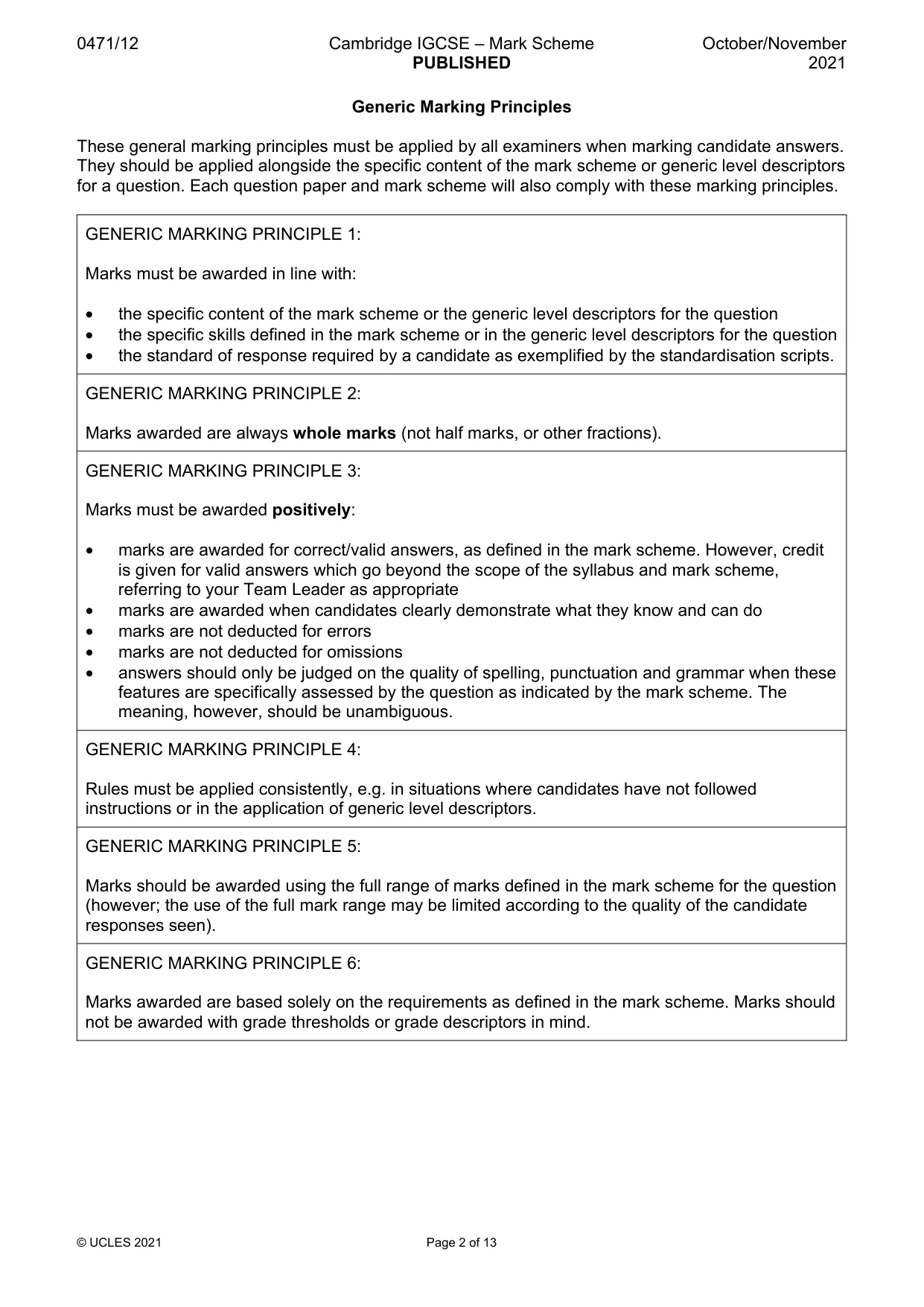
0471/12 Cambridge IGCSE – Mark Scheme PUBLISHED October/November 2021 © UCLES 2021 Page 2 of 13 Generic Marking Principles These general marking principles must be applied by all examiners when marking candidate answers. They should be applied alongside the specific content of the mark scheme or generic level descriptors for a question. Each question paper and mark scheme will also comply with these marking principles. GENERIC MARKING PRINCIPLE 1: Marks must be awarded in line with: • the specific content of the mark scheme or the generic level descriptors for the question • the specific skills defined in the mark scheme or in the generic level descriptors for the question • the standard of response required by a candidate as exemplified by the standardisation scripts. GENERIC MARKING PRINCIPLE 2: Marks awarded are always whole marks (not half marks, or other fractions). GENERIC MARKING PRINCIPLE 3: Marks must be awarded positively: • marks are awarded for correct/valid answers, as defined in the mark scheme. However, credit is given for valid answers which go beyond the scope of the syllabus and mark scheme, referring to your Team Leader as appropriate • marks are awarded when candidates clearly demonstrate what they know and can do • marks are not deducted for errors • marks are not deducted for omissions • answers should only be judged on the quality of spelling, punctuation and grammar when these features are specifically assessed by the question as indicated by the mark scheme. The meaning, however, should be unambiguous. GENERIC MARKING PRINCIPLE 4: Rules must be applied consistently, e.g. in situations where candidates have not followed instructions or in the application of generic level descriptors. GENERIC MARKING PRINCIPLE 5: Marks should be awarded using the full range of marks defined in the mark scheme for the question (however; the use of the full mark range may be limited according to the quality of the candidate responses seen). GENERIC MARKING PRINCIPLE 6: Marks awarded are based solely on the requirements as defined in the mark scheme. Marks should not be awarded with grade thresholds or grade descriptors in mind.
Mark scheme, page 3
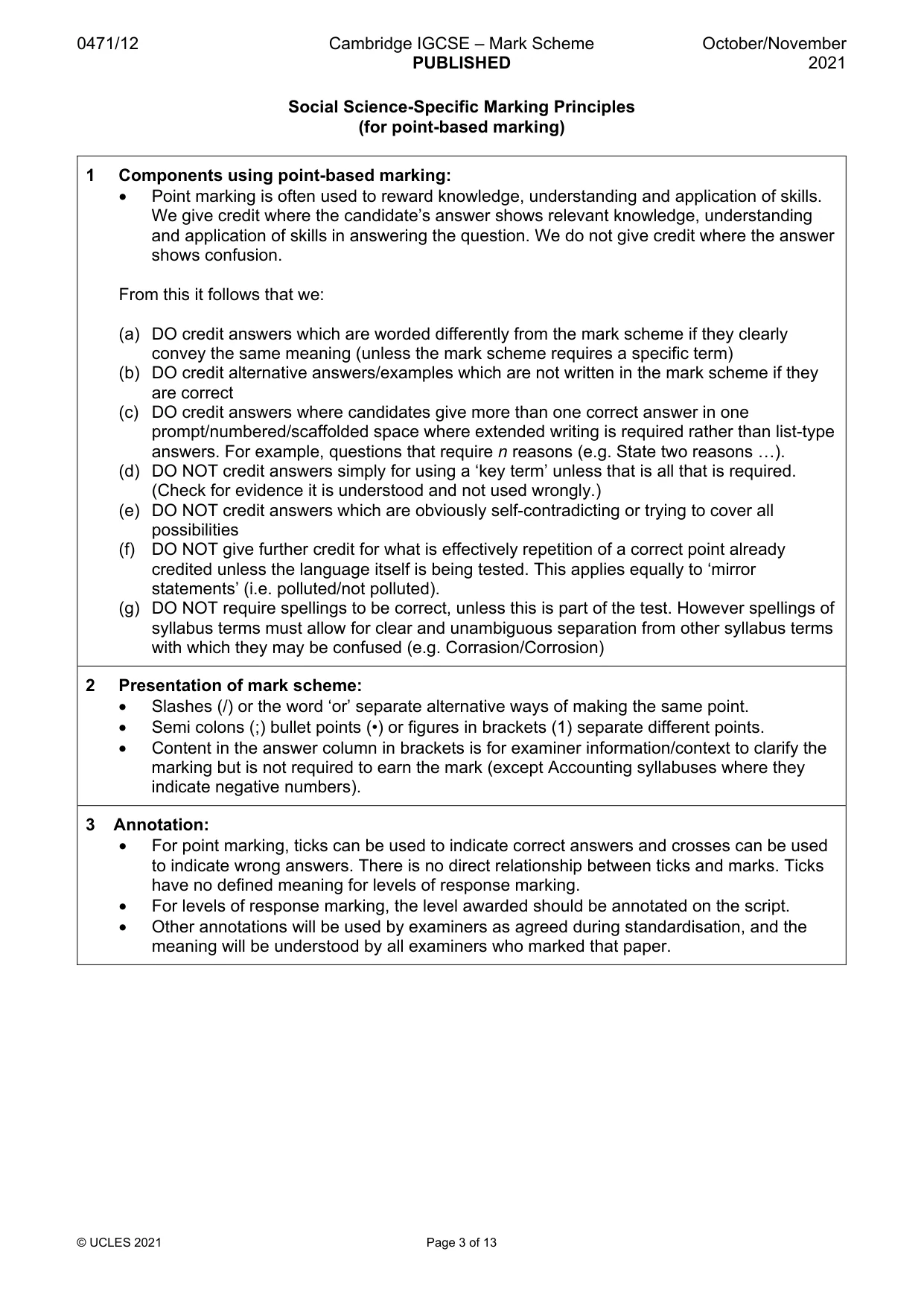
0471/12 Cambridge IGCSE – Mark Scheme PUBLISHED October/November 2021 © UCLES 2021 Page 3 of 13 Social Science-Specific Marking Principles (for point-based marking) 1 Components using point-based marking: • Point marking is often used to reward knowledge, understanding and application of skills. We give credit where the candidate’s answer shows relevant knowledge, understanding and application of skills in answering the question. We do not give credit where the answer shows confusion. From this it follows that we: (a) DO credit answers which are worded differently from the mark scheme if they clearly convey the same meaning (unless the mark scheme requires a specific term) (b) DO credit alternative answers/examples which are not written in the mark scheme if they are correct (c) DO credit answers where candidates give more than one correct answer in one prompt/numbered/scaffolded space where extended writing is required rather than list-type answers. For example, questions that require n reasons (e.g. State two reasons …). (d) DO NOT credit answers simply for using a ‘key term’ unless that is all that is required. (Check for evidence it is understood and not used wrongly.) (e) DO NOT credit answers which are obviously self-contradicting or trying to cover all possibilities (f) DO NOT give further credit for what is effectively repetition of a correct point already credited unless the language itself is being tested. This applies equally to ‘mirror statements’ (i.e. polluted/not polluted). (g) DO NOT require spellings to be correct, unless this is part of the test. However spellings of syllabus terms must allow for clear and unambiguous separation from other syllabus terms with which they may be confused (e.g. Corrasion/Corrosion) 2 Presentation of mark scheme: • Slashes (/) or the word ‘or’ separate alternative ways of making the same point. • Semi colons (;) bullet points (•) or figures in brackets (1) separate different points. • Content in the answer column in brackets is for examiner information/context to clarify the marking but is not required to earn the mark (except Accounting syllabuses where they indicate negative numbers). 3 Annotation: • For point marking, ticks can be used to indicate correct answers and crosses can be used to indicate wrong answers. There is no direct relationship between ticks and marks. Ticks have no defined meaning for levels of response marking. • For levels of response marking, the level awarded should be annotated on the script. • Other annotations will be used by examiners as agreed during standardisation, and the meaning will be understood by all examiners who marked that paper.
Mark scheme, page 4
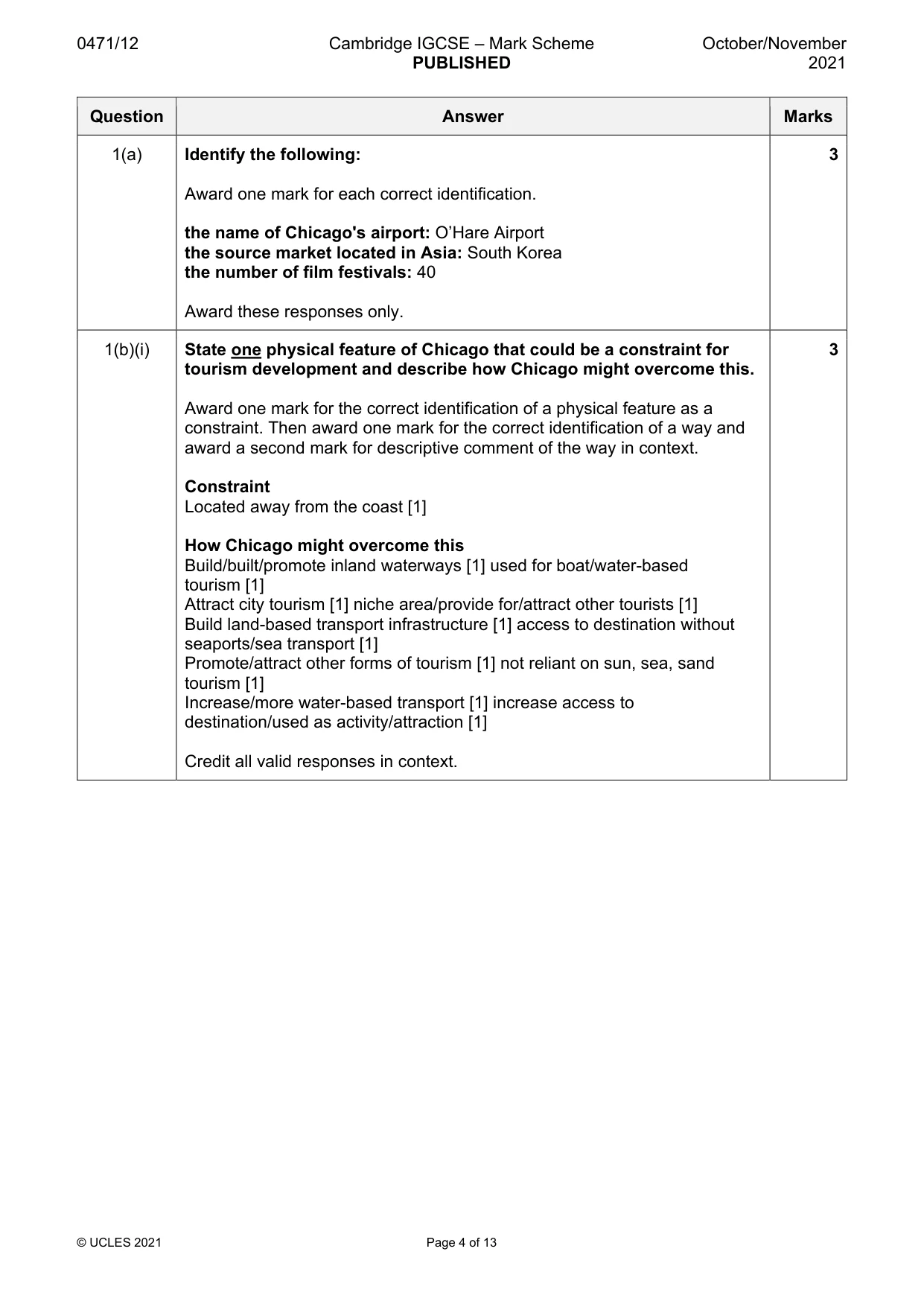
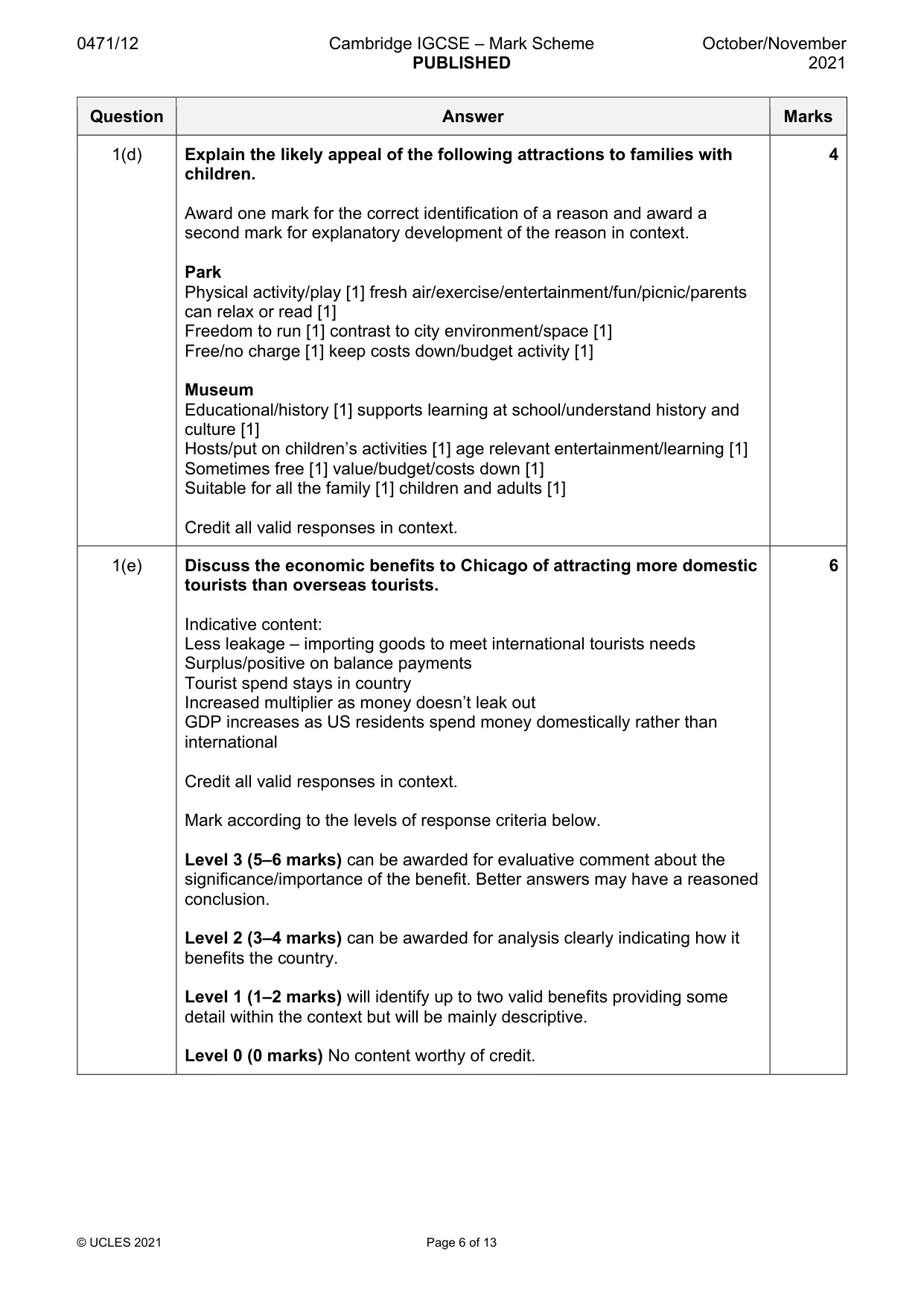
0471/12 Cambridge IGCSE – Mark Scheme PUBLISHED October/November 2021 © UCLES 2021 Page 4 of 13 Question Answer Marks 1(a) Identify the following: Award one mark for each correct identification. the name of Chicago's airport: O’Hare Airport the source market located in Asia: South Korea the number of film festivals: 40 Award these responses only. 3 1(b)(i) State one physical feature of Chicago that could be a constraint for tourism development and describe how Chicago might overcome this. Award one mark for the correct identification of a physical feature as a constraint. Then award one mark for the correct identification of a way and award a second mark for descriptive comment of the way in context. Constraint Located away from the coast [1] How Chicago might overcome this Build/built/promote inland waterways [1] used for boat/water-based tourism [1] Attract city tourism [1] niche area/provide for/attract other tourists [1] Build land-based transport infrastructure [1] access to destination without seaports/sea transport [1] Promote/attract other forms of tourism [1] not reliant on sun, sea, sand tourism [1] Increase/more water-based transport [1] increase access to destination/used as activity/attraction [1] Credit all valid responses in context. 3
Mark scheme, page 5
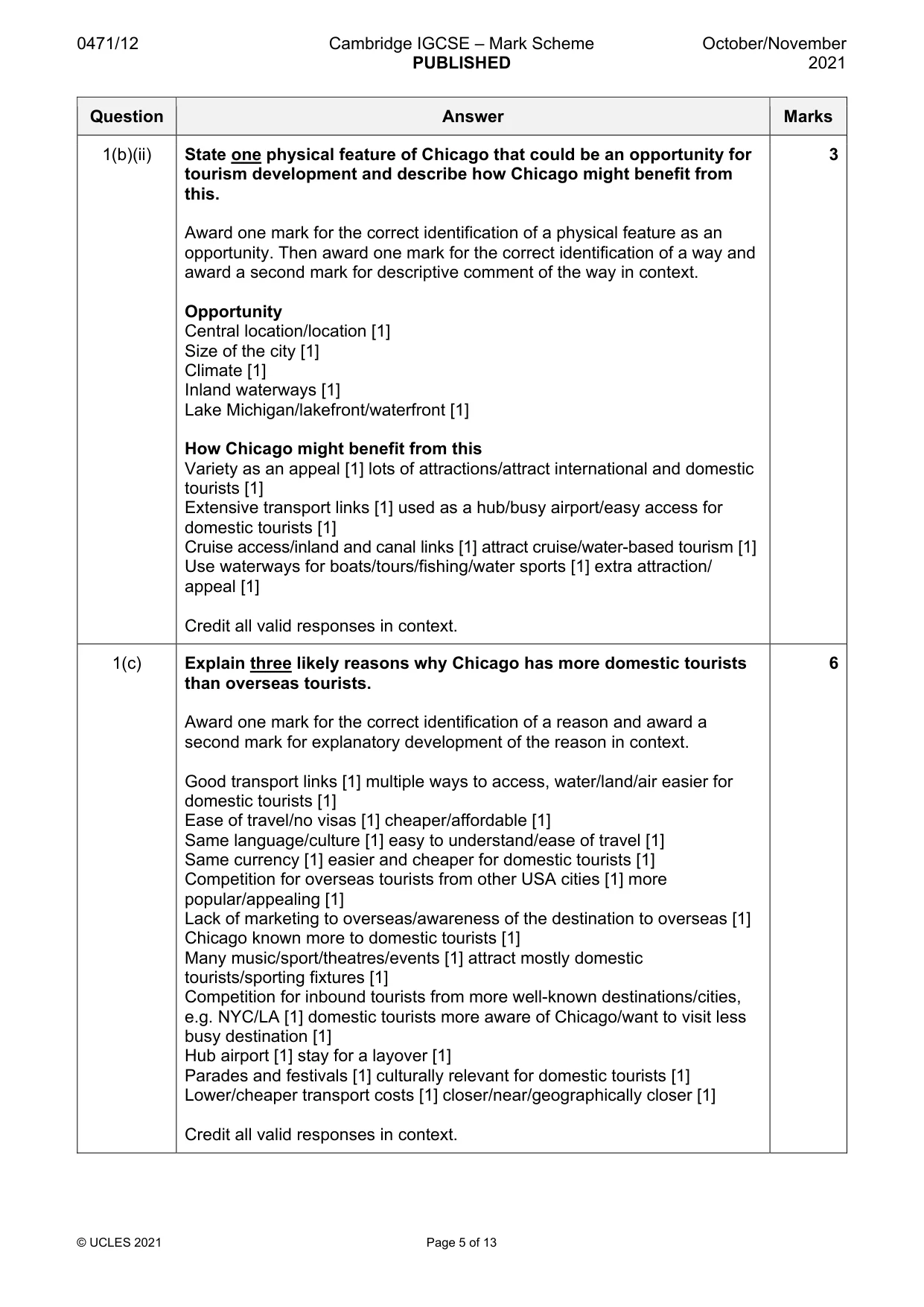
0471/12 Cambridge IGCSE – Mark Scheme PUBLISHED October/November 2021 © UCLES 2021 Page 5 of 13 Question Answer Marks 1(b)(ii) State one physical feature of Chicago that could be an opportunity for tourism development and describe how Chicago might benefit from this. Award one mark for the correct identification of a physical feature as an opportunity. Then award one mark for the correct identification of a way and award a second mark for descriptive comment of the way in context. Opportunity Central location/location [1] Size of the city [1] Climate [1] Inland waterways [1] Lake Michigan/lakefront/waterfront [1] How Chicago might benefit from this Variety as an appeal [1] lots of attractions/attract international and domestic tourists [1] Extensive transport links [1] used as a hub/busy airport/easy access for domestic tourists [1] Cruise access/inland and canal links [1] attract cruise/water-based tourism [1] Use waterways for boats/tours/fishing/water sports [1] extra attraction/ appeal [1] Credit all valid responses in context. 3 1(c) Explain three likely reasons why Chicago has more domestic tourists than overseas tourists. Award one mark for the correct identification of a reason and award a second mark for explanatory development of the reason in context. Good transport links [1] multiple ways to access, water/land/air easier for domestic tourists [1] Ease of travel/no visas [1] cheaper/affordable [1] Same language/culture [1] easy to understand/ease of travel [1] Same currency [1] easier and cheaper for domestic tourists [1] Competition for overseas tourists from other USA cities [1] more popular/appealing [1] Lack of marketing to overseas/awareness of the destination to overseas [1] Chicago known more to domestic tourists [1] Many music/sport/theatres/events [1] attract mostly domestic tourists/sporting fixtures [1] Competition for inbound tourists from more well-known destinations/cities, e.g. NYC/LA [1] domestic tourists more aware of Chicago/want to visit less busy destination [1] Hub airport [1] stay for a layover [1] Parades and festivals [1] culturally relevant for domestic tourists [1] Lower/cheaper transport costs [1] closer/near/geographically closer [1] Credit all valid responses in context. 6
Mark scheme, page 6
0471/12 Cambridge IGCSE – Mark Scheme PUBLISHED October/November 2021 © UCLES 2021 Page 6 of 13 Question Answer Marks 1(d) Explain the likely appeal of the following attractions to families with children. Award one mark for the correct identification of a reason and award a second mark for explanatory development of the reason in context. Park Physical activity/play [1] fresh air/exercise/entertainment/fun/picnic/parents can relax or read [1] Freedom to run [1] contrast to city environment/space [1] Free/no charge [1] keep costs down/budget activity [1] Museum Educational/history [1] supports learning at school/understand history and culture [1] Hosts/put on children’s activities [1] age relevant entertainment/learning [1] Sometimes free [1] value/budget/costs down [1] Suitable for all the family [1] children and adults [1] Credit all valid responses in context. 4 1(e) Discuss the economic benefits to Chicago of attracting more domestic tourists than overseas tourists. Indicative content: Less leakage – importing goods to meet international tourists needs Surplus/positive on balance payments Tourist spend stays in country Increased multiplier as money doesn’t leak out GDP increases as US residents spend money domestically rather than international Credit all valid responses in context. Mark according to the levels of response criteria below. Level 3 (5–6 marks) can be awarded for evaluative comment about the significance/importance of the benefit. Better answers may have a reasoned conclusion. Level 2 (3–4 marks) can be awarded for analysis clearly indicating how it benefits the country. Level 1 (1–2 marks) will identify up to two valid benefits providing some detail within the context but will be mainly descriptive. Level 0 (0 marks) No content worthy of credit. 6
Mark scheme, page 7
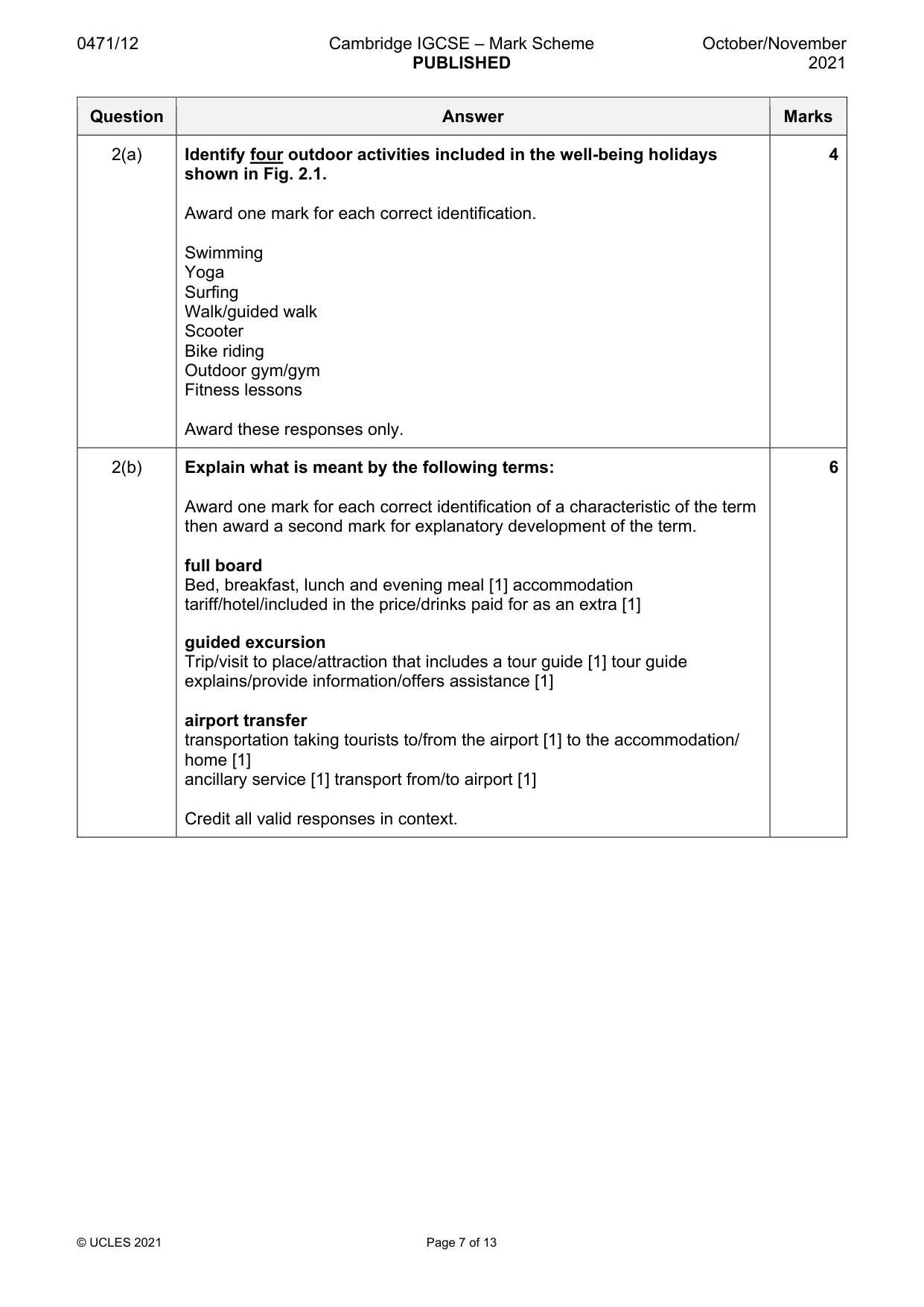
0471/12 Cambridge IGCSE – Mark Scheme PUBLISHED October/November 2021 © UCLES 2021 Page 7 of 13 Question Answer Marks 2(a) Identify four outdoor activities included in the well-being holidays shown in Fig. 2.1. Award one mark for each correct identification. Swimming Yoga Surfing Walk/guided walk Scooter Bike riding Outdoor gym/gym Fitness lessons Award these responses only. 4 2(b) Explain what is meant by the following terms: Award one mark for each correct identification of a characteristic of the term then award a second mark for explanatory development of the term. full board Bed, breakfast, lunch and evening meal [1] accommodation tariff/hotel/included in the price/drinks paid for as an extra [1] guided excursion Trip/visit to place/attraction that includes a tour guide [1] tour guide explains/provide information/offers assistance [1] airport transfer transportation taking tourists to/from the airport [1] to the accommodation/ home [1] ancillary service [1] transport from/to airport [1] Credit all valid responses in context. 6
Mark scheme, page 8
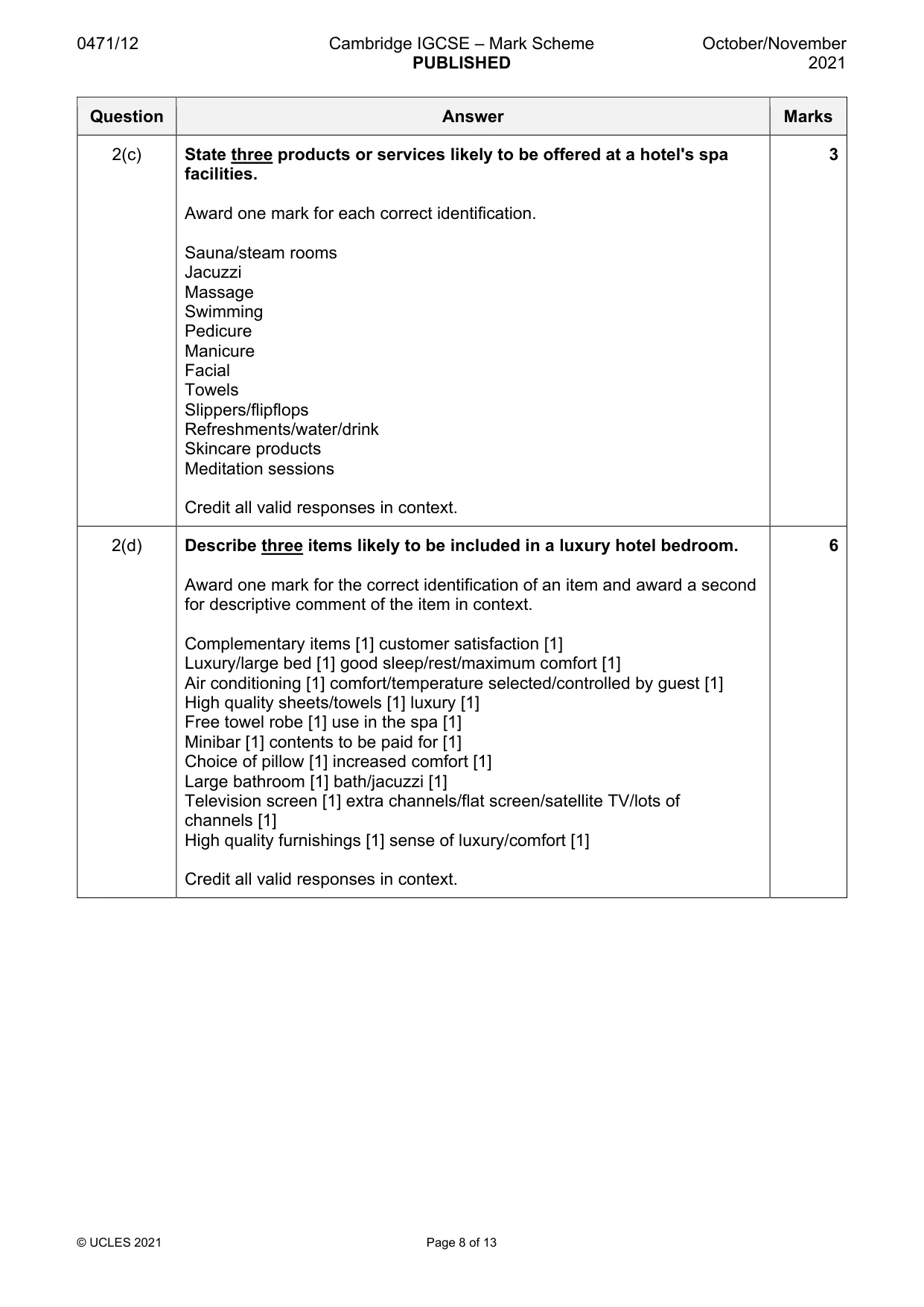
0471/12 Cambridge IGCSE – Mark Scheme PUBLISHED October/November 2021 © UCLES 2021 Page 8 of 13 Question Answer Marks 2(c) State three products or services likely to be offered at a hotel's spa facilities. Award one mark for each correct identification. Sauna/steam rooms Jacuzzi Massage Swimming Pedicure Manicure Facial Towels Slippers/flipflops Refreshments/water/drink Skincare products Meditation sessions Credit all valid responses in context. 3 2(d) Describe three items likely to be included in a luxury hotel bedroom. Award one mark for the correct identification of an item and award a second for descriptive comment of the item in context. Complementary items [1] customer satisfaction [1] Luxury/large bed [1] good sleep/rest/maximum comfort [1] Air conditioning [1] comfort/temperature selected/controlled by guest [1] High quality sheets/towels [1] luxury [1] Free towel robe [1] use in the spa [1] Minibar [1] contents to be paid for [1] Choice of pillow [1] increased comfort [1] Large bathroom [1] bath/jacuzzi [1] Television screen [1] extra channels/flat screen/satellite TV/lots of channels [1] High quality furnishings [1] sense of luxury/comfort [1] Credit all valid responses in context. 6
Mark scheme, page 9
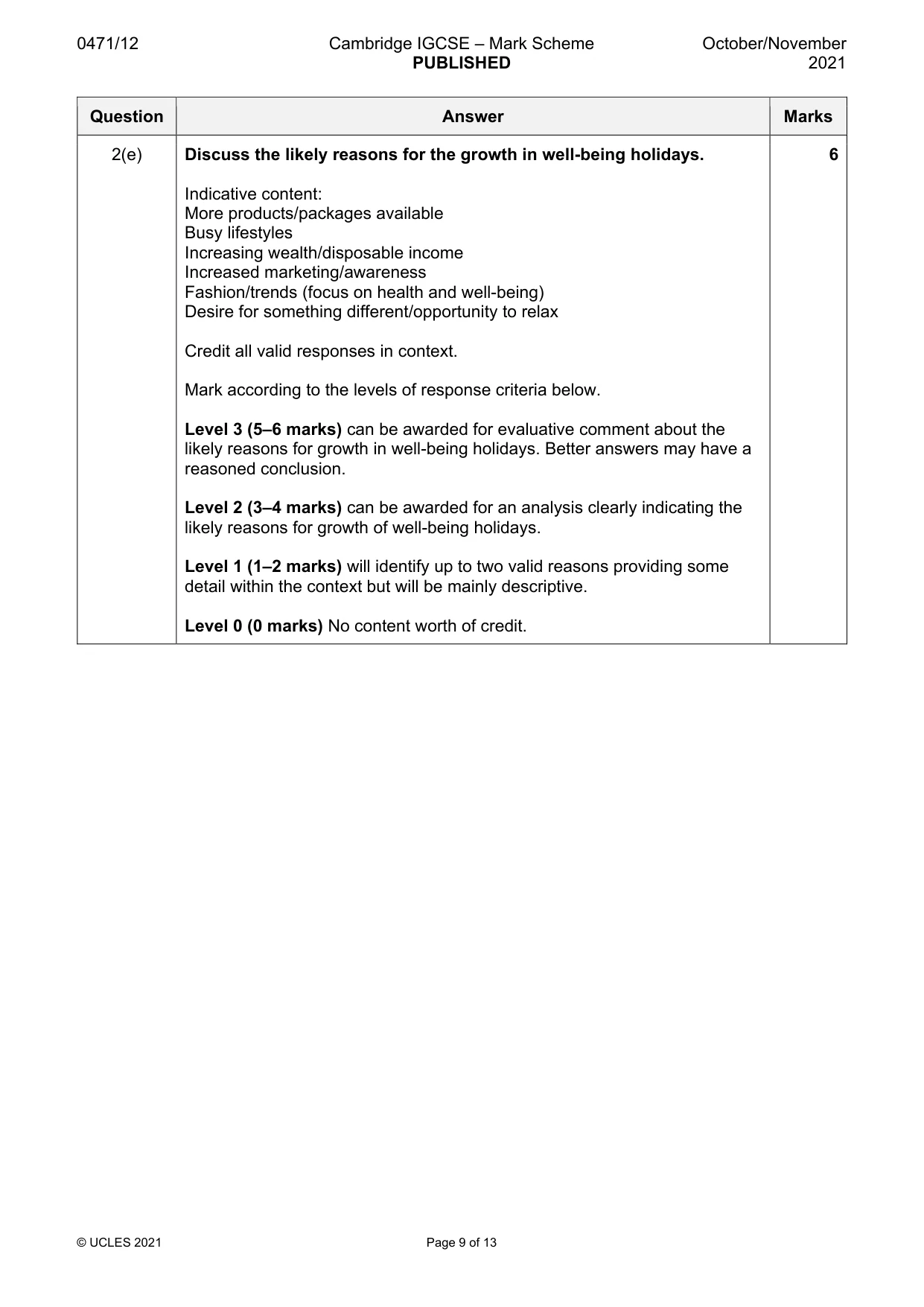
0471/12 Cambridge IGCSE – Mark Scheme PUBLISHED October/November 2021 © UCLES 2021 Page 9 of 13 Question Answer Marks 2(e) Discuss the likely reasons for the growth in well-being holidays. Indicative content: More products/packages available Busy lifestyles Increasing wealth/disposable income Increased marketing/awareness Fashion/trends (focus on health and well-being) Desire for something different/opportunity to relax Credit all valid responses in context. Mark according to the levels of response criteria below. Level 3 (5–6 marks) can be awarded for evaluative comment about the likely reasons for growth in well-being holidays. Better answers may have a reasoned conclusion. Level 2 (3–4 marks) can be awarded for an analysis clearly indicating the likely reasons for growth of well-being holidays. Level 1 (1–2 marks) will identify up to two valid reasons providing some detail within the context but will be mainly descriptive. Level 0 (0 marks) No content worth of credit. 6
Mark scheme, page 10
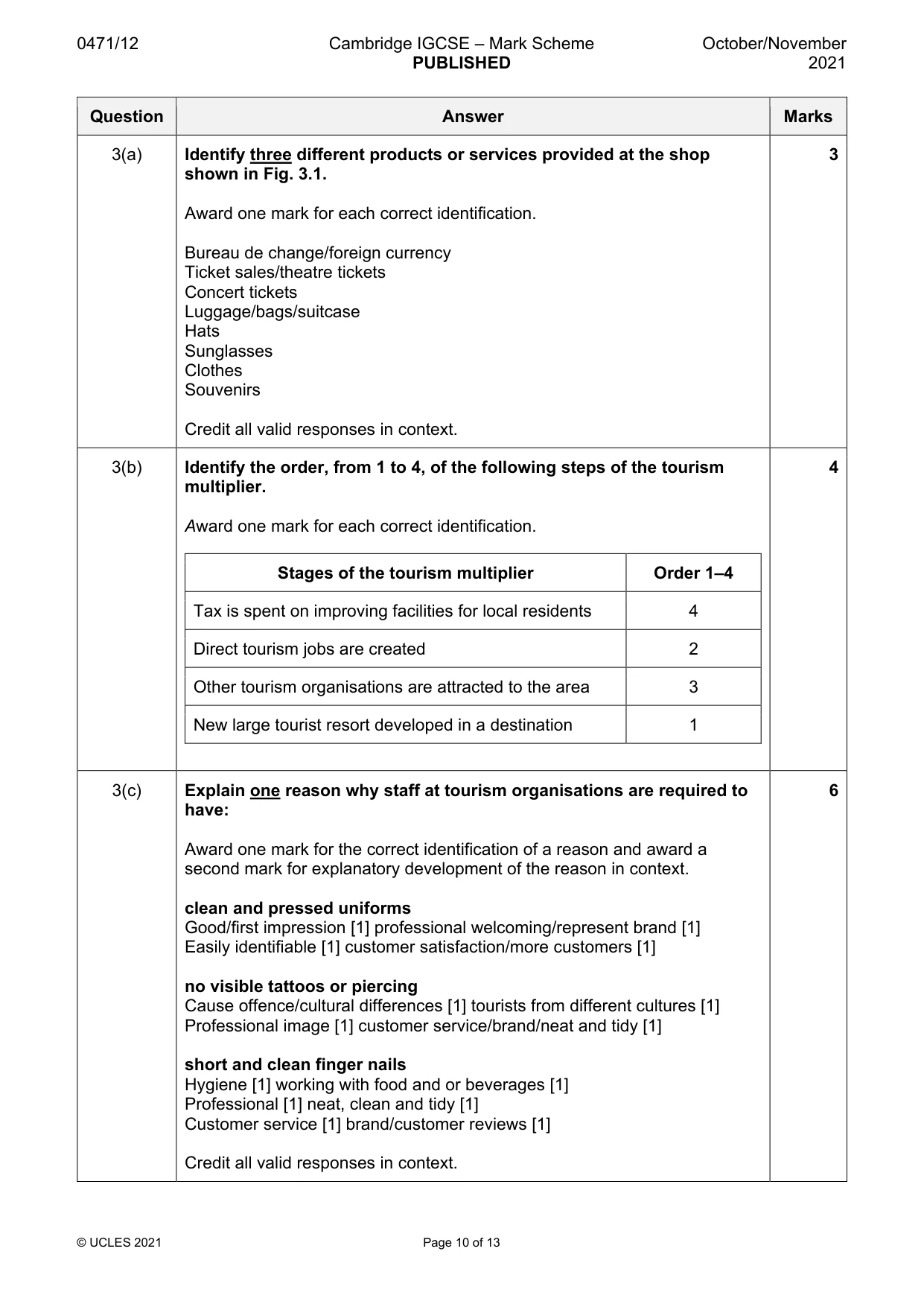
0471/12 Cambridge IGCSE – Mark Scheme PUBLISHED October/November 2021 © UCLES 2021 Page 10 of 13 Question Answer Marks 3(a) Identify three different products or services provided at the shop shown in Fig. 3.1. Award one mark for each correct identification. Bureau de change/foreign currency Ticket sales/theatre tickets Concert tickets Luggage/bags/suitcase Hats Sunglasses Clothes Souvenirs Credit all valid responses in context. 3 3(b) Identify the order, from 1 to 4, of the following steps of the tourism multiplier. Award one mark for each correct identification. Stages of the tourism multiplier Order 1–4 Tax is spent on improving facilities for local residents 4 Direct tourism jobs are created 2 Other tourism organisations are attracted to the area 3 New large tourist resort developed in a destination 1 4 3(c) Explain one reason why staff at tourism organisations are required to have: Award one mark for the correct identification of a reason and award a second mark for explanatory development of the reason in context. clean and pressed uniforms Good/first impression [1] professional welcoming/represent brand [1] Easily identifiable [1] customer satisfaction/more customers [1] no visible tattoos or piercing Cause offence/cultural differences [1] tourists from different cultures [1] Professional image [1] customer service/brand/neat and tidy [1] short and clean finger nails Hygiene [1] working with food and or beverages [1] Professional [1] neat, clean and tidy [1] Customer service [1] brand/customer reviews [1] Credit all valid responses in context. 6
Mark scheme, page 11
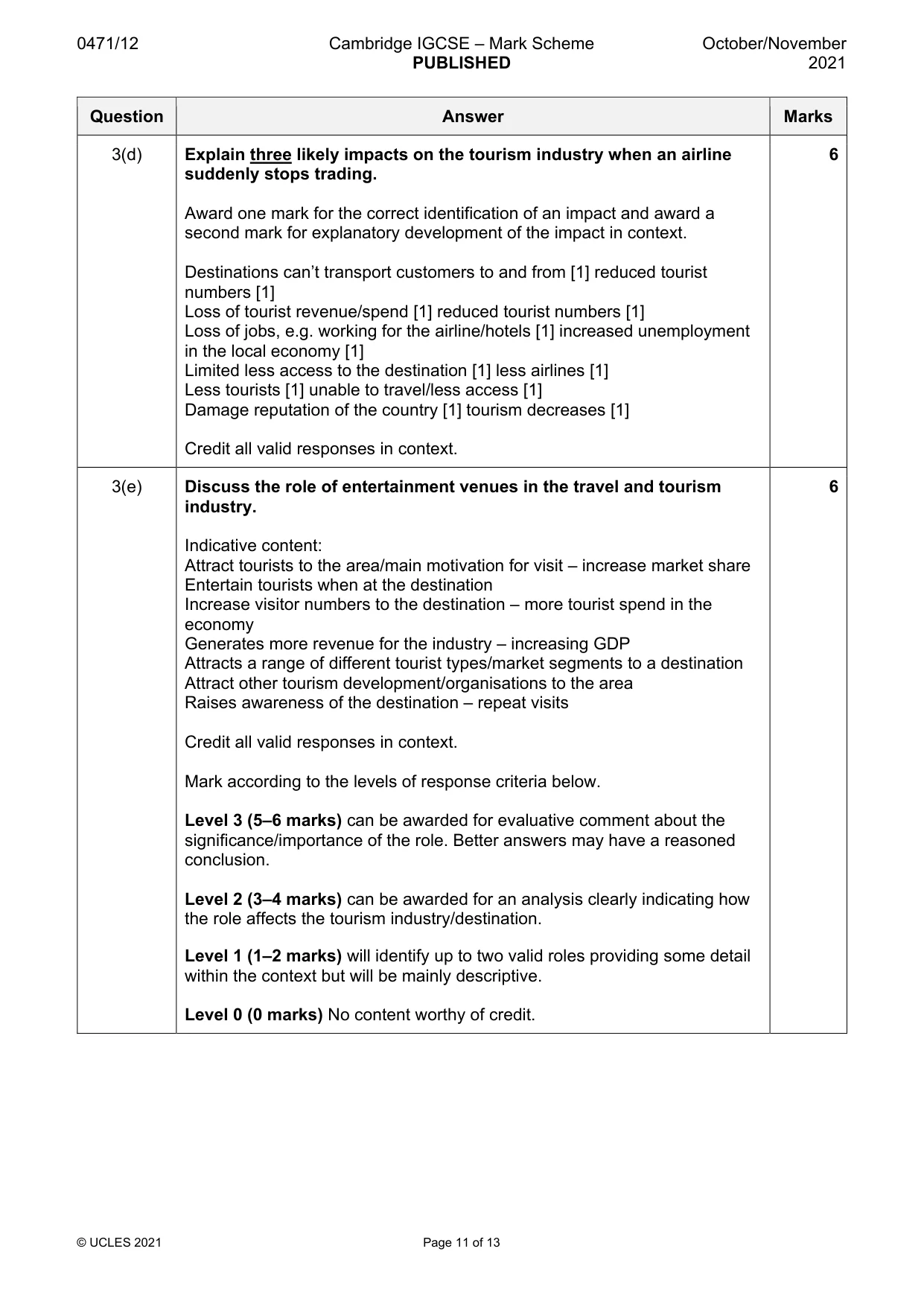
0471/12 Cambridge IGCSE – Mark Scheme PUBLISHED October/November 2021 © UCLES 2021 Page 11 of 13 Question Answer Marks 3(d) Explain three likely impacts on the tourism industry when an airline suddenly stops trading. Award one mark for the correct identification of an impact and award a second mark for explanatory development of the impact in context. Destinations can’t transport customers to and from [1] reduced tourist numbers [1] Loss of tourist revenue/spend [1] reduced tourist numbers [1] Loss of jobs, e.g. working for the airline/hotels [1] increased unemployment in the local economy [1] Limited less access to the destination [1] less airlines [1] Less tourists [1] unable to travel/less access [1] Damage reputation of the country [1] tourism decreases [1] Credit all valid responses in context. 6 3(e) Discuss the role of entertainment venues in the travel and tourism industry. Indicative content: Attract tourists to the area/main motivation for visit – increase market share Entertain tourists when at the destination Increase visitor numbers to the destination – more tourist spend in the economy Generates more revenue for the industry – increasing GDP Attracts a range of different tourist types/market segments to a destination Attract other tourism development/organisations to the area Raises awareness of the destination – repeat visits Credit all valid responses in context. Mark according to the levels of response criteria below. Level 3 (5–6 marks) can be awarded for evaluative comment about the significance/importance of the role. Better answers may have a reasoned conclusion. Level 2 (3–4 marks) can be awarded for an analysis clearly indicating how the role affects the tourism industry/destination. Level 1 (1–2 marks) will identify up to two valid roles providing some detail within the context but will be mainly descriptive. Level 0 (0 marks) No content worthy of credit. 6
Mark scheme, page 12
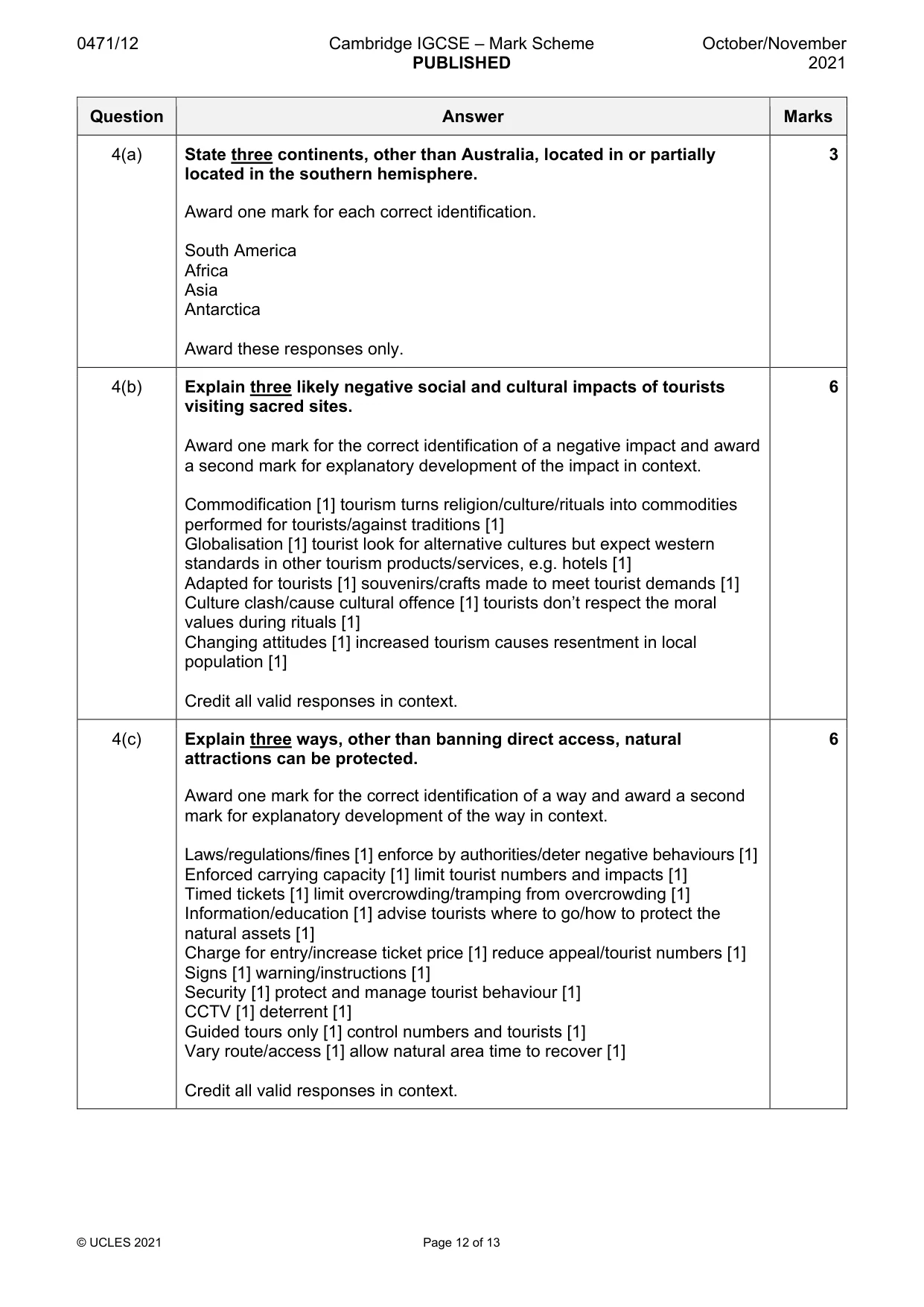
0471/12 Cambridge IGCSE – Mark Scheme PUBLISHED October/November 2021 © UCLES 2021 Page 12 of 13 Question Answer Marks 4(a) State three continents, other than Australia, located in or partially located in the southern hemisphere. Award one mark for each correct identification. South America Africa Asia Antarctica Award these responses only. 3 4(b) Explain three likely negative social and cultural impacts of tourists visiting sacred sites. Award one mark for the correct identification of a negative impact and award a second mark for explanatory development of the impact in context. Commodification [1] tourism turns religion/culture/rituals into commodities performed for tourists/against traditions [1] Globalisation [1] tourist look for alternative cultures but expect western standards in other tourism products/services, e.g. hotels [1] Adapted for tourists [1] souvenirs/crafts made to meet tourist demands [1] Culture clash/cause cultural offence [1] tourists don’t respect the moral values during rituals [1] Changing attitudes [1] increased tourism causes resentment in local population [1] Credit all valid responses in context. 6 4(c) Explain three ways, other than banning direct access, natural attractions can be protected. Award one mark for the correct identification of a way and award a second mark for explanatory development of the way in context. Laws/regulations/fines [1] enforce by authorities/deter negative behaviours [1] Enforced carrying capacity [1] limit tourist numbers and impacts [1] Timed tickets [1] limit overcrowding/tramping from overcrowding [1] Information/education [1] advise tourists where to go/how to protect the natural assets [1] Charge for entry/increase ticket price [1] reduce appeal/tourist numbers [1] Signs [1] warning/instructions [1] Security [1] protect and manage tourist behaviour [1] CCTV [1] deterrent [1] Guided tours only [1] control numbers and tourists [1] Vary route/access [1] allow natural area time to recover [1] Credit all valid responses in context. 6
Mark scheme, page 13
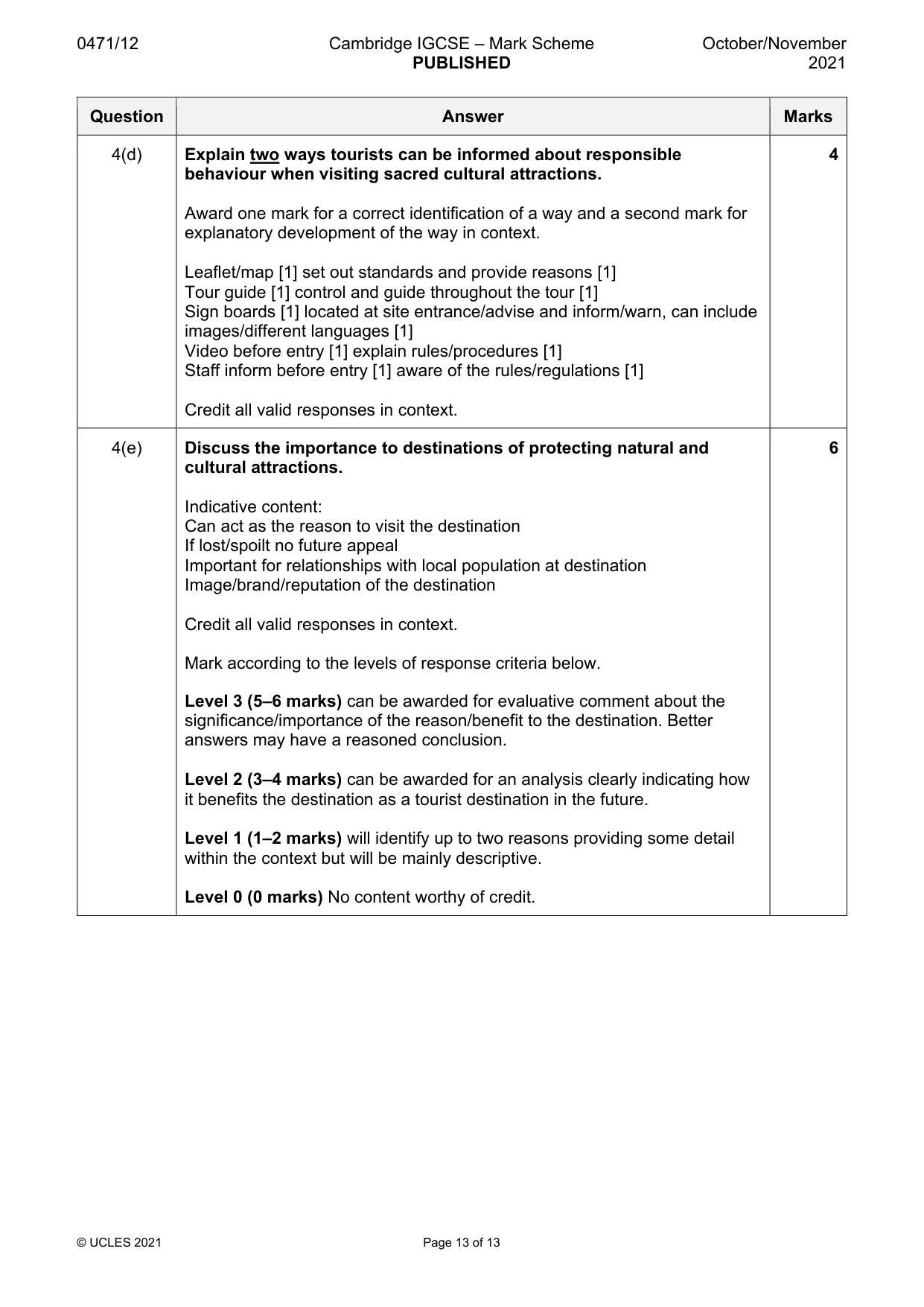
0471/12 Cambridge IGCSE – Mark Scheme PUBLISHED October/November 2021 © UCLES 2021 Page 13 of 13 Question Answer Marks 4(d) Explain two ways tourists can be informed about responsible behaviour when visiting sacred cultural attractions. Award one mark for a correct identification of a way and a second mark for explanatory development of the way in context. Leaflet/map [1] set out standards and provide reasons [1] Tour guide [1] control and guide throughout the tour [1] Sign boards [1] located at site entrance/advise and inform/warn, can include images/different languages [1] Video before entry [1] explain rules/procedures [1] Staff inform before entry [1] aware of the rules/regulations [1] Credit all valid responses in context. 4 4(e) Discuss the importance to destinations of protecting natural and cultural attractions. Indicative content: Can act as the reason to visit the destination If lost/spoilt no future appeal Important for relationships with local population at destination Image/brand/reputation of the destination Credit all valid responses in context. Mark according to the levels of response criteria below. Level 3 (5–6 marks) can be awarded for evaluative comment about the significance/importance of the reason/benefit to the destination. Better answers may have a reasoned conclusion. Level 2 (3–4 marks) can be awarded for an analysis clearly indicating how it benefits the destination as a tourist destination in the future. Level 1 (1–2 marks) will identify up to two reasons providing some detail within the context but will be mainly descriptive. Level 0 (0 marks) No content worthy of credit. 6
What you needed in this session
Cambridge’s own grade thresholds for 2021 Oct/Nov, Paper 1 · Variant 2. A higher threshold means an easier paper — the bar moves with how the cohort did.