Cambridge IGCSE Travel and Tourism 0471 — 2021 Oct/Nov Paper 1 · Variant 1
0471/11/O/N/21 · 100 marks · ≈113 min
The question paper and its mark scheme, free to read here and free to download. This is Cambridge’s own paper, exactly as it was sat.
Question paper12 pages
Mark scheme13 pages
Answers below. Sit the paper first if you are practising.
Paper as text
Question paper, page 1
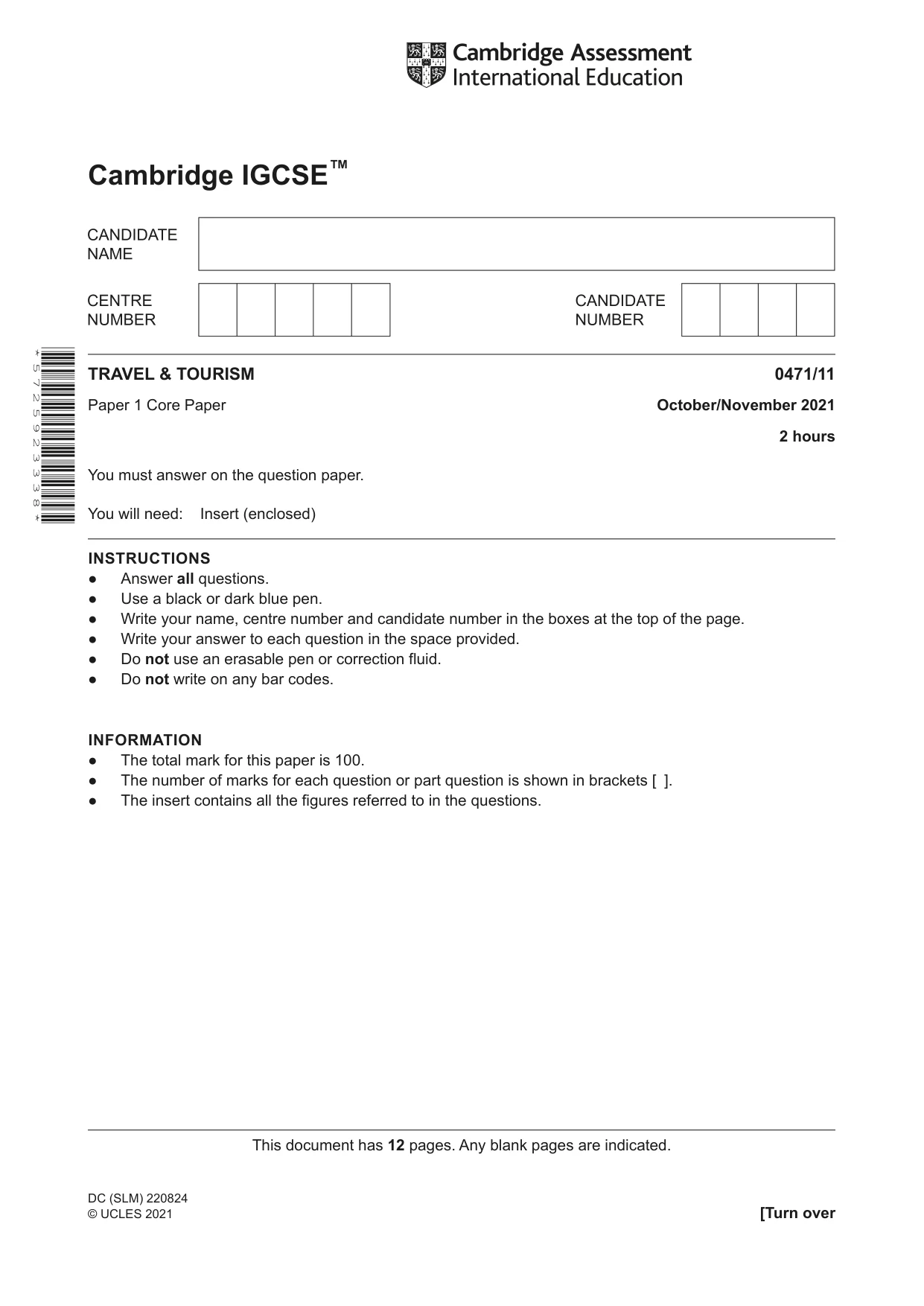
This document has 12 pages. Any blank pages are indicated. Cambridge IGCSE™ DC (SLM) 220824 © UCLES 2021 [Turn over * 5 7 2 5 9 2 3 3 3 8 * TRAVEL & TOURISM 0471/11 Paper 1 Core Paper October/November 2021 2 hours You must answer on the question paper. You will need: Insert (enclosed) INSTRUCTIONS ● Answer all questions. ● Use a black or dark blue pen. ● Write your name, centre number and candidate number in the boxes at the top of the page. ● Write your answer to each question in the space provided. ● Do not use an erasable pen or correction fluid. ● Do not write on any bar codes. INFORMATION ● The total mark for this paper is 100. ● The number of marks for each question or part question is shown in brackets [ ]. ● The insert contains all the figures referred to in the questions.
Question paper, page 2
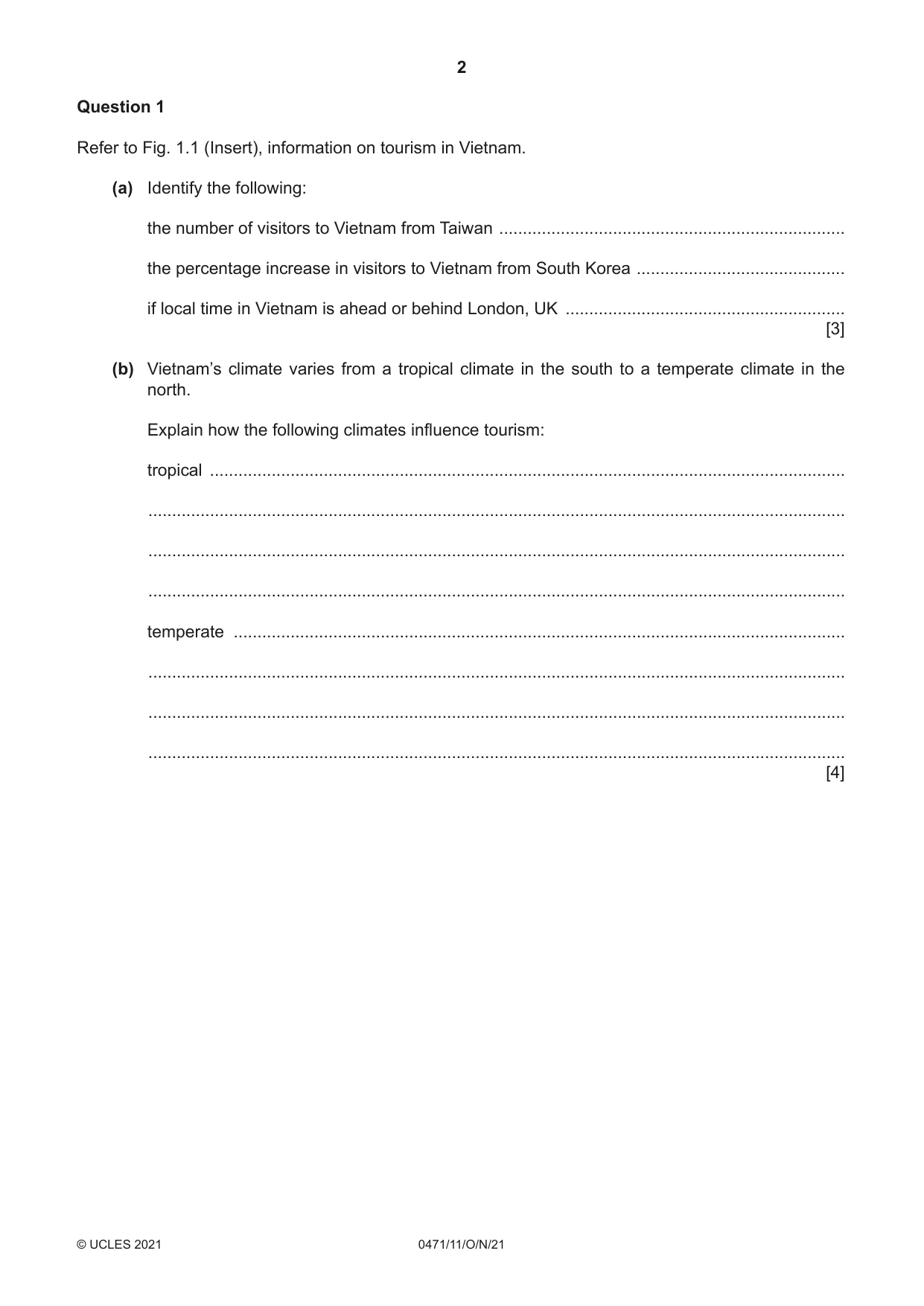
2 0471/11/O/N/21 © UCLES 2021 Question 1 Refer to Fig. 1.1 (Insert), information on tourism in Vietnam. (a) Identify the following: the number of visitors to Vietnam from Taiwan … the percentage increase in visitors to Vietnam from South Korea … if local time in Vietnam is ahead or behind London, UK … [3] (b) Vietnam’s climate varies from a tropical climate in the south to a temperate climate in the north. Explain how the following climates influence tourism: tropical … … … … temperate … … … … [4]
Question paper, page 3
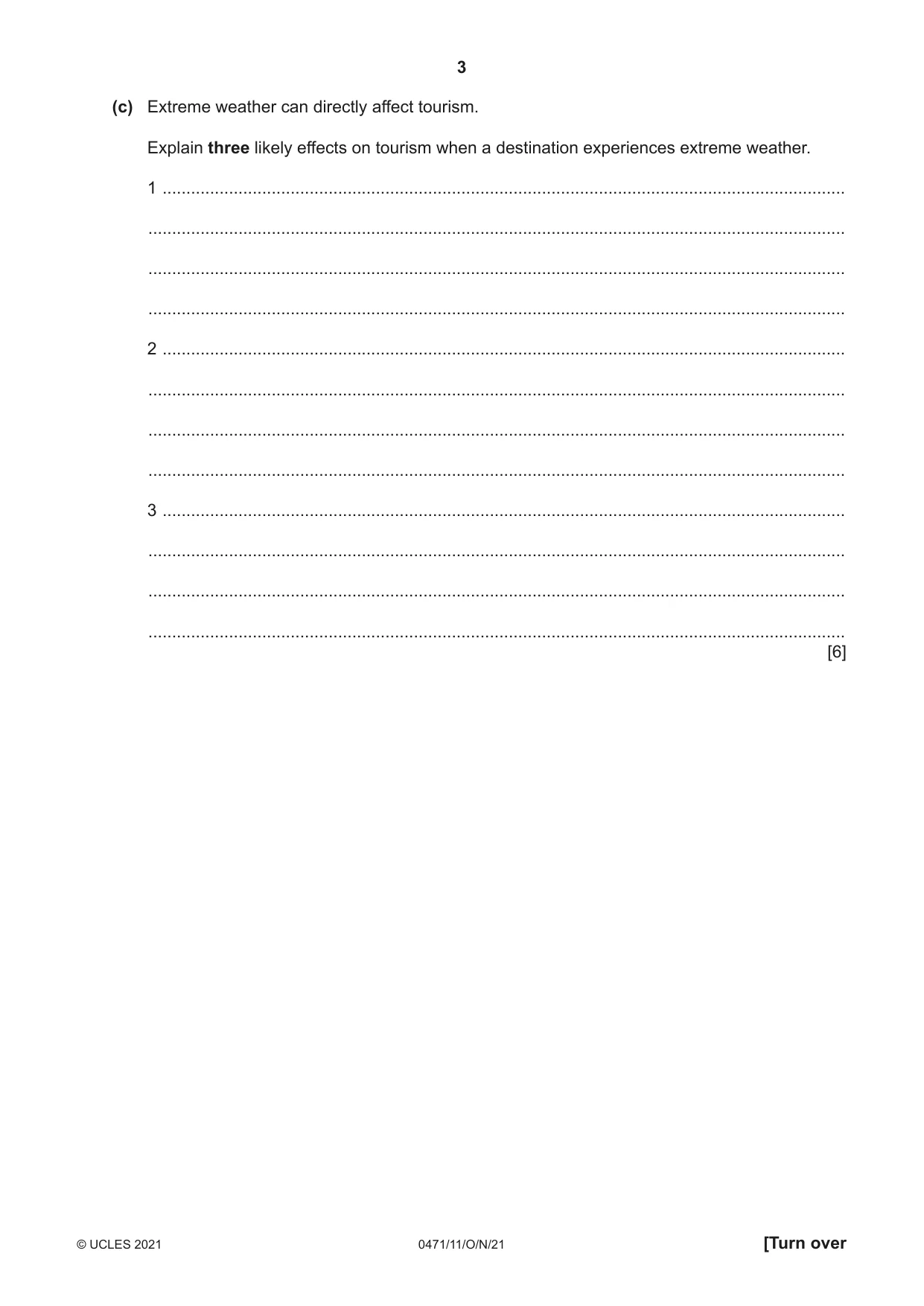
3 0471/11/O/N/21 © UCLES 2021 [Turn over (c) Extreme weather can directly affect tourism. Explain three likely effects on tourism when a destination experiences extreme weather. 1 … … … … 2 … … … … 3 … … … … [6]
Question paper, page 4
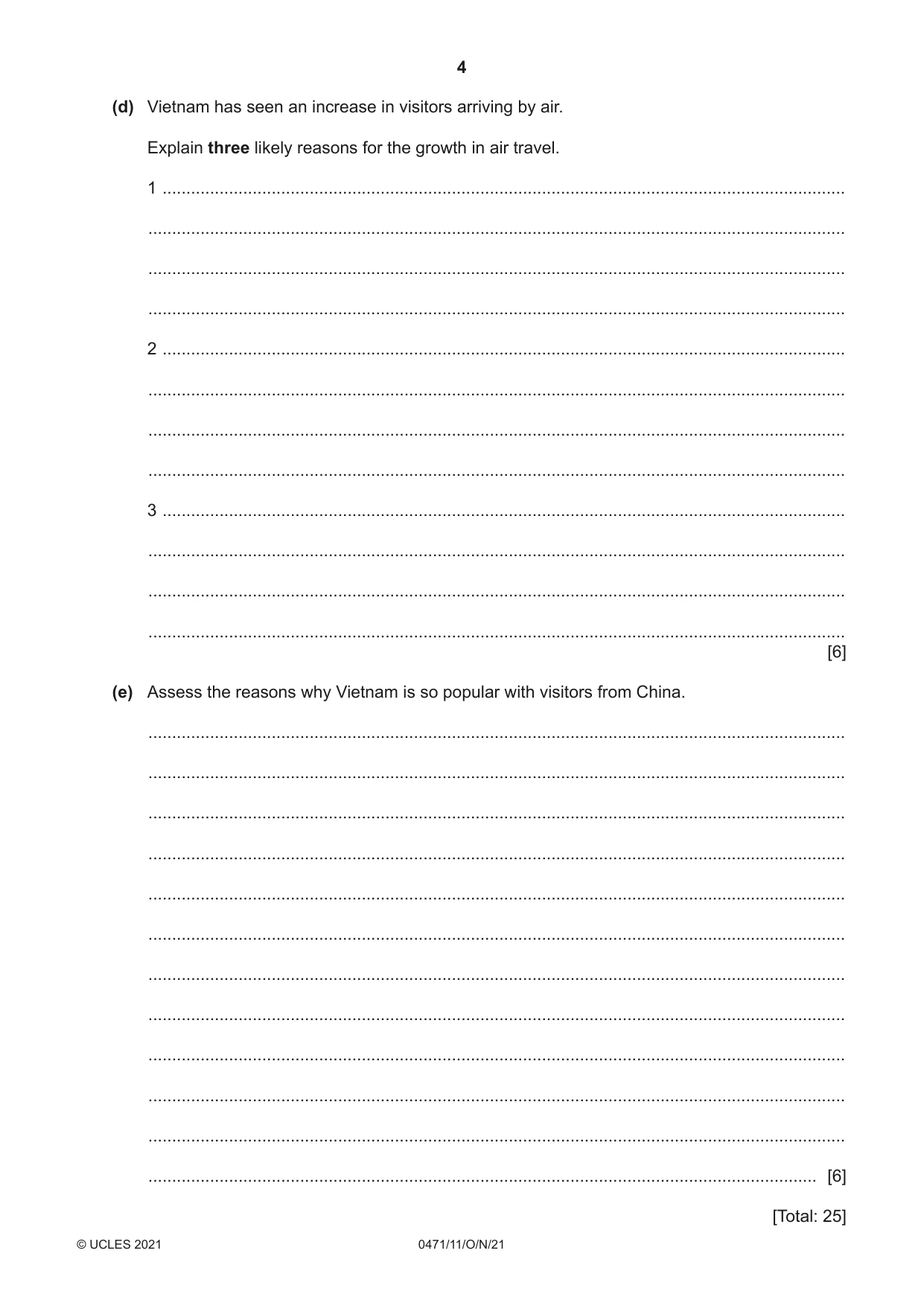
4 0471/11/O/N/21 © UCLES 2021 (d) Vietnam has seen an increase in visitors arriving by air. Explain three likely reasons for the growth in air travel. 1 … … … … 2 … … … … 3 … … … … [6] (e) Assess the reasons why Vietnam is so popular with visitors from China. … … … … … … … … … … … … [6] [Total: 25]
Question paper, page 5
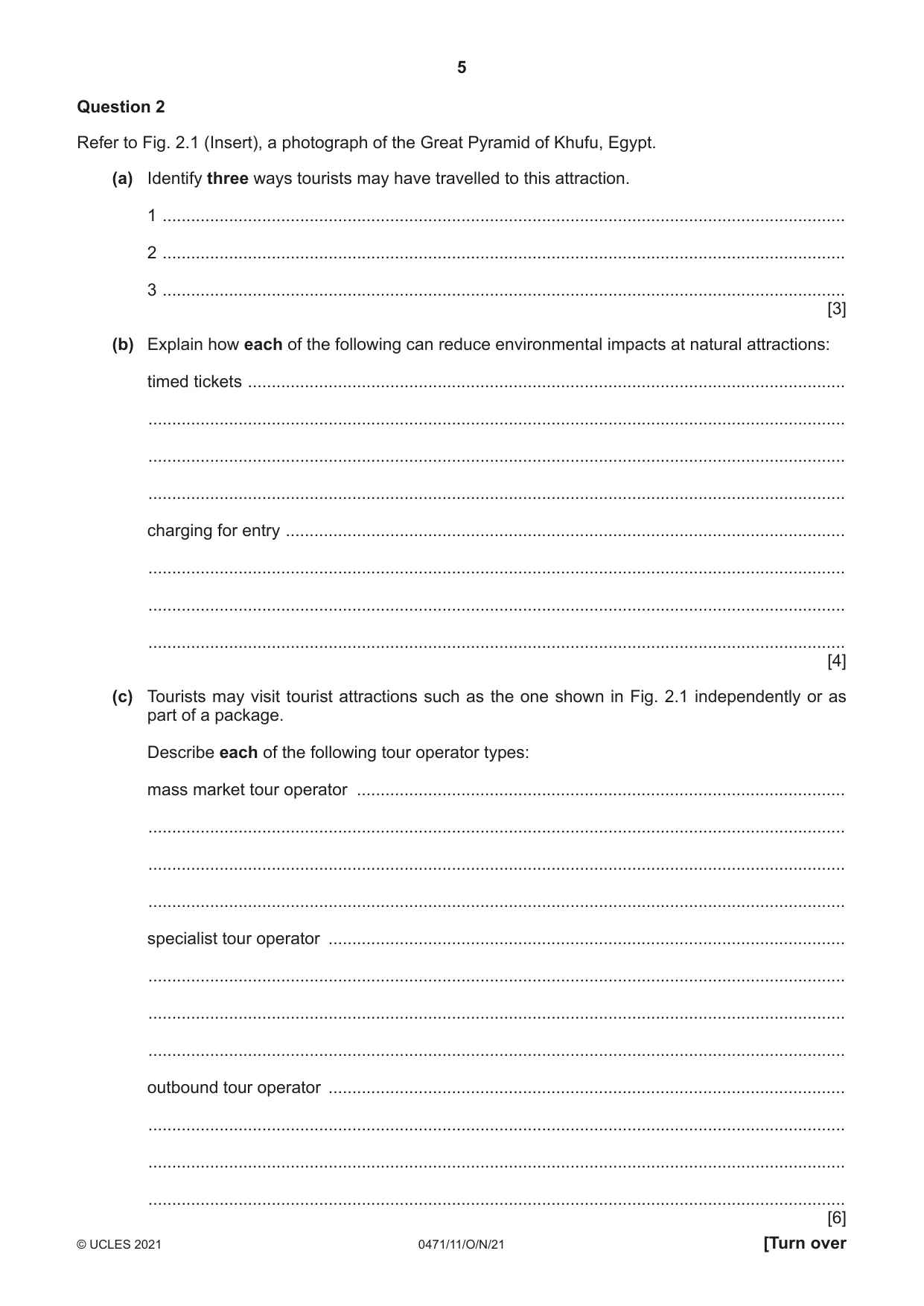
5 0471/11/O/N/21 © UCLES 2021 [Turn over Question 2 Refer to Fig. 2.1 (Insert), a photograph of the Great Pyramid of Khufu, Egypt. (a) Identify three ways tourists may have travelled to this attraction. 1 … 2 … 3 … [3] (b) Explain how each of the following can reduce environmental impacts at natural attractions: timed tickets … … … … charging for entry … … … … [4] (c) Tourists may visit tourist attractions such as the one shown in Fig. 2.1 independently or as part of a package. Describe each of the following tour operator types: mass market tour operator … … … … specialist tour operator … … … … outbound tour operator … … … … [6]
Question paper, page 6
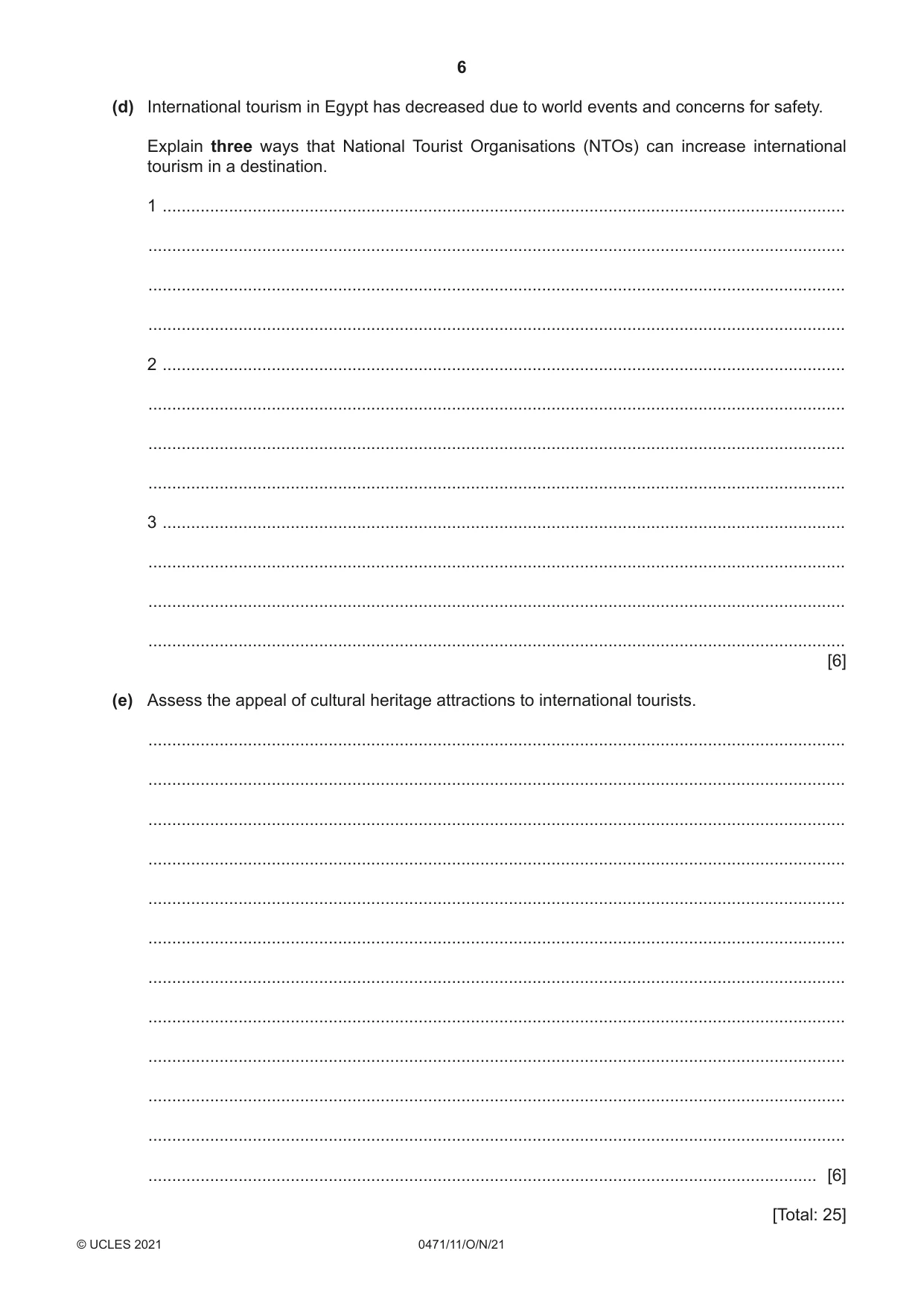
6 0471/11/O/N/21 © UCLES 2021 (d) International tourism in Egypt has decreased due to world events and concerns for safety. Explain three ways that National Tourist Organisations (NTOs) can increase international tourism in a destination. 1 … … … … 2 … … … … 3 … … … … [6] (e) Assess the appeal of cultural heritage attractions to international tourists. … … … … … … … … … … … … [6] [Total: 25]
Question paper, page 7
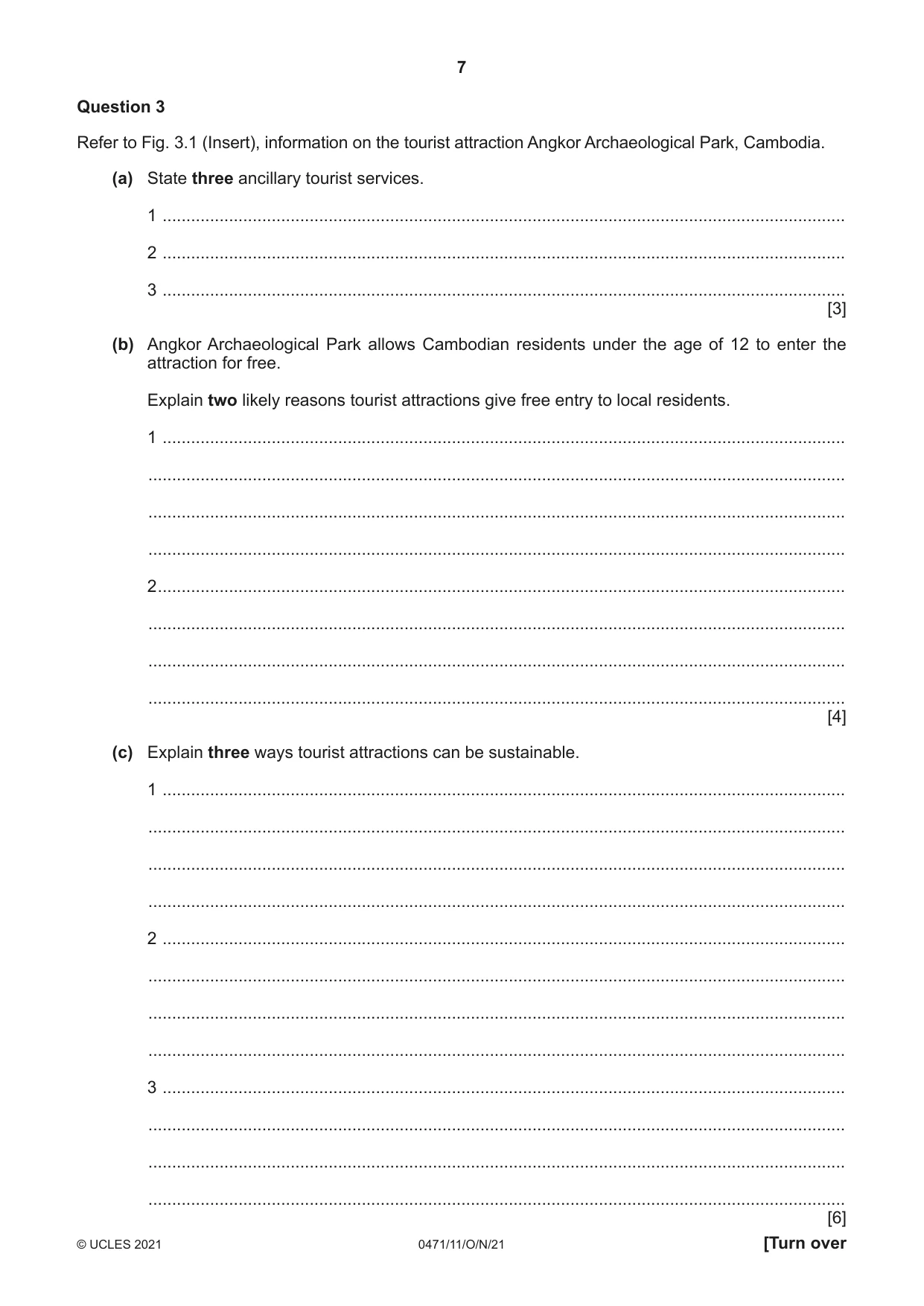
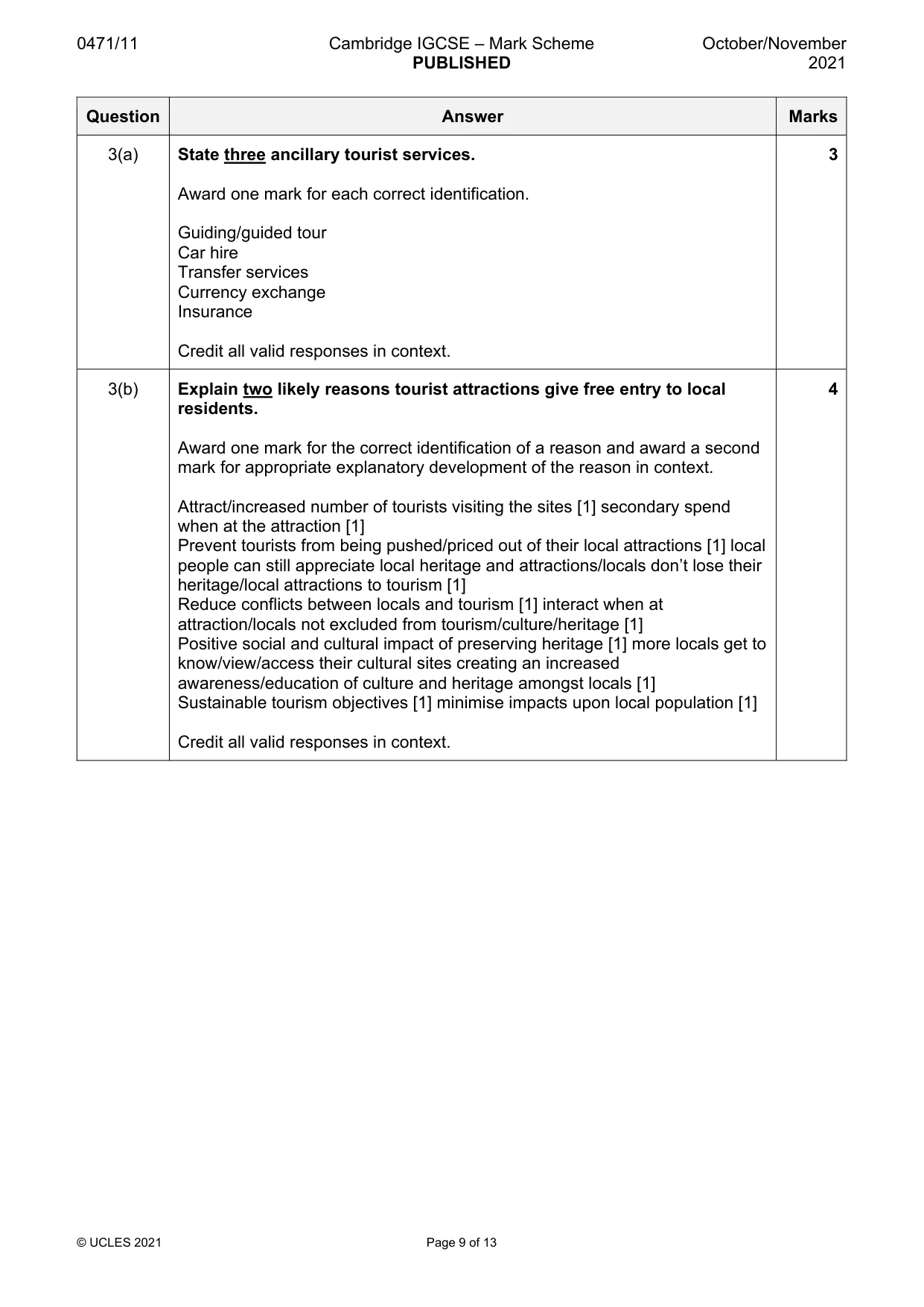
7 0471/11/O/N/21 © UCLES 2021 [Turn over Question 3 Refer to Fig. 3.1 (Insert), information on the tourist attraction Angkor Archaeological Park, Cambodia. (a) State three ancillary tourist services. 1 … 2 … 3 … [3] (b) Angkor Archaeological Park allows Cambodian residents under the age of 12 to enter the attraction for free. Explain two likely reasons tourist attractions give free entry to local residents. 1 … … … … 2 … … … … [4] (c) Explain three ways tourist attractions can be sustainable. 1 … … … … 2 … … … … 3 … … … … [6]
Question paper, page 8
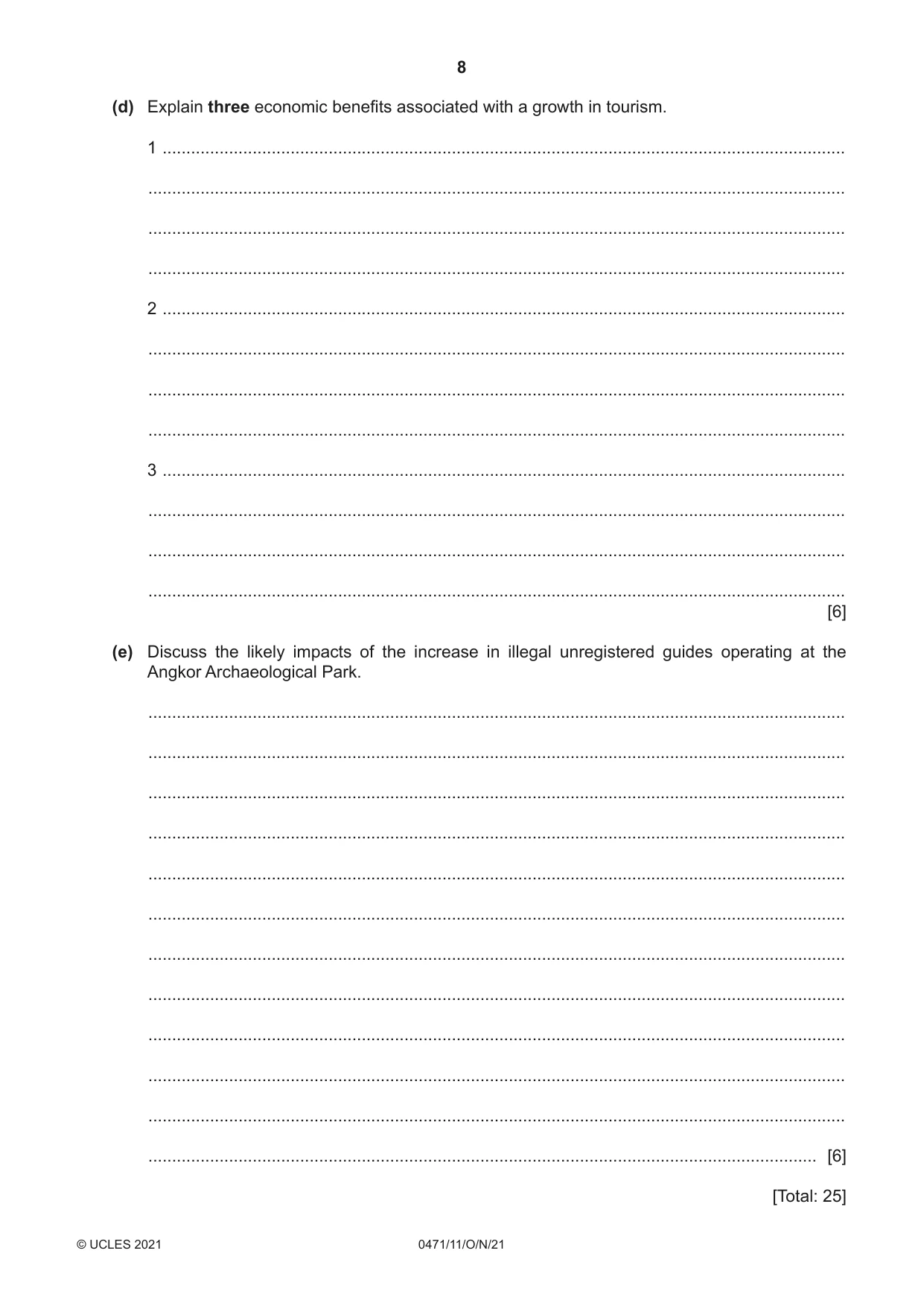
8 0471/11/O/N/21 © UCLES 2021 (d) Explain three economic benefits associated with a growth in tourism. 1 … … … … 2 … … … … 3 … … … … [6] (e) Discuss the likely impacts of the increase in illegal unregistered guides operating at the Angkor Archaeological Park. … … … … … … … … … … … … [6] [Total: 25]
Question paper, page 9
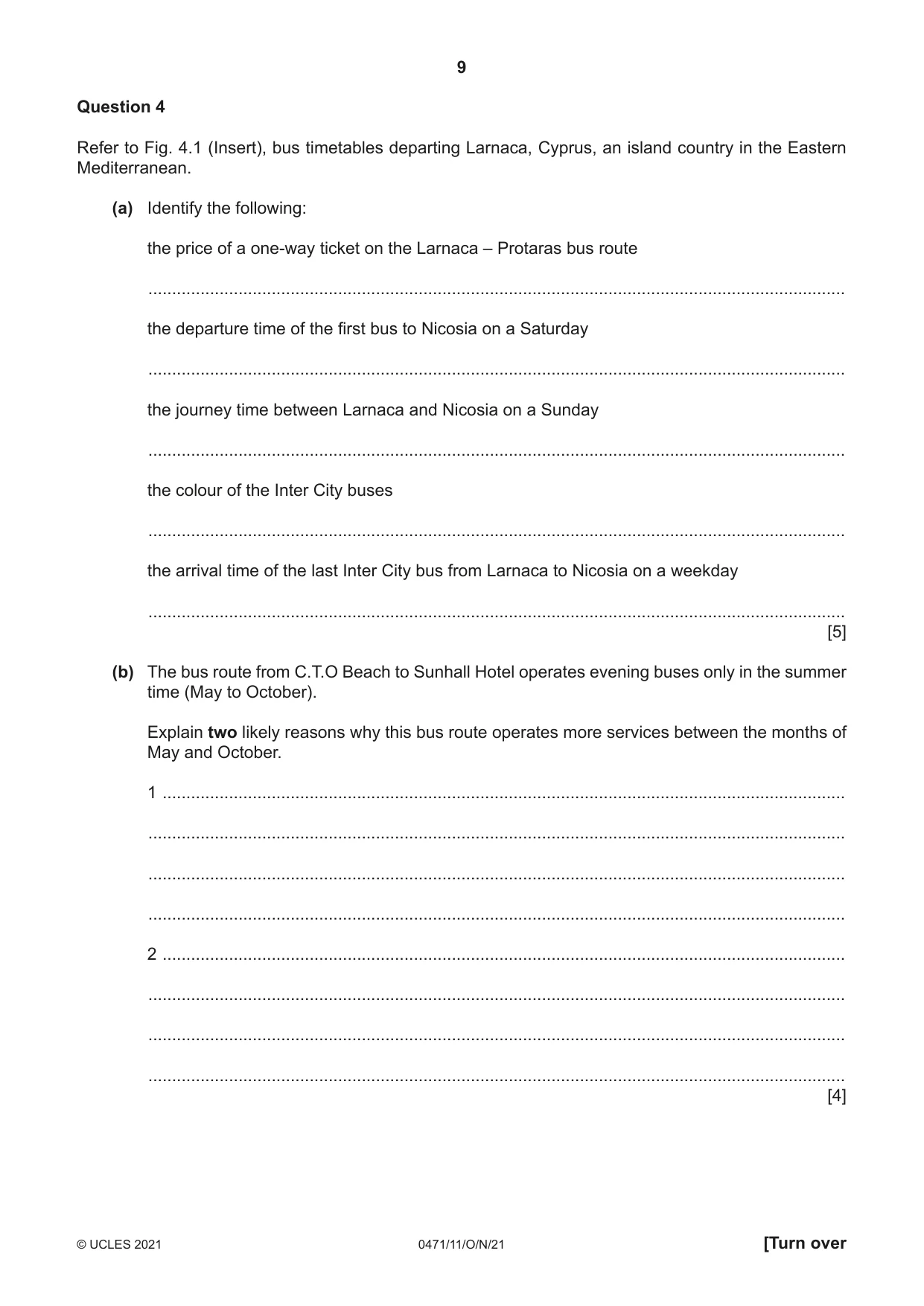
9 0471/11/O/N/21 © UCLES 2021 [Turn over Question 4 Refer to Fig. 4.1 (Insert), bus timetables departing Larnaca, Cyprus, an island country in the Eastern Mediterranean. (a) Identify the following: the price of a one-way ticket on the Larnaca – Protaras bus route … the departure time of the first bus to Nicosia on a Saturday … the journey time between Larnaca and Nicosia on a Sunday … the colour of the Inter City buses … the arrival time of the last Inter City bus from Larnaca to Nicosia on a weekday … [5] (b) The bus route from C.T.O Beach to Sunhall Hotel operates evening buses only in the summer time (May to October). Explain two likely reasons why this bus route operates more services between the months of May and October. 1 … … … … 2 … … … … [4]
Question paper, page 10
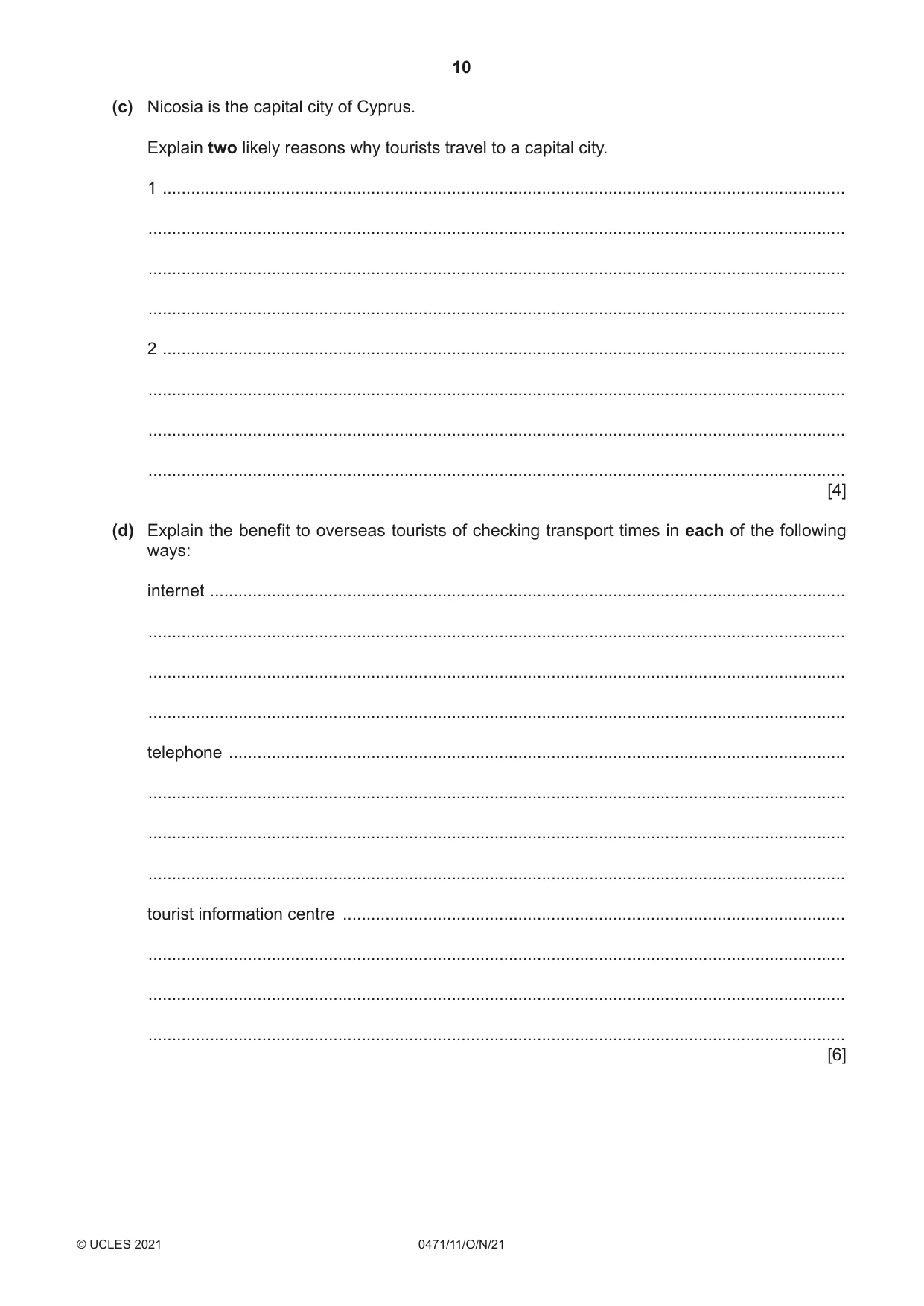
10 0471/11/O/N/21 © UCLES 2021 (c) Nicosia is the capital city of Cyprus. Explain two likely reasons why tourists travel to a capital city. 1 … … … … 2 … … … … [4] (d) Explain the benefit to overseas tourists of checking transport times in each of the following ways: internet … … … … telephone … … … … tourist information centre … … … … [6]
Question paper, page 11
11 0471/11/O/N/21 © UCLES 2021 (e) Discuss the appeal to leisure tourists of travelling around a destination using local bus services. … … … … … … … … … … … … [6] [Total: 25]
Question paper, page 12
12 0471/11/O/N/21 © UCLES 2021 The boundaries and names shown, the designations used and the presentation of material on any maps contained in this question paper/insert do not imply official endorsement or acceptance by Cambridge Assessment International Education concerning the legal status of any country, territory, or area or any of its authorities, or of the delimitation of its frontiers or boundaries. Permission to reproduce items where third-party owned material protected by copyright is included has been sought and cleared where possible. Every reasonable effort has been made by the publisher (UCLES) to trace copyright holders, but if any items requiring clearance have unwittingly been included, the publisher will be pleased to make amends at the earliest possible opportunity. To avoid the issue of disclosure of answer-related information to candidates, all copyright acknowledgements are reproduced online in the Cambridge Assessment International Education Copyright Acknowledgements Booklet. This is produced for each series of examinations and is freely available to download at www.cambridgeinternational.org after the live examination series. Cambridge Assessment International Education is part of the Cambridge Assessment Group. Cambridge Assessment is the brand name of the University of Cambridge Local Examinations Syndicate (UCLES), which itself is a department of the University of Cambridge. BLANK PAGE
Mark scheme, page 1
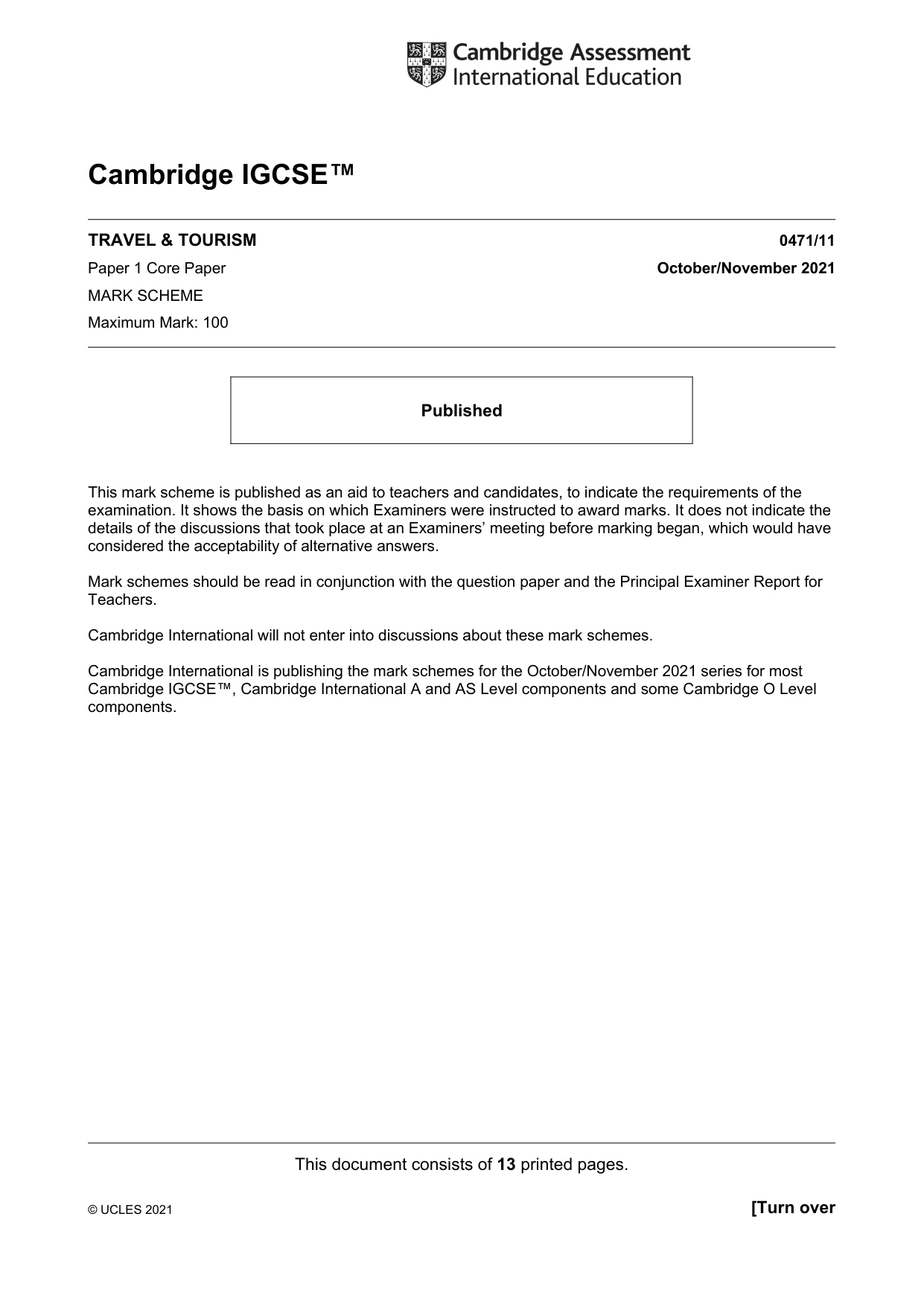
This document consists of 13 printed pages. © UCLES 2021 [Turn over Cambridge IGCSE™ TRAVEL & TOURISM 0471/11 Paper 1 Core Paper October/November 2021 MARK SCHEME Maximum Mark: 100 Published This mark scheme is published as an aid to teachers and candidates, to indicate the requirements of the examination. It shows the basis on which Examiners were instructed to award marks. It does not indicate the details of the discussions that took place at an Examiners’ meeting before marking began, which would have considered the acceptability of alternative answers. Mark schemes should be read in conjunction with the question paper and the Principal Examiner Report for Teachers. Cambridge International will not enter into discussions about these mark schemes. Cambridge International is publishing the mark schemes for the October/November 2021 series for most Cambridge IGCSE™, Cambridge International A and AS Level components and some Cambridge O Level components.
Mark scheme, page 2
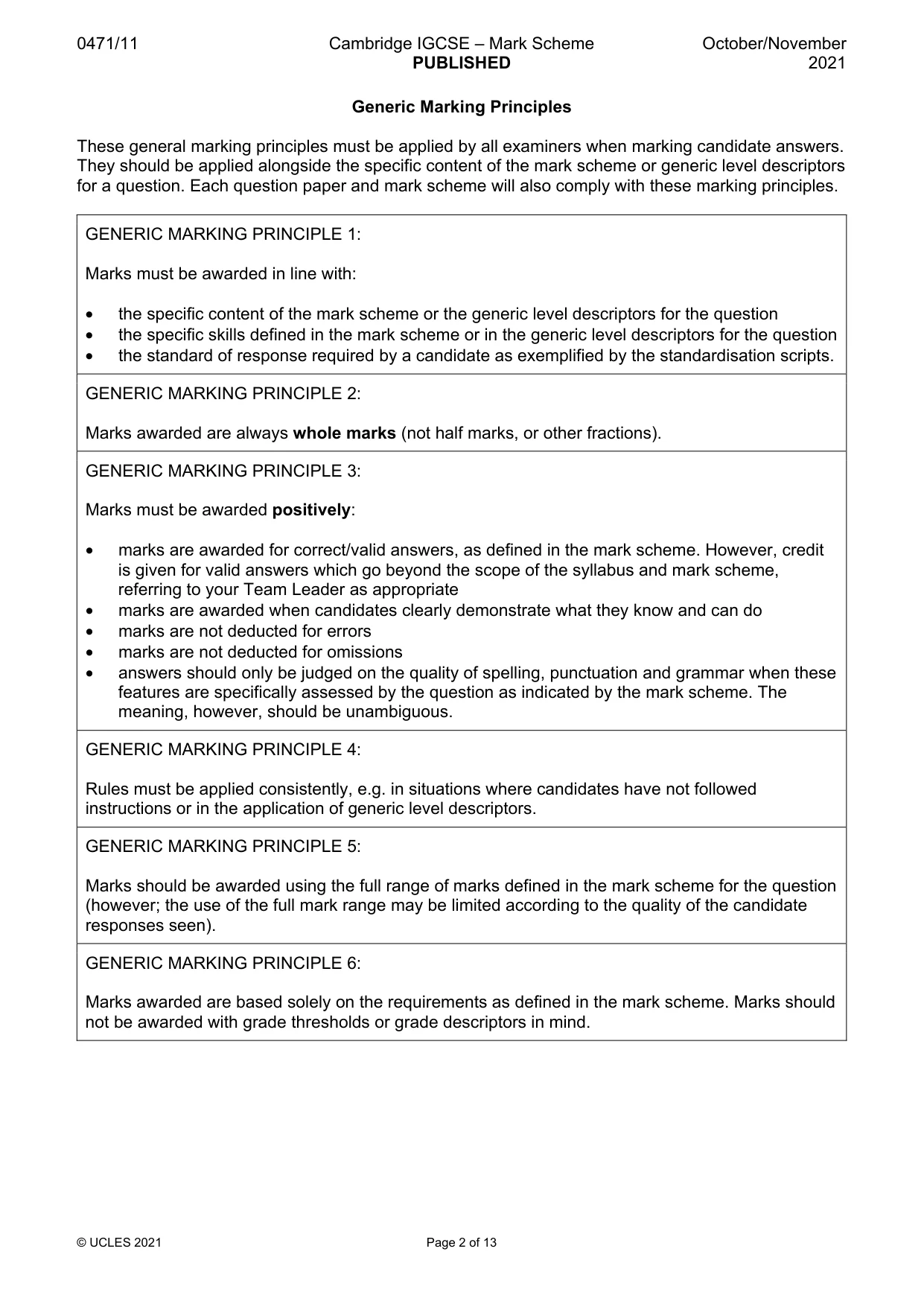
0471/11 Cambridge IGCSE – Mark Scheme PUBLISHED October/November 2021 © UCLES 2021 Page 2 of 13 Generic Marking Principles These general marking principles must be applied by all examiners when marking candidate answers. They should be applied alongside the specific content of the mark scheme or generic level descriptors for a question. Each question paper and mark scheme will also comply with these marking principles. GENERIC MARKING PRINCIPLE 1: Marks must be awarded in line with: • the specific content of the mark scheme or the generic level descriptors for the question • the specific skills defined in the mark scheme or in the generic level descriptors for the question • the standard of response required by a candidate as exemplified by the standardisation scripts. GENERIC MARKING PRINCIPLE 2: Marks awarded are always whole marks (not half marks, or other fractions). GENERIC MARKING PRINCIPLE 3: Marks must be awarded positively: • marks are awarded for correct/valid answers, as defined in the mark scheme. However, credit is given for valid answers which go beyond the scope of the syllabus and mark scheme, referring to your Team Leader as appropriate • marks are awarded when candidates clearly demonstrate what they know and can do • marks are not deducted for errors • marks are not deducted for omissions • answers should only be judged on the quality of spelling, punctuation and grammar when these features are specifically assessed by the question as indicated by the mark scheme. The meaning, however, should be unambiguous. GENERIC MARKING PRINCIPLE 4: Rules must be applied consistently, e.g. in situations where candidates have not followed instructions or in the application of generic level descriptors. GENERIC MARKING PRINCIPLE 5: Marks should be awarded using the full range of marks defined in the mark scheme for the question (however; the use of the full mark range may be limited according to the quality of the candidate responses seen). GENERIC MARKING PRINCIPLE 6: Marks awarded are based solely on the requirements as defined in the mark scheme. Marks should not be awarded with grade thresholds or grade descriptors in mind.
Mark scheme, page 3
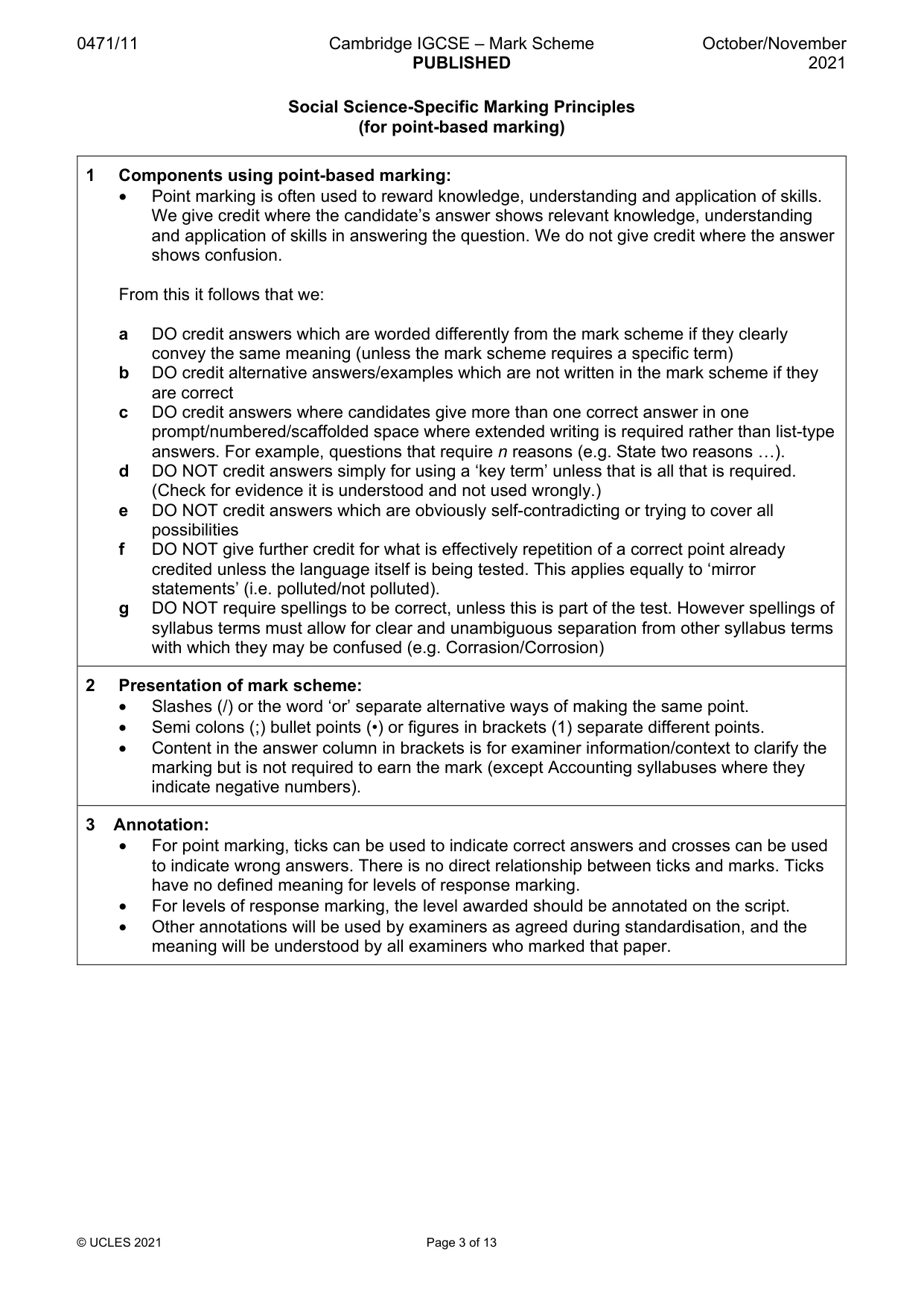
0471/11 Cambridge IGCSE – Mark Scheme PUBLISHED October/November 2021 © UCLES 2021 Page 3 of 13 Social Science-Specific Marking Principles (for point-based marking) 1 Components using point-based marking: • Point marking is often used to reward knowledge, understanding and application of skills. We give credit where the candidate’s answer shows relevant knowledge, understanding and application of skills in answering the question. We do not give credit where the answer shows confusion. From this it follows that we: a DO credit answers which are worded differently from the mark scheme if they clearly convey the same meaning (unless the mark scheme requires a specific term) b DO credit alternative answers/examples which are not written in the mark scheme if they are correct c DO credit answers where candidates give more than one correct answer in one prompt/numbered/scaffolded space where extended writing is required rather than list-type answers. For example, questions that require n reasons (e.g. State two reasons …). d DO NOT credit answers simply for using a ‘key term’ unless that is all that is required. (Check for evidence it is understood and not used wrongly.) e DO NOT credit answers which are obviously self-contradicting or trying to cover all possibilities f DO NOT give further credit for what is effectively repetition of a correct point already credited unless the language itself is being tested. This applies equally to ‘mirror statements’ (i.e. polluted/not polluted). g DO NOT require spellings to be correct, unless this is part of the test. However spellings of syllabus terms must allow for clear and unambiguous separation from other syllabus terms with which they may be confused (e.g. Corrasion/Corrosion) 2 Presentation of mark scheme: • Slashes (/) or the word ‘or’ separate alternative ways of making the same point. • Semi colons (;) bullet points (•) or figures in brackets (1) separate different points. • Content in the answer column in brackets is for examiner information/context to clarify the marking but is not required to earn the mark (except Accounting syllabuses where they indicate negative numbers). 3 Annotation: • For point marking, ticks can be used to indicate correct answers and crosses can be used to indicate wrong answers. There is no direct relationship between ticks and marks. Ticks have no defined meaning for levels of response marking. • For levels of response marking, the level awarded should be annotated on the script. • Other annotations will be used by examiners as agreed during standardisation, and the meaning will be understood by all examiners who marked that paper.
Mark scheme, page 4
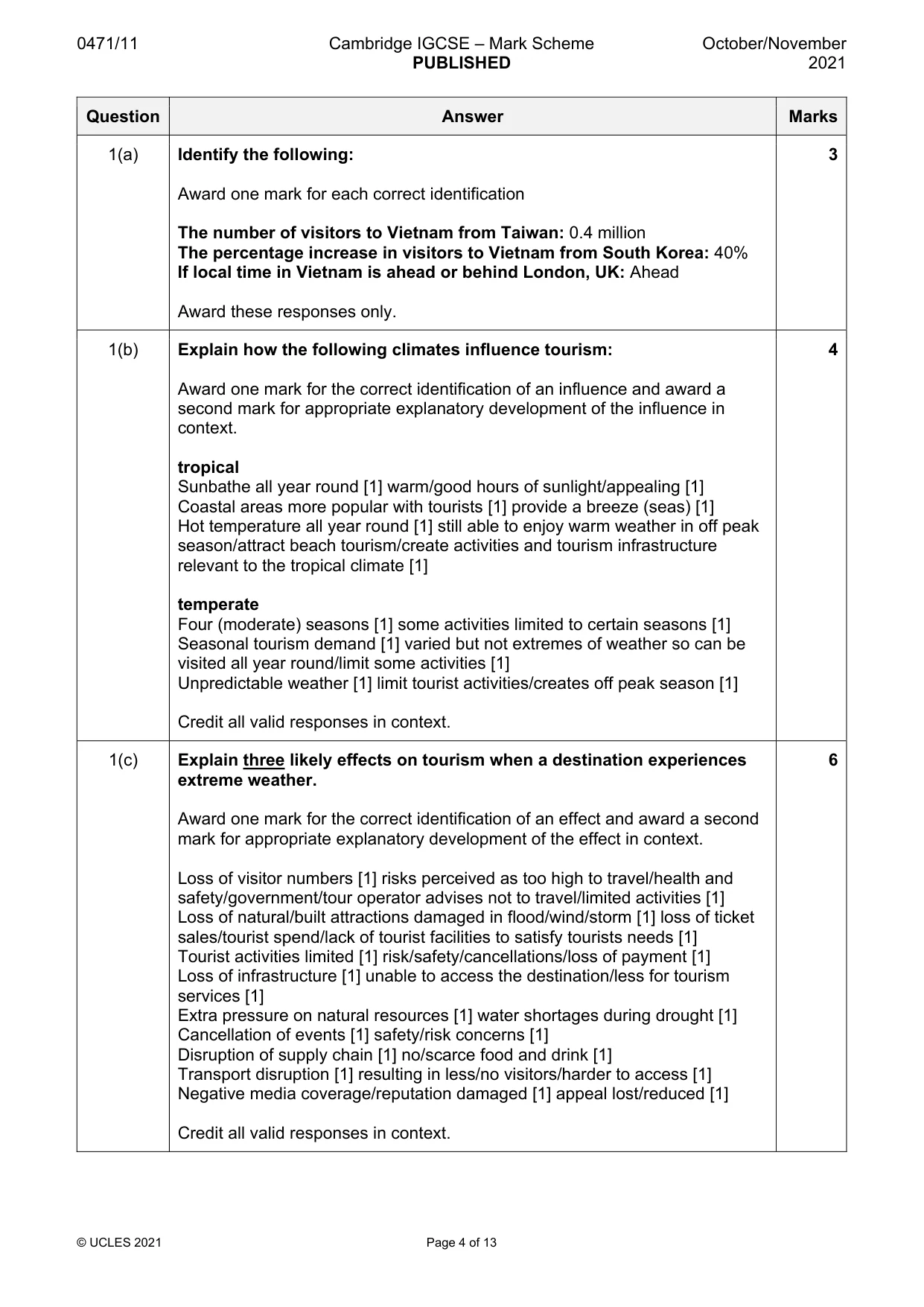
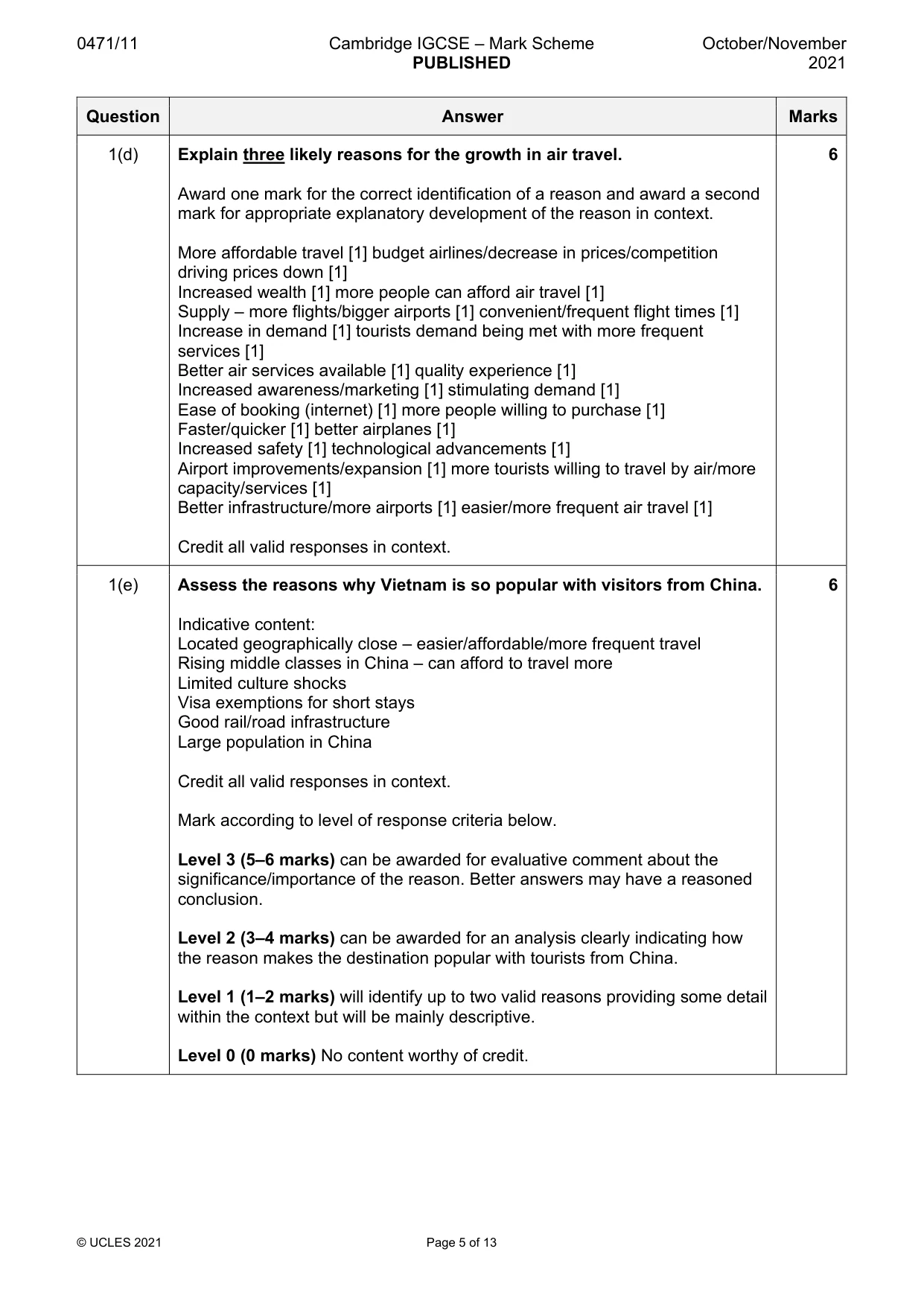
0471/11 Cambridge IGCSE – Mark Scheme PUBLISHED October/November 2021 © UCLES 2021 Page 4 of 13 Question Answer Marks 1(a) Identify the following: Award one mark for each correct identification The number of visitors to Vietnam from Taiwan: 0.4 million The percentage increase in visitors to Vietnam from South Korea: 40% If local time in Vietnam is ahead or behind London, UK: Ahead Award these responses only. 3 1(b) Explain how the following climates influence tourism: Award one mark for the correct identification of an influence and award a second mark for appropriate explanatory development of the influence in context. tropical Sunbathe all year round [1] warm/good hours of sunlight/appealing [1] Coastal areas more popular with tourists [1] provide a breeze (seas) [1] Hot temperature all year round [1] still able to enjoy warm weather in off peak season/attract beach tourism/create activities and tourism infrastructure relevant to the tropical climate [1] temperate Four (moderate) seasons [1] some activities limited to certain seasons [1] Seasonal tourism demand [1] varied but not extremes of weather so can be visited all year round/limit some activities [1] Unpredictable weather [1] limit tourist activities/creates off peak season [1] Credit all valid responses in context. 4 1(c) Explain three likely effects on tourism when a destination experiences extreme weather. Award one mark for the correct identification of an effect and award a second mark for appropriate explanatory development of the effect in context. Loss of visitor numbers [1] risks perceived as too high to travel/health and safety/government/tour operator advises not to travel/limited activities [1] Loss of natural/built attractions damaged in flood/wind/storm [1] loss of ticket sales/tourist spend/lack of tourist facilities to satisfy tourists needs [1] Tourist activities limited [1] risk/safety/cancellations/loss of payment [1] Loss of infrastructure [1] unable to access the destination/less for tourism services [1] Extra pressure on natural resources [1] water shortages during drought [1] Cancellation of events [1] safety/risk concerns [1] Disruption of supply chain [1] no/scarce food and drink [1] Transport disruption [1] resulting in less/no visitors/harder to access [1] Negative media coverage/reputation damaged [1] appeal lost/reduced [1] Credit all valid responses in context. 6
Mark scheme, page 5
0471/11 Cambridge IGCSE – Mark Scheme PUBLISHED October/November 2021 © UCLES 2021 Page 5 of 13 Question Answer Marks 1(d) Explain three likely reasons for the growth in air travel. Award one mark for the correct identification of a reason and award a second mark for appropriate explanatory development of the reason in context. More affordable travel [1] budget airlines/decrease in prices/competition driving prices down [1] Increased wealth [1] more people can afford air travel [1] Supply – more flights/bigger airports [1] convenient/frequent flight times [1] Increase in demand [1] tourists demand being met with more frequent services [1] Better air services available [1] quality experience [1] Increased awareness/marketing [1] stimulating demand [1] Ease of booking (internet) [1] more people willing to purchase [1] Faster/quicker [1] better airplanes [1] Increased safety [1] technological advancements [1] Airport improvements/expansion [1] more tourists willing to travel by air/more capacity/services [1] Better infrastructure/more airports [1] easier/more frequent air travel [1] Credit all valid responses in context. 6 1(e) Assess the reasons why Vietnam is so popular with visitors from China. Indicative content: Located geographically close – easier/affordable/more frequent travel Rising middle classes in China – can afford to travel more Limited culture shocks Visa exemptions for short stays Good rail/road infrastructure Large population in China Credit all valid responses in context. Mark according to level of response criteria below. Level 3 (5–6 marks) can be awarded for evaluative comment about the significance/importance of the reason. Better answers may have a reasoned conclusion. Level 2 (3–4 marks) can be awarded for an analysis clearly indicating how the reason makes the destination popular with tourists from China. Level 1 (1–2 marks) will identify up to two valid reasons providing some detail within the context but will be mainly descriptive. Level 0 (0 marks) No content worthy of credit. 6
Mark scheme, page 6
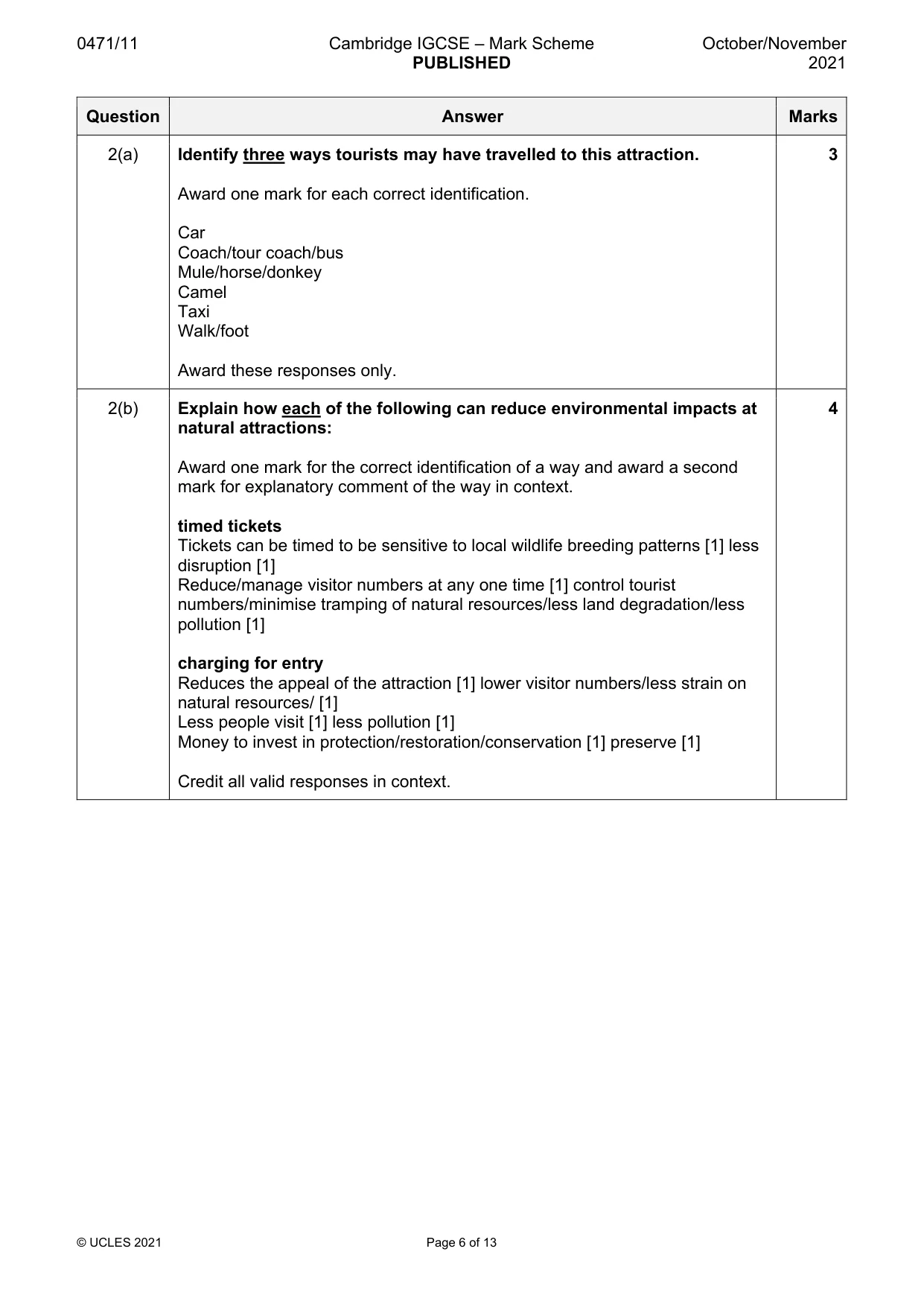
0471/11 Cambridge IGCSE – Mark Scheme PUBLISHED October/November 2021 © UCLES 2021 Page 6 of 13 Question Answer Marks 2(a) Identify three ways tourists may have travelled to this attraction. Award one mark for each correct identification. Car Coach/tour coach/bus Mule/horse/donkey Camel Taxi Walk/foot Award these responses only. 3 2(b) Explain how each of the following can reduce environmental impacts at natural attractions: Award one mark for the correct identification of a way and award a second mark for explanatory comment of the way in context. timed tickets Tickets can be timed to be sensitive to local wildlife breeding patterns [1] less disruption [1] Reduce/manage visitor numbers at any one time [1] control tourist numbers/minimise tramping of natural resources/less land degradation/less pollution [1] charging for entry Reduces the appeal of the attraction [1] lower visitor numbers/less strain on natural resources/ [1] Less people visit [1] less pollution [1] Money to invest in protection/restoration/conservation [1] preserve [1] Credit all valid responses in context. 4
Mark scheme, page 7
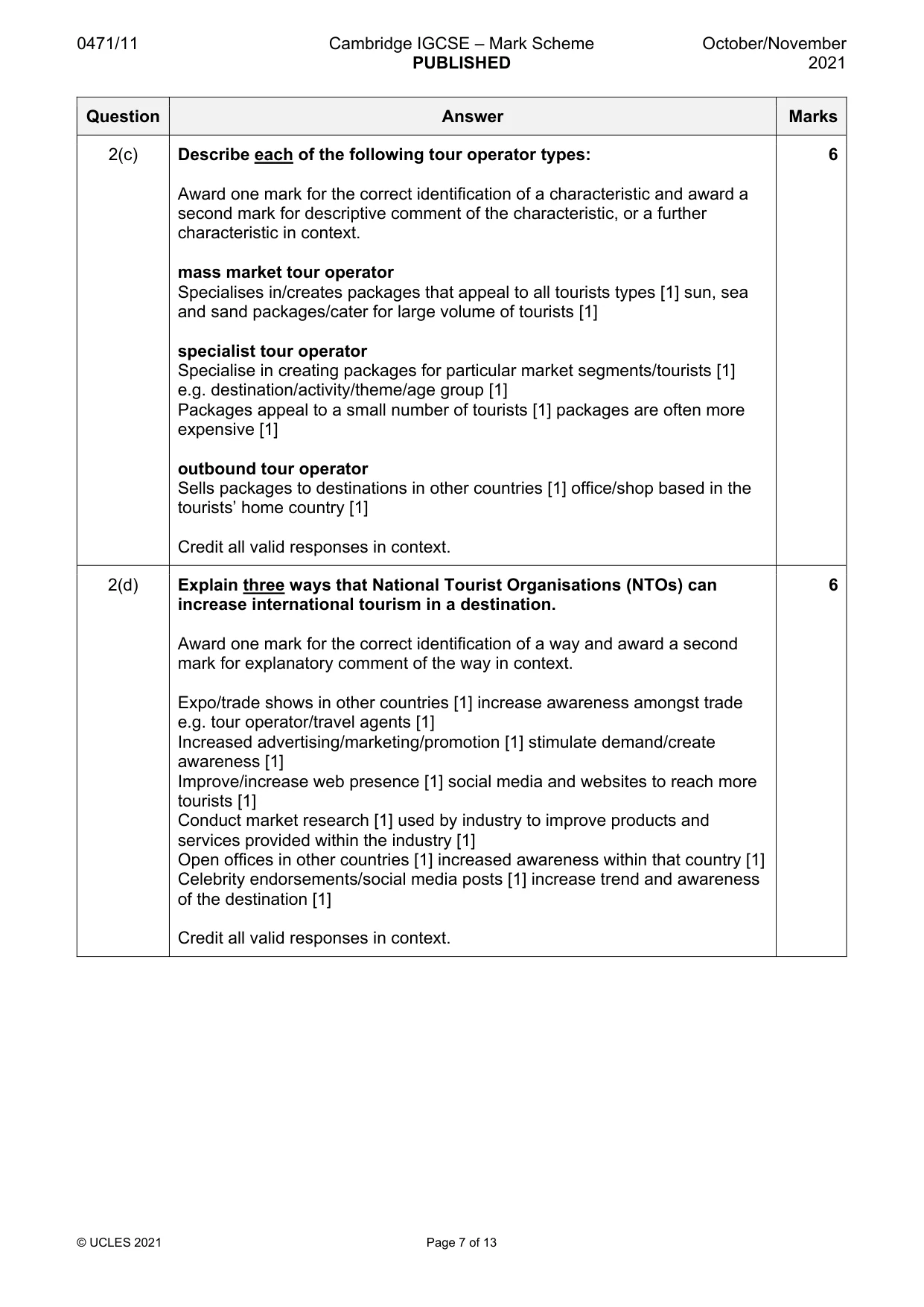
0471/11 Cambridge IGCSE – Mark Scheme PUBLISHED October/November 2021 © UCLES 2021 Page 7 of 13 Question Answer Marks 2(c) Describe each of the following tour operator types: Award one mark for the correct identification of a characteristic and award a second mark for descriptive comment of the characteristic, or a further characteristic in context. mass market tour operator Specialises in/creates packages that appeal to all tourists types [1] sun, sea and sand packages/cater for large volume of tourists [1] specialist tour operator Specialise in creating packages for particular market segments/tourists [1] e.g. destination/activity/theme/age group [1] Packages appeal to a small number of tourists [1] packages are often more expensive [1] outbound tour operator Sells packages to destinations in other countries [1] office/shop based in the tourists’ home country [1] Credit all valid responses in context. 6 2(d) Explain three ways that National Tourist Organisations (NTOs) can increase international tourism in a destination. Award one mark for the correct identification of a way and award a second mark for explanatory comment of the way in context. Expo/trade shows in other countries [1] increase awareness amongst trade e.g. tour operator/travel agents [1] Increased advertising/marketing/promotion [1] stimulate demand/create awareness [1] Improve/increase web presence [1] social media and websites to reach more tourists [1] Conduct market research [1] used by industry to improve products and services provided within the industry [1] Open offices in other countries [1] increased awareness within that country [1] Celebrity endorsements/social media posts [1] increase trend and awareness of the destination [1] Credit all valid responses in context. 6
Mark scheme, page 8
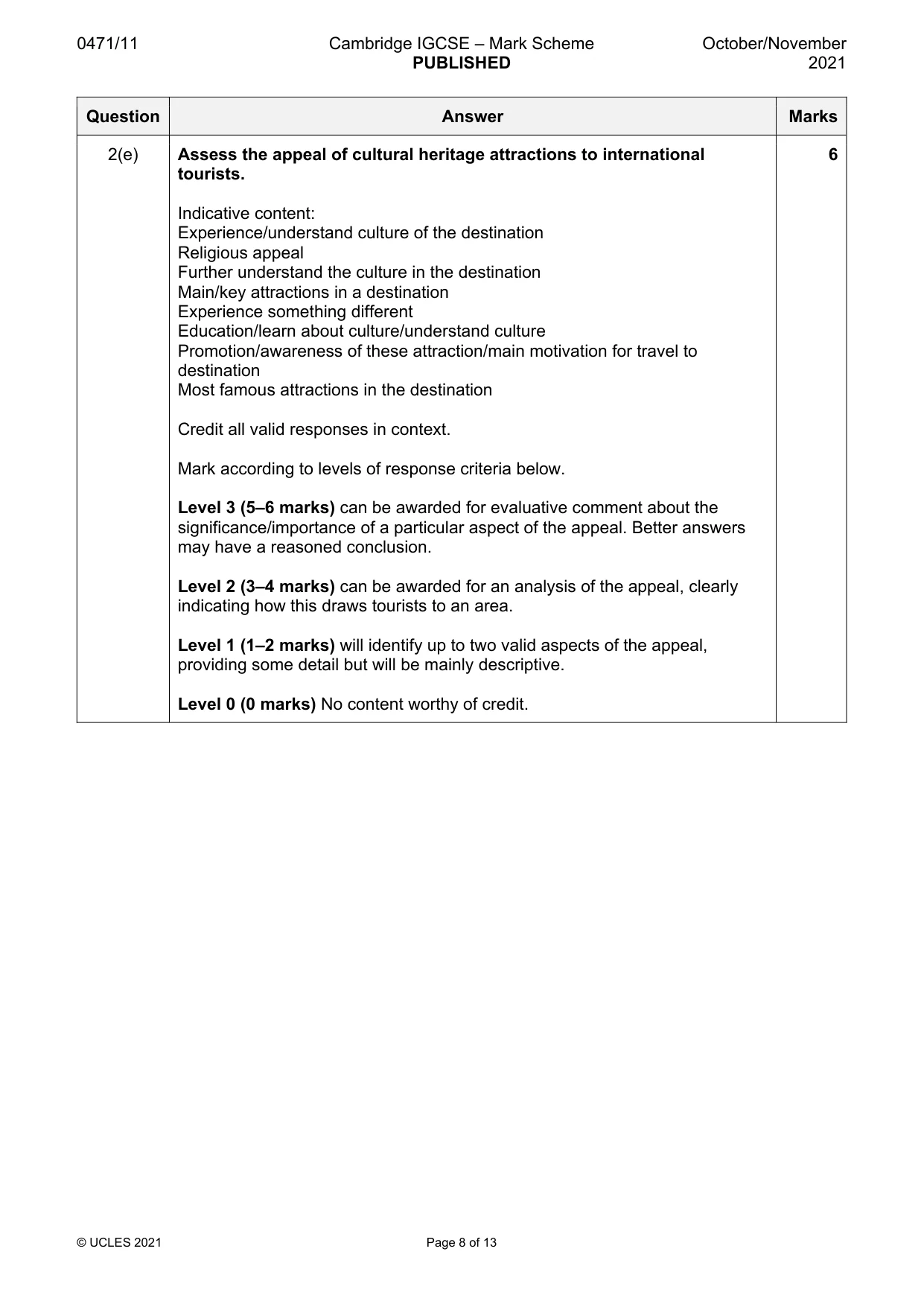
0471/11 Cambridge IGCSE – Mark Scheme PUBLISHED October/November 2021 © UCLES 2021 Page 8 of 13 Question Answer Marks 2(e) Assess the appeal of cultural heritage attractions to international tourists. Indicative content: Experience/understand culture of the destination Religious appeal Further understand the culture in the destination Main/key attractions in a destination Experience something different Education/learn about culture/understand culture Promotion/awareness of these attraction/main motivation for travel to destination Most famous attractions in the destination Credit all valid responses in context. Mark according to levels of response criteria below. Level 3 (5–6 marks) can be awarded for evaluative comment about the significance/importance of a particular aspect of the appeal. Better answers may have a reasoned conclusion. Level 2 (3–4 marks) can be awarded for an analysis of the appeal, clearly indicating how this draws tourists to an area. Level 1 (1–2 marks) will identify up to two valid aspects of the appeal, providing some detail but will be mainly descriptive. Level 0 (0 marks) No content worthy of credit. 6
Mark scheme, page 9
0471/11 Cambridge IGCSE – Mark Scheme PUBLISHED October/November 2021 © UCLES 2021 Page 9 of 13 Question Answer Marks 3(a) State three ancillary tourist services. Award one mark for each correct identification. Guiding/guided tour Car hire Transfer services Currency exchange Insurance Credit all valid responses in context. 3 3(b) Explain two likely reasons tourist attractions give free entry to local residents. Award one mark for the correct identification of a reason and award a second mark for appropriate explanatory development of the reason in context. Attract/increased number of tourists visiting the sites [1] secondary spend when at the attraction [1] Prevent tourists from being pushed/priced out of their local attractions [1] local people can still appreciate local heritage and attractions/locals don’t lose their heritage/local attractions to tourism [1] Reduce conflicts between locals and tourism [1] interact when at attraction/locals not excluded from tourism/culture/heritage [1] Positive social and cultural impact of preserving heritage [1] more locals get to know/view/access their cultural sites creating an increased awareness/education of culture and heritage amongst locals [1] Sustainable tourism objectives [1] minimise impacts upon local population [1] Credit all valid responses in context. 4
Mark scheme, page 10
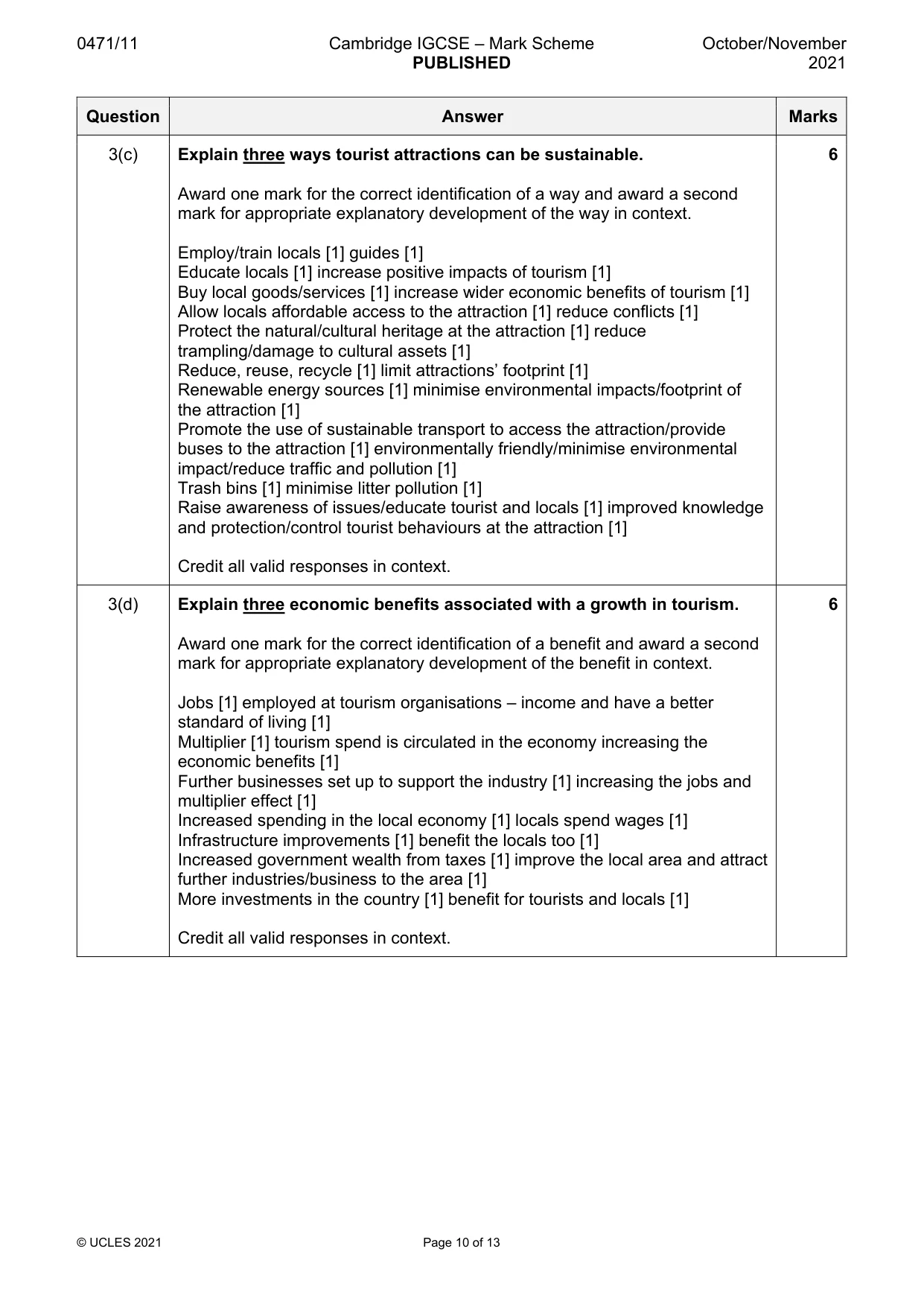
0471/11 Cambridge IGCSE – Mark Scheme PUBLISHED October/November 2021 © UCLES 2021 Page 10 of 13 Question Answer Marks 3(c) Explain three ways tourist attractions can be sustainable. Award one mark for the correct identification of a way and award a second mark for appropriate explanatory development of the way in context. Employ/train locals [1] guides [1] Educate locals [1] increase positive impacts of tourism [1] Buy local goods/services [1] increase wider economic benefits of tourism [1] Allow locals affordable access to the attraction [1] reduce conflicts [1] Protect the natural/cultural heritage at the attraction [1] reduce trampling/damage to cultural assets [1] Reduce, reuse, recycle [1] limit attractions’ footprint [1] Renewable energy sources [1] minimise environmental impacts/footprint of the attraction [1] Promote the use of sustainable transport to access the attraction/provide buses to the attraction [1] environmentally friendly/minimise environmental impact/reduce traffic and pollution [1] Trash bins [1] minimise litter pollution [1] Raise awareness of issues/educate tourist and locals [1] improved knowledge and protection/control tourist behaviours at the attraction [1] Credit all valid responses in context. 6 3(d) Explain three economic benefits associated with a growth in tourism. Award one mark for the correct identification of a benefit and award a second mark for appropriate explanatory development of the benefit in context. Jobs [1] employed at tourism organisations – income and have a better standard of living [1] Multiplier [1] tourism spend is circulated in the economy increasing the economic benefits [1] Further businesses set up to support the industry [1] increasing the jobs and multiplier effect [1] Increased spending in the local economy [1] locals spend wages [1] Infrastructure improvements [1] benefit the locals too [1] Increased government wealth from taxes [1] improve the local area and attract further industries/business to the area [1] More investments in the country [1] benefit for tourists and locals [1] Credit all valid responses in context. 6
Mark scheme, page 11
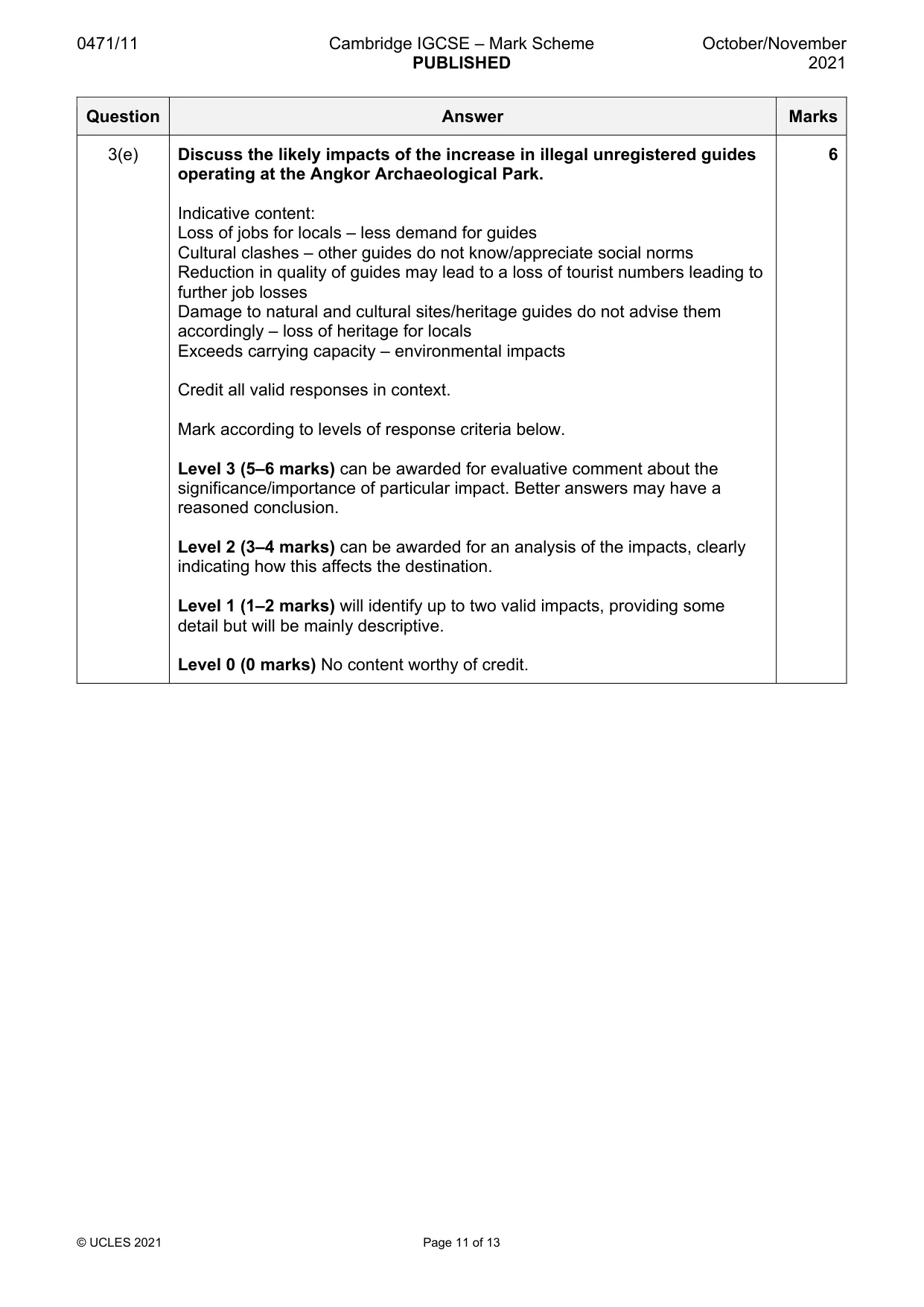
0471/11 Cambridge IGCSE – Mark Scheme PUBLISHED October/November 2021 © UCLES 2021 Page 11 of 13 Question Answer Marks 3(e) Discuss the likely impacts of the increase in illegal unregistered guides operating at the Angkor Archaeological Park. Indicative content: Loss of jobs for locals – less demand for guides Cultural clashes – other guides do not know/appreciate social norms Reduction in quality of guides may lead to a loss of tourist numbers leading to further job losses Damage to natural and cultural sites/heritage guides do not advise them accordingly – loss of heritage for locals Exceeds carrying capacity – environmental impacts Credit all valid responses in context. Mark according to levels of response criteria below. Level 3 (5–6 marks) can be awarded for evaluative comment about the significance/importance of particular impact. Better answers may have a reasoned conclusion. Level 2 (3–4 marks) can be awarded for an analysis of the impacts, clearly indicating how this affects the destination. Level 1 (1–2 marks) will identify up to two valid impacts, providing some detail but will be mainly descriptive. Level 0 (0 marks) No content worthy of credit. 6
Mark scheme, page 12
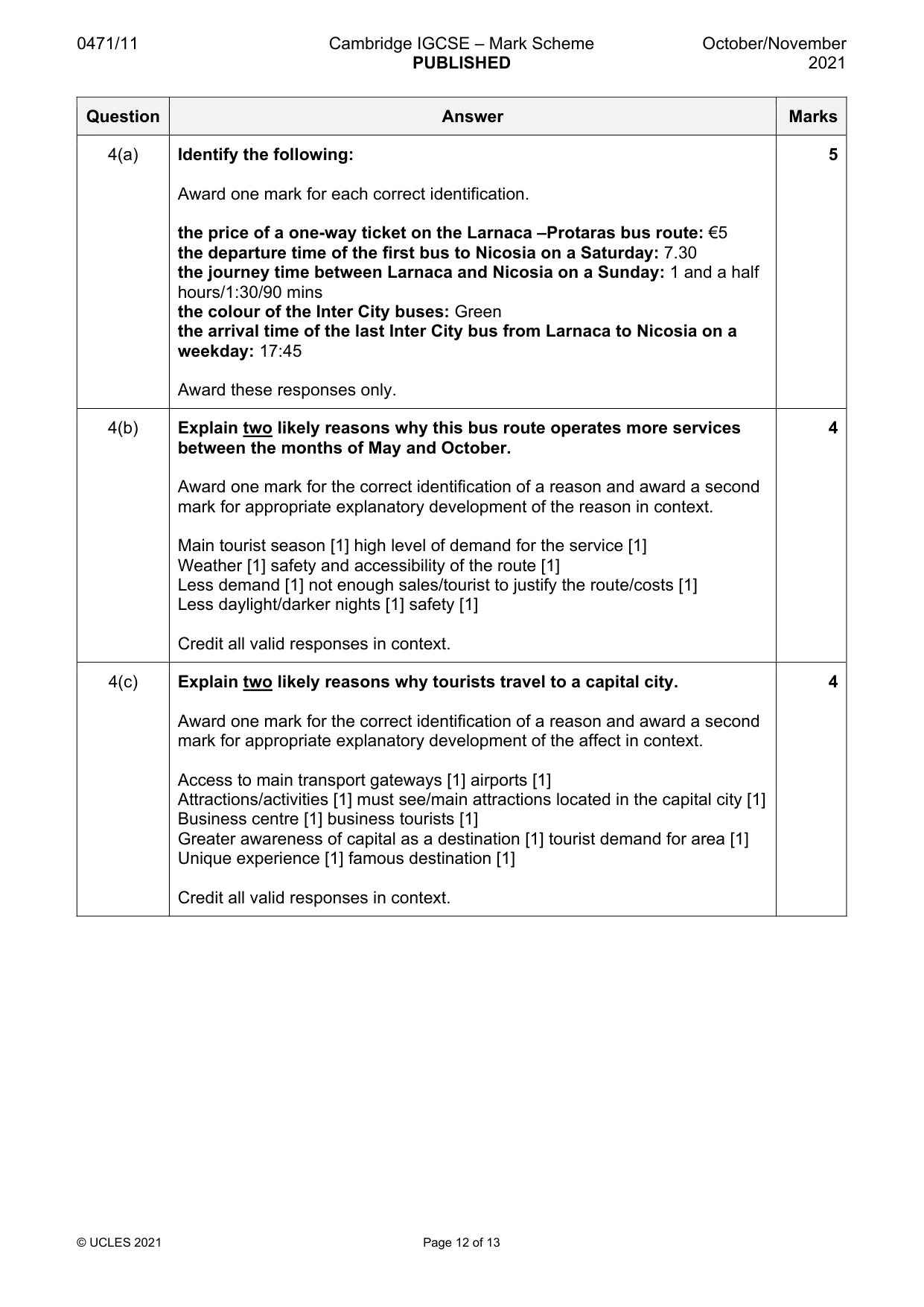
0471/11 Cambridge IGCSE – Mark Scheme PUBLISHED October/November 2021 © UCLES 2021 Page 12 of 13 Question Answer Marks 4(a) Identify the following: Award one mark for each correct identification. the price of a one-way ticket on the Larnaca –Protaras bus route: €5 the departure time of the first bus to Nicosia on a Saturday: 7.30 the journey time between Larnaca and Nicosia on a Sunday: 1 and a half hours/1:30/90 mins the colour of the Inter City buses: Green the arrival time of the last Inter City bus from Larnaca to Nicosia on a weekday: 17:45 Award these responses only. 5 4(b) Explain two likely reasons why this bus route operates more services between the months of May and October. Award one mark for the correct identification of a reason and award a second mark for appropriate explanatory development of the reason in context. Main tourist season [1] high level of demand for the service [1] Weather [1] safety and accessibility of the route [1] Less demand [1] not enough sales/tourist to justify the route/costs [1] Less daylight/darker nights [1] safety [1] Credit all valid responses in context. 4 4(c) Explain two likely reasons why tourists travel to a capital city. Award one mark for the correct identification of a reason and award a second mark for appropriate explanatory development of the affect in context. Access to main transport gateways [1] airports [1] Attractions/activities [1] must see/main attractions located in the capital city [1] Business centre [1] business tourists [1] Greater awareness of capital as a destination [1] tourist demand for area [1] Unique experience [1] famous destination [1] Credit all valid responses in context. 4
Mark scheme, page 13
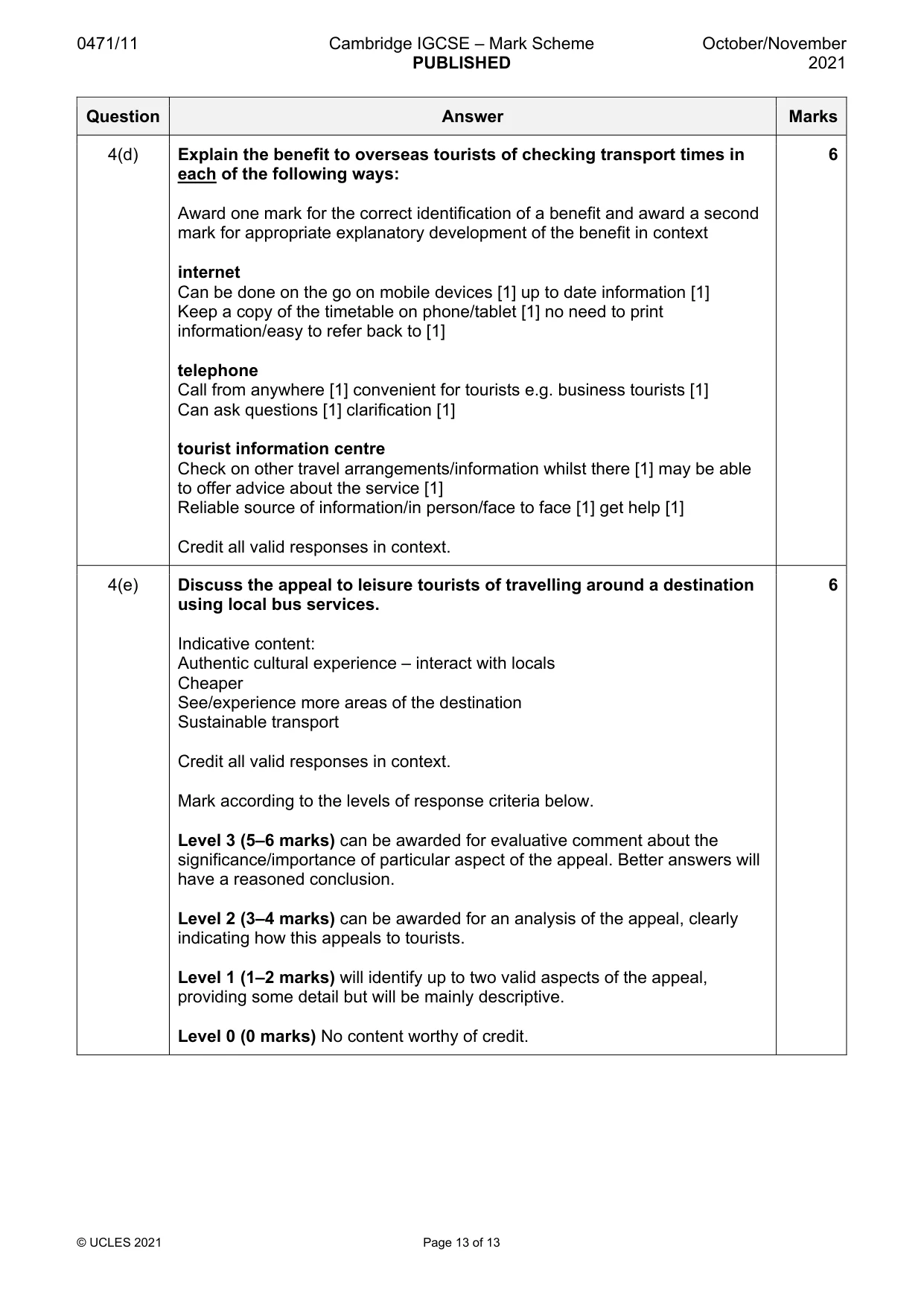
0471/11 Cambridge IGCSE – Mark Scheme PUBLISHED October/November 2021 © UCLES 2021 Page 13 of 13 Question Answer Marks 4(d) Explain the benefit to overseas tourists of checking transport times in each of the following ways: Award one mark for the correct identification of a benefit and award a second mark for appropriate explanatory development of the benefit in context internet Can be done on the go on mobile devices [1] up to date information [1] Keep a copy of the timetable on phone/tablet [1] no need to print information/easy to refer back to [1] telephone Call from anywhere [1] convenient for tourists e.g. business tourists [1] Can ask questions [1] clarification [1] tourist information centre Check on other travel arrangements/information whilst there [1] may be able to offer advice about the service [1] Reliable source of information/in person/face to face [1] get help [1] Credit all valid responses in context. 6 4(e) Discuss the appeal to leisure tourists of travelling around a destination using local bus services. Indicative content: Authentic cultural experience – interact with locals Cheaper See/experience more areas of the destination Sustainable transport Credit all valid responses in context. Mark according to the levels of response criteria below. Level 3 (5–6 marks) can be awarded for evaluative comment about the significance/importance of particular aspect of the appeal. Better answers will have a reasoned conclusion. Level 2 (3–4 marks) can be awarded for an analysis of the appeal, clearly indicating how this appeals to tourists. Level 1 (1–2 marks) will identify up to two valid aspects of the appeal, providing some detail but will be mainly descriptive. Level 0 (0 marks) No content worthy of credit. 6
What you needed in this session
Cambridge’s own grade thresholds for 2021 Oct/Nov, Paper 1 · Variant 1. A higher threshold means an easier paper — the bar moves with how the cohort did.