Cambridge IGCSE Travel and Tourism 0471 — 2021 May/June Paper 1 · Variant 2
0471/12/M/J/21 · 100 marks · ≈113 min
The question paper and its mark scheme, free to read here and free to download. This is Cambridge’s own paper, exactly as it was sat.
Question paper12 pages
Mark scheme13 pages
Answers below. Sit the paper first if you are practising.
Paper as text
Question paper, page 1
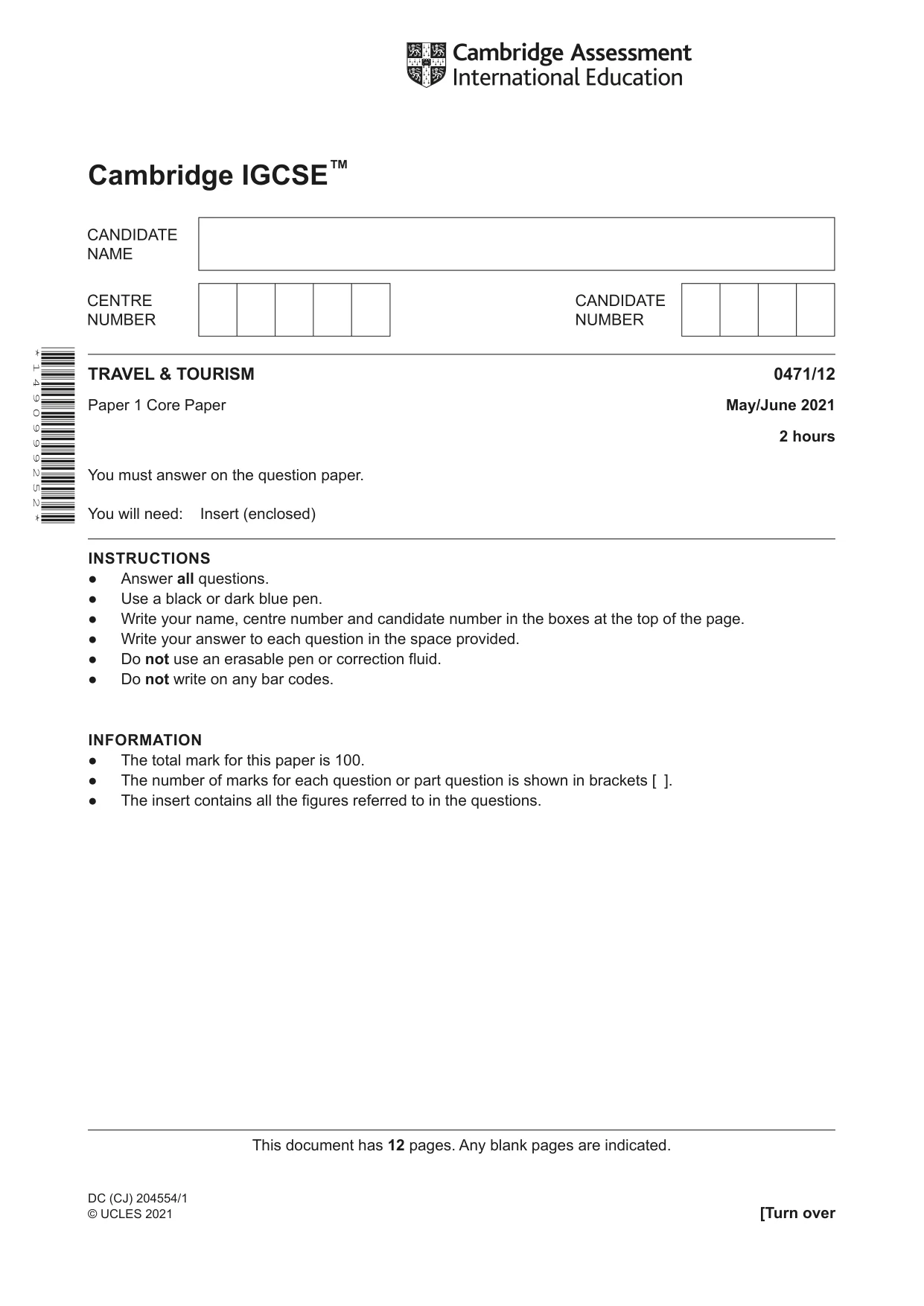
This document has 12 pages. Any blank pages are indicated. Cambridge IGCSE™ TRAVEL & TOURISM 0471/12 Paper 1 Core Paper May/June 2021 2 hours You must answer on the question paper. You will need: Insert (enclosed) INSTRUCTIONS ● Answer all questions. ● Use a black or dark blue pen. ● Write your name, centre number and candidate number in the boxes at the top of the page. ● Write your answer to each question in the space provided. ● Do not use an erasable pen or correction fluid. ● Do not write on any bar codes. INFORMATION ● The total mark for this paper is 100. ● The number of marks for each question or part question is shown in brackets [ ]. ● The insert contains all the figures referred to in the questions. * 1 4 9 0 9 9 9 2 5 2 * DC (CJ) 204554/1 © UCLES 2021 [Turn over
Question paper, page 2
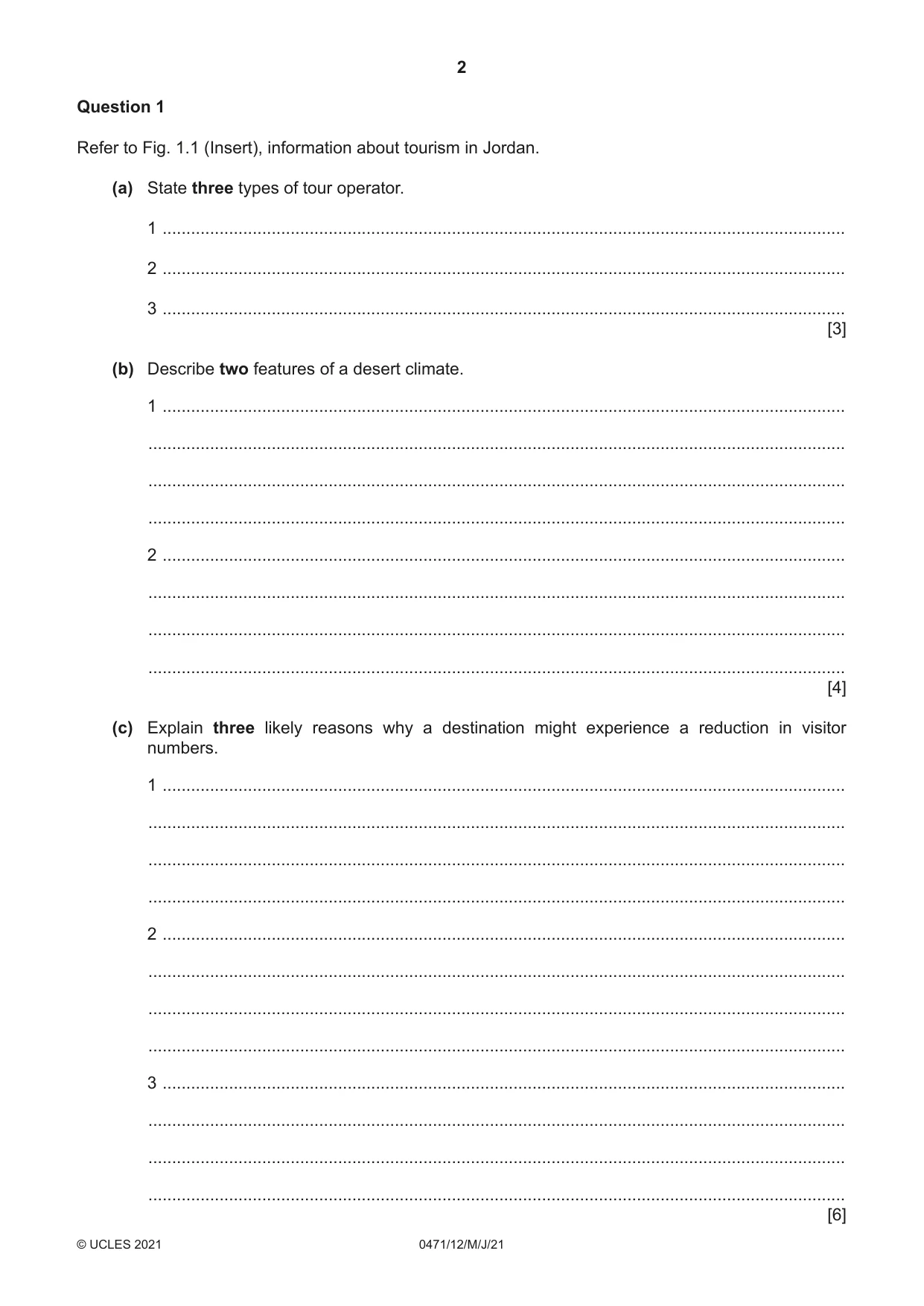
2 0471/12/M/J/21 © UCLES 2021 Question 1 Refer to Fig. 1.1 (Insert), information about tourism in Jordan. (a) State three types of tour operator. 1 … 2 … 3 … [3] (b) Describe two features of a desert climate. 1 … … … … 2 … … … … [4] (c) Explain three likely reasons why a destination might experience a reduction in visitor numbers. 1 … … … … 2 … … … … 3 … … … … [6]
Question paper, page 3
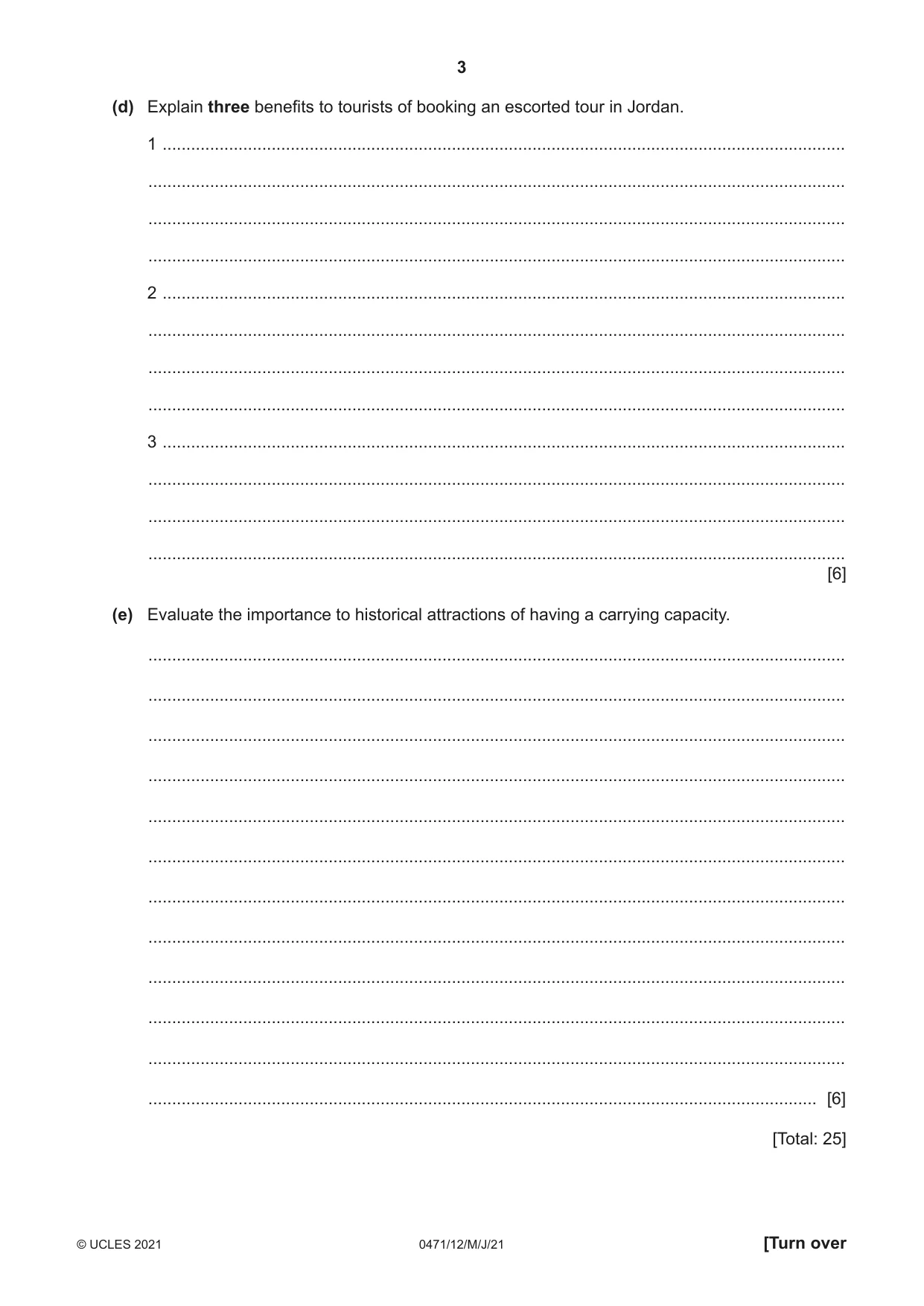
3 0471/12/M/J/21 © UCLES 2021 [Turn over (d) Explain three benefits to tourists of booking an escorted tour in Jordan. 1 … … … … 2 … … … … 3 … … … … [6] (e) Evaluate the importance to historical attractions of having a carrying capacity. … … … … … … … … … … … … [6] [Total: 25]
Question paper, page 4
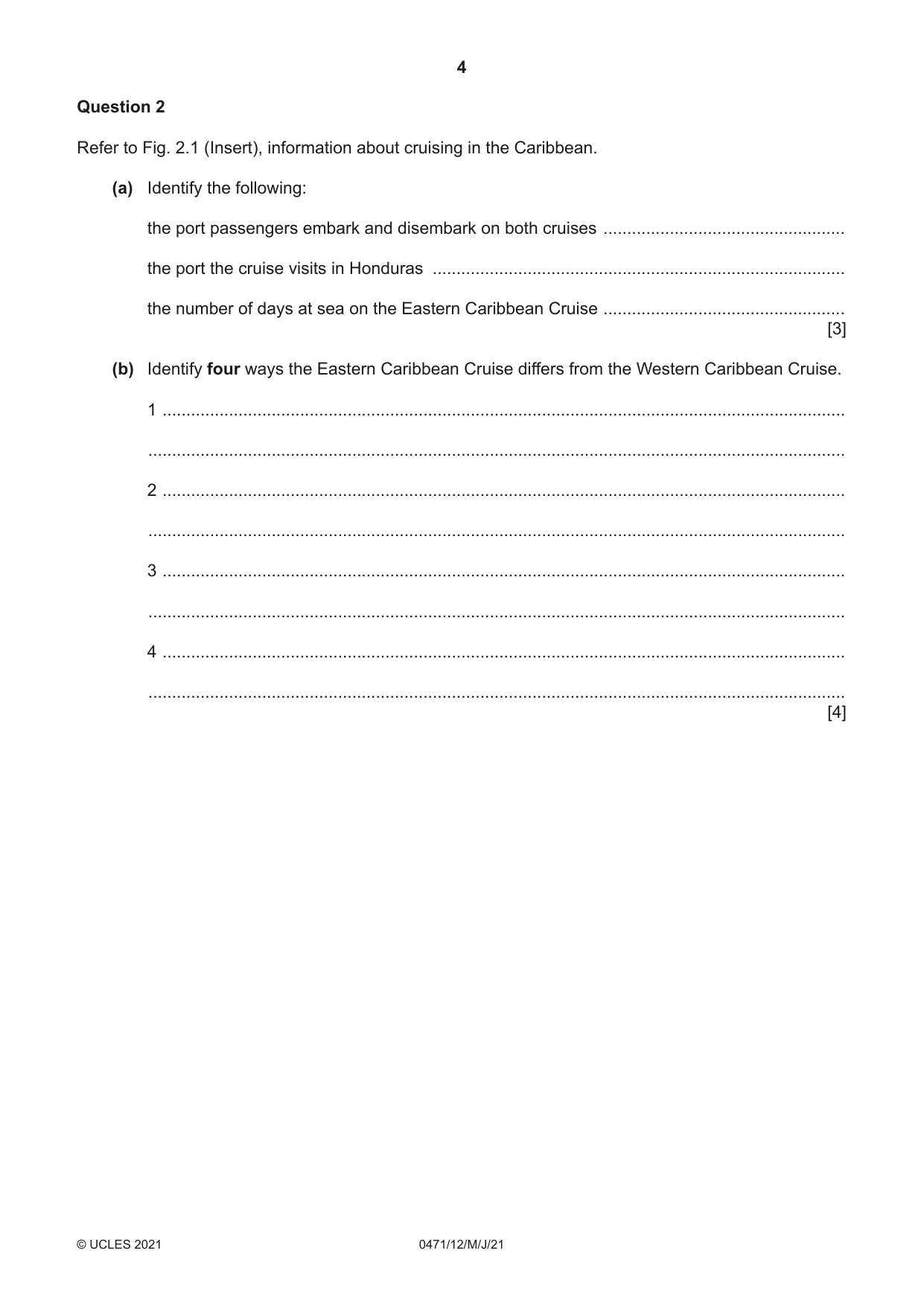
4 0471/12/M/J/21 © UCLES 2021 Question 2 Refer to Fig. 2.1 (Insert), information about cruising in the Caribbean. (a) Identify the following: the port passengers embark and disembark on both cruises … the port the cruise visits in Honduras … the number of days at sea on the Eastern Caribbean Cruise … [3] (b) Identify four ways the Eastern Caribbean Cruise differs from the Western Caribbean Cruise. 1 … … 2 … … 3 … … 4 … … [4]
Question paper, page 5
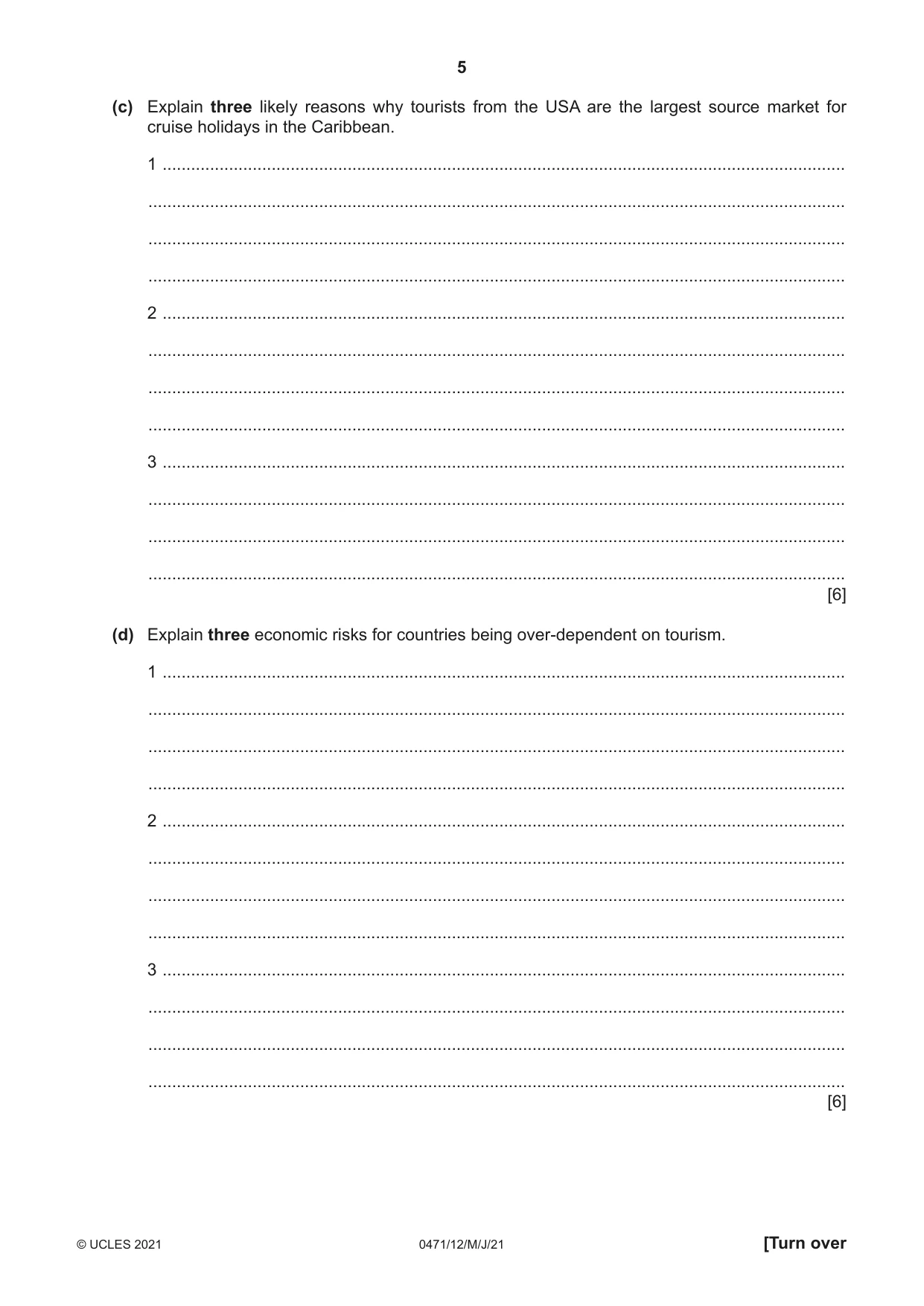
5 0471/12/M/J/21 © UCLES 2021 [Turn over (c) Explain three likely reasons why tourists from the USA are the largest source market for cruise holidays in the Caribbean. 1 … … … … 2 … … … … 3 … … … … [6] (d) Explain three economic risks for countries being over-dependent on tourism. 1 … … … … 2 … … … … 3 … … … … [6]
Question paper, page 6
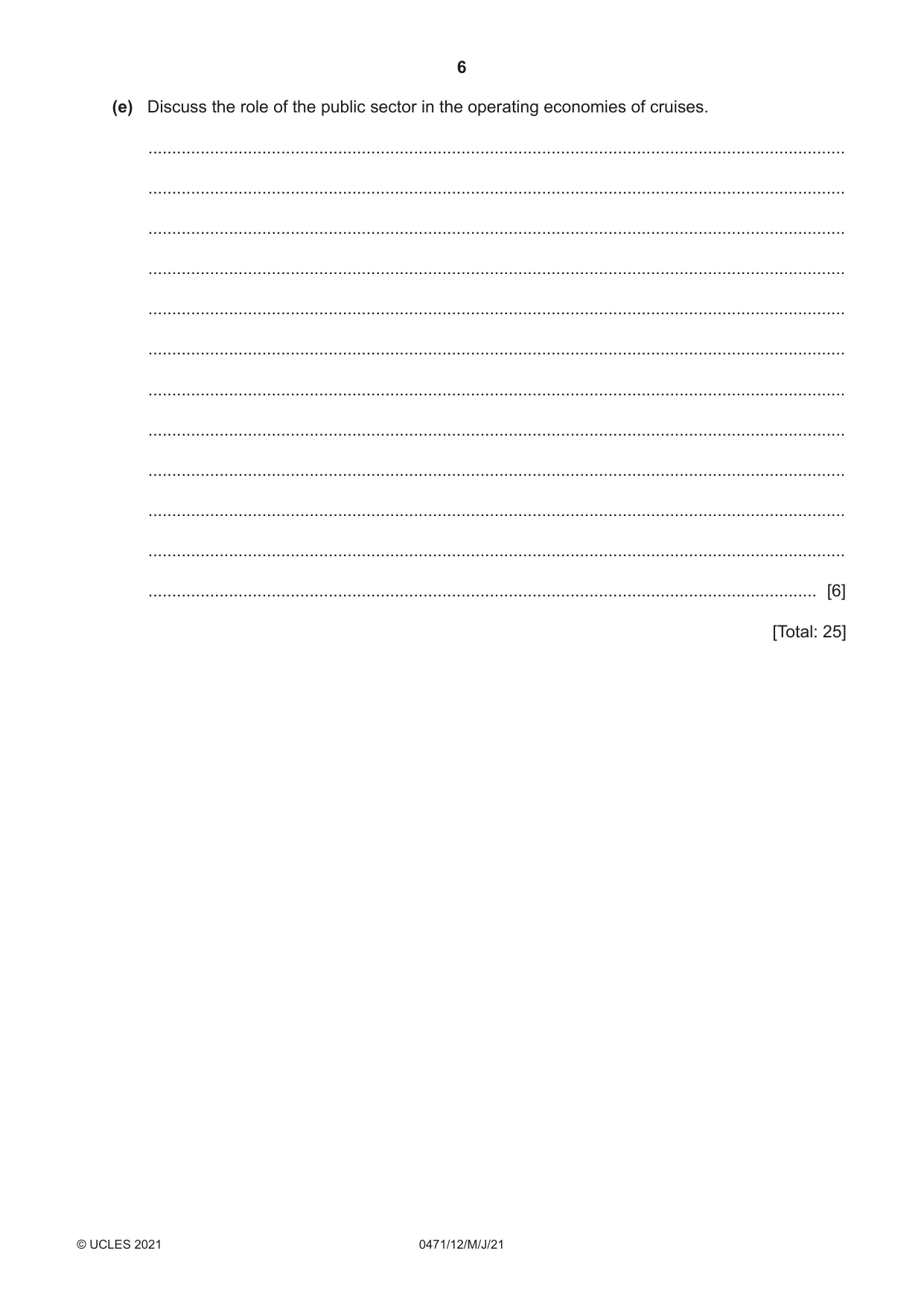
6 0471/12/M/J/21 © UCLES 2021 (e) Discuss the role of the public sector in the operating economies of cruises. … … … … … … … … … … … … [6] [Total: 25]
Question paper, page 7
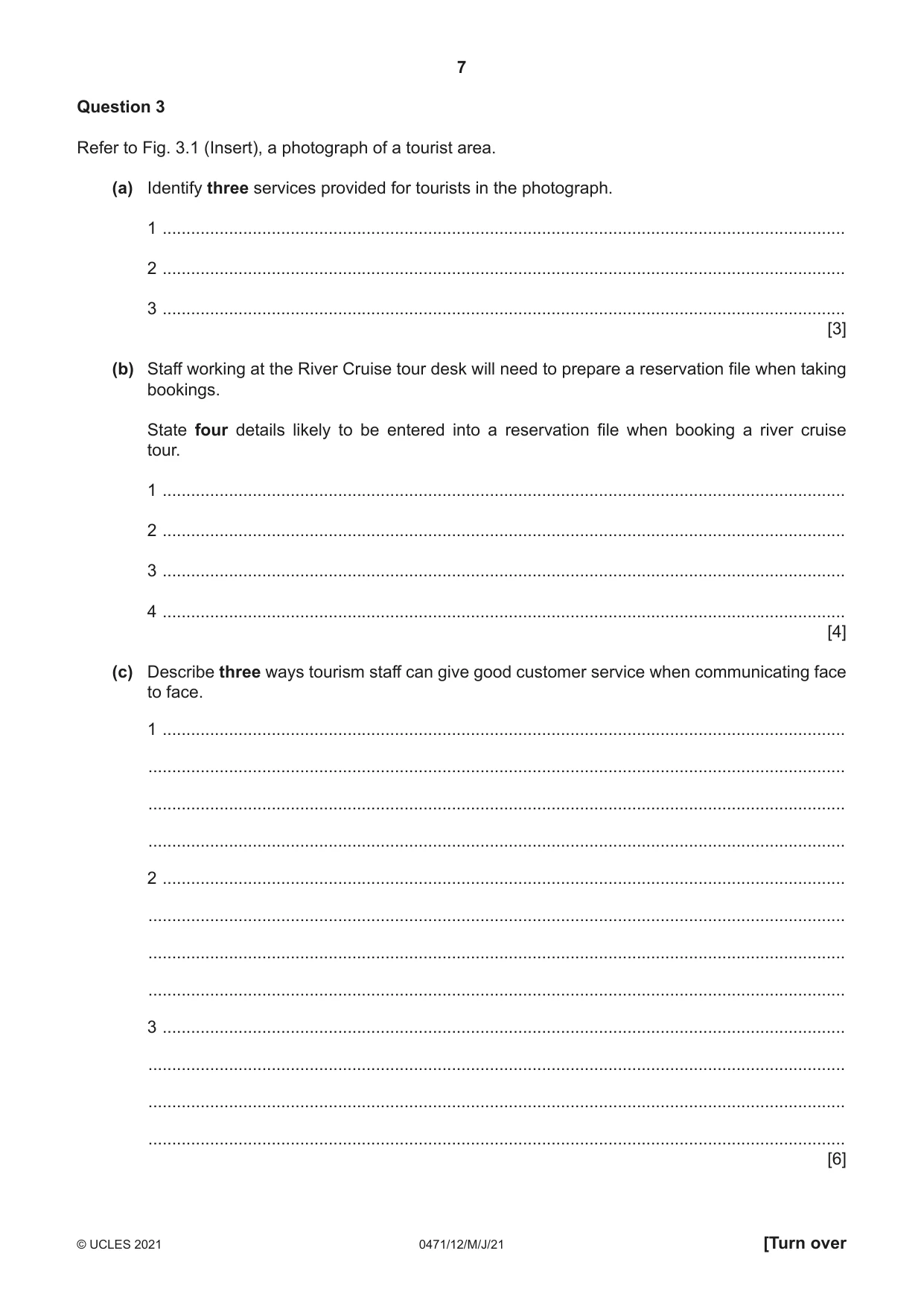
7 0471/12/M/J/21 © UCLES 2021 [Turn over Question 3 Refer to Fig. 3.1 (Insert), a photograph of a tourist area. (a) Identify three services provided for tourists in the photograph. 1 … 2 … 3 … [3] (b) Staff working at the River Cruise tour desk will need to prepare a reservation file when taking bookings. State four details likely to be entered into a reservation file when booking a river cruise tour. 1 … 2 … 3 … 4 … [4] (c) Describe three ways tourism staff can give good customer service when communicating face to face. 1 … … … … 2 … … … … 3 … … … … [6]
Question paper, page 8
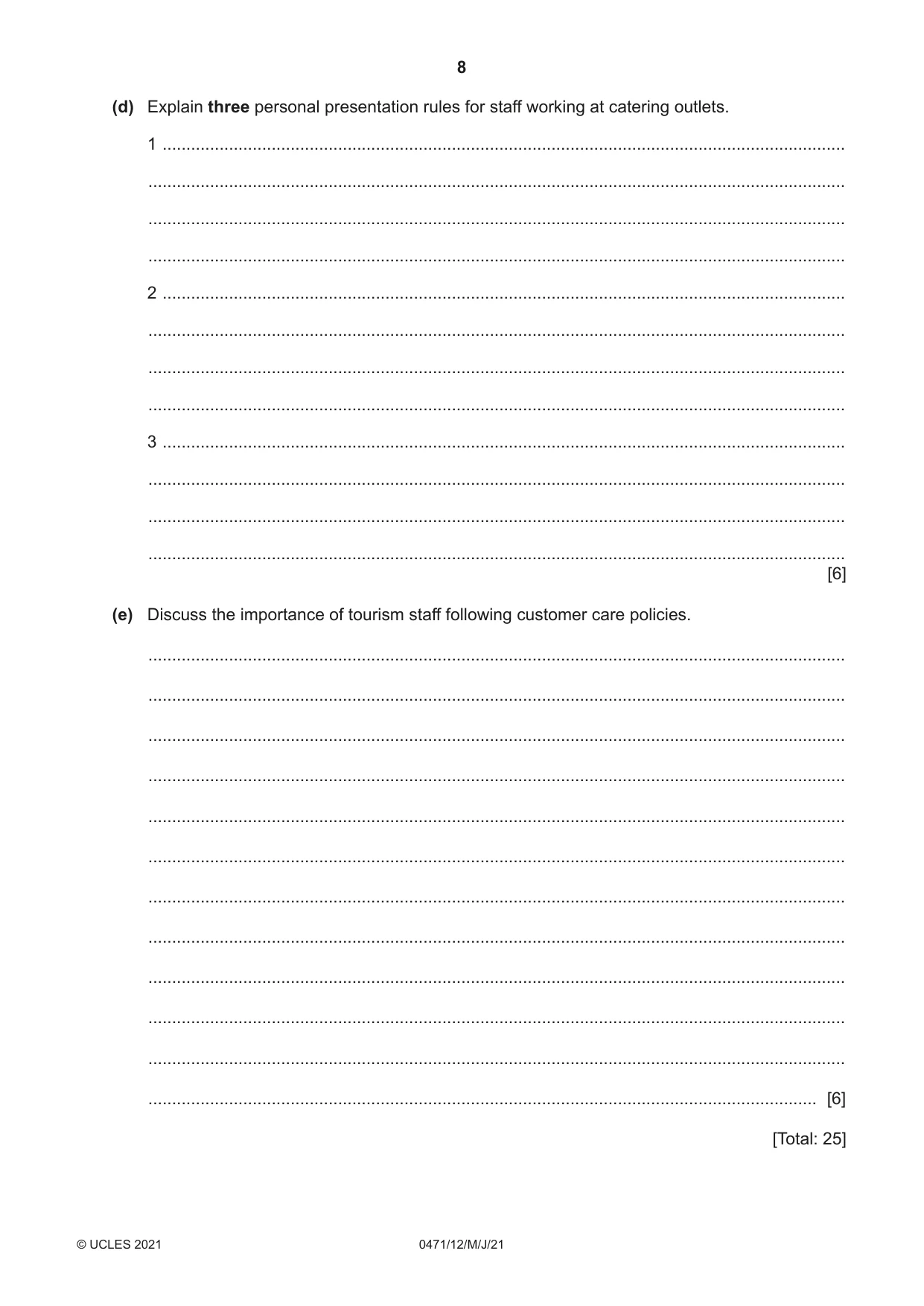
8 0471/12/M/J/21 © UCLES 2021 (d) Explain three personal presentation rules for staff working at catering outlets. 1 … … … … 2 … … … … 3 … … … … [6] (e) Discuss the importance of tourism staff following customer care policies. … … … … … … … … … … … … [6] [Total: 25]
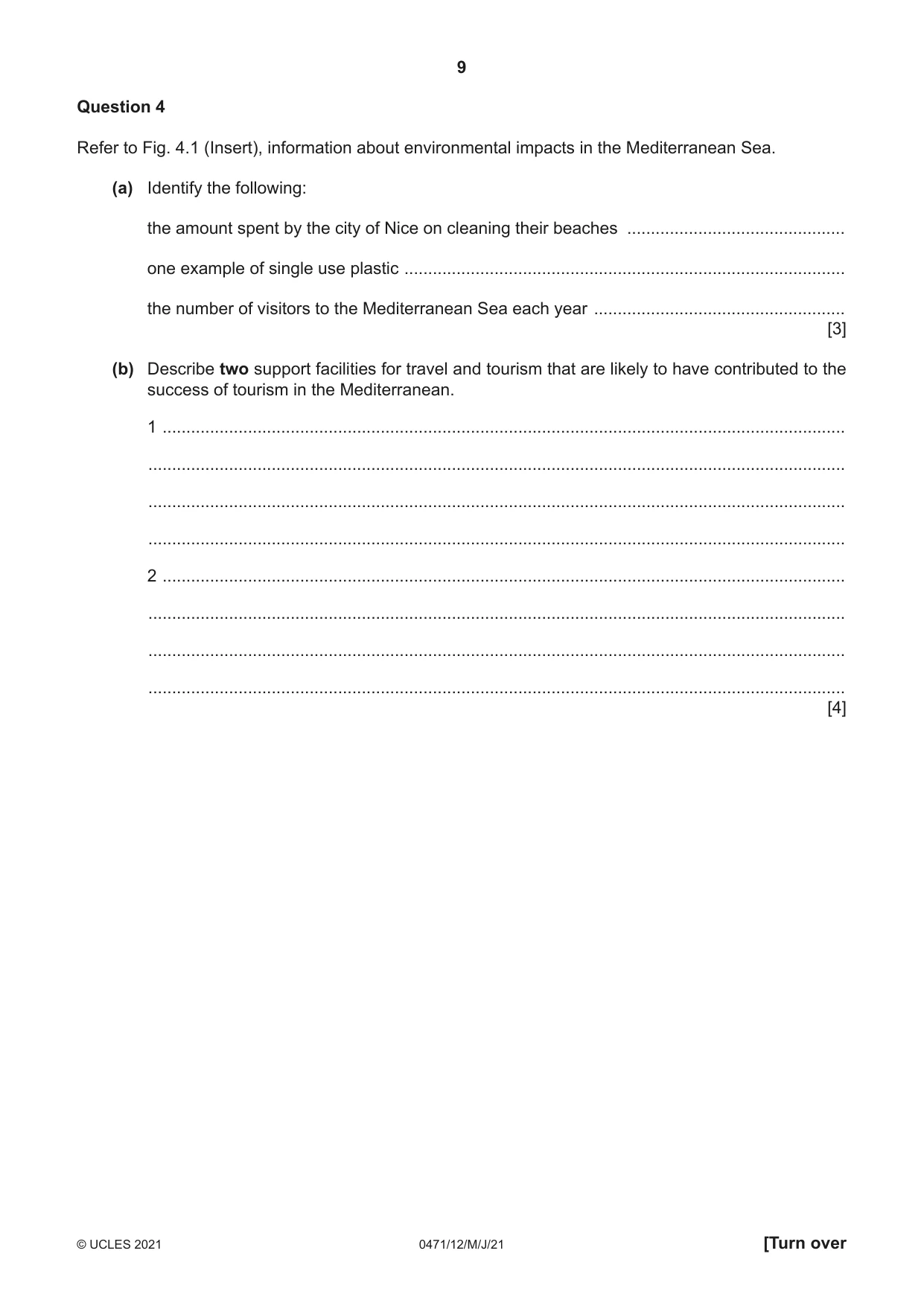
Question paper, page 9
9 0471/12/M/J/21 © UCLES 2021 [Turn over Question 4 Refer to Fig. 4.1 (Insert), information about environmental impacts in the Mediterranean Sea. (a) Identify the following: the amount spent by the city of Nice on cleaning their beaches … one example of single use plastic … the number of visitors to the Mediterranean Sea each year … [3] (b) Describe two support facilities for travel and tourism that are likely to have contributed to the success of tourism in the Mediterranean. 1 … … … … 2 … … … … [4]
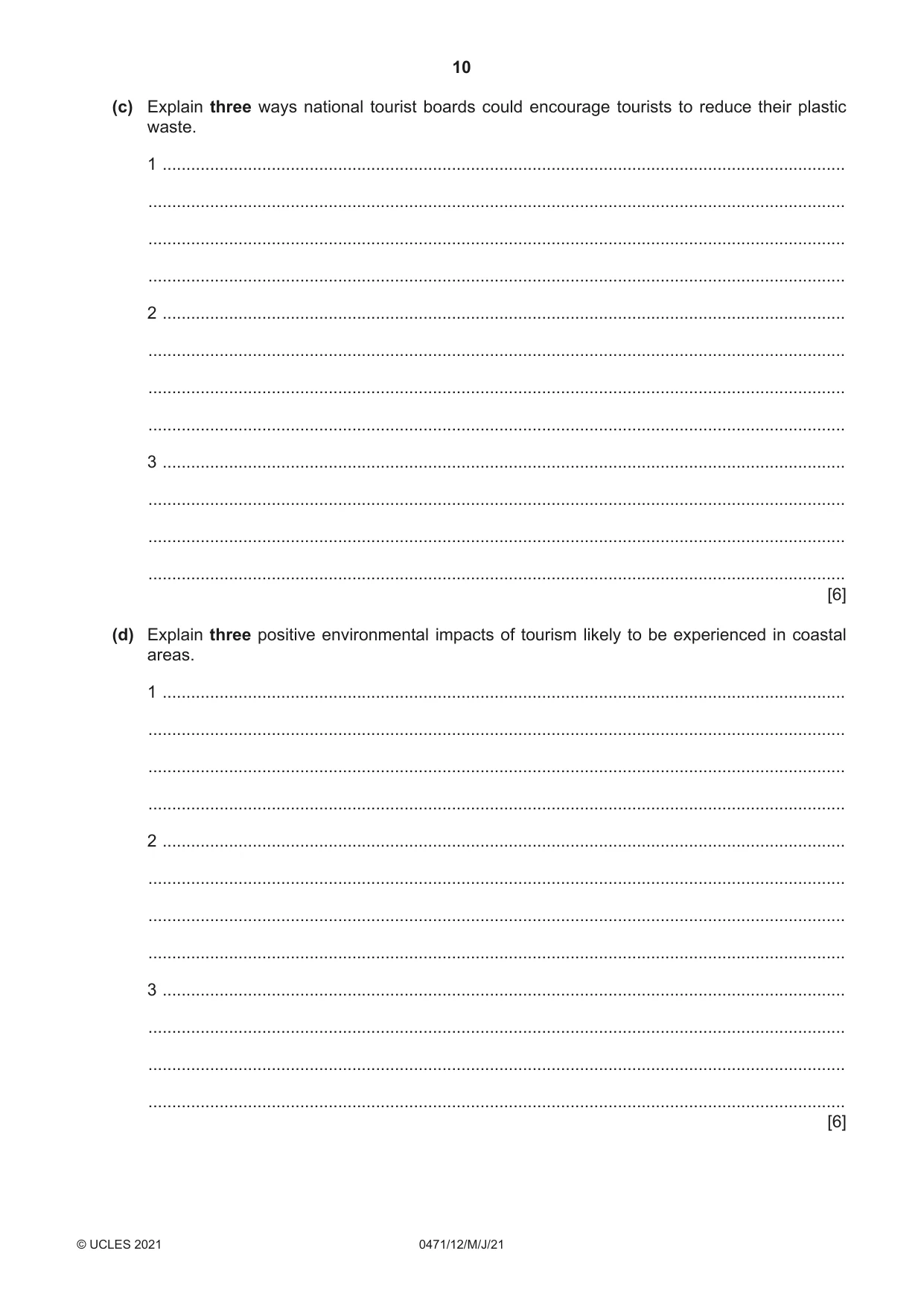
Question paper, page 10
10 0471/12/M/J/21 © UCLES 2021 (c) Explain three ways national tourist boards could encourage tourists to reduce their plastic waste. 1 … … … … 2 … … … … 3 … … … … [6] (d) Explain three positive environmental impacts of tourism likely to be experienced in coastal areas. 1 … … … … 2 … … … … 3 … … … … [6]
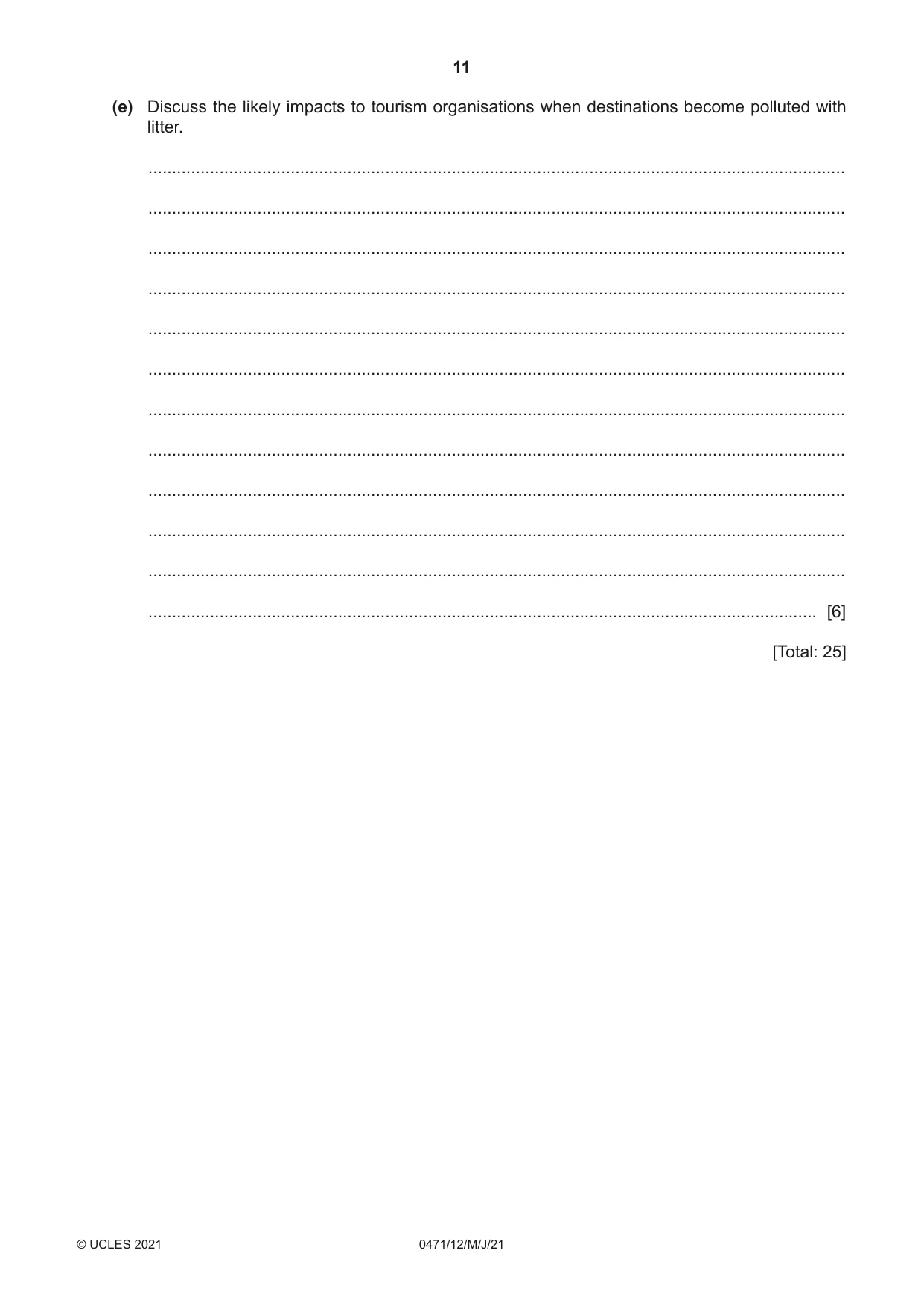
Question paper, page 11
11 0471/12/M/J/21 © UCLES 2021 (e) Discuss the likely impacts to tourism organisations when destinations become polluted with litter. … … … … … … … … … … … … [6] [Total: 25]
Question paper, page 12
12 0471/12/M/J/21 © UCLES 2021 BLANK PAGE The boundaries and names shown, the designations used and the presentation of material on any maps contained in this question paper/insert do not imply official endorsement or acceptance by Cambridge Assessment International Education concerning the legal status of any country, territory, or area or any of its authorities, or of the delimitation of its frontiers or boundaries. Permission to reproduce items where third-party owned material protected by copyright is included has been sought and cleared where possible. Every reasonable effort has been made by the publisher (UCLES) to trace copyright holders, but if any items requiring clearance have unwittingly been included, the publisher will be pleased to make amends at the earliest possible opportunity. To avoid the issue of disclosure of answer-related information to candidates, all copyright acknowledgements are reproduced online in the Cambridge Assessment International Education Copyright Acknowledgements Booklet. This is produced for each series of examinations and is freely available to download at www.cambridgeinternational.org after the live examination series. Cambridge Assessment International Education is part of the Cambridge Assessment Group. Cambridge Assessment is the brand name of the University of Cambridge Local Examinations Syndicate (UCLES), which itself is a department of the University of Cambridge.
Mark scheme, page 1
This document consists of 13 printed pages. © UCLES 2021 [Turn over Cambridge IGCSE™ TRAVEL & TOURISM 0471/12 Paper 1 Core Module May/June 2021 MARK SCHEME Maximum Mark: 100 Published This mark scheme is published as an aid to teachers and candidates, to indicate the requirements of the examination. It shows the basis on which Examiners were instructed to award marks. It does not indicate the details of the discussions that took place at an Examiners’ meeting before marking began, which would have considered the acceptability of alternative answers. Mark schemes should be read in conjunction with the question paper and the Principal Examiner Report for Teachers. Cambridge International will not enter into discussions about these mark schemes. Cambridge International is publishing the mark schemes for the May/June 2021 series for most Cambridge IGCSE™, Cambridge International A and AS Level components and some Cambridge O Level components.
Mark scheme, page 2
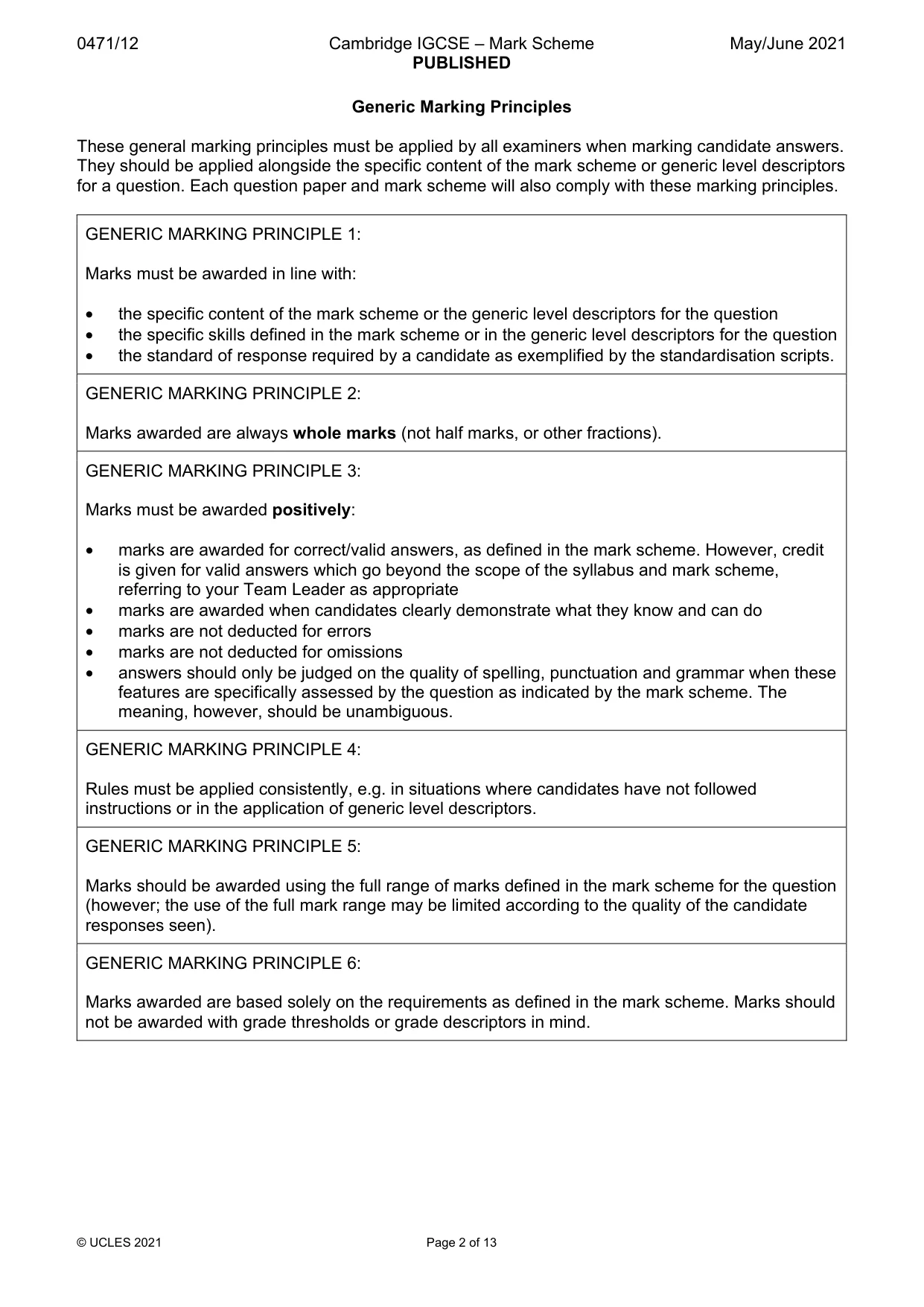
0471/12 Cambridge IGCSE – Mark Scheme PUBLISHED May/June 2021 © UCLES 2021 Page 2 of 13 Generic Marking Principles These general marking principles must be applied by all examiners when marking candidate answers. They should be applied alongside the specific content of the mark scheme or generic level descriptors for a question. Each question paper and mark scheme will also comply with these marking principles. GENERIC MARKING PRINCIPLE 1: Marks must be awarded in line with: • the specific content of the mark scheme or the generic level descriptors for the question • the specific skills defined in the mark scheme or in the generic level descriptors for the question • the standard of response required by a candidate as exemplified by the standardisation scripts. GENERIC MARKING PRINCIPLE 2: Marks awarded are always whole marks (not half marks, or other fractions). GENERIC MARKING PRINCIPLE 3: Marks must be awarded positively: • marks are awarded for correct/valid answers, as defined in the mark scheme. However, credit is given for valid answers which go beyond the scope of the syllabus and mark scheme, referring to your Team Leader as appropriate • marks are awarded when candidates clearly demonstrate what they know and can do • marks are not deducted for errors • marks are not deducted for omissions • answers should only be judged on the quality of spelling, punctuation and grammar when these features are specifically assessed by the question as indicated by the mark scheme. The meaning, however, should be unambiguous. GENERIC MARKING PRINCIPLE 4: Rules must be applied consistently, e.g. in situations where candidates have not followed instructions or in the application of generic level descriptors. GENERIC MARKING PRINCIPLE 5: Marks should be awarded using the full range of marks defined in the mark scheme for the question (however; the use of the full mark range may be limited according to the quality of the candidate responses seen). GENERIC MARKING PRINCIPLE 6: Marks awarded are based solely on the requirements as defined in the mark scheme. Marks should not be awarded with grade thresholds or grade descriptors in mind.
Mark scheme, page 3
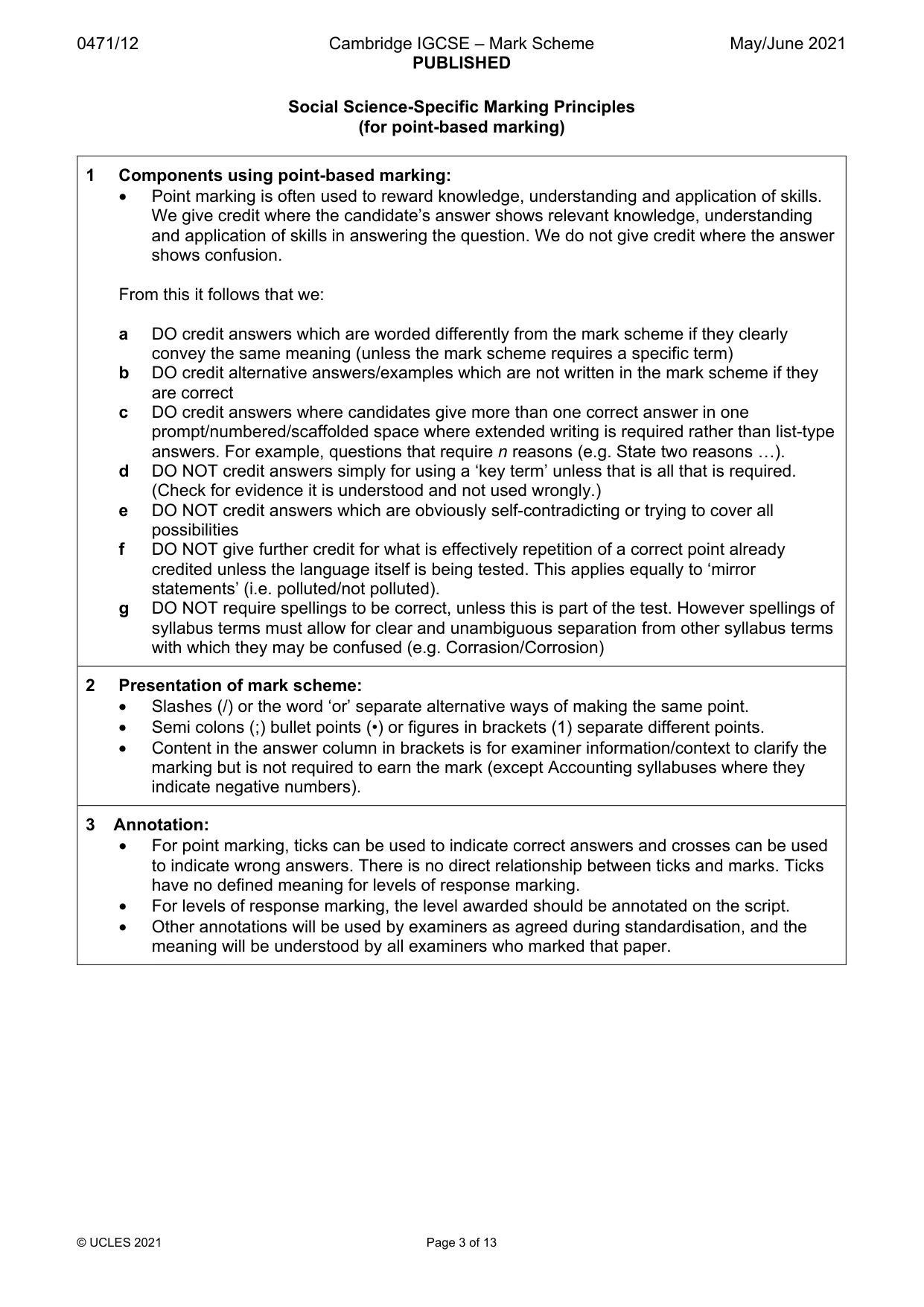
0471/12 Cambridge IGCSE – Mark Scheme PUBLISHED May/June 2021 © UCLES 2021 Page 3 of 13 Social Science-Specific Marking Principles (for point-based marking) 1 Components using point-based marking: • Point marking is often used to reward knowledge, understanding and application of skills. We give credit where the candidate’s answer shows relevant knowledge, understanding and application of skills in answering the question. We do not give credit where the answer shows confusion. From this it follows that we: a DO credit answers which are worded differently from the mark scheme if they clearly convey the same meaning (unless the mark scheme requires a specific term) b DO credit alternative answers/examples which are not written in the mark scheme if they are correct c DO credit answers where candidates give more than one correct answer in one prompt/numbered/scaffolded space where extended writing is required rather than list-type answers. For example, questions that require n reasons (e.g. State two reasons …). d DO NOT credit answers simply for using a ‘key term’ unless that is all that is required. (Check for evidence it is understood and not used wrongly.) e DO NOT credit answers which are obviously self-contradicting or trying to cover all possibilities f DO NOT give further credit for what is effectively repetition of a correct point already credited unless the language itself is being tested. This applies equally to ‘mirror statements’ (i.e. polluted/not polluted). g DO NOT require spellings to be correct, unless this is part of the test. However spellings of syllabus terms must allow for clear and unambiguous separation from other syllabus terms with which they may be confused (e.g. Corrasion/Corrosion) 2 Presentation of mark scheme: • Slashes (/) or the word ‘or’ separate alternative ways of making the same point. • Semi colons (;) bullet points (•) or figures in brackets (1) separate different points. • Content in the answer column in brackets is for examiner information/context to clarify the marking but is not required to earn the mark (except Accounting syllabuses where they indicate negative numbers). 3 Annotation: • For point marking, ticks can be used to indicate correct answers and crosses can be used to indicate wrong answers. There is no direct relationship between ticks and marks. Ticks have no defined meaning for levels of response marking. • For levels of response marking, the level awarded should be annotated on the script. • Other annotations will be used by examiners as agreed during standardisation, and the meaning will be understood by all examiners who marked that paper.
Mark scheme, page 4
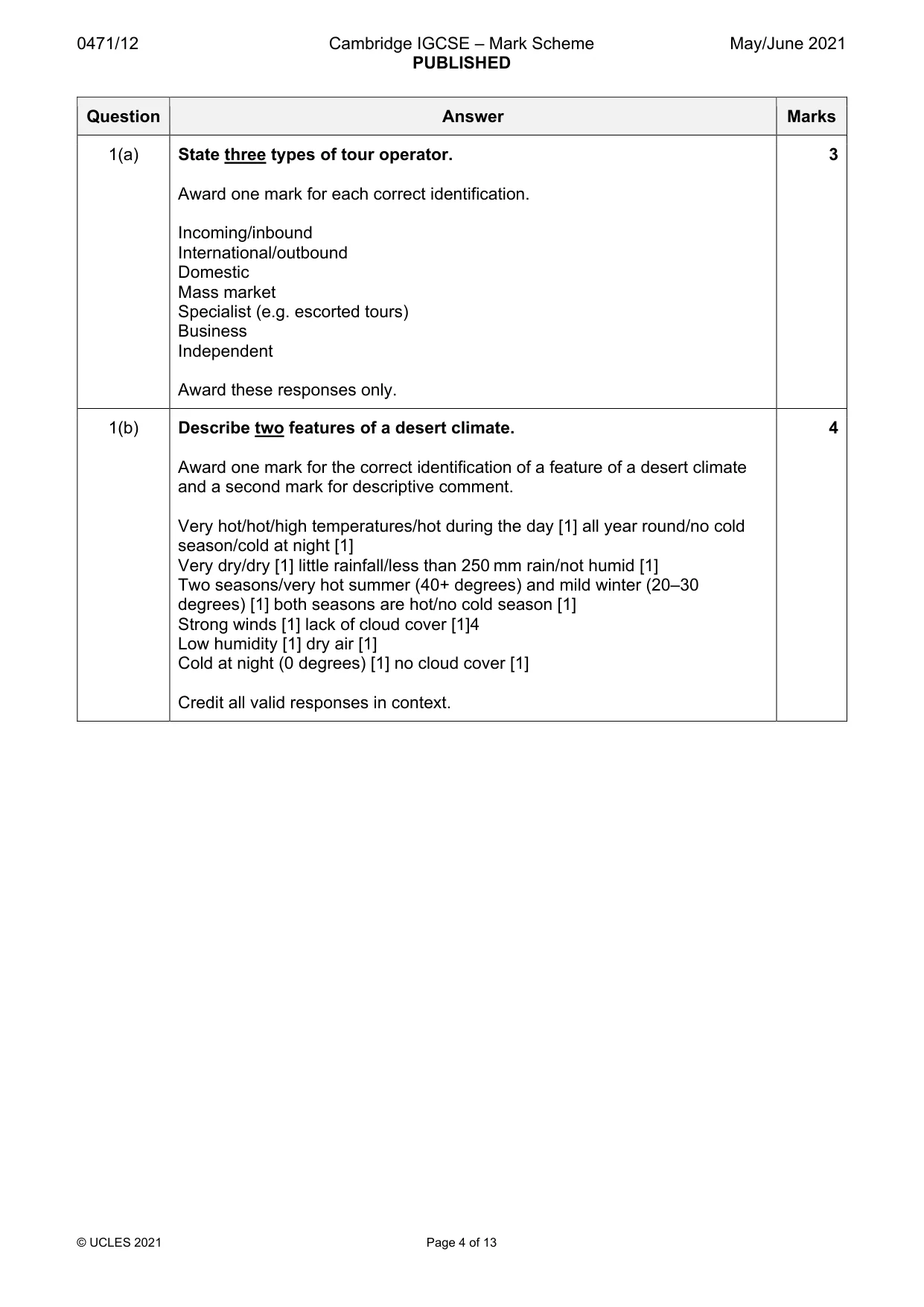
0471/12 Cambridge IGCSE – Mark Scheme PUBLISHED May/June 2021 © UCLES 2021 Page 4 of 13 Question Answer Marks 1(a) State three types of tour operator. Award one mark for each correct identification. Incoming/inbound International/outbound Domestic Mass market Specialist (e.g. escorted tours) Business Independent Award these responses only. 3 1(b) Describe two features of a desert climate. Award one mark for the correct identification of a feature of a desert climate and a second mark for descriptive comment. Very hot/hot/high temperatures/hot during the day [1] all year round/no cold season/cold at night [1] Very dry/dry [1] little rainfall/less than 250 mm rain/not humid [1] Two seasons/very hot summer (40+ degrees) and mild winter (20–30 degrees) [1] both seasons are hot/no cold season [1] Strong winds [1] lack of cloud cover [1]4 Low humidity [1] dry air [1] Cold at night (0 degrees) [1] no cloud cover [1] Credit all valid responses in context. 4
Mark scheme, page 5
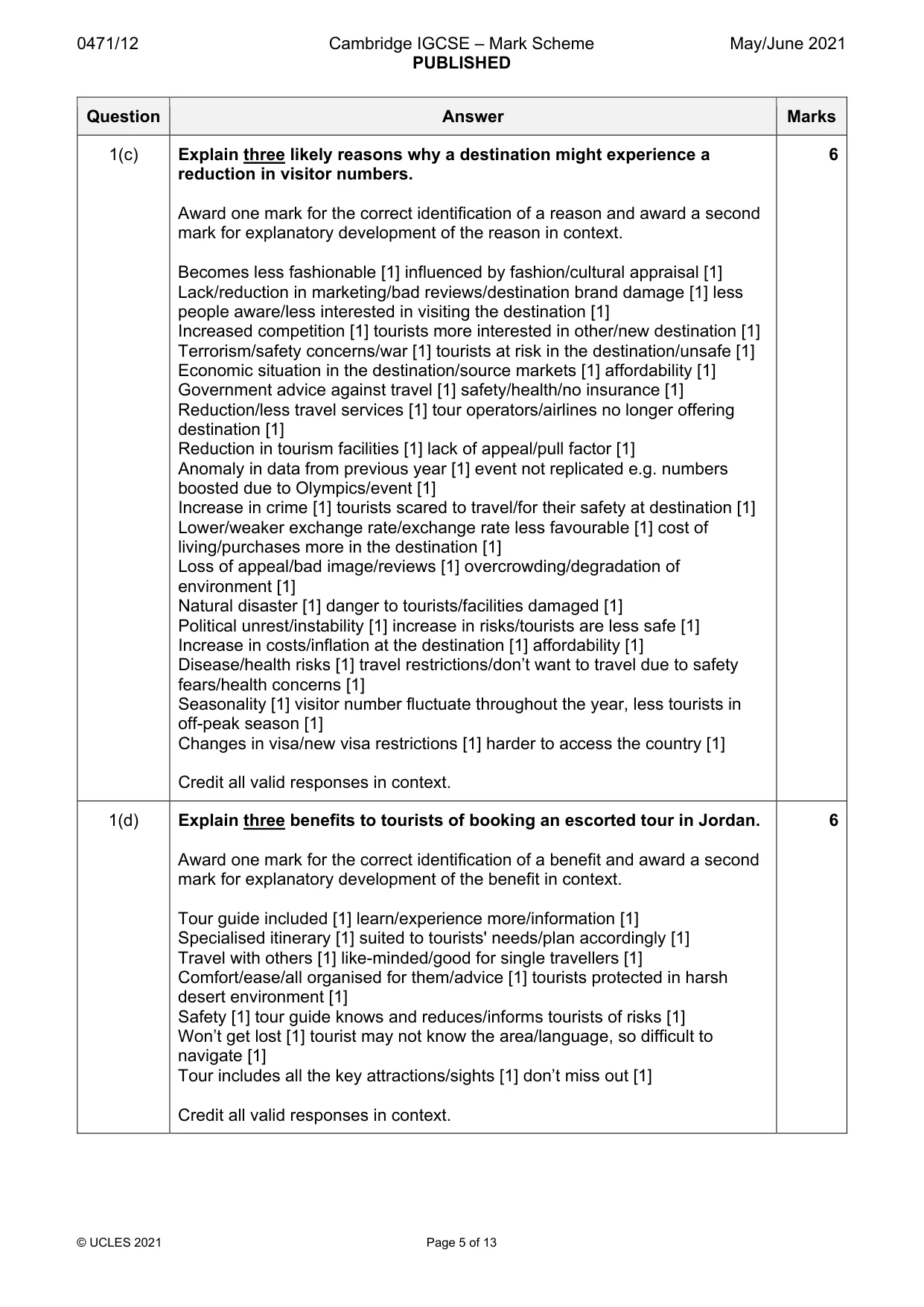
0471/12 Cambridge IGCSE – Mark Scheme PUBLISHED May/June 2021 © UCLES 2021 Page 5 of 13 Question Answer Marks 1(c) Explain three likely reasons why a destination might experience a reduction in visitor numbers. Award one mark for the correct identification of a reason and award a second mark for explanatory development of the reason in context. Becomes less fashionable [1] influenced by fashion/cultural appraisal [1] Lack/reduction in marketing/bad reviews/destination brand damage [1] less people aware/less interested in visiting the destination [1] Increased competition [1] tourists more interested in other/new destination [1] Terrorism/safety concerns/war [1] tourists at risk in the destination/unsafe [1] Economic situation in the destination/source markets [1] affordability [1] Government advice against travel [1] safety/health/no insurance [1] Reduction/less travel services [1] tour operators/airlines no longer offering destination [1] Reduction in tourism facilities [1] lack of appeal/pull factor [1] Anomaly in data from previous year [1] event not replicated e.g. numbers boosted due to Olympics/event [1] Increase in crime [1] tourists scared to travel/for their safety at destination [1] Lower/weaker exchange rate/exchange rate less favourable [1] cost of living/purchases more in the destination [1] Loss of appeal/bad image/reviews [1] overcrowding/degradation of environment [1] Natural disaster [1] danger to tourists/facilities damaged [1] Political unrest/instability [1] increase in risks/tourists are less safe [1] Increase in costs/inflation at the destination [1] affordability [1] Disease/health risks [1] travel restrictions/don’t want to travel due to safety fears/health concerns [1] Seasonality [1] visitor number fluctuate throughout the year, less tourists in off-peak season [1] Changes in visa/new visa restrictions [1] harder to access the country [1] Credit all valid responses in context. 6 1(d) Explain three benefits to tourists of booking an escorted tour in Jordan. Award one mark for the correct identification of a benefit and award a second mark for explanatory development of the benefit in context. Tour guide included [1] learn/experience more/information [1] Specialised itinerary [1] suited to tourists' needs/plan accordingly [1] Travel with others [1] like-minded/good for single travellers [1] Comfort/ease/all organised for them/advice [1] tourists protected in harsh desert environment [1] Safety [1] tour guide knows and reduces/informs tourists of risks [1] Won’t get lost [1] tourist may not know the area/language, so difficult to navigate [1] Tour includes all the key attractions/sights [1] don’t miss out [1] Credit all valid responses in context. 6
Mark scheme, page 6
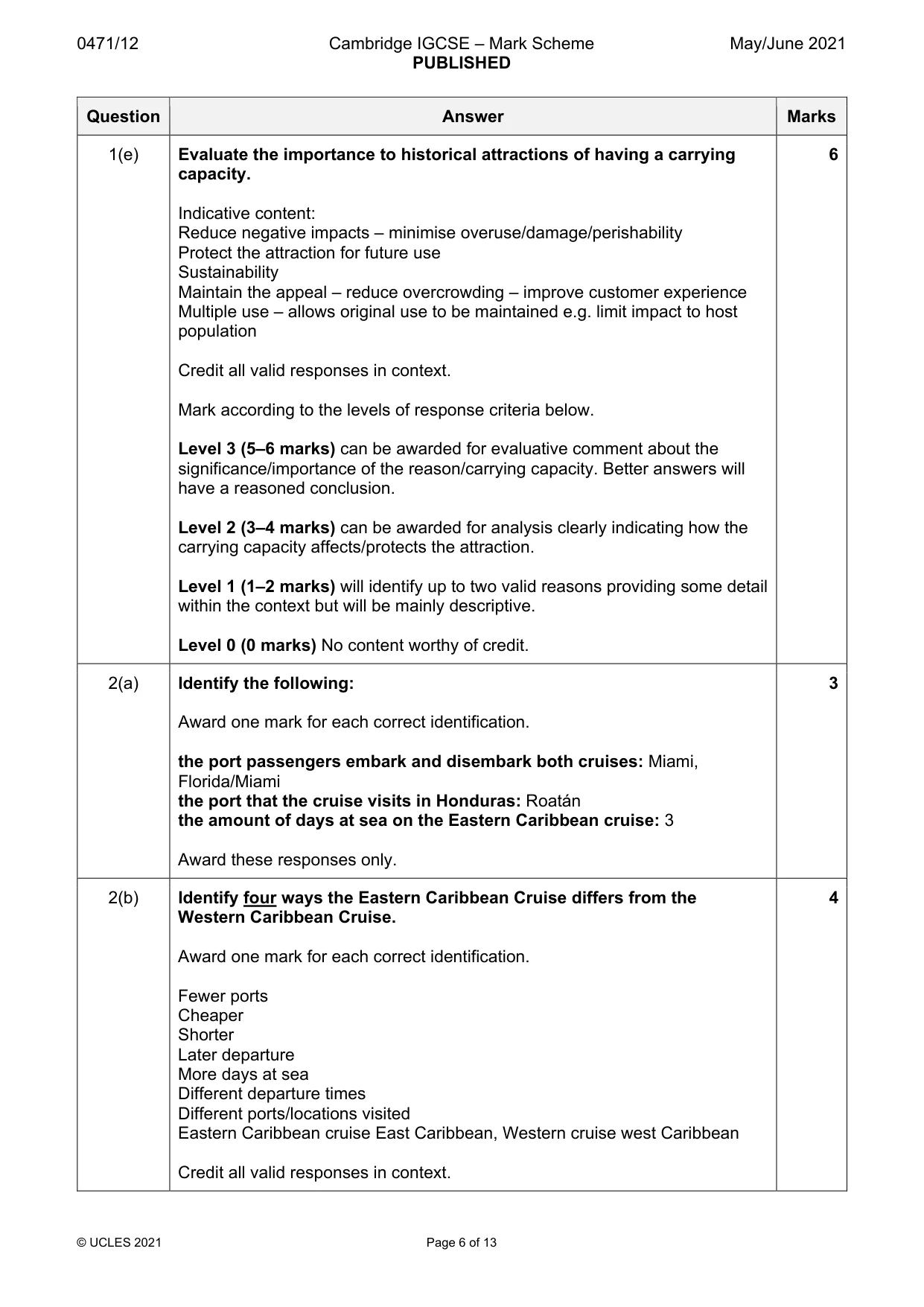
0471/12 Cambridge IGCSE – Mark Scheme PUBLISHED May/June 2021 © UCLES 2021 Page 6 of 13 Question Answer Marks 1(e) Evaluate the importance to historical attractions of having a carrying capacity. Indicative content: Reduce negative impacts – minimise overuse/damage/perishability Protect the attraction for future use Sustainability Maintain the appeal – reduce overcrowding – improve customer experience Multiple use – allows original use to be maintained e.g. limit impact to host population Credit all valid responses in context. Mark according to the levels of response criteria below. Level 3 (5–6 marks) can be awarded for evaluative comment about the significance/importance of the reason/carrying capacity. Better answers will have a reasoned conclusion. Level 2 (3–4 marks) can be awarded for analysis clearly indicating how the carrying capacity affects/protects the attraction. Level 1 (1–2 marks) will identify up to two valid reasons providing some detail within the context but will be mainly descriptive. Level 0 (0 marks) No content worthy of credit. 6 2(a) Identify the following: Award one mark for each correct identification. the port passengers embark and disembark both cruises: Miami, Florida/Miami the port that the cruise visits in Honduras: Roatán the amount of days at sea on the Eastern Caribbean cruise: 3 Award these responses only. 3 2(b) Identify four ways the Eastern Caribbean Cruise differs from the Western Caribbean Cruise. Award one mark for each correct identification. Fewer ports Cheaper Shorter Later departure More days at sea Different departure times Different ports/locations visited Eastern Caribbean cruise East Caribbean, Western cruise west Caribbean Credit all valid responses in context. 4
Mark scheme, page 7
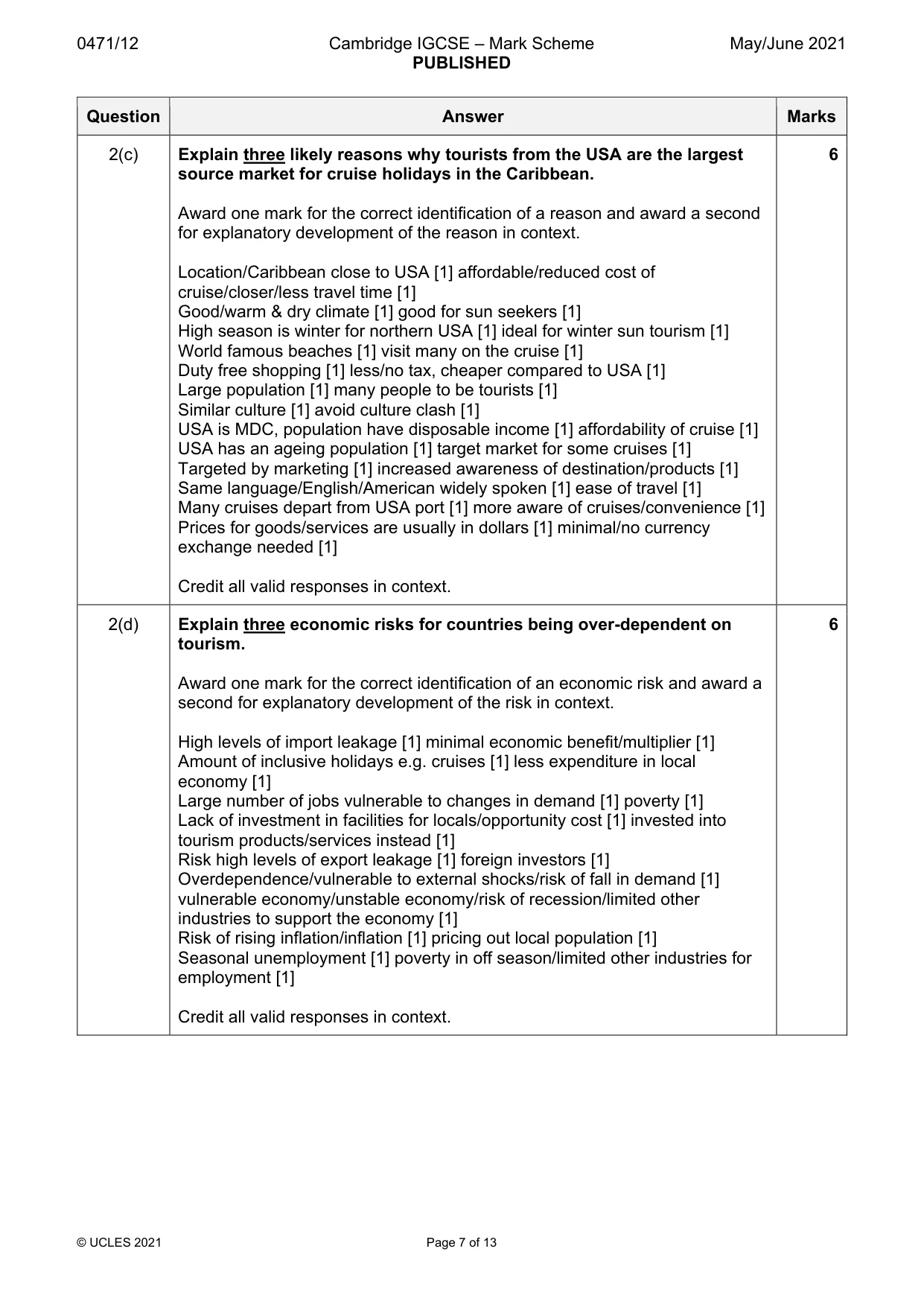
0471/12 Cambridge IGCSE – Mark Scheme PUBLISHED May/June 2021 © UCLES 2021 Page 7 of 13 Question Answer Marks 2(c) Explain three likely reasons why tourists from the USA are the largest source market for cruise holidays in the Caribbean. Award one mark for the correct identification of a reason and award a second for explanatory development of the reason in context. Location/Caribbean close to USA [1] affordable/reduced cost of cruise/closer/less travel time [1] Good/warm & dry climate [1] good for sun seekers [1] High season is winter for northern USA [1] ideal for winter sun tourism [1] World famous beaches [1] visit many on the cruise [1] Duty free shopping [1] less/no tax, cheaper compared to USA [1] Large population [1] many people to be tourists [1] Similar culture [1] avoid culture clash [1] USA is MDC, population have disposable income [1] affordability of cruise [1] USA has an ageing population [1] target market for some cruises [1] Targeted by marketing [1] increased awareness of destination/products [1] Same language/English/American widely spoken [1] ease of travel [1] Many cruises depart from USA port [1] more aware of cruises/convenience [1] Prices for goods/services are usually in dollars [1] minimal/no currency exchange needed [1] Credit all valid responses in context. 6 2(d) Explain three economic risks for countries being over-dependent on tourism. Award one mark for the correct identification of an economic risk and award a second for explanatory development of the risk in context. High levels of import leakage [1] minimal economic benefit/multiplier [1] Amount of inclusive holidays e.g. cruises [1] less expenditure in local economy [1] Large number of jobs vulnerable to changes in demand [1] poverty [1] Lack of investment in facilities for locals/opportunity cost [1] invested into tourism products/services instead [1] Risk high levels of export leakage [1] foreign investors [1] Overdependence/vulnerable to external shocks/risk of fall in demand [1] vulnerable economy/unstable economy/risk of recession/limited other industries to support the economy [1] Risk of rising inflation/inflation [1] pricing out local population [1] Seasonal unemployment [1] poverty in off season/limited other industries for employment [1] Credit all valid responses in context. 6
Mark scheme, page 8
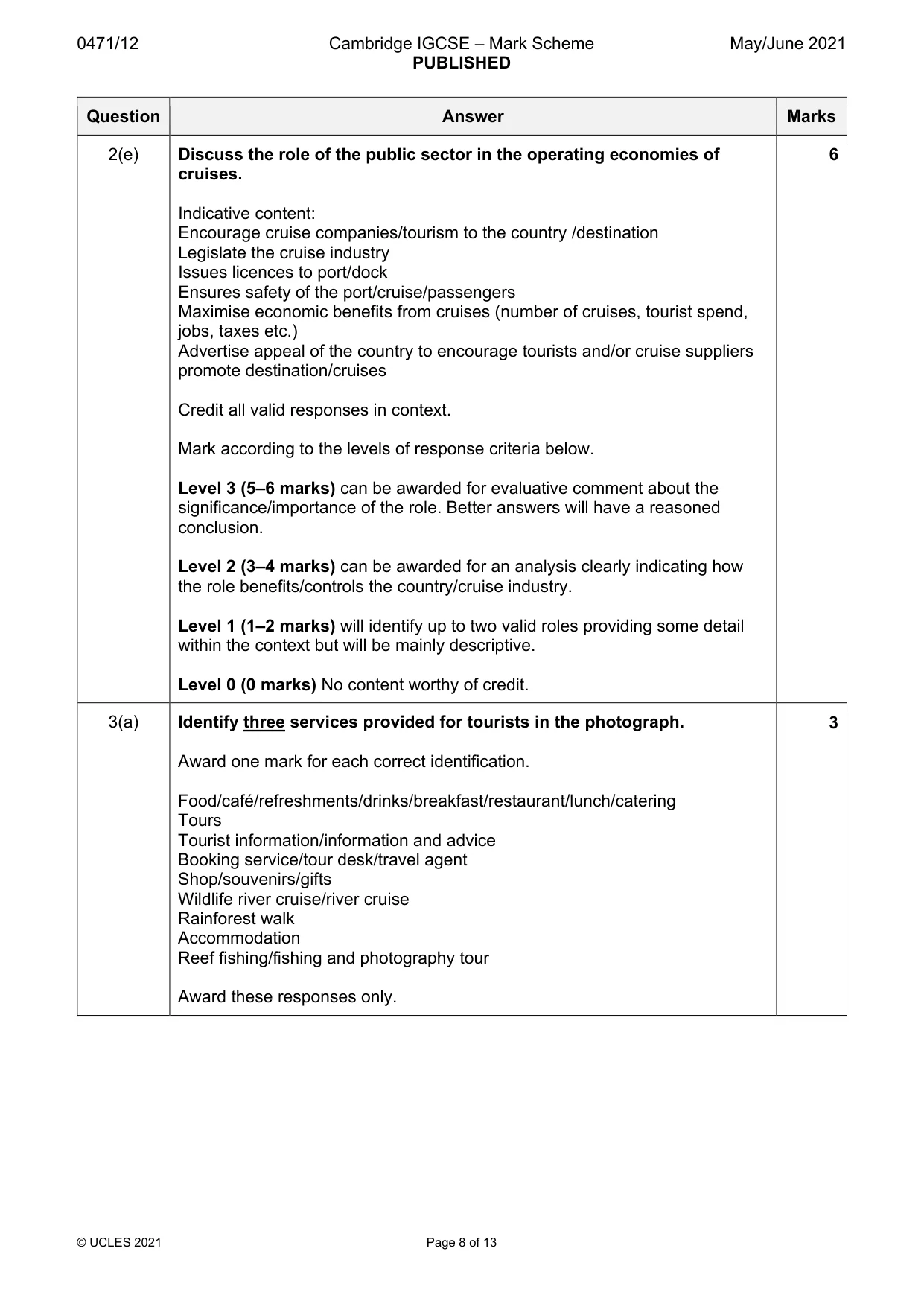
0471/12 Cambridge IGCSE – Mark Scheme PUBLISHED May/June 2021 © UCLES 2021 Page 8 of 13 Question Answer Marks 2(e) Discuss the role of the public sector in the operating economies of cruises. Indicative content: Encourage cruise companies/tourism to the country /destination Legislate the cruise industry Issues licences to port/dock Ensures safety of the port/cruise/passengers Maximise economic benefits from cruises (number of cruises, tourist spend, jobs, taxes etc.) Advertise appeal of the country to encourage tourists and/or cruise suppliers promote destination/cruises Credit all valid responses in context. Mark according to the levels of response criteria below. Level 3 (5–6 marks) can be awarded for evaluative comment about the significance/importance of the role. Better answers will have a reasoned conclusion. Level 2 (3–4 marks) can be awarded for an analysis clearly indicating how the role benefits/controls the country/cruise industry. Level 1 (1–2 marks) will identify up to two valid roles providing some detail within the context but will be mainly descriptive. Level 0 (0 marks) No content worthy of credit. 6 3(a) Identify three services provided for tourists in the photograph. Award one mark for each correct identification. Food/café/refreshments/drinks/breakfast/restaurant/lunch/catering Tours Tourist information/information and advice Booking service/tour desk/travel agent Shop/souvenirs/gifts Wildlife river cruise/river cruise Rainforest walk Accommodation Reef fishing/fishing and photography tour Award these responses only. 3
Mark scheme, page 9
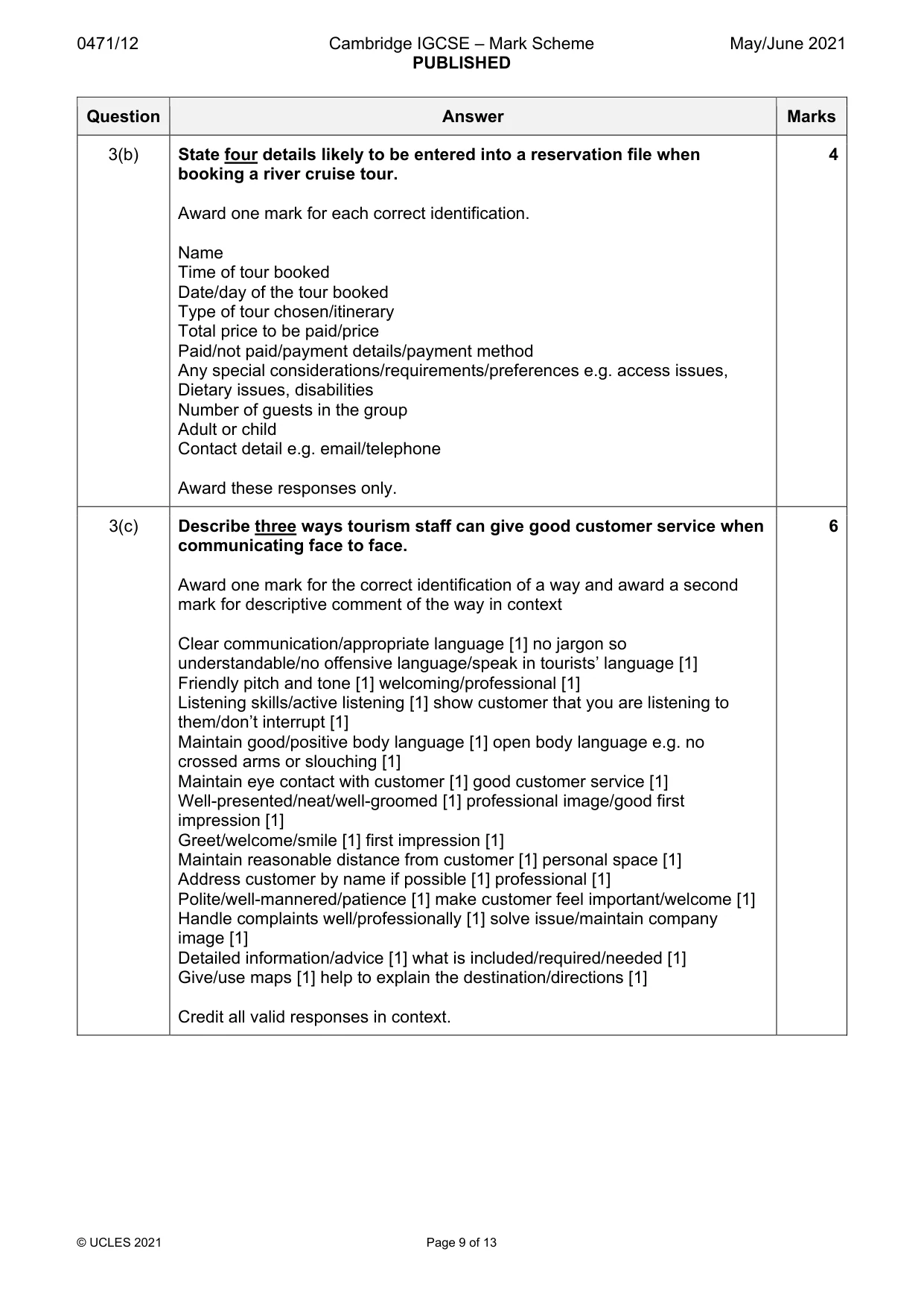
0471/12 Cambridge IGCSE – Mark Scheme PUBLISHED May/June 2021 © UCLES 2021 Page 9 of 13 Question Answer Marks 3(b) State four details likely to be entered into a reservation file when booking a river cruise tour. Award one mark for each correct identification. Name Time of tour booked Date/day of the tour booked Type of tour chosen/itinerary Total price to be paid/price Paid/not paid/payment details/payment method Any special considerations/requirements/preferences e.g. access issues, Dietary issues, disabilities Number of guests in the group Adult or child Contact detail e.g. email/telephone Award these responses only. 4 3(c) Describe three ways tourism staff can give good customer service when communicating face to face. Award one mark for the correct identification of a way and award a second mark for descriptive comment of the way in context Clear communication/appropriate language [1] no jargon so understandable/no offensive language/speak in tourists’ language [1] Friendly pitch and tone [1] welcoming/professional [1] Listening skills/active listening [1] show customer that you are listening to them/don’t interrupt [1] Maintain good/positive body language [1] open body language e.g. no crossed arms or slouching [1] Maintain eye contact with customer [1] good customer service [1] Well-presented/neat/well-groomed [1] professional image/good first impression [1] Greet/welcome/smile [1] first impression [1] Maintain reasonable distance from customer [1] personal space [1] Address customer by name if possible [1] professional [1] Polite/well-mannered/patience [1] make customer feel important/welcome [1] Handle complaints well/professionally [1] solve issue/maintain company image [1] Detailed information/advice [1] what is included/required/needed [1] Give/use maps [1] help to explain the destination/directions [1] Credit all valid responses in context. 6
Mark scheme, page 10
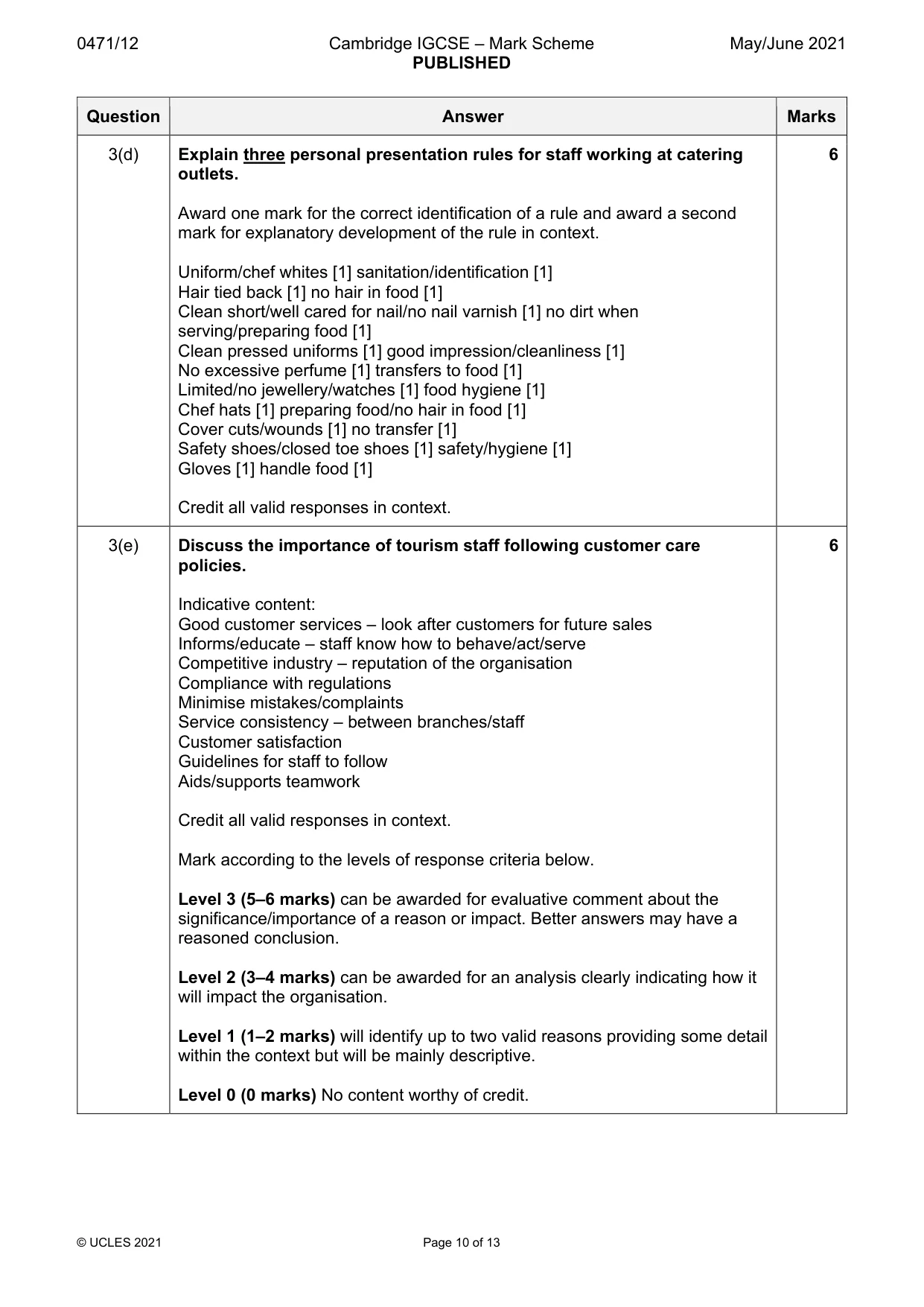
0471/12 Cambridge IGCSE – Mark Scheme PUBLISHED May/June 2021 © UCLES 2021 Page 10 of 13 Question Answer Marks 3(d) Explain three personal presentation rules for staff working at catering outlets. Award one mark for the correct identification of a rule and award a second mark for explanatory development of the rule in context. Uniform/chef whites [1] sanitation/identification [1] Hair tied back [1] no hair in food [1] Clean short/well cared for nail/no nail varnish [1] no dirt when serving/preparing food [1] Clean pressed uniforms [1] good impression/cleanliness [1] No excessive perfume [1] transfers to food [1] Limited/no jewellery/watches [1] food hygiene [1] Chef hats [1] preparing food/no hair in food [1] Cover cuts/wounds [1] no transfer [1] Safety shoes/closed toe shoes [1] safety/hygiene [1] Gloves [1] handle food [1] Credit all valid responses in context. 6 3(e) Discuss the importance of tourism staff following customer care policies. Indicative content: Good customer services – look after customers for future sales Informs/educate – staff know how to behave/act/serve Competitive industry – reputation of the organisation Compliance with regulations Minimise mistakes/complaints Service consistency – between branches/staff Customer satisfaction Guidelines for staff to follow Aids/supports teamwork Credit all valid responses in context. Mark according to the levels of response criteria below. Level 3 (5–6 marks) can be awarded for evaluative comment about the significance/importance of a reason or impact. Better answers may have a reasoned conclusion. Level 2 (3–4 marks) can be awarded for an analysis clearly indicating how it will impact the organisation. Level 1 (1–2 marks) will identify up to two valid reasons providing some detail within the context but will be mainly descriptive. Level 0 (0 marks) No content worthy of credit. 6
Mark scheme, page 11
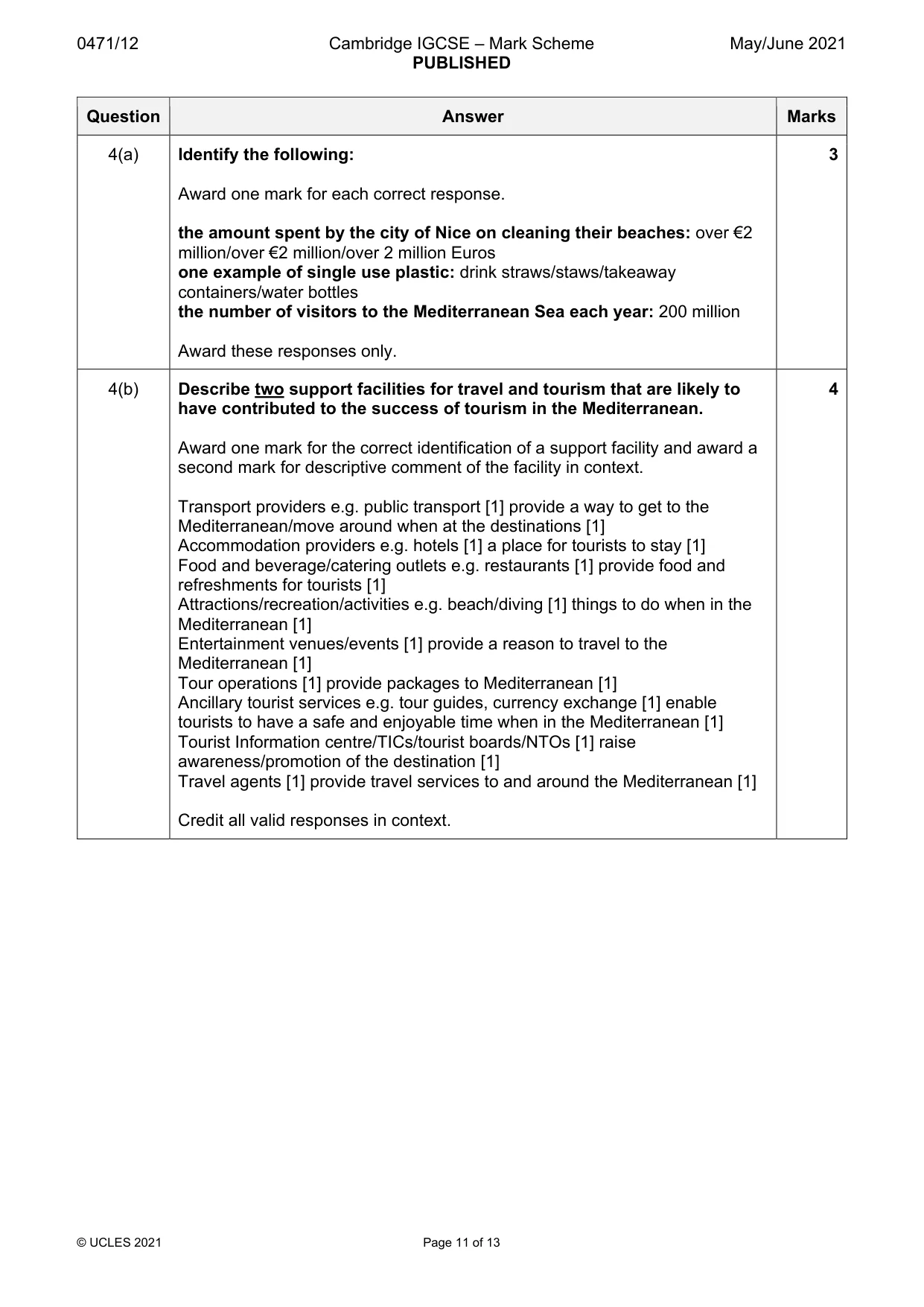
0471/12 Cambridge IGCSE – Mark Scheme PUBLISHED May/June 2021 © UCLES 2021 Page 11 of 13 Question Answer Marks 4(a) Identify the following: Award one mark for each correct response. the amount spent by the city of Nice on cleaning their beaches: over €2 million/over €2 million/over 2 million Euros one example of single use plastic: drink straws/staws/takeaway containers/water bottles the number of visitors to the Mediterranean Sea each year: 200 million Award these responses only. 3 4(b) Describe two support facilities for travel and tourism that are likely to have contributed to the success of tourism in the Mediterranean. Award one mark for the correct identification of a support facility and award a second mark for descriptive comment of the facility in context. Transport providers e.g. public transport [1] provide a way to get to the Mediterranean/move around when at the destinations [1] Accommodation providers e.g. hotels [1] a place for tourists to stay [1] Food and beverage/catering outlets e.g. restaurants [1] provide food and refreshments for tourists [1] Attractions/recreation/activities e.g. beach/diving [1] things to do when in the Mediterranean [1] Entertainment venues/events [1] provide a reason to travel to the Mediterranean [1] Tour operations [1] provide packages to Mediterranean [1] Ancillary tourist services e.g. tour guides, currency exchange [1] enable tourists to have a safe and enjoyable time when in the Mediterranean [1] Tourist Information centre/TICs/tourist boards/NTOs [1] raise awareness/promotion of the destination [1] Travel agents [1] provide travel services to and around the Mediterranean [1] Credit all valid responses in context. 4
Mark scheme, page 12
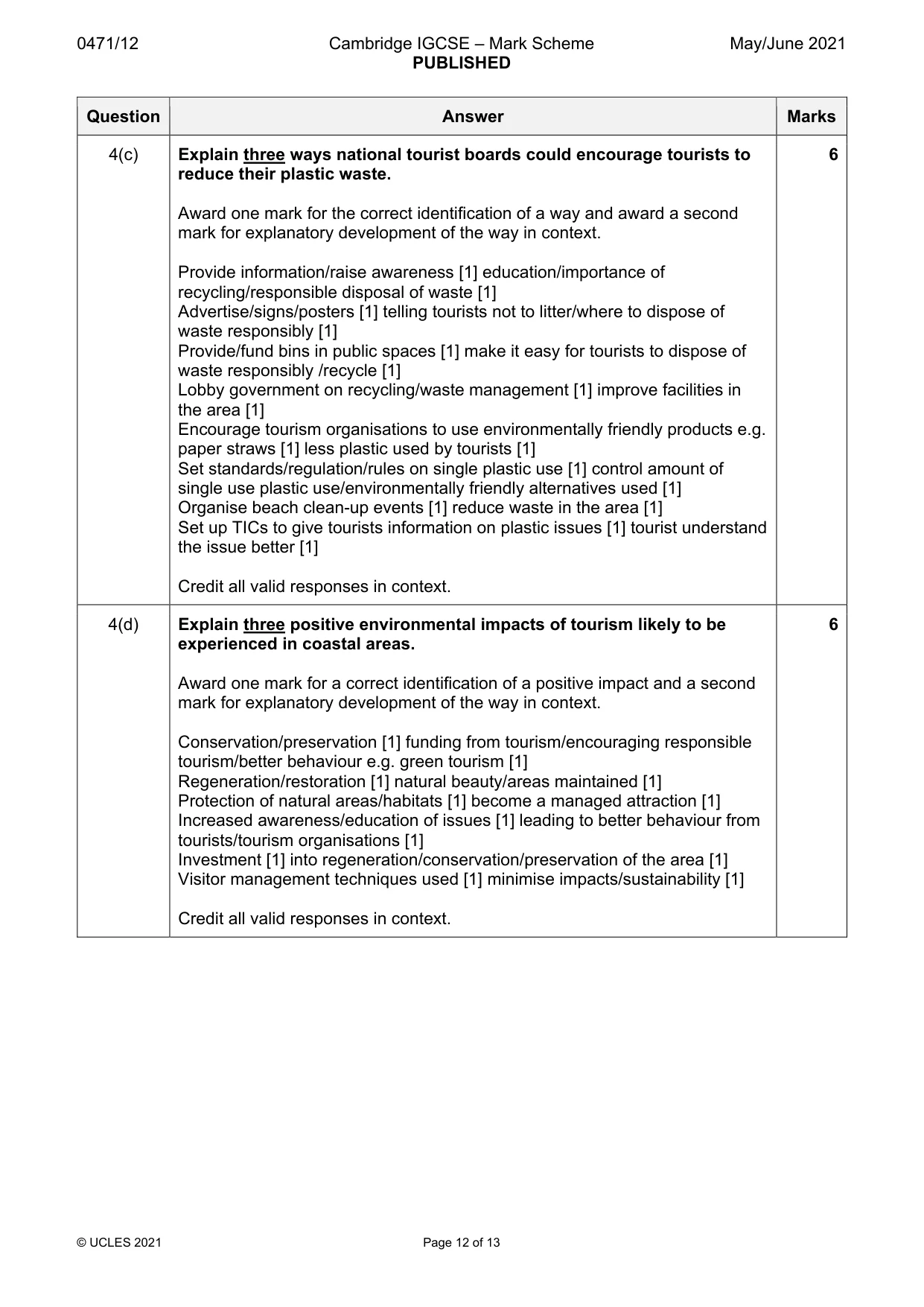
0471/12 Cambridge IGCSE – Mark Scheme PUBLISHED May/June 2021 © UCLES 2021 Page 12 of 13 Question Answer Marks 4(c) Explain three ways national tourist boards could encourage tourists to reduce their plastic waste. Award one mark for the correct identification of a way and award a second mark for explanatory development of the way in context. Provide information/raise awareness [1] education/importance of recycling/responsible disposal of waste [1] Advertise/signs/posters [1] telling tourists not to litter/where to dispose of waste responsibly [1] Provide/fund bins in public spaces [1] make it easy for tourists to dispose of waste responsibly /recycle [1] Lobby government on recycling/waste management [1] improve facilities in the area [1] Encourage tourism organisations to use environmentally friendly products e.g. paper straws [1] less plastic used by tourists [1] Set standards/regulation/rules on single plastic use [1] control amount of single use plastic use/environmentally friendly alternatives used [1] Organise beach clean-up events [1] reduce waste in the area [1] Set up TICs to give tourists information on plastic issues [1] tourist understand the issue better [1] Credit all valid responses in context. 6 4(d) Explain three positive environmental impacts of tourism likely to be experienced in coastal areas. Award one mark for a correct identification of a positive impact and a second mark for explanatory development of the way in context. Conservation/preservation [1] funding from tourism/encouraging responsible tourism/better behaviour e.g. green tourism [1] Regeneration/restoration [1] natural beauty/areas maintained [1] Protection of natural areas/habitats [1] become a managed attraction [1] Increased awareness/education of issues [1] leading to better behaviour from tourists/tourism organisations [1] Investment [1] into regeneration/conservation/preservation of the area [1] Visitor management techniques used [1] minimise impacts/sustainability [1] Credit all valid responses in context. 6
Mark scheme, page 13
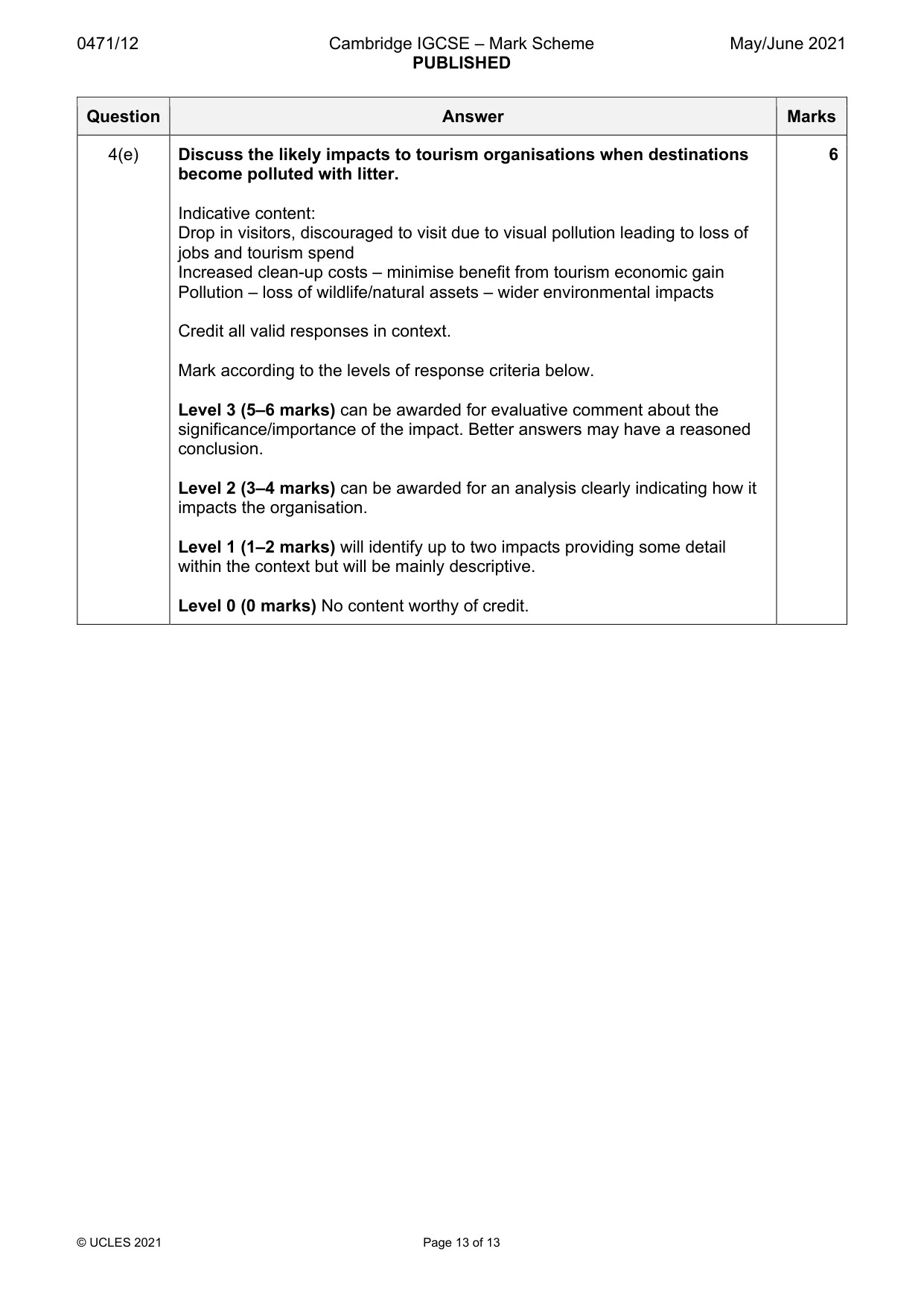
0471/12 Cambridge IGCSE – Mark Scheme PUBLISHED May/June 2021 © UCLES 2021 Page 13 of 13 Question Answer Marks 4(e) Discuss the likely impacts to tourism organisations when destinations become polluted with litter. Indicative content: Drop in visitors, discouraged to visit due to visual pollution leading to loss of jobs and tourism spend Increased clean-up costs – minimise benefit from tourism economic gain Pollution – loss of wildlife/natural assets – wider environmental impacts Credit all valid responses in context. Mark according to the levels of response criteria below. Level 3 (5–6 marks) can be awarded for evaluative comment about the significance/importance of the impact. Better answers may have a reasoned conclusion. Level 2 (3–4 marks) can be awarded for an analysis clearly indicating how it impacts the organisation. Level 1 (1–2 marks) will identify up to two impacts providing some detail within the context but will be mainly descriptive. Level 0 (0 marks) No content worthy of credit. 6
What you needed in this session
Cambridge’s own grade thresholds for 2021 May/June, Paper 1 · Variant 2. A higher threshold means an easier paper — the bar moves with how the cohort did.