Cambridge IGCSE Travel and Tourism 0471 — 2021 May/June Paper 1 · Variant 1
0471/11/M/J/21 · 100 marks · ≈113 min
The question paper and its mark scheme, free to read here and free to download. This is Cambridge’s own paper, exactly as it was sat.
Question paper12 pages

Mark scheme11 pages
Answers below. Sit the paper first if you are practising.
Paper as text
Question paper, page 1
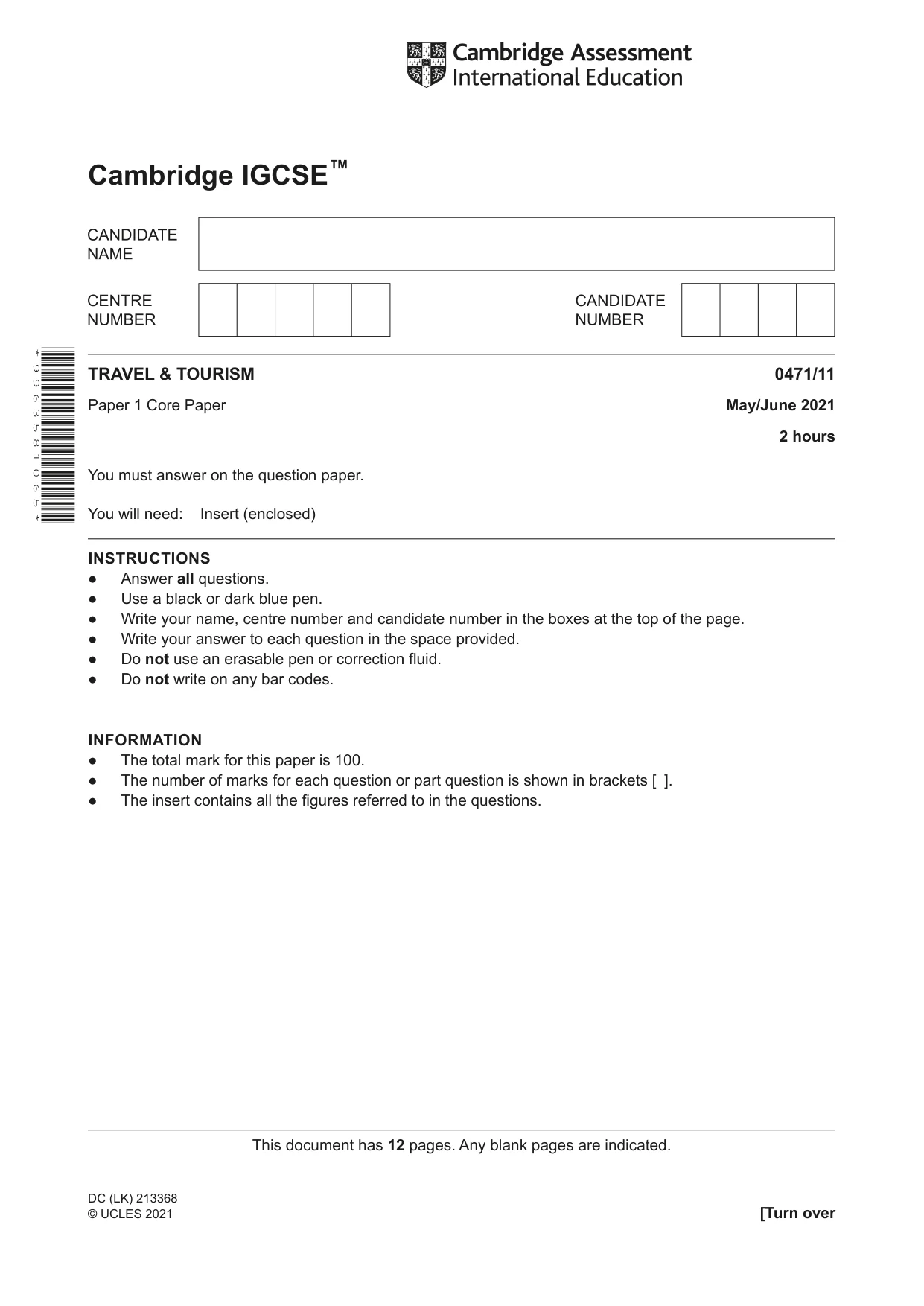
This document has 12 pages. Any blank pages are indicated. Cambridge IGCSE™ TRAVEL & TOURISM 0471/11 Paper 1 Core Paper May/June 2021 2 hours You must answer on the question paper. You will need: Insert (enclosed) INSTRUCTIONS ● Answer all questions. ● Use a black or dark blue pen. ● Write your name, centre number and candidate number in the boxes at the top of the page. ● Write your answer to each question in the space provided. ● Do not use an erasable pen or correction fluid. ● Do not write on any bar codes. INFORMATION ● The total mark for this paper is 100. ● The number of marks for each question or part question is shown in brackets [ ]. ● The insert contains all the figures referred to in the questions. * 9 9 6 3 5 8 1 0 6 5 * DC (LK) 213368 © UCLES 2021 [Turn over
Question paper, page 2
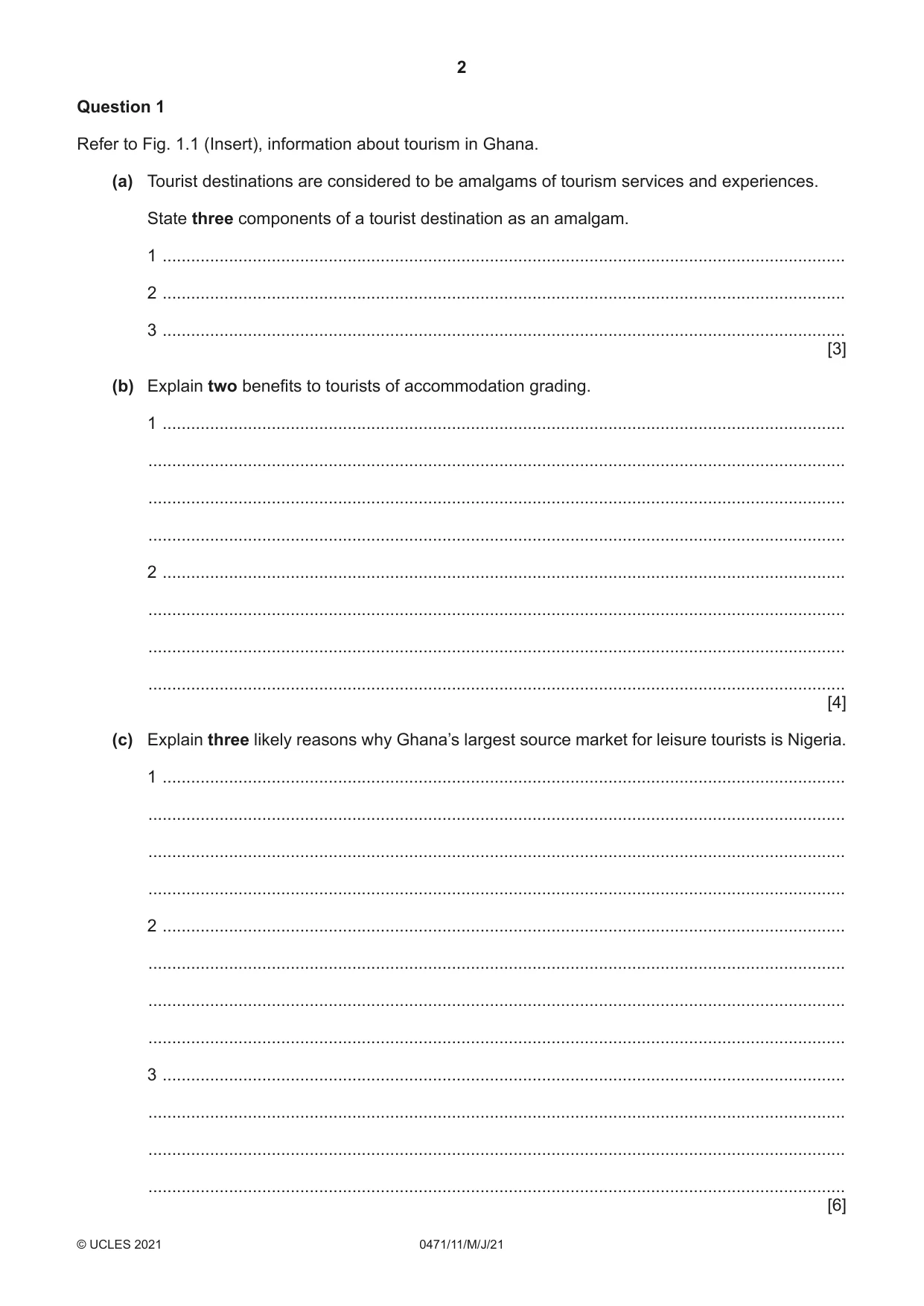
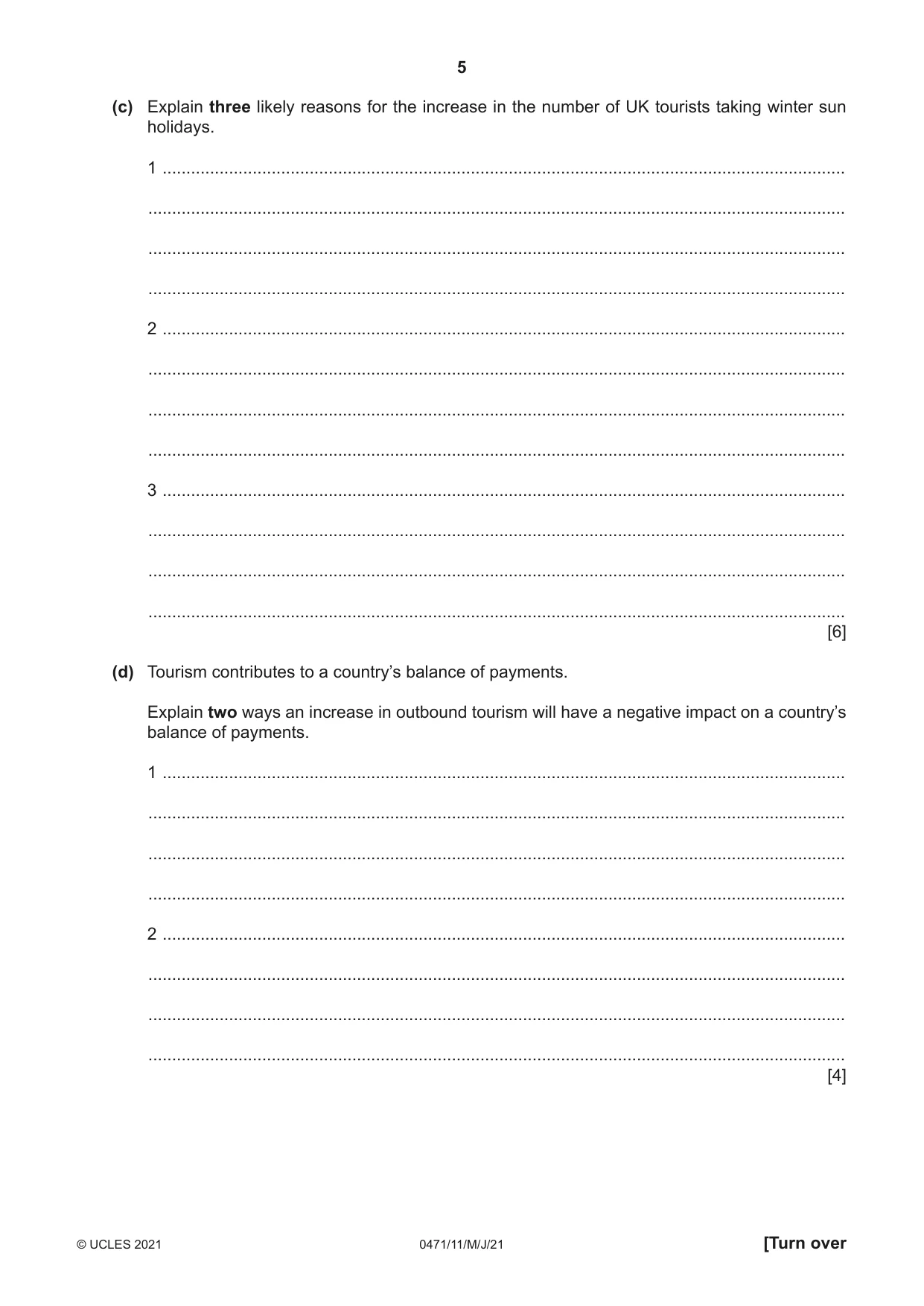
2 0471/11/M/J/21 © UCLES 2021 Question 1 Refer to Fig. 1.1 (Insert), information about tourism in Ghana. (a) Tourist destinations are considered to be amalgams of tourism services and experiences. State three components of a tourist destination as an amalgam. 1 … 2 … 3 … [3] (b) Explain two benefits to tourists of accommodation grading. 1 … … … … 2 … … … … [4] (c) Explain three likely reasons why Ghana’s largest source market for leisure tourists is Nigeria. 1 … … … … 2 … … … … 3 … … … … [6]
Question paper, page 3
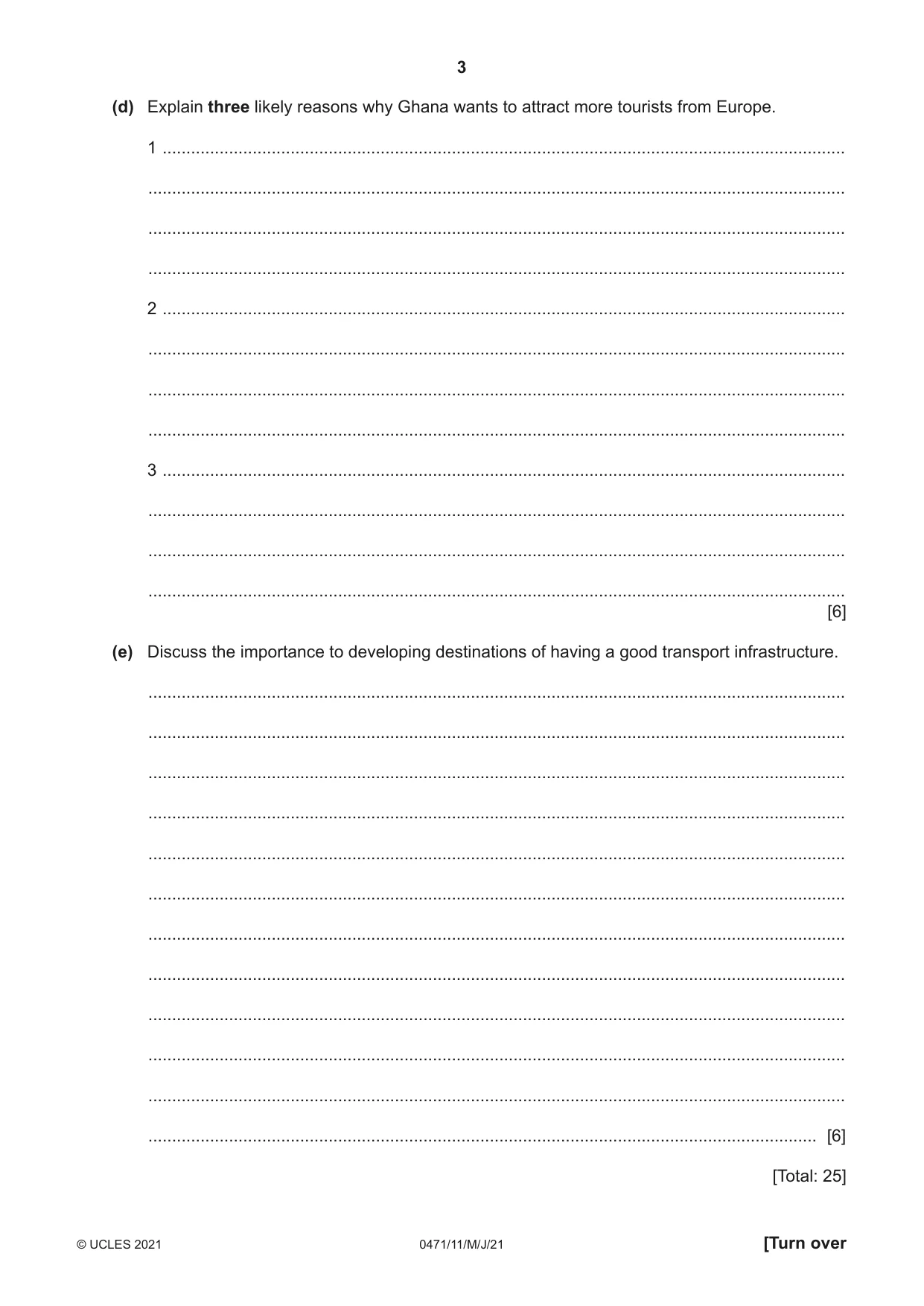
3 0471/11/M/J/21 © UCLES 2021 [Turn over (d) Explain three likely reasons why Ghana wants to attract more tourists from Europe. 1 … … … … 2 … … … … 3 … … … … [6] (e) Discuss the importance to developing destinations of having a good transport infrastructure. … … … … … … … … … … … … [6] [Total: 25]
Question paper, page 4
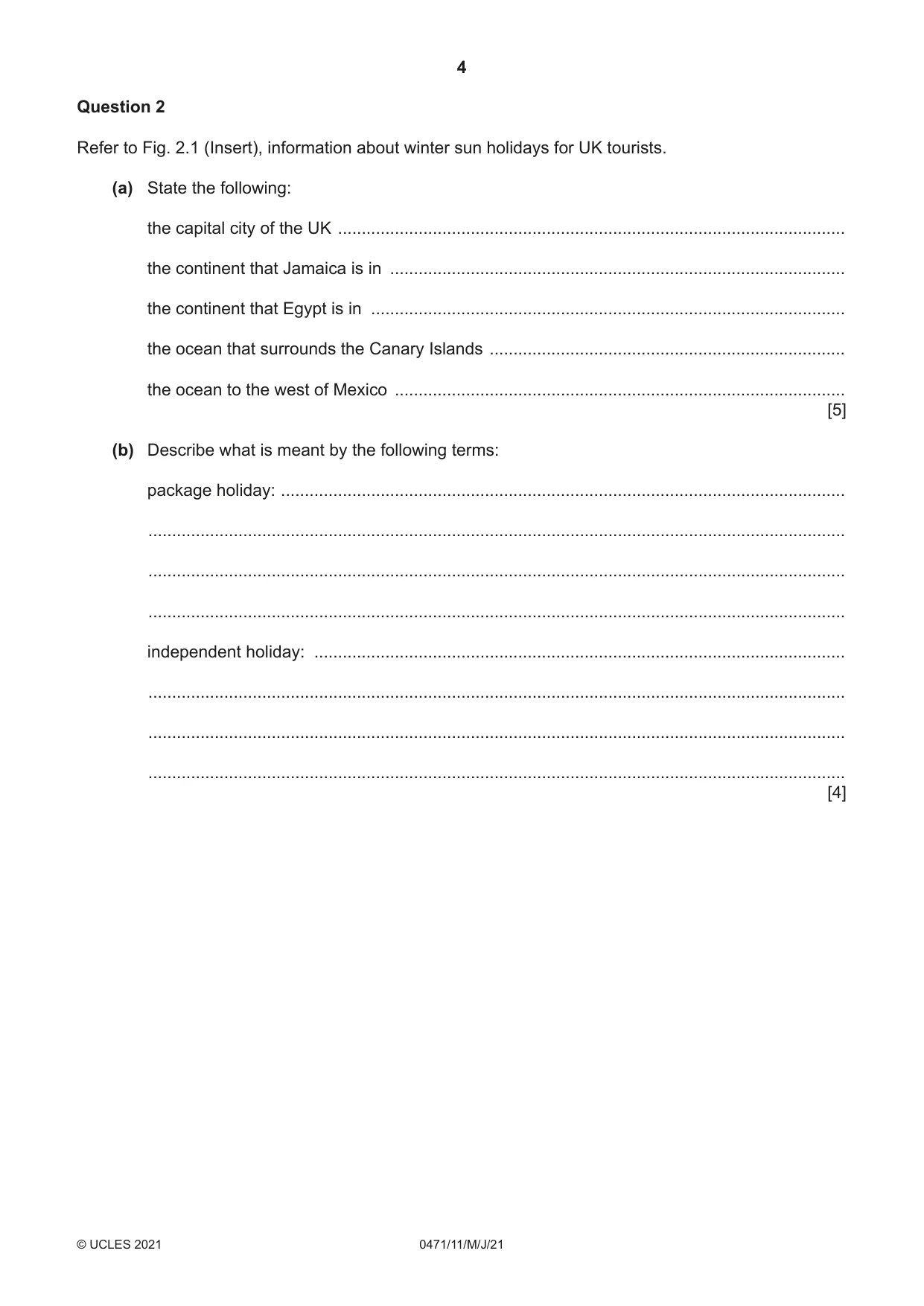
4 0471/11/M/J/21 © UCLES 2021 Question 2 Refer to Fig. 2.1 (Insert), information about winter sun holidays for UK tourists. (a) State the following: the capital city of the UK … the continent that Jamaica is in … the continent that Egypt is in … the ocean that surrounds the Canary Islands … the ocean to the west of Mexico … [5] (b) Describe what is meant by the following terms: package holiday: … … … … independent holiday: … … … … [4]
Question paper, page 5
5 0471/11/M/J/21 © UCLES 2021 [Turn over (c) Explain three likely reasons for the increase in the number of UK tourists taking winter sun holidays. 1 … … … … 2 … … … … 3 … … … … [6] (d) Tourism contributes to a country’s balance of payments. Explain two ways an increase in outbound tourism will have a negative impact on a country’s balance of payments. 1 … … … … 2 … … … … [4]
Question paper, page 6
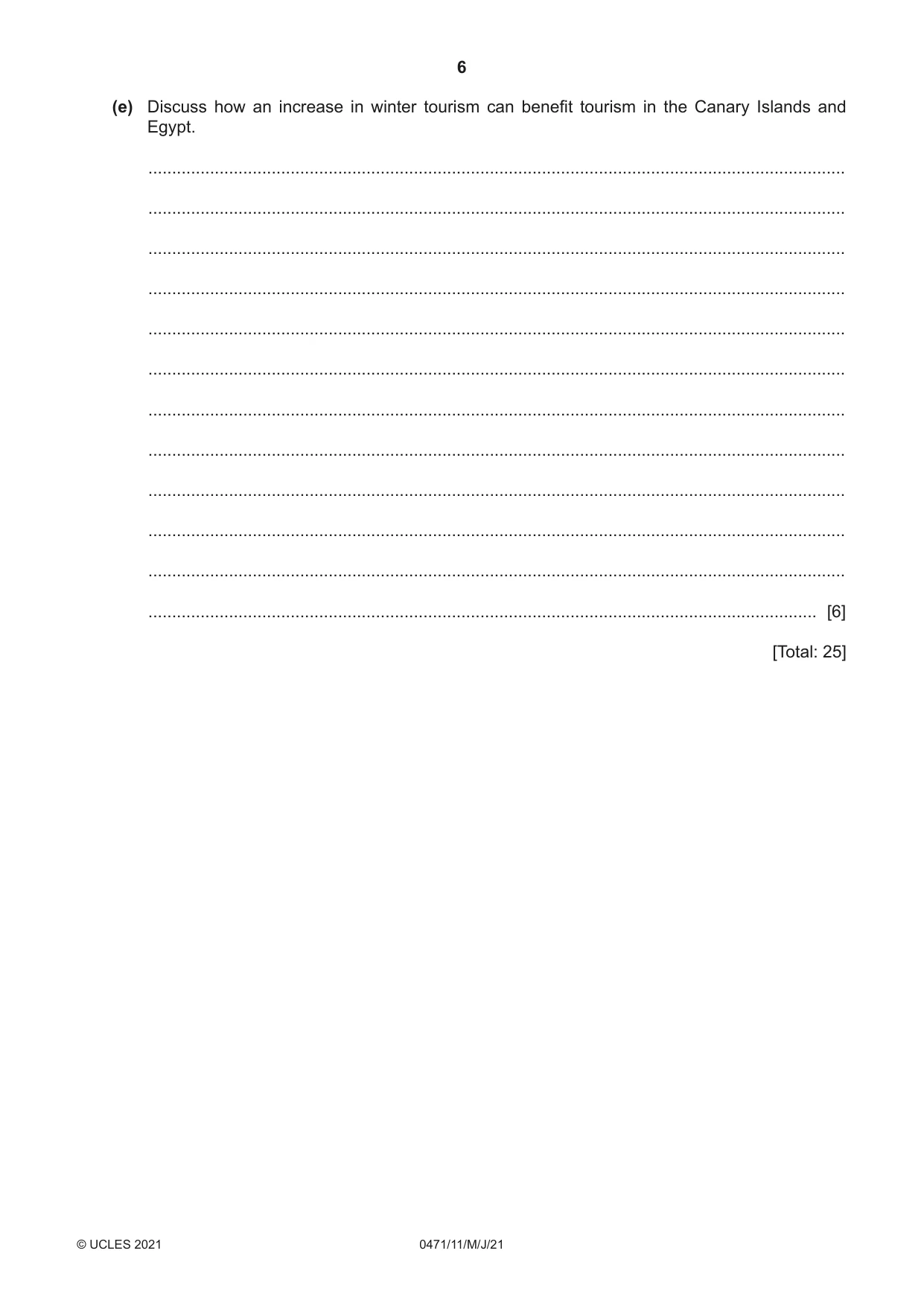
6 0471/11/M/J/21 © UCLES 2021 (e) Discuss how an increase in winter tourism can benefit tourism in the Canary Islands and Egypt. … … … … … … … … … … … … [6] [Total: 25]
Question paper, page 7
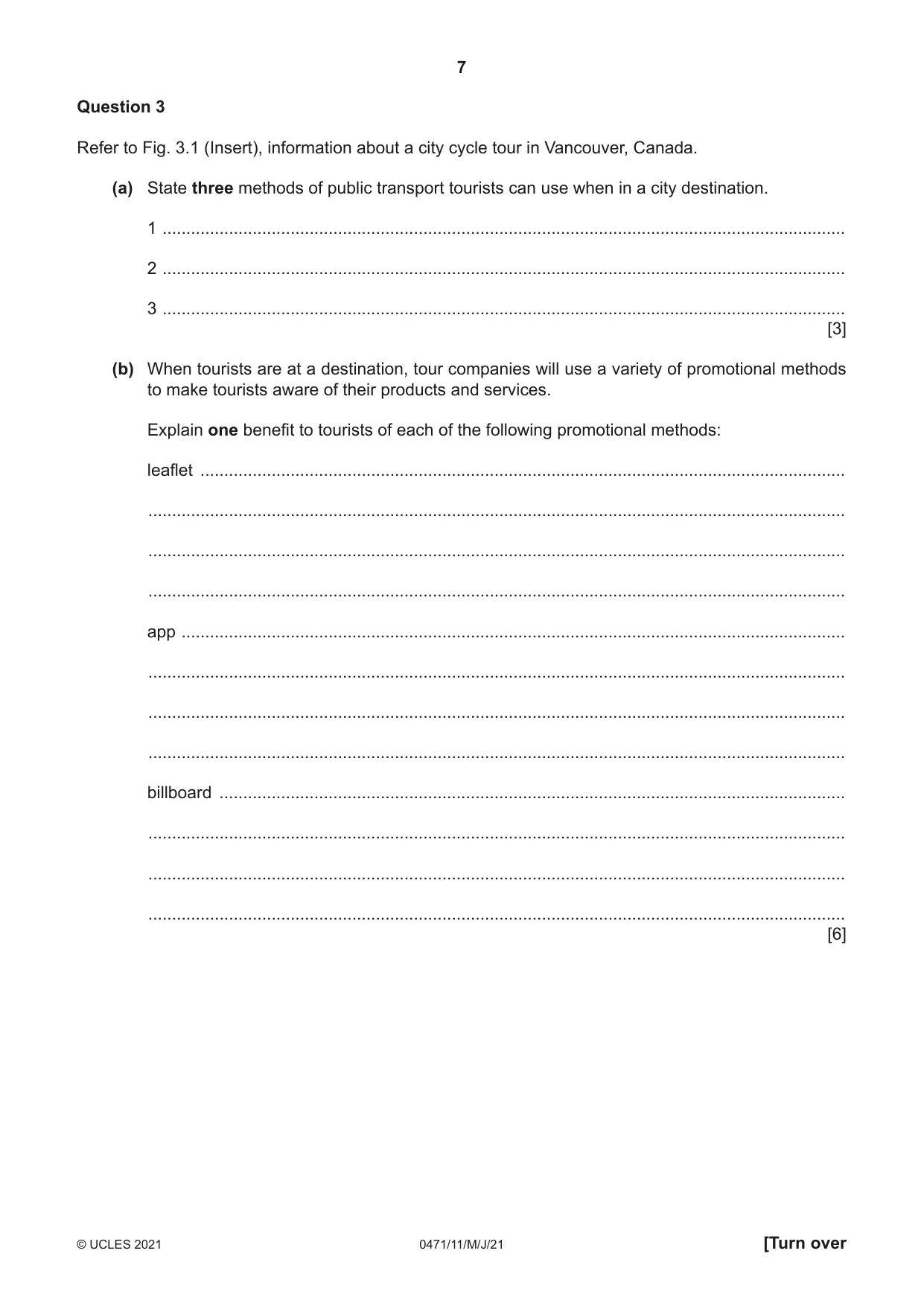
7 0471/11/M/J/21 © UCLES 2021 [Turn over Question 3 Refer to Fig. 3.1 (Insert), information about a city cycle tour in Vancouver, Canada. (a) State three methods of public transport tourists can use when in a city destination. 1 … 2 … 3 … [3] (b) When tourists are at a destination, tour companies will use a variety of promotional methods to make tourists aware of their products and services. Explain one benefit to tourists of each of the following promotional methods: leaflet … … … … app … … … … billboard … … … … [6]
Question paper, page 8
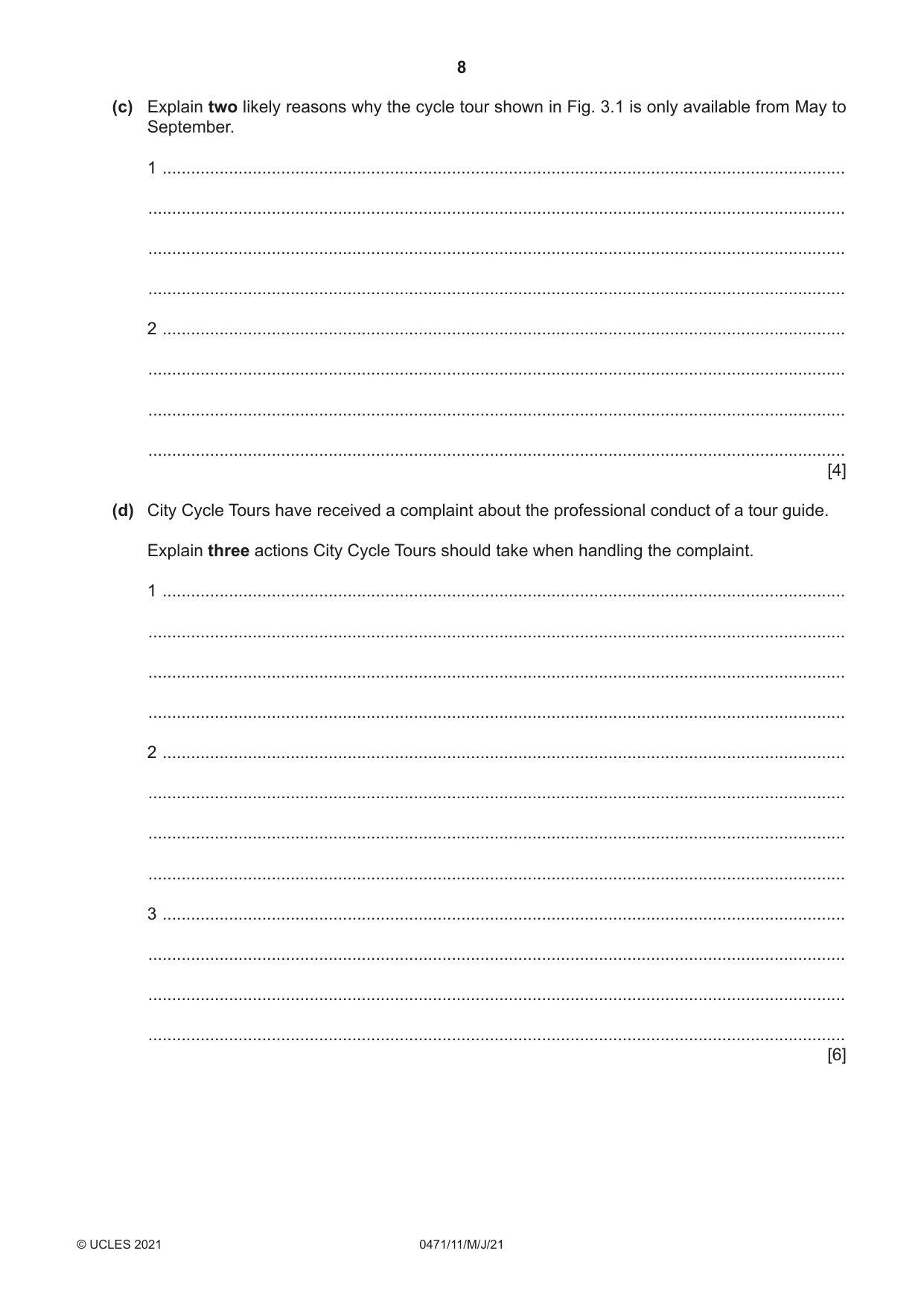
8 0471/11/M/J/21 © UCLES 2021 (c) Explain two likely reasons why the cycle tour shown in Fig. 3.1 is only available from May to September. 1 … … … … 2 … … … … [4] (d) City Cycle Tours have received a complaint about the professional conduct of a tour guide. Explain three actions City Cycle Tours should take when handling the complaint. 1 … … … … 2 … … … … 3 … … … … [6]
Question paper, page 9
9 0471/11/M/J/21 © UCLES 2021 [Turn over (e) Discuss the reasons why city destinations encourage the use of sustainable transport methods. … … … … … … … … … … … … [6] [Total: 25]
Question paper, page 10
10 0471/11/M/J/21 © UCLES 2021 Question 4 Refer to Fig. 4.1 (Insert), a photograph of a tourist taking part in a traditional festival in India. (a) State three cultural attractions, other than traditional dances and festivals. 1 … 2 … 3 … [3] (b) Explain three likely negative social and cultural impacts of traditional dance being used as an attraction. 1 … … … … 2 … … … … 3 … … … … [6] (c) National governments write the tourism policy for their country. In the table below identify with a tick (3) which of the government aims are economic, political, socio-cultural or environmental. Government aims Economic Political Socio-cultural Environmental improve the reputation of the country conserve natural resources develop a sense of pride in national identity create employment [4]
Question paper, page 11
11 0471/11/M/J/21 © UCLES 2021 (d) Explain three actions tourists can take to minimise their negative social and cultural impacts when at a destination. 1 … … … … 2 … … … … 3 … … … … [6] (e) Assess the role of tour operators in managing social and cultural impacts. … … … … … … … … … … … … [6] [Total: 25]
Question paper, page 12
12 0471/11/M/J/21 © UCLES 2021 BLANK PAGE The boundaries and names shown, the designations used and the presentation of material on any maps contained in this question paper/insert do not imply official endorsement or acceptance by Cambridge Assessment International Education concerning the legal status of any country, territory, or area or any of its authorities, or of the delimitation of its frontiers or boundaries. Permission to reproduce items where third-party owned material protected by copyright is included has been sought and cleared where possible. Every reasonable effort has been made by the publisher (UCLES) to trace copyright holders, but if any items requiring clearance have unwittingly been included, the publisher will be pleased to make amends at the earliest possible opportunity. To avoid the issue of disclosure of answer-related information to candidates, all copyright acknowledgements are reproduced online in the Cambridge Assessment International Education Copyright Acknowledgements Booklet. This is produced for each series of examinations and is freely available to download at www.cambridgeinternational.org after the live examination series. Cambridge Assessment International Education is part of the Cambridge Assessment Group. Cambridge Assessment is the brand name of the University of Cambridge Local Examinations Syndicate (UCLES), which itself is a department of the University of Cambridge.
Mark scheme, page 1
This document consists of 11 printed pages. © UCLES 2021 [Turn over Cambridge IGCSE™ TRAVEL & TOURISM 0471/11 Paper 1 Core Module May/June 2021 MARK SCHEME Maximum Mark: 100 Published This mark scheme is published as an aid to teachers and candidates, to indicate the requirements of the examination. It shows the basis on which Examiners were instructed to award marks. It does not indicate the details of the discussions that took place at an Examiners’ meeting before marking began, which would have considered the acceptability of alternative answers. Mark schemes should be read in conjunction with the question paper and the Principal Examiner Report for Teachers. Cambridge International will not enter into discussions about these mark schemes. Cambridge International is publishing the mark schemes for the May/June 2021 series for most Cambridge IGCSE™, Cambridge International A and AS Level components and some Cambridge O Level components.
Mark scheme, page 2
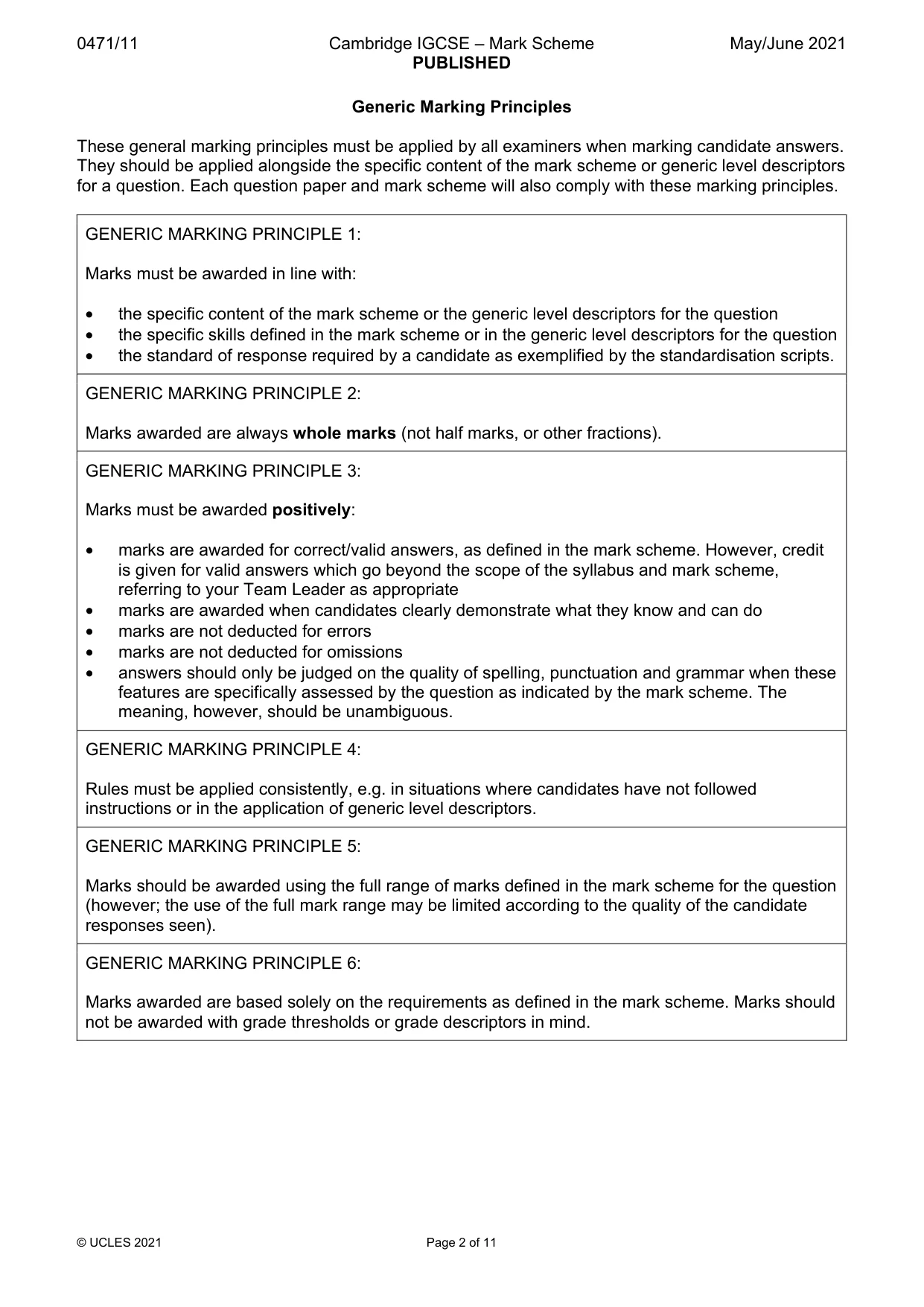
0471/11 Cambridge IGCSE – Mark Scheme PUBLISHED May/June 2021 © UCLES 2021 Page 2 of 11 Generic Marking Principles These general marking principles must be applied by all examiners when marking candidate answers. They should be applied alongside the specific content of the mark scheme or generic level descriptors for a question. Each question paper and mark scheme will also comply with these marking principles. GENERIC MARKING PRINCIPLE 1: Marks must be awarded in line with: • the specific content of the mark scheme or the generic level descriptors for the question • the specific skills defined in the mark scheme or in the generic level descriptors for the question • the standard of response required by a candidate as exemplified by the standardisation scripts. GENERIC MARKING PRINCIPLE 2: Marks awarded are always whole marks (not half marks, or other fractions). GENERIC MARKING PRINCIPLE 3: Marks must be awarded positively: • marks are awarded for correct/valid answers, as defined in the mark scheme. However, credit is given for valid answers which go beyond the scope of the syllabus and mark scheme, referring to your Team Leader as appropriate • marks are awarded when candidates clearly demonstrate what they know and can do • marks are not deducted for errors • marks are not deducted for omissions • answers should only be judged on the quality of spelling, punctuation and grammar when these features are specifically assessed by the question as indicated by the mark scheme. The meaning, however, should be unambiguous. GENERIC MARKING PRINCIPLE 4: Rules must be applied consistently, e.g. in situations where candidates have not followed instructions or in the application of generic level descriptors. GENERIC MARKING PRINCIPLE 5: Marks should be awarded using the full range of marks defined in the mark scheme for the question (however; the use of the full mark range may be limited according to the quality of the candidate responses seen). GENERIC MARKING PRINCIPLE 6: Marks awarded are based solely on the requirements as defined in the mark scheme. Marks should not be awarded with grade thresholds or grade descriptors in mind.
Mark scheme, page 3
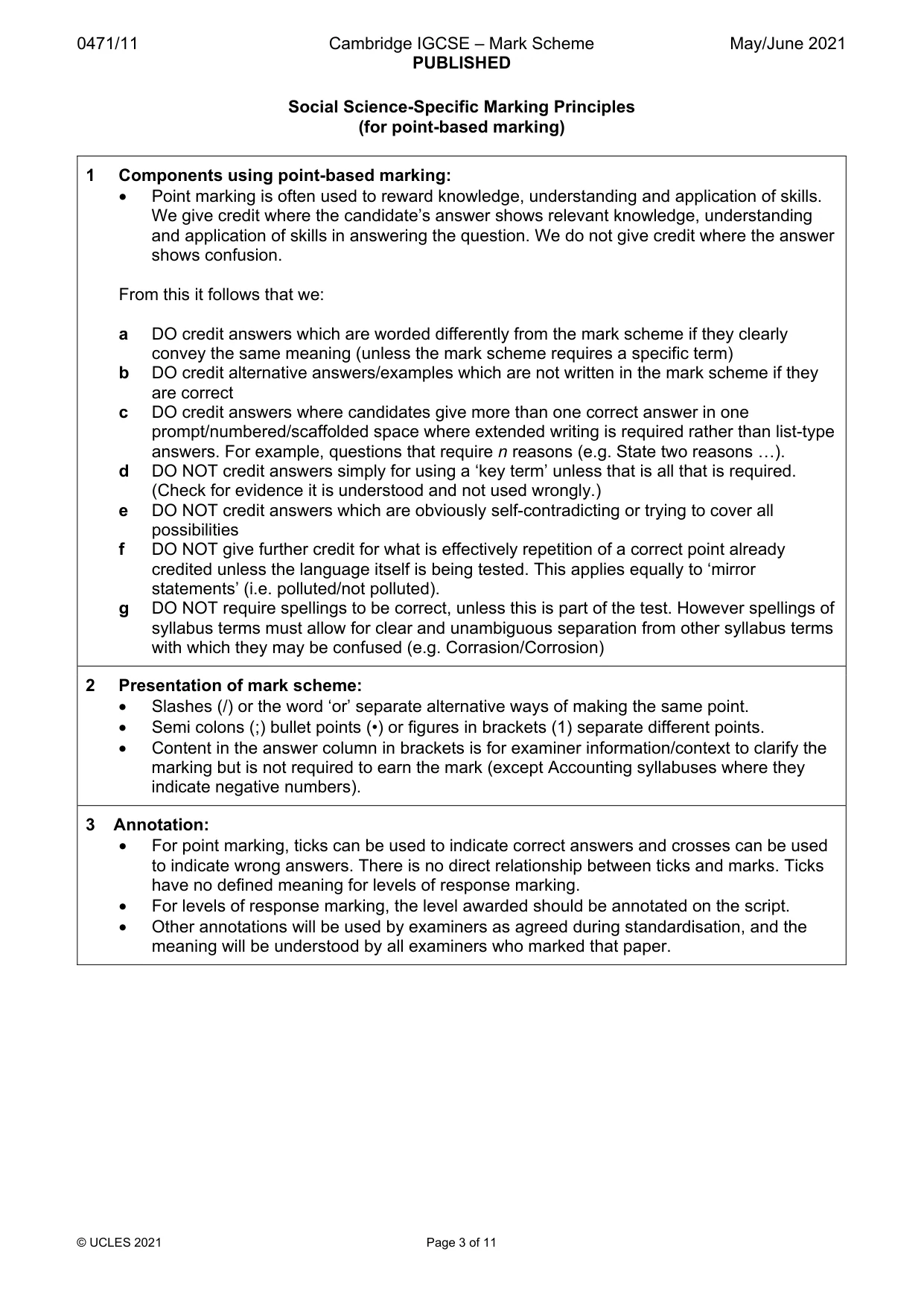
0471/11 Cambridge IGCSE – Mark Scheme PUBLISHED May/June 2021 © UCLES 2021 Page 3 of 11 Social Science-Specific Marking Principles (for point-based marking) 1 Components using point-based marking: • Point marking is often used to reward knowledge, understanding and application of skills. We give credit where the candidate’s answer shows relevant knowledge, understanding and application of skills in answering the question. We do not give credit where the answer shows confusion. From this it follows that we: a DO credit answers which are worded differently from the mark scheme if they clearly convey the same meaning (unless the mark scheme requires a specific term) b DO credit alternative answers/examples which are not written in the mark scheme if they are correct c DO credit answers where candidates give more than one correct answer in one prompt/numbered/scaffolded space where extended writing is required rather than list-type answers. For example, questions that require n reasons (e.g. State two reasons …). d DO NOT credit answers simply for using a ‘key term’ unless that is all that is required. (Check for evidence it is understood and not used wrongly.) e DO NOT credit answers which are obviously self-contradicting or trying to cover all possibilities f DO NOT give further credit for what is effectively repetition of a correct point already credited unless the language itself is being tested. This applies equally to ‘mirror statements’ (i.e. polluted/not polluted). g DO NOT require spellings to be correct, unless this is part of the test. However spellings of syllabus terms must allow for clear and unambiguous separation from other syllabus terms with which they may be confused (e.g. Corrasion/Corrosion) 2 Presentation of mark scheme: • Slashes (/) or the word ‘or’ separate alternative ways of making the same point. • Semi colons (;) bullet points (•) or figures in brackets (1) separate different points. • Content in the answer column in brackets is for examiner information/context to clarify the marking but is not required to earn the mark (except Accounting syllabuses where they indicate negative numbers). 3 Annotation: • For point marking, ticks can be used to indicate correct answers and crosses can be used to indicate wrong answers. There is no direct relationship between ticks and marks. Ticks have no defined meaning for levels of response marking. • For levels of response marking, the level awarded should be annotated on the script. • Other annotations will be used by examiners as agreed during standardisation, and the meaning will be understood by all examiners who marked that paper.
Mark scheme, page 4
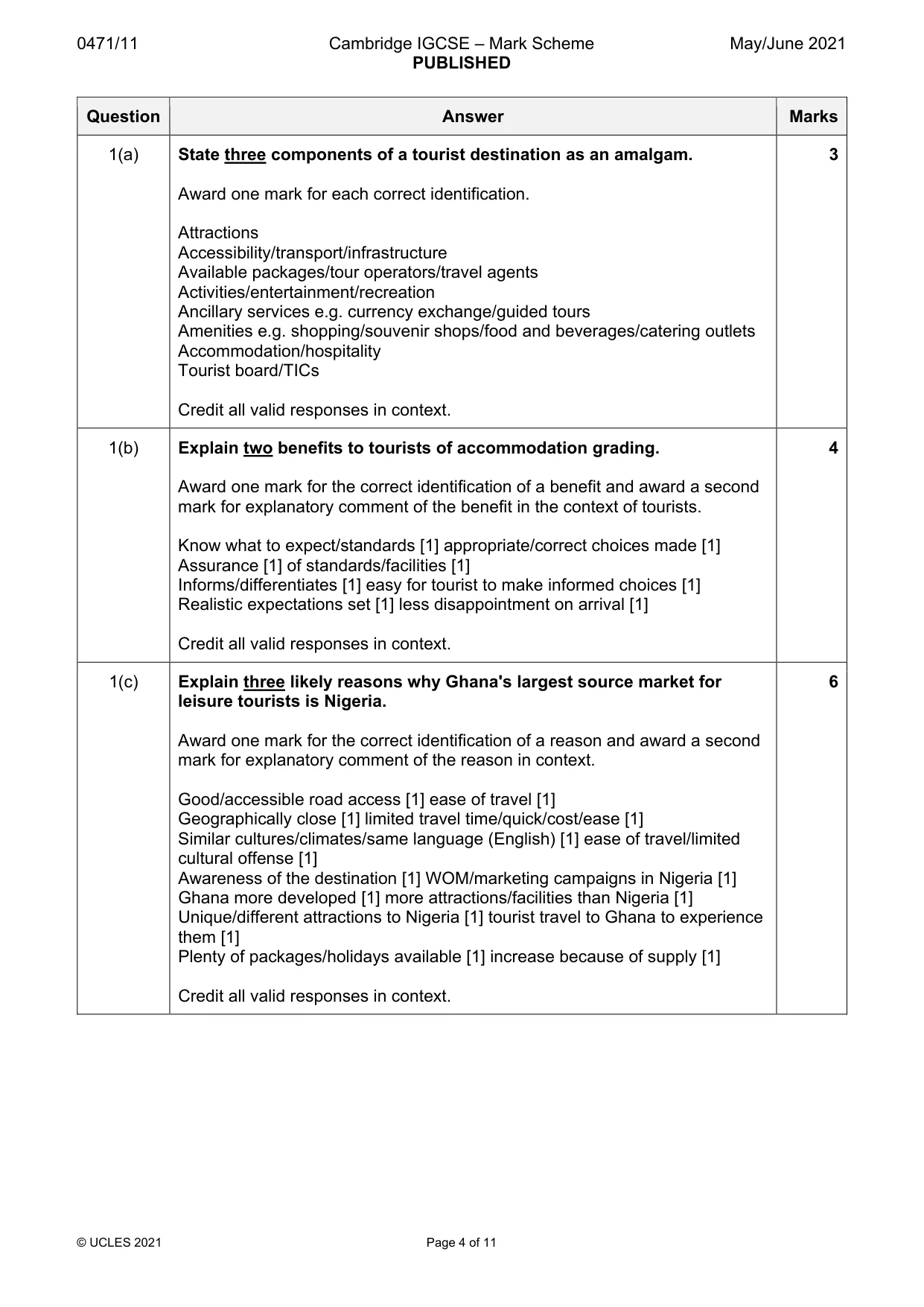
0471/11 Cambridge IGCSE – Mark Scheme PUBLISHED May/June 2021 © UCLES 2021 Page 4 of 11 Question Answer Marks 1(a) State three components of a tourist destination as an amalgam. Award one mark for each correct identification. Attractions Accessibility/transport/infrastructure Available packages/tour operators/travel agents Activities/entertainment/recreation Ancillary services e.g. currency exchange/guided tours Amenities e.g. shopping/souvenir shops/food and beverages/catering outlets Accommodation/hospitality Tourist board/TICs Credit all valid responses in context. 3 1(b) Explain two benefits to tourists of accommodation grading. Award one mark for the correct identification of a benefit and award a second mark for explanatory comment of the benefit in the context of tourists. Know what to expect/standards [1] appropriate/correct choices made [1] Assurance [1] of standards/facilities [1] Informs/differentiates [1] easy for tourist to make informed choices [1] Realistic expectations set [1] less disappointment on arrival [1] Credit all valid responses in context. 4 1(c) Explain three likely reasons why Ghana's largest source market for leisure tourists is Nigeria. Award one mark for the correct identification of a reason and award a second mark for explanatory comment of the reason in context. Good/accessible road access [1] ease of travel [1] Geographically close [1] limited travel time/quick/cost/ease [1] Similar cultures/climates/same language (English) [1] ease of travel/limited cultural offense [1] Awareness of the destination [1] WOM/marketing campaigns in Nigeria [1] Ghana more developed [1] more attractions/facilities than Nigeria [1] Unique/different attractions to Nigeria [1] tourist travel to Ghana to experience them [1] Plenty of packages/holidays available [1] increase because of supply [1] Credit all valid responses in context. 6
Mark scheme, page 5
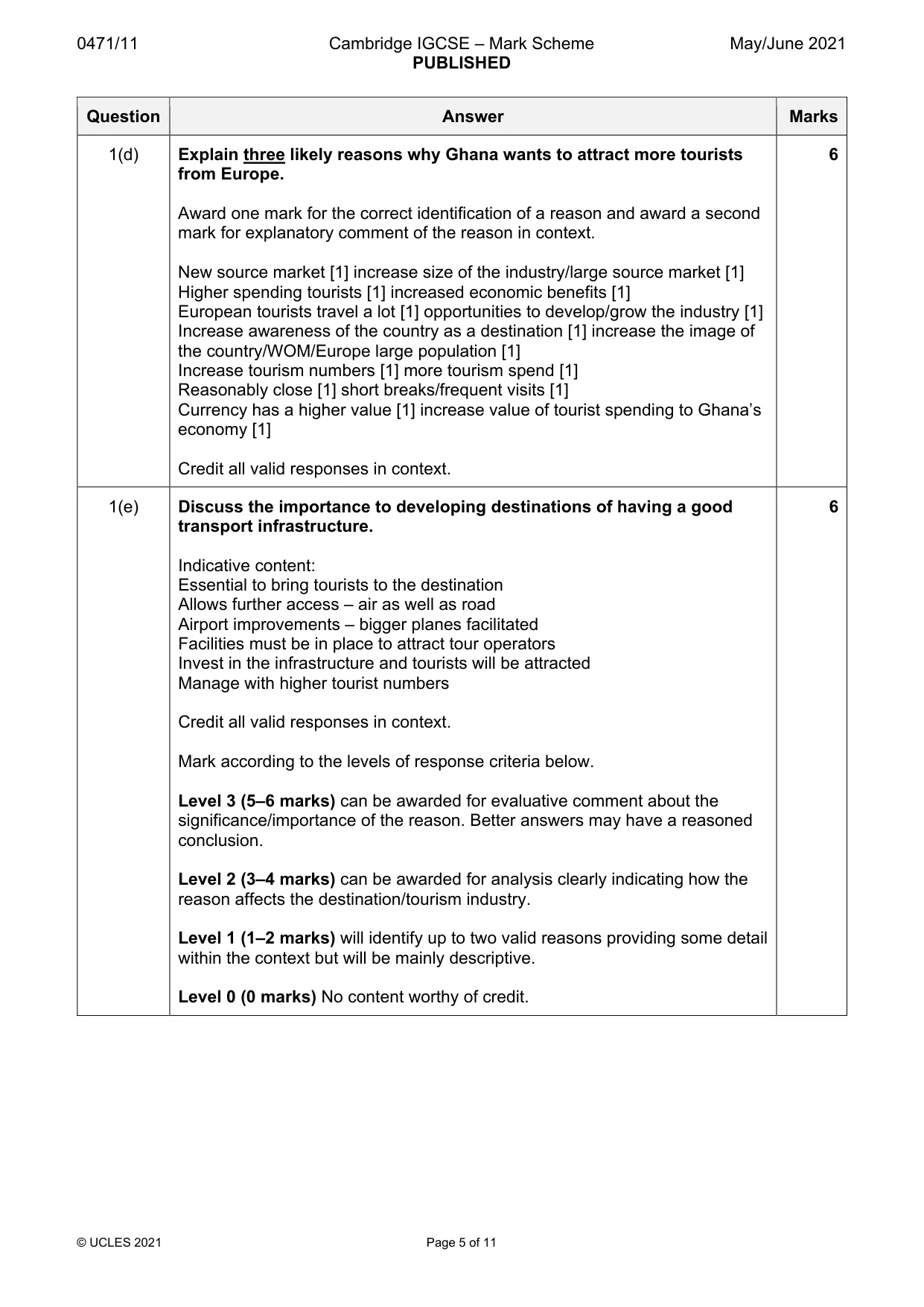
0471/11 Cambridge IGCSE – Mark Scheme PUBLISHED May/June 2021 © UCLES 2021 Page 5 of 11 Question Answer Marks 1(d) Explain three likely reasons why Ghana wants to attract more tourists from Europe. Award one mark for the correct identification of a reason and award a second mark for explanatory comment of the reason in context. New source market [1] increase size of the industry/large source market [1] Higher spending tourists [1] increased economic benefits [1] European tourists travel a lot [1] opportunities to develop/grow the industry [1] Increase awareness of the country as a destination [1] increase the image of the country/WOM/Europe large population [1] Increase tourism numbers [1] more tourism spend [1] Reasonably close [1] short breaks/frequent visits [1] Currency has a higher value [1] increase value of tourist spending to Ghana’s economy [1] Credit all valid responses in context. 6 1(e) Discuss the importance to developing destinations of having a good transport infrastructure. Indicative content: Essential to bring tourists to the destination Allows further access – air as well as road Airport improvements – bigger planes facilitated Facilities must be in place to attract tour operators Invest in the infrastructure and tourists will be attracted Manage with higher tourist numbers Credit all valid responses in context. Mark according to the levels of response criteria below. Level 3 (5–6 marks) can be awarded for evaluative comment about the significance/importance of the reason. Better answers may have a reasoned conclusion. Level 2 (3–4 marks) can be awarded for analysis clearly indicating how the reason affects the destination/tourism industry. Level 1 (1–2 marks) will identify up to two valid reasons providing some detail within the context but will be mainly descriptive. Level 0 (0 marks) No content worthy of credit. 6
Mark scheme, page 6
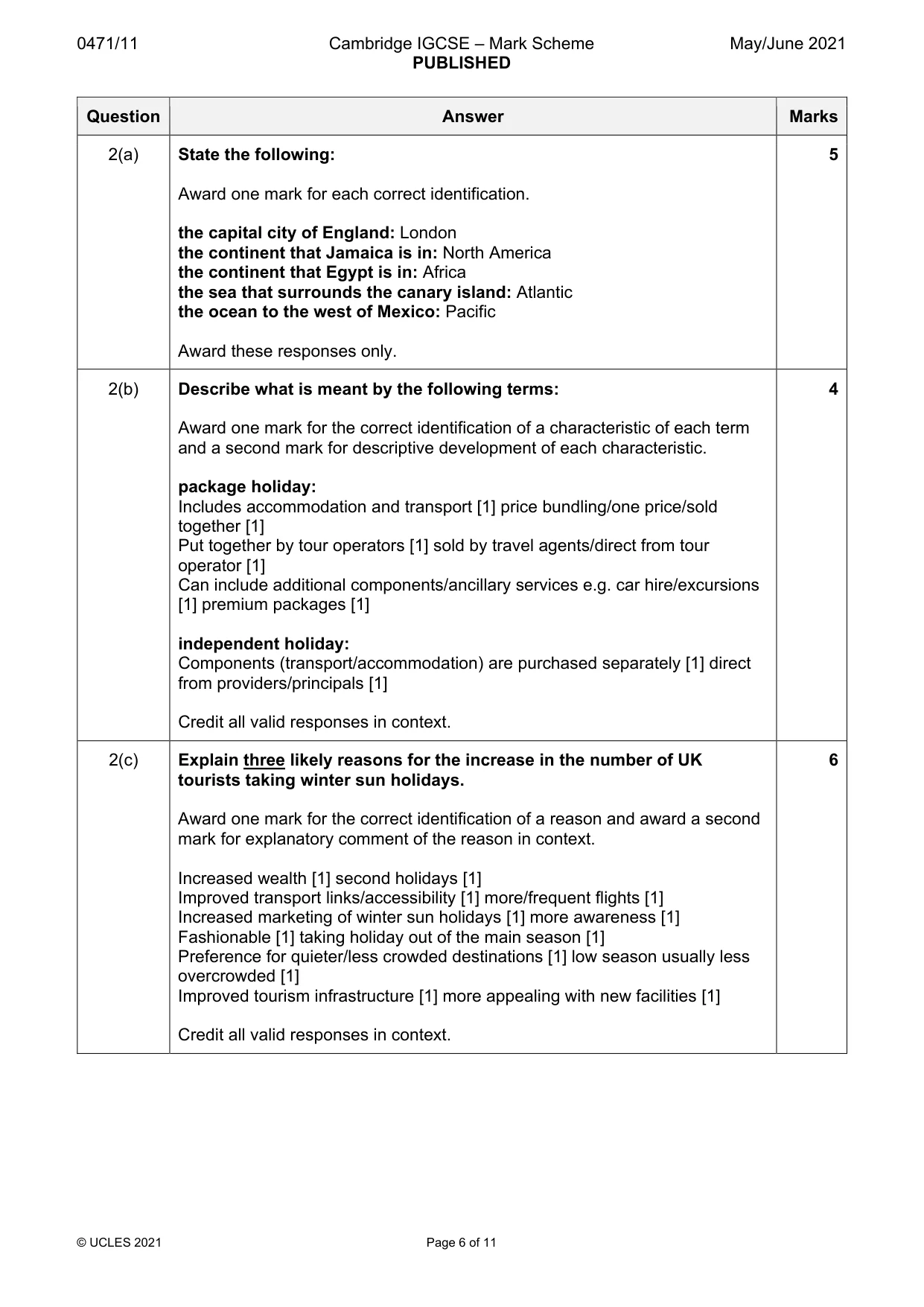
0471/11 Cambridge IGCSE – Mark Scheme PUBLISHED May/June 2021 © UCLES 2021 Page 6 of 11 Question Answer Marks 2(a) State the following: Award one mark for each correct identification. the capital city of England: London the continent that Jamaica is in: North America the continent that Egypt is in: Africa the sea that surrounds the canary island: Atlantic the ocean to the west of Mexico: Pacific Award these responses only. 5 2(b) Describe what is meant by the following terms: Award one mark for the correct identification of a characteristic of each term and a second mark for descriptive development of each characteristic. package holiday: Includes accommodation and transport [1] price bundling/one price/sold together [1] Put together by tour operators [1] sold by travel agents/direct from tour operator [1] Can include additional components/ancillary services e.g. car hire/excursions [1] premium packages [1] independent holiday: Components (transport/accommodation) are purchased separately [1] direct from providers/principals [1] Credit all valid responses in context. 4 2(c) Explain three likely reasons for the increase in the number of UK tourists taking winter sun holidays. Award one mark for the correct identification of a reason and award a second mark for explanatory comment of the reason in context. Increased wealth [1] second holidays [1] Improved transport links/accessibility [1] more/frequent flights [1] Increased marketing of winter sun holidays [1] more awareness [1] Fashionable [1] taking holiday out of the main season [1] Preference for quieter/less crowded destinations [1] low season usually less overcrowded [1] Improved tourism infrastructure [1] more appealing with new facilities [1] Credit all valid responses in context. 6
Mark scheme, page 7
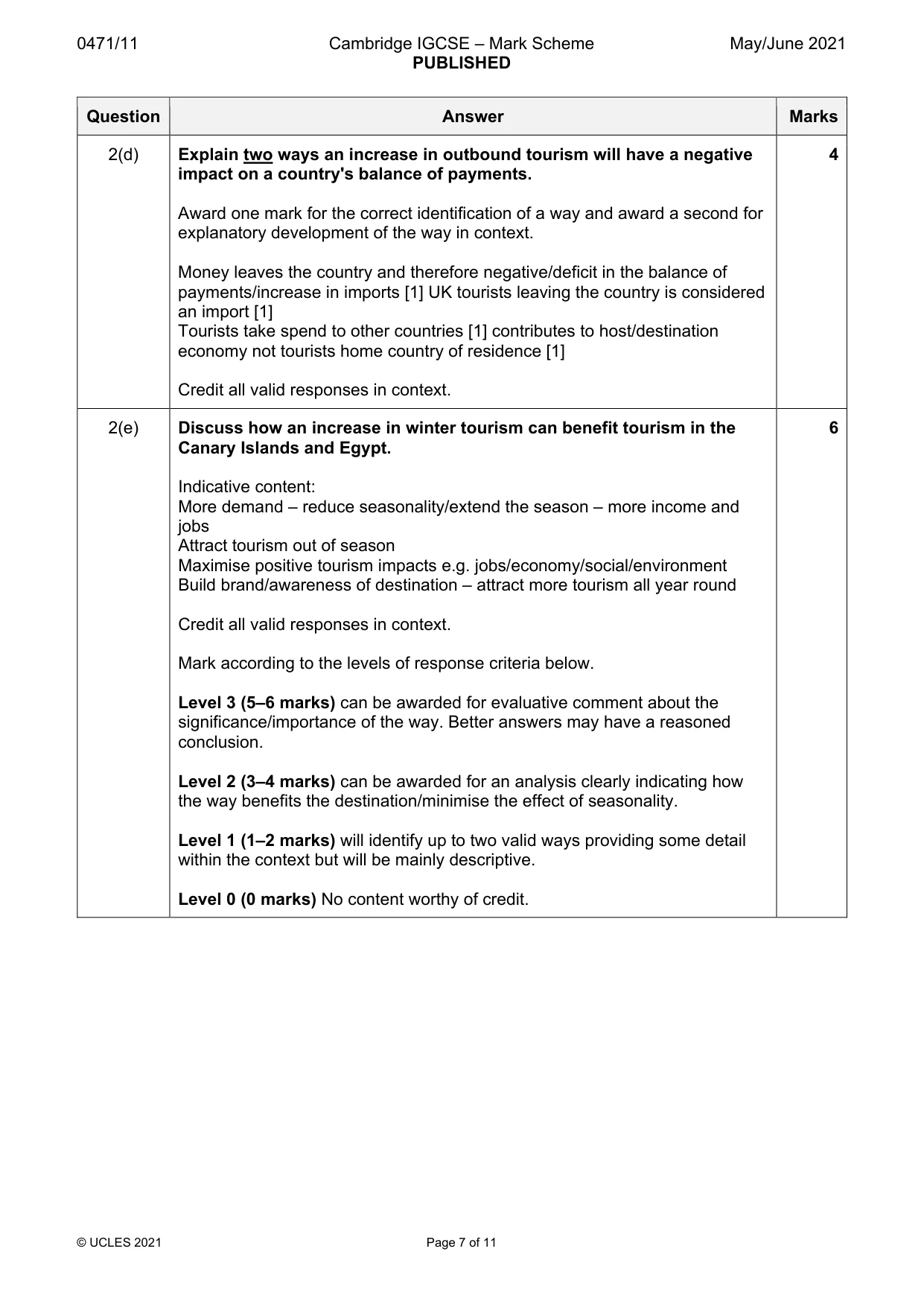
0471/11 Cambridge IGCSE – Mark Scheme PUBLISHED May/June 2021 © UCLES 2021 Page 7 of 11 Question Answer Marks 2(d) Explain two ways an increase in outbound tourism will have a negative impact on a country's balance of payments. Award one mark for the correct identification of a way and award a second for explanatory development of the way in context. Money leaves the country and therefore negative/deficit in the balance of payments/increase in imports [1] UK tourists leaving the country is considered an import [1] Tourists take spend to other countries [1] contributes to host/destination economy not tourists home country of residence [1] Credit all valid responses in context. 4 2(e) Discuss how an increase in winter tourism can benefit tourism in the Canary Islands and Egypt. Indicative content: More demand – reduce seasonality/extend the season – more income and jobs Attract tourism out of season Maximise positive tourism impacts e.g. jobs/economy/social/environment Build brand/awareness of destination – attract more tourism all year round Credit all valid responses in context. Mark according to the levels of response criteria below. Level 3 (5–6 marks) can be awarded for evaluative comment about the significance/importance of the way. Better answers may have a reasoned conclusion. Level 2 (3–4 marks) can be awarded for an analysis clearly indicating how the way benefits the destination/minimise the effect of seasonality. Level 1 (1–2 marks) will identify up to two valid ways providing some detail within the context but will be mainly descriptive. Level 0 (0 marks) No content worthy of credit. 6
Mark scheme, page 8
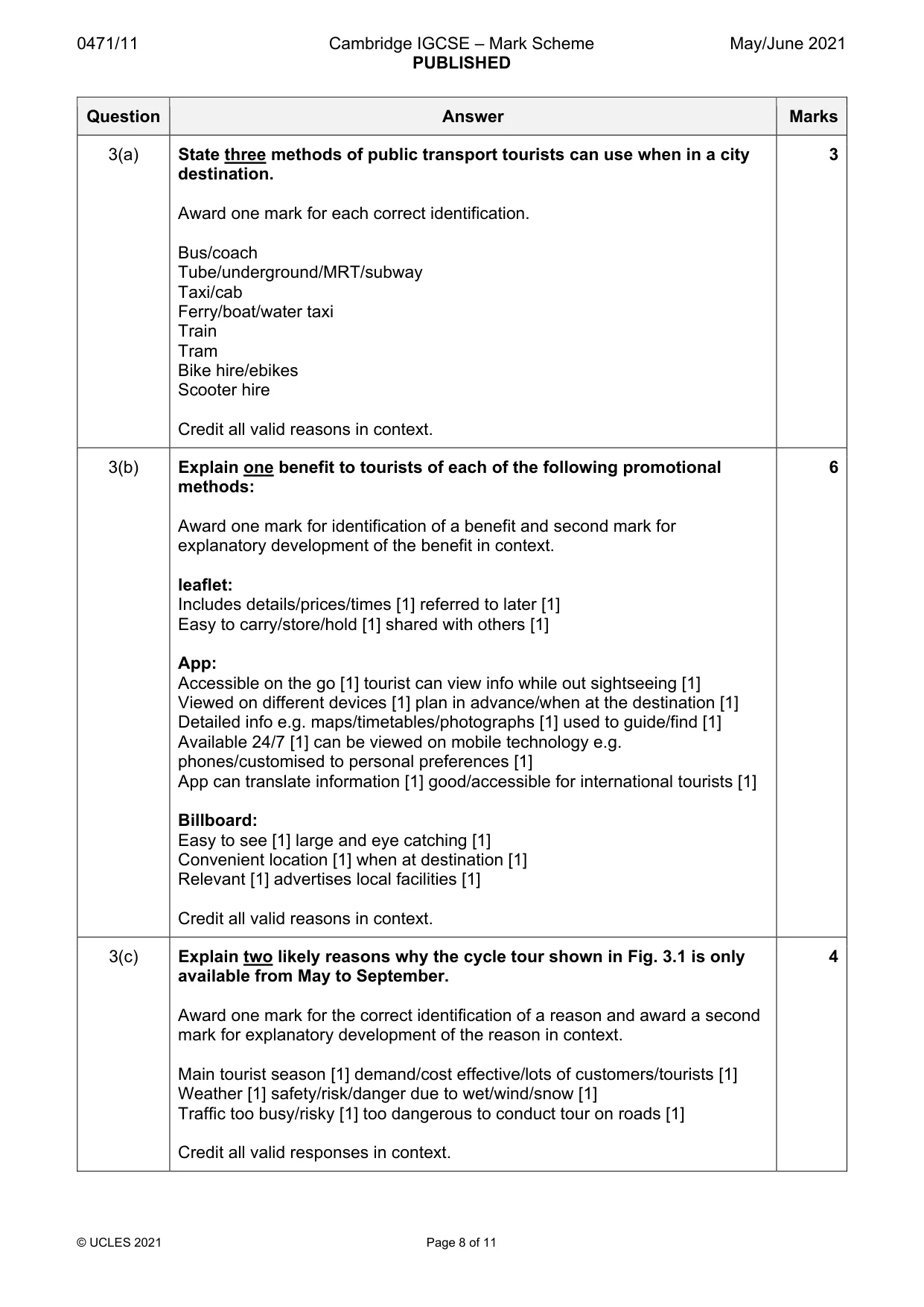
0471/11 Cambridge IGCSE – Mark Scheme PUBLISHED May/June 2021 © UCLES 2021 Page 8 of 11 Question Answer Marks 3(a) State three methods of public transport tourists can use when in a city destination. Award one mark for each correct identification. Bus/coach Tube/underground/MRT/subway Taxi/cab Ferry/boat/water taxi Train Tram Bike hire/ebikes Scooter hire Credit all valid reasons in context. 3 3(b) Explain one benefit to tourists of each of the following promotional methods: Award one mark for identification of a benefit and second mark for explanatory development of the benefit in context. leaflet: Includes details/prices/times [1] referred to later [1] Easy to carry/store/hold [1] shared with others [1] App: Accessible on the go [1] tourist can view info while out sightseeing [1] Viewed on different devices [1] plan in advance/when at the destination [1] Detailed info e.g. maps/timetables/photographs [1] used to guide/find [1] Available 24/7 [1] can be viewed on mobile technology e.g. phones/customised to personal preferences [1] App can translate information [1] good/accessible for international tourists [1] Billboard: Easy to see [1] large and eye catching [1] Convenient location [1] when at destination [1] Relevant [1] advertises local facilities [1] Credit all valid reasons in context. 6 3(c) Explain two likely reasons why the cycle tour shown in Fig. 3.1 is only available from May to September. Award one mark for the correct identification of a reason and award a second mark for explanatory development of the reason in context. Main tourist season [1] demand/cost effective/lots of customers/tourists [1] Weather [1] safety/risk/danger due to wet/wind/snow [1] Traffic too busy/risky [1] too dangerous to conduct tour on roads [1] Credit all valid responses in context. 4
Mark scheme, page 9
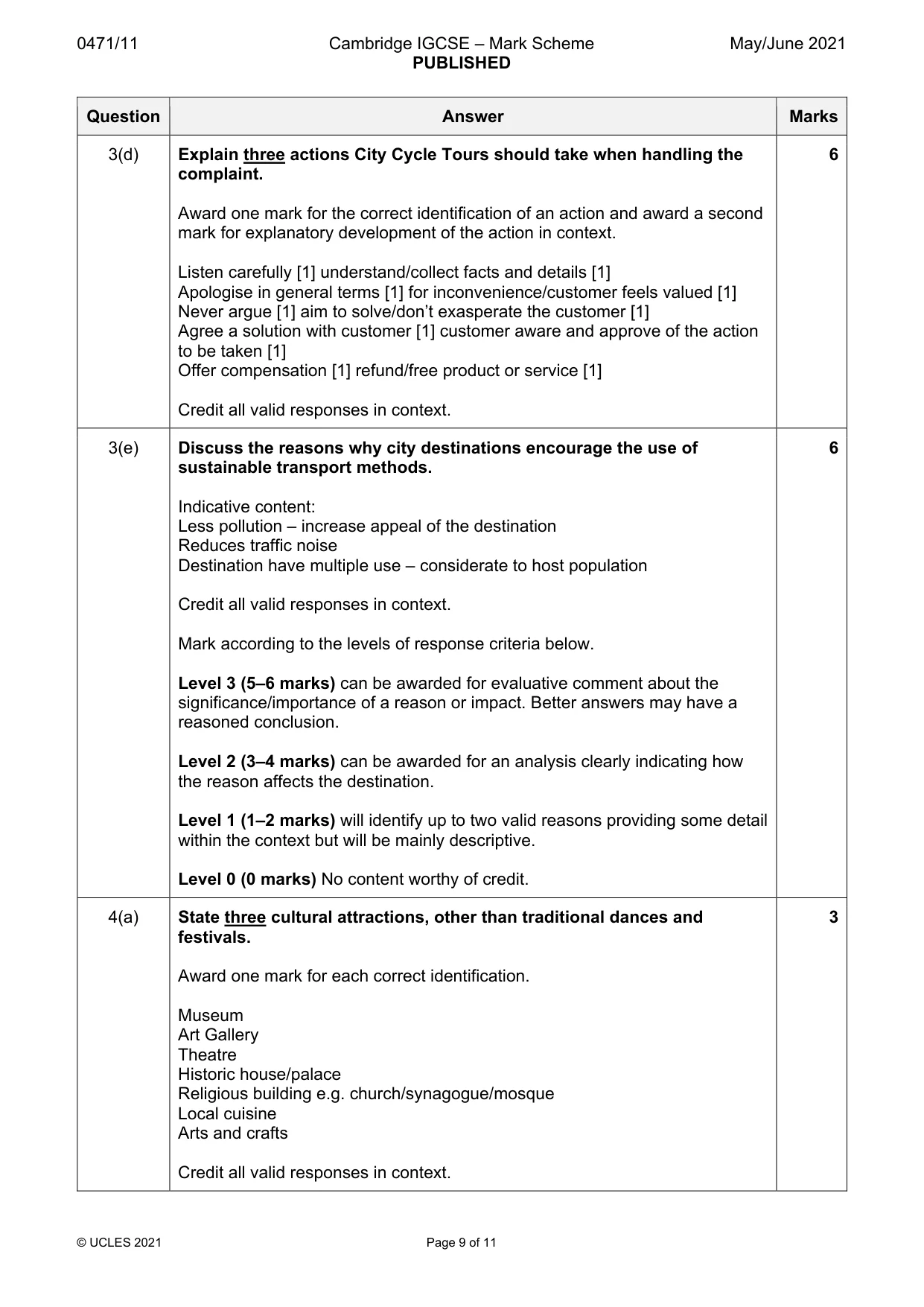
0471/11 Cambridge IGCSE – Mark Scheme PUBLISHED May/June 2021 © UCLES 2021 Page 9 of 11 Question Answer Marks 3(d) Explain three actions City Cycle Tours should take when handling the complaint. Award one mark for the correct identification of an action and award a second mark for explanatory development of the action in context. Listen carefully [1] understand/collect facts and details [1] Apologise in general terms [1] for inconvenience/customer feels valued [1] Never argue [1] aim to solve/don’t exasperate the customer [1] Agree a solution with customer [1] customer aware and approve of the action to be taken [1] Offer compensation [1] refund/free product or service [1] Credit all valid responses in context. 6 3(e) Discuss the reasons why city destinations encourage the use of sustainable transport methods. Indicative content: Less pollution – increase appeal of the destination Reduces traffic noise Destination have multiple use – considerate to host population Credit all valid responses in context. Mark according to the levels of response criteria below. Level 3 (5–6 marks) can be awarded for evaluative comment about the significance/importance of a reason or impact. Better answers may have a reasoned conclusion. Level 2 (3–4 marks) can be awarded for an analysis clearly indicating how the reason affects the destination. Level 1 (1–2 marks) will identify up to two valid reasons providing some detail within the context but will be mainly descriptive. Level 0 (0 marks) No content worthy of credit. 6 4(a) State three cultural attractions, other than traditional dances and festivals. Award one mark for each correct identification. Museum Art Gallery Theatre Historic house/palace Religious building e.g. church/synagogue/mosque Local cuisine Arts and crafts Credit all valid responses in context. 3
Mark scheme, page 10
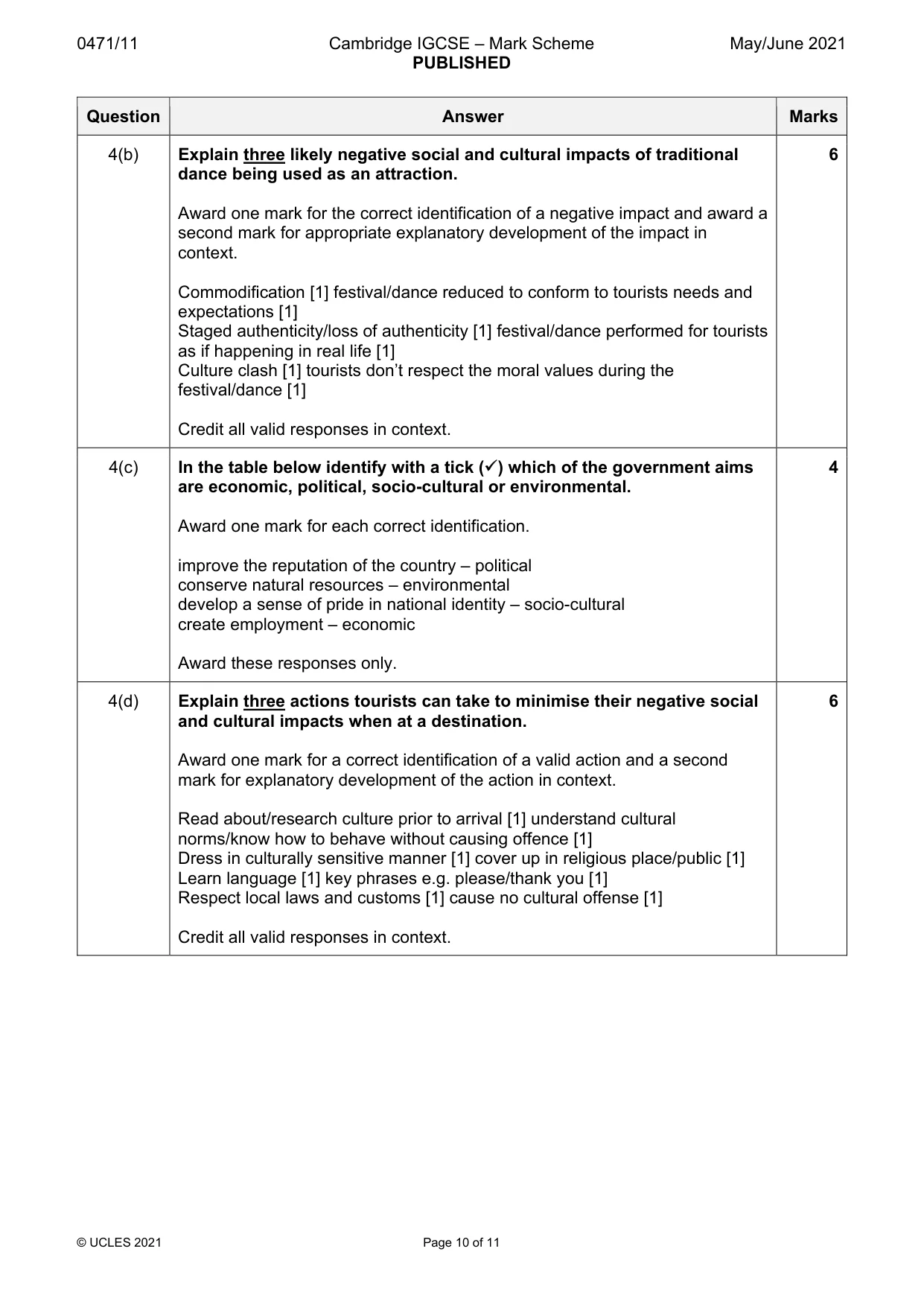
0471/11 Cambridge IGCSE – Mark Scheme PUBLISHED May/June 2021 © UCLES 2021 Page 10 of 11 Question Answer Marks 4(b) Explain three likely negative social and cultural impacts of traditional dance being used as an attraction. Award one mark for the correct identification of a negative impact and award a second mark for appropriate explanatory development of the impact in context. Commodification [1] festival/dance reduced to conform to tourists needs and expectations [1] Staged authenticity/loss of authenticity [1] festival/dance performed for tourists as if happening in real life [1] Culture clash [1] tourists don’t respect the moral values during the festival/dance [1] Credit all valid responses in context. 6 4(c) In the table below identify with a tick () which of the government aims are economic, political, socio-cultural or environmental. Award one mark for each correct identification. improve the reputation of the country – political conserve natural resources – environmental develop a sense of pride in national identity – socio-cultural create employment – economic Award these responses only. 4 4(d) Explain three actions tourists can take to minimise their negative social and cultural impacts when at a destination. Award one mark for a correct identification of a valid action and a second mark for explanatory development of the action in context. Read about/research culture prior to arrival [1] understand cultural norms/know how to behave without causing offence [1] Dress in culturally sensitive manner [1] cover up in religious place/public [1] Learn language [1] key phrases e.g. please/thank you [1] Respect local laws and customs [1] cause no cultural offense [1] Credit all valid responses in context. 6
Mark scheme, page 11
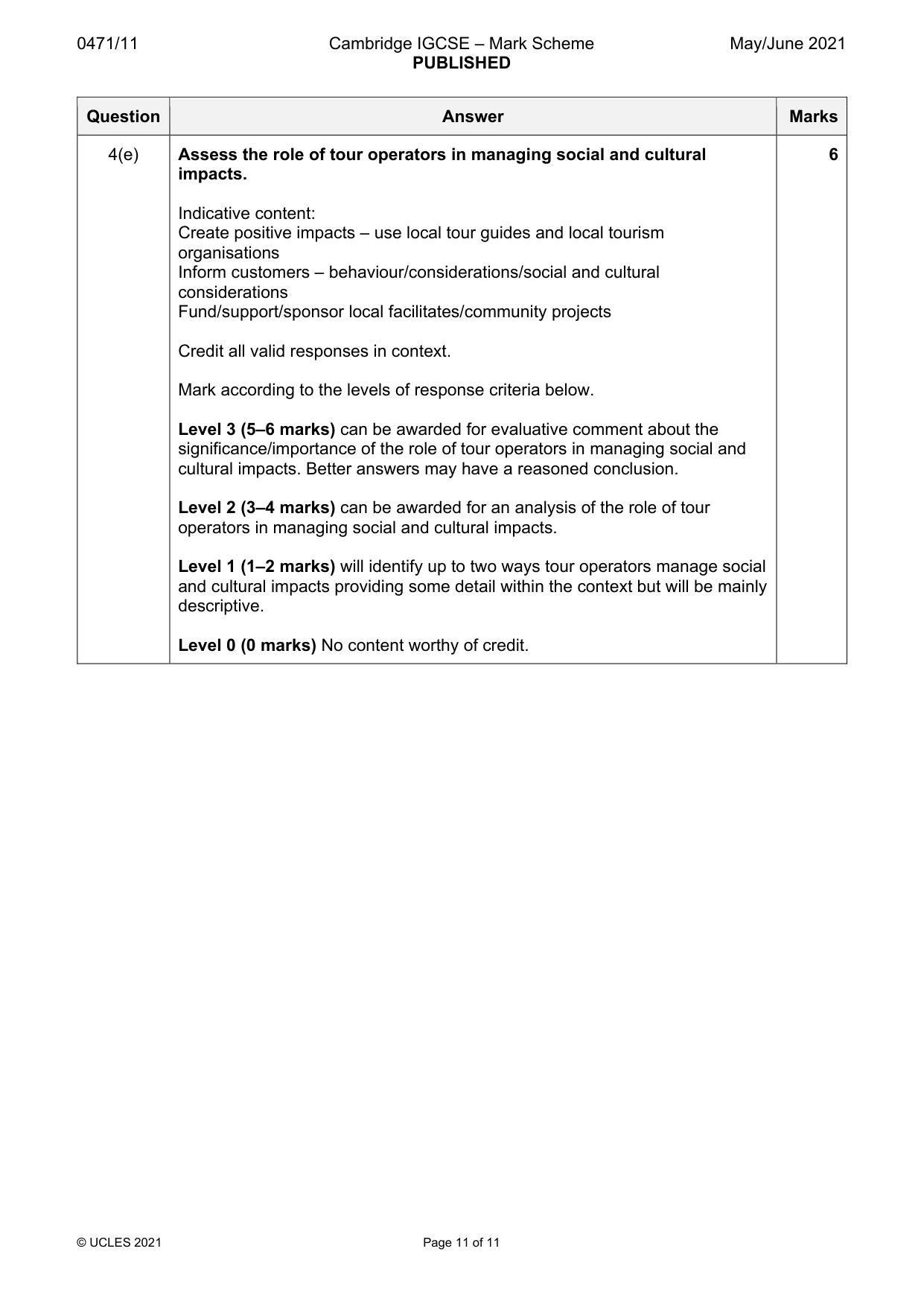
0471/11 Cambridge IGCSE – Mark Scheme PUBLISHED May/June 2021 © UCLES 2021 Page 11 of 11 Question Answer Marks 4(e) Assess the role of tour operators in managing social and cultural impacts. Indicative content: Create positive impacts – use local tour guides and local tourism organisations Inform customers – behaviour/considerations/social and cultural considerations Fund/support/sponsor local facilitates/community projects Credit all valid responses in context. Mark according to the levels of response criteria below. Level 3 (5–6 marks) can be awarded for evaluative comment about the significance/importance of the role of tour operators in managing social and cultural impacts. Better answers may have a reasoned conclusion. Level 2 (3–4 marks) can be awarded for an analysis of the role of tour operators in managing social and cultural impacts. Level 1 (1–2 marks) will identify up to two ways tour operators manage social and cultural impacts providing some detail within the context but will be mainly descriptive. Level 0 (0 marks) No content worthy of credit. 6
What you needed in this session
Cambridge’s own grade thresholds for 2021 May/June, Paper 1 · Variant 1. A higher threshold means an easier paper — the bar moves with how the cohort did.