Cambridge IGCSE Travel and Tourism 0471 — 2020 Oct/Nov Paper 2 · Variant 3
0471/23/O/N/20 · 100 marks · ≈113 min
The question paper and its mark scheme, free to read here and free to download. This is Cambridge’s own paper, exactly as it was sat.
Question paper16 pages



Mark scheme11 pages
Answers below. Sit the paper first if you are practising.
Paper as text
Question paper, page 1
This document has 16 pages. Blank pages are indicated. TRAVEL & TOURISM 0471/23 Paper 2 Alternative to Coursework October/November 2020 2 hours 30 minutes You must answer on the question paper. You will need: Insert (enclosed) INSTRUCTIONS ● Answer all questions. ● Use a black or dark blue pen. ● Write your name, centre number and candidate number in the boxes at the top of the page. ● Write your answer to each question in the space provided. ● Do not use an erasable pen or correction fluid. ● Do not write on any bar codes. INFORMATION ● The total mark for this paper is 100. ● The number of marks for each question or part question is shown in brackets [ ]. ● The insert contains all the figures referred to in the questions. Cambridge IGCSE™ * 0 1 4 0 0 6 4 6 0 9 * DC (ST) 179920/1 © UCLES 2020 [Turn over
Question paper, page 2
2 0471/23/O/N/20 © UCLES 2020 Question 1 Refer to Fig. 1.1 (Insert), a summary of Spain’s position on the product lifecycle model. (a) Describe two characteristics of a mature destination. 1 … … … … 2 … … … … [4] (b) Explain three reasons why visitors no longer find some parts of Spain appealing. 1 … … … … 2 … … … … 3 … … … … [6]
Question paper, page 3
3 0471/23/O/N/20 © UCLES 2020 [Turn over (c) Explain two reasons why discount pricing is suitable for some Spanish destinations. 1 … … … … … … 2 … … … … … … [6]
Question paper, page 4
4 0471/23/O/N/20 © UCLES 2020 (d) Evaluate how electronic media can be used to create interest in a destination. … … … … … … … … … … … … … … … … … … [9] [Total: 25]
Question paper, page 5
5 0471/23/O/N/20 © UCLES 2020 [Turn over Question 2 Refer to Fig. 2.1 (Insert), information about the Singapore Night Race, a sporting event. Singapore is a country in Asia. (a) Describe two purposes of tourism sponsorship. 1 … … … … 2 … … … … [4] (b) Explain three reasons for the popularity of sporting events as a tourist activity. 1 … … … … 2 … … … … 3 … … … … [6]
Question paper, page 6
6 0471/23/O/N/20 © UCLES 2020 (c) Explain two reasons why timing is an important aspect of a promotional campaign for the annual Singapore Night Race. 1 … … … … … … 2 … … … … … … [6]
Question paper, page 7
7 0471/23/O/N/20 © UCLES 2020 [Turn over (d) Discuss why a positive organisational image is important for the provider of the Singapore Night Race. … … … … … … … … … … … … … … … … … … [9] [Total: 25]
Question paper, page 8
8 0471/23/O/N/20 © UCLES 2020 Question 3 Refer to Fig. 3.1 (Insert), an advertisement for a special interest package to Prince Edward Island (PEI) in Canada. (a) (i) Define, using an example, what is meant by the term ‘double occupancy’. … … … … [2] (ii) Suggest two benefits to the tour operator of using the double occupancy strategy. 1 … … 2 … … [2] (b) Explain three ways the advertised special interest package has been tailored to the needs of the customer. 1 … … … … 2 … … … … 3 … … … … [6]
Question paper, page 9
9 0471/23/O/N/20 © UCLES 2020 [Turn over (c) Identify two ways the advertised package might be perishable. For each, suggest how the tour operator might overcome the issue. 1 … … … … … … 2 … … … … … … [6]
Question paper, page 10
10 0471/23/O/N/20 © UCLES 2020 (d) Assess the importance of brand loyalty when creating this type of special interest product. … … … … … … … … … … … … … … … … … … [9] [Total: 25]
Question paper, page 11
11 0471/23/O/N/20 © UCLES 2020 [Turn over Question 4 Refer to Fig. 4.1 (Insert), information about tourism subsidies in Kerala, a region in India. (a) (i) Define, using an example, what is meant by the term ‘star classification’. … … … … [2] (ii) Give two reasons why star classifications are important when marketing tourism within a destination. 1 … … 2 … … [2] (b) Explain three likely reasons why the Department of Tourism in Kerala is offering tourism subsidies. 1 … … … … 2 … … … … 3 … … … … [6]
Question paper, page 12
12 0471/23/O/N/20 © UCLES 2020 (c) Explain two ways the internet might help the Department of Tourism promote the subsidy scheme. 1 … … … … … … 2 … … … … … … [6]
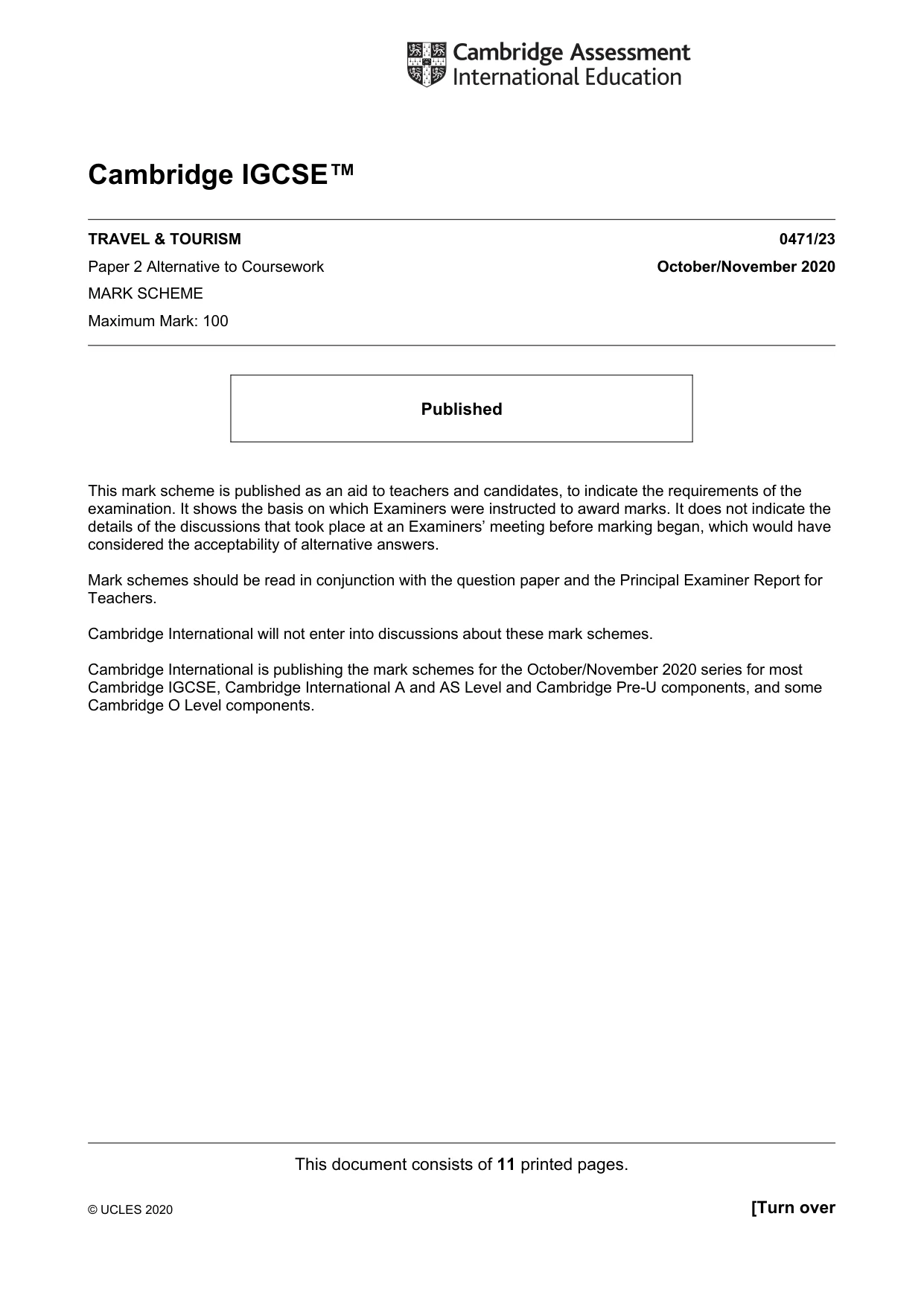
Question paper, page 13
13 0471/23/O/N/20 © UCLES 2020 (d) Discuss why repeat business is important for all organisations in the travel and tourism industry. … … … … … … … … … … … … … … … … … … [9] [Total: 25]
Question paper, page 14
14 0471/23/O/N/20 © UCLES 2020 BLANK PAGE
Question paper, page 15
15 0471/23/O/N/20 © UCLES 2020 BLANK PAGE
Question paper, page 16
16 0471/23/O/N/20 © UCLES 2020 Permission to reproduce items where third-party owned material protected by copyright is included has been sought and cleared where possible. Every reasonable effort has been made by the publisher (UCLES) to trace copyright holders, but if any items requiring clearance have unwittingly been included, the publisher will be pleased to make amends at the earliest possible opportunity. To avoid the issue of disclosure of answer-related information to candidates, all copyright acknowledgements are reproduced online in the Cambridge Assessment International Education Copyright Acknowledgements Booklet. This is produced for each series of examinations and is freely available to download at www.cambridgeinternational.org after the live examination series. Cambridge Assessment International Education is part of the Cambridge Assessment Group. Cambridge Assessment is the brand name of the University of Cambridge Local Examinations Syndicate (UCLES), which itself is a department of the University of Cambridge. BLANK PAGE
Mark scheme, page 1
This document consists of 11 printed pages. © UCLES 2020 [Turn over Cambridge IGCSE™ TRAVEL & TOURISM 0471/23 Paper 2 Alternative to Coursework October/November 2020 MARK SCHEME Maximum Mark: 100 Published This mark scheme is published as an aid to teachers and candidates, to indicate the requirements of the examination. It shows the basis on which Examiners were instructed to award marks. It does not indicate the details of the discussions that took place at an Examiners’ meeting before marking began, which would have considered the acceptability of alternative answers. Mark schemes should be read in conjunction with the question paper and the Principal Examiner Report for Teachers. Cambridge International will not enter into discussions about these mark schemes. Cambridge International is publishing the mark schemes for the October/November 2020 series for most Cambridge IGCSE, Cambridge International A and AS Level and Cambridge Pre-U components, and some Cambridge O Level components.
Mark scheme, page 2
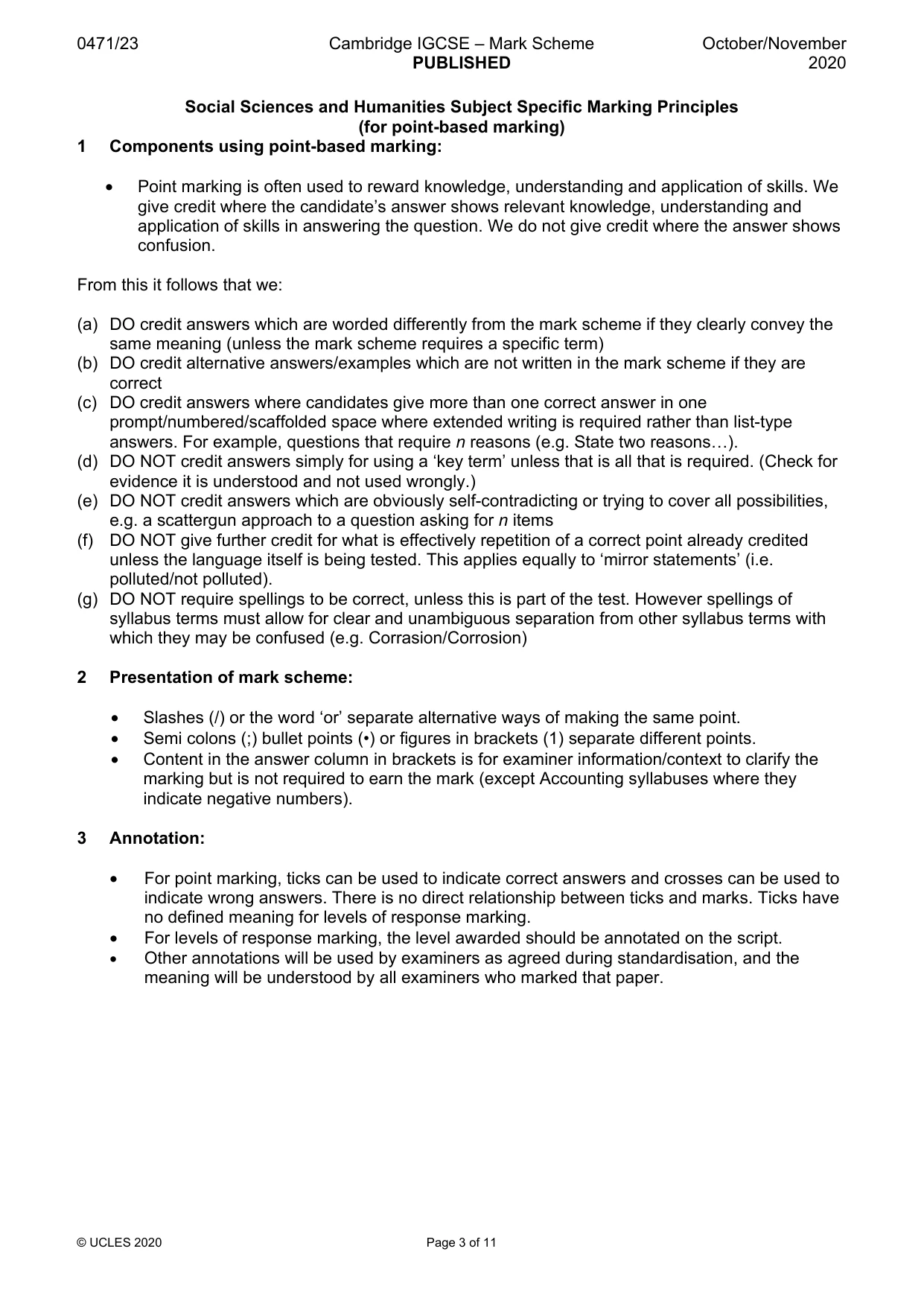
0471/23 Cambridge IGCSE – Mark Scheme PUBLISHED October/November 2020 © UCLES 2020 Page 2 of 11 Generic Marking Principles These general marking principles must be applied by all examiners when marking candidate answers. They should be applied alongside the specific content of the mark scheme or generic level descriptors for a question. Each question paper and mark scheme will also comply with these marking principles. GENERIC MARKING PRINCIPLE 1: Marks must be awarded in line with: • the specific content of the mark scheme or the generic level descriptors for the question • the specific skills defined in the mark scheme or in the generic level descriptors for the question • the standard of response required by a candidate as exemplified by the standardisation scripts. GENERIC MARKING PRINCIPLE 2: Marks awarded are always whole marks (not half marks, or other fractions). GENERIC MARKING PRINCIPLE 3: Marks must be awarded positively: • marks are awarded for correct/valid answers, as defined in the mark scheme. However, credit is given for valid answers which go beyond the scope of the syllabus and mark scheme, referring to your Team Leader as appropriate • marks are awarded when candidates clearly demonstrate what they know and can do • marks are not deducted for errors • marks are not deducted for omissions • answers should only be judged on the quality of spelling, punctuation and grammar when these features are specifically assessed by the question as indicated by the mark scheme. The meaning, however, should be unambiguous. GENERIC MARKING PRINCIPLE 4: Rules must be applied consistently, e.g. in situations where candidates have not followed instructions or in the application of generic level descriptors. GENERIC MARKING PRINCIPLE 5: Marks should be awarded using the full range of marks defined in the mark scheme for the question (however; the use of the full mark range may be limited according to the quality of the candidate responses seen). GENERIC MARKING PRINCIPLE 6: Marks awarded are based solely on the requirements as defined in the mark scheme. Marks should not be awarded with grade thresholds or grade descriptors in mind.
Mark scheme, page 3
0471/23 Cambridge IGCSE – Mark Scheme PUBLISHED October/November 2020 © UCLES 2020 Page 3 of 11 Social Sciences and Humanities Subject Specific Marking Principles (for point-based marking) 1 Components using point-based marking: • Point marking is often used to reward knowledge, understanding and application of skills. We give credit where the candidate’s answer shows relevant knowledge, understanding and application of skills in answering the question. We do not give credit where the answer shows confusion. From this it follows that we: (a) DO credit answers which are worded differently from the mark scheme if they clearly convey the same meaning (unless the mark scheme requires a specific term) (b) DO credit alternative answers/examples which are not written in the mark scheme if they are correct (c) DO credit answers where candidates give more than one correct answer in one prompt/numbered/scaffolded space where extended writing is required rather than list-type answers. For example, questions that require n reasons (e.g. State two reasons…). (d) DO NOT credit answers simply for using a ‘key term’ unless that is all that is required. (Check for evidence it is understood and not used wrongly.) (e) DO NOT credit answers which are obviously self-contradicting or trying to cover all possibilities, e.g. a scattergun approach to a question asking for n items (f) DO NOT give further credit for what is effectively repetition of a correct point already credited unless the language itself is being tested. This applies equally to ‘mirror statements’ (i.e. polluted/not polluted). (g) DO NOT require spellings to be correct, unless this is part of the test. However spellings of syllabus terms must allow for clear and unambiguous separation from other syllabus terms with which they may be confused (e.g. Corrasion/Corrosion) 2 Presentation of mark scheme: • Slashes (/) or the word ‘or’ separate alternative ways of making the same point. • Semi colons (;) bullet points (•) or figures in brackets (1) separate different points. • Content in the answer column in brackets is for examiner information/context to clarify the marking but is not required to earn the mark (except Accounting syllabuses where they indicate negative numbers). 3 Annotation: • For point marking, ticks can be used to indicate correct answers and crosses can be used to indicate wrong answers. There is no direct relationship between ticks and marks. Ticks have no defined meaning for levels of response marking. • For levels of response marking, the level awarded should be annotated on the script. • Other annotations will be used by examiners as agreed during standardisation, and the meaning will be understood by all examiners who marked that paper.
Mark scheme, page 4
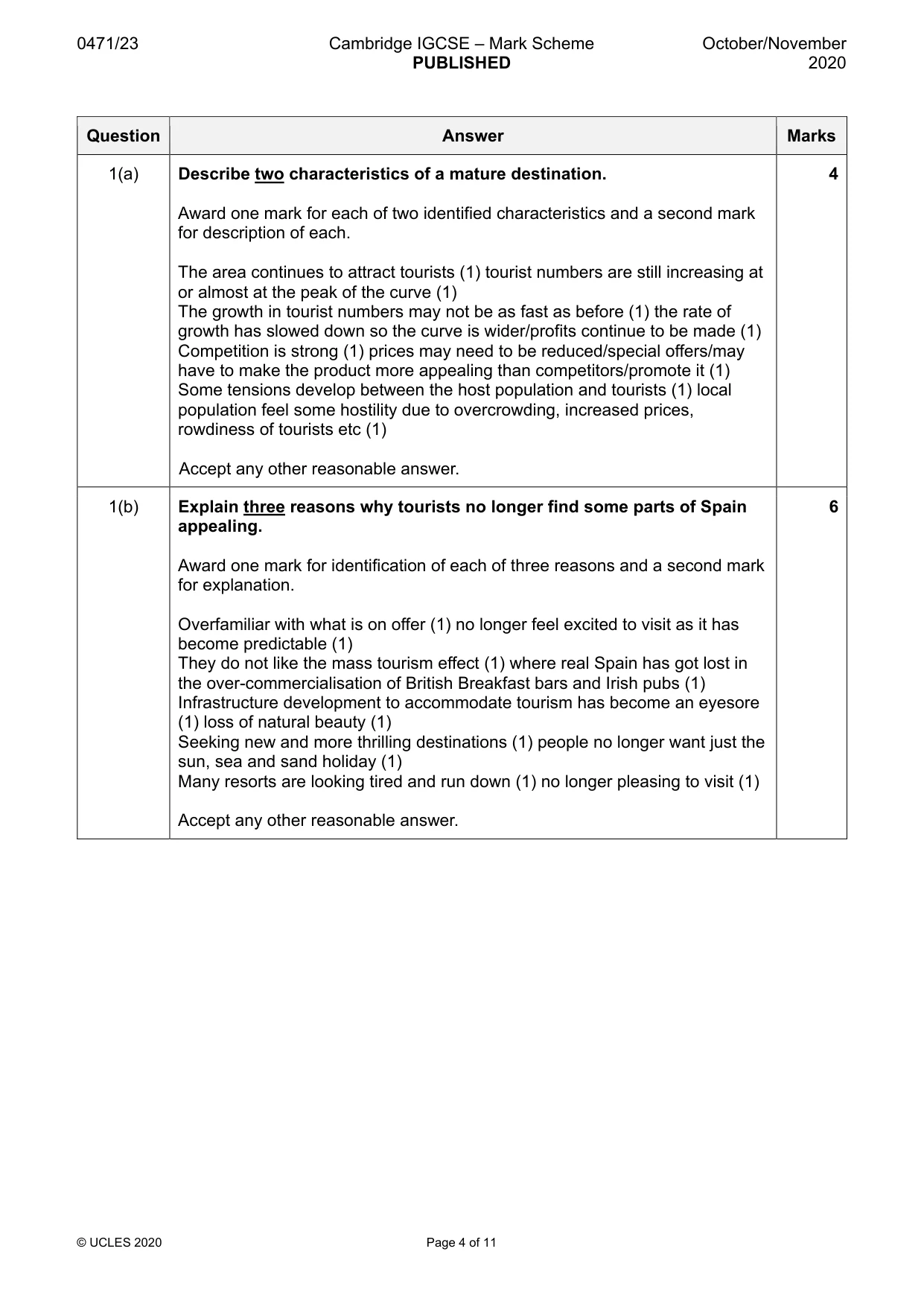
0471/23 Cambridge IGCSE – Mark Scheme PUBLISHED October/November 2020 © UCLES 2020 Page 4 of 11 Question Answer Marks 1(a) Describe two characteristics of a mature destination. Award one mark for each of two identified characteristics and a second mark for description of each. The area continues to attract tourists (1) tourist numbers are still increasing at or almost at the peak of the curve (1) The growth in tourist numbers may not be as fast as before (1) the rate of growth has slowed down so the curve is wider/profits continue to be made (1) Competition is strong (1) prices may need to be reduced/special offers/may have to make the product more appealing than competitors/promote it (1) Some tensions develop between the host population and tourists (1) local population feel some hostility due to overcrowding, increased prices, rowdiness of tourists etc (1) Accept any other reasonable answer. 4 1(b) Explain three reasons why tourists no longer find some parts of Spain appealing. Award one mark for identification of each of three reasons and a second mark for explanation. Overfamiliar with what is on offer (1) no longer feel excited to visit as it has become predictable (1) They do not like the mass tourism effect (1) where real Spain has got lost in the over-commercialisation of British Breakfast bars and Irish pubs (1) Infrastructure development to accommodate tourism has become an eyesore (1) loss of natural beauty (1) Seeking new and more thrilling destinations (1) people no longer want just the sun, sea and sand holiday (1) Many resorts are looking tired and run down (1) no longer pleasing to visit (1) Accept any other reasonable answer. 6
Mark scheme, page 5
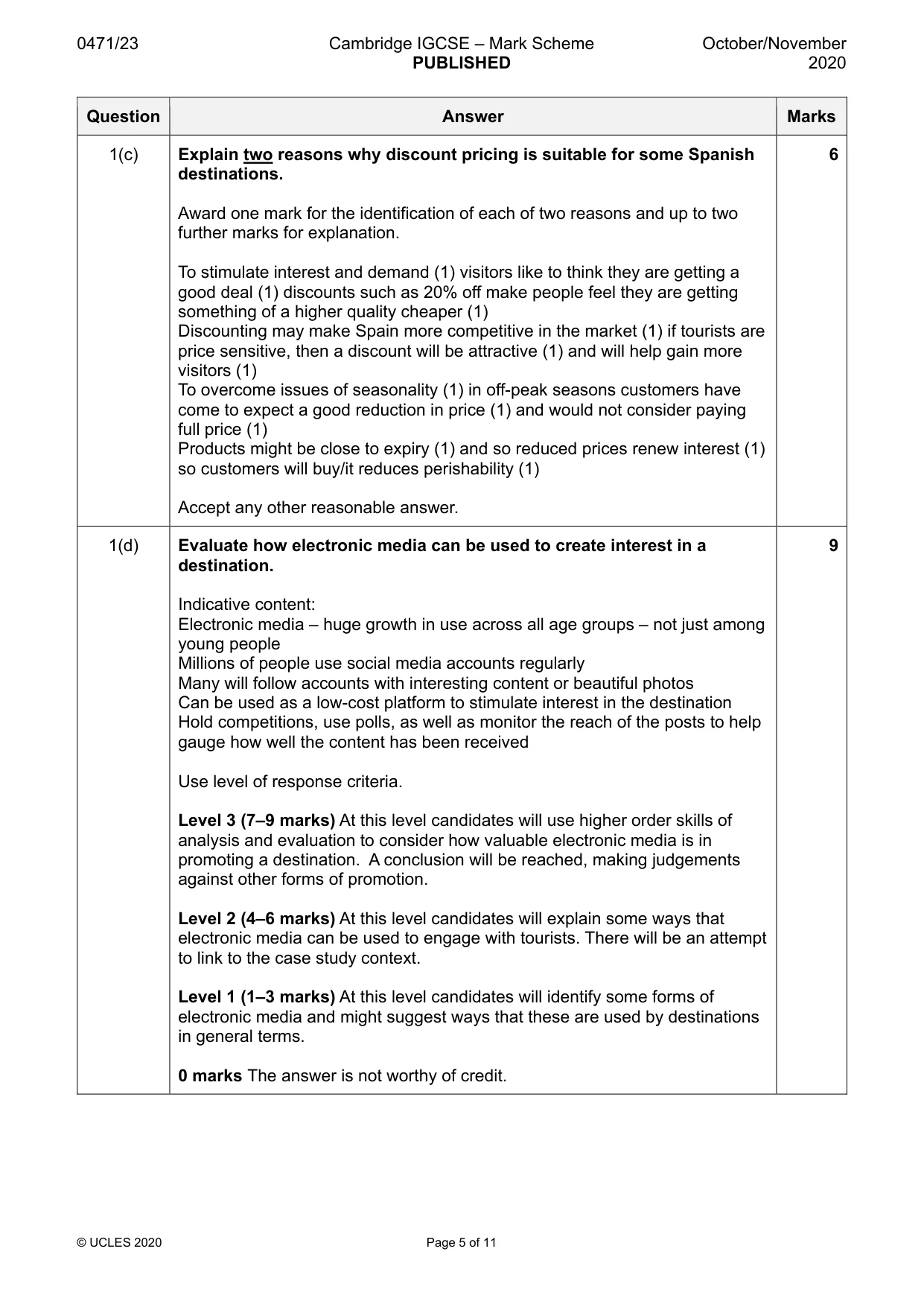
0471/23 Cambridge IGCSE – Mark Scheme PUBLISHED October/November 2020 © UCLES 2020 Page 5 of 11 Question Answer Marks 1(c) Explain two reasons why discount pricing is suitable for some Spanish destinations. Award one mark for the identification of each of two reasons and up to two further marks for explanation. To stimulate interest and demand (1) visitors like to think they are getting a good deal (1) discounts such as 20% off make people feel they are getting something of a higher quality cheaper (1) Discounting may make Spain more competitive in the market (1) if tourists are price sensitive, then a discount will be attractive (1) and will help gain more visitors (1) To overcome issues of seasonality (1) in off-peak seasons customers have come to expect a good reduction in price (1) and would not consider paying full price (1) Products might be close to expiry (1) and so reduced prices renew interest (1) so customers will buy/it reduces perishability (1) Accept any other reasonable answer. 6 1(d) Evaluate how electronic media can be used to create interest in a destination. Indicative content: Electronic media – huge growth in use across all age groups – not just among young people Millions of people use social media accounts regularly Many will follow accounts with interesting content or beautiful photos Can be used as a low-cost platform to stimulate interest in the destination Hold competitions, use polls, as well as monitor the reach of the posts to help gauge how well the content has been received Use level of response criteria. Level 3 (7–9 marks) At this level candidates will use higher order skills of analysis and evaluation to consider how valuable electronic media is in promoting a destination. A conclusion will be reached, making judgements against other forms of promotion. Level 2 (4–6 marks) At this level candidates will explain some ways that electronic media can be used to engage with tourists. There will be an attempt to link to the case study context. Level 1 (1–3 marks) At this level candidates will identify some forms of electronic media and might suggest ways that these are used by destinations in general terms. 0 marks The answer is not worthy of credit. 9
Mark scheme, page 6
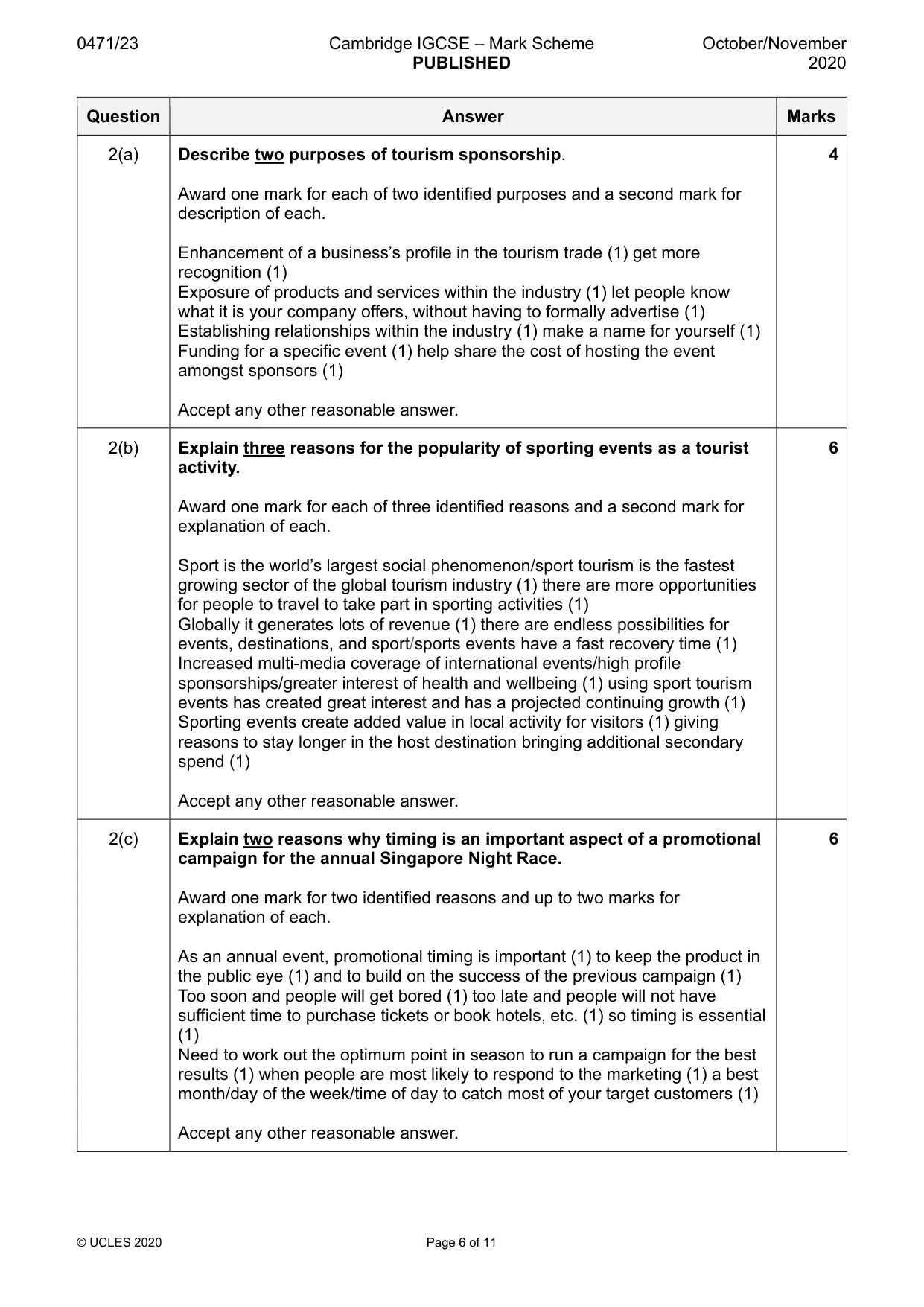
0471/23 Cambridge IGCSE – Mark Scheme PUBLISHED October/November 2020 © UCLES 2020 Page 6 of 11 Question Answer Marks 2(a) Describe two purposes of tourism sponsorship. Award one mark for each of two identified purposes and a second mark for description of each. Enhancement of a business’s profile in the tourism trade (1) get more recognition (1) Exposure of products and services within the industry (1) let people know what it is your company offers, without having to formally advertise (1) Establishing relationships within the industry (1) make a name for yourself (1) Funding for a specific event (1) help share the cost of hosting the event amongst sponsors (1) Accept any other reasonable answer. 4 2(b) Explain three reasons for the popularity of sporting events as a tourist activity. Award one mark for each of three identified reasons and a second mark for explanation of each. Sport is the world’s largest social phenomenon/sport tourism is the fastest growing sector of the global tourism industry (1) there are more opportunities for people to travel to take part in sporting activities (1) Globally it generates lots of revenue (1) there are endless possibilities for events, destinations, and sport/sports events have a fast recovery time (1) Increased multi-media coverage of international events/high profile sponsorships/greater interest of health and wellbeing (1) using sport tourism events has created great interest and has a projected continuing growth (1) Sporting events create added value in local activity for visitors (1) giving reasons to stay longer in the host destination bringing additional secondary spend (1) Accept any other reasonable answer. 6 2(c) Explain two reasons why timing is an important aspect of a promotional campaign for the annual Singapore Night Race. Award one mark for two identified reasons and up to two marks for explanation of each. As an annual event, promotional timing is important (1) to keep the product in the public eye (1) and to build on the success of the previous campaign (1) Too soon and people will get bored (1) too late and people will not have sufficient time to purchase tickets or book hotels, etc. (1) so timing is essential (1) Need to work out the optimum point in season to run a campaign for the best results (1) when people are most likely to respond to the marketing (1) a best month/day of the week/time of day to catch most of your target customers (1) Accept any other reasonable answer. 6
Mark scheme, page 7
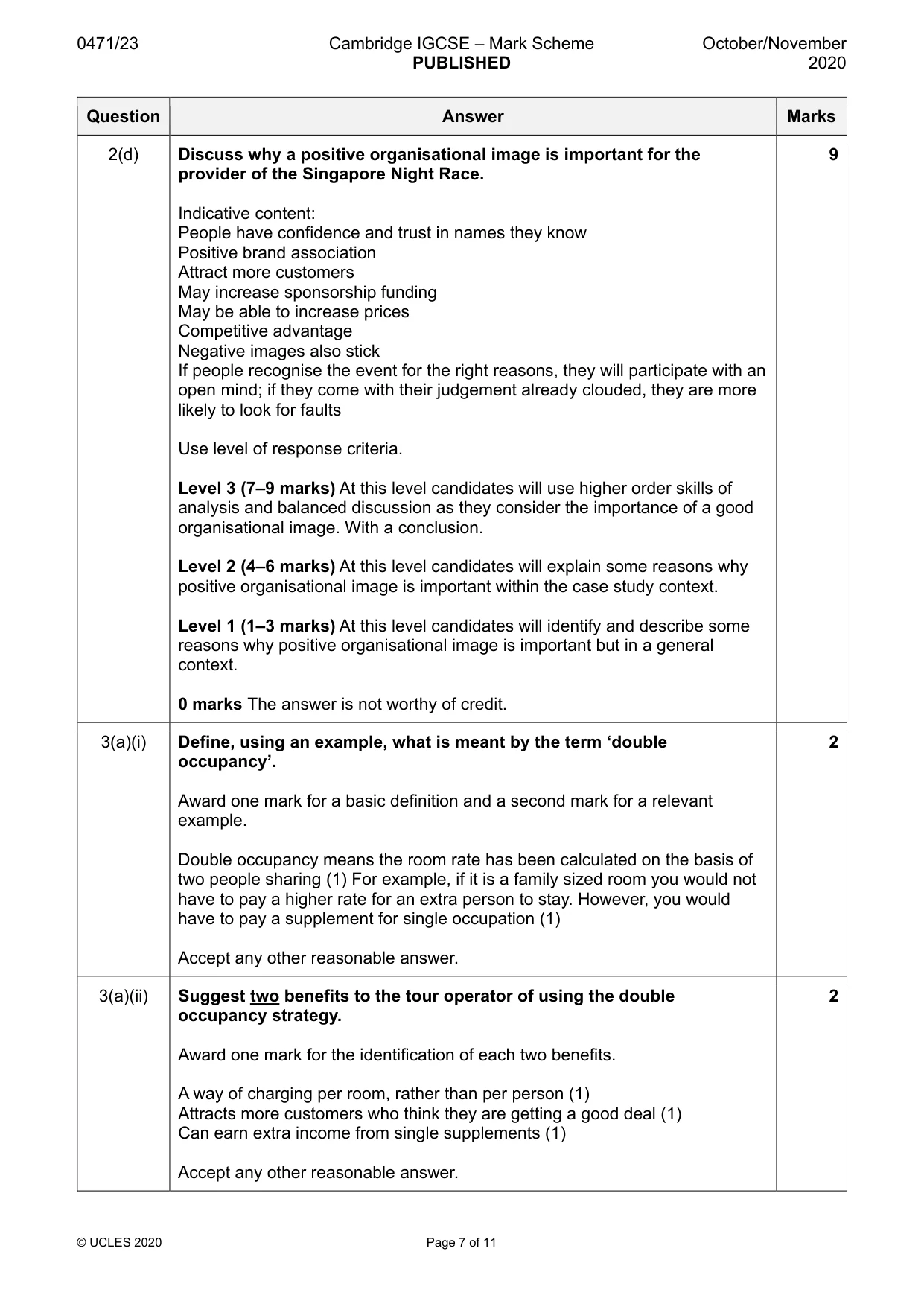
0471/23 Cambridge IGCSE – Mark Scheme PUBLISHED October/November 2020 © UCLES 2020 Page 7 of 11 Question Answer Marks 2(d) Discuss why a positive organisational image is important for the provider of the Singapore Night Race. Indicative content: People have confidence and trust in names they know Positive brand association Attract more customers May increase sponsorship funding May be able to increase prices Competitive advantage Negative images also stick If people recognise the event for the right reasons, they will participate with an open mind; if they come with their judgement already clouded, they are more likely to look for faults Use level of response criteria. Level 3 (7–9 marks) At this level candidates will use higher order skills of analysis and balanced discussion as they consider the importance of a good organisational image. With a conclusion. Level 2 (4–6 marks) At this level candidates will explain some reasons why positive organisational image is important within the case study context. Level 1 (1–3 marks) At this level candidates will identify and describe some reasons why positive organisational image is important but in a general context. 0 marks The answer is not worthy of credit. 9 3(a)(i) Define, using an example, what is meant by the term ‘double occupancy’. Award one mark for a basic definition and a second mark for a relevant example. Double occupancy means the room rate has been calculated on the basis of two people sharing (1) For example, if it is a family sized room you would not have to pay a higher rate for an extra person to stay. However, you would have to pay a supplement for single occupation (1) Accept any other reasonable answer. 2 3(a)(ii) Suggest two benefits to the tour operator of using the double occupancy strategy. Award one mark for the identification of each two benefits. A way of charging per room, rather than per person (1) Attracts more customers who think they are getting a good deal (1) Can earn extra income from single supplements (1) Accept any other reasonable answer. 2
Mark scheme, page 8
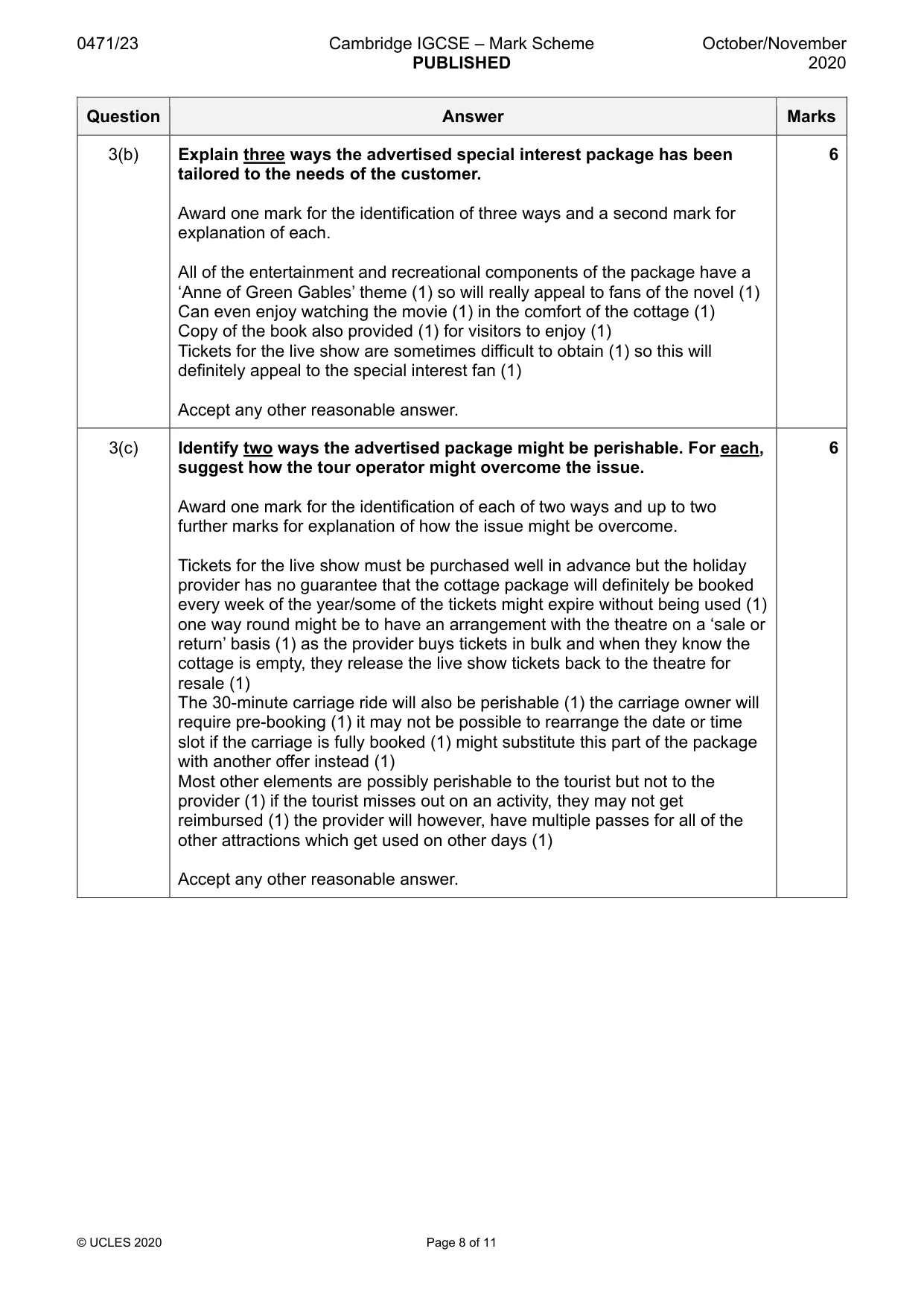
0471/23 Cambridge IGCSE – Mark Scheme PUBLISHED October/November 2020 © UCLES 2020 Page 8 of 11 Question Answer Marks 3(b) Explain three ways the advertised special interest package has been tailored to the needs of the customer. Award one mark for the identification of three ways and a second mark for explanation of each. All of the entertainment and recreational components of the package have a ‘Anne of Green Gables’ theme (1) so will really appeal to fans of the novel (1) Can even enjoy watching the movie (1) in the comfort of the cottage (1) Copy of the book also provided (1) for visitors to enjoy (1) Tickets for the live show are sometimes difficult to obtain (1) so this will definitely appeal to the special interest fan (1) Accept any other reasonable answer. 6 3(c) Identify two ways the advertised package might be perishable. For each, suggest how the tour operator might overcome the issue. Award one mark for the identification of each of two ways and up to two further marks for explanation of how the issue might be overcome. Tickets for the live show must be purchased well in advance but the holiday provider has no guarantee that the cottage package will definitely be booked every week of the year/some of the tickets might expire without being used (1) one way round might be to have an arrangement with the theatre on a ‘sale or return’ basis (1) as the provider buys tickets in bulk and when they know the cottage is empty, they release the live show tickets back to the theatre for resale (1) The 30-minute carriage ride will also be perishable (1) the carriage owner will require pre-booking (1) it may not be possible to rearrange the date or time slot if the carriage is fully booked (1) might substitute this part of the package with another offer instead (1) Most other elements are possibly perishable to the tourist but not to the provider (1) if the tourist misses out on an activity, they may not get reimbursed (1) the provider will however, have multiple passes for all of the other attractions which get used on other days (1) Accept any other reasonable answer. 6
Mark scheme, page 9
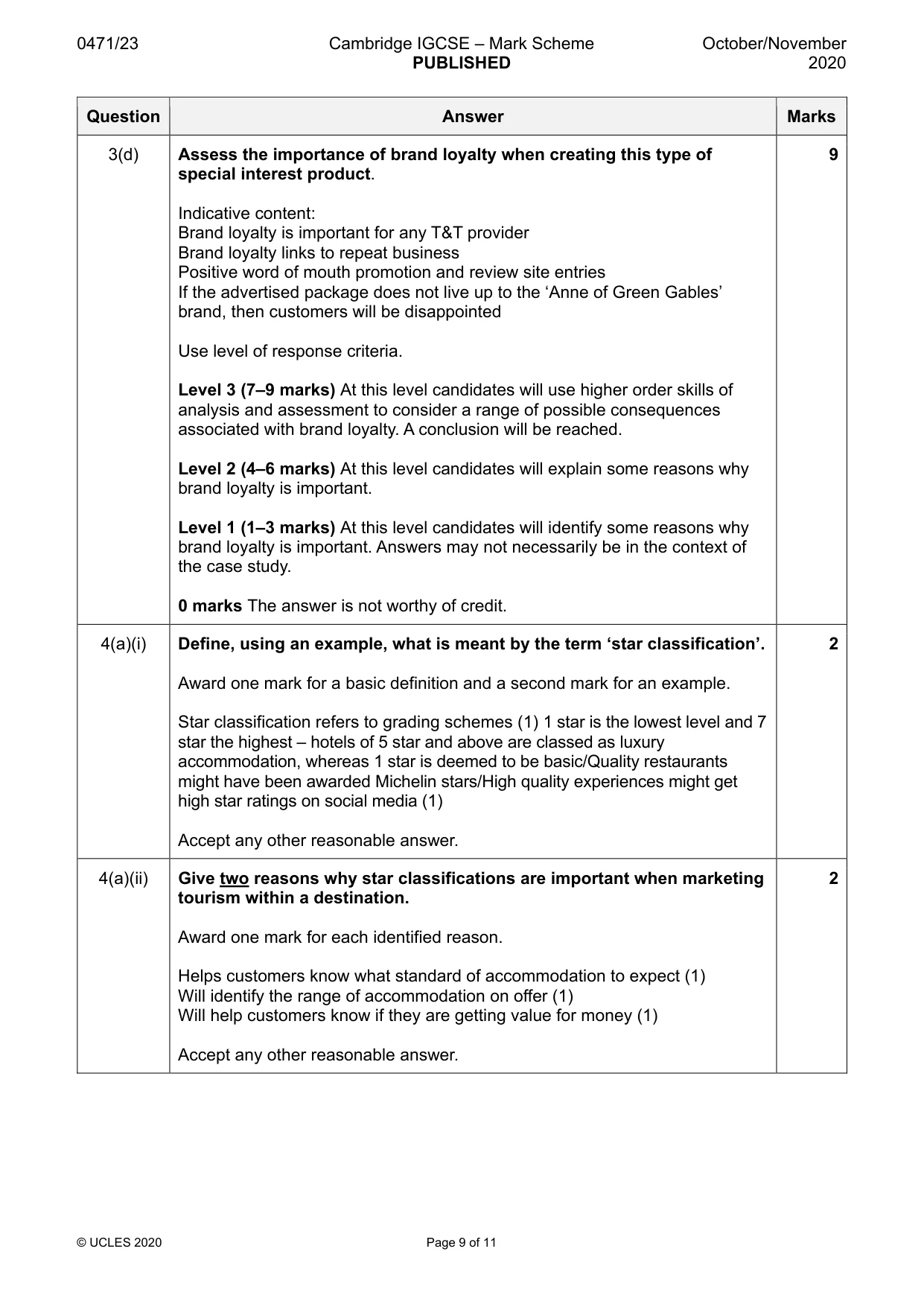
0471/23 Cambridge IGCSE – Mark Scheme PUBLISHED October/November 2020 © UCLES 2020 Page 9 of 11 Question Answer Marks 3(d) Assess the importance of brand loyalty when creating this type of special interest product. Indicative content: Brand loyalty is important for any T&T provider Brand loyalty links to repeat business Positive word of mouth promotion and review site entries If the advertised package does not live up to the ‘Anne of Green Gables’ brand, then customers will be disappointed Use level of response criteria. Level 3 (7–9 marks) At this level candidates will use higher order skills of analysis and assessment to consider a range of possible consequences associated with brand loyalty. A conclusion will be reached. Level 2 (4–6 marks) At this level candidates will explain some reasons why brand loyalty is important. Level 1 (1–3 marks) At this level candidates will identify some reasons why brand loyalty is important. Answers may not necessarily be in the context of the case study. 0 marks The answer is not worthy of credit. 9 4(a)(i) Define, using an example, what is meant by the term ‘star classification’. Award one mark for a basic definition and a second mark for an example. Star classification refers to grading schemes (1) 1 star is the lowest level and 7 star the highest – hotels of 5 star and above are classed as luxury accommodation, whereas 1 star is deemed to be basic/Quality restaurants might have been awarded Michelin stars/High quality experiences might get high star ratings on social media (1) Accept any other reasonable answer. 2 4(a)(ii) Give two reasons why star classifications are important when marketing tourism within a destination. Award one mark for each identified reason. Helps customers know what standard of accommodation to expect (1) Will identify the range of accommodation on offer (1) Will help customers know if they are getting value for money (1) Accept any other reasonable answer. 2
Mark scheme, page 10
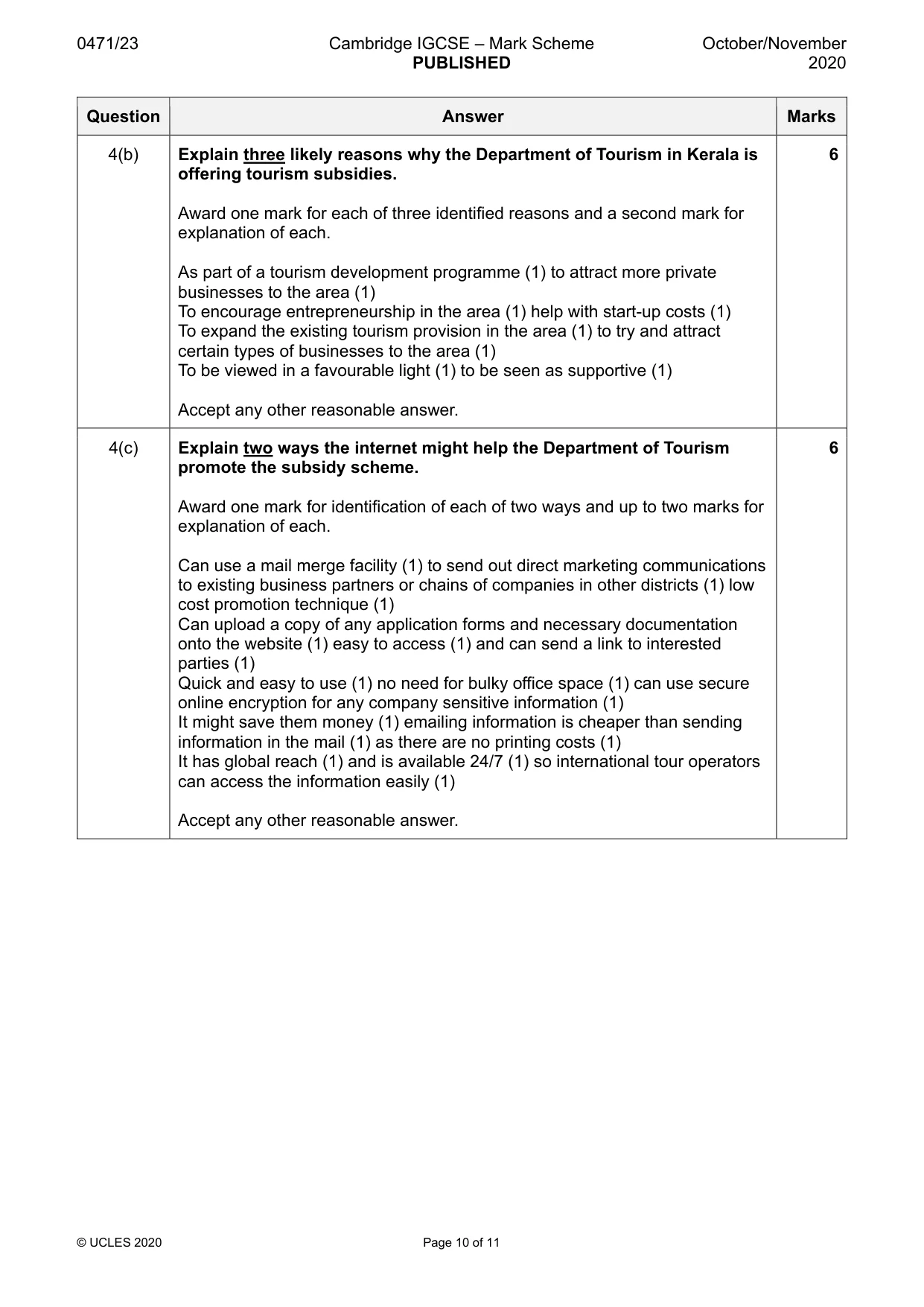
0471/23 Cambridge IGCSE – Mark Scheme PUBLISHED October/November 2020 © UCLES 2020 Page 10 of 11 Question Answer Marks 4(b) Explain three likely reasons why the Department of Tourism in Kerala is offering tourism subsidies. Award one mark for each of three identified reasons and a second mark for explanation of each. As part of a tourism development programme (1) to attract more private businesses to the area (1) To encourage entrepreneurship in the area (1) help with start-up costs (1) To expand the existing tourism provision in the area (1) to try and attract certain types of businesses to the area (1) To be viewed in a favourable light (1) to be seen as supportive (1) Accept any other reasonable answer. 6 4(c) Explain two ways the internet might help the Department of Tourism promote the subsidy scheme. Award one mark for identification of each of two ways and up to two marks for explanation of each. Can use a mail merge facility (1) to send out direct marketing communications to existing business partners or chains of companies in other districts (1) low cost promotion technique (1) Can upload a copy of any application forms and necessary documentation onto the website (1) easy to access (1) and can send a link to interested parties (1) Quick and easy to use (1) no need for bulky office space (1) can use secure online encryption for any company sensitive information (1) It might save them money (1) emailing information is cheaper than sending information in the mail (1) as there are no printing costs (1) It has global reach (1) and is available 24/7 (1) so international tour operators can access the information easily (1) Accept any other reasonable answer. 6
Mark scheme, page 11
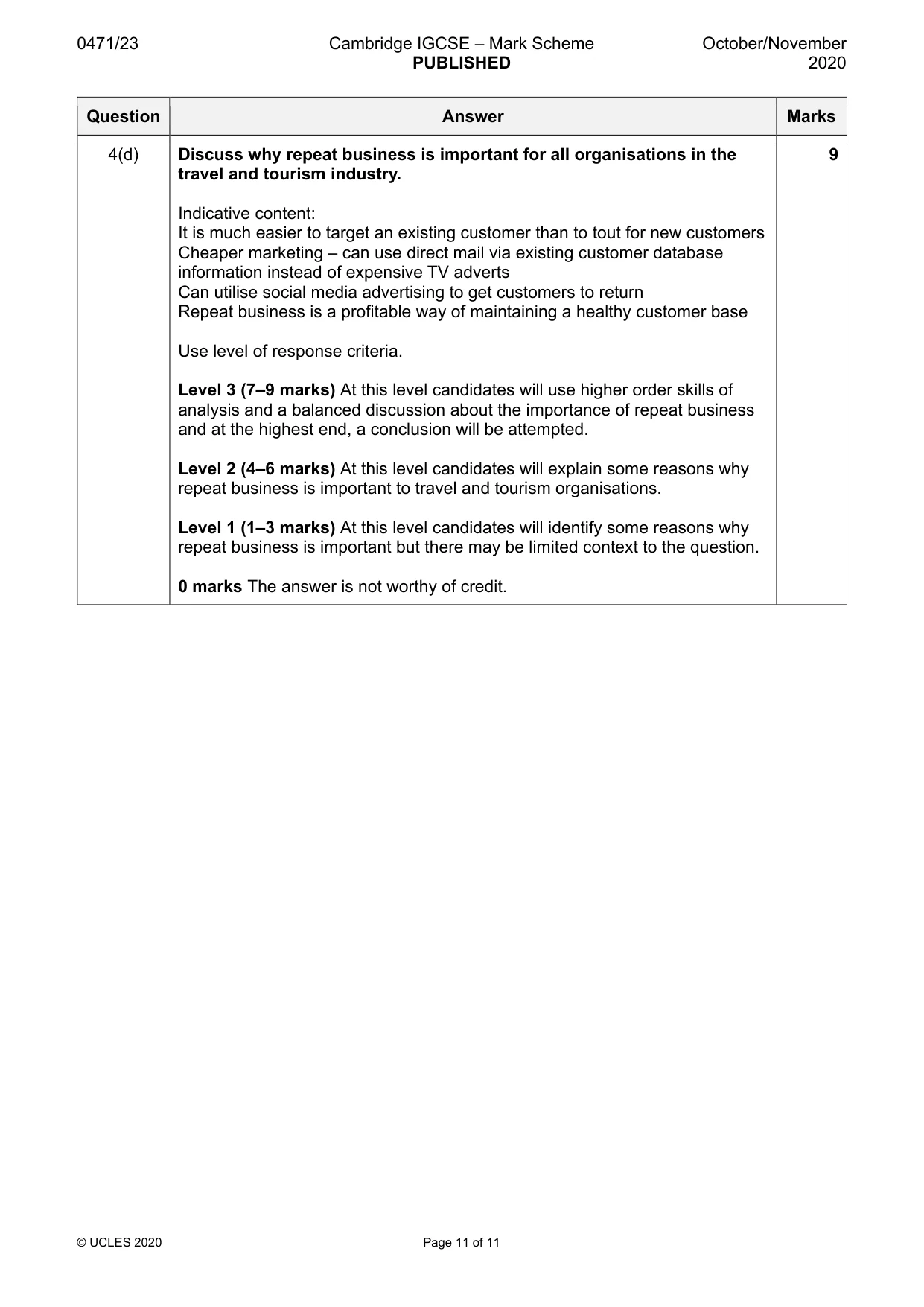
0471/23 Cambridge IGCSE – Mark Scheme PUBLISHED October/November 2020 © UCLES 2020 Page 11 of 11 Question Answer Marks 4(d) Discuss why repeat business is important for all organisations in the travel and tourism industry. Indicative content: It is much easier to target an existing customer than to tout for new customers Cheaper marketing – can use direct mail via existing customer database information instead of expensive TV adverts Can utilise social media advertising to get customers to return Repeat business is a profitable way of maintaining a healthy customer base Use level of response criteria. Level 3 (7–9 marks) At this level candidates will use higher order skills of analysis and a balanced discussion about the importance of repeat business and at the highest end, a conclusion will be attempted. Level 2 (4–6 marks) At this level candidates will explain some reasons why repeat business is important to travel and tourism organisations. Level 1 (1–3 marks) At this level candidates will identify some reasons why repeat business is important but there may be limited context to the question. 0 marks The answer is not worthy of credit. 9
What you needed in this session
Cambridge’s own grade thresholds for 2020 Oct/Nov, Paper 2 · Variant 3. A higher threshold means an easier paper — the bar moves with how the cohort did.