Cambridge IGCSE Travel and Tourism 0471 — 2023 May/June Paper 2 · Variant 3
0471/23/M/J/23 · 100 marks · ≈113 min
The question paper and its mark scheme, free to read here and free to download. This is Cambridge’s own paper, exactly as it was sat.
Question paper16 pages



Mark scheme13 pages
Answers below. Sit the paper first if you are practising.

Paper as text
Question paper, page 1
This document has 16 pages. Any blank pages are indicated. [Turn over Cambridge IGCSE™ * 5 6 0 9 6 9 0 7 6 8 * DC (EF) 311933/2 © UCLES 2023 TRAVEL & TOURISM 0471/23 Paper 2 Alternative to Coursework May/June 2023 2 hours 30 minutes You must answer on the question paper. You will need: Insert (enclosed) INSTRUCTIONS ● Answer all questions. ● Use a black or dark blue pen. ● Write your name, centre number and candidate number in the boxes at the top of the page. ● Write your answer to each question in the space provided. ● Do not use an erasable pen or correction fluid. ● Do not write on any bar codes. INFORMATION ● The total mark for this paper is 100. ● The number of marks for each question or part question is shown in brackets [ ]. ● The insert contains all the figures referred to in the questions.
Question paper, page 2
2 0471/23/M/J/23 © UCLES 2023 1 Refer to Fig. 1.1 (Insert), a SWOT analysis of Fiji. (a) (i) Identify two threats for Fiji. 1 … 2 … [2] (ii) Identify two weaknesses for Fiji. 1 … 2 … [2] (b) Explain three ways developing ecotourism could benefit rural areas in Fiji. 1 … … … … 2 … … … … 3 … … … … [6]
Question paper, page 3
3 0471/23/M/J/23 © UCLES 2023 [Turn over (c) Explain three reasons why national tourist boards carry out SWOT analysis. 1 … … … … 2 … … … … 3 … … … … [6]
Question paper, page 4
4 0471/23/M/J/23 © UCLES 2023 (d) Evaluate the importance to destinations such as Fiji of having a competitive advantage. … … … … … … … … … … … … … … … … … … [9] [Total: 25]
Question paper, page 5
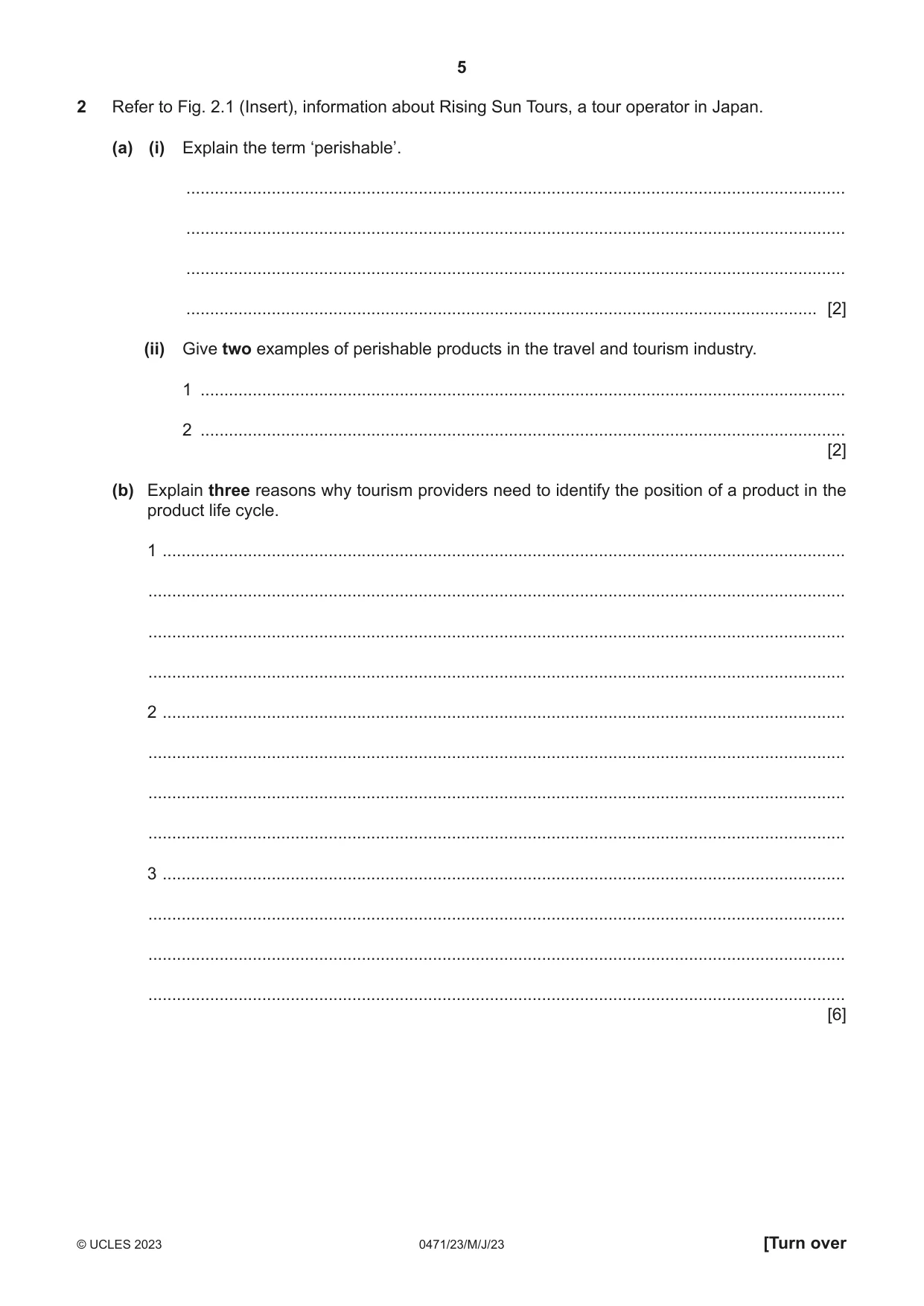
5 0471/23/M/J/23 © UCLES 2023 [Turn over 2 Refer to Fig. 2.1 (Insert), information about Rising Sun Tours, a tour operator in Japan. (a) (i) Explain the term ‘perishable’. … … … … [2] (ii) Give two examples of perishable products in the travel and tourism industry. 1 … 2 … [2] (b) Explain three reasons why tourism providers need to identify the position of a product in the product life cycle. 1 … … … … 2 … … … … 3 … … … … [6]
Question paper, page 6
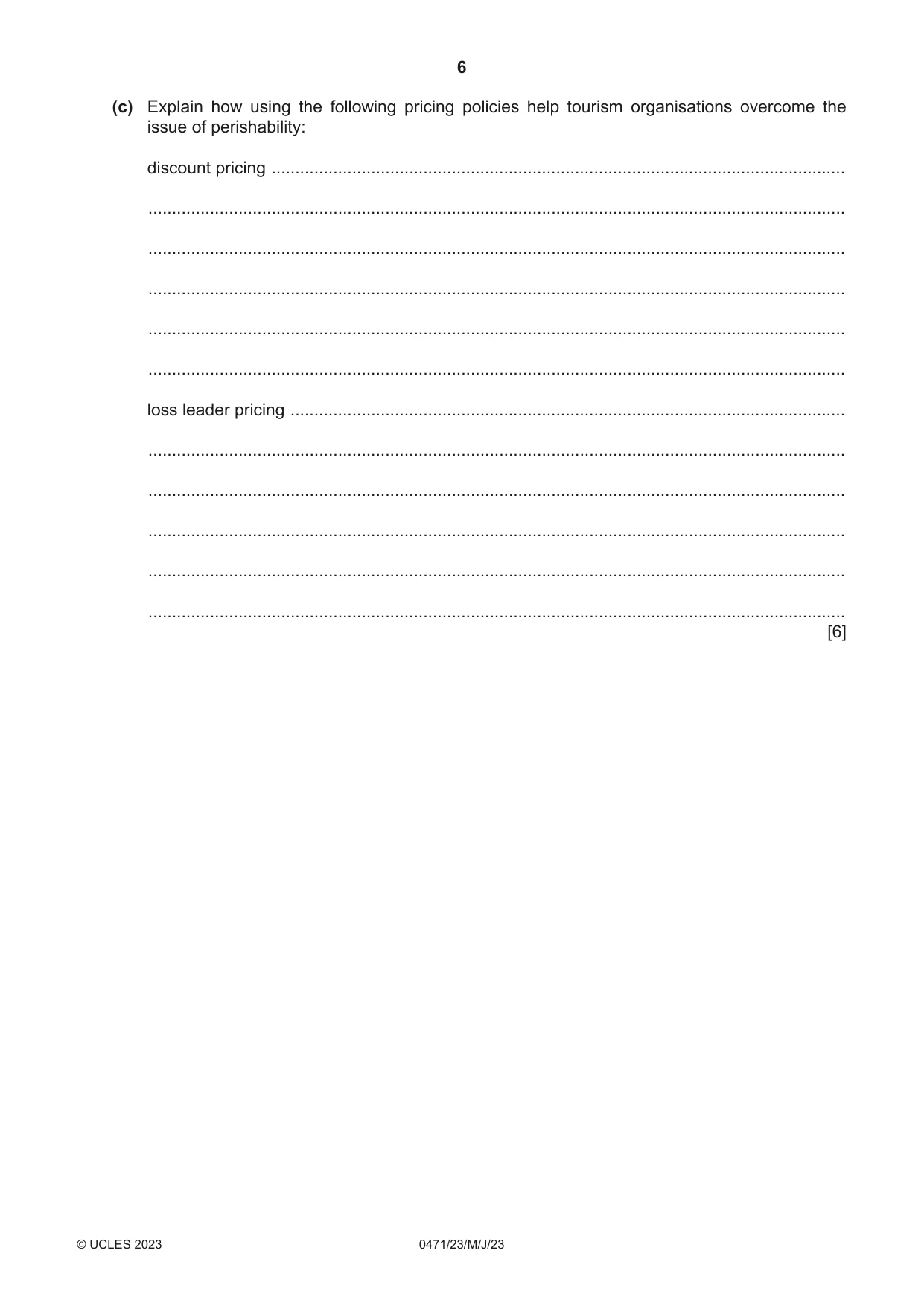
6 0471/23/M/J/23 © UCLES 2023 (c) Explain how using the following pricing policies help tourism organisations overcome the issue of perishability: discount pricing … … … … … … loss leader pricing … … … … … … [6]
Question paper, page 7
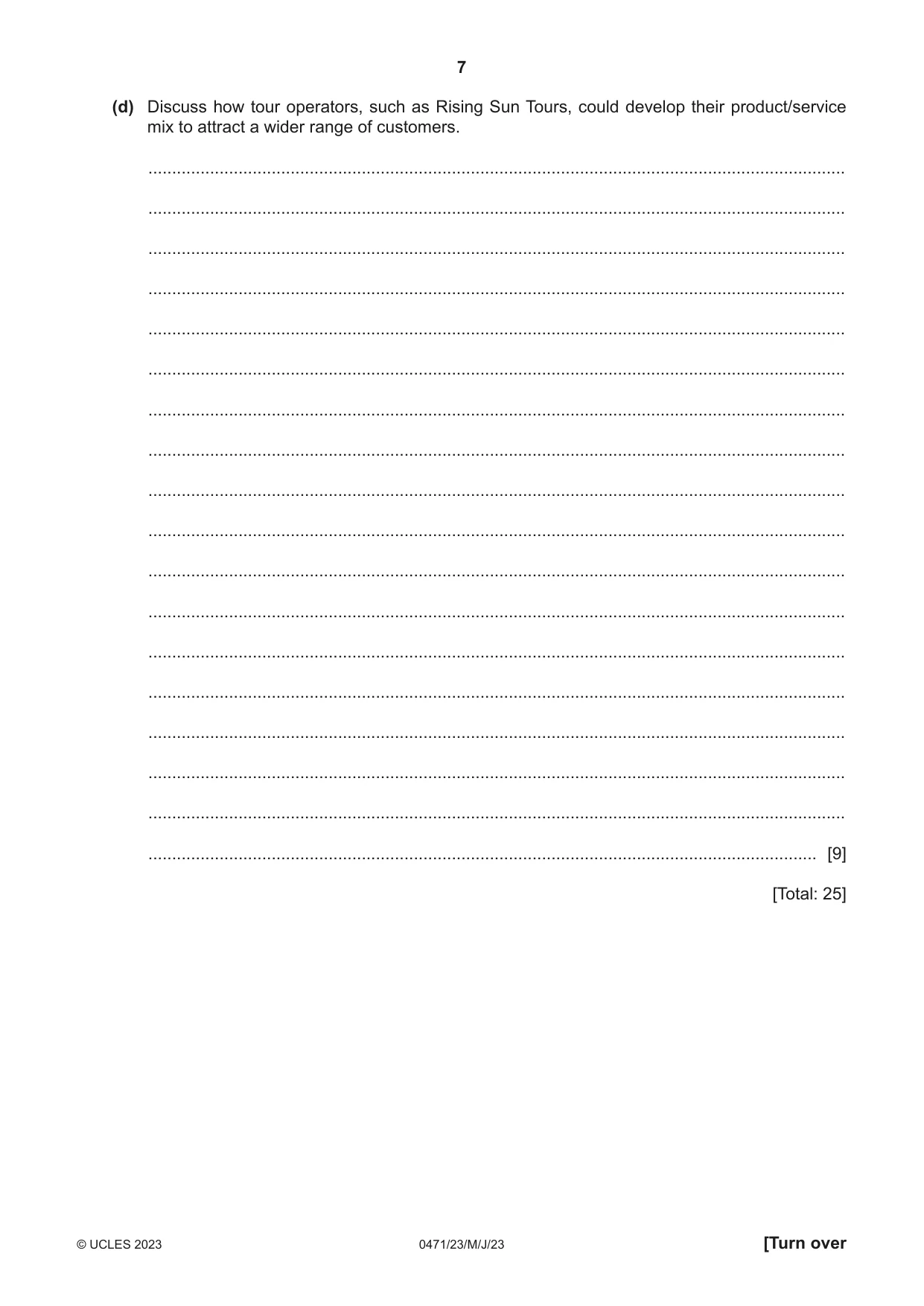
7 0471/23/M/J/23 © UCLES 2023 [Turn over (d) Discuss how tour operators, such as Rising Sun Tours, could develop their product/service mix to attract a wider range of customers. … … … … … … … … … … … … … … … … … … [9] [Total: 25]
Question paper, page 8
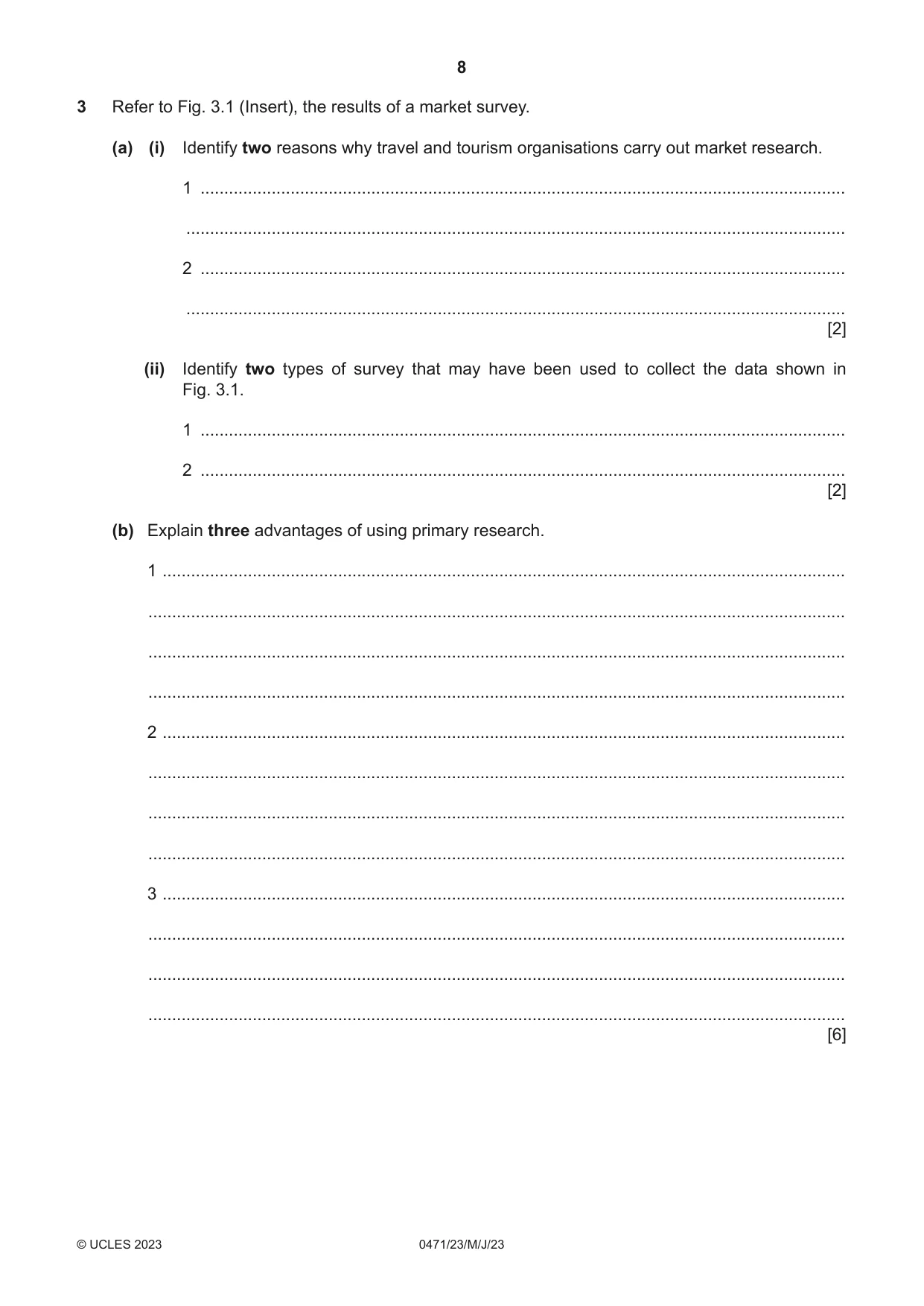
8 0471/23/M/J/23 © UCLES 2023 3 Refer to Fig. 3.1 (Insert), the results of a market survey. (a) (i) Identify two reasons why travel and tourism organisations carry out market research. 1 … … 2 … … [2] (ii) Identify two types of survey that may have been used to collect the data shown in Fig. 3.1. 1 … 2 … [2] (b) Explain three advantages of using primary research. 1 … … … … 2 … … … … 3 … … … … [6]
Question paper, page 9
9 0471/23/M/J/23 © UCLES 2023 [Turn over (c) There are five stages in the market research process. Explain what is done at the following stages: designing the research … … … … … … collecting data … … … … … … [6]
Question paper, page 10
10 0471/23/M/J/23 © UCLES 2023 (d) Evaluate the role of national tourist boards in helping to increase tourist numbers in a country. … … … … … … … … … … … … … … … … … … [9] [Total: 25]
Question paper, page 11
11 0471/23/M/J/23 © UCLES 2023 [Turn over 4 Refer to Fig. 4.1 (Insert), an advertisement for Frische Luft Campsite. (a) (i) Define the term ‘target market’. … … [1] (ii) Identify three target markets of Frische Luft Campsite. 1 … 2 … 3 … [3] (b) Explain three reasons why tourism organisations target particular market segments. 1 … … … … 2 … … … … 3 … … … … [6]
Question paper, page 12
12 0471/23/M/J/23 © UCLES 2023 (c) Explain how the following factors impact the price charged by Frische Luft Campsite: seasonality … … … … … … customer expectations … … … … … … [6]
Question paper, page 13
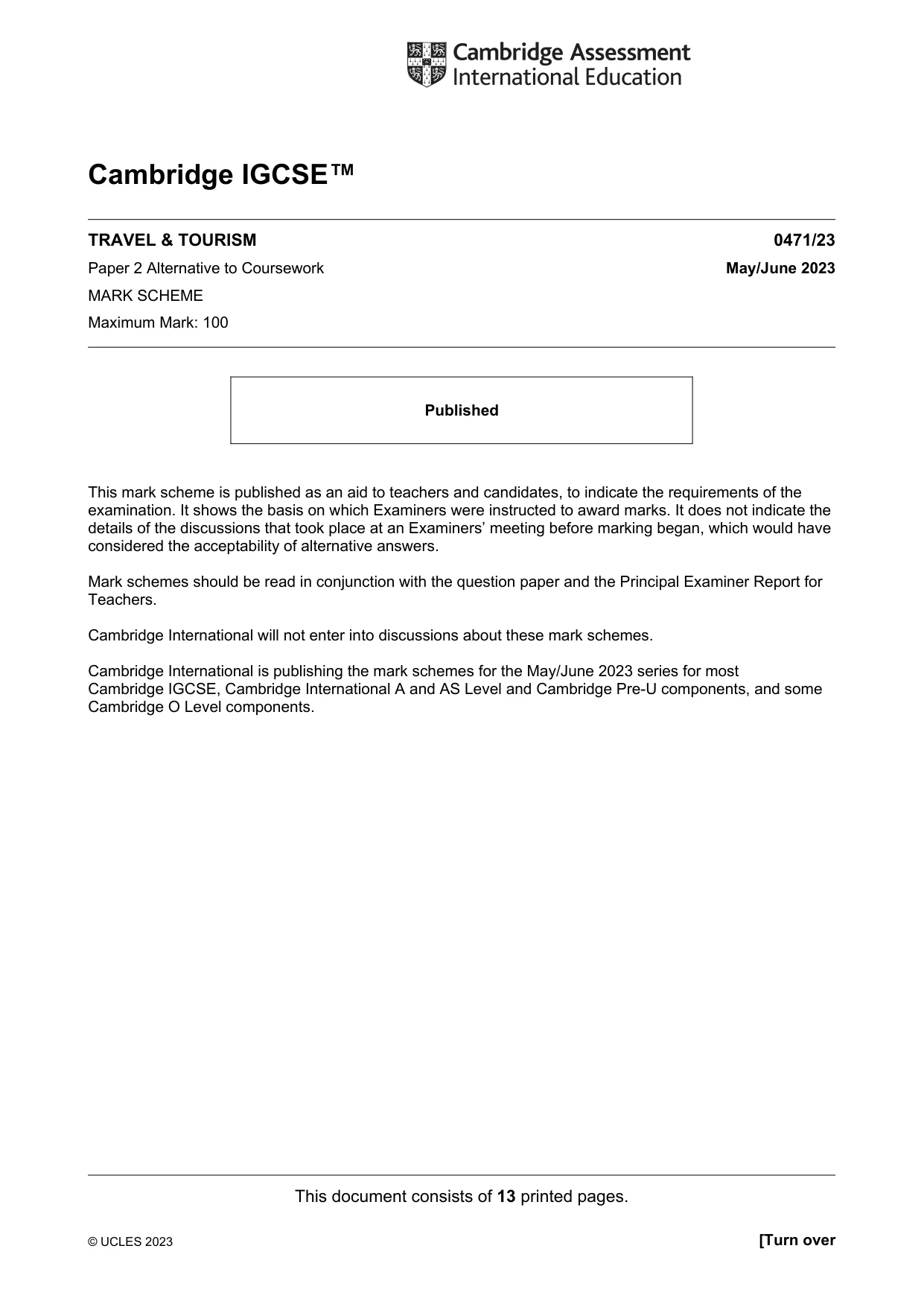
13 0471/23/M/J/23 © UCLES 2023 (d) Evaluate the benefits of using electronic media to attract customers. … … … … … … … … … … … … … … … … … … [9] [Total: 25]
Question paper, page 14
14 0471/23/M/J/23 © UCLES 2023 BLANK PAGE
Question paper, page 15
15 0471/23/M/J/23 © UCLES 2023 BLANK PAGE
Question paper, page 16
16 0471/23/M/J/23 © UCLES 2023 The boundaries and names shown, the designations used and the presentation of material on any maps contained in this question paper/insert do not imply official endorsement or acceptance by Cambridge Assessment International Education concerning the legal status of any country, territory, or area or any of its authorities, or of the delimitation of its frontiers or boundaries. Permission to reproduce items where third‑party owned material protected by copyright is included has been sought and cleared where possible. Every reasonable effort has been made by the publisher (UCLES) to trace copyright holders, but if any items requiring clearance have unwittingly been included, the publisher will be pleased to make amends at the earliest possible opportunity. To avoid the issue of disclosure of answer‑related information to candidates, all copyright acknowledgements are reproduced online in the Cambridge Assessment International Education Copyright Acknowledgements Booklet. This is produced for each series of examinations and is freely available to download at www.cambridgeinternational.org after the live examination series. Cambridge Assessment International Education is part of Cambridge Assessment. Cambridge Assessment is the brand name of the University of Cambridge Local Examinations Syndicate (UCLES), which is a department of the University of Cambridge. BLANK PAGE
Mark scheme, page 1
This document consists of 13 printed pages. © UCLES 2023 [Turn over Cambridge IGCSE™ TRAVEL & TOURISM 0471/23 Paper 2 Alternative to Coursework May/June 2023 MARK SCHEME Maximum Mark: 100 Published This mark scheme is published as an aid to teachers and candidates, to indicate the requirements of the examination. It shows the basis on which Examiners were instructed to award marks. It does not indicate the details of the discussions that took place at an Examiners’ meeting before marking began, which would have considered the acceptability of alternative answers. Mark schemes should be read in conjunction with the question paper and the Principal Examiner Report for Teachers. Cambridge International will not enter into discussions about these mark schemes. Cambridge International is publishing the mark schemes for the May/June 2023 series for most Cambridge IGCSE, Cambridge International A and AS Level and Cambridge Pre-U components, and some Cambridge O Level components.
Mark scheme, page 2
0471/23 Cambridge IGCSE – Mark Scheme PUBLISHED May/June 2023 © UCLES 2023 Page 2 of 13 Generic Marking Principles These general marking principles must be applied by all examiners when marking candidate answers. They should be applied alongside the specific content of the mark scheme or generic level descriptors for a question. Each question paper and mark scheme will also comply with these marking principles. GENERIC MARKING PRINCIPLE 1: Marks must be awarded in line with: the specific content of the mark scheme or the generic level descriptors for the question the specific skills defined in the mark scheme or in the generic level descriptors for the question the standard of response required by a candidate as exemplified by the standardisation scripts. GENERIC MARKING PRINCIPLE 2: Marks awarded are always whole marks (not half marks, or other fractions). GENERIC MARKING PRINCIPLE 3: Marks must be awarded positively: marks are awarded for correct/valid answers, as defined in the mark scheme. However, credit is given for valid answers which go beyond the scope of the syllabus and mark scheme, referring to your Team Leader as appropriate marks are awarded when candidates clearly demonstrate what they know and can do marks are not deducted for errors marks are not deducted for omissions answers should only be judged on the quality of spelling, punctuation and grammar when these features are specifically assessed by the question as indicated by the mark scheme. The meaning, however, should be unambiguous. GENERIC MARKING PRINCIPLE 4: Rules must be applied consistently, e.g. in situations where candidates have not followed instructions or in the application of generic level descriptors. GENERIC MARKING PRINCIPLE 5: Marks should be awarded using the full range of marks defined in the mark scheme for the question (however; the use of the full mark range may be limited according to the quality of the candidate responses seen). GENERIC MARKING PRINCIPLE 6: Marks awarded are based solely on the requirements as defined in the mark scheme. Marks should not be awarded with grade thresholds or grade descriptors in mind.
Mark scheme, page 3
0471/23 Cambridge IGCSE – Mark Scheme PUBLISHED May/June 2023 © UCLES 2023 Page 3 of 13 Social Science-Specific Marking Principles (for point-based marking) 1 Components using point-based marking: Point marking is often used to reward knowledge, understanding and application of skills. We give credit where the candidate’s answer shows relevant knowledge, understanding and application of skills in answering the question. We do not give credit where the answer shows confusion. From this it follows that we: a DO credit answers which are worded differently from the mark scheme if they clearly convey the same meaning (unless the mark scheme requires a specific term) b DO credit alternative answers/examples which are not written in the mark scheme if they are correct c DO credit answers where candidates give more than one correct answer in one prompt/numbered/scaffolded space where extended writing is required rather than list-type answers. For example, questions that require n reasons (e.g. State two reasons …). d DO NOT credit answers simply for using a ‘key term’ unless that is all that is required. (Check for evidence it is understood and not used wrongly.) e DO NOT credit answers which are obviously self-contradicting or trying to cover all possibilities f DO NOT give further credit for what is effectively repetition of a correct point already credited unless the language itself is being tested. This applies equally to ‘mirror statements’ (i.e. polluted/not polluted). g DO NOT require spellings to be correct, unless this is part of the test. However spellings of syllabus terms must allow for clear and unambiguous separation from other syllabus terms with which they may be confused (e.g. Corrasion/Corrosion) 2 Presentation of mark scheme: Slashes (/) or the word ‘or’ separate alternative ways of making the same point. Semi colons (;) bullet points (•) or figures in brackets (1) separate different points. Content in the answer column in brackets is for examiner information/context to clarify the marking but is not required to earn the mark (except Accounting syllabuses where they indicate negative numbers). 3 Calculation questions: The mark scheme will show the steps in the most likely correct method(s), the mark for each step, the correct answer(s) and the mark for each answer If working/explanation is considered essential for full credit, this will be indicated in the question paper and in the mark scheme. In all other instances, the correct answer to a calculation should be given full credit, even if no supporting working is shown. Where the candidate uses a valid method which is not covered by the mark scheme, award equivalent marks for reaching equivalent stages. Where an answer makes use of a candidate’s own incorrect figure from previous working, the ‘own figure rule’ applies: full marks will be given if a correct and complete method is used. Further guidance will be included in the mark scheme where necessary and any exceptions to this general principle will be noted.
Mark scheme, page 4
0471/23 Cambridge IGCSE – Mark Scheme PUBLISHED May/June 2023 © UCLES 2023 Page 4 of 13 4 Annotation: For point marking, ticks can be used to indicate correct answers and crosses can be used to indicate wrong answers. There is no direct relationship between ticks and marks. Ticks have no defined meaning for levels of response marking. For levels of response marking, the level awarded should be annotated on the script. Other annotations will be used by examiners as agreed during standardisation, and the meaning will be understood by all examiners who marked that paper.
Mark scheme, page 5
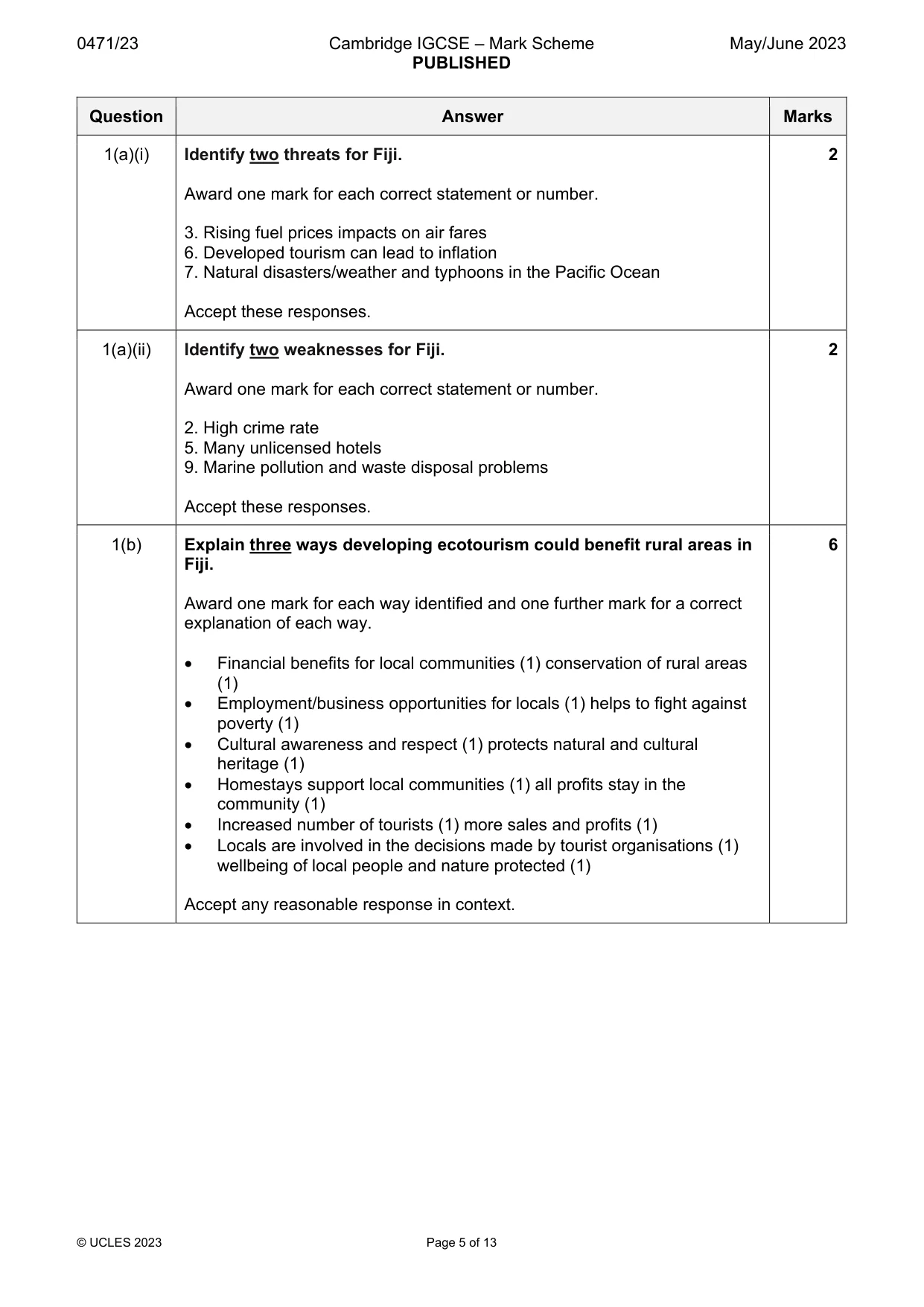
0471/23 Cambridge IGCSE – Mark Scheme PUBLISHED May/June 2023 © UCLES 2023 Page 5 of 13 Question Answer Marks 1(a)(i) Identify two threats for Fiji. Award one mark for each correct statement or number. 3. Rising fuel prices impacts on air fares 6. Developed tourism can lead to inflation 7. Natural disasters/weather and typhoons in the Pacific Ocean Accept these responses. 2 1(a)(ii) Identify two weaknesses for Fiji. Award one mark for each correct statement or number. 2. High crime rate 5. Many unlicensed hotels 9. Marine pollution and waste disposal problems Accept these responses. 2 1(b) Explain three ways developing ecotourism could benefit rural areas in Fiji. Award one mark for each way identified and one further mark for a correct explanation of each way. Financial benefits for local communities (1) conservation of rural areas (1) Employment/business opportunities for locals (1) helps to fight against poverty (1) Cultural awareness and respect (1) protects natural and cultural heritage (1) Homestays support local communities (1) all profits stay in the community (1) Increased number of tourists (1) more sales and profits (1) Locals are involved in the decisions made by tourist organisations (1) wellbeing of local people and nature protected (1) Accept any reasonable response in context. 6
Mark scheme, page 6
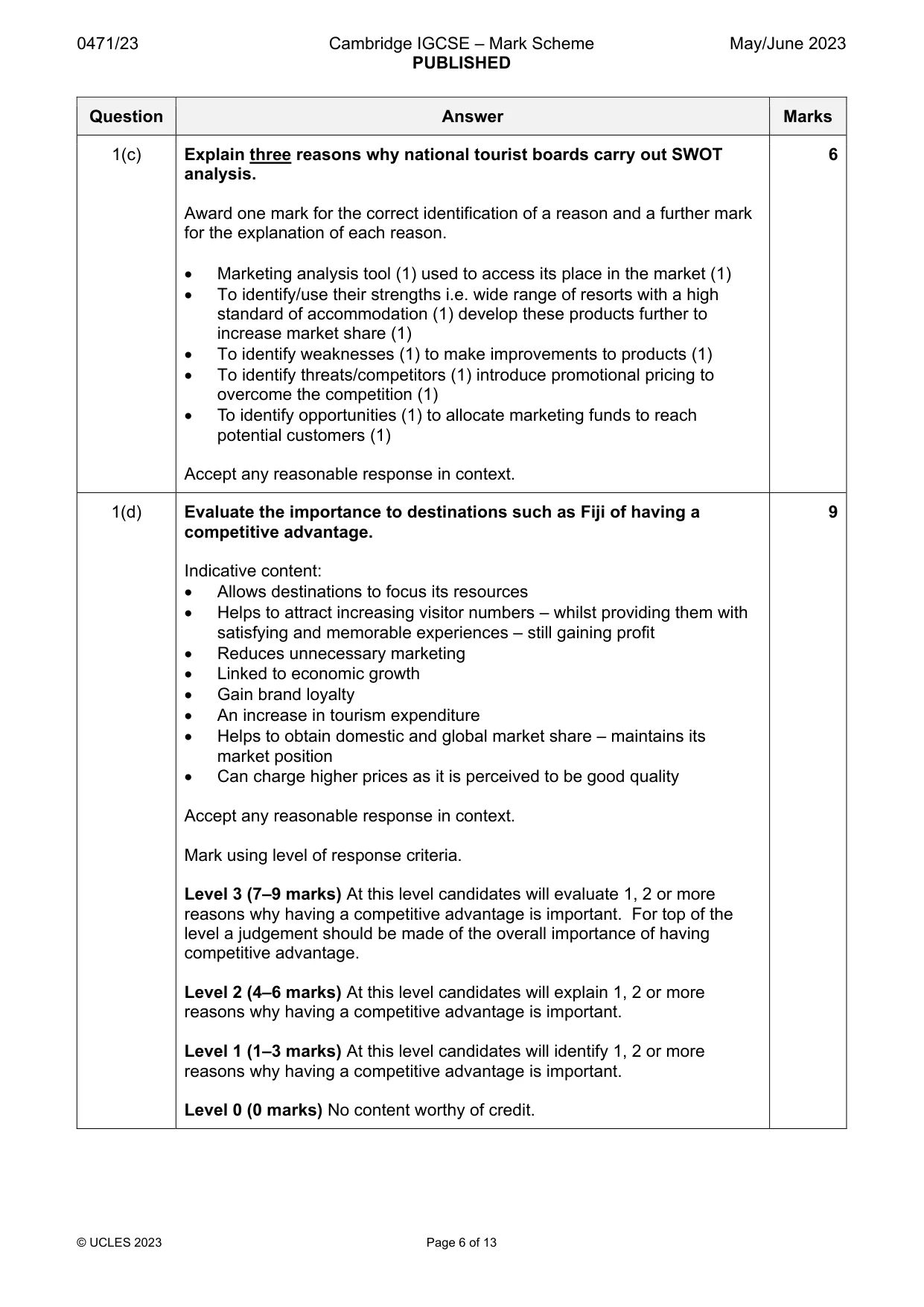
0471/23 Cambridge IGCSE – Mark Scheme PUBLISHED May/June 2023 © UCLES 2023 Page 6 of 13 Question Answer Marks 1(c) Explain three reasons why national tourist boards carry out SWOT analysis. Award one mark for the correct identification of a reason and a further mark for the explanation of each reason. Marketing analysis tool (1) used to access its place in the market (1) To identify/use their strengths i.e. wide range of resorts with a high standard of accommodation (1) develop these products further to increase market share (1) To identify weaknesses (1) to make improvements to products (1) To identify threats/competitors (1) introduce promotional pricing to overcome the competition (1) To identify opportunities (1) to allocate marketing funds to reach potential customers (1) Accept any reasonable response in context. 6 1(d) Evaluate the importance to destinations such as Fiji of having a competitive advantage. Indicative content: Allows destinations to focus its resources Helps to attract increasing visitor numbers – whilst providing them with satisfying and memorable experiences – still gaining profit Reduces unnecessary marketing Linked to economic growth Gain brand loyalty An increase in tourism expenditure Helps to obtain domestic and global market share – maintains its market position Can charge higher prices as it is perceived to be good quality Accept any reasonable response in context. Mark using level of response criteria. Level 3 (7–9 marks) At this level candidates will evaluate 1, 2 or more reasons why having a competitive advantage is important. For top of the level a judgement should be made of the overall importance of having competitive advantage. Level 2 (4–6 marks) At this level candidates will explain 1, 2 or more reasons why having a competitive advantage is important. Level 1 (1–3 marks) At this level candidates will identify 1, 2 or more reasons why having a competitive advantage is important. Level 0 (0 marks) No content worthy of credit. 9
Mark scheme, page 7
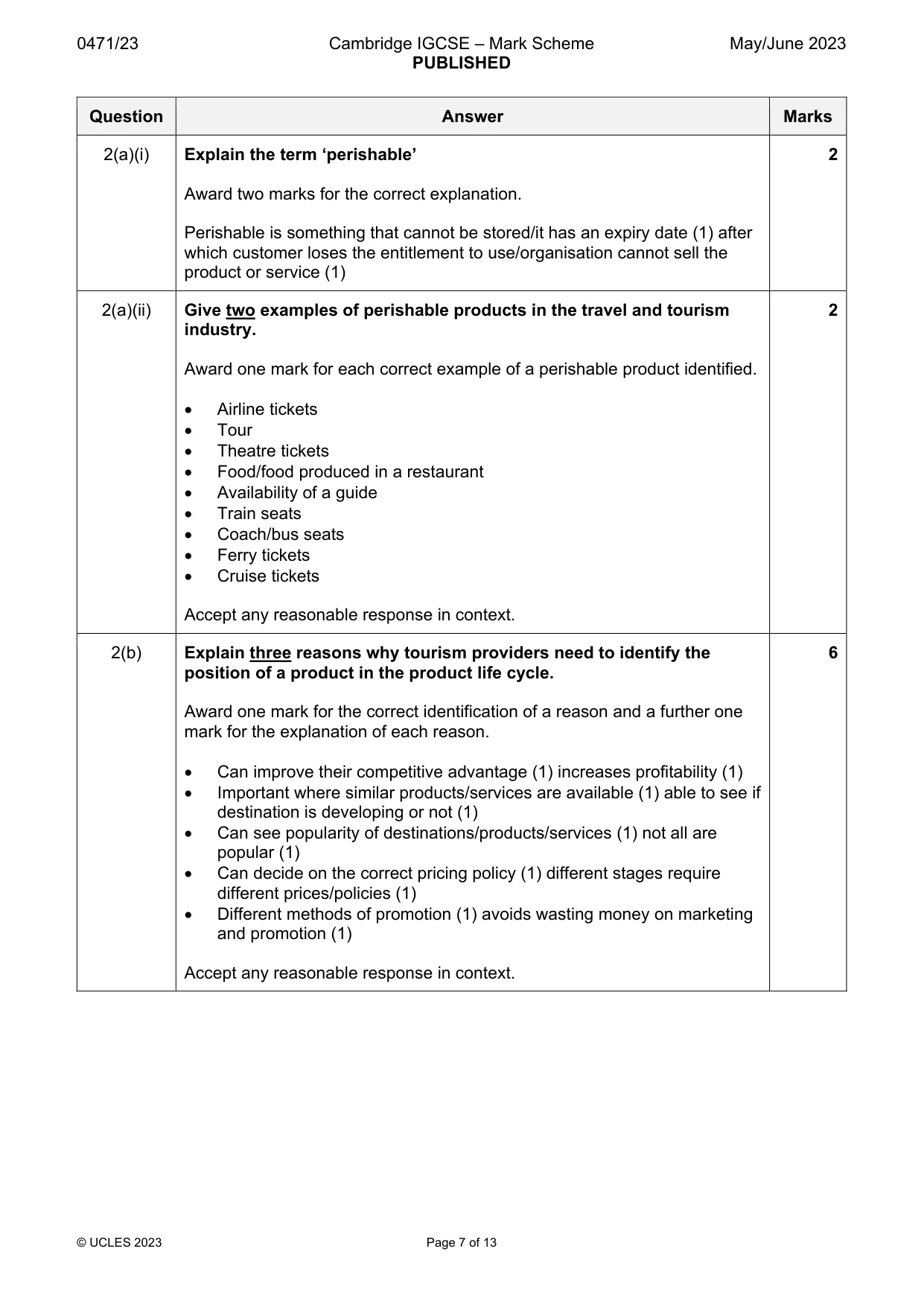
0471/23 Cambridge IGCSE – Mark Scheme PUBLISHED May/June 2023 © UCLES 2023 Page 7 of 13 Question Answer Marks 2(a)(i) Explain the term ‘perishable’ Award two marks for the correct explanation. Perishable is something that cannot be stored/it has an expiry date (1) after which customer loses the entitlement to use/organisation cannot sell the product or service (1) 2 2(a)(ii) Give two examples of perishable products in the travel and tourism industry. Award one mark for each correct example of a perishable product identified. Airline tickets Tour Theatre tickets Food/food produced in a restaurant Availability of a guide Train seats Coach/bus seats Ferry tickets Cruise tickets Accept any reasonable response in context. 2 2(b) Explain three reasons why tourism providers need to identify the position of a product in the product life cycle. Award one mark for the correct identification of a reason and a further one mark for the explanation of each reason. Can improve their competitive advantage (1) increases profitability (1) Important where similar products/services are available (1) able to see if destination is developing or not (1) Can see popularity of destinations/products/services (1) not all are popular (1) Can decide on the correct pricing policy (1) different stages require different prices/policies (1) Different methods of promotion (1) avoids wasting money on marketing and promotion (1) Accept any reasonable response in context. 6
Mark scheme, page 8
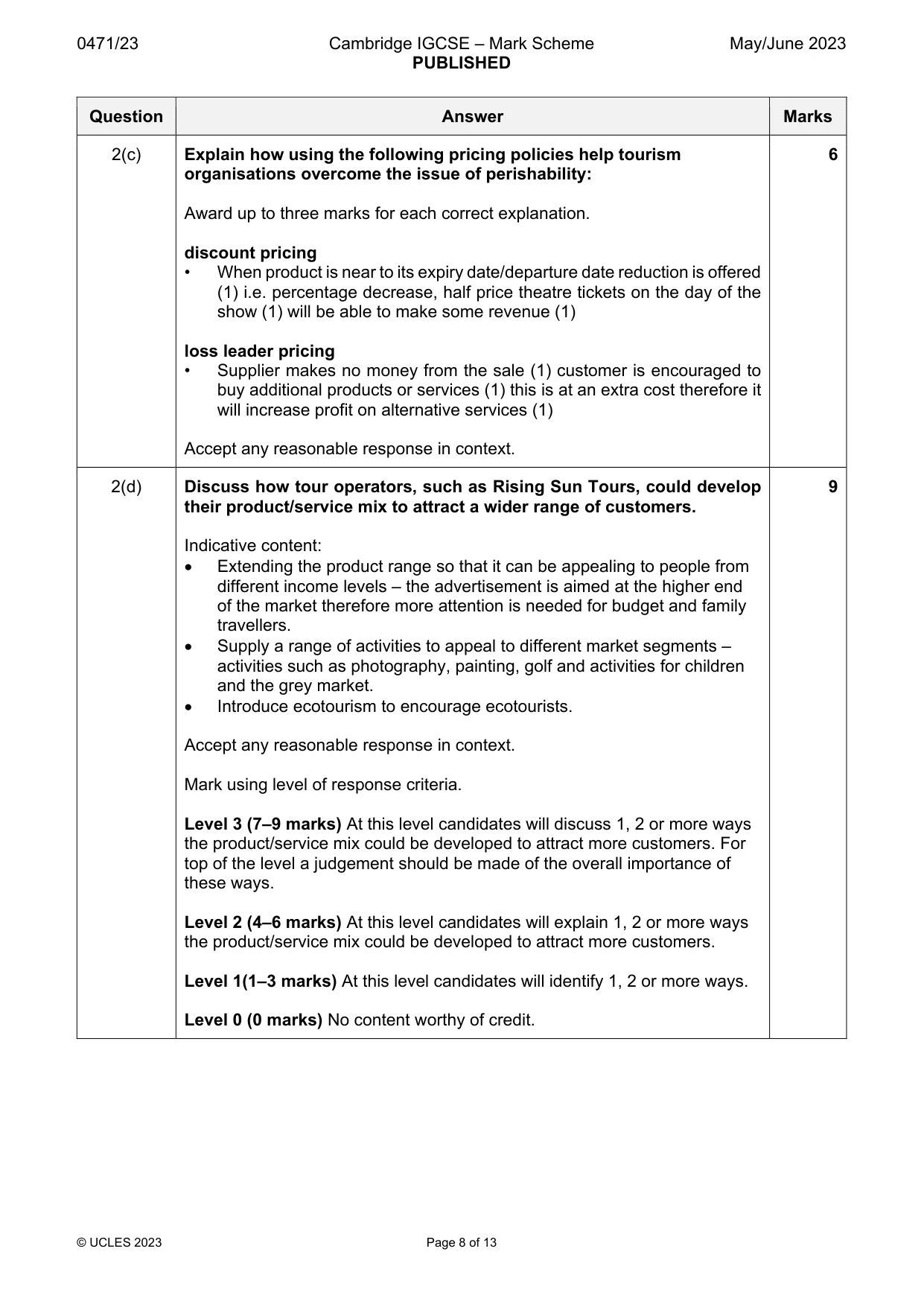
0471/23 Cambridge IGCSE – Mark Scheme PUBLISHED May/June 2023 © UCLES 2023 Page 8 of 13 Question Answer Marks 2(c) Explain how using the following pricing policies help tourism organisations overcome the issue of perishability: Award up to three marks for each correct explanation. discount pricing • When product is near to its expiry date/departure date reduction is offered (1) i.e. percentage decrease, half price theatre tickets on the day of the show (1) will be able to make some revenue (1) loss leader pricing • Supplier makes no money from the sale (1) customer is encouraged to buy additional products or services (1) this is at an extra cost therefore it will increase profit on alternative services (1) Accept any reasonable response in context. 6 2(d) Discuss how tour operators, such as Rising Sun Tours, could develop their product/service mix to attract a wider range of customers. Indicative content: Extending the product range so that it can be appealing to people from different income levels – the advertisement is aimed at the higher end of the market therefore more attention is needed for budget and family travellers. Supply a range of activities to appeal to different market segments – activities such as photography, painting, golf and activities for children and the grey market. Introduce ecotourism to encourage ecotourists. Accept any reasonable response in context. Mark using level of response criteria. Level 3 (7–9 marks) At this level candidates will discuss 1, 2 or more ways the product/service mix could be developed to attract more customers. For top of the level a judgement should be made of the overall importance of these ways. Level 2 (4–6 marks) At this level candidates will explain 1, 2 or more ways the product/service mix could be developed to attract more customers. Level 1(1–3 marks) At this level candidates will identify 1, 2 or more ways. Level 0 (0 marks) No content worthy of credit. 9
Mark scheme, page 9
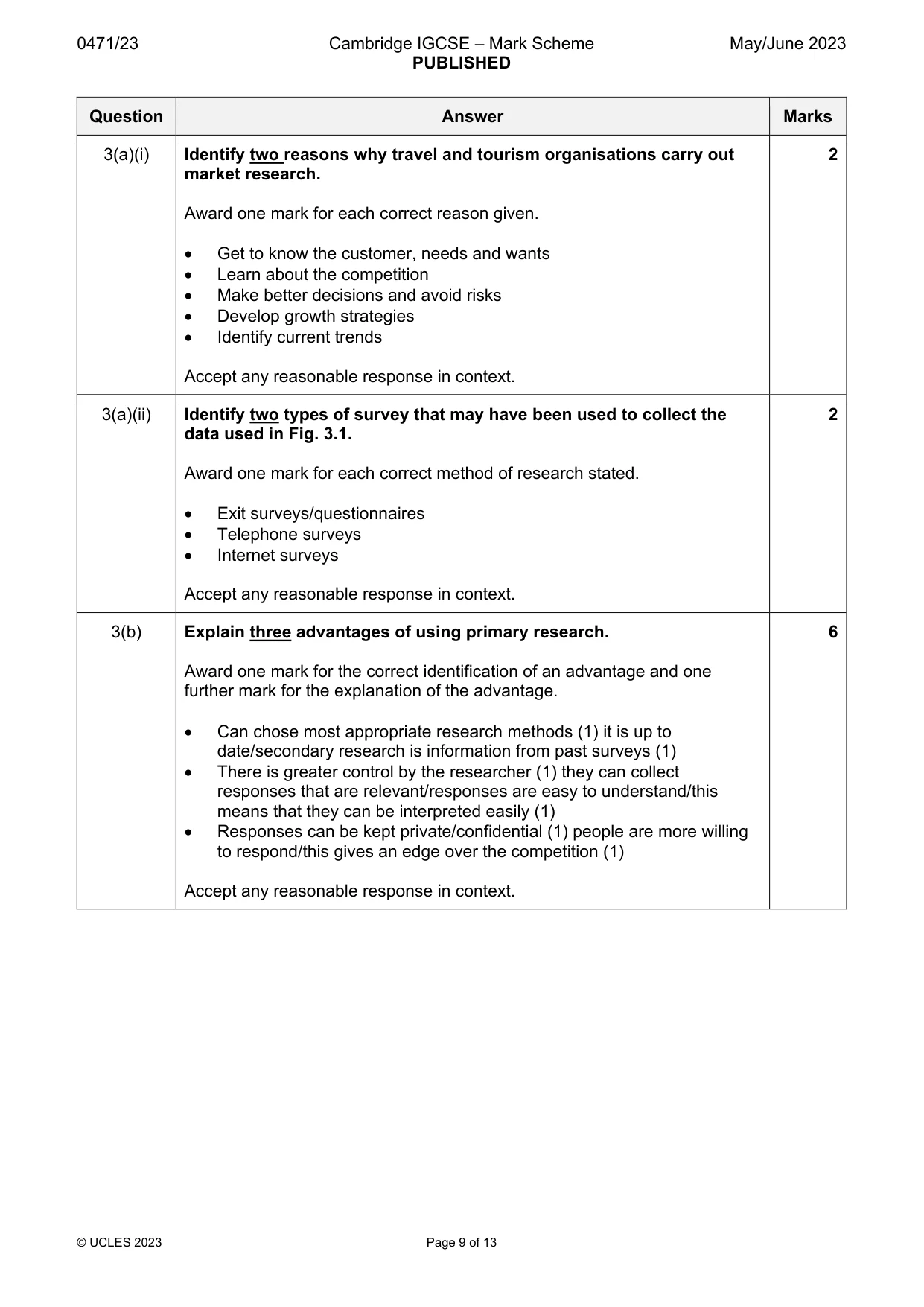
0471/23 Cambridge IGCSE – Mark Scheme PUBLISHED May/June 2023 © UCLES 2023 Page 9 of 13 Question Answer Marks 3(a)(i) Identify two reasons why travel and tourism organisations carry out market research. Award one mark for each correct reason given. Get to know the customer, needs and wants Learn about the competition Make better decisions and avoid risks Develop growth strategies Identify current trends Accept any reasonable response in context. 2 3(a)(ii) Identify two types of survey that may have been used to collect the data used in Fig. 3.1. Award one mark for each correct method of research stated. Exit surveys/questionnaires Telephone surveys Internet surveys Accept any reasonable response in context. 2 3(b) Explain three advantages of using primary research. Award one mark for the correct identification of an advantage and one further mark for the explanation of the advantage. Can chose most appropriate research methods (1) it is up to date/secondary research is information from past surveys (1) There is greater control by the researcher (1) they can collect responses that are relevant/responses are easy to understand/this means that they can be interpreted easily (1) Responses can be kept private/confidential (1) people are more willing to respond/this gives an edge over the competition (1) Accept any reasonable response in context. 6
Mark scheme, page 10
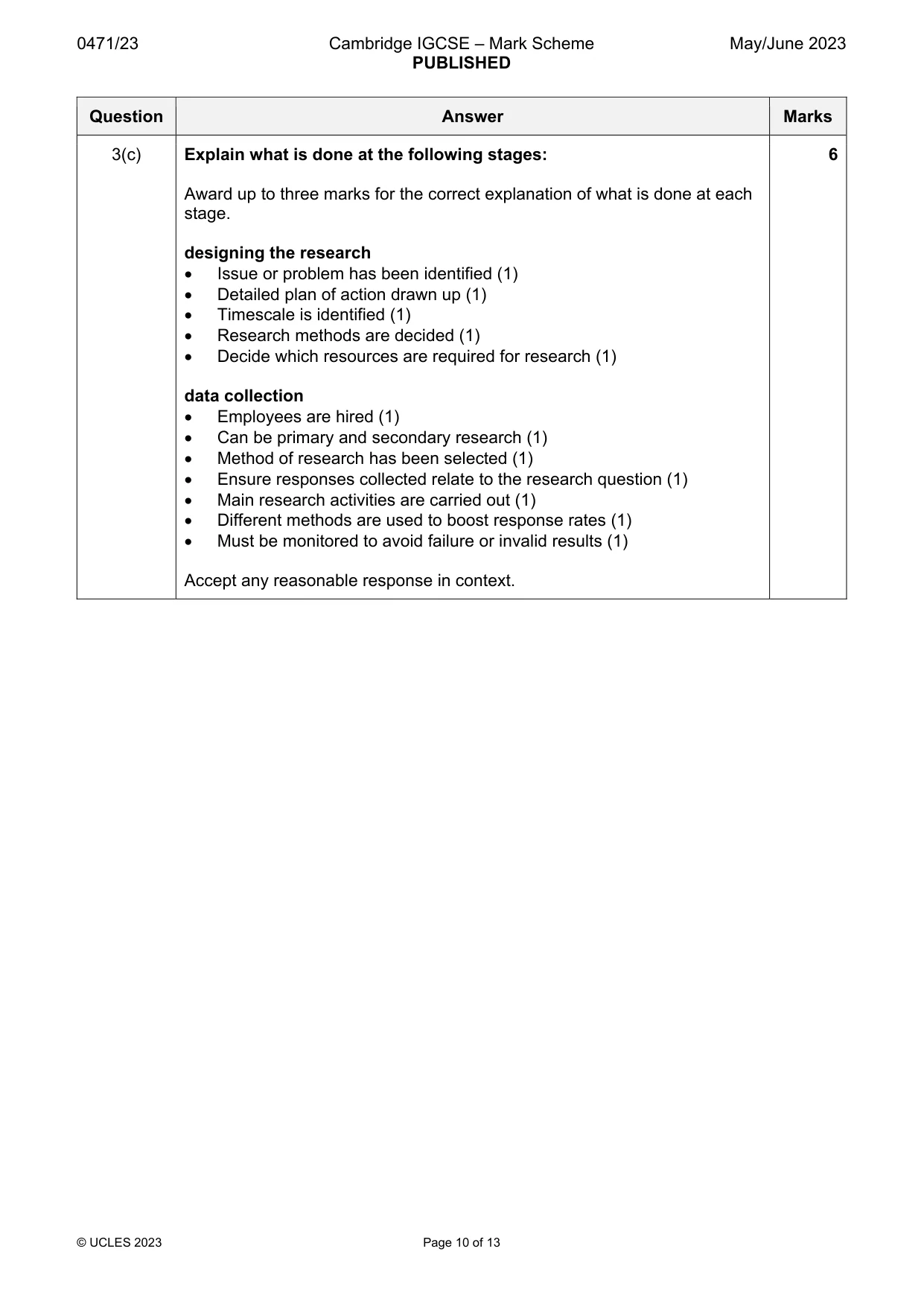
0471/23 Cambridge IGCSE – Mark Scheme PUBLISHED May/June 2023 © UCLES 2023 Page 10 of 13 Question Answer Marks 3(c) Explain what is done at the following stages: Award up to three marks for the correct explanation of what is done at each stage. designing the research Issue or problem has been identified (1) Detailed plan of action drawn up (1) Timescale is identified (1) Research methods are decided (1) Decide which resources are required for research (1) data collection Employees are hired (1) Can be primary and secondary research (1) Method of research has been selected (1) Ensure responses collected relate to the research question (1) Main research activities are carried out (1) Different methods are used to boost response rates (1) Must be monitored to avoid failure or invalid results (1) Accept any reasonable response in context. 6
Mark scheme, page 11
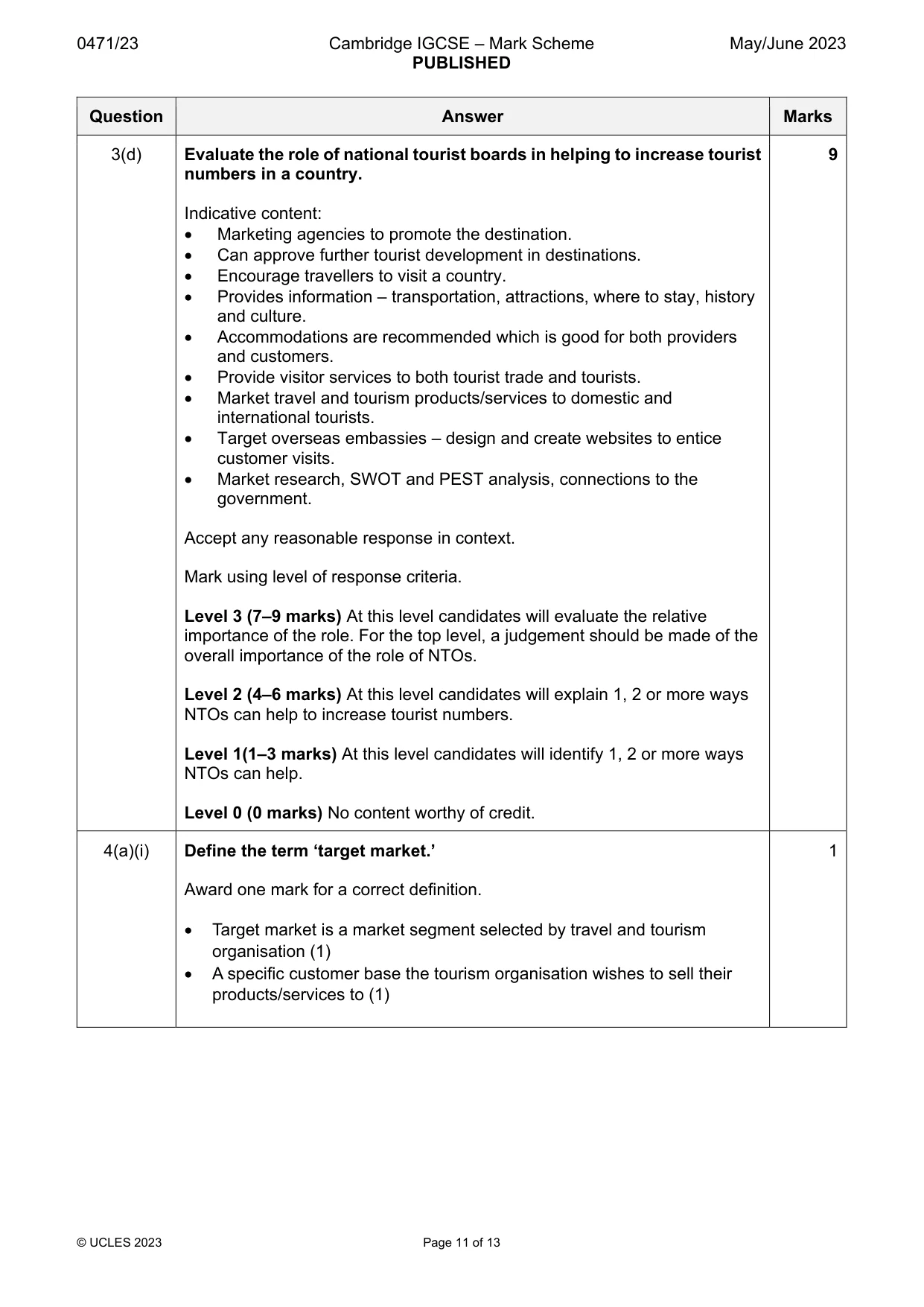
0471/23 Cambridge IGCSE – Mark Scheme PUBLISHED May/June 2023 © UCLES 2023 Page 11 of 13 Question Answer Marks 3(d) Evaluate the role of national tourist boards in helping to increase tourist numbers in a country. Indicative content: Marketing agencies to promote the destination. Can approve further tourist development in destinations. Encourage travellers to visit a country. Provides information – transportation, attractions, where to stay, history and culture. Accommodations are recommended which is good for both providers and customers. Provide visitor services to both tourist trade and tourists. Market travel and tourism products/services to domestic and international tourists. Target overseas embassies – design and create websites to entice customer visits. Market research, SWOT and PEST analysis, connections to the government. Accept any reasonable response in context. Mark using level of response criteria. Level 3 (7–9 marks) At this level candidates will evaluate the relative importance of the role. For the top level, a judgement should be made of the overall importance of the role of NTOs. Level 2 (4–6 marks) At this level candidates will explain 1, 2 or more ways NTOs can help to increase tourist numbers. Level 1(1–3 marks) At this level candidates will identify 1, 2 or more ways NTOs can help. Level 0 (0 marks) No content worthy of credit. 9 4(a)(i) Define the term ‘target market.’ Award one mark for a correct definition. Target market is a market segment selected by travel and tourism organisation (1) A specific customer base the tourism organisation wishes to sell their products/services to (1) 1
Mark scheme, page 12
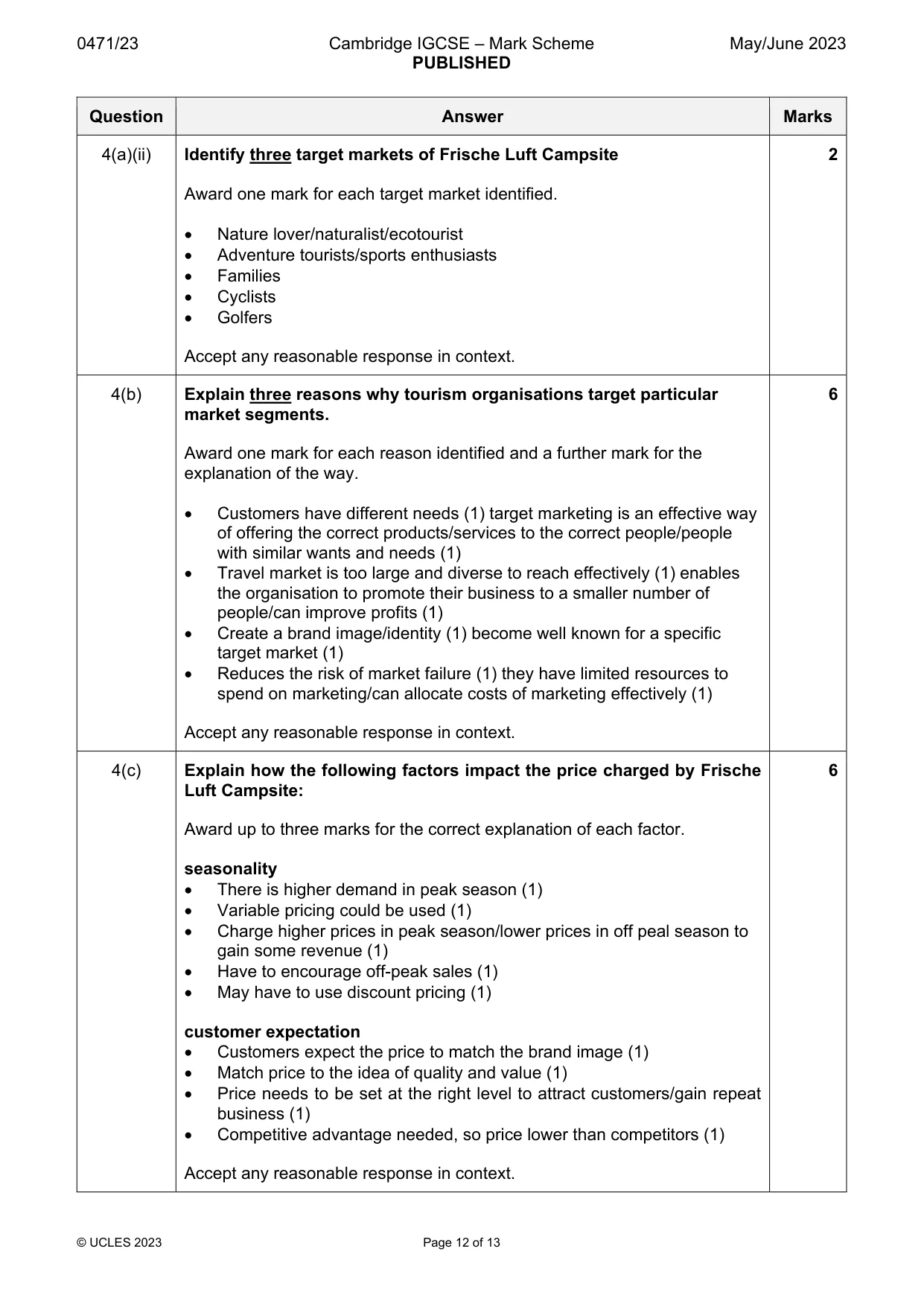
0471/23 Cambridge IGCSE – Mark Scheme PUBLISHED May/June 2023 © UCLES 2023 Page 12 of 13 Question Answer Marks 4(a)(ii) Identify three target markets of Frische Luft Campsite Award one mark for each target market identified. Nature lover/naturalist/ecotourist Adventure tourists/sports enthusiasts Families Cyclists Golfers Accept any reasonable response in context. 2 4(b) Explain three reasons why tourism organisations target particular market segments. Award one mark for each reason identified and a further mark for the explanation of the way. Customers have different needs (1) target marketing is an effective way of offering the correct products/services to the correct people/people with similar wants and needs (1) Travel market is too large and diverse to reach effectively (1) enables the organisation to promote their business to a smaller number of people/can improve profits (1) Create a brand image/identity (1) become well known for a specific target market (1) Reduces the risk of market failure (1) they have limited resources to spend on marketing/can allocate costs of marketing effectively (1) Accept any reasonable response in context. 6 4(c) Explain how the following factors impact the price charged by Frische Luft Campsite: Award up to three marks for the correct explanation of each factor. seasonality There is higher demand in peak season (1) Variable pricing could be used (1) Charge higher prices in peak season/lower prices in off peal season to gain some revenue (1) Have to encourage off-peak sales (1) May have to use discount pricing (1) customer expectation Customers expect the price to match the brand image (1) Match price to the idea of quality and value (1) Price needs to be set at the right level to attract customers/gain repeat business (1) Competitive advantage needed, so price lower than competitors (1) Accept any reasonable response in context. 6
Mark scheme, page 13
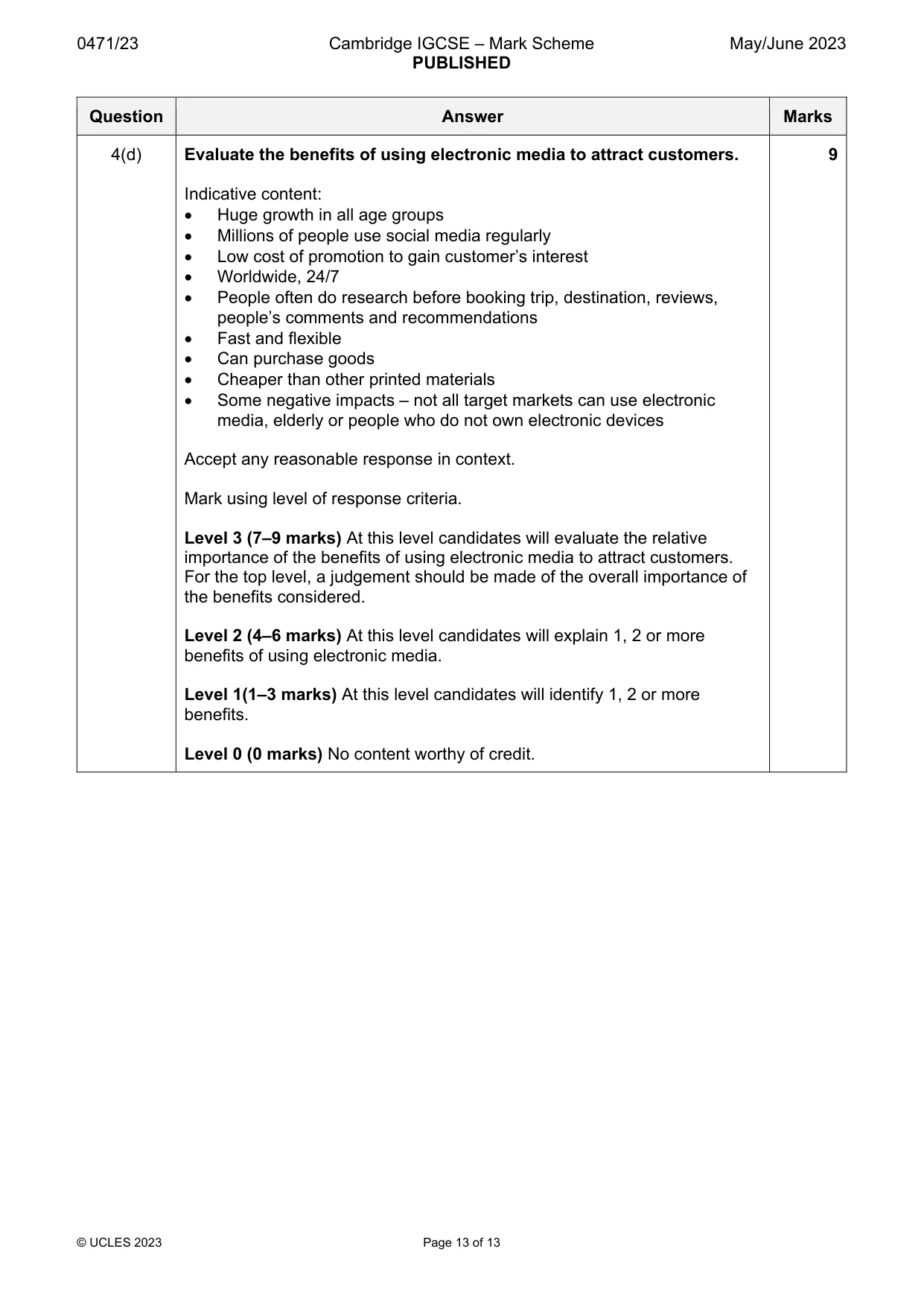
0471/23 Cambridge IGCSE – Mark Scheme PUBLISHED May/June 2023 © UCLES 2023 Page 13 of 13 Question Answer Marks 4(d) Evaluate the benefits of using electronic media to attract customers. Indicative content: Huge growth in all age groups Millions of people use social media regularly Low cost of promotion to gain customer’s interest Worldwide, 24/7 People often do research before booking trip, destination, reviews, people’s comments and recommendations Fast and flexible Can purchase goods Cheaper than other printed materials Some negative impacts – not all target markets can use electronic media, elderly or people who do not own electronic devices Accept any reasonable response in context. Mark using level of response criteria. Level 3 (7–9 marks) At this level candidates will evaluate the relative importance of the benefits of using electronic media to attract customers. For the top level, a judgement should be made of the overall importance of the benefits considered. Level 2 (4–6 marks) At this level candidates will explain 1, 2 or more benefits of using electronic media. Level 1(1–3 marks) At this level candidates will identify 1, 2 or more benefits. Level 0 (0 marks) No content worthy of credit. 9
What you needed in this session
Cambridge’s own grade thresholds for 2023 May/June, Paper 2 · Variant 3. A higher threshold means an easier paper — the bar moves with how the cohort did.