Cambridge IGCSE Travel and Tourism 0471 — 2020 Oct/Nov Paper 2 · Variant 1
0471/21/O/N/20 · 100 marks · ≈113 min
The question paper and its mark scheme, free to read here and free to download. This is Cambridge’s own paper, exactly as it was sat.
Question paper16 pages



Mark scheme11 pages
Answers below. Sit the paper first if you are practising.
Paper as text
Question paper, page 1
This document has 16 pages. Blank pages are indicated. DC (JC) 180079/1 © UCLES 2020 [Turn over TRAVEL & TOURISM 0471/21 Paper 2 Alternative to Coursework October/November 2020 2 hours 30 minutes You must answer on the question paper. You will need: Insert (enclosed) INSTRUCTIONS ● Answer all questions. ● Use a black or dark blue pen. ● Write your name, centre number and candidate number in the boxes at the top of the page. ● Write your answer to each question in the space provided. ● Do not use an erasable pen or correction fluid. ● Do not write on any bar codes. INFORMATION ● The total mark for this paper is 100. ● The number of marks for each question or part question is shown in brackets [ ]. ● The insert contains all the figures referred to in the questions. Cambridge IGCSE™ * 5 4 1 4 1 8 7 2 9 0 *
Question paper, page 2
2 0471/21/O/N/20 © UCLES 2020 Question 1 Refer to Fig. 1.1 (Insert), a promotional leaflet advertising a tour to Cappadocia, a region in Central Turkey. (a) (i) Give two reasons why adventure tourists might be interested in joining the advertised tour. 1 … … 2 … … [2] (ii) Define, using an example, what is meant by the term ‘airport transfer’. … … … … [2] (b) Explain three reasons why many tourists prefer to book guided tours. 1 … … … … 2 … … … … 3 … … … … [6]
Question paper, page 3
3 0471/21/O/N/20 © UCLES 2020 [Turn over (c) Explain two reasons why the tour operator might select prestige pricing for this tour. 1 … … … … … … 2 … … … … … … [6]
Question paper, page 4
4 0471/21/O/N/20 © UCLES 2020 (d) Turkey’s popularity as a destination decreased in the last decade following a number of terrorist-related incidents. Discuss how a destination might apply the principles of the product life cycle model to extend its popularity with tourists. … … … … … … … … … … … … … … … … … … [9] [Total: 25]
Question paper, page 5
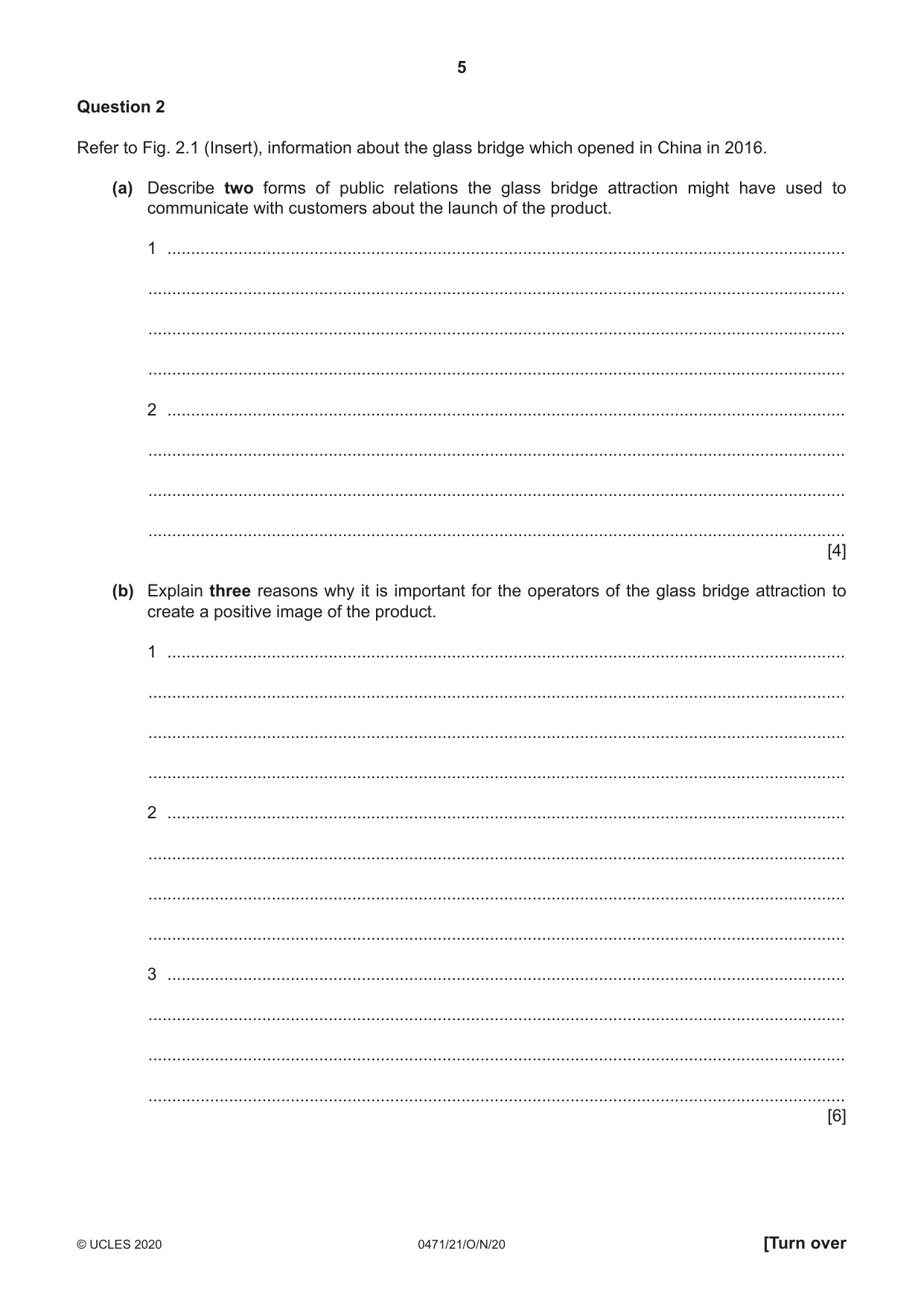
5 0471/21/O/N/20 © UCLES 2020 [Turn over Question 2 Refer to Fig. 2.1 (Insert), information about the glass bridge which opened in China in 2016. (a) Describe two forms of public relations the glass bridge attraction might have used to communicate with customers about the launch of the product. 1 … … … … 2 … … … … [4] (b) Explain three reasons why it is important for the operators of the glass bridge attraction to create a positive image of the product. 1 … … … … 2 … … … … 3 … … … … [6]
Question paper, page 6
6 0471/21/O/N/20 © UCLES 2020 (c) Explain two factors of price which are most likely to influence the price paid by customers to access the glass bridge. 1 … … … … … … 2 … … … … … … [6]
Question paper, page 7
7 0471/21/O/N/20 © UCLES 2020 [Turn over (d) Evaluate the effectiveness of the marketing mix used by the glass bridge attraction. … … … … … … … … … … … … … … … … … … [9] [Total: 25]
Question paper, page 8
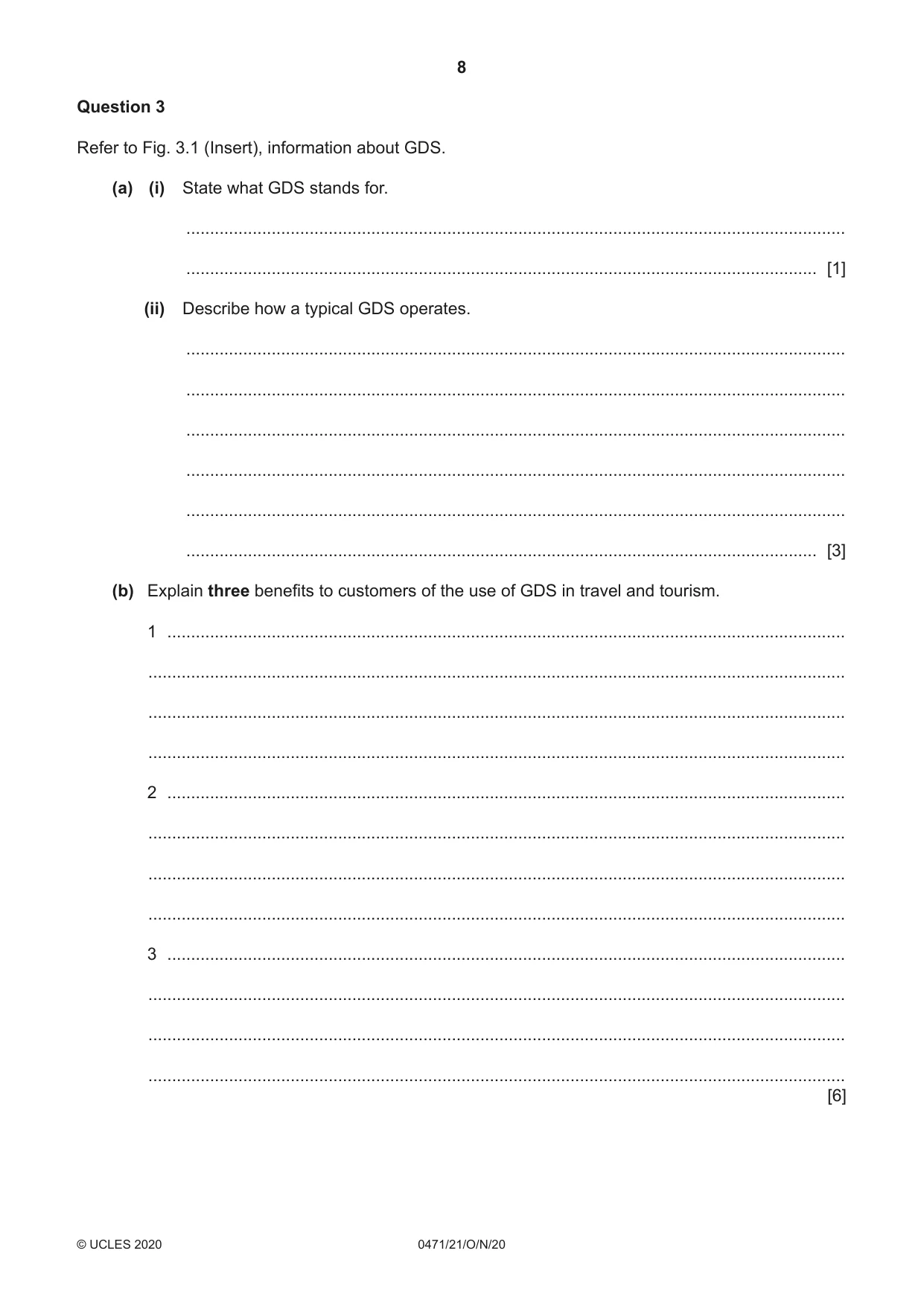
8 0471/21/O/N/20 © UCLES 2020 Question 3 Refer to Fig. 3.1 (Insert), information about GDS. (a) (i) State what GDS stands for. … … [1] (ii) Describe how a typical GDS operates. … … … … … … [3] (b) Explain three benefits to customers of the use of GDS in travel and tourism. 1 … … … … 2 … … … … 3 … … … … [6]
Question paper, page 9
9 0471/21/O/N/20 © UCLES 2020 [Turn over (c) Explain two reasons why some customers prefer to purchase directly from a tour operator rather than use the services of a travel agency. 1 … … … … … … 2 … … … … … … [6]
Question paper, page 10
10 0471/21/O/N/20 © UCLES 2020 (d) The cost of oil often rises and falls. Assess the likely impacts of fluctuations in oil prices on the overall cost of package holidays. … … … … … … … … … … … … … … … … … … [9] [Total: 25]
Question paper, page 11
11 0471/21/O/N/20 © UCLES 2020 [Turn over Question 4 Refer to Fig. 4.1 (Insert), information about Yosemite National Park in the US and the Yosemite Mariposa County Tourism Bureau (YMCTB). (a) Describe two functions of the YMCTB. 1 … … … … 2 … … … … [4] (b) Explain three reasons why group overnight stays in Yosemite are important to the YMCTB. 1 … … … … 2 … … … … 3 … … … … [6]
Question paper, page 12
12 0471/21/O/N/20 © UCLES 2020 (c) Explain two strategies Yosemite National Park have used to ensure tourists visit all year round. 1 … … … … … … 2 … … … … … … [6]
Question paper, page 13
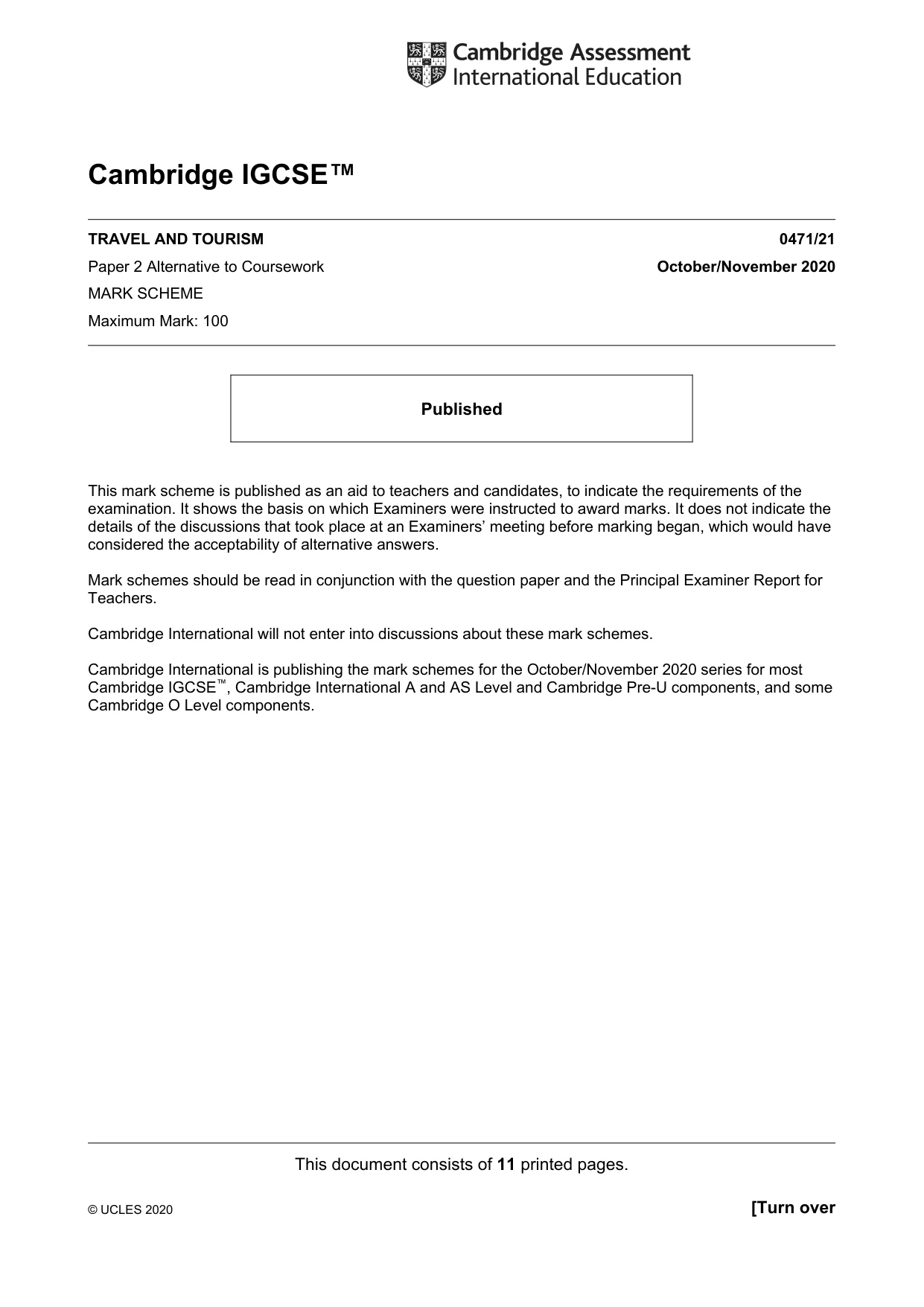
13 0471/21/O/N/20 © UCLES 2020 (d) Discuss the possibilities for further developing the tourism offering in Yosemite National Park. … … … … … … … … … … … … … … … … … … [9] [Total: 25]
Question paper, page 14
14 0471/21/O/N/20 © UCLES 2020 BLANK PAGE
Question paper, page 15
15 0471/21/O/N/20 © UCLES 2020 BLANK PAGE
Question paper, page 16
16 0471/21/O/N/20 © UCLES 2020 Permission to reproduce items where third-party owned material protected by copyright is included has been sought and cleared where possible. Every reasonable effort has been made by the publisher (UCLES) to trace copyright holders, but if any items requiring clearance have unwittingly been included, the publisher will be pleased to make amends at the earliest possible opportunity. To avoid the issue of disclosure of answer-related information to candidates, all copyright acknowledgements are reproduced online in the Cambridge Assessment International Education Copyright Acknowledgements Booklet. This is produced for each series of examinations and is freely available to download at www.cambridgeinternational.org after the live examination series. Cambridge Assessment International Education is part of the Cambridge Assessment Group. Cambridge Assessment is the brand name of the University of Cambridge Local Examinations Syndicate (UCLES), which itself is a department of the University of Cambridge. BLANK PAGE
Mark scheme, page 1
This document consists of 11 printed pages. © UCLES 2020 [Turn over Cambridge IGCSE™ TRAVEL AND TOURISM 0471/21 Paper 2 Alternative to Coursework October/November 2020 MARK SCHEME Maximum Mark: 100 Published This mark scheme is published as an aid to teachers and candidates, to indicate the requirements of the examination. It shows the basis on which Examiners were instructed to award marks. It does not indicate the details of the discussions that took place at an Examiners’ meeting before marking began, which would have considered the acceptability of alternative answers. Mark schemes should be read in conjunction with the question paper and the Principal Examiner Report for Teachers. Cambridge International will not enter into discussions about these mark schemes. Cambridge International is publishing the mark schemes for the October/November 2020 series for most Cambridge IGCSE™, Cambridge International A and AS Level and Cambridge Pre-U components, and some Cambridge O Level components.
Mark scheme, page 2
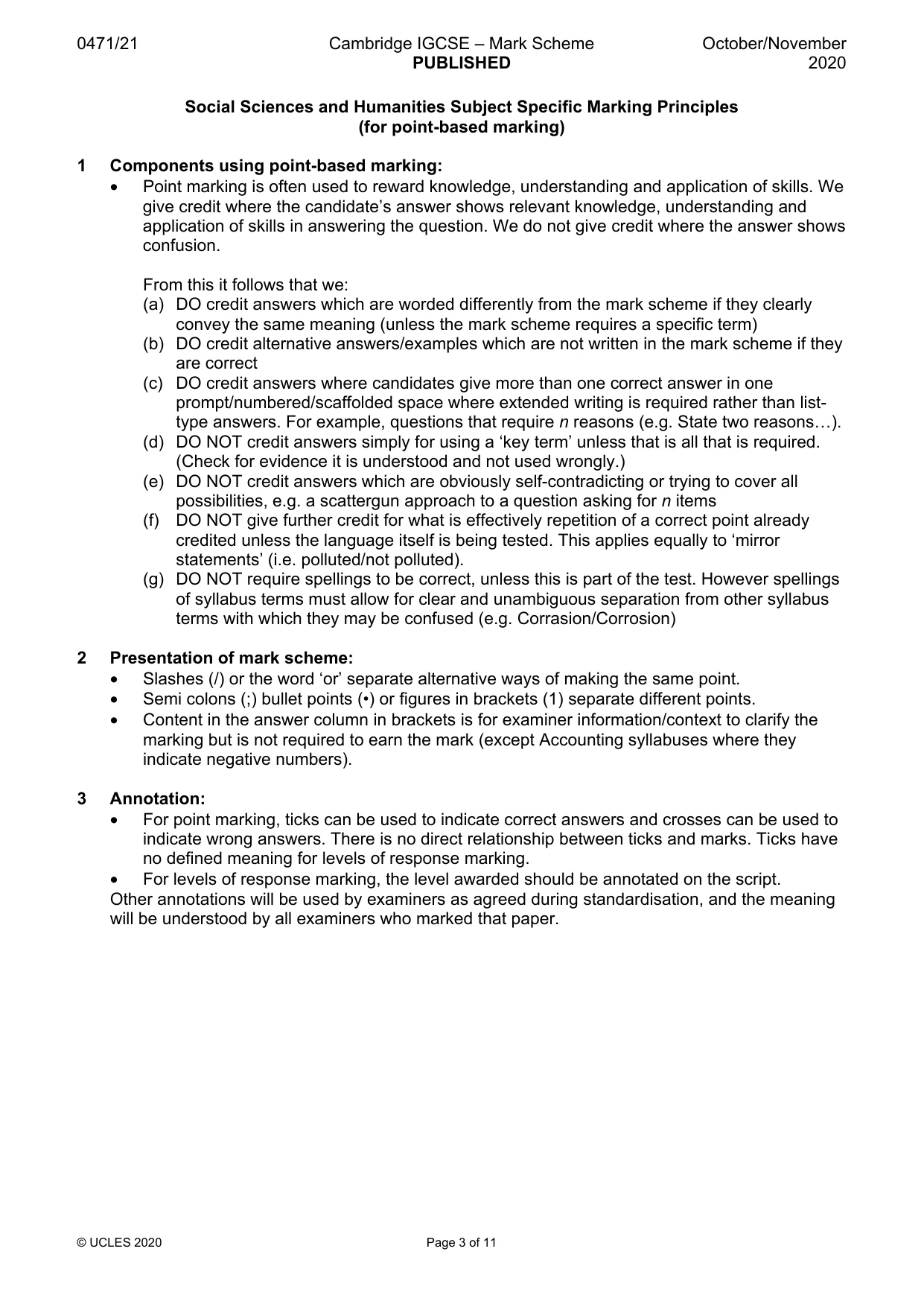
0471/21 Cambridge IGCSE – Mark Scheme PUBLISHED October/November 2020 © UCLES 2020 Page 2 of 11 Generic Marking Principles These general marking principles must be applied by all examiners when marking candidate answers. They should be applied alongside the specific content of the mark scheme or generic level descriptors for a question. Each question paper and mark scheme will also comply with these marking principles. GENERIC MARKING PRINCIPLE 1: Marks must be awarded in line with: • the specific content of the mark scheme or the generic level descriptors for the question • the specific skills defined in the mark scheme or in the generic level descriptors for the question • the standard of response required by a candidate as exemplified by the standardisation scripts. GENERIC MARKING PRINCIPLE 2: Marks awarded are always whole marks (not half marks, or other fractions). GENERIC MARKING PRINCIPLE 3: Marks must be awarded positively: • marks are awarded for correct/valid answers, as defined in the mark scheme. However, credit is given for valid answers which go beyond the scope of the syllabus and mark scheme, referring to your Team Leader as appropriate • marks are awarded when candidates clearly demonstrate what they know and can do • marks are not deducted for errors • marks are not deducted for omissions • answers should only be judged on the quality of spelling, punctuation and grammar when these features are specifically assessed by the question as indicated by the mark scheme. The meaning, however, should be unambiguous. GENERIC MARKING PRINCIPLE 4: Rules must be applied consistently, e.g. in situations where candidates have not followed instructions or in the application of generic level descriptors. GENERIC MARKING PRINCIPLE 5: Marks should be awarded using the full range of marks defined in the mark scheme for the question (however; the use of the full mark range may be limited according to the quality of the candidate responses seen). GENERIC MARKING PRINCIPLE 6: Marks awarded are based solely on the requirements as defined in the mark scheme. Marks should not be awarded with grade thresholds or grade descriptors in mind.
Mark scheme, page 3
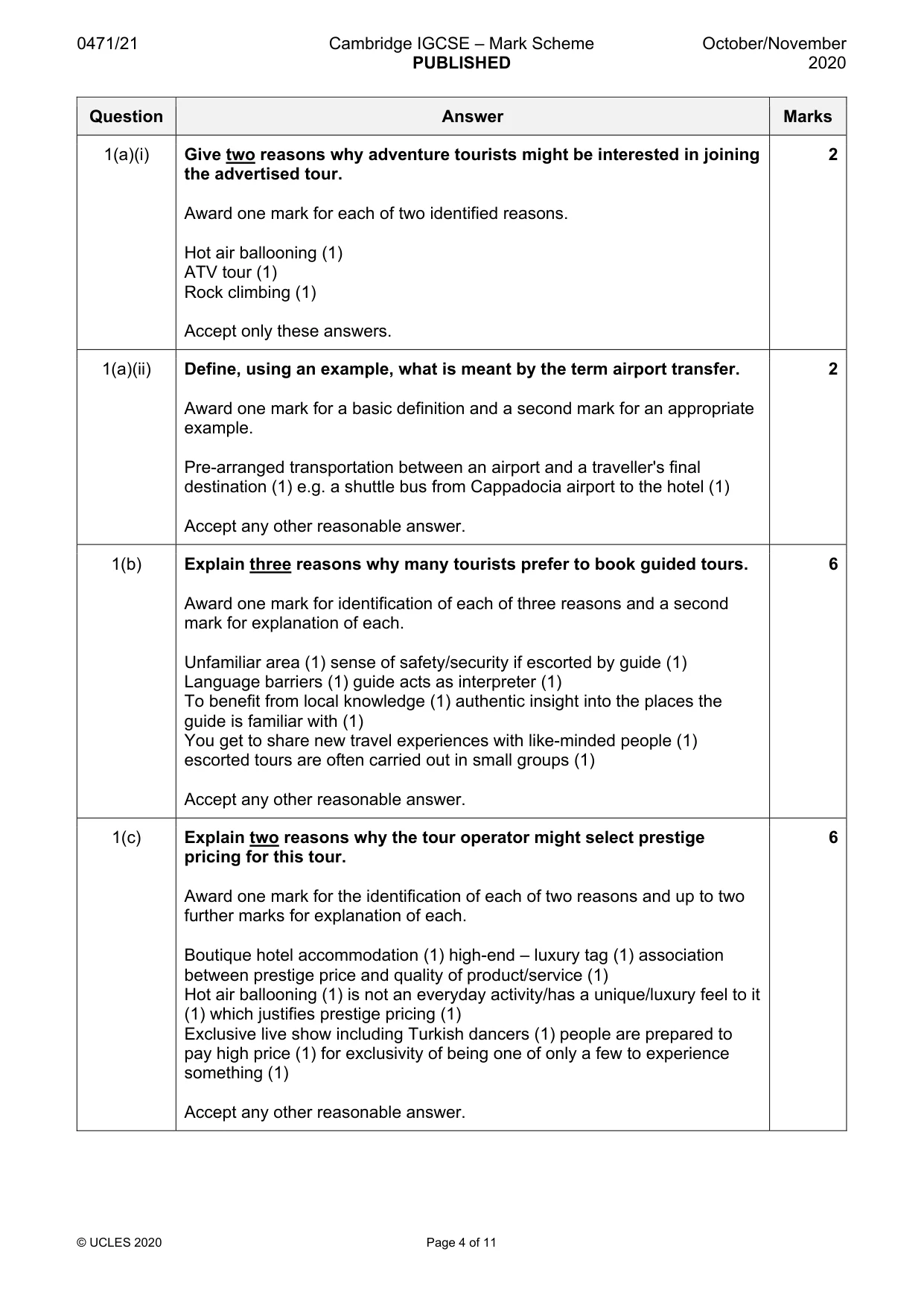
0471/21 Cambridge IGCSE – Mark Scheme PUBLISHED October/November 2020 © UCLES 2020 Page 3 of 11 Social Sciences and Humanities Subject Specific Marking Principles (for point-based marking) 1 Components using point-based marking: • Point marking is often used to reward knowledge, understanding and application of skills. We give credit where the candidate’s answer shows relevant knowledge, understanding and application of skills in answering the question. We do not give credit where the answer shows confusion. From this it follows that we: (a) DO credit answers which are worded differently from the mark scheme if they clearly convey the same meaning (unless the mark scheme requires a specific term) (b) DO credit alternative answers/examples which are not written in the mark scheme if they are correct (c) DO credit answers where candidates give more than one correct answer in one prompt/numbered/scaffolded space where extended writing is required rather than list- type answers. For example, questions that require n reasons (e.g. State two reasons…). (d) DO NOT credit answers simply for using a ‘key term’ unless that is all that is required. (Check for evidence it is understood and not used wrongly.) (e) DO NOT credit answers which are obviously self-contradicting or trying to cover all possibilities, e.g. a scattergun approach to a question asking for n items (f) DO NOT give further credit for what is effectively repetition of a correct point already credited unless the language itself is being tested. This applies equally to ‘mirror statements’ (i.e. polluted/not polluted). (g) DO NOT require spellings to be correct, unless this is part of the test. However spellings of syllabus terms must allow for clear and unambiguous separation from other syllabus terms with which they may be confused (e.g. Corrasion/Corrosion) 2 Presentation of mark scheme: • Slashes (/) or the word ‘or’ separate alternative ways of making the same point. • Semi colons (;) bullet points (•) or figures in brackets (1) separate different points. • Content in the answer column in brackets is for examiner information/context to clarify the marking but is not required to earn the mark (except Accounting syllabuses where they indicate negative numbers). 3 Annotation: • For point marking, ticks can be used to indicate correct answers and crosses can be used to indicate wrong answers. There is no direct relationship between ticks and marks. Ticks have no defined meaning for levels of response marking. • For levels of response marking, the level awarded should be annotated on the script. Other annotations will be used by examiners as agreed during standardisation, and the meaning will be understood by all examiners who marked that paper.
Mark scheme, page 4
0471/21 Cambridge IGCSE – Mark Scheme PUBLISHED October/November 2020 © UCLES 2020 Page 4 of 11 Question Answer Marks 1(a)(i) Give two reasons why adventure tourists might be interested in joining the advertised tour. Award one mark for each of two identified reasons. Hot air ballooning (1) ATV tour (1) Rock climbing (1) Accept only these answers. 2 1(a)(ii) Define, using an example, what is meant by the term airport transfer. Award one mark for a basic definition and a second mark for an appropriate example. Pre-arranged transportation between an airport and a traveller's final destination (1) e.g. a shuttle bus from Cappadocia airport to the hotel (1) Accept any other reasonable answer. 2 1(b) Explain three reasons why many tourists prefer to book guided tours. Award one mark for identification of each of three reasons and a second mark for explanation of each. Unfamiliar area (1) sense of safety/security if escorted by guide (1) Language barriers (1) guide acts as interpreter (1) To benefit from local knowledge (1) authentic insight into the places the guide is familiar with (1) You get to share new travel experiences with like-minded people (1) escorted tours are often carried out in small groups (1) Accept any other reasonable answer. 6 1(c) Explain two reasons why the tour operator might select prestige pricing for this tour. Award one mark for the identification of each of two reasons and up to two further marks for explanation of each. Boutique hotel accommodation (1) high-end – luxury tag (1) association between prestige price and quality of product/service (1) Hot air ballooning (1) is not an everyday activity/has a unique/luxury feel to it (1) which justifies prestige pricing (1) Exclusive live show including Turkish dancers (1) people are prepared to pay high price (1) for exclusivity of being one of only a few to experience something (1) Accept any other reasonable answer. 6
Mark scheme, page 5
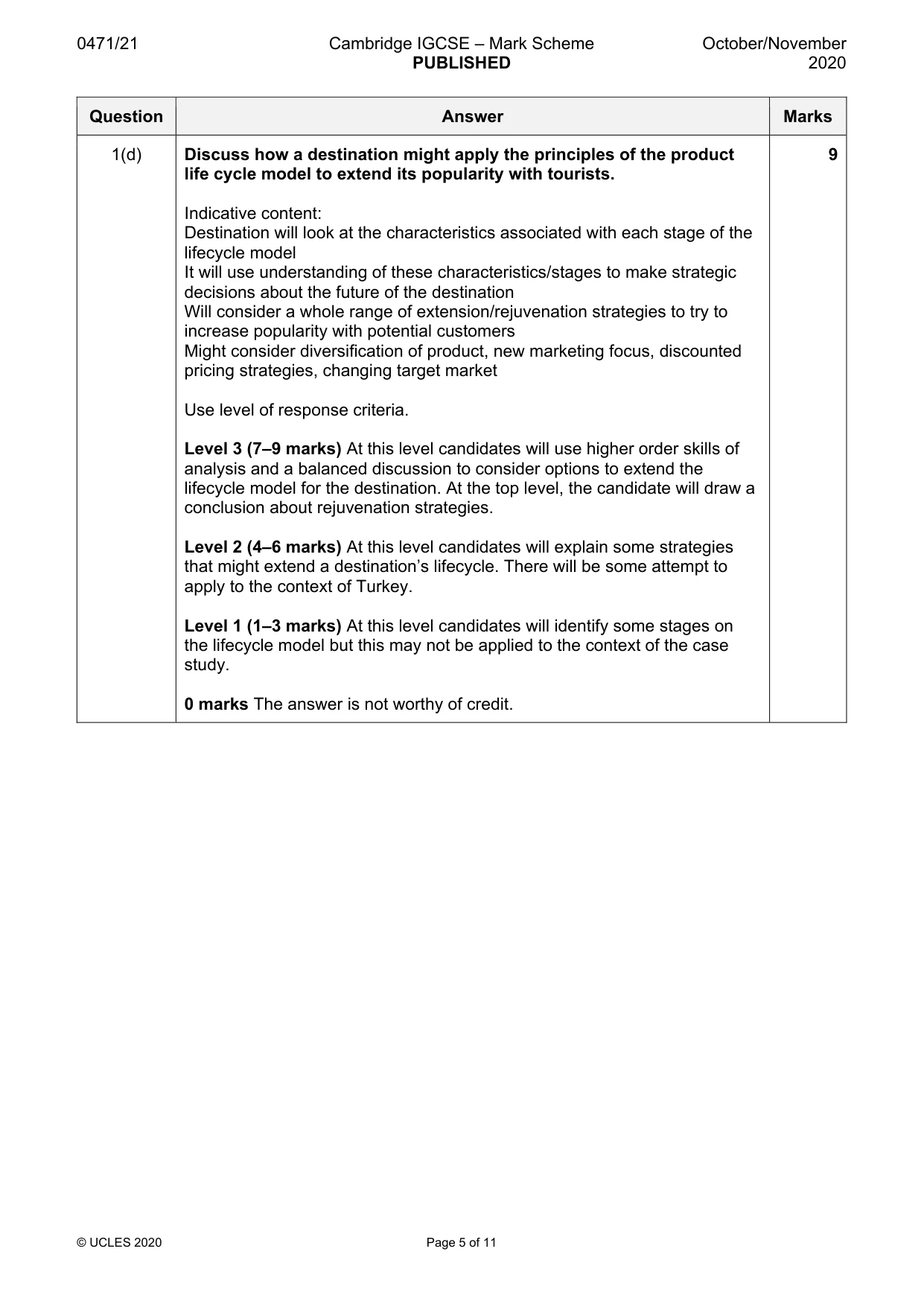
0471/21 Cambridge IGCSE – Mark Scheme PUBLISHED October/November 2020 © UCLES 2020 Page 5 of 11 Question Answer Marks 1(d) Discuss how a destination might apply the principles of the product life cycle model to extend its popularity with tourists. Indicative content: Destination will look at the characteristics associated with each stage of the lifecycle model It will use understanding of these characteristics/stages to make strategic decisions about the future of the destination Will consider a whole range of extension/rejuvenation strategies to try to increase popularity with potential customers Might consider diversification of product, new marketing focus, discounted pricing strategies, changing target market Use level of response criteria. Level 3 (7–9 marks) At this level candidates will use higher order skills of analysis and a balanced discussion to consider options to extend the lifecycle model for the destination. At the top level, the candidate will draw a conclusion about rejuvenation strategies. Level 2 (4–6 marks) At this level candidates will explain some strategies that might extend a destination’s lifecycle. There will be some attempt to apply to the context of Turkey. Level 1 (1–3 marks) At this level candidates will identify some stages on the lifecycle model but this may not be applied to the context of the case study. 0 marks The answer is not worthy of credit. 9
Mark scheme, page 6
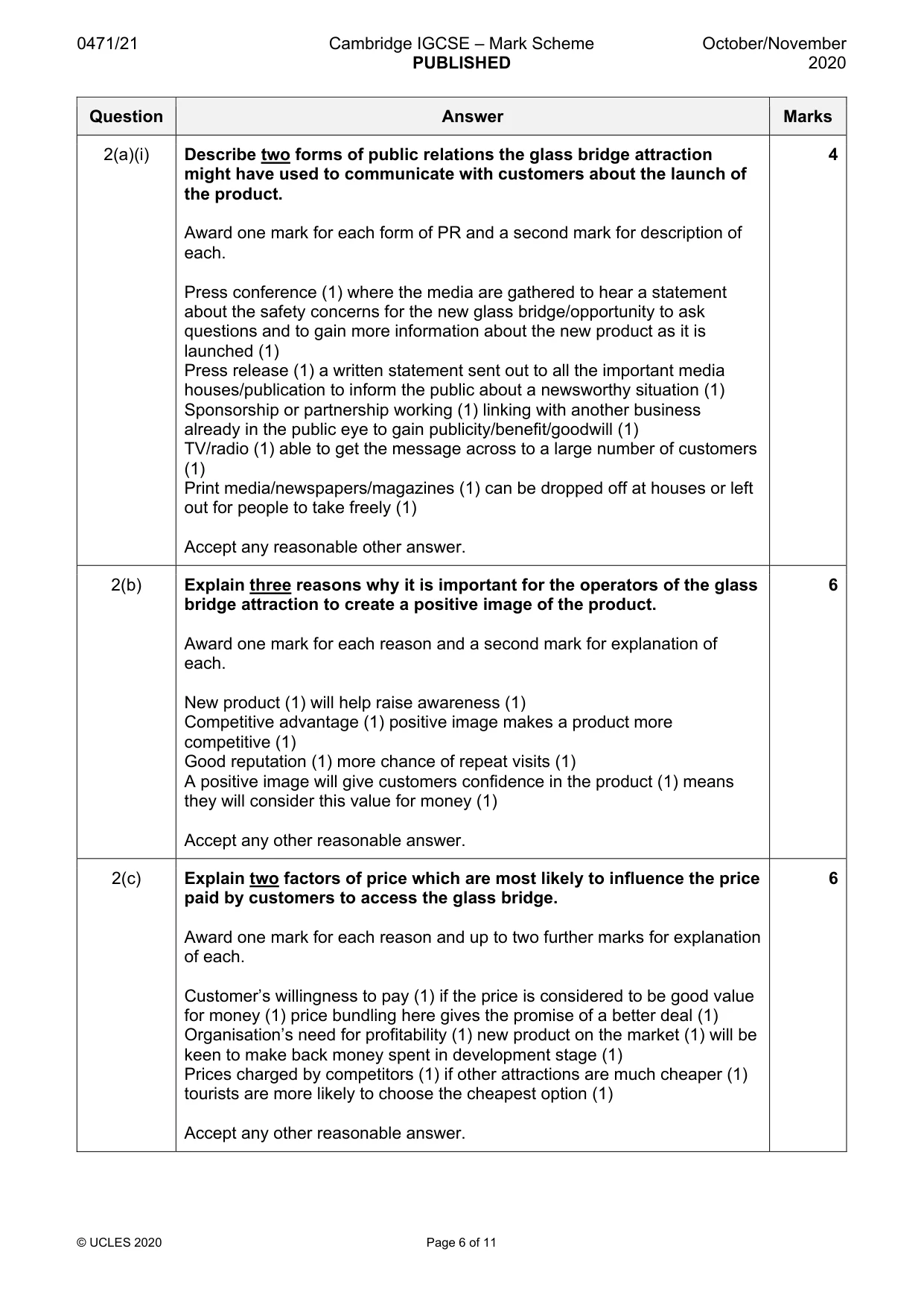
0471/21 Cambridge IGCSE – Mark Scheme PUBLISHED October/November 2020 © UCLES 2020 Page 6 of 11 Question Answer Marks 2(a)(i) Describe two forms of public relations the glass bridge attraction might have used to communicate with customers about the launch of the product. Award one mark for each form of PR and a second mark for description of each. Press conference (1) where the media are gathered to hear a statement about the safety concerns for the new glass bridge/opportunity to ask questions and to gain more information about the new product as it is launched (1) Press release (1) a written statement sent out to all the important media houses/publication to inform the public about a newsworthy situation (1) Sponsorship or partnership working (1) linking with another business already in the public eye to gain publicity/benefit/goodwill (1) TV/radio (1) able to get the message across to a large number of customers (1) Print media/newspapers/magazines (1) can be dropped off at houses or left out for people to take freely (1) Accept any reasonable other answer. 4 2(b) Explain three reasons why it is important for the operators of the glass bridge attraction to create a positive image of the product. Award one mark for each reason and a second mark for explanation of each. New product (1) will help raise awareness (1) Competitive advantage (1) positive image makes a product more competitive (1) Good reputation (1) more chance of repeat visits (1) A positive image will give customers confidence in the product (1) means they will consider this value for money (1) Accept any other reasonable answer. 6 2(c) Explain two factors of price which are most likely to influence the price paid by customers to access the glass bridge. Award one mark for each reason and up to two further marks for explanation of each. Customer’s willingness to pay (1) if the price is considered to be good value for money (1) price bundling here gives the promise of a better deal (1) Organisation’s need for profitability (1) new product on the market (1) will be keen to make back money spent in development stage (1) Prices charged by competitors (1) if other attractions are much cheaper (1) tourists are more likely to choose the cheapest option (1) Accept any other reasonable answer. 6
Mark scheme, page 7
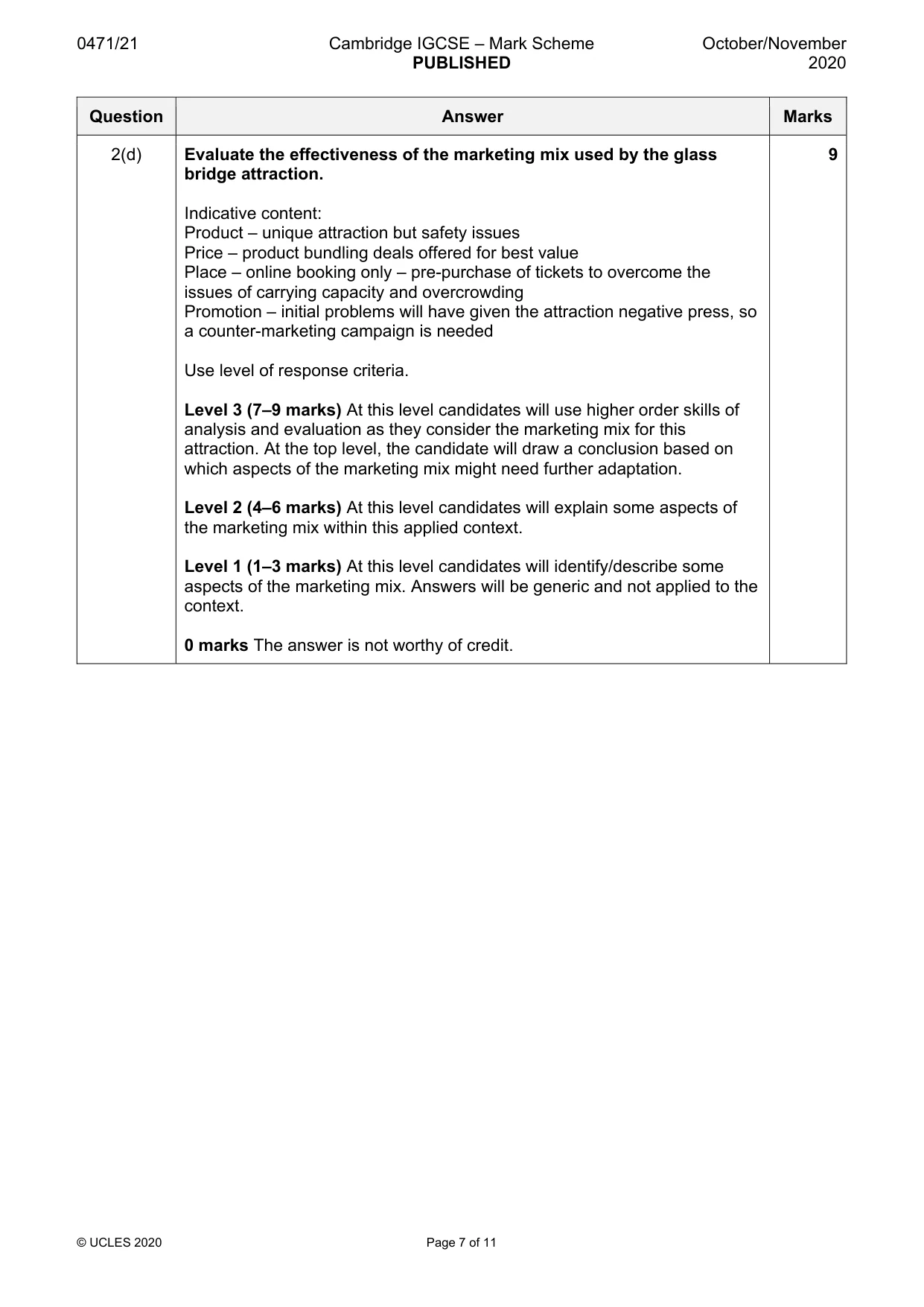
0471/21 Cambridge IGCSE – Mark Scheme PUBLISHED October/November 2020 © UCLES 2020 Page 7 of 11 Question Answer Marks 2(d) Evaluate the effectiveness of the marketing mix used by the glass bridge attraction. Indicative content: Product – unique attraction but safety issues Price – product bundling deals offered for best value Place – online booking only – pre-purchase of tickets to overcome the issues of carrying capacity and overcrowding Promotion – initial problems will have given the attraction negative press, so a counter-marketing campaign is needed Use level of response criteria. Level 3 (7–9 marks) At this level candidates will use higher order skills of analysis and evaluation as they consider the marketing mix for this attraction. At the top level, the candidate will draw a conclusion based on which aspects of the marketing mix might need further adaptation. Level 2 (4–6 marks) At this level candidates will explain some aspects of the marketing mix within this applied context. Level 1 (1–3 marks) At this level candidates will identify/describe some aspects of the marketing mix. Answers will be generic and not applied to the context. 0 marks The answer is not worthy of credit. 9
Mark scheme, page 8
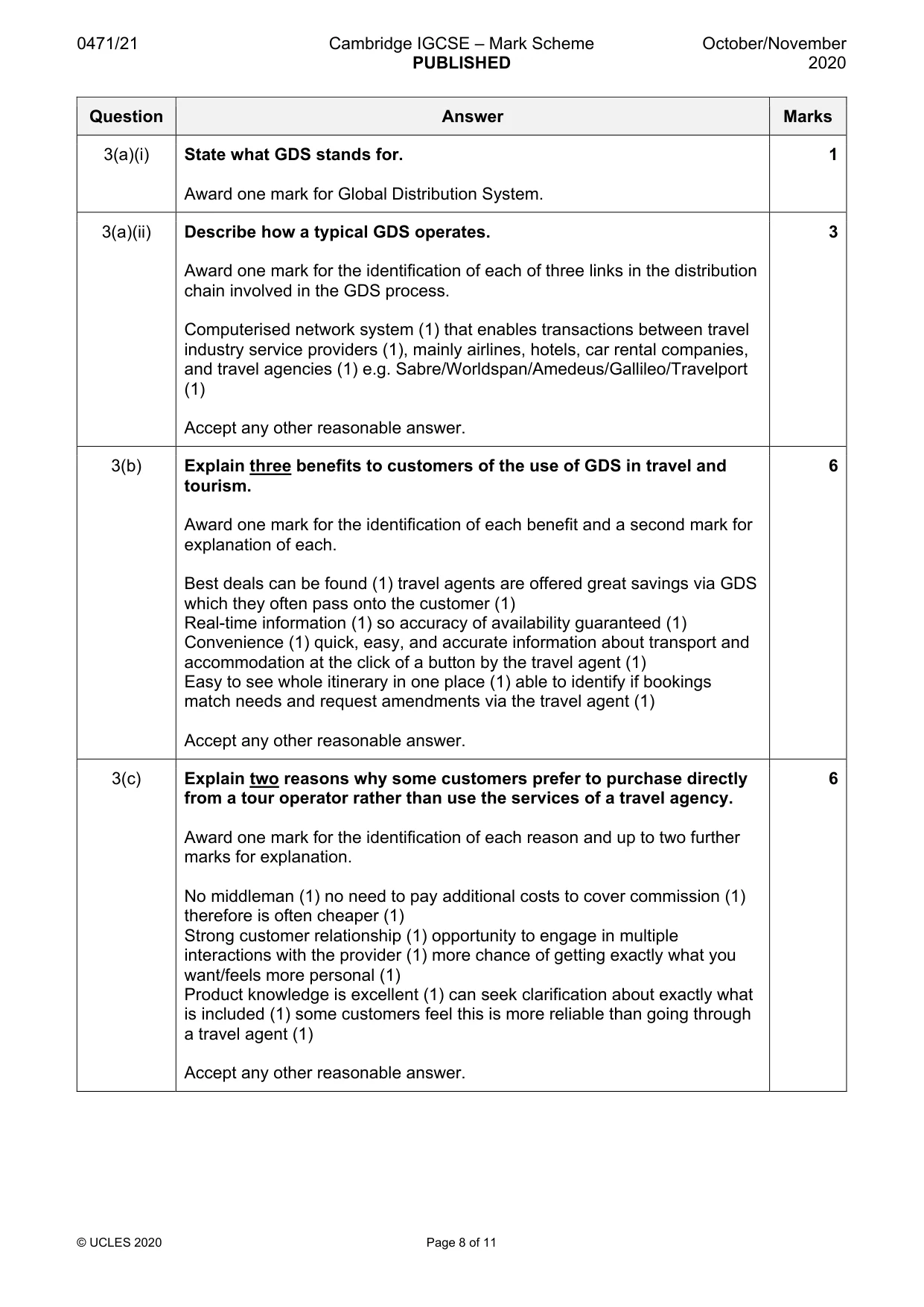
0471/21 Cambridge IGCSE – Mark Scheme PUBLISHED October/November 2020 © UCLES 2020 Page 8 of 11 Question Answer Marks 3(a)(i) State what GDS stands for. Award one mark for Global Distribution System. 1 3(a)(ii) Describe how a typical GDS operates. Award one mark for the identification of each of three links in the distribution chain involved in the GDS process. Computerised network system (1) that enables transactions between travel industry service providers (1), mainly airlines, hotels, car rental companies, and travel agencies (1) e.g. Sabre/Worldspan/Amedeus/Gallileo/Travelport (1) Accept any other reasonable answer. 3 3(b) Explain three benefits to customers of the use of GDS in travel and tourism. Award one mark for the identification of each benefit and a second mark for explanation of each. Best deals can be found (1) travel agents are offered great savings via GDS which they often pass onto the customer (1) Real-time information (1) so accuracy of availability guaranteed (1) Convenience (1) quick, easy, and accurate information about transport and accommodation at the click of a button by the travel agent (1) Easy to see whole itinerary in one place (1) able to identify if bookings match needs and request amendments via the travel agent (1) Accept any other reasonable answer. 6 3(c) Explain two reasons why some customers prefer to purchase directly from a tour operator rather than use the services of a travel agency. Award one mark for the identification of each reason and up to two further marks for explanation. No middleman (1) no need to pay additional costs to cover commission (1) therefore is often cheaper (1) Strong customer relationship (1) opportunity to engage in multiple interactions with the provider (1) more chance of getting exactly what you want/feels more personal (1) Product knowledge is excellent (1) can seek clarification about exactly what is included (1) some customers feel this is more reliable than going through a travel agent (1) Accept any other reasonable answer. 6
Mark scheme, page 9
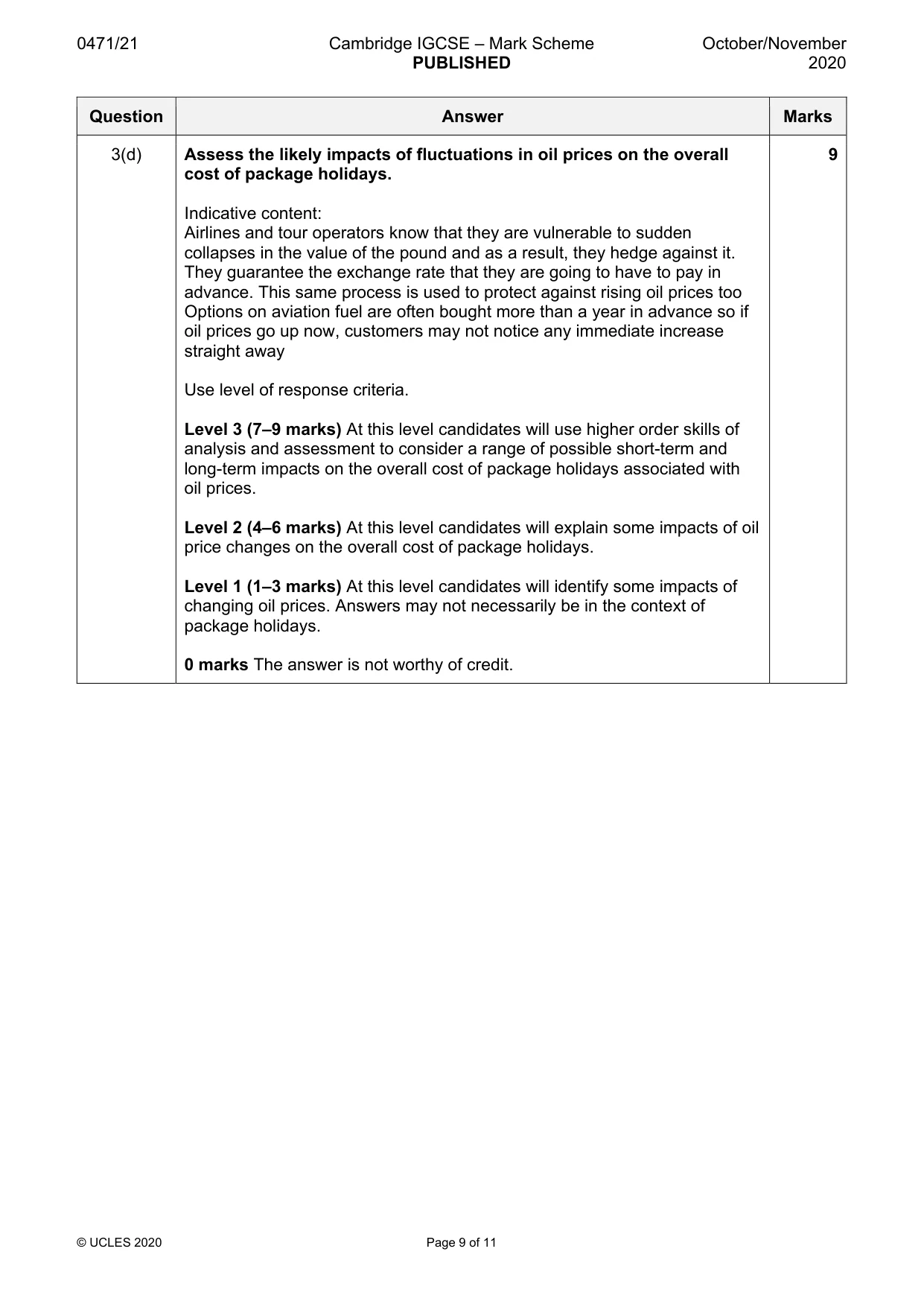
0471/21 Cambridge IGCSE – Mark Scheme PUBLISHED October/November 2020 © UCLES 2020 Page 9 of 11 Question Answer Marks 3(d) Assess the likely impacts of fluctuations in oil prices on the overall cost of package holidays. Indicative content: Airlines and tour operators know that they are vulnerable to sudden collapses in the value of the pound and as a result, they hedge against it. They guarantee the exchange rate that they are going to have to pay in advance. This same process is used to protect against rising oil prices too Options on aviation fuel are often bought more than a year in advance so if oil prices go up now, customers may not notice any immediate increase straight away Use level of response criteria. Level 3 (7–9 marks) At this level candidates will use higher order skills of analysis and assessment to consider a range of possible short-term and long-term impacts on the overall cost of package holidays associated with oil prices. Level 2 (4–6 marks) At this level candidates will explain some impacts of oil price changes on the overall cost of package holidays. Level 1 (1–3 marks) At this level candidates will identify some impacts of changing oil prices. Answers may not necessarily be in the context of package holidays. 0 marks The answer is not worthy of credit. 9
Mark scheme, page 10
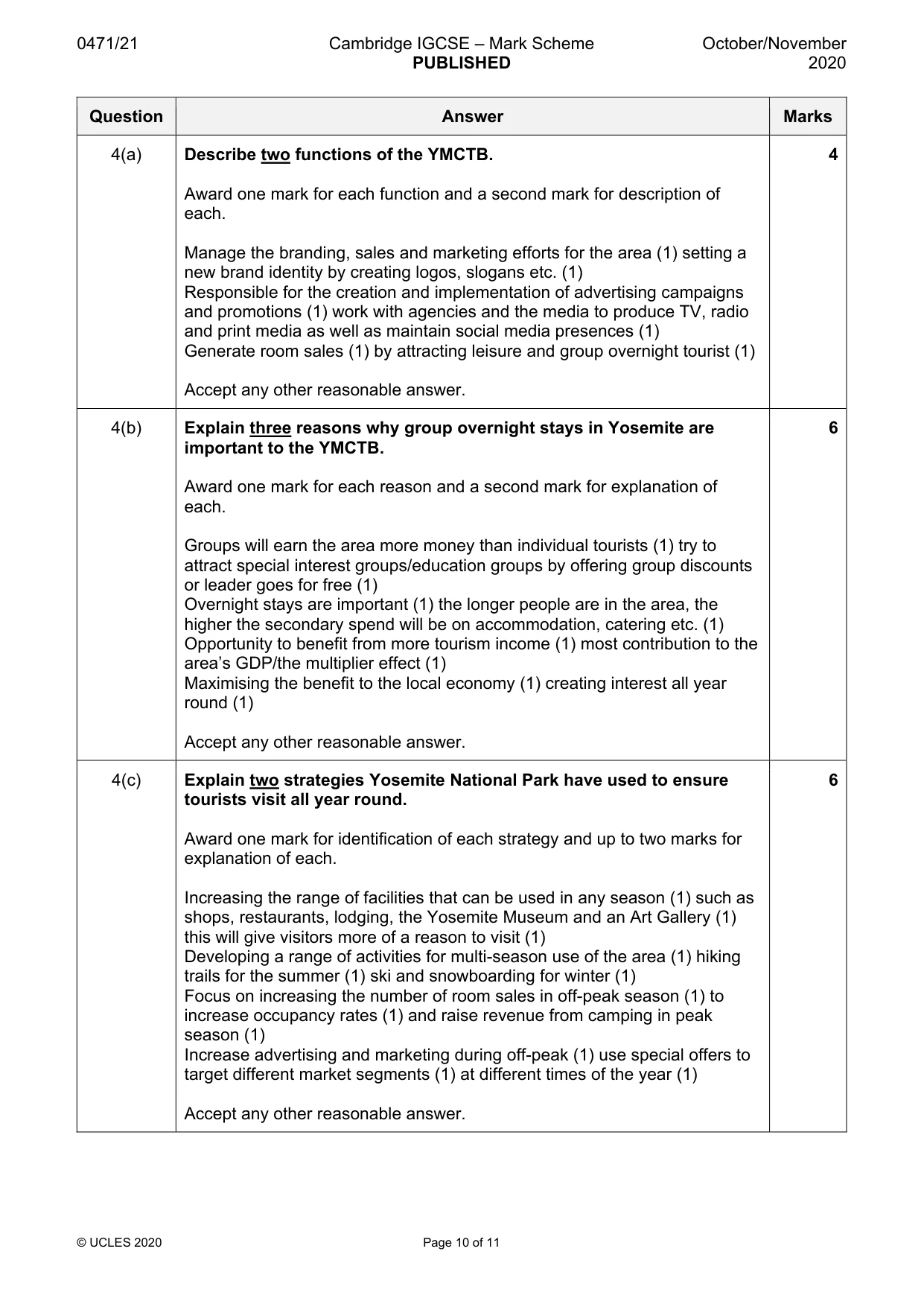
0471/21 Cambridge IGCSE – Mark Scheme PUBLISHED October/November 2020 © UCLES 2020 Page 10 of 11 Question Answer Marks 4(a) Describe two functions of the YMCTB. Award one mark for each function and a second mark for description of each. Manage the branding, sales and marketing efforts for the area (1) setting a new brand identity by creating logos, slogans etc. (1) Responsible for the creation and implementation of advertising campaigns and promotions (1) work with agencies and the media to produce TV, radio and print media as well as maintain social media presences (1) Generate room sales (1) by attracting leisure and group overnight tourist (1) Accept any other reasonable answer. 4 4(b) Explain three reasons why group overnight stays in Yosemite are important to the YMCTB. Award one mark for each reason and a second mark for explanation of each. Groups will earn the area more money than individual tourists (1) try to attract special interest groups/education groups by offering group discounts or leader goes for free (1) Overnight stays are important (1) the longer people are in the area, the higher the secondary spend will be on accommodation, catering etc. (1) Opportunity to benefit from more tourism income (1) most contribution to the area’s GDP/the multiplier effect (1) Maximising the benefit to the local economy (1) creating interest all year round (1) Accept any other reasonable answer. 6 4(c) Explain two strategies Yosemite National Park have used to ensure tourists visit all year round. Award one mark for identification of each strategy and up to two marks for explanation of each. Increasing the range of facilities that can be used in any season (1) such as shops, restaurants, lodging, the Yosemite Museum and an Art Gallery (1) this will give visitors more of a reason to visit (1) Developing a range of activities for multi-season use of the area (1) hiking trails for the summer (1) ski and snowboarding for winter (1) Focus on increasing the number of room sales in off-peak season (1) to increase occupancy rates (1) and raise revenue from camping in peak season (1) Increase advertising and marketing during off-peak (1) use special offers to target different market segments (1) at different times of the year (1) Accept any other reasonable answer. 6
Mark scheme, page 11
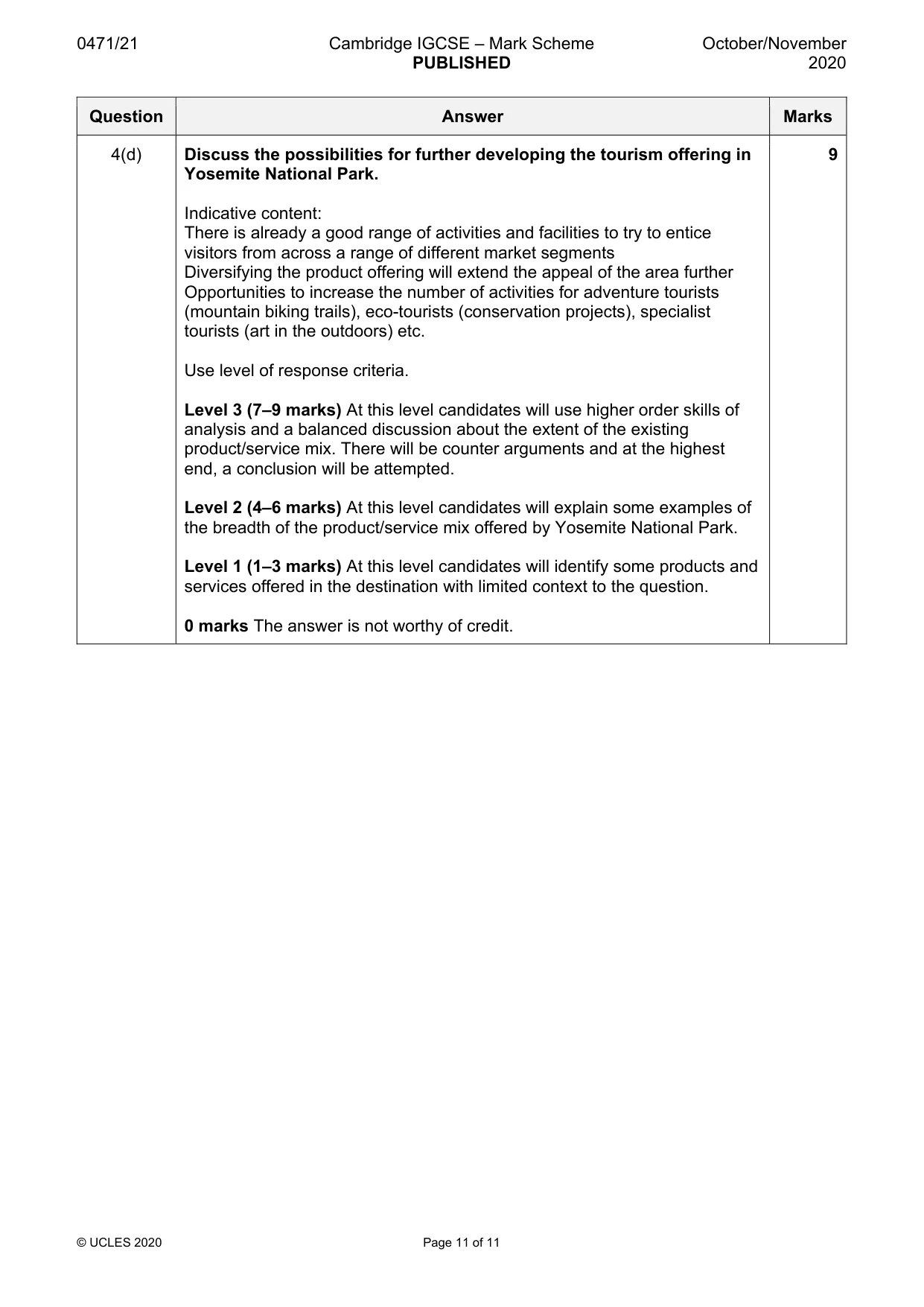
0471/21 Cambridge IGCSE – Mark Scheme PUBLISHED October/November 2020 © UCLES 2020 Page 11 of 11 Question Answer Marks 4(d) Discuss the possibilities for further developing the tourism offering in Yosemite National Park. Indicative content: There is already a good range of activities and facilities to try to entice visitors from across a range of different market segments Diversifying the product offering will extend the appeal of the area further Opportunities to increase the number of activities for adventure tourists (mountain biking trails), eco-tourists (conservation projects), specialist tourists (art in the outdoors) etc. Use level of response criteria. Level 3 (7–9 marks) At this level candidates will use higher order skills of analysis and a balanced discussion about the extent of the existing product/service mix. There will be counter arguments and at the highest end, a conclusion will be attempted. Level 2 (4–6 marks) At this level candidates will explain some examples of the breadth of the product/service mix offered by Yosemite National Park. Level 1 (1–3 marks) At this level candidates will identify some products and services offered in the destination with limited context to the question. 0 marks The answer is not worthy of credit. 9
What you needed in this session
Cambridge’s own grade thresholds for 2020 Oct/Nov, Paper 2 · Variant 1. A higher threshold means an easier paper — the bar moves with how the cohort did.