Cambridge IGCSE Travel and Tourism 0471 — 2020 Oct/Nov Paper 2 · Variant 2
0471/22/O/N/20 · 100 marks · ≈113 min
The question paper and its mark scheme, free to read here and free to download. This is Cambridge’s own paper, exactly as it was sat.
Question paper16 pages




Mark scheme10 pages
Answers below. Sit the paper first if you are practising.
Paper as text
Question paper, page 1
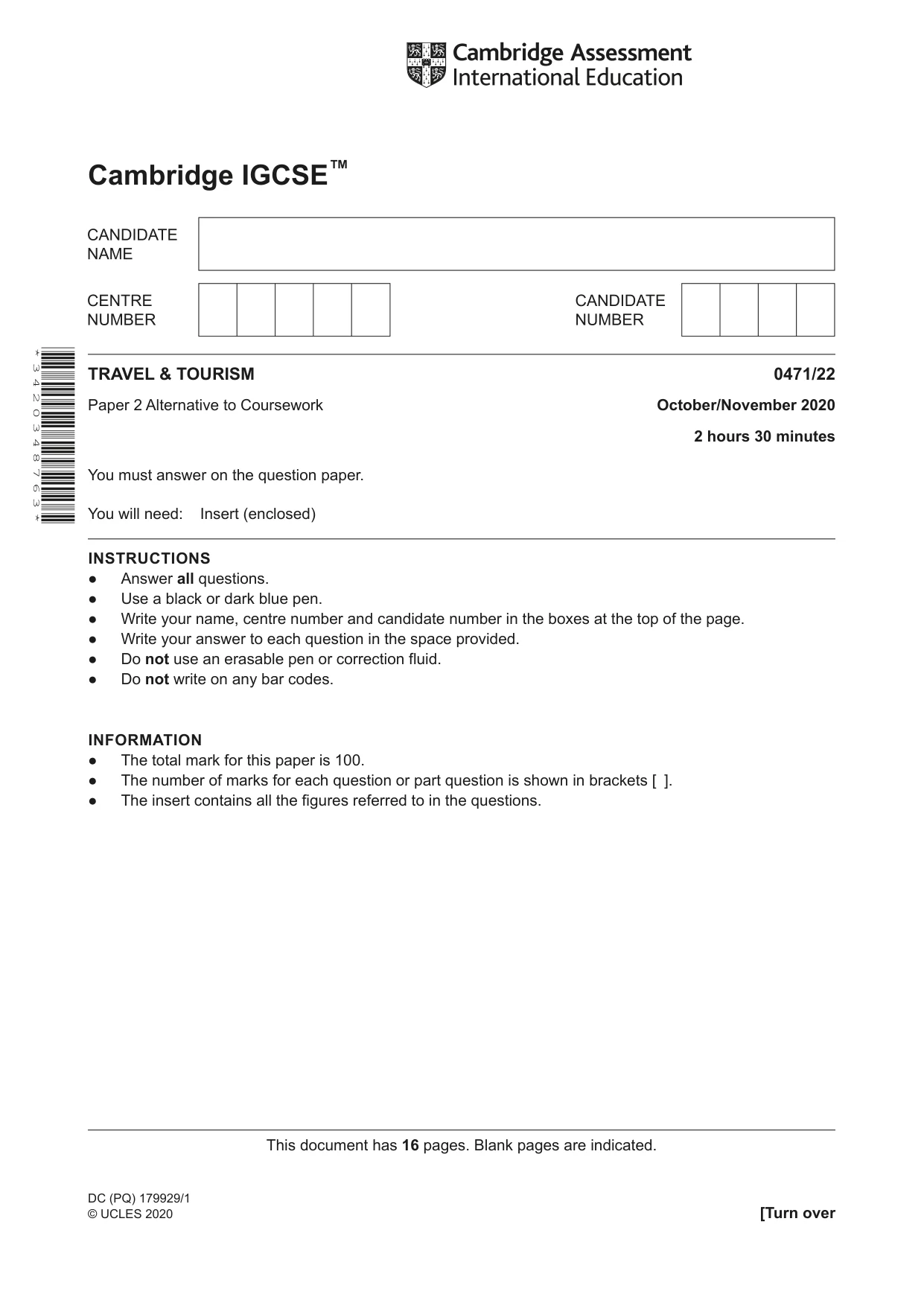
* 3 4 2 0 3 4 8 7 6 3 * DC (PQ) 179929/1 © UCLES 2020 [Turn over This document has 16 pages. Blank pages are indicated. TRAVEL & TOURISM 0471/22 Paper 2 Alternative to Coursework October/November 2020 2 hours 30 minutes You must answer on the question paper. You will need: Insert (enclosed) INSTRUCTIONS ● Answer all questions. ● Use a black or dark blue pen. ● Write your name, centre number and candidate number in the boxes at the top of the page. ● Write your answer to each question in the space provided. ● Do not use an erasable pen or correction fluid. ● Do not write on any bar codes. INFORMATION ● The total mark for this paper is 100. ● The number of marks for each question or part question is shown in brackets [ ]. ● The insert contains all the figures referred to in the questions. Cambridge IGCSE™
Question paper, page 2
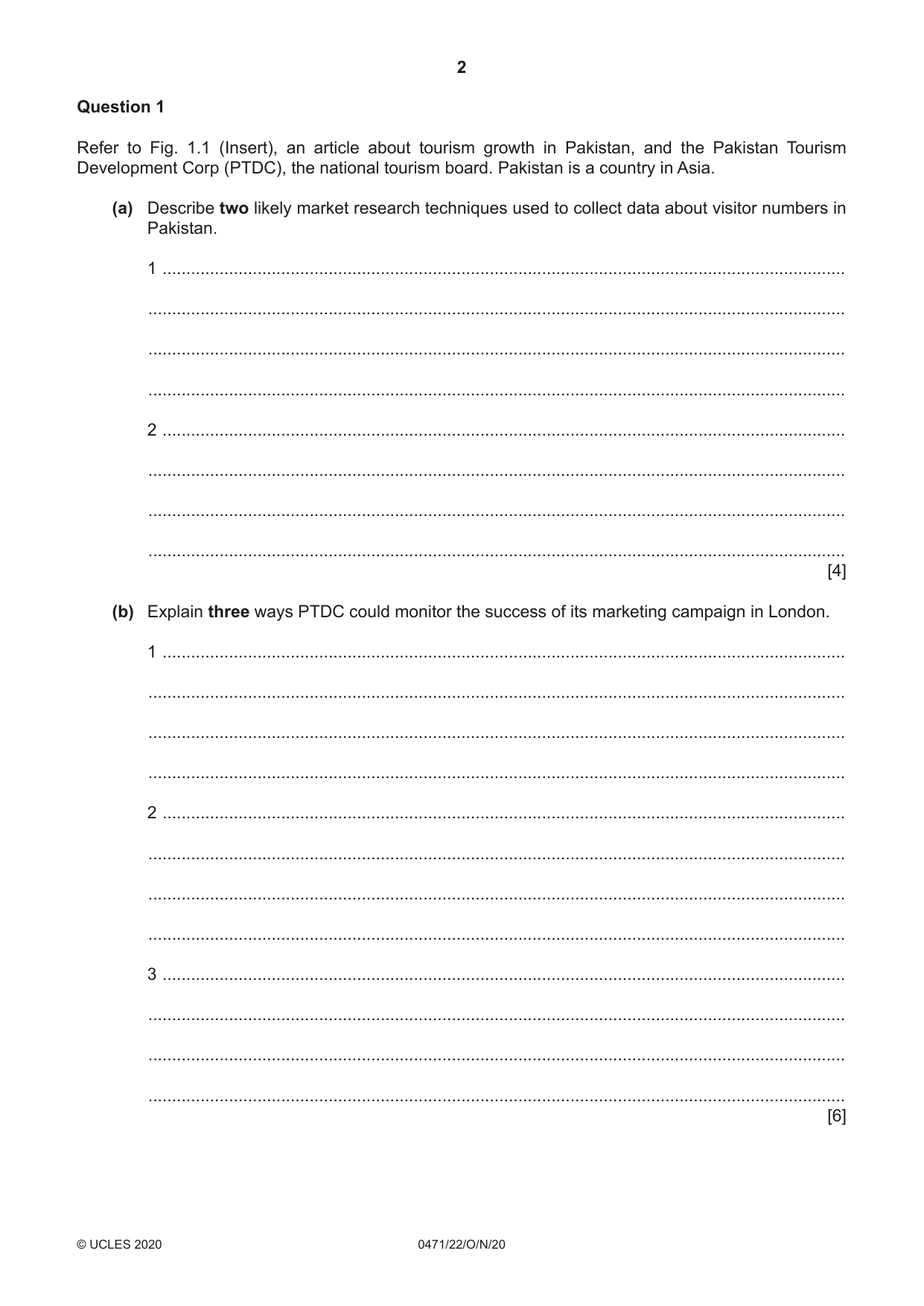
2 0471/22/O/N/20 © UCLES 2020 Question 1 Refer to Fig. 1.1 (Insert), an article about tourism growth in Pakistan, and the Pakistan Tourism Development Corp (PTDC), the national tourism board. Pakistan is a country in Asia. (a) Describe two likely market research techniques used to collect data about visitor numbers in Pakistan. 1 … … … … 2 … … … … [4] (b) Explain three ways PTDC could monitor the success of its marketing campaign in London. 1 … … … … 2 … … … … 3 … … … … [6]
Question paper, page 3
3 0471/22/O/N/20 © UCLES 2020 [Turn over (c) Explain two likely reasons why Pakistan attracts fewer visitors than other destinations. 1 … … … … … … 2 … … … … … … [6]
Question paper, page 4
4 0471/22/O/N/20 © UCLES 2020 (d) Discuss the ways PTDC might develop a product portfolio to appeal to a broader customer base. … … … … … … … … … … … … … … … … … … [9] [Total: 25]
Question paper, page 5
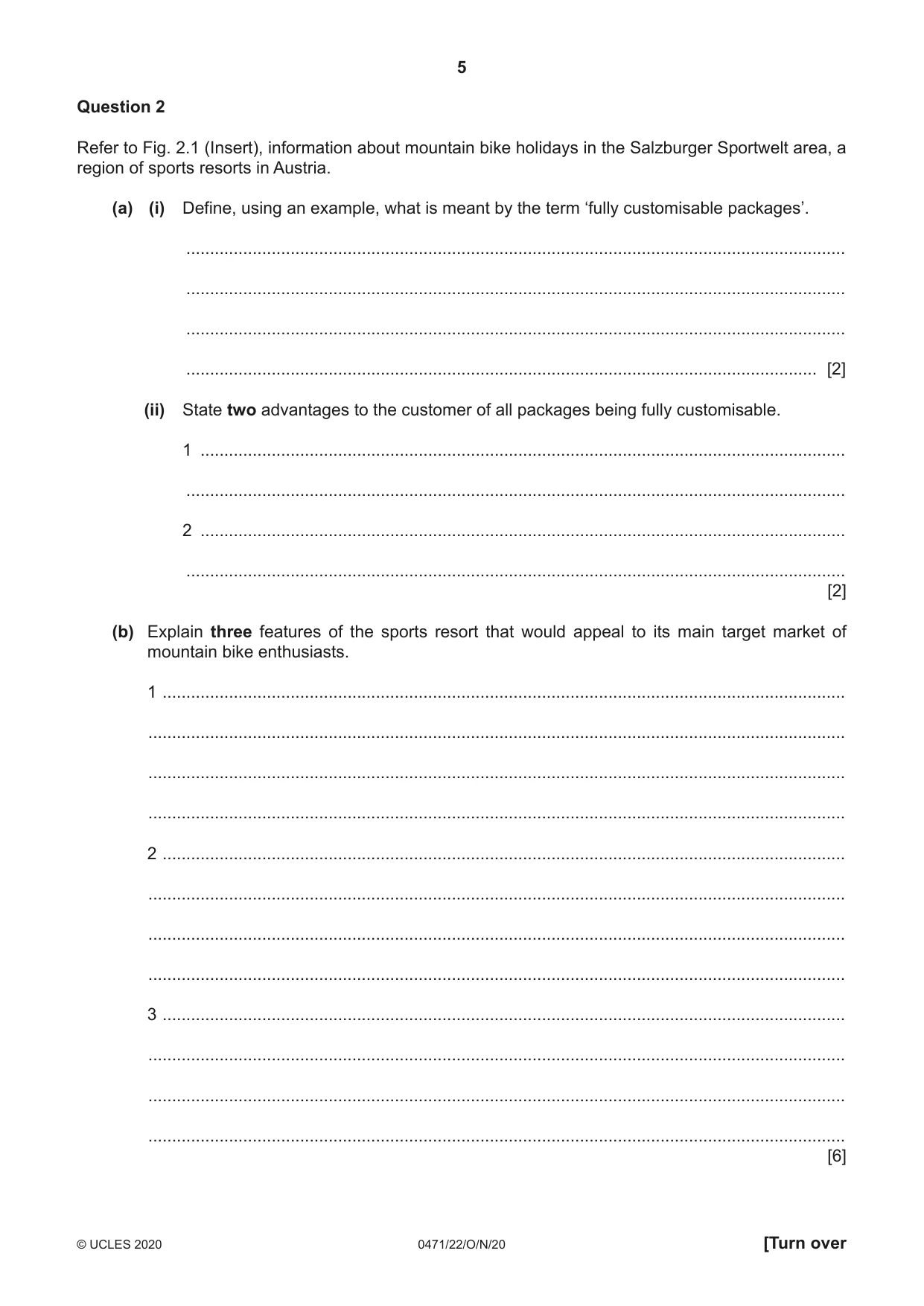
5 0471/22/O/N/20 © UCLES 2020 [Turn over Question 2 Refer to Fig. 2.1 (Insert), information about mountain bike holidays in the Salzburger Sportwelt area, a region of sports resorts in Austria. (a) (i) Define, using an example, what is meant by the term ‘fully customisable packages’. … … … … [2] (ii) State two advantages to the customer of all packages being fully customisable. 1 … … 2 … … [2] (b) Explain three features of the sports resort that would appeal to its main target market of mountain bike enthusiasts. 1 … … … … 2 … … … … 3 … … … … [6]
Question paper, page 6
6 0471/22/O/N/20 © UCLES 2020 (c) Explain two sales promotion techniques the sports resort might adopt. 1 … … … … … … 2 … … … … … … [6]
Question paper, page 7
7 0471/22/O/N/20 © UCLES 2020 [Turn over (d) Analyse the suitability of a variable pricing policy for the customisable MTB holiday packages. … … … … … … … … … … … … … … … … … … [9] [Total: 25]
Question paper, page 8
8 0471/22/O/N/20 © UCLES 2020 Question 3 Refer to Fig. 3.1 (Insert), information about plans to encourage more tourists to Japan, a country in Asia. (a) Describe two different forms of print advertisements the Japanese government might use in its marketing campaign. 1 … … … … 2 … … … … [4] (b) Explain three factors of place the Japanese government should consider when encouraging visitors away from the Golden Route. 1 … … … … 2 … … … … 3 … … … … [6]
Question paper, page 9
9 0471/22/O/N/20 © UCLES 2020 [Turn over (c) Explain two economic factors the Japanese government has already considered under the price part of the marketing mix. 1 … … … … … … 2 … … … … … … [6]
Question paper, page 10
10 0471/22/O/N/20 © UCLES 2020 (d) Discuss the likely benefits to the Japanese government of using market analysis tools for its travel and tourism industry. … … … … … … … … … … … … … … … … … … [9] [Total: 25]
Question paper, page 11
11 0471/22/O/N/20 © UCLES 2020 [Turn over Question 4 Refer to Fig. 4.1 (Insert), information about tourism in the Russian Arctic. (a) (i) Suggest two reasons why tourists can only take part in organised excursions in the Russian Arctic. 1 … … 2 … … [2] (ii) Give one example of each of the following market segments interested in Arctic tourism in Russia: a geographic segment … … a psychographic segment … … [2] (b) Explain three reasons why the Russian Arctic is suitable for the development of ecotourism products. 1 … … … … 2 … … … … 3 … … … … [6]
Question paper, page 12
12 0471/22/O/N/20 © UCLES 2020 (c) Explain two ways tourism activities have been adapted to meet the specific needs of customers in the Russian Arctic. 1 … … … … … … 2 … … … … … … [6]
Question paper, page 13
13 0471/22/O/N/20 © UCLES 2020 (d) Discuss the view that the Russian Arctic is a destination at the growth stage of the product life cycle model. … … … … … … … … … … … … … … … … … … [9] [Total: 25]
Question paper, page 14
14 0471/22/O/N/20 © UCLES 2020 BLANK PAGE
Question paper, page 15
15 0471/22/O/N/20 © UCLES 2020 BLANK PAGE
Question paper, page 16
16 0471/22/O/N/20 © UCLES 2020 Permission to reproduce items where third-party owned material protected by copyright is included has been sought and cleared where possible. Every reasonable effort has been made by the publisher (UCLES) to trace copyright holders, but if any items requiring clearance have unwittingly been included, the publisher will be pleased to make amends at the earliest possible opportunity. To avoid the issue of disclosure of answer-related information to candidates, all copyright acknowledgements are reproduced online in the Cambridge Assessment International Education Copyright Acknowledgements Booklet. This is produced for each series of examinations and is freely available to download at www.cambridgeinternational.org after the live examination series. Cambridge Assessment International Education is part of the Cambridge Assessment Group. Cambridge Assessment is the brand name of the University of Cambridge Local Examinations Syndicate (UCLES), which itself is a department of the University of Cambridge. BLANK PAGE
Mark scheme, page 1
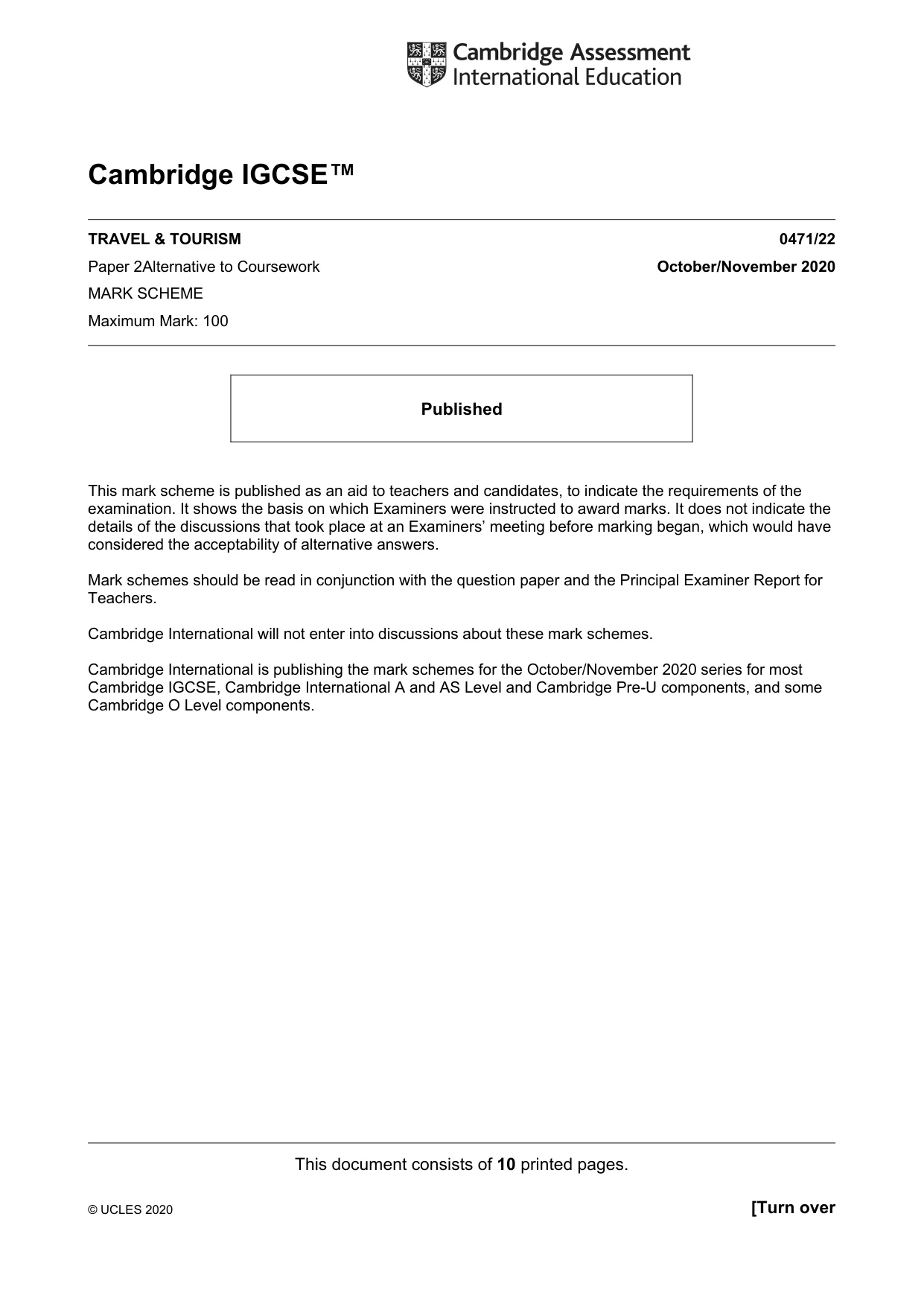
This document consists of 10 printed pages. © UCLES 2020 [Turn over Cambridge IGCSE™ TRAVEL & TOURISM 0471/22 Paper 2Alternative to Coursework October/November 2020 MARK SCHEME Maximum Mark: 100 Published This mark scheme is published as an aid to teachers and candidates, to indicate the requirements of the examination. It shows the basis on which Examiners were instructed to award marks. It does not indicate the details of the discussions that took place at an Examiners’ meeting before marking began, which would have considered the acceptability of alternative answers. Mark schemes should be read in conjunction with the question paper and the Principal Examiner Report for Teachers. Cambridge International will not enter into discussions about these mark schemes. Cambridge International is publishing the mark schemes for the October/November 2020 series for most Cambridge IGCSE, Cambridge International A and AS Level and Cambridge Pre-U components, and some Cambridge O Level components.
Mark scheme, page 2
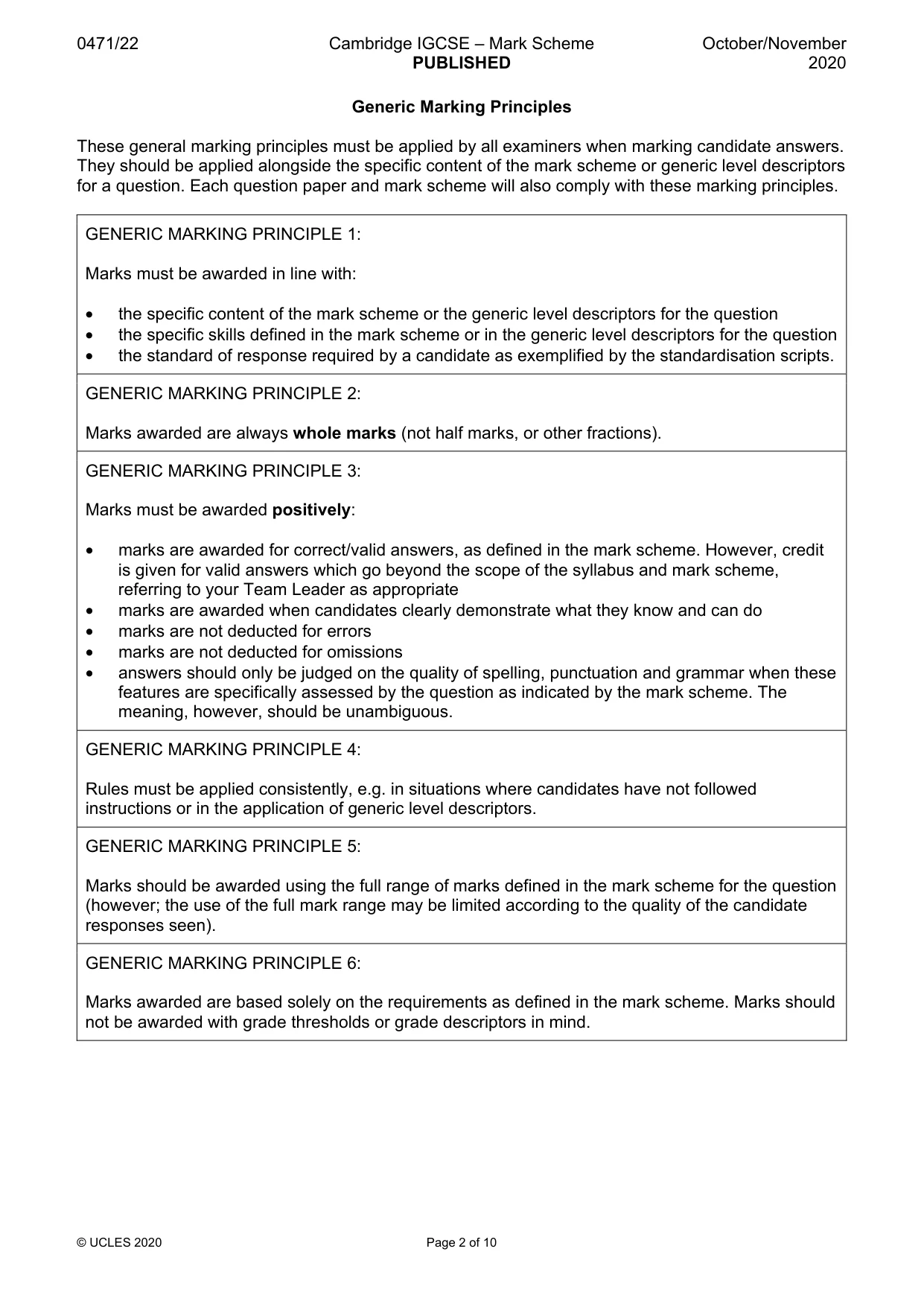
0471/22 Cambridge IGCSE – Mark Scheme PUBLISHED October/November 2020 © UCLES 2020 Page 2 of 10 Generic Marking Principles These general marking principles must be applied by all examiners when marking candidate answers. They should be applied alongside the specific content of the mark scheme or generic level descriptors for a question. Each question paper and mark scheme will also comply with these marking principles. GENERIC MARKING PRINCIPLE 1: Marks must be awarded in line with: • the specific content of the mark scheme or the generic level descriptors for the question • the specific skills defined in the mark scheme or in the generic level descriptors for the question • the standard of response required by a candidate as exemplified by the standardisation scripts. GENERIC MARKING PRINCIPLE 2: Marks awarded are always whole marks (not half marks, or other fractions). GENERIC MARKING PRINCIPLE 3: Marks must be awarded positively: • marks are awarded for correct/valid answers, as defined in the mark scheme. However, credit is given for valid answers which go beyond the scope of the syllabus and mark scheme, referring to your Team Leader as appropriate • marks are awarded when candidates clearly demonstrate what they know and can do • marks are not deducted for errors • marks are not deducted for omissions • answers should only be judged on the quality of spelling, punctuation and grammar when these features are specifically assessed by the question as indicated by the mark scheme. The meaning, however, should be unambiguous. GENERIC MARKING PRINCIPLE 4: Rules must be applied consistently, e.g. in situations where candidates have not followed instructions or in the application of generic level descriptors. GENERIC MARKING PRINCIPLE 5: Marks should be awarded using the full range of marks defined in the mark scheme for the question (however; the use of the full mark range may be limited according to the quality of the candidate responses seen). GENERIC MARKING PRINCIPLE 6: Marks awarded are based solely on the requirements as defined in the mark scheme. Marks should not be awarded with grade thresholds or grade descriptors in mind.
Mark scheme, page 3
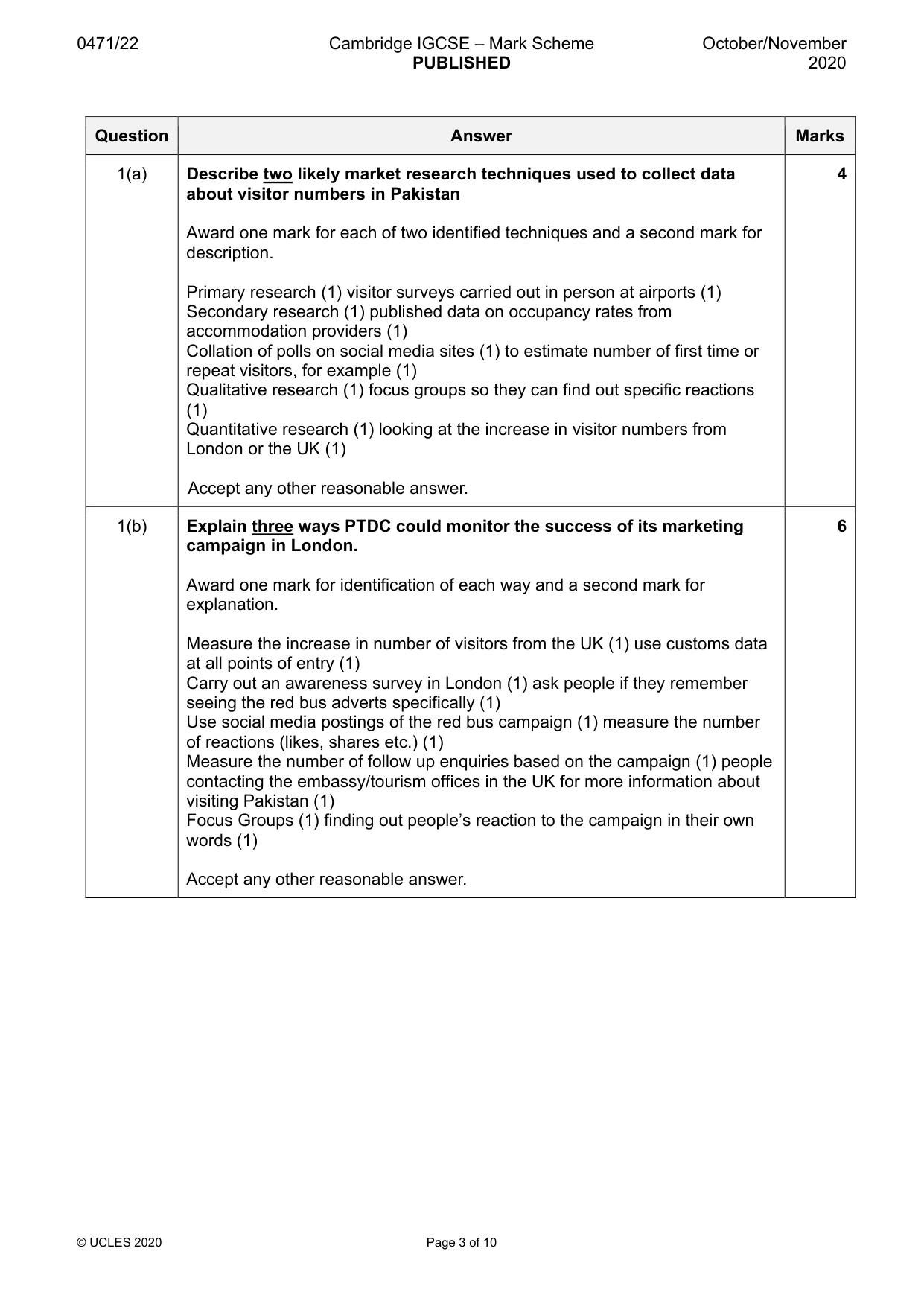
0471/22 Cambridge IGCSE – Mark Scheme PUBLISHED October/November 2020 © UCLES 2020 Page 3 of 10 Question Answer Marks 1(a) Describe two likely market research techniques used to collect data about visitor numbers in Pakistan Award one mark for each of two identified techniques and a second mark for description. Primary research (1) visitor surveys carried out in person at airports (1) Secondary research (1) published data on occupancy rates from accommodation providers (1) Collation of polls on social media sites (1) to estimate number of first time or repeat visitors, for example (1) Qualitative research (1) focus groups so they can find out specific reactions (1) Quantitative research (1) looking at the increase in visitor numbers from London or the UK (1) Accept any other reasonable answer. 4 1(b) Explain three ways PTDC could monitor the success of its marketing campaign in London. Award one mark for identification of each way and a second mark for explanation. Measure the increase in number of visitors from the UK (1) use customs data at all points of entry (1) Carry out an awareness survey in London (1) ask people if they remember seeing the red bus adverts specifically (1) Use social media postings of the red bus campaign (1) measure the number of reactions (likes, shares etc.) (1) Measure the number of follow up enquiries based on the campaign (1) people contacting the embassy/tourism offices in the UK for more information about visiting Pakistan (1) Focus Groups (1) finding out people’s reaction to the campaign in their own words (1) Accept any other reasonable answer. 6
Mark scheme, page 4
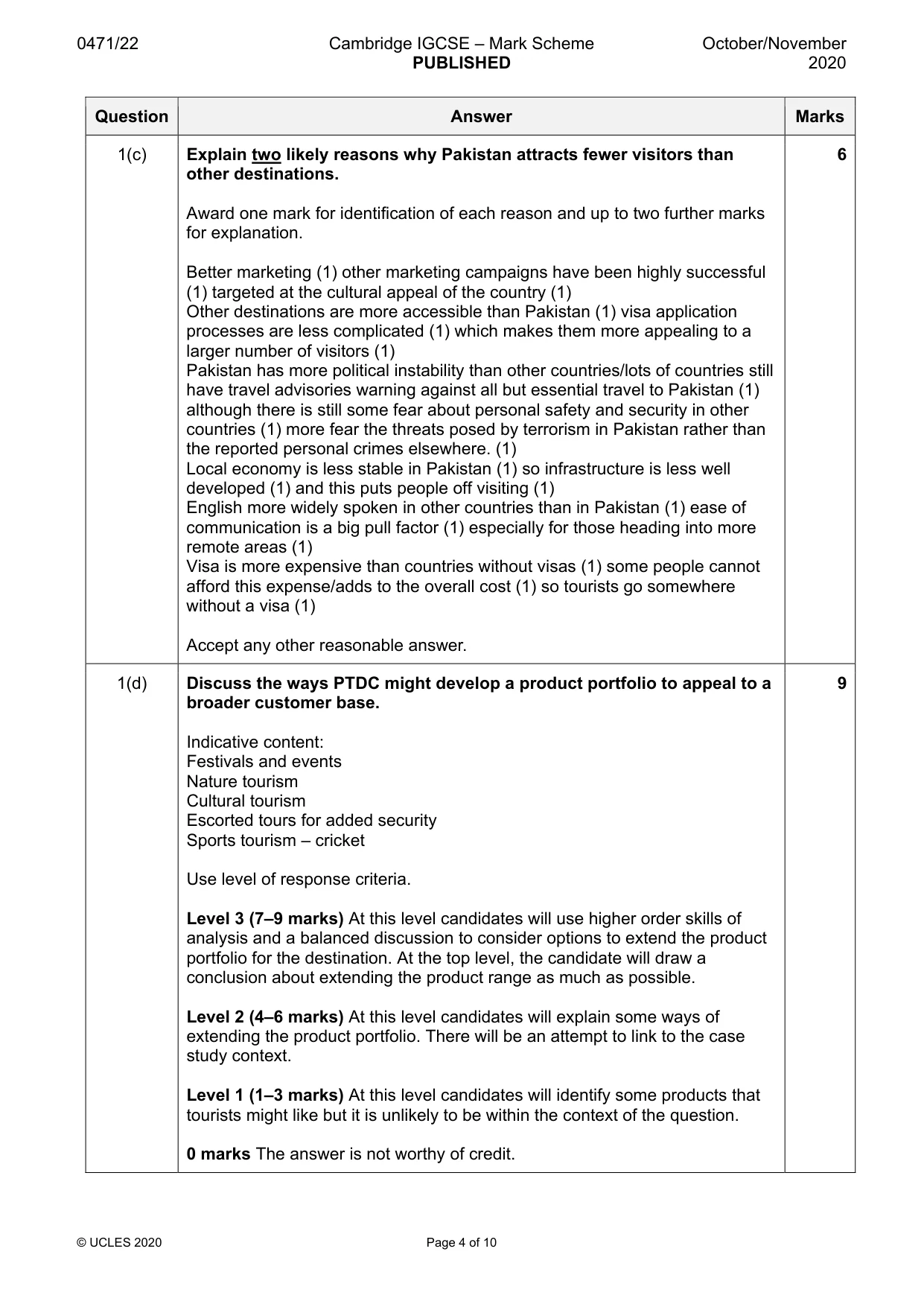
0471/22 Cambridge IGCSE – Mark Scheme PUBLISHED October/November 2020 © UCLES 2020 Page 4 of 10 Question Answer Marks 1(c) Explain two likely reasons why Pakistan attracts fewer visitors than other destinations. Award one mark for identification of each reason and up to two further marks for explanation. Better marketing (1) other marketing campaigns have been highly successful (1) targeted at the cultural appeal of the country (1) Other destinations are more accessible than Pakistan (1) visa application processes are less complicated (1) which makes them more appealing to a larger number of visitors (1) Pakistan has more political instability than other countries/lots of countries still have travel advisories warning against all but essential travel to Pakistan (1) although there is still some fear about personal safety and security in other countries (1) more fear the threats posed by terrorism in Pakistan rather than the reported personal crimes elsewhere. (1) Local economy is less stable in Pakistan (1) so infrastructure is less well developed (1) and this puts people off visiting (1) English more widely spoken in other countries than in Pakistan (1) ease of communication is a big pull factor (1) especially for those heading into more remote areas (1) Visa is more expensive than countries without visas (1) some people cannot afford this expense/adds to the overall cost (1) so tourists go somewhere without a visa (1) Accept any other reasonable answer. 6 1(d) Discuss the ways PTDC might develop a product portfolio to appeal to a broader customer base. Indicative content: Festivals and events Nature tourism Cultural tourism Escorted tours for added security Sports tourism – cricket Use level of response criteria. Level 3 (7–9 marks) At this level candidates will use higher order skills of analysis and a balanced discussion to consider options to extend the product portfolio for the destination. At the top level, the candidate will draw a conclusion about extending the product range as much as possible. Level 2 (4–6 marks) At this level candidates will explain some ways of extending the product portfolio. There will be an attempt to link to the case study context. Level 1 (1–3 marks) At this level candidates will identify some products that tourists might like but it is unlikely to be within the context of the question. 0 marks The answer is not worthy of credit. 9
Mark scheme, page 5
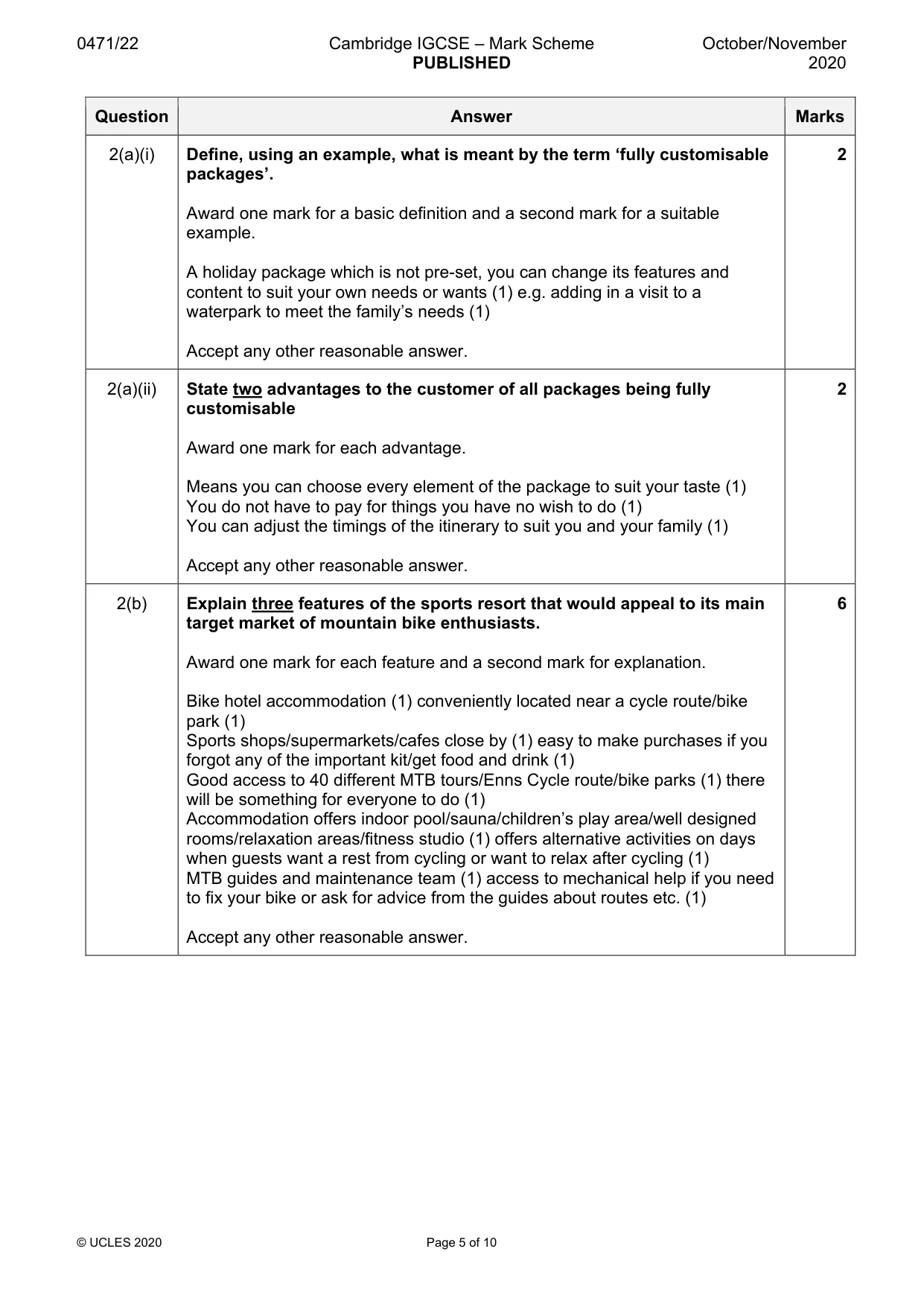
0471/22 Cambridge IGCSE – Mark Scheme PUBLISHED October/November 2020 © UCLES 2020 Page 5 of 10 Question Answer Marks 2(a)(i) Define, using an example, what is meant by the term ‘fully customisable packages’. Award one mark for a basic definition and a second mark for a suitable example. A holiday package which is not pre-set, you can change its features and content to suit your own needs or wants (1) e.g. adding in a visit to a waterpark to meet the family’s needs (1) Accept any other reasonable answer. 2 2(a)(ii) State two advantages to the customer of all packages being fully customisable Award one mark for each advantage. Means you can choose every element of the package to suit your taste (1) You do not have to pay for things you have no wish to do (1) You can adjust the timings of the itinerary to suit you and your family (1) Accept any other reasonable answer. 2 2(b) Explain three features of the sports resort that would appeal to its main target market of mountain bike enthusiasts. Award one mark for each feature and a second mark for explanation. Bike hotel accommodation (1) conveniently located near a cycle route/bike park (1) Sports shops/supermarkets/cafes close by (1) easy to make purchases if you forgot any of the important kit/get food and drink (1) Good access to 40 different MTB tours/Enns Cycle route/bike parks (1) there will be something for everyone to do (1) Accommodation offers indoor pool/sauna/children’s play area/well designed rooms/relaxation areas/fitness studio (1) offers alternative activities on days when guests want a rest from cycling or want to relax after cycling (1) MTB guides and maintenance team (1) access to mechanical help if you need to fix your bike or ask for advice from the guides about routes etc. (1) Accept any other reasonable answer. 6
Mark scheme, page 6
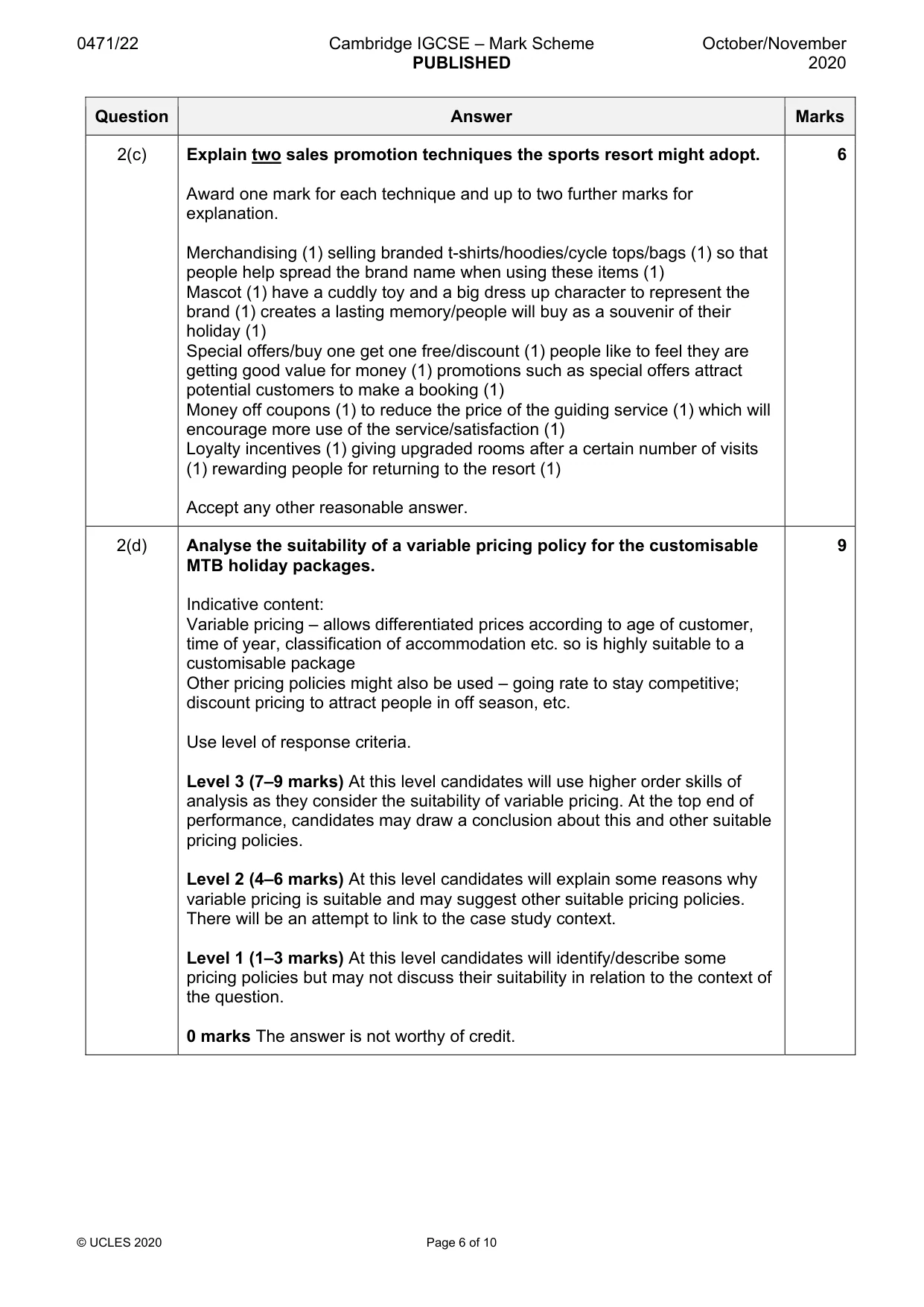
0471/22 Cambridge IGCSE – Mark Scheme PUBLISHED October/November 2020 © UCLES 2020 Page 6 of 10 Question Answer Marks 2(c) Explain two sales promotion techniques the sports resort might adopt. Award one mark for each technique and up to two further marks for explanation. Merchandising (1) selling branded t-shirts/hoodies/cycle tops/bags (1) so that people help spread the brand name when using these items (1) Mascot (1) have a cuddly toy and a big dress up character to represent the brand (1) creates a lasting memory/people will buy as a souvenir of their holiday (1) Special offers/buy one get one free/discount (1) people like to feel they are getting good value for money (1) promotions such as special offers attract potential customers to make a booking (1) Money off coupons (1) to reduce the price of the guiding service (1) which will encourage more use of the service/satisfaction (1) Loyalty incentives (1) giving upgraded rooms after a certain number of visits (1) rewarding people for returning to the resort (1) Accept any other reasonable answer. 6 2(d) Analyse the suitability of a variable pricing policy for the customisable MTB holiday packages. Indicative content: Variable pricing – allows differentiated prices according to age of customer, time of year, classification of accommodation etc. so is highly suitable to a customisable package Other pricing policies might also be used – going rate to stay competitive; discount pricing to attract people in off season, etc. Use level of response criteria. Level 3 (7–9 marks) At this level candidates will use higher order skills of analysis as they consider the suitability of variable pricing. At the top end of performance, candidates may draw a conclusion about this and other suitable pricing policies. Level 2 (4–6 marks) At this level candidates will explain some reasons why variable pricing is suitable and may suggest other suitable pricing policies. There will be an attempt to link to the case study context. Level 1 (1–3 marks) At this level candidates will identify/describe some pricing policies but may not discuss their suitability in relation to the context of the question. 0 marks The answer is not worthy of credit. 9
Mark scheme, page 7
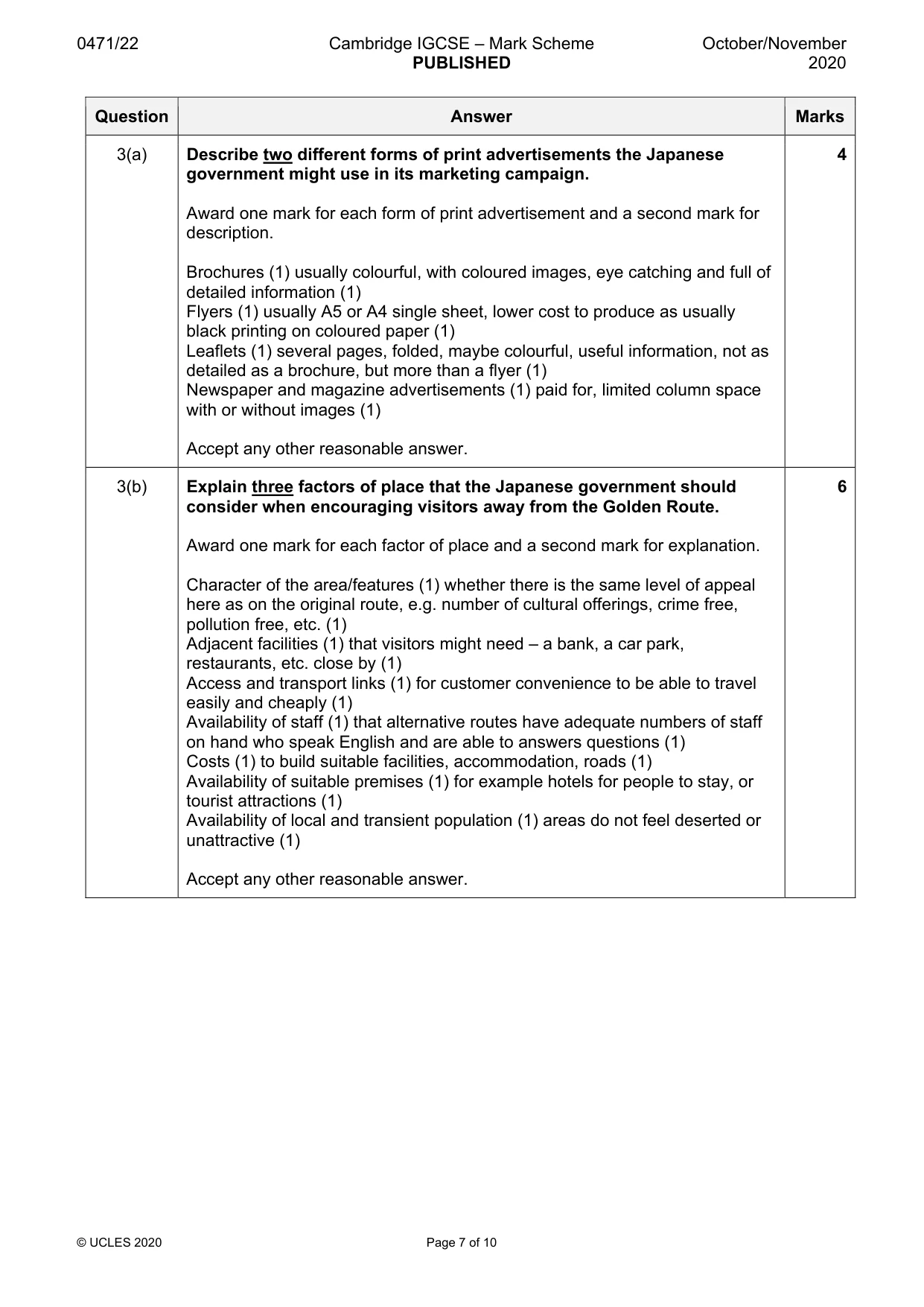
0471/22 Cambridge IGCSE – Mark Scheme PUBLISHED October/November 2020 © UCLES 2020 Page 7 of 10 Question Answer Marks 3(a) Describe two different forms of print advertisements the Japanese government might use in its marketing campaign. Award one mark for each form of print advertisement and a second mark for description. Brochures (1) usually colourful, with coloured images, eye catching and full of detailed information (1) Flyers (1) usually A5 or A4 single sheet, lower cost to produce as usually black printing on coloured paper (1) Leaflets (1) several pages, folded, maybe colourful, useful information, not as detailed as a brochure, but more than a flyer (1) Newspaper and magazine advertisements (1) paid for, limited column space with or without images (1) Accept any other reasonable answer. 4 3(b) Explain three factors of place that the Japanese government should consider when encouraging visitors away from the Golden Route. Award one mark for each factor of place and a second mark for explanation. Character of the area/features (1) whether there is the same level of appeal here as on the original route, e.g. number of cultural offerings, crime free, pollution free, etc. (1) Adjacent facilities (1) that visitors might need – a bank, a car park, restaurants, etc. close by (1) Access and transport links (1) for customer convenience to be able to travel easily and cheaply (1) Availability of staff (1) that alternative routes have adequate numbers of staff on hand who speak English and are able to answers questions (1) Costs (1) to build suitable facilities, accommodation, roads (1) Availability of suitable premises (1) for example hotels for people to stay, or tourist attractions (1) Availability of local and transient population (1) areas do not feel deserted or unattractive (1) Accept any other reasonable answer. 6
Mark scheme, page 8
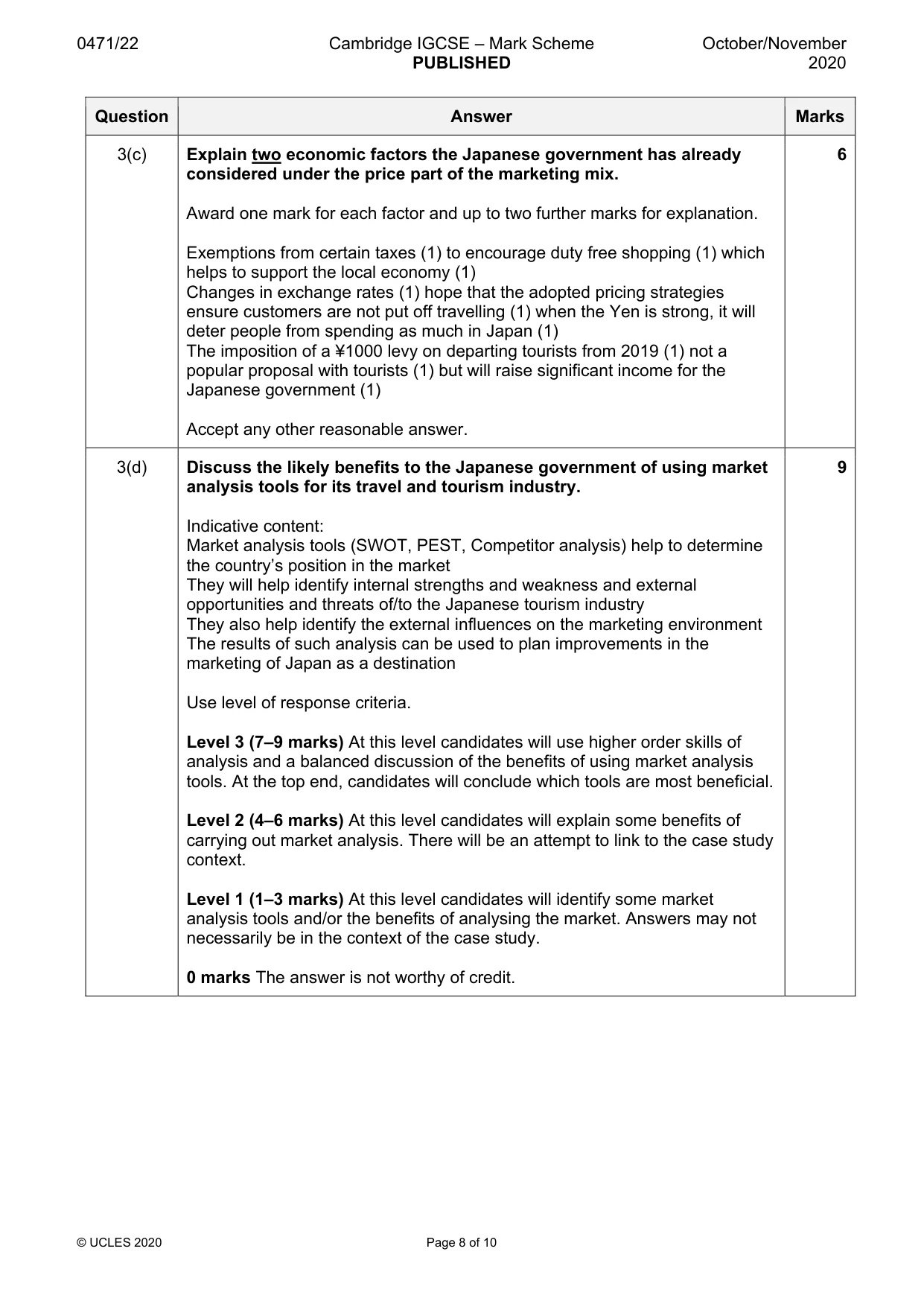
0471/22 Cambridge IGCSE – Mark Scheme PUBLISHED October/November 2020 © UCLES 2020 Page 8 of 10 Question Answer Marks 3(c) Explain two economic factors the Japanese government has already considered under the price part of the marketing mix. Award one mark for each factor and up to two further marks for explanation. Exemptions from certain taxes (1) to encourage duty free shopping (1) which helps to support the local economy (1) Changes in exchange rates (1) hope that the adopted pricing strategies ensure customers are not put off travelling (1) when the Yen is strong, it will deter people from spending as much in Japan (1) The imposition of a ¥1000 levy on departing tourists from 2019 (1) not a popular proposal with tourists (1) but will raise significant income for the Japanese government (1) Accept any other reasonable answer. 6 3(d) Discuss the likely benefits to the Japanese government of using market analysis tools for its travel and tourism industry. Indicative content: Market analysis tools (SWOT, PEST, Competitor analysis) help to determine the country’s position in the market They will help identify internal strengths and weakness and external opportunities and threats of/to the Japanese tourism industry They also help identify the external influences on the marketing environment The results of such analysis can be used to plan improvements in the marketing of Japan as a destination Use level of response criteria. Level 3 (7–9 marks) At this level candidates will use higher order skills of analysis and a balanced discussion of the benefits of using market analysis tools. At the top end, candidates will conclude which tools are most beneficial. Level 2 (4–6 marks) At this level candidates will explain some benefits of carrying out market analysis. There will be an attempt to link to the case study context. Level 1 (1–3 marks) At this level candidates will identify some market analysis tools and/or the benefits of analysing the market. Answers may not necessarily be in the context of the case study. 0 marks The answer is not worthy of credit. 9
Mark scheme, page 9
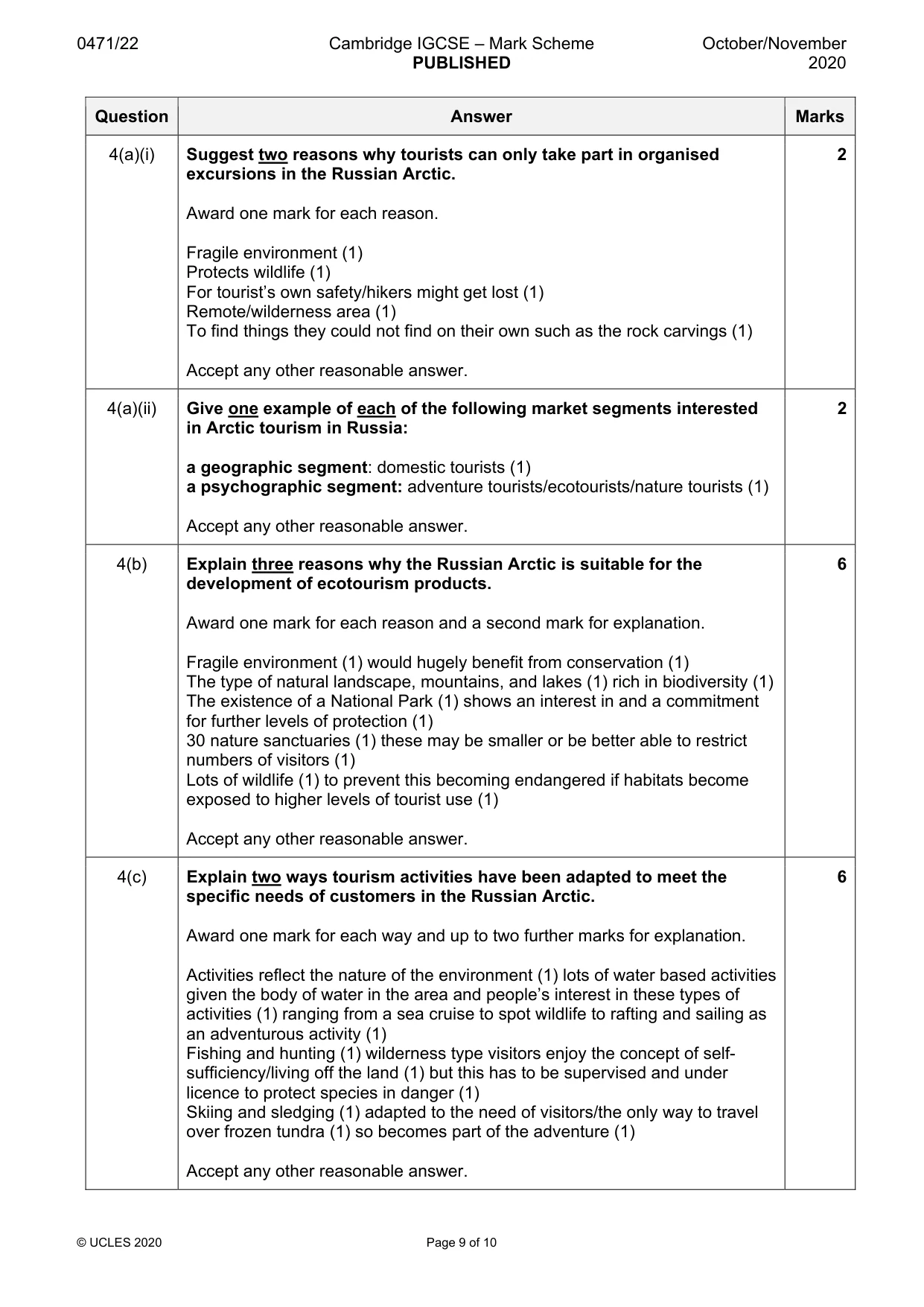
0471/22 Cambridge IGCSE – Mark Scheme PUBLISHED October/November 2020 © UCLES 2020 Page 9 of 10 Question Answer Marks 4(a)(i) Suggest two reasons why tourists can only take part in organised excursions in the Russian Arctic. Award one mark for each reason. Fragile environment (1) Protects wildlife (1) For tourist’s own safety/hikers might get lost (1) Remote/wilderness area (1) To find things they could not find on their own such as the rock carvings (1) Accept any other reasonable answer. 2 4(a)(ii) Give one example of each of the following market segments interested in Arctic tourism in Russia: a geographic segment: domestic tourists (1) a psychographic segment: adventure tourists/ecotourists/nature tourists (1) Accept any other reasonable answer. 2 4(b) Explain three reasons why the Russian Arctic is suitable for the development of ecotourism products. Award one mark for each reason and a second mark for explanation. Fragile environment (1) would hugely benefit from conservation (1) The type of natural landscape, mountains, and lakes (1) rich in biodiversity (1) The existence of a National Park (1) shows an interest in and a commitment for further levels of protection (1) 30 nature sanctuaries (1) these may be smaller or be better able to restrict numbers of visitors (1) Lots of wildlife (1) to prevent this becoming endangered if habitats become exposed to higher levels of tourist use (1) Accept any other reasonable answer. 6 4(c) Explain two ways tourism activities have been adapted to meet the specific needs of customers in the Russian Arctic. Award one mark for each way and up to two further marks for explanation. Activities reflect the nature of the environment (1) lots of water based activities given the body of water in the area and people’s interest in these types of activities (1) ranging from a sea cruise to spot wildlife to rafting and sailing as an adventurous activity (1) Fishing and hunting (1) wilderness type visitors enjoy the concept of self- sufficiency/living off the land (1) but this has to be supervised and under licence to protect species in danger (1) Skiing and sledging (1) adapted to the need of visitors/the only way to travel over frozen tundra (1) so becomes part of the adventure (1) Accept any other reasonable answer. 6
Mark scheme, page 10
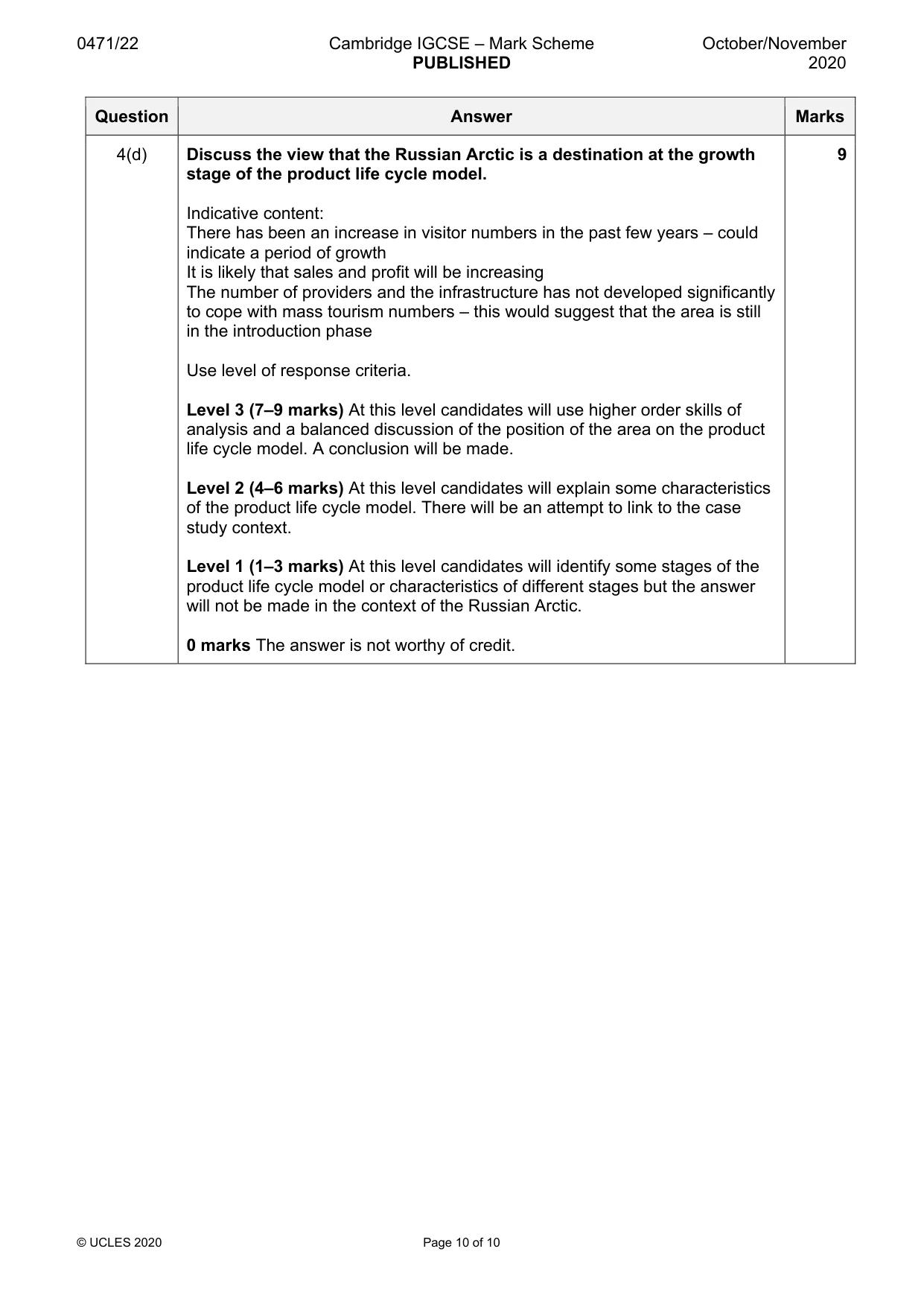
0471/22 Cambridge IGCSE – Mark Scheme PUBLISHED October/November 2020 © UCLES 2020 Page 10 of 10 Question Answer Marks 4(d) Discuss the view that the Russian Arctic is a destination at the growth stage of the product life cycle model. Indicative content: There has been an increase in visitor numbers in the past few years – could indicate a period of growth It is likely that sales and profit will be increasing The number of providers and the infrastructure has not developed significantly to cope with mass tourism numbers – this would suggest that the area is still in the introduction phase Use level of response criteria. Level 3 (7–9 marks) At this level candidates will use higher order skills of analysis and a balanced discussion of the position of the area on the product life cycle model. A conclusion will be made. Level 2 (4–6 marks) At this level candidates will explain some characteristics of the product life cycle model. There will be an attempt to link to the case study context. Level 1 (1–3 marks) At this level candidates will identify some stages of the product life cycle model or characteristics of different stages but the answer will not be made in the context of the Russian Arctic. 0 marks The answer is not worthy of credit. 9
What you needed in this session
Cambridge’s own grade thresholds for 2020 Oct/Nov, Paper 2 · Variant 2. A higher threshold means an easier paper — the bar moves with how the cohort did.