Cambridge IGCSE Travel and Tourism 0471 — 2020 May/June Paper 1 · Variant 2
0471/12/M/J/20
The question paper and its mark scheme, free to read here and free to download. This is Cambridge’s own paper, exactly as it was sat.
Question paper12 pages

Mark scheme10 pages
Answers below. Sit the paper first if you are practising.
Paper as text
Question paper, page 1
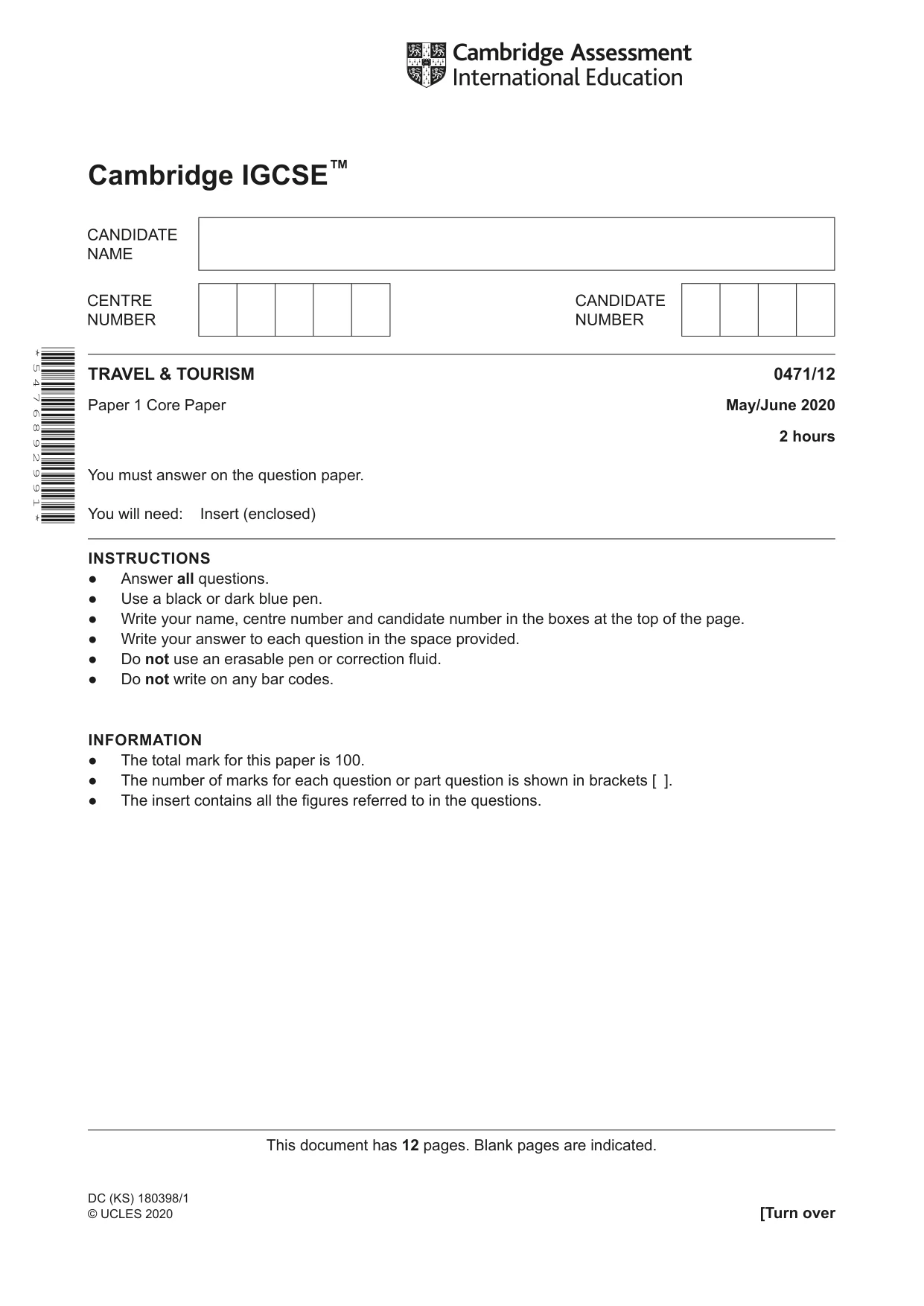
Cambridge IGCSE™ DC (KS) 180398/1 © UCLES 2020 [Turn over This document has 12 pages. Blank pages are indicated. TRAVEL & TOURISM 0471/12 Paper 1 Core Paper May/June 2020 2 hours You must answer on the question paper. You will need: Insert (enclosed) INSTRUCTIONS ● Answer all questions. ● Use a black or dark blue pen. ● Write your name, centre number and candidate number in the boxes at the top of the page. ● Write your answer to each question in the space provided. ● Do not use an erasable pen or correction fluid. ● Do not write on any bar codes. INFORMATION ● The total mark for this paper is 100. ● The number of marks for each question or part question is shown in brackets [ ]. ● The insert contains all the figures referred to in the questions. * 5 4 7 6 8 9 2 9 9 1 *
Question paper, page 2
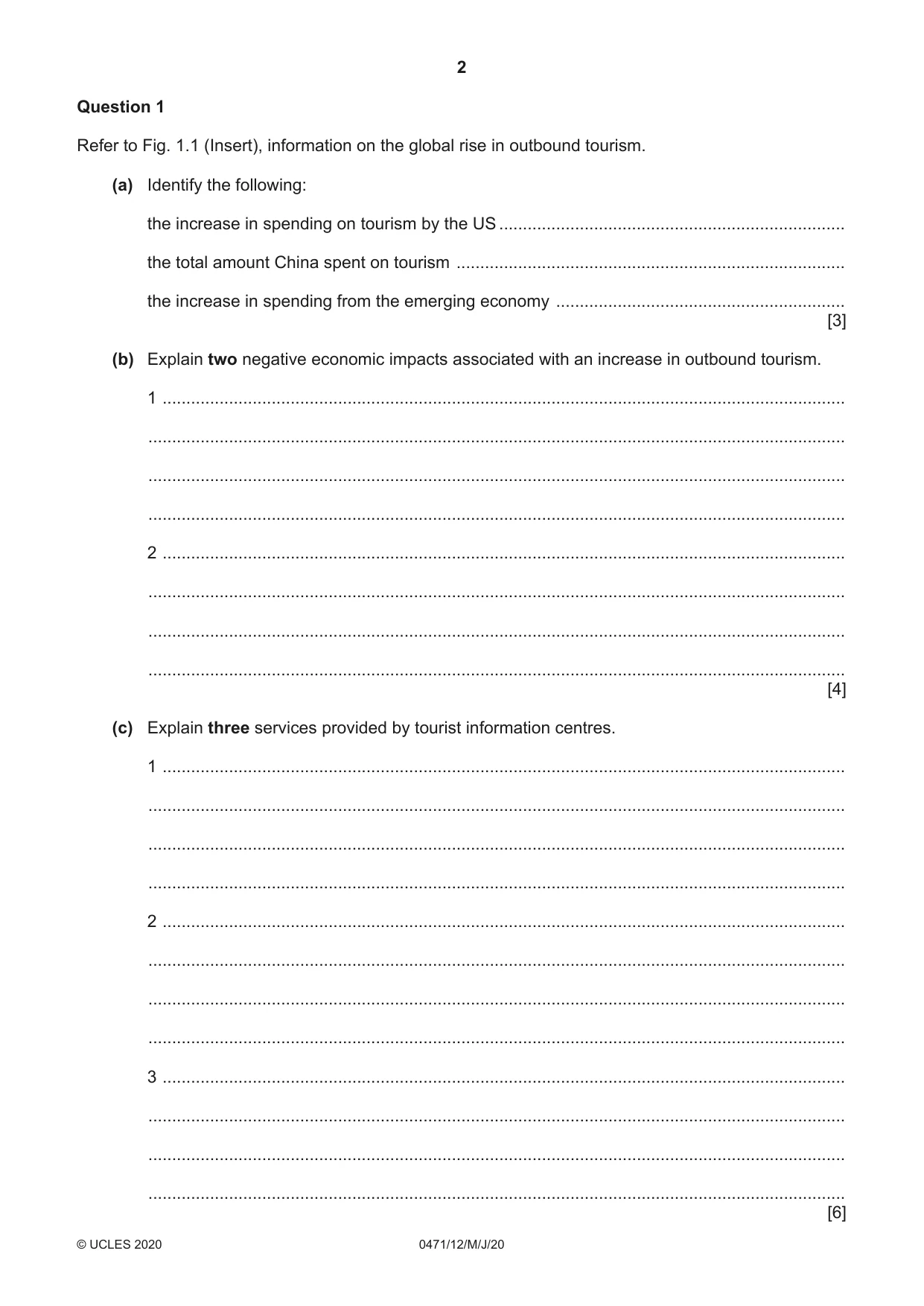
2 0471/12/M/J/20 © UCLES 2020 Question 1 Refer to Fig. 1.1 (Insert), information on the global rise in outbound tourism. (a) Identify the following: the increase in spending on tourism by the US … the total amount China spent on tourism … the increase in spending from the emerging economy … [3] (b) Explain two negative economic impacts associated with an increase in outbound tourism. 1 … … … … 2 … … … … [4] (c) Explain three services provided by tourist information centres. 1 … … … … 2 … … … … 3 … … … … [6]
Question paper, page 3
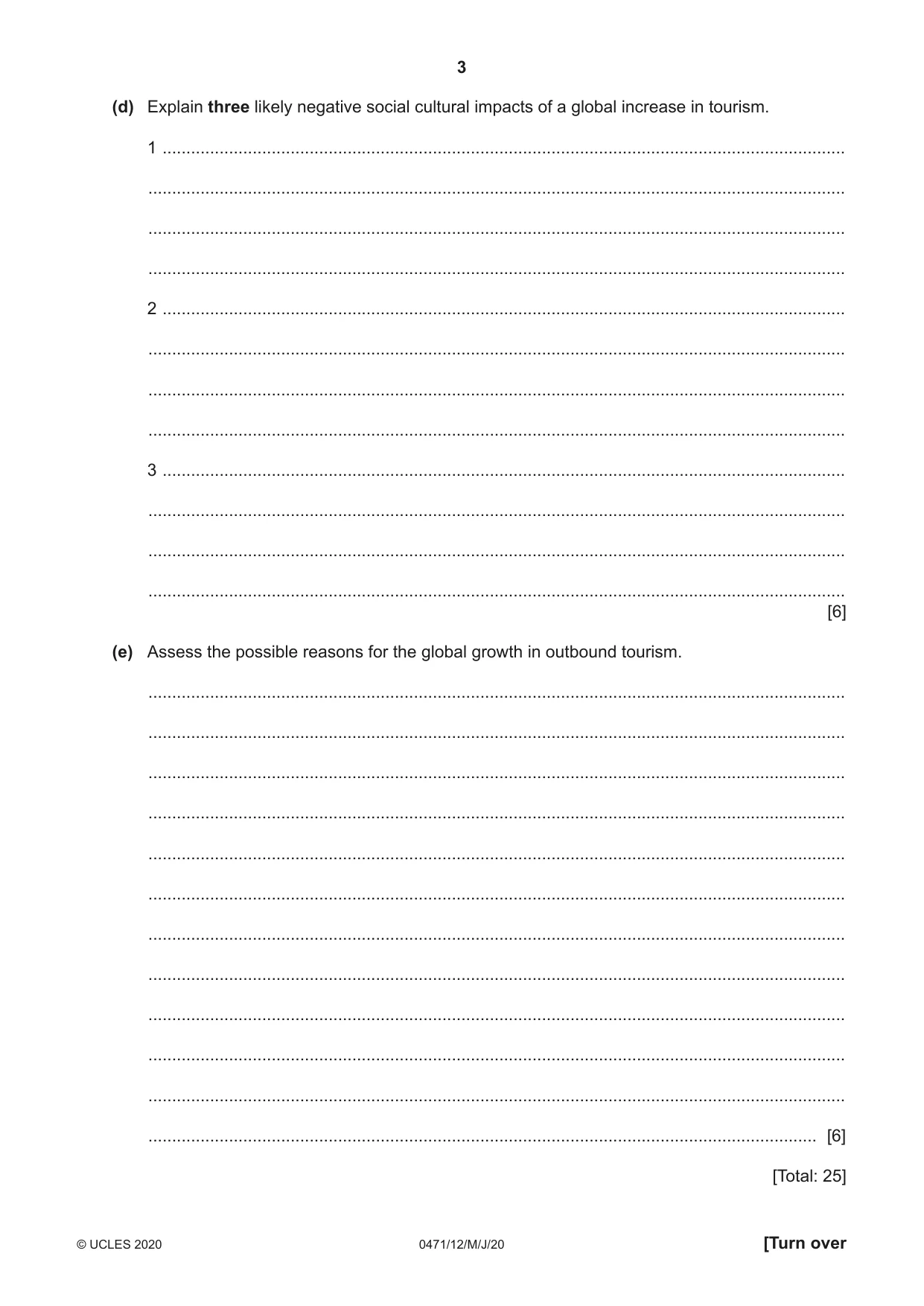
3 0471/12/M/J/20 © UCLES 2020 [Turn over (d) Explain three likely negative social cultural impacts of a global increase in tourism. 1 … … … … 2 … … … … 3 … … … … [6] (e) Assess the possible reasons for the global growth in outbound tourism. … … … … … … … … … … … … [6] [Total: 25]
Question paper, page 4
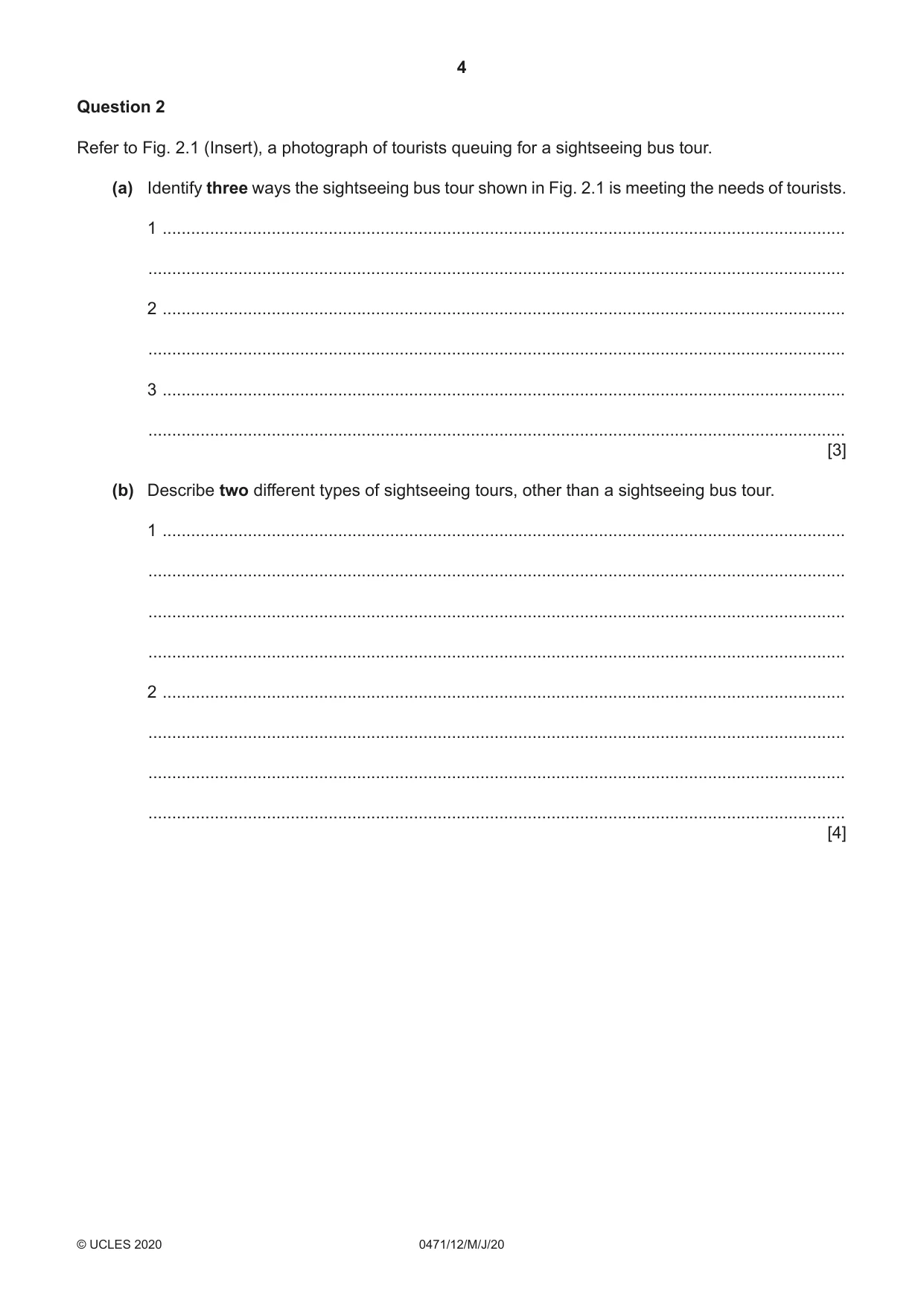
4 0471/12/M/J/20 © UCLES 2020 Question 2 Refer to Fig. 2.1 (Insert), a photograph of tourists queuing for a sightseeing bus tour. (a) Identify three ways the sightseeing bus tour shown in Fig. 2.1 is meeting the needs of tourists. 1 … … 2 … … 3 … … [3] (b) Describe two different types of sightseeing tours, other than a sightseeing bus tour. 1 … … … … 2 … … … … [4]
Question paper, page 5
5 0471/12/M/J/20 © UCLES 2020 [Turn over (c) Many sightseeing buses have a tour guide on board. Explain three interpersonal skills required of a tour guide. 1 … … … … 2 … … … … 3 … … … … [6] (d) Describe three likely personal presentation requirements for tour guides. 1 … … … … 2 … … … … 3 … … … … [6]
Question paper, page 6
6 0471/12/M/J/20 © UCLES 2020 (e) Discuss the interrelationship between sightseeing tours and tourist attractions. … … … … … … … … … … … … [6] [Total: 25]
Question paper, page 7
7 0471/12/M/J/20 © UCLES 2020 [Turn over Question 3 Refer to Fig. 3.1 (Insert), information on tourism in Lapland, a region in the north of Finland. (a) Identify the following: the expected increase in passenger numbers … the month snow starts to fall … the number of visitor arrivals by air in the month of April … the cost of the airport expansions … [4] (b) Identify the three busiest months for arrivals by air to northern Finland. 1 … 2 … 3 … [3] (c) Explain three likely reasons for the appeal of a leisure holiday in Lapland. 1 … … … … 2 … … … … 3 … … … … [6]
Question paper, page 8
8 0471/12/M/J/20 © UCLES 2020 (d) Explain three reasons why destinations expand and update their airports. 1 … … … … 2 … … … … 3 … … … … [6] (e) Discuss the ways destinations can increase tourism demand out of the main season. … … … … … … … … … … … … [6] [Total: 25]
Question paper, page 9
9 0471/12/M/J/20 © UCLES 2020 [Turn over Question 4 Refer to Fig. 4.1 (Insert), information about how some tour operators are innovating their package holidays. (a) State three providers of travel and tourism products, other than tour operators. 1 … 2 … 3 … [3] (b) Explain three factors tour operators must consider when creating package holidays. 1 … … … … 2 … … … … 3 … … … … [6]
Question paper, page 10
10 0471/12/M/J/20 © UCLES 2020 (c) Explain three likely reasons for the appeal of a door-to-door transfer to tourists. 1 … … … … 2 … … … … 3 … … … … [6] (d) Explain two ways, other than those mentioned in Fig. 4.1, tour operators could innovate their package holidays. 1 … … … … 2 … … … … [4]
Question paper, page 11
11 0471/12/M/J/20 © UCLES 2020 (e) Discuss the importance of consumer protection for tourists booking a package holiday. … … … … … … … … … … … … [6] [Total: 25]
Question paper, page 12
12 0471/12/M/J/20 © UCLES 2020 Permission to reproduce items where third-party owned material protected by copyright is included has been sought and cleared where possible. Every reasonable effort has been made by the publisher (UCLES) to trace copyright holders, but if any items requiring clearance have unwittingly been included, the publisher will be pleased to make amends at the earliest possible opportunity. To avoid the issue of disclosure of answer-related information to candidates, all copyright acknowledgements are reproduced online in the Cambridge Assessment International Education Copyright Acknowledgements Booklet. This is produced for each series of examinations and is freely available to download at www.cambridgeinternational.org after the live examination series. Cambridge Assessment International Education is part of the Cambridge Assessment Group. Cambridge Assessment is the brand name of the University of Cambridge Local Examinations Syndicate (UCLES), which itself is a department of the University of Cambridge. BLANK PAGE
Mark scheme, page 1
This document consists of 10 printed pages. © UCLES 2020 [Turn over Cambridge IGCSE™ TRAVEL & TOURISM 0471/12 Paper 1 Core Module May/June 2020 MARK SCHEME Maximum Mark: 100 Published Students did not sit exam papers in the June 2020 series due to the Covid-19 global pandemic. This mark scheme is published to support teachers and students and should be read together with the question paper. It shows the requirements of the exam. The answer column of the mark scheme shows the proposed basis on which Examiners would award marks for this exam. Where appropriate, this column also provides the most likely acceptable alternative responses expected from students. Examiners usually review the mark scheme after they have seen student responses and update the mark scheme if appropriate. In the June series, Examiners were unable to consider the acceptability of alternative responses, as there were no student responses to consider. Mark schemes should usually be read together with the Principal Examiner Report for Teachers. However, because students did not sit exam papers, there is no Principal Examiner Report for Teachers for the June 2020 series. Cambridge International will not enter into discussions about these mark schemes. Cambridge International is publishing the mark schemes for the June 2020 series for most Cambridge IGCSE™ and Cambridge International A & AS Level components, and some Cambridge O Level components.
Mark scheme, page 2
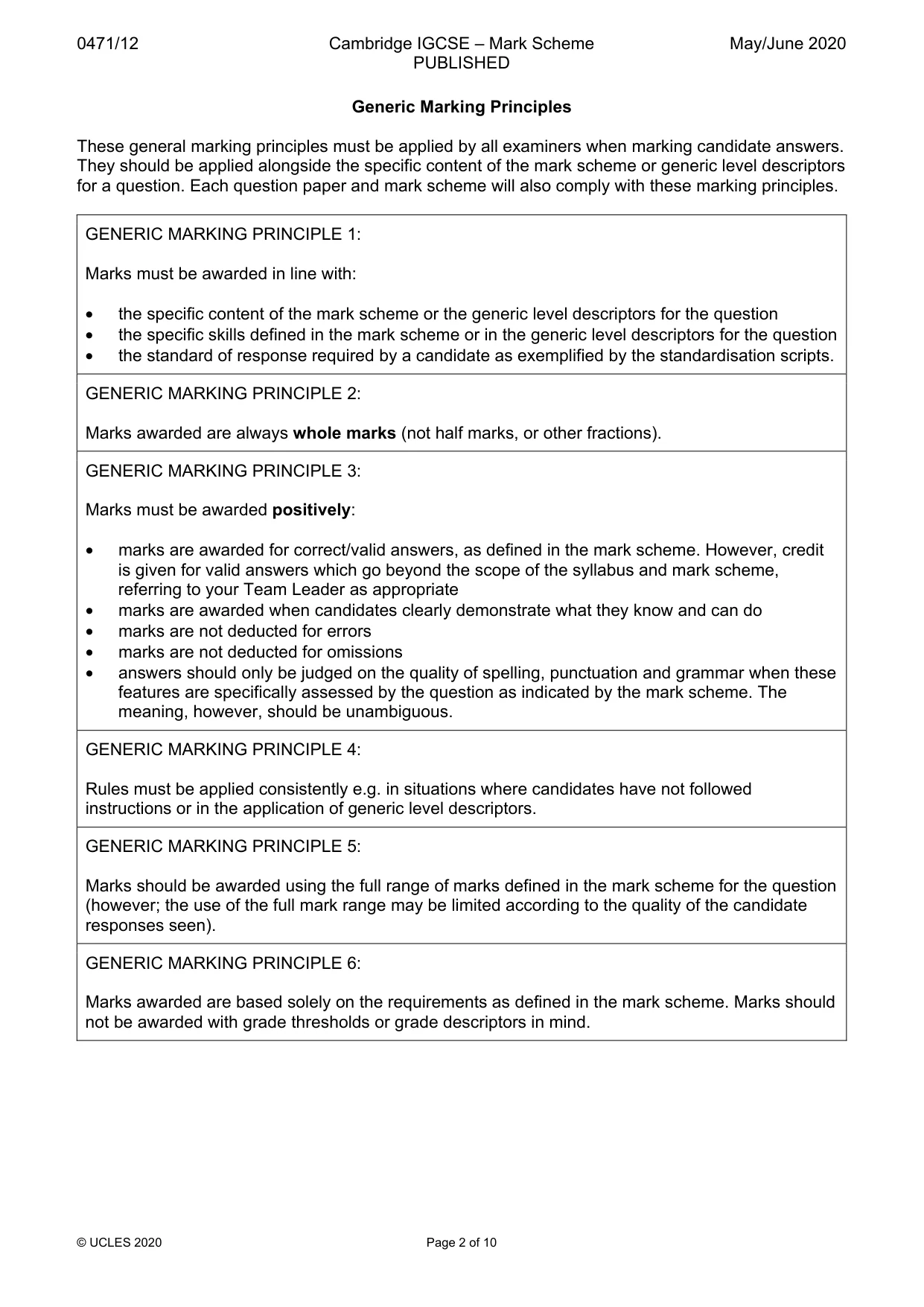
0471/12 Cambridge IGCSE – Mark Scheme PUBLISHED May/June 2020 © UCLES 2020 Page 2 of 10 Generic Marking Principles These general marking principles must be applied by all examiners when marking candidate answers. They should be applied alongside the specific content of the mark scheme or generic level descriptors for a question. Each question paper and mark scheme will also comply with these marking principles. GENERIC MARKING PRINCIPLE 1: Marks must be awarded in line with: • the specific content of the mark scheme or the generic level descriptors for the question • the specific skills defined in the mark scheme or in the generic level descriptors for the question • the standard of response required by a candidate as exemplified by the standardisation scripts. GENERIC MARKING PRINCIPLE 2: Marks awarded are always whole marks (not half marks, or other fractions). GENERIC MARKING PRINCIPLE 3: Marks must be awarded positively: • marks are awarded for correct/valid answers, as defined in the mark scheme. However, credit is given for valid answers which go beyond the scope of the syllabus and mark scheme, referring to your Team Leader as appropriate • marks are awarded when candidates clearly demonstrate what they know and can do • marks are not deducted for errors • marks are not deducted for omissions • answers should only be judged on the quality of spelling, punctuation and grammar when these features are specifically assessed by the question as indicated by the mark scheme. The meaning, however, should be unambiguous. GENERIC MARKING PRINCIPLE 4: Rules must be applied consistently e.g. in situations where candidates have not followed instructions or in the application of generic level descriptors. GENERIC MARKING PRINCIPLE 5: Marks should be awarded using the full range of marks defined in the mark scheme for the question (however; the use of the full mark range may be limited according to the quality of the candidate responses seen). GENERIC MARKING PRINCIPLE 6: Marks awarded are based solely on the requirements as defined in the mark scheme. Marks should not be awarded with grade thresholds or grade descriptors in mind.
Mark scheme, page 3
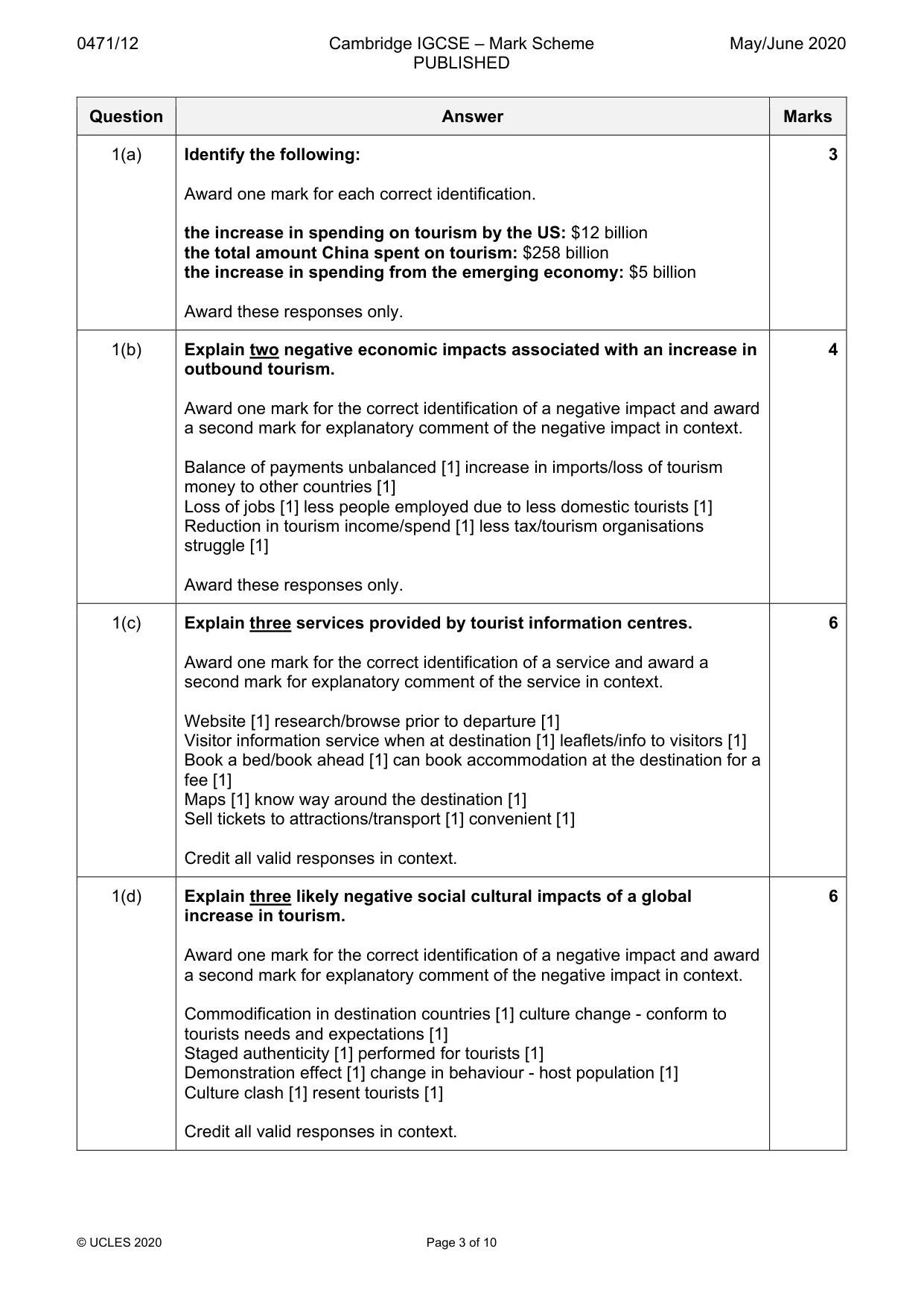
0471/12 Cambridge IGCSE – Mark Scheme PUBLISHED May/June 2020 © UCLES 2020 Page 3 of 10 Question Answer Marks 1(a) Identify the following: Award one mark for each correct identification. the increase in spending on tourism by the US: $12 billion the total amount China spent on tourism: $258 billion the increase in spending from the emerging economy: $5 billion Award these responses only. 3 1(b) Explain two negative economic impacts associated with an increase in outbound tourism. Award one mark for the correct identification of a negative impact and award a second mark for explanatory comment of the negative impact in context. Balance of payments unbalanced [1] increase in imports/loss of tourism money to other countries [1] Loss of jobs [1] less people employed due to less domestic tourists [1] Reduction in tourism income/spend [1] less tax/tourism organisations struggle [1] Award these responses only. 4 1(c) Explain three services provided by tourist information centres. Award one mark for the correct identification of a service and award a second mark for explanatory comment of the service in context. Website [1] research/browse prior to departure [1] Visitor information service when at destination [1] leaflets/info to visitors [1] Book a bed/book ahead [1] can book accommodation at the destination for a fee [1] Maps [1] know way around the destination [1] Sell tickets to attractions/transport [1] convenient [1] Credit all valid responses in context. 6 1(d) Explain three likely negative social cultural impacts of a global increase in tourism. Award one mark for the correct identification of a negative impact and award a second mark for explanatory comment of the negative impact in context. Commodification in destination countries [1] culture change - conform to tourists needs and expectations [1] Staged authenticity [1] performed for tourists [1] Demonstration effect [1] change in behaviour - host population [1] Culture clash [1] resent tourists [1] Credit all valid responses in context. 6
Mark scheme, page 4
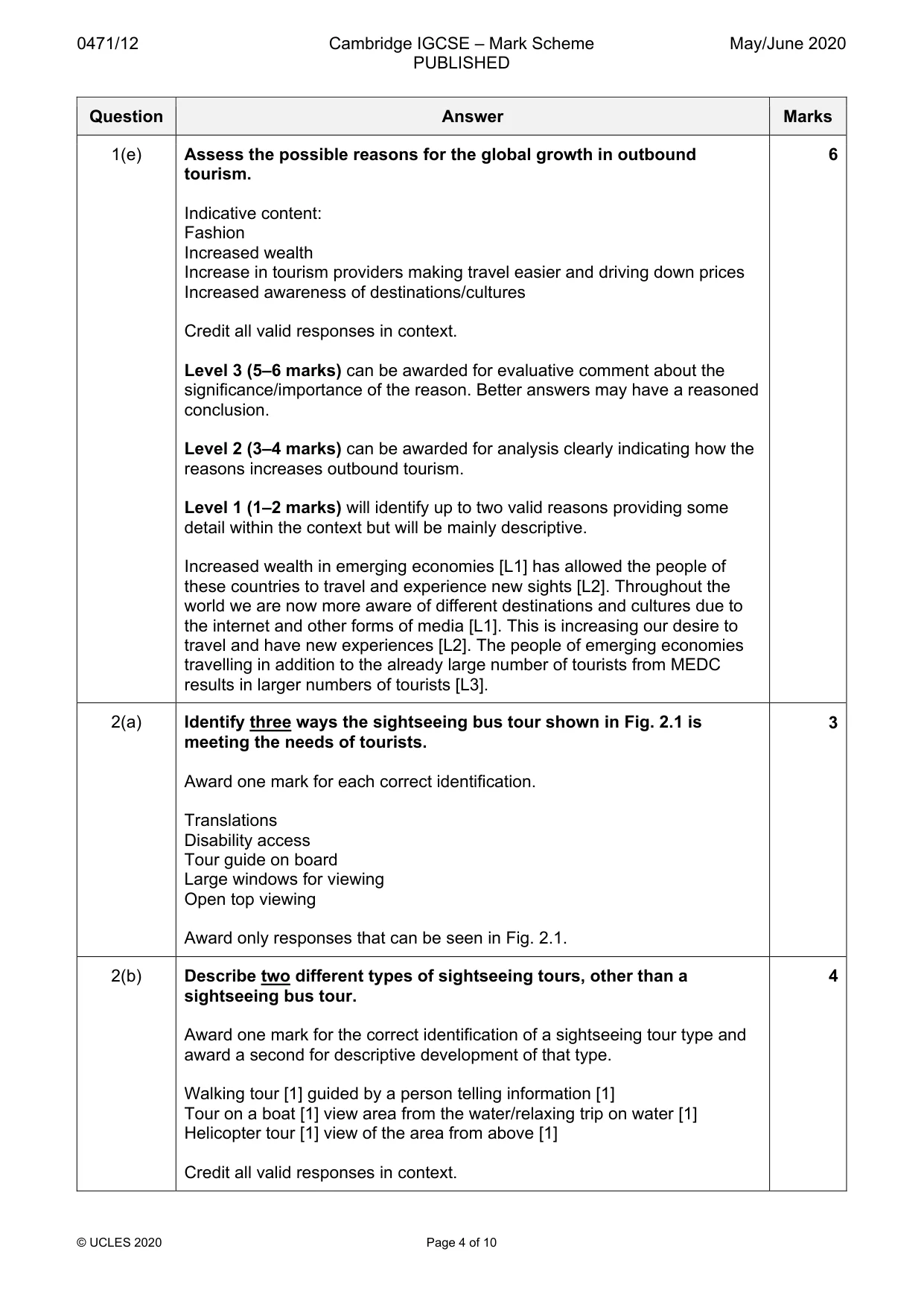
0471/12 Cambridge IGCSE – Mark Scheme PUBLISHED May/June 2020 © UCLES 2020 Page 4 of 10 Question Answer Marks 1(e) Assess the possible reasons for the global growth in outbound tourism. Indicative content: Fashion Increased wealth Increase in tourism providers making travel easier and driving down prices Increased awareness of destinations/cultures Credit all valid responses in context. Level 3 (5–6 marks) can be awarded for evaluative comment about the significance/importance of the reason. Better answers may have a reasoned conclusion. Level 2 (3–4 marks) can be awarded for analysis clearly indicating how the reasons increases outbound tourism. Level 1 (1–2 marks) will identify up to two valid reasons providing some detail within the context but will be mainly descriptive. Increased wealth in emerging economies [L1] has allowed the people of these countries to travel and experience new sights [L2]. Throughout the world we are now more aware of different destinations and cultures due to the internet and other forms of media [L1]. This is increasing our desire to travel and have new experiences [L2]. The people of emerging economies travelling in addition to the already large number of tourists from MEDC results in larger numbers of tourists [L3]. 6 2(a) Identify three ways the sightseeing bus tour shown in Fig. 2.1 is meeting the needs of tourists. Award one mark for each correct identification. Translations Disability access Tour guide on board Large windows for viewing Open top viewing Award only responses that can be seen in Fig. 2.1. 3 2(b) Describe two different types of sightseeing tours, other than a sightseeing bus tour. Award one mark for the correct identification of a sightseeing tour type and award a second for descriptive development of that type. Walking tour [1] guided by a person telling information [1] Tour on a boat [1] view area from the water/relaxing trip on water [1] Helicopter tour [1] view of the area from above [1] Credit all valid responses in context. 4
Mark scheme, page 5
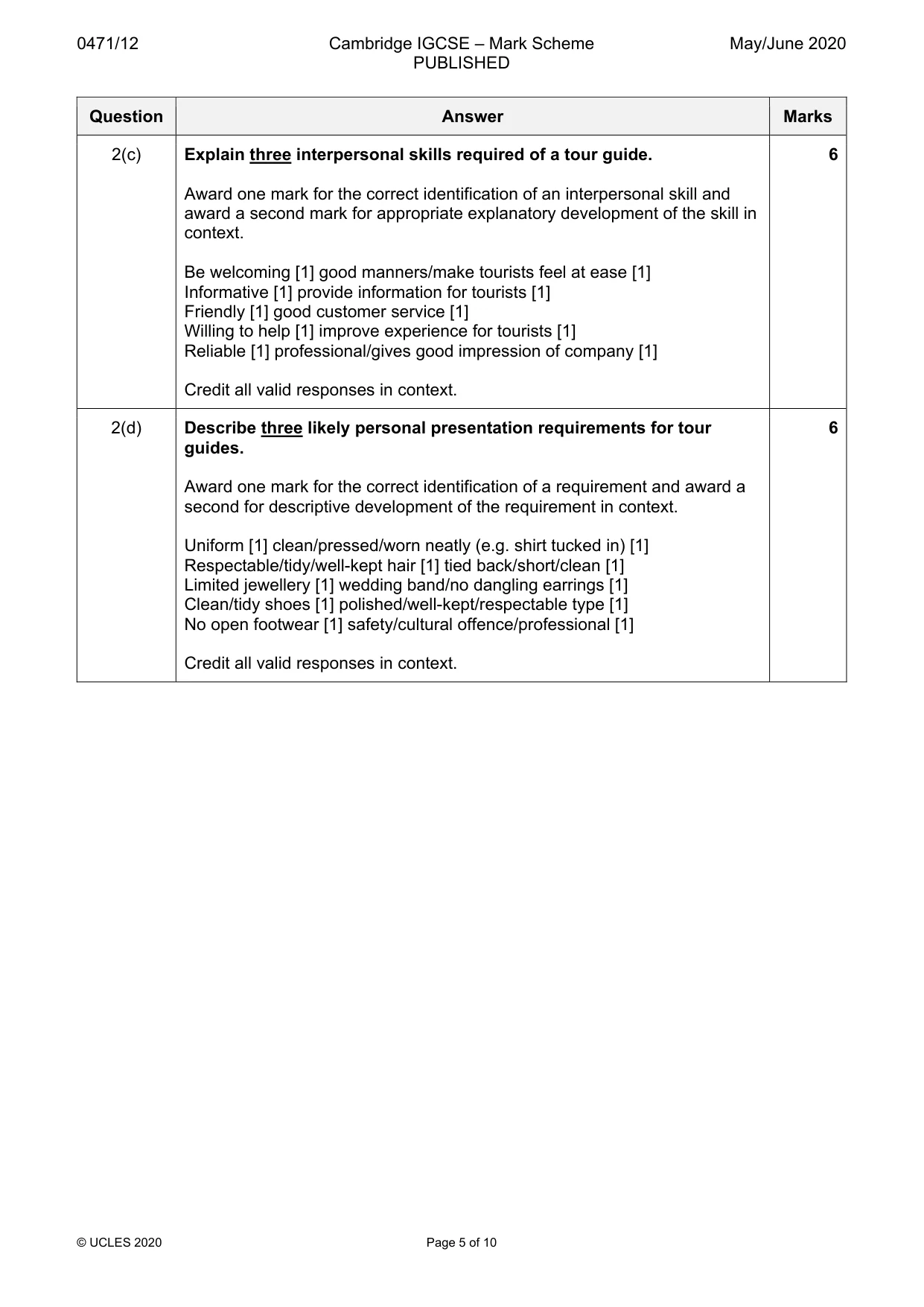
0471/12 Cambridge IGCSE – Mark Scheme PUBLISHED May/June 2020 © UCLES 2020 Page 5 of 10 Question Answer Marks 2(c) Explain three interpersonal skills required of a tour guide. Award one mark for the correct identification of an interpersonal skill and award a second mark for appropriate explanatory development of the skill in context. Be welcoming [1] good manners/make tourists feel at ease [1] Informative [1] provide information for tourists [1] Friendly [1] good customer service [1] Willing to help [1] improve experience for tourists [1] Reliable [1] professional/gives good impression of company [1] Credit all valid responses in context. 6 2(d) Describe three likely personal presentation requirements for tour guides. Award one mark for the correct identification of a requirement and award a second for descriptive development of the requirement in context. Uniform [1] clean/pressed/worn neatly (e.g. shirt tucked in) [1] Respectable/tidy/well-kept hair [1] tied back/short/clean [1] Limited jewellery [1] wedding band/no dangling earrings [1] Clean/tidy shoes [1] polished/well-kept/respectable type [1] No open footwear [1] safety/cultural offence/professional [1] Credit all valid responses in context. 6
Mark scheme, page 6
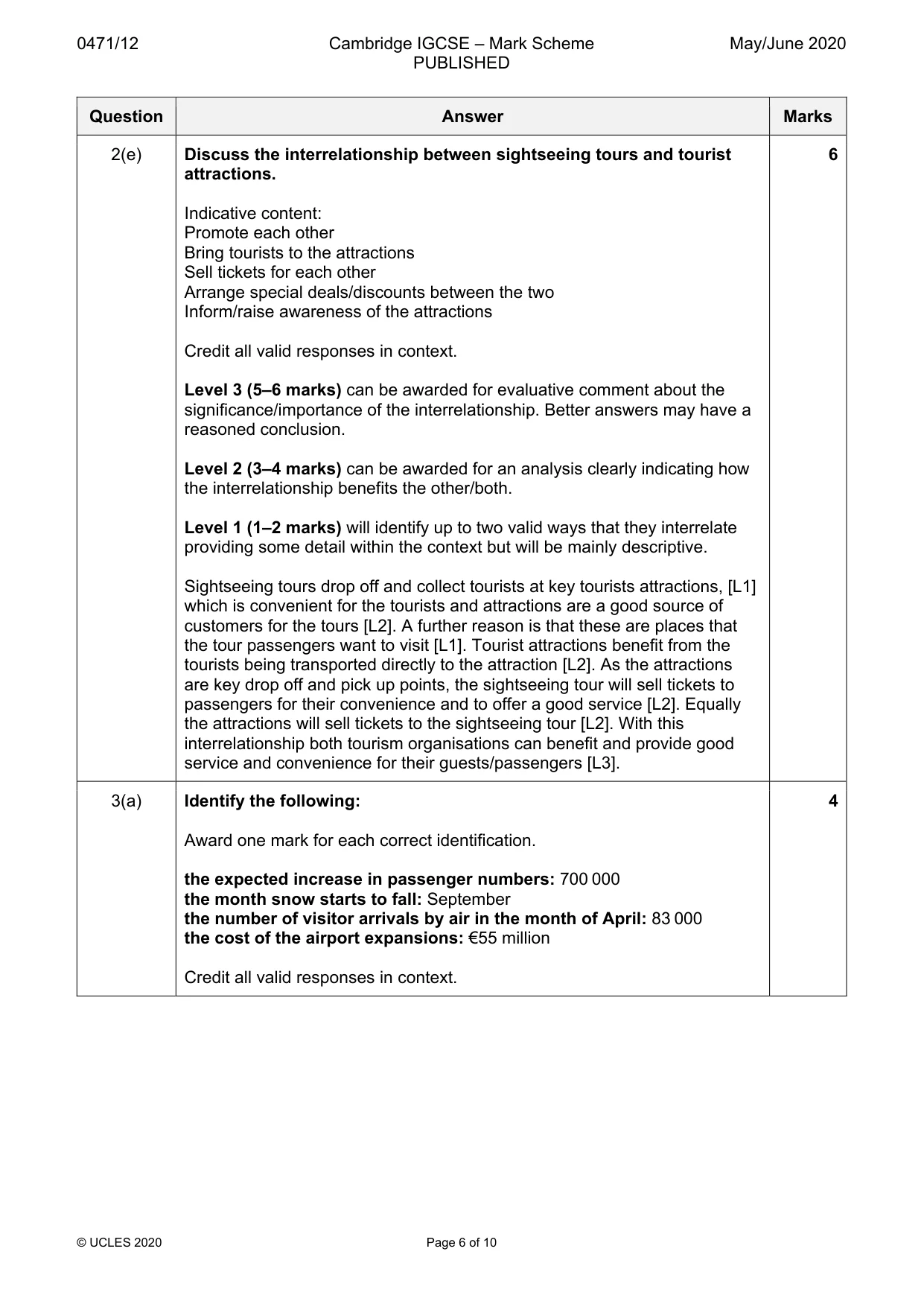
0471/12 Cambridge IGCSE – Mark Scheme PUBLISHED May/June 2020 © UCLES 2020 Page 6 of 10 Question Answer Marks 2(e) Discuss the interrelationship between sightseeing tours and tourist attractions. Indicative content: Promote each other Bring tourists to the attractions Sell tickets for each other Arrange special deals/discounts between the two Inform/raise awareness of the attractions Credit all valid responses in context. Level 3 (5–6 marks) can be awarded for evaluative comment about the significance/importance of the interrelationship. Better answers may have a reasoned conclusion. Level 2 (3–4 marks) can be awarded for an analysis clearly indicating how the interrelationship benefits the other/both. Level 1 (1–2 marks) will identify up to two valid ways that they interrelate providing some detail within the context but will be mainly descriptive. Sightseeing tours drop off and collect tourists at key tourists attractions, [L1] which is convenient for the tourists and attractions are a good source of customers for the tours [L2]. A further reason is that these are places that the tour passengers want to visit [L1]. Tourist attractions benefit from the tourists being transported directly to the attraction [L2]. As the attractions are key drop off and pick up points, the sightseeing tour will sell tickets to passengers for their convenience and to offer a good service [L2]. Equally the attractions will sell tickets to the sightseeing tour [L2]. With this interrelationship both tourism organisations can benefit and provide good service and convenience for their guests/passengers [L3]. 6 3(a) Identify the following: Award one mark for each correct identification. the expected increase in passenger numbers: 700 000 the month snow starts to fall: September the number of visitor arrivals by air in the month of April: 83 000 the cost of the airport expansions: €55 million Credit all valid responses in context. 4
Mark scheme, page 7
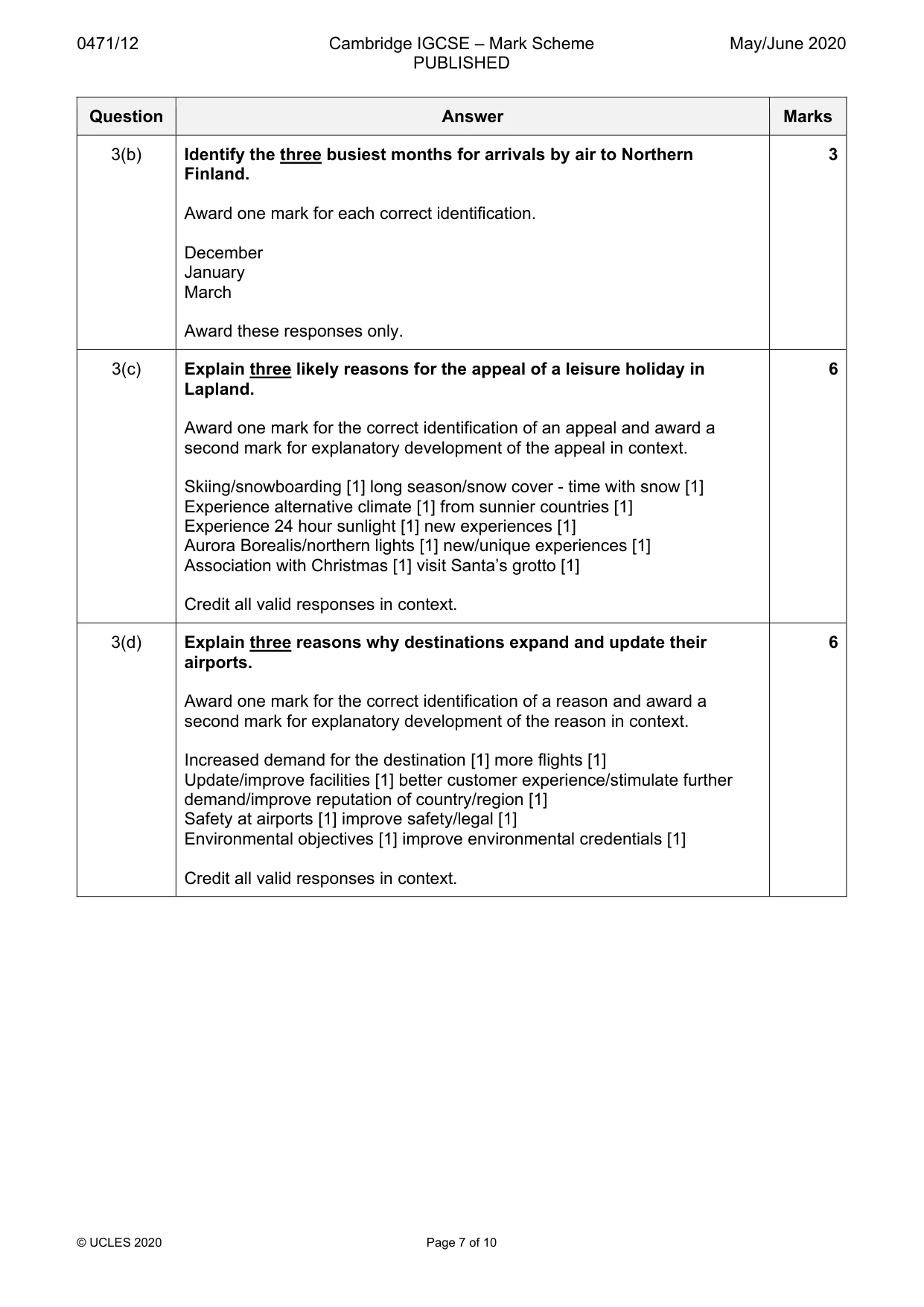
0471/12 Cambridge IGCSE – Mark Scheme PUBLISHED May/June 2020 © UCLES 2020 Page 7 of 10 Question Answer Marks 3(b) Identify the three busiest months for arrivals by air to Northern Finland. Award one mark for each correct identification. December January March Award these responses only. 3 3(c) Explain three likely reasons for the appeal of a leisure holiday in Lapland. Award one mark for the correct identification of an appeal and award a second mark for explanatory development of the appeal in context. Skiing/snowboarding [1] long season/snow cover - time with snow [1] Experience alternative climate [1] from sunnier countries [1] Experience 24 hour sunlight [1] new experiences [1] Aurora Borealis/northern lights [1] new/unique experiences [1] Association with Christmas [1] visit Santa’s grotto [1] Credit all valid responses in context. 6 3(d) Explain three reasons why destinations expand and update their airports. Award one mark for the correct identification of a reason and award a second mark for explanatory development of the reason in context. Increased demand for the destination [1] more flights [1] Update/improve facilities [1] better customer experience/stimulate further demand/improve reputation of country/region [1] Safety at airports [1] improve safety/legal [1] Environmental objectives [1] improve environmental credentials [1] Credit all valid responses in context. 6
Mark scheme, page 8
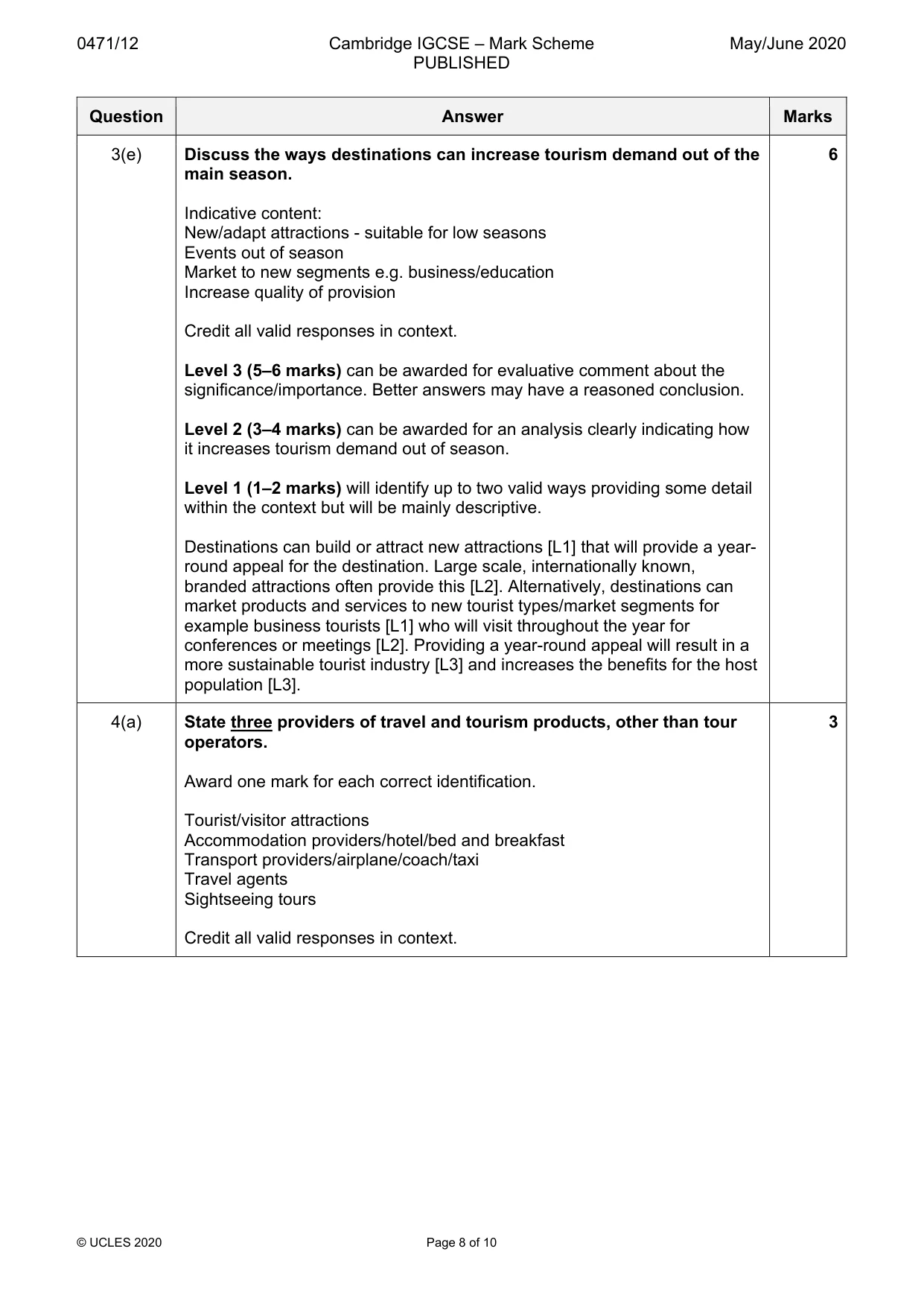
0471/12 Cambridge IGCSE – Mark Scheme PUBLISHED May/June 2020 © UCLES 2020 Page 8 of 10 Question Answer Marks 3(e) Discuss the ways destinations can increase tourism demand out of the main season. Indicative content: New/adapt attractions - suitable for low seasons Events out of season Market to new segments e.g. business/education Increase quality of provision Credit all valid responses in context. Level 3 (5–6 marks) can be awarded for evaluative comment about the significance/importance. Better answers may have a reasoned conclusion. Level 2 (3–4 marks) can be awarded for an analysis clearly indicating how it increases tourism demand out of season. Level 1 (1–2 marks) will identify up to two valid ways providing some detail within the context but will be mainly descriptive. Destinations can build or attract new attractions [L1] that will provide a year- round appeal for the destination. Large scale, internationally known, branded attractions often provide this [L2]. Alternatively, destinations can market products and services to new tourist types/market segments for example business tourists [L1] who will visit throughout the year for conferences or meetings [L2]. Providing a year-round appeal will result in a more sustainable tourist industry [L3] and increases the benefits for the host population [L3]. 6 4(a) State three providers of travel and tourism products, other than tour operators. Award one mark for each correct identification. Tourist/visitor attractions Accommodation providers/hotel/bed and breakfast Transport providers/airplane/coach/taxi Travel agents Sightseeing tours Credit all valid responses in context. 3
Mark scheme, page 9
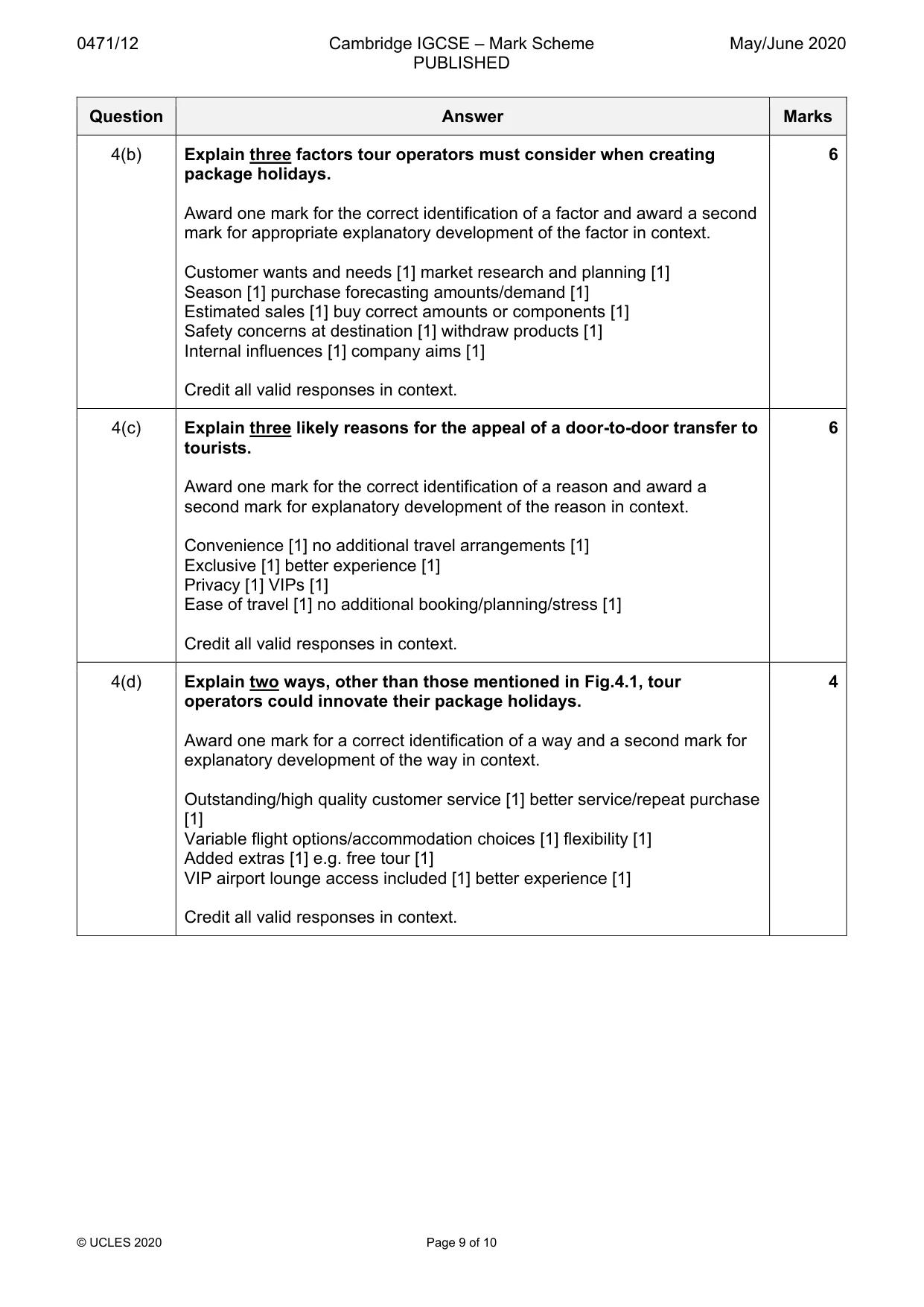
0471/12 Cambridge IGCSE – Mark Scheme PUBLISHED May/June 2020 © UCLES 2020 Page 9 of 10 Question Answer Marks 4(b) Explain three factors tour operators must consider when creating package holidays. Award one mark for the correct identification of a factor and award a second mark for appropriate explanatory development of the factor in context. Customer wants and needs [1] market research and planning [1] Season [1] purchase forecasting amounts/demand [1] Estimated sales [1] buy correct amounts or components [1] Safety concerns at destination [1] withdraw products [1] Internal influences [1] company aims [1] Credit all valid responses in context. 6 4(c) Explain three likely reasons for the appeal of a door-to-door transfer to tourists. Award one mark for the correct identification of a reason and award a second mark for explanatory development of the reason in context. Convenience [1] no additional travel arrangements [1] Exclusive [1] better experience [1] Privacy [1] VIPs [1] Ease of travel [1] no additional booking/planning/stress [1] Credit all valid responses in context. 6 4(d) Explain two ways, other than those mentioned in Fig.4.1, tour operators could innovate their package holidays. Award one mark for a correct identification of a way and a second mark for explanatory development of the way in context. Outstanding/high quality customer service [1] better service/repeat purchase [1] Variable flight options/accommodation choices [1] flexibility [1] Added extras [1] e.g. free tour [1] VIP airport lounge access included [1] better experience [1] Credit all valid responses in context. 4
Mark scheme, page 10
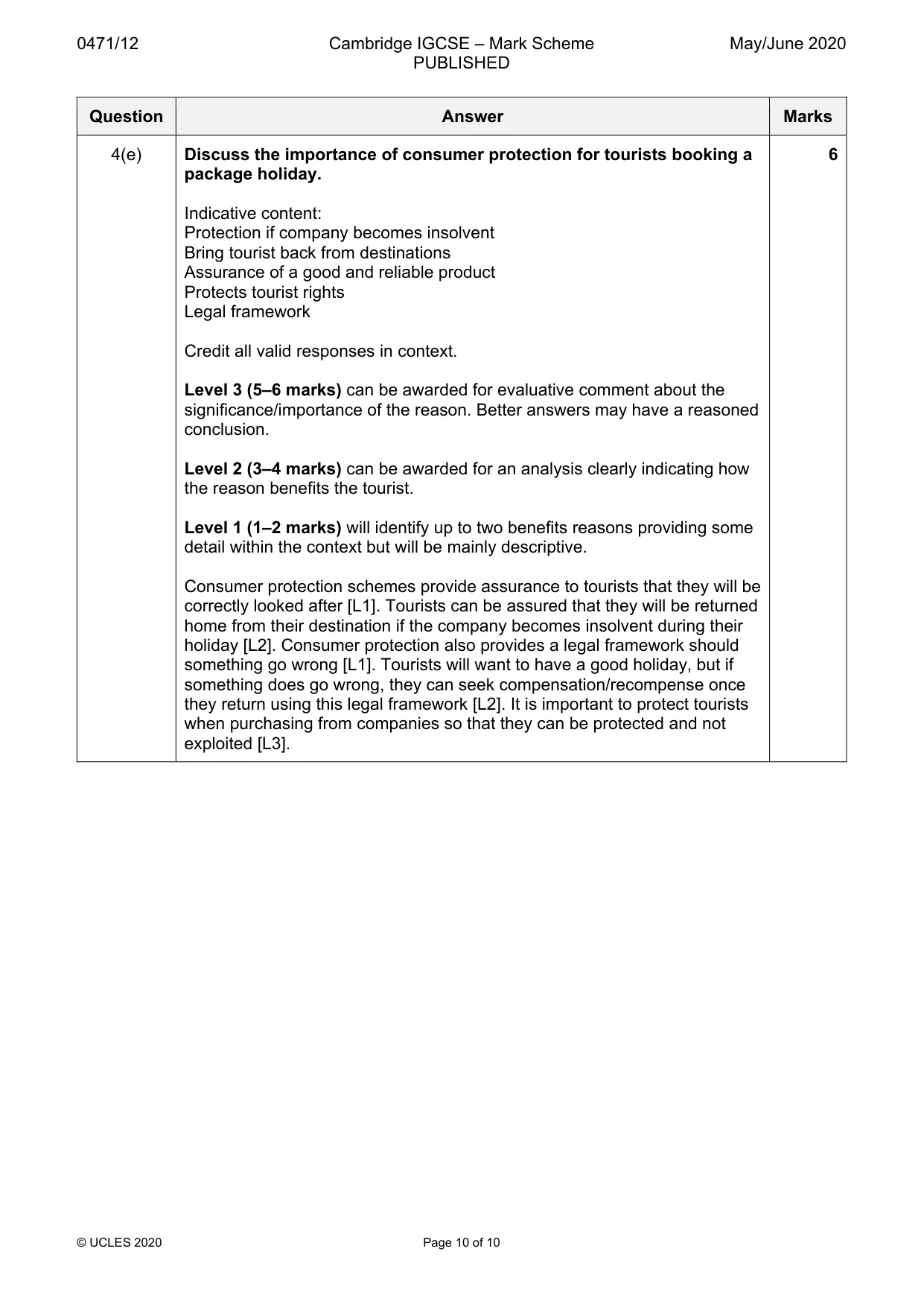
0471/12 Cambridge IGCSE – Mark Scheme PUBLISHED May/June 2020 © UCLES 2020 Page 10 of 10 Question Answer Marks 4(e) Discuss the importance of consumer protection for tourists booking a package holiday. Indicative content: Protection if company becomes insolvent Bring tourist back from destinations Assurance of a good and reliable product Protects tourist rights Legal framework Credit all valid responses in context. Level 3 (5–6 marks) can be awarded for evaluative comment about the significance/importance of the reason. Better answers may have a reasoned conclusion. Level 2 (3–4 marks) can be awarded for an analysis clearly indicating how the reason benefits the tourist. Level 1 (1–2 marks) will identify up to two benefits reasons providing some detail within the context but will be mainly descriptive. Consumer protection schemes provide assurance to tourists that they will be correctly looked after [L1]. Tourists can be assured that they will be returned home from their destination if the company becomes insolvent during their holiday [L2]. Consumer protection also provides a legal framework should something go wrong [L1]. Tourists will want to have a good holiday, but if something does go wrong, they can seek compensation/recompense once they return using this legal framework [L2]. It is important to protect tourists when purchasing from companies so that they can be protected and not exploited [L3]. 6