Cambridge IGCSE Travel and Tourism 0471 — 2020 May/June Paper 1 · Variant 3
0471/13/M/J/20
The question paper and its mark scheme, free to read here and free to download. This is Cambridge’s own paper, exactly as it was sat.
Question paper12 pages
Mark scheme10 pages
Answers below. Sit the paper first if you are practising.
Paper as text
Question paper, page 1
TRAVEL & TOURISM 0471/13 Paper 1 Core Paper May/June 2020 2 hours You must answer on the question paper. You will need: Insert (enclosed) INSTRUCTIONS ● Answer all questions. ● Use a black or dark blue pen. ● Write your name, centre number and candidate number in the boxes at the top of the page. ● Write your answer to each question in the space provided. ● Do not use an erasable pen or correction fluid. ● Do not write on any bar codes. INFORMATION ● The total mark for this paper is 100. ● The number of marks for each question or part question is shown in brackets [ ]. ● The insert contains all the figures referred to in the questions. Cambridge IGCSE™ DC (JC) 180400/2 © UCLES 2020 [Turn over This document has 12 pages. Blank pages are indicated. * 2 0 8 8 7 9 8 7 6 6 *
Question paper, page 2
2 0471/13/M/J/20 © UCLES 2020 Question 1 Refer to Fig. 1.1 (Insert), information on global tourism. (a) Identify three types of transport used by tourists. 1 … … 2 … … 3 … … [3] (b) Define, using an example, what is meant by the following terms: inbound tourism … … … … domestic tourism … … … … [4]
Question paper, page 3
3 0471/13/M/J/20 © UCLES 2020 [Turn over (c) Tourism can bring many positive economic benefits to a destination through the multiplier effect. Explain the following types of tourism multipliers: taxes … … … … investment … … … … employment … … … … [6] (d) Explain two ways tourism contributes to a country’s balance of payments. 1 … … … … … … 2 … … … … … … [6]
Question paper, page 4
4 0471/13/M/J/20 © UCLES 2020 (e) Discuss why it is important for governments and tourism organisations to monitor tourism demand. … … … … … … … … … … … … [6] [Total: 25]
Question paper, page 5
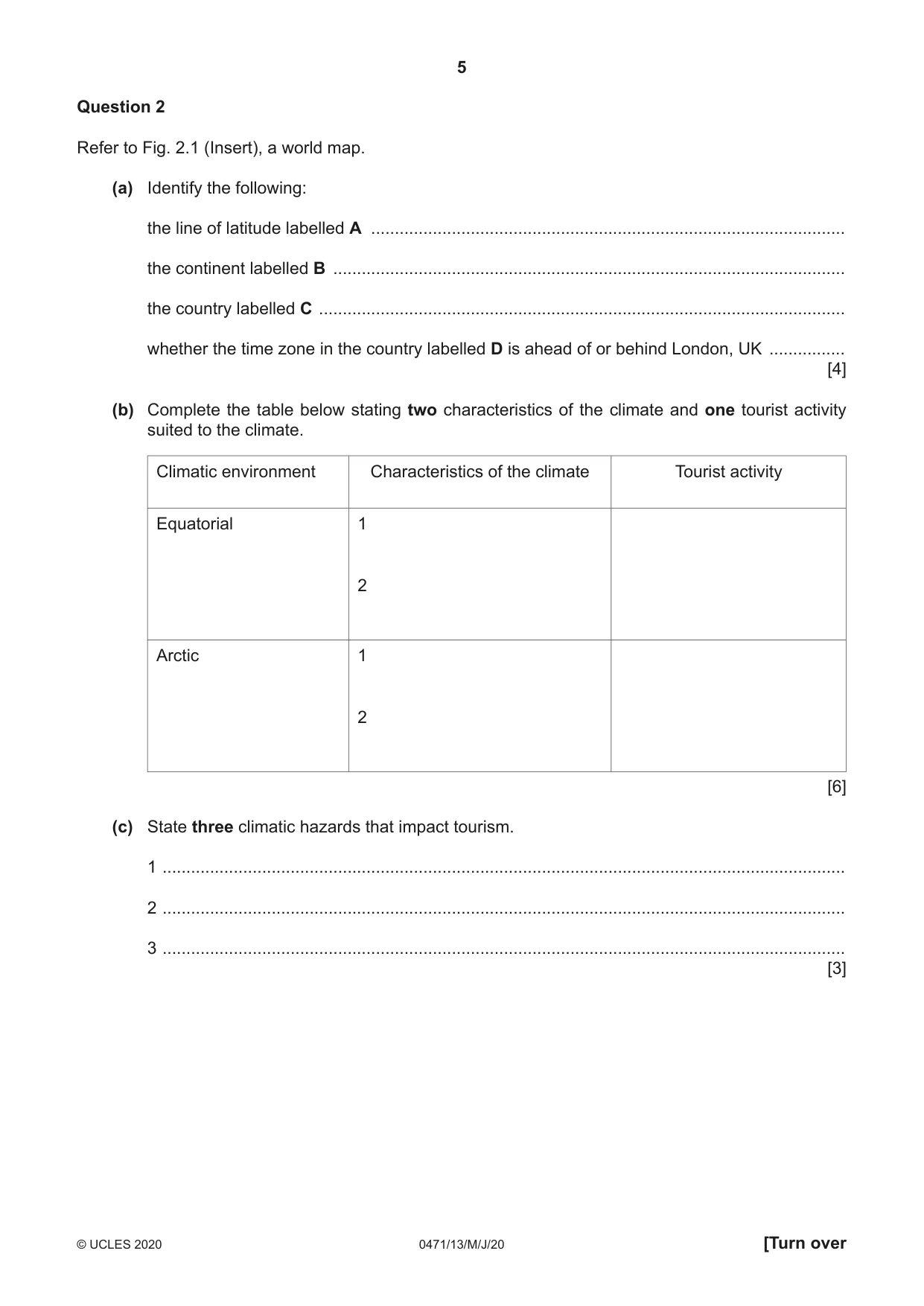
5 0471/13/M/J/20 © UCLES 2020 [Turn over Question 2 Refer to Fig. 2.1 (Insert), a world map. (a) Identify the following: the line of latitude labelled A … the continent labelled B … the country labelled C … whether the time zone in the country labelled D is ahead of or behind London, UK … [4] (b) Complete the table below stating two characteristics of the climate and one tourist activity suited to the climate. Climatic environment Characteristics of the climate Tourist activity Equatorial 1 2 Arctic 1 2 [6] (c) State three climatic hazards that impact tourism. 1 … 2 … 3 … [3]
Question paper, page 6
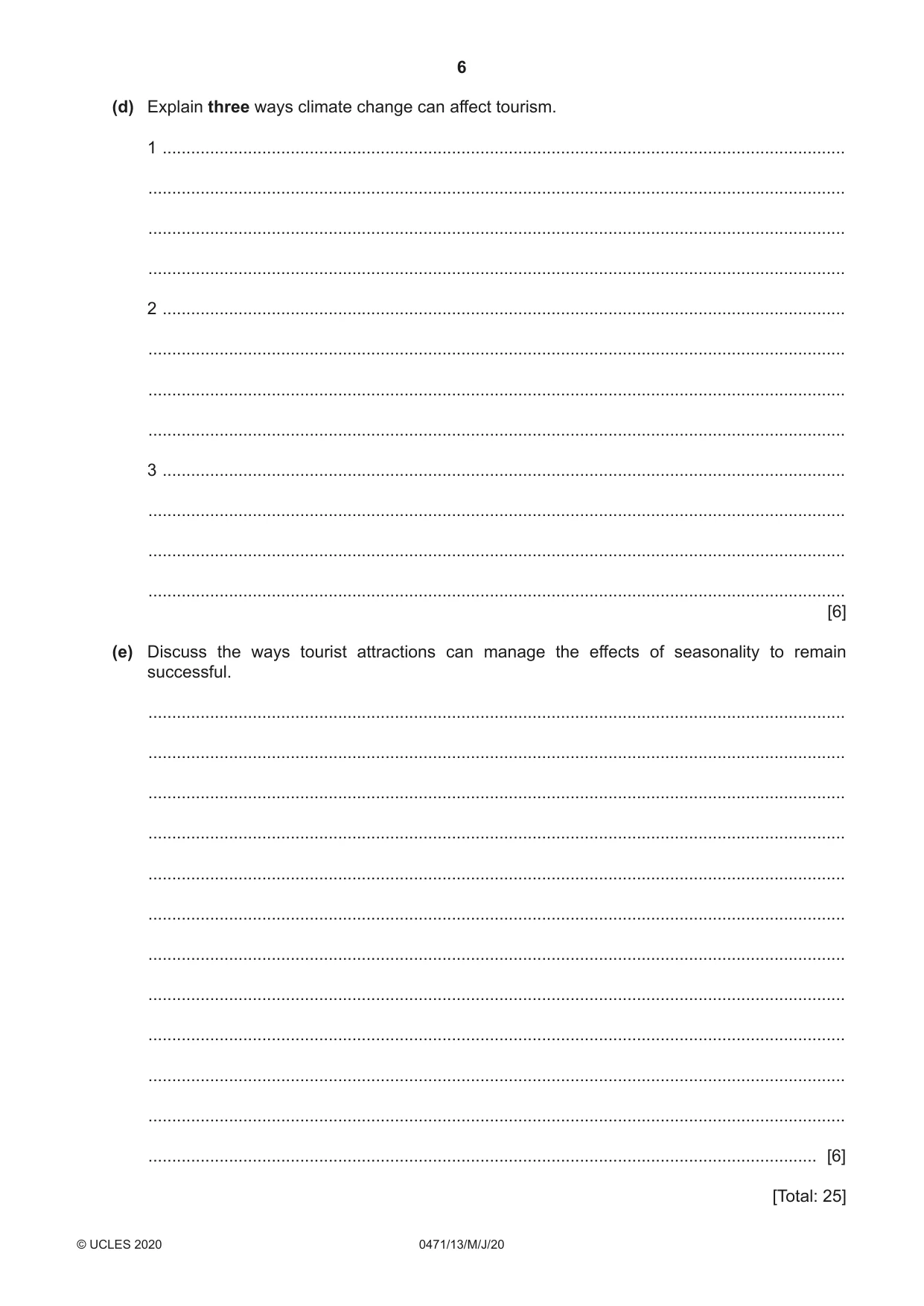
6 0471/13/M/J/20 © UCLES 2020 (d) Explain three ways climate change can affect tourism. 1 … … … … 2 … … … … 3 … … … … [6] (e) Discuss the ways tourist attractions can manage the effects of seasonality to remain successful. … … … … … … … … … … … … [6] [Total: 25]
Question paper, page 7
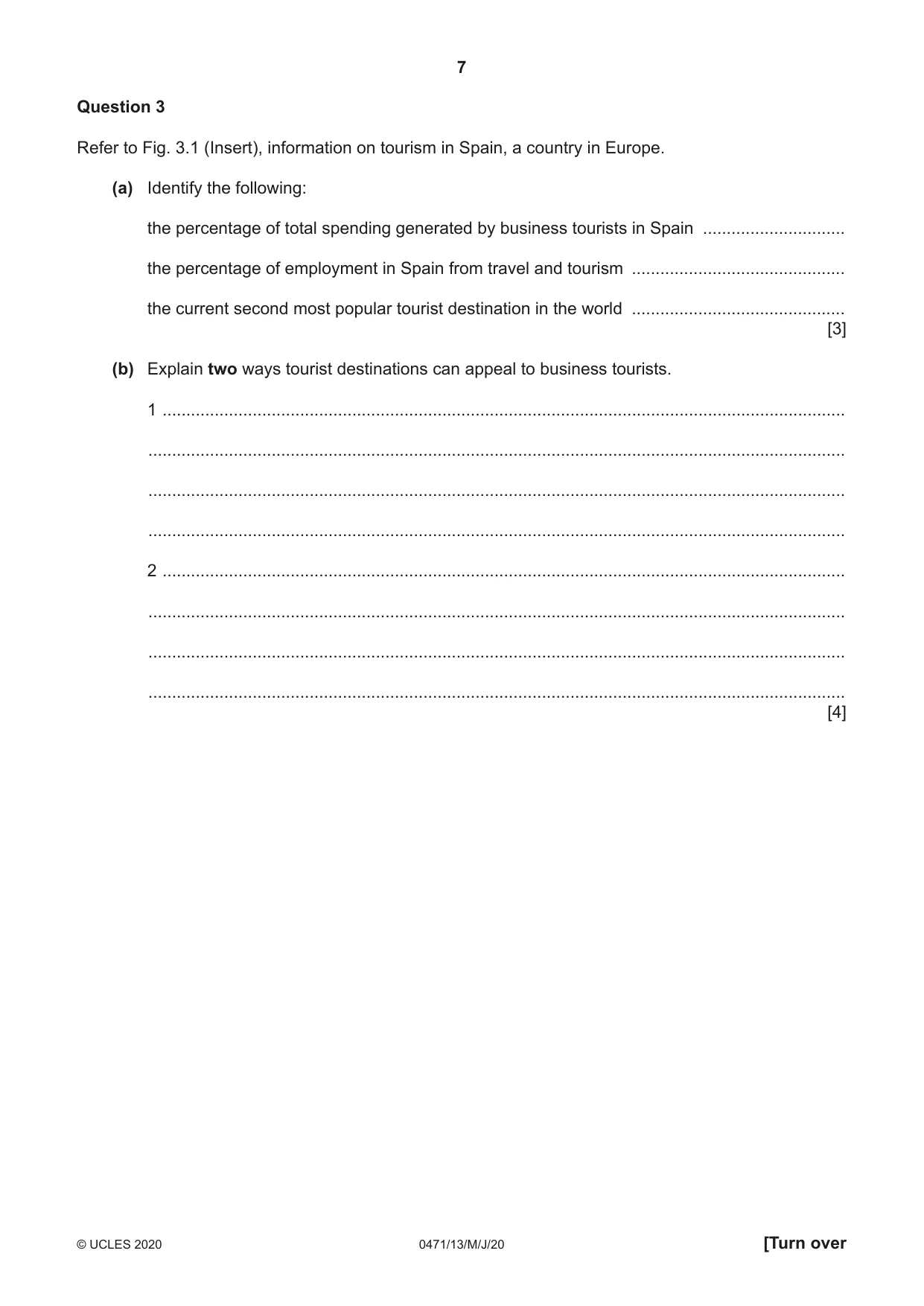
7 0471/13/M/J/20 © UCLES 2020 [Turn over Question 3 Refer to Fig. 3.1 (Insert), information on tourism in Spain, a country in Europe. (a) Identify the following: the percentage of total spending generated by business tourists in Spain … the percentage of employment in Spain from travel and tourism … the current second most popular tourist destination in the world … [3] (b) Explain two ways tourist destinations can appeal to business tourists. 1 … … … … 2 … … … … [4]
Question paper, page 8
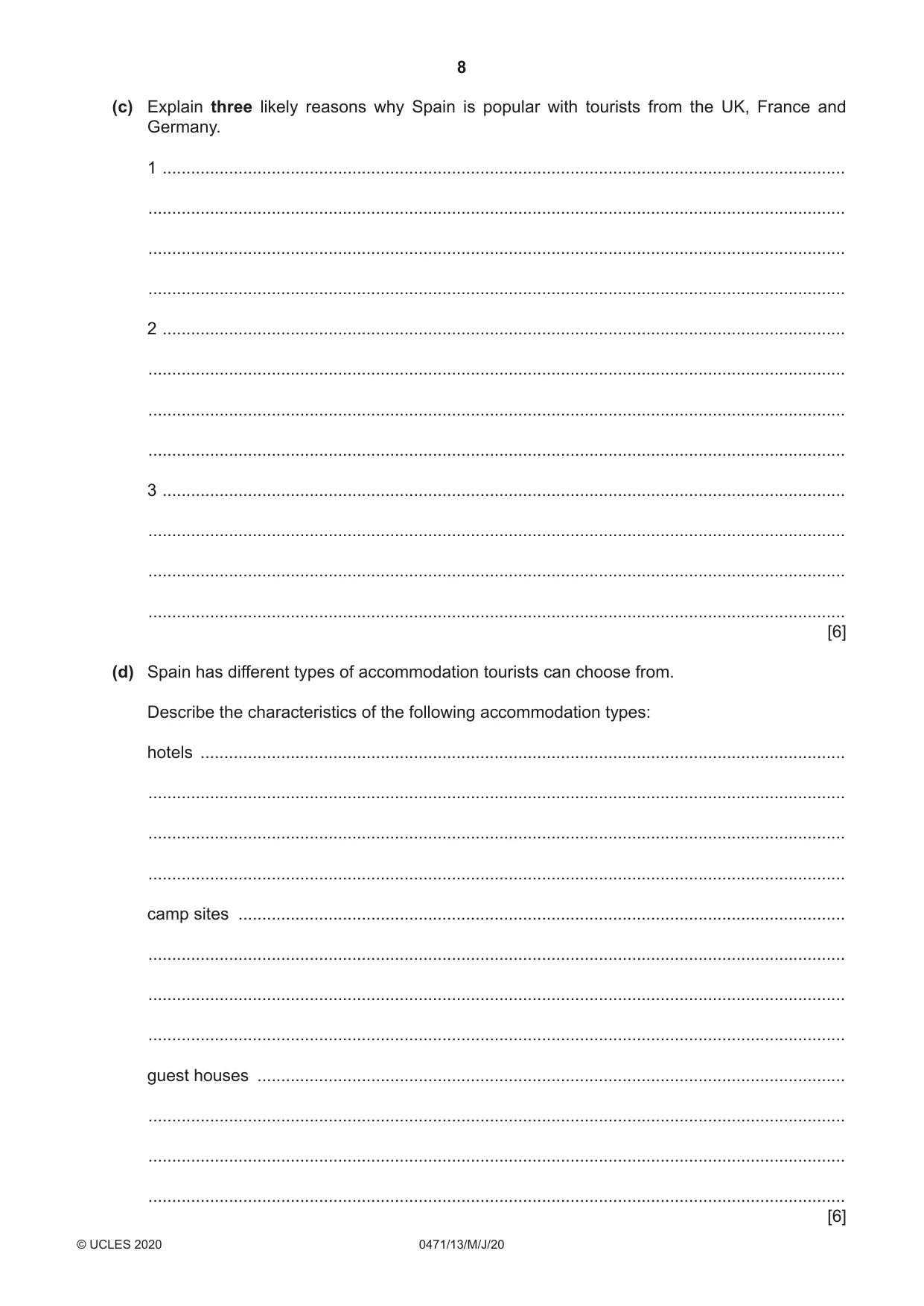
8 0471/13/M/J/20 © UCLES 2020 (c) Explain three likely reasons why Spain is popular with tourists from the UK, France and Germany. 1 … … … … 2 … … … … 3 … … … … [6] (d) Spain has different types of accommodation tourists can choose from. Describe the characteristics of the following accommodation types: hotels … … … … camp sites … … … … guest houses … … … … [6]
Question paper, page 9
9 0471/13/M/J/20 © UCLES 2020 [Turn over (e) Flamenco is a popular, traditional cultural activity in Spain, which involves music, dance and singing. Discuss the ways tourism can negatively affect traditional cultural activities. … … … … … … … … … … … … [6] [Total: 25]
Question paper, page 10
10 0471/13/M/J/20 © UCLES 2020 Question 4 Refer to Fig. 4.1 (Insert), a photograph of staff presenting an outdoor lunch buffet for hotel residents. (a) State three products provided by restaurants. 1 … 2 … 3 … [3] (b) Clear speech is essential when communicating with tourists. Explain three barriers to good communication in a tourism setting. 1 … … … … 2 … … … … 3 … … … … [6]
Question paper, page 11
11 0471/13/M/J/20 © UCLES 2020 [Turn over (c) Explain three personal presentation requirements for waiting staff. 1 … … … … 2 … … … … 3 … … … … [6] (d) Explain two ways restaurants can minimise their environmental impact. 1 … … … … 2 … … … … [4]
Question paper, page 12
12 0471/13/M/J/20 © UCLES 2020 Permission to reproduce items where third-party owned material protected by copyright is included has been sought and cleared where possible. Every reasonable effort has been made by the publisher (UCLES) to trace copyright holders, but if any items requiring clearance have unwittingly been included, the publisher will be pleased to make amends at the earliest possible opportunity. To avoid the issue of disclosure of answer-related information to candidates, all copyright acknowledgements are reproduced online in the Cambridge Assessment International Education Copyright Acknowledgements Booklet. This is produced for each series of examinations and is freely available to download at www.cambridgeinternational.org after the live examination series. Cambridge Assessment International Education is part of the Cambridge Assessment Group. Cambridge Assessment is the brand name of the University of Cambridge Local Examinations Syndicate (UCLES), which itself is a department of the University of Cambridge. (e) Assess the benefits of restaurants and hotels using local staff. … … … … … … … … … … … … [6] [Total: 25]
Mark scheme, page 1
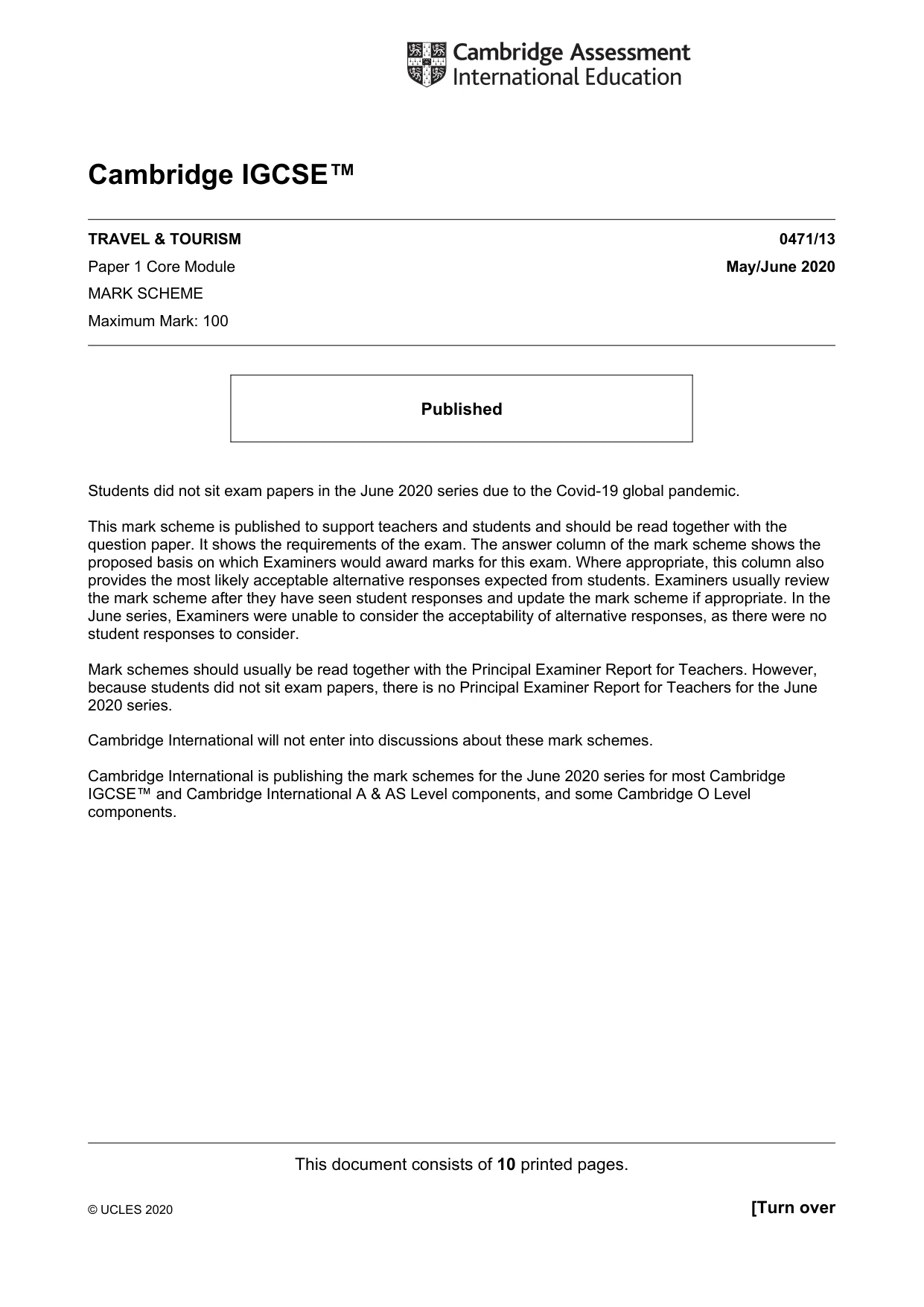
This document consists of 10 printed pages. © UCLES 2020 [Turn over Cambridge IGCSE™ TRAVEL & TOURISM 0471/13 Paper 1 Core Module May/June 2020 MARK SCHEME Maximum Mark: 100 Published Students did not sit exam papers in the June 2020 series due to the Covid-19 global pandemic. This mark scheme is published to support teachers and students and should be read together with the question paper. It shows the requirements of the exam. The answer column of the mark scheme shows the proposed basis on which Examiners would award marks for this exam. Where appropriate, this column also provides the most likely acceptable alternative responses expected from students. Examiners usually review the mark scheme after they have seen student responses and update the mark scheme if appropriate. In the June series, Examiners were unable to consider the acceptability of alternative responses, as there were no student responses to consider. Mark schemes should usually be read together with the Principal Examiner Report for Teachers. However, because students did not sit exam papers, there is no Principal Examiner Report for Teachers for the June 2020 series. Cambridge International will not enter into discussions about these mark schemes. Cambridge International is publishing the mark schemes for the June 2020 series for most Cambridge IGCSE™ and Cambridge International A & AS Level components, and some Cambridge O Level components.
Mark scheme, page 2
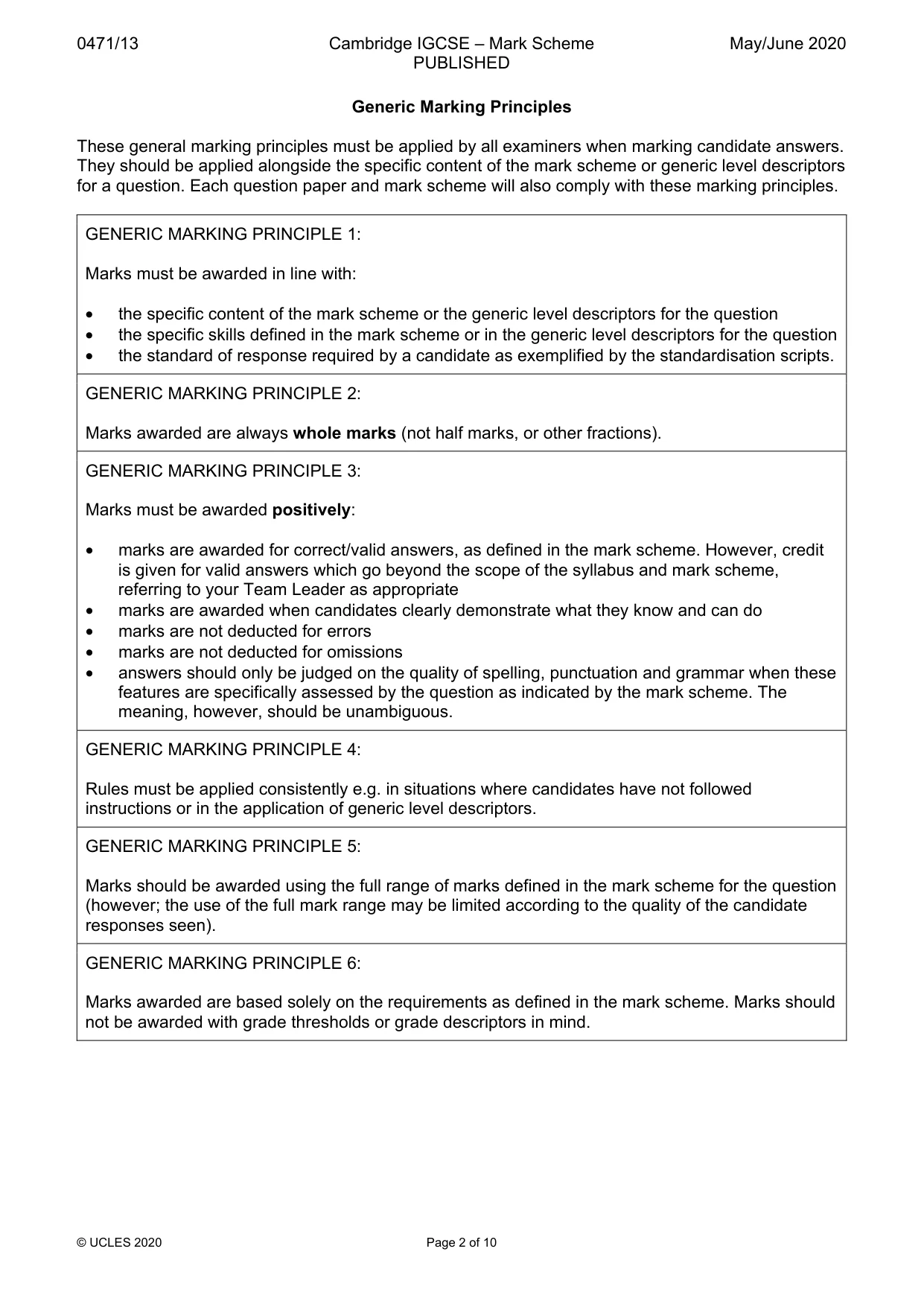
0471/13 Cambridge IGCSE – Mark Scheme PUBLISHED May/June 2020 © UCLES 2020 Page 2 of 10 Generic Marking Principles These general marking principles must be applied by all examiners when marking candidate answers. They should be applied alongside the specific content of the mark scheme or generic level descriptors for a question. Each question paper and mark scheme will also comply with these marking principles. GENERIC MARKING PRINCIPLE 1: Marks must be awarded in line with: • the specific content of the mark scheme or the generic level descriptors for the question • the specific skills defined in the mark scheme or in the generic level descriptors for the question • the standard of response required by a candidate as exemplified by the standardisation scripts. GENERIC MARKING PRINCIPLE 2: Marks awarded are always whole marks (not half marks, or other fractions). GENERIC MARKING PRINCIPLE 3: Marks must be awarded positively: • marks are awarded for correct/valid answers, as defined in the mark scheme. However, credit is given for valid answers which go beyond the scope of the syllabus and mark scheme, referring to your Team Leader as appropriate • marks are awarded when candidates clearly demonstrate what they know and can do • marks are not deducted for errors • marks are not deducted for omissions • answers should only be judged on the quality of spelling, punctuation and grammar when these features are specifically assessed by the question as indicated by the mark scheme. The meaning, however, should be unambiguous. GENERIC MARKING PRINCIPLE 4: Rules must be applied consistently e.g. in situations where candidates have not followed instructions or in the application of generic level descriptors. GENERIC MARKING PRINCIPLE 5: Marks should be awarded using the full range of marks defined in the mark scheme for the question (however; the use of the full mark range may be limited according to the quality of the candidate responses seen). GENERIC MARKING PRINCIPLE 6: Marks awarded are based solely on the requirements as defined in the mark scheme. Marks should not be awarded with grade thresholds or grade descriptors in mind.
Mark scheme, page 3
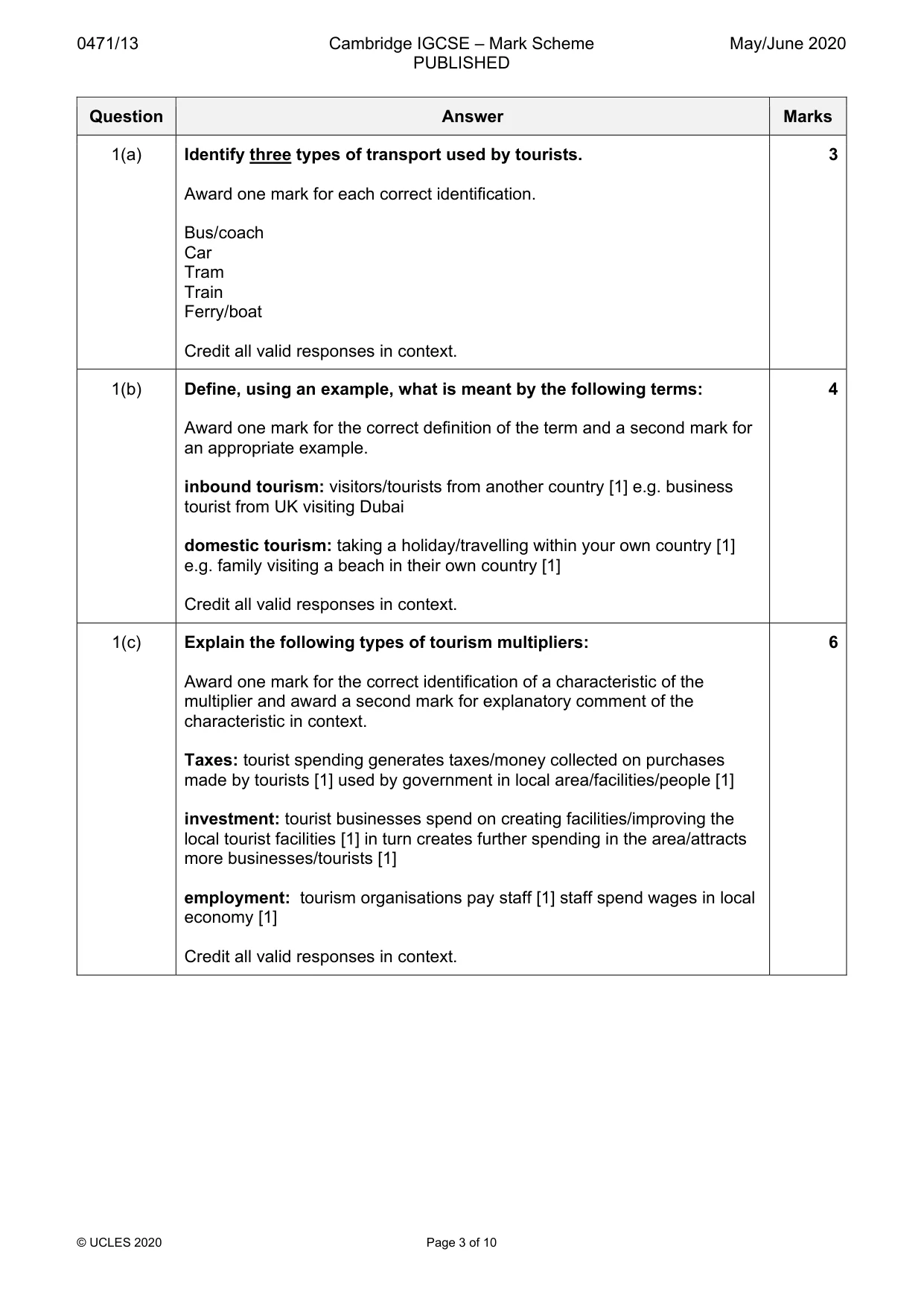
0471/13 Cambridge IGCSE – Mark Scheme PUBLISHED May/June 2020 © UCLES 2020 Page 3 of 10 Question Answer Marks 1(a) Identify three types of transport used by tourists. Award one mark for each correct identification. Bus/coach Car Tram Train Ferry/boat Credit all valid responses in context. 3 1(b) Define, using an example, what is meant by the following terms: Award one mark for the correct definition of the term and a second mark for an appropriate example. inbound tourism: visitors/tourists from another country [1] e.g. business tourist from UK visiting Dubai domestic tourism: taking a holiday/travelling within your own country [1] e.g. family visiting a beach in their own country [1] Credit all valid responses in context. 4 1(c) Explain the following types of tourism multipliers: Award one mark for the correct identification of a characteristic of the multiplier and award a second mark for explanatory comment of the characteristic in context. Taxes: tourist spending generates taxes/money collected on purchases made by tourists [1] used by government in local area/facilities/people [1] investment: tourist businesses spend on creating facilities/improving the local tourist facilities [1] in turn creates further spending in the area/attracts more businesses/tourists [1] employment: tourism organisations pay staff [1] staff spend wages in local economy [1] Credit all valid responses in context. 6
Mark scheme, page 4
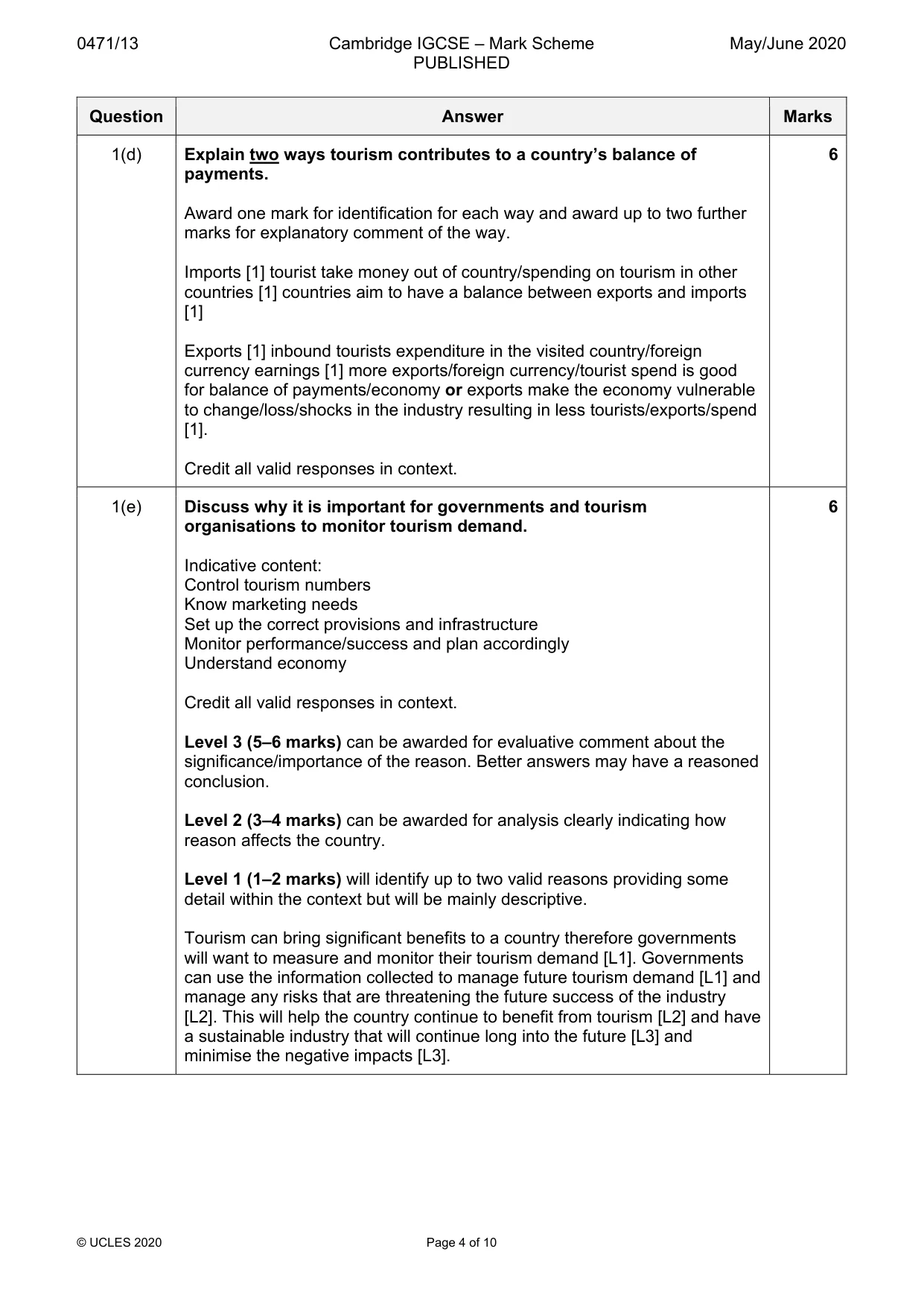
0471/13 Cambridge IGCSE – Mark Scheme PUBLISHED May/June 2020 © UCLES 2020 Page 4 of 10 Question Answer Marks 1(d) Explain two ways tourism contributes to a country’s balance of payments. Award one mark for identification for each way and award up to two further marks for explanatory comment of the way. Imports [1] tourist take money out of country/spending on tourism in other countries [1] countries aim to have a balance between exports and imports [1] Exports [1] inbound tourists expenditure in the visited country/foreign currency earnings [1] more exports/foreign currency/tourist spend is good for balance of payments/economy or exports make the economy vulnerable to change/loss/shocks in the industry resulting in less tourists/exports/spend [1]. Credit all valid responses in context. 6 1(e) Discuss why it is important for governments and tourism organisations to monitor tourism demand. Indicative content: Control tourism numbers Know marketing needs Set up the correct provisions and infrastructure Monitor performance/success and plan accordingly Understand economy Credit all valid responses in context. Level 3 (5–6 marks) can be awarded for evaluative comment about the significance/importance of the reason. Better answers may have a reasoned conclusion. Level 2 (3–4 marks) can be awarded for analysis clearly indicating how reason affects the country. Level 1 (1–2 marks) will identify up to two valid reasons providing some detail within the context but will be mainly descriptive. Tourism can bring significant benefits to a country therefore governments will want to measure and monitor their tourism demand [L1]. Governments can use the information collected to manage future tourism demand [L1] and manage any risks that are threatening the future success of the industry [L2]. This will help the country continue to benefit from tourism [L2] and have a sustainable industry that will continue long into the future [L3] and minimise the negative impacts [L3]. 6
Mark scheme, page 5
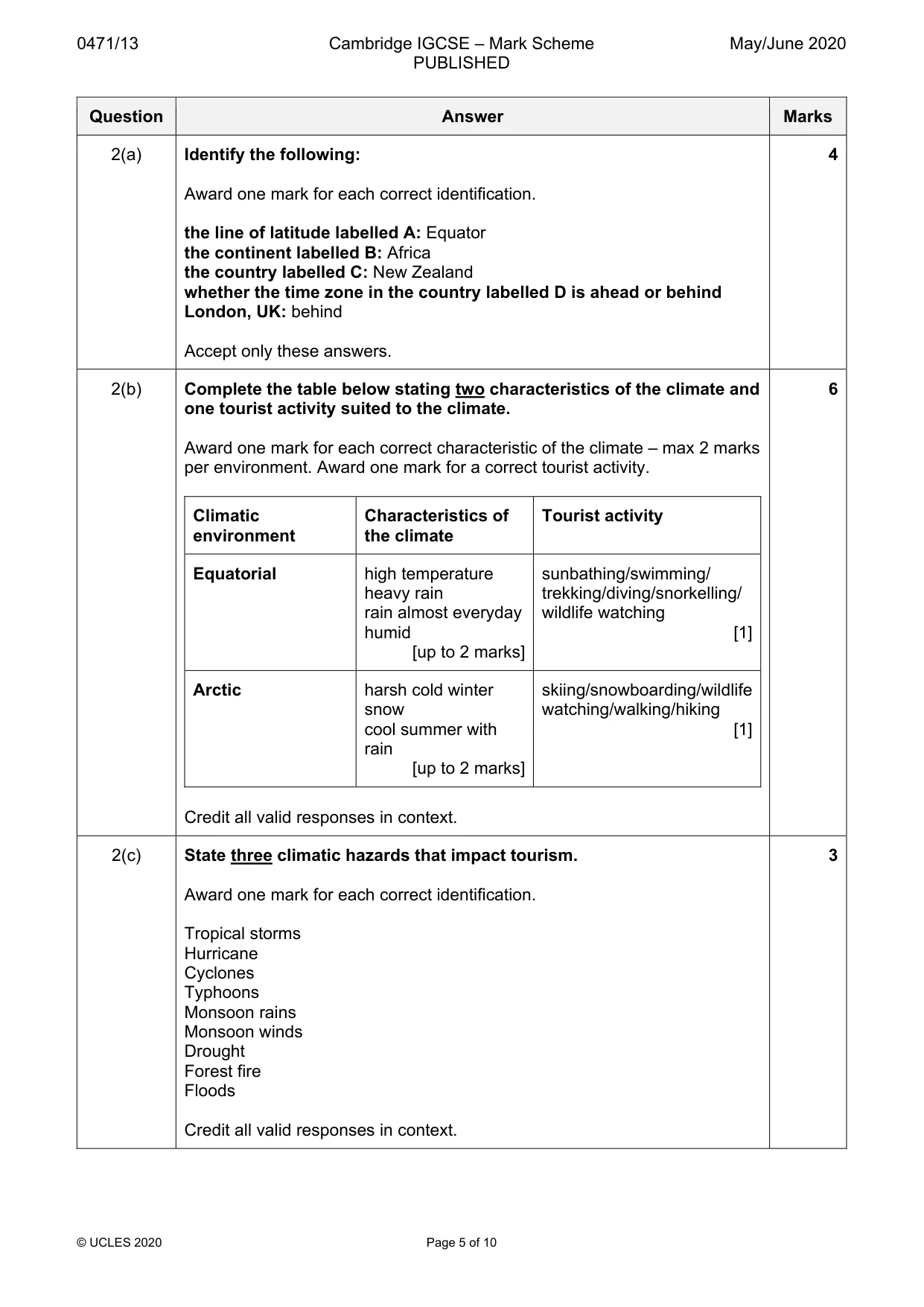
0471/13 Cambridge IGCSE – Mark Scheme PUBLISHED May/June 2020 © UCLES 2020 Page 5 of 10 Question Answer Marks 2(a) Identify the following: Award one mark for each correct identification. the line of latitude labelled A: Equator the continent labelled B: Africa the country labelled C: New Zealand whether the time zone in the country labelled D is ahead or behind London, UK: behind Accept only these answers. 4 2(b) Complete the table below stating two characteristics of the climate and one tourist activity suited to the climate. Award one mark for each correct characteristic of the climate – max 2 marks per environment. Award one mark for a correct tourist activity. Climatic environment Characteristics of the climate Tourist activity Equatorial high temperature heavy rain rain almost everyday humid [up to 2 marks] sunbathing/swimming/ trekking/diving/snorkelling/ wildlife watching [1] Arctic harsh cold winter snow cool summer with rain [up to 2 marks] skiing/snowboarding/wildlife watching/walking/hiking [1] Credit all valid responses in context. 6 2(c) State three climatic hazards that impact tourism. Award one mark for each correct identification. Tropical storms Hurricane Cyclones Typhoons Monsoon rains Monsoon winds Drought Forest fire Floods Credit all valid responses in context. 3
Mark scheme, page 6
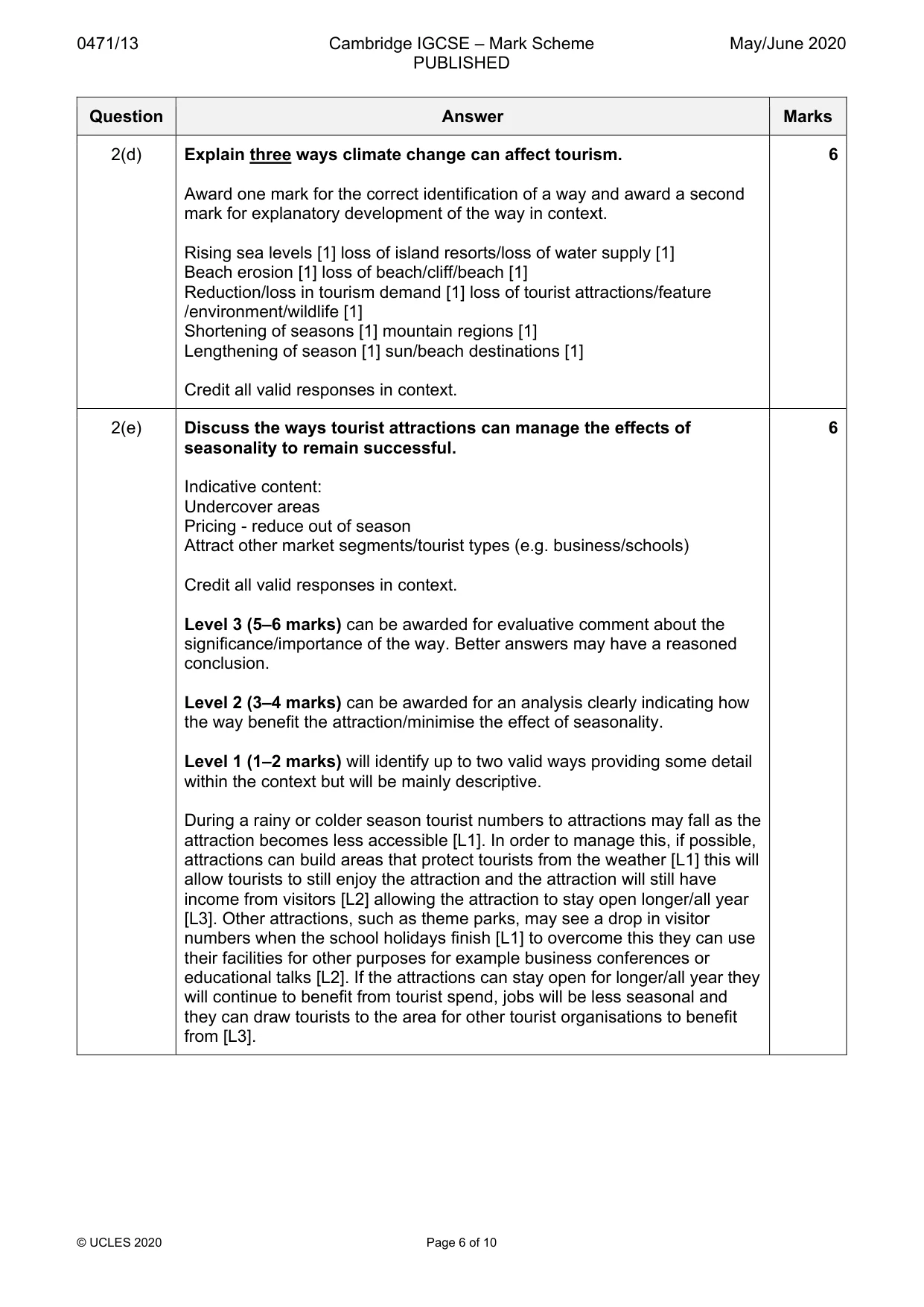
0471/13 Cambridge IGCSE – Mark Scheme PUBLISHED May/June 2020 © UCLES 2020 Page 6 of 10 Question Answer Marks 2(d) Explain three ways climate change can affect tourism. Award one mark for the correct identification of a way and award a second mark for explanatory development of the way in context. Rising sea levels [1] loss of island resorts/loss of water supply [1] Beach erosion [1] loss of beach/cliff/beach [1] Reduction/loss in tourism demand [1] loss of tourist attractions/feature /environment/wildlife [1] Shortening of seasons [1] mountain regions [1] Lengthening of season [1] sun/beach destinations [1] Credit all valid responses in context. 6 2(e) Discuss the ways tourist attractions can manage the effects of seasonality to remain successful. Indicative content: Undercover areas Pricing - reduce out of season Attract other market segments/tourist types (e.g. business/schools) Credit all valid responses in context. Level 3 (5–6 marks) can be awarded for evaluative comment about the significance/importance of the way. Better answers may have a reasoned conclusion. Level 2 (3–4 marks) can be awarded for an analysis clearly indicating how the way benefit the attraction/minimise the effect of seasonality. Level 1 (1–2 marks) will identify up to two valid ways providing some detail within the context but will be mainly descriptive. During a rainy or colder season tourist numbers to attractions may fall as the attraction becomes less accessible [L1]. In order to manage this, if possible, attractions can build areas that protect tourists from the weather [L1] this will allow tourists to still enjoy the attraction and the attraction will still have income from visitors [L2] allowing the attraction to stay open longer/all year [L3]. Other attractions, such as theme parks, may see a drop in visitor numbers when the school holidays finish [L1] to overcome this they can use their facilities for other purposes for example business conferences or educational talks [L2]. If the attractions can stay open for longer/all year they will continue to benefit from tourist spend, jobs will be less seasonal and they can draw tourists to the area for other tourist organisations to benefit from [L3]. 6
Mark scheme, page 7
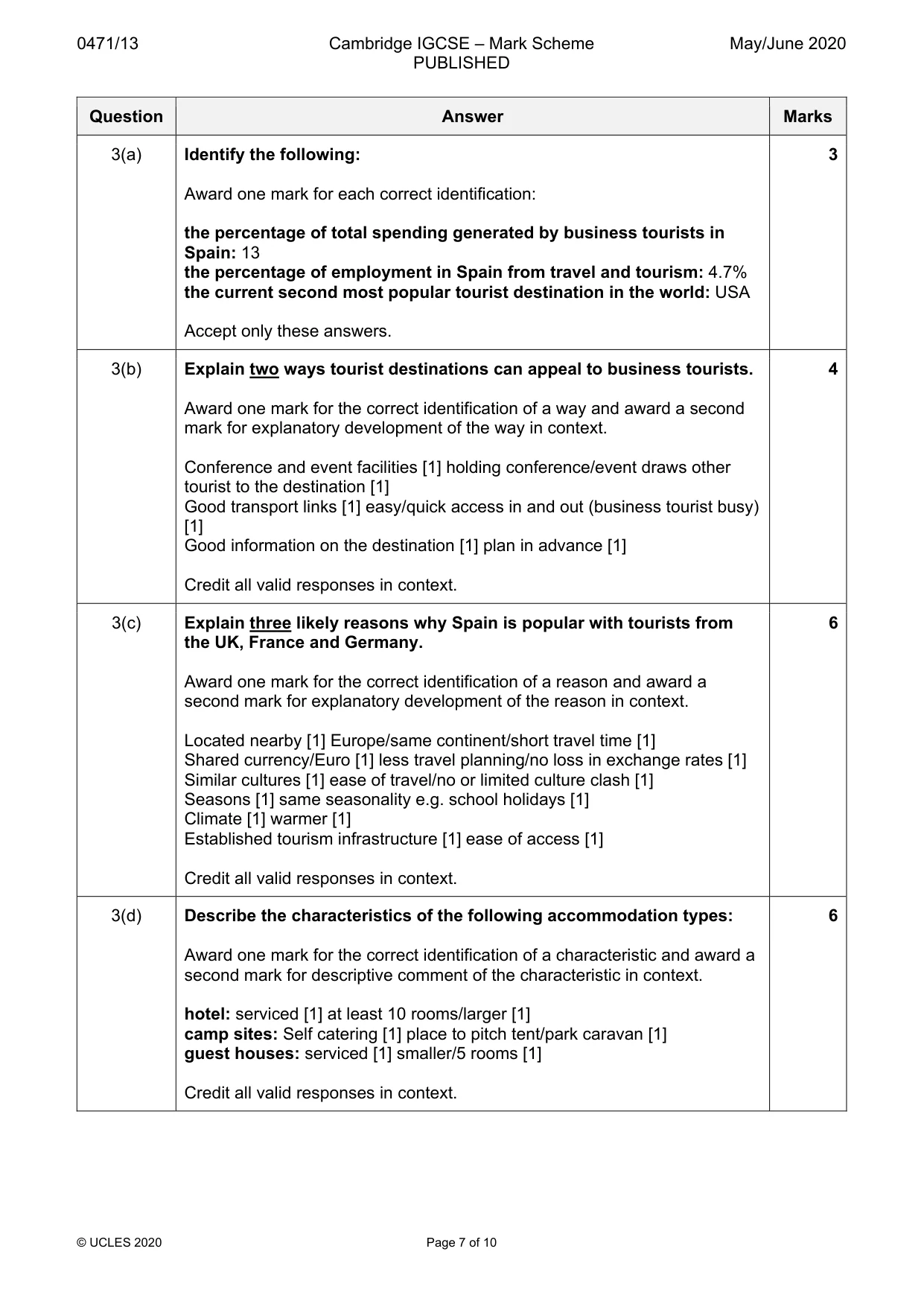
0471/13 Cambridge IGCSE – Mark Scheme PUBLISHED May/June 2020 © UCLES 2020 Page 7 of 10 Question Answer Marks 3(a) Identify the following: Award one mark for each correct identification: the percentage of total spending generated by business tourists in Spain: 13 the percentage of employment in Spain from travel and tourism: 4.7% the current second most popular tourist destination in the world: USA Accept only these answers. 3 3(b) Explain two ways tourist destinations can appeal to business tourists. Award one mark for the correct identification of a way and award a second mark for explanatory development of the way in context. Conference and event facilities [1] holding conference/event draws other tourist to the destination [1] Good transport links [1] easy/quick access in and out (business tourist busy) [1] Good information on the destination [1] plan in advance [1] Credit all valid responses in context. 4 3(c) Explain three likely reasons why Spain is popular with tourists from the UK, France and Germany. Award one mark for the correct identification of a reason and award a second mark for explanatory development of the reason in context. Located nearby [1] Europe/same continent/short travel time [1] Shared currency/Euro [1] less travel planning/no loss in exchange rates [1] Similar cultures [1] ease of travel/no or limited culture clash [1] Seasons [1] same seasonality e.g. school holidays [1] Climate [1] warmer [1] Established tourism infrastructure [1] ease of access [1] Credit all valid responses in context. 6 3(d) Describe the characteristics of the following accommodation types: Award one mark for the correct identification of a characteristic and award a second mark for descriptive comment of the characteristic in context. hotel: serviced [1] at least 10 rooms/larger [1] camp sites: Self catering [1] place to pitch tent/park caravan [1] guest houses: serviced [1] smaller/5 rooms [1] Credit all valid responses in context. 6
Mark scheme, page 8
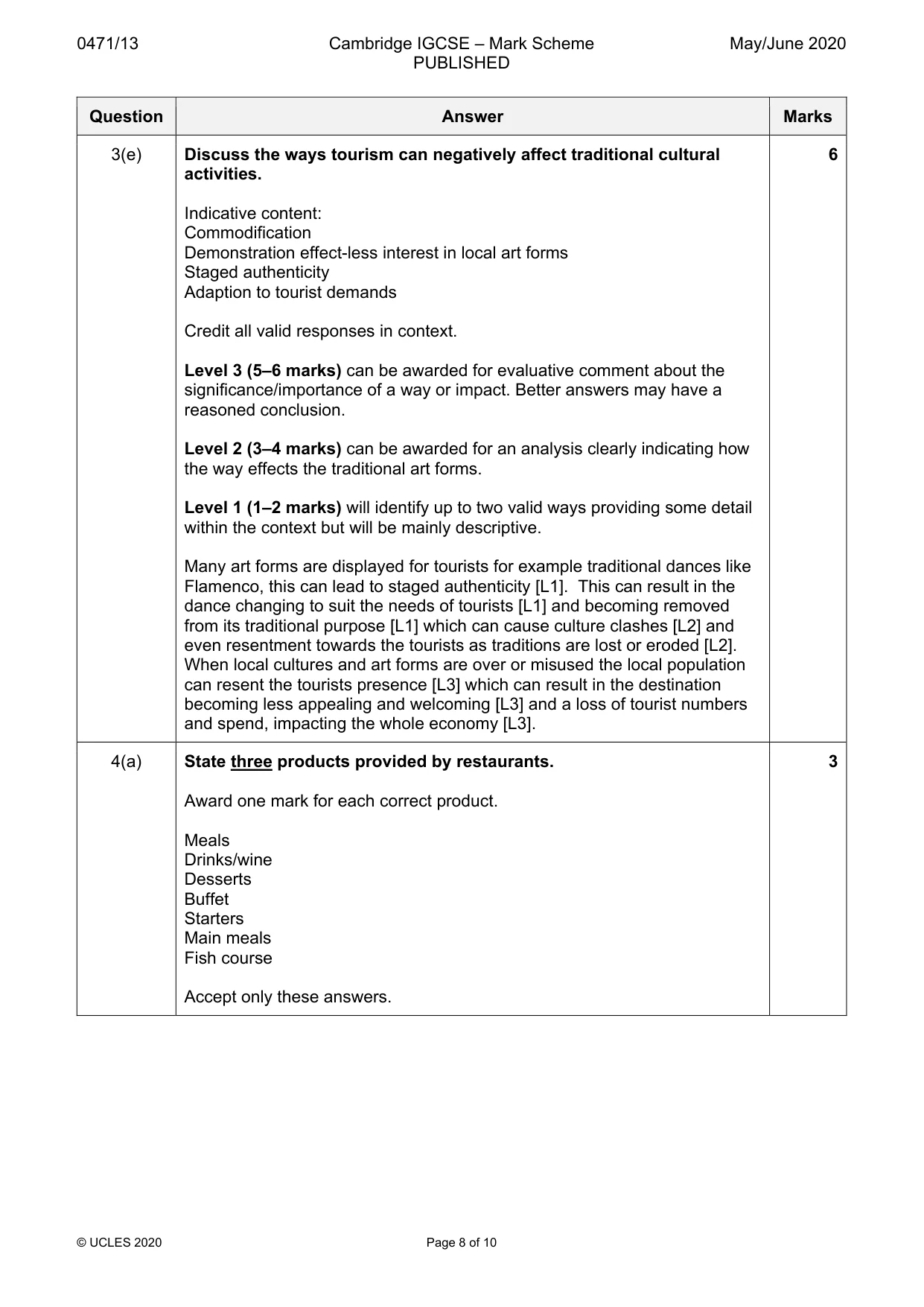
0471/13 Cambridge IGCSE – Mark Scheme PUBLISHED May/June 2020 © UCLES 2020 Page 8 of 10 Question Answer Marks 3(e) Discuss the ways tourism can negatively affect traditional cultural activities. Indicative content: Commodification Demonstration effect-less interest in local art forms Staged authenticity Adaption to tourist demands Credit all valid responses in context. Level 3 (5–6 marks) can be awarded for evaluative comment about the significance/importance of a way or impact. Better answers may have a reasoned conclusion. Level 2 (3–4 marks) can be awarded for an analysis clearly indicating how the way effects the traditional art forms. Level 1 (1–2 marks) will identify up to two valid ways providing some detail within the context but will be mainly descriptive. Many art forms are displayed for tourists for example traditional dances like Flamenco, this can lead to staged authenticity [L1]. This can result in the dance changing to suit the needs of tourists [L1] and becoming removed from its traditional purpose [L1] which can cause culture clashes [L2] and even resentment towards the tourists as traditions are lost or eroded [L2]. When local cultures and art forms are over or misused the local population can resent the tourists presence [L3] which can result in the destination becoming less appealing and welcoming [L3] and a loss of tourist numbers and spend, impacting the whole economy [L3]. 6 4(a) State three products provided by restaurants. Award one mark for each correct product. Meals Drinks/wine Desserts Buffet Starters Main meals Fish course Accept only these answers. 3
Mark scheme, page 9
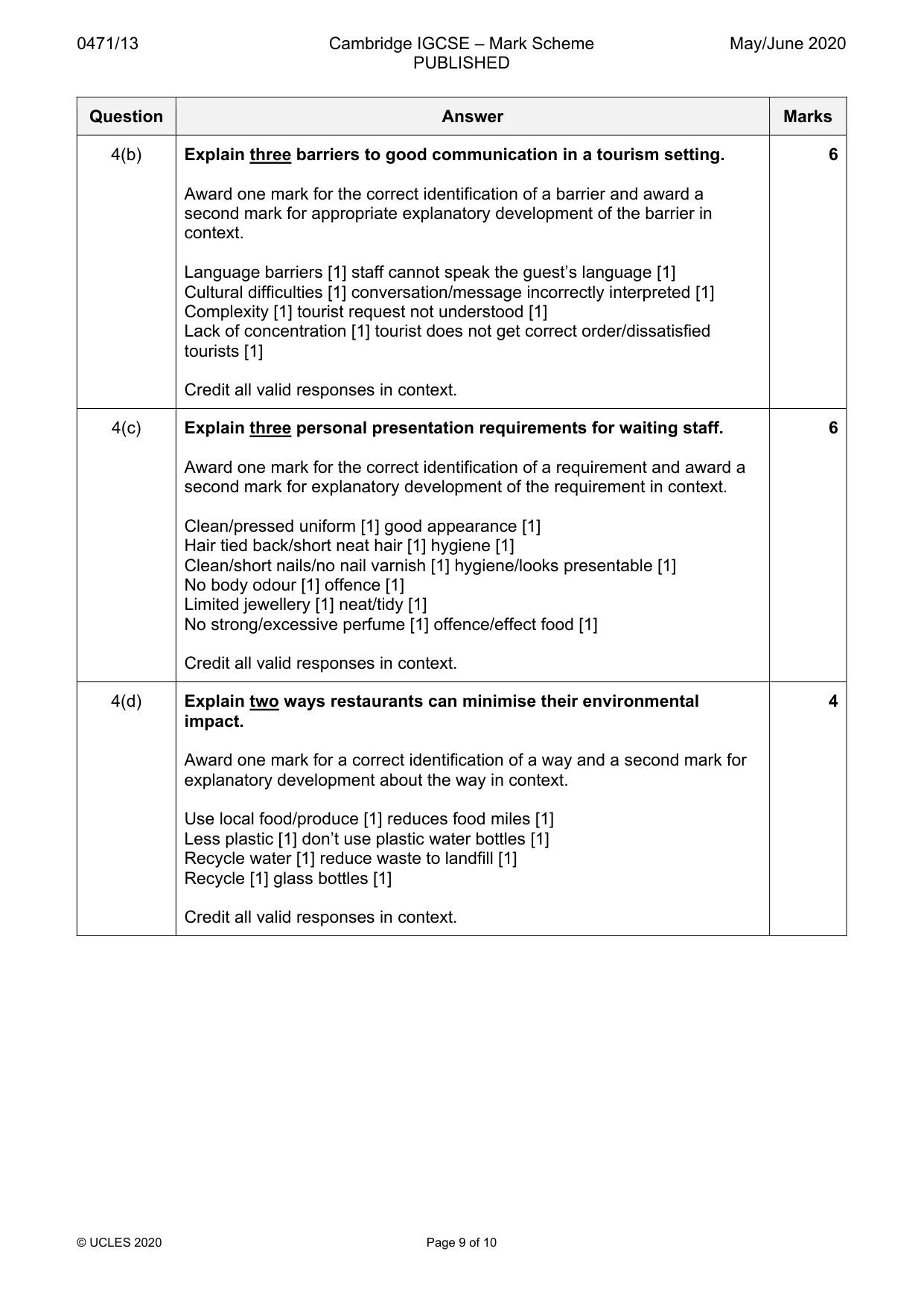
0471/13 Cambridge IGCSE – Mark Scheme PUBLISHED May/June 2020 © UCLES 2020 Page 9 of 10 Question Answer Marks 4(b) Explain three barriers to good communication in a tourism setting. Award one mark for the correct identification of a barrier and award a second mark for appropriate explanatory development of the barrier in context. Language barriers [1] staff cannot speak the guest’s language [1] Cultural difficulties [1] conversation/message incorrectly interpreted [1] Complexity [1] tourist request not understood [1] Lack of concentration [1] tourist does not get correct order/dissatisfied tourists [1] Credit all valid responses in context. 6 4(c) Explain three personal presentation requirements for waiting staff. Award one mark for the correct identification of a requirement and award a second mark for explanatory development of the requirement in context. Clean/pressed uniform [1] good appearance [1] Hair tied back/short neat hair [1] hygiene [1] Clean/short nails/no nail varnish [1] hygiene/looks presentable [1] No body odour [1] offence [1] Limited jewellery [1] neat/tidy [1] No strong/excessive perfume [1] offence/effect food [1] Credit all valid responses in context. 6 4(d) Explain two ways restaurants can minimise their environmental impact. Award one mark for a correct identification of a way and a second mark for explanatory development about the way in context. Use local food/produce [1] reduces food miles [1] Less plastic [1] don’t use plastic water bottles [1] Recycle water [1] reduce waste to landfill [1] Recycle [1] glass bottles [1] Credit all valid responses in context. 4
Mark scheme, page 10
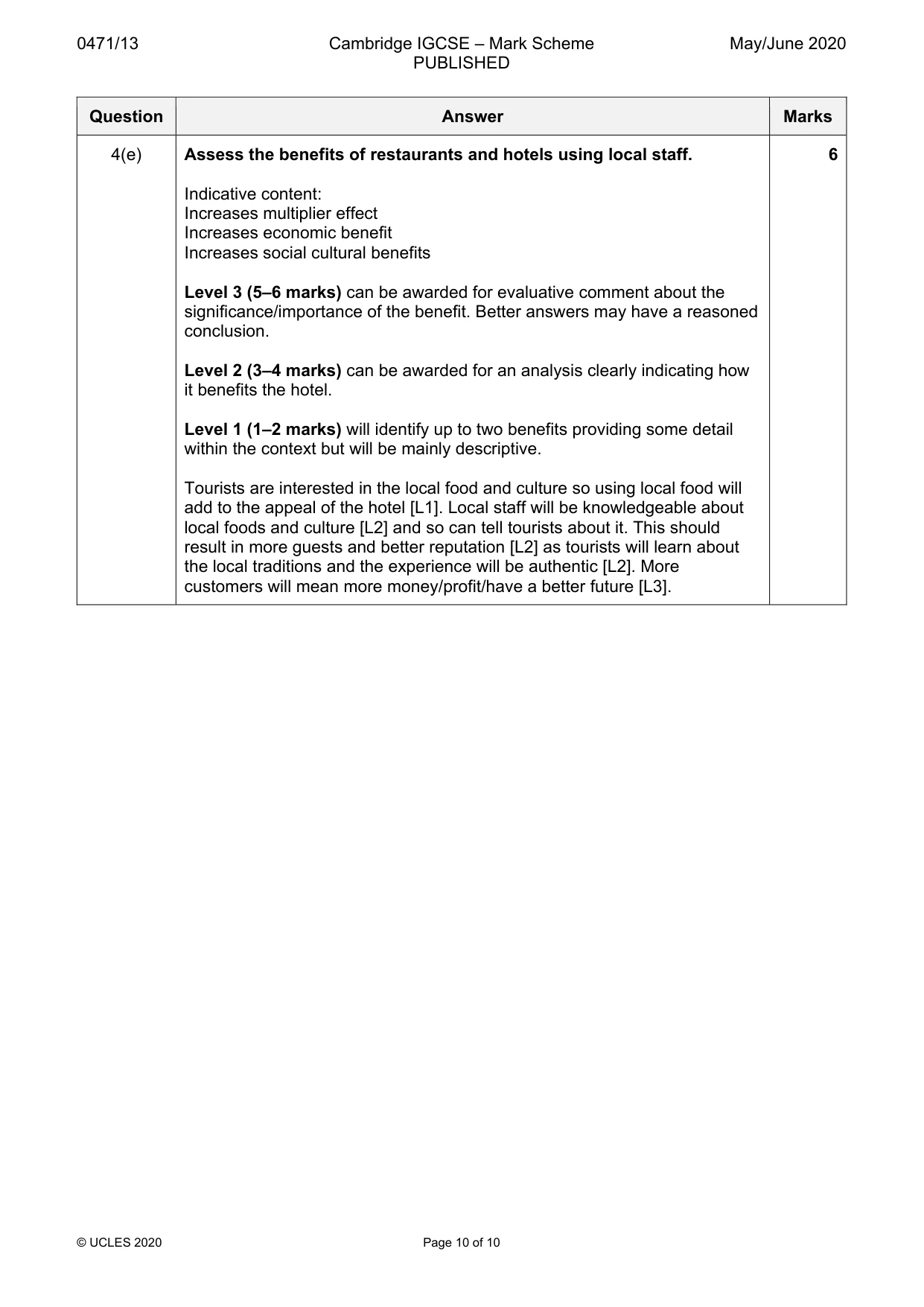
0471/13 Cambridge IGCSE – Mark Scheme PUBLISHED May/June 2020 © UCLES 2020 Page 10 of 10 Question Answer Marks 4(e) Assess the benefits of restaurants and hotels using local staff. Indicative content: Increases multiplier effect Increases economic benefit Increases social cultural benefits Level 3 (5–6 marks) can be awarded for evaluative comment about the significance/importance of the benefit. Better answers may have a reasoned conclusion. Level 2 (3–4 marks) can be awarded for an analysis clearly indicating how it benefits the hotel. Level 1 (1–2 marks) will identify up to two benefits providing some detail within the context but will be mainly descriptive. Tourists are interested in the local food and culture so using local food will add to the appeal of the hotel [L1]. Local staff will be knowledgeable about local foods and culture [L2] and so can tell tourists about it. This should result in more guests and better reputation [L2] as tourists will learn about the local traditions and the experience will be authentic [L2]. More customers will mean more money/profit/have a better future [L3]. 6