Cambridge IGCSE Travel and Tourism 0471 — 2019 Oct/Nov Paper 1 · Variant 2
0471/12/O/N/19 · 100 marks · ≈113 min
The question paper and its mark scheme, free to read here and free to download. This is Cambridge’s own paper, exactly as it was sat.
Question paper12 pages
Mark scheme10 pages
Answers below. Sit the paper first if you are practising.
Paper as text
Question paper, page 1
This document consists of 12 printed pages. DC (JP) 170544/1 © UCLES 2019 [Turn over * 7 1 2 4 8 6 7 9 0 5 * TRAVEL AND TOURISM 0471/12 Core Module October/November 2019 2 hours Candidates answer on the Question Paper. No Additional Materials are required. READ THESE INSTRUCTIONS FIRST Write your centre number, candidate number and name on all the work you hand in. Write in dark blue or black pen. You may use an HB pencil for any diagrams or graphs. Do not use staples, paper clips, glue or correction fluid. DO NOT WRITE IN ANY BARCODES. Answer all questions. All the Figures referred to in the questions are contained in the Insert. At the end of the examination, fasten all your work securely together. The number of marks is given in brackets [ ] at the end of each question or part question. Cambridge Assessment International Education Cambridge International General Certificate of Secondary Education
Question paper, page 2
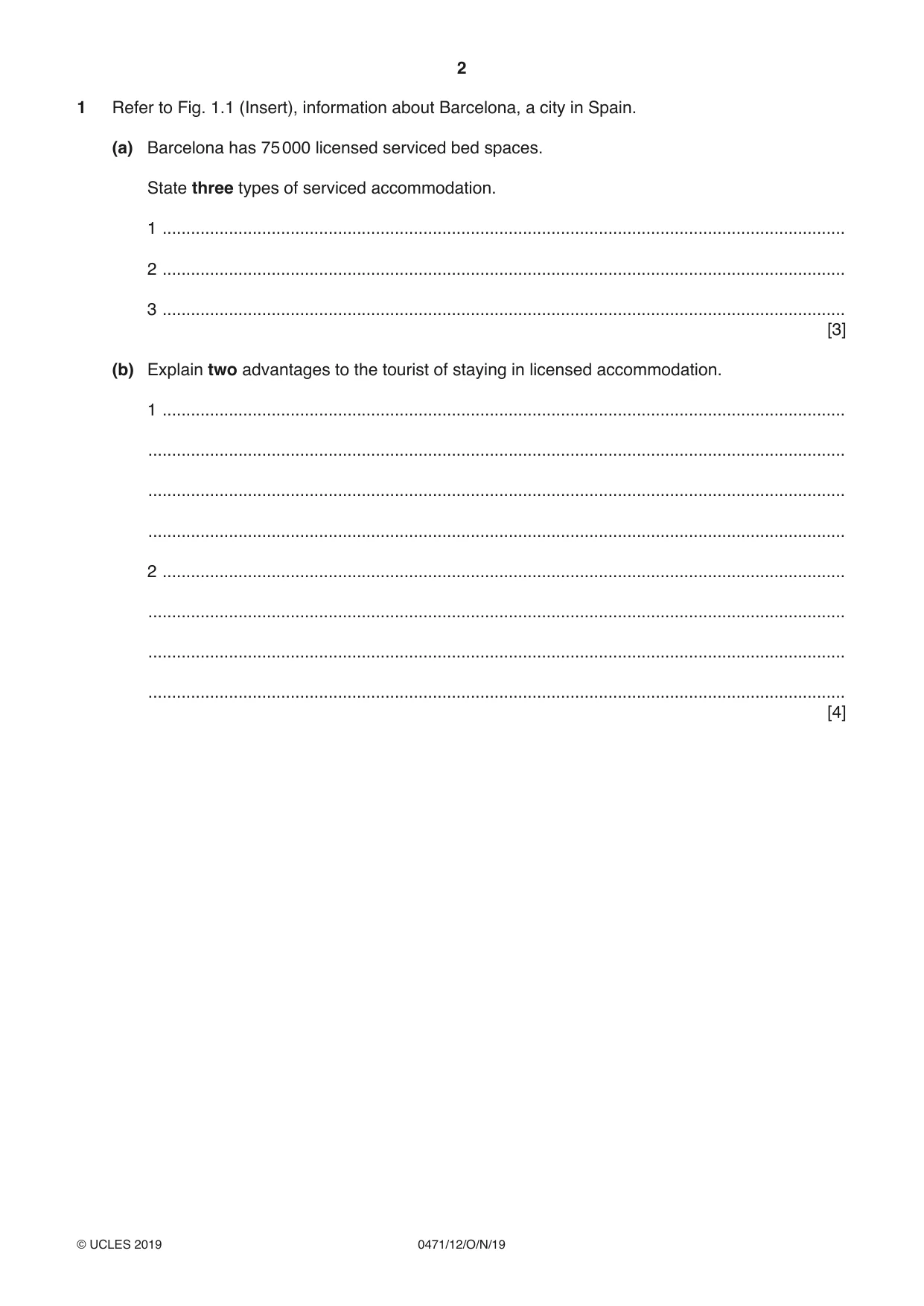
2 0471/12/O/N/19 © UCLES 2019 1 Refer to Fig. 1.1 (Insert), information about Barcelona, a city in Spain. (a) Barcelona has 75 000 licensed serviced bed spaces. State three types of serviced accommodation. 1 … 2 … 3 … [3] (b) Explain two advantages to the tourist of staying in licensed accommodation. 1 … … … … 2 … … … … [4]
Question paper, page 3
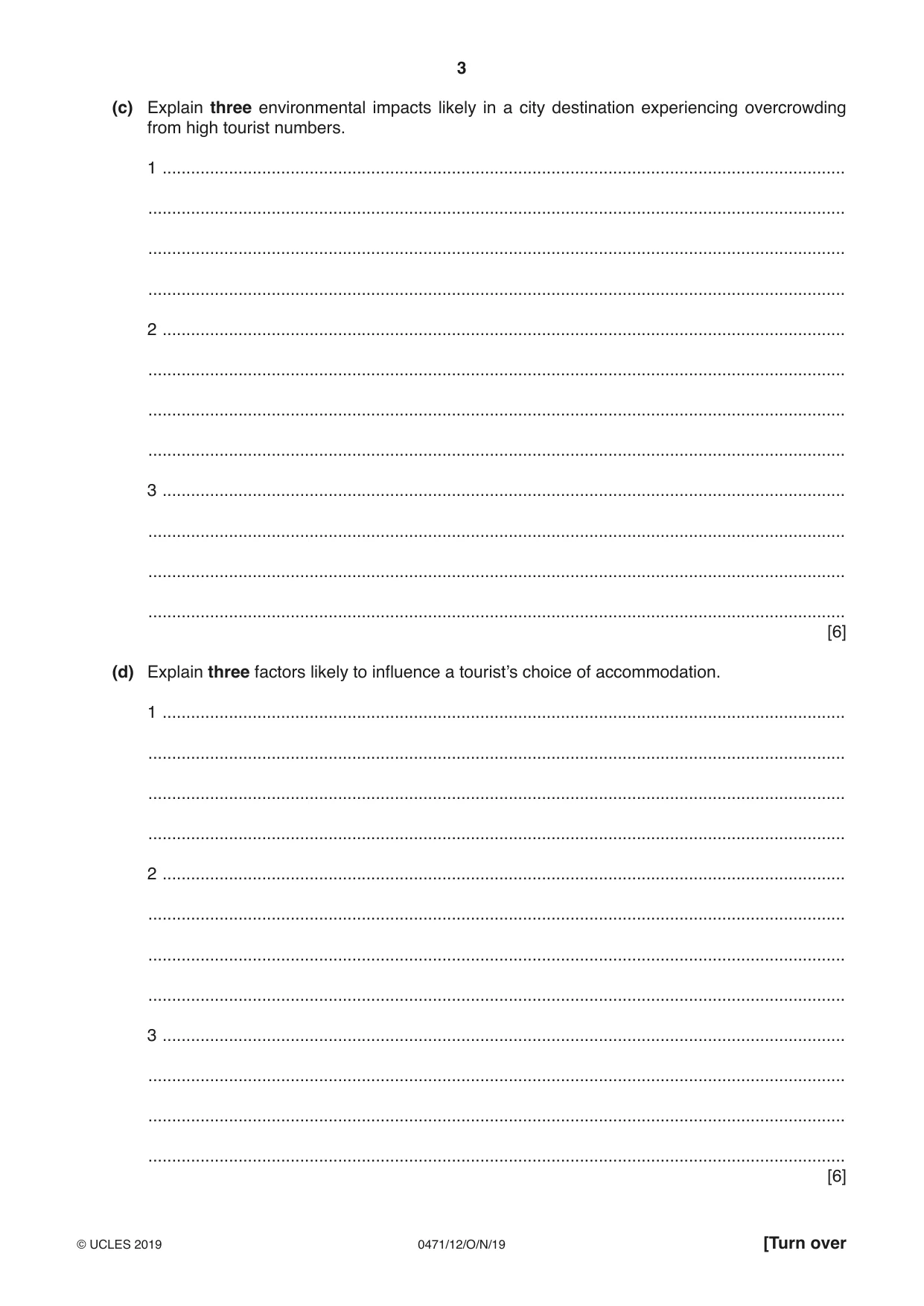
3 0471/12/O/N/19 © UCLES 2019 [Turn over (c) Explain three environmental impacts likely in a city destination experiencing overcrowding from high tourist numbers. 1 … … … … 2 … … … … 3 … … … … [6] (d) Explain three factors likely to influence a tourist’s choice of accommodation. 1 … … … … 2 … … … … 3 … … … … [6]
Question paper, page 4
4 0471/12/O/N/19 © UCLES 2019 (e) Discuss the likely economic impacts to the local population in Barcelona from high tourist numbers. … … … … … … … … … … … … [6] [Total: 25]
Question paper, page 5
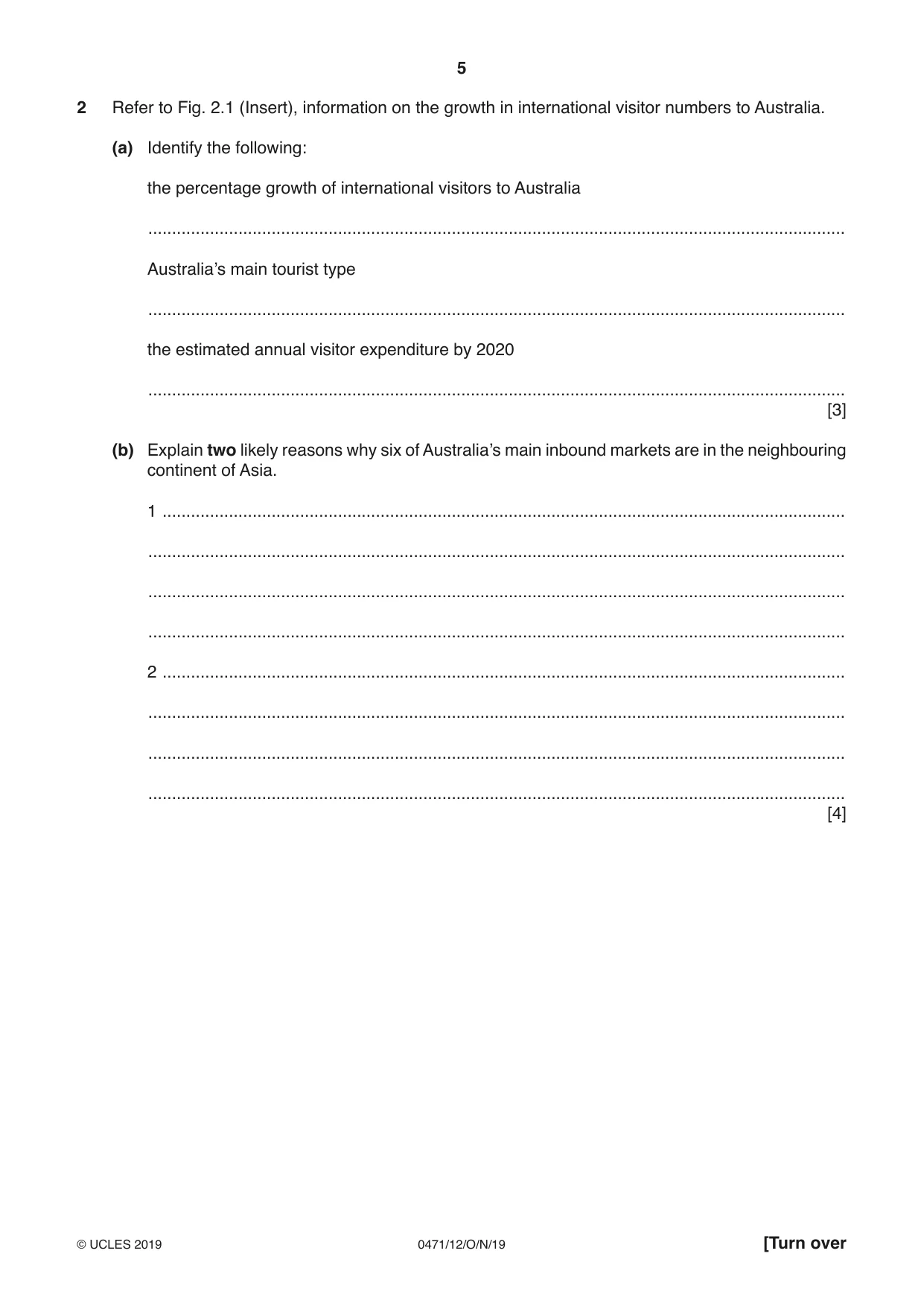
5 0471/12/O/N/19 © UCLES 2019 [Turn over 2 Refer to Fig. 2.1 (Insert), information on the growth in international visitor numbers to Australia. (a) Identify the following: the percentage growth of international visitors to Australia … Australia’s main tourist type … the estimated annual visitor expenditure by 2020 … [3] (b) Explain two likely reasons why six of Australia’s main inbound markets are in the neighbouring continent of Asia. 1 … … … … 2 … … … … [4]
Question paper, page 6
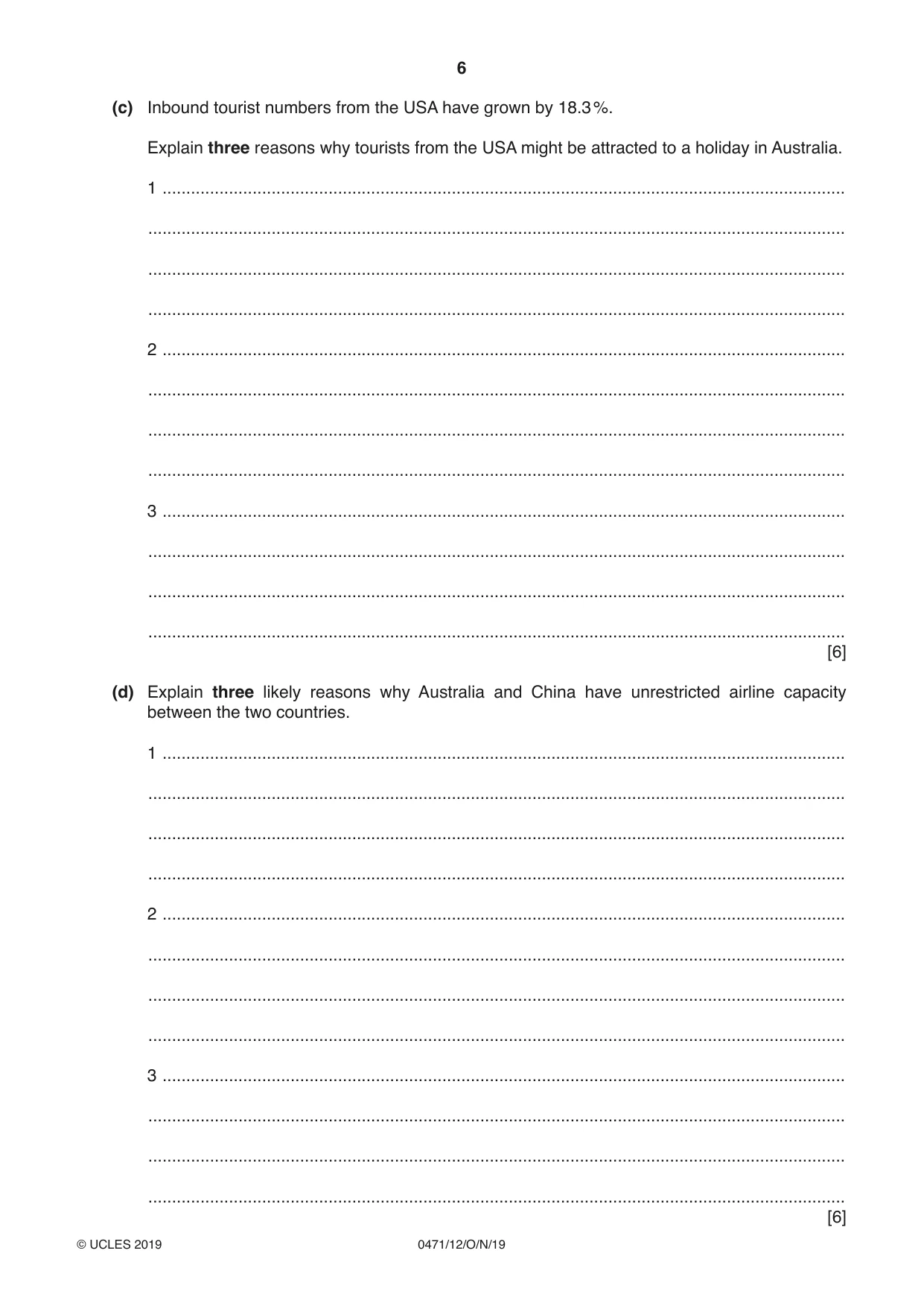
6 0471/12/O/N/19 © UCLES 2019 (c) Inbound tourist numbers from the USA have grown by 18.3 %. Explain three reasons why tourists from the USA might be attracted to a holiday in Australia. 1 … … … … 2 … … … … 3 … … … … [6] (d) Explain three likely reasons why Australia and China have unrestricted airline capacity between the two countries. 1 … … … … 2 … … … … 3 … … … … [6]
Question paper, page 7
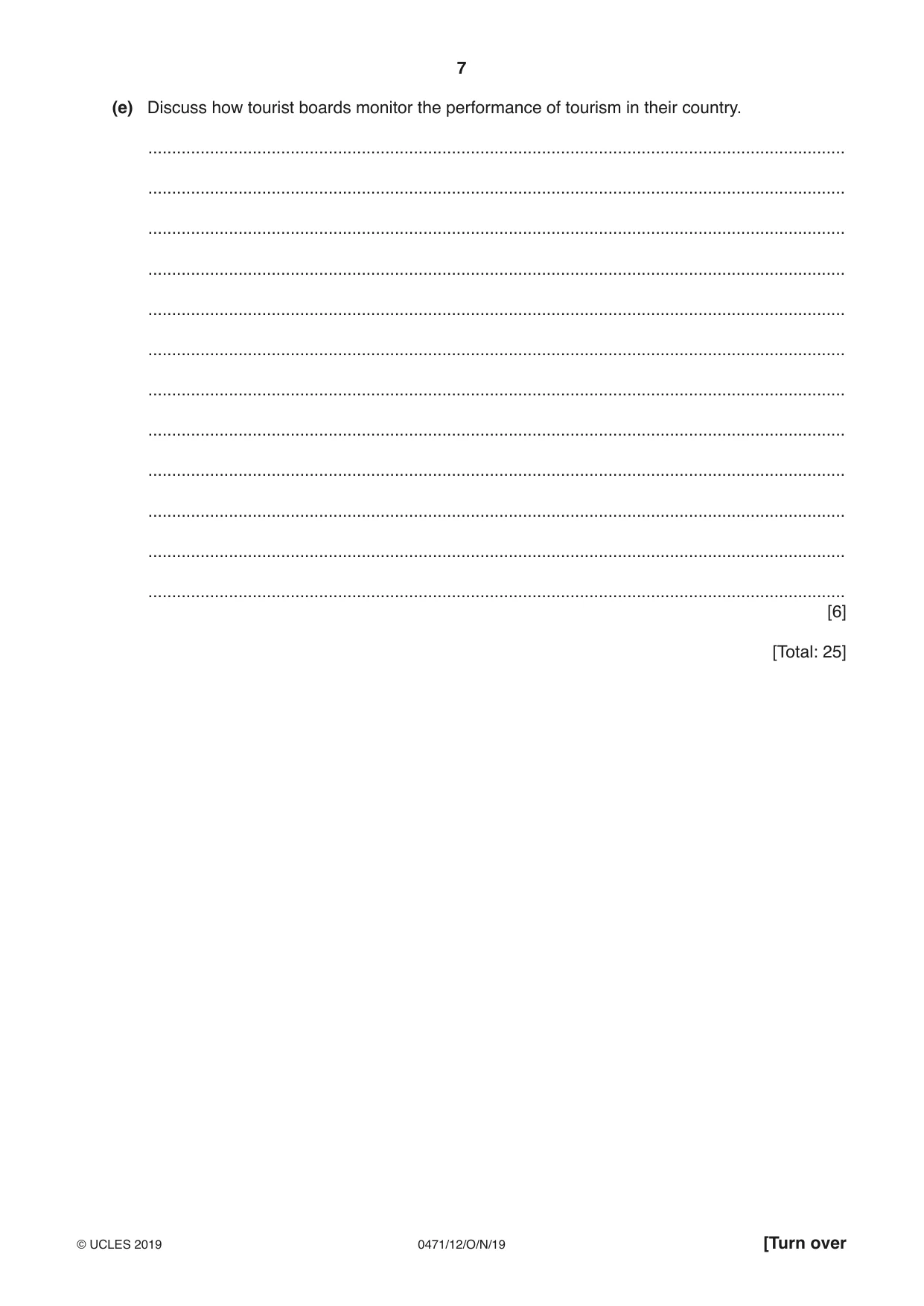
7 0471/12/O/N/19 © UCLES 2019 [Turn over (e) Discuss how tourist boards monitor the performance of tourism in their country. … … … … … … … … … … … … [6] [Total: 25]
Question paper, page 8
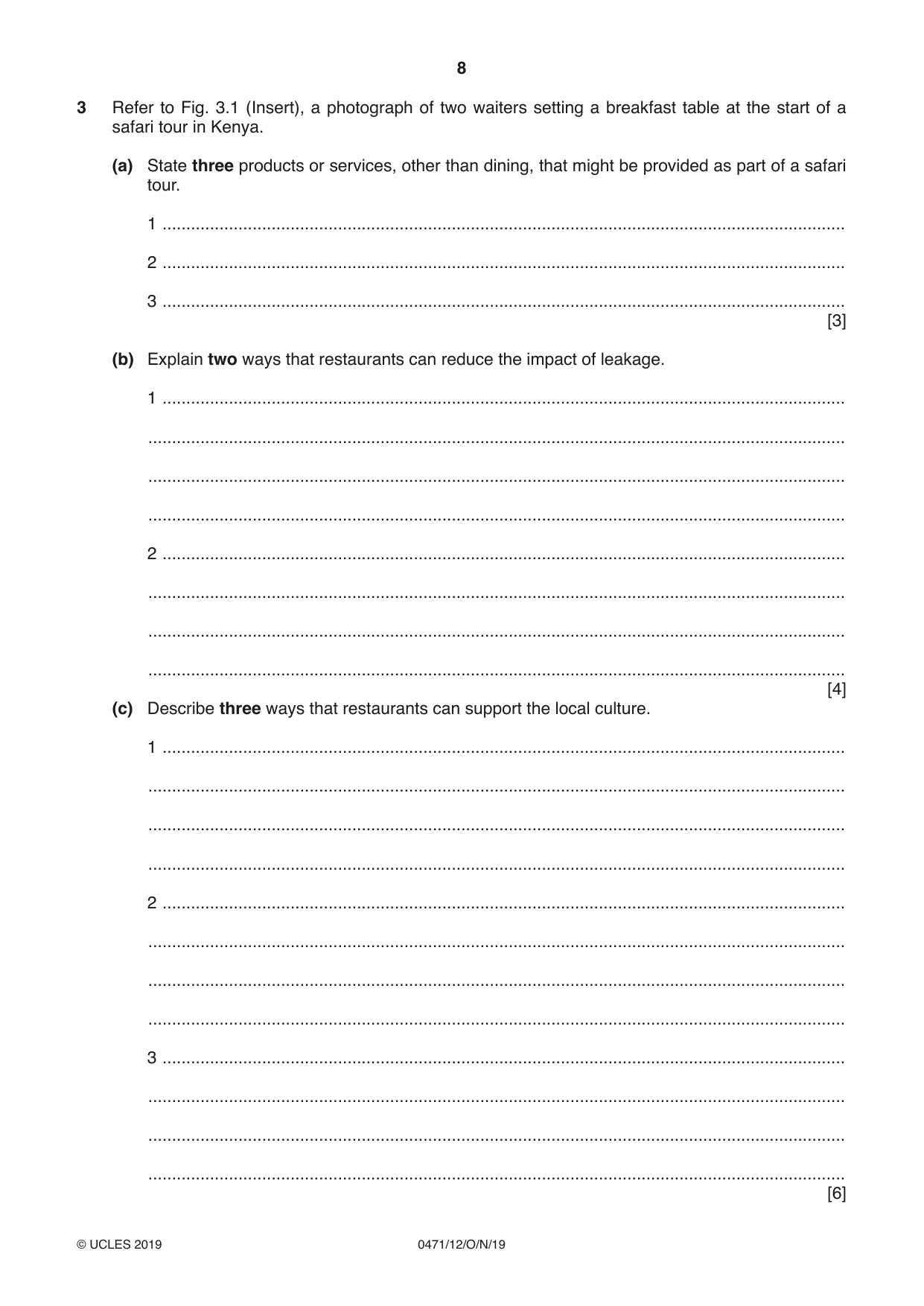
8 0471/12/O/N/19 © UCLES 2019 3 Refer to Fig. 3.1 (Insert), a photograph of two waiters setting a breakfast table at the start of a safari tour in Kenya. (a) State three products or services, other than dining, that might be provided as part of a safari tour. 1 … 2 … 3 … [3] (b) Explain two ways that restaurants can reduce the impact of leakage. 1 … … … … 2 … … … … [4] (c) Describe three ways that restaurants can support the local culture. 1 … … … … 2 … … … … 3 … … … … [6]
Question paper, page 9
9 0471/12/O/N/19 © UCLES 2019 [Turn over (d) The waiters in Fig. 3.1 are setting the table for breakfast service. Describe three actions a waiter is likely to take once guests are at the table. 1 … … … … 2 … … … … 3 … … … … [6] (e) The waiters in Fig. 3.1 are wearing uniforms suitable for serving food. Discuss the reasons why waiters are required to wear a uniform. … … … … … … … … … … … … [6] [Total: 25]
Question paper, page 10
10 0471/12/O/N/19 © UCLES 2019 4 Refer to Fig. 4.1 (Insert), information on the growth of air travel in Ireland. Ireland is an island in the continent of Europe, made up of two different countries. (a) State two types of transport that tourists could use to travel within a destination. 1 … 2 … [2] (b) In the table below circle three characteristics of business class air travel. priority boarding premium services on board reduced baggage allowance no reserved seating lie-flat seats fly to regional airports [3] (c) Explain three likely reasons for the increase in tourists using air transport. 1 … … … … 2 … … … … 3 … … … … [6]
Question paper, page 11
11 0471/12/O/N/19 © UCLES 2019 [Turn over (d) An increase in air travel can create negative environmental impacts. Describe two ways each of the following negative environmental impacts of air travel can be reduced. Noise pollution 1 … … … … 2 … … … … Air pollution 1 … … … … 2 … … … … [8]
Question paper, page 12
12 0471/12/O/N/19 © UCLES 2019 (e) Ireland offers the opportunity for multi-centre holidays. This means tourists can visit more than one destination in one trip. Discuss the likely appeal of a multi-centre holiday. … … … … … … … … … … … … [6] [Total: 25] Permission to reproduce items where third-party owned material protected by copyright is included has been sought and cleared where possible. Every reasonable effort has been made by the publisher (UCLES) to trace copyright holders, but if any items requiring clearance have unwittingly been included, the publisher will be pleased to make amends at the earliest possible opportunity. To avoid the issue of disclosure of answer-related information to candidates, all copyright acknowledgements are reproduced online in the Cambridge Assessment International Education Copyright Acknowledgements Booklet. This is produced for each series of examinations and is freely available to download at www.cambridgeinternational.org after the live examination series. Cambridge Assessment International Education is part of the Cambridge Assessment Group. Cambridge Assessment is the brand name of the University of Cambridge Local Examinations Syndicate (UCLES), which itself is a department of the University of Cambridge.
Mark scheme, page 1
This document consists of 10 printed pages. © UCLES 2019 [Turn over Cambridge Assessment International Education Cambridge International General Certificate of Secondary Education TRAVEL AND TOURISM 0471/12 Paper 1 Core Paper October/November 2019 MARK SCHEME Maximum Mark: 100 Published This mark scheme is published as an aid to teachers and candidates, to indicate the requirements of the examination. It shows the basis on which Examiners were instructed to award marks. It does not indicate the details of the discussions that took place at an Examiners’ meeting before marking began, which would have considered the acceptability of alternative answers. Mark schemes should be read in conjunction with the question paper and the Principal Examiner Report for Teachers. Cambridge International will not enter into discussions about these mark schemes. Cambridge International is publishing the mark schemes for the October/November 2019 series for most Cambridge IGCSE™, Cambridge International A and AS Level components and some Cambridge O Level components.
Mark scheme, page 2
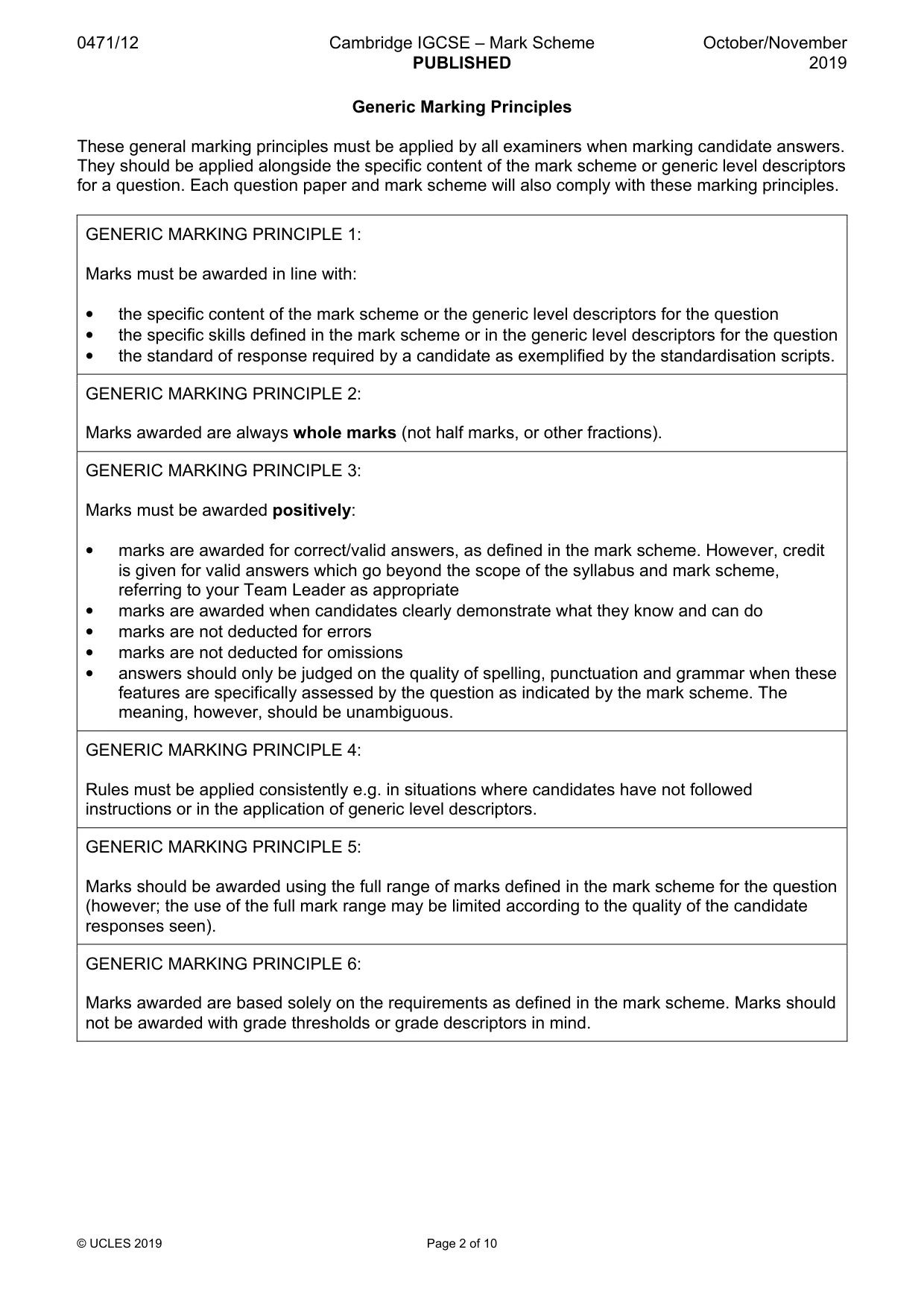
0471/12 Cambridge IGCSE – Mark Scheme PUBLISHED October/November 2019 © UCLES 2019 Page 2 of 10 Generic Marking Principles These general marking principles must be applied by all examiners when marking candidate answers. They should be applied alongside the specific content of the mark scheme or generic level descriptors for a question. Each question paper and mark scheme will also comply with these marking principles. GENERIC MARKING PRINCIPLE 1: Marks must be awarded in line with: • the specific content of the mark scheme or the generic level descriptors for the question • the specific skills defined in the mark scheme or in the generic level descriptors for the question • the standard of response required by a candidate as exemplified by the standardisation scripts. GENERIC MARKING PRINCIPLE 2: Marks awarded are always whole marks (not half marks, or other fractions). GENERIC MARKING PRINCIPLE 3: Marks must be awarded positively: • marks are awarded for correct/valid answers, as defined in the mark scheme. However, credit is given for valid answers which go beyond the scope of the syllabus and mark scheme, referring to your Team Leader as appropriate • marks are awarded when candidates clearly demonstrate what they know and can do • marks are not deducted for errors • marks are not deducted for omissions • answers should only be judged on the quality of spelling, punctuation and grammar when these features are specifically assessed by the question as indicated by the mark scheme. The meaning, however, should be unambiguous. GENERIC MARKING PRINCIPLE 4: Rules must be applied consistently e.g. in situations where candidates have not followed instructions or in the application of generic level descriptors. GENERIC MARKING PRINCIPLE 5: Marks should be awarded using the full range of marks defined in the mark scheme for the question (however; the use of the full mark range may be limited according to the quality of the candidate responses seen). GENERIC MARKING PRINCIPLE 6: Marks awarded are based solely on the requirements as defined in the mark scheme. Marks should not be awarded with grade thresholds or grade descriptors in mind.
Mark scheme, page 3
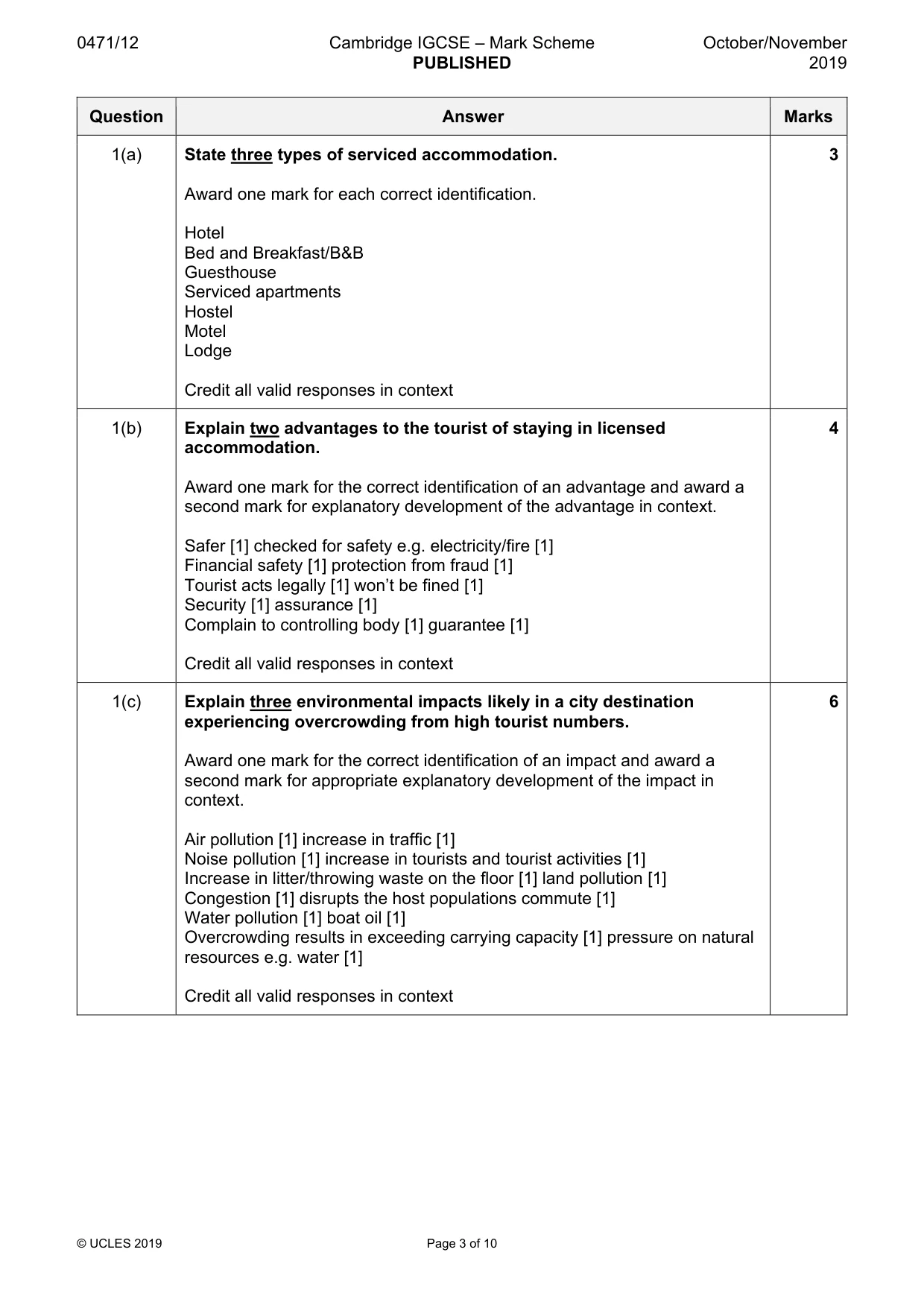
0471/12 Cambridge IGCSE – Mark Scheme PUBLISHED October/November 2019 © UCLES 2019 Page 3 of 10 Question Answer Marks 1(a) State three types of serviced accommodation. Award one mark for each correct identification. Hotel Bed and Breakfast/B&B Guesthouse Serviced apartments Hostel Motel Lodge Credit all valid responses in context 3 1(b) Explain two advantages to the tourist of staying in licensed accommodation. Award one mark for the correct identification of an advantage and award a second mark for explanatory development of the advantage in context. Safer [1] checked for safety e.g. electricity/fire [1] Financial safety [1] protection from fraud [1] Tourist acts legally [1] won’t be fined [1] Security [1] assurance [1] Complain to controlling body [1] guarantee [1] Credit all valid responses in context 4 1(c) Explain three environmental impacts likely in a city destination experiencing overcrowding from high tourist numbers. Award one mark for the correct identification of an impact and award a second mark for appropriate explanatory development of the impact in context. Air pollution [1] increase in traffic [1] Noise pollution [1] increase in tourists and tourist activities [1] Increase in litter/throwing waste on the floor [1] land pollution [1] Congestion [1] disrupts the host populations commute [1] Water pollution [1] boat oil [1] Overcrowding results in exceeding carrying capacity [1] pressure on natural resources e.g. water [1] Credit all valid responses in context 6
Mark scheme, page 4
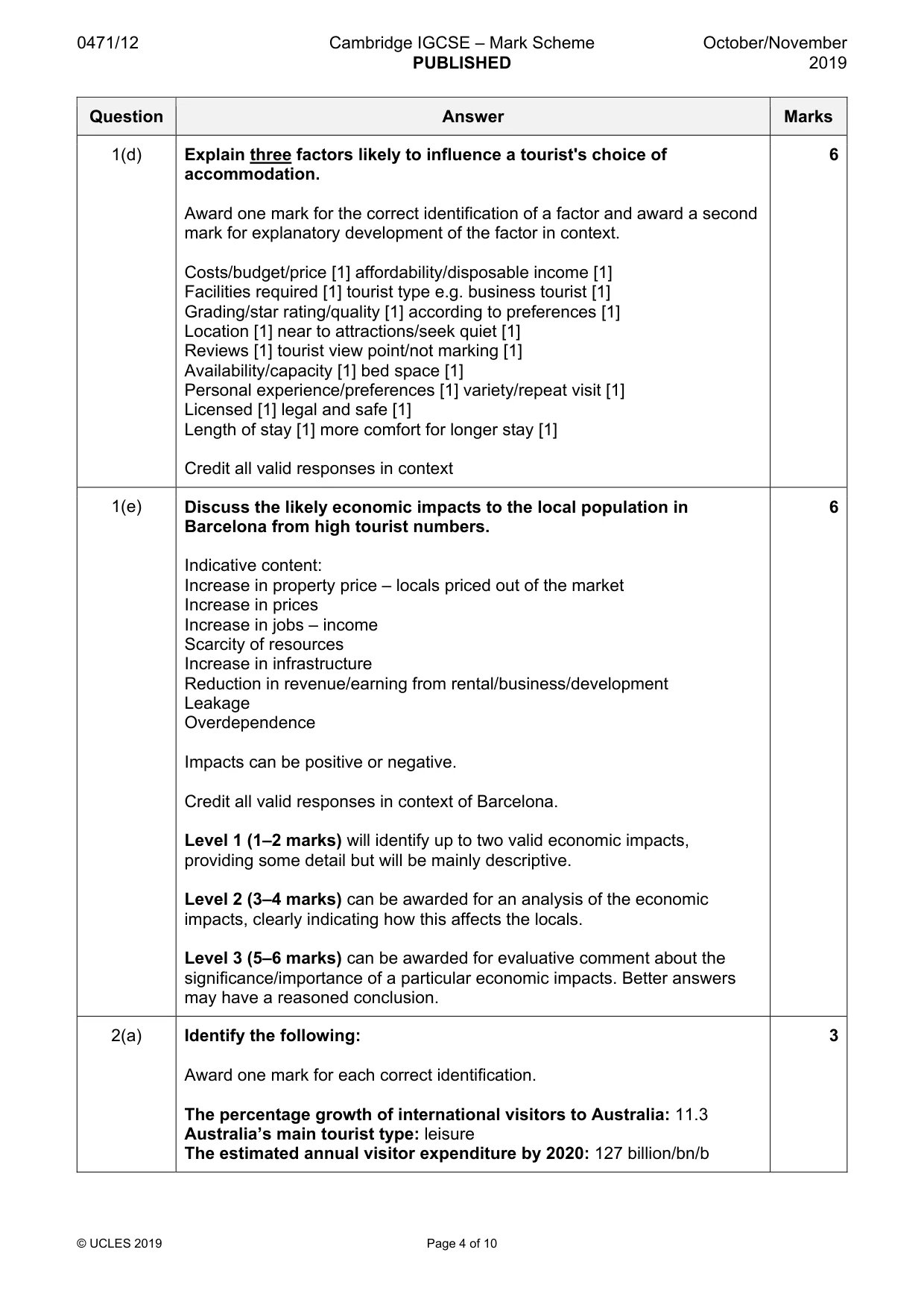
0471/12 Cambridge IGCSE – Mark Scheme PUBLISHED October/November 2019 © UCLES 2019 Page 4 of 10 Question Answer Marks 1(d) Explain three factors likely to influence a tourist's choice of accommodation. Award one mark for the correct identification of a factor and award a second mark for explanatory development of the factor in context. Costs/budget/price [1] affordability/disposable income [1] Facilities required [1] tourist type e.g. business tourist [1] Grading/star rating/quality [1] according to preferences [1] Location [1] near to attractions/seek quiet [1] Reviews [1] tourist view point/not marking [1] Availability/capacity [1] bed space [1] Personal experience/preferences [1] variety/repeat visit [1] Licensed [1] legal and safe [1] Length of stay [1] more comfort for longer stay [1] Credit all valid responses in context 6 1(e) Discuss the likely economic impacts to the local population in Barcelona from high tourist numbers. Indicative content: Increase in property price – locals priced out of the market Increase in prices Increase in jobs – income Scarcity of resources Increase in infrastructure Reduction in revenue/earning from rental/business/development Leakage Overdependence Impacts can be positive or negative. Credit all valid responses in context of Barcelona. Level 1 (1–2 marks) will identify up to two valid economic impacts, providing some detail but will be mainly descriptive. Level 2 (3–4 marks) can be awarded for an analysis of the economic impacts, clearly indicating how this affects the locals. Level 3 (5–6 marks) can be awarded for evaluative comment about the significance/importance of a particular economic impacts. Better answers may have a reasoned conclusion. 6 2(a) Identify the following: Award one mark for each correct identification. The percentage growth of international visitors to Australia: 11.3 Australia’s main tourist type: leisure The estimated annual visitor expenditure by 2020: 127 billion/bn/b 3
Mark scheme, page 5
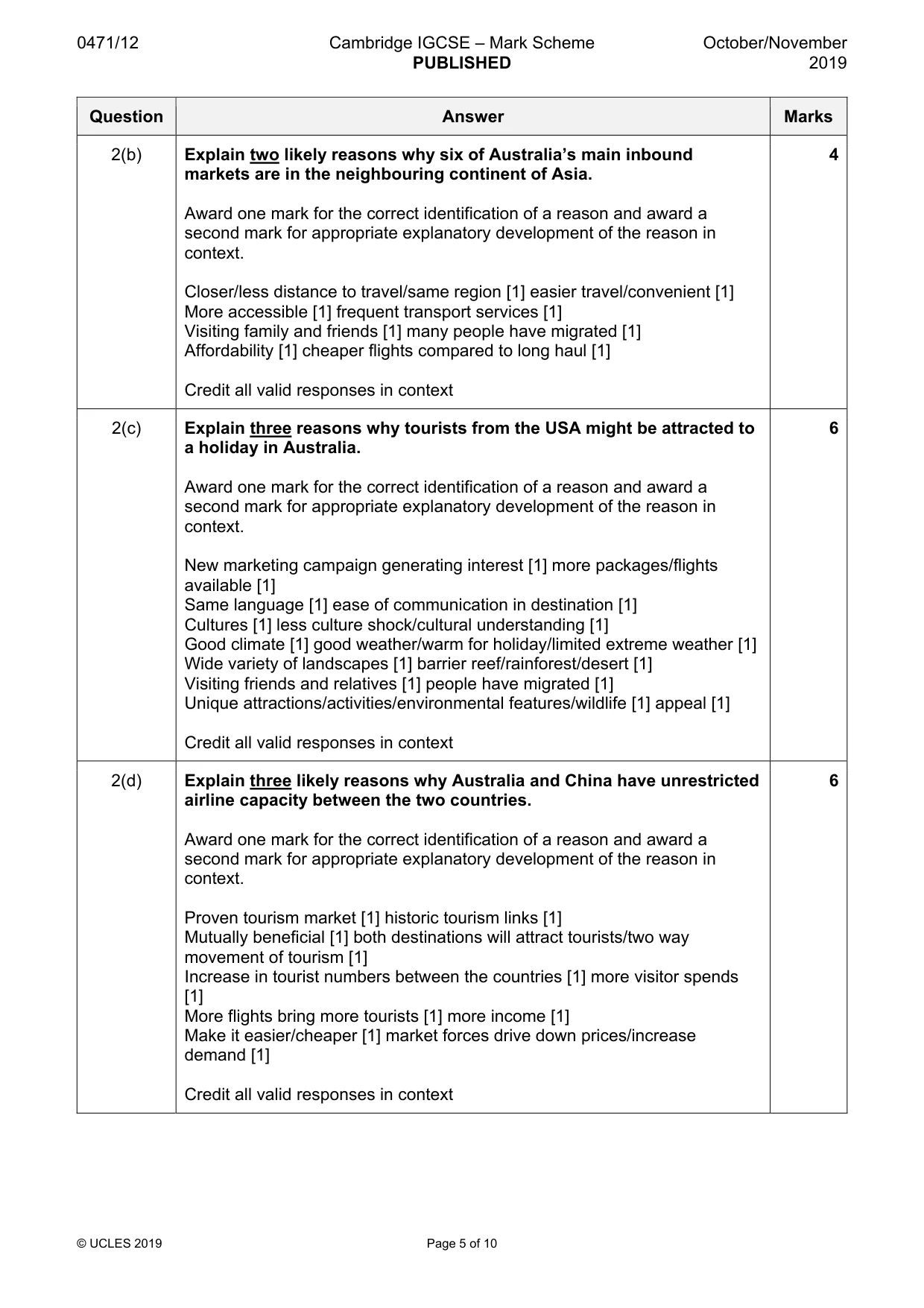
0471/12 Cambridge IGCSE – Mark Scheme PUBLISHED October/November 2019 © UCLES 2019 Page 5 of 10 Question Answer Marks 2(b) Explain two likely reasons why six of Australia’s main inbound markets are in the neighbouring continent of Asia. Award one mark for the correct identification of a reason and award a second mark for appropriate explanatory development of the reason in context. Closer/less distance to travel/same region [1] easier travel/convenient [1] More accessible [1] frequent transport services [1] Visiting family and friends [1] many people have migrated [1] Affordability [1] cheaper flights compared to long haul [1] Credit all valid responses in context 4 2(c) Explain three reasons why tourists from the USA might be attracted to a holiday in Australia. Award one mark for the correct identification of a reason and award a second mark for appropriate explanatory development of the reason in context. New marketing campaign generating interest [1] more packages/flights available [1] Same language [1] ease of communication in destination [1] Cultures [1] less culture shock/cultural understanding [1] Good climate [1] good weather/warm for holiday/limited extreme weather [1] Wide variety of landscapes [1] barrier reef/rainforest/desert [1] Visiting friends and relatives [1] people have migrated [1] Unique attractions/activities/environmental features/wildlife [1] appeal [1] Credit all valid responses in context 6 2(d) Explain three likely reasons why Australia and China have unrestricted airline capacity between the two countries. Award one mark for the correct identification of a reason and award a second mark for appropriate explanatory development of the reason in context. Proven tourism market [1] historic tourism links [1] Mutually beneficial [1] both destinations will attract tourists/two way movement of tourism [1] Increase in tourist numbers between the countries [1] more visitor spends [1] More flights bring more tourists [1] more income [1] Make it easier/cheaper [1] market forces drive down prices/increase demand [1] Credit all valid responses in context 6
Mark scheme, page 6
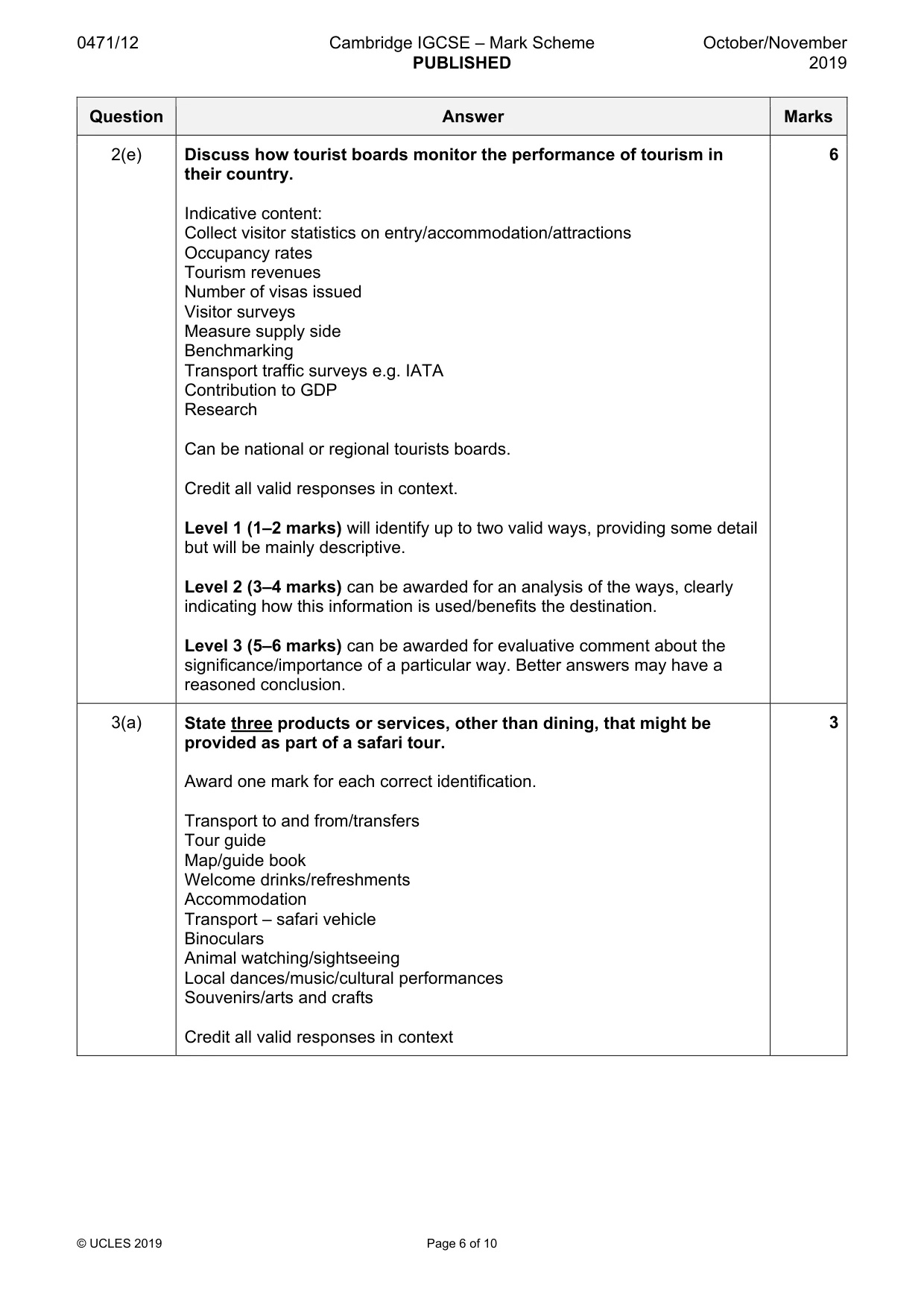
0471/12 Cambridge IGCSE – Mark Scheme PUBLISHED October/November 2019 © UCLES 2019 Page 6 of 10 Question Answer Marks 2(e) Discuss how tourist boards monitor the performance of tourism in their country. Indicative content: Collect visitor statistics on entry/accommodation/attractions Occupancy rates Tourism revenues Number of visas issued Visitor surveys Measure supply side Benchmarking Transport traffic surveys e.g. IATA Contribution to GDP Research Can be national or regional tourists boards. Credit all valid responses in context. Level 1 (1–2 marks) will identify up to two valid ways, providing some detail but will be mainly descriptive. Level 2 (3–4 marks) can be awarded for an analysis of the ways, clearly indicating how this information is used/benefits the destination. Level 3 (5–6 marks) can be awarded for evaluative comment about the significance/importance of a particular way. Better answers may have a reasoned conclusion. 6 3(a) State three products or services, other than dining, that might be provided as part of a safari tour. Award one mark for each correct identification. Transport to and from/transfers Tour guide Map/guide book Welcome drinks/refreshments Accommodation Transport – safari vehicle Binoculars Animal watching/sightseeing Local dances/music/cultural performances Souvenirs/arts and crafts Credit all valid responses in context 3
Mark scheme, page 7
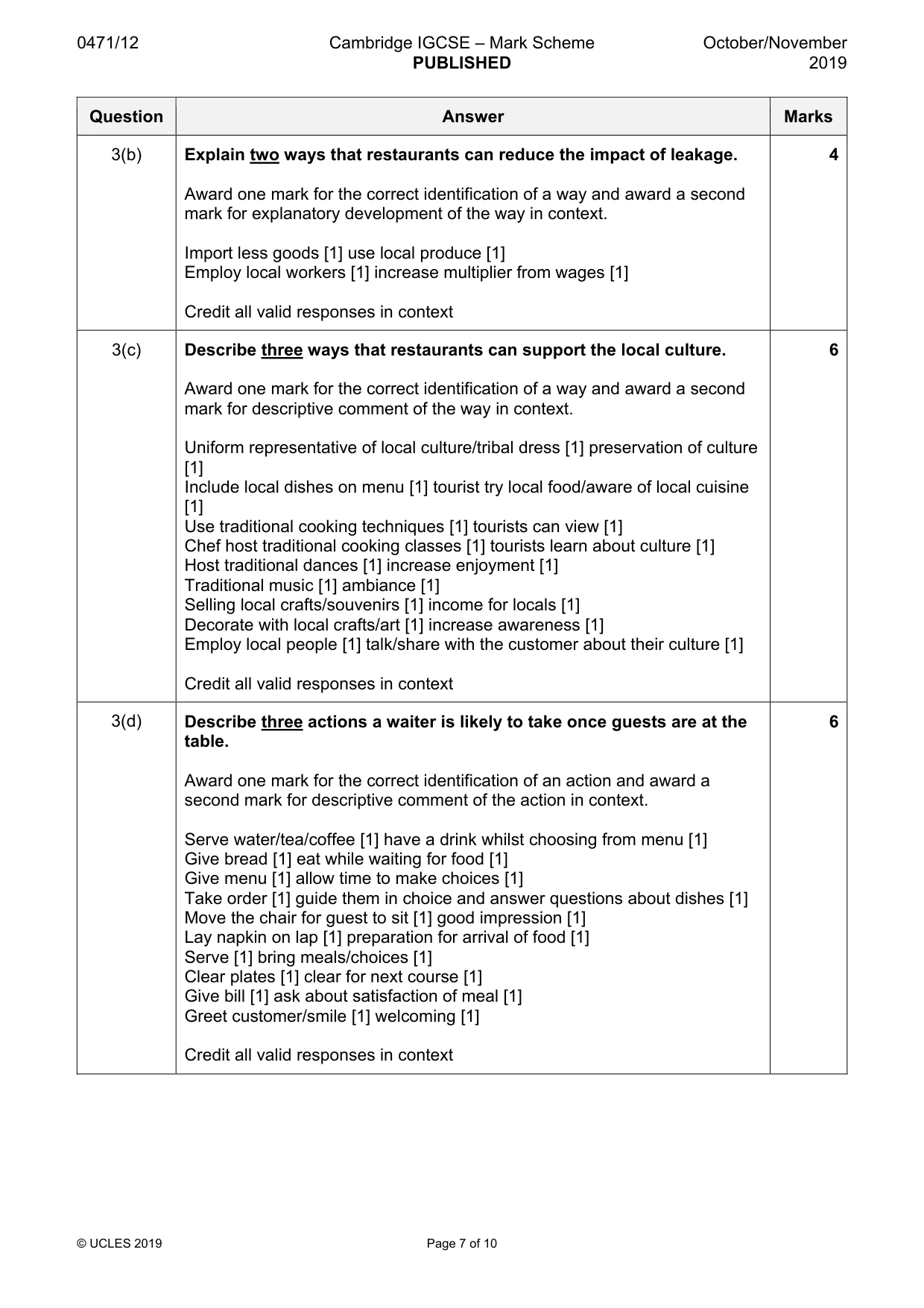
0471/12 Cambridge IGCSE – Mark Scheme PUBLISHED October/November 2019 © UCLES 2019 Page 7 of 10 Question Answer Marks 3(b) Explain two ways that restaurants can reduce the impact of leakage. Award one mark for the correct identification of a way and award a second mark for explanatory development of the way in context. Import less goods [1] use local produce [1] Employ local workers [1] increase multiplier from wages [1] Credit all valid responses in context 4 3(c) Describe three ways that restaurants can support the local culture. Award one mark for the correct identification of a way and award a second mark for descriptive comment of the way in context. Uniform representative of local culture/tribal dress [1] preservation of culture [1] Include local dishes on menu [1] tourist try local food/aware of local cuisine [1] Use traditional cooking techniques [1] tourists can view [1] Chef host traditional cooking classes [1] tourists learn about culture [1] Host traditional dances [1] increase enjoyment [1] Traditional music [1] ambiance [1] Selling local crafts/souvenirs [1] income for locals [1] Decorate with local crafts/art [1] increase awareness [1] Employ local people [1] talk/share with the customer about their culture [1] Credit all valid responses in context 6 3(d) Describe three actions a waiter is likely to take once guests are at the table. Award one mark for the correct identification of an action and award a second mark for descriptive comment of the action in context. Serve water/tea/coffee [1] have a drink whilst choosing from menu [1] Give bread [1] eat while waiting for food [1] Give menu [1] allow time to make choices [1] Take order [1] guide them in choice and answer questions about dishes [1] Move the chair for guest to sit [1] good impression [1] Lay napkin on lap [1] preparation for arrival of food [1] Serve [1] bring meals/choices [1] Clear plates [1] clear for next course [1] Give bill [1] ask about satisfaction of meal [1] Greet customer/smile [1] welcoming [1] Credit all valid responses in context 6
Mark scheme, page 8
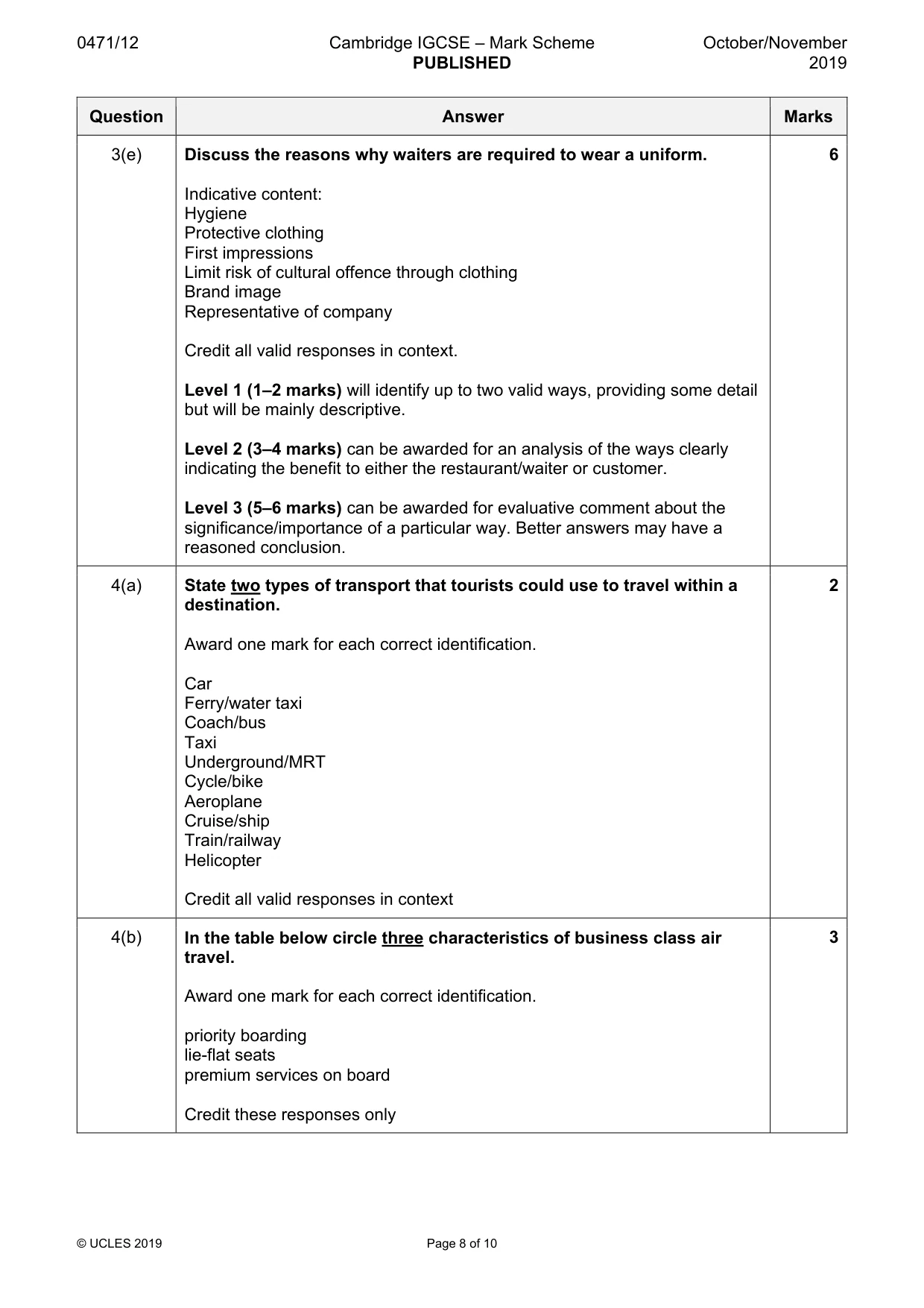
0471/12 Cambridge IGCSE – Mark Scheme PUBLISHED October/November 2019 © UCLES 2019 Page 8 of 10 Question Answer Marks 3(e) Discuss the reasons why waiters are required to wear a uniform. Indicative content: Hygiene Protective clothing First impressions Limit risk of cultural offence through clothing Brand image Representative of company Credit all valid responses in context. Level 1 (1–2 marks) will identify up to two valid ways, providing some detail but will be mainly descriptive. Level 2 (3–4 marks) can be awarded for an analysis of the ways clearly indicating the benefit to either the restaurant/waiter or customer. Level 3 (5–6 marks) can be awarded for evaluative comment about the significance/importance of a particular way. Better answers may have a reasoned conclusion. 6 4(a) State two types of transport that tourists could use to travel within a destination. Award one mark for each correct identification. Car Ferry/water taxi Coach/bus Taxi Underground/MRT Cycle/bike Aeroplane Cruise/ship Train/railway Helicopter Credit all valid responses in context 2 4(b) In the table below circle three characteristics of business class air travel. Award one mark for each correct identification. priority boarding lie-flat seats premium services on board Credit these responses only 3
Mark scheme, page 9
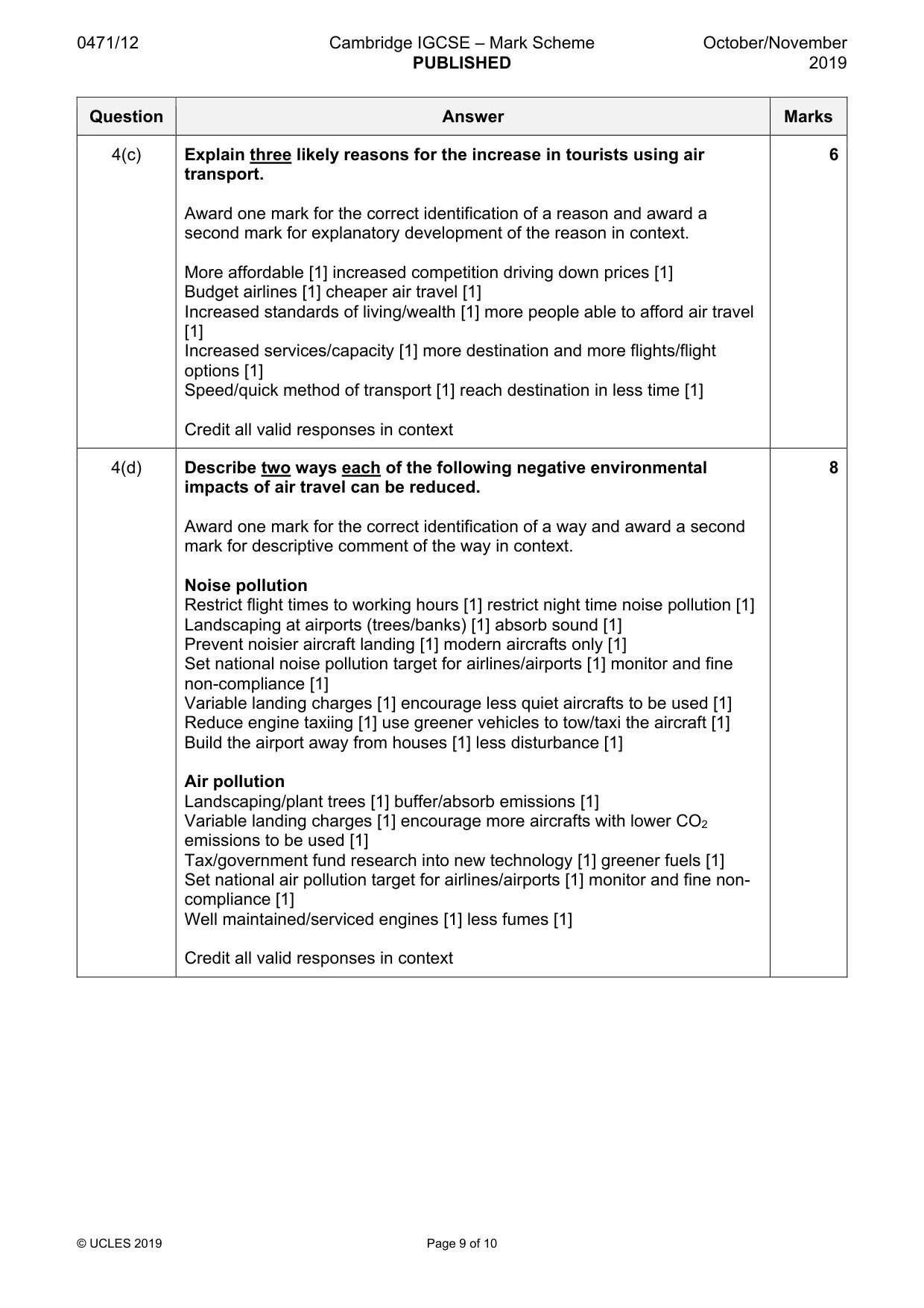
0471/12 Cambridge IGCSE – Mark Scheme PUBLISHED October/November 2019 © UCLES 2019 Page 9 of 10 Question Answer Marks 4(c) Explain three likely reasons for the increase in tourists using air transport. Award one mark for the correct identification of a reason and award a second mark for explanatory development of the reason in context. More affordable [1] increased competition driving down prices [1] Budget airlines [1] cheaper air travel [1] Increased standards of living/wealth [1] more people able to afford air travel [1] Increased services/capacity [1] more destination and more flights/flight options [1] Speed/quick method of transport [1] reach destination in less time [1] Credit all valid responses in context 6 4(d) Describe two ways each of the following negative environmental impacts of air travel can be reduced. Award one mark for the correct identification of a way and award a second mark for descriptive comment of the way in context. Noise pollution Restrict flight times to working hours [1] restrict night time noise pollution [1] Landscaping at airports (trees/banks) [1] absorb sound [1] Prevent noisier aircraft landing [1] modern aircrafts only [1] Set national noise pollution target for airlines/airports [1] monitor and fine non-compliance [1] Variable landing charges [1] encourage less quiet aircrafts to be used [1] Reduce engine taxiing [1] use greener vehicles to tow/taxi the aircraft [1] Build the airport away from houses [1] less disturbance [1] Air pollution Landscaping/plant trees [1] buffer/absorb emissions [1] Variable landing charges [1] encourage more aircrafts with lower CO2 emissions to be used [1] Tax/government fund research into new technology [1] greener fuels [1] Set national air pollution target for airlines/airports [1] monitor and fine non- compliance [1] Well maintained/serviced engines [1] less fumes [1] Credit all valid responses in context 8
Mark scheme, page 10
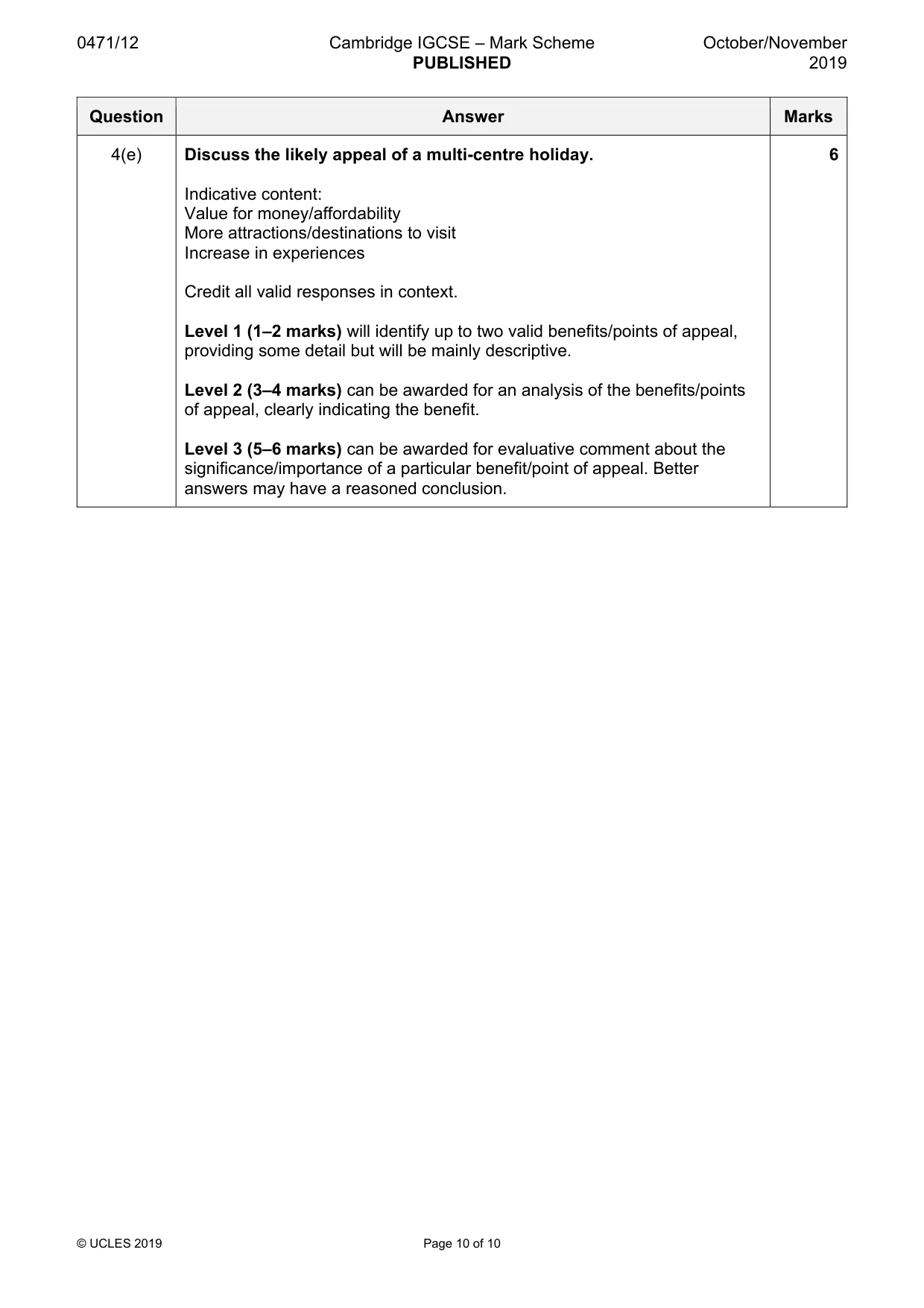
0471/12 Cambridge IGCSE – Mark Scheme PUBLISHED October/November 2019 © UCLES 2019 Page 10 of 10 Question Answer Marks 4(e) Discuss the likely appeal of a multi-centre holiday. Indicative content: Value for money/affordability More attractions/destinations to visit Increase in experiences Credit all valid responses in context. Level 1 (1–2 marks) will identify up to two valid benefits/points of appeal, providing some detail but will be mainly descriptive. Level 2 (3–4 marks) can be awarded for an analysis of the benefits/points of appeal, clearly indicating the benefit. Level 3 (5–6 marks) can be awarded for evaluative comment about the significance/importance of a particular benefit/point of appeal. Better answers may have a reasoned conclusion. 6
What you needed in this session
Cambridge’s own grade thresholds for 2019 Oct/Nov, Paper 1 · Variant 2. A higher threshold means an easier paper — the bar moves with how the cohort did.