Cambridge IGCSE Travel and Tourism 0471 — 2019 Oct/Nov Paper 1 · Variant 1
0471/11/O/N/19 · 100 marks · ≈113 min
The question paper and its mark scheme, free to read here and free to download. This is Cambridge’s own paper, exactly as it was sat.
Question paper12 pages

Mark scheme9 pages
Answers below. Sit the paper first if you are practising.
Paper as text
Question paper, page 1
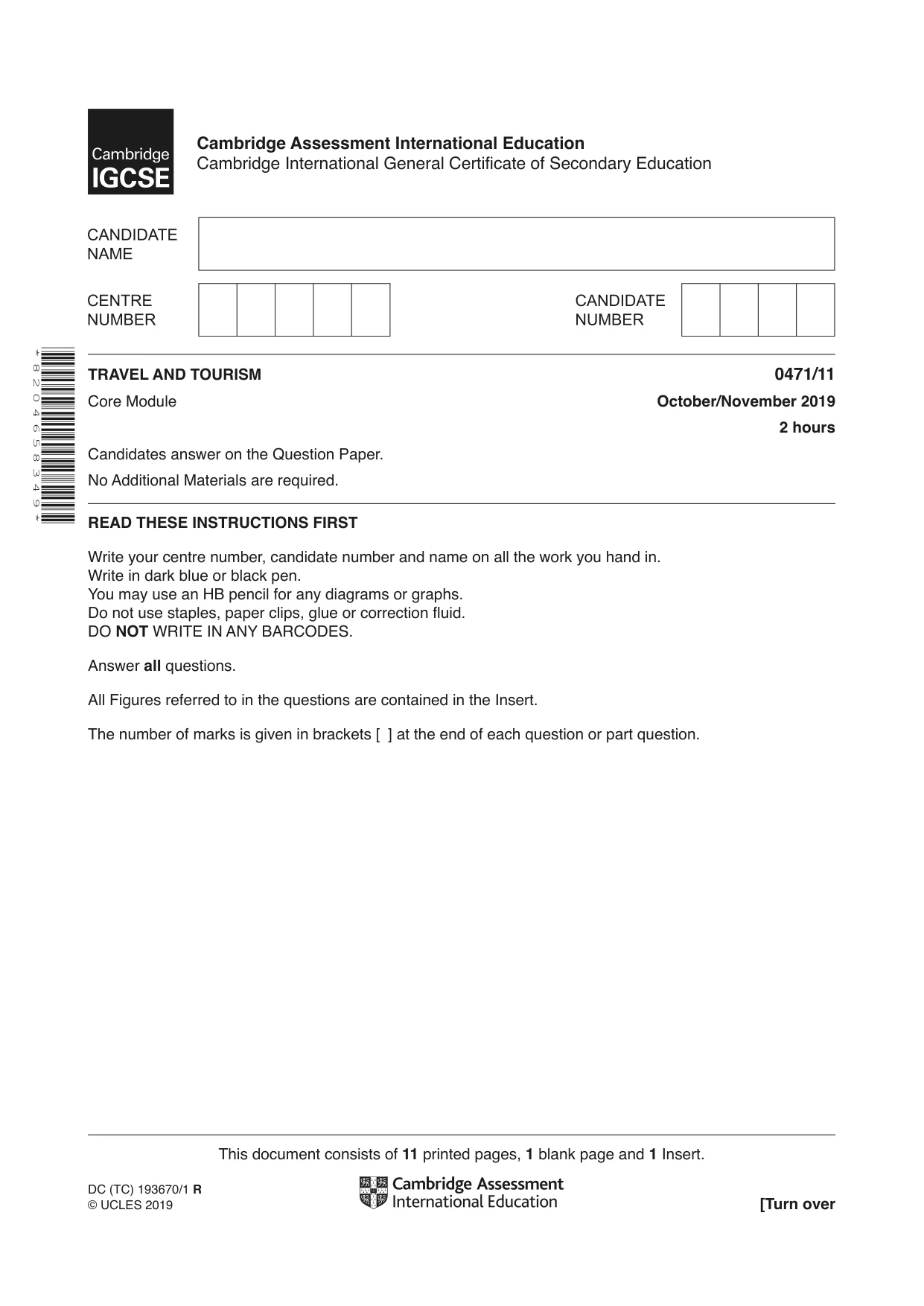
* 8 2 0 4 6 5 8 3 4 9 * Cambridge Assessment International Education Cambridge International General Certificate of Secondary Education This document consists of 11 printed pages, 1 blank page and 1 Insert. DC (TC) 193670/1 R © UCLES 2019 [Turn over TRAVEL AND TOURISM 0471/11 Core Module October/November 2019 2 hours Candidates answer on the Question Paper. No Additional Materials are required. READ THESE INSTRUCTIONS FIRST Write your centre number, candidate number and name on all the work you hand in. Write in dark blue or black pen. You may use an HB pencil for any diagrams or graphs. Do not use staples, paper clips, glue or correction fluid. DO NOT WRITE IN ANY BARCODES. Answer all questions. All Figures referred to in the questions are contained in the Insert. The number of marks is given in brackets [ ] at the end of each question or part question.
Question paper, page 2
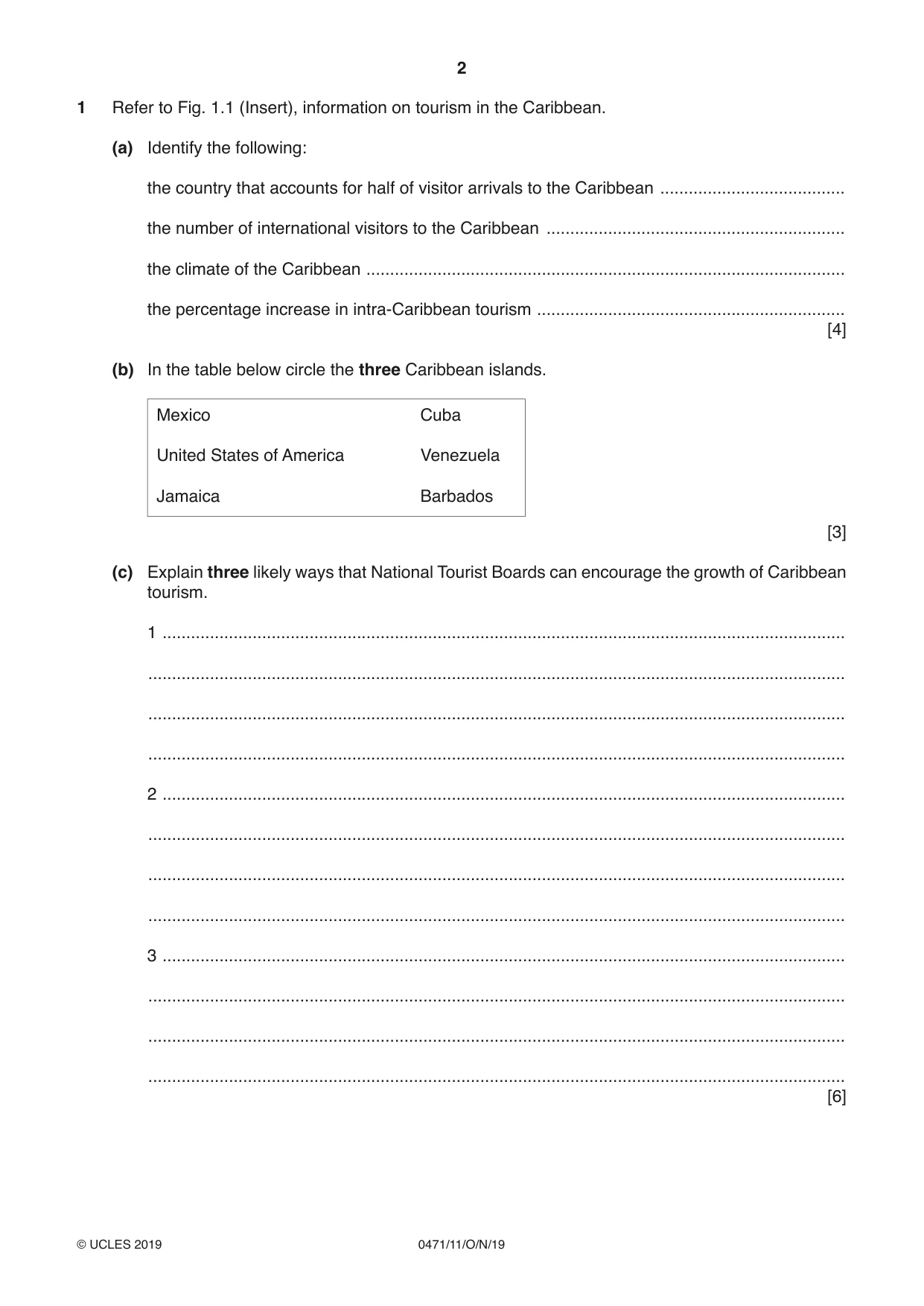
2 0471/11/O/N/19 © UCLES 2019 1 Refer to Fig. 1.1 (Insert), information on tourism in the Caribbean. (a) Identify the following: the country that accounts for half of visitor arrivals to the Caribbean … the number of international visitors to the Caribbean … the climate of the Caribbean … the percentage increase in intra-Caribbean tourism … [4] (b) In the table below circle the three Caribbean islands. Mexico Cuba United States of America Venezuela Jamaica Barbados [3] (c) Explain three likely ways that National Tourist Boards can encourage the growth of Caribbean tourism. 1 … … … … 2 … … … … 3 … … … … [6]
Question paper, page 3
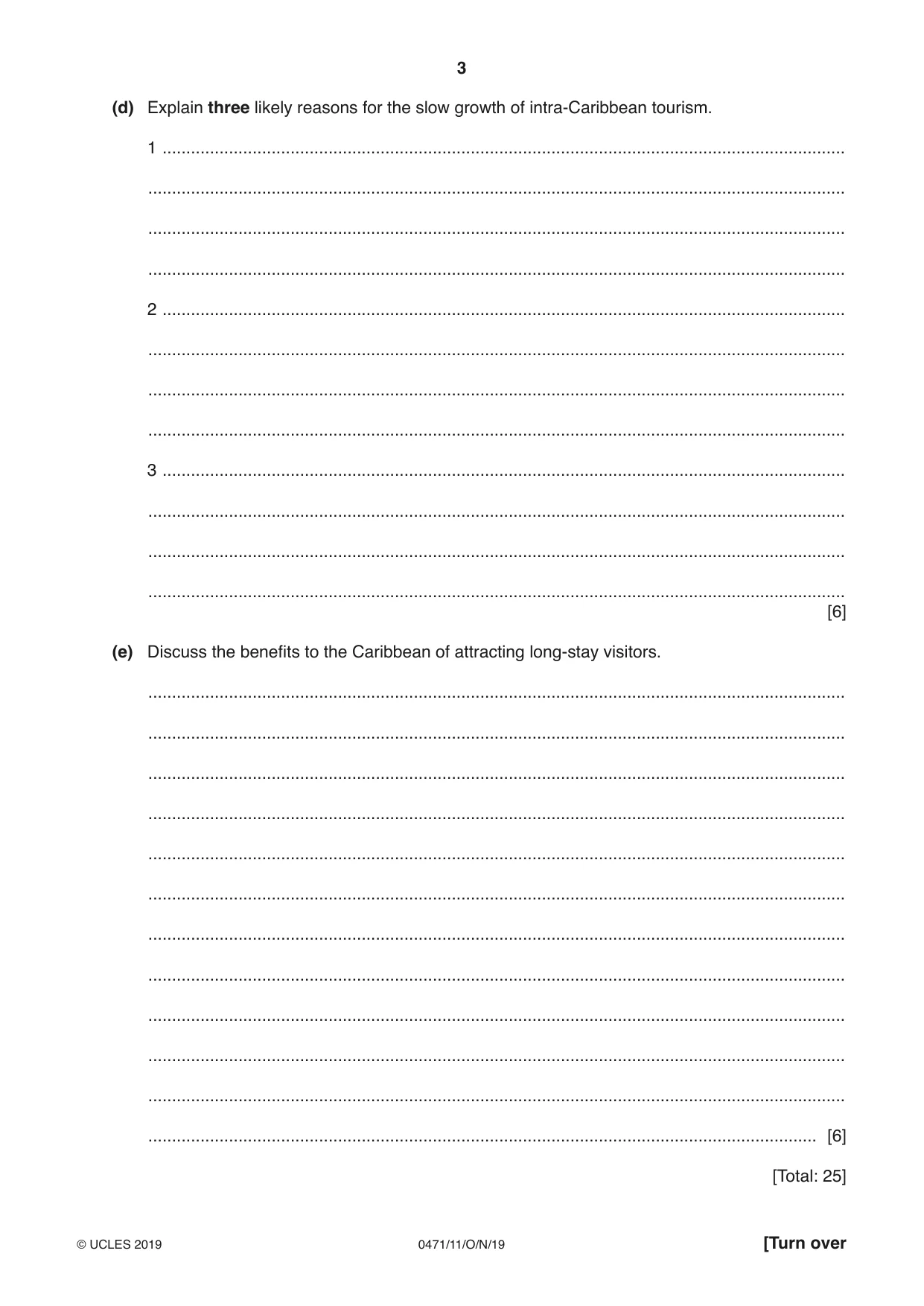
3 0471/11/O/N/19 © UCLES 2019 [Turn over (d) Explain three likely reasons for the slow growth of intra-Caribbean tourism. 1 … … … … 2 … … … … 3 … … … … [6] (e) Discuss the benefits to the Caribbean of attracting long-stay visitors. … … … … … … … … … … … … [6] [Total: 25]
Question paper, page 4
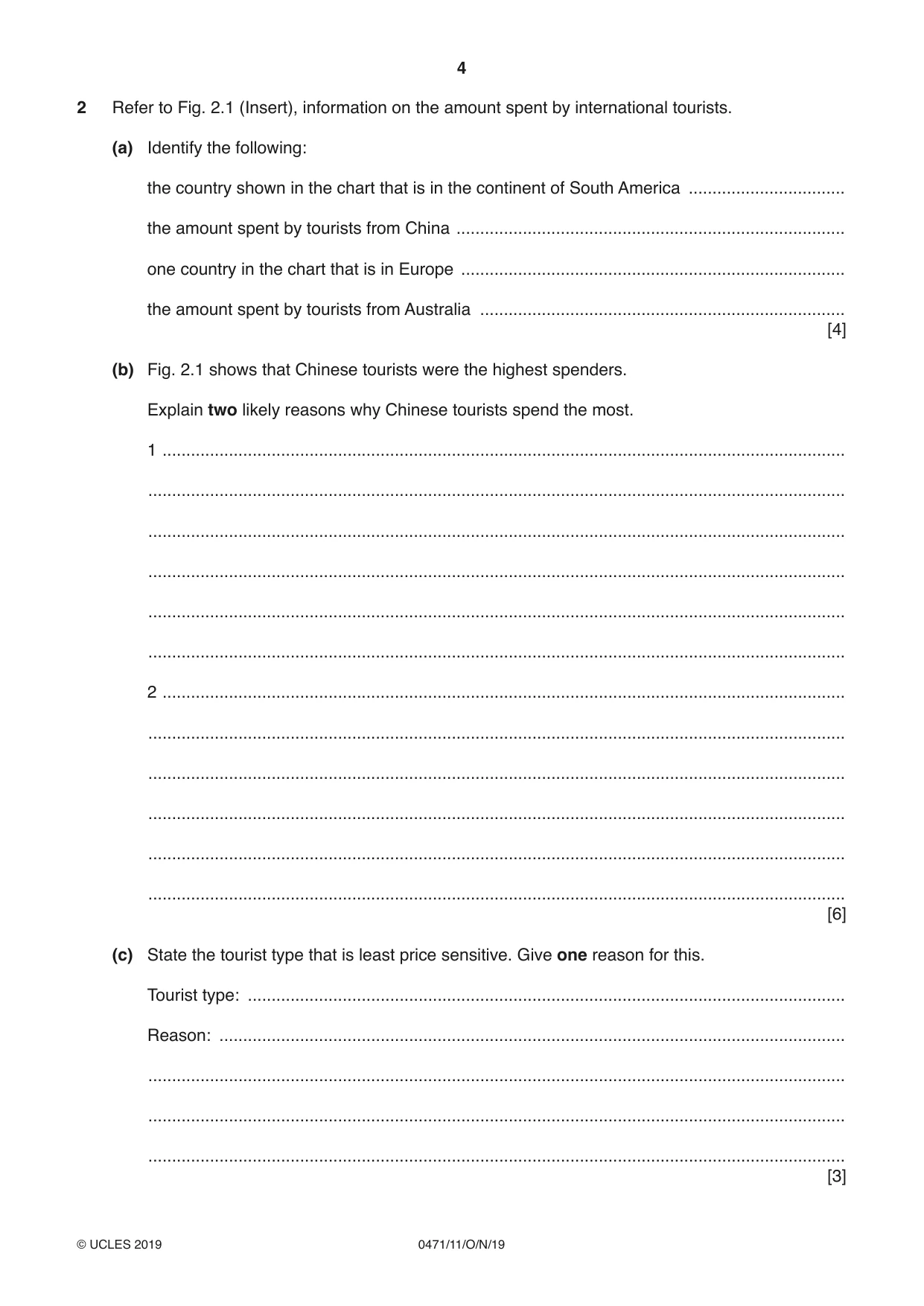
4 0471/11/O/N/19 © UCLES 2019 2 Refer to Fig. 2.1 (Insert), information on the amount spent by international tourists. (a) Identify the following: the country shown in the chart that is in the continent of South America … the amount spent by tourists from China … one country in the chart that is in Europe … the amount spent by tourists from Australia … [4] (b) Fig. 2.1 shows that Chinese tourists were the highest spenders. Explain two likely reasons why Chinese tourists spend the most. 1 … … … … … … 2 … … … … … … [6] (c) State the tourist type that is least price sensitive. Give one reason for this. Tourist type: … Reason: … … … … [3]
Question paper, page 5
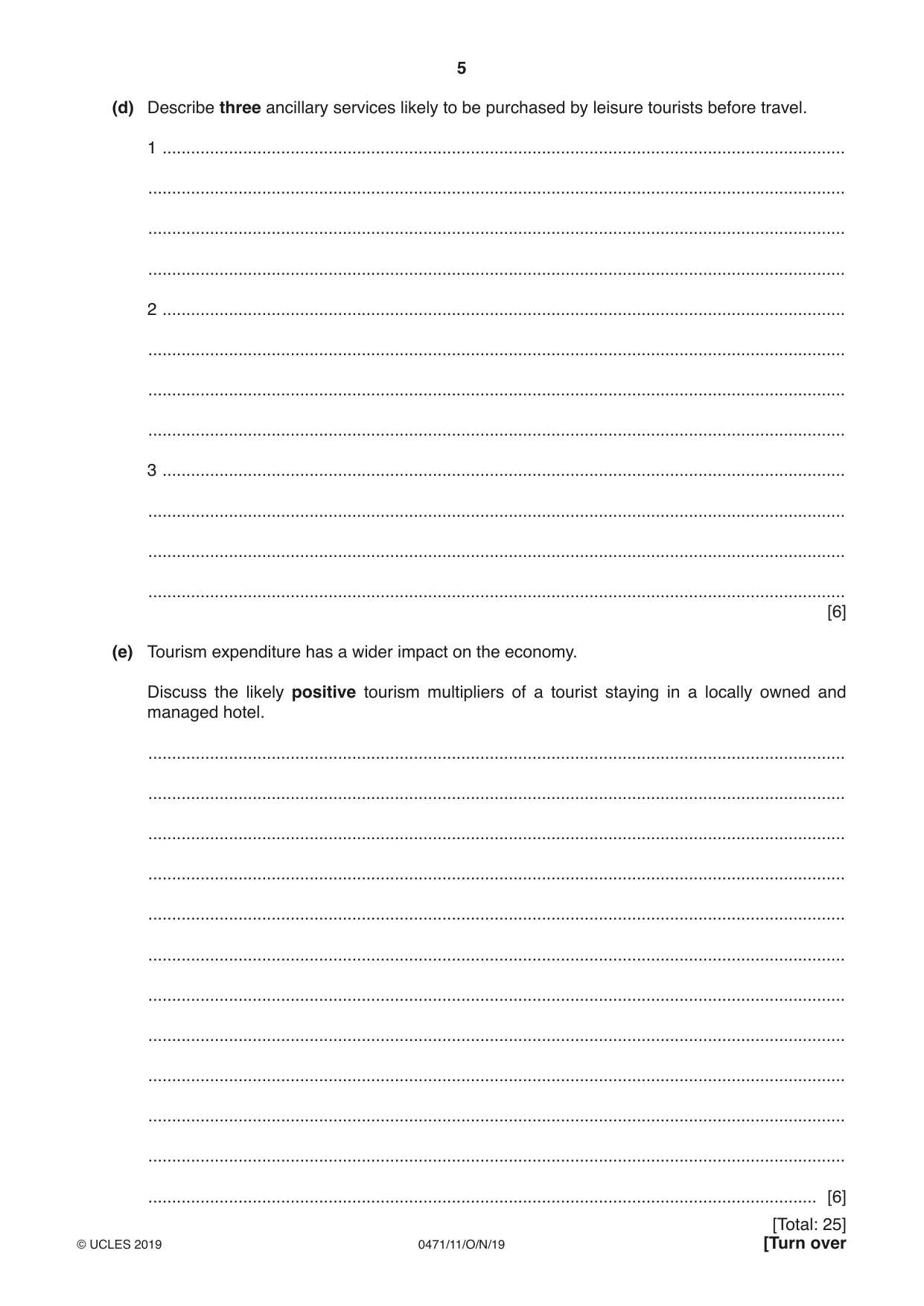
5 0471/11/O/N/19 © UCLES 2019 [Turn over (d) Describe three ancillary services likely to be purchased by leisure tourists before travel. 1 … … … … 2 … … … … 3 … … … … [6] (e) Tourism expenditure has a wider impact on the economy. Discuss the likely positive tourism multipliers of a tourist staying in a locally owned and managed hotel. … … … … … … … … … … … … [6] [Total: 25]
Question paper, page 6
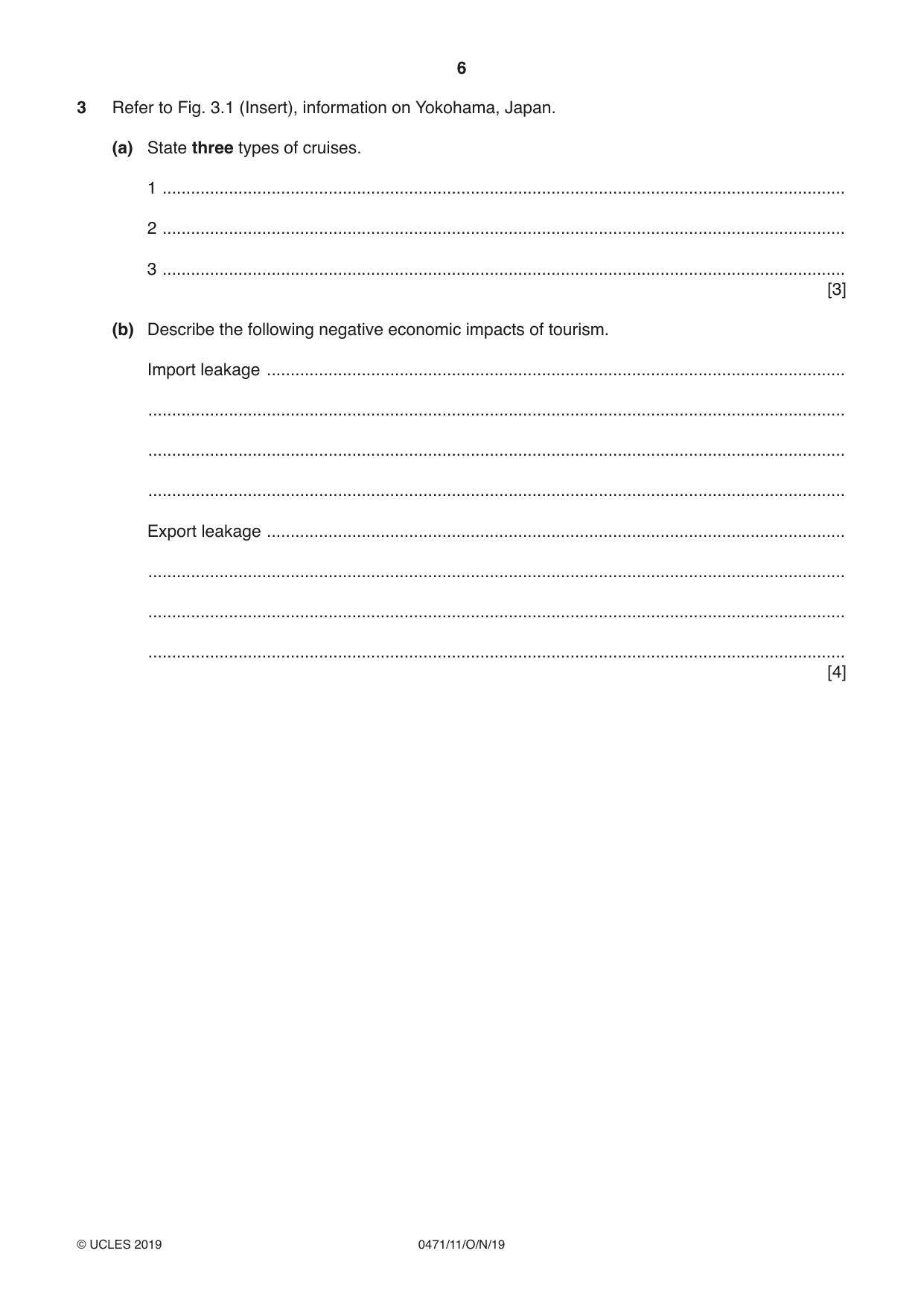
6 0471/11/O/N/19 © UCLES 2019 3 Refer to Fig. 3.1 (Insert), information on Yokohama, Japan. (a) State three types of cruises. 1 … 2 … 3 … [3] (b) Describe the following negative economic impacts of tourism. Import leakage … … … … Export leakage … … … … [4]
Question paper, page 7
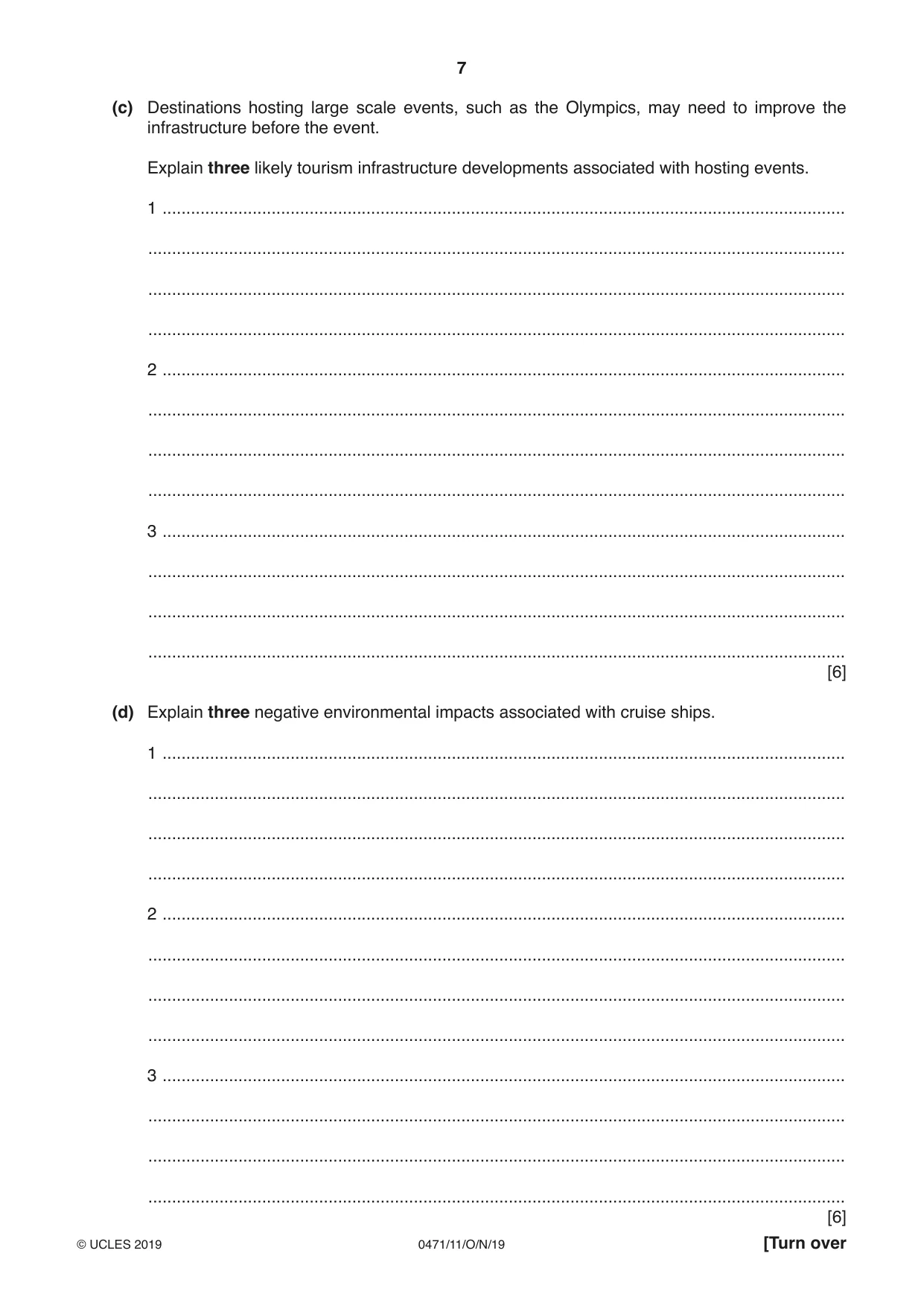
7 0471/11/O/N/19 © UCLES 2019 [Turn over (c) Destinations hosting large scale events, such as the Olympics, may need to improve the infrastructure before the event. Explain three likely tourism infrastructure developments associated with hosting events. 1 … … … … 2 … … … … 3 … … … … [6] (d) Explain three negative environmental impacts associated with cruise ships. 1 … … … … 2 … … … … 3 … … … … [6]
Question paper, page 8
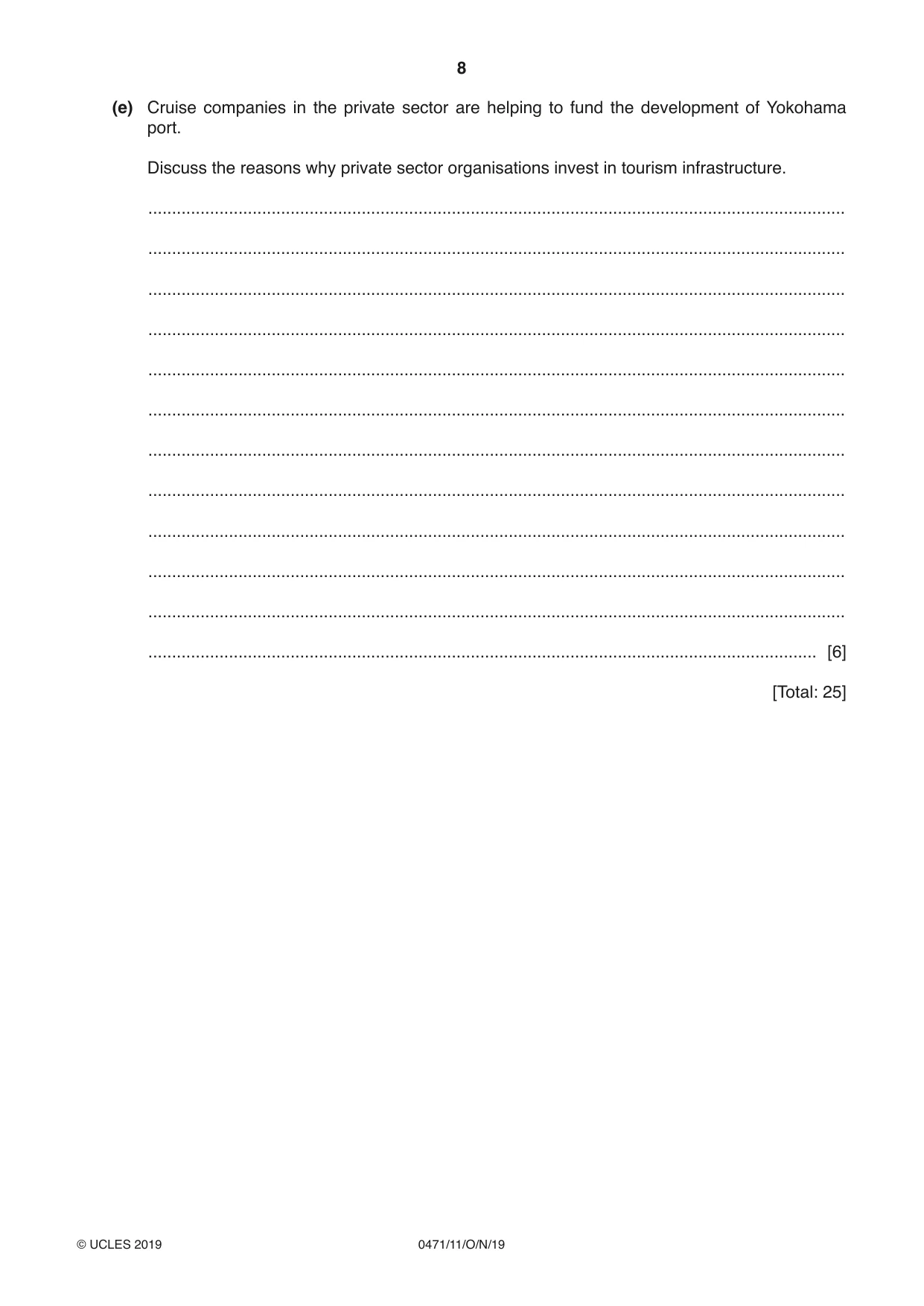
8 0471/11/O/N/19 © UCLES 2019 (e) Cruise companies in the private sector are helping to fund the development of Yokohama port. Discuss the reasons why private sector organisations invest in tourism infrastructure. … … … … … … … … … … … … [6] [Total: 25]
Question paper, page 9
9 0471/11/O/N/19 © UCLES 2019 [Turn over 4 Refer to Fig. 4.1 (Insert), information on open-top sightseeing bus tours in Cape Town, South Africa. (a) Identify the following: the time of the last bus … the destination of the first bus … where tourists can purchase tickets from before getting on the bus … [3] (b) Explain three benefits to tourists of using a sightseeing bus rather than public transport. 1 … … … … 2 … … … … 3 … … … … [6]
Question paper, page 10
10 0471/11/O/N/19 © UCLES 2019 (c) Explain three ways sightseeing tour companies can manage the impacts of seasonality. 1 … … … … 2 … … … … 3 … … … … [6] (d) Describe two personal presentation requirements likely for drivers of sightseeing tours. 1 … … … … 2 … … … … [4]
Question paper, page 11
11 0471/11/O/N/19 © UCLES 2019 (e) Discuss the benefit of sightseeing tour companies using social media as a way of promoting their services. … … … … … … … … … … … … [6] [Total: 25]
Question paper, page 12
12 0471/11/O/N/19 © UCLES 2019 Permission to reproduce items where third-party owned material protected by copyright is included has been sought and cleared where possible. Every reasonable effort has been made by the publisher (UCLES) to trace copyright holders, but if any items requiring clearance have unwittingly been included, the publisher will be pleased to make amends at the earliest possible opportunity. To avoid the issue of disclosure of answer-related information to candidates, all copyright acknowledgements are reproduced online in the Cambridge Assessment International Education Copyright Acknowledgements Booklet. This is produced for each series of examinations and is freely available to download at www.cambridgeinternational.org after the live examination series. Cambridge Assessment International Education is part of the Cambridge Assessment Group. Cambridge Assessment is the brand name of the University of Cambridge Local Examinations Syndicate (UCLES), which itself is a department of the University of Cambridge. BLANK PAGE
Mark scheme, page 1
This document consists of 9 printed pages. © UCLES 2019 [Turn over Cambridge Assessment International Education Cambridge International General Certificate of Secondary Education TRAVEL AND TOURISM 0471/11 Paper 1 Core Paper October/November 2019 MARK SCHEME Maximum Mark: 100 Published This mark scheme is published as an aid to teachers and candidates, to indicate the requirements of the examination. It shows the basis on which Examiners were instructed to award marks. It does not indicate the details of the discussions that took place at an Examiners’ meeting before marking began, which would have considered the acceptability of alternative answers. Mark schemes should be read in conjunction with the question paper and the Principal Examiner Report for Teachers. Cambridge International will not enter into discussions about these mark schemes. Cambridge International is publishing the mark schemes for the October/November 2019 series for most Cambridge IGCSE™, Cambridge International A and AS Level components and some Cambridge O Level components.
Mark scheme, page 2
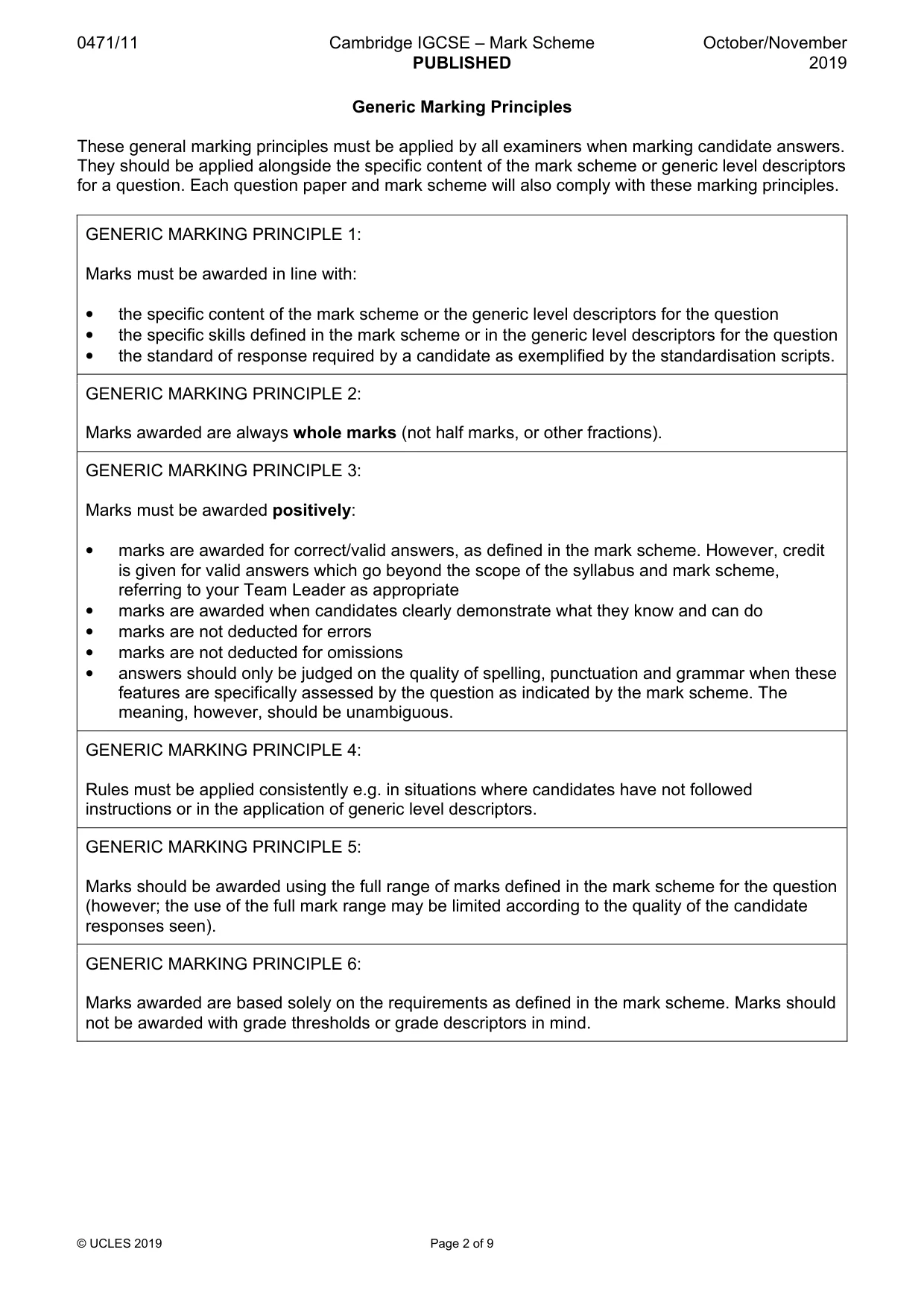
0471/11 Cambridge IGCSE – Mark Scheme PUBLISHED October/November 2019 © UCLES 2019 Page 2 of 9 Generic Marking Principles These general marking principles must be applied by all examiners when marking candidate answers. They should be applied alongside the specific content of the mark scheme or generic level descriptors for a question. Each question paper and mark scheme will also comply with these marking principles. GENERIC MARKING PRINCIPLE 1: Marks must be awarded in line with: • the specific content of the mark scheme or the generic level descriptors for the question • the specific skills defined in the mark scheme or in the generic level descriptors for the question • the standard of response required by a candidate as exemplified by the standardisation scripts. GENERIC MARKING PRINCIPLE 2: Marks awarded are always whole marks (not half marks, or other fractions). GENERIC MARKING PRINCIPLE 3: Marks must be awarded positively: • marks are awarded for correct/valid answers, as defined in the mark scheme. However, credit is given for valid answers which go beyond the scope of the syllabus and mark scheme, referring to your Team Leader as appropriate • marks are awarded when candidates clearly demonstrate what they know and can do • marks are not deducted for errors • marks are not deducted for omissions • answers should only be judged on the quality of spelling, punctuation and grammar when these features are specifically assessed by the question as indicated by the mark scheme. The meaning, however, should be unambiguous. GENERIC MARKING PRINCIPLE 4: Rules must be applied consistently e.g. in situations where candidates have not followed instructions or in the application of generic level descriptors. GENERIC MARKING PRINCIPLE 5: Marks should be awarded using the full range of marks defined in the mark scheme for the question (however; the use of the full mark range may be limited according to the quality of the candidate responses seen). GENERIC MARKING PRINCIPLE 6: Marks awarded are based solely on the requirements as defined in the mark scheme. Marks should not be awarded with grade thresholds or grade descriptors in mind.
Mark scheme, page 3
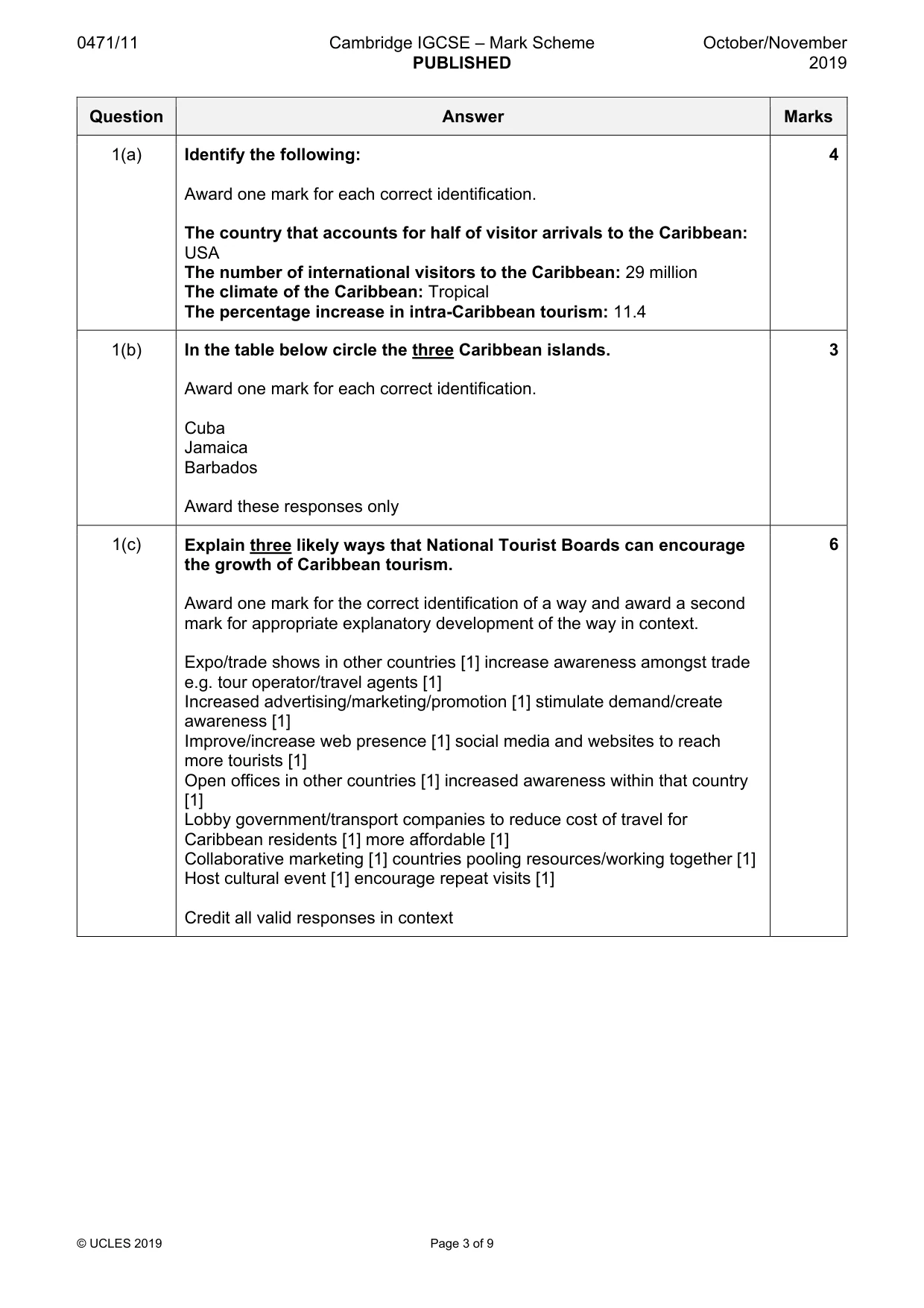
0471/11 Cambridge IGCSE – Mark Scheme PUBLISHED October/November 2019 © UCLES 2019 Page 3 of 9 Question Answer Marks 1(a) Identify the following: Award one mark for each correct identification. The country that accounts for half of visitor arrivals to the Caribbean: USA The number of international visitors to the Caribbean: 29 million The climate of the Caribbean: Tropical The percentage increase in intra-Caribbean tourism: 11.4 4 1(b) In the table below circle the three Caribbean islands. Award one mark for each correct identification. Cuba Jamaica Barbados Award these responses only 3 1(c) Explain three likely ways that National Tourist Boards can encourage the growth of Caribbean tourism. Award one mark for the correct identification of a way and award a second mark for appropriate explanatory development of the way in context. Expo/trade shows in other countries [1] increase awareness amongst trade e.g. tour operator/travel agents [1] Increased advertising/marketing/promotion [1] stimulate demand/create awareness [1] Improve/increase web presence [1] social media and websites to reach more tourists [1] Open offices in other countries [1] increased awareness within that country [1] Lobby government/transport companies to reduce cost of travel for Caribbean residents [1] more affordable [1] Collaborative marketing [1] countries pooling resources/working together [1] Host cultural event [1] encourage repeat visits [1] Credit all valid responses in context 6
Mark scheme, page 4
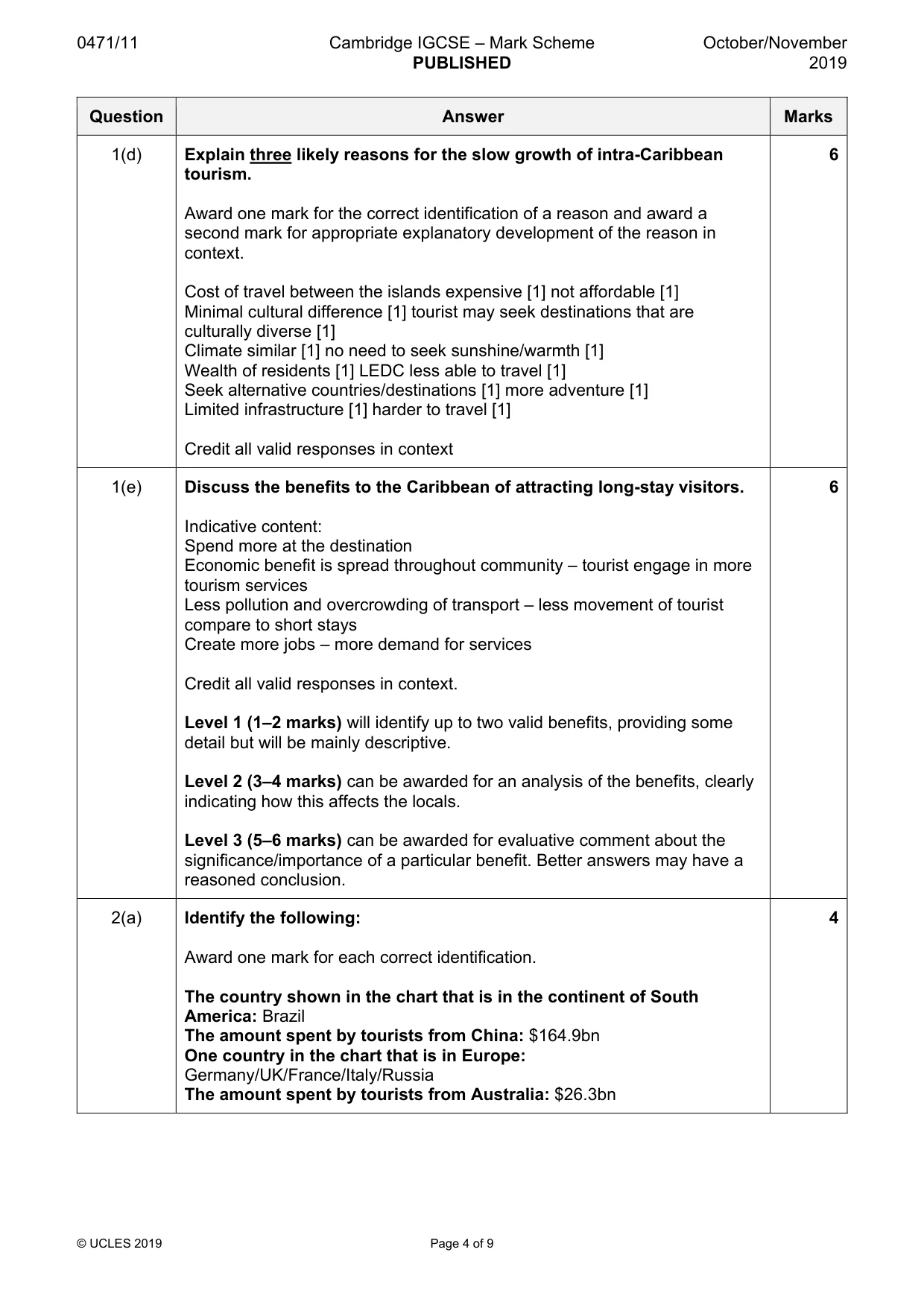
0471/11 Cambridge IGCSE – Mark Scheme PUBLISHED October/November 2019 © UCLES 2019 Page 4 of 9 Question Answer Marks 1(d) Explain three likely reasons for the slow growth of intra-Caribbean tourism. Award one mark for the correct identification of a reason and award a second mark for appropriate explanatory development of the reason in context. Cost of travel between the islands expensive [1] not affordable [1] Minimal cultural difference [1] tourist may seek destinations that are culturally diverse [1] Climate similar [1] no need to seek sunshine/warmth [1] Wealth of residents [1] LEDC less able to travel [1] Seek alternative countries/destinations [1] more adventure [1] Limited infrastructure [1] harder to travel [1] Credit all valid responses in context 6 1(e) Discuss the benefits to the Caribbean of attracting long-stay visitors. Indicative content: Spend more at the destination Economic benefit is spread throughout community – tourist engage in more tourism services Less pollution and overcrowding of transport – less movement of tourist compare to short stays Create more jobs – more demand for services Credit all valid responses in context. Level 1 (1–2 marks) will identify up to two valid benefits, providing some detail but will be mainly descriptive. Level 2 (3–4 marks) can be awarded for an analysis of the benefits, clearly indicating how this affects the locals. Level 3 (5–6 marks) can be awarded for evaluative comment about the significance/importance of a particular benefit. Better answers may have a reasoned conclusion. 6 2(a) Identify the following: Award one mark for each correct identification. The country shown in the chart that is in the continent of South America: Brazil The amount spent by tourists from China: $164.9bn One country in the chart that is in Europe: Germany/UK/France/Italy/Russia The amount spent by tourists from Australia: $26.3bn 4
Mark scheme, page 5
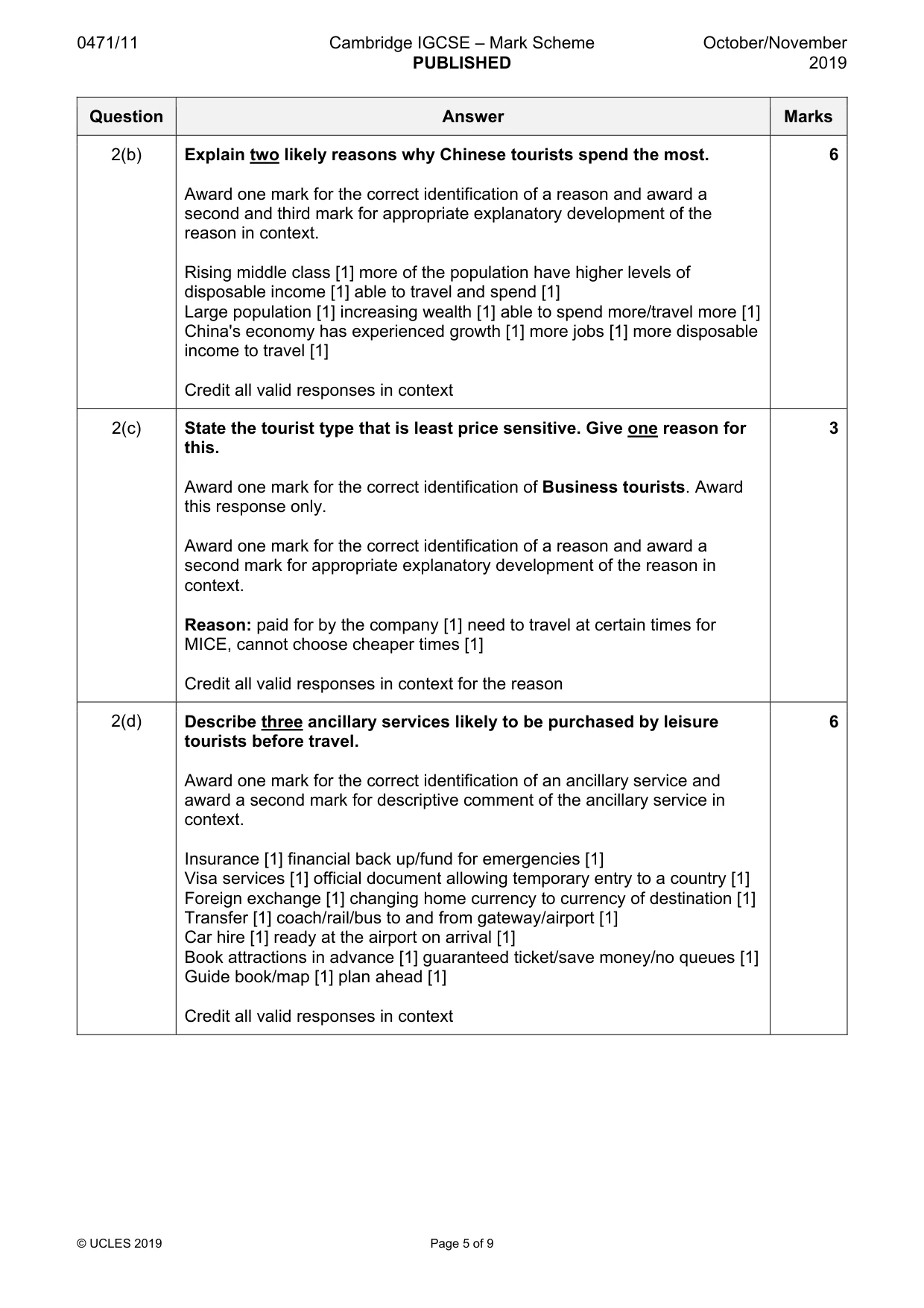
0471/11 Cambridge IGCSE – Mark Scheme PUBLISHED October/November 2019 © UCLES 2019 Page 5 of 9 Question Answer Marks 2(b) Explain two likely reasons why Chinese tourists spend the most. Award one mark for the correct identification of a reason and award a second and third mark for appropriate explanatory development of the reason in context. Rising middle class [1] more of the population have higher levels of disposable income [1] able to travel and spend [1] Large population [1] increasing wealth [1] able to spend more/travel more [1] China's economy has experienced growth [1] more jobs [1] more disposable income to travel [1] Credit all valid responses in context 6 2(c) State the tourist type that is least price sensitive. Give one reason for this. Award one mark for the correct identification of Business tourists. Award this response only. Award one mark for the correct identification of a reason and award a second mark for appropriate explanatory development of the reason in context. Reason: paid for by the company [1] need to travel at certain times for MICE, cannot choose cheaper times [1] Credit all valid responses in context for the reason 3 2(d) Describe three ancillary services likely to be purchased by leisure tourists before travel. Award one mark for the correct identification of an ancillary service and award a second mark for descriptive comment of the ancillary service in context. Insurance [1] financial back up/fund for emergencies [1] Visa services [1] official document allowing temporary entry to a country [1] Foreign exchange [1] changing home currency to currency of destination [1] Transfer [1] coach/rail/bus to and from gateway/airport [1] Car hire [1] ready at the airport on arrival [1] Book attractions in advance [1] guaranteed ticket/save money/no queues [1] Guide book/map [1] plan ahead [1] Credit all valid responses in context 6
Mark scheme, page 6
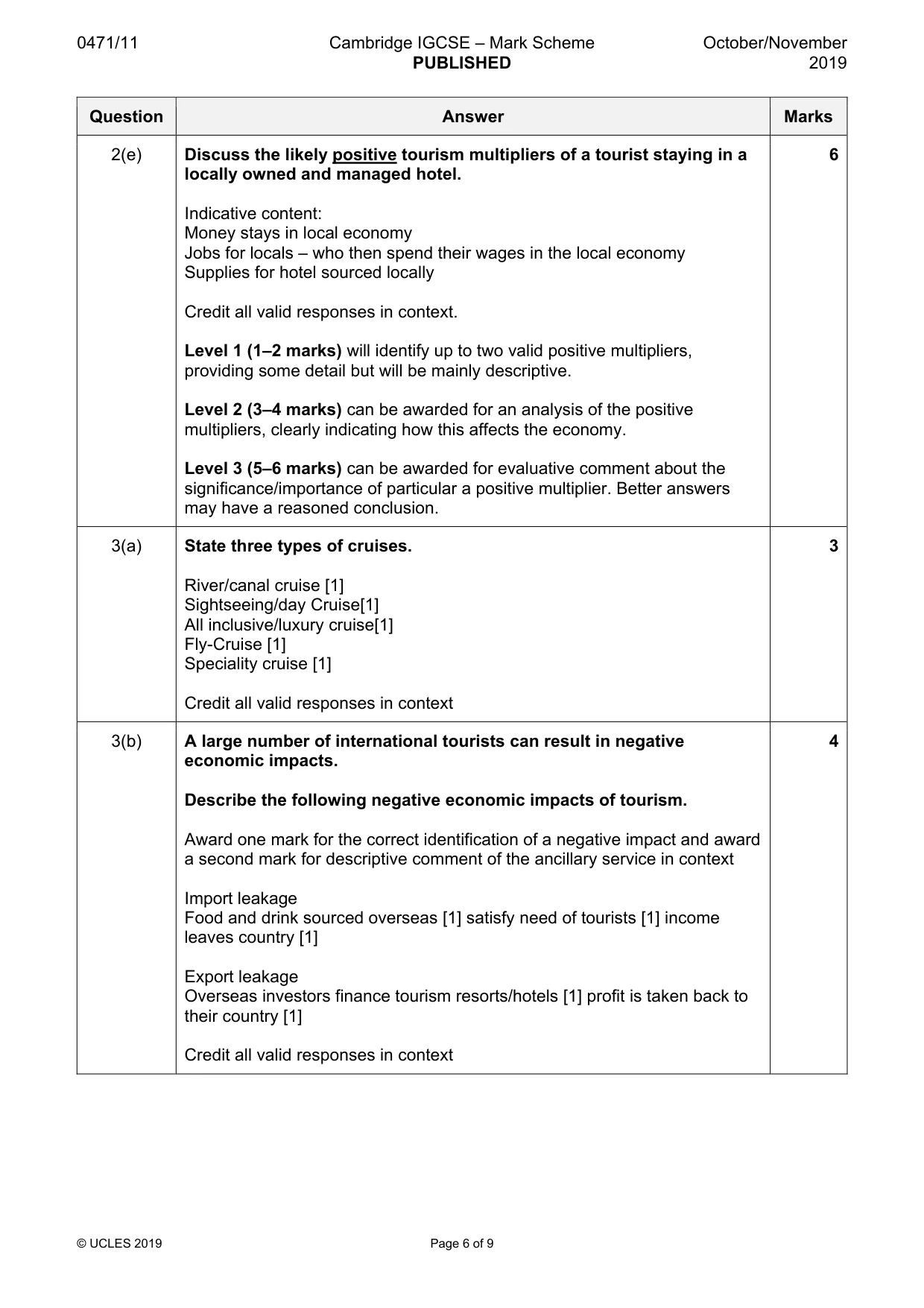
0471/11 Cambridge IGCSE – Mark Scheme PUBLISHED October/November 2019 © UCLES 2019 Page 6 of 9 Question Answer Marks 2(e) Discuss the likely positive tourism multipliers of a tourist staying in a locally owned and managed hotel. Indicative content: Money stays in local economy Jobs for locals – who then spend their wages in the local economy Supplies for hotel sourced locally Credit all valid responses in context. Level 1 (1–2 marks) will identify up to two valid positive multipliers, providing some detail but will be mainly descriptive. Level 2 (3–4 marks) can be awarded for an analysis of the positive multipliers, clearly indicating how this affects the economy. Level 3 (5–6 marks) can be awarded for evaluative comment about the significance/importance of particular a positive multiplier. Better answers may have a reasoned conclusion. 6 3(a) State three types of cruises. River/canal cruise [1] Sightseeing/day Cruise[1] All inclusive/luxury cruise[1] Fly-Cruise [1] Speciality cruise [1] Credit all valid responses in context 3 3(b) A large number of international tourists can result in negative economic impacts. Describe the following negative economic impacts of tourism. Award one mark for the correct identification of a negative impact and award a second mark for descriptive comment of the ancillary service in context Import leakage Food and drink sourced overseas [1] satisfy need of tourists [1] income leaves country [1] Export leakage Overseas investors finance tourism resorts/hotels [1] profit is taken back to their country [1] Credit all valid responses in context 4
Mark scheme, page 7
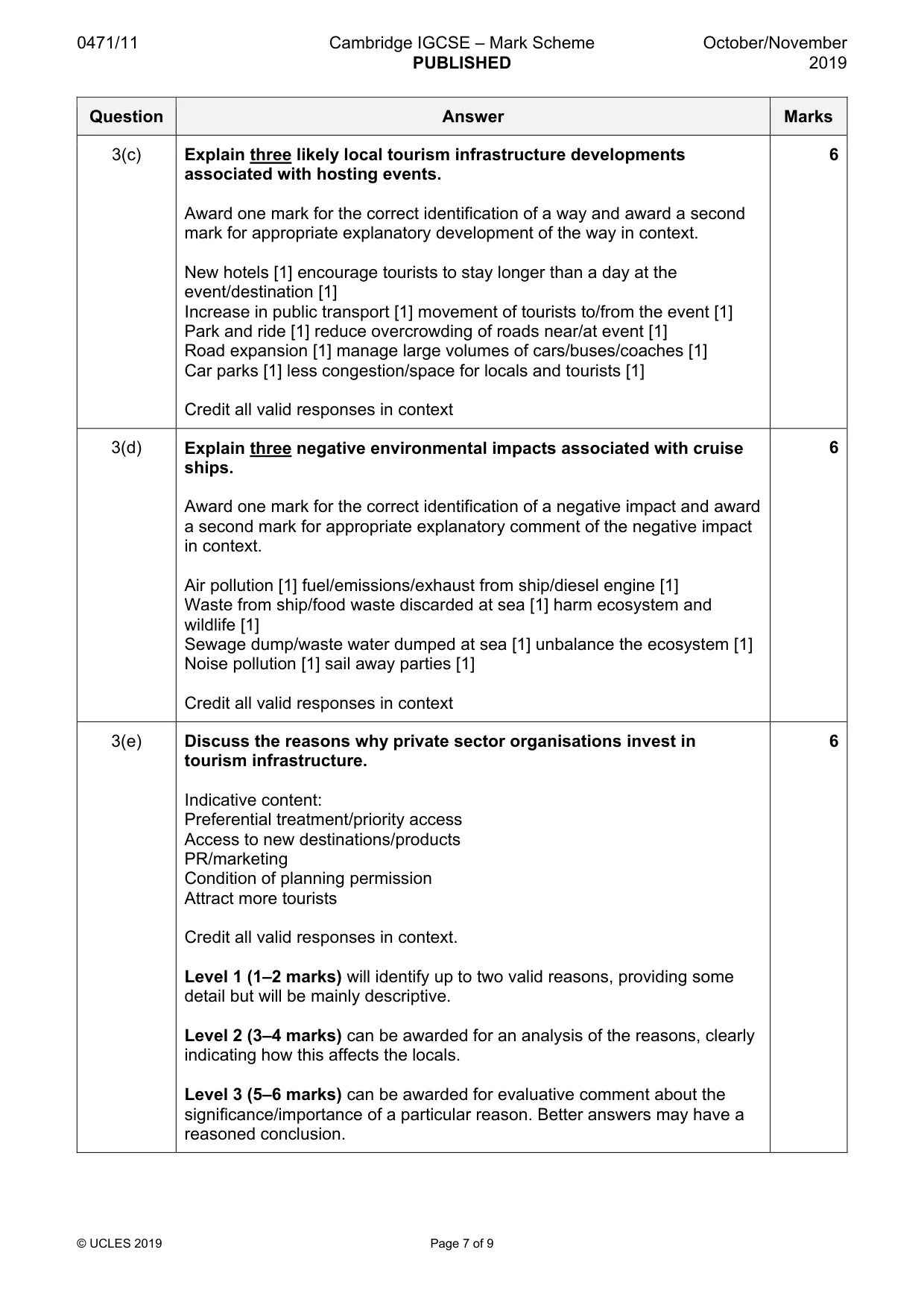
0471/11 Cambridge IGCSE – Mark Scheme PUBLISHED October/November 2019 © UCLES 2019 Page 7 of 9 Question Answer Marks 3(c) Explain three likely local tourism infrastructure developments associated with hosting events. Award one mark for the correct identification of a way and award a second mark for appropriate explanatory development of the way in context. New hotels [1] encourage tourists to stay longer than a day at the event/destination [1] Increase in public transport [1] movement of tourists to/from the event [1] Park and ride [1] reduce overcrowding of roads near/at event [1] Road expansion [1] manage large volumes of cars/buses/coaches [1] Car parks [1] less congestion/space for locals and tourists [1] Credit all valid responses in context 6 3(d) Explain three negative environmental impacts associated with cruise ships. Award one mark for the correct identification of a negative impact and award a second mark for appropriate explanatory comment of the negative impact in context. Air pollution [1] fuel/emissions/exhaust from ship/diesel engine [1] Waste from ship/food waste discarded at sea [1] harm ecosystem and wildlife [1] Sewage dump/waste water dumped at sea [1] unbalance the ecosystem [1] Noise pollution [1] sail away parties [1] Credit all valid responses in context 6 3(e) Discuss the reasons why private sector organisations invest in tourism infrastructure. Indicative content: Preferential treatment/priority access Access to new destinations/products PR/marketing Condition of planning permission Attract more tourists Credit all valid responses in context. Level 1 (1–2 marks) will identify up to two valid reasons, providing some detail but will be mainly descriptive. Level 2 (3–4 marks) can be awarded for an analysis of the reasons, clearly indicating how this affects the locals. Level 3 (5–6 marks) can be awarded for evaluative comment about the significance/importance of a particular reason. Better answers may have a reasoned conclusion. 6
Mark scheme, page 8
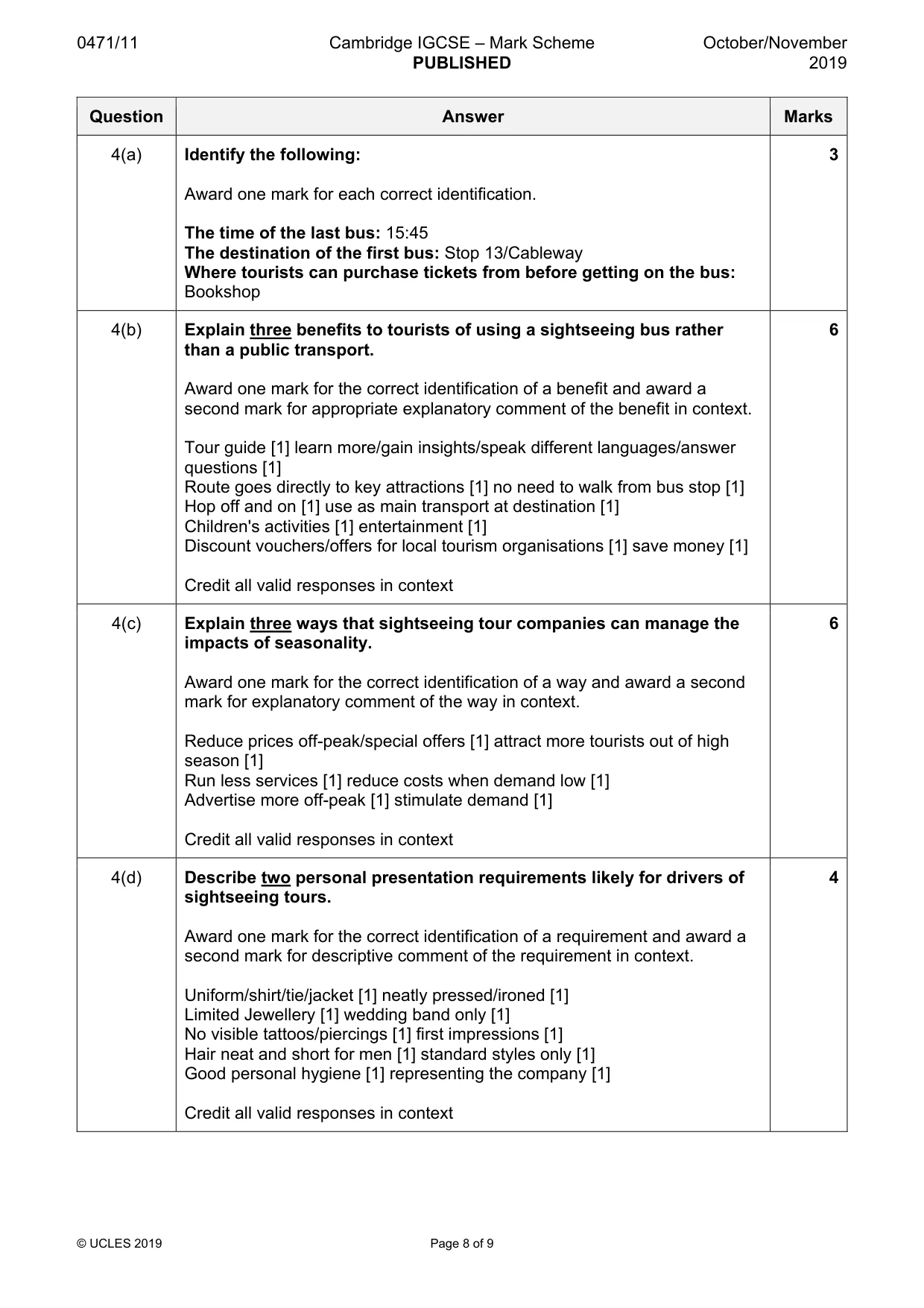
0471/11 Cambridge IGCSE – Mark Scheme PUBLISHED October/November 2019 © UCLES 2019 Page 8 of 9 Question Answer Marks 4(a) Identify the following: Award one mark for each correct identification. The time of the last bus: 15:45 The destination of the first bus: Stop 13/Cableway Where tourists can purchase tickets from before getting on the bus: Bookshop 3 4(b) Explain three benefits to tourists of using a sightseeing bus rather than a public transport. Award one mark for the correct identification of a benefit and award a second mark for appropriate explanatory comment of the benefit in context. Tour guide [1] learn more/gain insights/speak different languages/answer questions [1] Route goes directly to key attractions [1] no need to walk from bus stop [1] Hop off and on [1] use as main transport at destination [1] Children's activities [1] entertainment [1] Discount vouchers/offers for local tourism organisations [1] save money [1] Credit all valid responses in context 6 4(c) Explain three ways that sightseeing tour companies can manage the impacts of seasonality. Award one mark for the correct identification of a way and award a second mark for explanatory comment of the way in context. Reduce prices off-peak/special offers [1] attract more tourists out of high season [1] Run less services [1] reduce costs when demand low [1] Advertise more off-peak [1] stimulate demand [1] Credit all valid responses in context 6 4(d) Describe two personal presentation requirements likely for drivers of sightseeing tours. Award one mark for the correct identification of a requirement and award a second mark for descriptive comment of the requirement in context. Uniform/shirt/tie/jacket [1] neatly pressed/ironed [1] Limited Jewellery [1] wedding band only [1] No visible tattoos/piercings [1] first impressions [1] Hair neat and short for men [1] standard styles only [1] Good personal hygiene [1] representing the company [1] Credit all valid responses in context 4
Mark scheme, page 9
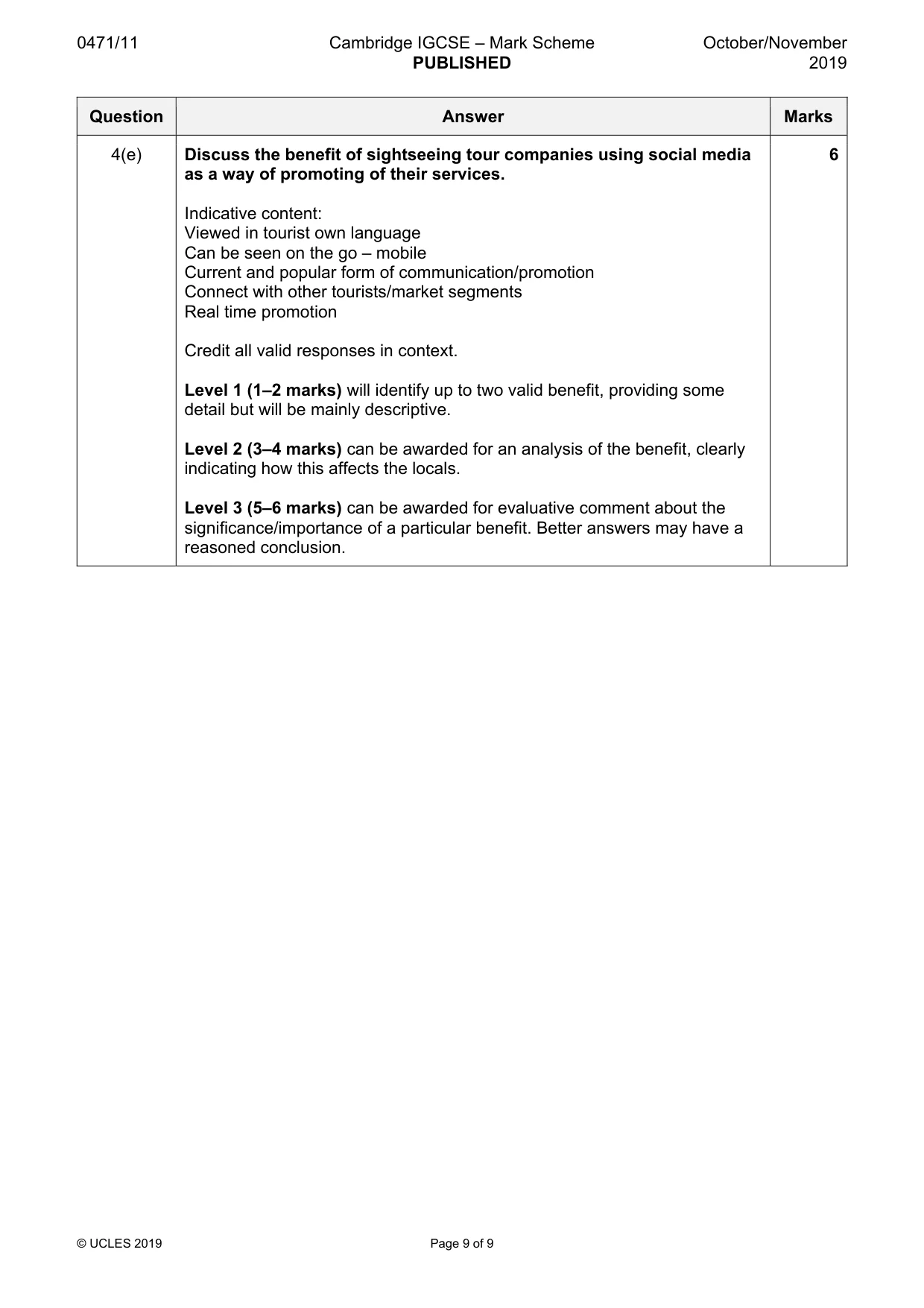
0471/11 Cambridge IGCSE – Mark Scheme PUBLISHED October/November 2019 © UCLES 2019 Page 9 of 9 Question Answer Marks 4(e) Discuss the benefit of sightseeing tour companies using social media as a way of promoting of their services. Indicative content: Viewed in tourist own language Can be seen on the go – mobile Current and popular form of communication/promotion Connect with other tourists/market segments Real time promotion Credit all valid responses in context. Level 1 (1–2 marks) will identify up to two valid benefit, providing some detail but will be mainly descriptive. Level 2 (3–4 marks) can be awarded for an analysis of the benefit, clearly indicating how this affects the locals. Level 3 (5–6 marks) can be awarded for evaluative comment about the significance/importance of a particular benefit. Better answers may have a reasoned conclusion. 6
What you needed in this session
Cambridge’s own grade thresholds for 2019 Oct/Nov, Paper 1 · Variant 1. A higher threshold means an easier paper — the bar moves with how the cohort did.