Cambridge IGCSE Travel and Tourism 0471 — 2019 May/June Paper 1 · Variant 2
0471/12/M/J/19 · 100 marks · ≈113 min
The question paper and its mark scheme, free to read here and free to download. This is Cambridge’s own paper, exactly as it was sat.
Question paper12 pages

Mark scheme12 pages
Answers below. Sit the paper first if you are practising.
Paper as text
Question paper, page 1
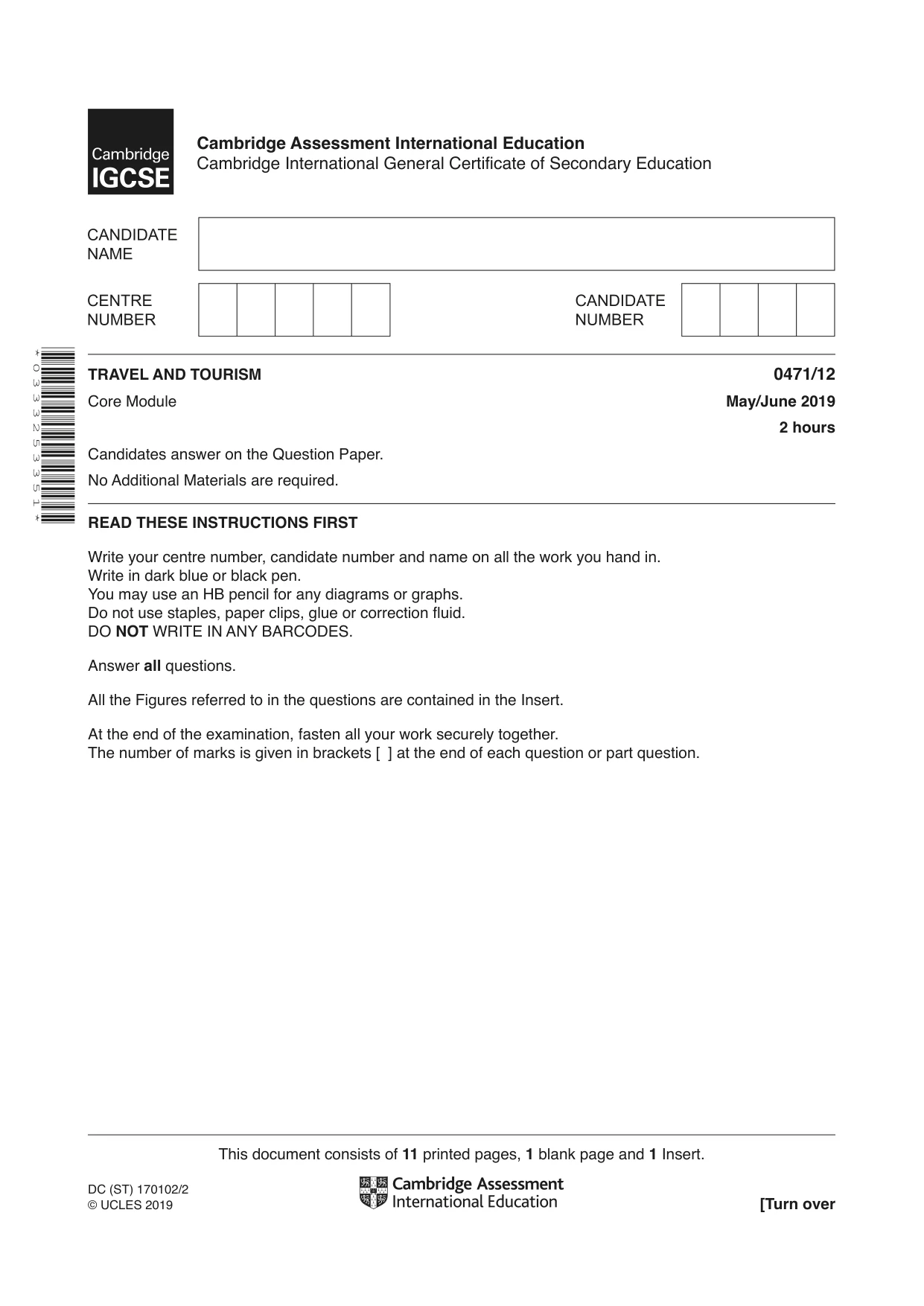
This document consists of 11 printed pages, 1 blank page and 1 Insert. DC (ST) 170102/2 © UCLES 2019 [Turn over * 0 3 3 3 2 5 3 3 5 1 * TRAVEL AND TOURISM 0471/12 Core Module May/June 2019 2 hours Candidates answer on the Question Paper. No Additional Materials are required. READ THESE INSTRUCTIONS FIRST Write your centre number, candidate number and name on all the work you hand in. Write in dark blue or black pen. You may use an HB pencil for any diagrams or graphs. Do not use staples, paper clips, glue or correction fluid. DO NOT WRITE IN ANY BARCODES. Answer all questions. All the Figures referred to in the questions are contained in the Insert. At the end of the examination, fasten all your work securely together. The number of marks is given in brackets [ ] at the end of each question or part question. Cambridge Assessment International Education Cambridge International General Certificate of Secondary Education
Question paper, page 2
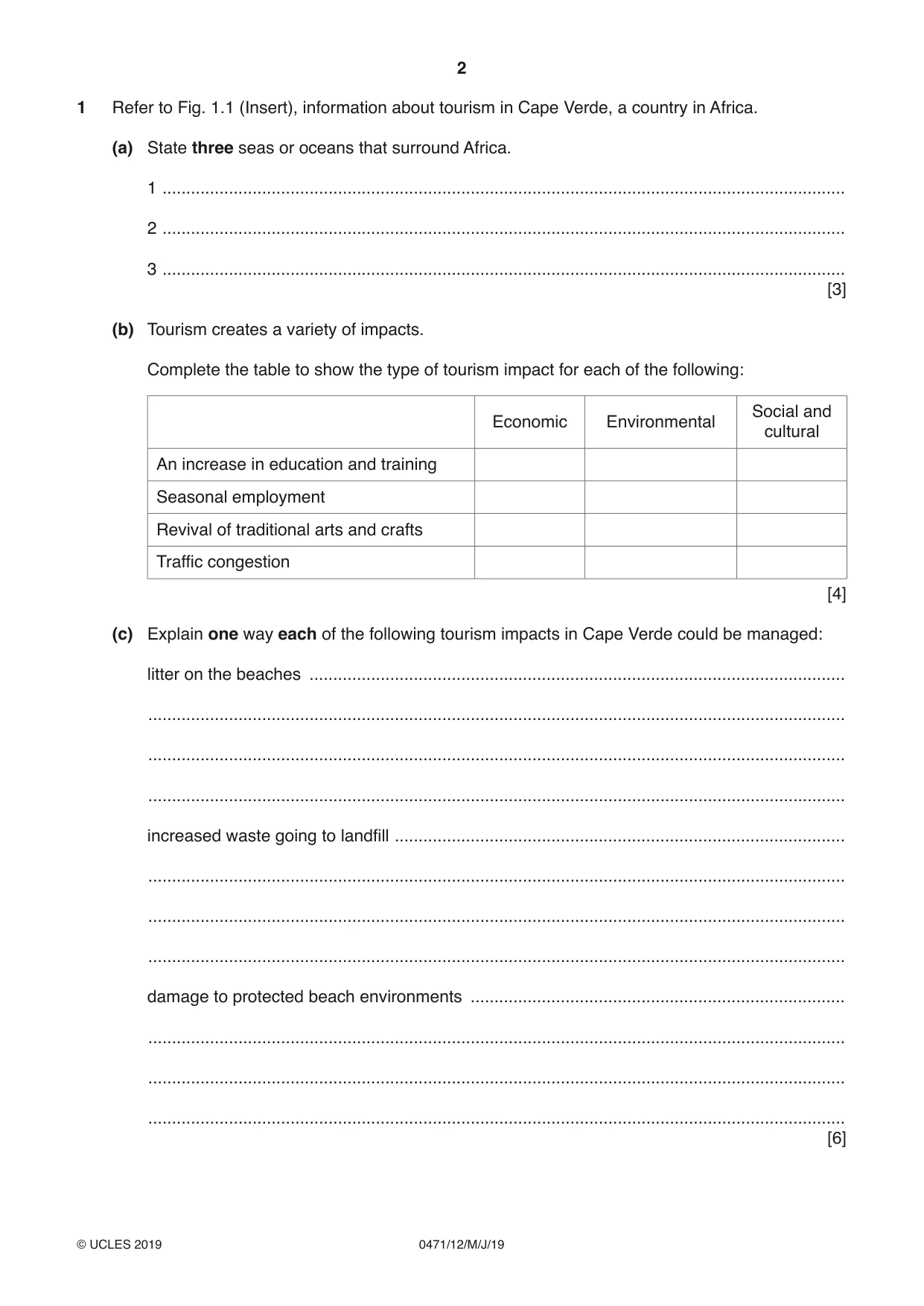
2 0471/12/M/J/19 © UCLES 2019 1 Refer to Fig. 1.1 (Insert), information about tourism in Cape Verde, a country in Africa. (a) State three seas or oceans that surround Africa. 1 … 2 … 3 … [3] (b) Tourism creates a variety of impacts. Complete the table to show the type of tourism impact for each of the following: Economic Environmental Social and cultural An increase in education and training Seasonal employment Revival of traditional arts and crafts Traffic congestion [4] (c) Explain one way each of the following tourism impacts in Cape Verde could be managed: litter on the beaches … … … … increased waste going to landfill … … … … damage to protected beach environments … … … … [6]
Question paper, page 3
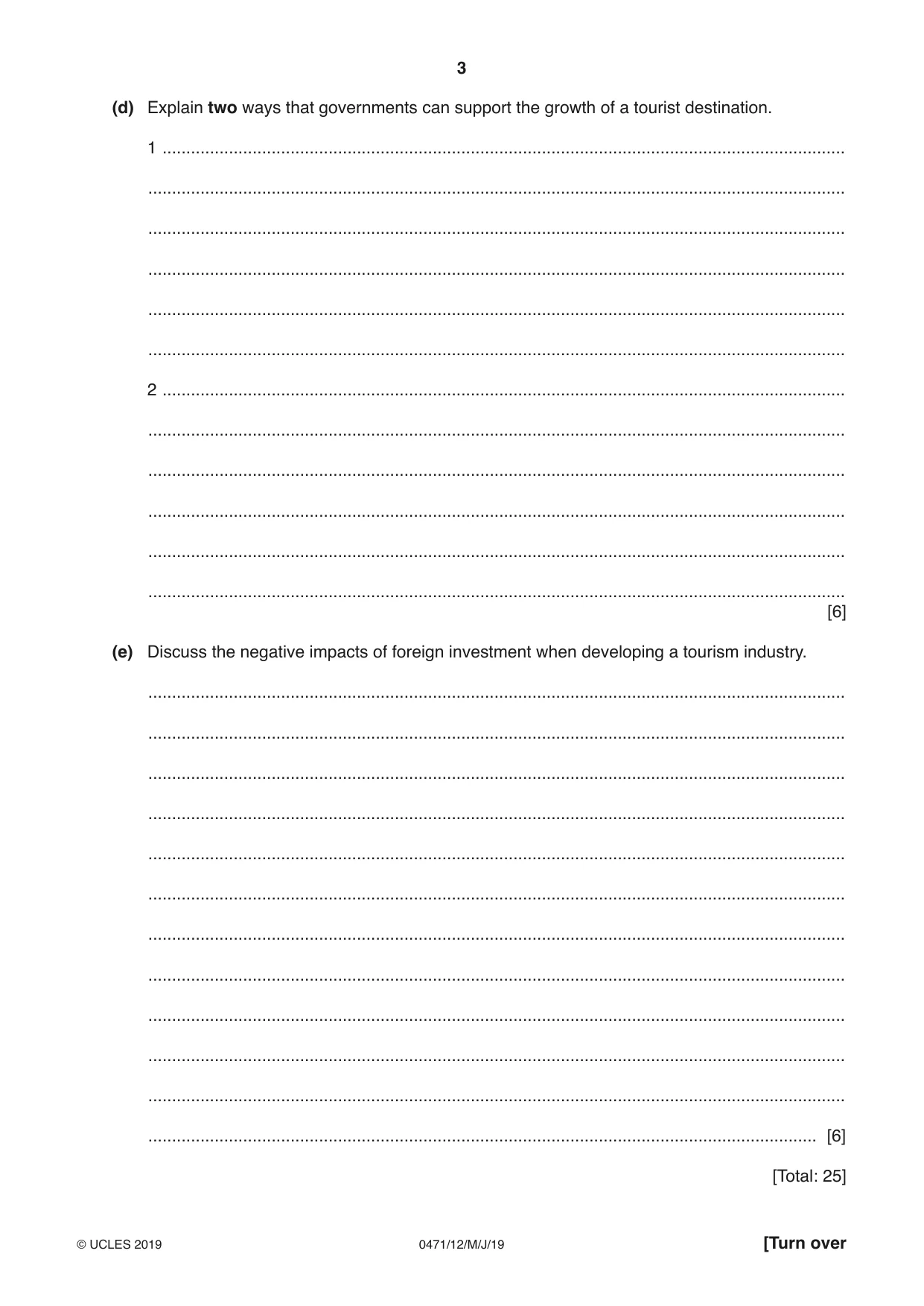
3 0471/12/M/J/19 © UCLES 2019 [Turn over (d) Explain two ways that governments can support the growth of a tourist destination. 1 … … … … … … 2 … … … … … … [6] (e) Discuss the negative impacts of foreign investment when developing a tourism industry. … … … … … … … … … … … … [6] [Total: 25]
Question paper, page 4
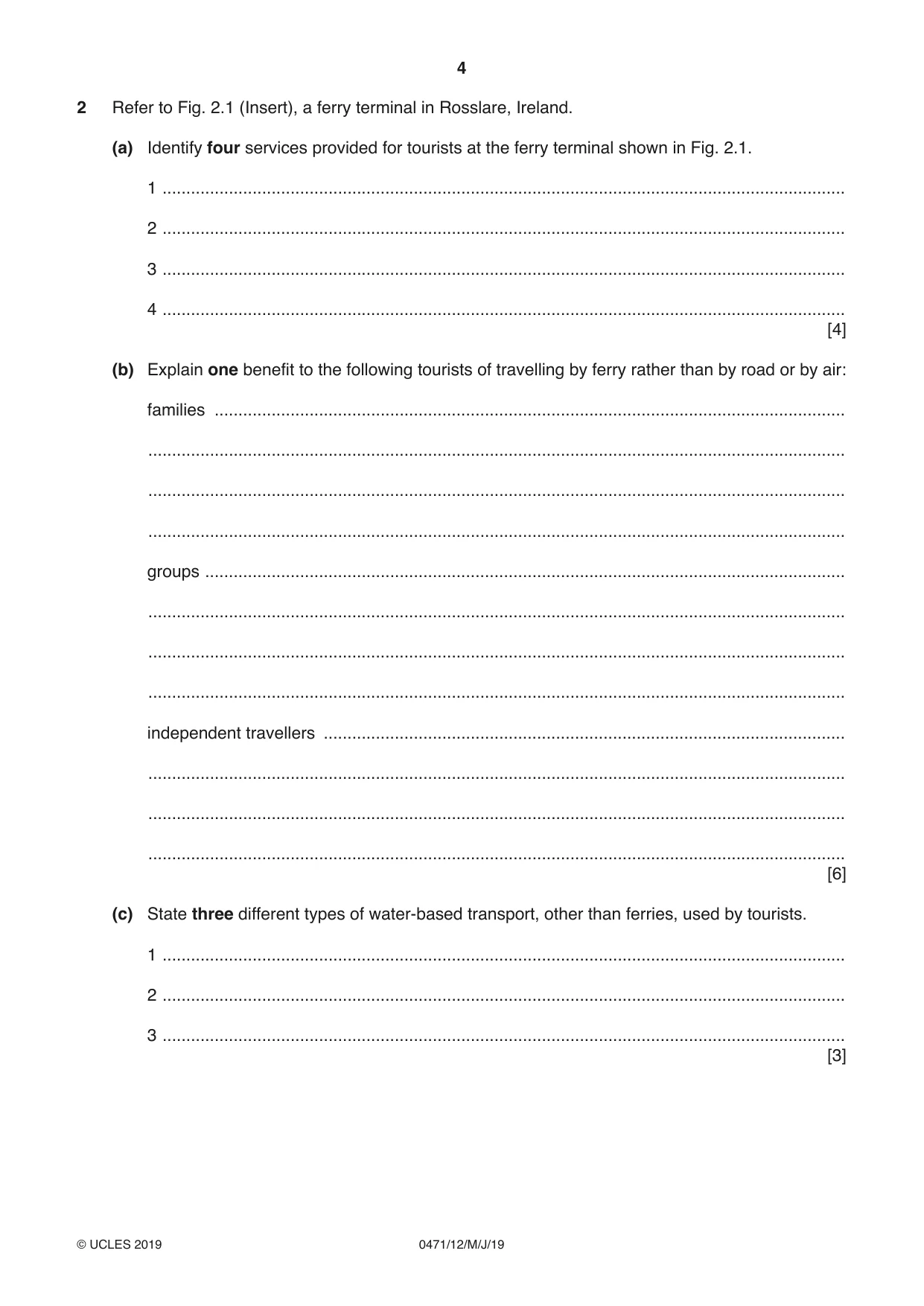
4 0471/12/M/J/19 © UCLES 2019 2 Refer to Fig. 2.1 (Insert), a ferry terminal in Rosslare, Ireland. (a) Identify four services provided for tourists at the ferry terminal shown in Fig. 2.1. 1 … 2 … 3 … 4 … [4] (b) Explain one benefit to the following tourists of travelling by ferry rather than by road or by air: families … … … … groups … … … … independent travellers … … … … [6] (c) State three different types of water-based transport, other than ferries, used by tourists. 1 … 2 … 3 … [3]
Question paper, page 5
5 0471/12/M/J/19 © UCLES 2019 [Turn over (d) Describe three ways that ferry companies can meet the needs of passengers with limited mobility. 1 … … … … 2 … … … … 3 … … … … [6] (e) Discuss the reasons why governments might invest in sea transport. … … … … … … … … … … … … [6] [Total: 25]
Question paper, page 6
6 0471/12/M/J/19 © UCLES 2019 3 Refer to Fig. 3.1 (Insert), a hotel check-in desk. (a) State three examples of technology that tourism staff are likely to use when communicating with customers. 1 … 2 … 3 … [3] (b) State four details staff will discuss with customers when booking a hotel room. 1 … … 2 … … 3 … … 4 … … [4]
Question paper, page 7
7 0471/12/M/J/19 © UCLES 2019 [Turn over (c) Describe one action a hotel receptionist is likely to take at each of the following stages of the hotel guest cycle: pre-arrival/booking … … … … check-in … … … … check-out … … … … [6] (d) Describe three ways tourism organisations can control the personal presentation of their staff. 1 … … … … 2 … … … … 3 … … … … [6]
Question paper, page 8
8 0471/12/M/J/19 © UCLES 2019 (e) Assess the importance to tourism organisations of creating a customer care policy. … … … … … … … … … … … … [6] [Total: 25]
Question paper, page 9
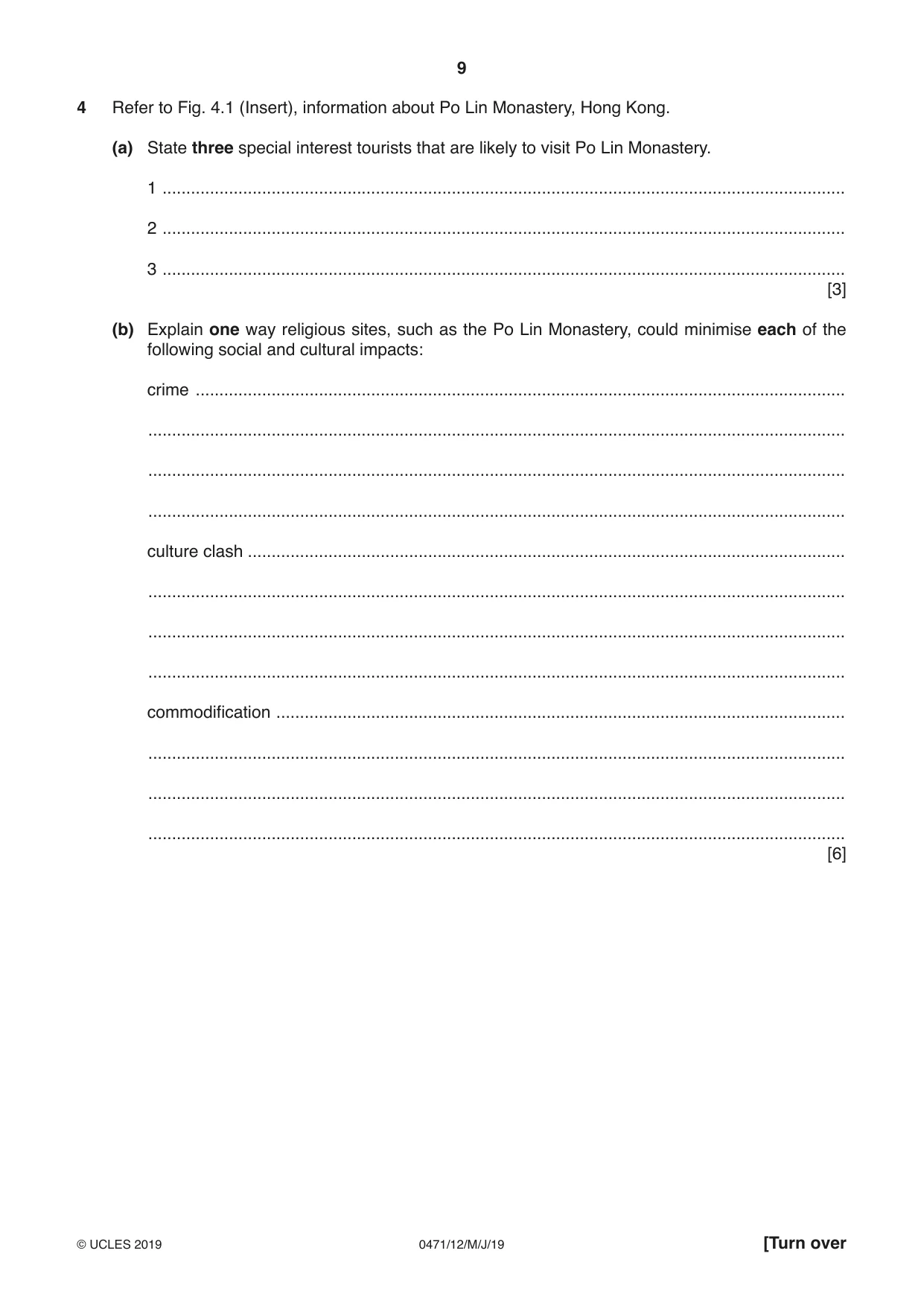
9 0471/12/M/J/19 © UCLES 2019 [Turn over 4 Refer to Fig. 4.1 (Insert), information about Po Lin Monastery, Hong Kong. (a) State three special interest tourists that are likely to visit Po Lin Monastery. 1 … 2 … 3 … [3] (b) Explain one way religious sites, such as the Po Lin Monastery, could minimise each of the following social and cultural impacts: crime … … … … culture clash … … … … commodification … … … … [6]
Question paper, page 10
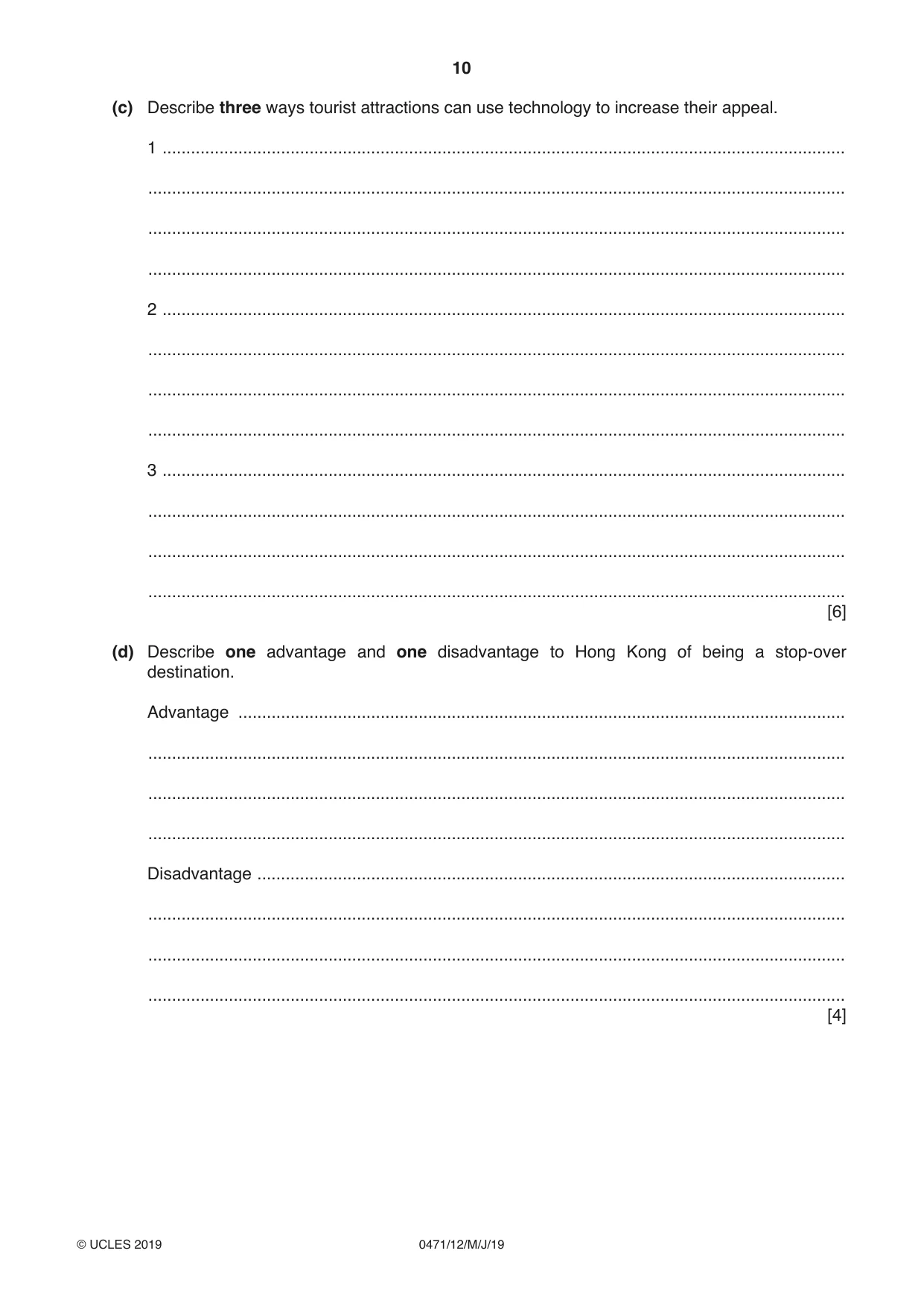
10 0471/12/M/J/19 © UCLES 2019 (c) Describe three ways tourist attractions can use technology to increase their appeal. 1 … … … … 2 … … … … 3 … … … … [6] (d) Describe one advantage and one disadvantage to Hong Kong of being a stop-over destination. Advantage … … … … Disadvantage … … … … [4]
Question paper, page 11
11 0471/12/M/J/19 © UCLES 2019 (e) Discuss the benefits to tourism organisations of having QTS status. … … … … … … … … … … … … [6] [Total: 25]
Question paper, page 12
12 0471/12/M/J/19 © UCLES 2019 Permission to reproduce items where third-party owned material protected by copyright is included has been sought and cleared where possible. Every reasonable effort has been made by the publisher (UCLES) to trace copyright holders, but if any items requiring clearance have unwittingly been included, the publisher will be pleased to make amends at the earliest possible opportunity. To avoid the issue of disclosure of answer-related information to candidates, all copyright acknowledgements are reproduced online in the Cambridge Assessment International Education Copyright Acknowledgements Booklet. This is produced for each series of examinations and is freely available to download at www.cambridgeinternational.org after the live examination series. Cambridge Assessment International Education is part of the Cambridge Assessment Group. Cambridge Assessment is the brand name of the University of Cambridge Local Examinations Syndicate (UCLES), which itself is a department of the University of Cambridge. BLANK PAGE
Mark scheme, page 1
This document consists of 12 printed pages. © UCLES 2019 [Turn over Cambridge Assessment International Education Cambridge International General Certificate of Secondary Education TRAVEL & TOURISM 0471/12 Paper 1 Core Module May/June 2019 MARK SCHEME Maximum Mark: 100 Published This mark scheme is published as an aid to teachers and candidates, to indicate the requirements of the examination. It shows the basis on which Examiners were instructed to award marks. It does not indicate the details of the discussions that took place at an Examiners’ meeting before marking began, which would have considered the acceptability of alternative answers. Mark schemes should be read in conjunction with the question paper and the Principal Examiner Report for Teachers. Cambridge International will not enter into discussions about these mark schemes. Cambridge International is publishing the mark schemes for the May/June 2019 series for most Cambridge IGCSE™, Cambridge International A and AS Level and Cambridge Pre-U components, and some Cambridge O Level components.
Mark scheme, page 2
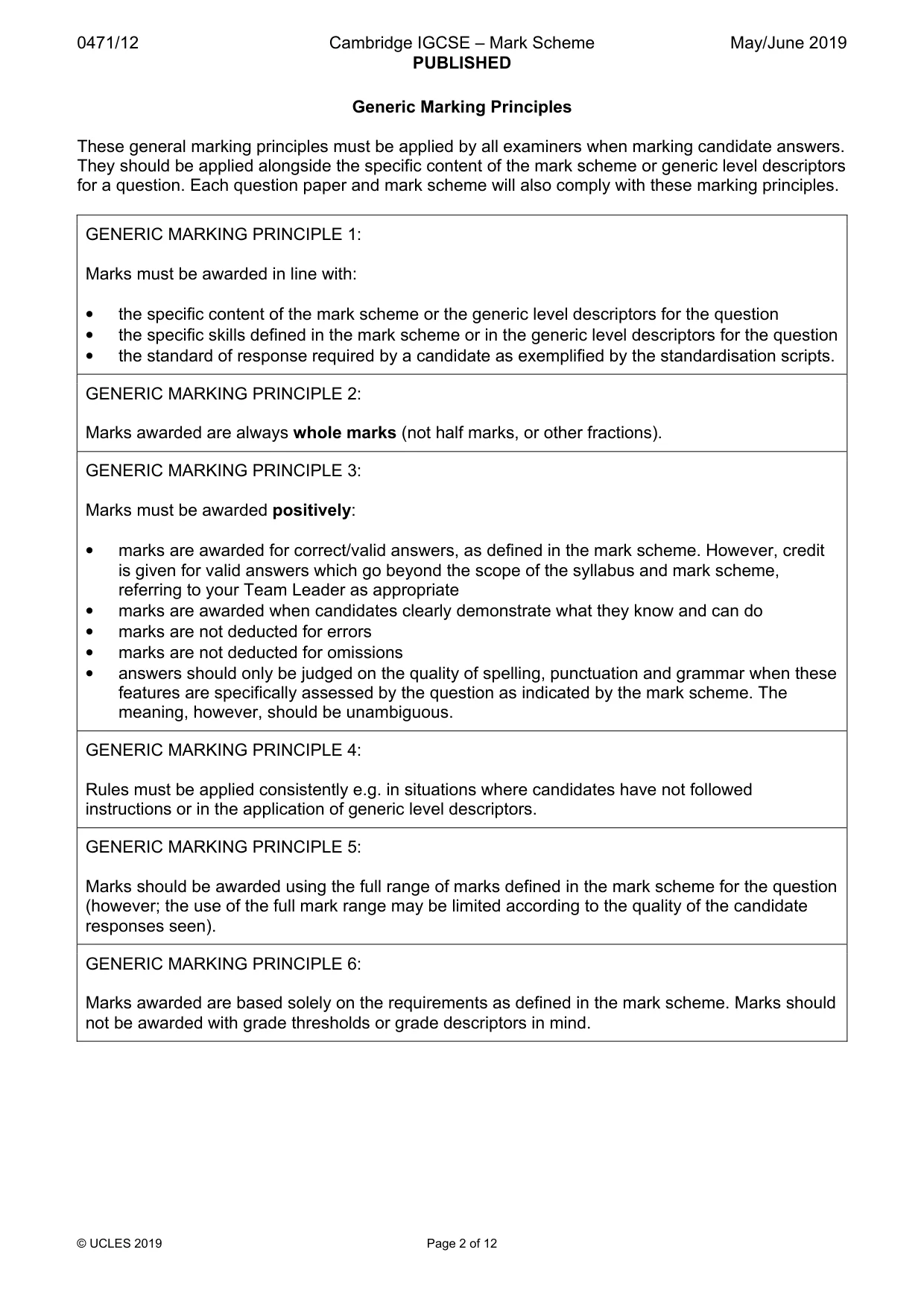
0471/12 Cambridge IGCSE – Mark Scheme PUBLISHED May/June 2019 © UCLES 2019 Page 2 of 12 Generic Marking Principles These general marking principles must be applied by all examiners when marking candidate answers. They should be applied alongside the specific content of the mark scheme or generic level descriptors for a question. Each question paper and mark scheme will also comply with these marking principles. GENERIC MARKING PRINCIPLE 1: Marks must be awarded in line with: • the specific content of the mark scheme or the generic level descriptors for the question • the specific skills defined in the mark scheme or in the generic level descriptors for the question • the standard of response required by a candidate as exemplified by the standardisation scripts. GENERIC MARKING PRINCIPLE 2: Marks awarded are always whole marks (not half marks, or other fractions). GENERIC MARKING PRINCIPLE 3: Marks must be awarded positively: • marks are awarded for correct/valid answers, as defined in the mark scheme. However, credit is given for valid answers which go beyond the scope of the syllabus and mark scheme, referring to your Team Leader as appropriate • marks are awarded when candidates clearly demonstrate what they know and can do • marks are not deducted for errors • marks are not deducted for omissions • answers should only be judged on the quality of spelling, punctuation and grammar when these features are specifically assessed by the question as indicated by the mark scheme. The meaning, however, should be unambiguous. GENERIC MARKING PRINCIPLE 4: Rules must be applied consistently e.g. in situations where candidates have not followed instructions or in the application of generic level descriptors. GENERIC MARKING PRINCIPLE 5: Marks should be awarded using the full range of marks defined in the mark scheme for the question (however; the use of the full mark range may be limited according to the quality of the candidate responses seen). GENERIC MARKING PRINCIPLE 6: Marks awarded are based solely on the requirements as defined in the mark scheme. Marks should not be awarded with grade thresholds or grade descriptors in mind.
Mark scheme, page 3
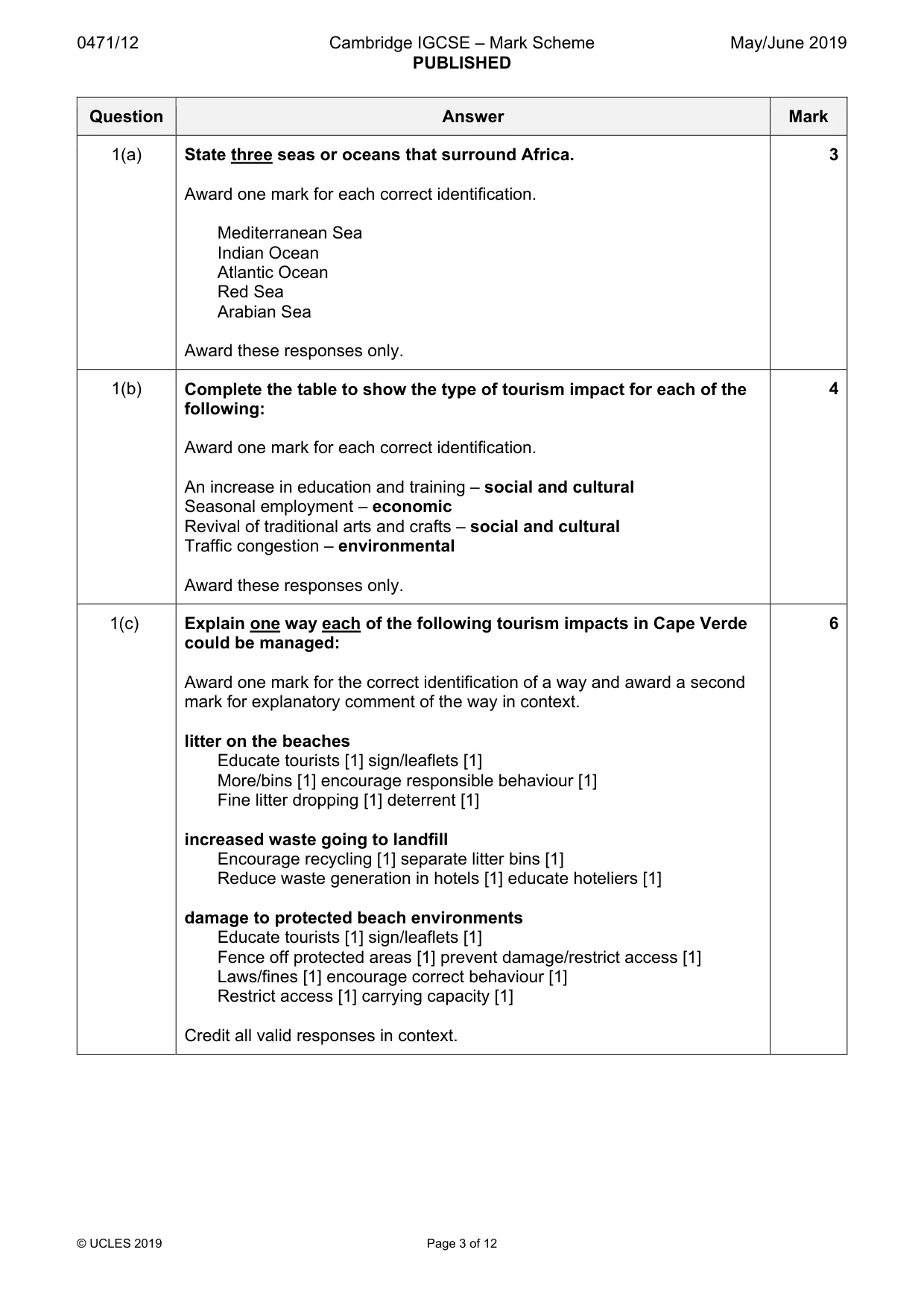
0471/12 Cambridge IGCSE – Mark Scheme PUBLISHED May/June 2019 © UCLES 2019 Page 3 of 12 Question Answer Mark 1(a) State three seas or oceans that surround Africa. Award one mark for each correct identification. Mediterranean Sea Indian Ocean Atlantic Ocean Red Sea Arabian Sea Award these responses only. 3 1(b) Complete the table to show the type of tourism impact for each of the following: Award one mark for each correct identification. An increase in education and training – social and cultural Seasonal employment – economic Revival of traditional arts and crafts – social and cultural Traffic congestion – environmental Award these responses only. 4 1(c) Explain one way each of the following tourism impacts in Cape Verde could be managed: Award one mark for the correct identification of a way and award a second mark for explanatory comment of the way in context. litter on the beaches Educate tourists [1] sign/leaflets [1] More/bins [1] encourage responsible behaviour [1] Fine litter dropping [1] deterrent [1] increased waste going to landfill Encourage recycling [1] separate litter bins [1] Reduce waste generation in hotels [1] educate hoteliers [1] damage to protected beach environments Educate tourists [1] sign/leaflets [1] Fence off protected areas [1] prevent damage/restrict access [1] Laws/fines [1] encourage correct behaviour [1] Restrict access [1] carrying capacity [1] Credit all valid responses in context. 6
Mark scheme, page 4
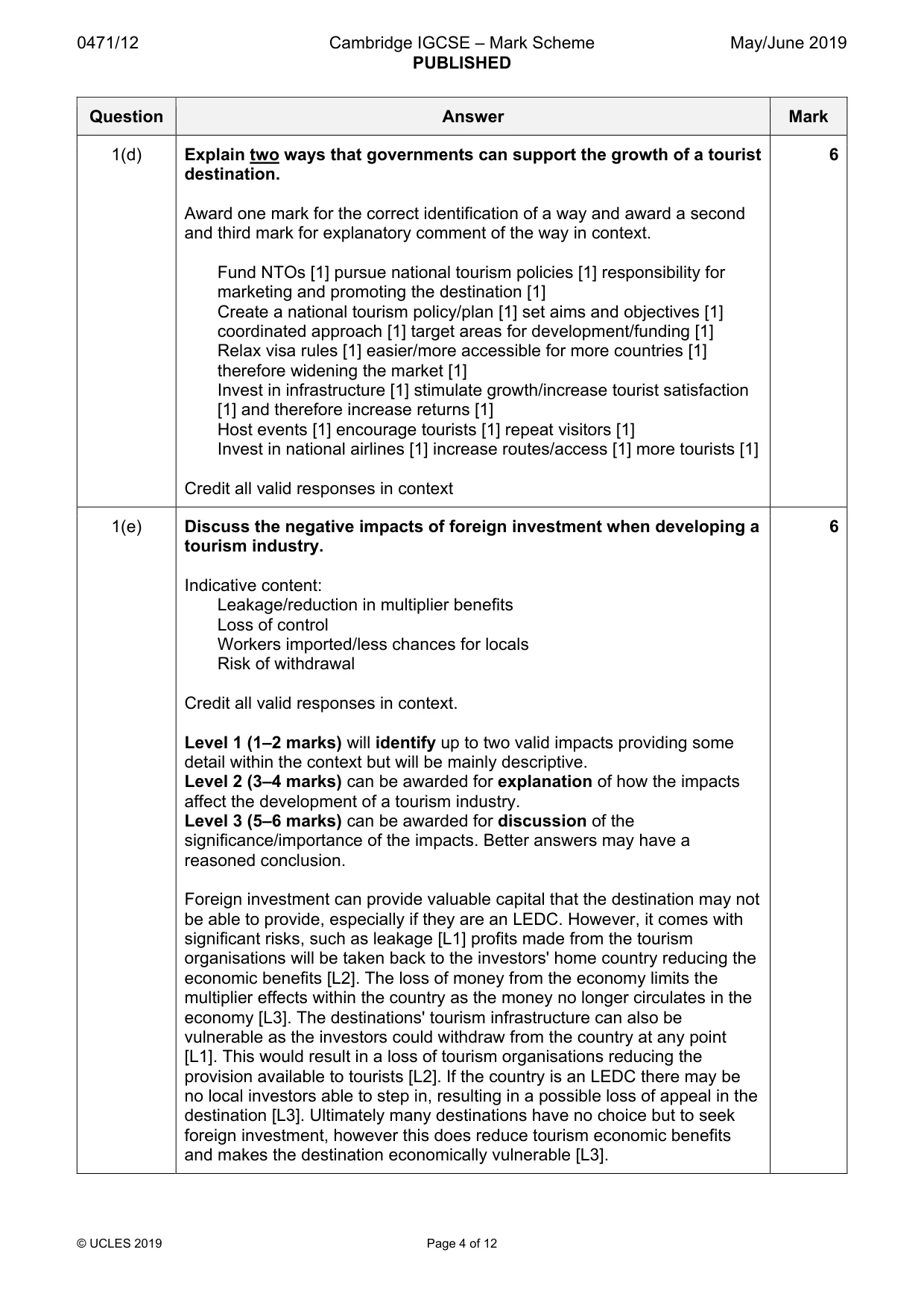
0471/12 Cambridge IGCSE – Mark Scheme PUBLISHED May/June 2019 © UCLES 2019 Page 4 of 12 Question Answer Mark 1(d) Explain two ways that governments can support the growth of a tourist destination. Award one mark for the correct identification of a way and award a second and third mark for explanatory comment of the way in context. Fund NTOs [1] pursue national tourism policies [1] responsibility for marketing and promoting the destination [1] Create a national tourism policy/plan [1] set aims and objectives [1] coordinated approach [1] target areas for development/funding [1] Relax visa rules [1] easier/more accessible for more countries [1] therefore widening the market [1] Invest in infrastructure [1] stimulate growth/increase tourist satisfaction [1] and therefore increase returns [1] Host events [1] encourage tourists [1] repeat visitors [1] Invest in national airlines [1] increase routes/access [1] more tourists [1] Credit all valid responses in context 6 1(e) Discuss the negative impacts of foreign investment when developing a tourism industry. Indicative content: Leakage/reduction in multiplier benefits Loss of control Workers imported/less chances for locals Risk of withdrawal Credit all valid responses in context. Level 1 (1–2 marks) will identify up to two valid impacts providing some detail within the context but will be mainly descriptive. Level 2 (3–4 marks) can be awarded for explanation of how the impacts affect the development of a tourism industry. Level 3 (5–6 marks) can be awarded for discussion of the significance/importance of the impacts. Better answers may have a reasoned conclusion. Foreign investment can provide valuable capital that the destination may not be able to provide, especially if they are an LEDC. However, it comes with significant risks, such as leakage [L1] profits made from the tourism organisations will be taken back to the investors' home country reducing the economic benefits [L2]. The loss of money from the economy limits the multiplier effects within the country as the money no longer circulates in the economy [L3]. The destinations' tourism infrastructure can also be vulnerable as the investors could withdraw from the country at any point [L1]. This would result in a loss of tourism organisations reducing the provision available to tourists [L2]. If the country is an LEDC there may be no local investors able to step in, resulting in a possible loss of appeal in the destination [L3]. Ultimately many destinations have no choice but to seek foreign investment, however this does reduce tourism economic benefits and makes the destination economically vulnerable [L3]. 6
Mark scheme, page 5
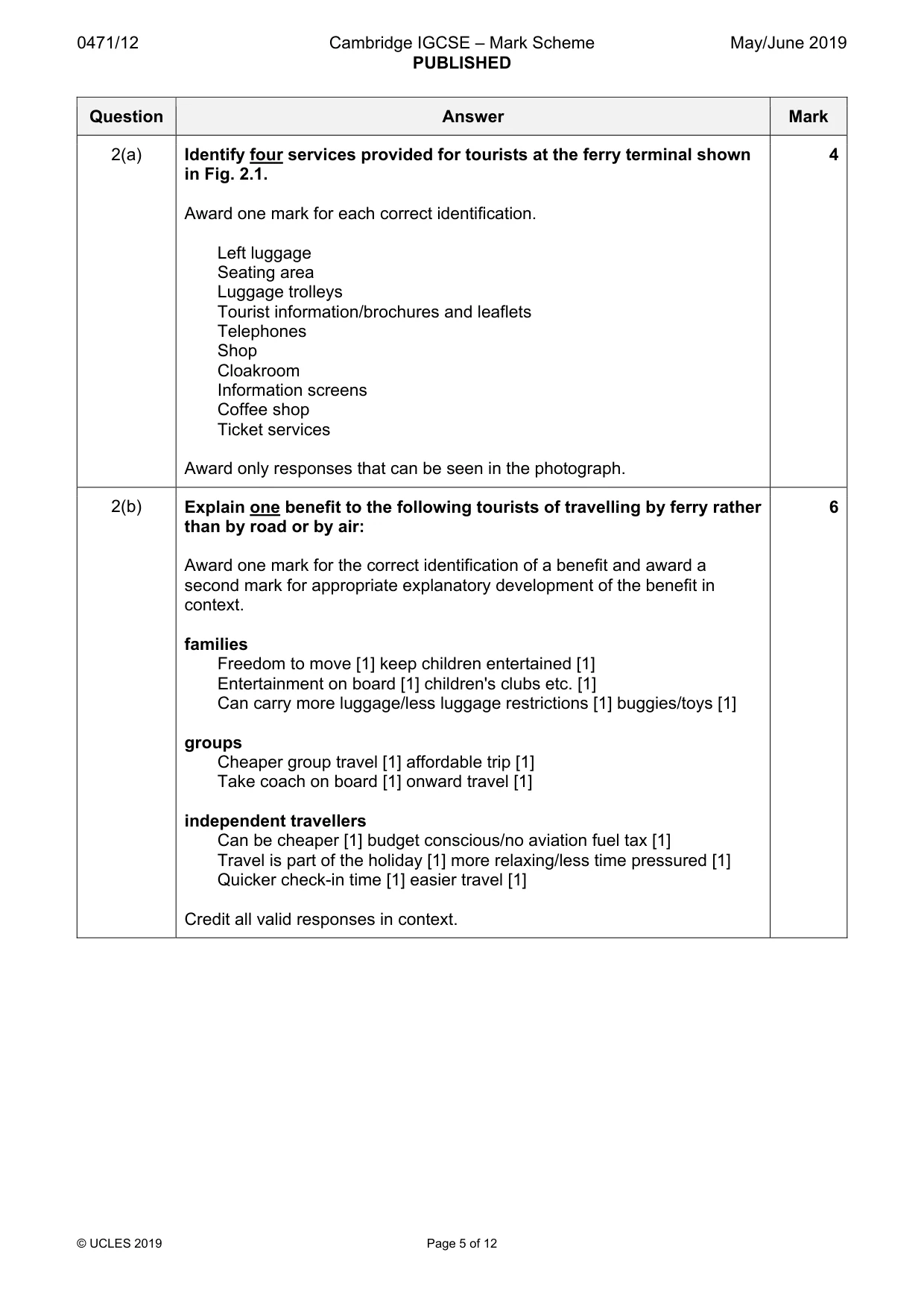
0471/12 Cambridge IGCSE – Mark Scheme PUBLISHED May/June 2019 © UCLES 2019 Page 5 of 12 Question Answer Mark 2(a) Identify four services provided for tourists at the ferry terminal shown in Fig. 2.1. Award one mark for each correct identification. Left luggage Seating area Luggage trolleys Tourist information/brochures and leaflets Telephones Shop Cloakroom Information screens Coffee shop Ticket services Award only responses that can be seen in the photograph. 4 2(b) Explain one benefit to the following tourists of travelling by ferry rather than by road or by air: Award one mark for the correct identification of a benefit and award a second mark for appropriate explanatory development of the benefit in context. families Freedom to move [1] keep children entertained [1] Entertainment on board [1] children's clubs etc. [1] Can carry more luggage/less luggage restrictions [1] buggies/toys [1] groups Cheaper group travel [1] affordable trip [1] Take coach on board [1] onward travel [1] independent travellers Can be cheaper [1] budget conscious/no aviation fuel tax [1] Travel is part of the holiday [1] more relaxing/less time pressured [1] Quicker check-in time [1] easier travel [1] Credit all valid responses in context. 6
Mark scheme, page 6
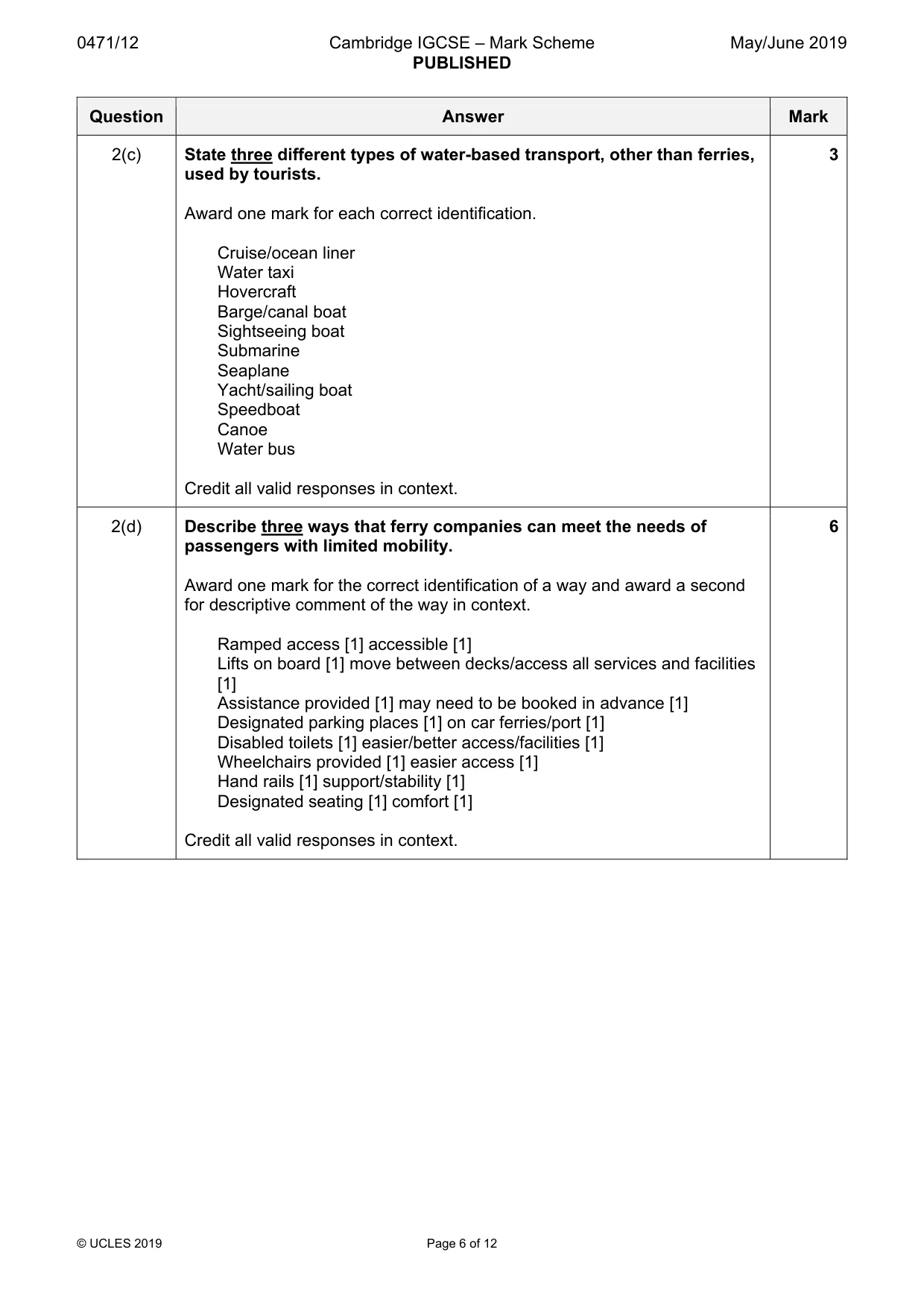
0471/12 Cambridge IGCSE – Mark Scheme PUBLISHED May/June 2019 © UCLES 2019 Page 6 of 12 Question Answer Mark 2(c) State three different types of water-based transport, other than ferries, used by tourists. Award one mark for each correct identification. Cruise/ocean liner Water taxi Hovercraft Barge/canal boat Sightseeing boat Submarine Seaplane Yacht/sailing boat Speedboat Canoe Water bus Credit all valid responses in context. 3 2(d) Describe three ways that ferry companies can meet the needs of passengers with limited mobility. Award one mark for the correct identification of a way and award a second for descriptive comment of the way in context. Ramped access [1] accessible [1] Lifts on board [1] move between decks/access all services and facilities [1] Assistance provided [1] may need to be booked in advance [1] Designated parking places [1] on car ferries/port [1] Disabled toilets [1] easier/better access/facilities [1] Wheelchairs provided [1] easier access [1] Hand rails [1] support/stability [1] Designated seating [1] comfort [1] Credit all valid responses in context. 6
Mark scheme, page 7
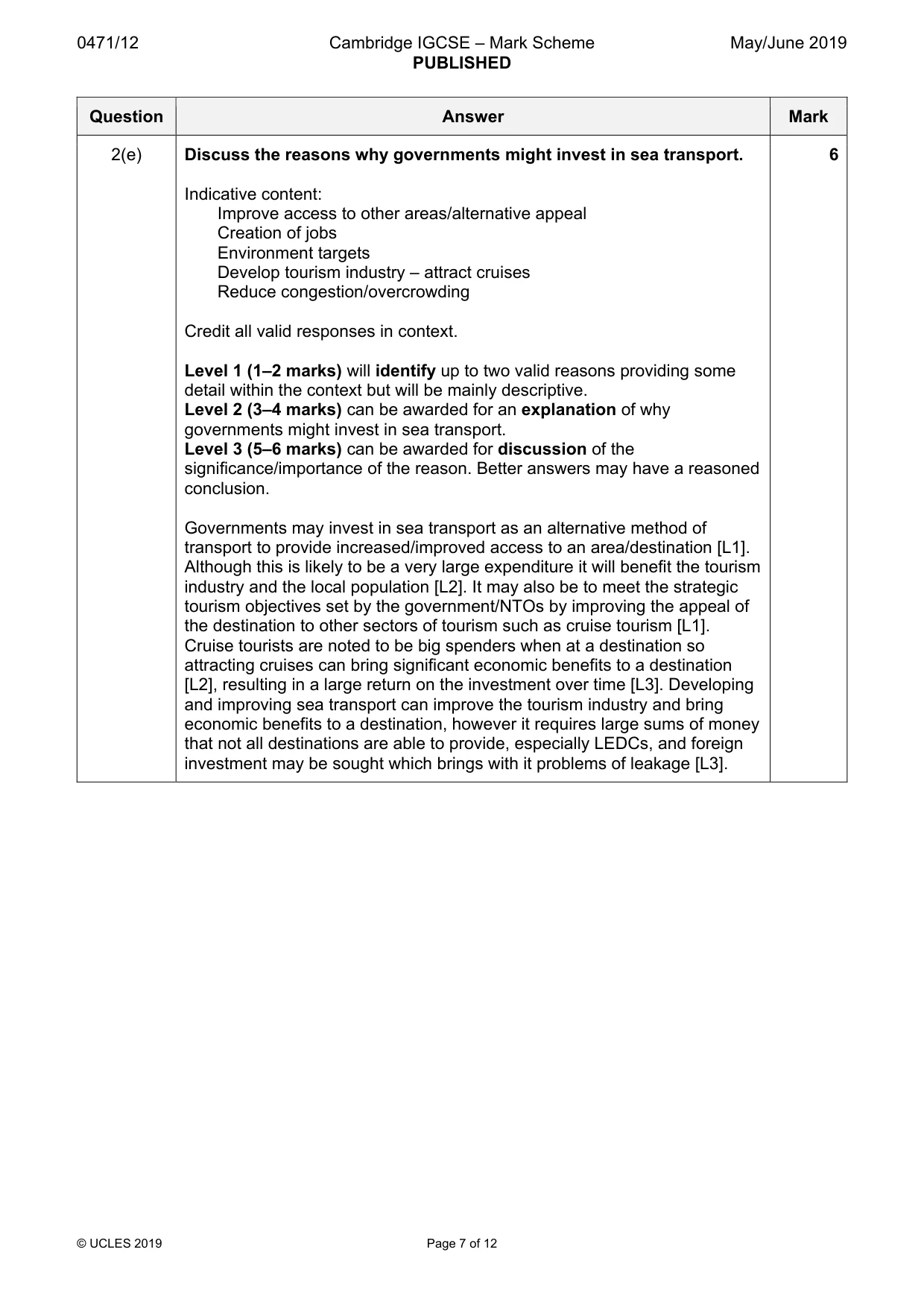
0471/12 Cambridge IGCSE – Mark Scheme PUBLISHED May/June 2019 © UCLES 2019 Page 7 of 12 Question Answer Mark 2(e) Discuss the reasons why governments might invest in sea transport. Indicative content: Improve access to other areas/alternative appeal Creation of jobs Environment targets Develop tourism industry – attract cruises Reduce congestion/overcrowding Credit all valid responses in context. Level 1 (1–2 marks) will identify up to two valid reasons providing some detail within the context but will be mainly descriptive. Level 2 (3–4 marks) can be awarded for an explanation of why governments might invest in sea transport. Level 3 (5–6 marks) can be awarded for discussion of the significance/importance of the reason. Better answers may have a reasoned conclusion. Governments may invest in sea transport as an alternative method of transport to provide increased/improved access to an area/destination [L1]. Although this is likely to be a very large expenditure it will benefit the tourism industry and the local population [L2]. It may also be to meet the strategic tourism objectives set by the government/NTOs by improving the appeal of the destination to other sectors of tourism such as cruise tourism [L1]. Cruise tourists are noted to be big spenders when at a destination so attracting cruises can bring significant economic benefits to a destination [L2], resulting in a large return on the investment over time [L3]. Developing and improving sea transport can improve the tourism industry and bring economic benefits to a destination, however it requires large sums of money that not all destinations are able to provide, especially LEDCs, and foreign investment may be sought which brings with it problems of leakage [L3]. 6
Mark scheme, page 8
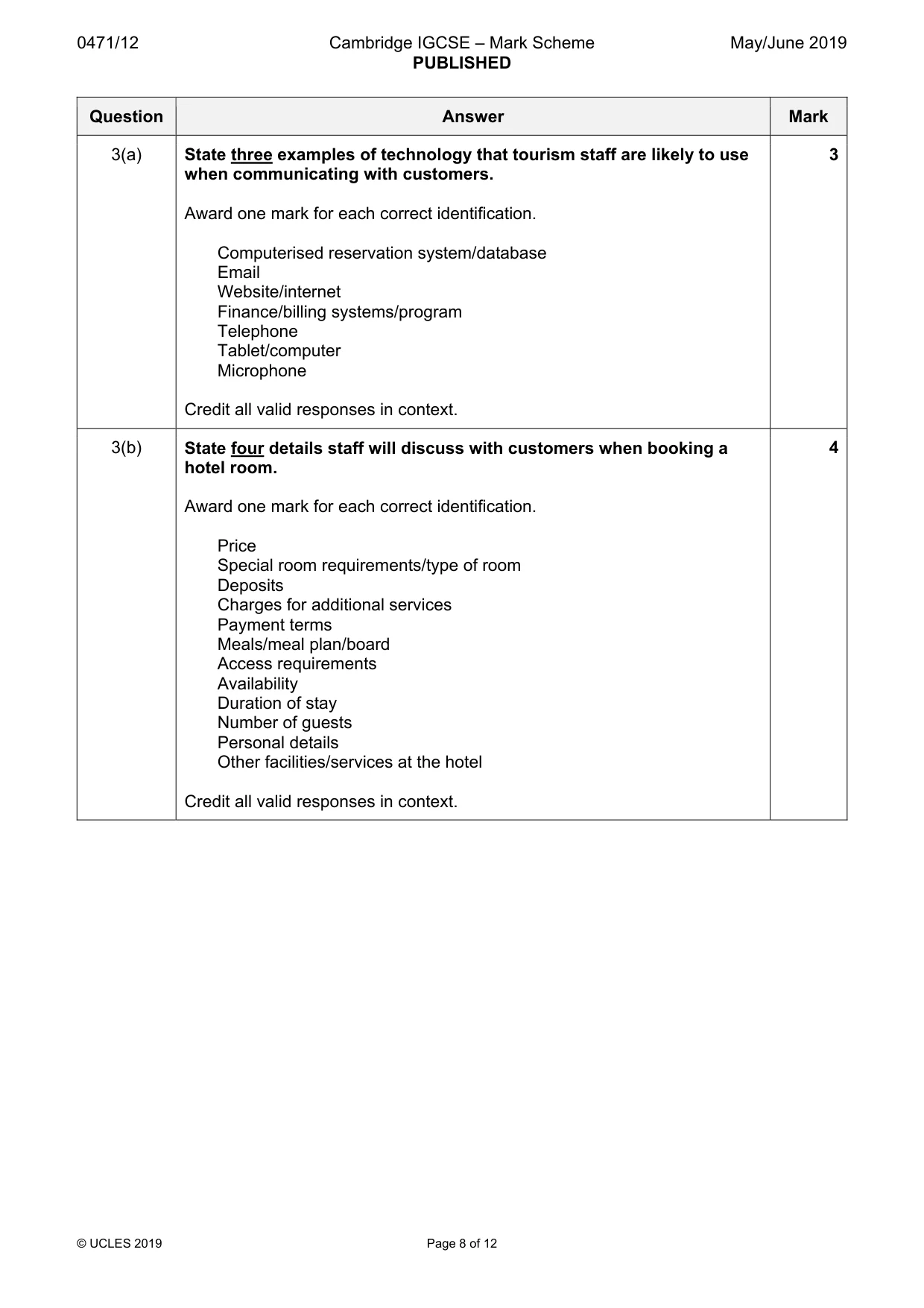
0471/12 Cambridge IGCSE – Mark Scheme PUBLISHED May/June 2019 © UCLES 2019 Page 8 of 12 Question Answer Mark 3(a) State three examples of technology that tourism staff are likely to use when communicating with customers. Award one mark for each correct identification. Computerised reservation system/database Email Website/internet Finance/billing systems/program Telephone Tablet/computer Microphone Credit all valid responses in context. 3 3(b) State four details staff will discuss with customers when booking a hotel room. Award one mark for each correct identification. Price Special room requirements/type of room Deposits Charges for additional services Payment terms Meals/meal plan/board Access requirements Availability Duration of stay Number of guests Personal details Other facilities/services at the hotel Credit all valid responses in context. 4
Mark scheme, page 9
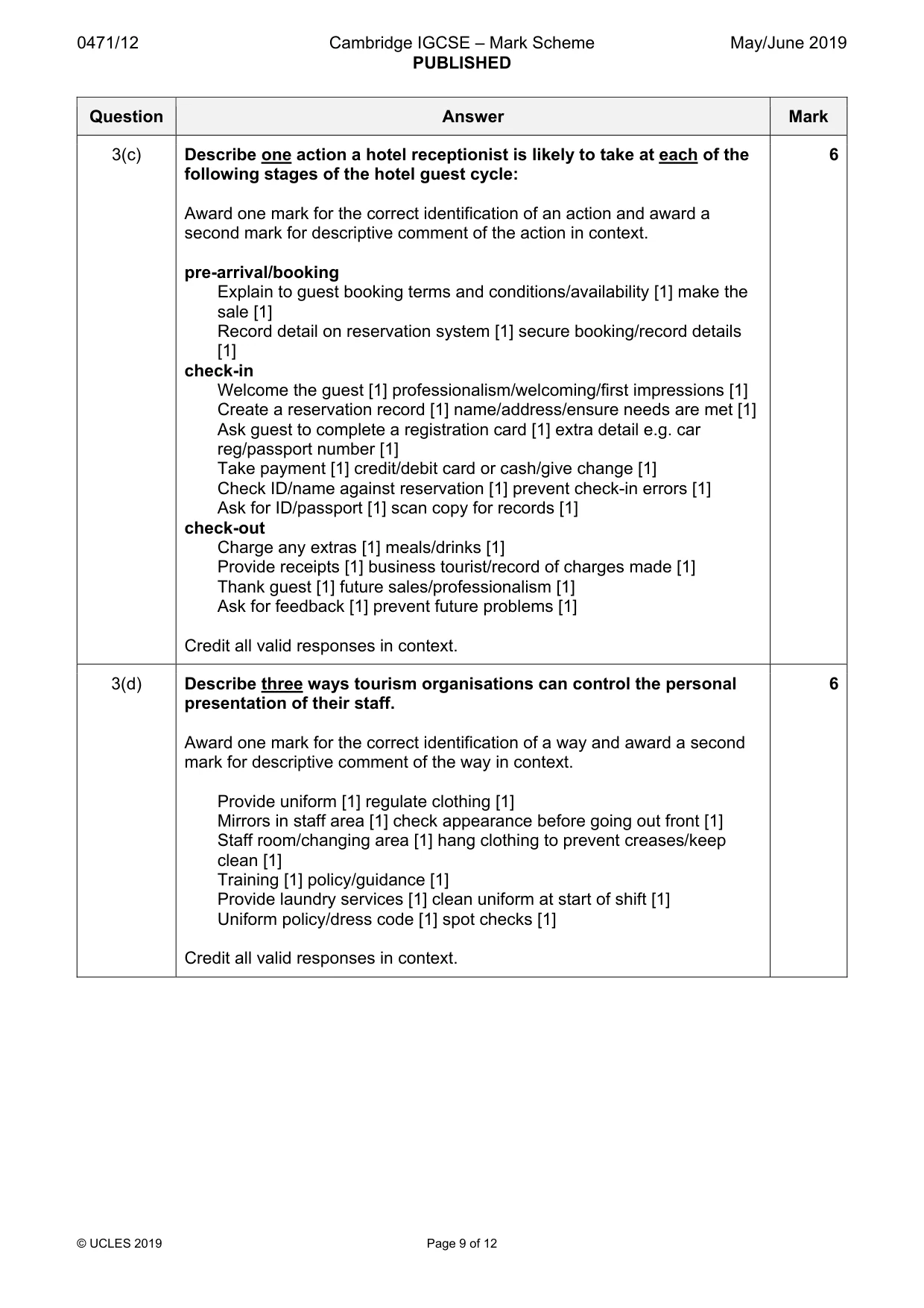
0471/12 Cambridge IGCSE – Mark Scheme PUBLISHED May/June 2019 © UCLES 2019 Page 9 of 12 Question Answer Mark 3(c) Describe one action a hotel receptionist is likely to take at each of the following stages of the hotel guest cycle: Award one mark for the correct identification of an action and award a second mark for descriptive comment of the action in context. pre-arrival/booking Explain to guest booking terms and conditions/availability [1] make the sale [1] Record detail on reservation system [1] secure booking/record details [1] check-in Welcome the guest [1] professionalism/welcoming/first impressions [1] Create a reservation record [1] name/address/ensure needs are met [1] Ask guest to complete a registration card [1] extra detail e.g. car reg/passport number [1] Take payment [1] credit/debit card or cash/give change [1] Check ID/name against reservation [1] prevent check-in errors [1] Ask for ID/passport [1] scan copy for records [1] check-out Charge any extras [1] meals/drinks [1] Provide receipts [1] business tourist/record of charges made [1] Thank guest [1] future sales/professionalism [1] Ask for feedback [1] prevent future problems [1] Credit all valid responses in context. 6 3(d) Describe three ways tourism organisations can control the personal presentation of their staff. Award one mark for the correct identification of a way and award a second mark for descriptive comment of the way in context. Provide uniform [1] regulate clothing [1] Mirrors in staff area [1] check appearance before going out front [1] Staff room/changing area [1] hang clothing to prevent creases/keep clean [1] Training [1] policy/guidance [1] Provide laundry services [1] clean uniform at start of shift [1] Uniform policy/dress code [1] spot checks [1] Credit all valid responses in context. 6
Mark scheme, page 10
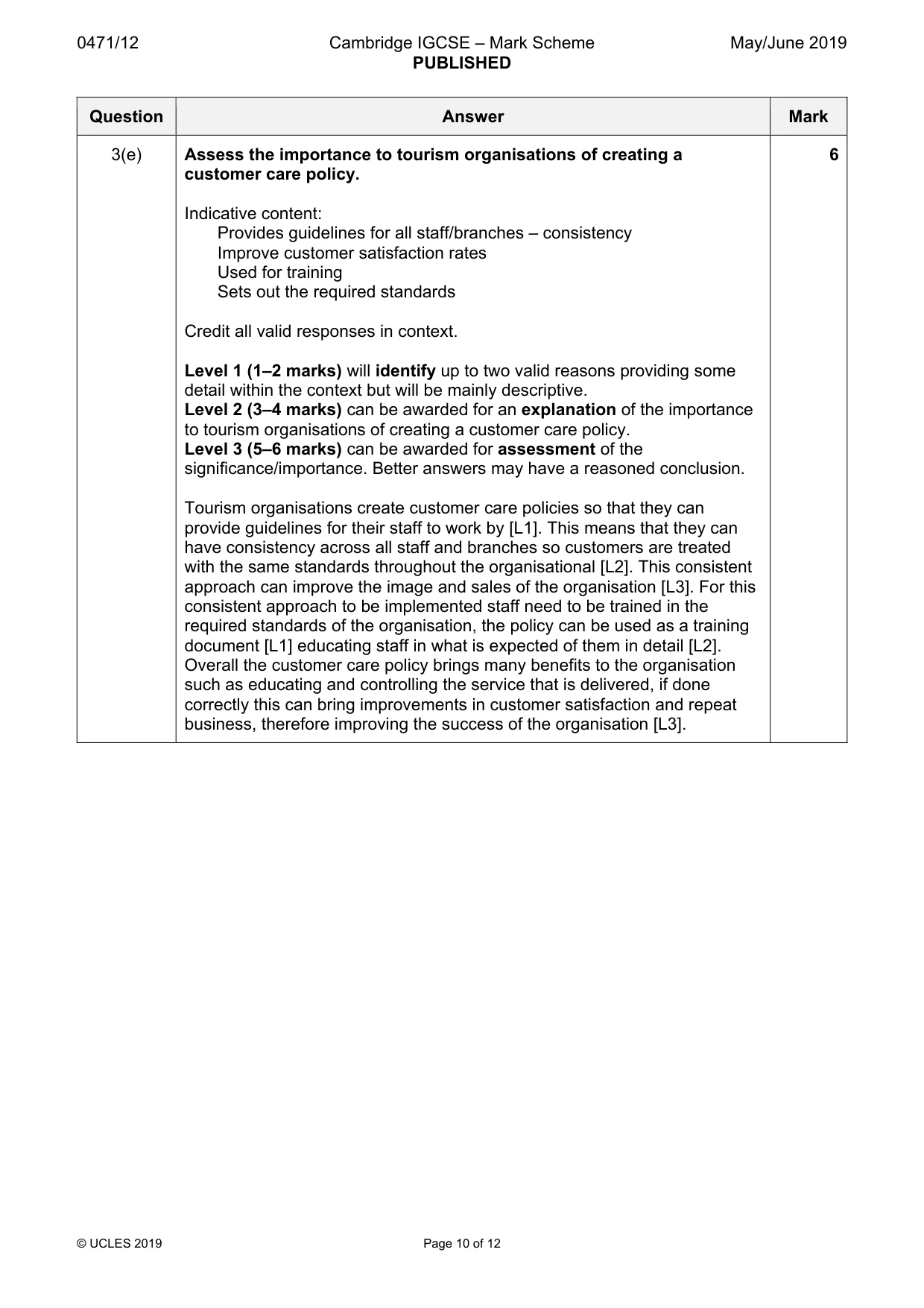
0471/12 Cambridge IGCSE – Mark Scheme PUBLISHED May/June 2019 © UCLES 2019 Page 10 of 12 Question Answer Mark 3(e) Assess the importance to tourism organisations of creating a customer care policy. Indicative content: Provides guidelines for all staff/branches – consistency Improve customer satisfaction rates Used for training Sets out the required standards Credit all valid responses in context. Level 1 (1–2 marks) will identify up to two valid reasons providing some detail within the context but will be mainly descriptive. Level 2 (3–4 marks) can be awarded for an explanation of the importance to tourism organisations of creating a customer care policy. Level 3 (5–6 marks) can be awarded for assessment of the significance/importance. Better answers may have a reasoned conclusion. Tourism organisations create customer care policies so that they can provide guidelines for their staff to work by [L1]. This means that they can have consistency across all staff and branches so customers are treated with the same standards throughout the organisational [L2]. This consistent approach can improve the image and sales of the organisation [L3]. For this consistent approach to be implemented staff need to be trained in the required standards of the organisation, the policy can be used as a training document [L1] educating staff in what is expected of them in detail [L2]. Overall the customer care policy brings many benefits to the organisation such as educating and controlling the service that is delivered, if done correctly this can bring improvements in customer satisfaction and repeat business, therefore improving the success of the organisation [L3]. 6
Mark scheme, page 11
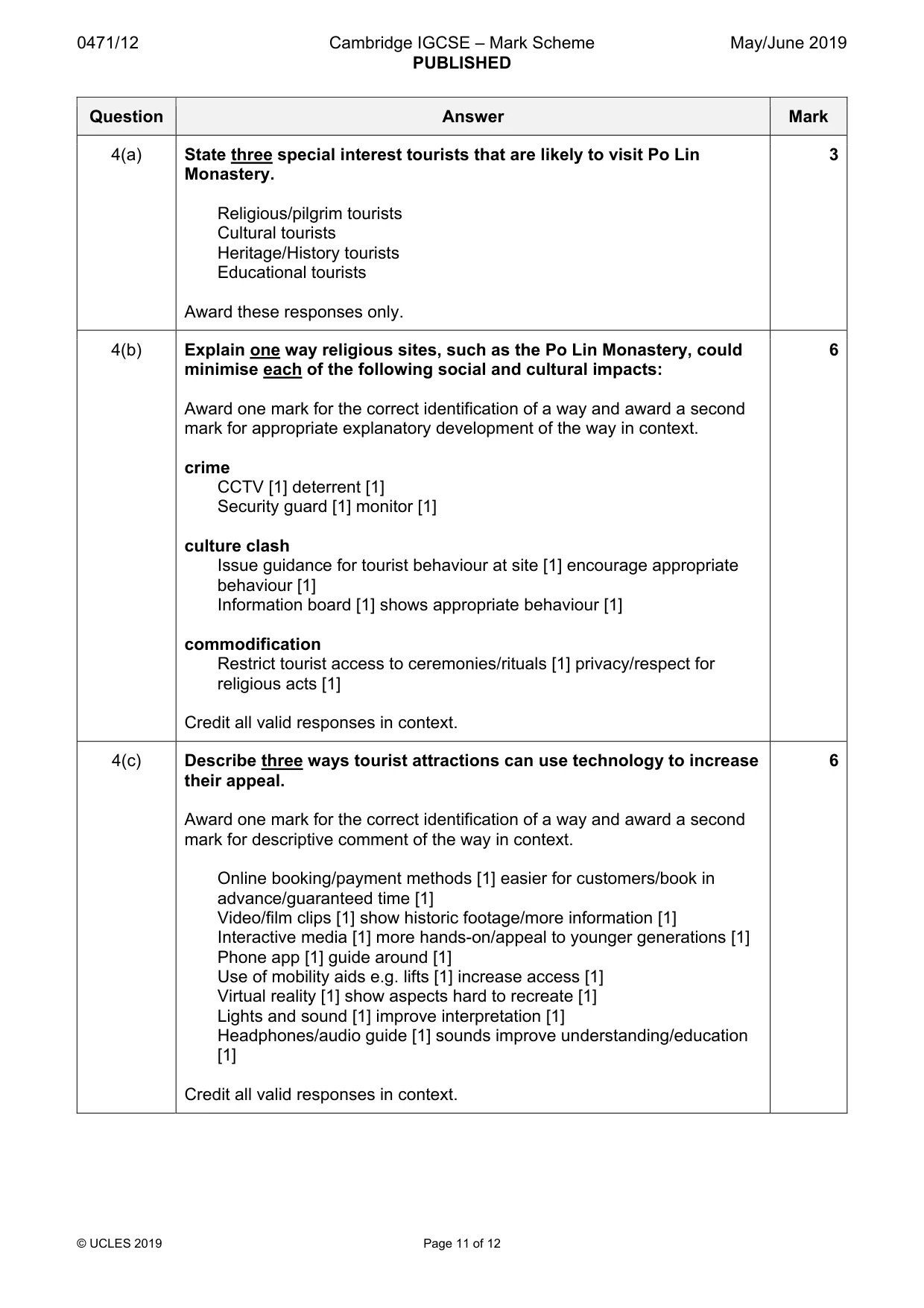
0471/12 Cambridge IGCSE – Mark Scheme PUBLISHED May/June 2019 © UCLES 2019 Page 11 of 12 Question Answer Mark 4(a) State three special interest tourists that are likely to visit Po Lin Monastery. Religious/pilgrim tourists Cultural tourists Heritage/History tourists Educational tourists Award these responses only. 3 4(b) Explain one way religious sites, such as the Po Lin Monastery, could minimise each of the following social and cultural impacts: Award one mark for the correct identification of a way and award a second mark for appropriate explanatory development of the way in context. crime CCTV [1] deterrent [1] Security guard [1] monitor [1] culture clash Issue guidance for tourist behaviour at site [1] encourage appropriate behaviour [1] Information board [1] shows appropriate behaviour [1] commodification Restrict tourist access to ceremonies/rituals [1] privacy/respect for religious acts [1] Credit all valid responses in context. 6 4(c) Describe three ways tourist attractions can use technology to increase their appeal. Award one mark for the correct identification of a way and award a second mark for descriptive comment of the way in context. Online booking/payment methods [1] easier for customers/book in advance/guaranteed time [1] Video/film clips [1] show historic footage/more information [1] Interactive media [1] more hands-on/appeal to younger generations [1] Phone app [1] guide around [1] Use of mobility aids e.g. lifts [1] increase access [1] Virtual reality [1] show aspects hard to recreate [1] Lights and sound [1] improve interpretation [1] Headphones/audio guide [1] sounds improve understanding/education [1] Credit all valid responses in context. 6
Mark scheme, page 12
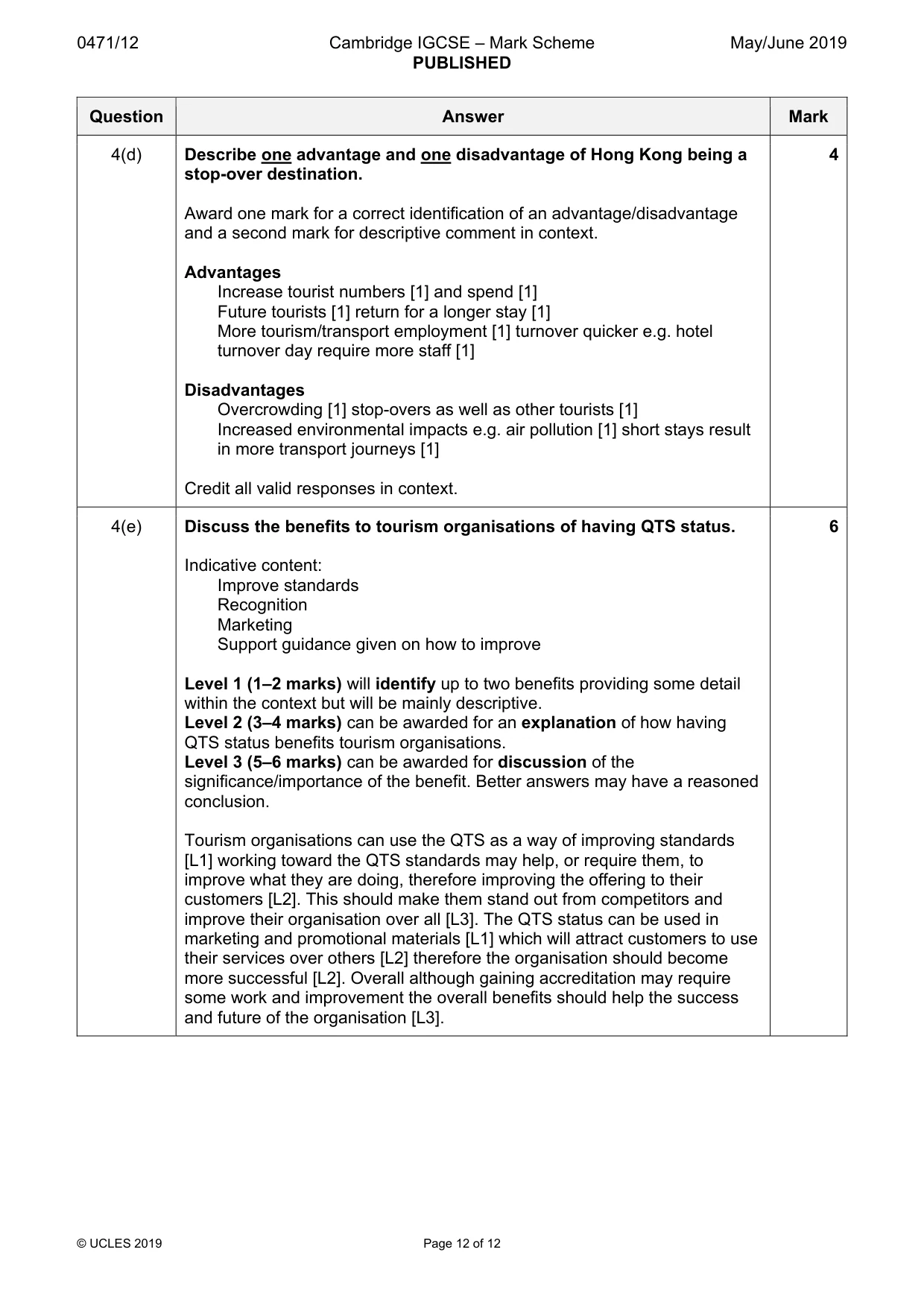
0471/12 Cambridge IGCSE – Mark Scheme PUBLISHED May/June 2019 © UCLES 2019 Page 12 of 12 Question Answer Mark 4(d) Describe one advantage and one disadvantage of Hong Kong being a stop-over destination. Award one mark for a correct identification of an advantage/disadvantage and a second mark for descriptive comment in context. Advantages Increase tourist numbers [1] and spend [1] Future tourists [1] return for a longer stay [1] More tourism/transport employment [1] turnover quicker e.g. hotel turnover day require more staff [1] Disadvantages Overcrowding [1] stop-overs as well as other tourists [1] Increased environmental impacts e.g. air pollution [1] short stays result in more transport journeys [1] Credit all valid responses in context. 4 4(e) Discuss the benefits to tourism organisations of having QTS status. Indicative content: Improve standards Recognition Marketing Support guidance given on how to improve Level 1 (1–2 marks) will identify up to two benefits providing some detail within the context but will be mainly descriptive. Level 2 (3–4 marks) can be awarded for an explanation of how having QTS status benefits tourism organisations. Level 3 (5–6 marks) can be awarded for discussion of the significance/importance of the benefit. Better answers may have a reasoned conclusion. Tourism organisations can use the QTS as a way of improving standards [L1] working toward the QTS standards may help, or require them, to improve what they are doing, therefore improving the offering to their customers [L2]. This should make them stand out from competitors and improve their organisation over all [L3]. The QTS status can be used in marketing and promotional materials [L1] which will attract customers to use their services over others [L2] therefore the organisation should become more successful [L2]. Overall although gaining accreditation may require some work and improvement the overall benefits should help the success and future of the organisation [L3]. 6
What you needed in this session
Cambridge’s own grade thresholds for 2019 May/June, Paper 1 · Variant 2. A higher threshold means an easier paper — the bar moves with how the cohort did.