Cambridge IGCSE Travel and Tourism 0471 — 2019 May/June Paper 1 · Variant 3
0471/13/M/J/19 · 100 marks · ≈113 min
The question paper and its mark scheme, free to read here and free to download. This is Cambridge’s own paper, exactly as it was sat.
Question paper12 pages

Mark scheme10 pages
Answers below. Sit the paper first if you are practising.
Paper as text
Question paper, page 1
This document consists of 11 printed pages, 1 blank page and 1 Insert. DC (ST) 170100/1 © UCLES 2019 [Turn over * 6 0 4 7 9 2 4 6 3 1 * TRAVEL AND TOURISM 0471/13 Core Module May/June 2019 2 hours Candidates answer on the Question Paper. No Additional Materials are required. READ THESE INSTRUCTIONS FIRST Write your centre number, candidate number and name on all the work you hand in. Write in dark blue or black pen. You may use an HB pencil for any diagrams or graphs. Do not use staples, paper clips, glue or correction fluid. DO NOT WRITE IN ANY BARCODES. Answer all questions. All the Figures referred to in the questions are contained in the Insert. At the end of the examination, fasten all your work securely together. The number of marks is given in brackets [ ] at the end of each question or part question. Cambridge Assessment International Education Cambridge International General Certificate of Secondary Education
Question paper, page 2
2 0471/13/M/J/19 © UCLES 2019 1 Refer to Fig. 1.1 (Insert), information on Indian Railways’ tours. (a) Identify the following: the capital of India … the continent that India is in … the island to the south of India … the river that runs through India … [4] (b) Indian Railways’ tours offer budget packages. State three other tourism products that are aimed at budget tourists. 1 … 2 … 3 … [3] (c) Explain three reasons for the appeal of the Indian Railways’ tours. 1 … … … … 2 … … … … 3 … … … … [6]
Question paper, page 3
3 0471/13/M/J/19 © UCLES 2019 [Turn over (d) Describe three ways Indian Railways’ tours may help to preserve the local culture. 1 … … … … 2 … … … … 3 … … … … [6] (e) Discuss the possible negative social and cultural impacts that may occur when tourists visit holy places. … … … … … … … … … … … … [6] [Total: 25]
Question paper, page 4
4 0471/13/M/J/19 © UCLES 2019 2 Refer to Fig. 2.1 (Insert), information on global tourism employment. (a) State four direct tourism jobs. 1 … 2 … 3 … 4 … [4] (b) Explain three skills that are important when dealing with customers. 1 … … … … 2 … … … … 3 … … … … [6]
Question paper, page 5
5 0471/13/M/J/19 © UCLES 2019 [Turn over (c) Explain how the local economy will benefit from increased tourism employment. … … … … … … [3] (d) Explain three likely positive social and cultural impacts associated with tourism employment. 1 … … … … 2 … … … … 3 … … … … [6]
Question paper, page 6
6 0471/13/M/J/19 © UCLES 2019 (e) Discuss the negative economic impacts associated with tourism employment. … … … … … … … … … … … … [6] [Total: 25]
Question paper, page 7
7 0471/13/M/J/19 © UCLES 2019 [Turn over 3 Refer to Fig. 3.1 (Insert), an advertisement for a customer service training course. (a) State three customer types. 1 … 2 … 3 … [3] (b) Describe two ways staff can show good body language when serving customers. 1 … … … … 2 … … … … [4] (c) Explain one benefit to travel and tourism organisations of each of the following methods of communicating with customers: letter … … … … brochure … … … … social media … … … … [6]
Question paper, page 8
8 0471/13/M/J/19 © UCLES 2019 (d) Understanding the needs and expectations of customers is essential in delivering good customer care. Explain three expectations of business tourists. 1 … … … … 2 … … … … 3 … … … … [6] (e) Assess the importance of tourism employees creating a good first impression. … … … … … … … … … … … … [6] [Total: 25]
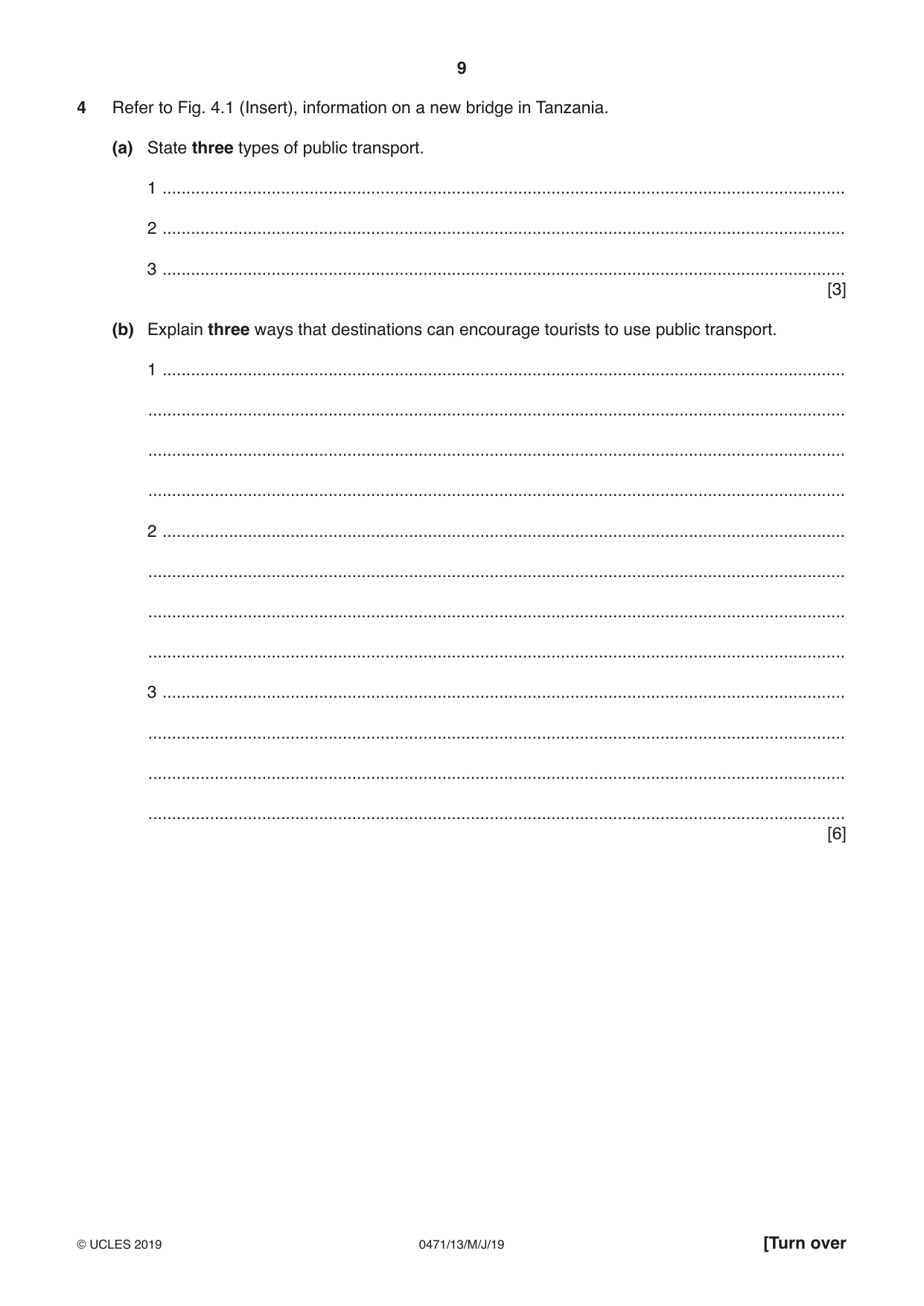
Question paper, page 9
9 0471/13/M/J/19 © UCLES 2019 [Turn over 4 Refer to Fig. 4.1 (Insert), information on a new bridge in Tanzania. (a) State three types of public transport. 1 … 2 … 3 … [3] (b) Explain three ways that destinations can encourage tourists to use public transport. 1 … … … … 2 … … … … 3 … … … … [6]
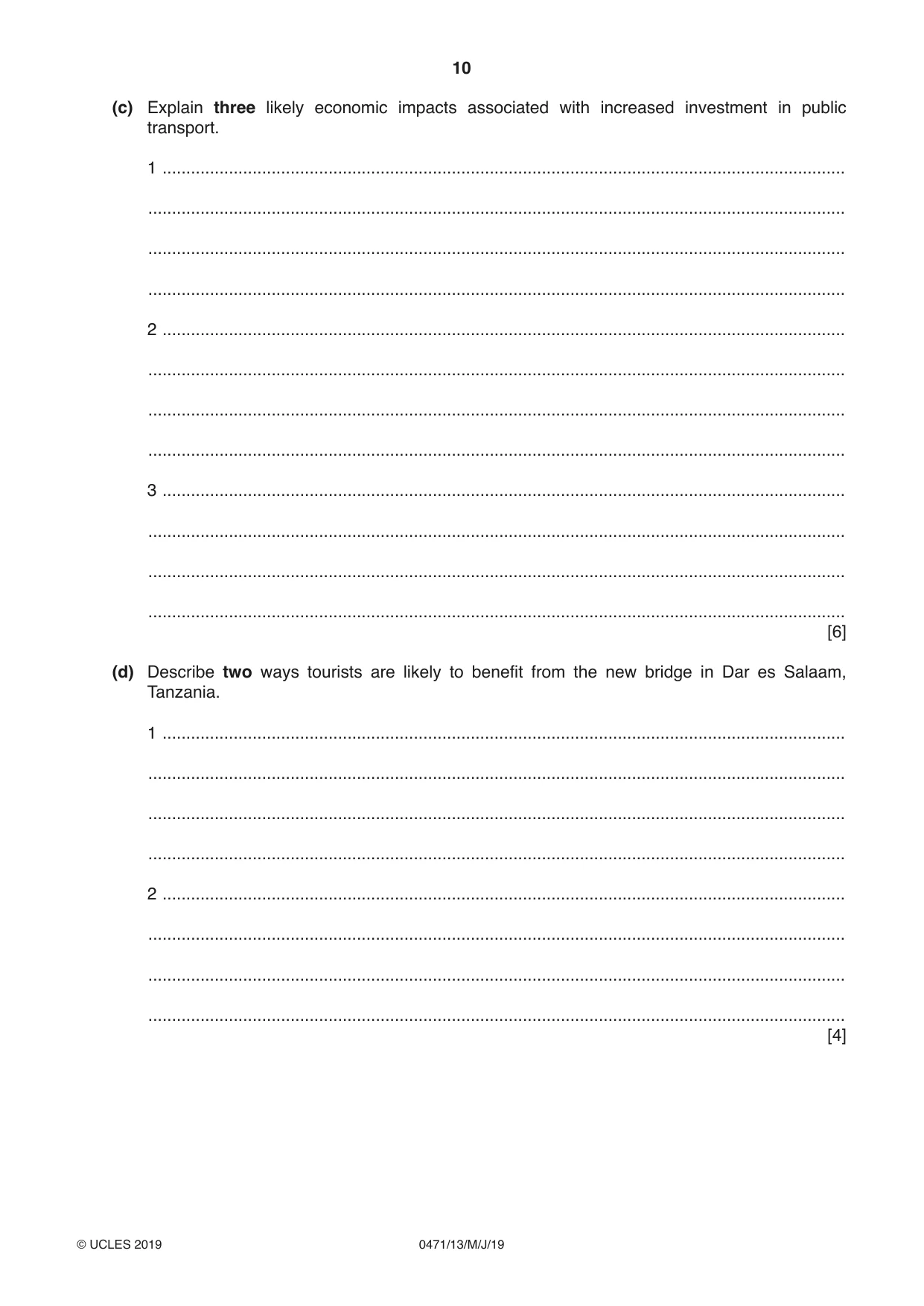
Question paper, page 10
10 0471/13/M/J/19 © UCLES 2019 (c) Explain three likely economic impacts associated with increased investment in public transport. 1 … … … … 2 … … … … 3 … … … … [6] (d) Describe two ways tourists are likely to benefit from the new bridge in Dar es Salaam, Tanzania. 1 … … … … 2 … … … … [4]
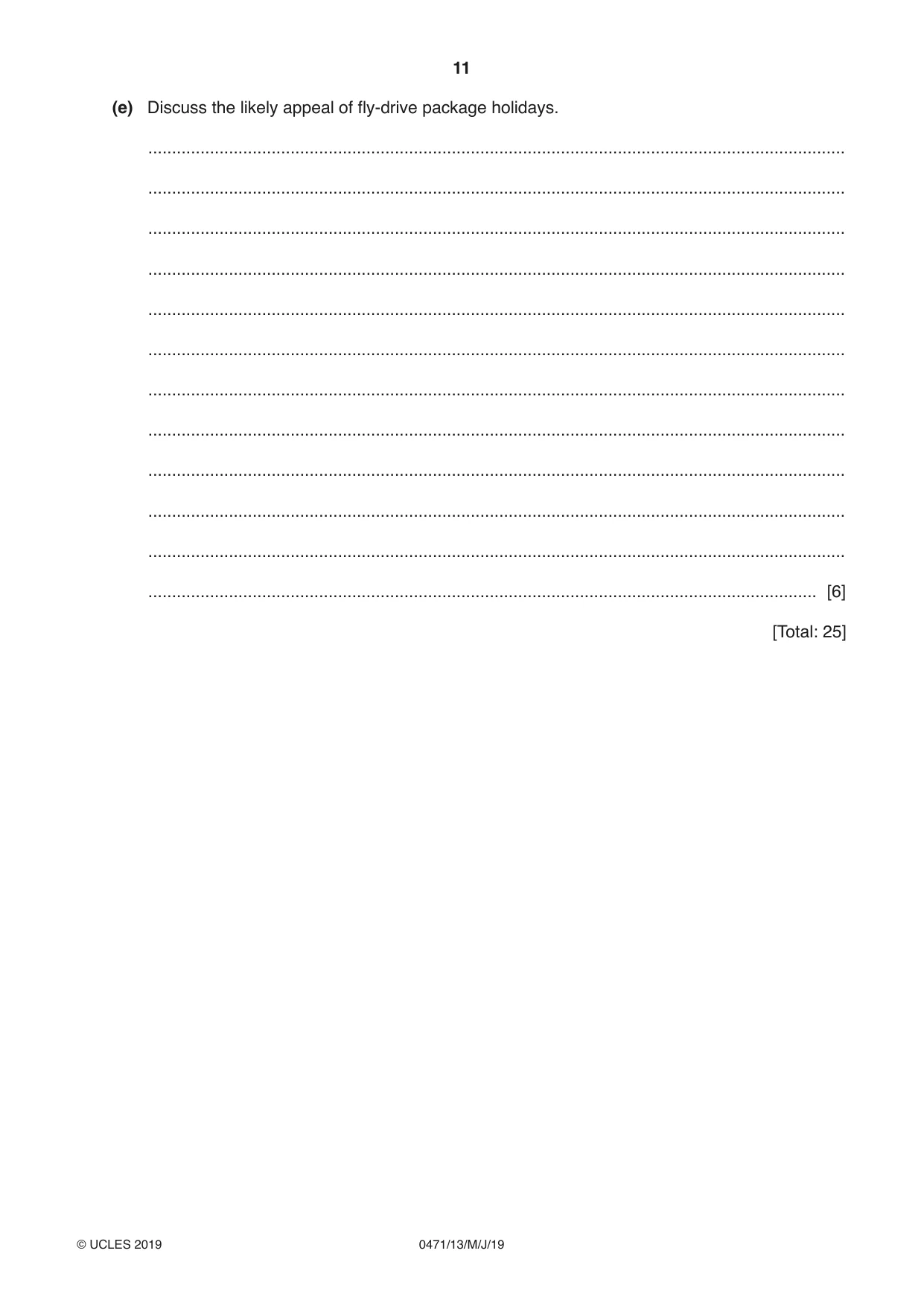
Question paper, page 11
11 0471/13/M/J/19 © UCLES 2019 (e) Discuss the likely appeal of fly-drive package holidays. … … … … … … … … … … … … [6] [Total: 25]
Question paper, page 12
12 0471/13/M/J/19 © UCLES 2019 Permission to reproduce items where third-party owned material protected by copyright is included has been sought and cleared where possible. Every reasonable effort has been made by the publisher (UCLES) to trace copyright holders, but if any items requiring clearance have unwittingly been included, the publisher will be pleased to make amends at the earliest possible opportunity. To avoid the issue of disclosure of answer-related information to candidates, all copyright acknowledgements are reproduced online in the Cambridge Assessment International Education Copyright Acknowledgements Booklet. This is produced for each series of examinations and is freely available to download at www.cambridgeinternational.org after the live examination series. Cambridge Assessment International Education is part of the Cambridge Assessment Group. Cambridge Assessment is the brand name of the University of Cambridge Local Examinations Syndicate (UCLES), which itself is a department of the University of Cambridge. BLANK PAGE
Mark scheme, page 1
This document consists of 10 printed pages. © UCLES 2019 [Turn over Cambridge Assessment International Education Cambridge International General Certificate of Secondary Education TRAVEL & TOURISM 0471/13 Paper 1 Core Module May/June 2019 MARK SCHEME Maximum Mark: 100 Published This mark scheme is published as an aid to teachers and candidates, to indicate the requirements of the examination. It shows the basis on which Examiners were instructed to award marks. It does not indicate the details of the discussions that took place at an Examiners’ meeting before marking began, which would have considered the acceptability of alternative answers. Mark schemes should be read in conjunction with the question paper and the Principal Examiner Report for Teachers. Cambridge International will not enter into discussions about these mark schemes. Cambridge International is publishing the mark schemes for the May/June 2019 series for most Cambridge IGCSE™, Cambridge International A and AS Level and Cambridge Pre-U components, and some Cambridge O Level components.
Mark scheme, page 2
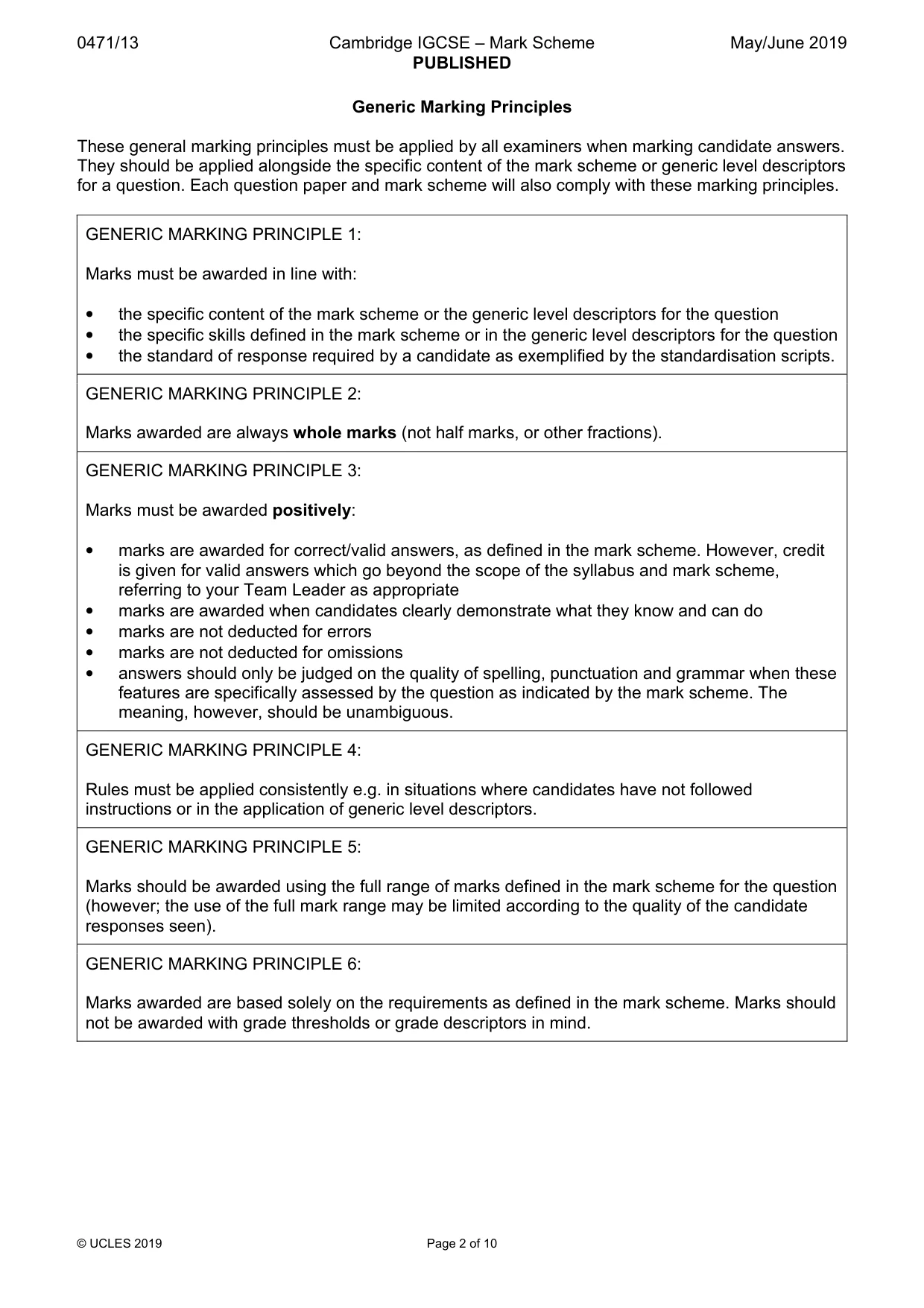
0471/13 Cambridge IGCSE – Mark Scheme PUBLISHED May/June 2019 © UCLES 2019 Page 2 of 10 Generic Marking Principles These general marking principles must be applied by all examiners when marking candidate answers. They should be applied alongside the specific content of the mark scheme or generic level descriptors for a question. Each question paper and mark scheme will also comply with these marking principles. GENERIC MARKING PRINCIPLE 1: Marks must be awarded in line with: • the specific content of the mark scheme or the generic level descriptors for the question • the specific skills defined in the mark scheme or in the generic level descriptors for the question • the standard of response required by a candidate as exemplified by the standardisation scripts. GENERIC MARKING PRINCIPLE 2: Marks awarded are always whole marks (not half marks, or other fractions). GENERIC MARKING PRINCIPLE 3: Marks must be awarded positively: • marks are awarded for correct/valid answers, as defined in the mark scheme. However, credit is given for valid answers which go beyond the scope of the syllabus and mark scheme, referring to your Team Leader as appropriate • marks are awarded when candidates clearly demonstrate what they know and can do • marks are not deducted for errors • marks are not deducted for omissions • answers should only be judged on the quality of spelling, punctuation and grammar when these features are specifically assessed by the question as indicated by the mark scheme. The meaning, however, should be unambiguous. GENERIC MARKING PRINCIPLE 4: Rules must be applied consistently e.g. in situations where candidates have not followed instructions or in the application of generic level descriptors. GENERIC MARKING PRINCIPLE 5: Marks should be awarded using the full range of marks defined in the mark scheme for the question (however; the use of the full mark range may be limited according to the quality of the candidate responses seen). GENERIC MARKING PRINCIPLE 6: Marks awarded are based solely on the requirements as defined in the mark scheme. Marks should not be awarded with grade thresholds or grade descriptors in mind.
Mark scheme, page 3
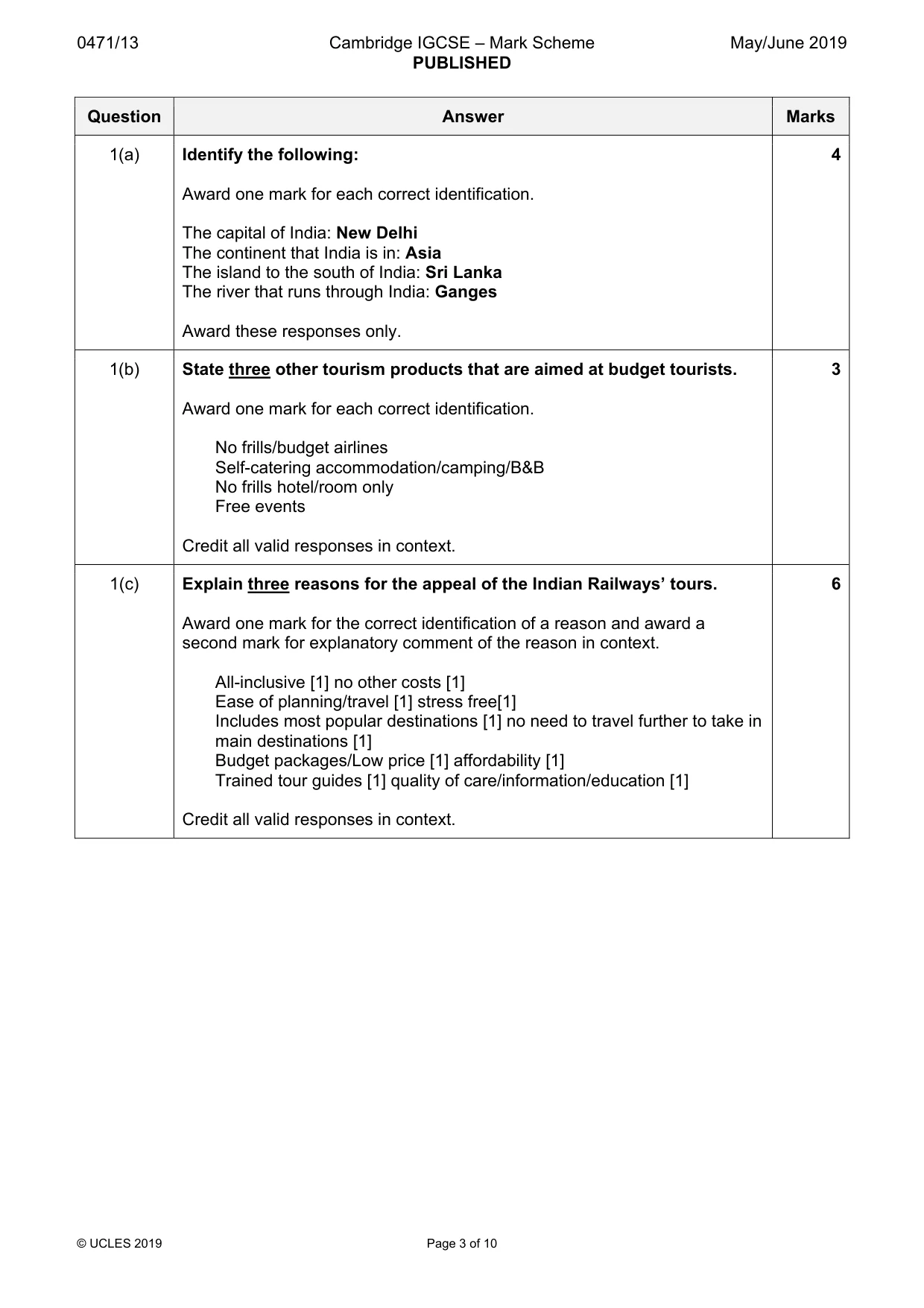
0471/13 Cambridge IGCSE – Mark Scheme PUBLISHED May/June 2019 © UCLES 2019 Page 3 of 10 Question Answer Marks 1(a) Identify the following: Award one mark for each correct identification. The capital of India: New Delhi The continent that India is in: Asia The island to the south of India: Sri Lanka The river that runs through India: Ganges Award these responses only. 4 1(b) State three other tourism products that are aimed at budget tourists. Award one mark for each correct identification. No frills/budget airlines Self-catering accommodation/camping/B&B No frills hotel/room only Free events Credit all valid responses in context. 3 1(c) Explain three reasons for the appeal of the Indian Railways’ tours. Award one mark for the correct identification of a reason and award a second mark for explanatory comment of the reason in context. All-inclusive [1] no other costs [1] Ease of planning/travel [1] stress free[1] Includes most popular destinations [1] no need to travel further to take in main destinations [1] Budget packages/Low price [1] affordability [1] Trained tour guides [1] quality of care/information/education [1] Credit all valid responses in context. 6
Mark scheme, page 4
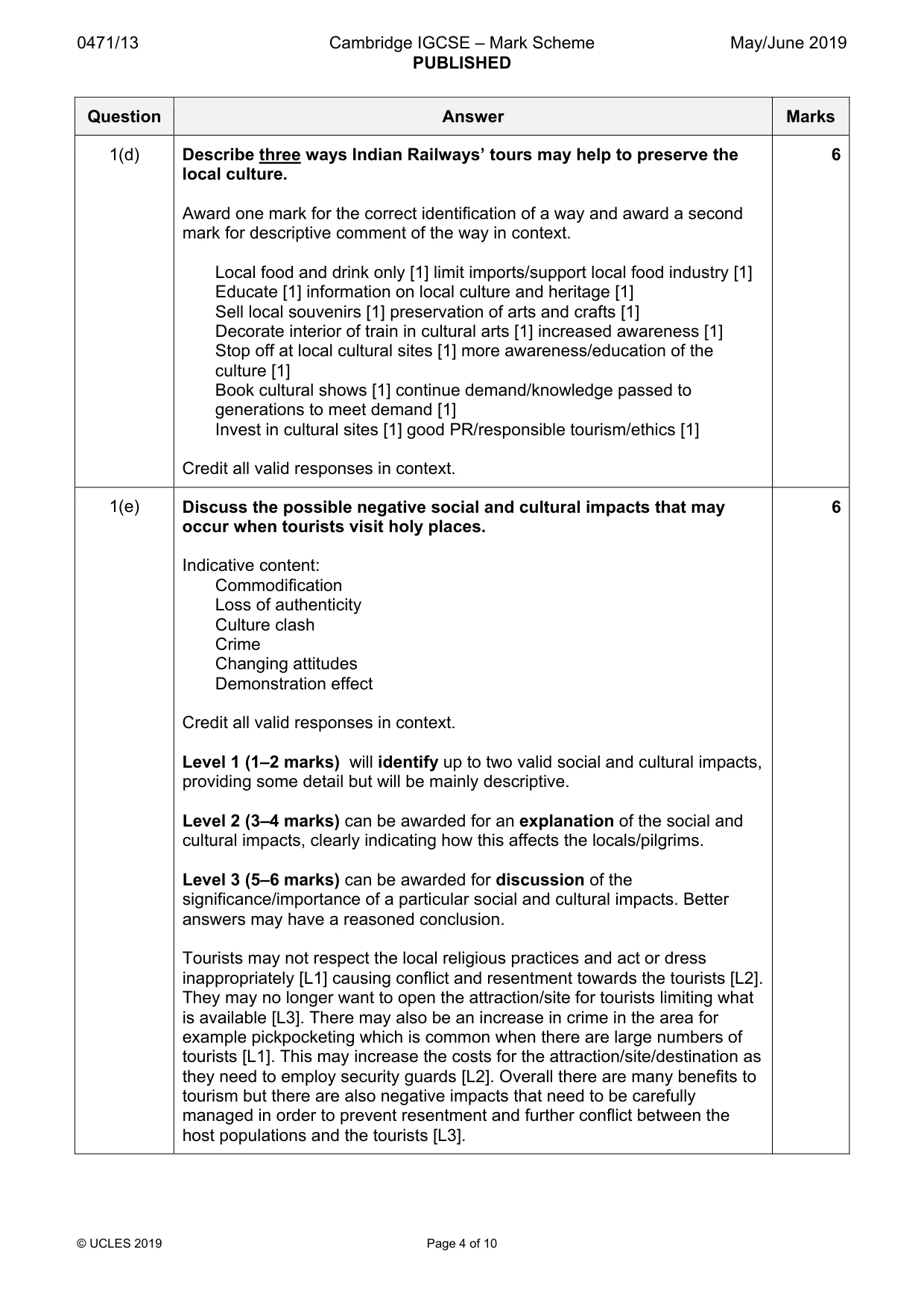
0471/13 Cambridge IGCSE – Mark Scheme PUBLISHED May/June 2019 © UCLES 2019 Page 4 of 10 Question Answer Marks 1(d) Describe three ways Indian Railways’ tours may help to preserve the local culture. Award one mark for the correct identification of a way and award a second mark for descriptive comment of the way in context. Local food and drink only [1] limit imports/support local food industry [1] Educate [1] information on local culture and heritage [1] Sell local souvenirs [1] preservation of arts and crafts [1] Decorate interior of train in cultural arts [1] increased awareness [1] Stop off at local cultural sites [1] more awareness/education of the culture [1] Book cultural shows [1] continue demand/knowledge passed to generations to meet demand [1] Invest in cultural sites [1] good PR/responsible tourism/ethics [1] Credit all valid responses in context. 6 1(e) Discuss the possible negative social and cultural impacts that may occur when tourists visit holy places. Indicative content: Commodification Loss of authenticity Culture clash Crime Changing attitudes Demonstration effect Credit all valid responses in context. Level 1 (1–2 marks) will identify up to two valid social and cultural impacts, providing some detail but will be mainly descriptive. Level 2 (3–4 marks) can be awarded for an explanation of the social and cultural impacts, clearly indicating how this affects the locals/pilgrims. Level 3 (5–6 marks) can be awarded for discussion of the significance/importance of a particular social and cultural impacts. Better answers may have a reasoned conclusion. Tourists may not respect the local religious practices and act or dress inappropriately [L1] causing conflict and resentment towards the tourists [L2]. They may no longer want to open the attraction/site for tourists limiting what is available [L3]. There may also be an increase in crime in the area for example pickpocketing which is common when there are large numbers of tourists [L1]. This may increase the costs for the attraction/site/destination as they need to employ security guards [L2]. Overall there are many benefits to tourism but there are also negative impacts that need to be carefully managed in order to prevent resentment and further conflict between the host populations and the tourists [L3]. 6
Mark scheme, page 5
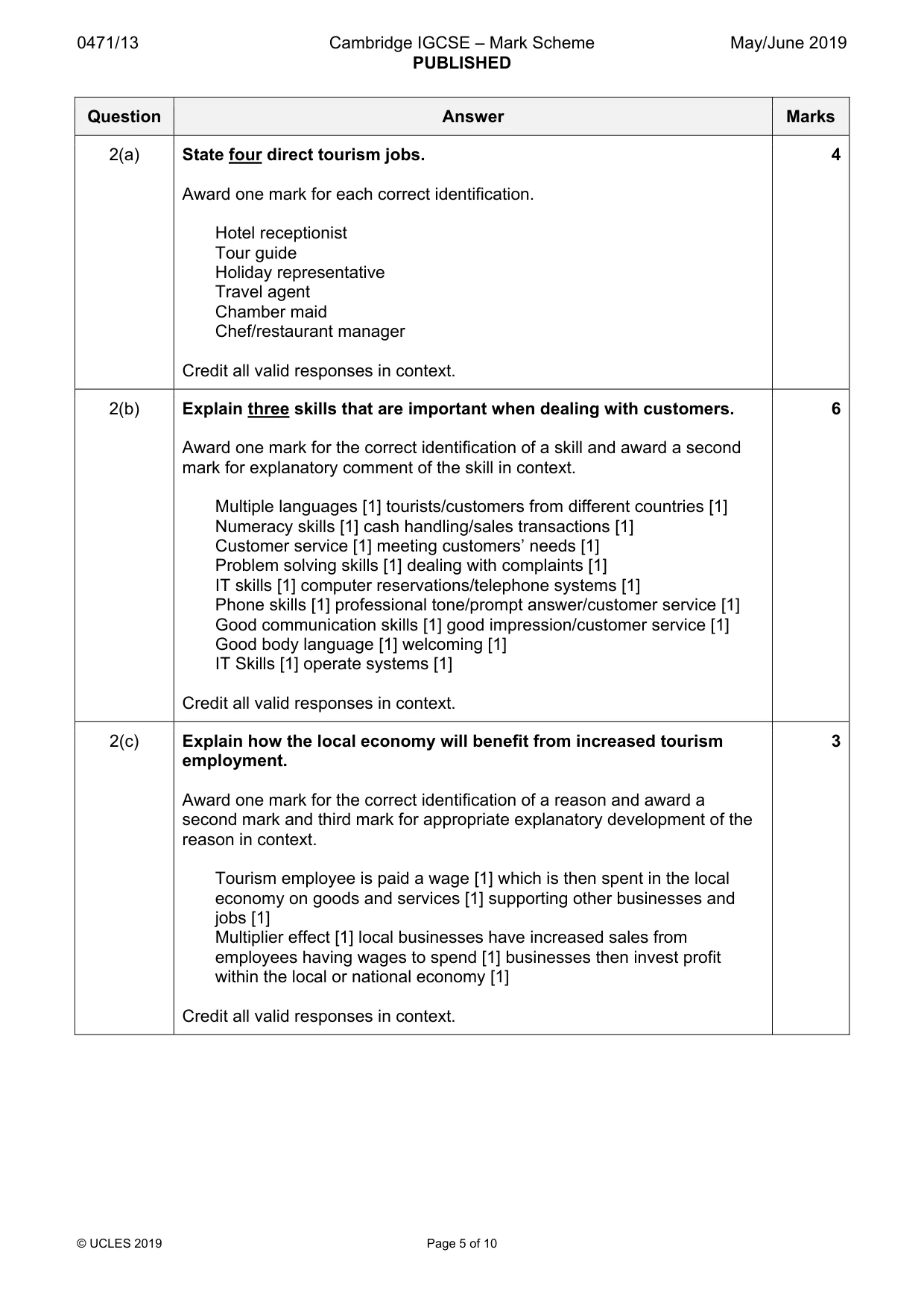
0471/13 Cambridge IGCSE – Mark Scheme PUBLISHED May/June 2019 © UCLES 2019 Page 5 of 10 Question Answer Marks 2(a) State four direct tourism jobs. Award one mark for each correct identification. Hotel receptionist Tour guide Holiday representative Travel agent Chamber maid Chef/restaurant manager Credit all valid responses in context. 4 2(b) Explain three skills that are important when dealing with customers. Award one mark for the correct identification of a skill and award a second mark for explanatory comment of the skill in context. Multiple languages [1] tourists/customers from different countries [1] Numeracy skills [1] cash handling/sales transactions [1] Customer service [1] meeting customers’ needs [1] Problem solving skills [1] dealing with complaints [1] IT skills [1] computer reservations/telephone systems [1] Phone skills [1] professional tone/prompt answer/customer service [1] Good communication skills [1] good impression/customer service [1] Good body language [1] welcoming [1] IT Skills [1] operate systems [1] Credit all valid responses in context. 6 2(c) Explain how the local economy will benefit from increased tourism employment. Award one mark for the correct identification of a reason and award a second mark and third mark for appropriate explanatory development of the reason in context. Tourism employee is paid a wage [1] which is then spent in the local economy on goods and services [1] supporting other businesses and jobs [1] Multiplier effect [1] local businesses have increased sales from employees having wages to spend [1] businesses then invest profit within the local or national economy [1] Credit all valid responses in context. 3
Mark scheme, page 6
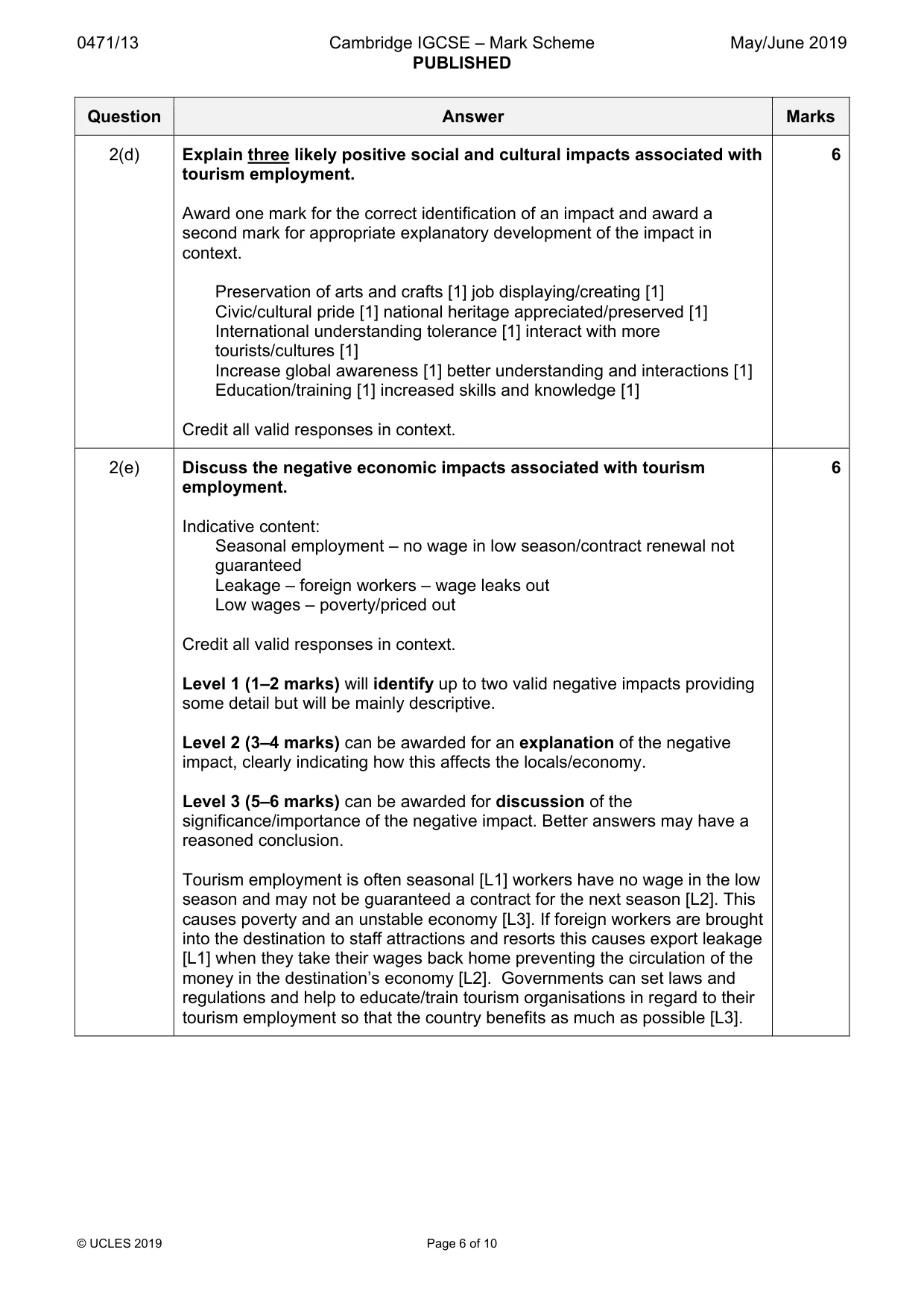
0471/13 Cambridge IGCSE – Mark Scheme PUBLISHED May/June 2019 © UCLES 2019 Page 6 of 10 Question Answer Marks 2(d) Explain three likely positive social and cultural impacts associated with tourism employment. Award one mark for the correct identification of an impact and award a second mark for appropriate explanatory development of the impact in context. Preservation of arts and crafts [1] job displaying/creating [1] Civic/cultural pride [1] national heritage appreciated/preserved [1] International understanding tolerance [1] interact with more tourists/cultures [1] Increase global awareness [1] better understanding and interactions [1] Education/training [1] increased skills and knowledge [1] Credit all valid responses in context. 6 2(e) Discuss the negative economic impacts associated with tourism employment. Indicative content: Seasonal employment – no wage in low season/contract renewal not guaranteed Leakage – foreign workers – wage leaks out Low wages – poverty/priced out Credit all valid responses in context. Level 1 (1–2 marks) will identify up to two valid negative impacts providing some detail but will be mainly descriptive. Level 2 (3–4 marks) can be awarded for an explanation of the negative impact, clearly indicating how this affects the locals/economy. Level 3 (5–6 marks) can be awarded for discussion of the significance/importance of the negative impact. Better answers may have a reasoned conclusion. Tourism employment is often seasonal [L1] workers have no wage in the low season and may not be guaranteed a contract for the next season [L2]. This causes poverty and an unstable economy [L3]. If foreign workers are brought into the destination to staff attractions and resorts this causes export leakage [L1] when they take their wages back home preventing the circulation of the money in the destination’s economy [L2]. Governments can set laws and regulations and help to educate/train tourism organisations in regard to their tourism employment so that the country benefits as much as possible [L3]. 6
Mark scheme, page 7
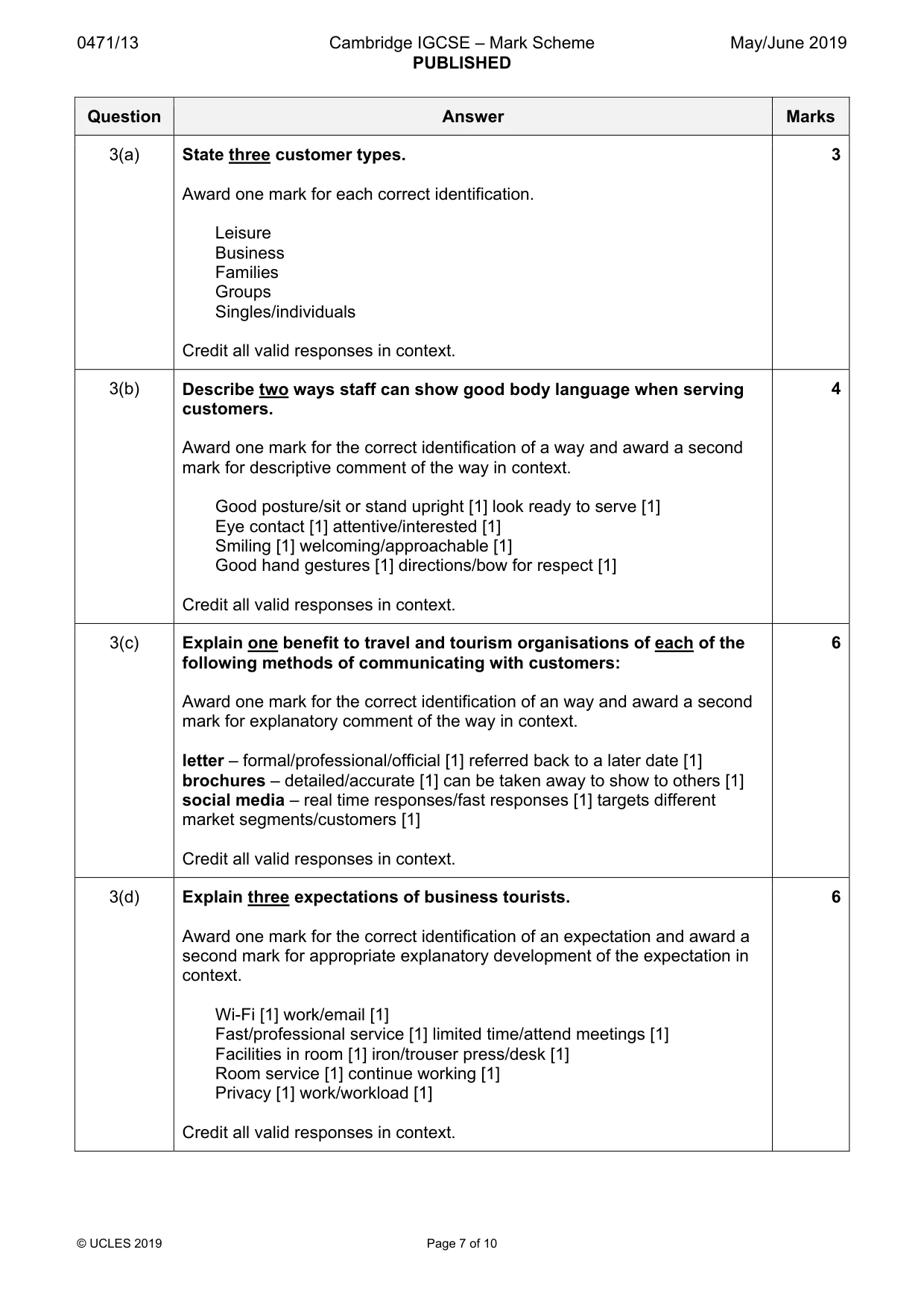
0471/13 Cambridge IGCSE – Mark Scheme PUBLISHED May/June 2019 © UCLES 2019 Page 7 of 10 Question Answer Marks 3(a) State three customer types. Award one mark for each correct identification. Leisure Business Families Groups Singles/individuals Credit all valid responses in context. 3 3(b) Describe two ways staff can show good body language when serving customers. Award one mark for the correct identification of a way and award a second mark for descriptive comment of the way in context. Good posture/sit or stand upright [1] look ready to serve [1] Eye contact [1] attentive/interested [1] Smiling [1] welcoming/approachable [1] Good hand gestures [1] directions/bow for respect [1] Credit all valid responses in context. 4 3(c) Explain one benefit to travel and tourism organisations of each of the following methods of communicating with customers: Award one mark for the correct identification of an way and award a second mark for explanatory comment of the way in context. letter – formal/professional/official [1] referred back to a later date [1] brochures – detailed/accurate [1] can be taken away to show to others [1] social media – real time responses/fast responses [1] targets different market segments/customers [1] Credit all valid responses in context. 6 3(d) Explain three expectations of business tourists. Award one mark for the correct identification of an expectation and award a second mark for appropriate explanatory development of the expectation in context. Wi-Fi [1] work/email [1] Fast/professional service [1] limited time/attend meetings [1] Facilities in room [1] iron/trouser press/desk [1] Room service [1] continue working [1] Privacy [1] work/workload [1] Credit all valid responses in context. 6
Mark scheme, page 8
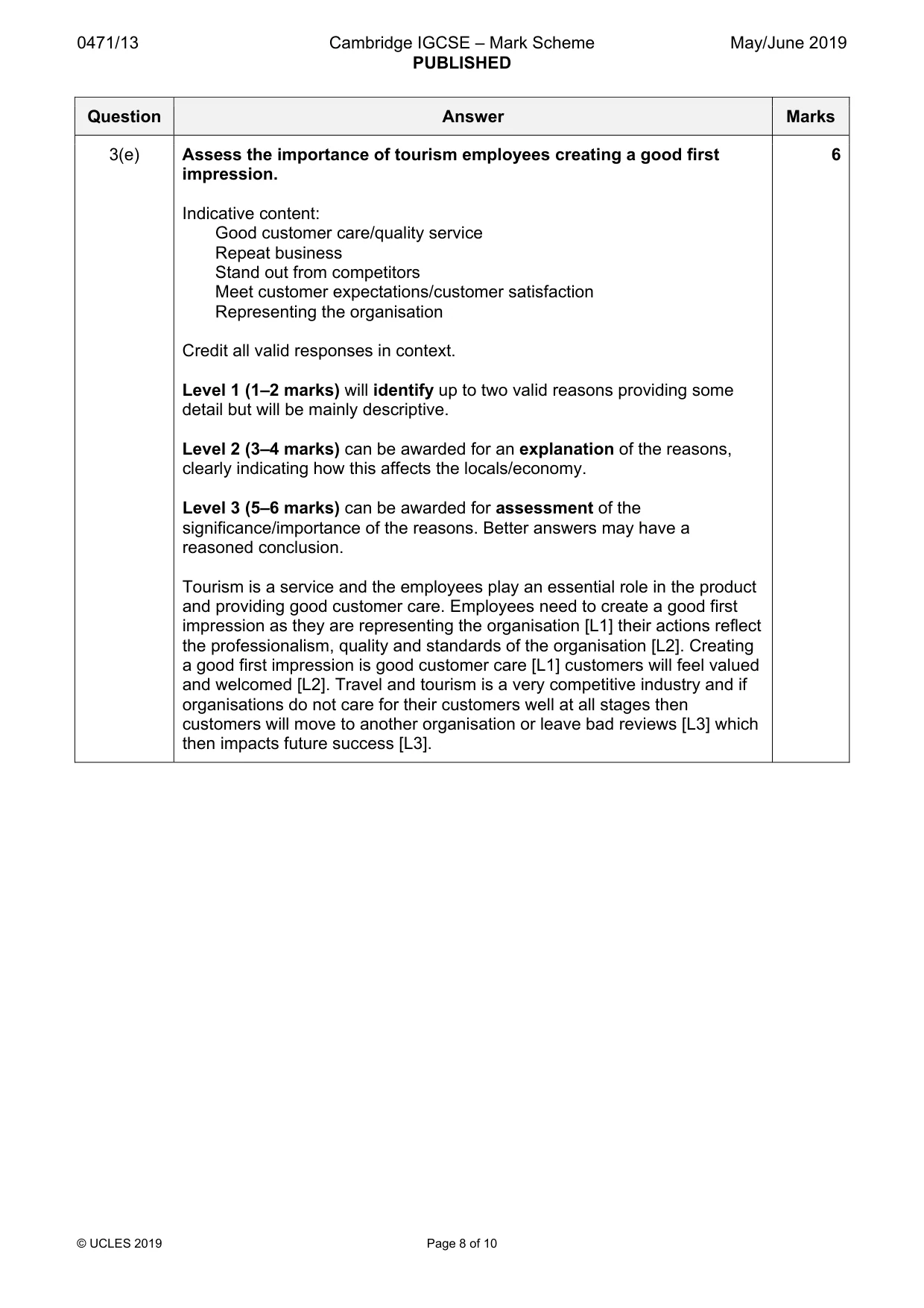
0471/13 Cambridge IGCSE – Mark Scheme PUBLISHED May/June 2019 © UCLES 2019 Page 8 of 10 Question Answer Marks 3(e) Assess the importance of tourism employees creating a good first impression. Indicative content: Good customer care/quality service Repeat business Stand out from competitors Meet customer expectations/customer satisfaction Representing the organisation Credit all valid responses in context. Level 1 (1–2 marks) will identify up to two valid reasons providing some detail but will be mainly descriptive. Level 2 (3–4 marks) can be awarded for an explanation of the reasons, clearly indicating how this affects the locals/economy. Level 3 (5–6 marks) can be awarded for assessment of the significance/importance of the reasons. Better answers may have a reasoned conclusion. Tourism is a service and the employees play an essential role in the product and providing good customer care. Employees need to create a good first impression as they are representing the organisation [L1] their actions reflect the professionalism, quality and standards of the organisation [L2]. Creating a good first impression is good customer care [L1] customers will feel valued and welcomed [L2]. Travel and tourism is a very competitive industry and if organisations do not care for their customers well at all stages then customers will move to another organisation or leave bad reviews [L3] which then impacts future success [L3]. 6
Mark scheme, page 9
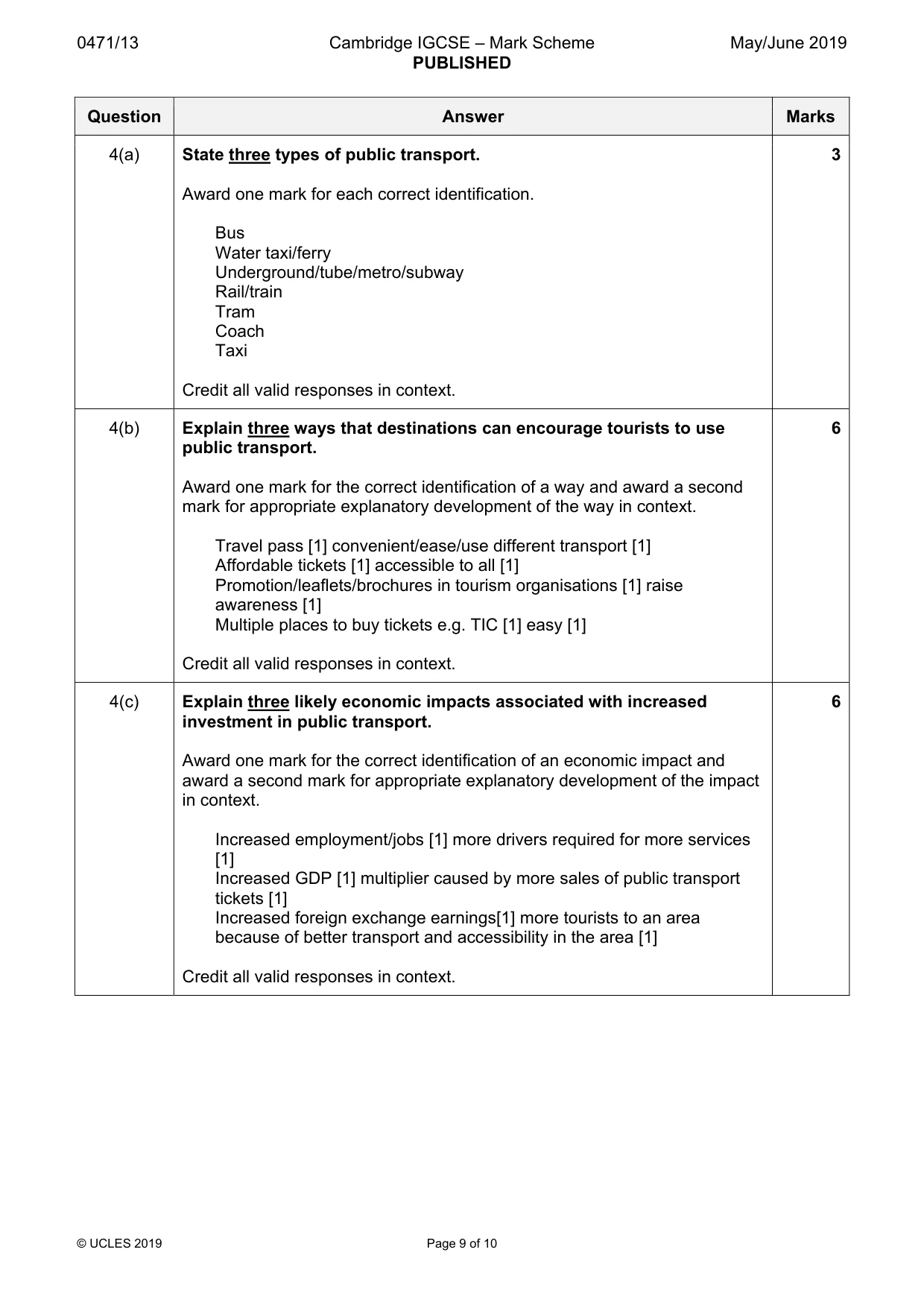
0471/13 Cambridge IGCSE – Mark Scheme PUBLISHED May/June 2019 © UCLES 2019 Page 9 of 10 Question Answer Marks 4(a) State three types of public transport. Award one mark for each correct identification. Bus Water taxi/ferry Underground/tube/metro/subway Rail/train Tram Coach Taxi Credit all valid responses in context. 3 4(b) Explain three ways that destinations can encourage tourists to use public transport. Award one mark for the correct identification of a way and award a second mark for appropriate explanatory development of the way in context. Travel pass [1] convenient/ease/use different transport [1] Affordable tickets [1] accessible to all [1] Promotion/leaflets/brochures in tourism organisations [1] raise awareness [1] Multiple places to buy tickets e.g. TIC [1] easy [1] Credit all valid responses in context. 6 4(c) Explain three likely economic impacts associated with increased investment in public transport. Award one mark for the correct identification of an economic impact and award a second mark for appropriate explanatory development of the impact in context. Increased employment/jobs [1] more drivers required for more services [1] Increased GDP [1] multiplier caused by more sales of public transport tickets [1] Increased foreign exchange earnings[1] more tourists to an area because of better transport and accessibility in the area [1] Credit all valid responses in context. 6
Mark scheme, page 10
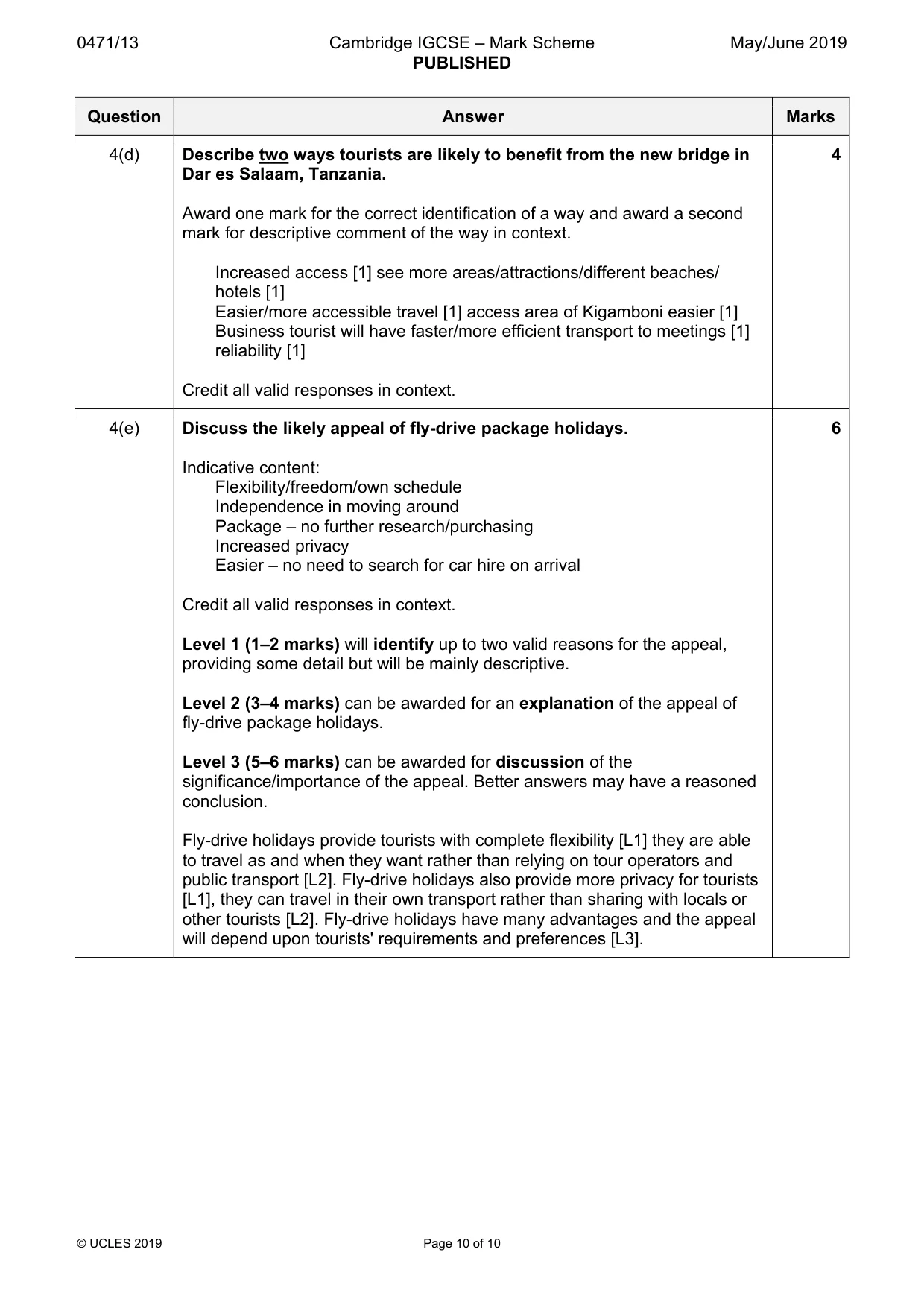
0471/13 Cambridge IGCSE – Mark Scheme PUBLISHED May/June 2019 © UCLES 2019 Page 10 of 10 Question Answer Marks 4(d) Describe two ways tourists are likely to benefit from the new bridge in Dar es Salaam, Tanzania. Award one mark for the correct identification of a way and award a second mark for descriptive comment of the way in context. Increased access [1] see more areas/attractions/different beaches/ hotels [1] Easier/more accessible travel [1] access area of Kigamboni easier [1] Business tourist will have faster/more efficient transport to meetings [1] reliability [1] Credit all valid responses in context. 4 4(e) Discuss the likely appeal of fly-drive package holidays. Indicative content: Flexibility/freedom/own schedule Independence in moving around Package – no further research/purchasing Increased privacy Easier – no need to search for car hire on arrival Credit all valid responses in context. Level 1 (1–2 marks) will identify up to two valid reasons for the appeal, providing some detail but will be mainly descriptive. Level 2 (3–4 marks) can be awarded for an explanation of the appeal of fly-drive package holidays. Level 3 (5–6 marks) can be awarded for discussion of the significance/importance of the appeal. Better answers may have a reasoned conclusion. Fly-drive holidays provide tourists with complete flexibility [L1] they are able to travel as and when they want rather than relying on tour operators and public transport [L2]. Fly-drive holidays also provide more privacy for tourists [L1], they can travel in their own transport rather than sharing with locals or other tourists [L2]. Fly-drive holidays have many advantages and the appeal will depend upon tourists' requirements and preferences [L3]. 6
What you needed in this session
Cambridge’s own grade thresholds for 2019 May/June, Paper 1 · Variant 3. A higher threshold means an easier paper — the bar moves with how the cohort did.