Cambridge IGCSE Travel and Tourism 0471 — 2018 Oct/Nov Paper 2 · Variant 3
0471/23/O/N/18 · 100 marks · ≈113 min
The question paper and its mark scheme, free to read here and free to download. This is Cambridge’s own paper, exactly as it was sat.
Question paper16 pages



Mark scheme10 pages
Answers below. Sit the paper first if you are practising.
Paper as text
Question paper, page 1
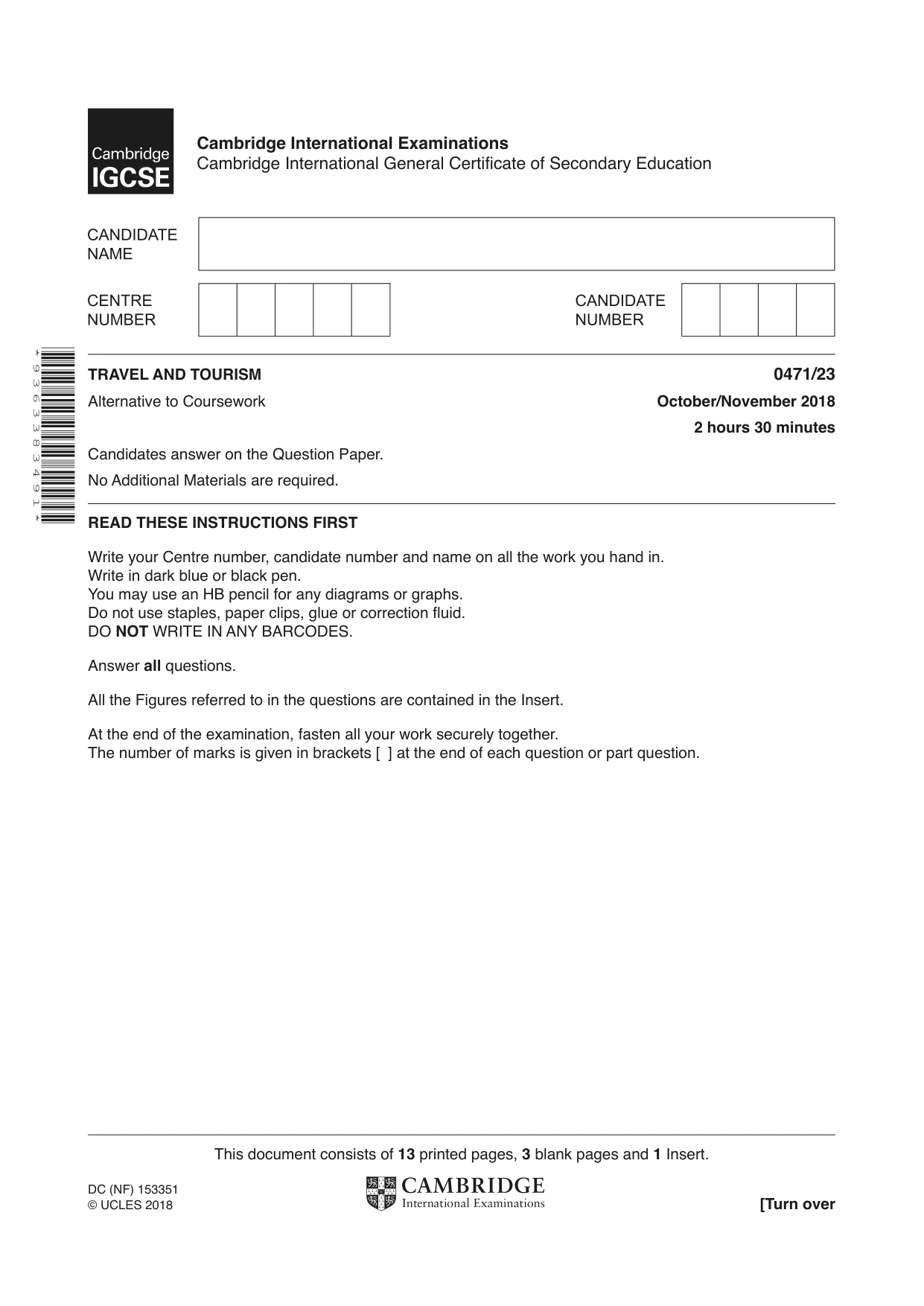
* 9 3 6 3 3 8 3 4 9 1 * This document consists of 13 printed pages, 3 blank pages and 1 Insert. DC (NF) 153351 © UCLES 2018 [Turn over TRAVEL AND TOURISM 0471/23 Alternative to Coursework October/November 2018 2 hours 30 minutes Candidates answer on the Question Paper. No Additional Materials are required. READ THESE INSTRUCTIONS FIRST Write your Centre number, candidate number and name on all the work you hand in. Write in dark blue or black pen. You may use an HB pencil for any diagrams or graphs. Do not use staples, paper clips, glue or correction fluid. DO NOT WRITE IN ANY BARCODES. Answer all questions. All the Figures referred to in the questions are contained in the Insert. At the end of the examination, fasten all your work securely together. The number of marks is given in brackets [ ] at the end of each question or part question. Cambridge International Examinations Cambridge International General Certificate of Secondary Education
Question paper, page 2
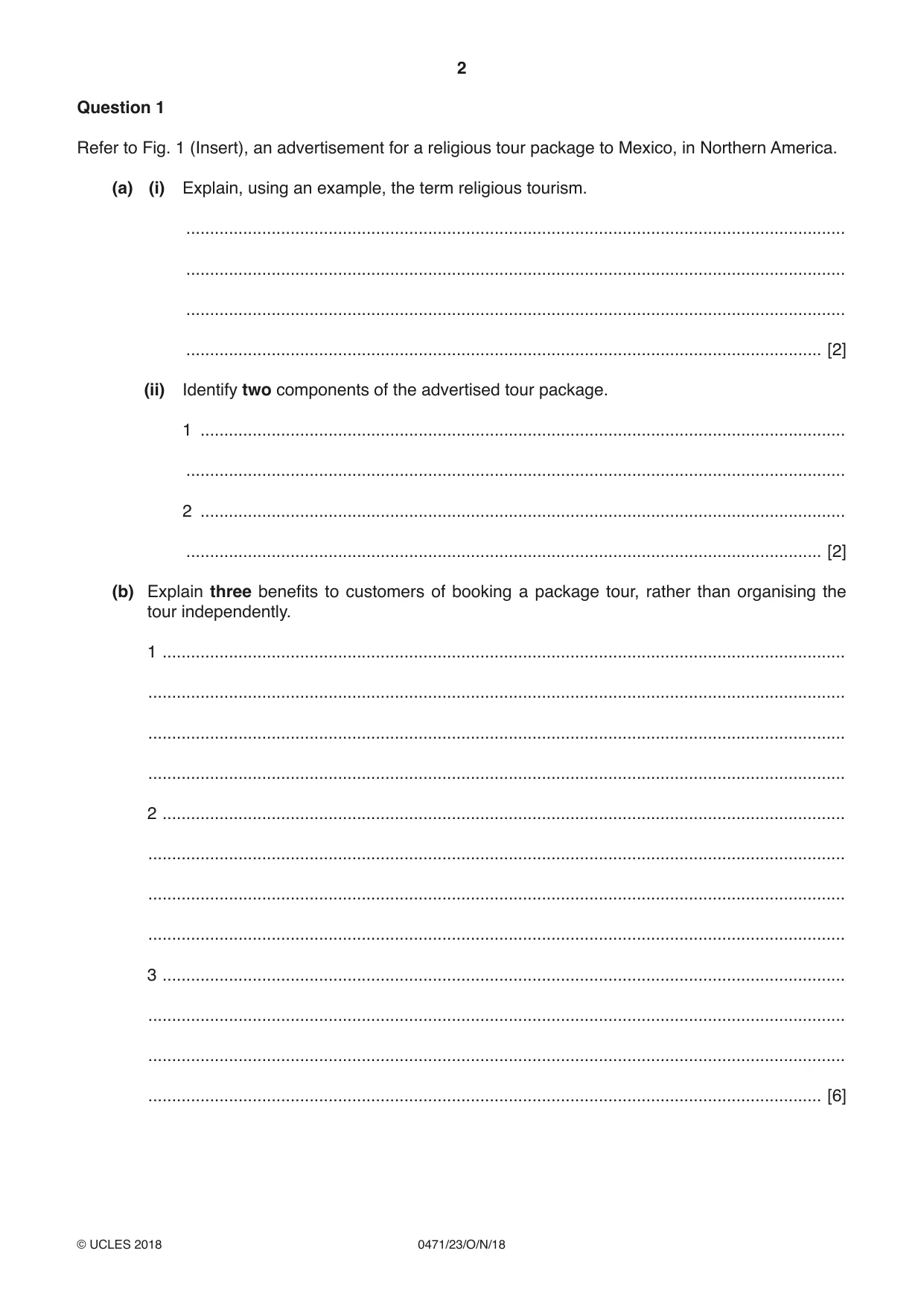
2 0471/23/O/N/18 © UCLES 2018 Question 1 Refer to Fig. 1 (Insert), an advertisement for a religious tour package to Mexico, in Northern America. (a) (i) Explain, using an example, the term religious tourism. … … … … [2] (ii) Identify two components of the advertised tour package. 1 … … 2 … … [2] (b) Explain three benefits to customers of booking a package tour, rather than organising the tour independently. 1 … … … … 2 … … … … 3 … … … … [6]
Question paper, page 3
3 0471/23/O/N/18 © UCLES 2018 [Turn over (c) Explain two benefits to tour operators of using an online distribution channel. 1 … … … … … … 2 … … … … … … [6]
Question paper, page 4
4 0471/23/O/N/18 © UCLES 2018 (d) Evaluate the importance of social networks as a method of promotion in the travel and tourism industry. … … … … … … … … … … … … … … … … … … [9] [Total: 25]
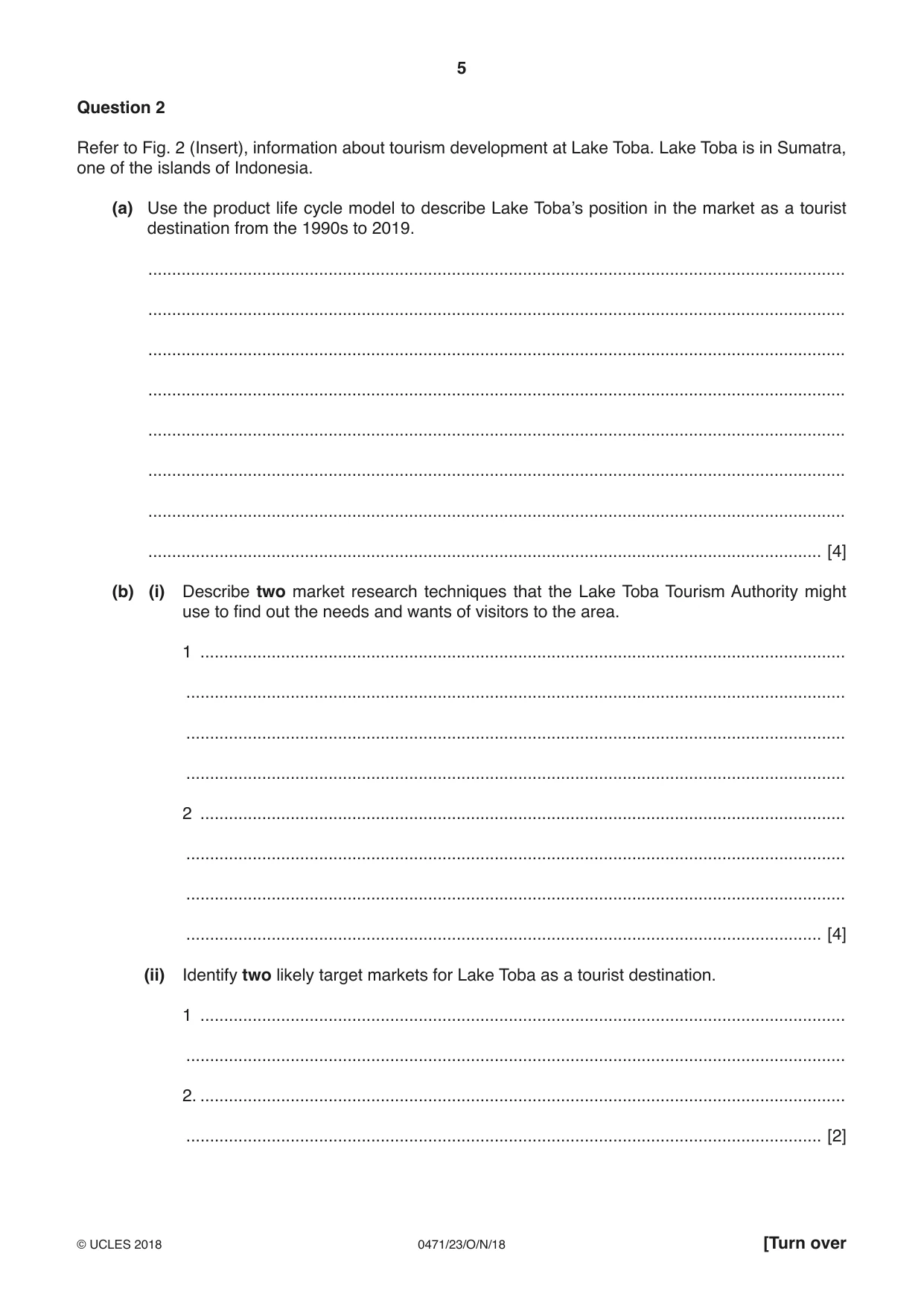
Question paper, page 5
5 0471/23/O/N/18 © UCLES 2018 [Turn over Question 2 Refer to Fig. 2 (Insert), information about tourism development at Lake Toba. Lake Toba is in Sumatra, one of the islands of Indonesia. (a) Use the product life cycle model to describe Lake Toba’s position in the market as a tourist destination from the 1990s to 2019. … … … … … … … … [4] (b) (i) Describe two market research techniques that the Lake Toba Tourism Authority might use to find out the needs and wants of visitors to the area. 1 … … … … 2 … … … … [4] (ii) Identify two likely target markets for Lake Toba as a tourist destination. 1 … … 2. … … [2]
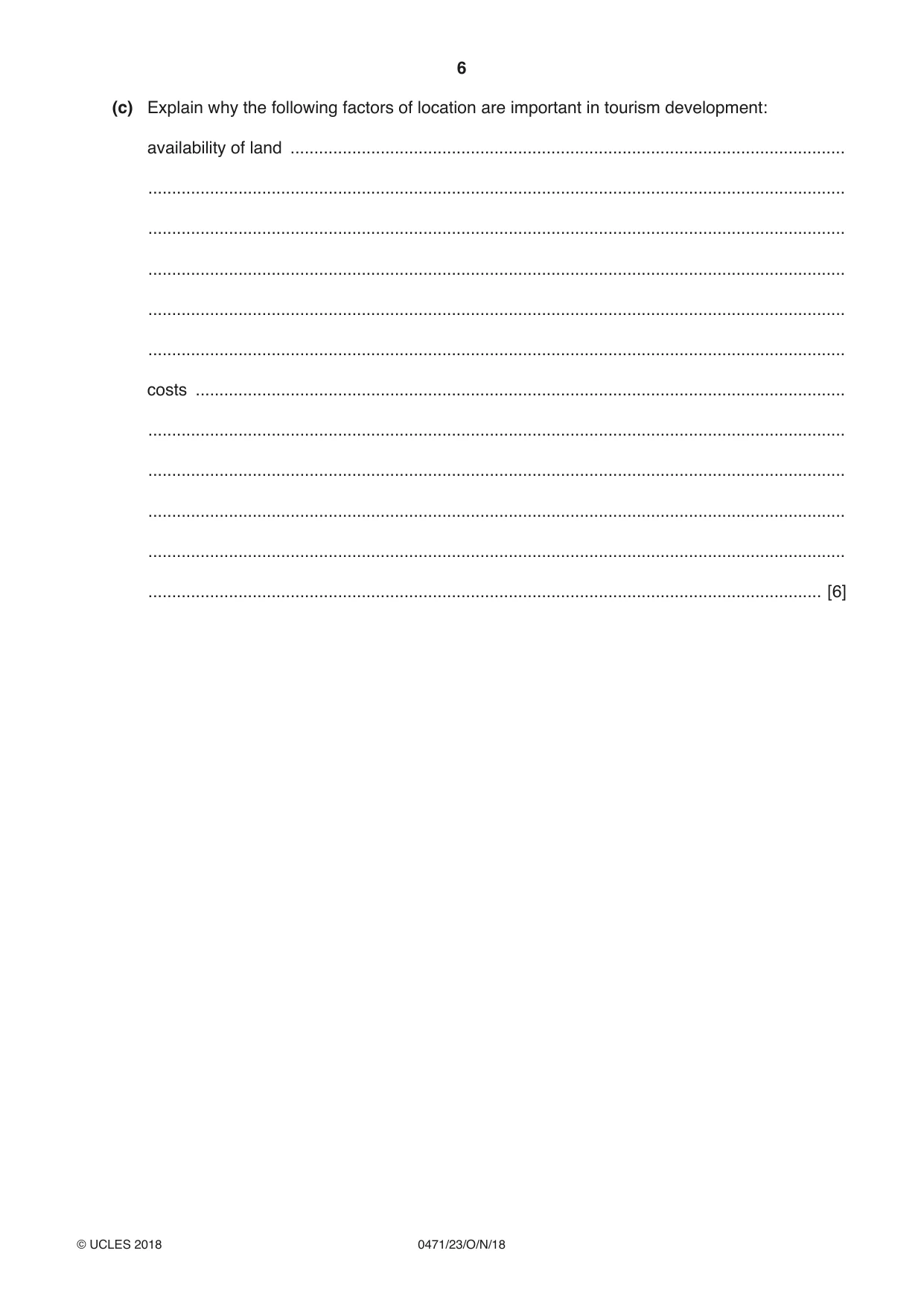
Question paper, page 6
6 0471/23/O/N/18 © UCLES 2018 (c) Explain why the following factors of location are important in tourism development: availability of land … … … … … … costs … … … … … … [6]
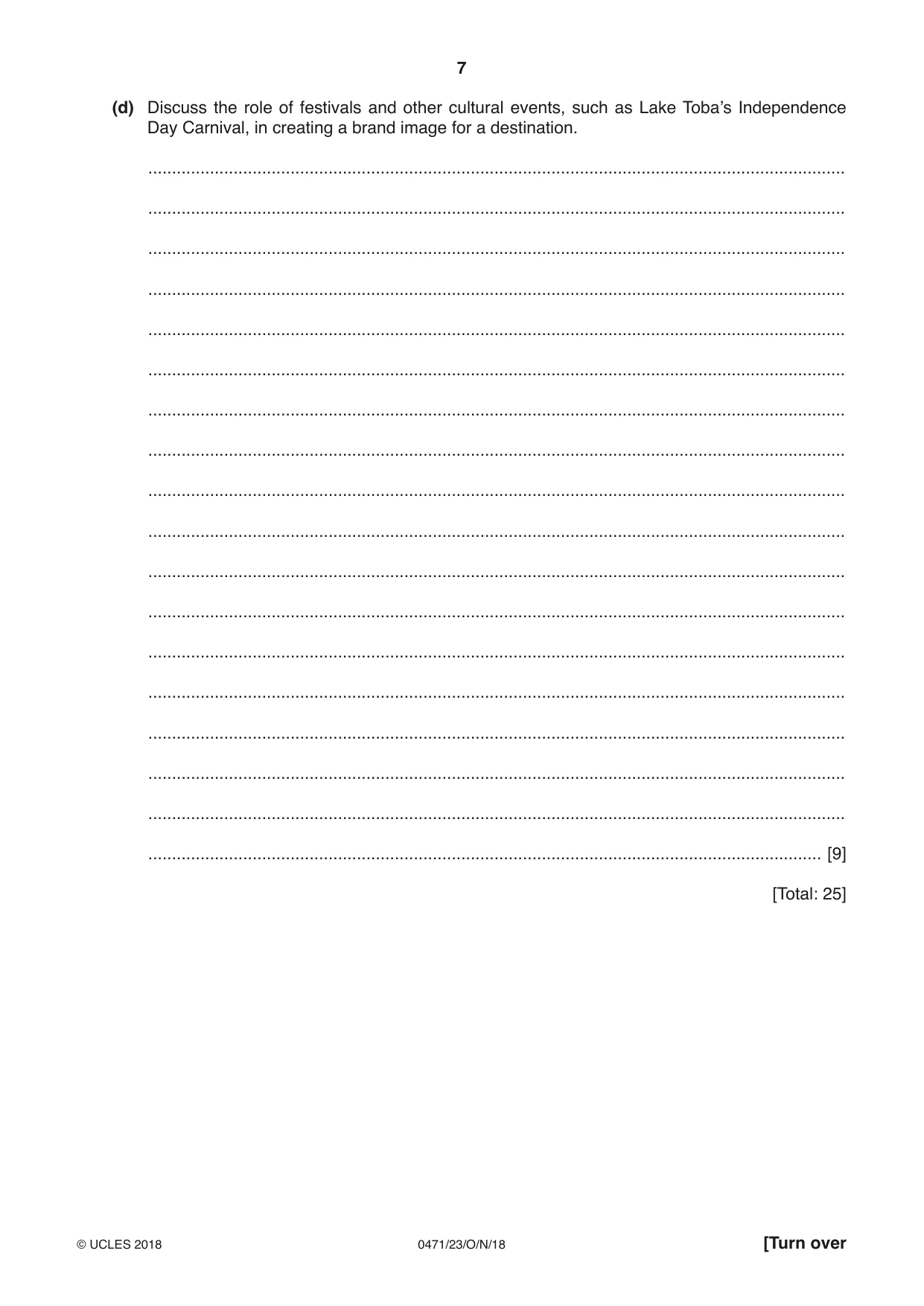
Question paper, page 7
7 0471/23/O/N/18 © UCLES 2018 [Turn over (d) Discuss the role of festivals and other cultural events, such as Lake Toba’s Independence Day Carnival, in creating a brand image for a destination. … … … … … … … … … … … … … … … … … … [9] [Total: 25]
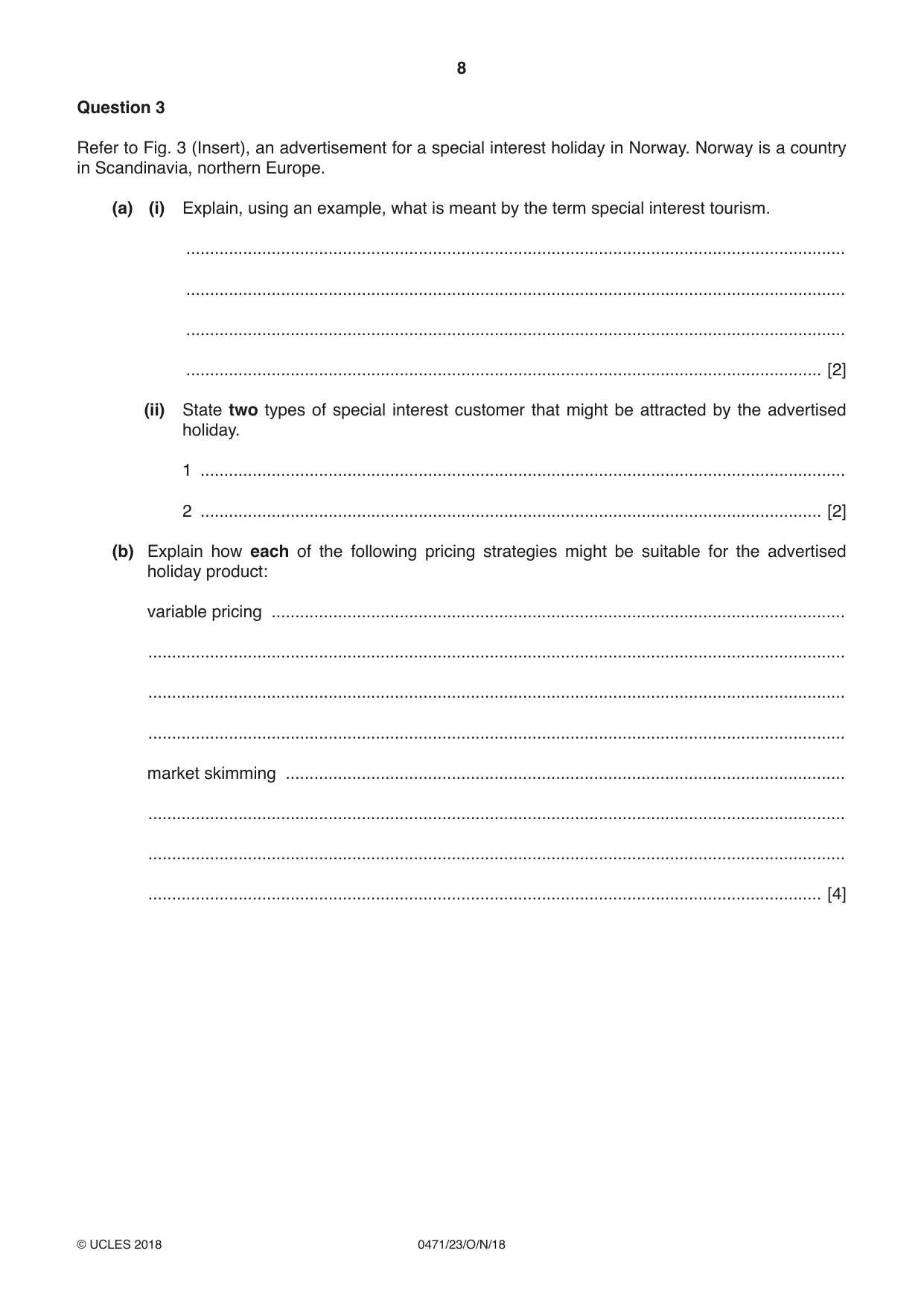
Question paper, page 8
8 0471/23/O/N/18 © UCLES 2018 Question 3 Refer to Fig. 3 (Insert), an advertisement for a special interest holiday in Norway. Norway is a country in Scandinavia, northern Europe. (a) (i) Explain, using an example, what is meant by the term special interest tourism. … … … … [2] (ii) State two types of special interest customer that might be attracted by the advertised holiday. 1 … 2 … [2] (b) Explain how each of the following pricing strategies might be suitable for the advertised holiday product: variable pricing … … … … market skimming … … … … [4]
Question paper, page 9
9 0471/23/O/N/18 © UCLES 2018 [Turn over (c) Apply the AIDA principle to the advertisement for this special interest holiday, to analyse its effectiveness as a piece of promotional material. … … … … … … … … … … … … … … … … [8]
Question paper, page 10
10 0471/23/O/N/18 © UCLES 2018 (d) Evaluate the relationship between marketing and promotion and customer satisfaction for travel and tourism organisations. … … … … … … … … … … … … … … … … … … [9] [Total: 25]
Question paper, page 11
11 0471/23/O/N/18 © UCLES 2018 [Turn over Question 4 Refer to Fig. 4 (Insert), information about Ibrahim Nasir International Airport, the international airport for the Maldives. (a) (i) Describe the transport services for international tourists wishing to visit one of the resort islands in the Maldives. … … … … [2] (ii) Explain why these services are described as perishable. … … … … [2] (b) Explain two reasons why travel and tourism providers offer ancillary products and services, such as baggage wrapping at the airport. 1 … … … … … … 2 … … … … … … [6]
Question paper, page 12
12 0471/23/O/N/18 © UCLES 2018 (c) Explain how airlines serving Ibrahim Nasir International Airport might use the following distribution channels: retailers … … … … … … global distribution systems (GDS) … … … … … … [6]
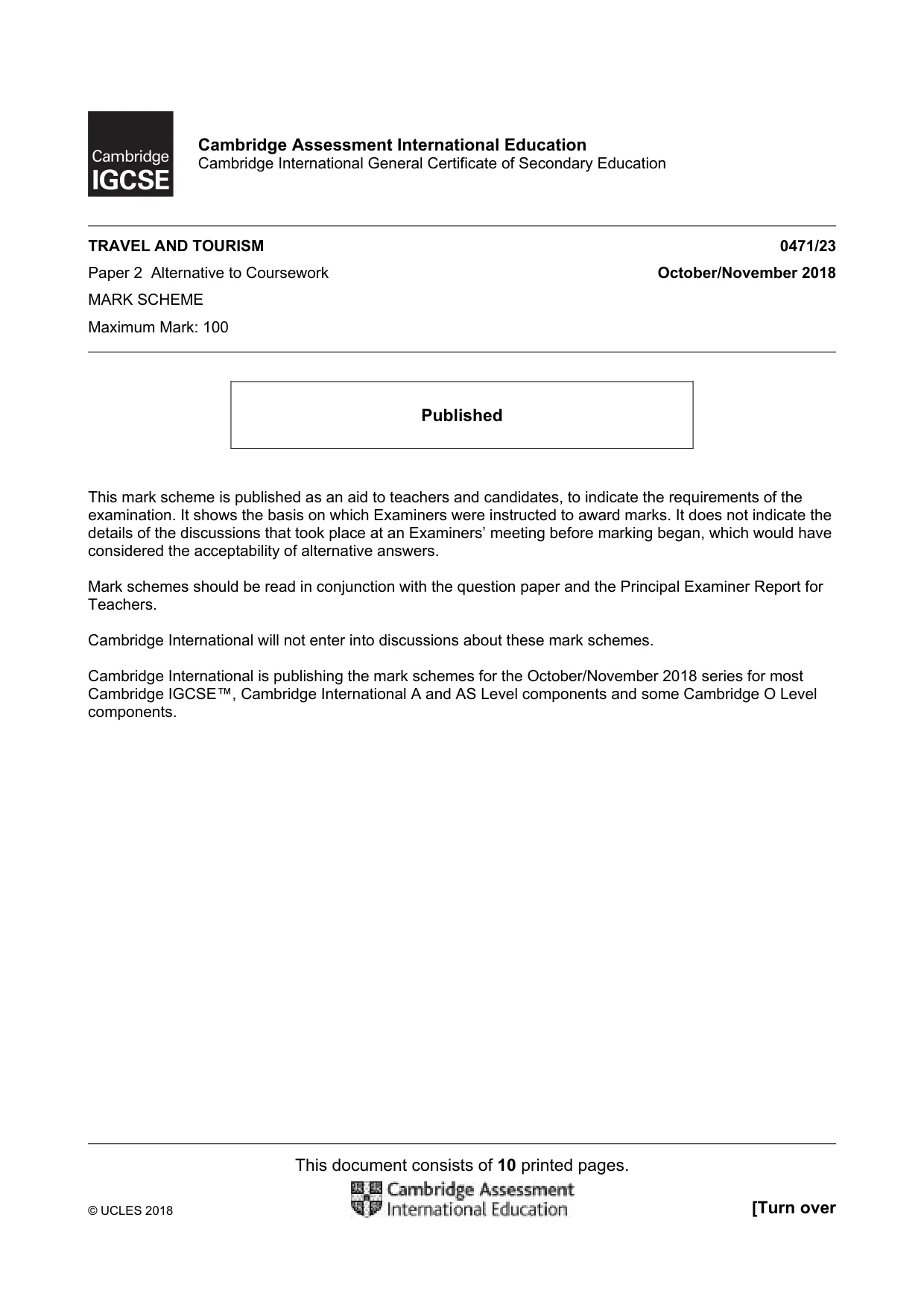
Question paper, page 13
13 0471/23/O/N/18 © UCLES 2018 (d) Discuss how technology, such as electronic information kiosks, helps potential customers understand that tourism products and services are heterogeneous. … … … … … … … … … … … … . … … … … … … [9] [Total: 25]
Question paper, page 14
14 0471/23/O/N/18 © UCLES 2018 BLANK PAGE
Question paper, page 15
15 0471/23/O/N/18 © UCLES 2018 BLANK PAGE
Question paper, page 16
16 0471/23/O/N/18 © UCLES 2018 Permission to reproduce items where third-party owned material protected by copyright is included has been sought and cleared where possible. Every reasonable effort has been made by the publisher (UCLES) to trace copyright holders, but if any items requiring clearance have unwittingly been included, the publisher will be pleased to make amends at the earliest possible opportunity. To avoid the issue of disclosure of answer-related information to candidates, all copyright acknowledgements are reproduced online in the Cambridge International Examinations Copyright Acknowledgements Booklet. This is produced for each series of examinations and is freely available to download at www.cie.org.uk after the live examination series. Cambridge International Examinations is part of the Cambridge Assessment Group. Cambridge Assessment is the brand name of University of Cambridge Local Examinations Syndicate (UCLES), which is itself a department of the University of Cambridge. BLANK PAGE
Mark scheme, page 1
This document consists of 10 printed pages. © UCLES 2018 [Turn over Cambridge Assessment International Education Cambridge International General Certificate of Secondary Education TRAVEL AND TOURISM 0471/23 Paper 2 Alternative to Coursework October/November 2018 MARK SCHEME Maximum Mark: 100 Published This mark scheme is published as an aid to teachers and candidates, to indicate the requirements of the examination. It shows the basis on which Examiners were instructed to award marks. It does not indicate the details of the discussions that took place at an Examiners’ meeting before marking began, which would have considered the acceptability of alternative answers. Mark schemes should be read in conjunction with the question paper and the Principal Examiner Report for Teachers. Cambridge International will not enter into discussions about these mark schemes. Cambridge International is publishing the mark schemes for the October/November 2018 series for most Cambridge IGCSE™, Cambridge International A and AS Level components and some Cambridge O Level components.
Mark scheme, page 2
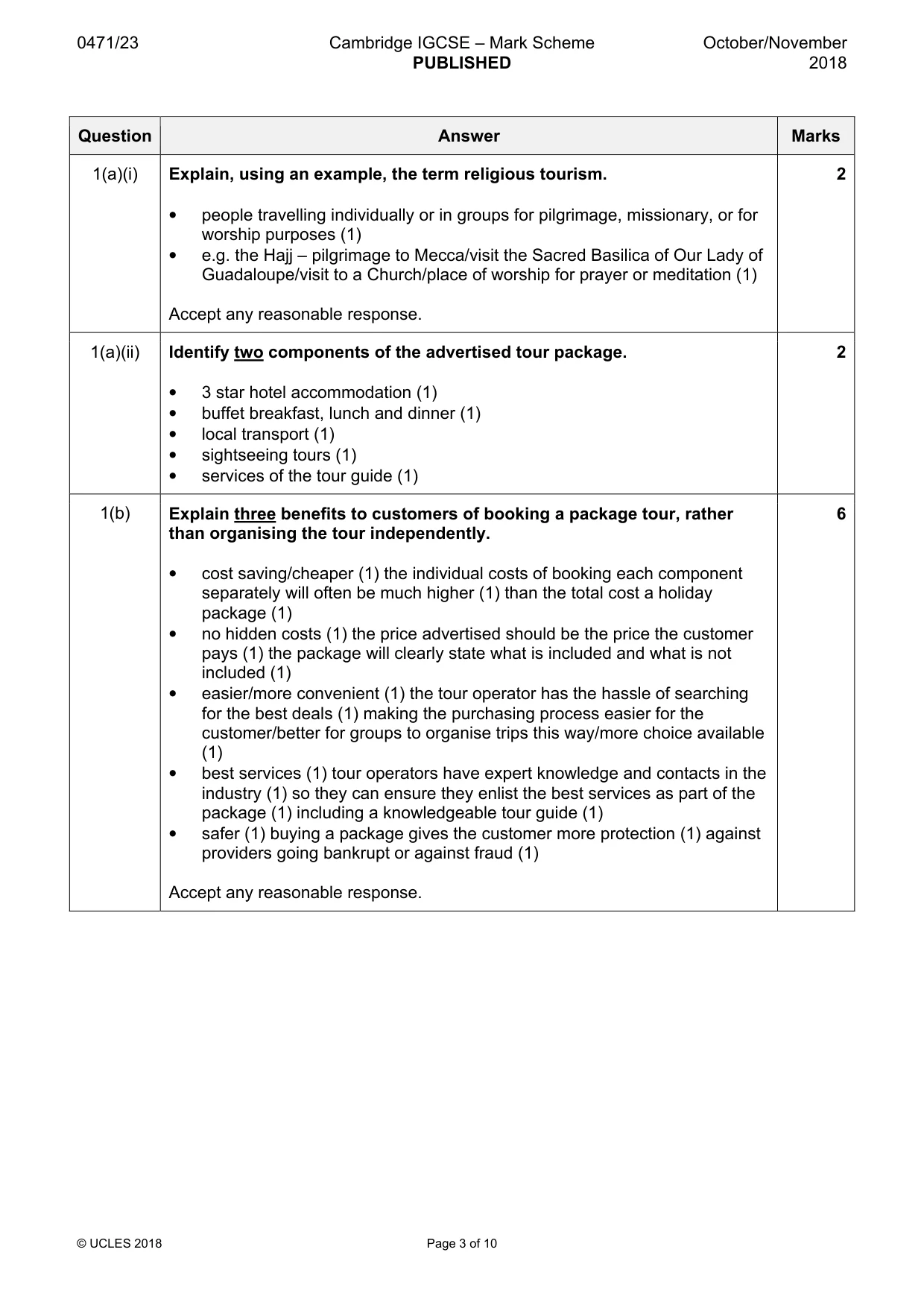
0471/23 Cambridge IGCSE – Mark Scheme PUBLISHED October/November 2018 © UCLES 2018 Page 2 of 10 Generic Marking Principles These general marking principles must be applied by all examiners when marking candidate answers. They should be applied alongside the specific content of the mark scheme or generic level descriptors for a question. Each question paper and mark scheme will also comply with these marking principles. GENERIC MARKING PRINCIPLE 1: Marks must be awarded in line with: • the specific content of the mark scheme or the generic level descriptors for the question • the specific skills defined in the mark scheme or in the generic level descriptors for the question • the standard of response required by a candidate as exemplified by the standardisation scripts. GENERIC MARKING PRINCIPLE 2: Marks awarded are always whole marks (not half marks, or other fractions). GENERIC MARKING PRINCIPLE 3: Marks must be awarded positively: • marks are awarded for correct/valid answers, as defined in the mark scheme. However, credit is given for valid answers which go beyond the scope of the syllabus and mark scheme, referring to your Team Leader as appropriate • marks are awarded when candidates clearly demonstrate what they know and can do • marks are not deducted for errors • marks are not deducted for omissions • answers should only be judged on the quality of spelling, punctuation and grammar when these features are specifically assessed by the question as indicated by the mark scheme. The meaning, however, should be unambiguous. GENERIC MARKING PRINCIPLE 4: Rules must be applied consistently e.g. in situations where candidates have not followed instructions or in the application of generic level descriptors. GENERIC MARKING PRINCIPLE 5: Marks should be awarded using the full range of marks defined in the mark scheme for the question (however; the use of the full mark range may be limited according to the quality of the candidate responses seen). GENERIC MARKING PRINCIPLE 6: Marks awarded are based solely on the requirements as defined in the mark scheme. Marks should not be awarded with grade thresholds or grade descriptors in mind.
Mark scheme, page 3
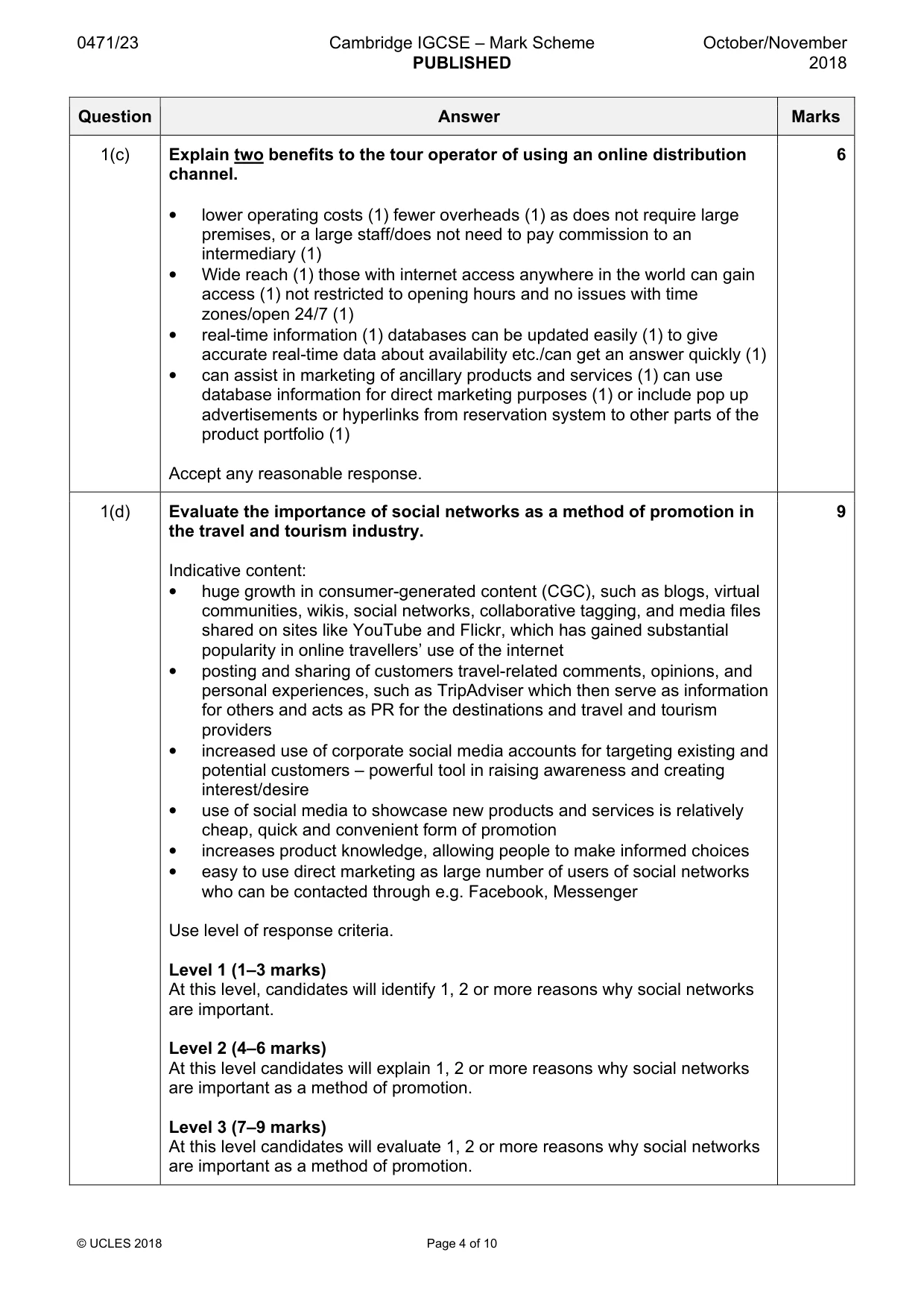
0471/23 Cambridge IGCSE – Mark Scheme PUBLISHED October/November 2018 © UCLES 2018 Page 3 of 10 Question Answer Marks 1(a)(i) Explain, using an example, the term religious tourism. • people travelling individually or in groups for pilgrimage, missionary, or for worship purposes (1) • e.g. the Hajj – pilgrimage to Mecca/visit the Sacred Basilica of Our Lady of Guadaloupe/visit to a Church/place of worship for prayer or meditation (1) Accept any reasonable response. 2 1(a)(ii) Identify two components of the advertised tour package. • 3 star hotel accommodation (1) • buffet breakfast, lunch and dinner (1) • local transport (1) • sightseeing tours (1) • services of the tour guide (1) 2 1(b) Explain three benefits to customers of booking a package tour, rather than organising the tour independently. • cost saving/cheaper (1) the individual costs of booking each component separately will often be much higher (1) than the total cost a holiday package (1) • no hidden costs (1) the price advertised should be the price the customer pays (1) the package will clearly state what is included and what is not included (1) • easier/more convenient (1) the tour operator has the hassle of searching for the best deals (1) making the purchasing process easier for the customer/better for groups to organise trips this way/more choice available (1) • best services (1) tour operators have expert knowledge and contacts in the industry (1) so they can ensure they enlist the best services as part of the package (1) including a knowledgeable tour guide (1) • safer (1) buying a package gives the customer more protection (1) against providers going bankrupt or against fraud (1) Accept any reasonable response. 6
Mark scheme, page 4
0471/23 Cambridge IGCSE – Mark Scheme PUBLISHED October/November 2018 © UCLES 2018 Page 4 of 10 Question Answer Marks 1(c) Explain two benefits to the tour operator of using an online distribution channel. • lower operating costs (1) fewer overheads (1) as does not require large premises, or a large staff/does not need to pay commission to an intermediary (1) • Wide reach (1) those with internet access anywhere in the world can gain access (1) not restricted to opening hours and no issues with time zones/open 24/7 (1) • real-time information (1) databases can be updated easily (1) to give accurate real-time data about availability etc./can get an answer quickly (1) • can assist in marketing of ancillary products and services (1) can use database information for direct marketing purposes (1) or include pop up advertisements or hyperlinks from reservation system to other parts of the product portfolio (1) Accept any reasonable response. 6 1(d) Evaluate the importance of social networks as a method of promotion in the travel and tourism industry. Indicative content: • huge growth in consumer-generated content (CGC), such as blogs, virtual communities, wikis, social networks, collaborative tagging, and media files shared on sites like YouTube and Flickr, which has gained substantial popularity in online travellers’ use of the internet • posting and sharing of customers travel-related comments, opinions, and personal experiences, such as TripAdviser which then serve as information for others and acts as PR for the destinations and travel and tourism providers • increased use of corporate social media accounts for targeting existing and potential customers – powerful tool in raising awareness and creating interest/desire • use of social media to showcase new products and services is relatively cheap, quick and convenient form of promotion • increases product knowledge, allowing people to make informed choices • easy to use direct marketing as large number of users of social networks who can be contacted through e.g. Facebook, Messenger Use level of response criteria. Level 1 (1–3 marks) At this level, candidates will identify 1, 2 or more reasons why social networks are important. Level 2 (4–6 marks) At this level candidates will explain 1, 2 or more reasons why social networks are important as a method of promotion. Level 3 (7–9 marks) At this level candidates will evaluate 1, 2 or more reasons why social networks are important as a method of promotion. 9
Mark scheme, page 5
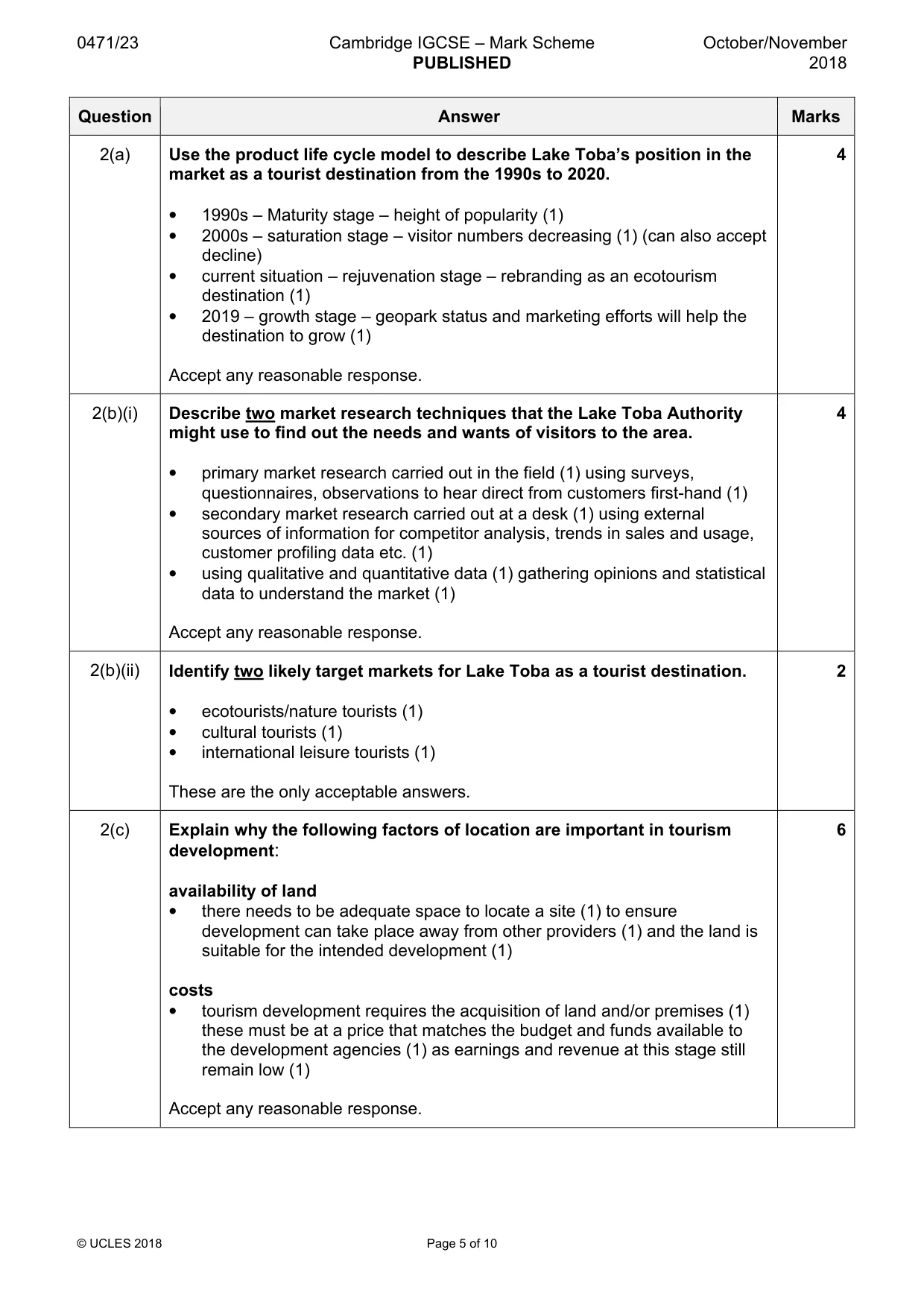
0471/23 Cambridge IGCSE – Mark Scheme PUBLISHED October/November 2018 © UCLES 2018 Page 5 of 10 Question Answer Marks 2(a) Use the product life cycle model to describe Lake Toba’s position in the market as a tourist destination from the 1990s to 2020. • 1990s – Maturity stage – height of popularity (1) • 2000s – saturation stage – visitor numbers decreasing (1) (can also accept decline) • current situation – rejuvenation stage – rebranding as an ecotourism destination (1) • 2019 – growth stage – geopark status and marketing efforts will help the destination to grow (1) Accept any reasonable response. 4 2(b)(i) Describe two market research techniques that the Lake Toba Authority might use to find out the needs and wants of visitors to the area. • primary market research carried out in the field (1) using surveys, questionnaires, observations to hear direct from customers first-hand (1) • secondary market research carried out at a desk (1) using external sources of information for competitor analysis, trends in sales and usage, customer profiling data etc. (1) • using qualitative and quantitative data (1) gathering opinions and statistical data to understand the market (1) Accept any reasonable response. 4 2(b)(ii) Identify two likely target markets for Lake Toba as a tourist destination. • ecotourists/nature tourists (1) • cultural tourists (1) • international leisure tourists (1) These are the only acceptable answers. 2 2(c) Explain why the following factors of location are important in tourism development: availability of land • there needs to be adequate space to locate a site (1) to ensure development can take place away from other providers (1) and the land is suitable for the intended development (1) costs • tourism development requires the acquisition of land and/or premises (1) these must be at a price that matches the budget and funds available to the development agencies (1) as earnings and revenue at this stage still remain low (1) Accept any reasonable response. 6
Mark scheme, page 6
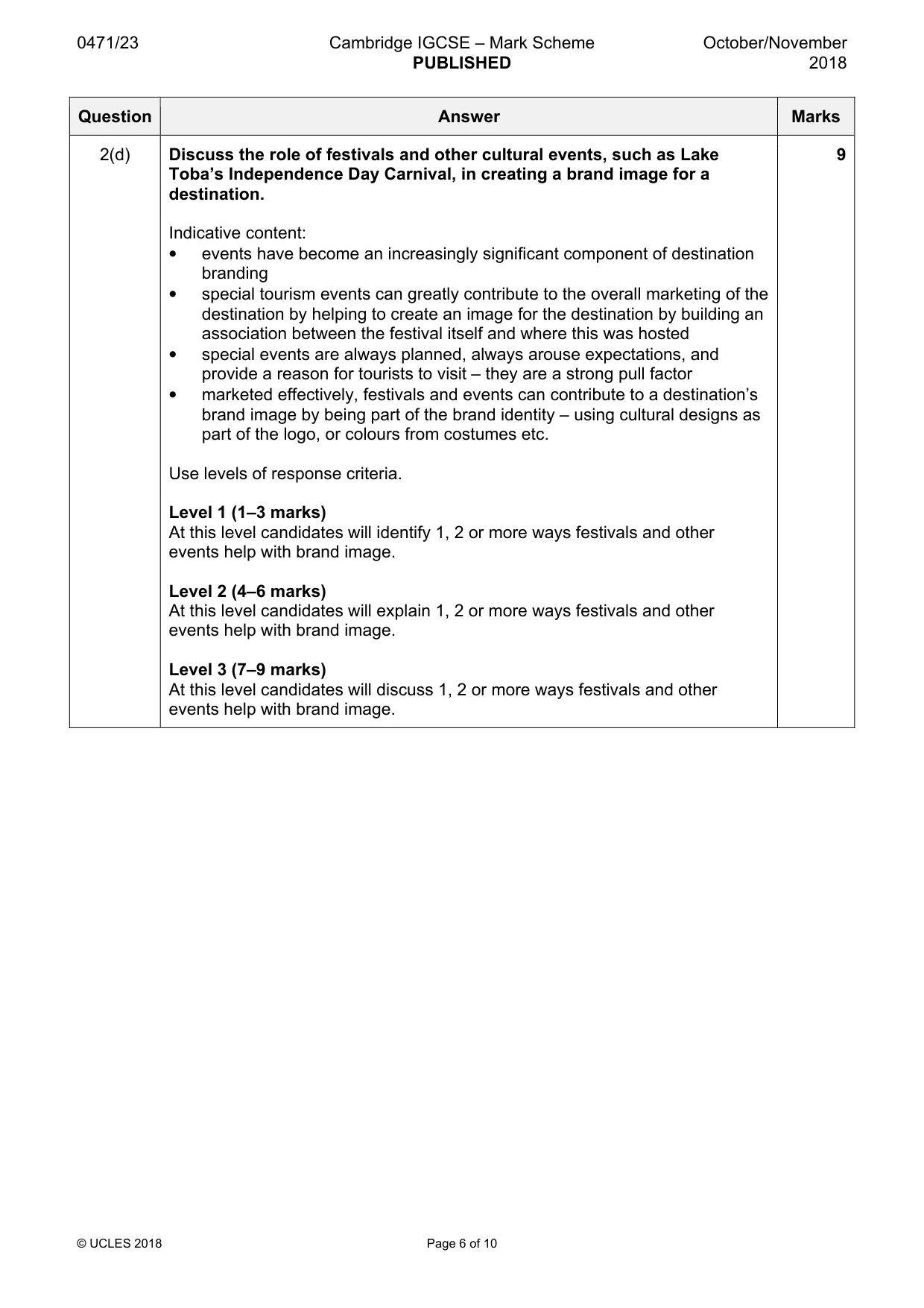
0471/23 Cambridge IGCSE – Mark Scheme PUBLISHED October/November 2018 © UCLES 2018 Page 6 of 10 Question Answer Marks 2(d) Discuss the role of festivals and other cultural events, such as Lake Toba’s Independence Day Carnival, in creating a brand image for a destination. Indicative content: • events have become an increasingly significant component of destination branding • special tourism events can greatly contribute to the overall marketing of the destination by helping to create an image for the destination by building an association between the festival itself and where this was hosted • special events are always planned, always arouse expectations, and provide a reason for tourists to visit – they are a strong pull factor • marketed effectively, festivals and events can contribute to a destination’s brand image by being part of the brand identity – using cultural designs as part of the logo, or colours from costumes etc. Use levels of response criteria. Level 1 (1–3 marks) At this level candidates will identify 1, 2 or more ways festivals and other events help with brand image. Level 2 (4–6 marks) At this level candidates will explain 1, 2 or more ways festivals and other events help with brand image. Level 3 (7–9 marks) At this level candidates will discuss 1, 2 or more ways festivals and other events help with brand image. 9
Mark scheme, page 7
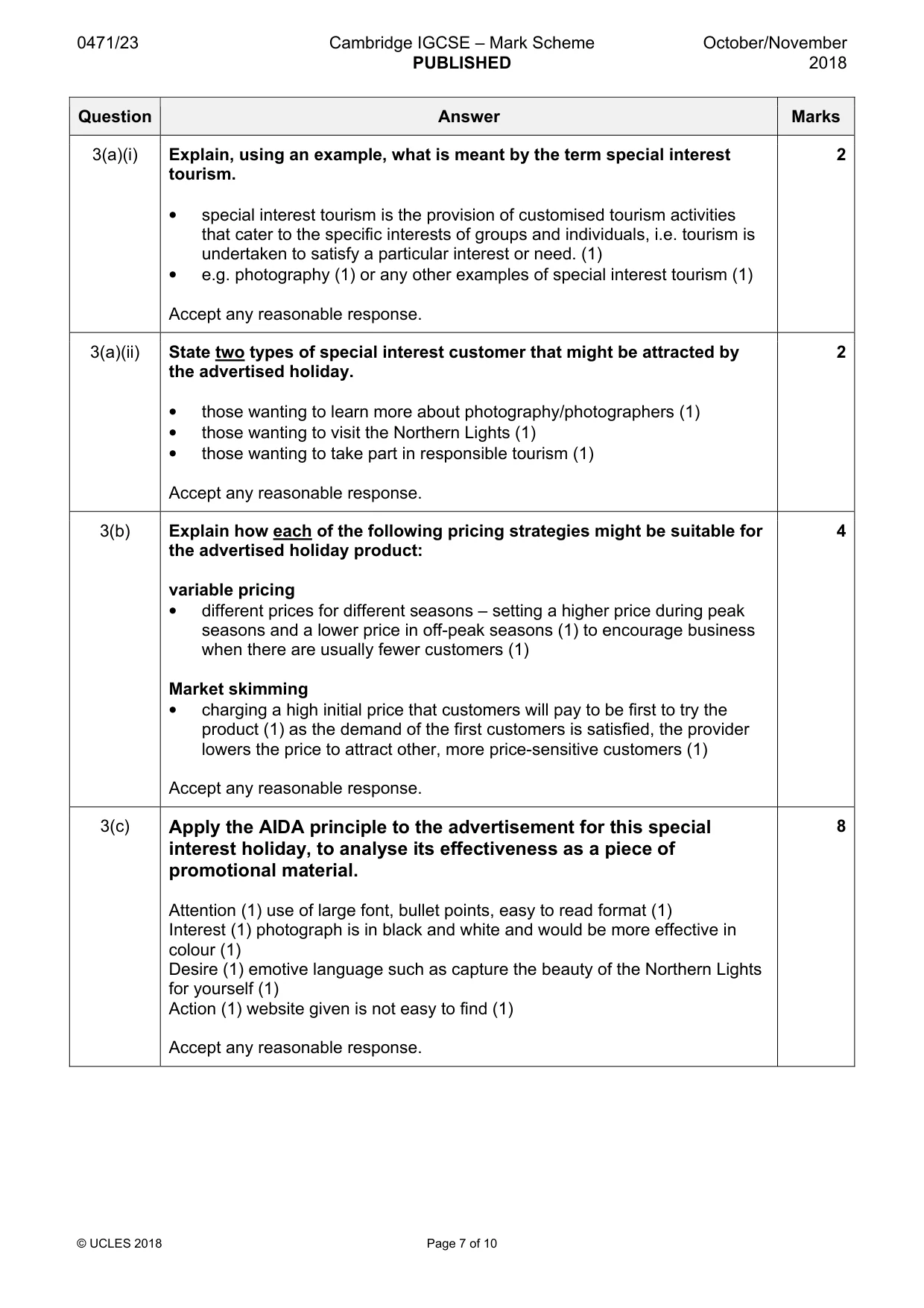
0471/23 Cambridge IGCSE – Mark Scheme PUBLISHED October/November 2018 © UCLES 2018 Page 7 of 10 Question Answer Marks 3(a)(i) Explain, using an example, what is meant by the term special interest tourism. • special interest tourism is the provision of customised tourism activities that cater to the specific interests of groups and individuals, i.e. tourism is undertaken to satisfy a particular interest or need. (1) • e.g. photography (1) or any other examples of special interest tourism (1) Accept any reasonable response. 2 3(a)(ii) State two types of special interest customer that might be attracted by the advertised holiday. • those wanting to learn more about photography/photographers (1) • those wanting to visit the Northern Lights (1) • those wanting to take part in responsible tourism (1) Accept any reasonable response. 2 3(b) Explain how each of the following pricing strategies might be suitable for the advertised holiday product: variable pricing • different prices for different seasons – setting a higher price during peak seasons and a lower price in off-peak seasons (1) to encourage business when there are usually fewer customers (1) Market skimming • charging a high initial price that customers will pay to be first to try the product (1) as the demand of the first customers is satisfied, the provider lowers the price to attract other, more price-sensitive customers (1) Accept any reasonable response. 4 3(c) Apply the AIDA principle to the advertisement for this special interest holiday, to analyse its effectiveness as a piece of promotional material. Attention (1) use of large font, bullet points, easy to read format (1) Interest (1) photograph is in black and white and would be more effective in colour (1) Desire (1) emotive language such as capture the beauty of the Northern Lights for yourself (1) Action (1) website given is not easy to find (1) Accept any reasonable response. 8
Mark scheme, page 8
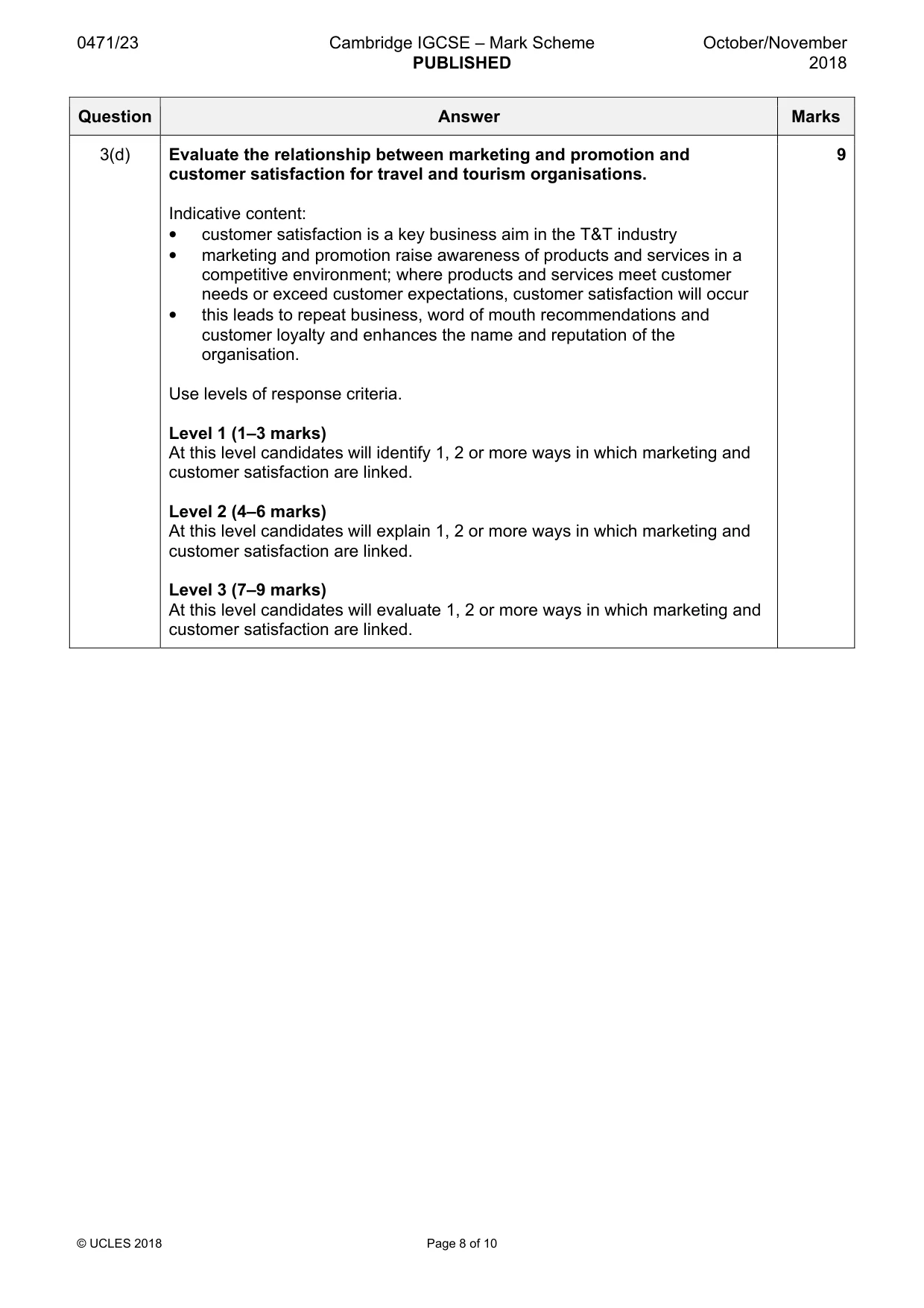
0471/23 Cambridge IGCSE – Mark Scheme PUBLISHED October/November 2018 © UCLES 2018 Page 8 of 10 Question Answer Marks 3(d) Evaluate the relationship between marketing and promotion and customer satisfaction for travel and tourism organisations. Indicative content: • customer satisfaction is a key business aim in the T&T industry • marketing and promotion raise awareness of products and services in a competitive environment; where products and services meet customer needs or exceed customer expectations, customer satisfaction will occur • this leads to repeat business, word of mouth recommendations and customer loyalty and enhances the name and reputation of the organisation. Use levels of response criteria. Level 1 (1–3 marks) At this level candidates will identify 1, 2 or more ways in which marketing and customer satisfaction are linked. Level 2 (4–6 marks) At this level candidates will explain 1, 2 or more ways in which marketing and customer satisfaction are linked. Level 3 (7–9 marks) At this level candidates will evaluate 1, 2 or more ways in which marketing and customer satisfaction are linked. 9
Mark scheme, page 9
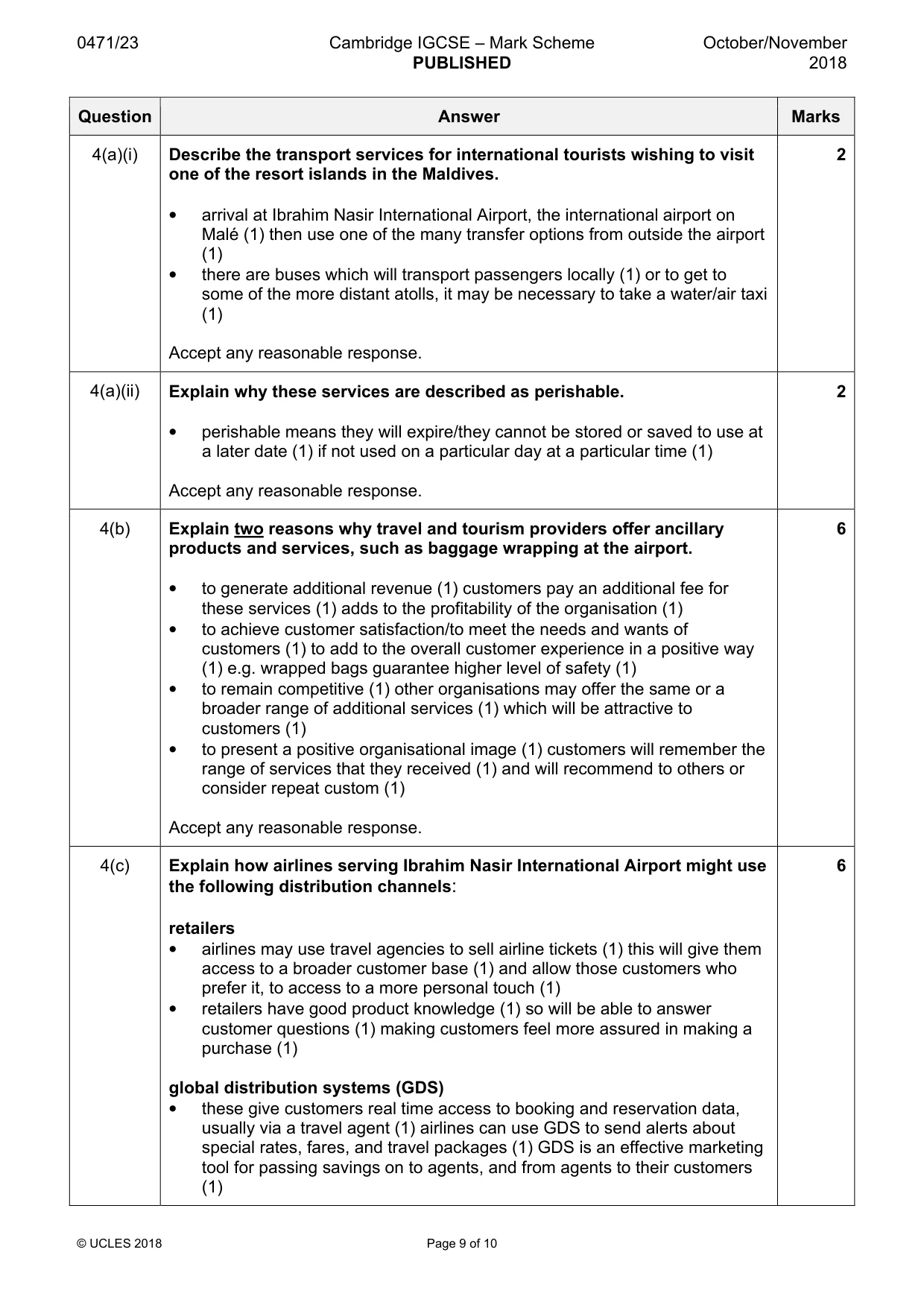
0471/23 Cambridge IGCSE – Mark Scheme PUBLISHED October/November 2018 © UCLES 2018 Page 9 of 10 Question Answer Marks 4(a)(i) Describe the transport services for international tourists wishing to visit one of the resort islands in the Maldives. • arrival at Ibrahim Nasir International Airport, the international airport on Malé (1) then use one of the many transfer options from outside the airport (1) • there are buses which will transport passengers locally (1) or to get to some of the more distant atolls, it may be necessary to take a water/air taxi (1) Accept any reasonable response. 2 4(a)(ii) Explain why these services are described as perishable. • perishable means they will expire/they cannot be stored or saved to use at a later date (1) if not used on a particular day at a particular time (1) Accept any reasonable response. 2 4(b) Explain two reasons why travel and tourism providers offer ancillary products and services, such as baggage wrapping at the airport. • to generate additional revenue (1) customers pay an additional fee for these services (1) adds to the profitability of the organisation (1) • to achieve customer satisfaction/to meet the needs and wants of customers (1) to add to the overall customer experience in a positive way (1) e.g. wrapped bags guarantee higher level of safety (1) • to remain competitive (1) other organisations may offer the same or a broader range of additional services (1) which will be attractive to customers (1) • to present a positive organisational image (1) customers will remember the range of services that they received (1) and will recommend to others or consider repeat custom (1) Accept any reasonable response. 6 4(c) Explain how airlines serving Ibrahim Nasir International Airport might use the following distribution channels: retailers • airlines may use travel agencies to sell airline tickets (1) this will give them access to a broader customer base (1) and allow those customers who prefer it, to access to a more personal touch (1) • retailers have good product knowledge (1) so will be able to answer customer questions (1) making customers feel more assured in making a purchase (1) global distribution systems (GDS) • these give customers real time access to booking and reservation data, usually via a travel agent (1) airlines can use GDS to send alerts about special rates, fares, and travel packages (1) GDS is an effective marketing tool for passing savings on to agents, and from agents to their customers (1) 6
Mark scheme, page 10
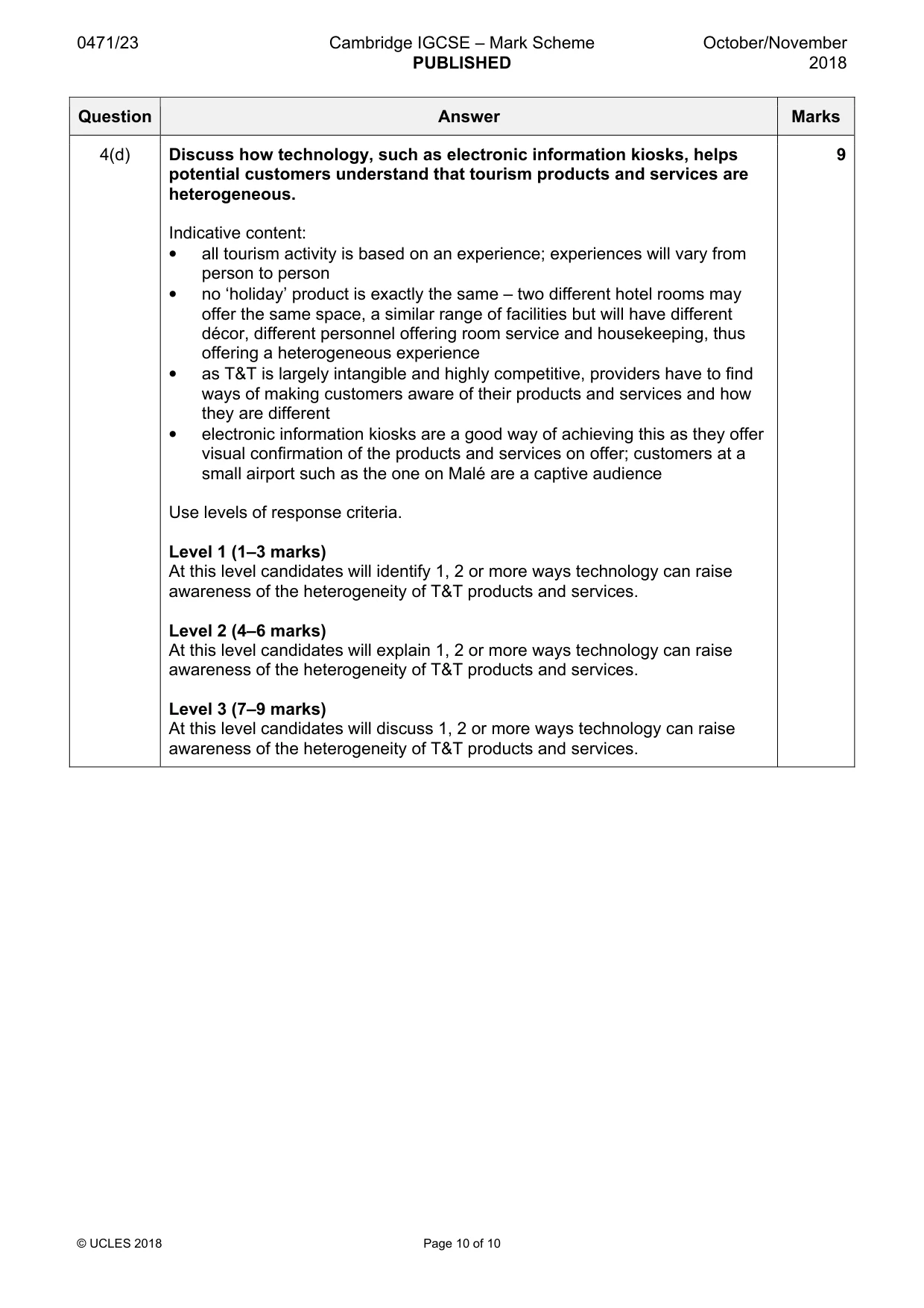
0471/23 Cambridge IGCSE – Mark Scheme PUBLISHED October/November 2018 © UCLES 2018 Page 10 of 10 Question Answer Marks 4(d) Discuss how technology, such as electronic information kiosks, helps potential customers understand that tourism products and services are heterogeneous. Indicative content: • all tourism activity is based on an experience; experiences will vary from person to person • no ‘holiday’ product is exactly the same – two different hotel rooms may offer the same space, a similar range of facilities but will have different décor, different personnel offering room service and housekeeping, thus offering a heterogeneous experience • as T&T is largely intangible and highly competitive, providers have to find ways of making customers aware of their products and services and how they are different • electronic information kiosks are a good way of achieving this as they offer visual confirmation of the products and services on offer; customers at a small airport such as the one on Malé are a captive audience Use levels of response criteria. Level 1 (1–3 marks) At this level candidates will identify 1, 2 or more ways technology can raise awareness of the heterogeneity of T&T products and services. Level 2 (4–6 marks) At this level candidates will explain 1, 2 or more ways technology can raise awareness of the heterogeneity of T&T products and services. Level 3 (7–9 marks) At this level candidates will discuss 1, 2 or more ways technology can raise awareness of the heterogeneity of T&T products and services. 9
What you needed in this session
Cambridge’s own grade thresholds for 2018 Oct/Nov, Paper 2 · Variant 3. A higher threshold means an easier paper — the bar moves with how the cohort did.