Cambridge IGCSE Travel and Tourism 0471 — 2018 Oct/Nov Paper 2 · Variant 1
0471/21/O/N/18 · 100 marks · ≈113 min
The question paper and its mark scheme, free to read here and free to download. This is Cambridge’s own paper, exactly as it was sat.
Question paper16 pages



Mark scheme10 pages
Answers below. Sit the paper first if you are practising.
Paper as text
Question paper, page 1
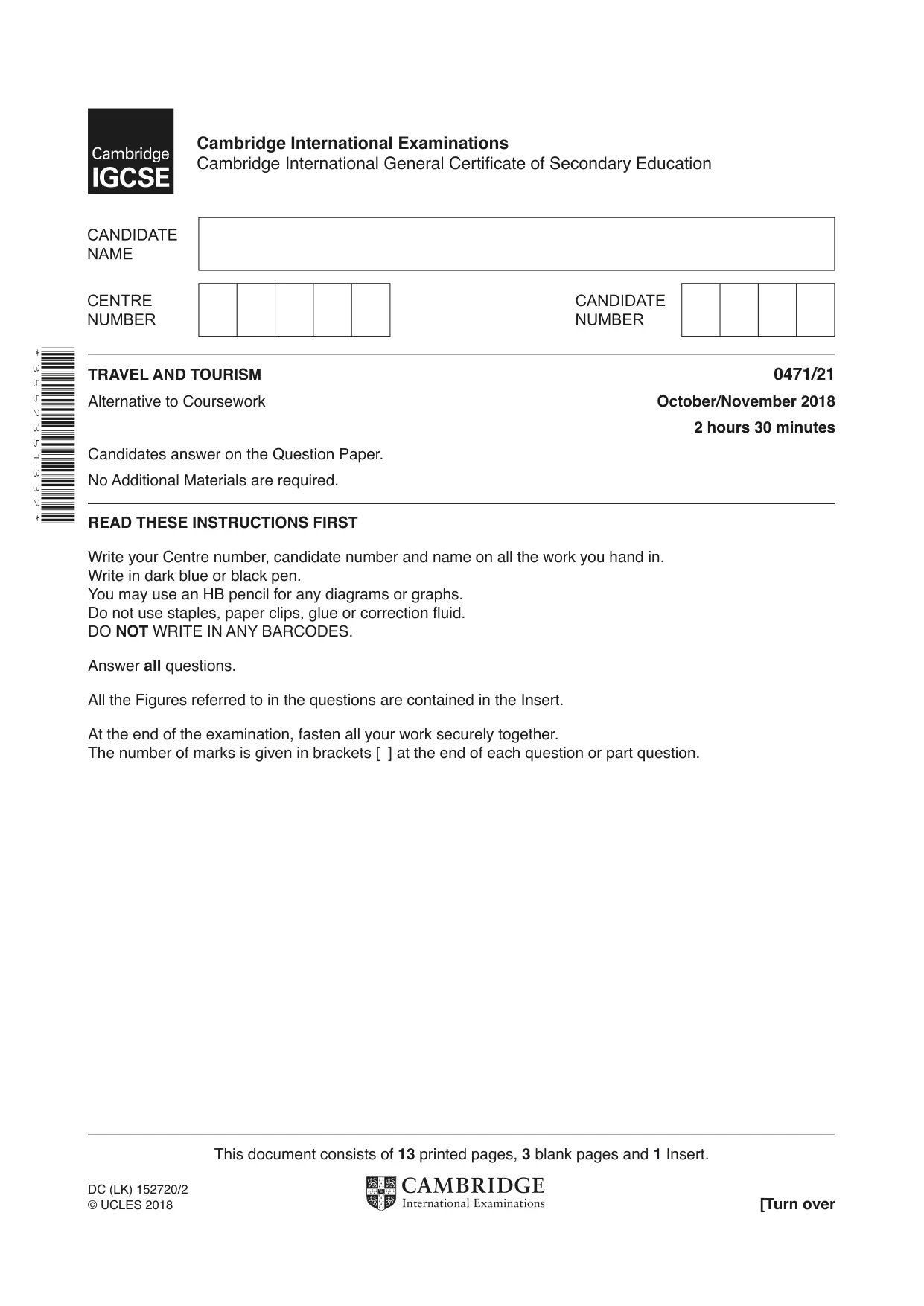
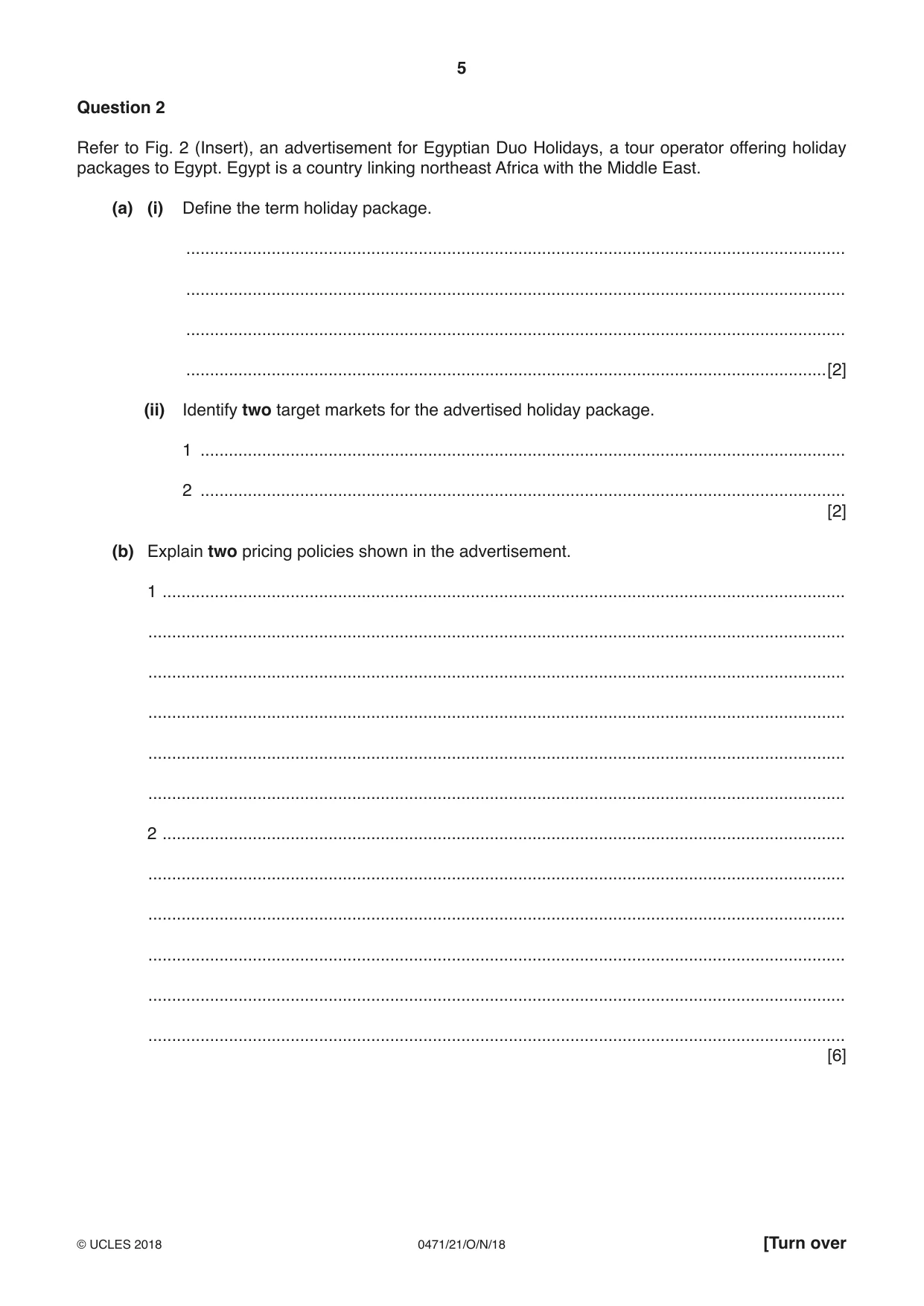
* 3 5 5 2 3 5 1 3 3 2 * This document consists of 13 printed pages, 3 blank pages and 1 Insert. DC (LK) 152720/2 © UCLES 2018 [Turn over TRAVEL AND TOURISM 0471/21 Alternative to Coursework October/November 2018 2 hours 30 minutes Candidates answer on the Question Paper. No Additional Materials are required. READ THESE INSTRUCTIONS FIRST Write your Centre number, candidate number and name on all the work you hand in. Write in dark blue or black pen. You may use an HB pencil for any diagrams or graphs. Do not use staples, paper clips, glue or correction fluid. DO NOT WRITE IN ANY BARCODES. Answer all questions. All the Figures referred to in the questions are contained in the Insert. At the end of the examination, fasten all your work securely together. The number of marks is given in brackets [ ] at the end of each question or part question. Cambridge International Examinations Cambridge International General Certificate of Secondary Education
Question paper, page 2
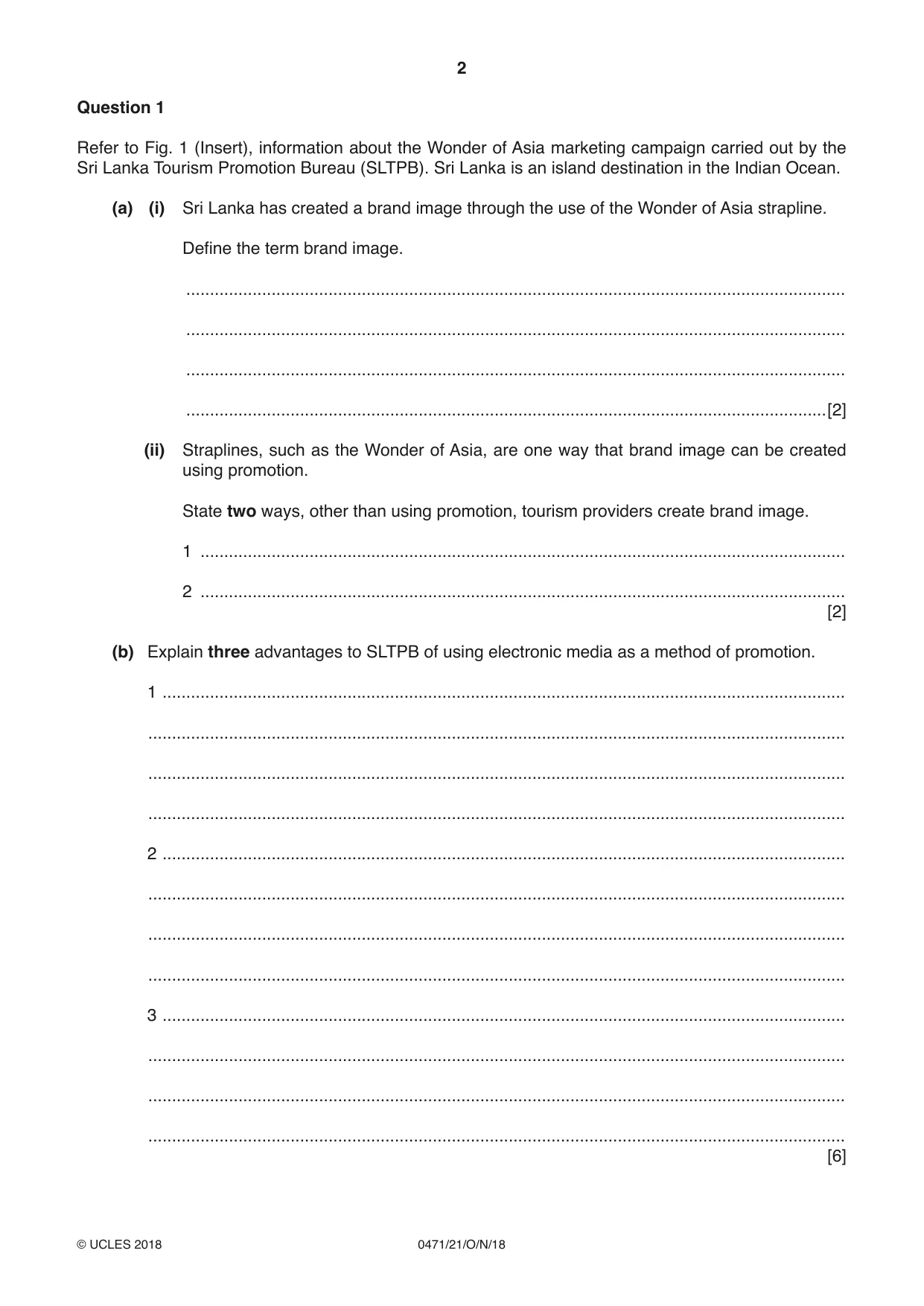
2 0471/21/O/N/18 © UCLES 2018 Question 1 Refer to Fig. 1 (Insert), information about the Wonder of Asia marketing campaign carried out by the Sri Lanka Tourism Promotion Bureau (SLTPB). Sri Lanka is an island destination in the Indian Ocean. (a) (i) Sri Lanka has created a brand image through the use of the Wonder of Asia strapline. Define the term brand image. … … … …[2] (ii) Straplines, such as the Wonder of Asia, are one way that brand image can be created using promotion. State two ways, other than using promotion, tourism providers create brand image. 1 … 2 … [2] (b) Explain three advantages to SLTPB of using electronic media as a method of promotion. 1 … … … … 2 … … … … 3 … … … … [6]
Question paper, page 3
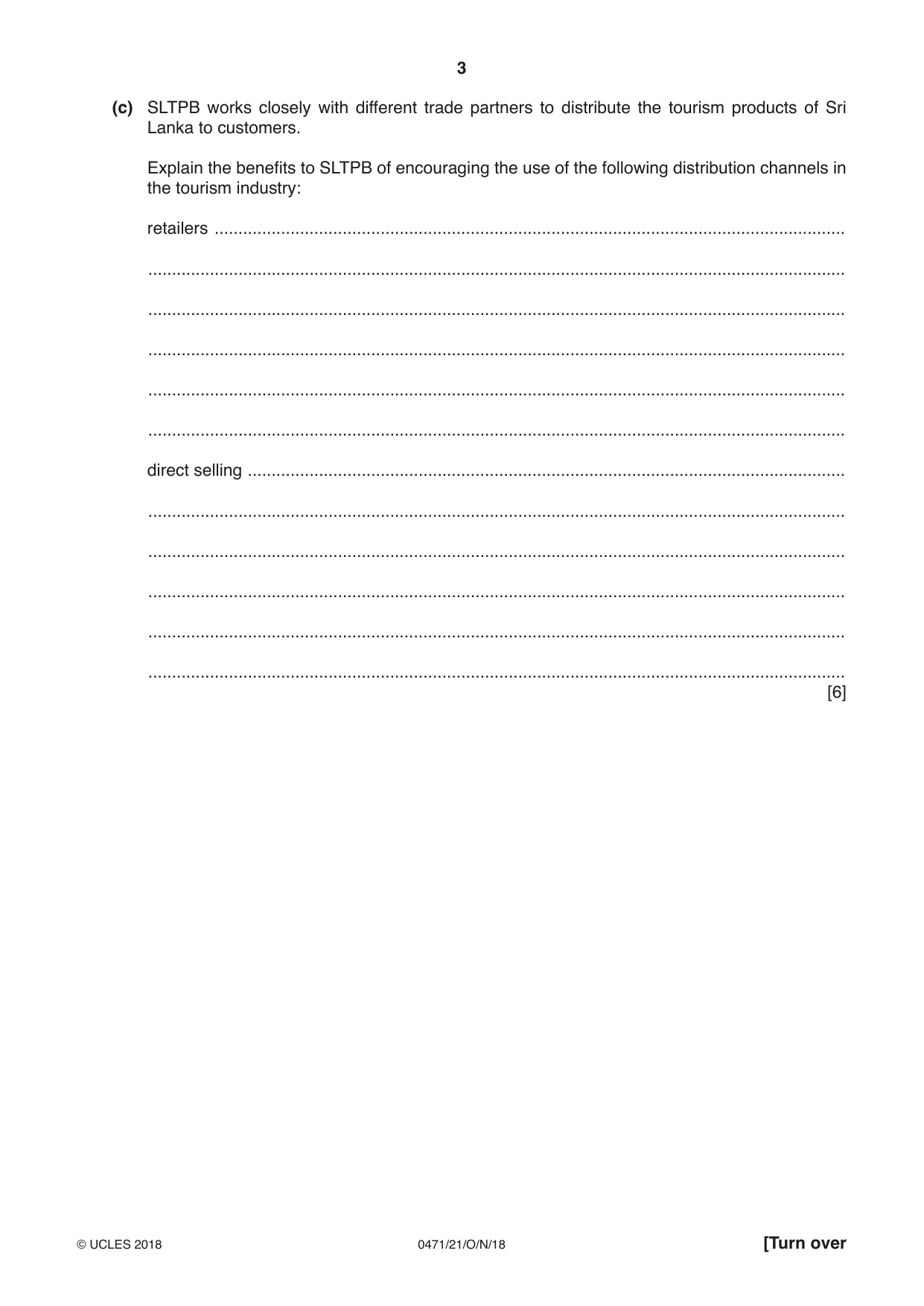
3 0471/21/O/N/18 © UCLES 2018 [Turn over (c) SLTPB works closely with different trade partners to distribute the tourism products of Sri Lanka to customers. Explain the benefits to SLTPB of encouraging the use of the following distribution channels in the tourism industry: retailers … … … … … … direct selling … … … … … … [6]
Question paper, page 4
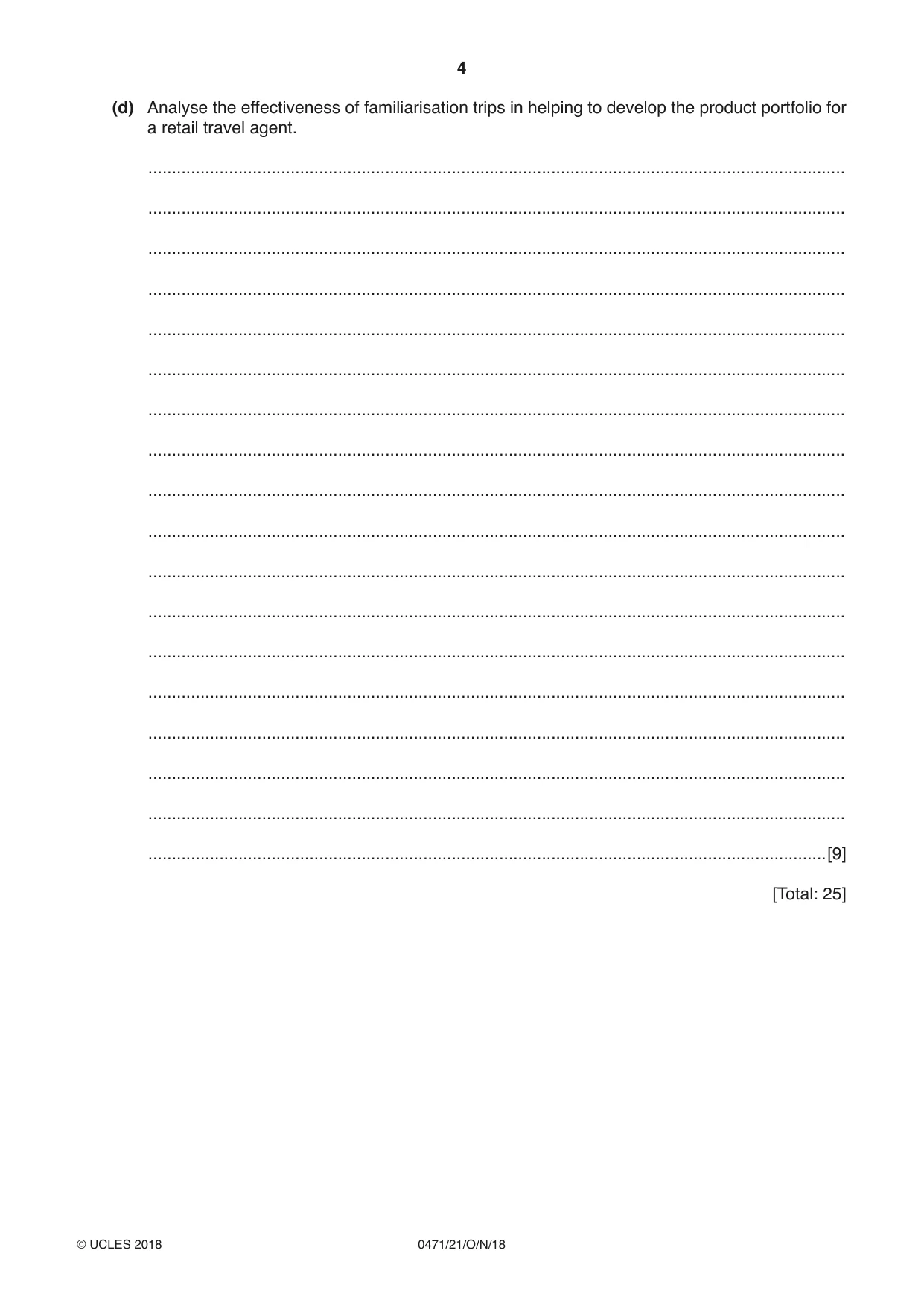
4 0471/21/O/N/18 © UCLES 2018 (d) Analyse the effectiveness of familiarisation trips in helping to develop the product portfolio for a retail travel agent. … … … … … … … … … … … … … … … … … …[9] [Total: 25]
Question paper, page 5
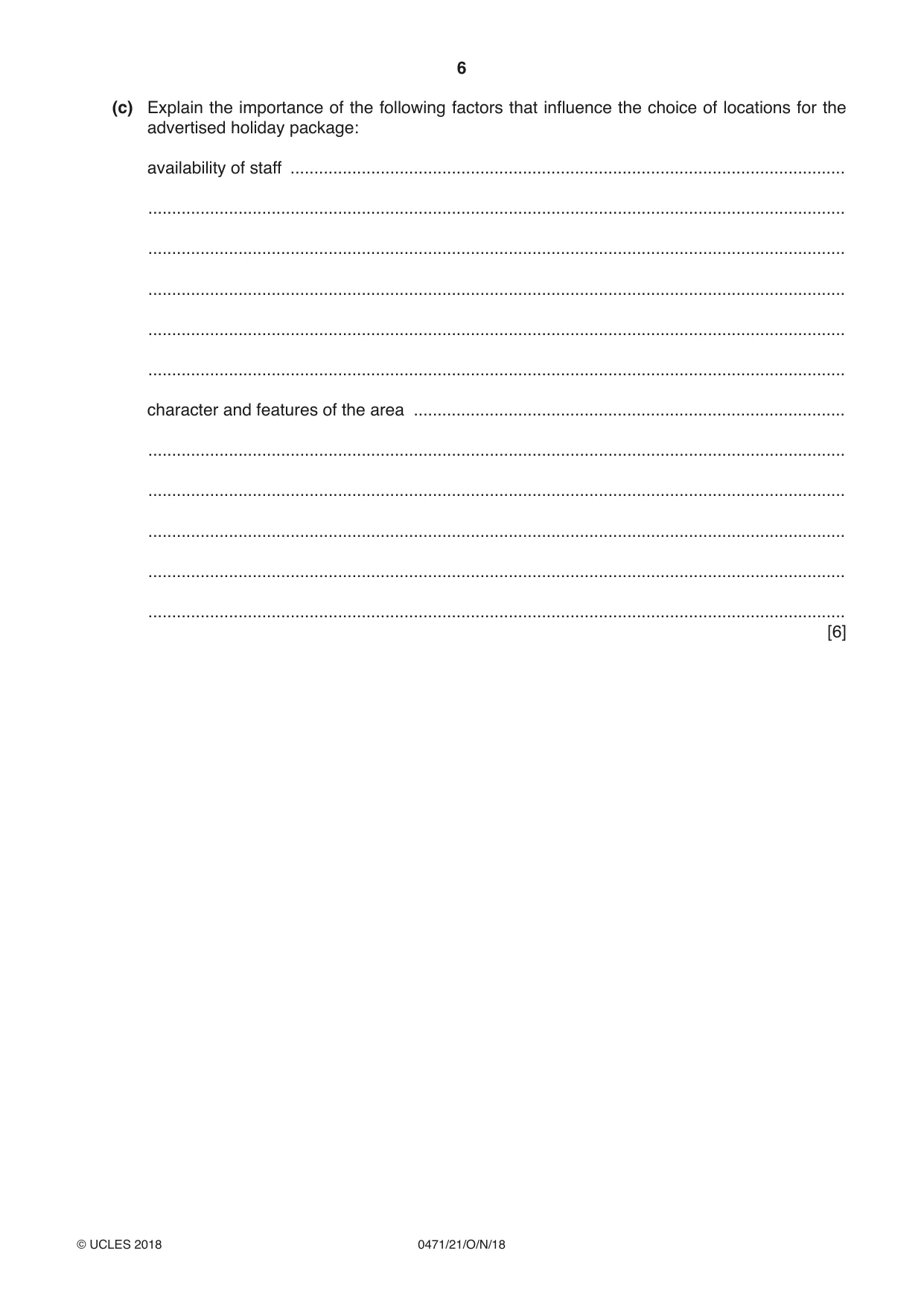
5 0471/21/O/N/18 © UCLES 2018 [Turn over Question 2 Refer to Fig. 2 (Insert), an advertisement for Egyptian Duo Holidays, a tour operator offering holiday packages to Egypt. Egypt is a country linking northeast Africa with the Middle East. (a) (i) Define the term holiday package. … … … …[2] (ii) Identify two target markets for the advertised holiday package. 1 … 2 … [2] (b) Explain two pricing policies shown in the advertisement. 1 … … … … … … 2 … … … … … … [6]
Question paper, page 6
6 0471/21/O/N/18 © UCLES 2018 (c) Explain the importance of the following factors that influence the choice of locations for the advertised holiday package: availability of staff … … … … … … character and features of the area … … … … … … [6]
Question paper, page 7
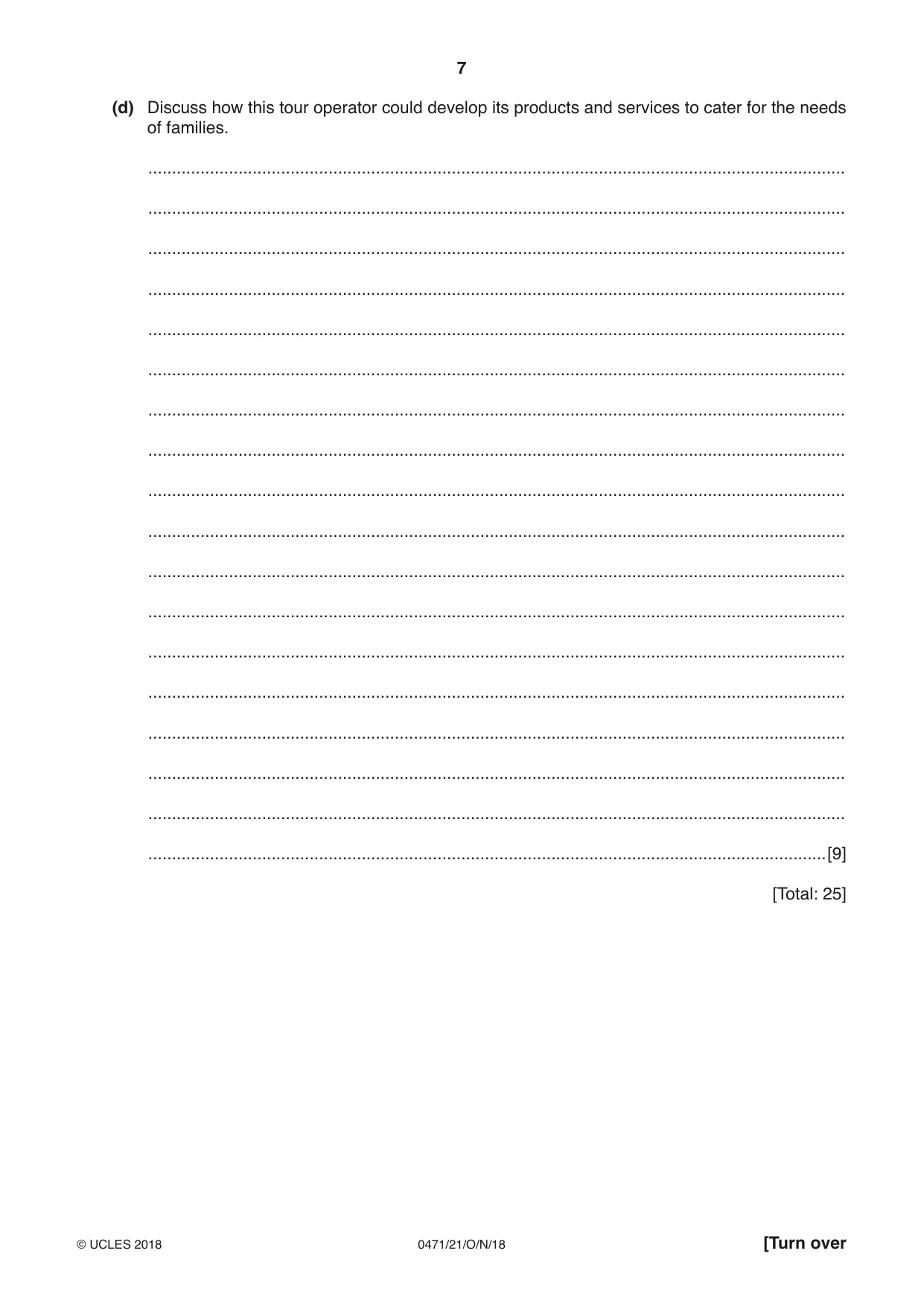
7 0471/21/O/N/18 © UCLES 2018 [Turn over (d) Discuss how this tour operator could develop its products and services to cater for the needs of families. … … … … … … … … … … … … … … … … … …[9] [Total: 25]
Question paper, page 8
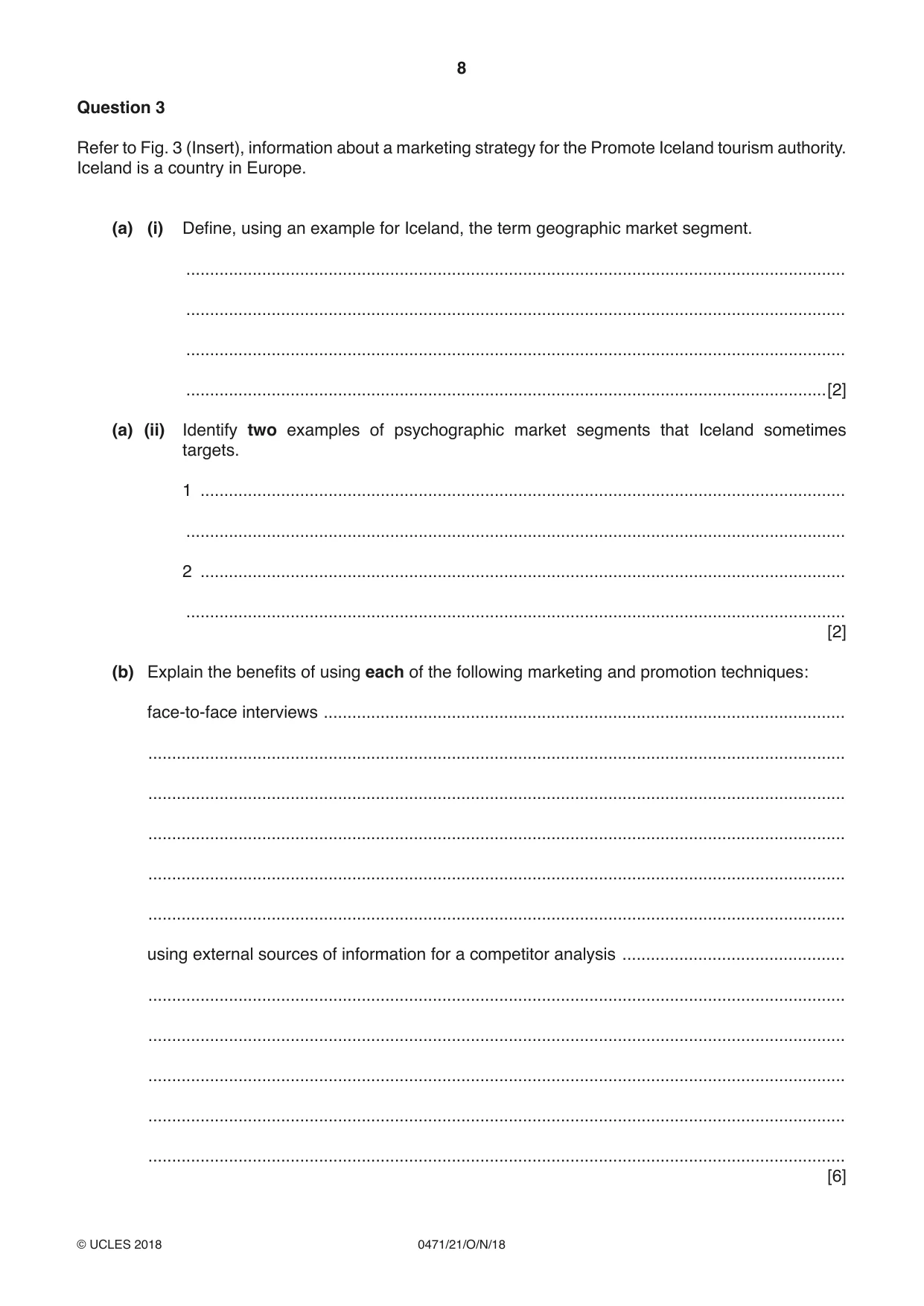
8 0471/21/O/N/18 © UCLES 2018 Question 3 Refer to Fig. 3 (Insert), information about a marketing strategy for the Promote Iceland tourism authority. Iceland is a country in Europe. (a) (i) Define, using an example for Iceland, the term geographic market segment. … … … …[2] (a) (ii) Identify two examples of psychographic market segments that Iceland sometimes targets. 1 … … 2 … … [2] (b) Explain the benefits of using each of the following marketing and promotion techniques: face-to-face interviews … … … … … … using external sources of information for a competitor analysis … … … … … … [6]
Question paper, page 9
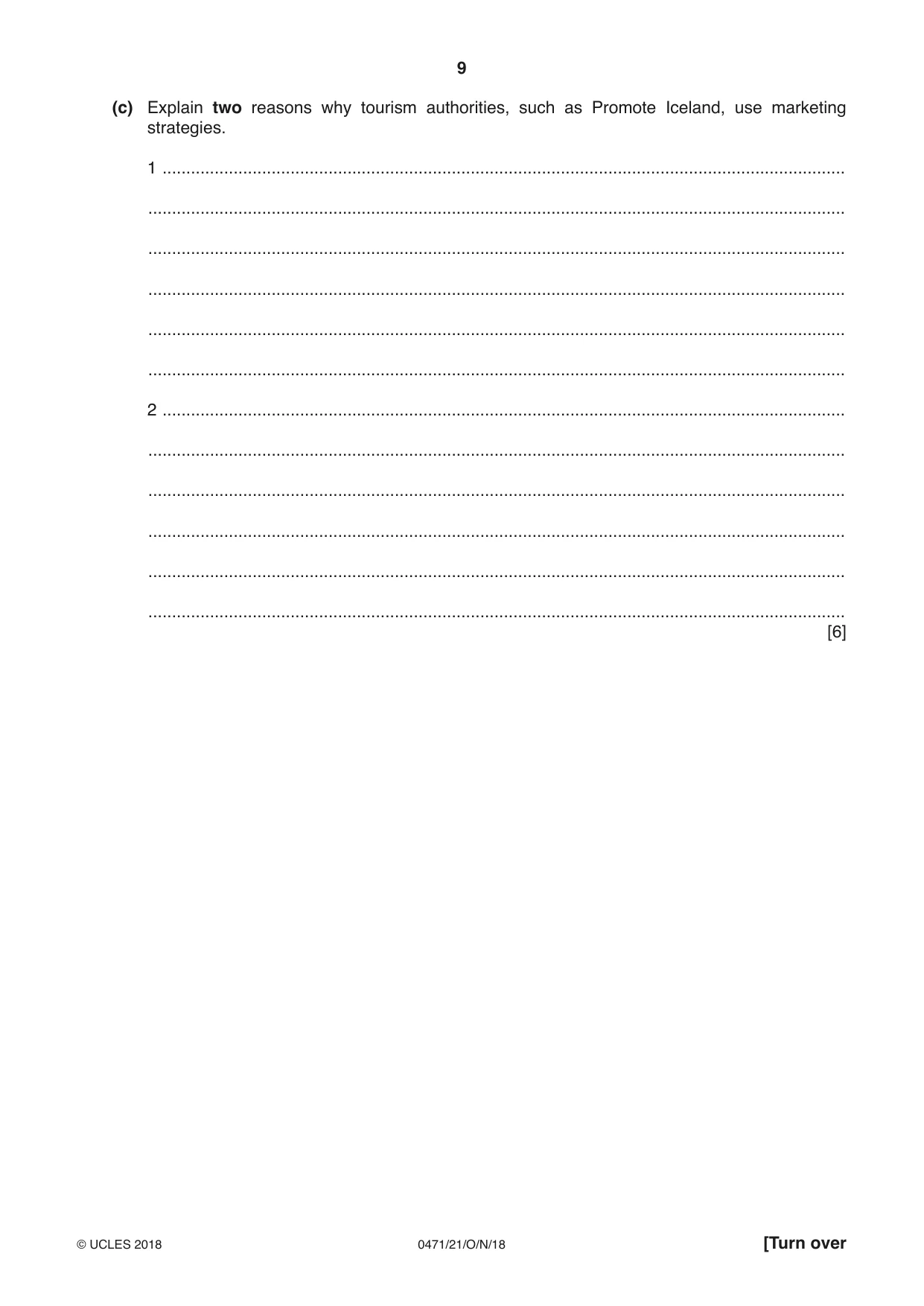
9 0471/21/O/N/18 © UCLES 2018 [Turn over (c) Explain two reasons why tourism authorities, such as Promote Iceland, use marketing strategies. 1 … … … … … … 2 … … … … … … [6]
Question paper, page 10
10 0471/21/O/N/18 © UCLES 2018 (d) Discuss how travel and tourism providers in Iceland might overcome the issue of seasonality. … … … … … … … … … … … … … … … … … …[9] [Total: 25]
Question paper, page 11
11 0471/21/O/N/18 © UCLES 2018 [Turn over Question 4 Refer to Fig. 4 (Insert), information about Sporting Moments, a tour operator which specialises in sports tourism, especially corporate hospitality packages for major sporting events. Corporate hospitality is also a form of business tourism. (a) (i) Explain, using an example, what is meant by the term specialised tour operator. … … … …[2] (a) (ii) Other than sports tourism, state two types of tourism packages often offered by specialised tour operators. 1 … … 2 … … [2] (b) Explain three reasons why business customers may choose a tailor-made package. 1 … … … … 2 … … … … 3 … … … … [6]
Question paper, page 12
12 0471/21/O/N/18 © UCLES 2018 (c) Explain how the following factors might determine the price that Sporting Moments charges customers to attend a major sporting event: customers’ expectations … … … … … … profitability … … … … … … [6]
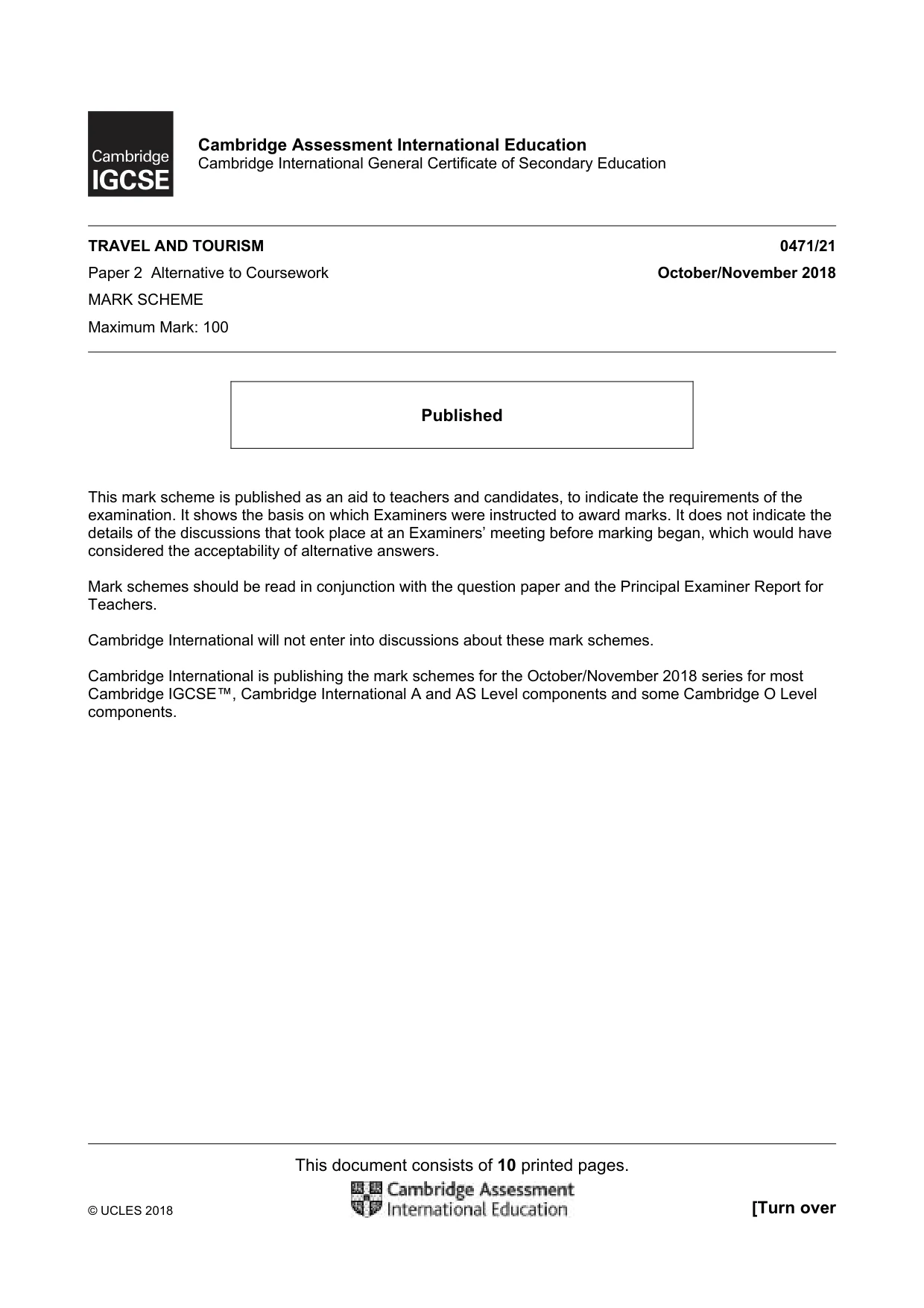
Question paper, page 13
13 0471/21/O/N/18 © UCLES 2018 (d) Discuss the importance of each component of the marketing mix for a tour operator, such as Sporting Moments. … … … … … … … … … … … … … … … … … …[9] [Total: 25]
Question paper, page 14
14 0471/21/O/N/18 © UCLES 2018 BLANK PAGE
Question paper, page 15
15 0471/21/O/N/18 © UCLES 2018 BLANK PAGE
Question paper, page 16
16 0471/21/O/N/18 © UCLES 2018 Permission to reproduce items where third-party owned material protected by copyright is included has been sought and cleared where possible. Every reasonable effort has been made by the publisher (UCLES) to trace copyright holders, but if any items requiring clearance have unwittingly been included, the publisher will be pleased to make amends at the earliest possible opportunity. To avoid the issue of disclosure of answer-related information to candidates, all copyright acknowledgements are reproduced online in the Cambridge International Examinations Copyright Acknowledgements Booklet. This is produced for each series of examinations and is freely available to download at www.cie.org.uk after the live examination series. Cambridge International Examinations is part of the Cambridge Assessment Group. Cambridge Assessment is the brand name of University of Cambridge Local Examinations Syndicate (UCLES), which is itself a department of the University of Cambridge. BLANK PAGE
Mark scheme, page 1
This document consists of 10 printed pages. © UCLES 2018 [Turn over Cambridge Assessment International Education Cambridge International General Certificate of Secondary Education TRAVEL AND TOURISM 0471/21 Paper 2 Alternative to Coursework October/November 2018 MARK SCHEME Maximum Mark: 100 Published This mark scheme is published as an aid to teachers and candidates, to indicate the requirements of the examination. It shows the basis on which Examiners were instructed to award marks. It does not indicate the details of the discussions that took place at an Examiners’ meeting before marking began, which would have considered the acceptability of alternative answers. Mark schemes should be read in conjunction with the question paper and the Principal Examiner Report for Teachers. Cambridge International will not enter into discussions about these mark schemes. Cambridge International is publishing the mark schemes for the October/November 2018 series for most Cambridge IGCSE™, Cambridge International A and AS Level components and some Cambridge O Level components.
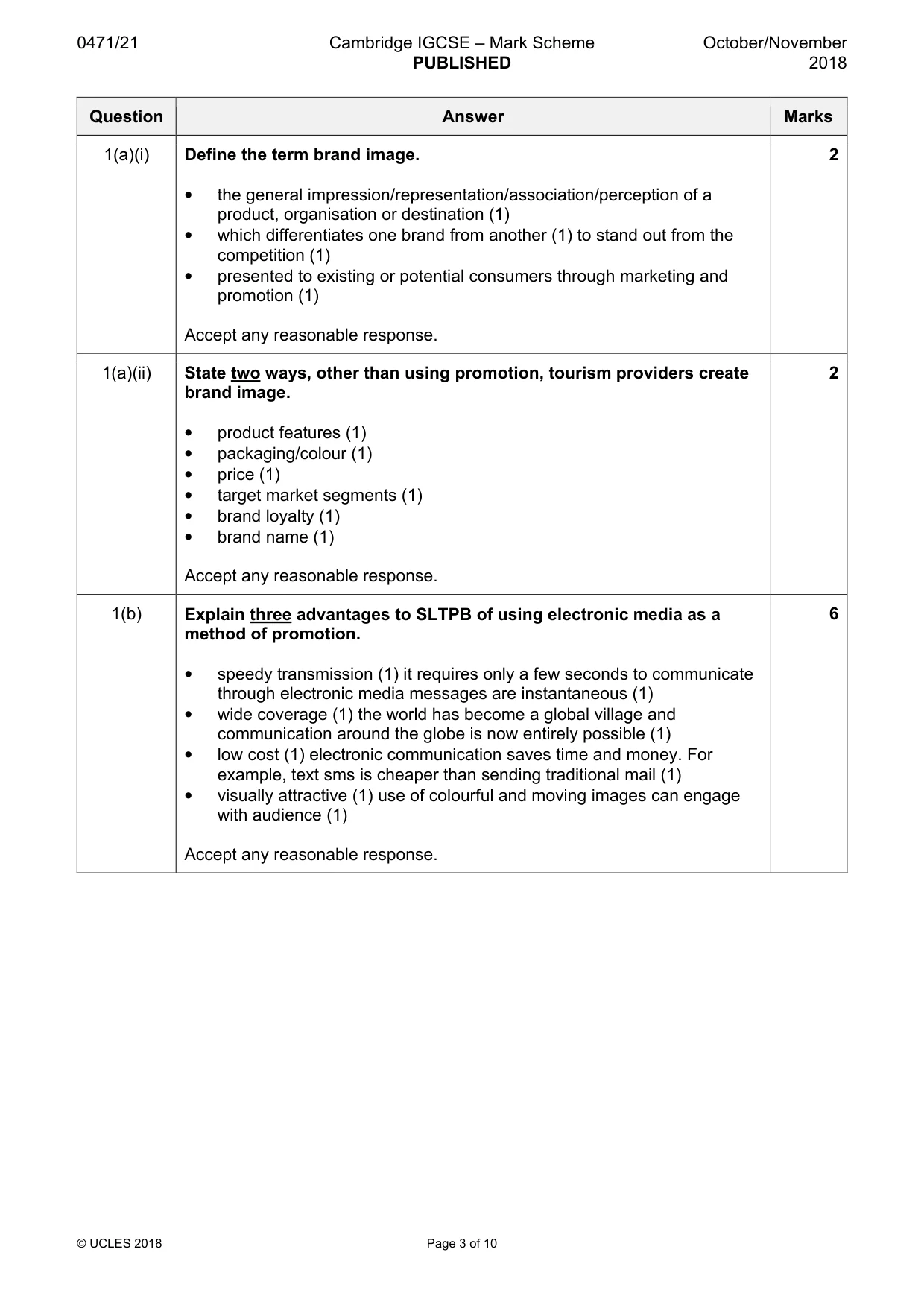
Mark scheme, page 2
0471/21 Cambridge IGCSE – Mark Scheme PUBLISHED October/November 2018 © UCLES 2018 Page 2 of 10 Generic Marking Principles These general marking principles must be applied by all examiners when marking candidate answers. They should be applied alongside the specific content of the mark scheme or generic level descriptors for a question. Each question paper and mark scheme will also comply with these marking principles. GENERIC MARKING PRINCIPLE 1: Marks must be awarded in line with: • the specific content of the mark scheme or the generic level descriptors for the question • the specific skills defined in the mark scheme or in the generic level descriptors for the question • the standard of response required by a candidate as exemplified by the standardisation scripts. GENERIC MARKING PRINCIPLE 2: Marks awarded are always whole marks (not half marks, or other fractions). GENERIC MARKING PRINCIPLE 3: Marks must be awarded positively: • marks are awarded for correct/valid answers, as defined in the mark scheme. However, credit is given for valid answers which go beyond the scope of the syllabus and mark scheme, referring to your Team Leader as appropriate • marks are awarded when candidates clearly demonstrate what they know and can do • marks are not deducted for errors • marks are not deducted for omissions • answers should only be judged on the quality of spelling, punctuation and grammar when these features are specifically assessed by the question as indicated by the mark scheme. The meaning, however, should be unambiguous. GENERIC MARKING PRINCIPLE 4: Rules must be applied consistently e.g. in situations where candidates have not followed instructions or in the application of generic level descriptors. GENERIC MARKING PRINCIPLE 5: Marks should be awarded using the full range of marks defined in the mark scheme for the question (however; the use of the full mark range may be limited according to the quality of the candidate responses seen). GENERIC MARKING PRINCIPLE 6: Marks awarded are based solely on the requirements as defined in the mark scheme. Marks should not be awarded with grade thresholds or grade descriptors in mind.
Mark scheme, page 3
0471/21 Cambridge IGCSE – Mark Scheme PUBLISHED October/November 2018 © UCLES 2018 Page 3 of 10 Question Answer Marks 1(a)(i) Define the term brand image. • the general impression/representation/association/perception of a product, organisation or destination (1) • which differentiates one brand from another (1) to stand out from the competition (1) • presented to existing or potential consumers through marketing and promotion (1) Accept any reasonable response. 2 1(a)(ii) State two ways, other than using promotion, tourism providers create brand image. • product features (1) • packaging/colour (1) • price (1) • target market segments (1) • brand loyalty (1) • brand name (1) Accept any reasonable response. 2 1(b) Explain three advantages to SLTPB of using electronic media as a method of promotion. • speedy transmission (1) it requires only a few seconds to communicate through electronic media messages are instantaneous (1) • wide coverage (1) the world has become a global village and communication around the globe is now entirely possible (1) • low cost (1) electronic communication saves time and money. For example, text sms is cheaper than sending traditional mail (1) • visually attractive (1) use of colourful and moving images can engage with audience (1) Accept any reasonable response. 6
Mark scheme, page 4
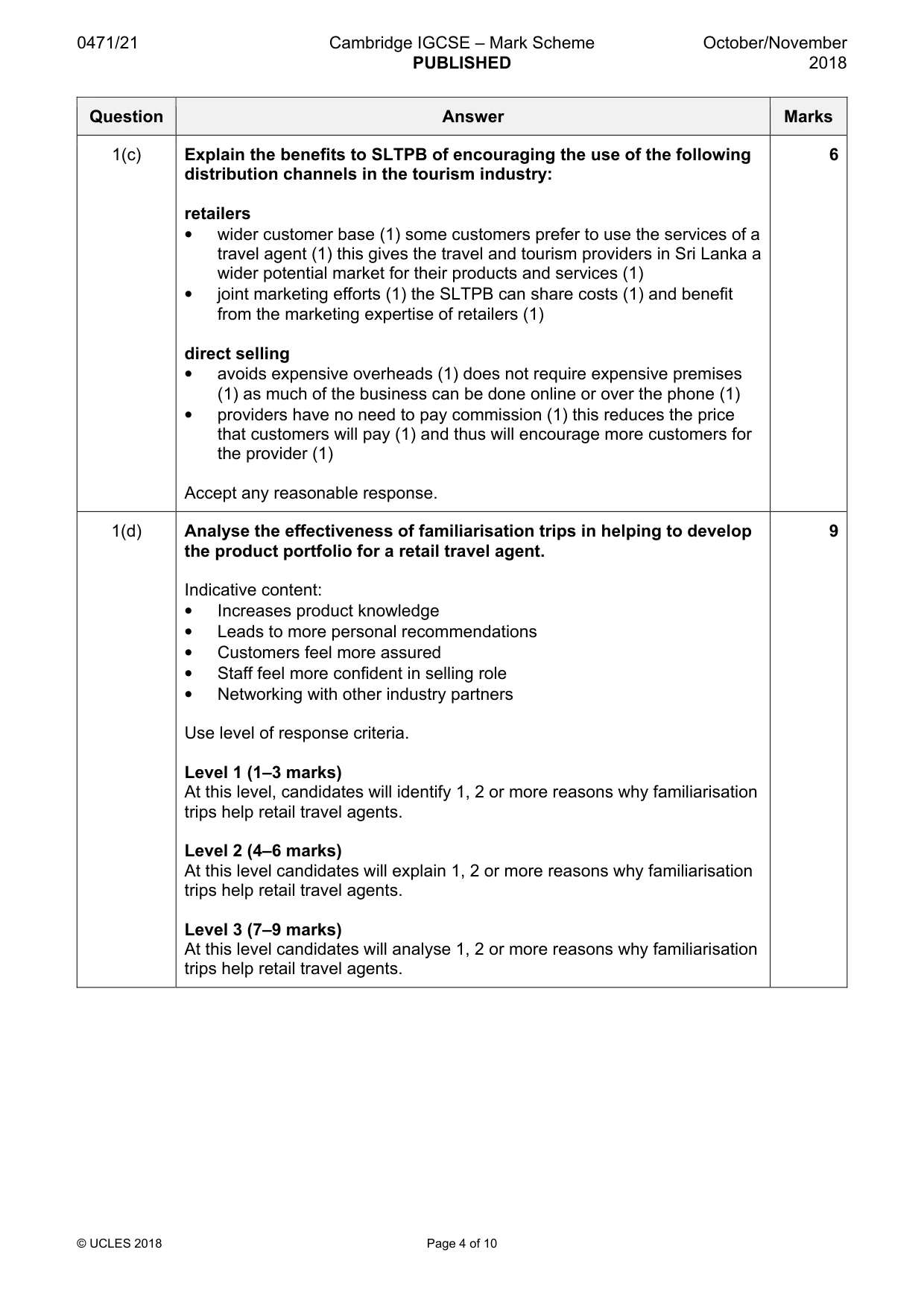
0471/21 Cambridge IGCSE – Mark Scheme PUBLISHED October/November 2018 © UCLES 2018 Page 4 of 10 Question Answer Marks 1(c) Explain the benefits to SLTPB of encouraging the use of the following distribution channels in the tourism industry: retailers • wider customer base (1) some customers prefer to use the services of a travel agent (1) this gives the travel and tourism providers in Sri Lanka a wider potential market for their products and services (1) • joint marketing efforts (1) the SLTPB can share costs (1) and benefit from the marketing expertise of retailers (1) direct selling • avoids expensive overheads (1) does not require expensive premises (1) as much of the business can be done online or over the phone (1) • providers have no need to pay commission (1) this reduces the price that customers will pay (1) and thus will encourage more customers for the provider (1) Accept any reasonable response. 6 1(d) Analyse the effectiveness of familiarisation trips in helping to develop the product portfolio for a retail travel agent. Indicative content: • Increases product knowledge • Leads to more personal recommendations • Customers feel more assured • Staff feel more confident in selling role • Networking with other industry partners Use level of response criteria. Level 1 (1–3 marks) At this level, candidates will identify 1, 2 or more reasons why familiarisation trips help retail travel agents. Level 2 (4–6 marks) At this level candidates will explain 1, 2 or more reasons why familiarisation trips help retail travel agents. Level 3 (7–9 marks) At this level candidates will analyse 1, 2 or more reasons why familiarisation trips help retail travel agents. 9
Mark scheme, page 5
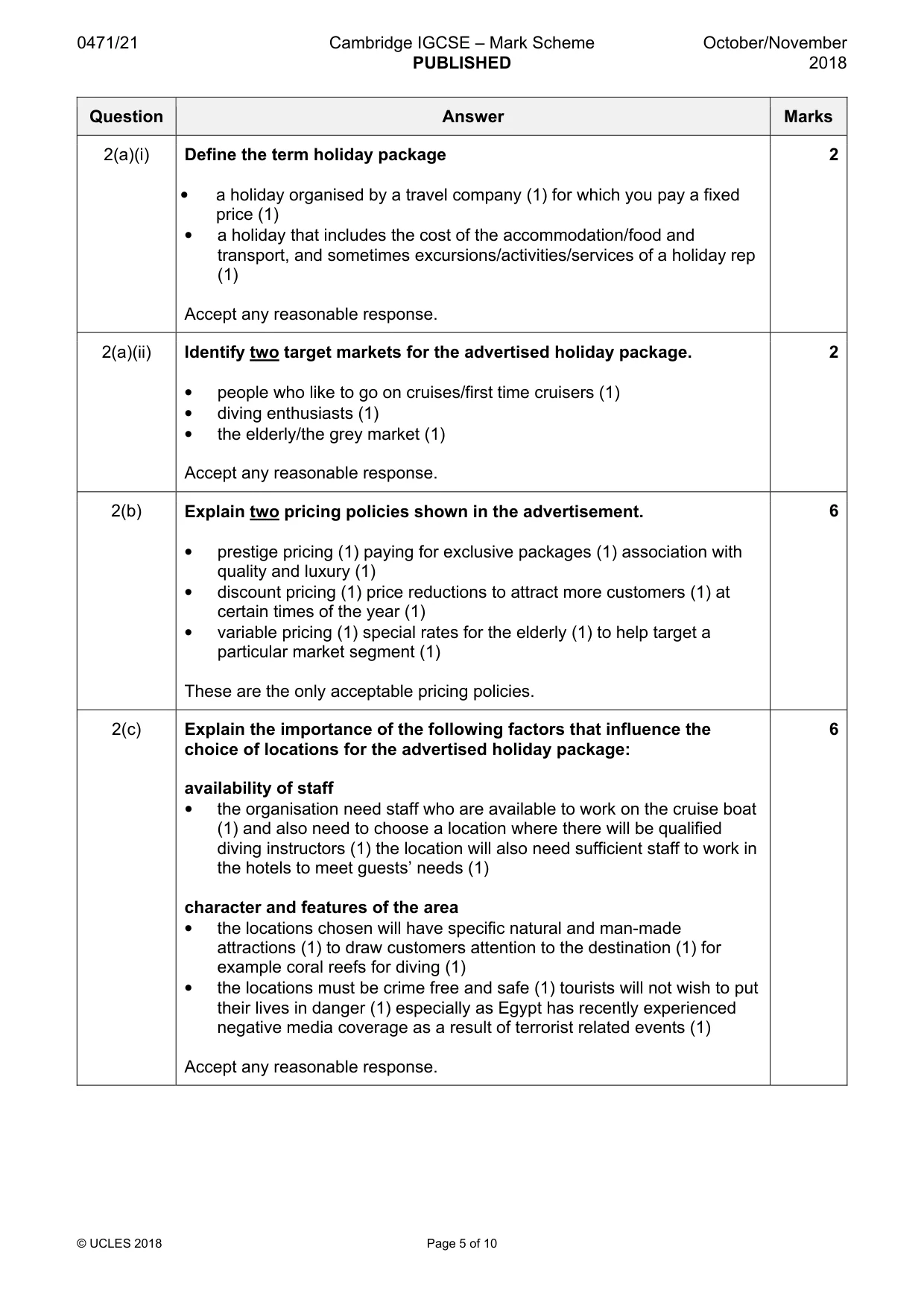
0471/21 Cambridge IGCSE – Mark Scheme PUBLISHED October/November 2018 © UCLES 2018 Page 5 of 10 Question Answer Marks 2(a)(i) Define the term holiday package • a holiday organised by a travel company (1) for which you pay a fixed price (1) • a holiday that includes the cost of the accommodation/food and transport, and sometimes excursions/activities/services of a holiday rep (1) Accept any reasonable response. 2 2(a)(ii) Identify two target markets for the advertised holiday package. • people who like to go on cruises/first time cruisers (1) • diving enthusiasts (1) • the elderly/the grey market (1) Accept any reasonable response. 2 2(b) Explain two pricing policies shown in the advertisement. • prestige pricing (1) paying for exclusive packages (1) association with quality and luxury (1) • discount pricing (1) price reductions to attract more customers (1) at certain times of the year (1) • variable pricing (1) special rates for the elderly (1) to help target a particular market segment (1) These are the only acceptable pricing policies. 6 2(c) Explain the importance of the following factors that influence the choice of locations for the advertised holiday package: availability of staff • the organisation need staff who are available to work on the cruise boat (1) and also need to choose a location where there will be qualified diving instructors (1) the location will also need sufficient staff to work in the hotels to meet guests’ needs (1) character and features of the area • the locations chosen will have specific natural and man-made attractions (1) to draw customers attention to the destination (1) for example coral reefs for diving (1) • the locations must be crime free and safe (1) tourists will not wish to put their lives in danger (1) especially as Egypt has recently experienced negative media coverage as a result of terrorist related events (1) Accept any reasonable response. 6
Mark scheme, page 6
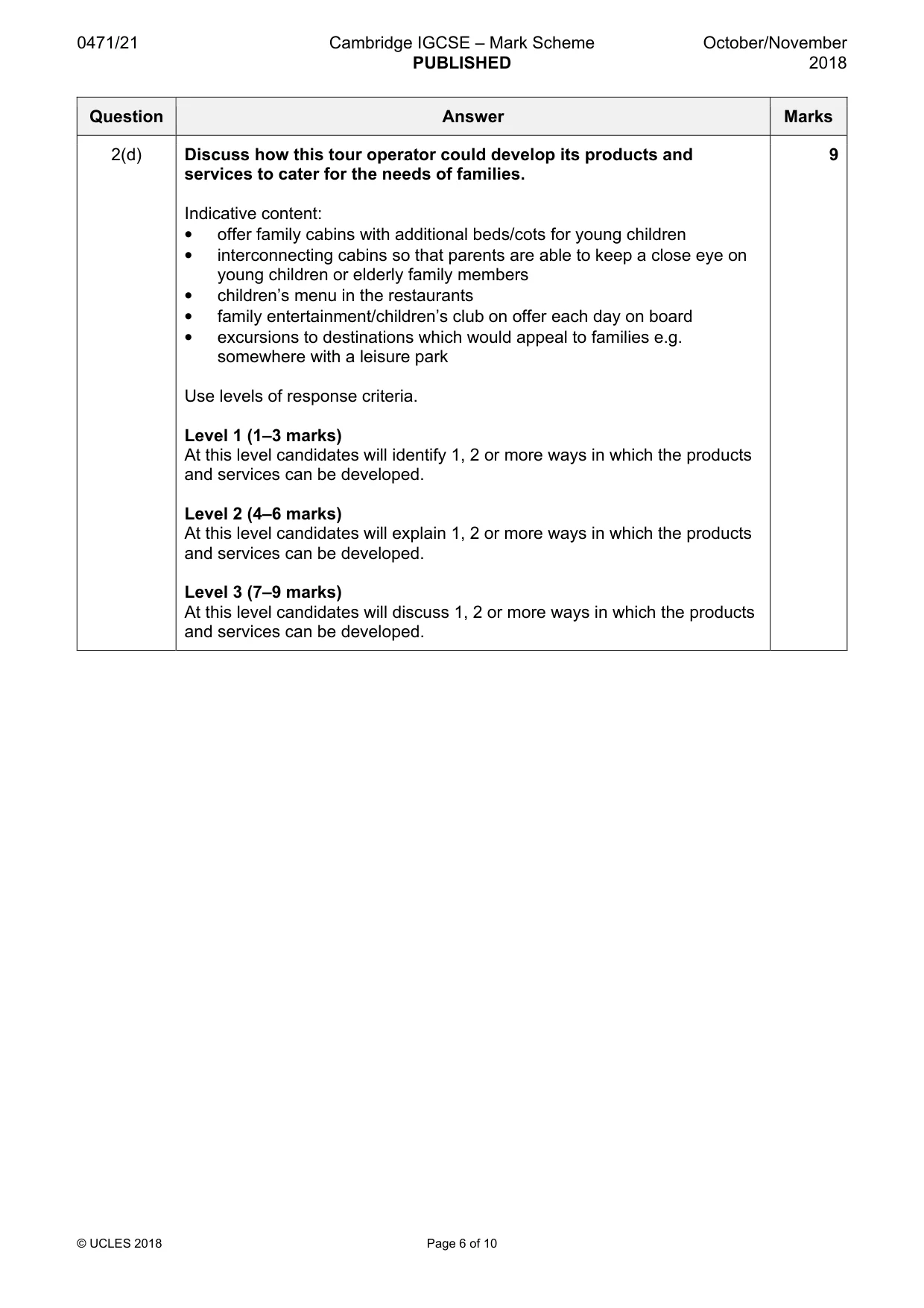
0471/21 Cambridge IGCSE – Mark Scheme PUBLISHED October/November 2018 © UCLES 2018 Page 6 of 10 Question Answer Marks 2(d) Discuss how this tour operator could develop its products and services to cater for the needs of families. Indicative content: • offer family cabins with additional beds/cots for young children • interconnecting cabins so that parents are able to keep a close eye on young children or elderly family members • children’s menu in the restaurants • family entertainment/children’s club on offer each day on board • excursions to destinations which would appeal to families e.g. somewhere with a leisure park Use levels of response criteria. Level 1 (1–3 marks) At this level candidates will identify 1, 2 or more ways in which the products and services can be developed. Level 2 (4–6 marks) At this level candidates will explain 1, 2 or more ways in which the products and services can be developed. Level 3 (7–9 marks) At this level candidates will discuss 1, 2 or more ways in which the products and services can be developed. 9
Mark scheme, page 7
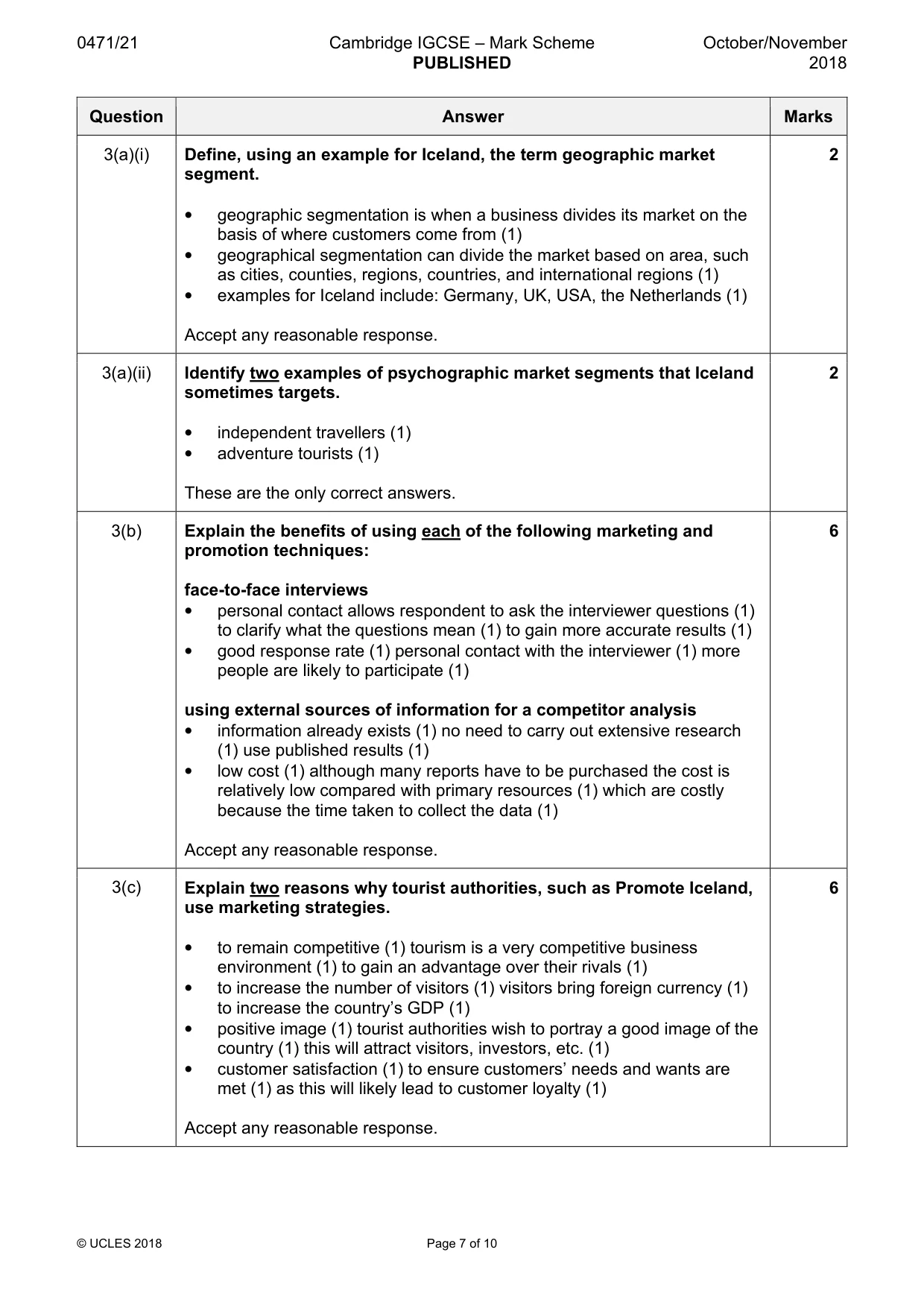
0471/21 Cambridge IGCSE – Mark Scheme PUBLISHED October/November 2018 © UCLES 2018 Page 7 of 10 Question Answer Marks 3(a)(i) Define, using an example for Iceland, the term geographic market segment. • geographic segmentation is when a business divides its market on the basis of where customers come from (1) • geographical segmentation can divide the market based on area, such as cities, counties, regions, countries, and international regions (1) • examples for Iceland include: Germany, UK, USA, the Netherlands (1) Accept any reasonable response. 2 3(a)(ii) Identify two examples of psychographic market segments that Iceland sometimes targets. • independent travellers (1) • adventure tourists (1) These are the only correct answers. 2 3(b) Explain the benefits of using each of the following marketing and promotion techniques: face-to-face interviews • personal contact allows respondent to ask the interviewer questions (1) to clarify what the questions mean (1) to gain more accurate results (1) • good response rate (1) personal contact with the interviewer (1) more people are likely to participate (1) using external sources of information for a competitor analysis • information already exists (1) no need to carry out extensive research (1) use published results (1) • low cost (1) although many reports have to be purchased the cost is relatively low compared with primary resources (1) which are costly because the time taken to collect the data (1) Accept any reasonable response. 6 3(c) Explain two reasons why tourist authorities, such as Promote Iceland, use marketing strategies. • to remain competitive (1) tourism is a very competitive business environment (1) to gain an advantage over their rivals (1) • to increase the number of visitors (1) visitors bring foreign currency (1) to increase the country’s GDP (1) • positive image (1) tourist authorities wish to portray a good image of the country (1) this will attract visitors, investors, etc. (1) • customer satisfaction (1) to ensure customers’ needs and wants are met (1) as this will likely lead to customer loyalty (1) Accept any reasonable response. 6
Mark scheme, page 8
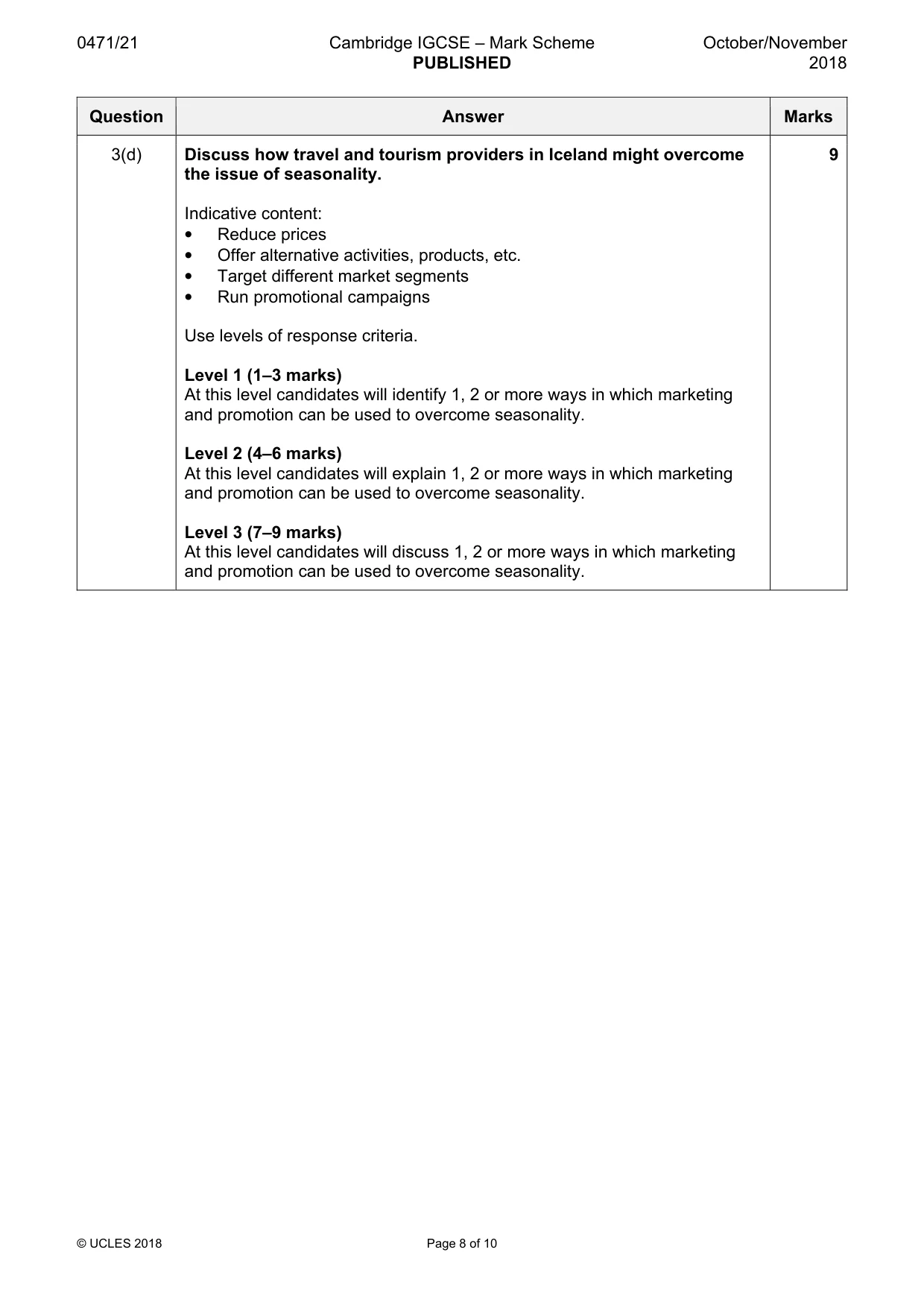
0471/21 Cambridge IGCSE – Mark Scheme PUBLISHED October/November 2018 © UCLES 2018 Page 8 of 10 Question Answer Marks 3(d) Discuss how travel and tourism providers in Iceland might overcome the issue of seasonality. Indicative content: • Reduce prices • Offer alternative activities, products, etc. • Target different market segments • Run promotional campaigns Use levels of response criteria. Level 1 (1–3 marks) At this level candidates will identify 1, 2 or more ways in which marketing and promotion can be used to overcome seasonality. Level 2 (4–6 marks) At this level candidates will explain 1, 2 or more ways in which marketing and promotion can be used to overcome seasonality. Level 3 (7–9 marks) At this level candidates will discuss 1, 2 or more ways in which marketing and promotion can be used to overcome seasonality. 9
Mark scheme, page 9
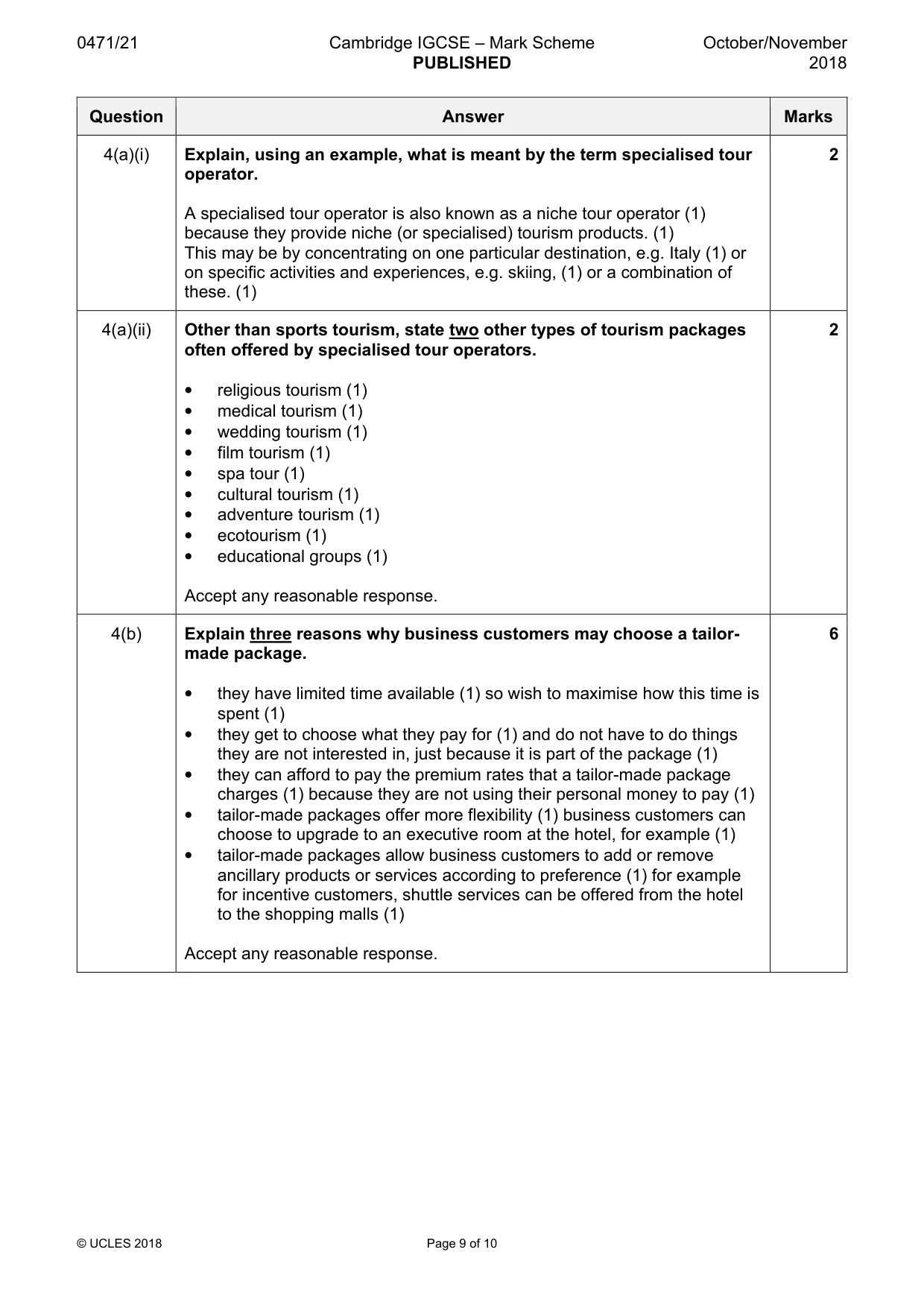
0471/21 Cambridge IGCSE – Mark Scheme PUBLISHED October/November 2018 © UCLES 2018 Page 9 of 10 Question Answer Marks 4(a)(i) Explain, using an example, what is meant by the term specialised tour operator. A specialised tour operator is also known as a niche tour operator (1) because they provide niche (or specialised) tourism products. (1) This may be by concentrating on one particular destination, e.g. Italy (1) or on specific activities and experiences, e.g. skiing, (1) or a combination of these. (1) 2 4(a)(ii) Other than sports tourism, state two other types of tourism packages often offered by specialised tour operators. • religious tourism (1) • medical tourism (1) • wedding tourism (1) • film tourism (1) • spa tour (1) • cultural tourism (1) • adventure tourism (1) • ecotourism (1) • educational groups (1) Accept any reasonable response. 2 4(b) Explain three reasons why business customers may choose a tailor- made package. • they have limited time available (1) so wish to maximise how this time is spent (1) • they get to choose what they pay for (1) and do not have to do things they are not interested in, just because it is part of the package (1) • they can afford to pay the premium rates that a tailor-made package charges (1) because they are not using their personal money to pay (1) • tailor-made packages offer more flexibility (1) business customers can choose to upgrade to an executive room at the hotel, for example (1) • tailor-made packages allow business customers to add or remove ancillary products or services according to preference (1) for example for incentive customers, shuttle services can be offered from the hotel to the shopping malls (1) Accept any reasonable response. 6
Mark scheme, page 10
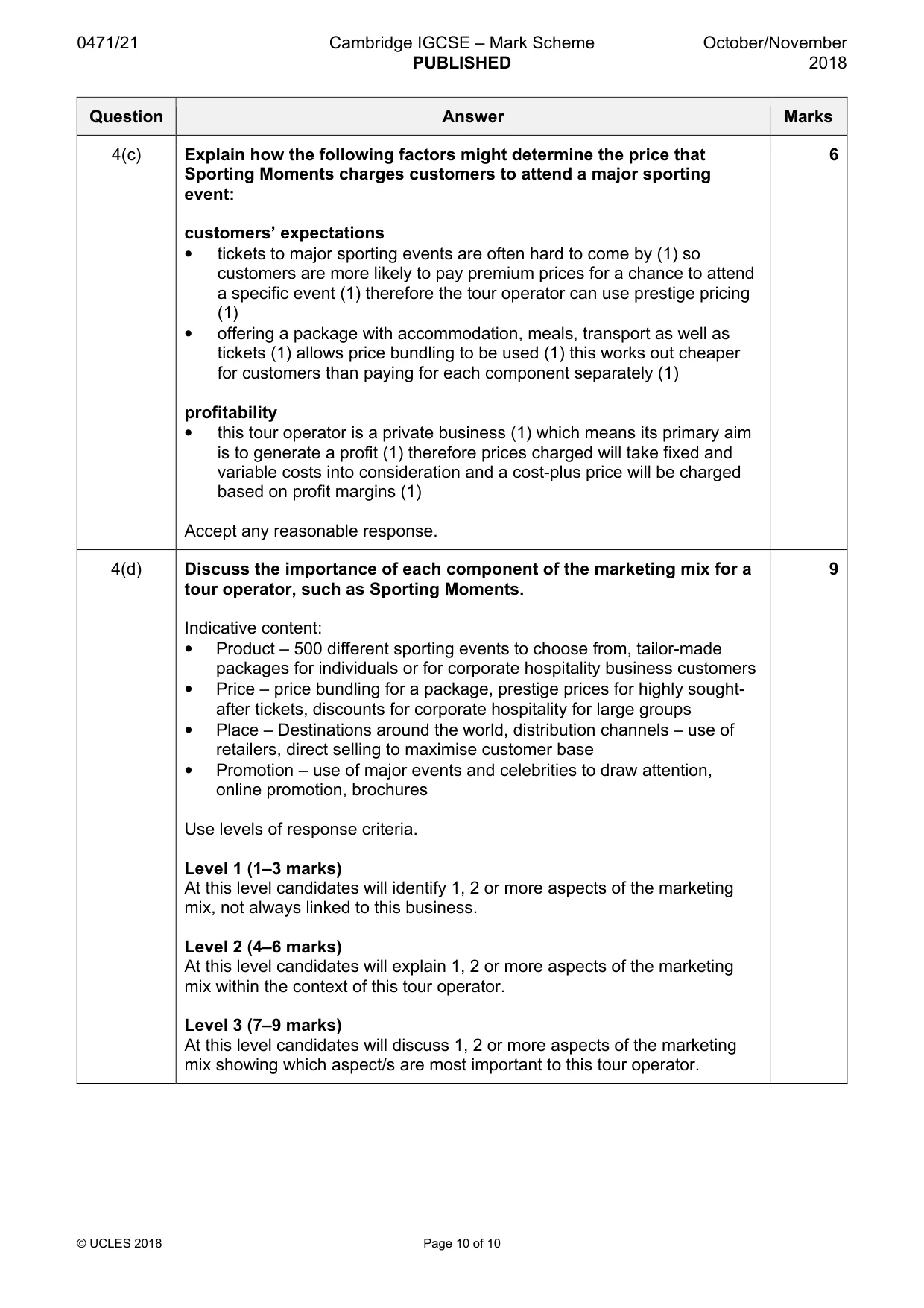
0471/21 Cambridge IGCSE – Mark Scheme PUBLISHED October/November 2018 © UCLES 2018 Page 10 of 10 Question Answer Marks 4(c) Explain how the following factors might determine the price that Sporting Moments charges customers to attend a major sporting event: customers’ expectations • tickets to major sporting events are often hard to come by (1) so customers are more likely to pay premium prices for a chance to attend a specific event (1) therefore the tour operator can use prestige pricing (1) • offering a package with accommodation, meals, transport as well as tickets (1) allows price bundling to be used (1) this works out cheaper for customers than paying for each component separately (1) profitability • this tour operator is a private business (1) which means its primary aim is to generate a profit (1) therefore prices charged will take fixed and variable costs into consideration and a cost-plus price will be charged based on profit margins (1) Accept any reasonable response. 6 4(d) Discuss the importance of each component of the marketing mix for a tour operator, such as Sporting Moments. Indicative content: • Product – 500 different sporting events to choose from, tailor-made packages for individuals or for corporate hospitality business customers • Price – price bundling for a package, prestige prices for highly sought- after tickets, discounts for corporate hospitality for large groups • Place – Destinations around the world, distribution channels – use of retailers, direct selling to maximise customer base • Promotion – use of major events and celebrities to draw attention, online promotion, brochures Use levels of response criteria. Level 1 (1–3 marks) At this level candidates will identify 1, 2 or more aspects of the marketing mix, not always linked to this business. Level 2 (4–6 marks) At this level candidates will explain 1, 2 or more aspects of the marketing mix within the context of this tour operator. Level 3 (7–9 marks) At this level candidates will discuss 1, 2 or more aspects of the marketing mix showing which aspect/s are most important to this tour operator. 9
What you needed in this session
Cambridge’s own grade thresholds for 2018 Oct/Nov, Paper 2 · Variant 1. A higher threshold means an easier paper — the bar moves with how the cohort did.