Cambridge IGCSE Travel and Tourism 0471 — 2018 Oct/Nov Paper 2 · Variant 2
0471/22/O/N/18 · 100 marks · ≈113 min
The question paper and its mark scheme, free to read here and free to download. This is Cambridge’s own paper, exactly as it was sat.
Question paper16 pages



Mark scheme10 pages
Answers below. Sit the paper first if you are practising.
Paper as text
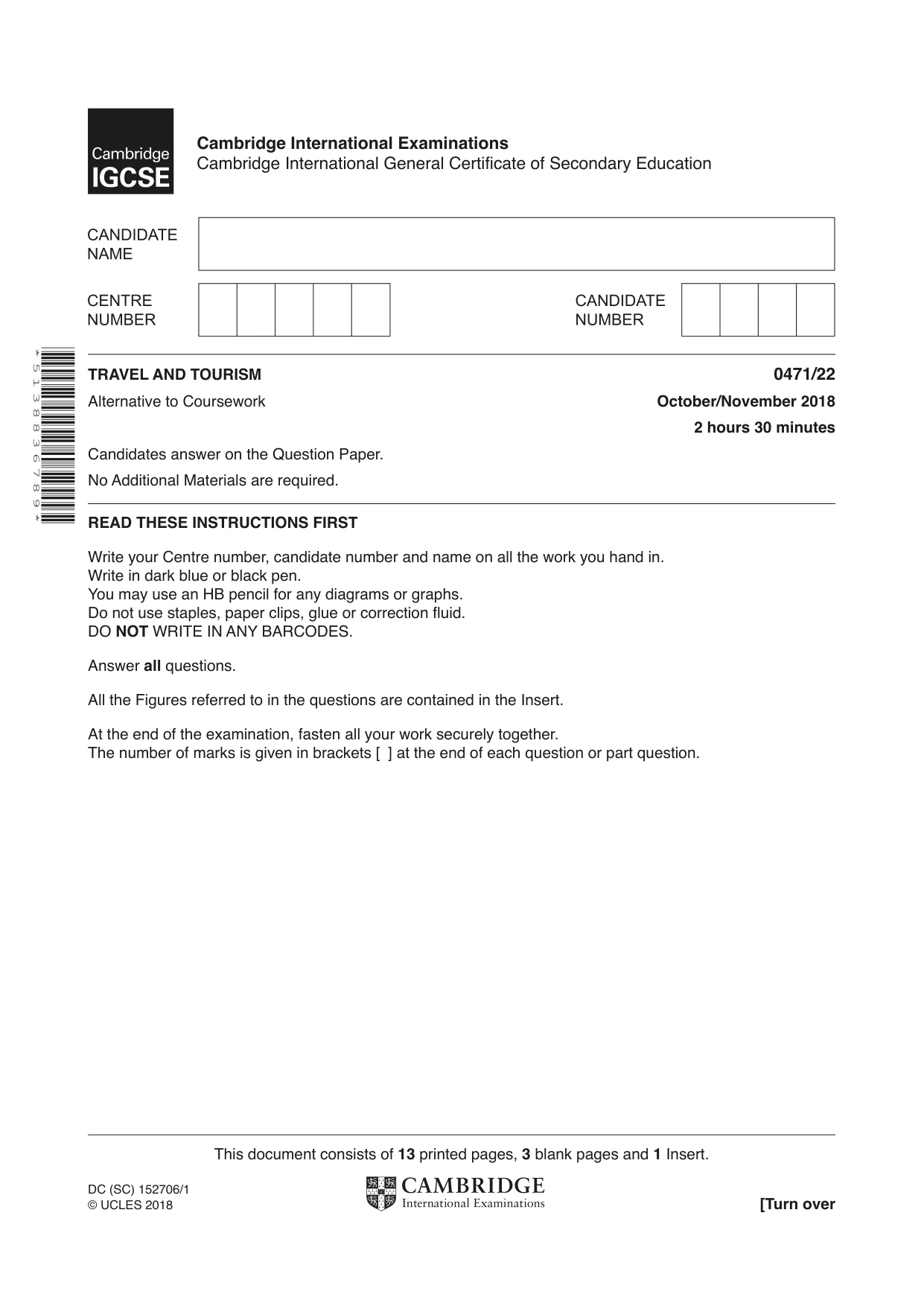
Question paper, page 1
* 5 1 3 8 8 3 6 7 8 9 * This document consists of 13 printed pages, 3 blank pages and 1 Insert. DC (SC) 152706/1 © UCLES 2018 [Turn over Cambridge International Examinations Cambridge International General Certificate of Secondary Education TRAVEL AND TOURISM 0471/22 Alternative to Coursework October/November 2018 2 hours 30 minutes Candidates answer on the Question Paper. No Additional Materials are required. READ THESE INSTRUCTIONS FIRST Write your Centre number, candidate number and name on all the work you hand in. Write in dark blue or black pen. You may use an HB pencil for any diagrams or graphs. Do not use staples, paper clips, glue or correction fluid. DO NOT WRITE IN ANY BARCODES. Answer all questions. All the Figures referred to in the questions are contained in the Insert. At the end of the examination, fasten all your work securely together. The number of marks is given in brackets [ ] at the end of each question or part question.
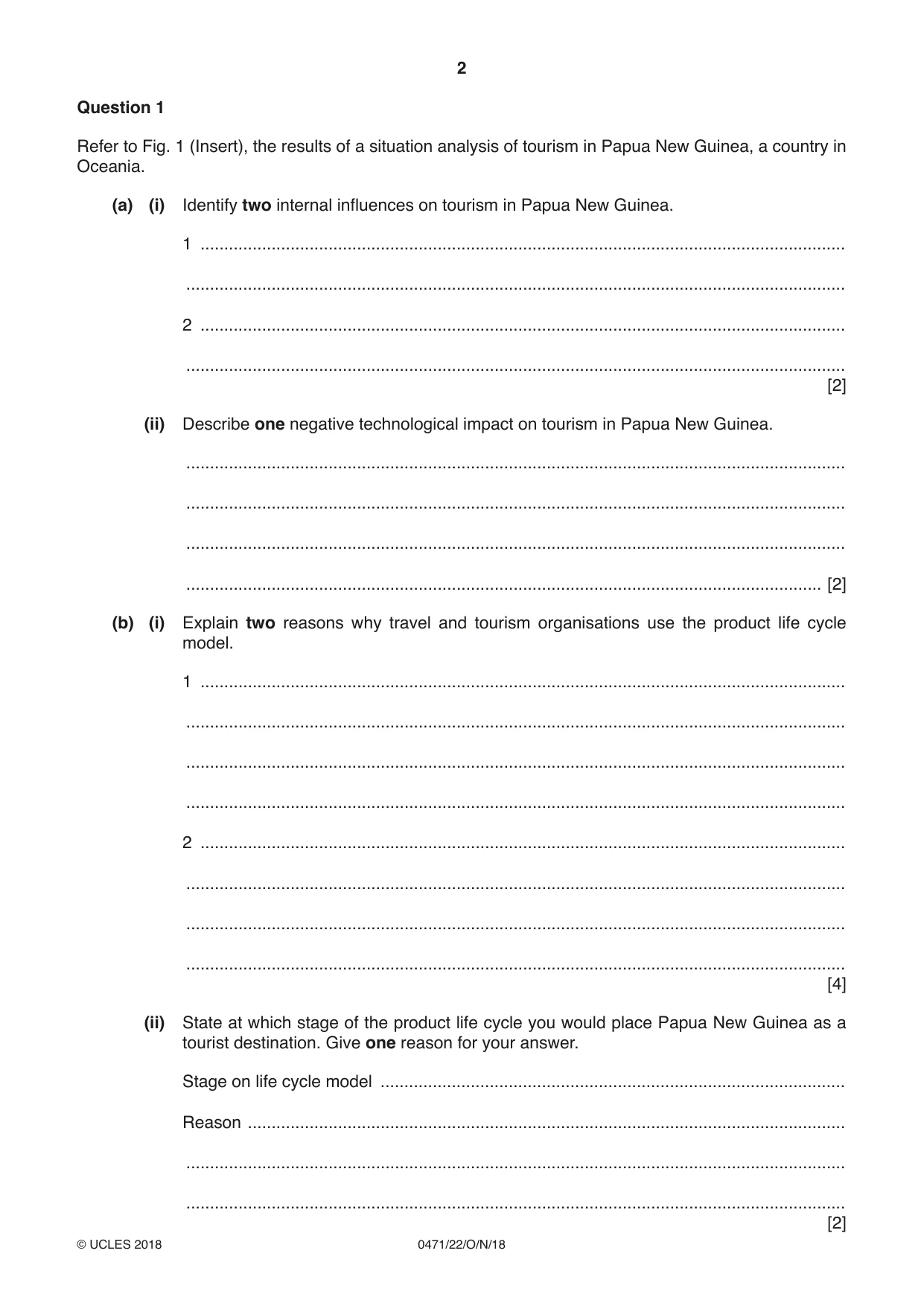
Question paper, page 2
2 0471/22/O/N/18 © UCLES 2018 Question 1 Refer to Fig. 1 (Insert), the results of a situation analysis of tourism in Papua New Guinea, a country in Oceania. (a) (i) Identify two internal influences on tourism in Papua New Guinea. 1 … … 2 … … [2] (ii) Describe one negative technological impact on tourism in Papua New Guinea. … … … … [2] (b) (i) Explain two reasons why travel and tourism organisations use the product life cycle model. 1 … … … … 2 … … … … [4] (ii) State at which stage of the product life cycle you would place Papua New Guinea as a tourist destination. Give one reason for your answer. Stage on life cycle model … Reason … … … [2]
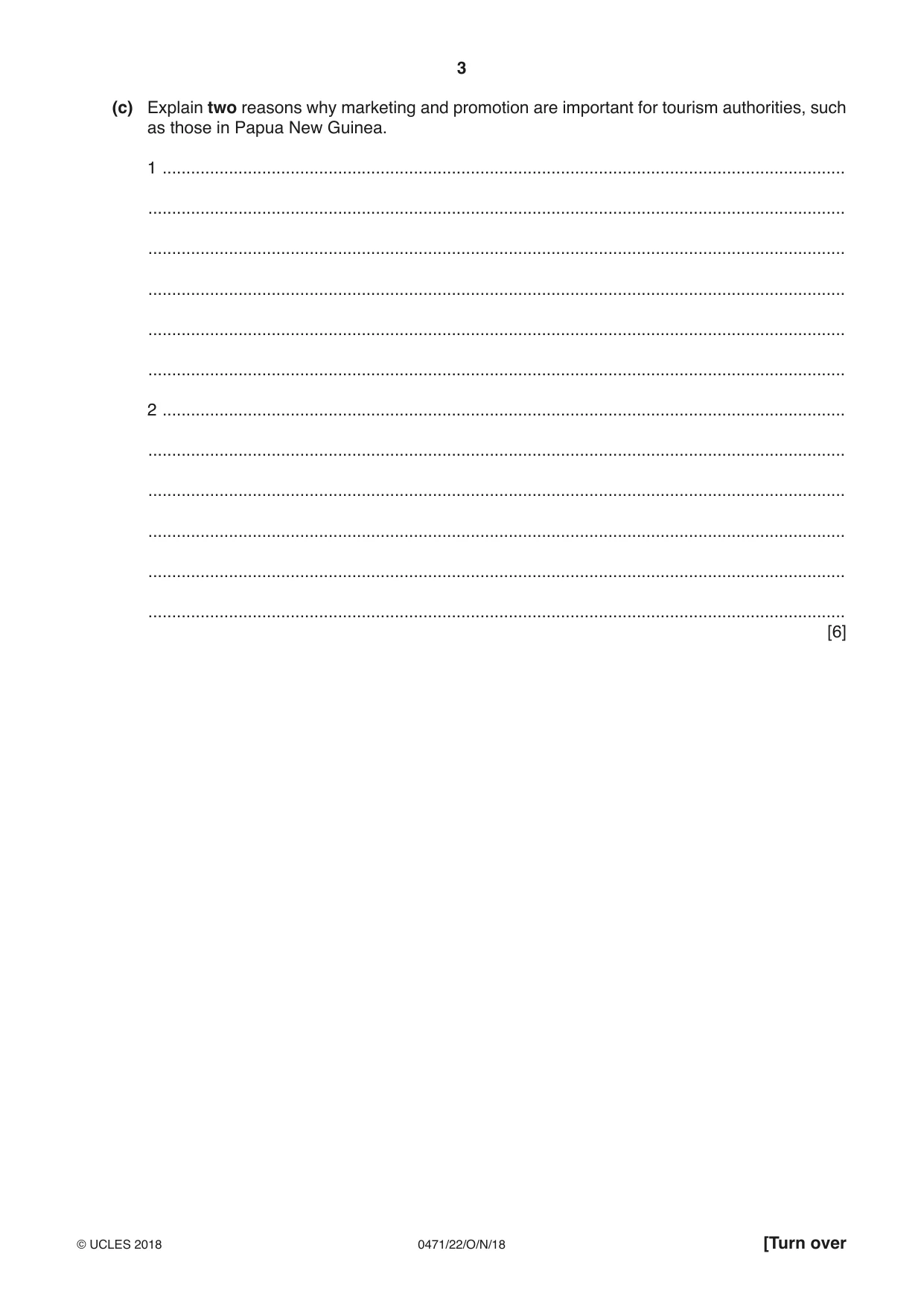
Question paper, page 3
3 0471/22/O/N/18 © UCLES 2018 [Turn over (c) Explain two reasons why marketing and promotion are important for tourism authorities, such as those in Papua New Guinea. 1 … … … … … … 2 … … … … … … [6]
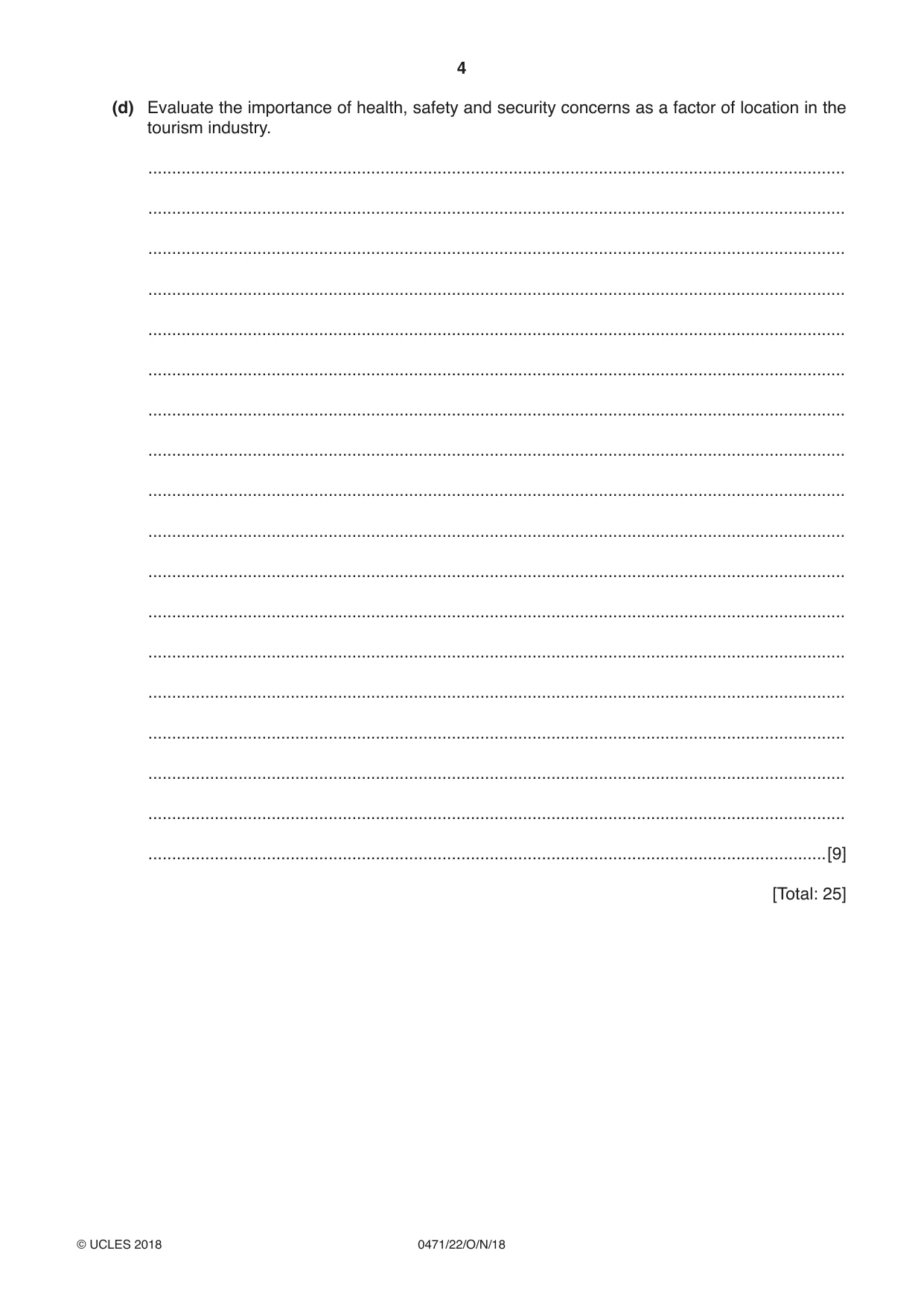
Question paper, page 4
4 0471/22/O/N/18 © UCLES 2018 (d) Evaluate the importance of health, safety and security concerns as a factor of location in the tourism industry. … … … … … … … … … … … … … … … … … …[9] [Total: 25]
Question paper, page 5
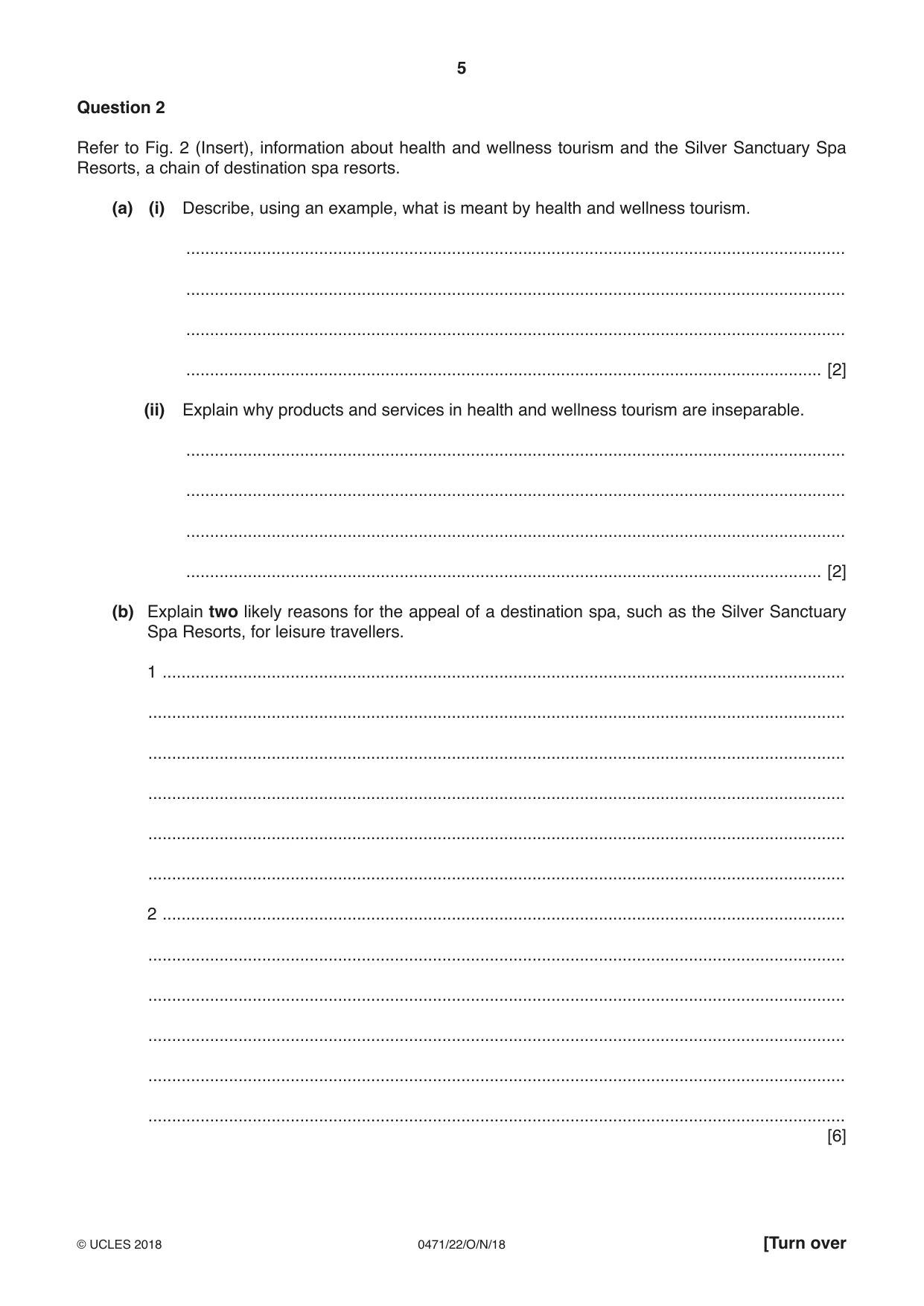
5 0471/22/O/N/18 © UCLES 2018 [Turn over Question 2 Refer to Fig. 2 (Insert), information about health and wellness tourism and the Silver Sanctuary Spa Resorts, a chain of destination spa resorts. (a) (i) Describe, using an example, what is meant by health and wellness tourism. … … … … [2] (ii) Explain why products and services in health and wellness tourism are inseparable. … … … … [2] (b) Explain two likely reasons for the appeal of a destination spa, such as the Silver Sanctuary Spa Resorts, for leisure travellers. 1 … … … … … … 2 … … … … … … [6]
Question paper, page 6
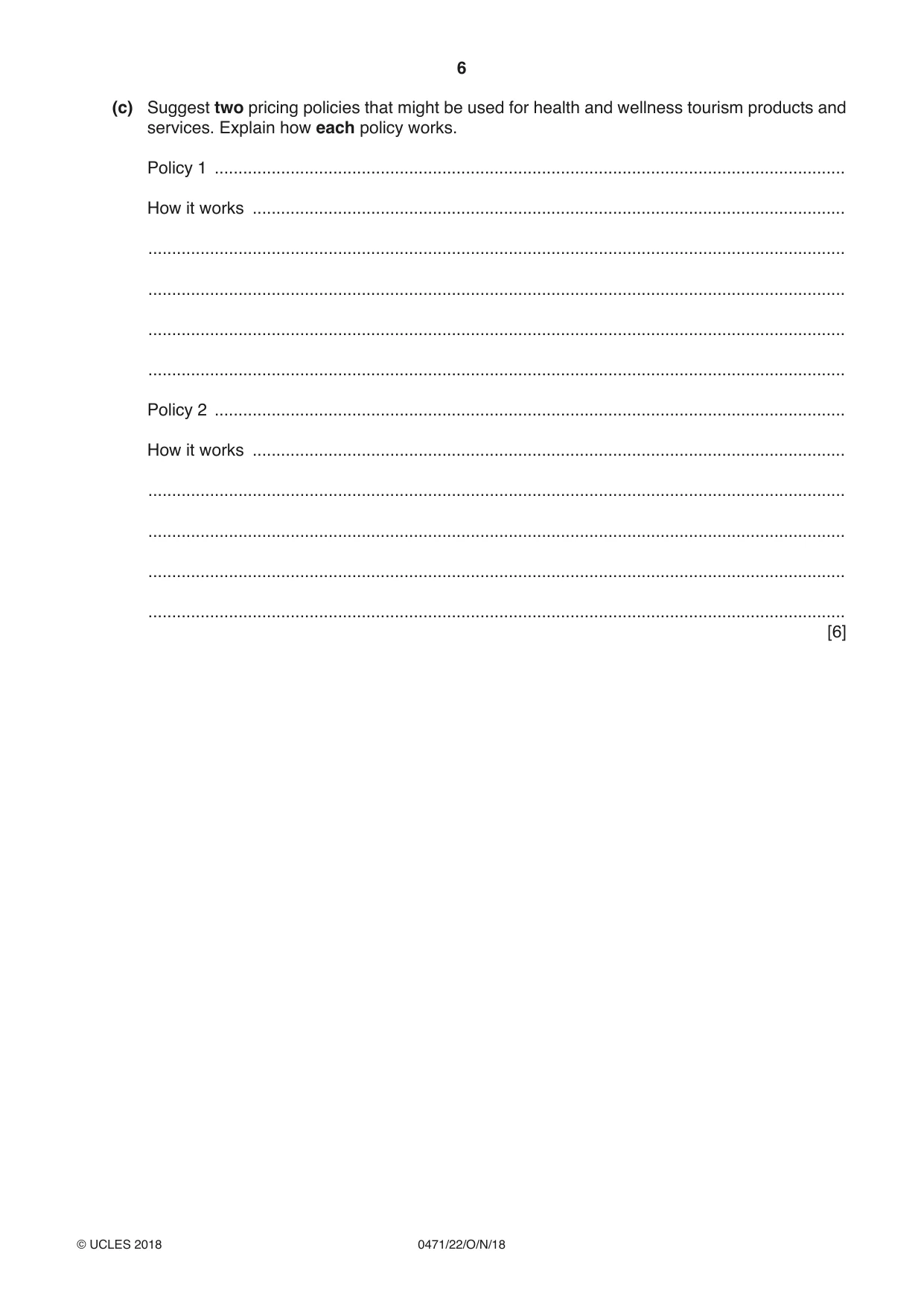
6 0471/22/O/N/18 © UCLES 2018 (c) Suggest two pricing policies that might be used for health and wellness tourism products and services. Explain how each policy works. Policy 1 … How it works … … … … … Policy 2 … How it works … … … … … [6]
Question paper, page 7
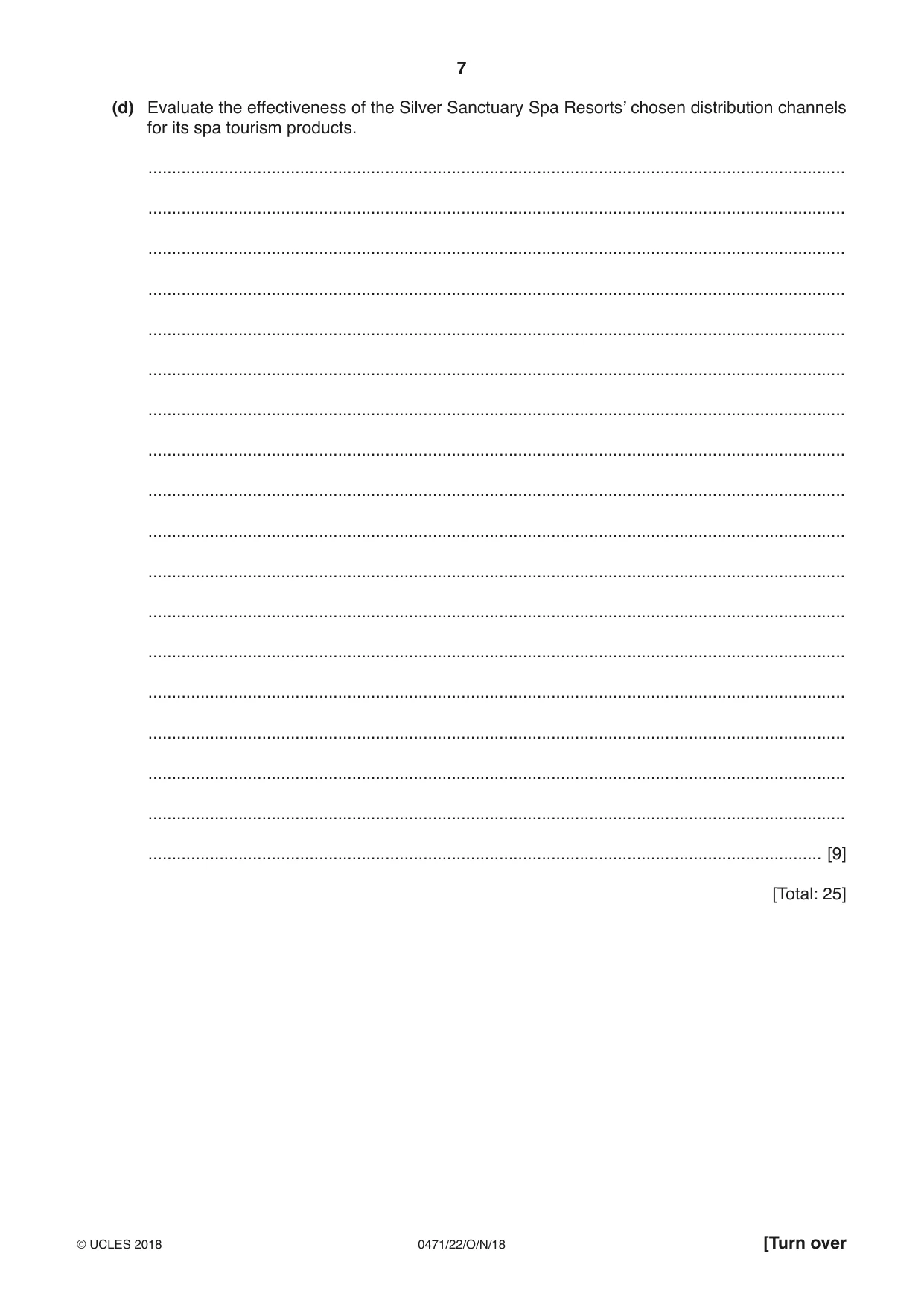
7 0471/22/O/N/18 © UCLES 2018 [Turn over (d) Evaluate the effectiveness of the Silver Sanctuary Spa Resorts’ chosen distribution channels for its spa tourism products. … … … … … … … … … … … … … … … … … … [9] [Total: 25]
Question paper, page 8
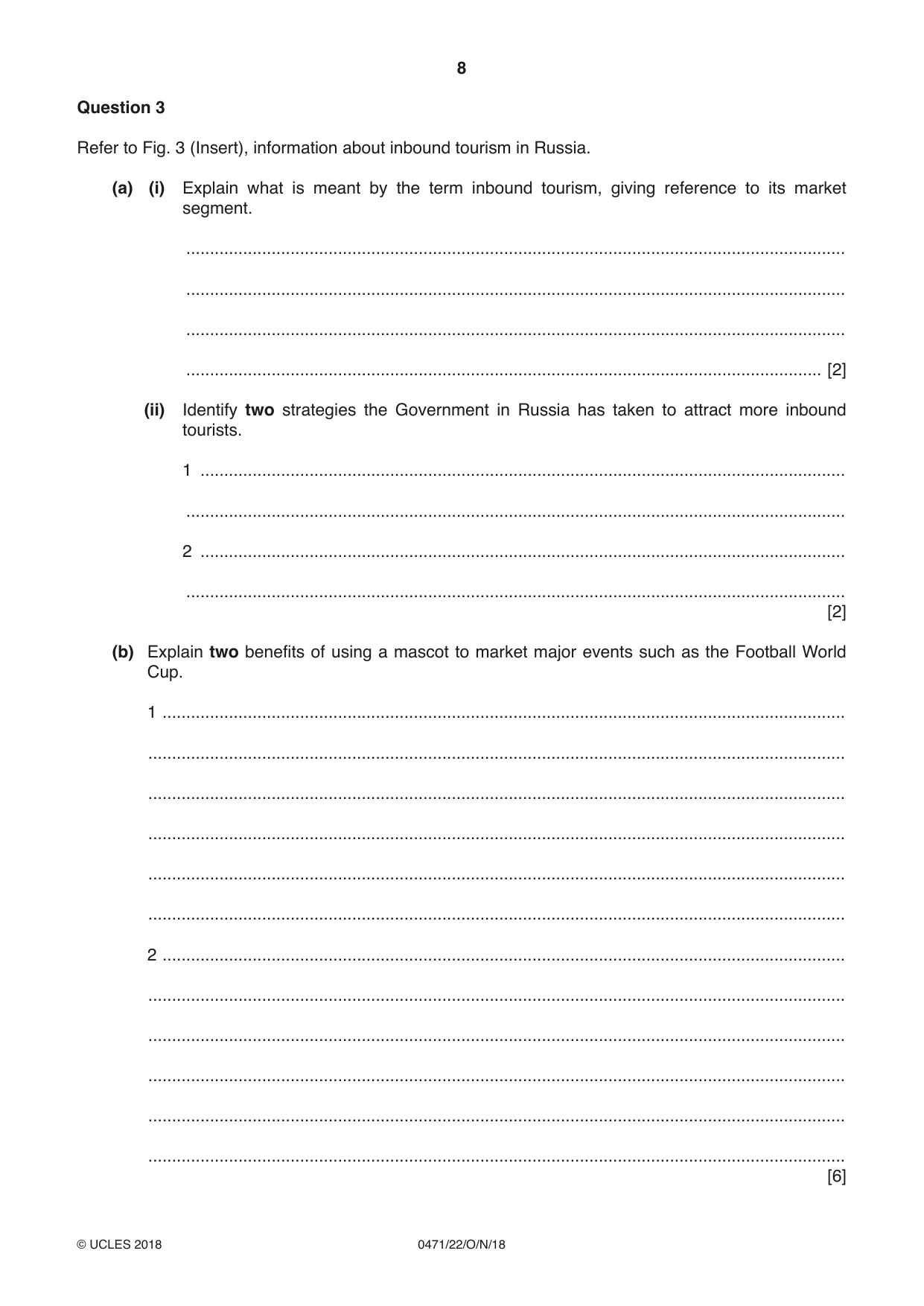
8 0471/22/O/N/18 © UCLES 2018 Question 3 Refer to Fig. 3 (Insert), information about inbound tourism in Russia. (a) (i) Explain what is meant by the term inbound tourism, giving reference to its market segment. … … … … [2] (ii) Identify two strategies the Government in Russia has taken to attract more inbound tourists. 1 … … 2 … … [2] (b) Explain two benefits of using a mascot to market major events such as the Football World Cup. 1 … … … … … … 2 … … … … … … [6]
Question paper, page 9
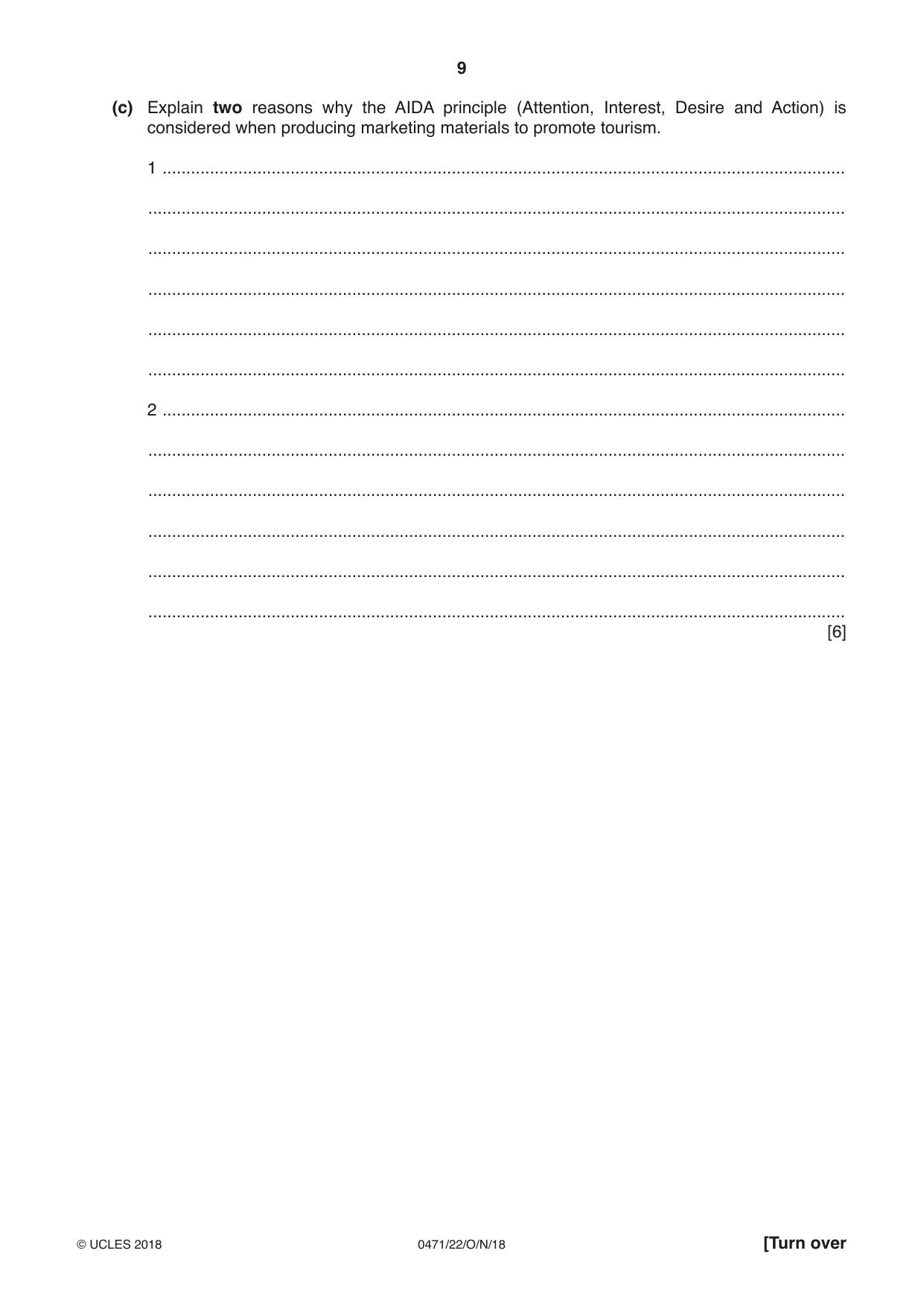
9 0471/22/O/N/18 © UCLES 2018 [Turn over (c) Explain two reasons why the AIDA principle (Attention, Interest, Desire and Action) is considered when producing marketing materials to promote tourism. 1 … … … … … … 2 … … … … … … [6]
Question paper, page 10
10 0471/22/O/N/18 © UCLES 2018 (d) Discuss the advantages to tour operators in Russia of changing their product and service mix. … … … … … … … … … … … … … … … … … … [9] [Total: 25]
Question paper, page 11
11 0471/22/O/N/18 © UCLES 2018 [Turn over Question 4 Refer to Fig. 4 (Insert), an advertisement for the 26 Windows accommodation facility in Ho Chi Minh City in Vietnam. (a) Describe two features of the accommodation provided at this facility. 1 … … … … 2 … … … … [4] (b) Explain two reasons why independent travellers might choose to stay at this accommodation facility. 1 … … … … … … 2 … … … … … … [6]
Question paper, page 12
12 0471/22/O/N/18 © UCLES 2018 (c) Explain how the following factors might affect the price that guests are charged for staying at an apartment at this facility: the likely number of customers … … … … … … the number of competitors … … … … … … [6]
Question paper, page 13
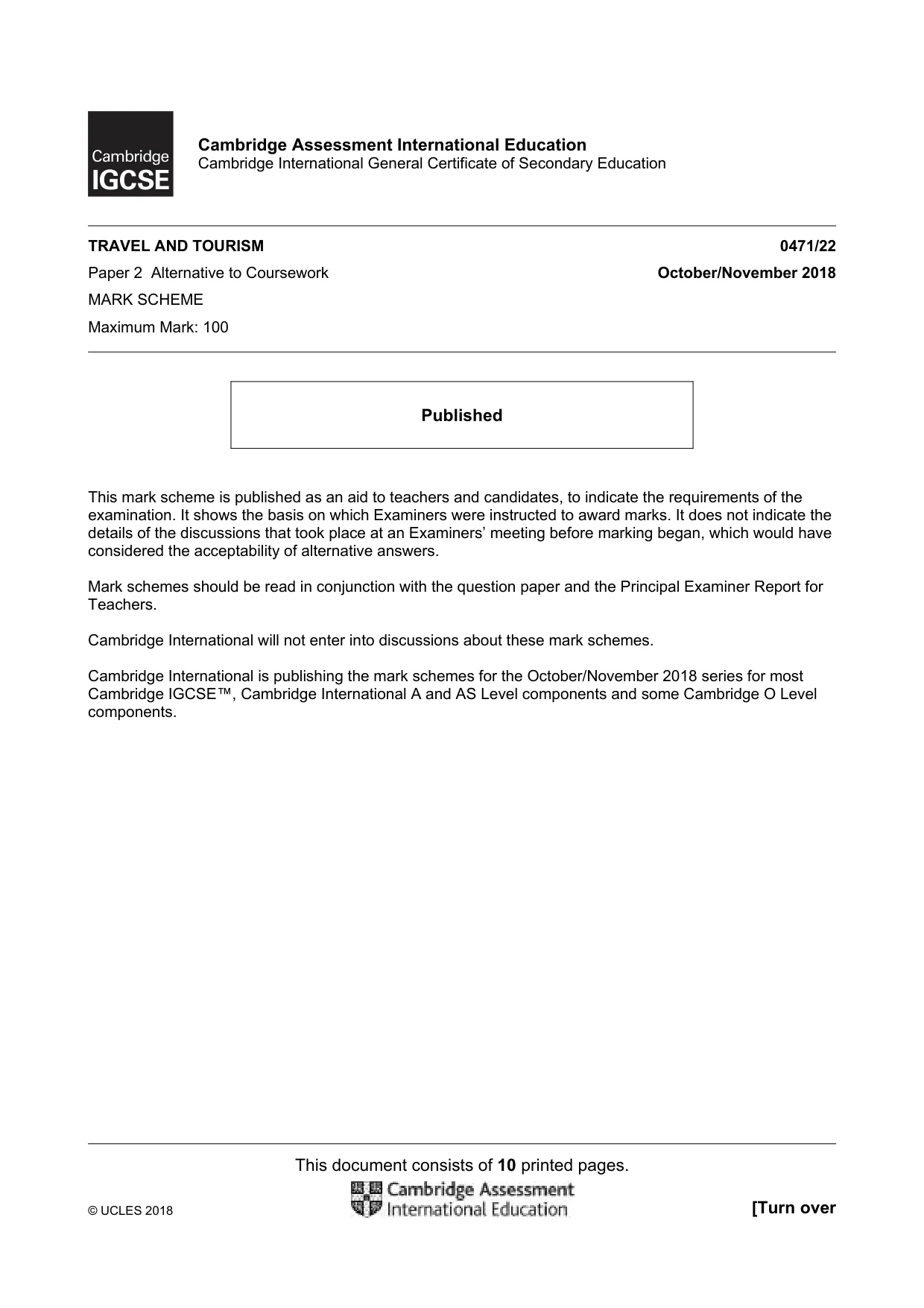
13 0471/22/O/N/18 © UCLES 2018 (d) Discuss the importance of brand loyalty for travel and tourism providers, such as the 26 Windows accommodation facility. … … … … … … … … … … … … … … … … … … [9] [Total: 25]
Question paper, page 14
14 0471/22/O/N/18 © UCLES 2018 BLANK PAGE
Question paper, page 15
15 0471/22/O/N/18 © UCLES 2018 BLANK PAGE
Question paper, page 16
16 0471/22/O/N/18 © UCLES 2018 Permission to reproduce items where third-party owned material protected by copyright is included has been sought and cleared where possible. Every reasonable effort has been made by the publisher (UCLES) to trace copyright holders, but if any items requiring clearance have unwittingly been included, the publisher will be pleased to make amends at the earliest possible opportunity. To avoid the issue of disclosure of answer-related information to candidates, all copyright acknowledgements are reproduced online in the Cambridge International Examinations Copyright Acknowledgements Booklet. This is produced for each series of examinations and is freely available to download at www.cie.org.uk after the live examination series. Cambridge International Examinations is part of the Cambridge Assessment Group. Cambridge Assessment is the brand name of University of Cambridge Local Examinations Syndicate (UCLES), which is itself a department of the University of Cambridge. BLANK PAGE
Mark scheme, page 1
This document consists of 10 printed pages. © UCLES 2018 [Turn over Cambridge Assessment International Education Cambridge International General Certificate of Secondary Education TRAVEL AND TOURISM 0471/22 Paper 2 Alternative to Coursework October/November 2018 MARK SCHEME Maximum Mark: 100 Published This mark scheme is published as an aid to teachers and candidates, to indicate the requirements of the examination. It shows the basis on which Examiners were instructed to award marks. It does not indicate the details of the discussions that took place at an Examiners’ meeting before marking began, which would have considered the acceptability of alternative answers. Mark schemes should be read in conjunction with the question paper and the Principal Examiner Report for Teachers. Cambridge International will not enter into discussions about these mark schemes. Cambridge International is publishing the mark schemes for the October/November 2018 series for most Cambridge IGCSE™, Cambridge International A and AS Level components and some Cambridge O Level components.
Mark scheme, page 2
0471/22 Cambridge IGCSE – Mark Scheme PUBLISHED October/November 2018 © UCLES 2018 Page 2 of 10 Generic Marking Principles These general marking principles must be applied by all examiners when marking candidate answers. They should be applied alongside the specific content of the mark scheme or generic level descriptors for a question. Each question paper and mark scheme will also comply with these marking principles. GENERIC MARKING PRINCIPLE 1: Marks must be awarded in line with: • the specific content of the mark scheme or the generic level descriptors for the question • the specific skills defined in the mark scheme or in the generic level descriptors for the question • the standard of response required by a candidate as exemplified by the standardisation scripts. GENERIC MARKING PRINCIPLE 2: Marks awarded are always whole marks (not half marks, or other fractions). GENERIC MARKING PRINCIPLE 3: Marks must be awarded positively: • marks are awarded for correct/valid answers, as defined in the mark scheme. However, credit is given for valid answers which go beyond the scope of the syllabus and mark scheme, referring to your Team Leader as appropriate • marks are awarded when candidates clearly demonstrate what they know and can do • marks are not deducted for errors • marks are not deducted for omissions • answers should only be judged on the quality of spelling, punctuation and grammar when these features are specifically assessed by the question as indicated by the mark scheme. The meaning, however, should be unambiguous. GENERIC MARKING PRINCIPLE 4: Rules must be applied consistently e.g. in situations where candidates have not followed instructions or in the application of generic level descriptors. GENERIC MARKING PRINCIPLE 5: Marks should be awarded using the full range of marks defined in the mark scheme for the question (however; the use of the full mark range may be limited according to the quality of the candidate responses seen). GENERIC MARKING PRINCIPLE 6: Marks awarded are based solely on the requirements as defined in the mark scheme. Marks should not be awarded with grade thresholds or grade descriptors in mind.
Mark scheme, page 3
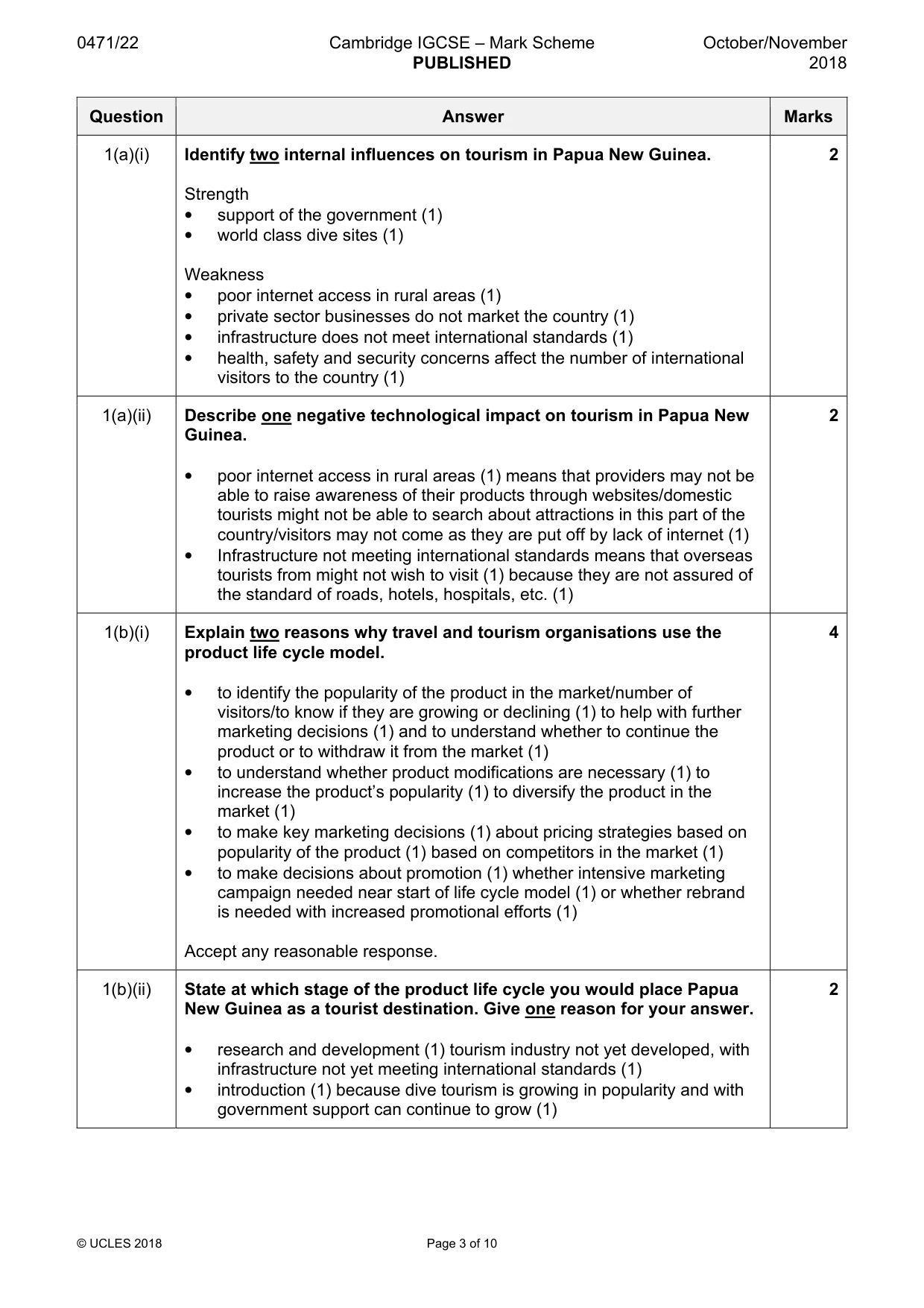
0471/22 Cambridge IGCSE – Mark Scheme PUBLISHED October/November 2018 © UCLES 2018 Page 3 of 10 Question Answer Marks 1(a)(i) Identify two internal influences on tourism in Papua New Guinea. Strength • support of the government (1) • world class dive sites (1) Weakness • poor internet access in rural areas (1) • private sector businesses do not market the country (1) • infrastructure does not meet international standards (1) • health, safety and security concerns affect the number of international visitors to the country (1) 2 1(a)(ii) Describe one negative technological impact on tourism in Papua New Guinea. • poor internet access in rural areas (1) means that providers may not be able to raise awareness of their products through websites/domestic tourists might not be able to search about attractions in this part of the country/visitors may not come as they are put off by lack of internet (1) • Infrastructure not meeting international standards means that overseas tourists from might not wish to visit (1) because they are not assured of the standard of roads, hotels, hospitals, etc. (1) 2 1(b)(i) Explain two reasons why travel and tourism organisations use the product life cycle model. • to identify the popularity of the product in the market/number of visitors/to know if they are growing or declining (1) to help with further marketing decisions (1) and to understand whether to continue the product or to withdraw it from the market (1) • to understand whether product modifications are necessary (1) to increase the product’s popularity (1) to diversify the product in the market (1) • to make key marketing decisions (1) about pricing strategies based on popularity of the product (1) based on competitors in the market (1) • to make decisions about promotion (1) whether intensive marketing campaign needed near start of life cycle model (1) or whether rebrand is needed with increased promotional efforts (1) Accept any reasonable response. 4 1(b)(ii) State at which stage of the product life cycle you would place Papua New Guinea as a tourist destination. Give one reason for your answer. • research and development (1) tourism industry not yet developed, with infrastructure not yet meeting international standards (1) • introduction (1) because dive tourism is growing in popularity and with government support can continue to grow (1) 2
Mark scheme, page 4
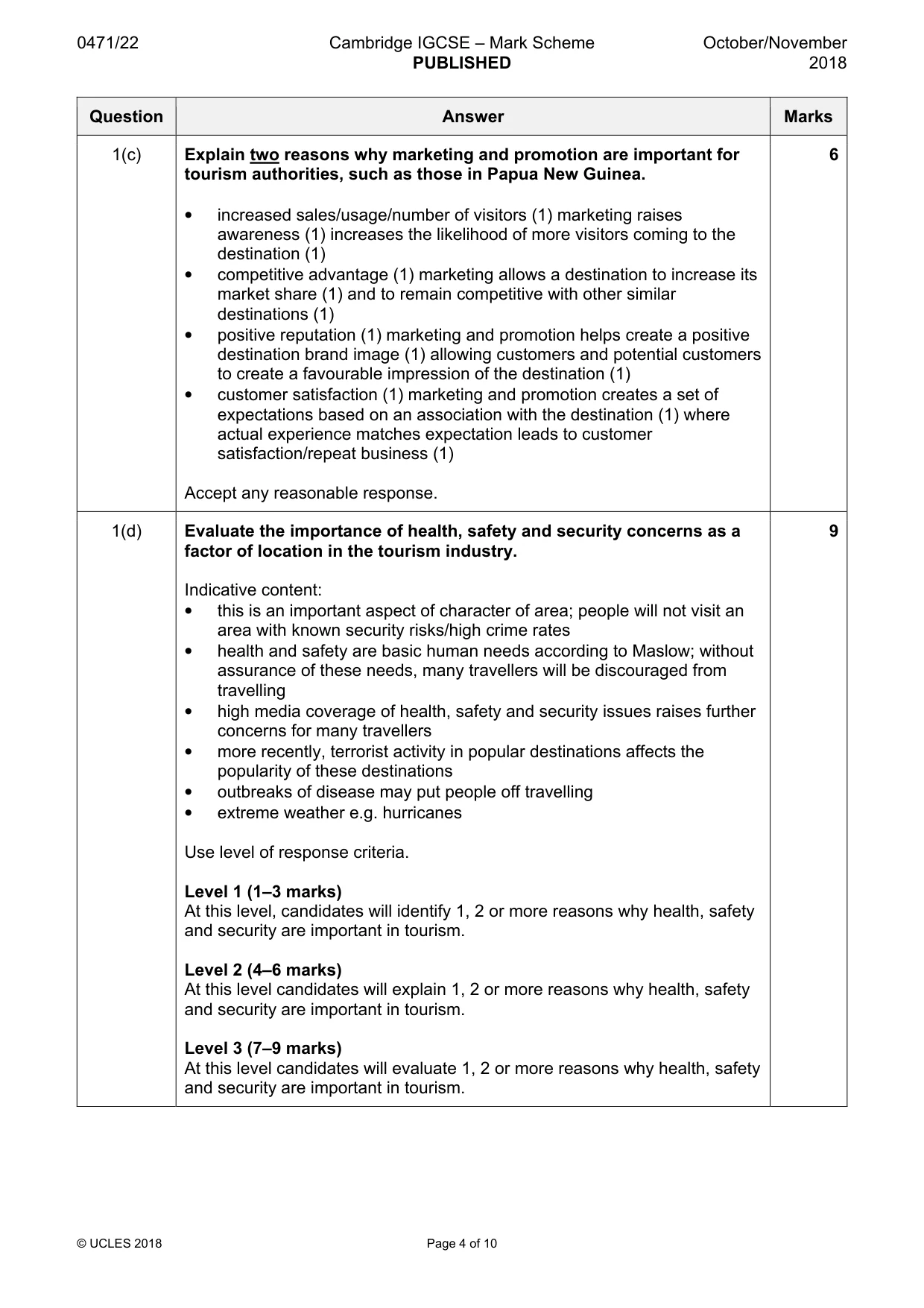
0471/22 Cambridge IGCSE – Mark Scheme PUBLISHED October/November 2018 © UCLES 2018 Page 4 of 10 Question Answer Marks 1(c) Explain two reasons why marketing and promotion are important for tourism authorities, such as those in Papua New Guinea. • increased sales/usage/number of visitors (1) marketing raises awareness (1) increases the likelihood of more visitors coming to the destination (1) • competitive advantage (1) marketing allows a destination to increase its market share (1) and to remain competitive with other similar destinations (1) • positive reputation (1) marketing and promotion helps create a positive destination brand image (1) allowing customers and potential customers to create a favourable impression of the destination (1) • customer satisfaction (1) marketing and promotion creates a set of expectations based on an association with the destination (1) where actual experience matches expectation leads to customer satisfaction/repeat business (1) Accept any reasonable response. 6 1(d) Evaluate the importance of health, safety and security concerns as a factor of location in the tourism industry. Indicative content: • this is an important aspect of character of area; people will not visit an area with known security risks/high crime rates • health and safety are basic human needs according to Maslow; without assurance of these needs, many travellers will be discouraged from travelling • high media coverage of health, safety and security issues raises further concerns for many travellers • more recently, terrorist activity in popular destinations affects the popularity of these destinations • outbreaks of disease may put people off travelling • extreme weather e.g. hurricanes Use level of response criteria. Level 1 (1–3 marks) At this level, candidates will identify 1, 2 or more reasons why health, safety and security are important in tourism. Level 2 (4–6 marks) At this level candidates will explain 1, 2 or more reasons why health, safety and security are important in tourism. Level 3 (7–9 marks) At this level candidates will evaluate 1, 2 or more reasons why health, safety and security are important in tourism. 9
Mark scheme, page 5
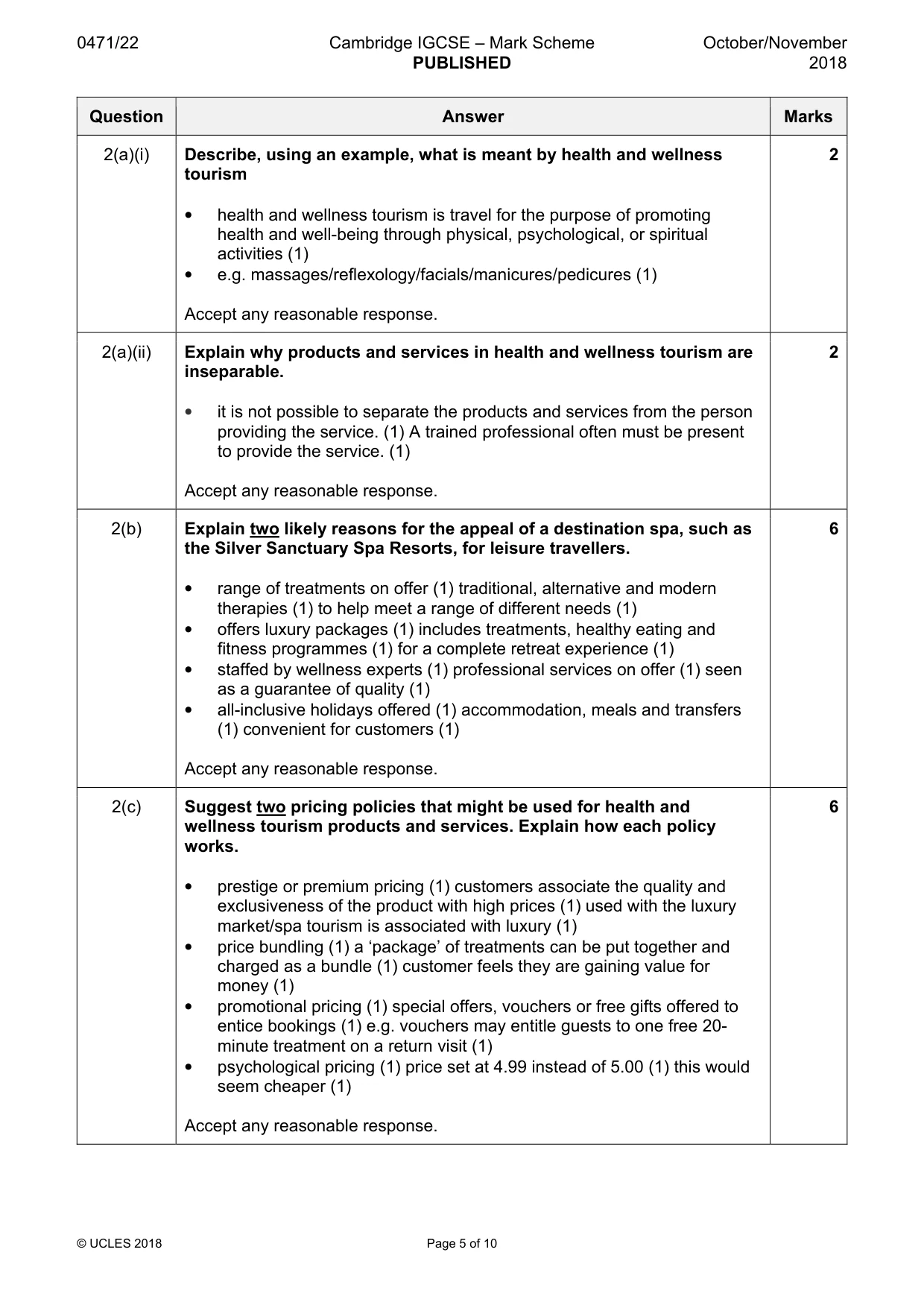
0471/22 Cambridge IGCSE – Mark Scheme PUBLISHED October/November 2018 © UCLES 2018 Page 5 of 10 Question Answer Marks 2(a)(i) Describe, using an example, what is meant by health and wellness tourism • health and wellness tourism is travel for the purpose of promoting health and well-being through physical, psychological, or spiritual activities (1) • e.g. massages/reflexology/facials/manicures/pedicures (1) Accept any reasonable response. 2 2(a)(ii) Explain why products and services in health and wellness tourism are inseparable. • it is not possible to separate the products and services from the person providing the service. (1) A trained professional often must be present to provide the service. (1) Accept any reasonable response. 2 2(b) Explain two likely reasons for the appeal of a destination spa, such as the Silver Sanctuary Spa Resorts, for leisure travellers. • range of treatments on offer (1) traditional, alternative and modern therapies (1) to help meet a range of different needs (1) • offers luxury packages (1) includes treatments, healthy eating and fitness programmes (1) for a complete retreat experience (1) • staffed by wellness experts (1) professional services on offer (1) seen as a guarantee of quality (1) • all-inclusive holidays offered (1) accommodation, meals and transfers (1) convenient for customers (1) Accept any reasonable response. 6 2(c) Suggest two pricing policies that might be used for health and wellness tourism products and services. Explain how each policy works. • prestige or premium pricing (1) customers associate the quality and exclusiveness of the product with high prices (1) used with the luxury market/spa tourism is associated with luxury (1) • price bundling (1) a ‘package’ of treatments can be put together and charged as a bundle (1) customer feels they are gaining value for money (1) • promotional pricing (1) special offers, vouchers or free gifts offered to entice bookings (1) e.g. vouchers may entitle guests to one free 20- minute treatment on a return visit (1) • psychological pricing (1) price set at 4.99 instead of 5.00 (1) this would seem cheaper (1) Accept any reasonable response. 6
Mark scheme, page 6
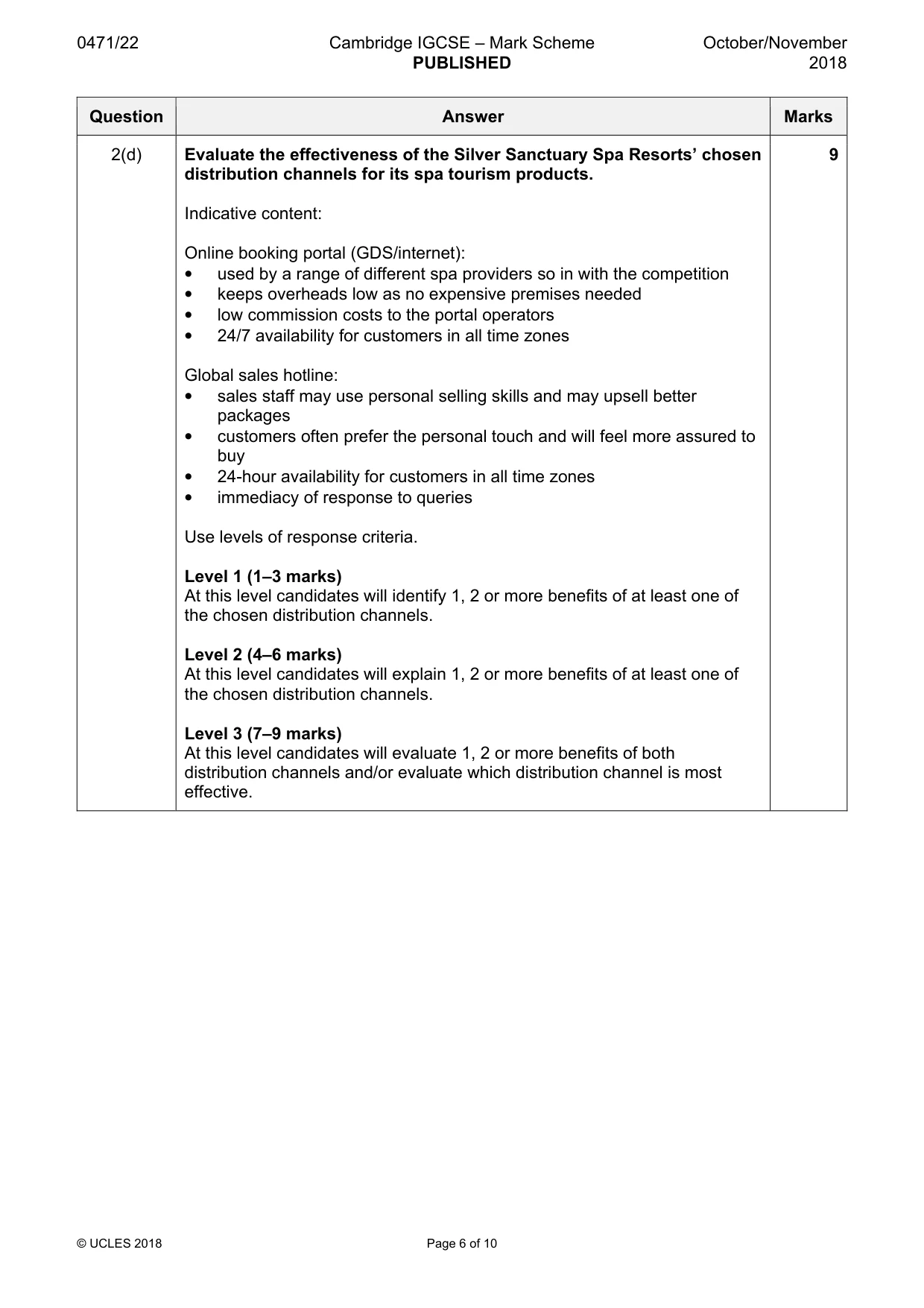
0471/22 Cambridge IGCSE – Mark Scheme PUBLISHED October/November 2018 © UCLES 2018 Page 6 of 10 Question Answer Marks 2(d) Evaluate the effectiveness of the Silver Sanctuary Spa Resorts’ chosen distribution channels for its spa tourism products. Indicative content: Online booking portal (GDS/internet): • used by a range of different spa providers so in with the competition • keeps overheads low as no expensive premises needed • low commission costs to the portal operators • 24/7 availability for customers in all time zones Global sales hotline: • sales staff may use personal selling skills and may upsell better packages • customers often prefer the personal touch and will feel more assured to buy • 24-hour availability for customers in all time zones • immediacy of response to queries Use levels of response criteria. Level 1 (1–3 marks) At this level candidates will identify 1, 2 or more benefits of at least one of the chosen distribution channels. Level 2 (4–6 marks) At this level candidates will explain 1, 2 or more benefits of at least one of the chosen distribution channels. Level 3 (7–9 marks) At this level candidates will evaluate 1, 2 or more benefits of both distribution channels and/or evaluate which distribution channel is most effective. 9
Mark scheme, page 7
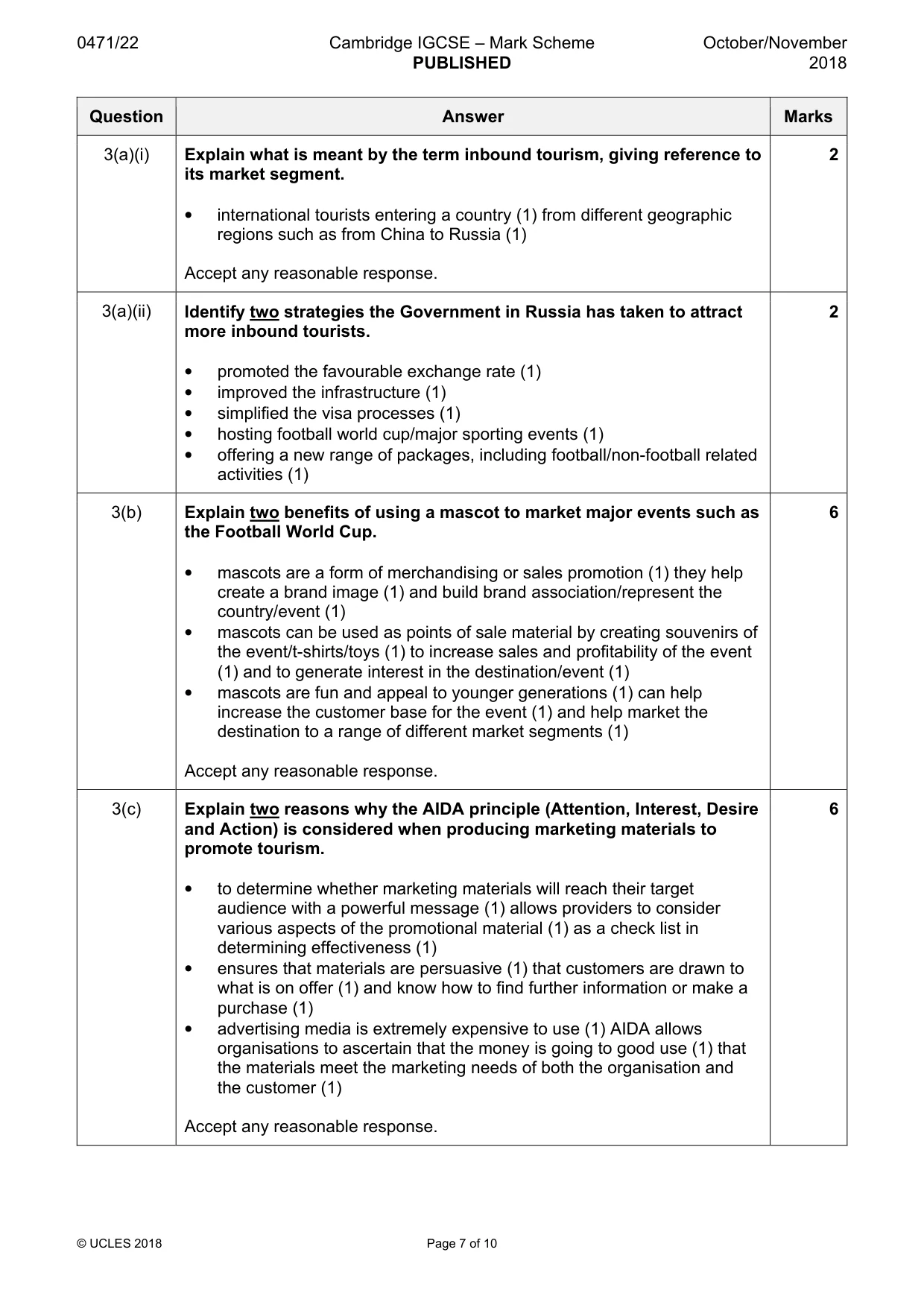
0471/22 Cambridge IGCSE – Mark Scheme PUBLISHED October/November 2018 © UCLES 2018 Page 7 of 10 Question Answer Marks 3(a)(i) Explain what is meant by the term inbound tourism, giving reference to its market segment. • international tourists entering a country (1) from different geographic regions such as from China to Russia (1) Accept any reasonable response. 2 3(a)(ii) Identify two strategies the Government in Russia has taken to attract more inbound tourists. • promoted the favourable exchange rate (1) • improved the infrastructure (1) • simplified the visa processes (1) • hosting football world cup/major sporting events (1) • offering a new range of packages, including football/non-football related activities (1) 2 3(b) Explain two benefits of using a mascot to market major events such as the Football World Cup. • mascots are a form of merchandising or sales promotion (1) they help create a brand image (1) and build brand association/represent the country/event (1) • mascots can be used as points of sale material by creating souvenirs of the event/t-shirts/toys (1) to increase sales and profitability of the event (1) and to generate interest in the destination/event (1) • mascots are fun and appeal to younger generations (1) can help increase the customer base for the event (1) and help market the destination to a range of different market segments (1) Accept any reasonable response. 6 3(c) Explain two reasons why the AIDA principle (Attention, Interest, Desire and Action) is considered when producing marketing materials to promote tourism. • to determine whether marketing materials will reach their target audience with a powerful message (1) allows providers to consider various aspects of the promotional material (1) as a check list in determining effectiveness (1) • ensures that materials are persuasive (1) that customers are drawn to what is on offer (1) and know how to find further information or make a purchase (1) • advertising media is extremely expensive to use (1) AIDA allows organisations to ascertain that the money is going to good use (1) that the materials meet the marketing needs of both the organisation and the customer (1) Accept any reasonable response. 6
Mark scheme, page 8
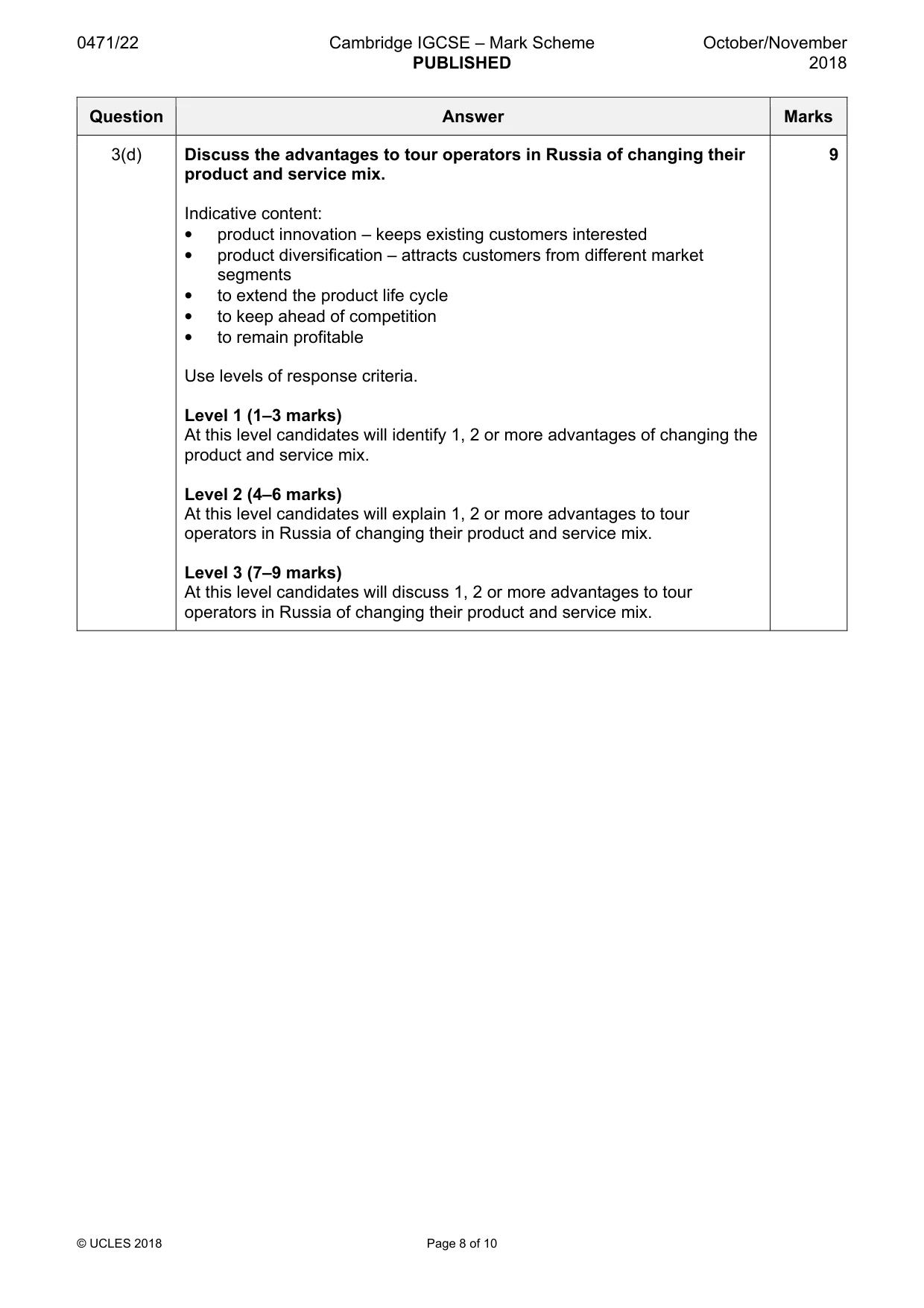
0471/22 Cambridge IGCSE – Mark Scheme PUBLISHED October/November 2018 © UCLES 2018 Page 8 of 10 Question Answer Marks 3(d) Discuss the advantages to tour operators in Russia of changing their product and service mix. Indicative content: • product innovation – keeps existing customers interested • product diversification – attracts customers from different market segments • to extend the product life cycle • to keep ahead of competition • to remain profitable Use levels of response criteria. Level 1 (1–3 marks) At this level candidates will identify 1, 2 or more advantages of changing the product and service mix. Level 2 (4–6 marks) At this level candidates will explain 1, 2 or more advantages to tour operators in Russia of changing their product and service mix. Level 3 (7–9 marks) At this level candidates will discuss 1, 2 or more advantages to tour operators in Russia of changing their product and service mix. 9
Mark scheme, page 9
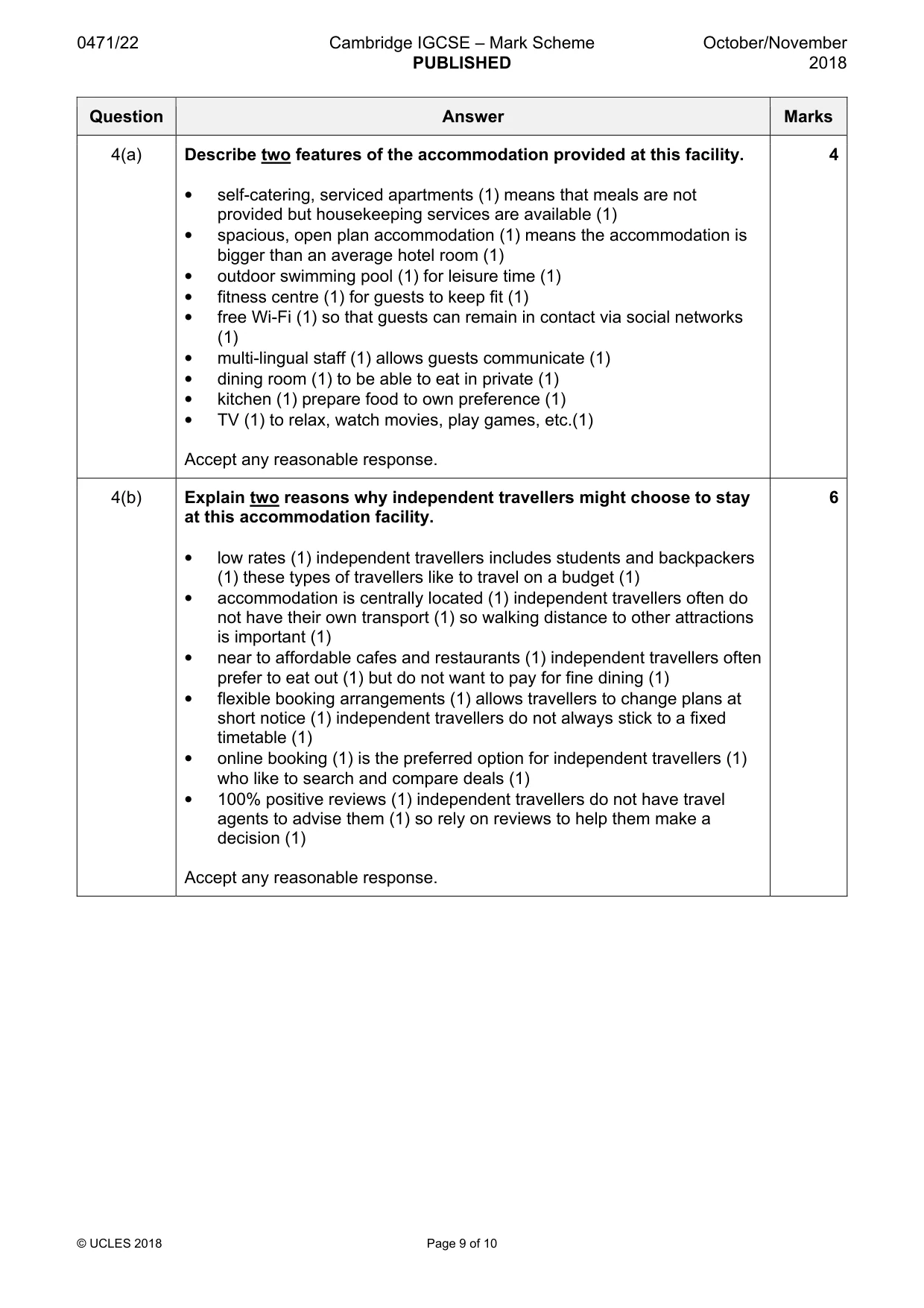
0471/22 Cambridge IGCSE – Mark Scheme PUBLISHED October/November 2018 © UCLES 2018 Page 9 of 10 Question Answer Marks 4(a) Describe two features of the accommodation provided at this facility. • self-catering, serviced apartments (1) means that meals are not provided but housekeeping services are available (1) • spacious, open plan accommodation (1) means the accommodation is bigger than an average hotel room (1) • outdoor swimming pool (1) for leisure time (1) • fitness centre (1) for guests to keep fit (1) • free Wi-Fi (1) so that guests can remain in contact via social networks (1) • multi-lingual staff (1) allows guests communicate (1) • dining room (1) to be able to eat in private (1) • kitchen (1) prepare food to own preference (1) • TV (1) to relax, watch movies, play games, etc.(1) Accept any reasonable response. 4 4(b) Explain two reasons why independent travellers might choose to stay at this accommodation facility. • low rates (1) independent travellers includes students and backpackers (1) these types of travellers like to travel on a budget (1) • accommodation is centrally located (1) independent travellers often do not have their own transport (1) so walking distance to other attractions is important (1) • near to affordable cafes and restaurants (1) independent travellers often prefer to eat out (1) but do not want to pay for fine dining (1) • flexible booking arrangements (1) allows travellers to change plans at short notice (1) independent travellers do not always stick to a fixed timetable (1) • online booking (1) is the preferred option for independent travellers (1) who like to search and compare deals (1) • 100% positive reviews (1) independent travellers do not have travel agents to advise them (1) so rely on reviews to help them make a decision (1) Accept any reasonable response. 6
Mark scheme, page 10
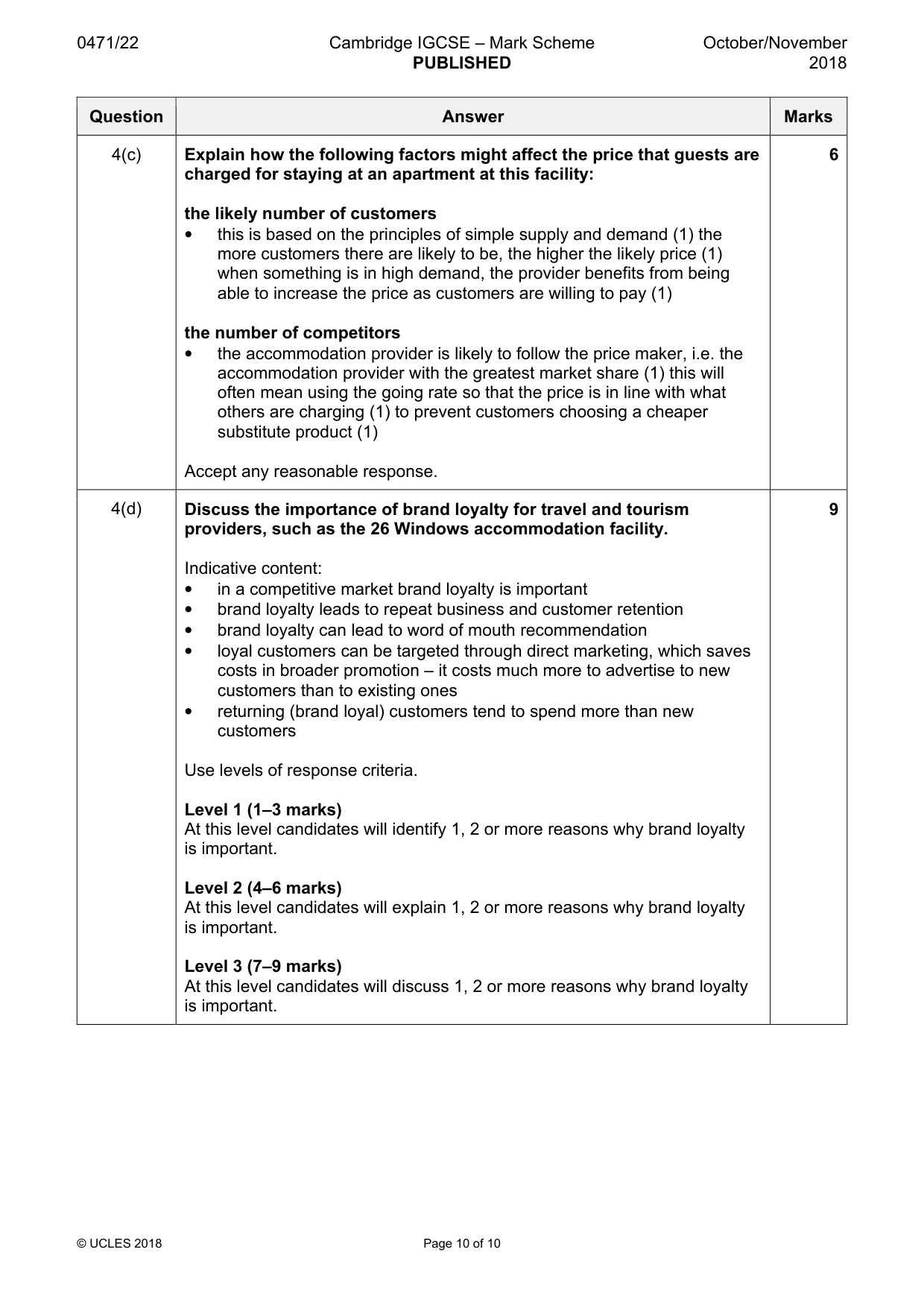
0471/22 Cambridge IGCSE – Mark Scheme PUBLISHED October/November 2018 © UCLES 2018 Page 10 of 10 Question Answer Marks 4(c) Explain how the following factors might affect the price that guests are charged for staying at an apartment at this facility: the likely number of customers • this is based on the principles of simple supply and demand (1) the more customers there are likely to be, the higher the likely price (1) when something is in high demand, the provider benefits from being able to increase the price as customers are willing to pay (1) the number of competitors • the accommodation provider is likely to follow the price maker, i.e. the accommodation provider with the greatest market share (1) this will often mean using the going rate so that the price is in line with what others are charging (1) to prevent customers choosing a cheaper substitute product (1) Accept any reasonable response. 6 4(d) Discuss the importance of brand loyalty for travel and tourism providers, such as the 26 Windows accommodation facility. Indicative content: • in a competitive market brand loyalty is important • brand loyalty leads to repeat business and customer retention • brand loyalty can lead to word of mouth recommendation • loyal customers can be targeted through direct marketing, which saves costs in broader promotion – it costs much more to advertise to new customers than to existing ones • returning (brand loyal) customers tend to spend more than new customers Use levels of response criteria. Level 1 (1–3 marks) At this level candidates will identify 1, 2 or more reasons why brand loyalty is important. Level 2 (4–6 marks) At this level candidates will explain 1, 2 or more reasons why brand loyalty is important. Level 3 (7–9 marks) At this level candidates will discuss 1, 2 or more reasons why brand loyalty is important. 9
What you needed in this session
Cambridge’s own grade thresholds for 2018 Oct/Nov, Paper 2 · Variant 2. A higher threshold means an easier paper — the bar moves with how the cohort did.