Cambridge IGCSE Travel and Tourism 0471 — 2018 May/June Paper 1 · Variant 2
0471/12/M/J/18 · 100 marks · ≈113 min
The question paper and its mark scheme, free to read here and free to download. This is Cambridge’s own paper, exactly as it was sat.
Question paper12 pages
Mark scheme12 pages
Answers below. Sit the paper first if you are practising.
Paper as text
Question paper, page 1
* 1 0 1 4 3 6 2 8 0 1 * This document consists of 12 printed pages and 1 Insert. DC (SC) 146168/1 © UCLES 2018 [Turn over Cambridge International Examinations Cambridge International General Certificate of Secondary Education TRAVEL AND TOURISM 0471/12 Core Module May/June 2018 2 hours Candidates answer on the Question Paper. No Additional Materials are required. READ THESE INSTRUCTIONS FIRST Write your Centre number, candidate number and name on all the work you hand in. Write in dark blue or black pen. You may use an HB pencil for any diagrams or graphs. Do not use staples, paper clips, glue or correction fluid. DO NOT WRITE IN ANY BARCODES. Answer all questions. All the Figures referred to in the questions are contained in the Insert. At the end of the examination, fasten all your work securely together. The number of marks is given in brackets [ ] at the end of each question or part question.
Question paper, page 2
2 0471/12/M/J/18 © UCLES 2018 Question 1 Refer to Fig. 1 (Insert), information on tourism in Goa, a state on the southwest coast of India. (a) Identify the following: • the number of international visitors to Goa … • the percentage increase in domestic visitors … • the total number of visitors to Goa … • the name of Goa’s bird sanctuary …[4] (b) Goa has a tropical monsoon climate. Explain how the monsoon climate affects tourism seasonality in Goa. … … … … … …[3] (c) Goa has a variety of accommodation types including homestays where tourists stay in the homes of local people. Explain two possible reasons for the appeal of homestays to international tourists. 1 … … … … 2 … … … …[4]
Question paper, page 3
3 0471/12/M/J/18 © UCLES 2018 [Turn over (d) Goa attracts more domestic visitors than international visitors. Explain two possible reasons for the appeal of Goa to domestic visitors. 1 … … … … 2 … … … …[4] (e) There are plans to develop Goa’s river tourism. State four ways that rivers in Goa may be developed for tourism use. 1 … … 2 … … 3 … … 4 … …[4]
Question paper, page 4
4 0471/12/M/J/18 © UCLES 2018 (f) Assess the benefits to Goa’s tourism industry of developing river tourism in Goa. … … … … … … … … … … … …[6] [Total: 25]
Question paper, page 5
5 0471/12/M/J/18 © UCLES 2018 [Turn over Question 2 Refer to Photograph A (Insert), tourists taking a guided tour around an indigenous Maori settlement in New Zealand. (a) Identify three ways that tourists are kept safe during the guided tour. 1 … 2 … 3 …[3] (b) Define the term guided tour. … … … …[2] (c) State three different types of training for tour guides. Explain how each type of training would benefit customers. Training 1: … How customers benefit: … … … Training 2: … How customers benefit: … … … Training 3: … How customers benefit: … … …[6]
Question paper, page 6
6 0471/12/M/J/18 © UCLES 2018 (d) Explain two ways that tour guides can be: welcoming … … … … ethical … … … …[4] (e) Explain how guided tours of indigenous settlements might contribute to the following negative social and cultural impacts: changes in family structure … … … … staged authenticity … … … …[4]
Question paper, page 7
7 0471/12/M/J/18 © UCLES 2018 [Turn over (f) Assess the benefits to indigenous communities of opening their settlements to tourists. … … … … … … … … … … … …[6] [Total: 25]
Question paper, page 8
8 0471/12/M/J/18 © UCLES 2018 Question 3 Refer to Photograph B (Insert), tourists checking in at an airport using the self-check-in machines. (a) Identify three customer facilities, other than self-check-in, shown in Photograph B. 1 … 2 … 3 …[3] (b) Describe the appeal of self-check-in at airports to the following tourists: business tourists … … … … families … … … …[4] (c) Explain three ways that airports provide for tourists in a wheelchair. 1 … … … … 2 … … … … 3 … … … …[6]
Question paper, page 9
9 0471/12/M/J/18 © UCLES 2018 [Turn over (d) Explain three likely negative impacts of airport expansion for the local population. 1 … … … … 2 … … … … 3 … … … …[6] (e) Assess the risks associated with destinations becoming over-dependent on tourism. … … … … … … … … … … … …[6] [Total: 25]
Question paper, page 10
10 0471/12/M/J/18 © UCLES 2018 Question 4 Refer to Fig. 2 (Insert), information on the Gotthard Base Tunnel in Switzerland. (a) Identify the following: • the journey time through the tunnel … • the name of the mountain range the tunnel passes through … • the speed the passenger trains will travel through the tunnel …[3] (b) Explain the benefits to tourists of purchasing train tickets in the following ways: online … … … … ticket counter at station … … … …[4]
Question paper, page 11
11 0471/12/M/J/18 © UCLES 2018 [Turn over (c) Explain three negative environmental impacts associated with mountain tourism. 1 … … … … 2 … … … … 3 … … … …[6] (d) Explain three risks to tourists associated with international travel. 1 … … … … 2 … … … … 3 … … … …[6]
Question paper, page 12
12 0471/12/M/J/18 © UCLES 2018 Permission to reproduce items where third-party owned material protected by copyright is included has been sought and cleared where possible. Every reasonable effort has been made by the publisher (UCLES) to trace copyright holders, but if any items requiring clearance have unwittingly been included, the publisher will be pleased to make amends at the earliest possible opportunity. To avoid the issue of disclosure of answer-related information to candidates, all copyright acknowledgements are reproduced online in the Cambridge International Examinations Copyright Acknowledgements Booklet. This is produced for each series of examinations and is freely available to download at www.cie.org.uk after the live examination series. Cambridge International Examinations is part of the Cambridge Assessment Group. Cambridge Assessment is the brand name of University of Cambridge Local Examinations Syndicate (UCLES), which is itself a department of the University of Cambridge. (e) Assess the appeal of train travel to tourists. … … … … … … … … … … … …[6] [Total: 25]
Mark scheme, page 1
IGCSE™ is a registered trademark. This document consists of 12 printed pages. © UCLES 2018 [Turn over Cambridge Assessment International Education Cambridge International General Certificate of Secondary Education TRAVEL & TOURISM 0471/12 Paper 1 May/June 2018 MARK SCHEME Maximum Mark: 100 Published This mark scheme is published as an aid to teachers and candidates, to indicate the requirements of the examination. It shows the basis on which Examiners were instructed to award marks. It does not indicate the details of the discussions that took place at an Examiners’ meeting before marking began, which would have considered the acceptability of alternative answers. Mark schemes should be read in conjunction with the question paper and the Principal Examiner Report for Teachers. Cambridge International will not enter into discussions about these mark schemes. Cambridge International is publishing the mark schemes for the May/June 2018 series for most Cambridge IGCSE™, Cambridge International A and AS Level and Cambridge Pre-U components, and some Cambridge O Level components.
Mark scheme, page 2
0471/12 Cambridge IGCSE – Mark Scheme PUBLISHED May/June 2018 © UCLES 2018 Page 2 of 12 Generic Marking Principles These general marking principles must be applied by all examiners when marking candidate answers. They should be applied alongside the specific content of the mark scheme or generic level descriptors for a question. Each question paper and mark scheme will also comply with these marking principles. GENERIC MARKING PRINCIPLE 1: Marks must be awarded in line with: • the specific content of the mark scheme or the generic level descriptors for the question • the specific skills defined in the mark scheme or in the generic level descriptors for the question • the standard of response required by a candidate as exemplified by the standardisation scripts. GENERIC MARKING PRINCIPLE 2: Marks awarded are always whole marks (not half marks, or other fractions). GENERIC MARKING PRINCIPLE 3: Marks must be awarded positively: • marks are awarded for correct/valid answers, as defined in the mark scheme. However, credit is given for valid answers which go beyond the scope of the syllabus and mark scheme, referring to your Team Leader as appropriate • marks are awarded when candidates clearly demonstrate what they know and can do • marks are not deducted for errors • marks are not deducted for omissions • answers should only be judged on the quality of spelling, punctuation and grammar when these features are specifically assessed by the question as indicated by the mark scheme. The meaning, however, should be unambiguous. GENERIC MARKING PRINCIPLE 4: Rules must be applied consistently e.g. in situations where candidates have not followed instructions or in the application of generic level descriptors. GENERIC MARKING PRINCIPLE 5: Marks should be awarded using the full range of marks defined in the mark scheme for the question (however; the use of the full mark range may be limited according to the quality of the candidate responses seen). GENERIC MARKING PRINCIPLE 6: Marks awarded are based solely on the requirements as defined in the mark scheme. Marks should not be awarded with grade thresholds or grade descriptors in mind.
Mark scheme, page 3
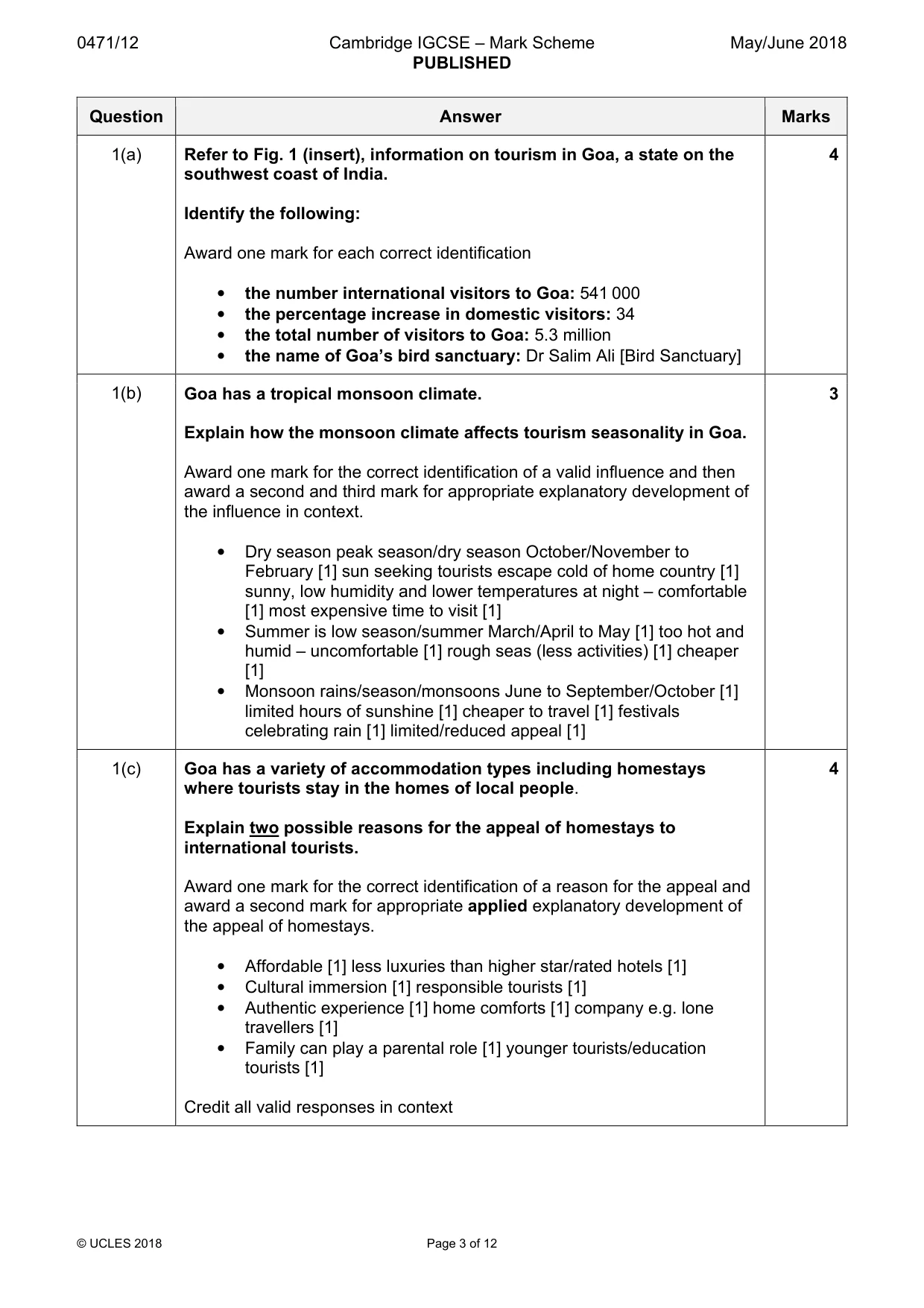
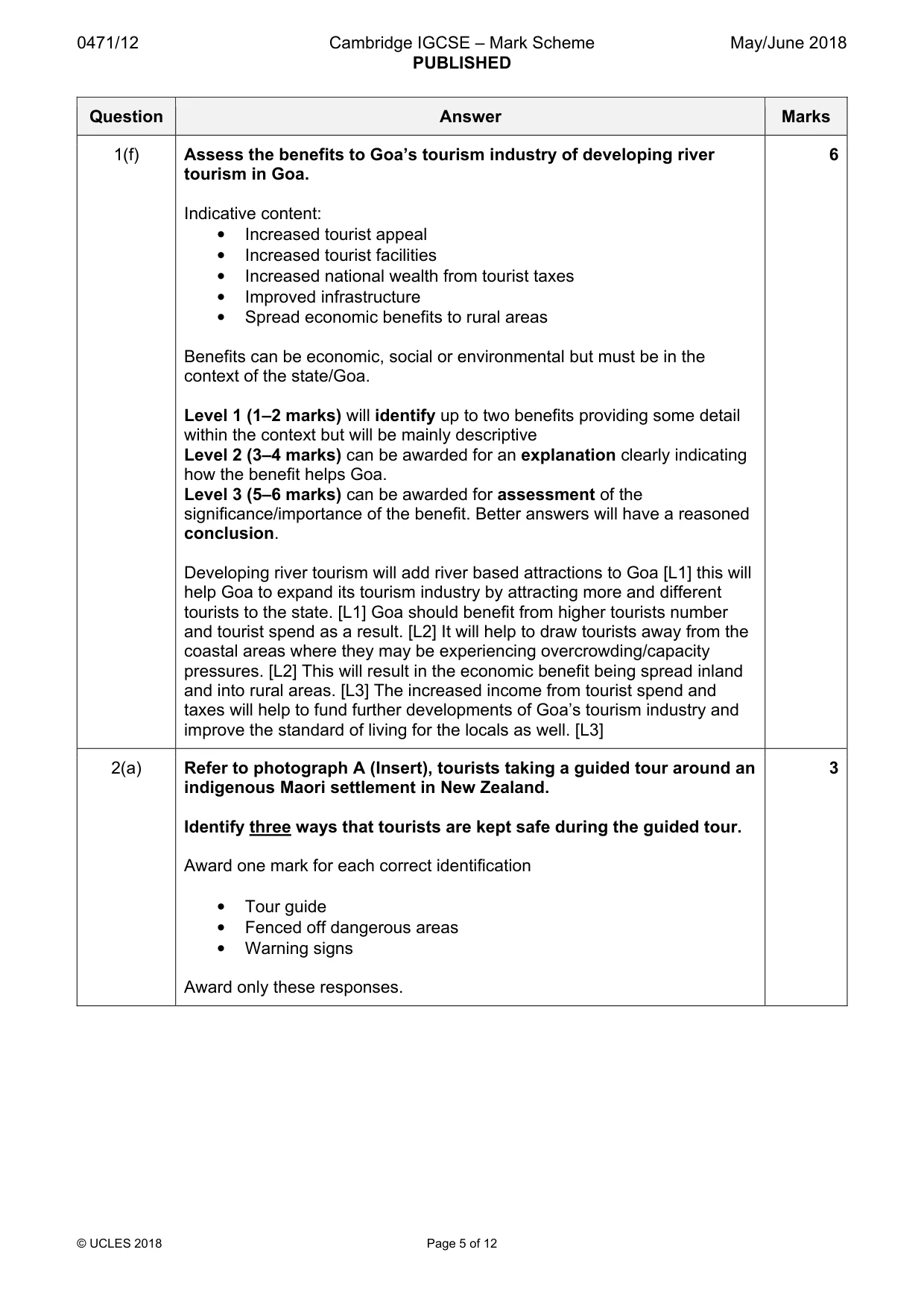
0471/12 Cambridge IGCSE – Mark Scheme PUBLISHED May/June 2018 © UCLES 2018 Page 3 of 12 Question Answer Marks 1(a) Refer to Fig. 1 (insert), information on tourism in Goa, a state on the southwest coast of India. Identify the following: Award one mark for each correct identification • the number international visitors to Goa: 541 000 • the percentage increase in domestic visitors: 34 • the total number of visitors to Goa: 5.3 million • the name of Goa’s bird sanctuary: Dr Salim Ali [Bird Sanctuary] 4 1(b) Goa has a tropical monsoon climate. Explain how the monsoon climate affects tourism seasonality in Goa. Award one mark for the correct identification of a valid influence and then award a second and third mark for appropriate explanatory development of the influence in context. • Dry season peak season/dry season October/November to February [1] sun seeking tourists escape cold of home country [1] sunny, low humidity and lower temperatures at night – comfortable [1] most expensive time to visit [1] • Summer is low season/summer March/April to May [1] too hot and humid – uncomfortable [1] rough seas (less activities) [1] cheaper [1] • Monsoon rains/season/monsoons June to September/October [1] limited hours of sunshine [1] cheaper to travel [1] festivals celebrating rain [1] limited/reduced appeal [1] 3 1(c) Goa has a variety of accommodation types including homestays where tourists stay in the homes of local people. Explain two possible reasons for the appeal of homestays to international tourists. Award one mark for the correct identification of a reason for the appeal and award a second mark for appropriate applied explanatory development of the appeal of homestays. • Affordable [1] less luxuries than higher star/rated hotels [1] • Cultural immersion [1] responsible tourists [1] • Authentic experience [1] home comforts [1] company e.g. lone travellers [1] • Family can play a parental role [1] younger tourists/education tourists [1] Credit all valid responses in context 4
Mark scheme, page 4
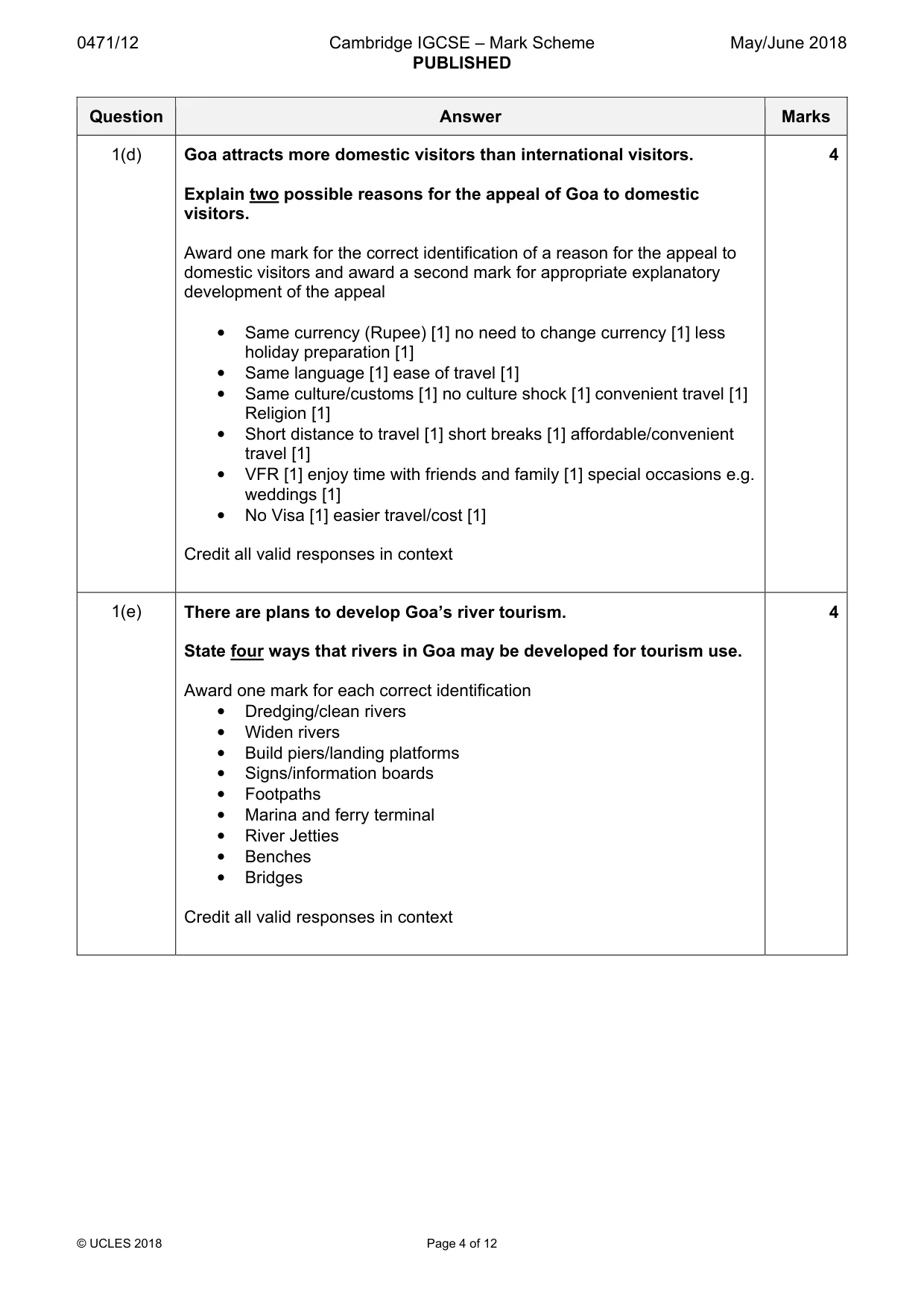
0471/12 Cambridge IGCSE – Mark Scheme PUBLISHED May/June 2018 © UCLES 2018 Page 4 of 12 Question Answer Marks 1(d) Goa attracts more domestic visitors than international visitors. Explain two possible reasons for the appeal of Goa to domestic visitors. Award one mark for the correct identification of a reason for the appeal to domestic visitors and award a second mark for appropriate explanatory development of the appeal • Same currency (Rupee) [1] no need to change currency [1] less holiday preparation [1] • Same language [1] ease of travel [1] • Same culture/customs [1] no culture shock [1] convenient travel [1] Religion [1] • Short distance to travel [1] short breaks [1] affordable/convenient travel [1] • VFR [1] enjoy time with friends and family [1] special occasions e.g. weddings [1] • No Visa [1] easier travel/cost [1] Credit all valid responses in context 4 1(e) There are plans to develop Goa’s river tourism. State four ways that rivers in Goa may be developed for tourism use. Award one mark for each correct identification • Dredging/clean rivers • Widen rivers • Build piers/landing platforms • Signs/information boards • Footpaths • Marina and ferry terminal • River Jetties • Benches • Bridges Credit all valid responses in context 4
Mark scheme, page 5
0471/12 Cambridge IGCSE – Mark Scheme PUBLISHED May/June 2018 © UCLES 2018 Page 5 of 12 Question Answer Marks 1(f) Assess the benefits to Goa’s tourism industry of developing river tourism in Goa. Indicative content: • Increased tourist appeal • Increased tourist facilities • Increased national wealth from tourist taxes • Improved infrastructure • Spread economic benefits to rural areas Benefits can be economic, social or environmental but must be in the context of the state/Goa. Level 1 (1–2 marks) will identify up to two benefits providing some detail within the context but will be mainly descriptive Level 2 (3–4 marks) can be awarded for an explanation clearly indicating how the benefit helps Goa. Level 3 (5–6 marks) can be awarded for assessment of the significance/importance of the benefit. Better answers will have a reasoned conclusion. Developing river tourism will add river based attractions to Goa [L1] this will help Goa to expand its tourism industry by attracting more and different tourists to the state. [L1] Goa should benefit from higher tourists number and tourist spend as a result. [L2] It will help to draw tourists away from the coastal areas where they may be experiencing overcrowding/capacity pressures. [L2] This will result in the economic benefit being spread inland and into rural areas. [L3] The increased income from tourist spend and taxes will help to fund further developments of Goa’s tourism industry and improve the standard of living for the locals as well. [L3] 6 2(a) Refer to photograph A (Insert), tourists taking a guided tour around an indigenous Maori settlement in New Zealand. Identify three ways that tourists are kept safe during the guided tour. Award one mark for each correct identification • Tour guide • Fenced off dangerous areas • Warning signs Award only these responses. 3
Mark scheme, page 6
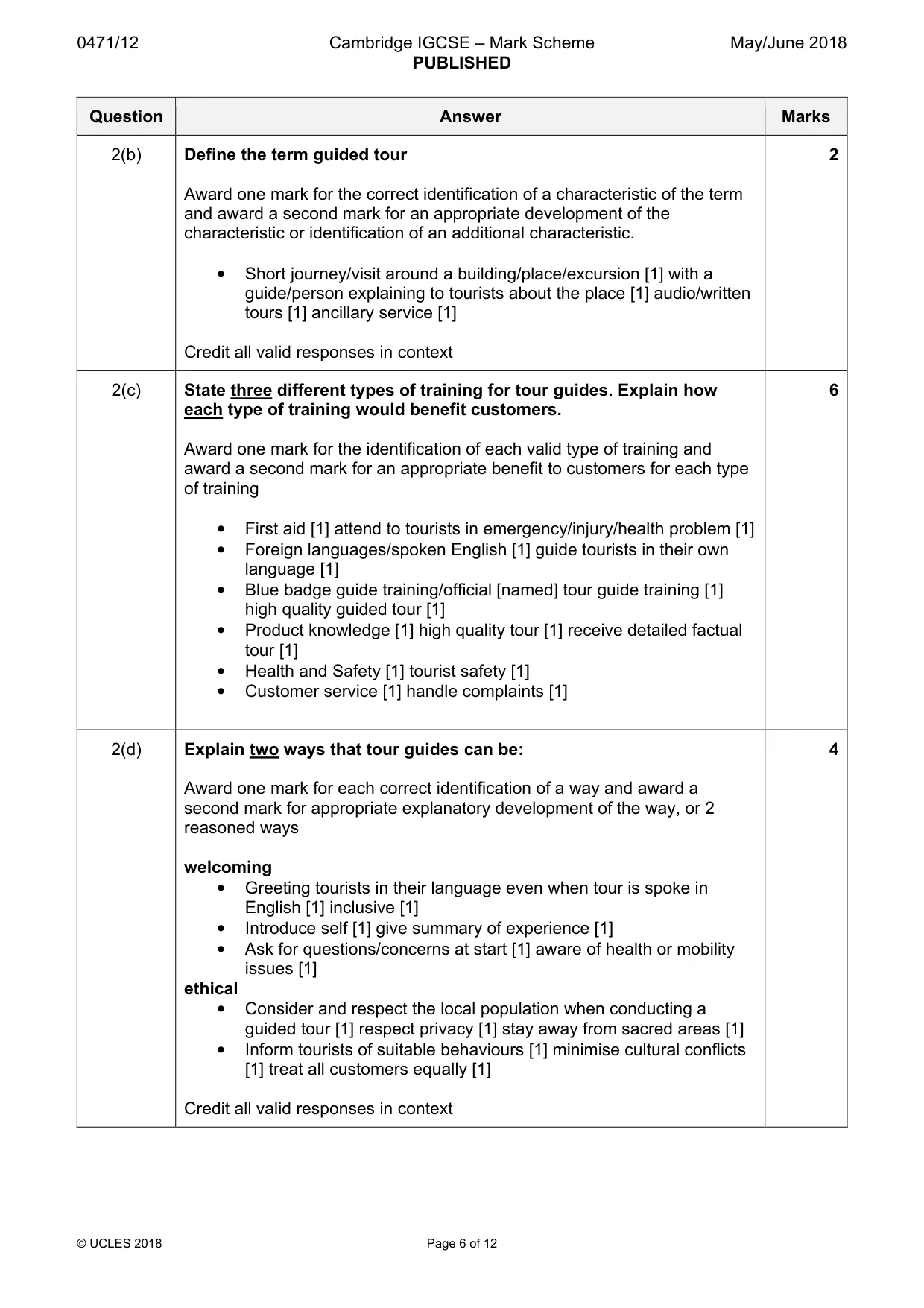
0471/12 Cambridge IGCSE – Mark Scheme PUBLISHED May/June 2018 © UCLES 2018 Page 6 of 12 Question Answer Marks 2(b) Define the term guided tour Award one mark for the correct identification of a characteristic of the term and award a second mark for an appropriate development of the characteristic or identification of an additional characteristic. • Short journey/visit around a building/place/excursion [1] with a guide/person explaining to tourists about the place [1] audio/written tours [1] ancillary service [1] Credit all valid responses in context 2 2(c) State three different types of training for tour guides. Explain how each type of training would benefit customers. Award one mark for the identification of each valid type of training and award a second mark for an appropriate benefit to customers for each type of training • First aid [1] attend to tourists in emergency/injury/health problem [1] • Foreign languages/spoken English [1] guide tourists in their own language [1] • Blue badge guide training/official [named] tour guide training [1] high quality guided tour [1] • Product knowledge [1] high quality tour [1] receive detailed factual tour [1] • Health and Safety [1] tourist safety [1] • Customer service [1] handle complaints [1] 6 2(d) Explain two ways that tour guides can be: Award one mark for each correct identification of a way and award a second mark for appropriate explanatory development of the way, or 2 reasoned ways welcoming • Greeting tourists in their language even when tour is spoke in English [1] inclusive [1] • Introduce self [1] give summary of experience [1] • Ask for questions/concerns at start [1] aware of health or mobility issues [1] ethical • Consider and respect the local population when conducting a guided tour [1] respect privacy [1] stay away from sacred areas [1] • Inform tourists of suitable behaviours [1] minimise cultural conflicts [1] treat all customers equally [1] Credit all valid responses in context 4
Mark scheme, page 7
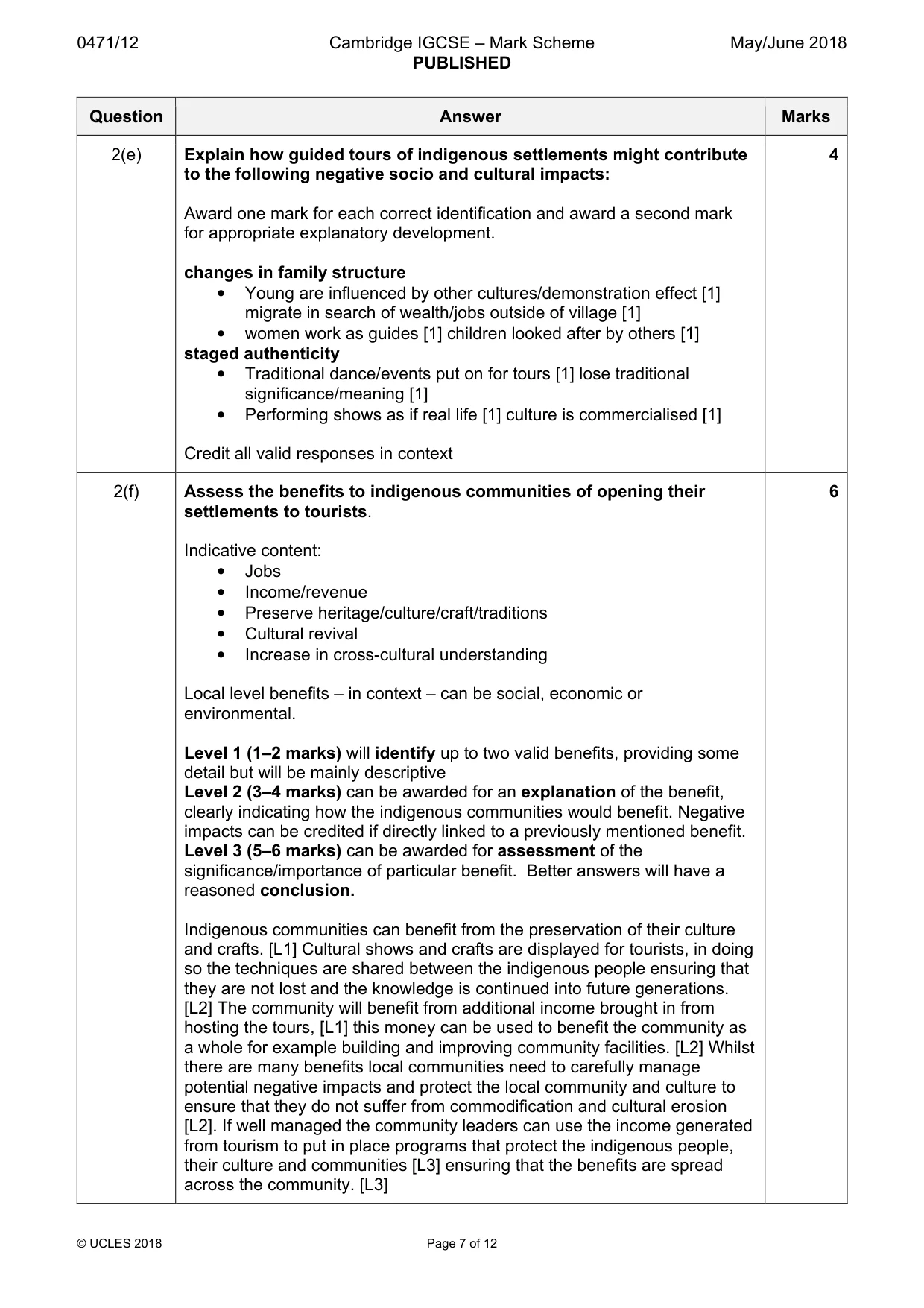
0471/12 Cambridge IGCSE – Mark Scheme PUBLISHED May/June 2018 © UCLES 2018 Page 7 of 12 Question Answer Marks 2(e) Explain how guided tours of indigenous settlements might contribute to the following negative socio and cultural impacts: Award one mark for each correct identification and award a second mark for appropriate explanatory development. changes in family structure • Young are influenced by other cultures/demonstration effect [1] migrate in search of wealth/jobs outside of village [1] • women work as guides [1] children looked after by others [1] staged authenticity • Traditional dance/events put on for tours [1] lose traditional significance/meaning [1] • Performing shows as if real life [1] culture is commercialised [1] Credit all valid responses in context 4 2(f) Assess the benefits to indigenous communities of opening their settlements to tourists. Indicative content: • Jobs • Income/revenue • Preserve heritage/culture/craft/traditions • Cultural revival • Increase in cross-cultural understanding Local level benefits – in context – can be social, economic or environmental. Level 1 (1–2 marks) will identify up to two valid benefits, providing some detail but will be mainly descriptive Level 2 (3–4 marks) can be awarded for an explanation of the benefit, clearly indicating how the indigenous communities would benefit. Negative impacts can be credited if directly linked to a previously mentioned benefit. Level 3 (5–6 marks) can be awarded for assessment of the significance/importance of particular benefit. Better answers will have a reasoned conclusion. Indigenous communities can benefit from the preservation of their culture and crafts. [L1] Cultural shows and crafts are displayed for tourists, in doing so the techniques are shared between the indigenous people ensuring that they are not lost and the knowledge is continued into future generations. [L2] The community will benefit from additional income brought in from hosting the tours, [L1] this money can be used to benefit the community as a whole for example building and improving community facilities. [L2] Whilst there are many benefits local communities need to carefully manage potential negative impacts and protect the local community and culture to ensure that they do not suffer from commodification and cultural erosion [L2]. If well managed the community leaders can use the income generated from tourism to put in place programs that protect the indigenous people, their culture and communities [L3] ensuring that the benefits are spread across the community. [L3] 6
Mark scheme, page 8
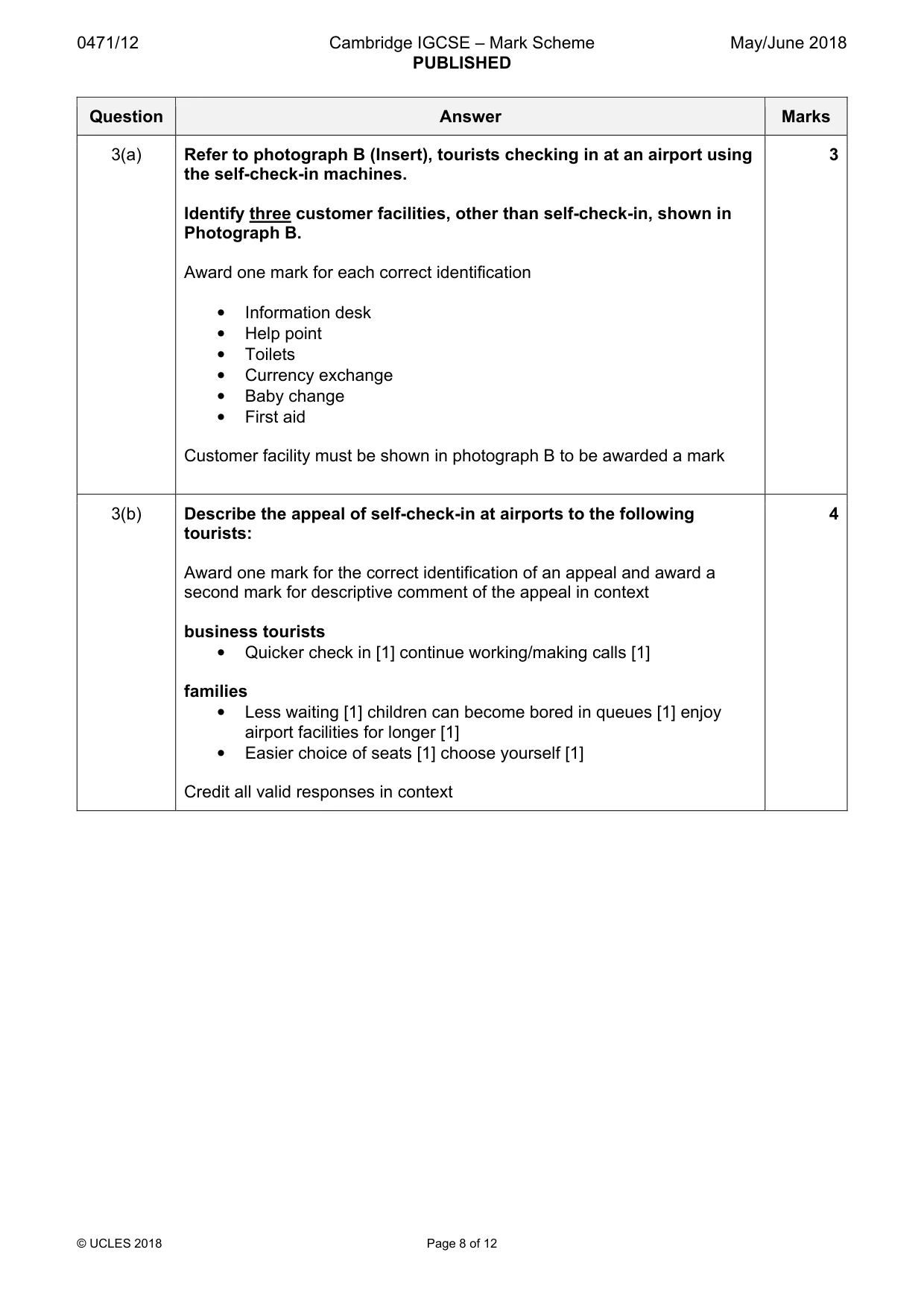
0471/12 Cambridge IGCSE – Mark Scheme PUBLISHED May/June 2018 © UCLES 2018 Page 8 of 12 Question Answer Marks 3(a) Refer to photograph B (Insert), tourists checking in at an airport using the self-check-in machines. Identify three customer facilities, other than self-check-in, shown in Photograph B. Award one mark for each correct identification • Information desk • Help point • Toilets • Currency exchange • Baby change • First aid Customer facility must be shown in photograph B to be awarded a mark 3 3(b) Describe the appeal of self-check-in at airports to the following tourists: Award one mark for the correct identification of an appeal and award a second mark for descriptive comment of the appeal in context business tourists • Quicker check in [1] continue working/making calls [1] families • Less waiting [1] children can become bored in queues [1] enjoy airport facilities for longer [1] • Easier choice of seats [1] choose yourself [1] Credit all valid responses in context 4
Mark scheme, page 9
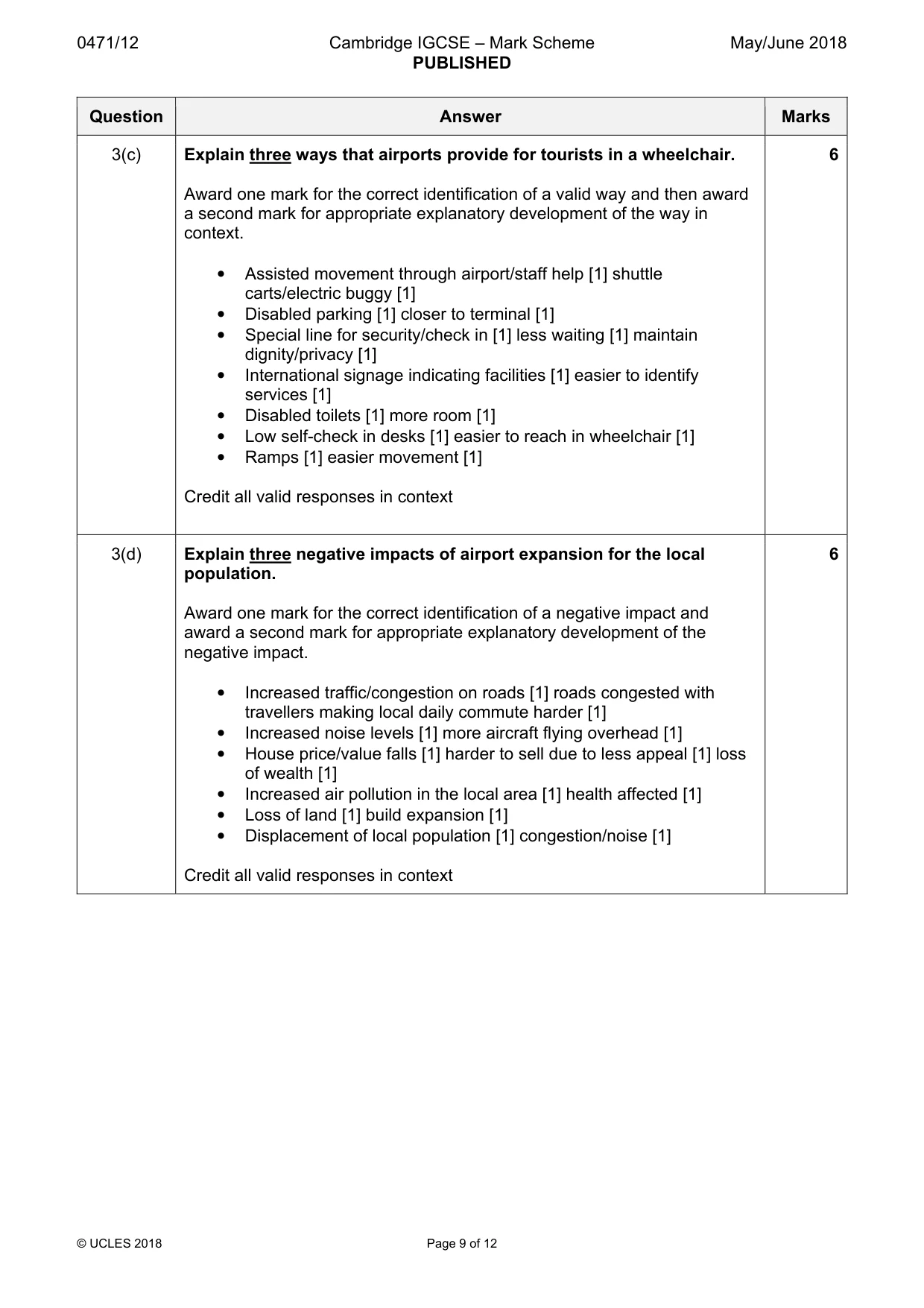
0471/12 Cambridge IGCSE – Mark Scheme PUBLISHED May/June 2018 © UCLES 2018 Page 9 of 12 Question Answer Marks 3(c) Explain three ways that airports provide for tourists in a wheelchair. Award one mark for the correct identification of a valid way and then award a second mark for appropriate explanatory development of the way in context. • Assisted movement through airport/staff help [1] shuttle carts/electric buggy [1] • Disabled parking [1] closer to terminal [1] • Special line for security/check in [1] less waiting [1] maintain dignity/privacy [1] • International signage indicating facilities [1] easier to identify services [1] • Disabled toilets [1] more room [1] • Low self-check in desks [1] easier to reach in wheelchair [1] • Ramps [1] easier movement [1] Credit all valid responses in context 6 3(d) Explain three negative impacts of airport expansion for the local population. Award one mark for the correct identification of a negative impact and award a second mark for appropriate explanatory development of the negative impact. • Increased traffic/congestion on roads [1] roads congested with travellers making local daily commute harder [1] • Increased noise levels [1] more aircraft flying overhead [1] • House price/value falls [1] harder to sell due to less appeal [1] loss of wealth [1] • Increased air pollution in the local area [1] health affected [1] • Loss of land [1] build expansion [1] • Displacement of local population [1] congestion/noise [1] Credit all valid responses in context 6
Mark scheme, page 10
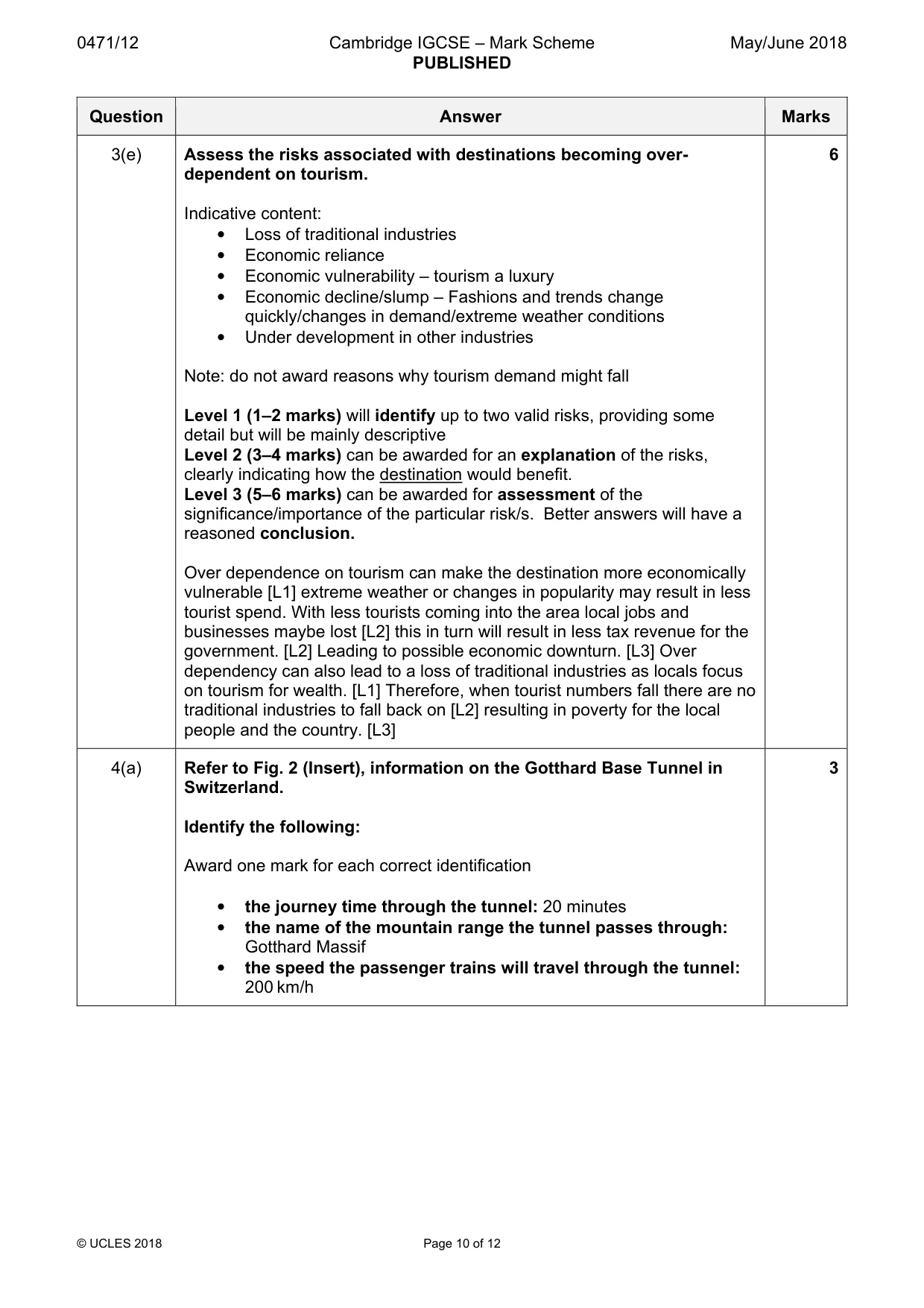
0471/12 Cambridge IGCSE – Mark Scheme PUBLISHED May/June 2018 © UCLES 2018 Page 10 of 12 Question Answer Marks 3(e) Assess the risks associated with destinations becoming over- dependent on tourism. Indicative content: • Loss of traditional industries • Economic reliance • Economic vulnerability – tourism a luxury • Economic decline/slump – Fashions and trends change quickly/changes in demand/extreme weather conditions • Under development in other industries Note: do not award reasons why tourism demand might fall Level 1 (1–2 marks) will identify up to two valid risks, providing some detail but will be mainly descriptive Level 2 (3–4 marks) can be awarded for an explanation of the risks, clearly indicating how the destination would benefit. Level 3 (5–6 marks) can be awarded for assessment of the significance/importance of the particular risk/s. Better answers will have a reasoned conclusion. Over dependence on tourism can make the destination more economically vulnerable [L1] extreme weather or changes in popularity may result in less tourist spend. With less tourists coming into the area local jobs and businesses maybe lost [L2] this in turn will result in less tax revenue for the government. [L2] Leading to possible economic downturn. [L3] Over dependency can also lead to a loss of traditional industries as locals focus on tourism for wealth. [L1] Therefore, when tourist numbers fall there are no traditional industries to fall back on [L2] resulting in poverty for the local people and the country. [L3] 6 4(a) Refer to Fig. 2 (Insert), information on the Gotthard Base Tunnel in Switzerland. Identify the following: Award one mark for each correct identification • the journey time through the tunnel: 20 minutes • the name of the mountain range the tunnel passes through: Gotthard Massif • the speed the passenger trains will travel through the tunnel: 200 km/h 3
Mark scheme, page 11
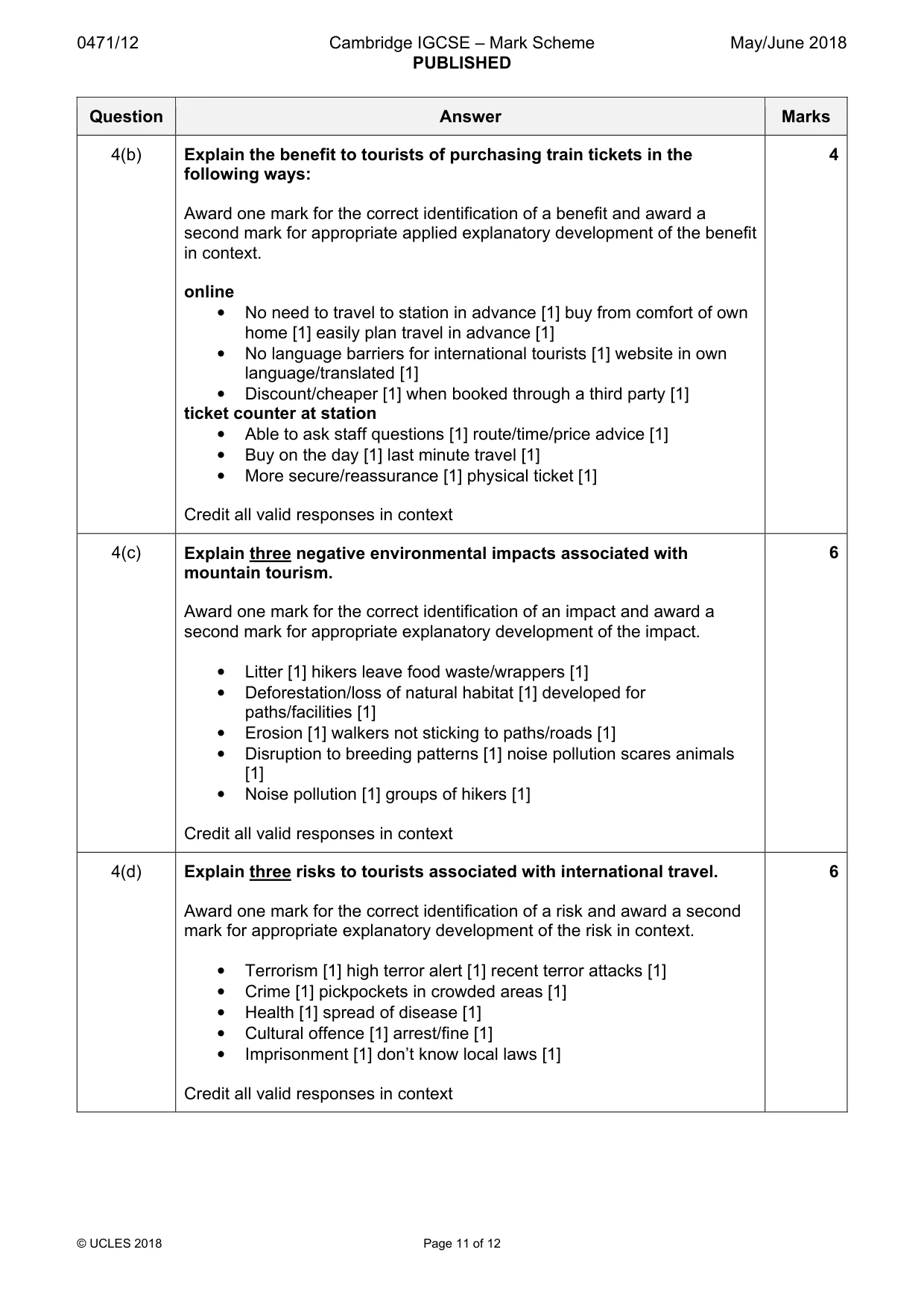
0471/12 Cambridge IGCSE – Mark Scheme PUBLISHED May/June 2018 © UCLES 2018 Page 11 of 12 Question Answer Marks 4(b) Explain the benefit to tourists of purchasing train tickets in the following ways: Award one mark for the correct identification of a benefit and award a second mark for appropriate applied explanatory development of the benefit in context. online • No need to travel to station in advance [1] buy from comfort of own home [1] easily plan travel in advance [1] • No language barriers for international tourists [1] website in own language/translated [1] • Discount/cheaper [1] when booked through a third party [1] ticket counter at station • Able to ask staff questions [1] route/time/price advice [1] • Buy on the day [1] last minute travel [1] • More secure/reassurance [1] physical ticket [1] Credit all valid responses in context 4 4(c) Explain three negative environmental impacts associated with mountain tourism. Award one mark for the correct identification of an impact and award a second mark for appropriate explanatory development of the impact. • Litter [1] hikers leave food waste/wrappers [1] • Deforestation/loss of natural habitat [1] developed for paths/facilities [1] • Erosion [1] walkers not sticking to paths/roads [1] • Disruption to breeding patterns [1] noise pollution scares animals [1] • Noise pollution [1] groups of hikers [1] Credit all valid responses in context 6 4(d) Explain three risks to tourists associated with international travel. Award one mark for the correct identification of a risk and award a second mark for appropriate explanatory development of the risk in context. • Terrorism [1] high terror alert [1] recent terror attacks [1] • Crime [1] pickpockets in crowded areas [1] • Health [1] spread of disease [1] • Cultural offence [1] arrest/fine [1] • Imprisonment [1] don’t know local laws [1] Credit all valid responses in context 6
Mark scheme, page 12
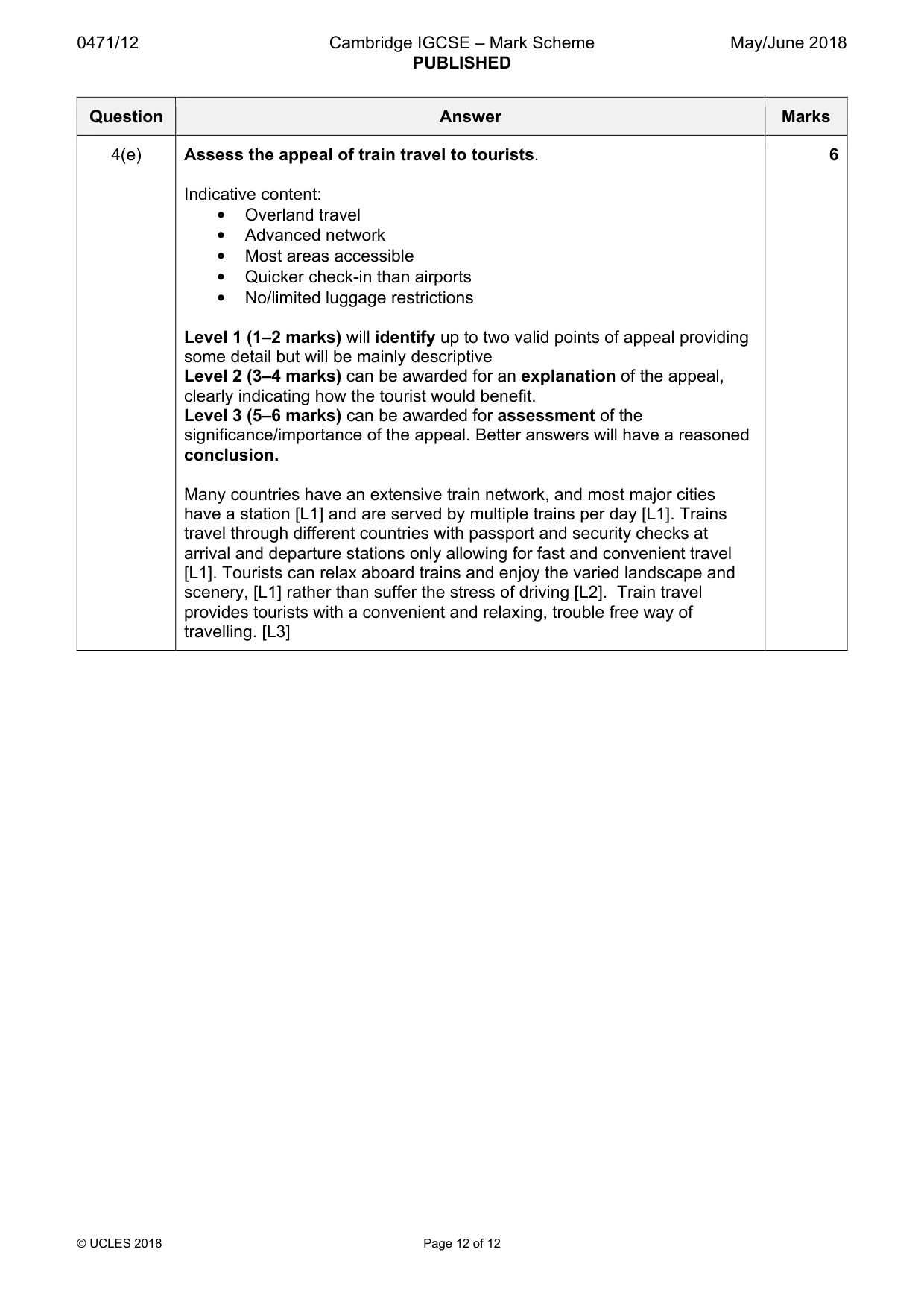
0471/12 Cambridge IGCSE – Mark Scheme PUBLISHED May/June 2018 © UCLES 2018 Page 12 of 12 Question Answer Marks 4(e) Assess the appeal of train travel to tourists. Indicative content: • Overland travel • Advanced network • Most areas accessible • Quicker check-in than airports • No/limited luggage restrictions Level 1 (1–2 marks) will identify up to two valid points of appeal providing some detail but will be mainly descriptive Level 2 (3–4 marks) can be awarded for an explanation of the appeal, clearly indicating how the tourist would benefit. Level 3 (5–6 marks) can be awarded for assessment of the significance/importance of the appeal. Better answers will have a reasoned conclusion. Many countries have an extensive train network, and most major cities have a station [L1] and are served by multiple trains per day [L1]. Trains travel through different countries with passport and security checks at arrival and departure stations only allowing for fast and convenient travel [L1]. Tourists can relax aboard trains and enjoy the varied landscape and scenery, [L1] rather than suffer the stress of driving [L2]. Train travel provides tourists with a convenient and relaxing, trouble free way of travelling. [L3] 6
What you needed in this session
Cambridge’s own grade thresholds for 2018 May/June, Paper 1 · Variant 2. A higher threshold means an easier paper — the bar moves with how the cohort did.