Cambridge IGCSE Travel and Tourism 0471 — 2018 May/June Paper 1 · Variant 1
0471/11/M/J/18 · 100 marks · ≈113 min
The question paper and its mark scheme, free to read here and free to download. This is Cambridge’s own paper, exactly as it was sat.
Question paper12 pages

Mark scheme12 pages
Answers below. Sit the paper first if you are practising.
Paper as text
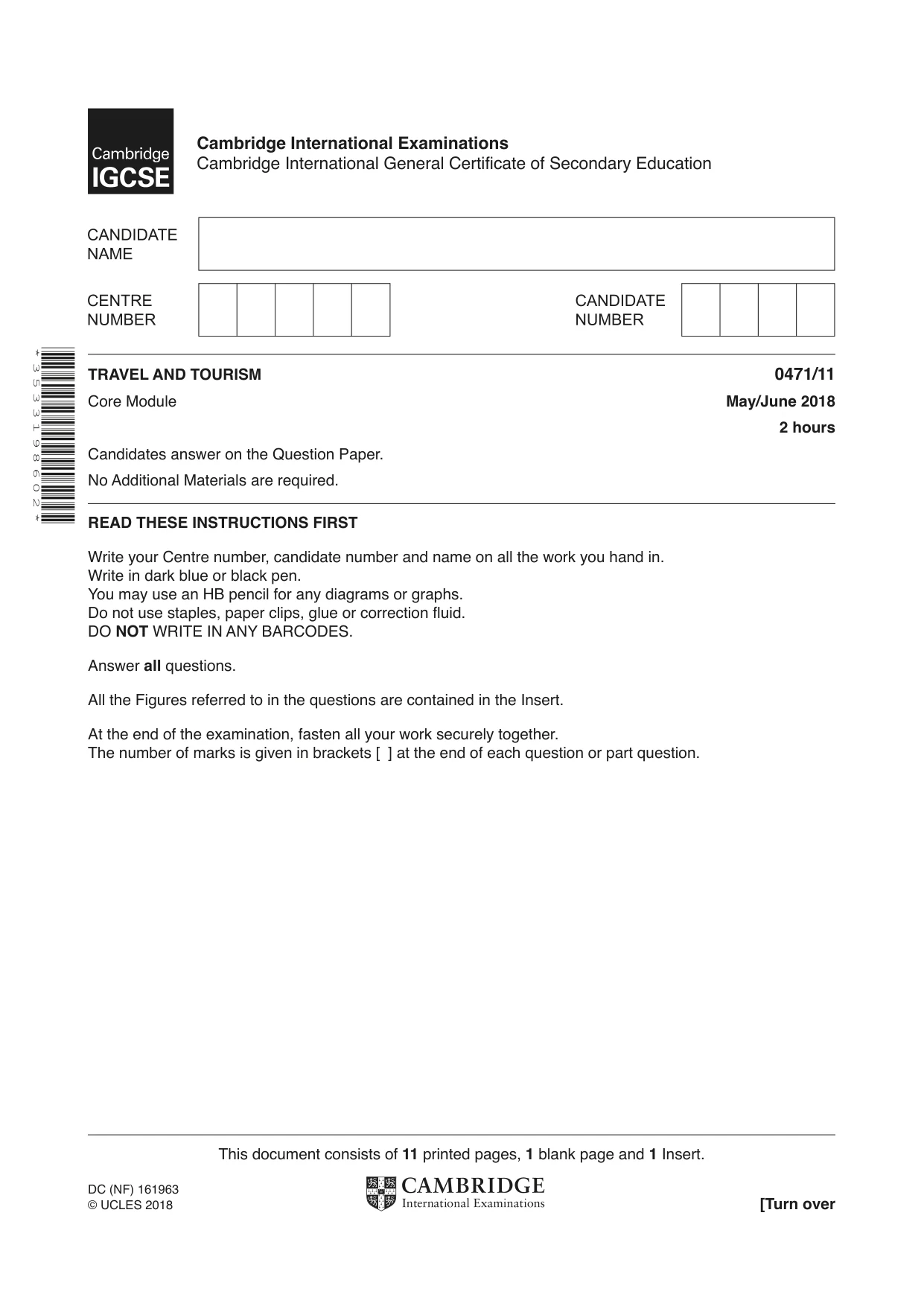
Question paper, page 1
* 3 5 3 3 1 9 8 6 0 2 * This document consists of 11 printed pages, 1 blank page and 1 Insert. DC (NF) 161963 © UCLES 2018 [Turn over Cambridge International Examinations Cambridge International General Certificate of Secondary Education TRAVEL AND TOURISM 0471/11 Core Module May/June 2018 2 hours Candidates answer on the Question Paper. No Additional Materials are required. READ THESE INSTRUCTIONS FIRST Write your Centre number, candidate number and name on all the work you hand in. Write in dark blue or black pen. You may use an HB pencil for any diagrams or graphs. Do not use staples, paper clips, glue or correction fluid. DO NOT WRITE IN ANY BARCODES. Answer all questions. All the Figures referred to in the questions are contained in the Insert. At the end of the examination, fasten all your work securely together. The number of marks is given in brackets [ ] at the end of each question or part question.
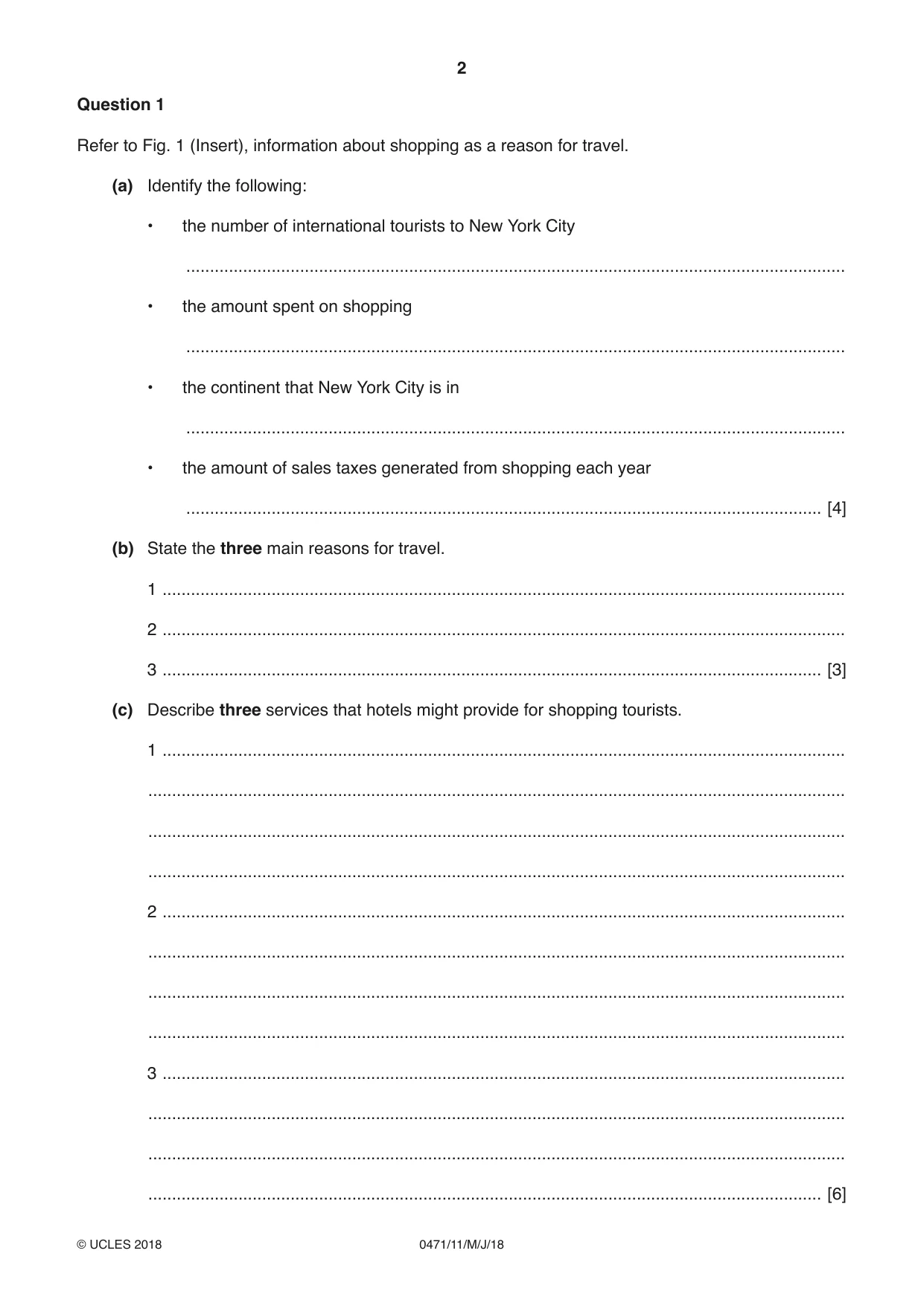
Question paper, page 2
2 0471/11/M/J/18 © UCLES 2018 Question 1 Refer to Fig. 1 (Insert), information about shopping as a reason for travel. (a) Identify the following: • the number of international tourists to New York City … • the amount spent on shopping … • the continent that New York City is in … • the amount of sales taxes generated from shopping each year … [4] (b) State the three main reasons for travel. 1 … 2 … 3 … [3] (c) Describe three services that hotels might provide for shopping tourists. 1 … … … … 2 … … … … 3 … … … … [6]
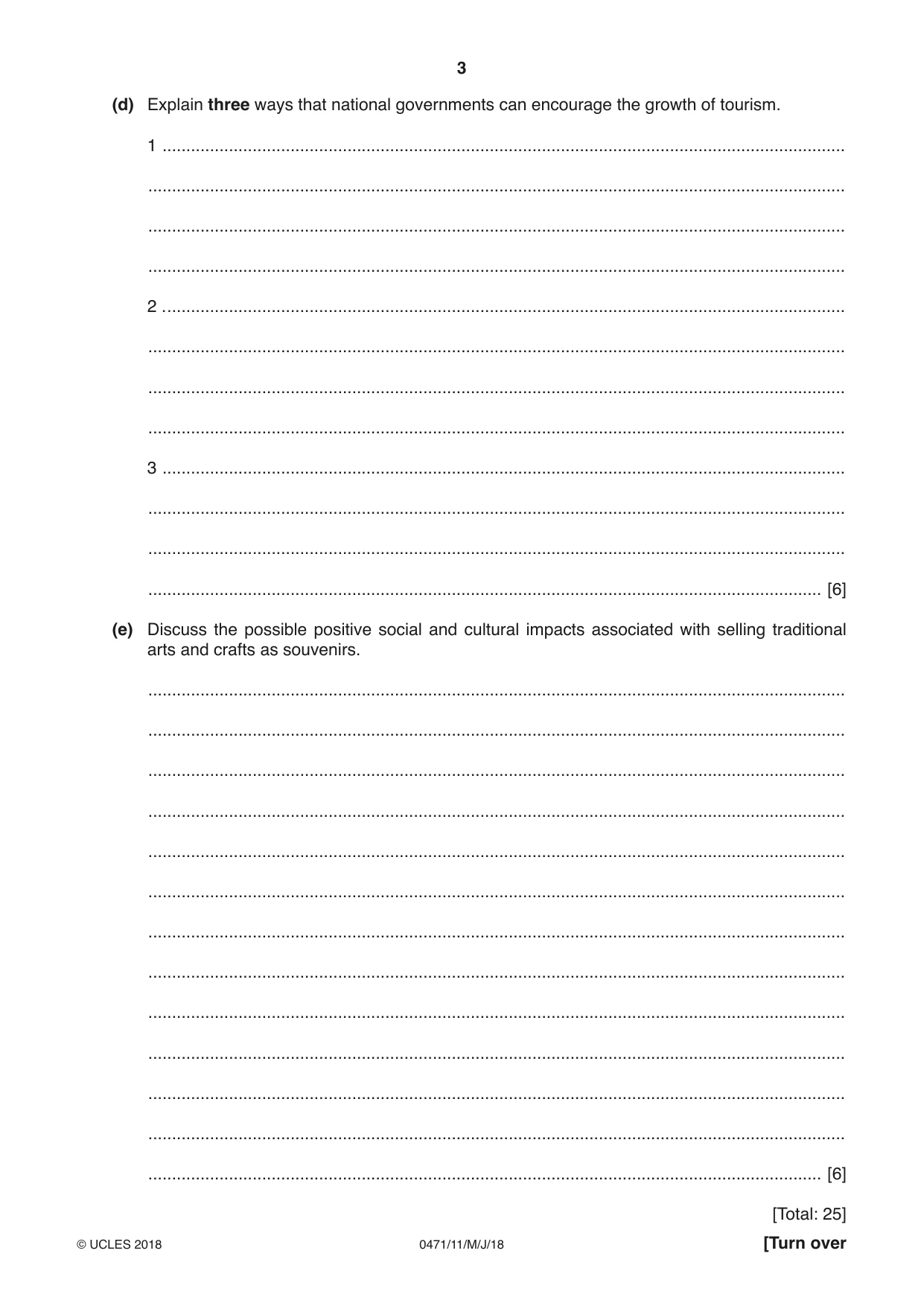
Question paper, page 3
3 0471/11/M/J/18 © UCLES 2018 [Turn over (d) Explain three ways that national governments can encourage the growth of tourism. 1 … … … … 2 . … … … … 3 … … … … [6] (e) Discuss the possible positive social and cultural impacts associated with selling traditional arts and crafts as souvenirs. … … … … … … … … … … … … … [6] [Total: 25]
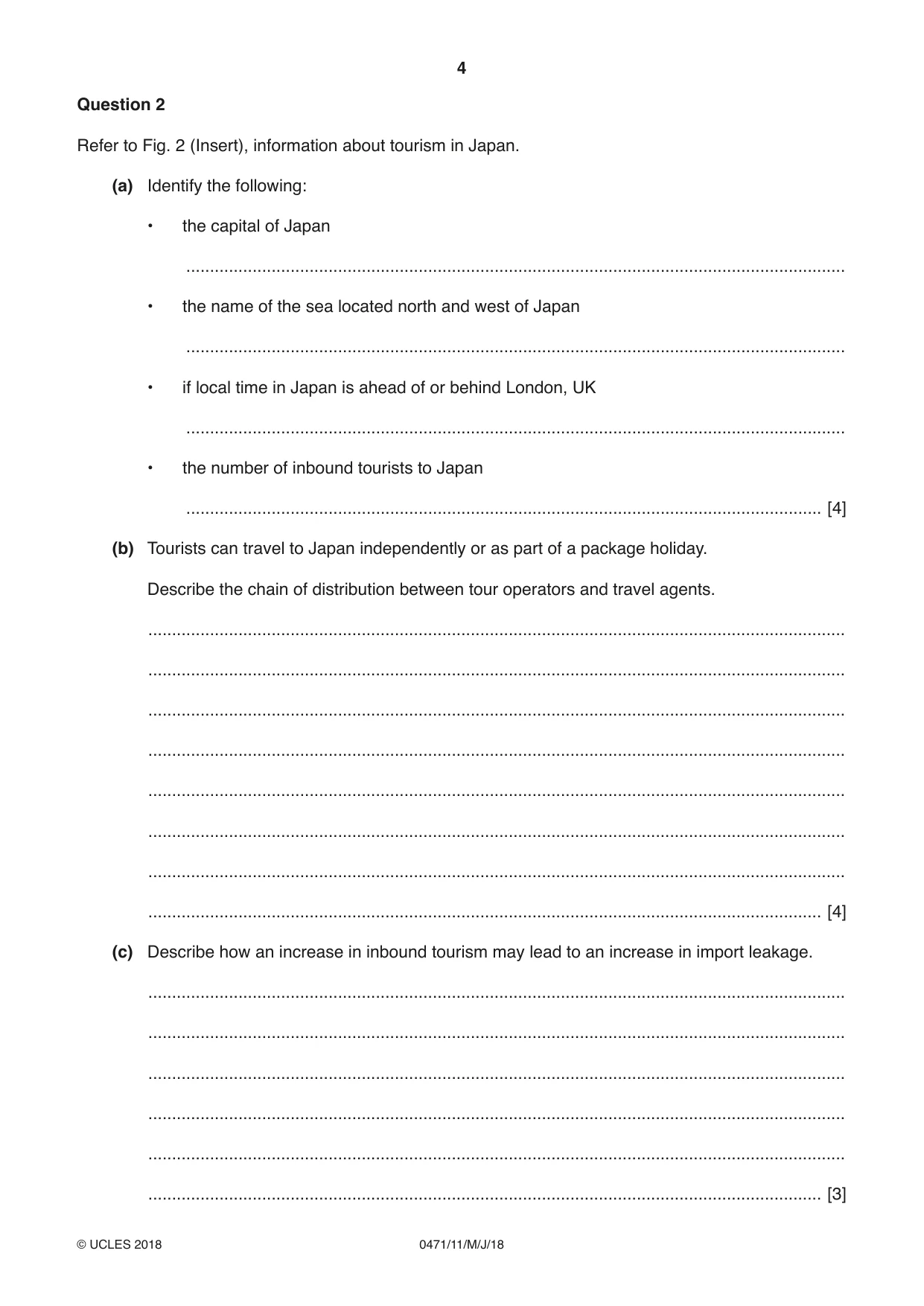
Question paper, page 4
4 0471/11/M/J/18 © UCLES 2018 Question 2 Refer to Fig. 2 (Insert), information about tourism in Japan. (a) Identify the following: • the capital of Japan … • the name of the sea located north and west of Japan … • if local time in Japan is ahead of or behind London, UK … • the number of inbound tourists to Japan … [4] (b) Tourists can travel to Japan independently or as part of a package holiday. Describe the chain of distribution between tour operators and travel agents. … … … … … … … … [4] (c) Describe how an increase in inbound tourism may lead to an increase in import leakage. … … … … … … [3]
Question paper, page 5
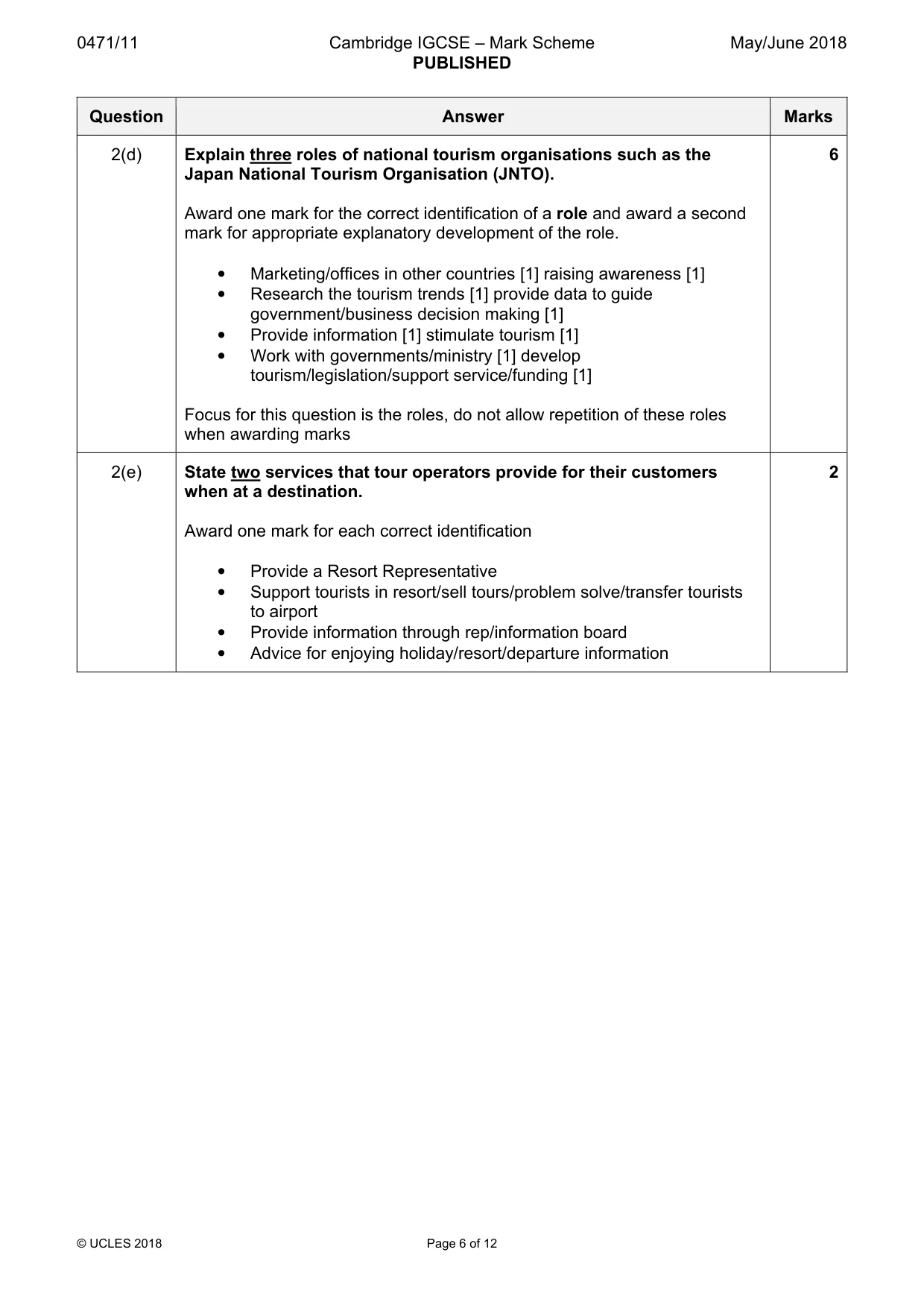
5 0471/11/M/J/18 © UCLES 2018 [Turn over (d) Explain three roles of national tourism organisations such as the Japan National Tourism Organisation (JNTO). 1 … … … … 2 … … … … 3 … … … … [6] (e) State two services that tour operators provide for their customers when at a destination. 1 … … 2 … … [2]
Question paper, page 6
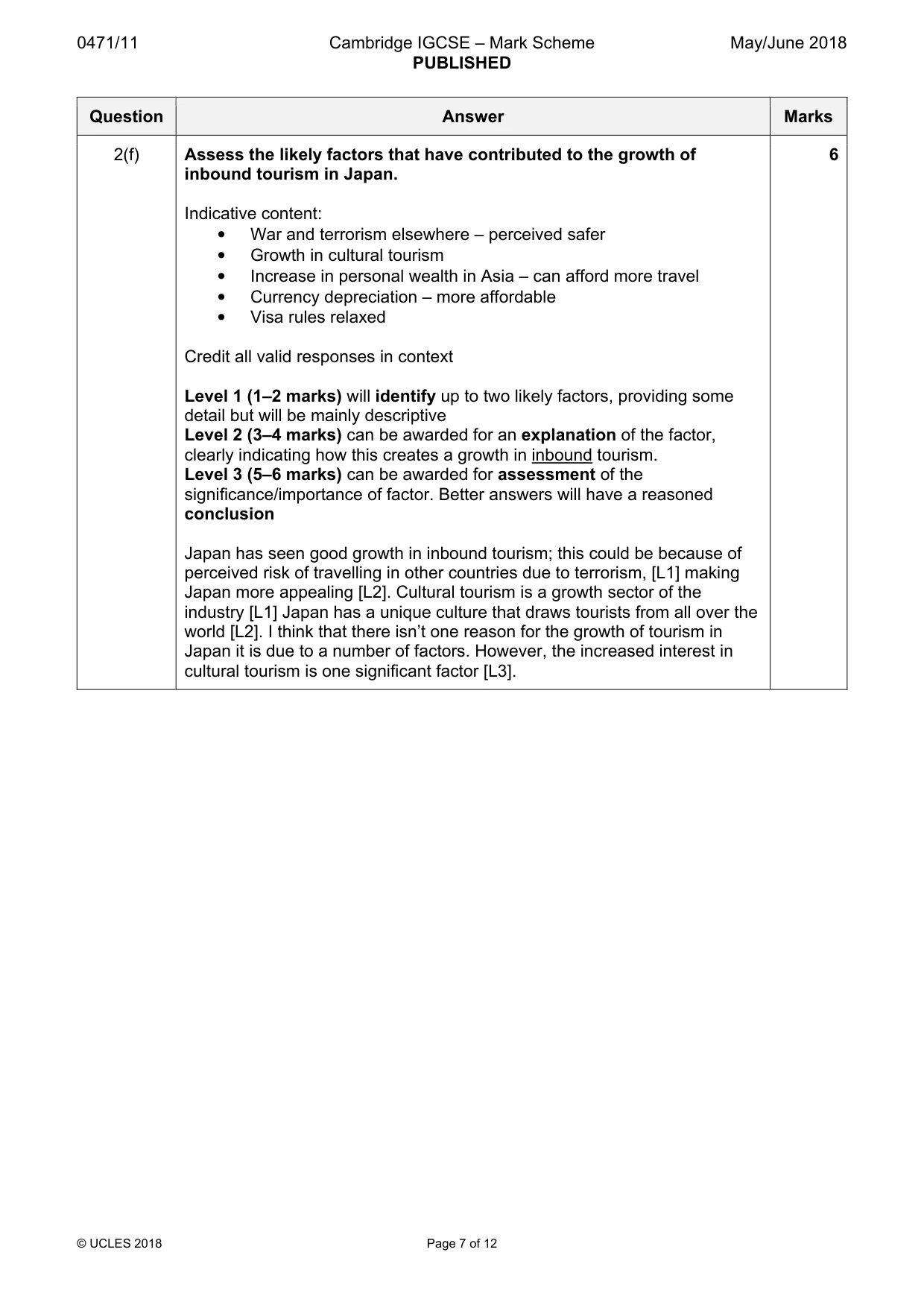
6 0471/11/M/J/18 © UCLES 2018 (f) Assess the likely factors that have contributed to the growth of inbound tourism in Japan. … … … … … … … … … … … … [6] [Total: 25]
Question paper, page 7
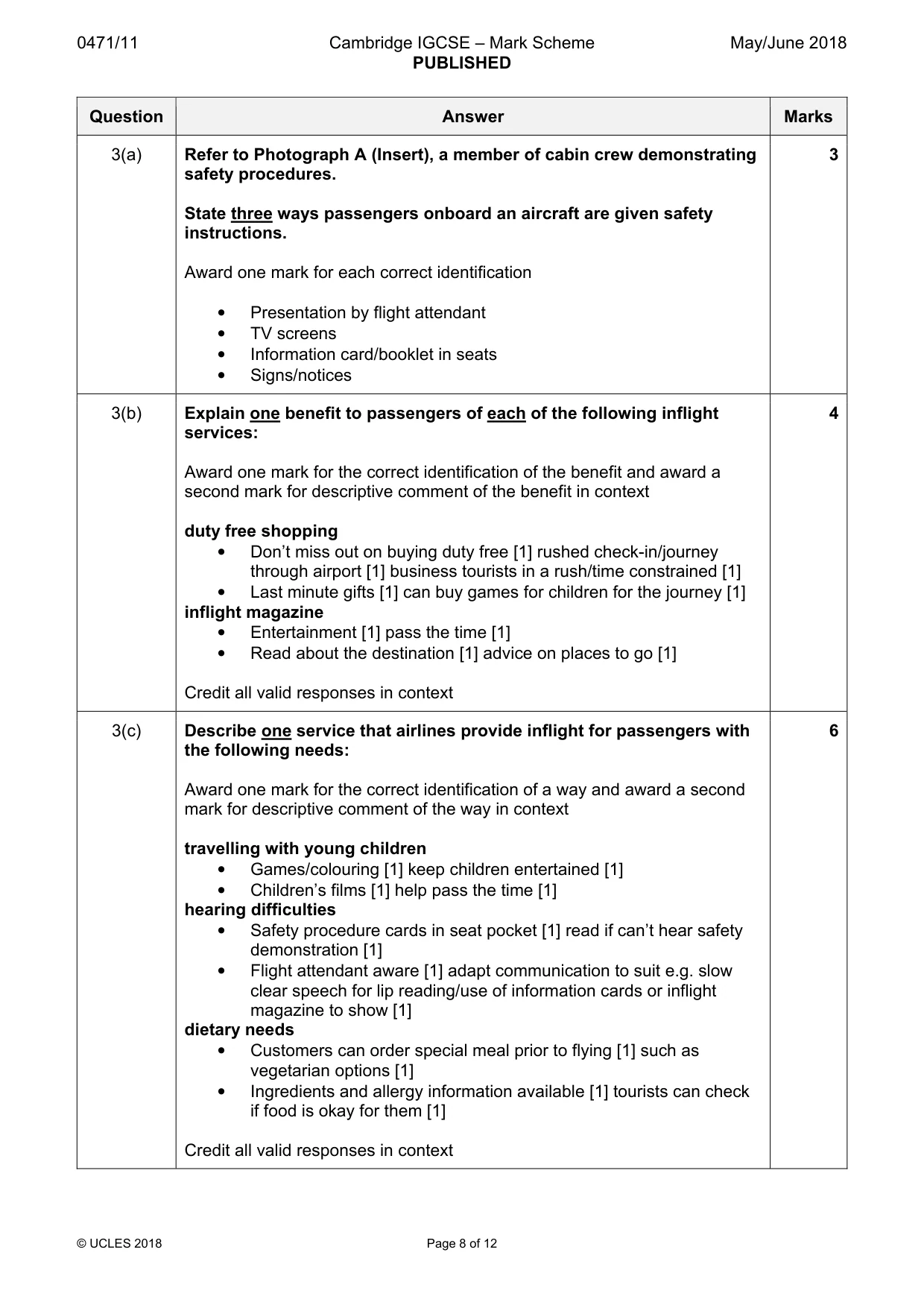
7 0471/11/M/J/18 © UCLES 2018 [Turn over Question 3 Refer to Photograph A (Insert), a member of cabin crew demonstrating safety procedures. (a) State three ways passengers onboard an aircraft are given safety instructions. 1 … … 2 … … 3 … … [3] (b) Explain one benefit to passengers of each of the following inflight services: duty free shopping … … … … inflight magazine … … … … [4]
Question paper, page 8
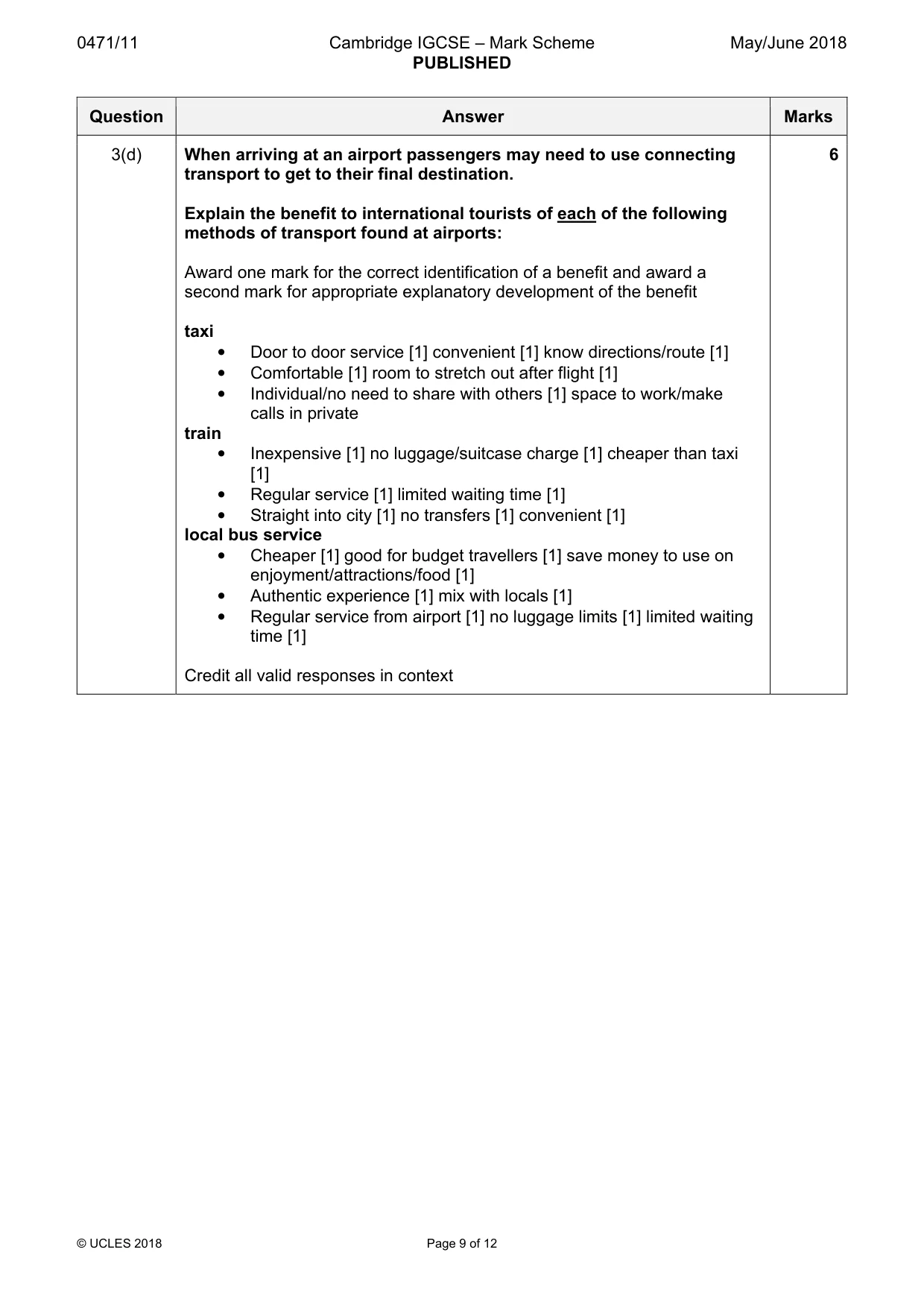
8 0471/11/M/J/18 © UCLES 2018 (c) Describe one service that airlines provide inflight for passengers with the following needs: travelling with young children … … … … hearing difficulties … … … … dietary needs … … … … [6] (d) When arriving at an airport passengers may need to use connecting transport to get to their final destination. Explain the benefit to international tourists of each of the following methods of transport found at airports: taxi … … … … train … … … … local bus service … … … … [6]
Question paper, page 9
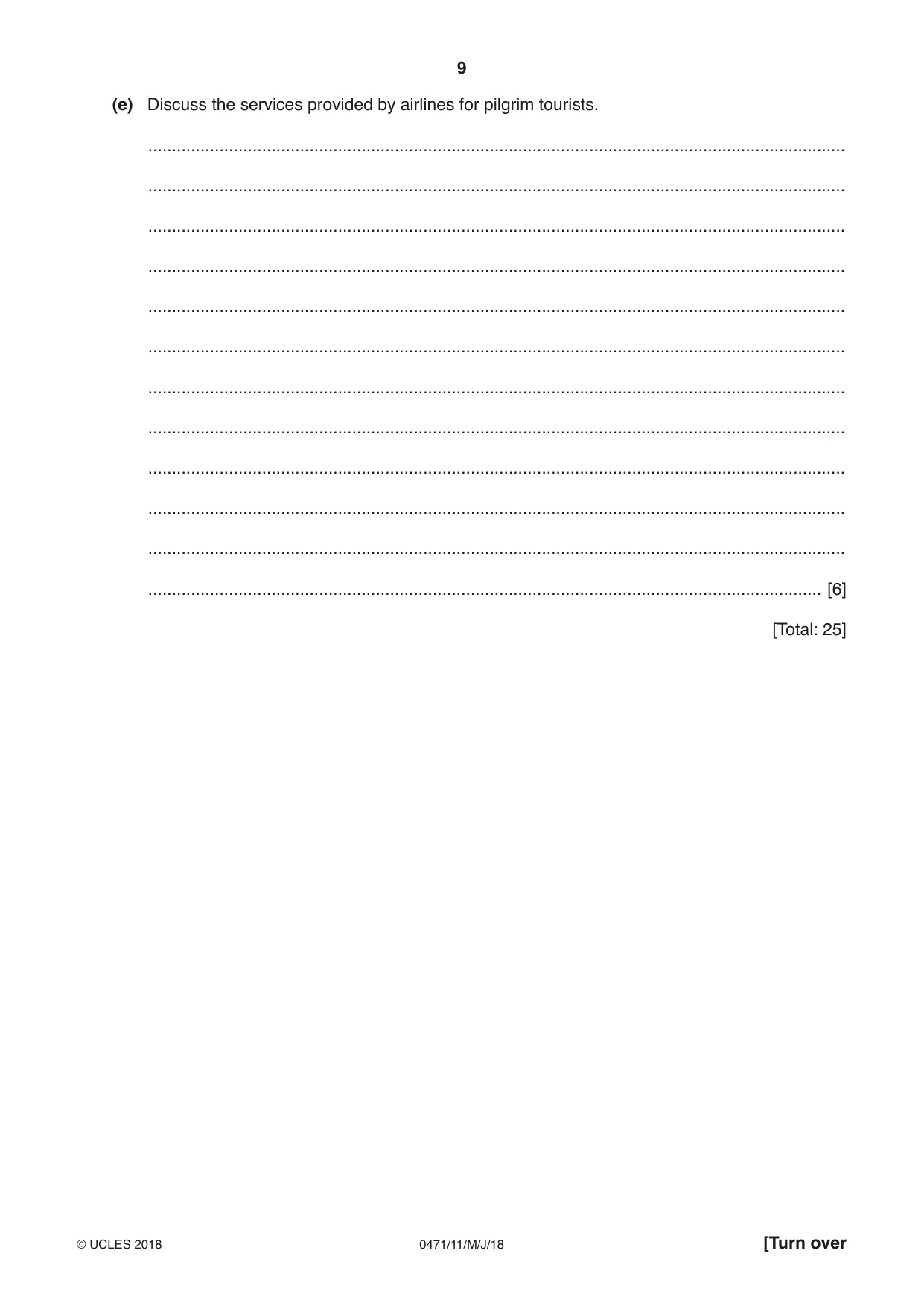
9 0471/11/M/J/18 © UCLES 2018 [Turn over (e) Discuss the services provided by airlines for pilgrim tourists. … … … … … … … … … … … … [6] [Total: 25]
Question paper, page 10
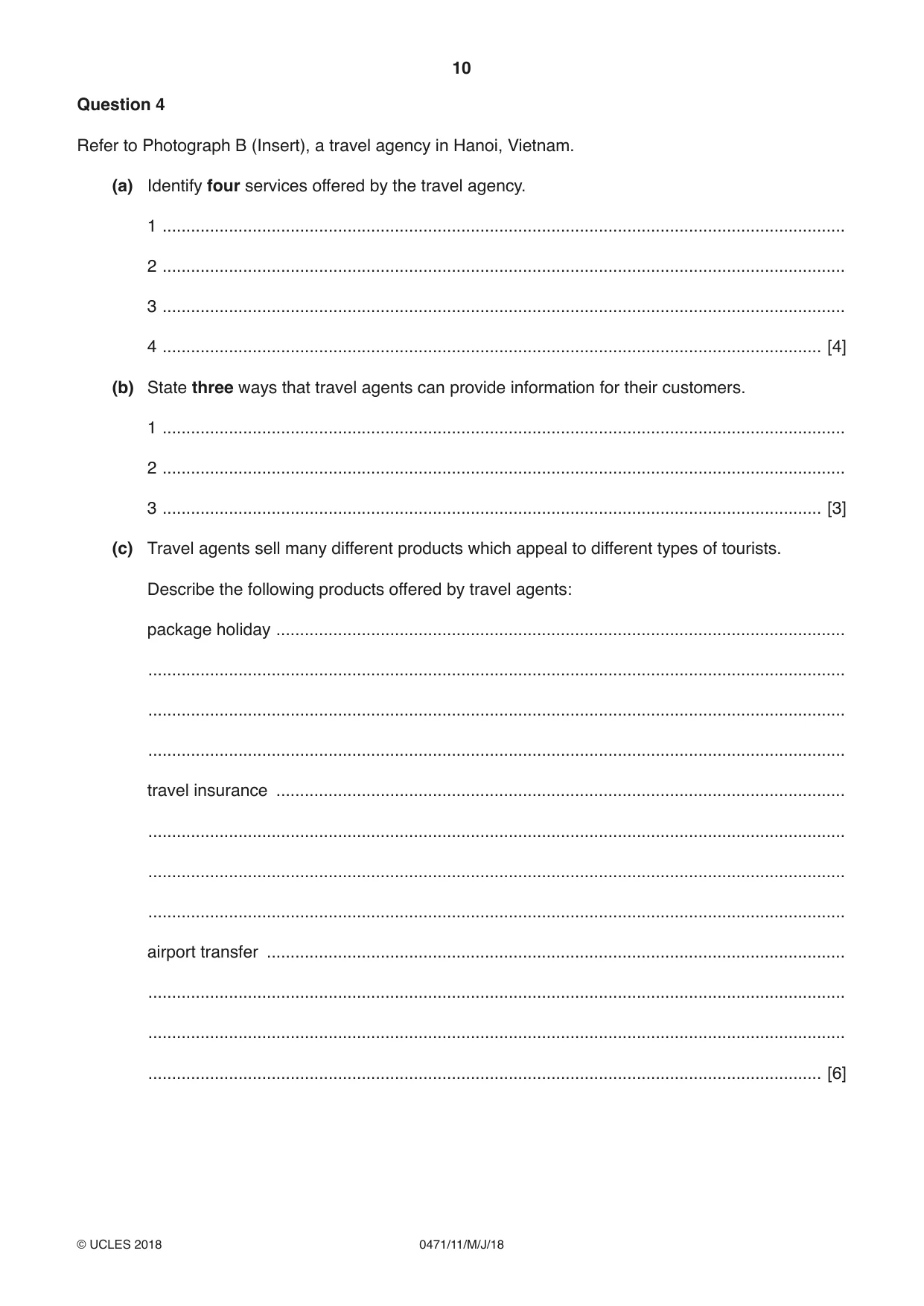
10 0471/11/M/J/18 © UCLES 2018 Question 4 Refer to Photograph B (Insert), a travel agency in Hanoi, Vietnam. (a) Identify four services offered by the travel agency. 1 … 2 … 3 … 4 … [4] (b) State three ways that travel agents can provide information for their customers. 1 … 2 … 3 … [3] (c) Travel agents sell many different products which appeal to different types of tourists. Describe the following products offered by travel agents: package holiday … … … … travel insurance … … … … airport transfer … … … … [6]
Question paper, page 11
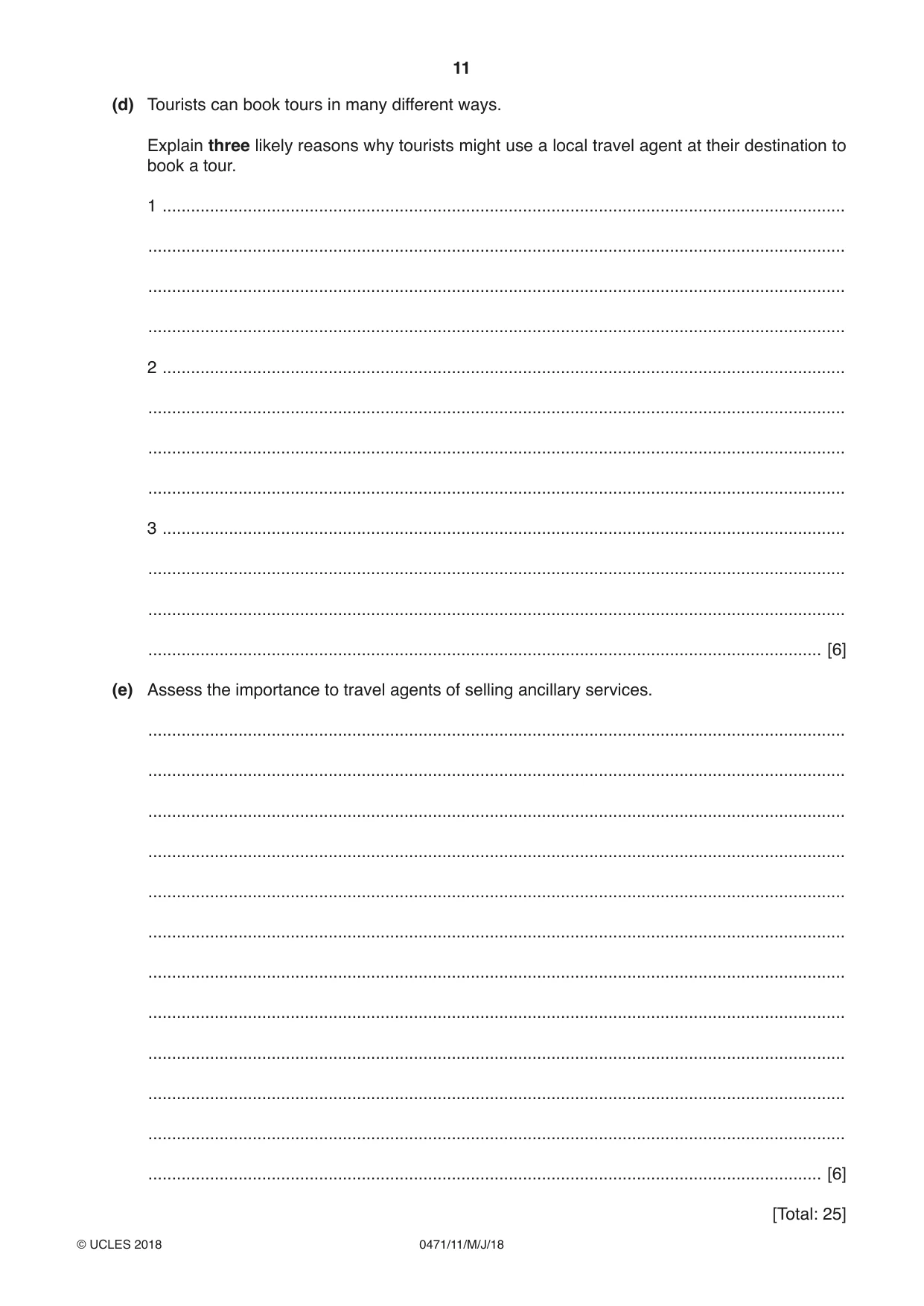
11 0471/11/M/J/18 © UCLES 2018 (d) Tourists can book tours in many different ways. Explain three likely reasons why tourists might use a local travel agent at their destination to book a tour. 1 … … … … 2 … … … … 3 … … … … [6] (e) Assess the importance to travel agents of selling ancillary services. … … … … … … … … … … … … [6] [Total: 25]
Question paper, page 12
12 0471/11/M/J/18 © UCLES 2018 BLANK PAGE Permission to reproduce items where third-party owned material protected by copyright is included has been sought and cleared where possible. Every reasonable effort has been made by the publisher (UCLES) to trace copyright holders, but if any items requiring clearance have unwittingly been included, the publisher will be pleased to make amends at the earliest possible opportunity. To avoid the issue of disclosure of answer-related information to candidates, all copyright acknowledgements are reproduced online in the Cambridge International Examinations Copyright Acknowledgements Booklet. This is produced for each series of examinations and is freely available to download at www.cie.org.uk after the live examination series. Cambridge International Examinations is part of the Cambridge Assessment Group. Cambridge Assessment is the brand name of University of Cambridge Local Examinations Syndicate (UCLES), which is itself a department of the University of Cambridge.
Mark scheme, page 1
IGCSE™ is a registered trademark. This document consists of 12 printed pages. © UCLES 2018 [Turn over Cambridge Assessment International Education Cambridge International General Certificate of Secondary Education TRAVEL & TOURISM 0471/11 Paper 1 Core Module May/June 2018 MARK SCHEME Maximum Mark: 100 Published This mark scheme is published as an aid to teachers and candidates, to indicate the requirements of the examination. It shows the basis on which Examiners were instructed to award marks. It does not indicate the details of the discussions that took place at an Examiners’ meeting before marking began, which would have considered the acceptability of alternative answers. Mark schemes should be read in conjunction with the question paper and the Principal Examiner Report for Teachers. Cambridge International will not enter into discussions about these mark schemes. Cambridge International is publishing the mark schemes for the May/June 2018 series for most Cambridge IGCSE™, Cambridge International A and AS Level and Cambridge Pre-U components, and some Cambridge O Level components.
Mark scheme, page 2
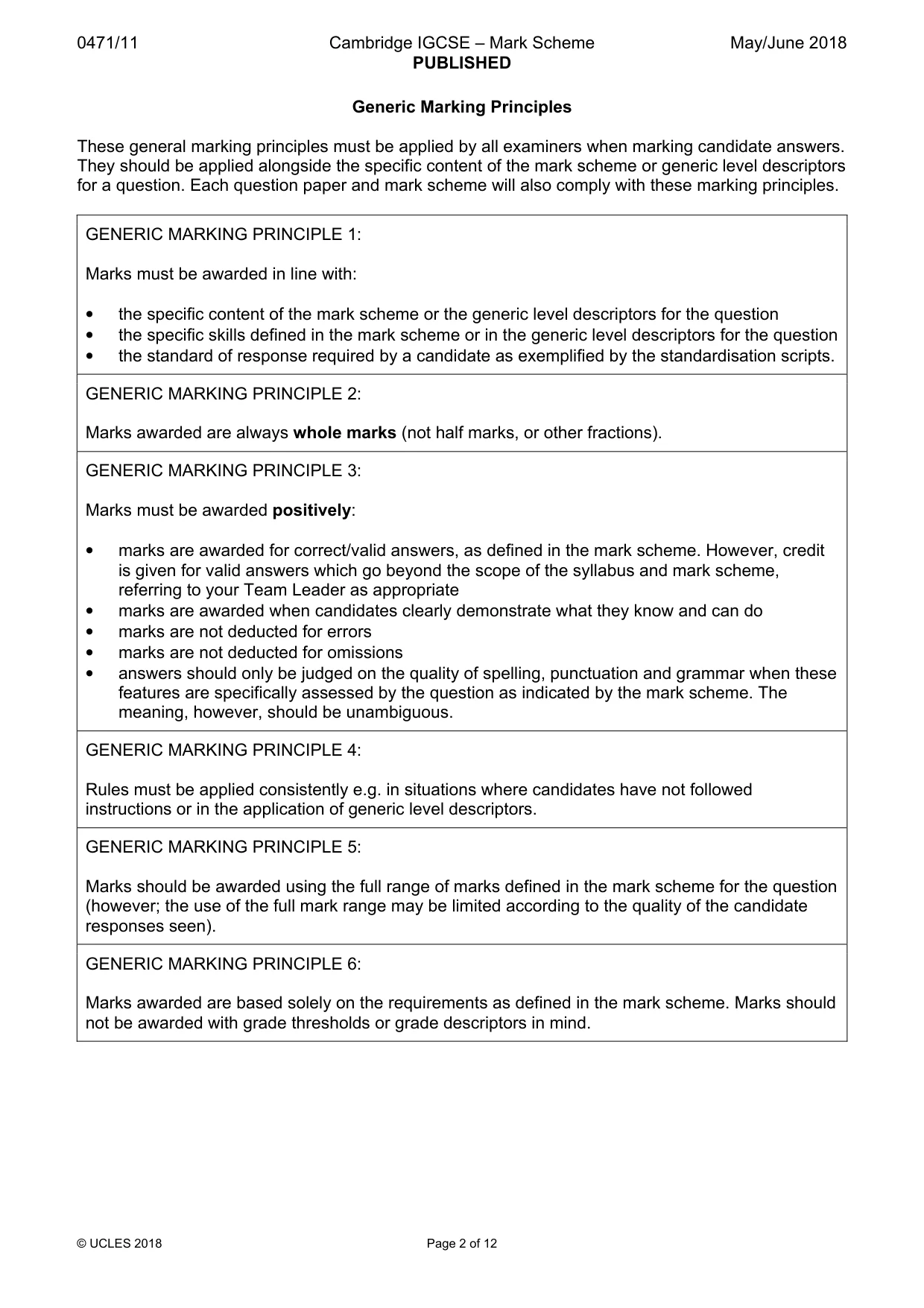
0471/11 Cambridge IGCSE – Mark Scheme PUBLISHED May/June 2018 © UCLES 2018 Page 2 of 12 Generic Marking Principles These general marking principles must be applied by all examiners when marking candidate answers. They should be applied alongside the specific content of the mark scheme or generic level descriptors for a question. Each question paper and mark scheme will also comply with these marking principles. GENERIC MARKING PRINCIPLE 1: Marks must be awarded in line with: • the specific content of the mark scheme or the generic level descriptors for the question • the specific skills defined in the mark scheme or in the generic level descriptors for the question • the standard of response required by a candidate as exemplified by the standardisation scripts. GENERIC MARKING PRINCIPLE 2: Marks awarded are always whole marks (not half marks, or other fractions). GENERIC MARKING PRINCIPLE 3: Marks must be awarded positively: • marks are awarded for correct/valid answers, as defined in the mark scheme. However, credit is given for valid answers which go beyond the scope of the syllabus and mark scheme, referring to your Team Leader as appropriate • marks are awarded when candidates clearly demonstrate what they know and can do • marks are not deducted for errors • marks are not deducted for omissions • answers should only be judged on the quality of spelling, punctuation and grammar when these features are specifically assessed by the question as indicated by the mark scheme. The meaning, however, should be unambiguous. GENERIC MARKING PRINCIPLE 4: Rules must be applied consistently e.g. in situations where candidates have not followed instructions or in the application of generic level descriptors. GENERIC MARKING PRINCIPLE 5: Marks should be awarded using the full range of marks defined in the mark scheme for the question (however; the use of the full mark range may be limited according to the quality of the candidate responses seen). GENERIC MARKING PRINCIPLE 6: Marks awarded are based solely on the requirements as defined in the mark scheme. Marks should not be awarded with grade thresholds or grade descriptors in mind.
Mark scheme, page 3
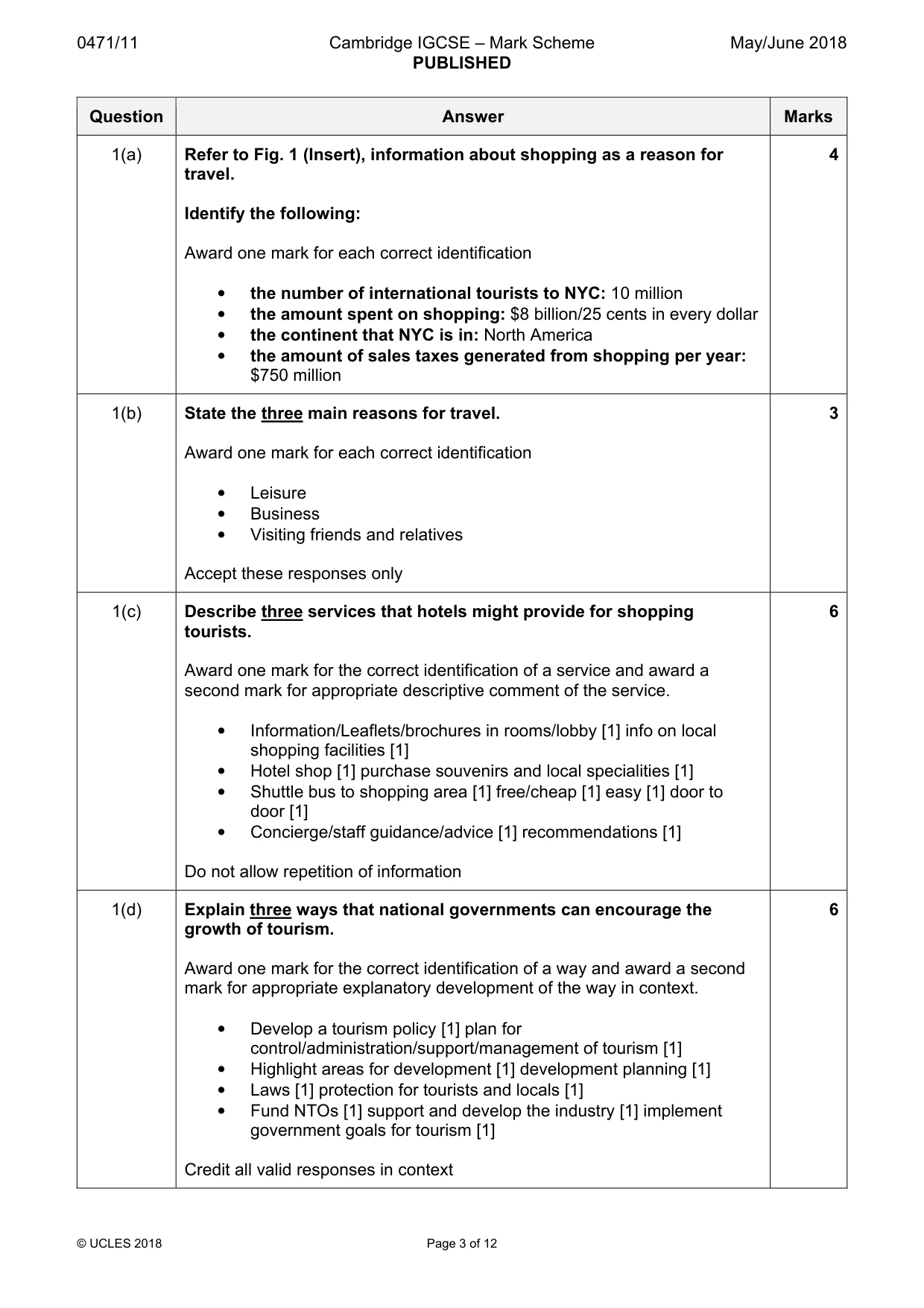
0471/11 Cambridge IGCSE – Mark Scheme PUBLISHED May/June 2018 © UCLES 2018 Page 3 of 12 Question Answer Marks 1(a) Refer to Fig. 1 (Insert), information about shopping as a reason for travel. Identify the following: Award one mark for each correct identification • the number of international tourists to NYC: 10 million • the amount spent on shopping: $8 billion/25 cents in every dollar • the continent that NYC is in: North America • the amount of sales taxes generated from shopping per year: $750 million 4 1(b) State the three main reasons for travel. Award one mark for each correct identification • Leisure • Business • Visiting friends and relatives Accept these responses only 3 1(c) Describe three services that hotels might provide for shopping tourists. Award one mark for the correct identification of a service and award a second mark for appropriate descriptive comment of the service. • Information/Leaflets/brochures in rooms/lobby [1] info on local shopping facilities [1] • Hotel shop [1] purchase souvenirs and local specialities [1] • Shuttle bus to shopping area [1] free/cheap [1] easy [1] door to door [1] • Concierge/staff guidance/advice [1] recommendations [1] Do not allow repetition of information 6 1(d) Explain three ways that national governments can encourage the growth of tourism. Award one mark for the correct identification of a way and award a second mark for appropriate explanatory development of the way in context. • Develop a tourism policy [1] plan for control/administration/support/management of tourism [1] • Highlight areas for development [1] development planning [1] • Laws [1] protection for tourists and locals [1] • Fund NTOs [1] support and develop the industry [1] implement government goals for tourism [1] Credit all valid responses in context 6
Mark scheme, page 4
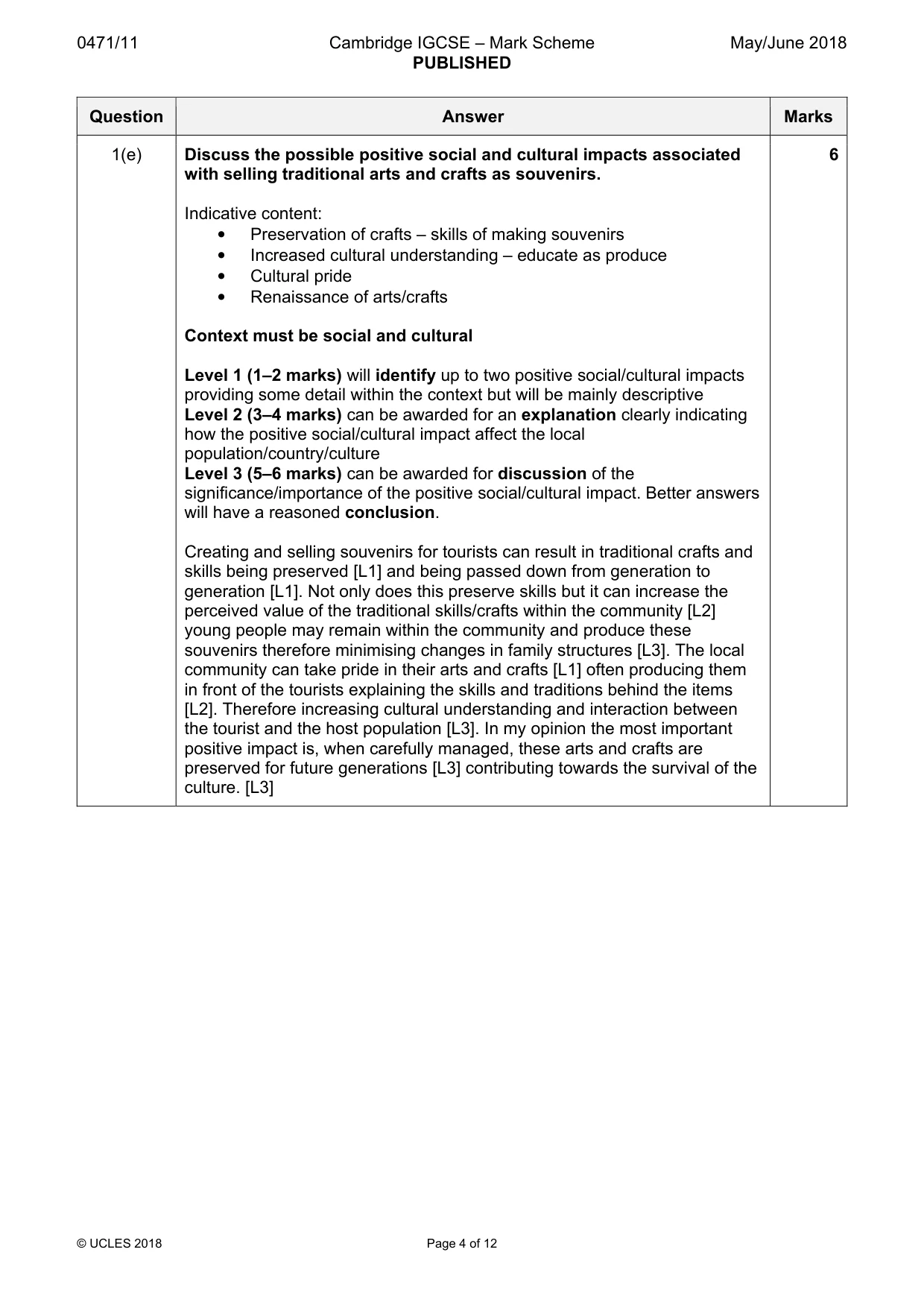
0471/11 Cambridge IGCSE – Mark Scheme PUBLISHED May/June 2018 © UCLES 2018 Page 4 of 12 Question Answer Marks 1(e) Discuss the possible positive social and cultural impacts associated with selling traditional arts and crafts as souvenirs. Indicative content: • Preservation of crafts – skills of making souvenirs • Increased cultural understanding – educate as produce • Cultural pride • Renaissance of arts/crafts Context must be social and cultural Level 1 (1–2 marks) will identify up to two positive social/cultural impacts providing some detail within the context but will be mainly descriptive Level 2 (3–4 marks) can be awarded for an explanation clearly indicating how the positive social/cultural impact affect the local population/country/culture Level 3 (5–6 marks) can be awarded for discussion of the significance/importance of the positive social/cultural impact. Better answers will have a reasoned conclusion. Creating and selling souvenirs for tourists can result in traditional crafts and skills being preserved [L1] and being passed down from generation to generation [L1]. Not only does this preserve skills but it can increase the perceived value of the traditional skills/crafts within the community [L2] young people may remain within the community and produce these souvenirs therefore minimising changes in family structures [L3]. The local community can take pride in their arts and crafts [L1] often producing them in front of the tourists explaining the skills and traditions behind the items [L2]. Therefore increasing cultural understanding and interaction between the tourist and the host population [L3]. In my opinion the most important positive impact is, when carefully managed, these arts and crafts are preserved for future generations [L3] contributing towards the survival of the culture. [L3] 6
Mark scheme, page 5
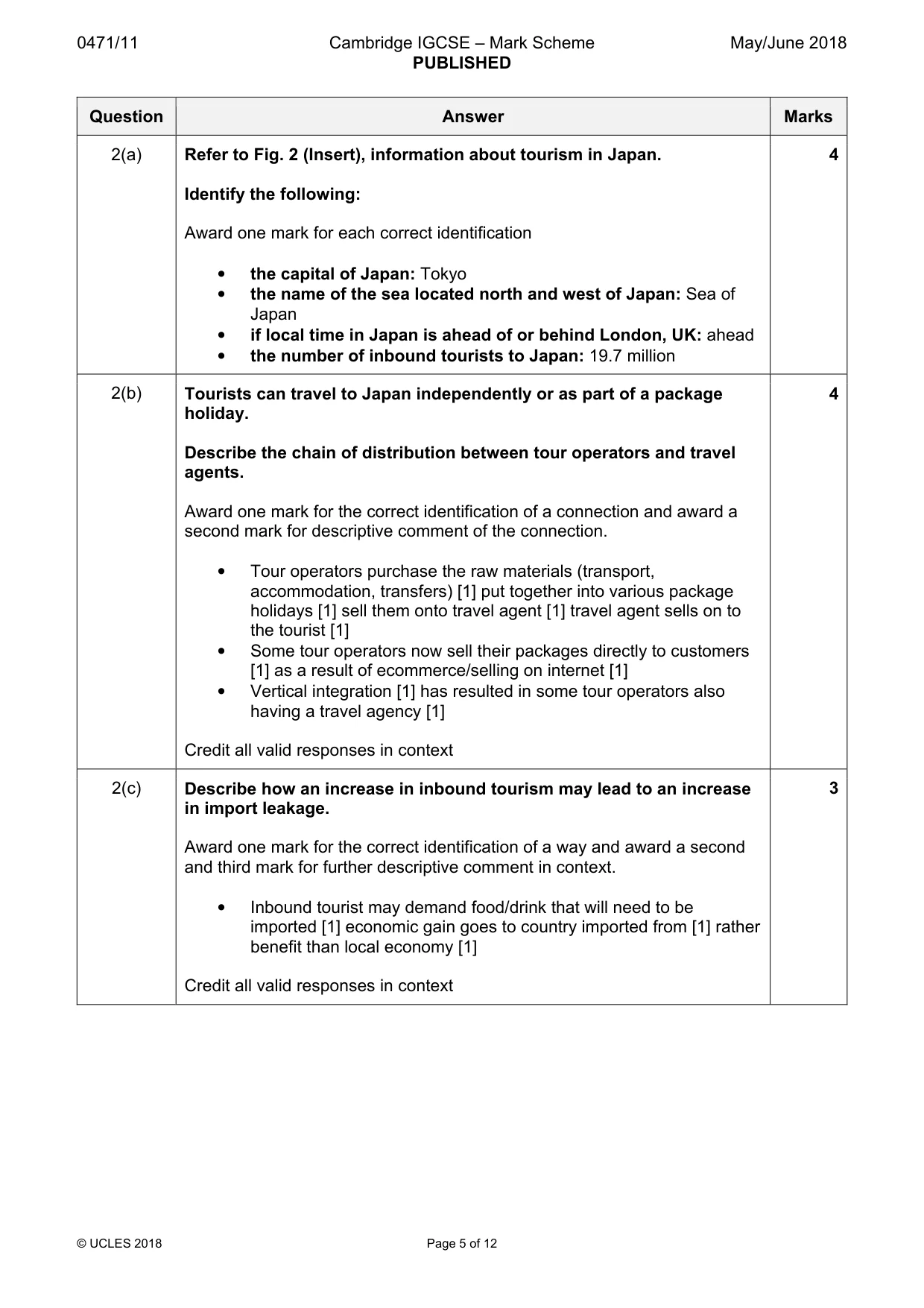
0471/11 Cambridge IGCSE – Mark Scheme PUBLISHED May/June 2018 © UCLES 2018 Page 5 of 12 Question Answer Marks 2(a) Refer to Fig. 2 (Insert), information about tourism in Japan. Identify the following: Award one mark for each correct identification • the capital of Japan: Tokyo • the name of the sea located north and west of Japan: Sea of Japan • if local time in Japan is ahead of or behind London, UK: ahead • the number of inbound tourists to Japan: 19.7 million 4 2(b) Tourists can travel to Japan independently or as part of a package holiday. Describe the chain of distribution between tour operators and travel agents. Award one mark for the correct identification of a connection and award a second mark for descriptive comment of the connection. • Tour operators purchase the raw materials (transport, accommodation, transfers) [1] put together into various package holidays [1] sell them onto travel agent [1] travel agent sells on to the tourist [1] • Some tour operators now sell their packages directly to customers [1] as a result of ecommerce/selling on internet [1] • Vertical integration [1] has resulted in some tour operators also having a travel agency [1] Credit all valid responses in context 4 2(c) Describe how an increase in inbound tourism may lead to an increase in import leakage. Award one mark for the correct identification of a way and award a second and third mark for further descriptive comment in context. • Inbound tourist may demand food/drink that will need to be imported [1] economic gain goes to country imported from [1] rather benefit than local economy [1] Credit all valid responses in context 3
Mark scheme, page 6
0471/11 Cambridge IGCSE – Mark Scheme PUBLISHED May/June 2018 © UCLES 2018 Page 6 of 12 Question Answer Marks 2(d) Explain three roles of national tourism organisations such as the Japan National Tourism Organisation (JNTO). Award one mark for the correct identification of a role and award a second mark for appropriate explanatory development of the role. • Marketing/offices in other countries [1] raising awareness [1] • Research the tourism trends [1] provide data to guide government/business decision making [1] • Provide information [1] stimulate tourism [1] • Work with governments/ministry [1] develop tourism/legislation/support service/funding [1] Focus for this question is the roles, do not allow repetition of these roles when awarding marks 6 2(e) State two services that tour operators provide for their customers when at a destination. Award one mark for each correct identification • Provide a Resort Representative • Support tourists in resort/sell tours/problem solve/transfer tourists to airport • Provide information through rep/information board • Advice for enjoying holiday/resort/departure information 2
Mark scheme, page 7
0471/11 Cambridge IGCSE – Mark Scheme PUBLISHED May/June 2018 © UCLES 2018 Page 7 of 12 Question Answer Marks 2(f) Assess the likely factors that have contributed to the growth of inbound tourism in Japan. Indicative content: • War and terrorism elsewhere – perceived safer • Growth in cultural tourism • Increase in personal wealth in Asia – can afford more travel • Currency depreciation – more affordable • Visa rules relaxed Credit all valid responses in context Level 1 (1–2 marks) will identify up to two likely factors, providing some detail but will be mainly descriptive Level 2 (3–4 marks) can be awarded for an explanation of the factor, clearly indicating how this creates a growth in inbound tourism. Level 3 (5–6 marks) can be awarded for assessment of the significance/importance of factor. Better answers will have a reasoned conclusion Japan has seen good growth in inbound tourism; this could be because of perceived risk of travelling in other countries due to terrorism, [L1] making Japan more appealing [L2]. Cultural tourism is a growth sector of the industry [L1] Japan has a unique culture that draws tourists from all over the world [L2]. I think that there isn’t one reason for the growth of tourism in Japan it is due to a number of factors. However, the increased interest in cultural tourism is one significant factor [L3]. 6
Mark scheme, page 8
0471/11 Cambridge IGCSE – Mark Scheme PUBLISHED May/June 2018 © UCLES 2018 Page 8 of 12 Question Answer Marks 3(a) Refer to Photograph A (Insert), a member of cabin crew demonstrating safety procedures. State three ways passengers onboard an aircraft are given safety instructions. Award one mark for each correct identification • Presentation by flight attendant • TV screens • Information card/booklet in seats • Signs/notices 3 3(b) Explain one benefit to passengers of each of the following inflight services: Award one mark for the correct identification of the benefit and award a second mark for descriptive comment of the benefit in context duty free shopping • Don’t miss out on buying duty free [1] rushed check-in/journey through airport [1] business tourists in a rush/time constrained [1] • Last minute gifts [1] can buy games for children for the journey [1] inflight magazine • Entertainment [1] pass the time [1] • Read about the destination [1] advice on places to go [1] Credit all valid responses in context 4 3(c) Describe one service that airlines provide inflight for passengers with the following needs: Award one mark for the correct identification of a way and award a second mark for descriptive comment of the way in context travelling with young children • Games/colouring [1] keep children entertained [1] • Children’s films [1] help pass the time [1] hearing difficulties • Safety procedure cards in seat pocket [1] read if can’t hear safety demonstration [1] • Flight attendant aware [1] adapt communication to suit e.g. slow clear speech for lip reading/use of information cards or inflight magazine to show [1] dietary needs • Customers can order special meal prior to flying [1] such as vegetarian options [1] • Ingredients and allergy information available [1] tourists can check if food is okay for them [1] Credit all valid responses in context 6
Mark scheme, page 9
0471/11 Cambridge IGCSE – Mark Scheme PUBLISHED May/June 2018 © UCLES 2018 Page 9 of 12 Question Answer Marks 3(d) When arriving at an airport passengers may need to use connecting transport to get to their final destination. Explain the benefit to international tourists of each of the following methods of transport found at airports: Award one mark for the correct identification of a benefit and award a second mark for appropriate explanatory development of the benefit taxi • Door to door service [1] convenient [1] know directions/route [1] • Comfortable [1] room to stretch out after flight [1] • Individual/no need to share with others [1] space to work/make calls in private train • Inexpensive [1] no luggage/suitcase charge [1] cheaper than taxi [1] • Regular service [1] limited waiting time [1] • Straight into city [1] no transfers [1] convenient [1] local bus service • Cheaper [1] good for budget travellers [1] save money to use on enjoyment/attractions/food [1] • Authentic experience [1] mix with locals [1] • Regular service from airport [1] no luggage limits [1] limited waiting time [1] Credit all valid responses in context 6
Mark scheme, page 10
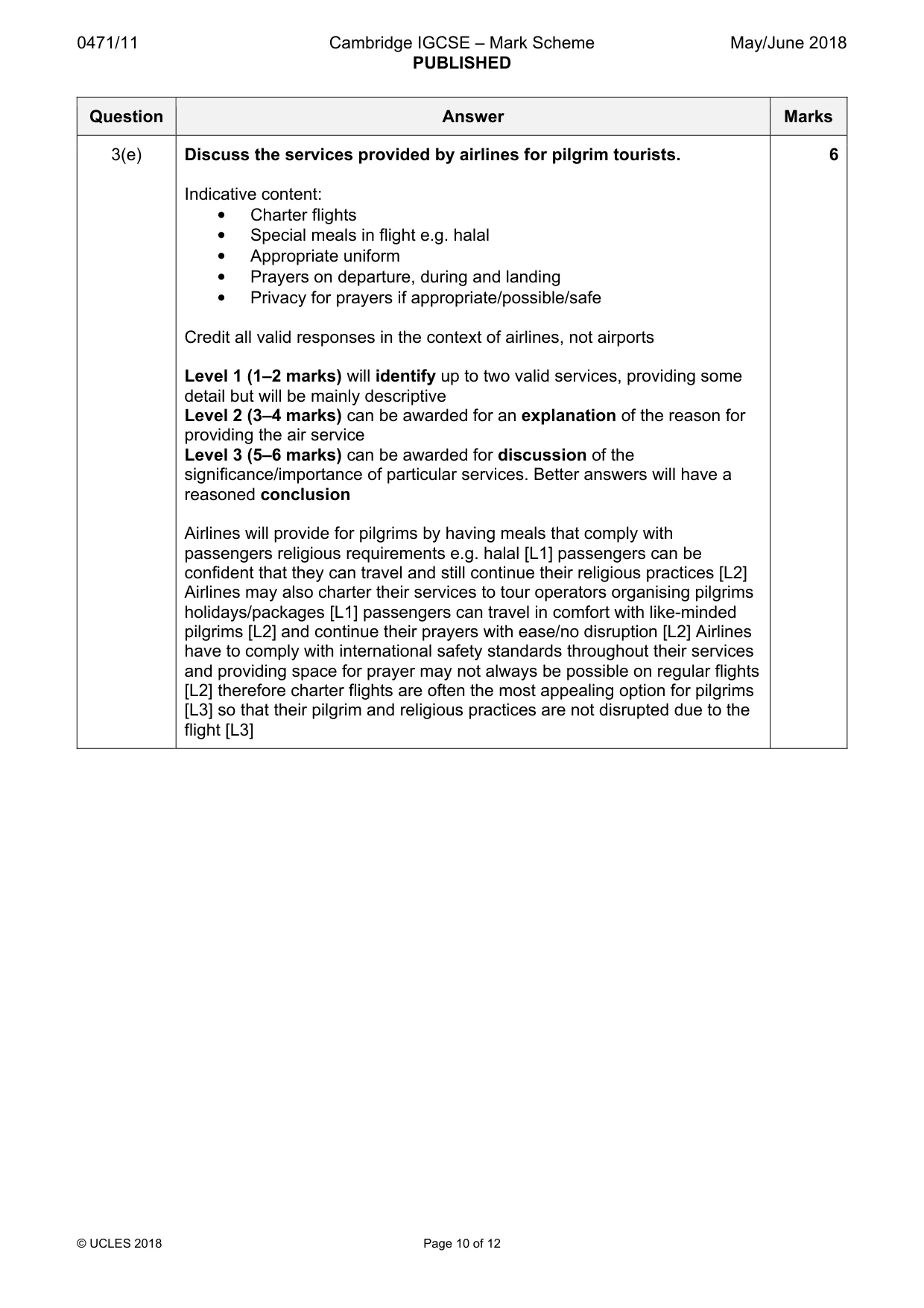
0471/11 Cambridge IGCSE – Mark Scheme PUBLISHED May/June 2018 © UCLES 2018 Page 10 of 12 Question Answer Marks 3(e) Discuss the services provided by airlines for pilgrim tourists. Indicative content: • Charter flights • Special meals in flight e.g. halal • Appropriate uniform • Prayers on departure, during and landing • Privacy for prayers if appropriate/possible/safe Credit all valid responses in the context of airlines, not airports Level 1 (1–2 marks) will identify up to two valid services, providing some detail but will be mainly descriptive Level 2 (3–4 marks) can be awarded for an explanation of the reason for providing the air service Level 3 (5–6 marks) can be awarded for discussion of the significance/importance of particular services. Better answers will have a reasoned conclusion Airlines will provide for pilgrims by having meals that comply with passengers religious requirements e.g. halal [L1] passengers can be confident that they can travel and still continue their religious practices [L2] Airlines may also charter their services to tour operators organising pilgrims holidays/packages [L1] passengers can travel in comfort with like-minded pilgrims [L2] and continue their prayers with ease/no disruption [L2] Airlines have to comply with international safety standards throughout their services and providing space for prayer may not always be possible on regular flights [L2] therefore charter flights are often the most appealing option for pilgrims [L3] so that their pilgrim and religious practices are not disrupted due to the flight [L3] 6
Mark scheme, page 11
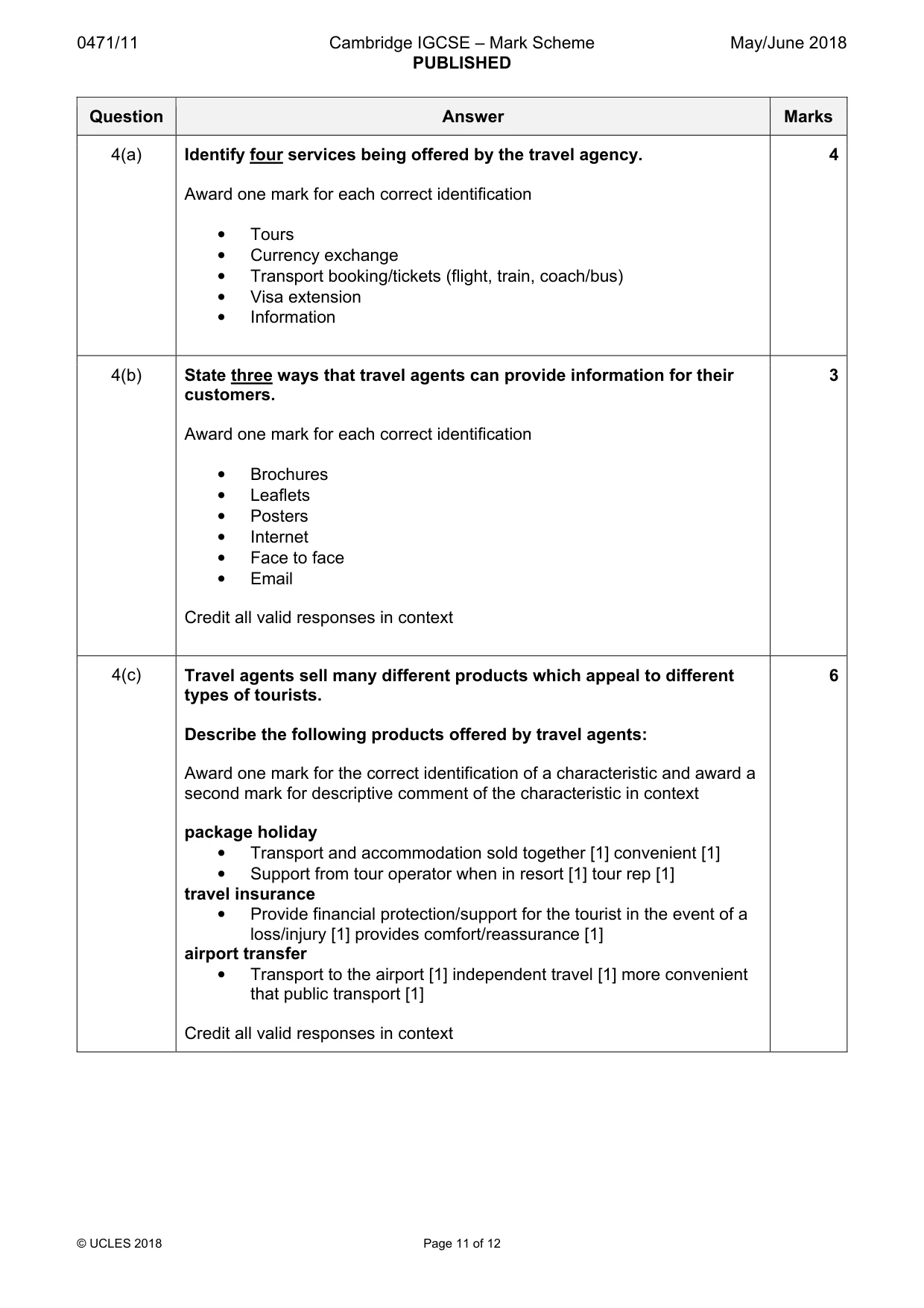
0471/11 Cambridge IGCSE – Mark Scheme PUBLISHED May/June 2018 © UCLES 2018 Page 11 of 12 Question Answer Marks 4(a) Identify four services being offered by the travel agency. Award one mark for each correct identification • Tours • Currency exchange • Transport booking/tickets (flight, train, coach/bus) • Visa extension • Information 4 4(b) State three ways that travel agents can provide information for their customers. Award one mark for each correct identification • Brochures • Leaflets • Posters • Internet • Face to face • Email Credit all valid responses in context 3 4(c) Travel agents sell many different products which appeal to different types of tourists. Describe the following products offered by travel agents: Award one mark for the correct identification of a characteristic and award a second mark for descriptive comment of the characteristic in context package holiday • Transport and accommodation sold together [1] convenient [1] • Support from tour operator when in resort [1] tour rep [1] travel insurance • Provide financial protection/support for the tourist in the event of a loss/injury [1] provides comfort/reassurance [1] airport transfer • Transport to the airport [1] independent travel [1] more convenient that public transport [1] Credit all valid responses in context 6
Mark scheme, page 12
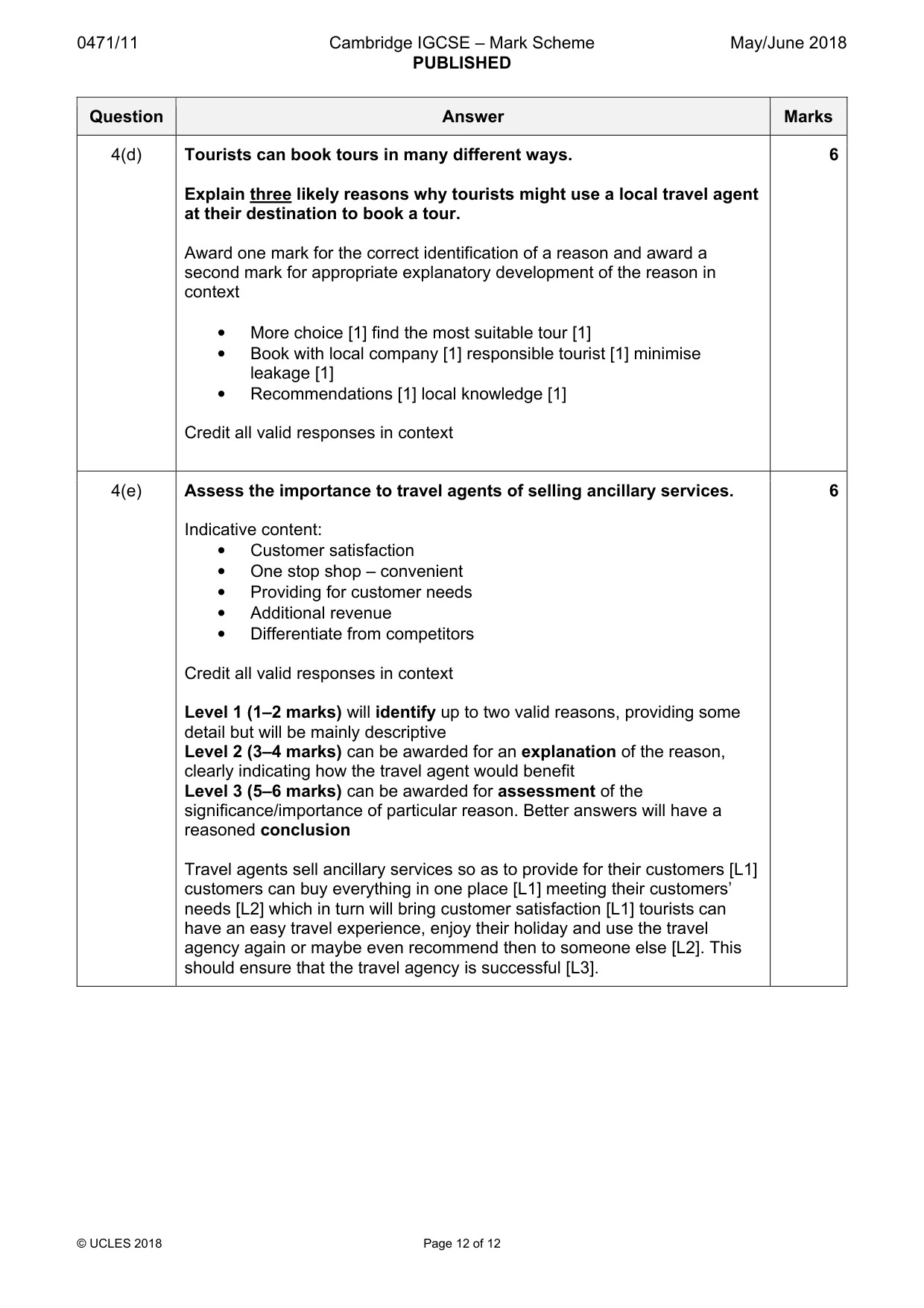
0471/11 Cambridge IGCSE – Mark Scheme PUBLISHED May/June 2018 © UCLES 2018 Page 12 of 12 Question Answer Marks 4(d) Tourists can book tours in many different ways. Explain three likely reasons why tourists might use a local travel agent at their destination to book a tour. Award one mark for the correct identification of a reason and award a second mark for appropriate explanatory development of the reason in context • More choice [1] find the most suitable tour [1] • Book with local company [1] responsible tourist [1] minimise leakage [1] • Recommendations [1] local knowledge [1] Credit all valid responses in context 6 4(e) Assess the importance to travel agents of selling ancillary services. Indicative content: • Customer satisfaction • One stop shop – convenient • Providing for customer needs • Additional revenue • Differentiate from competitors Credit all valid responses in context Level 1 (1–2 marks) will identify up to two valid reasons, providing some detail but will be mainly descriptive Level 2 (3–4 marks) can be awarded for an explanation of the reason, clearly indicating how the travel agent would benefit Level 3 (5–6 marks) can be awarded for assessment of the significance/importance of particular reason. Better answers will have a reasoned conclusion Travel agents sell ancillary services so as to provide for their customers [L1] customers can buy everything in one place [L1] meeting their customers’ needs [L2] which in turn will bring customer satisfaction [L1] tourists can have an easy travel experience, enjoy their holiday and use the travel agency again or maybe even recommend then to someone else [L2]. This should ensure that the travel agency is successful [L3]. 6
What you needed in this session
Cambridge’s own grade thresholds for 2018 May/June, Paper 1 · Variant 1. A higher threshold means an easier paper — the bar moves with how the cohort did.