Cambridge IGCSE Travel and Tourism 0471 — 2016 Oct/Nov Paper 1 · Variant 2
0471/12/O/N/16 · 100 marks · ≈113 min
The question paper and its mark scheme, free to read here and free to download. This is Cambridge’s own paper, exactly as it was sat.
Question paper16 pages


Mark scheme10 pages
Answers below. Sit the paper first if you are practising.
Paper as text
Question paper, page 1
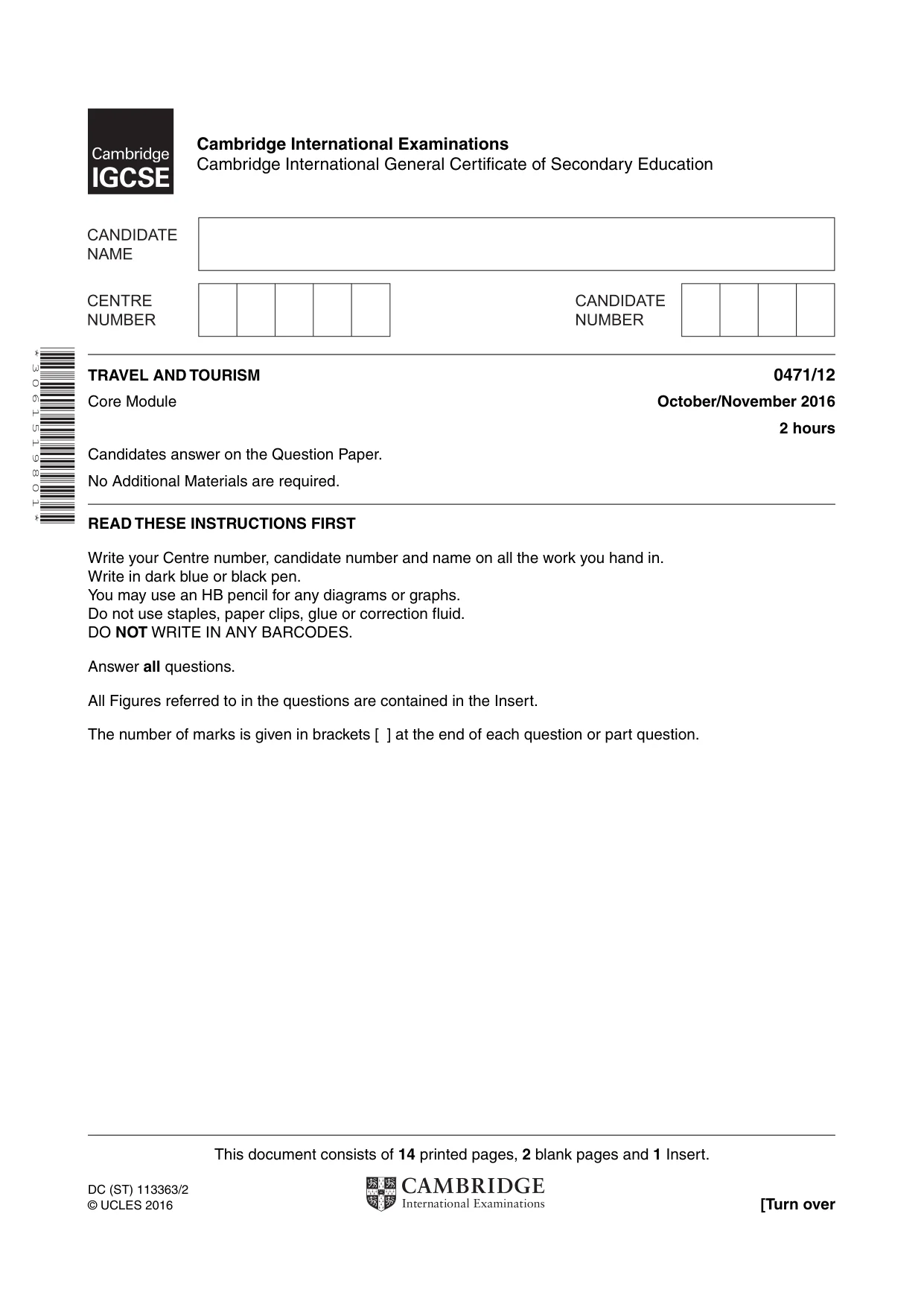
This document consists of 14 printed pages, 2 blank pages and 1 Insert. DC (ST) 113363/2 © UCLES 2016 [Turn over Cambridge International Examinations Cambridge International General Certificate of Secondary Education * 3 0 6 1 5 1 9 8 0 1 * TRAVEL AND TOURISM 0471/12 Core Module October/November 2016 2 hours Candidates answer on the Question Paper. No Additional Materials are required. READ THESE INSTRUCTIONS FIRST Write your Centre number, candidate number and name on all the work you hand in. Write in dark blue or black pen. You may use an HB pencil for any diagrams or graphs. Do not use staples, paper clips, glue or correction fluid. DO NOT WRITE IN ANY BARCODES. Answer all questions. All Figures referred to in the questions are contained in the Insert. The number of marks is given in brackets [ ] at the end of each question or part question.
Question paper, page 2
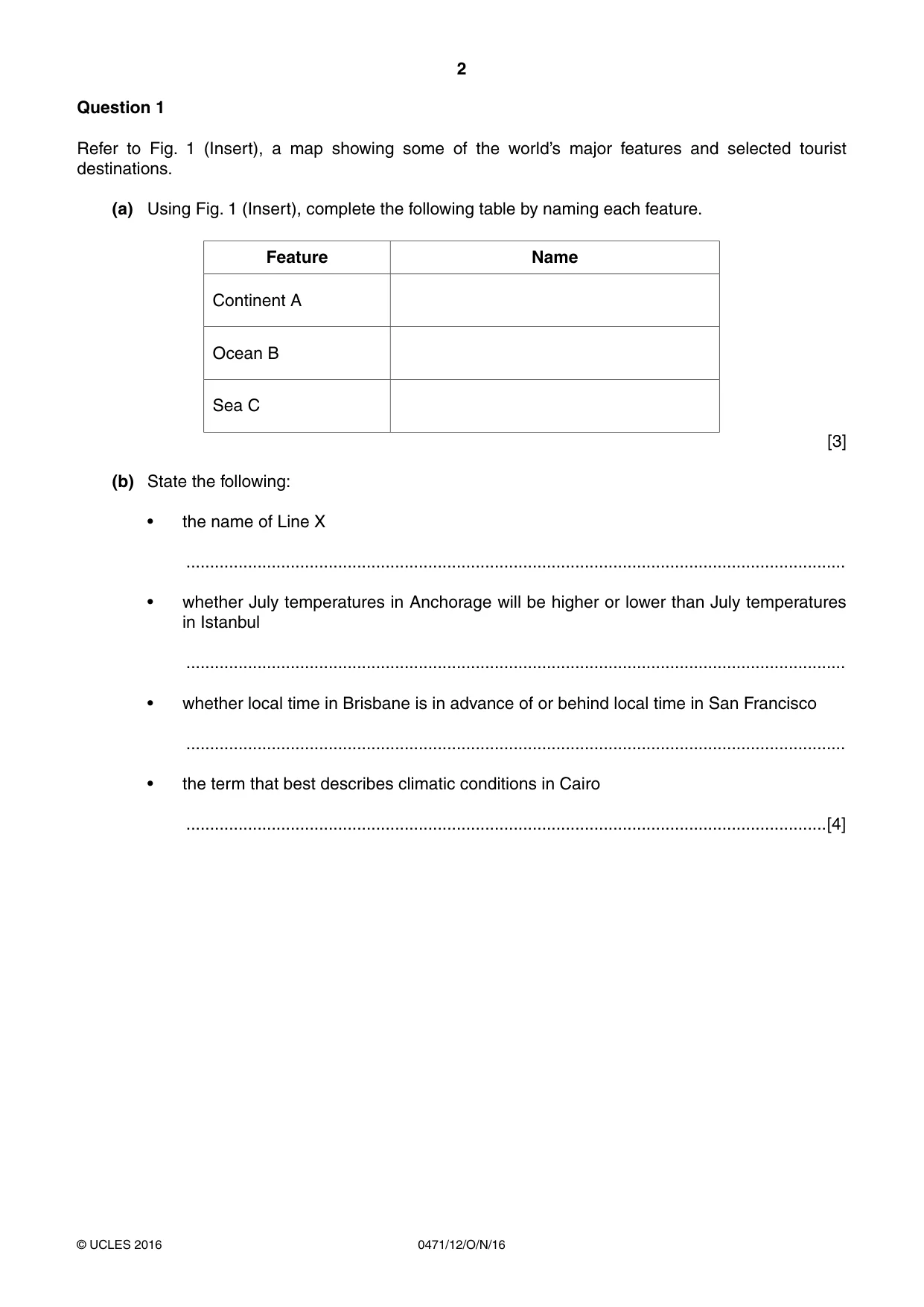
2 0471/12/O/N/16 © UCLES 2016 Question 1 Refer to Fig. 1 (Insert), a map showing some of the world’s major features and selected tourist destinations. (a) Using Fig. 1 (Insert), complete the following table by naming each feature. Feature Name Continent A Ocean B Sea C [3] (b) State the following: • the name of Line X … • whether July temperatures in Anchorage will be higher or lower than July temperatures in Istanbul … • whether local time in Brisbane is in advance of or behind local time in San Francisco … • the term that best describes climatic conditions in Cairo …[4]
Question paper, page 3
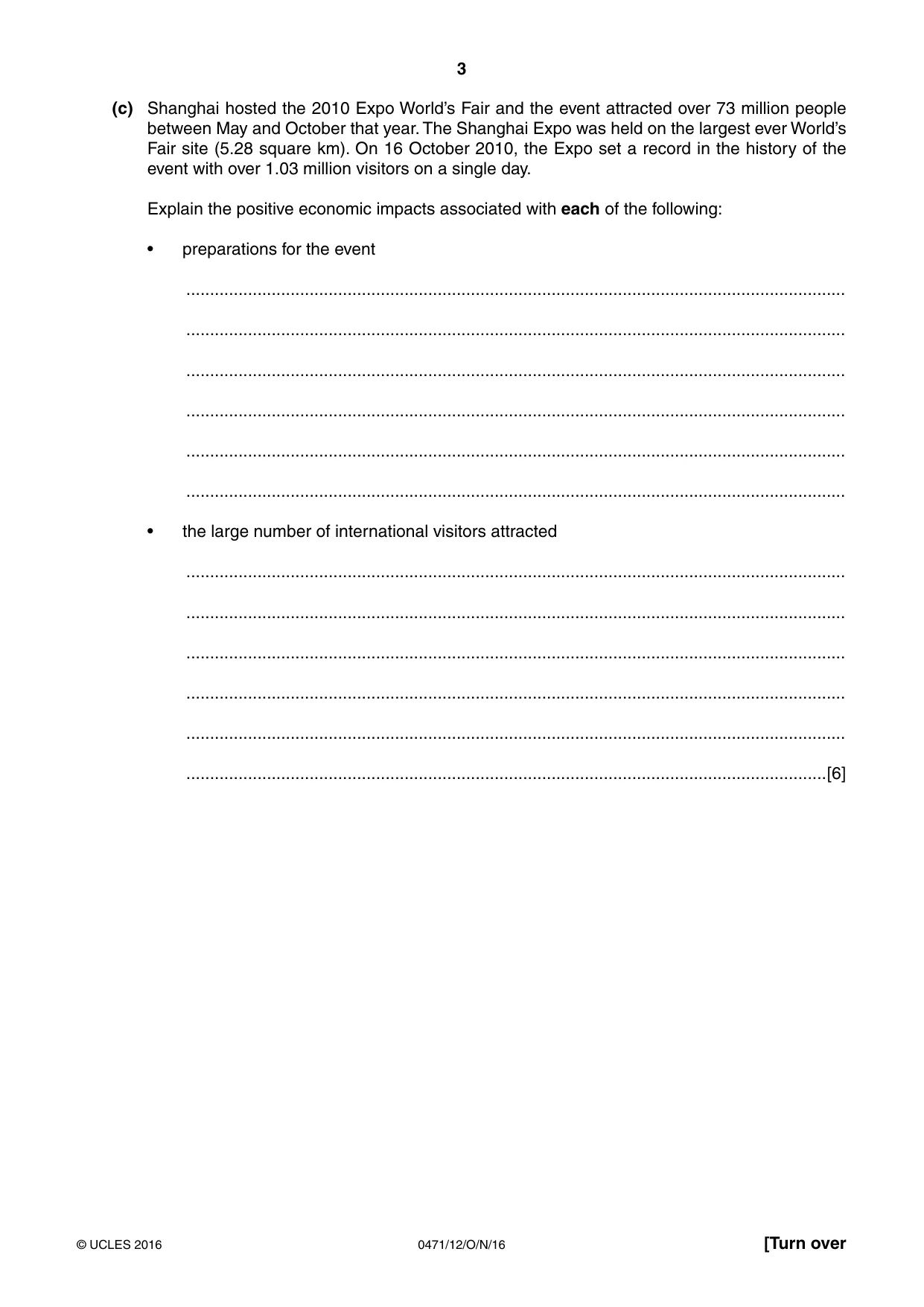
3 0471/12/O/N/16 © UCLES 2016 [Turn over (c) Shanghai hosted the 2010 Expo World’s Fair and the event attracted over 73 million people between May and October that year. The Shanghai Expo was held on the largest ever World’s Fair site (5.28 square km). On 16 October 2010, the Expo set a record in the history of the event with over 1.03 million visitors on a single day. Explain the positive economic impacts associated with each of the following: • preparations for the event … … … … … … • the large number of international visitors attracted … … … … … …[6]
Question paper, page 4
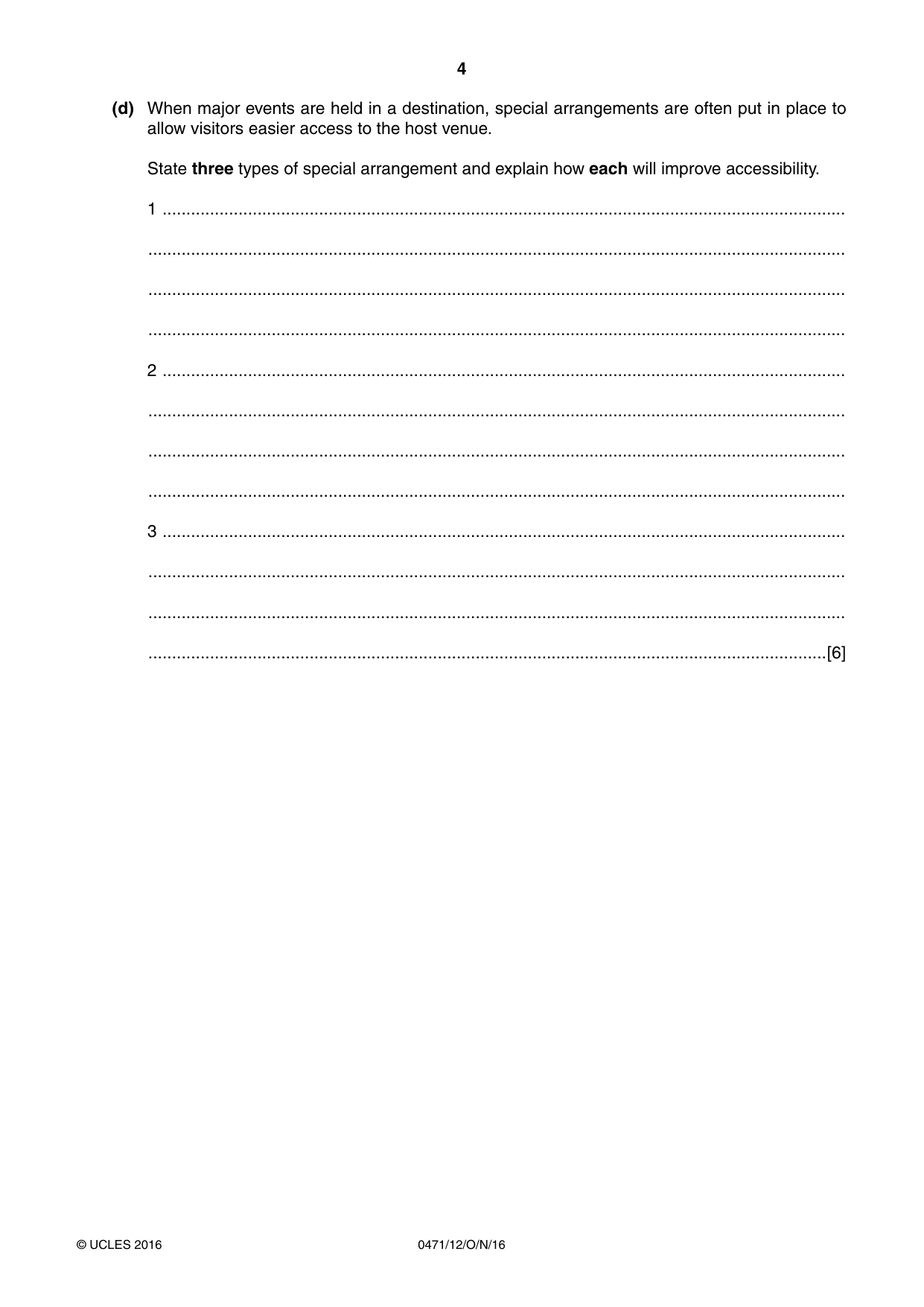
4 0471/12/O/N/16 © UCLES 2016 (d) When major events are held in a destination, special arrangements are often put in place to allow visitors easier access to the host venue. State three types of special arrangement and explain how each will improve accessibility. 1 … … … … 2 … … … … 3 … … … …[6]
Question paper, page 5
5 0471/12/O/N/16 © UCLES 2016 [Turn over (e) Discuss the actions a tour operator needs to take in order to create an inclusive package tour to a major overseas event. … … … … … … … … … … … …[6] [Total: 25]
Question paper, page 6
6 0471/12/O/N/16 © UCLES 2016 Question 2 Refer to Fig. 2 (Insert), visitor information about the Mt. Moriah Cemetery in Deadwood, South Dakota, USA. (a) Identify from Fig. 2 (Insert) the following: • the name of the town in which Mt. Moriah Cemetery is located … • the length of time it takes to visit all the celebrity graves … • the cost of admission to Mt. Moriah Cemetery …[3] (b) With reference to Fig. 2 (Insert), identify and explain the two ways in which Mt. Moriah Cemetery is encouraging sustainable tourism. 1 … … … … 2 … … … …[4]
Question paper, page 7
7 0471/12/O/N/16 © UCLES 2016 [Turn over (c) Describe three ways in which staff employed at cultural visitor attractions can help enhance the visitor experience. 1 … … … … 2 … … … … 3 … … … …[6] (d) Some international tourists are attracted to a destination because they want to experience a different culture from their own. Explain three ways in which tourism can help support the host destination’s traditional culture. 1 … … … … 2 … … … … 3 … … … …[6]
Question paper, page 8
8 0471/12/O/N/16 © UCLES 2016 (e) Discuss the factors that make a destination successful. … … … … … … … … … … … …[6] [Total: 25]
Question paper, page 9
9 0471/12/O/N/16 © UCLES 2016 [Turn over Question 3 Dubai International Airport (DXB), as shown in photographs A, B and C (Insert), is one of the world’s busiest airports and is used by many international travellers. (a) State three functions of international bodies in the airline industry, such as IATA. 1 … … 2 … … 3 … …[3] (b) State four characteristics of long haul scheduled flights. 1 … 2 … 3 … 4 …[4]
Question paper, page 10
10 0471/12/O/N/16 © UCLES 2016 (c) Photographs A, B and C (Insert), show different services provided by Emirates for the convenience of its customers. Identify and explain how the service shown in each photograph will help to meet the needs of particular customers. • Photograph A … … … … • Photograph B … … … … • Photograph C … … … …[6]
Question paper, page 11
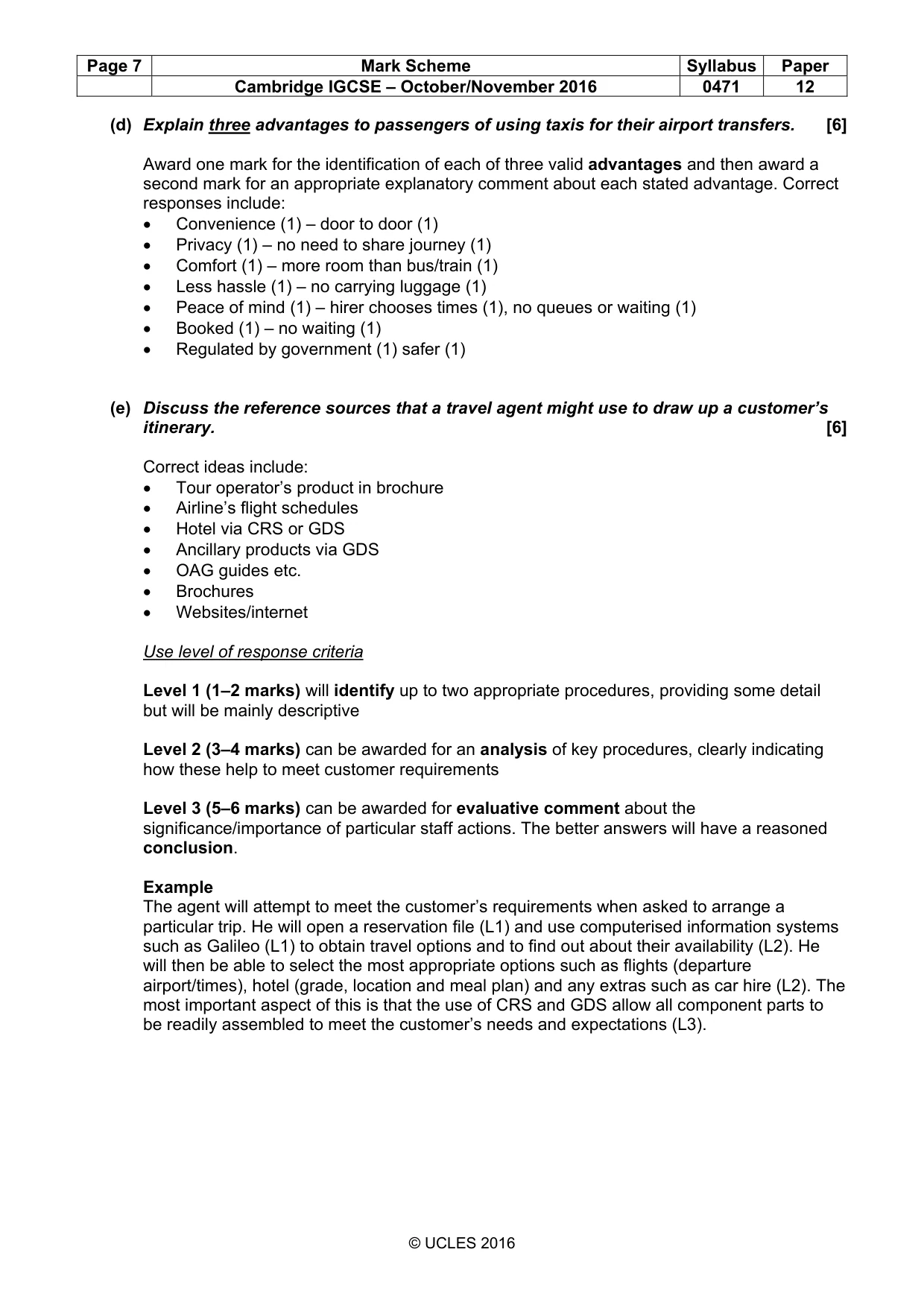
11 0471/12/O/N/16 © UCLES 2016 [Turn over (d) Explain three advantages to passengers of using taxis for their airport transfers. 1 … … … … 2 … … … … 3 … … … …[6] (e) Many passengers passing through Dubai International airport will be following an itinerary prepared for them, usually by their travel agent. Discuss the reference sources that a travel agent might use to draw up a customer’s itinerary. … … … … … … … … … … … …[6] [Total: 25]
Question paper, page 12
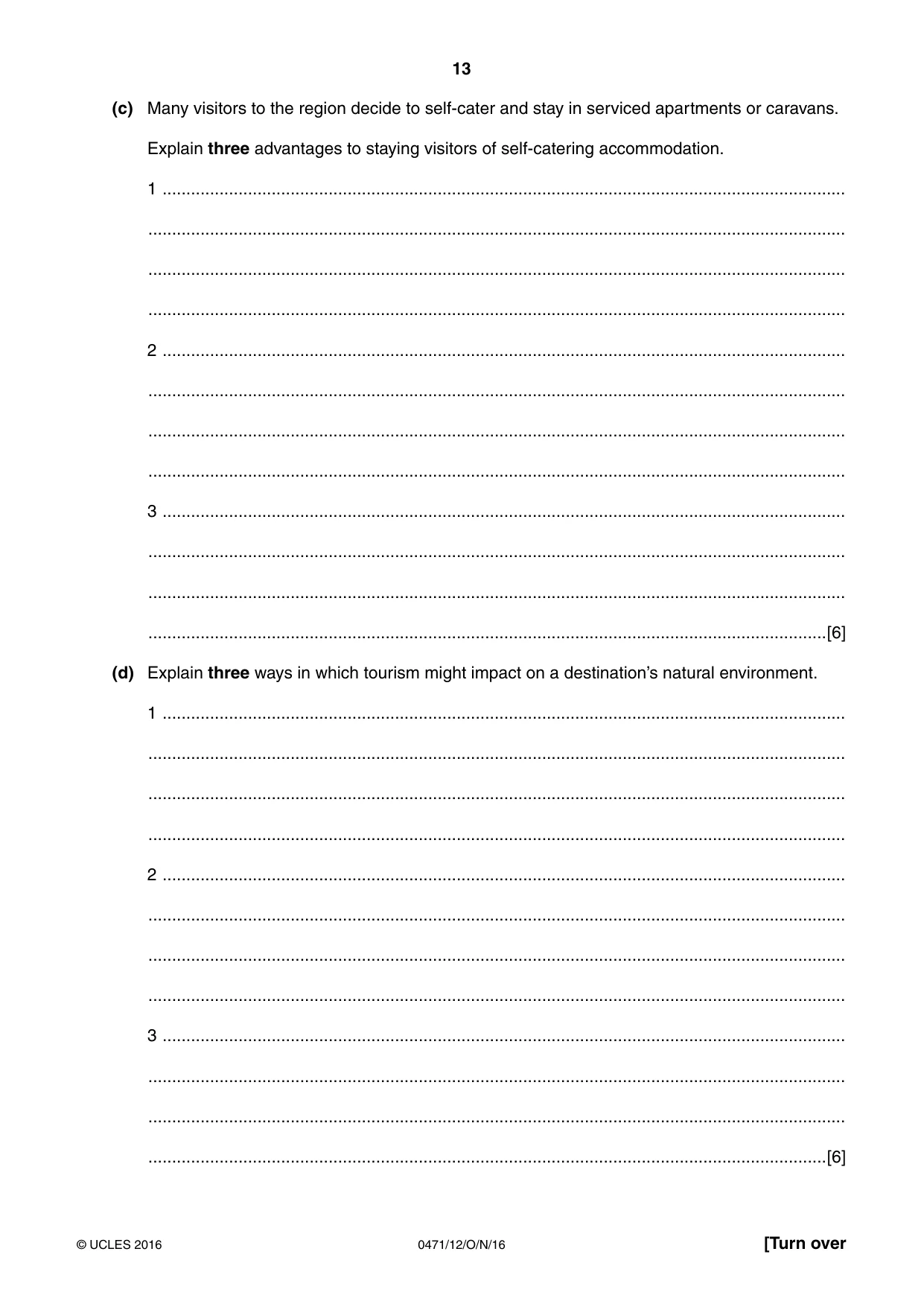
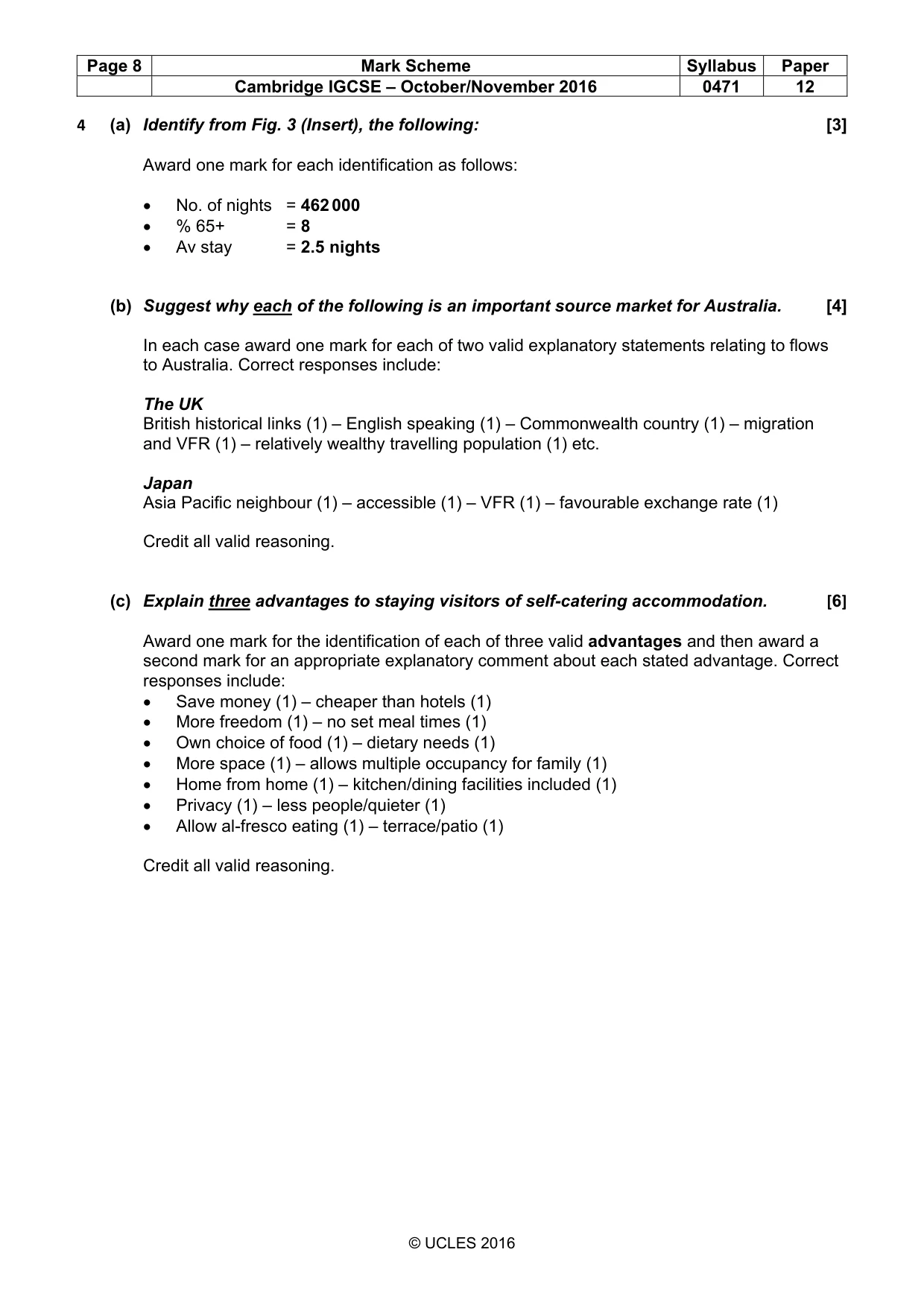
12 0471/12/O/N/16 © UCLES 2016 Question 4 Refer to Fig. 3 (Insert), information from a recent tourism survey in the Northern Territory region of Australia. The region contains Ayres Rock (Uluru National Park) and offers visitors a range of natural, cultural, historical and adventure experiences. (a) Identify from Fig. 3 (Insert), the following: • the number of international visitor nights spent in the region … • the percentage of international visitors to the region that are aged 65 or over … • the average international visitor length of stay …[3] (b) Suggest why each of the following is an important source market for Australia: • the UK … … … … • Japan … … … …[4]
Question paper, page 13
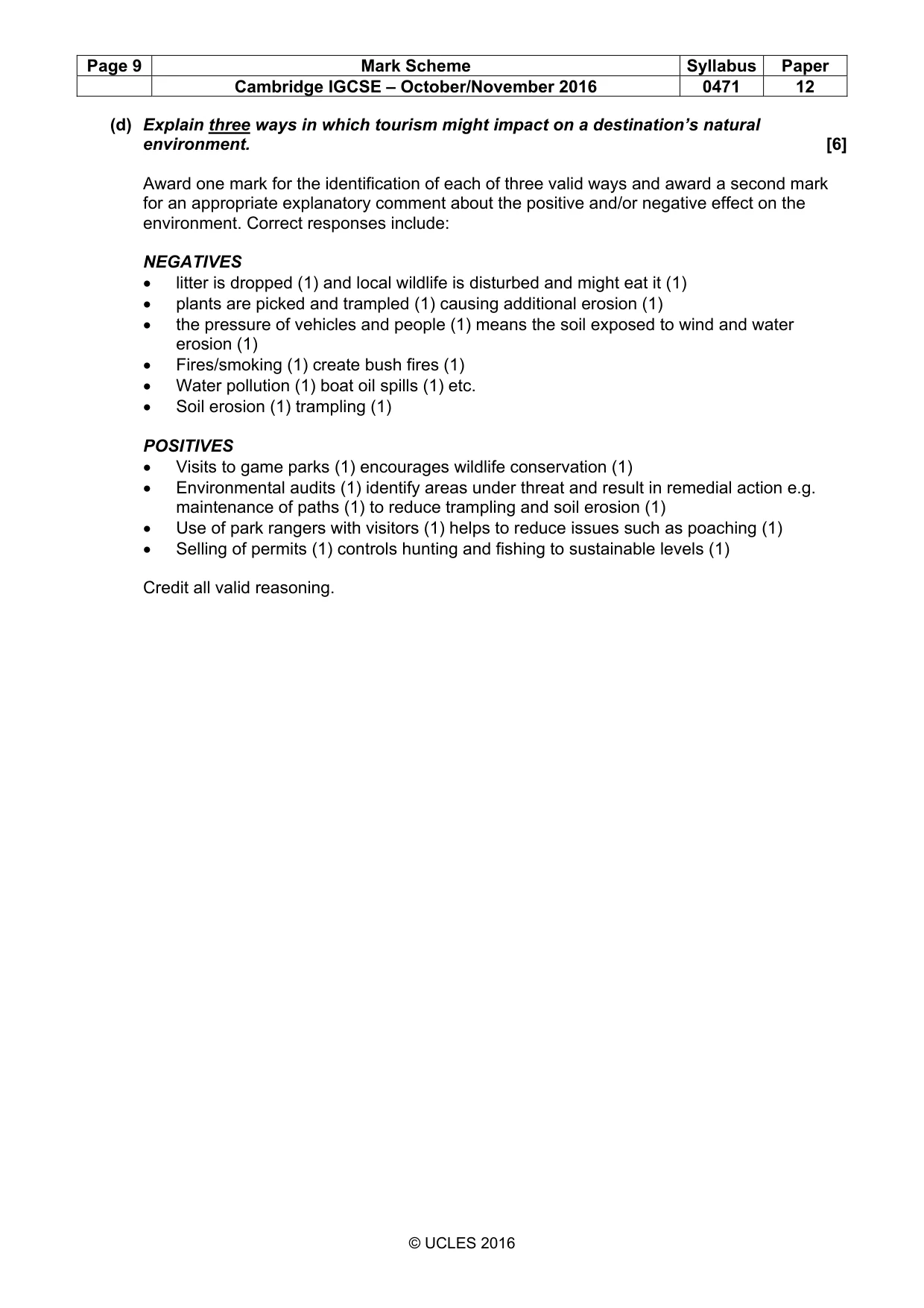
13 0471/12/O/N/16 © UCLES 2016 [Turn over (c) Many visitors to the region decide to self-cater and stay in serviced apartments or caravans. Explain three advantages to staying visitors of self-catering accommodation. 1 … … … … 2 … … … … 3 … … … …[6] (d) Explain three ways in which tourism might impact on a destination’s natural environment. 1 … … … … 2 … … … … 3 … … … …[6]
Question paper, page 14
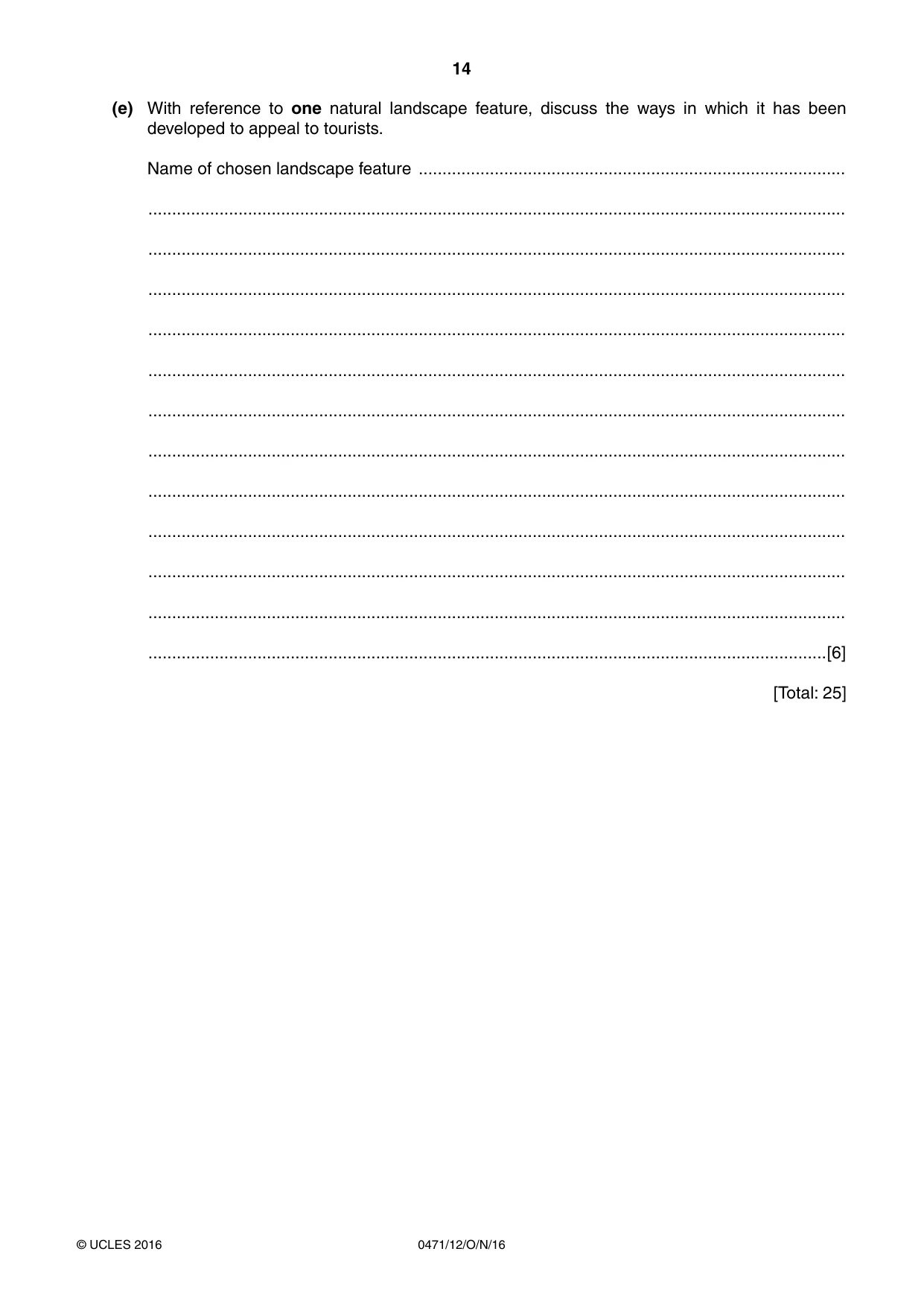
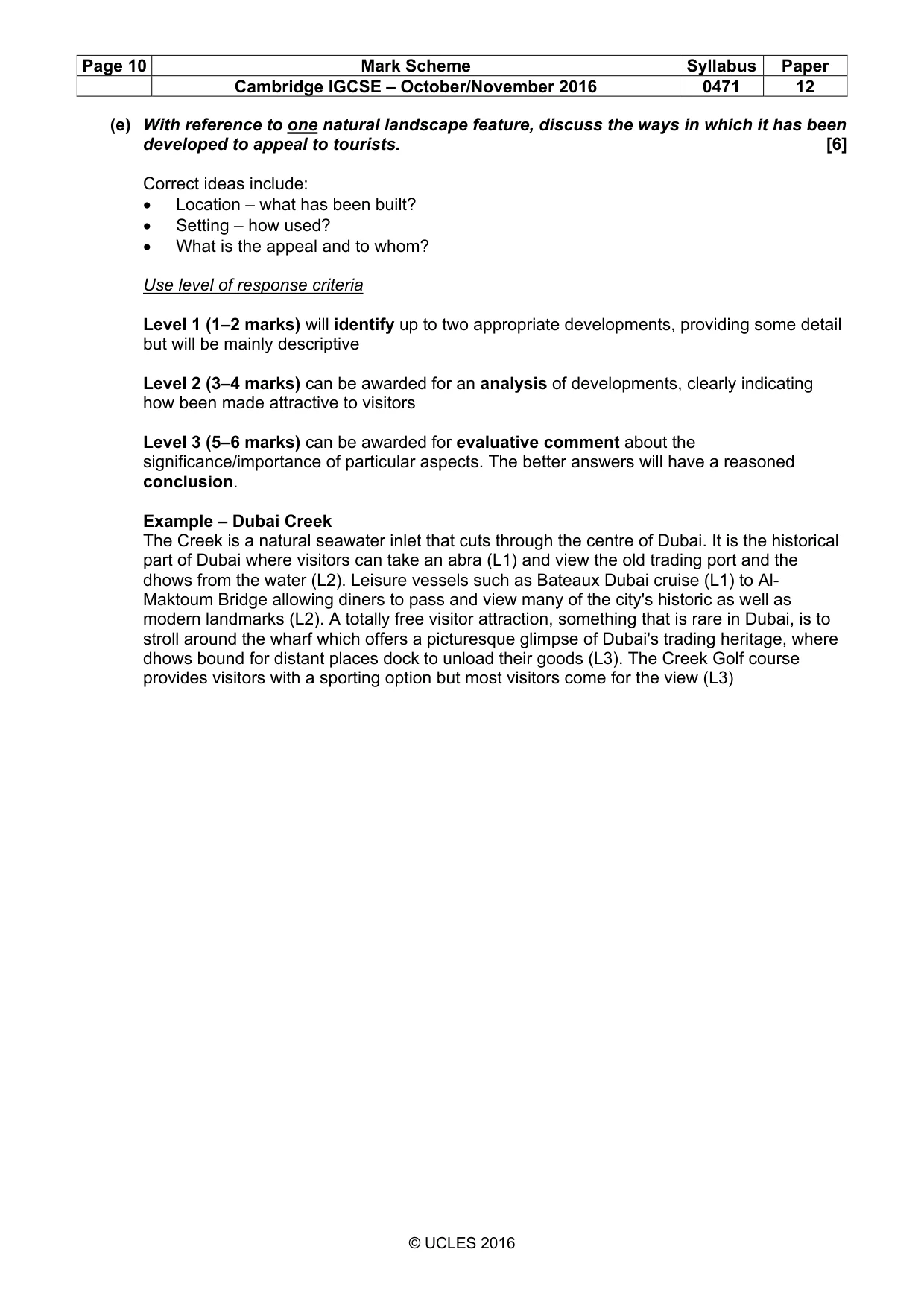
14 0471/12/O/N/16 © UCLES 2016 (e) With reference to one natural landscape feature, discuss the ways in which it has been developed to appeal to tourists. Name of chosen landscape feature … … … … … … … … … … … … …[6] [Total: 25]
Question paper, page 15
15 0471/12/O/N/16 © UCLES 2016 BLANK PAGE
Question paper, page 16
16 0471/12/O/N/16 © UCLES 2016 Permission to reproduce items where third-party owned material protected by copyright is included has been sought and cleared where possible. Every reasonable effort has been made by the publisher (UCLES) to trace copyright holders, but if any items requiring clearance have unwittingly been included, the publisher will be pleased to make amends at the earliest possible opportunity. To avoid the issue of disclosure of answer-related information to candidates, all copyright acknowledgements are reproduced online in the Cambridge International Examinations Copyright Acknowledgements Booklet. This is produced for each series of examinations and is freely available to download at www.cie.org.uk after the live examination series. Cambridge International Examinations is part of the Cambridge Assessment Group. Cambridge Assessment is the brand name of University of Cambridge Local Examinations Syndicate (UCLES), which is itself a department of the University of Cambridge. BLANK PAGE
Mark scheme, page 1
® IGCSE is the registered trademark of Cambridge International Examinations. This document consists of 10 printed pages. © UCLES 2016 [Turn over Cambridge International Examinations Cambridge International General Certificate of Secondary Education TRAVEL AND TOURISM 0471/12 Paper 1 Core Paper October/November 2016 MARK SCHEME Maximum Mark: 100 Published This mark scheme is published as an aid to teachers and candidates, to indicate the requirements of the examination. It shows the basis on which Examiners were instructed to award marks. It does not indicate the details of the discussions that took place at an Examiners’ meeting before marking began, which would have considered the acceptability of alternative answers. Mark schemes should be read in conjunction with the question paper and the Principal Examiner Report for Teachers. Cambridge will not enter into discussions about these mark schemes. Cambridge is publishing the mark schemes for the October/November 2016 series for most Cambridge IGCSE®, Cambridge International A and AS Level components and some Cambridge O Level components.
Mark scheme, page 2
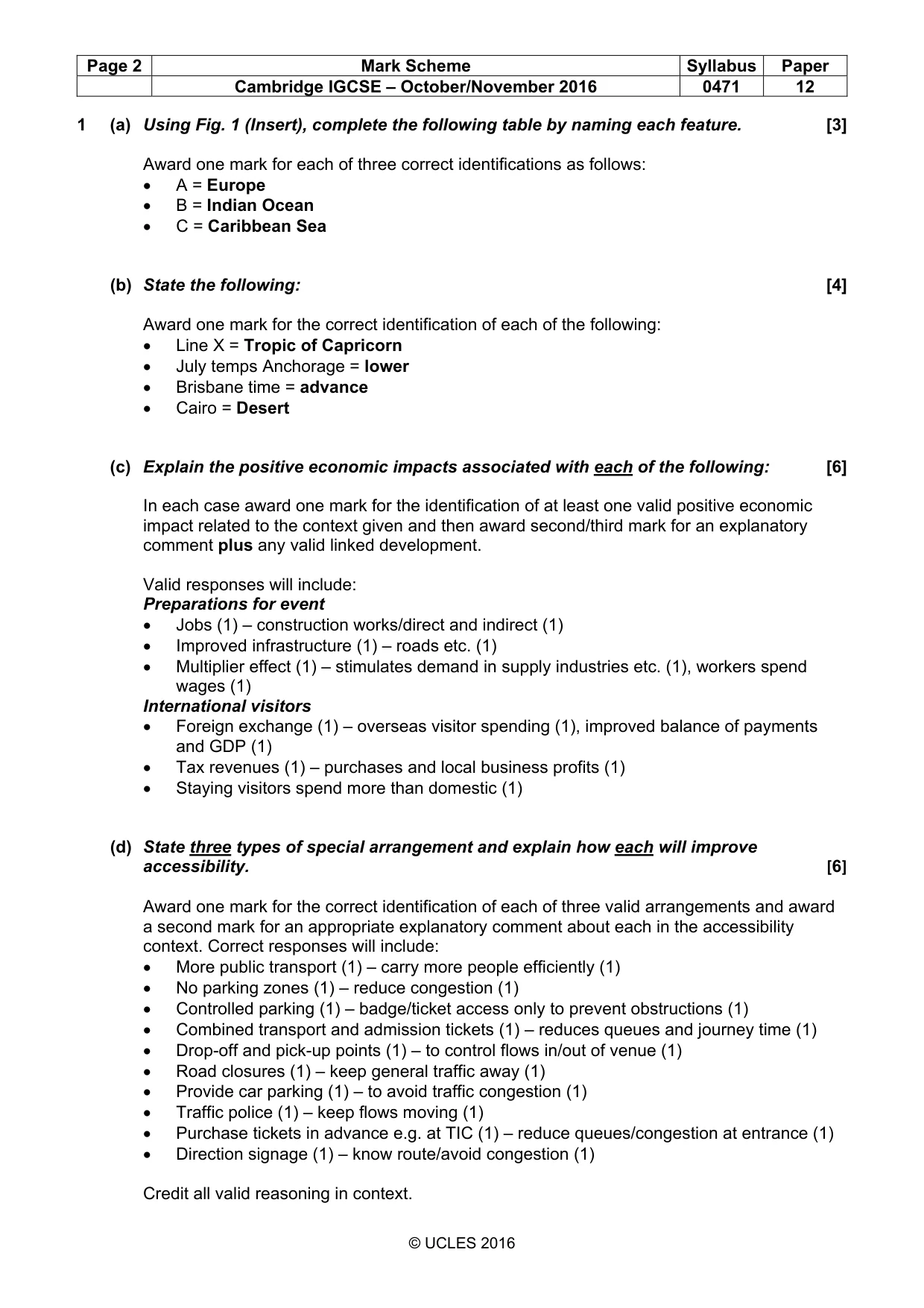
Page 2 Mark Scheme Syllabus Paper Cambridge IGCSE – October/November 2016 0471 12 © UCLES 2016 1 (a) Using Fig. 1 (Insert), complete the following table by naming each feature. [3] Award one mark for each of three correct identifications as follows: • A = Europe • B = Indian Ocean • C = Caribbean Sea (b) State the following: [4] Award one mark for the correct identification of each of the following: • Line X = Tropic of Capricorn • July temps Anchorage = lower • Brisbane time = advance • Cairo = Desert (c) Explain the positive economic impacts associated with each of the following: [6] In each case award one mark for the identification of at least one valid positive economic impact related to the context given and then award second/third mark for an explanatory comment plus any valid linked development. Valid responses will include: Preparations for event • Jobs (1) – construction works/direct and indirect (1) • Improved infrastructure (1) – roads etc. (1) • Multiplier effect (1) – stimulates demand in supply industries etc. (1), workers spend wages (1) International visitors • Foreign exchange (1) – overseas visitor spending (1), improved balance of payments and GDP (1) • Tax revenues (1) – purchases and local business profits (1) • Staying visitors spend more than domestic (1) (d) State three types of special arrangement and explain how each will improve accessibility. [6] Award one mark for the correct identification of each of three valid arrangements and award a second mark for an appropriate explanatory comment about each in the accessibility context. Correct responses will include: • More public transport (1) – carry more people efficiently (1) • No parking zones (1) – reduce congestion (1) • Controlled parking (1) – badge/ticket access only to prevent obstructions (1) • Combined transport and admission tickets (1) – reduces queues and journey time (1) • Drop-off and pick-up points (1) – to control flows in/out of venue (1) • Road closures (1) – keep general traffic away (1) • Provide car parking (1) – to avoid traffic congestion (1) • Traffic police (1) – keep flows moving (1) • Purchase tickets in advance e.g. at TIC (1) – reduce queues/congestion at entrance (1) • Direction signage (1) – know route/avoid congestion (1) Credit all valid reasoning in context.
Mark scheme, page 3
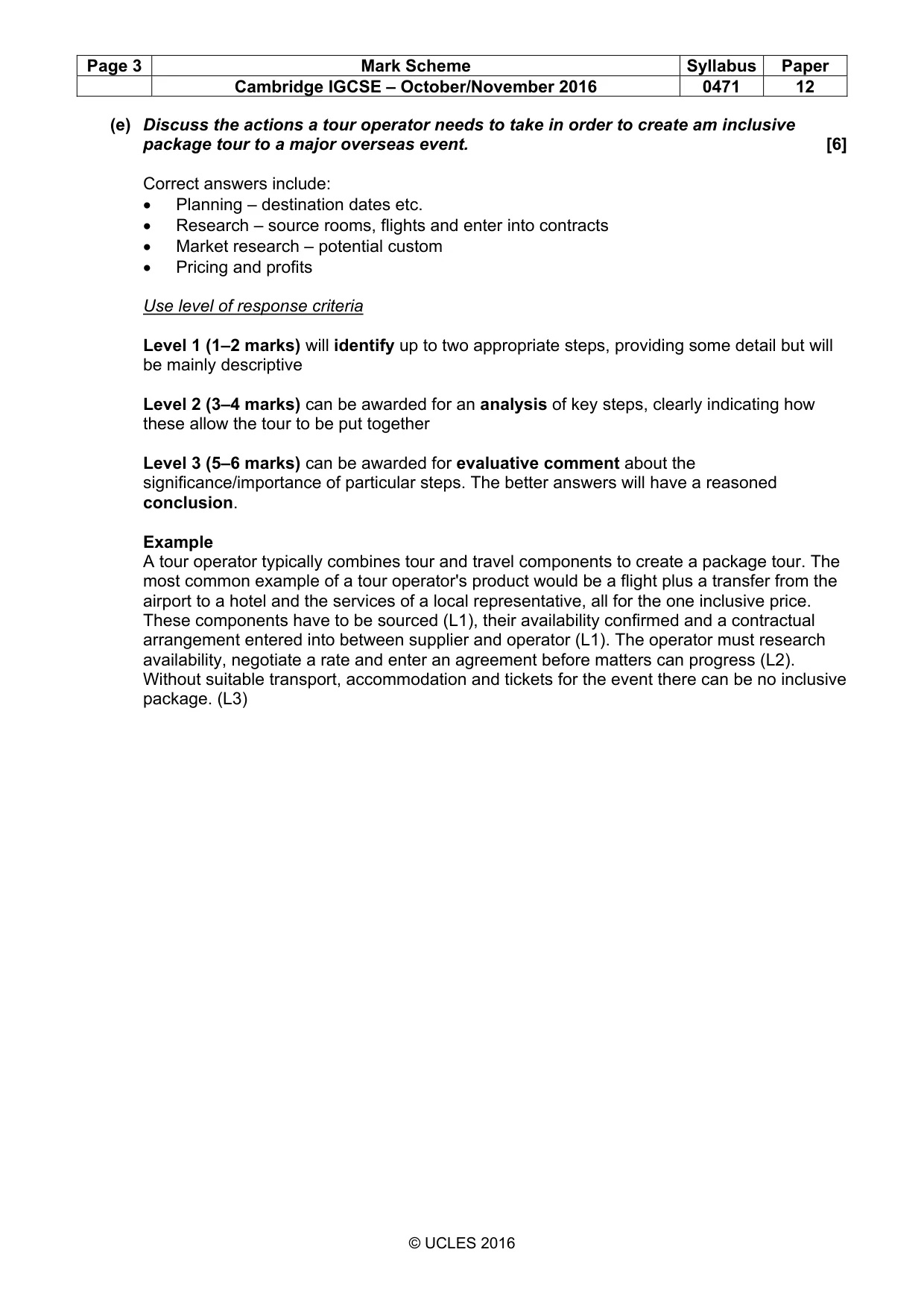
Page 3 Mark Scheme Syllabus Paper Cambridge IGCSE – October/November 2016 0471 12 © UCLES 2016 (e) Discuss the actions a tour operator needs to take in order to create am inclusive package tour to a major overseas event. [6] Correct answers include: • Planning – destination dates etc. • Research – source rooms, flights and enter into contracts • Market research – potential custom • Pricing and profits Use level of response criteria Level 1 (1–2 marks) will identify up to two appropriate steps, providing some detail but will be mainly descriptive Level 2 (3–4 marks) can be awarded for an analysis of key steps, clearly indicating how these allow the tour to be put together Level 3 (5–6 marks) can be awarded for evaluative comment about the significance/importance of particular steps. The better answers will have a reasoned conclusion. Example A tour operator typically combines tour and travel components to create a package tour. The most common example of a tour operator's product would be a flight plus a transfer from the airport to a hotel and the services of a local representative, all for the one inclusive price. These components have to be sourced (L1), their availability confirmed and a contractual arrangement entered into between supplier and operator (L1). The operator must research availability, negotiate a rate and enter an agreement before matters can progress (L2). Without suitable transport, accommodation and tickets for the event there can be no inclusive package. (L3)
Mark scheme, page 4
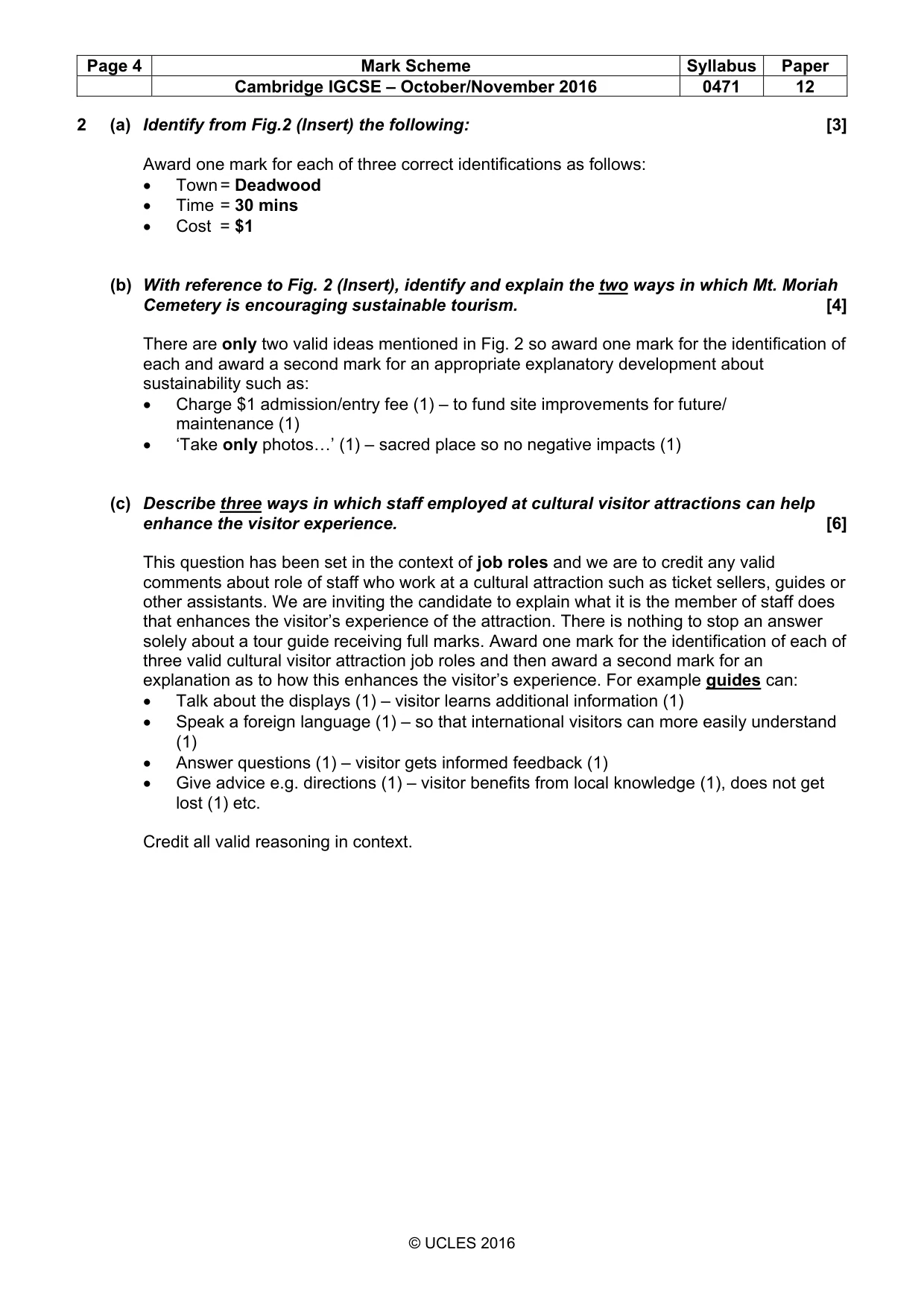
Page 4 Mark Scheme Syllabus Paper Cambridge IGCSE – October/November 2016 0471 12 © UCLES 2016 2 (a) Identify from Fig.2 (Insert) the following: [3] Award one mark for each of three correct identifications as follows: • Town = Deadwood • Time = 30 mins • Cost = $1 (b) With reference to Fig. 2 (Insert), identify and explain the two ways in which Mt. Moriah Cemetery is encouraging sustainable tourism. [4] There are only two valid ideas mentioned in Fig. 2 so award one mark for the identification of each and award a second mark for an appropriate explanatory development about sustainability such as: • Charge $1 admission/entry fee (1) – to fund site improvements for future/ maintenance (1) • ‘Take only photos…’ (1) – sacred place so no negative impacts (1) (c) Describe three ways in which staff employed at cultural visitor attractions can help enhance the visitor experience. [6] This question has been set in the context of job roles and we are to credit any valid comments about role of staff who work at a cultural attraction such as ticket sellers, guides or other assistants. We are inviting the candidate to explain what it is the member of staff does that enhances the visitor’s experience of the attraction. There is nothing to stop an answer solely about a tour guide receiving full marks. Award one mark for the identification of each of three valid cultural visitor attraction job roles and then award a second mark for an explanation as to how this enhances the visitor’s experience. For example guides can: • Talk about the displays (1) – visitor learns additional information (1) • Speak a foreign language (1) – so that international visitors can more easily understand (1) • Answer questions (1) – visitor gets informed feedback (1) • Give advice e.g. directions (1) – visitor benefits from local knowledge (1), does not get lost (1) etc. Credit all valid reasoning in context.
Mark scheme, page 5
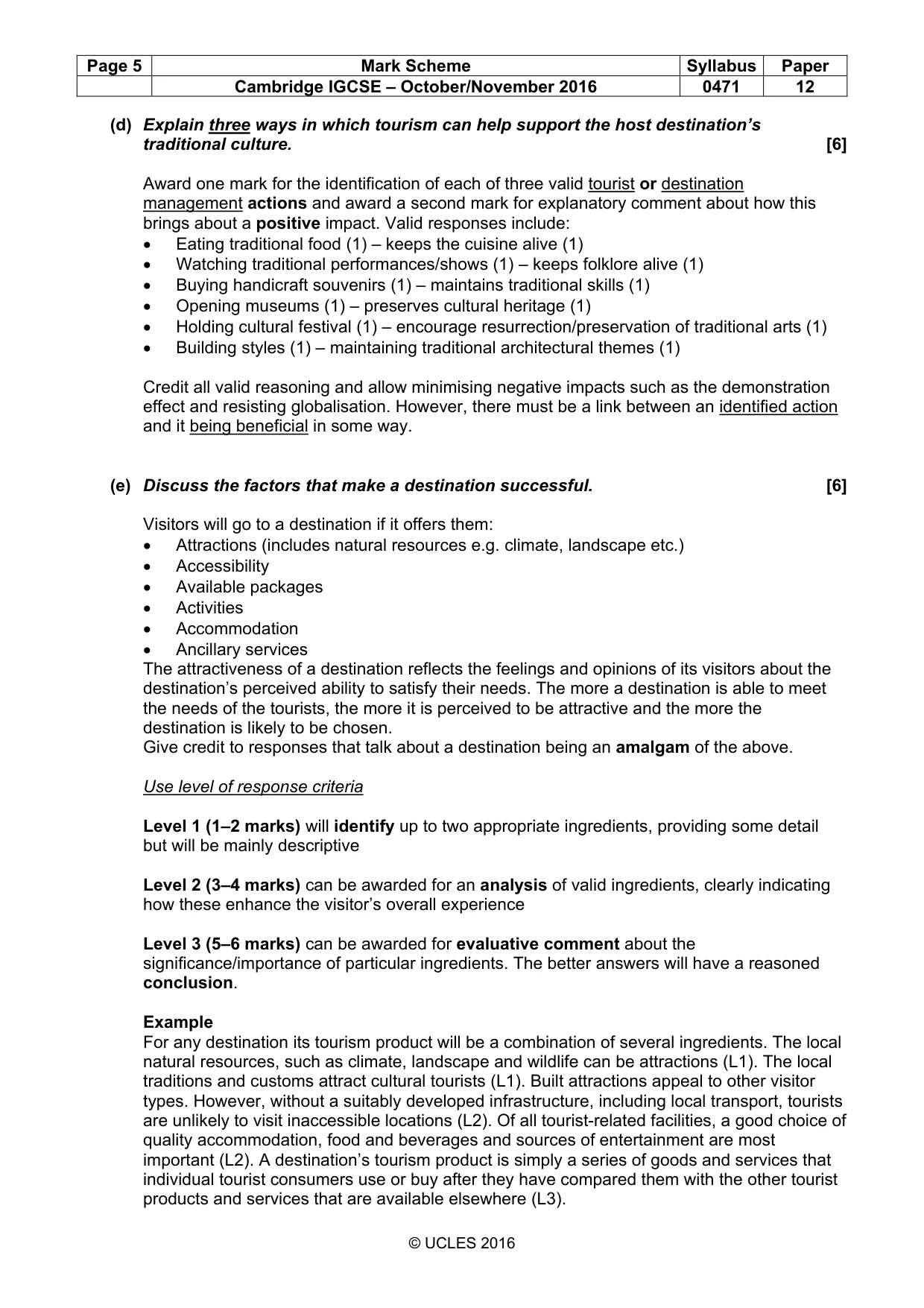
Page 5 Mark Scheme Syllabus Paper Cambridge IGCSE – October/November 2016 0471 12 © UCLES 2016 (d) Explain three ways in which tourism can help support the host destination’s traditional culture. [6] Award one mark for the identification of each of three valid tourist or destination management actions and award a second mark for explanatory comment about how this brings about a positive impact. Valid responses include: • Eating traditional food (1) – keeps the cuisine alive (1) • Watching traditional performances/shows (1) – keeps folklore alive (1) • Buying handicraft souvenirs (1) – maintains traditional skills (1) • Opening museums (1) – preserves cultural heritage (1) • Holding cultural festival (1) – encourage resurrection/preservation of traditional arts (1) • Building styles (1) – maintaining traditional architectural themes (1) Credit all valid reasoning and allow minimising negative impacts such as the demonstration effect and resisting globalisation. However, there must be a link between an identified action and it being beneficial in some way. (e) Discuss the factors that make a destination successful. [6] Visitors will go to a destination if it offers them: • Attractions (includes natural resources e.g. climate, landscape etc.) • Accessibility • Available packages • Activities • Accommodation • Ancillary services The attractiveness of a destination reflects the feelings and opinions of its visitors about the destination’s perceived ability to satisfy their needs. The more a destination is able to meet the needs of the tourists, the more it is perceived to be attractive and the more the destination is likely to be chosen. Give credit to responses that talk about a destination being an amalgam of the above. Use level of response criteria Level 1 (1–2 marks) will identify up to two appropriate ingredients, providing some detail but will be mainly descriptive Level 2 (3–4 marks) can be awarded for an analysis of valid ingredients, clearly indicating how these enhance the visitor’s overall experience Level 3 (5–6 marks) can be awarded for evaluative comment about the significance/importance of particular ingredients. The better answers will have a reasoned conclusion. Example For any destination its tourism product will be a combination of several ingredients. The local natural resources, such as climate, landscape and wildlife can be attractions (L1). The local traditions and customs attract cultural tourists (L1). Built attractions appeal to other visitor types. However, without a suitably developed infrastructure, including local transport, tourists are unlikely to visit inaccessible locations (L2). Of all tourist-related facilities, a good choice of quality accommodation, food and beverages and sources of entertainment are most important (L2). A destination’s tourism product is simply a series of goods and services that individual tourist consumers use or buy after they have compared them with the other tourist products and services that are available elsewhere (L3).
Mark scheme, page 6
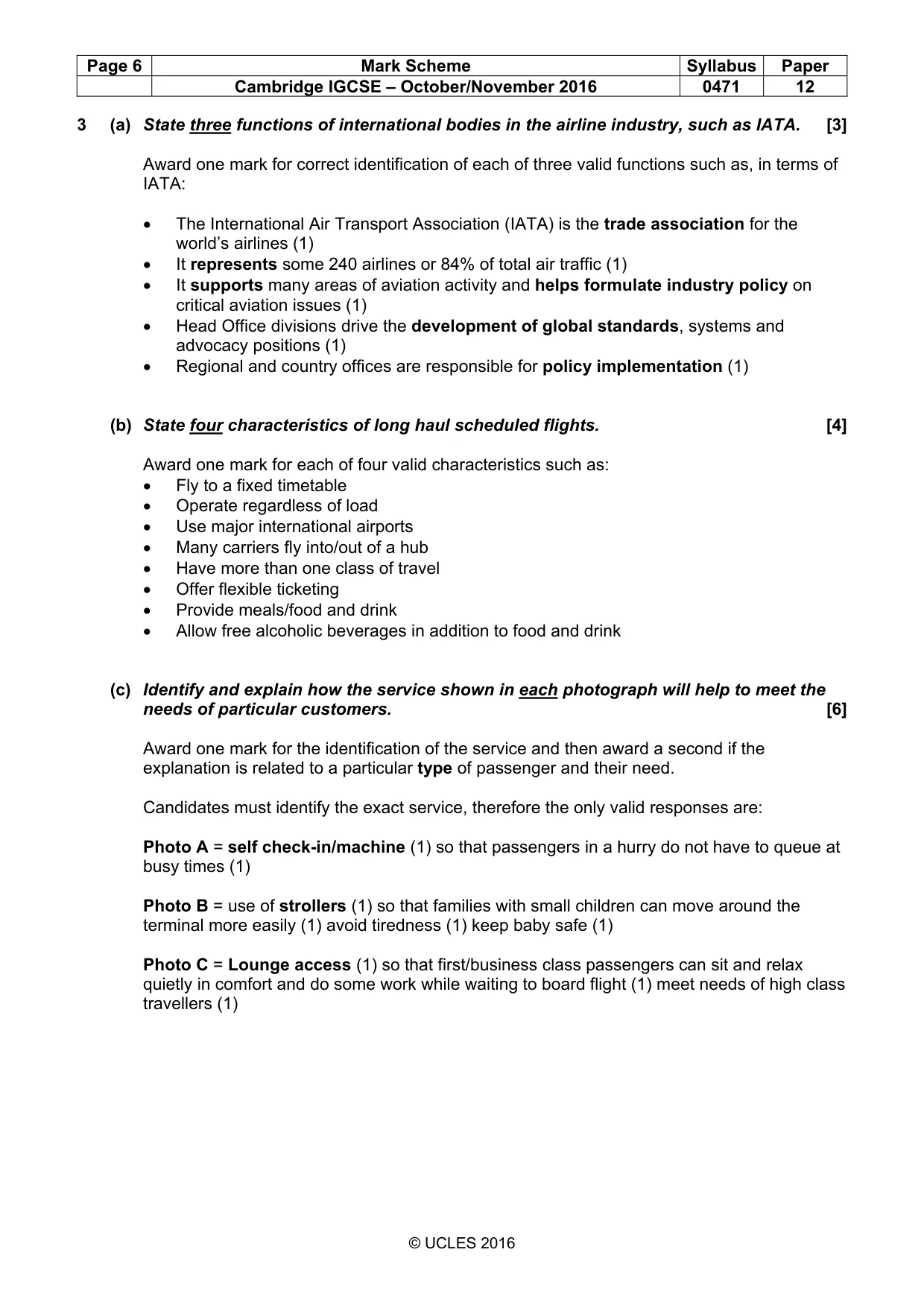
Page 6 Mark Scheme Syllabus Paper Cambridge IGCSE – October/November 2016 0471 12 © UCLES 2016 3 (a) State three functions of international bodies in the airline industry, such as IATA. [3] Award one mark for correct identification of each of three valid functions such as, in terms of IATA: • The International Air Transport Association (IATA) is the trade association for the world’s airlines (1) • It represents some 240 airlines or 84% of total air traffic (1) • It supports many areas of aviation activity and helps formulate industry policy on critical aviation issues (1) • Head Office divisions drive the development of global standards, systems and advocacy positions (1) • Regional and country offices are responsible for policy implementation (1) (b) State four characteristics of long haul scheduled flights. [4] Award one mark for each of four valid characteristics such as: • Fly to a fixed timetable • Operate regardless of load • Use major international airports • Many carriers fly into/out of a hub • Have more than one class of travel • Offer flexible ticketing • Provide meals/food and drink • Allow free alcoholic beverages in addition to food and drink (c) Identify and explain how the service shown in each photograph will help to meet the needs of particular customers. [6] Award one mark for the identification of the service and then award a second if the explanation is related to a particular type of passenger and their need. Candidates must identify the exact service, therefore the only valid responses are: Photo A = self check-in/machine (1) so that passengers in a hurry do not have to queue at busy times (1) Photo B = use of strollers (1) so that families with small children can move around the terminal more easily (1) avoid tiredness (1) keep baby safe (1) Photo C = Lounge access (1) so that first/business class passengers can sit and relax quietly in comfort and do some work while waiting to board flight (1) meet needs of high class travellers (1)
Mark scheme, page 7
Page 7 Mark Scheme Syllabus Paper Cambridge IGCSE – October/November 2016 0471 12 © UCLES 2016 (d) Explain three advantages to passengers of using taxis for their airport transfers. [6] Award one mark for the identification of each of three valid advantages and then award a second mark for an appropriate explanatory comment about each stated advantage. Correct responses include: • Convenience (1) – door to door (1) • Privacy (1) – no need to share journey (1) • Comfort (1) – more room than bus/train (1) • Less hassle (1) – no carrying luggage (1) • Peace of mind (1) – hirer chooses times (1), no queues or waiting (1) • Booked (1) – no waiting (1) • Regulated by government (1) safer (1) (e) Discuss the reference sources that a travel agent might use to draw up a customer’s itinerary. [6] Correct ideas include: • Tour operator’s product in brochure • Airline’s flight schedules • Hotel via CRS or GDS • Ancillary products via GDS • OAG guides etc. • Brochures • Websites/internet Use level of response criteria Level 1 (1–2 marks) will identify up to two appropriate procedures, providing some detail but will be mainly descriptive Level 2 (3–4 marks) can be awarded for an analysis of key procedures, clearly indicating how these help to meet customer requirements Level 3 (5–6 marks) can be awarded for evaluative comment about the significance/importance of particular staff actions. The better answers will have a reasoned conclusion. Example The agent will attempt to meet the customer’s requirements when asked to arrange a particular trip. He will open a reservation file (L1) and use computerised information systems such as Galileo (L1) to obtain travel options and to find out about their availability (L2). He will then be able to select the most appropriate options such as flights (departure airport/times), hotel (grade, location and meal plan) and any extras such as car hire (L2). The most important aspect of this is that the use of CRS and GDS allow all component parts to be readily assembled to meet the customer’s needs and expectations (L3).
Mark scheme, page 8
Page 8 Mark Scheme Syllabus Paper Cambridge IGCSE – October/November 2016 0471 12 © UCLES 2016 4 (a) Identify from Fig. 3 (Insert), the following: [3] Award one mark for each identification as follows: • No. of nights = 462 000 • % 65+ = 8 • Av stay = 2.5 nights (b) Suggest why each of the following is an important source market for Australia. [4] In each case award one mark for each of two valid explanatory statements relating to flows to Australia. Correct responses include: The UK British historical links (1) – English speaking (1) – Commonwealth country (1) – migration and VFR (1) – relatively wealthy travelling population (1) etc. Japan Asia Pacific neighbour (1) – accessible (1) – VFR (1) – favourable exchange rate (1) Credit all valid reasoning. (c) Explain three advantages to staying visitors of self-catering accommodation. [6] Award one mark for the identification of each of three valid advantages and then award a second mark for an appropriate explanatory comment about each stated advantage. Correct responses include: • Save money (1) – cheaper than hotels (1) • More freedom (1) – no set meal times (1) • Own choice of food (1) – dietary needs (1) • More space (1) – allows multiple occupancy for family (1) • Home from home (1) – kitchen/dining facilities included (1) • Privacy (1) – less people/quieter (1) • Allow al-fresco eating (1) – terrace/patio (1) Credit all valid reasoning.
Mark scheme, page 9
Page 9 Mark Scheme Syllabus Paper Cambridge IGCSE – October/November 2016 0471 12 © UCLES 2016 (d) Explain three ways in which tourism might impact on a destination’s natural environment. [6] Award one mark for the identification of each of three valid ways and award a second mark for an appropriate explanatory comment about the positive and/or negative effect on the environment. Correct responses include: NEGATIVES • litter is dropped (1) and local wildlife is disturbed and might eat it (1) • plants are picked and trampled (1) causing additional erosion (1) • the pressure of vehicles and people (1) means the soil exposed to wind and water erosion (1) • Fires/smoking (1) create bush fires (1) • Water pollution (1) boat oil spills (1) etc. • Soil erosion (1) trampling (1) POSITIVES • Visits to game parks (1) encourages wildlife conservation (1) • Environmental audits (1) identify areas under threat and result in remedial action e.g. maintenance of paths (1) to reduce trampling and soil erosion (1) • Use of park rangers with visitors (1) helps to reduce issues such as poaching (1) • Selling of permits (1) controls hunting and fishing to sustainable levels (1) Credit all valid reasoning.
Mark scheme, page 10
Page 10 Mark Scheme Syllabus Paper Cambridge IGCSE – October/November 2016 0471 12 © UCLES 2016 (e) With reference to one natural landscape feature, discuss the ways in which it has been developed to appeal to tourists. [6] Correct ideas include: • Location – what has been built? • Setting – how used? • What is the appeal and to whom? Use level of response criteria Level 1 (1–2 marks) will identify up to two appropriate developments, providing some detail but will be mainly descriptive Level 2 (3–4 marks) can be awarded for an analysis of developments, clearly indicating how been made attractive to visitors Level 3 (5–6 marks) can be awarded for evaluative comment about the significance/importance of particular aspects. The better answers will have a reasoned conclusion. Example – Dubai Creek The Creek is a natural seawater inlet that cuts through the centre of Dubai. It is the historical part of Dubai where visitors can take an abra (L1) and view the old trading port and the dhows from the water (L2). Leisure vessels such as Bateaux Dubai cruise (L1) to Al- Maktoum Bridge allowing diners to pass and view many of the city's historic as well as modern landmarks (L2). A totally free visitor attraction, something that is rare in Dubai, is to stroll around the wharf which offers a picturesque glimpse of Dubai's trading heritage, where dhows bound for distant places dock to unload their goods (L3). The Creek Golf course provides visitors with a sporting option but most visitors come for the view (L3)
What you needed in this session
Cambridge’s own grade thresholds for 2016 Oct/Nov, Paper 1 · Variant 2. A higher threshold means an easier paper — the bar moves with how the cohort did.