Cambridge IGCSE Travel and Tourism 0471 — 2016 Oct/Nov Paper 1 · Variant 1
0471/11/O/N/16 · 100 marks · ≈113 min
The question paper and its mark scheme, free to read here and free to download. This is Cambridge’s own paper, exactly as it was sat.
Question paper16 pages


Mark scheme9 pages
Answers below. Sit the paper first if you are practising.

Paper as text
Question paper, page 1
This document consists of 14 printed pages, 2 blank pages and 1 Insert. DC (ST) 113361/1 © UCLES 2016 [Turn over Cambridge International Examinations Cambridge International General Certificate of Secondary Education * 4 9 1 3 5 5 1 4 9 4 * TRAVEL AND TOURISM 0471/11 Core Module October/November 2016 2 hours Candidates answer on the Question Paper. No Additional Materials are required. READ THESE INSTRUCTIONS FIRST Write your Centre number, candidate number and name on all the work you hand in. Write in dark blue or black pen. You may use an HB pencil for any diagrams or graphs. Do not use staples, paper clips, glue or correction fluid. DO NOT WRITE IN ANY BARCODES. Answer all questions. All the Figures referred to in the questions are contained in the Insert. At the end of the examination, fasten all your work securely together. The number of marks is given in brackets [ ] at the end of each question or part question.
Question paper, page 2
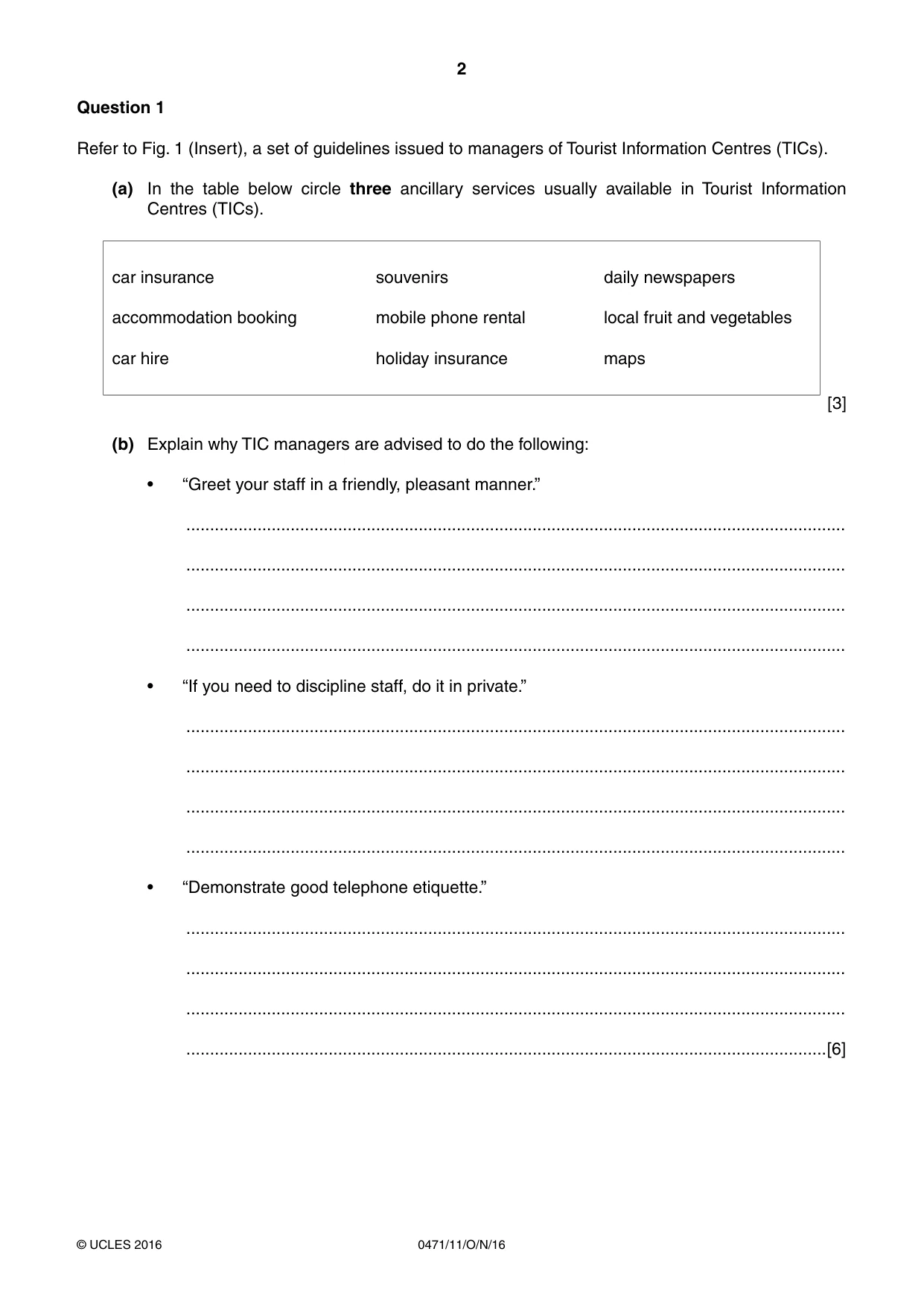
2 0471/11/O/N/16 © UCLES 2016 Question 1 Refer to Fig. 1 (Insert), a set of guidelines issued to managers of Tourist Information Centres (TICs). (a) In the table below circle three ancillary services usually available in Tourist Information Centres (TICs). car insurance souvenirs daily newspapers accommodation booking mobile phone rental local fruit and vegetables car hire holiday insurance maps [3] (b) Explain why TIC managers are advised to do the following: • “Greet your staff in a friendly, pleasant manner.” … … … … • “If you need to discipline staff, do it in private.” … … … … • “Demonstrate good telephone etiquette.” … … … …[6]
Question paper, page 3
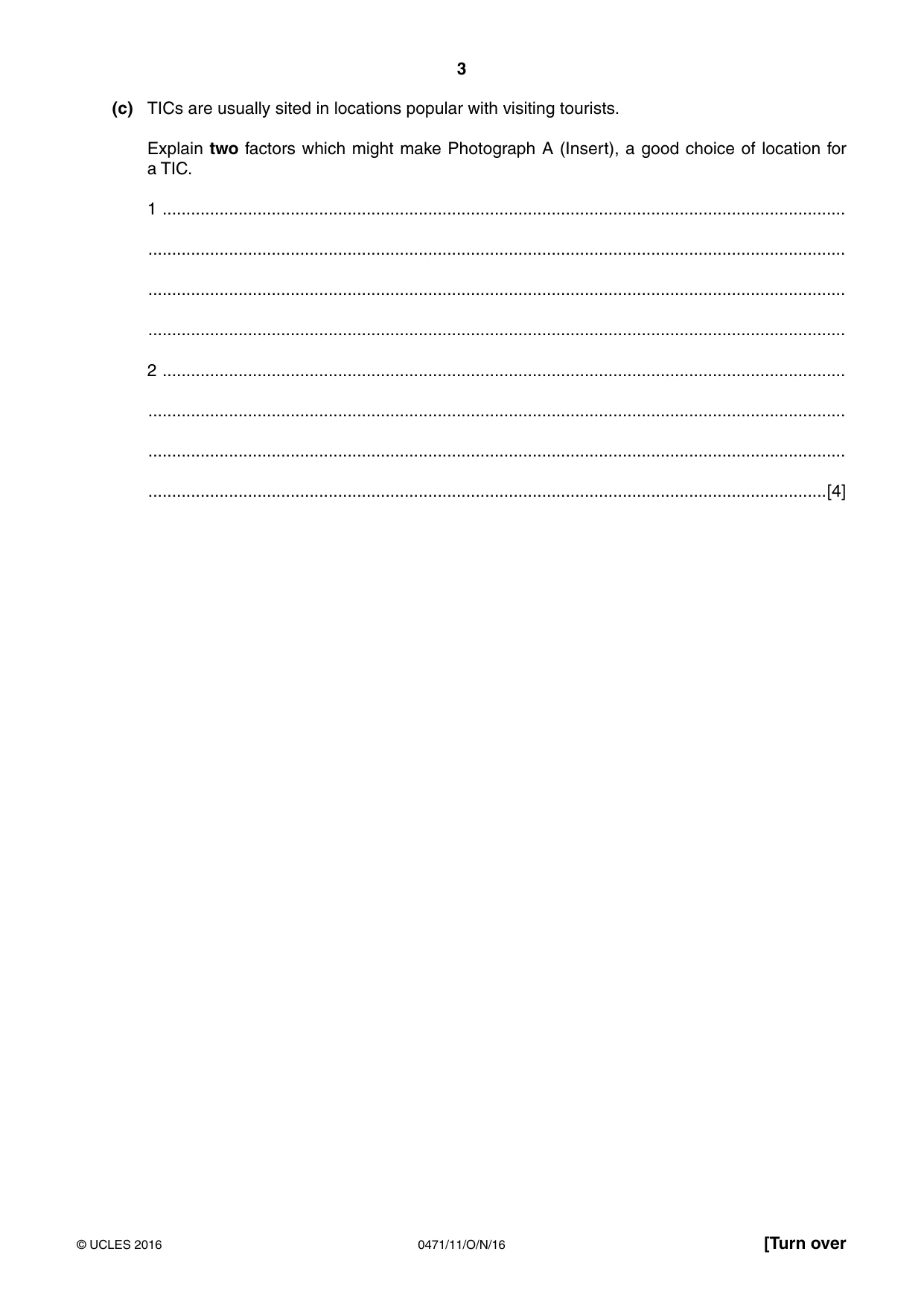
3 0471/11/O/N/16 © UCLES 2016 [Turn over (c) TICs are usually sited in locations popular with visiting tourists. Explain two factors which might make Photograph A (Insert), a good choice of location for a TIC. 1 … … … … 2 … … … …[4]
Question paper, page 4
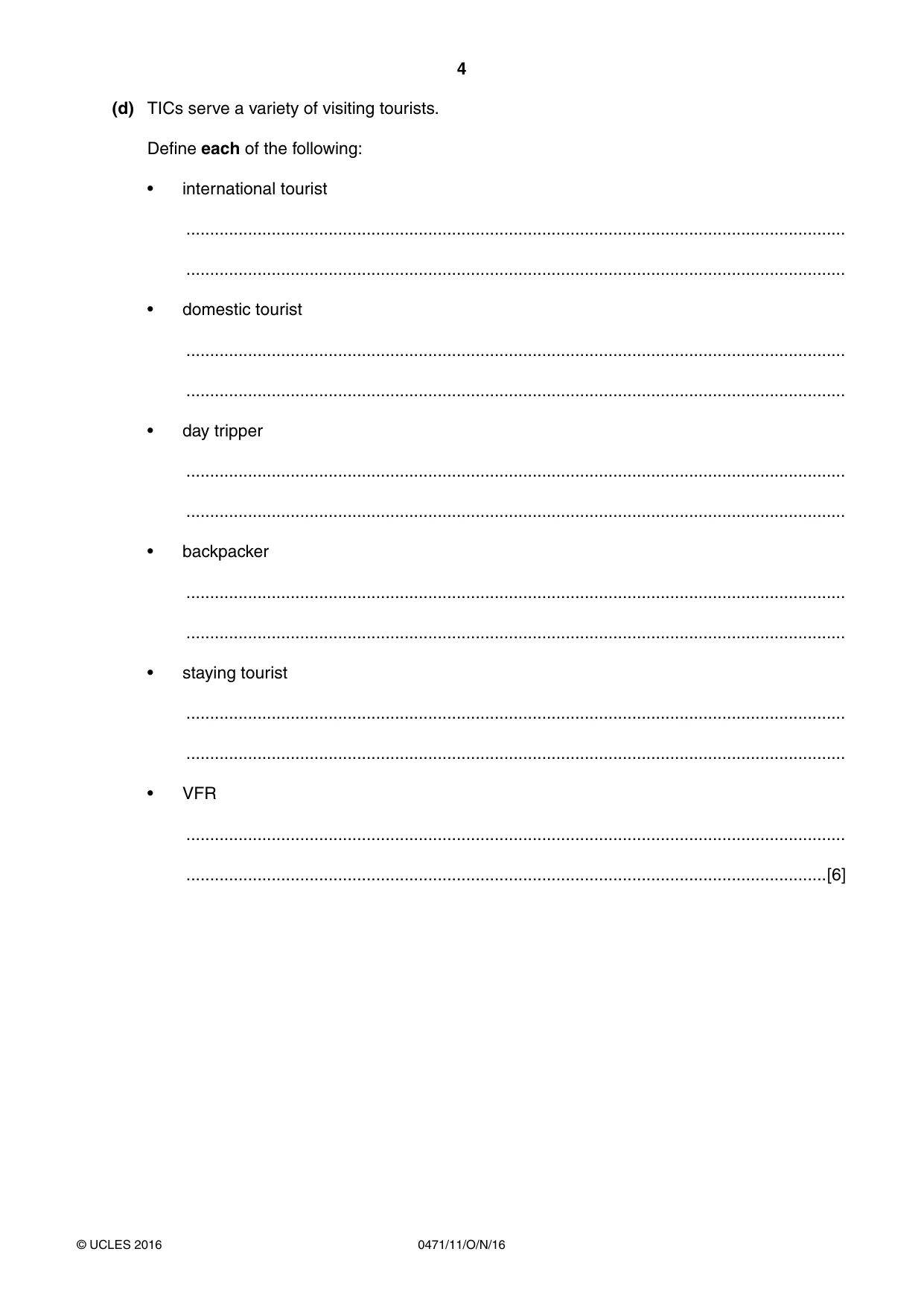
4 0471/11/O/N/16 © UCLES 2016 (d) TICs serve a variety of visiting tourists. Define each of the following: • international tourist … … • domestic tourist … … • day tripper … … • backpacker … … • staying tourist … … • VFR … …[6]
Question paper, page 5
5 0471/11/O/N/16 © UCLES 2016 [Turn over (e) Discuss the reasons why National Tourist Boards collect visitor statistics. … … … … … … … … … … … …[6] [Total: 25]
Question paper, page 6
6 0471/11/O/N/16 © UCLES 2016 Question 2 Refer to Fig. 2 (Insert), a news item about the Bishop Museum in Hawaii, USA. (a) Identify from Fig. 2 (Insert), the following: • the number of catalogued objects held at the museum … • the year the museum was founded … • the number of visitors attracted each year …[3] (b) With reference to Fig. 2 (Insert), identify and explain three ways in which the safety of visitors at the museum will have been improved by 2017. 1 … … … … 2 … … … … 3 … … … …[6]
Question paper, page 7
7 0471/11/O/N/16 © UCLES 2016 [Turn over (c) The Bishop Museum “is dedicated to the study and preservation of the cultures and natural history of Hawaii and the Pacific region”. State and explain three ways in which the Bishop Museum is likely to fulfil this role. 1 … … … … 2 … … … … 3 … … … …[6] (d) The Bishop Museum wishes to change its opening hours. State two promotional methods the museum could use to communicate this change, and give an advantage of using each method. Method 1 … Advantage … … … Method 2 … Advantage … … …[4]
Question paper, page 8
8 0471/11/O/N/16 © UCLES 2016 (e) With reference to one visitor attraction, assess its appeal to elderly visitors. Name of attraction … … … … … … … … … … … … …[6] [Total: 25]
Question paper, page 9
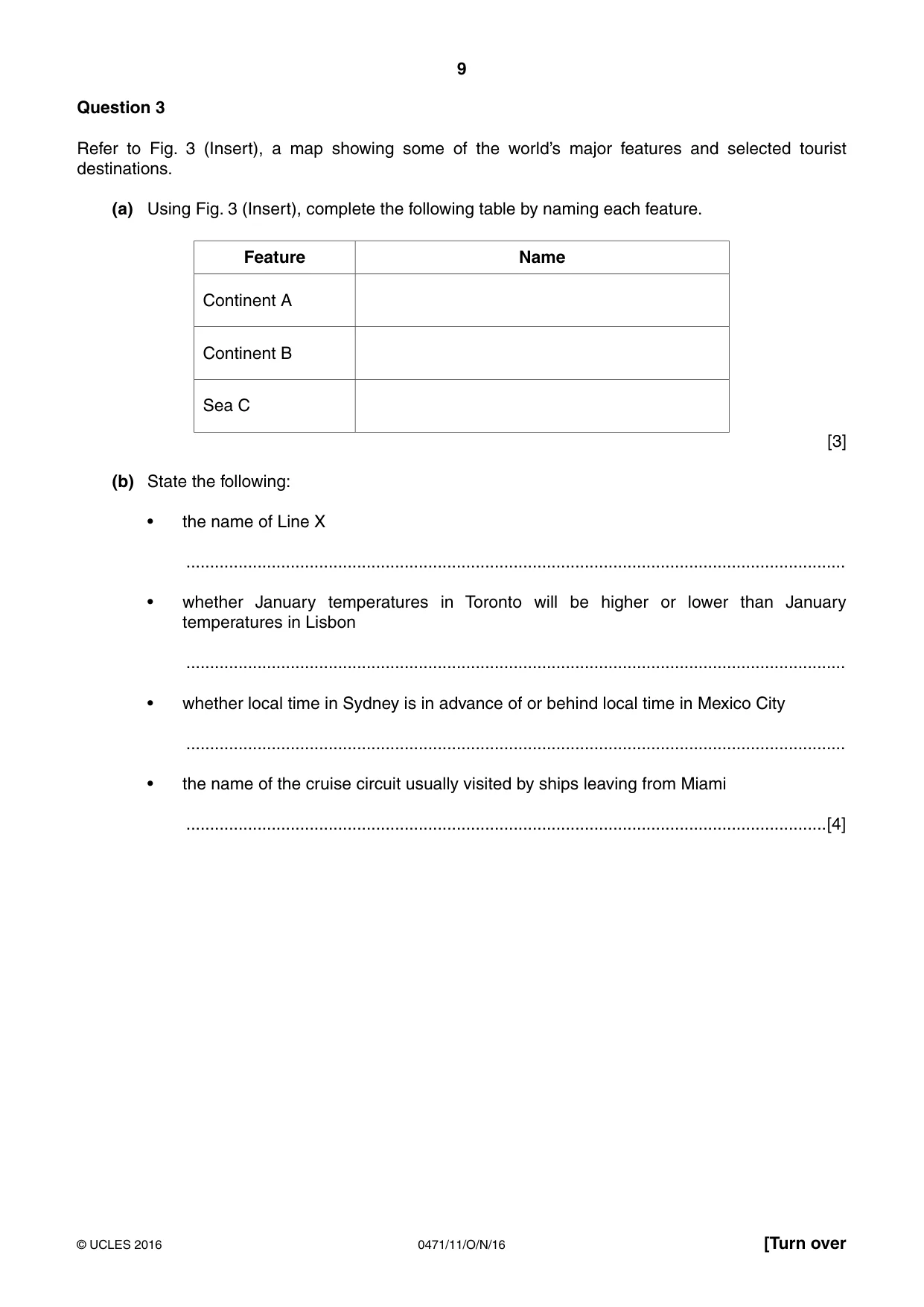
9 0471/11/O/N/16 © UCLES 2016 [Turn over Question 3 Refer to Fig. 3 (Insert), a map showing some of the world’s major features and selected tourist destinations. (a) Using Fig. 3 (Insert), complete the following table by naming each feature. Feature Name Continent A Continent B Sea C [3] (b) State the following: • the name of Line X … • whether January temperatures in Toronto will be higher or lower than January temperatures in Lisbon … • whether local time in Sydney is in advance of or behind local time in Mexico City … • the name of the cruise circuit usually visited by ships leaving from Miami …[4]
Question paper, page 10
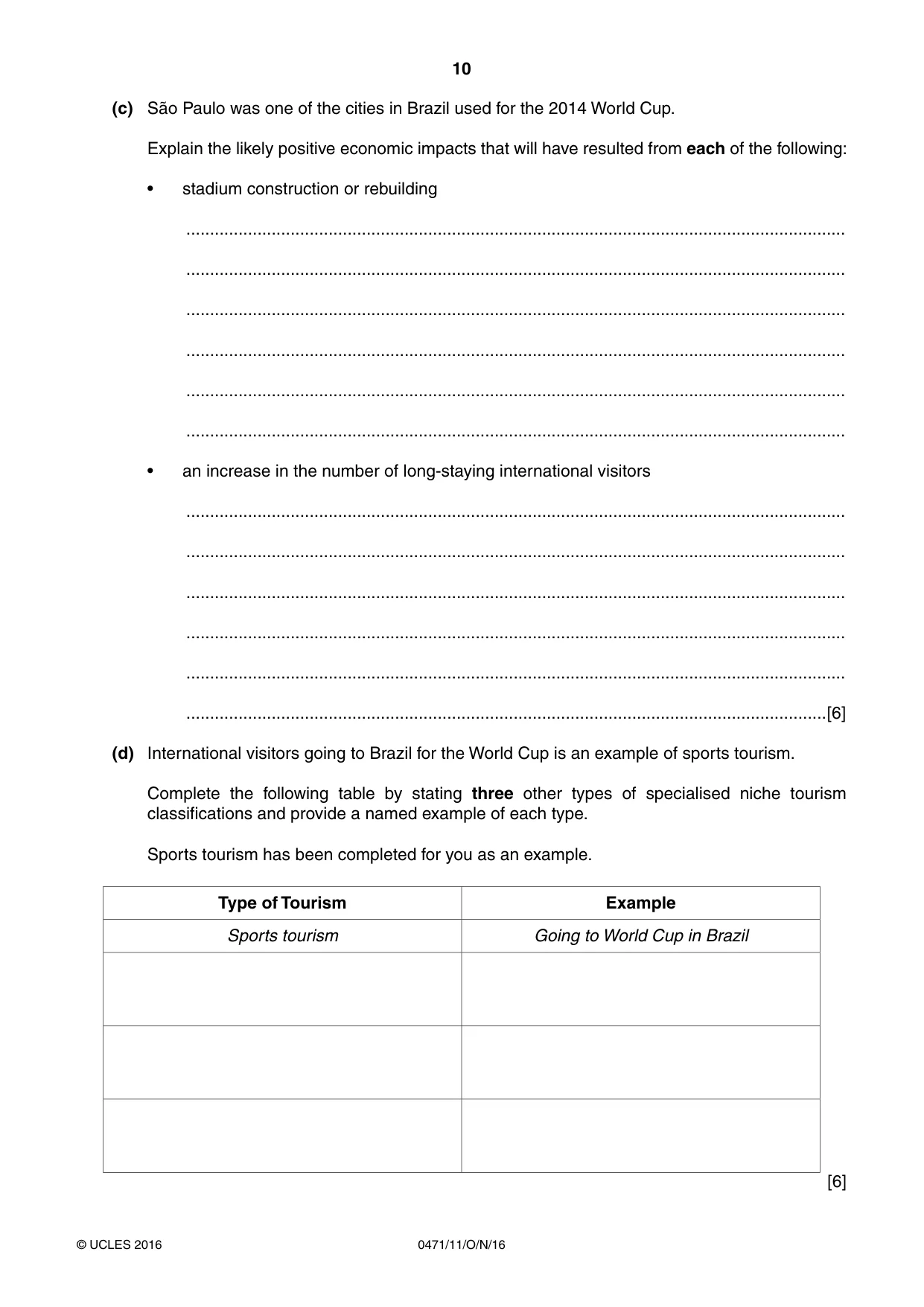
10 0471/11/O/N/16 © UCLES 2016 (c) São Paulo was one of the cities in Brazil used for the 2014 World Cup. Explain the likely positive economic impacts that will have resulted from each of the following: • stadium construction or rebuilding … … … … … … • an increase in the number of long-staying international visitors … … … … … …[6] (d) International visitors going to Brazil for the World Cup is an example of sports tourism. Complete the following table by stating three other types of specialised niche tourism classifications and provide a named example of each type. Sports tourism has been completed for you as an example. Type of Tourism Example Sports tourism Going to World Cup in Brazil [6]
Question paper, page 11
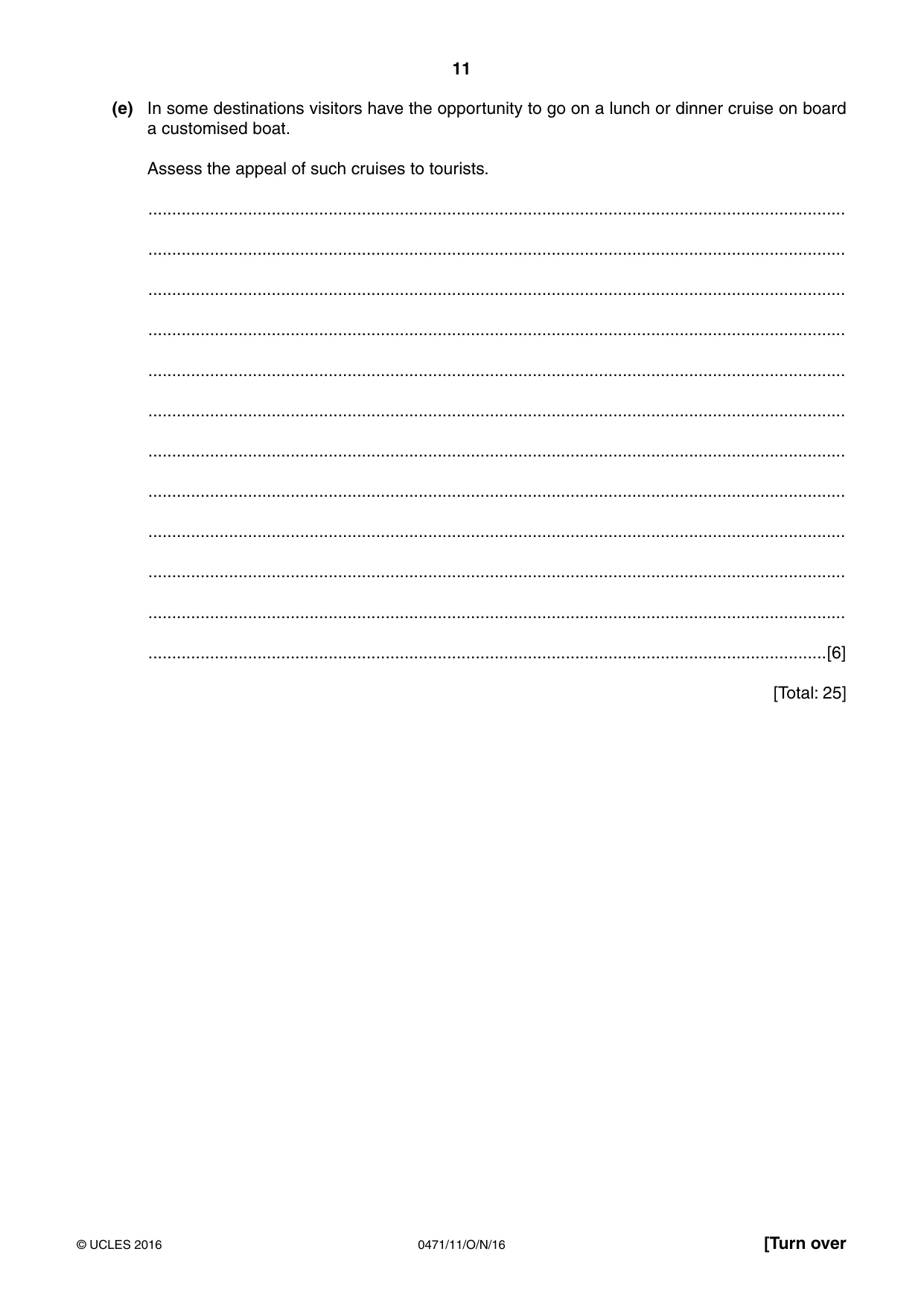
11 0471/11/O/N/16 © UCLES 2016 [Turn over (e) In some destinations visitors have the opportunity to go on a lunch or dinner cruise on board a customised boat. Assess the appeal of such cruises to tourists. … … … … … … … … … … … …[6] [Total: 25]
Question paper, page 12
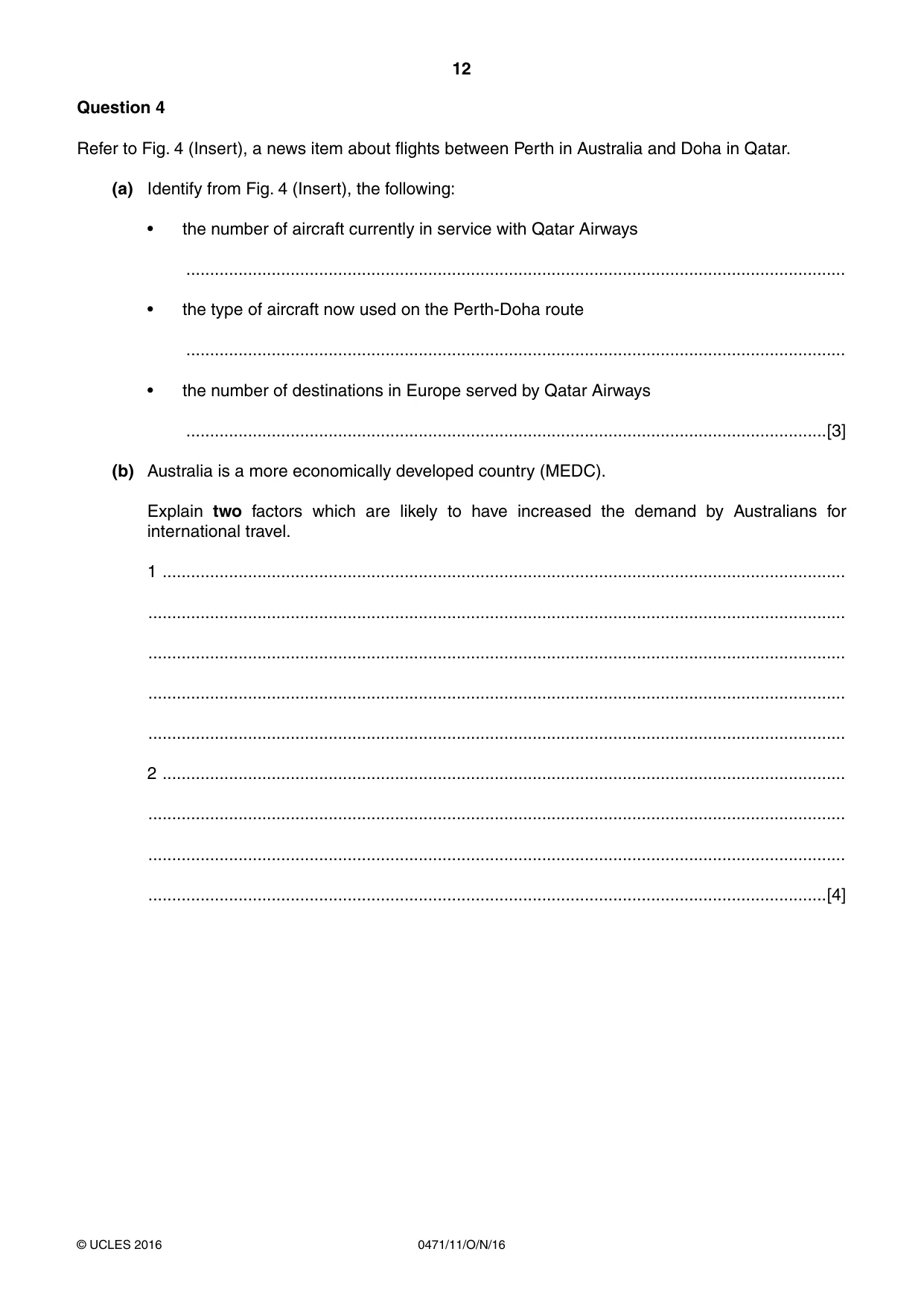
12 0471/11/O/N/16 © UCLES 2016 Question 4 Refer to Fig. 4 (Insert), a news item about flights between Perth in Australia and Doha in Qatar. (a) Identify from Fig. 4 (Insert), the following: • the number of aircraft currently in service with Qatar Airways … • the type of aircraft now used on the Perth-Doha route … • the number of destinations in Europe served by Qatar Airways …[3] (b) Australia is a more economically developed country (MEDC). Explain two factors which are likely to have increased the demand by Australians for international travel. 1 … … … … … 2 … … … …[4]
Question paper, page 13
13 0471/11/O/N/16 © UCLES 2016 [Turn over (c) With reference to Fig. 4 (Insert), identify and explain three ways in which Doha’s Hamad International Airport meets the needs of passengers travelling with children. 1 … … … … 2 … … … … 3 … … … …[6] (d) Doha’s airport is one of the many international airports in the world currently experiencing growth. Explain three negative environmental impacts associated with airport growth and expansion. 1 … … … … 2 … … … … 3 … … … …[6]
Question paper, page 14
14 0471/11/O/N/16 © UCLES 2016 (e) Discuss the ways in which major international airports currently ensure the safety and security of passengers. … … … … … … … … … … … …[6] [Total: 25]
Question paper, page 15
15 0471/11/O/N/16 © UCLES 2016 BLANK PAGE
Question paper, page 16
16 0471/11/O/N/16 © UCLES 2016 Permission to reproduce items where third-party owned material protected by copyright is included has been sought and cleared where possible. Every reasonable effort has been made by the publisher (UCLES) to trace copyright holders, but if any items requiring clearance have unwittingly been included, the publisher will be pleased to make amends at the earliest possible opportunity. To avoid the issue of disclosure of answer-related information to candidates, all copyright acknowledgements are reproduced online in the Cambridge International Examinations Copyright Acknowledgements Booklet. This is produced for each series of examinations and is freely available to download at www.cie.org.uk after the live examination series. Cambridge International Examinations is part of the Cambridge Assessment Group. Cambridge Assessment is the brand name of University of Cambridge Local Examinations Syndicate (UCLES), which is itself a department of the University of Cambridge. BLANK PAGE
Mark scheme, page 1
® IGCSE is the registered trademark of Cambridge International Examinations. This document consists of 9 printed pages. © UCLES 2016 [Turn over Cambridge International Examinations Cambridge International General Certificate of Secondary Education TRAVEL AND TOURISM 0471/11 Paper 1 Core Paper October/November 2016 MARK SCHEME Maximum Mark: 100 Published This mark scheme is published as an aid to teachers and candidates, to indicate the requirements of the examination. It shows the basis on which Examiners were instructed to award marks. It does not indicate the details of the discussions that took place at an Examiners’ meeting before marking began, which would have considered the acceptability of alternative answers. Mark schemes should be read in conjunction with the question paper and the Principal Examiner Report for Teachers. Cambridge will not enter into discussions about these mark schemes. Cambridge is publishing the mark schemes for the October/November 2016 series for most Cambridge IGCSE®, Cambridge International A and AS Level components and some Cambridge O Level components.
Mark scheme, page 2
Page 2 Mark Scheme Syllabus Paper Cambridge IGCSE – October/November 2016 0471 11 © UCLES 2016 1 (a) In the table below circle three ancillary services usually available in tourist information centres (TICs). [3] Award one mark for the identification of each of: • Souvenirs • Accommodation booking • Maps (b) Explain why TIC managers are advised to do the following: [6] In each case award one mark for each of two valid explanatory statements, such as: “Greet your staff in a friendly, pleasant manner” To create a welcoming working environment (1) that encourages staff to treat customers in the same way (1) and thus create a good impression (1) “If you need to discipline staff, do it in private” To avoid embarrassment (1) to both staff and customers (1) and keep confidentiality (1) “Demonstrate good telephone etiquette” To train staff (1) so that they know standard expected (1) so customer enquiries are dealt with in an appropriate business-like manner (1) (c) Explain two factors which might make Photograph A (Insert), a good choice of location for a TIC. [4] Award one mark for the identification of each of two valid factors and award a second mark for an appropriate explanatory comment about each. Correct answers include: • Accessibility (1) – located by car park with coach spaces (1) • Visibility (1) – pavement area to place sign (1) • Visitor destination (1) – coaches indicate flow of tourists (1) Credit all valid reasoning in context. (d) TICs serve a variety of visiting tourists. Define each of the following: [6] Award one mark for an appropriate definition of each tourist type, such as: International = tourist travelling from overseas (1) Domestic = tourist travelling within own country (1) Day tripper = tourist not staying overnight (1) Backpacker = tourist staying in hostel/camp to save money, while exploring various destinations (1) Staying = tourist spending at least one night (1) VFR = tourist visiting friends and relatives (1)
Mark scheme, page 3
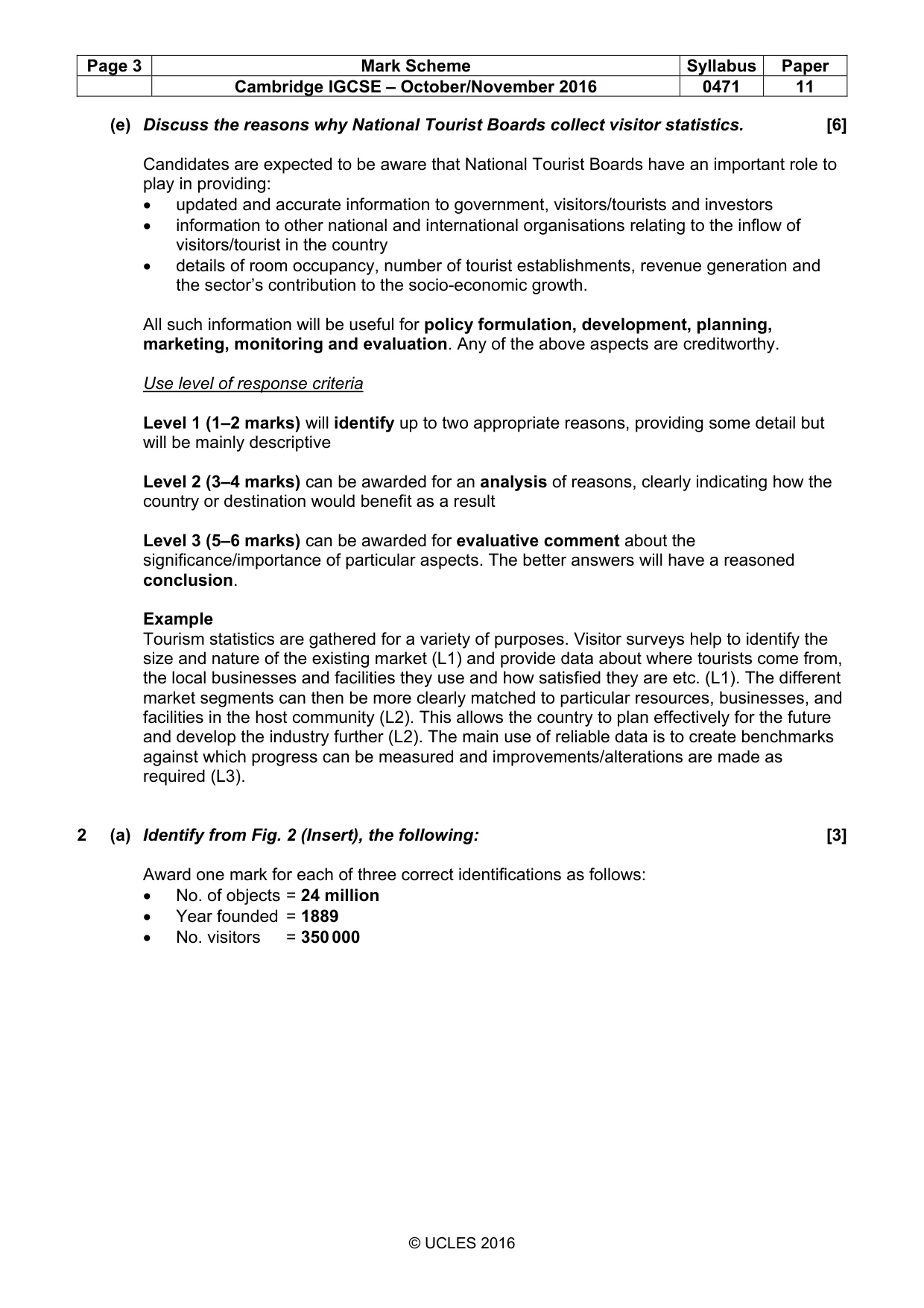
Page 3 Mark Scheme Syllabus Paper Cambridge IGCSE – October/November 2016 0471 11 © UCLES 2016 (e) Discuss the reasons why National Tourist Boards collect visitor statistics. [6] Candidates are expected to be aware that National Tourist Boards have an important role to play in providing: • updated and accurate information to government, visitors/tourists and investors • information to other national and international organisations relating to the inflow of visitors/tourist in the country • details of room occupancy, number of tourist establishments, revenue generation and the sector’s contribution to the socio-economic growth. All such information will be useful for policy formulation, development, planning, marketing, monitoring and evaluation. Any of the above aspects are creditworthy. Use level of response criteria Level 1 (1–2 marks) will identify up to two appropriate reasons, providing some detail but will be mainly descriptive Level 2 (3–4 marks) can be awarded for an analysis of reasons, clearly indicating how the country or destination would benefit as a result Level 3 (5–6 marks) can be awarded for evaluative comment about the significance/importance of particular aspects. The better answers will have a reasoned conclusion. Example Tourism statistics are gathered for a variety of purposes. Visitor surveys help to identify the size and nature of the existing market (L1) and provide data about where tourists come from, the local businesses and facilities they use and how satisfied they are etc. (L1). The different market segments can then be more clearly matched to particular resources, businesses, and facilities in the host community (L2). This allows the country to plan effectively for the future and develop the industry further (L2). The main use of reliable data is to create benchmarks against which progress can be measured and improvements/alterations are made as required (L3). 2 (a) Identify from Fig. 2 (Insert), the following: [3] Award one mark for each of three correct identifications as follows: • No. of objects = 24 million • Year founded = 1889 • No. visitors = 350 000
Mark scheme, page 4
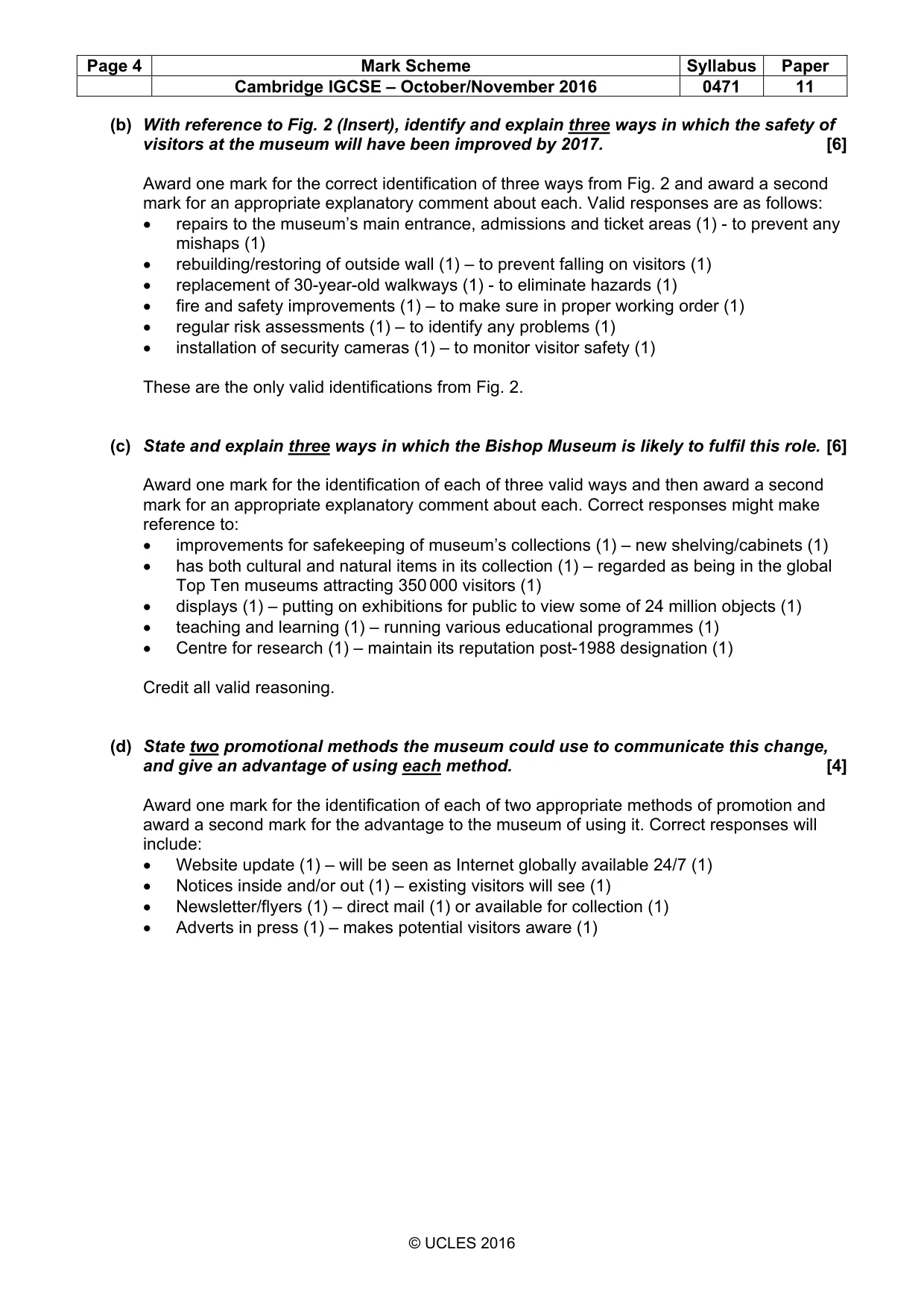
Page 4 Mark Scheme Syllabus Paper Cambridge IGCSE – October/November 2016 0471 11 © UCLES 2016 (b) With reference to Fig. 2 (Insert), identify and explain three ways in which the safety of visitors at the museum will have been improved by 2017. [6] Award one mark for the correct identification of three ways from Fig. 2 and award a second mark for an appropriate explanatory comment about each. Valid responses are as follows: • repairs to the museum’s main entrance, admissions and ticket areas (1) - to prevent any mishaps (1) • rebuilding/restoring of outside wall (1) – to prevent falling on visitors (1) • replacement of 30-year-old walkways (1) - to eliminate hazards (1) • fire and safety improvements (1) – to make sure in proper working order (1) • regular risk assessments (1) – to identify any problems (1) • installation of security cameras (1) – to monitor visitor safety (1) These are the only valid identifications from Fig. 2. (c) State and explain three ways in which the Bishop Museum is likely to fulfil this role. [6] Award one mark for the identification of each of three valid ways and then award a second mark for an appropriate explanatory comment about each. Correct responses might make reference to: • improvements for safekeeping of museum’s collections (1) – new shelving/cabinets (1) • has both cultural and natural items in its collection (1) – regarded as being in the global Top Ten museums attracting 350 000 visitors (1) • displays (1) – putting on exhibitions for public to view some of 24 million objects (1) • teaching and learning (1) – running various educational programmes (1) • Centre for research (1) – maintain its reputation post-1988 designation (1) Credit all valid reasoning. (d) State two promotional methods the museum could use to communicate this change, and give an advantage of using each method. [4] Award one mark for the identification of each of two appropriate methods of promotion and award a second mark for the advantage to the museum of using it. Correct responses will include: • Website update (1) – will be seen as Internet globally available 24/7 (1) • Notices inside and/or out (1) – existing visitors will see (1) • Newsletter/flyers (1) – direct mail (1) or available for collection (1) • Adverts in press (1) – makes potential visitors aware (1)
Mark scheme, page 5
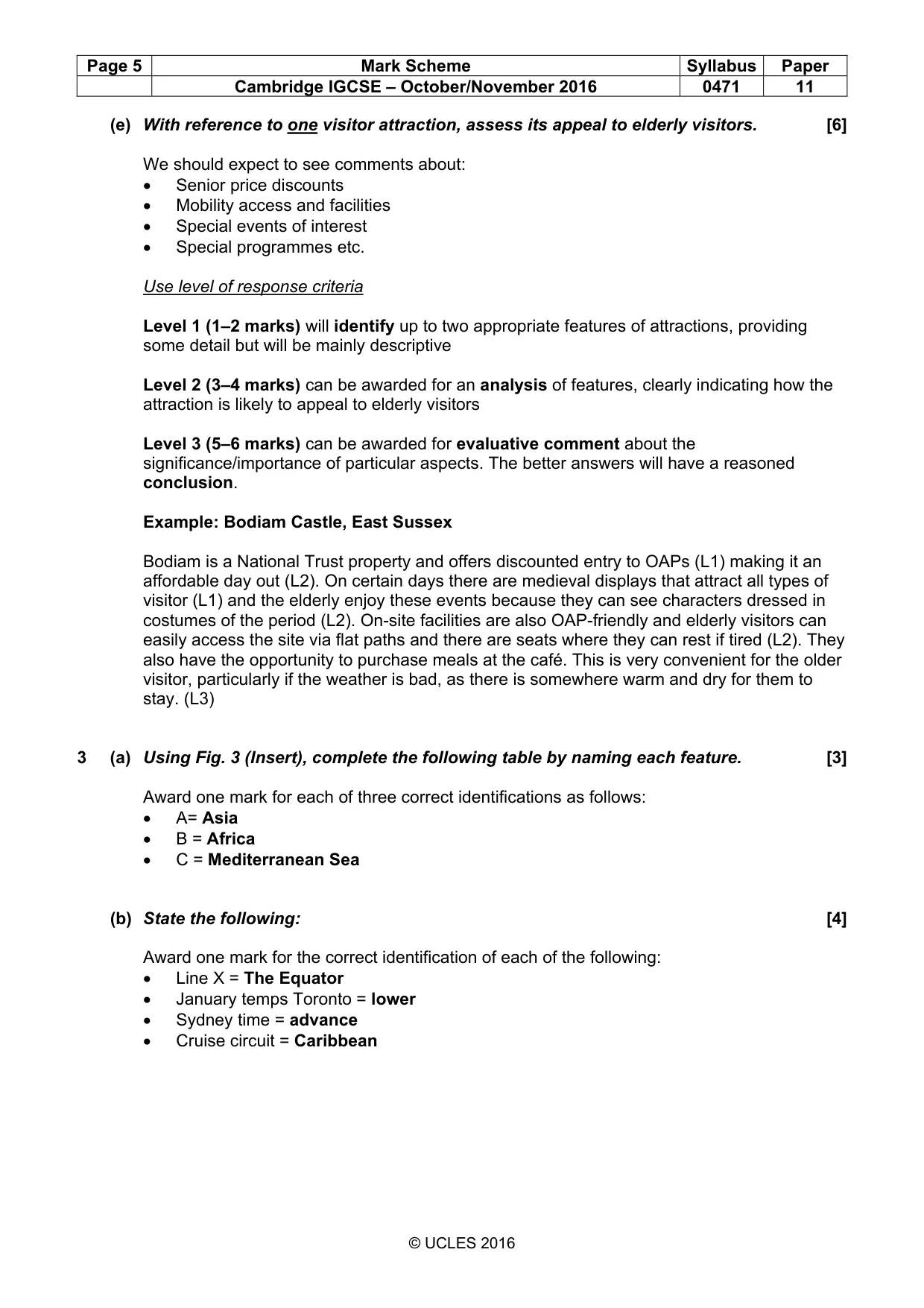
Page 5 Mark Scheme Syllabus Paper Cambridge IGCSE – October/November 2016 0471 11 © UCLES 2016 (e) With reference to one visitor attraction, assess its appeal to elderly visitors. [6] We should expect to see comments about: • Senior price discounts • Mobility access and facilities • Special events of interest • Special programmes etc. Use level of response criteria Level 1 (1–2 marks) will identify up to two appropriate features of attractions, providing some detail but will be mainly descriptive Level 2 (3–4 marks) can be awarded for an analysis of features, clearly indicating how the attraction is likely to appeal to elderly visitors Level 3 (5–6 marks) can be awarded for evaluative comment about the significance/importance of particular aspects. The better answers will have a reasoned conclusion. Example: Bodiam Castle, East Sussex Bodiam is a National Trust property and offers discounted entry to OAPs (L1) making it an affordable day out (L2). On certain days there are medieval displays that attract all types of visitor (L1) and the elderly enjoy these events because they can see characters dressed in costumes of the period (L2). On-site facilities are also OAP-friendly and elderly visitors can easily access the site via flat paths and there are seats where they can rest if tired (L2). They also have the opportunity to purchase meals at the café. This is very convenient for the older visitor, particularly if the weather is bad, as there is somewhere warm and dry for them to stay. (L3) 3 (a) Using Fig. 3 (Insert), complete the following table by naming each feature. [3] Award one mark for each of three correct identifications as follows: • A= Asia • B = Africa • C = Mediterranean Sea (b) State the following: [4] Award one mark for the correct identification of each of the following: • Line X = The Equator • January temps Toronto = lower • Sydney time = advance • Cruise circuit = Caribbean
Mark scheme, page 6
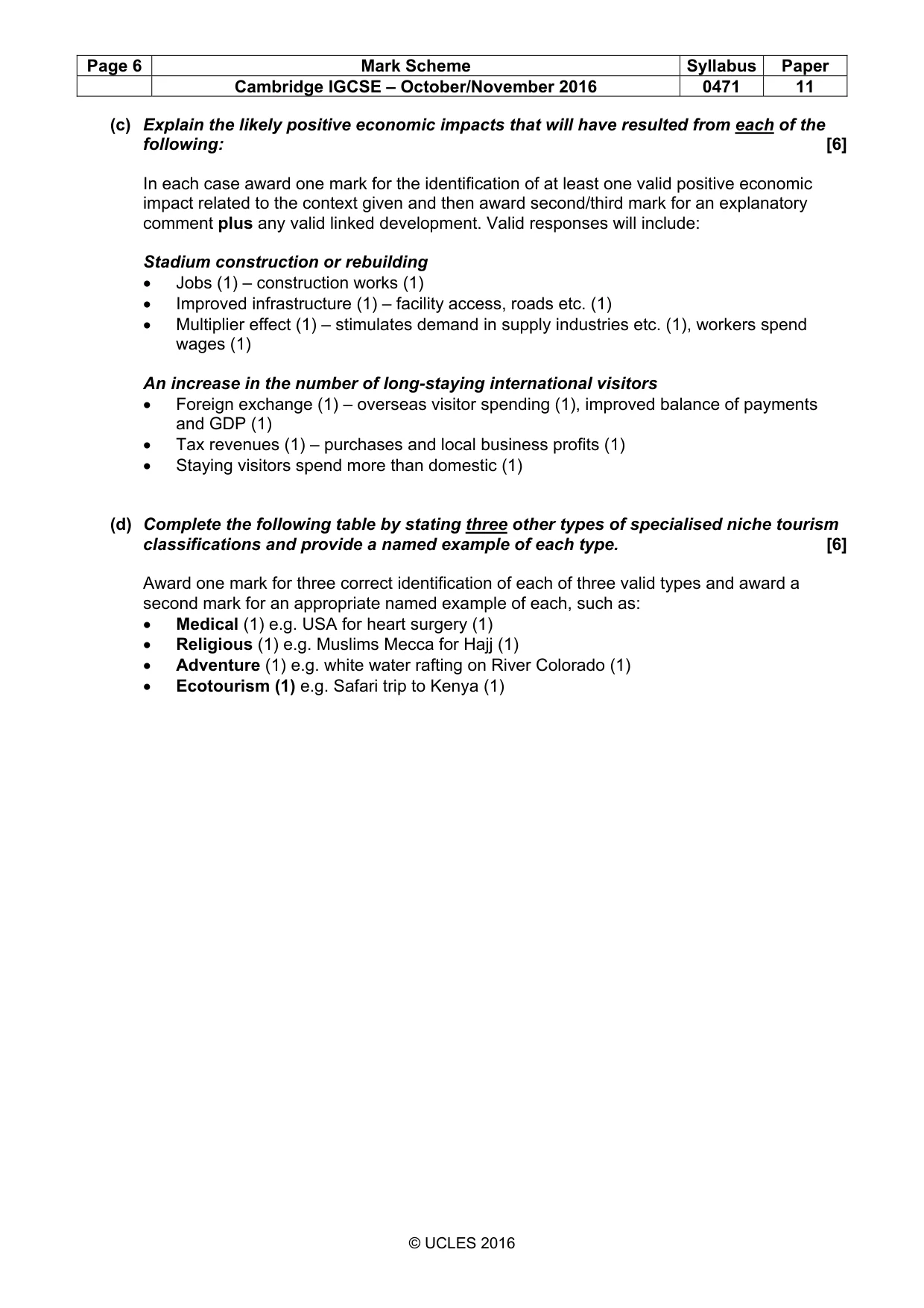
Page 6 Mark Scheme Syllabus Paper Cambridge IGCSE – October/November 2016 0471 11 © UCLES 2016 (c) Explain the likely positive economic impacts that will have resulted from each of the following: [6] In each case award one mark for the identification of at least one valid positive economic impact related to the context given and then award second/third mark for an explanatory comment plus any valid linked development. Valid responses will include: Stadium construction or rebuilding • Jobs (1) – construction works (1) • Improved infrastructure (1) – facility access, roads etc. (1) • Multiplier effect (1) – stimulates demand in supply industries etc. (1), workers spend wages (1) An increase in the number of long-staying international visitors • Foreign exchange (1) – overseas visitor spending (1), improved balance of payments and GDP (1) • Tax revenues (1) – purchases and local business profits (1) • Staying visitors spend more than domestic (1) (d) Complete the following table by stating three other types of specialised niche tourism classifications and provide a named example of each type. [6] Award one mark for three correct identification of each of three valid types and award a second mark for an appropriate named example of each, such as: • Medical (1) e.g. USA for heart surgery (1) • Religious (1) e.g. Muslims Mecca for Hajj (1) • Adventure (1) e.g. white water rafting on River Colorado (1) • Ecotourism (1) e.g. Safari trip to Kenya (1)
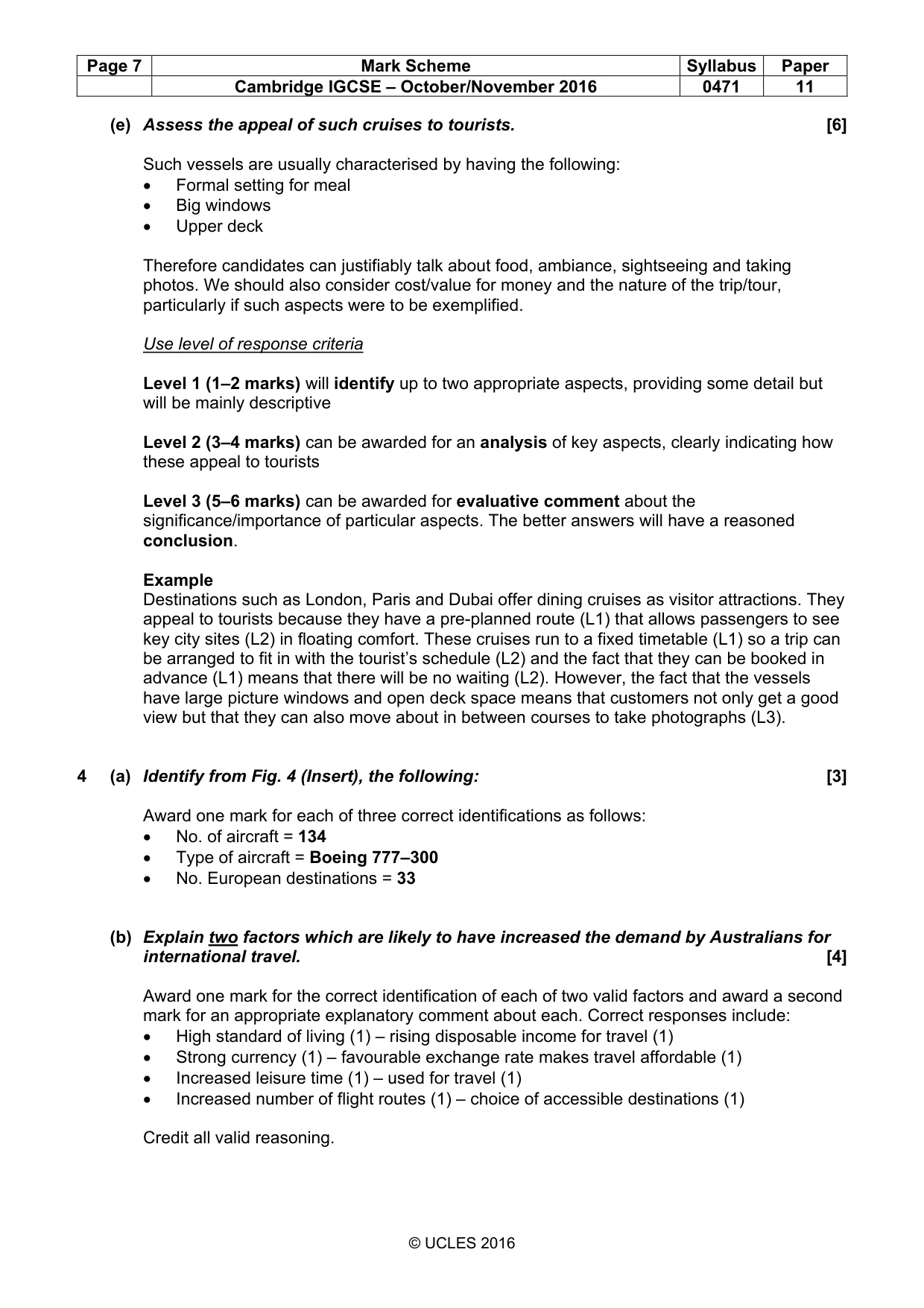
Mark scheme, page 7
Page 7 Mark Scheme Syllabus Paper Cambridge IGCSE – October/November 2016 0471 11 © UCLES 2016 (e) Assess the appeal of such cruises to tourists. [6] Such vessels are usually characterised by having the following: • Formal setting for meal • Big windows • Upper deck Therefore candidates can justifiably talk about food, ambiance, sightseeing and taking photos. We should also consider cost/value for money and the nature of the trip/tour, particularly if such aspects were to be exemplified. Use level of response criteria Level 1 (1–2 marks) will identify up to two appropriate aspects, providing some detail but will be mainly descriptive Level 2 (3–4 marks) can be awarded for an analysis of key aspects, clearly indicating how these appeal to tourists Level 3 (5–6 marks) can be awarded for evaluative comment about the significance/importance of particular aspects. The better answers will have a reasoned conclusion. Example Destinations such as London, Paris and Dubai offer dining cruises as visitor attractions. They appeal to tourists because they have a pre-planned route (L1) that allows passengers to see key city sites (L2) in floating comfort. These cruises run to a fixed timetable (L1) so a trip can be arranged to fit in with the tourist’s schedule (L2) and the fact that they can be booked in advance (L1) means that there will be no waiting (L2). However, the fact that the vessels have large picture windows and open deck space means that customers not only get a good view but that they can also move about in between courses to take photographs (L3). 4 (a) Identify from Fig. 4 (Insert), the following: [3] Award one mark for each of three correct identifications as follows: • No. of aircraft = 134 • Type of aircraft = Boeing 777–300 • No. European destinations = 33 (b) Explain two factors which are likely to have increased the demand by Australians for international travel. [4] Award one mark for the correct identification of each of two valid factors and award a second mark for an appropriate explanatory comment about each. Correct responses include: • High standard of living (1) – rising disposable income for travel (1) • Strong currency (1) – favourable exchange rate makes travel affordable (1) • Increased leisure time (1) – used for travel (1) • Increased number of flight routes (1) – choice of accessible destinations (1) Credit all valid reasoning.
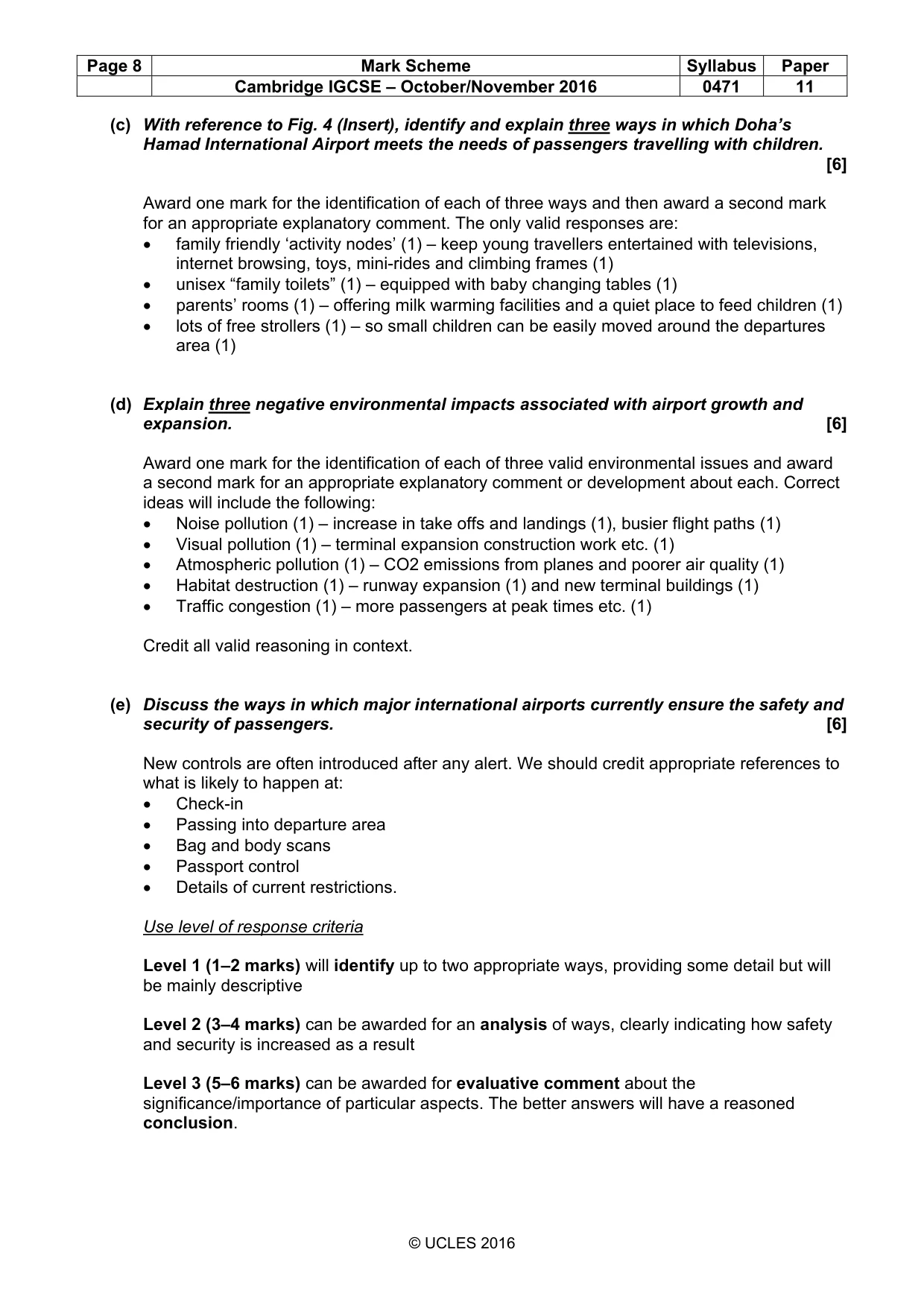
Mark scheme, page 8
Page 8 Mark Scheme Syllabus Paper Cambridge IGCSE – October/November 2016 0471 11 © UCLES 2016 (c) With reference to Fig. 4 (Insert), identify and explain three ways in which Doha’s Hamad International Airport meets the needs of passengers travelling with children. [6] Award one mark for the identification of each of three ways and then award a second mark for an appropriate explanatory comment. The only valid responses are: • family friendly ‘activity nodes’ (1) – keep young travellers entertained with televisions, internet browsing, toys, mini-rides and climbing frames (1) • unisex “family toilets” (1) – equipped with baby changing tables (1) • parents’ rooms (1) – offering milk warming facilities and a quiet place to feed children (1) • lots of free strollers (1) – so small children can be easily moved around the departures area (1) (d) Explain three negative environmental impacts associated with airport growth and expansion. [6] Award one mark for the identification of each of three valid environmental issues and award a second mark for an appropriate explanatory comment or development about each. Correct ideas will include the following: • Noise pollution (1) – increase in take offs and landings (1), busier flight paths (1) • Visual pollution (1) – terminal expansion construction work etc. (1) • Atmospheric pollution (1) – CO2 emissions from planes and poorer air quality (1) • Habitat destruction (1) – runway expansion (1) and new terminal buildings (1) • Traffic congestion (1) – more passengers at peak times etc. (1) Credit all valid reasoning in context. (e) Discuss the ways in which major international airports currently ensure the safety and security of passengers. [6] New controls are often introduced after any alert. We should credit appropriate references to what is likely to happen at: • Check-in • Passing into departure area • Bag and body scans • Passport control • Details of current restrictions. Use level of response criteria Level 1 (1–2 marks) will identify up to two appropriate ways, providing some detail but will be mainly descriptive Level 2 (3–4 marks) can be awarded for an analysis of ways, clearly indicating how safety and security is increased as a result Level 3 (5–6 marks) can be awarded for evaluative comment about the significance/importance of particular aspects. The better answers will have a reasoned conclusion.
Mark scheme, page 9
Page 9 Mark Scheme Syllabus Paper Cambridge IGCSE – October/November 2016 0471 11 © UCLES 2016 Example Many international airports have procedures in place limiting vehicle access to entrances (L1) to avoid terrorist car bomb attacks and this means that no vehicle can be positioned to generate maximum casualties (L2). Baggage checks take place (L1) and X-ray machines check for prohibited items such as drugs and explosives in an attempt to stop such materials being taken on board a flight (L2). However, the most obvious checks are person searches involving metal detectors to stop terrorists concealing weapons. Staff will conduct body searches on individuals who have banned items identified by these scans. This is the most secure way of reducing the threat from an individual and international travellers accept the need for such actions as safety is their paramount concern (L3).
What you needed in this session
Cambridge’s own grade thresholds for 2016 Oct/Nov, Paper 1 · Variant 1. A higher threshold means an easier paper — the bar moves with how the cohort did.