Cambridge IGCSE Travel and Tourism 0471 — 2015 Oct/Nov Paper 1 · Variant 2
0471/12/O/N/15 · 100 marks · ≈113 min
The question paper and its mark scheme, free to read here and free to download. This is Cambridge’s own paper, exactly as it was sat.
Question paper12 pages
Mark scheme9 pages
Answers below. Sit the paper first if you are practising.
Paper as text
Question paper, page 1
This document consists of 12 printed pages and 1 Insert. DC (RW) 106207 © UCLES 2015 [Turn over Cambridge International Examinations Cambridge International General Certificate of Secondary Education * 9 9 2 2 7 5 2 8 5 3 * TRAVEL AND TOURISM 0471/12 Core Module October/November 2015 2 hours Candidates answer on the Question Paper. No Additional Materials are required. READ THESE INSTRUCTIONS FIRST Write your Centre number, candidate number and name on all the work you hand in. Write in dark blue or black pen. You may use an HB pencil for any diagrams or graphs. Do not use staples, paper clips, glue or correction fluid. DO NOT WRITE IN ANY BARCODES. Answer all questions. All the Figures referred to in the questions are contained in the Insert. At the end of the examination, fasten all your work securely together. The number of marks is given in brackets [ ] at the end of each question or part question.
Question paper, page 2
2 0471/12/O/N/15 © UCLES 2015 Question 1 Refer to Fig. 1 (Insert), information about the economic importance of tourism. (a) Identify from Fig. 1 (Insert), the following: • the number of world tourism arrivals in 1995 … • the percentage of world GDP supplied by tourism … • the value of world tourism in terms of exports … [3] (b) State two developments to infrastructure undertaken in many destinations and explain why each is needed to increase international arrivals. Infrastructure development … … Reason … … Infrastructure development … … Reason … … [4]
Question paper, page 3
3 0471/12/O/N/15 © UCLES 2015 [Turn over (c) Large infrastructure projects can cause negative impacts in particular destinations. Explain how the construction of such projects might cause each of the following: • a negative economic impact … … … … • a negative social impact … … … … • a negative environmental impact … … … … [6]
Question paper, page 4
4 0471/12/O/N/15 © UCLES 2015 (d) Explain how each of three types of “shock”, other than the 1970s oil supply crisis, have disrupted the overall pattern of growth in world tourism since 1950. 1 … … … … 2 … … … … 3 … … … … [6] (e) With reference to one tourist destination with which you are familiar, discuss the reasons why the ‘demonstration effect’ is generally viewed as being a negative impact of tourism. Chosen destination … … … … … … … … … … … … … [6] [Total: 25]
Question paper, page 5
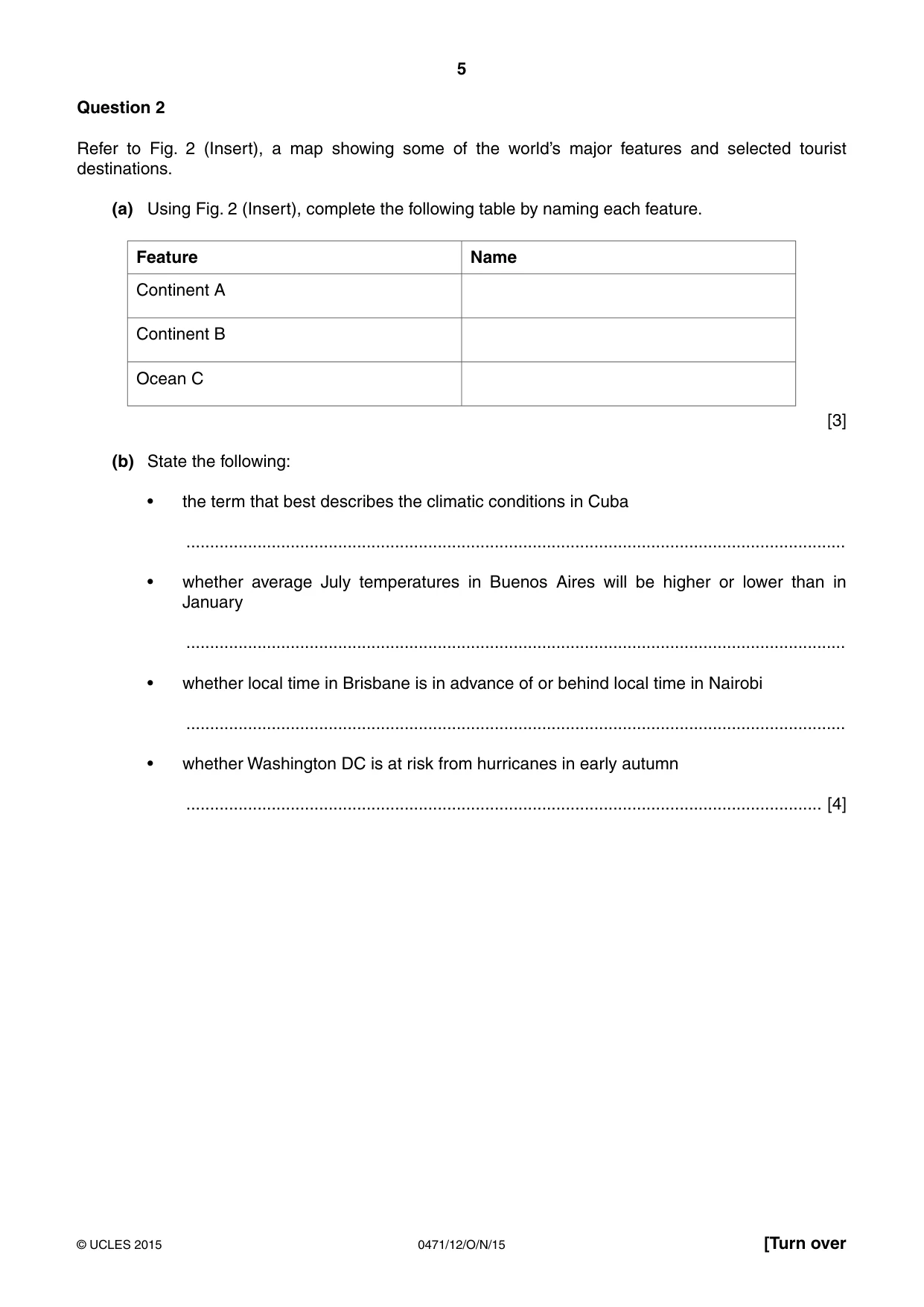
5 0471/12/O/N/15 © UCLES 2015 [Turn over Question 2 Refer to Fig. 2 (Insert), a map showing some of the world’s major features and selected tourist destinations. (a) Using Fig. 2 (Insert), complete the following table by naming each feature. Feature Name Continent A Continent B Ocean C [3] (b) State the following: • the term that best describes the climatic conditions in Cuba … • whether average July temperatures in Buenos Aires will be higher or lower than in January … • whether local time in Brisbane is in advance of or behind local time in Nairobi … • whether Washington DC is at risk from hurricanes in early autumn … [4]
Question paper, page 6
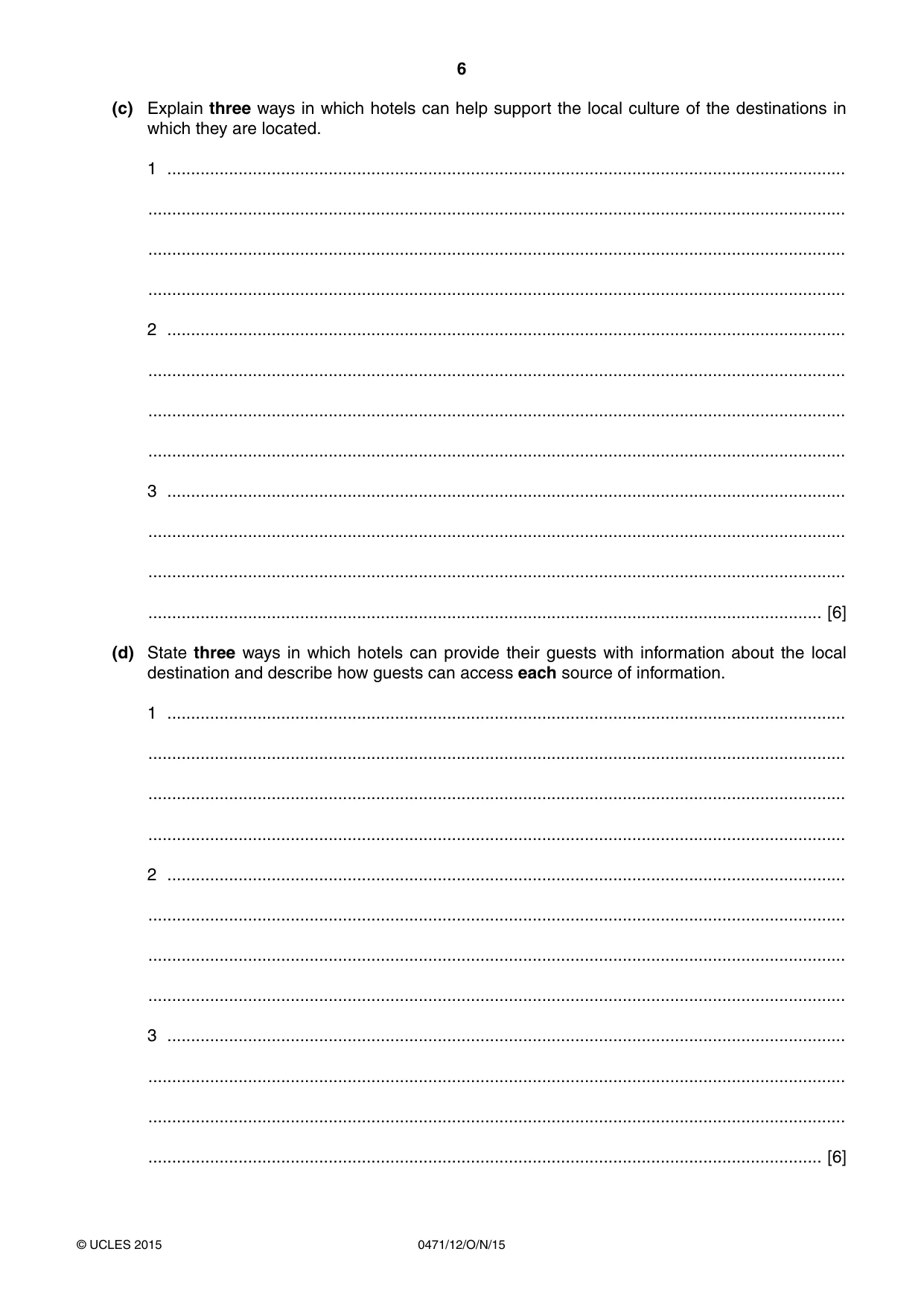
6 0471/12/O/N/15 © UCLES 2015 (c) Explain three ways in which hotels can help support the local culture of the destinations in which they are located. 1 … … … … 2 … … … … 3 … … … … [6] (d) State three ways in which hotels can provide their guests with information about the local destination and describe how guests can access each source of information. 1 … … … … 2 … … … … 3 … … … … [6]
Question paper, page 7
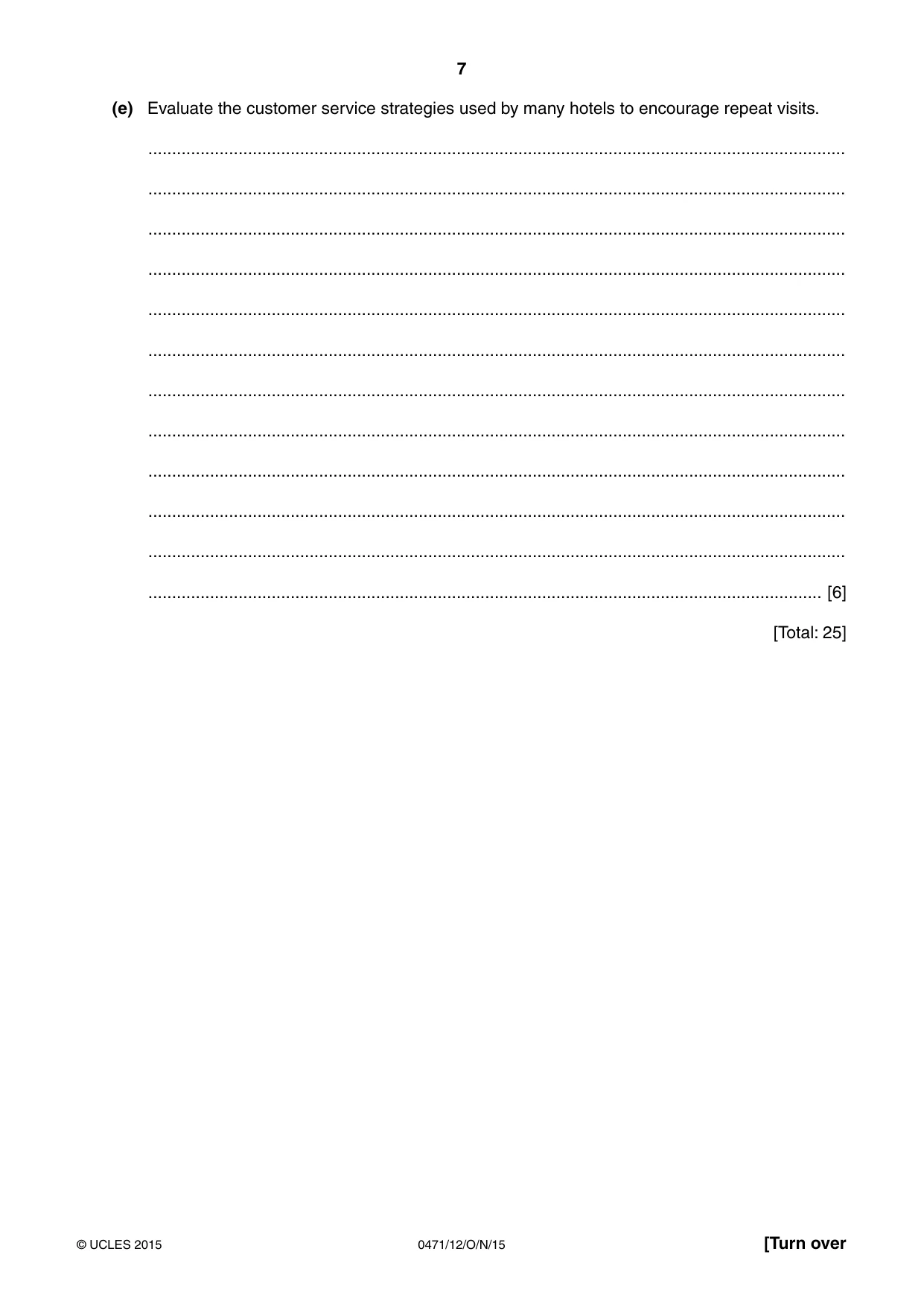
7 0471/12/O/N/15 © UCLES 2015 [Turn over (e) Evaluate the customer service strategies used by many hotels to encourage repeat visits. … … … … … … … … … … … … [6] [Total: 25]
Question paper, page 8
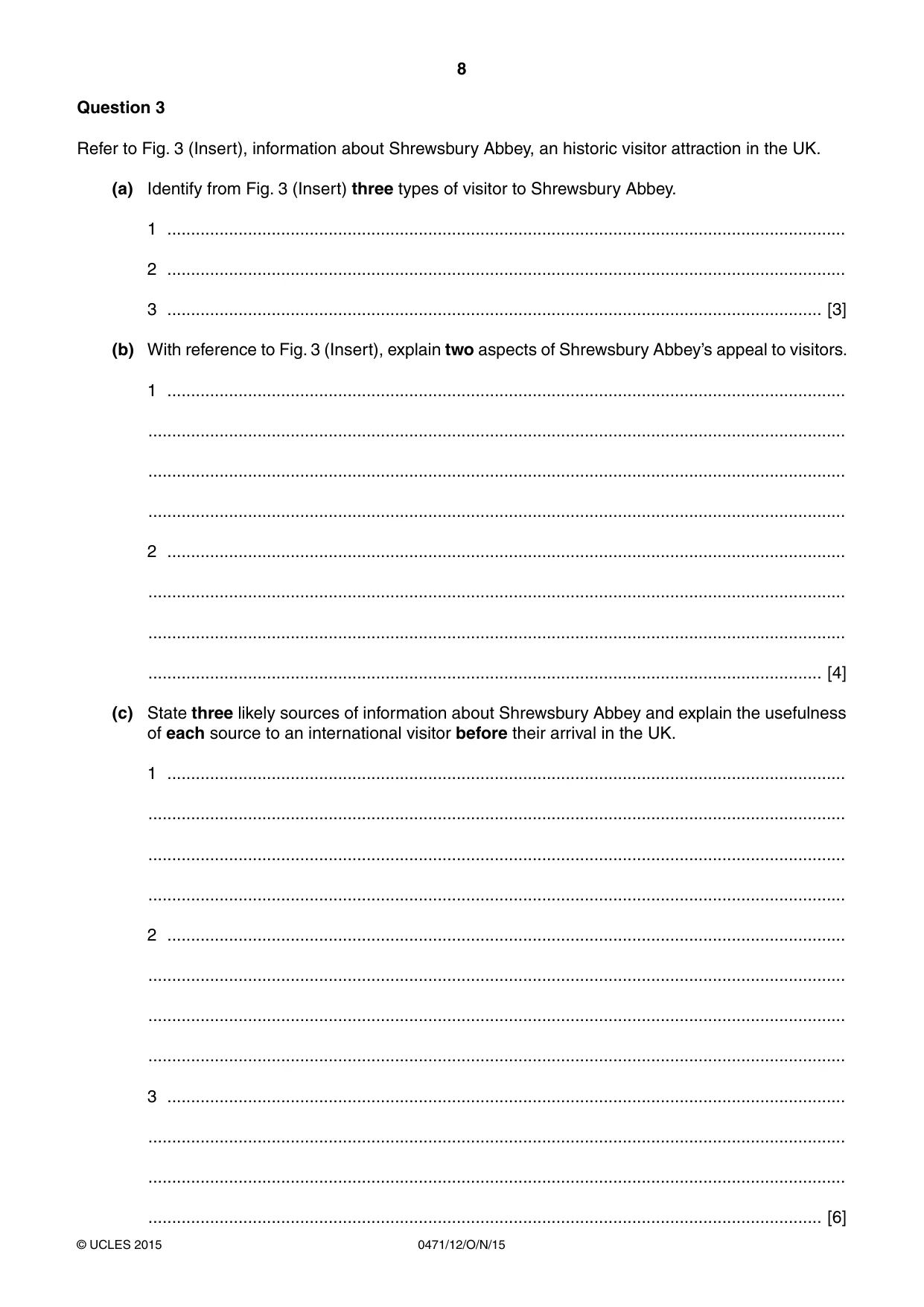
8 0471/12/O/N/15 © UCLES 2015 Question 3 Refer to Fig. 3 (Insert), information about Shrewsbury Abbey, an historic visitor attraction in the UK. (a) Identify from Fig. 3 (Insert) three types of visitor to Shrewsbury Abbey. 1 … 2 … 3 … [3] (b) With reference to Fig. 3 (Insert), explain two aspects of Shrewsbury Abbey’s appeal to visitors. 1 … … … … 2 … … … … [4] (c) State three likely sources of information about Shrewsbury Abbey and explain the usefulness of each source to an international visitor before their arrival in the UK. 1 … … … … 2 … … … … 3 … … … … [6]
Question paper, page 9
9 0471/12/O/N/15 © UCLES 2015 [Turn over (d) Explain three ways in which accidental damage to historic attractions and their exhibits can be prevented. 1 … … … … 2 … … … … 3 … … … … [6] (e) Assess the services that are usually provided by city centre Tourist Information Centres (TICs) for the benefit of visitors to a destination. … … … … … … … … … … … … [6] [Total: 25]
Question paper, page 10
10 0471/12/O/N/15 © UCLES 2015 Question 4 Refer to Fig. 4 (Insert), information about Dubai International airport (DXB). (a) Identify from Fig. 4 (Insert) the following: • the number of airlines serving Dubai International … • the current passenger capacity of Dubai International … • the percentage increase in passenger numbers for June 2013 compared with June 2012 … [3] (b) Using Fig. 4 (Insert), identify two services provided by Dubai International airport and for each explain how passenger needs might be met. 1 … … … … 2 … … … … [4]
Question paper, page 11
11 0471/12/O/N/15 © UCLES 2015 [Turn over (c) Dubai International airport acts as a ‘hub’ for Emirates flights to and from destinations around the world. Explain how this has contributed to each of the following: • Dubai acting as a stopover destination … … … … … … • all Emirates flights having multi-lingual cabin crew … … … … … … [6] (d) Many international airlines, such as Emirates, provide services for passengers with special needs. Complete the following table by identifying three special needs a passenger may have and describing how airlines attempt to meet these passengers’ requirements. Passenger Special Need How need is met 1. 2. 3. [6]
Question paper, page 12
12 0471/12/O/N/15 © UCLES 2015 Permission to reproduce items where third-party owned material protected by copyright is included has been sought and cleared where possible. Every reasonable effort has been made by the publisher (UCLES) to trace copyright holders, but if any items requiring clearance have unwittingly been included, the publisher will be pleased to make amends at the earliest possible opportunity. To avoid the issue of disclosure of answer-related information to candidates, all copyright acknowledgements are reproduced online in the Cambridge International Examinations Copyright Acknowledgements Booklet. This is produced for each series of examinations and is freely available to download at www.cie.org.uk after the live examination series. Cambridge International Examinations is part of the Cambridge Assessment Group. Cambridge Assessment is the brand name of University of Cambridge Local Examinations Syndicate (UCLES), which is itself a department of the University of Cambridge. (e) Many tour operators will include an Emirates flight as part of an inclusive tour. Discuss the ways in which tour operators create products for the leisure travel market. … … … … … … … … … … … … [6] [Total: 25]
Mark scheme, page 1
® IGCSE is the registered trademark of Cambridge International Examinations. CAMBRIDGE INTERNATIONAL EXAMINATIONS Cambridge International General Certificate of Secondary Education MARK SCHEME for the October/November 2015 series 0471 TRAVEL AND TOURISM 0471/12 Paper 1 (Core Paper), maximum raw mark 100 This mark scheme is published as an aid to teachers and candidates, to indicate the requirements of the examination. It shows the basis on which Examiners were instructed to award marks. It does not indicate the details of the discussions that took place at an Examiners’ meeting before marking began, which would have considered the acceptability of alternative answers. Mark schemes should be read in conjunction with the question paper and the Principal Examiner Report for Teachers. Cambridge will not enter into discussions about these mark schemes. Cambridge is publishing the mark schemes for the October/November 2015 series for most Cambridge IGCSE®, Cambridge International A and AS Level components and some Cambridge O Level components.
Mark scheme, page 2
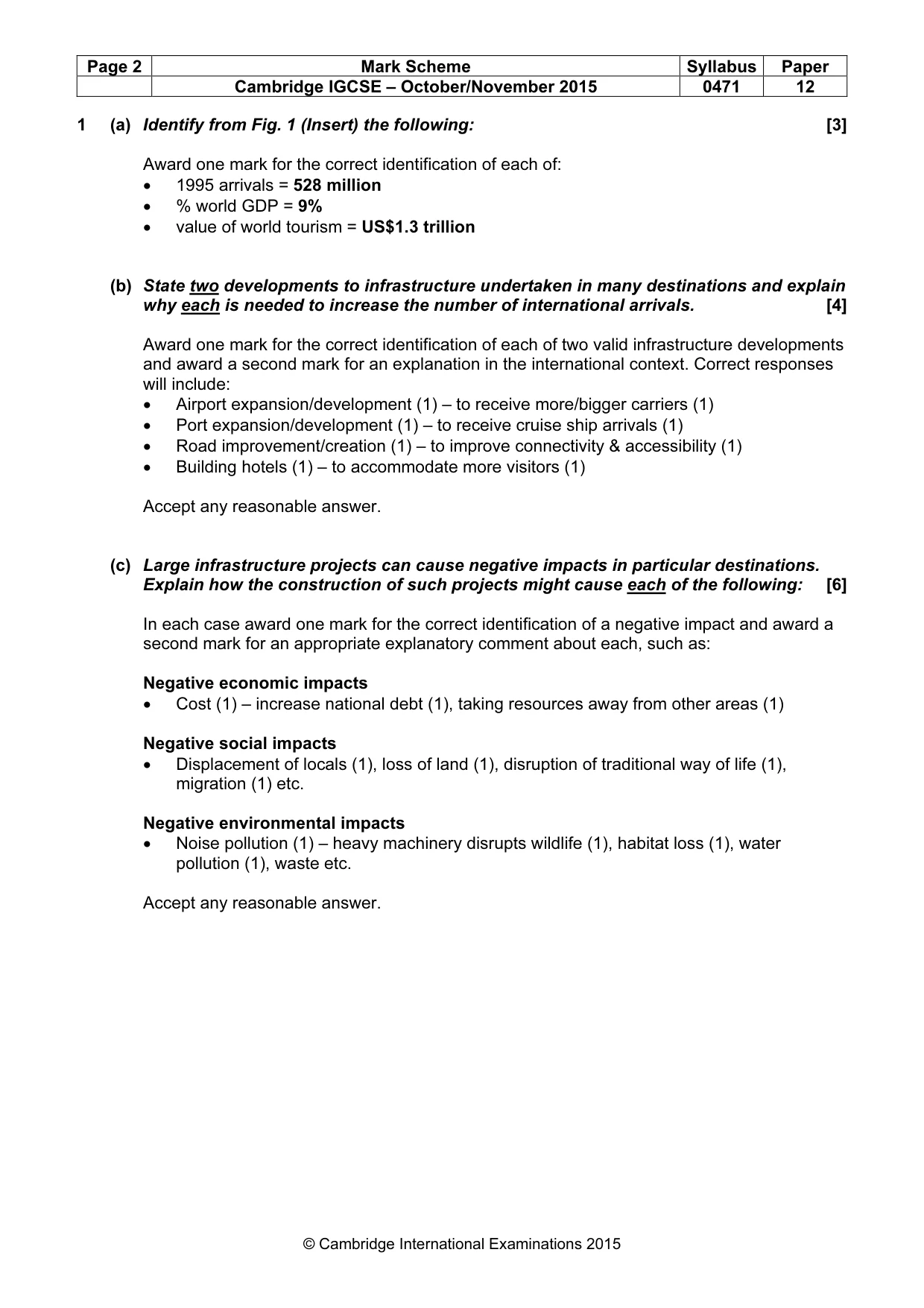
Page 2 Mark Scheme Syllabus Paper Cambridge IGCSE – October/November 2015 0471 12 © Cambridge International Examinations 2015 1 (a) Identify from Fig. 1 (Insert) the following: [3] Award one mark for the correct identification of each of: • 1995 arrivals = 528 million • % world GDP = 9% • value of world tourism = US$1.3 trillion (b) State two developments to infrastructure undertaken in many destinations and explain why each is needed to increase the number of international arrivals. [4] Award one mark for the correct identification of each of two valid infrastructure developments and award a second mark for an explanation in the international context. Correct responses will include: • Airport expansion/development (1) – to receive more/bigger carriers (1) • Port expansion/development (1) – to receive cruise ship arrivals (1) • Road improvement/creation (1) – to improve connectivity & accessibility (1) • Building hotels (1) – to accommodate more visitors (1) Accept any reasonable answer. (c) Large infrastructure projects can cause negative impacts in particular destinations. Explain how the construction of such projects might cause each of the following: [6] In each case award one mark for the correct identification of a negative impact and award a second mark for an appropriate explanatory comment about each, such as: Negative economic impacts • Cost (1) – increase national debt (1), taking resources away from other areas (1) Negative social impacts • Displacement of locals (1), loss of land (1), disruption of traditional way of life (1), migration (1) etc. Negative environmental impacts • Noise pollution (1) – heavy machinery disrupts wildlife (1), habitat loss (1), water pollution (1), waste etc. Accept any reasonable answer.
Mark scheme, page 3
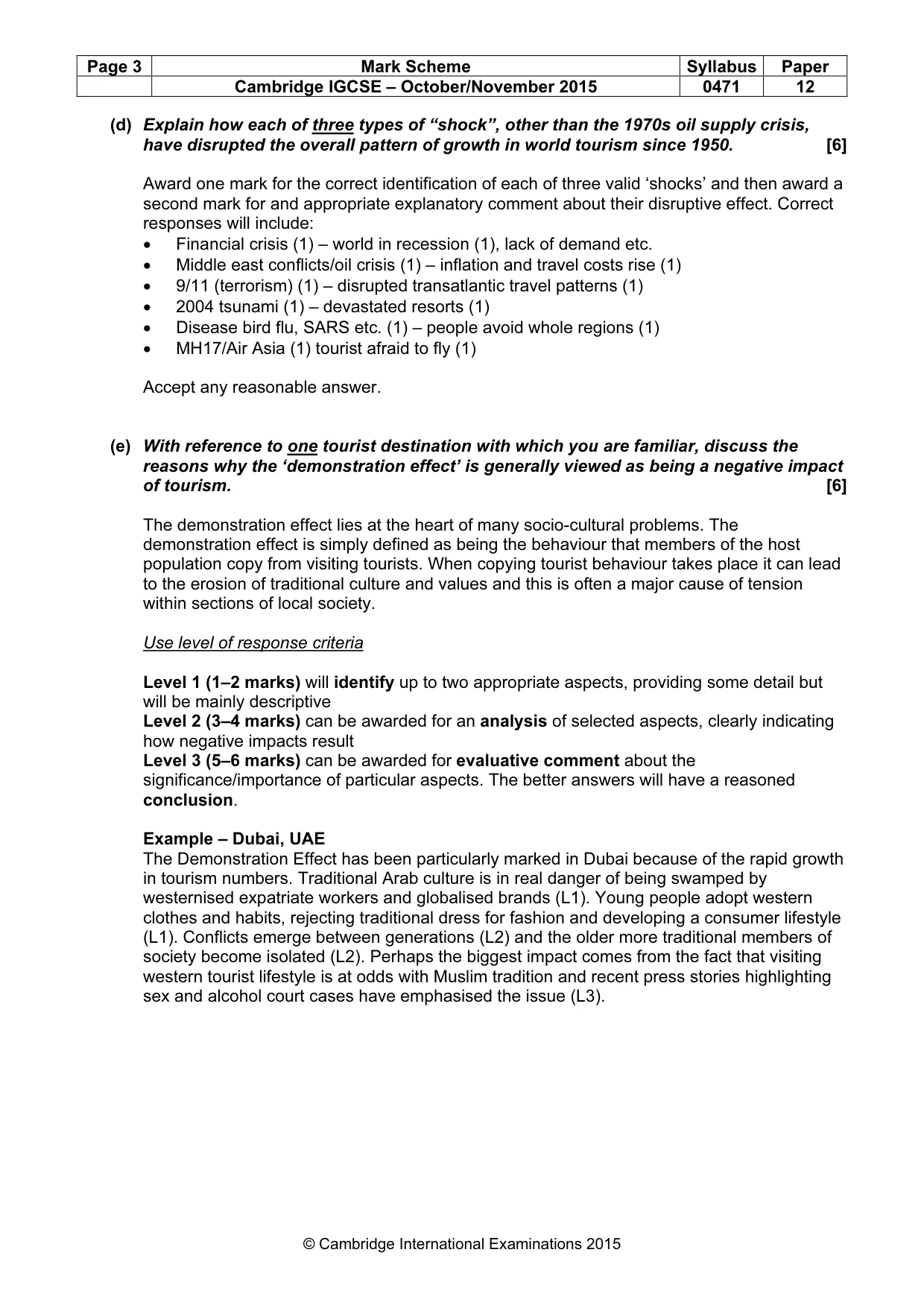
Page 3 Mark Scheme Syllabus Paper Cambridge IGCSE – October/November 2015 0471 12 © Cambridge International Examinations 2015 (d) Explain how each of three types of “shock”, other than the 1970s oil supply crisis, have disrupted the overall pattern of growth in world tourism since 1950. [6] Award one mark for the correct identification of each of three valid ‘shocks’ and then award a second mark for and appropriate explanatory comment about their disruptive effect. Correct responses will include: • Financial crisis (1) – world in recession (1), lack of demand etc. • Middle east conflicts/oil crisis (1) – inflation and travel costs rise (1) • 9/11 (terrorism) (1) – disrupted transatlantic travel patterns (1) • 2004 tsunami (1) – devastated resorts (1) • Disease bird flu, SARS etc. (1) – people avoid whole regions (1) • MH17/Air Asia (1) tourist afraid to fly (1) Accept any reasonable answer. (e) With reference to one tourist destination with which you are familiar, discuss the reasons why the ‘demonstration effect’ is generally viewed as being a negative impact of tourism. [6] The demonstration effect lies at the heart of many socio-cultural problems. The demonstration effect is simply defined as being the behaviour that members of the host population copy from visiting tourists. When copying tourist behaviour takes place it can lead to the erosion of traditional culture and values and this is often a major cause of tension within sections of local society. Use level of response criteria Level 1 (1–2 marks) will identify up to two appropriate aspects, providing some detail but will be mainly descriptive Level 2 (3–4 marks) can be awarded for an analysis of selected aspects, clearly indicating how negative impacts result Level 3 (5–6 marks) can be awarded for evaluative comment about the significance/importance of particular aspects. The better answers will have a reasoned conclusion. Example – Dubai, UAE The Demonstration Effect has been particularly marked in Dubai because of the rapid growth in tourism numbers. Traditional Arab culture is in real danger of being swamped by westernised expatriate workers and globalised brands (L1). Young people adopt western clothes and habits, rejecting traditional dress for fashion and developing a consumer lifestyle (L1). Conflicts emerge between generations (L2) and the older more traditional members of society become isolated (L2). Perhaps the biggest impact comes from the fact that visiting western tourist lifestyle is at odds with Muslim tradition and recent press stories highlighting sex and alcohol court cases have emphasised the issue (L3).
Mark scheme, page 4
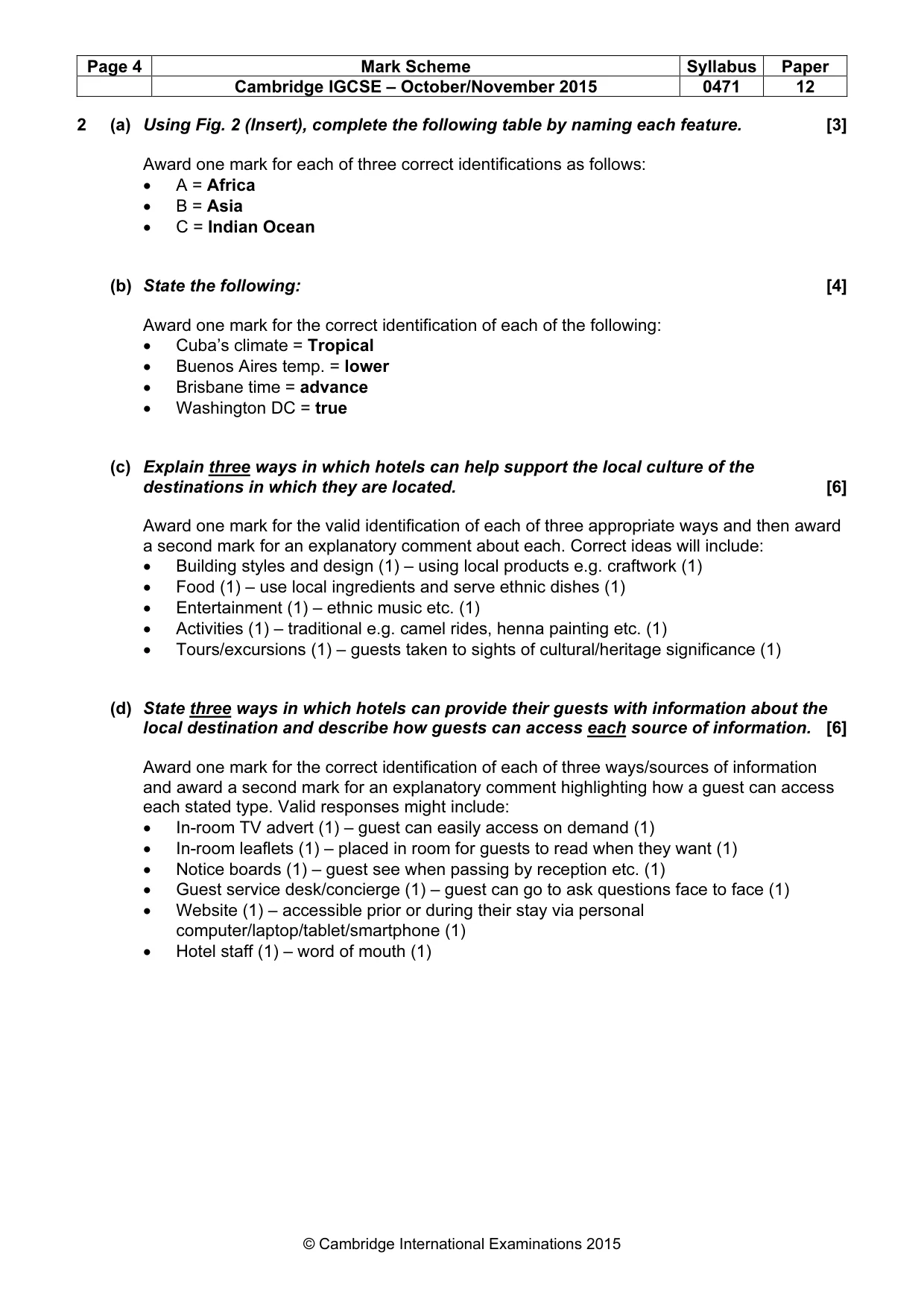
Page 4 Mark Scheme Syllabus Paper Cambridge IGCSE – October/November 2015 0471 12 © Cambridge International Examinations 2015 2 (a) Using Fig. 2 (Insert), complete the following table by naming each feature. [3] Award one mark for each of three correct identifications as follows: • A = Africa • B = Asia • C = Indian Ocean (b) State the following: [4] Award one mark for the correct identification of each of the following: • Cuba’s climate = Tropical • Buenos Aires temp. = lower • Brisbane time = advance • Washington DC = true (c) Explain three ways in which hotels can help support the local culture of the destinations in which they are located. [6] Award one mark for the valid identification of each of three appropriate ways and then award a second mark for an explanatory comment about each. Correct ideas will include: • Building styles and design (1) – using local products e.g. craftwork (1) • Food (1) – use local ingredients and serve ethnic dishes (1) • Entertainment (1) – ethnic music etc. (1) • Activities (1) – traditional e.g. camel rides, henna painting etc. (1) • Tours/excursions (1) – guests taken to sights of cultural/heritage significance (1) (d) State three ways in which hotels can provide their guests with information about the local destination and describe how guests can access each source of information. [6] Award one mark for the correct identification of each of three ways/sources of information and award a second mark for an explanatory comment highlighting how a guest can access each stated type. Valid responses might include: • In-room TV advert (1) – guest can easily access on demand (1) • In-room leaflets (1) – placed in room for guests to read when they want (1) • Notice boards (1) – guest see when passing by reception etc. (1) • Guest service desk/concierge (1) – guest can go to ask questions face to face (1) • Website (1) – accessible prior or during their stay via personal computer/laptop/tablet/smartphone (1) • Hotel staff (1) – word of mouth (1)
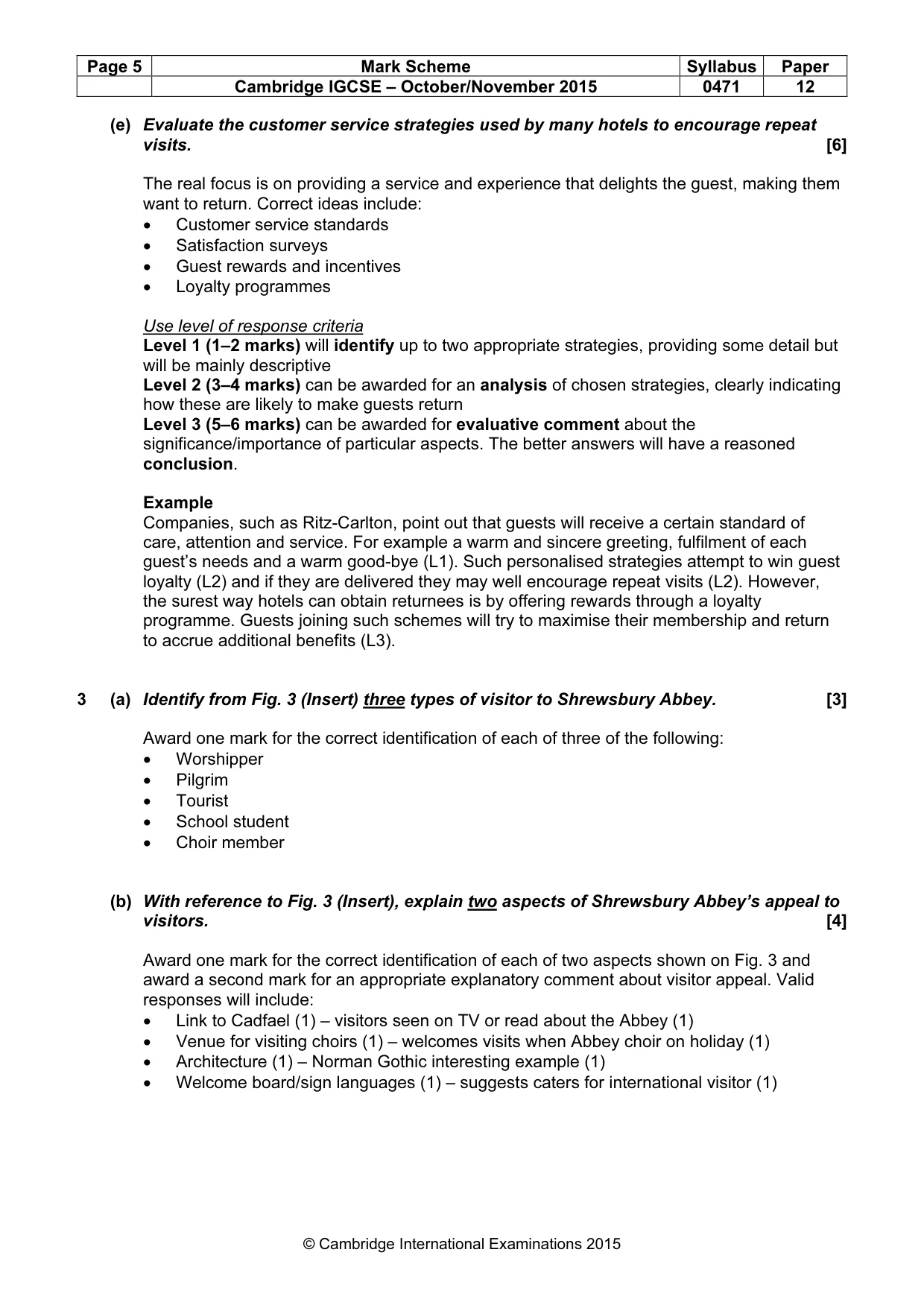
Mark scheme, page 5
Page 5 Mark Scheme Syllabus Paper Cambridge IGCSE – October/November 2015 0471 12 © Cambridge International Examinations 2015 (e) Evaluate the customer service strategies used by many hotels to encourage repeat visits. [6] The real focus is on providing a service and experience that delights the guest, making them want to return. Correct ideas include: • Customer service standards • Satisfaction surveys • Guest rewards and incentives • Loyalty programmes Use level of response criteria Level 1 (1–2 marks) will identify up to two appropriate strategies, providing some detail but will be mainly descriptive Level 2 (3–4 marks) can be awarded for an analysis of chosen strategies, clearly indicating how these are likely to make guests return Level 3 (5–6 marks) can be awarded for evaluative comment about the significance/importance of particular aspects. The better answers will have a reasoned conclusion. Example Companies, such as Ritz-Carlton, point out that guests will receive a certain standard of care, attention and service. For example a warm and sincere greeting, fulfilment of each guest’s needs and a warm good-bye (L1). Such personalised strategies attempt to win guest loyalty (L2) and if they are delivered they may well encourage repeat visits (L2). However, the surest way hotels can obtain returnees is by offering rewards through a loyalty programme. Guests joining such schemes will try to maximise their membership and return to accrue additional benefits (L3). 3 (a) Identify from Fig. 3 (Insert) three types of visitor to Shrewsbury Abbey. [3] Award one mark for the correct identification of each of three of the following: • Worshipper • Pilgrim • Tourist • School student • Choir member (b) With reference to Fig. 3 (Insert), explain two aspects of Shrewsbury Abbey’s appeal to visitors. [4] Award one mark for the correct identification of each of two aspects shown on Fig. 3 and award a second mark for an appropriate explanatory comment about visitor appeal. Valid responses will include: • Link to Cadfael (1) – visitors seen on TV or read about the Abbey (1) • Venue for visiting choirs (1) – welcomes visits when Abbey choir on holiday (1) • Architecture (1) – Norman Gothic interesting example (1) • Welcome board/sign languages (1) – suggests caters for international visitor (1)
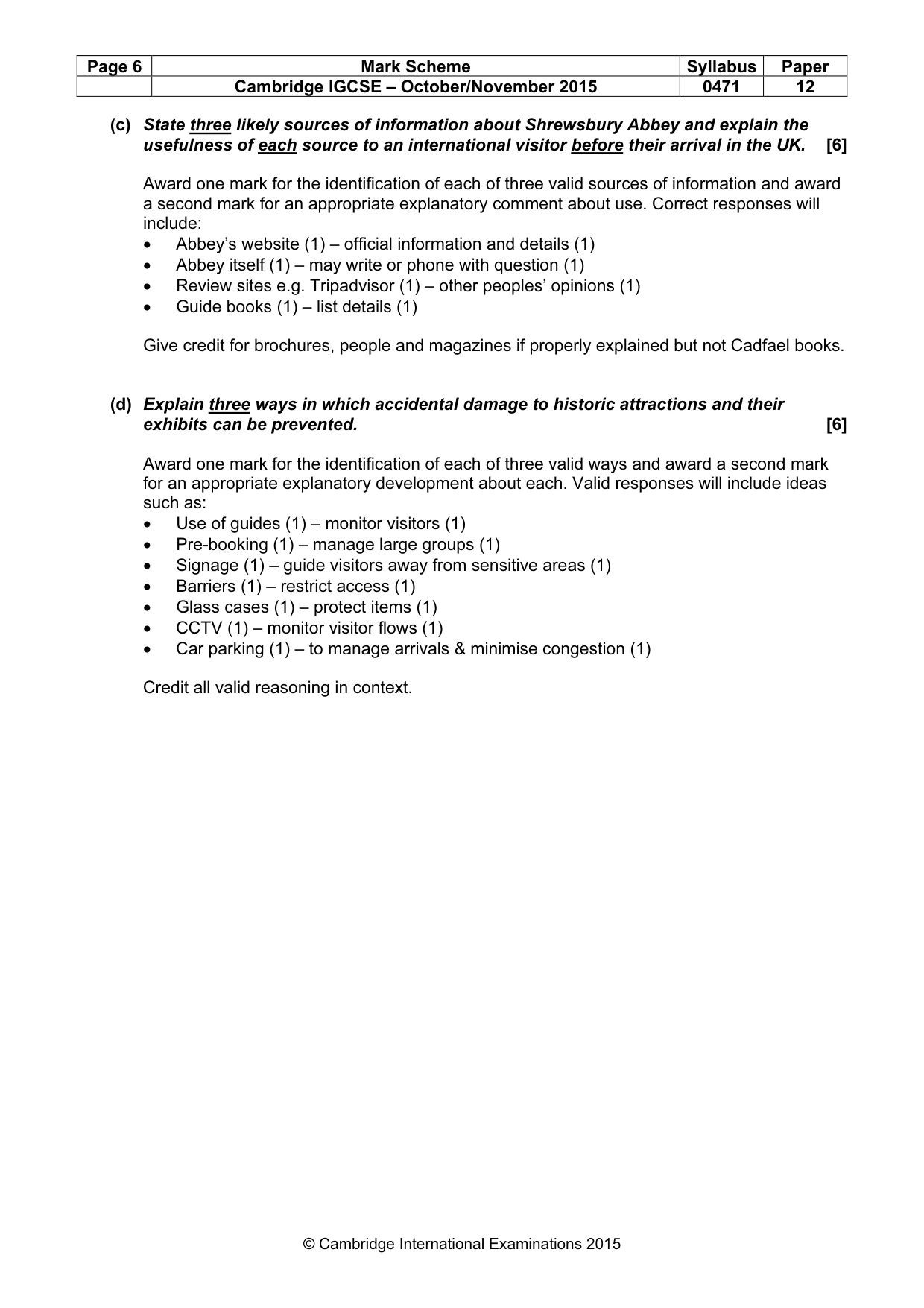
Mark scheme, page 6
Page 6 Mark Scheme Syllabus Paper Cambridge IGCSE – October/November 2015 0471 12 © Cambridge International Examinations 2015 (c) State three likely sources of information about Shrewsbury Abbey and explain the usefulness of each source to an international visitor before their arrival in the UK. [6] Award one mark for the identification of each of three valid sources of information and award a second mark for an appropriate explanatory comment about use. Correct responses will include: • Abbey’s website (1) – official information and details (1) • Abbey itself (1) – may write or phone with question (1) • Review sites e.g. Tripadvisor (1) – other peoples’ opinions (1) • Guide books (1) – list details (1) Give credit for brochures, people and magazines if properly explained but not Cadfael books. (d) Explain three ways in which accidental damage to historic attractions and their exhibits can be prevented. [6] Award one mark for the identification of each of three valid ways and award a second mark for an appropriate explanatory development about each. Valid responses will include ideas such as: • Use of guides (1) – monitor visitors (1) • Pre-booking (1) – manage large groups (1) • Signage (1) – guide visitors away from sensitive areas (1) • Barriers (1) – restrict access (1) • Glass cases (1) – protect items (1) • CCTV (1) – monitor visitor flows (1) • Car parking (1) – to manage arrivals & minimise congestion (1) Credit all valid reasoning in context.
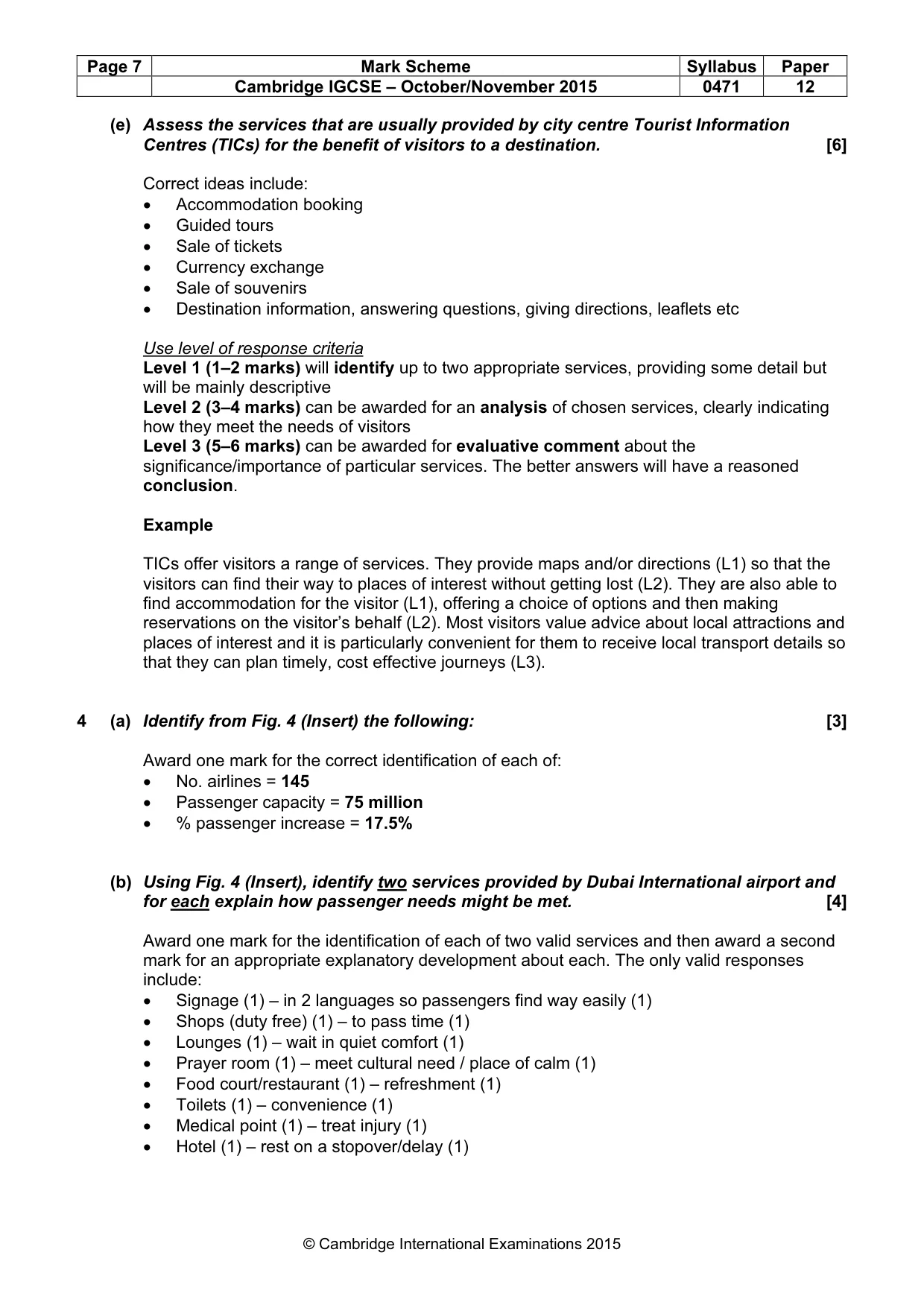
Mark scheme, page 7
Page 7 Mark Scheme Syllabus Paper Cambridge IGCSE – October/November 2015 0471 12 © Cambridge International Examinations 2015 (e) Assess the services that are usually provided by city centre Tourist Information Centres (TICs) for the benefit of visitors to a destination. [6] Correct ideas include: • Accommodation booking • Guided tours • Sale of tickets • Currency exchange • Sale of souvenirs • Destination information, answering questions, giving directions, leaflets etc Use level of response criteria Level 1 (1–2 marks) will identify up to two appropriate services, providing some detail but will be mainly descriptive Level 2 (3–4 marks) can be awarded for an analysis of chosen services, clearly indicating how they meet the needs of visitors Level 3 (5–6 marks) can be awarded for evaluative comment about the significance/importance of particular services. The better answers will have a reasoned conclusion. Example TICs offer visitors a range of services. They provide maps and/or directions (L1) so that the visitors can find their way to places of interest without getting lost (L2). They are also able to find accommodation for the visitor (L1), offering a choice of options and then making reservations on the visitor’s behalf (L2). Most visitors value advice about local attractions and places of interest and it is particularly convenient for them to receive local transport details so that they can plan timely, cost effective journeys (L3). 4 (a) Identify from Fig. 4 (Insert) the following: [3] Award one mark for the correct identification of each of: • No. airlines = 145 • Passenger capacity = 75 million • % passenger increase = 17.5% (b) Using Fig. 4 (Insert), identify two services provided by Dubai International airport and for each explain how passenger needs might be met. [4] Award one mark for the identification of each of two valid services and then award a second mark for an appropriate explanatory development about each. The only valid responses include: • Signage (1) – in 2 languages so passengers find way easily (1) • Shops (duty free) (1) – to pass time (1) • Lounges (1) – wait in quiet comfort (1) • Prayer room (1) – meet cultural need / place of calm (1) • Food court/restaurant (1) – refreshment (1) • Toilets (1) – convenience (1) • Medical point (1) – treat injury (1) • Hotel (1) – rest on a stopover/delay (1)
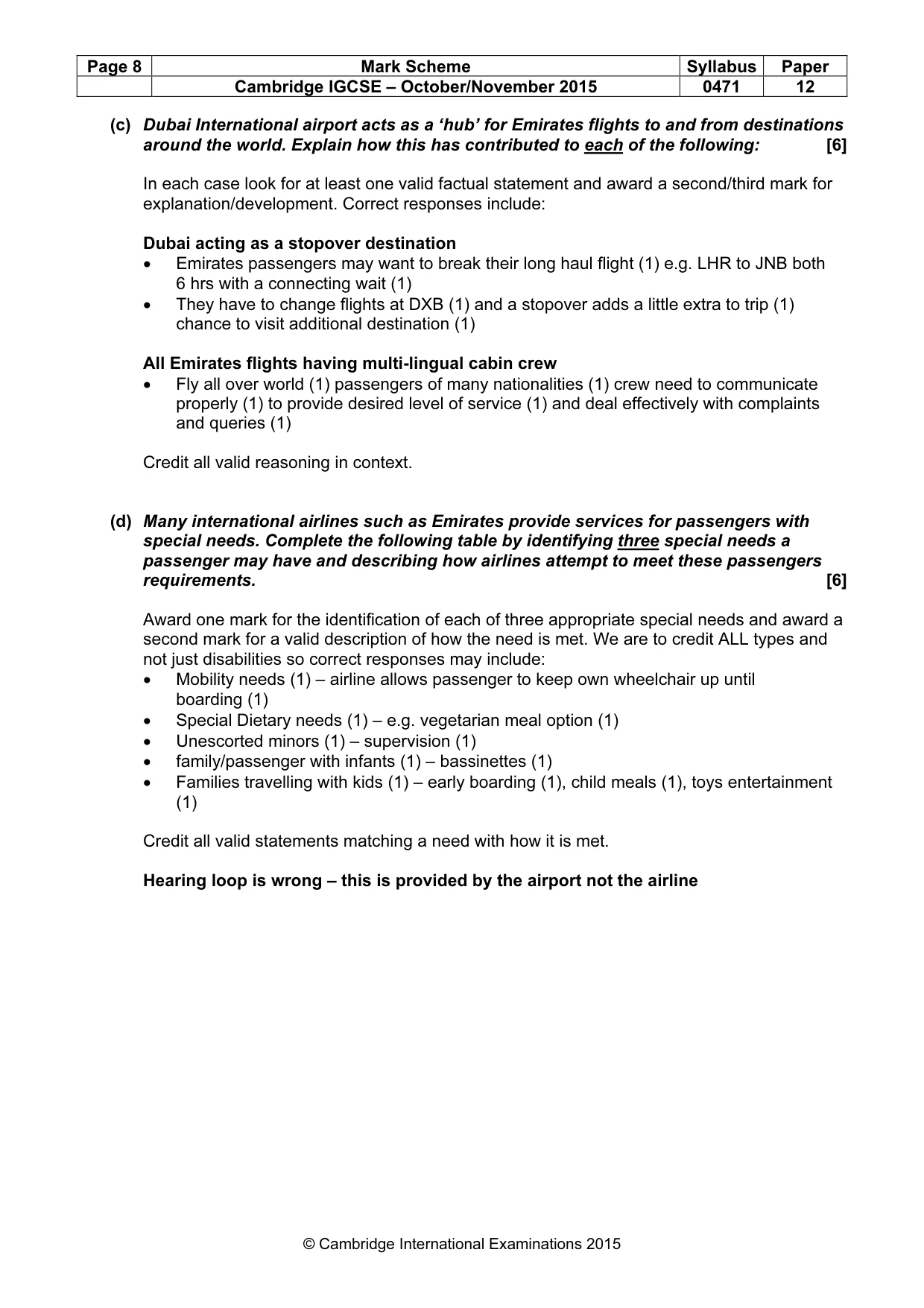
Mark scheme, page 8
Page 8 Mark Scheme Syllabus Paper Cambridge IGCSE – October/November 2015 0471 12 © Cambridge International Examinations 2015 (c) Dubai International airport acts as a ‘hub’ for Emirates flights to and from destinations around the world. Explain how this has contributed to each of the following: [6] In each case look for at least one valid factual statement and award a second/third mark for explanation/development. Correct responses include: Dubai acting as a stopover destination • Emirates passengers may want to break their long haul flight (1) e.g. LHR to JNB both 6 hrs with a connecting wait (1) • They have to change flights at DXB (1) and a stopover adds a little extra to trip (1) chance to visit additional destination (1) All Emirates flights having multi-lingual cabin crew • Fly all over world (1) passengers of many nationalities (1) crew need to communicate properly (1) to provide desired level of service (1) and deal effectively with complaints and queries (1) Credit all valid reasoning in context. (d) Many international airlines such as Emirates provide services for passengers with special needs. Complete the following table by identifying three special needs a passenger may have and describing how airlines attempt to meet these passengers requirements. [6] Award one mark for the identification of each of three appropriate special needs and award a second mark for a valid description of how the need is met. We are to credit ALL types and not just disabilities so correct responses may include: • Mobility needs (1) – airline allows passenger to keep own wheelchair up until boarding (1) • Special Dietary needs (1) – e.g. vegetarian meal option (1) • Unescorted minors (1) – supervision (1) • family/passenger with infants (1) – bassinettes (1) • Families travelling with kids (1) – early boarding (1), child meals (1), toys entertainment (1) Credit all valid statements matching a need with how it is met. Hearing loop is wrong – this is provided by the airport not the airline
Mark scheme, page 9
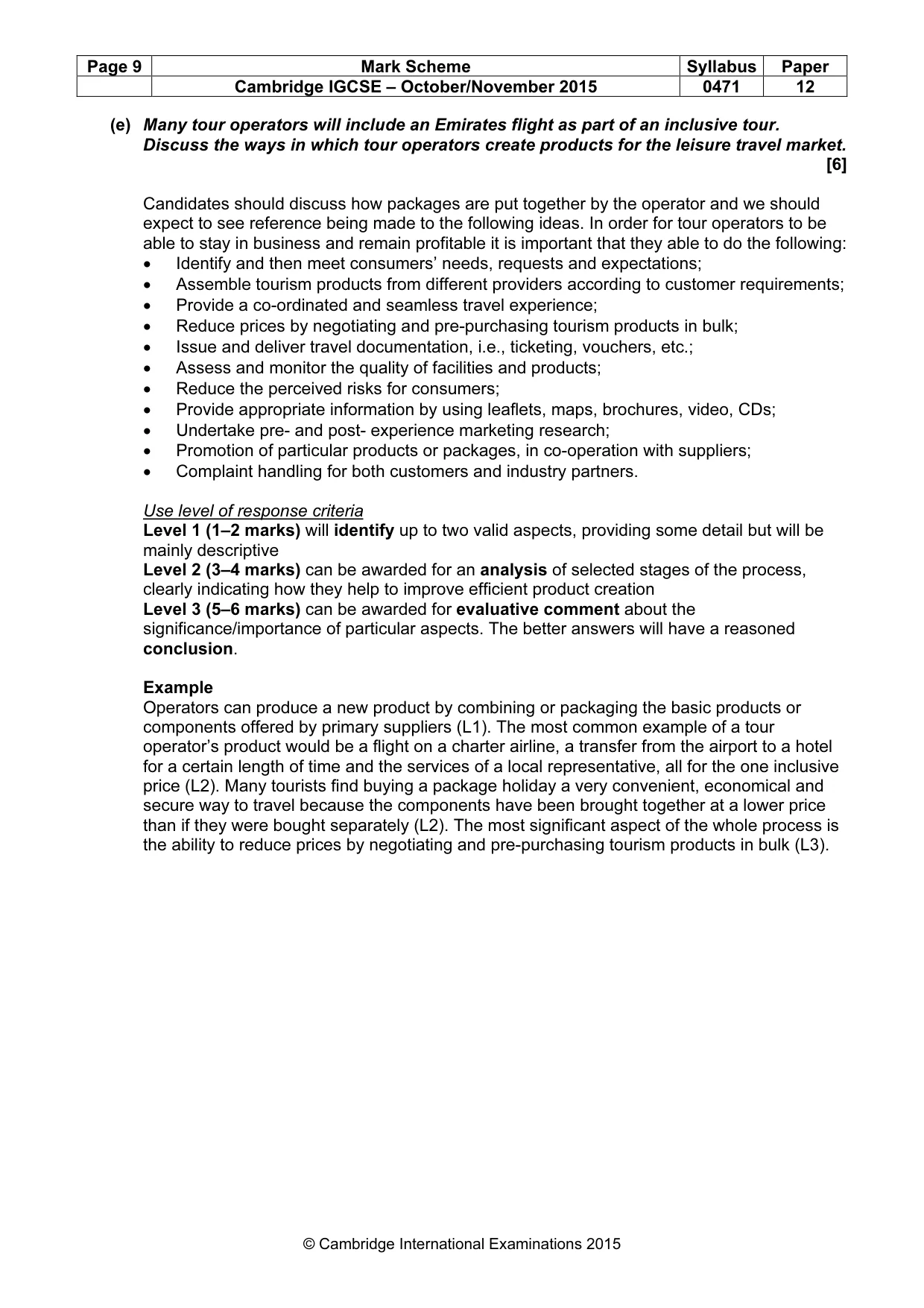
Page 9 Mark Scheme Syllabus Paper Cambridge IGCSE – October/November 2015 0471 12 © Cambridge International Examinations 2015 (e) Many tour operators will include an Emirates flight as part of an inclusive tour. Discuss the ways in which tour operators create products for the leisure travel market. [6] Candidates should discuss how packages are put together by the operator and we should expect to see reference being made to the following ideas. In order for tour operators to be able to stay in business and remain profitable it is important that they able to do the following: • Identify and then meet consumers’ needs, requests and expectations; • Assemble tourism products from different providers according to customer requirements; • Provide a co-ordinated and seamless travel experience; • Reduce prices by negotiating and pre-purchasing tourism products in bulk; • Issue and deliver travel documentation, i.e., ticketing, vouchers, etc.; • Assess and monitor the quality of facilities and products; • Reduce the perceived risks for consumers; • Provide appropriate information by using leaflets, maps, brochures, video, CDs; • Undertake pre- and post- experience marketing research; • Promotion of particular products or packages, in co-operation with suppliers; • Complaint handling for both customers and industry partners. Use level of response criteria Level 1 (1–2 marks) will identify up to two valid aspects, providing some detail but will be mainly descriptive Level 2 (3–4 marks) can be awarded for an analysis of selected stages of the process, clearly indicating how they help to improve efficient product creation Level 3 (5–6 marks) can be awarded for evaluative comment about the significance/importance of particular aspects. The better answers will have a reasoned conclusion. Example Operators can produce a new product by combining or packaging the basic products or components offered by primary suppliers (L1). The most common example of a tour operator’s product would be a flight on a charter airline, a transfer from the airport to a hotel for a certain length of time and the services of a local representative, all for the one inclusive price (L2). Many tourists find buying a package holiday a very convenient, economical and secure way to travel because the components have been brought together at a lower price than if they were bought separately (L2). The most significant aspect of the whole process is the ability to reduce prices by negotiating and pre-purchasing tourism products in bulk (L3).
What you needed in this session
Cambridge’s own grade thresholds for 2015 Oct/Nov, Paper 1 · Variant 2. A higher threshold means an easier paper — the bar moves with how the cohort did.