Cambridge IGCSE Travel and Tourism 0471 — 2015 Oct/Nov Paper 1 · Variant 3
0471/13/O/N/15 · 100 marks · ≈113 min
The question paper and its mark scheme, free to read here and free to download. This is Cambridge’s own paper, exactly as it was sat.
Question paper16 pages



Mark scheme9 pages
Answers below. Sit the paper first if you are practising.
Paper as text
Question paper, page 1
This document consists of 13 printed pages, 3 blank pages and 1 Insert. DC (NH) 94828/3 © UCLES 2015 [Turn over * 3 9 5 0 8 9 8 2 3 8 * TRAVEL AND TOURISM 0471/13 Core Module October/November 2015 2 hours Candidates answer on the Question Paper. No Additional Materials are required. READ THESE INSTRUCTIONS FIRST Write your Centre number, candidate number and name on all the work you hand in. Write in dark blue or black pen. You may use an HB pencil for any diagrams or graphs. Do not use staples, paper clips, glue or correction fluid. DO NOT WRITE IN ANY BARCODES. Answer all questions. All Figures referred to in the questions are contained in the Insert. The number of marks is given in brackets [ ] at the end of each question or part question. Cambridge International Examinations Cambridge International General Certificate of Secondary Education
Question paper, page 2
2 0471/13/O/N/15 © UCLES 2015 Question 1 Refer to Fig. 1 (Insert), a poster displayed on a travel and tourism organisation’s staff room wall and Fig. 2 (Insert), a member of waiting staff at a restaurant. (a) Identify from Fig. 1 (Insert), the three aspects of eagerness which the travel and tourism organisation expects of its employees. 1 … 2 … 3 …[3] (b) Explain the two ways in which the member of waiting staff shown in Fig. 2 (Insert), is putting the contents of the staff room poster into practice. 1 … … … … 2 … … … …[4]
Question paper, page 3
3 0471/13/O/N/15 © UCLES 2015 [Turn over (c) The restaurant shown in Fig. 2 (Insert), attracts many local residents to its weekly buffet lunches. Describe three ways in which staff are likely to prepare the restaurant for service. 1 … … … … 2 … … … … 3 … … … …[6] (d) The restaurant has won a number of awards and has obtained a star rating. Explain three advantages to the restaurant of displaying the award logos on its stationery, printed flyers and on the outside wall by the entrance. 1 … … … … 2 … … … … 3 … … … …[6]
Question paper, page 4
4 0471/13/O/N/15 © UCLES 2015 (e) Many destinations offer a variety of opportunities to enjoy a meal in an unusual setting. With reference to one example with which you are familiar, assess the appeal of the chosen unusual dining experience to visiting tourists. Chosen example … … … … … … … … … … … … …[6] [Total: 25]
Question paper, page 5
5 0471/13/O/N/15 © UCLES 2015 [Turn over Question 2 Refer to Fig. 3 (Insert), a map showing some of the world’s major features and selected tourist destinations. (a) Using Fig. 3 (Insert), complete the following table by naming each feature. Feature Name Continent A Continent B Ocean C [3] (b) State the following: • the term that best describes the climatic conditions in Hawaii … • whether average July temperatures in Johannesburg will be higher or lower than in January … • whether local time in Abu Dhabi is in advance of or behind local time in Perth … • whether San Francisco is at risk from hurricanes in early autumn … [4]
Question paper, page 6
6 0471/13/O/N/15 © UCLES 2015 (c) Many destinations have seasonal climates. Explain how the tourist season has been extended in some locations with each of the following characteristics: • mountain areas which have been developed mainly as ski resorts … … … … … … • coastal areas which have been developed mainly as beach resorts … … … … … … [6]
Question paper, page 7
7 0471/13/O/N/15 © UCLES 2015 [Turn over (d) Not all visitors to a destination are on holiday. Some visitors will be business tourists who are travelling in connection with their work, attending conferences and exhibitions. Describe three different types of facility found in major destinations which are often used to host such events. 1 … … … … 2 … … … … 3 … … … … [6] (e) Assess the services that major international airlines supply for the convenience of their business-class passengers. … … … … … … … … … … … …[6] [Total: 25]
Question paper, page 8
8 0471/13/O/N/15 © UCLES 2015 Question 3 Refer to Fig. 4 (Insert), information about the Japanese Shinkansen and details of a rail tour to Hiroshima. (a) Identify from Fig. 4 (Insert) the following: • the year in which Shinkansen services began … • the major natural landscape feature visible on the journey … • the cost of the 4-day tour … [3] (b) Identify and explain two likely disadvantages to tourists of taking the tour shown in Fig. 4 (Insert). 1 … … … … 2 … … … …[4]
Question paper, page 9
9 0471/13/O/N/15 © UCLES 2015 [Turn over (c) Explain three advantages to travellers of using trains for international travel rather than short-haul flights. 1 … … … … 2 … … … … 3 … … … …[6] (d) All destinations try to maximise their visitor numbers. Explain three potential benefits to a destination of increasing the amount of tourist accommodation available in the local area. 1 … … … … 2 … … … … 3 … … … …[6]
Question paper, page 10
10 0471/13/O/N/15 © UCLES 2015 (e) Discuss the ways in which tourism can create positive environmental impacts in urban areas. … … … … … … … … … … … …[6] [Total: 25]
Question paper, page 11
11 0471/13/O/N/15 © UCLES 2015 [Turn over Question 4 Refer to Fig. 5 (Insert), a news item about football tourism in the UK and Fig. 6 (Insert), a photograph of a city sightseeing tour bus. (a) Identify from Fig. 5 (Insert) the following: • the name of the UK’s national tourism agency … • the largest source market for football tourists visiting the UK … • the average amount spent by a visitor to the UK in 2012 … [3] (b) With reference to Fig. 5 (Insert), identify and explain two positive impacts on the UK resulting from football tourism. 1 … … … … 2 … … … …[4]
Question paper, page 12
12 0471/13/O/N/15 © UCLES 2015 (c) Visitors watching UK football matches are classified as sports tourists. There are many other types of tourism. Define what is meant by each of the following and give an appropriate named example of each of the listed types of tourism activity: • adventure tourism Definition … … Example … … • cultural tourism Definition … … Example … … • medical tourism Definition … … Example … … [6]
Question paper, page 13
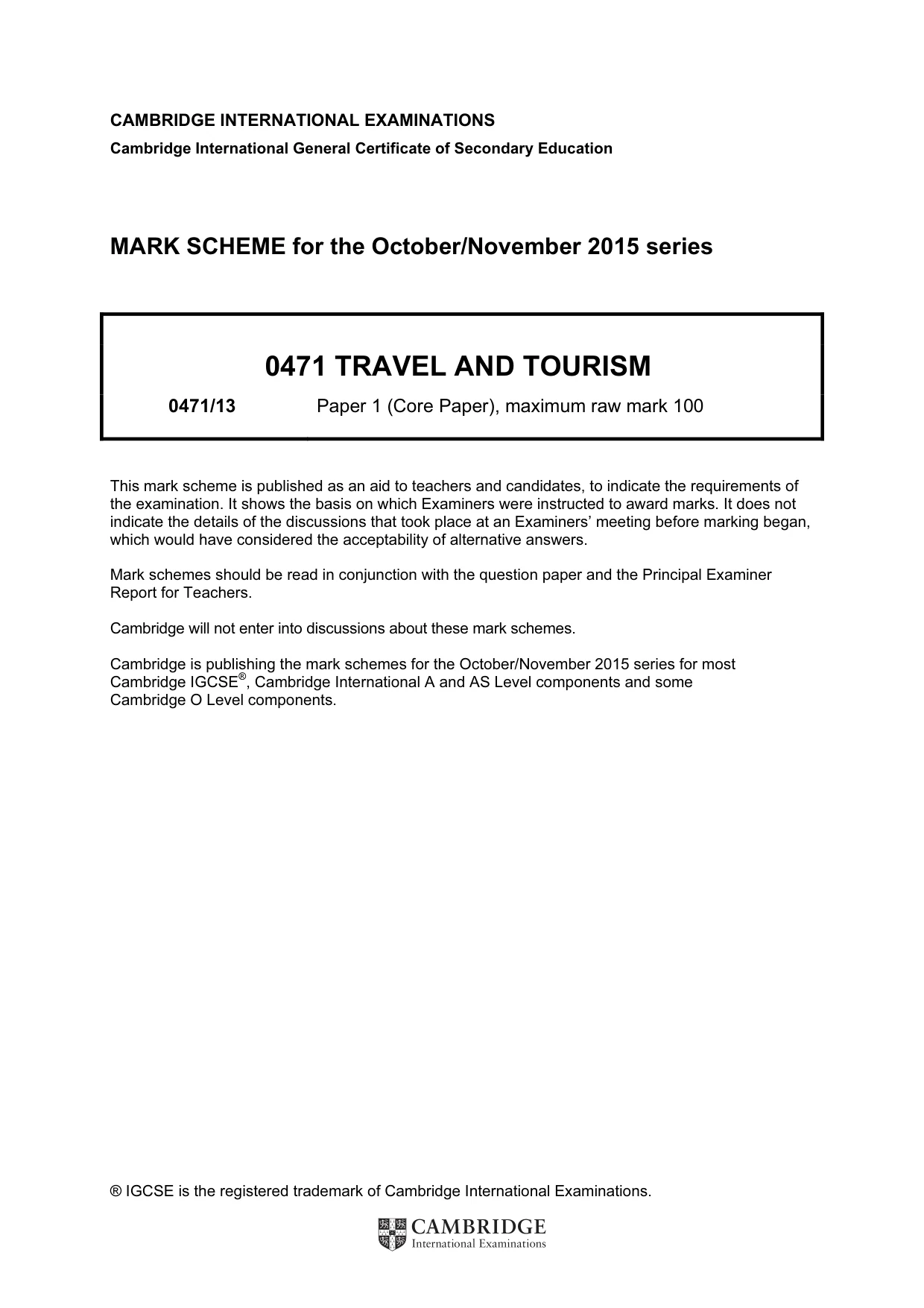
13 0471/13/O/N/15 © UCLES 2015 (d) Once at their chosen destination, many tourists will take a city sightseeing tour, such as the one shown in Fig. 6 (Insert). Explain three ways in which such tours are likely to appeal to visiting tourists. 1 … … … … 2 … … … … 3 … … … …[6] (e) Discuss the reasons why many destinations which were previously very popular with visitors are now facing decline. … … … … … … … … … … … …[6] [Total: 25]
Question paper, page 14
14 0471/13/O/N/15 © UCLES 2015 BLANK PAGE
Question paper, page 15
15 0471/13/O/N/15 © UCLES 2015 BLANK PAGE
Question paper, page 16
16 0471/13/O/N/15 © UCLES 2015 Permission to reproduce items where third-party owned material protected by copyright is included has been sought and cleared where possible. Every reasonable effort has been made by the publisher (UCLES) to trace copyright holders, but if any items requiring clearance have unwittingly been included, the publisher will be pleased to make amends at the earliest possible opportunity. To avoid the issue of disclosure of answer-related information to candidates, all copyright acknowledgements are reproduced online in the Cambridge International Examinations Copyright Acknowledgements Booklet. This is produced for each series of examinations and is freely available to download at www.cie.org.uk after the live examination series. Cambridge International Examinations is part of the Cambridge Assessment Group. Cambridge Assessment is the brand name of University of Cambridge Local Examinations Syndicate (UCLES), which is itself a department of the University of Cambridge. BLANK PAGE
Mark scheme, page 1
® IGCSE is the registered trademark of Cambridge International Examinations. CAMBRIDGE INTERNATIONAL EXAMINATIONS Cambridge International General Certificate of Secondary Education MARK SCHEME for the October/November 2015 series 0471 TRAVEL AND TOURISM 0471/13 Paper 1 (Core Paper), maximum raw mark 100 This mark scheme is published as an aid to teachers and candidates, to indicate the requirements of the examination. It shows the basis on which Examiners were instructed to award marks. It does not indicate the details of the discussions that took place at an Examiners’ meeting before marking began, which would have considered the acceptability of alternative answers. Mark schemes should be read in conjunction with the question paper and the Principal Examiner Report for Teachers. Cambridge will not enter into discussions about these mark schemes. Cambridge is publishing the mark schemes for the October/November 2015 series for most Cambridge IGCSE®, Cambridge International A and AS Level components and some Cambridge O Level components.
Mark scheme, page 2
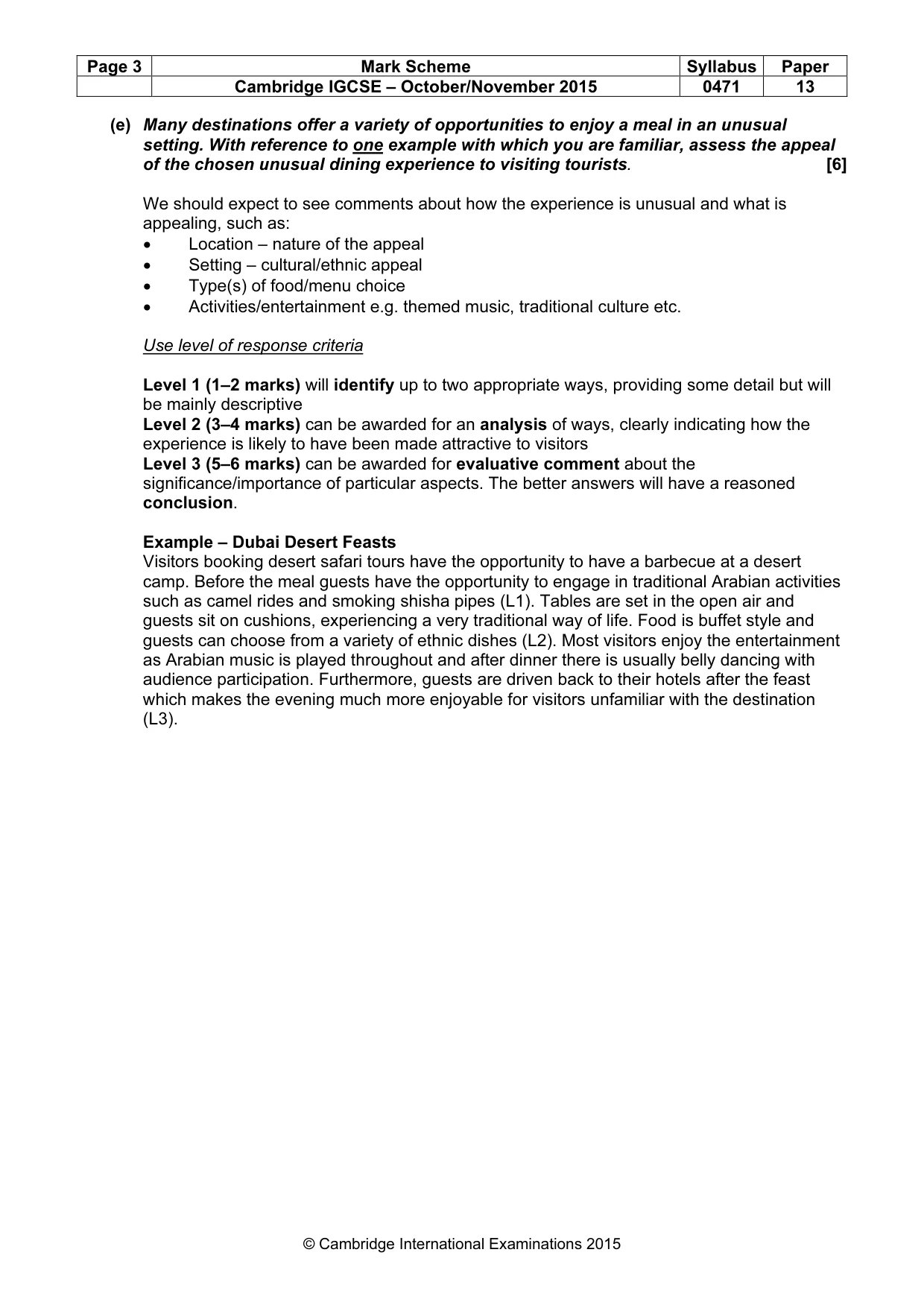
Page 2 Mark Scheme Syllabus Paper Cambridge IGCSE – October/November 2015 0471 13 © Cambridge International Examinations 2015 1 (a) Identify from Fig. 1 (Insert), the three aspects of eagerness which the travel and tourism organisation expects of its employees. [3] Award one mark for the correct identification of each of: • help others • show enthusiasm • enjoy your work These are the ONLY valid responses (b) Explain the two ways in which the member of waiting staff shown in Fig. 2 (Insert) is putting the contents of the staff room poster into practice. [4] Award one mark for the correct identification of each of the two valid ways and award a second mark for an appropriate explanatory contextualisation about each. The only correct responses are: • Posture (1) – standing to attention, ready and waiting to serve (1) • Appearance (1) – wearing uniform and looking professional (1) (c) The restaurant shown in Fig. 2 (Insert) attracts many local residents to its weekly buffet lunches. Describe three ways in which staff are likely to prepare the restaurant for service. [6] The candidates have been provided with a clear context here – Staff, Restaurant & Buffet – so we are not to credit what goes on in the kitchen. Award one mark for the identification of each of three valid elements of the preparation process and award a second mark for an appropriate description of what will be involved. We can credit aspects such as: • Arrange buffet table/food stations (1) – position to allow guest access (1) • Set dining tables (1) – linen, cutlery, glassware (1) • Position tables for 2/4/6+ covers (1) – to correspond with bookings, anticipated number of guests (1) • Clean after previous service (1) – or after spills (1) • Assist kitchen staff (1) – bring out food prior to service (1) Credit all valid statements in context. (d) The restaurant has won a number of awards and has obtained a star rating. Explain three advantages to the restaurant of displaying the award logos on its stationery, printed flyers and on the outside wall by the entrance. [6] Award one mark for the identification of each of three valid advantages and award a second mark for an appropriate explanatory comment about each. Valid responses will include: • Shows off a sign of quality assurance (1) – awarded by an independent external body (1) • Demonstrates the meeting of benchmarked standards (1) – shows that they meet the criteria of more than one awarding body (1) • Allow comparison with rivals (1) – gives a comparative advantage (1) • Sends a signal to potential customers (1) – public aware of the value of awards (1) Credit all valid reasoning in context
Mark scheme, page 3
Page 3 Mark Scheme Syllabus Paper Cambridge IGCSE – October/November 2015 0471 13 © Cambridge International Examinations 2015 (e) Many destinations offer a variety of opportunities to enjoy a meal in an unusual setting. With reference to one example with which you are familiar, assess the appeal of the chosen unusual dining experience to visiting tourists. [6] We should expect to see comments about how the experience is unusual and what is appealing, such as: • Location – nature of the appeal • Setting – cultural/ethnic appeal • Type(s) of food/menu choice • Activities/entertainment e.g. themed music, traditional culture etc. Use level of response criteria Level 1 (1–2 marks) will identify up to two appropriate ways, providing some detail but will be mainly descriptive Level 2 (3–4 marks) can be awarded for an analysis of ways, clearly indicating how the experience is likely to have been made attractive to visitors Level 3 (5–6 marks) can be awarded for evaluative comment about the significance/importance of particular aspects. The better answers will have a reasoned conclusion. Example – Dubai Desert Feasts Visitors booking desert safari tours have the opportunity to have a barbecue at a desert camp. Before the meal guests have the opportunity to engage in traditional Arabian activities such as camel rides and smoking shisha pipes (L1). Tables are set in the open air and guests sit on cushions, experiencing a very traditional way of life. Food is buffet style and guests can choose from a variety of ethnic dishes (L2). Most visitors enjoy the entertainment as Arabian music is played throughout and after dinner there is usually belly dancing with audience participation. Furthermore, guests are driven back to their hotels after the feast which makes the evening much more enjoyable for visitors unfamiliar with the destination (L3).
Mark scheme, page 4
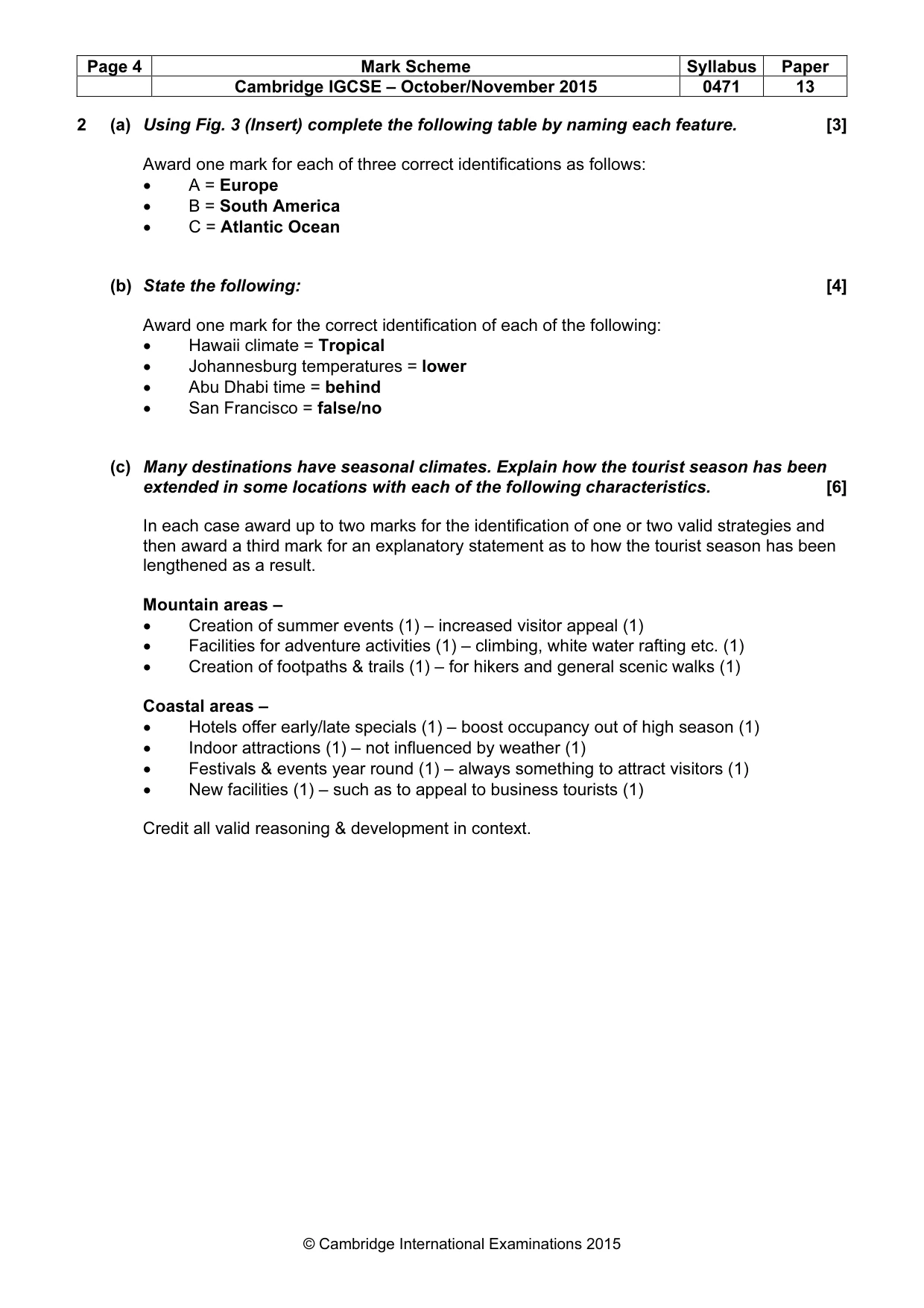
Page 4 Mark Scheme Syllabus Paper Cambridge IGCSE – October/November 2015 0471 13 © Cambridge International Examinations 2015 2 (a) Using Fig. 3 (Insert) complete the following table by naming each feature. [3] Award one mark for each of three correct identifications as follows: • A = Europe • B = South America • C = Atlantic Ocean (b) State the following: [4] Award one mark for the correct identification of each of the following: • Hawaii climate = Tropical • Johannesburg temperatures = lower • Abu Dhabi time = behind • San Francisco = false/no (c) Many destinations have seasonal climates. Explain how the tourist season has been extended in some locations with each of the following characteristics. [6] In each case award up to two marks for the identification of one or two valid strategies and then award a third mark for an explanatory statement as to how the tourist season has been lengthened as a result. Mountain areas – • Creation of summer events (1) – increased visitor appeal (1) • Facilities for adventure activities (1) – climbing, white water rafting etc. (1) • Creation of footpaths & trails (1) – for hikers and general scenic walks (1) Coastal areas – • Hotels offer early/late specials (1) – boost occupancy out of high season (1) • Indoor attractions (1) – not influenced by weather (1) • Festivals & events year round (1) – always something to attract visitors (1) • New facilities (1) – such as to appeal to business tourists (1) Credit all valid reasoning & development in context.
Mark scheme, page 5
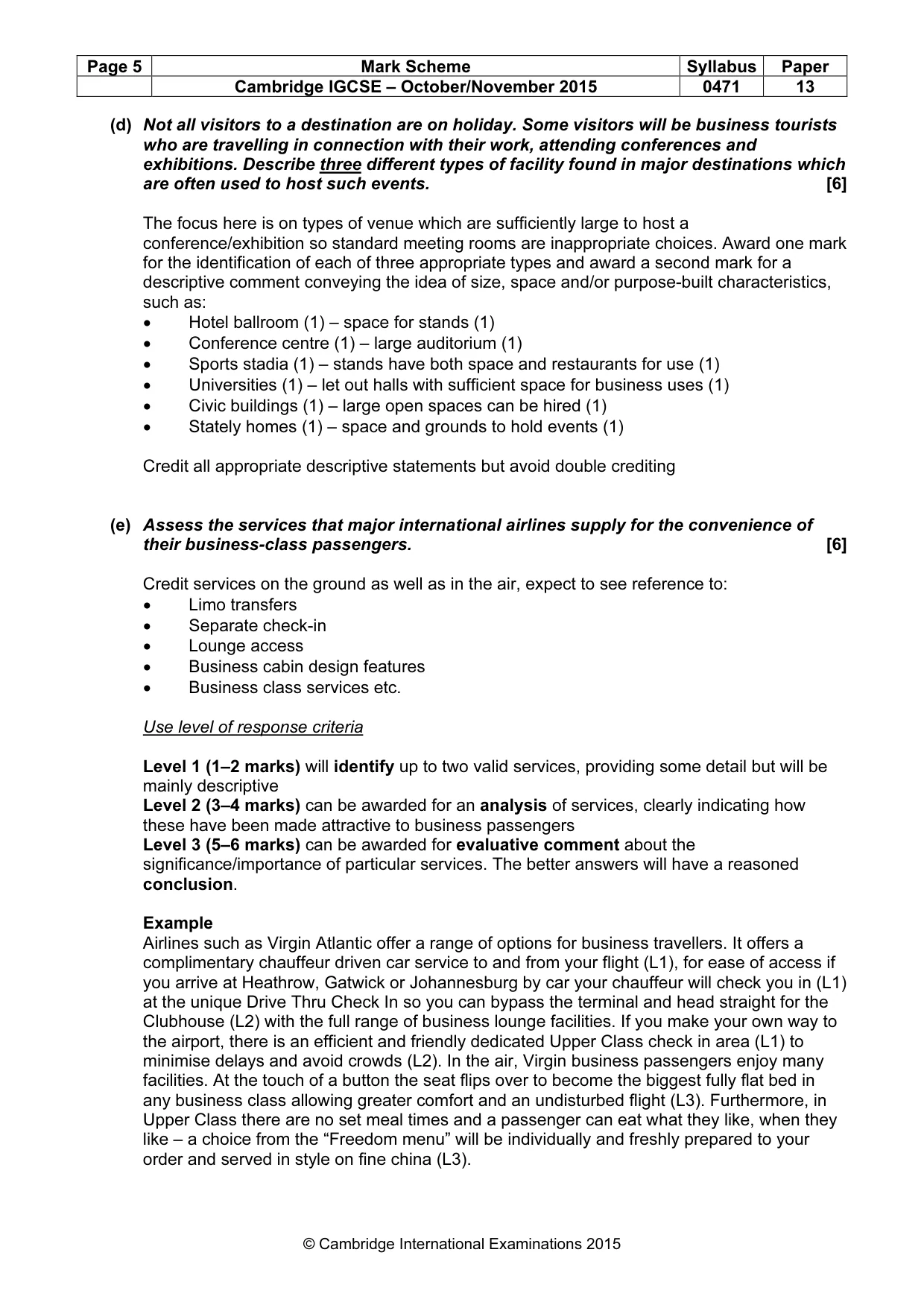
Page 5 Mark Scheme Syllabus Paper Cambridge IGCSE – October/November 2015 0471 13 © Cambridge International Examinations 2015 (d) Not all visitors to a destination are on holiday. Some visitors will be business tourists who are travelling in connection with their work, attending conferences and exhibitions. Describe three different types of facility found in major destinations which are often used to host such events. [6] The focus here is on types of venue which are sufficiently large to host a conference/exhibition so standard meeting rooms are inappropriate choices. Award one mark for the identification of each of three appropriate types and award a second mark for a descriptive comment conveying the idea of size, space and/or purpose-built characteristics, such as: • Hotel ballroom (1) – space for stands (1) • Conference centre (1) – large auditorium (1) • Sports stadia (1) – stands have both space and restaurants for use (1) • Universities (1) – let out halls with sufficient space for business uses (1) • Civic buildings (1) – large open spaces can be hired (1) • Stately homes (1) – space and grounds to hold events (1) Credit all appropriate descriptive statements but avoid double crediting (e) Assess the services that major international airlines supply for the convenience of their business-class passengers. [6] Credit services on the ground as well as in the air, expect to see reference to: • Limo transfers • Separate check-in • Lounge access • Business cabin design features • Business class services etc. Use level of response criteria Level 1 (1–2 marks) will identify up to two valid services, providing some detail but will be mainly descriptive Level 2 (3–4 marks) can be awarded for an analysis of services, clearly indicating how these have been made attractive to business passengers Level 3 (5–6 marks) can be awarded for evaluative comment about the significance/importance of particular services. The better answers will have a reasoned conclusion. Example Airlines such as Virgin Atlantic offer a range of options for business travellers. It offers a complimentary chauffeur driven car service to and from your flight (L1), for ease of access if you arrive at Heathrow, Gatwick or Johannesburg by car your chauffeur will check you in (L1) at the unique Drive Thru Check In so you can bypass the terminal and head straight for the Clubhouse (L2) with the full range of business lounge facilities. If you make your own way to the airport, there is an efficient and friendly dedicated Upper Class check in area (L1) to minimise delays and avoid crowds (L2). In the air, Virgin business passengers enjoy many facilities. At the touch of a button the seat flips over to become the biggest fully flat bed in any business class allowing greater comfort and an undisturbed flight (L3). Furthermore, in Upper Class there are no set meal times and a passenger can eat what they like, when they like – a choice from the “Freedom menu” will be individually and freshly prepared to your order and served in style on fine china (L3).
Mark scheme, page 6
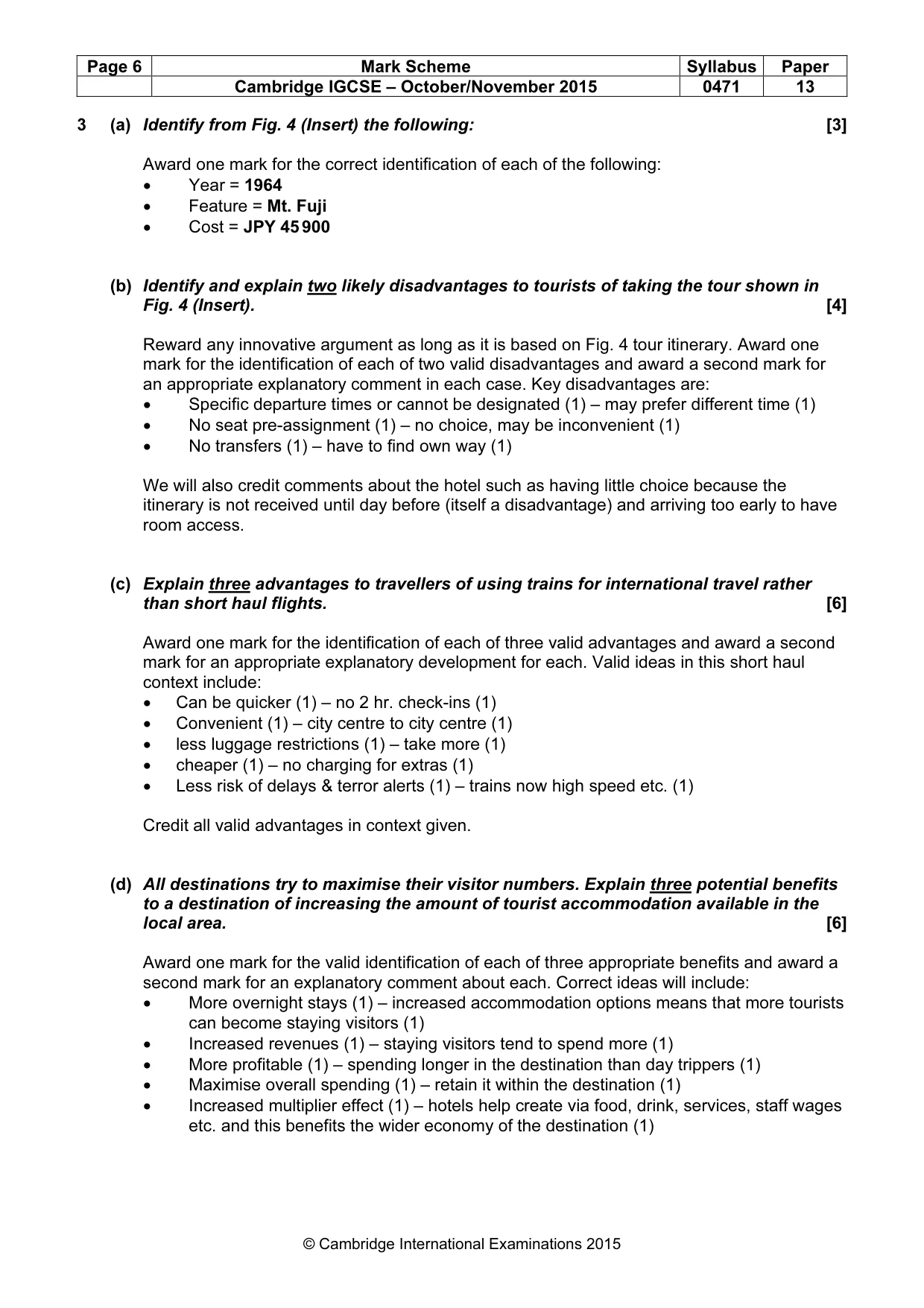
Page 6 Mark Scheme Syllabus Paper Cambridge IGCSE – October/November 2015 0471 13 © Cambridge International Examinations 2015 3 (a) Identify from Fig. 4 (Insert) the following: [3] Award one mark for the correct identification of each of the following: • Year = 1964 • Feature = Mt. Fuji • Cost = JPY 45 900 (b) Identify and explain two likely disadvantages to tourists of taking the tour shown in Fig. 4 (Insert). [4] Reward any innovative argument as long as it is based on Fig. 4 tour itinerary. Award one mark for the identification of each of two valid disadvantages and award a second mark for an appropriate explanatory comment in each case. Key disadvantages are: • Specific departure times or cannot be designated (1) – may prefer different time (1) • No seat pre-assignment (1) – no choice, may be inconvenient (1) • No transfers (1) – have to find own way (1) We will also credit comments about the hotel such as having little choice because the itinerary is not received until day before (itself a disadvantage) and arriving too early to have room access. (c) Explain three advantages to travellers of using trains for international travel rather than short haul flights. [6] Award one mark for the identification of each of three valid advantages and award a second mark for an appropriate explanatory development for each. Valid ideas in this short haul context include: • Can be quicker (1) – no 2 hr. check-ins (1) • Convenient (1) – city centre to city centre (1) • less luggage restrictions (1) – take more (1) • cheaper (1) – no charging for extras (1) • Less risk of delays & terror alerts (1) – trains now high speed etc. (1) Credit all valid advantages in context given. (d) All destinations try to maximise their visitor numbers. Explain three potential benefits to a destination of increasing the amount of tourist accommodation available in the local area. [6] Award one mark for the valid identification of each of three appropriate benefits and award a second mark for an explanatory comment about each. Correct ideas will include: • More overnight stays (1) – increased accommodation options means that more tourists can become staying visitors (1) • Increased revenues (1) – staying visitors tend to spend more (1) • More profitable (1) – spending longer in the destination than day trippers (1) • Maximise overall spending (1) – retain it within the destination (1) • Increased multiplier effect (1) – hotels help create via food, drink, services, staff wages etc. and this benefits the wider economy of the destination (1)
Mark scheme, page 7
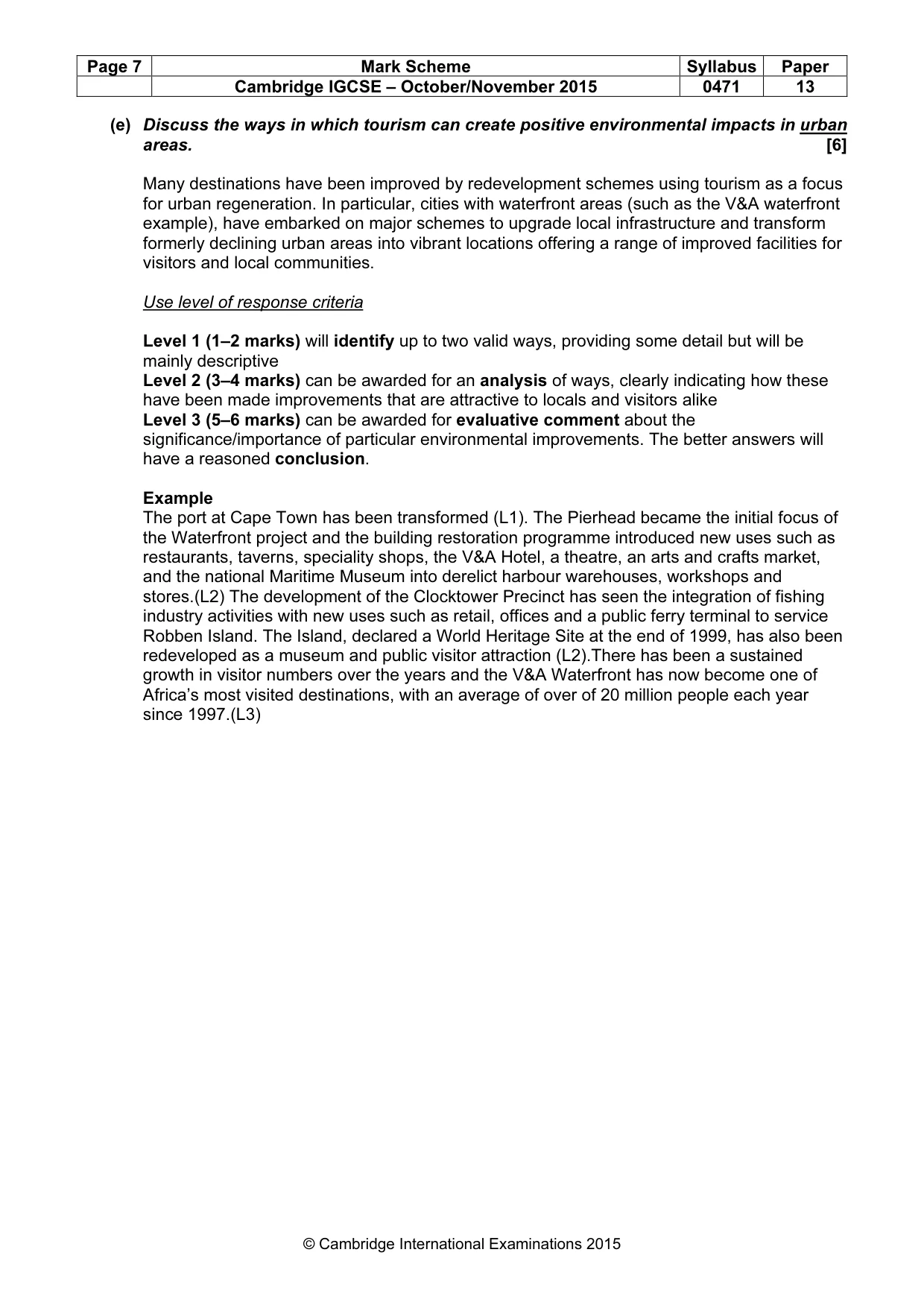
Page 7 Mark Scheme Syllabus Paper Cambridge IGCSE – October/November 2015 0471 13 © Cambridge International Examinations 2015 (e) Discuss the ways in which tourism can create positive environmental impacts in urban areas. [6] Many destinations have been improved by redevelopment schemes using tourism as a focus for urban regeneration. In particular, cities with waterfront areas (such as the V&A waterfront example), have embarked on major schemes to upgrade local infrastructure and transform formerly declining urban areas into vibrant locations offering a range of improved facilities for visitors and local communities. Use level of response criteria Level 1 (1–2 marks) will identify up to two valid ways, providing some detail but will be mainly descriptive Level 2 (3–4 marks) can be awarded for an analysis of ways, clearly indicating how these have been made improvements that are attractive to locals and visitors alike Level 3 (5–6 marks) can be awarded for evaluative comment about the significance/importance of particular environmental improvements. The better answers will have a reasoned conclusion. Example The port at Cape Town has been transformed (L1). The Pierhead became the initial focus of the Waterfront project and the building restoration programme introduced new uses such as restaurants, taverns, speciality shops, the V&A Hotel, a theatre, an arts and crafts market, and the national Maritime Museum into derelict harbour warehouses, workshops and stores.(L2) The development of the Clocktower Precinct has seen the integration of fishing industry activities with new uses such as retail, offices and a public ferry terminal to service Robben Island. The Island, declared a World Heritage Site at the end of 1999, has also been redeveloped as a museum and public visitor attraction (L2).There has been a sustained growth in visitor numbers over the years and the V&A Waterfront has now become one of Africa’s most visited destinations, with an average of over of 20 million people each year since 1997.(L3)
Mark scheme, page 8
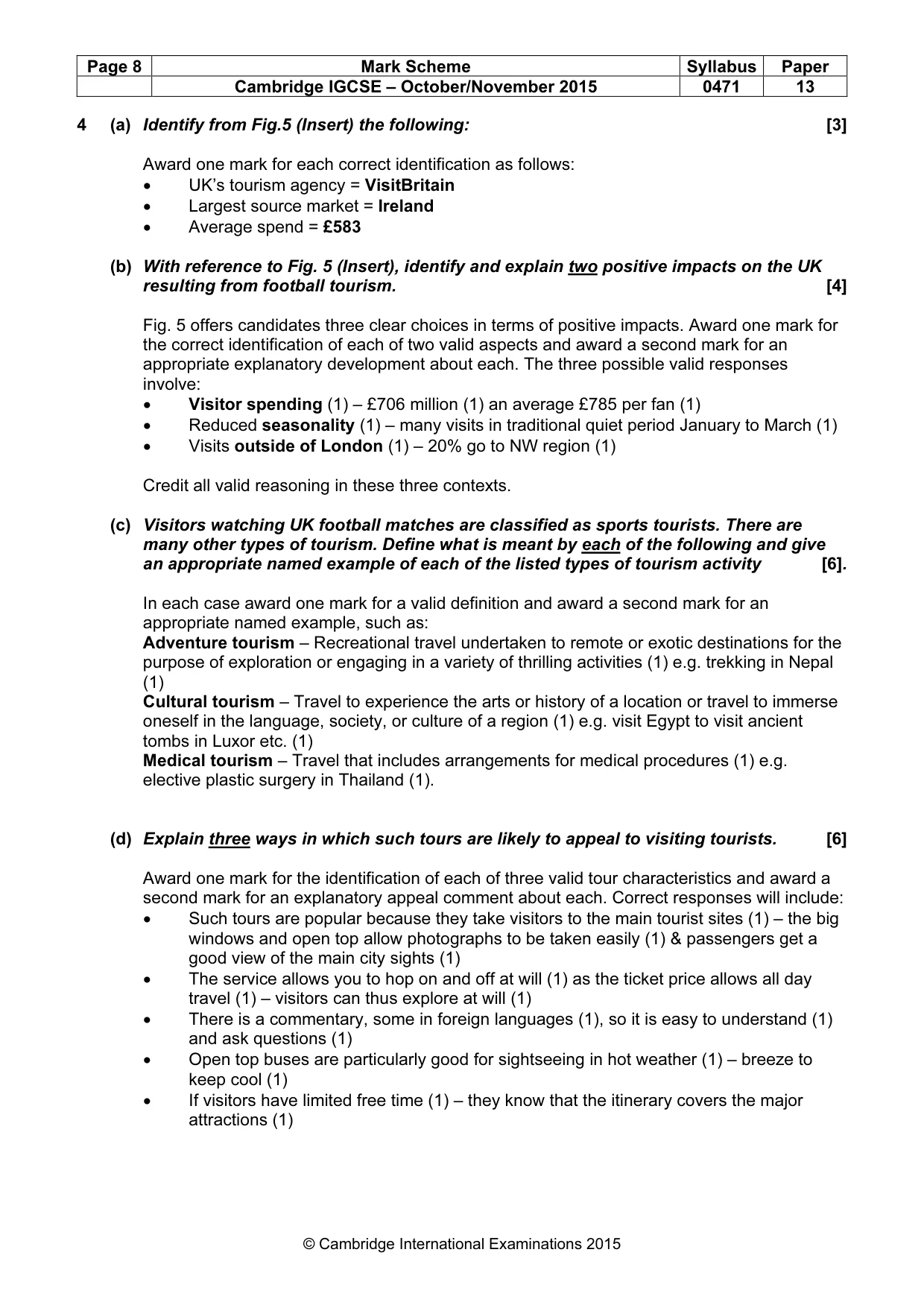
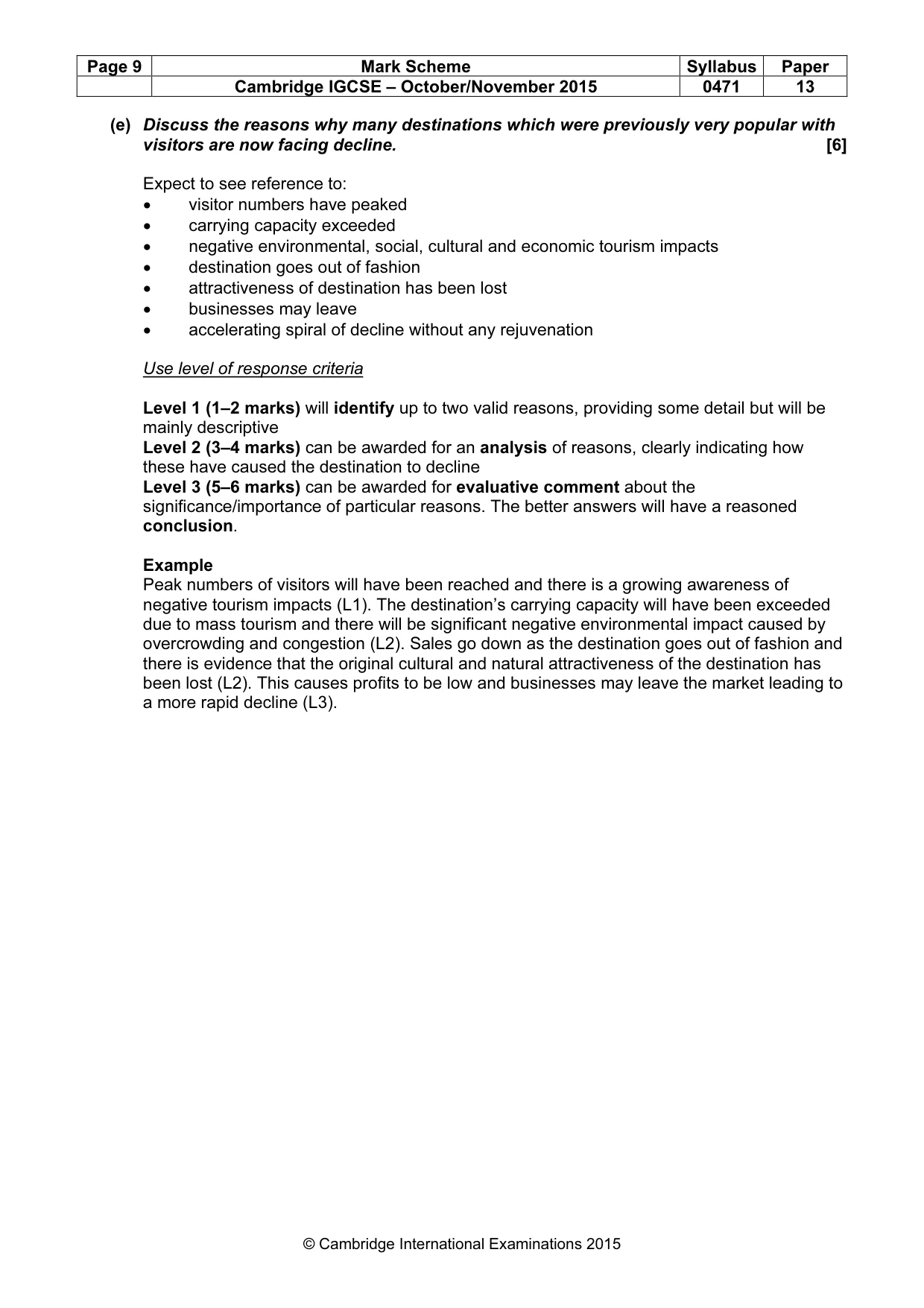
Page 8 Mark Scheme Syllabus Paper Cambridge IGCSE – October/November 2015 0471 13 © Cambridge International Examinations 2015 4 (a) Identify from Fig.5 (Insert) the following: [3] Award one mark for each correct identification as follows: • UK’s tourism agency = VisitBritain • Largest source market = Ireland • Average spend = £583 (b) With reference to Fig. 5 (Insert), identify and explain two positive impacts on the UK resulting from football tourism. [4] Fig. 5 offers candidates three clear choices in terms of positive impacts. Award one mark for the correct identification of each of two valid aspects and award a second mark for an appropriate explanatory development about each. The three possible valid responses involve: • Visitor spending (1) – £706 million (1) an average £785 per fan (1) • Reduced seasonality (1) – many visits in traditional quiet period January to March (1) • Visits outside of London (1) – 20% go to NW region (1) Credit all valid reasoning in these three contexts. (c) Visitors watching UK football matches are classified as sports tourists. There are many other types of tourism. Define what is meant by each of the following and give an appropriate named example of each of the listed types of tourism activity [6]. In each case award one mark for a valid definition and award a second mark for an appropriate named example, such as: Adventure tourism – Recreational travel undertaken to remote or exotic destinations for the purpose of exploration or engaging in a variety of thrilling activities (1) e.g. trekking in Nepal (1) Cultural tourism – Travel to experience the arts or history of a location or travel to immerse oneself in the language, society, or culture of a region (1) e.g. visit Egypt to visit ancient tombs in Luxor etc. (1) Medical tourism – Travel that includes arrangements for medical procedures (1) e.g. elective plastic surgery in Thailand (1). (d) Explain three ways in which such tours are likely to appeal to visiting tourists. [6] Award one mark for the identification of each of three valid tour characteristics and award a second mark for an explanatory appeal comment about each. Correct responses will include: • Such tours are popular because they take visitors to the main tourist sites (1) – the big windows and open top allow photographs to be taken easily (1) & passengers get a good view of the main city sights (1) • The service allows you to hop on and off at will (1) as the ticket price allows all day travel (1) – visitors can thus explore at will (1) • There is a commentary, some in foreign languages (1), so it is easy to understand (1) and ask questions (1) • Open top buses are particularly good for sightseeing in hot weather (1) – breeze to keep cool (1) • If visitors have limited free time (1) – they know that the itinerary covers the major attractions (1)
Mark scheme, page 9
Page 9 Mark Scheme Syllabus Paper Cambridge IGCSE – October/November 2015 0471 13 © Cambridge International Examinations 2015 (e) Discuss the reasons why many destinations which were previously very popular with visitors are now facing decline. [6] Expect to see reference to: • visitor numbers have peaked • carrying capacity exceeded • negative environmental, social, cultural and economic tourism impacts • destination goes out of fashion • attractiveness of destination has been lost • businesses may leave • accelerating spiral of decline without any rejuvenation Use level of response criteria Level 1 (1–2 marks) will identify up to two valid reasons, providing some detail but will be mainly descriptive Level 2 (3–4 marks) can be awarded for an analysis of reasons, clearly indicating how these have caused the destination to decline Level 3 (5–6 marks) can be awarded for evaluative comment about the significance/importance of particular reasons. The better answers will have a reasoned conclusion. Example Peak numbers of visitors will have been reached and there is a growing awareness of negative tourism impacts (L1). The destination’s carrying capacity will have been exceeded due to mass tourism and there will be significant negative environmental impact caused by overcrowding and congestion (L2). Sales go down as the destination goes out of fashion and there is evidence that the original cultural and natural attractiveness of the destination has been lost (L2). This causes profits to be low and businesses may leave the market leading to a more rapid decline (L3).
What you needed in this session
Cambridge’s own grade thresholds for 2015 Oct/Nov, Paper 1 · Variant 3. A higher threshold means an easier paper — the bar moves with how the cohort did.