Cambridge IGCSE Spanish - Literature 0488 — 2016 May/June Paper 1 · Variant 3
0488/13/M/J/16 · 60 marks · ≈68 min
The question paper and its mark scheme, free to download. This is Cambridge’s own paper, exactly as it was sat — the on-screen preview is on its way; download below in the meantime.
Question paper
The on-screen preview isn’t ready for this paper yet — download it above instead.
Mark scheme18 pages
Answers below. Sit the paper first if you are practising.

Paper as text
Mark scheme, page 1
® IGCSE is the registered trademark of Cambridge International Examinations. This document consists of 18 printed pages. © UCLES 2016 [Turn over Cambridge International Examinations Cambridge International General Certificate of Secondary Education LITERATURE (SPANISH) 0488/13 Paper 1 Set Texts (Open Books) May/June 2016 MARK SCHEME Maximum Mark: 60 Published This mark scheme is published as an aid to teachers and candidates, to indicate the requirements of the examination. It shows the basis on which Examiners were instructed to award marks. It does not indicate the details of the discussions that took place at an Examiners’ meeting before marking began, which would have considered the acceptability of alternative answers. Mark schemes should be read in conjunction with the question paper and the Principal Examiner Report for Teachers. Cambridge will not enter into discussions about these mark schemes. Cambridge is publishing the mark schemes for the May/June 2016 series for most Cambridge IGCSE®, Cambridge International A and AS Level components and some Cambridge O Level components.
Mark scheme, page 2
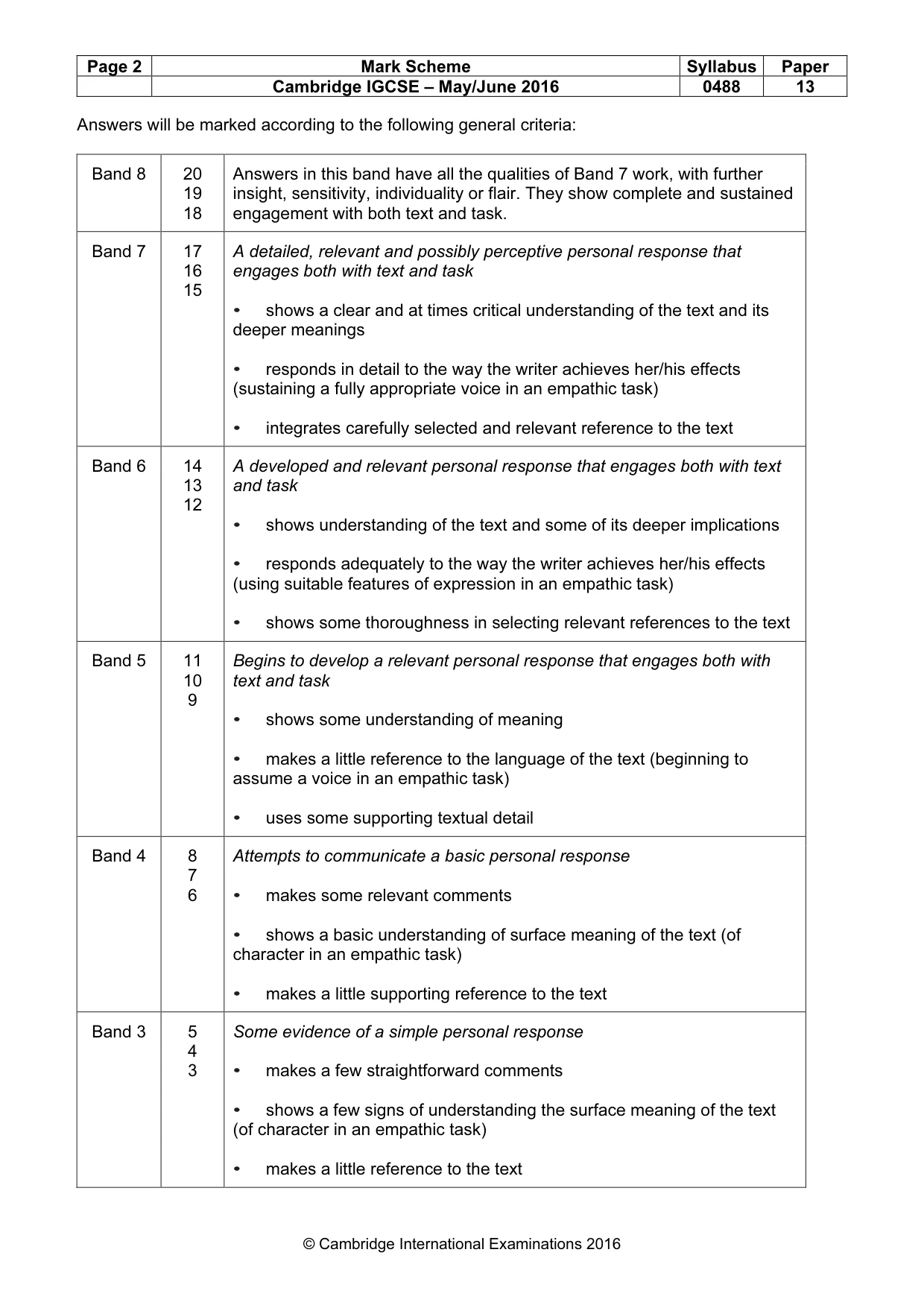
Page 2 Mark Scheme Syllabus Paper Cambridge IGCSE – May/June 2016 0488 13 © Cambridge International Examinations 2016 Answers will be marked according to the following general criteria: Band 8 20 19 18 Answers in this band have all the qualities of Band 7 work, with further insight, sensitivity, individuality or flair. They show complete and sustained engagement with both text and task. Band 7 17 16 15 A detailed, relevant and possibly perceptive personal response that engages both with text and task • shows a clear and at times critical understanding of the text and its deeper meanings • responds in detail to the way the writer achieves her/his effects (sustaining a fully appropriate voice in an empathic task) • integrates carefully selected and relevant reference to the text Band 6 14 13 12 A developed and relevant personal response that engages both with text and task • shows understanding of the text and some of its deeper implications • responds adequately to the way the writer achieves her/his effects (using suitable features of expression in an empathic task) • shows some thoroughness in selecting relevant references to the text Band 5 11 10 9 Begins to develop a relevant personal response that engages both with text and task • shows some understanding of meaning • makes a little reference to the language of the text (beginning to assume a voice in an empathic task) • uses some supporting textual detail Band 4 8 7 6 Attempts to communicate a basic personal response • makes some relevant comments • shows a basic understanding of surface meaning of the text (of character in an empathic task) • makes a little supporting reference to the text Band 3 5 4 3 Some evidence of a simple personal response • makes a few straightforward comments • shows a few signs of understanding the surface meaning of the text (of character in an empathic task) • makes a little reference to the text
Mark scheme, page 3
Page 3 Mark Scheme Syllabus Paper Cambridge IGCSE – May/June 2016 0488 13 © Cambridge International Examinations 2016 Band 2 2 1 Limited attempt to respond • shows some limited understanding of simple/literal meaning Band 1 0 no answer / insufficient answer to meet the criteria for Band 2
Mark scheme, page 4
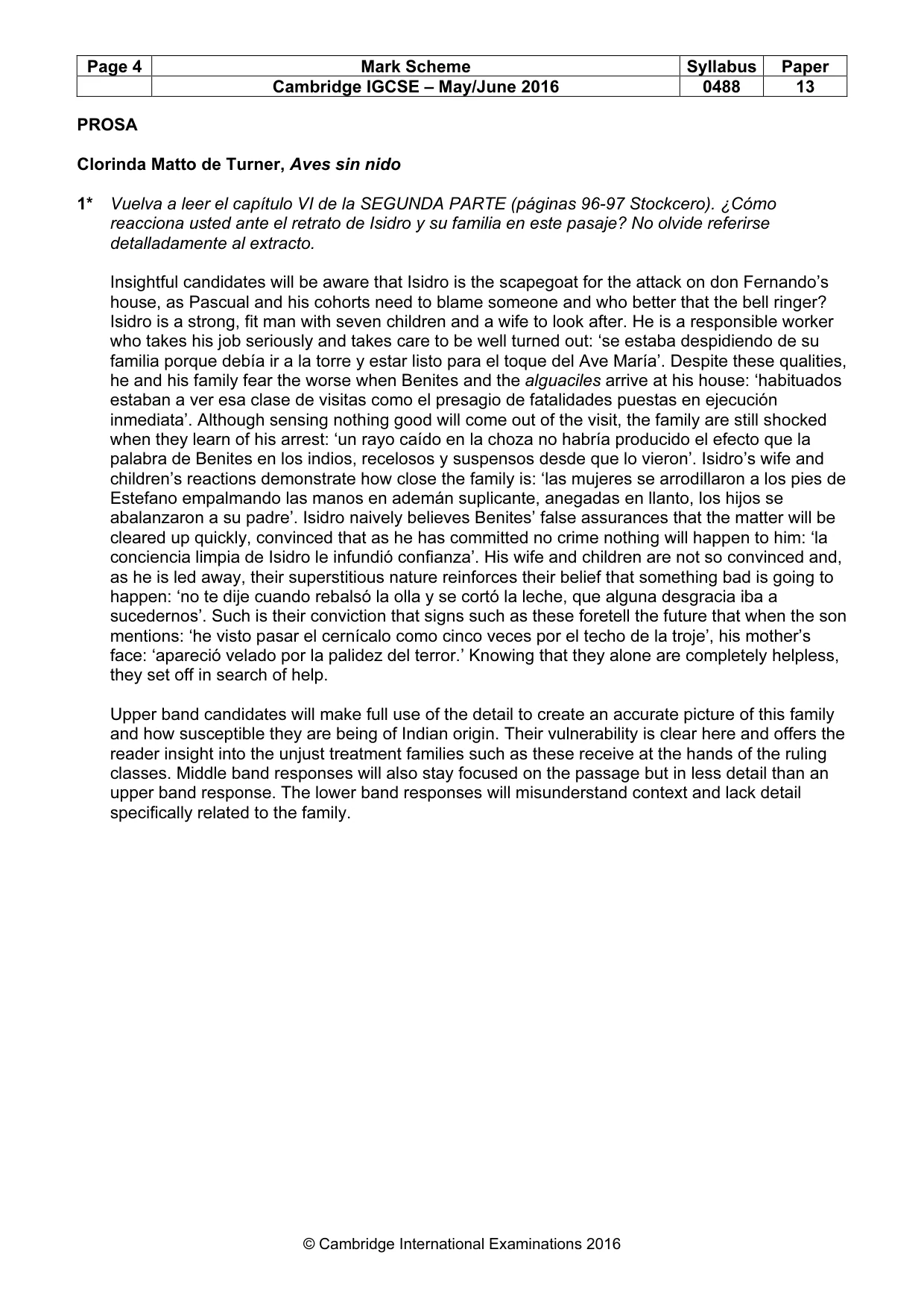
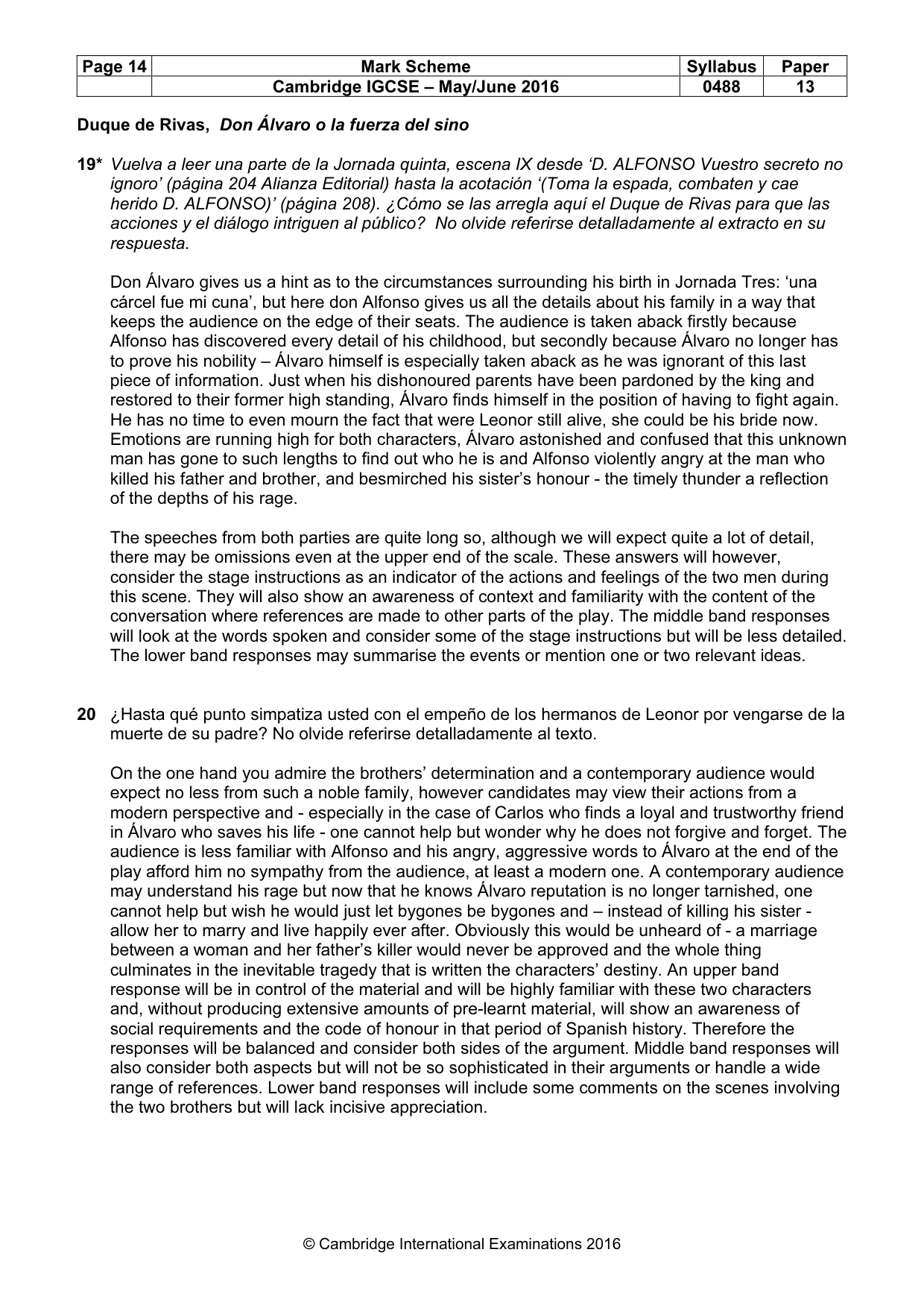
Page 4 Mark Scheme Syllabus Paper Cambridge IGCSE – May/June 2016 0488 13 © Cambridge International Examinations 2016 PROSA Clorinda Matto de Turner, Aves sin nido 1* Vuelva a leer el capítulo VI de la SEGUNDA PARTE (páginas 96-97 Stockcero). ¿Cómo reacciona usted ante el retrato de Isidro y su familia en este pasaje? No olvide referirse detalladamente al extracto. Insightful candidates will be aware that Isidro is the scapegoat for the attack on don Fernando’s house, as Pascual and his cohorts need to blame someone and who better that the bell ringer? Isidro is a strong, fit man with seven children and a wife to look after. He is a responsible worker who takes his job seriously and takes care to be well turned out: ‘se estaba despidiendo de su familia porque debía ir a la torre y estar listo para el toque del Ave María’. Despite these qualities, he and his family fear the worse when Benites and the alguaciles arrive at his house: ‘habituados estaban a ver esa clase de visitas como el presagio de fatalidades puestas en ejecución inmediata’. Although sensing nothing good will come out of the visit, the family are still shocked when they learn of his arrest: ‘un rayo caído en la choza no habría producido el efecto que la palabra de Benites en los indios, recelosos y suspensos desde que lo vieron’. Isidro’s wife and children’s reactions demonstrate how close the family is: ‘las mujeres se arrodillaron a los pies de Estefano empalmando las manos en ademán suplicante, anegadas en llanto, los hijos se abalanzaron a su padre’. Isidro naively believes Benites’ false assurances that the matter will be cleared up quickly, convinced that as he has committed no crime nothing will happen to him: ‘la conciencia limpia de Isidro le infundió confianza’. His wife and children are not so convinced and, as he is led away, their superstitious nature reinforces their belief that something bad is going to happen: ‘no te dije cuando rebalsó la olla y se cortó la leche, que alguna desgracia iba a sucedernos’. Such is their conviction that signs such as these foretell the future that when the son mentions: ‘he visto pasar el cernícalo como cinco veces por el techo de la troje’, his mother’s face: ‘apareció velado por la palidez del terror.’ Knowing that they alone are completely helpless, they set off in search of help. Upper band candidates will make full use of the detail to create an accurate picture of this family and how susceptible they are being of Indian origin. Their vulnerability is clear here and offers the reader insight into the unjust treatment families such as these receive at the hands of the ruling classes. Middle band responses will also stay focused on the passage but in less detail than an upper band response. The lower band responses will misunderstand context and lack detail specifically related to the family.
Mark scheme, page 5
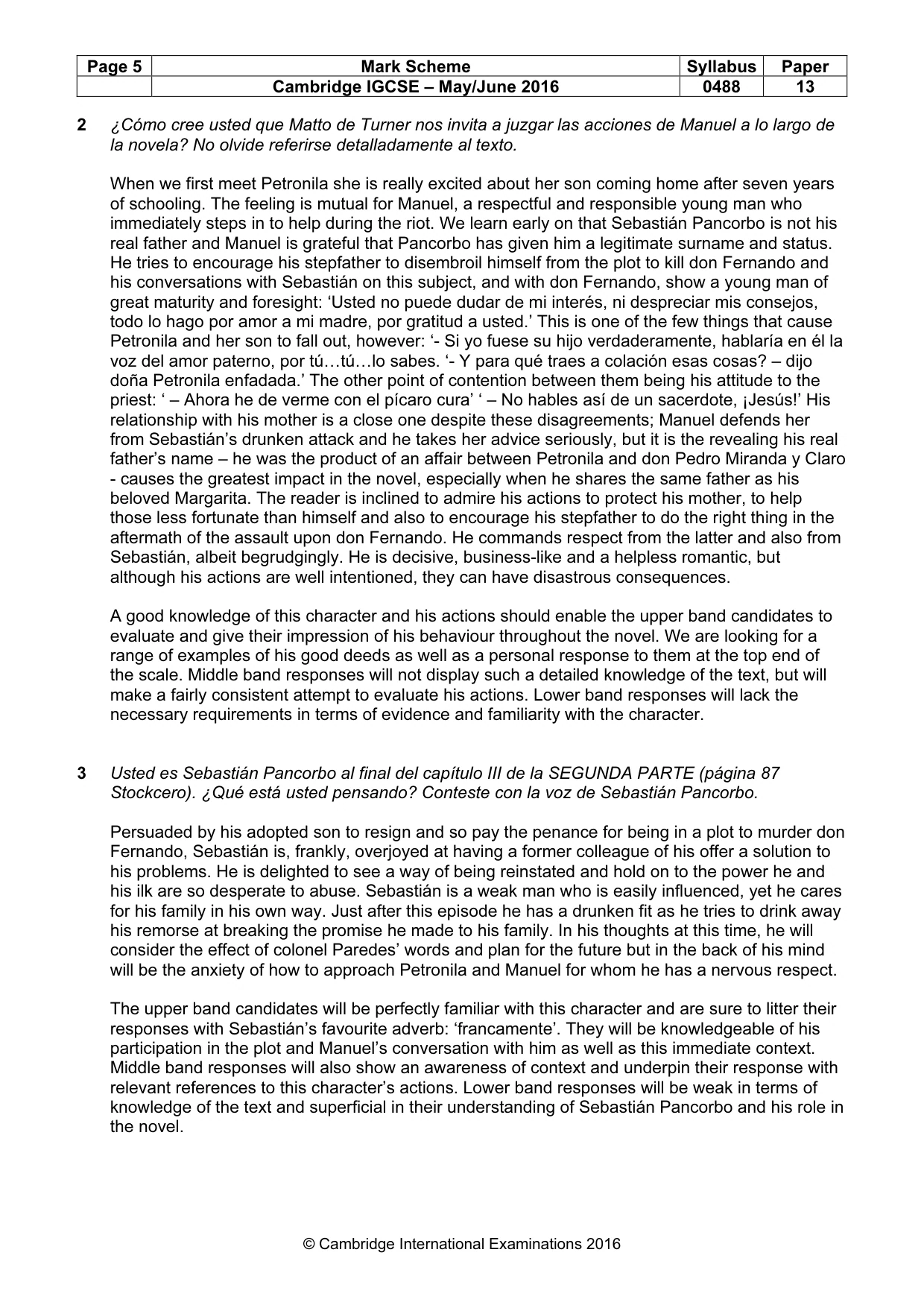
Page 5 Mark Scheme Syllabus Paper Cambridge IGCSE – May/June 2016 0488 13 © Cambridge International Examinations 2016 2 ¿Cómo cree usted que Matto de Turner nos invita a juzgar las acciones de Manuel a lo largo de la novela? No olvide referirse detalladamente al texto. When we first meet Petronila she is really excited about her son coming home after seven years of schooling. The feeling is mutual for Manuel, a respectful and responsible young man who immediately steps in to help during the riot. We learn early on that Sebastián Pancorbo is not his real father and Manuel is grateful that Pancorbo has given him a legitimate surname and status. He tries to encourage his stepfather to disembroil himself from the plot to kill don Fernando and his conversations with Sebastián on this subject, and with don Fernando, show a young man of great maturity and foresight: ‘Usted no puede dudar de mi interés, ni despreciar mis consejos, todo lo hago por amor a mi madre, por gratitud a usted.’ This is one of the few things that cause Petronila and her son to fall out, however: ‘- Si yo fuese su hijo verdaderamente, hablaría en él la voz del amor paterno, por tú…tú…lo sabes. ‘- Y para qué traes a colación esas cosas? – dijo doña Petronila enfadada.’ The other point of contention between them being his attitude to the priest: ‘ – Ahora he de verme con el pícaro cura’ ‘ – No hables así de un sacerdote, ¡Jesús!’ His relationship with his mother is a close one despite these disagreements; Manuel defends her from Sebastián’s drunken attack and he takes her advice seriously, but it is the revealing his real father’s name – he was the product of an affair between Petronila and don Pedro Miranda y Claro - causes the greatest impact in the novel, especially when he shares the same father as his beloved Margarita. The reader is inclined to admire his actions to protect his mother, to help those less fortunate than himself and also to encourage his stepfather to do the right thing in the aftermath of the assault upon don Fernando. He commands respect from the latter and also from Sebastián, albeit begrudgingly. He is decisive, business-like and a helpless romantic, but although his actions are well intentioned, they can have disastrous consequences. A good knowledge of this character and his actions should enable the upper band candidates to evaluate and give their impression of his behaviour throughout the novel. We are looking for a range of examples of his good deeds as well as a personal response to them at the top end of the scale. Middle band responses will not display such a detailed knowledge of the text, but will make a fairly consistent attempt to evaluate his actions. Lower band responses will lack the necessary requirements in terms of evidence and familiarity with the character. 3 Usted es Sebastián Pancorbo al final del capítulo III de la SEGUNDA PARTE (página 87 Stockcero). ¿Qué está usted pensando? Conteste con la voz de Sebastián Pancorbo. Persuaded by his adopted son to resign and so pay the penance for being in a plot to murder don Fernando, Sebastián is, frankly, overjoyed at having a former colleague of his offer a solution to his problems. He is delighted to see a way of being reinstated and hold on to the power he and his ilk are so desperate to abuse. Sebastián is a weak man who is easily influenced, yet he cares for his family in his own way. Just after this episode he has a drunken fit as he tries to drink away his remorse at breaking the promise he made to his family. In his thoughts at this time, he will consider the effect of colonel Paredes’ words and plan for the future but in the back of his mind will be the anxiety of how to approach Petronila and Manuel for whom he has a nervous respect. The upper band candidates will be perfectly familiar with this character and are sure to litter their responses with Sebastián’s favourite adverb: ‘francamente’. They will be knowledgeable of his participation in the plot and Manuel’s conversation with him as well as this immediate context. Middle band responses will also show an awareness of context and underpin their response with relevant references to this character’s actions. Lower band responses will be weak in terms of knowledge of the text and superficial in their understanding of Sebastián Pancorbo and his role in the novel.
Mark scheme, page 6
Page 6 Mark Scheme Syllabus Paper Cambridge IGCSE – May/June 2016 0488 13 © Cambridge International Examinations 2016 Ana María Matute, Pequeño teatro 4* Vuelva a leer el principio del capítulo V sección 2 desde ‘La señorita Mirentxu no fue capaz’ (página 101 Austral) hasta ‘aquellas vocecillas exageradamente conmovidas’ (página 103).¿Cómo se las arregla aquí Matute para impresionarnos con la intensidad de los sentimientos de Mirentxu en este fragmento? No olvide referirse detalladamente al pasaje. The opening paragraph explores the effect the puppet show is having on Mirentxu - a woman whose life is marked by her sister’s dominance and is bereft of passion and excitement. She has only her fantasies to allow her to escape from the dreary monotony of her existence and the show has a heady effect on her: ‘era como un perfume, intenso, viejo, de extrañas cosas tal vez soñadas’. Indeed, it seems that the puppet show reflects her own personal aspirations: ‘algo de su propio corazón estaba en el pequeño escenario’ - a microcosm of the town’s emotions and sentiments. Of course her feelings are heightened by the mere presence of Marco: ‘de cuando en cuando, miraba disimuladamente hacia aquel hombre’, and as she takes in every detail of his physical appearance, he appears to have the same effect on her as the puppet show does: ‘¡en qué raros momentos he visto yo este rostro!...No sé si lo soñé, de niña’. She regresses to her childhood, awakening dormant memories and fears: ‘era lo que temía ver surgir de los rincones oscuros’. The magical combination of the puppet show and Marco’s presence transports her to a happier time: ‘se quedó encantada en un tiempo joven, crédulo, apasionado’, and it appears the powerful effect of his presence spreads throughout the theatre and incites those attending to ask endless questions about him: ‘mil ojos se clavaban en él…y mil lenguas silenciosas se preguntaban’. The upper band candidates will consider the ‘extraño hálito que emanaba’ from the stage and its effect on Mirenxtu. They will also explore the obsessive fixation Mirentxu has on Marco indicated by her detailed appreciation of his facial features and communicate the surprising depths to which her imagination runs and the memories his presence triggers. The middle band will also cover these points but with less sophistication and fewer references from the passage. The lower band responses will consider part of the extract and write superficially about it. 5 ¿Hasta qué punto cree usted que Anderea es un personaje clave en la novela aunque no aparece con gran frecuencia? No olvide citar ejemplos del texto. An enigmatic and mysterious character, Anderea’s appearances add an intriguing touch to key moments in the story. He has a close relationship with Ilé and shares his passion for puppets with him. He is the only person in the village who shows empathy towards Ilé and offers him shelter. He is also the only one unfazed by Marco and who sees him for who he really is. When Ilé comes to say goodbye as he is leaving with Marco, Anderea calmly talks to him unconvinced that he is about to lose his friend.Very much the wise old man like Merlin with his apprentice, he works his magic in the theatre basement and calmly gives advice to his young charge. His performances provoke strong reactions from the audience who find his stories uncomfortably reflect their own miserable lives. Candidates who select this question will show a good knowledge of the text and select appropriate references to this character as well as evaluate the intriguing aspect to his appearances in the novel. Middle band candidate will be less in control of the material and evaluate more superficially the role he plays. Lower band responses will find it challenging to recall his appearances and consider his contribution to the plot.
Mark scheme, page 7
Page 7 Mark Scheme Syllabus Paper Cambridge IGCSE – May/June 2016 0488 13 © Cambridge International Examinations 2016 6 ‘Marco hablaba, hablaba con una voz distinta’ (capítulo IV sección 5 página 94 Austral). Usted es Marco en este momento. ¿Qué está usted diciendo a Ilé? Conteste con la voz de Marco. There are many things that Marco could be saying to Ilé at this point and we will be quite open as to the content of his speech in answers as long as they are relevant. He could be talking about his conversation with Kepa or, most likely according to the context, about Zazu. Marco sees Zazu as somewhat of a challenge as she is one of the few people not immediately enchanted by Marco’s presence. In fact, he seems more bewitched by her presence as he has just had a fleeting glimpse of her. Some candidates may have Marco plan how he is going to ensure she falls under his spell and makes it a challenge to do so. The upper band candidates will try to imitate the way Marco speaks at great lengths about things he is passionate about, enjoying the sound of his own voice and fooling himself into believing his own fantasies. Candidates who select this question will show a good knowledge of the text and select appropriate references to this character as well as evaluate the intriguing aspect to his appearances in the novel. Middle band candidate will be less in control of the material and evaluate more superficially the role he plays. Lower band responses will find it challenging to recall his appearances and consider his contribution to the plot. Pérez-Reverte, El capitán Alatriste 7* Vuelva a leer una parte del capítulo XI EL SELLO Y LA CARTA desde ‘– Disculpadme – el secretario miraba los papeles de la mesa’ (página 222 Alfaguara) hasta ‘seguía el movimiento de la pluma con ojos angustiados’ (página 227). ¿Cómo se las arreglan aquí los Pérez-Reverte para que disfrutemos del malestar que experimenta Alquézar? No olvide referirse detalladamente al pasaje. It will be hard not to enjoy the anguish and tension suffered by Alquézar in this passage. A man always in control of the situation and who has put Alatriste through his paces, it is quite refreshing to see him squirm as Olivares deftly handles the situation. The better candidates will be familiar enough with this character to see how the tables have turned and will appreciate how Olivares plays him throughout the extract. Olivares disconcerts him at every turn, claiming Alatriste has revealed nothing about the second conspiracy but is there for a different matter. Alatriste himself notes that: ‘Olivares parecía disfrutar con todo aquello’ as Alquézar ‘con expresión inquieta’, becomes more and more nervous, indicated by his face changing from bright red to a deathly pale and by his increasingly noisy swallowing of saliva. Olivares ironically manages to learn more about the conspiracy from Alquézar than he did from Alatriste and no one is more surprised than Alquézar himself when Olivares correctly suggests Bocanegra is behind it: ‘Alatriste vio como el secretario del rey reprimía un sobresalto’. Whenever Alquézar appears to feel reassured that he has gained control of the situation: ‘a medida que se prolongaba la conversación y sabía a qué tono atenerse, parecía más taimado y seguro de sí’, Olivares launches a thinly veiled threat. Alquézar’s natural instinct to save himself through conciliatory platitudes: 'a fin de cuentas se trataría de serviros’ are met with a disdainful: 'pues voto a Dios, Alquézar, que por servicios así hice ahorcar a más de uno’. If he were in any doubt about the consequences of a future betrayal, Olivares’ penetrating stare makes it more than clear: ‘la mirada de Olivares perforaba al secretario real como un mosquetazo’ and this soon wipes the smile off his face: ‘la sonrisa cómplice y servil que ya apuntaba bajo el bigote del secretario real se borró como por ensalmo.’ The extract continues in this vein and upper band candidates will work through the entire passage to demonstrate Alquézar’s discomfort provoked by Olivares careful handling of the situation and enjoyed by the reader. The middle band candidates will also stay on task but will provide fewer references from the passage. The lower band responses will convey one or two ideas, but will be quite short and only mention one or two aspects of the passage.
Mark scheme, page 8
Page 8 Mark Scheme Syllabus Paper Cambridge IGCSE – May/June 2016 0488 13 © Cambridge International Examinations 2016 8 ¿Cómo aprovechan los Pérez-Reverte el ambiente de Madrid en aquella época para enriquecer la novela? Argumente su respuesta citando ejemplos del texto. Madrid de los Austrias gives an exciting backdrop to the action and on many occasions, incites events in the novel. The dangerous, poorly lit streets of Madrid are ideal for a man of Alatriste’s profession and as everyone seems to carry a sword, he can freely earn his living or defend himself from attackers. When Madrid enjoys a rua and the wealthy display all their finery, there is a distinct contrast between how the different classes and this also highlights the fact that former soldiers such as Alatriste have to resort to killing to earn a living, while others enjoy excessive riches. The opening of a play reveals a great deal about Madrid society at that time. Although all classes attend, class divisions are evident in the way people freely fight over seats, while others have theirs guaranteed. The theatre also affords an excellent opportunity for Alatriste’s enemies to attack him. The Inquisition, at the height of it’s powers, creates a feeling of wariness and danger, as most fear being arrested for heresy and suffering all manner of torture. We have glimpses of court life and witness scenes in a humble tavern, la Taberna del turco, as well as learn of machinations and plot conspiracies that freely flow through the capital. Band 7/8 candidates will be comfortable ranging through the entire novel to select appropriate references and at this level we will see a variety of evidence and well-selected episodes that support their response. Middle band responses will be less impressive with their range of examples and less convincing in their argument but will be relevant none the less. The lower band responses will be very short and mention one or two relevant details. 9 ‘… alzaba una mano para tocarme levemente una mejilla, con un roce de afecto desusado en él. Y me seguía mirando como antes, cuando había preguntado si estaba bien’. (Capítulo VIII EL PORTILLO DE LAS ÁNIMAS página 165 Alfaguara). Usted es el capitán Alatriste después de la pelea con Malatesta. ¿Qué está usted pensando? Conteste con la voz del capitán Alatriste. This is a good opportunity to evaluate the relationship between Íñigo and Alatriste from the latter’s point of view. He cares deeply for Íñigo as if he were his own son but, as a man of few words and with a tendency not to show his emotions, he rarely gives displays of affection like the one mentioned here. Alatriste is dedicated to looking after and protecting Íñigo and not just because he gave his word to Lope Balboa. It is ironic here therefore that Íñigo has just saved his life. During his time with Alatriste, Íñigo grows increasingly astute and handles his sword with skill that indicates he will be able to defend himself and also follow in Alatriste’s footsteps. This is one of the moments when Alatriste realises the young boy is becoming a man who thinks and acts quickly and will not hesitate risking his life for his beloved Alatriste. While his thoughts will be mainly about Íñigo’s well being he will also be concerned about recent events and how he will have to face his enemies in the future, knowing that he has only bought himself a short reprieve. Most candidates should have no problem understanding the context of this moment but we will see varying degrees of competence when responses convey Alatriste’s thoughts and feelings at this time. The upper band responses will give an authentic voice to the character as well as convey an accurate interpretation of the relationship between the two and may include other concerns beyond Alatriste’s concern for Íñigo. Middle band responses will also be aware of the context but will be less convincing when communicating Alatriste’s thoughts and feelings towards Íñigo. The lower band responses will be brief and reflect a superficial knowledge of character and situation.
Mark scheme, page 9
Page 9 Mark Scheme Syllabus Paper Cambridge IGCSE – May/June 2016 0488 13 © Cambridge International Examinations 2016 Carpentier, Los pasos perdidos 10* Vuelva a leer una parte del capítulo 3 sección 8 (11 de junio) desde ‘El autobús trepaba; trepaba con tal esfuerzo’ (página 102 Losada) hasta ‘la pluralidad de las cimas y simas’ (página 104). ¿Cómo se las arregla Carpentier aquí para que este viaje en autobús sea tan emocionante? No olvide referirse detalladamente al texto. The personification of the bus in the opening lines of this passage is so convincing that you almost feel sorry for the vehicle as it struggles to climb the mountain. The use of verbs associated more with humans than machines: ‘gimiendo por los ejes agarrándose con las ruedas’, gives us an idea of how treacherous this part of the journey is. This sense of danger is conveyed also in the steepness and size of the mountains it is climbing: ‘las vertientes casi verticales de una barranca.’ Their immense vastness is made apparent by the idea that the bus is shrinking in size, as the mountains grow ever taller and steeper: ‘cada vez más estiradas, más hoscas, como inmensas hachas negras’. The mountain range seems to grow longer as the journey progresses: ‘al cabo de aquella subida de las cien vueltas y revueltas, como creíamos haber llegado a una cima se descubría otra cuesta, más abrupta, más enrevesada’. The picture painted by the author is vivid and we easily imagine the sense of insignificance felt by the narrator who is astonished by the view of the volcanoes and mesmerised by the flora that grows in such a harsh climate: ‘éramos seres ínfimos, mudos de caras yertas, en un páramo donde solo subsistía la presencia foliácea de un cacto de fieltro gris’. The detail in the description of the landscape, the stressful struggle of the bus climbing ever steeper and dangerous slopes, the sense that the landscape is part of prehistory and the narrators feelings during the journey will be covered to some degree in the middle to higher band answers. There may be a tendency to comment on character and incident rather than focus on the description in the middle to lower band answers. The very low band responses will comment on one or two sentences and lack insight or relevance to the question. 11 Carpentier se refiere a Santa Mónica de los Venados como ‘el Valle del Tiempo Detenido’ (Capítulo 6 sección 39 página 353 Losada). ¿Hasta qué punto, y cómo, le ha convencido el autor que éste es un nombre apropiado para la ciudad? No olvide referirse detalladamente al texto. We will not place responses in the upper bands if they merely point out the lack of electronic devices in the village that indicate how cut off from civilisation it is, although candidates will relate it to their own experiences to a certain degree. We are looking for precise examples from the text to support the idea that the village belongs well into the past and is totally cut off from modernisation and ‘civilisation’, except for an expedition or two a couple of times year to replenish supplies. El Adelantado goes to great lengths to ensure the location of his village is unknown, as he wants to maintain the traditional way of life followed in Santa Mónica. One can appreciate why he might want to maintain the isolation from the modern world but even the narrator, who is supposedly blissfully happy with his new life finds the lack of paper - to him a basic necessity - rather troublesome. El Adelantado has established his own set of laws and these must be adhered to, yet there is also permissiveness for example when his son actually kills someone and is immune from modern day prosecution. The upper bands will demonstrate a good knowledge of the text and in particular, be very familiar with the part of the novel that takes place in this village and the experiences related to el Adelantado the village’s founder. They will use this evidence to show why this village is indeed forgotten by time or at least, immune to the advance of time and maintain a clear logical argument relevant to the question throughout their answers. The middle band responses will attempt to do the same but will find managing the material more challenging and so be less sophisticated in their argument. The lower band responses may mention one or two events related to the village or misunderstand the question entirely.
Mark scheme, page 10
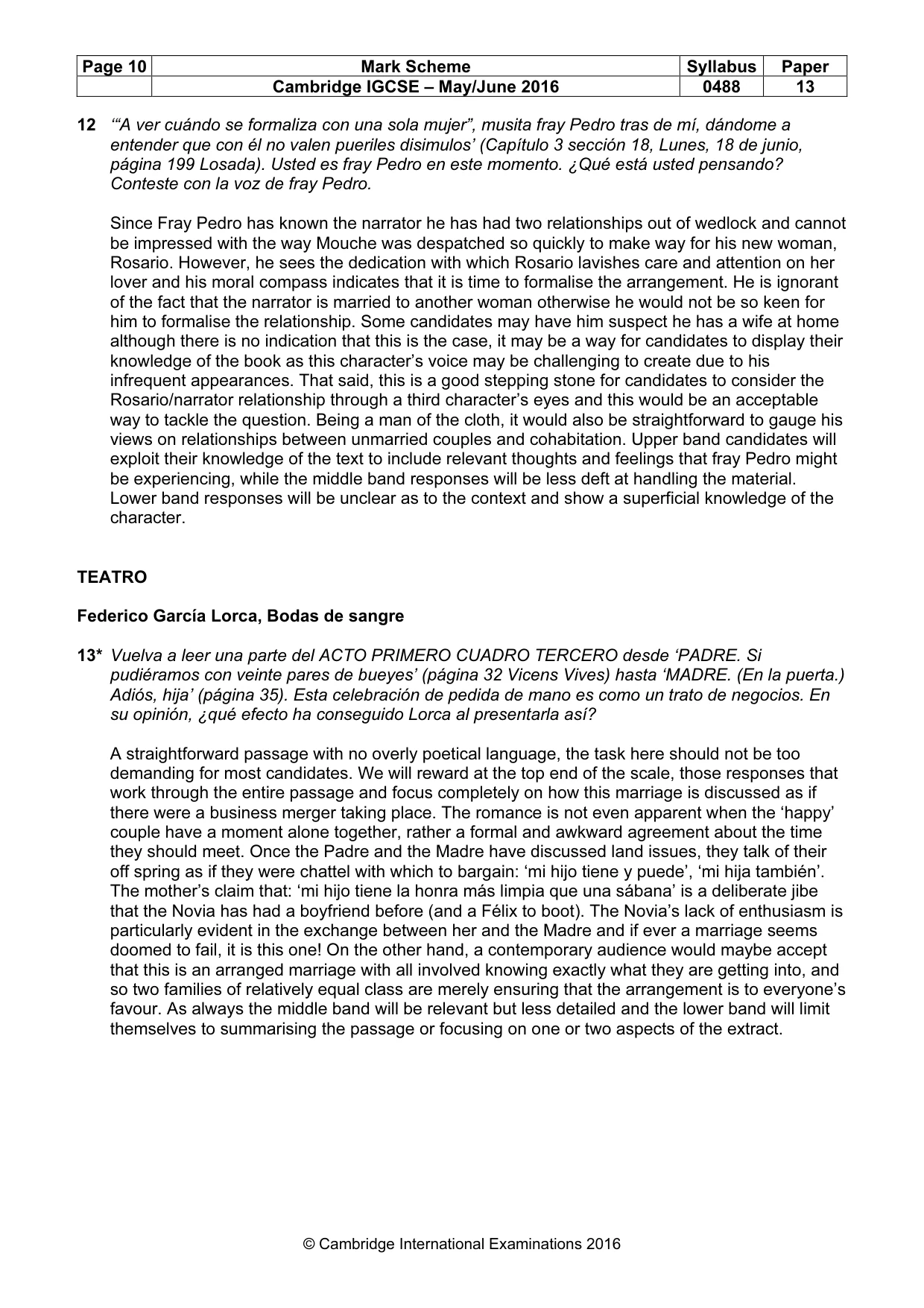
Page 10 Mark Scheme Syllabus Paper Cambridge IGCSE – May/June 2016 0488 13 © Cambridge International Examinations 2016 12 ‘“A ver cuándo se formaliza con una sola mujer”, musita fray Pedro tras de mí, dándome a entender que con él no valen pueriles disimulos’ (Capítulo 3 sección 18, Lunes, 18 de junio, página 199 Losada). Usted es fray Pedro en este momento. ¿Qué está usted pensando? Conteste con la voz de fray Pedro. Since Fray Pedro has known the narrator he has had two relationships out of wedlock and cannot be impressed with the way Mouche was despatched so quickly to make way for his new woman, Rosario. However, he sees the dedication with which Rosario lavishes care and attention on her lover and his moral compass indicates that it is time to formalise the arrangement. He is ignorant of the fact that the narrator is married to another woman otherwise he would not be so keen for him to formalise the relationship. Some candidates may have him suspect he has a wife at home although there is no indication that this is the case, it may be a way for candidates to display their knowledge of the book as this character’s voice may be challenging to create due to his infrequent appearances. That said, this is a good stepping stone for candidates to consider the Rosario/narrator relationship through a third character’s eyes and this would be an acceptable way to tackle the question. Being a man of the cloth, it would also be straightforward to gauge his views on relationships between unmarried couples and cohabitation. Upper band candidates will exploit their knowledge of the text to include relevant thoughts and feelings that fray Pedro might be experiencing, while the middle band responses will be less deft at handling the material. Lower band responses will be unclear as to the context and show a superficial knowledge of the character. TEATRO Federico García Lorca, Bodas de sangre 13* Vuelva a leer una parte del ACTO PRIMERO CUADRO TERCERO desde ‘PADRE. Si pudiéramos con veinte pares de bueyes’ (página 32 Vicens Vives) hasta ‘MADRE. (En la puerta.) Adiós, hija’ (página 35). Esta celebración de pedida de mano es como un trato de negocios. En su opinión, ¿qué efecto ha conseguido Lorca al presentarla así? A straightforward passage with no overly poetical language, the task here should not be too demanding for most candidates. We will reward at the top end of the scale, those responses that work through the entire passage and focus completely on how this marriage is discussed as if there were a business merger taking place. The romance is not even apparent when the ‘happy’ couple have a moment alone together, rather a formal and awkward agreement about the time they should meet. Once the Padre and the Madre have discussed land issues, they talk of their off spring as if they were chattel with which to bargain: ‘mi hijo tiene y puede’, ‘mi hija también’. The mother’s claim that: ‘mi hijo tiene la honra más limpia que una sábana’ is a deliberate jibe that the Novia has had a boyfriend before (and a Félix to boot). The Novia’s lack of enthusiasm is particularly evident in the exchange between her and the Madre and if ever a marriage seems doomed to fail, it is this one! On the other hand, a contemporary audience would maybe accept that this is an arranged marriage with all involved knowing exactly what they are getting into, and so two families of relatively equal class are merely ensuring that the arrangement is to everyone’s favour. As always the middle band will be relevant but less detailed and the lower band will limit themselves to summarising the passage or focusing on one or two aspects of the extract.
Mark scheme, page 11
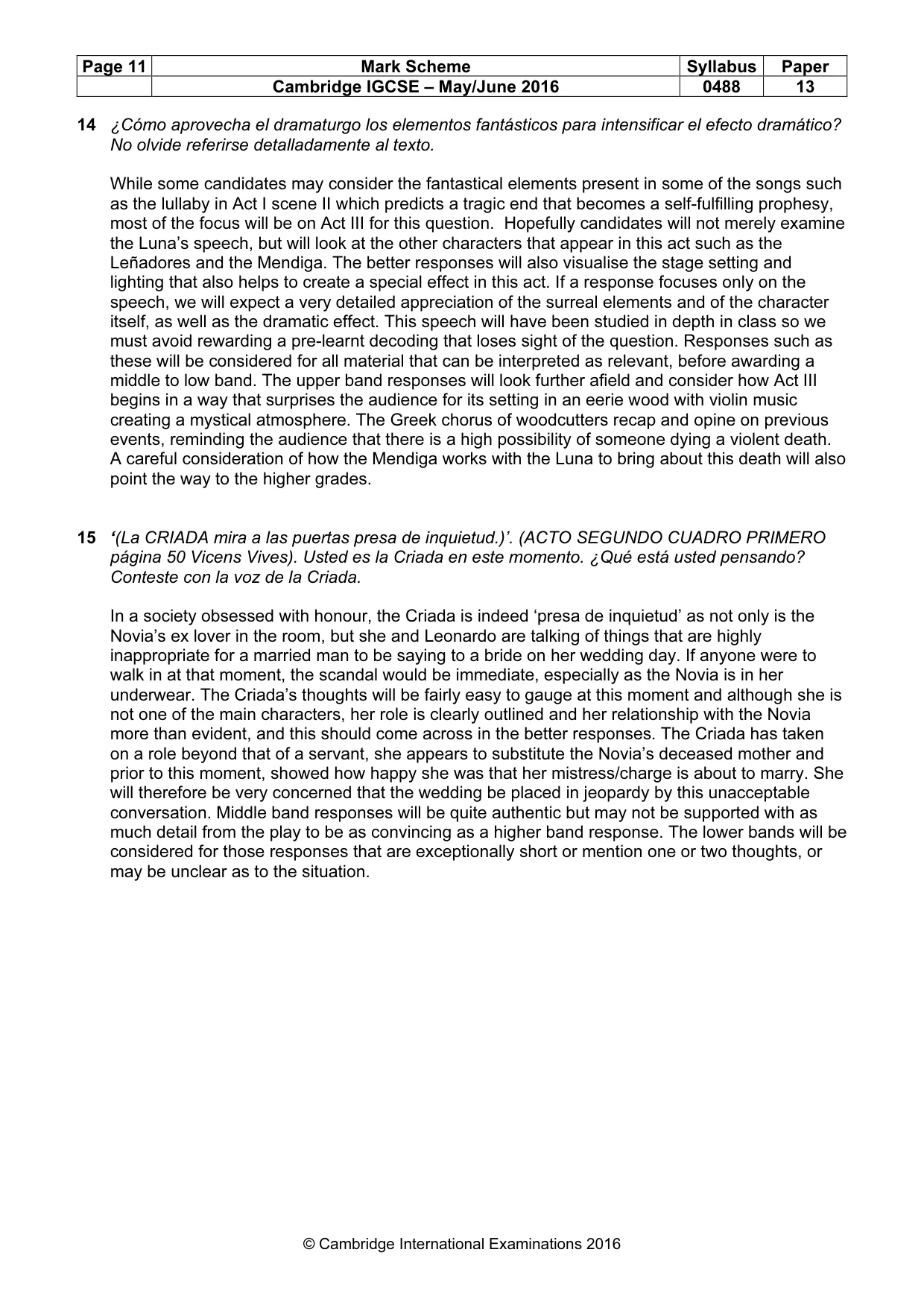
Page 11 Mark Scheme Syllabus Paper Cambridge IGCSE – May/June 2016 0488 13 © Cambridge International Examinations 2016 14 ¿Cómo aprovecha el dramaturgo los elementos fantásticos para intensificar el efecto dramático? No olvide referirse detalladamente al texto. While some candidates may consider the fantastical elements present in some of the songs such as the lullaby in Act I scene II which predicts a tragic end that becomes a self-fulfilling prophesy, most of the focus will be on Act III for this question. Hopefully candidates will not merely examine the Luna’s speech, but will look at the other characters that appear in this act such as the Leñadores and the Mendiga. The better responses will also visualise the stage setting and lighting that also helps to create a special effect in this act. If a response focuses only on the speech, we will expect a very detailed appreciation of the surreal elements and of the character itself, as well as the dramatic effect. This speech will have been studied in depth in class so we must avoid rewarding a pre-learnt decoding that loses sight of the question. Responses such as these will be considered for all material that can be interpreted as relevant, before awarding a middle to low band. The upper band responses will look further afield and consider how Act III begins in a way that surprises the audience for its setting in an eerie wood with violin music creating a mystical atmosphere. The Greek chorus of woodcutters recap and opine on previous events, reminding the audience that there is a high possibility of someone dying a violent death. A careful consideration of how the Mendiga works with the Luna to bring about this death will also point the way to the higher grades. 15 ‘(La CRIADA mira a las puertas presa de inquietud.)’. (ACTO SEGUNDO CUADRO PRIMERO página 50 Vicens Vives). Usted es la Criada en este momento. ¿Qué está usted pensando? Conteste con la voz de la Criada. In a society obsessed with honour, the Criada is indeed ‘presa de inquietud’ as not only is the Novia’s ex lover in the room, but she and Leonardo are talking of things that are highly inappropriate for a married man to be saying to a bride on her wedding day. If anyone were to walk in at that moment, the scandal would be immediate, especially as the Novia is in her underwear. The Criada’s thoughts will be fairly easy to gauge at this moment and although she is not one of the main characters, her role is clearly outlined and her relationship with the Novia more than evident, and this should come across in the better responses. The Criada has taken on a role beyond that of a servant, she appears to substitute the Novia’s deceased mother and prior to this moment, showed how happy she was that her mistress/charge is about to marry. She will therefore be very concerned that the wedding be placed in jeopardy by this unacceptable conversation. Middle band responses will be quite authentic but may not be supported with as much detail from the play to be as convincing as a higher band response. The lower bands will be considered for those responses that are exceptionally short or mention one or two thoughts, or may be unclear as to the situation.
Mark scheme, page 12
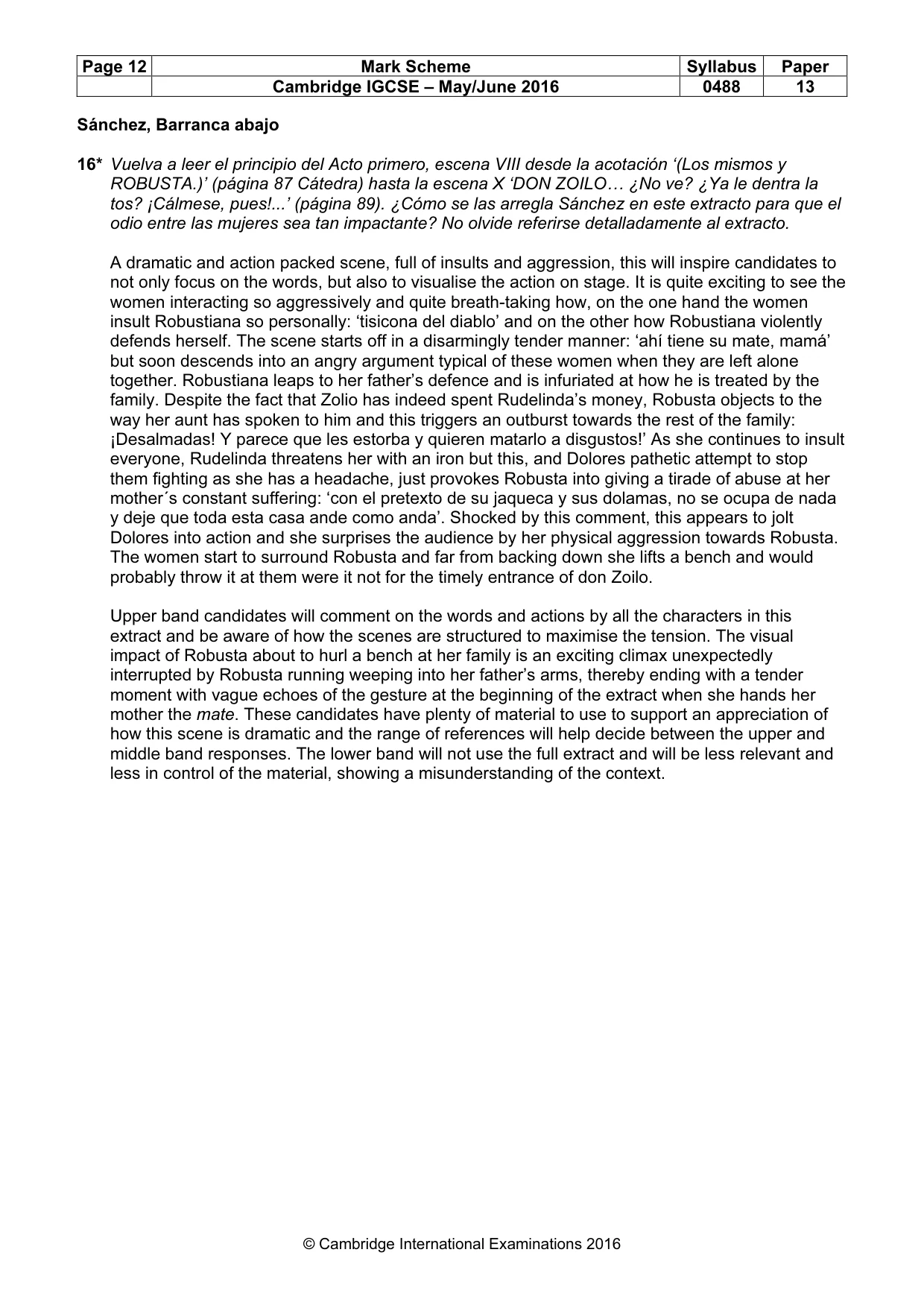
Page 12 Mark Scheme Syllabus Paper Cambridge IGCSE – May/June 2016 0488 13 © Cambridge International Examinations 2016 Sánchez, Barranca abajo 16* Vuelva a leer el principio del Acto primero, escena VIII desde la acotación ‘(Los mismos y ROBUSTA.)’ (página 87 Cátedra) hasta la escena X ‘DON ZOILO… ¿No ve? ¿Ya le dentra la tos? ¡Cálmese, pues!...’ (página 89). ¿Cómo se las arregla Sánchez en este extracto para que el odio entre las mujeres sea tan impactante? No olvide referirse detalladamente al extracto. A dramatic and action packed scene, full of insults and aggression, this will inspire candidates to not only focus on the words, but also to visualise the action on stage. It is quite exciting to see the women interacting so aggressively and quite breath-taking how, on the one hand the women insult Robustiana so personally: ‘tisicona del diablo’ and on the other how Robustiana violently defends herself. The scene starts off in a disarmingly tender manner: ‘ahí tiene su mate, mamá’ but soon descends into an angry argument typical of these women when they are left alone together. Robustiana leaps to her father’s defence and is infuriated at how he is treated by the family. Despite the fact that Zolio has indeed spent Rudelinda’s money, Robusta objects to the way her aunt has spoken to him and this triggers an outburst towards the rest of the family: ¡Desalmadas! Y parece que les estorba y quieren matarlo a disgustos!’ As she continues to insult everyone, Rudelinda threatens her with an iron but this, and Dolores pathetic attempt to stop them fighting as she has a headache, just provokes Robusta into giving a tirade of abuse at her mother´s constant suffering: ‘con el pretexto de su jaqueca y sus dolamas, no se ocupa de nada y deje que toda esta casa ande como anda’. Shocked by this comment, this appears to jolt Dolores into action and she surprises the audience by her physical aggression towards Robusta. The women start to surround Robusta and far from backing down she lifts a bench and would probably throw it at them were it not for the timely entrance of don Zoilo. Upper band candidates will comment on the words and actions by all the characters in this extract and be aware of how the scenes are structured to maximise the tension. The visual impact of Robusta about to hurl a bench at her family is an exciting climax unexpectedly interrupted by Robusta running weeping into her father’s arms, thereby ending with a tender moment with vague echoes of the gesture at the beginning of the extract when she hands her mother the mate. These candidates have plenty of material to use to support an appreciation of how this scene is dramatic and the range of references will help decide between the upper and middle band responses. The lower band will not use the full extract and will be less relevant and less in control of the material, showing a misunderstanding of the context.
Mark scheme, page 13
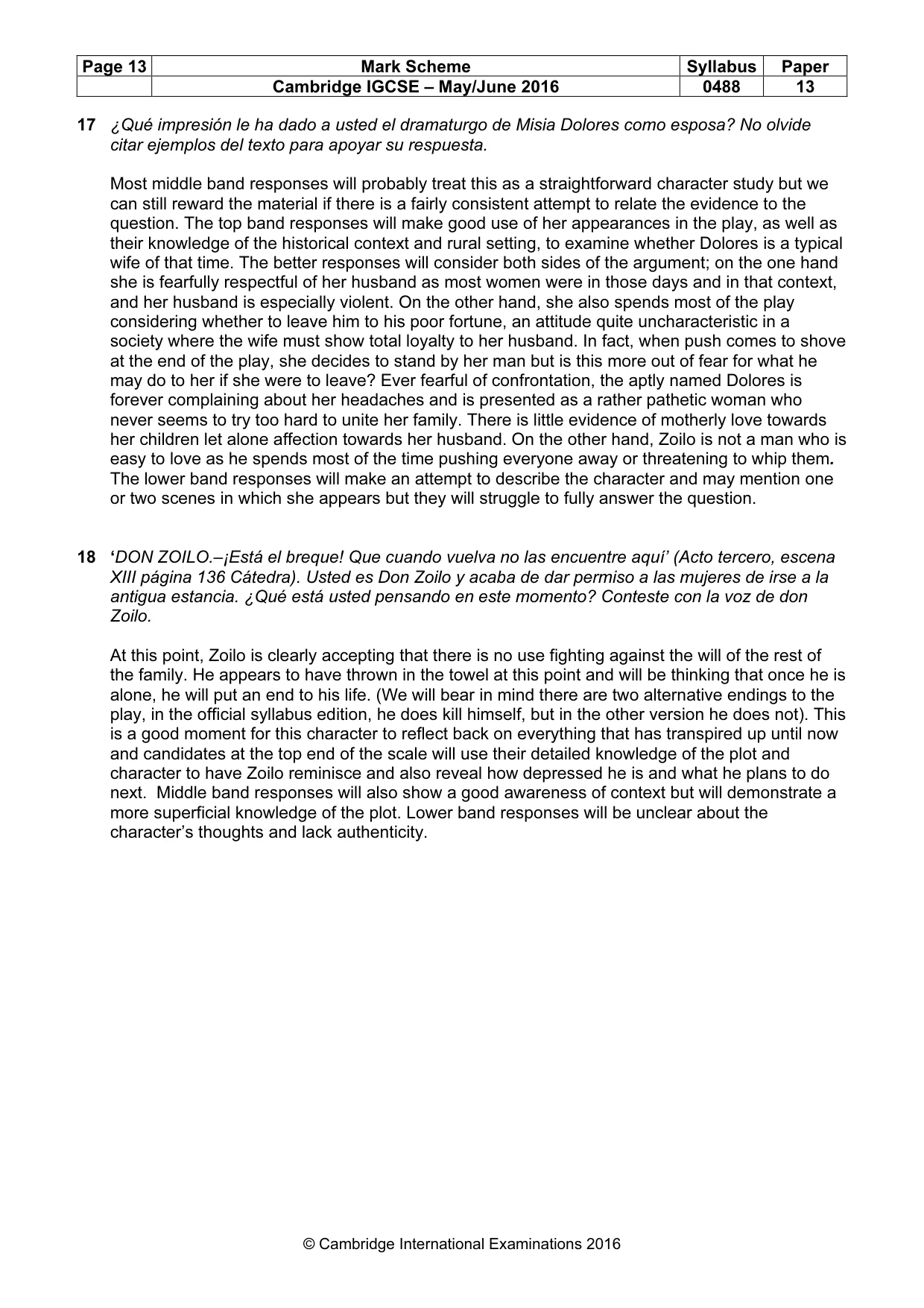
Page 13 Mark Scheme Syllabus Paper Cambridge IGCSE – May/June 2016 0488 13 © Cambridge International Examinations 2016 17 ¿Qué impresión le ha dado a usted el dramaturgo de Misia Dolores como esposa? No olvide citar ejemplos del texto para apoyar su respuesta. Most middle band responses will probably treat this as a straightforward character study but we can still reward the material if there is a fairly consistent attempt to relate the evidence to the question. The top band responses will make good use of her appearances in the play, as well as their knowledge of the historical context and rural setting, to examine whether Dolores is a typical wife of that time. The better responses will consider both sides of the argument; on the one hand she is fearfully respectful of her husband as most women were in those days and in that context, and her husband is especially violent. On the other hand, she also spends most of the play considering whether to leave him to his poor fortune, an attitude quite uncharacteristic in a society where the wife must show total loyalty to her husband. In fact, when push comes to shove at the end of the play, she decides to stand by her man but is this more out of fear for what he may do to her if she were to leave? Ever fearful of confrontation, the aptly named Dolores is forever complaining about her headaches and is presented as a rather pathetic woman who never seems to try too hard to unite her family. There is little evidence of motherly love towards her children let alone affection towards her husband. On the other hand, Zoilo is not a man who is easy to love as he spends most of the time pushing everyone away or threatening to whip them. The lower band responses will make an attempt to describe the character and may mention one or two scenes in which she appears but they will struggle to fully answer the question. 18 ‘DON ZOILO.–¡Está el breque! Que cuando vuelva no las encuentre aquí’ (Acto tercero, escena XIII página 136 Cátedra). Usted es Don Zoilo y acaba de dar permiso a las mujeres de irse a la antigua estancia. ¿Qué está usted pensando en este momento? Conteste con la voz de don Zoilo. At this point, Zoilo is clearly accepting that there is no use fighting against the will of the rest of the family. He appears to have thrown in the towel at this point and will be thinking that once he is alone, he will put an end to his life. (We will bear in mind there are two alternative endings to the play, in the official syllabus edition, he does kill himself, but in the other version he does not). This is a good moment for this character to reflect back on everything that has transpired up until now and candidates at the top end of the scale will use their detailed knowledge of the plot and character to have Zoilo reminisce and also reveal how depressed he is and what he plans to do next. Middle band responses will also show a good awareness of context but will demonstrate a more superficial knowledge of the plot. Lower band responses will be unclear about the character’s thoughts and lack authenticity.
Mark scheme, page 14
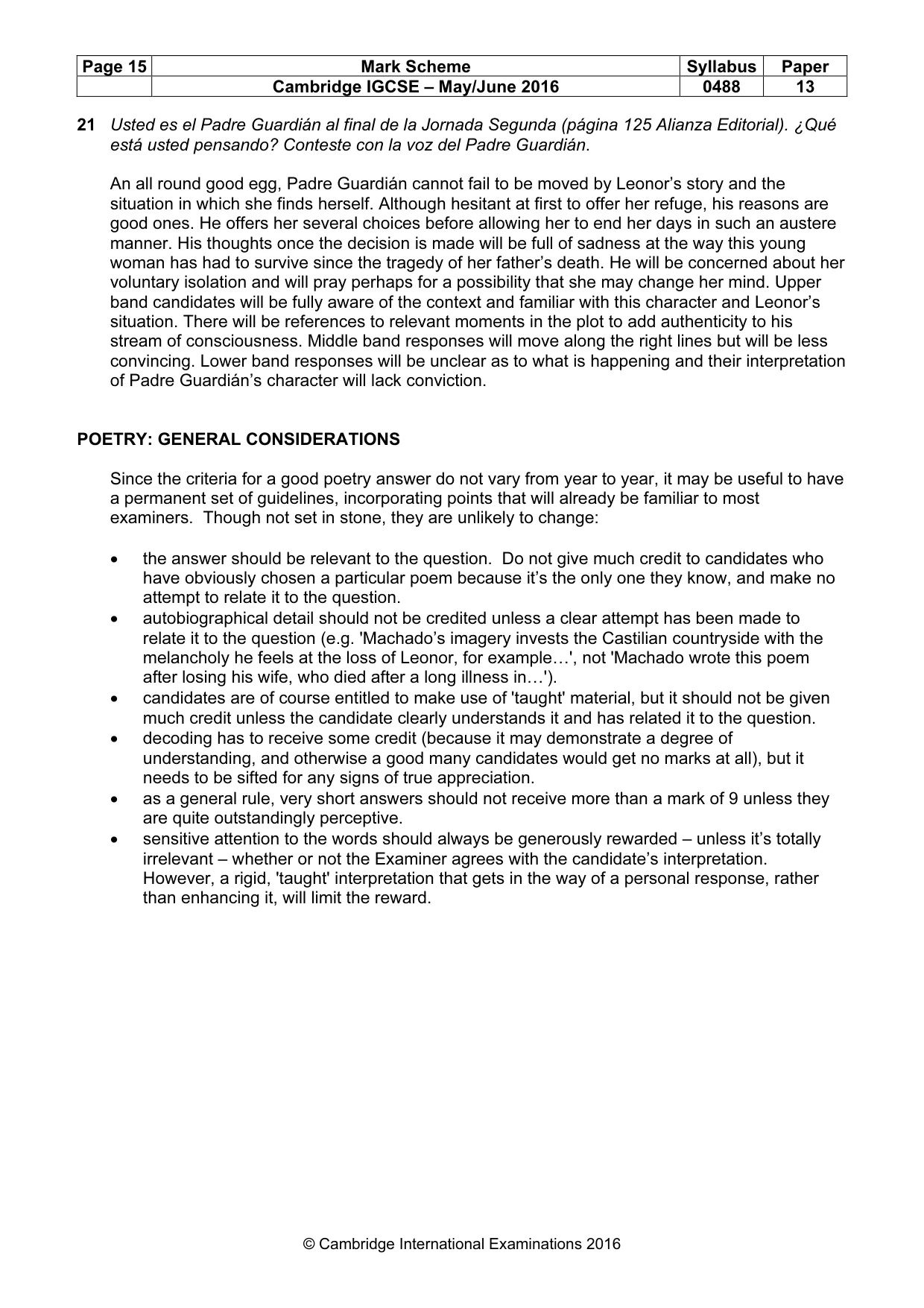
Page 14 Mark Scheme Syllabus Paper Cambridge IGCSE – May/June 2016 0488 13 © Cambridge International Examinations 2016 Duque de Rivas, Don Álvaro o la fuerza del sino 19* Vuelva a leer una parte de la Jornada quinta, escena IX desde ‘D. ALFONSO Vuestro secreto no ignoro’ (página 204 Alianza Editorial) hasta la acotación ‘(Toma la espada, combaten y cae herido D. ALFONSO)’ (página 208). ¿Cómo se las arregla aquí el Duque de Rivas para que las acciones y el diálogo intriguen al público? No olvide referirse detalladamente al extracto en su respuesta. Don Álvaro gives us a hint as to the circumstances surrounding his birth in Jornada Tres: ‘una cárcel fue mi cuna’, but here don Alfonso gives us all the details about his family in a way that keeps the audience on the edge of their seats. The audience is taken aback firstly because Alfonso has discovered every detail of his childhood, but secondly because Álvaro no longer has to prove his nobility – Álvaro himself is especially taken aback as he was ignorant of this last piece of information. Just when his dishonoured parents have been pardoned by the king and restored to their former high standing, Álvaro finds himself in the position of having to fight again. He has no time to even mourn the fact that were Leonor still alive, she could be his bride now. Emotions are running high for both characters, Álvaro astonished and confused that this unknown man has gone to such lengths to find out who he is and Alfonso violently angry at the man who killed his father and brother, and besmirched his sister’s honour - the timely thunder a reflection of the depths of his rage. The speeches from both parties are quite long so, although we will expect quite a lot of detail, there may be omissions even at the upper end of the scale. These answers will however, consider the stage instructions as an indicator of the actions and feelings of the two men during this scene. They will also show an awareness of context and familiarity with the content of the conversation where references are made to other parts of the play. The middle band responses will look at the words spoken and consider some of the stage instructions but will be less detailed. The lower band responses may summarise the events or mention one or two relevant ideas. 20 ¿Hasta qué punto simpatiza usted con el empeño de los hermanos de Leonor por vengarse de la muerte de su padre? No olvide referirse detalladamente al texto. On the one hand you admire the brothers’ determination and a contemporary audience would expect no less from such a noble family, however candidates may view their actions from a modern perspective and - especially in the case of Carlos who finds a loyal and trustworthy friend in Álvaro who saves his life - one cannot help but wonder why he does not forgive and forget. The audience is less familiar with Alfonso and his angry, aggressive words to Álvaro at the end of the play afford him no sympathy from the audience, at least a modern one. A contemporary audience may understand his rage but now that he knows Álvaro reputation is no longer tarnished, one cannot help but wish he would just let bygones be bygones and – instead of killing his sister - allow her to marry and live happily ever after. Obviously this would be unheard of - a marriage between a woman and her father’s killer would never be approved and the whole thing culminates in the inevitable tragedy that is written the characters’ destiny. An upper band response will be in control of the material and will be highly familiar with these two characters and, without producing extensive amounts of pre-learnt material, will show an awareness of social requirements and the code of honour in that period of Spanish history. Therefore the responses will be balanced and consider both sides of the argument. Middle band responses will also consider both aspects but will not be so sophisticated in their arguments or handle a wide range of references. Lower band responses will include some comments on the scenes involving the two brothers but will lack incisive appreciation.
Mark scheme, page 15
Page 15 Mark Scheme Syllabus Paper Cambridge IGCSE – May/June 2016 0488 13 © Cambridge International Examinations 2016 21 Usted es el Padre Guardián al final de la Jornada Segunda (página 125 Alianza Editorial). ¿Qué está usted pensando? Conteste con la voz del Padre Guardián. An all round good egg, Padre Guardián cannot fail to be moved by Leonor’s story and the situation in which she finds herself. Although hesitant at first to offer her refuge, his reasons are good ones. He offers her several choices before allowing her to end her days in such an austere manner. His thoughts once the decision is made will be full of sadness at the way this young woman has had to survive since the tragedy of her father’s death. He will be concerned about her voluntary isolation and will pray perhaps for a possibility that she may change her mind. Upper band candidates will be fully aware of the context and familiar with this character and Leonor’s situation. There will be references to relevant moments in the plot to add authenticity to his stream of consciousness. Middle band responses will move along the right lines but will be less convincing. Lower band responses will be unclear as to what is happening and their interpretation of Padre Guardián’s character will lack conviction. POETRY: GENERAL CONSIDERATIONS Since the criteria for a good poetry answer do not vary from year to year, it may be useful to have a permanent set of guidelines, incorporating points that will already be familiar to most examiners. Though not set in stone, they are unlikely to change: • the answer should be relevant to the question. Do not give much credit to candidates who have obviously chosen a particular poem because it’s the only one they know, and make no attempt to relate it to the question. • autobiographical detail should not be credited unless a clear attempt has been made to relate it to the question (e.g. 'Machado’s imagery invests the Castilian countryside with the melancholy he feels at the loss of Leonor, for example…', not 'Machado wrote this poem after losing his wife, who died after a long illness in…'). • candidates are of course entitled to make use of 'taught' material, but it should not be given much credit unless the candidate clearly understands it and has related it to the question. • decoding has to receive some credit (because it may demonstrate a degree of understanding, and otherwise a good many candidates would get no marks at all), but it needs to be sifted for any signs of true appreciation. • as a general rule, very short answers should not receive more than a mark of 9 unless they are quite outstandingly perceptive. • sensitive attention to the words should always be generously rewarded – unless it’s totally irrelevant – whether or not the Examiner agrees with the candidate’s interpretation. However, a rigid, 'taught' interpretation that gets in the way of a personal response, rather than enhancing it, will limit the reward.
Mark scheme, page 16
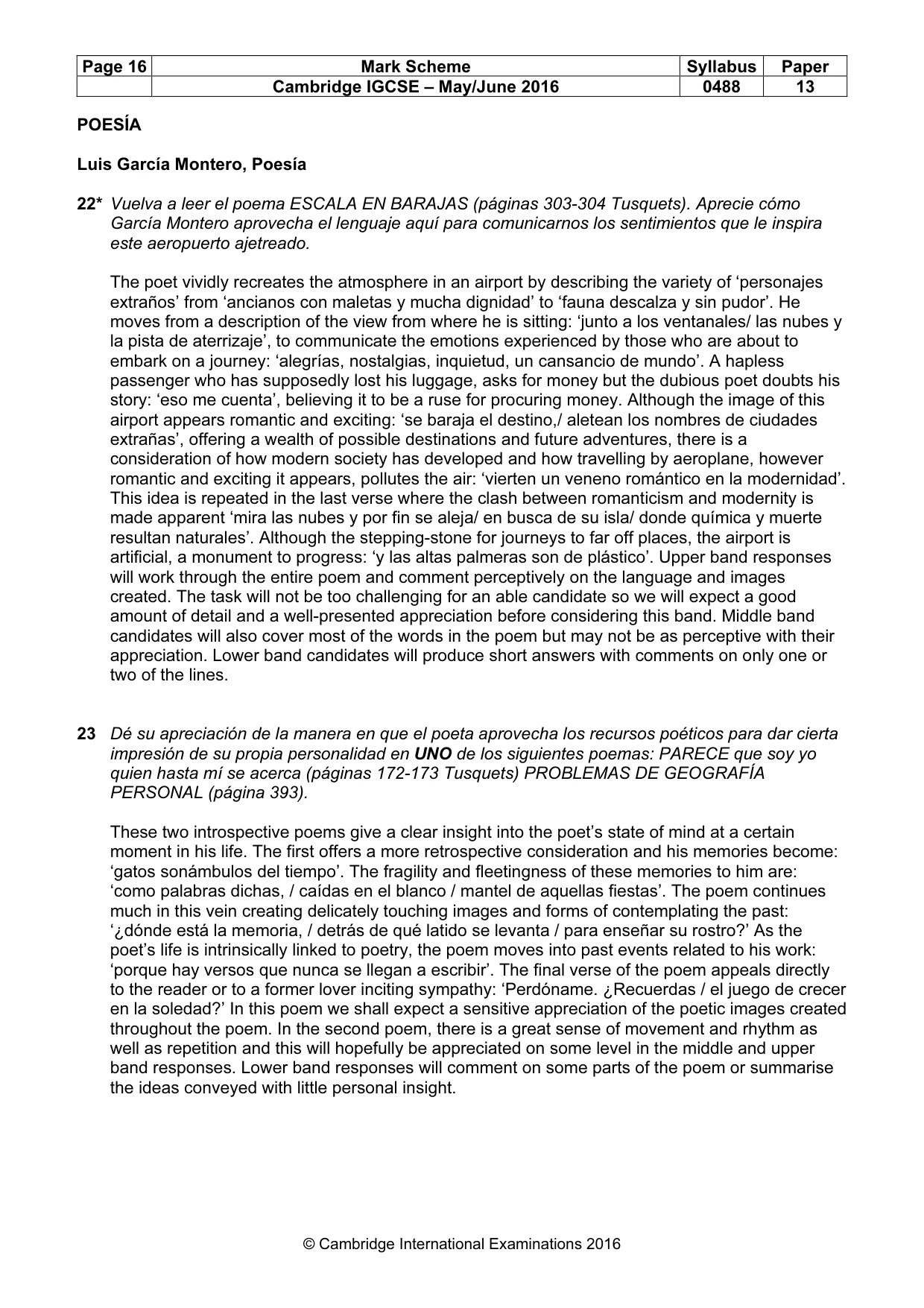
Page 16 Mark Scheme Syllabus Paper Cambridge IGCSE – May/June 2016 0488 13 © Cambridge International Examinations 2016 POESÍA Luis García Montero, Poesía 22* Vuelva a leer el poema ESCALA EN BARAJAS (páginas 303-304 Tusquets). Aprecie cómo García Montero aprovecha el lenguaje aquí para comunicarnos los sentimientos que le inspira este aeropuerto ajetreado. The poet vividly recreates the atmosphere in an airport by describing the variety of ‘personajes extraños’ from ‘ancianos con maletas y mucha dignidad’ to ‘fauna descalza y sin pudor’. He moves from a description of the view from where he is sitting: ‘junto a los ventanales/ las nubes y la pista de aterrizaje’, to communicate the emotions experienced by those who are about to embark on a journey: ‘alegrías, nostalgias, inquietud, un cansancio de mundo’. A hapless passenger who has supposedly lost his luggage, asks for money but the dubious poet doubts his story: ‘eso me cuenta’, believing it to be a ruse for procuring money. Although the image of this airport appears romantic and exciting: ‘se baraja el destino,/ aletean los nombres de ciudades extrañas’, offering a wealth of possible destinations and future adventures, there is a consideration of how modern society has developed and how travelling by aeroplane, however romantic and exciting it appears, pollutes the air: ‘vierten un veneno romántico en la modernidad’. This idea is repeated in the last verse where the clash between romanticism and modernity is made apparent ‘mira las nubes y por fin se aleja/ en busca de su isla/ donde química y muerte resultan naturales’. Although the stepping-stone for journeys to far off places, the airport is artificial, a monument to progress: ‘y las altas palmeras son de plástico’. Upper band responses will work through the entire poem and comment perceptively on the language and images created. The task will not be too challenging for an able candidate so we will expect a good amount of detail and a well-presented appreciation before considering this band. Middle band candidates will also cover most of the words in the poem but may not be as perceptive with their appreciation. Lower band candidates will produce short answers with comments on only one or two of the lines. 23 Dé su apreciación de la manera en que el poeta aprovecha los recursos poéticos para dar cierta impresión de su propia personalidad en UNO de los siguientes poemas: PARECE que soy yo quien hasta mí se acerca (páginas 172-173 Tusquets) PROBLEMAS DE GEOGRAFÍA PERSONAL (página 393). These two introspective poems give a clear insight into the poet’s state of mind at a certain moment in his life. The first offers a more retrospective consideration and his memories become: ‘gatos sonámbulos del tiempo’. The fragility and fleetingness of these memories to him are: ‘como palabras dichas, / caídas en el blanco / mantel de aquellas fiestas’. The poem continues much in this vein creating delicately touching images and forms of contemplating the past: ‘¿dónde está la memoria, / detrás de qué latido se levanta / para enseñar su rostro?’ As the poet’s life is intrinsically linked to poetry, the poem moves into past events related to his work: ‘porque hay versos que nunca se llegan a escribir’. The final verse of the poem appeals directly to the reader or to a former lover inciting sympathy: ‘Perdóname. ¿Recuerdas / el juego de crecer en la soledad?’ In this poem we shall expect a sensitive appreciation of the poetic images created throughout the poem. In the second poem, there is a great sense of movement and rhythm as well as repetition and this will hopefully be appreciated on some level in the middle and upper band responses. Lower band responses will comment on some parts of the poem or summarise the ideas conveyed with little personal insight.
Mark scheme, page 17
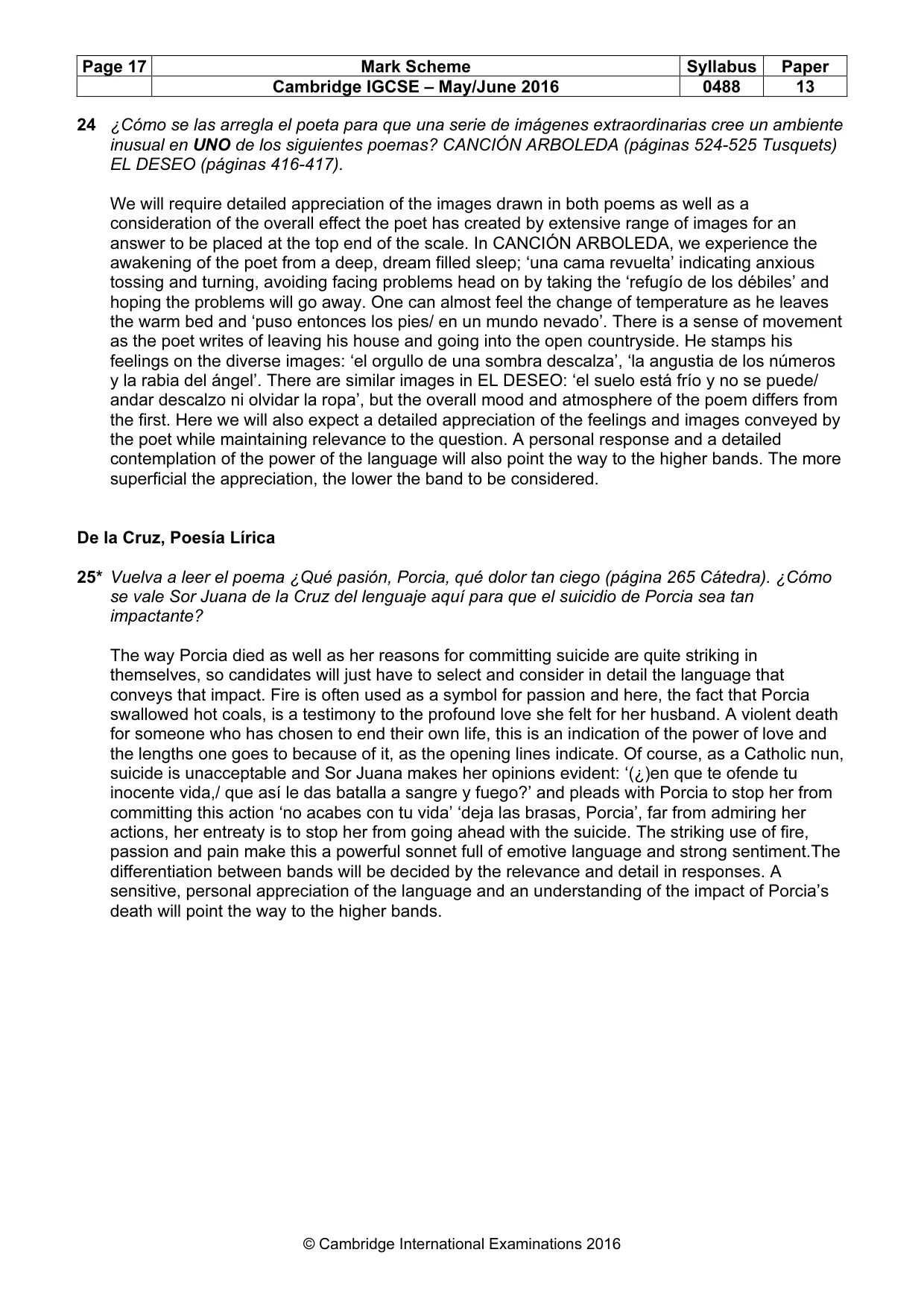
Page 17 Mark Scheme Syllabus Paper Cambridge IGCSE – May/June 2016 0488 13 © Cambridge International Examinations 2016 24 ¿Cómo se las arregla el poeta para que una serie de imágenes extraordinarias cree un ambiente inusual en UNO de los siguientes poemas? CANCIÓN ARBOLEDA (páginas 524-525 Tusquets) EL DESEO (páginas 416-417). We will require detailed appreciation of the images drawn in both poems as well as a consideration of the overall effect the poet has created by extensive range of images for an answer to be placed at the top end of the scale. In CANCIÓN ARBOLEDA, we experience the awakening of the poet from a deep, dream filled sleep; ‘una cama revuelta’ indicating anxious tossing and turning, avoiding facing problems head on by taking the ‘refugío de los débiles’ and hoping the problems will go away. One can almost feel the change of temperature as he leaves the warm bed and ‘puso entonces los pies/ en un mundo nevado’. There is a sense of movement as the poet writes of leaving his house and going into the open countryside. He stamps his feelings on the diverse images: ‘el orgullo de una sombra descalza’, ‘la angustia de los números y la rabia del ángel’. There are similar images in EL DESEO: ‘el suelo está frío y no se puede/ andar descalzo ni olvidar la ropa’, but the overall mood and atmosphere of the poem differs from the first. Here we will also expect a detailed appreciation of the feelings and images conveyed by the poet while maintaining relevance to the question. A personal response and a detailed contemplation of the power of the language will also point the way to the higher bands. The more superficial the appreciation, the lower the band to be considered. De la Cruz, Poesía Lírica 25* Vuelva a leer el poema ¿Qué pasión, Porcia, qué dolor tan ciego (página 265 Cátedra). ¿Cómo se vale Sor Juana de la Cruz del lenguaje aquí para que el suicidio de Porcia sea tan impactante? The way Porcia died as well as her reasons for committing suicide are quite striking in themselves, so candidates will just have to select and consider in detail the language that conveys that impact. Fire is often used as a symbol for passion and here, the fact that Porcia swallowed hot coals, is a testimony to the profound love she felt for her husband. A violent death for someone who has chosen to end their own life, this is an indication of the power of love and the lengths one goes to because of it, as the opening lines indicate. Of course, as a Catholic nun, suicide is unacceptable and Sor Juana makes her opinions evident: ‘(¿)en que te ofende tu inocente vida,/ que así le das batalla a sangre y fuego?’ and pleads with Porcia to stop her from committing this action ‘no acabes con tu vida’ ‘deja las brasas, Porcia’, far from admiring her actions, her entreaty is to stop her from going ahead with the suicide. The striking use of fire, passion and pain make this a powerful sonnet full of emotive language and strong sentiment.The differentiation between bands will be decided by the relevance and detail in responses. A sensitive, personal appreciation of the language and an understanding of the impact of Porcia’s death will point the way to the higher bands.
Mark scheme, page 18
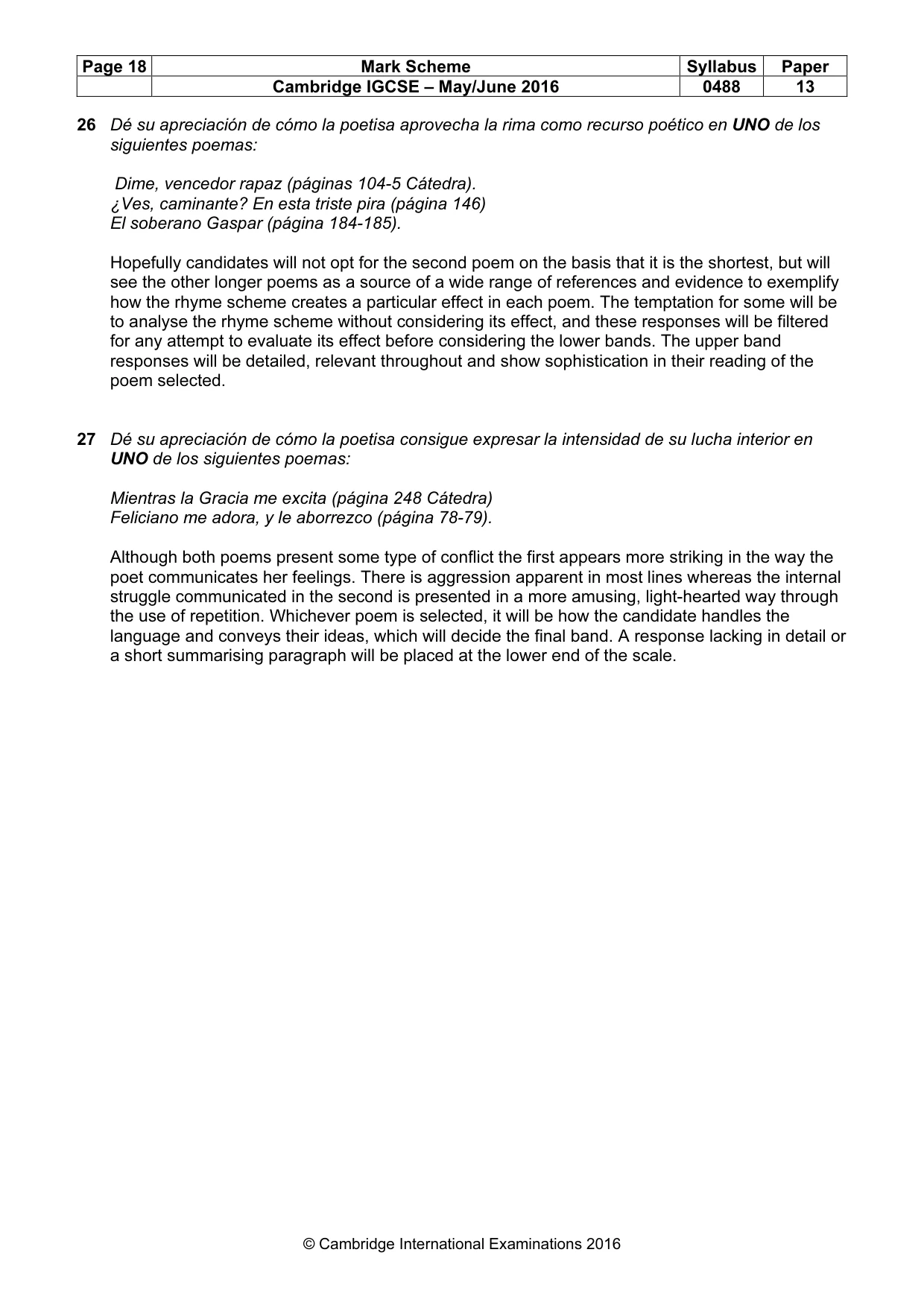
Page 18 Mark Scheme Syllabus Paper Cambridge IGCSE – May/June 2016 0488 13 © Cambridge International Examinations 2016 26 Dé su apreciación de cómo la poetisa aprovecha la rima como recurso poético en UNO de los siguientes poemas: Dime, vencedor rapaz (páginas 104-5 Cátedra). ¿Ves, caminante? En esta triste pira (página 146) El soberano Gaspar (página 184-185). Hopefully candidates will not opt for the second poem on the basis that it is the shortest, but will see the other longer poems as a source of a wide range of references and evidence to exemplify how the rhyme scheme creates a particular effect in each poem. The temptation for some will be to analyse the rhyme scheme without considering its effect, and these responses will be filtered for any attempt to evaluate its effect before considering the lower bands. The upper band responses will be detailed, relevant throughout and show sophistication in their reading of the poem selected. 27 Dé su apreciación de cómo la poetisa consigue expresar la intensidad de su lucha interior en UNO de los siguientes poemas: Mientras la Gracia me excita (página 248 Cátedra) Feliciano me adora, y le aborrezco (página 78-79). Although both poems present some type of conflict the first appears more striking in the way the poet communicates her feelings. There is aggression apparent in most lines whereas the internal struggle communicated in the second is presented in a more amusing, light-hearted way through the use of repetition. Whichever poem is selected, it will be how the candidate handles the language and conveys their ideas, which will decide the final band. A response lacking in detail or a short summarising paragraph will be placed at the lower end of the scale.
What you needed in this session
Cambridge’s own grade thresholds for 2016 May/June, Paper 1 · Variant 3. A higher threshold means an easier paper — the bar moves with how the cohort did.