Cambridge IGCSE Spanish (9-1) 7160 — 2023 May/June Paper 2 · Variant 2
7160/22/M/J/23 · 45 marks · ≈51 min
The question paper and its mark scheme, free to read here and free to download. This is Cambridge’s own paper, exactly as it was sat.
Question paper12 pages

Mark scheme12 pages
Answers below. Sit the paper first if you are practising.
Paper as text
Question paper, page 1
This document has 12 pages. Any blank pages are indicated. [Turn over Cambridge IGCSE™(9–1) DC (LK) 326504 © UCLES 2023 * 7 6 3 8 6 4 6 0 1 2 * SPANISH 7160/22 Paper 2 Reading May/June 2023 1 hour You must answer on the question paper. No additional materials are needed. INSTRUCTIONS ● Answer all questions. ● Use a black or dark blue pen. ● Write your name, centre number and candidate number in the boxes at the top of the page. ● Write your answer to each question in the space provided. ● Do not use an erasable pen or correction fluid. ● Do not write on any bar codes. ● Dictionaries are not allowed. INFORMATION ● The total mark for this paper is 45. ● The number of marks for each question or part question is shown in brackets [ ].
Question paper, page 2
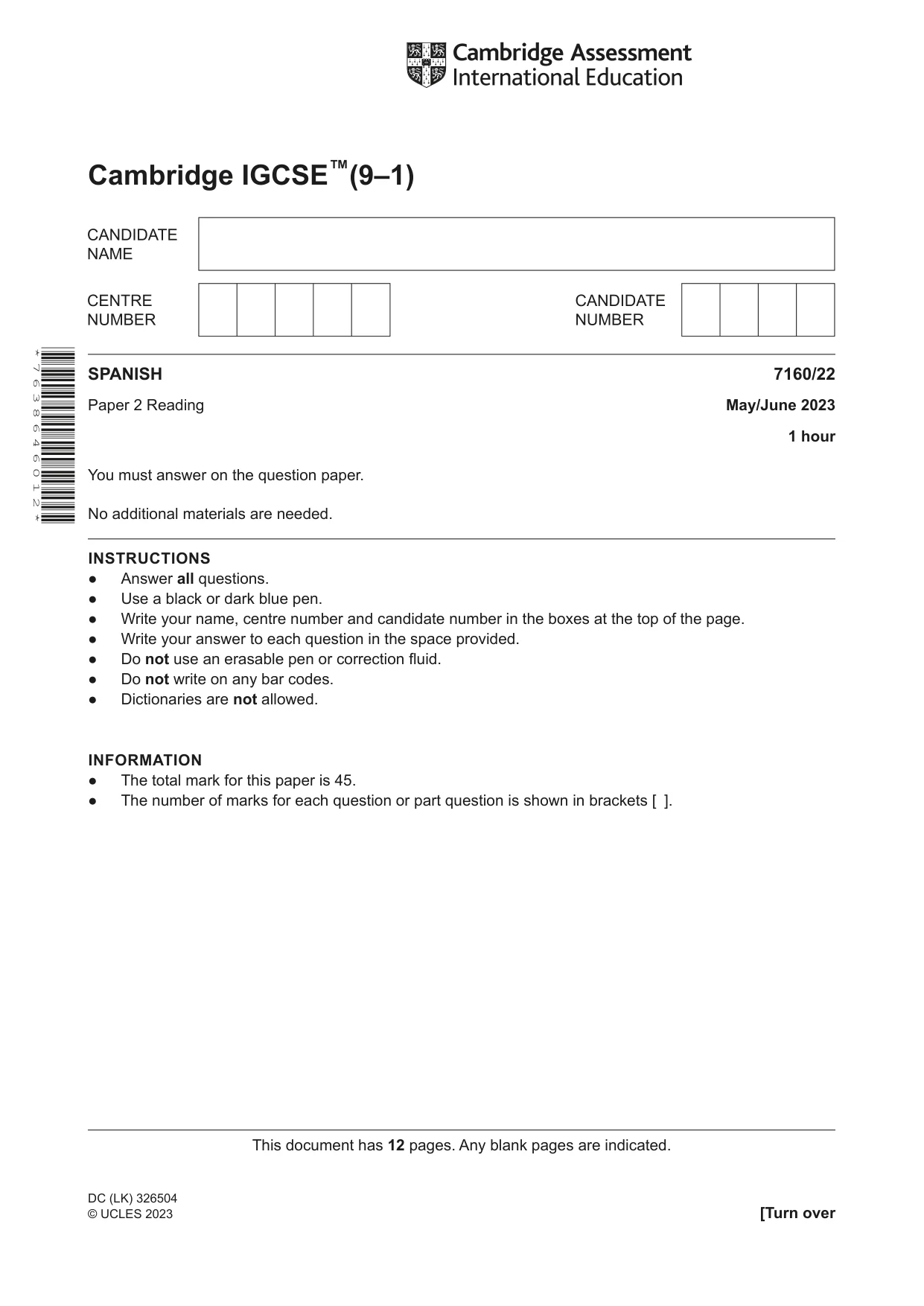
2 7160/22/ M / J /23 © UCLES 2023 1 Mira los dibujos. C B A E D F Para cada pregunta escribe la letra correcta (A–F) en la casilla. (a) Vivo cerca del mercado. [1] (b) Yo cocino los fines de semana. [1] (c) Como un bocadillo a mediodía. [1] (d) Las verduras son buenas para la salud. [1] (e) Cenamos todos en el comedor. [1] [Total: 5]
Question paper, page 3
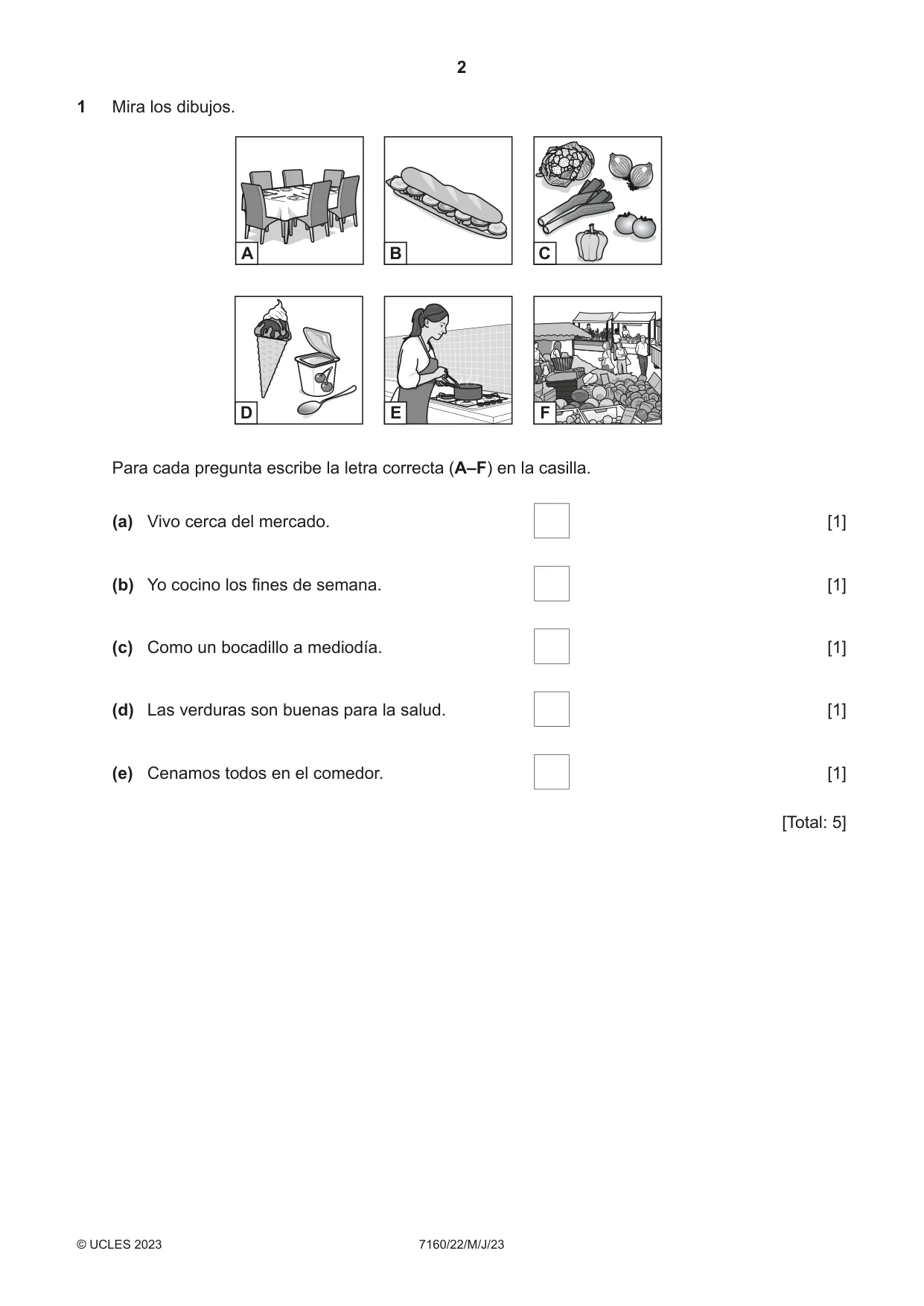
3 7160/22/M/J/23 © UCLES 2023 [Turn over 2 Lee los letreros. En el aeropuerto Baños Cambio de moneda Tienda de recuerdos Alquiler de coches Control de seguridad Restaurante Venta de billetes de avión Información A B C D E F G H Para cada pregunta escribe la letra correcta (A–H) en la casilla. (a) Me gustaría comprar un regalo para mis padres. [1] (b) Tengo hambre. ¿Vamos a comer algo? [1] (c) Necesito dinero extranjero. [1] (d) Tengo una pregunta sobre los hoteles. [1] (e) Quieren mirar lo que llevas en la mochila. [1] [Total: 5]
Question paper, page 4
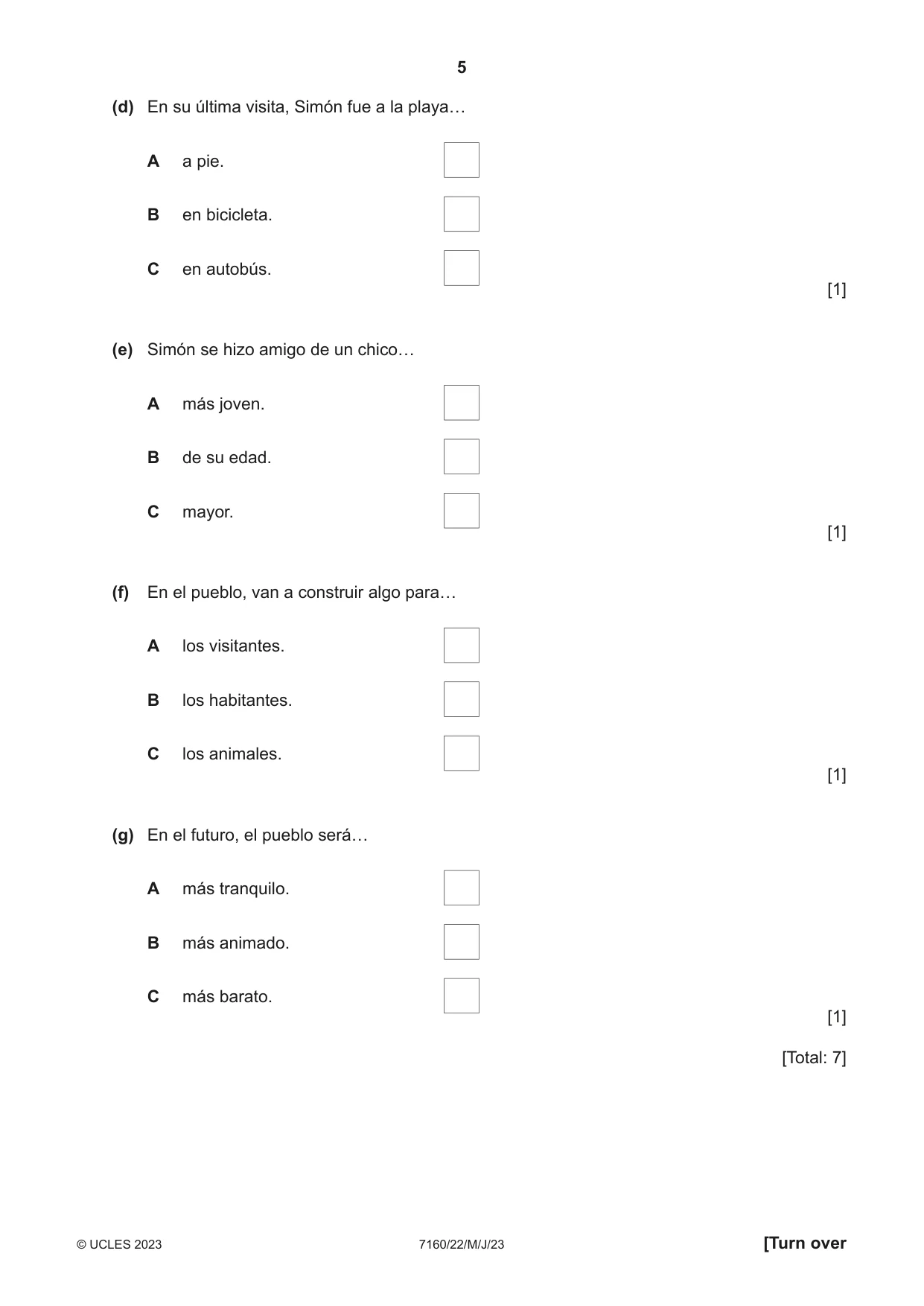
4 7160/22/M/J/23 © UCLES 2023 3 Lee el texto. Para cada pregunta indica tu respuesta escribiendo una X en la casilla correcta (A–C). Todos los veranos vamos a un pueblo pequeño junto al mar. Es muy agradable; no hay mucha gente, y la playa, aunque no es muy grande, está muy limpia. Los barcos de pesca en el puerto no hacen mucho ruido, y el pueblo en general es bonito. La casa que tenemos allí es sencilla; no tiene jardín ni, desgraciadamente, piscina, pero se ve la costa desde el balcón. Durante nuestra última visita, fuimos andando a la playa para nadar. Conocí a un chico francés que tenía la misma edad que yo. Ahora somos muy amigos. Sin embargo, todo va a cambiar. Pronto construirán dos grandes hoteles adonde vendrán muchos turistas. Habrá sala de baile y varios restaurantes. No será tan tranquilo como antes y sin duda todo será más caro. Simón (a) Simón pasa tiempo en el pueblo… A una vez al mes. B dos veces al año. C todos los años. [1] (b) El pueblo tiene una playa… A limpia. B grande. C ruidosa. [1] (c) La casa de Simón tiene… A piscina. B jardín. C balcón. [1]
Question paper, page 5
5 7160/22/M/J/23 © UCLES 2023 [Turn over (d) En su última visita, Simón fue a la playa… A a pie. B en bicicleta. C en autobús. [1] (e) Simón se hizo amigo de un chico… A más joven. B de su edad. C mayor. [1] (f) En el pueblo, van a construir algo para… A los visitantes. B los habitantes. C los animales. [1] (g) En el futuro, el pueblo será… A más tranquilo. B más animado. C más barato. [1] [Total: 7]
Question paper, page 6
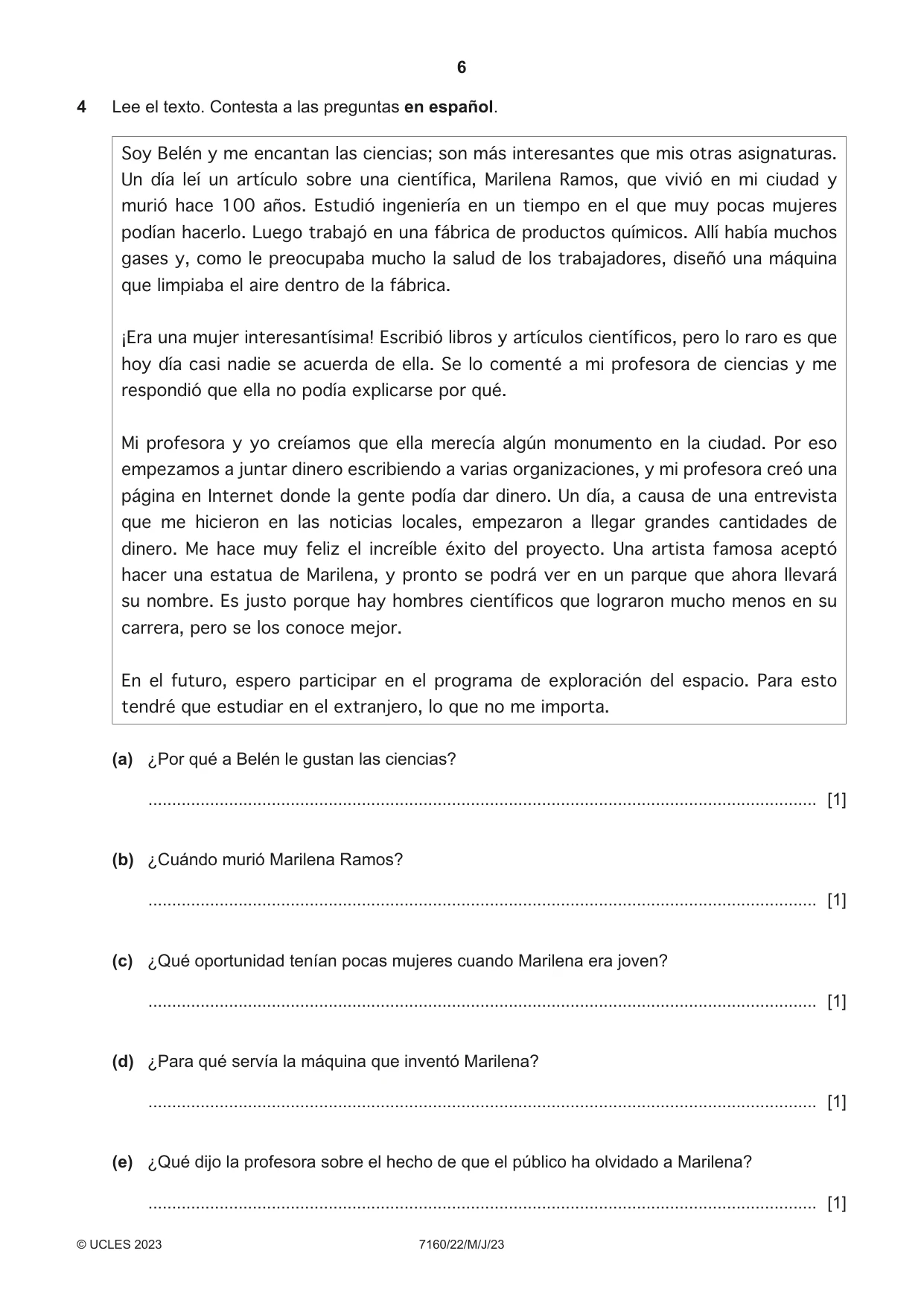
6 7160/22/M/J/23 © UCLES 2023 4 Lee el texto. Contesta a las preguntas en español. Soy Belén y me encantan las ciencias; son más interesantes que mis otras asignaturas. Un día leí un artículo sobre una científica, Marilena Ramos, que vivió en mi ciudad y murió hace 100 años. Estudió ingeniería en un tiempo en el que muy pocas mujeres podían hacerlo. Luego trabajó en una fábrica de productos químicos. Allí había muchos gases y, como le preocupaba mucho la salud de los trabajadores, diseñó una máquina que limpiaba el aire dentro de la fábrica. ¡Era una mujer interesantísima! Escribió libros y artículos científicos, pero lo raro es que hoy día casi nadie se acuerda de ella. Se lo comenté a mi profesora de ciencias y me respondió que ella no podía explicarse por qué. Mi profesora y yo creíamos que ella merecía algún monumento en la ciudad. Por eso empezamos a juntar dinero escribiendo a varias organizaciones, y mi profesora creó una página en Internet donde la gente podía dar dinero. Un día, a causa de una entrevista que me hicieron en las noticias locales, empezaron a llegar grandes cantidades de dinero. Me hace muy feliz el increíble éxito del proyecto. Una artista famosa aceptó hacer una estatua de Marilena, y pronto se podrá ver en un parque que ahora llevará su nombre. Es justo porque hay hombres científicos que lograron mucho menos en su carrera, pero se los conoce mejor. En el futuro, espero participar en el programa de exploración del espacio. Para esto tendré que estudiar en el extranjero, lo que no me importa. (a) ¿Por qué a Belén le gustan las ciencias? … [1] (b) ¿Cuándo murió Marilena Ramos? … [1] (c) ¿Qué oportunidad tenían pocas mujeres cuando Marilena era joven? … [1] (d) ¿Para qué servía la máquina que inventó Marilena? … [1] (e) ¿Qué dijo la profesora sobre el hecho de que el público ha olvidado a Marilena? … [1]
Question paper, page 7
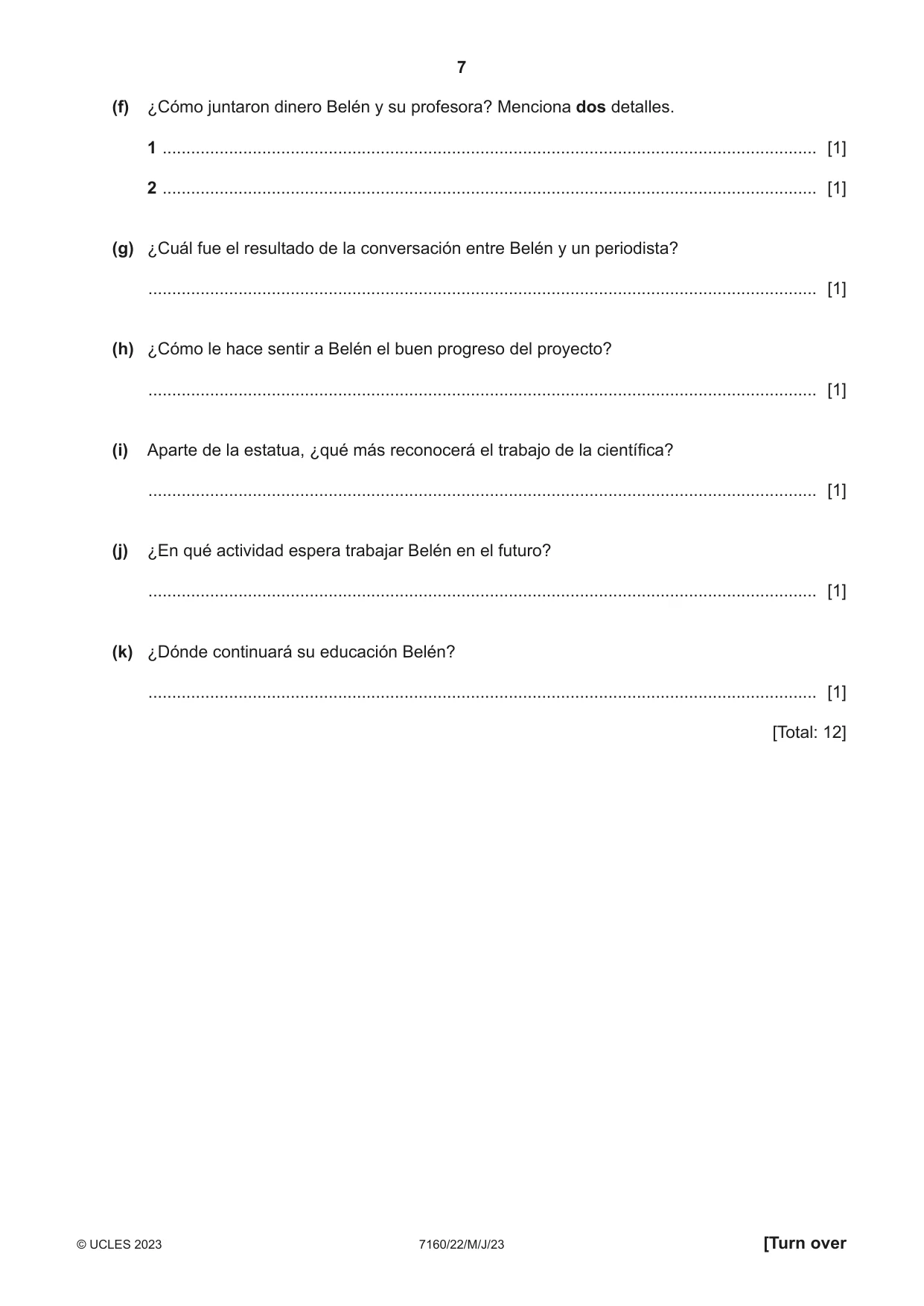
7 7160/22/M/J/23 © UCLES 2023 [Turn over (f) ¿Cómo juntaron dinero Belén y su profesora? Menciona dos detalles. 1 … [1] 2 … [1] (g) ¿Cuál fue el resultado de la conversación entre Belén y un periodista? … [1] (h) ¿Cómo le hace sentir a Belén el buen progreso del proyecto? … [1] (i) Aparte de la estatua, ¿qué más reconocerá el trabajo de la científica? … [1] (j) ¿En qué actividad espera trabajar Belén en el futuro? … [1] (k) ¿Dónde continuará su educación Belén? … [1] [Total: 12]
Question paper, page 8
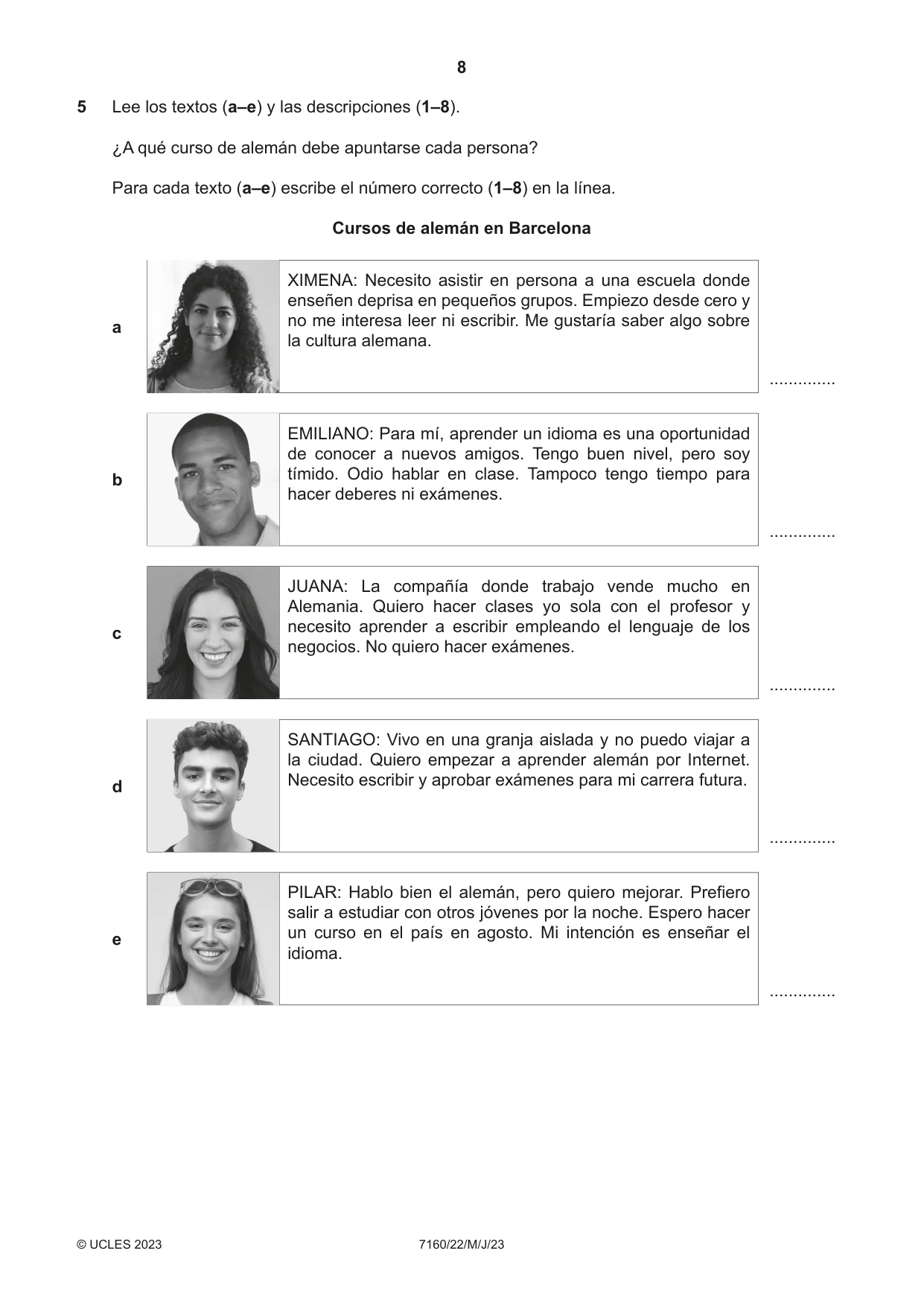
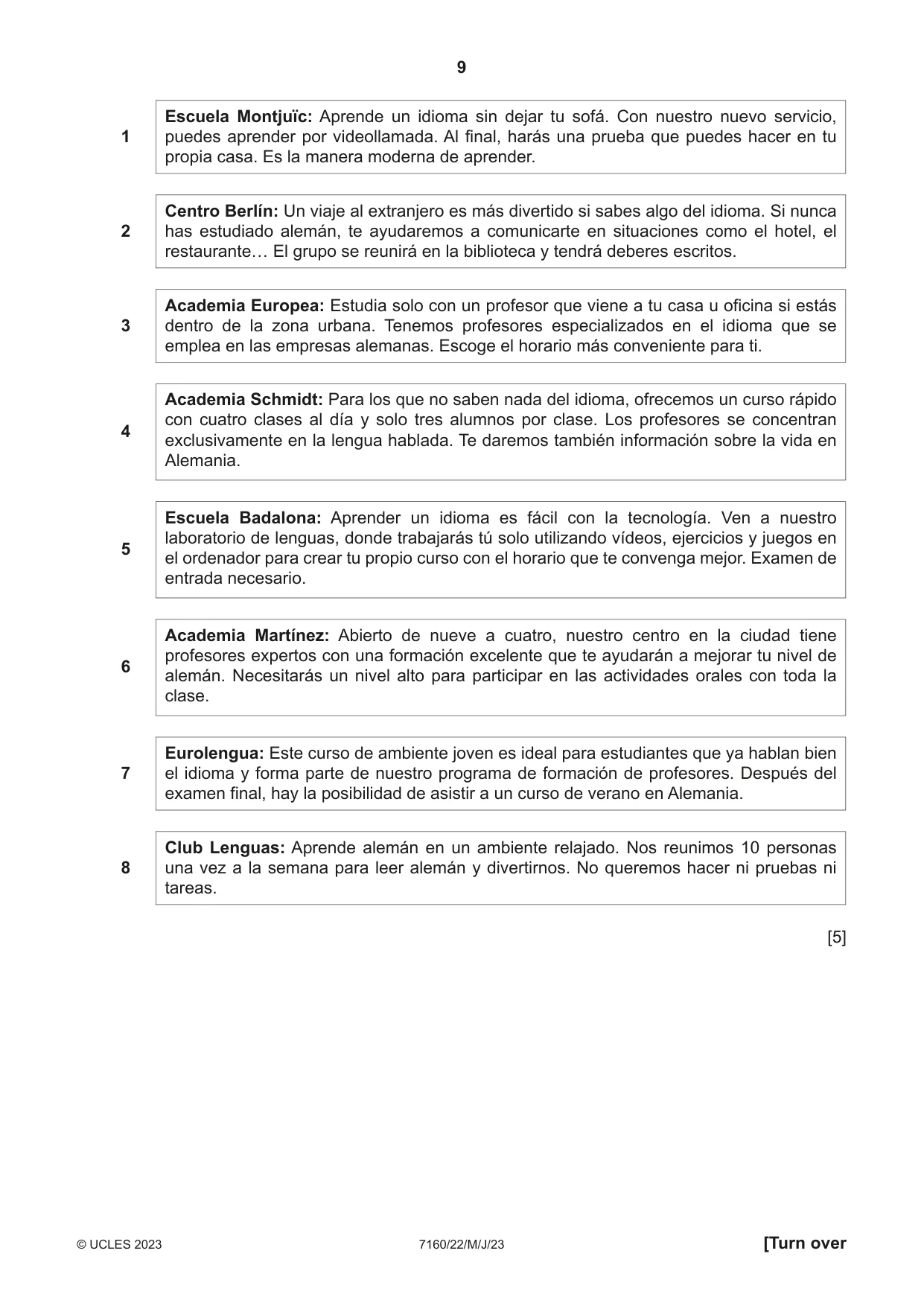
8 7160/22/M/J/23 © UCLES 2023 5 Lee los textos (a–e) y las descripciones (1–8). ¿A qué curso de alemán debe apuntarse cada persona? Para cada texto (a–e) escribe el número correcto (1–8) en la línea. Cursos de alemán en Barcelona a XIMENA: Necesito asistir en persona a una escuela donde enseñen deprisa en pequeños grupos. Empiezo desde cero y no me interesa leer ni escribir. Me gustaría saber algo sobre la cultura alemana. … b EMILIANO: Para mí, aprender un idioma es una oportunidad de conocer a nuevos amigos. Tengo buen nivel, pero soy tímido. Odio hablar en clase. Tampoco tengo tiempo para hacer deberes ni exámenes. … c JUANA: La compañía donde trabajo vende mucho en Alemania. Quiero hacer clases yo sola con el profesor y necesito aprender a escribir empleando el lenguaje de los negocios. No quiero hacer exámenes. … d SANTIAGO: Vivo en una granja aislada y no puedo viajar a la ciudad. Quiero empezar a aprender alemán por Internet. Necesito escribir y aprobar exámenes para mi carrera futura. … e PILAR: Hablo bien el alemán, pero quiero mejorar. Prefiero salir a estudiar con otros jóvenes por la noche. Espero hacer un curso en el país en agosto. Mi intención es enseñar el idioma. …
Question paper, page 9
9 7160/22/M/J/23 © UCLES 2023 [Turn over 1 Escuela Montjuïc: Aprende un idioma sin dejar tu sofá. Con nuestro nuevo servicio, puedes aprender por videollamada. Al final, harás una prueba que puedes hacer en tu propia casa. Es la manera moderna de aprender. 2 Centro Berlín: Un viaje al extranjero es más divertido si sabes algo del idioma. Si nunca has estudiado alemán, te ayudaremos a comunicarte en situaciones como el hotel, el restaurante… El grupo se reunirá en la biblioteca y tendrá deberes escritos. 3 Academia Europea: Estudia solo con un profesor que viene a tu casa u oficina si estás dentro de la zona urbana. Tenemos profesores especializados en el idioma que se emplea en las empresas alemanas. Escoge el horario más conveniente para ti. 4 Academia Schmidt: Para los que no saben nada del idioma, ofrecemos un curso rápido con cuatro clases al día y solo tres alumnos por clase. Los profesores se concentran exclusivamente en la lengua hablada. Te daremos también información sobre la vida en Alemania. 5 Escuela Badalona: Aprender un idioma es fácil con la tecnología. Ven a nuestro laboratorio de lenguas, donde trabajarás tú solo utilizando vídeos, ejercicios y juegos en el ordenador para crear tu propio curso con el horario que te convenga mejor. Examen de entrada necesario. 6 Academia Martínez: Abierto de nueve a cuatro, nuestro centro en la ciudad tiene profesores expertos con una formación excelente que te ayudarán a mejorar tu nivel de alemán. Necesitarás un nivel alto para participar en las actividades orales con toda la clase. 7 Eurolengua: Este curso de ambiente joven es ideal para estudiantes que ya hablan bien el idioma y forma parte de nuestro programa de formación de profesores. Después del examen final, hay la posibilidad de asistir a un curso de verano en Alemania. 8 Club Lenguas: Aprende alemán en un ambiente relajado. Nos reunimos 10 personas una vez a la semana para leer alemán y divertirnos. No queremos hacer ni pruebas ni tareas. [5]
Question paper, page 10
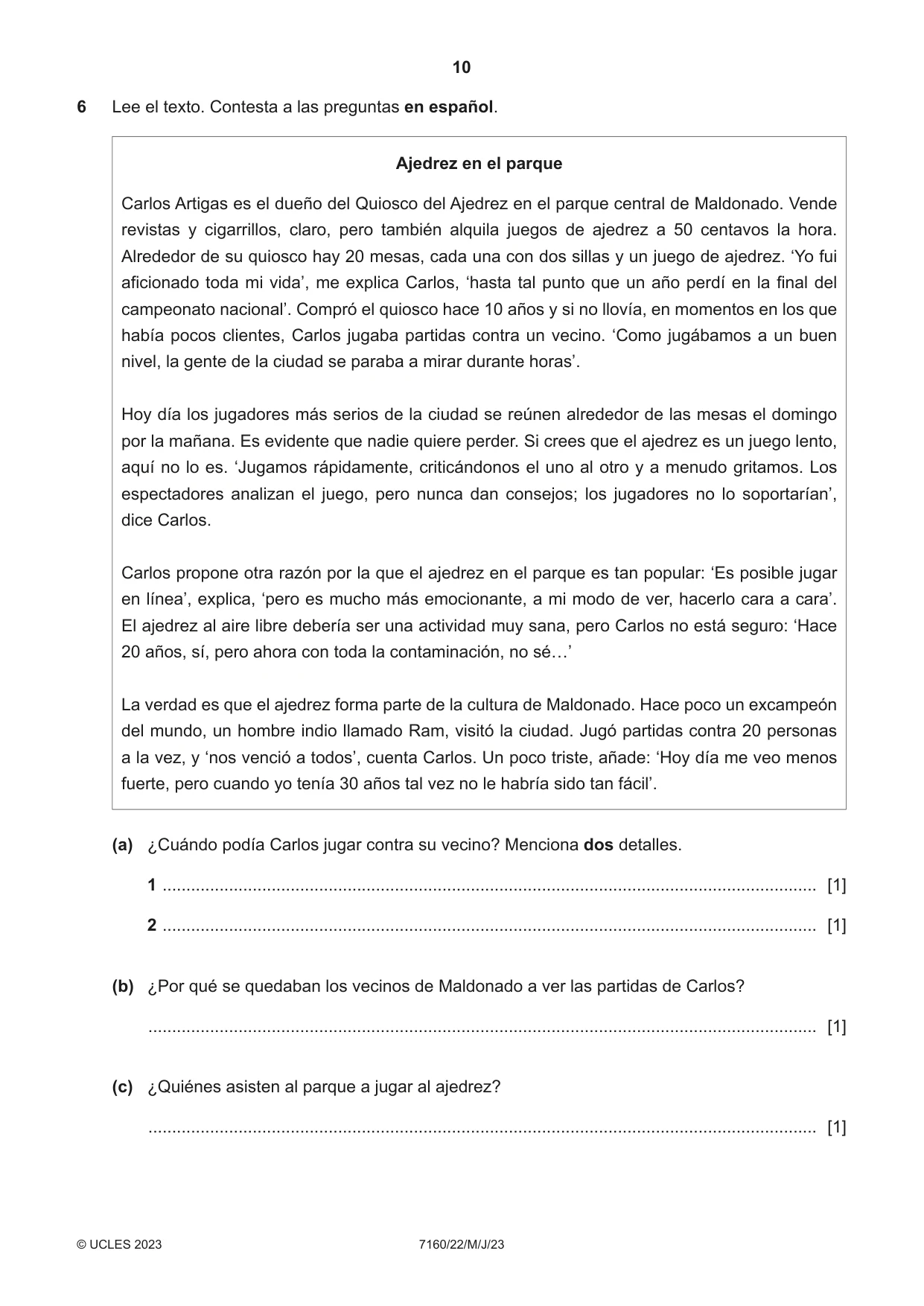
10 7160/22/M/J/23 © UCLES 2023 6 Lee el texto. Contesta a las preguntas en español. Ajedrez en el parque Carlos Artigas es el dueño del Quiosco del Ajedrez en el parque central de Maldonado. Vende revistas y cigarrillos, claro, pero también alquila juegos de ajedrez a 50 centavos la hora. Alrededor de su quiosco hay 20 mesas, cada una con dos sillas y un juego de ajedrez. ‘Yo fui aficionado toda mi vida’, me explica Carlos, ‘hasta tal punto que un año perdí en la final del campeonato nacional’. Compró el quiosco hace 10 años y si no llovía, en momentos en los que había pocos clientes, Carlos jugaba partidas contra un vecino. ‘Como jugábamos a un buen nivel, la gente de la ciudad se paraba a mirar durante horas’. Hoy día los jugadores más serios de la ciudad se reúnen alrededor de las mesas el domingo por la mañana. Es evidente que nadie quiere perder. Si crees que el ajedrez es un juego lento, aquí no lo es. ‘Jugamos rápidamente, criticándonos el uno al otro y a menudo gritamos. Los espectadores analizan el juego, pero nunca dan consejos; los jugadores no lo soportarían’, dice Carlos. Carlos propone otra razón por la que el ajedrez en el parque es tan popular: ‘Es posible jugar en línea’, explica, ‘pero es mucho más emocionante, a mi modo de ver, hacerlo cara a cara’. El ajedrez al aire libre debería ser una actividad muy sana, pero Carlos no está seguro: ‘Hace 20 años, sí, pero ahora con toda la contaminación, no sé…’ La verdad es que el ajedrez forma parte de la cultura de Maldonado. Hace poco un excampeón del mundo, un hombre indio llamado Ram, visitó la ciudad. Jugó partidas contra 20 personas a la vez, y ‘nos venció a todos’, cuenta Carlos. Un poco triste, añade: ‘Hoy día me veo menos fuerte, pero cuando yo tenía 30 años tal vez no le habría sido tan fácil’. (a) ¿Cuándo podía Carlos jugar contra su vecino? Menciona dos detalles. 1 … [1] 2 … [1] (b) ¿Por qué se quedaban los vecinos de Maldonado a ver las partidas de Carlos? … [1] (c) ¿Quiénes asisten al parque a jugar al ajedrez? … [1]
Question paper, page 11
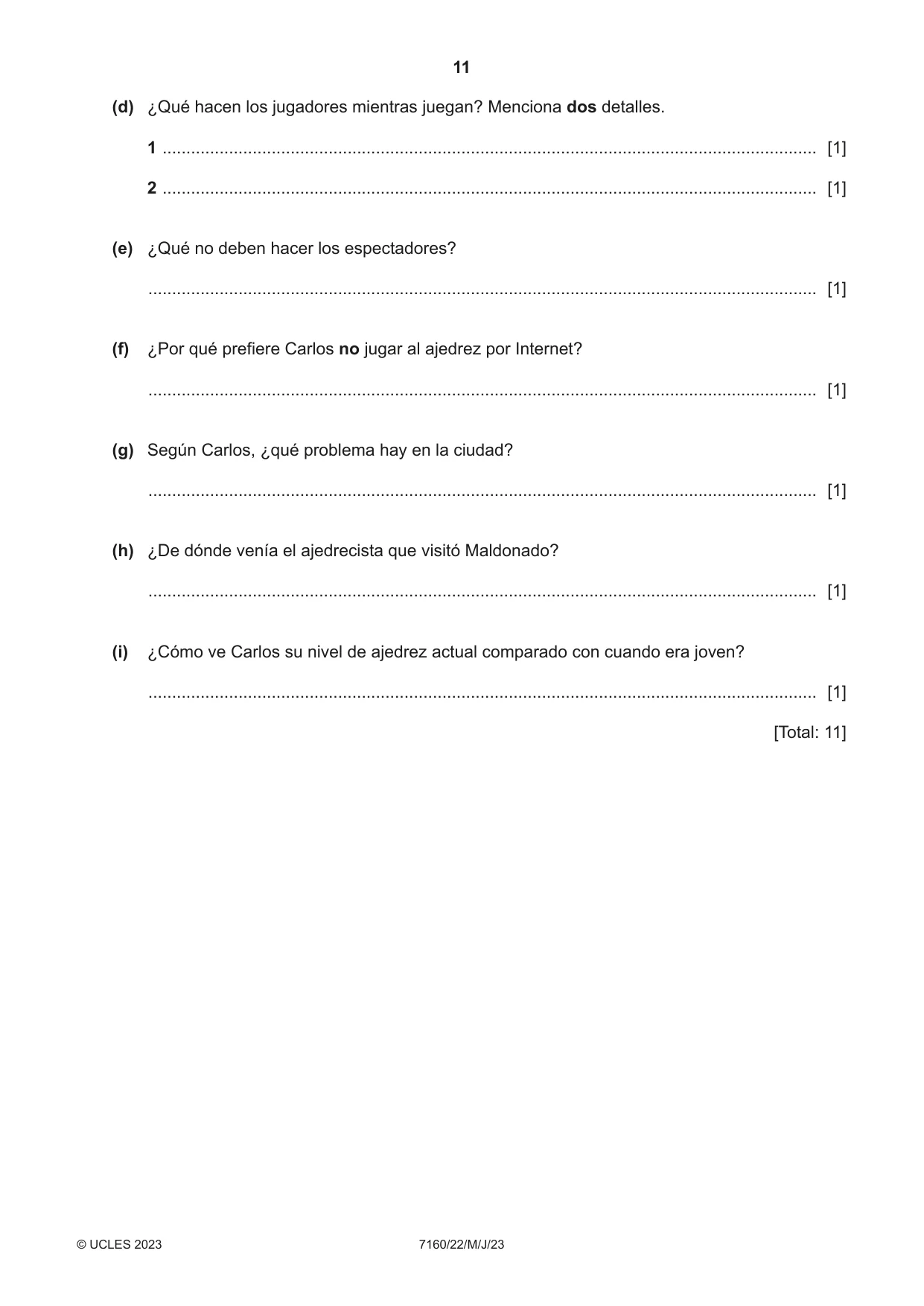
11 7160/22/M/J/23 © UCLES 2023 (d) ¿Qué hacen los jugadores mientras juegan? Menciona dos detalles. 1 … [1] 2 … [1] (e) ¿Qué no deben hacer los espectadores? … [1] (f) ¿Por qué prefiere Carlos no jugar al ajedrez por Internet? … [1] (g) Según Carlos, ¿qué problema hay en la ciudad? … [1] (h) ¿De dónde venía el ajedrecista que visitó Maldonado? … [1] (i) ¿Cómo ve Carlos su nivel de ajedrez actual comparado con cuando era joven? … [1] [Total: 11]
Question paper, page 12
12 7160/22/M/J/23 © UCLES 2023 Permission to reproduce items where third‑party owned material protected by copyright is included has been sought and cleared where possible. Every reasonable effort has been made by the publisher (UCLES) to trace copyright holders, but if any items requiring clearance have unwittingly been included, the publisher will be pleased to make amends at the earliest possible opportunity. To avoid the issue of disclosure of answer‑related information to candidates, all copyright acknowledgements are reproduced online in the Cambridge Assessment International Education Copyright Acknowledgements Booklet. This is produced for each series of examinations and is freely available to download at www.cambridgeinternational.org after the live examination series. Cambridge Assessment International Education is part of Cambridge Assessment. Cambridge Assessment is the brand name of the University of Cambridge Local Examinations Syndicate (UCLES), which is a department of the University of Cambridge. BLANK PAGE
Mark scheme, page 1
This document consists of 12 printed pages. © UCLES 2023 [Turn over Cambridge IGCSE™ (9–1) SPANISH 7160/22 Paper 2 Reading May/June 2023 MARK SCHEME Maximum Mark: 45 Published This mark scheme is published as an aid to teachers and candidates, to indicate the requirements of the examination. It shows the basis on which Examiners were instructed to award marks. It does not indicate the details of the discussions that took place at an Examiners’ meeting before marking began, which would have considered the acceptability of alternative answers. Mark schemes should be read in conjunction with the question paper and the Principal Examiner Report for Teachers. Cambridge International will not enter into discussions about these mark schemes. Cambridge International is publishing the mark schemes for the May/June 2023 series for most Cambridge IGCSE, Cambridge International A and AS Level and Cambridge Pre-U components, and some Cambridge O Level components.
Mark scheme, page 2
7160/22 Cambridge IGCSE (9–1) – Mark Scheme PUBLISHED May/June 2023 © UCLES 2023 Page 2 of 12 Generic Marking Principles These general marking principles must be applied by all examiners when marking candidate answers. They should be applied alongside the specific content of the mark scheme or generic level descriptors for a question. Each question paper and mark scheme will also comply with these marking principles. GENERIC MARKING PRINCIPLE 1: Marks must be awarded in line with: the specific content of the mark scheme or the generic level descriptors for the question the specific skills defined in the mark scheme or in the generic level descriptors for the question the standard of response required by a candidate as exemplified by the standardisation scripts. GENERIC MARKING PRINCIPLE 2: Marks awarded are always whole marks (not half marks, or other fractions). GENERIC MARKING PRINCIPLE 3: Marks must be awarded positively: marks are awarded for correct/valid answers, as defined in the mark scheme. However, credit is given for valid answers which go beyond the scope of the syllabus and mark scheme, referring to your Team Leader as appropriate marks are awarded when candidates clearly demonstrate what they know and can do marks are not deducted for errors marks are not deducted for omissions answers should only be judged on the quality of spelling, punctuation and grammar when these features are specifically assessed by the question as indicated by the mark scheme. The meaning, however, should be unambiguous. GENERIC MARKING PRINCIPLE 4: Rules must be applied consistently, e.g. in situations where candidates have not followed instructions or in the application of generic level descriptors.
Mark scheme, page 3
7160/22 Cambridge IGCSE (9–1) – Mark Scheme PUBLISHED May/June 2023 © UCLES 2023 Page 3 of 12 GENERIC MARKING PRINCIPLE 5: Marks should be awarded using the full range of marks defined in the mark scheme for the question (however; the use of the full mark range may be limited according to the quality of the candidate responses seen). GENERIC MARKING PRINCIPLE 6: Marks awarded are based solely on the requirements as defined in the mark scheme. Marks should not be awarded with grade thresholds or grade descriptors in mind.
Mark scheme, page 4
7160/22 Cambridge IGCSE (9–1) – Mark Scheme PUBLISHED May/June 2023 © UCLES 2023 Page 4 of 12 Additional Guidance The following guidance underpins the detailed instructions provided in the mark scheme. Where a decision is taken to deviate from this guidance for a particular question, this will be specified in the mark scheme. Often the additional guidance points will have to be weighed up against each other, e.g. the answer might look or sound like the intended word/phrase in Spanish, but if what the candidate has written means something different in Spanish from what is expected, the mark cannot be awarded. It is not possible to list all acceptable alternatives in the mark scheme. If you encounter an answer which is not covered by the mark scheme, you will need to make a decision about whether it communicates the required elements (in consultation with your Team Leader if necessary, or with your Product Manager if you are a single examiner), and award marks accordingly. Crossing out: (a) If a candidate changes his/her mind about an answer and crosses out an attempt, award a mark if the final attempt is correct. (b) If a candidate crosses out an answer to a whole question but makes no second attempt at it, mark the crossed out work. More than the stipulated number of boxes ticked/crossed by the candidate: (a) If more than one attempt is visible but the candidate has clearly indicated which attempt is his/her final answer (e.g. by crossing out other attempts or by annotating the script in some way), mark in the usual way. (b) If two attempts are visible (e.g. two boxes ticked instead of the one box stipulated), and neither has been crossed out/discounted by the candidate, no mark can be awarded. For questions requiring more than one element for the answer, 1 and 2, where the answers are interchangeable: (a) Both of the correct answers are on line 1 and line 2 blank (or vice versa) = 2 marks (b) Both correct answers on line 1 and line 2 contains a wrong answer (or vice versa) = 1 mark
Mark scheme, page 5
7160/22 Cambridge IGCSE (9–1) – Mark Scheme PUBLISHED May/June 2023 © UCLES 2023 Page 5 of 12 Mark for communication: Answers requiring the use of Spanish (rather than a non-verbal response) should be marked for communication. Tolerate inaccuracies provided that the message is clear. However, do not accept incorrect Spanish if the word written by the candidate means something else in Spanish (unless the mark scheme specifies otherwise). (a) If you read aloud what the candidate has written, does it sound like the correct answer? Would a native speaker of Spanish understand it? (b) Does what the candidate has written look like the correct answer, e.g. one letter missing but no other word created? Would a native speaker of Spanish understand it? Annotations used in the mark scheme: (a) INV = invalidation. This is used when the additional material included by the candidate is judged to invalidate an otherwise correct answer and therefore prevents him/her from scoring the mark. (INV = 0) (b) tc = ‘tout court’. This means that, on its own, the material is not sufficient to score the mark. (c) HA = harmless addition. This means that the candidate has included additional material which, in conjunction with the correct answer, does not prevent him/her from scoring the mark. No response and ‘0’ marks: (a) Award NR (no response): If there is nothing written at all in the answer space or If there is only a comment which does not in any way relate to the question being asked (e.g. ‘can’t do’ or ‘don’t know’) or If there is only a mark which isn’t an attempt at the question (e.g. a dash, a question mark). (b) Award 0: If there is any attempt that earns no credit, e.g. the candidate has copied out part or all of the question.
Mark scheme, page 6
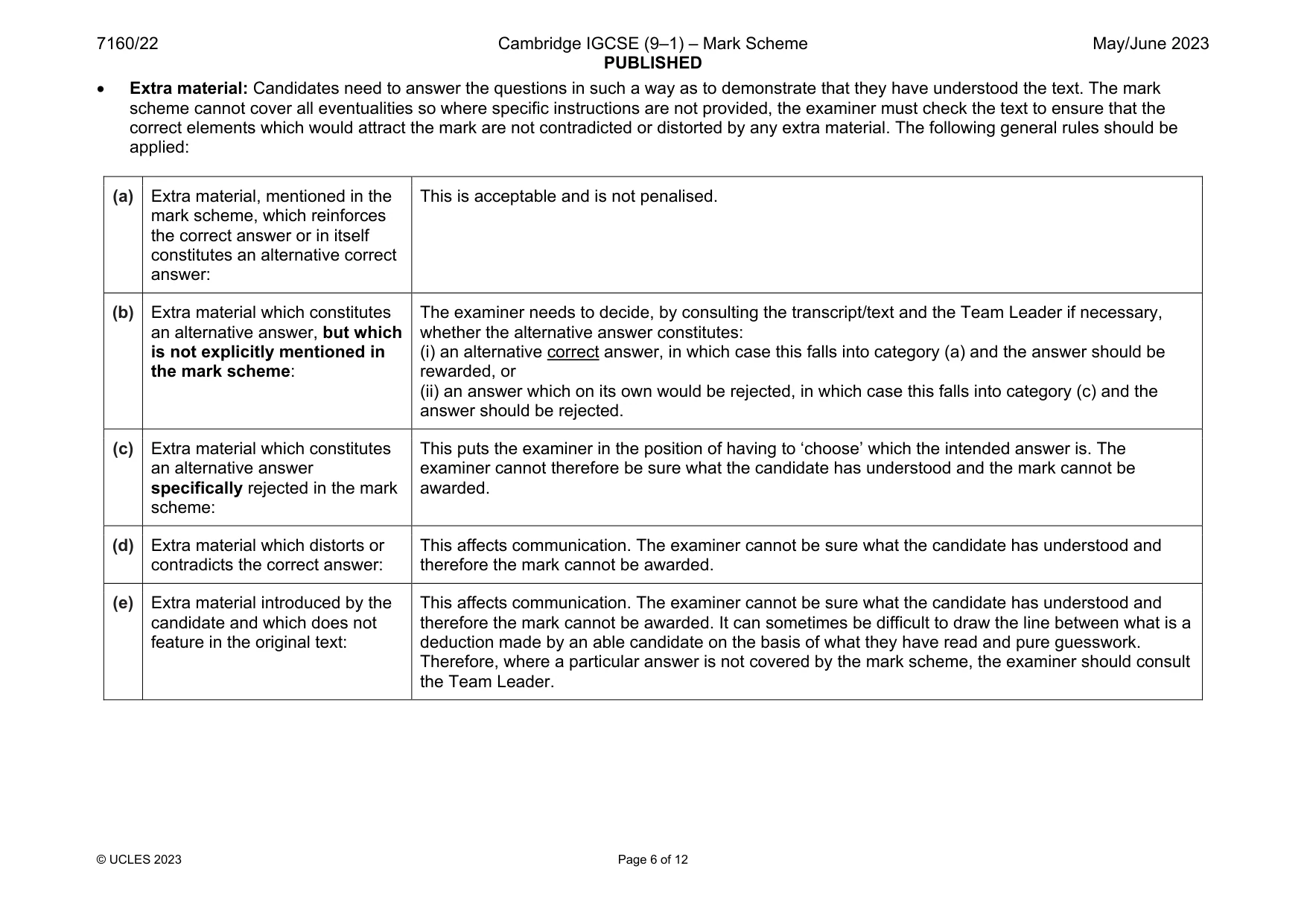
7160/22 Cambridge IGCSE (9–1) – Mark Scheme PUBLISHED May/June 2023 © UCLES 2023 Page 6 of 12 Extra material: Candidates need to answer the questions in such a way as to demonstrate that they have understood the text. The mark scheme cannot cover all eventualities so where specific instructions are not provided, the examiner must check the text to ensure that the correct elements which would attract the mark are not contradicted or distorted by any extra material. The following general rules should be applied: (a) Extra material, mentioned in the mark scheme, which reinforces the correct answer or in itself constitutes an alternative correct answer: This is acceptable and is not penalised. (b) Extra material which constitutes an alternative answer, but which is not explicitly mentioned in the mark scheme: The examiner needs to decide, by consulting the transcript/text and the Team Leader if necessary, whether the alternative answer constitutes: (i) an alternative correct answer, in which case this falls into category (a) and the answer should be rewarded, or (ii) an answer which on its own would be rejected, in which case this falls into category (c) and the answer should be rejected. (c) Extra material which constitutes an alternative answer specifically rejected in the mark scheme: This puts the examiner in the position of having to ‘choose’ which the intended answer is. The examiner cannot therefore be sure what the candidate has understood and the mark cannot be awarded. (d) Extra material which distorts or contradicts the correct answer: This affects communication. The examiner cannot be sure what the candidate has understood and therefore the mark cannot be awarded. (e) Extra material introduced by the candidate and which does not feature in the original text: This affects communication. The examiner cannot be sure what the candidate has understood and therefore the mark cannot be awarded. It can sometimes be difficult to draw the line between what is a deduction made by an able candidate on the basis of what they have read and pure guesswork. Therefore, where a particular answer is not covered by the mark scheme, the examiner should consult the Team Leader.
Mark scheme, page 7
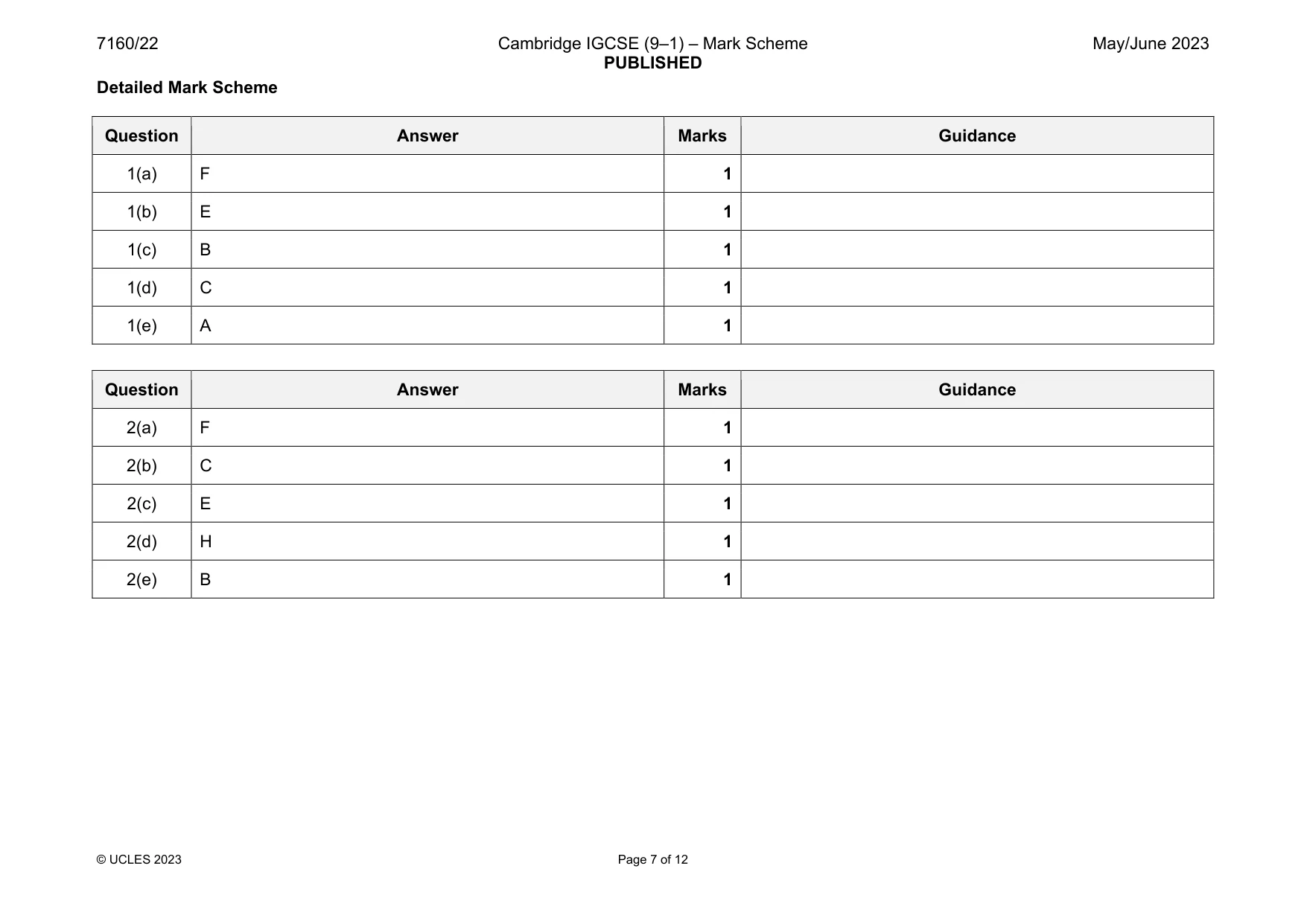
7160/22 Cambridge IGCSE (9–1) – Mark Scheme PUBLISHED May/June 2023 © UCLES 2023 Page 7 of 12 Detailed Mark Scheme Question Answer Marks Guidance 1(a) F 1 1(b) E 1 1(c) B 1 1(d) C 1 1(e) A 1 Question Answer Marks Guidance 2(a) F 1 2(b) C 1 2(c) E 1 2(d) H 1 2(e) B 1
Mark scheme, page 8
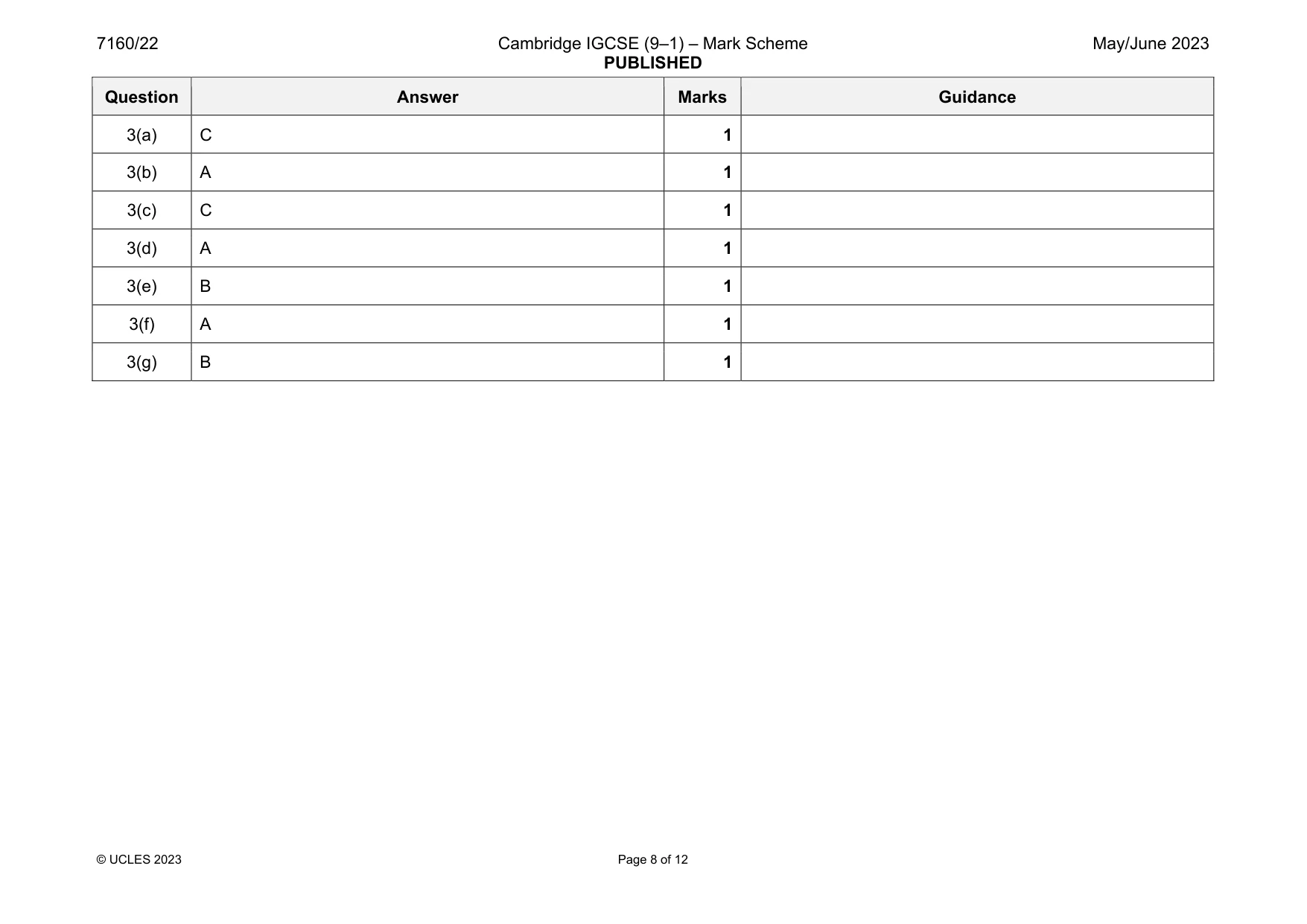
7160/22 Cambridge IGCSE (9–1) – Mark Scheme PUBLISHED May/June 2023 © UCLES 2023 Page 8 of 12 Question Answer Marks Guidance 3(a) C 1 3(b) A 1 3(c) C 1 3(d) A 1 3(e) B 1 3(f) A 1 3(g) B 1
Mark scheme, page 9
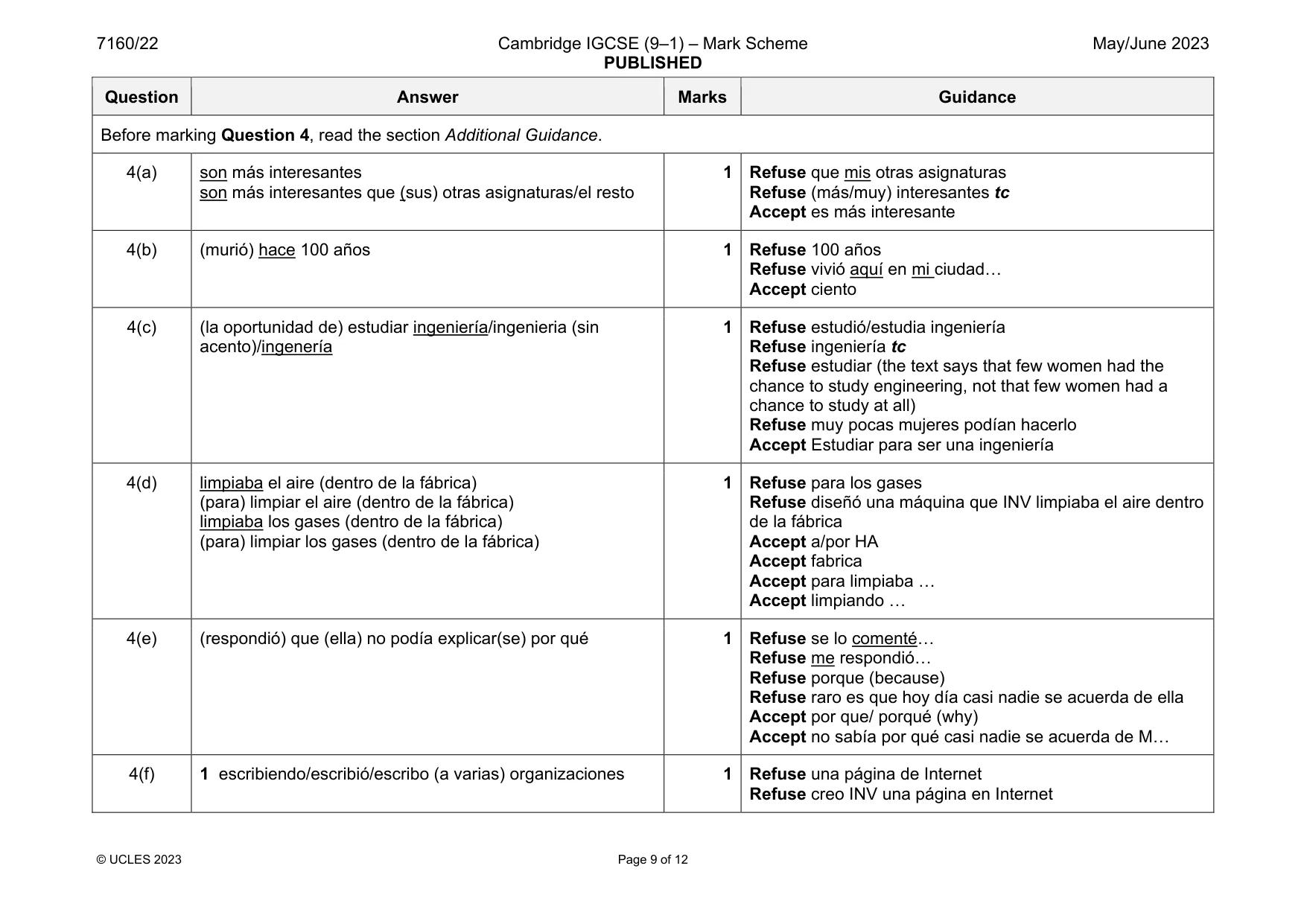
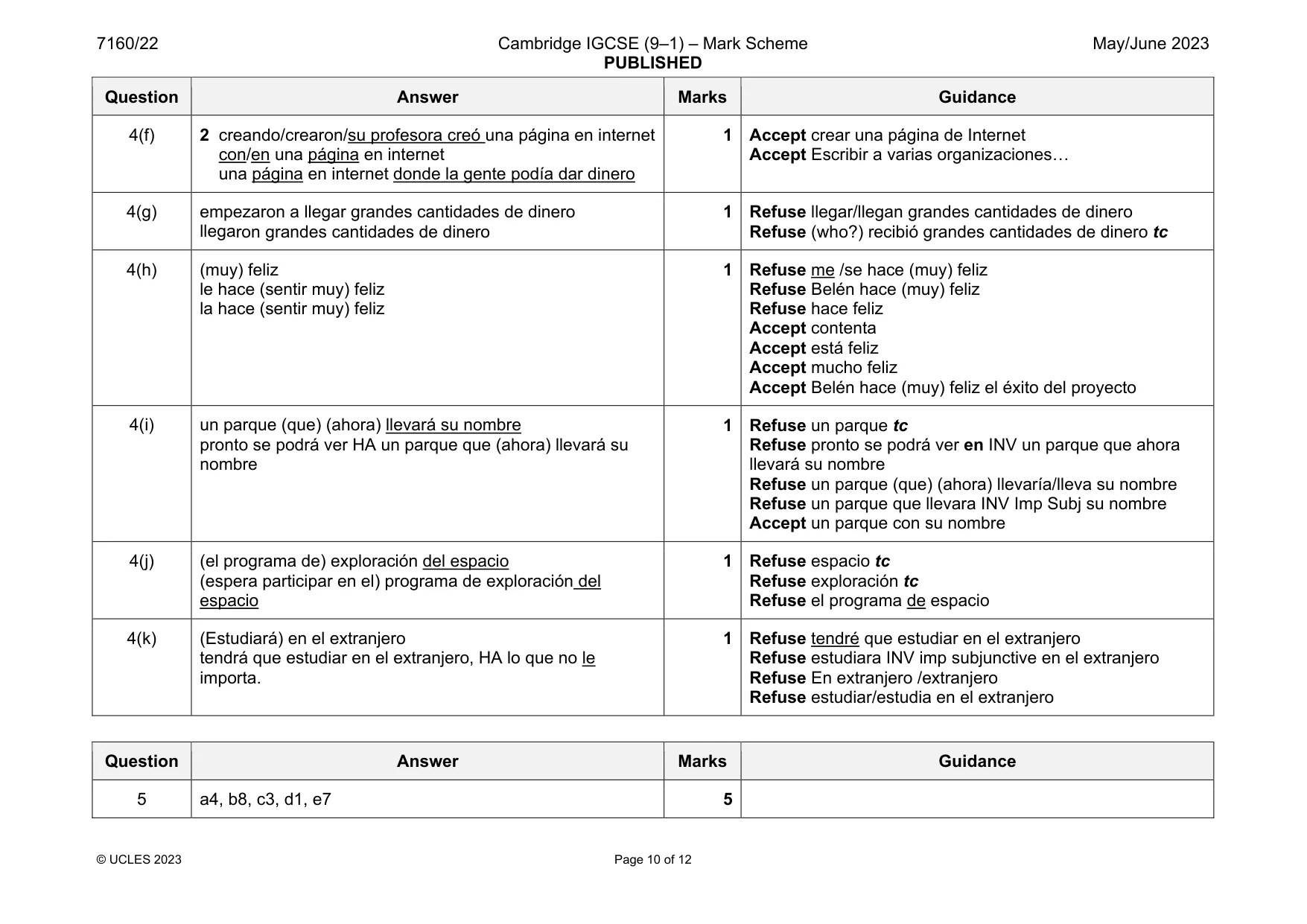
7160/22 Cambridge IGCSE (9–1) – Mark Scheme PUBLISHED May/June 2023 © UCLES 2023 Page 9 of 12 Question Answer Marks Guidance Before marking Question 4, read the section Additional Guidance. 4(a) son más interesantes son más interesantes que (sus) otras asignaturas/el resto 1 Refuse que mis otras asignaturas Refuse (más/muy) interesantes tc Accept es más interesante 4(b) (murió) hace 100 años 1 Refuse 100 años Refuse vivió aquí en mi ciudad… Accept ciento 4(c) (la oportunidad de) estudiar ingeniería/ingenieria (sin acento)/ingenería 1 Refuse estudió/estudia ingeniería Refuse ingeniería tc Refuse estudiar (the text says that few women had the chance to study engineering, not that few women had a chance to study at all) Refuse muy pocas mujeres podían hacerlo Accept Estudiar para ser una ingeniería 4(d) limpiaba el aire (dentro de la fábrica) (para) limpiar el aire (dentro de la fábrica) limpiaba los gases (dentro de la fábrica) (para) limpiar los gases (dentro de la fábrica) 1 Refuse para los gases Refuse diseñó una máquina que INV limpiaba el aire dentro de la fábrica Accept a/por HA Accept fabrica Accept para limpiaba … Accept limpiando … 4(e) (respondió) que (ella) no podía explicar(se) por qué 1 Refuse se lo comenté… Refuse me respondió… Refuse porque (because) Refuse raro es que hoy día casi nadie se acuerda de ella Accept por que/ porqué (why) Accept no sabía por qué casi nadie se acuerda de M… 4(f) 1 escribiendo/escribió/escribo (a varias) organizaciones 1 Refuse una página de Internet Refuse creo INV una página en Internet
Mark scheme, page 10
7160/22 Cambridge IGCSE (9–1) – Mark Scheme PUBLISHED May/June 2023 © UCLES 2023 Page 10 of 12 Question Answer Marks Guidance 4(f) 2 creando/crearon/su profesora creó una página en internet con/en una página en internet una página en internet donde la gente podía dar dinero 1 Accept crear una página de Internet Accept Escribir a varias organizaciones… 4(g) empezaron a llegar grandes cantidades de dinero llegaron grandes cantidades de dinero 1 Refuse llegar/llegan grandes cantidades de dinero Refuse (who?) recibió grandes cantidades de dinero tc 4(h) (muy) feliz le hace (sentir muy) feliz la hace (sentir muy) feliz 1 Refuse me /se hace (muy) feliz Refuse Belén hace (muy) feliz Refuse hace feliz Accept contenta Accept está feliz Accept mucho feliz Accept Belén hace (muy) feliz el éxito del proyecto 4(i) un parque (que) (ahora) llevará su nombre pronto se podrá ver HA un parque que (ahora) llevará su nombre 1 Refuse un parque tc Refuse pronto se podrá ver en INV un parque que ahora llevará su nombre Refuse un parque (que) (ahora) llevaría/lleva su nombre Refuse un parque que llevara INV Imp Subj su nombre Accept un parque con su nombre 4(j) (el programa de) exploración del espacio (espera participar en el) programa de exploración del espacio 1 Refuse espacio tc Refuse exploración tc Refuse el programa de espacio 4(k) (Estudiará) en el extranjero tendrá que estudiar en el extranjero, HA lo que no le importa. 1 Refuse tendré que estudiar en el extranjero Refuse estudiara INV imp subjunctive en el extranjero Refuse En extranjero /extranjero Refuse estudiar/estudia en el extranjero Question Answer Marks Guidance 5 a4, b8, c3, d1, e7 5
Mark scheme, page 11
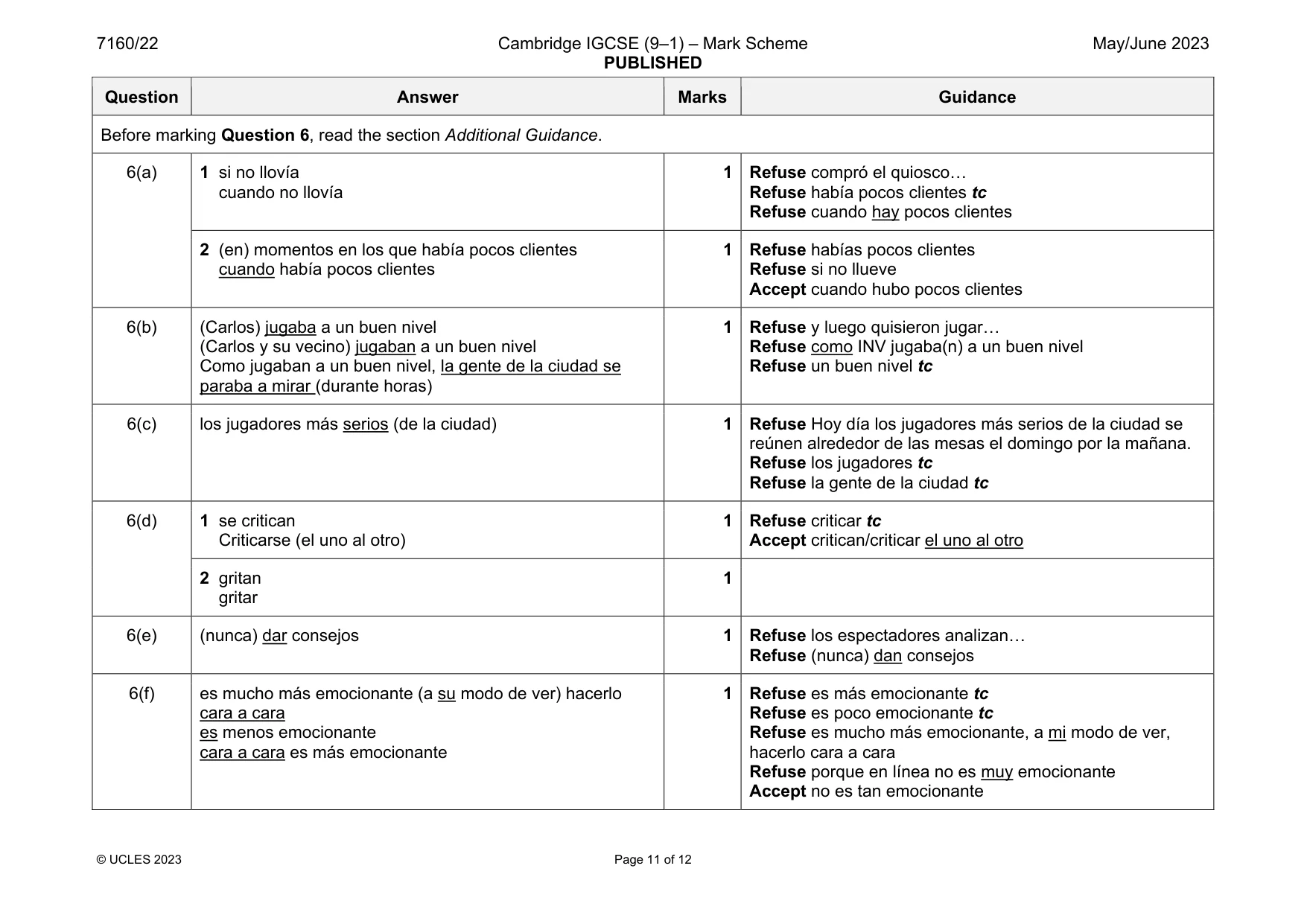
7160/22 Cambridge IGCSE (9–1) – Mark Scheme PUBLISHED May/June 2023 © UCLES 2023 Page 11 of 12 Question Answer Marks Guidance Before marking Question 6, read the section Additional Guidance. 6(a) 1 si no llovía cuando no llovía 1 Refuse compró el quiosco… Refuse había pocos clientes tc Refuse cuando hay pocos clientes 2 (en) momentos en los que había pocos clientes cuando había pocos clientes 1 Refuse habías pocos clientes Refuse si no llueve Accept cuando hubo pocos clientes 6(b) (Carlos) jugaba a un buen nivel (Carlos y su vecino) jugaban a un buen nivel Como jugaban a un buen nivel, la gente de la ciudad se paraba a mirar (durante horas) 1 Refuse y luego quisieron jugar… Refuse como INV jugaba(n) a un buen nivel Refuse un buen nivel tc 6(c) los jugadores más serios (de la ciudad) 1 Refuse Hoy día los jugadores más serios de la ciudad se reúnen alrededor de las mesas el domingo por la mañana. Refuse los jugadores tc Refuse la gente de la ciudad tc 6(d) 1 se critican Criticarse (el uno al otro) 1 Refuse criticar tc Accept critican/criticar el uno al otro 2 gritan gritar 1 6(e) (nunca) dar consejos 1 Refuse los espectadores analizan… Refuse (nunca) dan consejos 6(f) es mucho más emocionante (a su modo de ver) hacerlo cara a cara es menos emocionante cara a cara es más emocionante 1 Refuse es más emocionante tc Refuse es poco emocionante tc Refuse es mucho más emocionante, a mi modo de ver, hacerlo cara a cara Refuse porque en línea no es muy emocionante Accept no es tan emocionante
Mark scheme, page 12
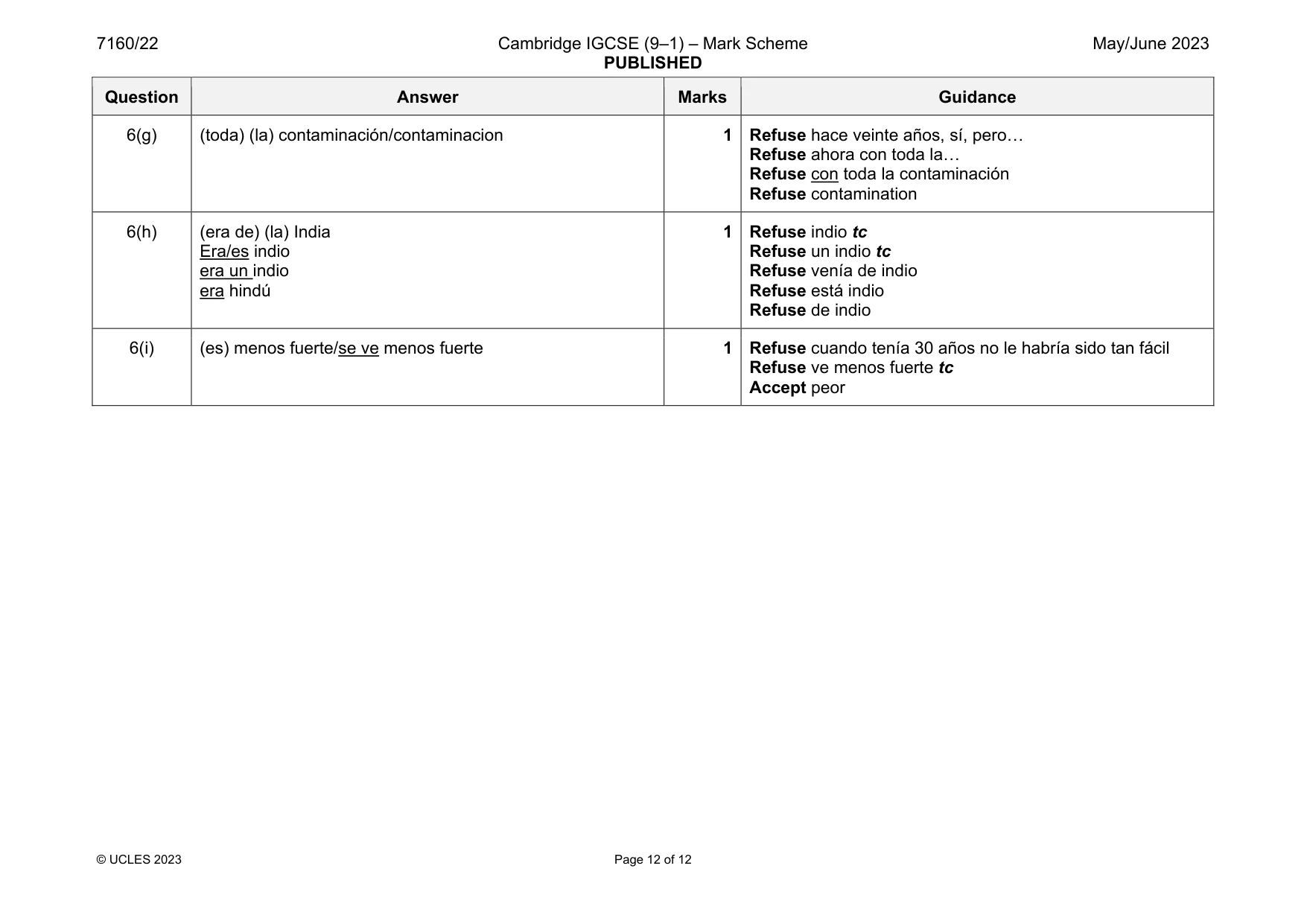
7160/22 Cambridge IGCSE (9–1) – Mark Scheme PUBLISHED May/June 2023 © UCLES 2023 Page 12 of 12 Question Answer Marks Guidance 6(g) (toda) (la) contaminación/contaminacion 1 Refuse hace veinte años, sí, pero… Refuse ahora con toda la… Refuse con toda la contaminación Refuse contamination 6(h) (era de) (la) India Era/es indio era un indio era hindú 1 Refuse indio tc Refuse un indio tc Refuse venía de indio Refuse está indio Refuse de indio 6(i) (es) menos fuerte/se ve menos fuerte 1 Refuse cuando tenía 30 años no le habría sido tan fácil Refuse ve menos fuerte tc Accept peor
What you needed in this session
Cambridge’s own grade thresholds for 2023 May/June, Paper 2 · Variant 2. A higher threshold means an easier paper — the bar moves with how the cohort did.