Cambridge IGCSE Spanish (9-1) 7160 — 2022 Oct/Nov Paper 2 · Variant 1
7160/21/O/N/22 · 45 marks · ≈51 min
The question paper and its mark scheme, free to read here and free to download. This is Cambridge’s own paper, exactly as it was sat.
Question paper12 pages

Mark scheme12 pages
Answers below. Sit the paper first if you are practising.
Paper as text
Question paper, page 1
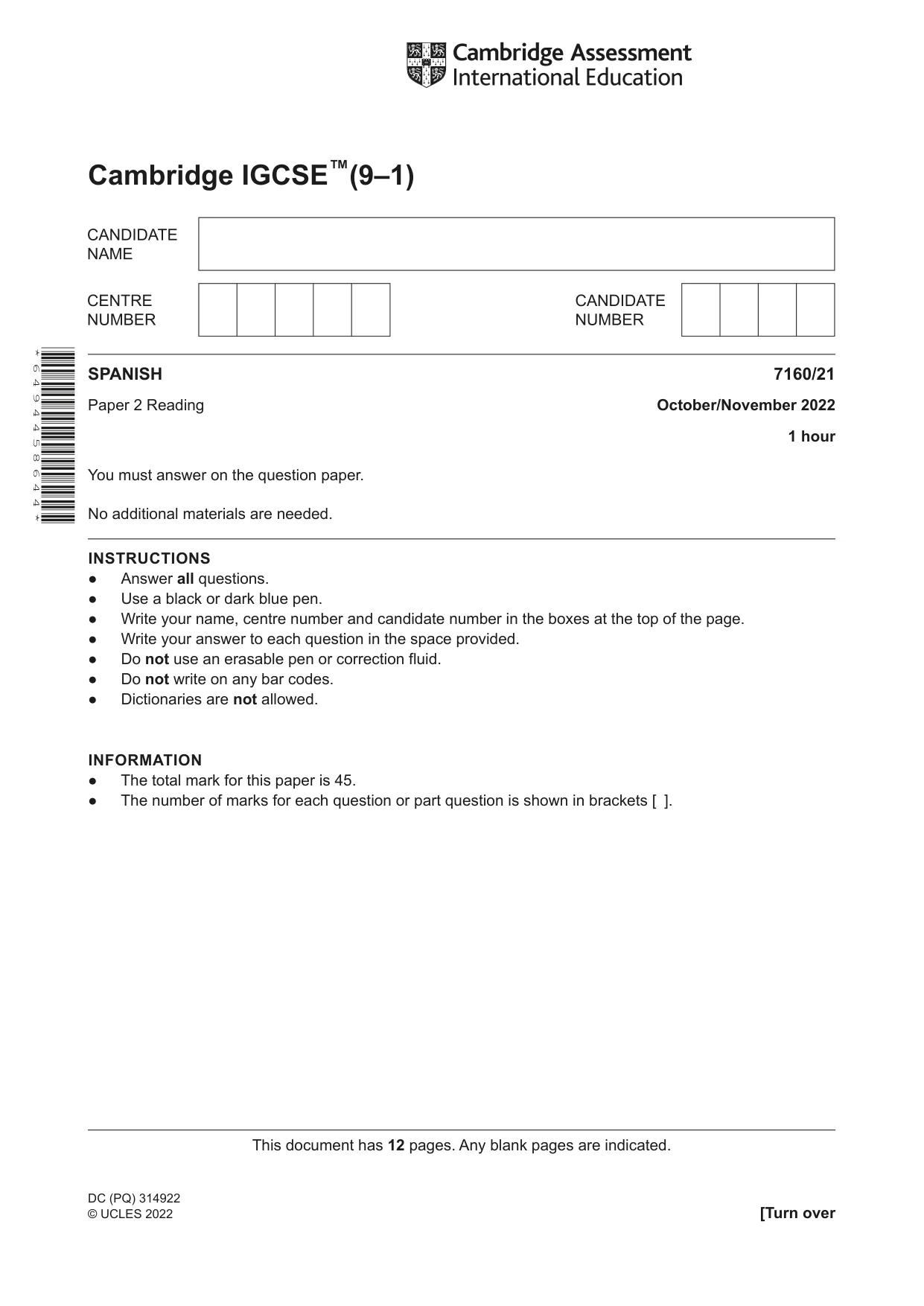
This document has 12 pages. Any blank pages are indicated. [Turn over Cambridge IGCSE™(9–1) DC (PQ) 314922 © UCLES 2022 * 6 4 9 4 4 5 8 6 4 4 * SPANISH 7160/21 Paper 2 Reading October/November 2022 1 hour You must answer on the question paper. No additional materials are needed. INSTRUCTIONS ● Answer all questions. ● Use a black or dark blue pen. ● Write your name, centre number and candidate number in the boxes at the top of the page. ● Write your answer to each question in the space provided. ● Do not use an erasable pen or correction fluid. ● Do not write on any bar codes. ● Dictionaries are not allowed. INFORMATION ● The total mark for this paper is 45. ● The number of marks for each question or part question is shown in brackets [ ].
Question paper, page 2
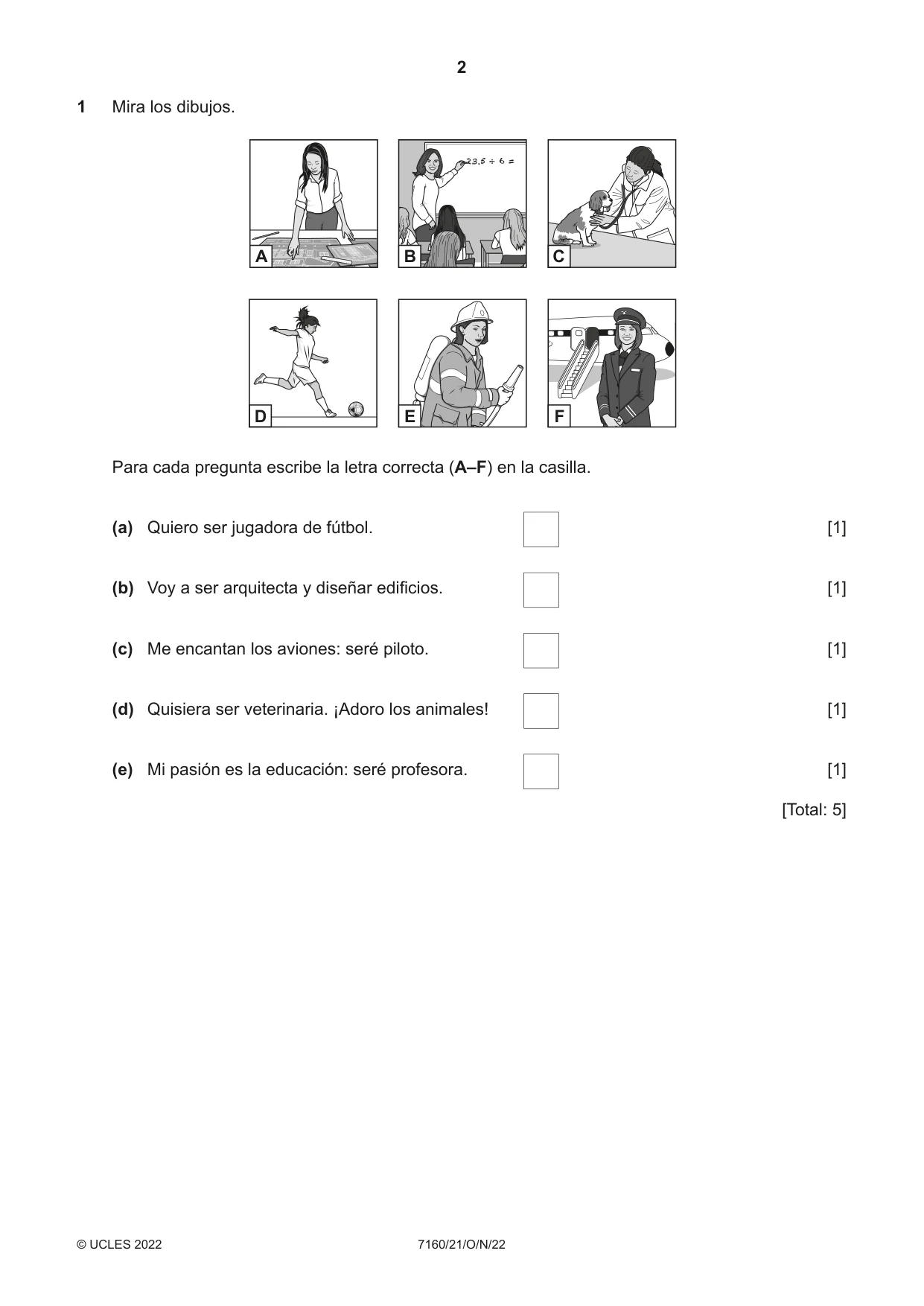
2 7160/21/O/N/22 © UCLES 2022 1 Mira los dibujos. C B A E D F Para cada pregunta escribe la letra correcta (A–F) en la casilla. (a) Quiero ser jugadora de fútbol. [1] (b) Voy a ser arquitecta y diseñar edificios. [1] (c) Me encantan los aviones: seré piloto. [1] (d) Quisiera ser veterinaria. ¡Adoro los animales! [1] (e) Mi pasión es la educación: seré profesora. [1] [Total: 5]
Question paper, page 3
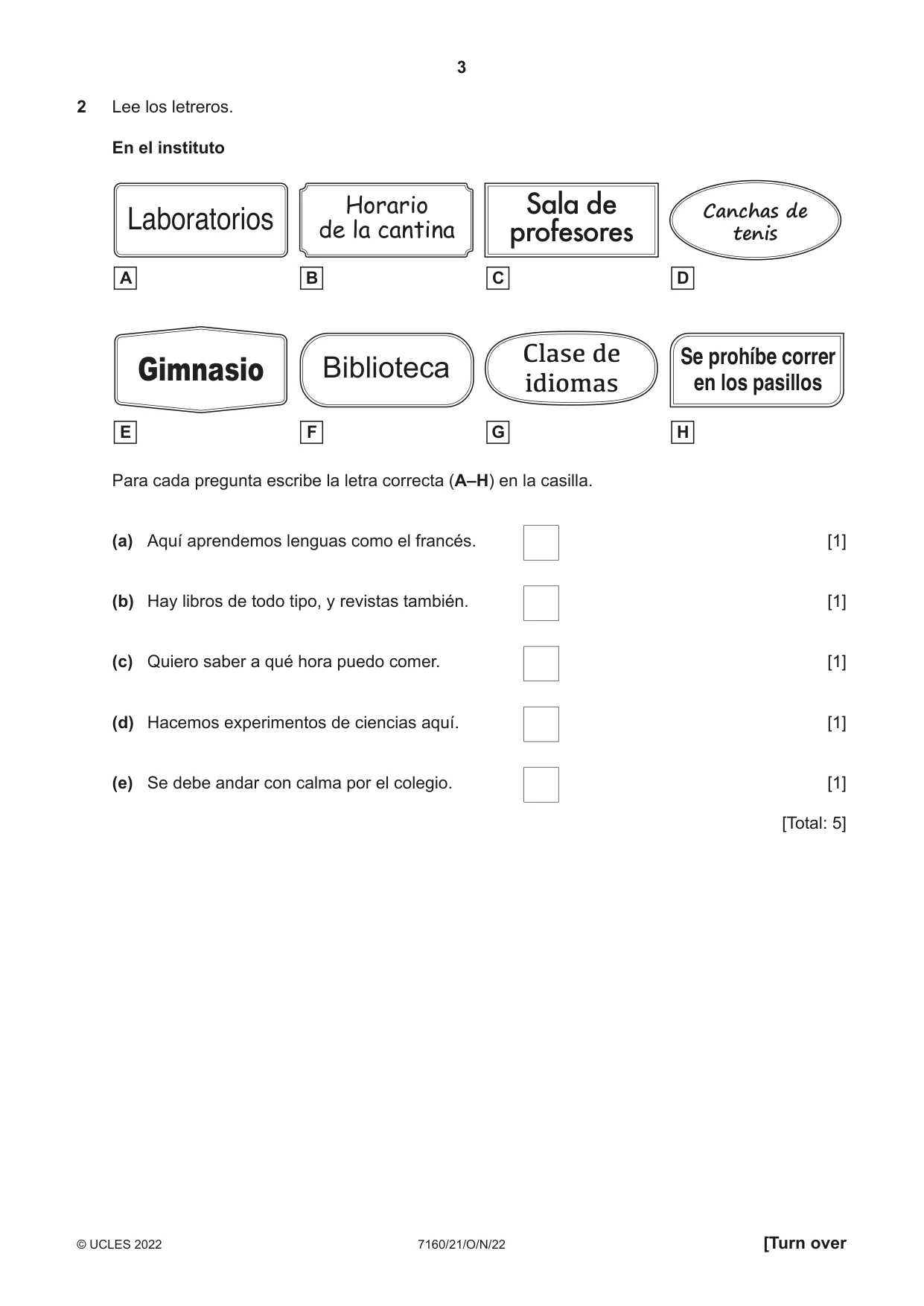
3 7160/21/O/N/22 © UCLES 2022 [Turn over 2 Lee los letreros. En el instituto Laboratorios Clase de idiomas Gimnasio Sala de profesores Canchas de tenis Se prohíbe correr en los pasillos A B C D E F G H Horario de la cantina Biblioteca Para cada pregunta escribe la letra correcta (A–H) en la casilla. (a) Aquí aprendemos lenguas como el francés. [1] (b) Hay libros de todo tipo, y revistas también. [1] (c) Quiero saber a qué hora puedo comer. [1] (d) Hacemos experimentos de ciencias aquí. [1] (e) Se debe andar con calma por el colegio. [1] [Total: 5]
Question paper, page 4
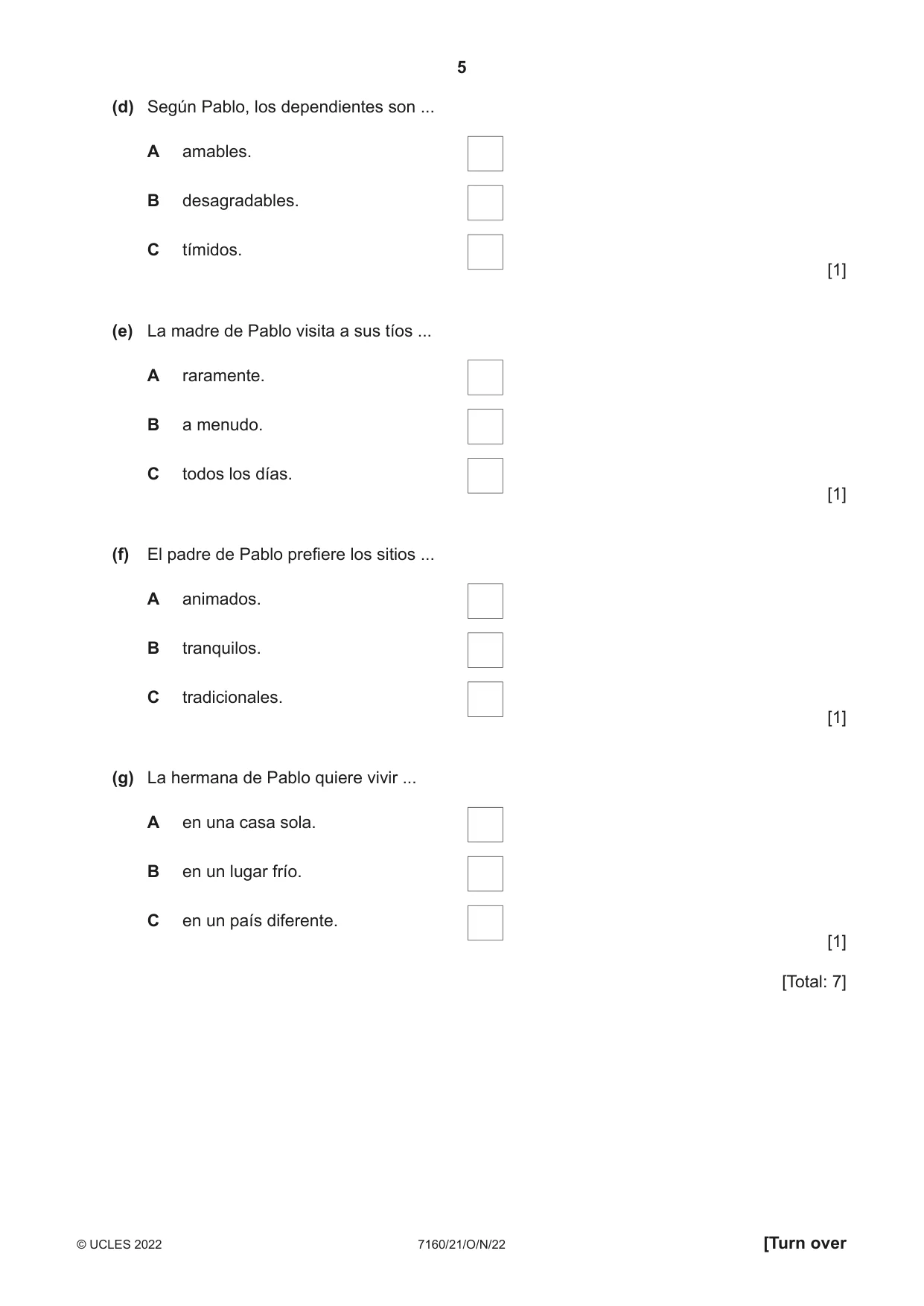
4 7160/21/O/N/22 © UCLES 2022 3 Lee el texto. Para cada pregunta indica tu respuesta escribiendo una X en la casilla correcta (A–C). Me llamo Pablo. Vivo cerca de la ciudad de Madrid en un pueblo pequeño al lado de un bosque. Nos mudamos a esta casa hace ocho años, cuando tenía siete años. No hay mucho aquí. Tenemos un parque donde los niños pueden jugar. También hay un río, pero lo que más me gusta son las tiendas. Los dependientes son muy simpáticos y nos conocen a todos. Mi madre es de la capital y visita a sus tíos allí frecuentemente, más o menos cada semana. Sin embargo, mi padre odia el tráfico; prefiere el silencio así que nunca va con ella. Solo tengo una hermana. Tiene 18 años y pronto va a ir a otro país para vivir con unos amigos. ¡Prefiere los sitios donde hace calor! (a) Pablo vive ... A en la ciudad. B en un pueblo. C en las montañas. [1] (b) Pablo vive en su casa desde hace ... A siete años. B ocho años. C nueve años. [1] (c) Pablo prefiere ... A el río. B la escuela. C las tiendas. [1]
Question paper, page 5
5 7160/21/O/N/22 © UCLES 2022 [Turn over (d) Según Pablo, los dependientes son ... A amables. B desagradables. C tímidos. [1] (e) La madre de Pablo visita a sus tíos ... A raramente. B a menudo. C todos los días. [1] (f) El padre de Pablo prefiere los sitios ... A animados. B tranquilos. C tradicionales. [1] (g) La hermana de Pablo quiere vivir ... A en una casa sola. B en un lugar frío. C en un país diferente. [1] [Total: 7]
Question paper, page 6
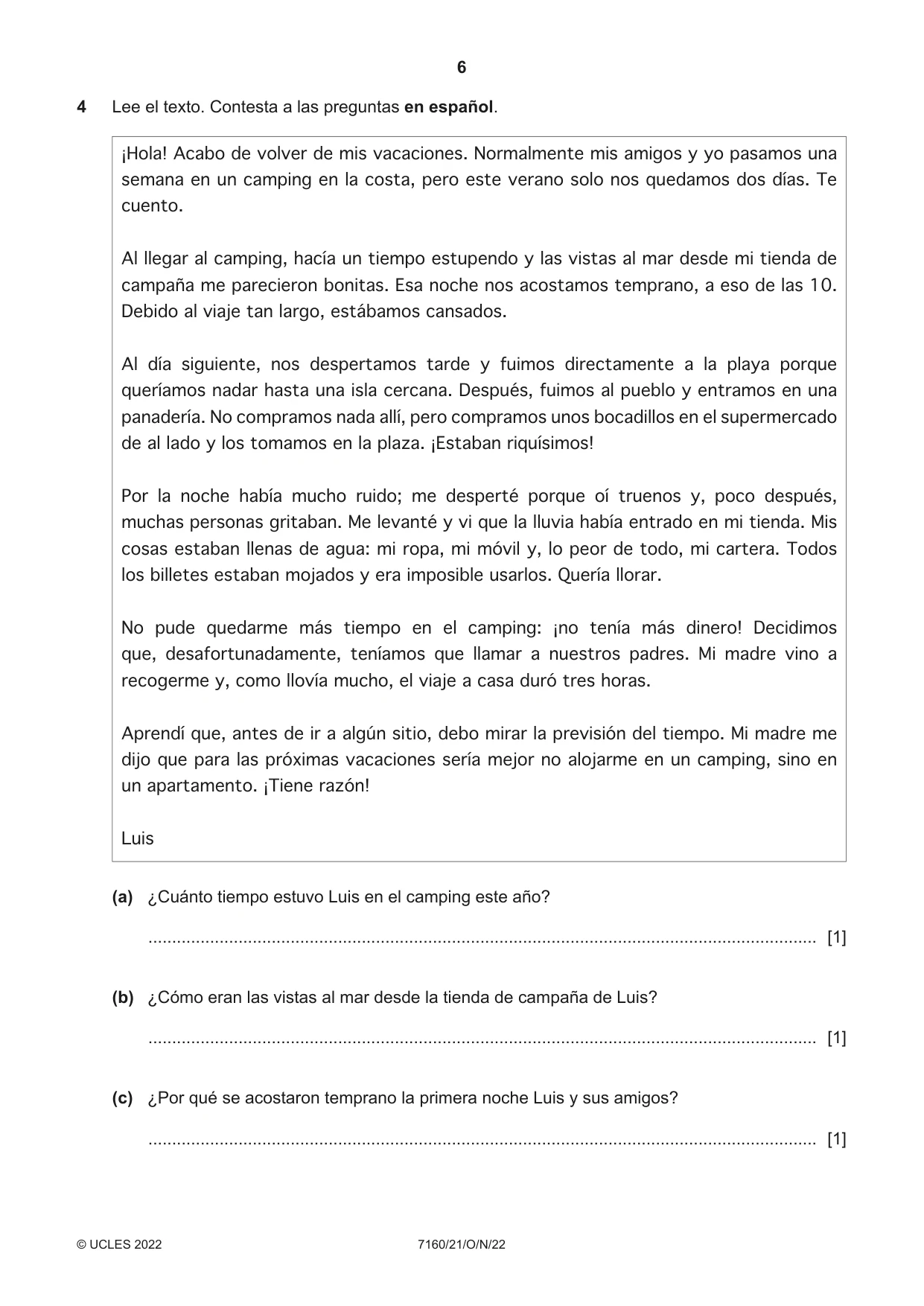
6 7160/21/O/N/22 © UCLES 2022 4 Lee el texto. Contesta a las preguntas en español. ¡Hola! Acabo de volver de mis vacaciones. Normalmente mis amigos y yo pasamos una semana en un camping en la costa, pero este verano solo nos quedamos dos días. Te cuento. Al llegar al camping, hacía un tiempo estupendo y las vistas al mar desde mi tienda de campaña me parecieron bonitas. Esa noche nos acostamos temprano, a eso de las 10. Debido al viaje tan largo, estábamos cansados. Al día siguiente, nos despertamos tarde y fuimos directamente a la playa porque queríamos nadar hasta una isla cercana. Después, fuimos al pueblo y entramos en una panadería. No compramos nada allí, pero compramos unos bocadillos en el supermercado de al lado y los tomamos en la plaza. ¡Estaban riquísimos! Por la noche había mucho ruido; me desperté porque oí truenos y, poco después, muchas personas gritaban. Me levanté y vi que la lluvia había entrado en mi tienda. Mis cosas estaban llenas de agua: mi ropa, mi móvil y, lo peor de todo, mi cartera. Todos los billetes estaban mojados y era imposible usarlos. Quería llorar. No pude quedarme más tiempo en el camping: ¡no tenía más dinero! Decidimos que, desafortunadamente, teníamos que llamar a nuestros padres. Mi madre vino a recogerme y, como llovía mucho, el viaje a casa duró tres horas. Aprendí que, antes de ir a algún sitio, debo mirar la previsión del tiempo. Mi madre me dijo que para las próximas vacaciones sería mejor no alojarme en un camping, sino en un apartamento. ¡Tiene razón! Luis (a) ¿Cuánto tiempo estuvo Luis en el camping este año? … [1] (b) ¿Cómo eran las vistas al mar desde la tienda de campaña de Luis? … [1] (c) ¿Por qué se acostaron temprano la primera noche Luis y sus amigos? … [1]
Question paper, page 7
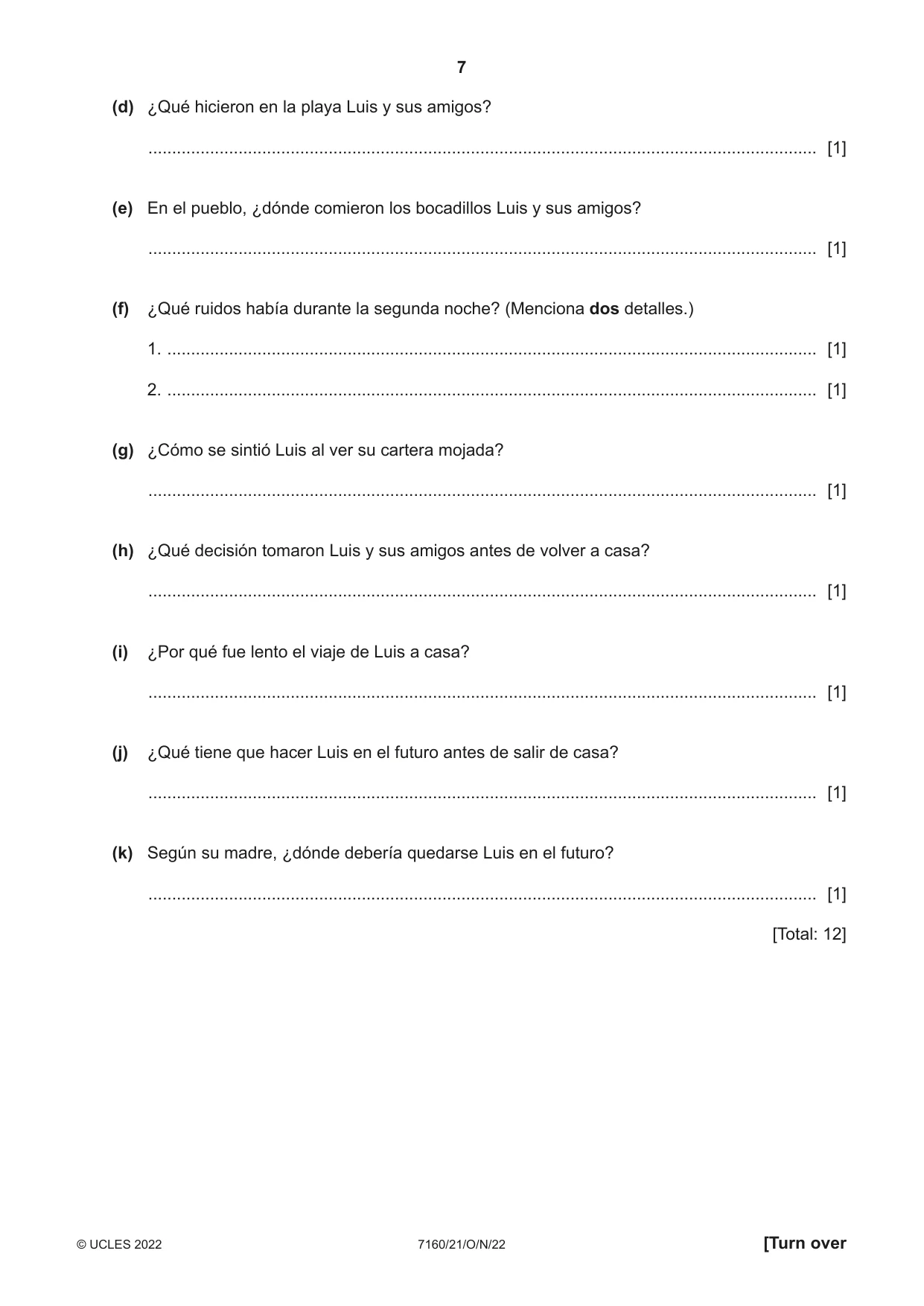
7 7160/21/O/N/22 © UCLES 2022 [Turn over (d) ¿Qué hicieron en la playa Luis y sus amigos? … [1] (e) En el pueblo, ¿dónde comieron los bocadillos Luis y sus amigos? … [1] (f) ¿Qué ruidos había durante la segunda noche? (Menciona dos detalles.) 1. … [1] 2. … [1] (g) ¿Cómo se sintió Luis al ver su cartera mojada? … [1] (h) ¿Qué decisión tomaron Luis y sus amigos antes de volver a casa? … [1] (i) ¿Por qué fue lento el viaje de Luis a casa? … [1] (j) ¿Qué tiene que hacer Luis en el futuro antes de salir de casa? … [1] (k) Según su madre, ¿dónde debería quedarse Luis en el futuro? … [1] [Total: 12]
Question paper, page 8
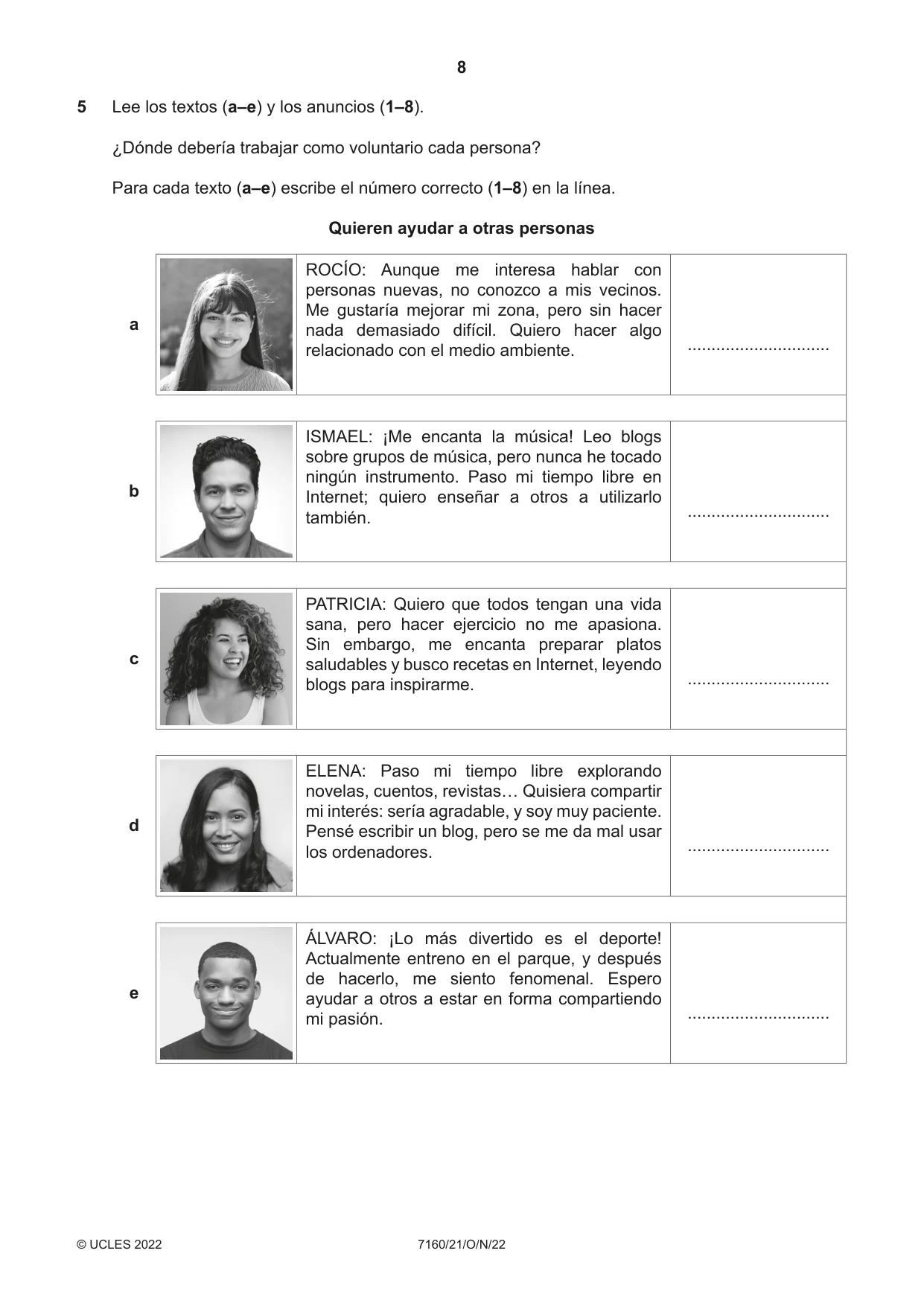
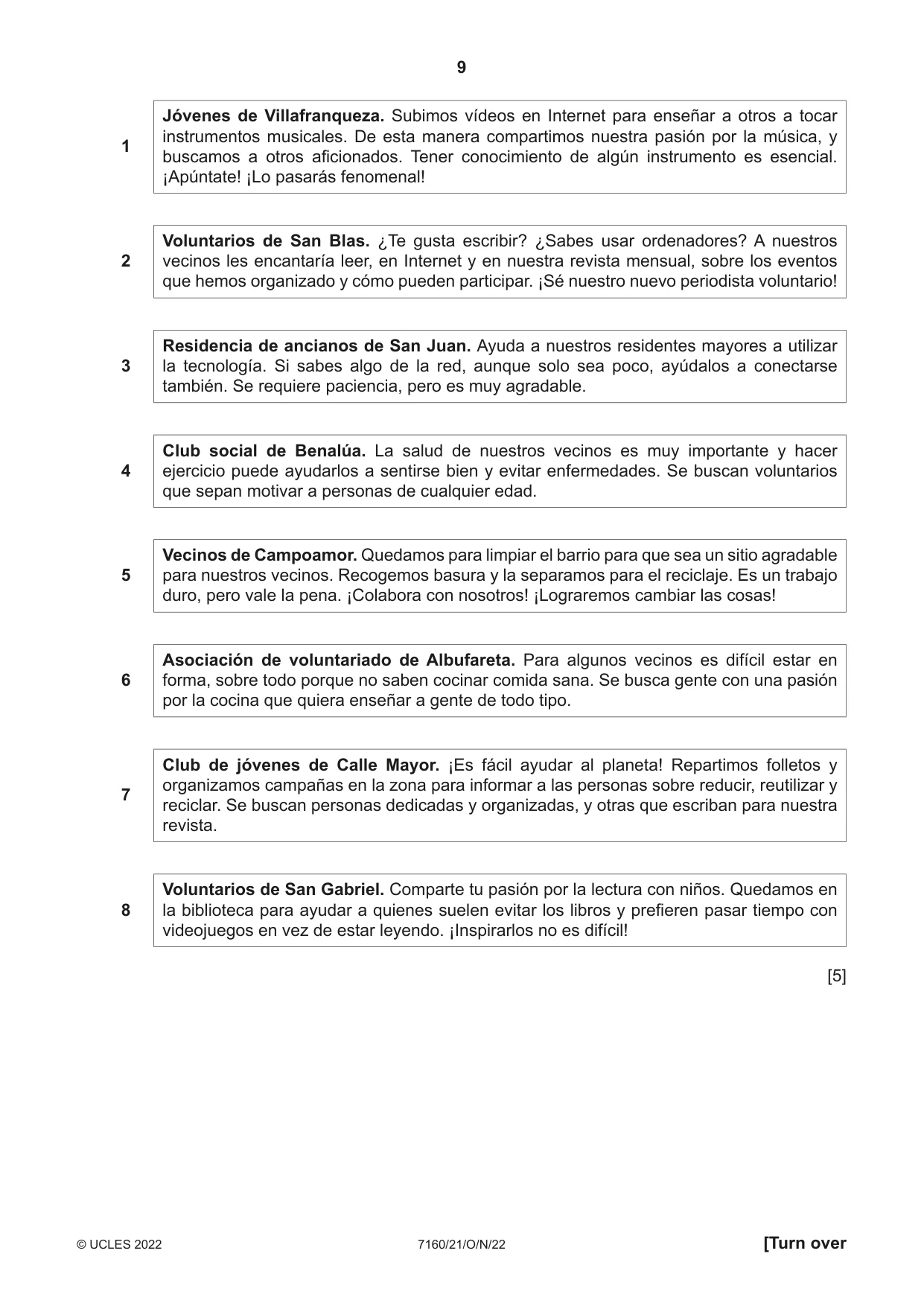
8 7160/21/O/N/22 © UCLES 2022 5 Lee los textos (a–e) y los anuncios (1–8). ¿Dónde debería trabajar como voluntario cada persona? Para cada texto (a–e) escribe el número correcto (1–8) en la línea. Quieren ayudar a otras personas a ROCÍO: Aunque me interesa hablar con personas nuevas, no conozco a mis vecinos. Me gustaría mejorar mi zona, pero sin hacer nada demasiado difícil. Quiero hacer algo relacionado con el medio ambiente. … b ISMAEL: ¡Me encanta la música! Leo blogs sobre grupos de música, pero nunca he tocado ningún instrumento. Paso mi tiempo libre en Internet; quiero enseñar a otros a utilizarlo también. … c PATRICIA: Quiero que todos tengan una vida sana, pero hacer ejercicio no me apasiona. Sin embargo, me encanta preparar platos saludables y busco recetas en Internet, leyendo blogs para inspirarme. … d ELENA: Paso mi tiempo libre explorando novelas, cuentos, revistas… Quisiera compartir mi interés: sería agradable, y soy muy paciente. Pensé escribir un blog, pero se me da mal usar los ordenadores. … e ÁLVARO: ¡Lo más divertido es el deporte! Actualmente entreno en el parque, y después de hacerlo, me siento fenomenal. Espero ayudar a otros a estar en forma compartiendo mi pasión. …
Question paper, page 9
9 7160/21/O/N/22 © UCLES 2022 [Turn over 1 Jóvenes de Villafranqueza. Subimos vídeos en Internet para enseñar a otros a tocar instrumentos musicales. De esta manera compartimos nuestra pasión por la música, y buscamos a otros aficionados. Tener conocimiento de algún instrumento es esencial. ¡Apúntate! ¡Lo pasarás fenomenal! 2 Voluntarios de San Blas. ¿Te gusta escribir? ¿Sabes usar ordenadores? A nuestros vecinos les encantaría leer, en Internet y en nuestra revista mensual, sobre los eventos que hemos organizado y cómo pueden participar. ¡Sé nuestro nuevo periodista voluntario! 3 Residencia de ancianos de San Juan. Ayuda a nuestros residentes mayores a utilizar la tecnología. Si sabes algo de la red, aunque solo sea poco, ayúdalos a conectarse también. Se requiere paciencia, pero es muy agradable. 4 Club social de Benalúa. La salud de nuestros vecinos es muy importante y hacer ejercicio puede ayudarlos a sentirse bien y evitar enfermedades. Se buscan voluntarios que sepan motivar a personas de cualquier edad. 5 Vecinos de Campoamor. Quedamos para limpiar el barrio para que sea un sitio agradable para nuestros vecinos. Recogemos basura y la separamos para el reciclaje. Es un trabajo duro, pero vale la pena. ¡Colabora con nosotros! ¡Lograremos cambiar las cosas! 6 Asociación de voluntariado de Albufareta. Para algunos vecinos es difícil estar en forma, sobre todo porque no saben cocinar comida sana. Se busca gente con una pasión por la cocina que quiera enseñar a gente de todo tipo. 7 Club de jóvenes de Calle Mayor. ¡Es fácil ayudar al planeta! Repartimos folletos y organizamos campañas en la zona para informar a las personas sobre reducir, reutilizar y reciclar. Se buscan personas dedicadas y organizadas, y otras que escriban para nuestra revista. 8 Voluntarios de San Gabriel. Comparte tu pasión por la lectura con niños. Quedamos en la biblioteca para ayudar a quienes suelen evitar los libros y prefieren pasar tiempo con videojuegos en vez de estar leyendo. ¡Inspirarlos no es difícil! [5]
Question paper, page 10
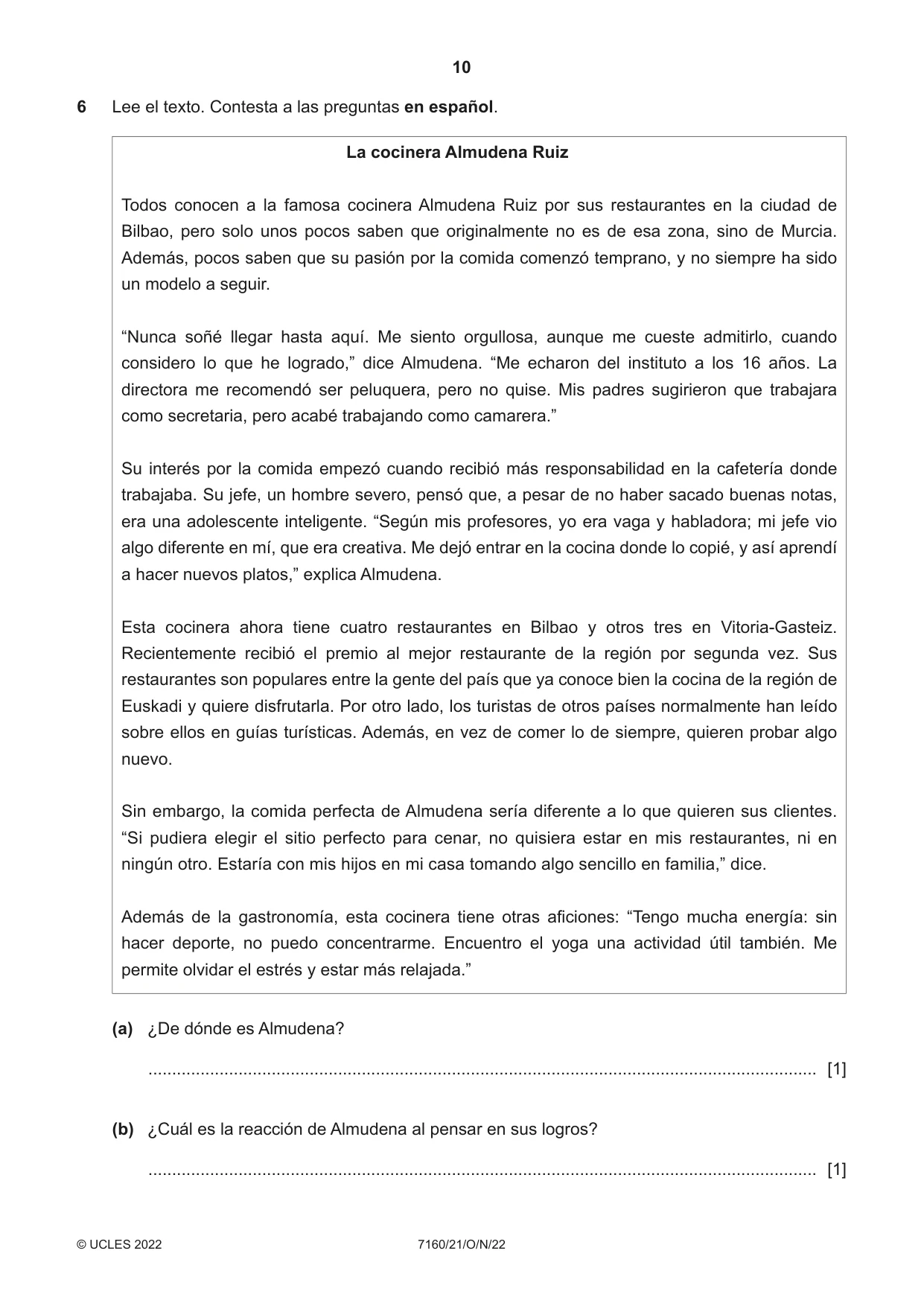
10 7160/21/O/N/22 © UCLES 2022 6 Lee el texto. Contesta a las preguntas en español. La cocinera Almudena Ruiz Todos conocen a la famosa cocinera Almudena Ruiz por sus restaurantes en la ciudad de Bilbao, pero solo unos pocos saben que originalmente no es de esa zona, sino de Murcia. Además, pocos saben que su pasión por la comida comenzó temprano, y no siempre ha sido un modelo a seguir. “Nunca soñé llegar hasta aquí. Me siento orgullosa, aunque me cueste admitirlo, cuando considero lo que he logrado,” dice Almudena. “Me echaron del instituto a los 16 años. La directora me recomendó ser peluquera, pero no quise. Mis padres sugirieron que trabajara como secretaria, pero acabé trabajando como camarera.” Su interés por la comida empezó cuando recibió más responsabilidad en la cafetería donde trabajaba. Su jefe, un hombre severo, pensó que, a pesar de no haber sacado buenas notas, era una adolescente inteligente. “Según mis profesores, yo era vaga y habladora; mi jefe vio algo diferente en mí, que era creativa. Me dejó entrar en la cocina donde lo copié, y así aprendí a hacer nuevos platos,” explica Almudena. Esta cocinera ahora tiene cuatro restaurantes en Bilbao y otros tres en Vitoria-Gasteiz. Recientemente recibió el premio al mejor restaurante de la región por segunda vez. Sus restaurantes son populares entre la gente del país que ya conoce bien la cocina de la región de Euskadi y quiere disfrutarla. Por otro lado, los turistas de otros países normalmente han leído sobre ellos en guías turísticas. Además, en vez de comer lo de siempre, quieren probar algo nuevo. Sin embargo, la comida perfecta de Almudena sería diferente a lo que quieren sus clientes. “Si pudiera elegir el sitio perfecto para cenar, no quisiera estar en mis restaurantes, ni en ningún otro. Estaría con mis hijos en mi casa tomando algo sencillo en familia,” dice. Además de la gastronomía, esta cocinera tiene otras aficiones: “Tengo mucha energía: sin hacer deporte, no puedo concentrarme. Encuentro el yoga una actividad útil también. Me permite olvidar el estrés y estar más relajada.” (a) ¿De dónde es Almudena? … [1] (b) ¿Cuál es la reacción de Almudena al pensar en sus logros? … [1]
Question paper, page 11
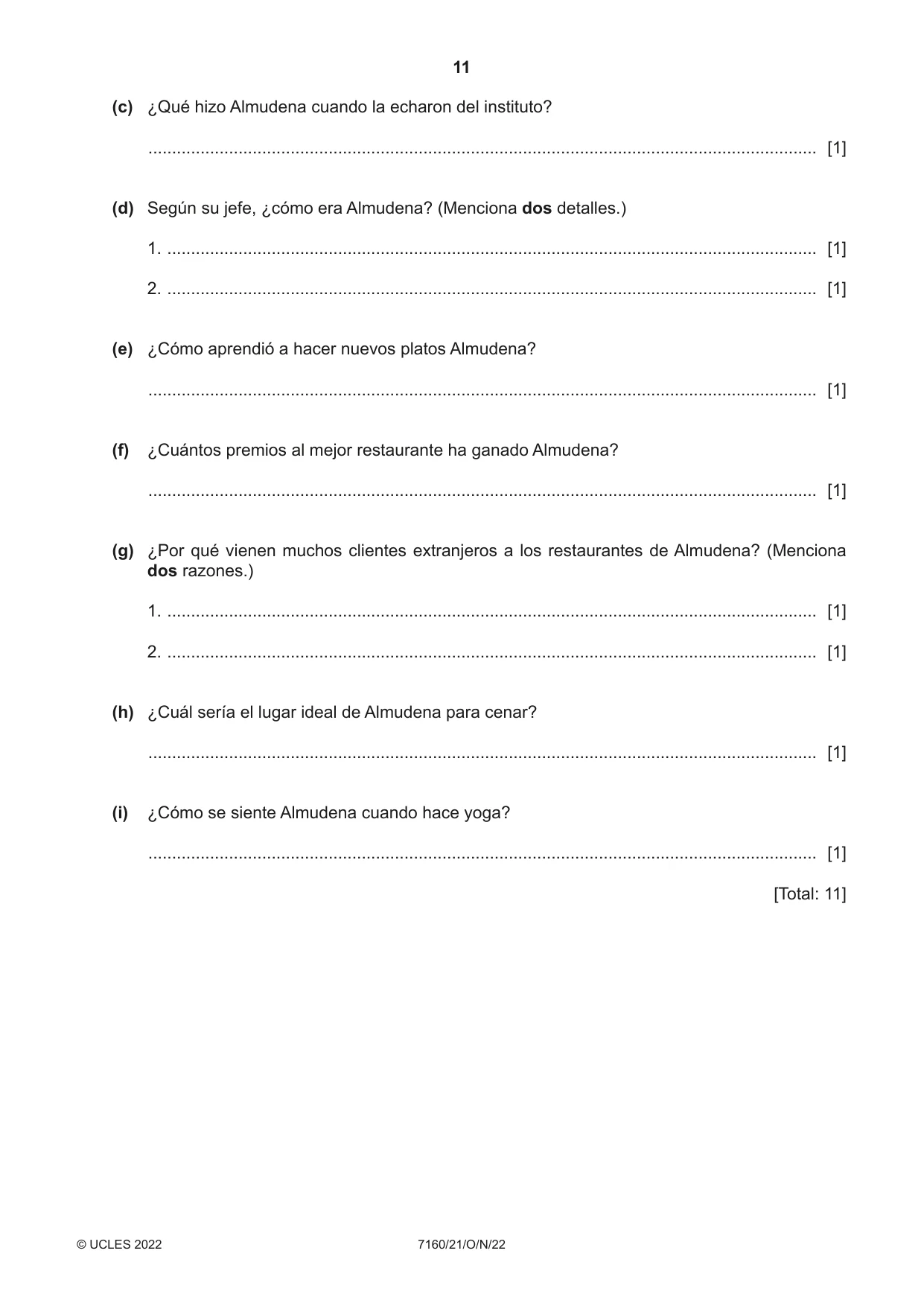
11 7160/21/O/N/22 © UCLES 2022 (c) ¿Qué hizo Almudena cuando la echaron del instituto? … [1] (d) Según su jefe, ¿cómo era Almudena? (Menciona dos detalles.) 1. … [1] 2. … [1] (e) ¿Cómo aprendió a hacer nuevos platos Almudena? … [1] (f) ¿Cuántos premios al mejor restaurante ha ganado Almudena? … [1] (g) ¿Por qué vienen muchos clientes extranjeros a los restaurantes de Almudena? (Menciona dos razones.) 1. … [1] 2. … [1] (h) ¿Cuál sería el lugar ideal de Almudena para cenar? … [1] (i) ¿Cómo se siente Almudena cuando hace yoga? … [1] [Total: 11]
Question paper, page 12
12 7160/21/O/N/22 © UCLES 2022 Permission to reproduce items where third-party owned material protected by copyright is included has been sought and cleared where possible. Every reasonable effort has been made by the publisher (UCLES) to trace copyright holders, but if any items requiring clearance have unwittingly been included, the publisher will be pleased to make amends at the earliest possible opportunity. To avoid the issue of disclosure of answer-related information to candidates, all copyright acknowledgements are reproduced online in the Cambridge Assessment International Education Copyright Acknowledgements Booklet. This is produced for each series of examinations and is freely available to download at www.cambridgeinternational.org after the live examination series. Cambridge Assessment International Education is part of Cambridge Assessment. Cambridge Assessment is the brand name of the University of Cambridge Local Examinations Syndicate (UCLES), which is a department of the University of Cambridge. BLANK PAGE
Mark scheme, page 1
This document consists of 12 printed pages. © UCLES 2022 [Turn over Cambridge IGCSE™ (9–1) SPANISH 7160/21 Paper 2 Reading October/November 2022 MARK SCHEME Maximum Mark: 45 Published This mark scheme is published as an aid to teachers and candidates, to indicate the requirements of the examination. It shows the basis on which Examiners were instructed to award marks. It does not indicate the details of the discussions that took place at an Examiners’ meeting before marking began, which would have considered the acceptability of alternative answers. Mark schemes should be read in conjunction with the question paper and the Principal Examiner Report for Teachers. Cambridge International will not enter into discussions about these mark schemes. Cambridge International is publishing the mark schemes for the October/November 2022 series for most Cambridge IGCSE™, Cambridge International A and AS Level components and some Cambridge O Level components.
Mark scheme, page 2
7160/21 Cambridge IGCSE (9–1) – Mark Scheme PUBLISHED October/November 2022 © UCLES 2022 Page 2 of 12 Generic Marking Principles These general marking principles must be applied by all examiners when marking candidate answers. They should be applied alongside the specific content of the mark scheme or generic level descriptors for a question. Each question paper and mark scheme will also comply with these marking principles. GENERIC MARKING PRINCIPLE 1: Marks must be awarded in line with: the specific content of the mark scheme or the generic level descriptors for the question the specific skills defined in the mark scheme or in the generic level descriptors for the question the standard of response required by a candidate as exemplified by the standardisation scripts. GENERIC MARKING PRINCIPLE 2: Marks awarded are always whole marks (not half marks, or other fractions). GENERIC MARKING PRINCIPLE 3: Marks must be awarded positively: • marks are awarded for correct/valid answers, as defined in the mark scheme. However, credit is given for valid answers which go beyond the scope of the syllabus and mark scheme, referring to your Team Leader as appropriate • marks are awarded when candidates clearly demonstrate what they know and can do • marks are not deducted for errors • marks are not deducted for omissions • answers should only be judged on the quality of spelling, punctuation and grammar when these features are specifically assessed by the question as indicated by the mark scheme. The meaning, however, should be unambiguous. GENERIC MARKING PRINCIPLE 4: Rules must be applied consistently, e.g. in situations where candidates have not followed instructions or in the application of generic level descriptors.
Mark scheme, page 3
7160/21 Cambridge IGCSE (9–1) – Mark Scheme PUBLISHED October/November 2022 © UCLES 2022 Page 3 of 12 GENERIC MARKING PRINCIPLE 5: Marks should be awarded using the full range of marks defined in the mark scheme for the question (however; the use of the full mark range may be limited according to the quality of the candidate responses seen). GENERIC MARKING PRINCIPLE 6: Marks awarded are based solely on the requirements as defined in the mark scheme. Marks should not be awarded with grade thresholds or grade descriptors in mind. Additional Guidance The following guidance underpins the detailed instructions provided in the mark scheme. Where a decision is taken to deviate from this guidance for a particular question, this will be specified in the mark scheme. Often the additional guidance points will have to be weighed up against each other, e.g. the answer might look or sound like the intended word/phrase in Spanish, but if what the candidate has written means something different in Spanish from what is expected, the mark cannot be awarded. It is not possible to list all acceptable alternatives in the mark scheme. If you encounter an answer which is not covered by the mark scheme, you will need to make a decision about whether it communicates the required elements (in consultation with your Team Leader if necessary, or with your Product Manager if you are a single examiner), and award marks accordingly. • Crossing out: (a) If a candidate changes his/her mind about an answer and crosses out an attempt, award a mark if the final attempt is correct. (b) If a candidate crosses out an answer to a whole question but makes no second attempt at it, mark the crossed out work.
Mark scheme, page 4
7160/21 Cambridge IGCSE (9–1) – Mark Scheme PUBLISHED October/November 2022 © UCLES 2022 Page 4 of 12 • More than the stipulated number of boxes ticked/crossed by the candidate: (a) If more than one attempt is visible but the candidate has clearly indicated which attempt is his/her final answer (e.g. by crossing out other attempts or by annotating the script in some way), mark in the usual way. (b) If two attempts are visible (e.g. two boxes ticked instead of the one box stipulated), and neither has been crossed out/discounted by the candidate, no mark can be awarded. • For questions requiring more than one element for the answer, 1 and 2, where the answers are interchangeable: (a) Both of the correct answers are on line 1 and line 2 blank (or vice versa) = 2 marks (b) Both correct answers on line 1 and line 2 contains a wrong answer (or vice versa) = 1 mark • Mark for communication: Answers requiring the use of Spanish (rather than a non-verbal response) should be marked for communication. Tolerate inaccuracies provided that the message is clear. However, do not accept incorrect Spanish if the word written by the candidate means something else in Spanish (unless the mark scheme specifies otherwise). (a) If you read aloud what the candidate has written, does it sound like the correct answer? Would a native speaker of Spanish understand it? (b) Does what the candidate has written look like the correct answer, e.g. one letter missing but no other word created? Would a native speaker of Spanish understand it? (c) Tolerate incorrect auxiliaries and incorrect use of the infinitive unless the mark scheme specifies otherwise. • Annotations used in the mark scheme: (a) INV = invalidation. This is used when the additional material included by the candidate is judged to invalidate an otherwise correct answer and therefore prevents him/her from scoring the mark. (INV = 0) (b) tc = ‘tout court’. This means that, on its own, the material is not sufficient to score the mark. (c) HA = harmless addition. This means that the candidate has included additional material which, in conjunction with the correct answer, does not prevent him/her from scoring the mark.
Mark scheme, page 5
7160/21 Cambridge IGCSE (9–1) – Mark Scheme PUBLISHED October/November 2022 © UCLES 2022 Page 5 of 12 • No response and ‘0’ marks: (a) Award NR (no response): If there is nothing written at all in the answer space or If there is only a comment which does not in any way relate to the question being asked (e.g. ‘can’t do’ or ‘don’t know’) or If there is only a mark which isn’t an attempt at the question (e.g. a dash, a question mark). (b) Award 0: If there is any attempt that earns no credit, e.g. the candidate has copied out part or all of the question.
Mark scheme, page 6
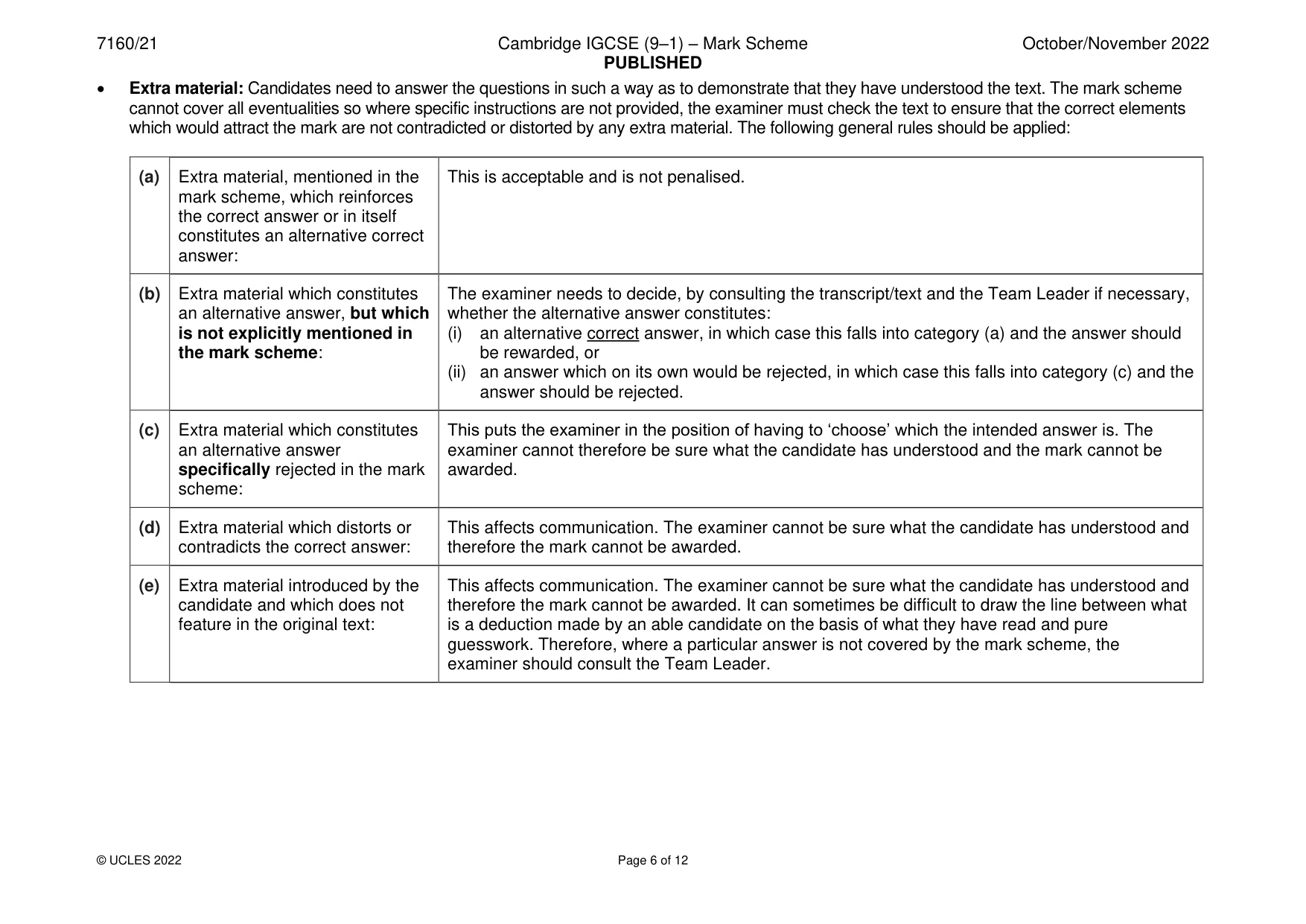
7160/21 Cambridge IGCSE (9–1) – Mark Scheme PUBLISHED October/November 2022 © UCLES 2022 Page 6 of 12 • Extra material: Candidates need to answer the questions in such a way as to demonstrate that they have understood the text. The mark scheme cannot cover all eventualities so where specific instructions are not provided, the examiner must check the text to ensure that the correct elements which would attract the mark are not contradicted or distorted by any extra material. The following general rules should be applied: (a) Extra material, mentioned in the mark scheme, which reinforces the correct answer or in itself constitutes an alternative correct answer: This is acceptable and is not penalised. (b) Extra material which constitutes an alternative answer, but which is not explicitly mentioned in the mark scheme: The examiner needs to decide, by consulting the transcript/text and the Team Leader if necessary, whether the alternative answer constitutes: (i) an alternative correct answer, in which case this falls into category (a) and the answer should be rewarded, or (ii) an answer which on its own would be rejected, in which case this falls into category (c) and the answer should be rejected. (c) Extra material which constitutes an alternative answer specifically rejected in the mark scheme: This puts the examiner in the position of having to ‘choose’ which the intended answer is. The examiner cannot therefore be sure what the candidate has understood and the mark cannot be awarded. (d) Extra material which distorts or contradicts the correct answer: This affects communication. The examiner cannot be sure what the candidate has understood and therefore the mark cannot be awarded. (e) Extra material introduced by the candidate and which does not feature in the original text: This affects communication. The examiner cannot be sure what the candidate has understood and therefore the mark cannot be awarded. It can sometimes be difficult to draw the line between what is a deduction made by an able candidate on the basis of what they have read and pure guesswork. Therefore, where a particular answer is not covered by the mark scheme, the examiner should consult the Team Leader.
Mark scheme, page 7
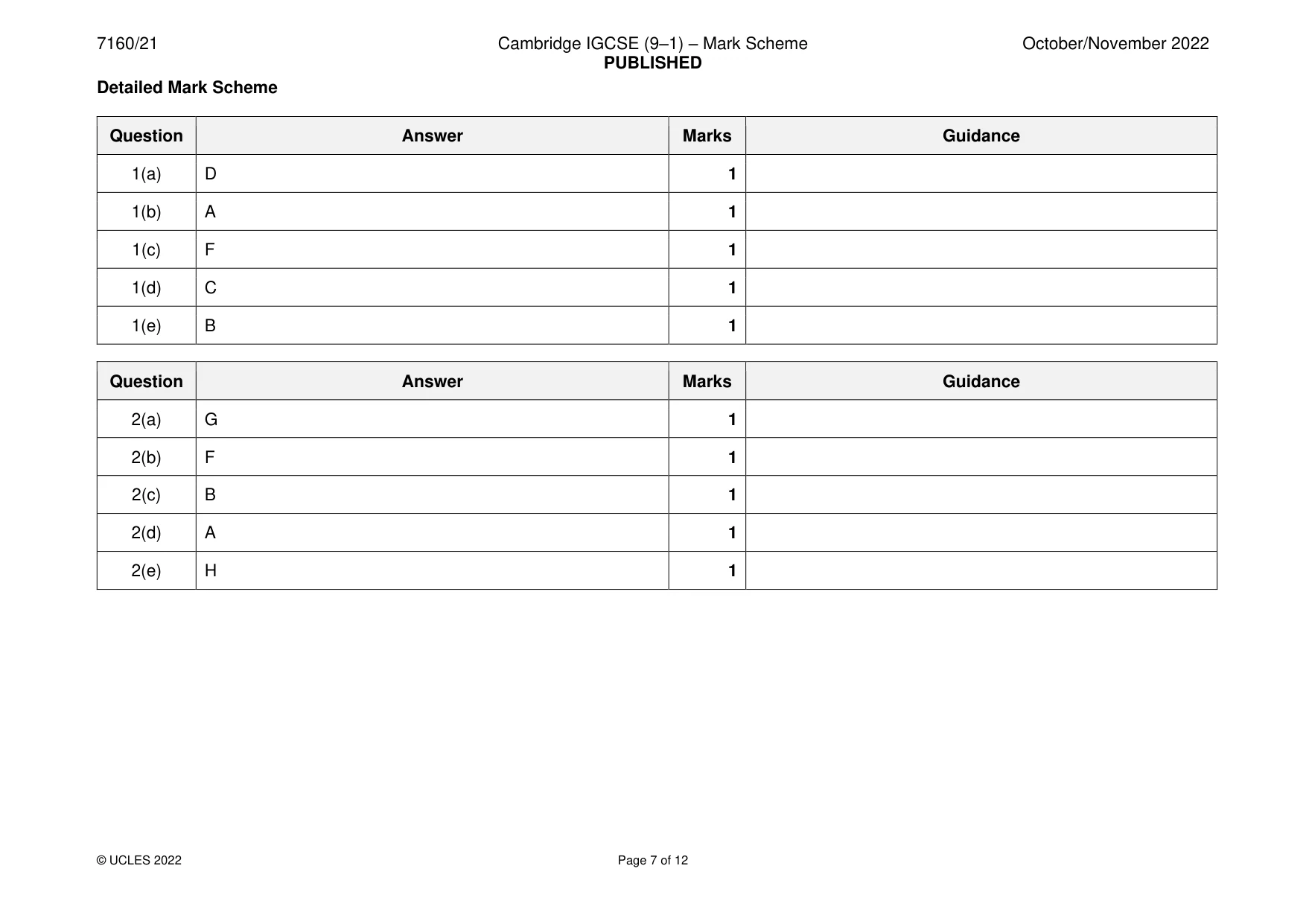
7160/21 Cambridge IGCSE (9–1) – Mark Scheme PUBLISHED October/November 2022 © UCLES 2022 Page 7 of 12 Detailed Mark Scheme Question Answer Marks Guidance 1(a) D 1 1(b) A 1 1(c) F 1 1(d) C 1 1(e) B 1 Question Answer Marks Guidance 2(a) G 1 2(b) F 1 2(c) B 1 2(d) A 1 2(e) H 1
Mark scheme, page 8
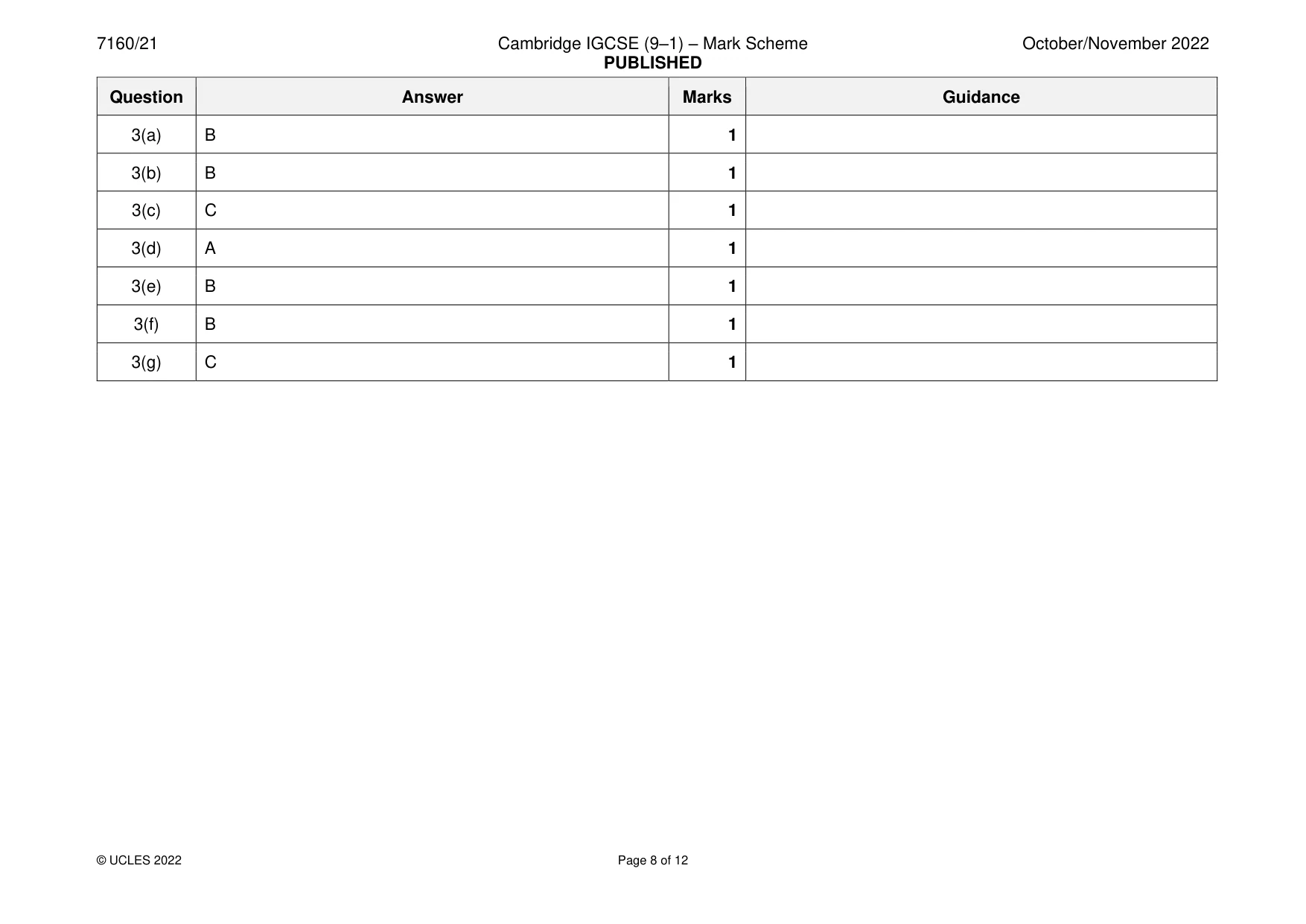
7160/21 Cambridge IGCSE (9–1) – Mark Scheme PUBLISHED October/November 2022 © UCLES 2022 Page 8 of 12 Question Answer Marks Guidance 3(a) B 1 3(b) B 1 3(c) C 1 3(d) A 1 3(e) B 1 3(f) B 1 3(g) C 1
Mark scheme, page 9
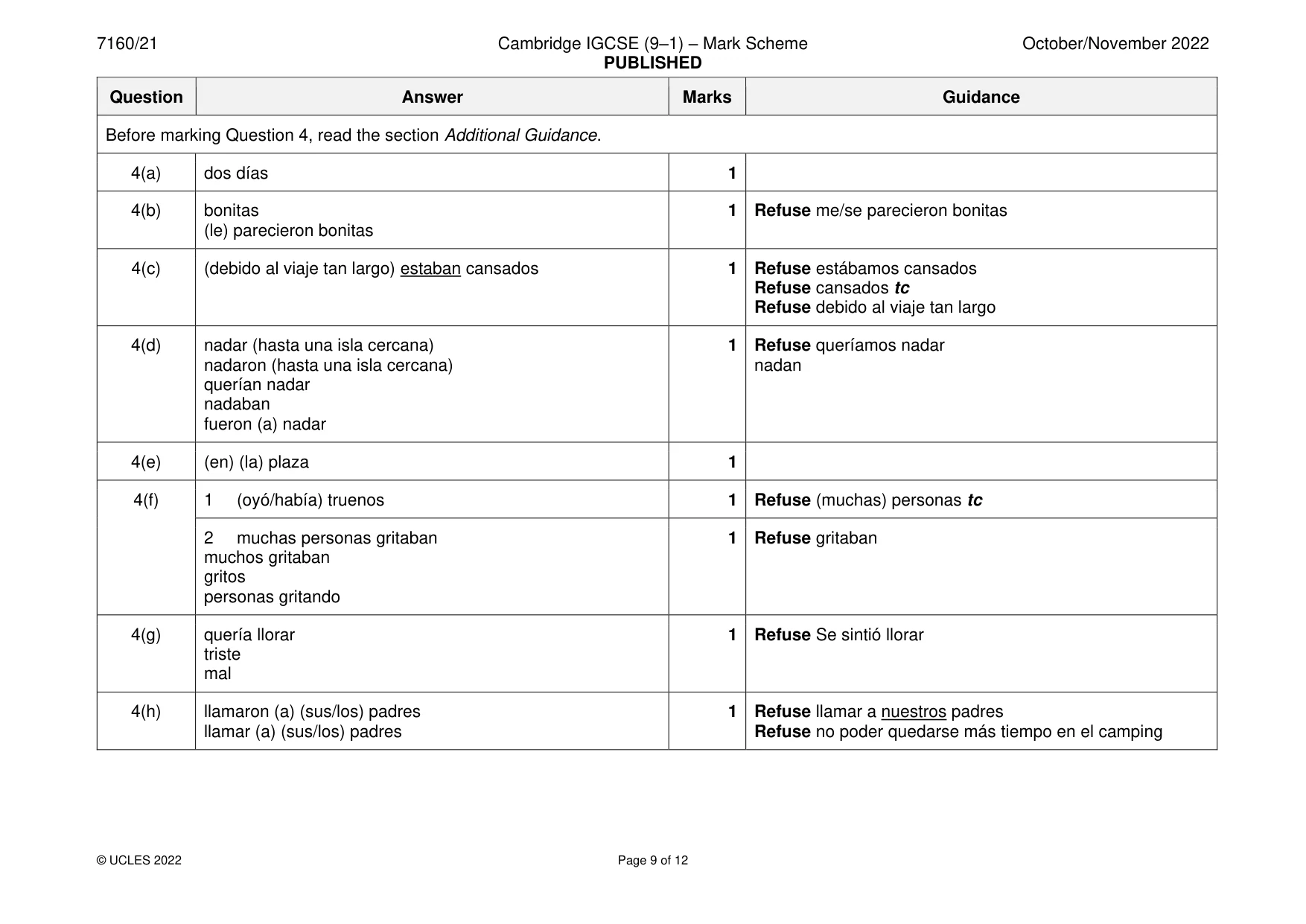
7160/21 Cambridge IGCSE (9–1) – Mark Scheme PUBLISHED October/November 2022 © UCLES 2022 Page 9 of 12 Question Answer Marks Guidance Before marking Question 4, read the section Additional Guidance. 4(a) dos días 1 4(b) bonitas (le) parecieron bonitas 1 Refuse me/se parecieron bonitas 4(c) (debido al viaje tan largo) estaban cansados 1 Refuse estábamos cansados Refuse cansados tc Refuse debido al viaje tan largo 4(d) nadar (hasta una isla cercana) nadaron (hasta una isla cercana) querían nadar nadaban fueron (a) nadar 1 Refuse queríamos nadar nadan 4(e) (en) (la) plaza 1 4(f) 1 (oyó/había) truenos 1 Refuse (muchas) personas tc 2 muchas personas gritaban muchos gritaban gritos personas gritando 1 Refuse gritaban 4(g) quería llorar triste mal 1 Refuse Se sintió llorar 4(h) llamaron (a) (sus/los) padres llamar (a) (sus/los) padres 1 Refuse llamar a nuestros padres Refuse no poder quedarse más tiempo en el camping
Mark scheme, page 10
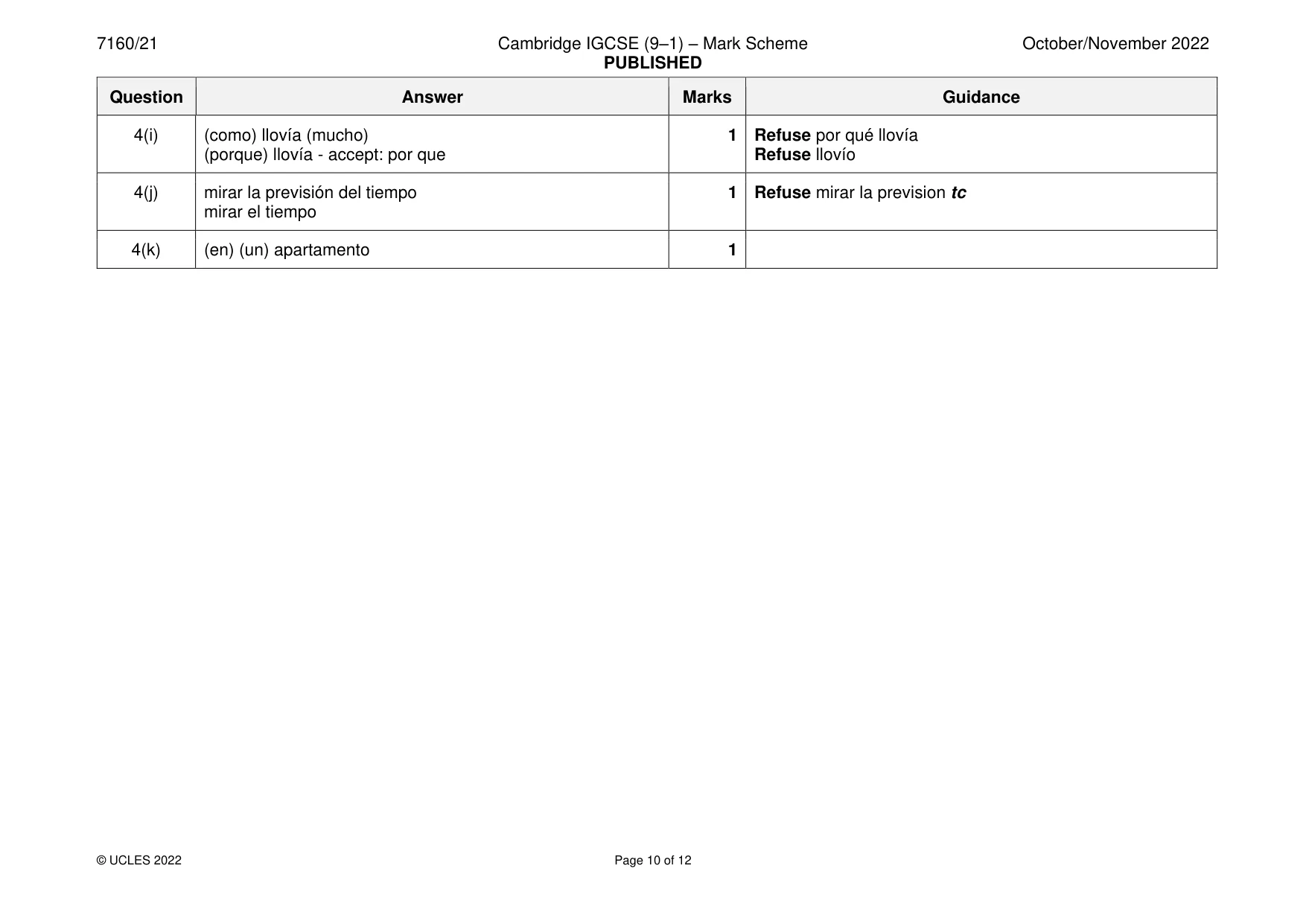
7160/21 Cambridge IGCSE (9–1) – Mark Scheme PUBLISHED October/November 2022 © UCLES 2022 Page 10 of 12 Question Answer Marks Guidance 4(i) (como) llovía (mucho) (porque) llovía - accept: por que 1 Refuse por qué llovía Refuse llovío 4(j) mirar la previsión del tiempo mirar el tiempo 1 Refuse mirar la prevision tc 4(k) (en) (un) apartamento 1
Mark scheme, page 11
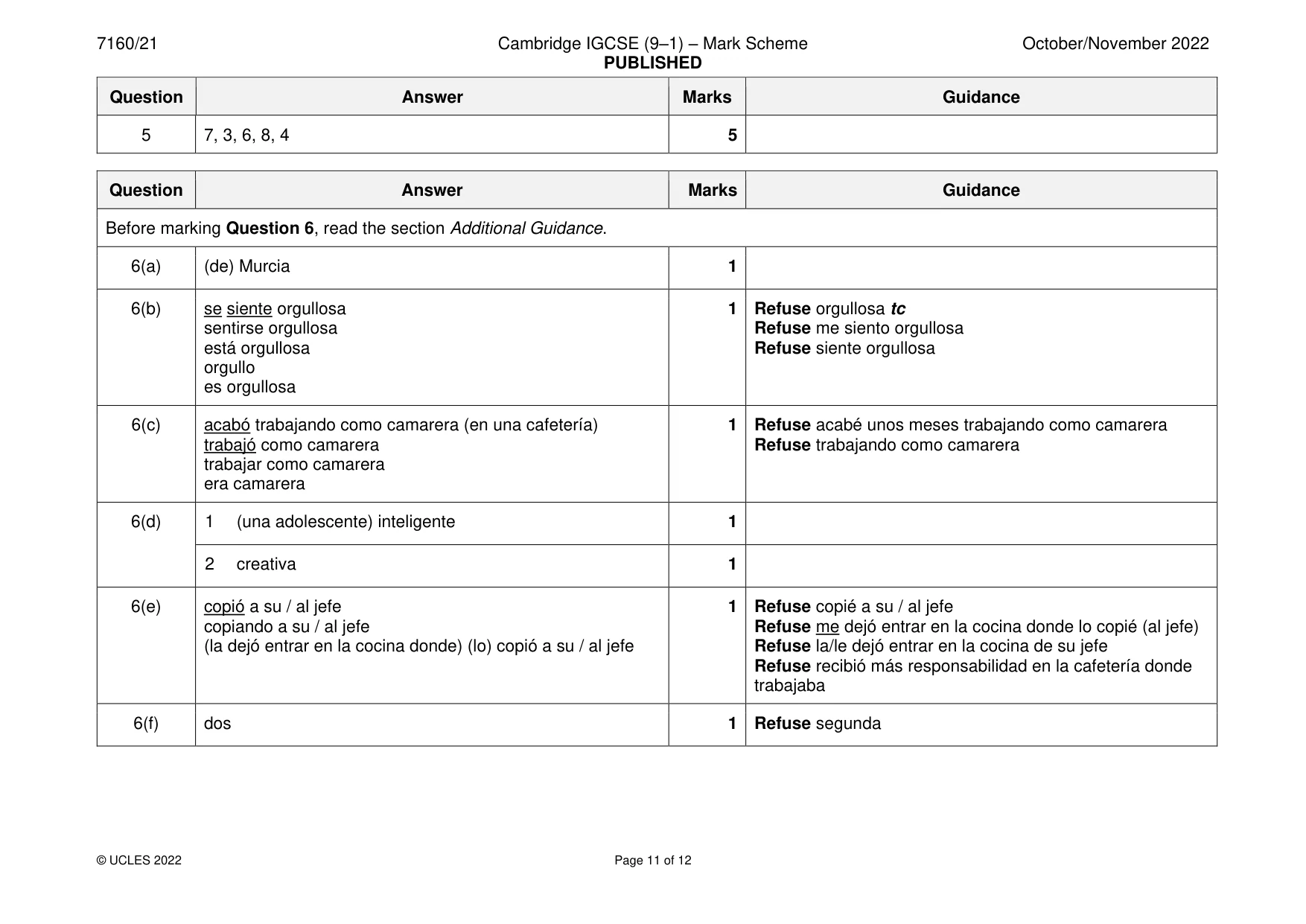
7160/21 Cambridge IGCSE (9–1) – Mark Scheme PUBLISHED October/November 2022 © UCLES 2022 Page 11 of 12 Question Answer Marks Guidance 5 7, 3, 6, 8, 4 5 Question Answer Marks Guidance Before marking Question 6, read the section Additional Guidance. 6(a) (de) Murcia 1 6(b) se siente orgullosa sentirse orgullosa está orgullosa orgullo es orgullosa 1 Refuse orgullosa tc Refuse me siento orgullosa Refuse siente orgullosa 6(c) acabó trabajando como camarera (en una cafetería) trabajó como camarera trabajar como camarera era camarera 1 Refuse acabé unos meses trabajando como camarera Refuse trabajando como camarera 6(d) 1 (una adolescente) inteligente 1 2 creativa 1 6(e) copió a su / al jefe copiando a su / al jefe (la dejó entrar en la cocina donde) (lo) copió a su / al jefe 1 Refuse copié a su / al jefe Refuse me dejó entrar en la cocina donde lo copié (al jefe) Refuse la/le dejó entrar en la cocina de su jefe Refuse recibió más responsabilidad en la cafetería donde trabajaba 6(f) dos 1 Refuse segunda
Mark scheme, page 12
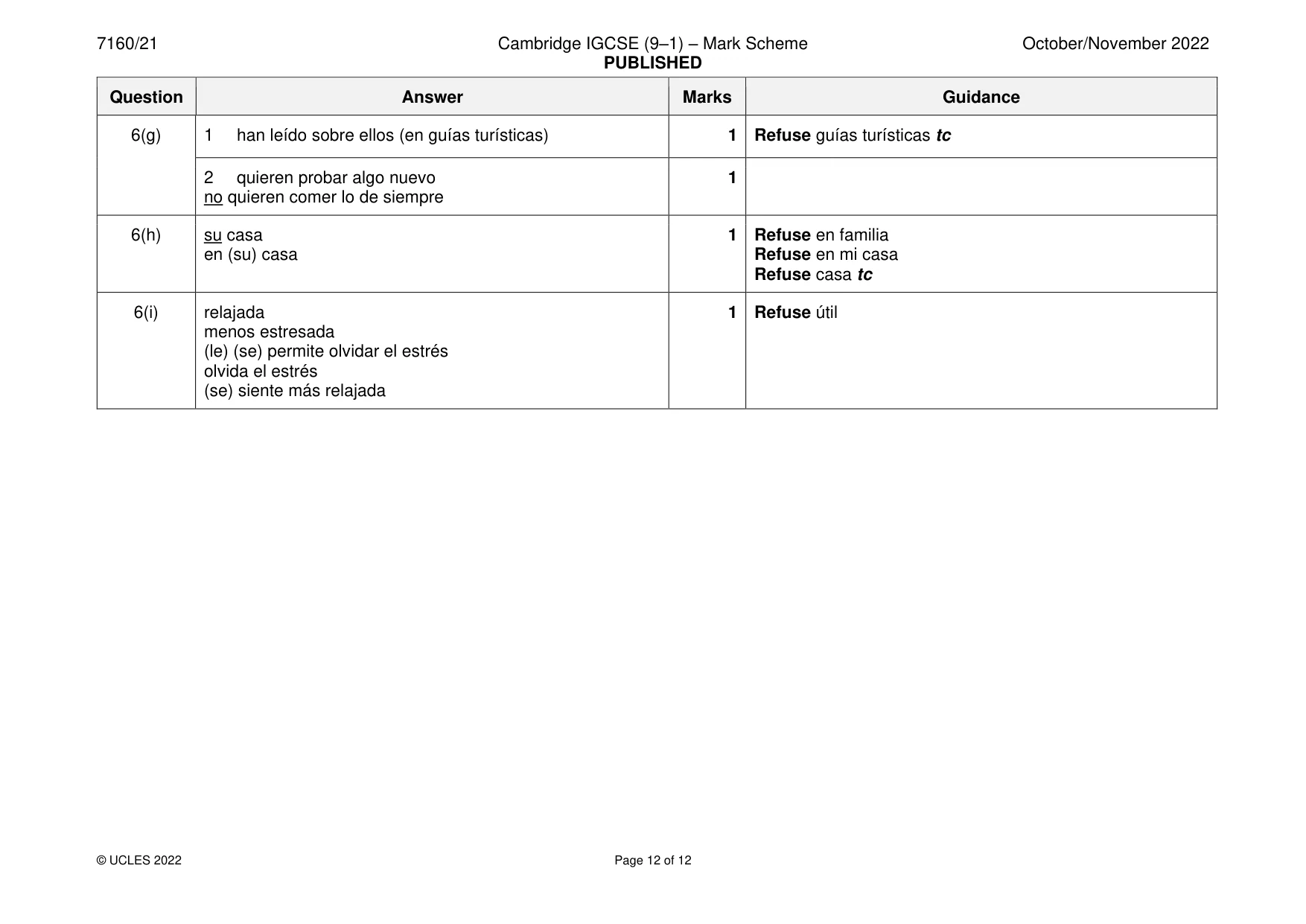
7160/21 Cambridge IGCSE (9–1) – Mark Scheme PUBLISHED October/November 2022 © UCLES 2022 Page 12 of 12 Question Answer Marks Guidance 6(g) 1 han leído sobre ellos (en guías turísticas) 1 Refuse guías turísticas tc 2 quieren probar algo nuevo no quieren comer lo de siempre 1 6(h) su casa en (su) casa 1 Refuse en familia Refuse en mi casa Refuse casa tc 6(i) relajada menos estresada (le) (se) permite olvidar el estrés olvida el estrés (se) siente más relajada 1 Refuse útil
What you needed in this session
Cambridge’s own grade thresholds for 2022 Oct/Nov, Paper 2 · Variant 1. A higher threshold means an easier paper — the bar moves with how the cohort did.