Cambridge IGCSE Spanish (9-1) 7160 — 2021 Oct/Nov Paper 2 · Variant 1
7160/21/O/N/21 · 45 marks · ≈51 min
The question paper and its mark scheme, free to read here and free to download. This is Cambridge’s own paper, exactly as it was sat.
Question paper12 pages

Mark scheme11 pages
Answers below. Sit the paper first if you are practising.
Paper as text
Question paper, page 1
This document has 12 pages. Any blank pages are indicated. DC (RW) 222407 © UCLES 2021 [Turn over * 3 6 2 7 6 9 3 4 7 3 * SPANISH 7160/21 Paper 2 Reading October/November 2021 1 hour You must answer on the question paper. No additional materials are needed. INSTRUCTIONS ● Answer all questions. ● Use a black or dark blue pen. ● Write your name, centre number and candidate number in the boxes at the top of the page. ● Write your answer to each question in the space provided. ● Do not use an erasable pen or correction fluid. ● Do not write on any bar codes. ● Dictionaries are not allowed. INFORMATION ● The total mark for this paper is 45. ● The number of marks for each question or part question is shown in brackets [ ]. Cambridge IGCSE™(9–1)
Question paper, page 2
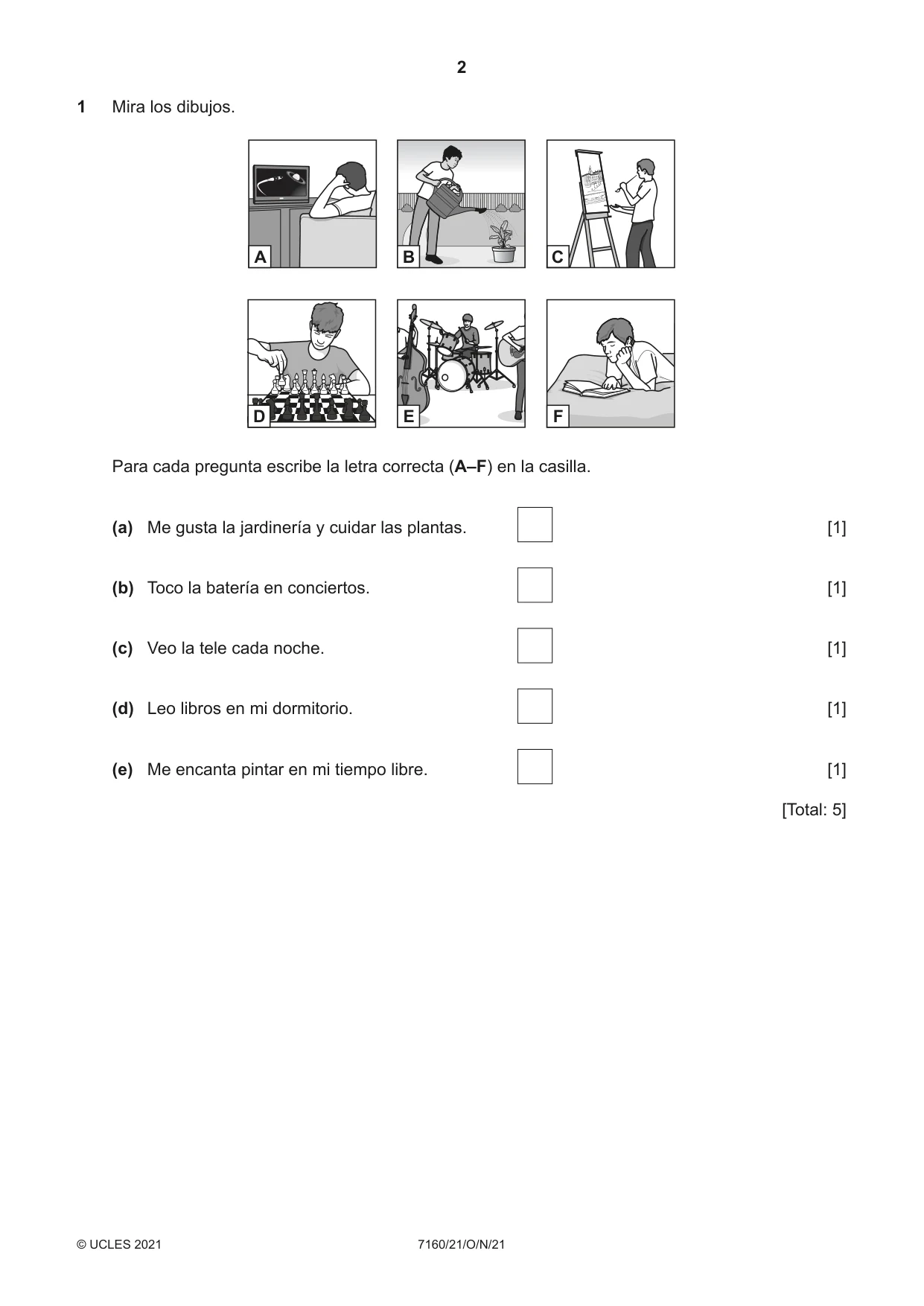
2 7160/21/O/N/21 © UCLES 2021 1 Mira los dibujos. C B A E D F Para cada pregunta escribe la letra correcta (A–F) en la casilla. (a) Me gusta la jardinería y cuidar las plantas. [1] (b) Toco la batería en conciertos. [1] (c) Veo la tele cada noche. [1] (d) Leo libros en mi dormitorio. [1] (e) Me encanta pintar en mi tiempo libre. [1] [Total: 5]
Question paper, page 3
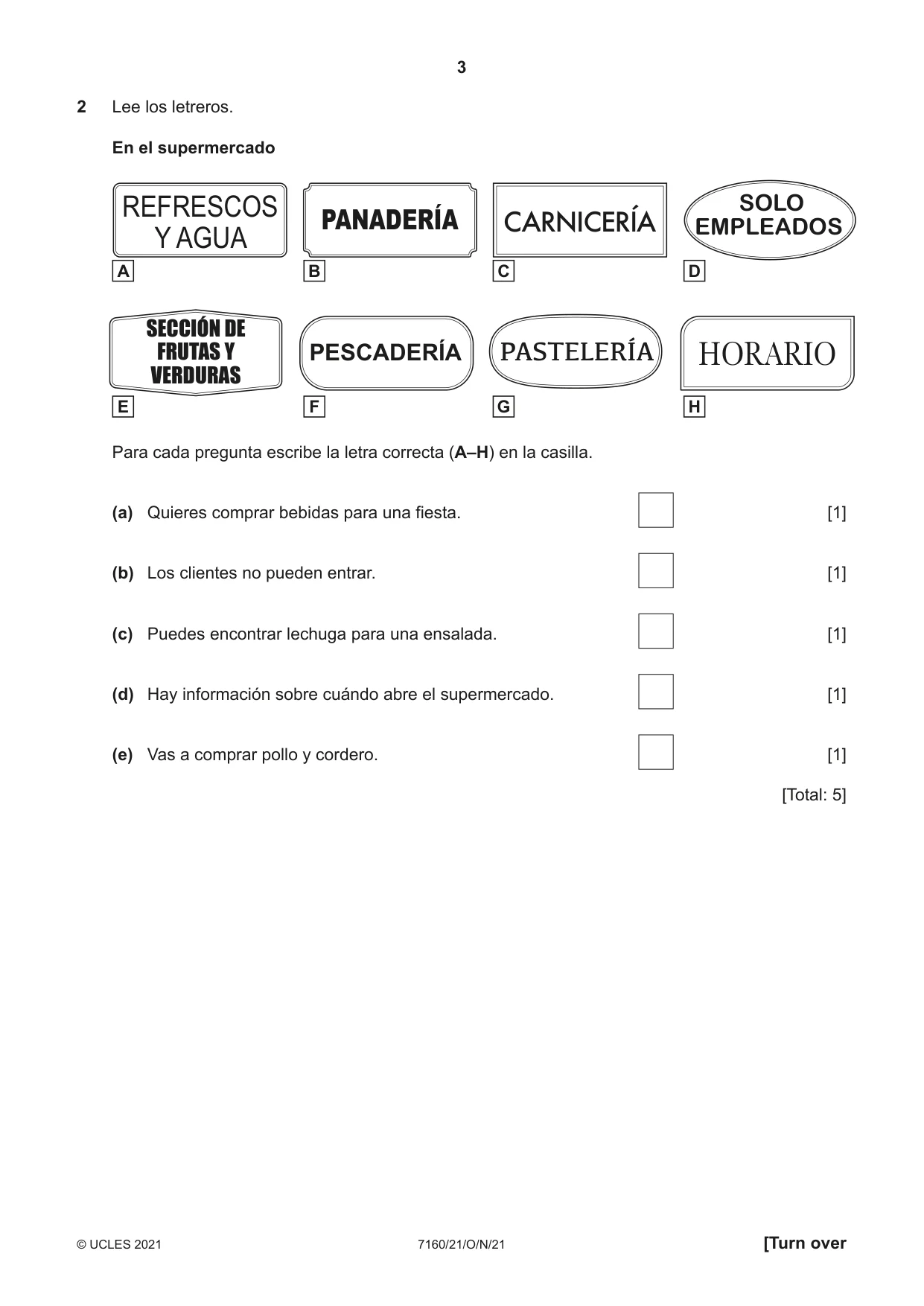
3 7160/21/O/N/21 © UCLES 2021 [Turn over 2 Lee los letreros. En el supermercado REFRESCOS Y AGUA PANADERÍA CARNICERÍA SOLO EMPLEADOS A B C D SECCIÓN DE FRUTAS Y VERDURAS PESCADERÍA PASTELERÍA HORARIO E F G H Para cada pregunta escribe la letra correcta (A–H) en la casilla. (a) Quieres comprar bebidas para una fiesta. [1] (b) Los clientes no pueden entrar. [1] (c) Puedes encontrar lechuga para una ensalada. [1] (d) Hay información sobre cuándo abre el supermercado. [1] (e) Vas a comprar pollo y cordero. [1] [Total: 5]
Question paper, page 4
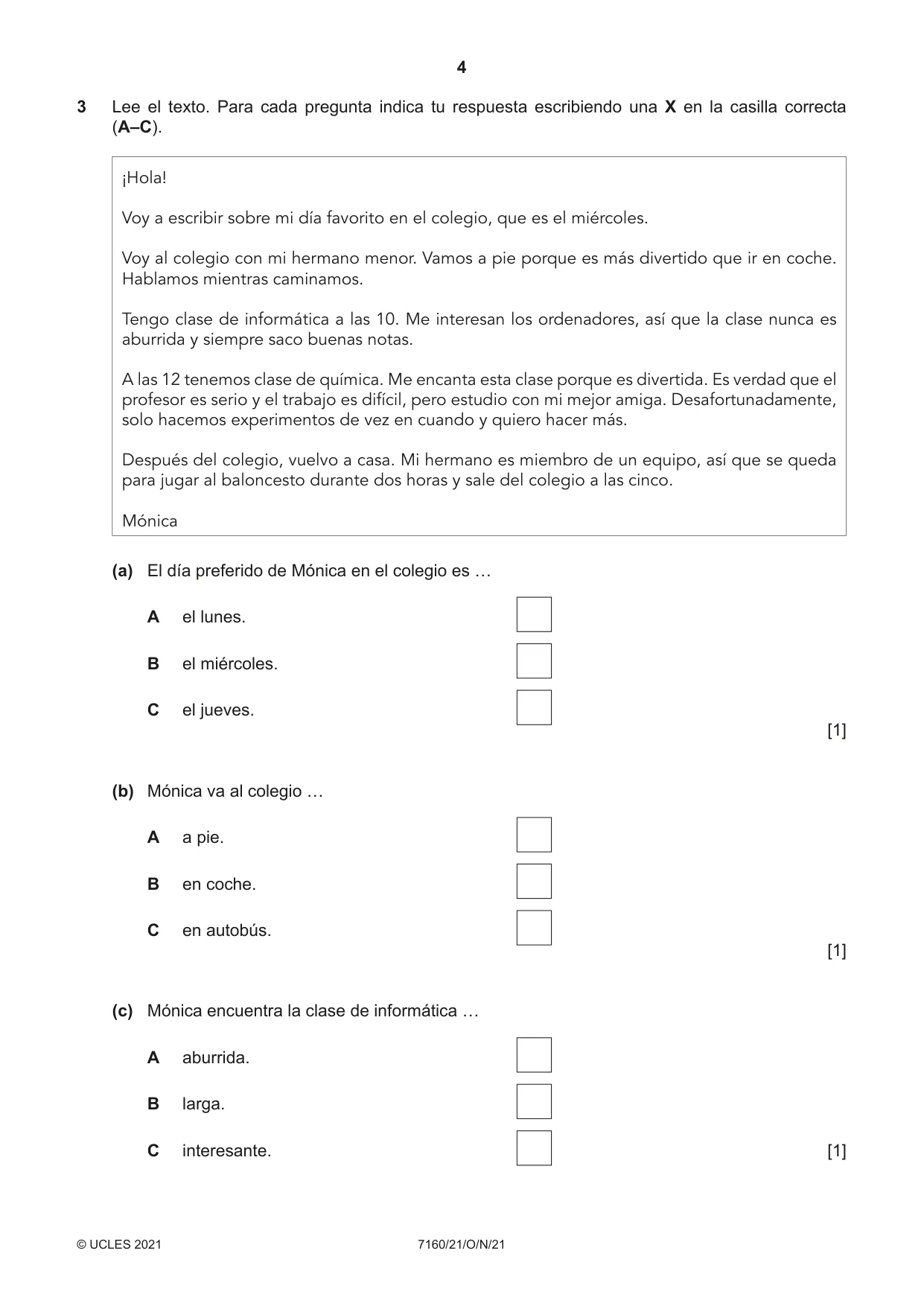
4 7160/21/O/N/21 © UCLES 2021 3 Lee el texto. Para cada pregunta indica tu respuesta escribiendo una X en la casilla correcta (A–C). ¡Hola! Voy a escribir sobre mi día favorito en el colegio, que es el miércoles. Voy al colegio con mi hermano menor. Vamos a pie porque es más divertido que ir en coche. Hablamos mientras caminamos. Tengo clase de informática a las 10. Me interesan los ordenadores, así que la clase nunca es aburrida y siempre saco buenas notas. A las 12 tenemos clase de química. Me encanta esta clase porque es divertida. Es verdad que el profesor es serio y el trabajo es difícil, pero estudio con mi mejor amiga. Desafortunadamente, solo hacemos experimentos de vez en cuando y quiero hacer más. Después del colegio, vuelvo a casa. Mi hermano es miembro de un equipo, así que se queda para jugar al baloncesto durante dos horas y sale del colegio a las cinco. Mónica (a) El día preferido de Mónica en el colegio es … A el lunes. B el miércoles. C el jueves. [1] (b) Mónica va al colegio … A a pie. B en coche. C en autobús. [1] (c) Mónica encuentra la clase de informática … A aburrida. B larga. C interesante. [1]
Question paper, page 5
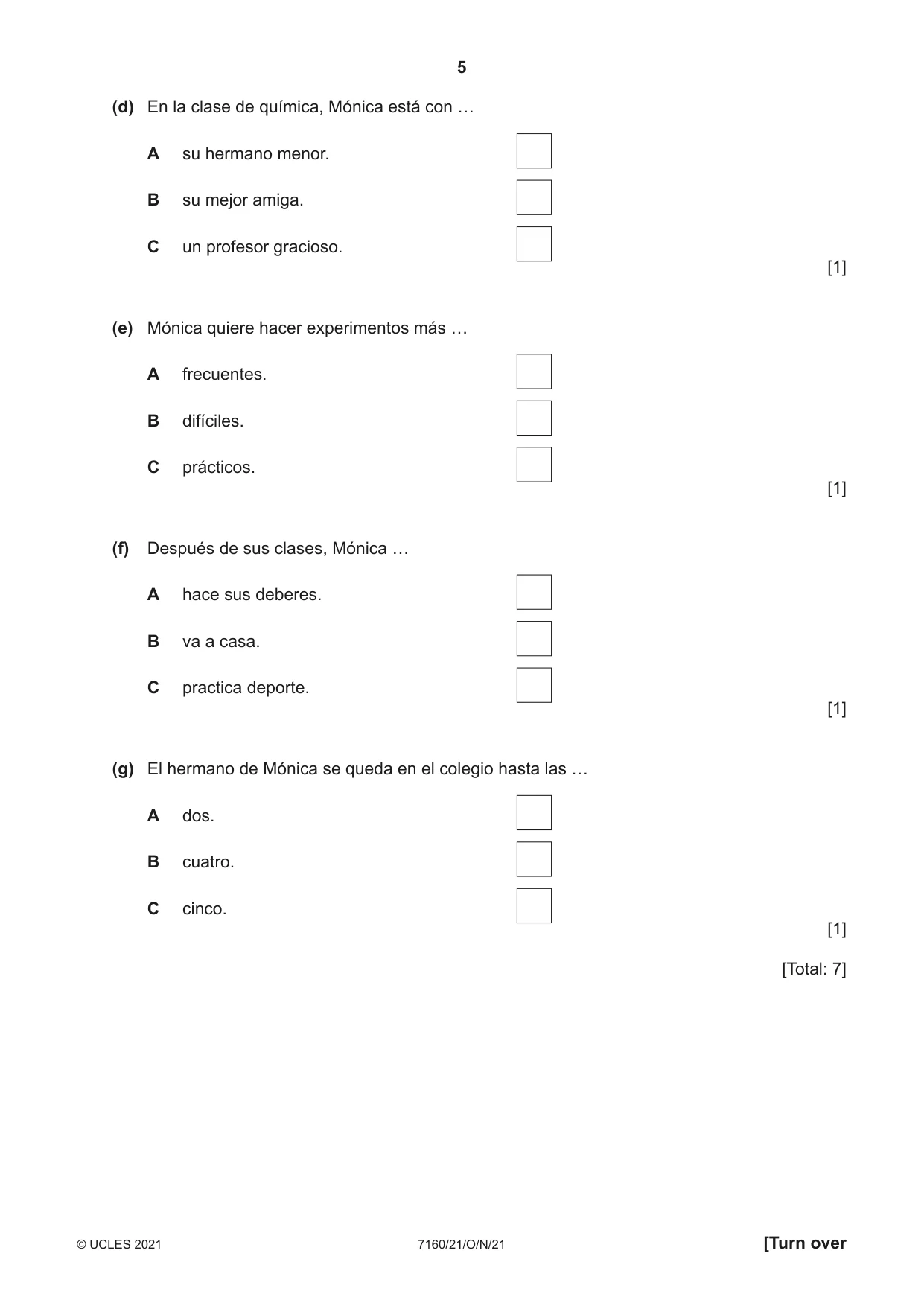
5 7160/21/O/N/21 © UCLES 2021 [Turn over (d) En la clase de química, Mónica está con … A su hermano menor. B su mejor amiga. C un profesor gracioso. [1] (e) Mónica quiere hacer experimentos más … A frecuentes. B difíciles. C prácticos. [1] (f) Después de sus clases, Mónica … A hace sus deberes. B va a casa. C practica deporte. [1] (g) El hermano de Mónica se queda en el colegio hasta las … A dos. B cuatro. C cinco. [1] [Total: 7]
Question paper, page 6
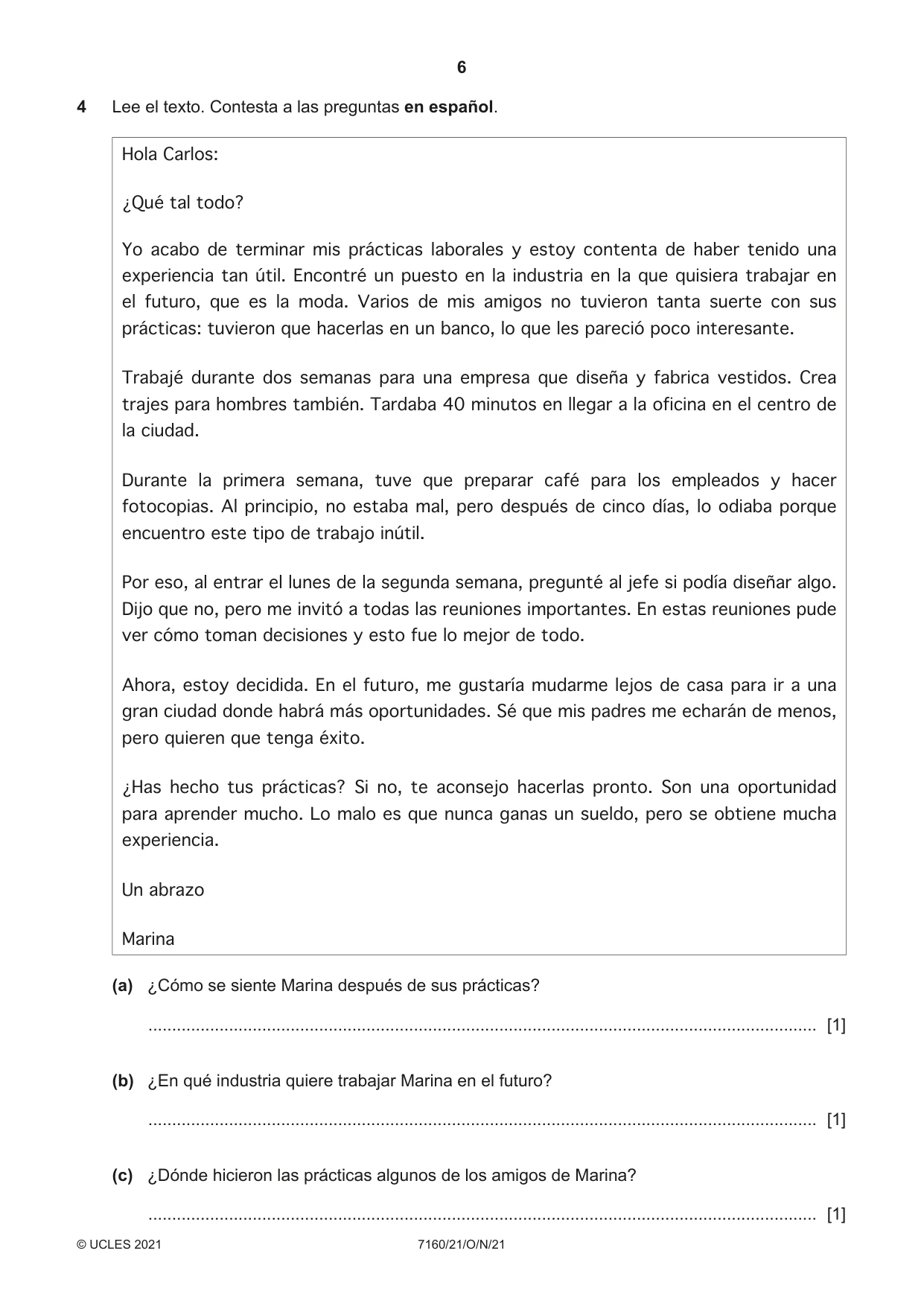
6 7160/21/O/N/21 © UCLES 2021 4 Lee el texto. Contesta a las preguntas en español. Hola Carlos: ¿Qué tal todo? Yo acabo de terminar mis prácticas laborales y estoy contenta de haber tenido una experiencia tan útil. Encontré un puesto en la industria en la que quisiera trabajar en el futuro, que es la moda. Varios de mis amigos no tuvieron tanta suerte con sus prácticas: tuvieron que hacerlas en un banco, lo que les pareció poco interesante. Trabajé durante dos semanas para una empresa que diseña y fabrica vestidos. Crea trajes para hombres también. Tardaba 40 minutos en llegar a la oficina en el centro de la ciudad. Durante la primera semana, tuve que preparar café para los empleados y hacer fotocopias. Al principio, no estaba mal, pero después de cinco días, lo odiaba porque encuentro este tipo de trabajo inútil. Por eso, al entrar el lunes de la segunda semana, pregunté al jefe si podía diseñar algo. Dijo que no, pero me invitó a todas las reuniones importantes. En estas reuniones pude ver cómo toman decisiones y esto fue lo mejor de todo. Ahora, estoy decidida. En el futuro, me gustaría mudarme lejos de casa para ir a una gran ciudad donde habrá más oportunidades. Sé que mis padres me echarán de menos, pero quieren que tenga éxito. ¿Has hecho tus prácticas? Si no, te aconsejo hacerlas pronto. Son una oportunidad para aprender mucho. Lo malo es que nunca ganas un sueldo, pero se obtiene mucha experiencia. Un abrazo Marina (a) ¿Cómo se siente Marina después de sus prácticas? … [1] (b) ¿En qué industria quiere trabajar Marina en el futuro? … [1] (c) ¿Dónde hicieron las prácticas algunos de los amigos de Marina? … [1]
Question paper, page 7
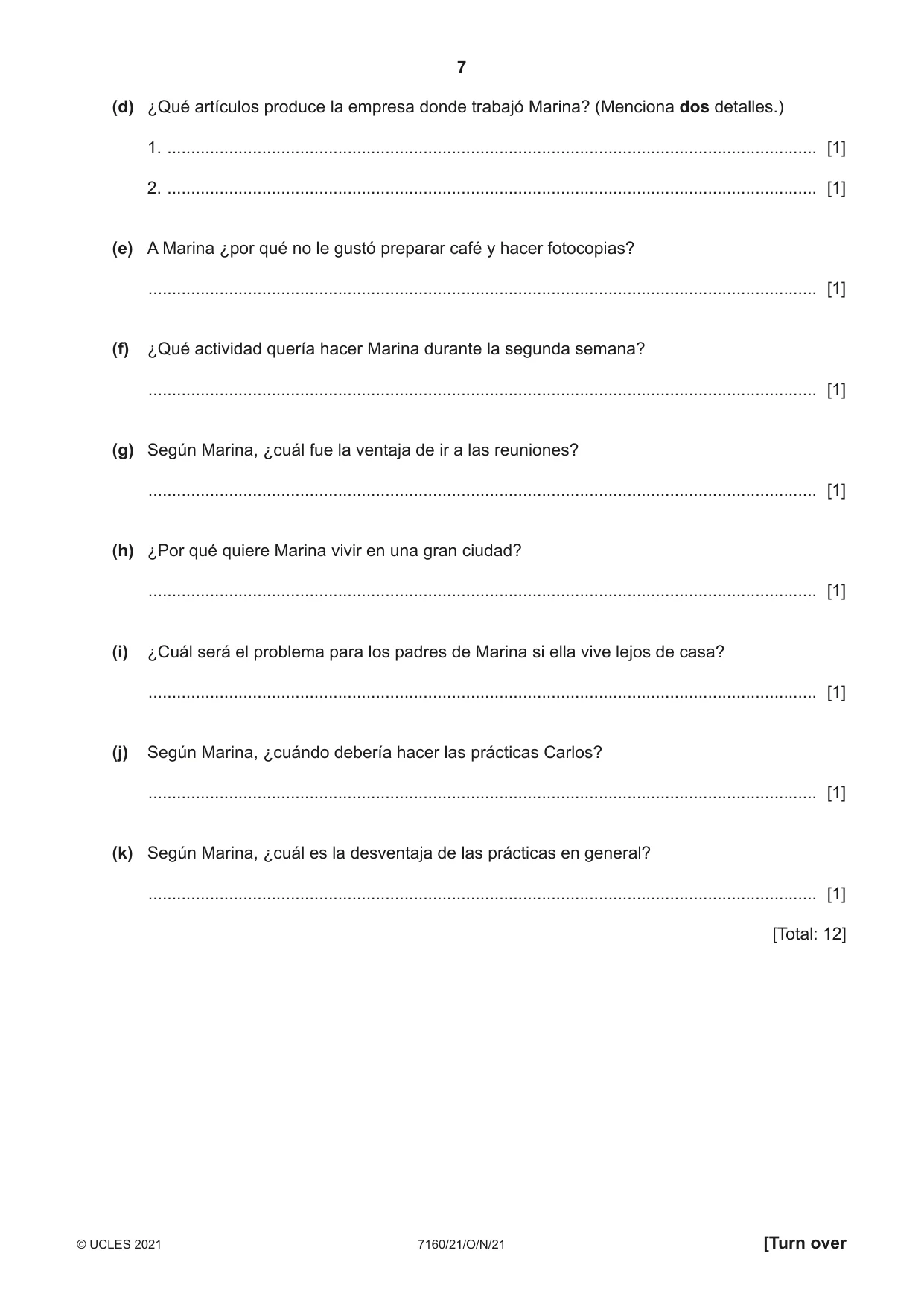
7 7160/21/O/N/21 © UCLES 2021 [Turn over (d) ¿Qué artículos produce la empresa donde trabajó Marina? (Menciona dos detalles.) 1. … [1] 2. … [1] (e) A Marina ¿por qué no le gustó preparar café y hacer fotocopias? … [1] (f) ¿Qué actividad quería hacer Marina durante la segunda semana? … [1] (g) Según Marina, ¿cuál fue la ventaja de ir a las reuniones? … [1] (h) ¿Por qué quiere Marina vivir en una gran ciudad? … [1] (i) ¿Cuál será el problema para los padres de Marina si ella vive lejos de casa? … [1] (j) Según Marina, ¿cuándo debería hacer las prácticas Carlos? … [1] (k) Según Marina, ¿cuál es la desventaja de las prácticas en general? … [1] [Total: 12]
Question paper, page 8
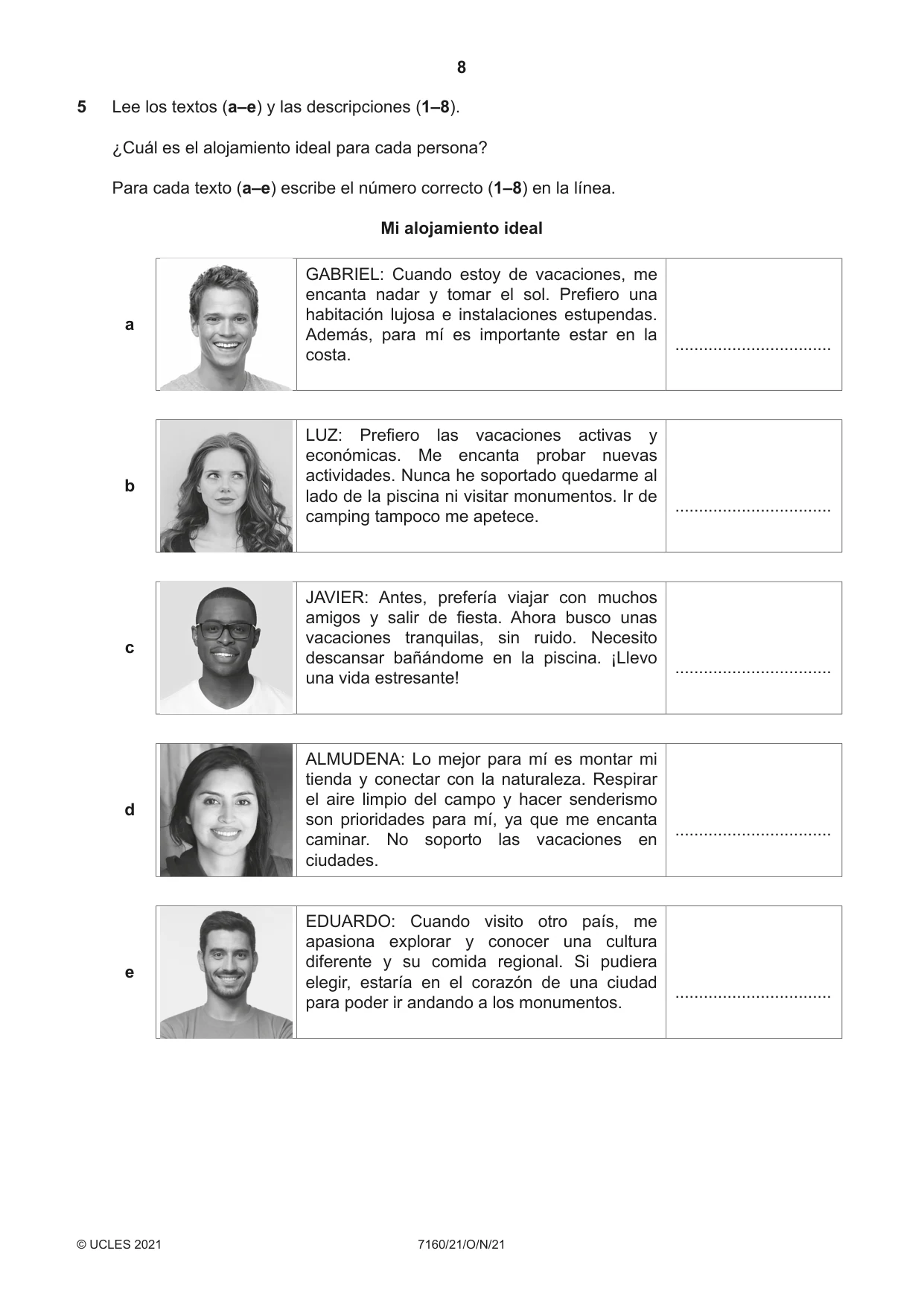
8 7160/21/O/N/21 © UCLES 2021 5 Lee los textos (a–e) y las descripciones (1–8). ¿Cuál es el alojamiento ideal para cada persona? Para cada texto (a–e) escribe el número correcto (1–8) en la línea. Mi alojamiento ideal a GABRIEL: Cuando estoy de vacaciones, me encanta nadar y tomar el sol. Prefiero una habitación lujosa e instalaciones estupendas. Además, para mí es importante estar en la costa. … b LUZ: Prefiero las vacaciones activas y económicas. Me encanta probar nuevas actividades. Nunca he soportado quedarme al lado de la piscina ni visitar monumentos. Ir de camping tampoco me apetece. … c JAVIER: Antes, prefería viajar con muchos amigos y salir de fiesta. Ahora busco unas vacaciones tranquilas, sin ruido. Necesito descansar bañándome en la piscina. ¡Llevo una vida estresante! … d ALMUDENA: Lo mejor para mí es montar mi tienda y conectar con la naturaleza. Respirar el aire limpio del campo y hacer senderismo son prioridades para mí, ya que me encanta caminar. No soporto las vacaciones en ciudades. … e EDUARDO: Cuando visito otro país, me apasiona explorar y conocer una cultura diferente y su comida regional. Si pudiera elegir, estaría en el corazón de una ciudad para poder ir andando a los monumentos. …
Question paper, page 9
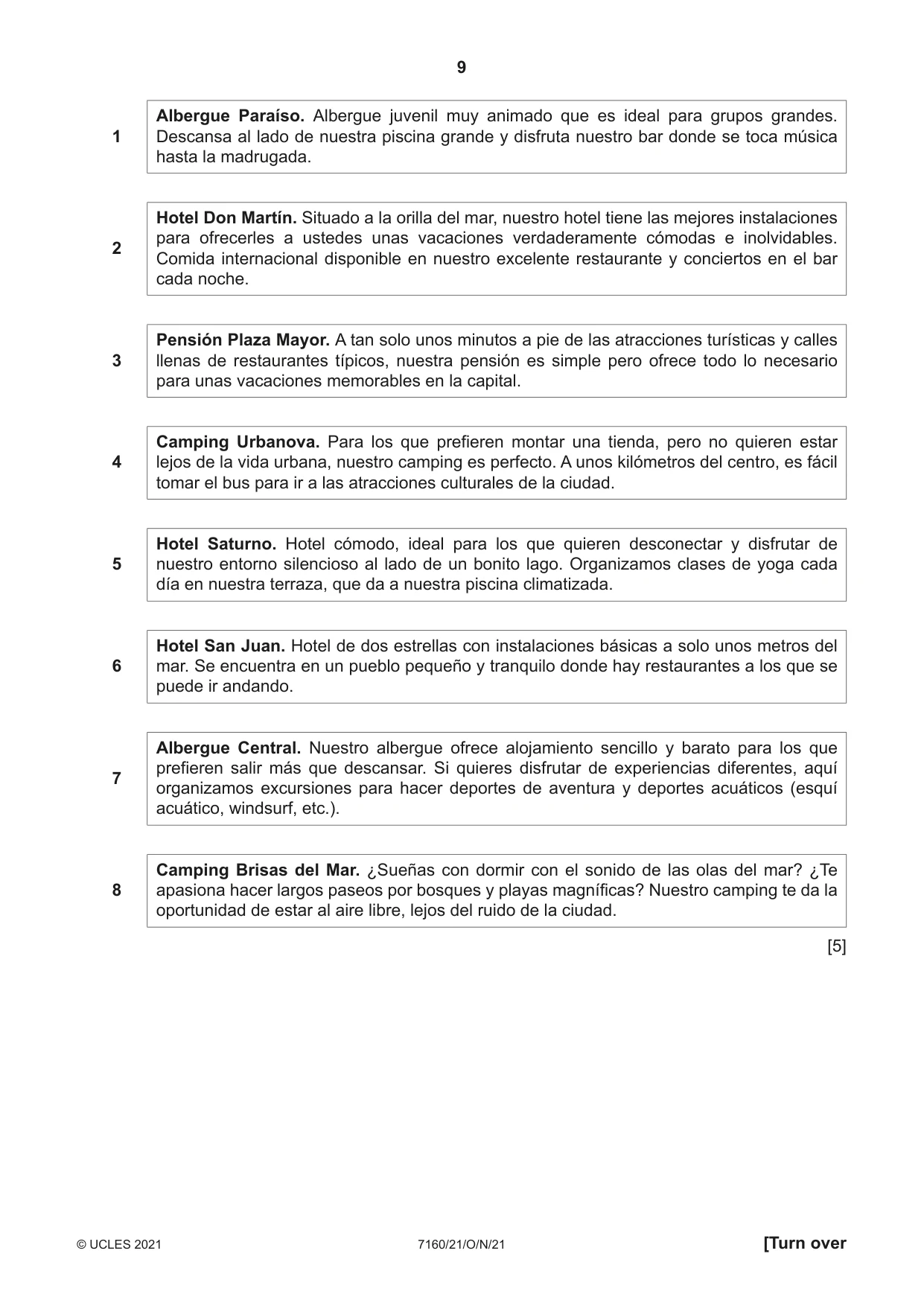
9 7160/21/O/N/21 © UCLES 2021 [Turn over 1 Albergue Paraíso. Albergue juvenil muy animado que es ideal para grupos grandes. Descansa al lado de nuestra piscina grande y disfruta nuestro bar donde se toca música hasta la madrugada. 2 Hotel Don Martín. Situado a la orilla del mar, nuestro hotel tiene las mejores instalaciones para ofrecerles a ustedes unas vacaciones verdaderamente cómodas e inolvidables. Comida internacional disponible en nuestro excelente restaurante y conciertos en el bar cada noche. 3 Pensión Plaza Mayor. A tan solo unos minutos a pie de las atracciones turísticas y calles llenas de restaurantes típicos, nuestra pensión es simple pero ofrece todo lo necesario para unas vacaciones memorables en la capital. 4 Camping Urbanova. Para los que prefieren montar una tienda, pero no quieren estar lejos de la vida urbana, nuestro camping es perfecto. A unos kilómetros del centro, es fácil tomar el bus para ir a las atracciones culturales de la ciudad. 5 Hotel Saturno. Hotel cómodo, ideal para los que quieren desconectar y disfrutar de nuestro entorno silencioso al lado de un bonito lago. Organizamos clases de yoga cada día en nuestra terraza, que da a nuestra piscina climatizada. 6 Hotel San Juan. Hotel de dos estrellas con instalaciones básicas a solo unos metros del mar. Se encuentra en un pueblo pequeño y tranquilo donde hay restaurantes a los que se puede ir andando. 7 Albergue Central. Nuestro albergue ofrece alojamiento sencillo y barato para los que prefieren salir más que descansar. Si quieres disfrutar de experiencias diferentes, aquí organizamos excursiones para hacer deportes de aventura y deportes acuáticos (esquí acuático, windsurf, etc.). 8 Camping Brisas del Mar. ¿Sueñas con dormir con el sonido de las olas del mar? ¿Te apasiona hacer largos paseos por bosques y playas magníficas? Nuestro camping te da la oportunidad de estar al aire libre, lejos del ruido de la ciudad. [5]
Question paper, page 10
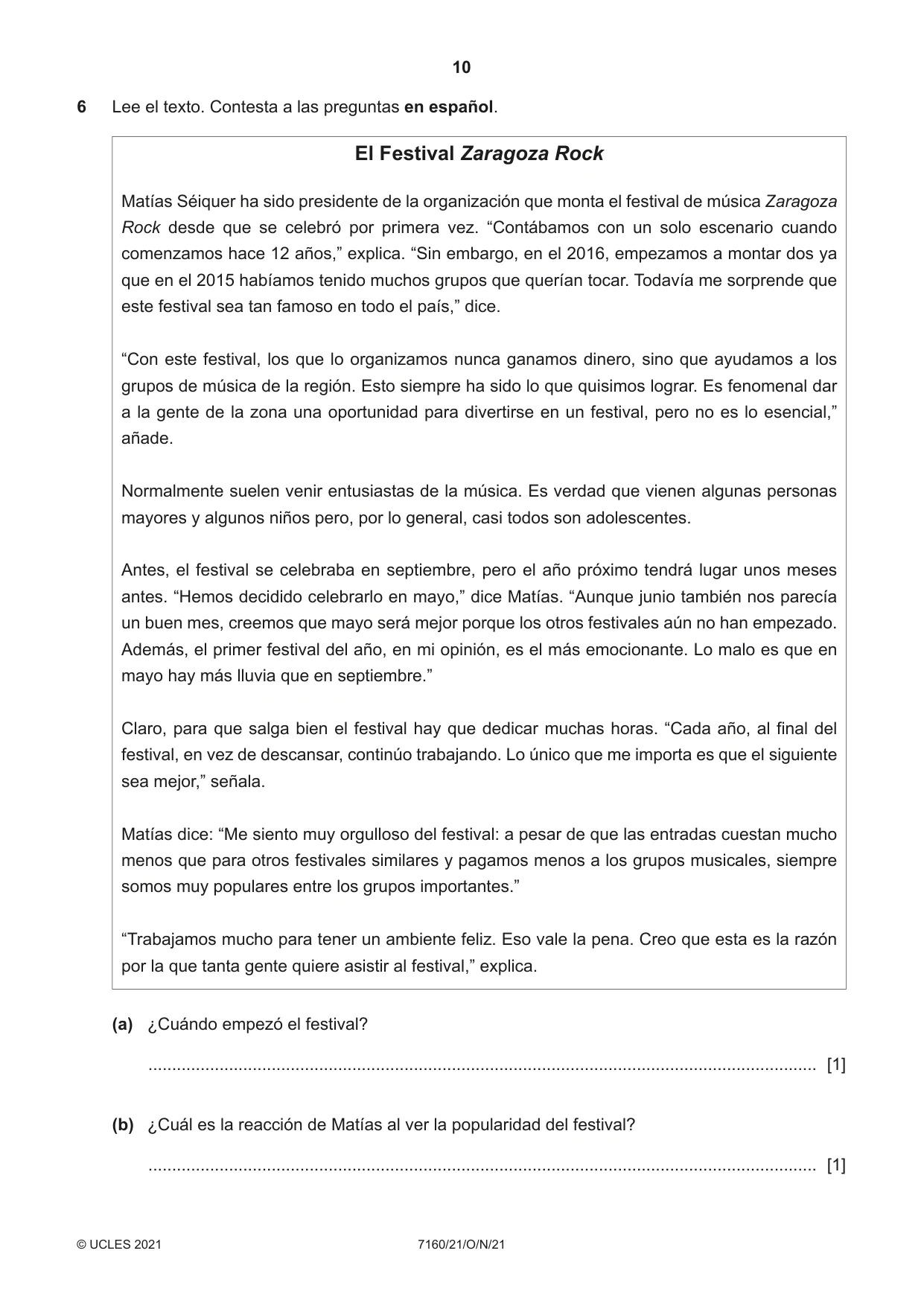
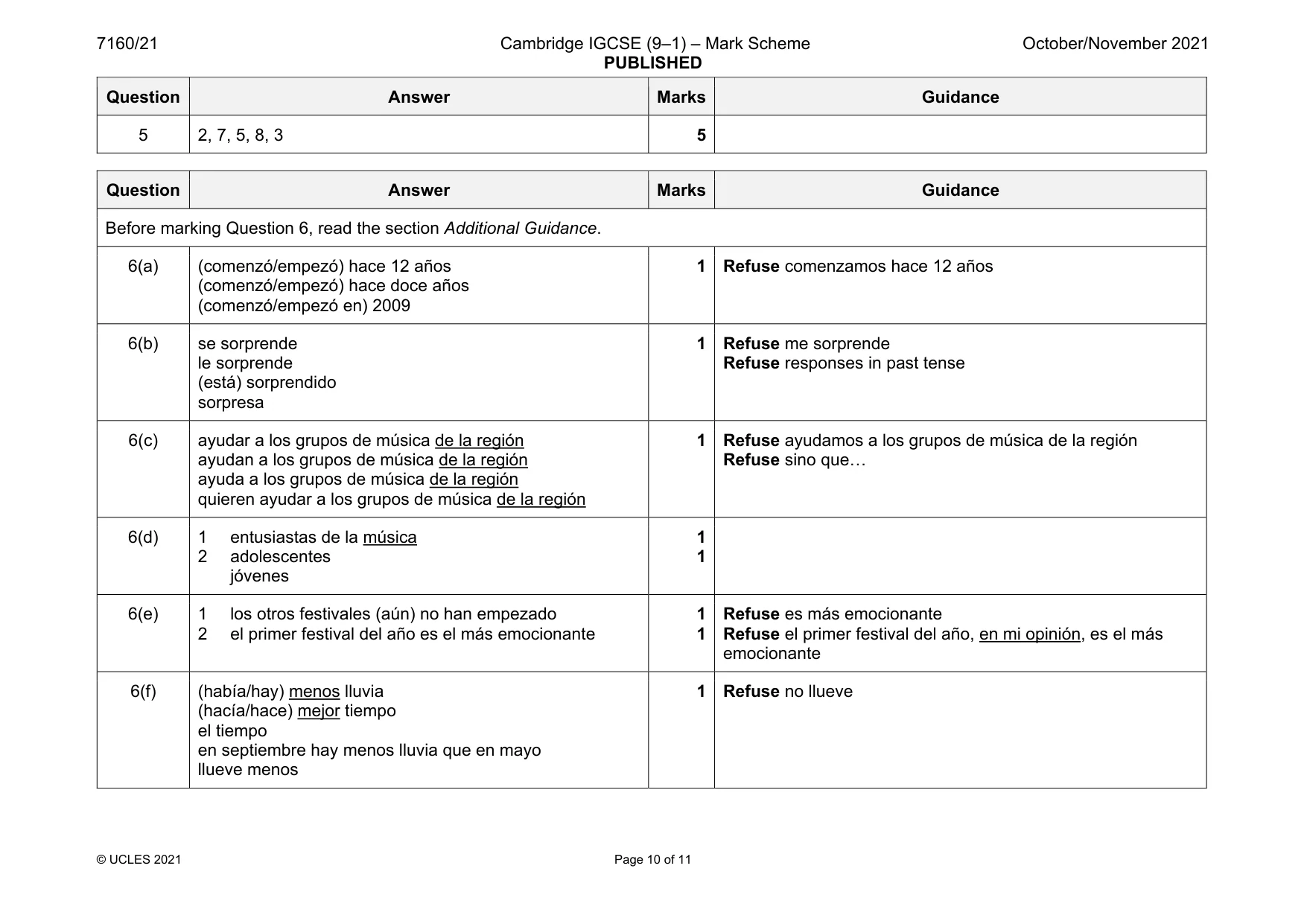
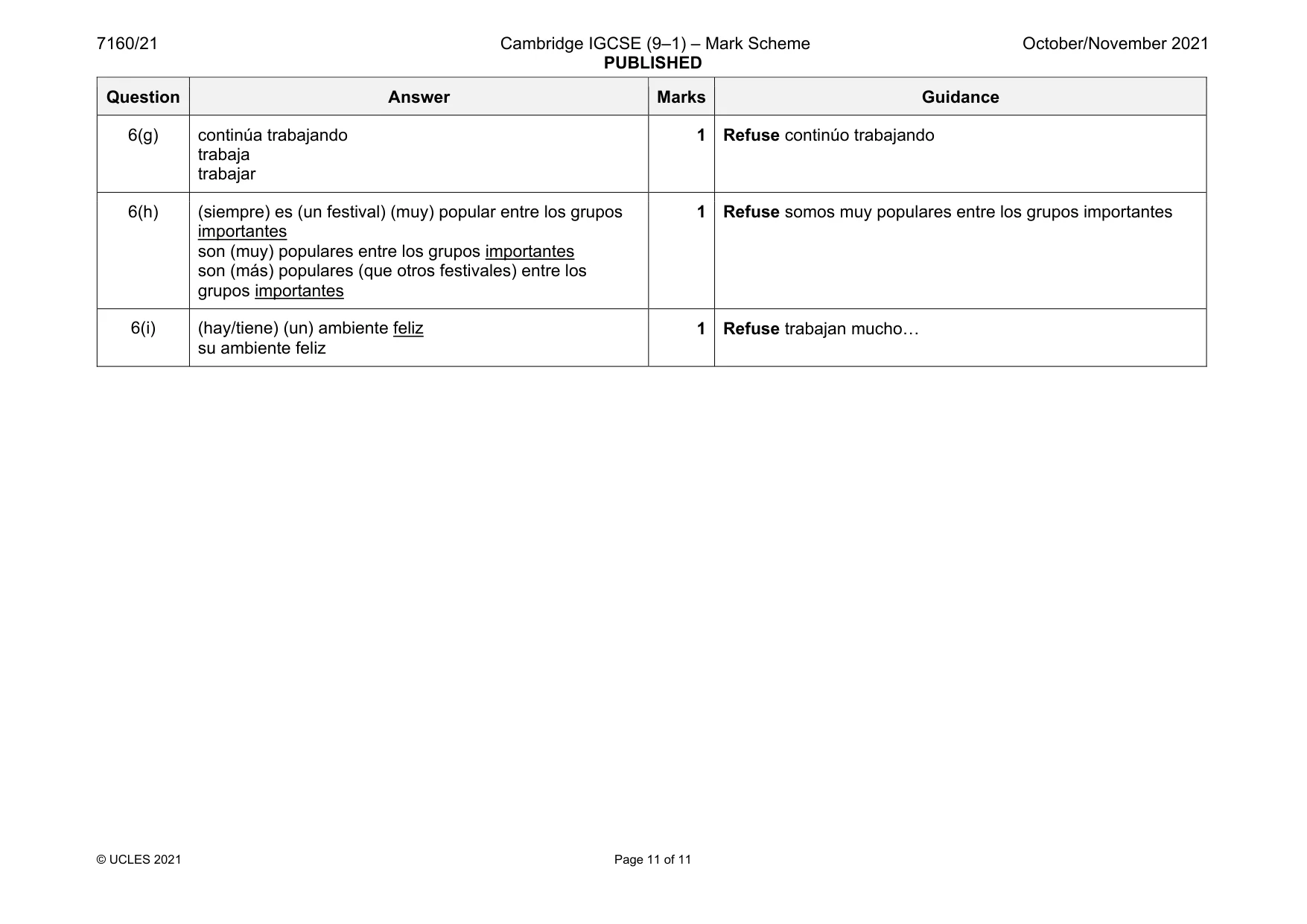
10 7160/21/O/N/21 © UCLES 2021 6 Lee el texto. Contesta a las preguntas en español. El Festival Zaragoza Rock Matías Séiquer ha sido presidente de la organización que monta el festival de música Zaragoza Rock desde que se celebró por primera vez. “Contábamos con un solo escenario cuando comenzamos hace 12 años,” explica. “Sin embargo, en el 2016, empezamos a montar dos ya que en el 2015 habíamos tenido muchos grupos que querían tocar. Todavía me sorprende que este festival sea tan famoso en todo el país,” dice. “Con este festival, los que lo organizamos nunca ganamos dinero, sino que ayudamos a los grupos de música de la región. Esto siempre ha sido lo que quisimos lograr. Es fenomenal dar a la gente de la zona una oportunidad para divertirse en un festival, pero no es lo esencial,” añade. Normalmente suelen venir entusiastas de la música. Es verdad que vienen algunas personas mayores y algunos niños pero, por lo general, casi todos son adolescentes. Antes, el festival se celebraba en septiembre, pero el año próximo tendrá lugar unos meses antes. “Hemos decidido celebrarlo en mayo,” dice Matías. “Aunque junio también nos parecía un buen mes, creemos que mayo será mejor porque los otros festivales aún no han empezado. Además, el primer festival del año, en mi opinión, es el más emocionante. Lo malo es que en mayo hay más lluvia que en septiembre.” Claro, para que salga bien el festival hay que dedicar muchas horas. “Cada año, al final del festival, en vez de descansar, continúo trabajando. Lo único que me importa es que el siguiente sea mejor,” señala. Matías dice: “Me siento muy orgulloso del festival: a pesar de que las entradas cuestan mucho menos que para otros festivales similares y pagamos menos a los grupos musicales, siempre somos muy populares entre los grupos importantes.” “Trabajamos mucho para tener un ambiente feliz. Eso vale la pena. Creo que esta es la razón por la que tanta gente quiere asistir al festival,” explica. (a) ¿Cuándo empezó el festival? … [1] (b) ¿Cuál es la reacción de Matías al ver la popularidad del festival? … [1]
Question paper, page 11
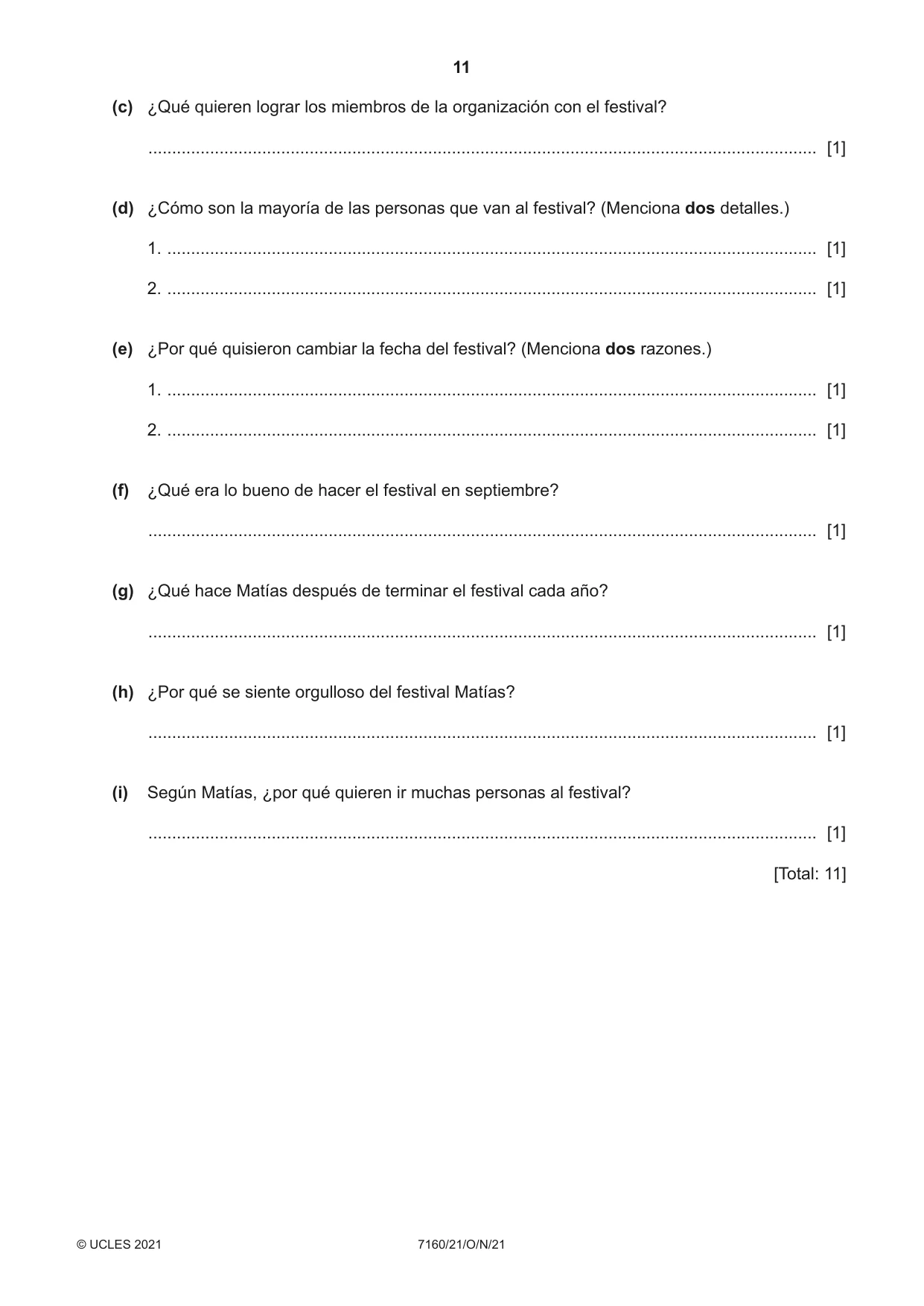
11 7160/21/O/N/21 © UCLES 2021 (c) ¿Qué quieren lograr los miembros de la organización con el festival? … [1] (d) ¿Cómo son la mayoría de las personas que van al festival? (Menciona dos detalles.) 1. … [1] 2. … [1] (e) ¿Por qué quisieron cambiar la fecha del festival? (Menciona dos razones.) 1. … [1] 2. … [1] (f) ¿Qué era lo bueno de hacer el festival en septiembre? … [1] (g) ¿Qué hace Matías después de terminar el festival cada año? … [1] (h) ¿Por qué se siente orgulloso del festival Matías? … [1] (i) Según Matías, ¿por qué quieren ir muchas personas al festival? … [1] [Total: 11]
Question paper, page 12
12 7160/21/O/N/21 © UCLES 2021 Permission to reproduce items where third-party owned material protected by copyright is included has been sought and cleared where possible. Every reasonable effort has been made by the publisher (UCLES) to trace copyright holders, but if any items requiring clearance have unwittingly been included, the publisher will be pleased to make amends at the earliest possible opportunity. To avoid the issue of disclosure of answer-related information to candidates, all copyright acknowledgements are reproduced online in the Cambridge Assessment International Education Copyright Acknowledgements Booklet. This is produced for each series of examinations and is freely available to download at www.cambridgeinternational.org after the live examination series. Cambridge Assessment International Education is part of the Cambridge Assessment Group. Cambridge Assessment is the brand name of the University of Cambridge Local Examinations Syndicate (UCLES), which itself is a department of the University of Cambridge. BLANK PAGE
Mark scheme, page 1
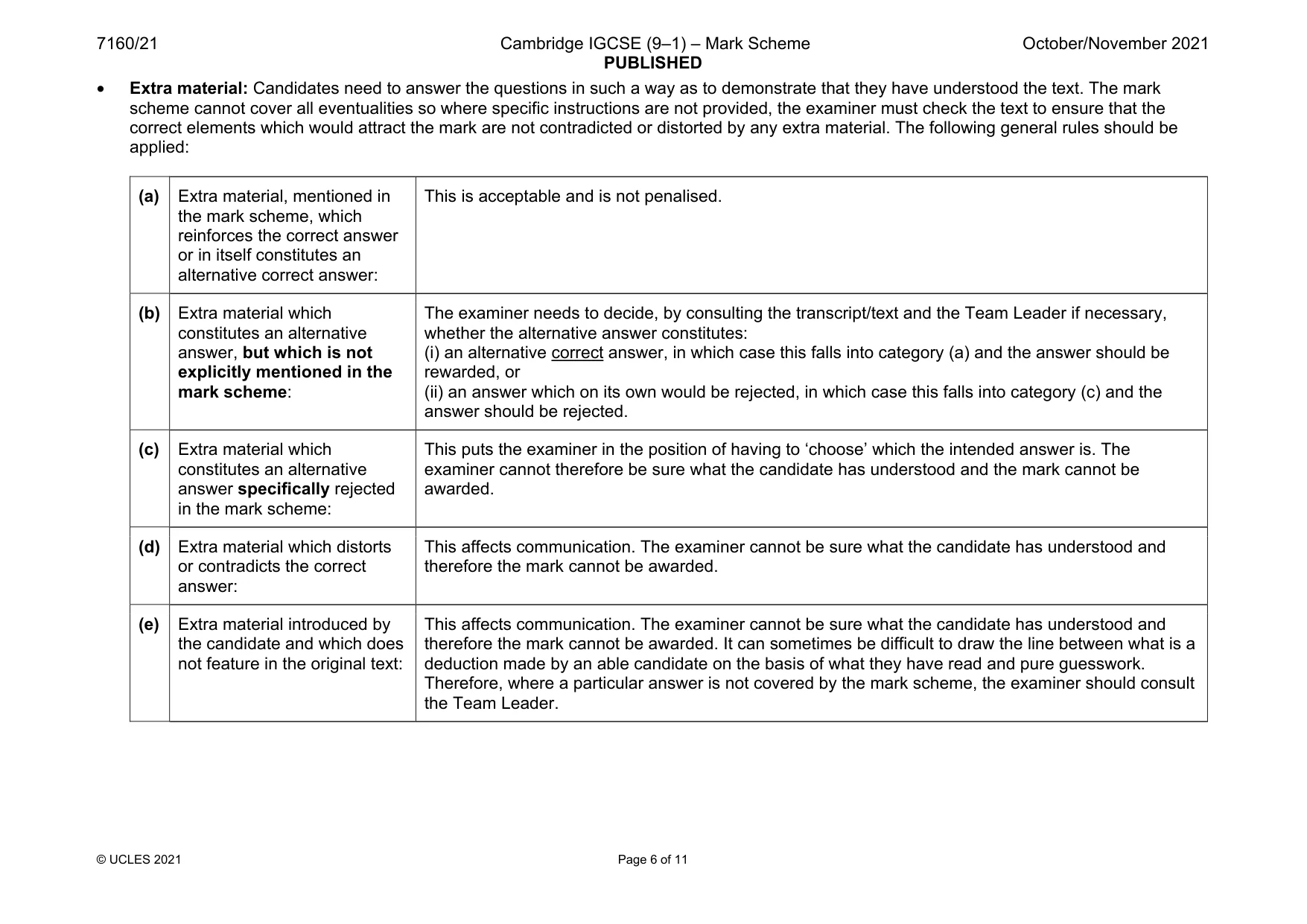
This document consists of 11 printed pages. © UCLES 2021 [Turn over Cambridge IGCSE™ (9–1) SPANISH 7160/21 Paper 2 Reading October/November 2021 MARK SCHEME Maximum Mark: 45 Published This mark scheme is published as an aid to teachers and candidates, to indicate the requirements of the examination. It shows the basis on which Examiners were instructed to award marks. It does not indicate the details of the discussions that took place at an Examiners’ meeting before marking began, which would have considered the acceptability of alternative answers. Mark schemes should be read in conjunction with the question paper and the Principal Examiner Report for Teachers. Cambridge International will not enter into discussions about these mark schemes. Cambridge International is publishing the mark schemes for the October/November 2021 series for most Cambridge IGCSE™, Cambridge International A and AS Level components and some Cambridge O Level components.
Mark scheme, page 2
7160/21 Cambridge IGCSE (9–1) – Mark Scheme PUBLISHED October/November 2021 © UCLES 2021 Page 2 of 11 Generic Marking Principles These general marking principles must be applied by all examiners when marking candidate answers. They should be applied alongside the specific content of the mark scheme or generic level descriptors for a question. Each question paper and mark scheme will also comply with these marking principles. GENERIC MARKING PRINCIPLE 1: Marks must be awarded in line with: • the specific content of the mark scheme or the generic level descriptors for the question • the specific skills defined in the mark scheme or in the generic level descriptors for the question • the standard of response required by a candidate as exemplified by the standardisation scripts. GENERIC MARKING PRINCIPLE 2: Marks awarded are always whole marks (not half marks, or other fractions). GENERIC MARKING PRINCIPLE 3: Marks must be awarded positively: • marks are awarded for correct/valid answers, as defined in the mark scheme. However, credit is given for valid answers which go beyond the scope of the syllabus and mark scheme, referring to your Team Leader as appropriate • marks are awarded when candidates clearly demonstrate what they know and can do • marks are not deducted for errors • marks are not deducted for omissions • answers should only be judged on the quality of spelling, punctuation and grammar when these features are specifically assessed by the question as indicated by the mark scheme. The meaning, however, should be unambiguous. GENERIC MARKING PRINCIPLE 4: Rules must be applied consistently, e.g. in situations where candidates have not followed instructions or in the application of generic level descriptors.
Mark scheme, page 3
7160/21 Cambridge IGCSE (9–1) – Mark Scheme PUBLISHED October/November 2021 © UCLES 2021 Page 3 of 11 GENERIC MARKING PRINCIPLE 5: Marks should be awarded using the full range of marks defined in the mark scheme for the question (however; the use of the full mark range may be limited according to the quality of the candidate responses seen). GENERIC MARKING PRINCIPLE 6: Marks awarded are based solely on the requirements as defined in the mark scheme. Marks should not be awarded with grade thresholds or grade descriptors in mind. Additional Guidance The following guidance underpins the detailed instructions provided in the mark scheme. Where a decision is taken to deviate from this guidance for a particular question, this will be specified in the mark scheme. Often the additional guidance points will have to be weighed up against each other, e.g. the answer might look or sound like the intended word/phrase in Spanish, but if what the candidate has written means something different in Spanish from what is expected, the mark cannot be awarded. It is not possible to list all acceptable alternatives in the mark scheme. If you encounter an answer which is not covered by the mark scheme, you will need to make a decision about whether it communicates the required elements (in consultation with your Team Leader if necessary, or with your Product Manager if you are a single examiner), and award marks accordingly. • Crossing out: (a) If a candidate changes his/her mind about an answer and crosses out an attempt, award a mark if the final attempt is correct. (b) If a candidate crosses out an answer to a whole question but makes no second attempt at it, mark the crossed out work.
Mark scheme, page 4
7160/21 Cambridge IGCSE (9–1) – Mark Scheme PUBLISHED October/November 2021 © UCLES 2021 Page 4 of 11 • More than the stipulated number of boxes ticked/crossed by the candidate: (a) If more than one attempt is visible but the candidate has clearly indicated which attempt is his/her final answer (e.g. by crossing out other attempts or by annotating the script in some way), mark in the usual way. (b) If two attempts are visible (e.g. two boxes ticked instead of the one box stipulated), and neither has been crossed out/discounted by the candidate, no mark can be awarded. • For questions requiring more than one element for the answer, 1 and 2, where the answers are interchangeable: (a) Both of the correct answers are on line 1 and line 2 blank (or vice versa) = 2 marks (b) Both correct answers on line 1 and line 2 contains a wrong answer (or vice versa) = 1 mark • Mark for communication: Answers requiring the use of Spanish (rather than a non-verbal response) should be marked for communication. Tolerate inaccuracies provided that the message is clear. However, do not accept incorrect Spanish if the word written by the candidate means something else in Spanish (unless the mark scheme specifies otherwise). (a) If you read aloud what the candidate has written, does it sound like the correct answer? Would a native speaker of Spanish understand it? (b) Does what the candidate has written look like the correct answer, e.g. one letter missing but no other word created? Would a native speaker of Spanish understand it? (c) Tolerate incorrect auxiliaries and incorrect use of the infinitive unless the mark scheme specifies otherwise.
Mark scheme, page 5
7160/21 Cambridge IGCSE (9–1) – Mark Scheme PUBLISHED October/November 2021 © UCLES 2021 Page 5 of 11 • Annotations used in the mark scheme: (a) INV = invalidation. This is used when the additional material included by the candidate is judged to invalidate an otherwise correct answer and therefore prevents him/her from scoring the mark. (INV = 0) (b) tc = ‘tout court’. This means that, on its own, the material is not sufficient to score the mark. (c) HA = harmless addition. This means that the candidate has included additional material which, in conjunction with the correct answer, does not prevent him/her from scoring the mark. • No response and ‘0’ marks: (a) Award NR (no response): If there is nothing written at all in the answer space or If there is only a comment which does not in any way relate to the question being asked (e.g. ‘can’t do’ or ‘don’t know’) or If there is only a mark which isn’t an attempt at the question (e.g. a dash, a question mark). (b) Award 0: If there is any attempt that earns no credit, e.g. the candidate has copied out part or all of the question.
Mark scheme, page 6
7160/21 Cambridge IGCSE (9–1) – Mark Scheme PUBLISHED October/November 2021 © UCLES 2021 Page 6 of 11 • Extra material: Candidates need to answer the questions in such a way as to demonstrate that they have understood the text. The mark scheme cannot cover all eventualities so where specific instructions are not provided, the examiner must check the text to ensure that the correct elements which would attract the mark are not contradicted or distorted by any extra material. The following general rules should be applied: (a) Extra material, mentioned in the mark scheme, which reinforces the correct answer or in itself constitutes an alternative correct answer: This is acceptable and is not penalised. (b) Extra material which constitutes an alternative answer, but which is not explicitly mentioned in the mark scheme: The examiner needs to decide, by consulting the transcript/text and the Team Leader if necessary, whether the alternative answer constitutes: (i) an alternative correct answer, in which case this falls into category (a) and the answer should be rewarded, or (ii) an answer which on its own would be rejected, in which case this falls into category (c) and the answer should be rejected. (c) Extra material which constitutes an alternative answer specifically rejected in the mark scheme: This puts the examiner in the position of having to ‘choose’ which the intended answer is. The examiner cannot therefore be sure what the candidate has understood and the mark cannot be awarded. (d) Extra material which distorts or contradicts the correct answer: This affects communication. The examiner cannot be sure what the candidate has understood and therefore the mark cannot be awarded. (e) Extra material introduced by the candidate and which does not feature in the original text: This affects communication. The examiner cannot be sure what the candidate has understood and therefore the mark cannot be awarded. It can sometimes be difficult to draw the line between what is a deduction made by an able candidate on the basis of what they have read and pure guesswork. Therefore, where a particular answer is not covered by the mark scheme, the examiner should consult the Team Leader.
Mark scheme, page 7
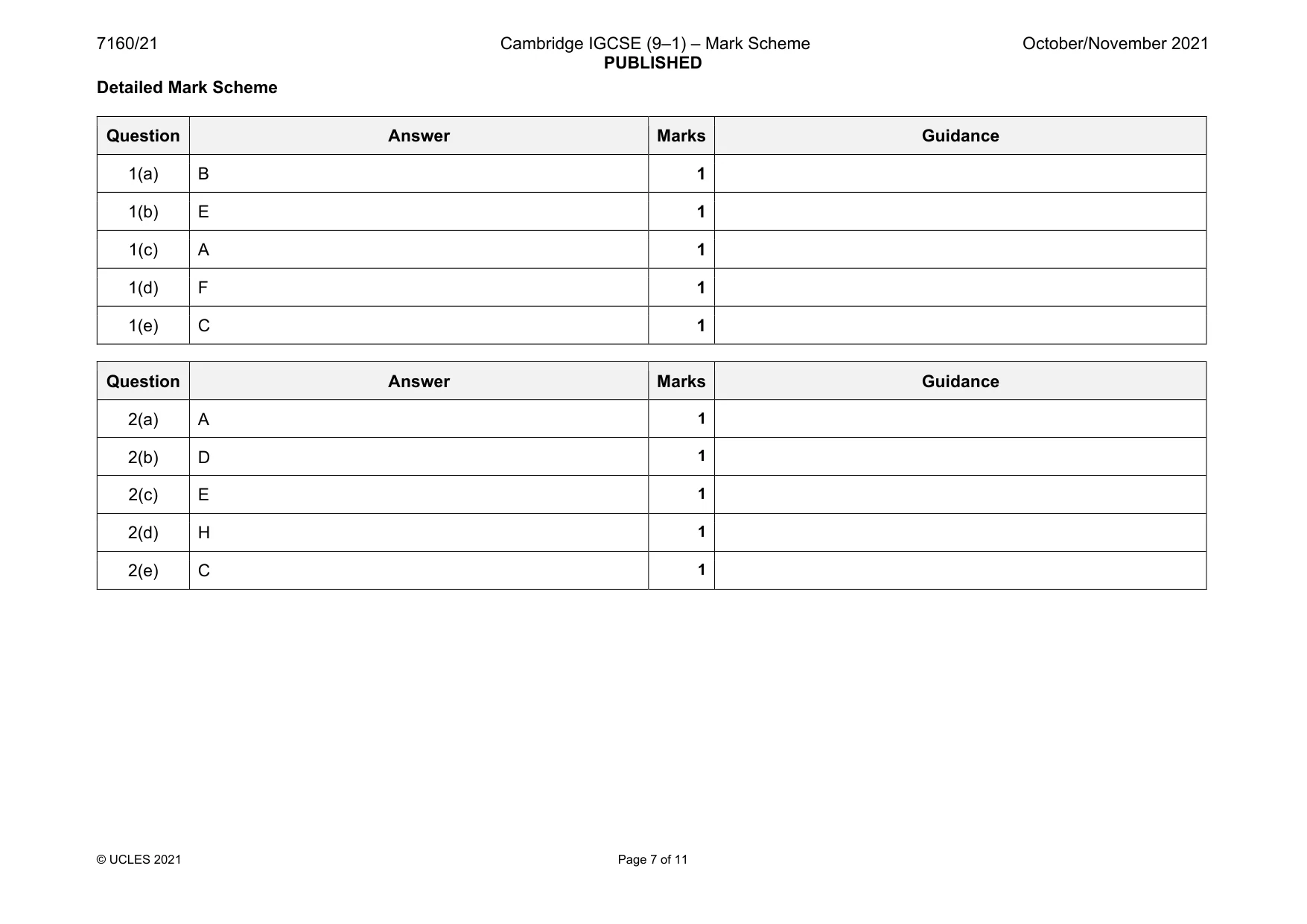
7160/21 Cambridge IGCSE (9–1) – Mark Scheme PUBLISHED October/November 2021 © UCLES 2021 Page 7 of 11 Detailed Mark Scheme Question Answer Marks Guidance 1(a) B 1 1(b) E 1 1(c) A 1 1(d) F 1 1(e) C 1 Question Answer Marks Guidance 2(a) A 1 2(b) D 1 2(c) E 1 2(d) H 1 2(e) C 1
Mark scheme, page 8
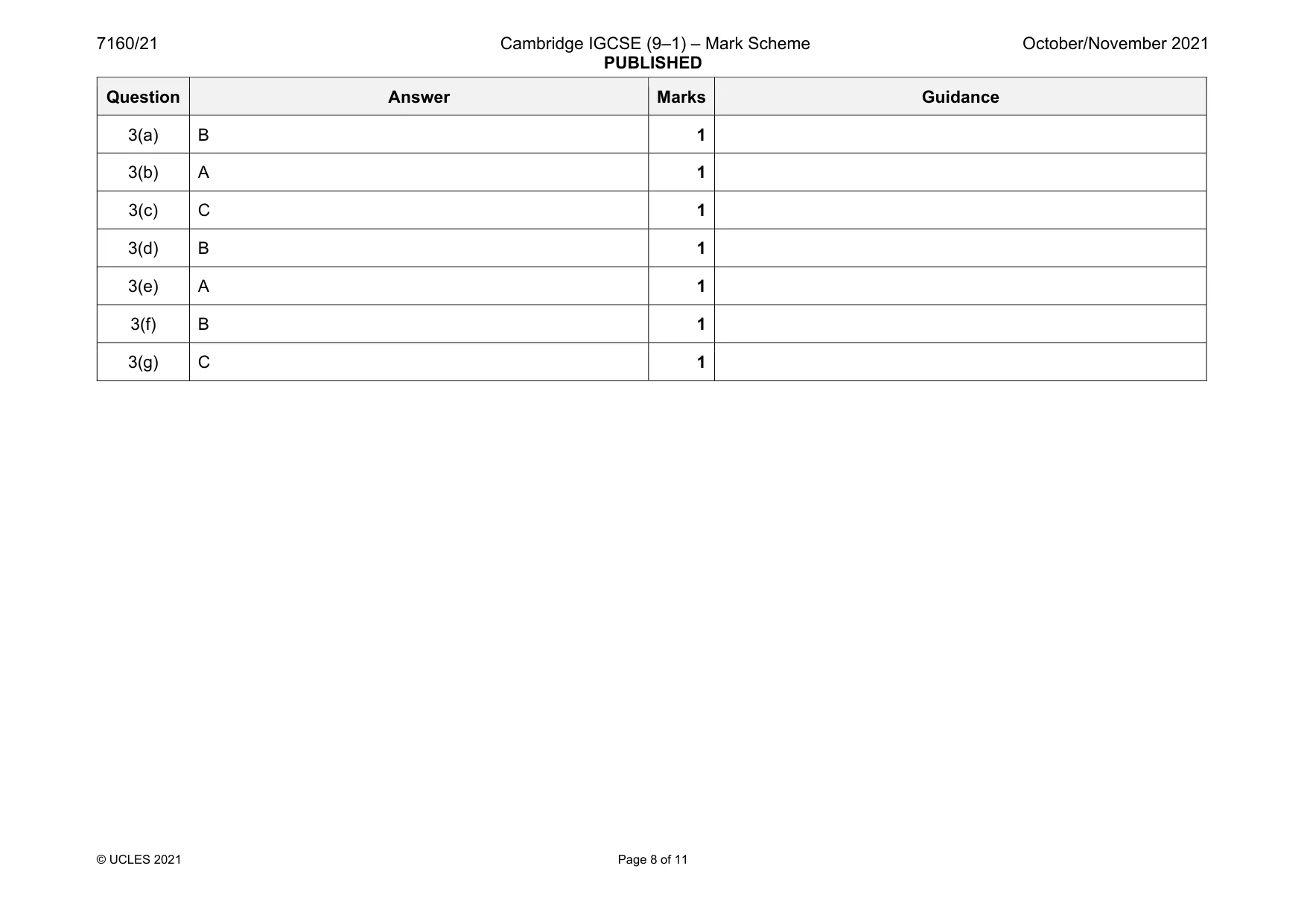
7160/21 Cambridge IGCSE (9–1) – Mark Scheme PUBLISHED October/November 2021 © UCLES 2021 Page 8 of 11 Question Answer Marks Guidance 3(a) B 1 3(b) A 1 3(c) C 1 3(d) B 1 3(e) A 1 3(f) B 1 3(g) C 1
Mark scheme, page 9
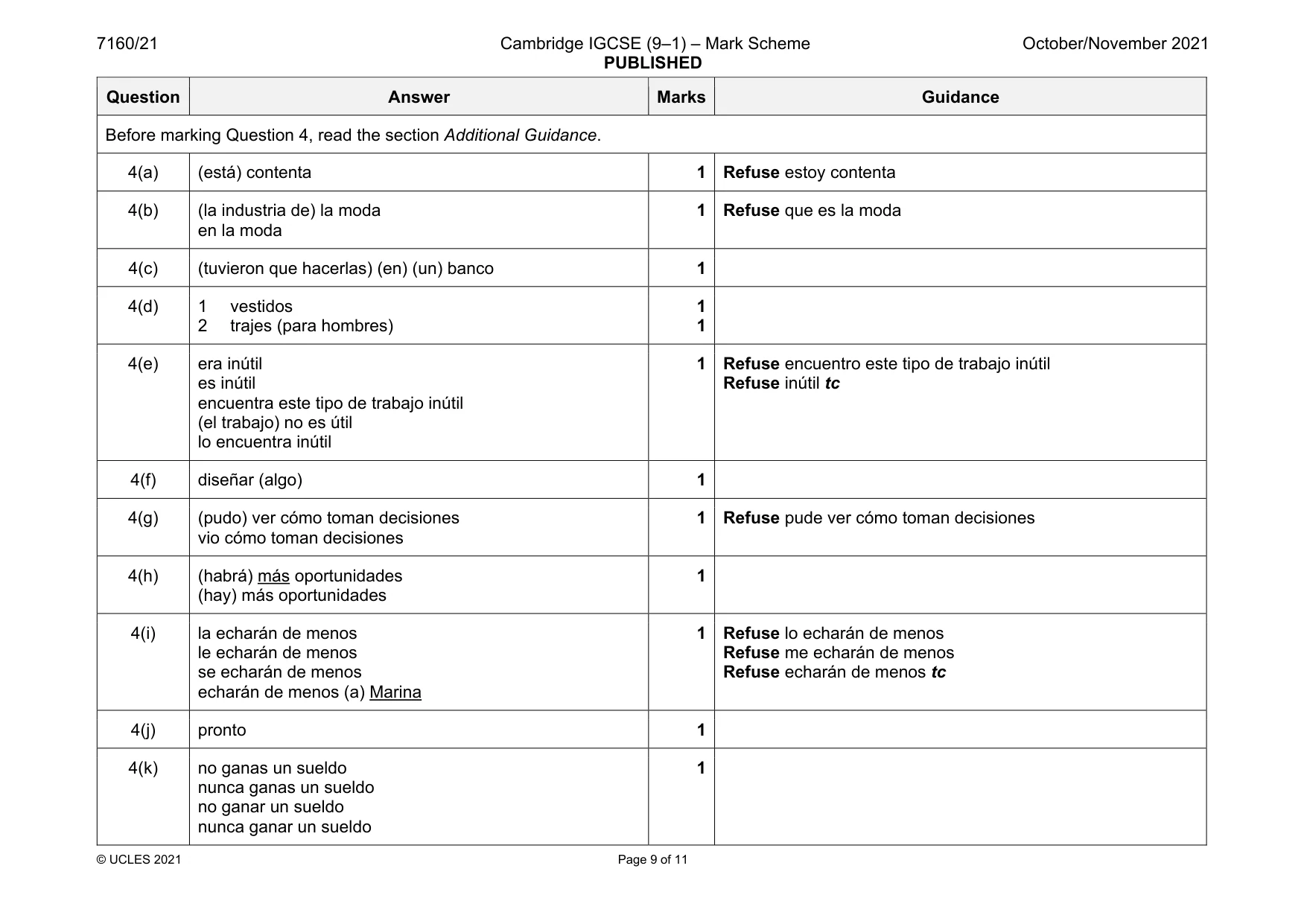
7160/21 Cambridge IGCSE (9–1) – Mark Scheme PUBLISHED October/November 2021 © UCLES 2021 Page 9 of 11 Question Answer Marks Guidance Before marking Question 4, read the section Additional Guidance. 4(a) (está) contenta 1 Refuse estoy contenta 4(b) (la industria de) la moda en la moda 1 Refuse que es la moda 4(c) (tuvieron que hacerlas) (en) (un) banco 1 4(d) 1 vestidos 2 trajes (para hombres) 1 1 4(e) era inútil es inútil encuentra este tipo de trabajo inútil (el trabajo) no es útil lo encuentra inútil 1 Refuse encuentro este tipo de trabajo inútil Refuse inútil tc 4(f) diseñar (algo) 1 4(g) (pudo) ver cómo toman decisiones vio cómo toman decisiones 1 Refuse pude ver cómo toman decisiones 4(h) (habrá) más oportunidades (hay) más oportunidades 1 4(i) la echarán de menos le echarán de menos se echarán de menos echarán de menos (a) Marina 1 Refuse lo echarán de menos Refuse me echarán de menos Refuse echarán de menos tc 4(j) pronto 1 4(k) no ganas un sueldo nunca ganas un sueldo no ganar un sueldo nunca ganar un sueldo 1
Mark scheme, page 10
7160/21 Cambridge IGCSE (9–1) – Mark Scheme PUBLISHED October/November 2021 © UCLES 2021 Page 10 of 11 Question Answer Marks Guidance 5 2, 7, 5, 8, 3 5 Question Answer Marks Guidance Before marking Question 6, read the section Additional Guidance. 6(a) (comenzó/empezó) hace 12 años (comenzó/empezó) hace doce años (comenzó/empezó en) 2009 1 Refuse comenzamos hace 12 años 6(b) se sorprende le sorprende (está) sorprendido sorpresa 1 Refuse me sorprende Refuse responses in past tense 6(c) ayudar a los grupos de música de la región ayudan a los grupos de música de la región ayuda a los grupos de música de la región quieren ayudar a los grupos de música de la región 1 Refuse ayudamos a los grupos de música de la región Refuse sino que… 6(d) 1 entusiastas de la música 2 adolescentes jóvenes 1 1 6(e) 1 los otros festivales (aún) no han empezado 2 el primer festival del año es el más emocionante 1 1 Refuse es más emocionante Refuse el primer festival del año, en mi opinión, es el más emocionante 6(f) (había/hay) menos lluvia (hacía/hace) mejor tiempo el tiempo en septiembre hay menos lluvia que en mayo llueve menos 1 Refuse no llueve
Mark scheme, page 11
7160/21 Cambridge IGCSE (9–1) – Mark Scheme PUBLISHED October/November 2021 © UCLES 2021 Page 11 of 11 Question Answer Marks Guidance 6(g) continúa trabajando trabaja trabajar 1 Refuse continúo trabajando 6(h) (siempre) es (un festival) (muy) popular entre los grupos importantes son (muy) populares entre los grupos importantes son (más) populares (que otros festivales) entre los grupos importantes 1 Refuse somos muy populares entre los grupos importantes 6(i) (hay/tiene) (un) ambiente feliz su ambiente feliz 1 Refuse trabajan mucho…
What you needed in this session
Cambridge’s own grade thresholds for 2021 Oct/Nov, Paper 2 · Variant 1. A higher threshold means an easier paper — the bar moves with how the cohort did.