Cambridge IGCSE Sciences - Co-ordinated (Double) 0654 — 2014 May/June Paper 3 · Variant 2
0654/32/M/J/14 · 120 marks · ≈135 min
The question paper and its mark scheme, free to read here and free to download. This is Cambridge’s own paper, exactly as it was sat.
Question paper32 pages






Mark scheme8 pages
Answers below. Sit the paper first if you are practising.
Paper as text
Question paper, page 1
This document consists of 30 printed pages and 2 blank pages. IB14 06_0654_32/6RP © UCLES 2014 [Turn over *0689172130* Cambridge International Examinations Cambridge International General Certificate of Secondary Education CO-ORDINATED SCIENCES 0654/32 Paper 3 (Extended) May/June 2014 2 hours Candidates answer on the Question Paper. No Additional Materials are required. READ THESE INSTRUCTIONS FIRST Write your Centre number, candidate number and name on all the work you hand in. Write in dark blue or black pen. You may use an HB pencil for any diagrams or graphs. Do not use staples, paper clips, glue or correction fluid. DO NOT WRITE IN ANY BARCODES. Answer all questions. Electronic calculators may be used. You may lose marks if you do not show your working or if you do not use appropriate units. A copy of the Periodic Table is printed on page 32. At the end of the examination, fasten all your work securely together. The number of marks is given in brackets [ ] at the end of each question or part question.
Question paper, page 2
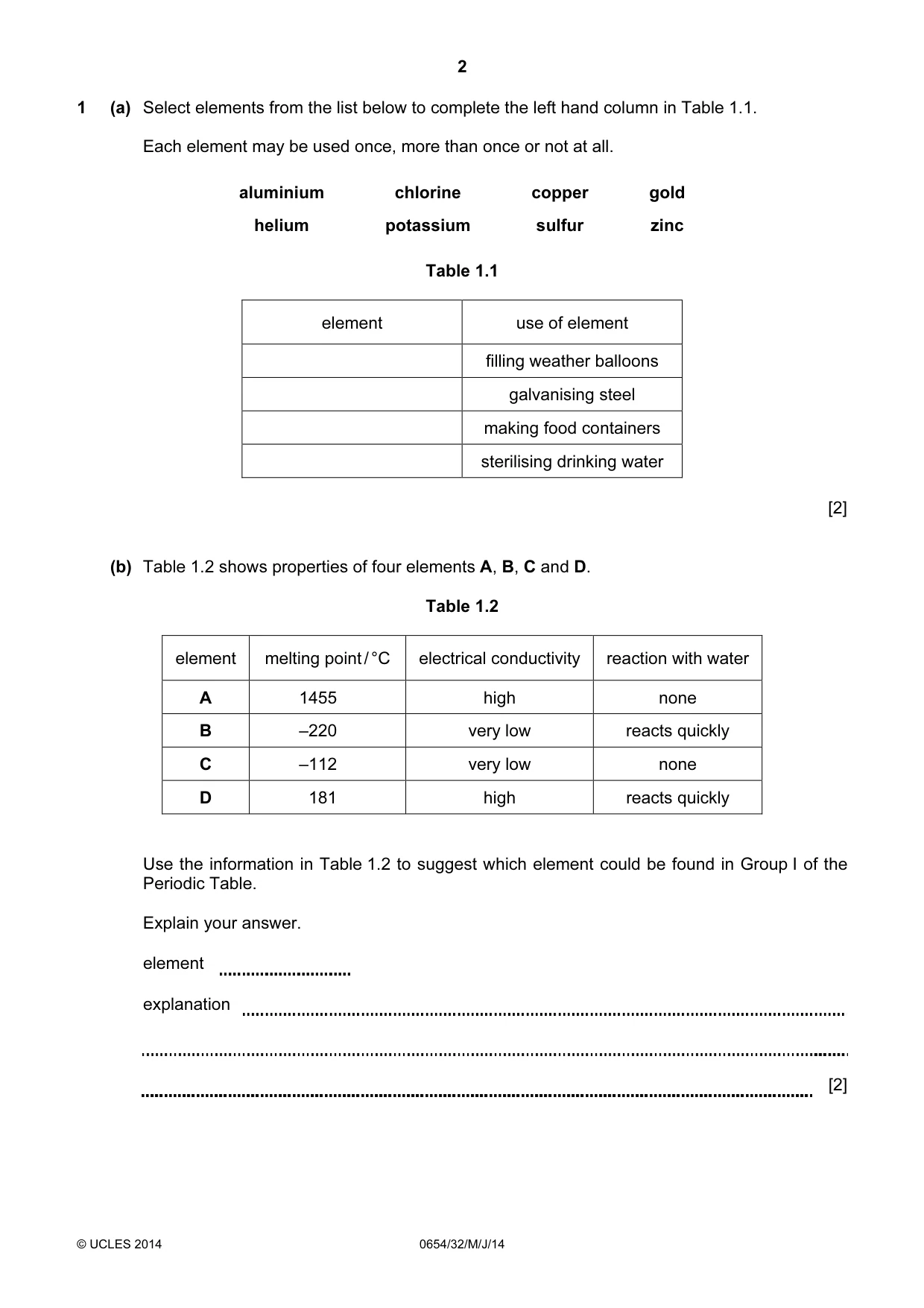
2 © UCLES 2014 0654/32/M/J/14 1 (a) Select elements from the list below to complete the left hand column in Table 1.1. Each element may be used once, more than once or not at all. aluminium chlorine copper gold helium potassium sulfur zinc Table 1.1 element use of element filling weather balloons galvanising steel making food containers sterilising drinking water [2] (b) Table 1.2 shows properties of four elements A, B, C and D. Table 1.2 element melting point / °C electrical conductivity reaction with water A 1455 high none B –220 very low reacts quickly C –112 very low none D 181 high reacts quickly Use the information in Table 1.2 to suggest which element could be found in Group I of the Periodic Table. Explain your answer. element explanation [2]
Question paper, page 3
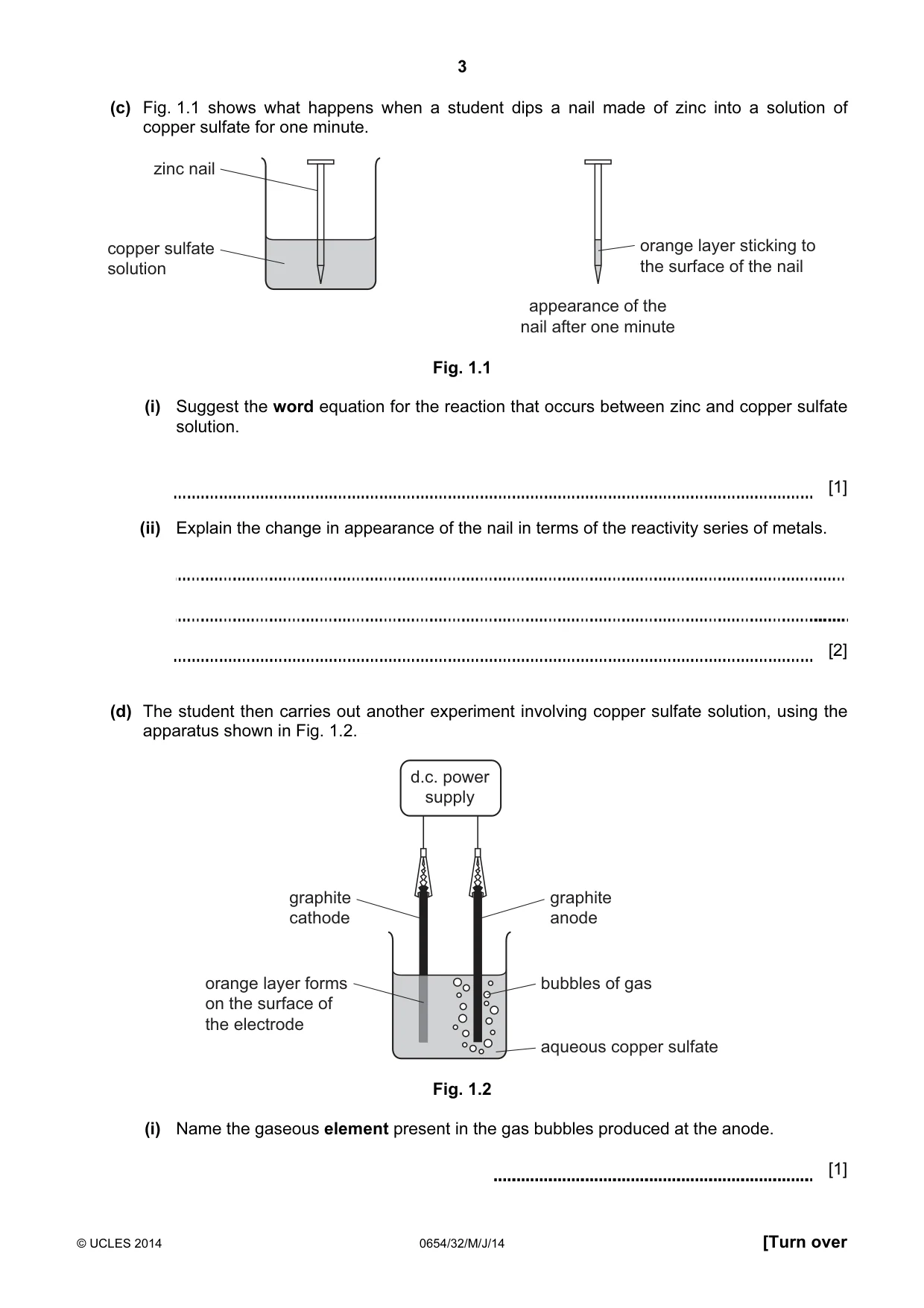
3 © UCLES 2014 0654/32/M/J/14 [Turn over (c) Fig. 1.1 shows what happens when a student dips a nail made of zinc into a solution of copper sulfate for one minute. zinc nail copper sulfate solution appearance of the nail after one minute orange layer sticking to the surface of the nail Fig. 1.1 (i) Suggest the word equation for the reaction that occurs between zinc and copper sulfate solution. [1] (ii) Explain the change in appearance of the nail in terms of the reactivity series of metals. [2] (d) The student then carries out another experiment involving copper sulfate solution, using the apparatus shown in Fig. 1.2. bubbles of gas aqueous copper sulfate graphite anode graphite cathode d.c. power supply orange layer forms on the surface of the electrode Fig. 1.2 (i) Name the gaseous element present in the gas bubbles produced at the anode. [1]
Question paper, page 4
4 © UCLES 2014 0654/32/M/J/14 (ii) Describe, in terms of copper ions, Cu2+, what happens to cause the formation of the orange layer on the surface of the cathode. [3]
Question paper, page 5
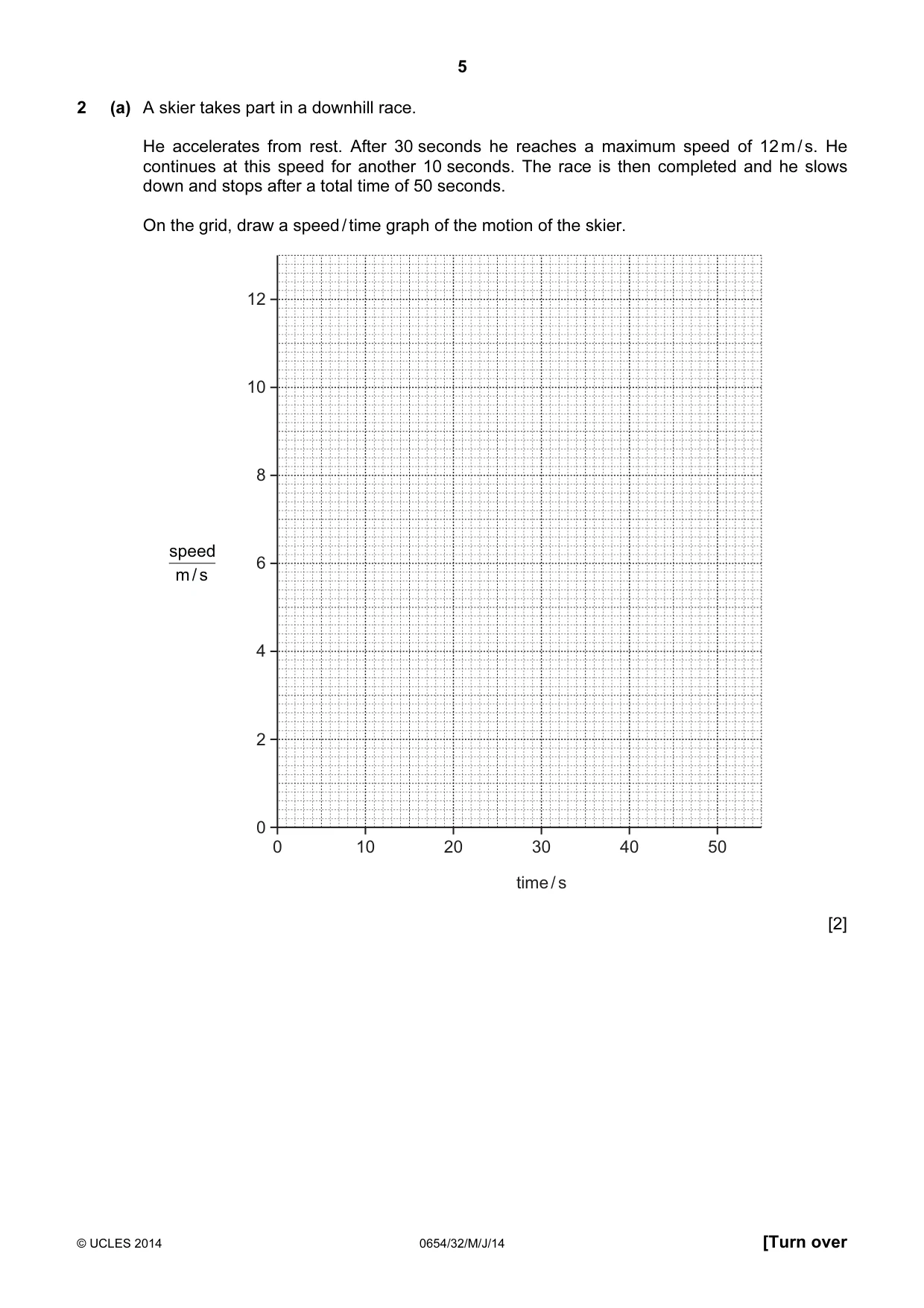
5 © UCLES 2014 0654/32/M/J/14 [Turn over 2 (a) A skier takes part in a downhill race. He accelerates from rest. After 30 seconds he reaches a maximum speed of 12 m / s. He continues at this speed for another 10 seconds. The race is then completed and he slows down and stops after a total time of 50 seconds. On the grid, draw a speed / time graph of the motion of the skier. m / s speed 0 10 20 30 40 50 12 10 8 6 4 2 0 time / s [2]
Question paper, page 6
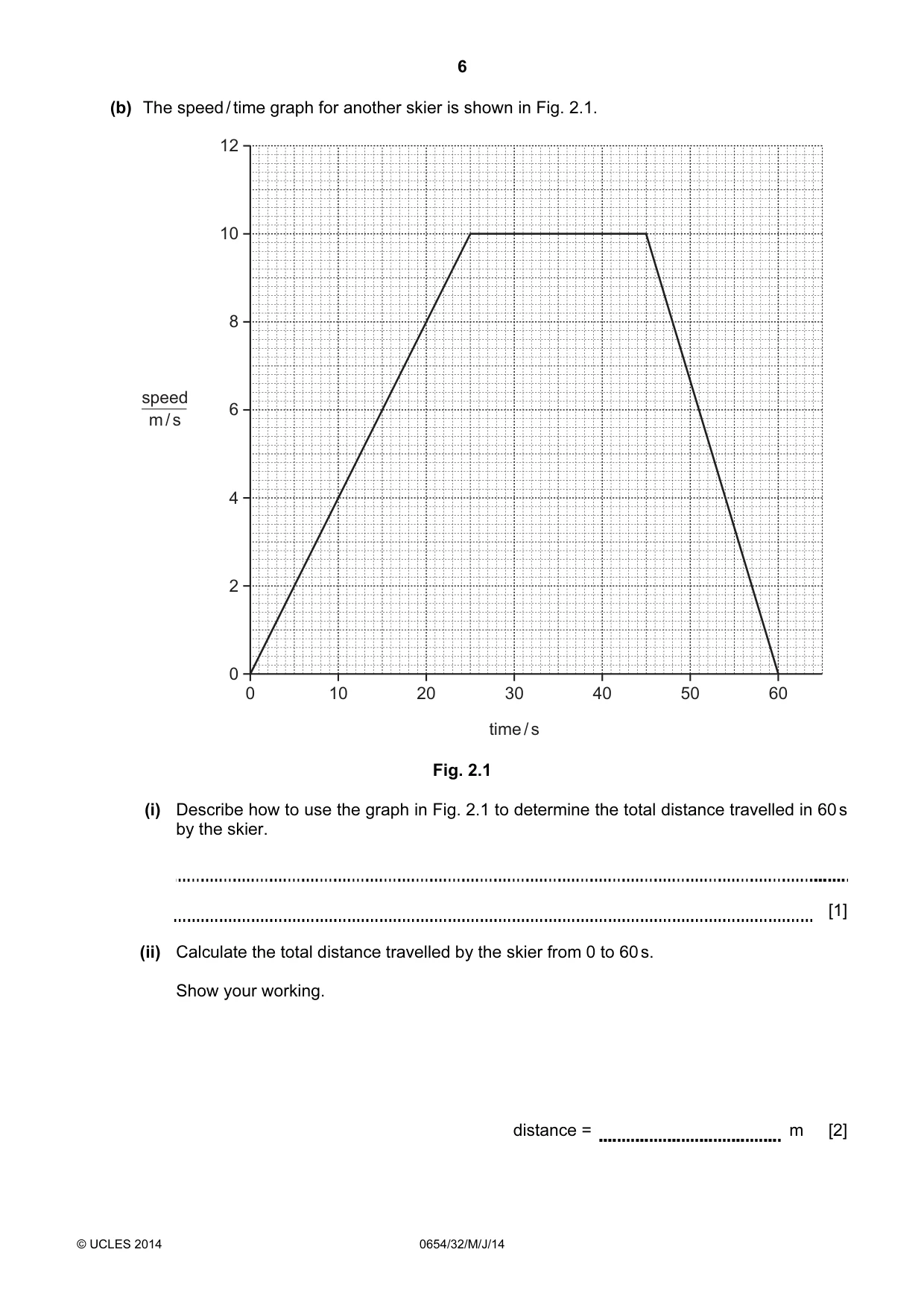
6 © UCLES 2014 0654/32/M/J/14 (b) The speed / time graph for another skier is shown in Fig. 2.1. 0 10 20 30 40 50 60 12 10 8 6 4 2 0 time / s speed m / s Fig. 2.1 (i) Describe how to use the graph in Fig. 2.1 to determine the total distance travelled in 60 s by the skier. [1] (ii) Calculate the total distance travelled by the skier from 0 to 60 s. Show your working. distance = m [2]
Question paper, page 7
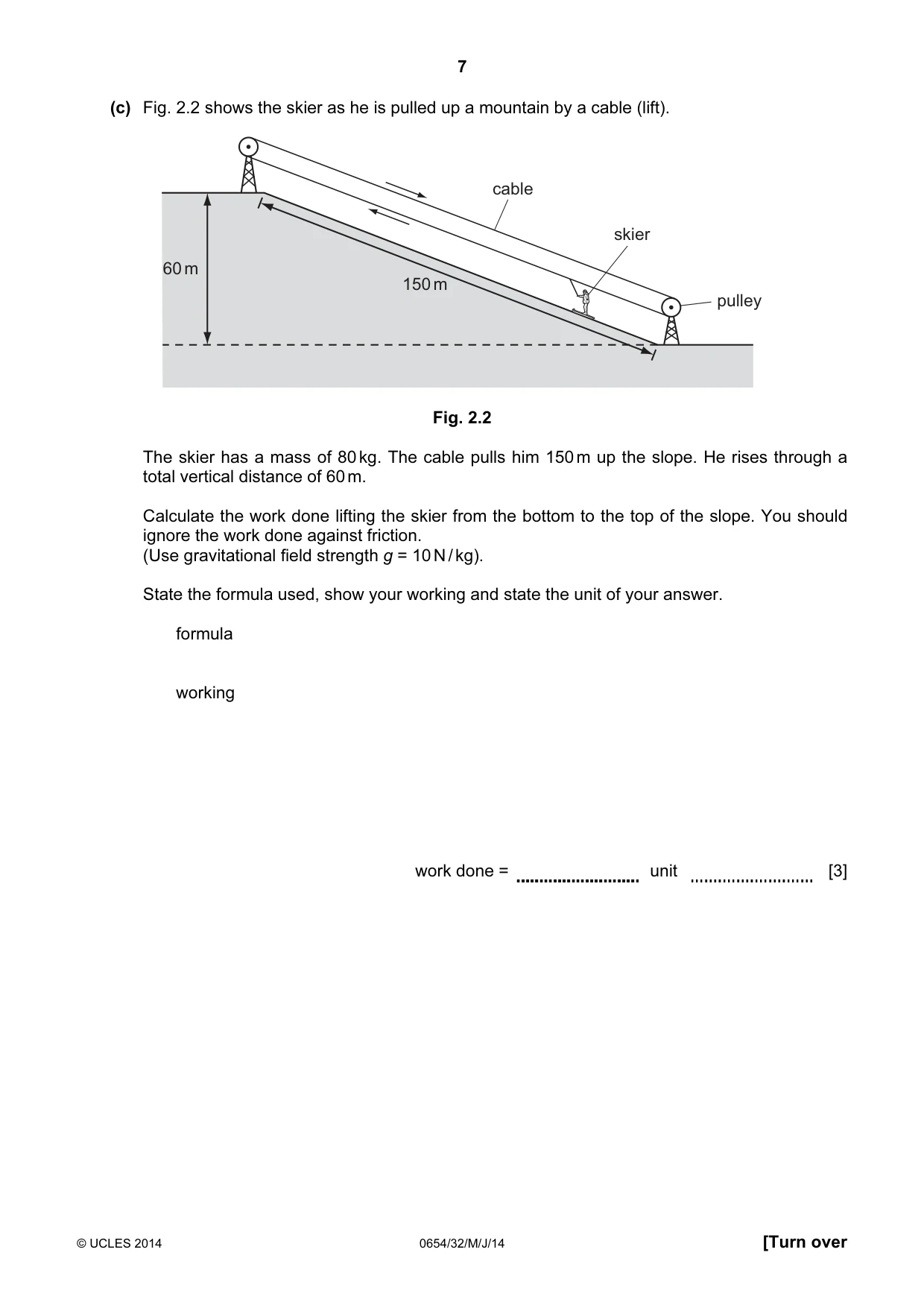
7 © UCLES 2014 0654/32/M/J/14 [Turn over (c) Fig. 2.2 shows the skier as he is pulled up a mountain by a cable (lift). 60 m 150 m cable skier pulley Fig. 2.2 The skier has a mass of 80 kg. The cable pulls him 150 m up the slope. He rises through a total vertical distance of 60 m. Calculate the work done lifting the skier from the bottom to the top of the slope. You should ignore the work done against friction. (Use gravitational field strength g = 10 N / kg). State the formula used, show your working and state the unit of your answer. formula working work done = unit [3]
Question paper, page 8
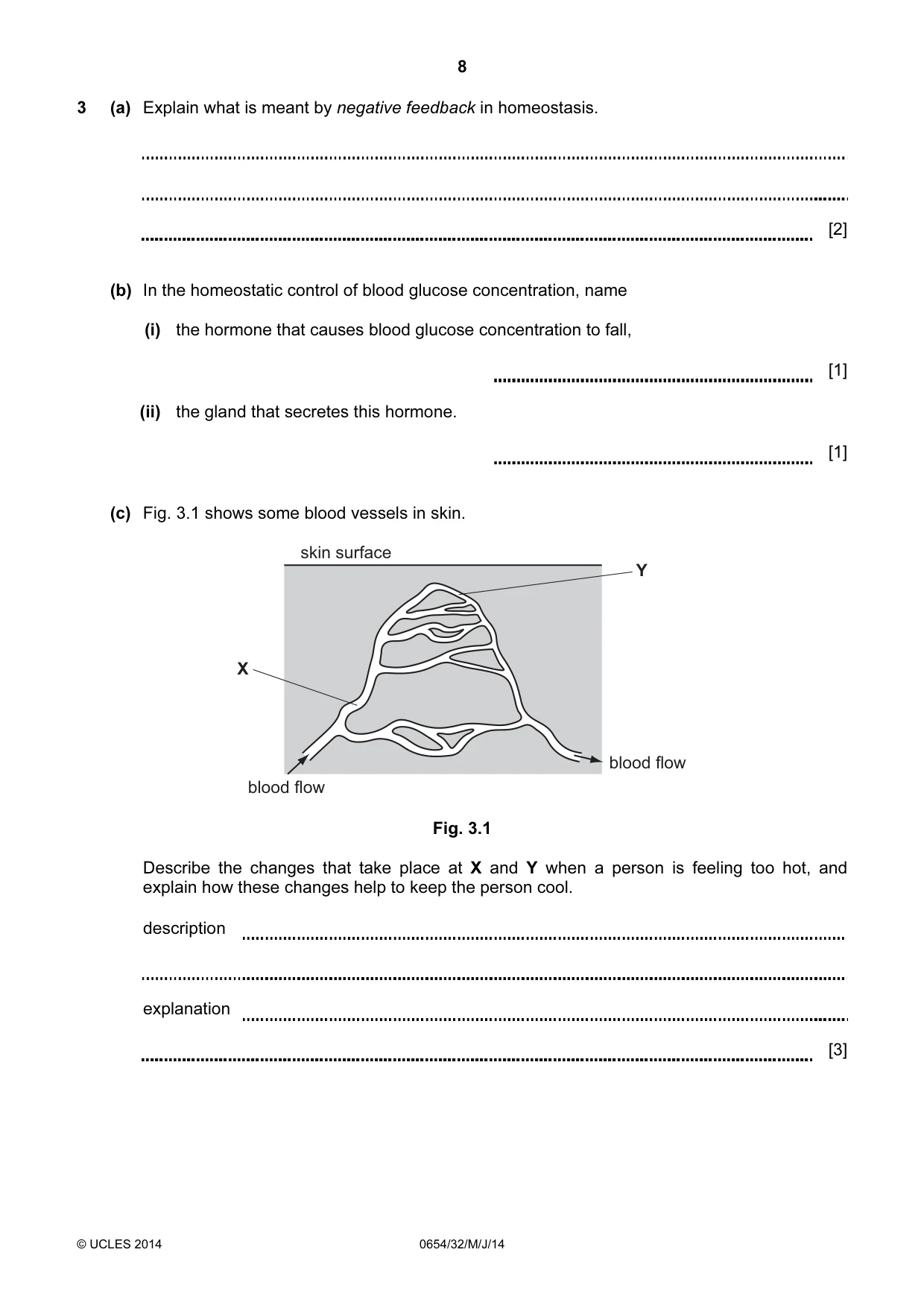
8 © UCLES 2014 0654/32/M/J/14 3 (a) Explain what is meant by negative feedback in homeostasis. [2] (b) In the homeostatic control of blood glucose concentration, name (i) the hormone that causes blood glucose concentration to fall, [1] (ii) the gland that secretes this hormone. [1] (c) Fig. 3.1 shows some blood vessels in skin. blood flow blood flow X Y skin surface Fig. 3.1 Describe the changes that take place at X and Y when a person is feeling too hot, and explain how these changes help to keep the person cool. description explanation [3]
Question paper, page 9
9 © UCLES 2014 0654/32/M/J/14 [Turn over (d) Some people suffer from a disease called Raynaud’s syndrome, in which the blood supply to the fingers may be severely reduced for a period of time varying from just a few minutes up to several hours. (i) Suggest what changes in the body to cause the blood supply to the fingers to be reduced. [1] (ii) People with Raynaud’s syndrome are told to take special care to keep their hands warm in cold weather. Suggest the reason for this advice. [1] (iii) Explain what might be the effect on the fingers if the blood supply to them is severely reduced for several hours. [2]
Question paper, page 10
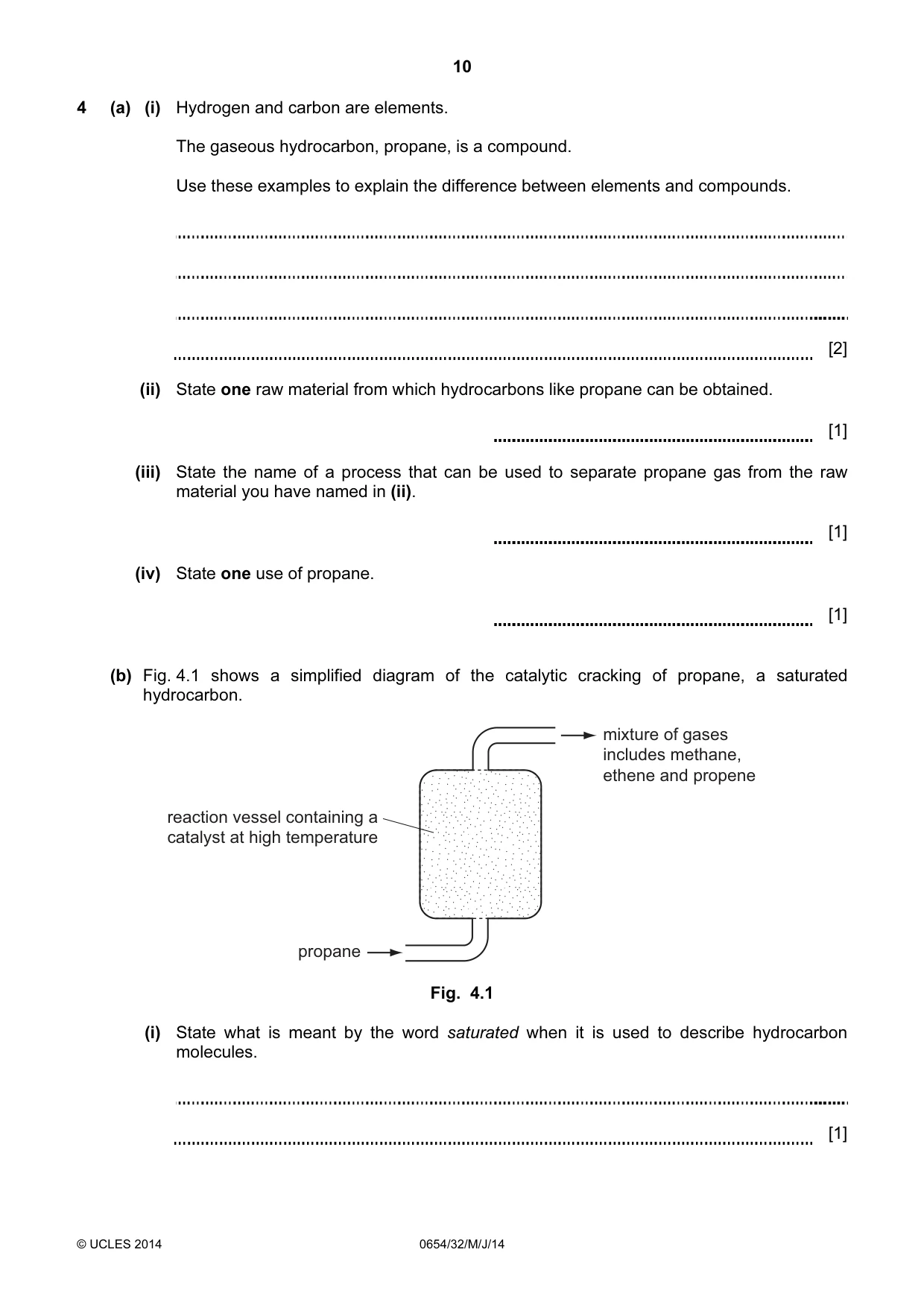
10 © UCLES 2014 0654/32/M/J/14 4 (a) (i) Hydrogen and carbon are elements. The gaseous hydrocarbon, propane, is a compound. Use these examples to explain the difference between elements and compounds. [2] (ii) State one raw material from which hydrocarbons like propane can be obtained. [1] (iii) State the name of a process that can be used to separate propane gas from the raw material you have named in (ii). [1] (iv) State one use of propane. [1] (b) Fig. 4.1 shows a simplified diagram of the catalytic cracking of propane, a saturated hydrocarbon. reaction vessel containing a catalyst at high temperature propane mixture of gases includes methane, ethene and propene Fig. 4.1 (i) State what is meant by the word saturated when it is used to describe hydrocarbon molecules. [1]
Question paper, page 11
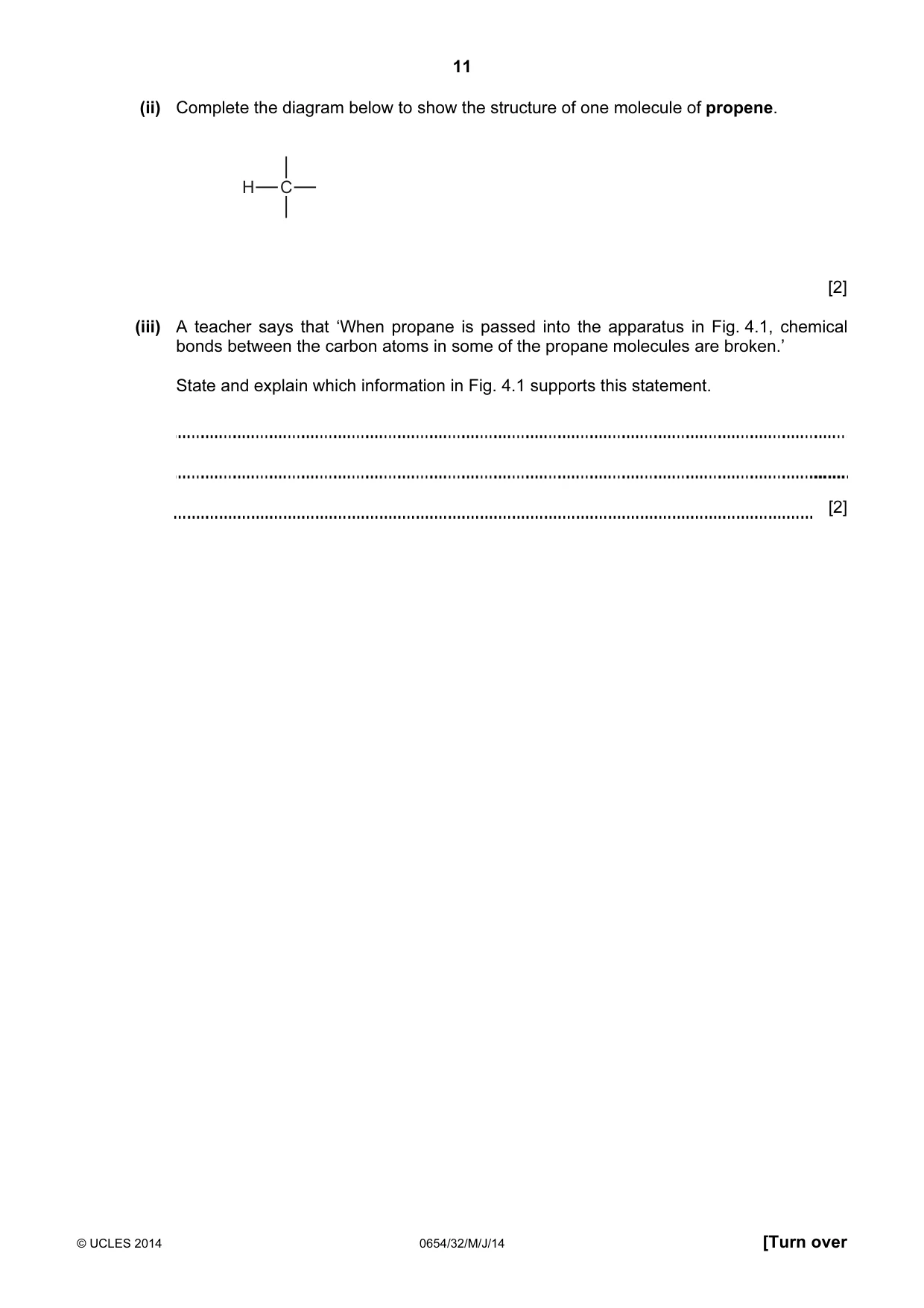
11 © UCLES 2014 0654/32/M/J/14 [Turn over (ii) Complete the diagram below to show the structure of one molecule of propene. H C [2] (iii) A teacher says that ‘When propane is passed into the apparatus in Fig. 4.1, chemical bonds between the carbon atoms in some of the propane molecules are broken.’ State and explain which information in Fig. 4.1 supports this statement. [2]
Question paper, page 12
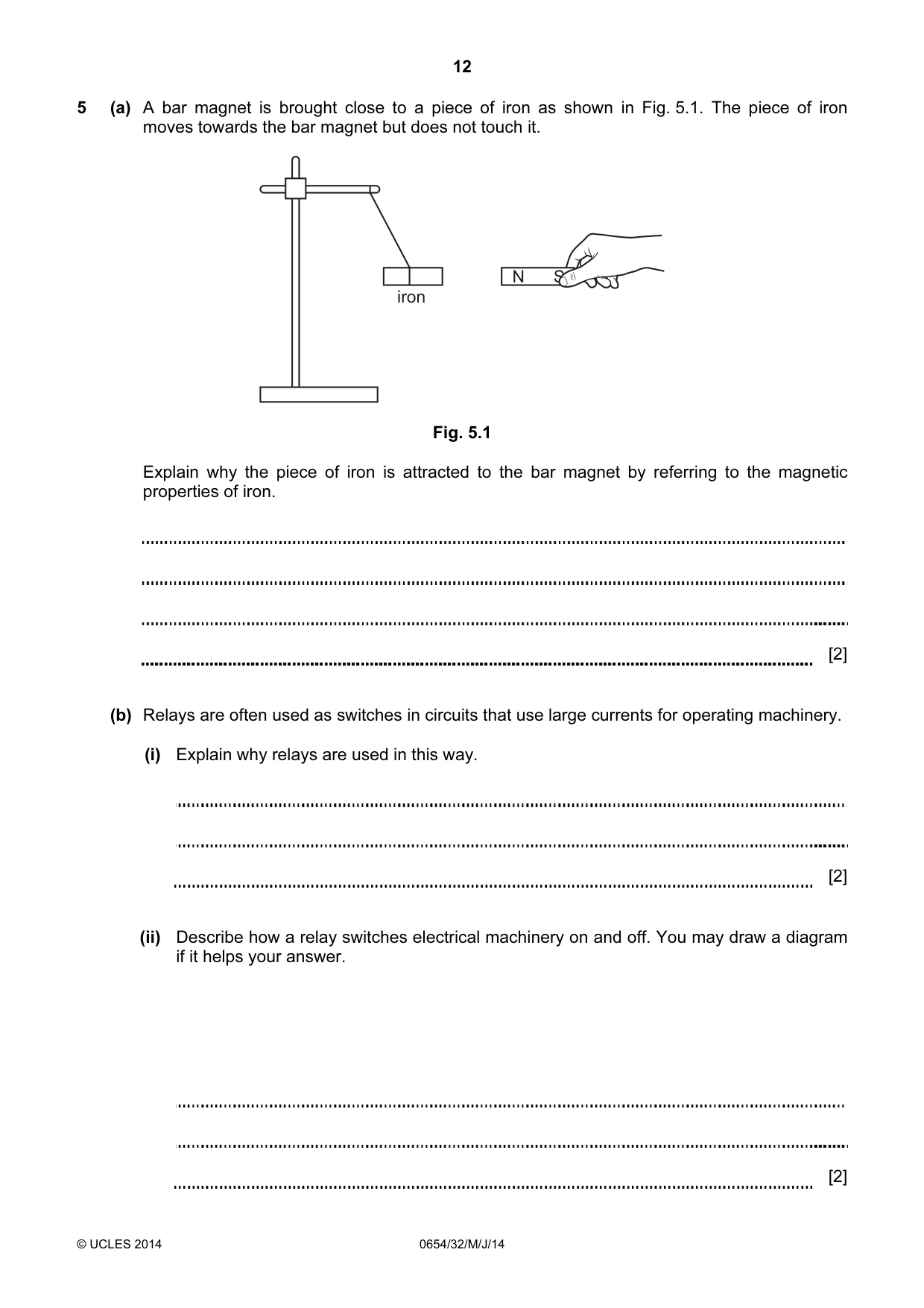
12 © UCLES 2014 0654/32/M/J/14 5 (a) A bar magnet is brought close to a piece of iron as shown in Fig. 5.1. The piece of iron moves towards the bar magnet but does not touch it. N S iron Fig. 5.1 Explain why the piece of iron is attracted to the bar magnet by referring to the magnetic properties of iron. [2] (b) Relays are often used as switches in circuits that use large currents for operating machinery. (i) Explain why relays are used in this way. [2] (ii) Describe how a relay switches electrical machinery on and off. You may draw a diagram if it helps your answer. [2]
Question paper, page 13
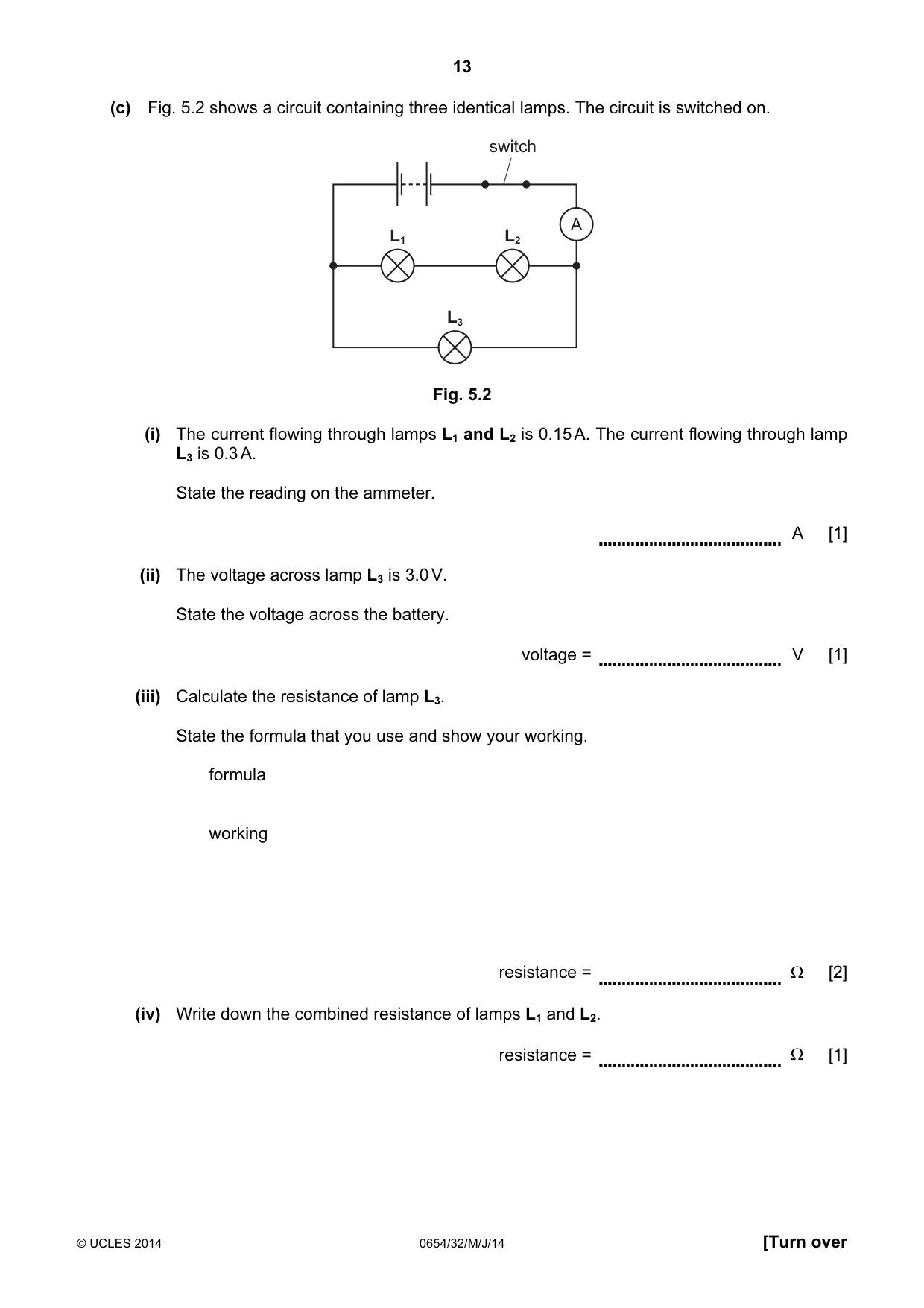
13 © UCLES 2014 0654/32/M/J/14 [Turn over (c) Fig. 5.2 shows a circuit containing three identical lamps. The circuit is switched on. A L1 L2 L3 switch Fig. 5.2 (i) The current flowing through lamps L1 and L2 is 0.15 A. The current flowing through lamp L3 is 0.3 A. State the reading on the ammeter. A [1] (ii) The voltage across lamp L3 is 3.0 V. State the voltage across the battery. voltage = V [1] (iii) Calculate the resistance of lamp L3. State the formula that you use and show your working. formula working resistance = Ω [2] (iv) Write down the combined resistance of lamps L1 and L2. resistance = Ω [1]
Question paper, page 14
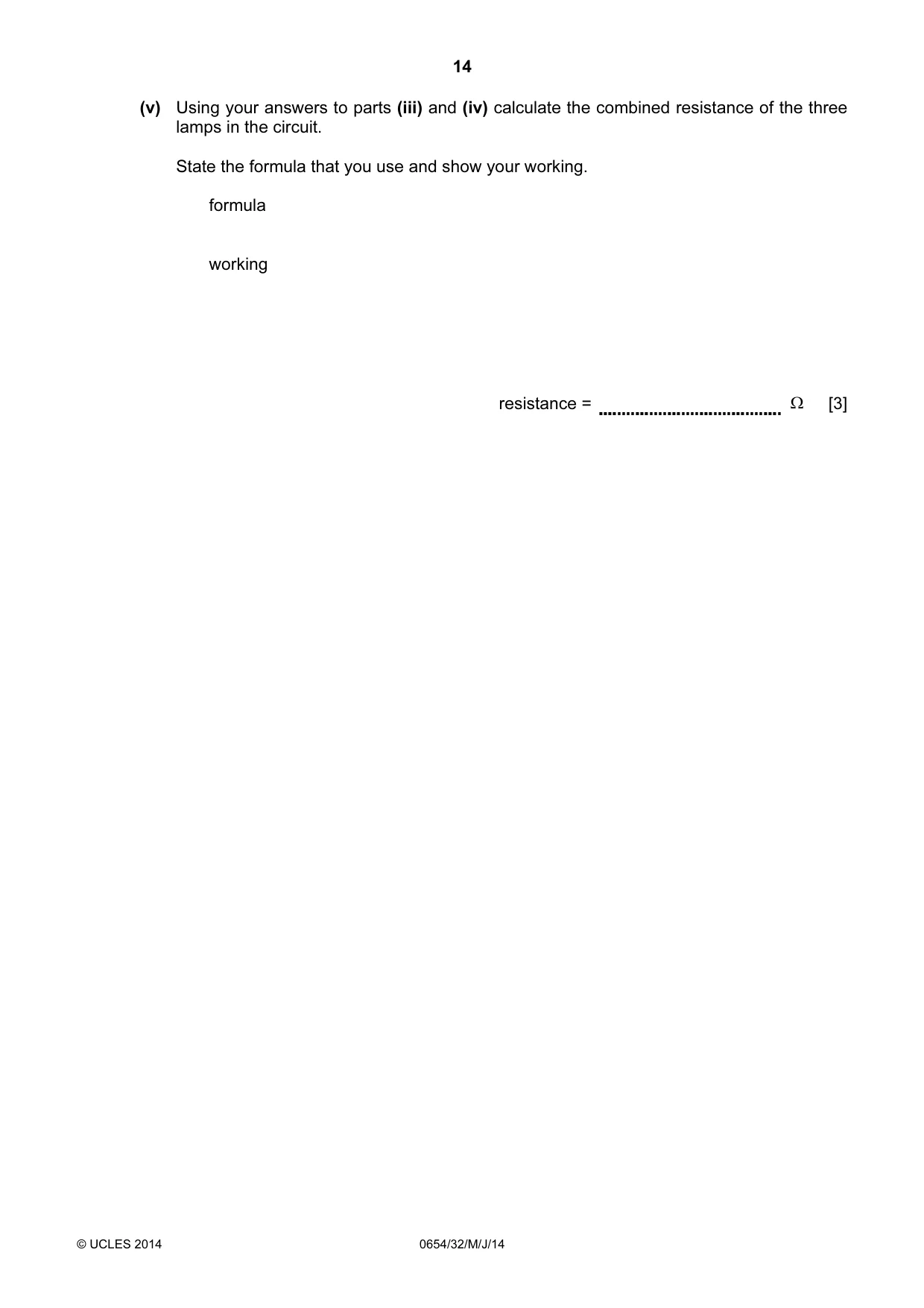
14 © UCLES 2014 0654/32/M/J/14 (v) Using your answers to parts (iii) and (iv) calculate the combined resistance of the three lamps in the circuit. State the formula that you use and show your working. formula working resistance = Ω [3]
Question paper, page 15
15 © UCLES 2014 0654/32/M/J/14 [Turn over Please turn over for Question 6.
Question paper, page 16
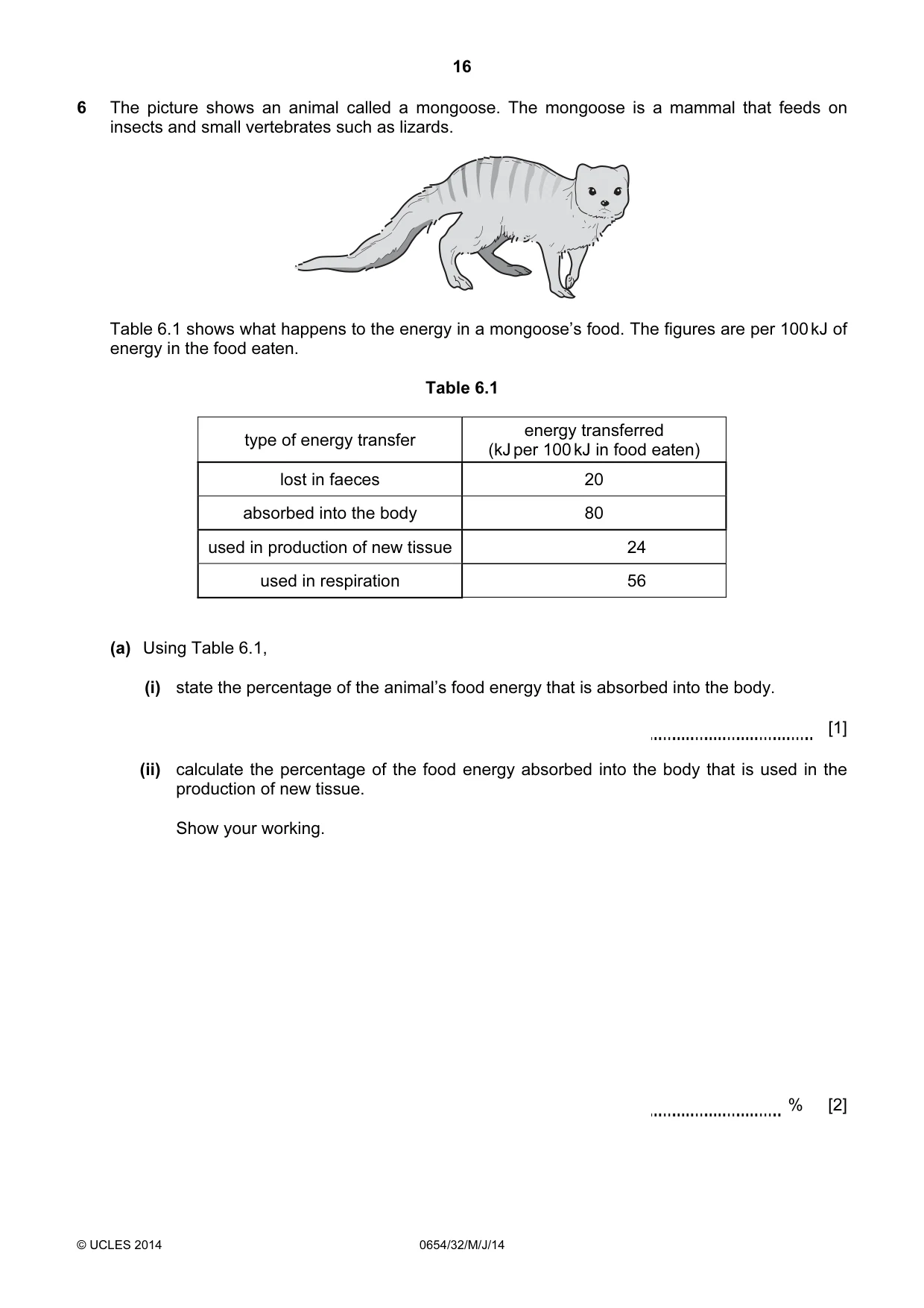
16 © UCLES 2014 0654/32/M/J/14 6 The picture shows an animal called a mongoose. The mongoose is a mammal that feeds on insects and small vertebrates such as lizards. Table 6.1 shows what happens to the energy in a mongoose’s food. The figures are per 100 kJ of energy in the food eaten. Table 6.1 type of energy transfer energy transferred (kJ per 100 kJ in food eaten) lost in faeces 20 absorbed into the body 80 used in production of new tissue 24 used in respiration 56 (a) Using Table 6.1, (i) state the percentage of the animal’s food energy that is absorbed into the body. [1] (ii) calculate the percentage of the food energy absorbed into the body that is used in the production of new tissue. Show your working. % [2]
Question paper, page 17
17 © UCLES 2014 0654/32/M/J/14 [Turn over (b) All of the energy in the mongoose’s food will eventually be transferred into the same form of energy. State this form of energy. [1] (c) Suggest one way in which the mongoose would use energy released from respiration. [1] (d) Suggest and explain how the values in Table 6.1 would be different for (i) a mammal in a colder climate, [2] (ii) an animal that eats mainly grass. [2]
Question paper, page 18
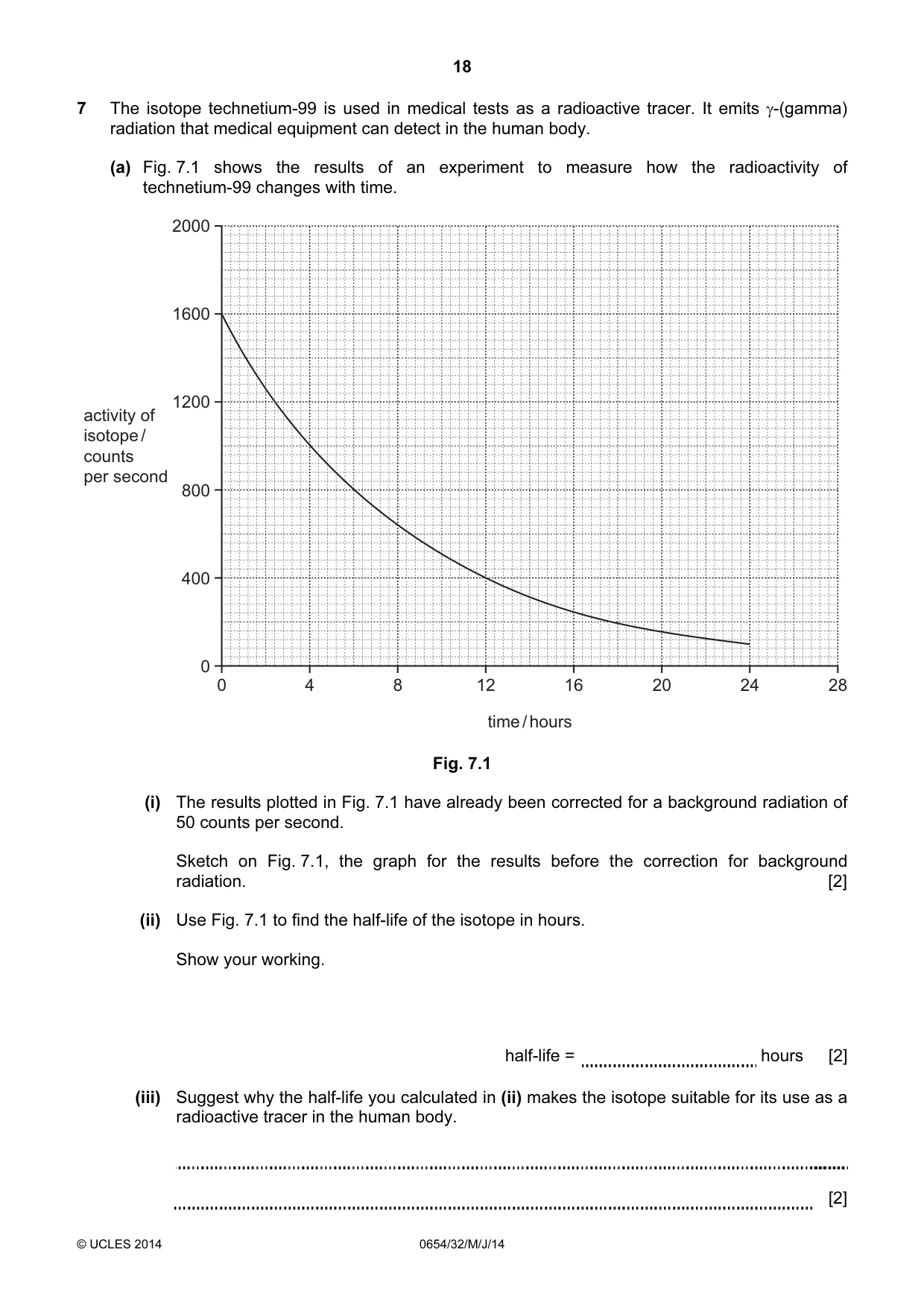
18 © UCLES 2014 0654/32/M/J/14 7 The isotope technetium-99 is used in medical tests as a radioactive tracer. It emits γ-(gamma) radiation that medical equipment can detect in the human body. (a) Fig. 7.1 shows the results of an experiment to measure how the radioactivity of technetium-99 changes with time. 0 4 8 12 time / hours activity of isotope / counts per second 16 20 24 28 2000 1600 1200 800 400 0 Fig. 7.1 (i) The results plotted in Fig. 7.1 have already been corrected for a background radiation of 50 counts per second. Sketch on Fig. 7.1, the graph for the results before the correction for background radiation. [2] (ii) Use Fig. 7.1 to find the half-life of the isotope in hours. Show your working. half-life = hours [2] (iii) Suggest why the half-life you calculated in (ii) makes the isotope suitable for its use as a radioactive tracer in the human body. [2]
Question paper, page 19
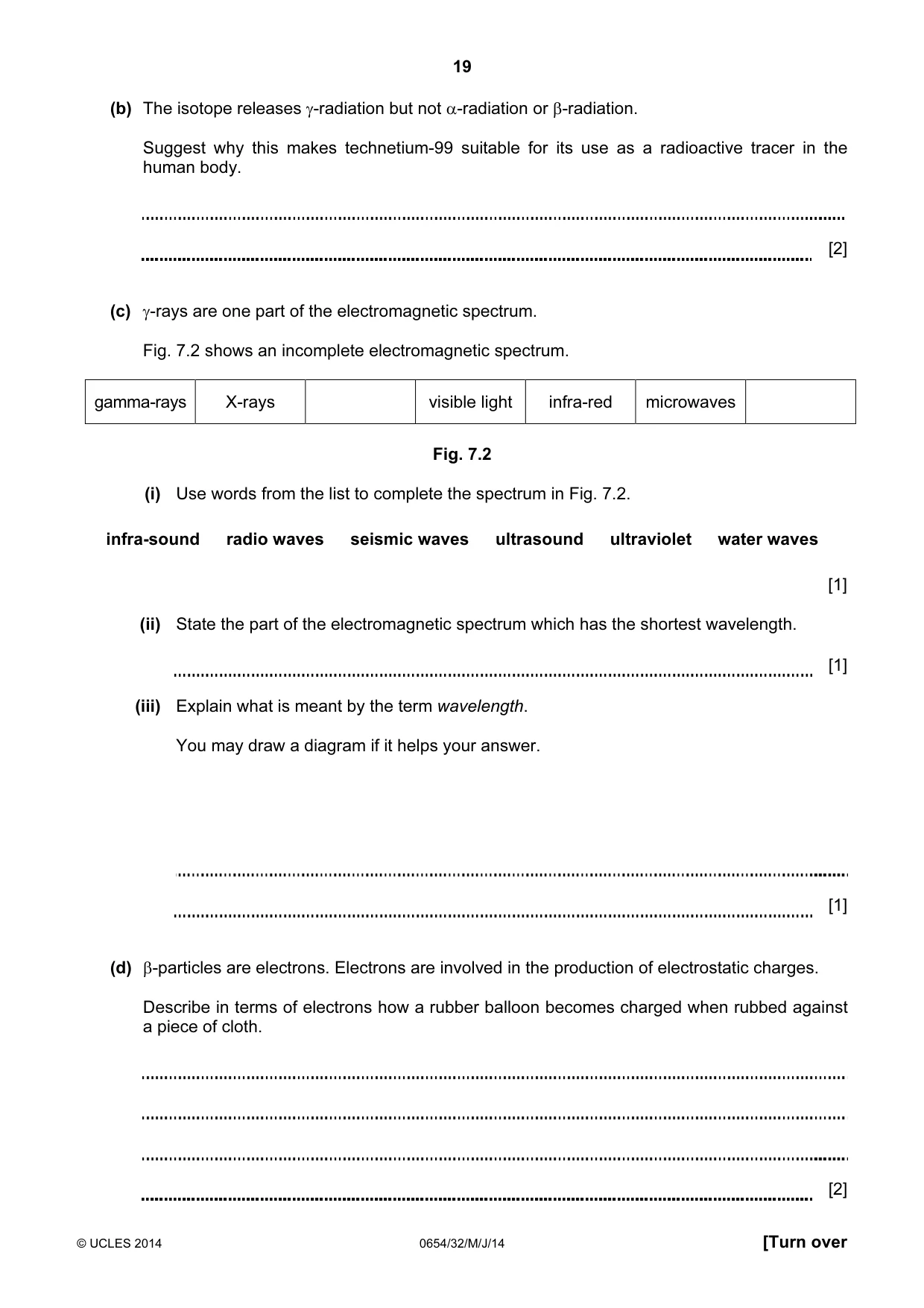
19 © UCLES 2014 0654/32/M/J/14 [Turn over (b) The isotope releases γ-radiation but not α-radiation or β-radiation. Suggest why this makes technetium-99 suitable for its use as a radioactive tracer in the human body. [2] (c) γ-rays are one part of the electromagnetic spectrum. Fig. 7.2 shows an incomplete electromagnetic spectrum. gamma-rays X-rays visible light infra-red microwaves Fig. 7.2 (i) Use words from the list to complete the spectrum in Fig. 7.2. infra-sound radio waves seismic waves ultrasound ultraviolet water waves [1] (ii) State the part of the electromagnetic spectrum which has the shortest wavelength. [1] (iii) Explain what is meant by the term wavelength. You may draw a diagram if it helps your answer. [1] (d) β-particles are electrons. Electrons are involved in the production of electrostatic charges. Describe in terms of electrons how a rubber balloon becomes charged when rubbed against a piece of cloth. [2]
Question paper, page 20
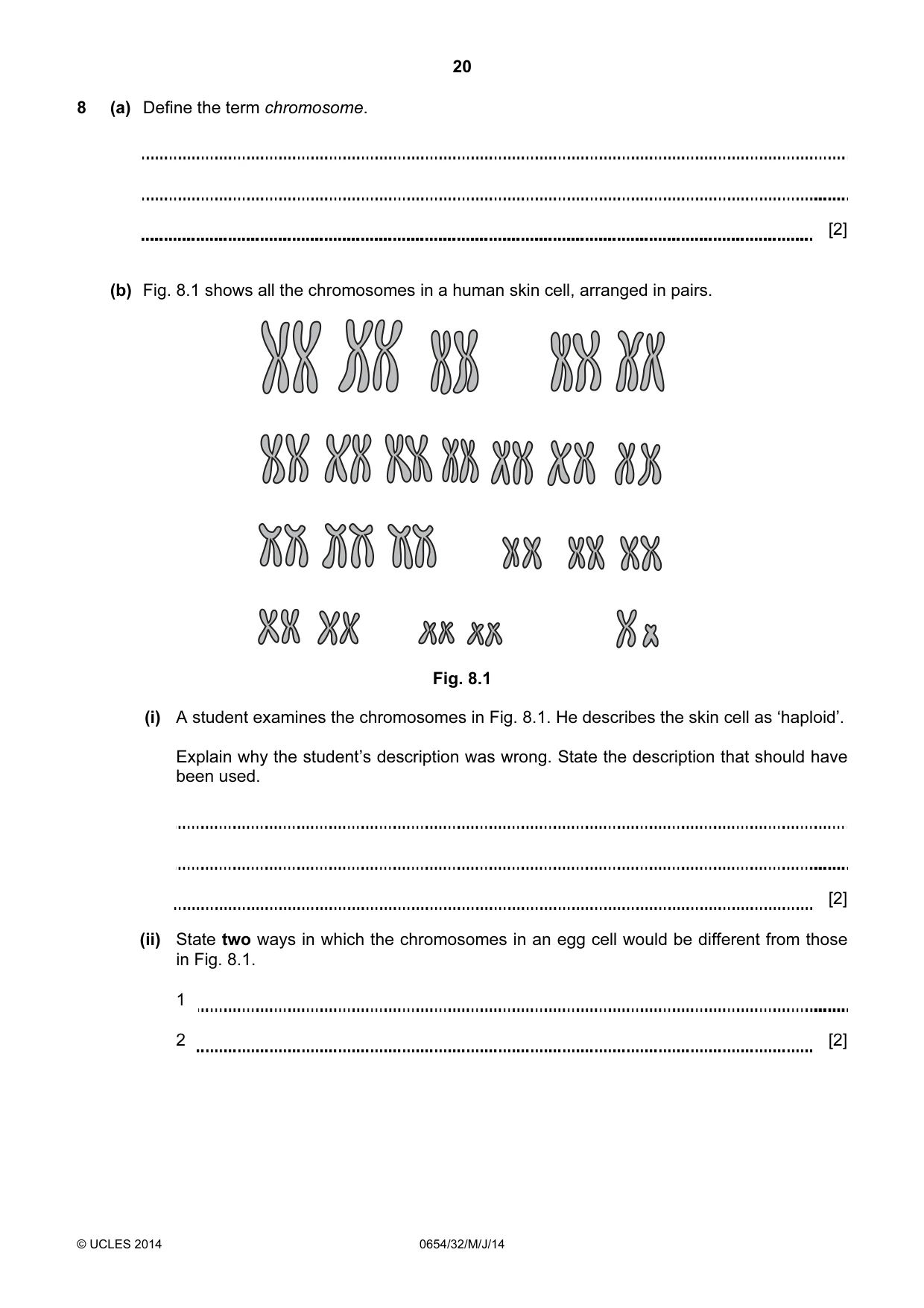
20 © UCLES 2014 0654/32/M/J/14 8 (a) Define the term chromosome. [2] (b) Fig. 8.1 shows all the chromosomes in a human skin cell, arranged in pairs. Fig. 8.1 (i) A student examines the chromosomes in Fig. 8.1. He describes the skin cell as ‘haploid’. Explain why the student’s description was wrong. State the description that should have been used. [2] (ii) State two ways in which the chromosomes in an egg cell would be different from those in Fig. 8.1. 1 2 [2]
Question paper, page 21
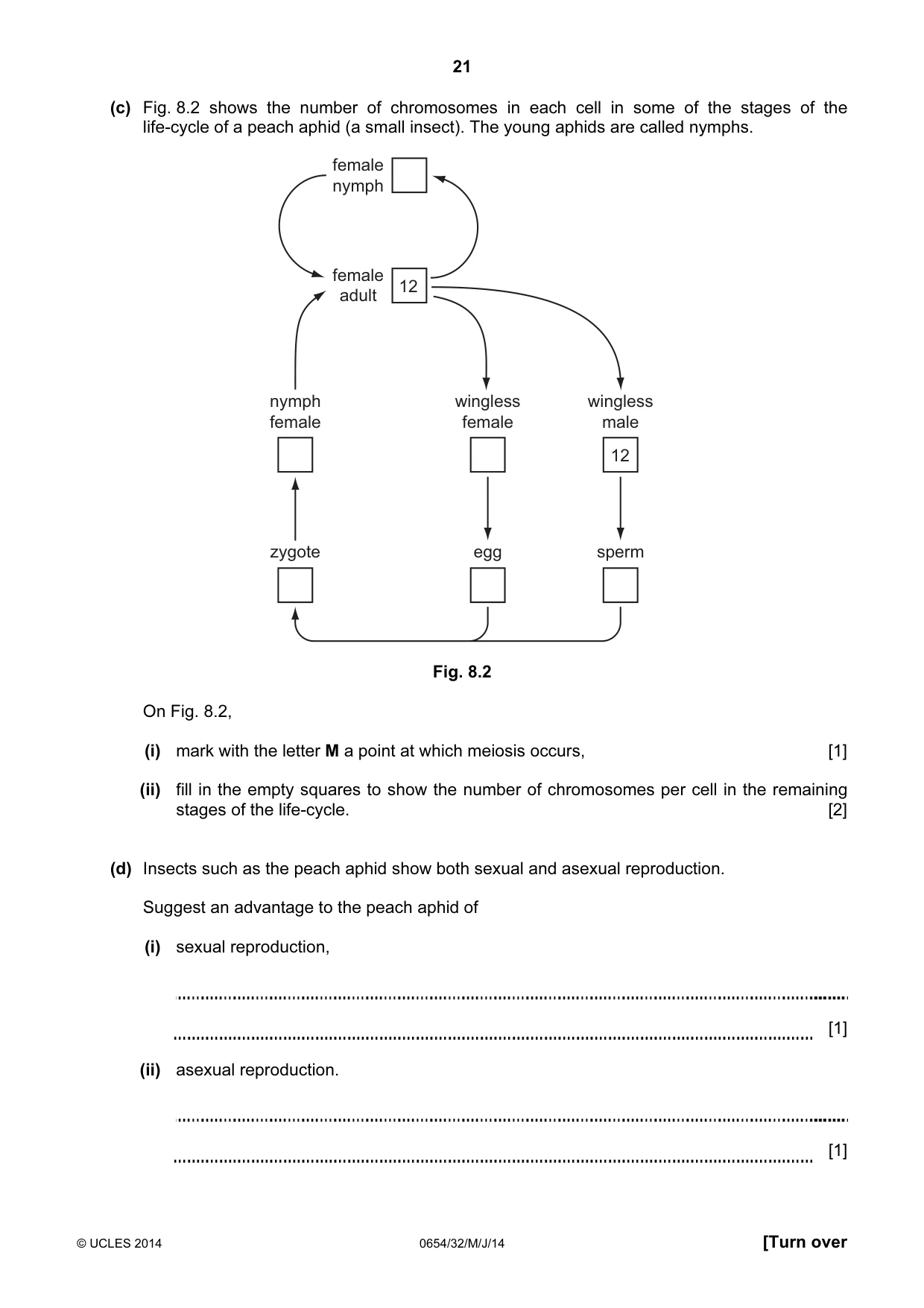
21 © UCLES 2014 0654/32/M/J/14 [Turn over (c) Fig. 8.2 shows the number of chromosomes in each cell in some of the stages of the life-cycle of a peach aphid (a small insect). The young aphids are called nymphs. female nymph female adult wingless female wingless male egg sperm 12 12 nymph female zygote Fig. 8.2 On Fig. 8.2, (i) mark with the letter M a point at which meiosis occurs, [1] (ii) fill in the empty squares to show the number of chromosomes per cell in the remaining stages of the life-cycle. [2] (d) Insects such as the peach aphid show both sexual and asexual reproduction. Suggest an advantage to the peach aphid of (i) sexual reproduction, [1] (ii) asexual reproduction. [1]
Question paper, page 22
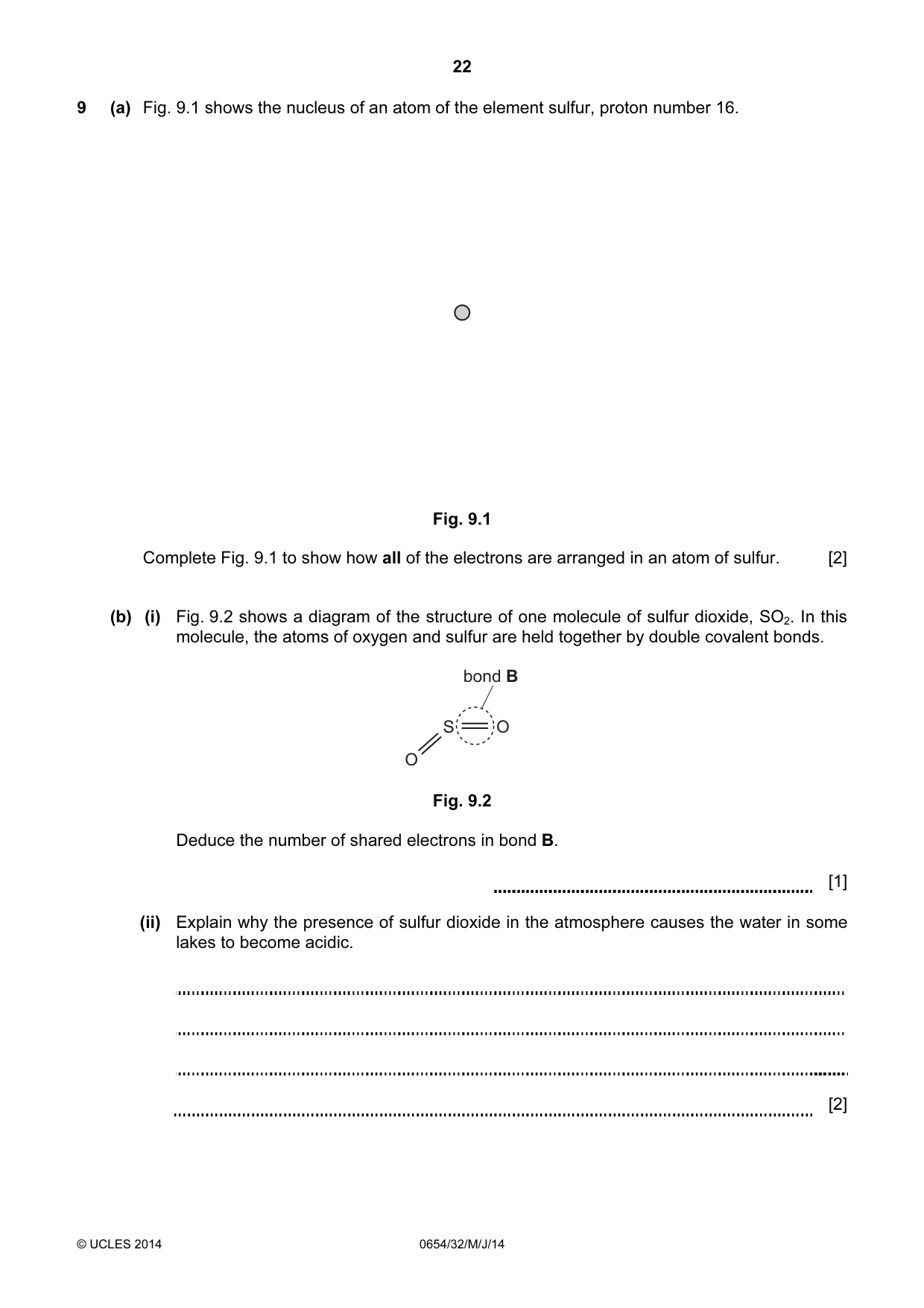
22 © UCLES 2014 0654/32/M/J/14 9 (a) Fig. 9.1 shows the nucleus of an atom of the element sulfur, proton number 16. Fig. 9.1 Complete Fig. 9.1 to show how all of the electrons are arranged in an atom of sulfur. [2] (b) (i) Fig. 9.2 shows a diagram of the structure of one molecule of sulfur dioxide, SO2. In this molecule, the atoms of oxygen and sulfur are held together by double covalent bonds. S O O bond B Fig. 9.2 Deduce the number of shared electrons in bond B. [1] (ii) Explain why the presence of sulfur dioxide in the atmosphere causes the water in some lakes to become acidic. [2]
Question paper, page 23
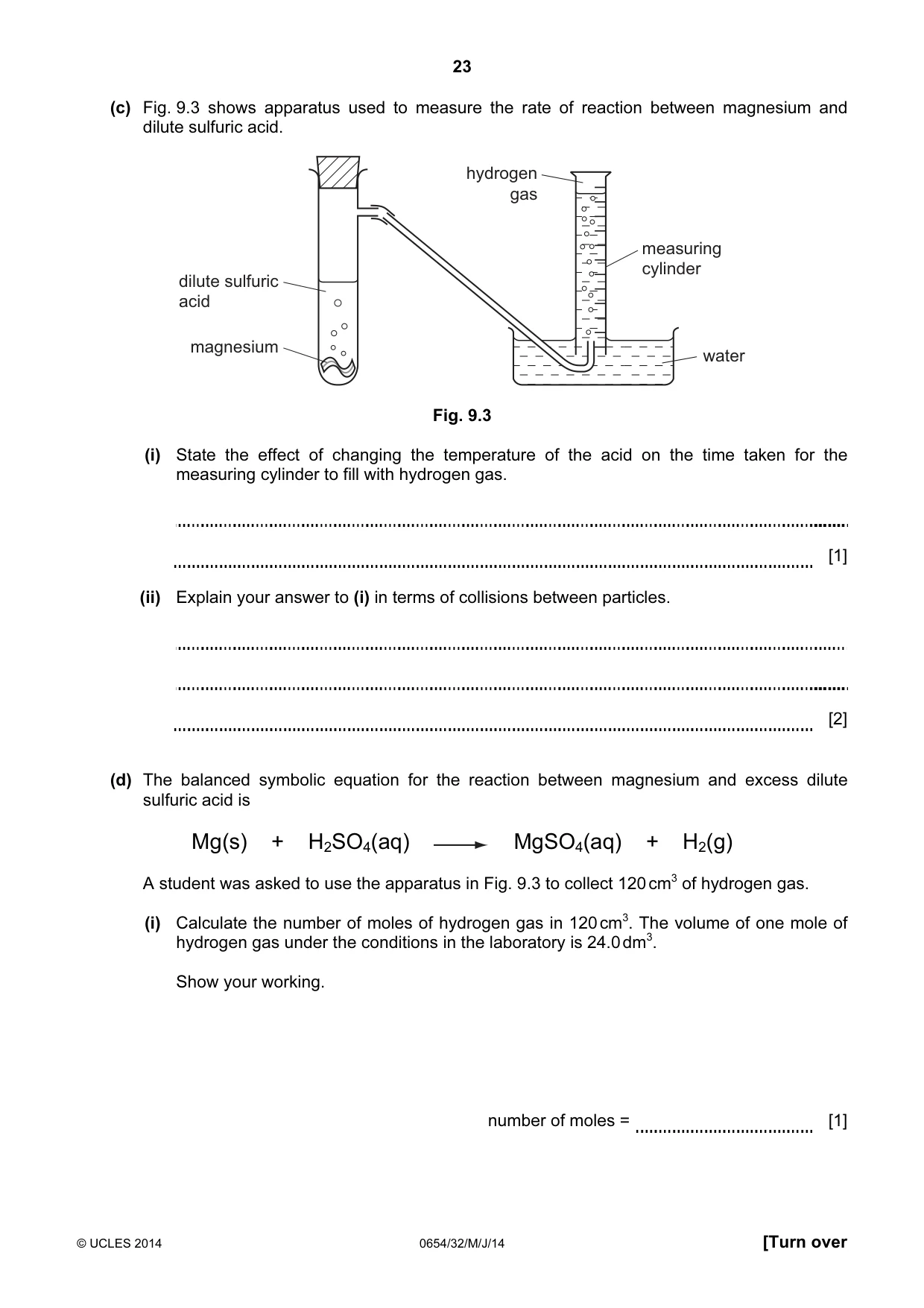
23 © UCLES 2014 0654/32/M/J/14 [Turn over (c) Fig. 9.3 shows apparatus used to measure the rate of reaction between magnesium and dilute sulfuric acid. water hydrogen gas measuring cylinder magnesium dilute sulfuric acid Fig. 9.3 (i) State the effect of changing the temperature of the acid on the time taken for the measuring cylinder to fill with hydrogen gas. [1] (ii) Explain your answer to (i) in terms of collisions between particles. [2] (d) The balanced symbolic equation for the reaction between magnesium and excess dilute sulfuric acid is Mg(s) + H2SO4(aq) MgSO4(aq) + H2(g) A student was asked to use the apparatus in Fig. 9.3 to collect 120 cm3 of hydrogen gas. (i) Calculate the number of moles of hydrogen gas in 120 cm3. The volume of one mole of hydrogen gas under the conditions in the laboratory is 24.0 dm3. Show your working. number of moles = [1]
Question paper, page 24
24 © UCLES 2014 0654/32/M/J/14 (ii) Calculate the minimum mass of magnesium that the student should use to make sure that she has enough to produce 120 cm3 of hydrogen gas. Show your working. mass of magnesium = g [2]
Question paper, page 25
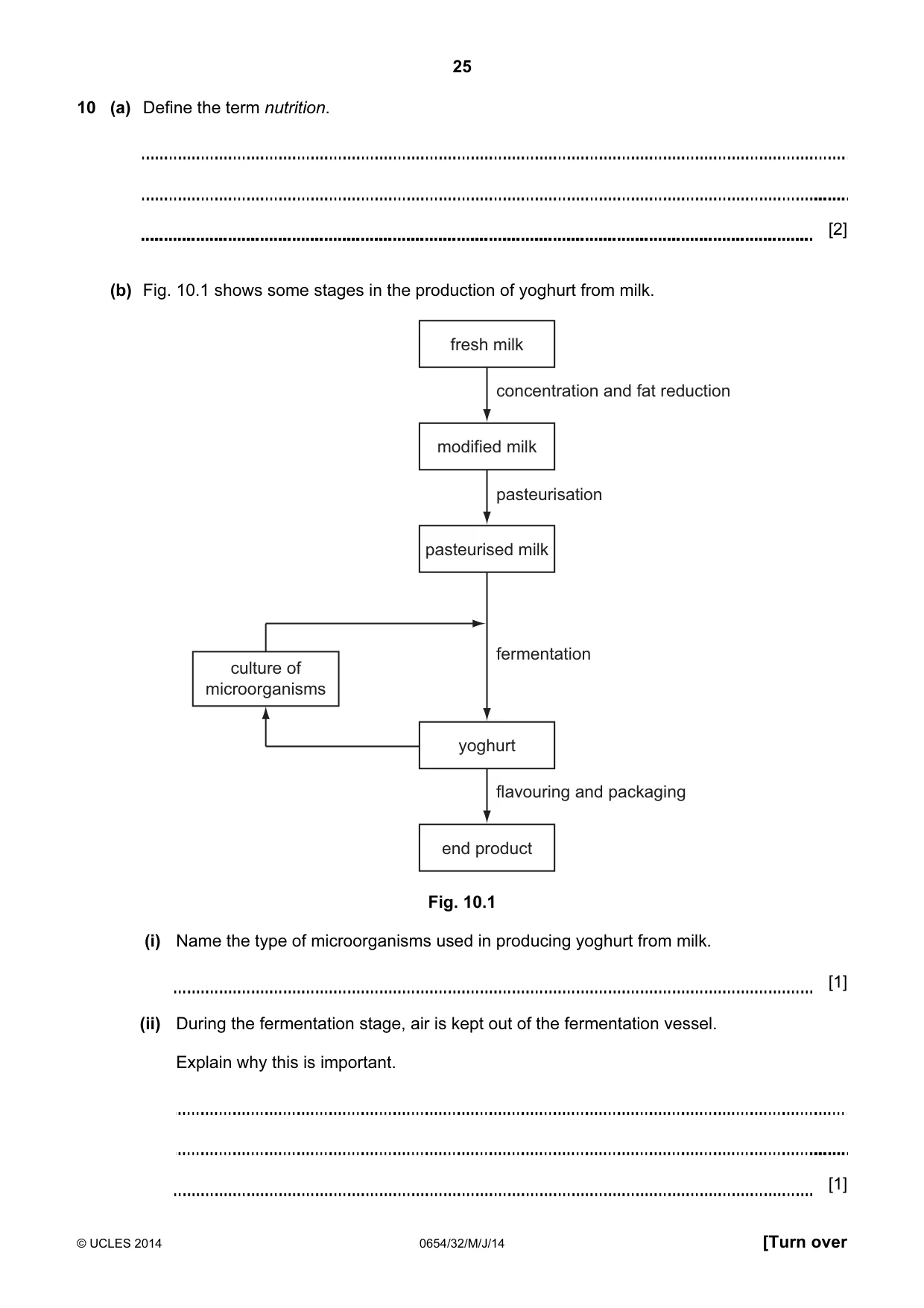
25 © UCLES 2014 0654/32/M/J/14 [Turn over 10 (a) Define the term nutrition. [2] (b) Fig. 10.1 shows some stages in the production of yoghurt from milk. fresh milk modified milk pasteurised milk concentration and fat reduction yoghurt culture of microorganisms end product flavouring and packaging pasteurisation fermentation Fig. 10.1 (i) Name the type of microorganisms used in producing yoghurt from milk. [1] (ii) During the fermentation stage, air is kept out of the fermentation vessel. Explain why this is important. [1]
Question paper, page 26
26 © UCLES 2014 0654/32/M/J/14 (iii) Before fermentation, the milk is heat treated during the process of pasteurisation. Suggest two reasons why this is important. 1 2 [2] (iv) In this production process, fat is removed from the milk before the milk is converted to yoghurt. Explain why, as a result of this, the yoghurt might be healthier to eat than yoghurt from full-fat milk. [2] (v) During the fermentation stage, the pH of the mixture falls. Explain why this happens. [1]
Question paper, page 27
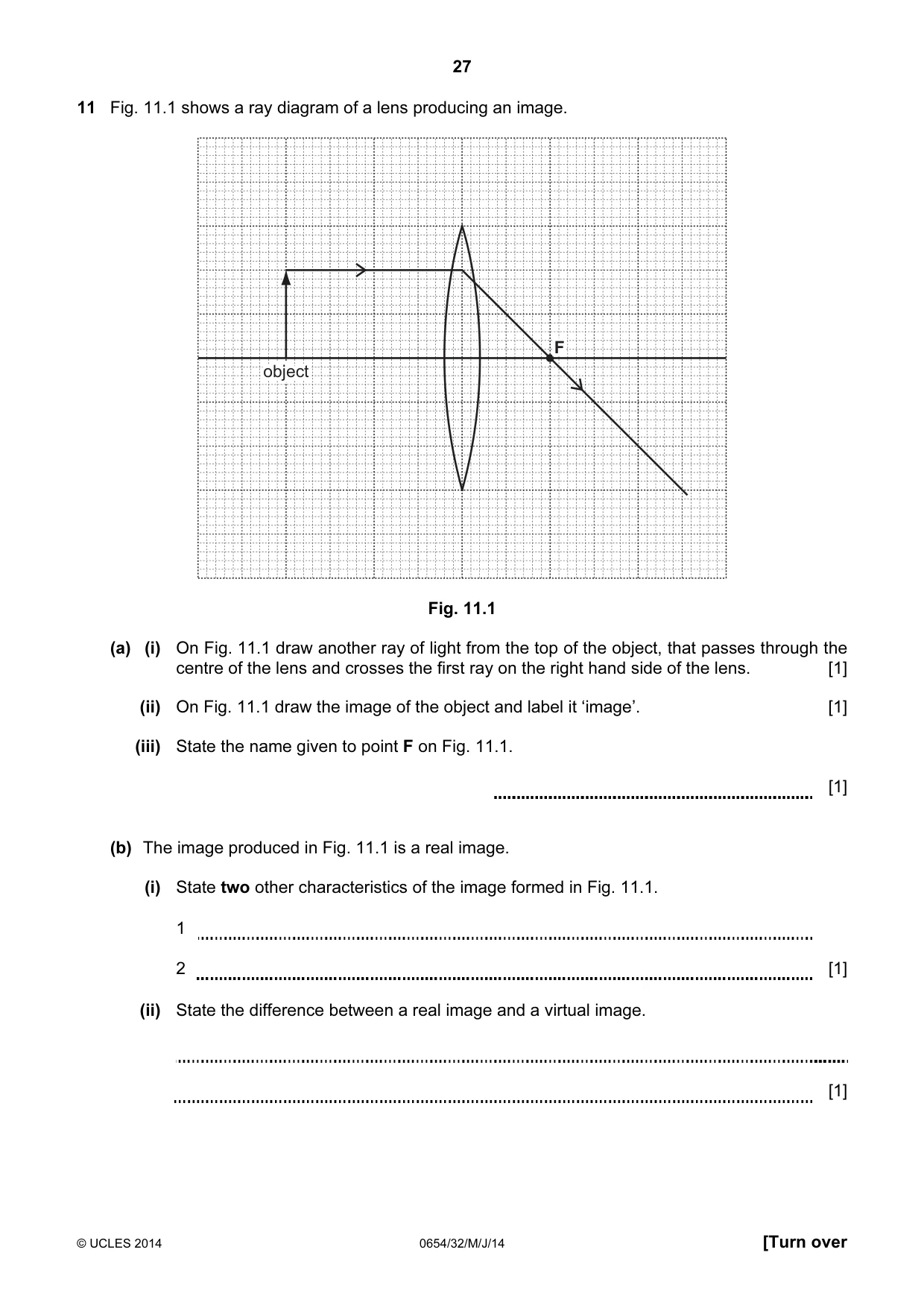
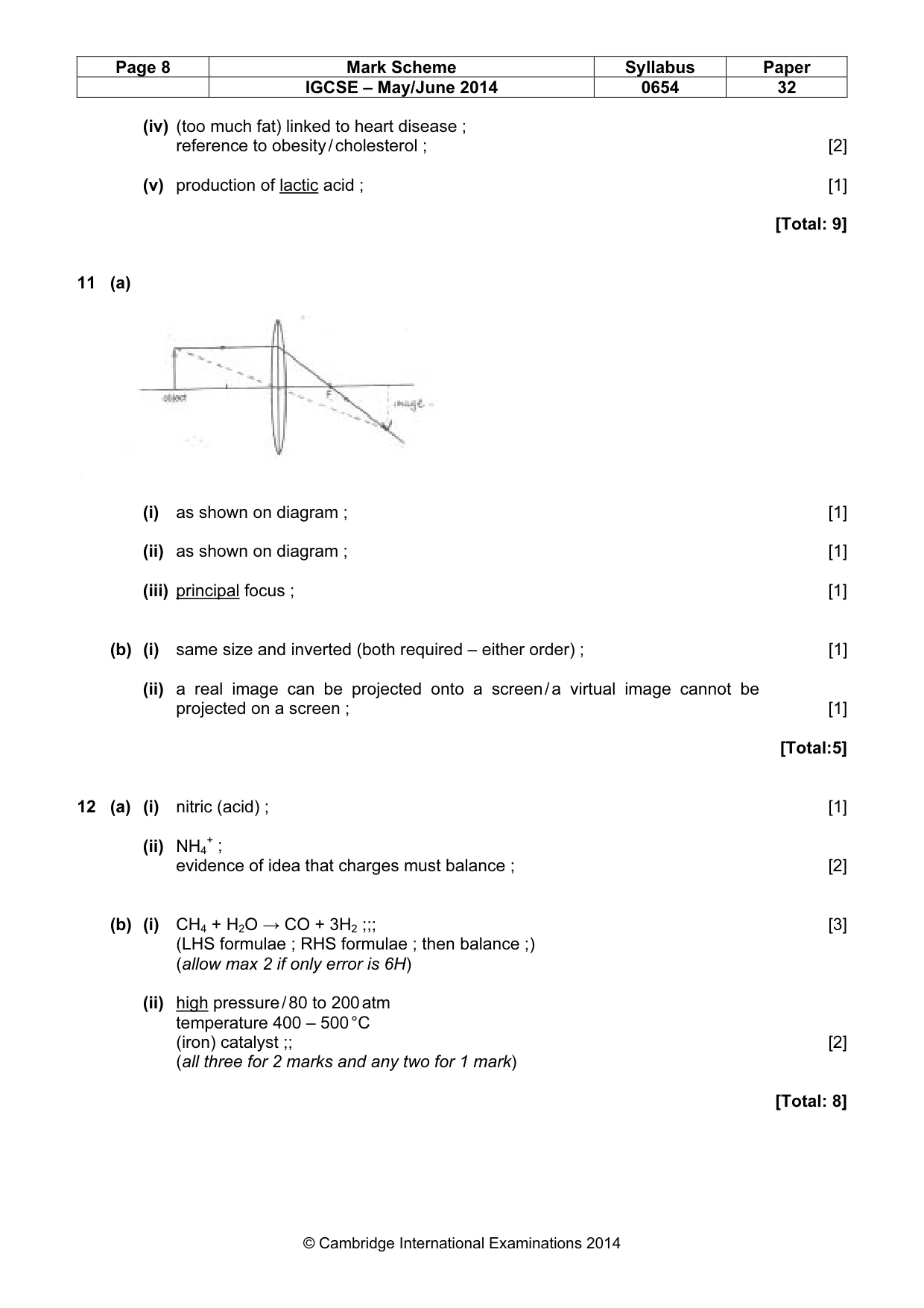
27 © UCLES 2014 0654/32/M/J/14 [Turn over 11 Fig. 11.1 shows a ray diagram of a lens producing an image. object object F object Fig. 11.1 (a) (i) On Fig. 11.1 draw another ray of light from the top of the object, that passes through the centre of the lens and crosses the first ray on the right hand side of the lens. [1] (ii) On Fig. 11.1 draw the image of the object and label it ‘image’. [1] (iii) State the name given to point F on Fig. 11.1. [1] (b) The image produced in Fig. 11.1 is a real image. (i) State two other characteristics of the image formed in Fig. 11.1. 1 2 [1] (ii) State the difference between a real image and a virtual image. [1]
Question paper, page 28
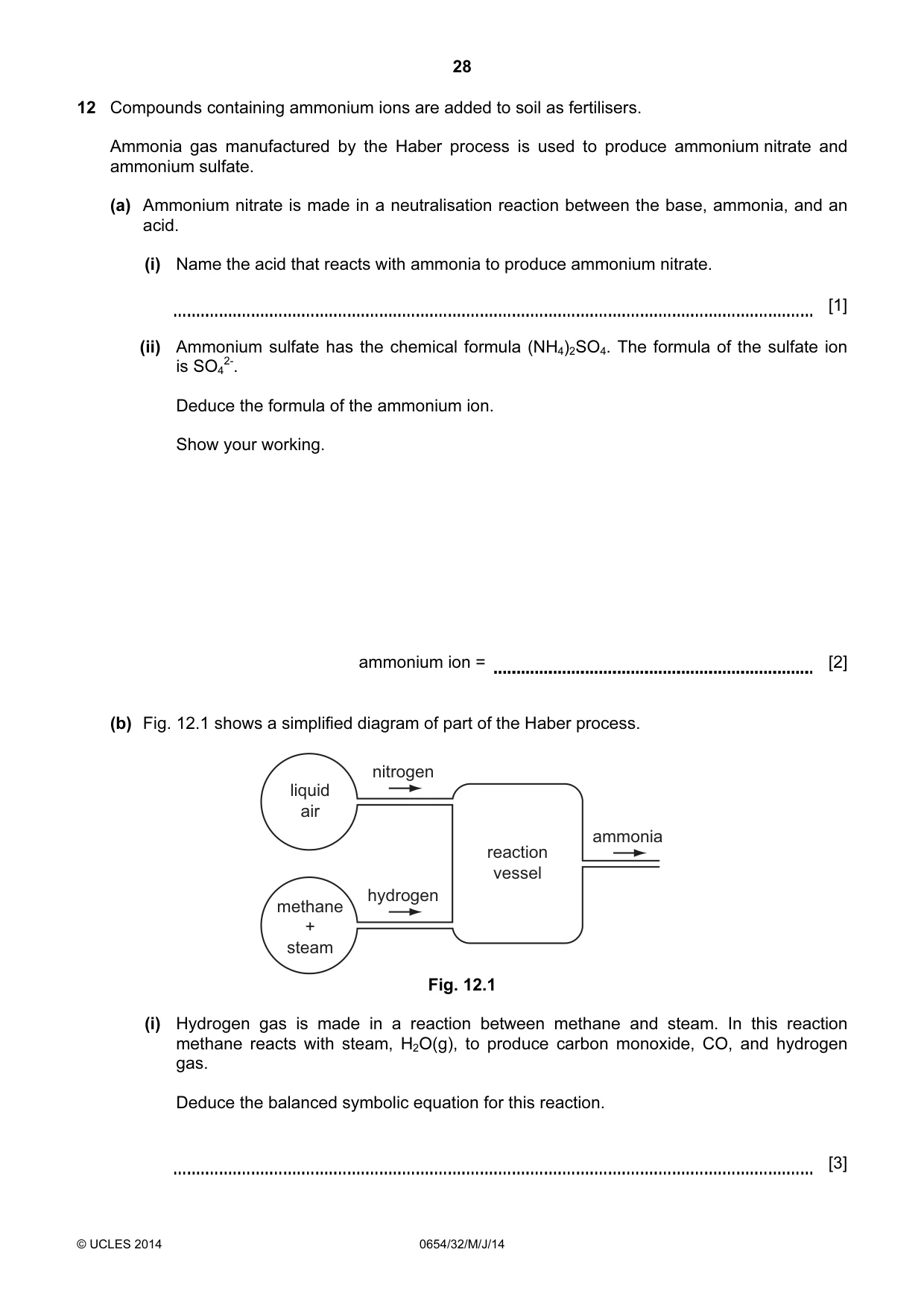
28 © UCLES 2014 0654/32/M/J/14 12 Compounds containing ammonium ions are added to soil as fertilisers. Ammonia gas manufactured by the Haber process is used to produce ammonium nitrate and ammonium sulfate. (a) Ammonium nitrate is made in a neutralisation reaction between the base, ammonia, and an acid. (i) Name the acid that reacts with ammonia to produce ammonium nitrate. [1] (ii) Ammonium sulfate has the chemical formula (NH4)2SO4. The formula of the sulfate ion is SO4 2-. Deduce the formula of the ammonium ion. Show your working. ammonium ion = [2] (b) Fig. 12.1 shows a simplified diagram of part of the Haber process. reaction vessel methane + steam hydrogen liquid air nitrogen ammonia Fig. 12.1 (i) Hydrogen gas is made in a reaction between methane and steam. In this reaction methane reacts with steam, H2O(g), to produce carbon monoxide, CO, and hydrogen gas. Deduce the balanced symbolic equation for this reaction. [3]
Question paper, page 29
29 © UCLES 2014 0654/32/M/J/14 (ii) State the three important reaction conditions inside the reaction vessel in Fig. 12.1. 1 2 3 [2]
Question paper, page 30
30 © UCLES 2014 0654/32/M/J/14 BLANK PAGE
Question paper, page 31
31 © UCLES 2014 0654/32/M/J/14 BLANK PAGE
Question paper, page 32
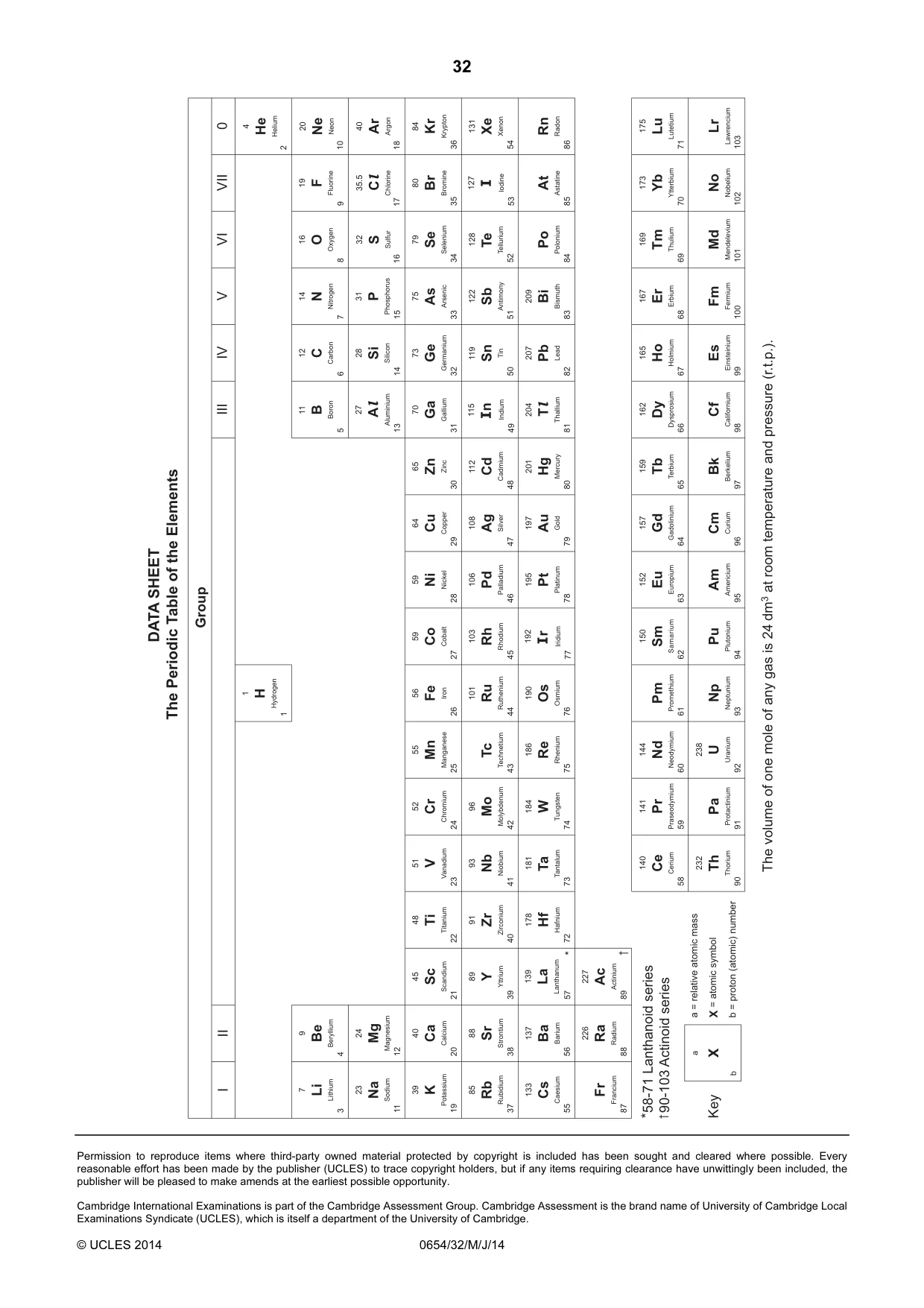
32 Permission to reproduce items where third-party owned material protected by copyright is included has been sought and cleared where possible. Every reasonable effort has been made by the publisher (UCLES) to trace copyright holders, but if any items requiring clearance have unwittingly been included, the publisher will be pleased to make amends at the earliest possible opportunity. Cambridge International Examinations is part of the Cambridge Assessment Group. Cambridge Assessment is the brand name of University of Cambridge Local Examinations Syndicate (UCLES), which is itself a department of the University of Cambridge. © UCLES 2014 0654/32/M/J/14 Group 140 Ce Cerium 58 141 Pr Praseodymium 59 144 Nd Neodymium 60 Pm Promethium 61 150 Sm Samarium 62 152 Eu Europium 63 157 Gd Gadolinium 64 159 Tb Terbium 65 162 Dy Dysprosium 66 165 Ho Holmium 67 167 Er Erbium 68 169 Tm Thulium 69 173 Yb Ytterbium 70 175 Lu Lutetium 71 232 Th Thorium 90 Pa Protactinium 91 238 U Uranium 92 Np Neptunium 93 Pu Plutonium 94 Am Americium 95 Cm Curium 96 Bk Berkelium 97 Cf Californium 98 Es Einsteinium 99 Fm Fermium 100 Md Mendelevium 101 No Nobelium 102 Lr Lawrencium 103 1 H Hydrogen 1 7 Li Lithium 3 23 Na Sodium 11 24 Mg Magnesium 12 40 Ca Calcium 20 45 Sc Scandium 21 48 Ti Titanium 22 51 V Vanadium 23 52 Cr Chromium 24 55 Mn Manganese 25 56 Fe Iron 26 59 Co Cobalt 27 59 Ni Nickel 28 64 Cu Copper 29 65 Zn Zinc 30 70 Ga Gallium 31 27 Al Aluminium 13 11 B Boron 5 12 C Carbon 6 14 N Nitrogen 7 16 O Oxygen 8 19 F Fluorine 9 28 Si Silicon 14 31 P Phosphorus 15 32 S Sulfur 16 35.5 Cl Chlorine 17 40 Ar Argon 18 20 Ne Neon 10 4 He Helium 2 73 Ge Germanium 32 75 As Arsenic 33 79 Se Selenium 34 80 Br Bromine 35 84 Kr Krypton 36 39 K Potassium 19 88 Sr Strontium 38 89 Y Yttrium 39 91 Zr Zirconium 40 93 Nb Niobium 41 96 Mo Molybdenum 42 Tc Technetium 43 101 Ru Ruthenium 44 103 Rh Rhodium 45 106 Pd Palladium 46 108 Ag Silver 47 112 Cd Cadmium 48 115 In Indium 49 119 Sn Tin 50 122 Sb Antimony 51 128 Te Tellurium 52 127 I Iodine 53 131 Xe Xenon 54 137 Ba Barium 56 139 La Lanthanum 57 * 178 Hf Hafnium 72 181 Ta Tantalum 73 184 W Tungsten 74 186 Re Rhenium 75 190 Os Osmium 76 192 Ir Iridium 77 195 Pt Platinum 78 197 Au Gold 79 201 Hg Mercury 80 204 Tl Thallium 81 207 Pb Lead 82 209 Bi Bismuth 83 Po Polonium 84 At Astatine 85 Rn Radon 86 Fr Francium 87 227 Ac Actinium 89 9 Be Beryllium 4 I II III IV V VI VII 0 85 Rb Rubidium 37 133 Cs Caesium 55 226 Ra Radium 88 The volume of one mole of any gas is 24 dm3 at room temperature and pressure (r.t.p.). a X b a = relative atomic mass X = atomic symbol b = proton (atomic) number Key *58-71 Lanthanoid series 90-103 Actinoid series DATA SHEET The Periodic Table of the Elements
Mark scheme, page 1
CAMBRIDGE INTERNATIONAL EXAMINATIONS International General Certificate of Secondary Education MARK SCHEME for the May/June 2014 series 0654 CO-ORDINATED SCIENCES 0654/32 Paper 3 (Extended Theory), maximum raw mark 120 This mark scheme is published as an aid to teachers and candidates, to indicate the requirements of the examination. It shows the basis on which Examiners were instructed to award marks. It does not indicate the details of the discussions that took place at an Examiners’ meeting before marking began, which would have considered the acceptability of alternative answers. Mark schemes should be read in conjunction with the question paper and the Principal Examiner Report for Teachers. Cambridge will not enter into discussions about these mark schemes. Cambridge is publishing the mark schemes for the May/June 2014 series for most IGCSE, GCE Advanced Level and Advanced Subsidiary Level components and some Ordinary Level components.
Mark scheme, page 2
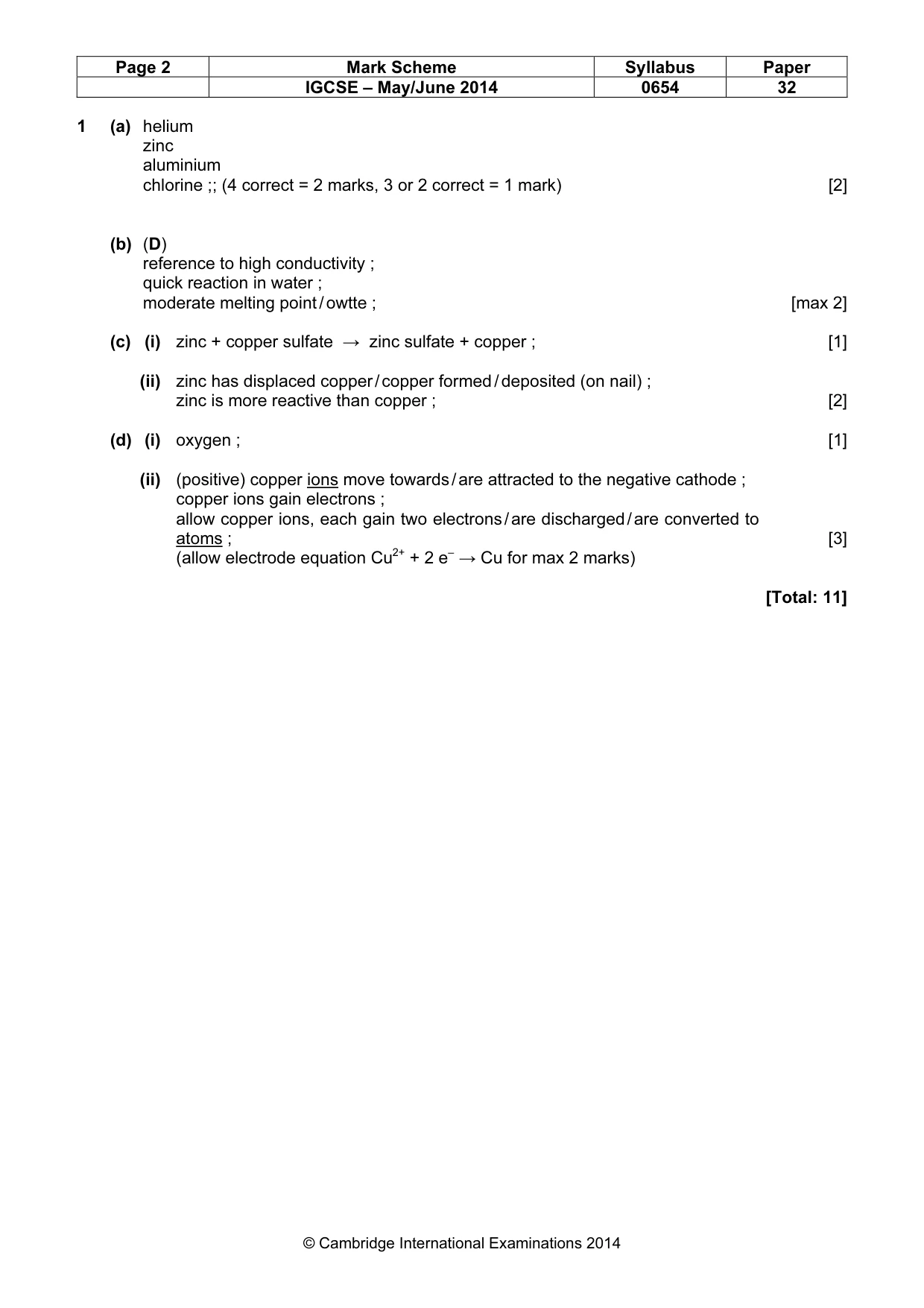
Page 2 Mark Scheme Syllabus Paper IGCSE – May/June 2014 0654 32 © Cambridge International Examinations 2014 1 (a) helium zinc aluminium chlorine ;; (4 correct = 2 marks, 3 or 2 correct = 1 mark) [2] (b) (D) reference to high conductivity ; quick reaction in water ; moderate melting point / owtte ; [max 2] (c) (i) zinc + copper sulfate → zinc sulfate + copper ; [1] (ii) zinc has displaced copper / copper formed / deposited (on nail) ; zinc is more reactive than copper ; [2] (d) (i) oxygen ; [1] (ii) (positive) copper ions move towards / are attracted to the negative cathode ; copper ions gain electrons ; allow copper ions, each gain two electrons / are discharged / are converted to atoms ; [3] (allow electrode equation Cu2+ + 2 e– → Cu for max 2 marks) [Total: 11]
Mark scheme, page 3
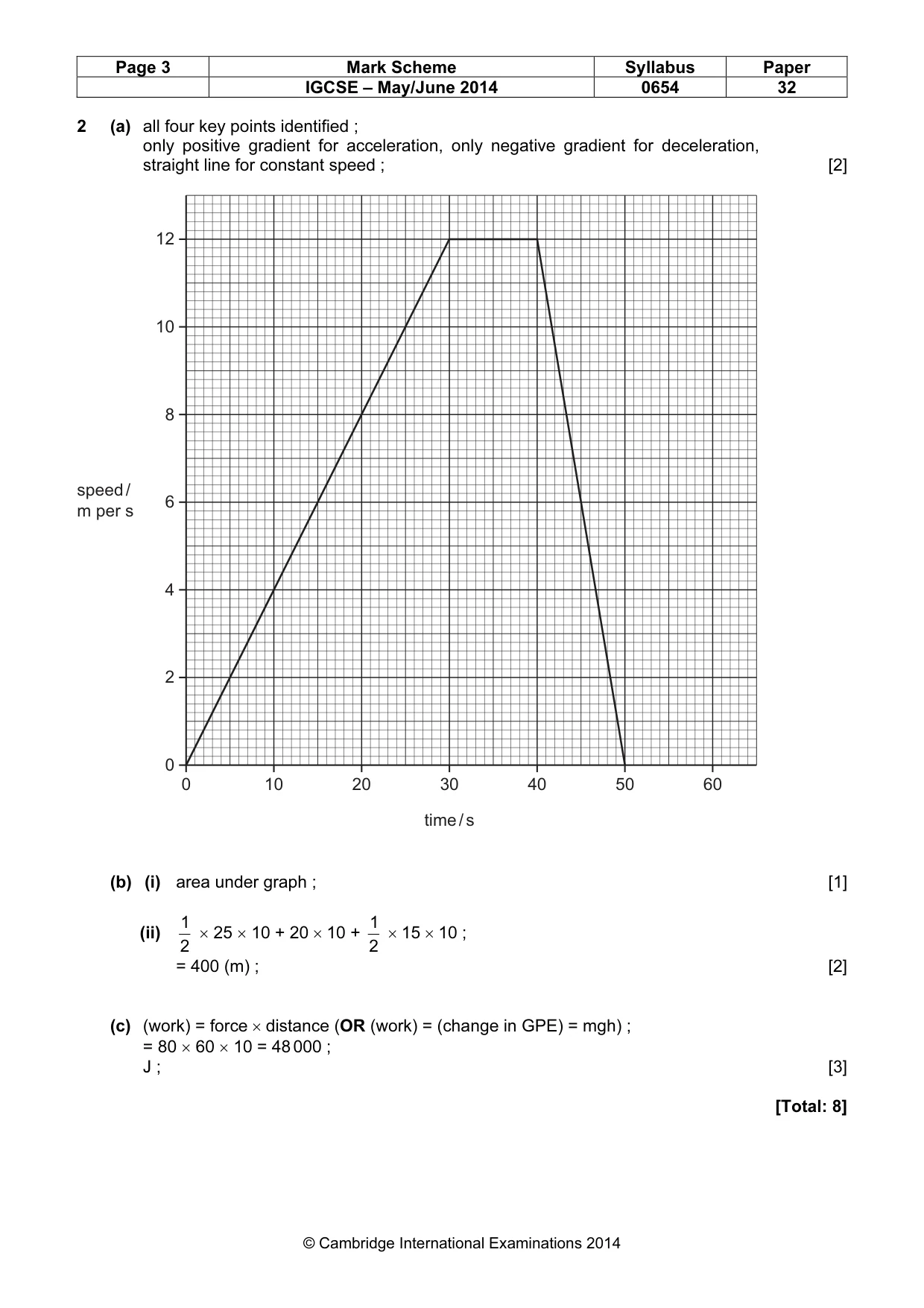
Page 3 Mark Scheme Syllabus Paper IGCSE – May/June 2014 0654 32 © Cambridge International Examinations 2014 2 (a) all four key points identified ; only positive gradient for acceleration, only negative gradient for deceleration, straight line for constant speed ; [2] (b) (i) area under graph ; [1] (ii) 2 1 × 25 × 10 + 20 × 10 + 2 1 × 15 × 10 ; = 400 (m) ; [2] (c) (work) = force × distance (OR (work) = (change in GPE) = mgh) ; = 80 × 60 × 10 = 48 000 ; J ; [3] [Total: 8] 0 10 20 30 40 50 60 12 10 8 6 4 2 0 time / s speed / m per s
Mark scheme, page 4
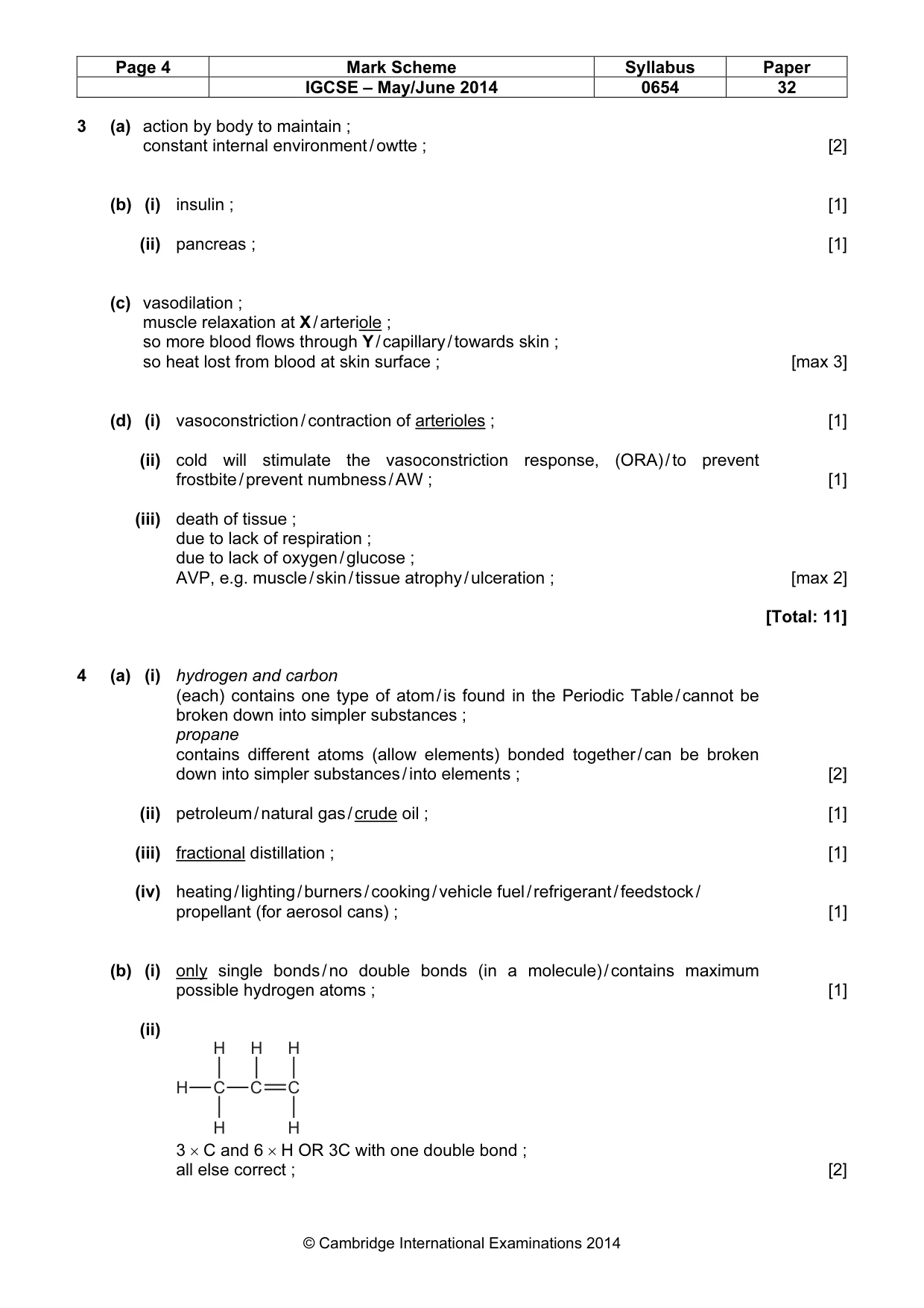
Page 4 Mark Scheme Syllabus Paper IGCSE – May/June 2014 0654 32 © Cambridge International Examinations 2014 3 (a) action by body to maintain ; constant internal environment / owtte ; [2] (b) (i) insulin ; [1] (ii) pancreas ; [1] (c) vasodilation ; muscle relaxation at X / arteriole ; so more blood flows through Y / capillary / towards skin ; so heat lost from blood at skin surface ; [max 3] (d) (i) vasoconstriction / contraction of arterioles ; [1] (ii) cold will stimulate the vasoconstriction response, (ORA) / to prevent frostbite / prevent numbness / AW ; [1] (iii) death of tissue ; due to lack of respiration ; due to lack of oxygen / glucose ; AVP, e.g. muscle / skin / tissue atrophy / ulceration ; [max 2] [Total: 11] 4 (a) (i) hydrogen and carbon (each) contains one type of atom / is found in the Periodic Table / cannot be broken down into simpler substances ; propane contains different atoms (allow elements) bonded together / can be broken down into simpler substances / into elements ; [2] (ii) petroleum / natural gas / crude oil ; [1] (iii) fractional distillation ; [1] (iv) heating / lighting / burners / cooking / vehicle fuel / refrigerant / feedstock / propellant (for aerosol cans) ; [1] (b) (i) only single bonds / no double bonds (in a molecule) / contains maximum possible hydrogen atoms ; [1] (ii) 3 × C and 6 × H OR 3C with one double bond ; all else correct ; [2] H H H C C H H H C
Mark scheme, page 5
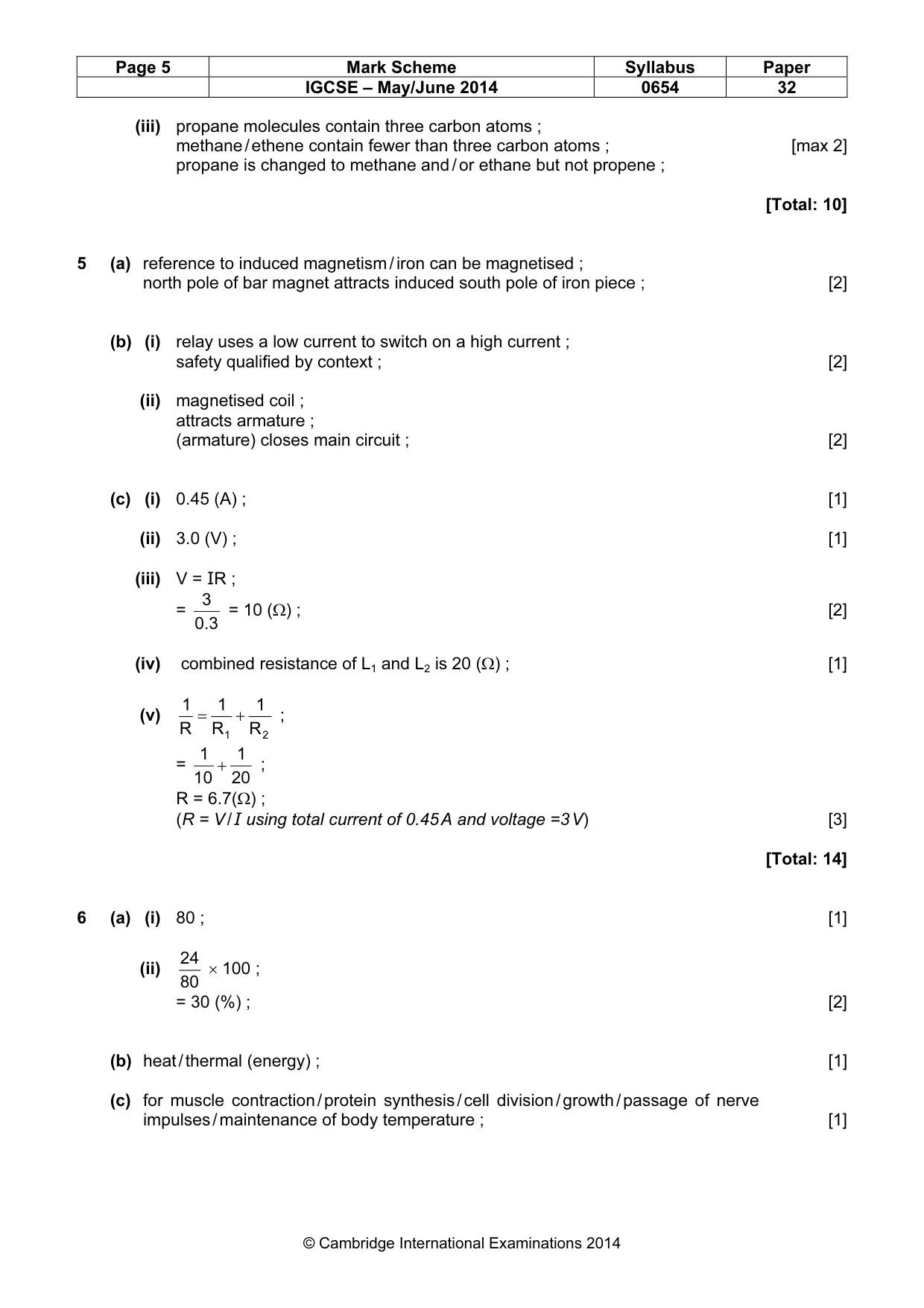
Page 5 Mark Scheme Syllabus Paper IGCSE – May/June 2014 0654 32 © Cambridge International Examinations 2014 (iii) propane molecules contain three carbon atoms ; methane / ethene contain fewer than three carbon atoms ; [max 2] propane is changed to methane and / or ethane but not propene ; [Total: 10] 5 (a) reference to induced magnetism / iron can be magnetised ; north pole of bar magnet attracts induced south pole of iron piece ; [2] (b) (i) relay uses a low current to switch on a high current ; safety qualified by context ; [2] (ii) magnetised coil ; attracts armature ; (armature) closes main circuit ; [2] (c) (i) 0.45 (A) ; [1] (ii) 3.0 (V) ; [1] (iii) V = IR ; = 0.3 3 = 10 (Ω) ; [2] (iv) combined resistance of L1 and L2 is 20 (Ω) ; [1] (v) 2 1 R 1 R 1 R 1 + = ; = 20 1 10 1 + ; R = 6.7(Ω) ; (R = V / I using total current of 0.45 A and voltage =3 V) [3] [Total: 14] 6 (a) (i) 80 ; [1] (ii) 80 24 × 100 ; = 30 (%) ; [2] (b) heat / thermal (energy) ; [1] (c) for muscle contraction / protein synthesis / cell division / growth / passage of nerve impulses / maintenance of body temperature ; [1]
Mark scheme, page 6
Page 6 Mark Scheme Syllabus Paper IGCSE – May/June 2014 0654 32 © Cambridge International Examinations 2014 (d) (i) more used in respiration / less used for new tissue ; respiration produces heat to keep warm ; [2] (ii) more lost in faeces / less absorbed ; because more fibre ; [2] [Total: 9] 7 (a) (i) curve above original at all times ; approx. 50 cps (one square) above ; [2] (ii) working shown on graph or elsewhere ; 6 (hours) ; [2] (iii) lasts long enough to travel to target organ ; will only irradiate body for a short period / does not linger in the environment for too long ; [2] (b) more penetrating – easier to monitor / not stopped by skin ; less ionising – causes less damage to body cells ; gamma ray energy / wavelength easy to detect using X-ray detectors ; gamma can leave body easily / AW ; [max 2] (c) (i) ultra violet and then radiowaves ; [1] (ii) gamma (end) / left hand side ; [1] (iii) distance between identical points (on two waves) ; [1] (d) electrons are transferred ; loss of electrons (on cloth or balloon) means positive charge (or vv) ; [2] [Total: 13] 8 (a) a thread of DNA ; made up of / carrying (a string of) genes ; [2] (b) (i) diploid ; because chromosomes are in pairs / two sets of chromosomes ; [2] (ii) haploid / not paired / half as many / AW ; no Y chromosome / only X chromosome ; [2] (c) (i) M on the arrow(s) from wingless stages to egg / sperm ; [1] (ii) egg and sperm = 6 ; all others = 12 ; [2]
Mark scheme, page 7
Page 7 Mark Scheme Syllabus Paper IGCSE – May/June 2014 0654 32 © Cambridge International Examinations 2014 (d) (i) creates genetic variety / produces eggs to survive winter ; [1] (ii) rapid increase in numbers / no partner needed; [1] [Total: 11] 9 (a) 16 electrons ; electron configuration of 2,8,6 ; [2] (b) (i) 4 ; [1] (ii) dissolves / mixes / reacts with rain water / water in the air ; rain water becomes acidic / now contains (dilute) sulfuric acid ; acid rain falls into lake ; water evaporates but sulfuric acid does not ; [max 2] (c) (i) increasing the temperature decreases the time to fill the cylinder ; [1] (ii) increasing temperature increases rate of reaction ; increasing temperature increases speed / kinetic energy of particles ; which increases the collision frequency between acid particles and magnesium ; which increases chance of reaction resulting from collision / more effective or successful collisions ; [max 2] (d) (i) look for 120 ÷ 24000 = 0.005 or 5 × 10⁻³ ; [1] (ii) statement that reacting moles Mg : H2SO4 = 1:1 or 0.005 moles of magnesium required ; look for 0.005 × 24 = 0.12 (g) of magnesium required ; [2] (allow ecf from (i)) [Total: 11] 10 (a) taking in nutrients / organic substances (and mineral ions) / raw materials ; absorbing them and assimilating them ; using them for growth / tissue repair ; [max 2] (b) (i) bacteria / Lactobacillus ; [1] (ii) so respiration is anaerobic / prevents aerobic respiration ; [1] (iii) remove other micro-organisms ; other micro-organisms might produce toxins / be harmful ; would compete with the yoghurt bacteria ; [max 2]
Mark scheme, page 8
Page 8 Mark Scheme Syllabus Paper IGCSE – May/June 2014 0654 32 © Cambridge International Examinations 2014 (iv) (too much fat) linked to heart disease ; reference to obesity / cholesterol ; [2] (v) production of lactic acid ; [1] [Total: 9] 11 (a) (i) as shown on diagram ; [1] (ii) as shown on diagram ; [1] (iii) principal focus ; [1] (b) (i) same size and inverted (both required – either order) ; [1] (ii) a real image can be projected onto a screen / a virtual image cannot be projected on a screen ; [1] [Total:5] 12 (a) (i) nitric (acid) ; [1] (ii) NH4 + ; evidence of idea that charges must balance ; [2] (b) (i) CH4 + H2O → CO + 3H2 ;;; [3] (LHS formulae ; RHS formulae ; then balance ;) (allow max 2 if only error is 6H) (ii) high pressure / 80 to 200 atm temperature 400 – 500 °C (iron) catalyst ;; [2] (all three for 2 marks and any two for 1 mark) [Total: 8]
What you needed in this session
Cambridge’s own grade thresholds for 2014 May/June, Paper 3 · Variant 2. A higher threshold means an easier paper — the bar moves with how the cohort did.