Cambridge IGCSE Sciences - Co-ordinated (Double) 0654 — 2013 Oct/Nov Paper 3 · Variant 1
0654/31/O/N/13
The question paper and its mark scheme, free to read here and free to download. This is Cambridge’s own paper, exactly as it was sat.
Question paper36 pages





Mark scheme7 pages
Answers below. Sit the paper first if you are practising.
Paper as text
Question paper, page 1
This document consists of 35 printed pages and 1 blank page. IB13 11_0654_31/3RP © UCLES 2013 [Turn over *0587695124* UNIVERSITY OF CAMBRIDGE INTERNATIONAL EXAMINATIONS International General Certificate of Secondary Education CO-ORDINATED SCIENCES 0654/31 Paper 3 (Extended) October/November 2013 2 hours Candidates answer on the Question Paper. No Additional Materials are required. READ THESE INSTRUCTIONS FIRST Write your Centre number, candidate number and name on all the work you hand in. Write in dark blue or black pen. You may use a pencil for any diagrams or graphs. Do not use staples, paper clips, glue or correction fluid. DO NOT WRITE IN ANY BARCODES. Answer all questions. Electronic calculators may be used. You may lose marks if you do not show your working or if you do not use appropriate units. A copy of the Periodic Table is printed on page 36. At the end of the examination, fasten all your work securely together. The number of marks is given in brackets [ ] at the end of each question or part question.
Question paper, page 2
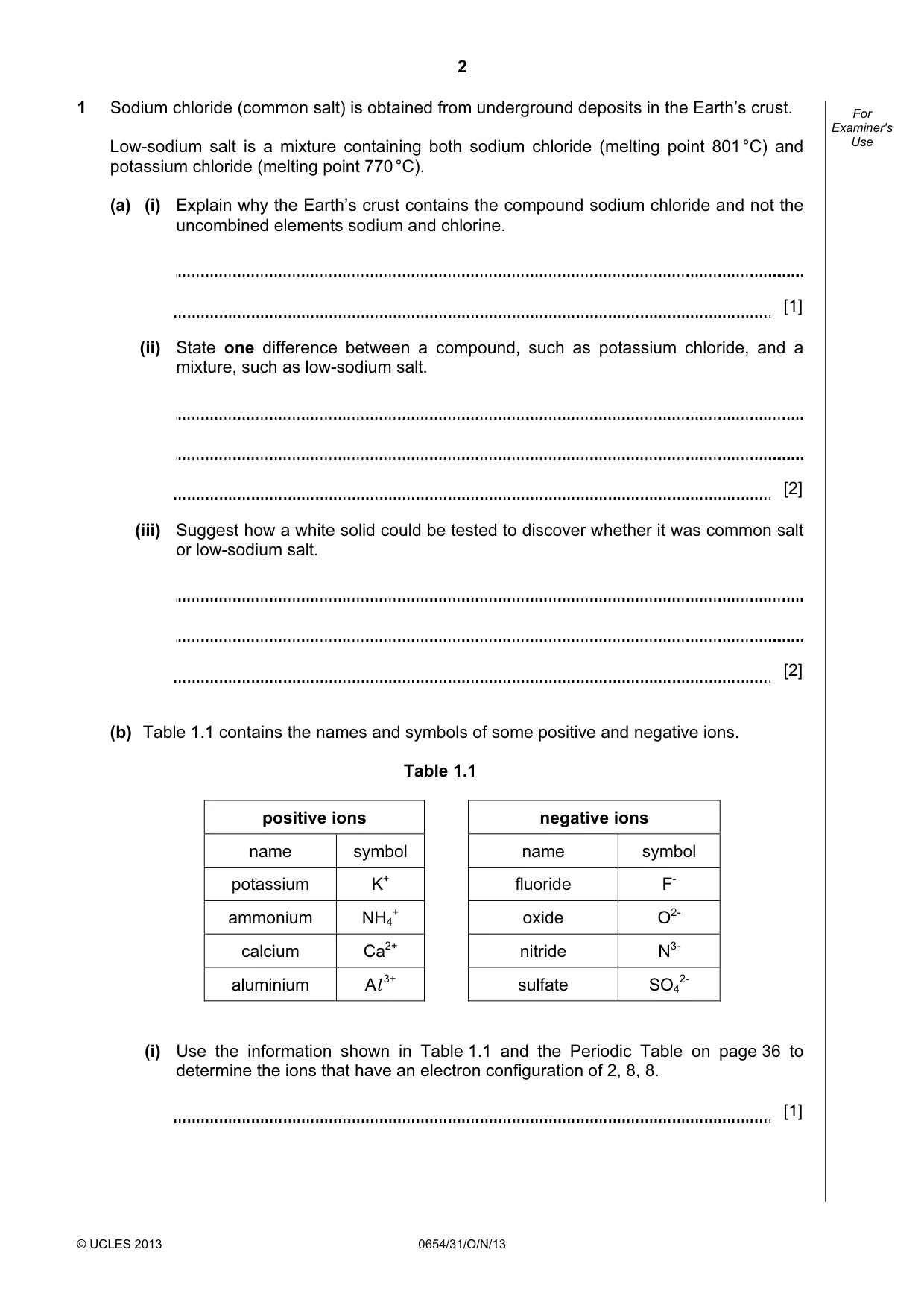
2 © UCLES 2013 0654/31/O/N/13 For Examiner's Use 1 Sodium chloride (common salt) is obtained from underground deposits in the Earth’s crust. Low-sodium salt is a mixture containing both sodium chloride (melting point 801 °C) and potassium chloride (melting point 770 °C). (a) (i) Explain why the Earth’s crust contains the compound sodium chloride and not the uncombined elements sodium and chlorine. [1] (ii) State one difference between a compound, such as potassium chloride, and a mixture, such as low-sodium salt. [2] (iii) Suggest how a white solid could be tested to discover whether it was common salt or low-sodium salt. [2] (b) Table 1.1 contains the names and symbols of some positive and negative ions. Table 1.1 positive ions negative ions name symbol name symbol potassium K+ fluoride F- ammonium NH4 + oxide O2- calcium Ca2+ nitride N3- aluminium Al 3+ sulfate SO4 2- (i) Use the information shown in Table 1.1 and the Periodic Table on page 36 to determine the ions that have an electron configuration of 2, 8, 8. [1]
Question paper, page 3
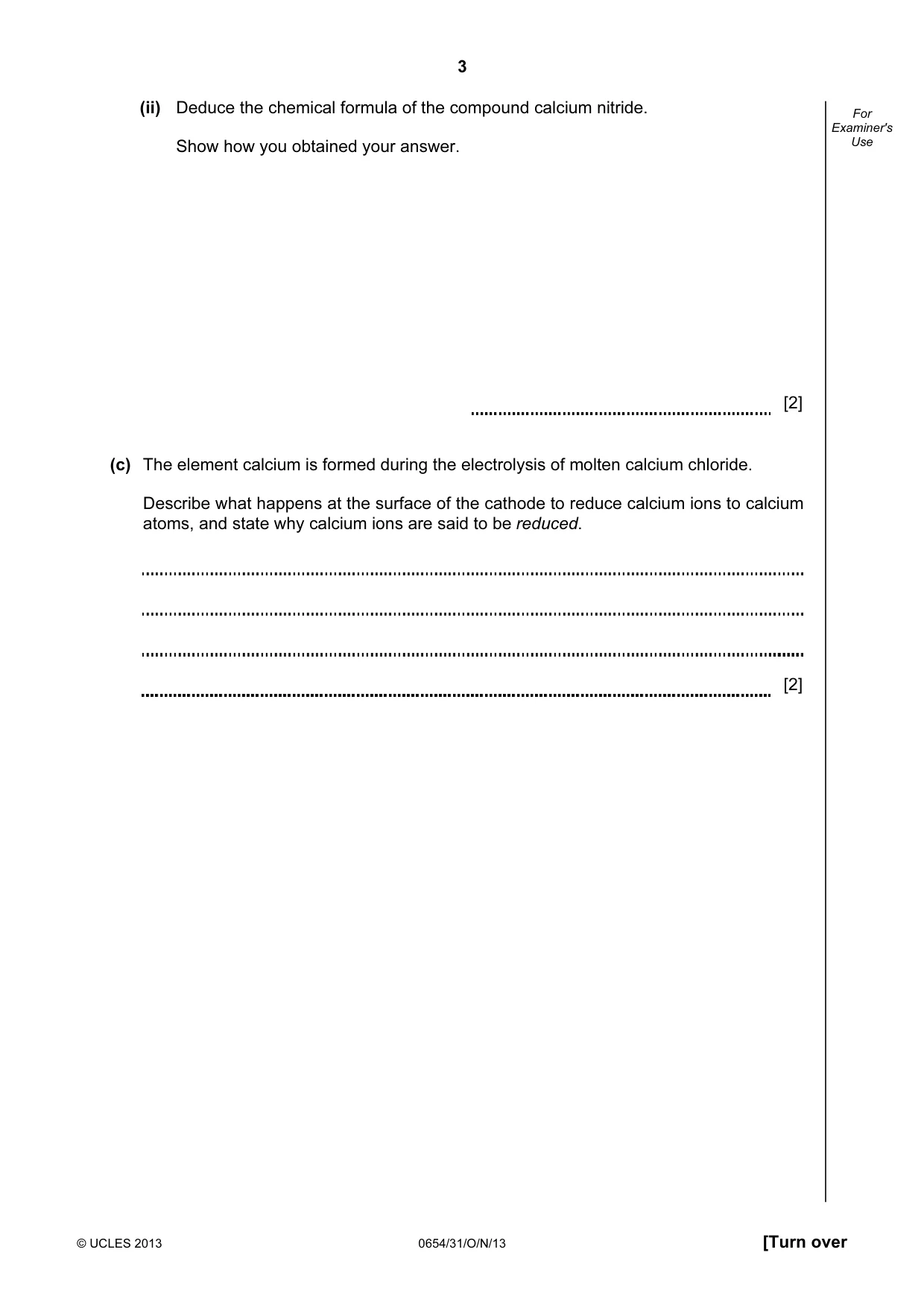
3 © UCLES 2013 0654/31/O/N/13 [Turn over For Examiner's Use (ii) Deduce the chemical formula of the compound calcium nitride. Show how you obtained your answer. [2] (c) The element calcium is formed during the electrolysis of molten calcium chloride. Describe what happens at the surface of the cathode to reduce calcium ions to calcium atoms, and state why calcium ions are said to be reduced. [2]
Question paper, page 4
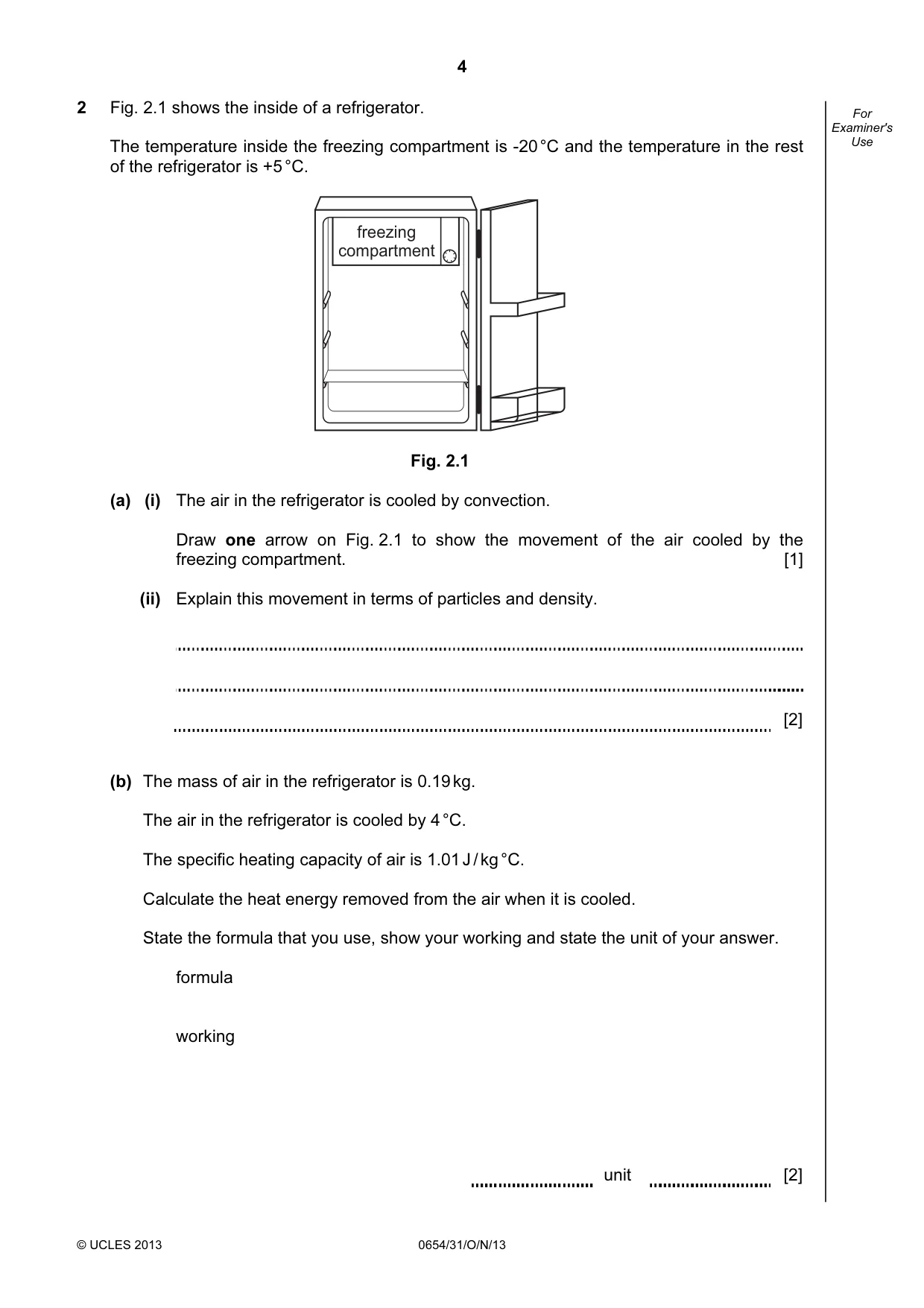
4 © UCLES 2013 0654/31/O/N/13 For Examiner's Use 2 Fig. 2.1 shows the inside of a refrigerator. The temperature inside the freezing compartment is -20 °C and the temperature in the rest of the refrigerator is +5 °C. freezing compartment Fig. 2.1 (a) (i) The air in the refrigerator is cooled by convection. Draw one arrow on Fig. 2.1 to show the movement of the air cooled by the freezing compartment. [1] (ii) Explain this movement in terms of particles and density. [2] (b) The mass of air in the refrigerator is 0.19 kg. The air in the refrigerator is cooled by 4 °C. The specific heating capacity of air is 1.01 J / kg °C. Calculate the heat energy removed from the air when it is cooled. State the formula that you use, show your working and state the unit of your answer. formula working unit [2]
Question paper, page 5
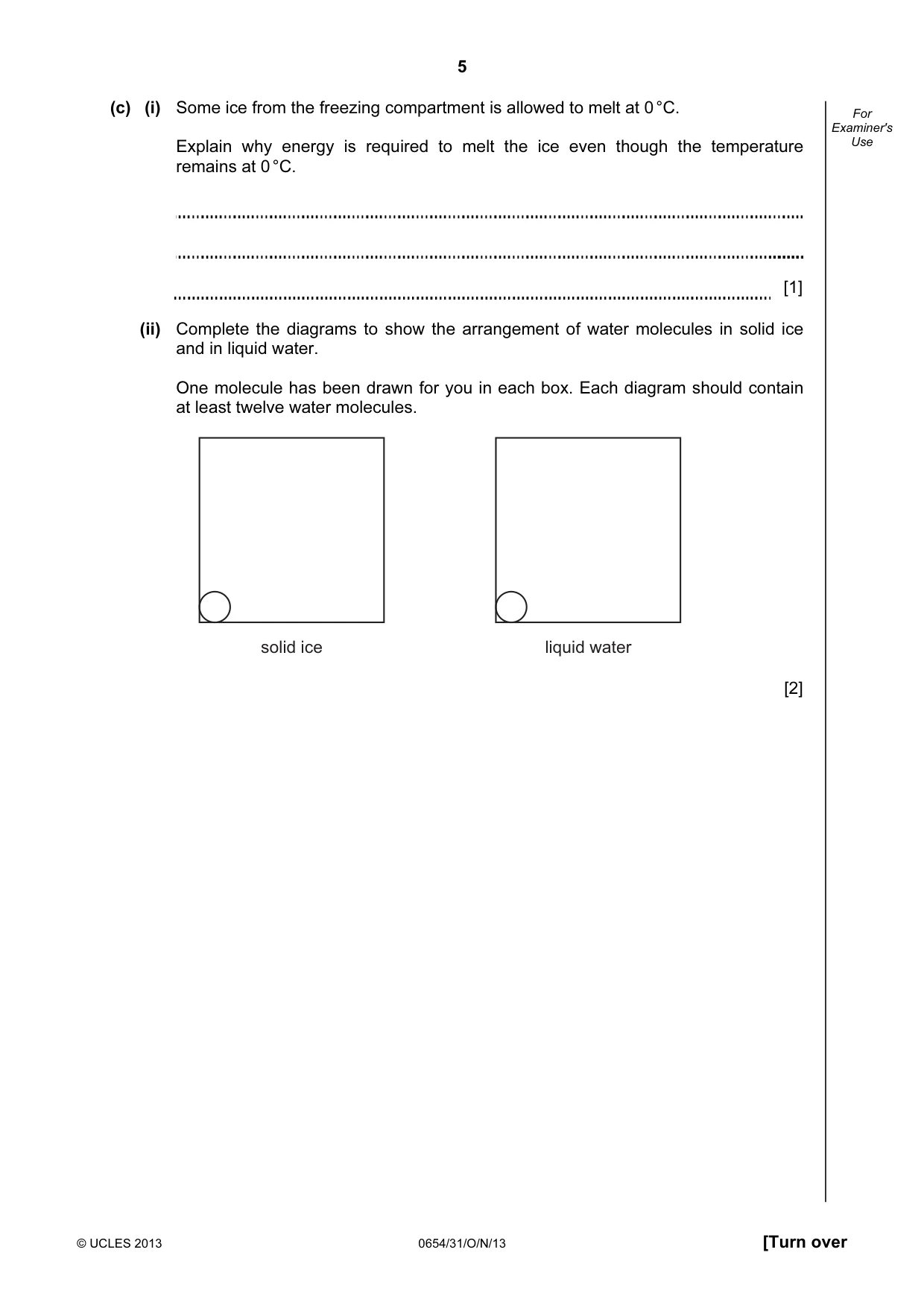
5 © UCLES 2013 0654/31/O/N/13 [Turn over For Examiner's Use (c) (i) Some ice from the freezing compartment is allowed to melt at 0 °C. Explain why energy is required to melt the ice even though the temperature remains at 0 °C. [1] (ii) Complete the diagrams to show the arrangement of water molecules in solid ice and in liquid water. One molecule has been drawn for you in each box. Each diagram should contain at least twelve water molecules. solid ice liquid water [2]
Question paper, page 6
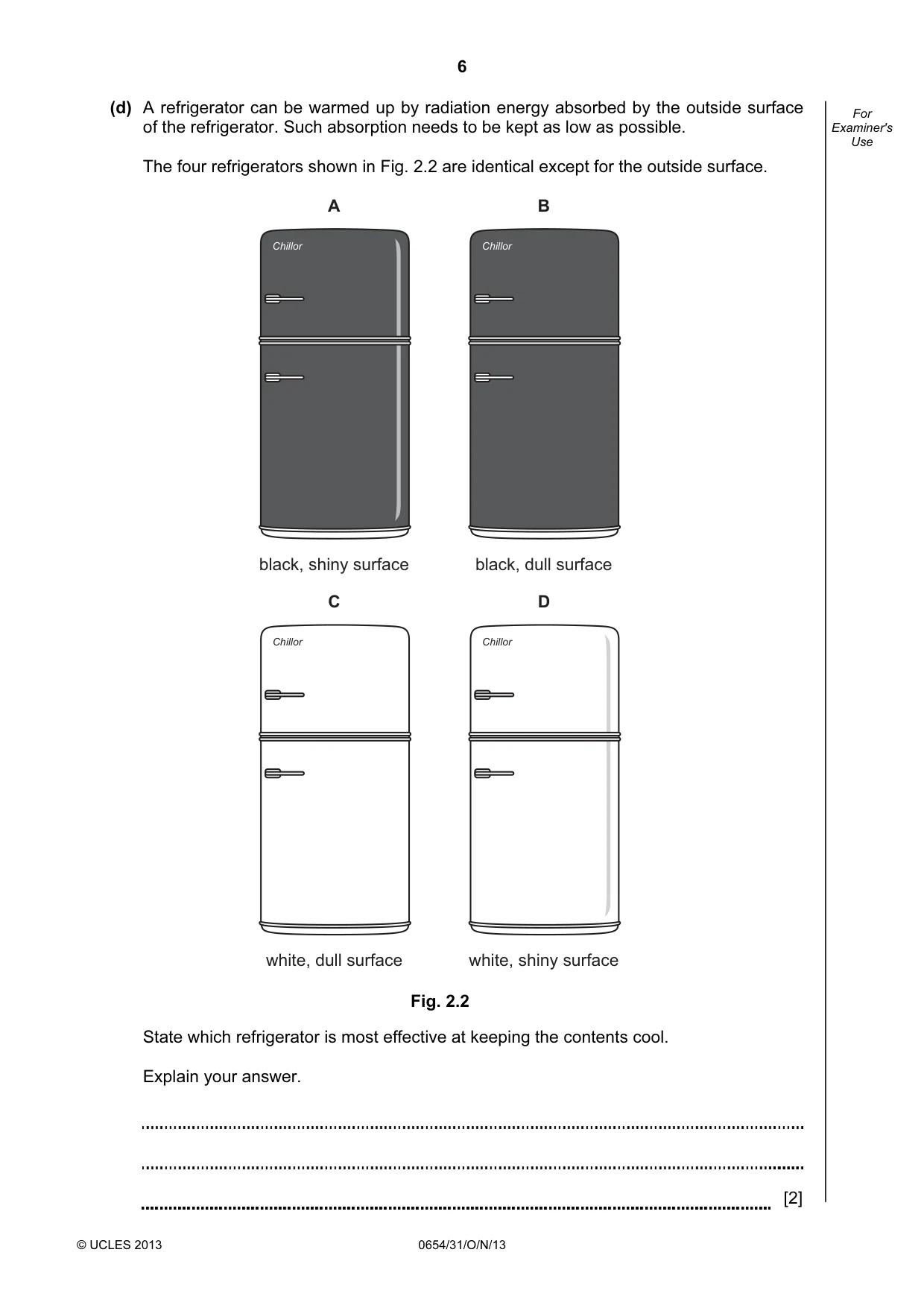
6 © UCLES 2013 0654/31/O/N/13 For Examiner's Use (d) A refrigerator can be warmed up by radiation energy absorbed by the outside surface of the refrigerator. Such absorption needs to be kept as low as possible. The four refrigerators shown in Fig. 2.2 are identical except for the outside surface. Chillor black, dull surface B Chillor black, shiny surface A Chillor white, dull surface C Chillor white, shiny surface D Fig. 2.2 State which refrigerator is most effective at keeping the contents cool. Explain your answer. [2]
Question paper, page 7
7 © UCLES 2013 0654/31/O/N/13 [Turn over Please turn over for Question 3.
Question paper, page 8
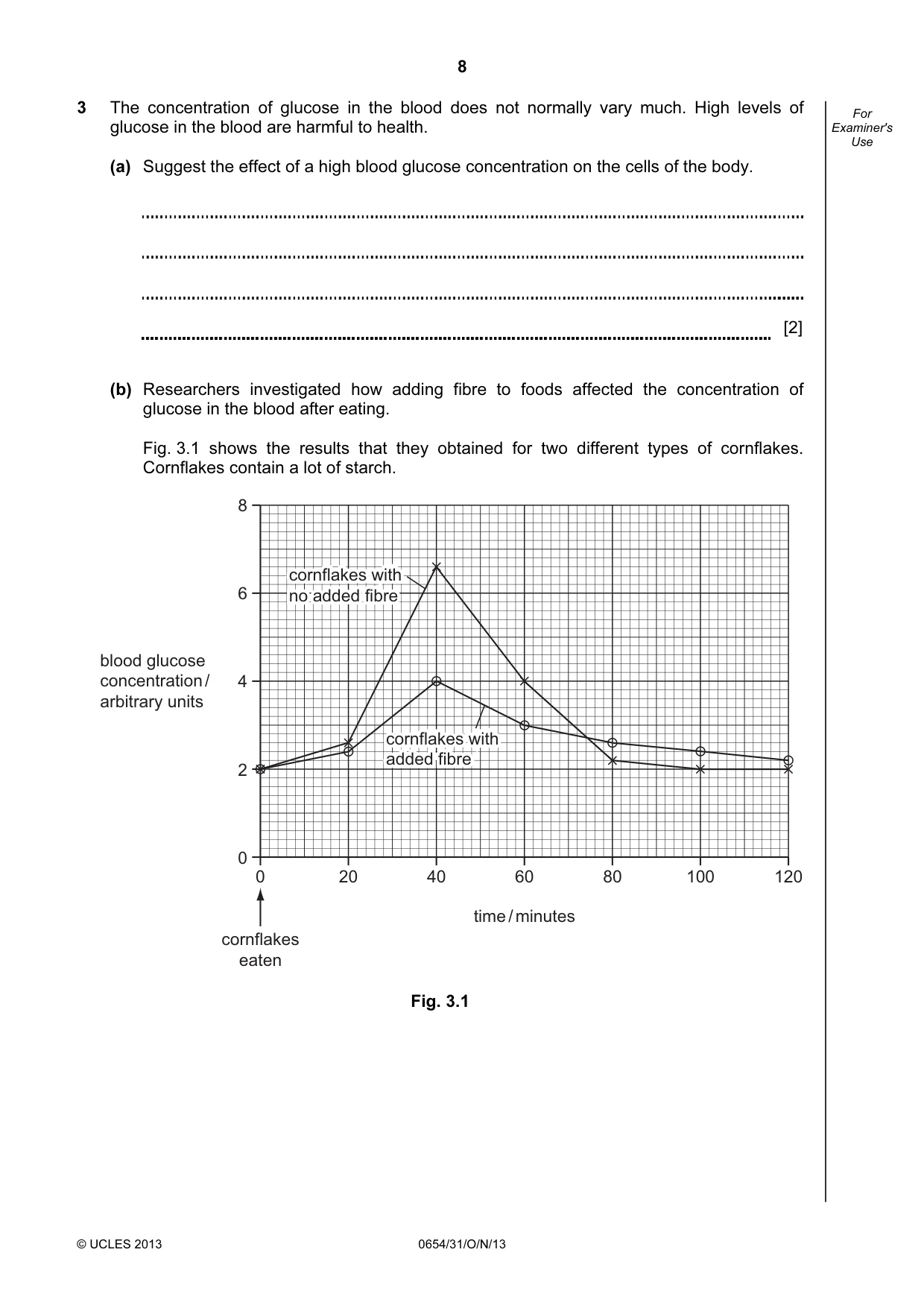
8 © UCLES 2013 0654/31/O/N/13 For Examiner's Use 3 The concentration of glucose in the blood does not normally vary much. High levels of glucose in the blood are harmful to health. (a) Suggest the effect of a high blood glucose concentration on the cells of the body. [2] (b) Researchers investigated how adding fibre to foods affected the concentration of glucose in the blood after eating. Fig. 3.1 shows the results that they obtained for two different types of cornflakes. Cornflakes contain a lot of starch. 8 6 4 2 0 0 20 40 60 time / minutes 80 100 120 blood glucose concentration / arbitrary units cornflakes with cornflakes with no added fibre no added fibre cornflakes with cornflakes with added fibre added fibre cornflakes with no added fibre cornflakes with added fibre cornflakes eaten Fig. 3.1
Question paper, page 9
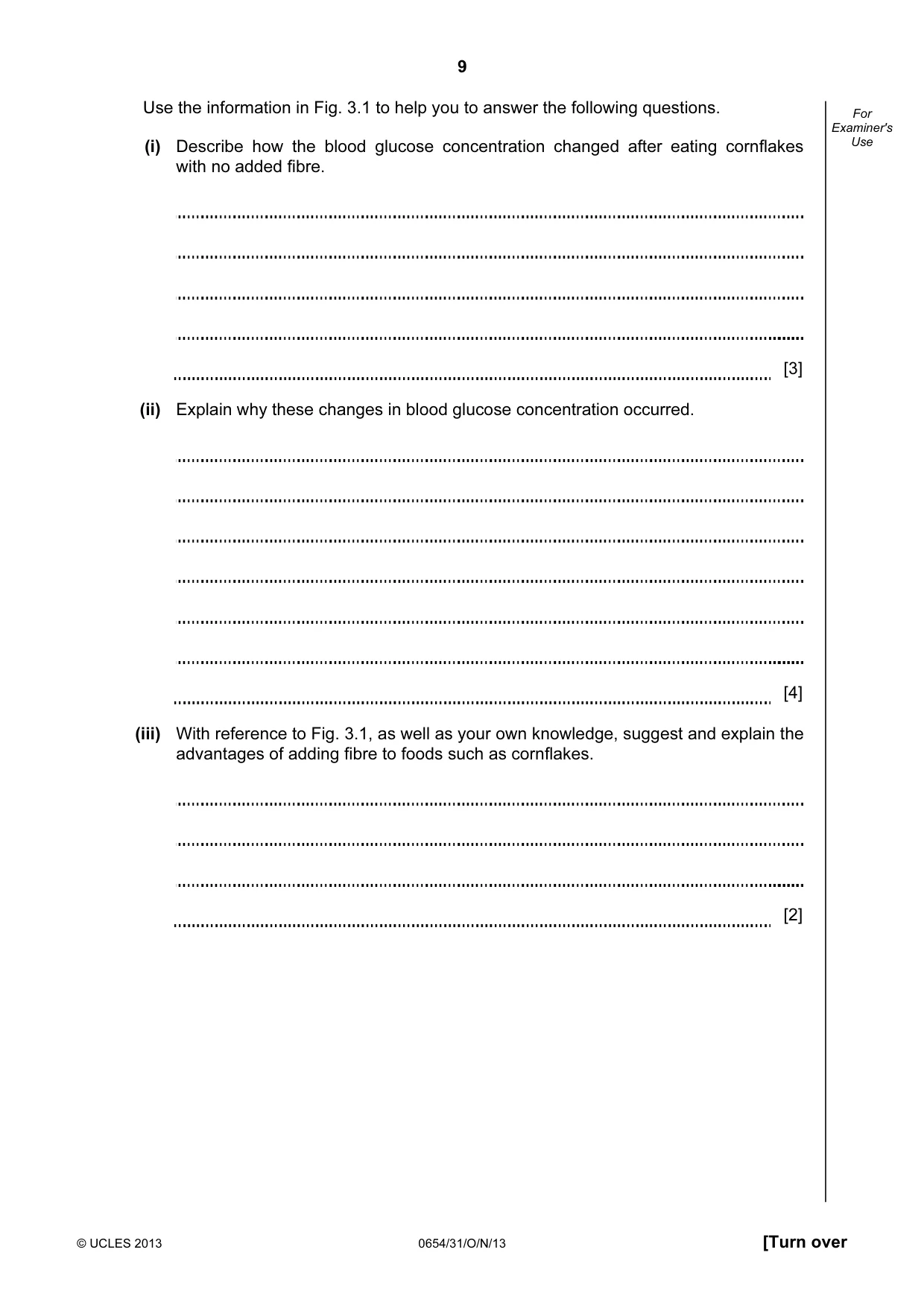
9 © UCLES 2013 0654/31/O/N/13 [Turn over For Examiner's Use Use the information in Fig. 3.1 to help you to answer the following questions. (i) Describe how the blood glucose concentration changed after eating cornflakes with no added fibre. [3] (ii) Explain why these changes in blood glucose concentration occurred. [4] (iii) With reference to Fig. 3.1, as well as your own knowledge, suggest and explain the advantages of adding fibre to foods such as cornflakes. [2]
Question paper, page 10
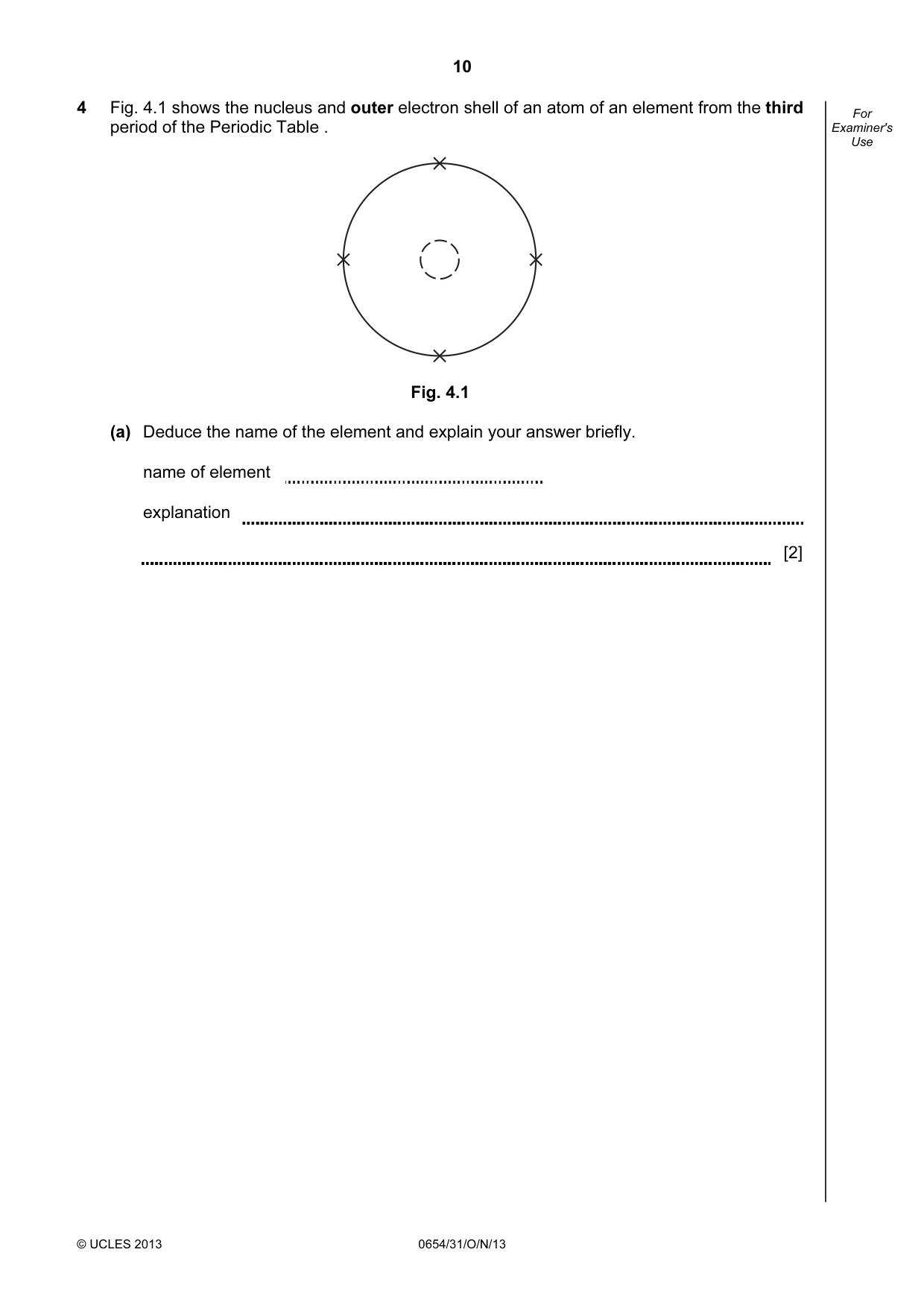
10 © UCLES 2013 0654/31/O/N/13 For Examiner's Use 4 Fig. 4.1 shows the nucleus and outer electron shell of an atom of an element from the third period of the Periodic Table . Fig. 4.1 (a) Deduce the name of the element and explain your answer briefly. name of element explanation [2]
Question paper, page 11
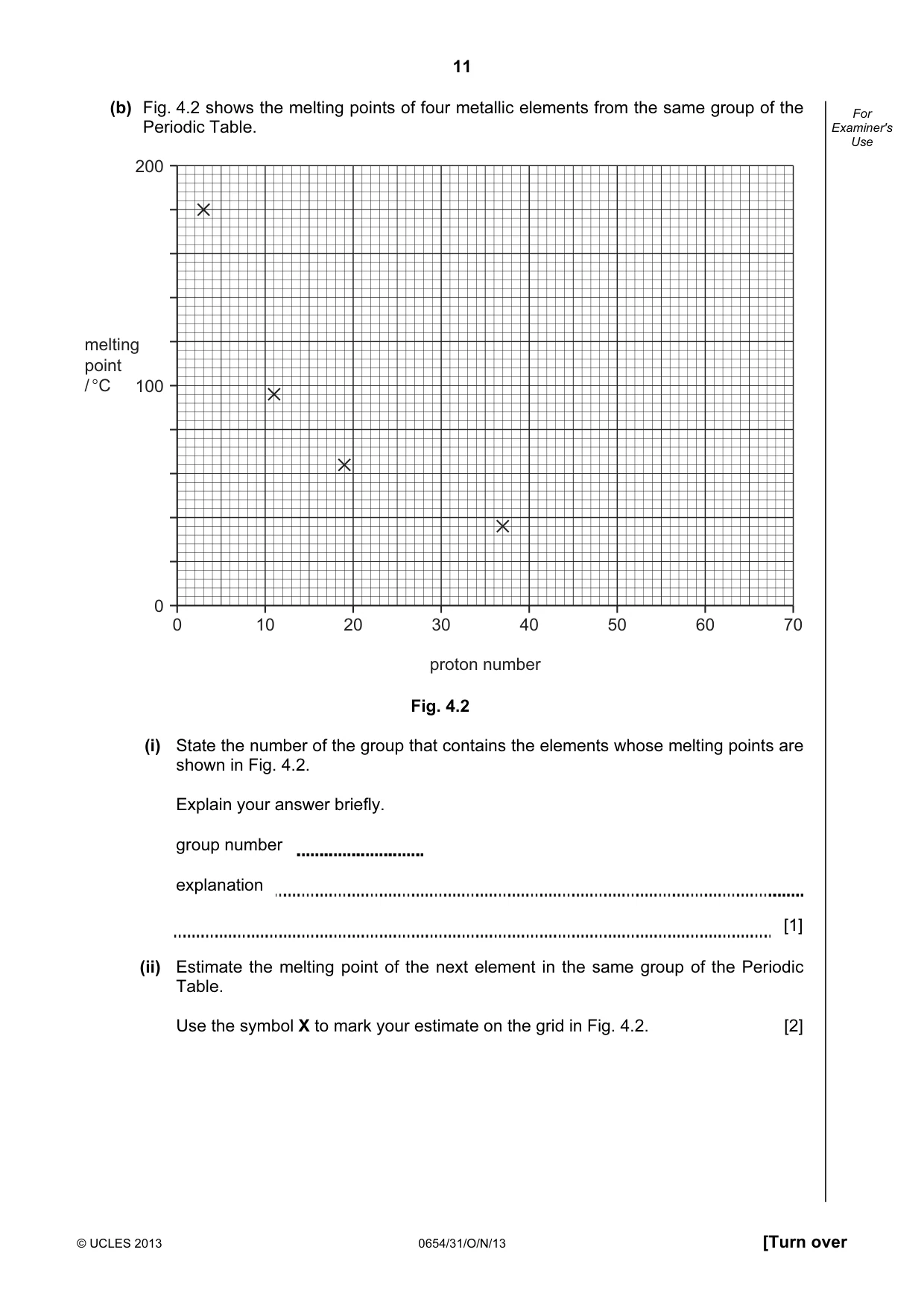
11 © UCLES 2013 0654/31/O/N/13 [Turn over For Examiner's Use (b) Fig. 4.2 shows the melting points of four metallic elements from the same group of the Periodic Table. 200 100 0 0 10 20 30 40 50 60 70 proton number melting point / °C Fig. 4.2 (i) State the number of the group that contains the elements whose melting points are shown in Fig. 4.2. Explain your answer briefly. group number explanation [1] (ii) Estimate the melting point of the next element in the same group of the Periodic Table. Use the symbol X to mark your estimate on the grid in Fig. 4.2. [2]
Question paper, page 12
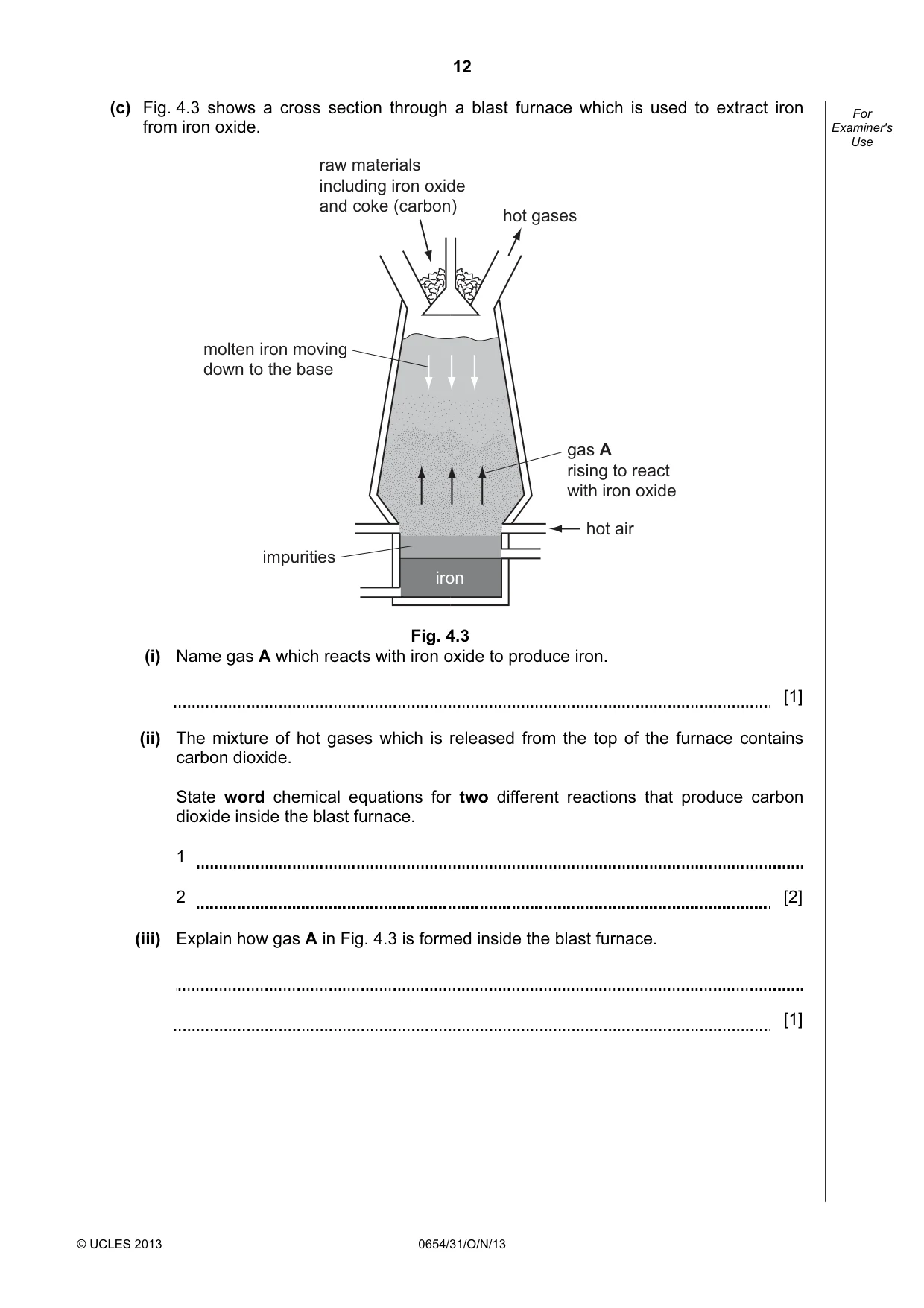
12 © UCLES 2013 0654/31/O/N/13 For Examiner's Use (c) Fig. 4.3 shows a cross section through a blast furnace which is used to extract iron from iron oxide. iron gas A rising to react with iron oxide hot air impurities hot gases molten iron moving down to the base raw materials including iron oxide and coke (carbon) Fig. 4.3 (i) Name gas A which reacts with iron oxide to produce iron. [1] (ii) The mixture of hot gases which is released from the top of the furnace contains carbon dioxide. State word chemical equations for two different reactions that produce carbon dioxide inside the blast furnace. 1 2 [2] (iii) Explain how gas A in Fig. 4.3 is formed inside the blast furnace. [1]
Question paper, page 13
13 © UCLES 2013 0654/31/O/N/13 [Turn over Please turn over for Question 5.
Question paper, page 14
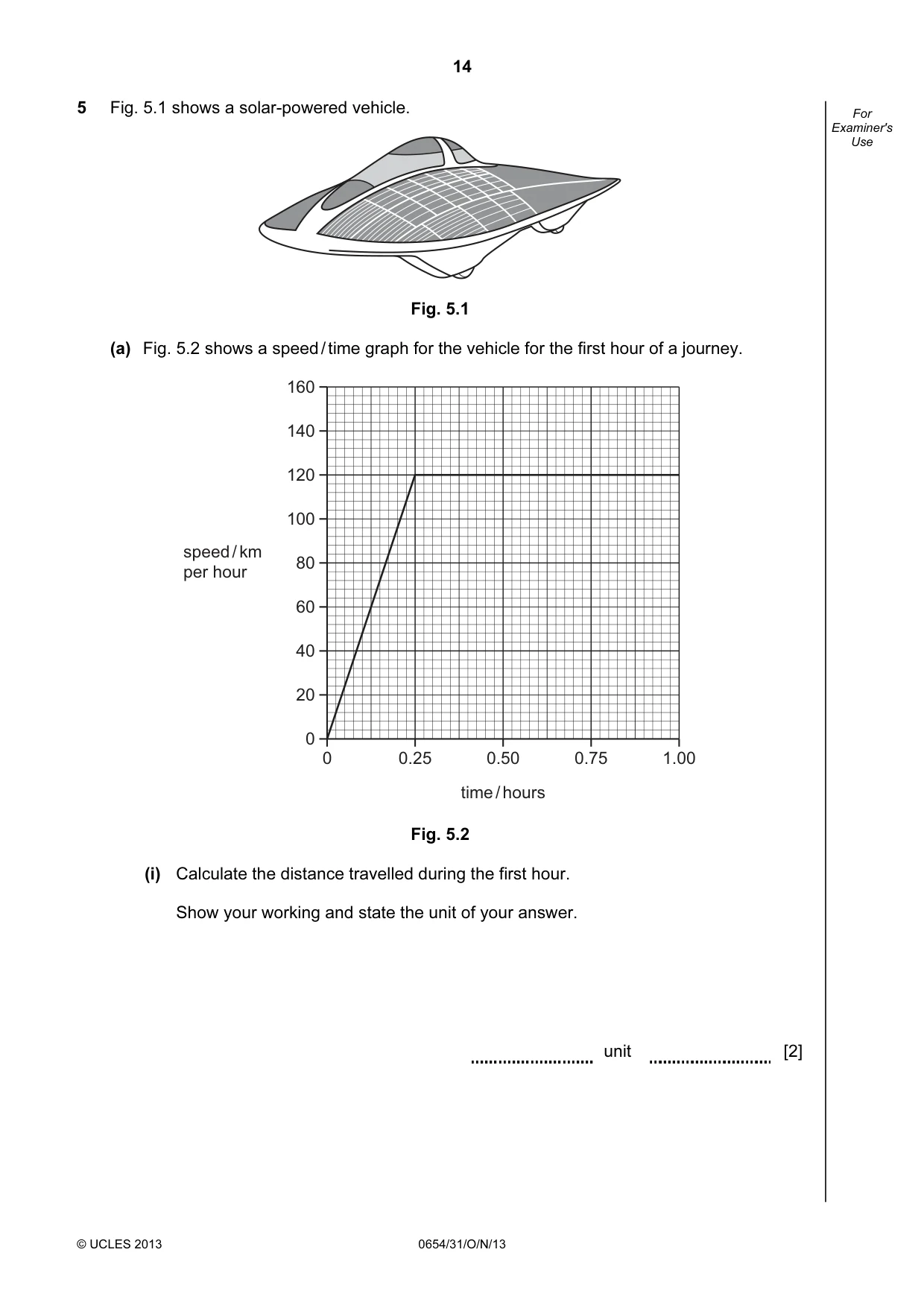
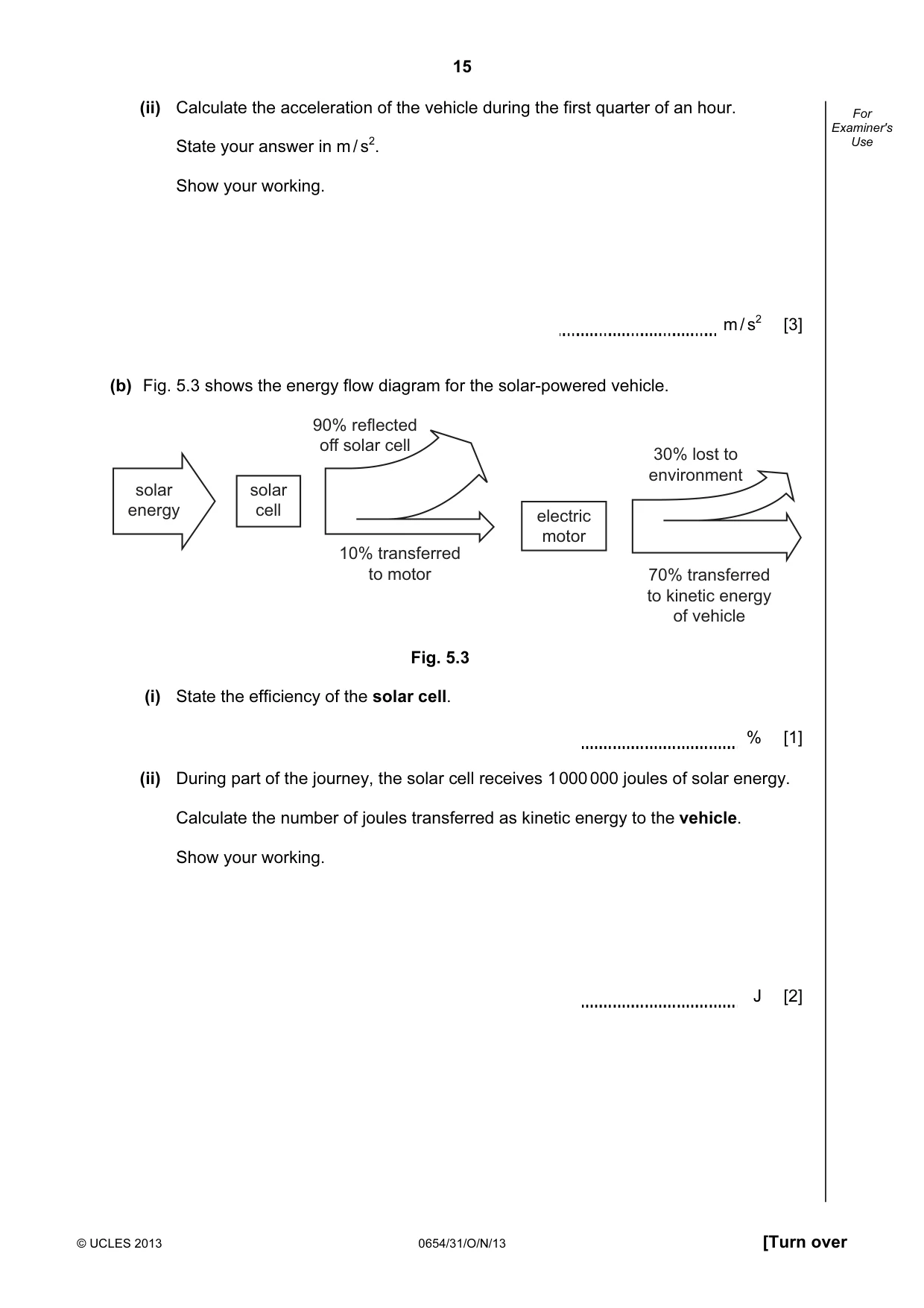
14 © UCLES 2013 0654/31/O/N/13 For Examiner's Use 5 Fig. 5.1 shows a solar-powered vehicle. Fig. 5.1 (a) Fig. 5.2 shows a speed / time graph for the vehicle for the first hour of a journey. 0 0.25 0.50 time / hours 0.75 1.00 160 140 120 100 80 60 40 20 0 speed / km per hour Fig. 5.2 (i) Calculate the distance travelled during the first hour. Show your working and state the unit of your answer. unit [2]
Question paper, page 15
15 © UCLES 2013 0654/31/O/N/13 [Turn over For Examiner's Use (ii) Calculate the acceleration of the vehicle during the first quarter of an hour. State your answer in m / s2. Show your working. m / s2 [3] (b) Fig. 5.3 shows the energy flow diagram for the solar-powered vehicle. solar energy solar cell 90% reflected off solar cell 30% lost to environment electric motor 10% transferred to motor 70% transferred to kinetic energy of vehicle Fig. 5.3 (i) State the efficiency of the solar cell. % [1] (ii) During part of the journey, the solar cell receives 1 000 000 joules of solar energy. Calculate the number of joules transferred as kinetic energy to the vehicle. Show your working. J [2]
Question paper, page 16
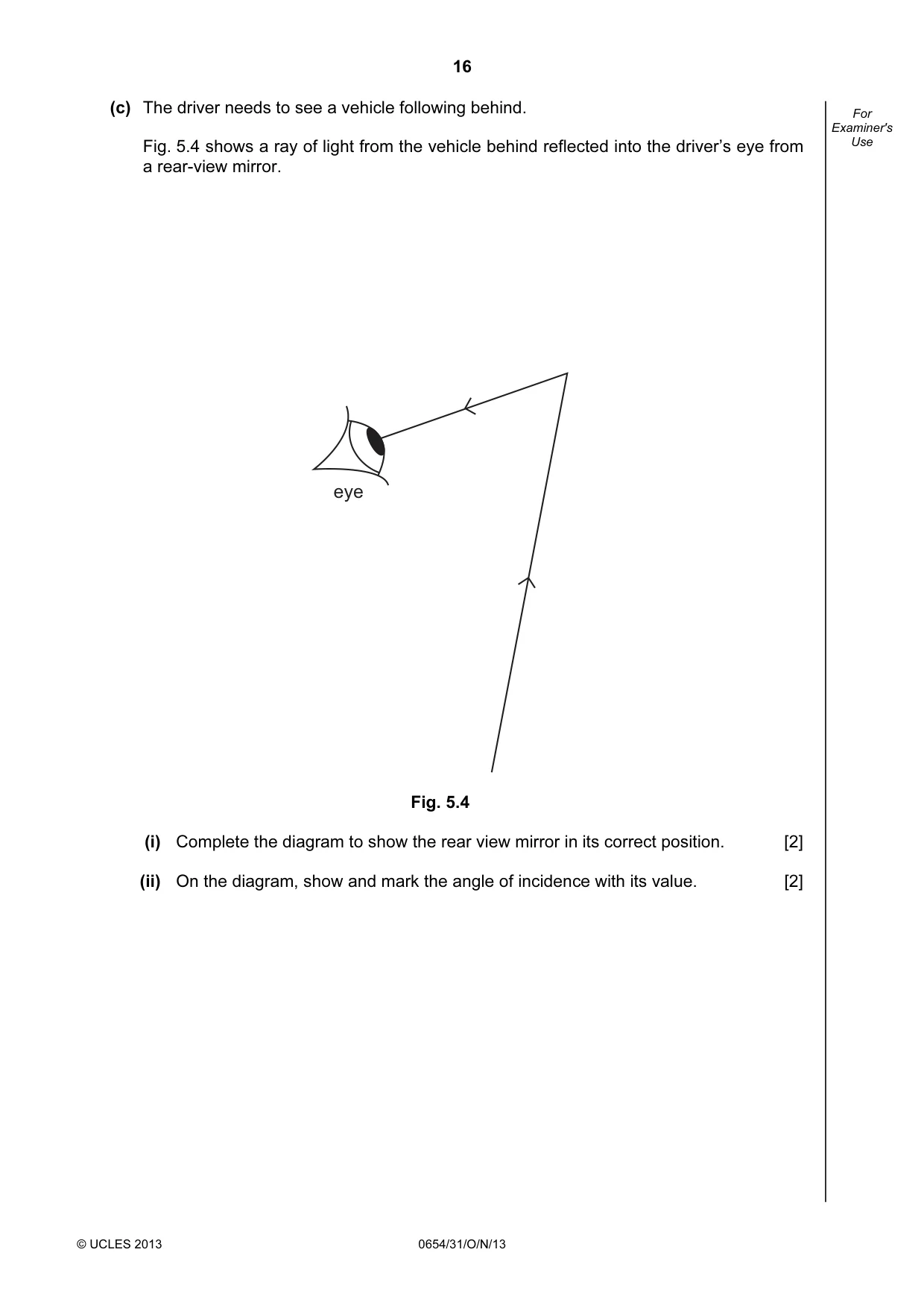
16 © UCLES 2013 0654/31/O/N/13 For Examiner's Use (c) The driver needs to see a vehicle following behind. Fig. 5.4 shows a ray of light from the vehicle behind reflected into the driver’s eye from a rear-view mirror. eye Fig. 5.4 (i) Complete the diagram to show the rear view mirror in its correct position. [2] (ii) On the diagram, show and mark the angle of incidence with its value. [2]
Question paper, page 17
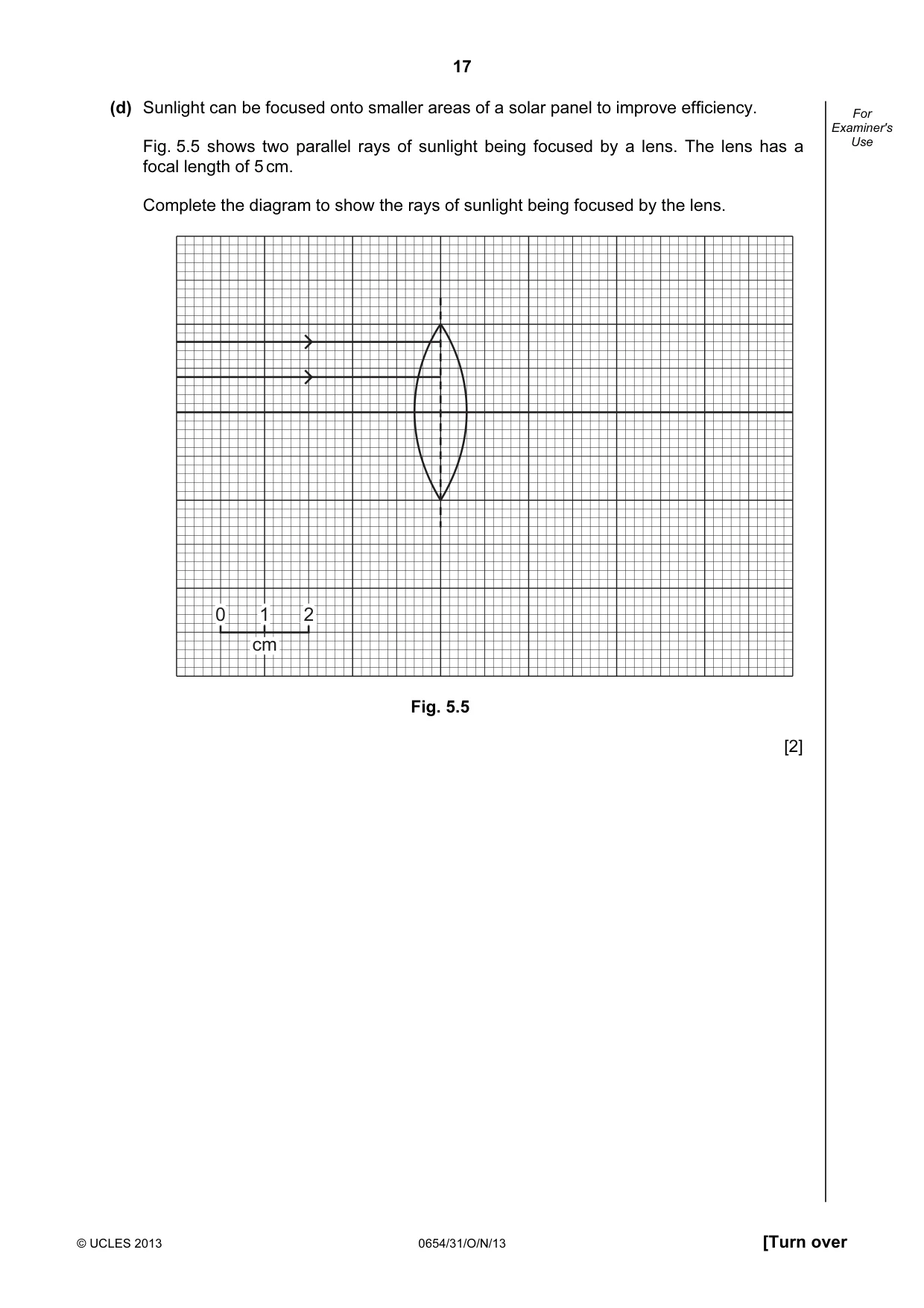
17 © UCLES 2013 0654/31/O/N/13 [Turn over For Examiner's Use (d) Sunlight can be focused onto smaller areas of a solar panel to improve efficiency. Fig. 5.5 shows two parallel rays of sunlight being focused by a lens. The lens has a focal length of 5 cm. Complete the diagram to show the rays of sunlight being focused by the lens. 0 1 2 cm cm cm 0 1 2 Fig. 5.5 [2]
Question paper, page 18
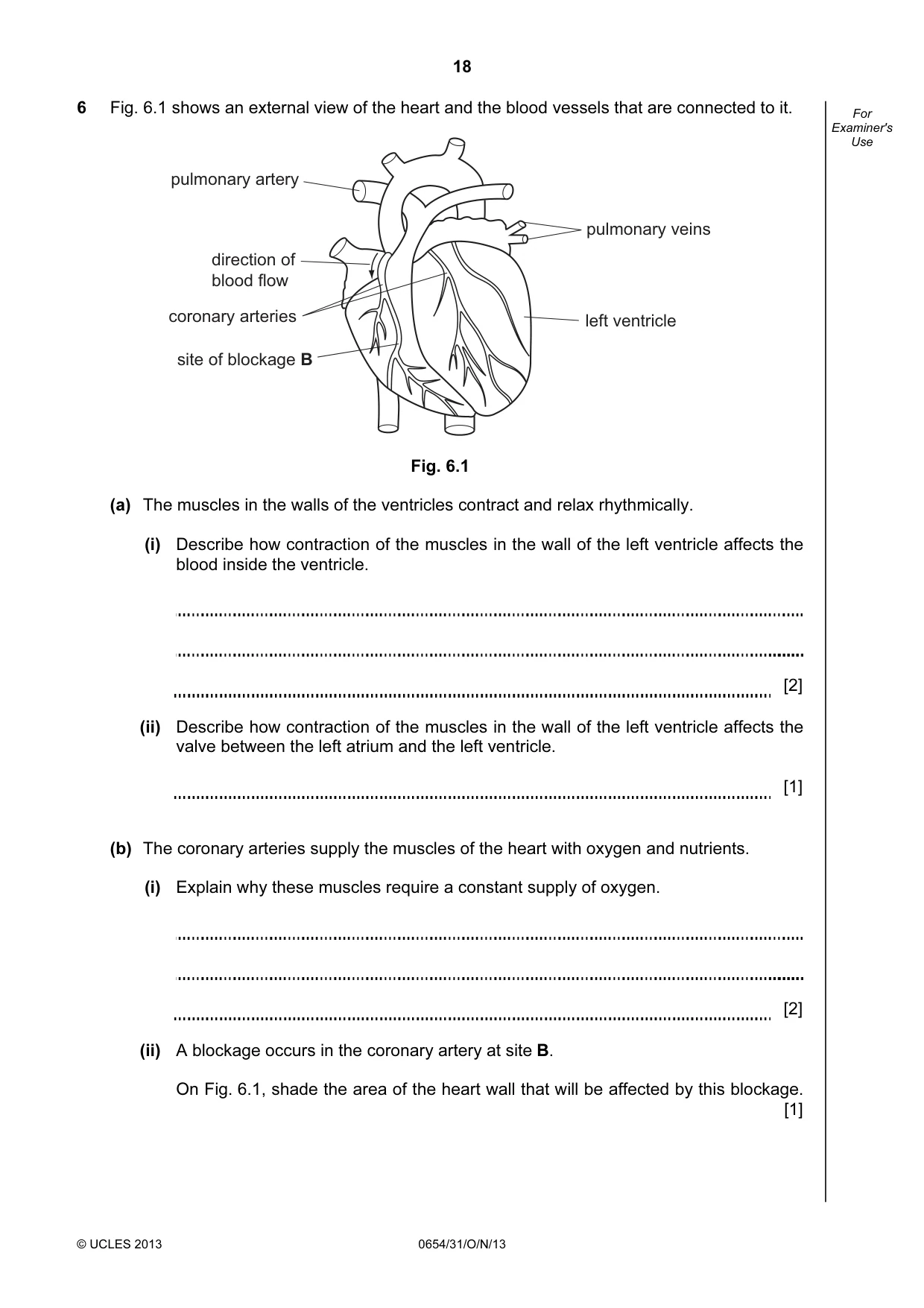
18 © UCLES 2013 0654/31/O/N/13 For Examiner's Use 6 Fig. 6.1 shows an external view of the heart and the blood vessels that are connected to it. pulmonary artery direction of blood flow coronary arteries site of blockage B pulmonary veins left ventricle Fig. 6.1 (a) The muscles in the walls of the ventricles contract and relax rhythmically. (i) Describe how contraction of the muscles in the wall of the left ventricle affects the blood inside the ventricle. [2] (ii) Describe how contraction of the muscles in the wall of the left ventricle affects the valve between the left atrium and the left ventricle. [1] (b) The coronary arteries supply the muscles of the heart with oxygen and nutrients. (i) Explain why these muscles require a constant supply of oxygen. [2] (ii) A blockage occurs in the coronary artery at site B. On Fig. 6.1, shade the area of the heart wall that will be affected by this blockage. [1]
Question paper, page 19
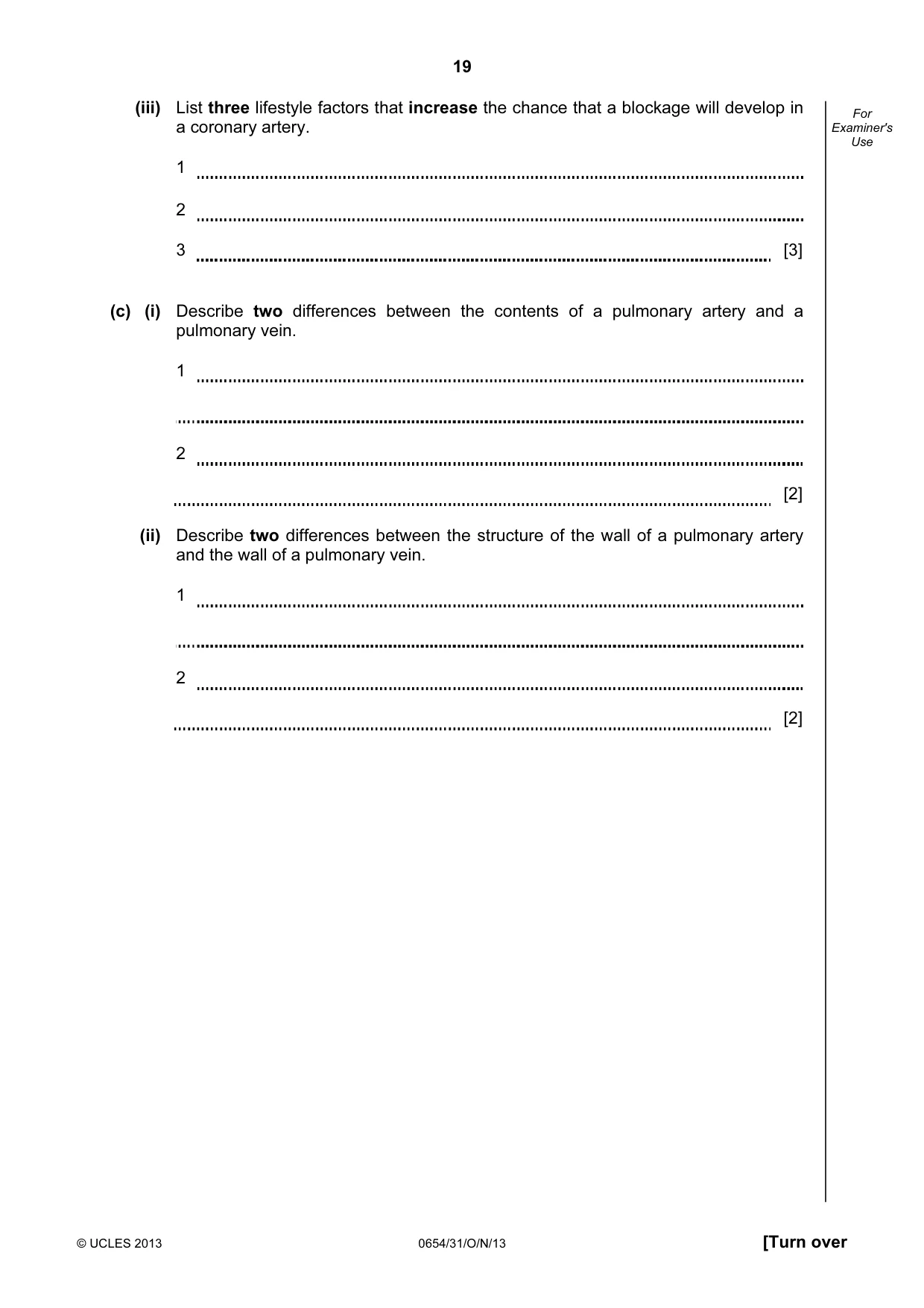
19 © UCLES 2013 0654/31/O/N/13 [Turn over For Examiner's Use (iii) List three lifestyle factors that increase the chance that a blockage will develop in a coronary artery. 1 2 3 [3] (c) (i) Describe two differences between the contents of a pulmonary artery and a pulmonary vein. 1 2 [2] (ii) Describe two differences between the structure of the wall of a pulmonary artery and the wall of a pulmonary vein. 1 2 [2]
Question paper, page 20
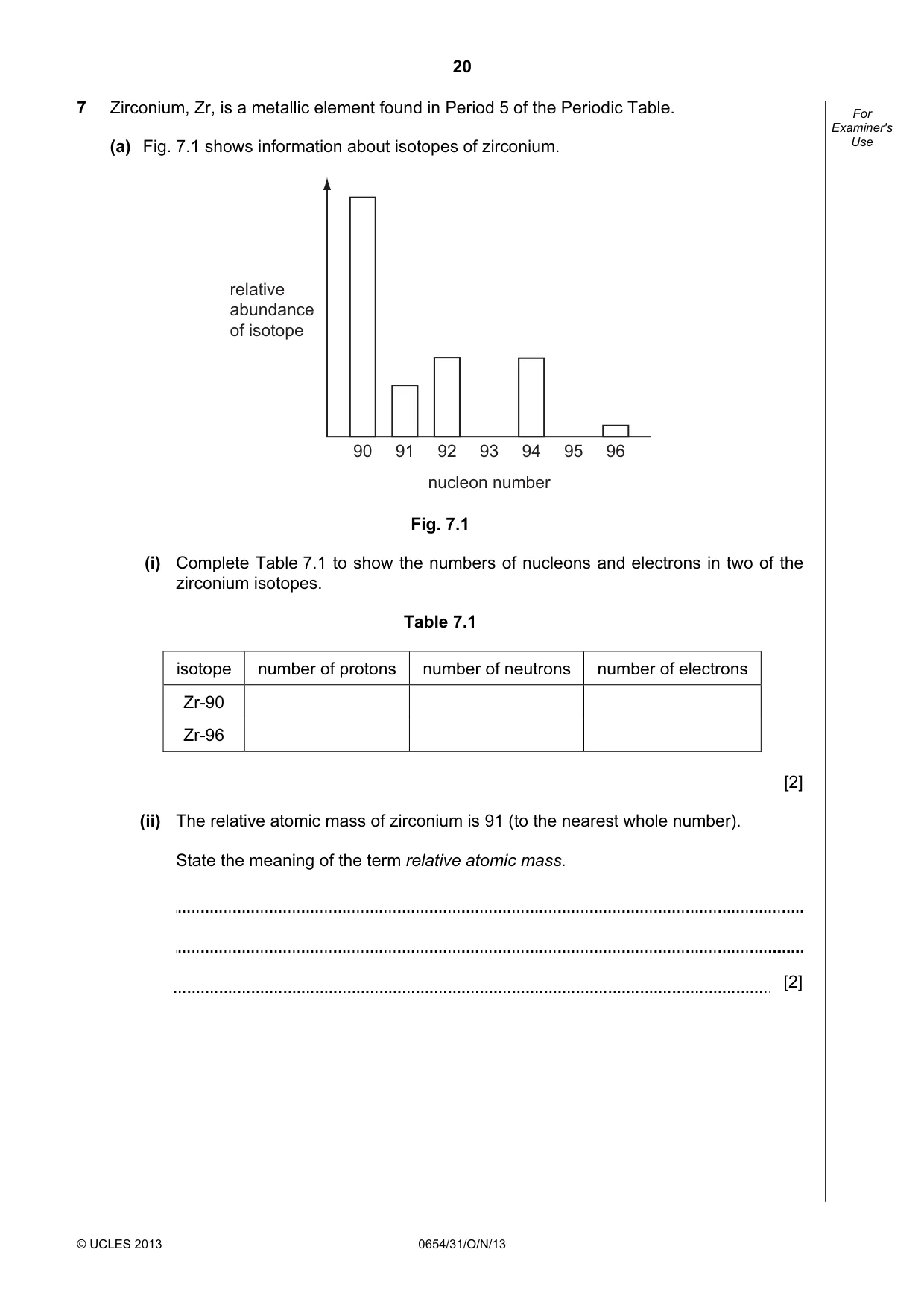
20 © UCLES 2013 0654/31/O/N/13 For Examiner's Use 7 Zirconium, Zr, is a metallic element found in Period 5 of the Periodic Table. (a) Fig. 7.1 shows information about isotopes of zirconium. 90 91 92 93 nucleon number 94 95 96 relative abundance of isotope Fig. 7.1 (i) Complete Table 7.1 to show the numbers of nucleons and electrons in two of the zirconium isotopes. Table 7.1 isotope number of protons number of neutrons number of electrons Zr-90 Zr-96 [2] (ii) The relative atomic mass of zirconium is 91 (to the nearest whole number). State the meaning of the term relative atomic mass. [2]
Question paper, page 21
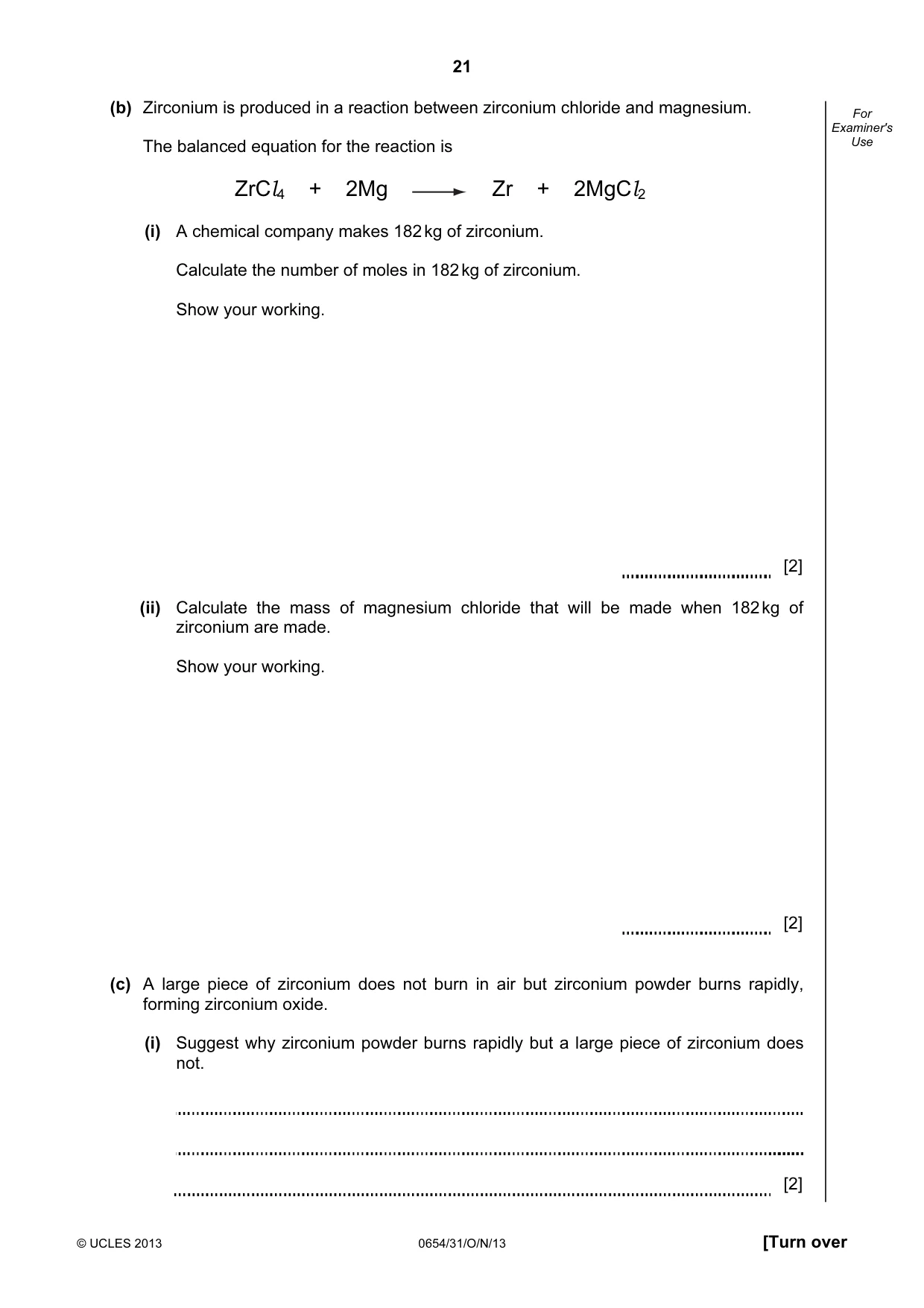
21 © UCLES 2013 0654/31/O/N/13 [Turn over For Examiner's Use (b) Zirconium is produced in a reaction between zirconium chloride and magnesium. The balanced equation for the reaction is ZrCl4 + 2Mg Zr + 2MgCl2 (i) A chemical company makes 182 kg of zirconium. Calculate the number of moles in 182 kg of zirconium. Show your working. [2] (ii) Calculate the mass of magnesium chloride that will be made when 182 kg of zirconium are made. Show your working. [2] (c) A large piece of zirconium does not burn in air but zirconium powder burns rapidly, forming zirconium oxide. (i) Suggest why zirconium powder burns rapidly but a large piece of zirconium does not. [2]
Question paper, page 22
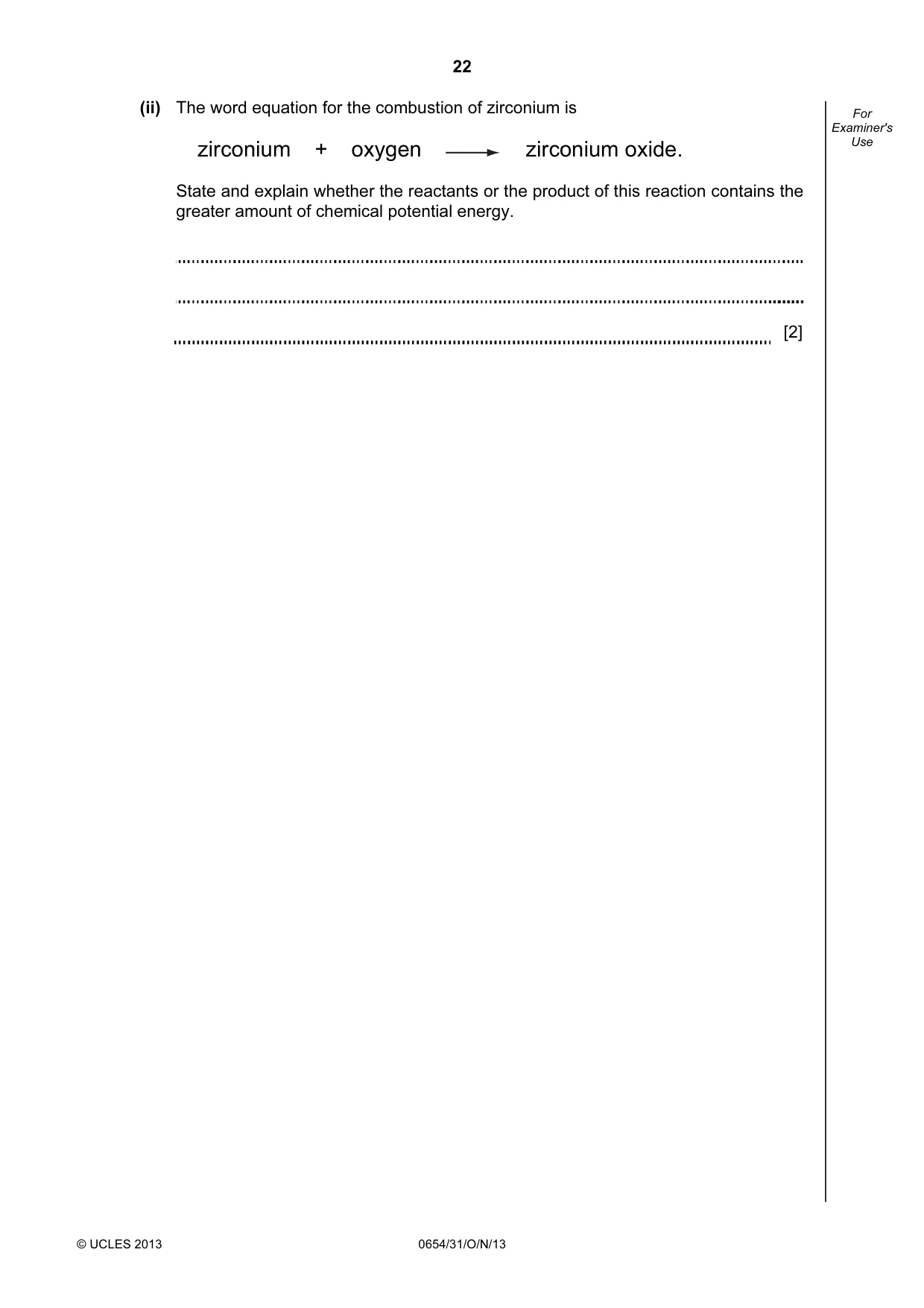
22 © UCLES 2013 0654/31/O/N/13 For Examiner's Use (ii) The word equation for the combustion of zirconium is zirconium + oxygen zirconium oxide. State and explain whether the reactants or the product of this reaction contains the greater amount of chemical potential energy. [2]
Question paper, page 23
23 © UCLES 2013 0654/31/O/N/13 [Turn over Please turn over for Question 8.
Question paper, page 24
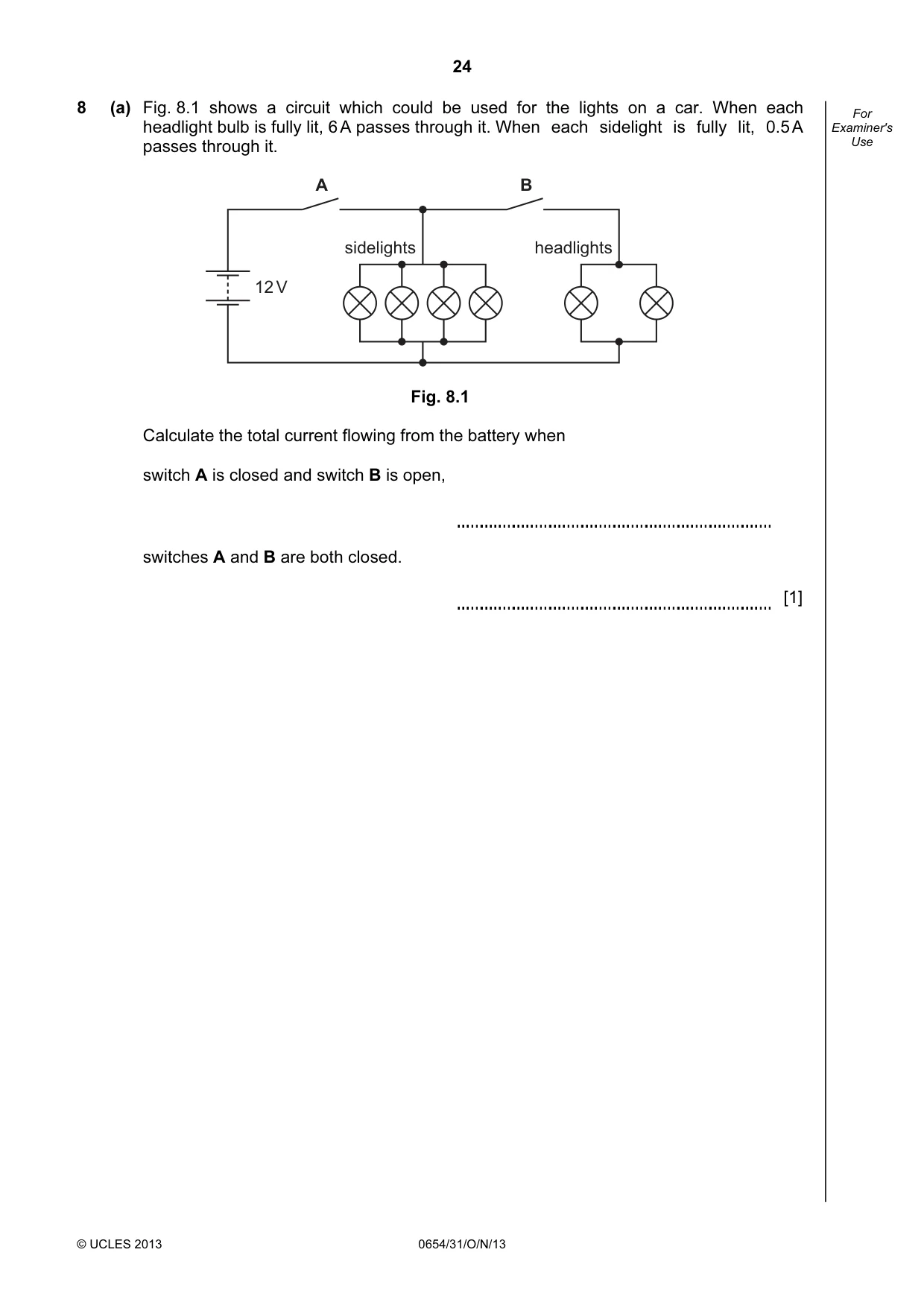
24 © UCLES 2013 0654/31/O/N/13 For Examiner's Use 8 (a) Fig. 8.1 shows a circuit which could be used for the lights on a car. When each headlight bulb is fully lit, 6 A passes through it. When each sidelight is fully lit, 0.5 A passes through it. 12 V sidelights headlights A B Fig. 8.1 Calculate the total current flowing from the battery when switch A is closed and switch B is open, switches A and B are both closed. [1]
Question paper, page 25
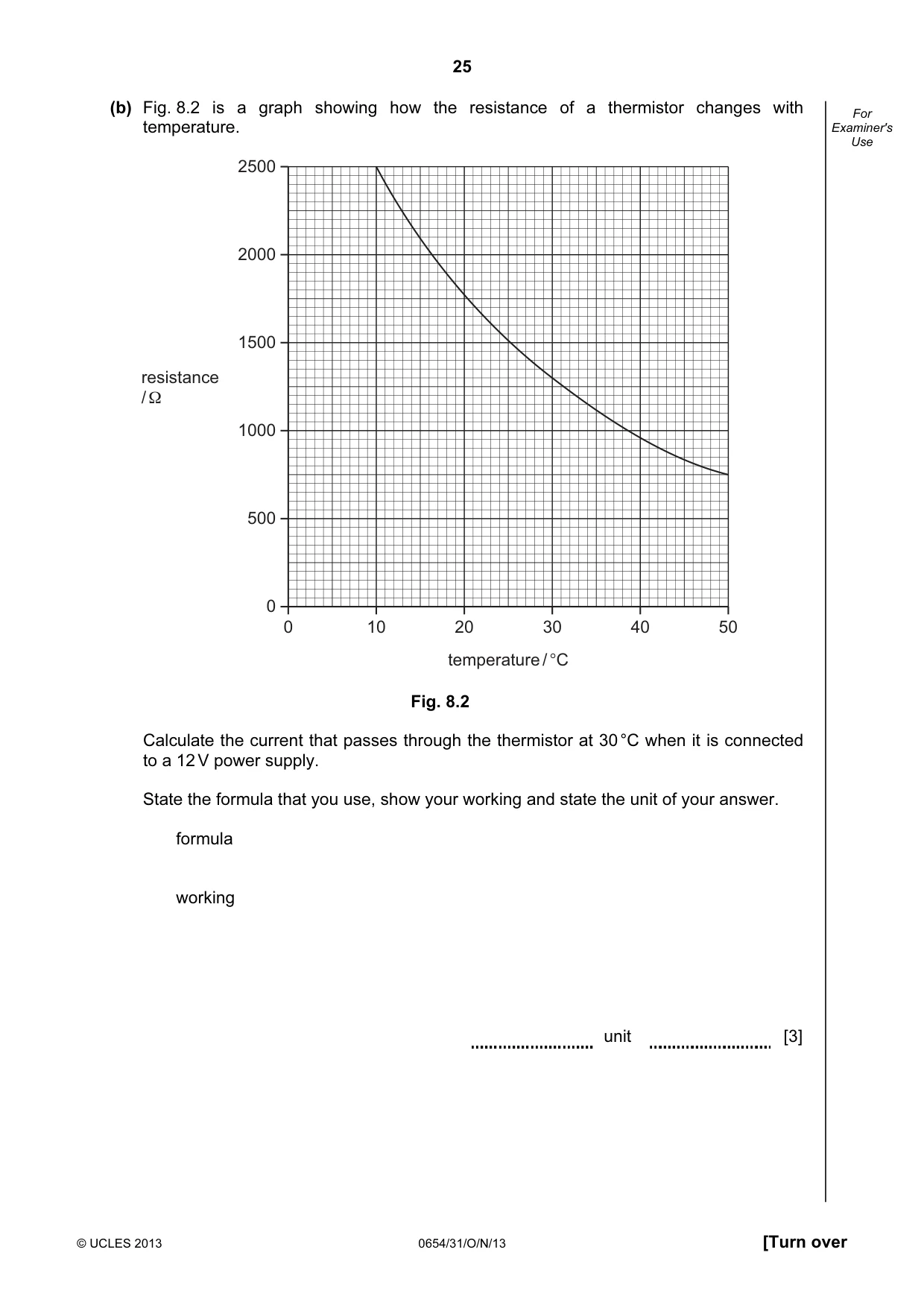
25 © UCLES 2013 0654/31/O/N/13 [Turn over For Examiner's Use (b) Fig. 8.2 is a graph showing how the resistance of a thermistor changes with temperature. 0 10 20 30 40 50 temperature / °C 2500 2000 1500 1000 500 0 resistance / Ω Fig. 8.2 Calculate the current that passes through the thermistor at 30 °C when it is connected to a 12 V power supply. State the formula that you use, show your working and state the unit of your answer. formula working unit [3]
Question paper, page 26
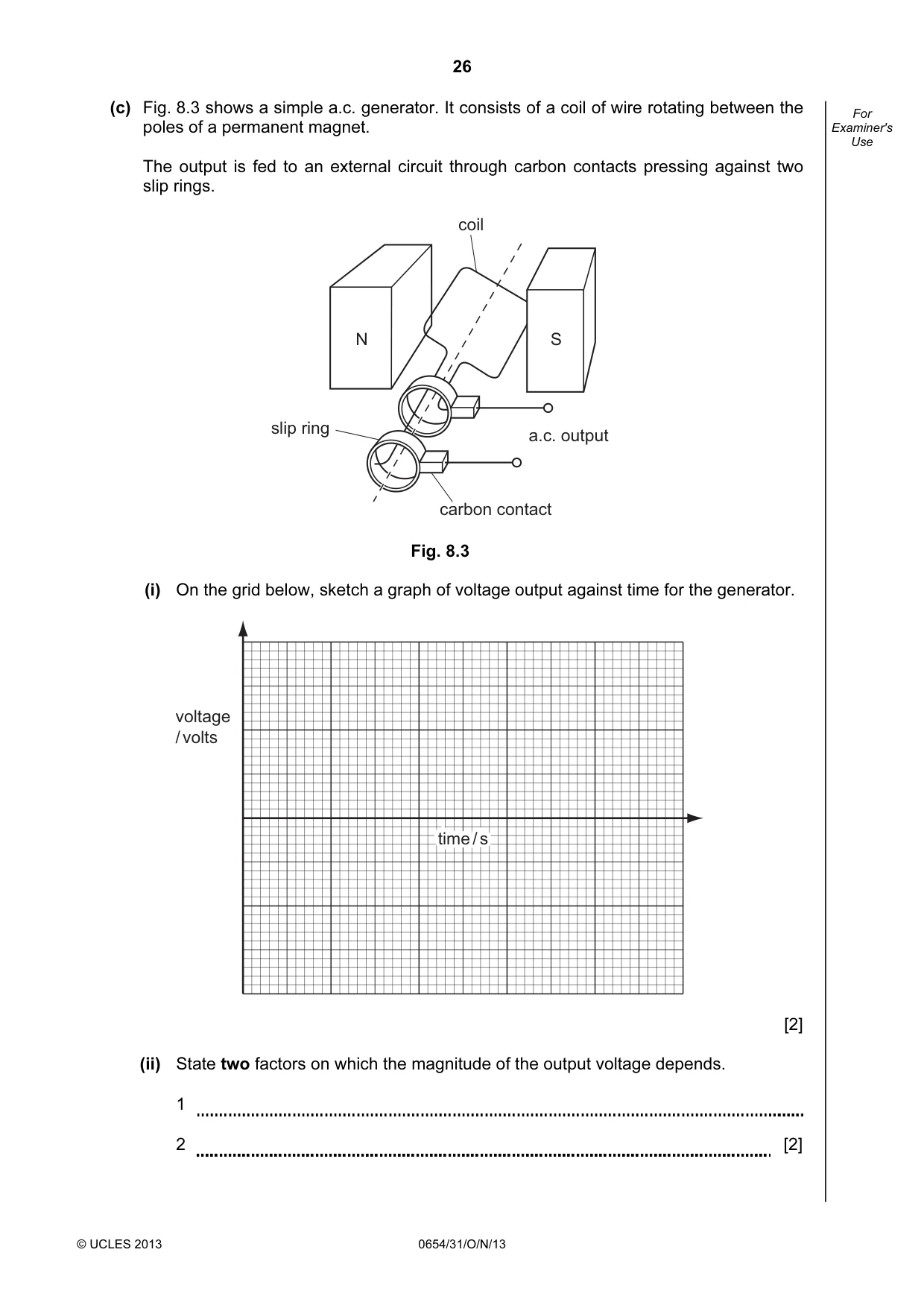
26 © UCLES 2013 0654/31/O/N/13 For Examiner's Use (c) Fig. 8.3 shows a simple a.c. generator. It consists of a coil of wire rotating between the poles of a permanent magnet. The output is fed to an external circuit through carbon contacts pressing against two slip rings. N S a.c. output carbon contact slip ring coil Fig. 8.3 (i) On the grid below, sketch a graph of voltage output against time for the generator. voltage / volts time time / s time / s [2] (ii) State two factors on which the magnitude of the output voltage depends. 1 2 [2]
Question paper, page 27
27 © UCLES 2013 0654/31/O/N/13 [Turn over Please turn over for Question 9.
Question paper, page 28
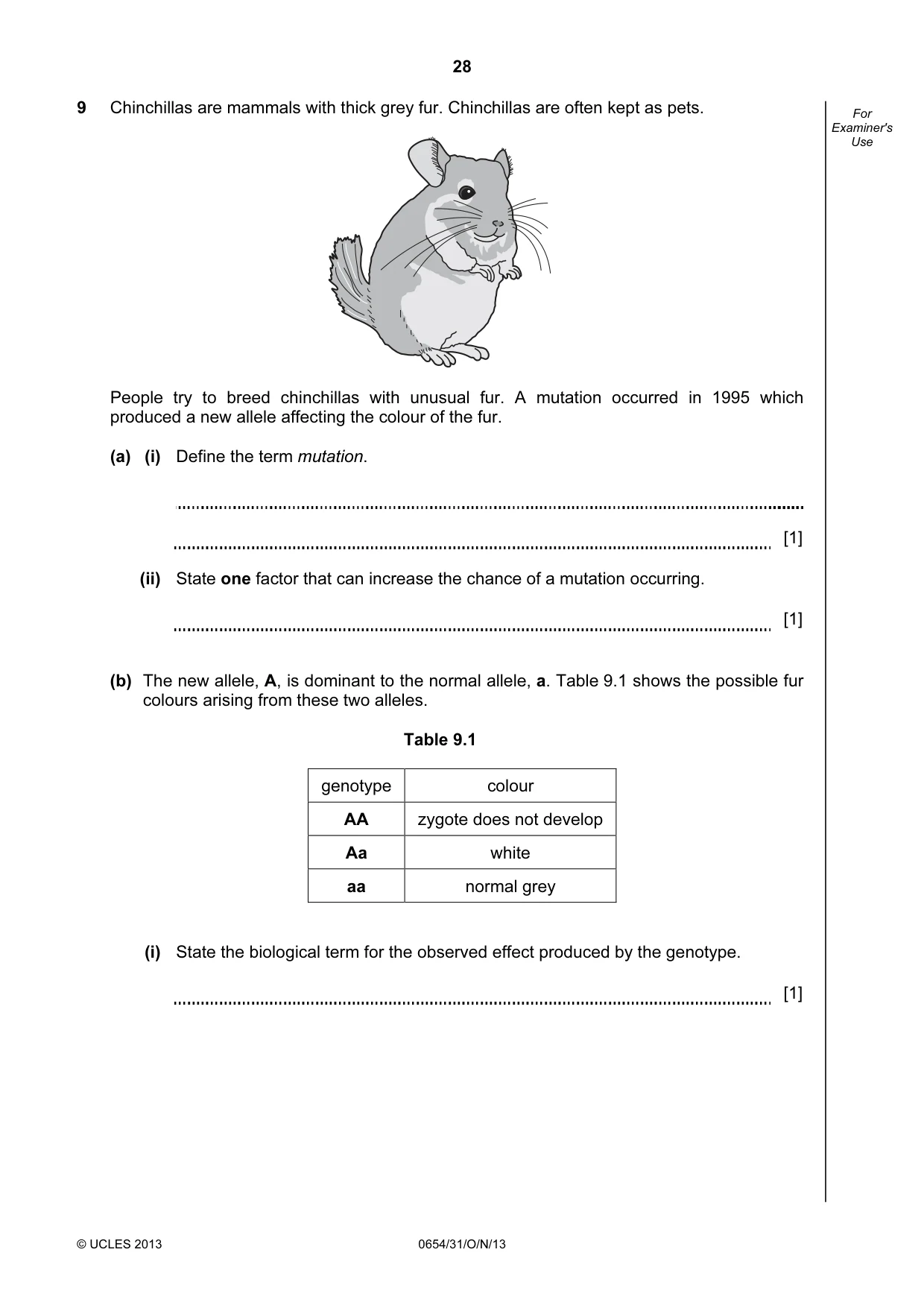
28 © UCLES 2013 0654/31/O/N/13 For Examiner's Use 9 Chinchillas are mammals with thick grey fur. Chinchillas are often kept as pets. People try to breed chinchillas with unusual fur. A mutation occurred in 1995 which produced a new allele affecting the colour of the fur. (a) (i) Define the term mutation. [1] (ii) State one factor that can increase the chance of a mutation occurring. [1] (b) The new allele, A, is dominant to the normal allele, a. Table 9.1 shows the possible fur colours arising from these two alleles. Table 9.1 genotype colour AA zygote does not develop Aa white aa normal grey (i) State the biological term for the observed effect produced by the genotype. [1]
Question paper, page 29
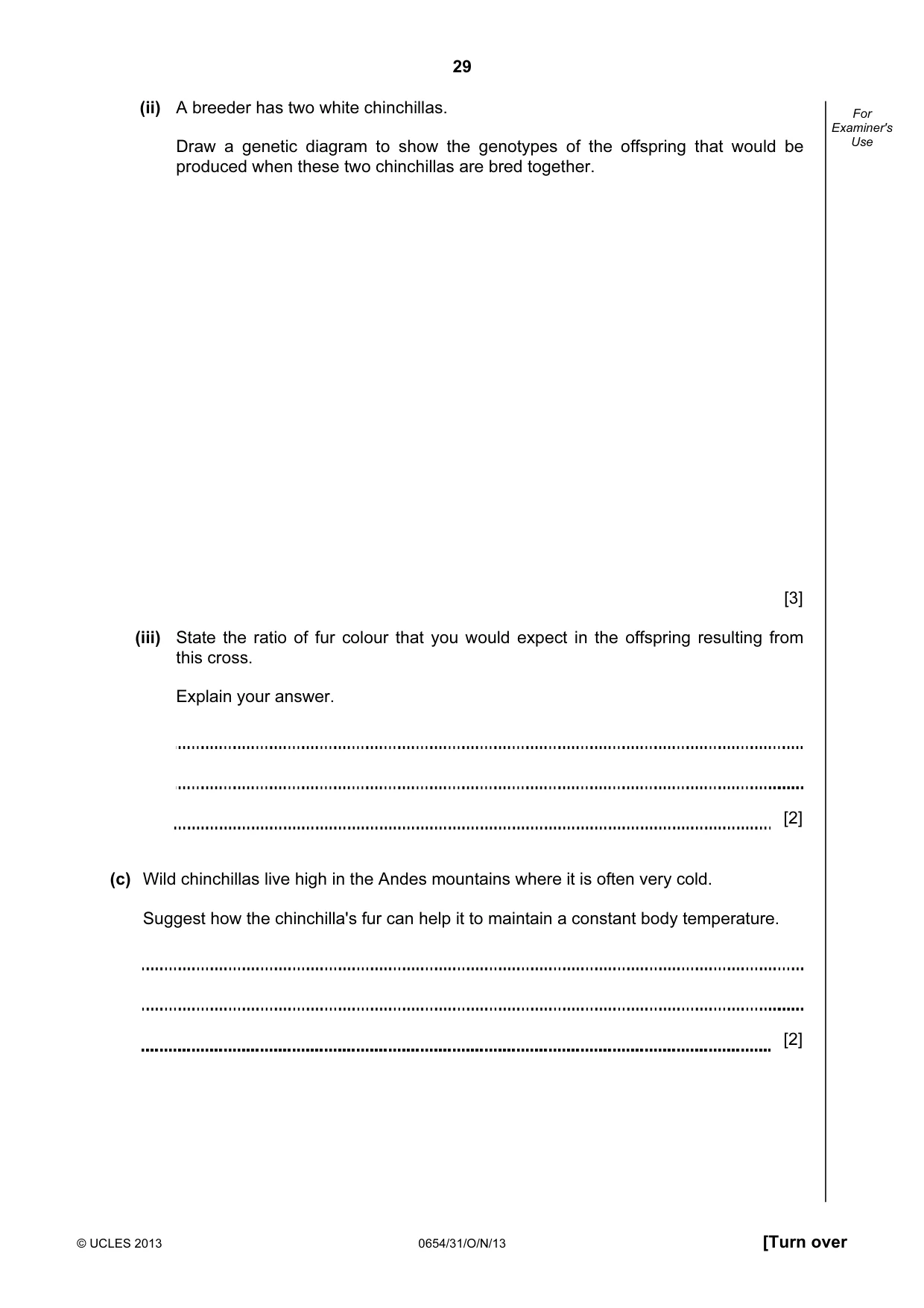
29 © UCLES 2013 0654/31/O/N/13 [Turn over For Examiner's Use (ii) A breeder has two white chinchillas. Draw a genetic diagram to show the genotypes of the offspring that would be produced when these two chinchillas are bred together. [3] (iii) State the ratio of fur colour that you would expect in the offspring resulting from this cross. Explain your answer. [2] (c) Wild chinchillas live high in the Andes mountains where it is often very cold. Suggest how the chinchilla's fur can help it to maintain a constant body temperature. [2]
Question paper, page 30
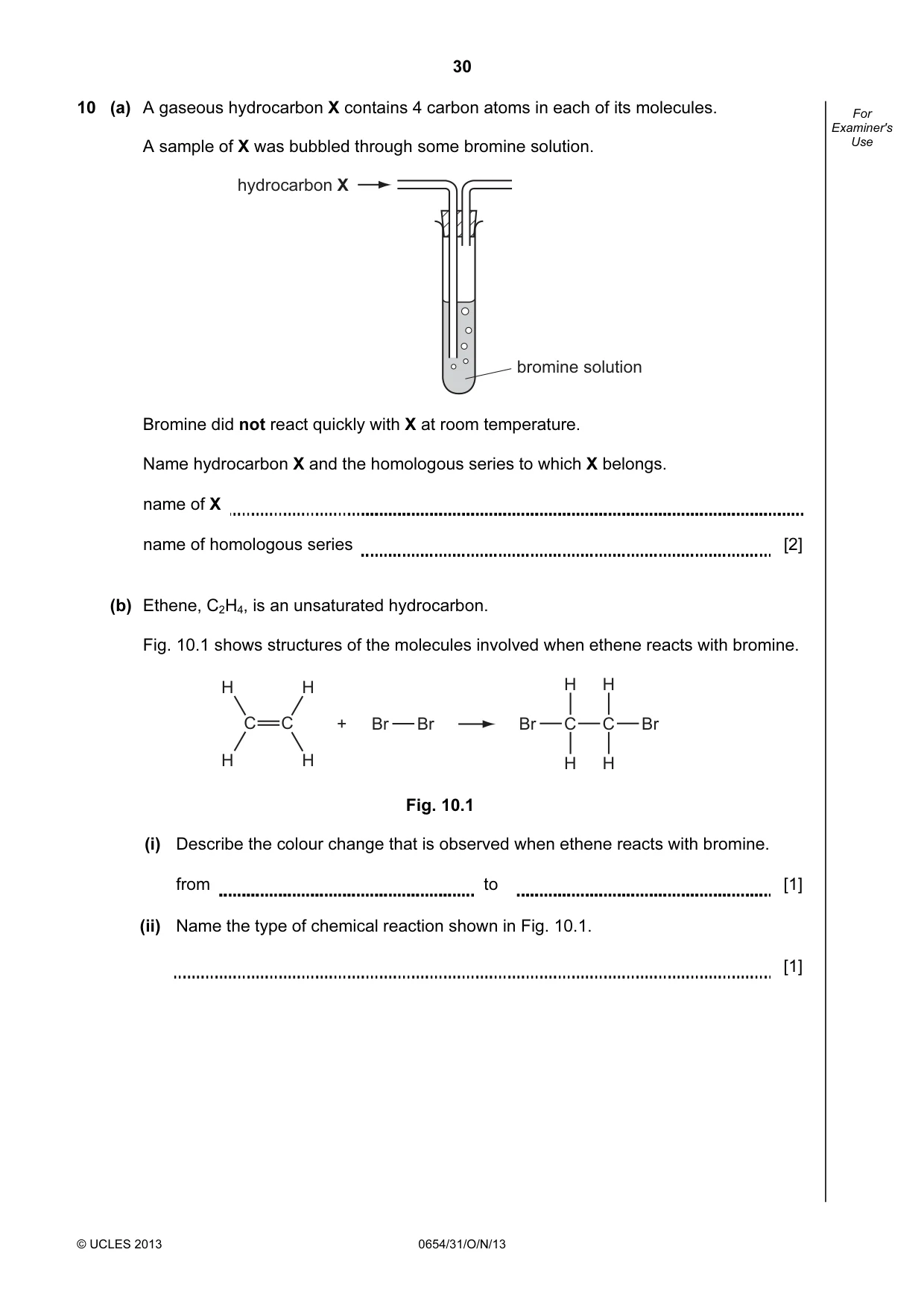
30 © UCLES 2013 0654/31/O/N/13 For Examiner's Use 10 (a) A gaseous hydrocarbon X contains 4 carbon atoms in each of its molecules. A sample of X was bubbled through some bromine solution. hydrocarbon X bromine solution Bromine did not react quickly with X at room temperature. Name hydrocarbon X and the homologous series to which X belongs. name of X name of homologous series [2] (b) Ethene, C2H4, is an unsaturated hydrocarbon. Fig. 10.1 shows structures of the molecules involved when ethene reacts with bromine. C C H H H H Br Br Br Br C C H H H H + Fig. 10.1 (i) Describe the colour change that is observed when ethene reacts with bromine. from to [1] (ii) Name the type of chemical reaction shown in Fig. 10.1. [1]
Question paper, page 31
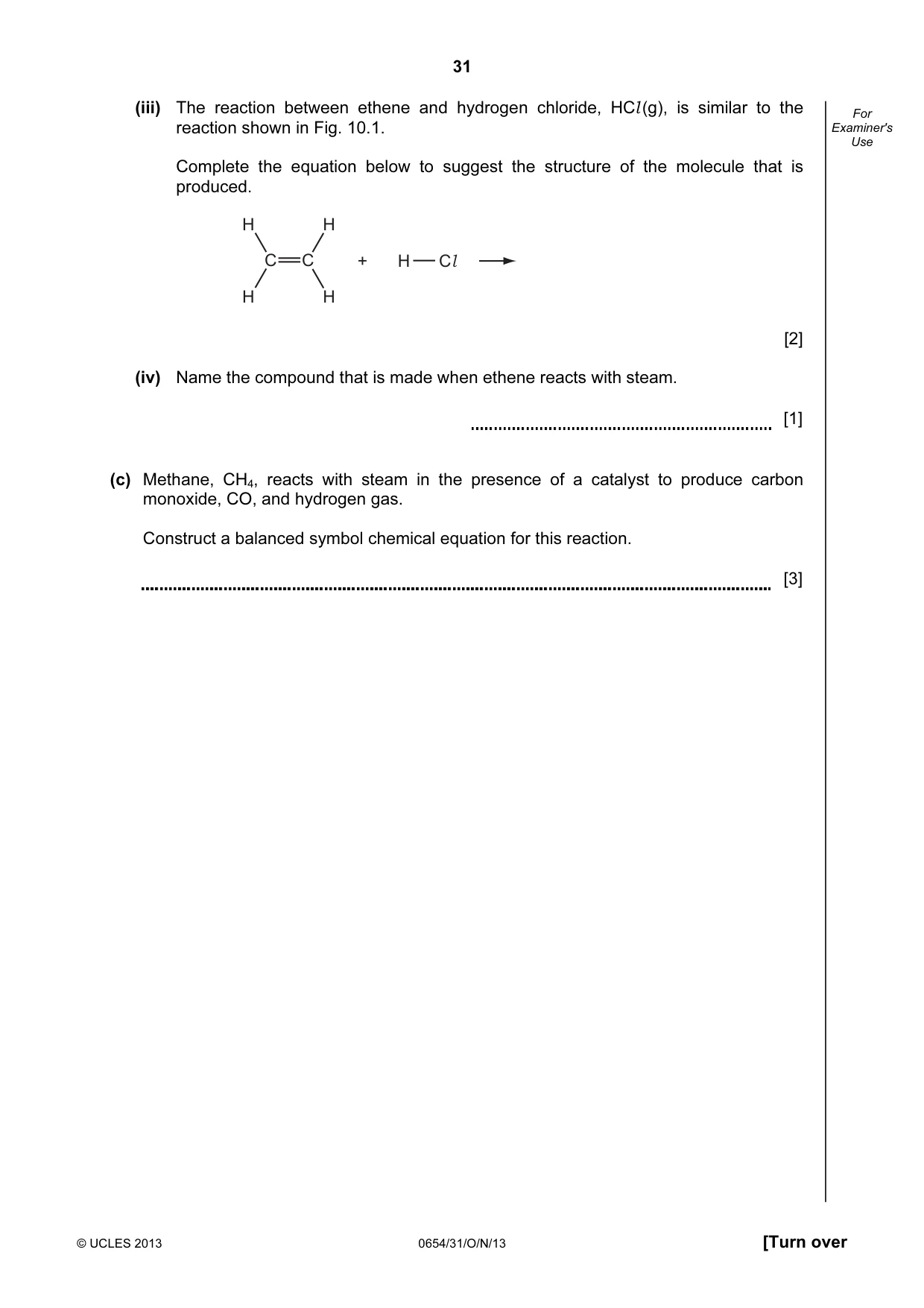
31 © UCLES 2013 0654/31/O/N/13 [Turn over For Examiner's Use (iii) The reaction between ethene and hydrogen chloride, HCl (g), is similar to the reaction shown in Fig. 10.1. Complete the equation below to suggest the structure of the molecule that is produced. C C H H H H H Cl + [2] (iv) Name the compound that is made when ethene reacts with steam. [1] (c) Methane, CH4, reacts with steam in the presence of a catalyst to produce carbon monoxide, CO, and hydrogen gas. Construct a balanced symbol chemical equation for this reaction. [3]
Question paper, page 32
32 © UCLES 2013 0654/31/O/N/13 For Examiner's Use 11 X-rays and γ(gamma)–rays are both forms of electromagnetic radiation. They are also both forms of ionising radiation and are used in the treatment of cancer. (a) State the meaning of the term ionising radiation. [1] (b) Name the radiation that comes between X-rays and visible light in the electromagnetic spectrum. Give one use for this radiation. radiation use [2] (c) State the speed at which both X-rays and γ-rays travel through a vacuum. [1] (d) (i) State the meaning of the term half-life. [1]
Question paper, page 33
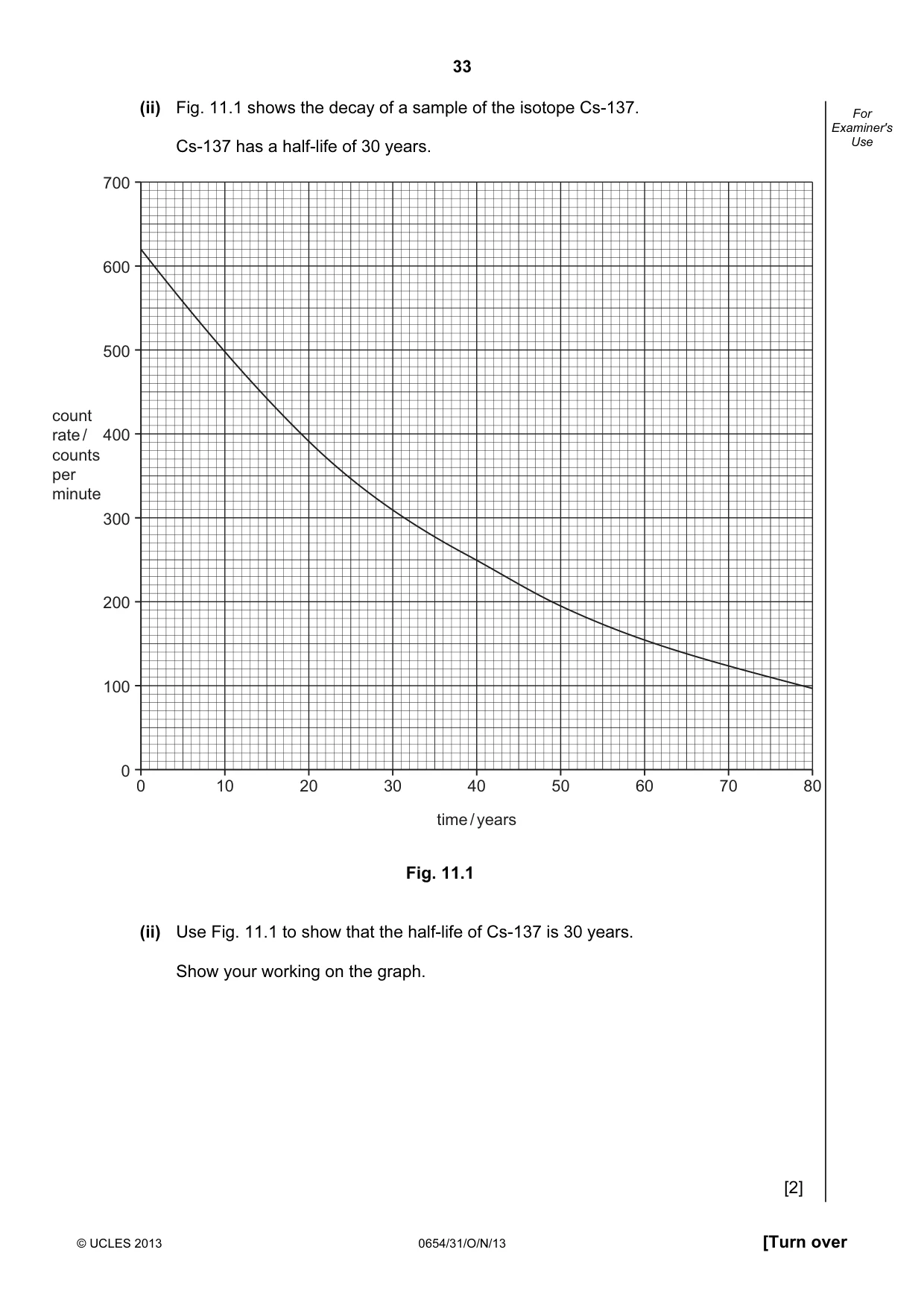
33 © UCLES 2013 0654/31/O/N/13 [Turn over For Examiner's Use (ii) Fig. 11.1 shows the decay of a sample of the isotope Cs-137. Cs-137 has a half-life of 30 years. Fig. 11.1 (ii) Use Fig. 11.1 to show that the half-life of Cs-137 is 30 years. Show your working on the graph. [2] 0 10 20 30 40 time / years 50 60 70 80 700 600 500 400 300 200 100 0 count rate / counts per minute
Question paper, page 34
34 © UCLES 2013 0654/31/O/N/13 BLANK PAGE
Question paper, page 35
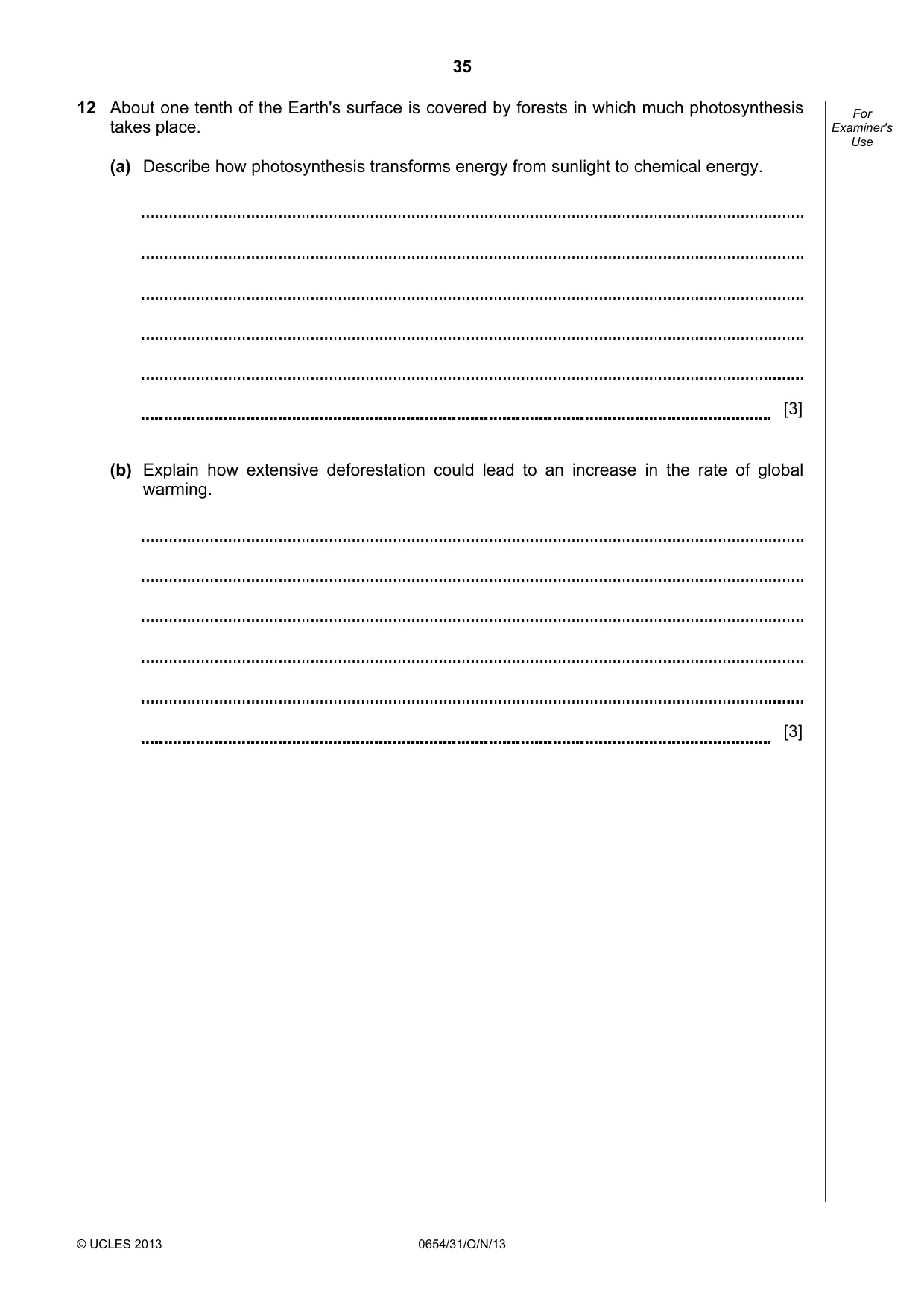
35 © UCLES 2013 0654/31/O/N/13 For Examiner's Use 12 About one tenth of the Earth's surface is covered by forests in which much photosynthesis takes place. (a) Describe how photosynthesis transforms energy from sunlight to chemical energy. [3] (b) Explain how extensive deforestation could lead to an increase in the rate of global warming. [3]
Question paper, page 36
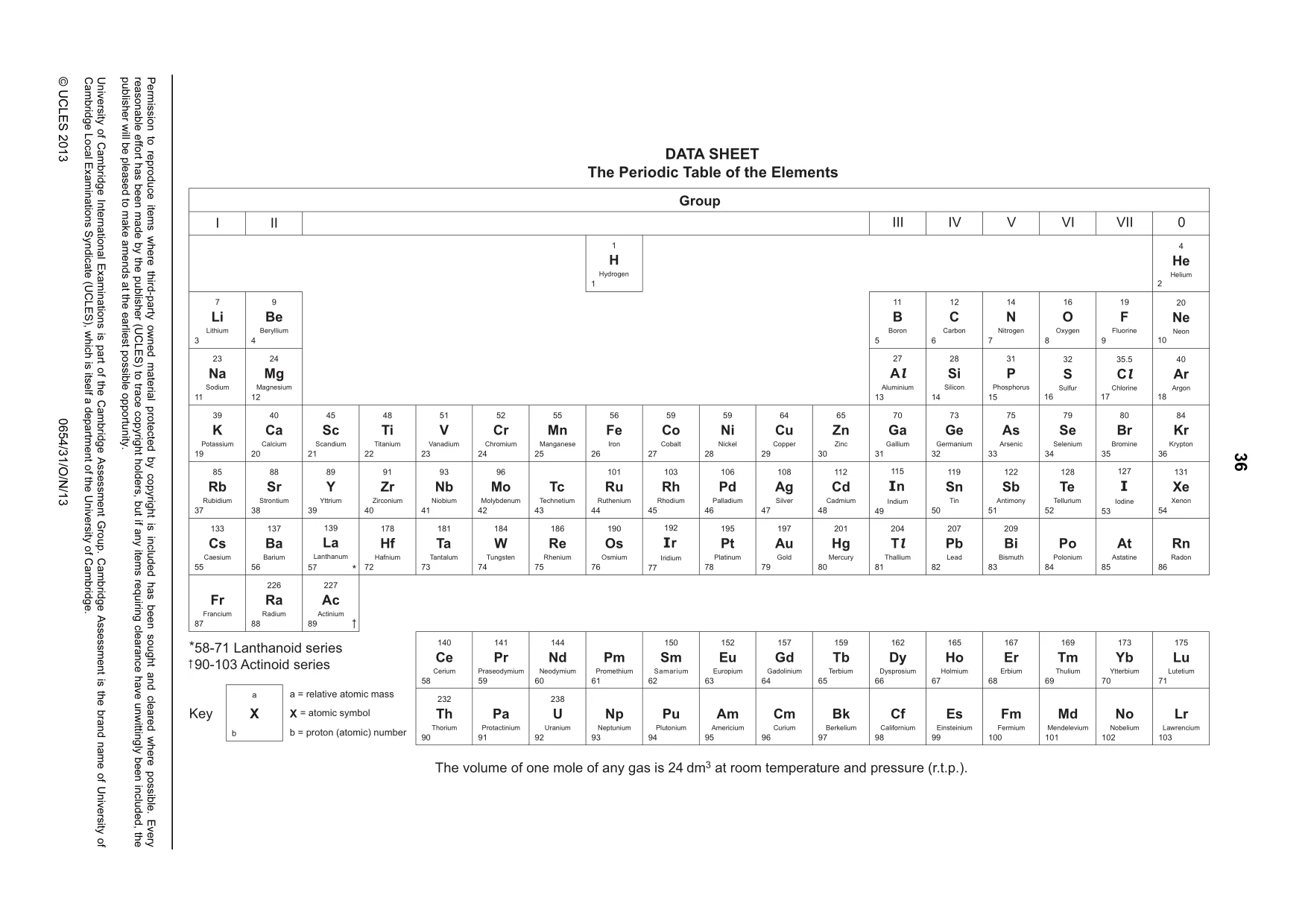
36 Permission to reproduce items where third-party owned material protected by copyright is included has been sought and cleared where possible. Every reasonable effort has been made by the publisher (UCLES) to trace copyright holders, but if any items requiring clearance have unwittingly been included, the publisher will be pleased to make amends at the earliest possible opportunity. University of Cambridge International Examinations is part of the Cambridge Assessment Group. Cambridge Assessment is the brand name of University of Cambridge Local Examinations Syndicate (UCLES), which is itself a department of the University of Cambridge. © UCLES 2013 0654/31/O/N/13 Group 140 Ce Cerium 58 141 Pr Praseodymium 59 144 Nd Neodymium 60 Pm Promethium 61 150 Sm Samarium 62 152 Eu Europium 63 157 Gd Gadolinium 64 159 Tb Terbium 65 162 Dy Dysprosium 66 165 Ho Holmium 67 167 Er Erbium 68 169 Tm Thulium 69 173 Yb Ytterbium 70 175 Lu Lutetium 71 232 Th Thorium 90 Pa Protactinium 91 238 U Uranium 92 Np Neptunium 93 Pu Plutonium 94 Am Americium 95 Cm Curium 96 Bk Berkelium 97 Cf Californium 98 Es Einsteinium 99 Fm Fermium 100 Md Mendelevium 101 No Nobelium 102 Lr Lawrencium 103 1 H Hydrogen 1 7 Li Lithium 3 23 Na Sodium 11 24 Mg Magnesium 12 40 Ca Calcium 20 45 Sc Scandium 21 48 Ti Titanium 22 51 V Vanadium 23 52 Cr Chromium 24 55 Mn Manganese 25 56 Fe Iron 26 59 Co Cobalt 27 59 Ni Nickel 28 64 Cu Copper 29 65 Zn Zinc 30 70 Ga Gallium 31 27 Al Aluminium 13 11 B Boron 5 12 C Carbon 6 14 N Nitrogen 7 16 O Oxygen 8 19 F Fluorine 9 28 Si Silicon 14 31 P Phosphorus 15 32 S Sulfur 16 35.5 Cl Chlorine 17 40 Ar Argon 18 20 Ne Neon 10 4 He Helium 2 73 Ge Germanium 32 75 As Arsenic 33 79 Se Selenium 34 80 Br Bromine 35 84 Kr Krypton 36 39 K Potassium 19 88 Sr Strontium 38 89 Y Yttrium 39 91 Zr Zirconium 40 93 Nb Niobium 41 96 Mo Molybdenum 42 Tc Technetium 43 101 Ru Ruthenium 44 103 Rh Rhodium 45 106 Pd Palladium 46 108 Ag Silver 47 112 Cd Cadmium 48 115 In Indium 49 119 Sn Tin 50 122 Sb Antimony 51 128 Te Tellurium 52 127 I Iodine 53 131 Xe Xenon 54 137 Ba Barium 56 139 La Lanthanum 57 * 178 Hf Hafnium 72 181 Ta Tantalum 73 184 W Tungsten 74 186 Re Rhenium 75 190 Os Osmium 76 192 Ir Iridium 77 195 Pt Platinum 78 197 Au Gold 79 201 Hg Mercury 80 204 Tl Thallium 81 207 Pb Lead 82 209 Bi Bismuth 83 Po Polonium 84 At Astatine 85 Rn Radon 86 Fr Francium 87 227 Ac Actinium 89 9 Be Beryllium 4 I II III IV V VI VII 0 85 Rb Rubidium 37 133 Cs Caesium 55 226 Ra Radium 88 The volume of one mole of any gas is 24 dm3 at room temperature and pressure (r.t.p.). a X b a = relative atomic mass X = atomic symbol b = proton (atomic) number Key *58-71 Lanthanoid series 90-103 Actinoid series DATA SHEET The Periodic Table of the Elements
Mark scheme, page 1
CAMBRIDGE INTERNATIONAL EXAMINATIONS International General Certificate of Secondary Education MARK SCHEME for the October/November 2013 series 0654 CO-ORDINATED SCIENCES 0654/31 Paper 3 (Extended Theory), maximum raw mark 120 This mark scheme is published as an aid to teachers and candidates, to indicate the requirements of the examination. It shows the basis on which Examiners were instructed to award marks. It does not indicate the details of the discussions that took place at an Examiners’ meeting before marking began, which would have considered the acceptability of alternative answers. Mark schemes should be read in conjunction with the question paper and the Principal Examiner Report for Teachers. Cambridge will not enter into discussions about these mark schemes. Cambridge is publishing the mark schemes for the October/November 2013 series for most IGCSE, GCE Advanced Level and Advanced Subsidiary Level components and some Ordinary Level components.
Mark scheme, page 2
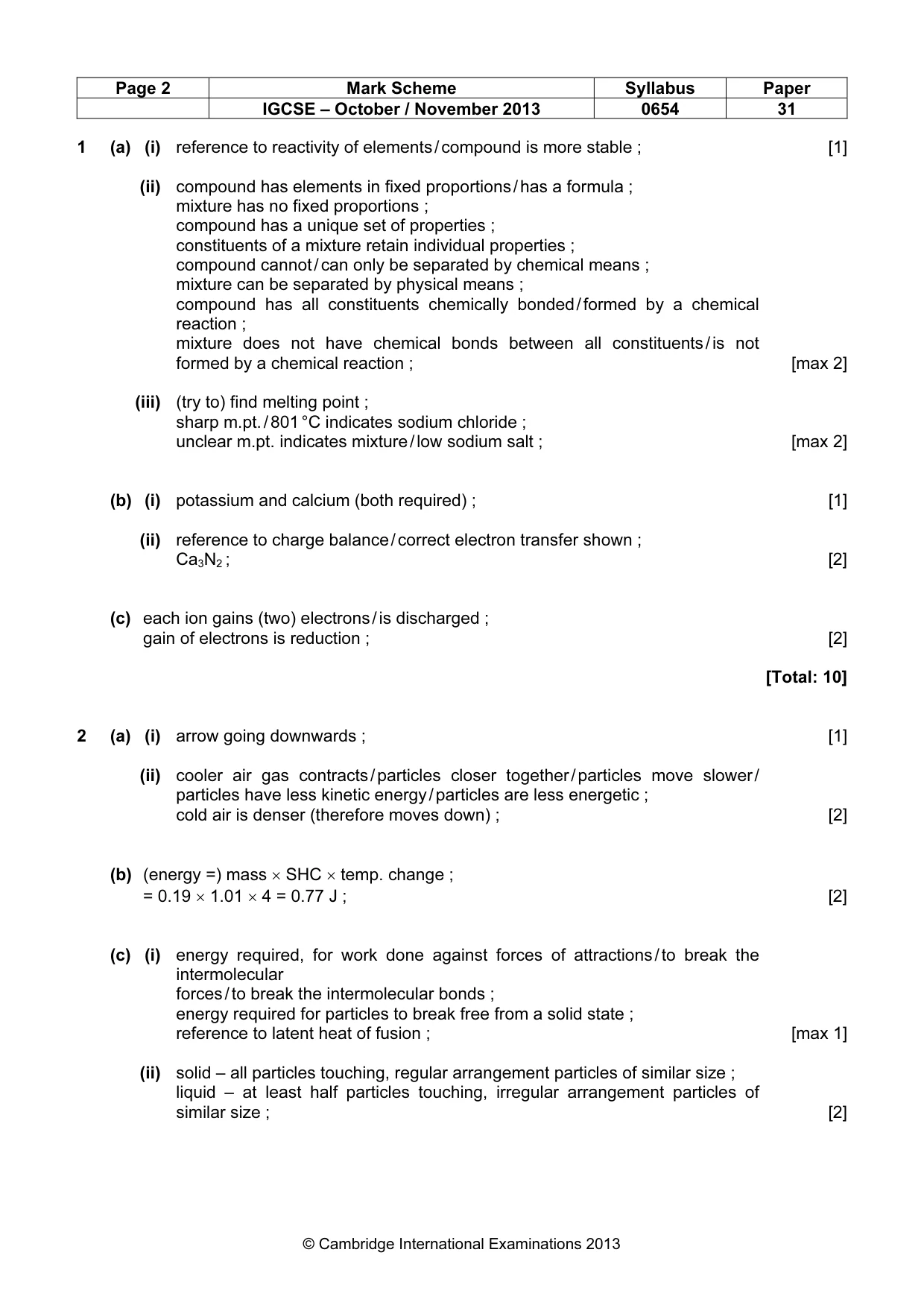
Page 2 Mark Scheme Syllabus Paper IGCSE – October / November 2013 0654 31 © Cambridge International Examinations 2013 1 (a) (i) reference to reactivity of elements / compound is more stable ; [1] (ii) compound has elements in fixed proportions / has a formula ; mixture has no fixed proportions ; compound has a unique set of properties ; constituents of a mixture retain individual properties ; compound cannot / can only be separated by chemical means ; mixture can be separated by physical means ; compound has all constituents chemically bonded / formed by a chemical reaction ; mixture does not have chemical bonds between all constituents / is not formed by a chemical reaction ; [max 2] (iii) (try to) find melting point ; sharp m.pt. / 801 °C indicates sodium chloride ; unclear m.pt. indicates mixture / low sodium salt ; [max 2] (b) (i) potassium and calcium (both required) ; [1] (ii) reference to charge balance / correct electron transfer shown ; Ca3N2 ; [2] (c) each ion gains (two) electrons / is discharged ; gain of electrons is reduction ; [2] [Total: 10] 2 (a) (i) arrow going downwards ; [1] (ii) cooler air gas contracts / particles closer together / particles move slower / particles have less kinetic energy / particles are less energetic ; cold air is denser (therefore moves down) ; [2] (b) (energy =) mass × SHC × temp. change ; = 0.19 × 1.01 × 4 = 0.77 J ; [2] (c) (i) energy required, for work done against forces of attractions / to break the intermolecular forces / to break the intermolecular bonds ; energy required for particles to break free from a solid state ; reference to latent heat of fusion ; [max 1] (ii) solid – all particles touching, regular arrangement particles of similar size ; liquid – at least half particles touching, irregular arrangement particles of similar size ; [2]
Mark scheme, page 3
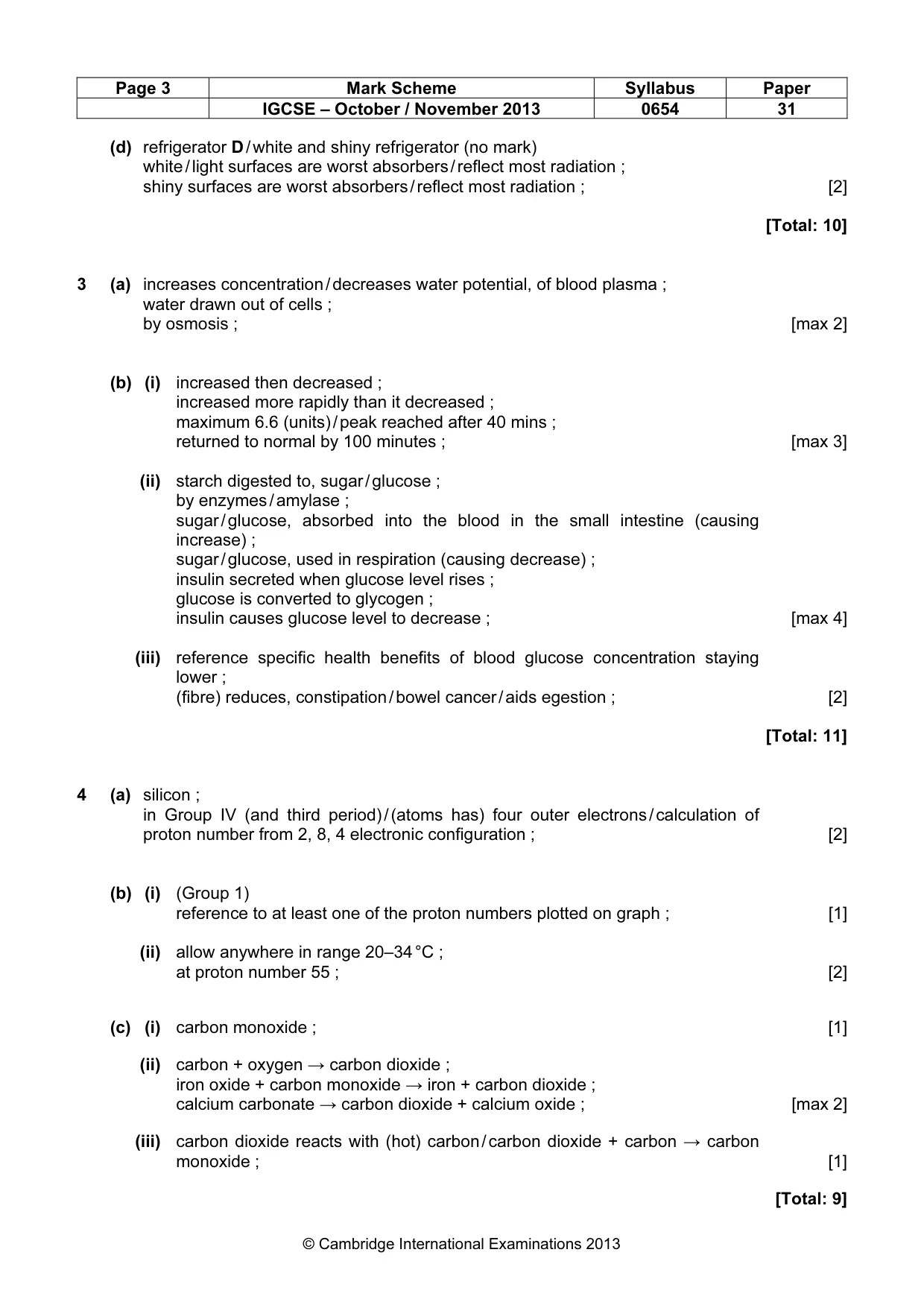
Page 3 Mark Scheme Syllabus Paper IGCSE – October / November 2013 0654 31 © Cambridge International Examinations 2013 (d) refrigerator D / white and shiny refrigerator (no mark) white / light surfaces are worst absorbers / reflect most radiation ; shiny surfaces are worst absorbers / reflect most radiation ; [2] [Total: 10] 3 (a) increases concentration / decreases water potential, of blood plasma ; water drawn out of cells ; by osmosis ; [max 2] (b) (i) increased then decreased ; increased more rapidly than it decreased ; maximum 6.6 (units) / peak reached after 40 mins ; returned to normal by 100 minutes ; [max 3] (ii) starch digested to, sugar / glucose ; by enzymes / amylase ; sugar / glucose, absorbed into the blood in the small intestine (causing increase) ; sugar / glucose, used in respiration (causing decrease) ; insulin secreted when glucose level rises ; glucose is converted to glycogen ; insulin causes glucose level to decrease ; [max 4] (iii) reference specific health benefits of blood glucose concentration staying lower ; (fibre) reduces, constipation / bowel cancer / aids egestion ; [2] [Total: 11] 4 (a) silicon ; in Group IV (and third period) / (atoms has) four outer electrons / calculation of proton number from 2, 8, 4 electronic configuration ; [2] (b) (i) (Group 1) reference to at least one of the proton numbers plotted on graph ; [1] (ii) allow anywhere in range 20–34 °C ; at proton number 55 ; [2] (c) (i) carbon monoxide ; [1] (ii) carbon + oxygen → carbon dioxide ; iron oxide + carbon monoxide → iron + carbon dioxide ; calcium carbonate → carbon dioxide + calcium oxide ; [max 2] (iii) carbon dioxide reacts with (hot) carbon / carbon dioxide + carbon → carbon monoxide ; [1] [Total: 9]
Mark scheme, page 4
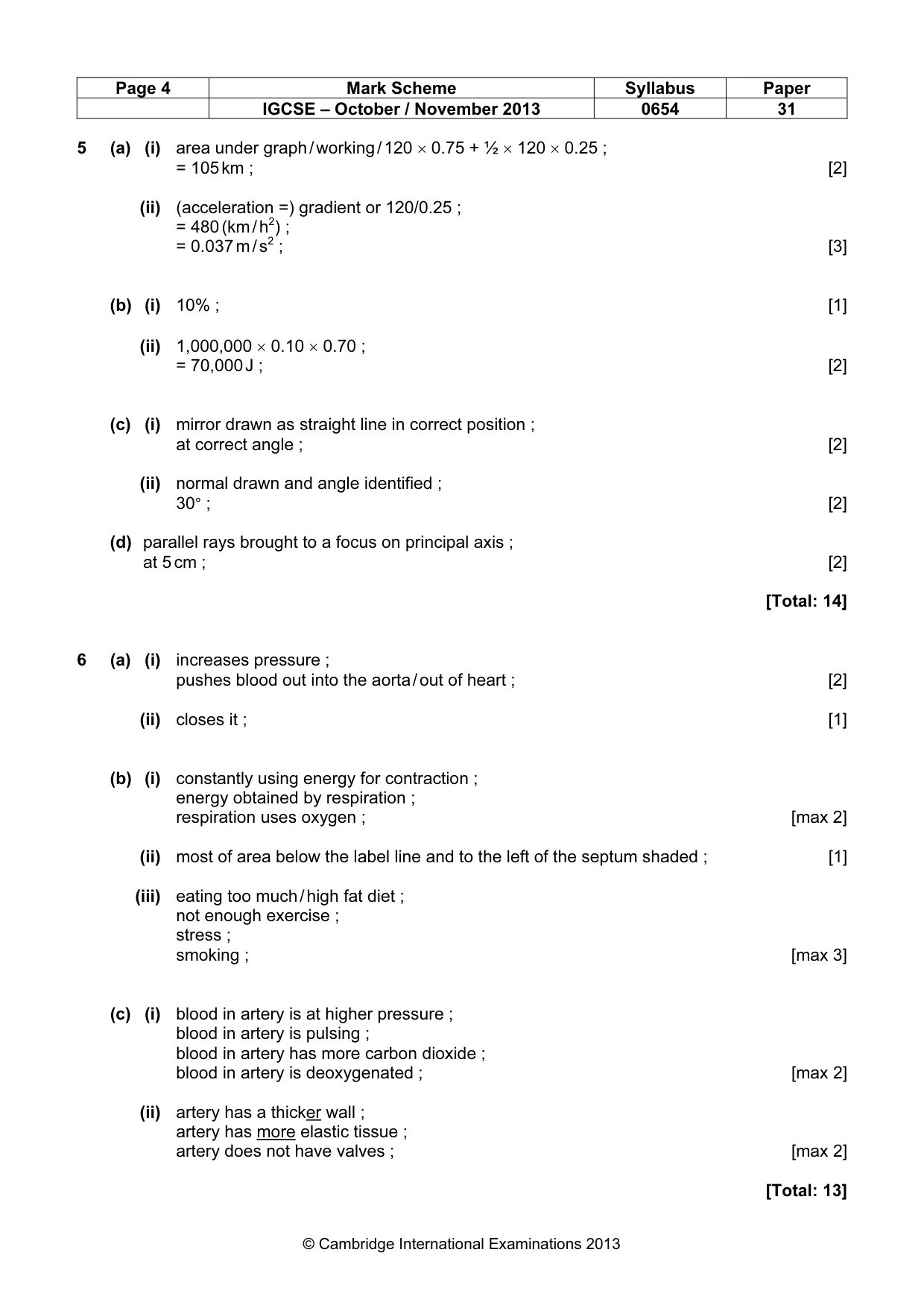
Page 4 Mark Scheme Syllabus Paper IGCSE – October / November 2013 0654 31 © Cambridge International Examinations 2013 5 (a) (i) area under graph / working / 120 × 0.75 + ½ × 120 × 0.25 ; = 105 km ; [2] (ii) (acceleration =) gradient or 120/0.25 ; = 480 (km / h2) ; = 0.037 m / s2 ; [3] (b) (i) 10% ; [1] (ii) 1,000,000 × 0.10 × 0.70 ; = 70,000 J ; [2] (c) (i) mirror drawn as straight line in correct position ; at correct angle ; [2] (ii) normal drawn and angle identified ; 30° ; [2] (d) parallel rays brought to a focus on principal axis ; at 5 cm ; [2] [Total: 14] 6 (a) (i) increases pressure ; pushes blood out into the aorta / out of heart ; [2] (ii) closes it ; [1] (b) (i) constantly using energy for contraction ; energy obtained by respiration ; respiration uses oxygen ; [max 2] (ii) most of area below the label line and to the left of the septum shaded ; [1] (iii) eating too much / high fat diet ; not enough exercise ; stress ; smoking ; [max 3] (c) (i) blood in artery is at higher pressure ; blood in artery is pulsing ; blood in artery has more carbon dioxide ; blood in artery is deoxygenated ; [max 2] (ii) artery has a thicker wall ; artery has more elastic tissue ; artery does not have valves ; [max 2] [Total: 13]
Mark scheme, page 5
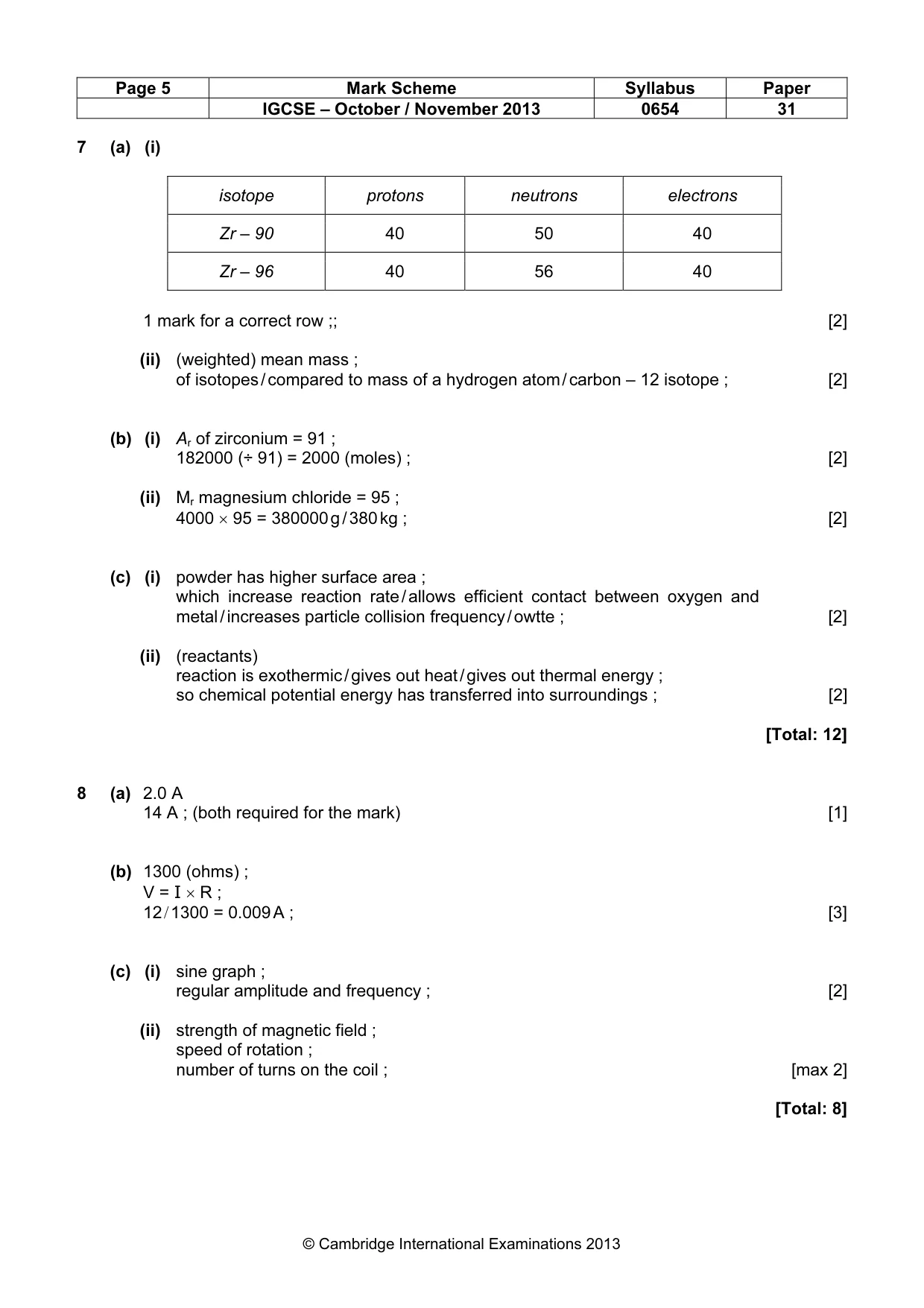
Page 5 Mark Scheme Syllabus Paper IGCSE – October / November 2013 0654 31 © Cambridge International Examinations 2013 7 (a) (i) isotope protons neutrons electrons Zr – 90 40 50 40 Zr – 96 40 56 40 1 mark for a correct row ;; [2] (ii) (weighted) mean mass ; of isotopes / compared to mass of a hydrogen atom / carbon – 12 isotope ; [2] (b) (i) Ar of zirconium = 91 ; 182000 (÷ 91) = 2000 (moles) ; [2] (ii) Mr magnesium chloride = 95 ; 4000 × 95 = 380000 g / 380 kg ; [2] (c) (i) powder has higher surface area ; which increase reaction rate / allows efficient contact between oxygen and metal / increases particle collision frequency / owtte ; [2] (ii) (reactants) reaction is exothermic / gives out heat / gives out thermal energy ; so chemical potential energy has transferred into surroundings ; [2] [Total: 12] 8 (a) 2.0 A 14 A ; (both required for the mark) [1] (b) 1300 (ohms) ; V = I × R ; 12 / 1300 = 0.009 A ; [3] (c) (i) sine graph ; regular amplitude and frequency ; [2] (ii) strength of magnetic field ; speed of rotation ; number of turns on the coil ; [max 2] [Total: 8]
Mark scheme, page 6
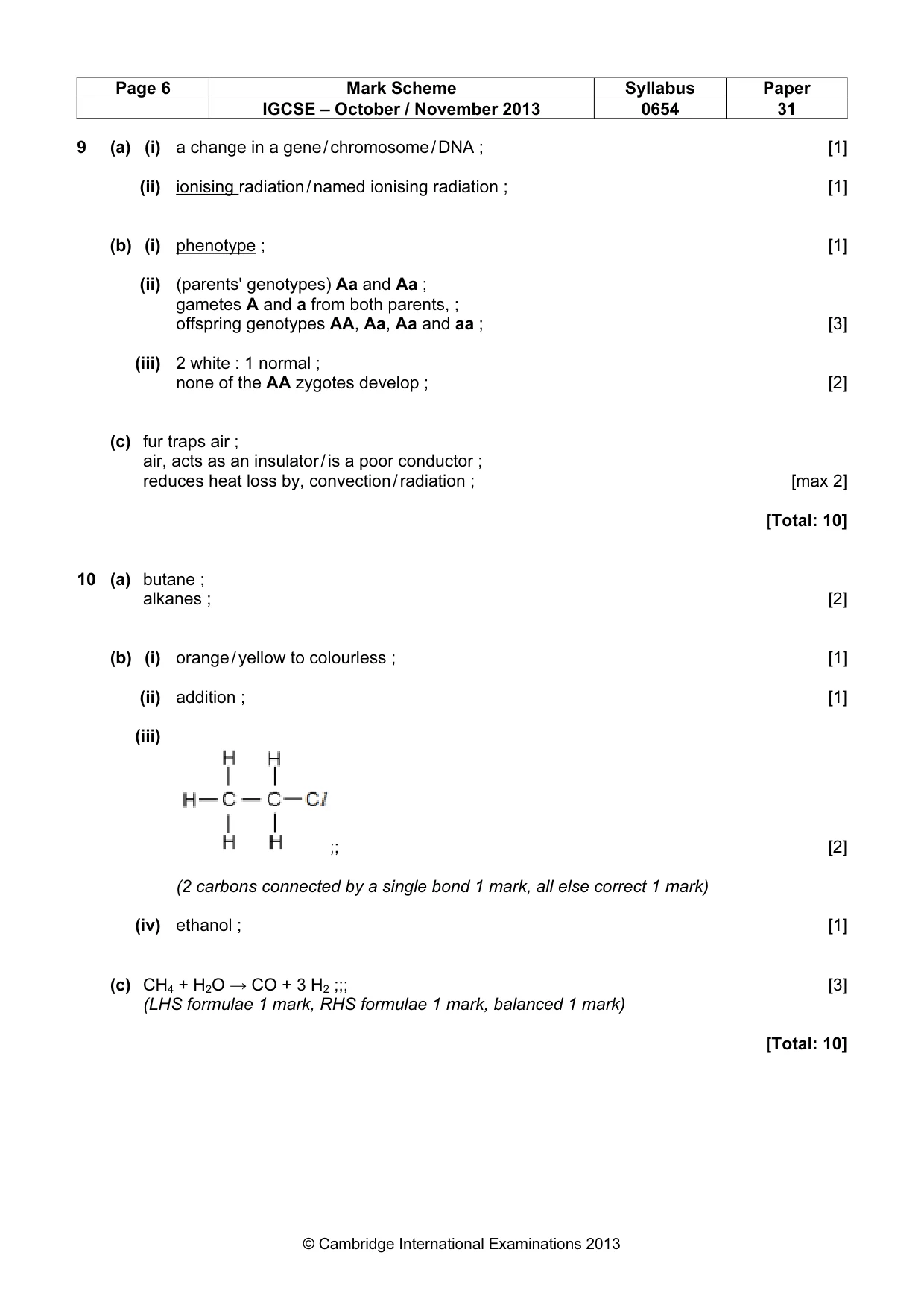
Page 6 Mark Scheme Syllabus Paper IGCSE – October / November 2013 0654 31 © Cambridge International Examinations 2013 9 (a) (i) a change in a gene / chromosome / DNA ; [1] (ii) ionising radiation / named ionising radiation ; [1] (b) (i) phenotype ; [1] (ii) (parents' genotypes) Aa and Aa ; gametes A and a from both parents, ; offspring genotypes AA, Aa, Aa and aa ; [3] (iii) 2 white : 1 normal ; none of the AA zygotes develop ; [2] (c) fur traps air ; air, acts as an insulator / is a poor conductor ; reduces heat loss by, convection / radiation ; [max 2] [Total: 10] 10 (a) butane ; alkanes ; [2] (b) (i) orange / yellow to colourless ; [1] (ii) addition ; [1] (iii) ;; [2] (2 carbons connected by a single bond 1 mark, all else correct 1 mark) (iv) ethanol ; [1] (c) CH4 + H2O → CO + 3 H2 ;;; [3] (LHS formulae 1 mark, RHS formulae 1 mark, balanced 1 mark) [Total: 10]
Mark scheme, page 7
Page 7 Mark Scheme Syllabus Paper IGCSE – October / November 2013 0654 31 © Cambridge International Examinations 2013 11 (a) removes electrons from atom / produces a charged particle ; [1] (b) ultraviolet ; fluorescent tubes / security marking / tanning / sterilisation / detecting biological fluids ; [2] (c) 3 × 10⁸ m / s ; [1] (d) (i) time for half radioactive atoms to decay / time for count rate of radioactive material to halve ; [1] (ii) find time when count rate was a particular value and find the time when count rate was half this value ; time difference is the half-life ; [2] [Total: 7] 12 (a) energy in sunlight absorbed / trapped by chlorophyll ; plus any two of: carbon dioxide and water react together ; to produce glucose ; glucose contains chemical energy ; [max 3] (b) CO2 levels in the atmosphere increase ; due to fewer trees to photosynthesise / less photosynthesis to remove carbon dioxide ; also due to burning trees produce CO2 / rotting trees produce CO2 by respiration of microbes ; carbon dioxide, traps long-wave radiation / infra-red / heat / thermal energy / is a greenhouse gas ; reduces rate of loss of heat from the Earth’s surface ; [max 3] [Total: 6]