Cambridge IGCSE Sciences - Co-ordinated (Double) 0654 — 2012 May/June Paper 3 · Variant 1
0654/31/M/J/12 · 100 marks · ≈113 min
The question paper and its mark scheme, free to read here and free to download. This is Cambridge’s own paper, exactly as it was sat.
Question paper28 pages
Mark scheme8 pages
Answers below. Sit the paper first if you are practising.
Paper as text
Question paper, page 1
This document consists of 28 printed pages. IB12 06_0654_31/5RP © UCLES 2012 [Turn over *9669161496* For Examiner's Use 1 2 3 4 5 6 7 8 9 10 11 12 Total UNIVERSITY OF CAMBRIDGE INTERNATIONAL EXAMINATIONS International General Certificate of Secondary Education CO-ORDINATED SCIENCES 0654/31 Paper 3 (Extended) May/June 2012 2 hours Candidates answer on the Question Paper. No Additional Materials are required. READ THESE INSTRUCTIONS FIRST Write your Centre number, candidate number and name on all the work you hand in. Write in dark blue or black pen. You may use a soft pencil for any diagrams, graphs, tables or rough working. Do not use staples, paper clips, highlighters, glue or correction fluid. DO NOT WRITE IN ANY BARCODES. Answer all questions. A copy of the Periodic Table is printed on page 28. At the end of the examination, fasten all your work securely together. The number of marks is given in brackets [ ] at the end of each question or part question. www.XtremePapers.com
Question paper, page 2
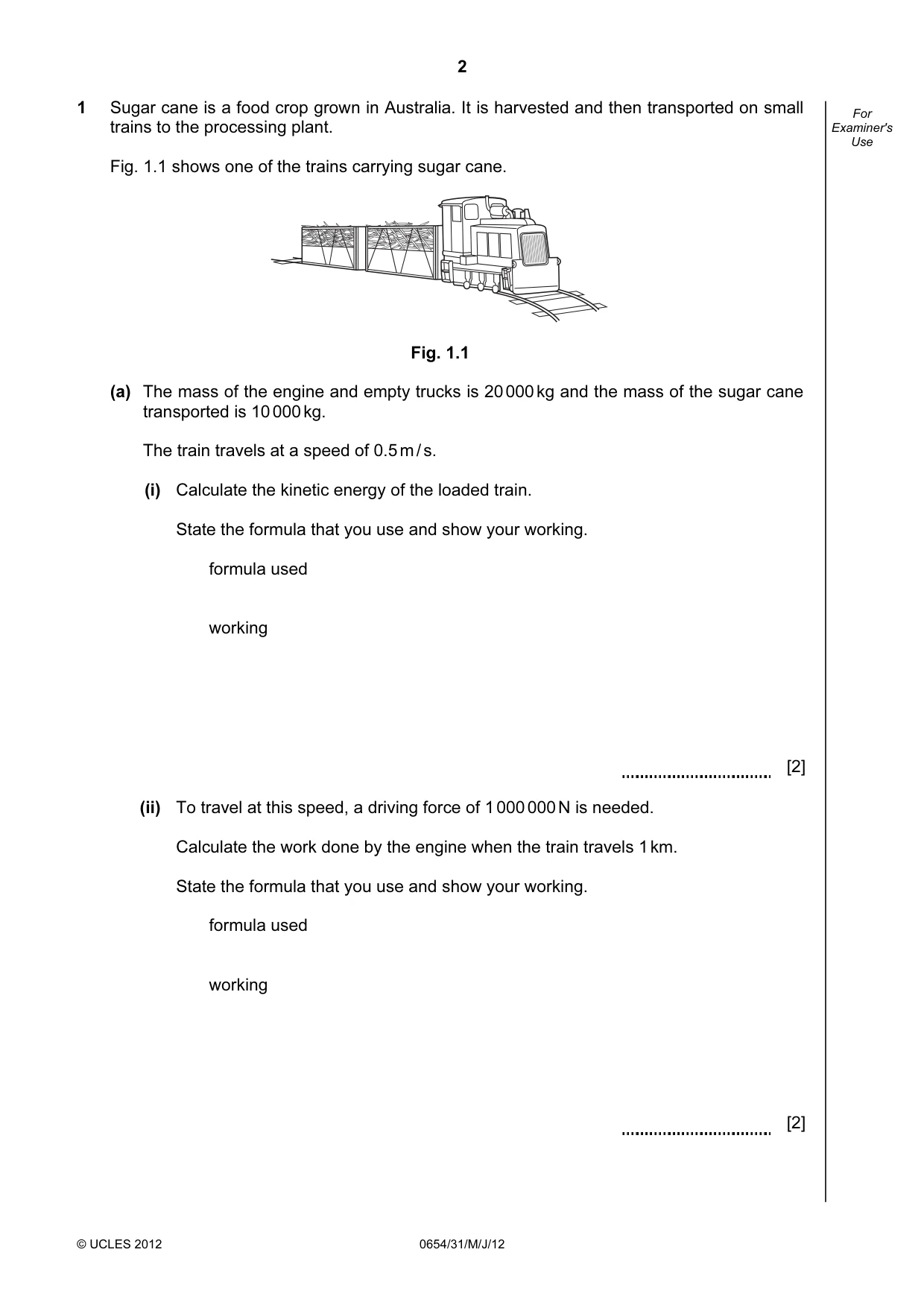
2 © UCLES 2012 0654/31/M/J/12 For Examiner's Use 1 Sugar cane is a food crop grown in Australia. It is harvested and then transported on small trains to the processing plant. Fig. 1.1 shows one of the trains carrying sugar cane. Fig. 1.1 (a) The mass of the engine and empty trucks is 20 000 kg and the mass of the sugar cane transported is 10 000 kg. The train travels at a speed of 0.5 m / s. (i) Calculate the kinetic energy of the loaded train. State the formula that you use and show your working. formula used working [2] (ii) To travel at this speed, a driving force of 1 000 000 N is needed. Calculate the work done by the engine when the train travels 1 km. State the formula that you use and show your working. formula used working [2]
Question paper, page 3
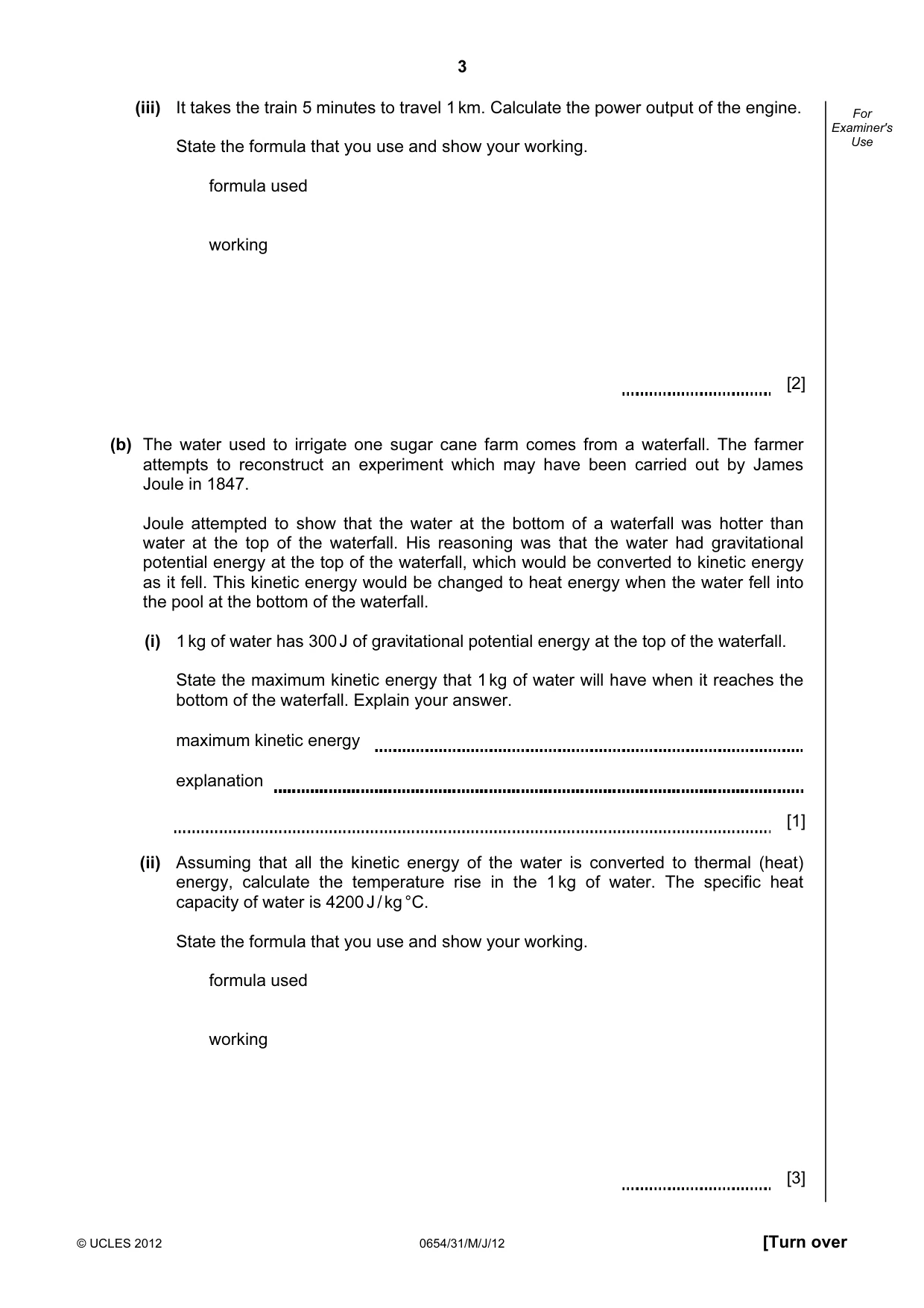
3 © UCLES 2012 0654/31/M/J/12 [Turn over For Examiner's Use (iii) It takes the train 5 minutes to travel 1 km. Calculate the power output of the engine. State the formula that you use and show your working. formula used working [2] (b) The water used to irrigate one sugar cane farm comes from a waterfall. The farmer attempts to reconstruct an experiment which may have been carried out by James Joule in 1847. Joule attempted to show that the water at the bottom of a waterfall was hotter than water at the top of the waterfall. His reasoning was that the water had gravitational potential energy at the top of the waterfall, which would be converted to kinetic energy as it fell. This kinetic energy would be changed to heat energy when the water fell into the pool at the bottom of the waterfall. (i) 1 kg of water has 300 J of gravitational potential energy at the top of the waterfall. State the maximum kinetic energy that 1 kg of water will have when it reaches the bottom of the waterfall. Explain your answer. maximum kinetic energy explanation [1] (ii) Assuming that all the kinetic energy of the water is converted to thermal (heat) energy, calculate the temperature rise in the 1 kg of water. The specific heat capacity of water is 4200 J / kg °C. State the formula that you use and show your working. formula used working [3]
Question paper, page 4
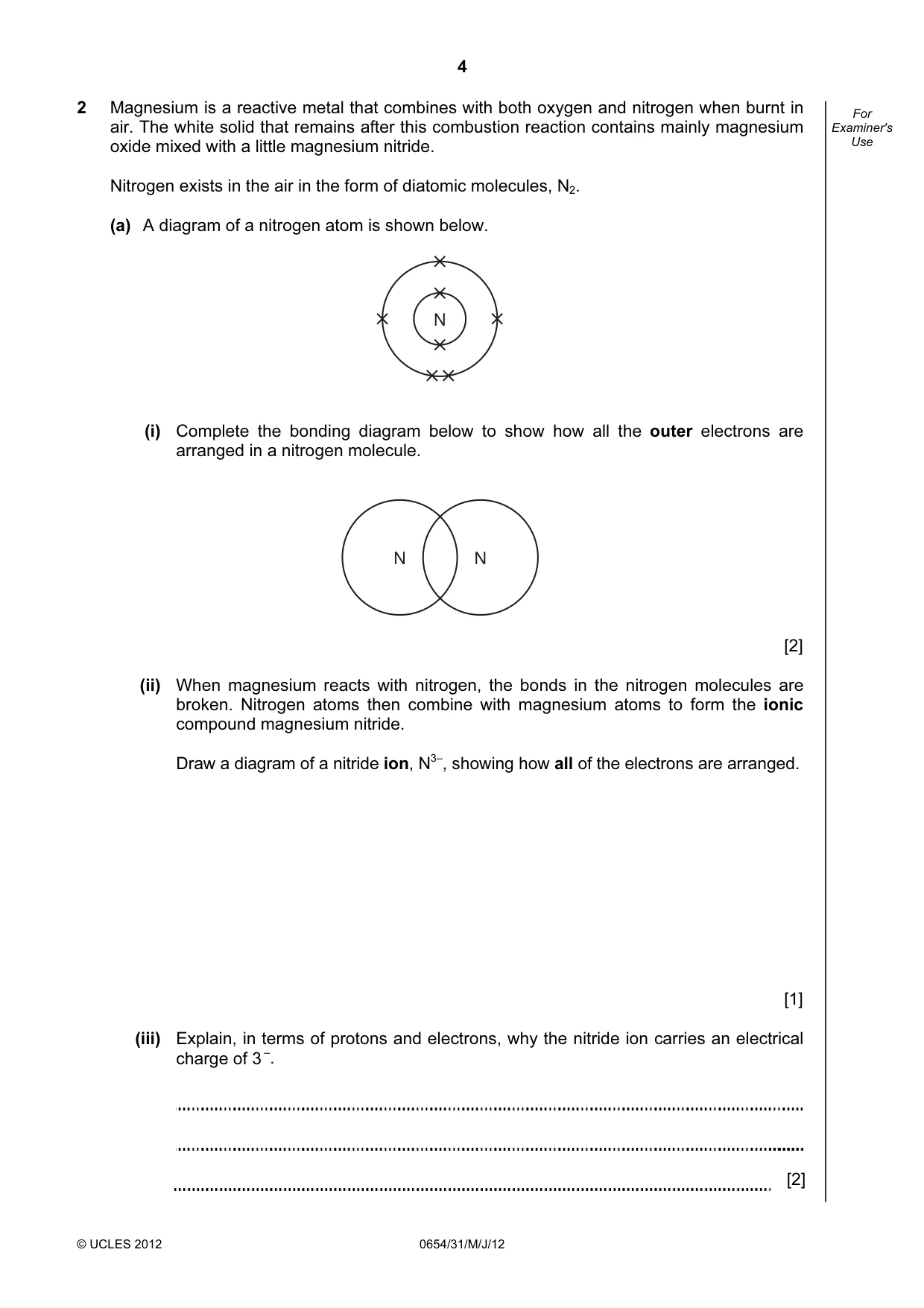
4 © UCLES 2012 0654/31/M/J/12 For Examiner's Use 2 Magnesium is a reactive metal that combines with both oxygen and nitrogen when burnt in air. The white solid that remains after this combustion reaction contains mainly magnesium oxide mixed with a little magnesium nitride. Nitrogen exists in the air in the form of diatomic molecules, N2. (a) A diagram of a nitrogen atom is shown below. N (i) Complete the bonding diagram below to show how all the outer electrons are arranged in a nitrogen molecule. N N [2] (ii) When magnesium reacts with nitrogen, the bonds in the nitrogen molecules are broken. Nitrogen atoms then combine with magnesium atoms to form the ionic compound magnesium nitride. Draw a diagram of a nitride ion, N3–, showing how all of the electrons are arranged. [1] (iii) Explain, in terms of protons and electrons, why the nitride ion carries an electrical charge of 3 –. [2]
Question paper, page 5
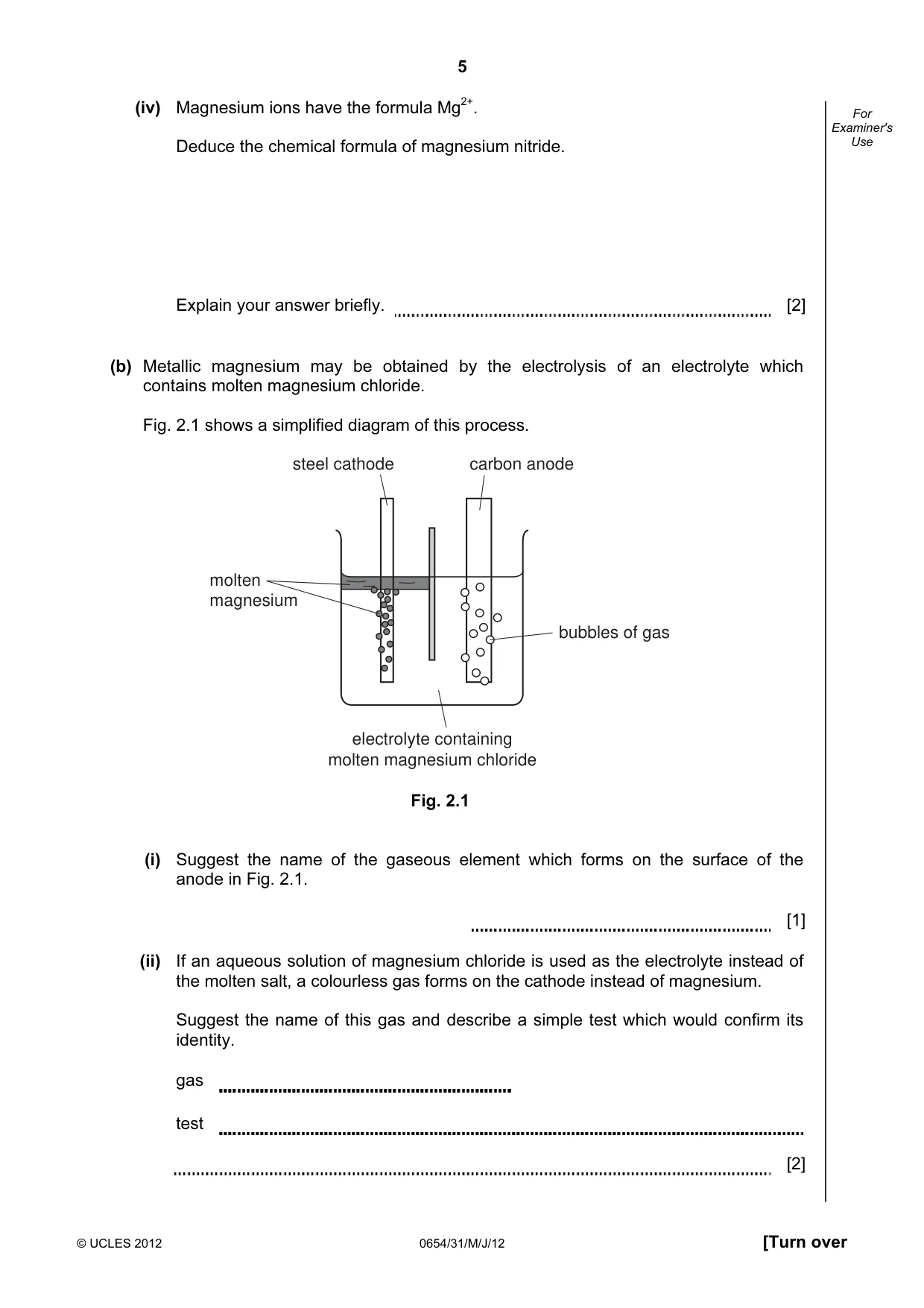
5 © UCLES 2012 0654/31/M/J/12 [Turn over For Examiner's Use (iv) Magnesium ions have the formula Mg2+. Deduce the chemical formula of magnesium nitride. Explain your answer briefly. [2] (b) Metallic magnesium may be obtained by the electrolysis of an electrolyte which contains molten magnesium chloride. Fig. 2.1 shows a simplified diagram of this process. steel cathode carbon anode bubbles of gas molten magnesium electrolyte containing molten magnesium chloride Fig. 2.1 (i) Suggest the name of the gaseous element which forms on the surface of the anode in Fig. 2.1. [1] (ii) If an aqueous solution of magnesium chloride is used as the electrolyte instead of the molten salt, a colourless gas forms on the cathode instead of magnesium. Suggest the name of this gas and describe a simple test which would confirm its identity. gas test [2]
Question paper, page 6
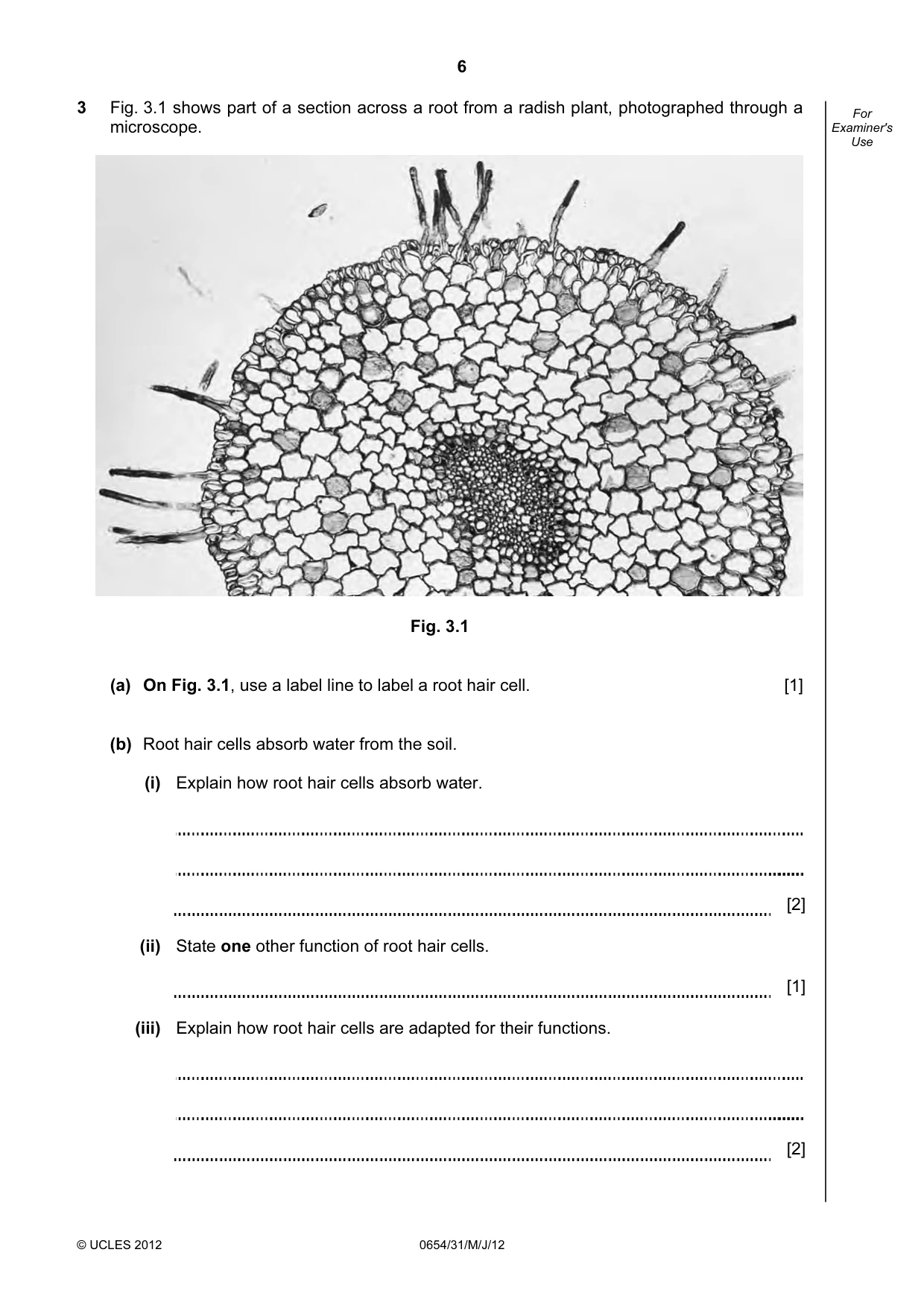
6 © UCLES 2012 0654/31/M/J/12 For Examiner's Use 3 Fig. 3.1 shows part of a section across a root from a radish plant, photographed through a microscope. Fig. 3.1 (a) On Fig. 3.1, use a label line to label a root hair cell. [1] (b) Root hair cells absorb water from the soil. (i) Explain how root hair cells absorb water. [2] (ii) State one other function of root hair cells. [1] (iii) Explain how root hair cells are adapted for their functions. [2]
Question paper, page 7
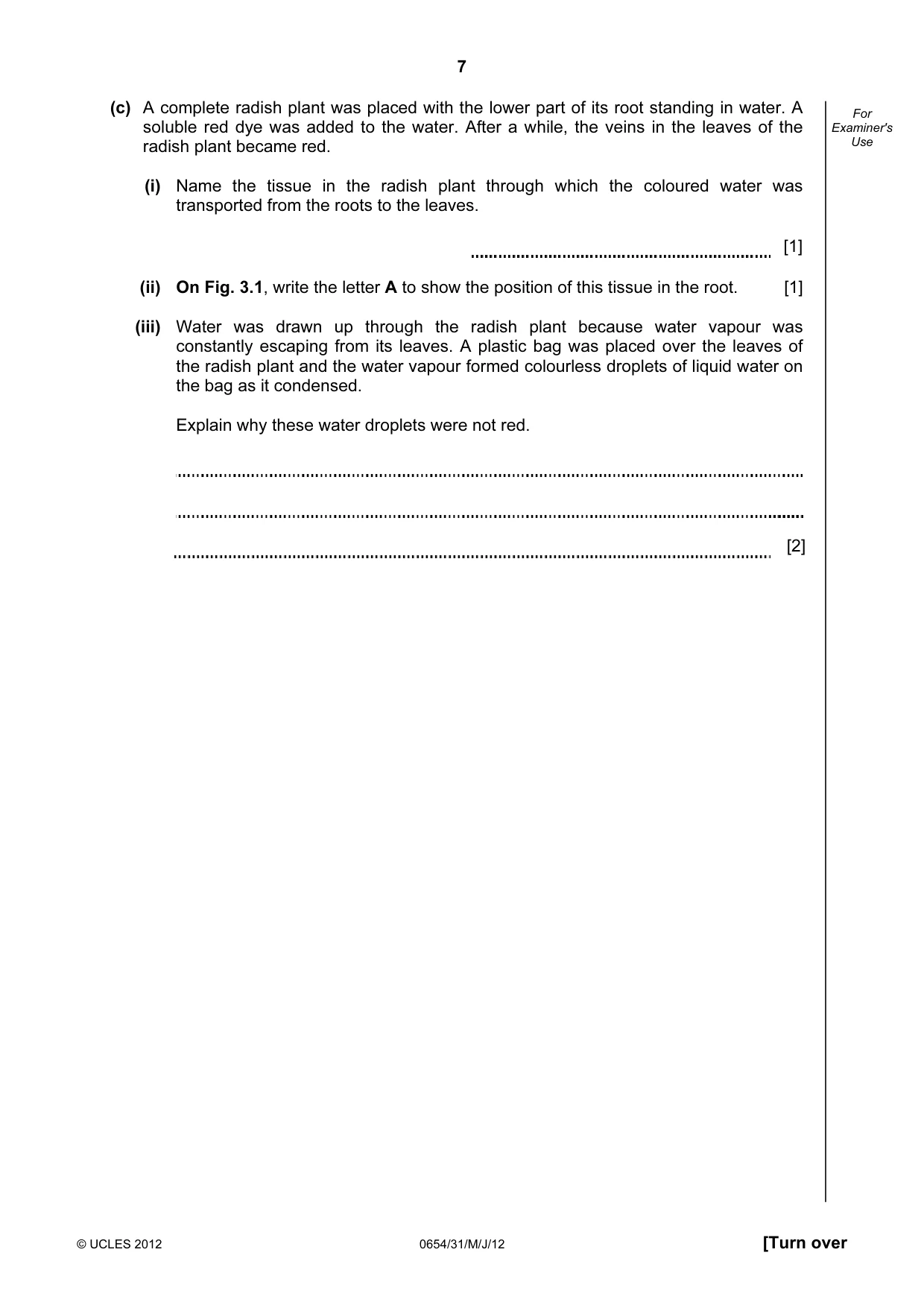
7 © UCLES 2012 0654/31/M/J/12 [Turn over For Examiner's Use (c) A complete radish plant was placed with the lower part of its root standing in water. A soluble red dye was added to the water. After a while, the veins in the leaves of the radish plant became red. (i) Name the tissue in the radish plant through which the coloured water was transported from the roots to the leaves. [1] (ii) On Fig. 3.1, write the letter A to show the position of this tissue in the root. [1] (iii) Water was drawn up through the radish plant because water vapour was constantly escaping from its leaves. A plastic bag was placed over the leaves of the radish plant and the water vapour formed colourless droplets of liquid water on the bag as it condensed. Explain why these water droplets were not red. [2]
Question paper, page 8
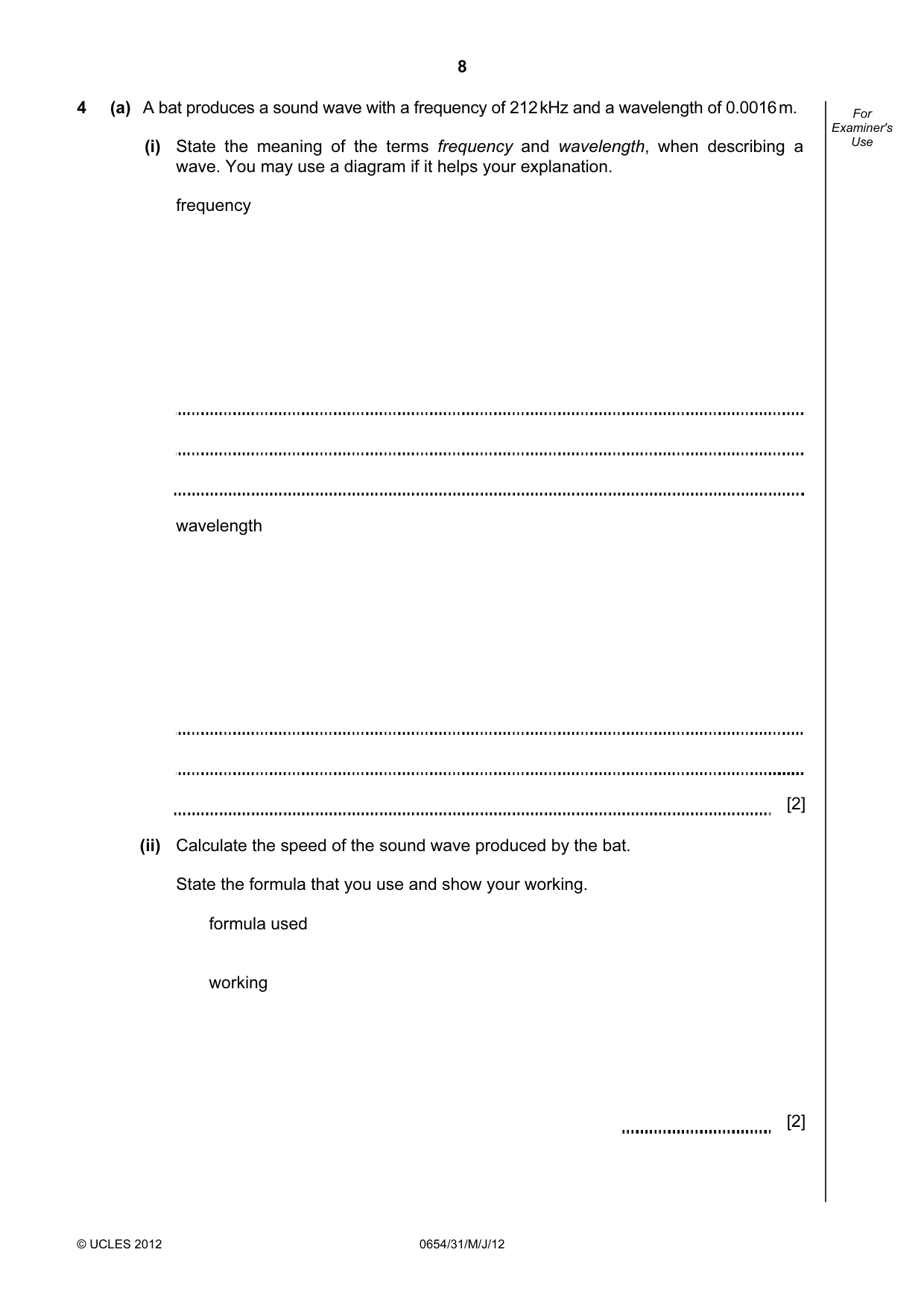
8 © UCLES 2012 0654/31/M/J/12 For Examiner's Use 4 (a) A bat produces a sound wave with a frequency of 212 kHz and a wavelength of 0.0016 m. (i) State the meaning of the terms frequency and wavelength, when describing a wave. You may use a diagram if it helps your explanation. frequency wavelength [2] (ii) Calculate the speed of the sound wave produced by the bat. State the formula that you use and show your working. formula used working [2]
Question paper, page 9
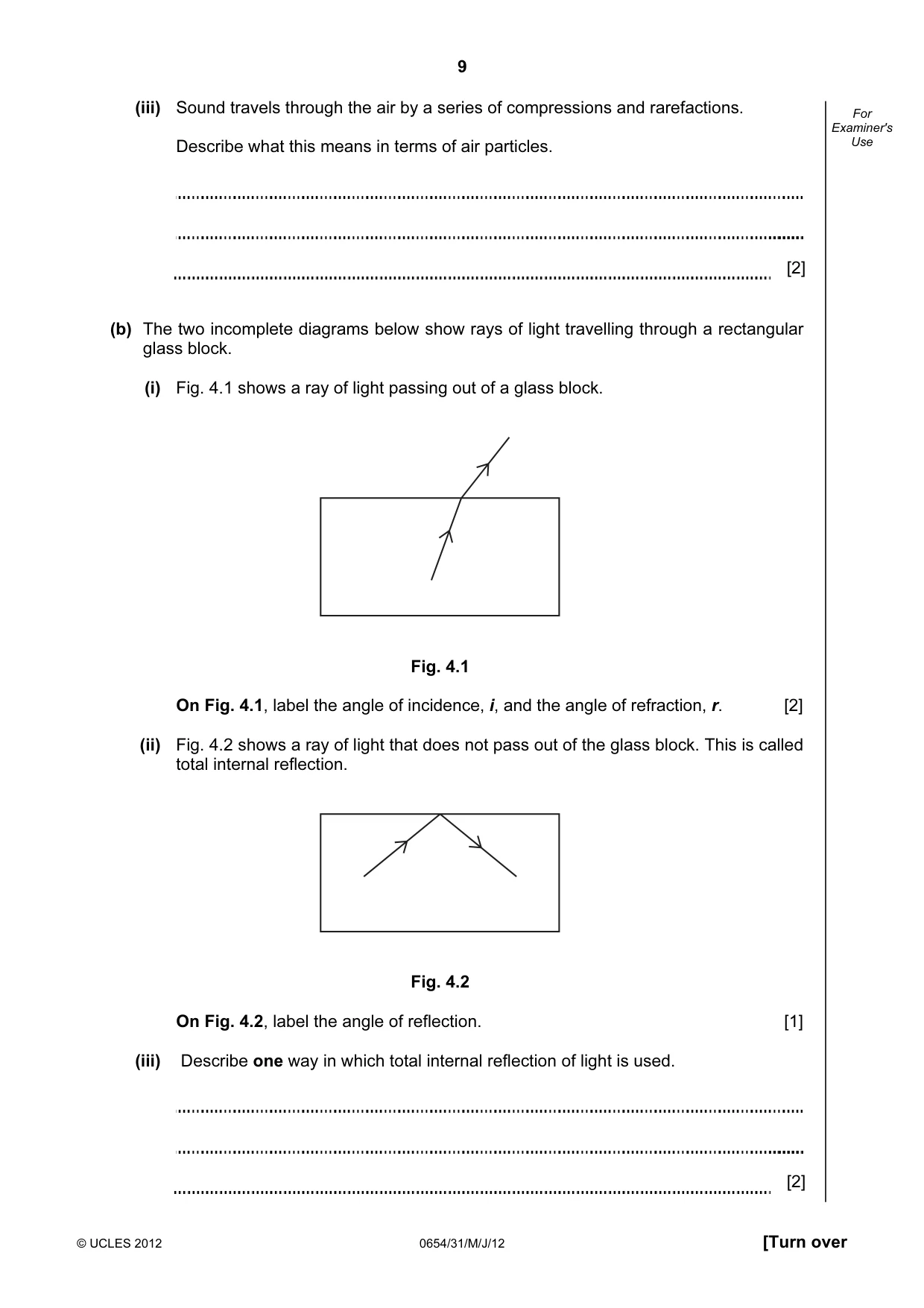
9 © UCLES 2012 0654/31/M/J/12 [Turn over For Examiner's Use (iii) Sound travels through the air by a series of compressions and rarefactions. Describe what this means in terms of air particles. [2] (b) The two incomplete diagrams below show rays of light travelling through a rectangular glass block. (i) Fig. 4.1 shows a ray of light passing out of a glass block. Fig. 4.1 On Fig. 4.1, label the angle of incidence, i, and the angle of refraction, r. [2] (ii) Fig. 4.2 shows a ray of light that does not pass out of the glass block. This is called total internal reflection. Fig. 4.2 On Fig. 4.2, label the angle of reflection. [1] (iii) Describe one way in which total internal reflection of light is used. [2]
Question paper, page 10
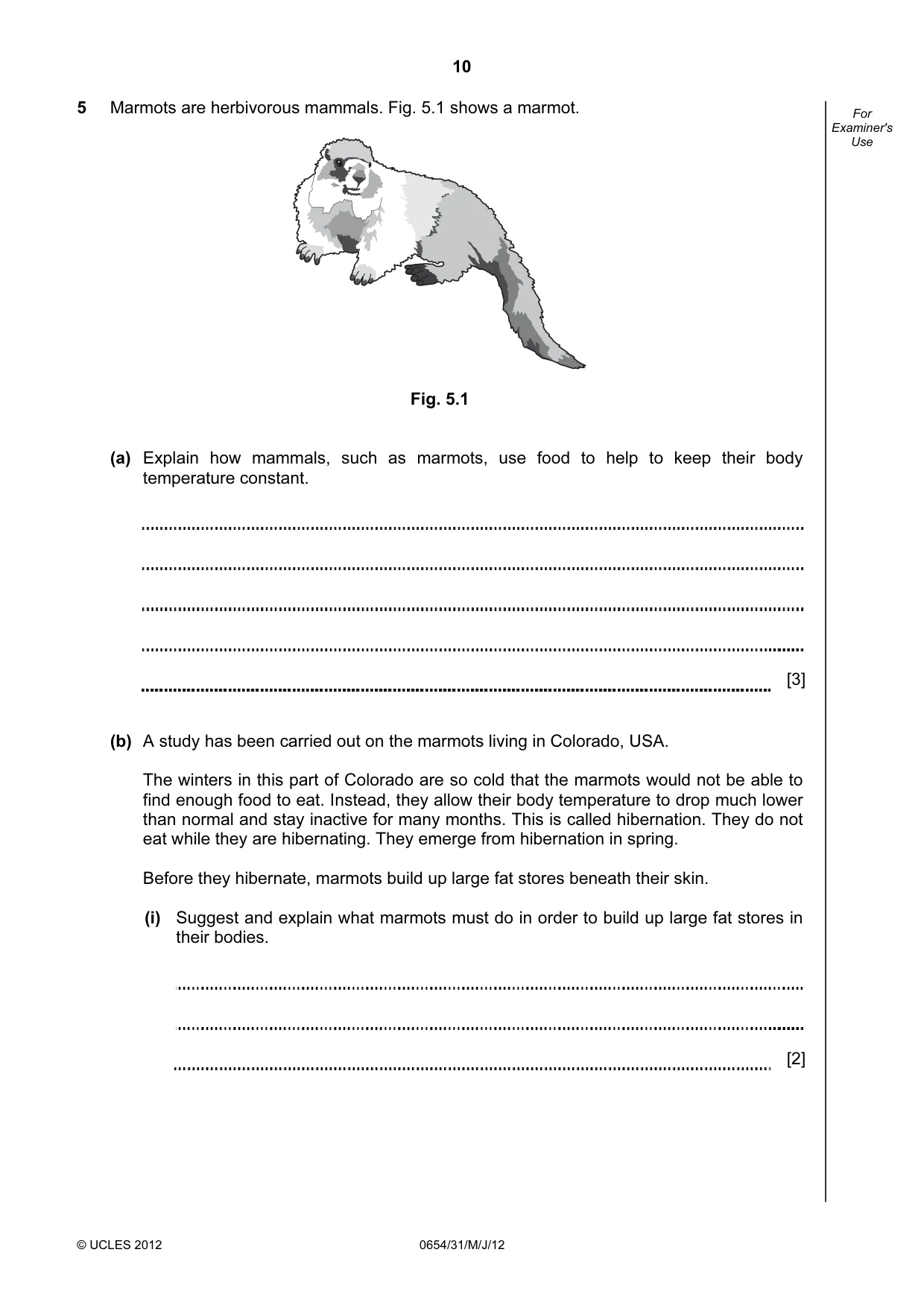
10 © UCLES 2012 0654/31/M/J/12 For Examiner's Use 5 Marmots are herbivorous mammals. Fig. 5.1 shows a marmot. Fig. 5.1 (a) Explain how mammals, such as marmots, use food to help to keep their body temperature constant. [3] (b) A study has been carried out on the marmots living in Colorado, USA. The winters in this part of Colorado are so cold that the marmots would not be able to find enough food to eat. Instead, they allow their body temperature to drop much lower than normal and stay inactive for many months. This is called hibernation. They do not eat while they are hibernating. They emerge from hibernation in spring. Before they hibernate, marmots build up large fat stores beneath their skin. (i) Suggest and explain what marmots must do in order to build up large fat stores in their bodies. [2]
Question paper, page 11
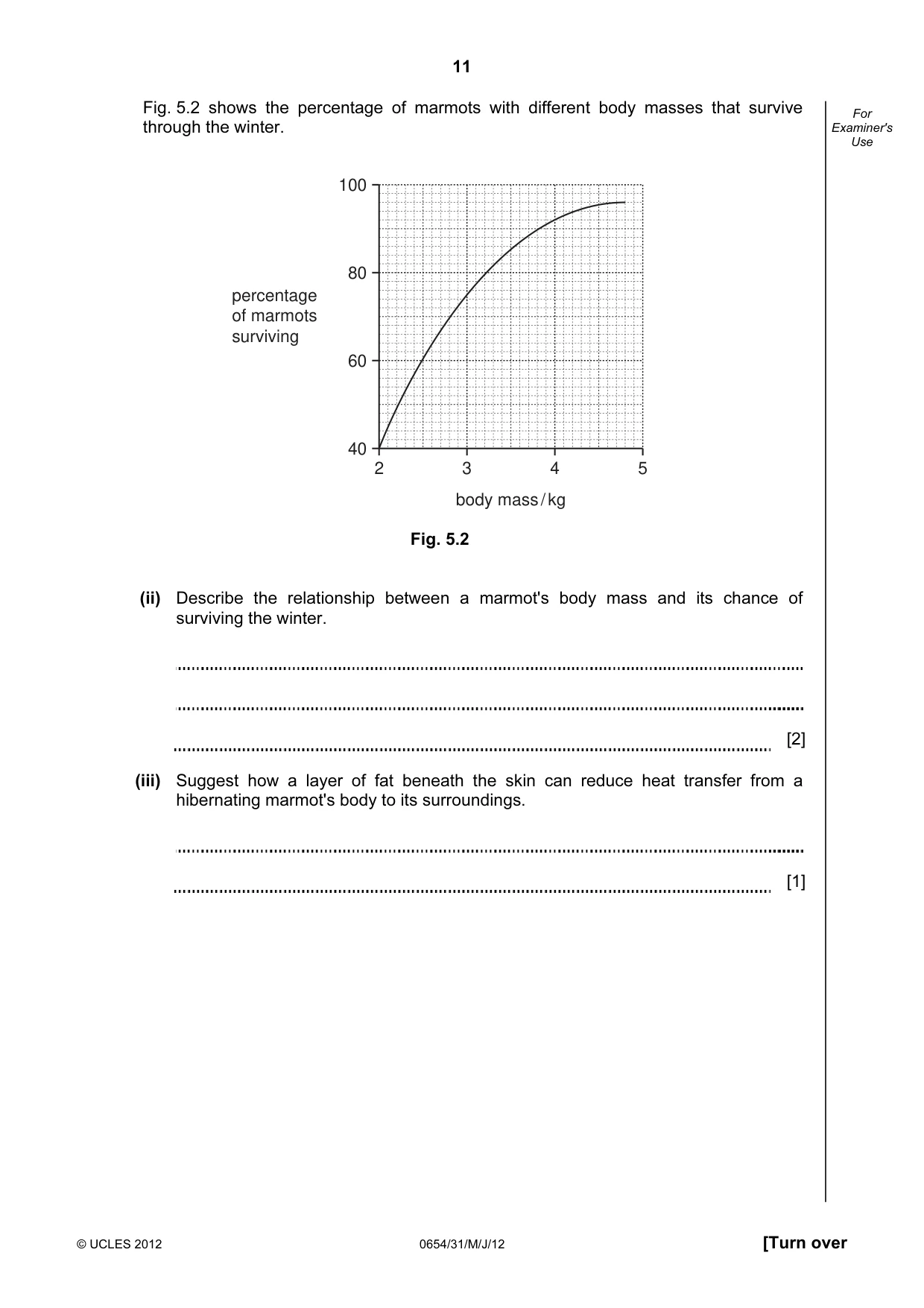
11 © UCLES 2012 0654/31/M/J/12 [Turn over For Examiner's Use Fig. 5.2 shows the percentage of marmots with different body masses that survive through the winter. 100 80 60 40 percentage of marmots surviving body mass / kg 2 3 4 5 Fig. 5.2 (ii) Describe the relationship between a marmot's body mass and its chance of surviving the winter. [2] (iii) Suggest how a layer of fat beneath the skin can reduce heat transfer from a hibernating marmot's body to its surroundings. [1]
Question paper, page 12
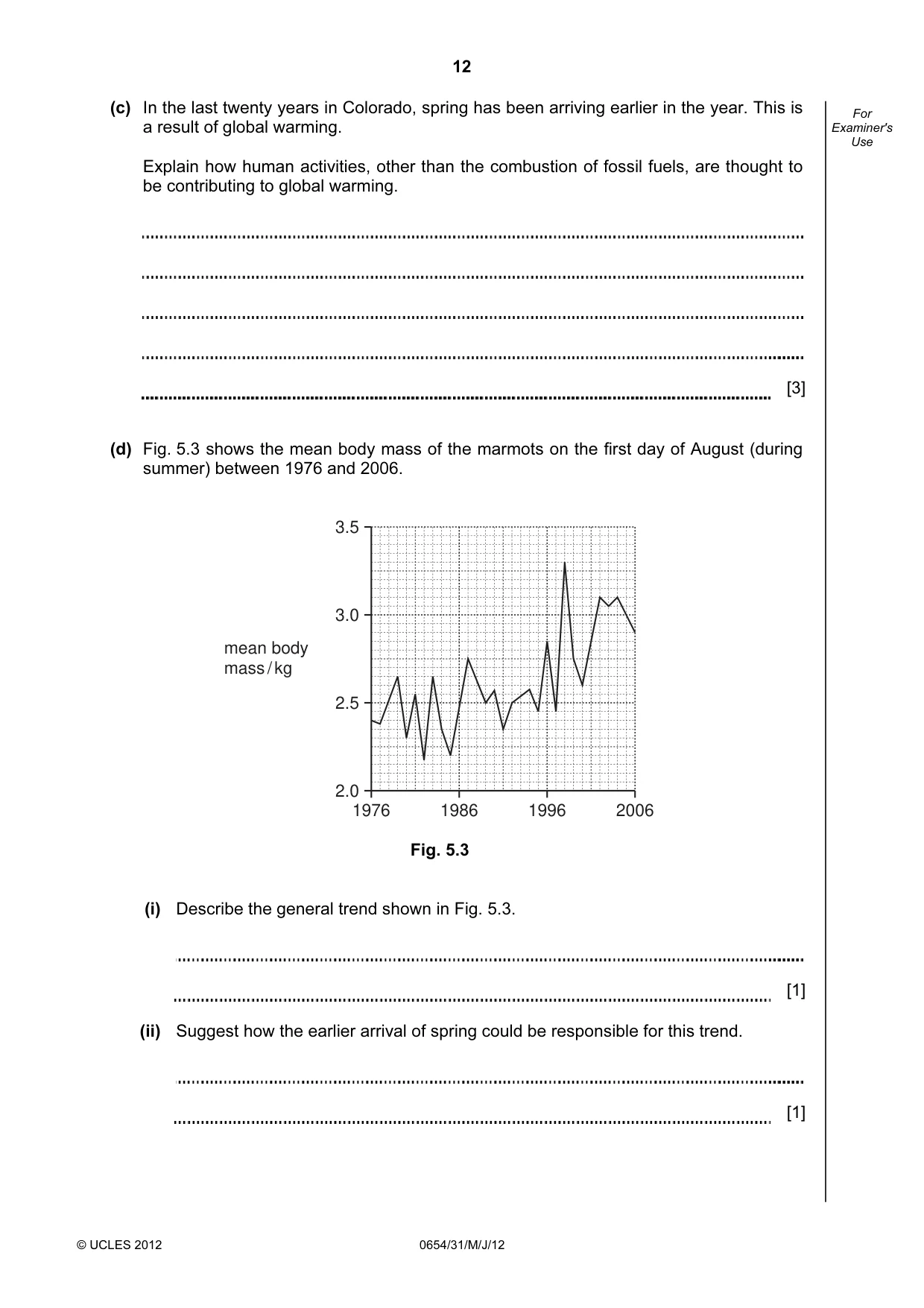
12 © UCLES 2012 0654/31/M/J/12 For Examiner's Use (c) In the last twenty years in Colorado, spring has been arriving earlier in the year. This is a result of global warming. Explain how human activities, other than the combustion of fossil fuels, are thought to be contributing to global warming. [3] (d) Fig. 5.3 shows the mean body mass of the marmots on the first day of August (during summer) between 1976 and 2006. 3.5 3.0 2.5 2.0 mean body mass / kg 1976 1986 1996 2006 Fig. 5.3 (i) Describe the general trend shown in Fig. 5.3. [1] (ii) Suggest how the earlier arrival of spring could be responsible for this trend. [1]
Question paper, page 13
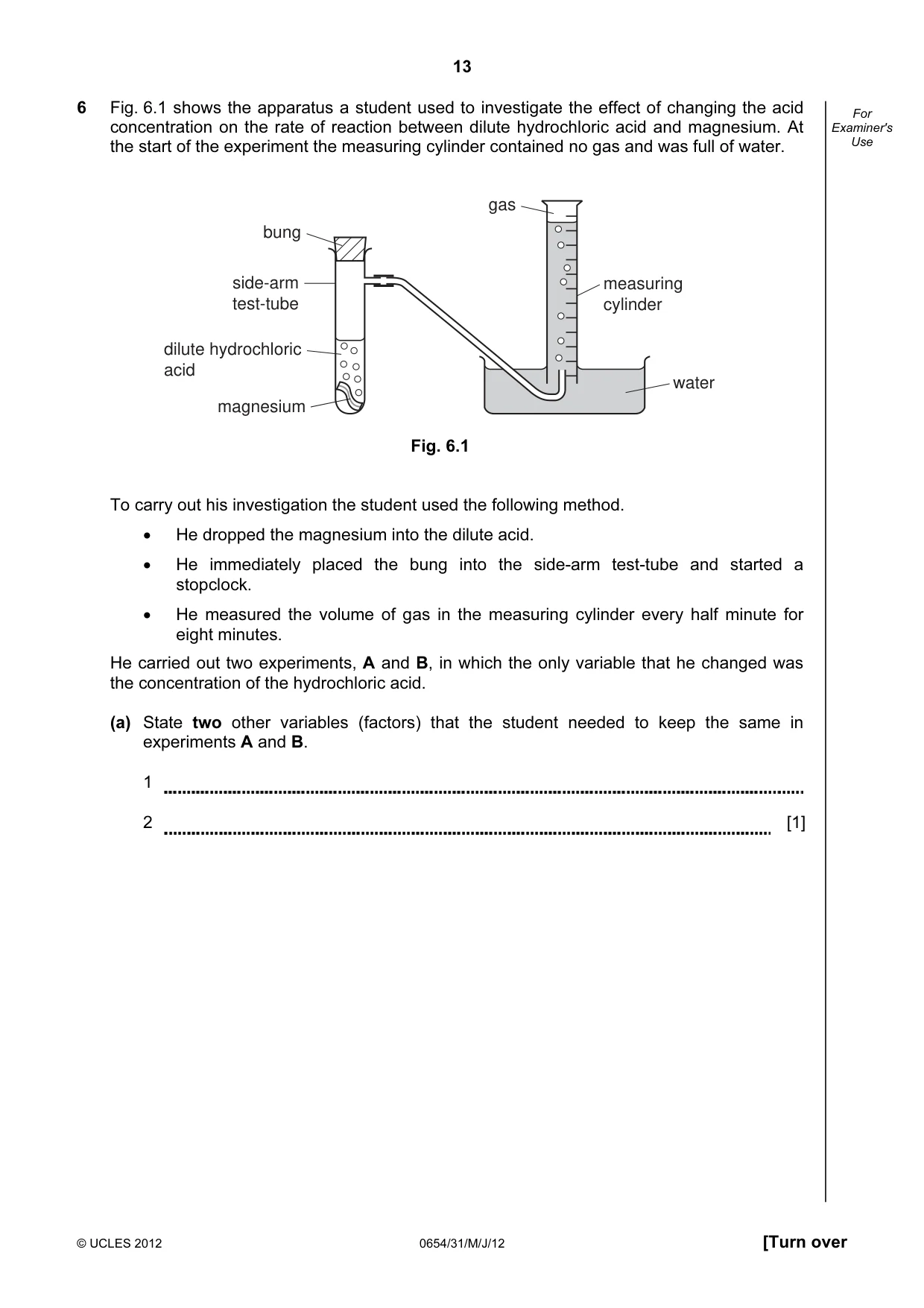
13 © UCLES 2012 0654/31/M/J/12 [Turn over For Examiner's Use 6 Fig. 6.1 shows the apparatus a student used to investigate the effect of changing the acid concentration on the rate of reaction between dilute hydrochloric acid and magnesium. At the start of the experiment the measuring cylinder contained no gas and was full of water. water measuring cylinder dilute hydrochloric acid bung magnesium gas side-arm test-tube Fig. 6.1 To carry out his investigation the student used the following method. • He dropped the magnesium into the dilute acid. • He immediately placed the bung into the side-arm test-tube and started a stopclock. • He measured the volume of gas in the measuring cylinder every half minute for eight minutes. He carried out two experiments, A and B, in which the only variable that he changed was the concentration of the hydrochloric acid. (a) State two other variables (factors) that the student needed to keep the same in experiments A and B. 1 2 [1]
Question paper, page 14
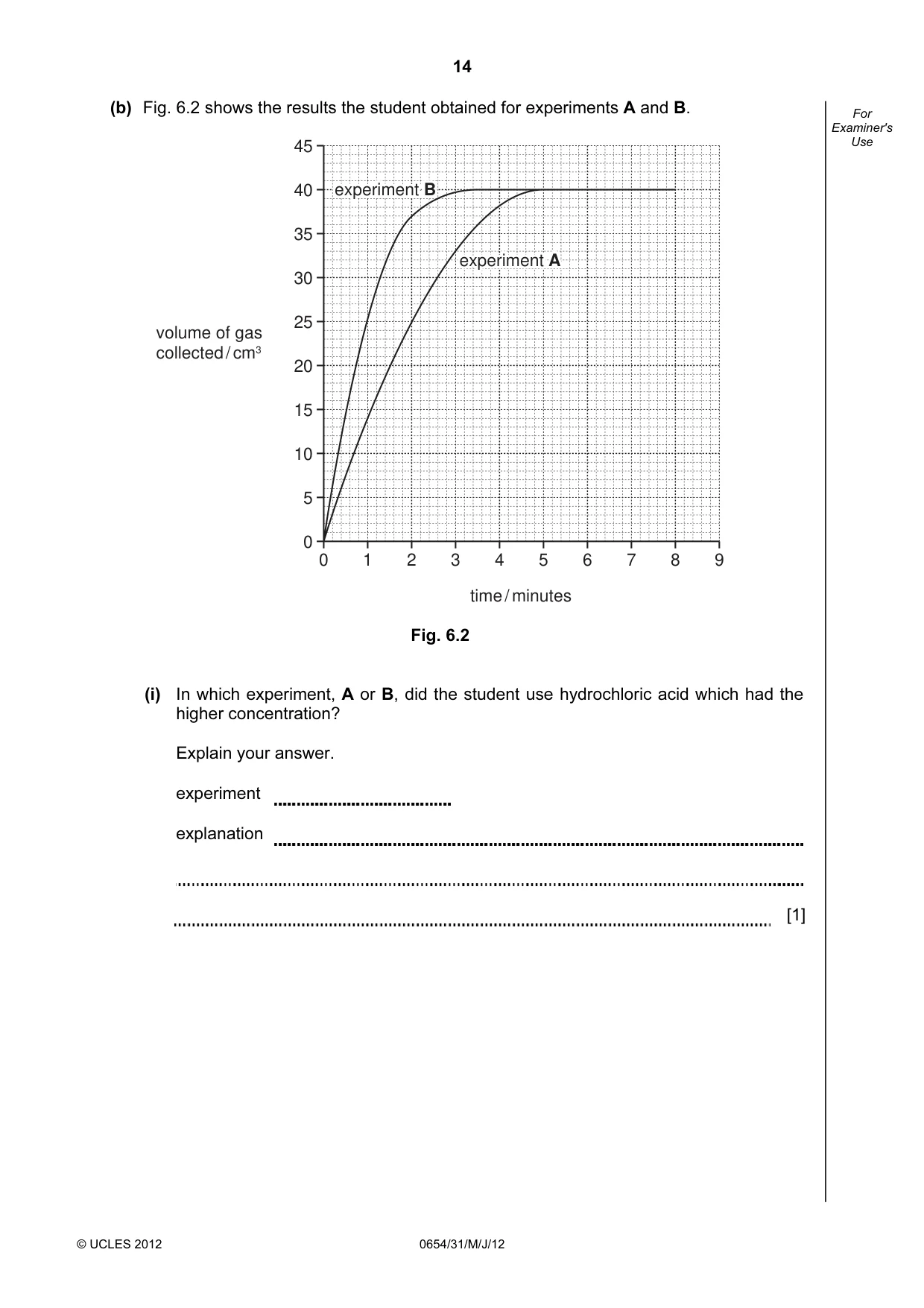
14 © UCLES 2012 0654/31/M/J/12 For Examiner's Use (b) Fig. 6.2 shows the results the student obtained for experiments A and B. experiment experiment A experiment experiment B 0 1 2 3 4 5 6 7 8 9 45 40 35 30 25 20 15 10 5 0 time / minutes volume of gas collected / cm3 experiment A experiment B Fig. 6.2 (i) In which experiment, A or B, did the student use hydrochloric acid which had the higher concentration? Explain your answer. experiment explanation [1]
Question paper, page 15
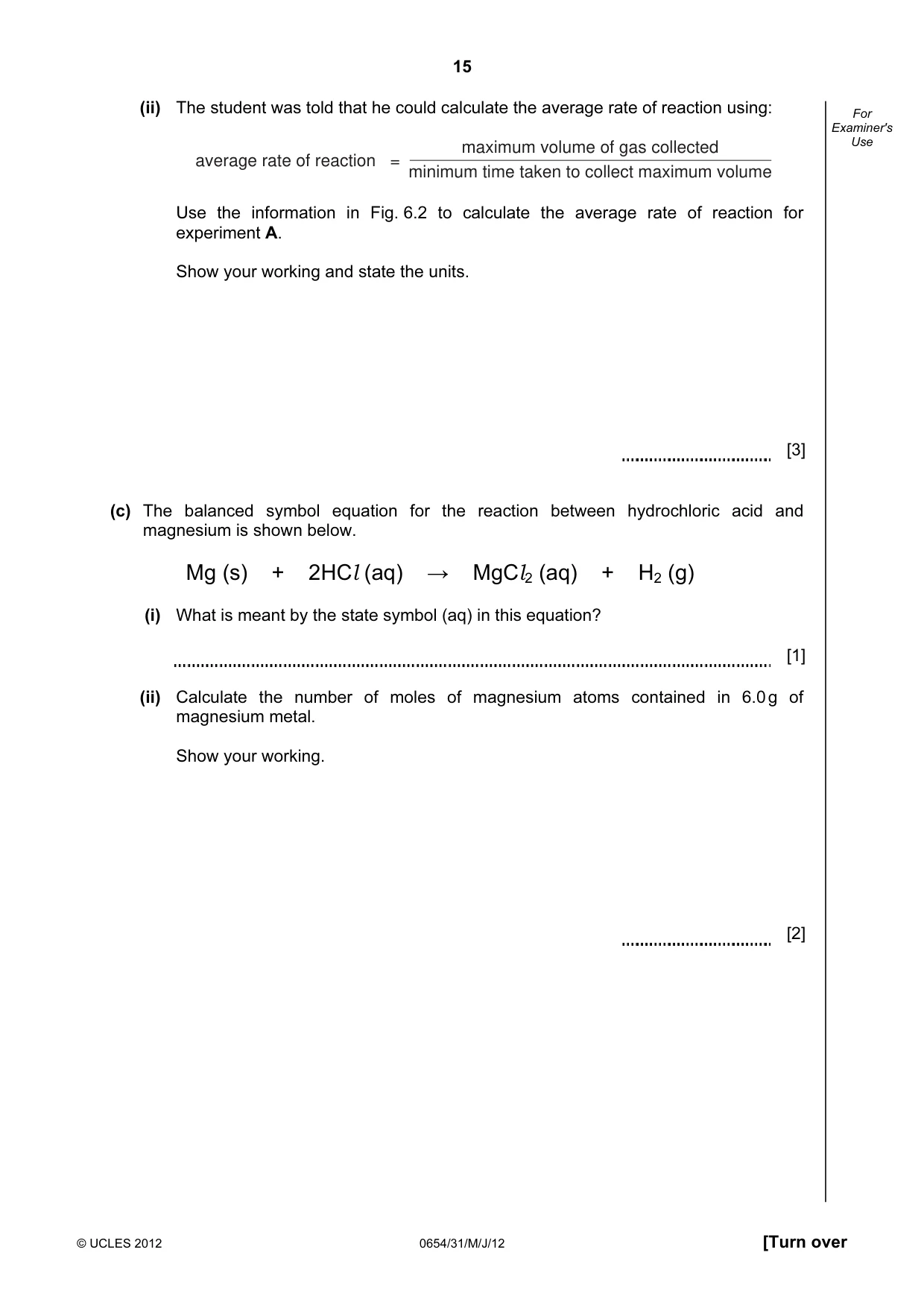
15 © UCLES 2012 0654/31/M/J/12 [Turn over For Examiner's Use (ii) The student was told that he could calculate the average rate of reaction using: maximum volume of gas collected minimum time taken to collect maximum volume average rate of reaction = Use the information in Fig. 6.2 to calculate the average rate of reaction for experiment A. Show your working and state the units. [3] (c) The balanced symbol equation for the reaction between hydrochloric acid and magnesium is shown below. Mg (s) + 2HCl (aq) → MgCl2 (aq) + H2 (g) (i) What is meant by the state symbol (aq) in this equation? [1] (ii) Calculate the number of moles of magnesium atoms contained in 6.0 g of magnesium metal. Show your working. [2]
Question paper, page 16
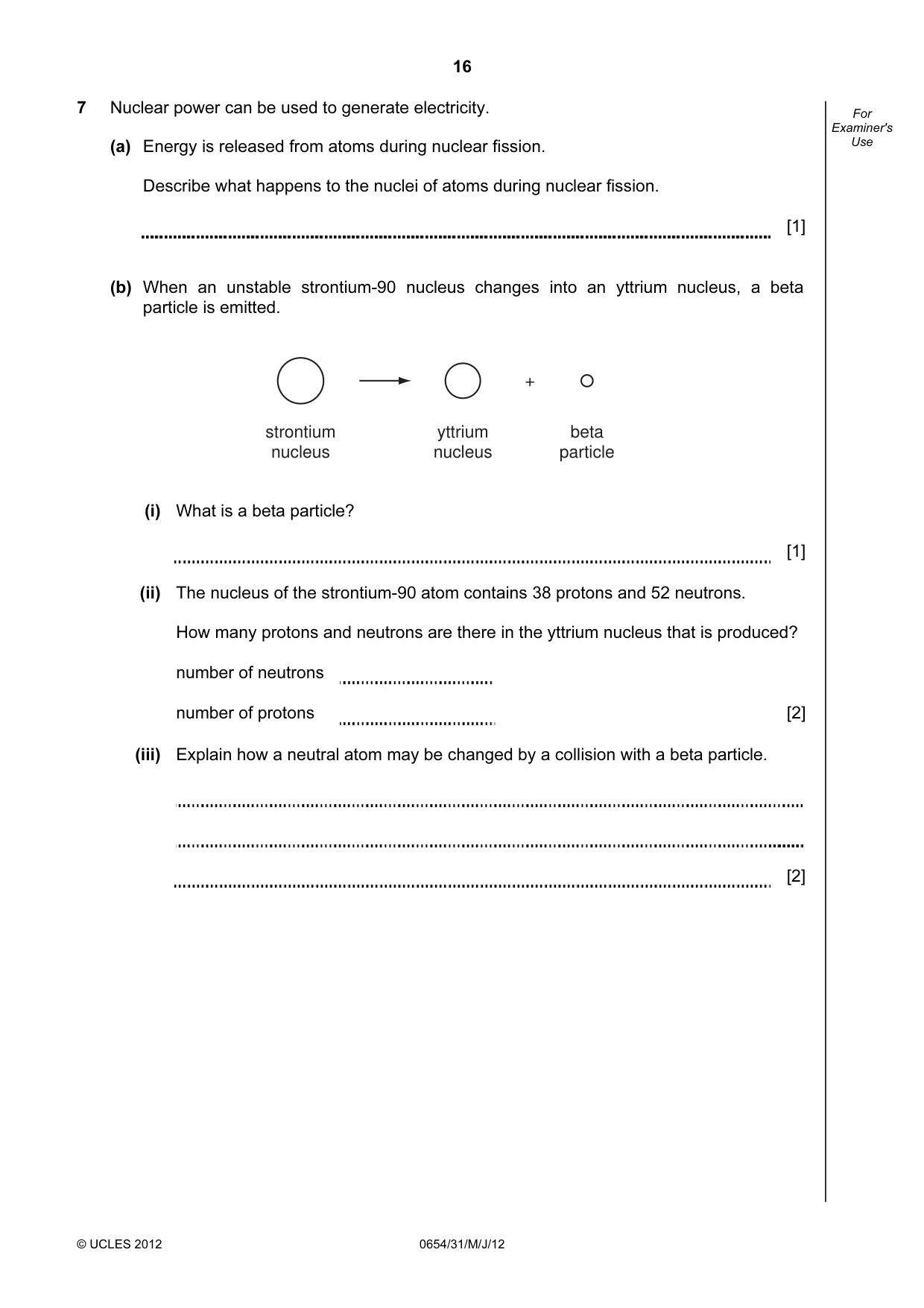
16 © UCLES 2012 0654/31/M/J/12 For Examiner's Use 7 Nuclear power can be used to generate electricity. (a) Energy is released from atoms during nuclear fission. Describe what happens to the nuclei of atoms during nuclear fission. [1] (b) When an unstable strontium-90 nucleus changes into an yttrium nucleus, a beta particle is emitted. strontium nucleus yttrium nucleus beta particle + (i) What is a beta particle? [1] (ii) The nucleus of the strontium-90 atom contains 38 protons and 52 neutrons. How many protons and neutrons are there in the yttrium nucleus that is produced? number of neutrons number of protons [2] (iii) Explain how a neutral atom may be changed by a collision with a beta particle. [2]
Question paper, page 17
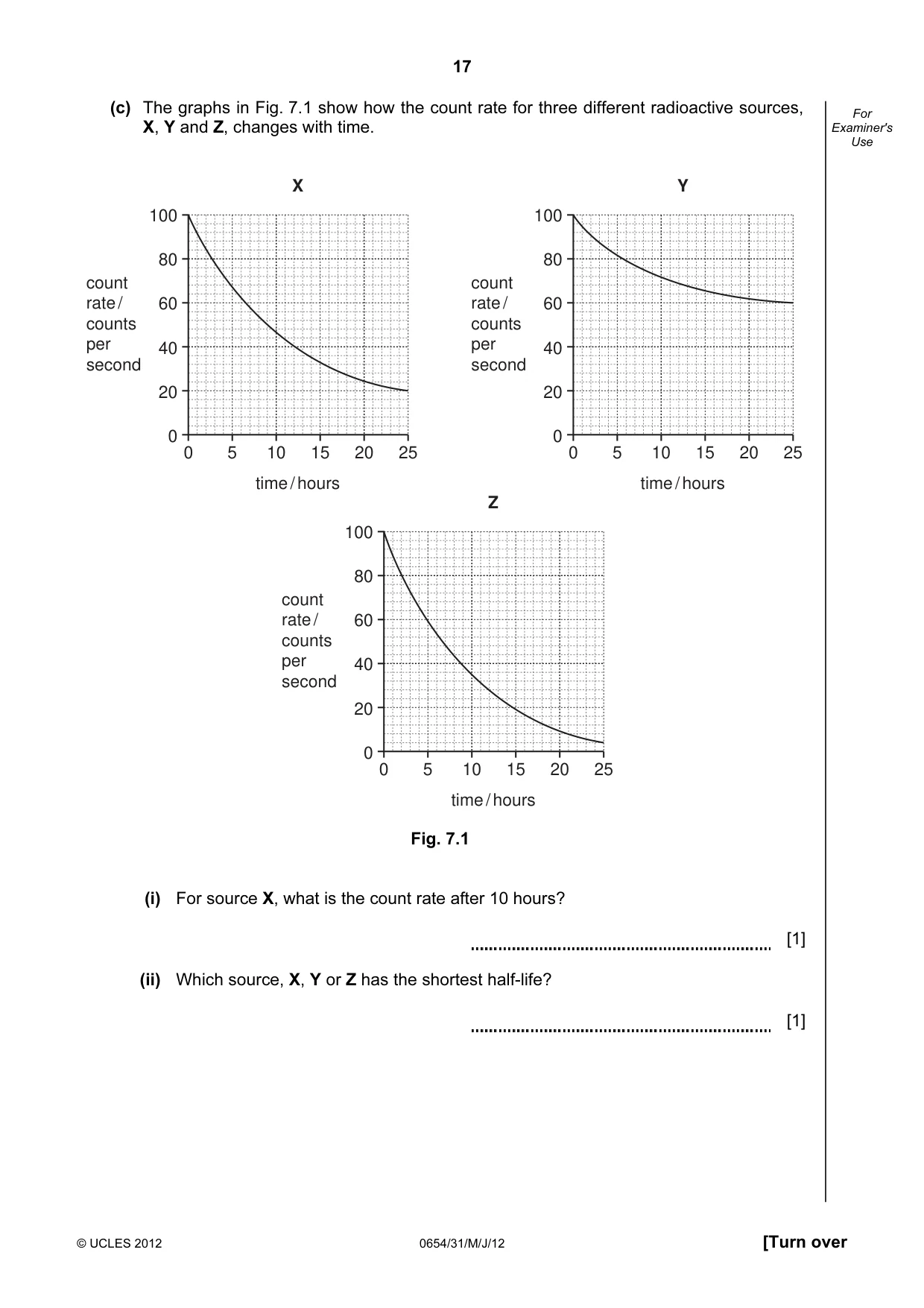
17 © UCLES 2012 0654/31/M/J/12 [Turn over For Examiner's Use (c) The graphs in Fig. 7.1 show how the count rate for three different radioactive sources, X, Y and Z, changes with time. 100 80 60 40 20 0 0 5 10 15 20 25 time / hours X count rate / counts per second 100 80 60 40 20 0 0 5 10 15 20 25 time / hours Y count rate / counts per second 100 80 60 40 20 0 0 5 10 15 20 25 time / hours Z count rate / counts per second Fig. 7.1 (i) For source X, what is the count rate after 10 hours? [1] (ii) Which source, X, Y or Z has the shortest half-life? [1]
Question paper, page 18
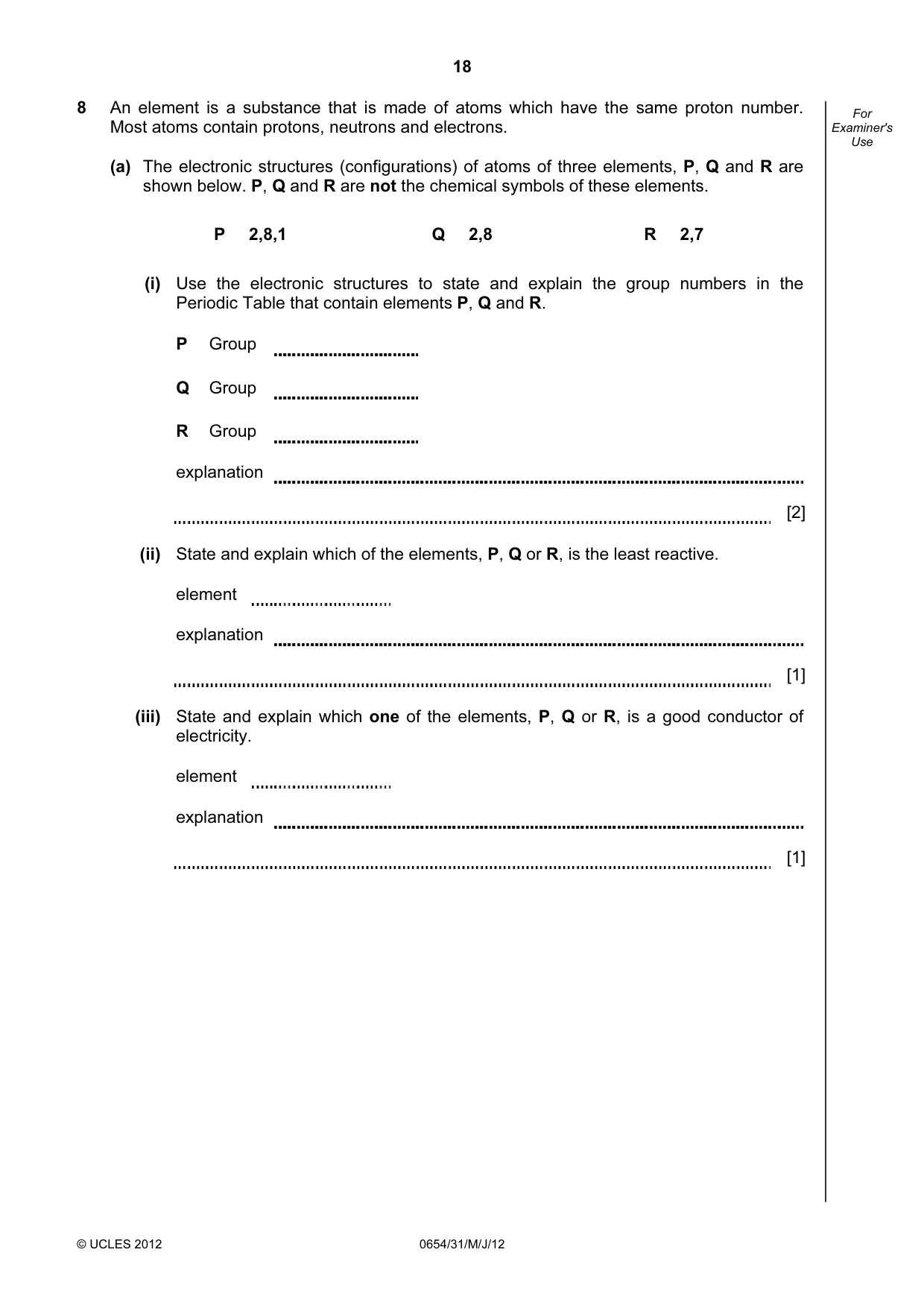
18 © UCLES 2012 0654/31/M/J/12 For Examiner's Use 8 An element is a substance that is made of atoms which have the same proton number. Most atoms contain protons, neutrons and electrons. (a) The electronic structures (configurations) of atoms of three elements, P, Q and R are shown below. P, Q and R are not the chemical symbols of these elements. P 2,8,1 Q 2,8 R 2,7 (i) Use the electronic structures to state and explain the group numbers in the Periodic Table that contain elements P, Q and R. P Group Q Group R Group explanation [2] (ii) State and explain which of the elements, P, Q or R, is the least reactive. element explanation [1] (iii) State and explain which one of the elements, P, Q or R, is a good conductor of electricity. element explanation [1]
Question paper, page 19
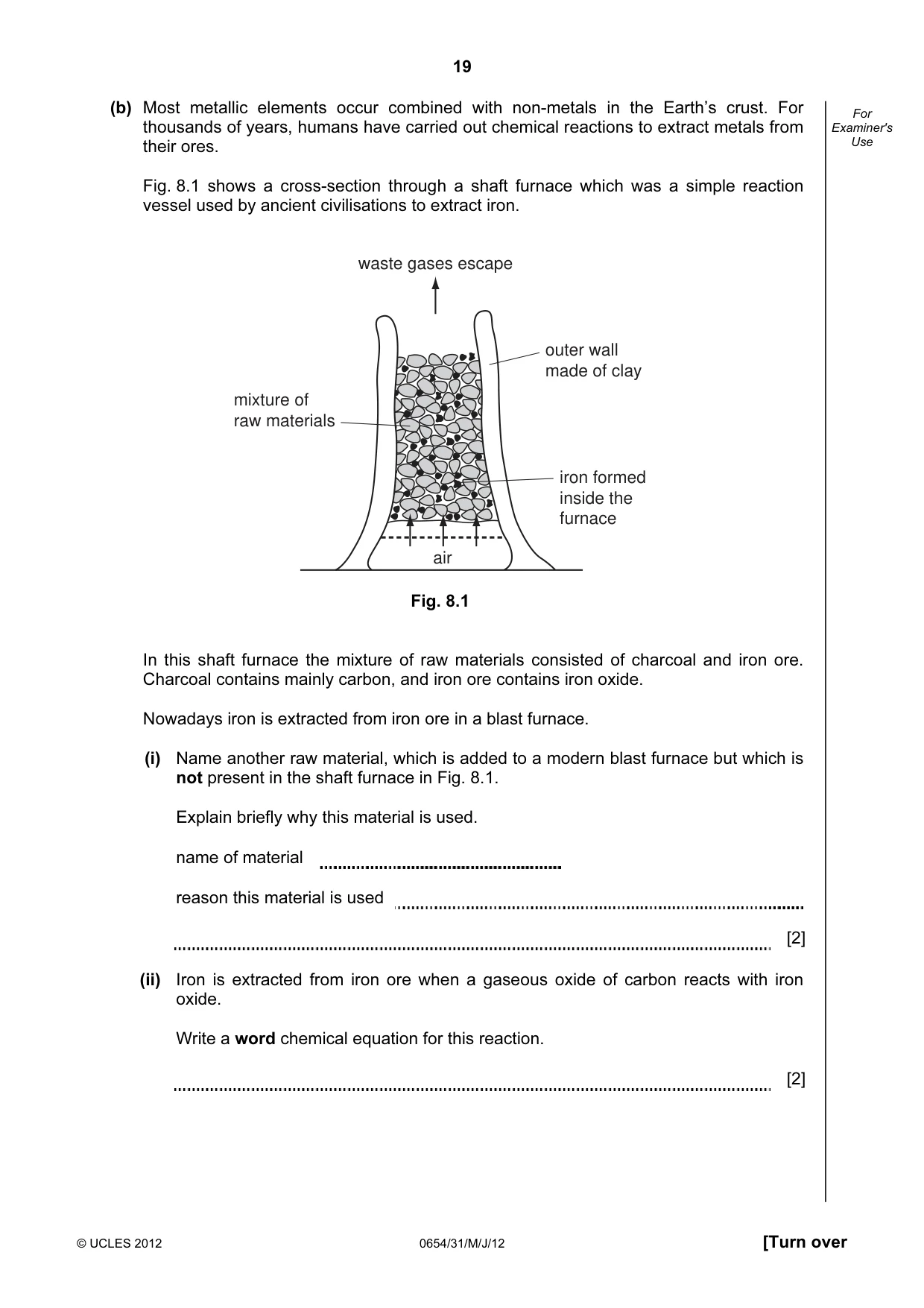
19 © UCLES 2012 0654/31/M/J/12 [Turn over For Examiner's Use (b) Most metallic elements occur combined with non-metals in the Earth’s crust. For thousands of years, humans have carried out chemical reactions to extract metals from their ores. Fig. 8.1 shows a cross-section through a shaft furnace which was a simple reaction vessel used by ancient civilisations to extract iron. waste gases escape air outer wall made of clay iron formed inside the furnace mixture of raw materials Fig. 8.1 In this shaft furnace the mixture of raw materials consisted of charcoal and iron ore. Charcoal contains mainly carbon, and iron ore contains iron oxide. Nowadays iron is extracted from iron ore in a blast furnace. (i) Name another raw material, which is added to a modern blast furnace but which is not present in the shaft furnace in Fig. 8.1. Explain briefly why this material is used. name of material reason this material is used [2] (ii) Iron is extracted from iron ore when a gaseous oxide of carbon reacts with iron oxide. Write a word chemical equation for this reaction. [2]
Question paper, page 20
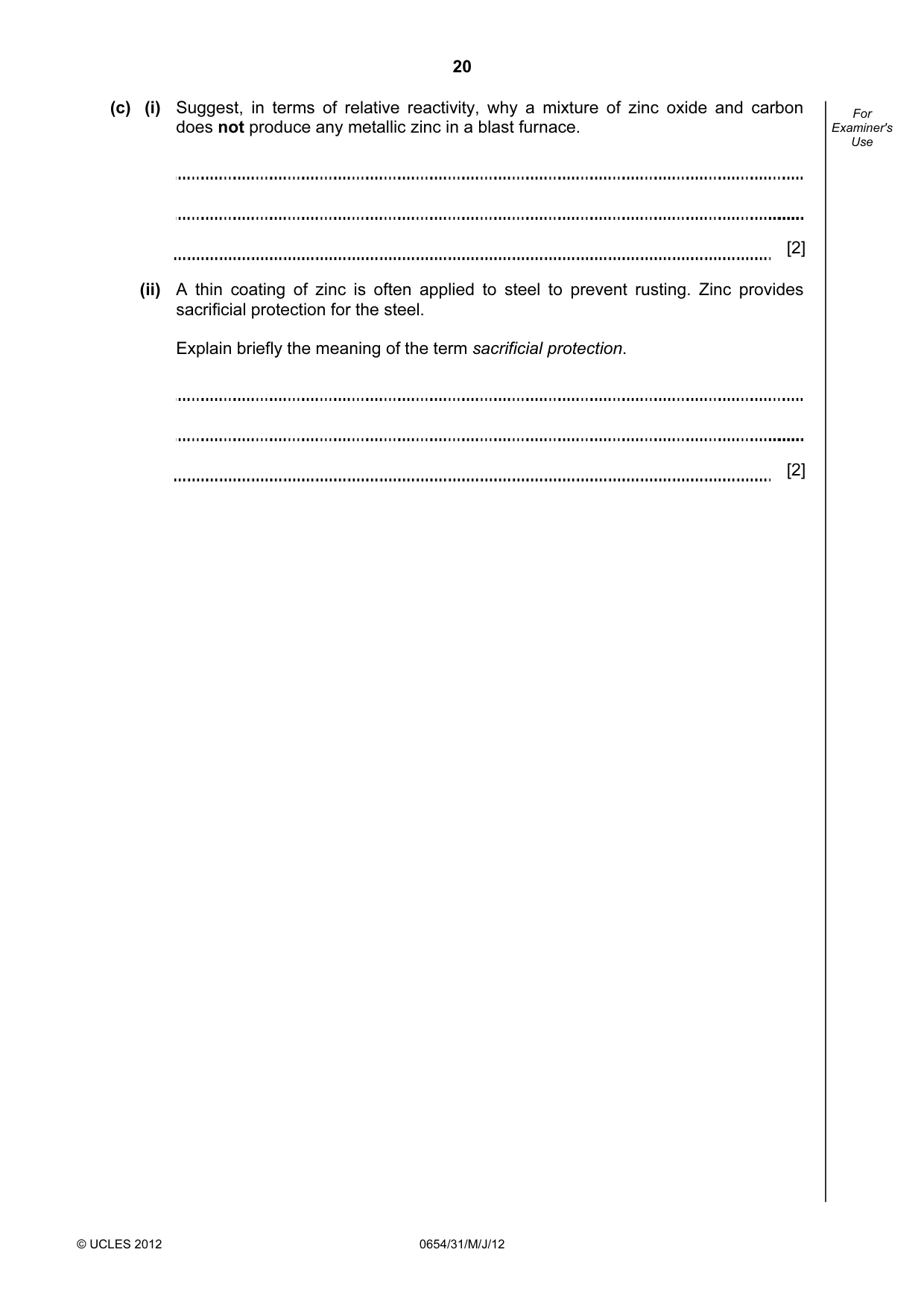
20 © UCLES 2012 0654/31/M/J/12 For Examiner's Use (c) (i) Suggest, in terms of relative reactivity, why a mixture of zinc oxide and carbon does not produce any metallic zinc in a blast furnace. [2] (ii) A thin coating of zinc is often applied to steel to prevent rusting. Zinc provides sacrificial protection for the steel. Explain briefly the meaning of the term sacrificial protection. [2]
Question paper, page 21
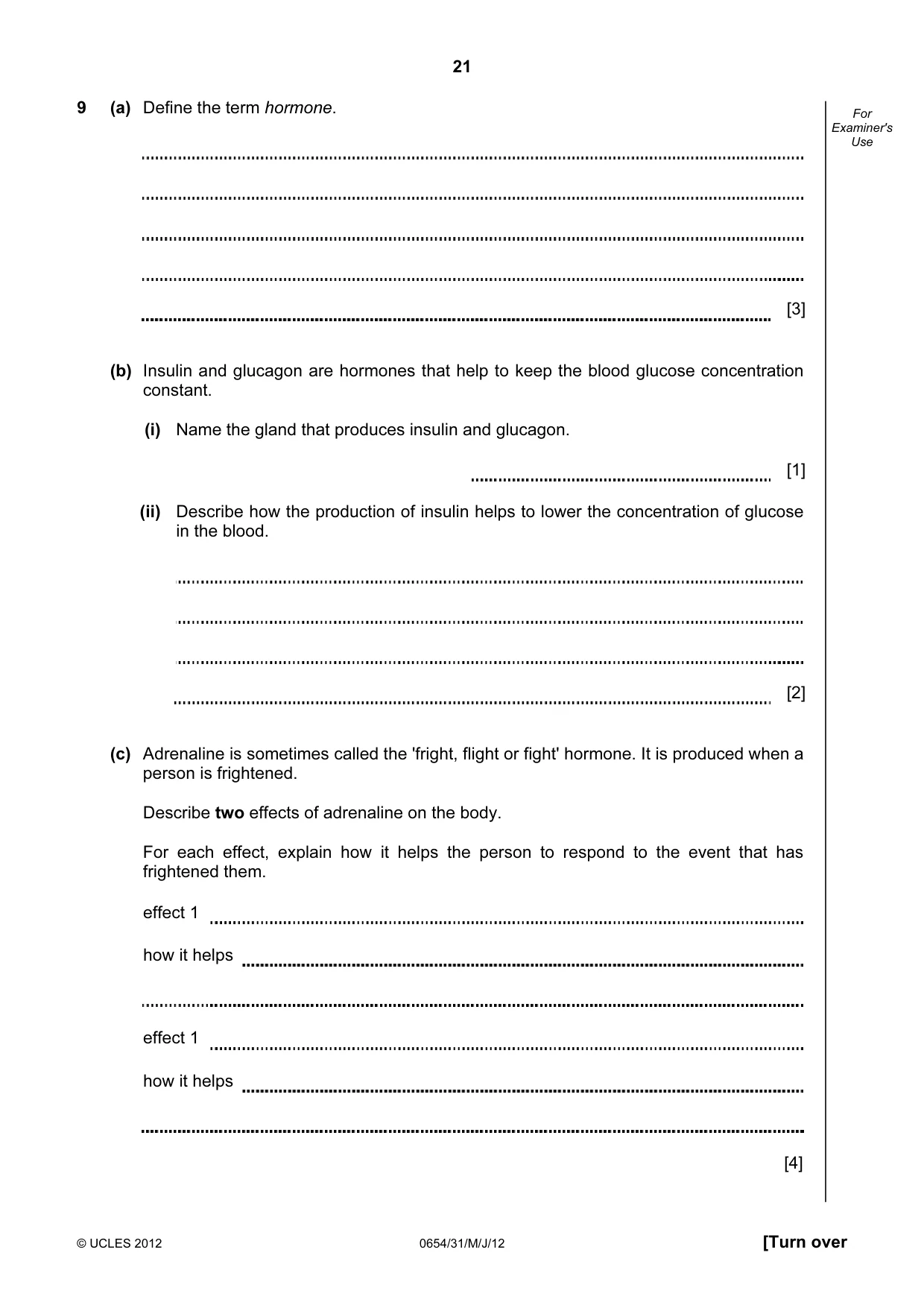
21 © UCLES 2012 0654/31/M/J/12 [Turn over For Examiner's Use 9 (a) Define the term hormone. [3] (b) Insulin and glucagon are hormones that help to keep the blood glucose concentration constant. (i) Name the gland that produces insulin and glucagon. [1] (ii) Describe how the production of insulin helps to lower the concentration of glucose in the blood. [2] (c) Adrenaline is sometimes called the 'fright, flight or fight' hormone. It is produced when a person is frightened. Describe two effects of adrenaline on the body. For each effect, explain how it helps the person to respond to the event that has frightened them. effect 1 how it helps effect 1 how it helps [4]
Question paper, page 22
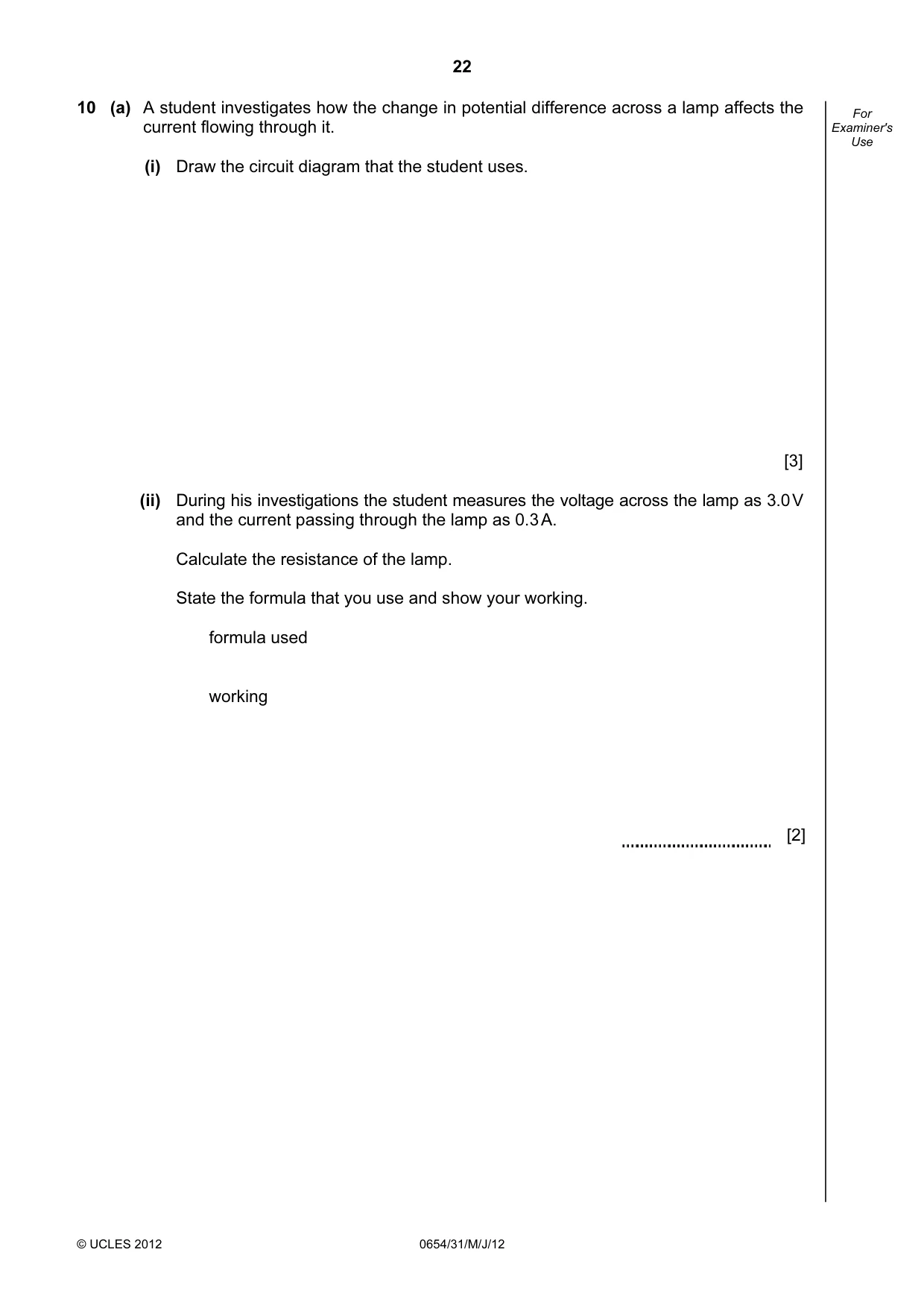
22 © UCLES 2012 0654/31/M/J/12 For Examiner's Use 10 (a) A student investigates how the change in potential difference across a lamp affects the current flowing through it. (i) Draw the circuit diagram that the student uses. [3] (ii) During his investigations the student measures the voltage across the lamp as 3.0 V and the current passing through the lamp as 0.3 A. Calculate the resistance of the lamp. State the formula that you use and show your working. formula used working [2]
Question paper, page 23
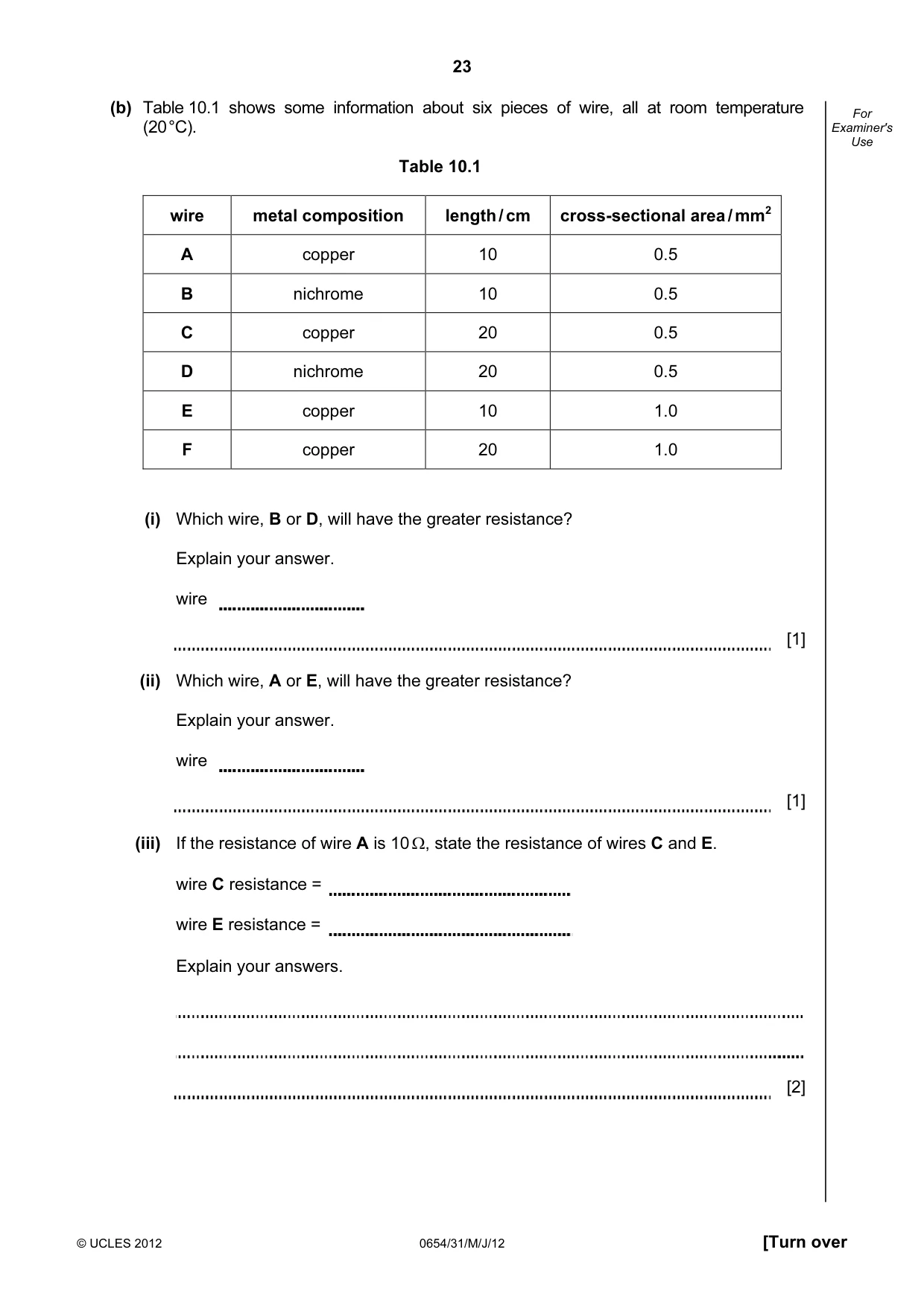
23 © UCLES 2012 0654/31/M/J/12 [Turn over For Examiner's Use (b) Table 10.1 shows some information about six pieces of wire, all at room temperature (20 °C). Table 10.1 wire metal composition length / cm cross-sectional area / mm2 A copper 10 0.5 B nichrome 10 0.5 C copper 20 0.5 D nichrome 20 0.5 E copper 10 1.0 F copper 20 1.0 (i) Which wire, B or D, will have the greater resistance? Explain your answer. wire [1] (ii) Which wire, A or E, will have the greater resistance? Explain your answer. wire [1] (iii) If the resistance of wire A is 10 Ω, state the resistance of wires C and E. wire C resistance = wire E resistance = Explain your answers. [2]
Question paper, page 24
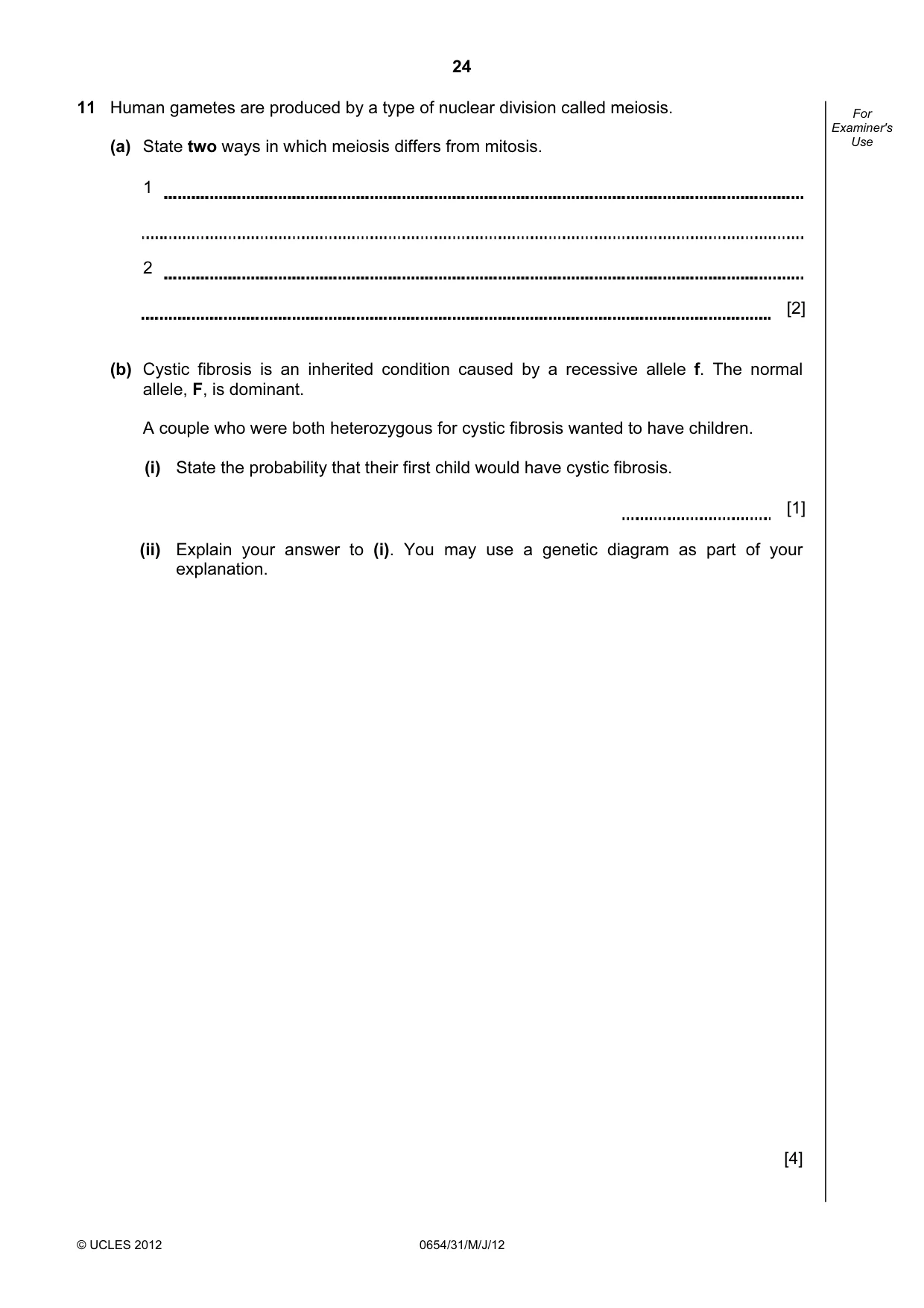
24 © UCLES 2012 0654/31/M/J/12 For Examiner's Use 11 Human gametes are produced by a type of nuclear division called meiosis. (a) State two ways in which meiosis differs from mitosis. 1 2 [2] (b) Cystic fibrosis is an inherited condition caused by a recessive allele f. The normal allele, F, is dominant. A couple who were both heterozygous for cystic fibrosis wanted to have children. (i) State the probability that their first child would have cystic fibrosis. [1] (ii) Explain your answer to (i). You may use a genetic diagram as part of your explanation. [4]
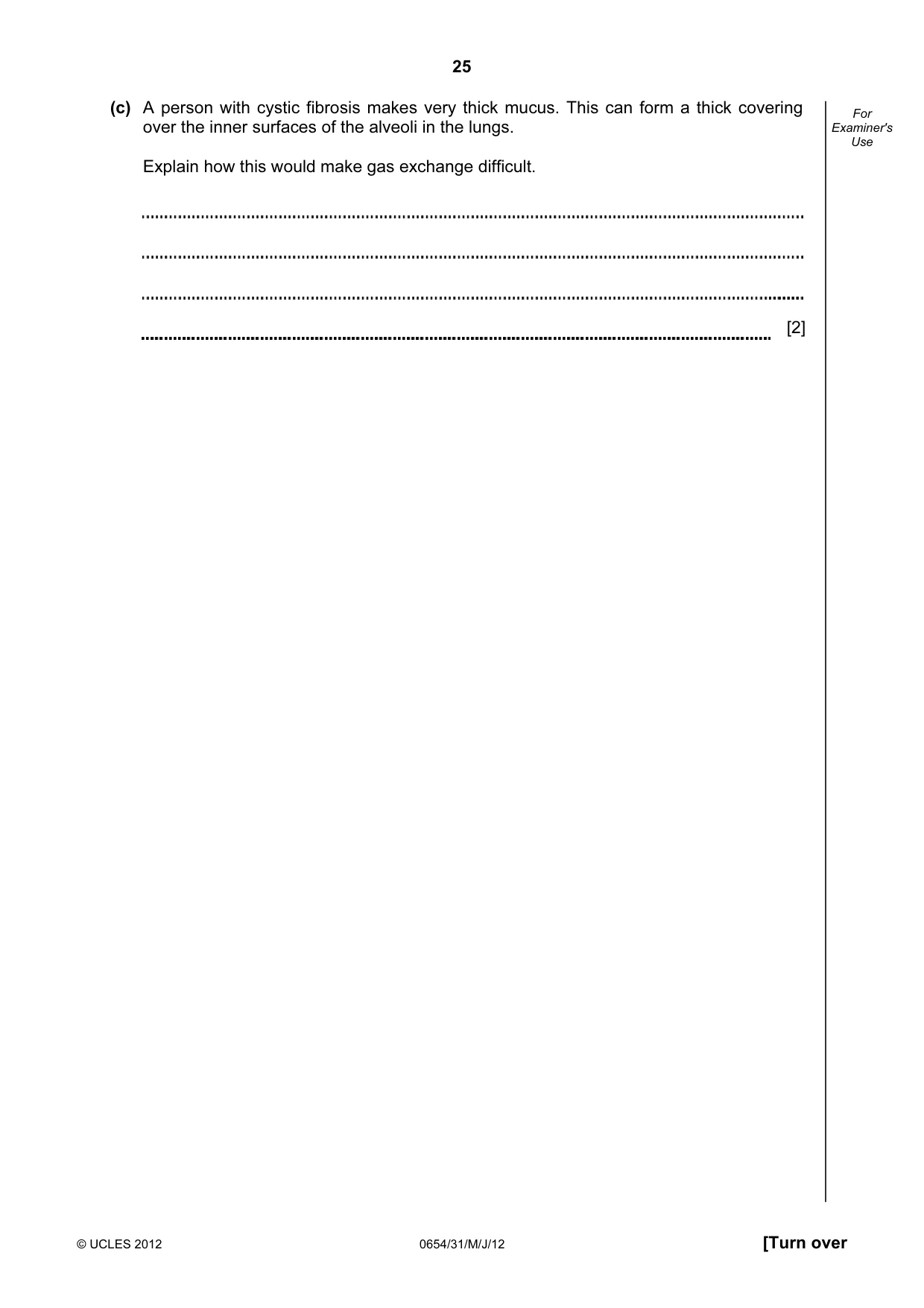
Question paper, page 25
25 © UCLES 2012 0654/31/M/J/12 [Turn over For Examiner's Use (c) A person with cystic fibrosis makes very thick mucus. This can form a thick covering over the inner surfaces of the alveoli in the lungs. Explain how this would make gas exchange difficult. [2]
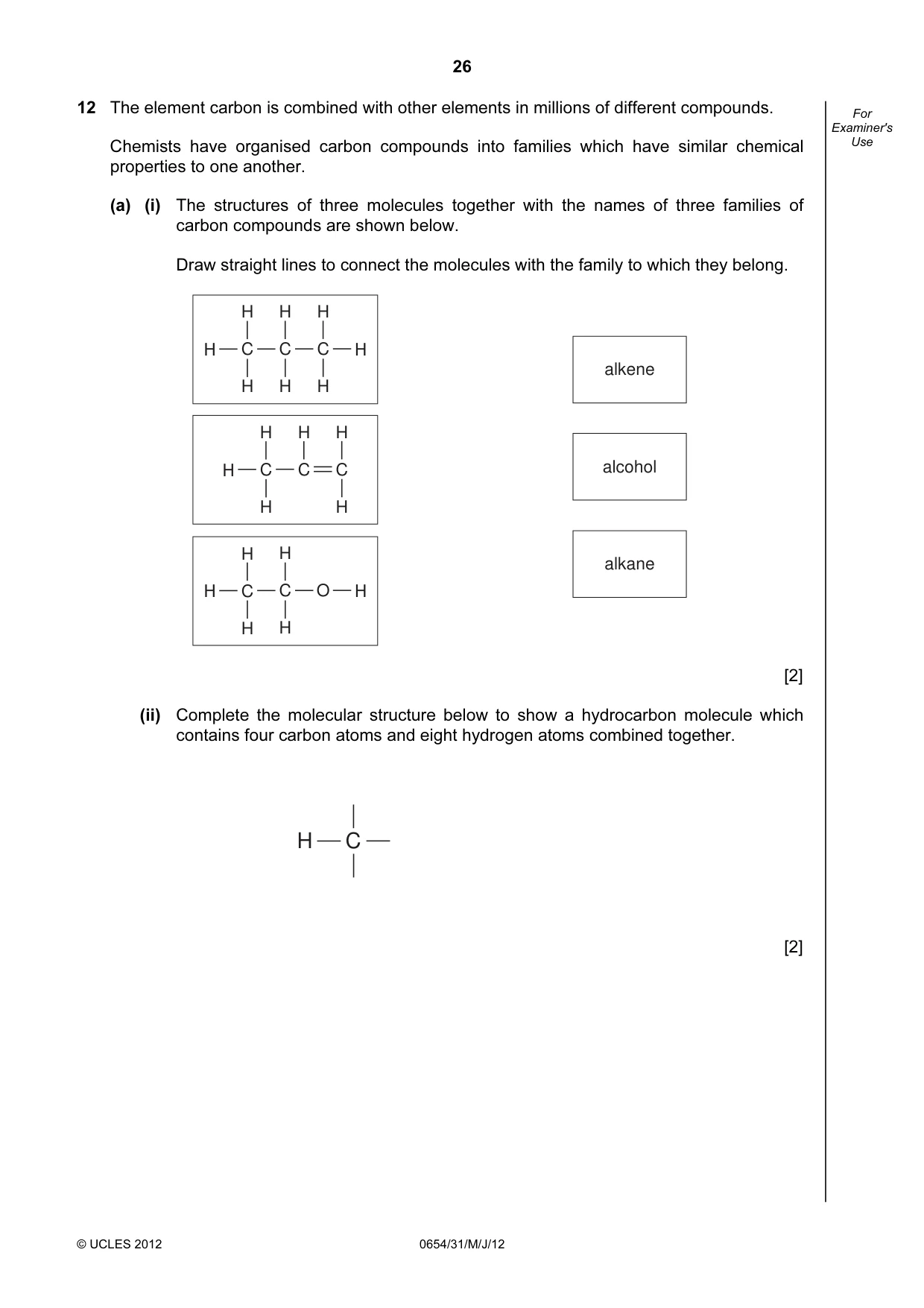
Question paper, page 26
26 © UCLES 2012 0654/31/M/J/12 For Examiner's Use 12 The element carbon is combined with other elements in millions of different compounds. Chemists have organised carbon compounds into families which have similar chemical properties to one another. (a) (i) The structures of three molecules together with the names of three families of carbon compounds are shown below. Draw straight lines to connect the molecules with the family to which they belong. H C H H C H H H C H H H C H H C H H C H H C H H C H H O H alkene alcohol alkane [2] (ii) Complete the molecular structure below to show a hydrocarbon molecule which contains four carbon atoms and eight hydrogen atoms combined together. H C [2]
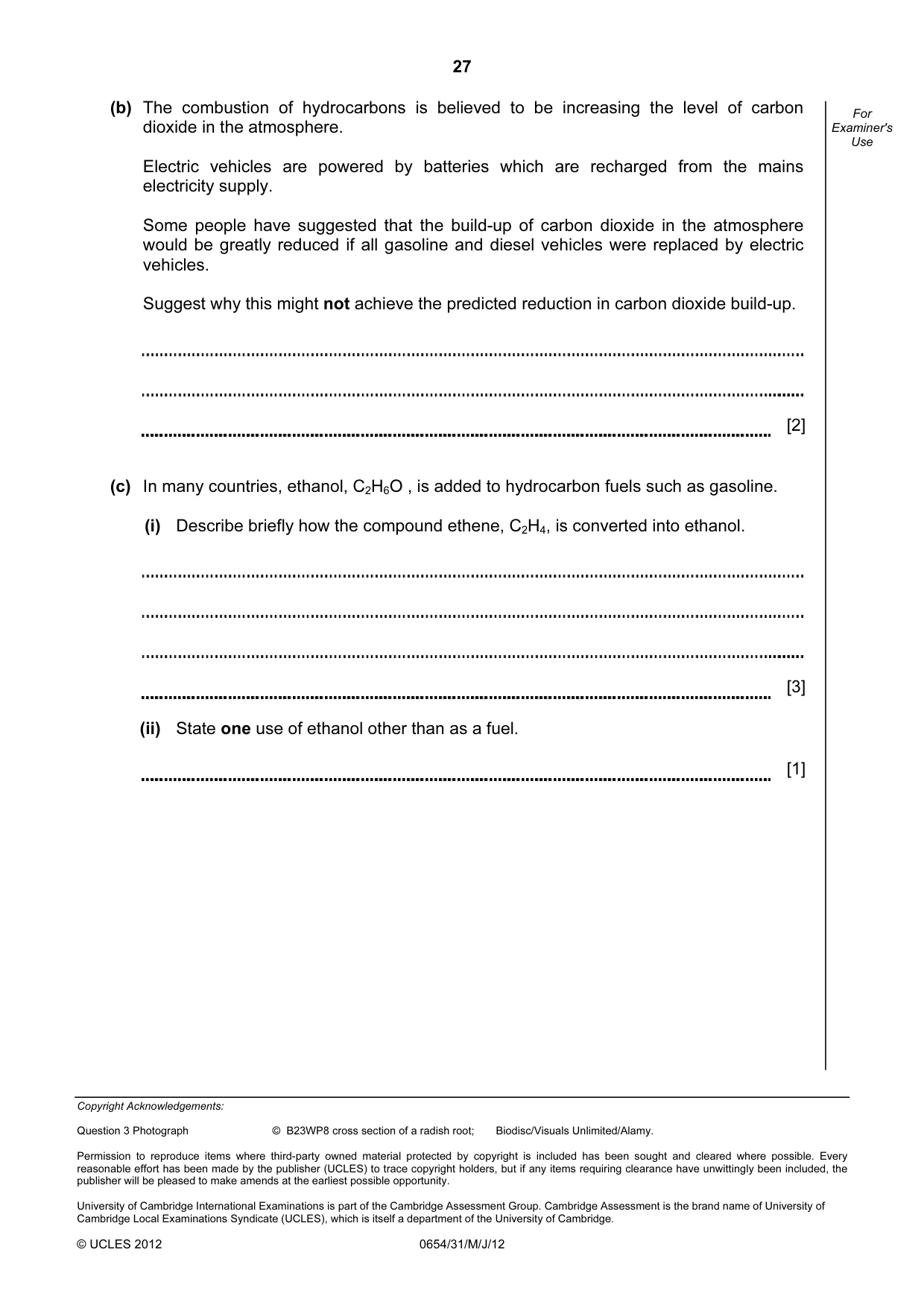
Question paper, page 27
27 Copyright Acknowledgements: Question 3 Photograph © B23WP8 cross section of a radish root; Biodisc/Visuals Unlimited/Alamy. Permission to reproduce items where third-party owned material protected by copyright is included has been sought and cleared where possible. Every reasonable effort has been made by the publisher (UCLES) to trace copyright holders, but if any items requiring clearance have unwittingly been included, the publisher will be pleased to make amends at the earliest possible opportunity. University of Cambridge International Examinations is part of the Cambridge Assessment Group. Cambridge Assessment is the brand name of University of Cambridge Local Examinations Syndicate (UCLES), which is itself a department of the University of Cambridge. © UCLES 2012 0654/31/M/J/12 For Examiner's Use (b) The combustion of hydrocarbons is believed to be increasing the level of carbon dioxide in the atmosphere. Electric vehicles are powered by batteries which are recharged from the mains electricity supply. Some people have suggested that the build-up of carbon dioxide in the atmosphere would be greatly reduced if all gasoline and diesel vehicles were replaced by electric vehicles. Suggest why this might not achieve the predicted reduction in carbon dioxide build-up. [2] (c) In many countries, ethanol, C2H6O , is added to hydrocarbon fuels such as gasoline. (i) Describe briefly how the compound ethene, C2H4, is converted into ethanol. [3] (ii) State one use of ethanol other than as a fuel. [1]
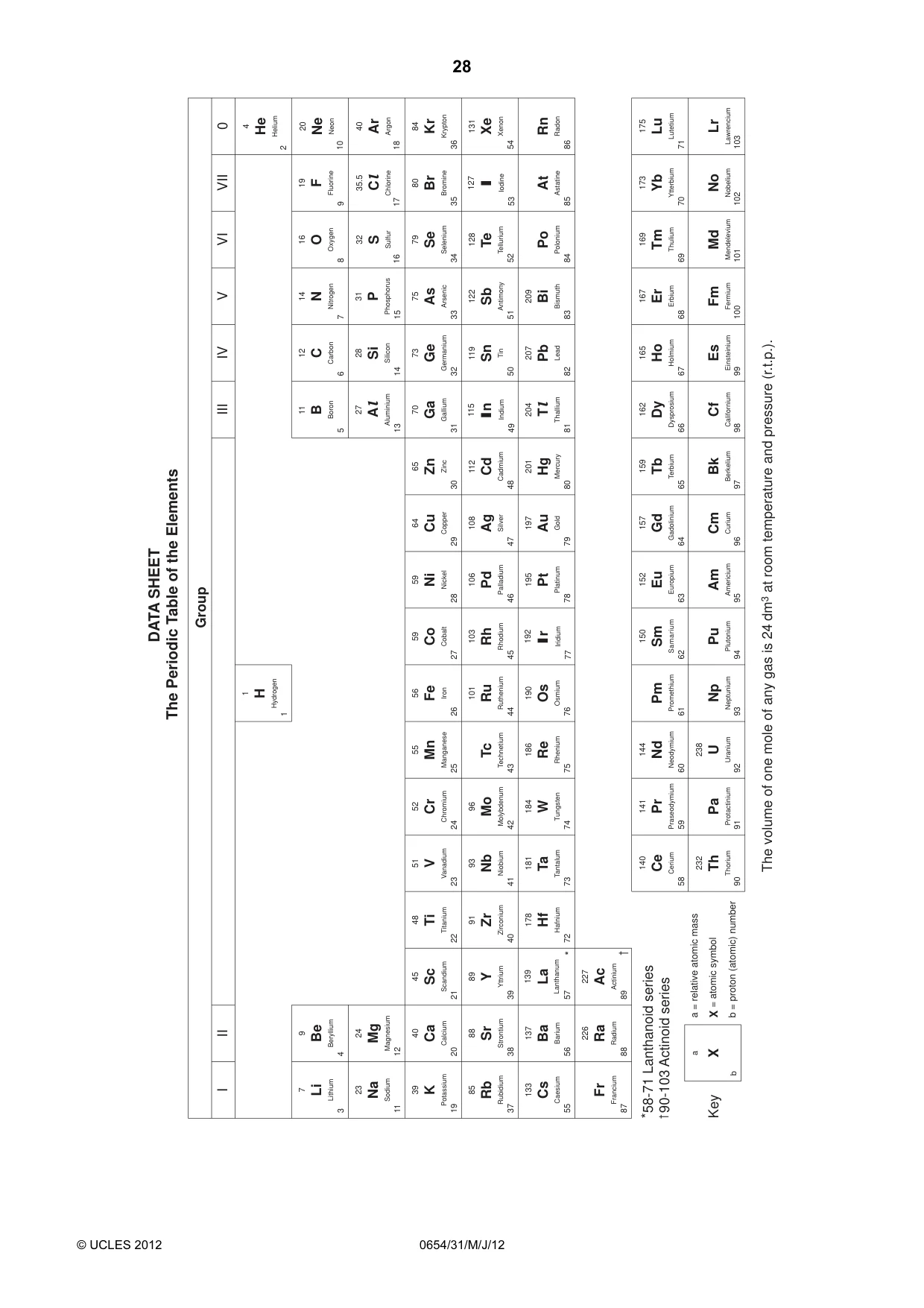
Question paper, page 28
28 © UCLES 2012 0654/31/M/J/12 Group 140 Ce Cerium 58 141 Pr Praseodymium 59 144 Nd Neodymium 60 Pm Promethium 61 150 Sm Samarium 62 152 Eu Europium 63 157 Gd Gadolinium 64 159 Tb Terbium 65 162 Dy Dysprosium 66 165 Ho Holmium 67 167 Er Erbium 68 169 Tm Thulium 69 173 Yb Ytterbium 70 175 Lu Lutetium 71 232 Th Thorium 90 Pa Protactinium 91 238 U Uranium 92 Np Neptunium 93 Pu Plutonium 94 Am Americium 95 Cm Curium 96 Bk Berkelium 97 Cf Californium 98 Es Einsteinium 99 Fm Fermium 100 Md Mendelevium 101 No Nobelium 102 Lr Lawrencium 103 1 H Hydrogen 1 7 Li Lithium 3 23 Na Sodium 11 24 Mg Magnesium 12 40 Ca Calcium 20 45 Sc Scandium 21 48 Ti Titanium 22 51 V Vanadium 23 52 Cr Chromium 24 55 Mn Manganese 25 56 Fe Iron 26 59 Co Cobalt 27 59 Ni Nickel 28 64 Cu Copper 29 65 Zn Zinc 30 70 Ga Gallium 31 27 Al Aluminium 13 11 B Boron 5 12 C Carbon 6 14 N Nitrogen 7 16 O Oxygen 8 19 F Fluorine 9 28 Si Silicon 14 31 P Phosphorus 15 32 S Sulfur 16 35.5 Cl Chlorine 17 40 Ar Argon 18 20 Ne Neon 10 4 He Helium 2 73 Ge Germanium 32 75 As Arsenic 33 79 Se Selenium 34 80 Br Bromine 35 84 Kr Krypton 36 39 K Potassium 19 88 Sr Strontium 38 89 Y Yttrium 39 91 Zr Zirconium 40 93 Nb Niobium 41 96 Mo Molybdenum 42 Tc Technetium 43 101 Ru Ruthenium 44 103 Rh Rhodium 45 106 Pd Palladium 46 108 Ag Silver 47 112 Cd Cadmium 48 115 In Indium 49 119 Sn Tin 50 122 Sb Antimony 51 128 Te Tellurium 52 127 I Iodine 53 131 Xe Xenon 54 137 Ba Barium 56 139 La Lanthanum 57 * 178 Hf Hafnium 72 181 Ta Tantalum 73 184 W Tungsten 74 186 Re Rhenium 75 190 Os Osmium 76 192 Ir Iridium 77 195 Pt Platinum 78 197 Au Gold 79 201 Hg Mercury 80 204 Tl Thallium 81 207 Pb Lead 82 209 Bi Bismuth 83 Po Polonium 84 At Astatine 85 Rn Radon 86 Fr Francium 87 227 Ac Actinium 89 9 Be Beryllium 4 I II III IV V VI VII 0 85 Rb Rubidium 37 133 Cs Caesium 55 226 Ra Radium 88 The volume of one mole of any gas is 24 dm3 at room temperature and pressure (r.t.p.). a X b a = relative atomic mass X = atomic symbol b = proton (atomic) number Key *58-71 Lanthanoid series 90-103 Actinoid series DATA SHEET The Periodic Table of the Elements
Mark scheme, page 1
UNIVERSITY OF CAMBRIDGE INTERNATIONAL EXAMINATIONS International General Certificate of Secondary Education MARK SCHEME for the May/June 2012 question paper for the guidance of teachers 0654 CO-ORDINATED SCIENCES 0654/31 Paper 3 (Extended Theory), maximum raw mark 120 This mark scheme is published as an aid to teachers and candidates, to indicate the requirements of the examination. It shows the basis on which Examiners were instructed to award marks. It does not indicate the details of the discussions that took place at an Examiners’ meeting before marking began, which would have considered the acceptability of alternative answers. Mark schemes must be read in conjunction with the question papers and the report on the examination. • Cambridge will not enter into discussions or correspondence in connection with these mark schemes. Cambridge is publishing the mark schemes for the May/June 2012 question papers for most IGCSE, GCE Advanced Level and Advanced Subsidiary Level syllabuses and some Ordinary Level syllabuses. www.XtremePapers.com
Mark scheme, page 2
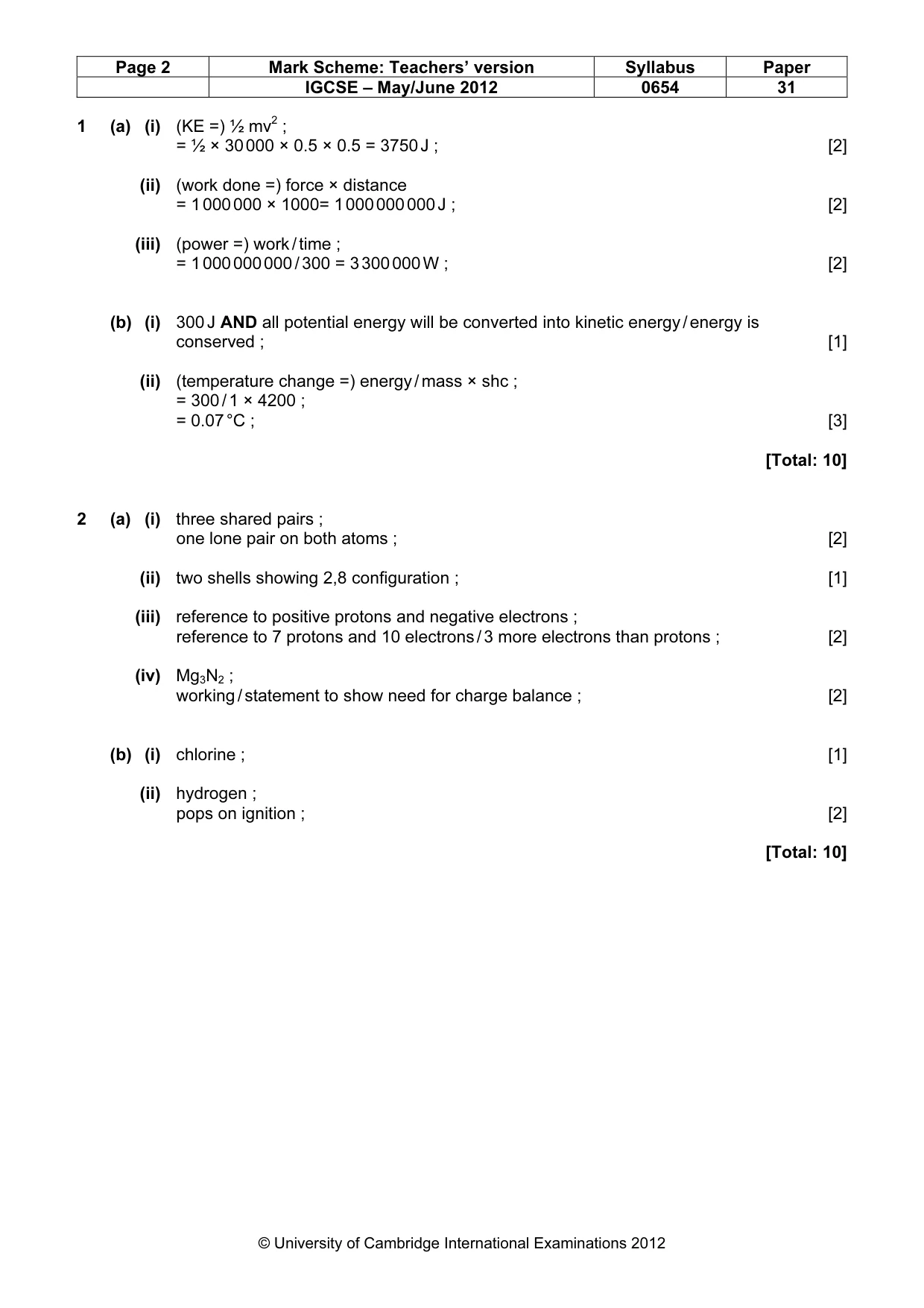
Page 2 Mark Scheme: Teachers’ version Syllabus Paper IGCSE – May/June 2012 0654 31 © University of Cambridge International Examinations 2012 1 (a) (i) (KE =) ½ mv2 ; = ½ × 30 000 × 0.5 × 0.5 = 3750 J ; [2] (ii) (work done =) force × distance = 1 000 000 × 1000= 1 000 000 000 J ; [2] (iii) (power =) work / time ; = 1 000 000 000 / 300 = 3 300 000 W ; [2] (b) (i) 300 J AND all potential energy will be converted into kinetic energy / energy is conserved ; [1] (ii) (temperature change =) energy / mass × shc ; = 300 / 1 × 4200 ; = 0.07 °C ; [3] [Total: 10] 2 (a) (i) three shared pairs ; one lone pair on both atoms ; [2] (ii) two shells showing 2,8 configuration ; [1] (iii) reference to positive protons and negative electrons ; reference to 7 protons and 10 electrons / 3 more electrons than protons ; [2] (iv) Mg3N2 ; working / statement to show need for charge balance ; [2] (b) (i) chlorine ; [1] (ii) hydrogen ; pops on ignition ; [2] [Total: 10]
Mark scheme, page 3
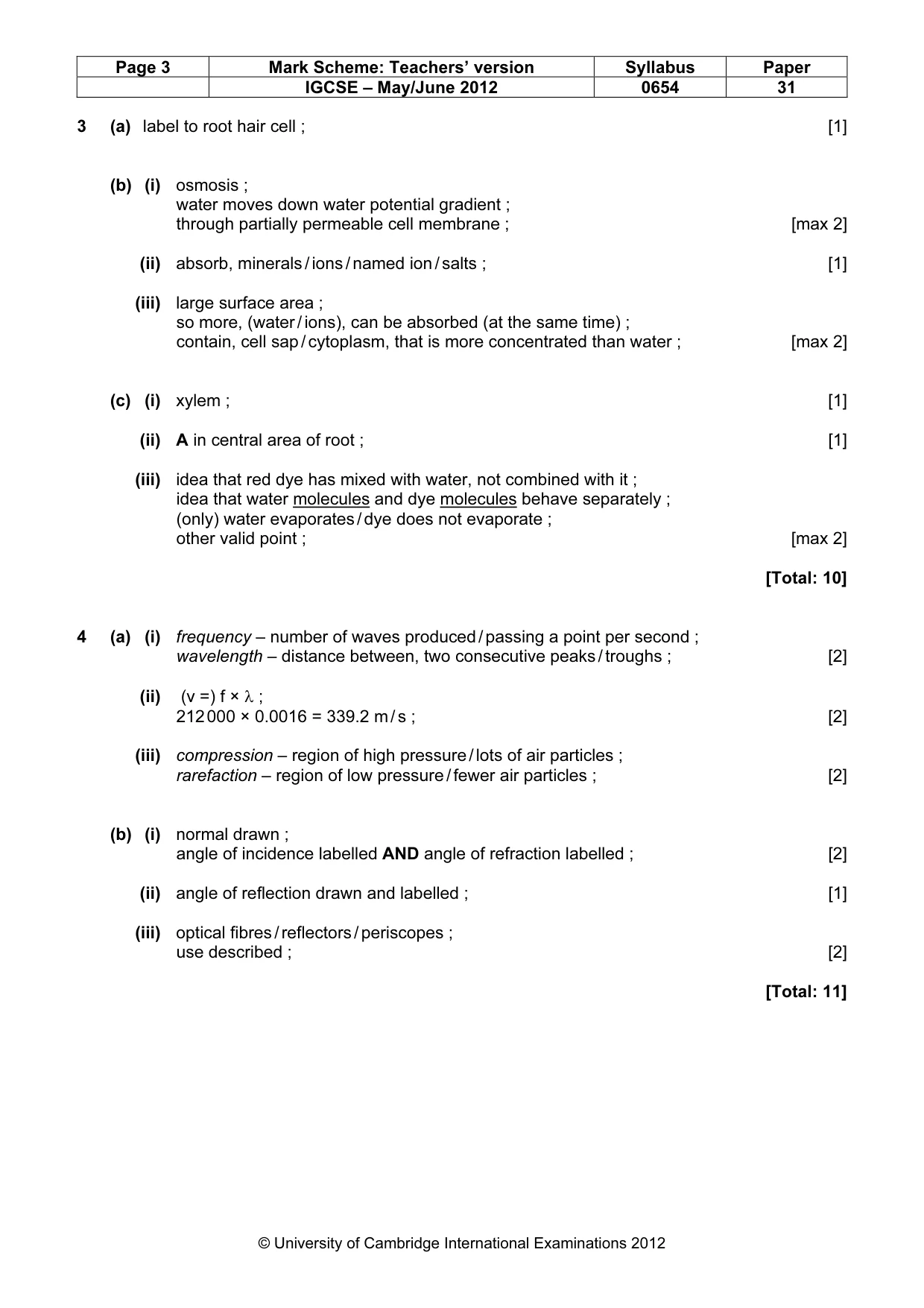
Page 3 Mark Scheme: Teachers’ version Syllabus Paper IGCSE – May/June 2012 0654 31 © University of Cambridge International Examinations 2012 3 (a) label to root hair cell ; [1] (b) (i) osmosis ; water moves down water potential gradient ; through partially permeable cell membrane ; [max 2] (ii) absorb, minerals / ions / named ion / salts ; [1] (iii) large surface area ; so more, (water / ions), can be absorbed (at the same time) ; contain, cell sap / cytoplasm, that is more concentrated than water ; [max 2] (c) (i) xylem ; [1] (ii) A in central area of root ; [1] (iii) idea that red dye has mixed with water, not combined with it ; idea that water molecules and dye molecules behave separately ; (only) water evaporates / dye does not evaporate ; other valid point ; [max 2] [Total: 10] 4 (a) (i) frequency – number of waves produced / passing a point per second ; wavelength – distance between, two consecutive peaks / troughs ; [2] (ii) (v =) f × λ ; 212 000 × 0.0016 = 339.2 m / s ; [2] (iii) compression – region of high pressure / lots of air particles ; rarefaction – region of low pressure / fewer air particles ; [2] (b) (i) normal drawn ; angle of incidence labelled AND angle of refraction labelled ; [2] (ii) angle of reflection drawn and labelled ; [1] (iii) optical fibres / reflectors / periscopes ; use described ; [2] [Total: 11]
Mark scheme, page 4
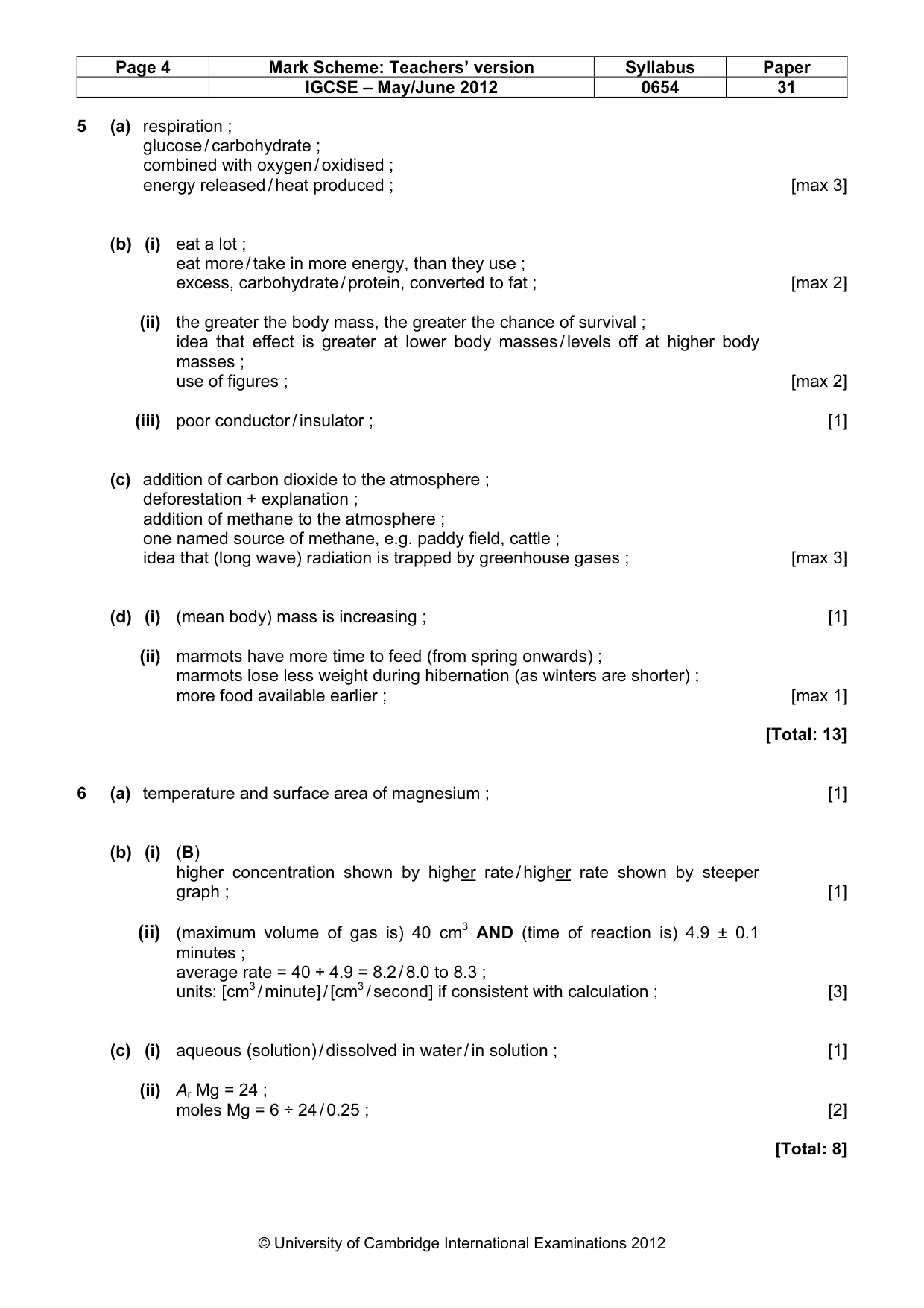
Page 4 Mark Scheme: Teachers’ version Syllabus Paper IGCSE – May/June 2012 0654 31 © University of Cambridge International Examinations 2012 5 (a) respiration ; glucose / carbohydrate ; combined with oxygen / oxidised ; energy released / heat produced ; [max 3] (b) (i) eat a lot ; eat more / take in more energy, than they use ; excess, carbohydrate / protein, converted to fat ; [max 2] (ii) the greater the body mass, the greater the chance of survival ; idea that effect is greater at lower body masses / levels off at higher body masses ; use of figures ; [max 2] (iii) poor conductor / insulator ; [1] (c) addition of carbon dioxide to the atmosphere ; deforestation + explanation ; addition of methane to the atmosphere ; one named source of methane, e.g. paddy field, cattle ; idea that (long wave) radiation is trapped by greenhouse gases ; [max 3] (d) (i) (mean body) mass is increasing ; [1] (ii) marmots have more time to feed (from spring onwards) ; marmots lose less weight during hibernation (as winters are shorter) ; more food available earlier ; [max 1] [Total: 13] 6 (a) temperature and surface area of magnesium ; [1] (b) (i) (B) higher concentration shown by higher rate / higher rate shown by steeper graph ; [1] (ii) (maximum volume of gas is) 40 cm3 AND (time of reaction is) 4.9 ± 0.1 minutes ; average rate = 40 ÷ 4.9 = 8.2 / 8.0 to 8.3 ; units: [cm3 / minute] / [cm3 / second] if consistent with calculation ; [3] (c) (i) aqueous (solution) / dissolved in water / in solution ; [1] (ii) Ar Mg = 24 ; moles Mg = 6 ÷ 24 / 0.25 ; [2] [Total: 8]
Mark scheme, page 5
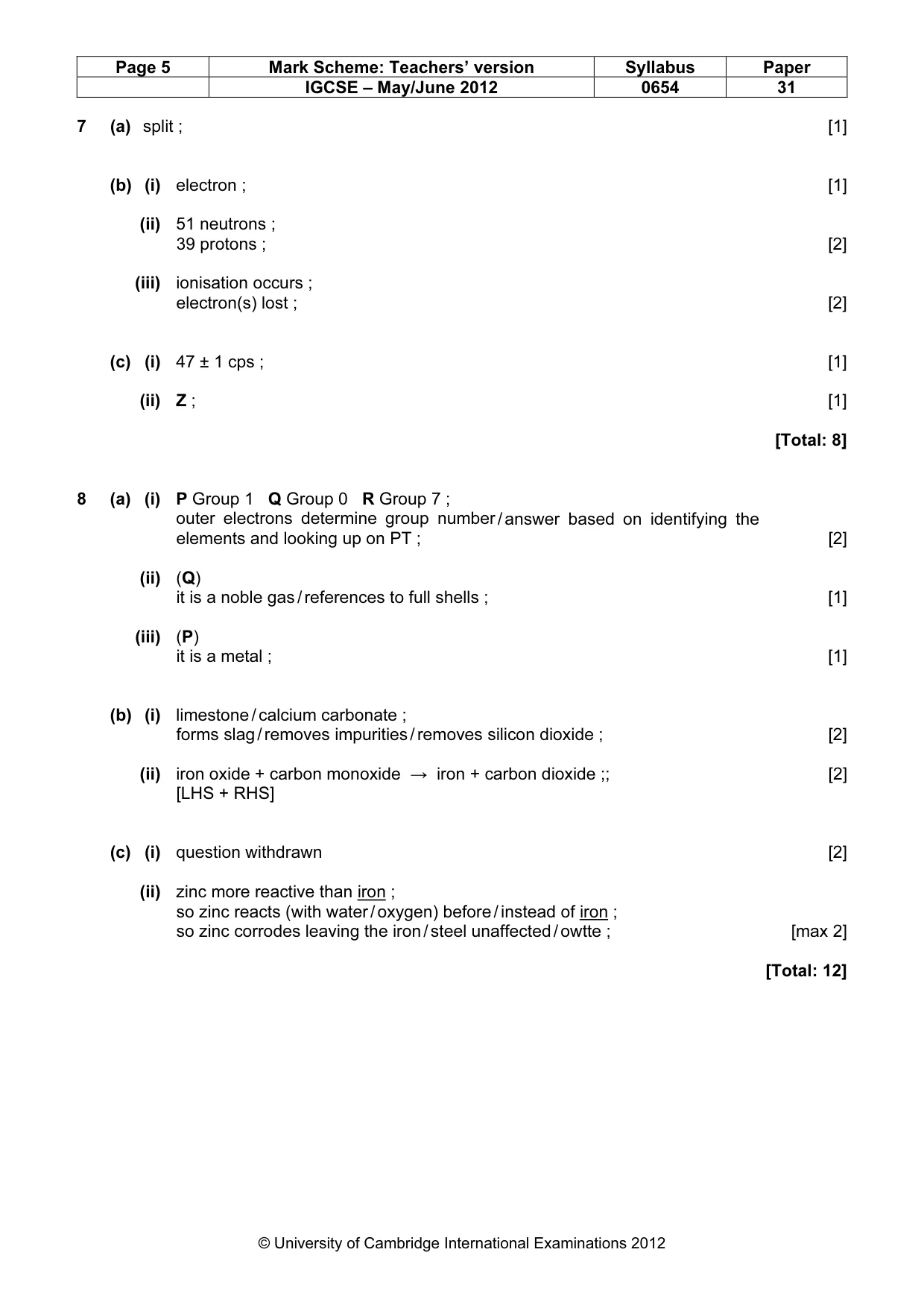
Page 5 Mark Scheme: Teachers’ version Syllabus Paper IGCSE – May/June 2012 0654 31 © University of Cambridge International Examinations 2012 7 (a) split ; [1] (b) (i) electron ; [1] (ii) 51 neutrons ; 39 protons ; [2] (iii) ionisation occurs ; electron(s) lost ; [2] (c) (i) 47 ± 1 cps ; [1] (ii) Z ; [1] [Total: 8] 8 (a) (i) P Group 1 Q Group 0 R Group 7 ; outer electrons determine group number / answer based on identifying the elements and looking up on PT ; [2] (ii) (Q) it is a noble gas / references to full shells ; [1] (iii) (P) it is a metal ; [1] (b) (i) limestone / calcium carbonate ; forms slag / removes impurities / removes silicon dioxide ; [2] (ii) iron oxide + carbon monoxide → iron + carbon dioxide ;; [2] [LHS + RHS] (c) (i) question withdrawn [2] (ii) zinc more reactive than iron ; so zinc reacts (with water / oxygen) before / instead of iron ; so zinc corrodes leaving the iron / steel unaffected / owtte ; [max 2] [Total: 12]
Mark scheme, page 6
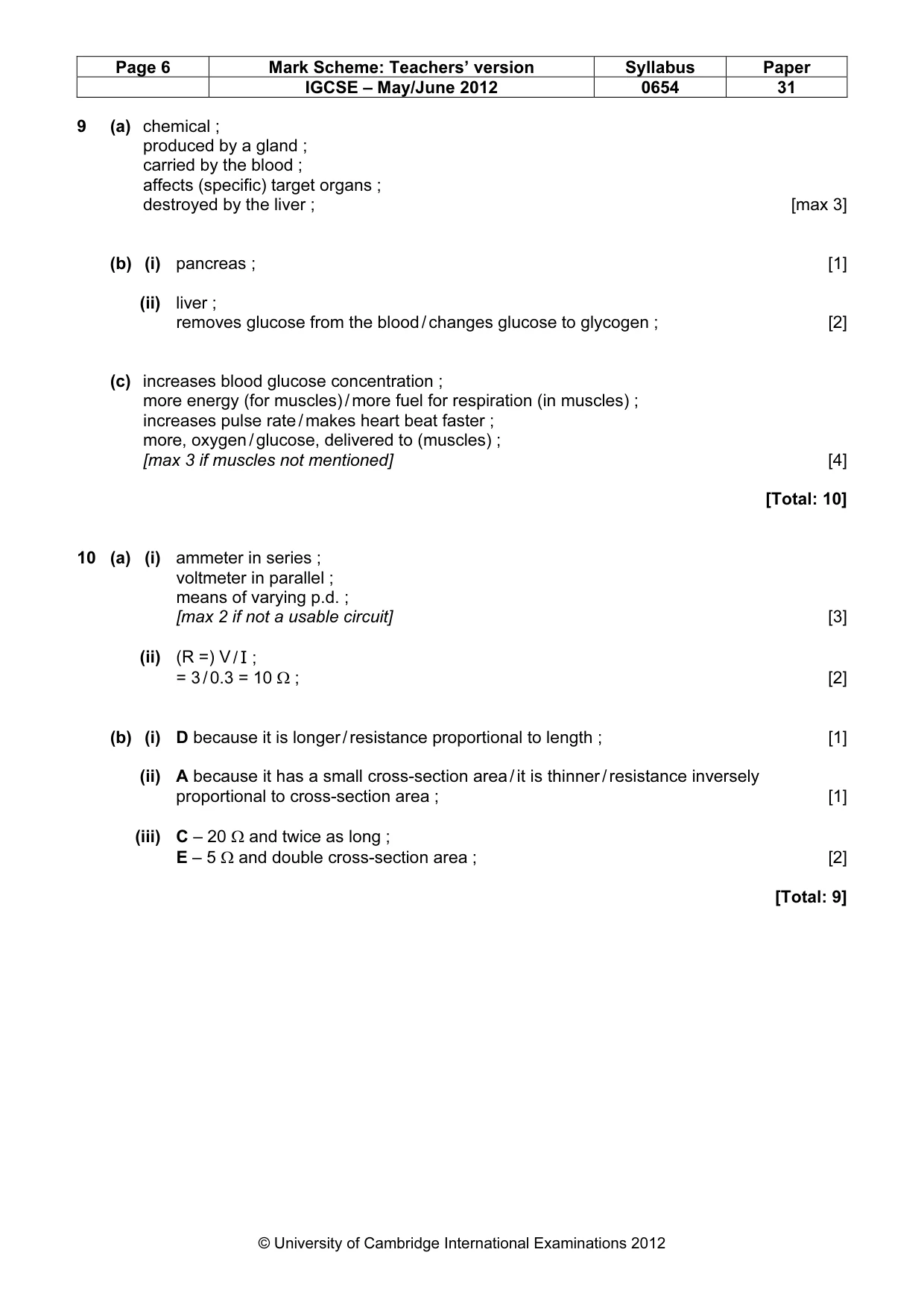
Page 6 Mark Scheme: Teachers’ version Syllabus Paper IGCSE – May/June 2012 0654 31 © University of Cambridge International Examinations 2012 9 (a) chemical ; produced by a gland ; carried by the blood ; affects (specific) target organs ; destroyed by the liver ; [max 3] (b) (i) pancreas ; [1] (ii) liver ; removes glucose from the blood / changes glucose to glycogen ; [2] (c) increases blood glucose concentration ; more energy (for muscles) / more fuel for respiration (in muscles) ; increases pulse rate / makes heart beat faster ; more, oxygen / glucose, delivered to (muscles) ; [max 3 if muscles not mentioned] [4] [Total: 10] 10 (a) (i) ammeter in series ; voltmeter in parallel ; means of varying p.d. ; [max 2 if not a usable circuit] [3] (ii) (R =) V / I ; = 3 / 0.3 = 10 Ω ; [2] (b) (i) D because it is longer / resistance proportional to length ; [1] (ii) A because it has a small cross-section area / it is thinner / resistance inversely proportional to cross-section area ; [1] (iii) C – 20 Ω and twice as long ; E – 5 Ω and double cross-section area ; [2] [Total: 9]
Mark scheme, page 7
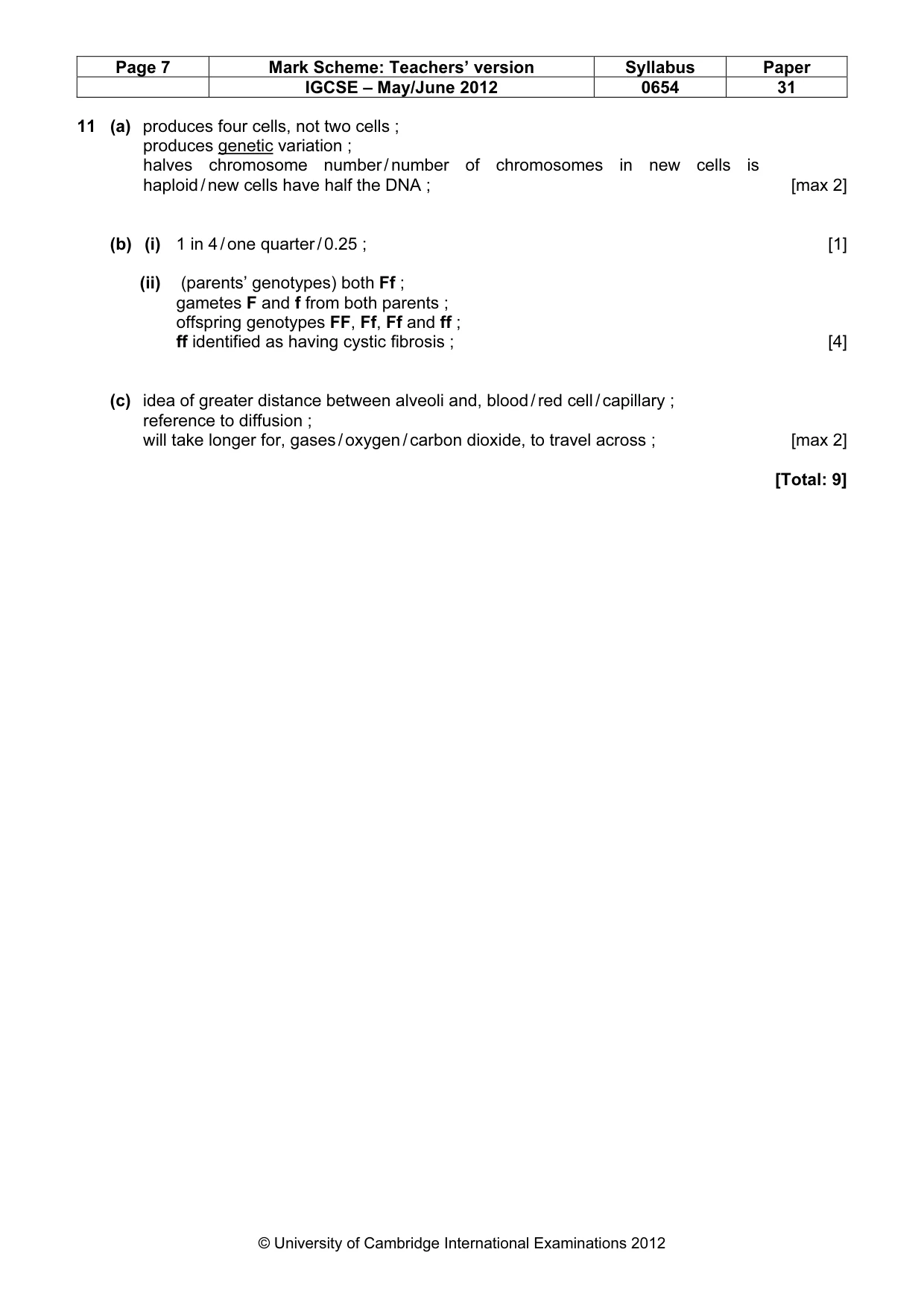
Page 7 Mark Scheme: Teachers’ version Syllabus Paper IGCSE – May/June 2012 0654 31 © University of Cambridge International Examinations 2012 11 (a) produces four cells, not two cells ; produces genetic variation ; halves chromosome number / number of chromosomes in new cells is haploid / new cells have half the DNA ; [max 2] (b) (i) 1 in 4 / one quarter / 0.25 ; [1] (ii) (parents’ genotypes) both Ff ; gametes F and f from both parents ; offspring genotypes FF, Ff, Ff and ff ; ff identified as having cystic fibrosis ; [4] (c) idea of greater distance between alveoli and, blood / red cell / capillary ; reference to diffusion ; will take longer for, gases / oxygen / carbon dioxide, to travel across ; [max 2] [Total: 9]
Mark scheme, page 8
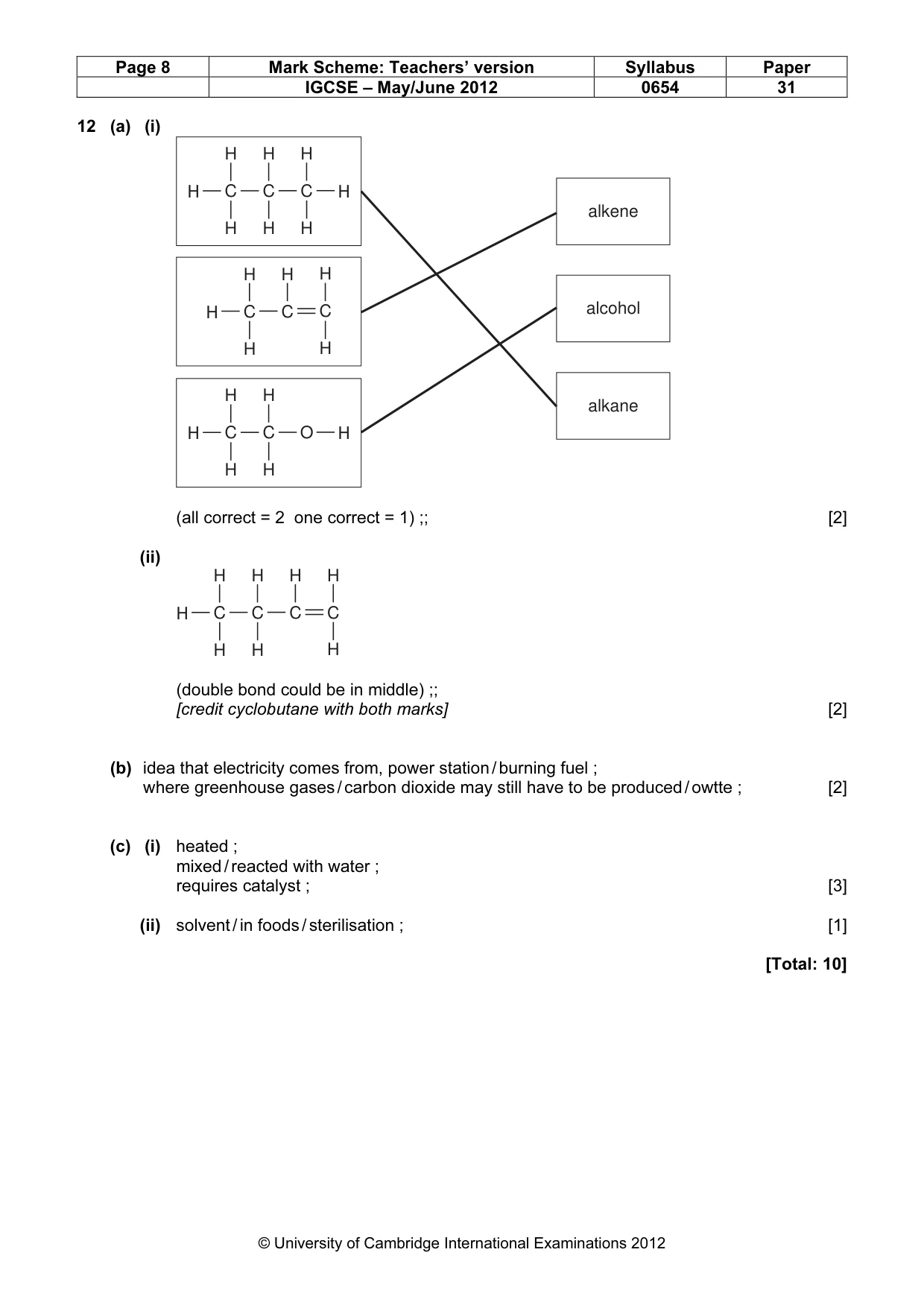
Page 8 Mark Scheme: Teachers’ version Syllabus Paper IGCSE – May/June 2012 0654 31 © University of Cambridge International Examinations 2012 12 (a) (i) H C H H C H H H C H H H C H H C H H C H H C H H C H H O H alkene alcohol alkane (all correct = 2 one correct = 1) ;; [2] (ii) H C H H C H C H H H C H (double bond could be in middle) ;; [credit cyclobutane with both marks] [2] (b) idea that electricity comes from, power station / burning fuel ; where greenhouse gases / carbon dioxide may still have to be produced / owtte ; [2] (c) (i) heated ; mixed / reacted with water ; requires catalyst ; [3] (ii) solvent / in foods / sterilisation ; [1] [Total: 10]
What you needed in this session
Cambridge’s own grade thresholds for 2012 May/June, Paper 3 · Variant 1. A higher threshold means an easier paper — the bar moves with how the cohort did.