Cambridge IGCSE Sciences - Co-ordinated (Double) 0654 — 2011 Oct/Nov Paper 3 · Variant 2
0654/32/O/N/11 · 100 marks · ≈113 min
The question paper and its mark scheme, free to read here and free to download. This is Cambridge’s own paper, exactly as it was sat.
Question paper24 pages


Mark scheme6 pages
Answers below. Sit the paper first if you are practising.
Paper as text
Question paper, page 1
This document consists of 22 printed pages and 2 blank pages. IB11 11_0654_32/5RP © UCLES 2011 [Turn over *4362952058* For Examiner's Use 1 2 3 4 5 6 7 8 9 Total UNIVERSITY OF CAMBRIDGE INTERNATIONAL EXAMINATIONS International General Certificate of Secondary Education CO-ORDINATED SCIENCES 0654/32 Paper 3 (Extended) October/November 2011 2 hours Candidates answer on the Question Paper. No Additional Materials are required. READ THESE INSTRUCTIONS FIRST Write your Centre number, candidate number and name on all the work you hand in. Write in dark blue or black pen. You may use a soft pencil for any diagrams, graphs, tables or rough working. Do not use staples, paper clips, highlighters, glue or correction fluid. DO NOT WRITE IN ANY BARCODES. Answer all questions. A copy of the Periodic Table is printed on page 24. At the end of the examination, fasten all your work securely together. The number of marks is given in brackets [ ] at the end of each question or part question. www.XtremePapers.com
Question paper, page 2
2 © UCLES 2011 0654/32/O/N/11 For Examiner's Use 1 Houseflies are common insect pests. Fig. 1.1 shows a housefly. Fig. 1.1 (a) On Fig. 1.1, label and name two features that are characteristic of insects. [2] (b) Houseflies feed by spitting saliva onto food, such as meat. Enzymes in the saliva turn insoluble substances into soluble ones. The flies can then suck up the liquid into their digestive system. (i) Suggest one enzyme in a housefly's saliva that could digest a substance in meat. [1] (ii) State the soluble product or products that this enzyme would produce. [1] (c) Houseflies spread diseases such as typhoid fever. They leave harmful microorganisms on food that will later be eaten by a person. Describe two ways in which white blood cells can destroy microorganisms that have entered a person's body. 1 2 [2] (d) When a housefly flies, its wings produce a buzzing sound. (i) Suggest how a movement such as that of a fly's wings produces sound. [2]
Question paper, page 3
3 © UCLES 2011 0654/32/O/N/11 [Turn over For Examiner's Use (ii) A housefly beats its wings about 200 times per second. A midge (a small insect) beats its wings about 1000 times per second. State and explain how the sound produced by a flying midge will differ from the sound produced by a flying housefly. [2]
Question paper, page 4
4 © UCLES 2011 0654/32/O/N/11 For Examiner's Use 2 Nordic gold is an alloy of four metals used to make coins. Table 2.1 shows information about the metals contained in Nordic gold. Table 2.1 metal % by mass in Nordic gold compound from which the metal is extracted aluminium 5 Al2O3 copper 89 CuFeS2 tin 1 SnO2 zinc 5 ZnS (a) Nordic gold has properties which make it suitable for making coins. Suggest one property Nordic gold is likely to have, other than its appearance, that makes it suitable for making coins. Explain briefly why this property is important. property importance [2] (b) The method used to extract a metal from its compounds depends on the reactivity of the metal. (i) Tin may be extracted from tin oxide, SnO2, by heating a mixture of tin oxide and carbon. The other product of this reaction is carbon monoxide, CO. Construct a balanced, symbolic equation for this reaction. [2]
Question paper, page 5
5 © UCLES 2011 0654/32/O/N/11 [Turn over For Examiner's Use (ii) When aluminium oxide is heated with carbon, no reaction occurs. Explain why it is possible to extract tin but not aluminium by heating their oxides with carbon. [2] (iii) Aluminium is extracted from the insoluble compound aluminium oxide by electrolysis. Outline the stages by which aluminium oxide, containing aluminium ions, is converted into metallic aluminium, containing aluminium atoms, using electrolysis. [3] (c) A coin made of Nordic gold has a mass of 7.80 g. Calculate the number of moles of copper in the coin. Show your working. [2]
Question paper, page 6
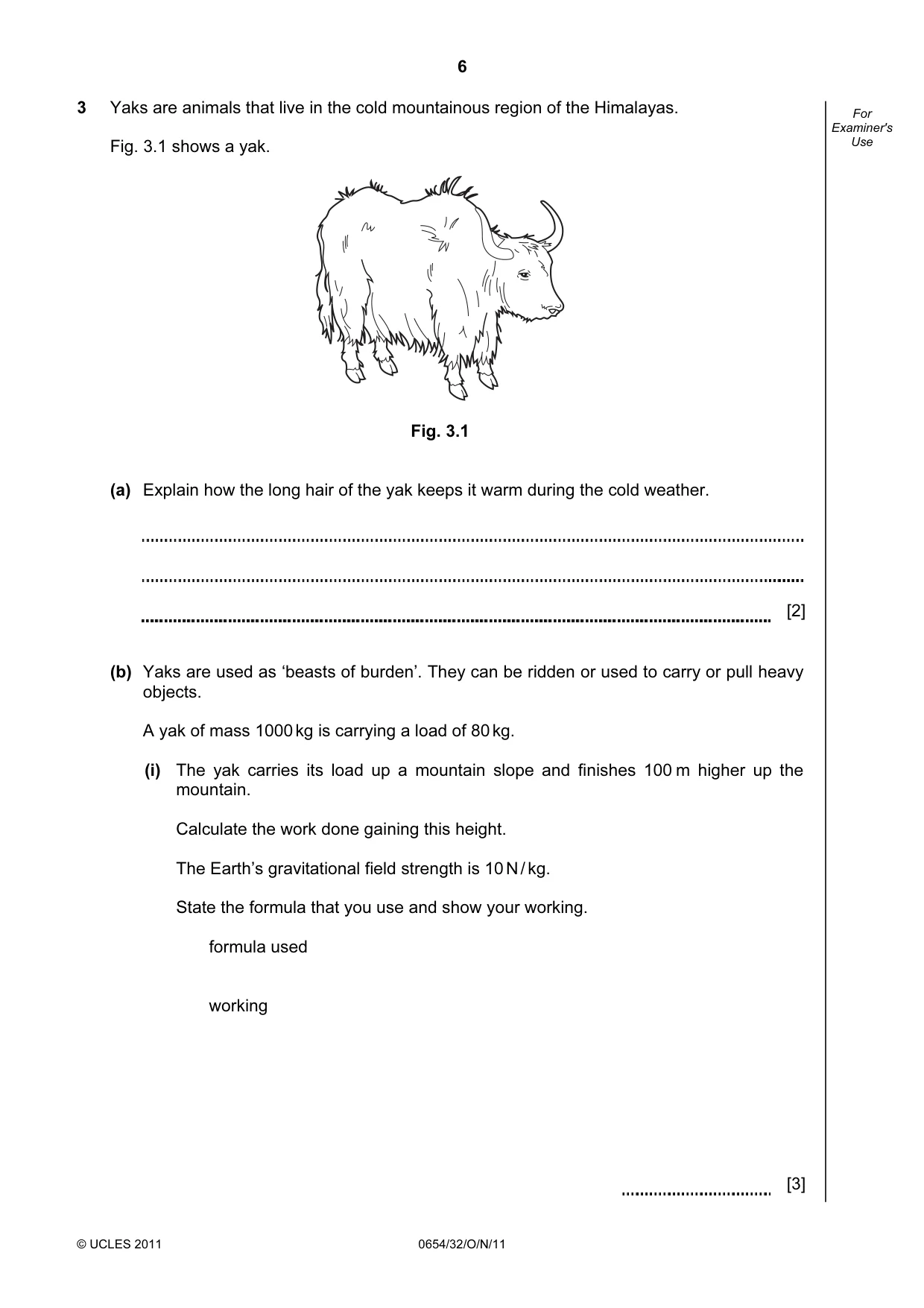
6 © UCLES 2011 0654/32/O/N/11 For Examiner's Use 3 Yaks are animals that live in the cold mountainous region of the Himalayas. Fig. 3.1 shows a yak. Fig. 3.1 (a) Explain how the long hair of the yak keeps it warm during the cold weather. [2] (b) Yaks are used as ‘beasts of burden’. They can be ridden or used to carry or pull heavy objects. A yak of mass 1000 kg is carrying a load of 80 kg. (i) The yak carries its load up a mountain slope and finishes 100 m higher up the mountain. Calculate the work done gaining this height. The Earth’s gravitational field strength is 10 N / kg. State the formula that you use and show your working. formula used working [3]
Question paper, page 7
7 © UCLES 2011 0654/32/O/N/11 [Turn over For Examiner's Use (ii) While the yak is carrying the load, it travels at a speed of 0.2 m / s. Calculate the kinetic energy of the yak and its load at this time. State the formula that you use and show your working. formula used working [2] (c) A yak has a mass of 1000 kg. It has four feet, each of area 300 cm2. Calculate the average pressure that the yak exerts on the ground. State the formula that you use and show your working. formula used working [3]
Question paper, page 8
8 © UCLES 2011 0654/32/O/N/11 BLANK PAGE
Question paper, page 9
9 © UCLES 2011 0654/32/O/N/11 [Turn over For Examiner's Use 4 Hydrocarbons are compounds which contain only the elements hydrogen and carbon. (a) The simplest hydrocarbon is methane, CH4, which is an important fuel. (i) State two natural sources of methane. 1 2 [2] (ii) A free (unbonded) carbon atom has four electrons in its outer shell. State the number, and describe the arrangement, of the electrons in the outer shell of a carbon atom in a methane molecule. You may wish to draw a diagram to help you answer this question. [2]
Question paper, page 10
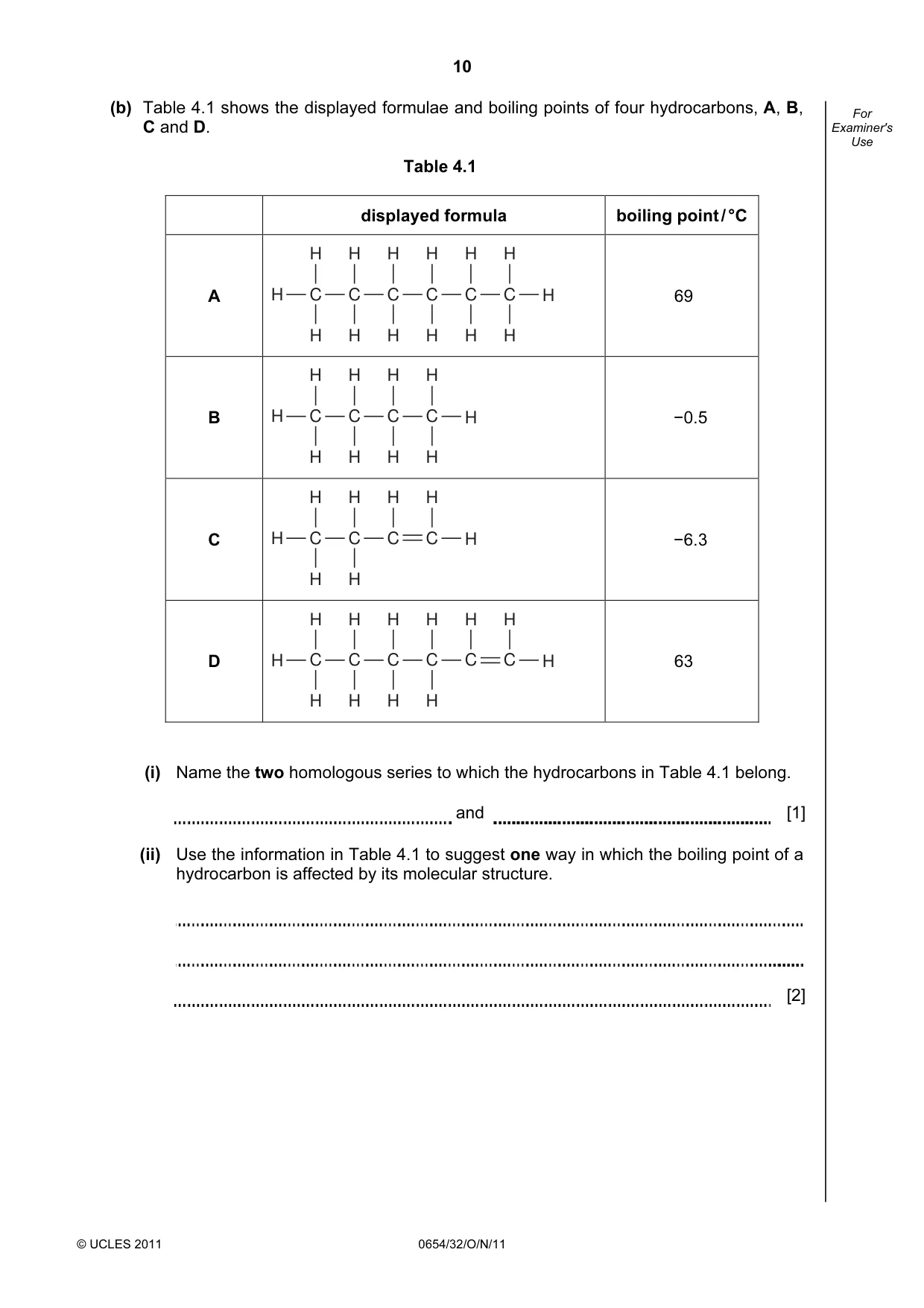
10 © UCLES 2011 0654/32/O/N/11 For Examiner's Use (b) Table 4.1 shows the displayed formulae and boiling points of four hydrocarbons, A, B, C and D. Table 4.1 displayed formula boiling point / °C A H C H H C H H C H H H C H H H C H H C H 69 B H H C H H C H H H C H H C H −0.5 C H C H C H C H H H C H H −6.3 D H C H C H C H H H C H H H C H H C H 63 (i) Name the two homologous series to which the hydrocarbons in Table 4.1 belong. and [1] (ii) Use the information in Table 4.1 to suggest one way in which the boiling point of a hydrocarbon is affected by its molecular structure. [2]
Question paper, page 11
11 © UCLES 2011 0654/32/O/N/11 [Turn over For Examiner's Use (iii) A bottle contains a colourless liquid which is thought to be either hydrocarbon A or D. Describe a chemical test, and its result, which could be used to identify which hydrocarbon is in the bottle. Explain your choice of test. [3]
Question paper, page 12
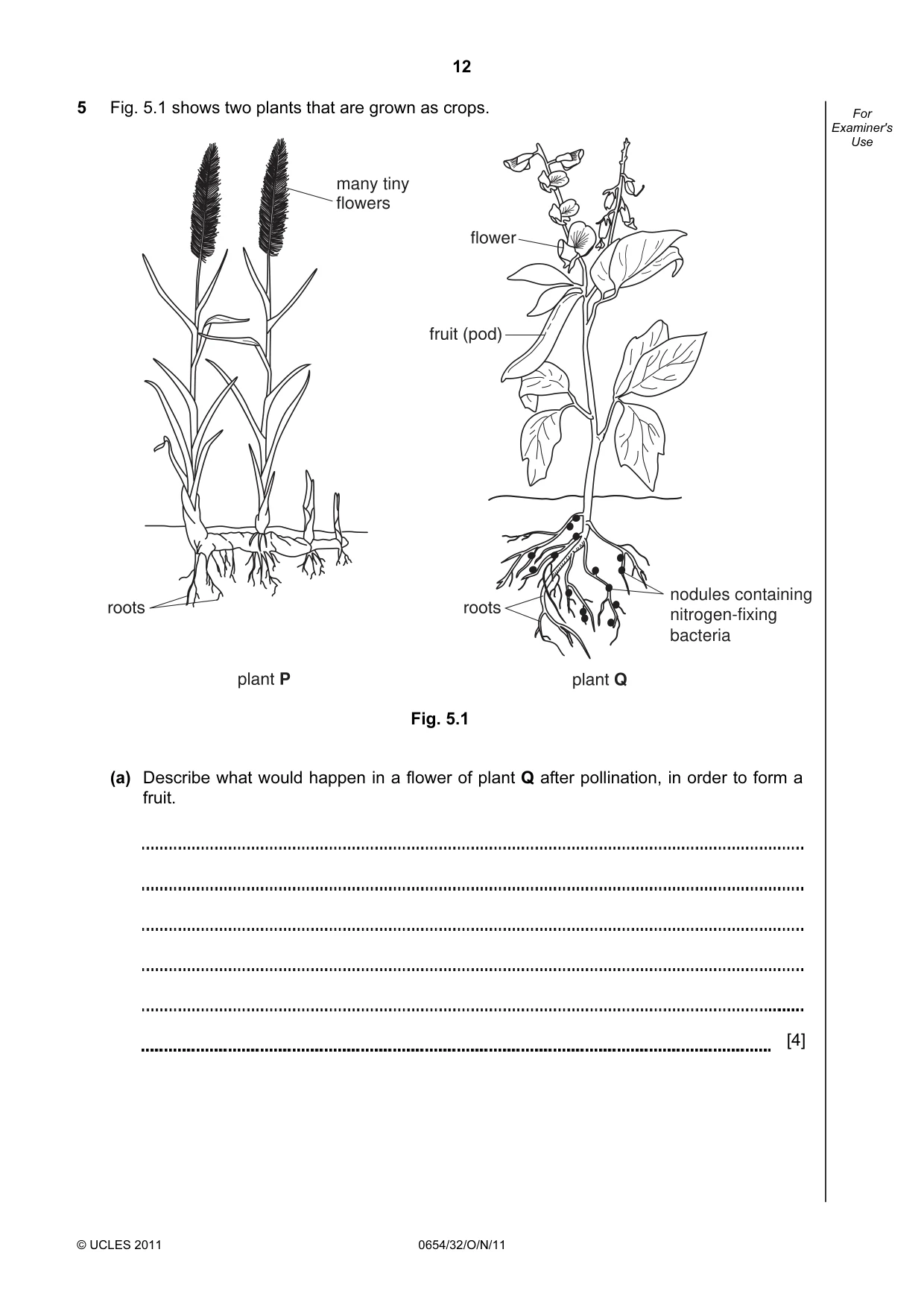
12 © UCLES 2011 0654/32/O/N/11 For Examiner's Use 5 Fig. 5.1 shows two plants that are grown as crops. many tiny nodules containing nitrogen-fixing bacteria Fig. 5.1 (a) Describe what would happen in a flower of plant Q after pollination, in order to form a fruit. [4]
Question paper, page 13
13 © UCLES 2011 0654/32/O/N/11 [Turn over For Examiner's Use (b) Farmers often add fertilisers containing nitrates to the soil where they grow crops. (i) Explain why this is done. [2] (ii) Explain why fields in which plant Q is growing would require less nitrate fertiliser than fields in which plant P is growing. [2] (iii) Explain why using large amounts of nitrate fertiliser near a river could cause harm to the environment. [3]
Question paper, page 14
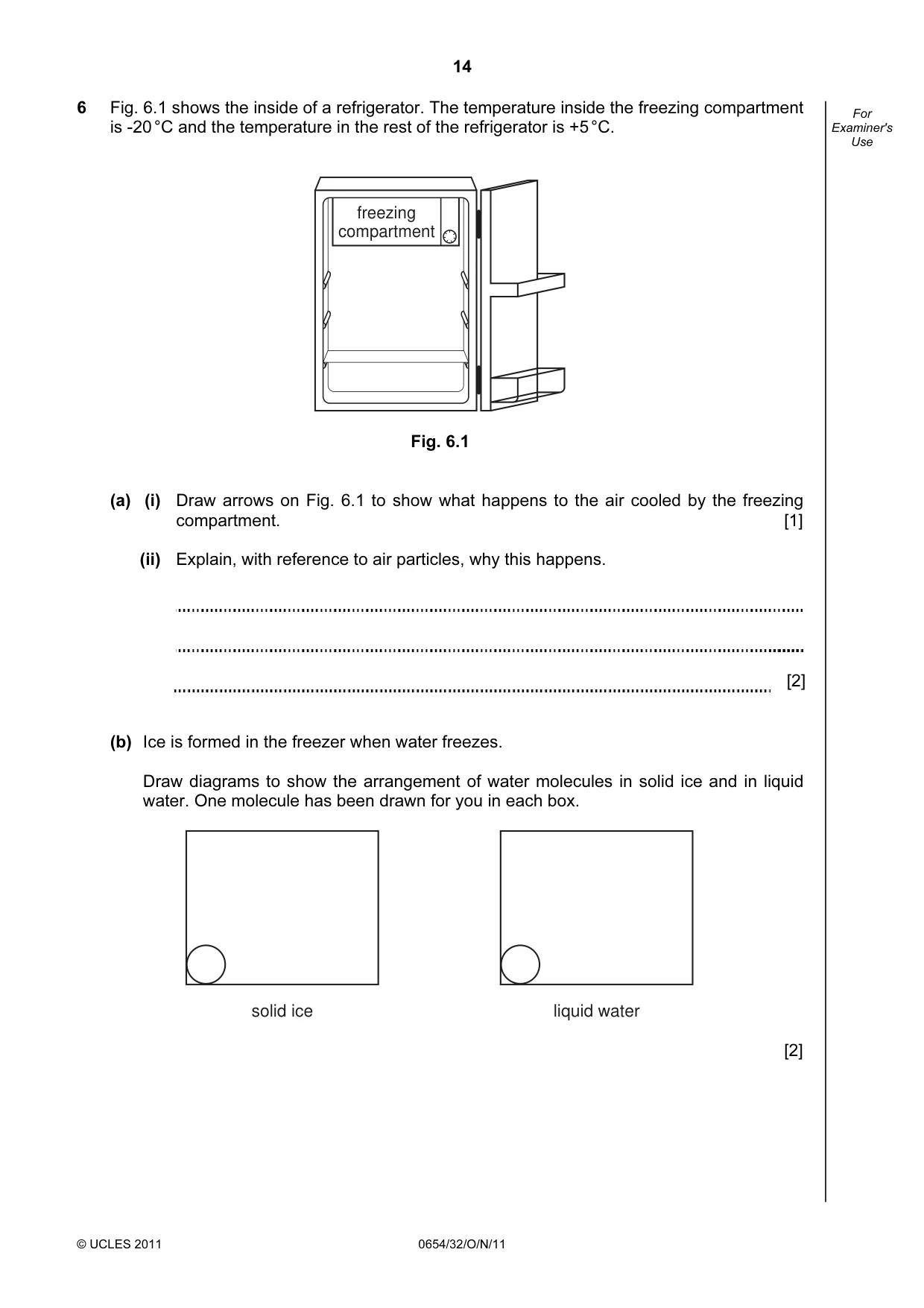
14 © UCLES 2011 0654/32/O/N/11 For Examiner's Use 6 Fig. 6.1 shows the inside of a refrigerator. The temperature inside the freezing compartment is -20 °C and the temperature in the rest of the refrigerator is +5 °C. freezing compartment Fig. 6.1 (a) (i) Draw arrows on Fig. 6.1 to show what happens to the air cooled by the freezing compartment. [1] (ii) Explain, with reference to air particles, why this happens. [2] (b) Ice is formed in the freezer when water freezes. Draw diagrams to show the arrangement of water molecules in solid ice and in liquid water. One molecule has been drawn for you in each box. solid ice liquid water [2]
Question paper, page 15
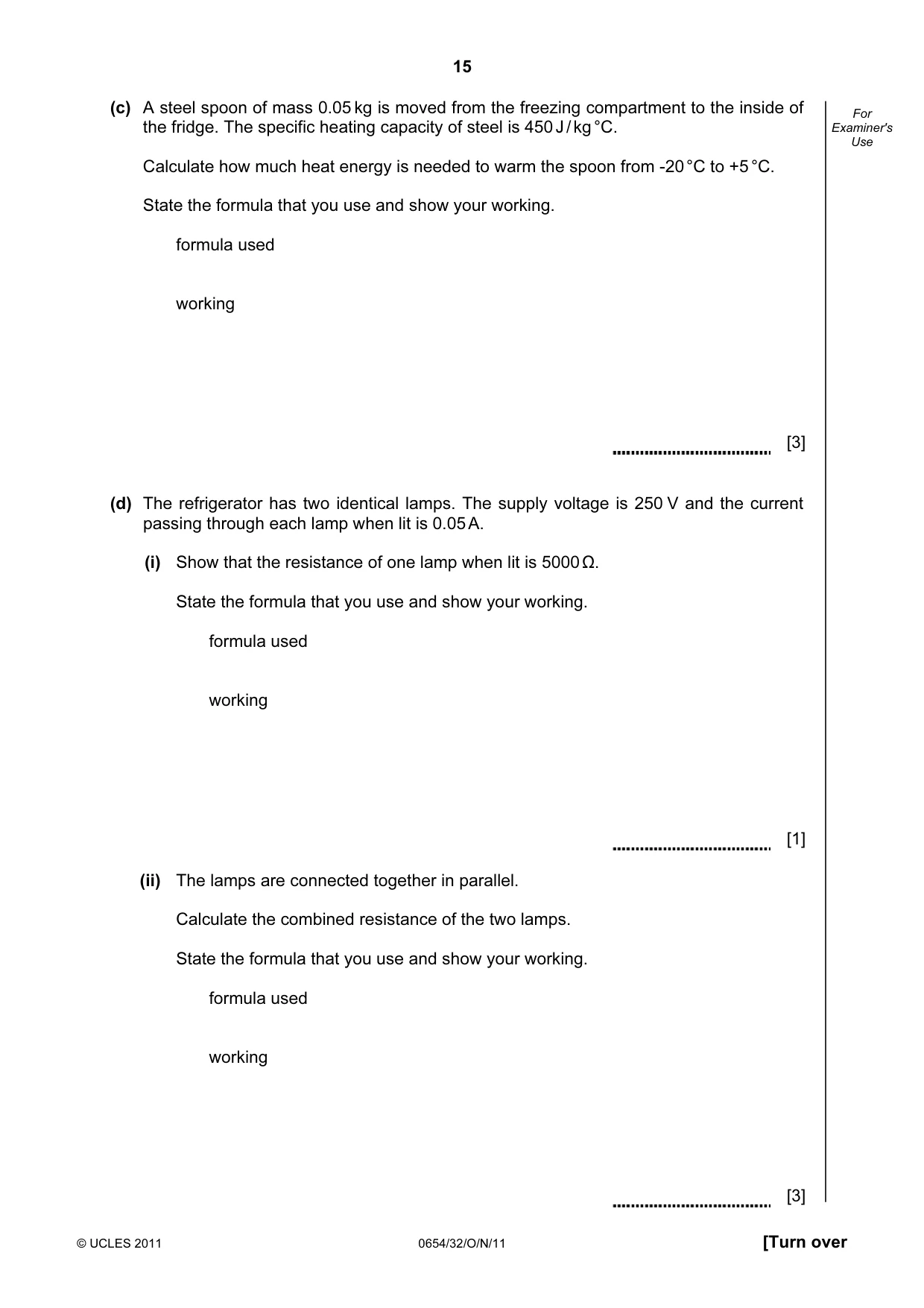
15 © UCLES 2011 0654/32/O/N/11 [Turn over For Examiner's Use (c) A steel spoon of mass 0.05 kg is moved from the freezing compartment to the inside of the fridge. The specific heating capacity of steel is 450 J / kg °C. Calculate how much heat energy is needed to warm the spoon from -20 °C to +5 °C. State the formula that you use and show your working. formula used working [3] (d) The refrigerator has two identical lamps. The supply voltage is 250 V and the current passing through each lamp when lit is 0.05 A. (i) Show that the resistance of one lamp when lit is 5000 Ω. State the formula that you use and show your working. formula used working [1] (ii) The lamps are connected together in parallel. Calculate the combined resistance of the two lamps. State the formula that you use and show your working. formula used working [3]
Question paper, page 16
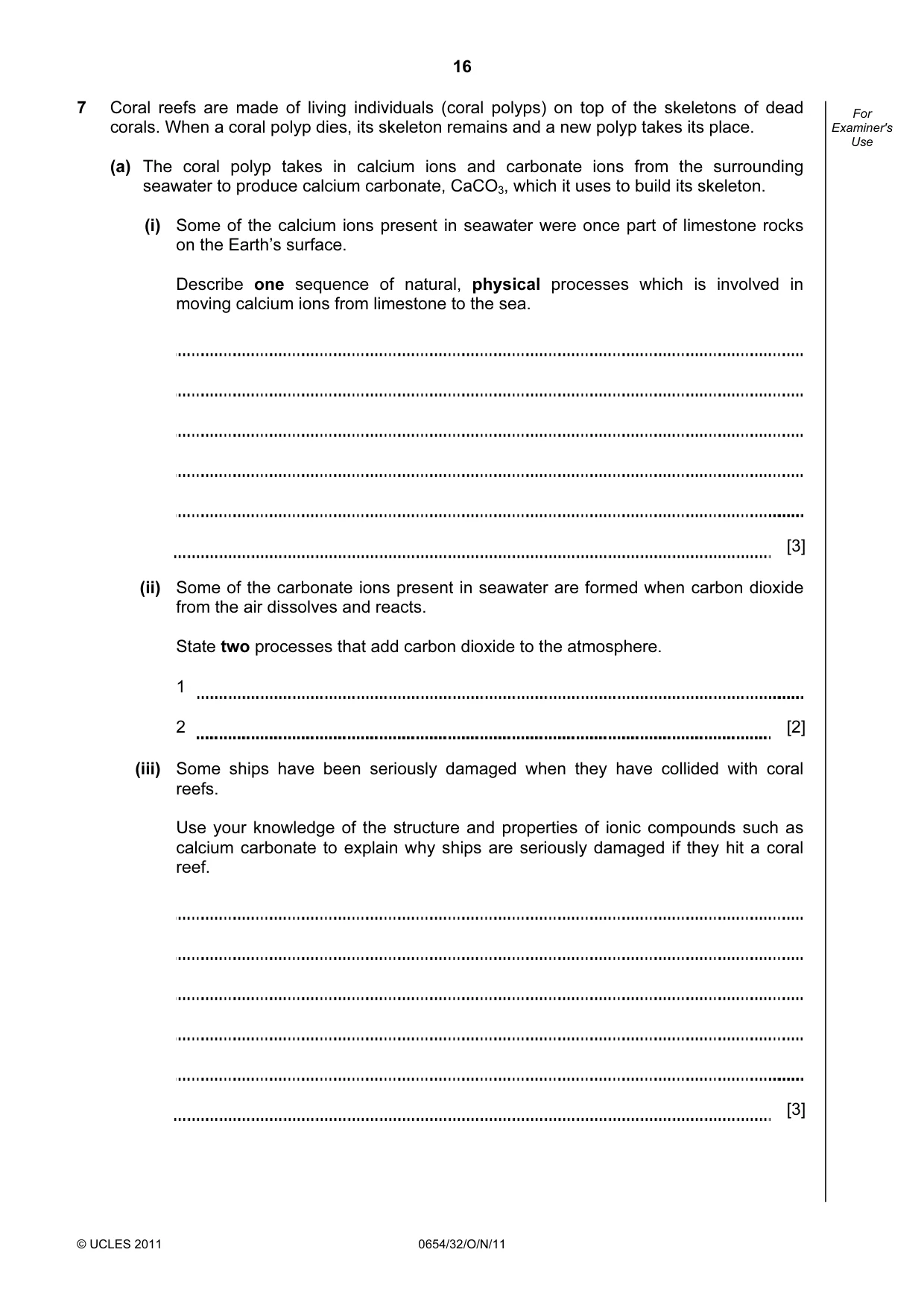
16 © UCLES 2011 0654/32/O/N/11 For Examiner's Use 7 Coral reefs are made of living individuals (coral polyps) on top of the skeletons of dead corals. When a coral polyp dies, its skeleton remains and a new polyp takes its place. (a) The coral polyp takes in calcium ions and carbonate ions from the surrounding seawater to produce calcium carbonate, CaCO3, which it uses to build its skeleton. (i) Some of the calcium ions present in seawater were once part of limestone rocks on the Earth’s surface. Describe one sequence of natural, physical processes which is involved in moving calcium ions from limestone to the sea. [3] (ii) Some of the carbonate ions present in seawater are formed when carbon dioxide from the air dissolves and reacts. State two processes that add carbon dioxide to the atmosphere. 1 2 [2] (iii) Some ships have been seriously damaged when they have collided with coral reefs. Use your knowledge of the structure and properties of ionic compounds such as calcium carbonate to explain why ships are seriously damaged if they hit a coral reef. [3]
Question paper, page 17
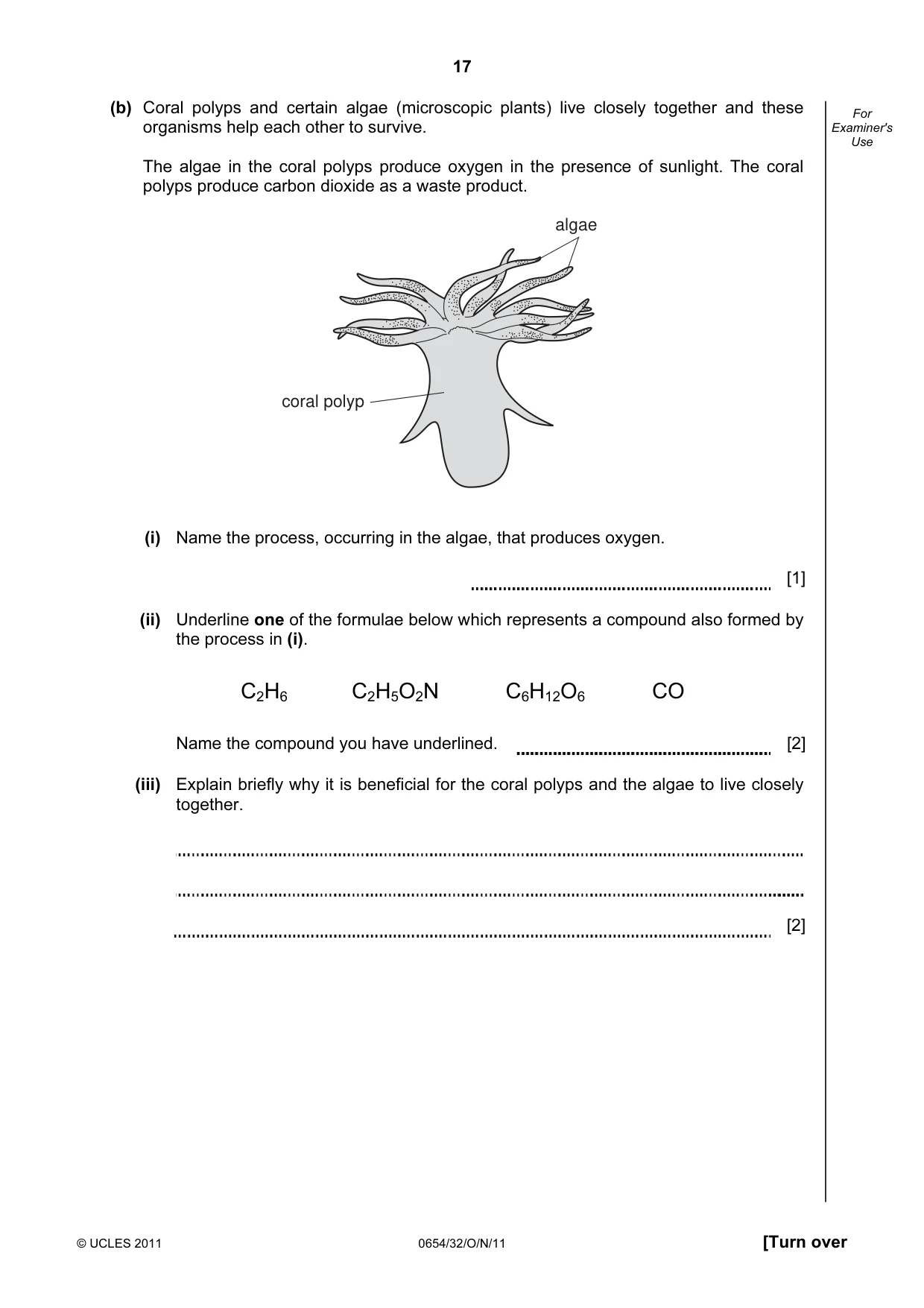
17 © UCLES 2011 0654/32/O/N/11 [Turn over For Examiner's Use (b) Coral polyps and certain algae (microscopic plants) live closely together and these organisms help each other to survive. The algae in the coral polyps produce oxygen in the presence of sunlight. The coral polyps produce carbon dioxide as a waste product. coral polyp algae (i) Name the process, occurring in the algae, that produces oxygen. [1] (ii) Underline one of the formulae below which represents a compound also formed by the process in (i). C2H6 C2H5O2N C6H12O6 CO Name the compound you have underlined. [2] (iii) Explain briefly why it is beneficial for the coral polyps and the algae to live closely together. [2]
Question paper, page 18
18 © UCLES 2011 0654/32/O/N/11 For Examiner's Use (c) In recent years, the amount of carbon dioxide in the atmosphere has increased. This has contributed to a decrease in the average pH of seawater. During this period, the growth rate of many coral reefs has significantly decreased, and many others are no longer part of a successful ecosystem. (i) Explain why increased levels of carbon dioxide in the atmosphere cause the average pH of seawater to decrease. [2] (ii) Suggest a possible reason why a decrease in the average pH of seawater could damage coral reefs. [1]
Question paper, page 19
19 © UCLES 2011 0654/32/O/N/11 [Turn over BLANK PAGE Please turn over for Question 8.
Question paper, page 20
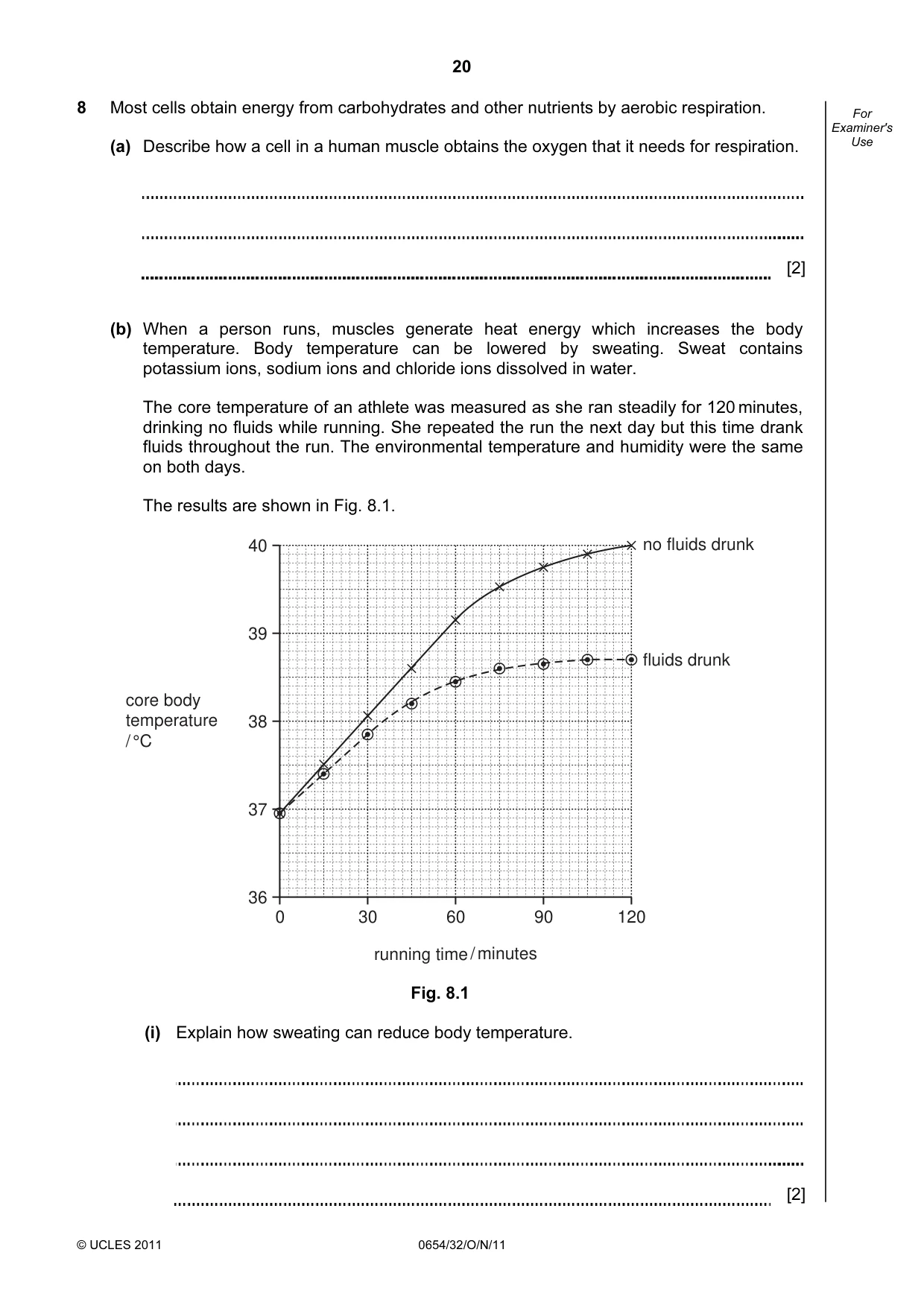
20 © UCLES 2011 0654/32/O/N/11 For Examiner's Use 8 Most cells obtain energy from carbohydrates and other nutrients by aerobic respiration. (a) Describe how a cell in a human muscle obtains the oxygen that it needs for respiration. [2] (b) When a person runs, muscles generate heat energy which increases the body temperature. Body temperature can be lowered by sweating. Sweat contains potassium ions, sodium ions and chloride ions dissolved in water. The core temperature of an athlete was measured as she ran steadily for 120 minutes, drinking no fluids while running. She repeated the run the next day but this time drank fluids throughout the run. The environmental temperature and humidity were the same on both days. The results are shown in Fig. 8.1. 0 30 60 90 120 40 39 38 37 36 running time / minutes core body temperature / °C no fluids drunk fluids drunk Fig. 8.1 (i) Explain how sweating can reduce body temperature. [2]
Question paper, page 21
21 © UCLES 2011 0654/32/O/N/11 [Turn over For Examiner's Use (ii) Compare the body temperature of the athlete when she ran without drinking fluids to her body temperature when she ran while drinking fluids. [2] (iii) Suggest an explanation for the differences you have described in (ii). [2] (iv) During a long run, athletes prefer to drink fluids containing glucose, potassium ions, sodium ions and chloride ions rather than pure water. Suggest how this can help them to perform better. [2]
Question paper, page 22
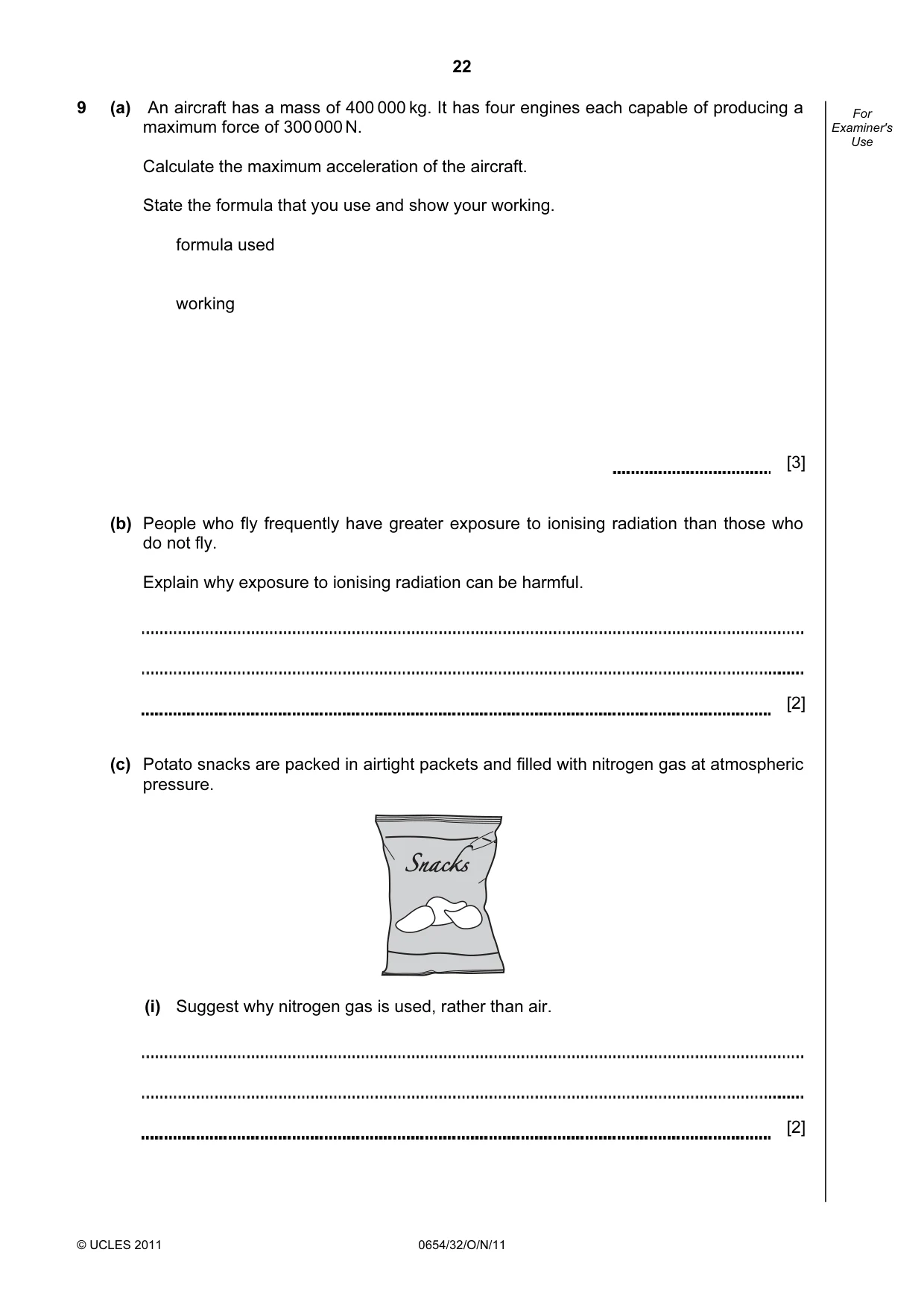
22 © UCLES 2011 0654/32/O/N/11 For Examiner's Use 9 (a) An aircraft has a mass of 400 000 kg. It has four engines each capable of producing a maximum force of 300 000 N. Calculate the maximum acceleration of the aircraft. State the formula that you use and show your working. formula used working [3] (b) People who fly frequently have greater exposure to ionising radiation than those who do not fly. Explain why exposure to ionising radiation can be harmful. [2] (c) Potato snacks are packed in airtight packets and filled with nitrogen gas at atmospheric pressure. (i) Suggest why nitrogen gas is used, rather than air. [2]
Question paper, page 23
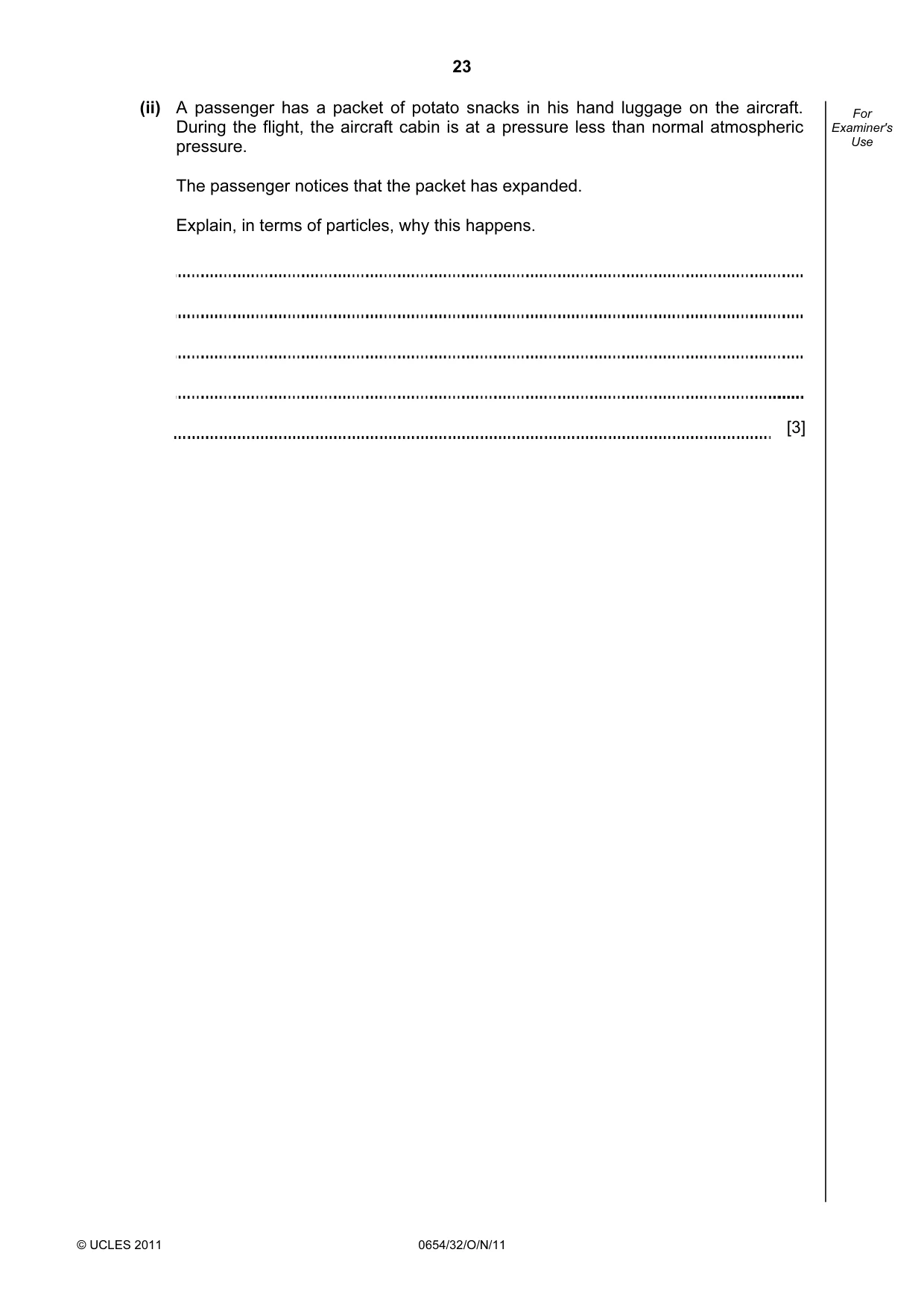
23 © UCLES 2011 0654/32/O/N/11 For Examiner's Use (ii) A passenger has a packet of potato snacks in his hand luggage on the aircraft. During the flight, the aircraft cabin is at a pressure less than normal atmospheric pressure. The passenger notices that the packet has expanded. Explain, in terms of particles, why this happens. [3]
Question paper, page 24
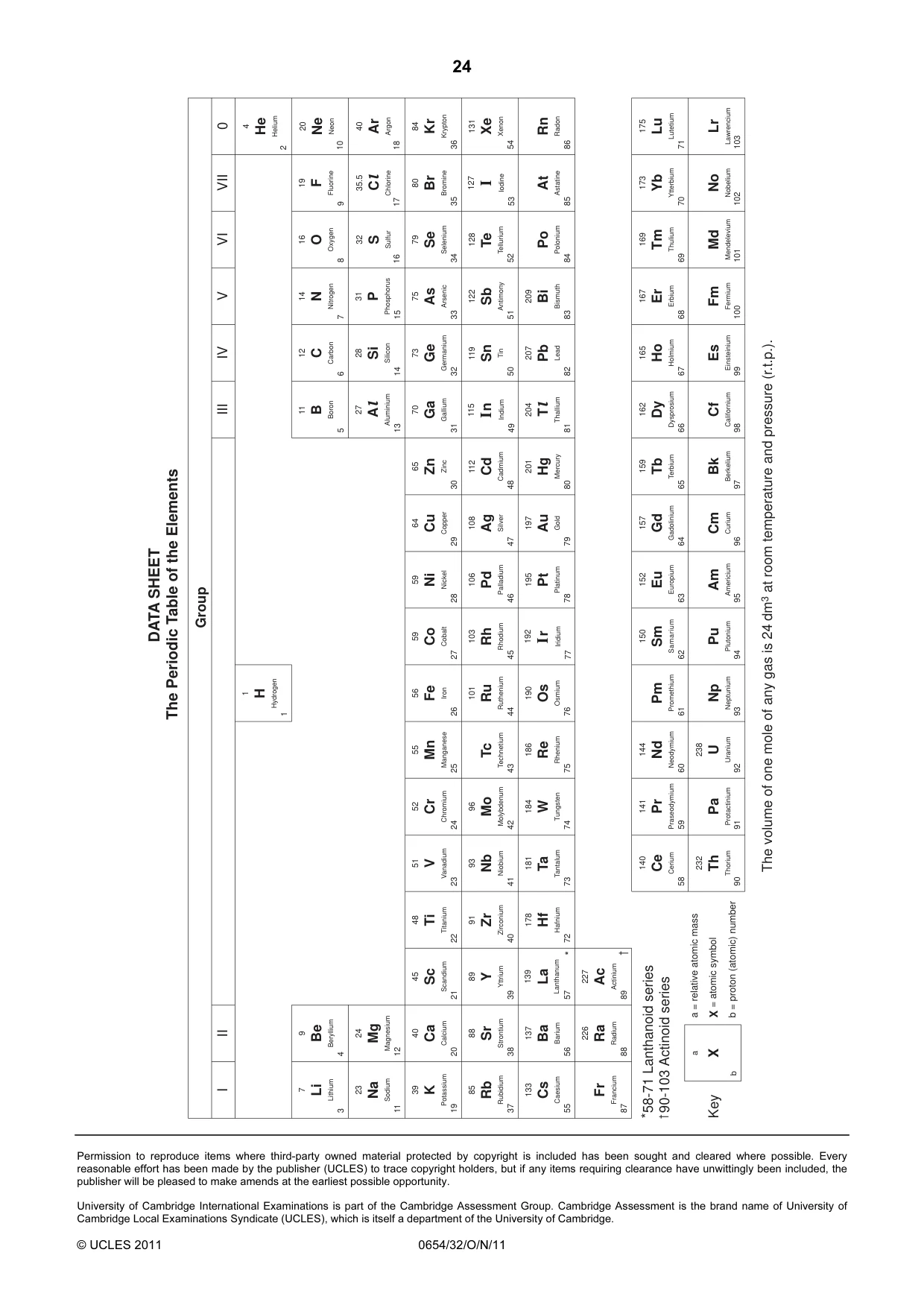
24 Permission to reproduce items where third-party owned material protected by copyright is included has been sought and cleared where possible. Every reasonable effort has been made by the publisher (UCLES) to trace copyright holders, but if any items requiring clearance have unwittingly been included, the publisher will be pleased to make amends at the earliest possible opportunity. University of Cambridge International Examinations is part of the Cambridge Assessment Group. Cambridge Assessment is the brand name of University of Cambridge Local Examinations Syndicate (UCLES), which is itself a department of the University of Cambridge. © UCLES 2011 0654/32/O/N/11 Group 140 Ce Cerium 58 141 Pr Praseodymium 59 144 Nd Neodymium 60 Pm Promethium 61 150 Sm Samarium 62 152 Eu Europium 63 157 Gd Gadolinium 64 159 Tb Terbium 65 162 Dy Dysprosium 66 165 Ho Holmium 67 167 Er Erbium 68 169 Tm Thulium 69 173 Yb Ytterbium 70 175 Lu Lutetium 71 232 Th Thorium 90 Pa Protactinium 91 238 U Uranium 92 Np Neptunium 93 Pu Plutonium 94 Am Americium 95 Cm Curium 96 Bk Berkelium 97 Cf Californium 98 Es Einsteinium 99 Fm Fermium 100 Md Mendelevium 101 No Nobelium 102 Lr Lawrencium 103 1 H Hydrogen 1 7 Li Lithium 3 23 Na Sodium 11 24 Mg Magnesium 12 40 Ca Calcium 20 45 Sc Scandium 21 48 Ti Titanium 22 51 V Vanadium 23 52 Cr Chromium 24 55 Mn Manganese 25 56 Fe Iron 26 59 Co Cobalt 27 59 Ni Nickel 28 64 Cu Copper 29 65 Zn Zinc 30 70 Ga Gallium 31 27 Al Aluminium 13 11 B Boron 5 12 C Carbon 6 14 N Nitrogen 7 16 O Oxygen 8 19 F Fluorine 9 28 Si Silicon 14 31 P Phosphorus 15 32 S Sulfur 16 35.5 Cl Chlorine 17 40 Ar Argon 18 20 Ne Neon 10 4 He Helium 2 73 Ge Germanium 32 75 As Arsenic 33 79 Se Selenium 34 80 Br Bromine 35 84 Kr Krypton 36 39 K Potassium 19 88 Sr Strontium 38 89 Y Yttrium 39 91 Zr Zirconium 40 93 Nb Niobium 41 96 Mo Molybdenum 42 Tc Technetium 43 101 Ru Ruthenium 44 103 Rh Rhodium 45 106 Pd Palladium 46 108 Ag Silver 47 112 Cd Cadmium 48 115 In Indium 49 119 Sn Tin 50 122 Sb Antimony 51 128 Te Tellurium 52 127 I Iodine 53 131 Xe Xenon 54 137 Ba Barium 56 139 La Lanthanum 57 * 178 Hf Hafnium 72 181 Ta Tantalum 73 184 W Tungsten 74 186 Re Rhenium 75 190 Os Osmium 76 192 Ir Iridium 77 195 Pt Platinum 78 197 Au Gold 79 201 Hg Mercury 80 204 Tl Thallium 81 207 Pb Lead 82 209 Bi Bismuth 83 Po Polonium 84 At Astatine 85 Rn Radon 86 Fr Francium 87 227 Ac Actinium 89 9 Be Beryllium 4 I II III IV V VI VII 0 85 Rb Rubidium 37 133 Cs Caesium 55 226 Ra Radium 88 The volume of one mole of any gas is 24 dm3 at room temperature and pressure (r.t.p.). a X b a = relative atomic mass X = atomic symbol b = proton (atomic) number Key *58-71 Lanthanoid series 90-103 Actinoid series DATA SHEET The Periodic Table of the Elements
Mark scheme, page 1
UNIVERSITY OF CAMBRIDGE INTERNATIONAL EXAMINATIONS International General Certificate of Secondary Education MARK SCHEME for the October/November 2011 question paper for the guidance of teachers 0654 CO-ORDINATED SCIENCES 0654/32 Paper 3 (Extended Theory), maximum raw mark 100 This mark scheme is published as an aid to teachers and candidates, to indicate the requirements of the examination. It shows the basis on which Examiners were instructed to award marks. It does not indicate the details of the discussions that took place at an Examiners’ meeting before marking began, which would have considered the acceptability of alternative answers. Mark schemes must be read in conjunction with the question papers and the report on the examination. • Cambridge will not enter into discussions or correspondence in connection with these mark schemes. Cambridge is publishing the mark schemes for the October / November 2011 question papers for most IGCSE, GCE Advanced Level and Advanced Subsidiary Level syllabuses and some Ordinary Level syllabuses. www.XtremePapers.com
Mark scheme, page 2
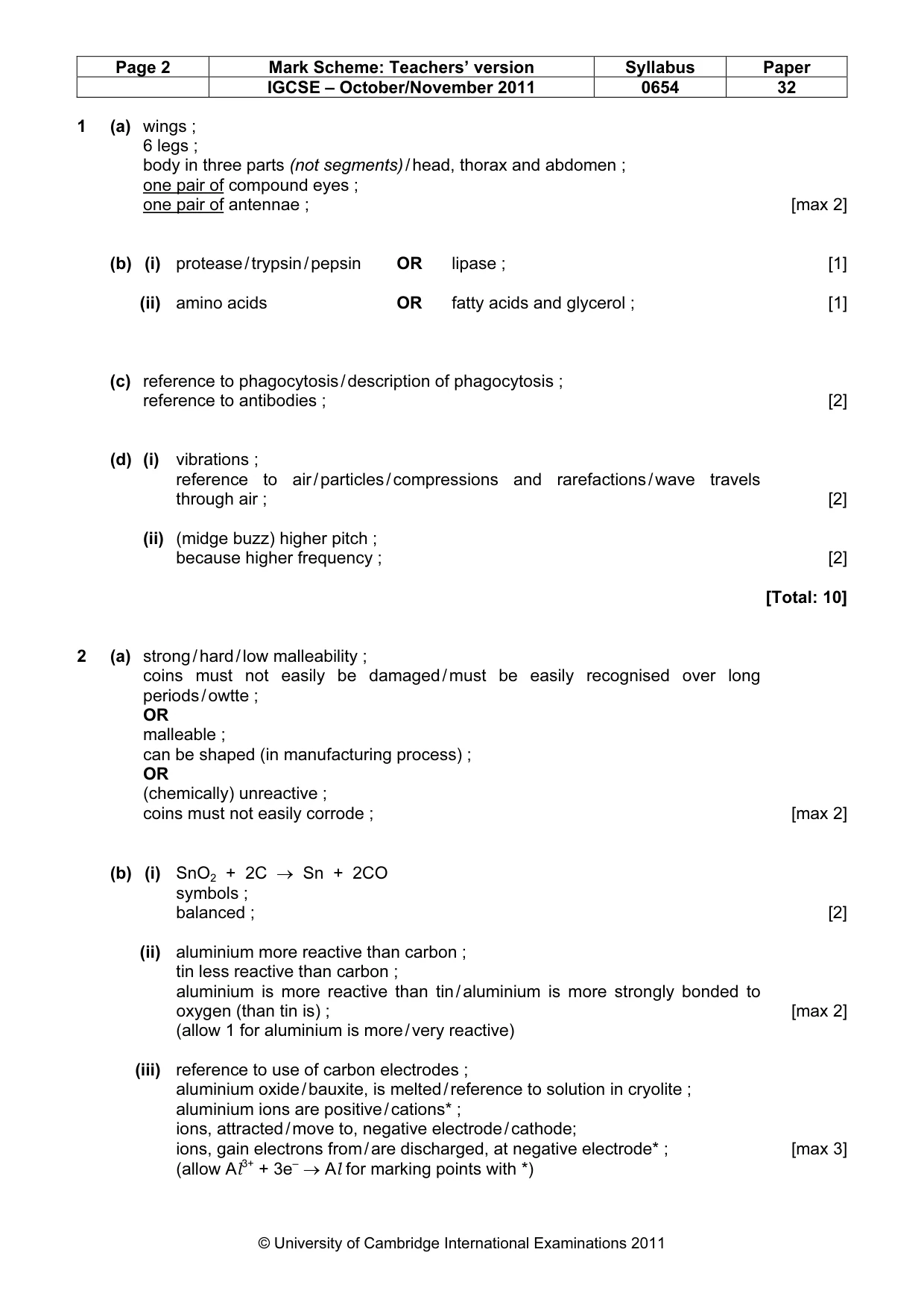
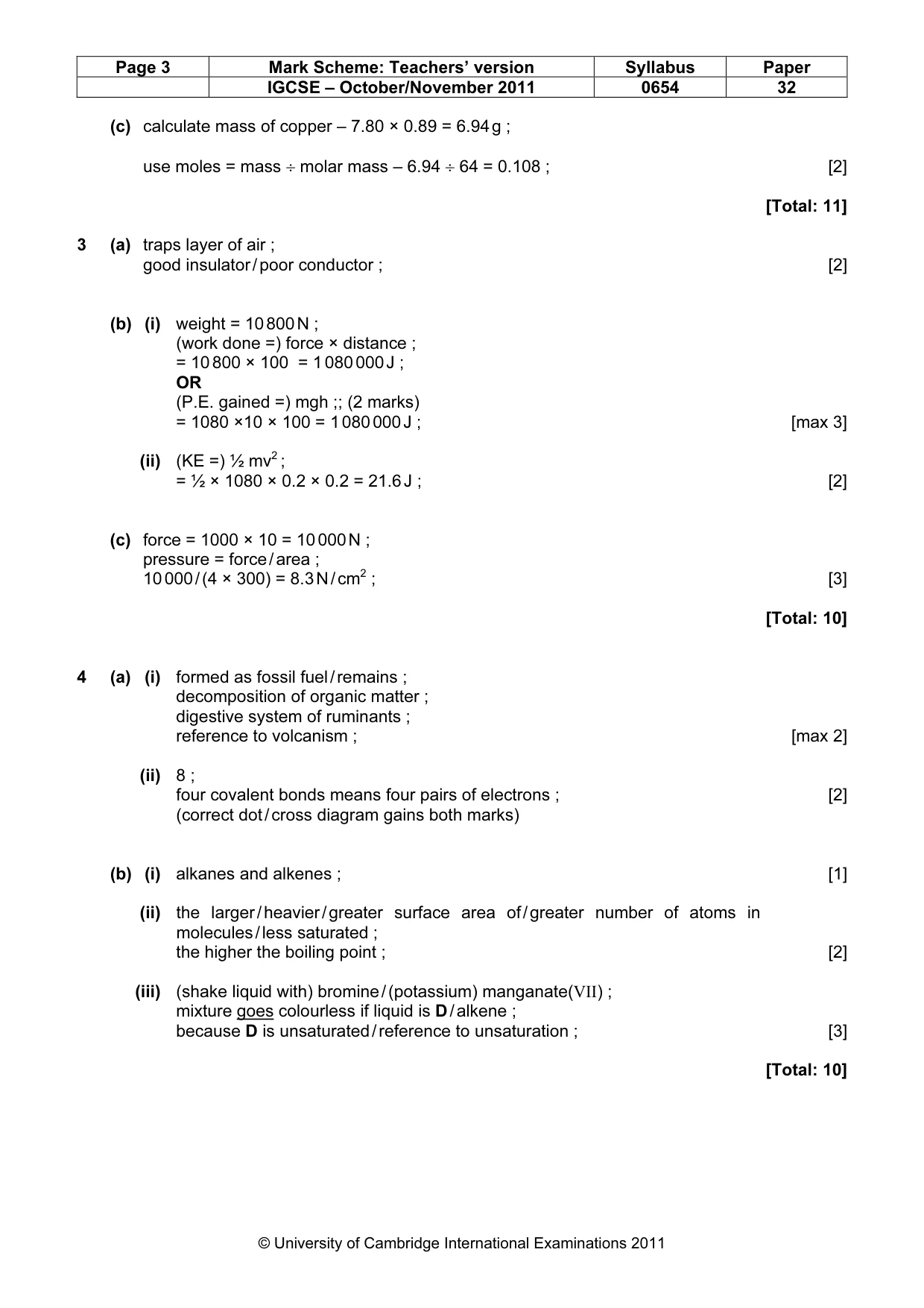
Page 2 Mark Scheme: Teachers’ version Syllabus Paper IGCSE – October/November 2011 0654 32 © University of Cambridge International Examinations 2011 1 (a) wings ; 6 legs ; body in three parts (not segments) / head, thorax and abdomen ; one pair of compound eyes ; one pair of antennae ; [max 2] (b) (i) protease / trypsin / pepsin OR lipase ; [1] (ii) amino acids OR fatty acids and glycerol ; [1] (c) reference to phagocytosis / description of phagocytosis ; reference to antibodies ; [2] (d) (i) vibrations ; reference to air / particles / compressions and rarefactions / wave travels through air ; [2] (ii) (midge buzz) higher pitch ; because higher frequency ; [2] [Total: 10] 2 (a) strong / hard / low malleability ; coins must not easily be damaged / must be easily recognised over long periods / owtte ; OR malleable ; can be shaped (in manufacturing process) ; OR (chemically) unreactive ; coins must not easily corrode ; [max 2] (b) (i) SnO2 + 2C → Sn + 2CO symbols ; balanced ; [2] (ii) aluminium more reactive than carbon ; tin less reactive than carbon ; aluminium is more reactive than tin / aluminium is more strongly bonded to oxygen (than tin is) ; [max 2] (allow 1 for aluminium is more / very reactive) (iii) reference to use of carbon electrodes ; aluminium oxide / bauxite, is melted / reference to solution in cryolite ; aluminium ions are positive / cations* ; ions, attracted / move to, negative electrode / cathode; ions, gain electrons from / are discharged, at negative electrode* ; [max 3] (allow Al3+ + 3e– → Al for marking points with *)
Mark scheme, page 3
Page 3 Mark Scheme: Teachers’ version Syllabus Paper IGCSE – October/November 2011 0654 32 © University of Cambridge International Examinations 2011 (c) calculate mass of copper – 7.80 × 0.89 = 6.94 g ; use moles = mass ÷ molar mass – 6.94 ÷ 64 = 0.108 ; [2] [Total: 11] 3 (a) traps layer of air ; good insulator / poor conductor ; [2] (b) (i) weight = 10 800 N ; (work done =) force × distance ; = 10 800 × 100 = 1 080 000 J ; OR (P.E. gained =) mgh ;; (2 marks) = 1080 ×10 × 100 = 1 080 000 J ; [max 3] (ii) (KE =) ½ mv2 ; = ½ × 1080 × 0.2 × 0.2 = 21.6 J ; [2] (c) force = 1000 × 10 = 10 000 N ; pressure = force / area ; 10 000 / (4 × 300) = 8.3 N / cm2 ; [3] [Total: 10] 4 (a) (i) formed as fossil fuel / remains ; decomposition of organic matter ; digestive system of ruminants ; reference to volcanism ; [max 2] (ii) 8 ; four covalent bonds means four pairs of electrons ; [2] (correct dot / cross diagram gains both marks) (b) (i) alkanes and alkenes ; [1] (ii) the larger / heavier / greater surface area of / greater number of atoms in molecules / less saturated ; the higher the boiling point ; [2] (iii) (shake liquid with) bromine / (potassium) manganate(VII) ; mixture goes colourless if liquid is D / alkene ; because D is unsaturated / reference to unsaturation ; [3] [Total: 10]
Mark scheme, page 4
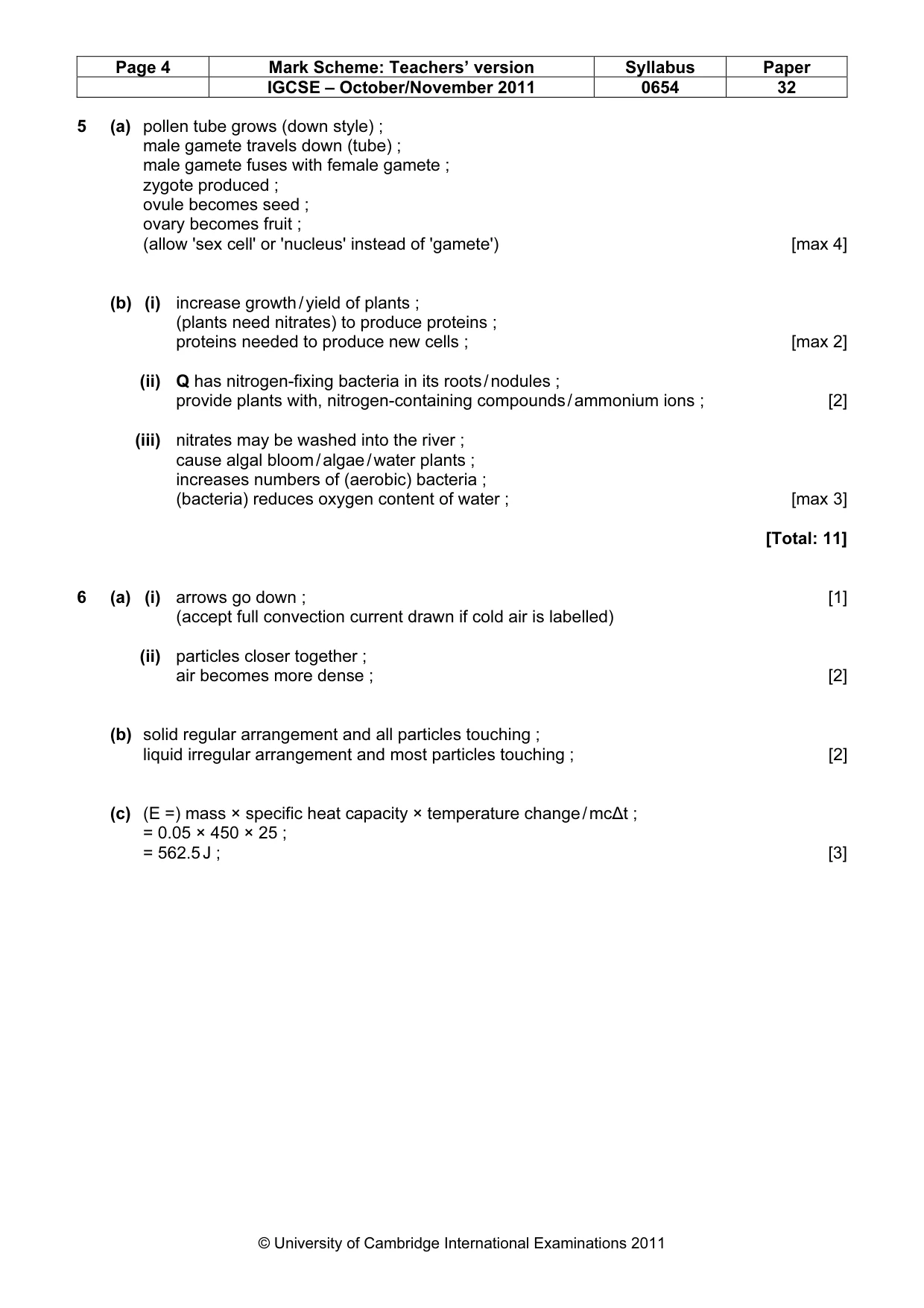
Page 4 Mark Scheme: Teachers’ version Syllabus Paper IGCSE – October/November 2011 0654 32 © University of Cambridge International Examinations 2011 5 (a) pollen tube grows (down style) ; male gamete travels down (tube) ; male gamete fuses with female gamete ; zygote produced ; ovule becomes seed ; ovary becomes fruit ; (allow 'sex cell' or 'nucleus' instead of 'gamete') [max 4] (b) (i) increase growth / yield of plants ; (plants need nitrates) to produce proteins ; proteins needed to produce new cells ; [max 2] (ii) Q has nitrogen-fixing bacteria in its roots / nodules ; provide plants with, nitrogen-containing compounds / ammonium ions ; [2] (iii) nitrates may be washed into the river ; cause algal bloom / algae / water plants ; increases numbers of (aerobic) bacteria ; (bacteria) reduces oxygen content of water ; [max 3] [Total: 11] 6 (a) (i) arrows go down ; [1] (accept full convection current drawn if cold air is labelled) (ii) particles closer together ; air becomes more dense ; [2] (b) solid regular arrangement and all particles touching ; liquid irregular arrangement and most particles touching ; [2] (c) (E =) mass × specific heat capacity × temperature change / mc∆t ; = 0.05 × 450 × 25 ; = 562.5 J ; [3]
Mark scheme, page 5
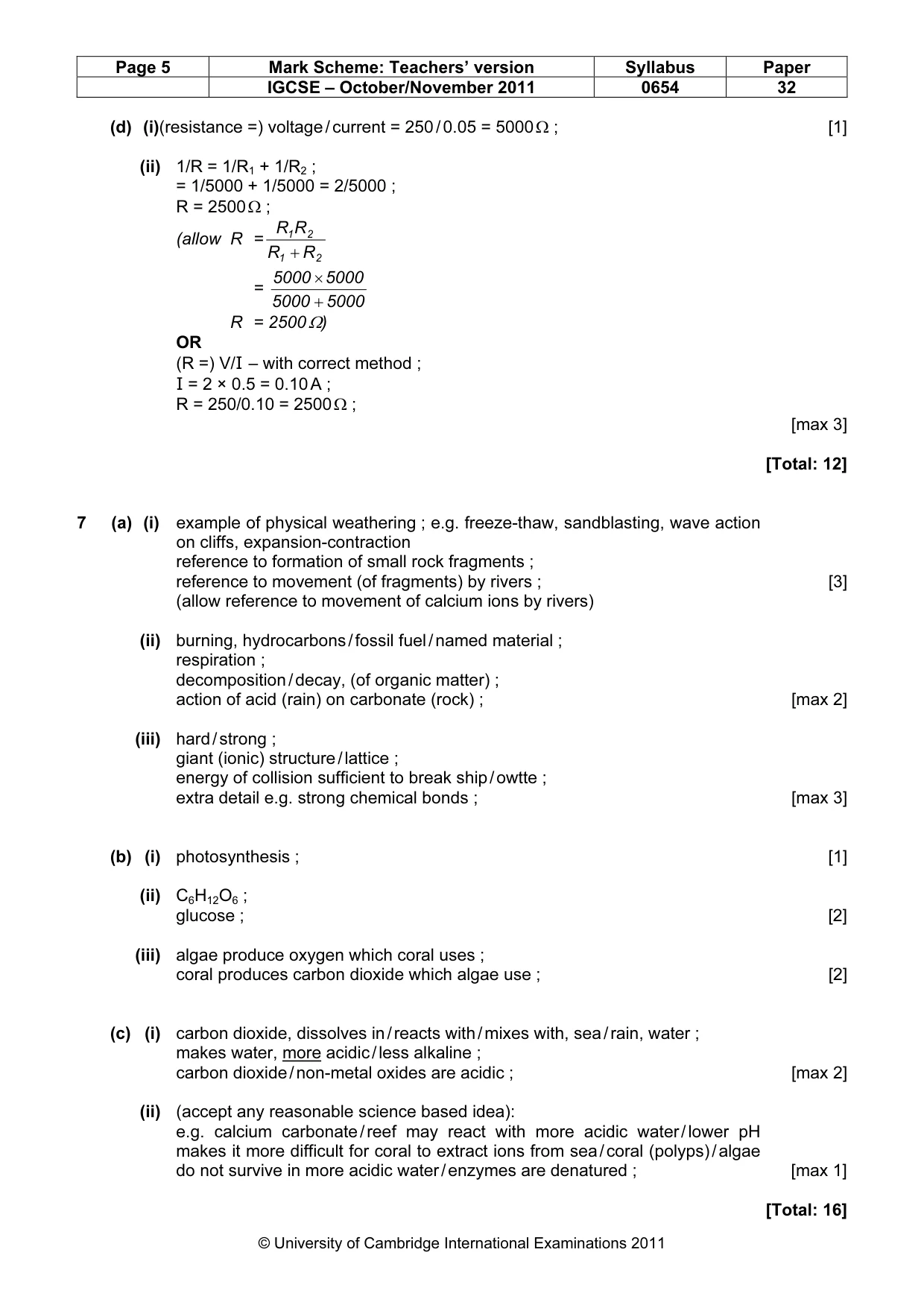
Page 5 Mark Scheme: Teachers’ version Syllabus Paper IGCSE – October/November 2011 0654 32 © University of Cambridge International Examinations 2011 (d) (i)(resistance =) voltage / current = 250 / 0.05 = 5000 Ω ; [1] (ii) 1/R = 1/R1 + 1/R2 ; = 1/5000 + 1/5000 = 2/5000 ; R = 2500 Ω ; (allow R = 2 1 2 1 R R R R + = 5000 5000 5000 5000 + × R = 2500 Ω) OR (R =) V/I – with correct method ; I = 2 × 0.5 = 0.10 A ; R = 250/0.10 = 2500 Ω ; [max 3] [Total: 12] 7 (a) (i) example of physical weathering ; e.g. freeze-thaw, sandblasting, wave action on cliffs, expansion-contraction reference to formation of small rock fragments ; reference to movement (of fragments) by rivers ; [3] (allow reference to movement of calcium ions by rivers) (ii) burning, hydrocarbons / fossil fuel / named material ; respiration ; decomposition / decay, (of organic matter) ; action of acid (rain) on carbonate (rock) ; [max 2] (iii) hard / strong ; giant (ionic) structure / lattice ; energy of collision sufficient to break ship / owtte ; extra detail e.g. strong chemical bonds ; [max 3] (b) (i) photosynthesis ; [1] (ii) C6H12O6 ; glucose ; [2] (iii) algae produce oxygen which coral uses ; coral produces carbon dioxide which algae use ; [2] (c) (i) carbon dioxide, dissolves in / reacts with / mixes with, sea / rain, water ; makes water, more acidic / less alkaline ; carbon dioxide / non-metal oxides are acidic ; [max 2] (ii) (accept any reasonable science based idea): e.g. calcium carbonate / reef may react with more acidic water / lower pH makes it more difficult for coral to extract ions from sea / coral (polyps) / algae do not survive in more acidic water / enzymes are denatured ; [max 1] [Total: 16]
Mark scheme, page 6
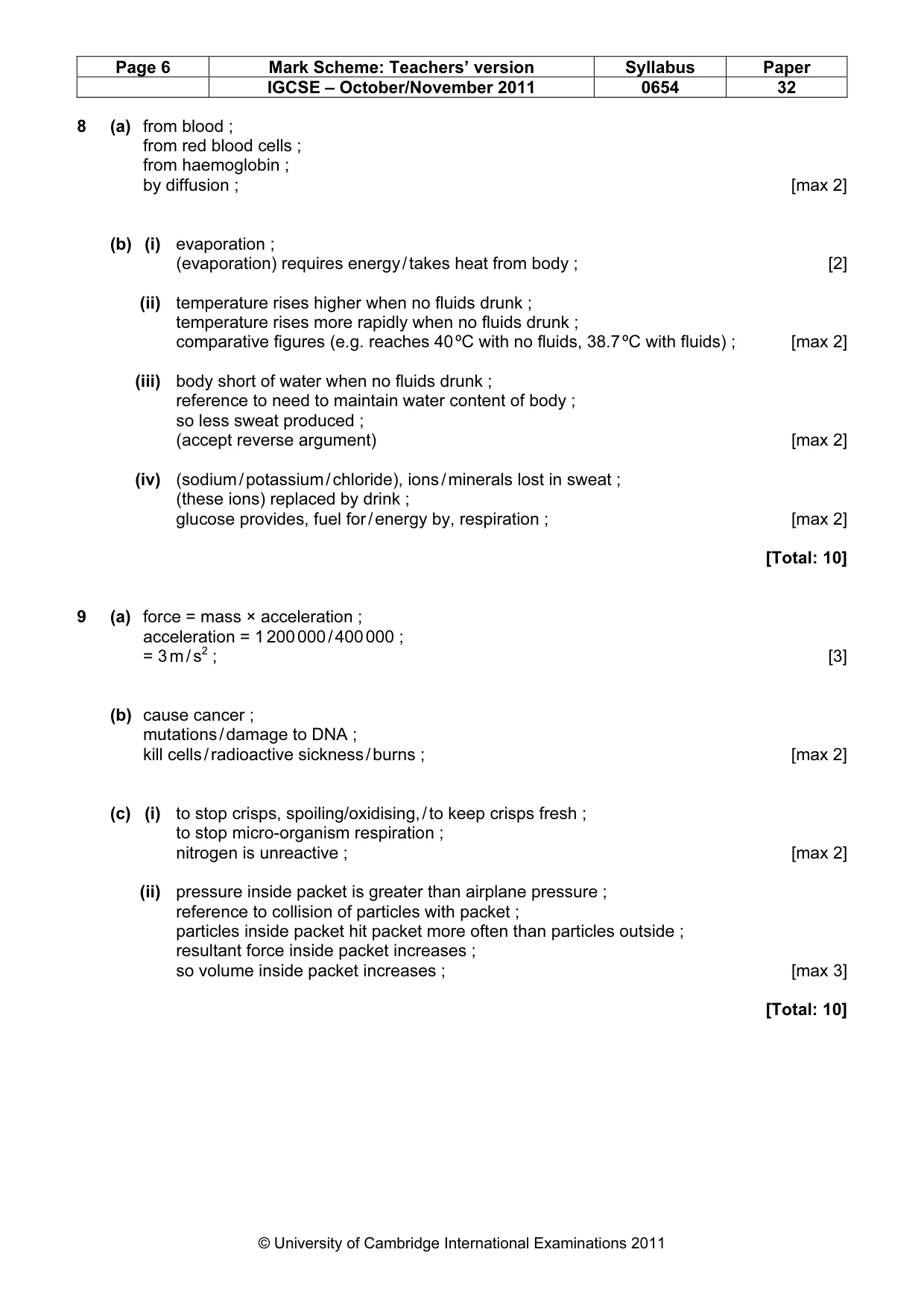
Page 6 Mark Scheme: Teachers’ version Syllabus Paper IGCSE – October/November 2011 0654 32 © University of Cambridge International Examinations 2011 8 (a) from blood ; from red blood cells ; from haemoglobin ; by diffusion ; [max 2] (b) (i) evaporation ; (evaporation) requires energy / takes heat from body ; [2] (ii) temperature rises higher when no fluids drunk ; temperature rises more rapidly when no fluids drunk ; comparative figures (e.g. reaches 40 ºC with no fluids, 38.7 ºC with fluids) ; [max 2] (iii) body short of water when no fluids drunk ; reference to need to maintain water content of body ; so less sweat produced ; (accept reverse argument) [max 2] (iv) (sodium / potassium / chloride), ions / minerals lost in sweat ; (these ions) replaced by drink ; glucose provides, fuel for / energy by, respiration ; [max 2] [Total: 10] 9 (a) force = mass × acceleration ; acceleration = 1 200 000 / 400 000 ; = 3 m / s2 ; [3] (b) cause cancer ; mutations / damage to DNA ; kill cells / radioactive sickness / burns ; [max 2] (c) (i) to stop crisps, spoiling/oxidising, / to keep crisps fresh ; to stop micro-organism respiration ; nitrogen is unreactive ; [max 2] (ii) pressure inside packet is greater than airplane pressure ; reference to collision of particles with packet ; particles inside packet hit packet more often than particles outside ; resultant force inside packet increases ; so volume inside packet increases ; [max 3] [Total: 10]
What you needed in this session
Cambridge’s own grade thresholds for 2011 Oct/Nov, Paper 3 · Variant 2. A higher threshold means an easier paper — the bar moves with how the cohort did.