Cambridge IGCSE Sciences - Co-ordinated (Double) 0654 — 2011 May/June Paper 3 · Variant 2
0654/32/M/J/11 · 100 marks · ≈113 min
The question paper and its mark scheme, free to read here and free to download. This is Cambridge’s own paper, exactly as it was sat.
Question paper28 pages


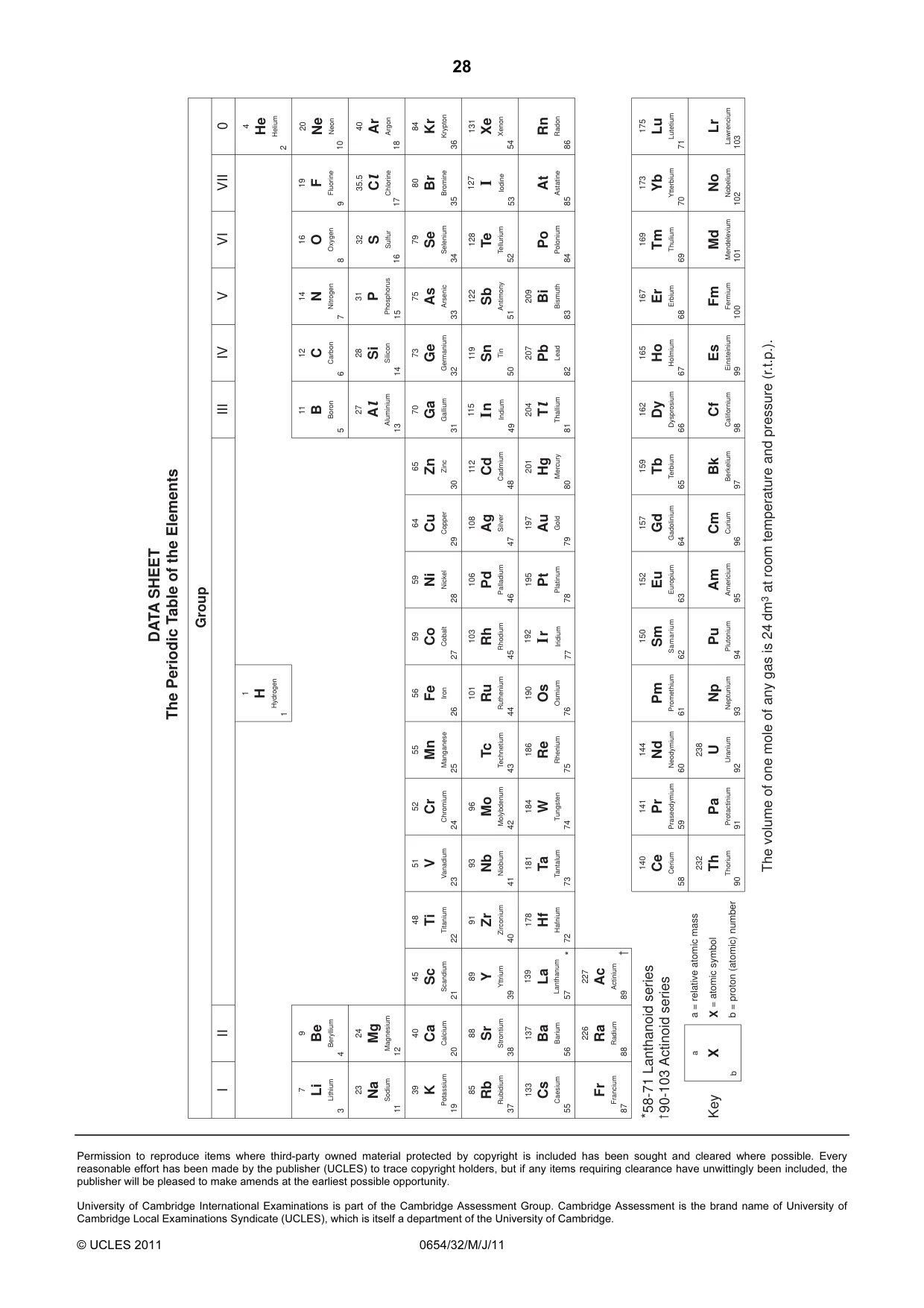
Mark scheme8 pages
Answers below. Sit the paper first if you are practising.
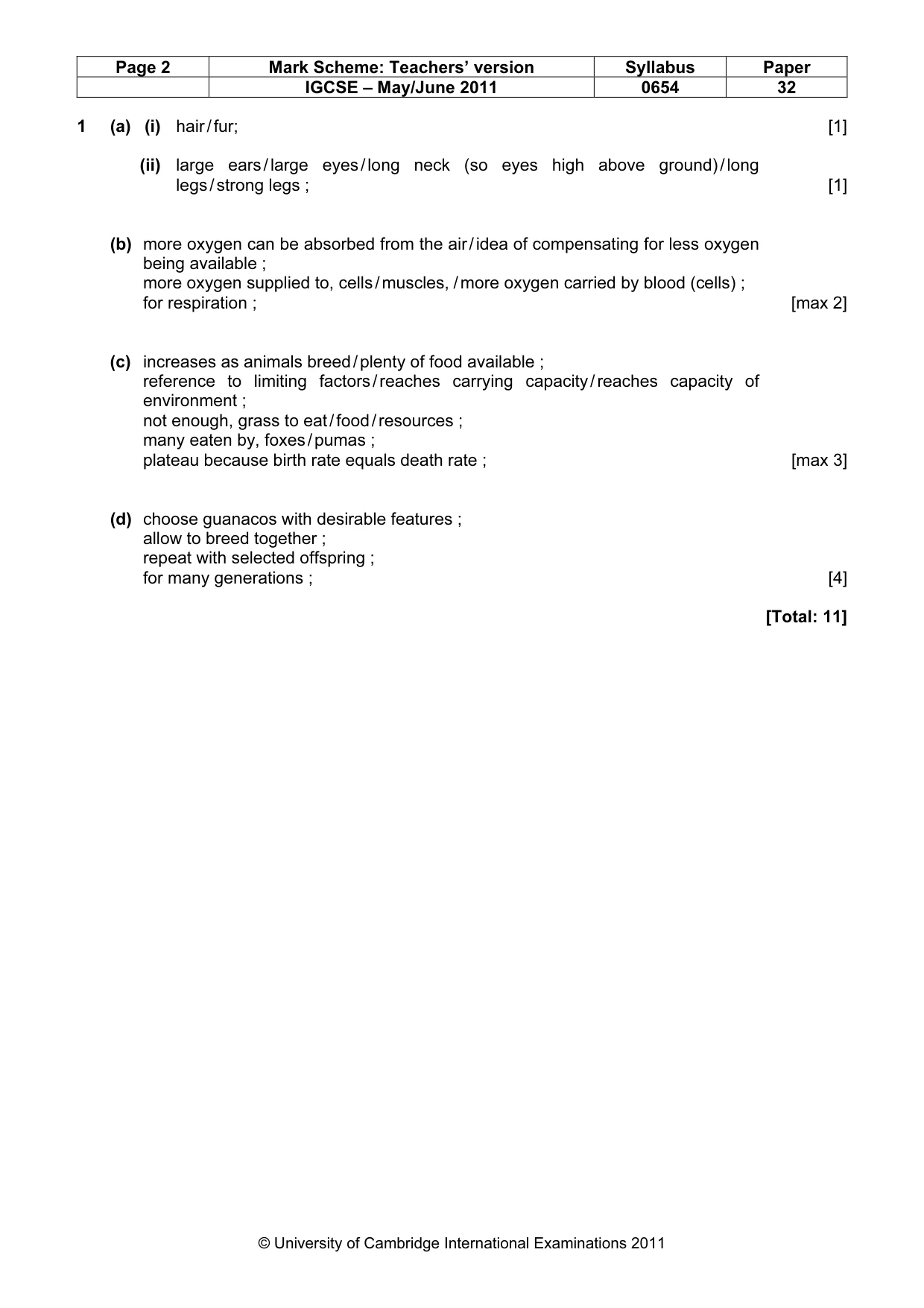
Paper as text
Question paper, page 1
This document consists of 26 printed pages and 2 blank pages. IB11 06_0654_32/4RP © UCLES 2011 [Turn over *8210372670* For Examiner's Use 1 2 3 4 5 6 7 8 9 10 Total UNIVERSITY OF CAMBRIDGE INTERNATIONAL EXAMINATIONS International General Certificate of Secondary Education CO-ORDINATED SCIENCES 0654/32 Paper 3 (Extended) May/June 2011 2 hours Candidates answer on the Question Paper. No Additional Materials are required. READ THESE INSTRUCTIONS FIRST Write your Centre number, candidate number and name on all the work you hand in. Write in dark blue or black pen. You may use a soft pencil for any diagrams, graphs, tables or rough working. Do not use staples, paper clips, highlighters, glue or correction fluid. DO NOT WRITE IN ANY BARCODES. Answer all questions. A copy of the Periodic Table is printed on page 28. At the end of the examination, fasten all your work securely together. The number of marks is given in brackets [ ] at the end of each question or part question. www.XtremePapers.com
Question paper, page 2
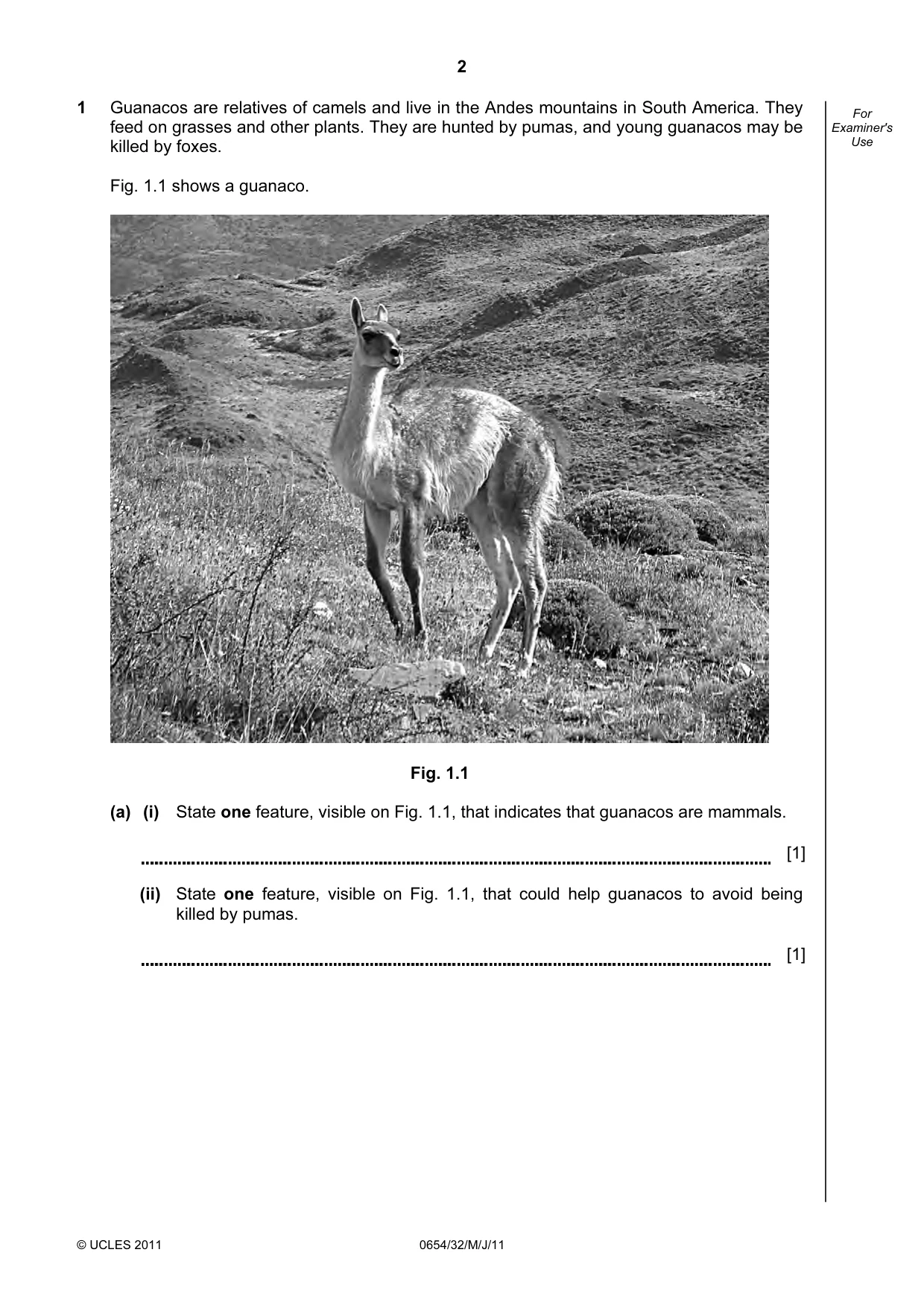
2 © UCLES 2011 0654/32/M/J/11 For Examiner's Use 1 Guanacos are relatives of camels and live in the Andes mountains in South America. They feed on grasses and other plants. They are hunted by pumas, and young guanacos may be killed by foxes. Fig. 1.1 shows a guanaco. Fig. 1.1 (a) (i) State one feature, visible on Fig. 1.1, that indicates that guanacos are mammals. [1] (ii) State one feature, visible on Fig. 1.1, that could help guanacos to avoid being killed by pumas. [1]
Question paper, page 3
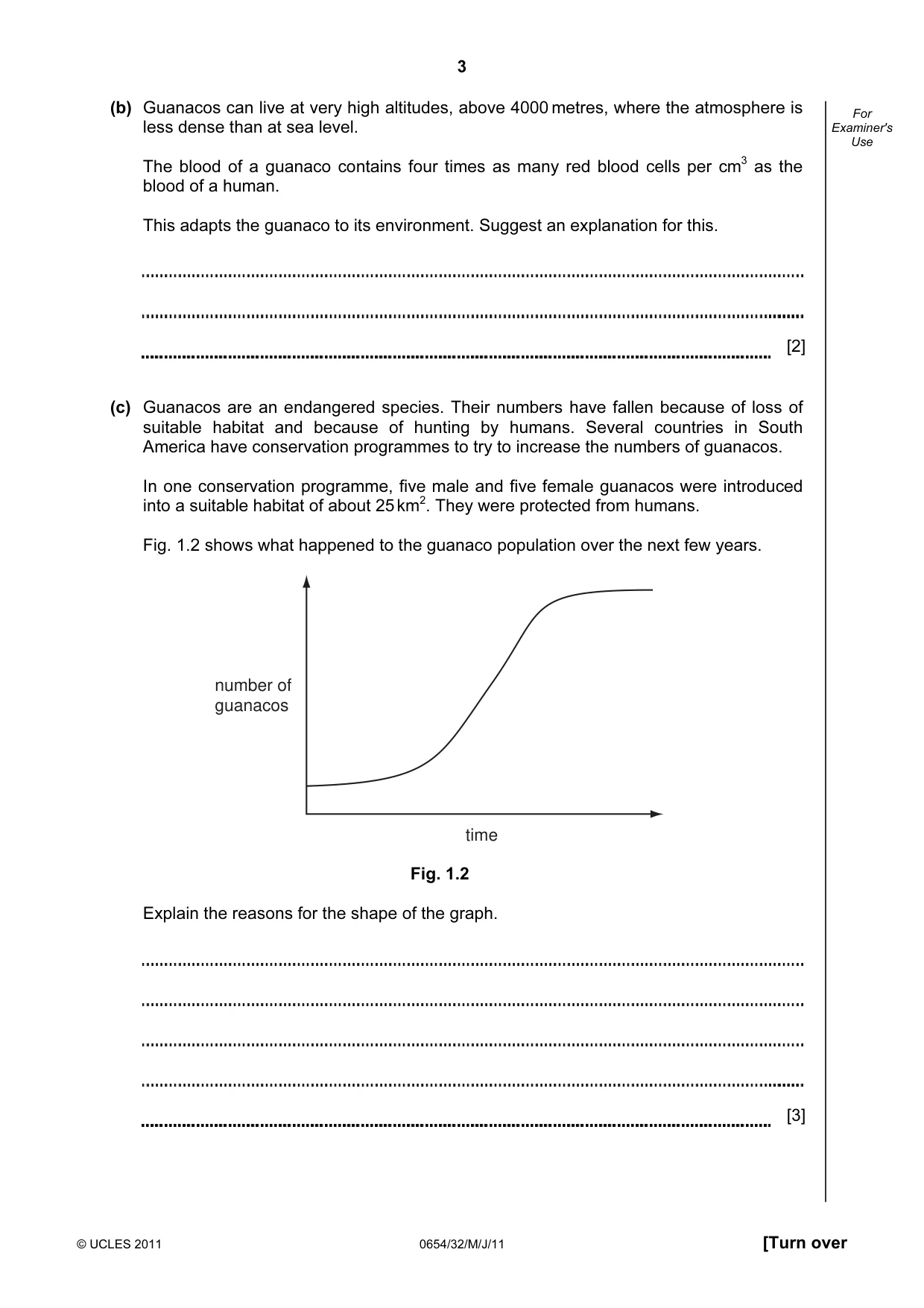
3 © UCLES 2011 0654/32/M/J/11 [Turn over For Examiner's Use (b) Guanacos can live at very high altitudes, above 4000 metres, where the atmosphere is less dense than at sea level. The blood of a guanaco contains four times as many red blood cells per cm3 as the blood of a human. This adapts the guanaco to its environment. Suggest an explanation for this. [2] (c) Guanacos are an endangered species. Their numbers have fallen because of loss of suitable habitat and because of hunting by humans. Several countries in South America have conservation programmes to try to increase the numbers of guanacos. In one conservation programme, five male and five female guanacos were introduced into a suitable habitat of about 25 km2. They were protected from humans. Fig. 1.2 shows what happened to the guanaco population over the next few years. time number of guanacos Fig. 1.2 Explain the reasons for the shape of the graph. [3]
Question paper, page 4
4 © UCLES 2011 0654/32/M/J/11 For Examiner's Use (d) People in South America domesticated guanacos at least 6000 years ago. They used artificial selection to produce a breed of guanacos that produced more meat, milk and wool and that were easy to keep as herds. These animals are now called llamas. Explain how artificial selection could have produced llamas from guanacos. [4]
Question paper, page 5
5 © UCLES 2011 0654/32/M/J/11 [Turn over For Examiner's Use 2 Lithium and its compounds have many important uses. The production of lithium metal involves three main stages. 1 Lithium compounds found in the Earth’s crust are converted into lithium carbonate, Li2CO3. 2 Lithium carbonate is converted into lithium chloride, LiCl. 3 Lithium chloride is melted and is electrolysed. (a) Explain why lithium is never found as the uncombined element in the Earth’s crust. [1] (b) The electron configurations of lithium ions and chloride ions are shown below. lithium ion 2 chloride ion 2,8,8 (i) Explain, in terms of protons and electrons, why a lithium ion has a single positive electrical charge but a lithium atom is uncharged (neutral). [2] (ii) Explain why lithium chloride is a solid with a high melting point. [2] (c) Suggest a word equation for a reaction in which lithium carbonate is converted into lithium chloride. [2]
Question paper, page 6
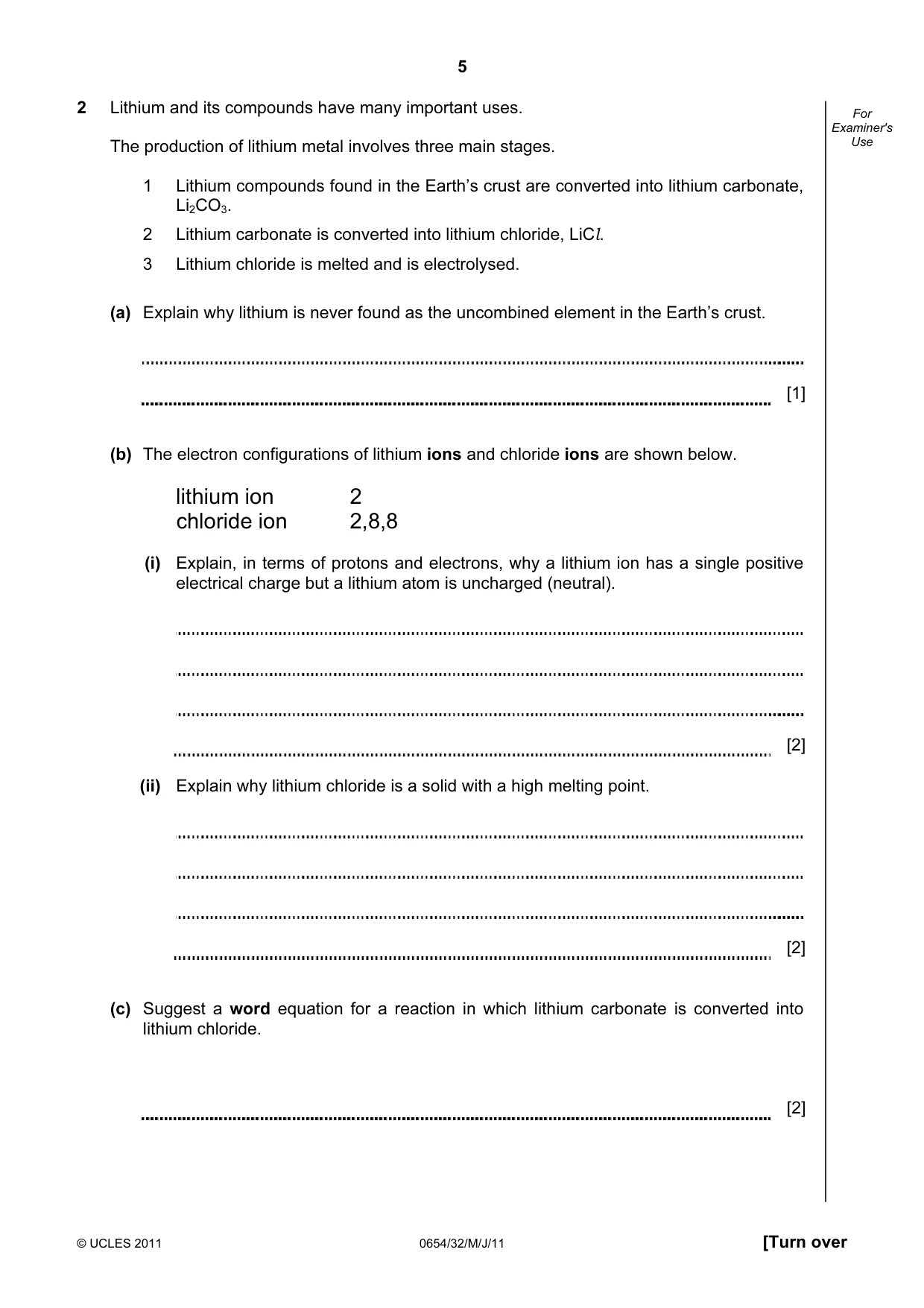
6 © UCLES 2011 0654/32/M/J/11 For Examiner's Use (d) Fig. 2.1 shows the industrial electrolysis of molten lithium chloride. chlorine gas lithium chloride electrolyte containing molten LiCl graphite anode iron gauze iron container steel cathode molten lithium Fig. 2.1 (i) Explain why the electrolyte must be kept molten. [1] (ii) Describe how the electron configuration of each lithium ion changes when they arrive at the cathode during the electrolysis in Fig. 2.1. [1] (e) Lithium carbonate is widely used as a drug to treat some types of mental illness. It is very important that compounds for use as drugs are made to high standards of purity. State one reason for this. [1]
Question paper, page 7
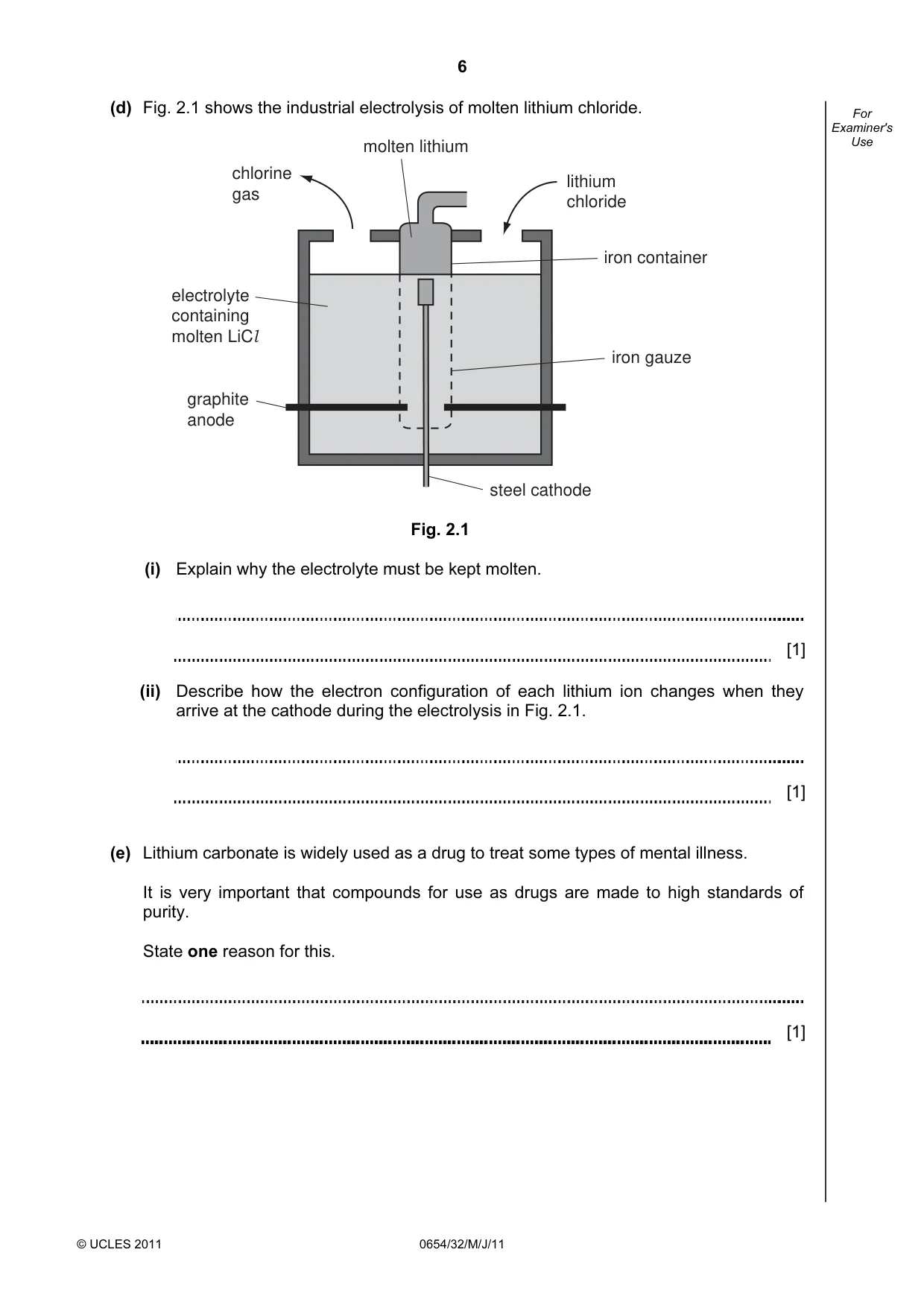
7 © UCLES 2011 0654/32/M/J/11 [Turn over For Examiner's Use 3 (a) Fig. 3.1 shows a skier being pulled up a mountain slope by a cable (lift). 55 m 120 m cable skier pulley Fig. 3.1 The skier weighs 700 N. She travels 120 m along the slope and rises by a vertical height of 55 m. Calculate the work done lifting the skier from the bottom to the top of the slope. You should ignore the work done against friction. State the formula that you use and show your working. formula used working [2]
Question paper, page 8
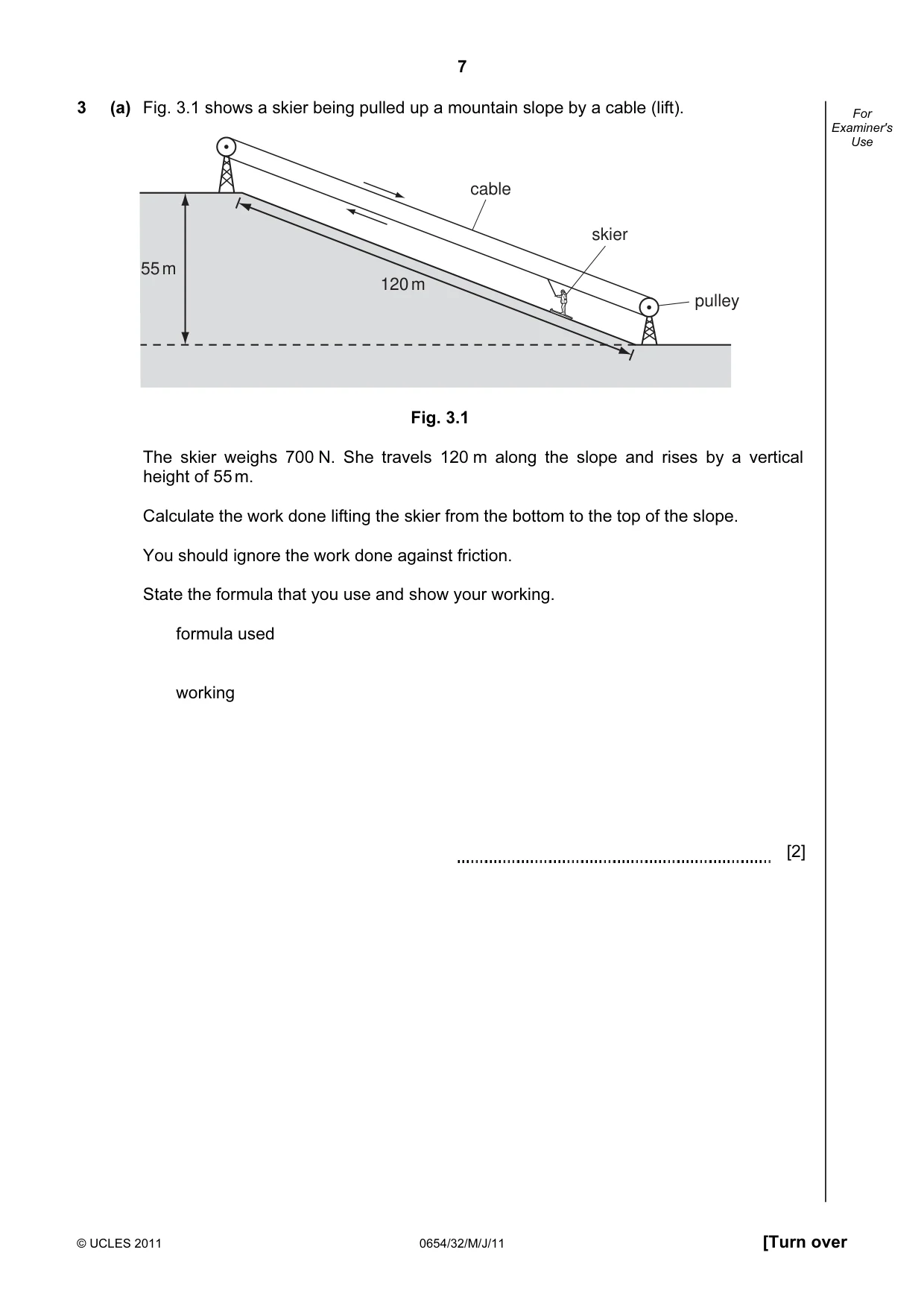
8 © UCLES 2011 0654/32/M/J/11 For Examiner's Use (b) Skiers use a ski pole in each hand to help control their motion. The ski poles work best when they only go into the snow for a few centimetres. Fig. 3.2 shows a skier using ski poles. disc point Fig. 3.2 Explain, in terms of pressure, force and area, why the ski pole has a pointed end and a large disc a few centimetres above this. [2] (c) Explain why a skier keeps the lower surface of her skis smooth and well polished. [1]
Question paper, page 9
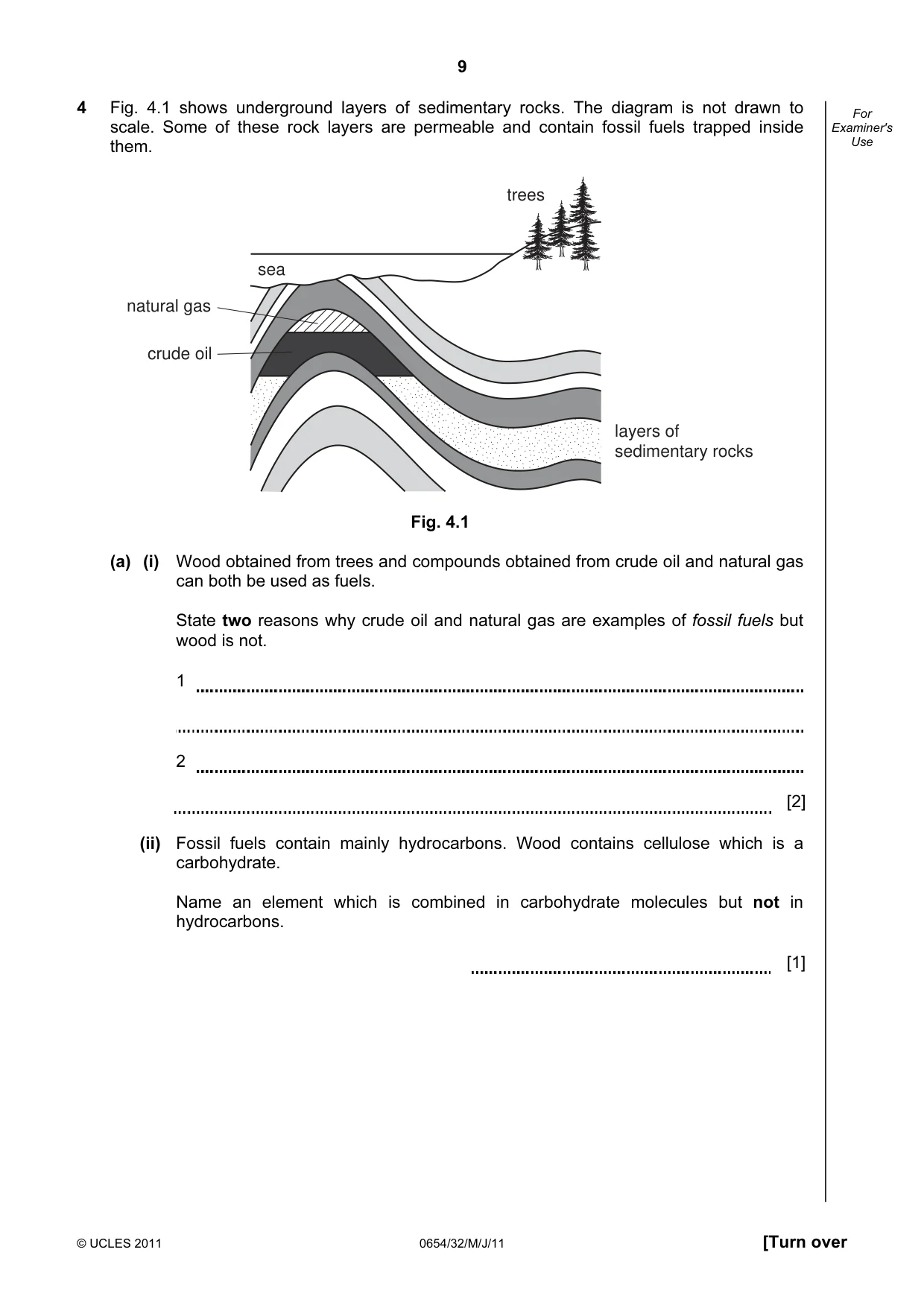
9 © UCLES 2011 0654/32/M/J/11 [Turn over For Examiner's Use 4 Fig. 4.1 shows underground layers of sedimentary rocks. The diagram is not drawn to scale. Some of these rock layers are permeable and contain fossil fuels trapped inside them. layers of sedimentary rocks natural gas crude oil trees sea Fig. 4.1 (a) (i) Wood obtained from trees and compounds obtained from crude oil and natural gas can both be used as fuels. State two reasons why crude oil and natural gas are examples of fossil fuels but wood is not. 1 2 [2] (ii) Fossil fuels contain mainly hydrocarbons. Wood contains cellulose which is a carbohydrate. Name an element which is combined in carbohydrate molecules but not in hydrocarbons. [1]
Question paper, page 10
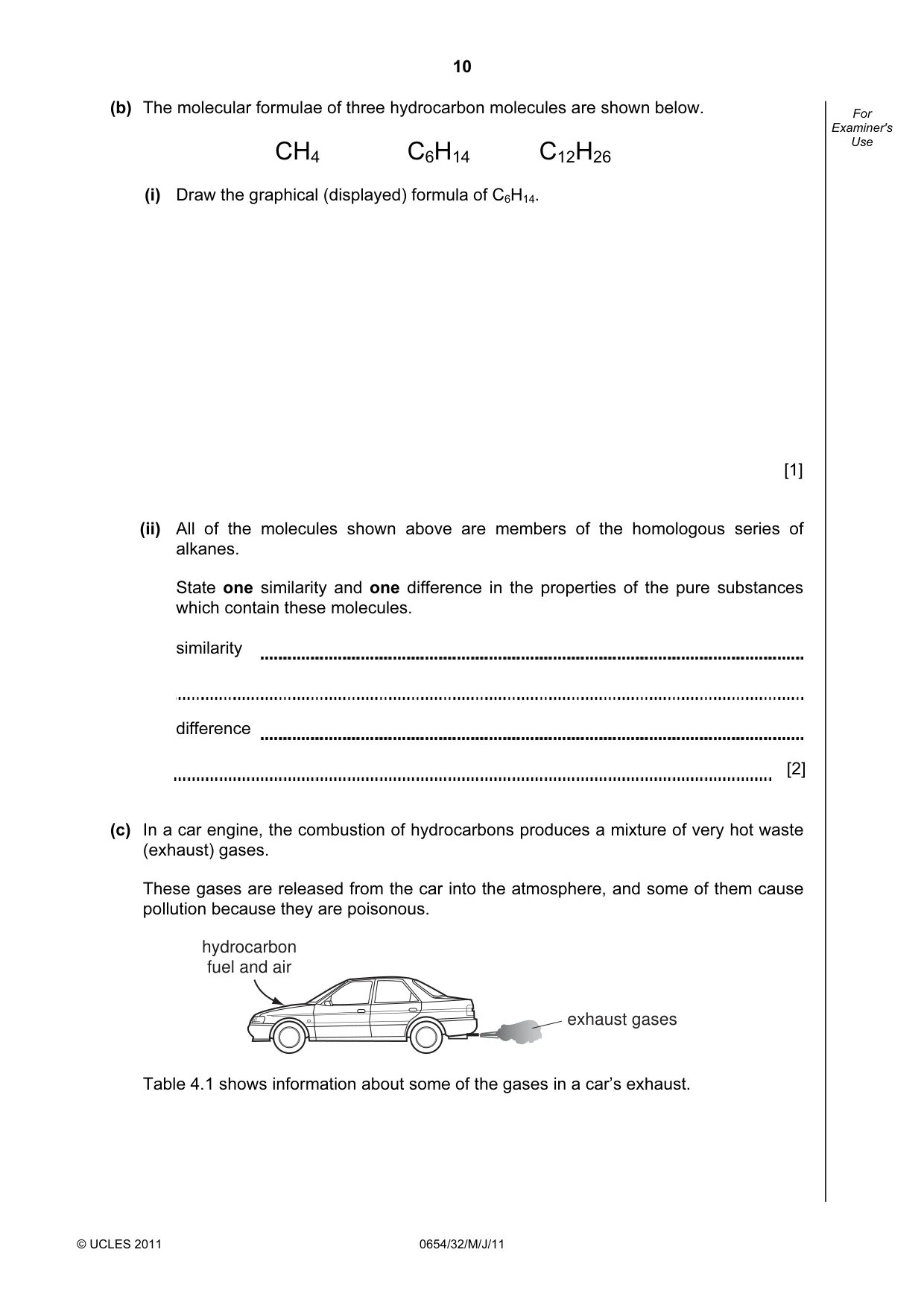
10 © UCLES 2011 0654/32/M/J/11 For Examiner's Use (b) The molecular formulae of three hydrocarbon molecules are shown below. CH4 C6H14 C12H26 (i) Draw the graphical (displayed) formula of C6H14. [1] (ii) All of the molecules shown above are members of the homologous series of alkanes. State one similarity and one difference in the properties of the pure substances which contain these molecules. similarity difference [2] (c) In a car engine, the combustion of hydrocarbons produces a mixture of very hot waste (exhaust) gases. These gases are released from the car into the atmosphere, and some of them cause pollution because they are poisonous. exhaust gases hydrocarbon fuel and air Table 4.1 shows information about some of the gases in a car’s exhaust.
Question paper, page 11
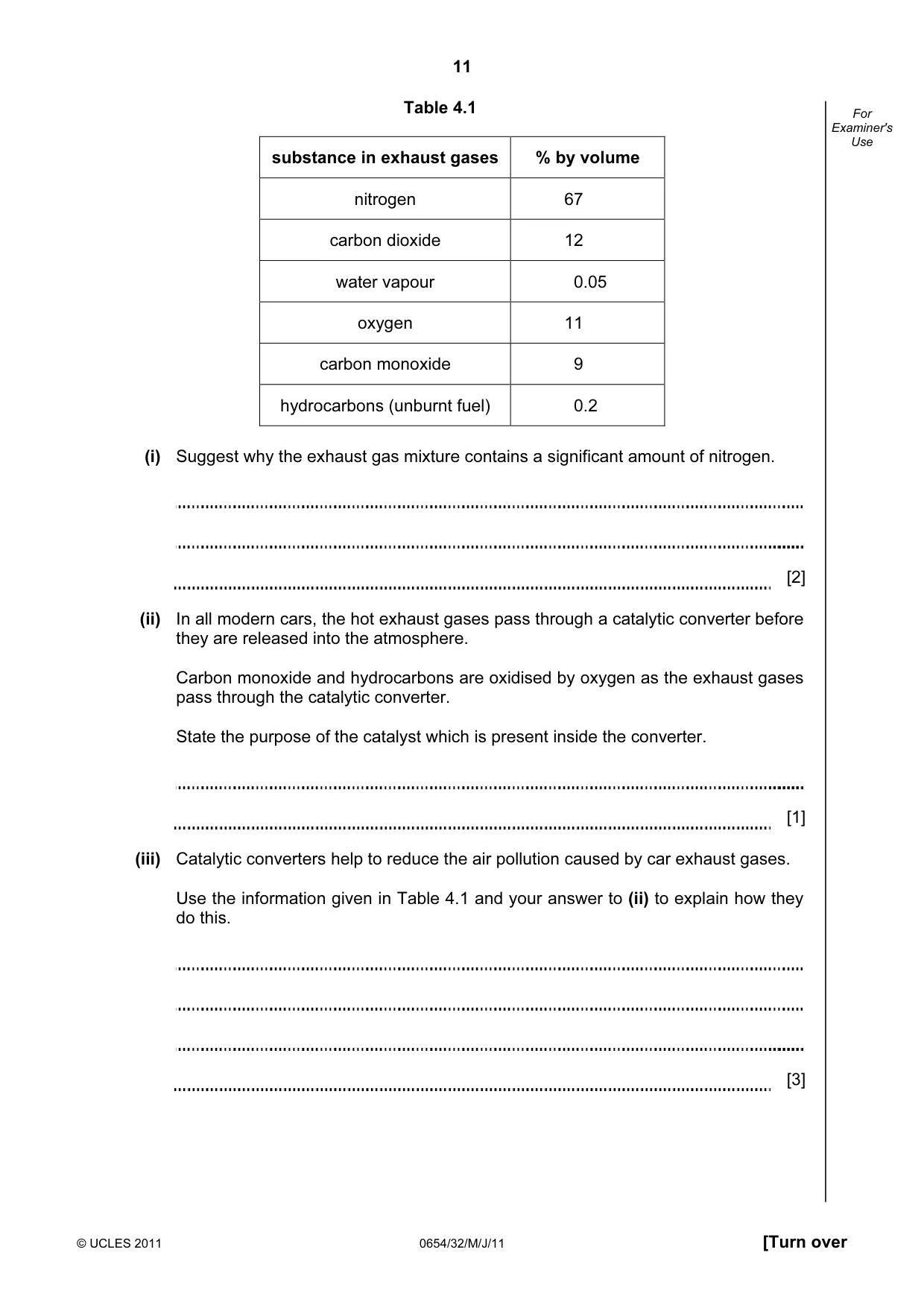
11 © UCLES 2011 0654/32/M/J/11 [Turn over For Examiner's Use Table 4.1 substance in exhaust gases % by volume nitrogen 67 carbon dioxide 12 water vapour 0.05 oxygen 11 carbon monoxide 9 hydrocarbons (unburnt fuel) 0.2 (i) Suggest why the exhaust gas mixture contains a significant amount of nitrogen. [2] (ii) In all modern cars, the hot exhaust gases pass through a catalytic converter before they are released into the atmosphere. Carbon monoxide and hydrocarbons are oxidised by oxygen as the exhaust gases pass through the catalytic converter. State the purpose of the catalyst which is present inside the converter. [1] (iii) Catalytic converters help to reduce the air pollution caused by car exhaust gases. Use the information given in Table 4.1 and your answer to (ii) to explain how they do this. [3]
Question paper, page 12
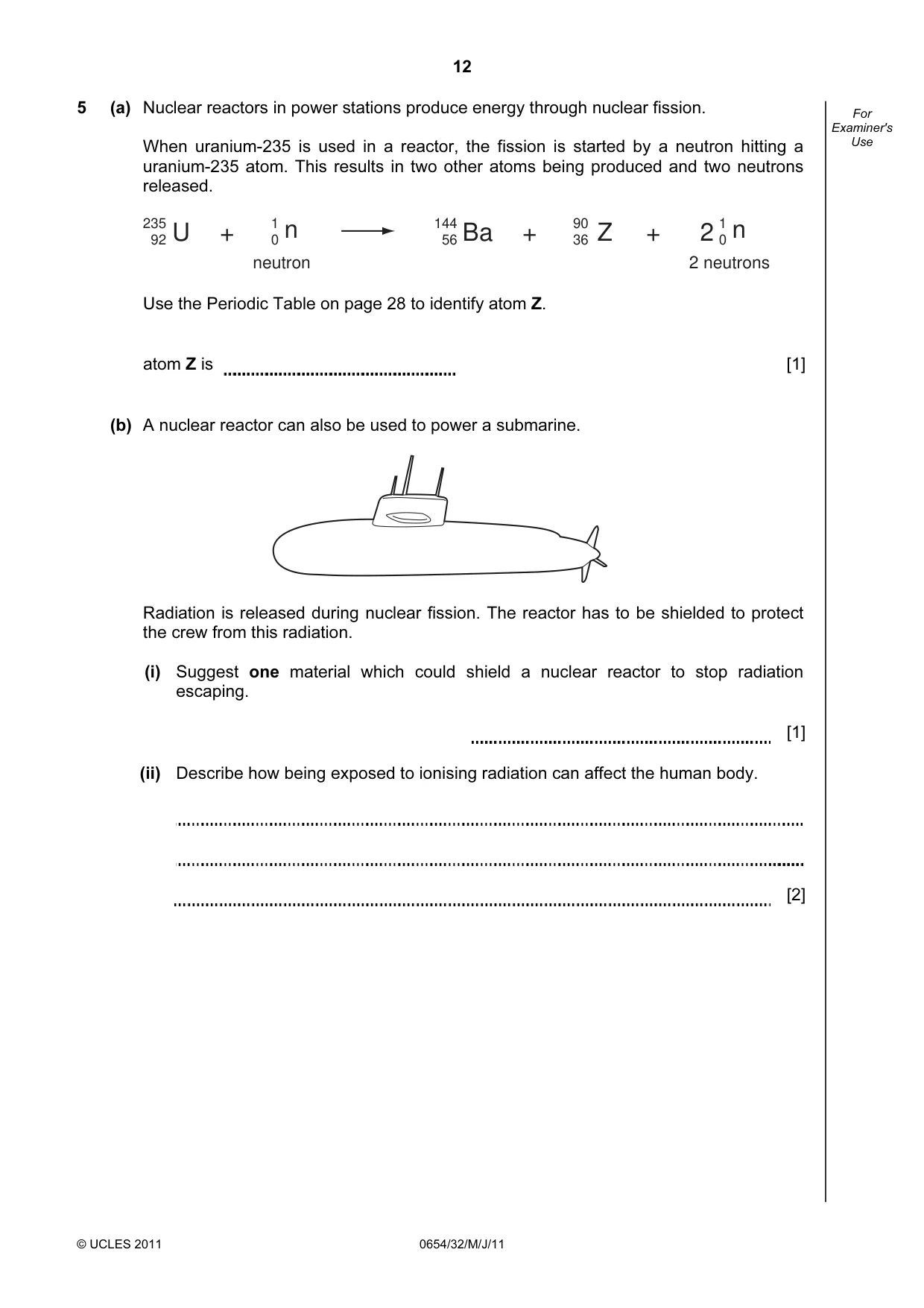
12 © UCLES 2011 0654/32/M/J/11 For Examiner's Use 5 (a) Nuclear reactors in power stations produce energy through nuclear fission. When uranium-235 is used in a reactor, the fission is started by a neutron hitting a uranium-235 atom. This results in two other atoms being produced and two neutrons released. 235 92 U 2 1 0 n + neutron 144 56 Ba 90 36 Z 1 0 n + + 2 neutrons Use the Periodic Table on page 28 to identify atom Z. atom Z is [1] (b) A nuclear reactor can also be used to power a submarine. Radiation is released during nuclear fission. The reactor has to be shielded to protect the crew from this radiation. (i) Suggest one material which could shield a nuclear reactor to stop radiation escaping. [1] (ii) Describe how being exposed to ionising radiation can affect the human body. [2]
Question paper, page 13
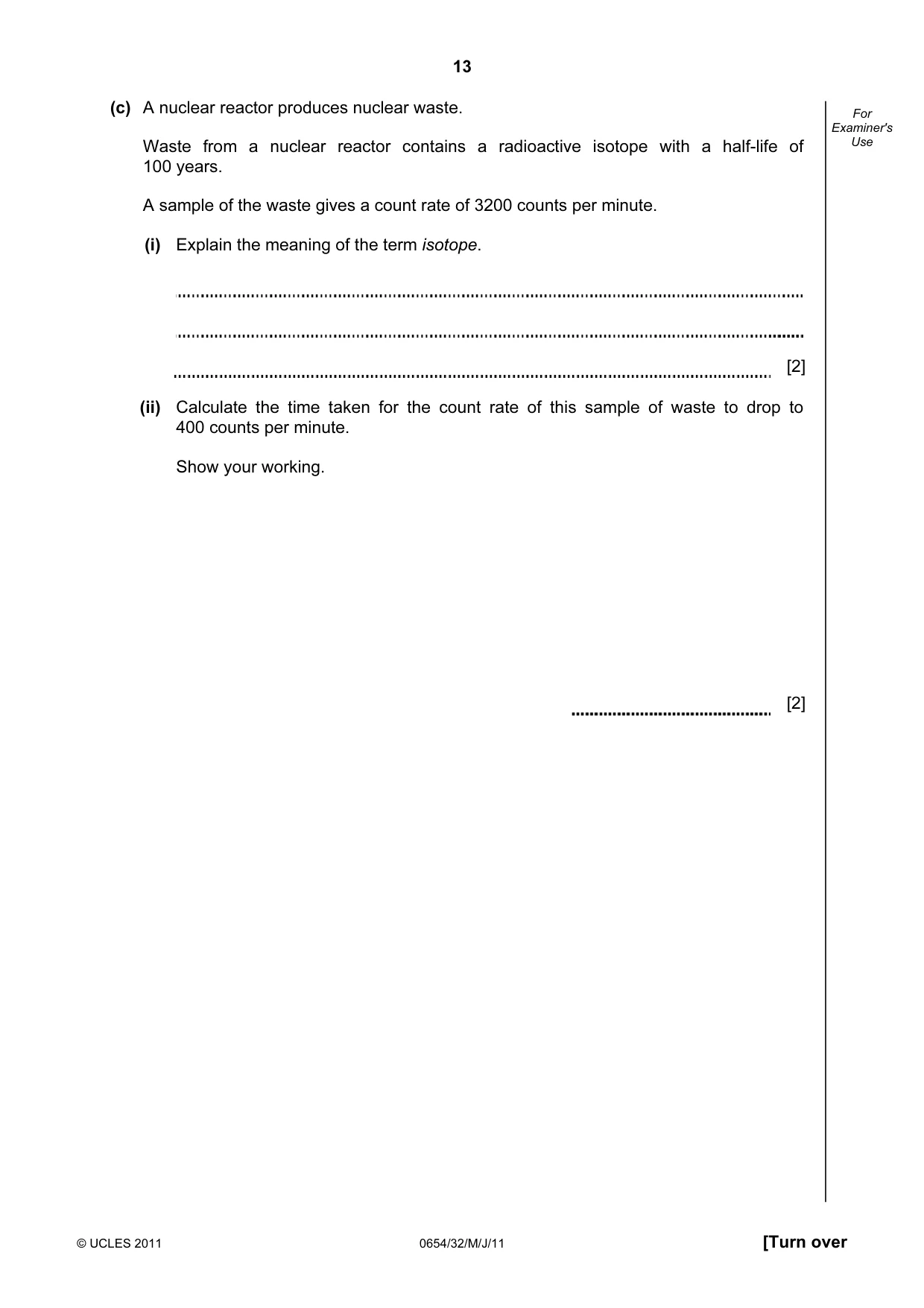
13 © UCLES 2011 0654/32/M/J/11 [Turn over For Examiner's Use (c) A nuclear reactor produces nuclear waste. Waste from a nuclear reactor contains a radioactive isotope with a half-life of 100 years. A sample of the waste gives a count rate of 3200 counts per minute. (i) Explain the meaning of the term isotope. [2] (ii) Calculate the time taken for the count rate of this sample of waste to drop to 400 counts per minute. Show your working. [2]
Question paper, page 14
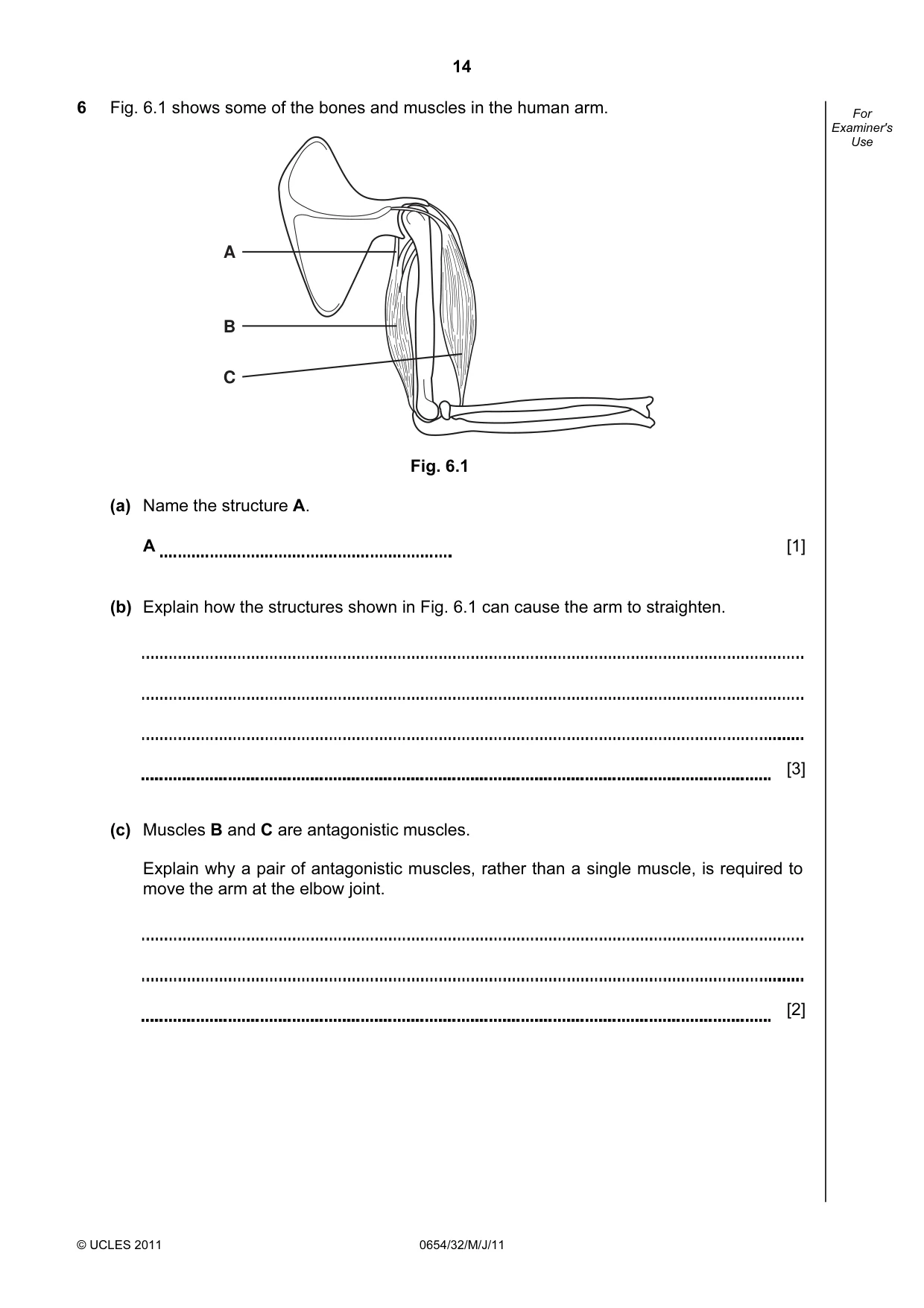
14 © UCLES 2011 0654/32/M/J/11 For Examiner's Use 6 Fig. 6.1 shows some of the bones and muscles in the human arm. A B C Fig. 6.1 (a) Name the structure A. A [1] (b) Explain how the structures shown in Fig. 6.1 can cause the arm to straighten. [3] (c) Muscles B and C are antagonistic muscles. Explain why a pair of antagonistic muscles, rather than a single muscle, is required to move the arm at the elbow joint. [2]
Question paper, page 15
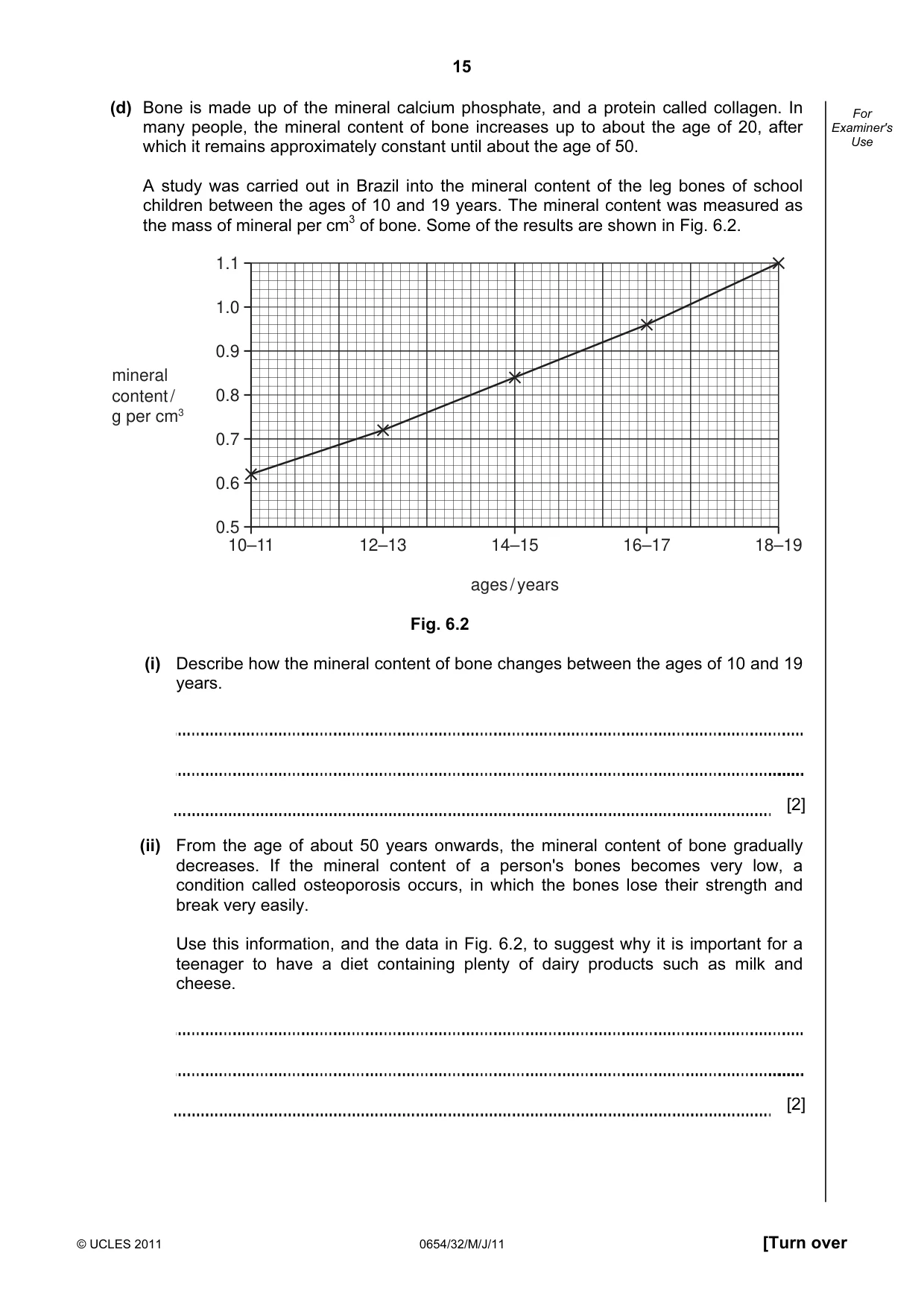
15 © UCLES 2011 0654/32/M/J/11 [Turn over For Examiner's Use (d) Bone is made up of the mineral calcium phosphate, and a protein called collagen. In many people, the mineral content of bone increases up to about the age of 20, after which it remains approximately constant until about the age of 50. A study was carried out in Brazil into the mineral content of the leg bones of school children between the ages of 10 and 19 years. The mineral content was measured as the mass of mineral per cm3 of bone. Some of the results are shown in Fig. 6.2. 10–11 12–13 14–15 16–17 18–19 1.1 1.0 0.9 0.8 0.7 0.6 0.5 ages / years mineral content / g per cm3 Fig. 6.2 (i) Describe how the mineral content of bone changes between the ages of 10 and 19 years. [2] (ii) From the age of about 50 years onwards, the mineral content of bone gradually decreases. If the mineral content of a person's bones becomes very low, a condition called osteoporosis occurs, in which the bones lose their strength and break very easily. Use this information, and the data in Fig. 6.2, to suggest why it is important for a teenager to have a diet containing plenty of dairy products such as milk and cheese. [2]
Question paper, page 16
16 © UCLES 2011 0654/32/M/J/11 For Examiner's Use (e) The human skeleton also contains cartilage. (i) State one difference between the properties of bone and cartilage. [1] (ii) State precisely where cartilage is found in the human arm shown in Fig. 6.1, and describe its function. [2]
Question paper, page 17
17 © UCLES 2011 0654/32/M/J/11 [Turn over BLANK PAGE Please turn over for Question 7.
Question paper, page 18
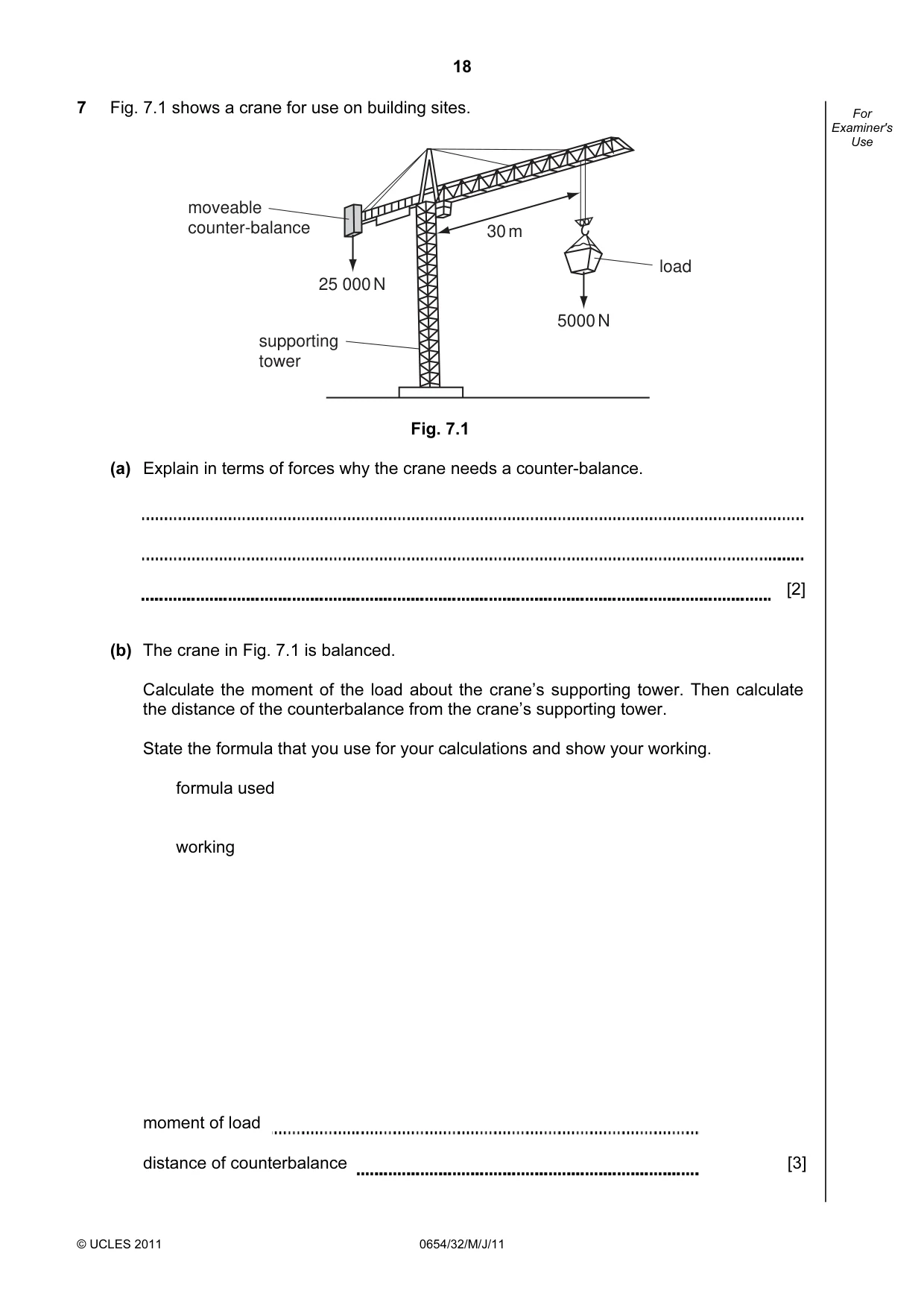
18 © UCLES 2011 0654/32/M/J/11 For Examiner's Use 7 Fig. 7.1 shows a crane for use on building sites. moveable counter-balance load supporting tower 25 000 N 5000 N 30 m Fig. 7.1 (a) Explain in terms of forces why the crane needs a counter-balance. [2] (b) The crane in Fig. 7.1 is balanced. Calculate the moment of the load about the crane’s supporting tower. Then calculate the distance of the counterbalance from the crane’s supporting tower. State the formula that you use for your calculations and show your working. formula used working moment of load distance of counterbalance [3]
Question paper, page 19
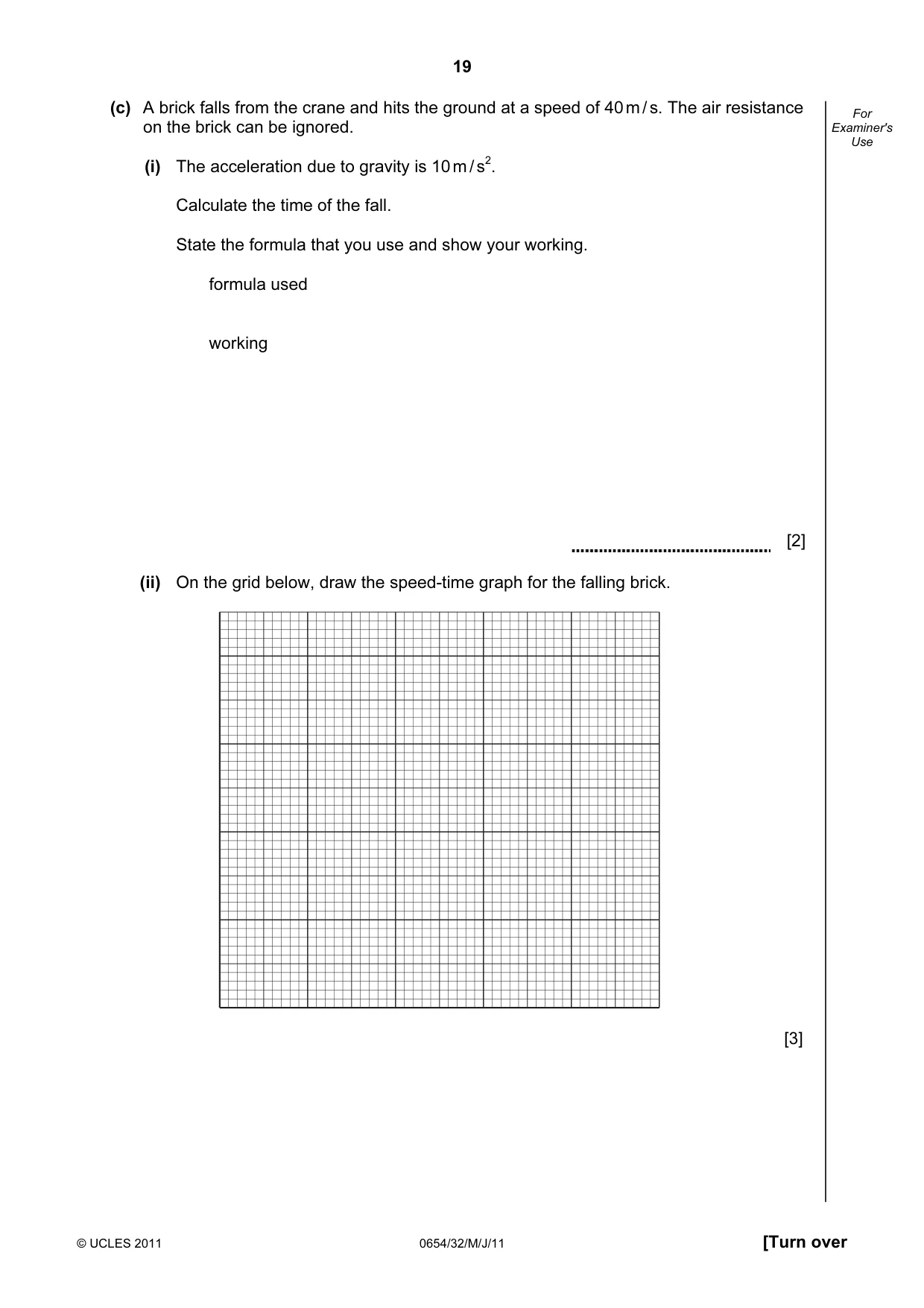
19 © UCLES 2011 0654/32/M/J/11 [Turn over For Examiner's Use (c) A brick falls from the crane and hits the ground at a speed of 40 m / s. The air resistance on the brick can be ignored. (i) The acceleration due to gravity is 10 m / s2. Calculate the time of the fall. State the formula that you use and show your working. formula used working [2] (ii) On the grid below, draw the speed-time graph for the falling brick. [3]
Question paper, page 20
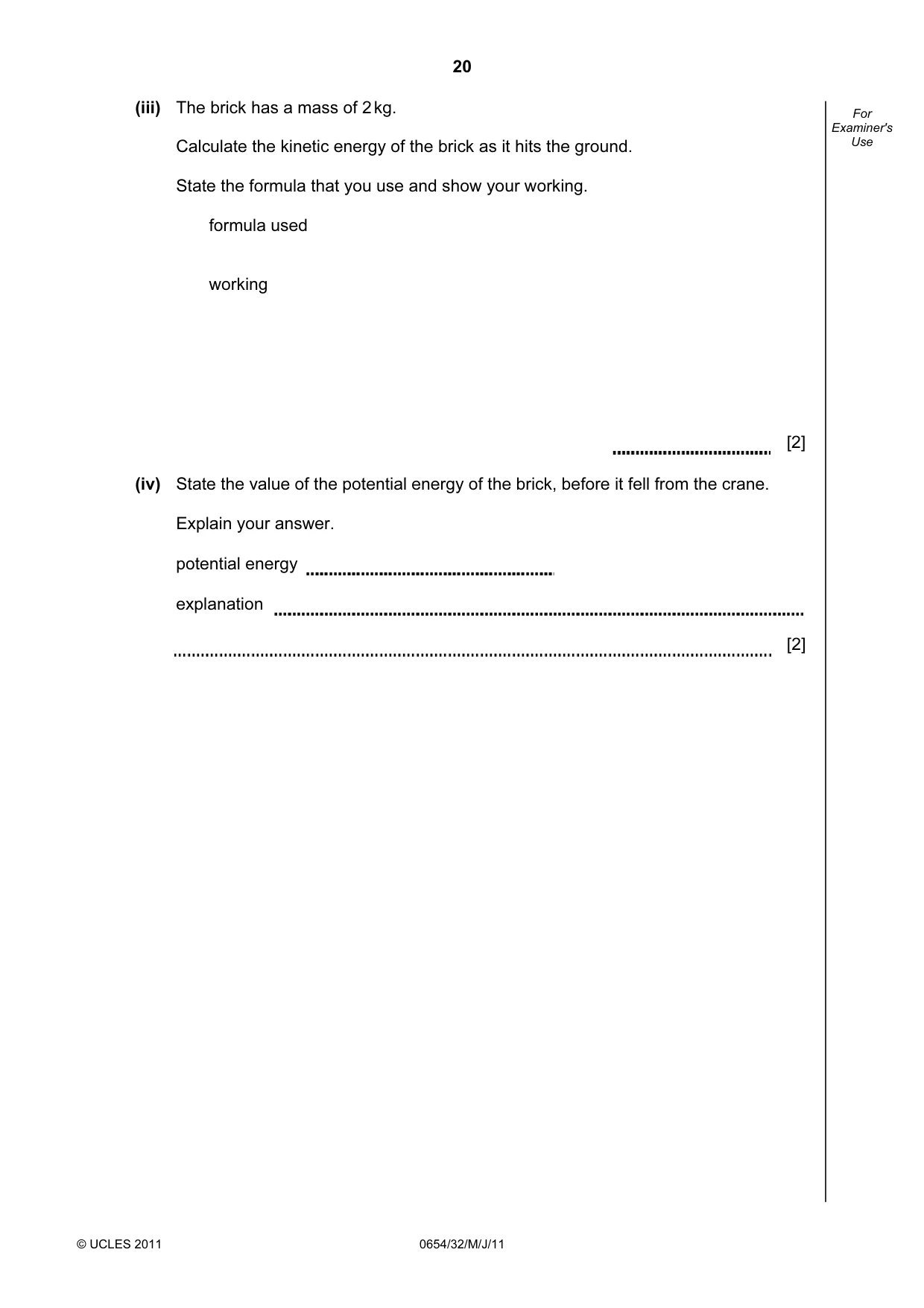
20 © UCLES 2011 0654/32/M/J/11 For Examiner's Use (iii) The brick has a mass of 2 kg. Calculate the kinetic energy of the brick as it hits the ground. State the formula that you use and show your working. formula used working [2] (iv) State the value of the potential energy of the brick, before it fell from the crane. Explain your answer. potential energy explanation [2]
Question paper, page 21
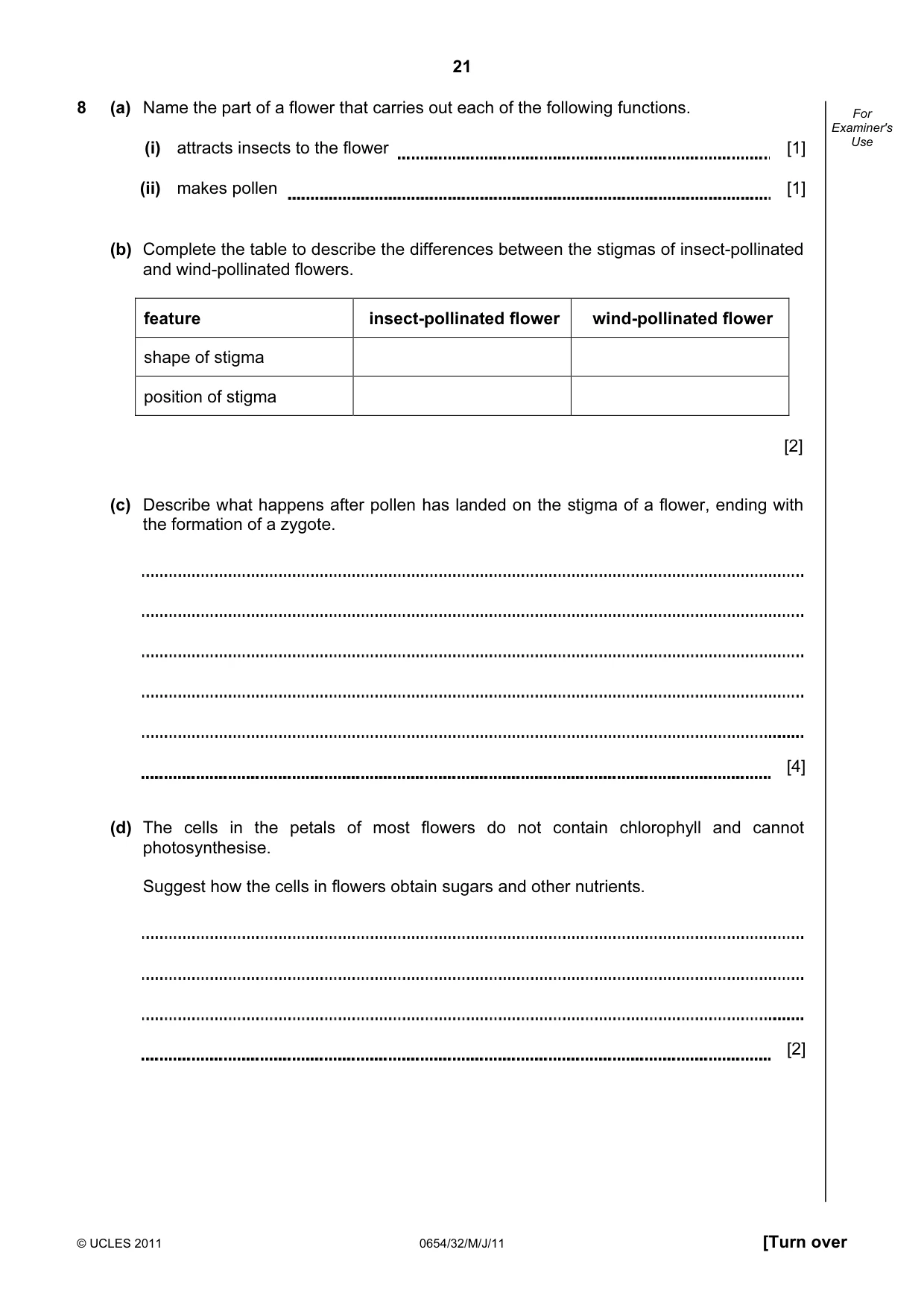
21 © UCLES 2011 0654/32/M/J/11 [Turn over For Examiner's Use 8 (a) Name the part of a flower that carries out each of the following functions. (i) attracts insects to the flower [1] (ii) makes pollen [1] (b) Complete the table to describe the differences between the stigmas of insect-pollinated and wind-pollinated flowers. feature insect-pollinated flower wind-pollinated flower shape of stigma position of stigma [2] (c) Describe what happens after pollen has landed on the stigma of a flower, ending with the formation of a zygote. [4] (d) The cells in the petals of most flowers do not contain chlorophyll and cannot photosynthesise. Suggest how the cells in flowers obtain sugars and other nutrients. [2]
Question paper, page 22
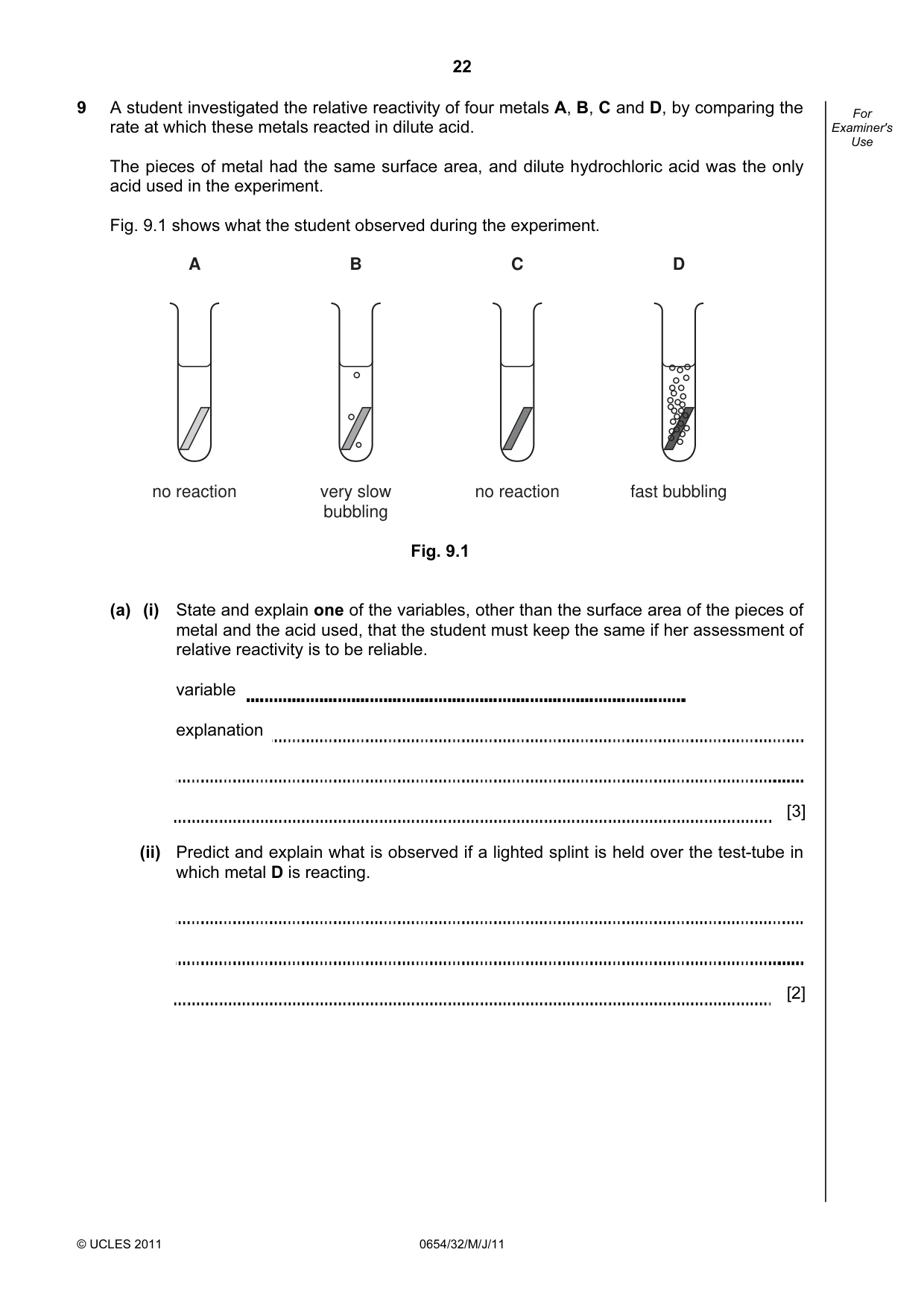
22 © UCLES 2011 0654/32/M/J/11 For Examiner's Use 9 A student investigated the relative reactivity of four metals A, B, C and D, by comparing the rate at which these metals reacted in dilute acid. The pieces of metal had the same surface area, and dilute hydrochloric acid was the only acid used in the experiment. Fig. 9.1 shows what the student observed during the experiment. no reaction A very slow bubbling B no reaction C fast bubbling D Fig. 9.1 (a) (i) State and explain one of the variables, other than the surface area of the pieces of metal and the acid used, that the student must keep the same if her assessment of relative reactivity is to be reliable. variable explanation [3] (ii) Predict and explain what is observed if a lighted splint is held over the test-tube in which metal D is reacting. [2]
Question paper, page 23
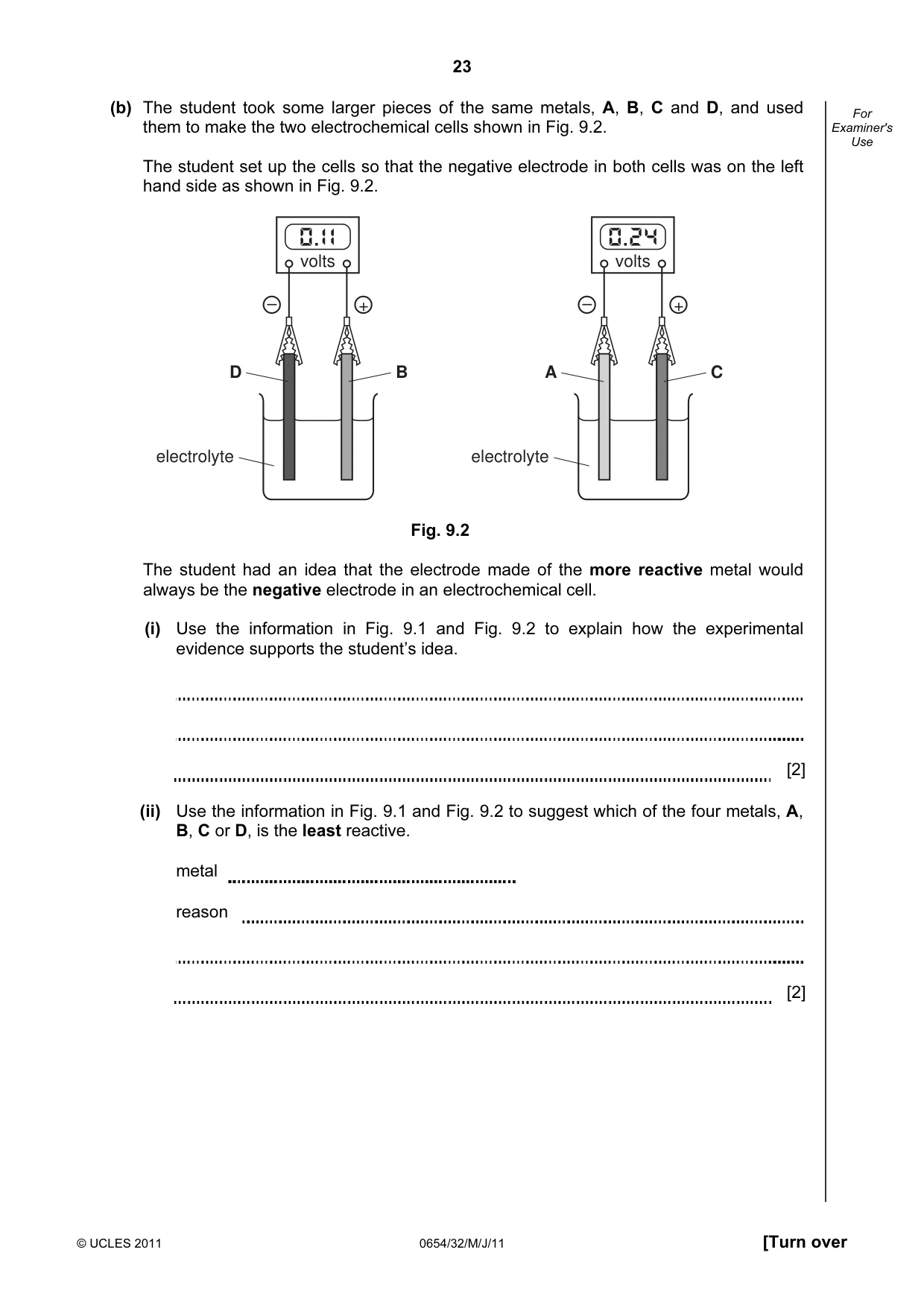
23 © UCLES 2011 0654/32/M/J/11 [Turn over For Examiner's Use (b) The student took some larger pieces of the same metals, A, B, C and D, and used them to make the two electrochemical cells shown in Fig. 9.2. The student set up the cells so that the negative electrode in both cells was on the left hand side as shown in Fig. 9.2. D B electrolyte + – volts A C electrolyte + – volts Fig. 9.2 The student had an idea that the electrode made of the more reactive metal would always be the negative electrode in an electrochemical cell. (i) Use the information in Fig. 9.1 and Fig. 9.2 to explain how the experimental evidence supports the student’s idea. [2] (ii) Use the information in Fig. 9.1 and Fig. 9.2 to suggest which of the four metals, A, B, C or D, is the least reactive. metal reason [2]
Question paper, page 24
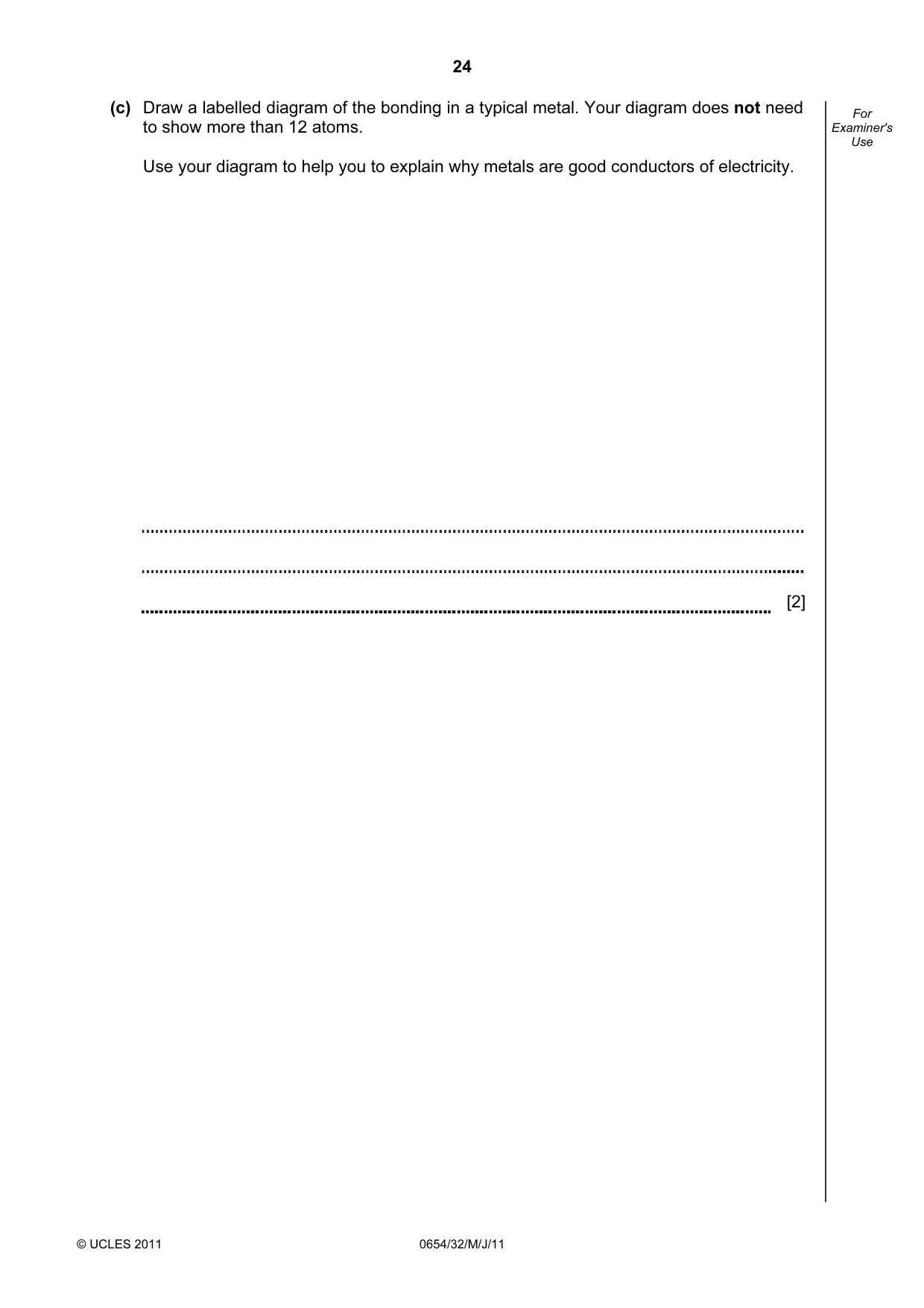
24 © UCLES 2011 0654/32/M/J/11 For Examiner's Use (c) Draw a labelled diagram of the bonding in a typical metal. Your diagram does not need to show more than 12 atoms. Use your diagram to help you to explain why metals are good conductors of electricity. [2]
Question paper, page 25
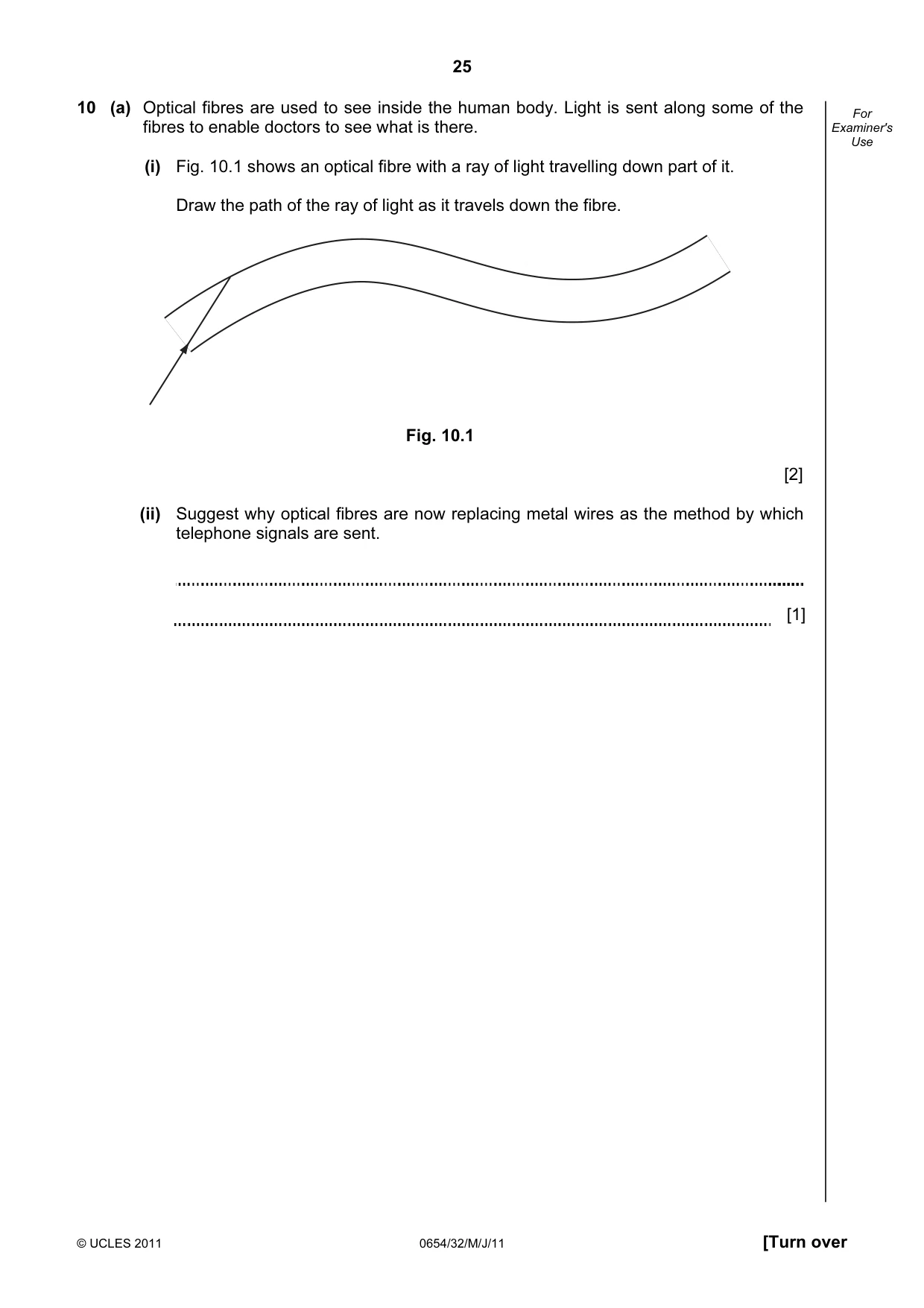
25 © UCLES 2011 0654/32/M/J/11 [Turn over For Examiner's Use 10 (a) Optical fibres are used to see inside the human body. Light is sent along some of the fibres to enable doctors to see what is there. (i) Fig. 10.1 shows an optical fibre with a ray of light travelling down part of it. Draw the path of the ray of light as it travels down the fibre. Fig. 10.1 [2] (ii) Suggest why optical fibres are now replacing metal wires as the method by which telephone signals are sent. [1]
Question paper, page 26
26 © UCLES 2011 0654/32/M/J/11 For Examiner's Use (b) Table 10.1 shows the likely effects of an electric current passing through the body. Table 10.1 current / amperes effect on the human body 0.001 none 0.003 tingling 0.010 muscular spasm 0.100 fatal if it passes through the heart A person touched a live wire connected to a 250 V supply. The path to earth through the body had a high resistance of 20 000 Ω. Calculate the current that passes through the person. What effect will this have on the person’s body? State the formula that you use and show your working. formula used working current = effect on the body [3]
Question paper, page 27
27 © UCLES 2011 0654/32/M/J/11 BLANK PAGE
Question paper, page 28
28 Permission to reproduce items where third-party owned material protected by copyright is included has been sought and cleared where possible. Every reasonable effort has been made by the publisher (UCLES) to trace copyright holders, but if any items requiring clearance have unwittingly been included, the publisher will be pleased to make amends at the earliest possible opportunity. University of Cambridge International Examinations is part of the Cambridge Assessment Group. Cambridge Assessment is the brand name of University of Cambridge Local Examinations Syndicate (UCLES), which is itself a department of the University of Cambridge. © UCLES 2011 0654/32/M/J/11 Group 140 Ce Cerium 58 141 Pr Praseodymium 59 144 Nd Neodymium 60 Pm Promethium 61 150 Sm Samarium 62 152 Eu Europium 63 157 Gd Gadolinium 64 159 Tb Terbium 65 162 Dy Dysprosium 66 165 Ho Holmium 67 167 Er Erbium 68 169 Tm Thulium 69 173 Yb Ytterbium 70 175 Lu Lutetium 71 232 Th Thorium 90 Pa Protactinium 91 238 U Uranium 92 Np Neptunium 93 Pu Plutonium 94 Am Americium 95 Cm Curium 96 Bk Berkelium 97 Cf Californium 98 Es Einsteinium 99 Fm Fermium 100 Md Mendelevium 101 No Nobelium 102 Lr Lawrencium 103 1 H Hydrogen 1 7 Li Lithium 3 23 Na Sodium 11 24 Mg Magnesium 12 40 Ca Calcium 20 45 Sc Scandium 21 48 Ti Titanium 22 51 V Vanadium 23 52 Cr Chromium 24 55 Mn Manganese 25 56 Fe Iron 26 59 Co Cobalt 27 59 Ni Nickel 28 64 Cu Copper 29 65 Zn Zinc 30 70 Ga Gallium 31 27 Al Aluminium 13 11 B Boron 5 12 C Carbon 6 14 N Nitrogen 7 16 O Oxygen 8 19 F Fluorine 9 28 Si Silicon 14 31 P Phosphorus 15 32 S Sulfur 16 35.5 Cl Chlorine 17 40 Ar Argon 18 20 Ne Neon 10 4 He Helium 2 73 Ge Germanium 32 75 As Arsenic 33 79 Se Selenium 34 80 Br Bromine 35 84 Kr Krypton 36 39 K Potassium 19 88 Sr Strontium 38 89 Y Yttrium 39 91 Zr Zirconium 40 93 Nb Niobium 41 96 Mo Molybdenum 42 Tc Technetium 43 101 Ru Ruthenium 44 103 Rh Rhodium 45 106 Pd Palladium 46 108 Ag Silver 47 112 Cd Cadmium 48 115 In Indium 49 119 Sn Tin 50 122 Sb Antimony 51 128 Te Tellurium 52 127 I Iodine 53 131 Xe Xenon 54 137 Ba Barium 56 139 La Lanthanum 57 * 178 Hf Hafnium 72 181 Ta Tantalum 73 184 W Tungsten 74 186 Re Rhenium 75 190 Os Osmium 76 192 Ir Iridium 77 195 Pt Platinum 78 197 Au Gold 79 201 Hg Mercury 80 204 Tl Thallium 81 207 Pb Lead 82 209 Bi Bismuth 83 Po Polonium 84 At Astatine 85 Rn Radon 86 Fr Francium 87 227 Ac Actinium 89 9 Be Beryllium 4 I II III IV V VI VII 0 85 Rb Rubidium 37 133 Cs Caesium 55 226 Ra Radium 88 The volume of one mole of any gas is 24 dm3 at room temperature and pressure (r.t.p.). a X b a = relative atomic mass X = atomic symbol b = proton (atomic) number Key *58-71 Lanthanoid series 90-103 Actinoid series DATA SHEET The Periodic Table of the Elements
Mark scheme, page 1
UNIVERSITY OF CAMBRIDGE INTERNATIONAL EXAMINATIONS International General Certificate of Secondary Education MARK SCHEME for the May/June 2011 question paper for the guidance of teachers 0654 CO-ORDINATED SCIENCES 0654/32 Paper 3 (Extended Theory), maximum raw mark 100 This mark scheme is published as an aid to teachers and candidates, to indicate the requirements of the examination. It shows the basis on which Examiners were instructed to award marks. It does not indicate the details of the discussions that took place at an Examiners’ meeting before marking began, which would have considered the acceptability of alternative answers. Mark schemes must be read in conjunction with the question papers and the report on the examination. • Cambridge will not enter into discussions or correspondence in connection with these mark schemes. Cambridge is publishing the mark schemes for the May/June 2011 question papers for most IGCSE, GCE Advanced Level and Advanced Subsidiary Level syllabuses and some Ordinary Level syllabuses. www.XtremePapers.com
Mark scheme, page 2
Page 2 Mark Scheme: Teachers’ version Syllabus Paper IGCSE – May/June 2011 0654 32 © University of Cambridge International Examinations 2011 1 (a) (i) hair / fur; [1] (ii) large ears / large eyes / long neck (so eyes high above ground) / long legs / strong legs ; [1] (b) more oxygen can be absorbed from the air / idea of compensating for less oxygen being available ; more oxygen supplied to, cells / muscles, / more oxygen carried by blood (cells) ; for respiration ; [max 2] (c) increases as animals breed / plenty of food available ; reference to limiting factors / reaches carrying capacity / reaches capacity of environment ; not enough, grass to eat / food / resources ; many eaten by, foxes / pumas ; plateau because birth rate equals death rate ; [max 3] (d) choose guanacos with desirable features ; allow to breed together ; repeat with selected offspring ; for many generations ; [4] [Total: 11]
Mark scheme, page 3
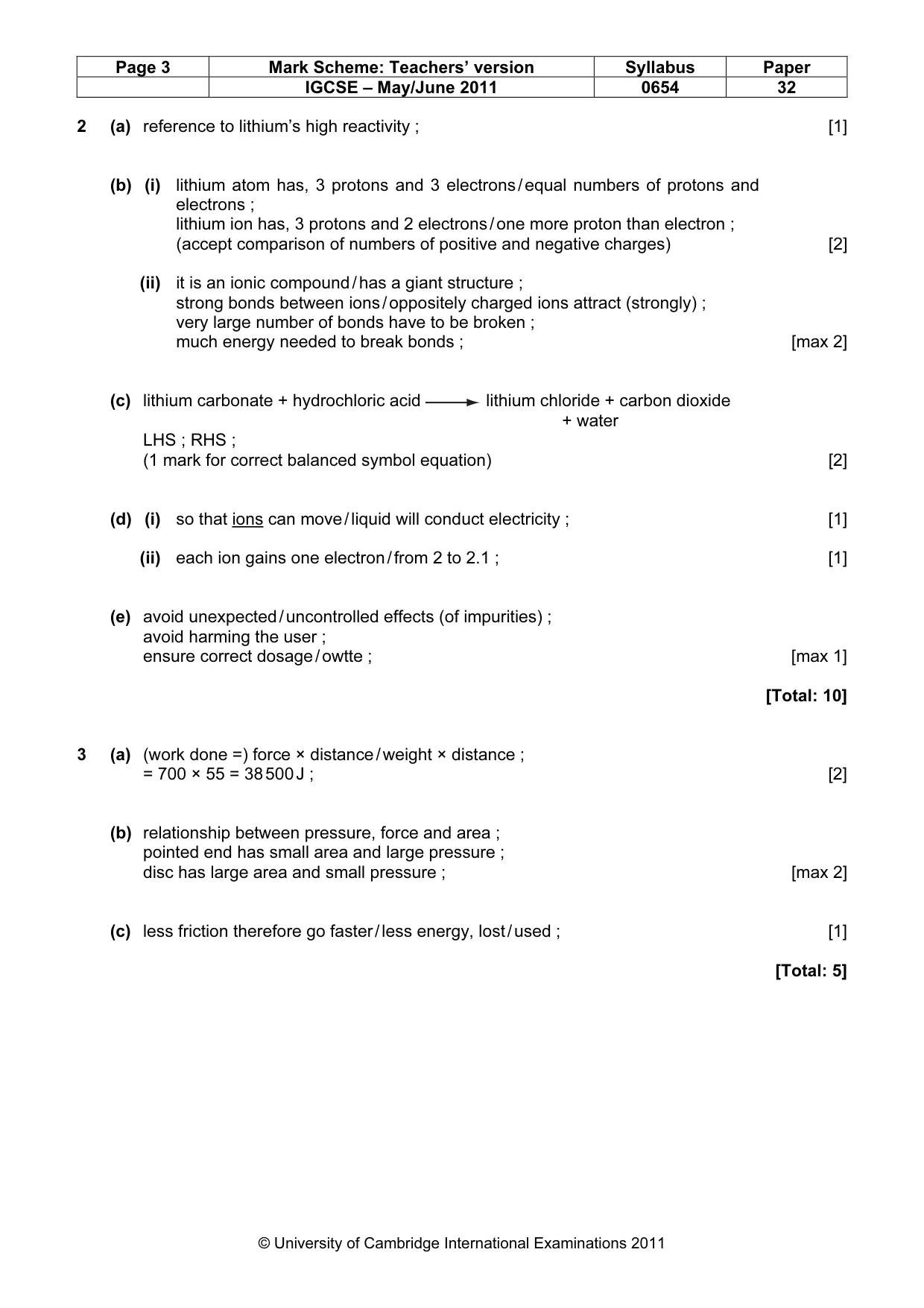
Page 3 Mark Scheme: Teachers’ version Syllabus Paper IGCSE – May/June 2011 0654 32 © University of Cambridge International Examinations 2011 2 (a) reference to lithium’s high reactivity ; [1] (b) (i) lithium atom has, 3 protons and 3 electrons / equal numbers of protons and electrons ; lithium ion has, 3 protons and 2 electrons / one more proton than electron ; (accept comparison of numbers of positive and negative charges) [2] (ii) it is an ionic compound / has a giant structure ; strong bonds between ions / oppositely charged ions attract (strongly) ; very large number of bonds have to be broken ; much energy needed to break bonds ; [max 2] (c) lithium carbonate + hydrochloric acid lithium chloride + carbon dioxide + water LHS ; RHS ; (1 mark for correct balanced symbol equation) [2] (d) (i) so that ions can move / liquid will conduct electricity ; [1] (ii) each ion gains one electron / from 2 to 2.1 ; [1] (e) avoid unexpected / uncontrolled effects (of impurities) ; avoid harming the user ; ensure correct dosage / owtte ; [max 1] [Total: 10] 3 (a) (work done =) force × distance / weight × distance ; = 700 × 55 = 38 500 J ; [2] (b) relationship between pressure, force and area ; pointed end has small area and large pressure ; disc has large area and small pressure ; [max 2] (c) less friction therefore go faster / less energy, lost / used ; [1] [Total: 5]
Mark scheme, page 4
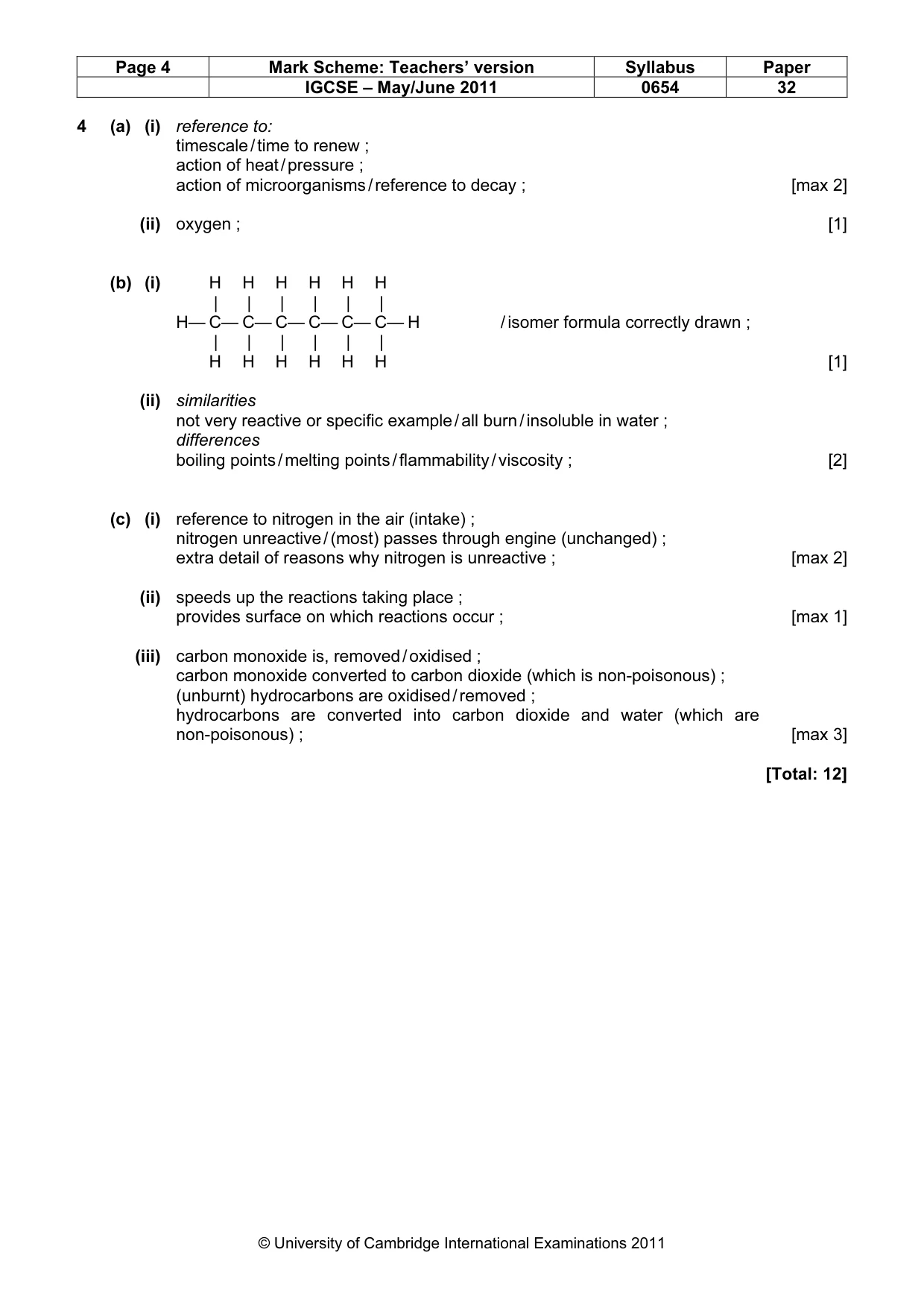
Page 4 Mark Scheme: Teachers’ version Syllabus Paper IGCSE – May/June 2011 0654 32 © University of Cambridge International Examinations 2011 4 (a) (i) reference to: timescale / time to renew ; action of heat / pressure ; action of microorganisms / reference to decay ; [max 2] (ii) oxygen ; [1] (b) (i) H H H H H H | | | | | | H— C— C— C— C— C— C— H / isomer formula correctly drawn ; | | | | | | H H H H H H [1] (ii) similarities not very reactive or specific example / all burn / insoluble in water ; differences boiling points / melting points / flammability / viscosity ; [2] (c) (i) reference to nitrogen in the air (intake) ; nitrogen unreactive / (most) passes through engine (unchanged) ; extra detail of reasons why nitrogen is unreactive ; [max 2] (ii) speeds up the reactions taking place ; provides surface on which reactions occur ; [max 1] (iii) carbon monoxide is, removed / oxidised ; carbon monoxide converted to carbon dioxide (which is non-poisonous) ; (unburnt) hydrocarbons are oxidised / removed ; hydrocarbons are converted into carbon dioxide and water (which are non-poisonous) ; [max 3] [Total: 12]
Mark scheme, page 5
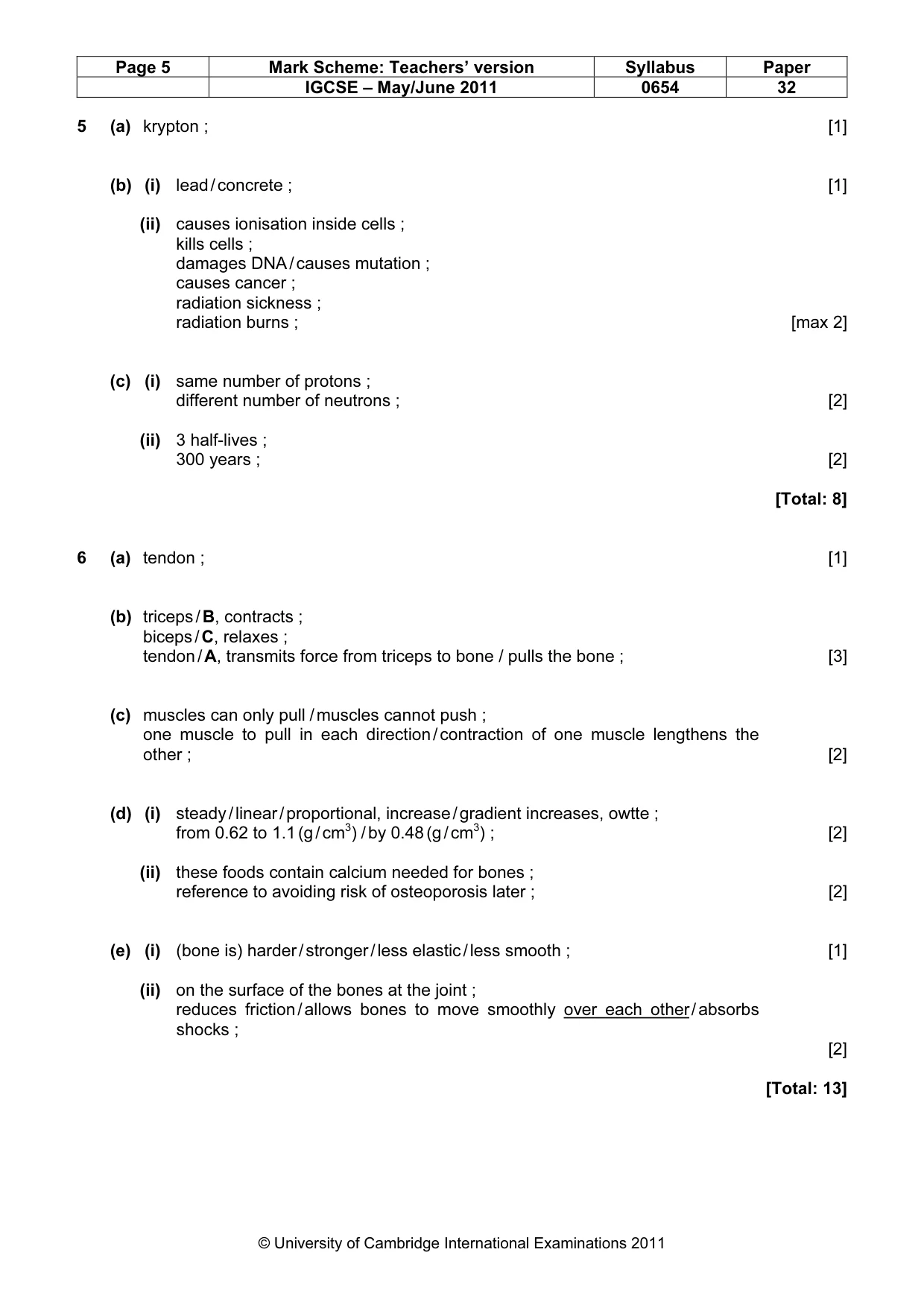
Page 5 Mark Scheme: Teachers’ version Syllabus Paper IGCSE – May/June 2011 0654 32 © University of Cambridge International Examinations 2011 5 (a) krypton ; [1] (b) (i) lead / concrete ; [1] (ii) causes ionisation inside cells ; kills cells ; damages DNA / causes mutation ; causes cancer ; radiation sickness ; radiation burns ; [max 2] (c) (i) same number of protons ; different number of neutrons ; [2] (ii) 3 half-lives ; 300 years ; [2] [Total: 8] 6 (a) tendon ; [1] (b) triceps / B, contracts ; biceps / C, relaxes ; tendon / A, transmits force from triceps to bone / pulls the bone ; [3] (c) muscles can only pull / muscles cannot push ; one muscle to pull in each direction / contraction of one muscle lengthens the other ; [2] (d) (i) steady / linear / proportional, increase / gradient increases, owtte ; from 0.62 to 1.1 (g / cm3) / by 0.48 (g / cm3) ; [2] (ii) these foods contain calcium needed for bones ; reference to avoiding risk of osteoporosis later ; [2] (e) (i) (bone is) harder / stronger / less elastic / less smooth ; [1] (ii) on the surface of the bones at the joint ; reduces friction / allows bones to move smoothly over each other / absorbs shocks ; [2] [Total: 13]
Mark scheme, page 6
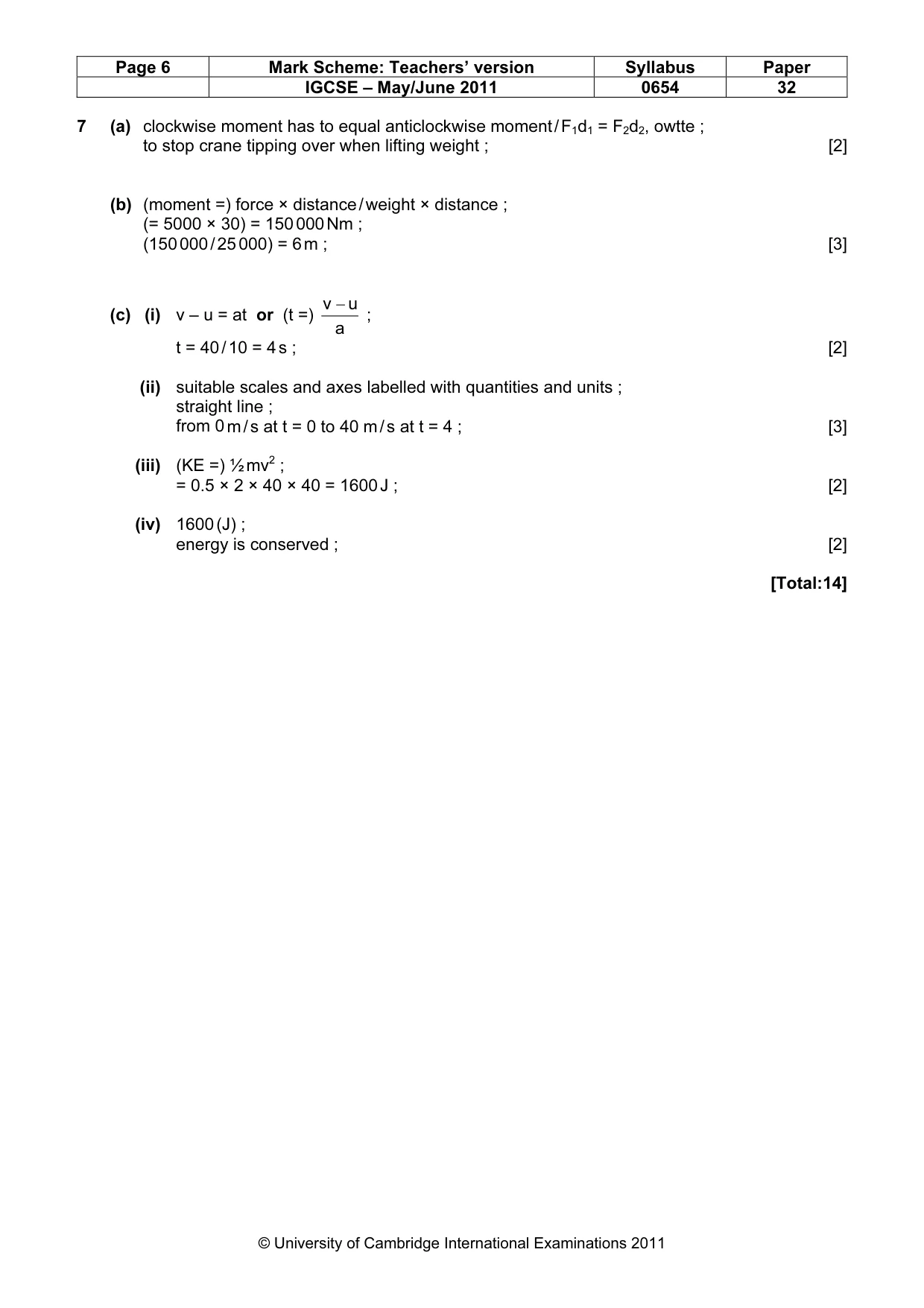
Page 6 Mark Scheme: Teachers’ version Syllabus Paper IGCSE – May/June 2011 0654 32 © University of Cambridge International Examinations 2011 7 (a) clockwise moment has to equal anticlockwise moment / F1d1 = F2d2, owtte ; to stop crane tipping over when lifting weight ; [2] (b) (moment =) force × distance / weight × distance ; (= 5000 × 30) = 150 000 Nm ; (150 000 / 25 000) = 6 m ; [3] (c) (i) v – u = at or (t =) a u v − ; t = 40 / 10 = 4 s ; [2] (ii) suitable scales and axes labelled with quantities and units ; straight line ; from 0 m / s at t = 0 to 40 m / s at t = 4 ; [3] (iii) (KE =) ½ mv2 ; = 0.5 × 2 × 40 × 40 = 1600 J ; [2] (iv) 1600 (J) ; energy is conserved ; [2] [Total:14]
Mark scheme, page 7
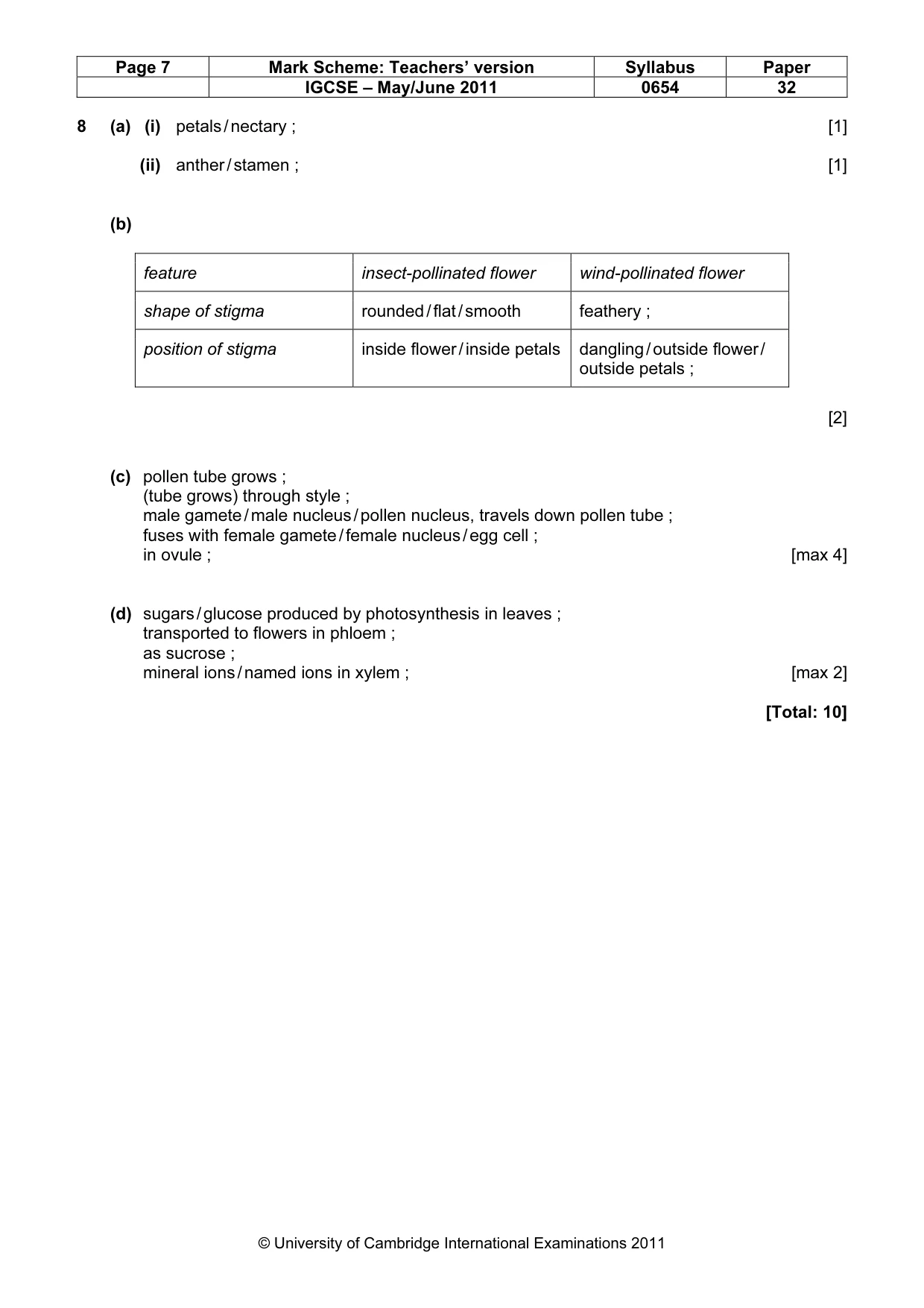
Page 7 Mark Scheme: Teachers’ version Syllabus Paper IGCSE – May/June 2011 0654 32 © University of Cambridge International Examinations 2011 8 (a) (i) petals / nectary ; [1] (ii) anther / stamen ; [1] (b) feature insect-pollinated flower wind-pollinated flower shape of stigma rounded / flat / smooth feathery ; position of stigma inside flower / inside petals dangling / outside flower / outside petals ; [2] (c) pollen tube grows ; (tube grows) through style ; male gamete / male nucleus / pollen nucleus, travels down pollen tube ; fuses with female gamete / female nucleus / egg cell ; in ovule ; [max 4] (d) sugars / glucose produced by photosynthesis in leaves ; transported to flowers in phloem ; as sucrose ; mineral ions / named ions in xylem ; [max 2] [Total: 10]
Mark scheme, page 8
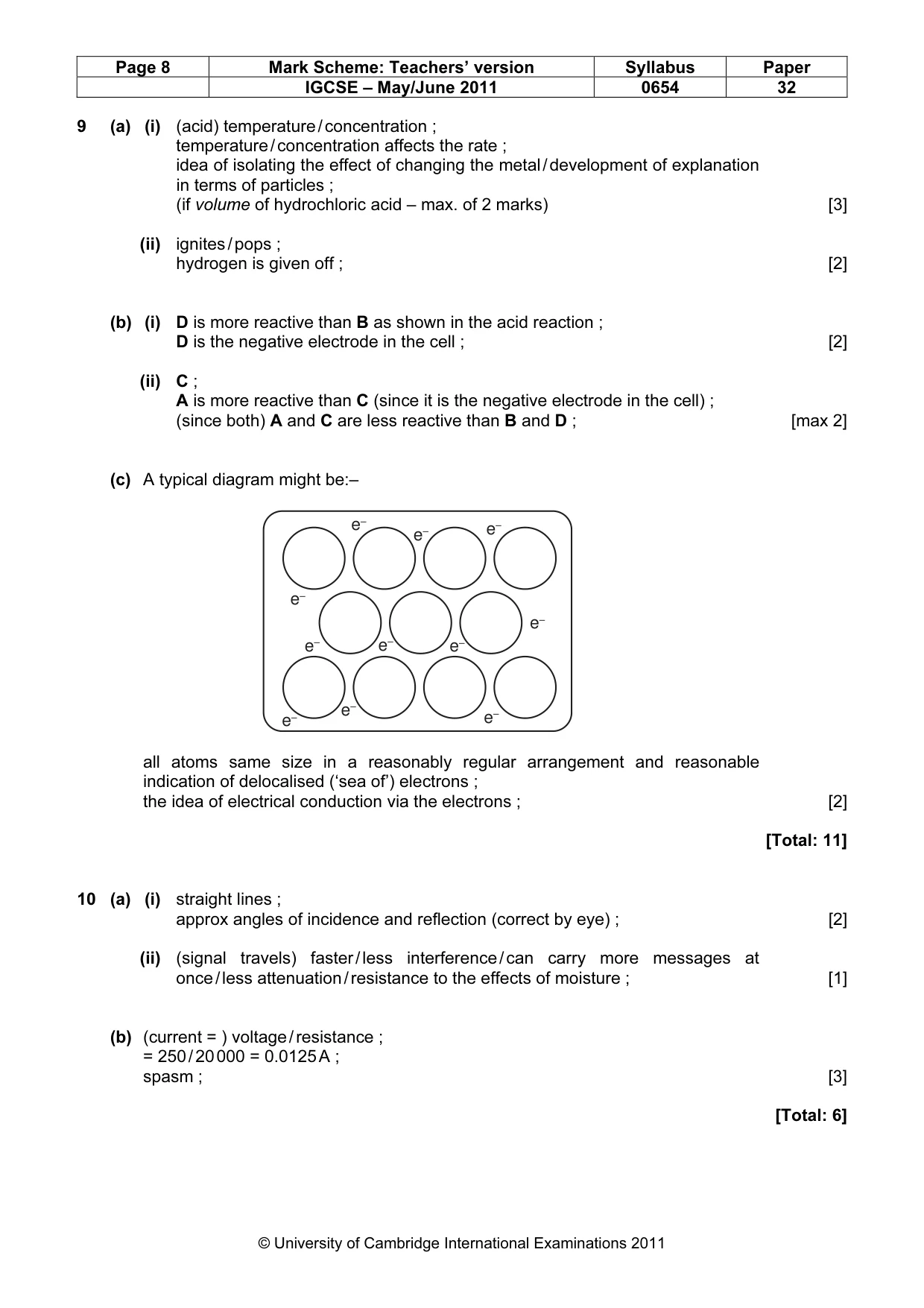
Page 8 Mark Scheme: Teachers’ version Syllabus Paper IGCSE – May/June 2011 0654 32 © University of Cambridge International Examinations 2011 9 (a) (i) (acid) temperature / concentration ; temperature / concentration affects the rate ; idea of isolating the effect of changing the metal / development of explanation in terms of particles ; (if volume of hydrochloric acid – max. of 2 marks) [3] (ii) ignites / pops ; hydrogen is given off ; [2] (b) (i) D is more reactive than B as shown in the acid reaction ; D is the negative electrode in the cell ; [2] (ii) C ; A is more reactive than C (since it is the negative electrode in the cell) ; (since both) A and C are less reactive than B and D ; [max 2] (c) A typical diagram might be:– e– e– e– e– e– e– e– e– e– e– e– all atoms same size in a reasonably regular arrangement and reasonable indication of delocalised (‘sea of’) electrons ; the idea of electrical conduction via the electrons ; [2] [Total: 11] 10 (a) (i) straight lines ; approx angles of incidence and reflection (correct by eye) ; [2] (ii) (signal travels) faster / less interference / can carry more messages at once / less attenuation / resistance to the effects of moisture ; [1] (b) (current = ) voltage / resistance ; = 250 / 20 000 = 0.0125 A ; spasm ; [3] [Total: 6]
What you needed in this session
Cambridge’s own grade thresholds for 2011 May/June, Paper 3 · Variant 2. A higher threshold means an easier paper — the bar moves with how the cohort did.