Cambridge IGCSE Sciences - Co-ordinated (Double) 0654 — 2009 May/June Paper 3 · Variant 1
0654/31/M/J/09
The question paper and its mark scheme, free to read here and free to download. This is Cambridge’s own paper, exactly as it was sat.
Question paper57 pages







Mark scheme13 pages
Answers below. Sit the paper first if you are practising.
Paper as text
Question paper, page 1
Location Entry Codes As part of CIE’s continual commitment to maintaining best practice in assessment, CIE uses different variants of some question papers for our most popular assessments with large and widespread candidature. The question papers are closely related and the relationships between them have been thoroughly established using our assessment expertise. All versions of the paper give assessment of equal standard. The content assessed by the examination papers and the type of questions is unchanged. This change means that for this component there are now two variant Question Papers, Mark Schemes and Principal Examiner’s Reports where previously there was only one. For any individual country, it is intended that only one variant is used. This document contains both variants which will give all Centres access to even more past examination material than is usually the case. The diagram shows the relationship between the Question Papers, Mark Schemes and Principal Examiners’ Reports that are available. Question Paper Mark Scheme Principal Examiner’s Report Introduction Introduction Introduction First variant Question Paper First variant Mark Scheme First variant Principal Examiner’s Report Second variant Question Paper Second variant Mark Scheme Second variant Principal Examiner’s Report Who can I contact for further information on these changes? Please direct any questions about this to CIE’s Customer Services team at: international@cie.org.uk The titles for the variant items should correspond with the table above, so that at the top of the first page of the relevant part of the document and on the header, it has the words: • First variant Question Paper / Mark Scheme / Principal Examiner’s Report or • Second variant Question Paper / Mark Scheme / Principal Examiner’s Report as appropriate. www.XtremePapers.com
Question paper, page 2
This document consists of 25 printed pages and 3 blank pages. IB09 06_0654_31/3RP © UCLES 2009 [Turn over *0622320493* For Examiner's Use 1 2 3 4 5 6 7 8 9 Total UNIVERSITY OF CAMBRIDGE INTERNATIONAL EXAMINATIONS International General Certificate of Secondary Education CO-ORDINATED SCIENCES 0654/31 Paper 3 (Extended) May/June 2009 2 hours Candidates answer on the Question Paper. No Additional Materials are required. READ THESE INSTRUCTIONS FIRST Write your Centre number, candidate number and name on all the work you hand in. Write in dark blue or black pen. You may use a soft pencil for any diagrams, graphs, tables or rough working. Do not use staples, paper clips, highlighters, glue or correction fluid. DO NOT WRITE IN ANY BARCODES. Answer all questions. A copy of the Periodic Table is printed on page 28. At the end of the examination, fasten all your work securely together. The number of marks is given in brackets [ ] at the end of each question or part question. First Variant Question Paper
Question paper, page 3
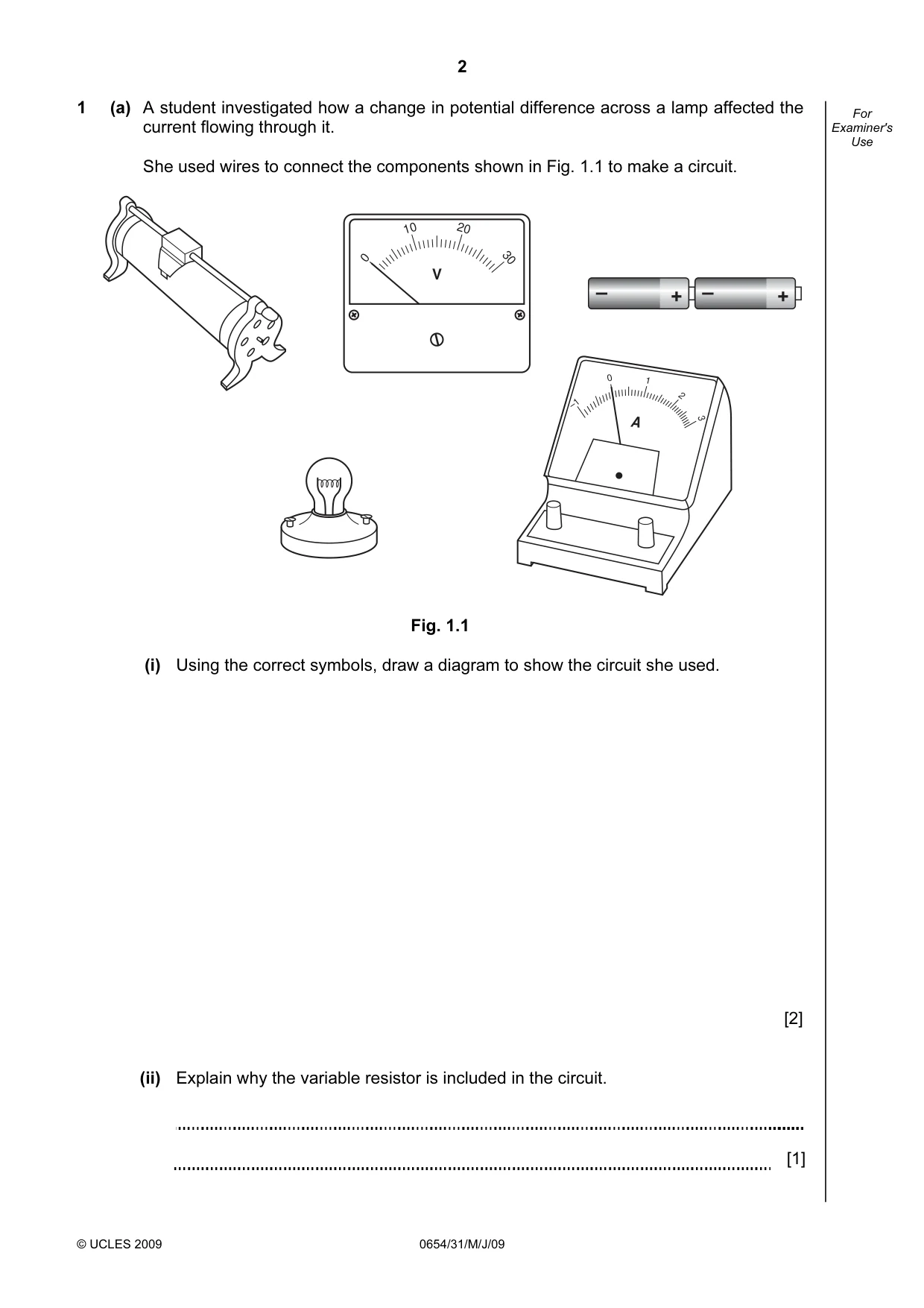
2 © UCLES 2009 0654/31/M/J/09 For Examiner's Use 1 (a) A student investigated how a change in potential difference across a lamp affected the current flowing through it. She used wires to connect the components shown in Fig. 1.1 to make a circuit. 10 20 30 0 V 1 2 3 0 –1 A + – + – Fig. 1.1 (i) Using the correct symbols, draw a diagram to show the circuit she used. [2] (ii) Explain why the variable resistor is included in the circuit. [1]
Question paper, page 4
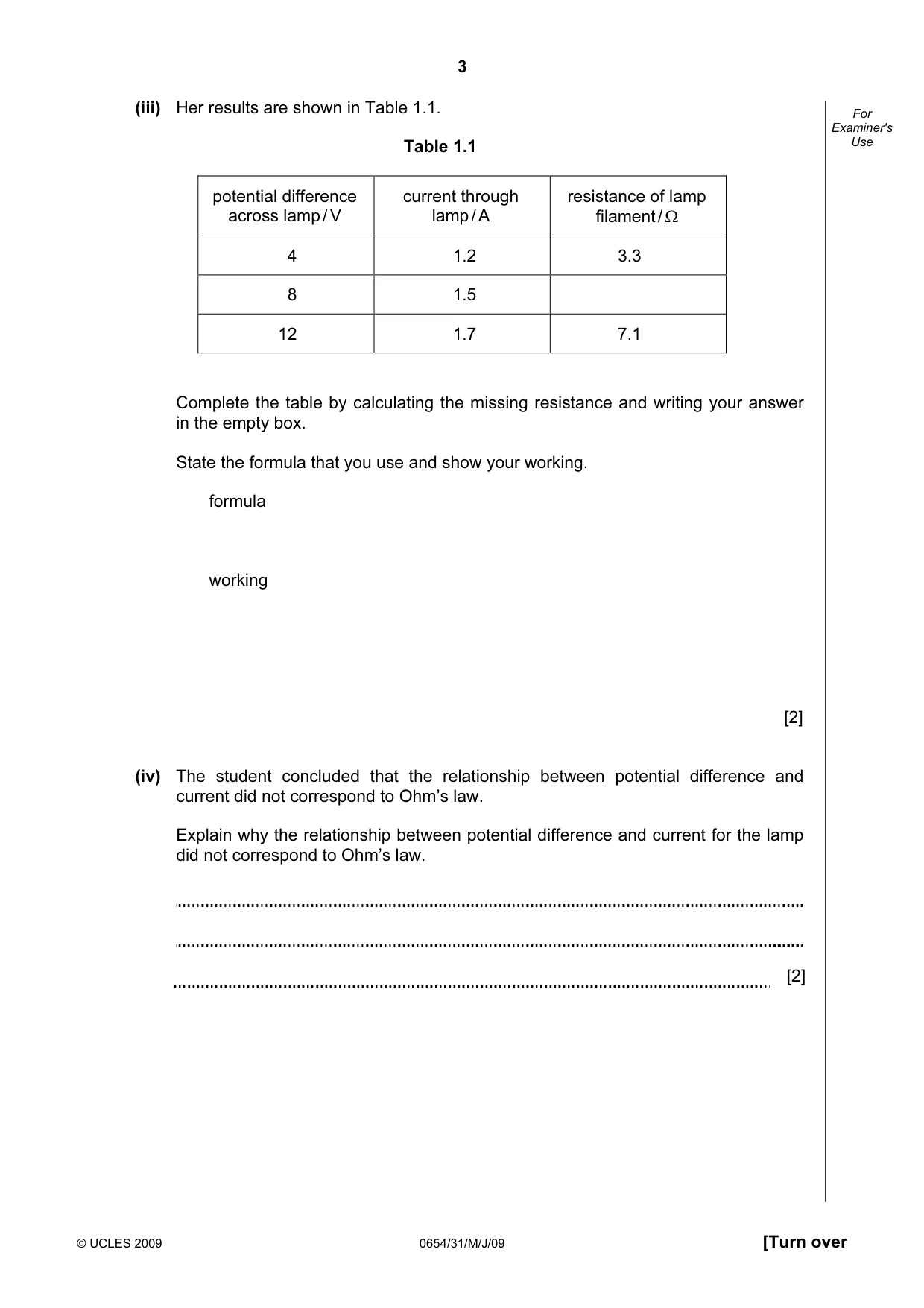
3 © UCLES 2009 0654/31/M/J/09 [Turn over For Examiner's Use (iii) Her results are shown in Table 1.1. Table 1.1 potential difference across lamp / V current through lamp / A resistance of lamp filament / Ω 4 1.2 3.3 8 1.5 12 1.7 7.1 Complete the table by calculating the missing resistance and writing your answer in the empty box. State the formula that you use and show your working. formula working [2] (iv) The student concluded that the relationship between potential difference and current did not correspond to Ohm’s law. Explain why the relationship between potential difference and current for the lamp did not correspond to Ohm’s law. [2]
Question paper, page 5
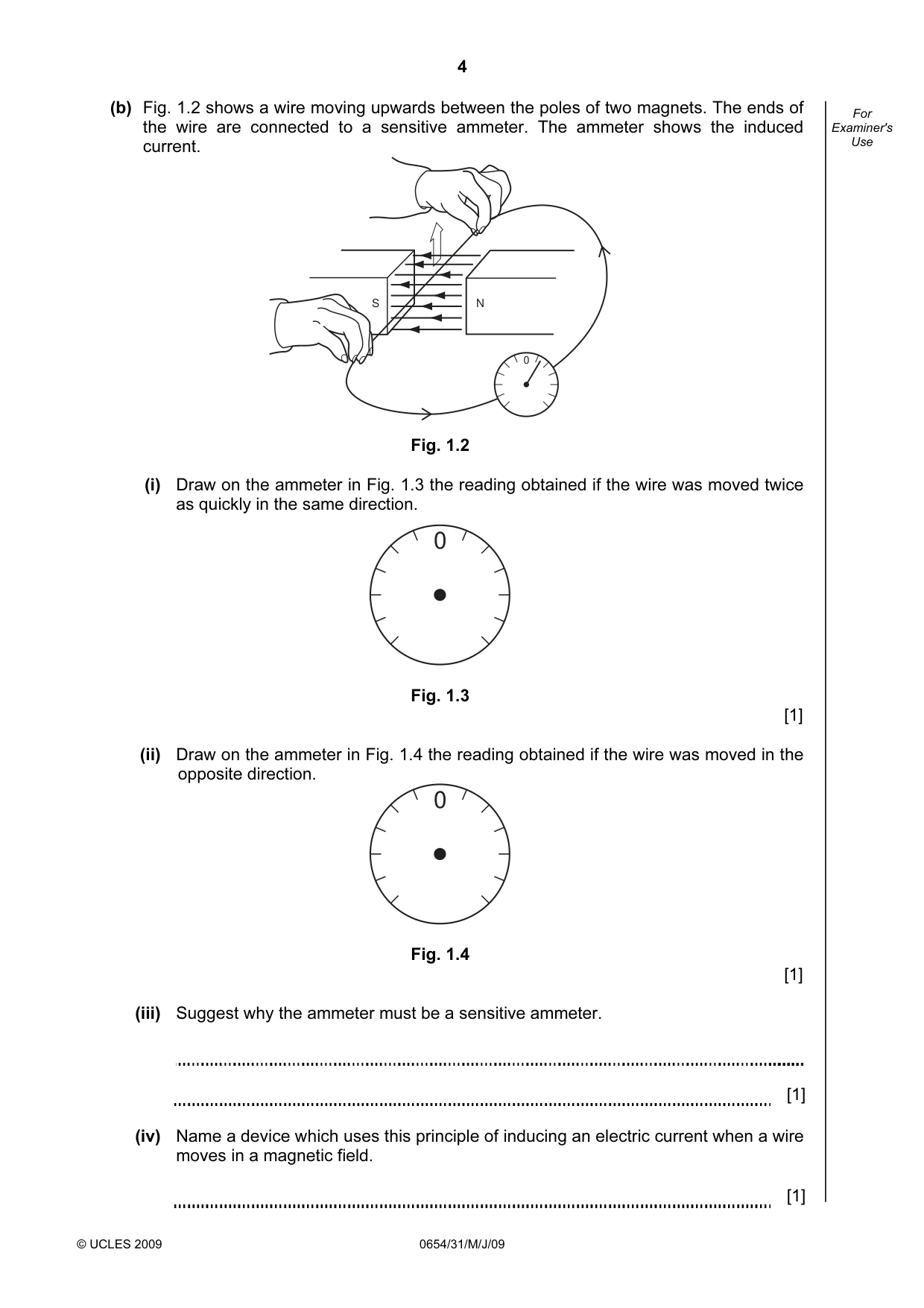
4 © UCLES 2009 0654/31/M/J/09 For Examiner's Use (b) Fig. 1.2 shows a wire moving upwards between the poles of two magnets. The ends of the wire are connected to a sensitive ammeter. The ammeter shows the induced current. S N 0 Fig. 1.2 (i) Draw on the ammeter in Fig. 1.3 the reading obtained if the wire was moved twice as quickly in the same direction. 0 Fig. 1.3 [1] (ii) Draw on the ammeter in Fig. 1.4 the reading obtained if the wire was moved in the opposite direction. 0 Fig. 1.4 [1] (iii) Suggest why the ammeter must be a sensitive ammeter. [1] (iv) Name a device which uses this principle of inducing an electric current when a wire moves in a magnetic field. [1]
Question paper, page 6
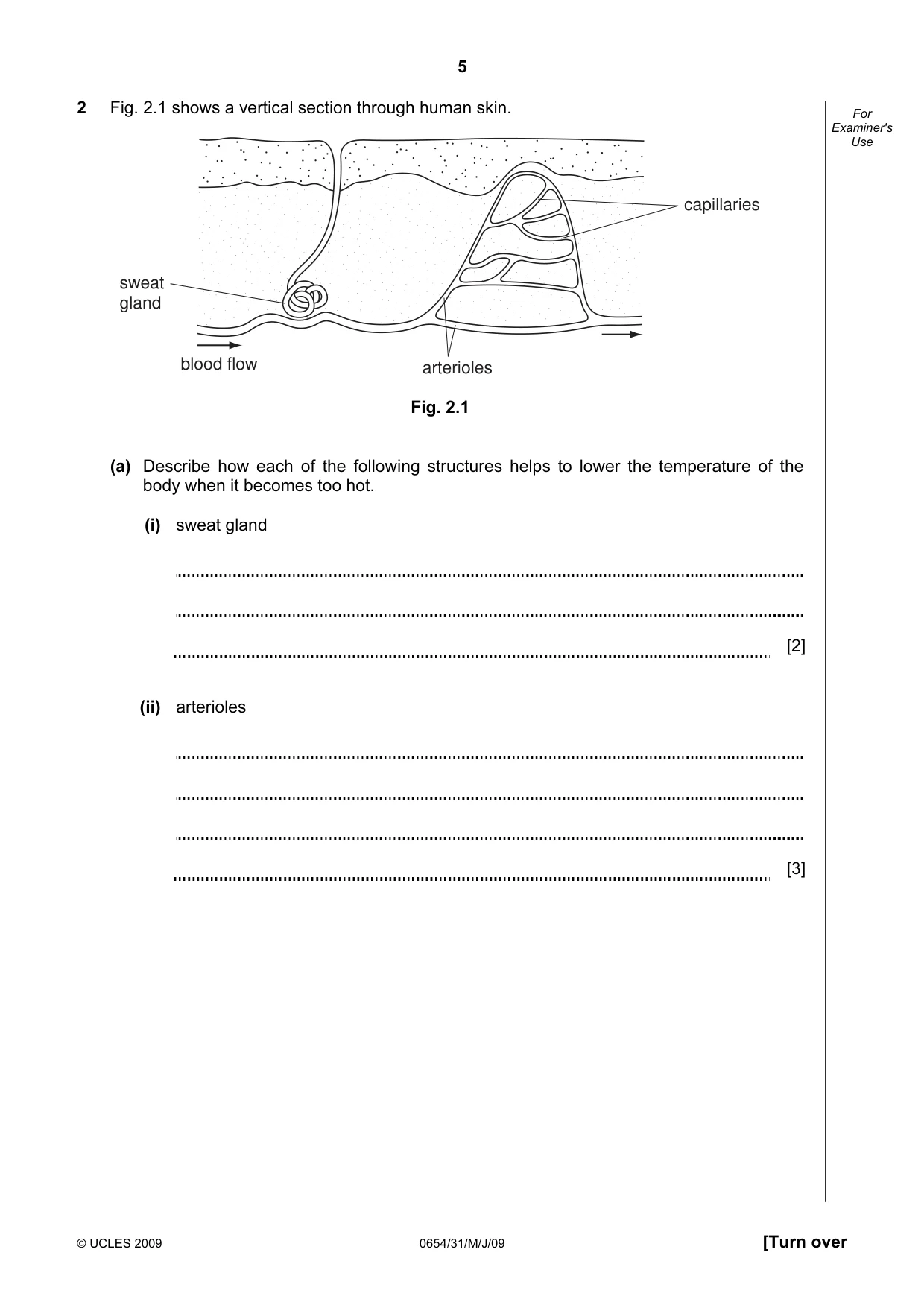
5 © UCLES 2009 0654/31/M/J/09 [Turn over For Examiner's Use 2 Fig. 2.1 shows a vertical section through human skin. capillaries arterioles blood flow sweat gland Fig. 2.1 (a) Describe how each of the following structures helps to lower the temperature of the body when it becomes too hot. (i) sweat gland [2] (ii) arterioles [3]
Question paper, page 7
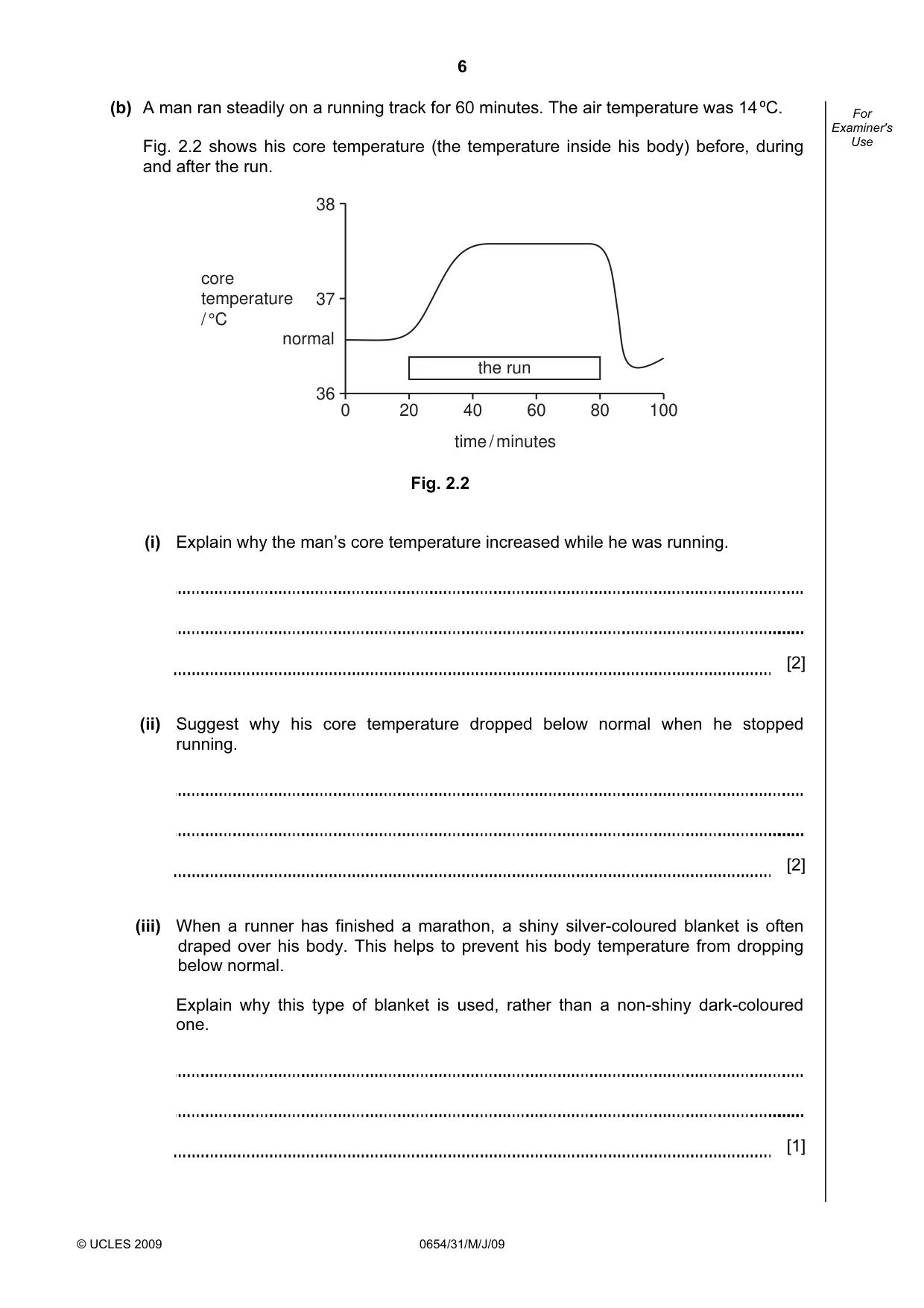
6 © UCLES 2009 0654/31/M/J/09 For Examiner's Use (b) A man ran steadily on a running track for 60 minutes. The air temperature was 14 ºC. Fig. 2.2 shows his core temperature (the temperature inside his body) before, during and after the run. 0 20 40 60 80 100 time / minutes 38 37 36 core temperature / °C the run normal Fig. 2.2 (i) Explain why the man’s core temperature increased while he was running. [2] (ii) Suggest why his core temperature dropped below normal when he stopped running. [2] (iii) When a runner has finished a marathon, a shiny silver-coloured blanket is often draped over his body. This helps to prevent his body temperature from dropping below normal. Explain why this type of blanket is used, rather than a non-shiny dark-coloured one. [1]
Question paper, page 8
7 © UCLES 2009 0654/31/M/J/09 [Turn over For Examiner's Use (c) The skin has an important role in making vitamin D, which it does when sunlight falls onto it. Explain the importance of vitamin D in the body. [2]
Question paper, page 9
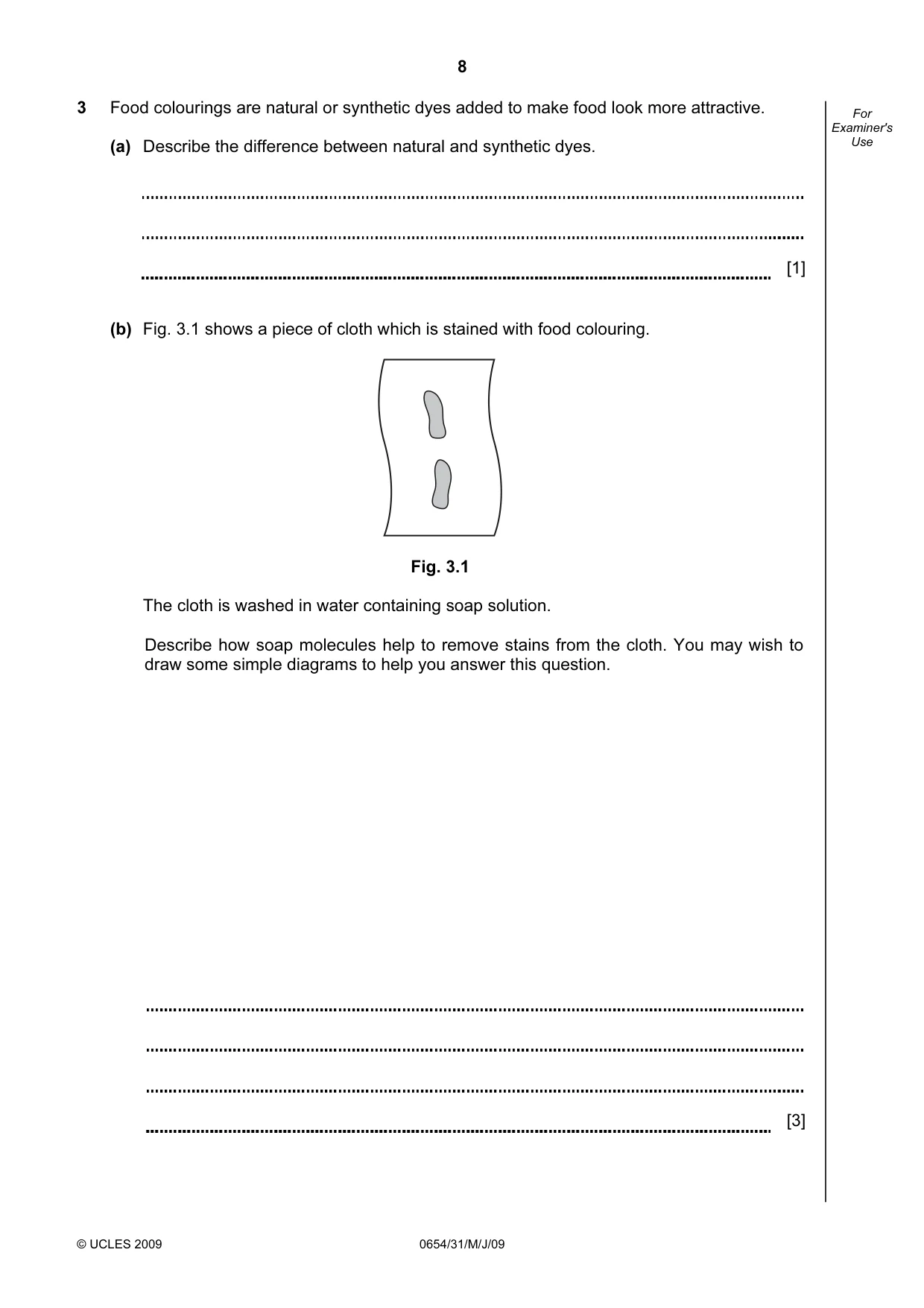
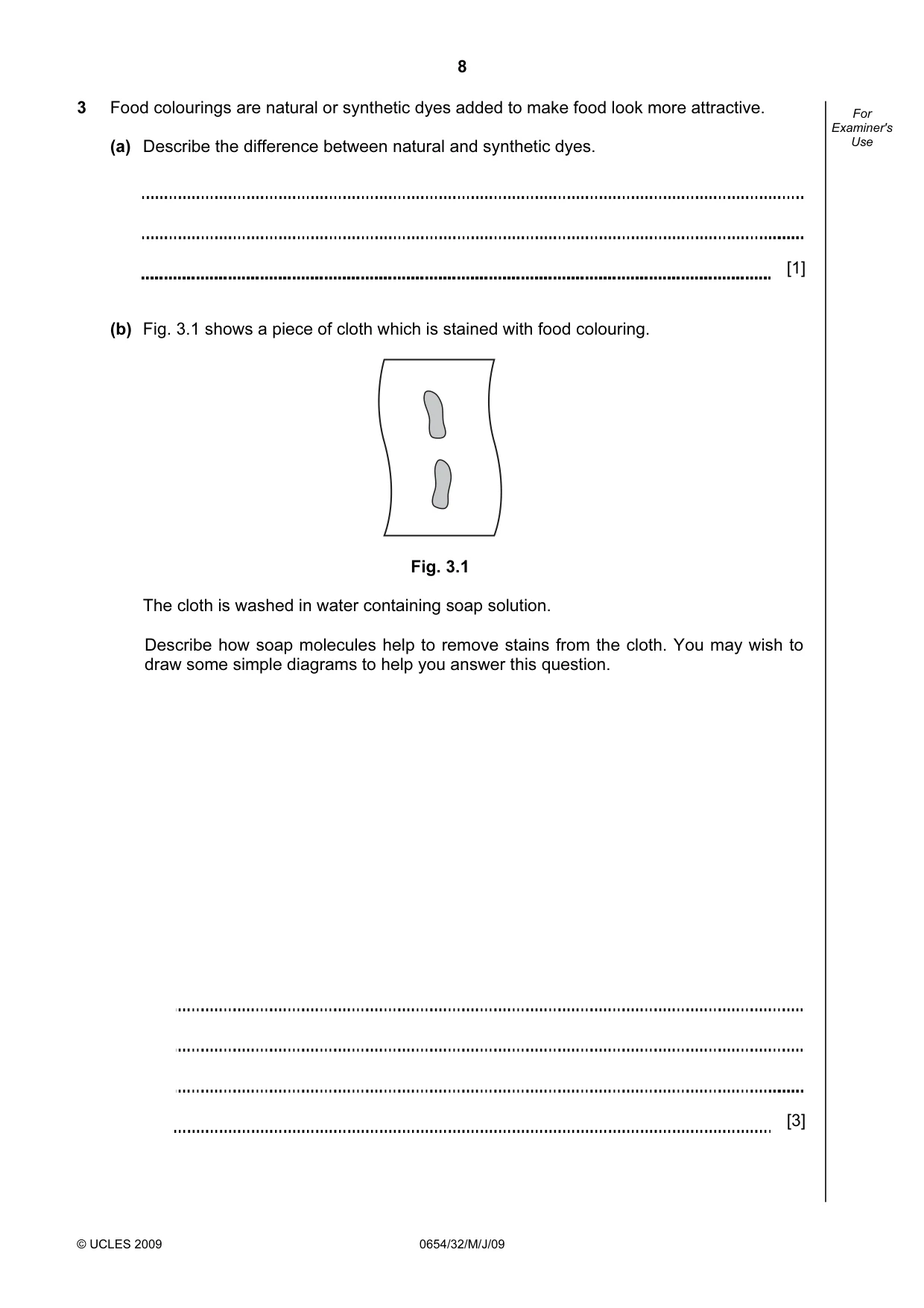
8 © UCLES 2009 0654/31/M/J/09 For Examiner's Use 3 Food colourings are natural or synthetic dyes added to make food look more attractive. (a) Describe the difference between natural and synthetic dyes. [1] (b) Fig. 3.1 shows a piece of cloth which is stained with food colouring. Fig. 3.1 The cloth is washed in water containing soap solution. Describe how soap molecules help to remove stains from the cloth. You may wish to draw some simple diagrams to help you answer this question. [3]
Question paper, page 10
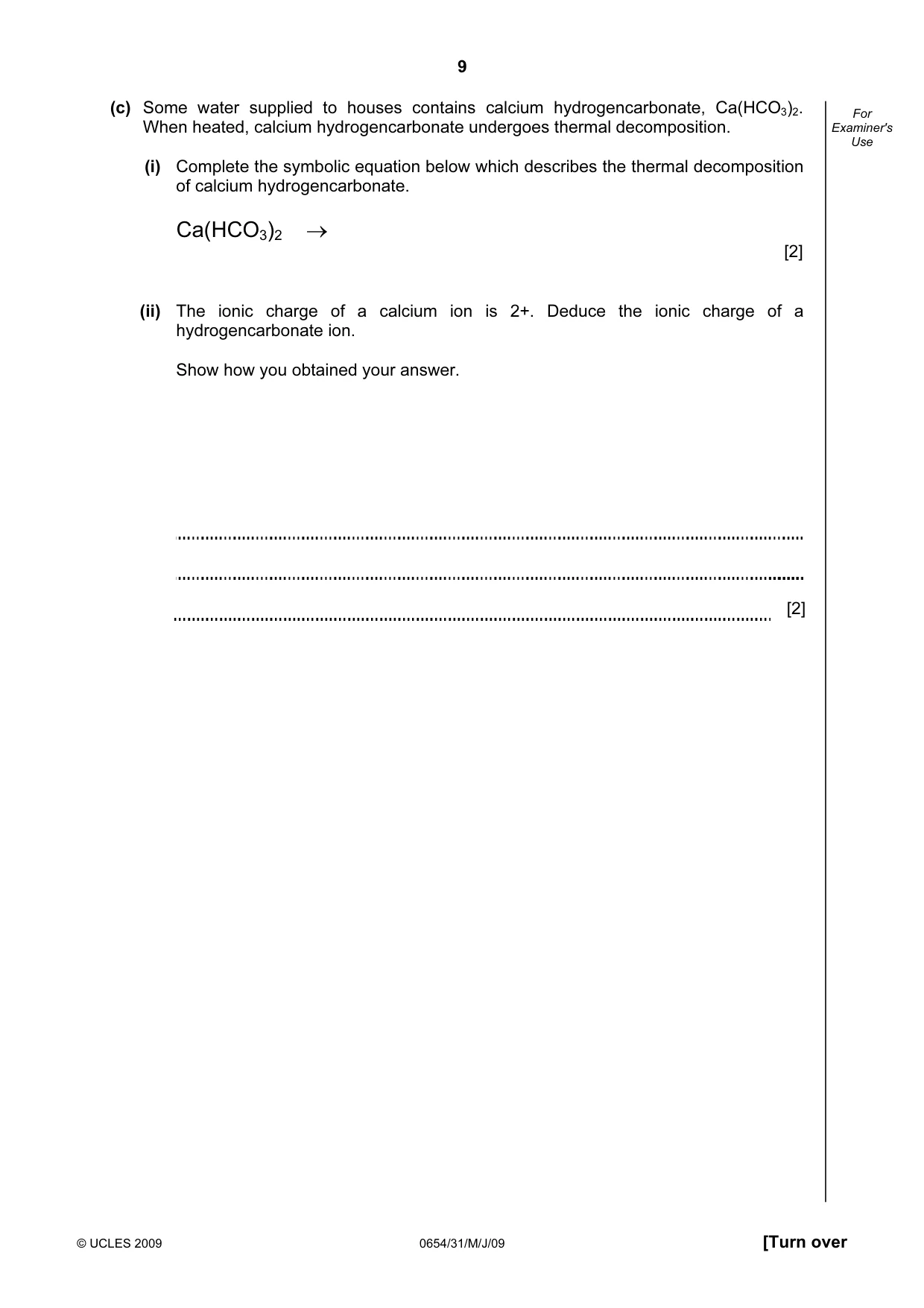
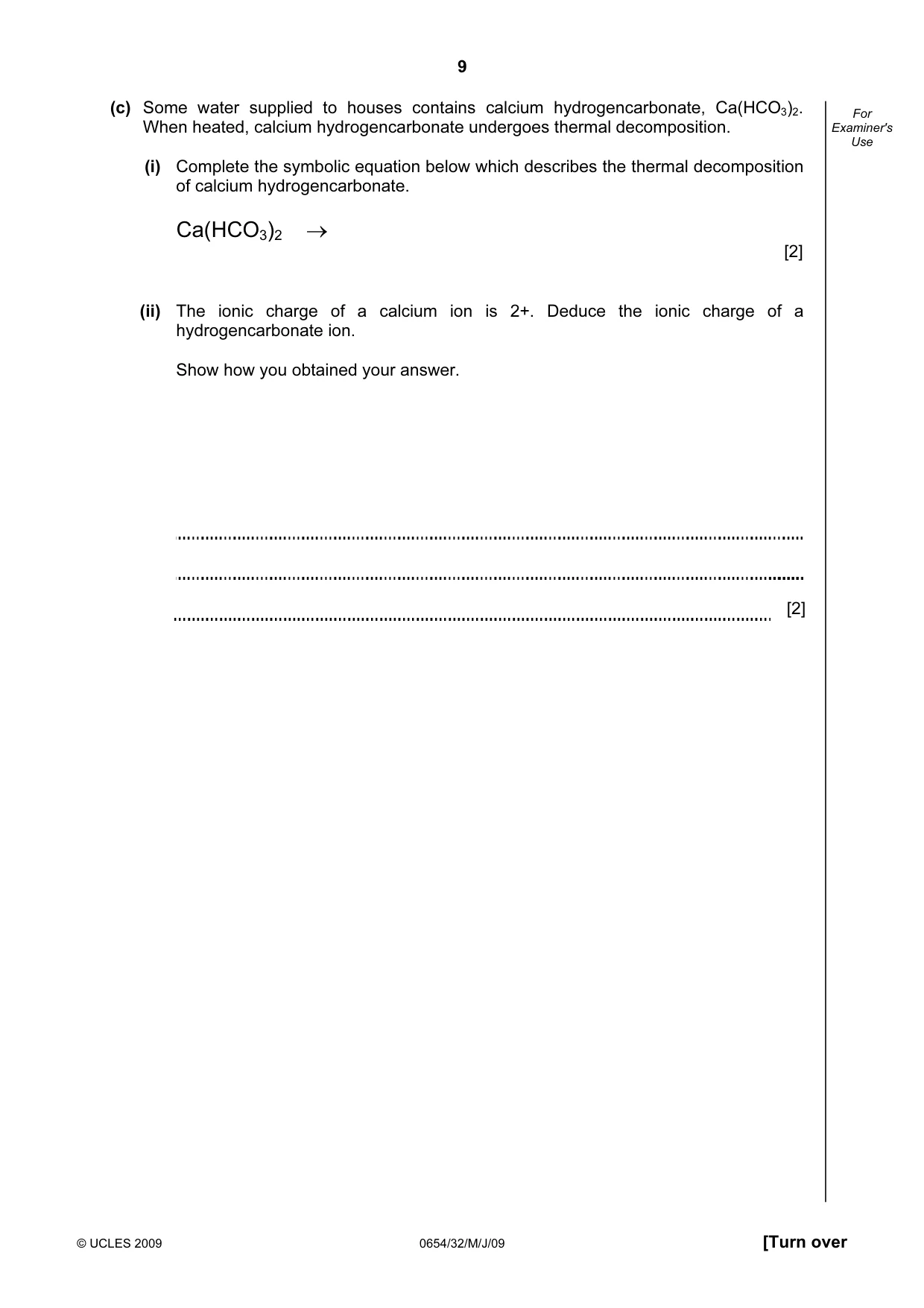
9 © UCLES 2009 0654/31/M/J/09 [Turn over For Examiner's Use (c) Some water supplied to houses contains calcium hydrogencarbonate, Ca(HCO3)2. When heated, calcium hydrogencarbonate undergoes thermal decomposition. (i) Complete the symbolic equation below which describes the thermal decomposition of calcium hydrogencarbonate. Ca(HCO3)2 → [2] (ii) The ionic charge of a calcium ion is 2+. Deduce the ionic charge of a hydrogencarbonate ion. Show how you obtained your answer. [2]
Question paper, page 11
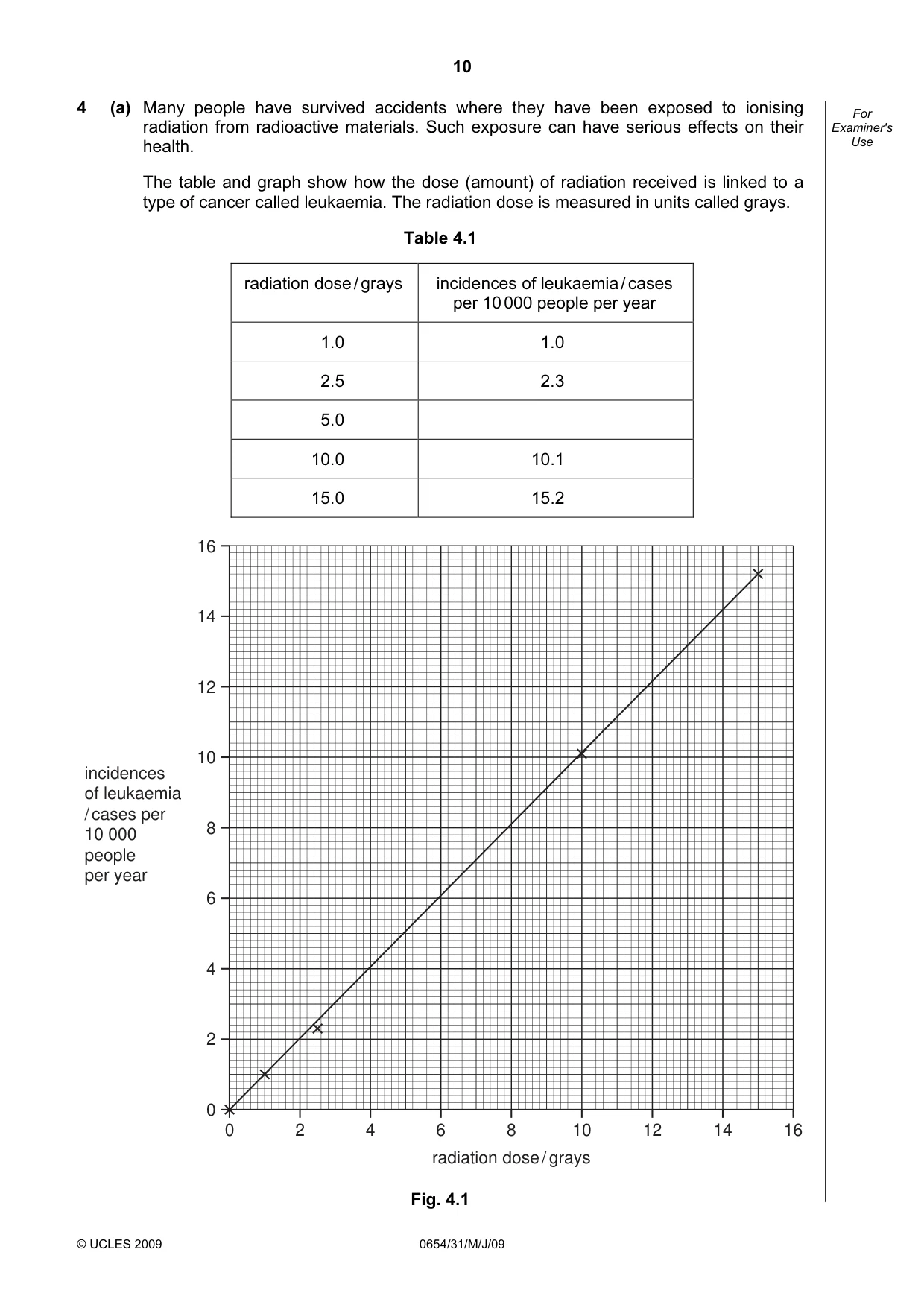
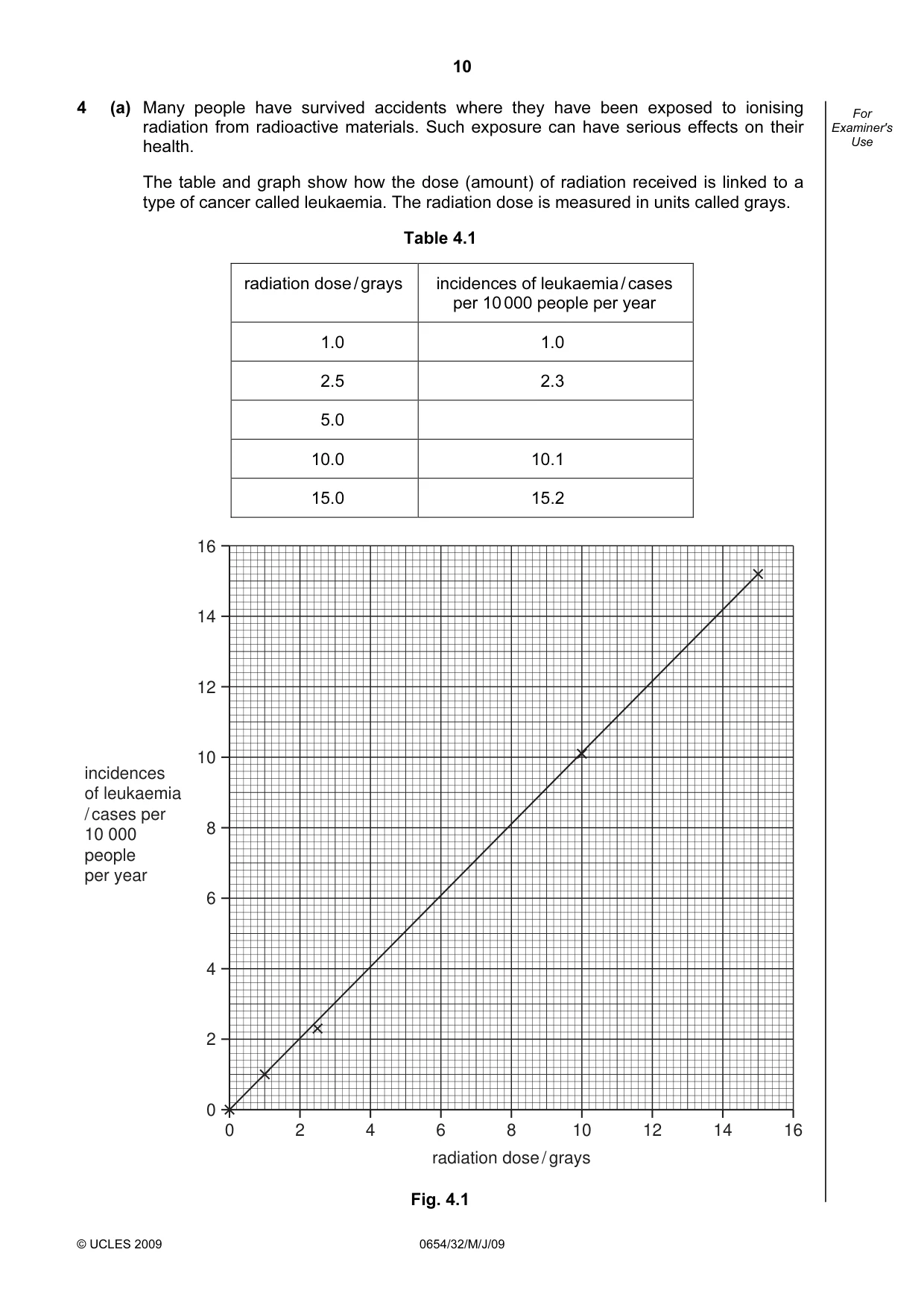
10 © UCLES 2009 0654/31/M/J/09 For Examiner's Use 4 (a) Many people have survived accidents where they have been exposed to ionising radiation from radioactive materials. Such exposure can have serious effects on their health. The table and graph show how the dose (amount) of radiation received is linked to a type of cancer called leukaemia. The radiation dose is measured in units called grays. Table 4.1 radiation dose / grays incidences of leukaemia / cases per 10 000 people per year 1.0 1.0 2.5 2.3 5.0 10.0 10.1 15.0 15.2 incidences of leukaemia / cases per 10 000 people per year 16 14 12 10 8 6 4 2 0 0 2 4 6 8 radiation dose / grays 10 12 14 16 Fig. 4.1
Question paper, page 12
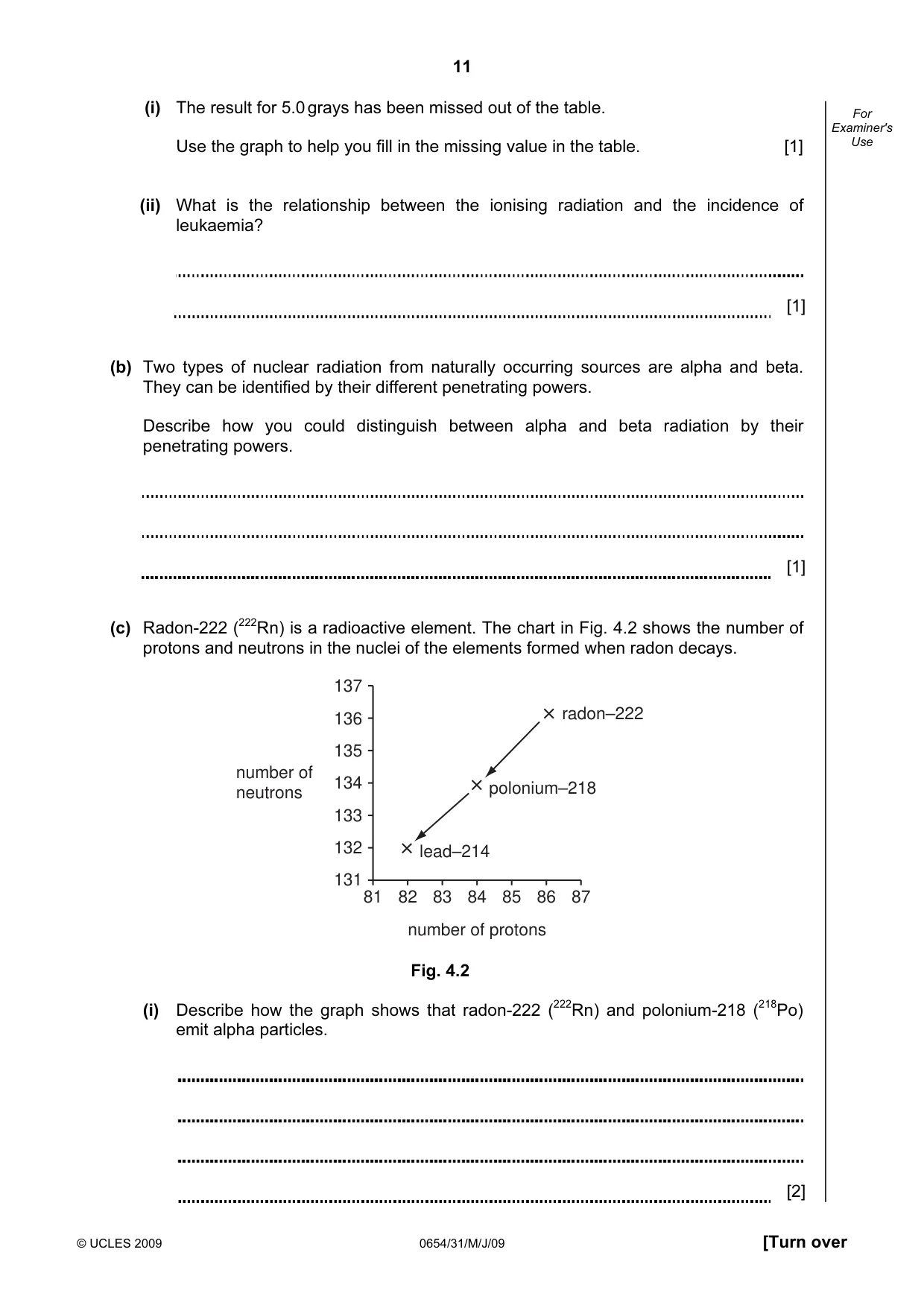
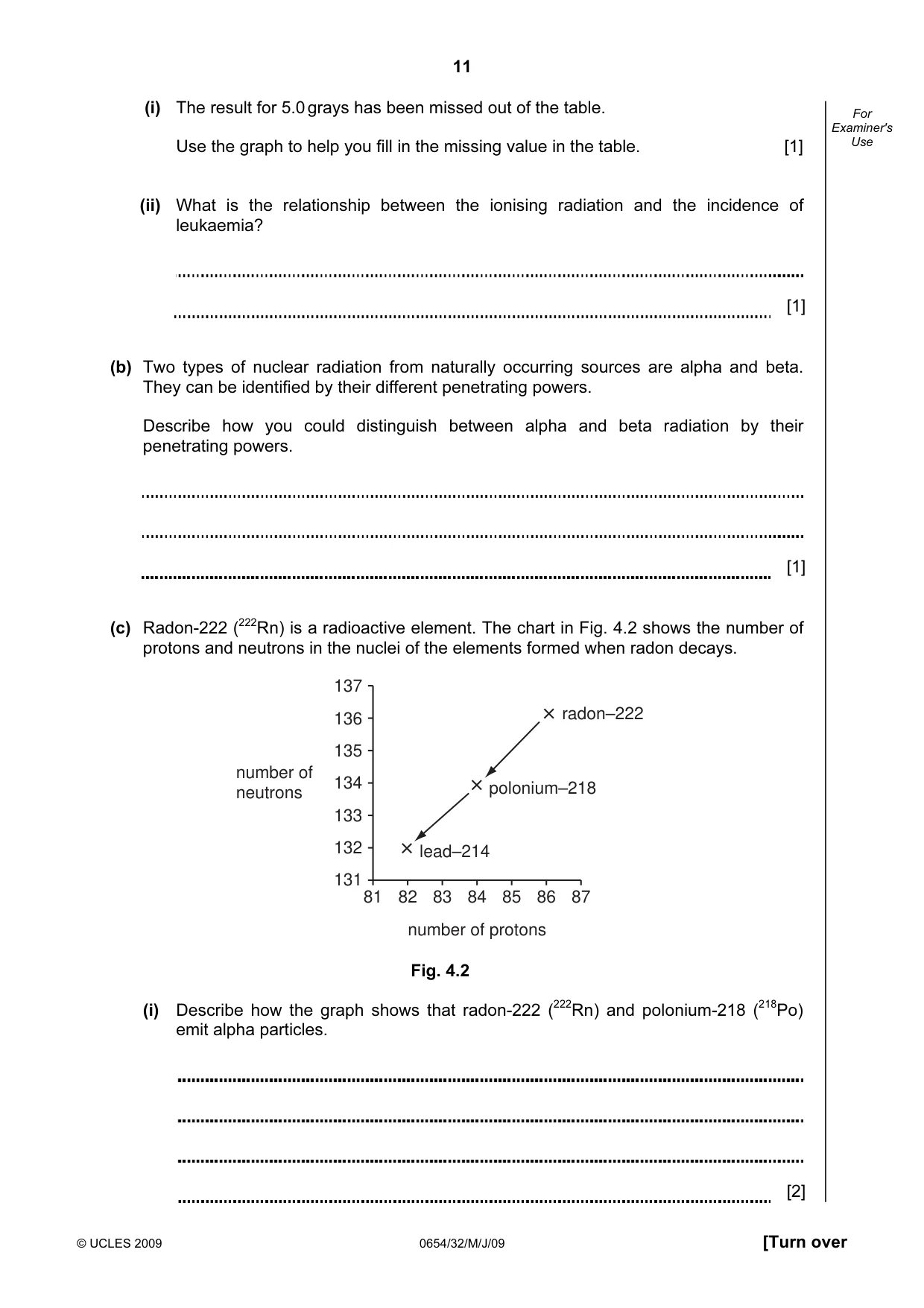
11 © UCLES 2009 0654/31/M/J/09 [Turn over For Examiner's Use (i) The result for 5.0 grays has been missed out of the table. Use the graph to help you fill in the missing value in the table. [1] (ii) What is the relationship between the ionising radiation and the incidence of leukaemia? [1] (b) Two types of nuclear radiation from naturally occurring sources are alpha and beta. They can be identified by their different penetrating powers. Describe how you could distinguish between alpha and beta radiation by their penetrating powers. [1] (c) Radon-222 (222Rn) is a radioactive element. The chart in Fig. 4.2 shows the number of protons and neutrons in the nuclei of the elements formed when radon decays. lead–214 polonium–218 radon–222 137 136 135 134 133 132 131 81 82 83 84 number of protons 85 86 87 number of neutrons Fig. 4.2 (i) Describe how the graph shows that radon-222 (222Rn) and polonium-218 (218Po) emit alpha particles. [2]
Question paper, page 13
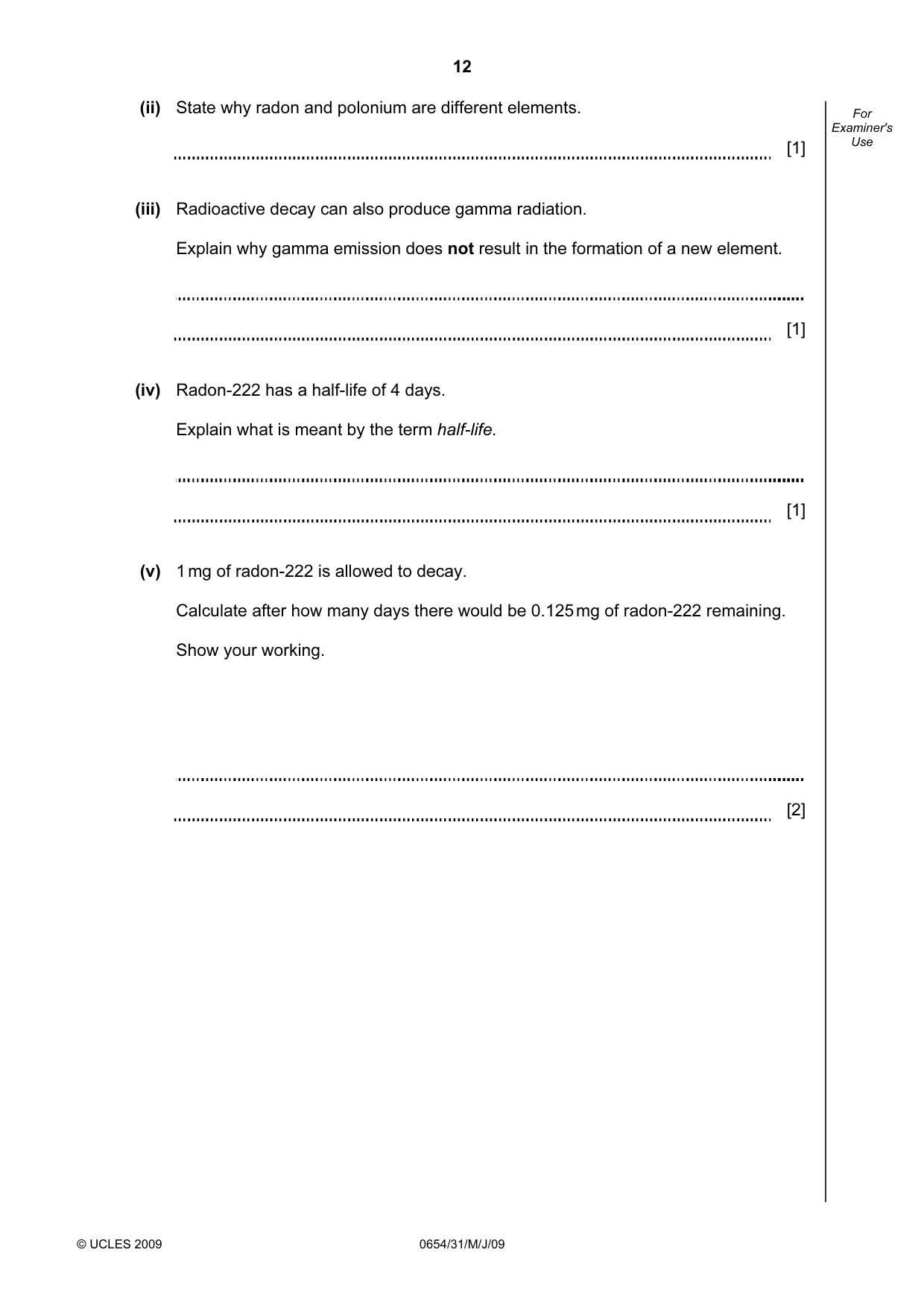
12 © UCLES 2009 0654/31/M/J/09 For Examiner's Use (ii) State why radon and polonium are different elements. [1] (iii) Radioactive decay can also produce gamma radiation. Explain why gamma emission does not result in the formation of a new element. [1] (iv) Radon-222 has a half-life of 4 days. Explain what is meant by the term half-life. [1] (v) 1 mg of radon-222 is allowed to decay. Calculate after how many days there would be 0.125 mg of radon-222 remaining. Show your working. [2]
Question paper, page 14
13 0654/31/M/J/09 [Turn over BLANK PAGE Please turn over for Question 5.
Question paper, page 15
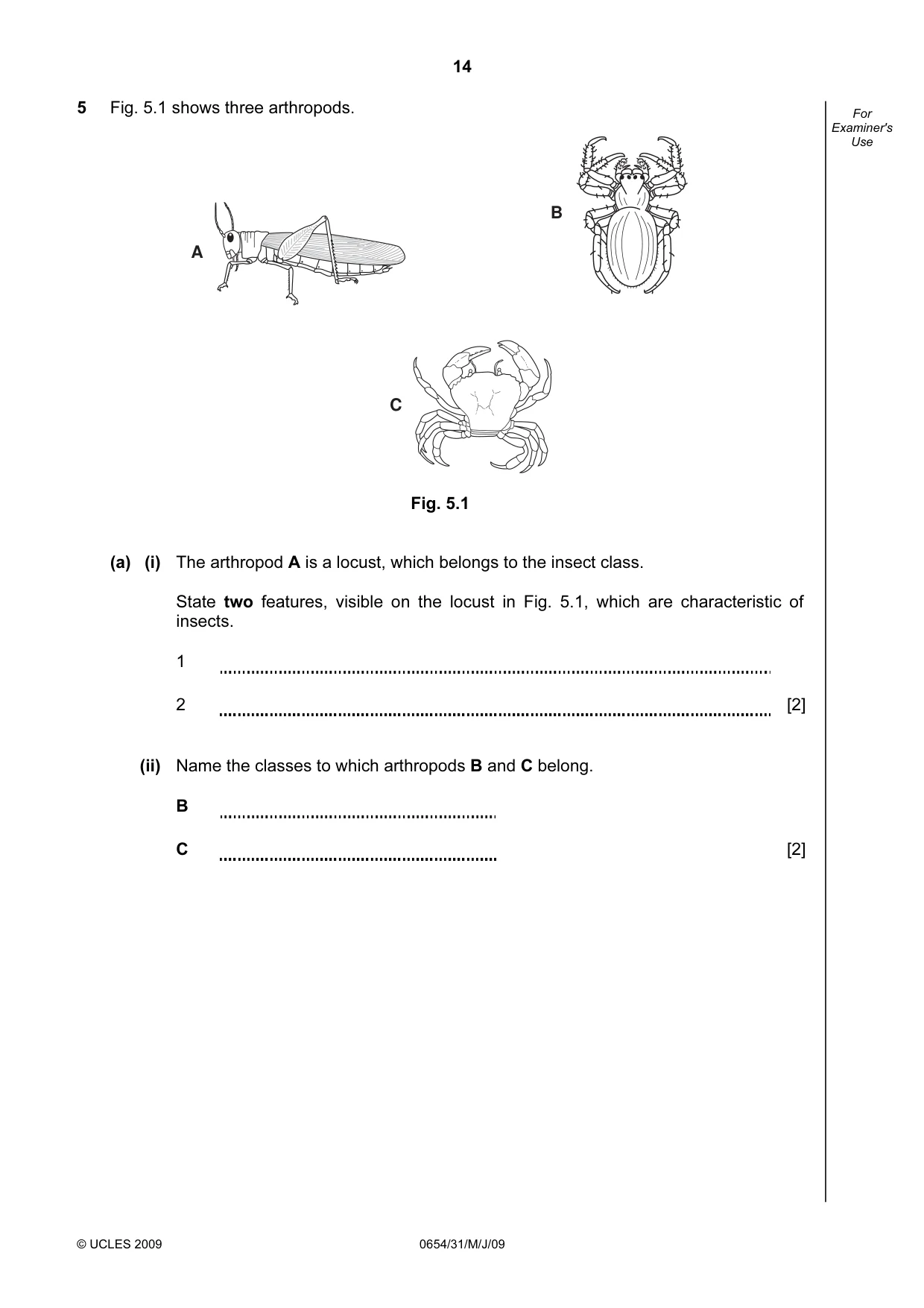
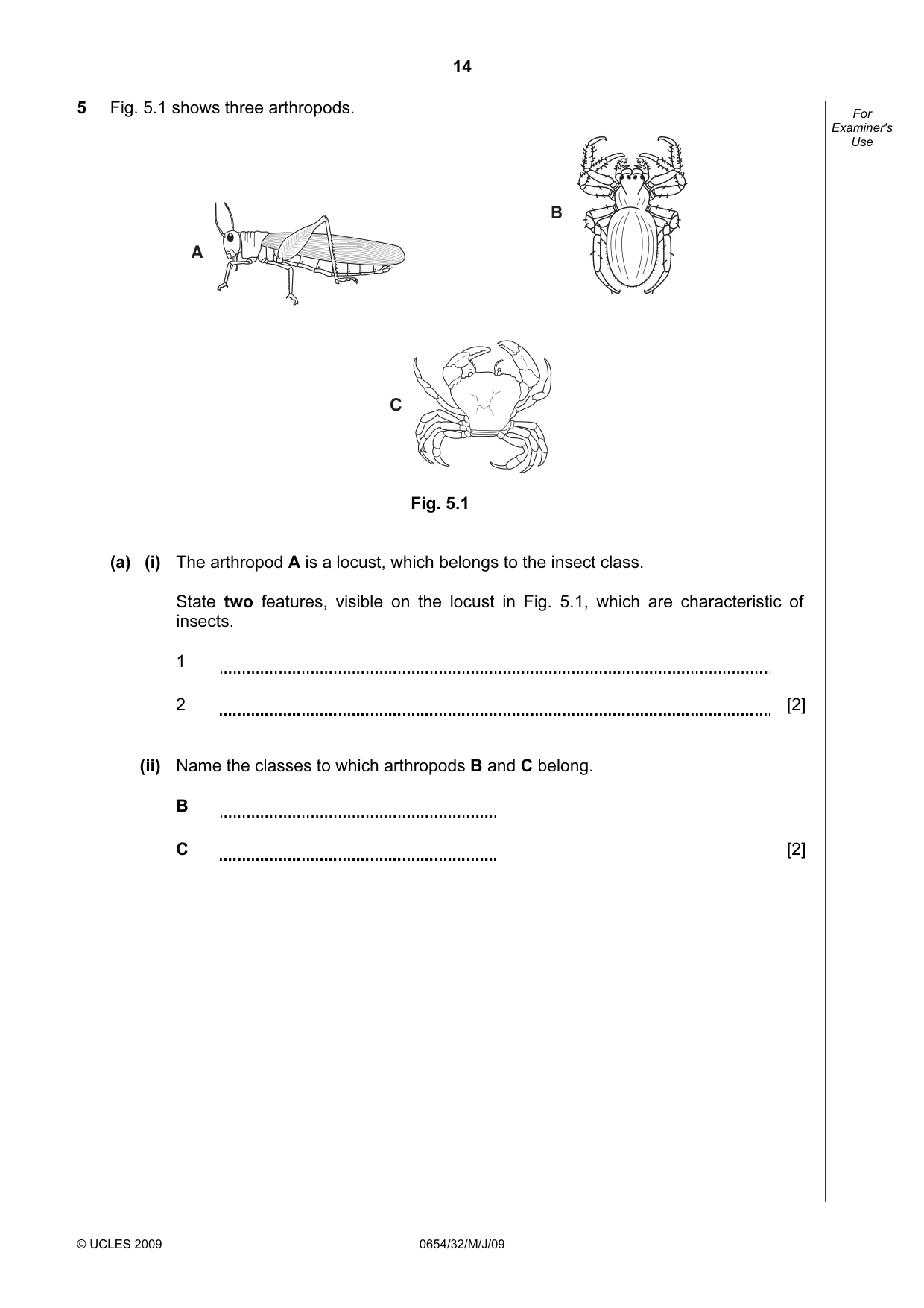
14 © UCLES 2009 0654/31/M/J/09 For Examiner's Use 5 Fig. 5.1 shows three arthropods. A B C Fig. 5.1 (a) (i) The arthropod A is a locust, which belongs to the insect class. State two features, visible on the locust in Fig. 5.1, which are characteristic of insects. 1 2 [2] (ii) Name the classes to which arthropods B and C belong. B C [2]
Question paper, page 16
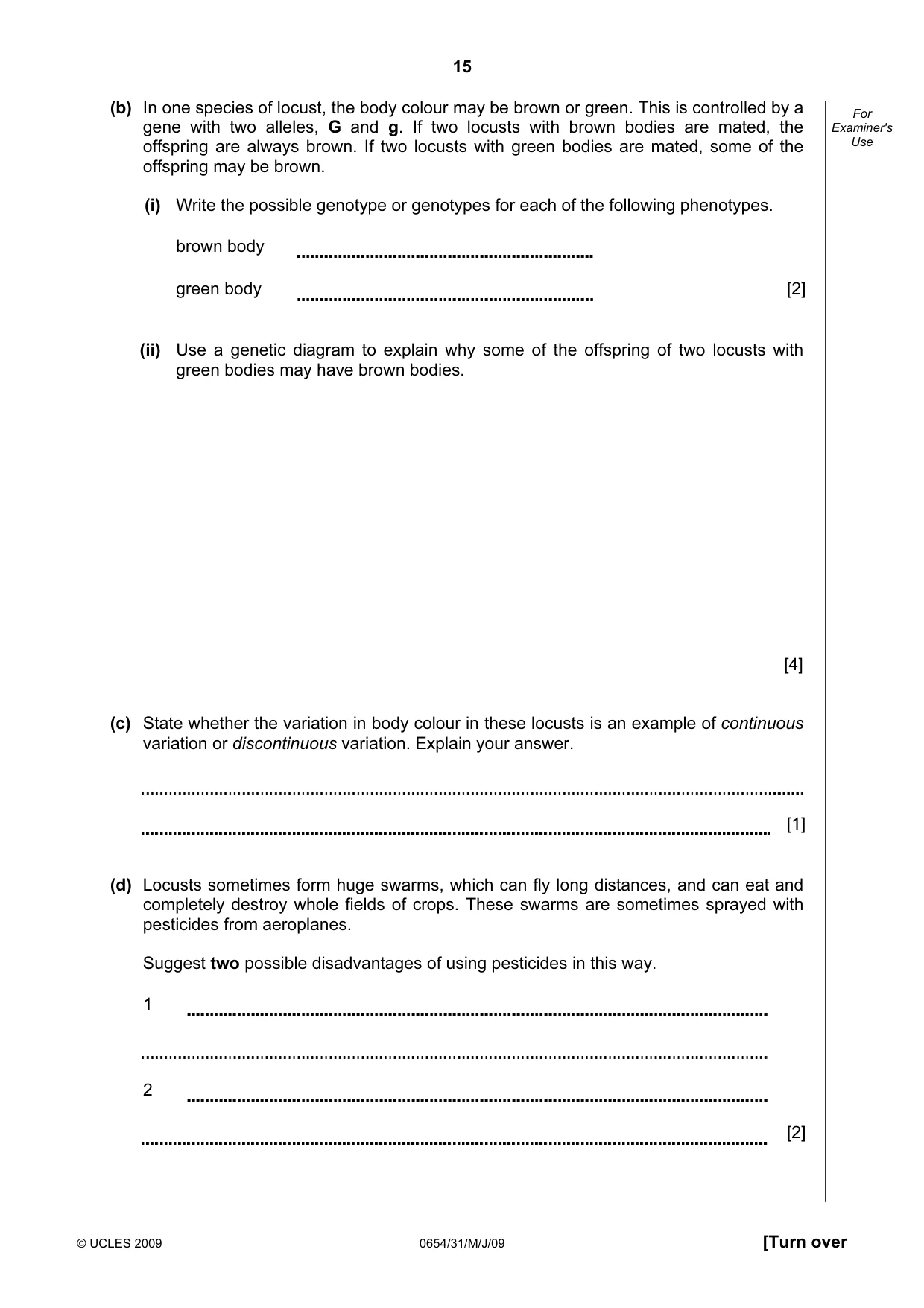
15 © UCLES 2009 0654/31/M/J/09 [Turn over For Examiner's Use (b) In one species of locust, the body colour may be brown or green. This is controlled by a gene with two alleles, G and g. If two locusts with brown bodies are mated, the offspring are always brown. If two locusts with green bodies are mated, some of the offspring may be brown. (i) Write the possible genotype or genotypes for each of the following phenotypes. brown body green body [2] (ii) Use a genetic diagram to explain why some of the offspring of two locusts with green bodies may have brown bodies. [4] (c) State whether the variation in body colour in these locusts is an example of continuous variation or discontinuous variation. Explain your answer. [1] (d) Locusts sometimes form huge swarms, which can fly long distances, and can eat and completely destroy whole fields of crops. These swarms are sometimes sprayed with pesticides from aeroplanes. Suggest two possible disadvantages of using pesticides in this way. 1 2 [2]
Question paper, page 17
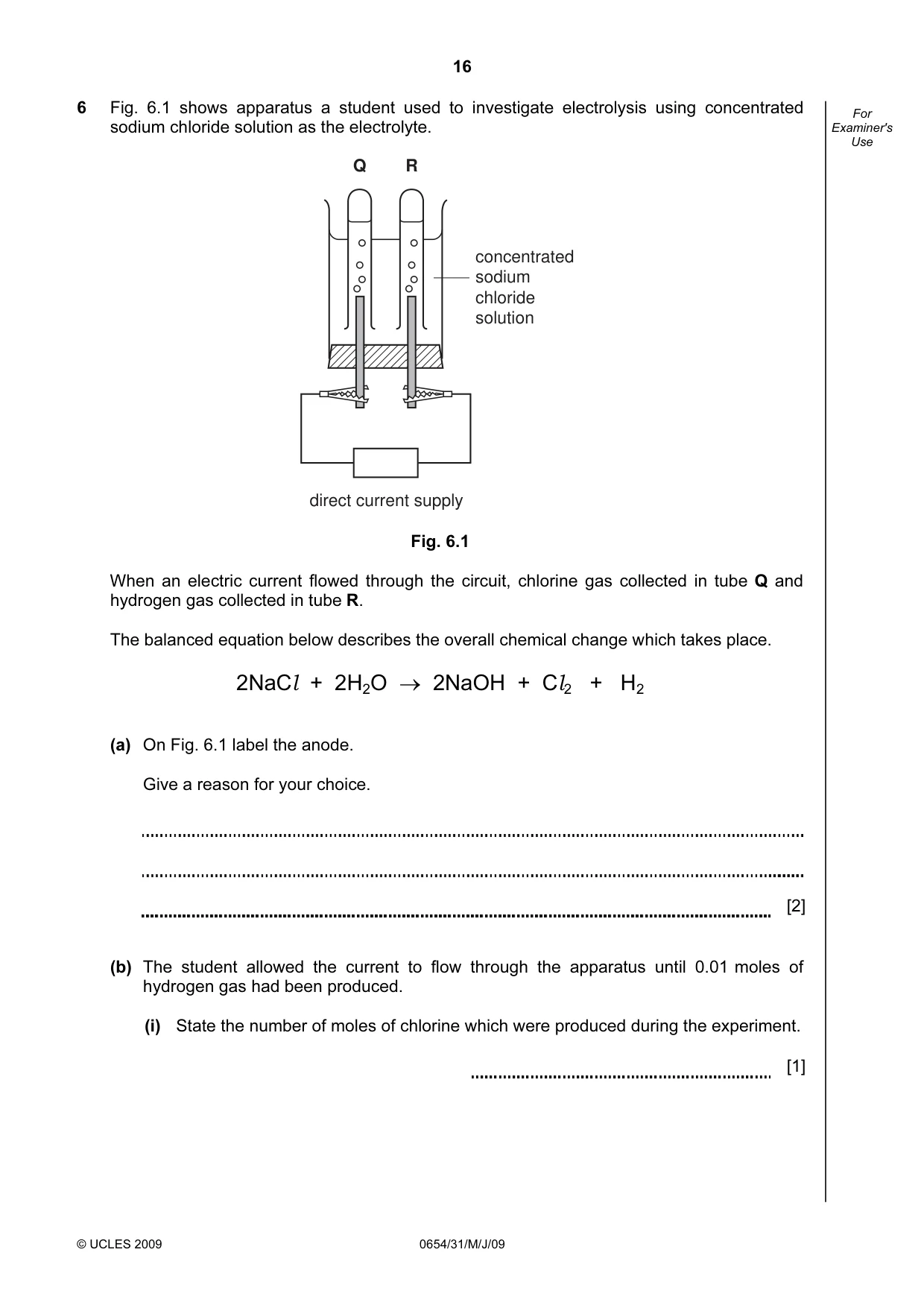
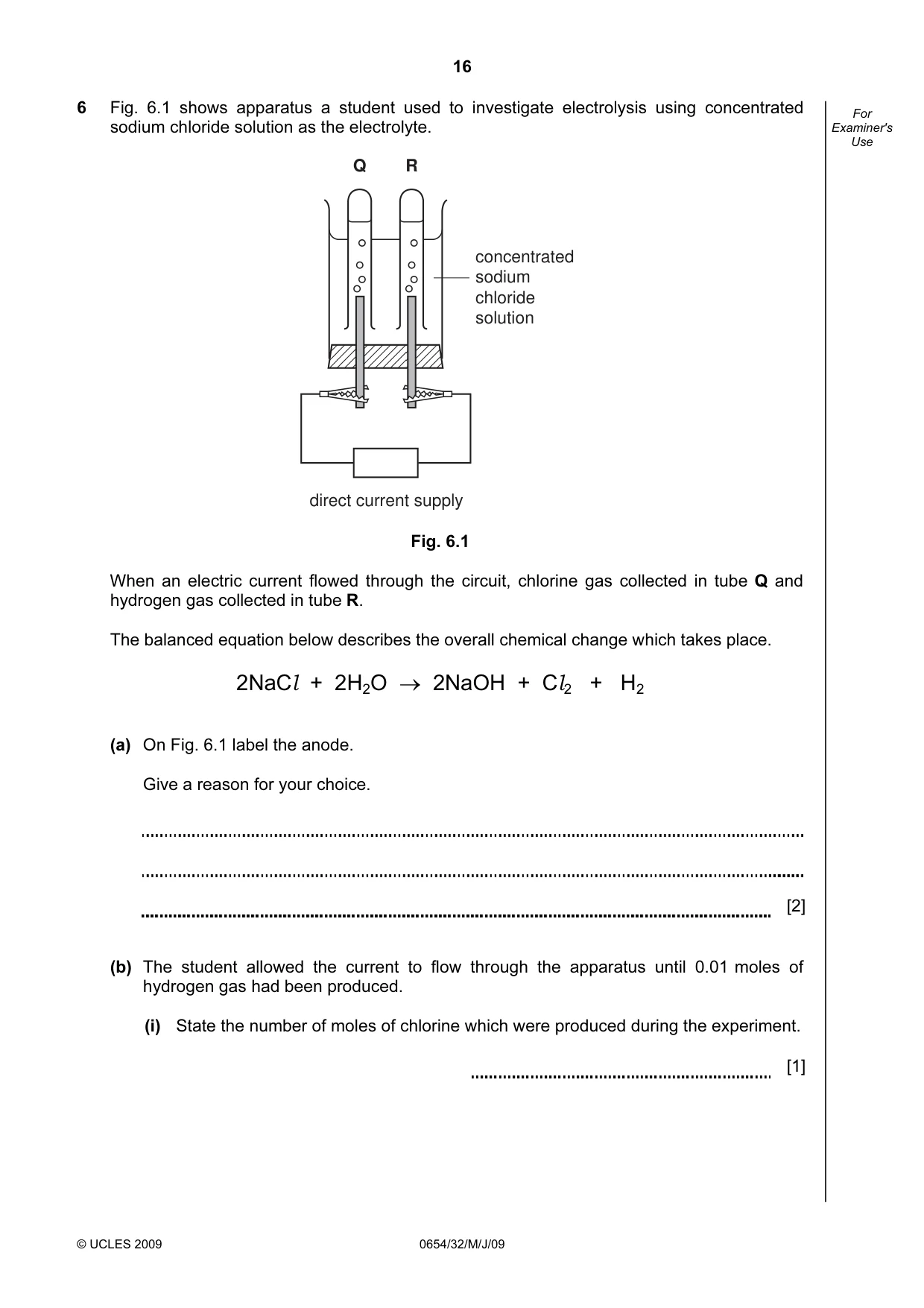
16 © UCLES 2009 0654/31/M/J/09 For Examiner's Use 6 Fig. 6.1 shows apparatus a student used to investigate electrolysis using concentrated sodium chloride solution as the electrolyte. R direct current supply Q concentrated sodium chloride solution Fig. 6.1 When an electric current flowed through the circuit, chlorine gas collected in tube Q and hydrogen gas collected in tube R. The balanced equation below describes the overall chemical change which takes place. 2NaCl + 2H2O → 2NaOH + Cl2 + H2 (a) On Fig. 6.1 label the anode. Give a reason for your choice. [2] (b) The student allowed the current to flow through the apparatus until 0.01 moles of hydrogen gas had been produced. (i) State the number of moles of chlorine which were produced during the experiment. [1]
Question paper, page 18
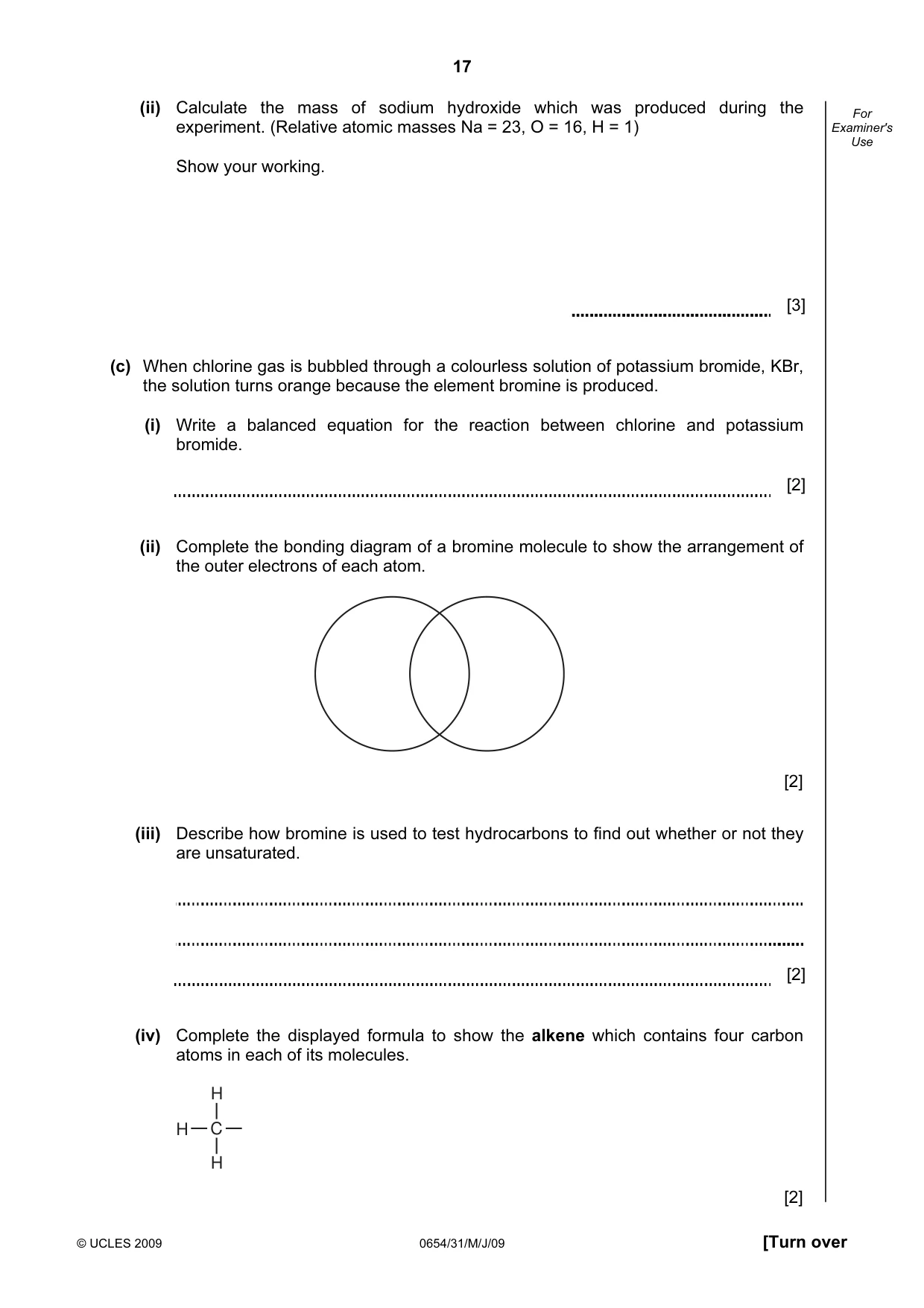
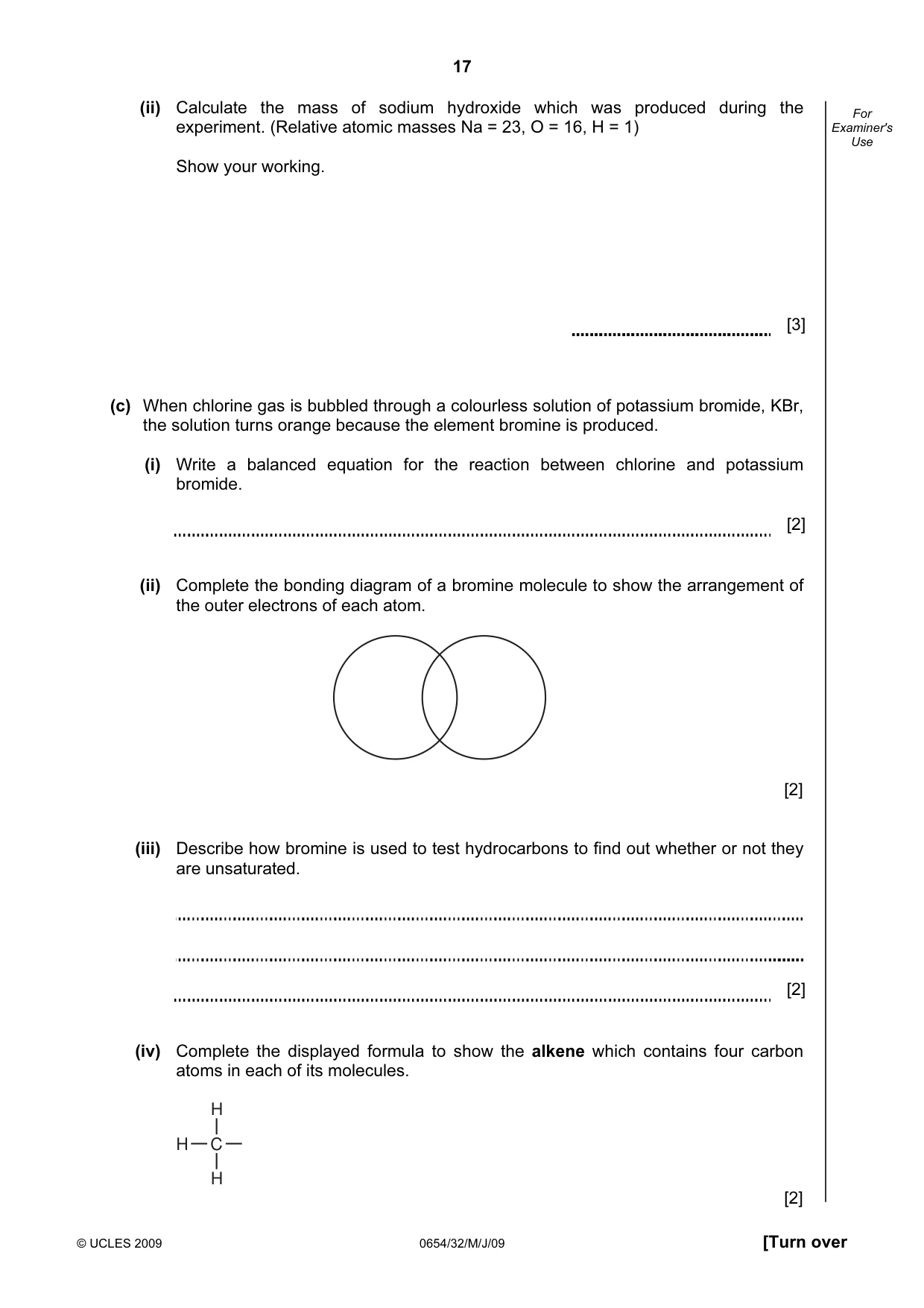
17 © UCLES 2009 0654/31/M/J/09 [Turn over For Examiner's Use (ii) Calculate the mass of sodium hydroxide which was produced during the experiment. (Relative atomic masses Na = 23, O = 16, H = 1) Show your working. [3] (c) When chlorine gas is bubbled through a colourless solution of potassium bromide, KBr, the solution turns orange because the element bromine is produced. (i) Write a balanced equation for the reaction between chlorine and potassium bromide. [2] (ii) Complete the bonding diagram of a bromine molecule to show the arrangement of the outer electrons of each atom. [2] (iii) Describe how bromine is used to test hydrocarbons to find out whether or not they are unsaturated. [2] (iv) Complete the displayed formula to show the alkene which contains four carbon atoms in each of its molecules. C H H H [2]
Question paper, page 19
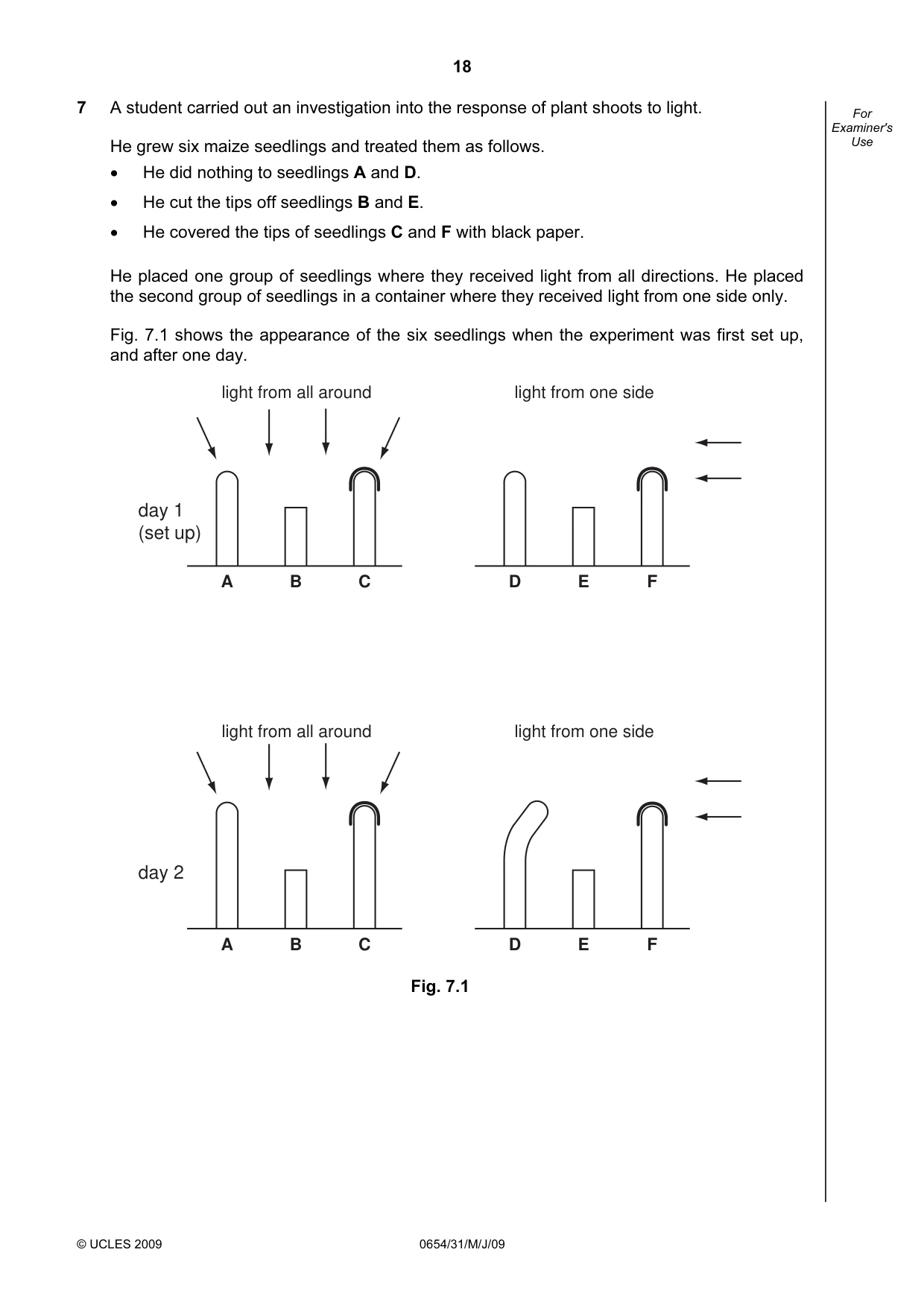
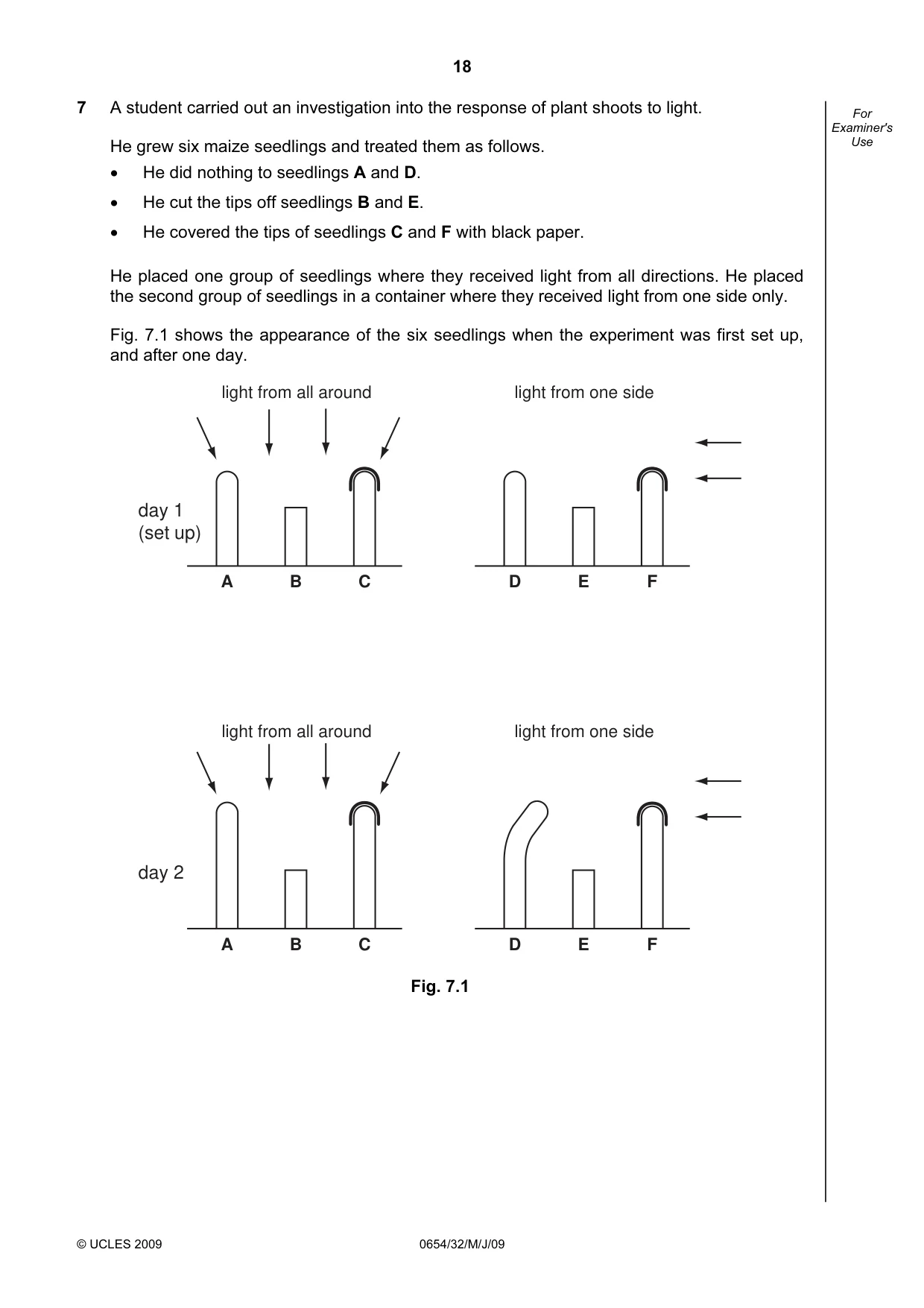
18 © UCLES 2009 0654/31/M/J/09 For Examiner's Use 7 A student carried out an investigation into the response of plant shoots to light. He grew six maize seedlings and treated them as follows. • He did nothing to seedlings A and D. • He cut the tips off seedlings B and E. • He covered the tips of seedlings C and F with black paper. He placed one group of seedlings where they received light from all directions. He placed the second group of seedlings in a container where they received light from one side only. Fig. 7.1 shows the appearance of the six seedlings when the experiment was first set up, and after one day. A B C D E F light from all around light from one side light from all around light from one side day 1 (set up) A B C D E F day 2 Fig. 7.1
Question paper, page 20
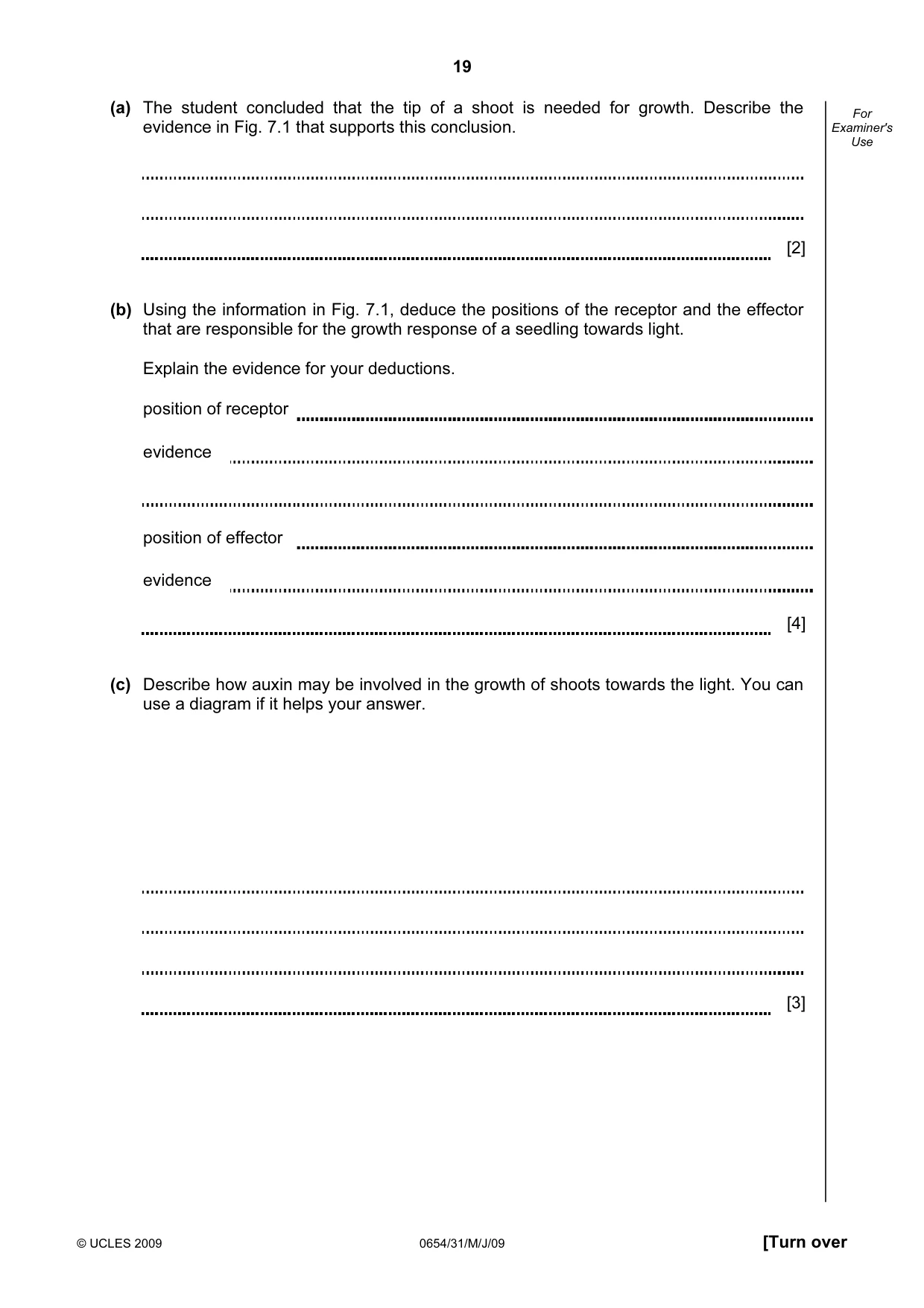
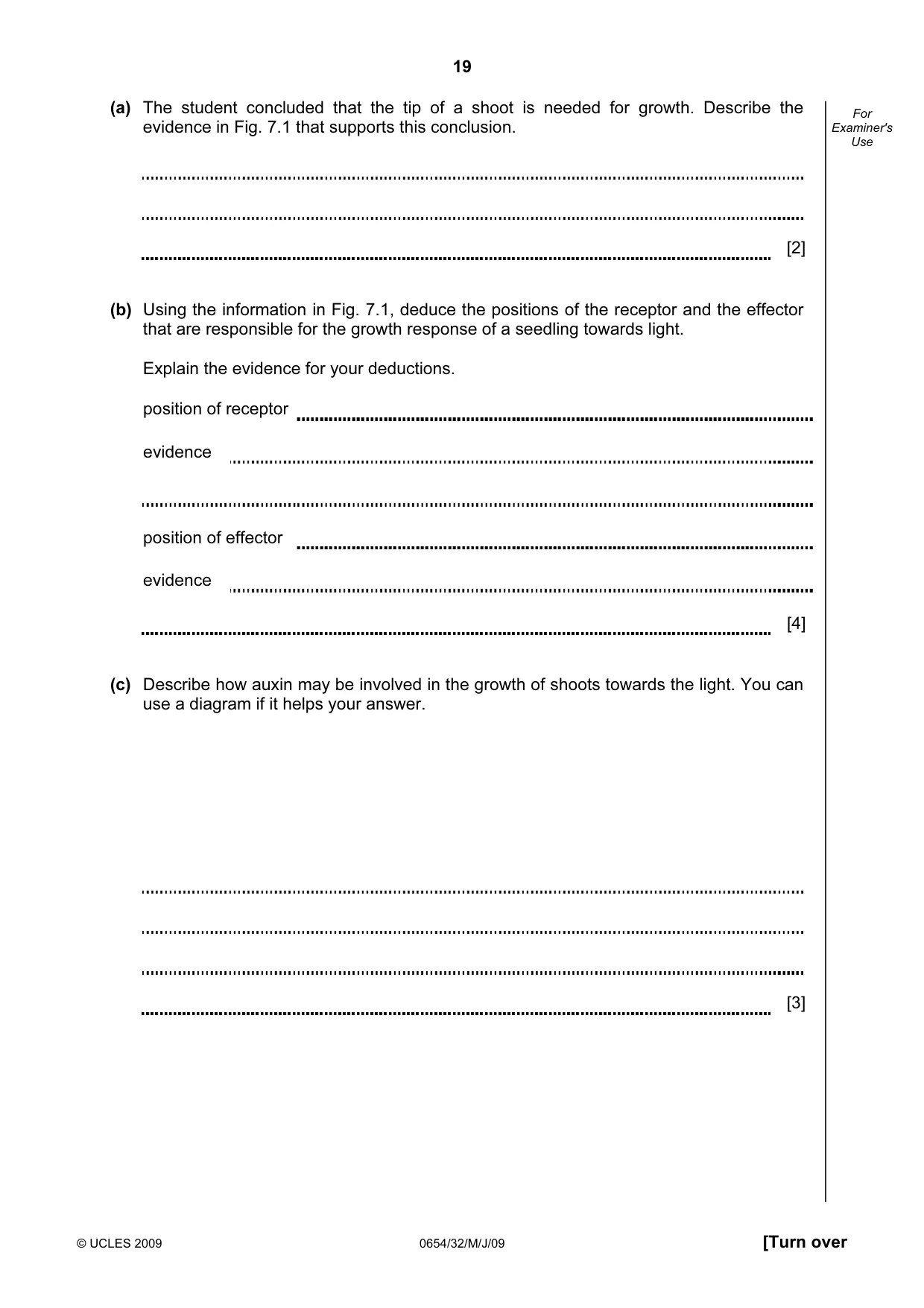
19 © UCLES 2009 0654/31/M/J/09 [Turn over For Examiner's Use (a) The student concluded that the tip of a shoot is needed for growth. Describe the evidence in Fig. 7.1 that supports this conclusion. [2] (b) Using the information in Fig. 7.1, deduce the positions of the receptor and the effector that are responsible for the growth response of a seedling towards light. Explain the evidence for your deductions. position of receptor evidence position of effector evidence [4] (c) Describe how auxin may be involved in the growth of shoots towards the light. You can use a diagram if it helps your answer. [3]
Question paper, page 21
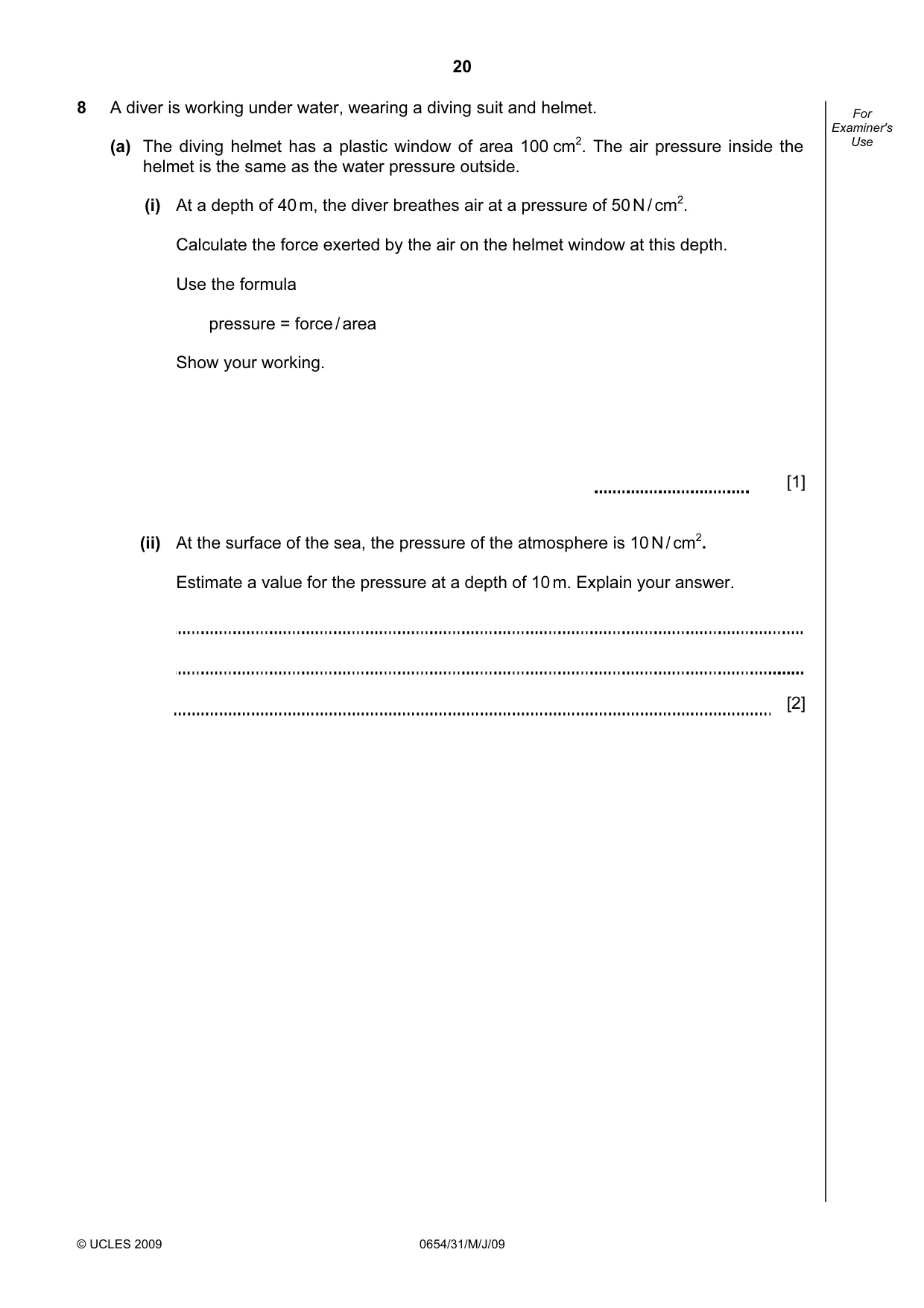
20 © UCLES 2009 0654/31/M/J/09 For Examiner's Use 8 A diver is working under water, wearing a diving suit and helmet. (a) The diving helmet has a plastic window of area 100 cm2. The air pressure inside the helmet is the same as the water pressure outside. (i) At a depth of 40 m, the diver breathes air at a pressure of 50 N / cm2. Calculate the force exerted by the air on the helmet window at this depth. Use the formula pressure = force / area Show your working. [1] (ii) At the surface of the sea, the pressure of the atmosphere is 10 N / cm2. Estimate a value for the pressure at a depth of 10 m. Explain your answer. [2]
Question paper, page 22
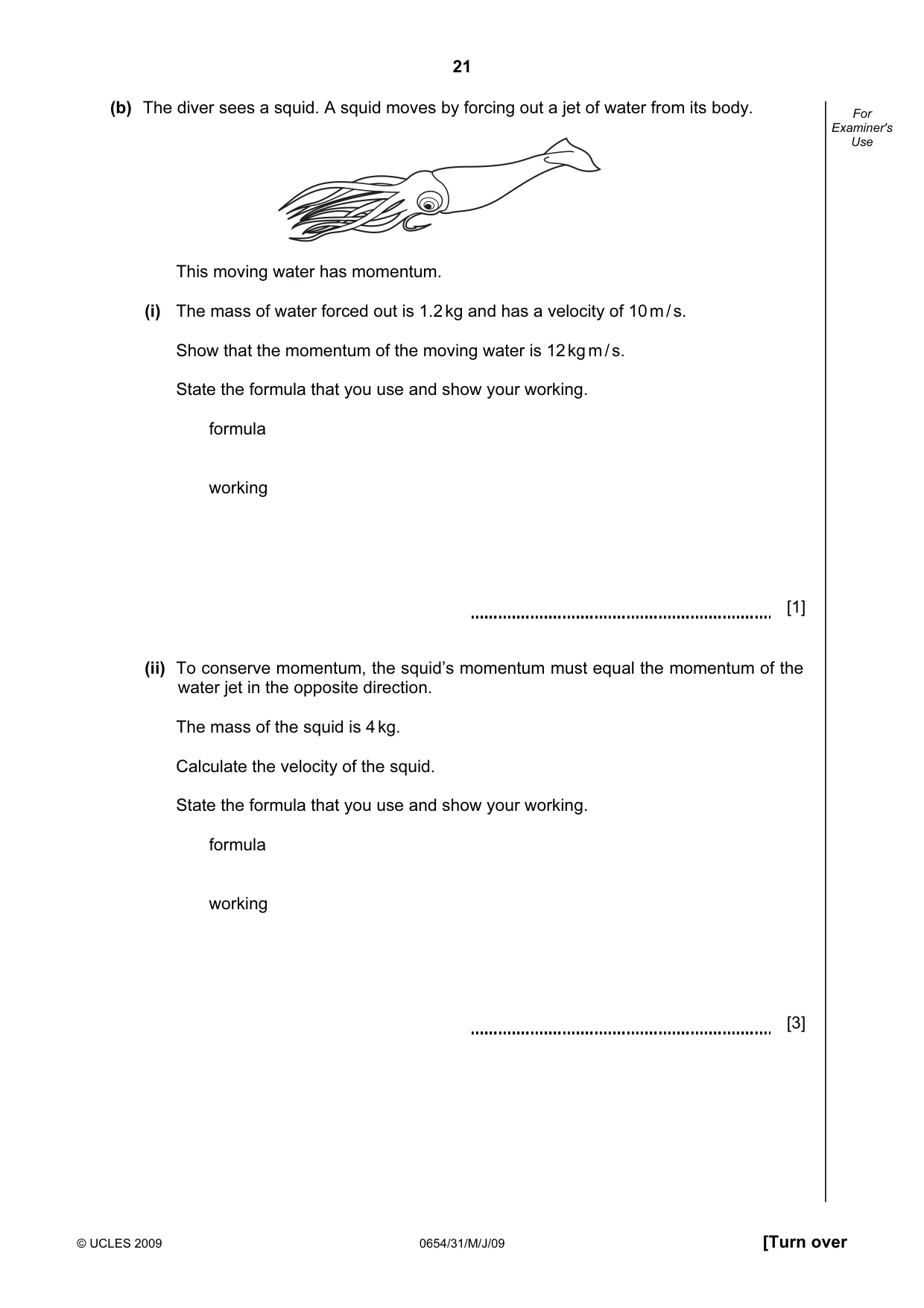
21 © UCLES 2009 0654/31/M/J/09 [Turn over For Examiner's Use (b) The diver sees a squid. A squid moves by forcing out a jet of water from its body. This moving water has momentum. (i) The mass of water forced out is 1.2 kg and has a velocity of 10 m / s. Show that the momentum of the moving water is 12 kg m / s. State the formula that you use and show your working. formula working [1] (ii) To conserve momentum, the squid’s momentum must equal the momentum of the water jet in the opposite direction. The mass of the squid is 4 kg. Calculate the velocity of the squid. State the formula that you use and show your working. formula working [3]
Question paper, page 23
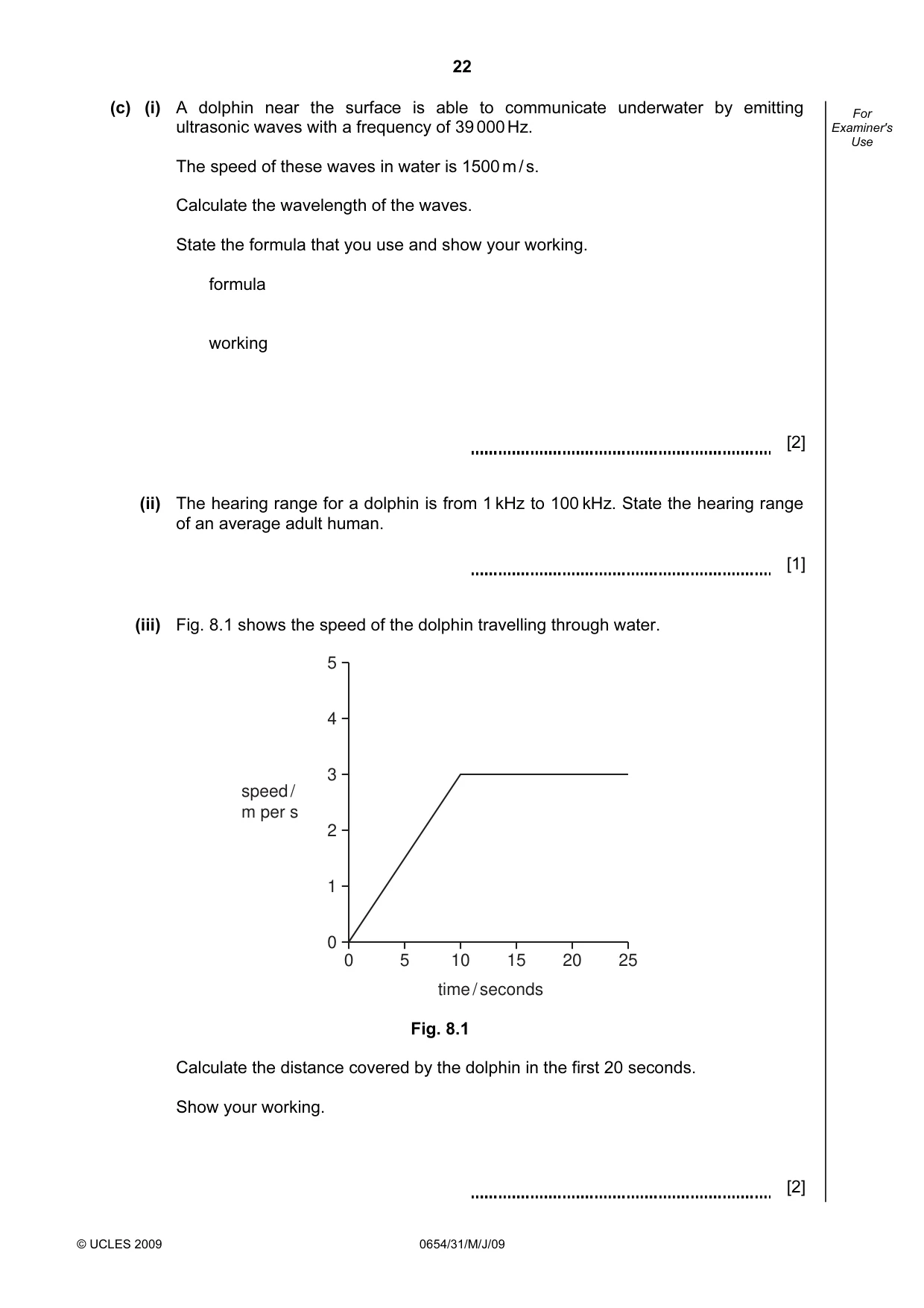
22 © UCLES 2009 0654/31/M/J/09 For Examiner's Use (c) (i) A dolphin near the surface is able to communicate underwater by emitting ultrasonic waves with a frequency of 39 000 Hz. The speed of these waves in water is 1500 m / s. Calculate the wavelength of the waves. State the formula that you use and show your working. formula working [2] (ii) The hearing range for a dolphin is from 1 kHz to 100 kHz. State the hearing range of an average adult human. [1] (iii) Fig. 8.1 shows the speed of the dolphin travelling through water. 5 4 3 2 1 0 0 5 10 15 20 25 time / seconds speed / m per s Fig. 8.1 Calculate the distance covered by the dolphin in the first 20 seconds. Show your working. [2]
Question paper, page 24
23 0654/31/M/J/09 [Turn over BLANK PAGE Please turn over for Question 9.
Question paper, page 25
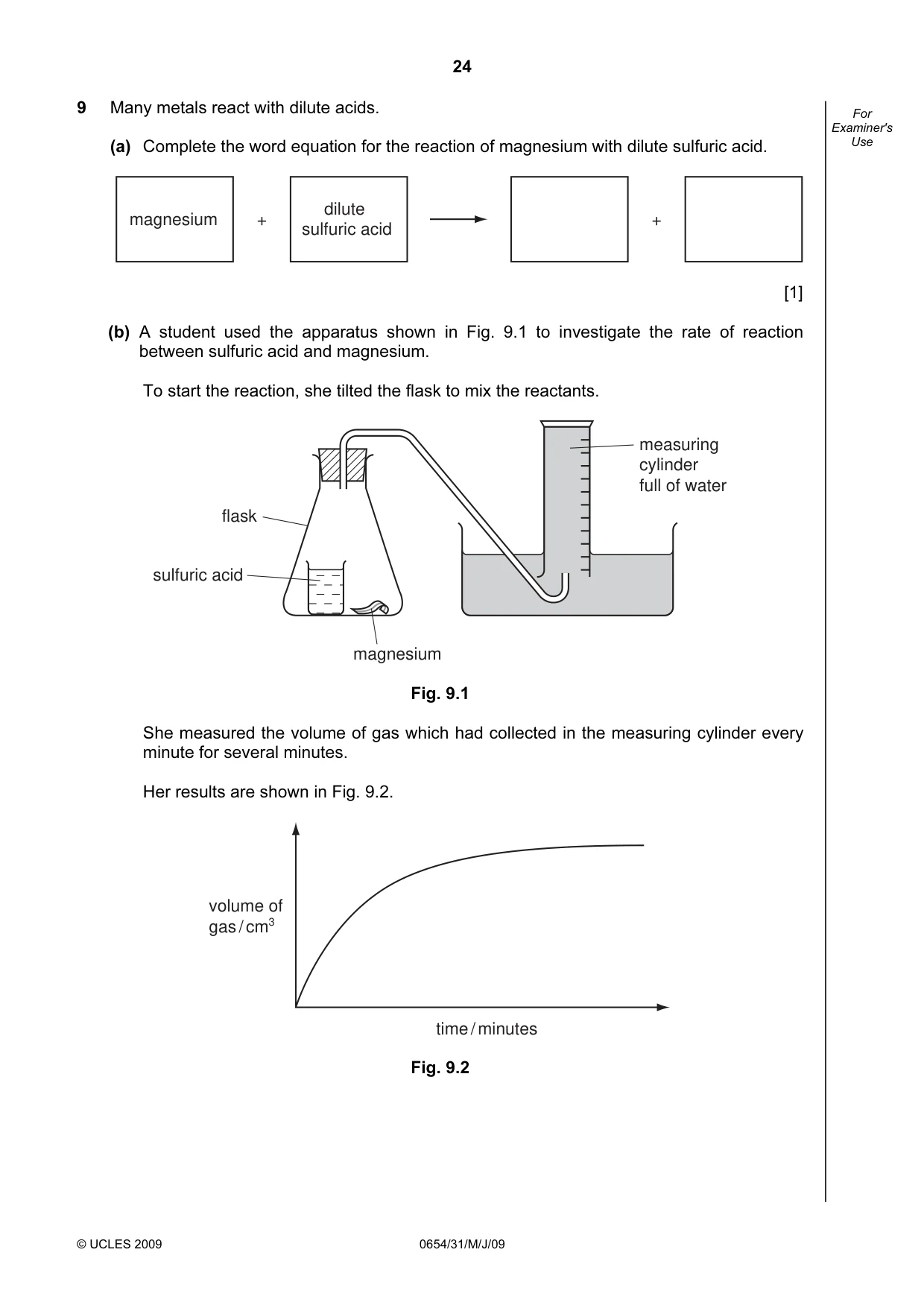
24 © UCLES 2009 0654/31/M/J/09 For Examiner's Use 9 Many metals react with dilute acids. (a) Complete the word equation for the reaction of magnesium with dilute sulfuric acid. dilute sulfuric acid + magnesium + [1] (b) A student used the apparatus shown in Fig. 9.1 to investigate the rate of reaction between sulfuric acid and magnesium. To start the reaction, she tilted the flask to mix the reactants. sulfuric acid flask magnesium measuring cylinder full of water Fig. 9.1 She measured the volume of gas which had collected in the measuring cylinder every minute for several minutes. Her results are shown in Fig. 9.2. volume of gas / cm3 time / minutes Fig. 9.2
Question paper, page 26
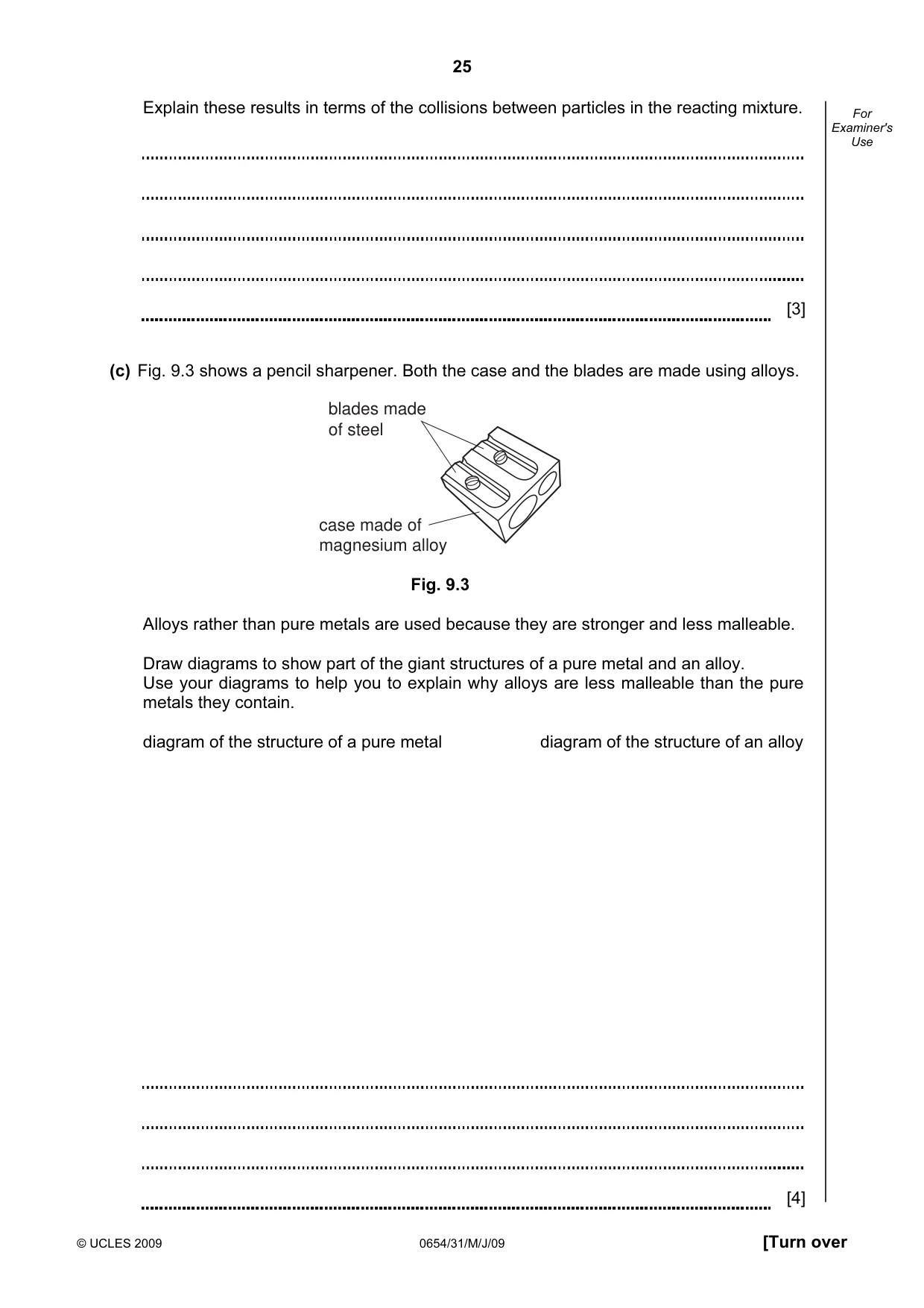
25 © UCLES 2009 0654/31/M/J/09 [Turn over For Examiner's Use Explain these results in terms of the collisions between particles in the reacting mixture. [3] (c) Fig. 9.3 shows a pencil sharpener. Both the case and the blades are made using alloys. blades made of steel case made of magnesium alloy Fig. 9.3 Alloys rather than pure metals are used because they are stronger and less malleable. Draw diagrams to show part of the giant structures of a pure metal and an alloy. Use your diagrams to help you to explain why alloys are less malleable than the pure metals they contain. diagram of the structure of a pure metal diagram of the structure of an alloy [4]
Question paper, page 27
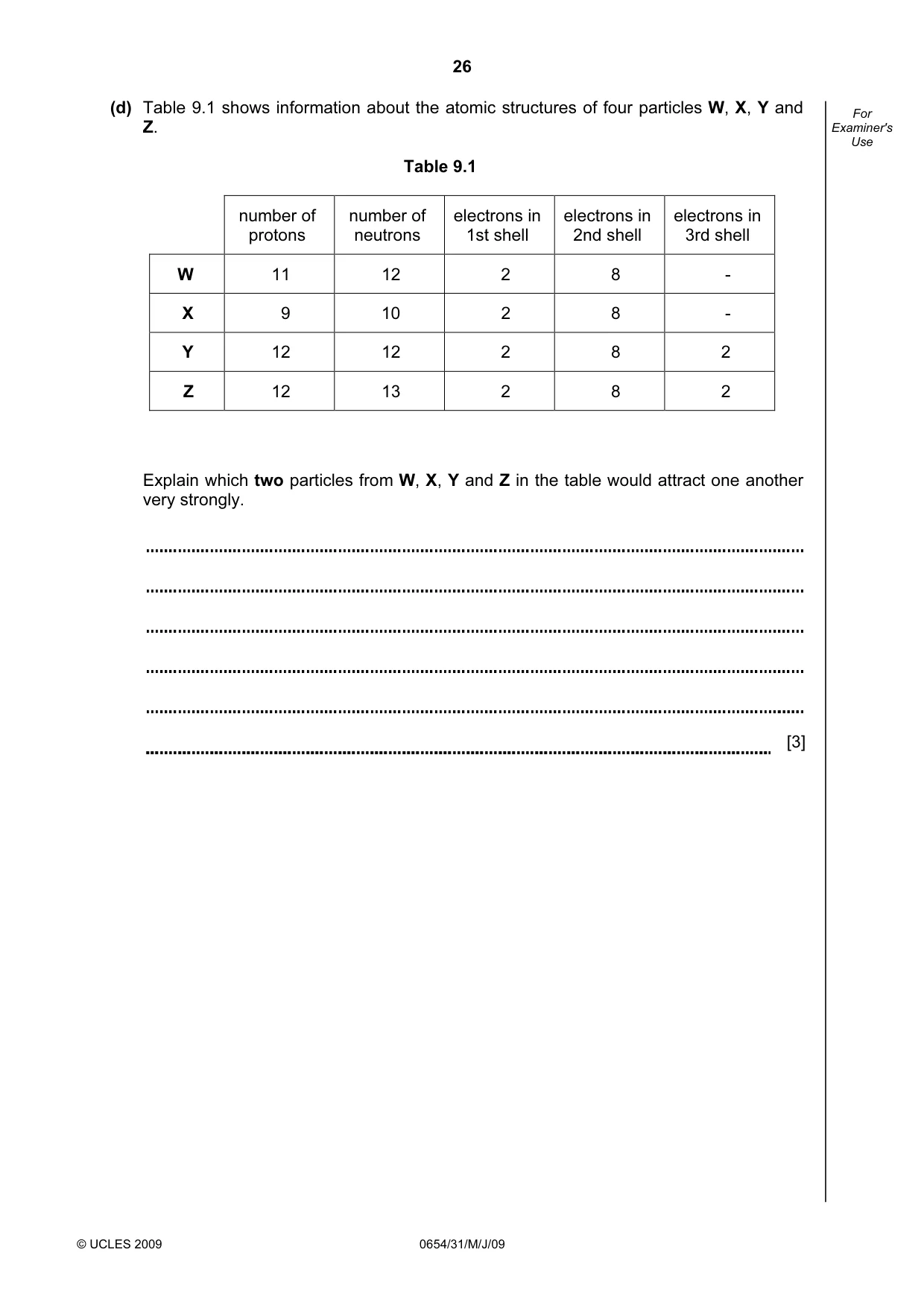
26 © UCLES 2009 0654/31/M/J/09 For Examiner's Use (d) Table 9.1 shows information about the atomic structures of four particles W, X, Y and Z. Table 9.1 number of protons number of neutrons electrons in 1st shell electrons in 2nd shell electrons in 3rd shell W 11 12 2 8 - X 9 10 2 8 - Y 12 12 2 8 2 Z 12 13 2 8 2 Explain which two particles from W, X, Y and Z in the table would attract one another very strongly. [3]
Question paper, page 29
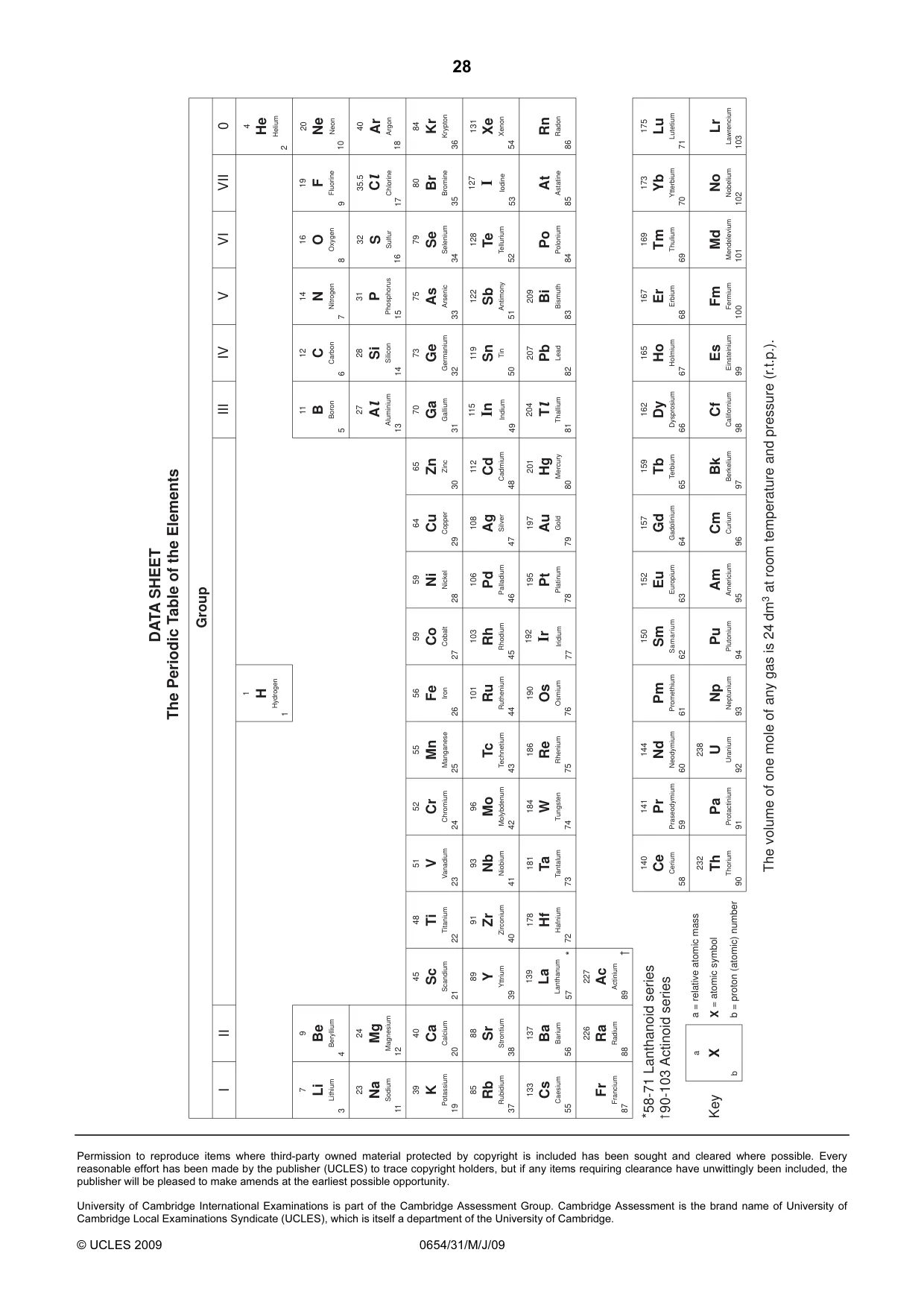
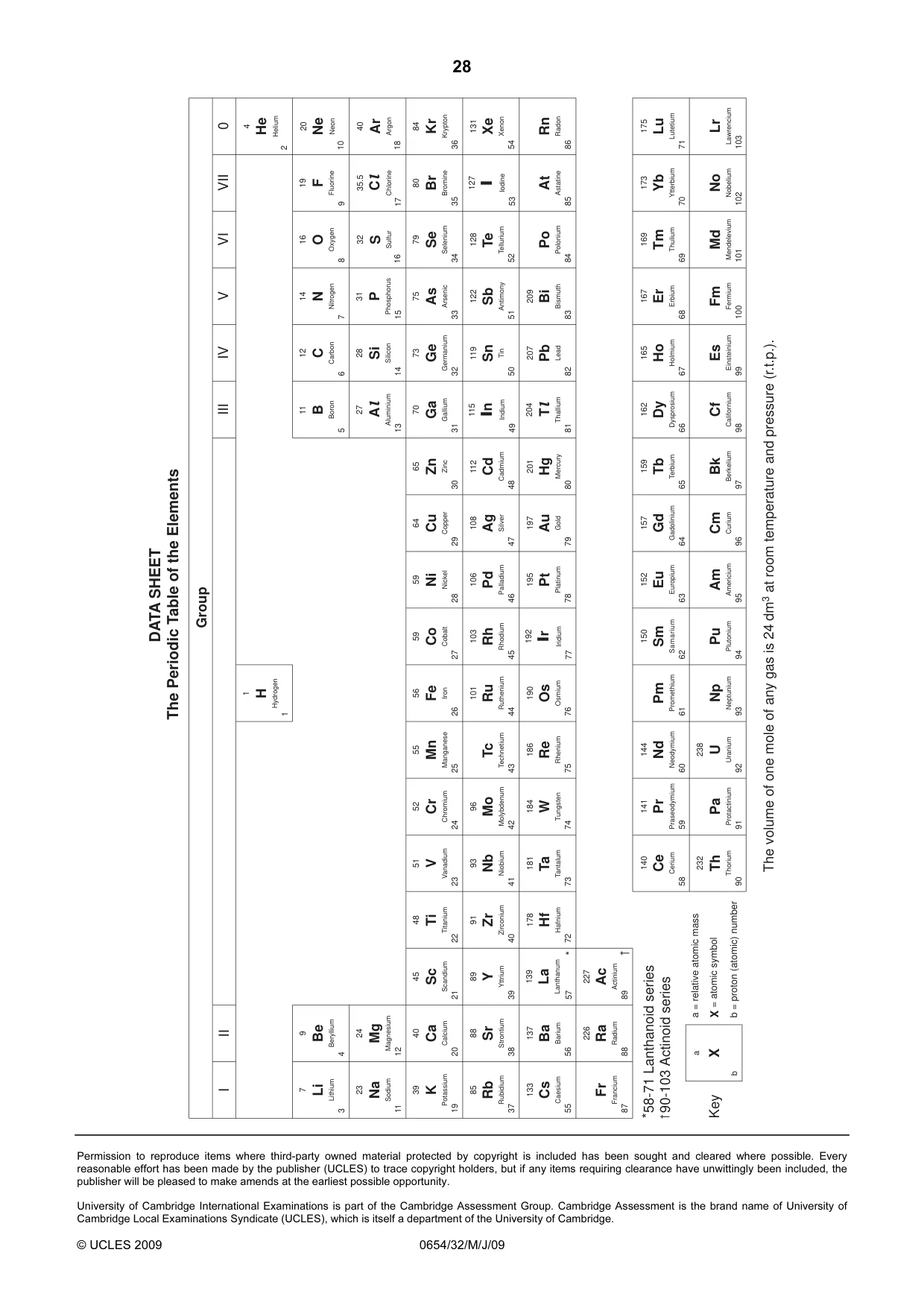
28 Permission to reproduce items where third-party owned material protected by copyright is included has been sought and cleared where possible. Every reasonable effort has been made by the publisher (UCLES) to trace copyright holders, but if any items requiring clearance have unwittingly been included, the publisher will be pleased to make amends at the earliest possible opportunity. University of Cambridge International Examinations is part of the Cambridge Assessment Group. Cambridge Assessment is the brand name of University of Cambridge Local Examinations Syndicate (UCLES), which is itself a department of the University of Cambridge. © UCLES 2009 0654/31/M/J/09 Group 140 Ce Cerium 58 141 Pr Praseodymium 59 144 Nd Neodymium 60 Pm Promethium 61 150 Sm Samarium 62 152 Eu Europium 63 157 Gd Gadolinium 64 159 Tb Terbium 65 162 Dy Dysprosium 66 165 Ho Holmium 67 167 Er Erbium 68 169 Tm Thulium 69 173 Yb Ytterbium 70 175 Lu Lutetium 71 232 Th Thorium 90 Pa Protactinium 91 238 U Uranium 92 Np Neptunium 93 Pu Plutonium 94 Am Americium 95 Cm Curium 96 Bk Berkelium 97 Cf Californium 98 Es Einsteinium 99 Fm Fermium 100 Md Mendelevium 101 No Nobelium 102 Lr Lawrencium 103 1 H Hydrogen 1 7 Li Lithium 3 23 Na Sodium 11 24 Mg Magnesium 12 40 Ca Calcium 20 45 Sc Scandium 21 48 Ti Titanium 22 51 V Vanadium 23 52 Cr Chromium 24 55 Mn Manganese 25 56 Fe Iron 26 59 Co Cobalt 27 59 Ni Nickel 28 64 Cu Copper 29 65 Zn Zinc 30 70 Ga Gallium 31 27 Al Aluminium 13 11 B Boron 5 12 C Carbon 6 14 N Nitrogen 7 16 O Oxygen 8 19 F Fluorine 9 28 Si Silicon 14 31 P Phosphorus 15 32 S Sulfur 16 35.5 Cl Chlorine 17 40 Ar Argon 18 20 Ne Neon 10 4 He Helium 2 73 Ge Germanium 32 75 As Arsenic 33 79 Se Selenium 34 80 Br Bromine 35 84 Kr Krypton 36 39 K Potassium 19 88 Sr Strontium 38 89 Y Yttrium 39 91 Zr Zirconium 40 93 Nb Niobium 41 96 Mo Molybdenum 42 Tc Technetium 43 101 Ru Ruthenium 44 103 Rh Rhodium 45 106 Pd Palladium 46 108 Ag Silver 47 112 Cd Cadmium 48 115 In Indium 49 119 Sn Tin 50 122 Sb Antimony 51 128 Te Tellurium 52 127 I Iodine 53 131 Xe Xenon 54 137 Ba Barium 56 139 La Lanthanum 57 * 178 Hf Hafnium 72 181 Ta Tantalum 73 184 W Tungsten 74 186 Re Rhenium 75 190 Os Osmium 76 192 Ir Iridium 77 195 Pt Platinum 78 197 Au Gold 79 201 Hg Mercury 80 204 Tl Thallium 81 207 Pb Lead 82 209 Bi Bismuth 83 Po Polonium 84 At Astatine 85 Rn Radon 86 Fr Francium 87 227 Ac Actinium 89 9 Be Beryllium 4 I II III IV V VI VII 0 85 Rb Rubidium 37 133 Cs Caesium 55 226 Ra Radium 88 The volume of one mole of any gas is 24 dm3 at room temperature and pressure (r.t.p.). a X b a = relative atomic mass X = atomic symbol b = proton (atomic) number Key *58-71 Lanthanoid series 90-103 Actinoid series DATA SHEET The Periodic Table of the Elements
Question paper, page 30
This document consists of 23 printed pages and 5 blank pages. IB09 06_0654_32/3RP © UCLES 2009 [Turn over *3882206291* For Examiner's Use 1 2 3 4 5 6 7 8 9 Total UNIVERSITY OF CAMBRIDGE INTERNATIONAL EXAMINATIONS International General Certificate of Secondary Education CO-ORDINATED SCIENCES 0654/32 Paper 3 (Extended) May/June 2009 2 hours Candidates answer on the Question Paper. No Additional Materials are required. READ THESE INSTRUCTIONS FIRST Write your Centre number, candidate number and name on all the work you hand in. Write in dark blue or black pen. You may use a soft pencil for any diagrams, graphs, tables or rough working. Do not use staples, paper clips, highlighters, glue or correction fluid. DO NOT WRITE IN ANY BARCODES. Answer all questions. A copy of the Periodic Table is printed on page 28. At the end of the examination, fasten all your work securely together. The number of marks is given in brackets [ ] at the end of each question or part question. Second Variant Question Paper
Question paper, page 32
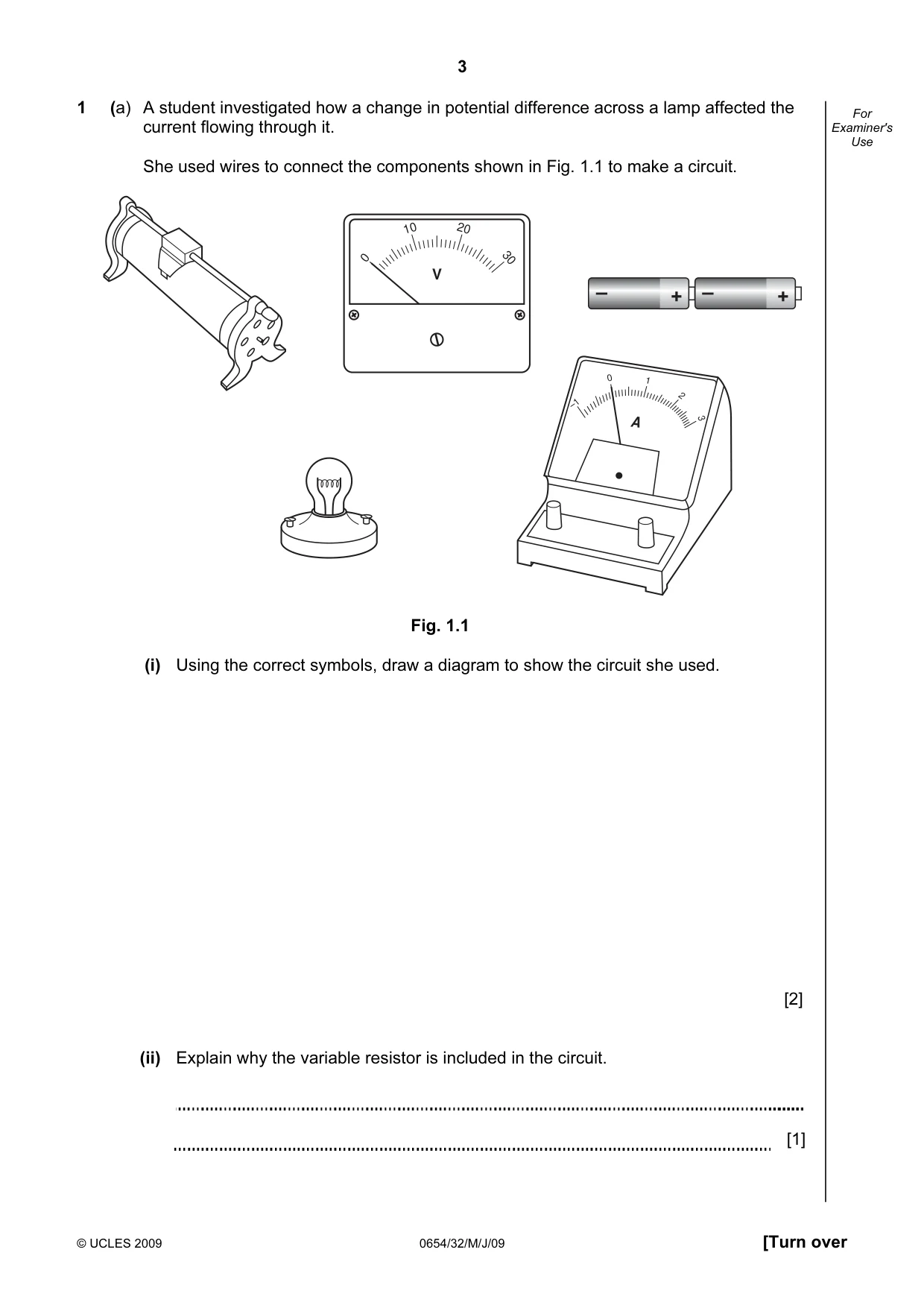
3 © UCLES 2009 0654/32/M/J/09 [Turn over For Examiner's Use 1 (a) A student investigated how a change in potential difference across a lamp affected the current flowing through it. She used wires to connect the components shown in Fig. 1.1 to make a circuit. 10 20 30 0 V 1 2 3 0 –1 A + – + – Fig. 1.1 (i) Using the correct symbols, draw a diagram to show the circuit she used. [2] (ii) Explain why the variable resistor is included in the circuit. [1]
Question paper, page 33
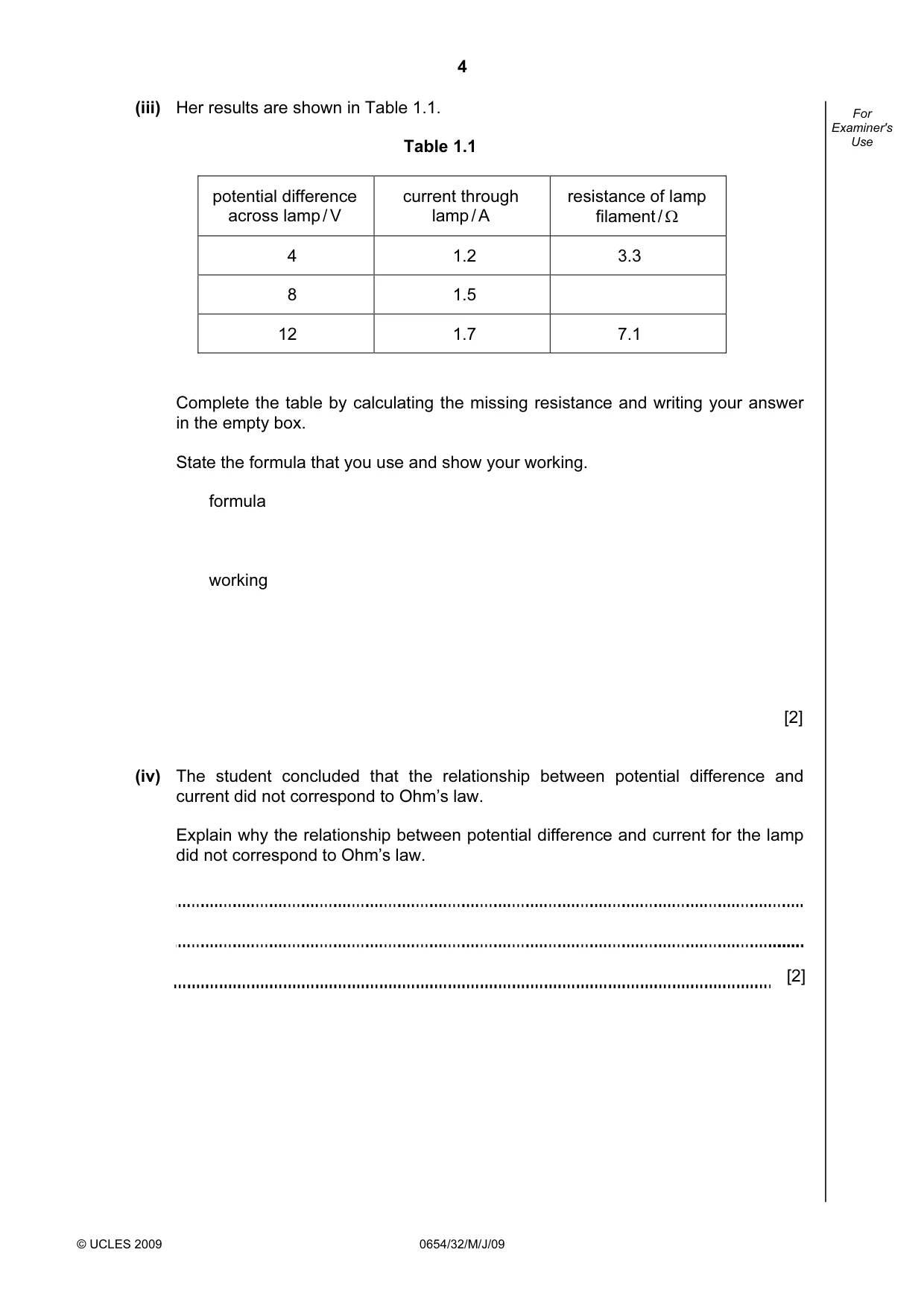
4 © UCLES 2009 0654/32/M/J/09 For Examiner's Use (iii) Her results are shown in Table 1.1. Table 1.1 potential difference across lamp / V current through lamp / A resistance of lamp filament / Ω 4 1.2 3.3 8 1.5 12 1.7 7.1 Complete the table by calculating the missing resistance and writing your answer in the empty box. State the formula that you use and show your working. formula working [2] (iv) The student concluded that the relationship between potential difference and current did not correspond to Ohm’s law. Explain why the relationship between potential difference and current for the lamp did not correspond to Ohm’s law. [2]
Question paper, page 34
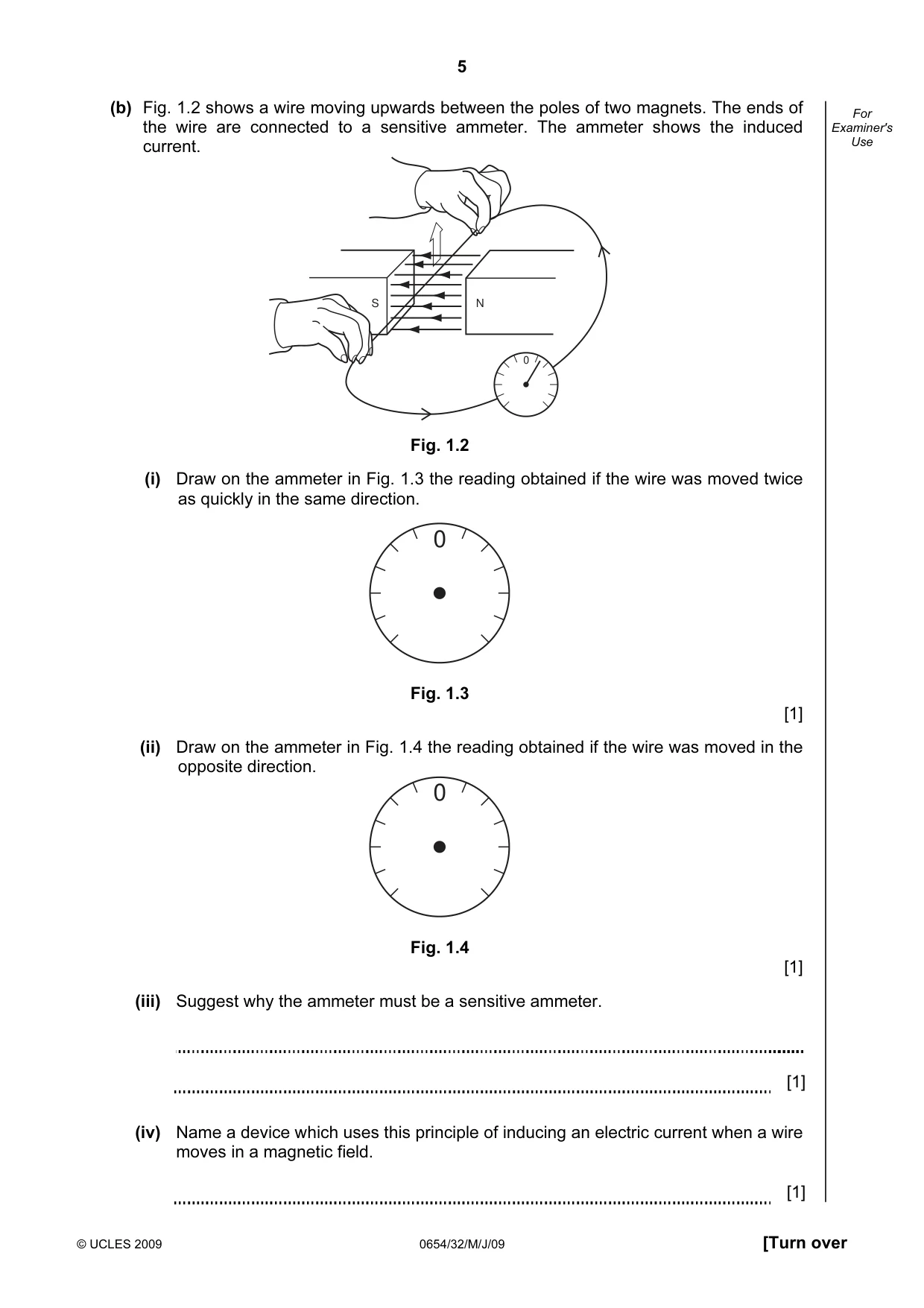
5 © UCLES 2009 0654/32/M/J/09 [Turn over For Examiner's Use (b) Fig. 1.2 shows a wire moving upwards between the poles of two magnets. The ends of the wire are connected to a sensitive ammeter. The ammeter shows the induced current. S N 0 Fig. 1.2 (i) Draw on the ammeter in Fig. 1.3 the reading obtained if the wire was moved twice as quickly in the same direction. 0 Fig. 1.3 [1] (ii) Draw on the ammeter in Fig. 1.4 the reading obtained if the wire was moved in the opposite direction. 0 Fig. 1.4 [1] (iii) Suggest why the ammeter must be a sensitive ammeter. [1] (iv) Name a device which uses this principle of inducing an electric current when a wire moves in a magnetic field. [1]
Question paper, page 35
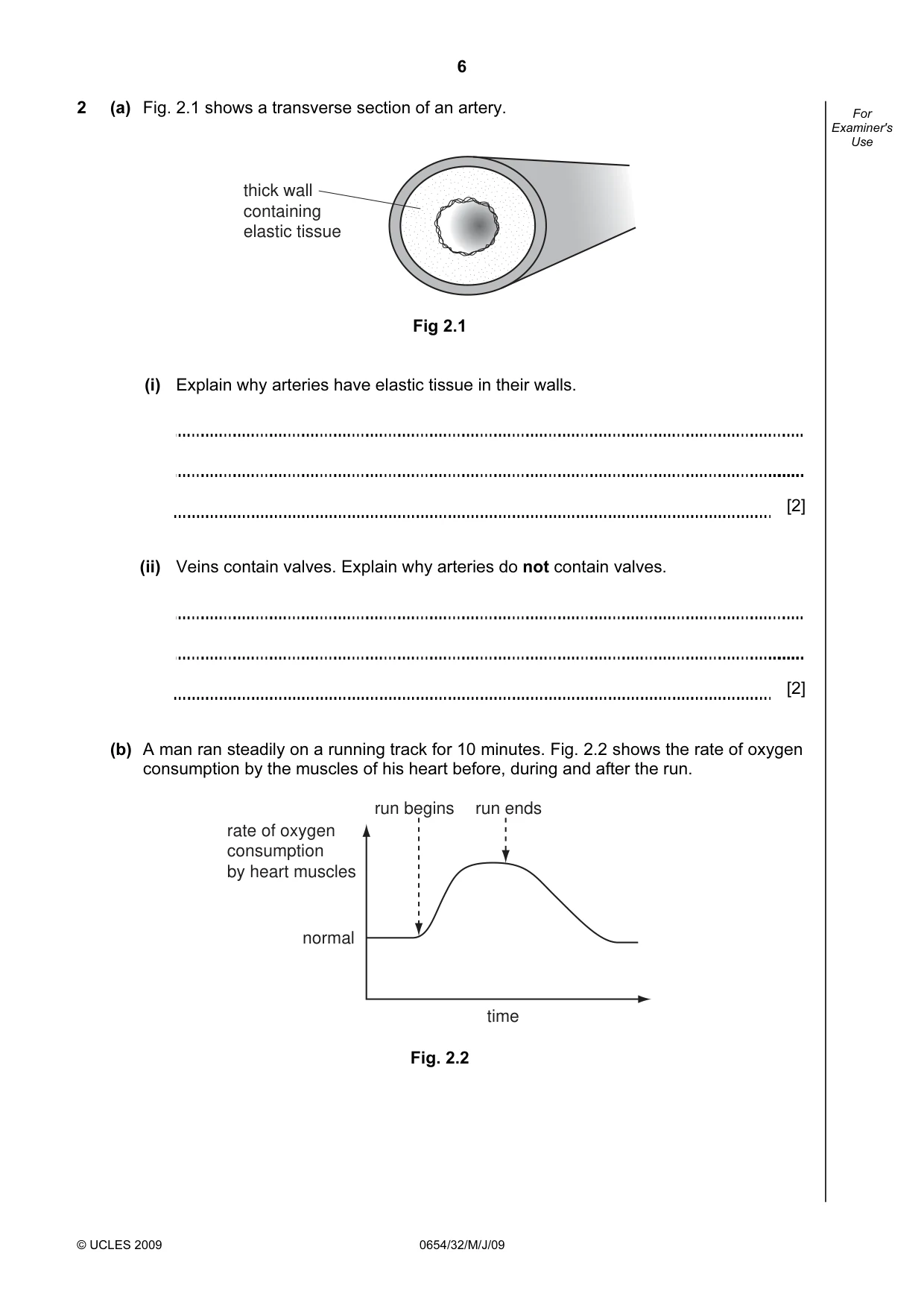
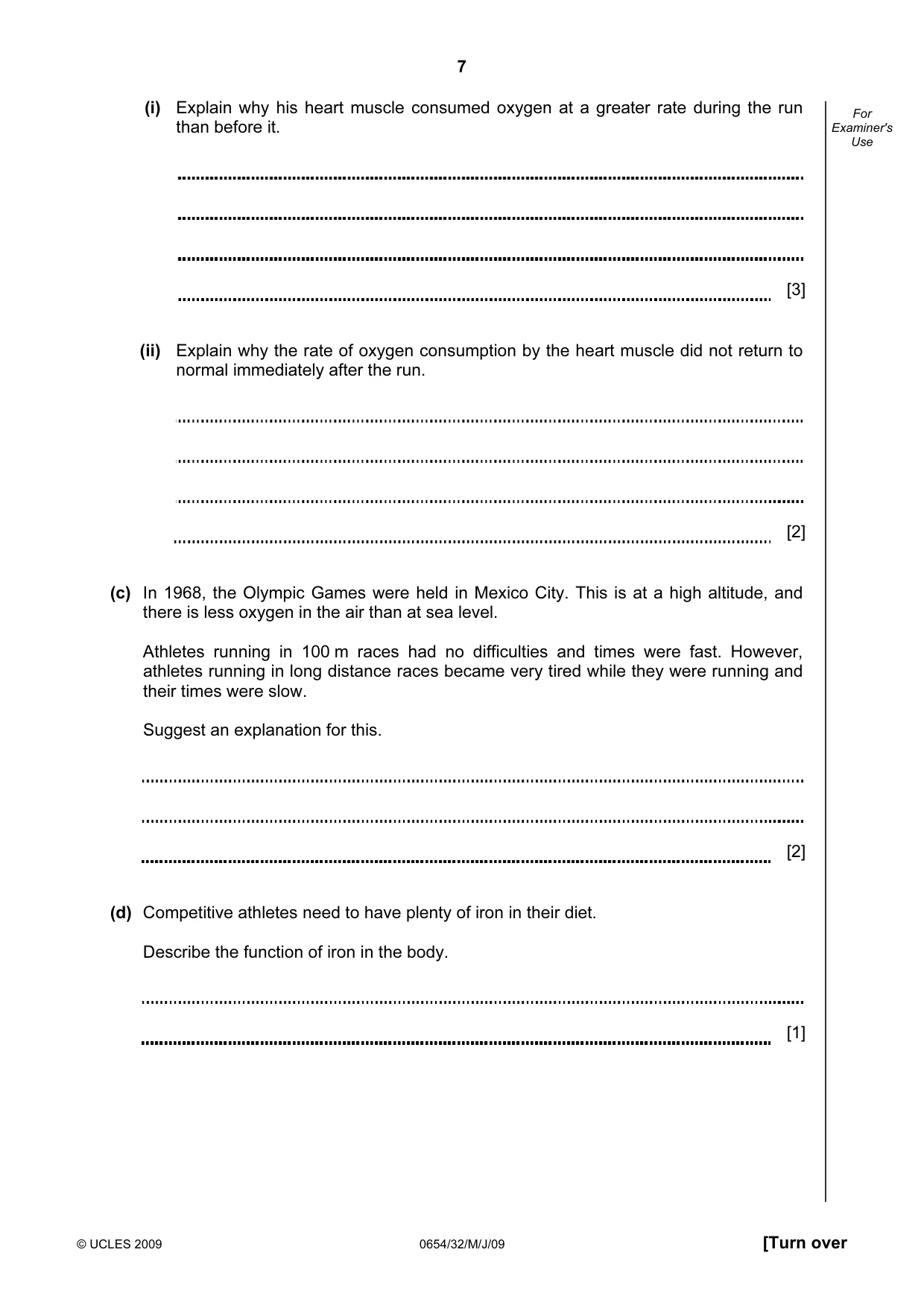
6 © UCLES 2009 0654/32/M/J/09 For Examiner's Use 2 (a) Fig. 2.1 shows a transverse section of an artery. thick wall containing elastic tissue Fig 2.1 (i) Explain why arteries have elastic tissue in their walls. [2] (ii) Veins contain valves. Explain why arteries do not contain valves. [2] (b) A man ran steadily on a running track for 10 minutes. Fig. 2.2 shows the rate of oxygen consumption by the muscles of his heart before, during and after the run. run begins run ends rate of oxygen consumption by heart muscles time normal Fig. 2.2
Question paper, page 36
7 © UCLES 2009 0654/32/M/J/09 [Turn over For Examiner's Use (i) Explain why his heart muscle consumed oxygen at a greater rate during the run than before it. [3] (ii) Explain why the rate of oxygen consumption by the heart muscle did not return to normal immediately after the run. [2] (c) In 1968, the Olympic Games were held in Mexico City. This is at a high altitude, and there is less oxygen in the air than at sea level. Athletes running in 100 m races had no difficulties and times were fast. However, athletes running in long distance races became very tired while they were running and their times were slow. Suggest an explanation for this. [2] (d) Competitive athletes need to have plenty of iron in their diet. Describe the function of iron in the body. [1]
Question paper, page 37
8 © UCLES 2009 0654/32/M/J/09 For Examiner's Use 3 Food colourings are natural or synthetic dyes added to make food look more attractive. (a) Describe the difference between natural and synthetic dyes. [1] (b) Fig. 3.1 shows a piece of cloth which is stained with food colouring. Fig. 3.1 The cloth is washed in water containing soap solution. Describe how soap molecules help to remove stains from the cloth. You may wish to draw some simple diagrams to help you answer this question. [3]
Question paper, page 38
9 © UCLES 2009 0654/32/M/J/09 [Turn over For Examiner's Use (c) Some water supplied to houses contains calcium hydrogencarbonate, Ca(HCO3)2. When heated, calcium hydrogencarbonate undergoes thermal decomposition. (i) Complete the symbolic equation below which describes the thermal decomposition of calcium hydrogencarbonate. Ca(HCO3)2 → [2] (ii) The ionic charge of a calcium ion is 2+. Deduce the ionic charge of a hydrogencarbonate ion. Show how you obtained your answer. [2]
Question paper, page 39
10 © UCLES 2009 0654/32/M/J/09 For Examiner's Use 4 (a) Many people have survived accidents where they have been exposed to ionising radiation from radioactive materials. Such exposure can have serious effects on their health. The table and graph show how the dose (amount) of radiation received is linked to a type of cancer called leukaemia. The radiation dose is measured in units called grays. Table 4.1 radiation dose / grays incidences of leukaemia / cases per 10 000 people per year 1.0 1.0 2.5 2.3 5.0 10.0 10.1 15.0 15.2 incidences of leukaemia / cases per 10 000 people per year 16 14 12 10 8 6 4 2 0 0 2 4 6 8 radiation dose / grays 10 12 14 16 Fig. 4.1
Question paper, page 40
11 © UCLES 2009 0654/32/M/J/09 [Turn over For Examiner's Use (i) The result for 5.0 grays has been missed out of the table. Use the graph to help you fill in the missing value in the table. [1] (ii) What is the relationship between the ionising radiation and the incidence of leukaemia? [1] (b) Two types of nuclear radiation from naturally occurring sources are alpha and beta. They can be identified by their different penetrating powers. Describe how you could distinguish between alpha and beta radiation by their penetrating powers. [1] (c) Radon-222 (222Rn) is a radioactive element. The chart in Fig. 4.2 shows the number of protons and neutrons in the nuclei of the elements formed when radon decays. lead–214 polonium–218 radon–222 137 136 135 134 133 132 131 81 82 83 84 number of protons 85 86 87 number of neutrons Fig. 4.2 (i) Describe how the graph shows that radon-222 (222Rn) and polonium-218 (218Po) emit alpha particles. [2]
Question paper, page 41
12 © UCLES 2009 0654/32/M/J/09 For Examiner's Use (ii) State why radon and polonium are different elements. [1] (iii) Radioactive decay can also produce gamma radiation. Explain why gamma emission does not result in the formation of a new element. [1] (iv) Radon-222 has a half-life of 4 days. Explain what is meant by the term half-life. [1] (v) 1 mg of radon-222 is allowed to decay. Calculate after how many days there would be 0.125 mg of radon-222 remaining. Show your working. [2]
Question paper, page 42
13 0654/32/M/J/09 [Turn over BLANK PAGE Please turn over for Question 5.
Question paper, page 43
14 © UCLES 2009 0654/32/M/J/09 For Examiner's Use 5 Fig. 5.1 shows three arthropods. A B C Fig. 5.1 (a) (i) The arthropod A is a locust, which belongs to the insect class. State two features, visible on the locust in Fig. 5.1, which are characteristic of insects. 1 2 [2] (ii) Name the classes to which arthropods B and C belong. B C [2]
Question paper, page 44
15 © UCLES 2009 0654/32/M/J/09 [Turn over For Examiner's Use (b) In one species of locust, the body colour may be brown or green. This is controlled by a gene with two alleles, G and g. If two locusts with brown bodies are mated, the offspring are always brown. If two locusts with green bodies are mated, some of the offspring may be brown. (i) Write the possible genotype or genotypes for each of the following phenotypes. brown body green body [2] (ii) Use a genetic diagram to explain why some of the offspring of two locusts with green bodies may have brown bodies. [4] (c) State whether the variation in body colour in these locusts is an example of continuous variation or discontinuous variation. Explain your answer. [1] (d) Locusts sometimes form huge swarms, which can fly long distances, and can eat and completely destroy whole fields of crops. These swarms are sometimes sprayed with pesticides from aeroplanes. Suggest two possible disadvantages of using pesticides in this way. 1 2 [2]
Question paper, page 45
16 © UCLES 2009 0654/32/M/J/09 For Examiner's Use 6 Fig. 6.1 shows apparatus a student used to investigate electrolysis using concentrated sodium chloride solution as the electrolyte. R direct current supply Q concentrated sodium chloride solution Fig. 6.1 When an electric current flowed through the circuit, chlorine gas collected in tube Q and hydrogen gas collected in tube R. The balanced equation below describes the overall chemical change which takes place. 2NaCl + 2H2O → 2NaOH + Cl2 + H2 (a) On Fig. 6.1 label the anode. Give a reason for your choice. [2] (b) The student allowed the current to flow through the apparatus until 0.01 moles of hydrogen gas had been produced. (i) State the number of moles of chlorine which were produced during the experiment. [1]
Question paper, page 46
17 © UCLES 2009 0654/32/M/J/09 [Turn over For Examiner's Use (ii) Calculate the mass of sodium hydroxide which was produced during the experiment. (Relative atomic masses Na = 23, O = 16, H = 1) Show your working. [3] (c) When chlorine gas is bubbled through a colourless solution of potassium bromide, KBr, the solution turns orange because the element bromine is produced. (i) Write a balanced equation for the reaction between chlorine and potassium bromide. [2] (ii) Complete the bonding diagram of a bromine molecule to show the arrangement of the outer electrons of each atom. [2] (iii) Describe how bromine is used to test hydrocarbons to find out whether or not they are unsaturated. [2] (iv) Complete the displayed formula to show the alkene which contains four carbon atoms in each of its molecules. C H H H [2]
Question paper, page 47
18 © UCLES 2009 0654/32/M/J/09 For Examiner's Use 7 A student carried out an investigation into the response of plant shoots to light. He grew six maize seedlings and treated them as follows. • He did nothing to seedlings A and D. • He cut the tips off seedlings B and E. • He covered the tips of seedlings C and F with black paper. He placed one group of seedlings where they received light from all directions. He placed the second group of seedlings in a container where they received light from one side only. Fig. 7.1 shows the appearance of the six seedlings when the experiment was first set up, and after one day. A B C D E F light from all around light from one side light from all around light from one side day 1 (set up) A B C D E F day 2 Fig. 7.1
Question paper, page 48
19 © UCLES 2009 0654/32/M/J/09 [Turn over For Examiner's Use (a) The student concluded that the tip of a shoot is needed for growth. Describe the evidence in Fig. 7.1 that supports this conclusion. [2] (b) Using the information in Fig. 7.1, deduce the positions of the receptor and the effector that are responsible for the growth response of a seedling towards light. Explain the evidence for your deductions. position of receptor evidence position of effector evidence [4] (c) Describe how auxin may be involved in the growth of shoots towards the light. You can use a diagram if it helps your answer. [3]
Question paper, page 49
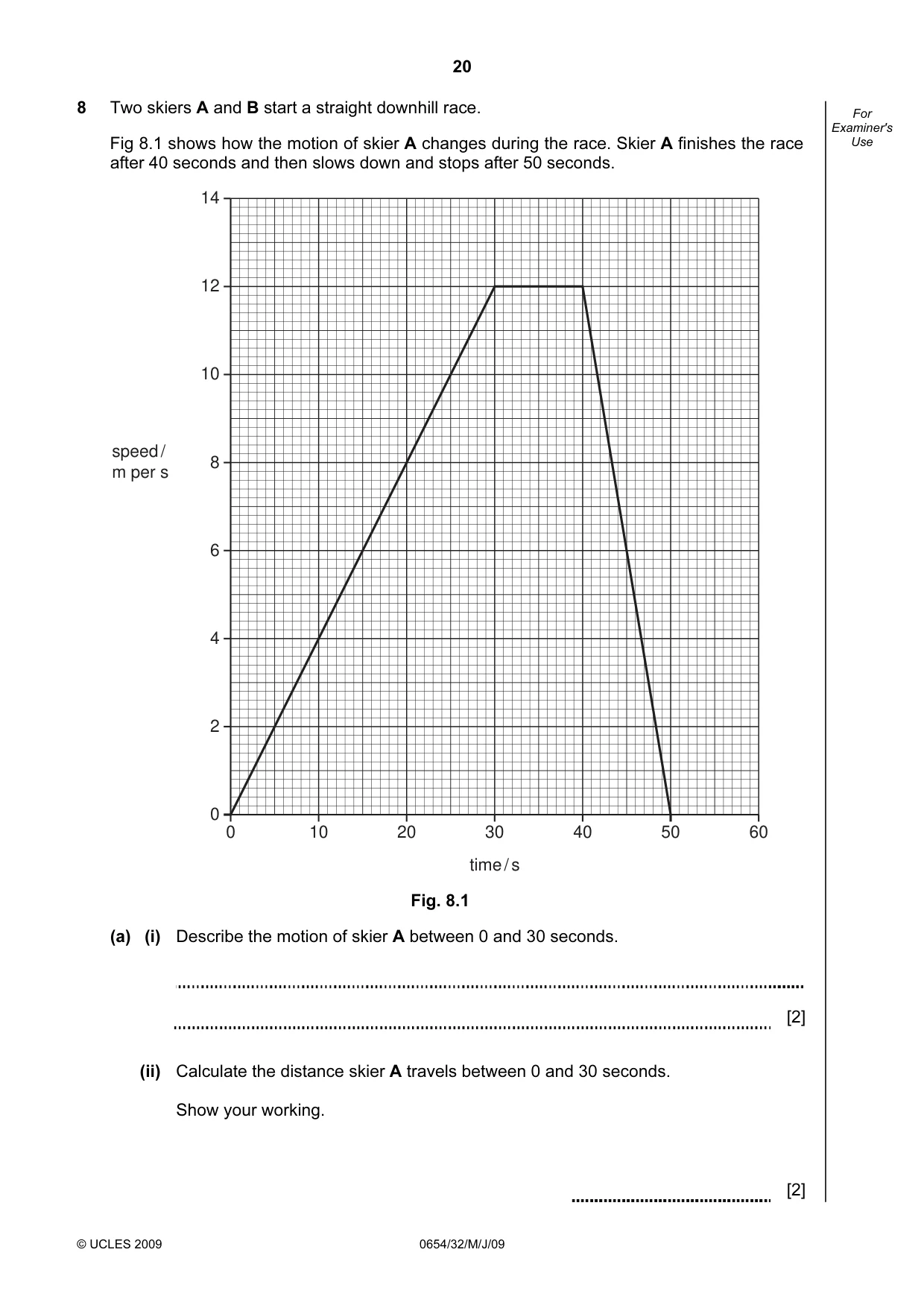
20 © UCLES 2009 0654/32/M/J/09 For Examiner's Use 8 Two skiers A and B start a straight downhill race. Fig 8.1 shows how the motion of skier A changes during the race. Skier A finishes the race after 40 seconds and then slows down and stops after 50 seconds. 0 10 20 30 time / s 40 50 60 14 12 10 8 6 4 2 0 speed / m per s Fig. 8.1 (a) (i) Describe the motion of skier A between 0 and 30 seconds. [2] (ii) Calculate the distance skier A travels between 0 and 30 seconds. Show your working. [2]
Question paper, page 50
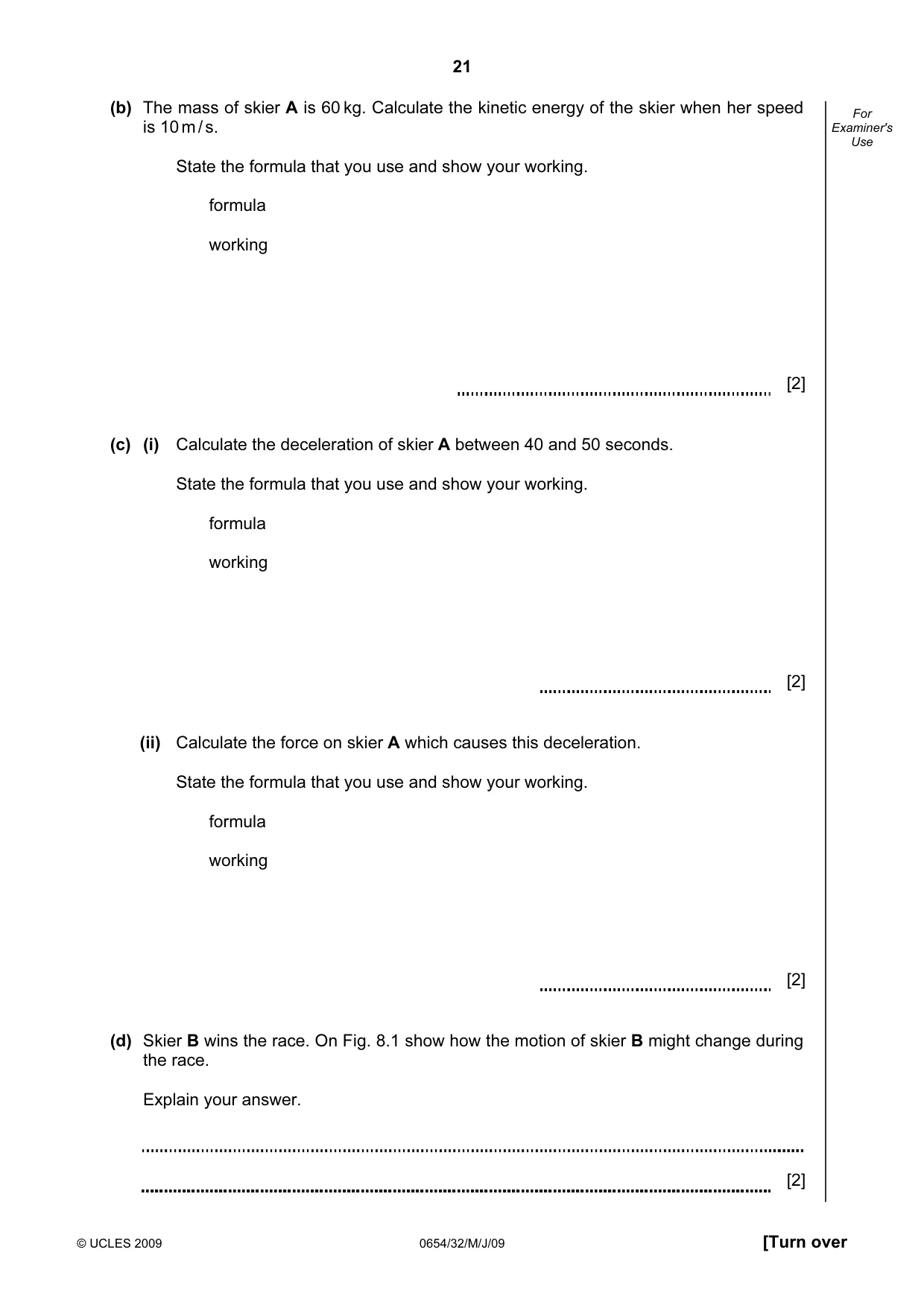
21 © UCLES 2009 0654/32/M/J/09 [Turn over For Examiner's Use (b) The mass of skier A is 60 kg. Calculate the kinetic energy of the skier when her speed is 10 m / s. State the formula that you use and show your working. formula working [2] (c) (i) Calculate the deceleration of skier A between 40 and 50 seconds. State the formula that you use and show your working. formula working [2] (ii) Calculate the force on skier A which causes this deceleration. State the formula that you use and show your working. formula working [2] (d) Skier B wins the race. On Fig. 8.1 show how the motion of skier B might change during the race. Explain your answer. [2]
Question paper, page 51
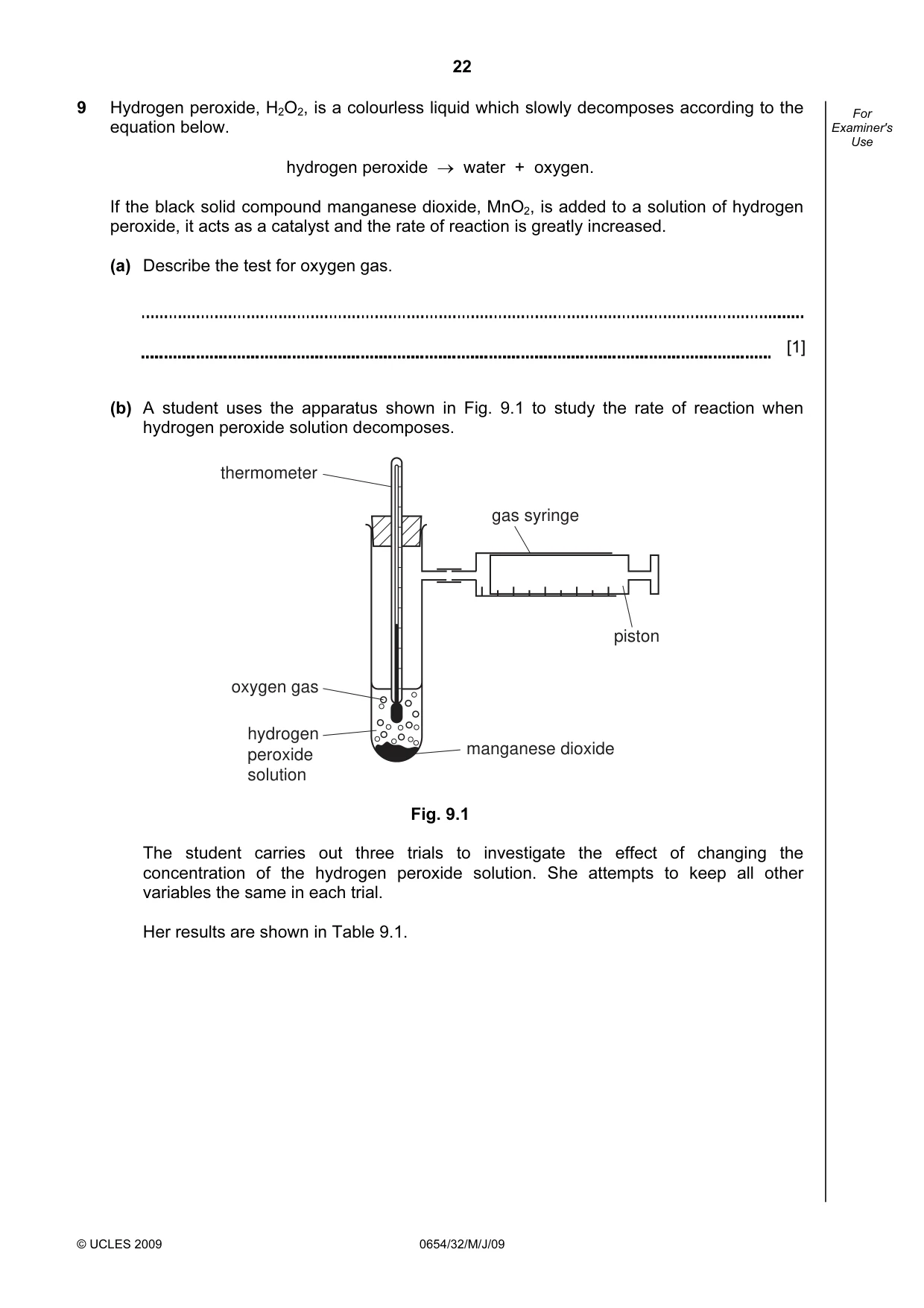
22 © UCLES 2009 0654/32/M/J/09 For Examiner's Use 9 Hydrogen peroxide, H2O2, is a colourless liquid which slowly decomposes according to the equation below. hydrogen peroxide → water + oxygen. If the black solid compound manganese dioxide, MnO2, is added to a solution of hydrogen peroxide, it acts as a catalyst and the rate of reaction is greatly increased. (a) Describe the test for oxygen gas. [1] (b) A student uses the apparatus shown in Fig. 9.1 to study the rate of reaction when hydrogen peroxide solution decomposes. thermometer oxygen gas hydrogen peroxide solution manganese dioxide gas syringe piston Fig. 9.1 The student carries out three trials to investigate the effect of changing the concentration of the hydrogen peroxide solution. She attempts to keep all other variables the same in each trial. Her results are shown in Table 9.1.
Question paper, page 52
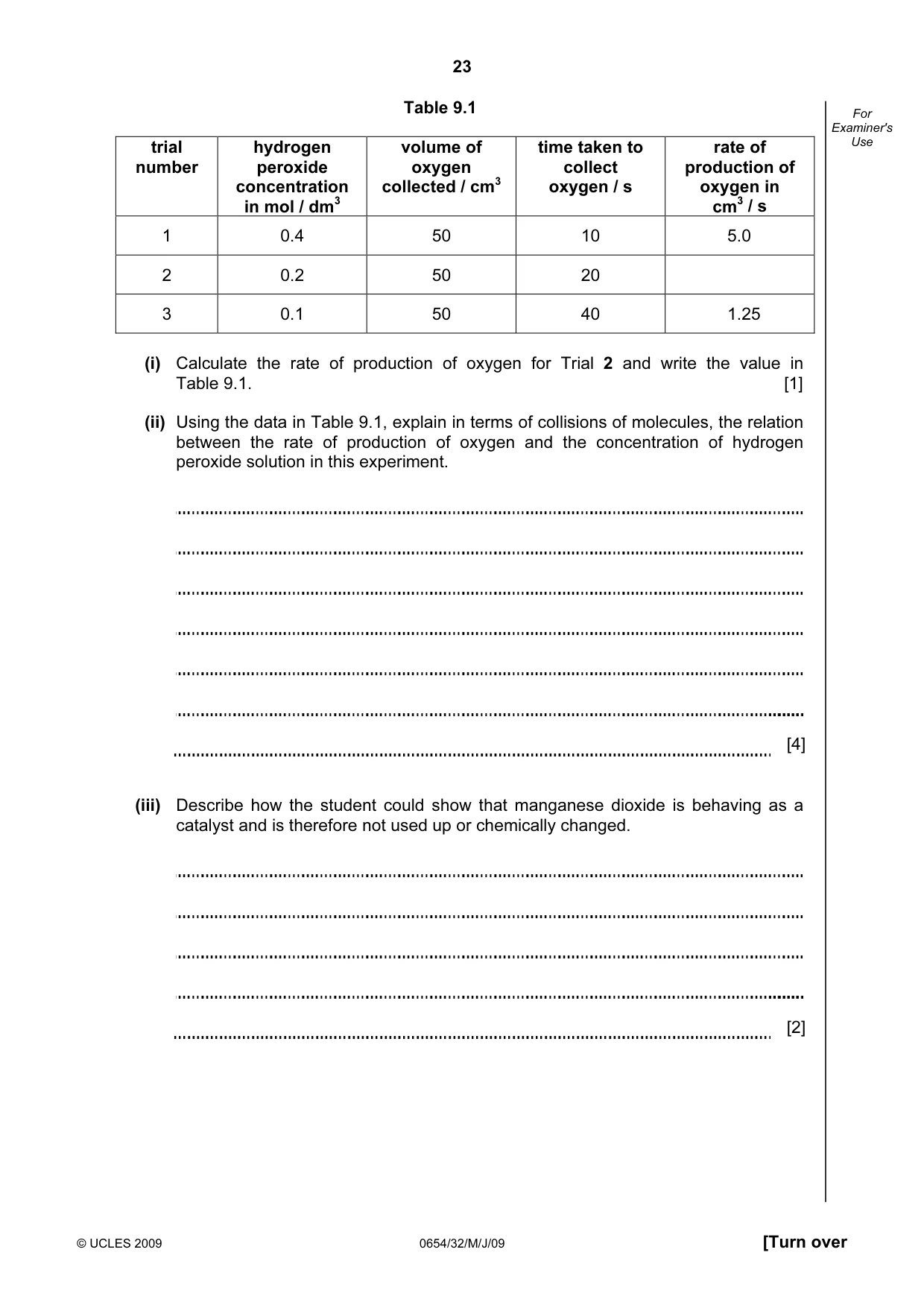
23 © UCLES 2009 0654/32/M/J/09 [Turn over For Examiner's Use Table 9.1 trial number hydrogen peroxide concentration in mol / dm3 volume of oxygen collected / cm3 time taken to collect oxygen / s rate of production of oxygen in cm3 / s 1 0.4 50 10 5.0 2 0.2 50 20 3 0.1 50 40 1.25 (i) Calculate the rate of production of oxygen for Trial 2 and write the value in Table 9.1. [1] (ii) Using the data in Table 9.1, explain in terms of collisions of molecules, the relation between the rate of production of oxygen and the concentration of hydrogen peroxide solution in this experiment. [4] (iii) Describe how the student could show that manganese dioxide is behaving as a catalyst and is therefore not used up or chemically changed. [2]
Question paper, page 53
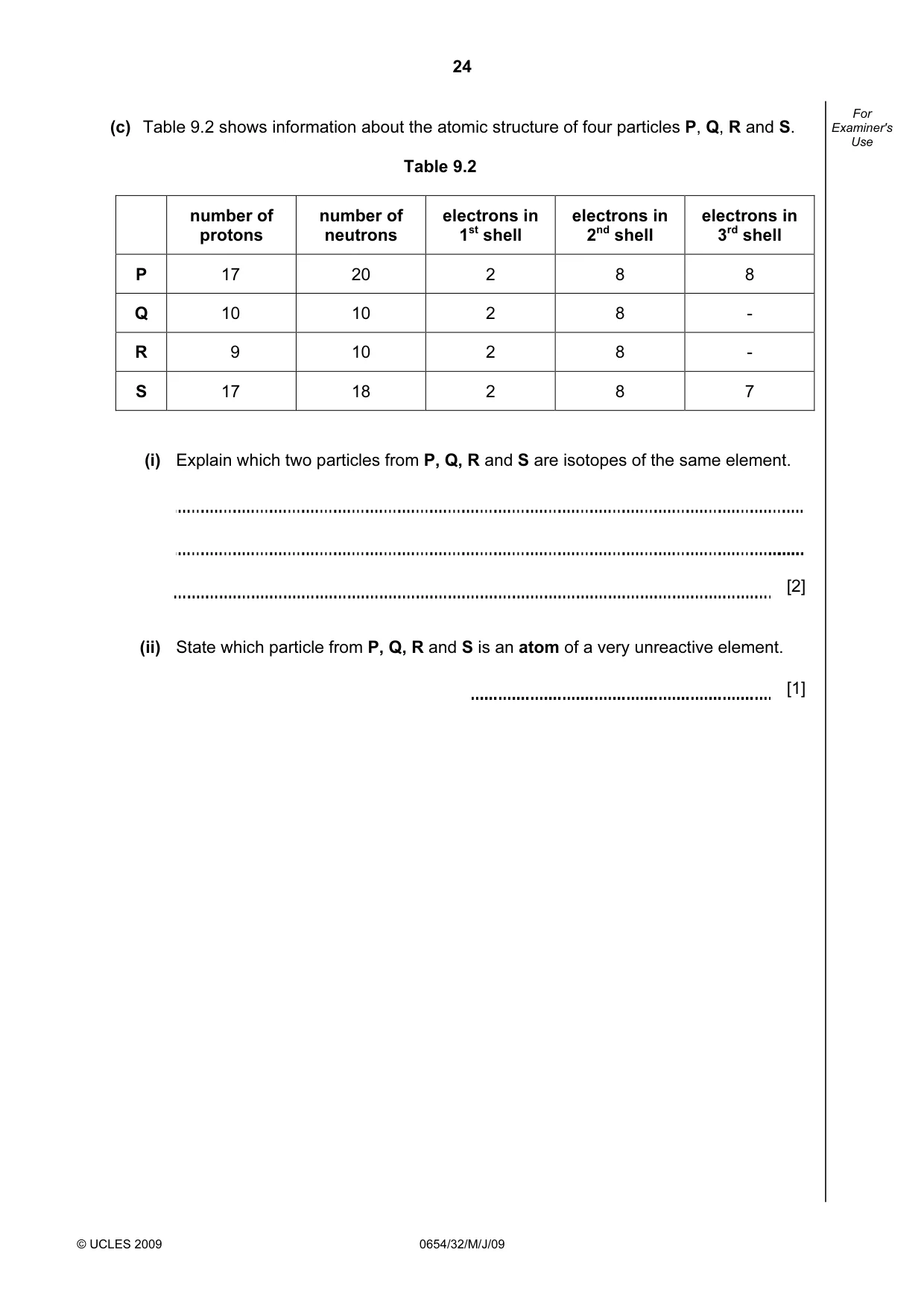
24 © UCLES 2009 0654/32/M/J/09 For Examiner's Use (c) Table 9.2 shows information about the atomic structure of four particles P, Q, R and S. Table 9.2 number of protons number of neutrons electrons in 1st shell electrons in 2nd shell electrons in 3rd shell P 17 20 2 8 8 Q 10 10 2 8 - R 9 10 2 8 - S 17 18 2 8 7 (i) Explain which two particles from P, Q, R and S are isotopes of the same element. [2] (ii) State which particle from P, Q, R and S is an atom of a very unreactive element. [1]
Question paper, page 57
28 Permission to reproduce items where third-party owned material protected by copyright is included has been sought and cleared where possible. Every reasonable effort has been made by the publisher (UCLES) to trace copyright holders, but if any items requiring clearance have unwittingly been included, the publisher will be pleased to make amends at the earliest possible opportunity. University of Cambridge International Examinations is part of the Cambridge Assessment Group. Cambridge Assessment is the brand name of University of Cambridge Local Examinations Syndicate (UCLES), which is itself a department of the University of Cambridge. © UCLES 2009 0654/32/M/J/09 Group 140 Ce Cerium 58 141 Pr Praseodymium 59 144 Nd Neodymium 60 Pm Promethium 61 150 Sm Samarium 62 152 Eu Europium 63 157 Gd Gadolinium 64 159 Tb Terbium 65 162 Dy Dysprosium 66 165 Ho Holmium 67 167 Er Erbium 68 169 Tm Thulium 69 173 Yb Ytterbium 70 175 Lu Lutetium 71 232 Th Thorium 90 Pa Protactinium 91 238 U Uranium 92 Np Neptunium 93 Pu Plutonium 94 Am Americium 95 Cm Curium 96 Bk Berkelium 97 Cf Californium 98 Es Einsteinium 99 Fm Fermium 100 Md Mendelevium 101 No Nobelium 102 Lr Lawrencium 103 1 H Hydrogen 1 7 Li Lithium 3 23 Na Sodium 11 24 Mg Magnesium 12 40 Ca Calcium 20 45 Sc Scandium 21 48 Ti Titanium 22 51 V Vanadium 23 52 Cr Chromium 24 55 Mn Manganese 25 56 Fe Iron 26 59 Co Cobalt 27 59 Ni Nickel 28 64 Cu Copper 29 65 Zn Zinc 30 70 Ga Gallium 31 27 Al Aluminium 13 11 B Boron 5 12 C Carbon 6 14 N Nitrogen 7 16 O Oxygen 8 19 F Fluorine 9 28 Si Silicon 14 31 P Phosphorus 15 32 S Sulfur 16 35.5 Cl Chlorine 17 40 Ar Argon 18 20 Ne Neon 10 4 He Helium 2 73 Ge Germanium 32 75 As Arsenic 33 79 Se Selenium 34 80 Br Bromine 35 84 Kr Krypton 36 39 K Potassium 19 88 Sr Strontium 38 89 Y Yttrium 39 91 Zr Zirconium 40 93 Nb Niobium 41 96 Mo Molybdenum 42 Tc Technetium 43 101 Ru Ruthenium 44 103 Rh Rhodium 45 106 Pd Palladium 46 108 Ag Silver 47 112 Cd Cadmium 48 115 In Indium 49 119 Sn Tin 50 122 Sb Antimony 51 128 Te Tellurium 52 127 I Iodine 53 131 Xe Xenon 54 137 Ba Barium 56 139 La Lanthanum 57 * 178 Hf Hafnium 72 181 Ta Tantalum 73 184 W Tungsten 74 186 Re Rhenium 75 190 Os Osmium 76 192 Ir Iridium 77 195 Pt Platinum 78 197 Au Gold 79 201 Hg Mercury 80 204 Tl Thallium 81 207 Pb Lead 82 209 Bi Bismuth 83 Po Polonium 84 At Astatine 85 Rn Radon 86 Fr Francium 87 227 Ac Actinium 89 9 Be Beryllium 4 I II III IV V VI VII 0 85 Rb Rubidium 37 133 Cs Caesium 55 226 Ra Radium 88 The volume of one mole of any gas is 24 dm3 at room temperature and pressure (r.t.p.). a X b a = relative atomic mass X = atomic symbol b = proton (atomic) number Key *58-71 Lanthanoid series 90-103 Actinoid series DATA SHEET The Periodic Table of the Elements
Mark scheme, page 1
Location Entry Codes As part of CIE’s continual commitment to maintaining best practice in assessment, CIE has begun to use different variants of some question papers for our most popular assessments with extremely large and widespread candidature, The question papers are closely related and the relationships between them have been thoroughly established using our assessment expertise. All versions of the paper give assessment of equal standard. The content assessed by the examination papers and the type of questions are unchanged. This change means that for this component there are now two variant Question Papers, Mark Schemes and Principal Examiner’s Reports where previously there was only one. For any individual country, it is intended that only one variant is used. This document contains both variants which will give all Centres access to even more past examination material than is usually the case. The diagram shows the relationship between the Question Papers, Mark Schemes and Principal Examiner’s Reports. Question Paper Mark Scheme Principal Examiner’s Report Introduction Introduction Introduction First variant Question Paper First variant Mark Scheme First variant Principal Examiner’s Report Second variant Question Paper Second variant Mark Scheme Second variant Principal Examiner’s Report Who can I contact for further information on these changes? Please direct any questions about this to CIE’s Customer Services team at: international@cie.org.uk www.XtremePapers.com
Mark scheme, page 2
UNIVERSITY OF CAMBRIDGE INTERNATIONAL EXAMINATIONS International General Certificate of Secondary Education MARK SCHEME for the May/June 2009 question paper for the guidance of teachers 0654 CO-ORDINATED SCIENCES 0654/31 Paper 3 (Extended Theory), maximum raw mark 100 This mark scheme is published as an aid to teachers and candidates, to indicate the requirements of the examination. It shows the basis on which Examiners were instructed to award marks. It does not indicate the details of the discussions that took place at an Examiners’ meeting before marking began, which would have considered the acceptability of alternative answers. Mark schemes must be read in conjunction with the question papers and the report on the examination. • CIE will not enter into discussions or correspondence in connection with these mark schemes. CIE is publishing the mark schemes for the May/June 2009 question papers for most IGCSE, GCE Advanced Level and Advanced Subsidiary Level syllabuses and some Ordinary Level syllabuses. First variant Mark Scheme
Mark scheme, page 3
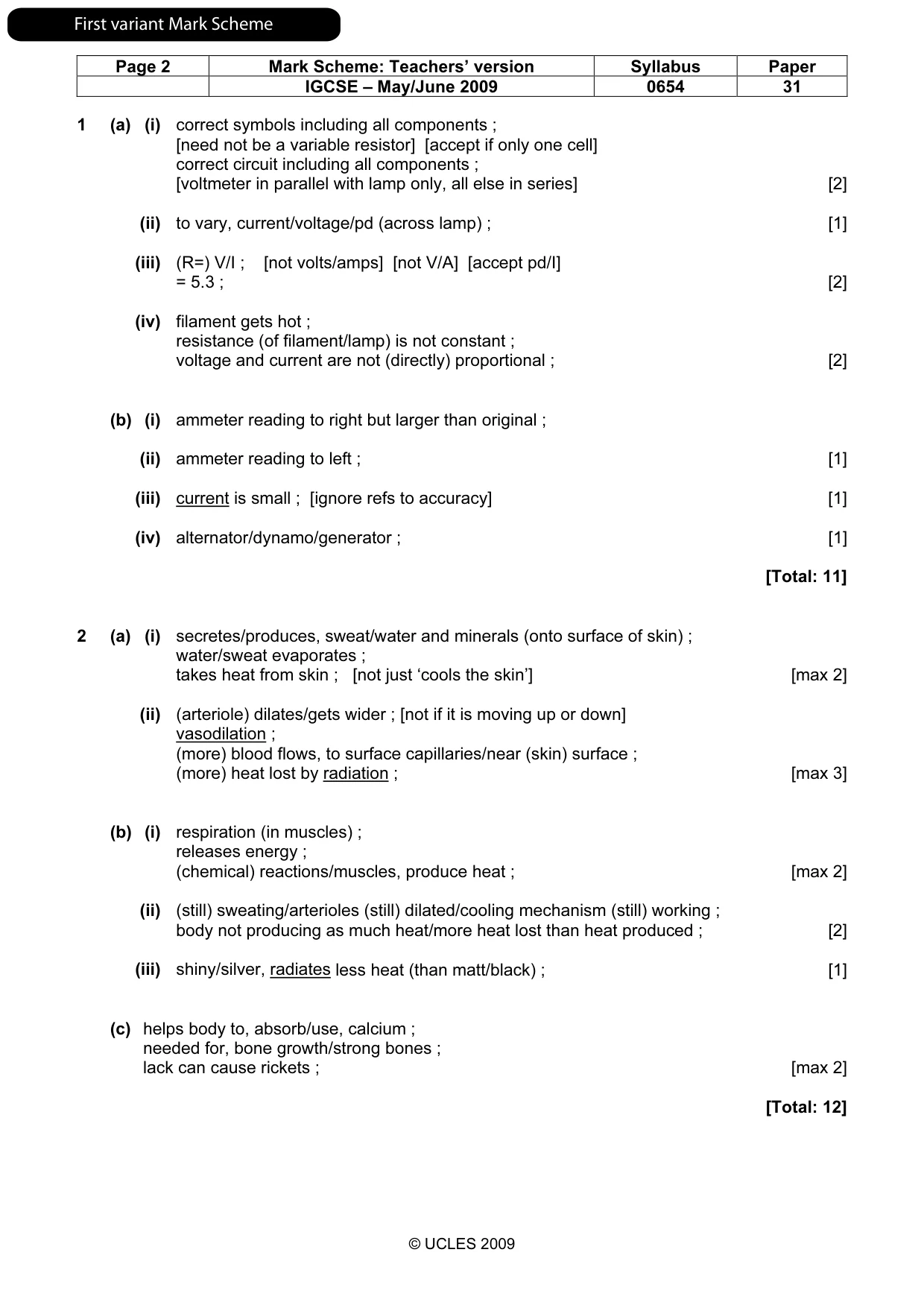
Page 2 Mark Scheme: Teachers’ version Syllabus Paper IGCSE – May/June 2009 0654 31 © UCLES 2009 1 (a) (i) correct symbols including all components ; [need not be a variable resistor] [accept if only one cell] correct circuit including all components ; [voltmeter in parallel with lamp only, all else in series] [2] (ii) to vary, current/voltage/pd (across lamp) ; [1] (iii) (R=) V/I ; [not volts/amps] [not V/A] [accept pd/I] = 5.3 ; [2] (iv) filament gets hot ; resistance (of filament/lamp) is not constant ; voltage and current are not (directly) proportional ; [2] (b) (i) ammeter reading to right but larger than original ; (ii) ammeter reading to left ; [1] (iii) current is small ; [ignore refs to accuracy] [1] (iv) alternator/dynamo/generator ; [1] [Total: 11] 2 (a) (i) secretes/produces, sweat/water and minerals (onto surface of skin) ; water/sweat evaporates ; takes heat from skin ; [not just ‘cools the skin’] [max 2] (ii) (arteriole) dilates/gets wider ; [not if it is moving up or down] vasodilation ; (more) blood flows, to surface capillaries/near (skin) surface ; (more) heat lost by radiation ; [max 3] (b) (i) respiration (in muscles) ; releases energy ; (chemical) reactions/muscles, produce heat ; [max 2] (ii) (still) sweating/arterioles (still) dilated/cooling mechanism (still) working ; body not producing as much heat/more heat lost than heat produced ; [2] (iii) shiny/silver, radiates less heat (than matt/black) ; [1] (c) helps body to, absorb/use, calcium ; needed for, bone growth/strong bones ; lack can cause rickets ; [max 2] [Total: 12] First variant Mark Scheme
Mark scheme, page 4
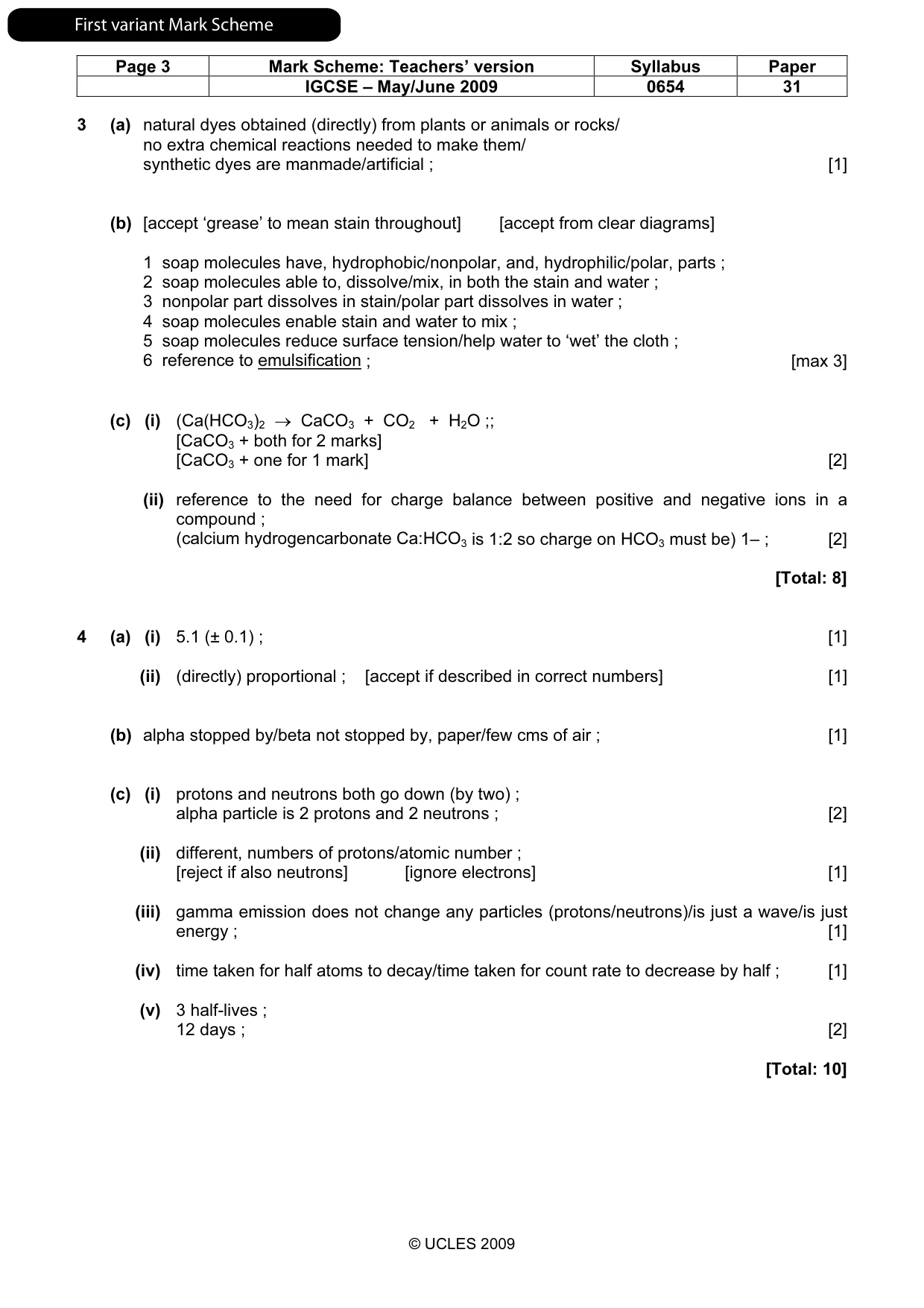
Page 3 Mark Scheme: Teachers’ version Syllabus Paper IGCSE – May/June 2009 0654 31 © UCLES 2009 3 (a) natural dyes obtained (directly) from plants or animals or rocks/ no extra chemical reactions needed to make them/ synthetic dyes are manmade/artificial ; [1] (b) [accept ‘grease’ to mean stain throughout] [accept from clear diagrams] 1 soap molecules have, hydrophobic/nonpolar, and, hydrophilic/polar, parts ; 2 soap molecules able to, dissolve/mix, in both the stain and water ; 3 nonpolar part dissolves in stain/polar part dissolves in water ; 4 soap molecules enable stain and water to mix ; 5 soap molecules reduce surface tension/help water to ‘wet’ the cloth ; 6 reference to emulsification ; [max 3] (c) (i) (Ca(HCO3)2 → CaCO3 + CO2 + H2O ;; [CaCO3 + both for 2 marks] [CaCO3 + one for 1 mark] [2] (ii) reference to the need for charge balance between positive and negative ions in a compound ; (calcium hydrogencarbonate Ca:HCO3 is 1:2 so charge on HCO3 must be) 1– ; [2] [Total: 8] 4 (a) (i) 5.1 (± 0.1) ; [1] (ii) (directly) proportional ; [accept if described in correct numbers] [1] (b) alpha stopped by/beta not stopped by, paper/few cms of air ; [1] (c) (i) protons and neutrons both go down (by two) ; alpha particle is 2 protons and 2 neutrons ; [2] (ii) different, numbers of protons/atomic number ; [reject if also neutrons] [ignore electrons] [1] (iii) gamma emission does not change any particles (protons/neutrons)/is just a wave/is just energy ; [1] (iv) time taken for half atoms to decay/time taken for count rate to decrease by half ; [1] (v) 3 half-lives ; 12 days ; [2] [Total: 10] First variant Mark Scheme
Mark scheme, page 5
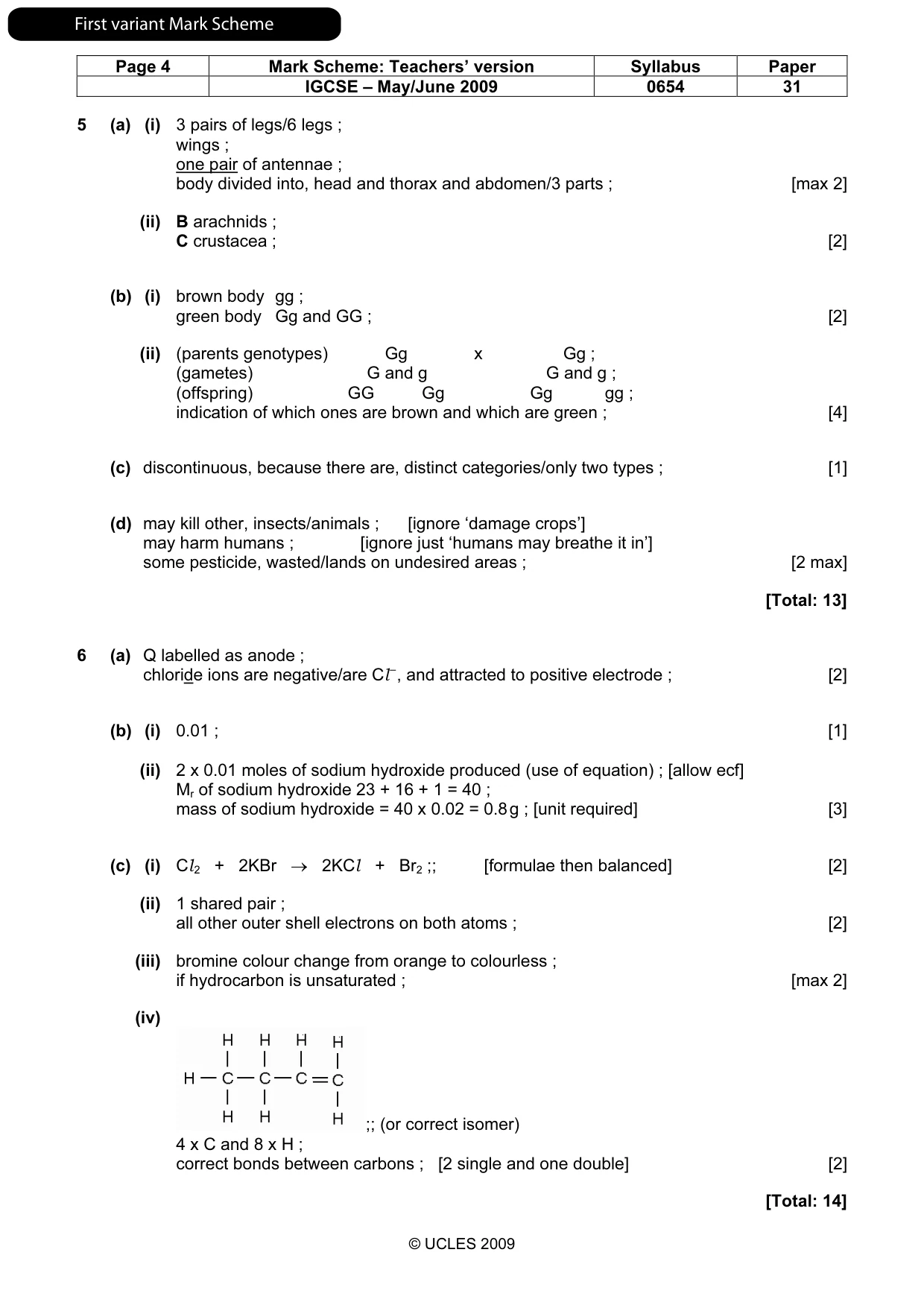
Page 4 Mark Scheme: Teachers’ version Syllabus Paper IGCSE – May/June 2009 0654 31 © UCLES 2009 5 (a) (i) 3 pairs of legs/6 legs ; wings ; one pair of antennae ; body divided into, head and thorax and abdomen/3 parts ; [max 2] (ii) B arachnids ; C crustacea ; [2] (b) (i) brown body gg ; green body Gg and GG ; [2] (ii) (parents genotypes) Gg x Gg ; (gametes) G and g G and g ; (offspring) GG Gg Gg gg ; indication of which ones are brown and which are green ; [4] (c) discontinuous, because there are, distinct categories/only two types ; [1] (d) may kill other, insects/animals ; [ignore ‘damage crops’] may harm humans ; [ignore just ‘humans may breathe it in’] some pesticide, wasted/lands on undesired areas ; [2 max] [Total: 13] 6 (a) Q labelled as anode ; chloride ions are negative/are Cl–, and attracted to positive electrode ; [2] (b) (i) 0.01 ; [1] (ii) 2 x 0.01 moles of sodium hydroxide produced (use of equation) ; [allow ecf] Mr of sodium hydroxide 23 + 16 + 1 = 40 ; mass of sodium hydroxide = 40 x 0.02 = 0.8 g ; [unit required] [3] (c) (i) Cl2 + 2KBr → 2KCl + Br2 ;; [formulae then balanced] [2] (ii) 1 shared pair ; all other outer shell electrons on both atoms ; [2] (iii) bromine colour change from orange to colourless ; if hydrocarbon is unsaturated ; [max 2] (iv) ;; (or correct isomer) 4 x C and 8 x H ; correct bonds between carbons ; [2 single and one double] [2] [Total: 14] First variant Mark Scheme
Mark scheme, page 6
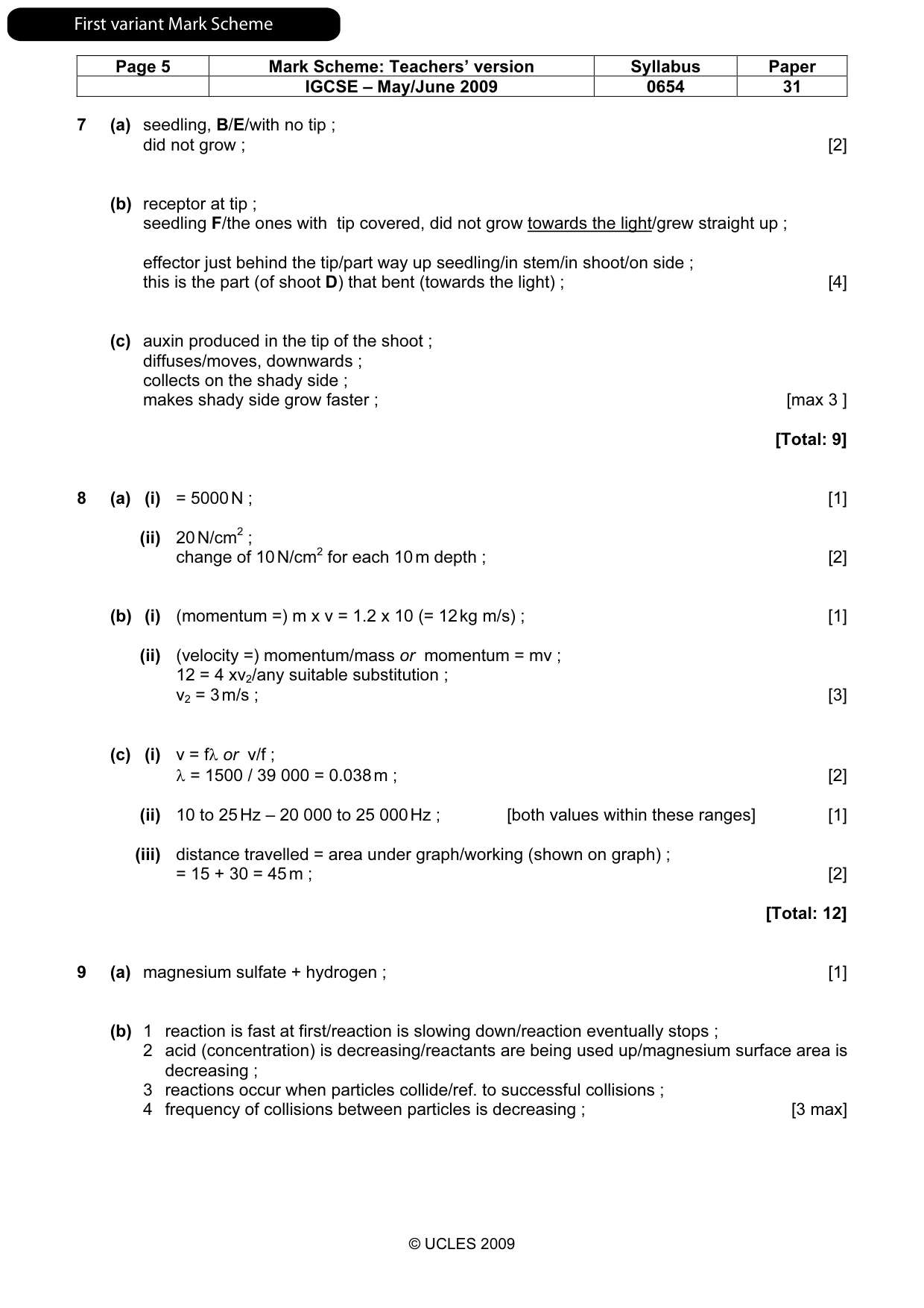
Page 5 Mark Scheme: Teachers’ version Syllabus Paper IGCSE – May/June 2009 0654 31 © UCLES 2009 7 (a) seedling, B/E/with no tip ; did not grow ; [2] (b) receptor at tip ; seedling F/the ones with tip covered, did not grow towards the light/grew straight up ; effector just behind the tip/part way up seedling/in stem/in shoot/on side ; this is the part (of shoot D) that bent (towards the light) ; [4] (c) auxin produced in the tip of the shoot ; diffuses/moves, downwards ; collects on the shady side ; makes shady side grow faster ; [max 3 ] [Total: 9] 8 (a) (i) = 5000 N ; [1] (ii) 20 N/cm2 ; change of 10 N/cm2 for each 10 m depth ; [2] (b) (i) (momentum =) m x v = 1.2 x 10 (= 12 kg m/s) ; [1] (ii) (velocity =) momentum/mass or momentum = mv ; 12 = 4 xv2/any suitable substitution ; v2 = 3 m/s ; [3] (c) (i) v = fλ or v/f ; λ = 1500 / 39 000 = 0.038 m ; [2] (ii) 10 to 25 Hz – 20 000 to 25 000 Hz ; [both values within these ranges] [1] (iii) distance travelled = area under graph/working (shown on graph) ; = 15 + 30 = 45 m ; [2] [Total: 12] 9 (a) magnesium sulfate + hydrogen ; [1] (b) 1 reaction is fast at first/reaction is slowing down/reaction eventually stops ; 2 acid (concentration) is decreasing/reactants are being used up/magnesium surface area is decreasing ; 3 reactions occur when particles collide/ref. to successful collisions ; 4 frequency of collisions between particles is decreasing ; [3 max] First variant Mark Scheme
Mark scheme, page 7
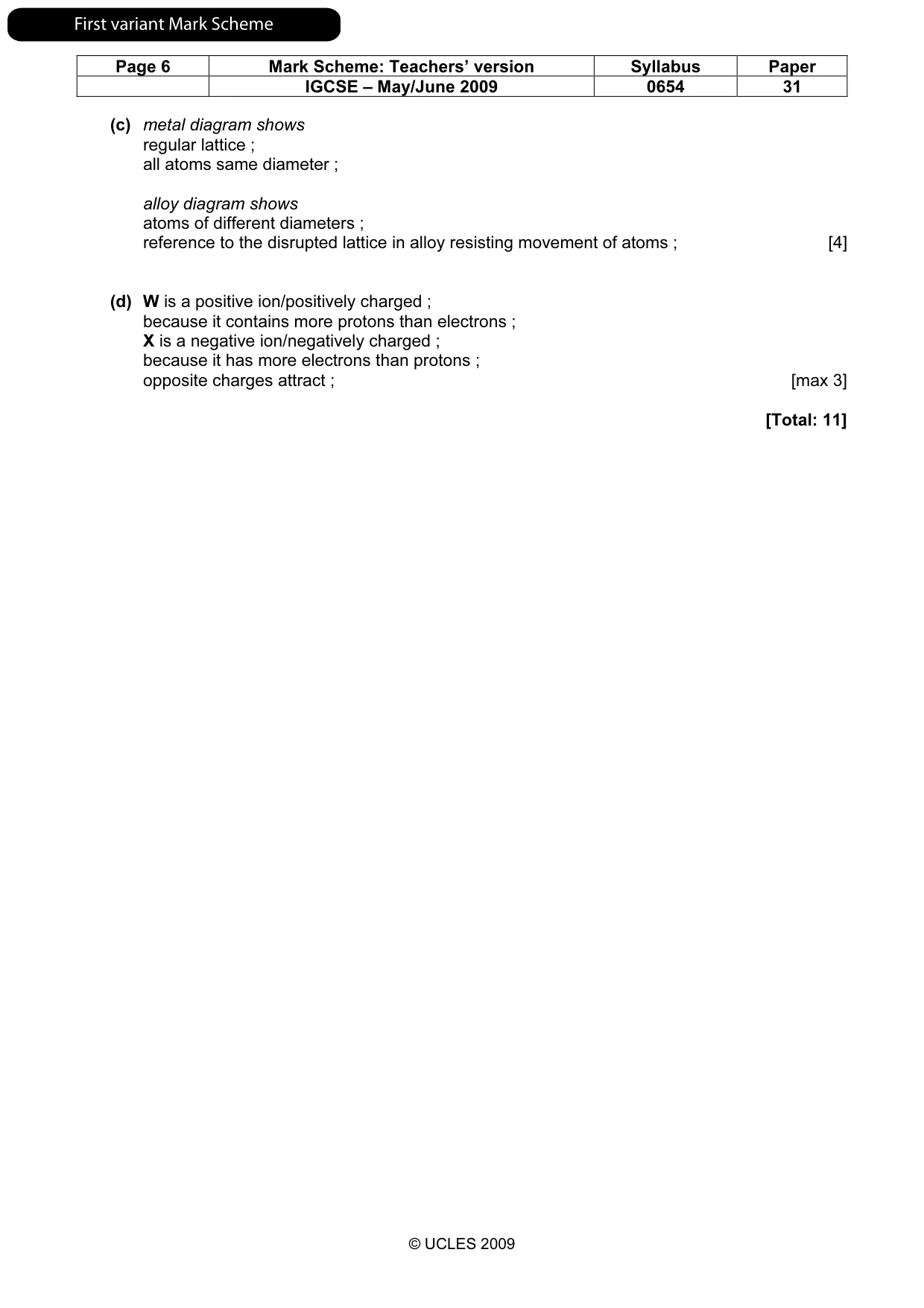
Page 6 Mark Scheme: Teachers’ version Syllabus Paper IGCSE – May/June 2009 0654 31 © UCLES 2009 (c) metal diagram shows regular lattice ; all atoms same diameter ; alloy diagram shows atoms of different diameters ; reference to the disrupted lattice in alloy resisting movement of atoms ; [4] (d) W is a positive ion/positively charged ; because it contains more protons than electrons ; X is a negative ion/negatively charged ; because it has more electrons than protons ; opposite charges attract ; [max 3] [Total: 11] First variant Mark Scheme
Mark scheme, page 8
UNIVERSITY OF CAMBRIDGE INTERNATIONAL EXAMINATIONS International General Certificate of Secondary Education MARK SCHEME for the May/June 2009 question paper for the guidance of teachers 0654 CO-ORDINATED SCIENCES 0654/32 Paper 3 (Extended Theory), maximum raw mark 100 This mark scheme is published as an aid to teachers and candidates, to indicate the requirements of the examination. It shows the basis on which Examiners were instructed to award marks. It does not indicate the details of the discussions that took place at an Examiners’ meeting before marking began, which would have considered the acceptability of alternative answers. Mark schemes must be read in conjunction with the question papers and the report on the examination. • CIE will not enter into discussions or correspondence in connection with these mark schemes. CIE is publishing the mark schemes for the May/June 2009 question papers for most IGCSE, GCE Advanced Level and Advanced Subsidiary Level syllabuses and some Ordinary Level syllabuses. Second variant Mark Scheme
Mark scheme, page 9
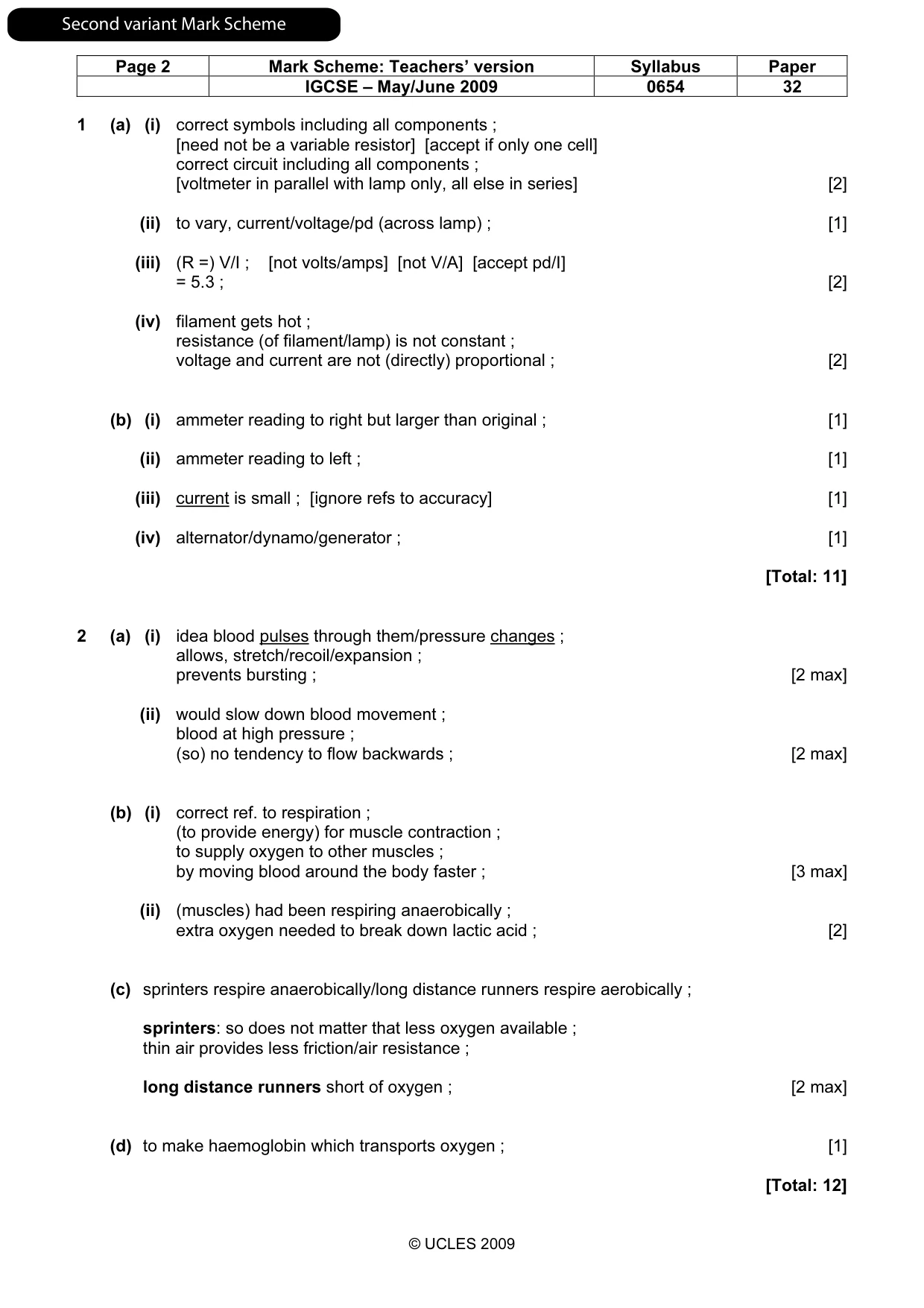
Page 2 Mark Scheme: Teachers’ version Syllabus Paper IGCSE – May/June 2009 0654 32 © UCLES 2009 1 (a) (i) correct symbols including all components ; [need not be a variable resistor] [accept if only one cell] correct circuit including all components ; [voltmeter in parallel with lamp only, all else in series] [2] (ii) to vary, current/voltage/pd (across lamp) ; [1] (iii) (R =) V/I ; [not volts/amps] [not V/A] [accept pd/I] = 5.3 ; [2] (iv) filament gets hot ; resistance (of filament/lamp) is not constant ; voltage and current are not (directly) proportional ; [2] (b) (i) ammeter reading to right but larger than original ; [1] (ii) ammeter reading to left ; [1] (iii) current is small ; [ignore refs to accuracy] [1] (iv) alternator/dynamo/generator ; [1] [Total: 11] 2 (a) (i) idea blood pulses through them/pressure changes ; allows, stretch/recoil/expansion ; prevents bursting ; [2 max] (ii) would slow down blood movement ; blood at high pressure ; (so) no tendency to flow backwards ; [2 max] (b) (i) correct ref. to respiration ; (to provide energy) for muscle contraction ; to supply oxygen to other muscles ; by moving blood around the body faster ; [3 max] (ii) (muscles) had been respiring anaerobically ; extra oxygen needed to break down lactic acid ; [2] (c) sprinters respire anaerobically/long distance runners respire aerobically ; sprinters: so does not matter that less oxygen available ; thin air provides less friction/air resistance ; long distance runners short of oxygen ; [2 max] (d) to make haemoglobin which transports oxygen ; [1] [Total: 12] Second variant Mark Scheme
Mark scheme, page 10
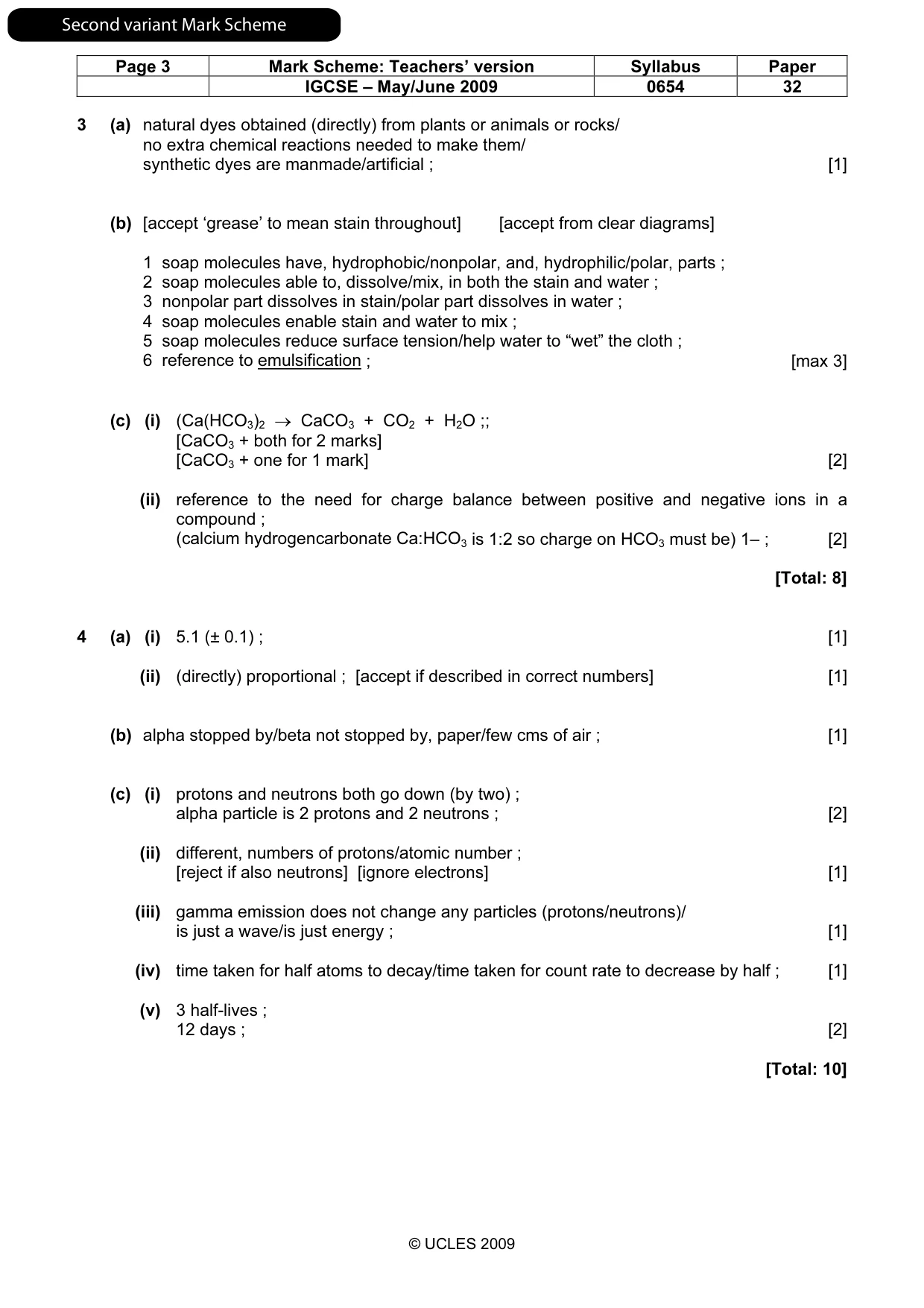
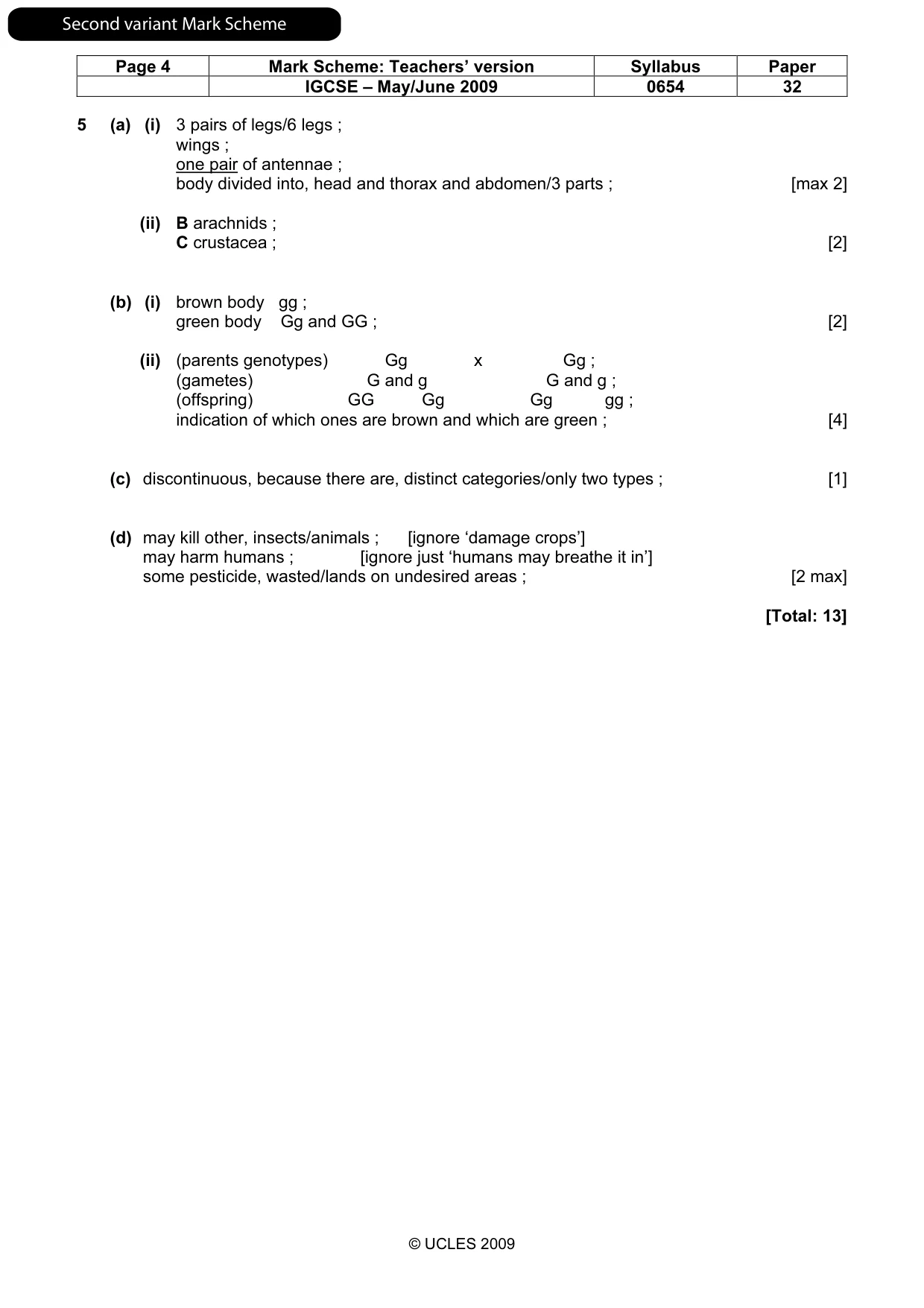
Page 3 Mark Scheme: Teachers’ version Syllabus Paper IGCSE – May/June 2009 0654 32 © UCLES 2009 3 (a) natural dyes obtained (directly) from plants or animals or rocks/ no extra chemical reactions needed to make them/ synthetic dyes are manmade/artificial ; [1] (b) [accept ‘grease’ to mean stain throughout] [accept from clear diagrams] 1 soap molecules have, hydrophobic/nonpolar, and, hydrophilic/polar, parts ; 2 soap molecules able to, dissolve/mix, in both the stain and water ; 3 nonpolar part dissolves in stain/polar part dissolves in water ; 4 soap molecules enable stain and water to mix ; 5 soap molecules reduce surface tension/help water to “wet” the cloth ; 6 reference to emulsification ; [max 3] (c) (i) (Ca(HCO3)2 → CaCO3 + CO2 + H2O ;; [CaCO3 + both for 2 marks] [CaCO3 + one for 1 mark] [2] (ii) reference to the need for charge balance between positive and negative ions in a compound ; (calcium hydrogencarbonate Ca:HCO3 is 1:2 so charge on HCO3 must be) 1– ; [2] [Total: 8] 4 (a) (i) 5.1 (± 0.1) ; [1] (ii) (directly) proportional ; [accept if described in correct numbers] [1] (b) alpha stopped by/beta not stopped by, paper/few cms of air ; [1] (c) (i) protons and neutrons both go down (by two) ; alpha particle is 2 protons and 2 neutrons ; [2] (ii) different, numbers of protons/atomic number ; [reject if also neutrons] [ignore electrons] [1] (iii) gamma emission does not change any particles (protons/neutrons)/ is just a wave/is just energy ; [1] (iv) time taken for half atoms to decay/time taken for count rate to decrease by half ; [1] (v) 3 half-lives ; 12 days ; [2] [Total: 10] Second variant Mark Scheme
Mark scheme, page 11
Page 4 Mark Scheme: Teachers’ version Syllabus Paper IGCSE – May/June 2009 0654 32 © UCLES 2009 5 (a) (i) 3 pairs of legs/6 legs ; wings ; one pair of antennae ; body divided into, head and thorax and abdomen/3 parts ; [max 2] (ii) B arachnids ; C crustacea ; [2] (b) (i) brown body gg ; green body Gg and GG ; [2] (ii) (parents genotypes) Gg x Gg ; (gametes) G and g G and g ; (offspring) GG Gg Gg gg ; indication of which ones are brown and which are green ; [4] (c) discontinuous, because there are, distinct categories/only two types ; [1] (d) may kill other, insects/animals ; [ignore ‘damage crops’] may harm humans ; [ignore just ‘humans may breathe it in’] some pesticide, wasted/lands on undesired areas ; [2 max] [Total: 13] Second variant Mark Scheme
Mark scheme, page 12
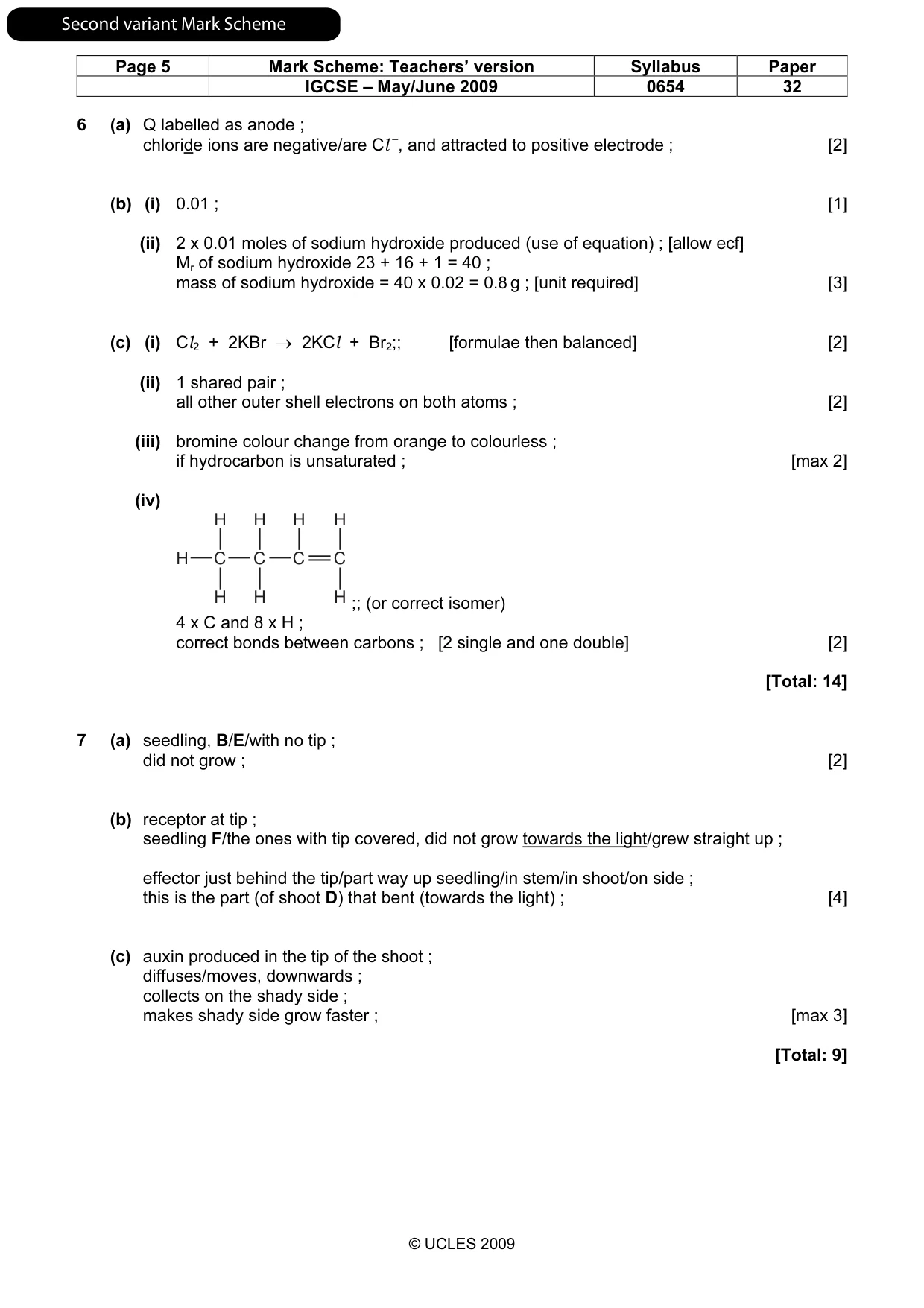
Page 5 Mark Scheme: Teachers’ version Syllabus Paper IGCSE – May/June 2009 0654 32 © UCLES 2009 6 (a) Q labelled as anode ; chloride ions are negative/are Cl –, and attracted to positive electrode ; [2] (b) (i) 0.01 ; [1] (ii) 2 x 0.01 moles of sodium hydroxide produced (use of equation) ; [allow ecf] Mr of sodium hydroxide 23 + 16 + 1 = 40 ; mass of sodium hydroxide = 40 x 0.02 = 0.8 g ; [unit required] [3] (c) (i) Cl2 + 2KBr → 2KCl + Br2;; [formulae then balanced] [2] (ii) 1 shared pair ; all other outer shell electrons on both atoms ; [2] (iii) bromine colour change from orange to colourless ; if hydrocarbon is unsaturated ; [max 2] (iv) H H H C H H H H H C C C ;; (or correct isomer) 4 x C and 8 x H ; correct bonds between carbons ; [2 single and one double] [2] [Total: 14] 7 (a) seedling, B/E/with no tip ; did not grow ; [2] (b) receptor at tip ; seedling F/the ones with tip covered, did not grow towards the light/grew straight up ; effector just behind the tip/part way up seedling/in stem/in shoot/on side ; this is the part (of shoot D) that bent (towards the light) ; [4] (c) auxin produced in the tip of the shoot ; diffuses/moves, downwards ; collects on the shady side ; makes shady side grow faster ; [max 3] [Total: 9] Second variant Mark Scheme
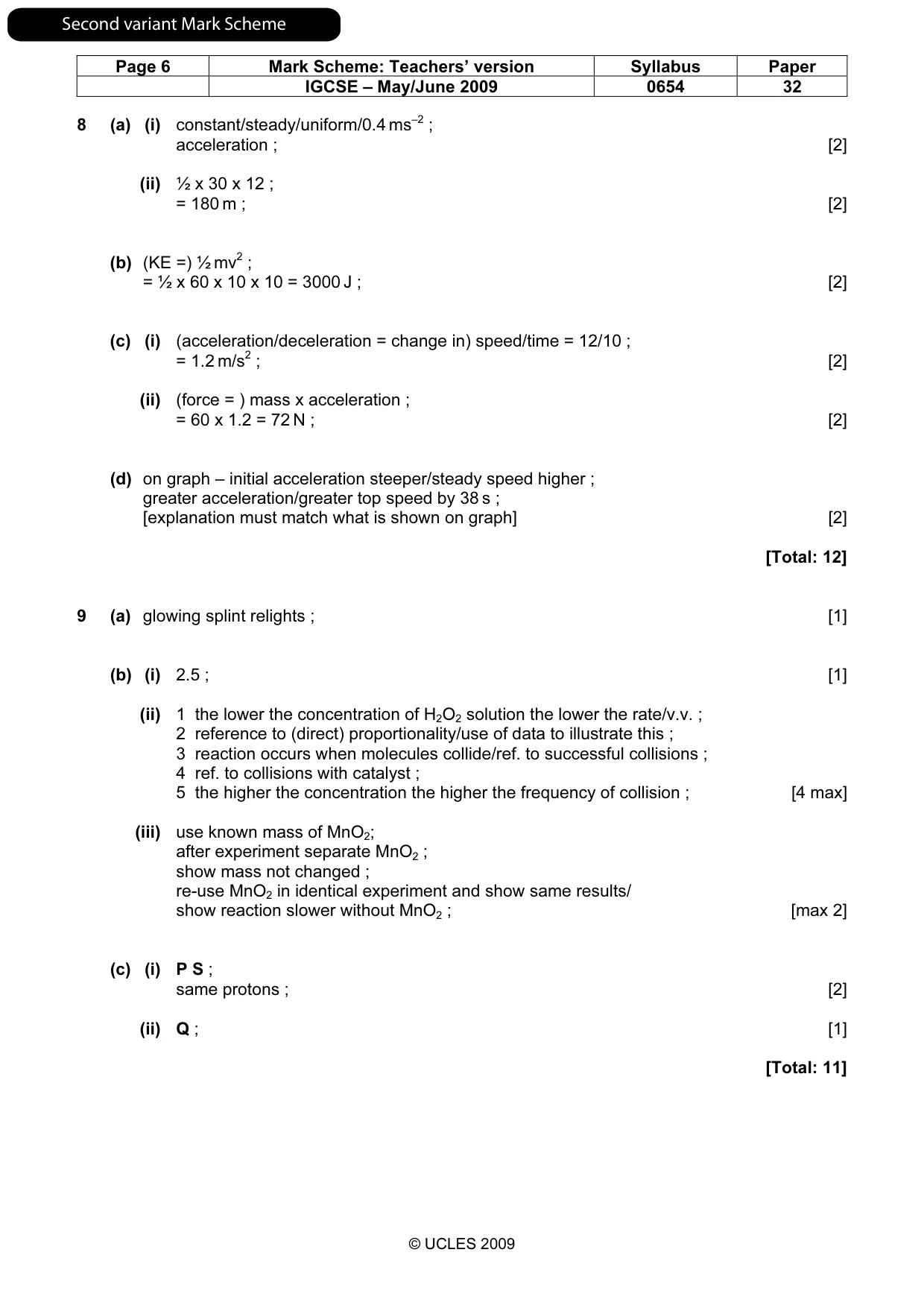
Mark scheme, page 13
Page 6 Mark Scheme: Teachers’ version Syllabus Paper IGCSE – May/June 2009 0654 32 © UCLES 2009 8 (a) (i) constant/steady/uniform/0.4 ms–2 ; acceleration ; [2] (ii) ½ x 30 x 12 ; = 180 m ; [2] (b) (KE =) ½ mv2 ; = ½ x 60 x 10 x 10 = 3000 J ; [2] (c) (i) (acceleration/deceleration = change in) speed/time = 12/10 ; = 1.2 m/s2 ; [2] (ii) (force = ) mass x acceleration ; = 60 x 1.2 = 72 N ; [2] (d) on graph – initial acceleration steeper/steady speed higher ; greater acceleration/greater top speed by 38 s ; [explanation must match what is shown on graph] [2] [Total: 12] 9 (a) glowing splint relights ; [1] (b) (i) 2.5 ; [1] (ii) 1 the lower the concentration of H2O2 solution the lower the rate/v.v. ; 2 reference to (direct) proportionality/use of data to illustrate this ; 3 reaction occurs when molecules collide/ref. to successful collisions ; 4 ref. to collisions with catalyst ; 5 the higher the concentration the higher the frequency of collision ; [4 max] (iii) use known mass of MnO2; after experiment separate MnO2 ; show mass not changed ; re-use MnO2 in identical experiment and show same results/ show reaction slower without MnO2 ; [max 2] (c) (i) P S ; same protons ; [2] (ii) Q ; [1] [Total: 11] Second variant Mark Scheme