Cambridge IGCSE Sciences - Co-ordinated (Double) 0654 — 2005 Oct/Nov Paper 3 · Variant 1
0654/31/O/N/05
The question paper and its mark scheme, free to read here and free to download. This is Cambridge’s own paper, exactly as it was sat.
Question paper20 pages
Mark scheme6 pages
Answers below. Sit the paper first if you are practising.
Paper as text
Question paper, page 1
Centre Number Candidate Number Name UNIVERSITY OF CAMBRIDGE INTERNATIONAL EXAMINATIONS International General Certificate of Secondary Education CO-ORDINATED SCIENCES 0654/03 Paper 3 October/November 2005 2 hours Candidates answer on the Question Paper. No Additional Materials are required. READ THESE INSTRUCTIONS FIRST Write your Centre number, candidate number and name on all the work you hand in. Write in dark blue or black pen in the spaces provided on the Question Paper. You may use a soft pencil for any diagrams, graphs, tables or rough working. Do not use staples, paper clips, highlighters, glue or correction fluid. Answer all questions. The number of marks is given in brackets [ ] at the end of each question or part question. A copy of the Periodic Table is printed on page 20. For Examiner’s Use 1 2 3 4 5 6 7 8 9 Total This document consists of 20 printed pages. IB05 11_0654_03/2RP UCLES 2005 [Turn over If you have been given a label, look at the details. If any details are incorrect or missing, please fill in your correct details in the space given at the top of this page. Stick your personal label here, if provided. www.XtremePapers.com
Question paper, page 2
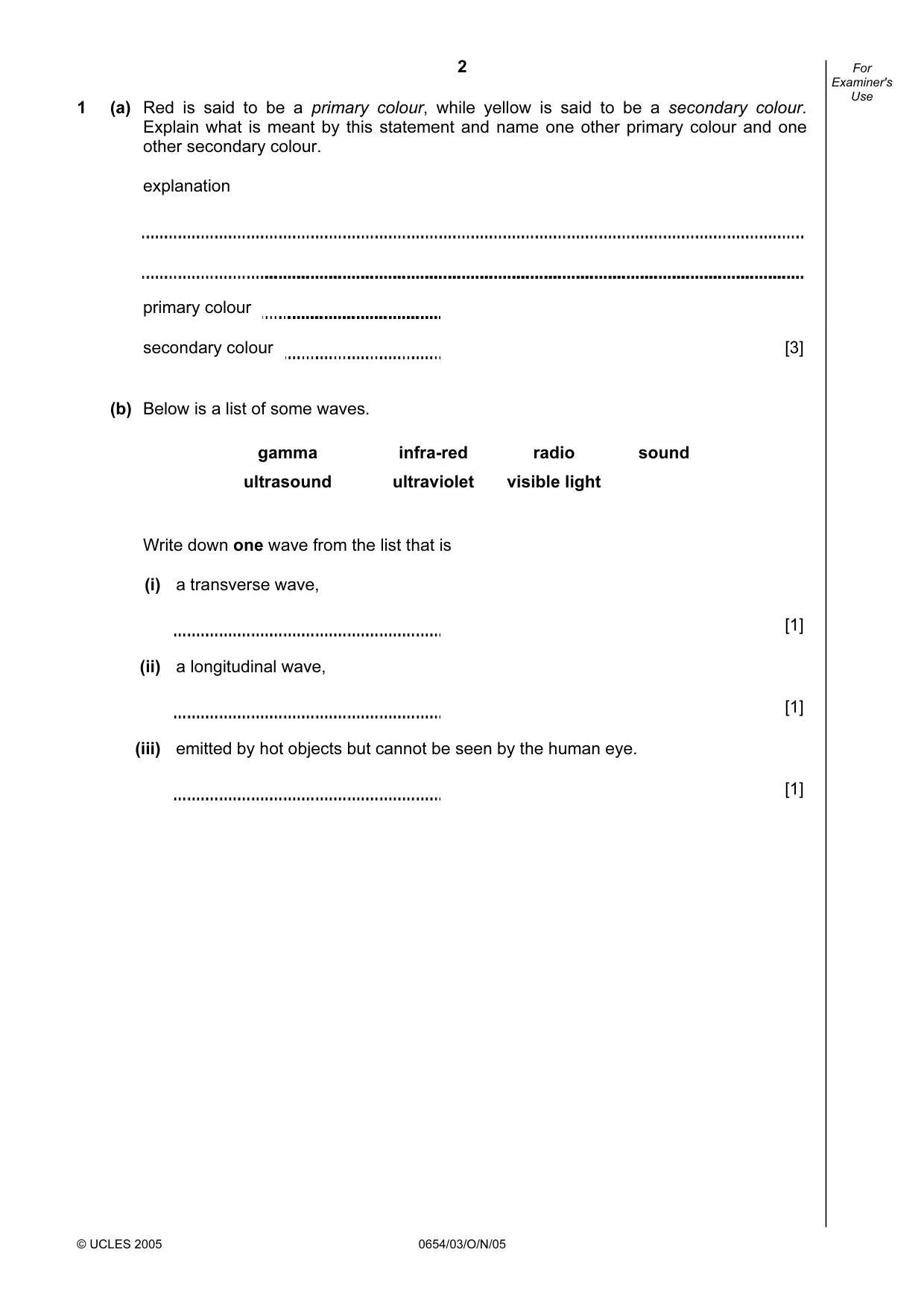
2 © UCLES 2005 0654/03/O/N/05 For Examiner's Use 1 (a) Red is said to be a primary colour, while yellow is said to be a secondary colour. Explain what is meant by this statement and name one other primary colour and one other secondary colour. explanation primary colour secondary colour [3] (b) Below is a list of some waves. gamma infra-red radio sound ultrasound ultraviolet visible light Write down one wave from the list that is (i) a transverse wave, [1] (ii) a longitudinal wave, [1] (iii) emitted by hot objects but cannot be seen by the human eye. [1]
Question paper, page 3
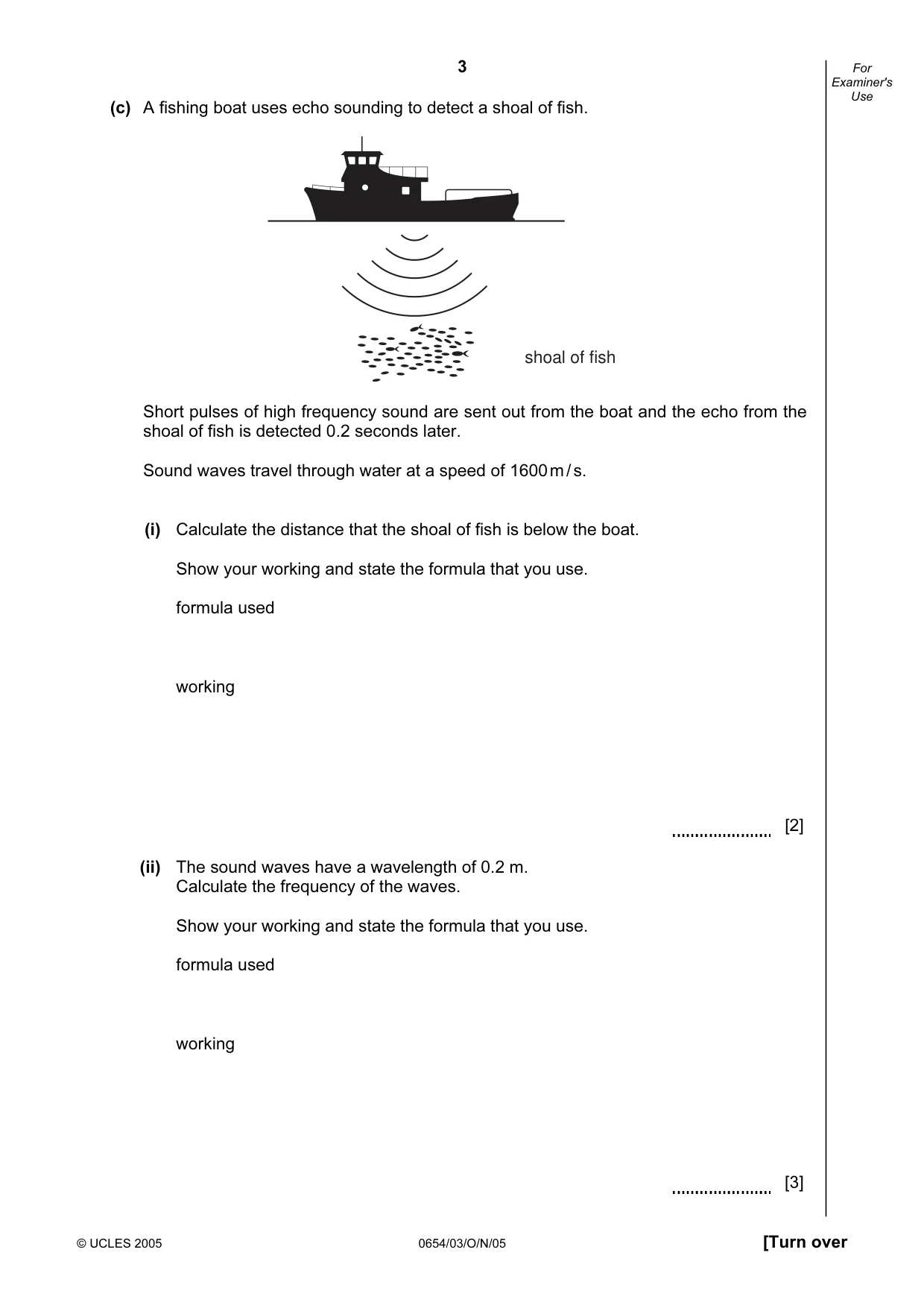
3 © UCLES 2005 0654/03/O/N/05 [Turn over For Examiner's Use (c) A fishing boat uses echo sounding to detect a shoal of fish. shoal of fish Short pulses of high frequency sound are sent out from the boat and the echo from the shoal of fish is detected 0.2 seconds later. Sound waves travel through water at a speed of 1600 m / s. (i) Calculate the distance that the shoal of fish is below the boat. Show your working and state the formula that you use. formula used working [2] (ii) The sound waves have a wavelength of 0.2 m. Calculate the frequency of the waves. Show your working and state the formula that you use. formula used working [3]
Question paper, page 4
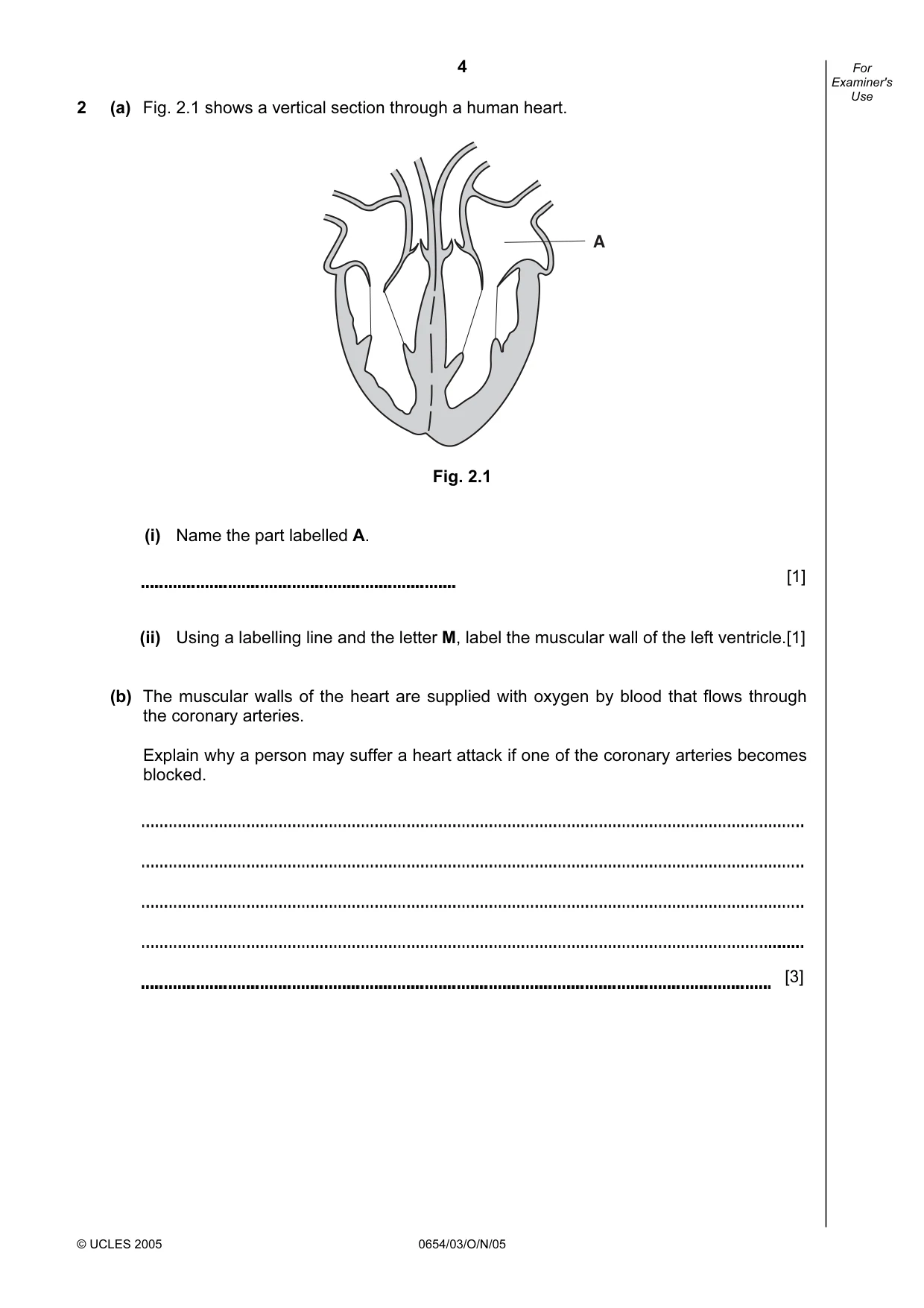
4 © UCLES 2005 0654/03/O/N/05 For Examiner's Use 2 (a) Fig. 2.1 shows a vertical section through a human heart. A Fig. 2.1 (i) Name the part labelled A. [1] (ii) Using a labelling line and the letter M, label the muscular wall of the left ventricle.[1] (b) The muscular walls of the heart are supplied with oxygen by blood that flows through the coronary arteries. Explain why a person may suffer a heart attack if one of the coronary arteries becomes blocked. [3]
Question paper, page 5
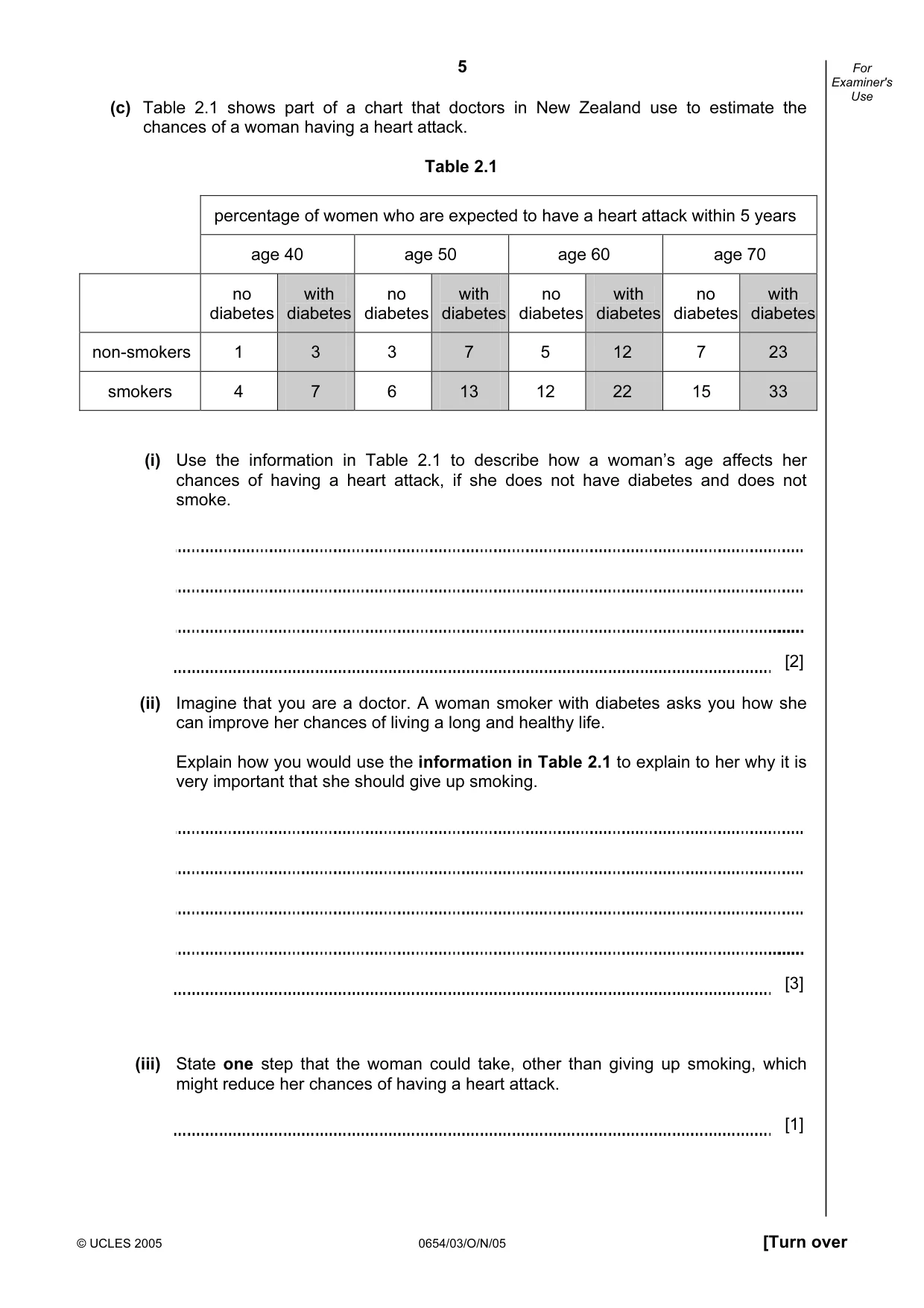
5 © UCLES 2005 0654/03/O/N/05 [Turn over For Examiner's Use (c) Table 2.1 shows part of a chart that doctors in New Zealand use to estimate the chances of a woman having a heart attack. Table 2.1 percentage of women who are expected to have a heart attack within 5 years age 40 age 50 age 60 age 70 no diabetes with diabetes no diabetes with diabetes no diabetes with diabetes no diabetes with diabetes non-smokers 1 3 3 7 5 12 7 23 smokers 4 7 6 13 12 22 15 33 (i) Use the information in Table 2.1 to describe how a woman’s age affects her chances of having a heart attack, if she does not have diabetes and does not smoke. [2] (ii) Imagine that you are a doctor. A woman smoker with diabetes asks you how she can improve her chances of living a long and healthy life. Explain how you would use the information in Table 2.1 to explain to her why it is very important that she should give up smoking. [3] (iii) State one step that the woman could take, other than giving up smoking, which might reduce her chances of having a heart attack. [1]
Question paper, page 6
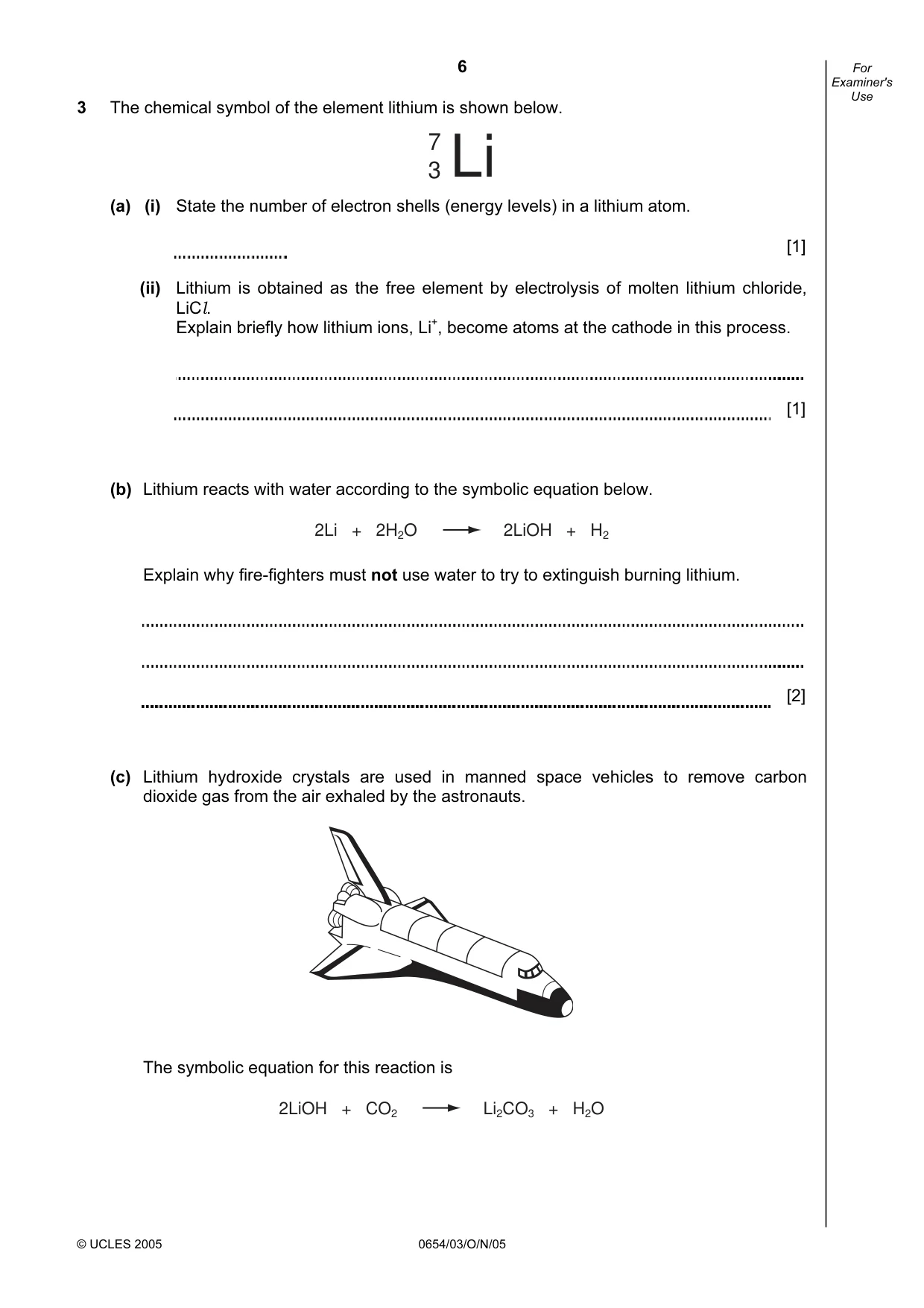
6 © UCLES 2005 0654/03/O/N/05 For Examiner's Use 3 The chemical symbol of the element lithium is shown below. Li 7 3 (a) (i) State the number of electron shells (energy levels) in a lithium atom. [1] (ii) Lithium is obtained as the free element by electrolysis of molten lithium chloride, LiCl. Explain briefly how lithium ions, Li+, become atoms at the cathode in this process. [1] (b) Lithium reacts with water according to the symbolic equation below. 2Li + 2H2O 2LiOH + H2 Explain why fire-fighters must not use water to try to extinguish burning lithium. [2] (c) Lithium hydroxide crystals are used in manned space vehicles to remove carbon dioxide gas from the air exhaled by the astronauts. The symbolic equation for this reaction is 2LiOH + CO2 Li2CO3 + H2O
Question paper, page 7
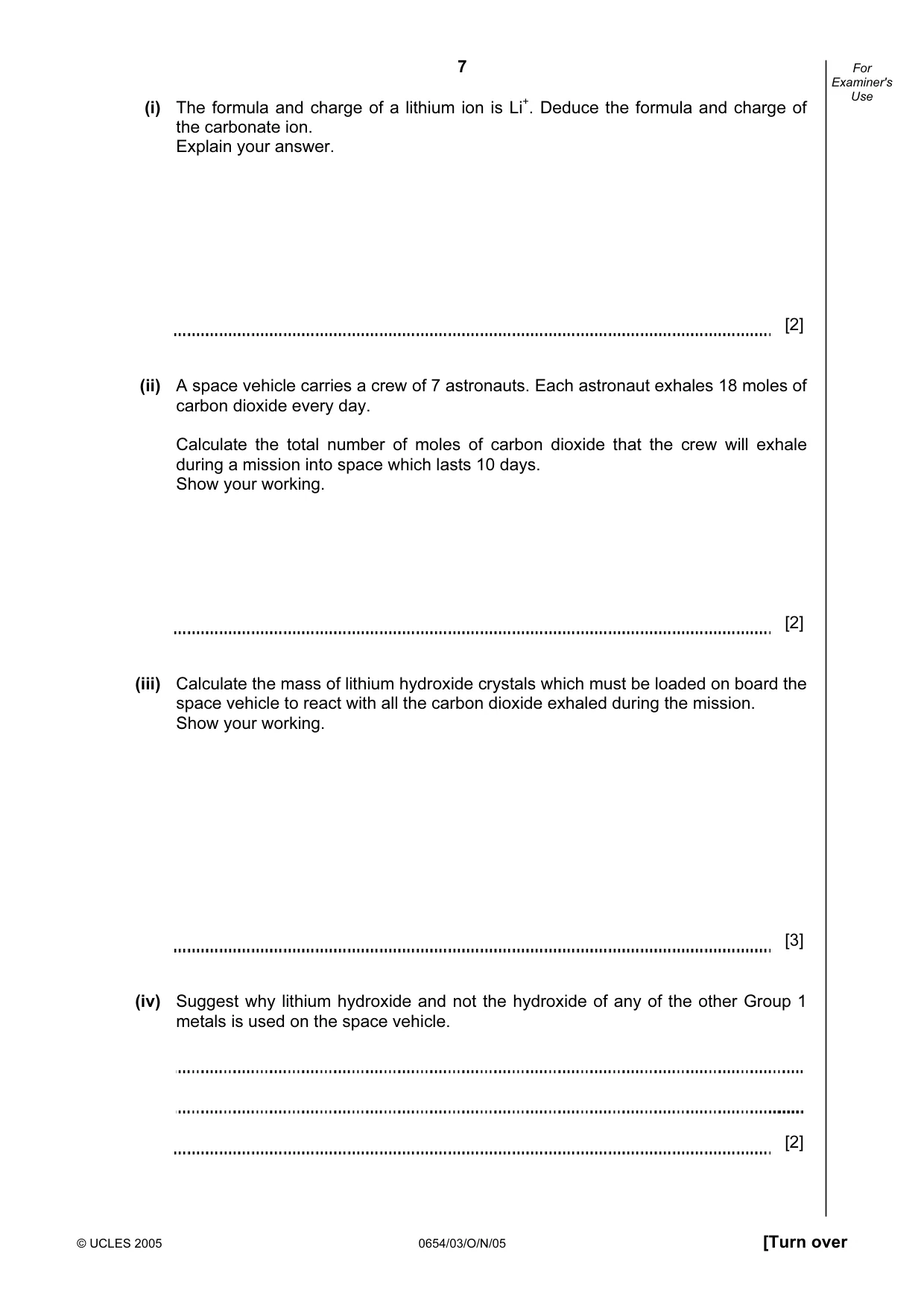
7 © UCLES 2005 0654/03/O/N/05 [Turn over For Examiner's Use (i) The formula and charge of a lithium ion is Li+. Deduce the formula and charge of the carbonate ion. Explain your answer. [2] (ii) A space vehicle carries a crew of 7 astronauts. Each astronaut exhales 18 moles of carbon dioxide every day. Calculate the total number of moles of carbon dioxide that the crew will exhale during a mission into space which lasts 10 days. Show your working. [2] (iii) Calculate the mass of lithium hydroxide crystals which must be loaded on board the space vehicle to react with all the carbon dioxide exhaled during the mission. Show your working. [3] (iv) Suggest why lithium hydroxide and not the hydroxide of any of the other Group 1 metals is used on the space vehicle. [2]
Question paper, page 8
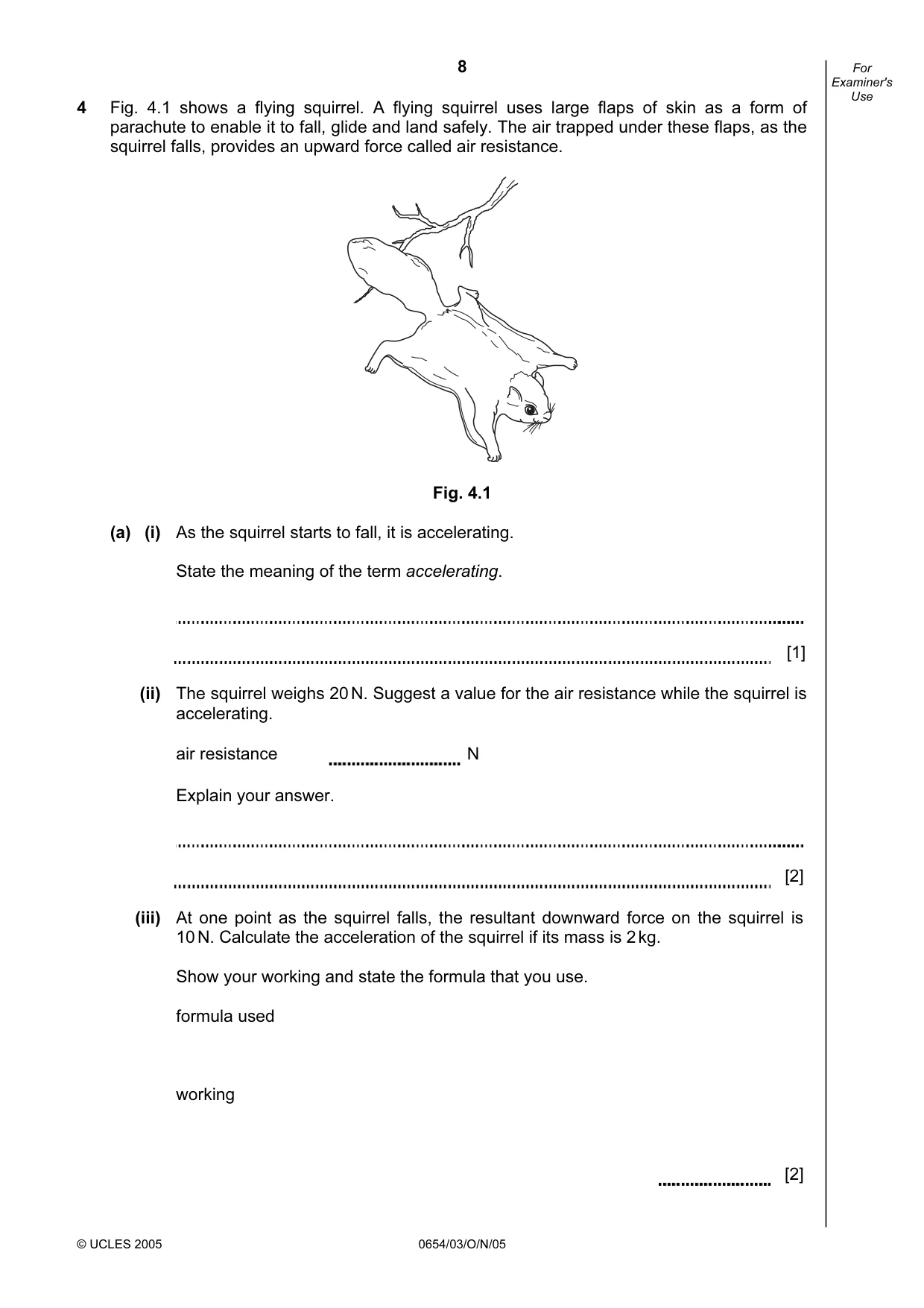
8 © UCLES 2005 0654/03/O/N/05 For Examiner's Use 4 Fig. 4.1 shows a flying squirrel. A flying squirrel uses large flaps of skin as a form of parachute to enable it to fall, glide and land safely. The air trapped under these flaps, as the squirrel falls, provides an upward force called air resistance. Fig. 4.1 (a) (i) As the squirrel starts to fall, it is accelerating. State the meaning of the term accelerating. [1] (ii) The squirrel weighs 20 N. Suggest a value for the air resistance while the squirrel is accelerating. air resistance N Explain your answer. [2] (iii) At one point as the squirrel falls, the resultant downward force on the squirrel is 10 N. Calculate the acceleration of the squirrel if its mass is 2 kg. Show your working and state the formula that you use. formula used working [2]
Question paper, page 9
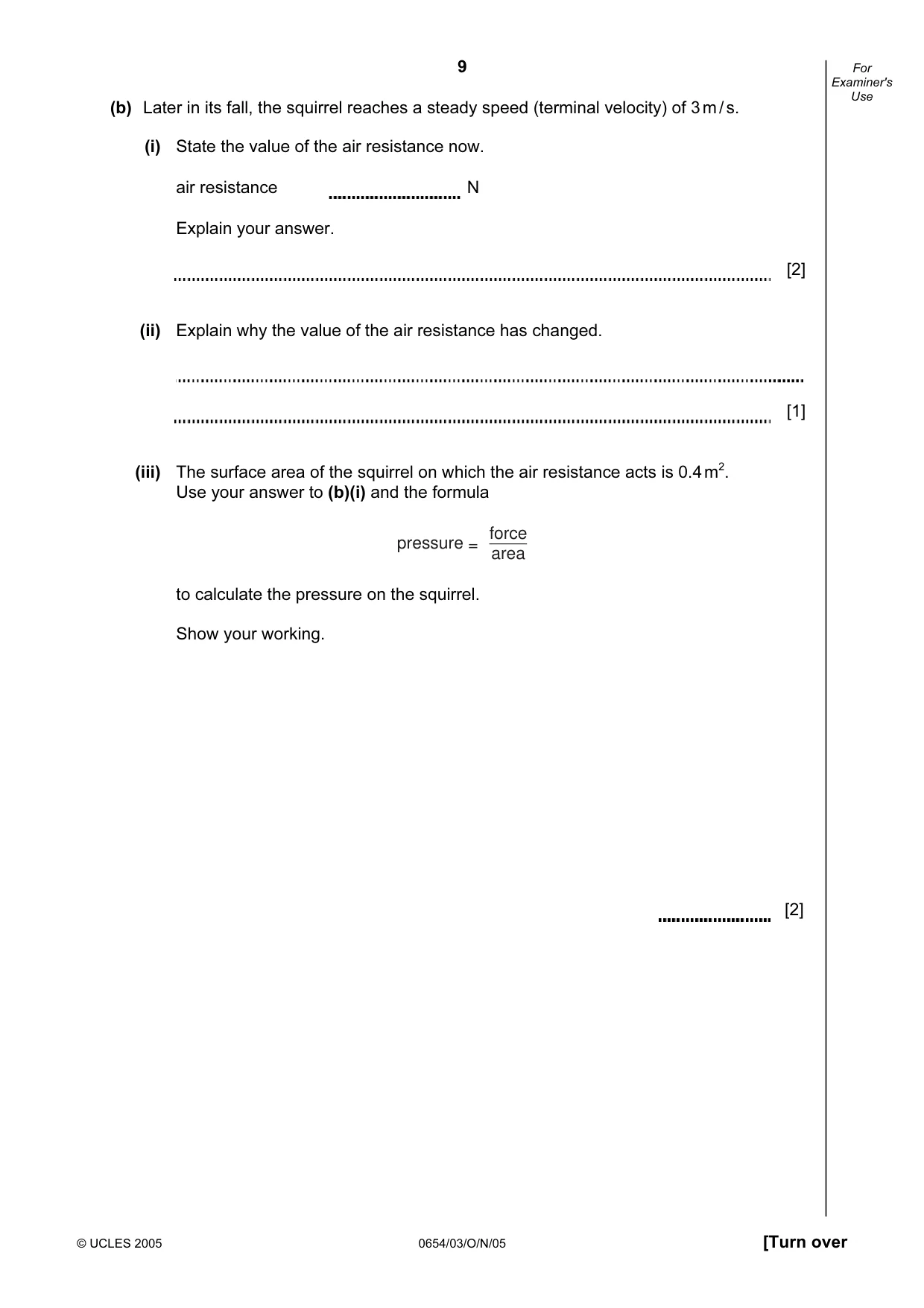
9 © UCLES 2005 0654/03/O/N/05 [Turn over For Examiner's Use (b) Later in its fall, the squirrel reaches a steady speed (terminal velocity) of 3 m / s. (i) State the value of the air resistance now. air resistance N Explain your answer. [2] (ii) Explain why the value of the air resistance has changed. [1] (iii) The surface area of the squirrel on which the air resistance acts is 0.4 m2. Use your answer to (b)(i) and the formula force area pressure = to calculate the pressure on the squirrel. Show your working. [2]
Question paper, page 10
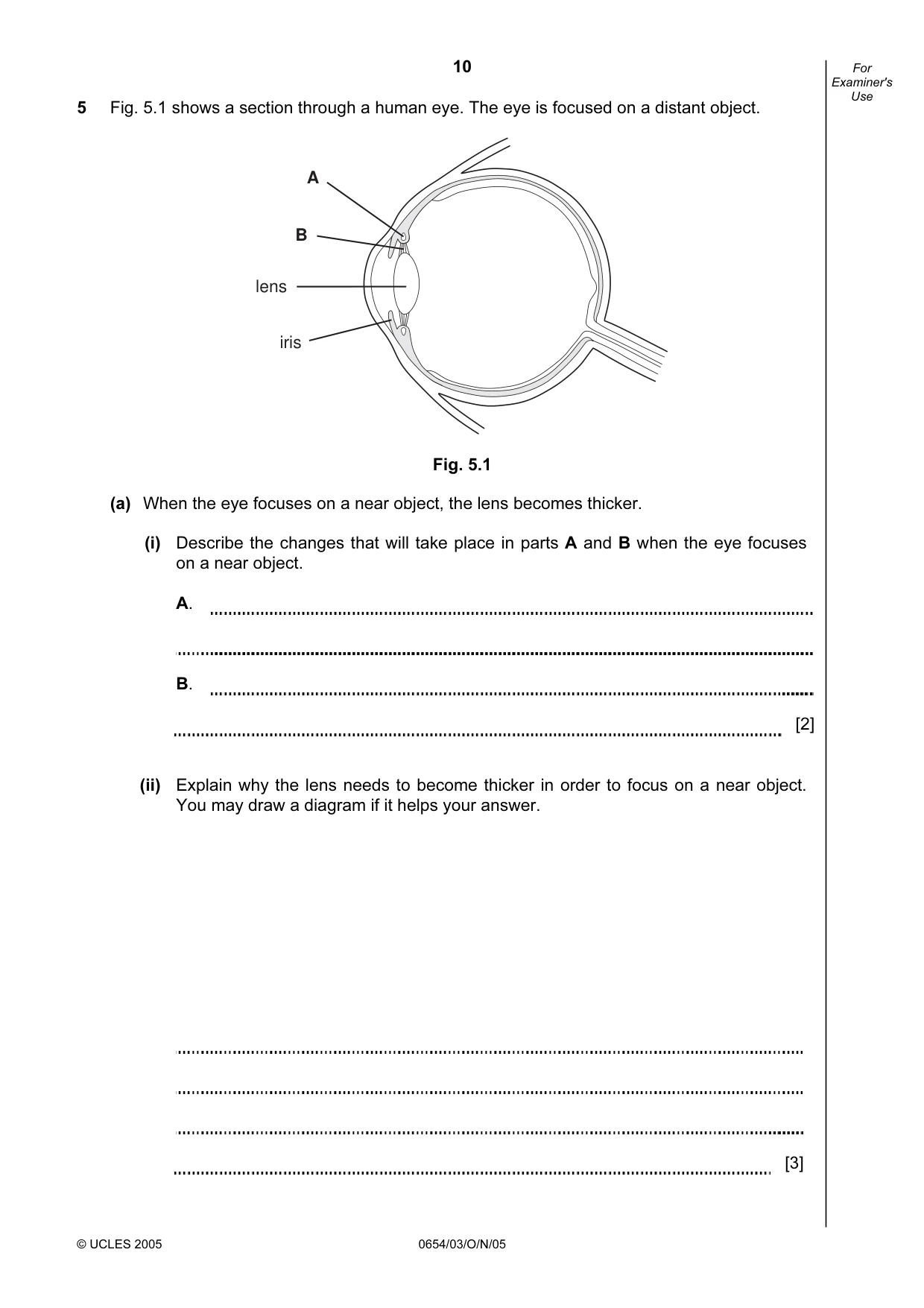
10 © UCLES 2005 0654/03/O/N/05 For Examiner's Use 5 Fig. 5.1 shows a section through a human eye. The eye is focused on a distant object. iris lens A B Fig. 5.1 (a) When the eye focuses on a near object, the lens becomes thicker. (i) Describe the changes that will take place in parts A and B when the eye focuses on a near object. A. B. [2] (ii) Explain why the lens needs to become thicker in order to focus on a near object. You may draw a diagram if it helps your answer. [3]
Question paper, page 11
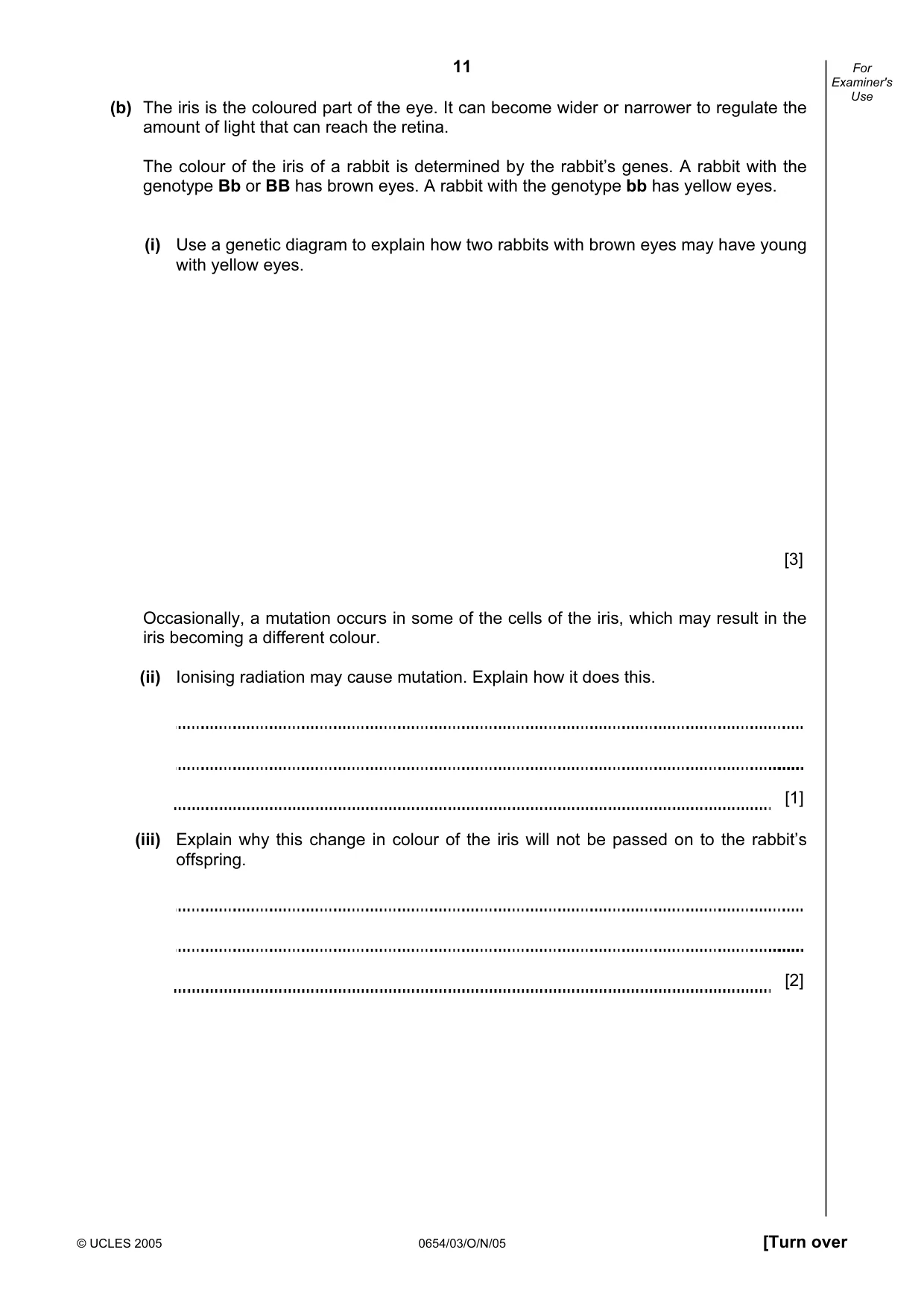
11 © UCLES 2005 0654/03/O/N/05 [Turn over For Examiner's Use (b) The iris is the coloured part of the eye. It can become wider or narrower to regulate the amount of light that can reach the retina. The colour of the iris of a rabbit is determined by the rabbit’s genes. A rabbit with the genotype Bb or BB has brown eyes. A rabbit with the genotype bb has yellow eyes. (i) Use a genetic diagram to explain how two rabbits with brown eyes may have young with yellow eyes. [3] Occasionally, a mutation occurs in some of the cells of the iris, which may result in the iris becoming a different colour. (ii) Ionising radiation may cause mutation. Explain how it does this. [1] (iii) Explain why this change in colour of the iris will not be passed on to the rabbit’s offspring. [2]
Question paper, page 12
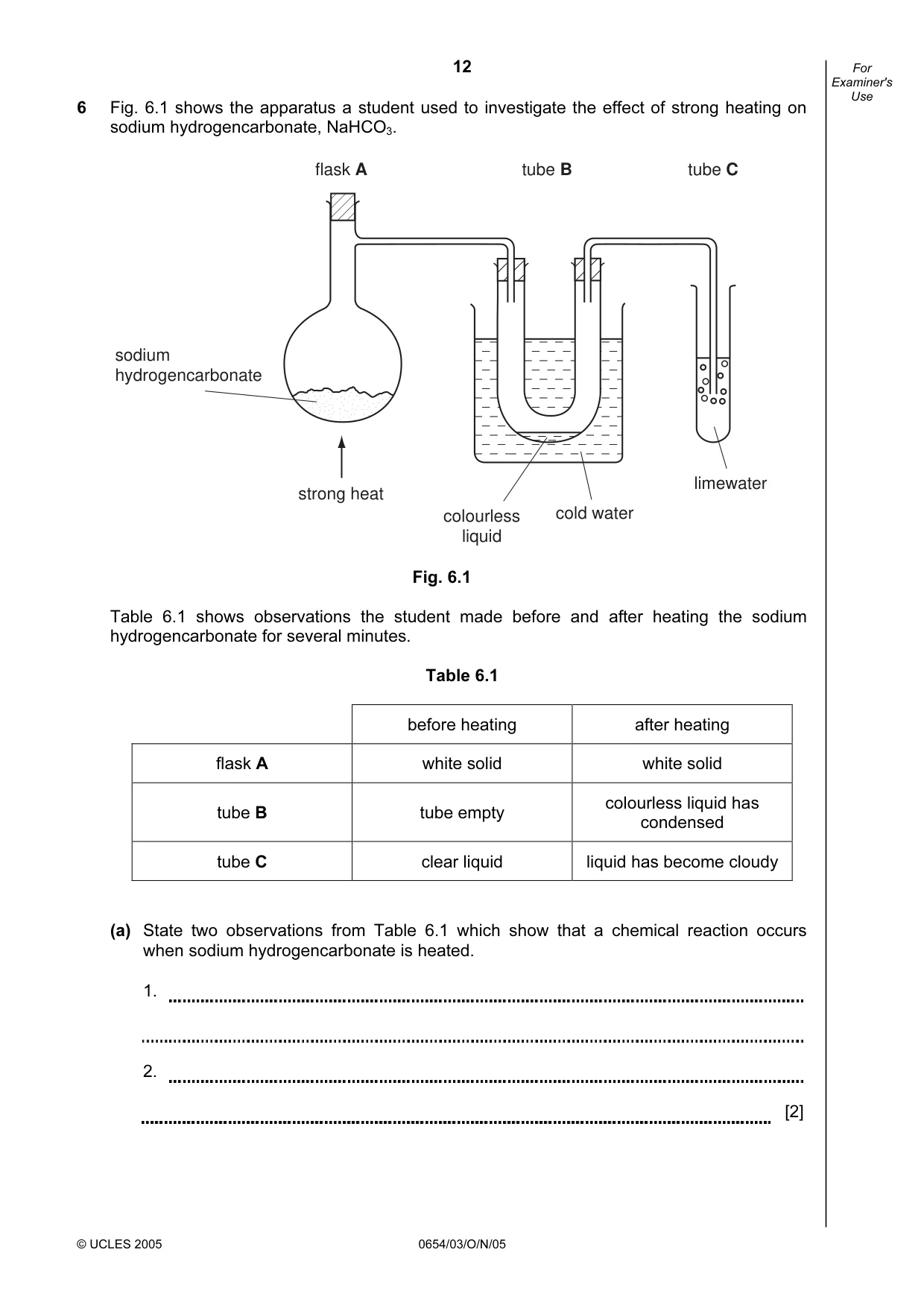
12 © UCLES 2005 0654/03/O/N/05 For Examiner's Use 6 Fig. 6.1 shows the apparatus a student used to investigate the effect of strong heating on sodium hydrogencarbonate, NaHCO3. strong heat sodium hydrogencarbonate flask A tube B tube C limewater cold water colourless liquid Fig. 6.1 Table 6.1 shows observations the student made before and after heating the sodium hydrogencarbonate for several minutes. Table 6.1 before heating after heating flask A white solid white solid tube B tube empty colourless liquid has condensed tube C clear liquid liquid has become cloudy (a) State two observations from Table 6.1 which show that a chemical reaction occurs when sodium hydrogencarbonate is heated. 1. 2. [2]
Question paper, page 13
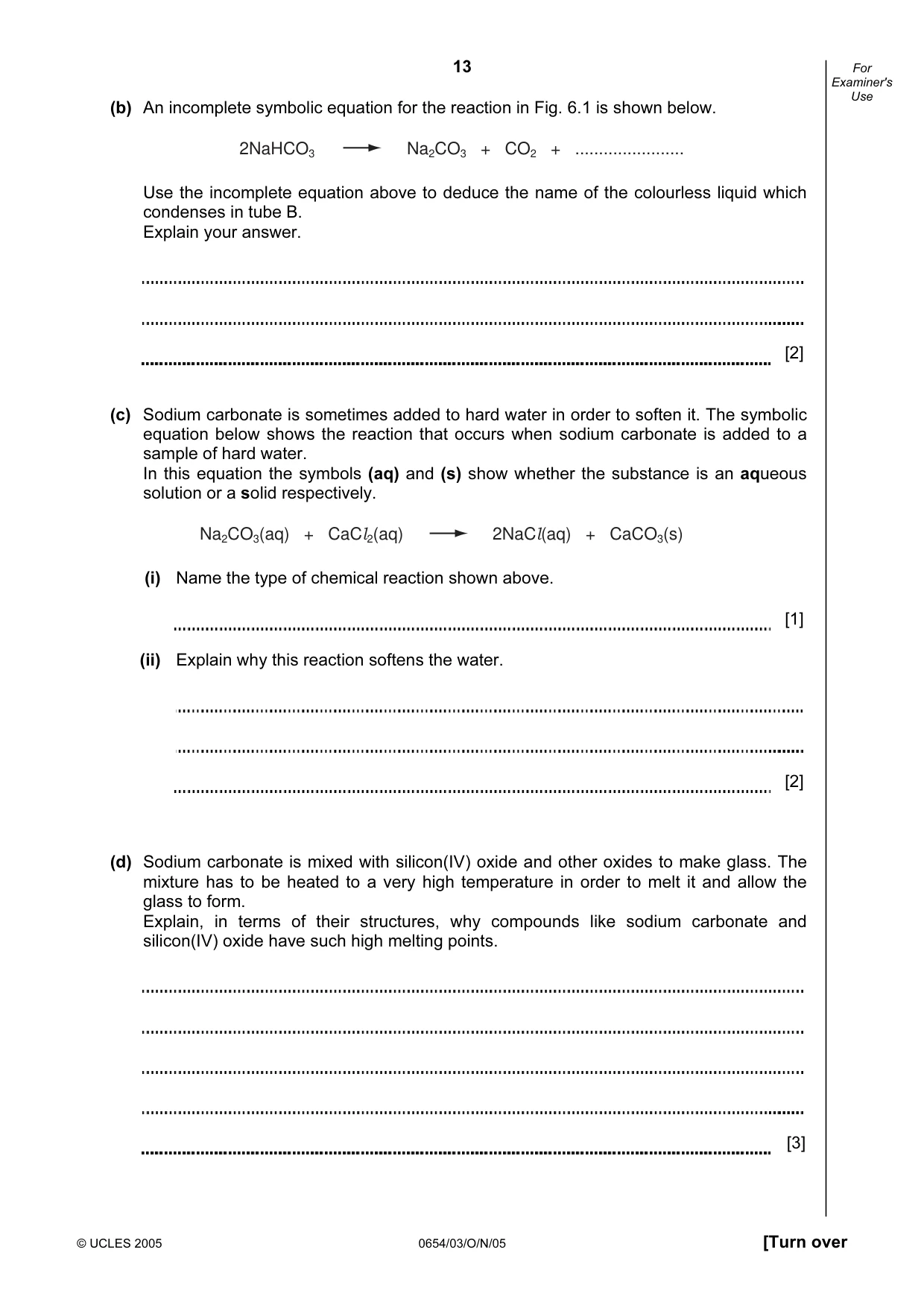
13 © UCLES 2005 0654/03/O/N/05 [Turn over For Examiner's Use (b) An incomplete symbolic equation for the reaction in Fig. 6.1 is shown below. 2NaHCO3 Na2CO3 + CO2 + … Use the incomplete equation above to deduce the name of the colourless liquid which condenses in tube B. Explain your answer. [2] (c) Sodium carbonate is sometimes added to hard water in order to soften it. The symbolic equation below shows the reaction that occurs when sodium carbonate is added to a sample of hard water. In this equation the symbols (aq) and (s) show whether the substance is an aqueous solution or a solid respectively. Na2CO3(aq) + CaCl2(aq) 2NaCl(aq) + CaCO3(s) (i) Name the type of chemical reaction shown above. [1] (ii) Explain why this reaction softens the water. [2] (d) Sodium carbonate is mixed with silicon(IV) oxide and other oxides to make glass. The mixture has to be heated to a very high temperature in order to melt it and allow the glass to form. Explain, in terms of their structures, why compounds like sodium carbonate and silicon(IV) oxide have such high melting points. [3]
Question paper, page 14
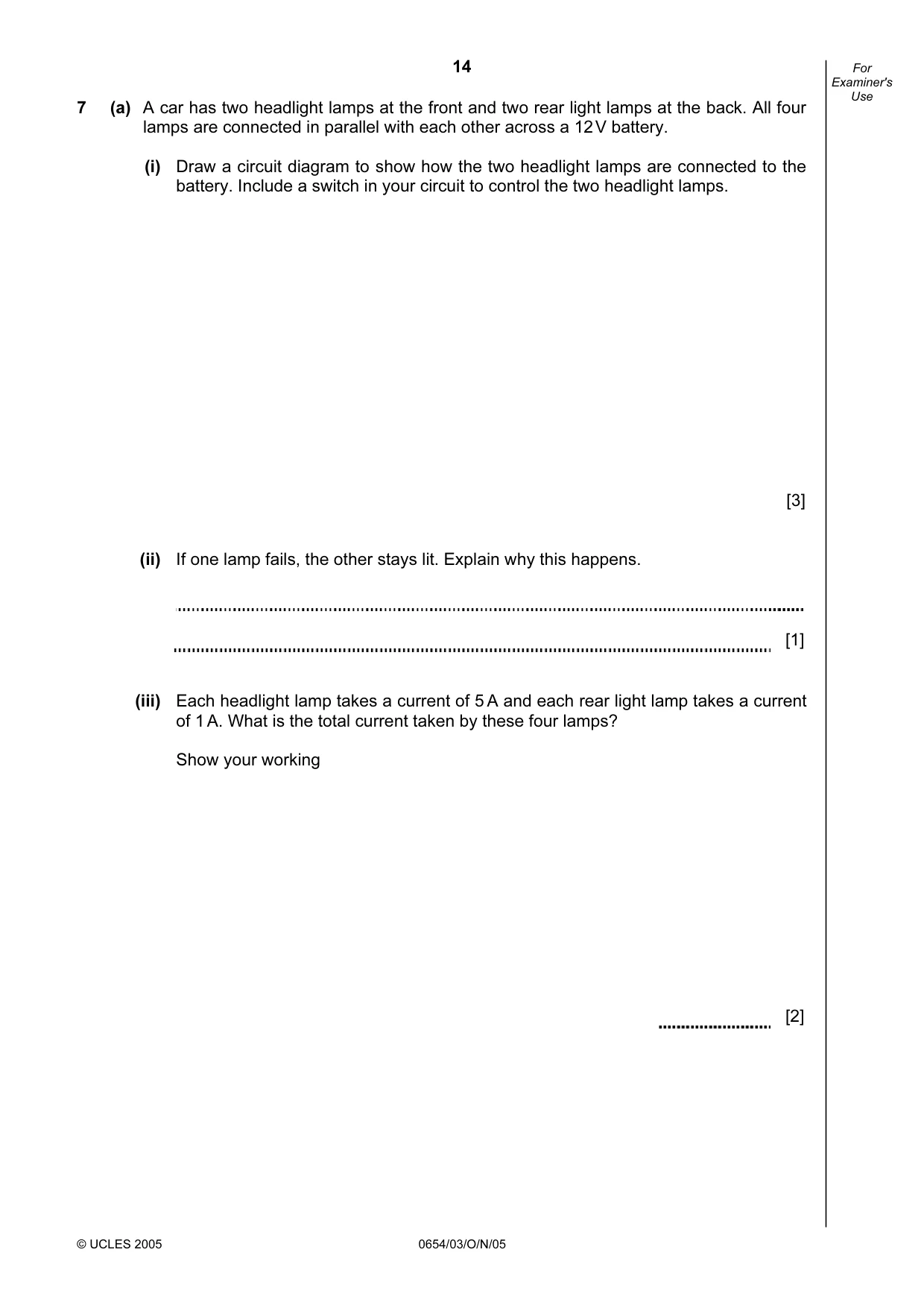
14 © UCLES 2005 0654/03/O/N/05 For Examiner's Use 7 (a) A car has two headlight lamps at the front and two rear light lamps at the back. All four lamps are connected in parallel with each other across a 12 V battery. (i) Draw a circuit diagram to show how the two headlight lamps are connected to the battery. Include a switch in your circuit to control the two headlight lamps. [3] (ii) If one lamp fails, the other stays lit. Explain why this happens. [1] (iii) Each headlight lamp takes a current of 5 A and each rear light lamp takes a current of 1 A. What is the total current taken by these four lamps? Show your working [2]
Question paper, page 15
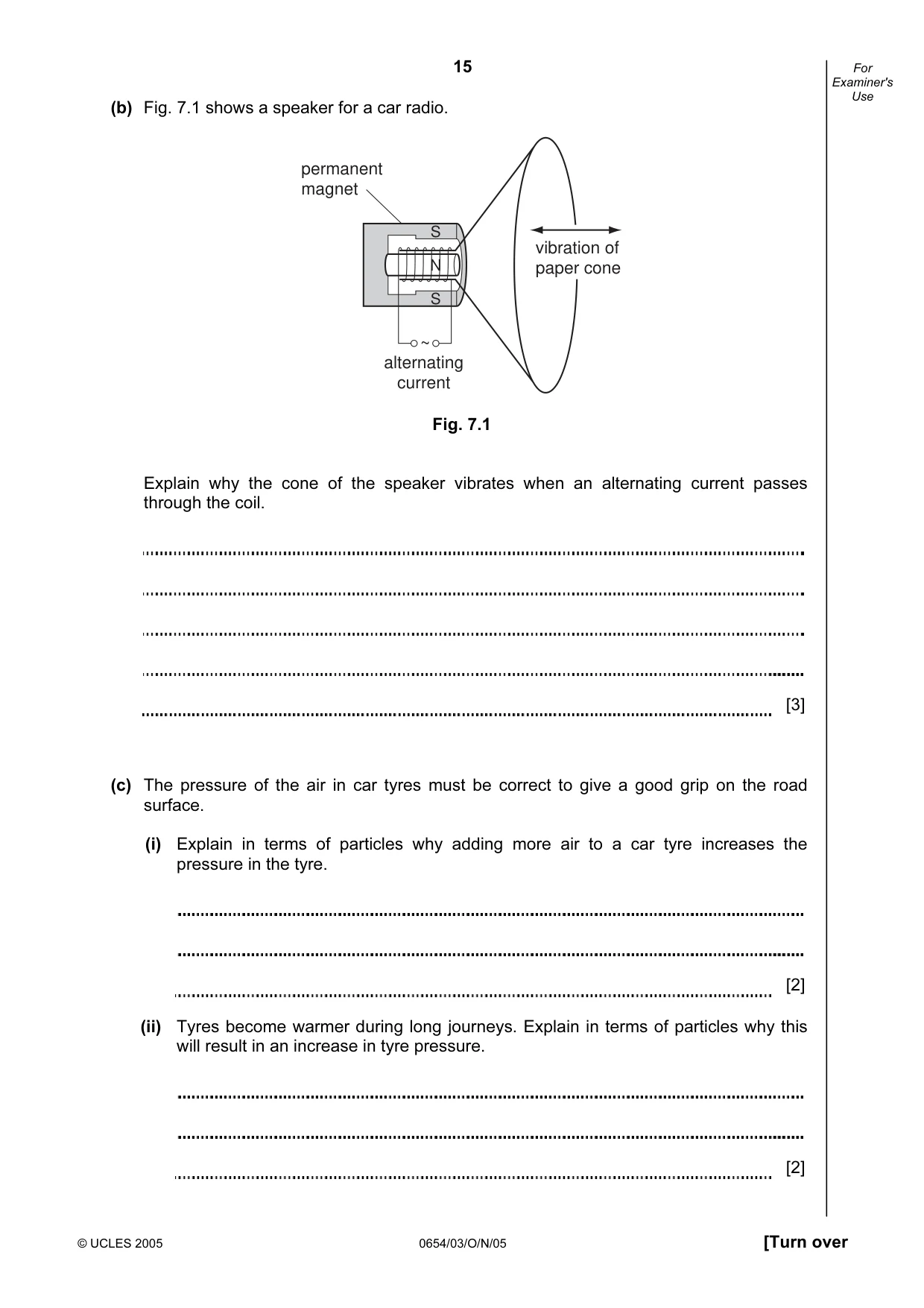
15 © UCLES 2005 0654/03/O/N/05 [Turn over For Examiner's Use (b) Fig. 7.1 shows a speaker for a car radio. ~ S N S vibration of paper cone alternating current permanent magnet Fig. 7.1 Explain why the cone of the speaker vibrates when an alternating current passes through the coil. [3] (c) The pressure of the air in car tyres must be correct to give a good grip on the road surface. (i) Explain in terms of particles why adding more air to a car tyre increases the pressure in the tyre. [2] (ii) Tyres become warmer during long journeys. Explain in terms of particles why this will result in an increase in tyre pressure. [2]
Question paper, page 16
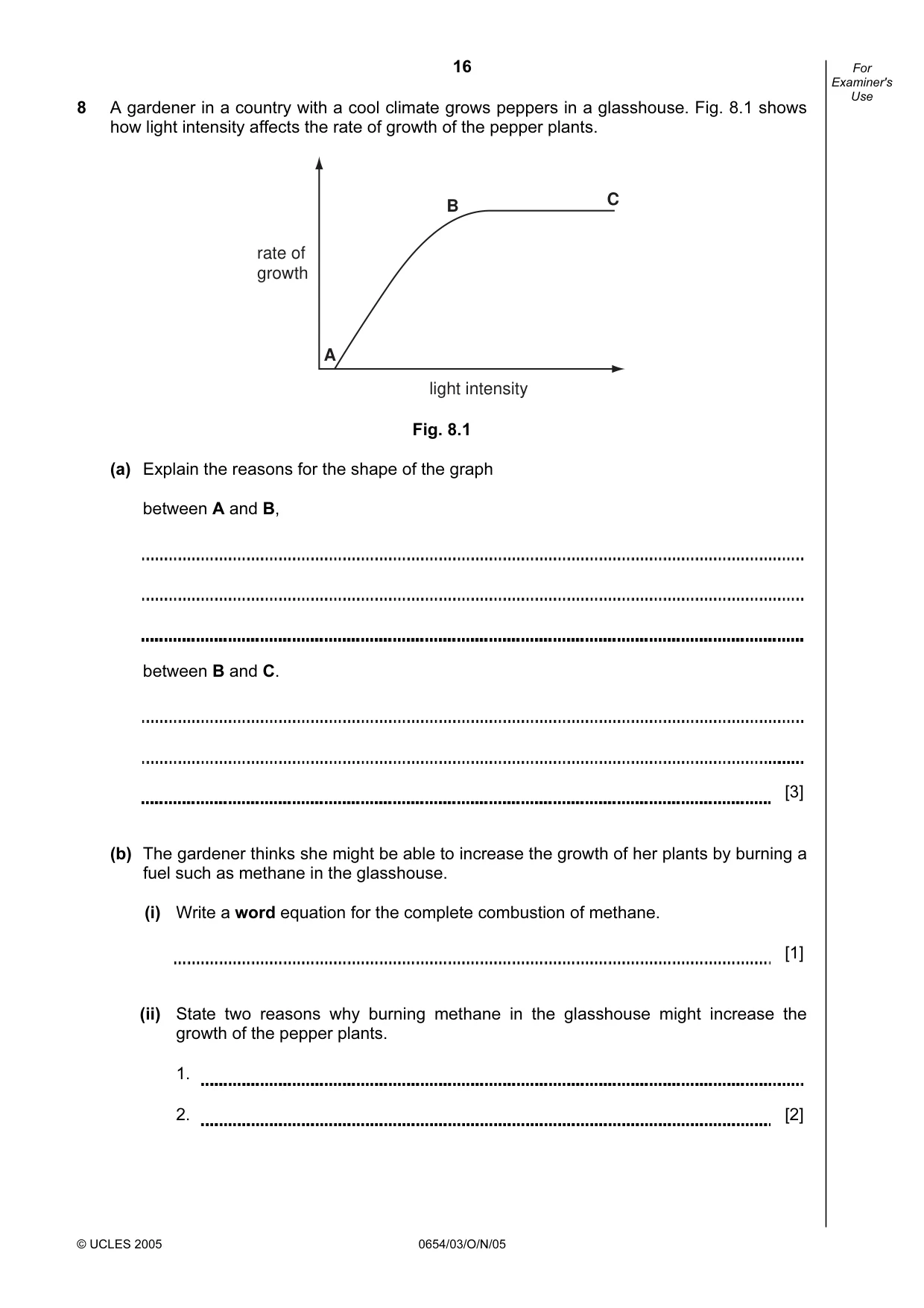
16 © UCLES 2005 0654/03/O/N/05 For Examiner's Use 8 A gardener in a country with a cool climate grows peppers in a glasshouse. Fig. 8.1 shows how light intensity affects the rate of growth of the pepper plants. light intensity rate of growth A B C Fig. 8.1 (a) Explain the reasons for the shape of the graph between A and B, between B and C. [3] (b) The gardener thinks she might be able to increase the growth of her plants by burning a fuel such as methane in the glasshouse. (i) Write a word equation for the complete combustion of methane. [1] (ii) State two reasons why burning methane in the glasshouse might increase the growth of the pepper plants. 1. 2. [2]
Question paper, page 17
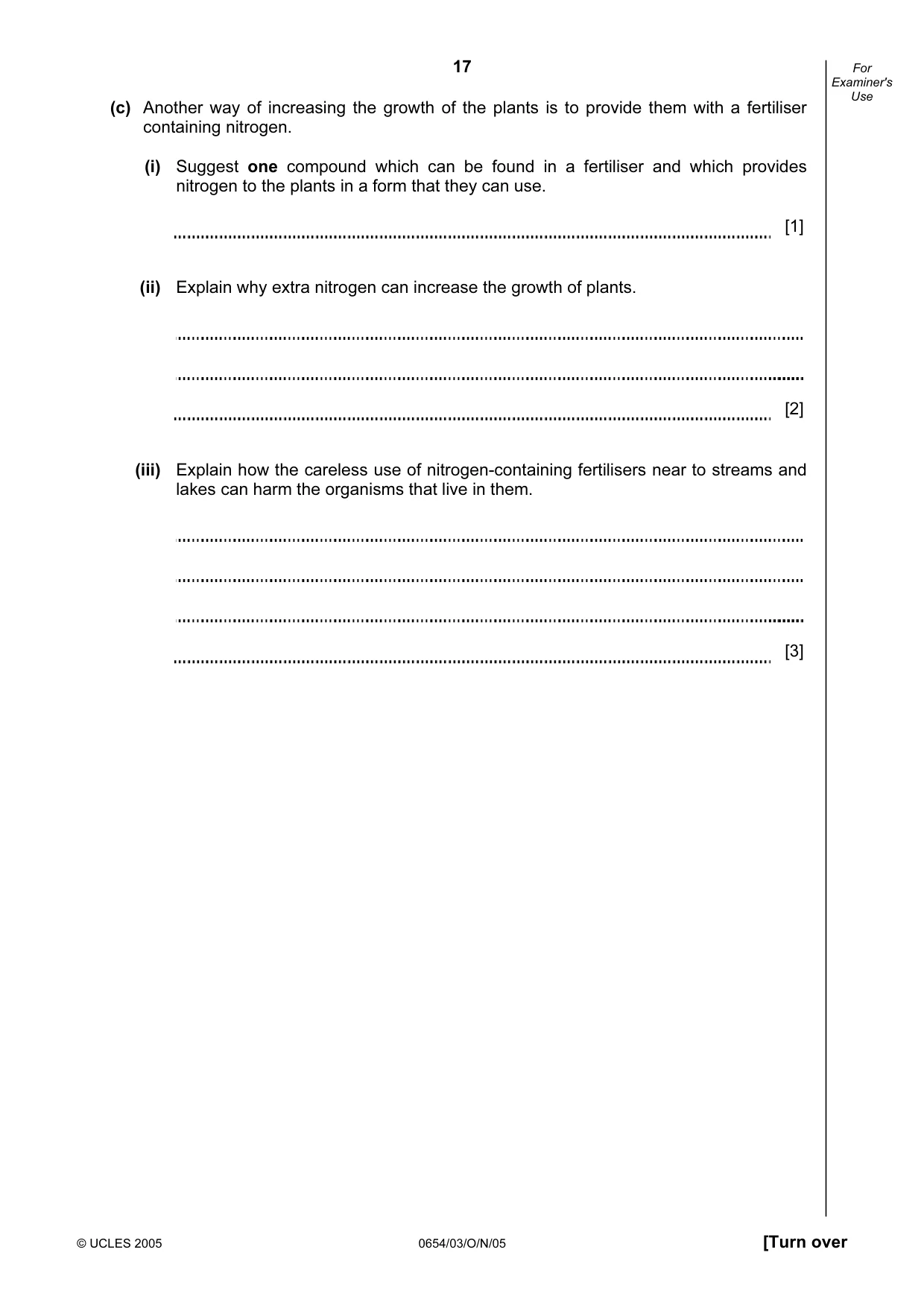
17 © UCLES 2005 0654/03/O/N/05 [Turn over For Examiner's Use (c) Another way of increasing the growth of the plants is to provide them with a fertiliser containing nitrogen. (i) Suggest one compound which can be found in a fertiliser and which provides nitrogen to the plants in a form that they can use. [1] (ii) Explain why extra nitrogen can increase the growth of plants. [2] (iii) Explain how the careless use of nitrogen-containing fertilisers near to streams and lakes can harm the organisms that live in them. [3]
Question paper, page 18
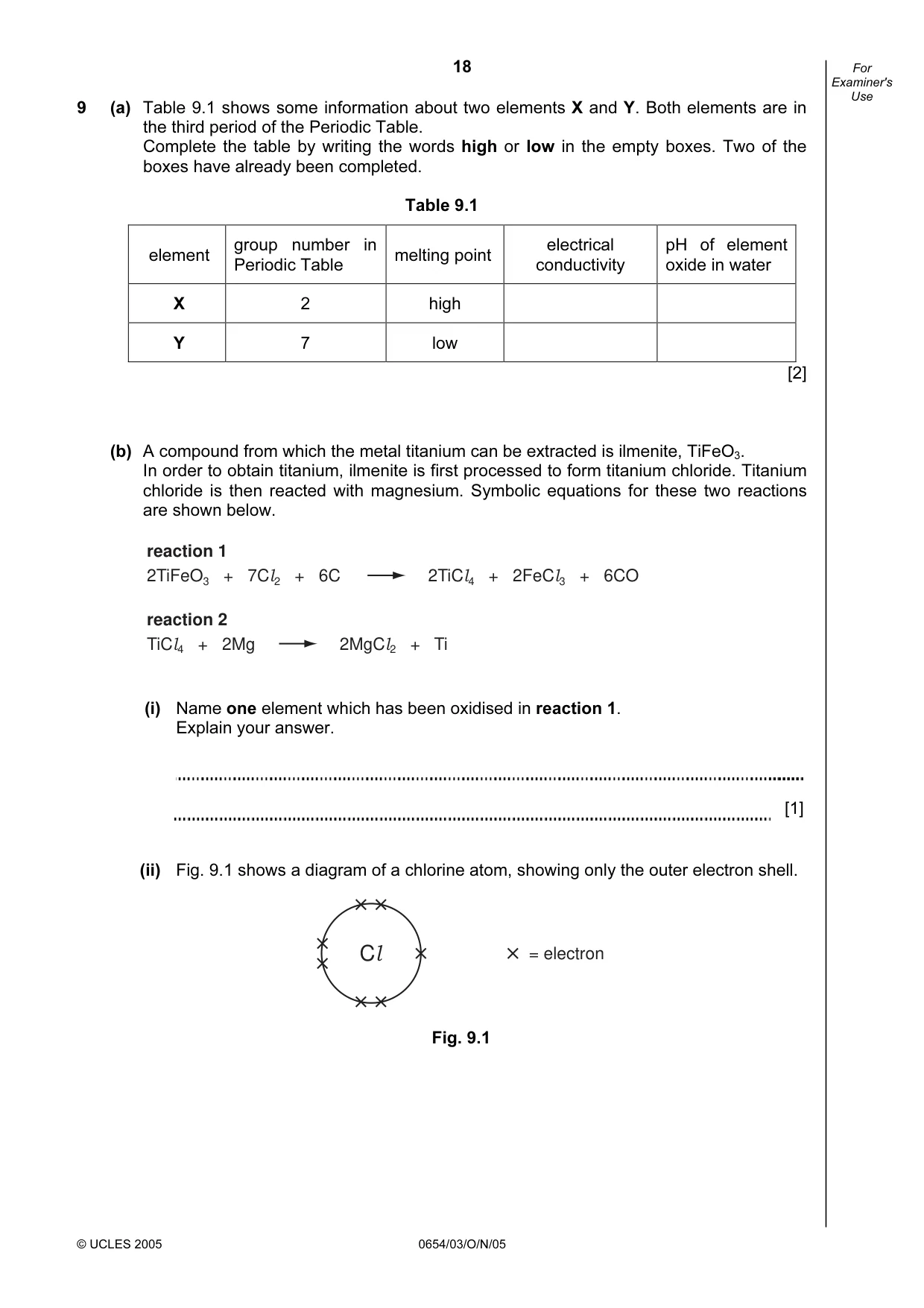
18 © UCLES 2005 0654/03/O/N/05 For Examiner's Use 9 (a) Table 9.1 shows some information about two elements X and Y. Both elements are in the third period of the Periodic Table. Complete the table by writing the words high or low in the empty boxes. Two of the boxes have already been completed. Table 9.1 element group number in Periodic Table melting point electrical conductivity pH of element oxide in water X 2 high Y 7 low [2] (b) A compound from which the metal titanium can be extracted is ilmenite, TiFeO3. In order to obtain titanium, ilmenite is first processed to form titanium chloride. Titanium chloride is then reacted with magnesium. Symbolic equations for these two reactions are shown below. 2TiFeO3 + 7Cl2 + 6C reaction 1 2TiCl4 + 2FeCl3 + 6CO TiCl4 + 2Mg reaction 2 2MgCl2 + Ti (i) Name one element which has been oxidised in reaction 1. Explain your answer. [1] (ii) Fig. 9.1 shows a diagram of a chlorine atom, showing only the outer electron shell. Cl = electron Fig. 9.1
Question paper, page 19
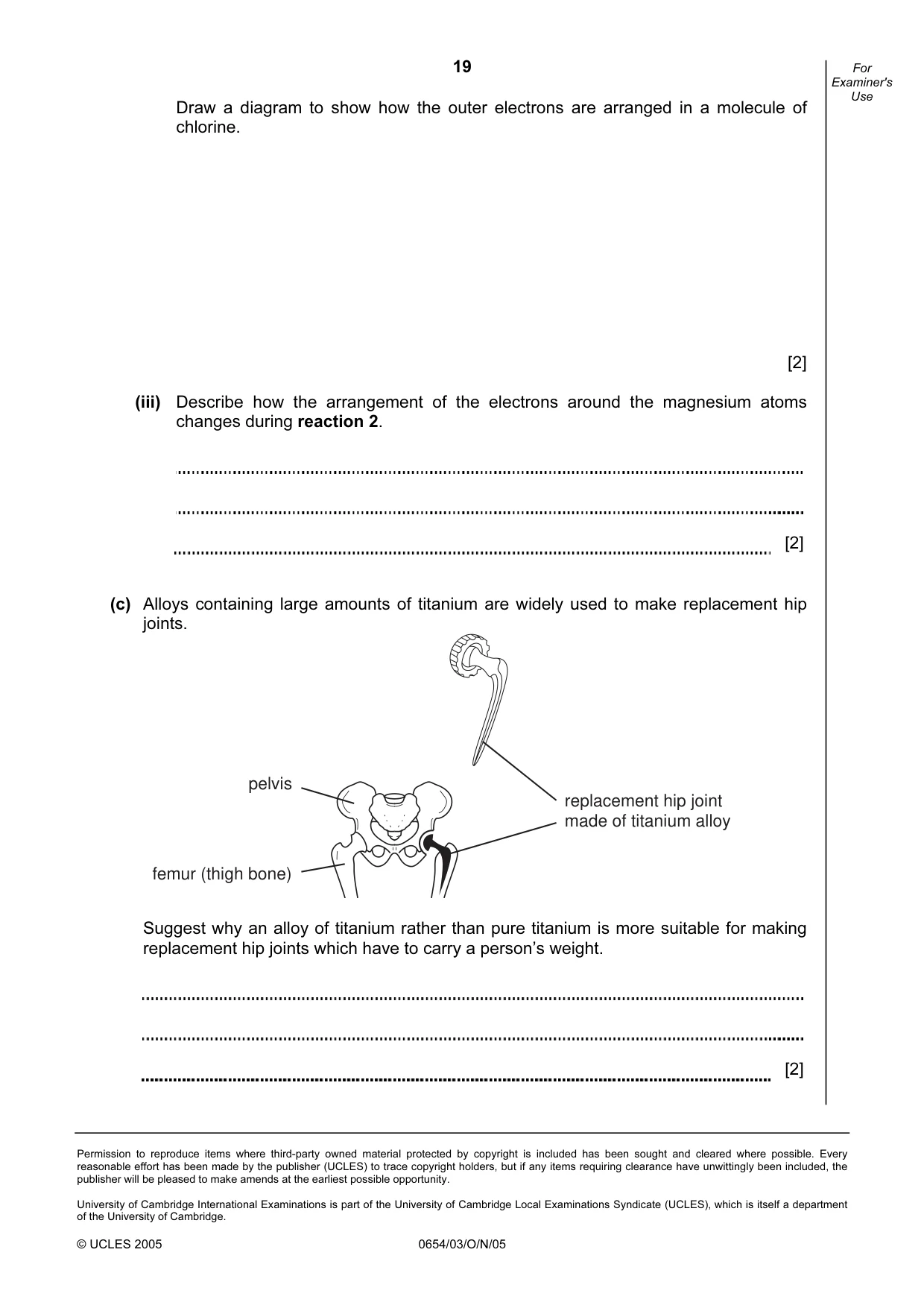
19 Permission to reproduce items where third-party owned material protected by copyright is included has been sought and cleared where possible. Every reasonable effort has been made by the publisher (UCLES) to trace copyright holders, but if any items requiring clearance have unwittingly been included, the publisher will be pleased to make amends at the earliest possible opportunity. University of Cambridge International Examinations is part of the University of Cambridge Local Examinations Syndicate (UCLES), which is itself a department of the University of Cambridge. © UCLES 2005 0654/03/O/N/05 For Examiner's Use Draw a diagram to show how the outer electrons are arranged in a molecule of chlorine. [2] (iii) Describe how the arrangement of the electrons around the magnesium atoms changes during reaction 2. [2] (c) Alloys containing large amounts of titanium are widely used to make replacement hip joints. replacement hip joint made of titanium alloy pelvis femur (thigh bone) Suggest why an alloy of titanium rather than pure titanium is more suitable for making replacement hip joints which have to carry a person’s weight. [2]
Question paper, page 20
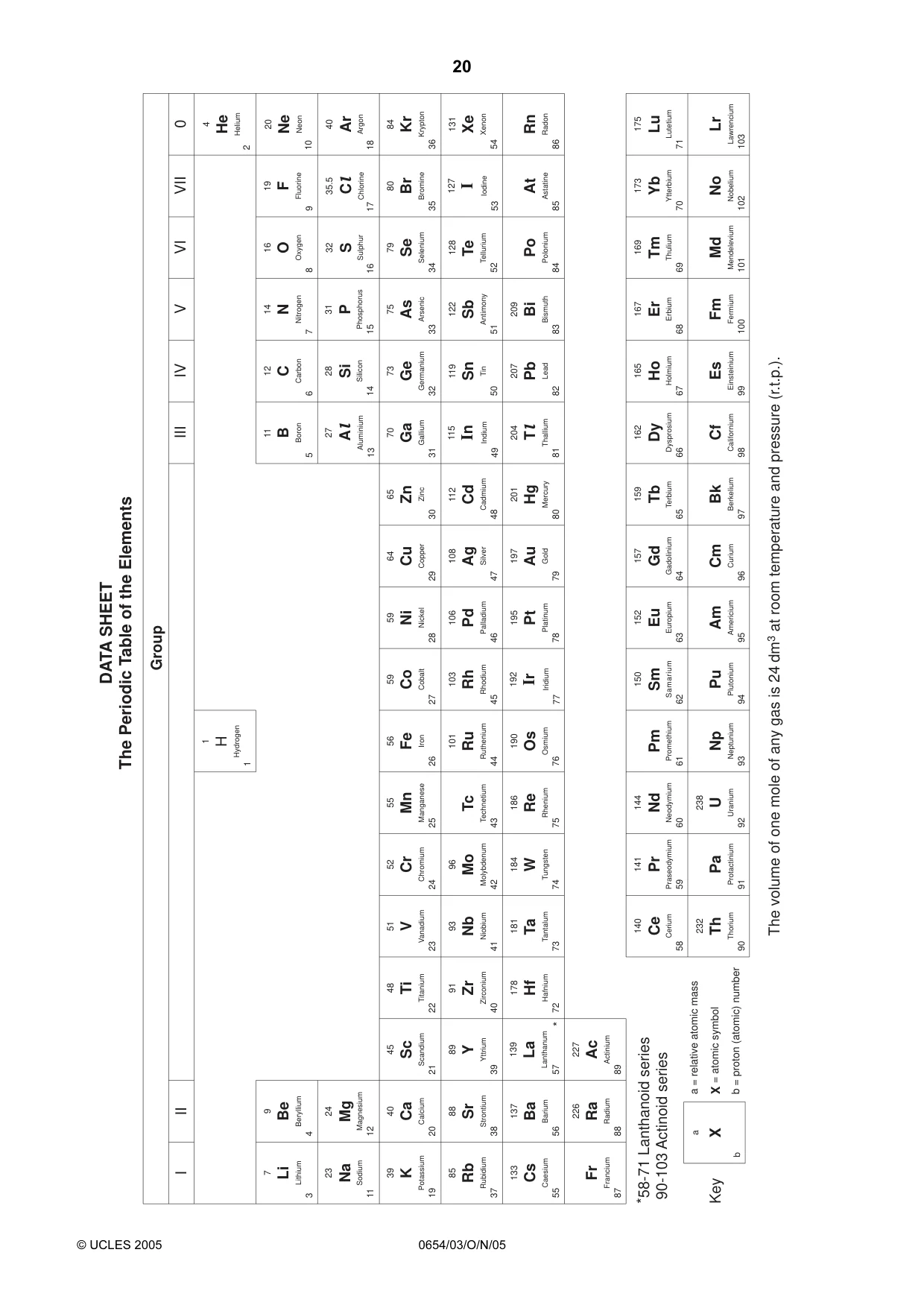
20 © UCLES 2005 0654/03/O/N/05 Group 140 Ce Cerium 58 141 Pr Praseodymium 59 144 Nd Neodymium 60 Pm Promethium 61 150 Sm Samarium 62 152 Eu Europium 63 157 Gd Gadolinium 64 159 Tb Terbium 65 162 Dy Dysprosium 66 165 Ho Holmium 67 167 Er Erbium 68 169 Tm Thulium 69 173 Yb Ytterbium 70 175 Lu Lutetium 71 232 Th Thorium 90 Pa Protactinium 91 238 U Uranium 92 Np Neptunium 93 Pu Plutonium 94 Am Americium 95 Cm Curium 96 Bk Berkelium 97 Cf Californium 98 Es Einsteinium 99 Fm Fermium 100 Md Mendelevium 101 No Nobelium 102 Lr Lawrencium 103 1 H Hydrogen 1 7 Li Lithium 3 23 Na Sodium 11 24 Mg Magnesium 12 40 Ca Calcium 20 45 Sc Scandium 21 48 Ti Titanium 22 51 V Vanadium 23 52 Cr Chromium 24 55 Mn Manganese 25 56 Fe Iron 26 59 Co Cobalt 27 59 Ni Nickel 28 64 Cu Copper 29 65 Zn Zinc 30 70 Ga Gallium 31 27 Al Aluminium 13 11 B Boron 5 12 C Carbon 6 14 N Nitrogen 7 16 O Oxygen 8 19 F Fluorine 9 28 Si Silicon 14 31 P Phosphorus 15 32 S Sulphur 16 35.5 Cl Chlorine 17 40 Ar Argon 18 20 Ne Neon 10 4 He Helium 2 73 Ge Germanium 32 75 As Arsenic 33 79 Se Selenium 34 80 Br Bromine 35 84 Kr Krypton 36 39 K Potassium 19 88 Sr Strontium 38 89 Y Yttrium 39 91 Zr Zirconium 40 93 Nb Niobium 41 96 Mo Molybdenum 42 Tc Technetium 43 101 Ru Ruthenium 44 103 Rh Rhodium 45 106 Pd Palladium 46 108 Ag Silver 47 112 Cd Cadmium 48 115 In Indium 49 119 Sn Tin 50 122 Sb Antimony 51 128 Te Tellurium 52 127 I Iodine 53 131 Xe Xenon 54 137 Ba Barium 56 139 La Lanthanum 57 * 178 Hf Hafnium 72 181 Ta Tantalum 73 184 W Tungsten 74 186 Re Rhenium 75 190 Os Osmium 76 192 Ir Iridium 77 195 Pt Platinum 78 197 Au Gold 79 201 Hg Mercury 80 204 Tl Thallium 81 207 Pb Lead 82 209 Bi Bismuth 83 Po Polonium 84 At Astatine 85 Rn Radon 86 Fr Francium 87 227 Ac Actinium 89 9 Be Beryllium 4 I II III IV V VI VII 0 85 Rb Rubidium 37 133 Cs Caesium 55 226 Ra Radium 88 The volume of one mole of any gas is 24 dm3 at room temperature and pressure (r.t.p.). a X b a = relative atomic mass X = atomic symbol b = proton (atomic) number Key *58-71 Lanthanoid series 90-103 Actinoid series DATA SHEET The Periodic Table of the Elements
Mark scheme, page 1
UNIVERSITY OF CAMBRIDGE INTERNATIONAL EXAMINATIONS International General Certificate of Secondary Education MARK SCHEME for the November 2005 question paper 0654 CO-ORDINATED SCIENCES 0654/03 Paper 3, maximum 100 This mark scheme is published as an aid to teachers and students, to indicate the requirements of the examination. It shows the basis on which Examiners were initially instructed to award marks. It does not indicate the details of the discussions that took place at an Examiners’ meeting before marking began. Any substantial changes to the mark scheme that arose from these discussions will be recorded in the published Report on the Examination. All Examiners are instructed that alternative correct answers and unexpected approaches in candidates’ scripts must be given marks that fairly reflect the relevant knowledge and skills demonstrated. Mark schemes must be read in conjunction with the question papers and the Report on the Examination. The minimum marks in these components needed for various grades were previously published with these mark schemes, but are now instead included in the Report on the Examination for this session. • CIE will not enter into discussion or correspondence in connection with these mark schemes. CIE is publishing the mark schemes for the November 2005 question papers for most IGCSE and GCE Advanced Level and Advanced Subsidiary Level syllabuses and some Ordinary Level syllabuses. www.XtremePapers.com
Mark scheme, page 2
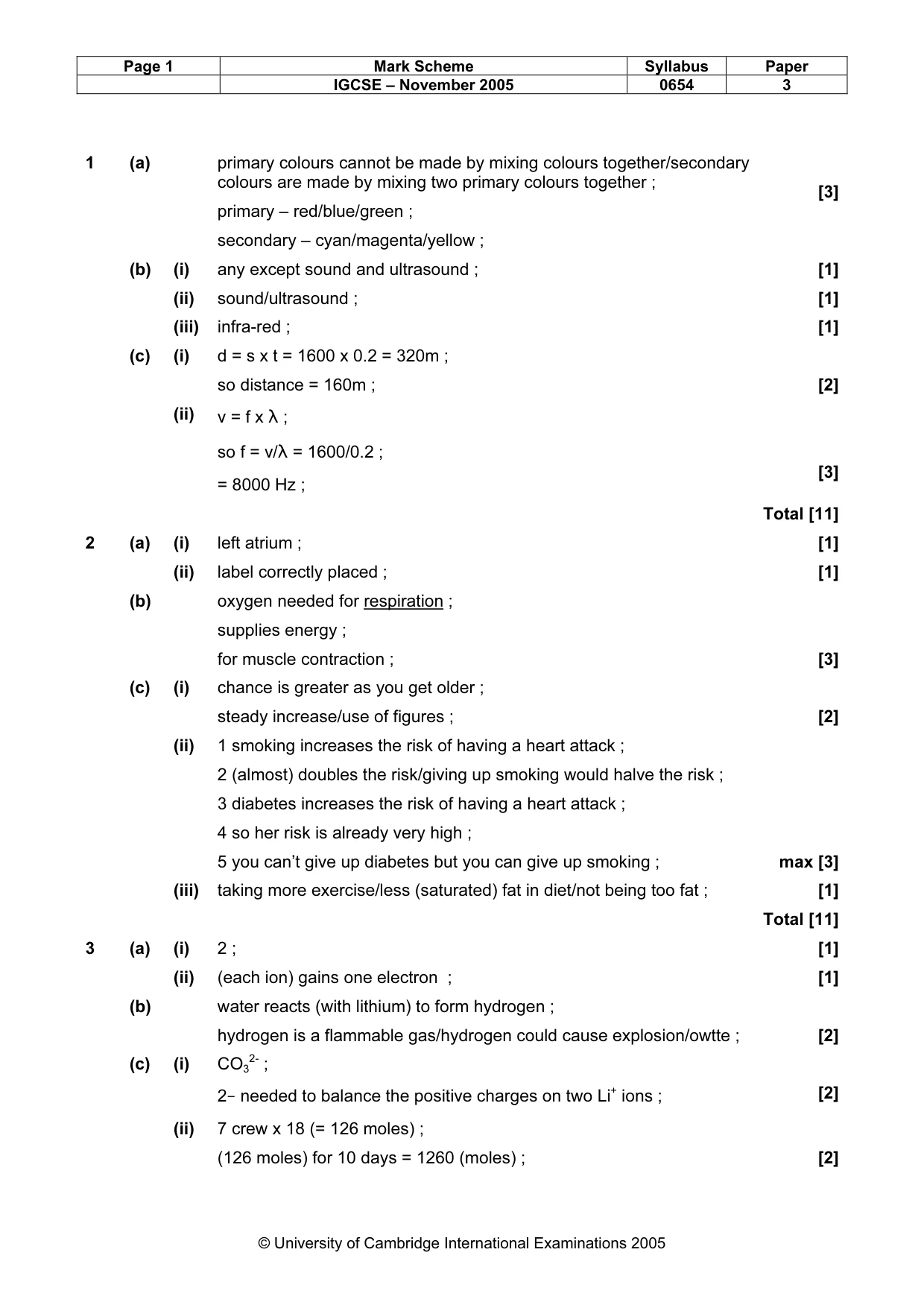
Page 1 Mark Scheme Syllabus Paper IGCSE – November 2005 0654 3 © University of Cambridge International Examinations 2005 1 (a) primary colours cannot be made by mixing colours together/secondary colours are made by mixing two primary colours together ; primary – red/blue/green ; secondary – cyan/magenta/yellow ; [3] (b) (i) any except sound and ultrasound ; [1] (ii) sound/ultrasound ; [1] (iii) infra-red ; [1] (c) (i) d = s x t = 1600 x 0.2 = 320m ; so distance = 160m ; [2] (ii) v = f x λ ; so f = v/λ = 1600/0.2 ; = 8000 Hz ; [3] Total [11] 2 (a) (i) left atrium ; [1] (ii) label correctly placed ; [1] (b) oxygen needed for respiration ; supplies energy ; for muscle contraction ; [3] (c) (i) chance is greater as you get older ; steady increase/use of figures ; [2] (ii) 1 smoking increases the risk of having a heart attack ; 2 (almost) doubles the risk/giving up smoking would halve the risk ; 3 diabetes increases the risk of having a heart attack ; 4 so her risk is already very high ; 5 you can’t give up diabetes but you can give up smoking ; max [3] (iii) taking more exercise/less (saturated) fat in diet/not being too fat ; [1] Total [11] 3 (a) (i) 2 ; [1] (ii) (each ion) gains one electron ; [1] (b) water reacts (with lithium) to form hydrogen ; hydrogen is a flammable gas/hydrogen could cause explosion/owtte ; [2] (c) (i) CO3 2- ; 2– needed to balance the positive charges on two Li+ ions ; [2] (ii) 7 crew x 18 (= 126 moles) ; (126 moles) for 10 days = 1260 (moles) ; [2]
Mark scheme, page 3
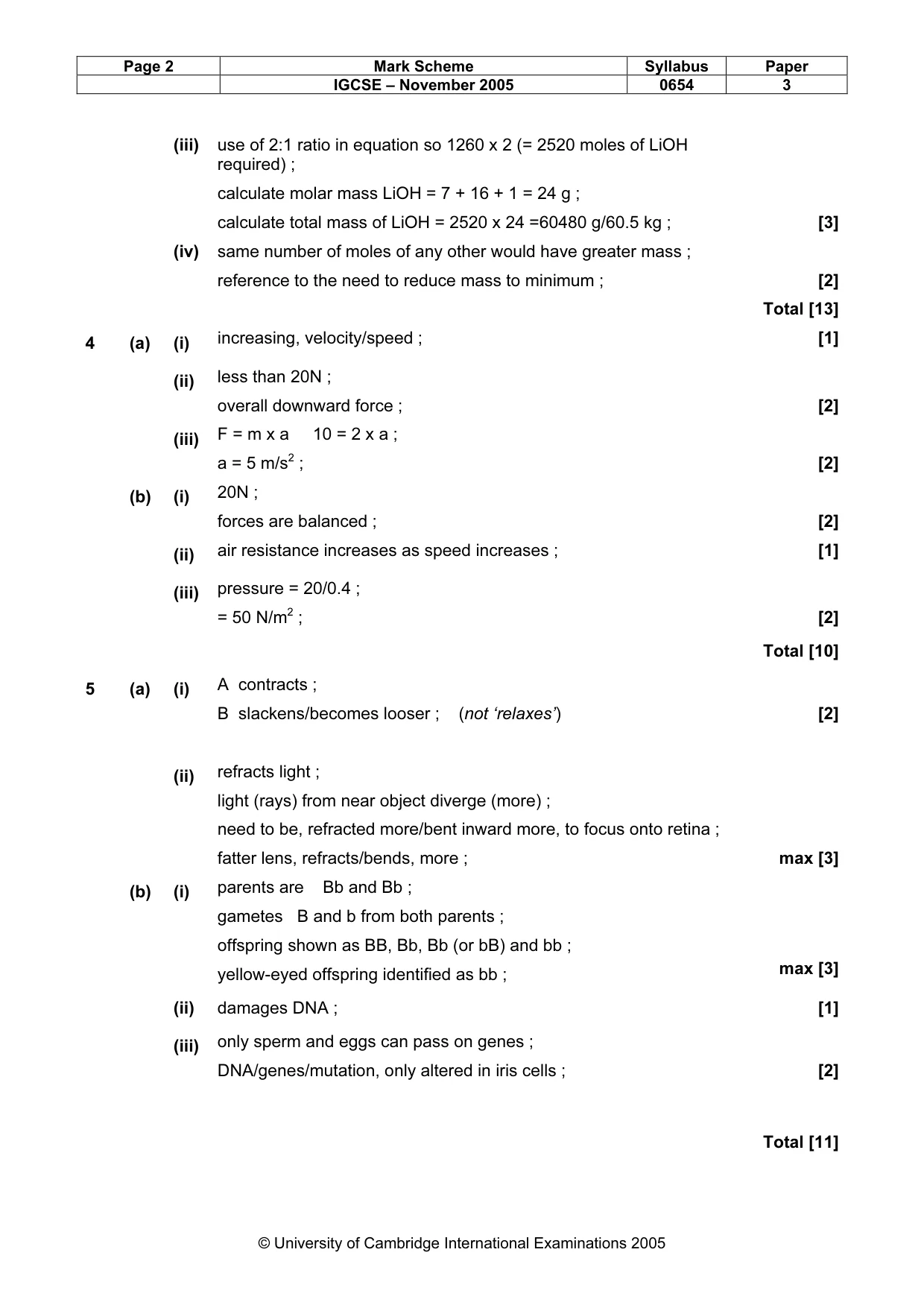
Page 2 Mark Scheme Syllabus Paper IGCSE – November 2005 0654 3 © University of Cambridge International Examinations 2005 (iii) use of 2:1 ratio in equation so 1260 x 2 (= 2520 moles of LiOH required) ; calculate molar mass LiOH = 7 + 16 + 1 = 24 g ; calculate total mass of LiOH = 2520 x 24 =60480 g/60.5 kg ; [3] (iv) same number of moles of any other would have greater mass ; reference to the need to reduce mass to minimum ; [2] Total [13] 4 (a) (i) increasing, velocity/speed ; [1] (ii) less than 20N ; overall downward force ; [2] (iii) F = m x a 10 = 2 x a ; a = 5 m/s2 ; [2] (b) (i) 20N ; forces are balanced ; [2] (ii) air resistance increases as speed increases ; [1] (iii) pressure = 20/0.4 ; = 50 N/m2 ; [2] Total [10] 5 (a) (i) A contracts ; B slackens/becomes looser ; (not ‘relaxes’) [2] (ii) refracts light ; light (rays) from near object diverge (more) ; need to be, refracted more/bent inward more, to focus onto retina ; fatter lens, refracts/bends, more ; max [3] (b) (i) parents are Bb and Bb ; gametes B and b from both parents ; offspring shown as BB, Bb, Bb (or bB) and bb ; yellow-eyed offspring identified as bb ; max [3] (ii) damages DNA ; [1] (iii) only sperm and eggs can pass on genes ; DNA/genes/mutation, only altered in iris cells ; [2] Total [11]
Mark scheme, page 4
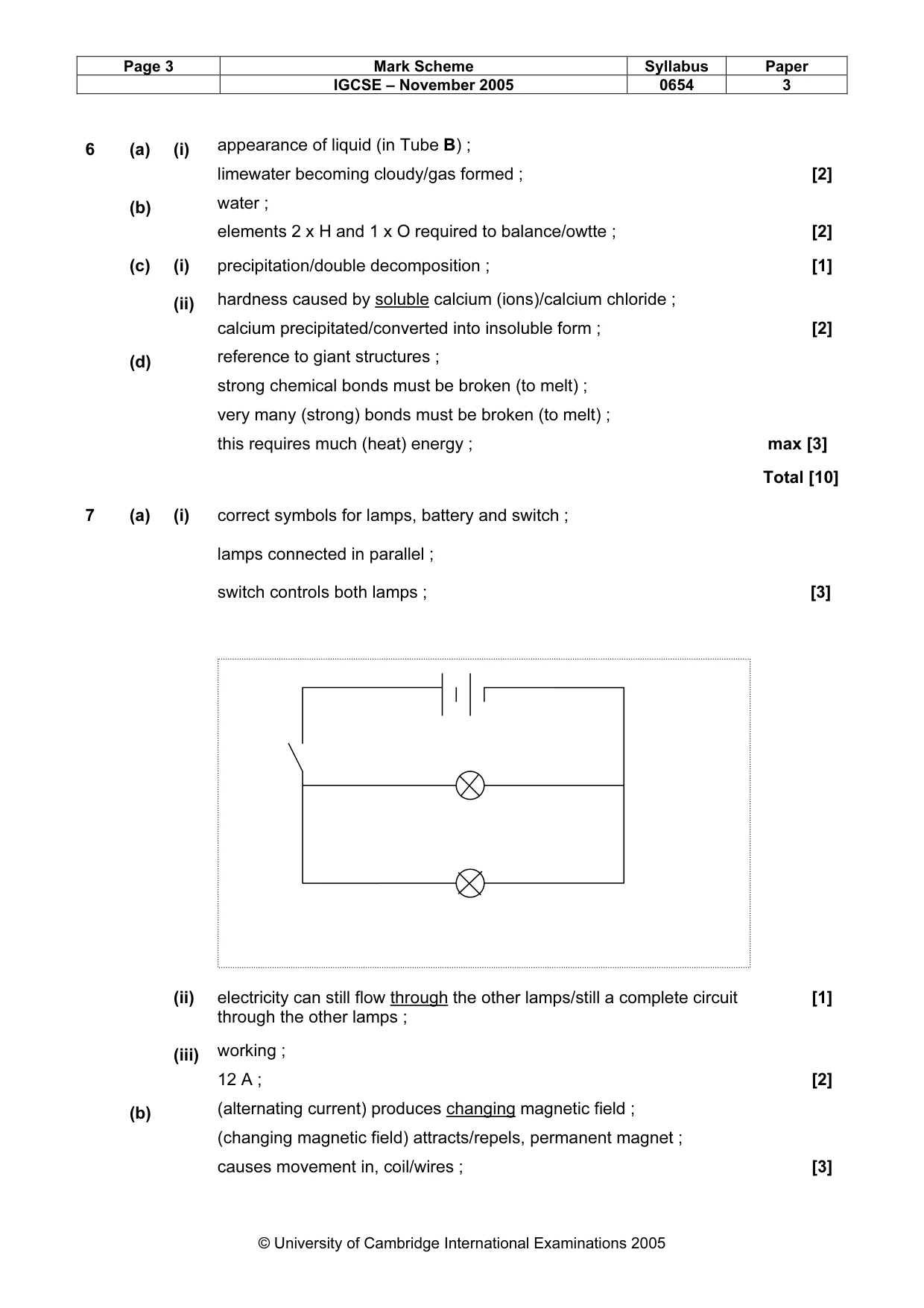
Page 3 Mark Scheme Syllabus Paper IGCSE – November 2005 0654 3 © University of Cambridge International Examinations 2005 6 (a) (i) appearance of liquid (in Tube B) ; limewater becoming cloudy/gas formed ; [2] (b) water ; elements 2 x H and 1 x O required to balance/owtte ; [2] (c) (i) precipitation/double decomposition ; [1] (ii) hardness caused by soluble calcium (ions)/calcium chloride ; calcium precipitated/converted into insoluble form ; [2] (d) reference to giant structures ; strong chemical bonds must be broken (to melt) ; very many (strong) bonds must be broken (to melt) ; this requires much (heat) energy ; max [3] Total [10] 7 (a) (i) correct symbols for lamps, battery and switch ; lamps connected in parallel ; switch controls both lamps ; [3] (ii) electricity can still flow through the other lamps/still a complete circuit through the other lamps ; [1] (iii) working ; 12 A ; [2] (b) (alternating current) produces changing magnetic field ; (changing magnetic field) attracts/repels, permanent magnet ; causes movement in, coil/wires ; [3]
Mark scheme, page 5
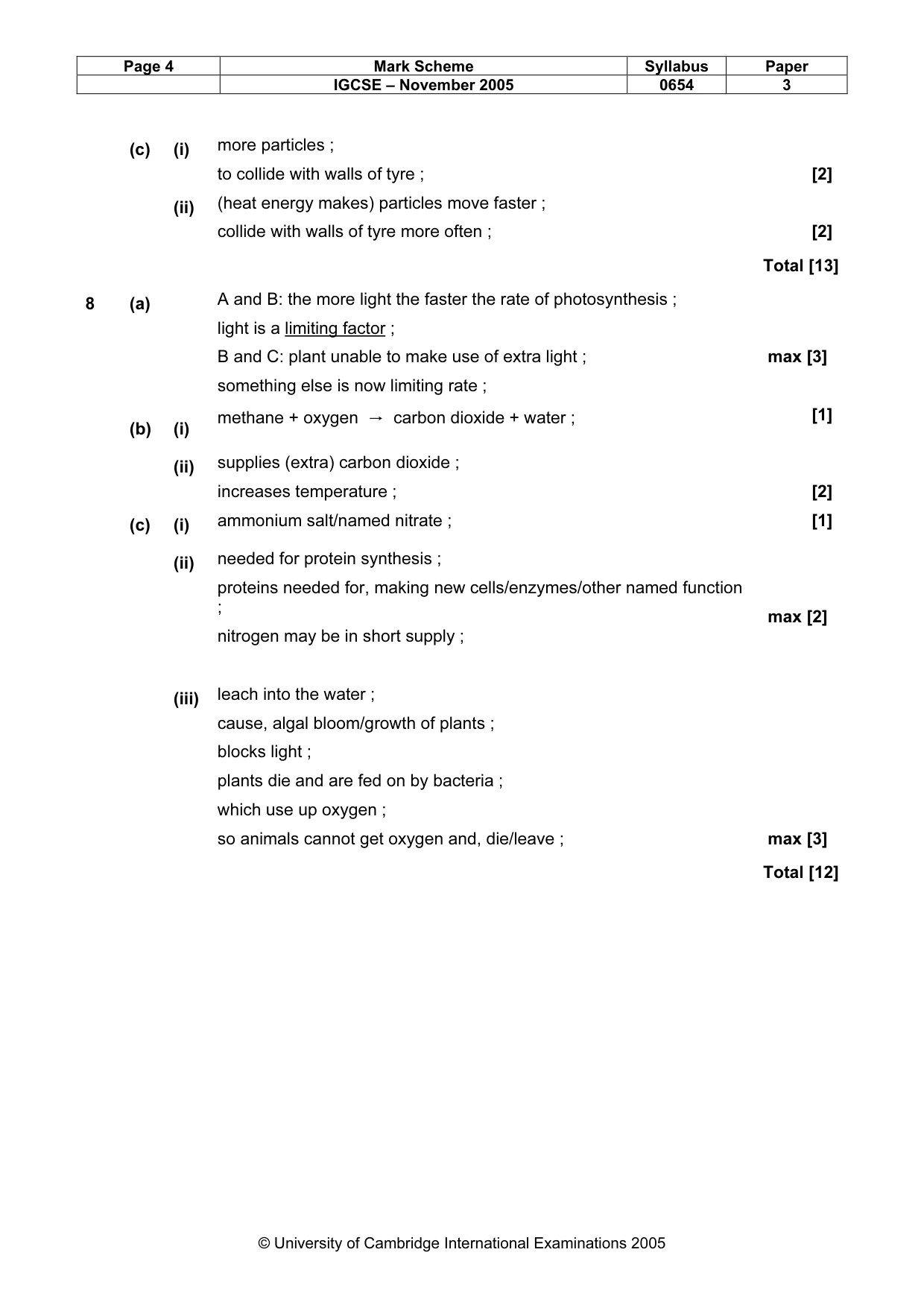
Page 4 Mark Scheme Syllabus Paper IGCSE – November 2005 0654 3 © University of Cambridge International Examinations 2005 (c) (i) more particles ; to collide with walls of tyre ; [2] (ii) (heat energy makes) particles move faster ; collide with walls of tyre more often ; [2] Total [13] 8 (a) A and B: the more light the faster the rate of photosynthesis ; light is a limiting factor ; B and C: plant unable to make use of extra light ; something else is now limiting rate ; max [3] (b) (i) methane + oxygen → carbon dioxide + water ; [1] (ii) supplies (extra) carbon dioxide ; increases temperature ; [2] (c) (i) ammonium salt/named nitrate ; [1] (ii) needed for protein synthesis ; proteins needed for, making new cells/enzymes/other named function ; nitrogen may be in short supply ; max [2] (iii) leach into the water ; cause, algal bloom/growth of plants ; blocks light ; plants die and are fed on by bacteria ; which use up oxygen ; so animals cannot get oxygen and, die/leave ; max [3] Total [12]
Mark scheme, page 6
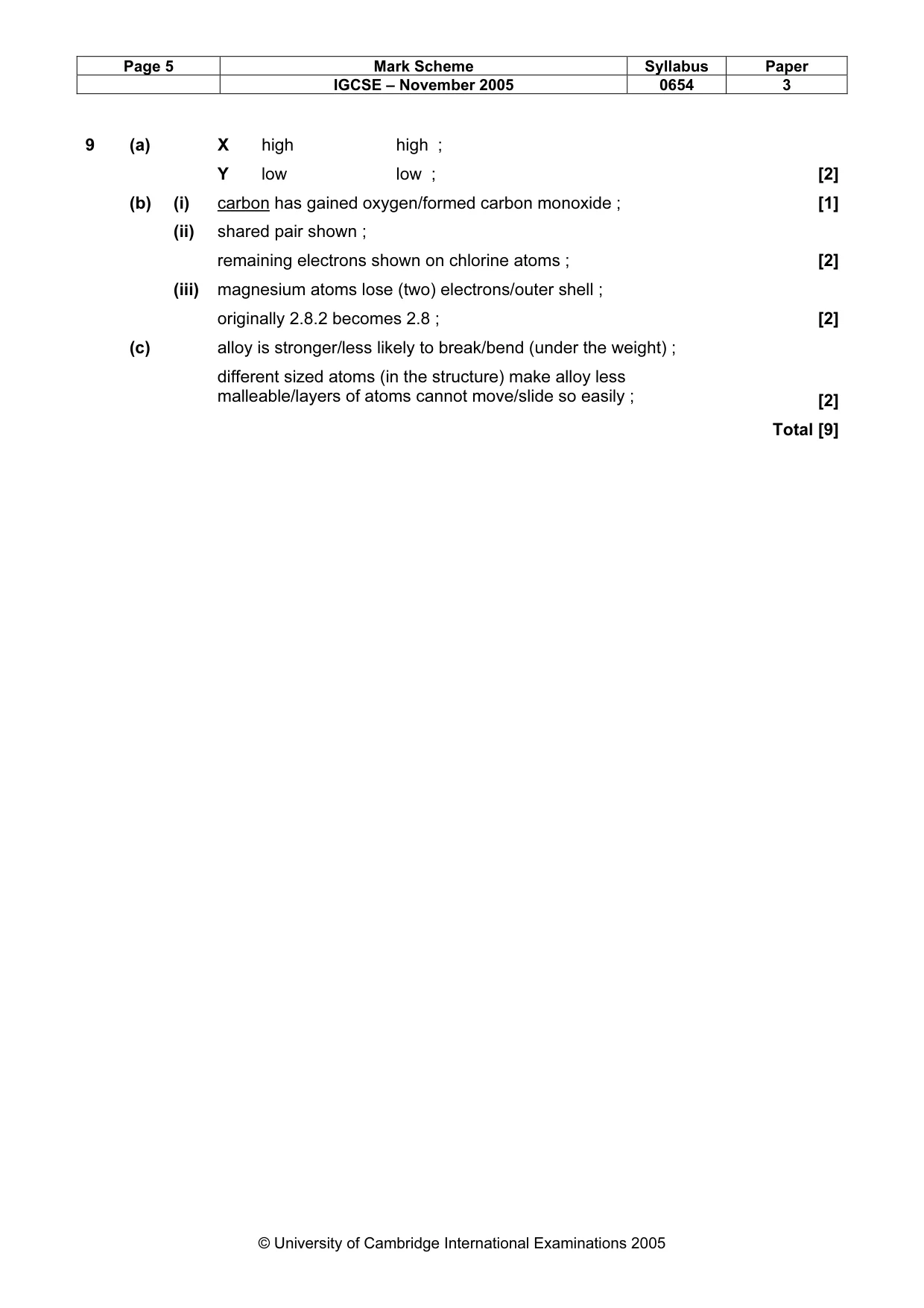
Page 5 Mark Scheme Syllabus Paper IGCSE – November 2005 0654 3 © University of Cambridge International Examinations 2005 9 (a) X high high ; Y low low ; [2] (b) (i) carbon has gained oxygen/formed carbon monoxide ; [1] (ii) shared pair shown ; remaining electrons shown on chlorine atoms ; [2] (iii) magnesium atoms lose (two) electrons/outer shell ; originally 2.8.2 becomes 2.8 ; [2] (c) alloy is stronger/less likely to break/bend (under the weight) ; different sized atoms (in the structure) make alloy less malleable/layers of atoms cannot move/slide so easily ; [2] Total [9]