Cambridge IGCSE Sciences - Co-ordinated (Double) 0654 — 2005 May/June Paper 3 · Variant 1
0654/31/M/J/05
The question paper and its mark scheme, free to read here and free to download. This is Cambridge’s own paper, exactly as it was sat.
Question paper24 pages

Mark scheme12 pages
Answers below. Sit the paper first if you are practising.
Paper as text
Question paper, page 1
Centre Number Candidate Number Name UNIVERSITY OF CAMBRIDGE INTERNATIONAL EXAMINATIONS International General Certificate of Secondary Education CO-ORDINATED SCIENCES 0654/03 Paper 3 May/June 2005 2 hours Candidates answer on the Question Paper. No Additional Materials are required. READ THESE INSTRUCTIONS FIRST Write your Centre number, candidate number and name on all the work you hand in. Write in dark blue or black pen in the spaces provided on the Question Paper. You may use a soft pencil for any diagrams, graphs, tables or rough working. Do not use staples, paper clips, highlighters, glue or correction fluid. Answer all questions. The number of marks is given in brackets [ ] at the end of each question or part question. A copy of the Periodic Table is printed on page 24. For Examiner’s Use 1 2 3 4 5 6 7 8 9 Total This document consists of 22 printed pages and 2 blank pages. IB05 06_0654_03/4RP UCLES 2005 [Turn over If you have been given a label, look at the details. If any details are incorrect or missing, please fill in your correct details in the space given at the top of this page. Stick your personal label here, if provided. www.XtremePapers.com
Question paper, page 2
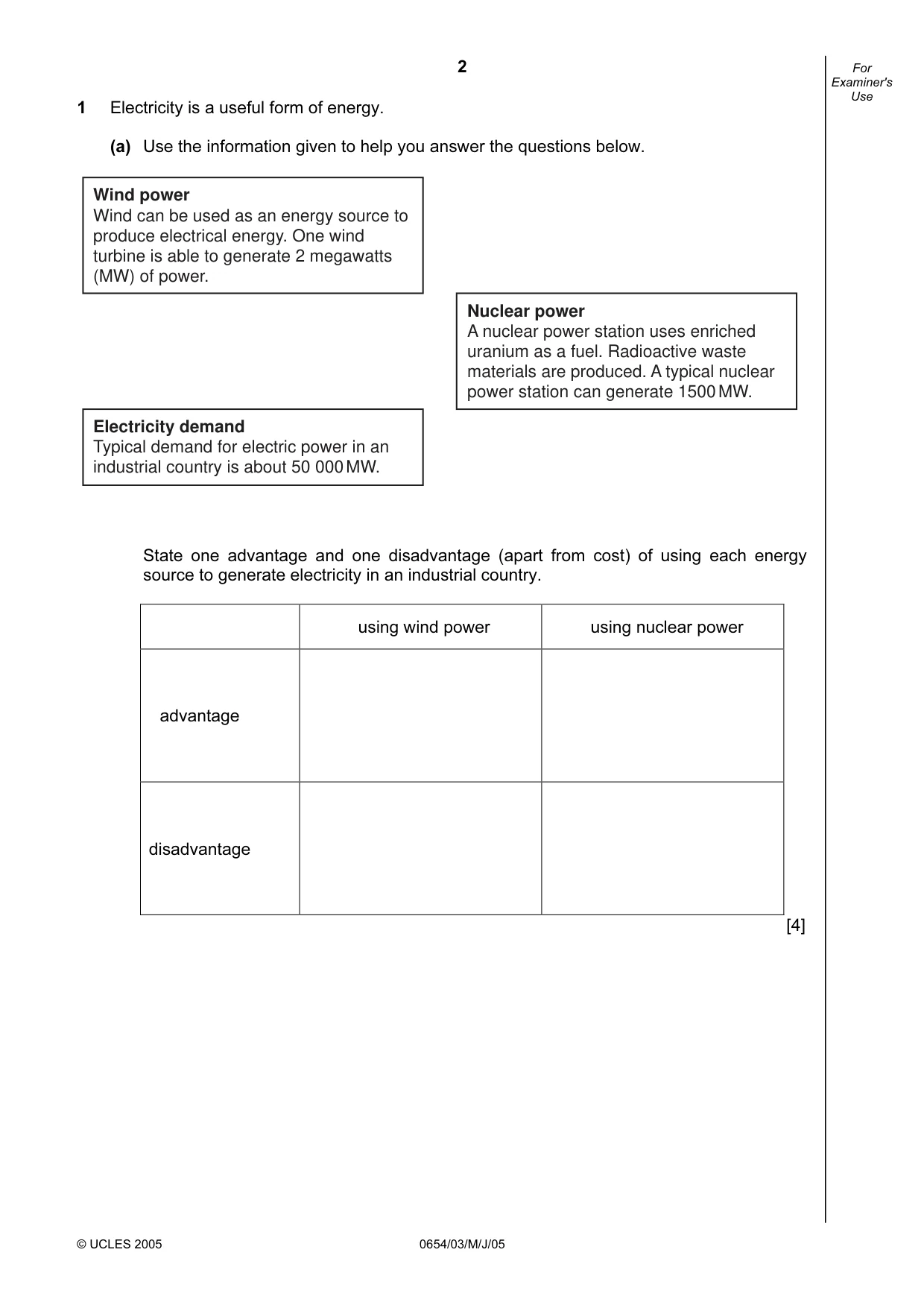
2 © UCLES 2005 0654/03/M/J/05 For Examiner's Use 1 Electricity is a useful form of energy. (a) Use the information given to help you answer the questions below. Wind power Wind can be used as an energy source to produce electrical energy. One wind turbine is able to generate 2 megawatts (MW) of power. Electricity demand Typical demand for electric power in an industrial country is about 50 000 MW. Nuclear power A nuclear power station uses enriched uranium as a fuel. Radioactive waste materials are produced. A typical nuclear power station can generate 1500 MW. State one advantage and one disadvantage (apart from cost) of using each energy source to generate electricity in an industrial country. using wind power using nuclear power advantage disadvantage [4]
Question paper, page 3
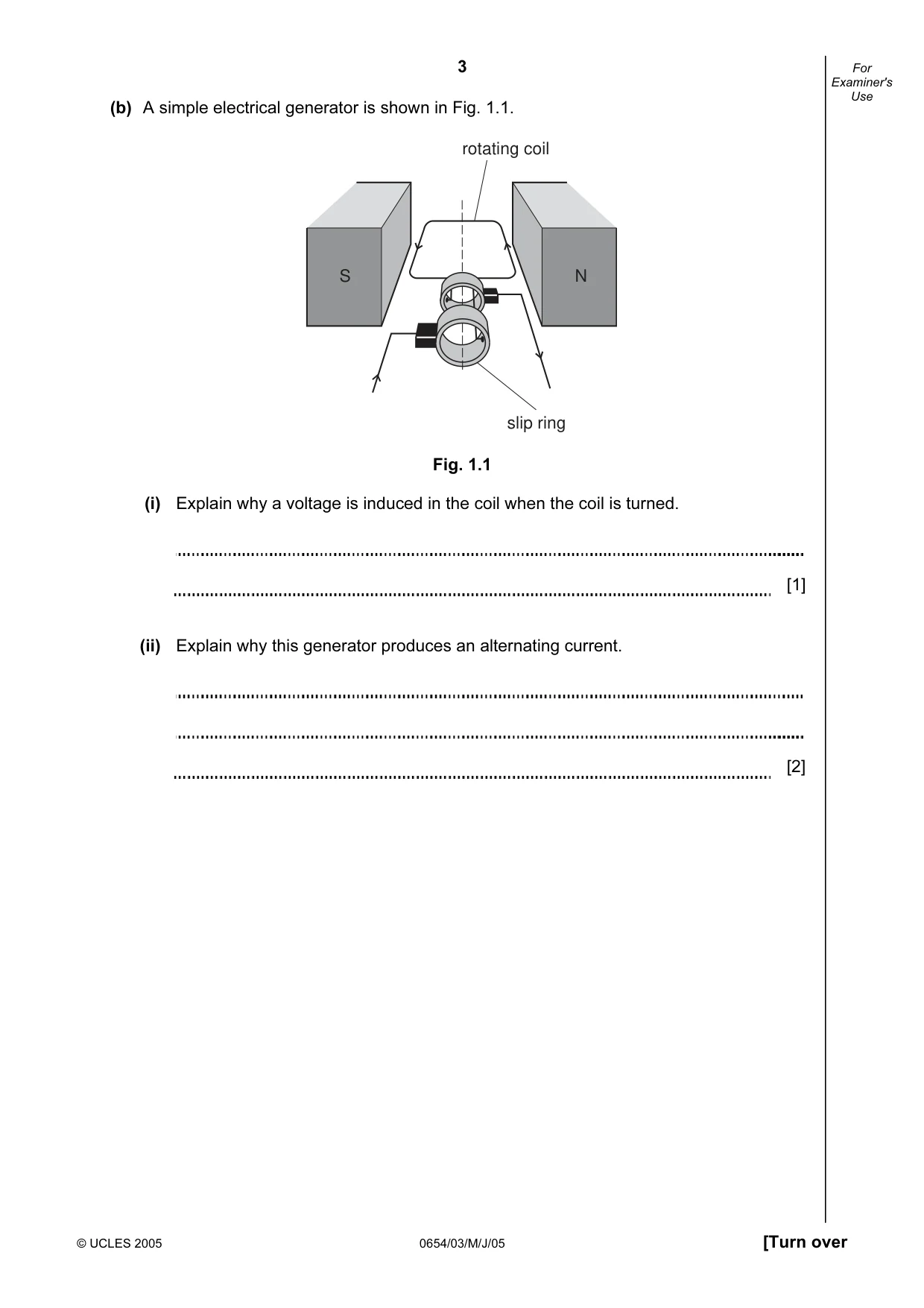
3 © UCLES 2005 0654/03/M/J/05 [Turn over For Examiner's Use (b) A simple electrical generator is shown in Fig. 1.1. N S rotating coil slip ring Fig. 1.1 (i) Explain why a voltage is induced in the coil when the coil is turned. [1] (ii) Explain why this generator produces an alternating current. [2]
Question paper, page 4
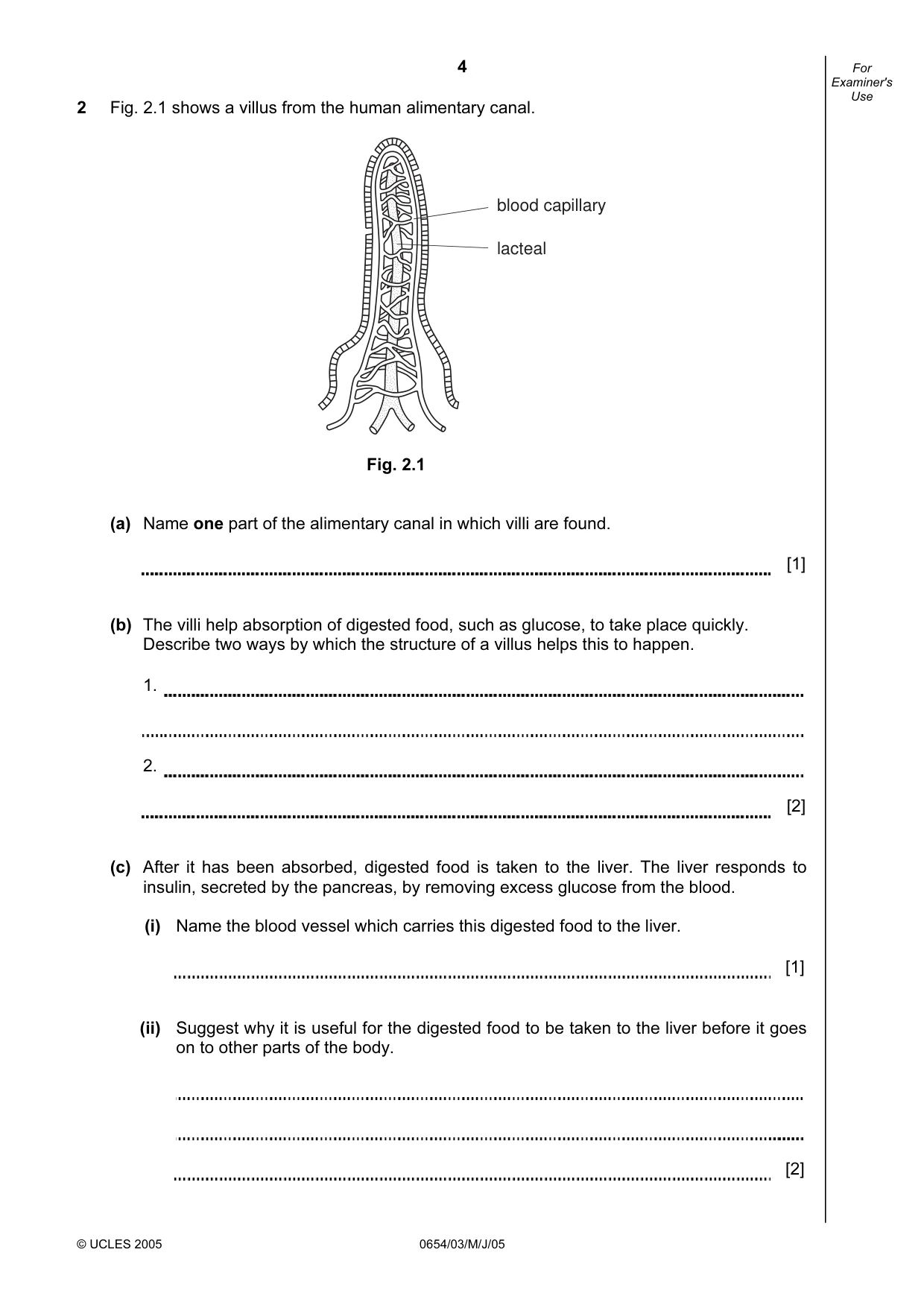
4 © UCLES 2005 0654/03/M/J/05 For Examiner's Use 2 Fig. 2.1 shows a villus from the human alimentary canal. blood capillary lacteal Fig. 2.1 (a) Name one part of the alimentary canal in which villi are found. [1] (b) The villi help absorption of digested food, such as glucose, to take place quickly. Describe two ways by which the structure of a villus helps this to happen. 1. 2. [2] (c) After it has been absorbed, digested food is taken to the liver. The liver responds to insulin, secreted by the pancreas, by removing excess glucose from the blood. (i) Name the blood vessel which carries this digested food to the liver. [1] (ii) Suggest why it is useful for the digested food to be taken to the liver before it goes on to other parts of the body. [2]
Question paper, page 5
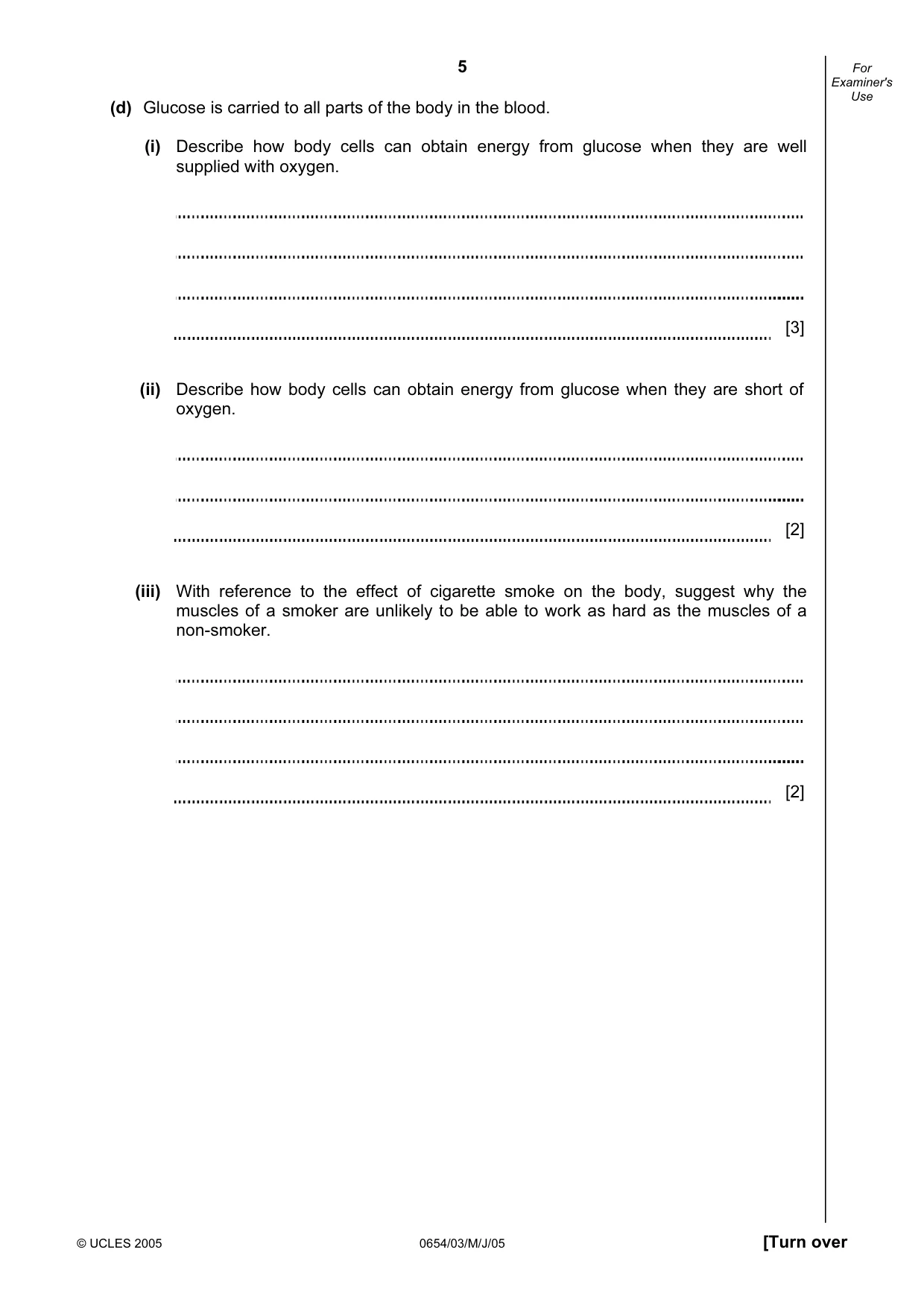
5 © UCLES 2005 0654/03/M/J/05 [Turn over For Examiner's Use (d) Glucose is carried to all parts of the body in the blood. (i) Describe how body cells can obtain energy from glucose when they are well supplied with oxygen. [3] (ii) Describe how body cells can obtain energy from glucose when they are short of oxygen. [2] (iii) With reference to the effect of cigarette smoke on the body, suggest why the muscles of a smoker are unlikely to be able to work as hard as the muscles of a non-smoker. [2]
Question paper, page 6
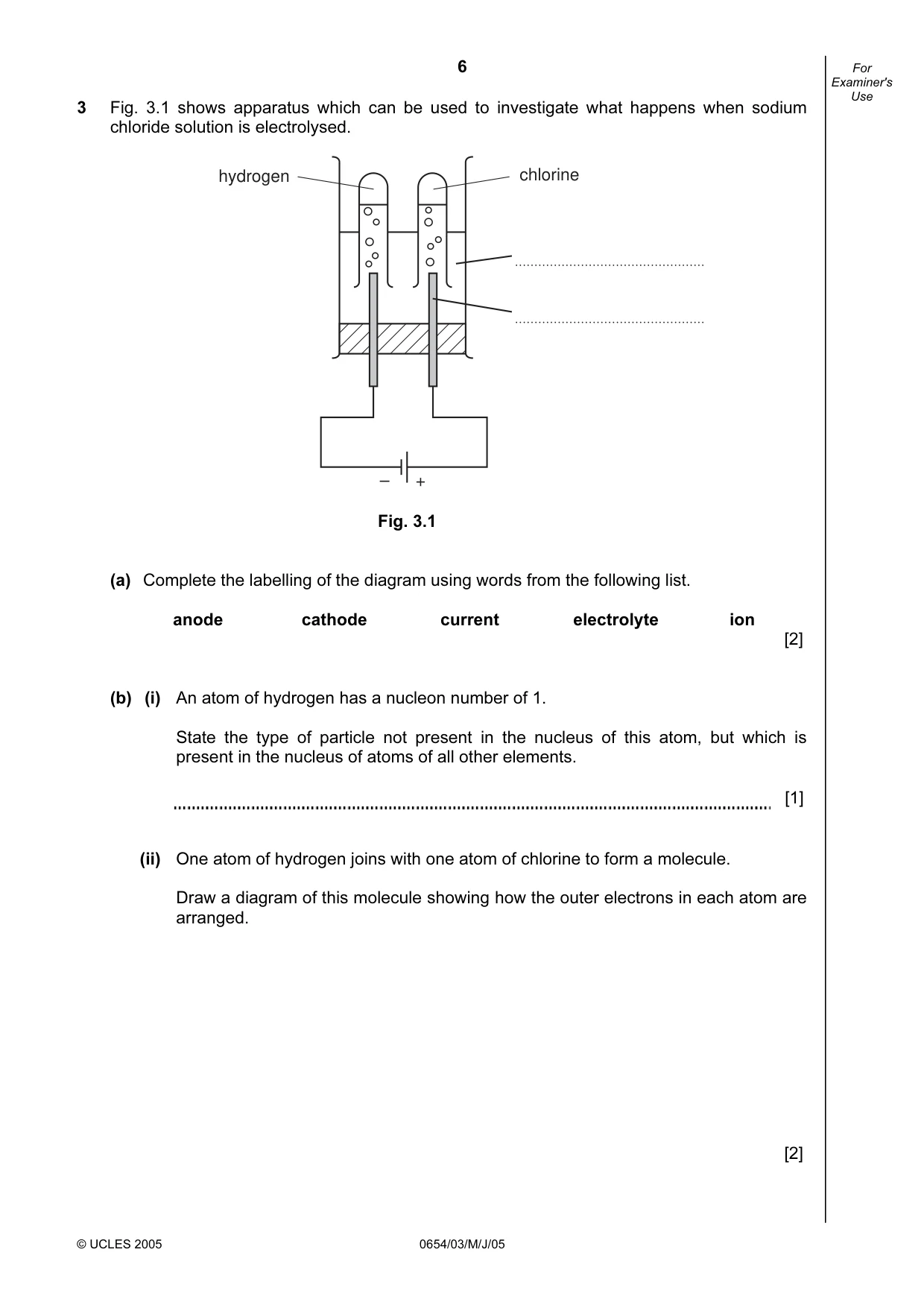
6 © UCLES 2005 0654/03/M/J/05 For Examiner's Use 3 Fig. 3.1 shows apparatus which can be used to investigate what happens when sodium chloride solution is electrolysed. + – hydrogen chlorine Fig. 3.1 (a) Complete the labelling of the diagram using words from the following list. anode cathode current electrolyte ion [2] (b) (i) An atom of hydrogen has a nucleon number of 1. State the type of particle not present in the nucleus of this atom, but which is present in the nucleus of atoms of all other elements. [1] (ii) One atom of hydrogen joins with one atom of chlorine to form a molecule. Draw a diagram of this molecule showing how the outer electrons in each atom are arranged. [2]
Question paper, page 7
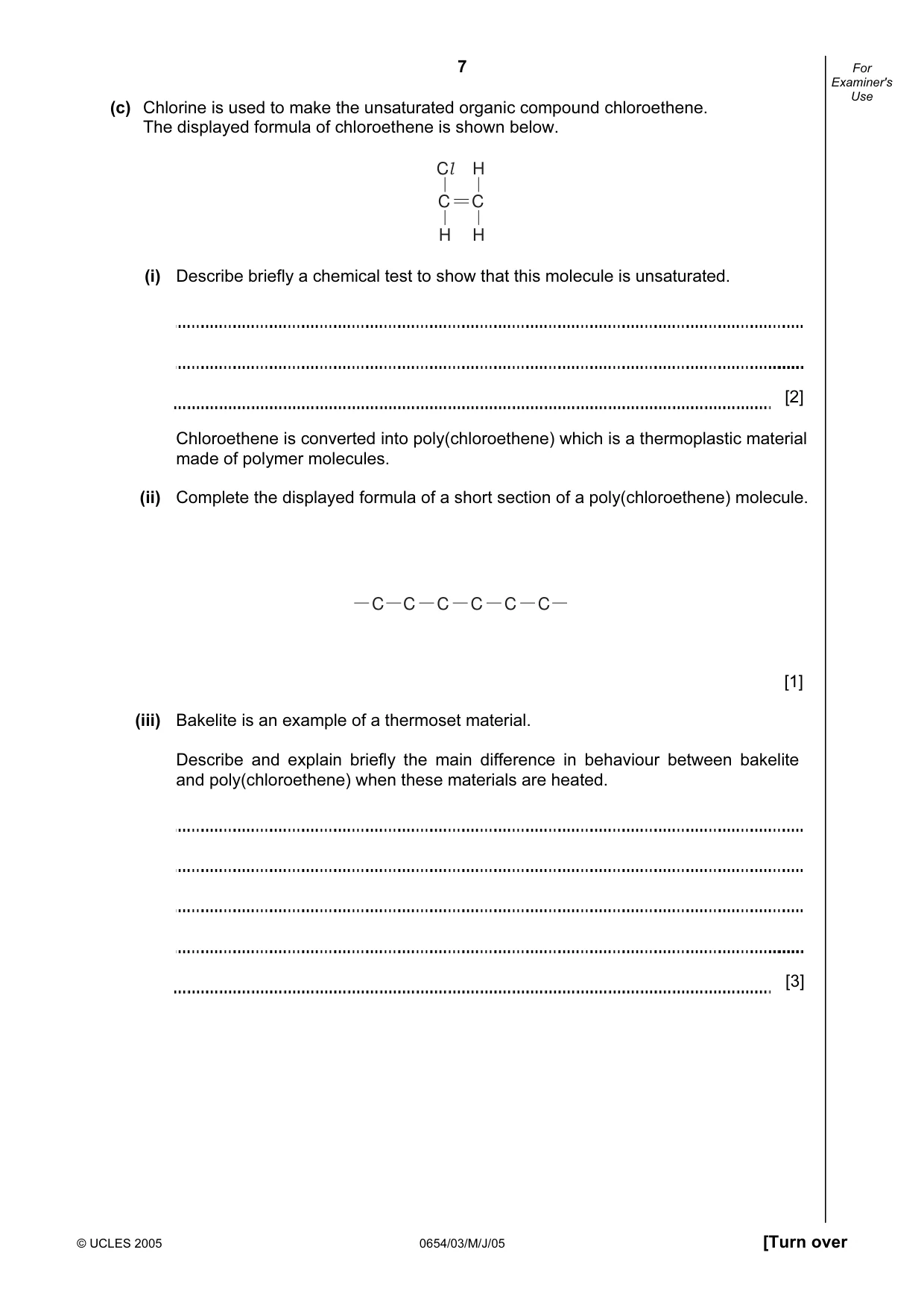
7 © UCLES 2005 0654/03/M/J/05 [Turn over For Examiner's Use (c) Chlorine is used to make the unsaturated organic compound chloroethene. The displayed formula of chloroethene is shown below. C Cl H C H H (i) Describe briefly a chemical test to show that this molecule is unsaturated. [2] Chloroethene is converted into poly(chloroethene) which is a thermoplastic material made of polymer molecules. (ii) Complete the displayed formula of a short section of a poly(chloroethene) molecule. C C C C C C [1] (iii) Bakelite is an example of a thermoset material. Describe and explain briefly the main difference in behaviour between bakelite and poly(chloroethene) when these materials are heated. [3]
Question paper, page 8
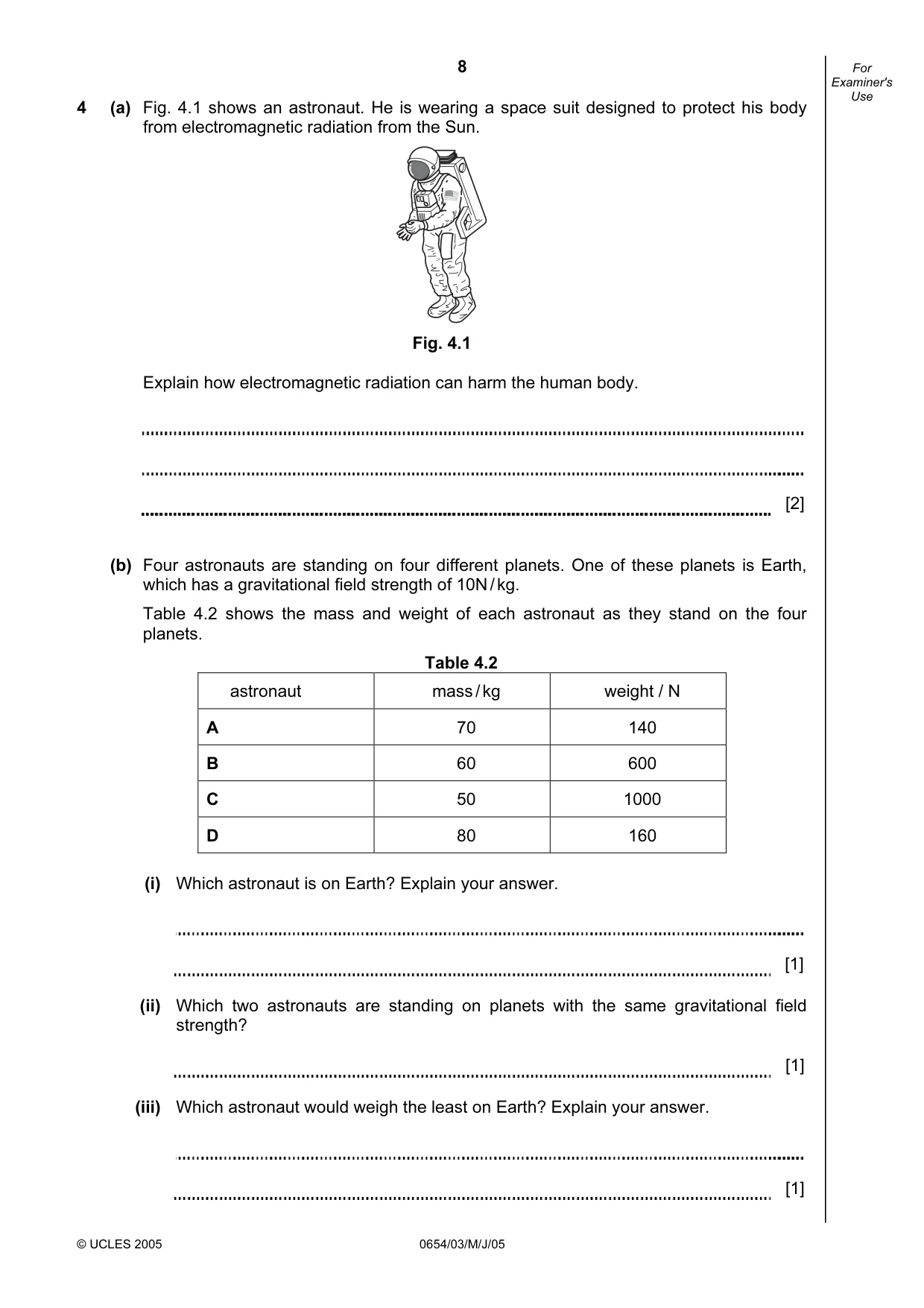
8 © UCLES 2005 0654/03/M/J/05 For Examiner's Use 4 (a) Fig. 4.1 shows an astronaut. He is wearing a space suit designed to protect his body from electromagnetic radiation from the Sun. Fig. 4.1 Explain how electromagnetic radiation can harm the human body. [2] (b) Four astronauts are standing on four different planets. One of these planets is Earth, which has a gravitational field strength of 10N / kg. Table 4.2 shows the mass and weight of each astronaut as they stand on the four planets. Table 4.2 astronaut mass / kg weight / N A 70 140 B 60 600 C 50 1000 D 80 160 (i) Which astronaut is on Earth? Explain your answer. [1] (ii) Which two astronauts are standing on planets with the same gravitational field strength? [1] (iii) Which astronaut would weigh the least on Earth? Explain your answer. [1]
Question paper, page 9
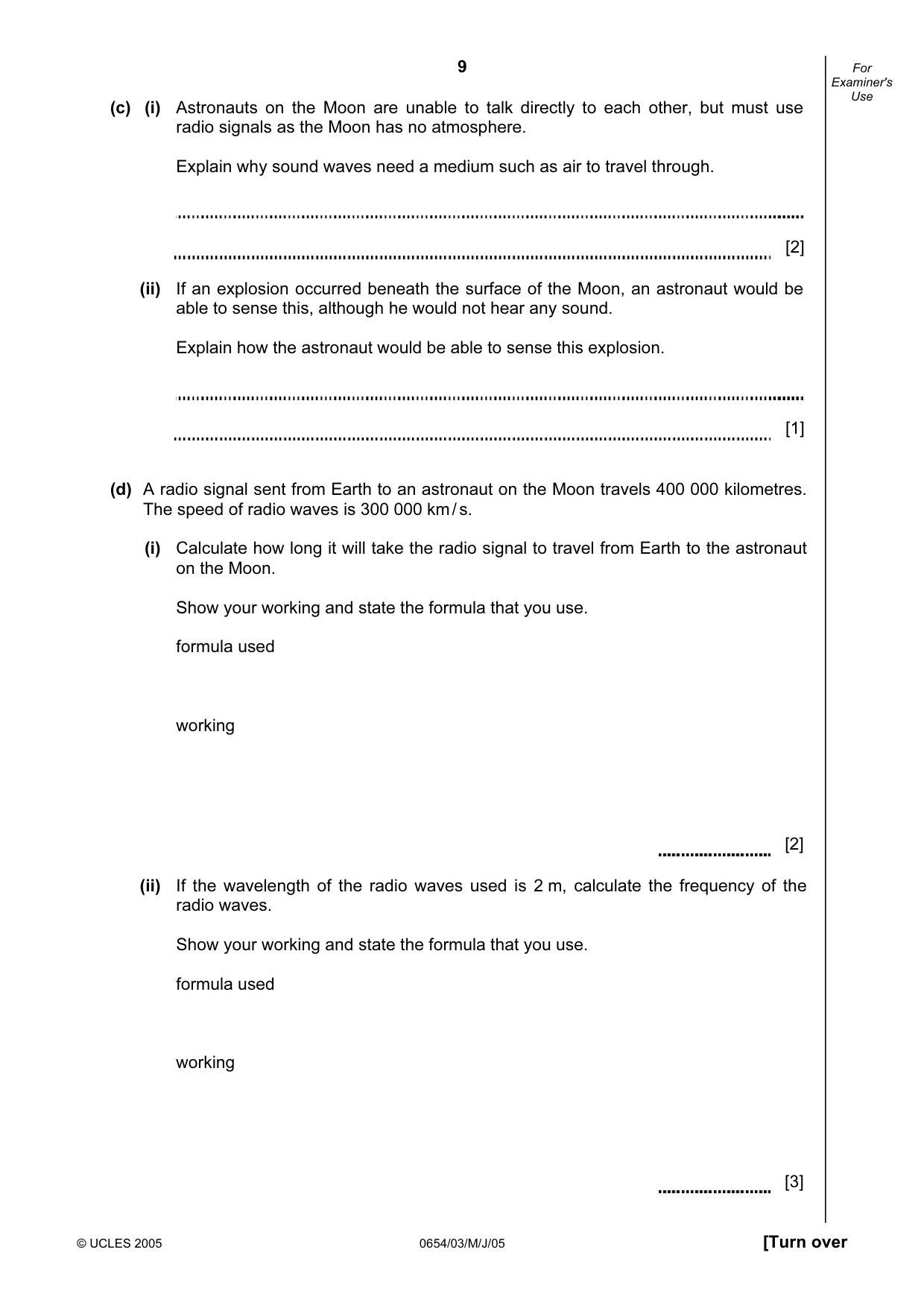
9 © UCLES 2005 0654/03/M/J/05 [Turn over For Examiner's Use (c) (i) Astronauts on the Moon are unable to talk directly to each other, but must use radio signals as the Moon has no atmosphere. Explain why sound waves need a medium such as air to travel through. [2] (ii) If an explosion occurred beneath the surface of the Moon, an astronaut would be able to sense this, although he would not hear any sound. Explain how the astronaut would be able to sense this explosion. [1] (d) A radio signal sent from Earth to an astronaut on the Moon travels 400 000 kilometres. The speed of radio waves is 300 000 km / s. (i) Calculate how long it will take the radio signal to travel from Earth to the astronaut on the Moon. Show your working and state the formula that you use. formula used working [2] (ii) If the wavelength of the radio waves used is 2 m, calculate the frequency of the radio waves. Show your working and state the formula that you use. formula used working [3]
Question paper, page 10
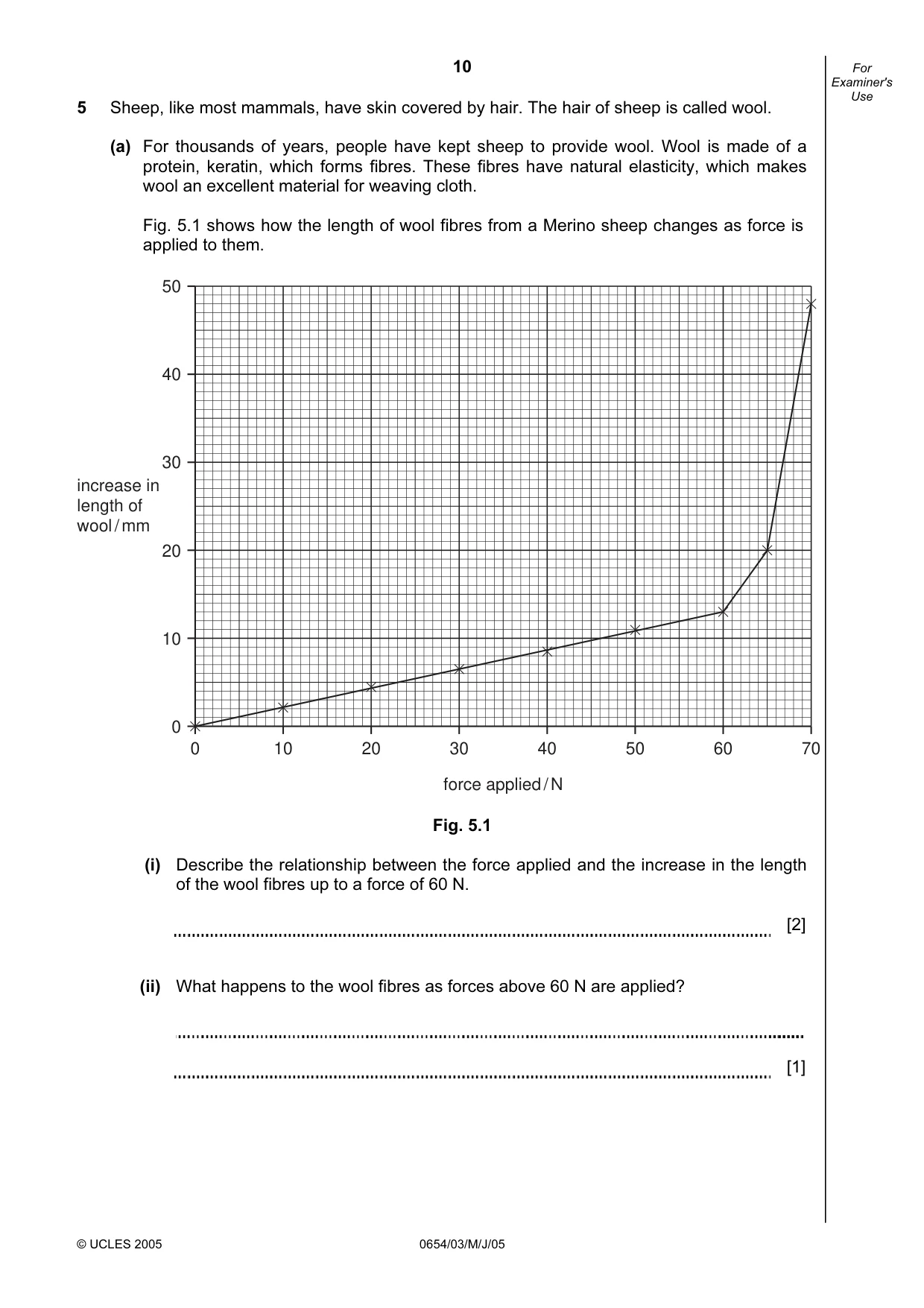
10 © UCLES 2005 0654/03/M/J/05 For Examiner's Use 5 Sheep, like most mammals, have skin covered by hair. The hair of sheep is called wool. (a) For thousands of years, people have kept sheep to provide wool. Wool is made of a protein, keratin, which forms fibres. These fibres have natural elasticity, which makes wool an excellent material for weaving cloth. Fig. 5.1 shows how the length of wool fibres from a Merino sheep changes as force is applied to them. 50 40 30 20 10 0 0 10 20 30 40 50 60 70 increase in length of wool / mm force applied / N Fig. 5.1 (i) Describe the relationship between the force applied and the increase in the length of the wool fibres up to a force of 60 N. [2] (ii) What happens to the wool fibres as forces above 60 N are applied? [1]
Question paper, page 11
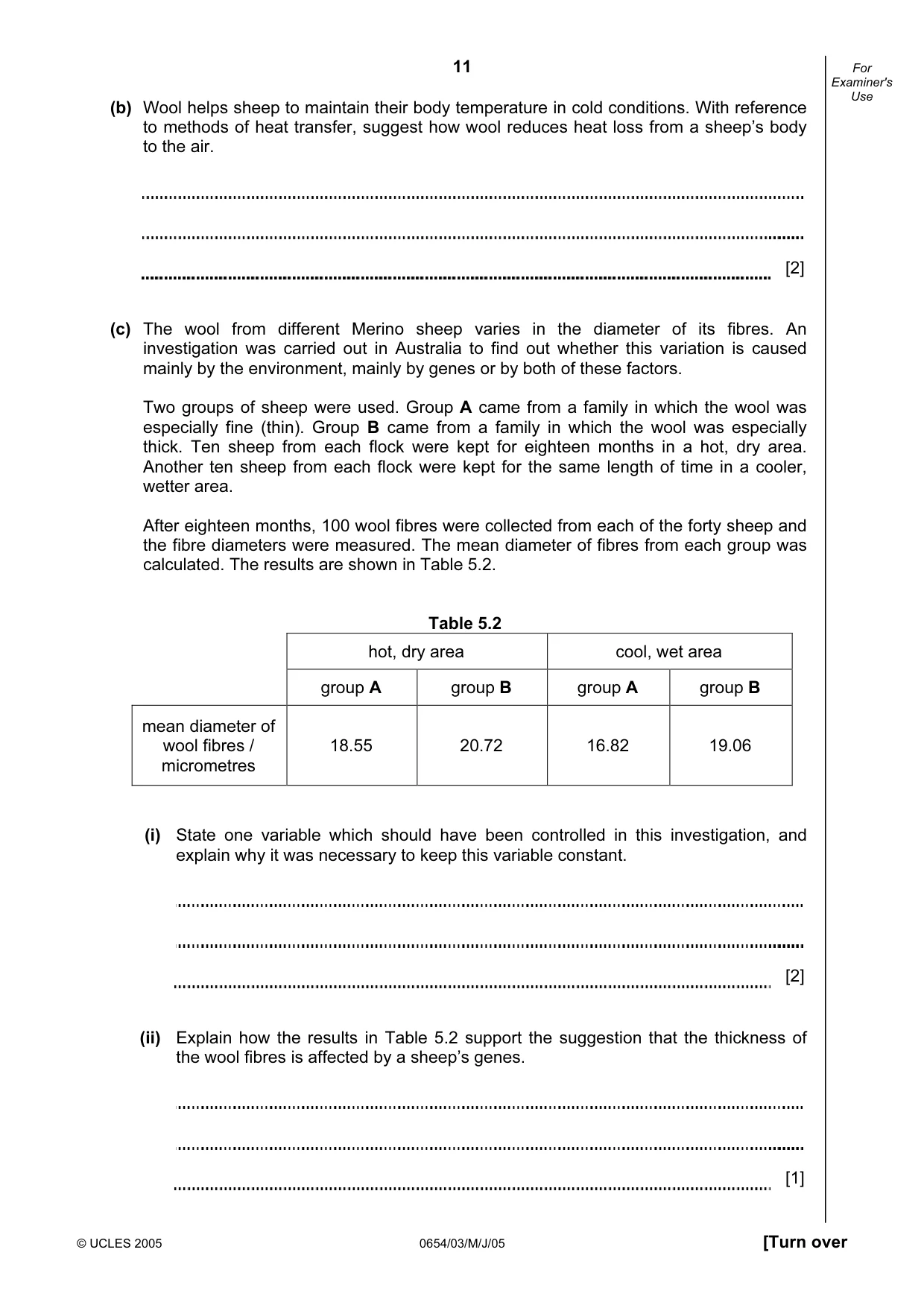
11 © UCLES 2005 0654/03/M/J/05 [Turn over For Examiner's Use (b) Wool helps sheep to maintain their body temperature in cold conditions. With reference to methods of heat transfer, suggest how wool reduces heat loss from a sheep’s body to the air. [2] (c) The wool from different Merino sheep varies in the diameter of its fibres. An investigation was carried out in Australia to find out whether this variation is caused mainly by the environment, mainly by genes or by both of these factors. Two groups of sheep were used. Group A came from a family in which the wool was especially fine (thin). Group B came from a family in which the wool was especially thick. Ten sheep from each flock were kept for eighteen months in a hot, dry area. Another ten sheep from each flock were kept for the same length of time in a cooler, wetter area. After eighteen months, 100 wool fibres were collected from each of the forty sheep and the fibre diameters were measured. The mean diameter of fibres from each group was calculated. The results are shown in Table 5.2. Table 5.2 hot, dry area cool, wet area group A group B group A group B mean diameter of wool fibres / micrometres 18.55 20.72 16.82 19.06 (i) State one variable which should have been controlled in this investigation, and explain why it was necessary to keep this variable constant. [2] (ii) Explain how the results in Table 5.2 support the suggestion that the thickness of the wool fibres is affected by a sheep’s genes. [1]
Question paper, page 12
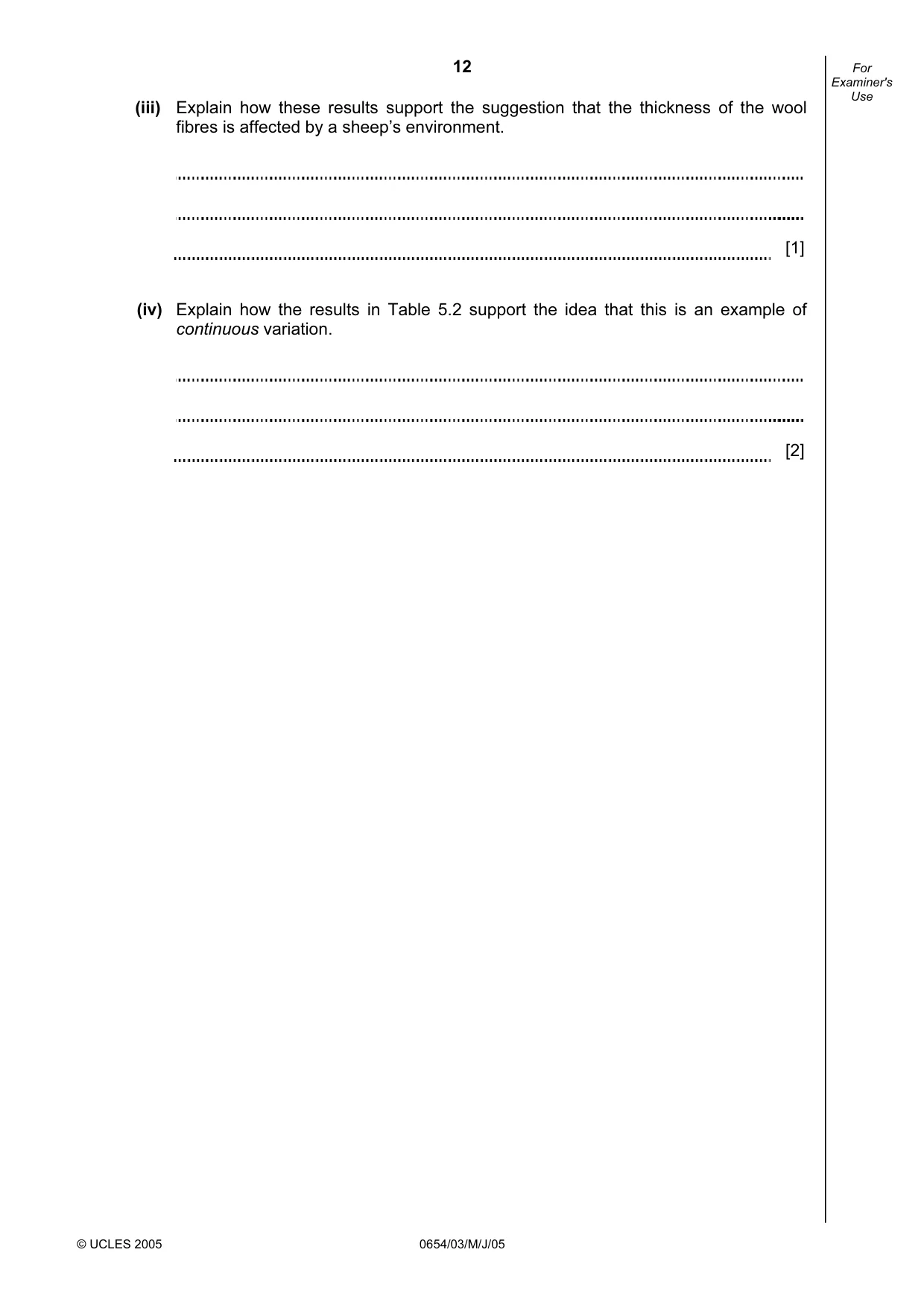
12 © UCLES 2005 0654/03/M/J/05 For Examiner's Use (iii) Explain how these results support the suggestion that the thickness of the wool fibres is affected by a sheep’s environment. [1] (iv) Explain how the results in Table 5.2 support the idea that this is an example of continuous variation. [2]
Question paper, page 13
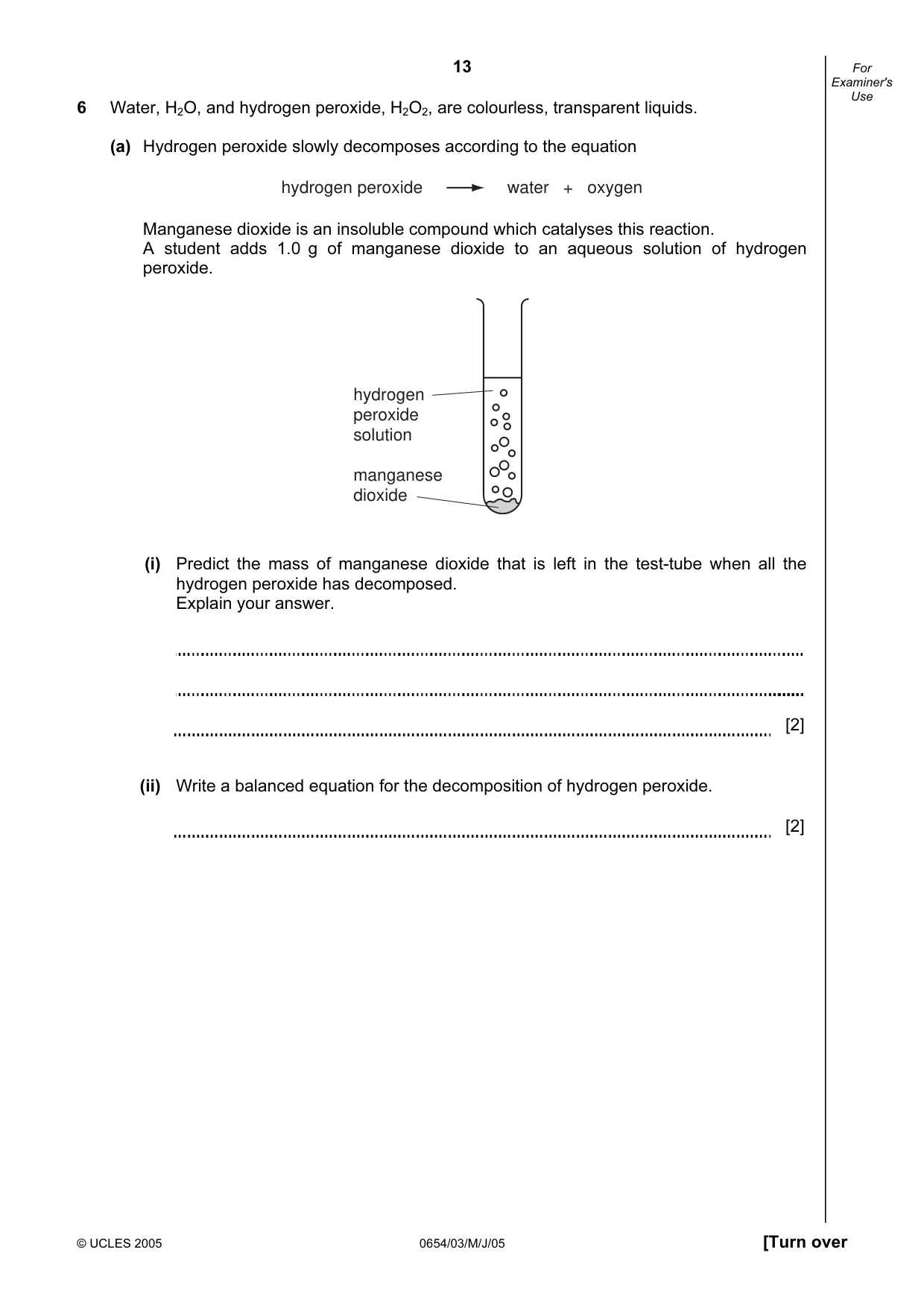
13 © UCLES 2005 0654/03/M/J/05 [Turn over For Examiner's Use 6 Water, H2O, and hydrogen peroxide, H2O2, are colourless, transparent liquids. (a) Hydrogen peroxide slowly decomposes according to the equation hydrogen peroxide water + oxygen Manganese dioxide is an insoluble compound which catalyses this reaction. A student adds 1.0 g of manganese dioxide to an aqueous solution of hydrogen peroxide. hydrogen peroxide solution manganese dioxide (i) Predict the mass of manganese dioxide that is left in the test-tube when all the hydrogen peroxide has decomposed. Explain your answer. [2] (ii) Write a balanced equation for the decomposition of hydrogen peroxide. [2]
Question paper, page 14
14 © UCLES 2005 0654/03/M/J/05 For Examiner's Use (b) Water that contains permanent hardness cannot be softened by boiling. Describe briefly how the process of ion-exchange removes permanent hardness from water. You may draw a diagram if it helps you to answer this question. [3]
Question paper, page 15
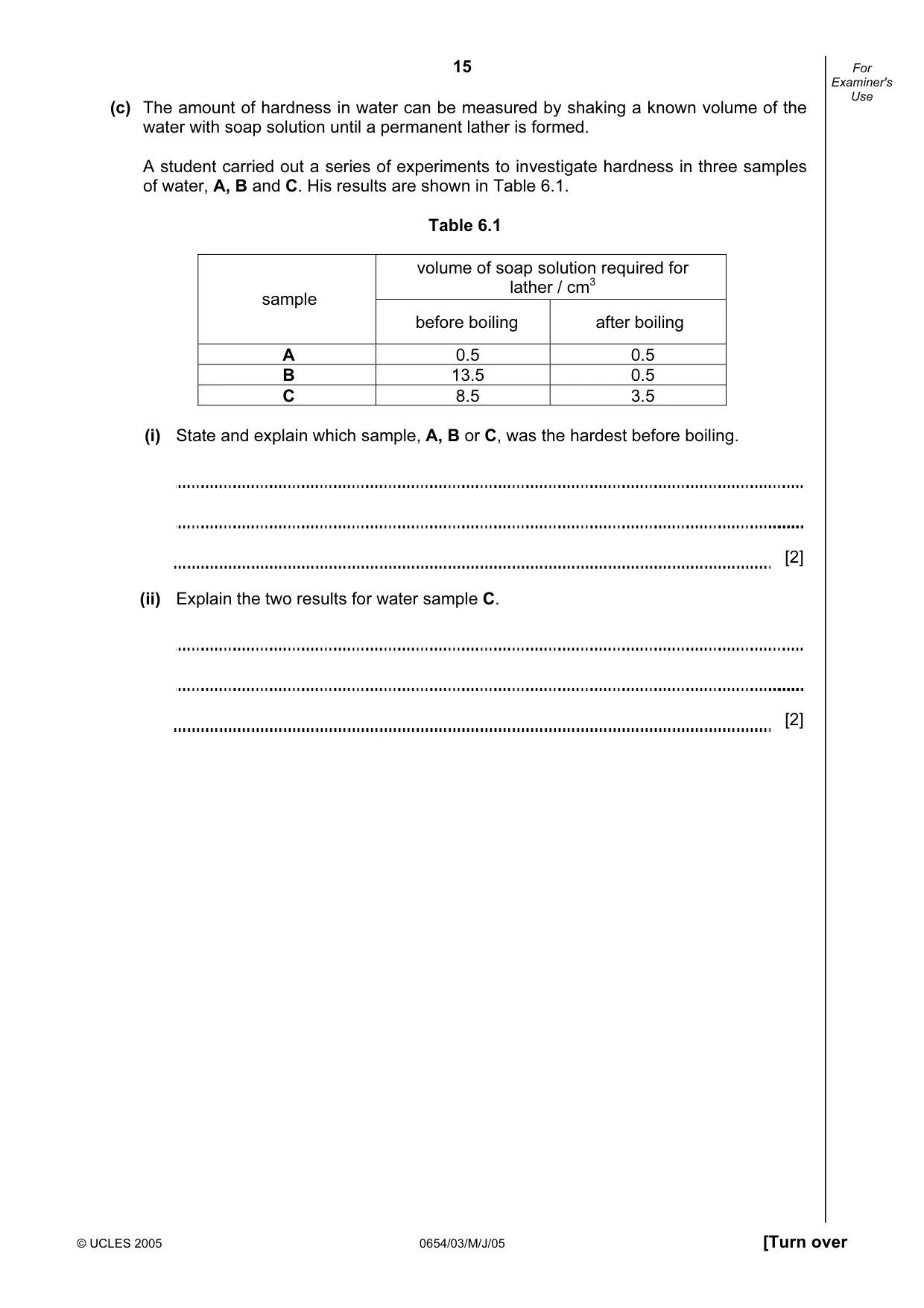
15 © UCLES 2005 0654/03/M/J/05 [Turn over For Examiner's Use (c) The amount of hardness in water can be measured by shaking a known volume of the water with soap solution until a permanent lather is formed. A student carried out a series of experiments to investigate hardness in three samples of water, A, B and C. His results are shown in Table 6.1. Table 6.1 volume of soap solution required for lather / cm3 sample before boiling after boiling A 0.5 0.5 B 13.5 0.5 C 8.5 3.5 (i) State and explain which sample, A, B or C, was the hardest before boiling. [2] (ii) Explain the two results for water sample C. [2]
Question paper, page 16
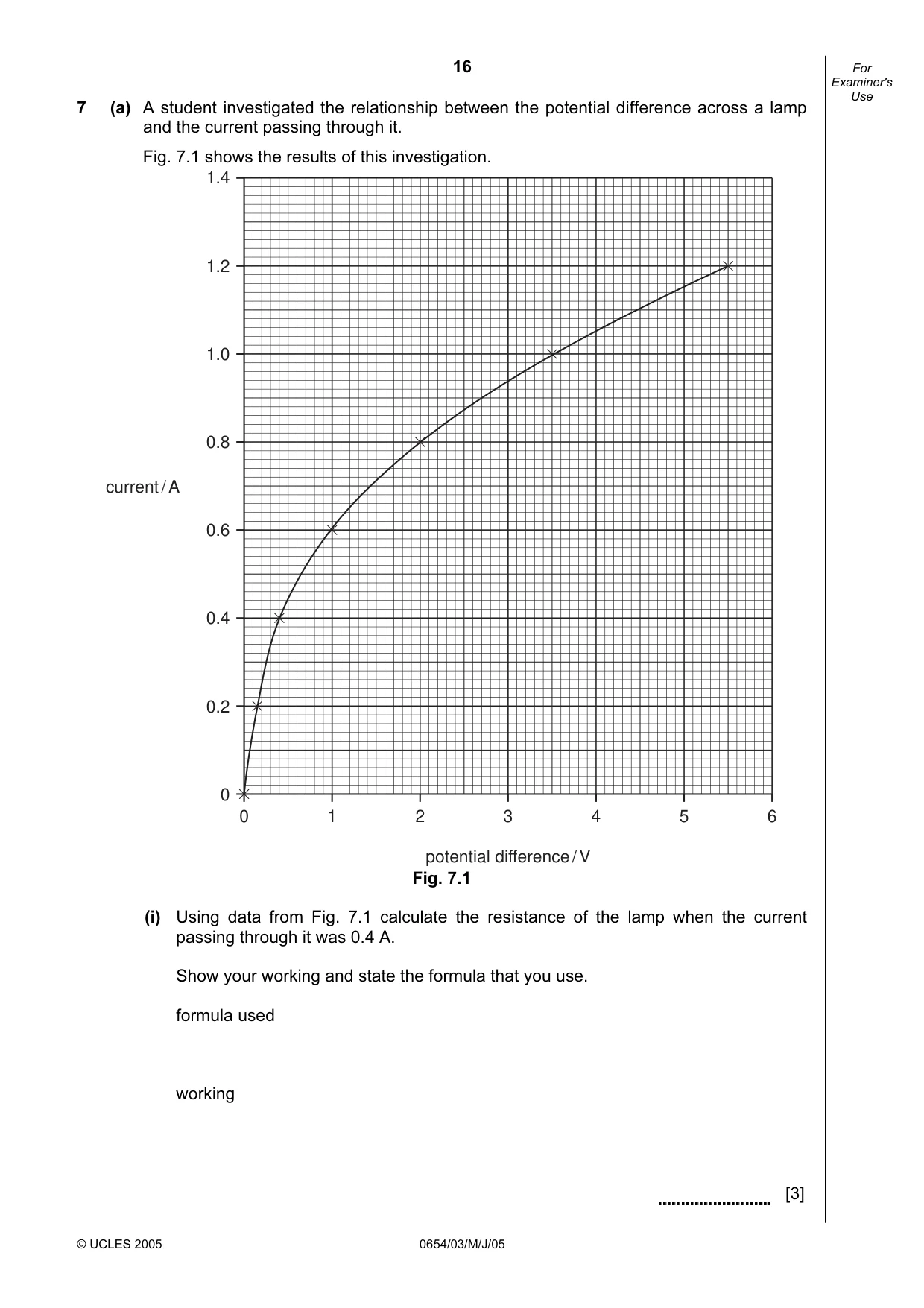
16 © UCLES 2005 0654/03/M/J/05 For Examiner's Use 7 (a) A student investigated the relationship between the potential difference across a lamp and the current passing through it. Fig. 7.1 shows the results of this investigation. 1.4 1.2 1.0 0.8 0.6 0.4 0.2 0 0 1 2 3 potential difference / V 4 5 6 current / A Fig. 7.1 (i) Using data from Fig. 7.1 calculate the resistance of the lamp when the current passing through it was 0.4 A. Show your working and state the formula that you use. formula used working [3]
Question paper, page 17
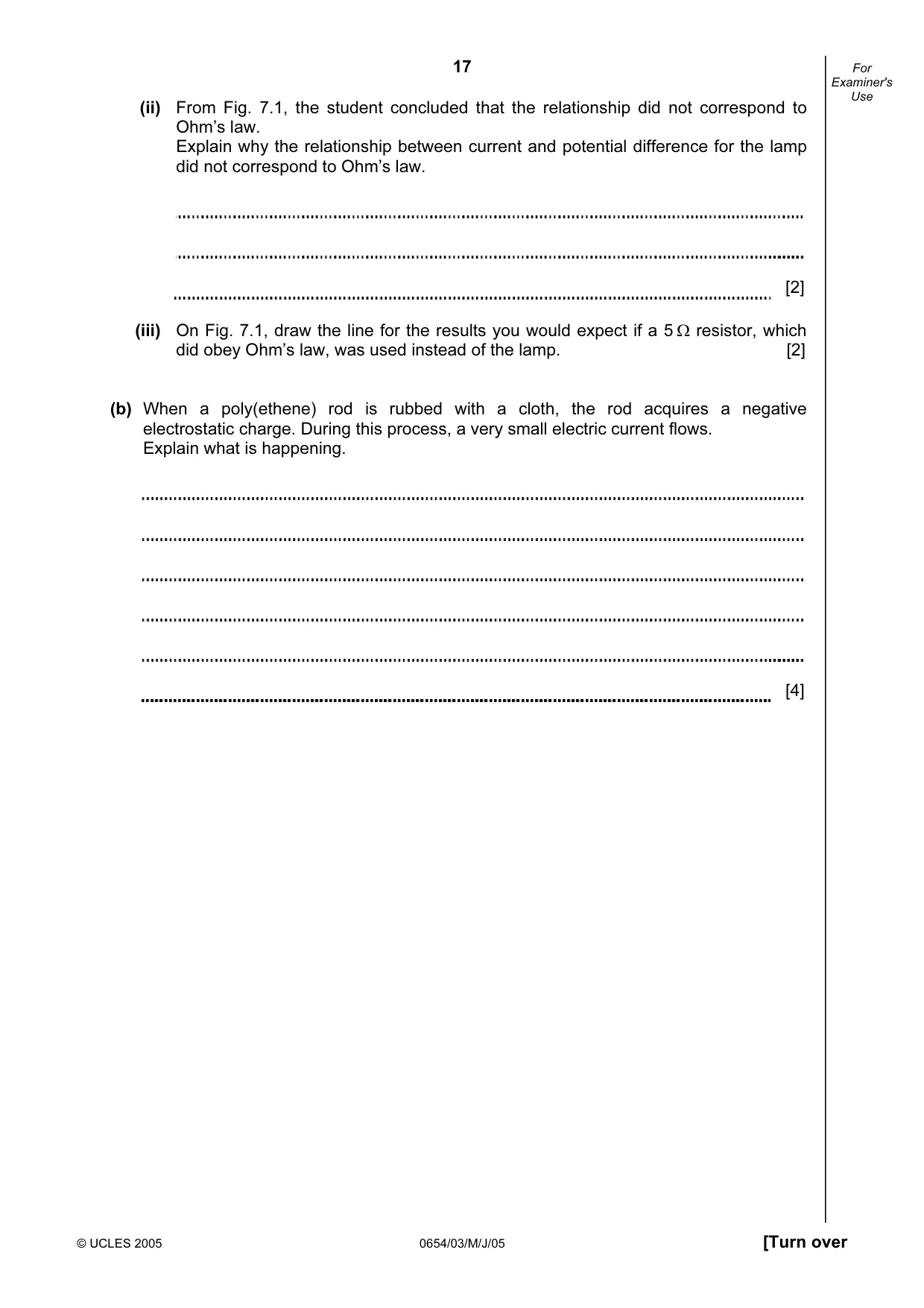
17 © UCLES 2005 0654/03/M/J/05 [Turn over For Examiner's Use (ii) From Fig. 7.1, the student concluded that the relationship did not correspond to Ohm’s law. Explain why the relationship between current and potential difference for the lamp did not correspond to Ohm’s law. [2] (iii) On Fig. 7.1, draw the line for the results you would expect if a 5 Ω resistor, which did obey Ohm’s law, was used instead of the lamp. [2] (b) When a poly(ethene) rod is rubbed with a cloth, the rod acquires a negative electrostatic charge. During this process, a very small electric current flows. Explain what is happening. [4]
Question paper, page 18
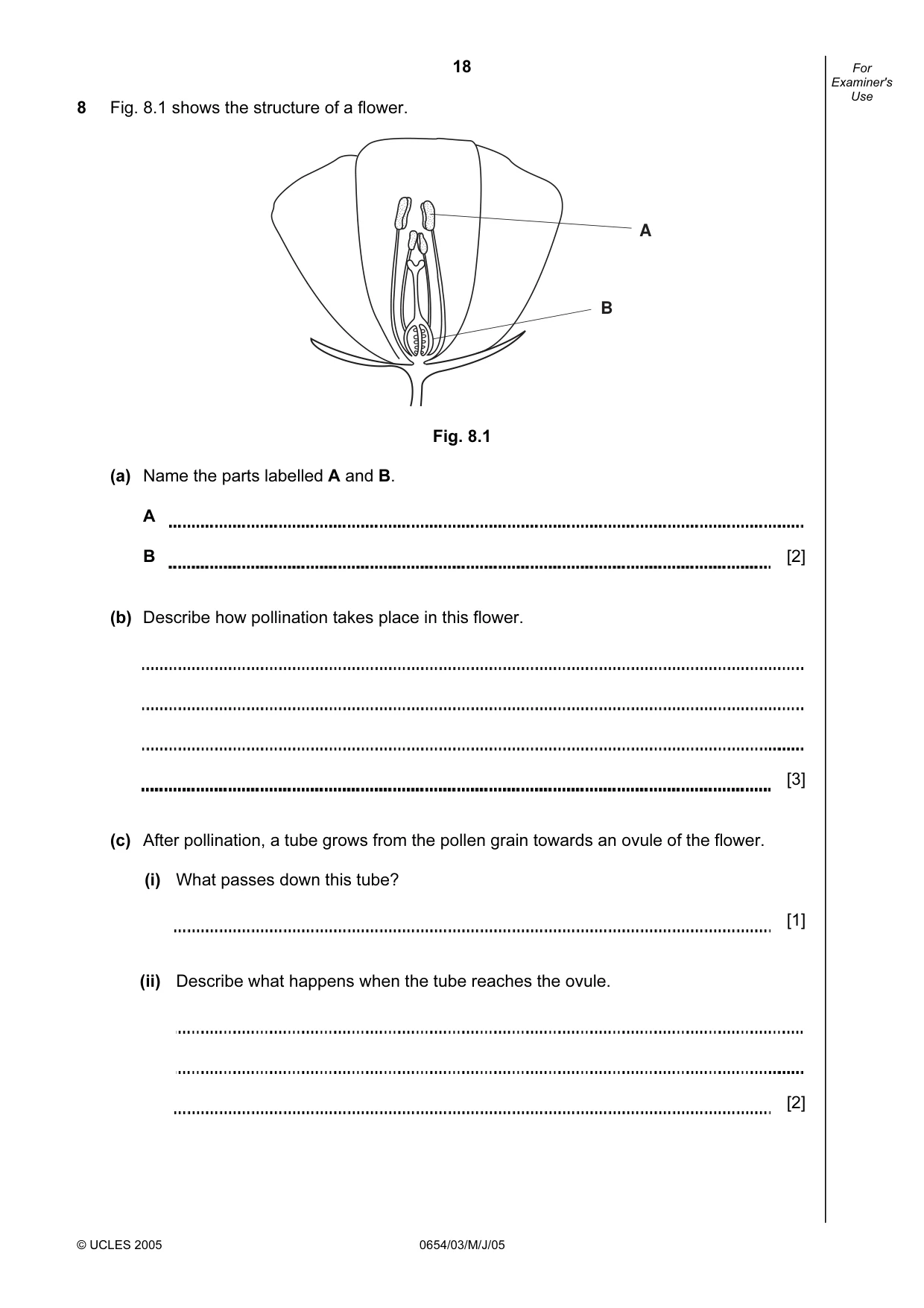
18 © UCLES 2005 0654/03/M/J/05 For Examiner's Use 8 Fig. 8.1 shows the structure of a flower. A B Fig. 8.1 (a) Name the parts labelled A and B. A B [2] (b) Describe how pollination takes place in this flower. [3] (c) After pollination, a tube grows from the pollen grain towards an ovule of the flower. (i) What passes down this tube? [1] (ii) Describe what happens when the tube reaches the ovule. [2]
Question paper, page 19
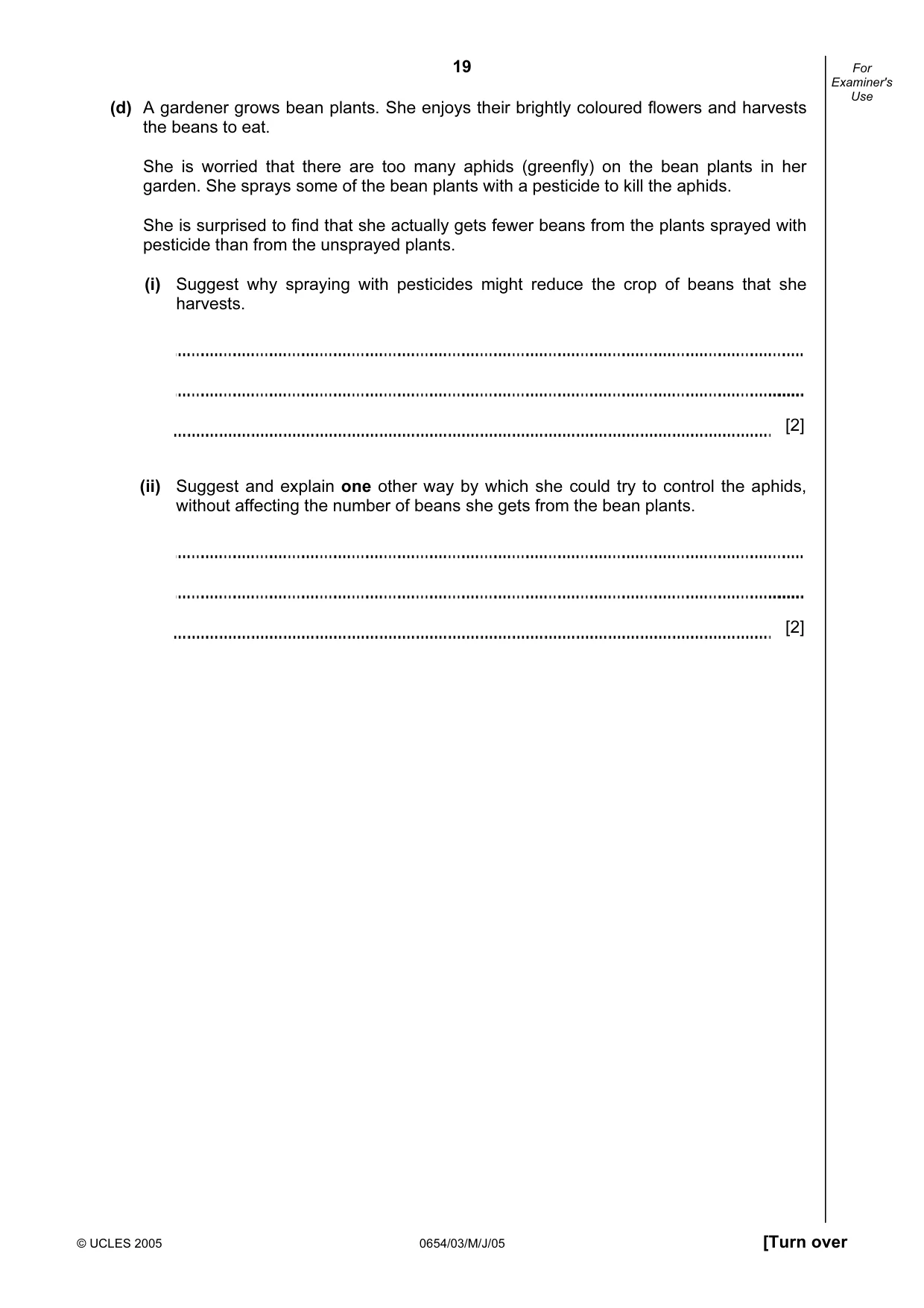
19 © UCLES 2005 0654/03/M/J/05 [Turn over For Examiner's Use (d) A gardener grows bean plants. She enjoys their brightly coloured flowers and harvests the beans to eat. She is worried that there are too many aphids (greenfly) on the bean plants in her garden. She sprays some of the bean plants with a pesticide to kill the aphids. She is surprised to find that she actually gets fewer beans from the plants sprayed with pesticide than from the unsprayed plants. (i) Suggest why spraying with pesticides might reduce the crop of beans that she harvests. [2] (ii) Suggest and explain one other way by which she could try to control the aphids, without affecting the number of beans she gets from the bean plants. [2]
Question paper, page 20
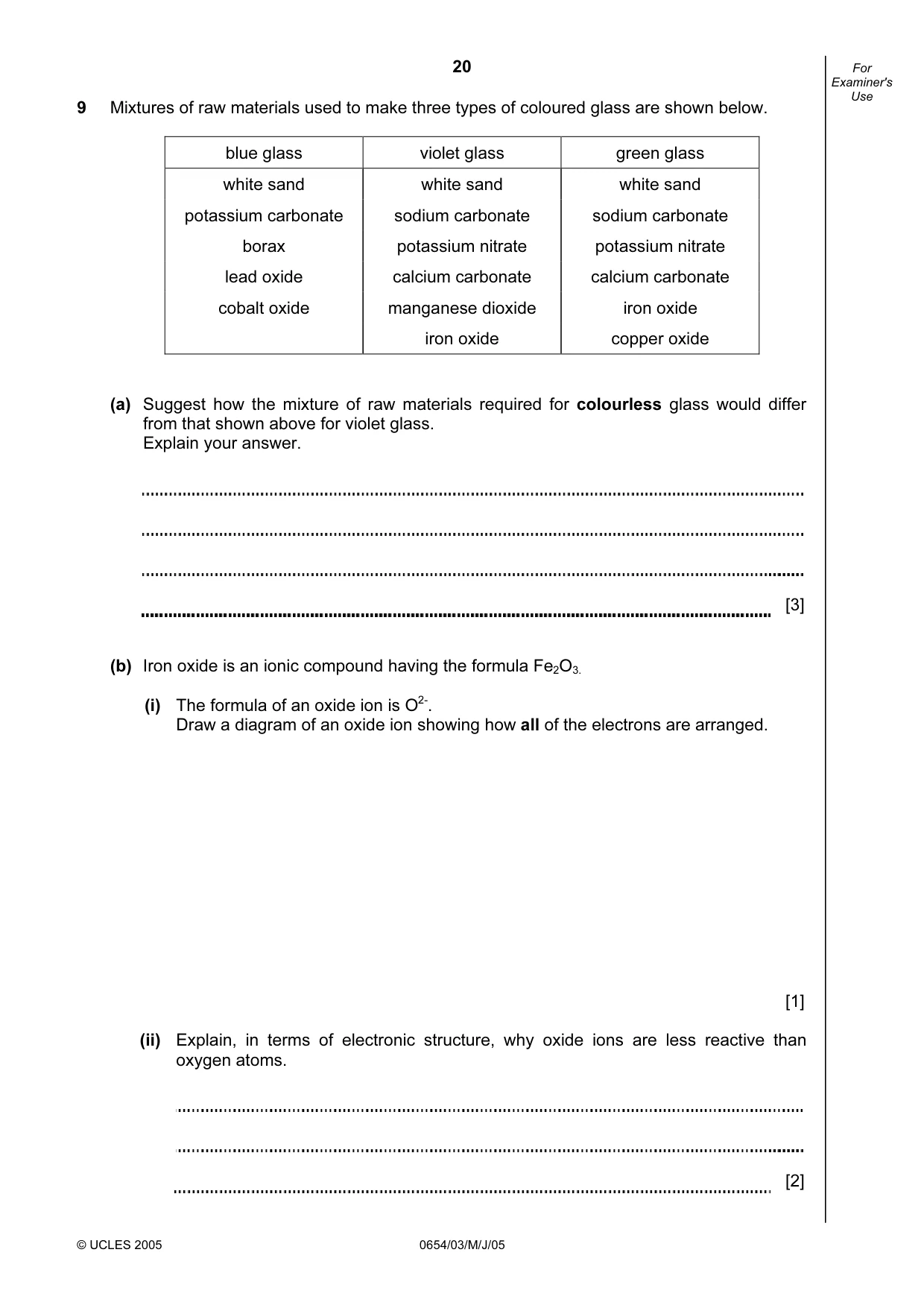
20 © UCLES 2005 0654/03/M/J/05 For Examiner's Use 9 Mixtures of raw materials used to make three types of coloured glass are shown below. blue glass violet glass green glass white sand white sand white sand potassium carbonate sodium carbonate sodium carbonate borax potassium nitrate potassium nitrate lead oxide calcium carbonate calcium carbonate cobalt oxide manganese dioxide iron oxide iron oxide copper oxide (a) Suggest how the mixture of raw materials required for colourless glass would differ from that shown above for violet glass. Explain your answer. [3] (b) Iron oxide is an ionic compound having the formula Fe2O3. (i) The formula of an oxide ion is O2-. Draw a diagram of an oxide ion showing how all of the electrons are arranged. [1] (ii) Explain, in terms of electronic structure, why oxide ions are less reactive than oxygen atoms. [2]
Question paper, page 21
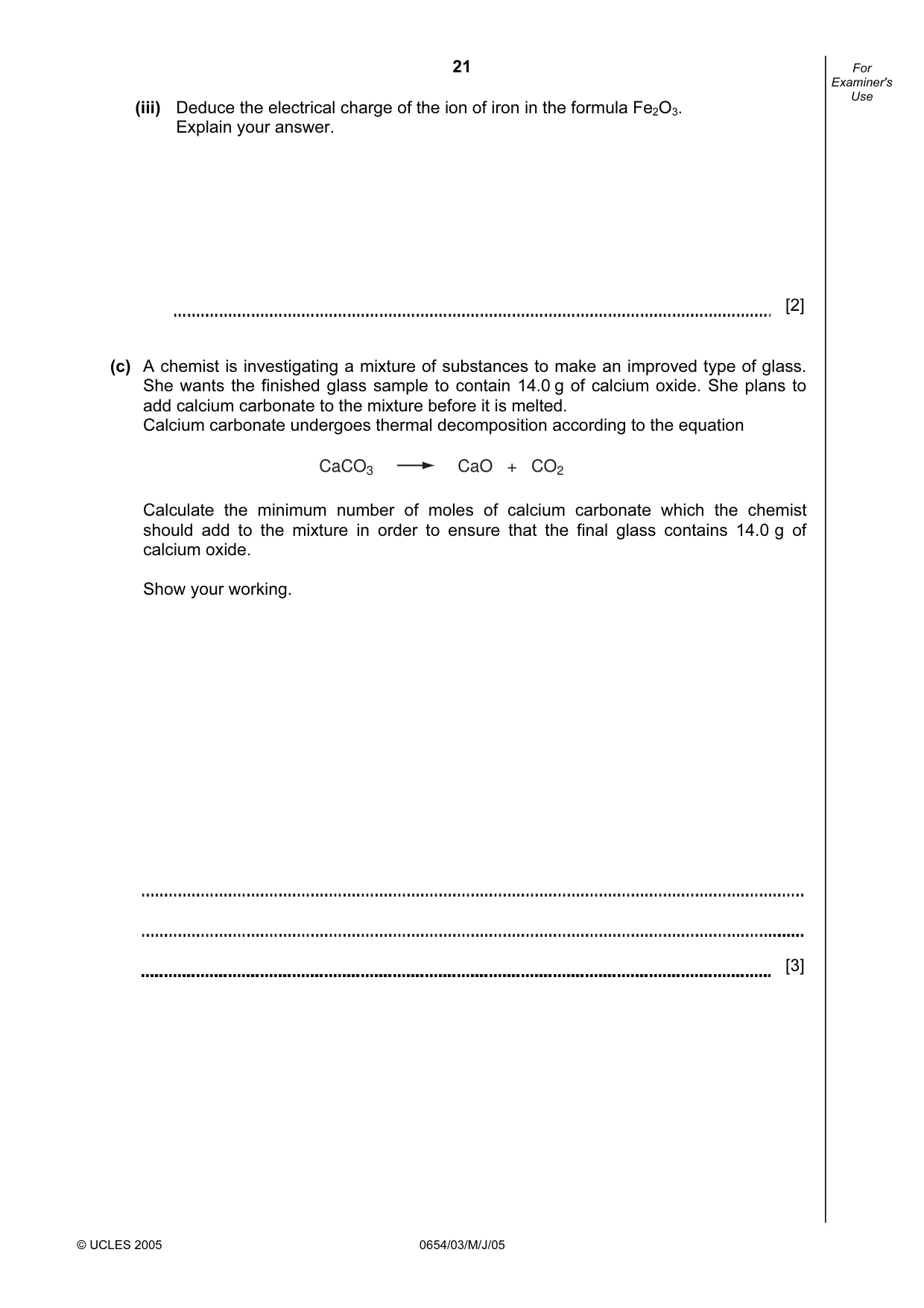
21 © UCLES 2005 0654/03/M/J/05 For Examiner's Use (iii) Deduce the electrical charge of the ion of iron in the formula Fe2O3. Explain your answer. [2] (c) A chemist is investigating a mixture of substances to make an improved type of glass. She wants the finished glass sample to contain 14.0 g of calcium oxide. She plans to add calcium carbonate to the mixture before it is melted. Calcium carbonate undergoes thermal decomposition according to the equation CaCO3 CaO + CO2 Calculate the minimum number of moles of calcium carbonate which the chemist should add to the mixture in order to ensure that the final glass contains 14.0 g of calcium oxide. Show your working. [3]
Question paper, page 23
23 Permission to reproduce items where third-party owned material protected by copyright is included has been sought and cleared where possible. Every reasonable effort has been made by the publisher (UCLES) to trace copyright holders, but if any items requiring clearance have unwittingly been included, the publisher will be pleased to make amends at the earliest possible opportunity. University of Cambridge International Examinations is part of the University of Cambridge Local Examinations Syndicate (UCLES), which is itself a department of the University of Cambridge. 0654/03/M/J/05 BLANK PAGE
Question paper, page 24
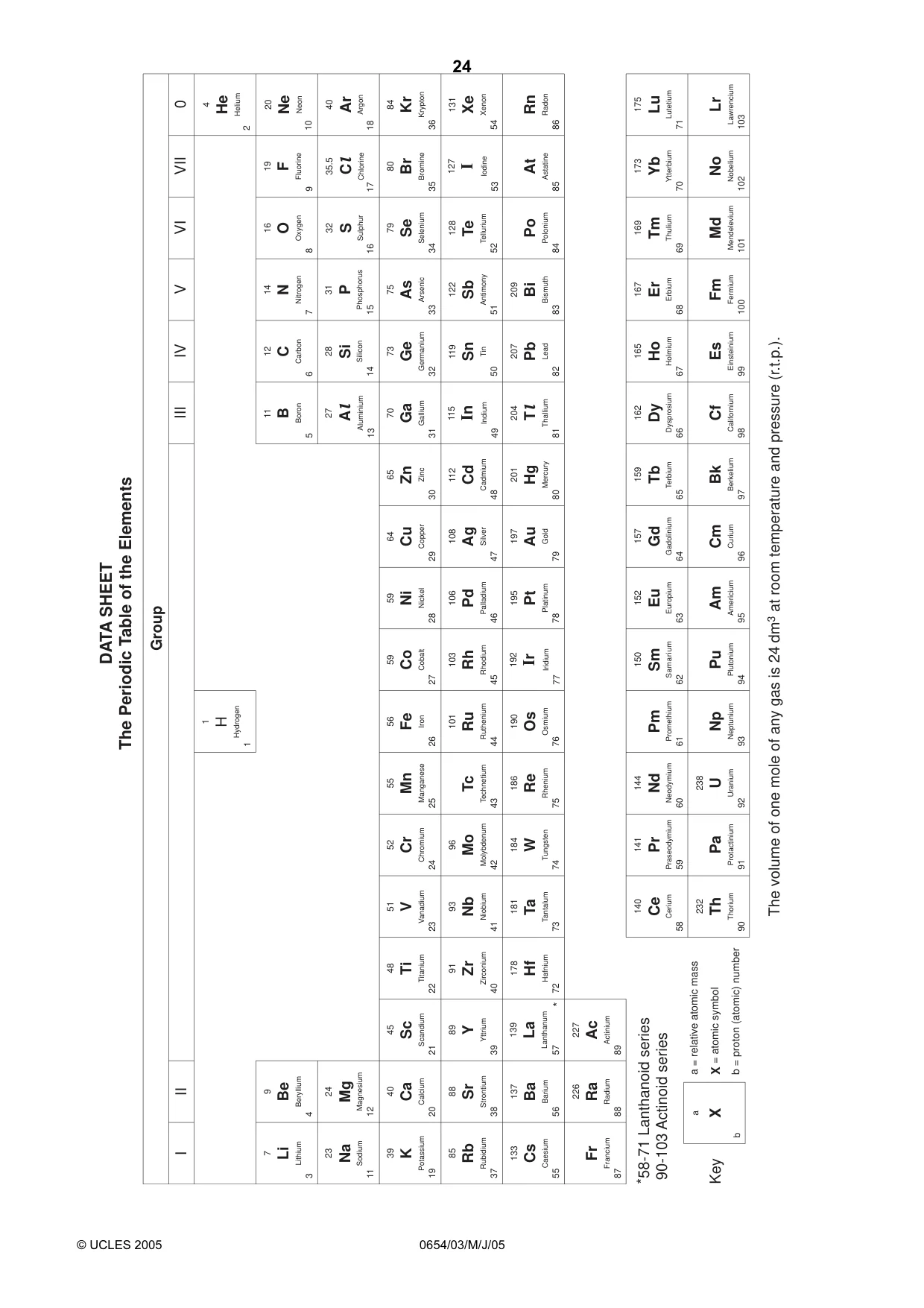
24 © UCLES 2005 0654/03/M/J/05 Group 140 Ce Cerium 58 141 Pr Praseodymium 59 144 Nd Neodymium 60 Pm Promethium 61 150 Sm Samarium 62 152 Eu Europium 63 157 Gd Gadolinium 64 159 Tb Terbium 65 162 Dy Dysprosium 66 165 Ho Holmium 67 167 Er Erbium 68 169 Tm Thulium 69 173 Yb Ytterbium 70 175 Lu Lutetium 71 232 Th Thorium 90 Pa Protactinium 91 238 U Uranium 92 Np Neptunium 93 Pu Plutonium 94 Am Americium 95 Cm Curium 96 Bk Berkelium 97 Cf Californium 98 Es Einsteinium 99 Fm Fermium 100 Md Mendelevium 101 No Nobelium 102 Lr Lawrencium 103 1 H Hydrogen 1 7 Li Lithium 3 23 Na Sodium 11 24 Mg Magnesium 12 40 Ca Calcium 20 45 Sc Scandium 21 48 Ti Titanium 22 51 V Vanadium 23 52 Cr Chromium 24 55 Mn Manganese 25 56 Fe Iron 26 59 Co Cobalt 27 59 Ni Nickel 28 64 Cu Copper 29 65 Zn Zinc 30 70 Ga Gallium 31 27 Al Aluminium 13 11 B Boron 5 12 C Carbon 6 14 N Nitrogen 7 16 O Oxygen 8 19 F Fluorine 9 28 Si Silicon 14 31 P Phosphorus 15 32 S Sulphur 16 35.5 Cl Chlorine 17 40 Ar Argon 18 20 Ne Neon 10 4 He Helium 2 73 Ge Germanium 32 75 As Arsenic 33 79 Se Selenium 34 80 Br Bromine 35 84 Kr Krypton 36 39 K Potassium 19 88 Sr Strontium 38 89 Y Yttrium 39 91 Zr Zirconium 40 93 Nb Niobium 41 96 Mo Molybdenum 42 Tc Technetium 43 101 Ru Ruthenium 44 103 Rh Rhodium 45 106 Pd Palladium 46 108 Ag Silver 47 112 Cd Cadmium 48 115 In Indium 49 119 Sn Tin 50 122 Sb Antimony 51 128 Te Tellurium 52 127 I Iodine 53 131 Xe Xenon 54 137 Ba Barium 56 139 La Lanthanum 57 * 178 Hf Hafnium 72 181 Ta Tantalum 73 184 W Tungsten 74 186 Re Rhenium 75 190 Os Osmium 76 192 Ir Iridium 77 195 Pt Platinum 78 197 Au Gold 79 201 Hg Mercury 80 204 Tl Thallium 81 207 Pb Lead 82 209 Bi Bismuth 83 Po Polonium 84 At Astatine 85 Rn Radon 86 Fr Francium 87 227 Ac Actinium 89 9 Be Beryllium 4 I II III IV V VI VII 0 85 Rb Rubidium 37 133 Cs Caesium 55 226 Ra Radium 88 The volume of one mole of any gas is 24 dm3 at room temperature and pressure (r.t.p.). a X b a = relative atomic mass X = atomic symbol b = proton (atomic) number Key *58-71 Lanthanoid series 90-103 Actinoid series DATA SHEET The Periodic Table of the Elements
Mark scheme, page 1
UNIVERSITY OF CAMBRIDGE INTERNATIONAL EXAMINATIONS International General Certificate of Secondary Education MARK SCHEME for the June 2005 question paper 0654 CO-ORDINATED SCIENCES 0654/03 Paper 3 (Extended Theory), maximum mark 100 This mark scheme is published as an aid to teachers and students, to indicate the requirements of the examination. It shows the basis on which Examiners were initially instructed to award marks. It does not indicate the details of the discussions that took place at an Examiners’ meeting before marking began. Any substantial changes to the mark scheme that arose from these discussions will be recorded in the published Report on the Examination. All Examiners are instructed that alternative correct answers and unexpected approaches in candidates’ scripts must be given marks that fairly reflect the relevant knowledge and skills demonstrated. Mark schemes must be read in conjunction with the question papers and the Report on the Examination. • CIE will not enter into discussion or correspondence in connection with these mark schemes. CIE is publishing the mark schemes for the June 2005 question papers for most IGCSE and GCE Advanced Level and Advanced Subsidiary Level syllabuses and some Ordinary Level syllabuses. www.XtremePapers.com
Mark scheme, page 2
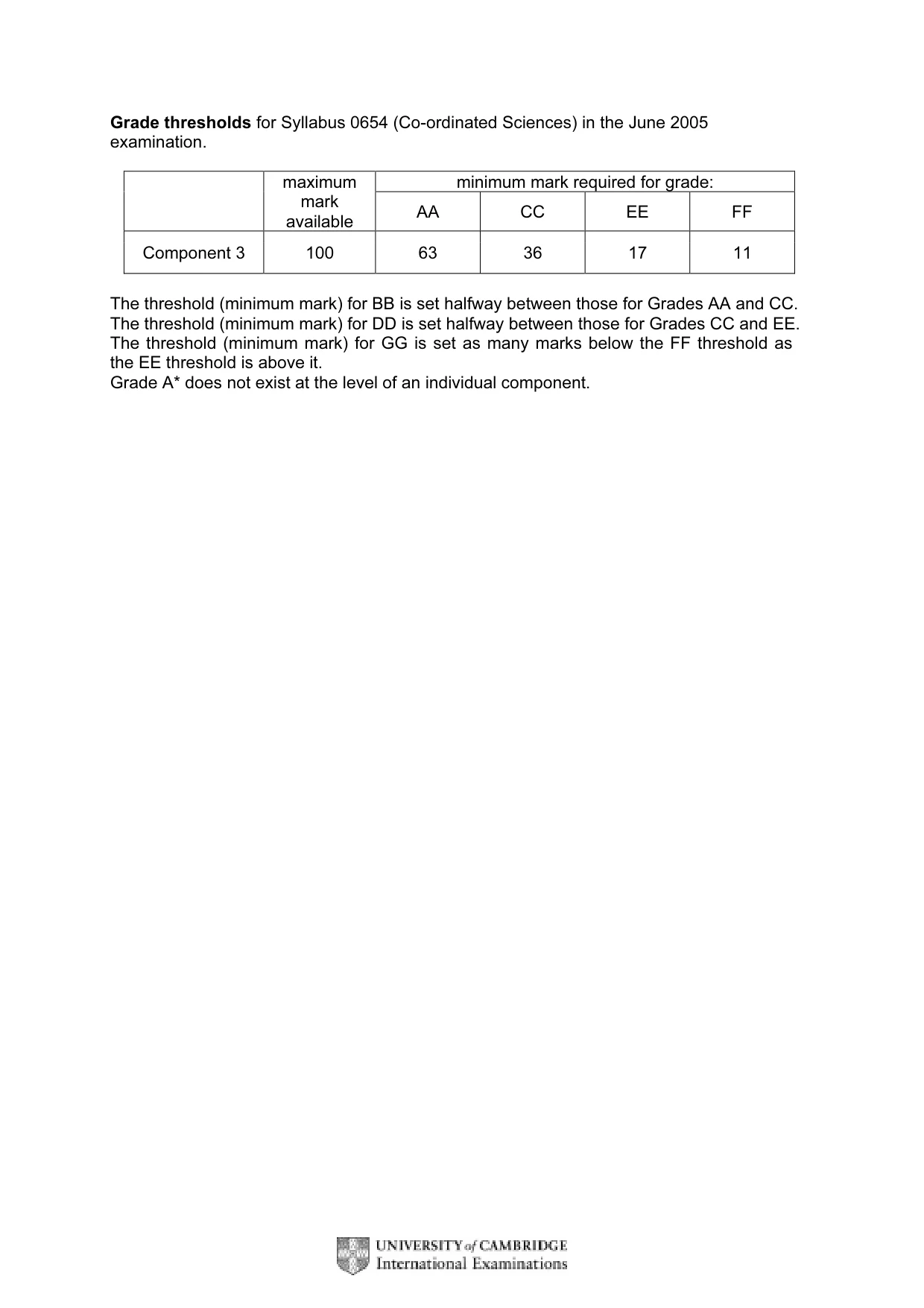
Grade thresholds for Syllabus 0654 (Co-ordinated Sciences) in the June 2005 examination. minimum mark required for grade: maximum mark available AA CC EE FF Component 3 100 63 36 17 11 The threshold (minimum mark) for BB is set halfway between those for Grades AA and CC. The threshold (minimum mark) for DD is set halfway between those for Grades CC and EE. The threshold (minimum mark) for GG is set as many marks below the FF threshold as the EE threshold is above it. Grade A* does not exist at the level of an individual component.
Mark scheme, page 3
June 2005 IGCSE MARK SCHEME MAXIMUM MARK: 100 SYLLABUS/COMPONENT: 0654/03 CO-ORDINATED SCIENCES Paper 3 (Extended Theory)
Mark scheme, page 4
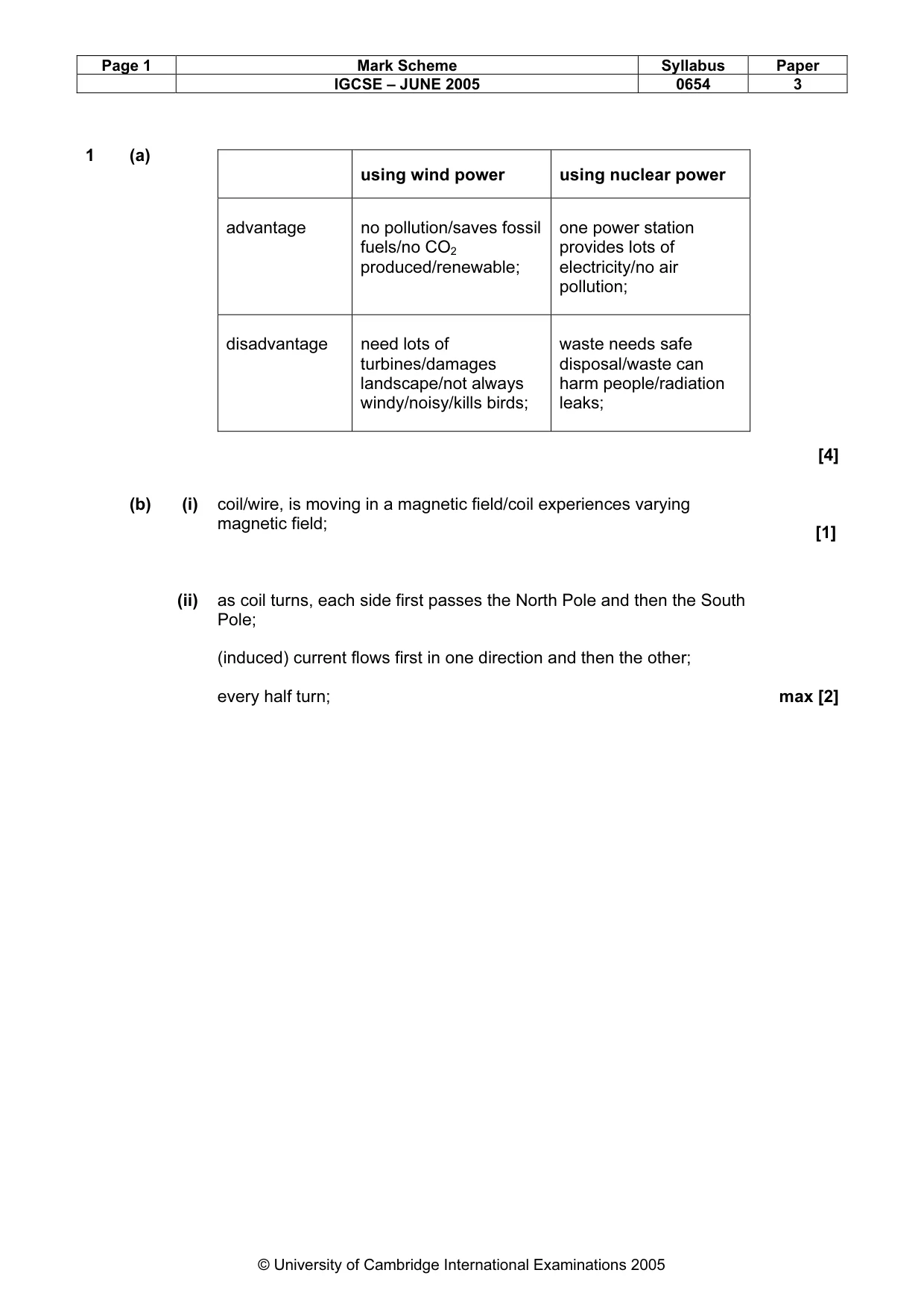
Page 1 Mark Scheme Syllabus Paper IGCSE – JUNE 2005 0654 3 © University of Cambridge International Examinations 2005 1 (a) using wind power using nuclear power advantage no pollution/saves fossil fuels/no CO2 produced/renewable; one power station provides lots of electricity/no air pollution; disadvantage need lots of turbines/damages landscape/not always windy/noisy/kills birds; waste needs safe disposal/waste can harm people/radiation leaks; [4] (b) (i) coil/wire, is moving in a magnetic field/coil experiences varying magnetic field; [1] (ii) as coil turns, each side first passes the North Pole and then the South Pole; (induced) current flows first in one direction and then the other; every half turn; max [2]
Mark scheme, page 5
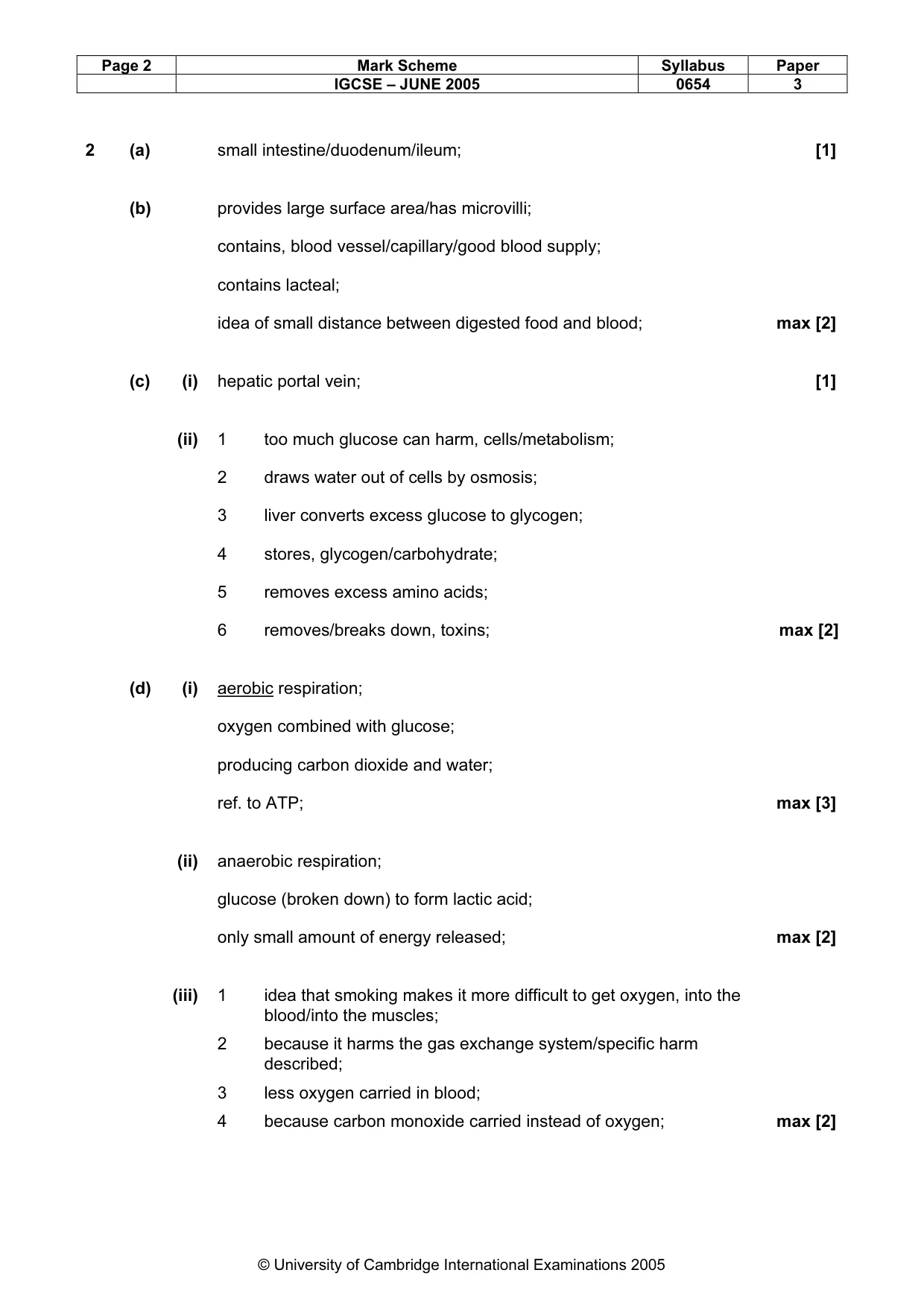
Page 2 Mark Scheme Syllabus Paper IGCSE – JUNE 2005 0654 3 © University of Cambridge International Examinations 2005 2 (a) small intestine/duodenum/ileum; [1] (b) provides large surface area/has microvilli; contains, blood vessel/capillary/good blood supply; contains lacteal; idea of small distance between digested food and blood; max [2] (c) (i) hepatic portal vein; [1] (ii) 1 too much glucose can harm, cells/metabolism; 2 draws water out of cells by osmosis; 3 liver converts excess glucose to glycogen; 4 stores, glycogen/carbohydrate; 5 removes excess amino acids; 6 removes/breaks down, toxins; max [2] (d) (i) aerobic respiration; oxygen combined with glucose; producing carbon dioxide and water; ref. to ATP; max [3] (ii) anaerobic respiration; glucose (broken down) to form lactic acid; only small amount of energy released; max [2] (iii) 1 idea that smoking makes it more difficult to get oxygen, into the blood/into the muscles; 2 because it harms the gas exchange system/specific harm described; 3 less oxygen carried in blood; 4 because carbon monoxide carried instead of oxygen; max [2]
Mark scheme, page 6
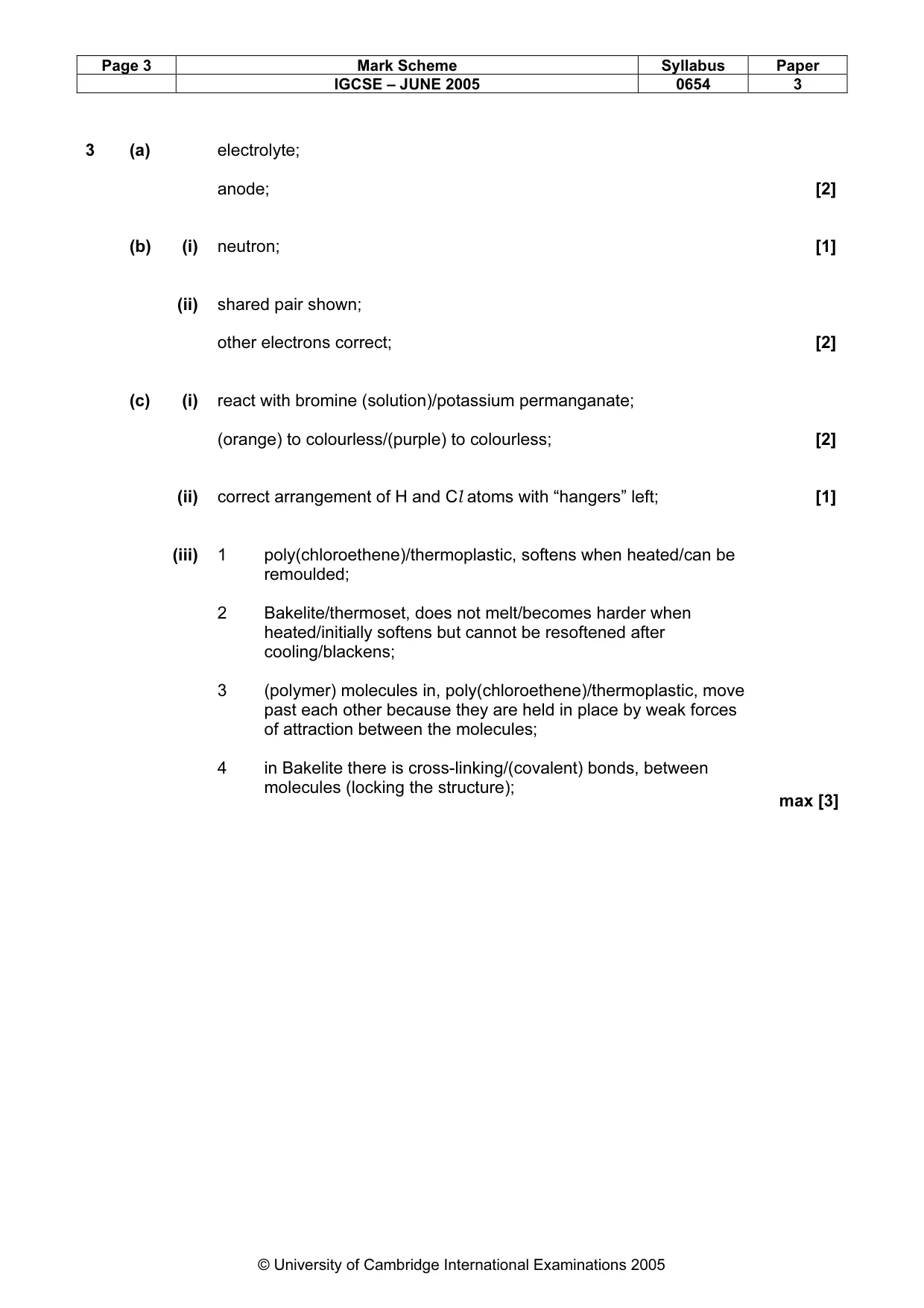
Page 3 Mark Scheme Syllabus Paper IGCSE – JUNE 2005 0654 3 © University of Cambridge International Examinations 2005 3 (a) electrolyte; anode; [2] (b) (i) neutron; [1] (ii) shared pair shown; other electrons correct; [2] (c) (i) react with bromine (solution)/potassium permanganate; (orange) to colourless/(purple) to colourless; [2] (ii) correct arrangement of H and Cl atoms with “hangers” left; [1] (iii) 1 poly(chloroethene)/thermoplastic, softens when heated/can be remoulded; 2 Bakelite/thermoset, does not melt/becomes harder when heated/initially softens but cannot be resoftened after cooling/blackens; 3 (polymer) molecules in, poly(chloroethene)/thermoplastic, move past each other because they are held in place by weak forces of attraction between the molecules; 4 in Bakelite there is cross-linking/(covalent) bonds, between molecules (locking the structure); max [3]
Mark scheme, page 7
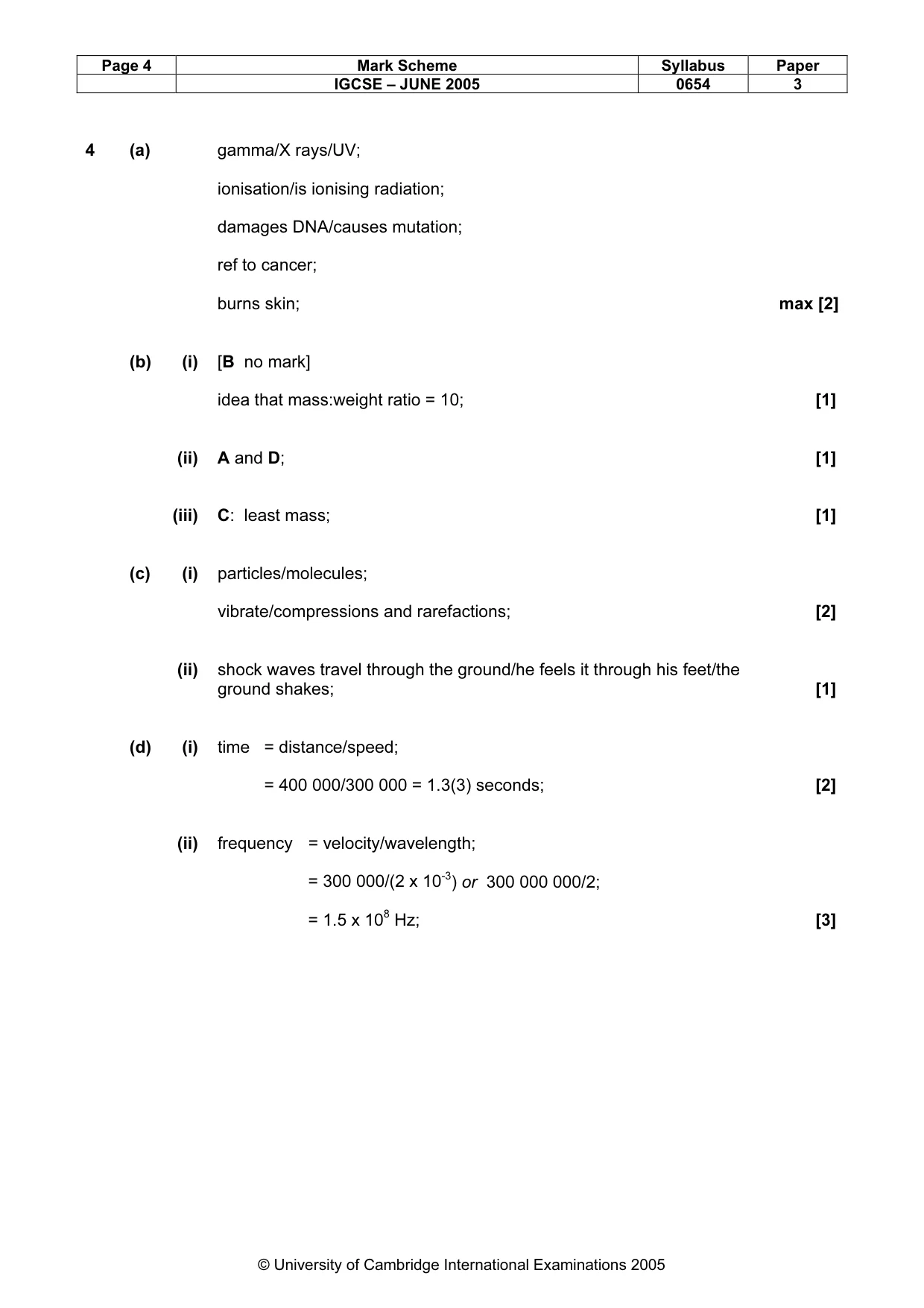
Page 4 Mark Scheme Syllabus Paper IGCSE – JUNE 2005 0654 3 © University of Cambridge International Examinations 2005 4 (a) gamma/X rays/UV; ionisation/is ionising radiation; damages DNA/causes mutation; ref to cancer; burns skin; max [2] (b) (i) [B no mark] idea that mass:weight ratio = 10; [1] (ii) A and D; [1] (iii) C: least mass; [1] (c) (i) particles/molecules; vibrate/compressions and rarefactions; [2] (ii) shock waves travel through the ground/he feels it through his feet/the ground shakes; [1] (d) (i) time = distance/speed; = 400 000/300 000 = 1.3(3) seconds; [2] (ii) frequency = velocity/wavelength; = 300 000/(2 x 10-3) or 300 000 000/2; = 1.5 x 10⁸ Hz; [3]
Mark scheme, page 8
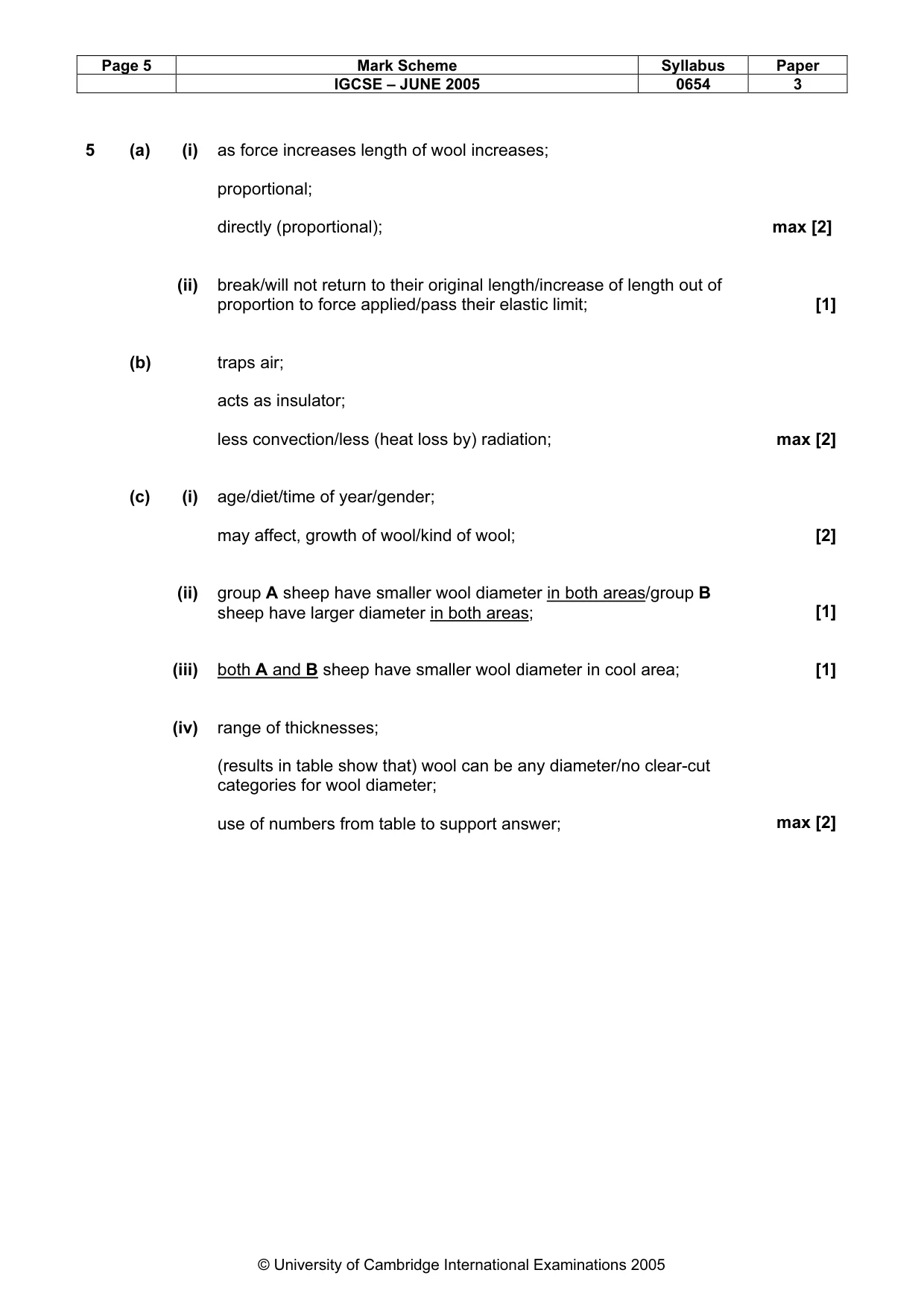
Page 5 Mark Scheme Syllabus Paper IGCSE – JUNE 2005 0654 3 © University of Cambridge International Examinations 2005 5 (a) (i) as force increases length of wool increases; proportional; directly (proportional); max [2] (ii) break/will not return to their original length/increase of length out of proportion to force applied/pass their elastic limit; [1] (b) traps air; acts as insulator; less convection/less (heat loss by) radiation; max [2] (c) (i) age/diet/time of year/gender; may affect, growth of wool/kind of wool; [2] (ii) group A sheep have smaller wool diameter in both areas/group B sheep have larger diameter in both areas; [1] (iii) both A and B sheep have smaller wool diameter in cool area; [1] (iv) range of thicknesses; (results in table show that) wool can be any diameter/no clear-cut categories for wool diameter; use of numbers from table to support answer; max [2]
Mark scheme, page 9
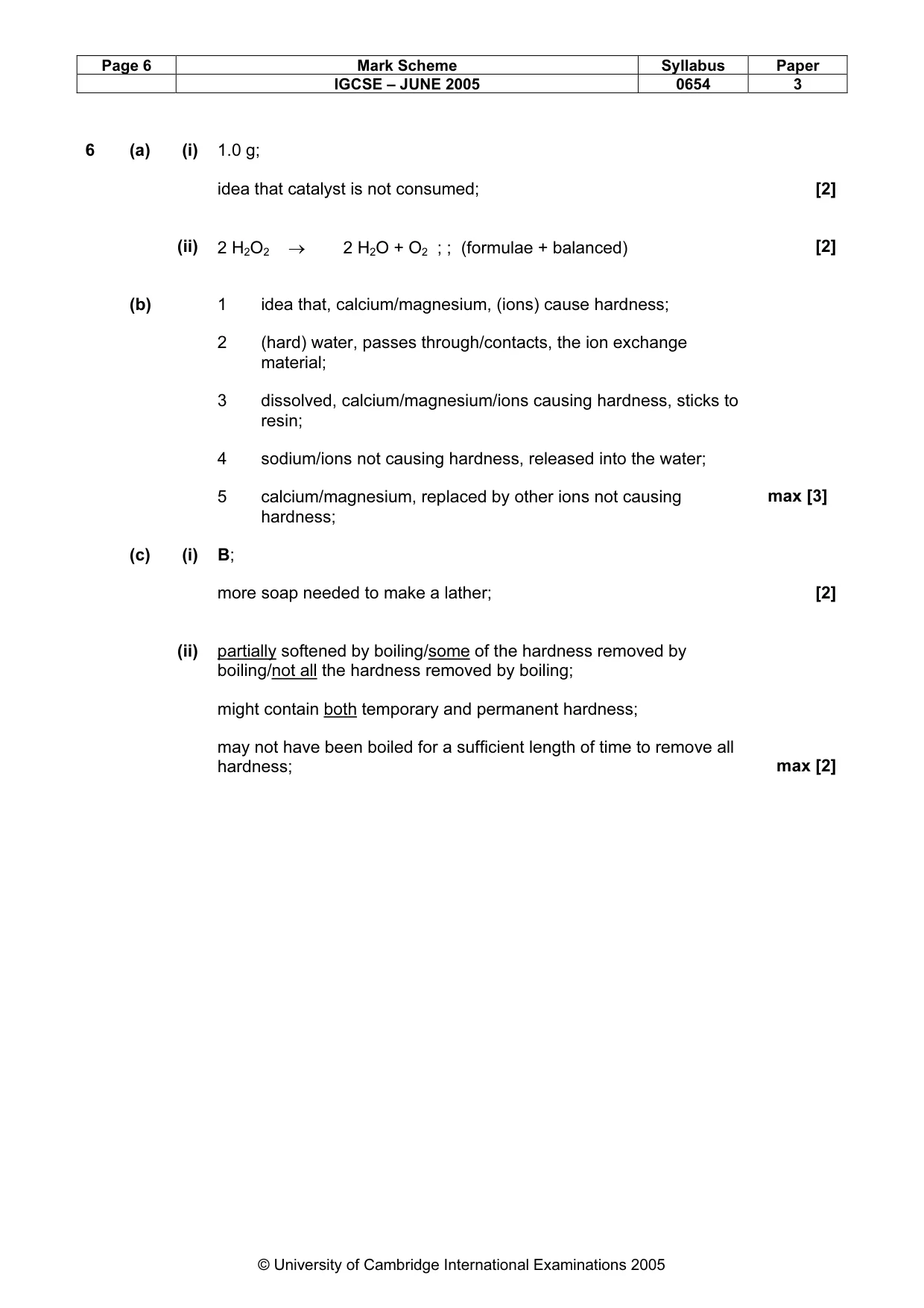
Page 6 Mark Scheme Syllabus Paper IGCSE – JUNE 2005 0654 3 © University of Cambridge International Examinations 2005 6 (a) (i) 1.0 g; idea that catalyst is not consumed; [2] (ii) 2 H2O2 → 2 H2O + O2 ; ; (formulae + balanced) [2] (b) 1 idea that, calcium/magnesium, (ions) cause hardness; 2 (hard) water, passes through/contacts, the ion exchange material; 3 dissolved, calcium/magnesium/ions causing hardness, sticks to resin; 4 sodium/ions not causing hardness, released into the water; 5 calcium/magnesium, replaced by other ions not causing hardness; max [3] (c) (i) B; more soap needed to make a lather; [2] (ii) partially softened by boiling/some of the hardness removed by boiling/not all the hardness removed by boiling; might contain both temporary and permanent hardness; may not have been boiled for a sufficient length of time to remove all hardness; max [2]
Mark scheme, page 10
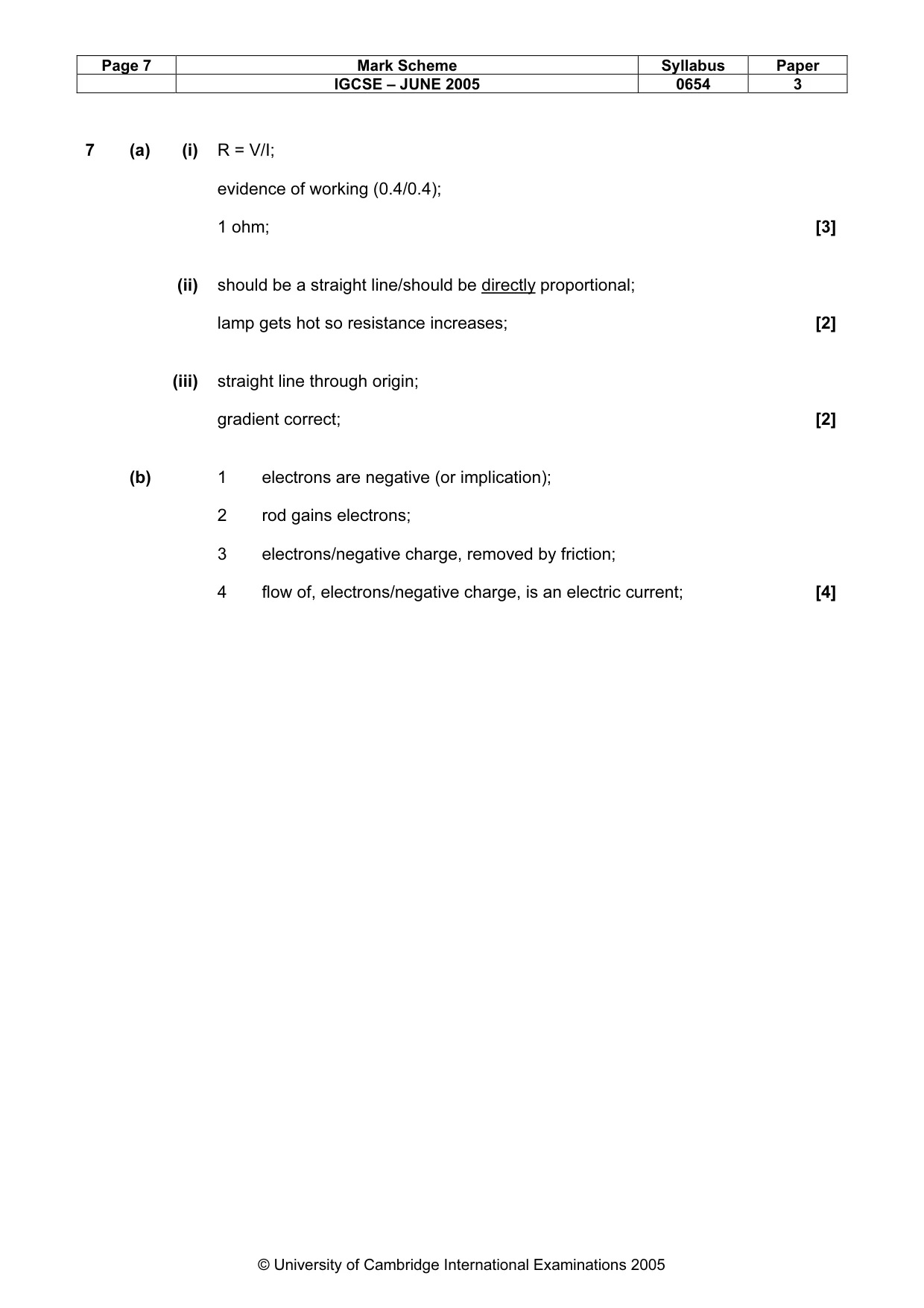
Page 7 Mark Scheme Syllabus Paper IGCSE – JUNE 2005 0654 3 © University of Cambridge International Examinations 2005 7 (a) (i) R = V/I; evidence of working (0.4/0.4); 1 ohm; [3] (ii) should be a straight line/should be directly proportional; lamp gets hot so resistance increases; [2] (iii) straight line through origin; gradient correct; [2] (b) 1 electrons are negative (or implication); 2 rod gains electrons; 3 electrons/negative charge, removed by friction; 4 flow of, electrons/negative charge, is an electric current; [4]
Mark scheme, page 11
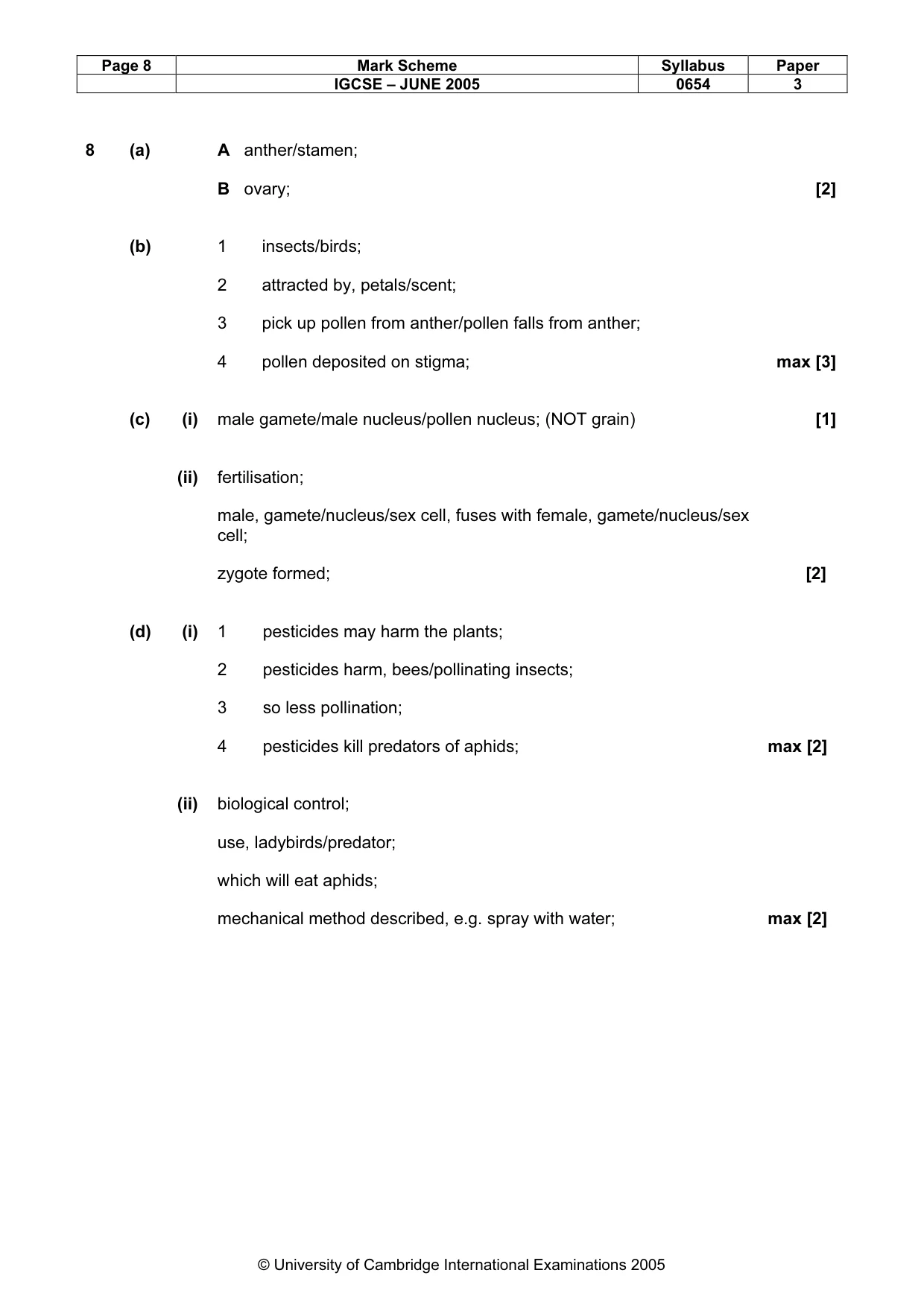
Page 8 Mark Scheme Syllabus Paper IGCSE – JUNE 2005 0654 3 © University of Cambridge International Examinations 2005 8 (a) A anther/stamen; B ovary; [2] (b) 1 insects/birds; 2 attracted by, petals/scent; 3 pick up pollen from anther/pollen falls from anther; 4 pollen deposited on stigma; max [3] (c) (i) male gamete/male nucleus/pollen nucleus; (NOT grain) [1] (ii) fertilisation; male, gamete/nucleus/sex cell, fuses with female, gamete/nucleus/sex cell; zygote formed; [2] (d) (i) 1 pesticides may harm the plants; 2 pesticides harm, bees/pollinating insects; 3 so less pollination; 4 pesticides kill predators of aphids; max [2] (ii) biological control; use, ladybirds/predator; which will eat aphids; mechanical method described, e.g. spray with water; max [2]
Mark scheme, page 12
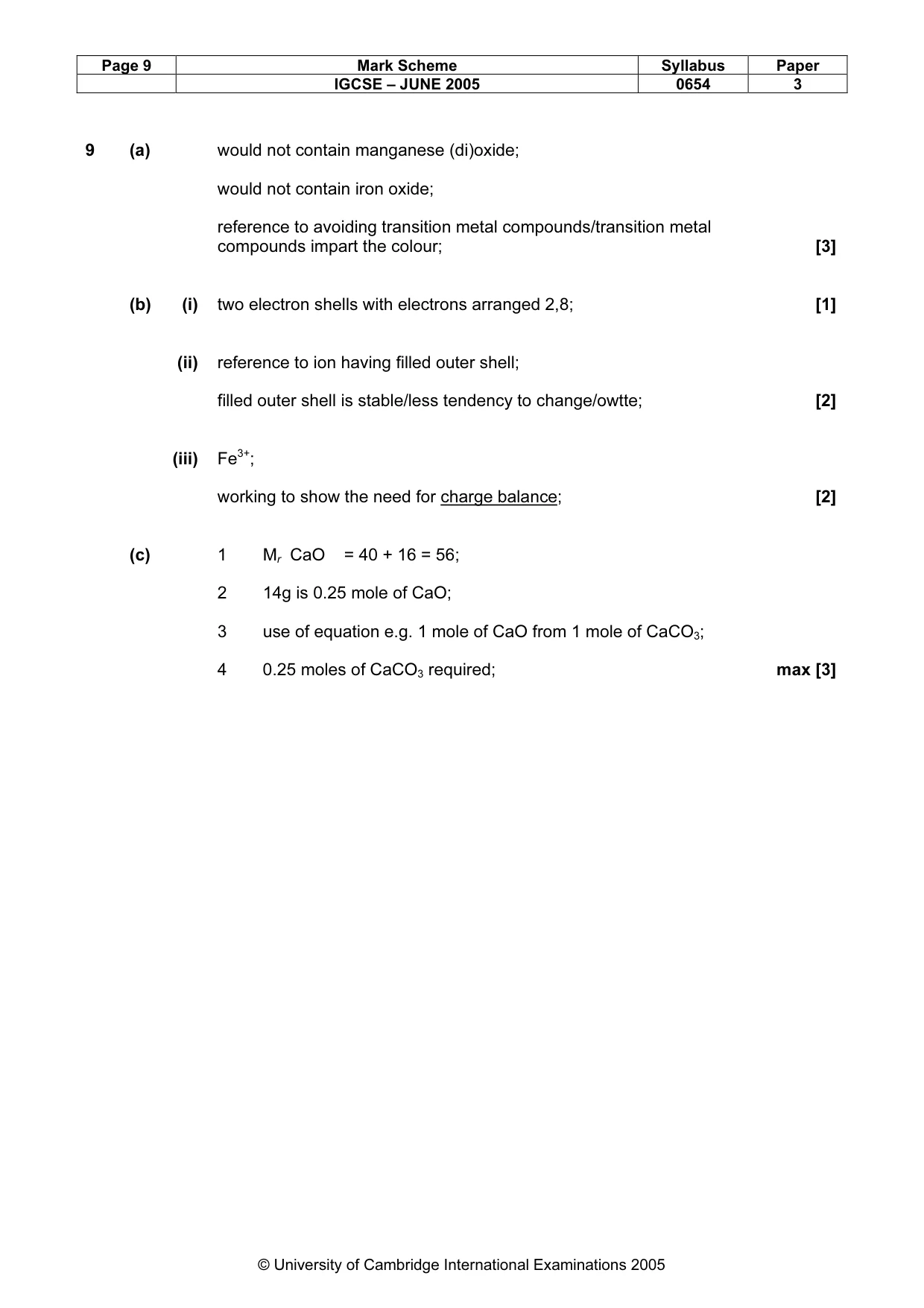
Page 9 Mark Scheme Syllabus Paper IGCSE – JUNE 2005 0654 3 © University of Cambridge International Examinations 2005 9 (a) would not contain manganese (di)oxide; would not contain iron oxide; reference to avoiding transition metal compounds/transition metal compounds impart the colour; [3] (b) (i) two electron shells with electrons arranged 2,8; [1] (ii) reference to ion having filled outer shell; filled outer shell is stable/less tendency to change/owtte; [2] (iii) Fe3+; working to show the need for charge balance; [2] (c) 1 Mr CaO = 40 + 16 = 56; 2 14g is 0.25 mole of CaO; 3 use of equation e.g. 1 mole of CaO from 1 mole of CaCO3; 4 0.25 moles of CaCO3 required; max [3]