Cambridge IGCSE Sciences - Co-ordinated (Double) 0654 — 2004 May/June Paper 3 · Variant 1
0654/31/M/J/04
The question paper and its mark scheme, free to read here and free to download. This is Cambridge’s own paper, exactly as it was sat.
Question paper24 pages

Mark scheme
No mark scheme is in the library for this paper.
Paper as text
Question paper, page 1
This document consists of 22 printed pages and 2 blank pages. SPA (CW/D&G) S63774/2 © UCLES 2004 [Turn over UNIVERSITY OF CAMBRIDGE INTERNATIONAL EXAMINATIONS International General Certificate of Secondary Education CO-ORDINATED SCIENCES 0654/03 Paper 3 May/June 2004 2 hours Candidates answer on the Question Paper. No Additional Materials are required. READ THESE INSTRUCTIONS FIRST Write your Centre number, candidate number and name on all the work you hand in. Write in dark blue or black pen in the spaces provided on the Question Paper. You may use a soft pencil for any diagrams, graphs or rough working. Do not use staples, paper clips, highlighters, glue or correction fluid. Answer all questions. The number of marks is given in brackets [ ] at the end of each question or part question. A copy of the Periodic Table is printed on page 24. Centre Number Candidate Number Name If you have been given a label, look at the details. If any details are incorrect or missing, please fill in your correct details in the space given at the top of this page. Stick your personal label here, if provided. For Examiner’s Use 1 2 3 4 5 6 7 8 9 10 Total www.XtremePapers.com
Question paper, page 2
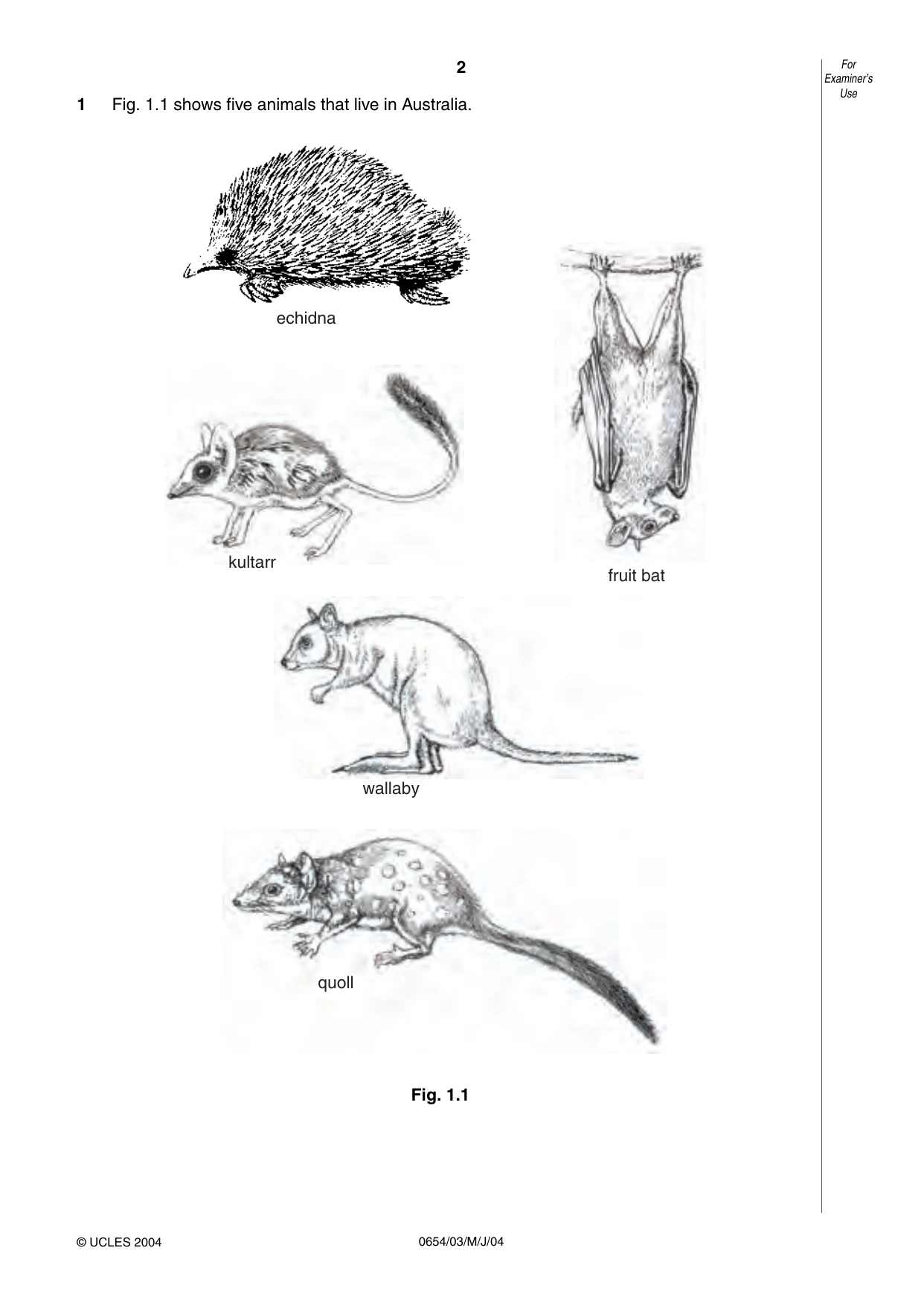
2 0654/03/M/J/04 1 Fig. 1.1 shows five animals that live in Australia. Fig. 1.1 echidna kultarr wallaby quoll fruit bat For Examiner’s Use © UCLES 2004
Question paper, page 3
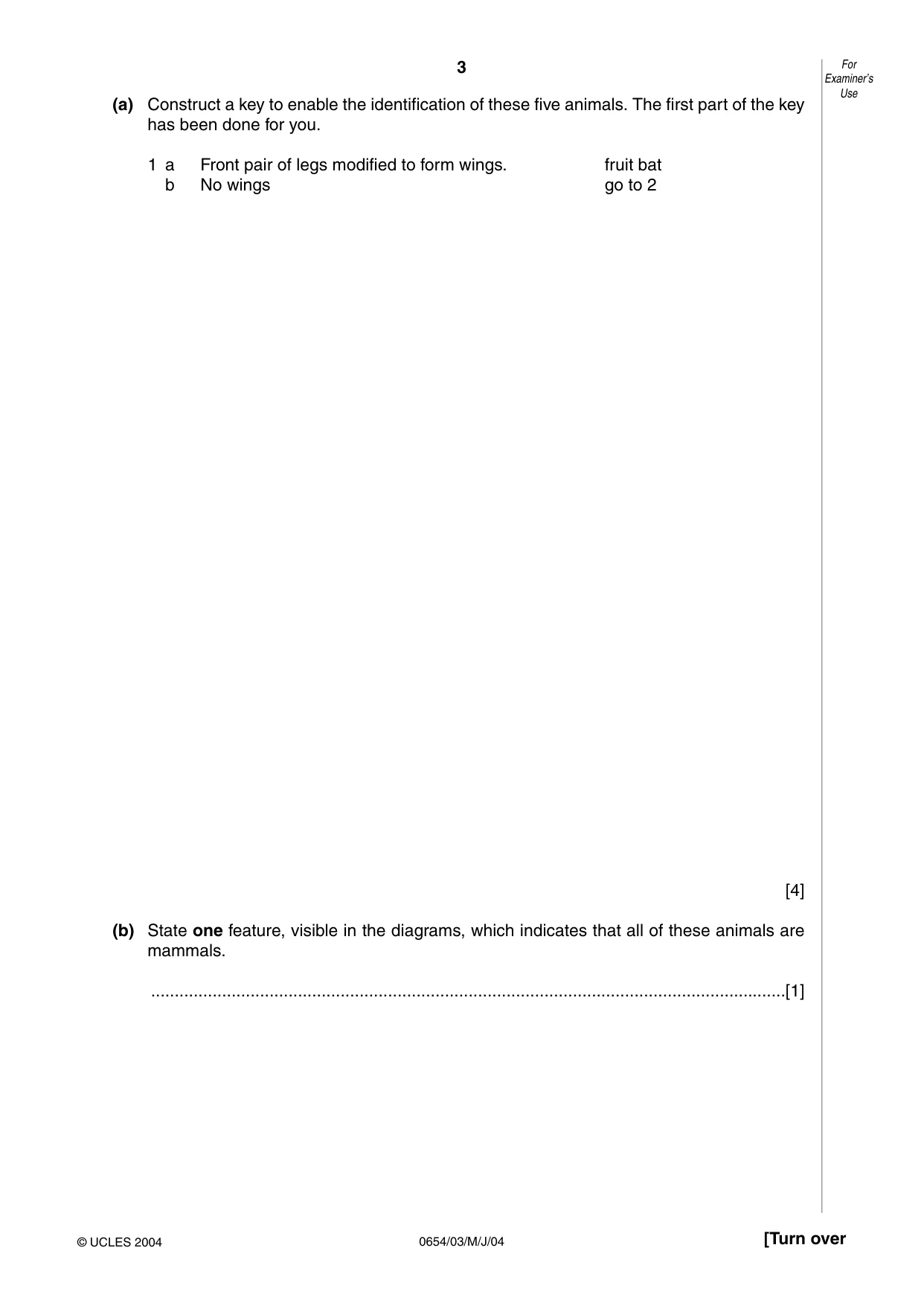
3 0654/03/M/J/04 [Turn over (a) Construct a key to enable the identification of these five animals. The first part of the key has been done for you. 1 a Front pair of legs modified to form wings. fruit bat b No wings go to 2 [4] (b) State one feature, visible in the diagrams, which indicates that all of these animals are mammals. …[1] For Examiner’s Use © UCLES 2004
Question paper, page 4
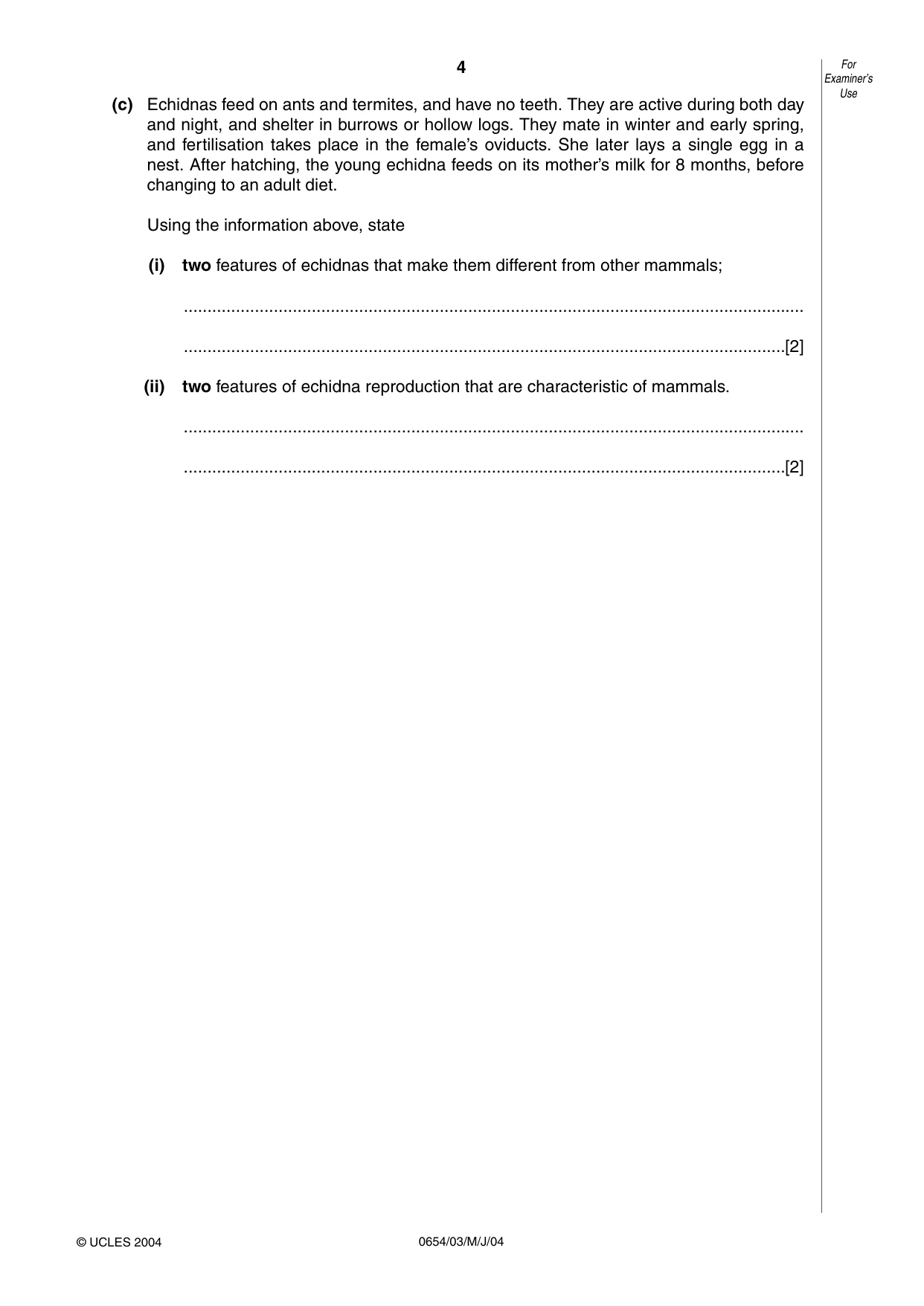
4 0654/03/M/J/04 (c) Echidnas feed on ants and termites, and have no teeth. They are active during both day and night, and shelter in burrows or hollow logs. They mate in winter and early spring, and fertilisation takes place in the female’s oviducts. She later lays a single egg in a nest. After hatching, the young echidna feeds on its mother’s milk for 8 months, before changing to an adult diet. Using the information above, state (i) two features of echidnas that make them different from other mammals; … …[2] (ii) two features of echidna reproduction that are characteristic of mammals. … …[2] For Examiner’s Use © UCLES 2004
Question paper, page 5
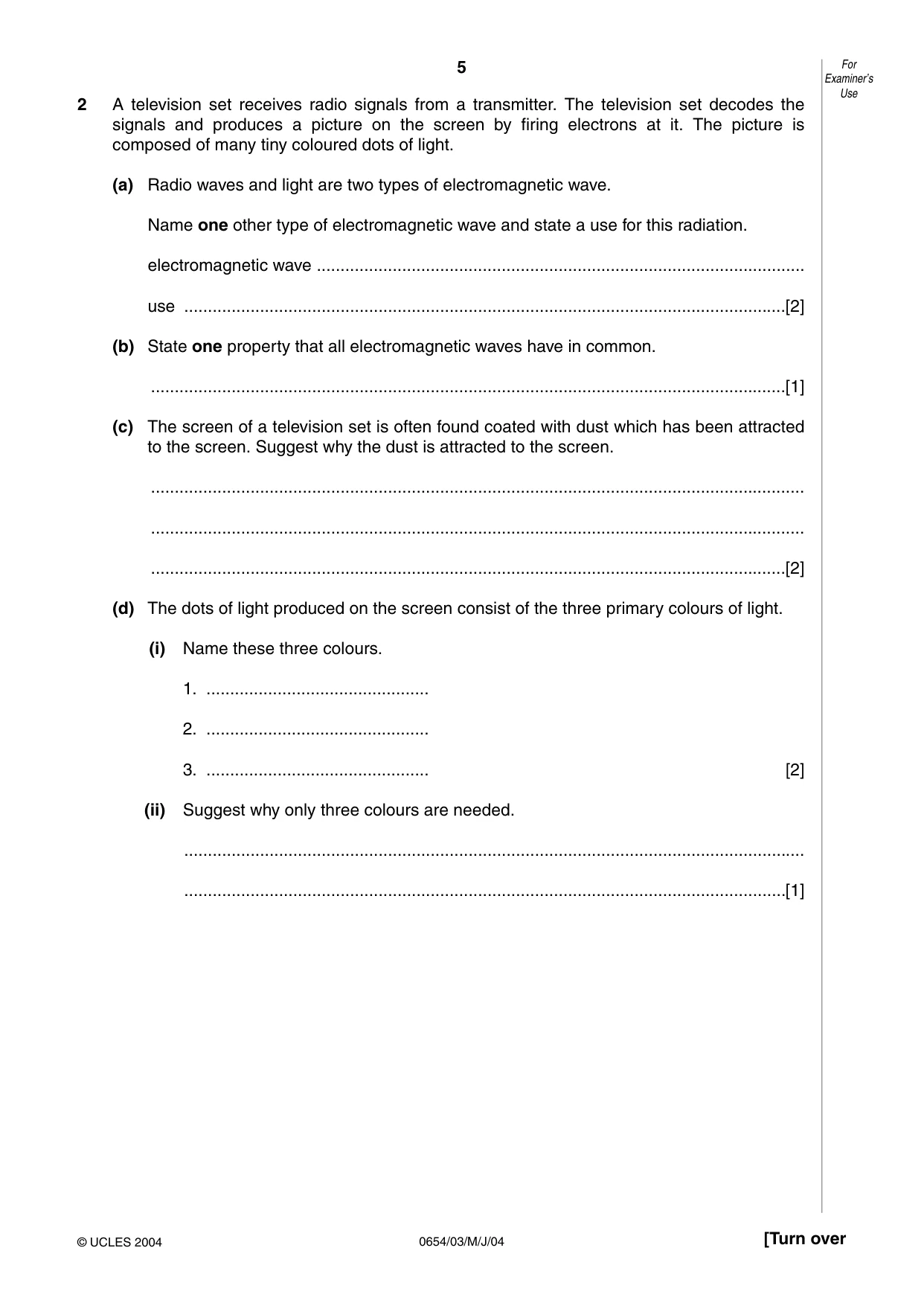
5 0654/03/M/J/04 [Turn over 2 A television set receives radio signals from a transmitter. The television set decodes the signals and produces a picture on the screen by firing electrons at it. The picture is composed of many tiny coloured dots of light. (a) Radio waves and light are two types of electromagnetic wave. Name one other type of electromagnetic wave and state a use for this radiation. electromagnetic wave … use …[2] (b) State one property that all electromagnetic waves have in common. …[1] (c) The screen of a television set is often found coated with dust which has been attracted to the screen. Suggest why the dust is attracted to the screen. … … …[2] (d) The dots of light produced on the screen consist of the three primary colours of light. (i) Name these three colours. 1. … 2. … 3. … [2] (ii) Suggest why only three colours are needed. … …[1] For Examiner’s Use © UCLES 2004
Question paper, page 6
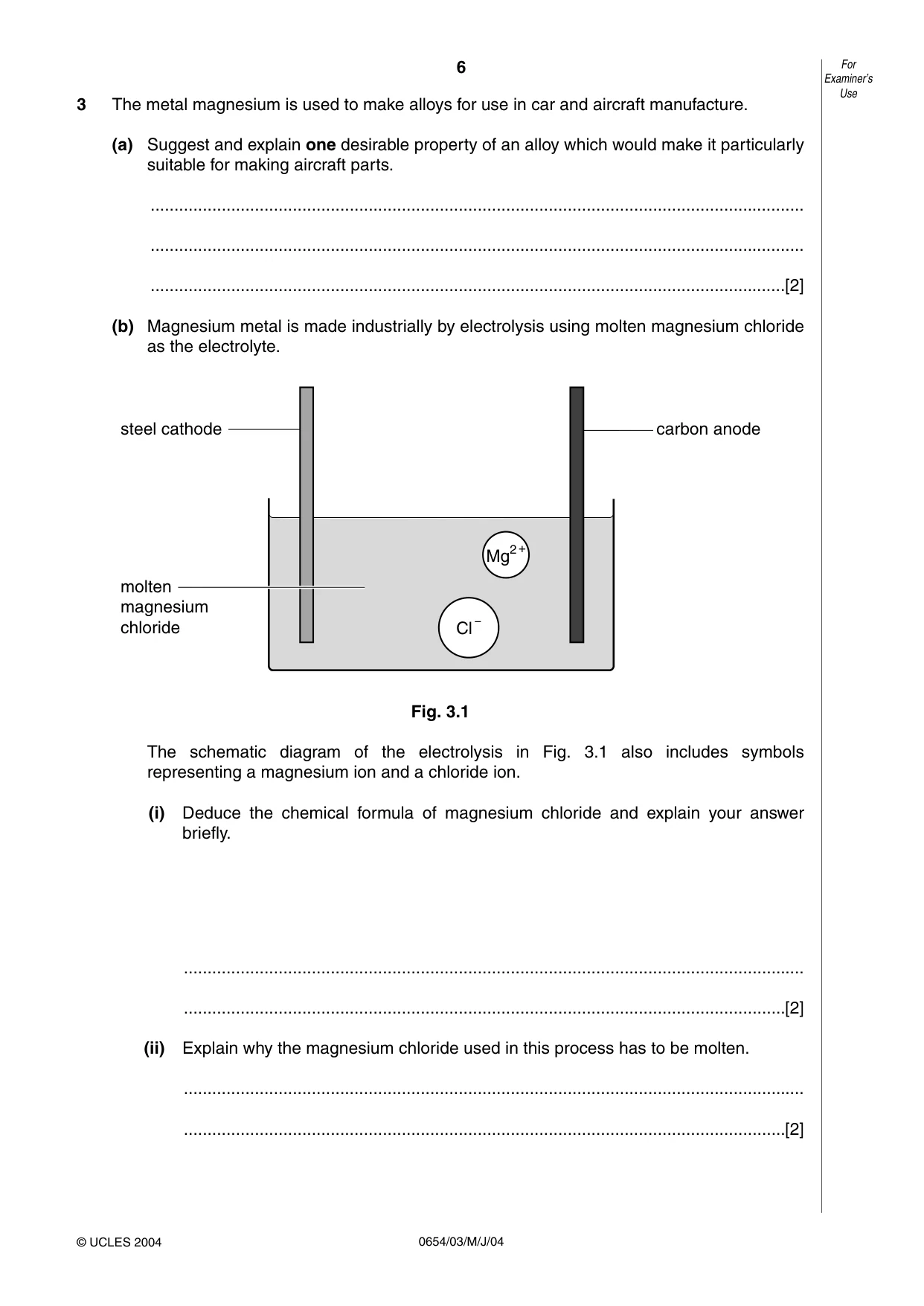
6 0654/03/M/J/04 3 The metal magnesium is used to make alloys for use in car and aircraft manufacture. (a) Suggest and explain one desirable property of an alloy which would make it particularly suitable for making aircraft parts. … … …[2] (b) Magnesium metal is made industrially by electrolysis using molten magnesium chloride as the electrolyte. Fig. 3.1 The schematic diagram of the electrolysis in Fig. 3.1 also includes symbols representing a magnesium ion and a chloride ion. (i) Deduce the chemical formula of magnesium chloride and explain your answer briefly. … …[2] (ii) Explain why the magnesium chloride used in this process has to be molten. … …[2] steel cathode Mg2+ Cl – carbon anode molten magnesium chloride For Examiner’s Use © UCLES 2004
Question paper, page 7
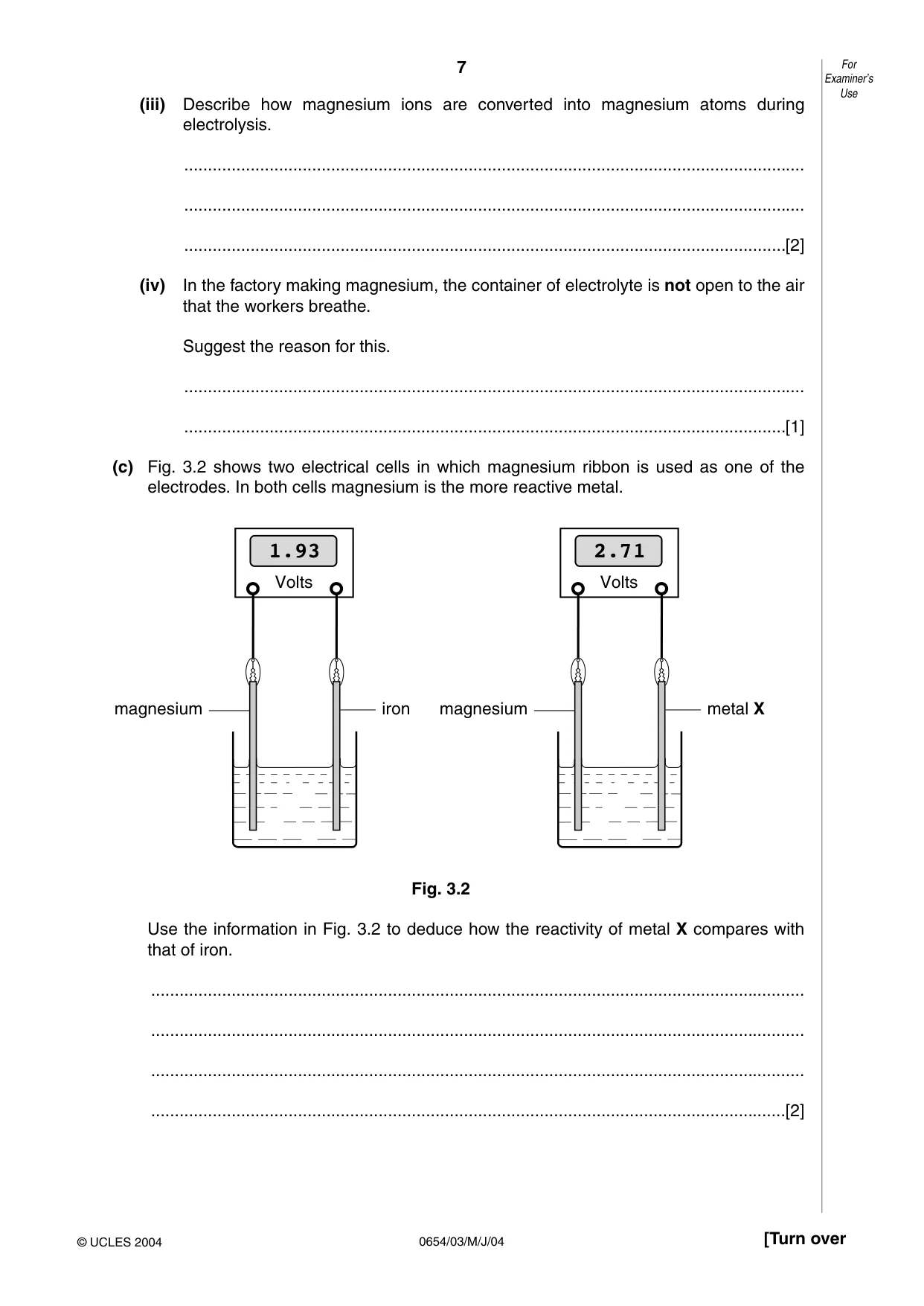
7 0654/03/M/J/04 [Turn over (iii) Describe how magnesium ions are converted into magnesium atoms during electrolysis. … … …[2] (iv) In the factory making magnesium, the container of electrolyte is not open to the air that the workers breathe. Suggest the reason for this. … …[1] (c) Fig. 3.2 shows two electrical cells in which magnesium ribbon is used as one of the electrodes. In both cells magnesium is the more reactive metal. Fig. 3.2 Use the information in Fig. 3.2 to deduce how the reactivity of metal X compares with that of iron. … … … …[2] magnesium iron magnesium metal X 1.93 Volts 2.71 Volts For Examiner’s Use © UCLES 2004
Question paper, page 8
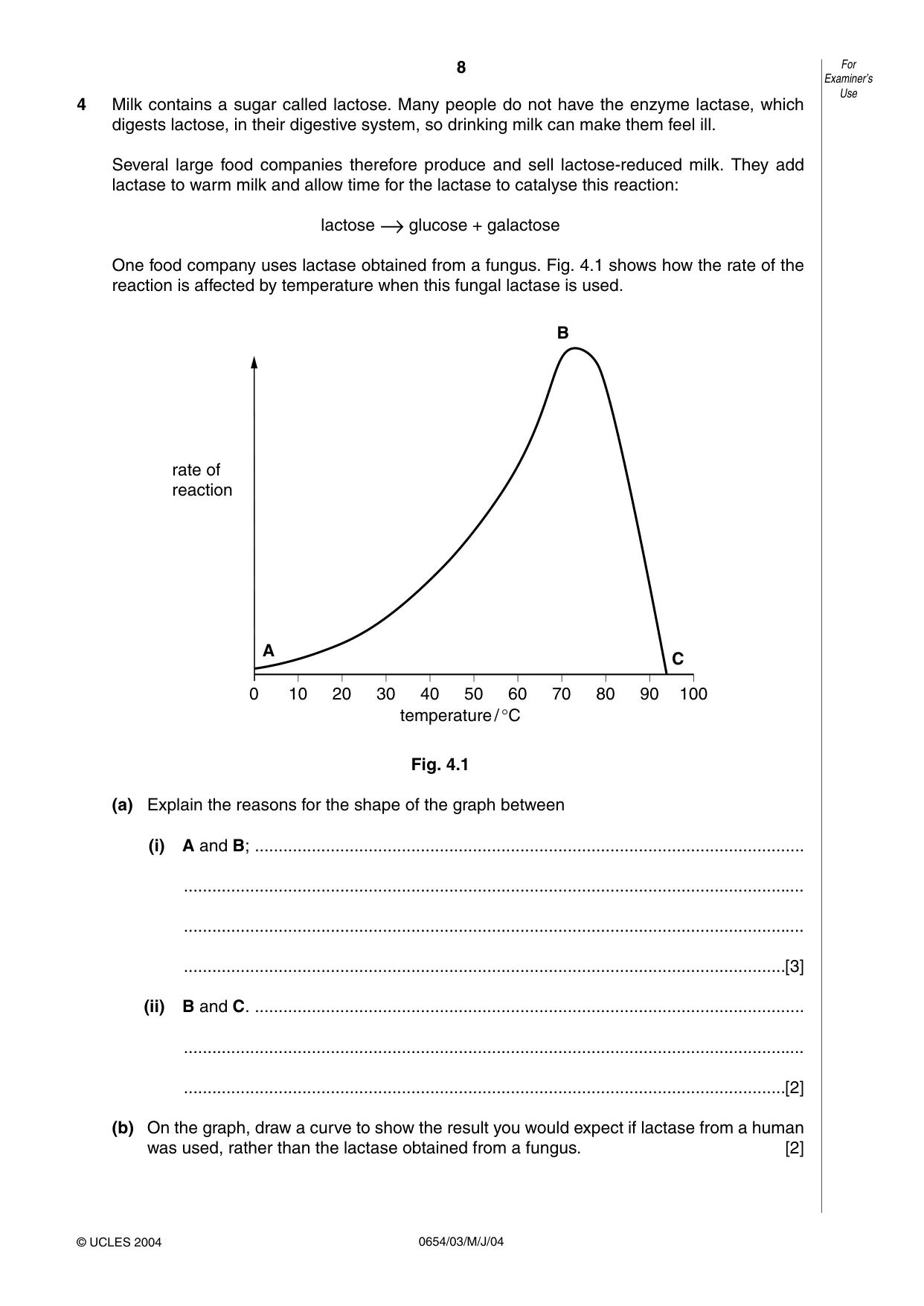
8 0654/03/M/J/04 4 Milk contains a sugar called lactose. Many people do not have the enzyme lactase, which digests lactose, in their digestive system, so drinking milk can make them feel ill. Several large food companies therefore produce and sell lactose-reduced milk. They add lactase to warm milk and allow time for the lactase to catalyse this reaction: lactose →glucose + galactose One food company uses lactase obtained from a fungus. Fig. 4.1 shows how the rate of the reaction is affected by temperature when this fungal lactase is used. Fig. 4.1 (a) Explain the reasons for the shape of the graph between (i) A and B; … … … …[3] (ii) B and C. … … …[2] (b) On the graph, draw a curve to show the result you would expect if lactase from a human was used, rather than the lactase obtained from a fungus. [2] rate of reaction 0 10 20 30 40 50 60 70 80 90 100 temperature/°C A C B For Examiner’s Use © UCLES 2004
Question paper, page 9
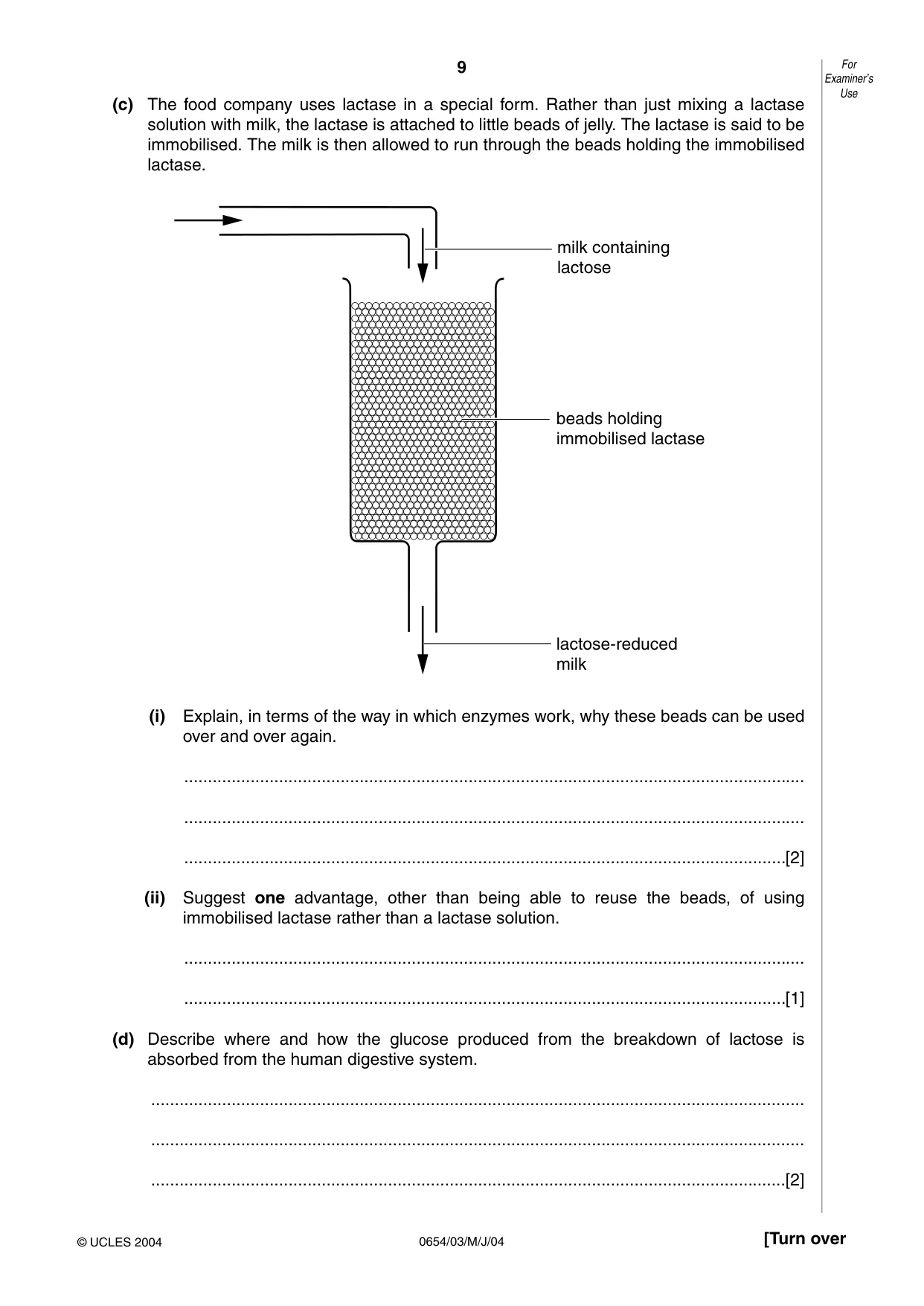
9 0654/03/M/J/04 [Turn over (c) The food company uses lactase in a special form. Rather than just mixing a lactase solution with milk, the lactase is attached to little beads of jelly. The lactase is said to be immobilised. The milk is then allowed to run through the beads holding the immobilised lactase. (i) Explain, in terms of the way in which enzymes work, why these beads can be used over and over again. … … …[2] (ii) Suggest one advantage, other than being able to reuse the beads, of using immobilised lactase rather than a lactase solution. … …[1] (d) Describe where and how the glucose produced from the breakdown of lactose is absorbed from the human digestive system. … … …[2] milk containing lactose beads holding immobilised lactase lactose-reduced milk For Examiner’s Use © UCLES 2004
Question paper, page 10
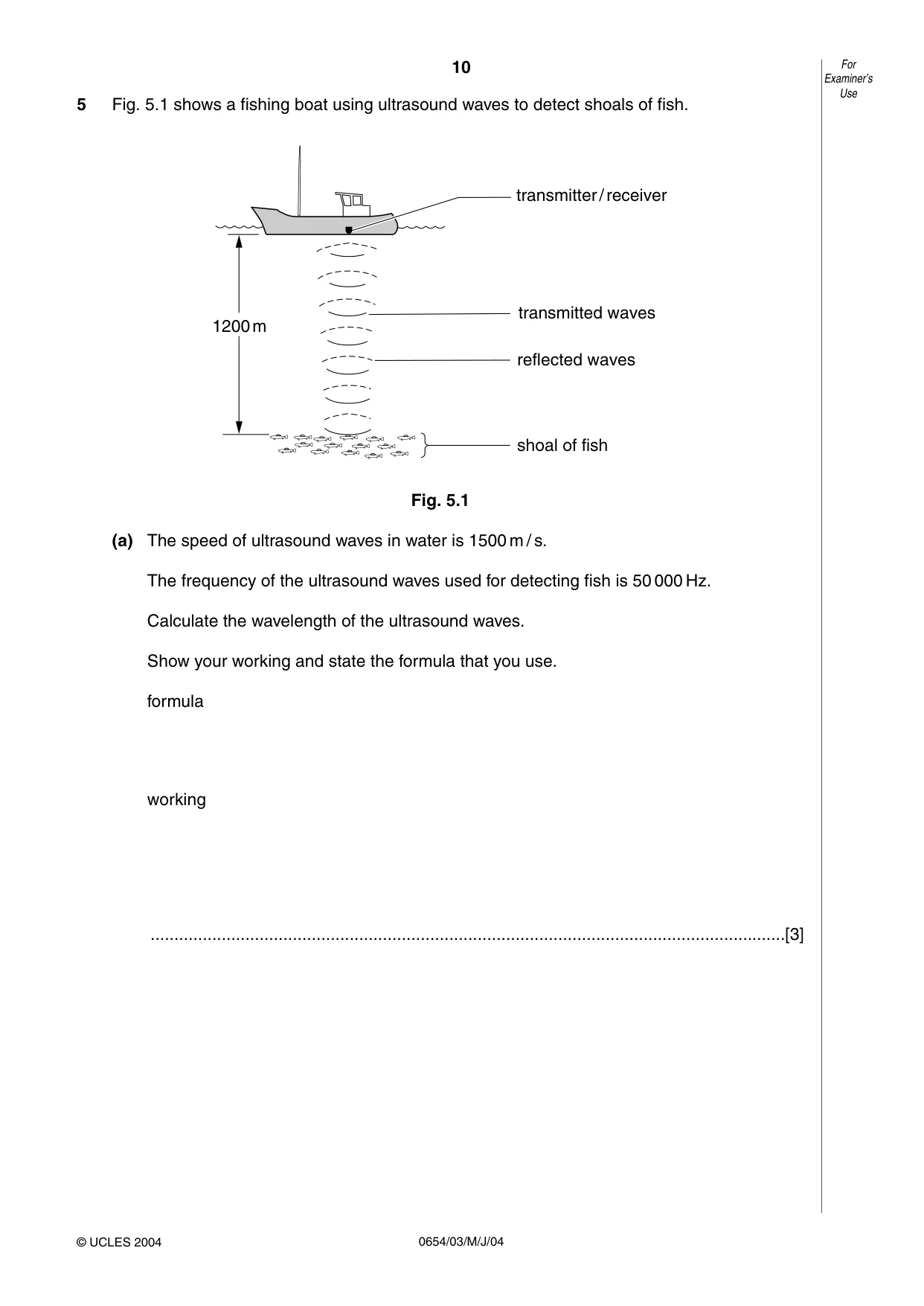
10 0654/03/M/J/04 5 Fig. 5.1 shows a fishing boat using ultrasound waves to detect shoals of fish. Fig. 5.1 (a) The speed of ultrasound waves in water is 1500 m / s. The frequency of the ultrasound waves used for detecting fish is 50 000 Hz. Calculate the wavelength of the ultrasound waves. Show your working and state the formula that you use. formula working …[3] transmitter/receiver transmitted waves reflected waves shoal of fish 1200m For Examiner’s Use © UCLES 2004
Question paper, page 11
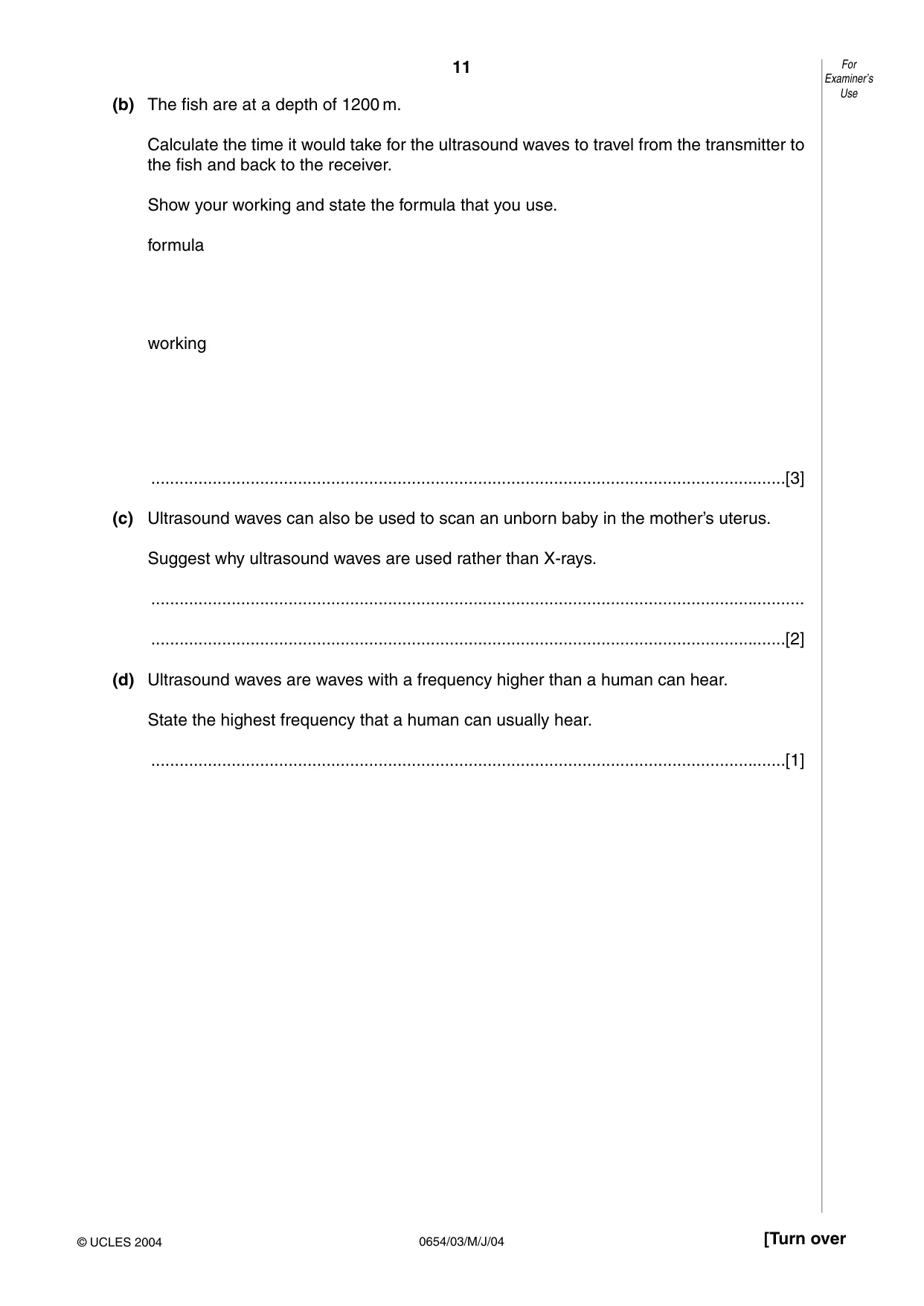
11 0654/03/M/J/04 [Turn over (b) The fish are at a depth of 1200 m. Calculate the time it would take for the ultrasound waves to travel from the transmitter to the fish and back to the receiver. Show your working and state the formula that you use. formula working …[3] (c) Ultrasound waves can also be used to scan an unborn baby in the mother’s uterus. Suggest why ultrasound waves are used rather than X-rays. … …[2] (d) Ultrasound waves are waves with a frequency higher than a human can hear. State the highest frequency that a human can usually hear. …[1] For Examiner’s Use © UCLES 2004
Question paper, page 12
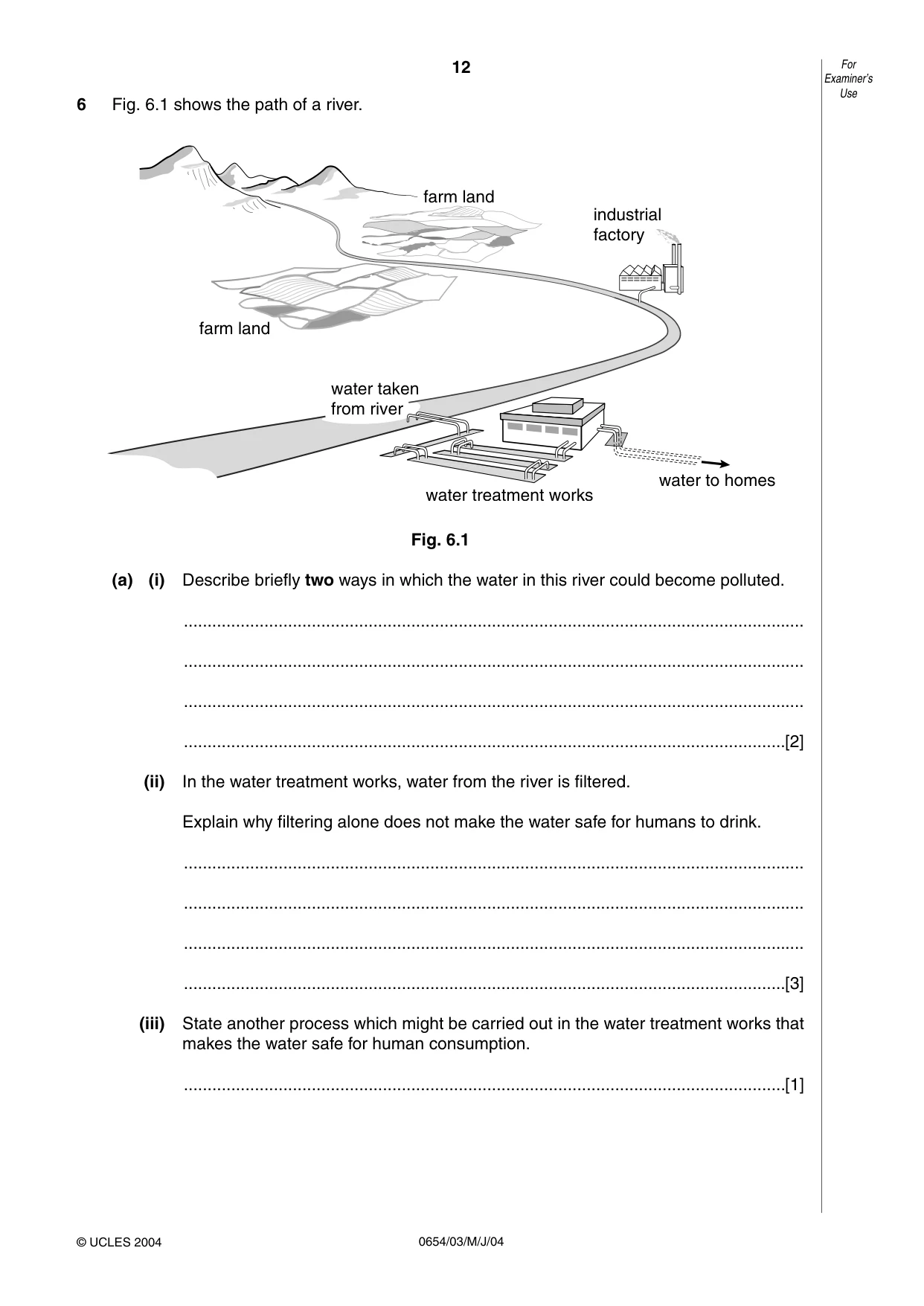
12 0654/03/M/J/04 6 Fig. 6.1 shows the path of a river. Fig. 6.1 (a) (i) Describe briefly two ways in which the water in this river could become polluted. … … … …[2] (ii) In the water treatment works, water from the river is filtered. Explain why filtering alone does not make the water safe for humans to drink. … … … …[3] (iii) State another process which might be carried out in the water treatment works that makes the water safe for human consumption. …[1] water treatment works water taken from river water to homes industrial factory farm land farm land For Examiner’s Use © UCLES 2004
Question paper, page 13
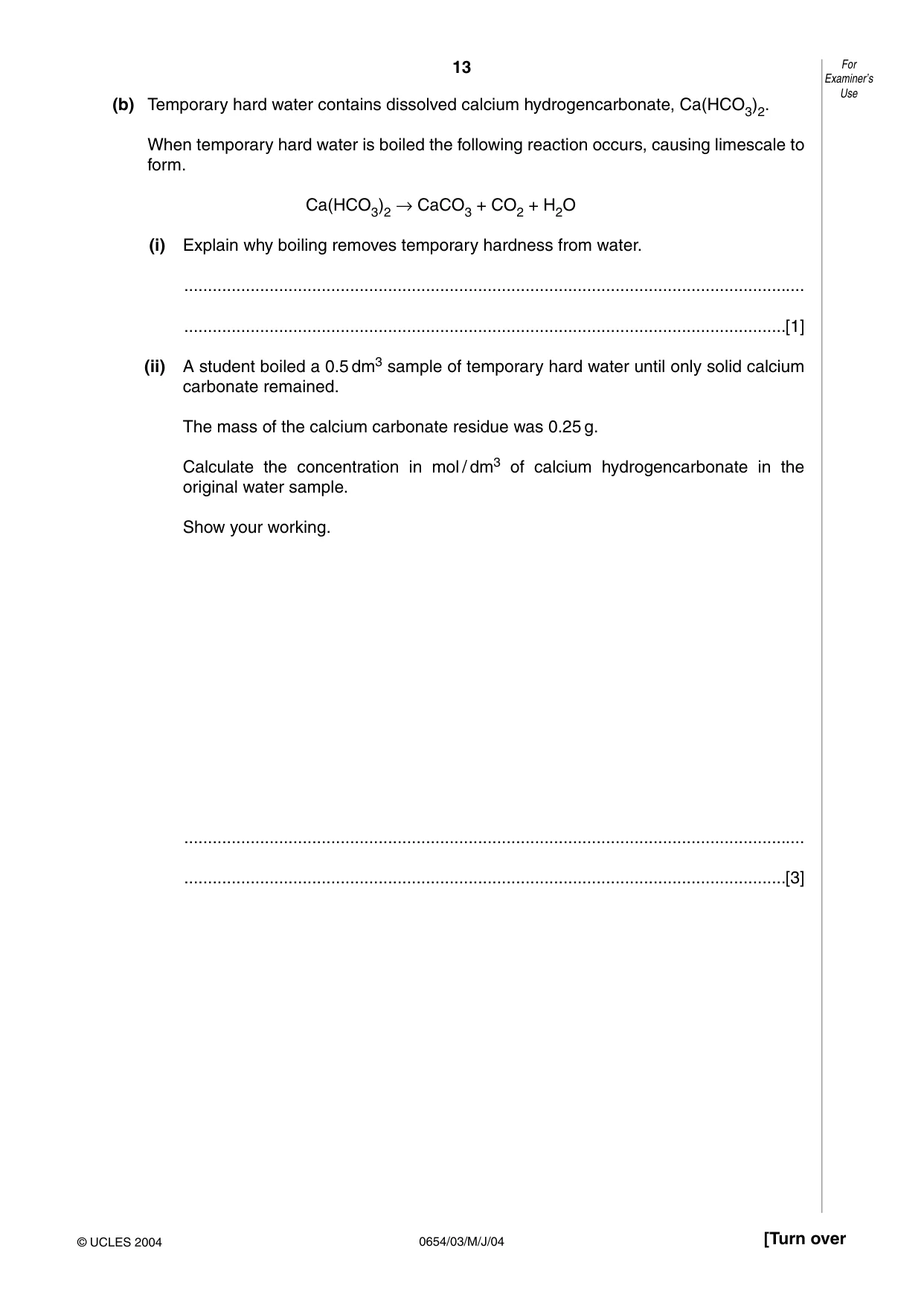
13 0654/03/M/J/04 [Turn over (b) Temporary hard water contains dissolved calcium hydrogencarbonate, Ca(HCO3)2. When temporary hard water is boiled the following reaction occurs, causing limescale to form. Ca(HCO3)2 →CaCO3 + CO2 + H2O (i) Explain why boiling removes temporary hardness from water. … …[1] (ii) A student boiled a 0.5 dm3 sample of temporary hard water until only solid calcium carbonate remained. The mass of the calcium carbonate residue was 0.25 g. Calculate the concentration in mol / dm3 of calcium hydrogencarbonate in the original water sample. Show your working. … …[3] For Examiner’s Use © UCLES 2004
Question paper, page 14
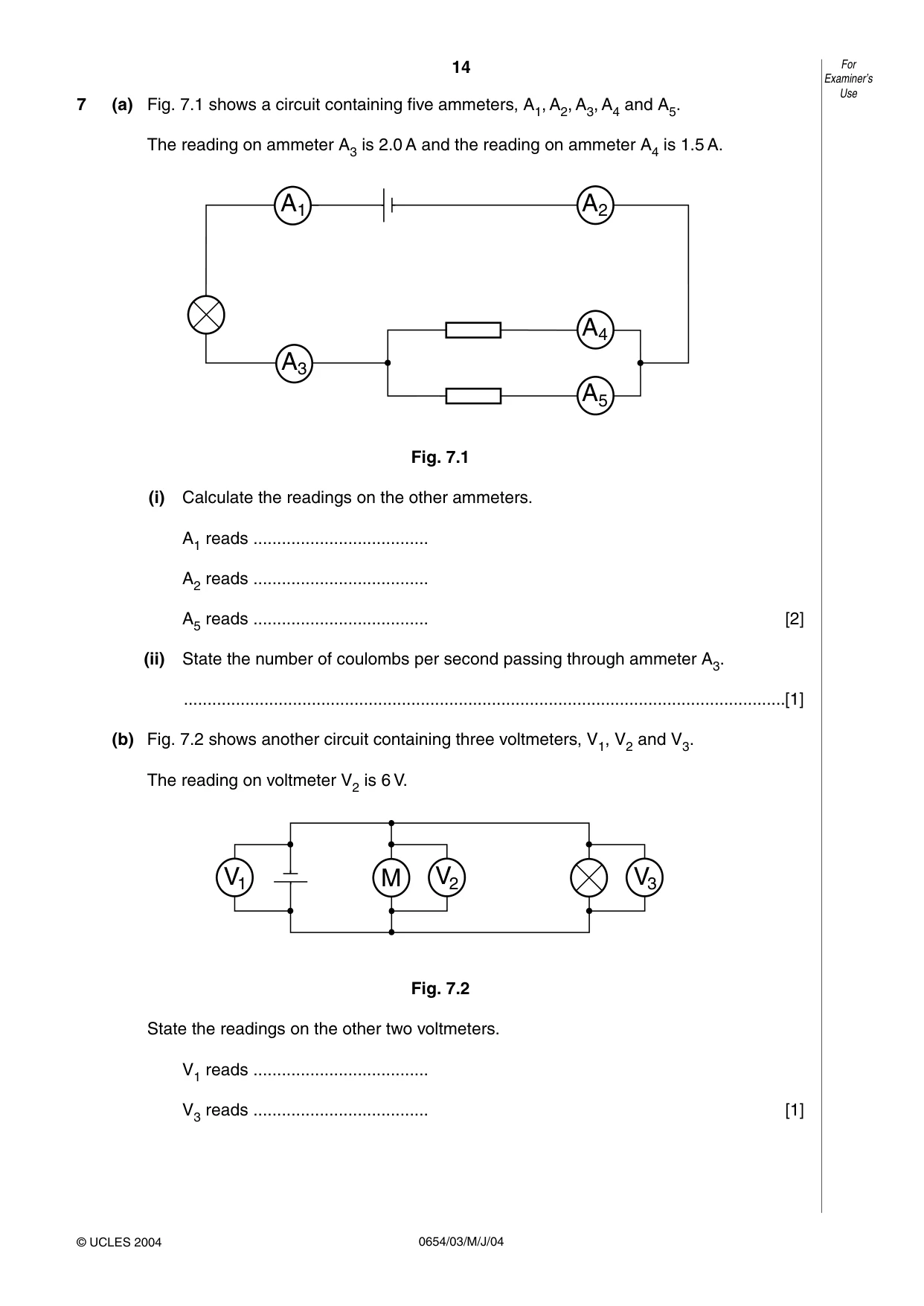
14 0654/03/M/J/04 7 (a) Fig. 7.1 shows a circuit containing five ammeters, A1, A2, A3, A4 and A5. The reading on ammeter A3 is 2.0 A and the reading on ammeter A4 is 1.5 A. Fig. 7.1 (i) Calculate the readings on the other ammeters. A1 reads … A2 reads … A5 reads … [2] (ii) State the number of coulombs per second passing through ammeter A3. …[1] (b) Fig. 7.2 shows another circuit containing three voltmeters, V1, V2 and V3. The reading on voltmeter V2 is 6 V. Fig. 7.2 State the readings on the other two voltmeters. V1 reads … V3 reads … [1] V3 V2 V1 M A1 A3 A4 A2 A5 For Examiner’s Use © UCLES 2004
Question paper, page 15
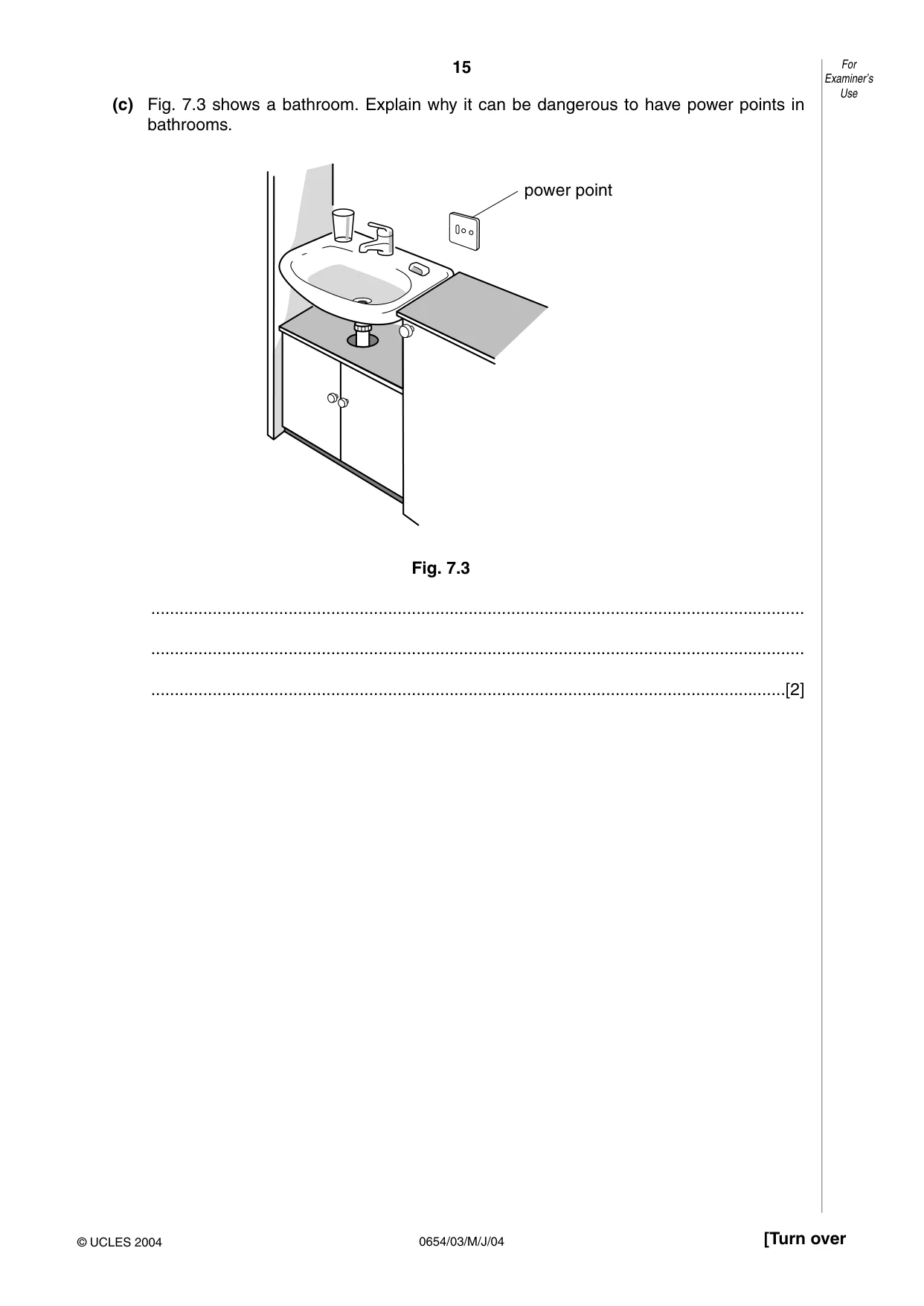
15 0654/03/M/J/04 [Turn over (c) Fig. 7.3 shows a bathroom. Explain why it can be dangerous to have power points in bathrooms. Fig. 7.3 … … …[2] power point For Examiner’s Use © UCLES 2004
Question paper, page 16
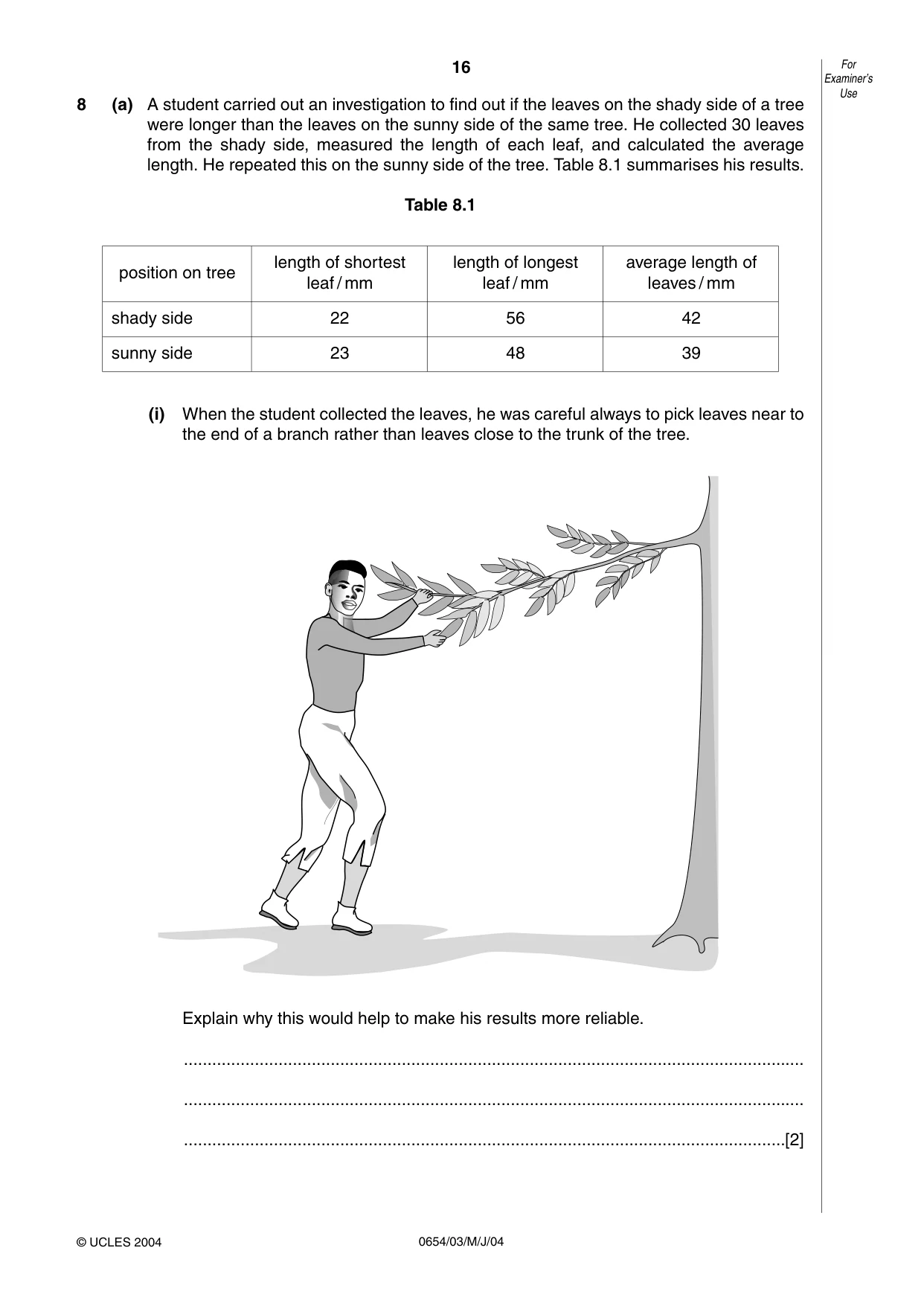
16 0654/03/M/J/04 8 (a) A student carried out an investigation to find out if the leaves on the shady side of a tree were longer than the leaves on the sunny side of the same tree. He collected 30 leaves from the shady side, measured the length of each leaf, and calculated the average length. He repeated this on the sunny side of the tree. Table 8.1 summarises his results. Table 8.1 (i) When the student collected the leaves, he was careful always to pick leaves near to the end of a branch rather than leaves close to the trunk of the tree. Explain why this would help to make his results more reliable. … … …[2] For Examiner’s Use © UCLES 2004 length of shortest length of longest average length of position on tree leaf / mm leaf / mm leaves / mm shady side 22 56 42 sunny side 23 48 39
Question paper, page 17
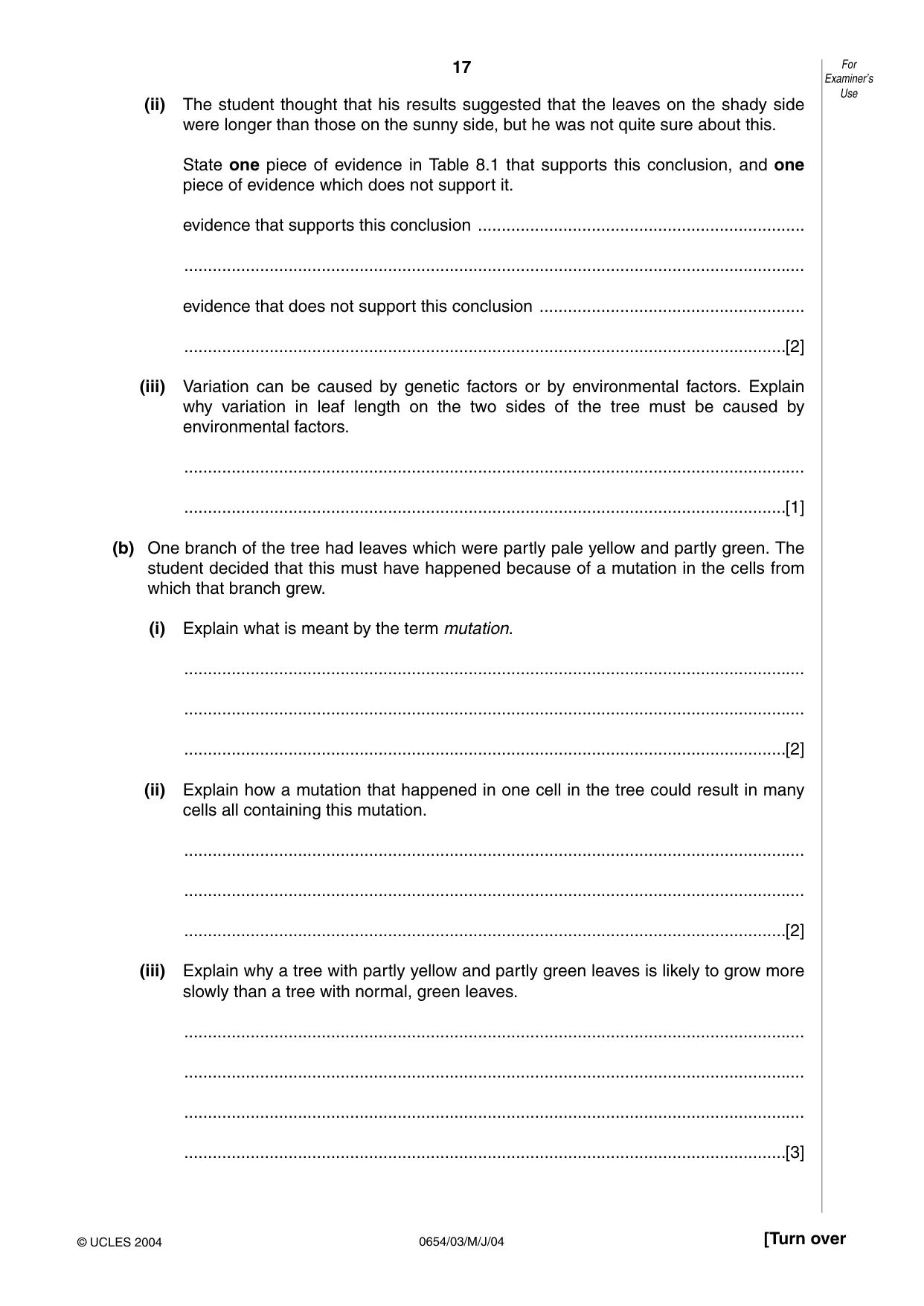
17 0654/03/M/J/04 [Turn over (ii) The student thought that his results suggested that the leaves on the shady side were longer than those on the sunny side, but he was not quite sure about this. State one piece of evidence in Table 8.1 that supports this conclusion, and one piece of evidence which does not support it. evidence that supports this conclusion … … evidence that does not support this conclusion … …[2] (iii) Variation can be caused by genetic factors or by environmental factors. Explain why variation in leaf length on the two sides of the tree must be caused by environmental factors. … …[1] (b) One branch of the tree had leaves which were partly pale yellow and partly green. The student decided that this must have happened because of a mutation in the cells from which that branch grew. (i) Explain what is meant by the term mutation. … … …[2] (ii) Explain how a mutation that happened in one cell in the tree could result in many cells all containing this mutation. … … …[2] (iii) Explain why a tree with partly yellow and partly green leaves is likely to grow more slowly than a tree with normal, green leaves. … … … …[3] For Examiner’s Use © UCLES 2004
Question paper, page 18
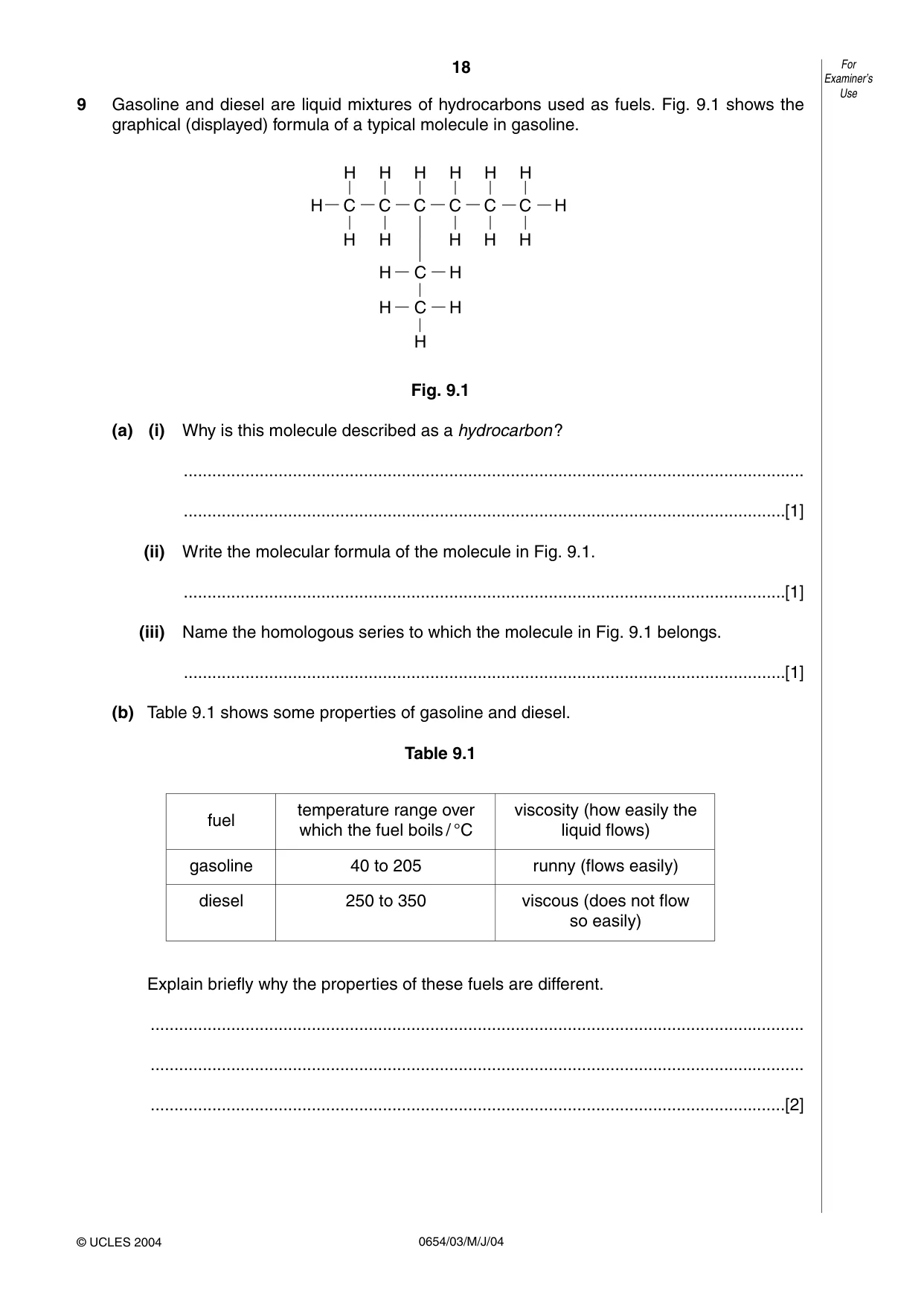
18 0654/03/M/J/04 9 Gasoline and diesel are liquid mixtures of hydrocarbons used as fuels. Fig. 9.1 shows the graphical (displayed) formula of a typical molecule in gasoline. Fig. 9.1 (a) (i) Why is this molecule described as a hydrocarbon? … …[1] (ii) Write the molecular formula of the molecule in Fig. 9.1. …[1] (iii) Name the homologous series to which the molecule in Fig. 9.1 belongs. …[1] (b) Table 9.1 shows some properties of gasoline and diesel. Table 9.1 Explain briefly why the properties of these fuels are different. … … …[2] H H H C H C H H C H H C H H C H H C H H H C H H H C For Examiner’s Use © UCLES 2004 temperature range over viscosity (how easily the fuel which the fuel boils / °C liquid flows) gasoline 40 to 205 runny (flows easily) diesel 250 to 350 viscous (does not flow so easily)
Question paper, page 19
19 0654/03/M/J/04 [Turn over (c) Ethene, C2H4, is an important unsaturated hydrocarbon. (i) Explain why ethene is described as unsaturated. … …[1] (ii) Describe a chemical test and its result which would show that ethene is unsaturated. … … …[2] (iii) Millions of tonnes of ethene are used in chemical industries world-wide each year. Ethene burns easily and releases much heat when it does so. Suggest why the world’s chemical industries consider ethene too valuable to use as a fuel. … … …[2] (d) Describe briefly how ethene can be converted into ethanol, C2H6O, and write a balanced equation for the reaction. … … … …[3] For Examiner’s Use © UCLES 2004
Question paper, page 20
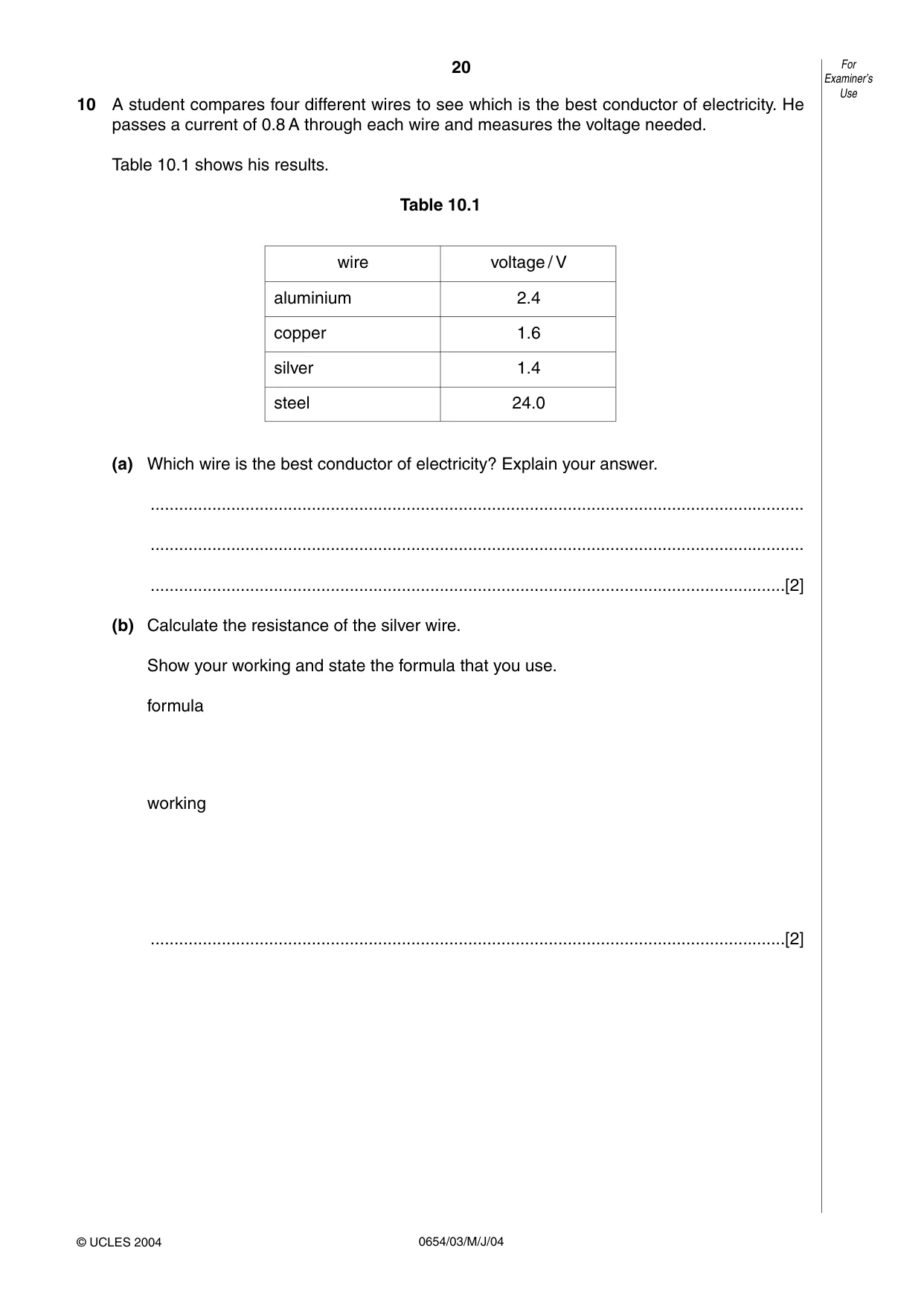
20 0654/03/M/J/04 10 A student compares four different wires to see which is the best conductor of electricity. He passes a current of 0.8 A through each wire and measures the voltage needed. Table 10.1 shows his results. Table 10.1 (a) Which wire is the best conductor of electricity? Explain your answer. … … …[2] (b) Calculate the resistance of the silver wire. Show your working and state the formula that you use. formula working …[2] For Examiner’s Use © UCLES 2004 wire voltage / V aluminium 2.4 copper 1.6 silver 1.4 steel 24.0
Question paper, page 21
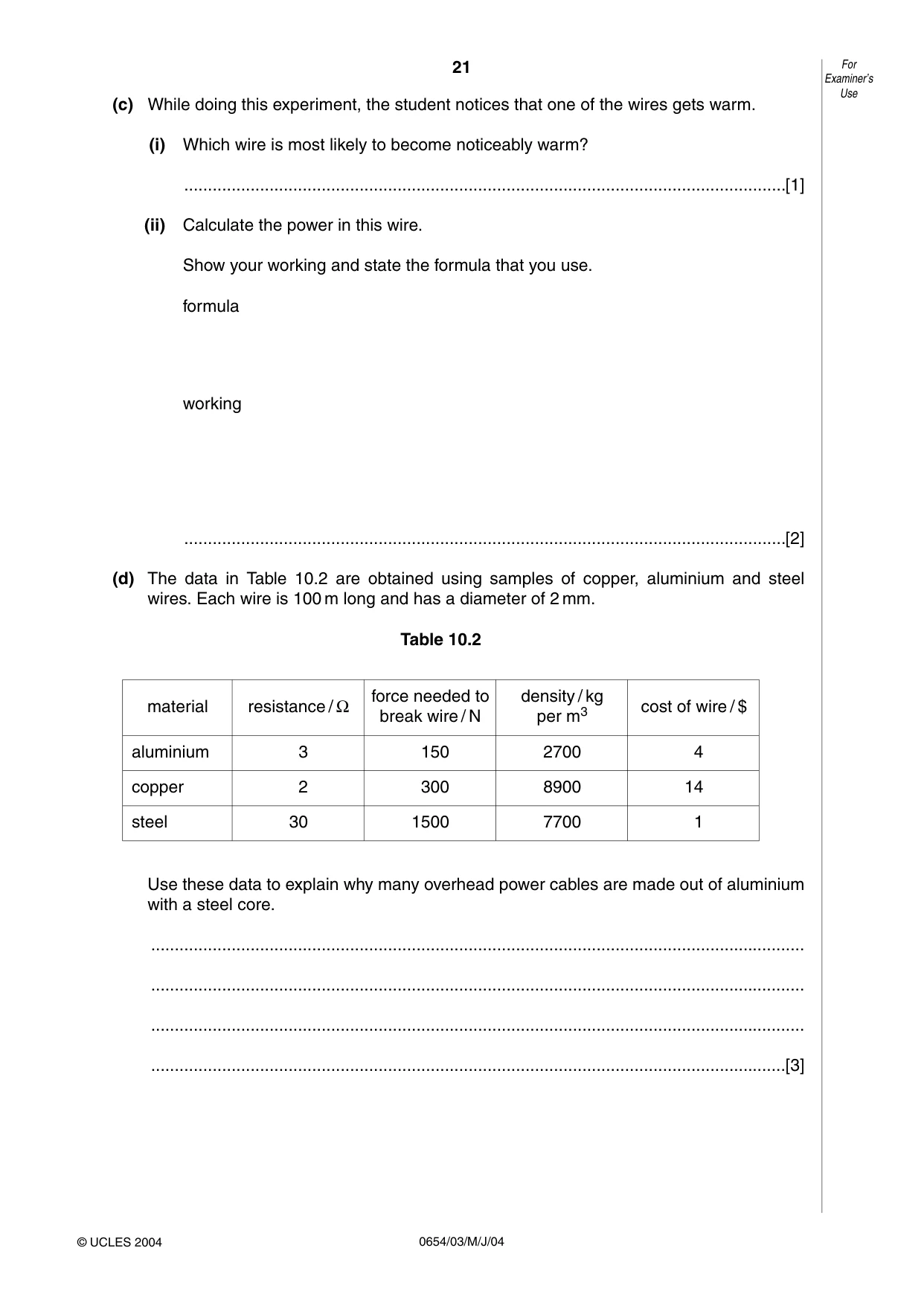
21 0654/03/M/J/04 (c) While doing this experiment, the student notices that one of the wires gets warm. (i) Which wire is most likely to become noticeably warm? …[1] (ii) Calculate the power in this wire. Show your working and state the formula that you use. formula working …[2] (d) The data in Table 10.2 are obtained using samples of copper, aluminium and steel wires. Each wire is 100 m long and has a diameter of 2 mm. Table 10.2 Use these data to explain why many overhead power cables are made out of aluminium with a steel core. … … … …[3] For Examiner’s Use © UCLES 2004 force needed to density / kg material resistance / Ω cost of wire / $ break wire / N per m3 aluminium 3 150 2700 4 copper 2 300 8900 14 steel 30 1500 7700 1
Question paper, page 23
23 0654/03/M/J/04 BLANK PAGE Copyright Acknowledgements: Question 3. Reproduced by permission of Oxford University Press Australia from A Field Guide to Mammals of Australia by: Menkhorst and Knight © Oxford University Press www.oup.com.au The University of Cambridge Local Examinations Syndicate has made every effort to trace copyright holders, but if we have inadvertently overlooked any we will be pleased to make the necessary arrangements at the first opportunity. University of Cambridge International Examinations is part of the University of Cambridge Local Examinations Syndicate (UCLES), which is itself a department of the University of Cambridge.
Question paper, page 24
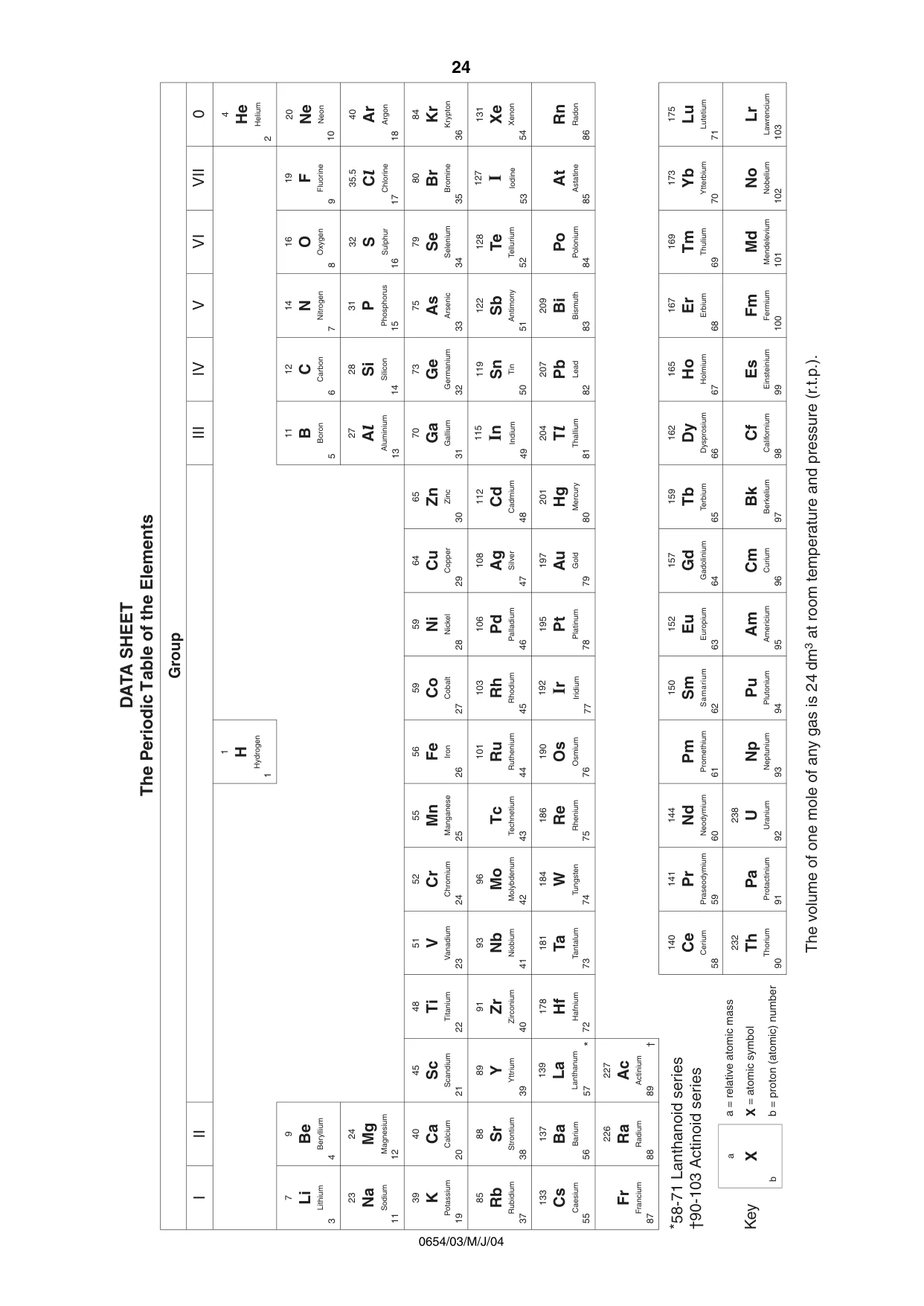
24 0654/03/M/J/04 Group DATA SHEET The Periodic Table of the Elements 140 Ce Cerium 58 141 Pr Praseodymium 59 144 Nd Neodymium 60 Pm Promethium 61 150 Sm Samarium 62 152 Eu Europium 63 157 Gd Gadolinium 64 159 Tb Terbium 65 162 Dy Dysprosium 66 165 Ho Holmium 67 167 Er Erbium 68 169 Tm Thulium 69 173 Yb Ytterbium 70 175 Lu Lutetium 71 232 Th Thorium 90 Pa Protactinium 91 238 U Uranium 92 Np Neptunium 93 Pu Plutonium 94 Am Americium 95 Cm Curium 96 Bk Berkelium 97 Cf Californium 98 Es Einsteinium 99 Fm Fermium 100 Md Mendelevium 101 No Nobelium 102 Lr Lawrencium 103 1 H Hydrogen 1 7 Li Lithium 3 23 Na Sodium 11 24 Mg Magnesium 12 40 Ca Calcium 20 45 Sc Scandium 21 48 Ti Titanium 22 51 V Vanadium 23 52 Cr Chromium 24 55 Mn Manganese 25 56 Fe Iron 26 59 Co Cobalt 27 59 Ni Nickel 28 64 Cu Copper 29 65 Zn Zinc 30 70 Ga Gallium 31 27 Al Aluminium 13 11 B Boron 5 12 C Carbon 6 14 N Nitrogen 7 16 O Oxygen 8 19 F Fluorine 9 28 Si Silicon 14 31 P Phosphorus 15 32 S Sulphur 16 35.5 Cl Chlorine 17 40 Ar Argon 18 20 Ne Neon 10 4 He Helium 2 73 Ge Germanium 32 75 As Arsenic 33 79 Se Selenium 34 80 Br Bromine 35 84 Kr Krypton 36 39 K Potassium 19 88 Sr Strontium 38 89 Y Yttrium 39 91 Zr Zirconium 40 93 Nb Niobium 41 96 Mo Molybdenum 42 Tc Technetium 43 101 Ru Ruthenium 44 103 Rh Rhodium 45 106 Pd Palladium 46 108 Ag Silver 47 112 Cd Cadmium 48 115 In Indium 49 119 Sn Tin 50 122 Sb Antimony 51 128 Te Tellurium 52 127 I Iodine 53 131 Xe Xenon 54 137 Ba Barium 56 139 La Lanthanum 57 * 178 Hf Hafnium 72 181 Ta Tantalum 73 184 W Tungsten 74 186 Re Rhenium 75 190 Os Osmium 76 192 Ir Iridium 77 195 Pt Platinum 78 197 Au Gold 79 201 Hg Mercury 80 204 Tl Thallium 81 207 Pb Lead 82 209 Bi Bismuth 83 Po Polonium 84 At Astatine 85 Rn Radon 86 Fr Francium 87 227 Ac Actinium 89 † 9 Be Beryllium 4 I II III IV V VI VII 0 85 Rb Rubidium 37 133 Cs Caesium 55 226 Ra Radium 88 The volume of one mole of any gas is 24 dm3 at room temperature and pressure (r.t.p.). a X b a = relative atomic mass X = atomic symbol b = proton (atomic) number Key *58-71 Lanthanoid series †90-103 Actinoid series