Cambridge IGCSE Sciences - Co-ordinated (Double) 0654 — 2003 Oct/Nov Paper 3 · Variant 1
0654/31/O/N/03
The question paper and its mark scheme, free to read here and free to download. This is Cambridge’s own paper, exactly as it was sat.
Question paper24 pages


Mark scheme
No mark scheme is in the library for this paper.
Paper as text
Question paper, page 1
This document consists of 21 printed pages and 3 blank pages. SP (NF/SLC) S42831/2 © UCLES 2003 [Turn over CAMBRIDGE INTERNATIONAL EXAMINATIONS International General Certificate of Secondary Education CO-ORDINATED SCIENCES 0654/03 Paper 3 October/November 2003 2 hours Candidates answer on the Question Paper. No Additional Materials are required. READ THESE INSTRUCTIONS FIRST Write your Centre number, candidate number and name on all the work you hand in. Write in dark blue or black pen in the spaces provided on the Question Paper. You may use a soft pencil for any diagrams, graphs, tables or rough working. Do not use staples, paper clips, highlighters, glue or correction fluid. Answer all questions. At the end of the examination, fasten all your work securely together. The number of marks is given in brackets [ ] at the end of each question or part question. A copy of the Periodic Table is printed on page 24. Centre Number Candidate Number Name If you have been given a label, look at the details. If any details are incorrect or missing, please fill in your correct details in the space given at the top of this page. Stick your personal label here, if provided. For Examiner’s Use 1 2 3 4 5 6 7 8 9 10 Total www.XtremePapers.com
Question paper, page 2
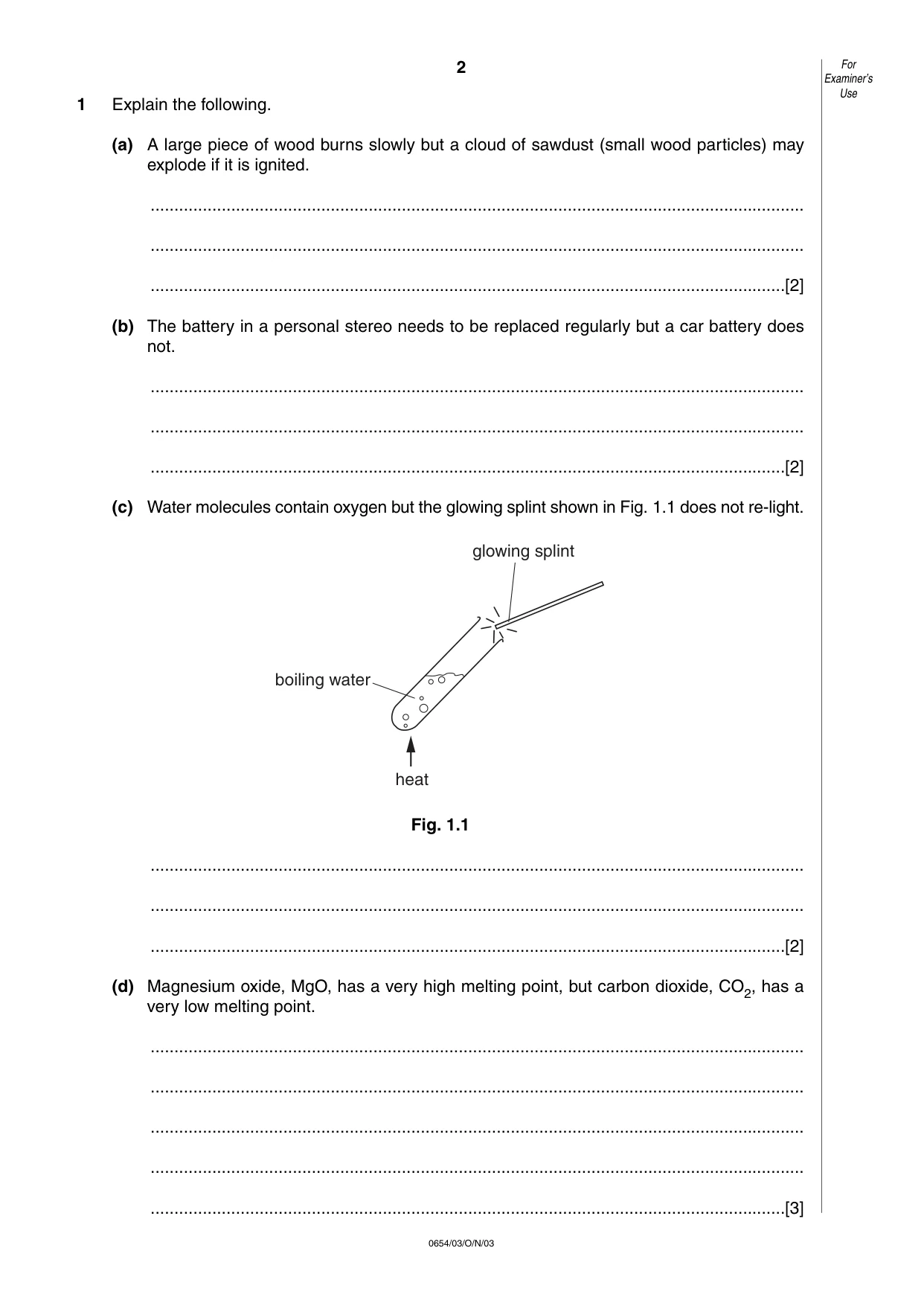
2 0654/03/O/N/03 1 Explain the following. (a) A large piece of wood burns slowly but a cloud of sawdust (small wood particles) may explode if it is ignited. … … …[2] (b) The battery in a personal stereo needs to be replaced regularly but a car battery does not. … … …[2] (c) Water molecules contain oxygen but the glowing splint shown in Fig. 1.1 does not re-light. Fig. 1.1 … … …[2] (d) Magnesium oxide, MgO, has a very high melting point, but carbon dioxide, CO2, has a very low melting point. … … … … …[3] heat boiling water glowing splint For Examiner’s Use
Question paper, page 3
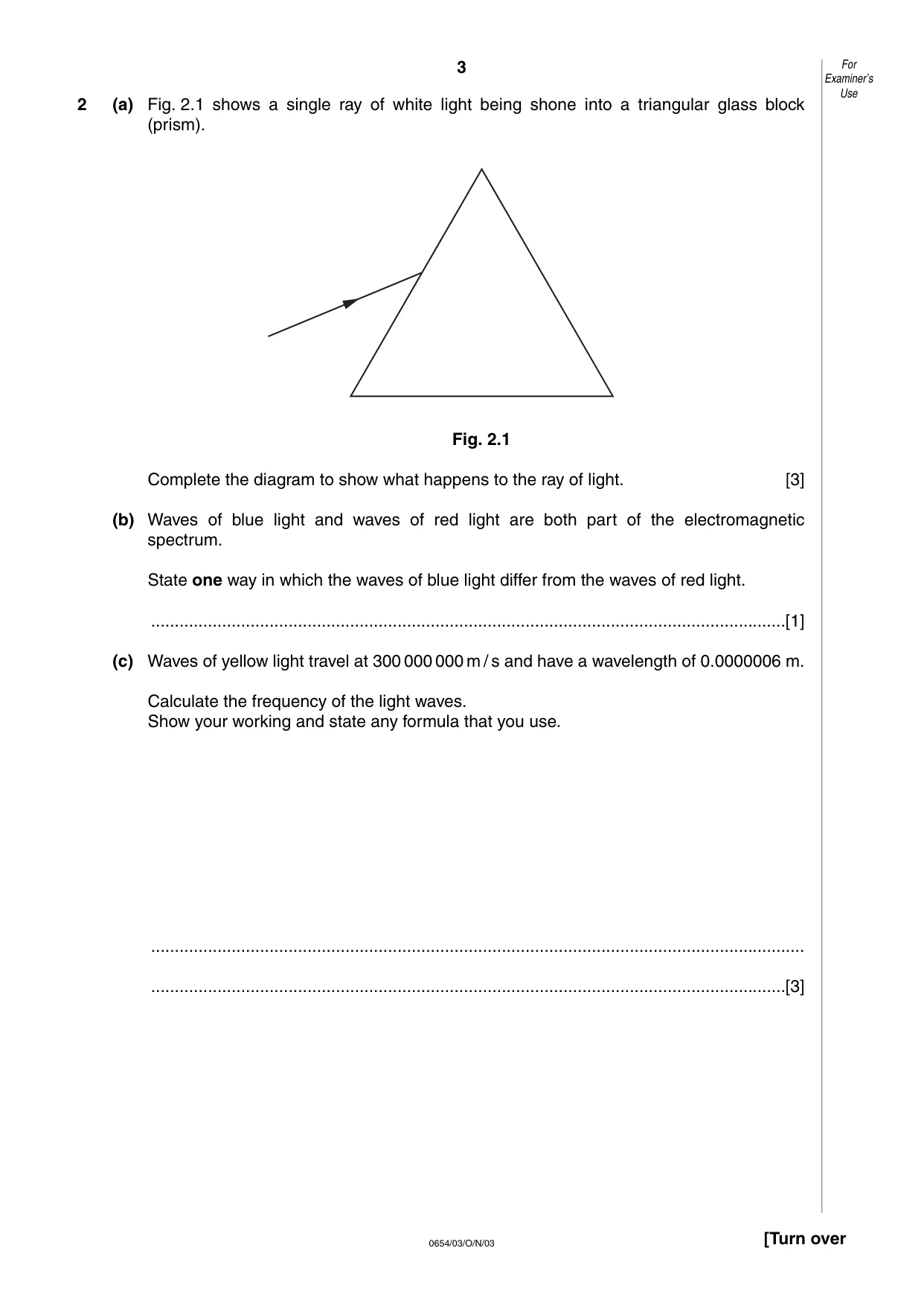
3 0654/03/O/N/03 [Turn over 2 (a) Fig. 2.1 shows a single ray of white light being shone into a triangular glass block (prism). Fig. 2.1 Complete the diagram to show what happens to the ray of light. [3] (b) Waves of blue light and waves of red light are both part of the electromagnetic spectrum. State one way in which the waves of blue light differ from the waves of red light. …[1] (c) Waves of yellow light travel at 300 000 000 m / s and have a wavelength of 0.0000006 m. Calculate the frequency of the light waves. Show your working and state any formula that you use. … …[3] For Examiner’s Use
Question paper, page 4
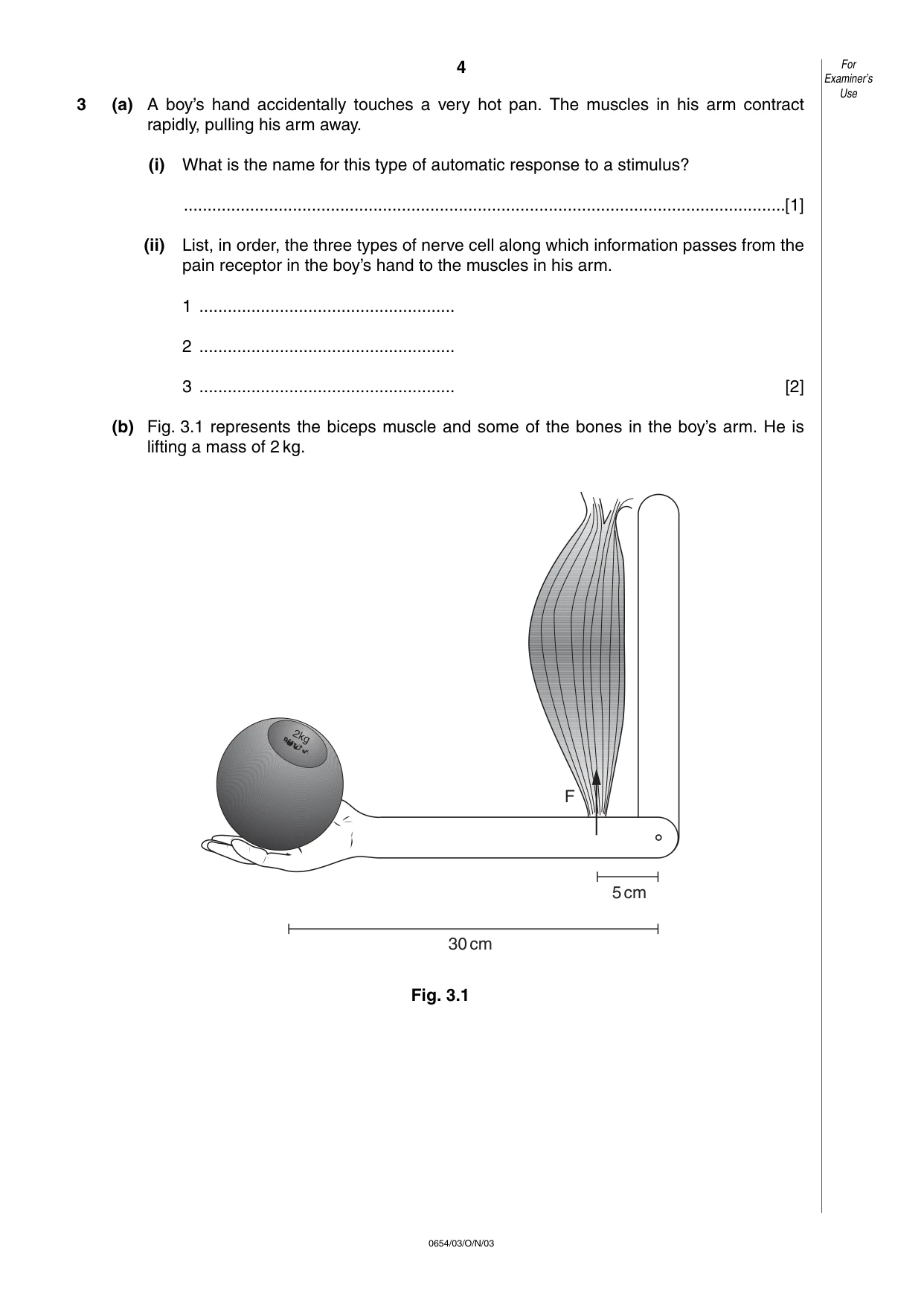
4 0654/03/O/N/03 3 (a) A boy’s hand accidentally touches a very hot pan. The muscles in his arm contract rapidly, pulling his arm away. (i) What is the name for this type of automatic response to a stimulus? …[1] (ii) List, in order, the three types of nerve cell along which information passes from the pain receptor in the boy’s hand to the muscles in his arm. 1 … 2 … 3 … [2] (b) Fig. 3.1 represents the biceps muscle and some of the bones in the boy’s arm. He is lifting a mass of 2 kg. Fig. 3.1 2kg F 5cm 30cm For Examiner’s Use
Question paper, page 5
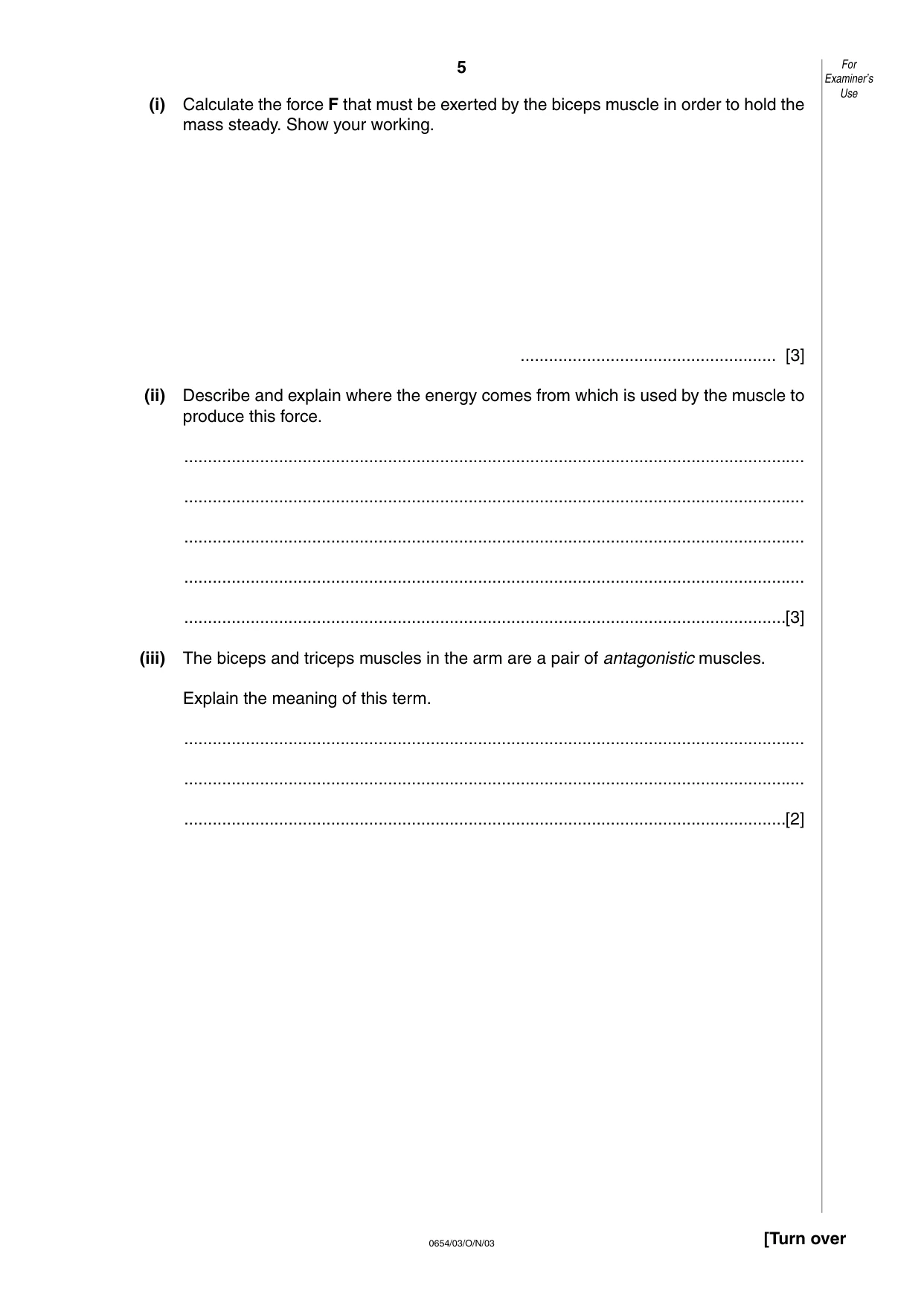
5 0654/03/O/N/03 [Turn over (i) Calculate the force F that must be exerted by the biceps muscle in order to hold the mass steady. Show your working. … [3] (ii) Describe and explain where the energy comes from which is used by the muscle to produce this force. … … … … …[3] (iii) The biceps and triceps muscles in the arm are a pair of antagonistic muscles. Explain the meaning of this term. … … …[2] For Examiner’s Use
Question paper, page 6
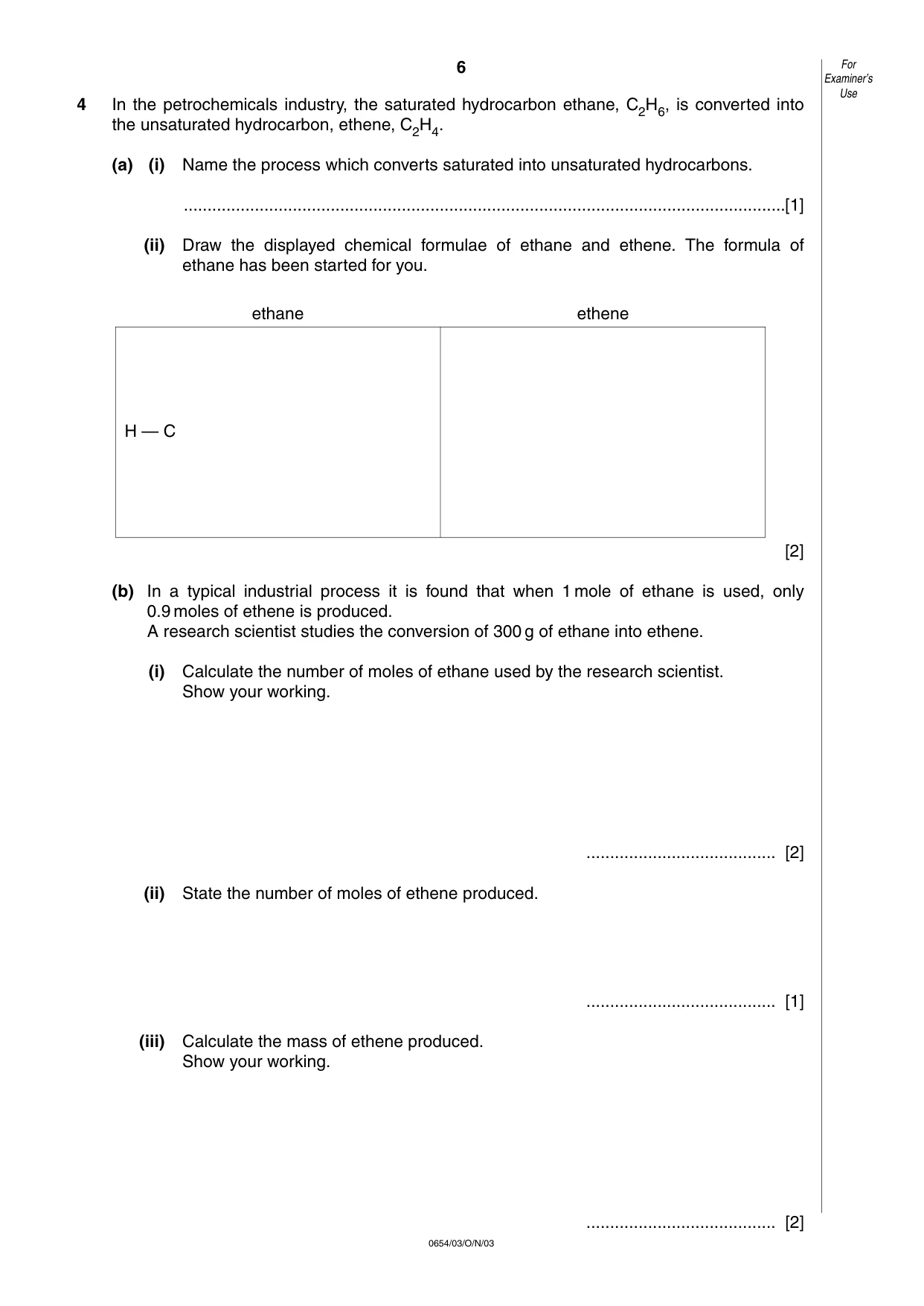
6 0654/03/O/N/03 4 In the petrochemicals industry, the saturated hydrocarbon ethane, C2H6, is converted into the unsaturated hydrocarbon, ethene, C2H4. (a) (i) Name the process which converts saturated into unsaturated hydrocarbons. …[1] (ii) Draw the displayed chemical formulae of ethane and ethene. The formula of ethane has been started for you. ethane ethene [2] (b) In a typical industrial process it is found that when 1 mole of ethane is used, only 0.9 moles of ethene is produced. A research scientist studies the conversion of 300 g of ethane into ethene. (i) Calculate the number of moles of ethane used by the research scientist. Show your working. … [2] (ii) State the number of moles of ethene produced. … [1] (iii) Calculate the mass of ethene produced. Show your working. … [2] For Examiner’s Use H — C
Question paper, page 7
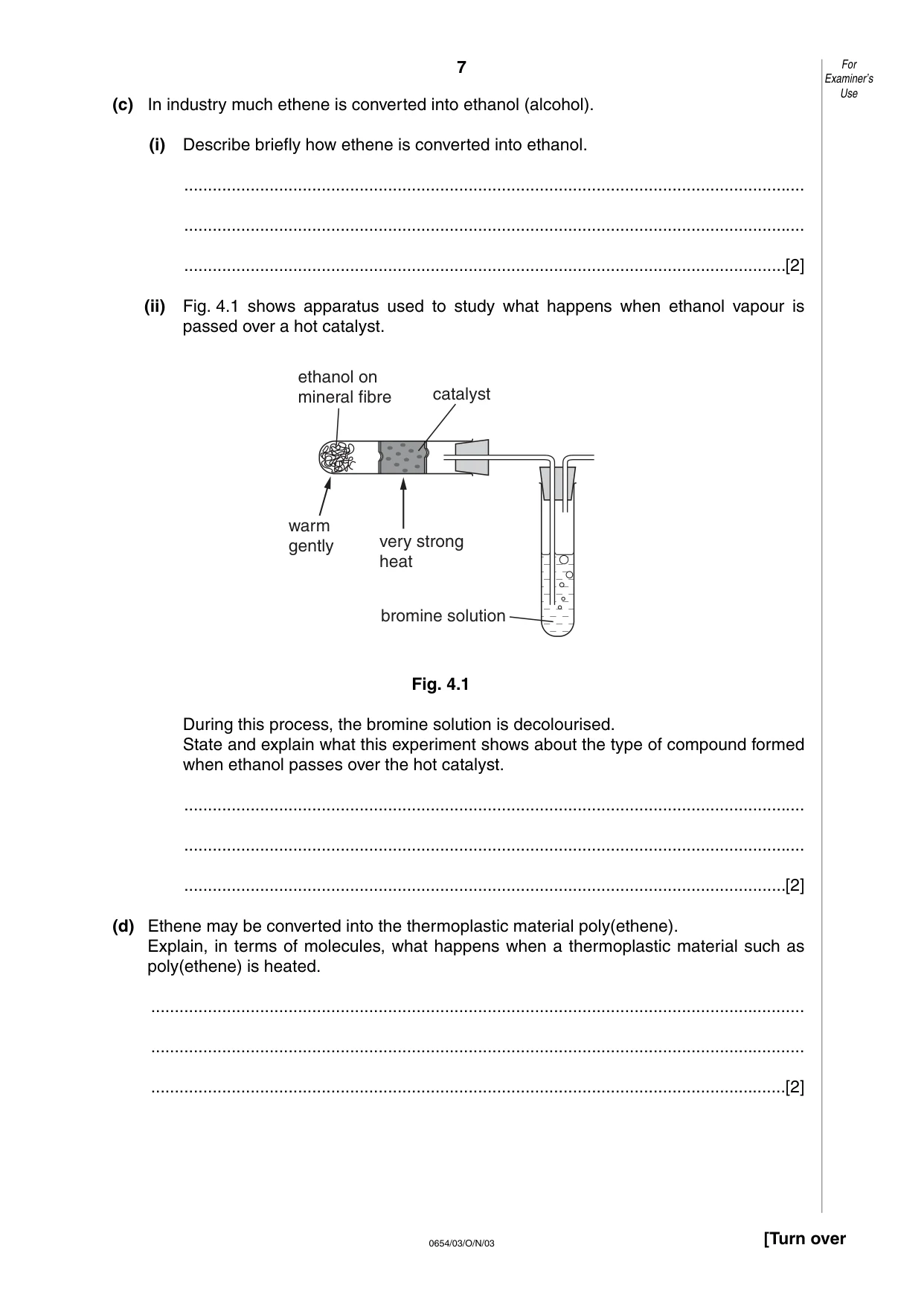
7 0654/03/O/N/03 [Turn over (c) In industry much ethene is converted into ethanol (alcohol). (i) Describe briefly how ethene is converted into ethanol. … … …[2] (ii) Fig. 4.1 shows apparatus used to study what happens when ethanol vapour is passed over a hot catalyst. Fig. 4.1 During this process, the bromine solution is decolourised. State and explain what this experiment shows about the type of compound formed when ethanol passes over the hot catalyst. … … …[2] (d) Ethene may be converted into the thermoplastic material poly(ethene). Explain, in terms of molecules, what happens when a thermoplastic material such as poly(ethene) is heated. … … …[2] ethanol on mineral fibre warm gently very strong heat bromine solution catalyst For Examiner’s Use
Question paper, page 8
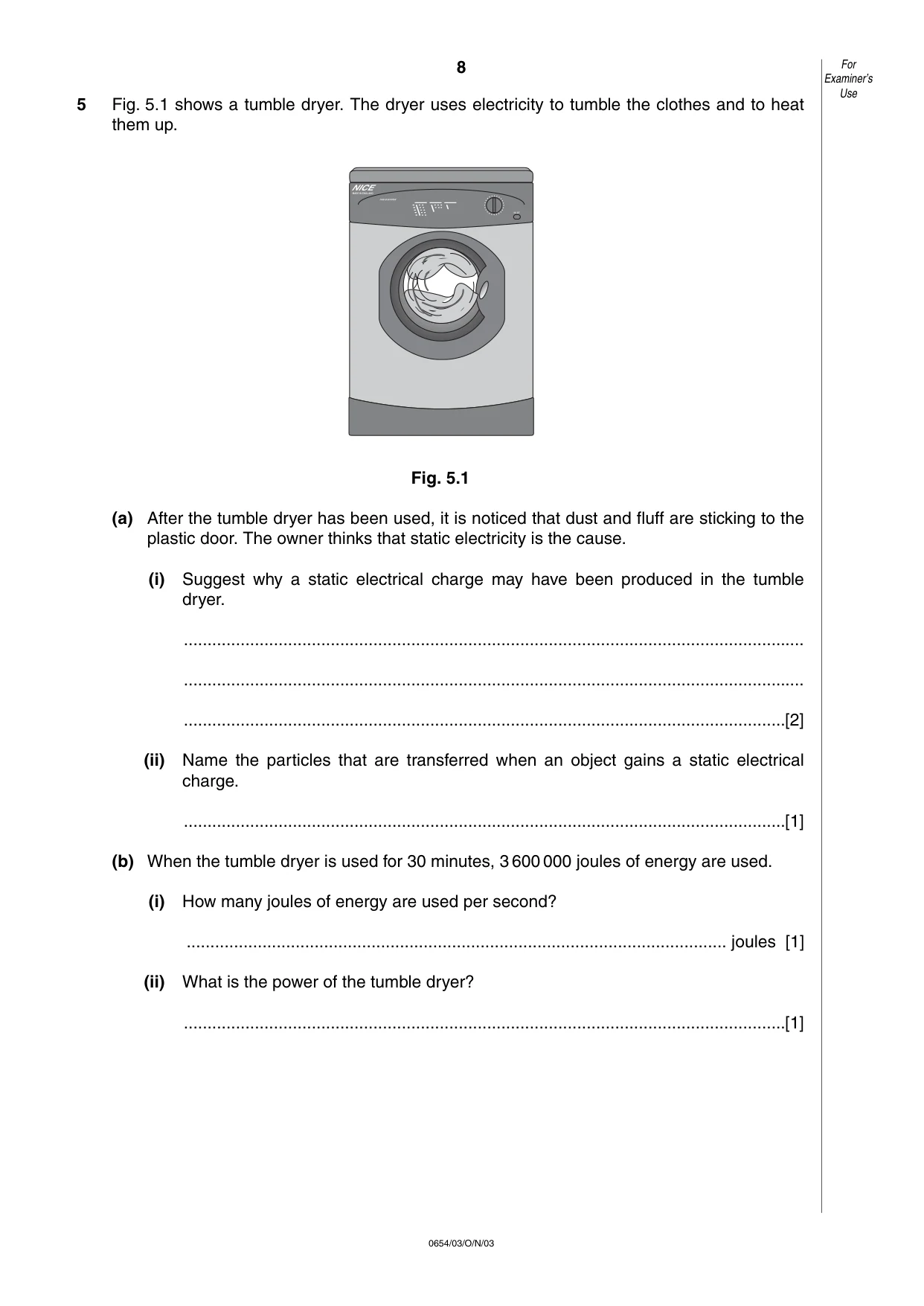
8 0654/03/O/N/03 5 Fig. 5.1 shows a tumble dryer. The dryer uses electricity to tumble the clothes and to heat them up. Fig. 5.1 (a) After the tumble dryer has been used, it is noticed that dust and fluff are sticking to the plastic door. The owner thinks that static electricity is the cause. (i) Suggest why a static electrical charge may have been produced in the tumble dryer. … … …[2] (ii) Name the particles that are transferred when an object gains a static electrical charge. …[1] (b) When the tumble dryer is used for 30 minutes, 3 600 000 joules of energy are used. (i) How many joules of energy are used per second? … joules [1] (ii) What is the power of the tumble dryer? …[1] For Examiner’s Use
Question paper, page 9
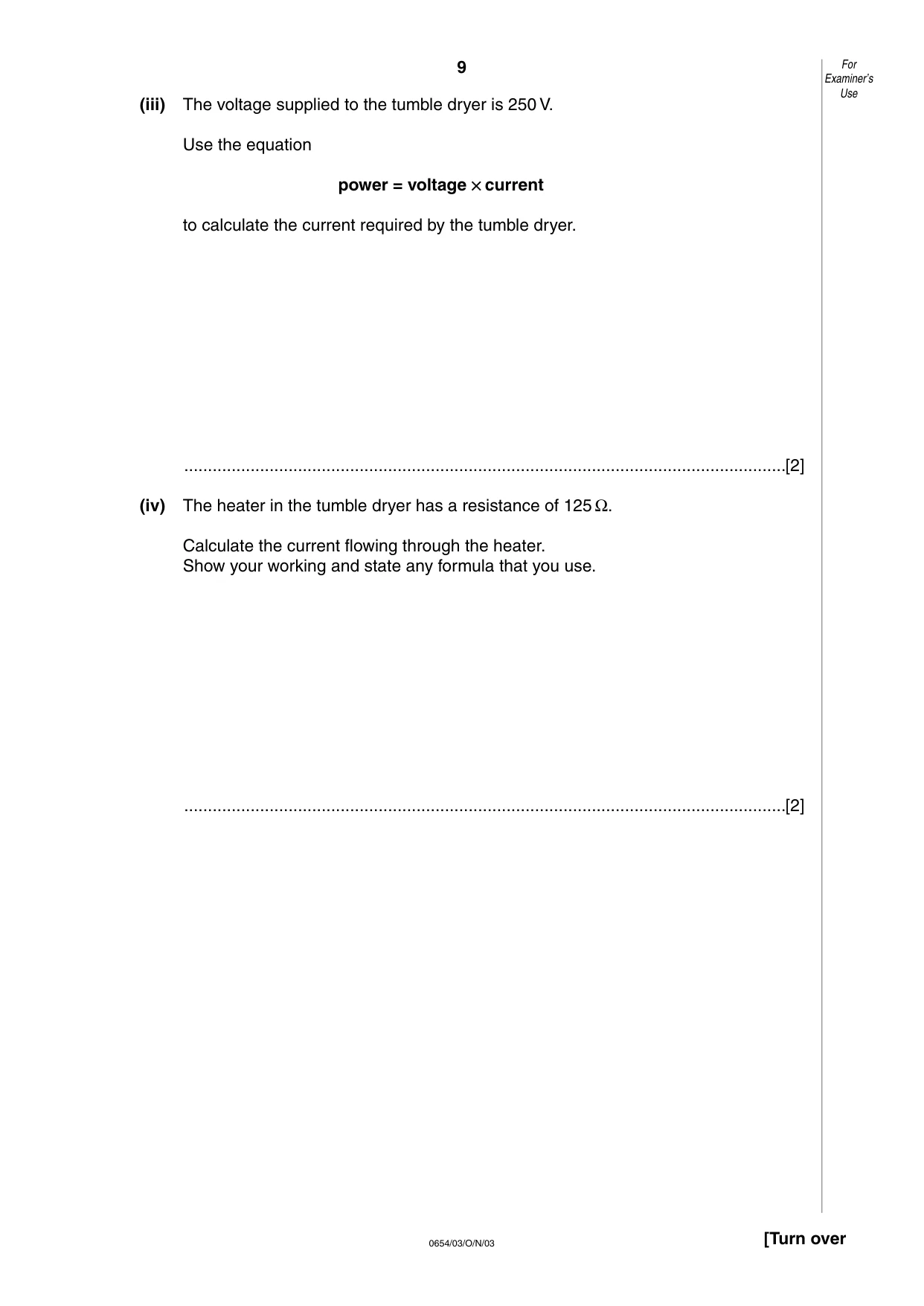
9 0654/03/O/N/03 [Turn over (iii) The voltage supplied to the tumble dryer is 250 V. Use the equation power = voltage × current to calculate the current required by the tumble dryer. …[2] (iv) The heater in the tumble dryer has a resistance of 125 Ω. Calculate the current flowing through the heater. Show your working and state any formula that you use. …[2] For Examiner’s Use
Question paper, page 10
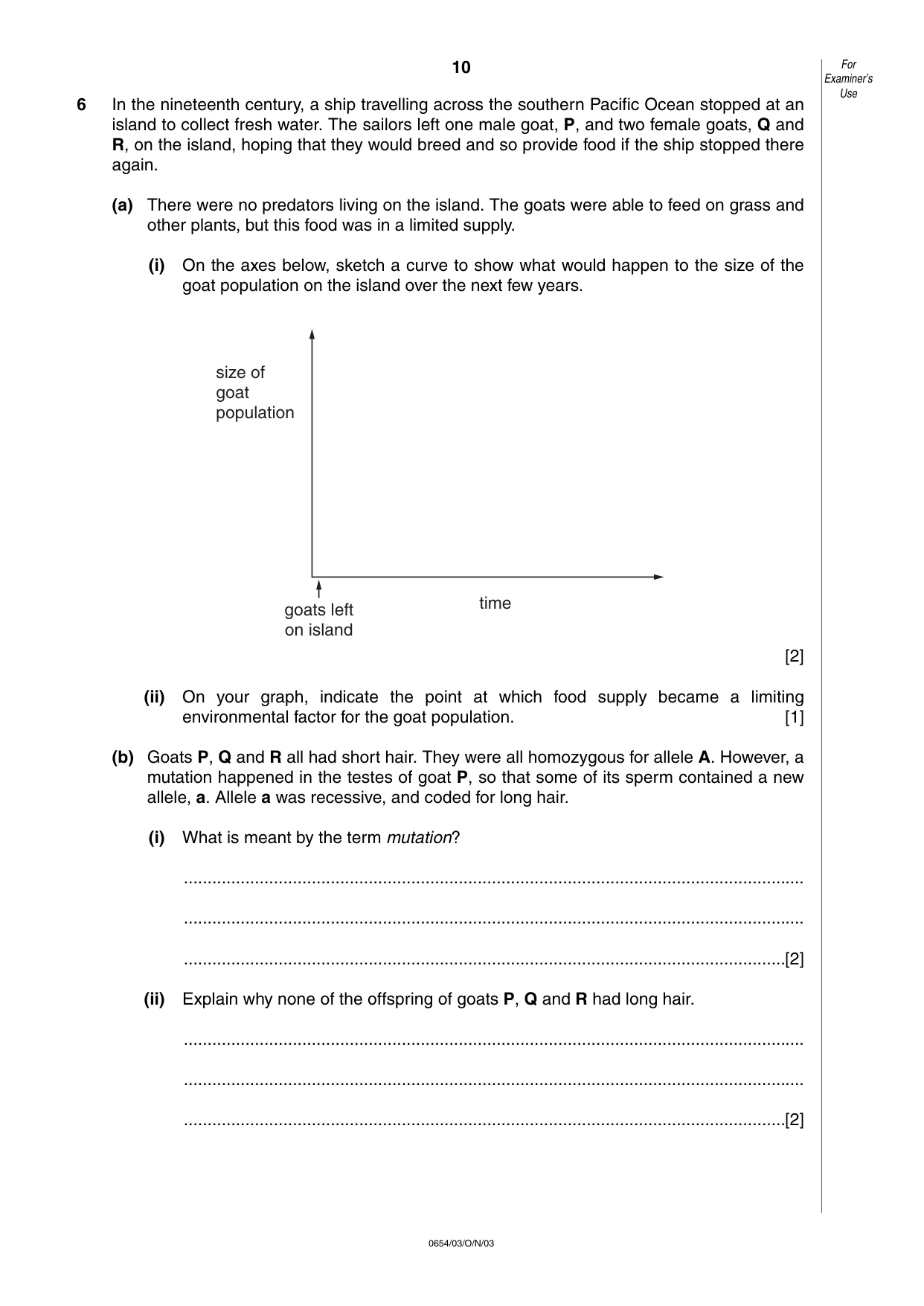
10 0654/03/O/N/03 6 In the nineteenth century, a ship travelling across the southern Pacific Ocean stopped at an island to collect fresh water. The sailors left one male goat, P, and two female goats, Q and R, on the island, hoping that they would breed and so provide food if the ship stopped there again. (a) There were no predators living on the island. The goats were able to feed on grass and other plants, but this food was in a limited supply. (i) On the axes below, sketch a curve to show what would happen to the size of the goat population on the island over the next few years. [2] (ii) On your graph, indicate the point at which food supply became a limiting environmental factor for the goat population. [1] (b) Goats P, Q and R all had short hair. They were all homozygous for allele A. However, a mutation happened in the testes of goat P, so that some of its sperm contained a new allele, a. Allele a was recessive, and coded for long hair. (i) What is meant by the term mutation? … … …[2] (ii) Explain why none of the offspring of goats P, Q and R had long hair. … … …[2] time size of goat population goats left on island For Examiner’s Use
Question paper, page 11
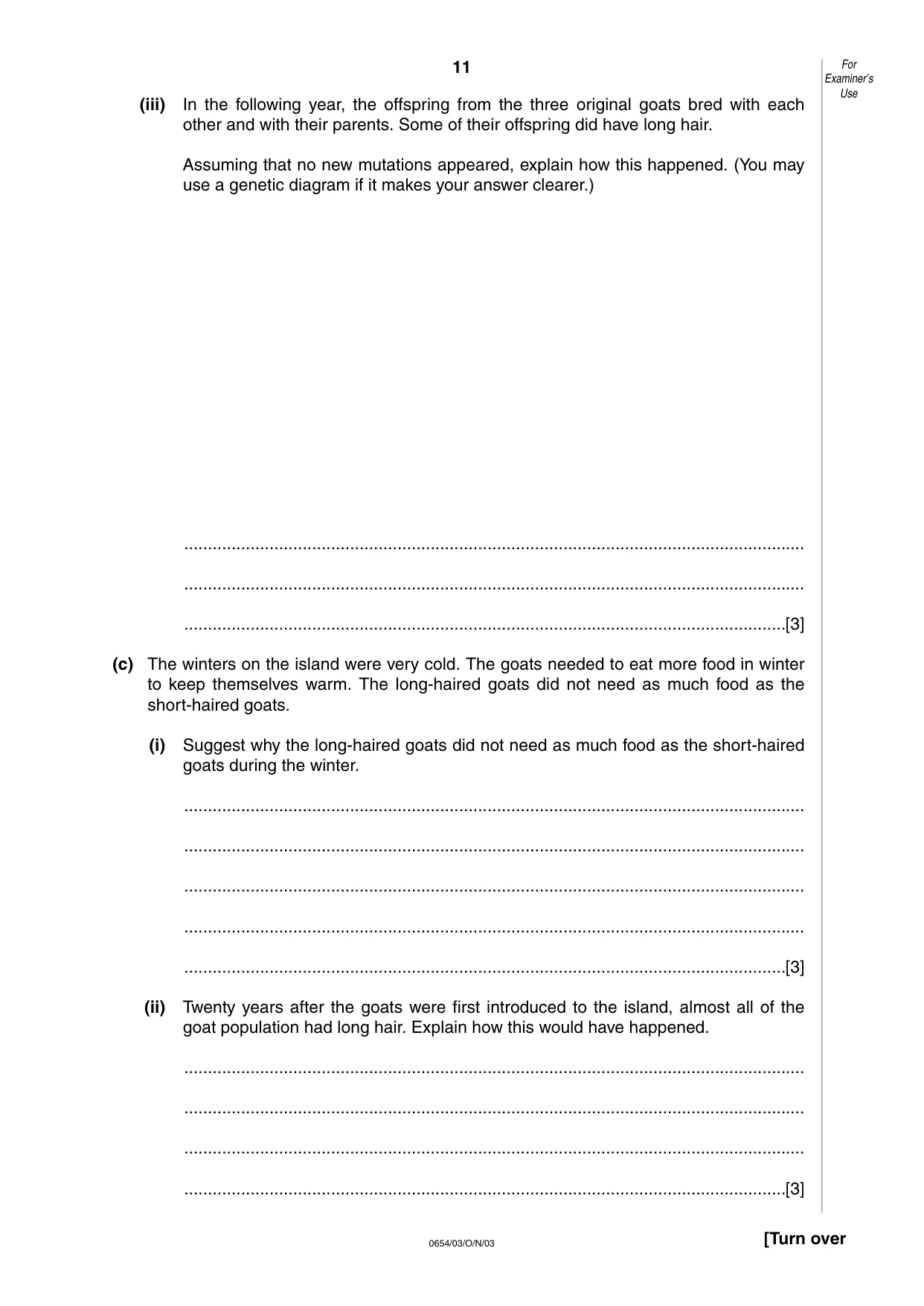
11 0654/03/O/N/03 [Turn over (iii) In the following year, the offspring from the three original goats bred with each other and with their parents. Some of their offspring did have long hair. Assuming that no new mutations appeared, explain how this happened. (You may use a genetic diagram if it makes your answer clearer.) … … …[3] (c) The winters on the island were very cold. The goats needed to eat more food in winter to keep themselves warm. The long-haired goats did not need as much food as the short-haired goats. (i) Suggest why the long-haired goats did not need as much food as the short-haired goats during the winter. … … … … …[3] (ii) Twenty years after the goats were first introduced to the island, almost all of the goat population had long hair. Explain how this would have happened. … … … …[3] For Examiner’s Use
Question paper, page 12
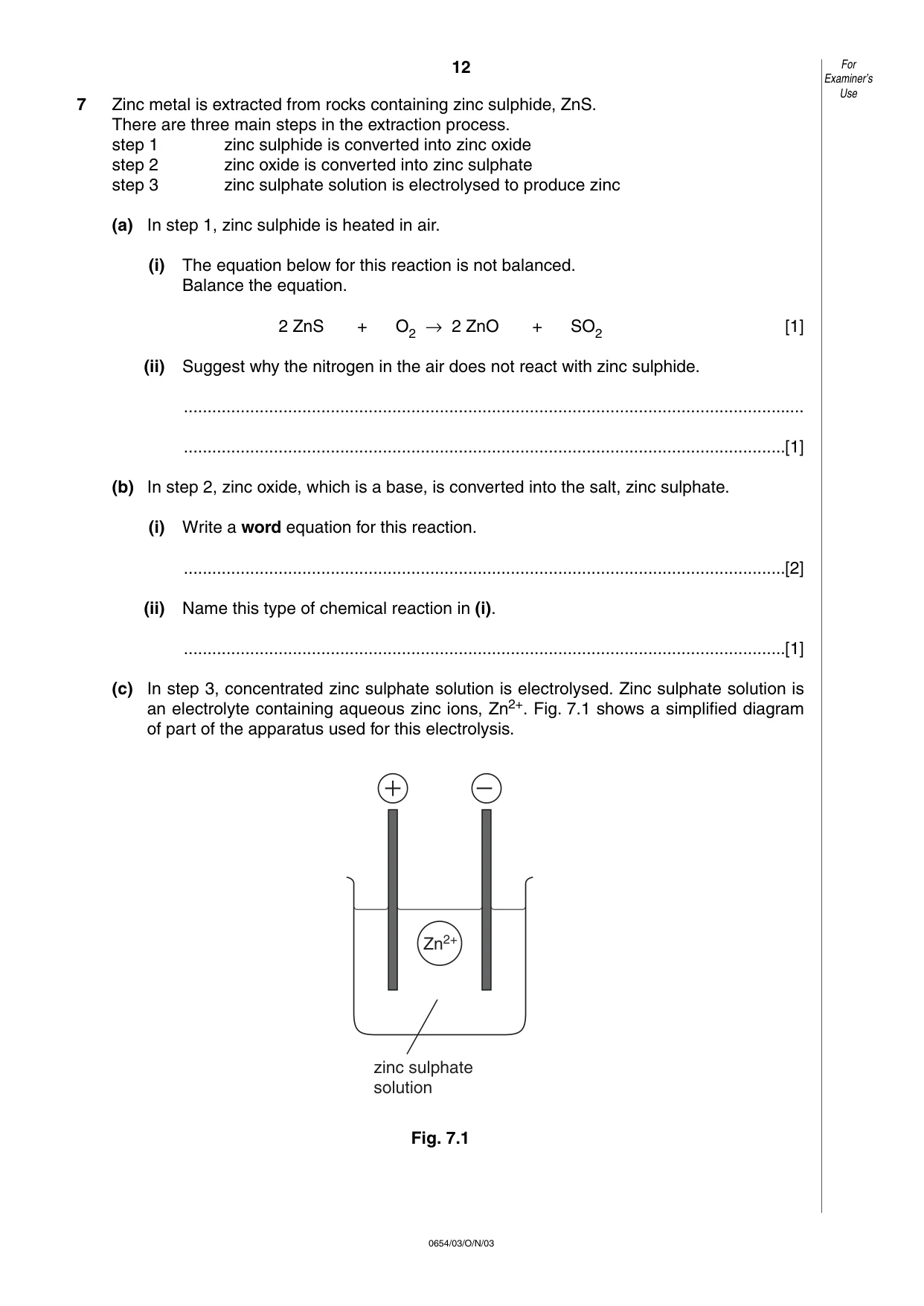
12 0654/03/O/N/03 7 Zinc metal is extracted from rocks containing zinc sulphide, ZnS. There are three main steps in the extraction process. step 1 zinc sulphide is converted into zinc oxide step 2 zinc oxide is converted into zinc sulphate step 3 zinc sulphate solution is electrolysed to produce zinc (a) In step 1, zinc sulphide is heated in air. (i) The equation below for this reaction is not balanced. Balance the equation. 2 ZnS + O2 →2 ZnO + SO2 [1] (ii) Suggest why the nitrogen in the air does not react with zinc sulphide. … …[1] (b) In step 2, zinc oxide, which is a base, is converted into the salt, zinc sulphate. (i) Write a word equation for this reaction. …[2] (ii) Name this type of chemical reaction in (i). …[1] (c) In step 3, concentrated zinc sulphate solution is electrolysed. Zinc sulphate solution is an electrolyte containing aqueous zinc ions, Zn2+. Fig. 7.1 shows a simplified diagram of part of the apparatus used for this electrolysis. Fig. 7.1 zinc sulphate solution Zn2+ For Examiner’s Use
Question paper, page 13
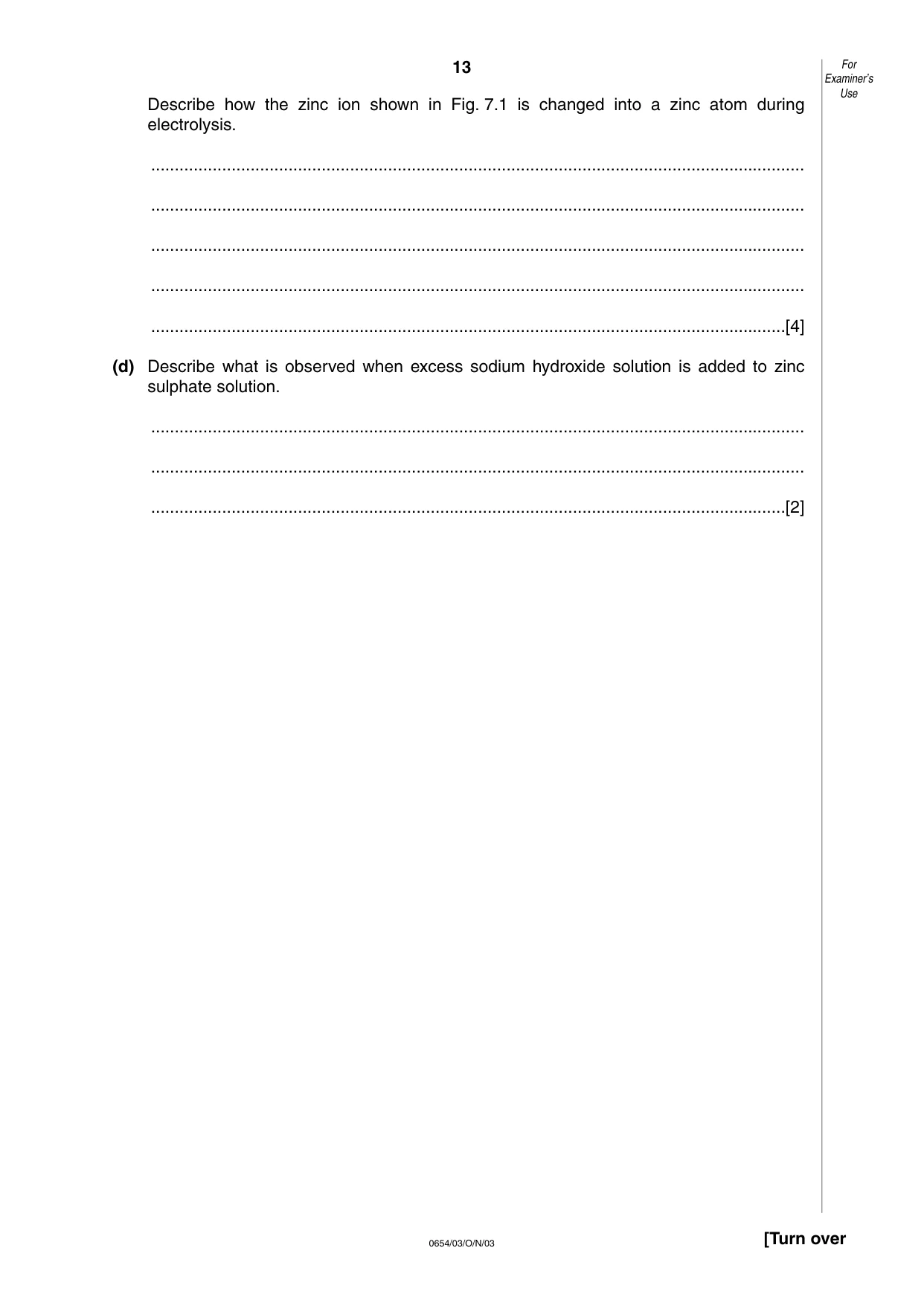
13 0654/03/O/N/03 [Turn over Describe how the zinc ion shown in Fig. 7.1 is changed into a zinc atom during electrolysis. … … … … …[4] (d) Describe what is observed when excess sodium hydroxide solution is added to zinc sulphate solution. … … …[2] For Examiner’s Use
Question paper, page 14
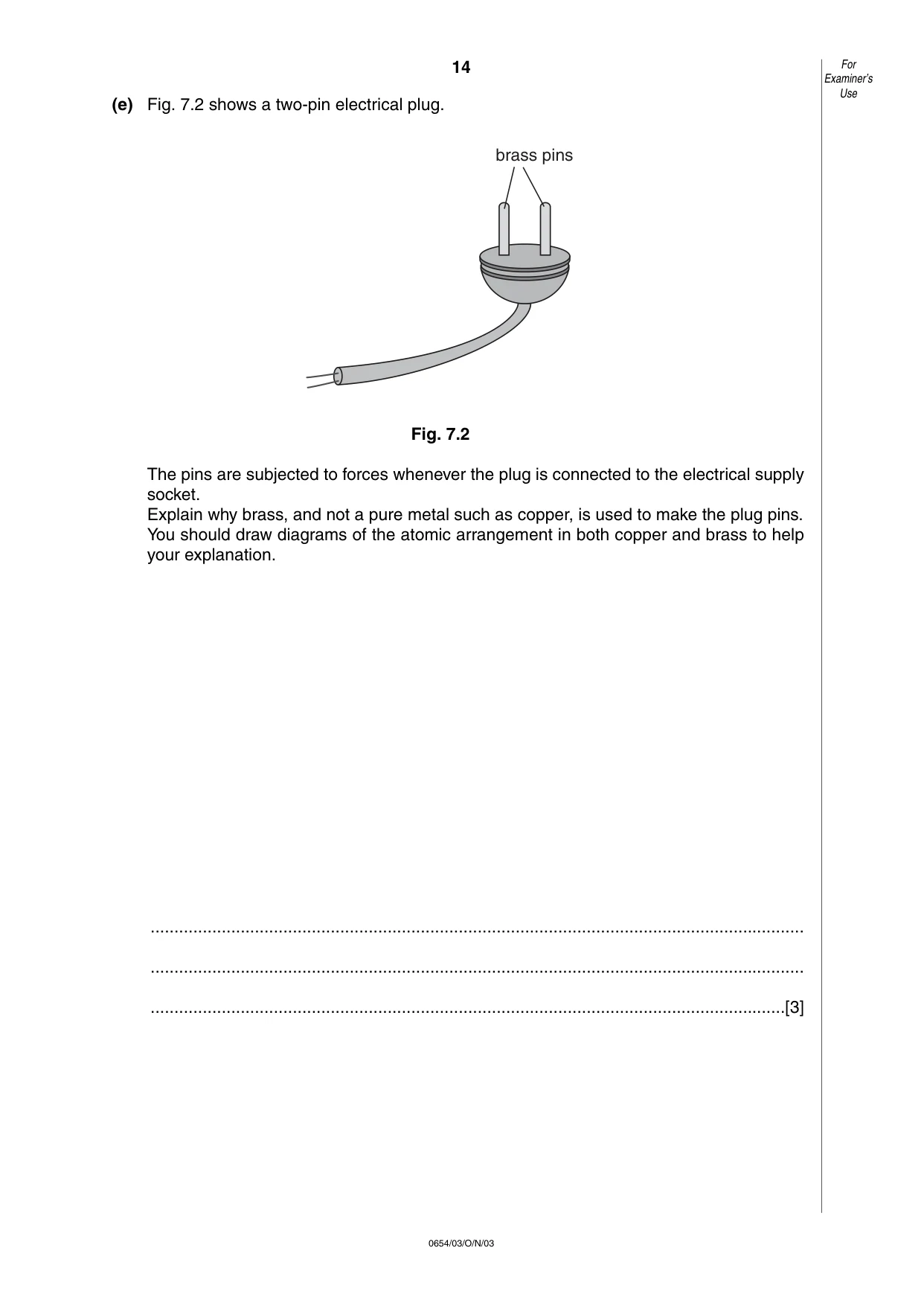
14 0654/03/O/N/03 (e) Fig. 7.2 shows a two-pin electrical plug. Fig. 7.2 The pins are subjected to forces whenever the plug is connected to the electrical supply socket. Explain why brass, and not a pure metal such as copper, is used to make the plug pins. You should draw diagrams of the atomic arrangement in both copper and brass to help your explanation. … … …[3] brass pins For Examiner’s Use
Question paper, page 15
15 0654/03/O/N/03 [Turn over BLANK PAGE (Question 8 can be found on page 16)
Question paper, page 16
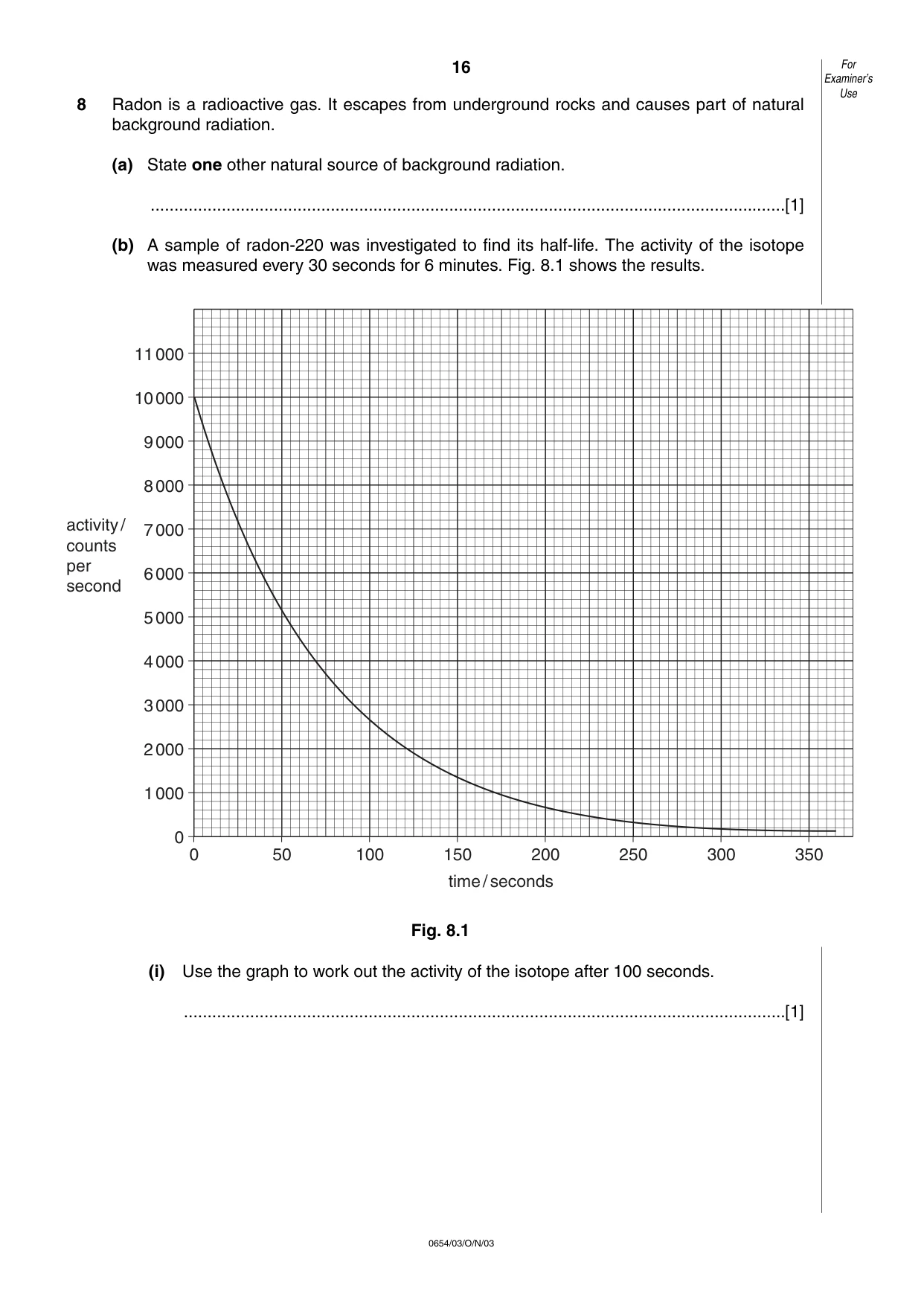
16 0654/03/O/N/03 8 Radon is a radioactive gas. It escapes from underground rocks and causes part of natural background radiation. (a) State one other natural source of background radiation. …[1] (b) A sample of radon-220 was investigated to find its half-life. The activity of the isotope was measured every 30 seconds for 6 minutes. Fig. 8.1 shows the results. Fig. 8.1 (i) Use the graph to work out the activity of the isotope after 100 seconds. …[1] For Examiner’s Use 0 0 50 100 150 200 250 300 350 1000 2000 3000 4000 5000 6000 7000 8000 9000 10000 11000 activity/ counts per second time/seconds
Question paper, page 17
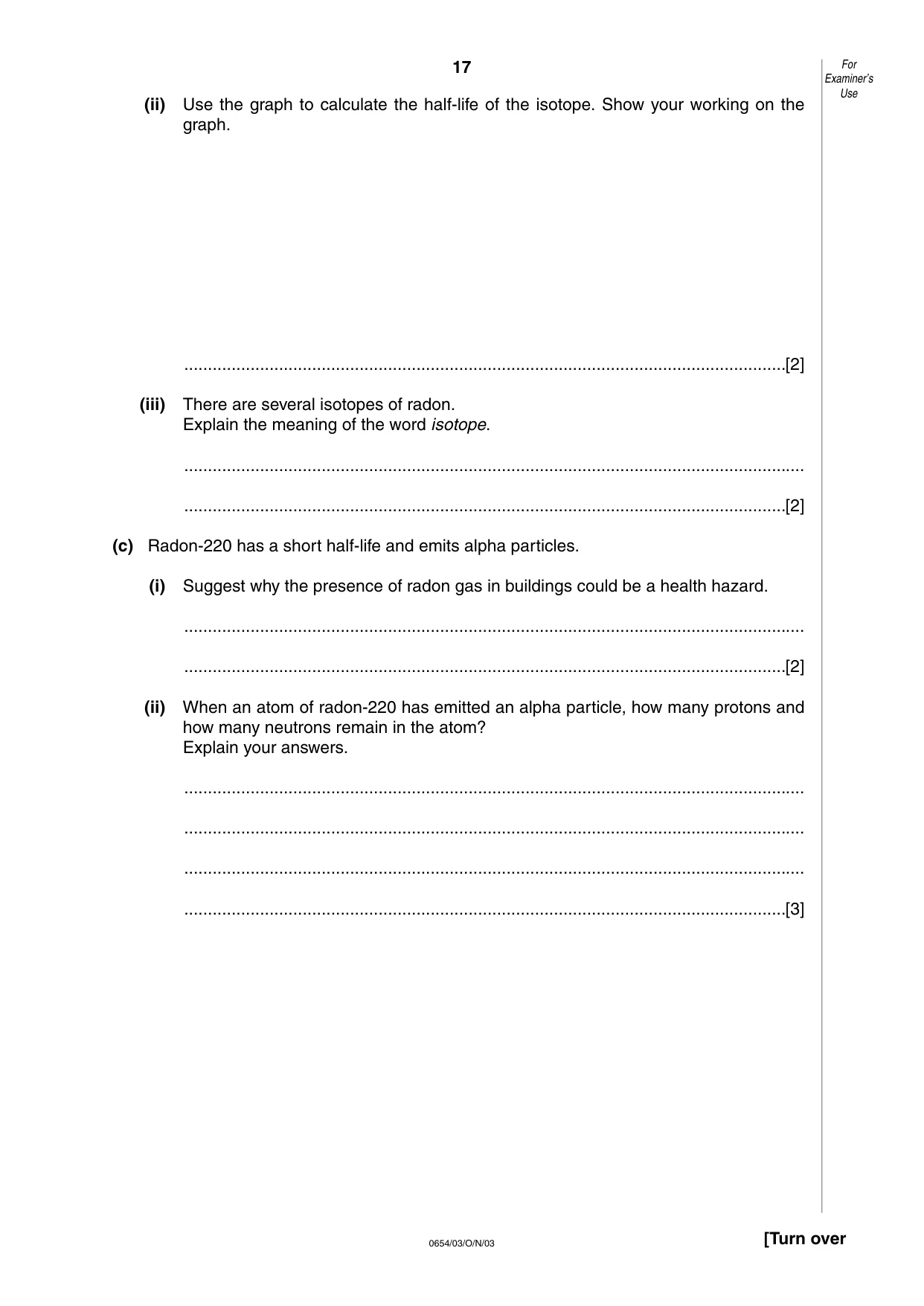
17 0654/03/O/N/03 [Turn over (ii) Use the graph to calculate the half-life of the isotope. Show your working on the graph. …[2] (iii) There are several isotopes of radon. Explain the meaning of the word isotope. … …[2] (c) Radon-220 has a short half-life and emits alpha particles. (i) Suggest why the presence of radon gas in buildings could be a health hazard. … …[2] (ii) When an atom of radon-220 has emitted an alpha particle, how many protons and how many neutrons remain in the atom? Explain your answers. … … … …[3] For Examiner’s Use
Question paper, page 18
18 0654/03/O/N/03 9 (a) Describe the differences between the cell membrane and cell wall of a plant cell. … … … …[3] (b) (i) Explain how water enters the root hairs of a plant. … … … …[3] (ii) Describe how the water is transported from the roots to the leaves. … … … …[2] (c) If a plant loses more water from its leaves than it can take up through its roots, its stems and leaves become soft and begin to droop. Explain why this happens. … … … …[2] For Examiner’s Use
Question paper, page 19
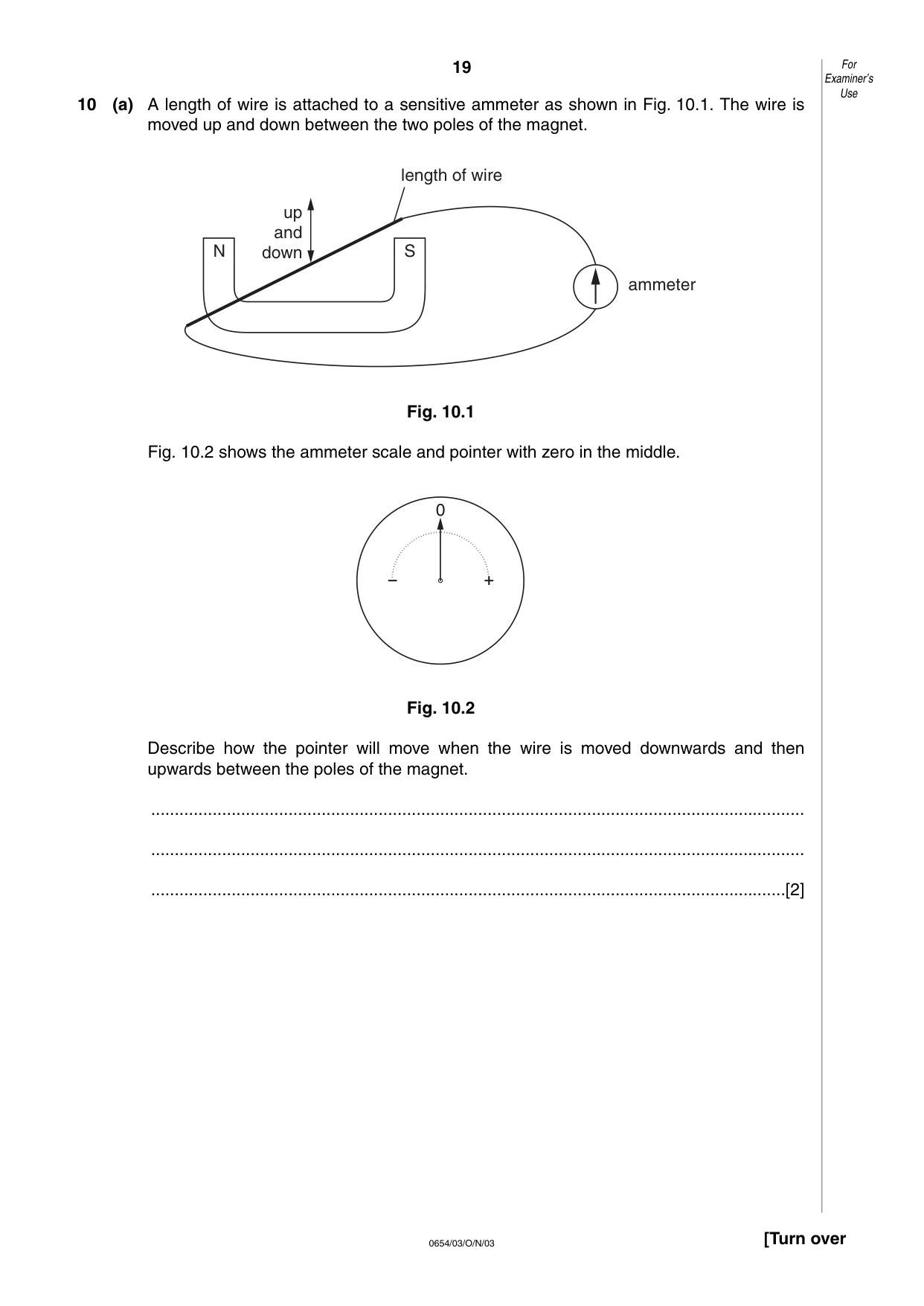
19 0654/03/O/N/03 [Turn over 10 (a) A length of wire is attached to a sensitive ammeter as shown in Fig. 10.1. The wire is moved up and down between the two poles of the magnet. Fig. 10.1 Fig. 10.2 shows the ammeter scale and pointer with zero in the middle. Fig. 10.2 Describe how the pointer will move when the wire is moved downwards and then upwards between the poles of the magnet. … … …[2] 0 N S ammeter length of wire up and down For Examiner’s Use
Question paper, page 20
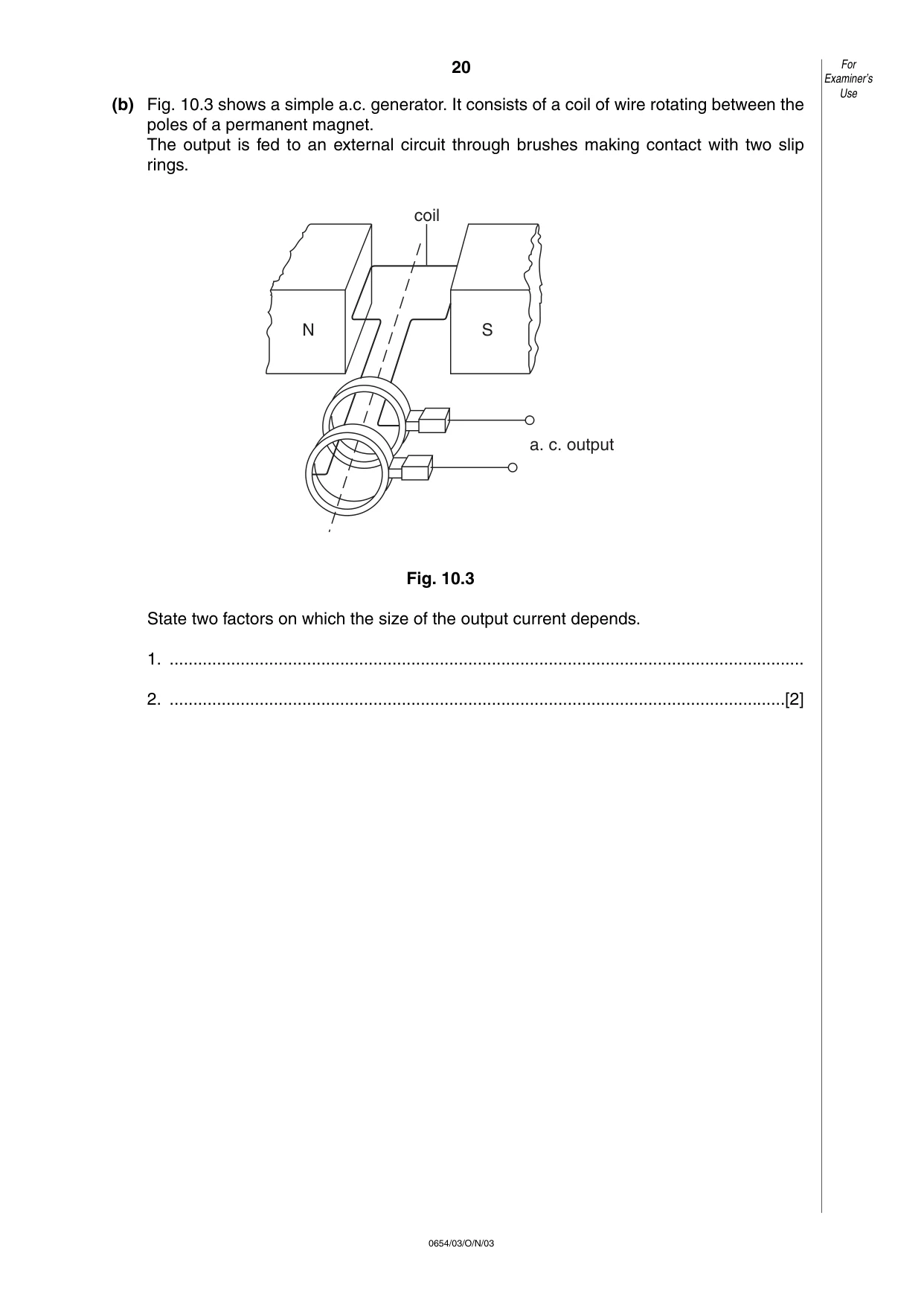
20 0654/03/O/N/03 (b) Fig. 10.3 shows a simple a.c. generator. It consists of a coil of wire rotating between the poles of a permanent magnet. The output is fed to an external circuit through brushes making contact with two slip rings. Fig. 10.3 State two factors on which the size of the output current depends. 1. … 2. …[2] a. c. output N S coil For Examiner’s Use
Question paper, page 21
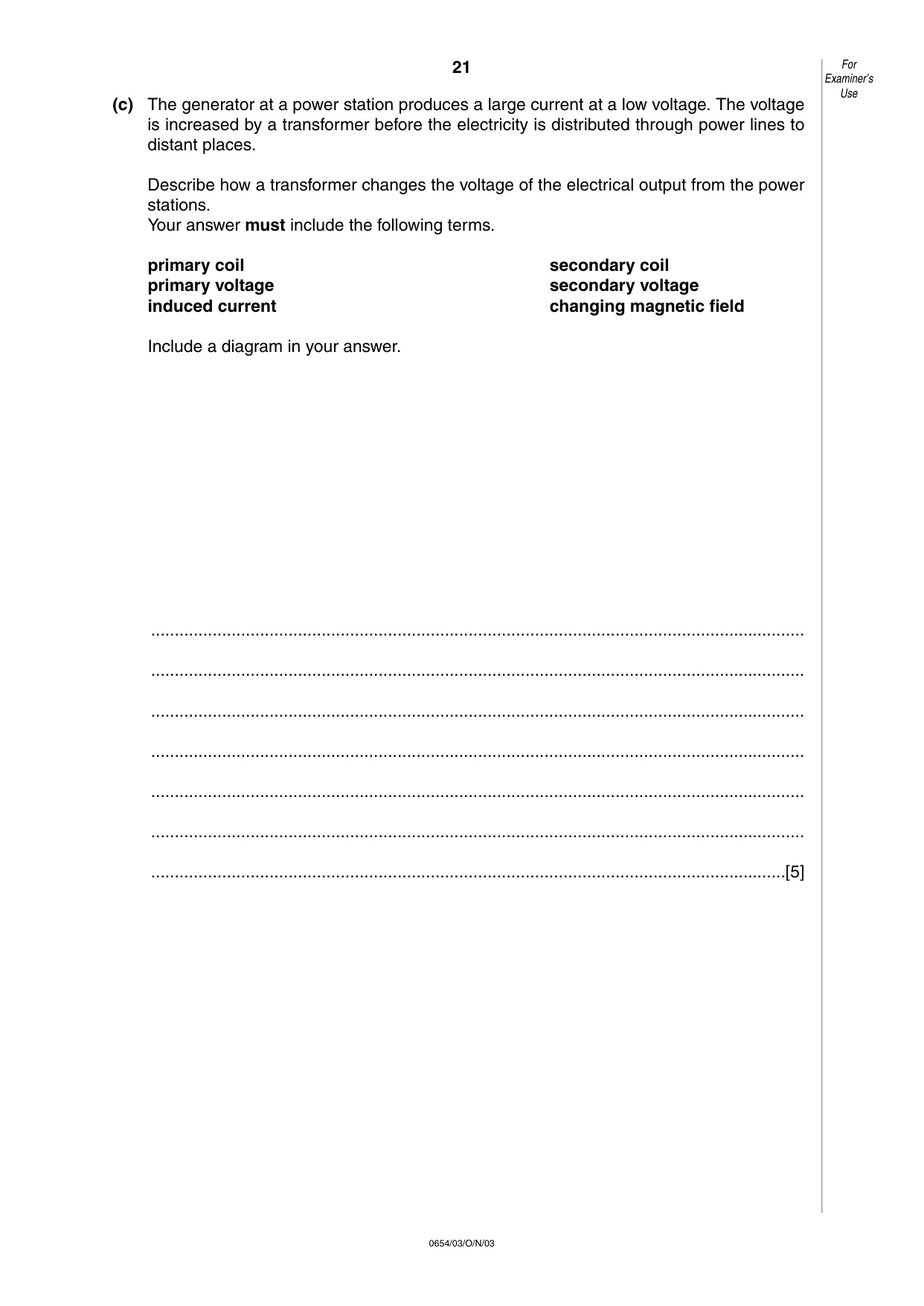
21 0654/03/O/N/03 (c) The generator at a power station produces a large current at a low voltage. The voltage is increased by a transformer before the electricity is distributed through power lines to distant places. Describe how a transformer changes the voltage of the electrical output from the power stations. Your answer must include the following terms. primary coil secondary coil primary voltage secondary voltage induced current changing magnetic field Include a diagram in your answer. … … … … … … …[5] For Examiner’s Use
Question paper, page 24
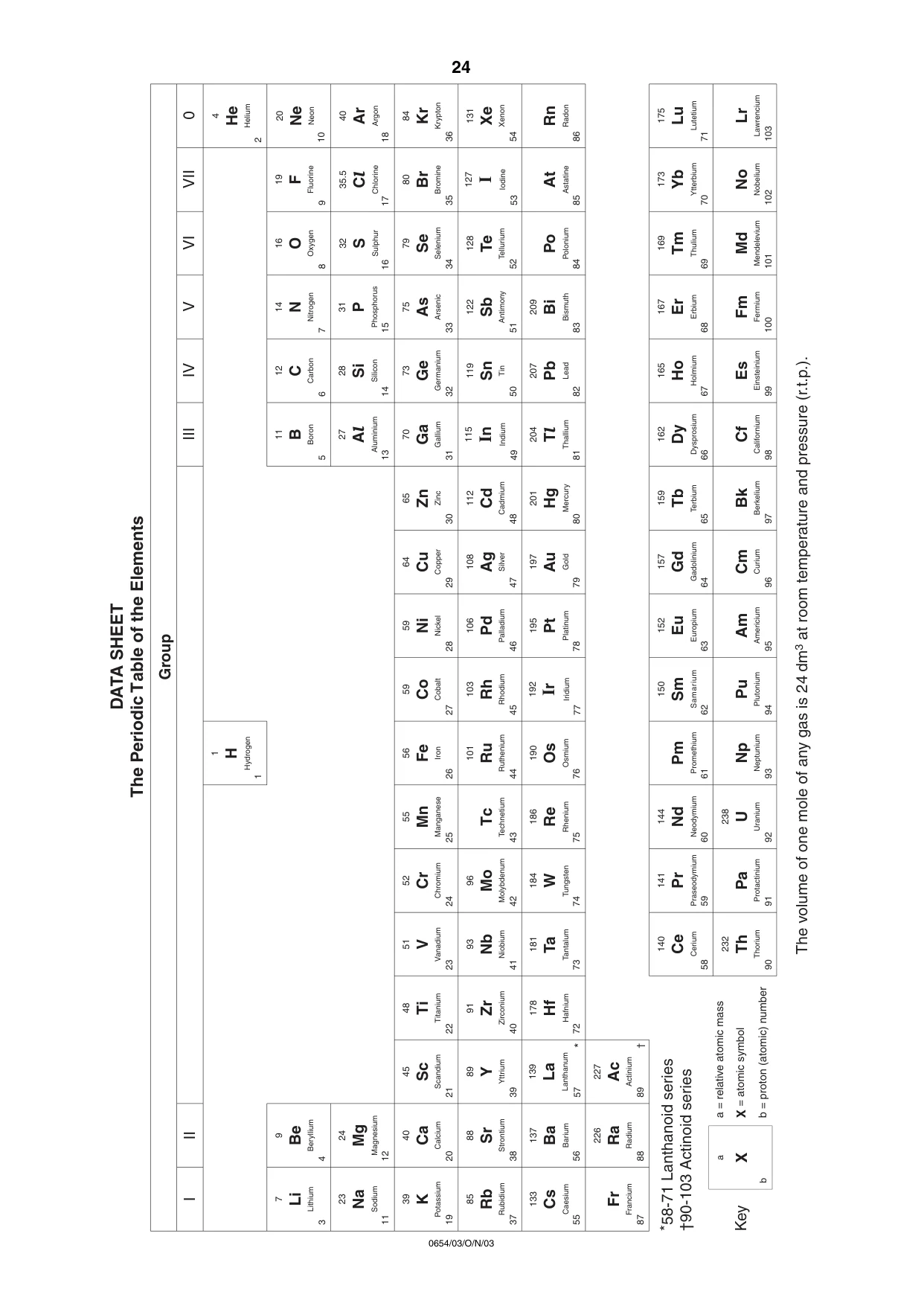
24 0654/03/O/N/03 Group DATA SHEET The Periodic Table of the Elements 140 Ce Cerium 58 141 Pr Praseodymium 59 144 Nd Neodymium 60 Pm Promethium 61 150 Sm Samarium 62 152 Eu Europium 63 157 Gd Gadolinium 64 159 Tb Terbium 65 162 Dy Dysprosium 66 165 Ho Holmium 67 167 Er Erbium 68 169 Tm Thulium 69 173 Yb Ytterbium 70 175 Lu Lutetium 71 232 Th Thorium 90 Pa Protactinium 91 238 U Uranium 92 Np Neptunium 93 Pu Plutonium 94 Am Americium 95 Cm Curium 96 Bk Berkelium 97 Cf Californium 98 Es Einsteinium 99 Fm Fermium 100 Md Mendelevium 101 No Nobelium 102 Lr Lawrencium 103 1 H Hydrogen 1 7 Li Lithium 3 23 Na Sodium 11 24 Mg Magnesium 12 40 Ca Calcium 20 45 Sc Scandium 21 48 Ti Titanium 22 51 V Vanadium 23 52 Cr Chromium 24 55 Mn Manganese 25 56 Fe Iron 26 59 Co Cobalt 27 59 Ni Nickel 28 64 Cu Copper 29 65 Zn Zinc 30 70 Ga Gallium 31 27 Al Aluminium 13 11 B Boron 5 12 C Carbon 6 14 N Nitrogen 7 16 O Oxygen 8 19 F Fluorine 9 28 Si Silicon 14 31 P Phosphorus 15 32 S Sulphur 16 35.5 Cl Chlorine 17 40 Ar Argon 18 20 Ne Neon 10 4 He Helium 2 73 Ge Germanium 32 75 As Arsenic 33 79 Se Selenium 34 80 Br Bromine 35 84 Kr Krypton 36 39 K Potassium 19 88 Sr Strontium 38 89 Y Yttrium 39 91 Zr Zirconium 40 93 Nb Niobium 41 96 Mo Molybdenum 42 Tc Technetium 43 101 Ru Ruthenium 44 103 Rh Rhodium 45 106 Pd Palladium 46 108 Ag Silver 47 112 Cd Cadmium 48 115 In Indium 49 119 Sn Tin 50 122 Sb Antimony 51 128 Te Tellurium 52 127 I Iodine 53 131 Xe Xenon 54 137 Ba Barium 56 139 La Lanthanum 57 * 178 Hf Hafnium 72 181 Ta Tantalum 73 184 W Tungsten 74 186 Re Rhenium 75 190 Os Osmium 76 192 Ir Iridium 77 195 Pt Platinum 78 197 Au Gold 79 201 Hg Mercury 80 204 Tl Thallium 81 207 Pb Lead 82 209 Bi Bismuth 83 Po Polonium 84 At Astatine 85 Rn Radon 86 Fr Francium 87 227 Ac Actinium 89 † 9 Be Beryllium 4 I II III IV V VI VII 0 85 Rb Rubidium 37 133 Cs Caesium 55 226 Ra Radium 88 The volume of one mole of any gas is 24 dm3 at room temperature and pressure (r.t.p.). a X b a = relative atomic mass X = atomic symbol b = proton (atomic) number Key *58-71 Lanthanoid series †90-103 Actinoid series