Cambridge IGCSE Sciences - Co-ordinated (Double) 0654 — 2003 May/June Paper 3 · Variant 1
0654/31/M/J/03
The question paper and its mark scheme, free to read here and free to download. This is Cambridge’s own paper, exactly as it was sat.
Question paper24 pages



Mark scheme
No mark scheme is in the library for this paper.
Paper as text
Question paper, page 1
This document consists of 21 printed pages and 3 blank pages. MML 3040 4/02 S38078/4 © UCLES 2003 [Turn over CAMBRIDGE INTERNATIONAL EXAMINATIONS International General Certificate of Secondary Education CO-ORDINATED SCIENCES 0654/03 Paper 3 May/June 2003 2 hours Candidates answer on the Question Paper. No Additional Materials are required. READ THESE INSTRUCTIONS FIRST Write your Centre number, candidate number and name on all the work you hand in. Write in dark blue or black pen in the spaces provided on the Question Paper. You may use a soft pencil for any diagrams, graphs, tables or rough working. Do not use staples, paper clips, highlighters, glue or correction fluid. Answer all questions. At the end of the examination, fasten all your work securely together. The number of marks is given in brackets [ ] at the end of each question or part question. A copy of the Periodic Table is printed on page 24. Centre Number Index Number Name For Examiner’s Use 9 8 7 6 5 4 3 2 1 10 Total If you have been given a label, look at the details. If any details are incorrect or missing, please fill in your correct details in the space given at the top of this page. Stick your personal label here, if provided. UNIVERSITY of CAMBRIDGE Local Examinations Syndicate www.XtremePapers.com
Question paper, page 2
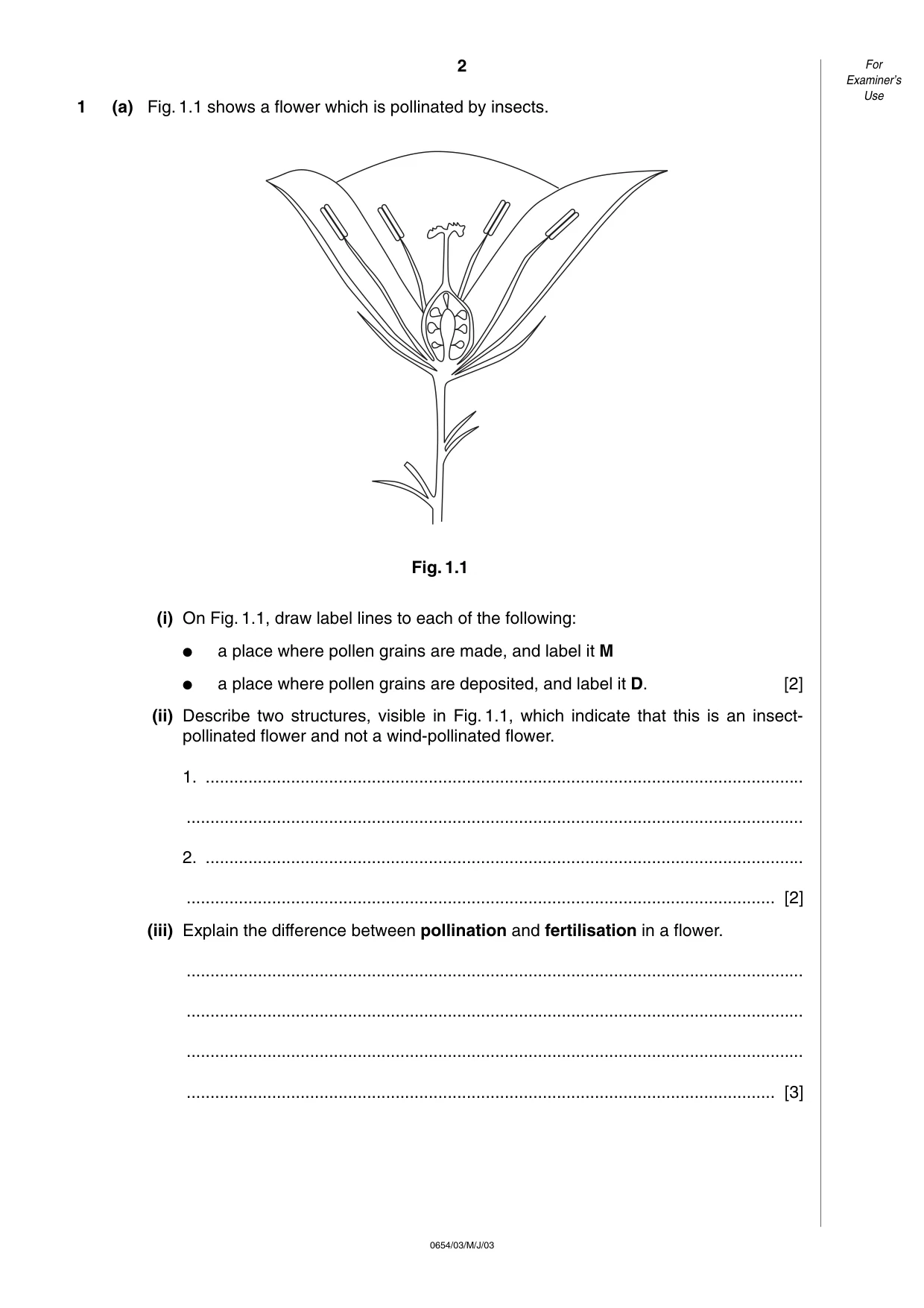
1 (a) Fig. 1.1 shows a flower which is pollinated by insects. Fig. 1.1 (i) On Fig. 1.1, draw label lines to each of the following: ● a place where pollen grains are made, and label it M ● a place where pollen grains are deposited, and label it D. [2] (ii) Describe two structures, visible in Fig. 1.1, which indicate that this is an insect- pollinated flower and not a wind-pollinated flower. 1. … … 2. … … [2] (iii) Explain the difference between pollination and fertilisation in a flower. … … … … [3] 2 0654/03/M/J/03 For Examiner’s Use
Question paper, page 3
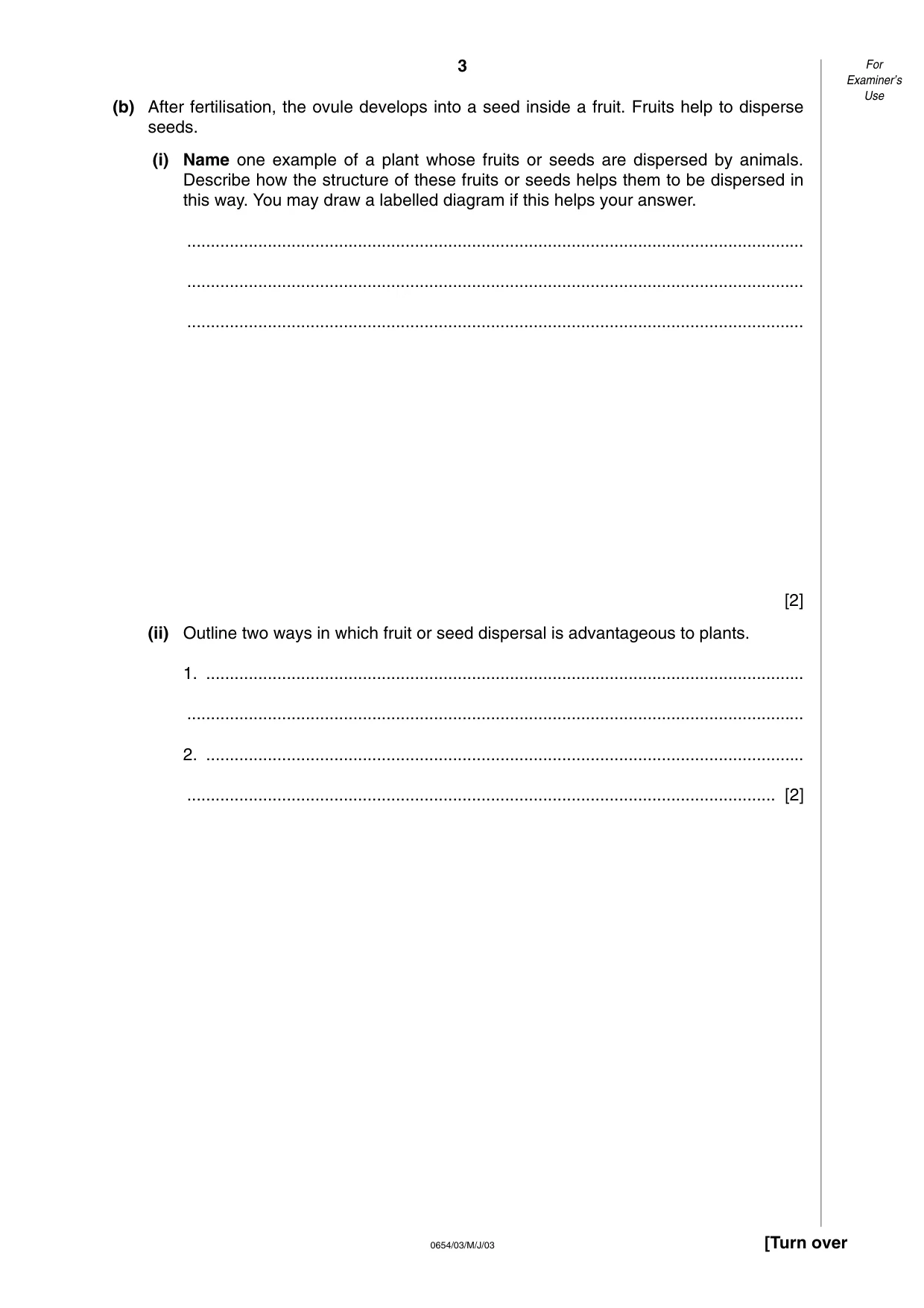
(b) After fertilisation, the ovule develops into a seed inside a fruit. Fruits help to disperse seeds. (i) Name one example of a plant whose fruits or seeds are dispersed by animals. Describe how the structure of these fruits or seeds helps them to be dispersed in this way. You may draw a labelled diagram if this helps your answer. … … … [2] (ii) Outline two ways in which fruit or seed dispersal is advantageous to plants. 1. … … 2. … … [2] 3 0654/03/M/J/03 [Turn over For Examiner’s Use
Question paper, page 4
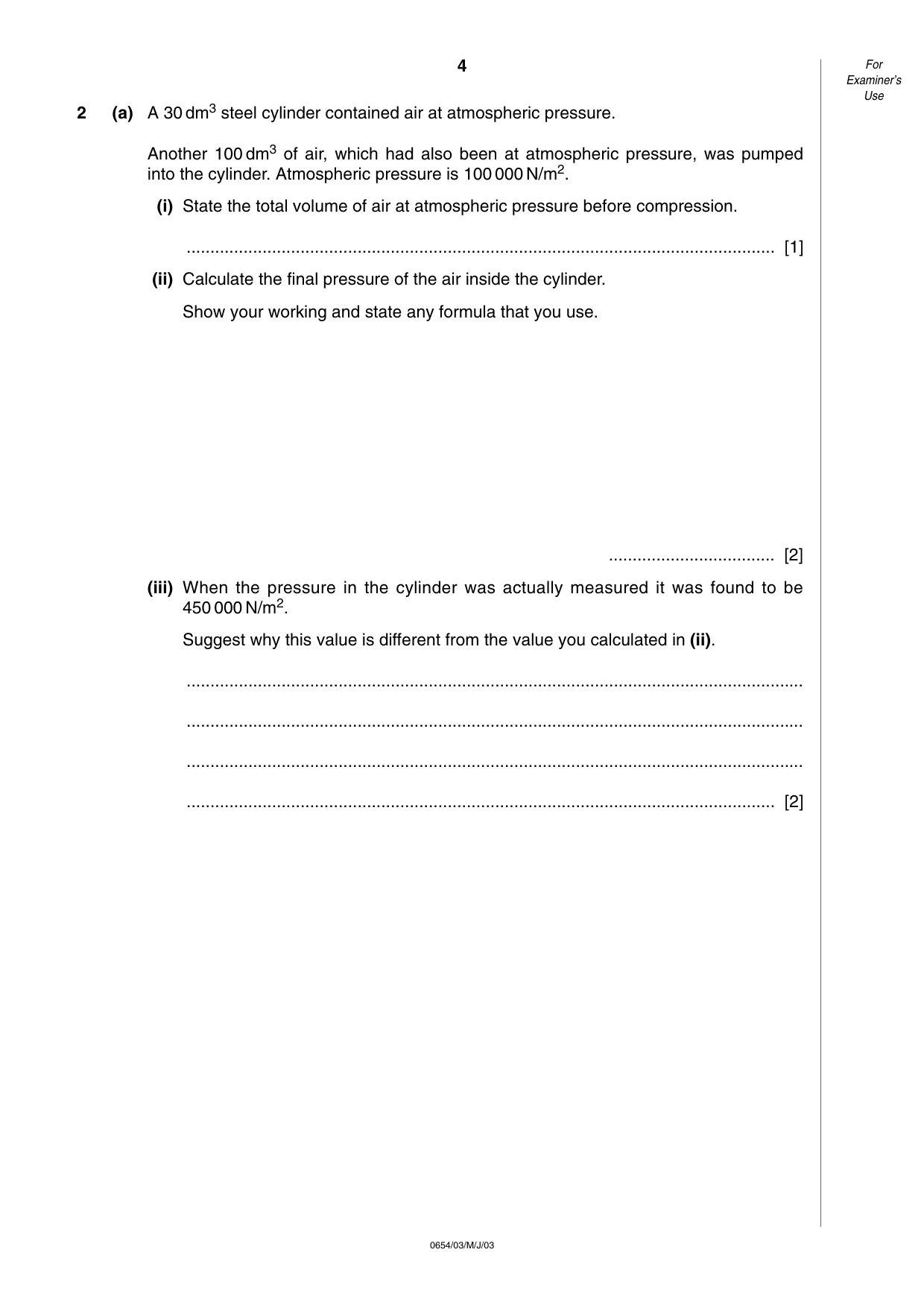
2 (a) A 30 dm3 steel cylinder contained air at atmospheric pressure. Another 100 dm3 of air, which had also been at atmospheric pressure, was pumped into the cylinder. Atmospheric pressure is 100 000 N/m2. (i) State the total volume of air at atmospheric pressure before compression. … [1] (ii) Calculate the final pressure of the air inside the cylinder. Show your working and state any formula that you use. … [2] (iii) When the pressure in the cylinder was actually measured it was found to be 450 000 N/m2. Suggest why this value is different from the value you calculated in (ii). … … … … [2] 4 0654/03/M/J/03 For Examiner’s Use
Question paper, page 5
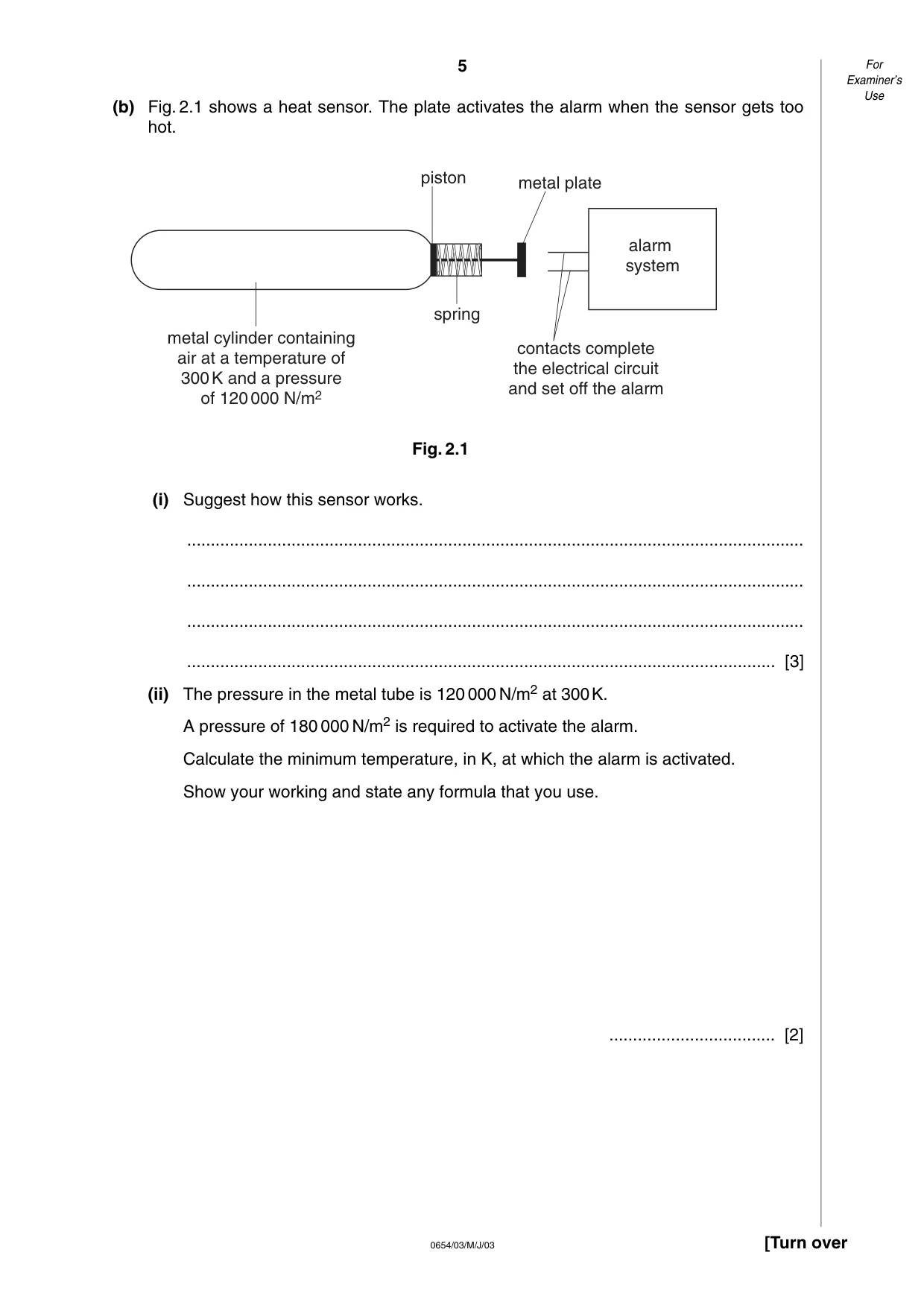
(b) Fig. 2.1 shows a heat sensor. The plate activates the alarm when the sensor gets too hot. Fig. 2.1 (i) Suggest how this sensor works. … … … … [3] (ii) The pressure in the metal tube is 120 000 N/m2 at 300K. A pressure of 180 000 N/m2 is required to activate the alarm. Calculate the minimum temperature, in K, at which the alarm is activated. Show your working and state any formula that you use. … [2] alarm system piston metal plate spring contacts complete the electrical circuit and set off the alarm metal cylinder containing air at a temperature of 300K and a pressure of 120000 N/m2 5 0654/03/M/J/03 [Turn over For Examiner’s Use
Question paper, page 6
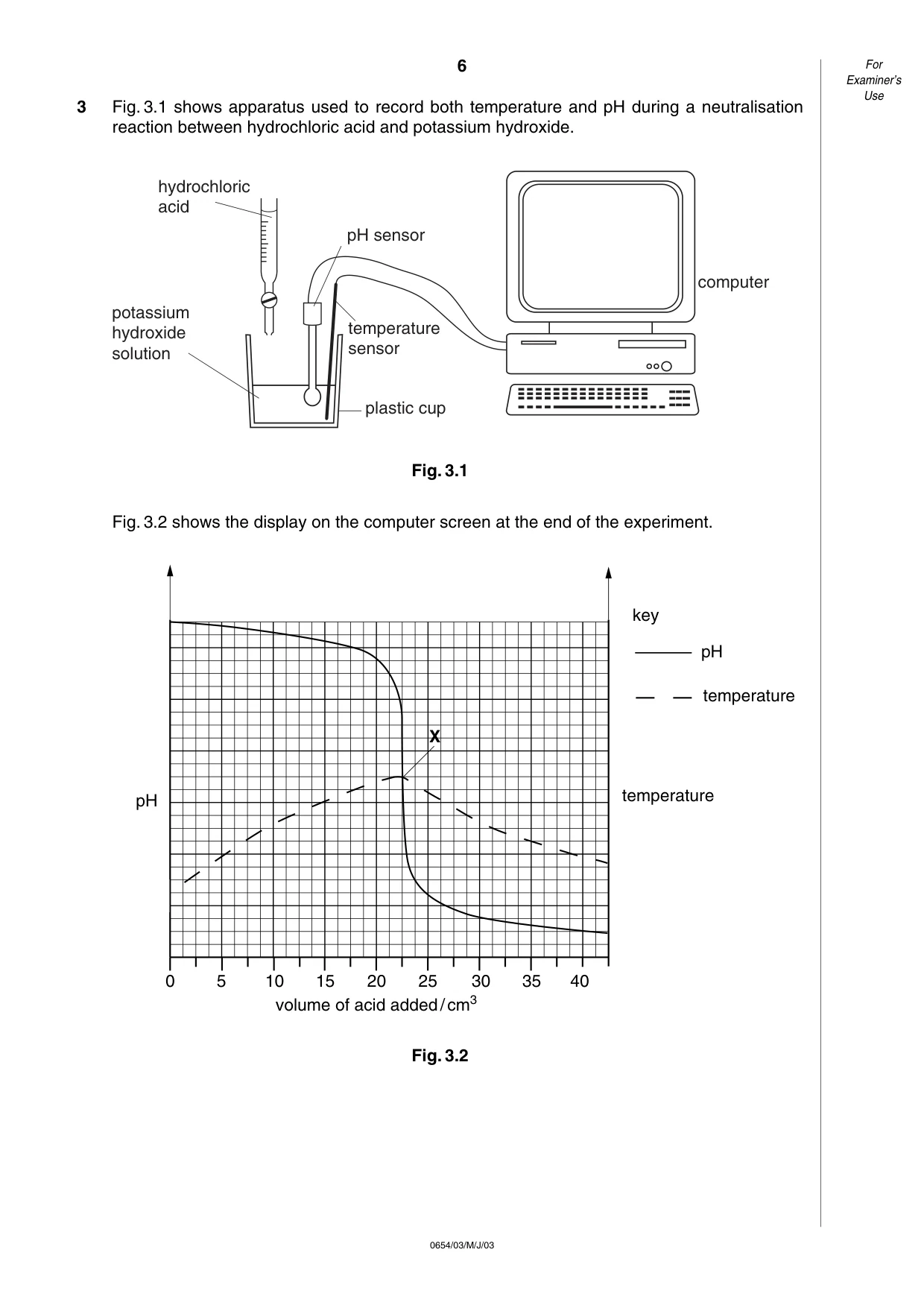
3 Fig. 3.1 shows apparatus used to record both temperature and pH during a neutralisation reaction between hydrochloric acid and potassium hydroxide. Fig. 3.1 Fig. 3.2 shows the display on the computer screen at the end of the experiment. Fig. 3.2 0 5 10 15 20 25 30 35 40 X pH temperature temperature key pH volume of acid added/cm3 computer hydrochloric acid pH sensor temperature sensor plastic cup potassium hydroxide solution 6 0654/03/M/J/03 For Examiner’s Use
Question paper, page 7
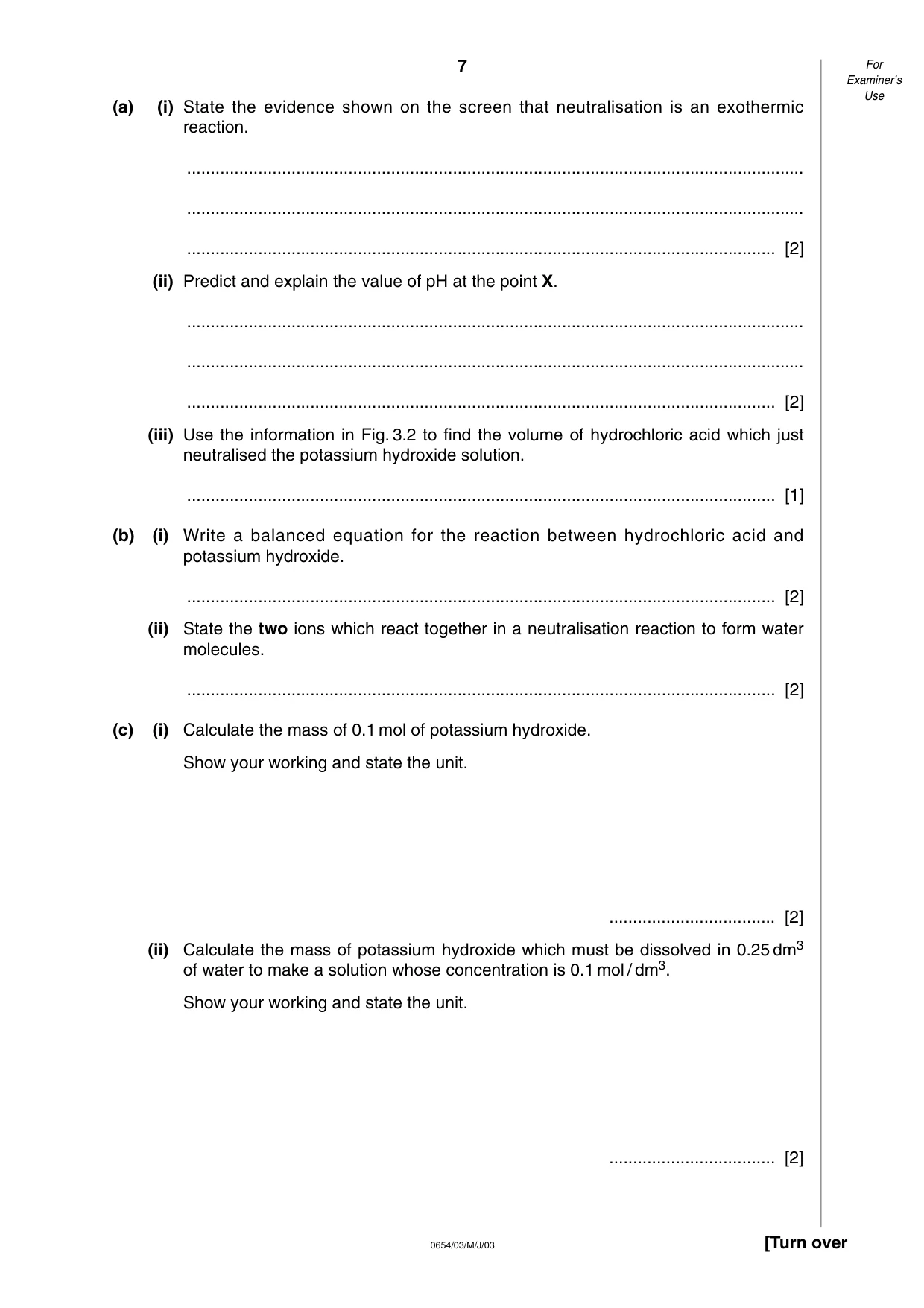
(a) (i) State the evidence shown on the screen that neutralisation is an exothermic reaction. … … … [2] (ii) Predict and explain the value of pH at the point X. … … … [2] (iii) Use the information in Fig. 3.2 to find the volume of hydrochloric acid which just neutralised the potassium hydroxide solution. … [1] (b) (i) Write a balanced equation for the reaction between hydrochloric acid and potassium hydroxide. … [2] (ii) State the two ions which react together in a neutralisation reaction to form water molecules. … [2] (c) (i) Calculate the mass of 0.1 mol of potassium hydroxide. Show your working and state the unit. … [2] (ii) Calculate the mass of potassium hydroxide which must be dissolved in 0.25 dm3 of water to make a solution whose concentration is 0.1 mol / dm3. Show your working and state the unit. … [2] 7 0654/03/M/J/03 [Turn over For Examiner’s Use
Question paper, page 8
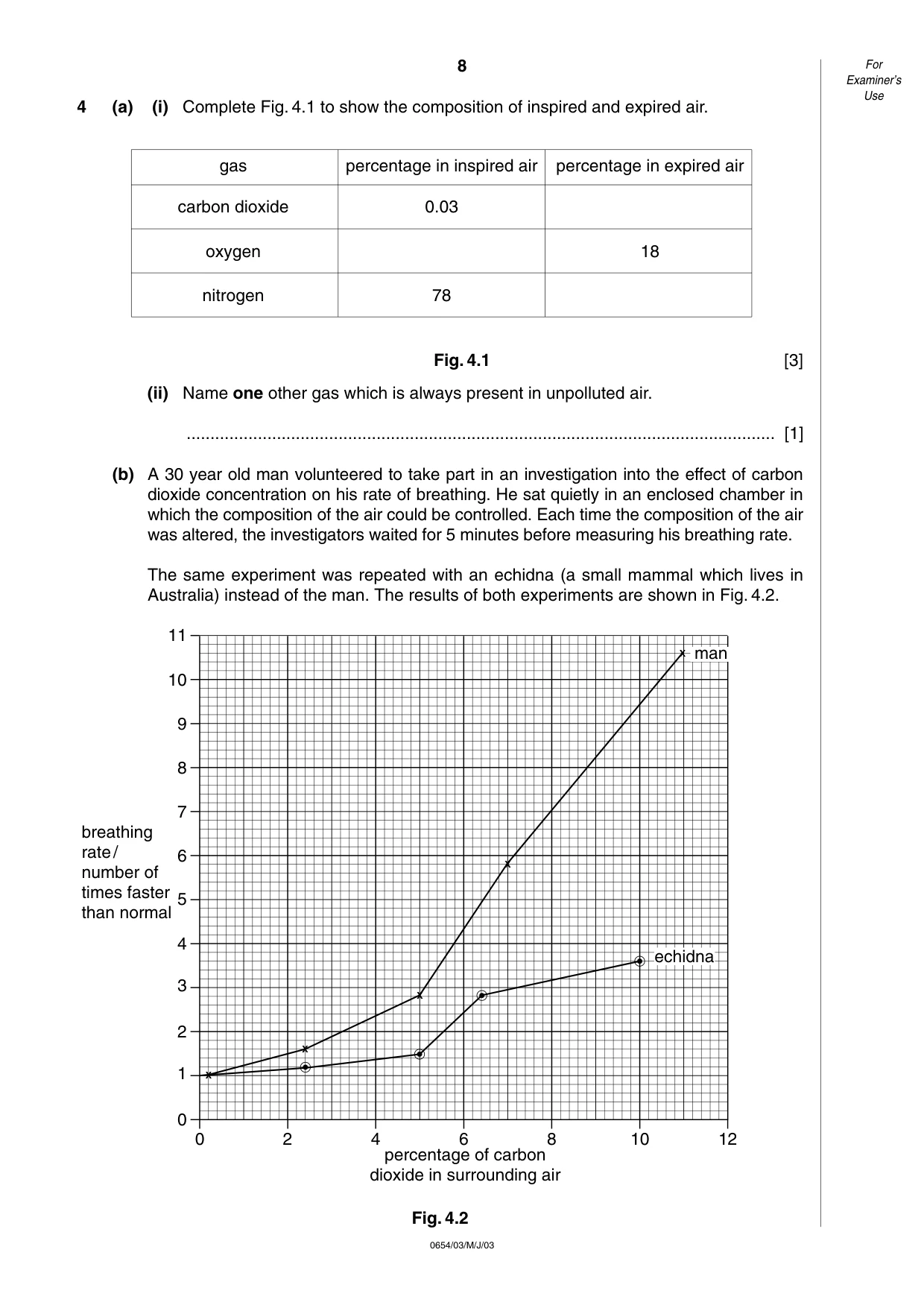
4 (a) (i) Complete Fig. 4.1 to show the composition of inspired and expired air. Fig. 4.1 [3] (ii) Name one other gas which is always present in unpolluted air. … [1] (b) A 30 year old man volunteered to take part in an investigation into the effect of carbon dioxide concentration on his rate of breathing. He sat quietly in an enclosed chamber in which the composition of the air could be controlled. Each time the composition of the air was altered, the investigators waited for 5 minutes before measuring his breathing rate. The same experiment was repeated with an echidna (a small mammal which lives in Australia) instead of the man. The results of both experiments are shown in Fig. 4.2. Fig. 4.2 12 10 8 6 4 2 0 0 2 1 3 4 5 6 7 8 9 10 11 breathing rate/ number of times faster than normal percentage of carbon dioxide in surrounding air X X X X X man echidna 8 0654/03/M/J/03 For Examiner’s Use gas percentage in inspired air percentage in expired air carbon dioxide 0.03 oxygen 18 nitrogen 78
Question paper, page 9
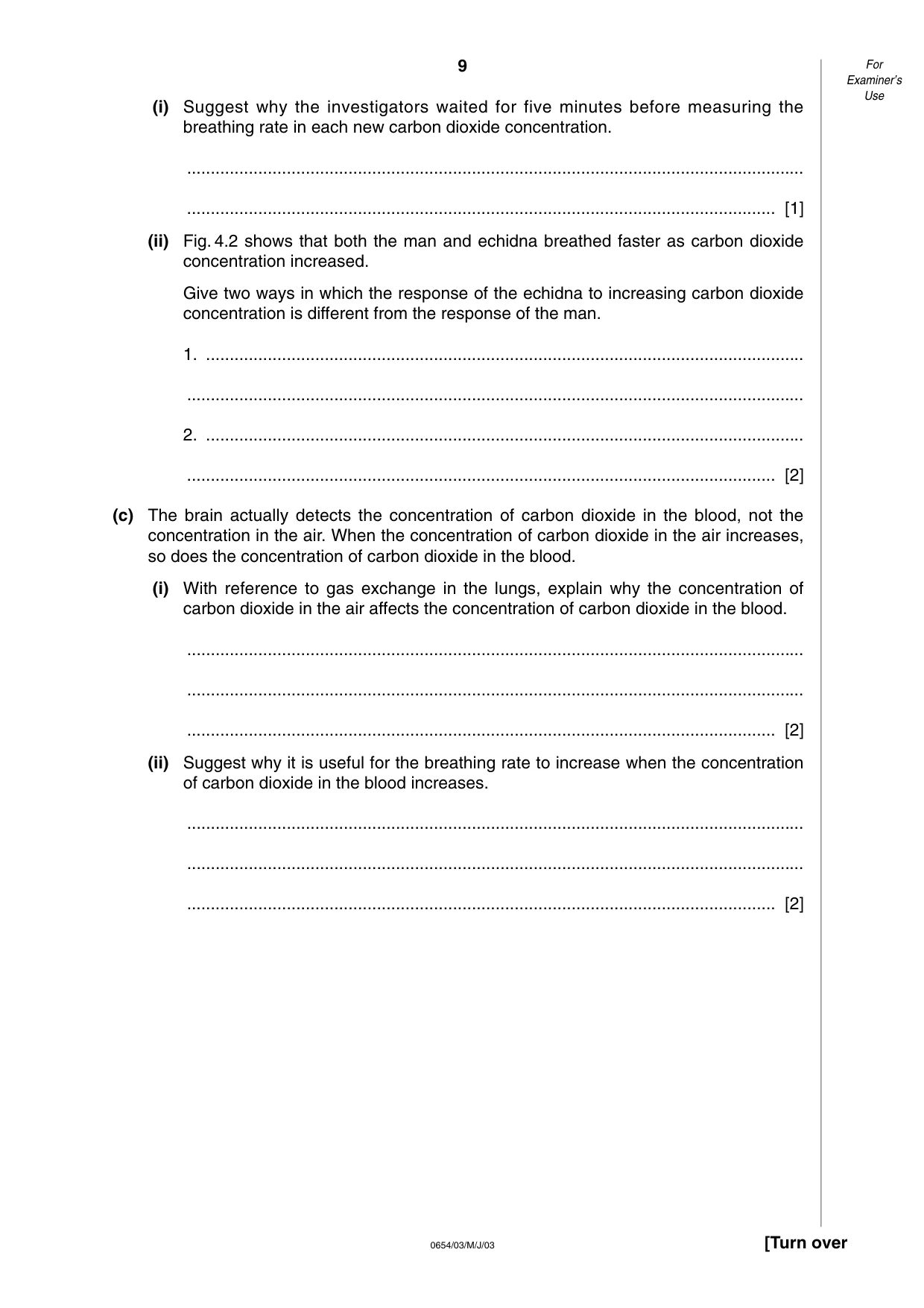
(i) Suggest why the investigators waited for five minutes before measuring the breathing rate in each new carbon dioxide concentration. … … [1] (ii) Fig. 4.2 shows that both the man and echidna breathed faster as carbon dioxide concentration increased. Give two ways in which the response of the echidna to increasing carbon dioxide concentration is different from the response of the man. 1. … … 2. … … [2] (c) The brain actually detects the concentration of carbon dioxide in the blood, not the concentration in the air. When the concentration of carbon dioxide in the air increases, so does the concentration of carbon dioxide in the blood. (i) With reference to gas exchange in the lungs, explain why the concentration of carbon dioxide in the air affects the concentration of carbon dioxide in the blood. … … … [2] (ii) Suggest why it is useful for the breathing rate to increase when the concentration of carbon dioxide in the blood increases. … … … [2] 9 0654/03/M/J/03 [Turn over For Examiner’s Use
Question paper, page 10
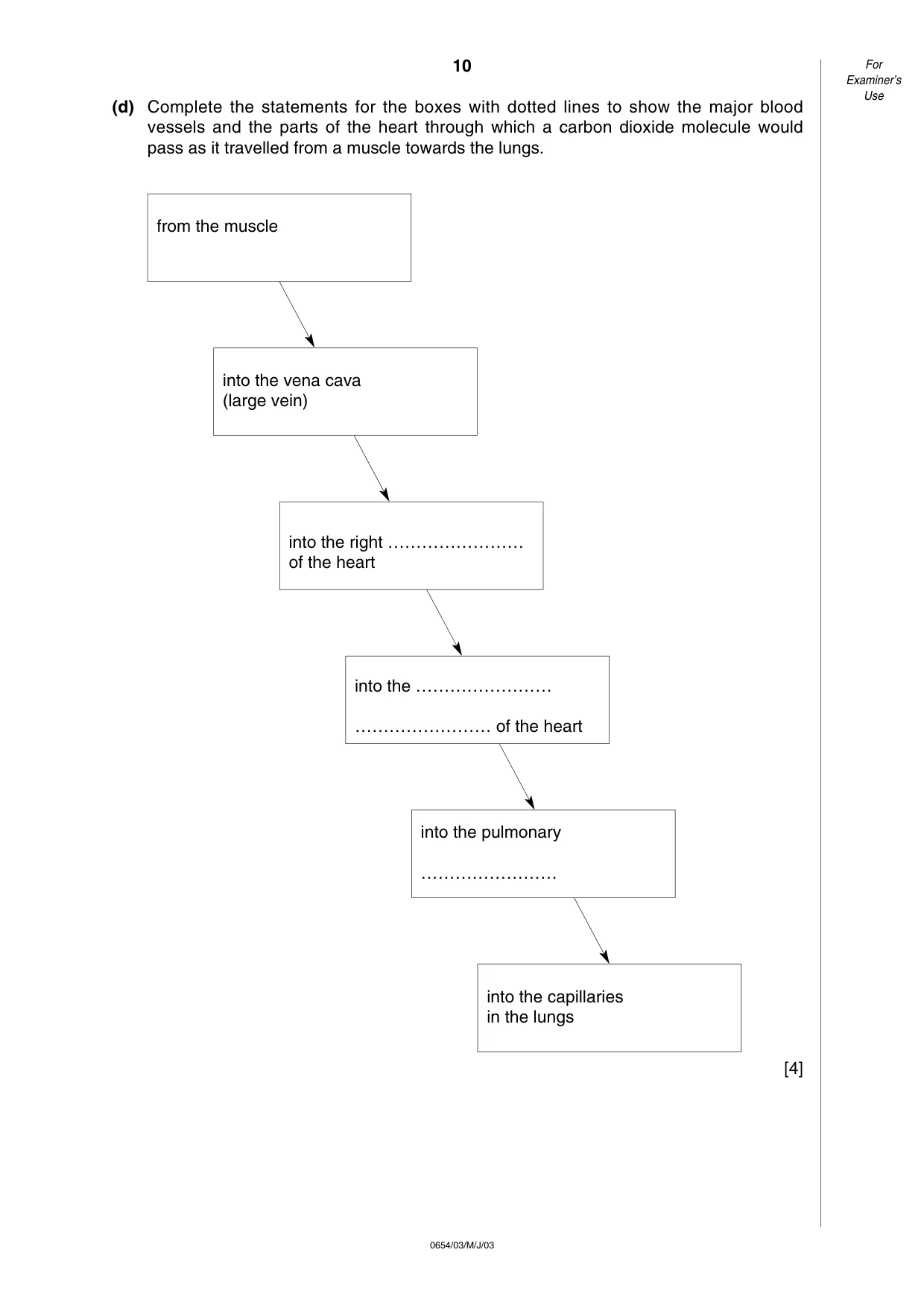
(d) Complete the statements for the boxes with dotted lines to show the major blood vessels and the parts of the heart through which a carbon dioxide molecule would pass as it travelled from a muscle towards the lungs. [4] 10 0654/03/M/J/03 For Examiner’s Use from the muscle into the vena cava (large vein) into the right …………………… of the heart into the …………………… …………………… of the heart into the pulmonary …………………… into the capillaries in the lungs
Question paper, page 11
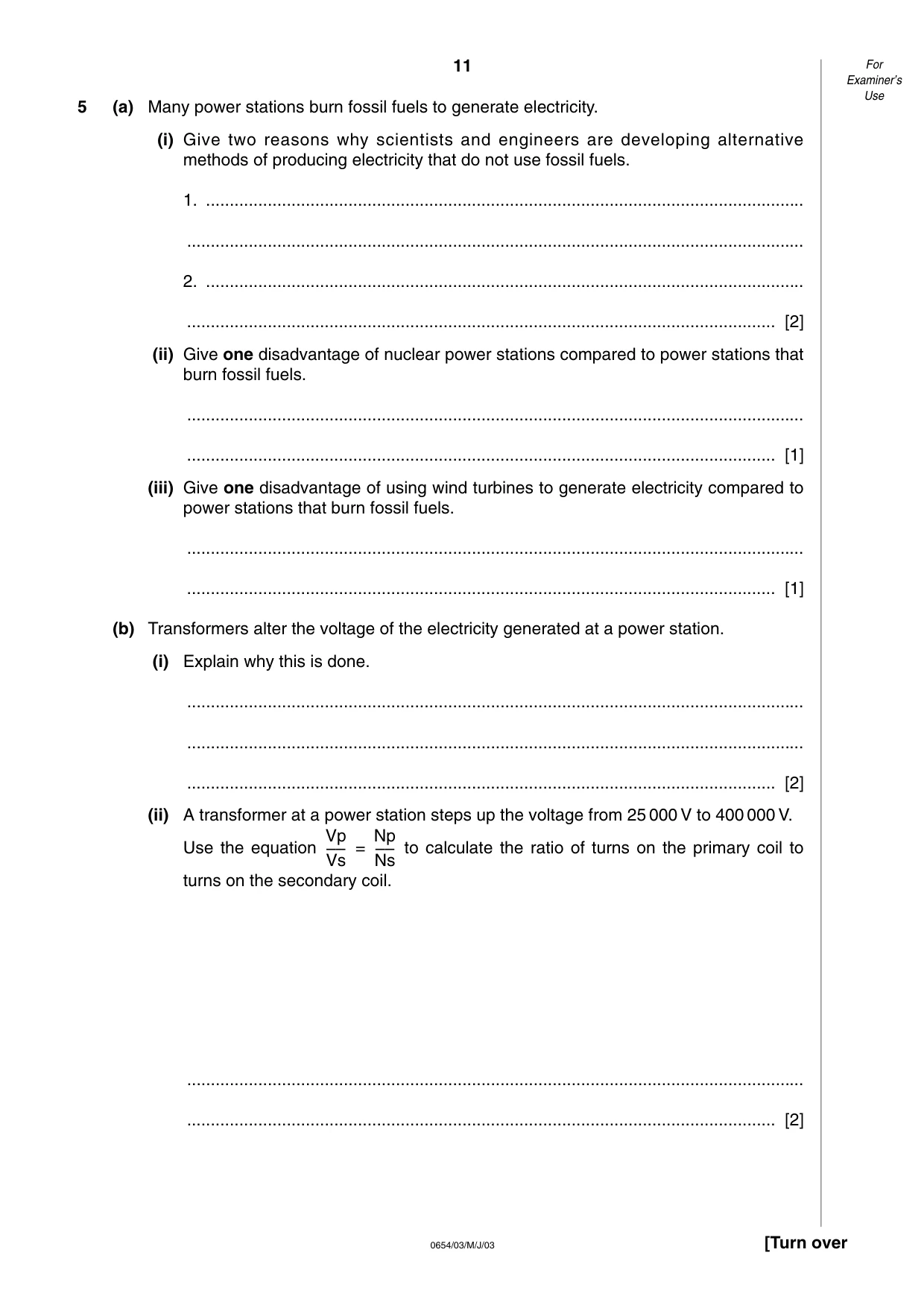
5 (a) Many power stations burn fossil fuels to generate electricity. (i) Give two reasons why scientists and engineers are developing alternative methods of producing electricity that do not use fossil fuels. 1. … … 2. … … [2] (ii) Give one disadvantage of nuclear power stations compared to power stations that burn fossil fuels. … … [1] (iii) Give one disadvantage of using wind turbines to generate electricity compared to power stations that burn fossil fuels. … … [1] (b) Transformers alter the voltage of the electricity generated at a power station. (i) Explain why this is done. … … … [2] (ii) A transformer at a power station steps up the voltage from 25 000 V to 400 000 V. Use the equation = to calculate the ratio of turns on the primary coil to turns on the secondary coil. … … [2] Np –– Ns Vp –– Vs 11 0654/03/M/J/03 [Turn over For Examiner’s Use
Question paper, page 12
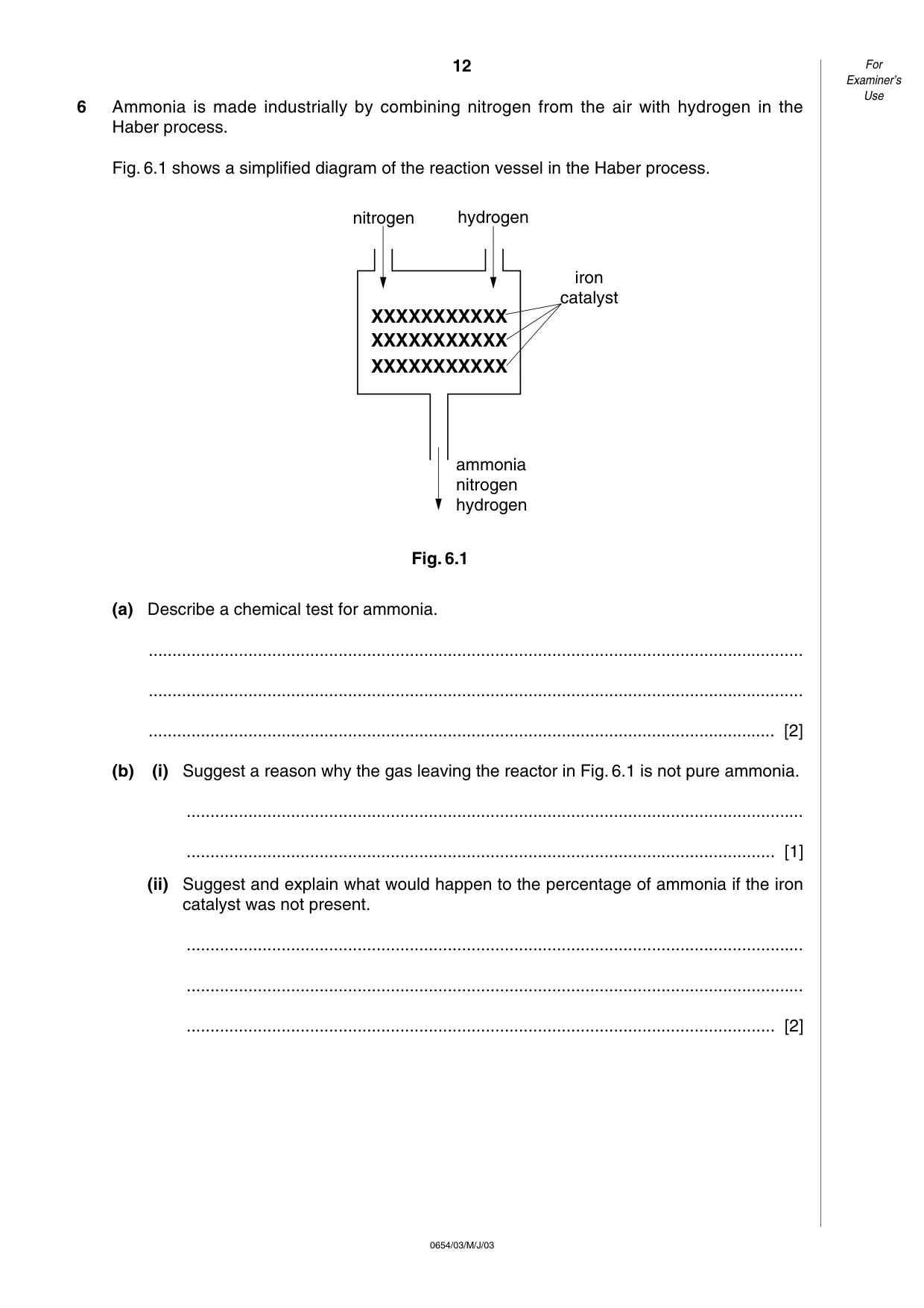
6 Ammonia is made industrially by combining nitrogen from the air with hydrogen in the Haber process. Fig. 6.1 shows a simplified diagram of the reaction vessel in the Haber process. Fig. 6.1 (a) Describe a chemical test for ammonia. … … … [2] (b) (i) Suggest a reason why the gas leaving the reactor in Fig. 6.1 is not pure ammonia. … … [1] (ii) Suggest and explain what would happen to the percentage of ammonia if the iron catalyst was not present. … … … [2] XXXXXXXXXXX XXXXXXXXXXX XXXXXXXXXXX iron catalyst ammonia nitrogen hydrogen hydrogen nitrogen 12 0654/03/M/J/03 For Examiner’s Use
Question paper, page 13
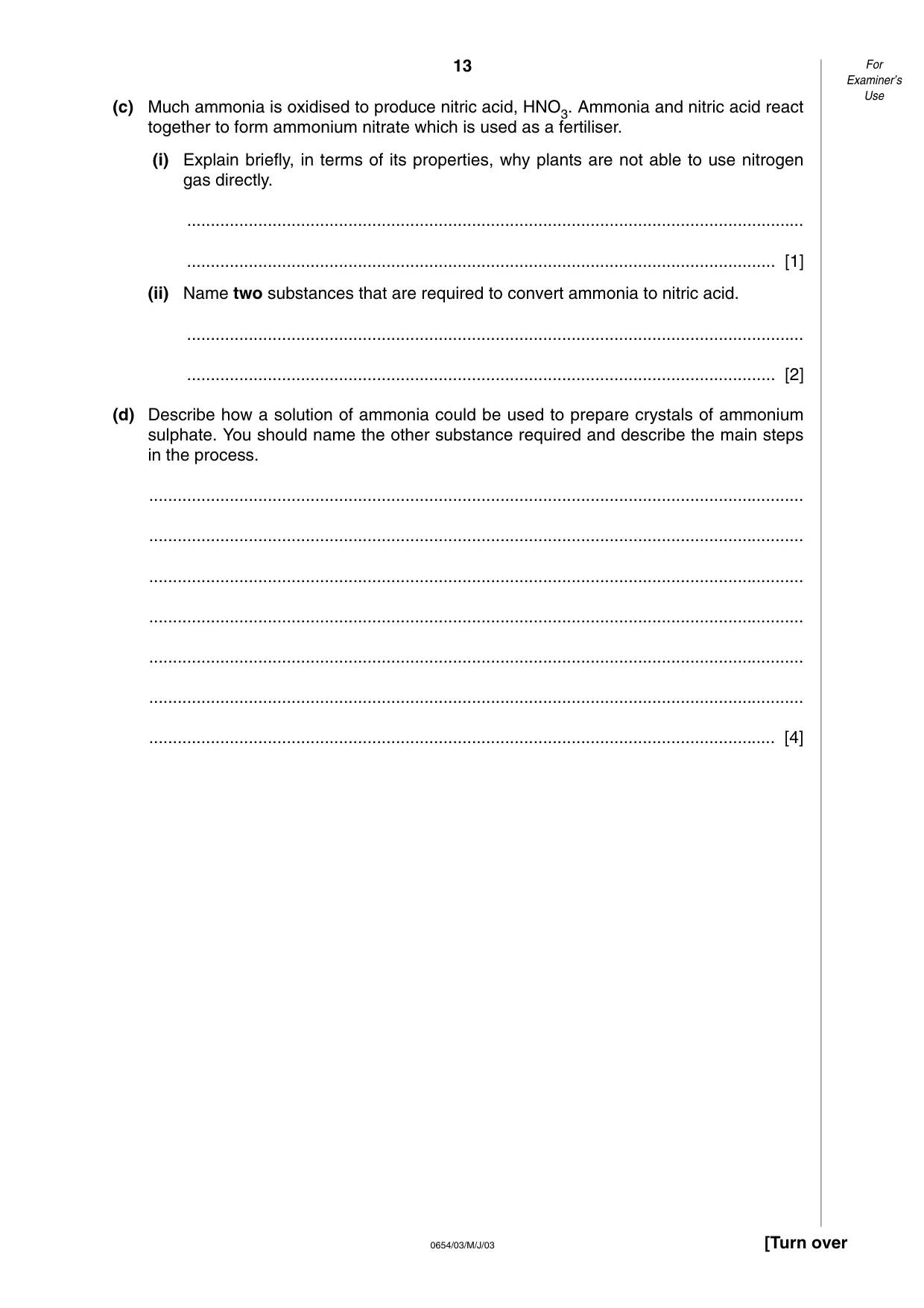
(c) Much ammonia is oxidised to produce nitric acid, HNO3. Ammonia and nitric acid react together to form ammonium nitrate which is used as a fertiliser. (i) Explain briefly, in terms of its properties, why plants are not able to use nitrogen gas directly. … … [1] (ii) Name two substances that are required to convert ammonia to nitric acid. … … [2] (d) Describe how a solution of ammonia could be used to prepare crystals of ammonium sulphate. You should name the other substance required and describe the main steps in the process. … … … … … … … [4] 13 0654/03/M/J/03 [Turn over For Examiner’s Use
Question paper, page 14
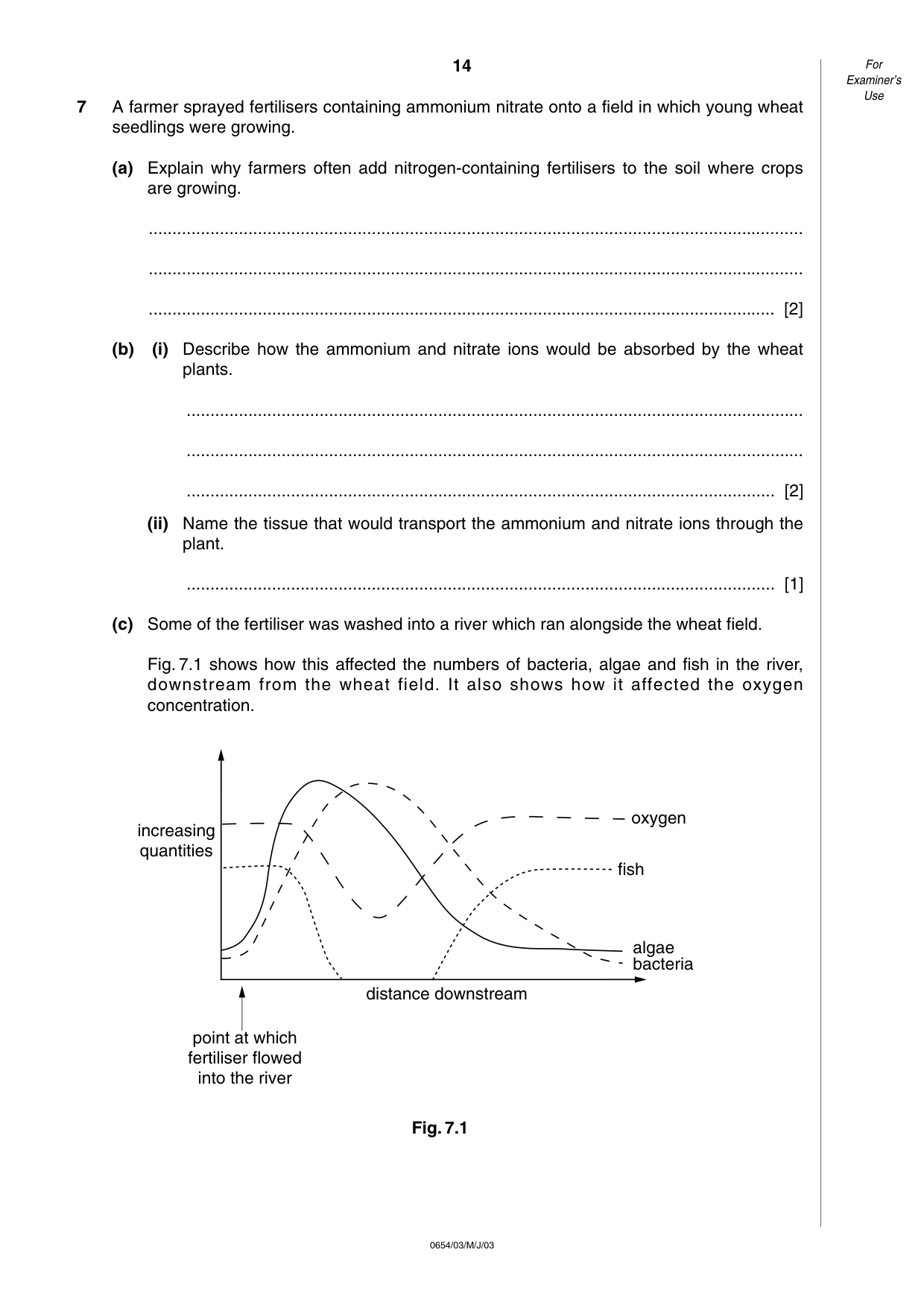
7 A farmer sprayed fertilisers containing ammonium nitrate onto a field in which young wheat seedlings were growing. (a) Explain why farmers often add nitrogen-containing fertilisers to the soil where crops are growing. … … … [2] (b) (i) Describe how the ammonium and nitrate ions would be absorbed by the wheat plants. … … … [2] (ii) Name the tissue that would transport the ammonium and nitrate ions through the plant. … [1] (c) Some of the fertiliser was washed into a river which ran alongside the wheat field. Fig. 7.1 shows how this affected the numbers of bacteria, algae and fish in the river, downstream from the wheat field. It also shows how it affected the oxygen concentration. Fig. 7.1 distance downstream oxygen fish algae increasing quantities point at which fertiliser flowed into the river bacteria 14 0654/03/M/J/03 For Examiner’s Use
Question paper, page 15
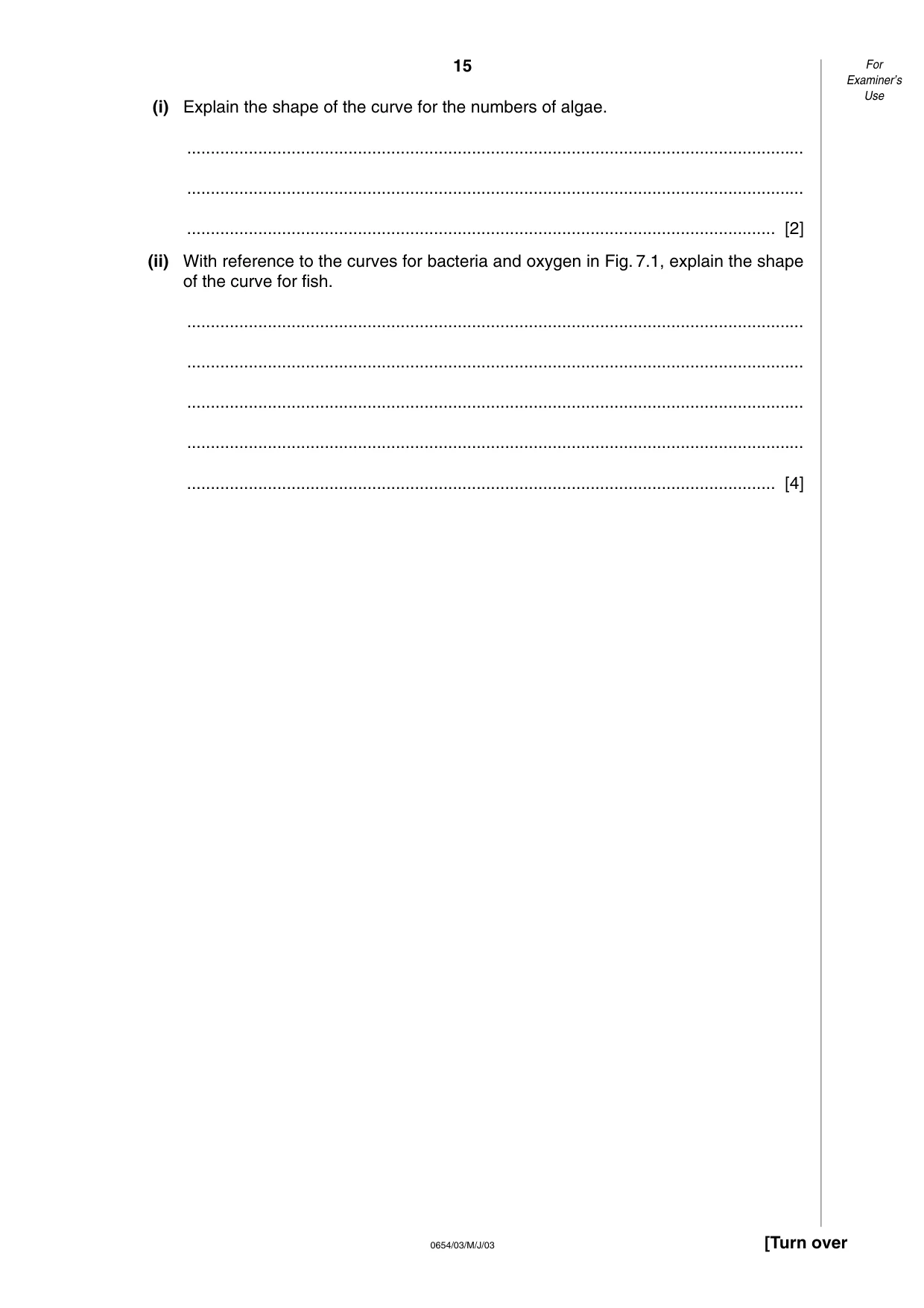
(i) Explain the shape of the curve for the numbers of algae. … … … [2] (ii) With reference to the curves for bacteria and oxygen in Fig. 7.1, explain the shape of the curve for fish. … … … … … [4] 15 0654/03/M/J/03 [Turn over For Examiner’s Use
Question paper, page 16
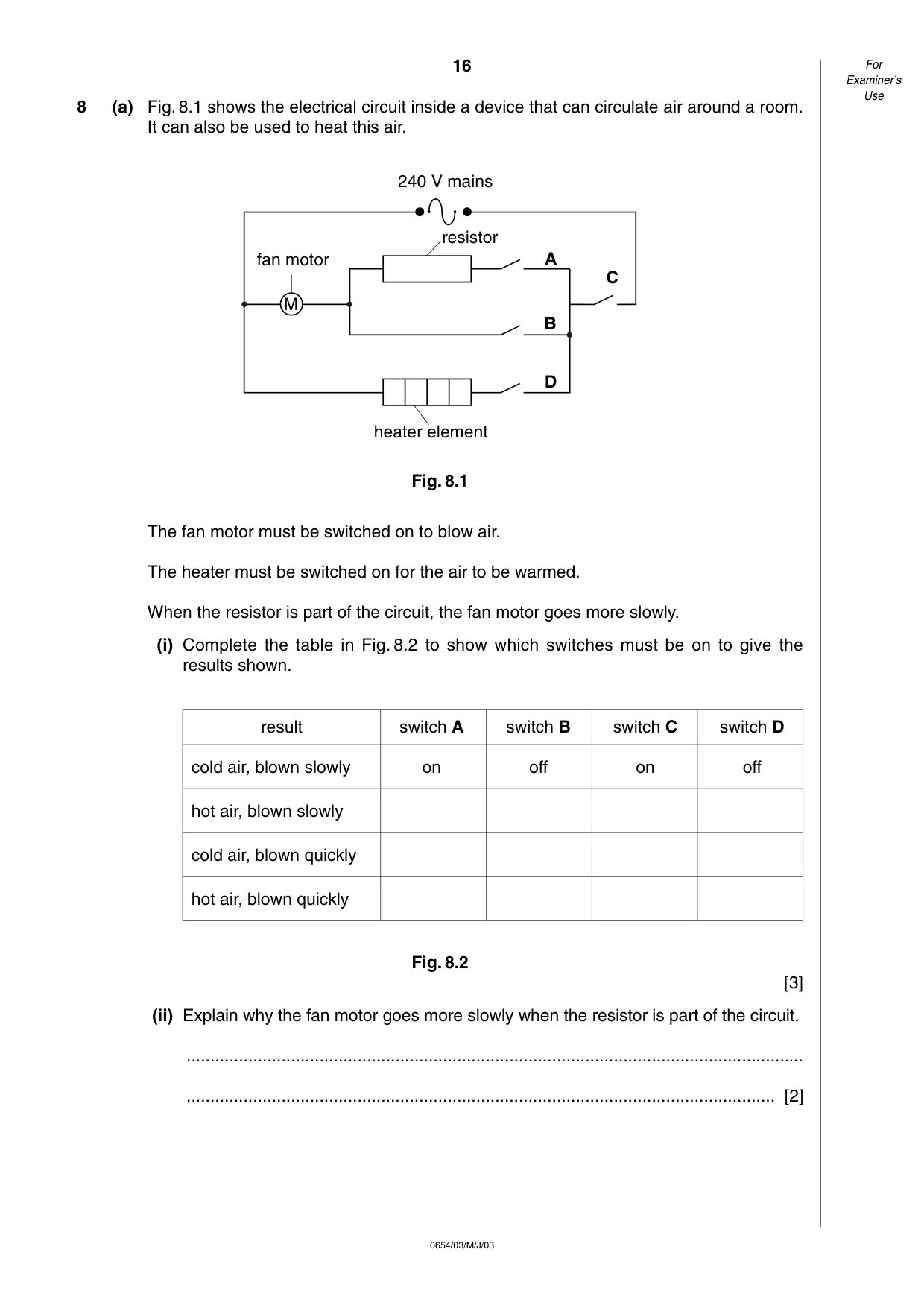
8 (a) Fig. 8.1 shows the electrical circuit inside a device that can circulate air around a room. It can also be used to heat this air. Fig. 8.1 The fan motor must be switched on to blow air. The heater must be switched on for the air to be warmed. When the resistor is part of the circuit, the fan motor goes more slowly. (i) Complete the table in Fig. 8.2 to show which switches must be on to give the results shown. Fig. 8.2 [3] (ii) Explain why the fan motor goes more slowly when the resistor is part of the circuit. … … [2] M resistor fan motor heater element A B C D 240 V mains 16 0654/03/M/J/03 For Examiner’s Use result switch A switch B switch C switch D on off on off cold air, blown slowly hot air, blown slowly cold air, blown quickly hot air, blown quickly
Question paper, page 17
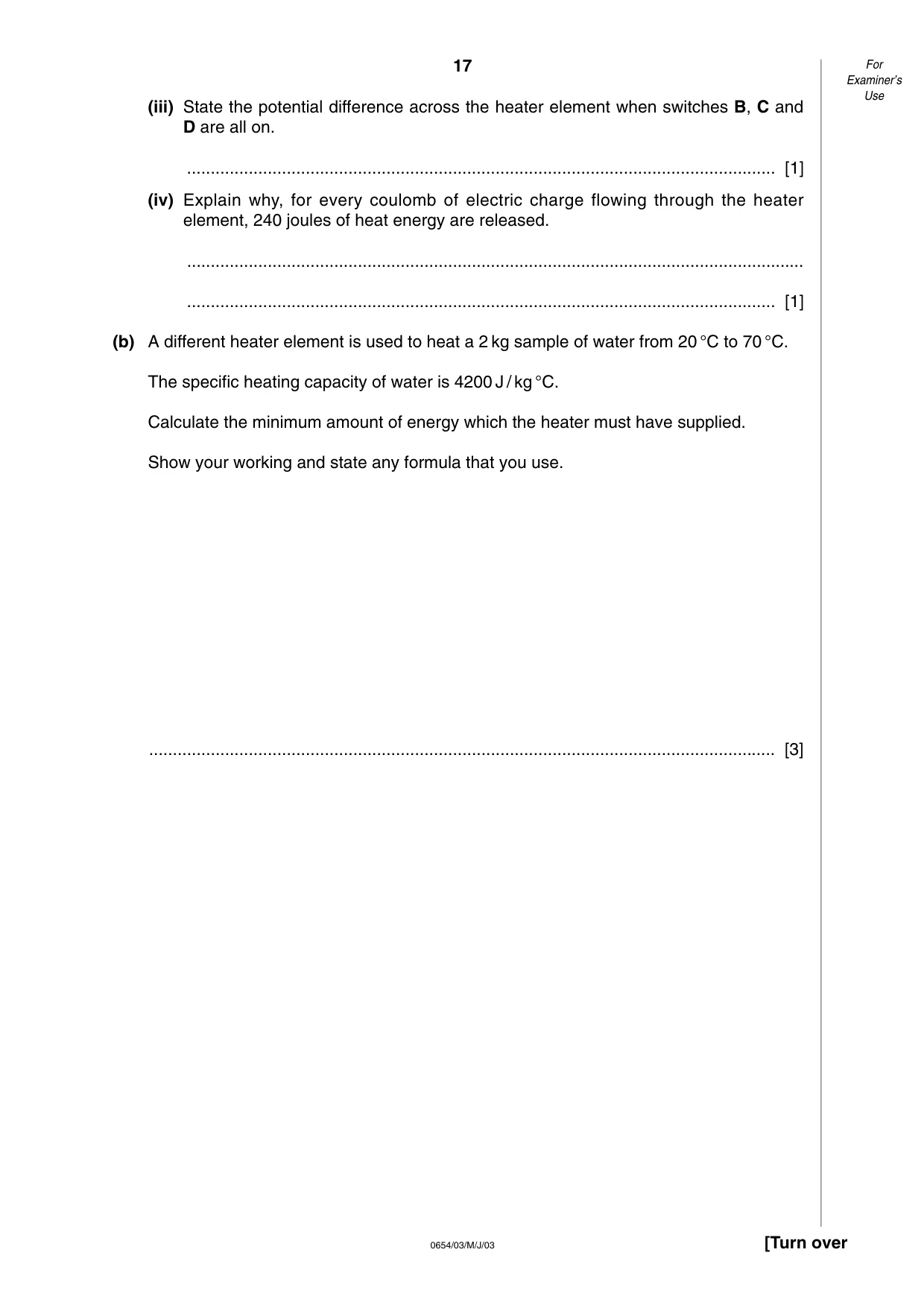
(iii) State the potential difference across the heater element when switches B, C and D are all on. … [1] (iv) Explain why, for every coulomb of electric charge flowing through the heater element, 240 joules of heat energy are released. … … [1] (b) A different heater element is used to heat a 2 kg sample of water from 20 °C to 70 °C. The specific heating capacity of water is 4200 J / kg °C. Calculate the minimum amount of energy which the heater must have supplied. Show your working and state any formula that you use. … [3] 17 0654/03/M/J/03 [Turn over For Examiner’s Use
Question paper, page 18
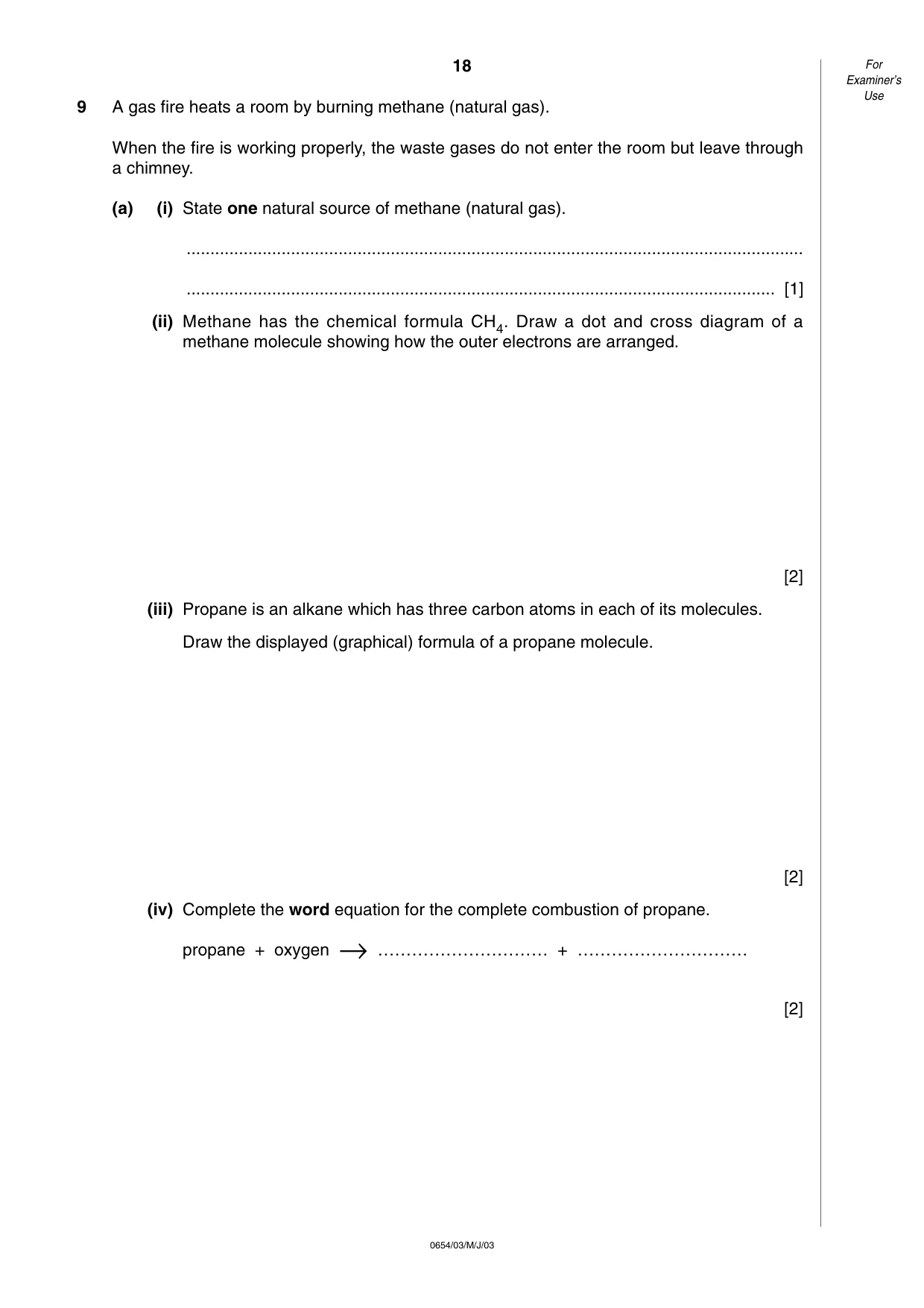
9 A gas fire heats a room by burning methane (natural gas). When the fire is working properly, the waste gases do not enter the room but leave through a chimney. (a) (i) State one natural source of methane (natural gas). … … [1] (ii) Methane has the chemical formula CH4. Draw a dot and cross diagram of a methane molecule showing how the outer electrons are arranged. [2] (iii) Propane is an alkane which has three carbon atoms in each of its molecules. Draw the displayed (graphical) formula of a propane molecule. [2] (iv) Complete the word equation for the complete combustion of propane. propane + oxygen →………………………… + ………………………… [2] 18 0654/03/M/J/03 For Examiner’s Use
Question paper, page 19
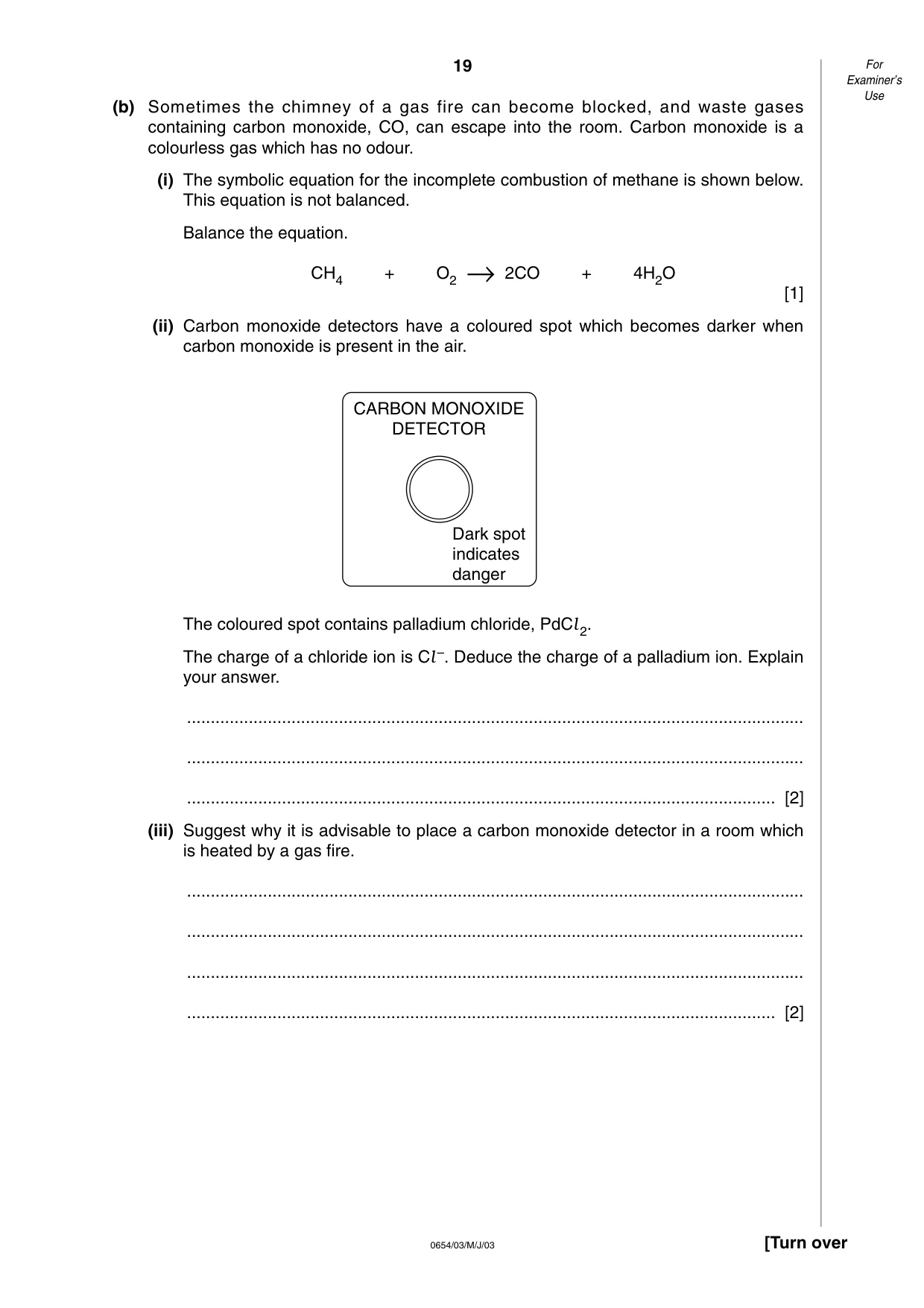
(b) Sometimes the chimney of a gas fire can become blocked, and waste gases containing carbon monoxide, CO, can escape into the room. Carbon monoxide is a colourless gas which has no odour. (i) The symbolic equation for the incomplete combustion of methane is shown below. This equation is not balanced. Balance the equation. CH4 + O2 →2CO + 4H2O [1] (ii) Carbon monoxide detectors have a coloured spot which becomes darker when carbon monoxide is present in the air. The coloured spot contains palladium chloride, PdCl 2. The charge of a chloride ion is Cl –. Deduce the charge of a palladium ion. Explain your answer. … … … [2] (iii) Suggest why it is advisable to place a carbon monoxide detector in a room which is heated by a gas fire. … … … … [2] CARBON MONOXIDE DETECTOR Dark spot indicates danger 19 0654/03/M/J/03 [Turn over For Examiner’s Use
Question paper, page 20
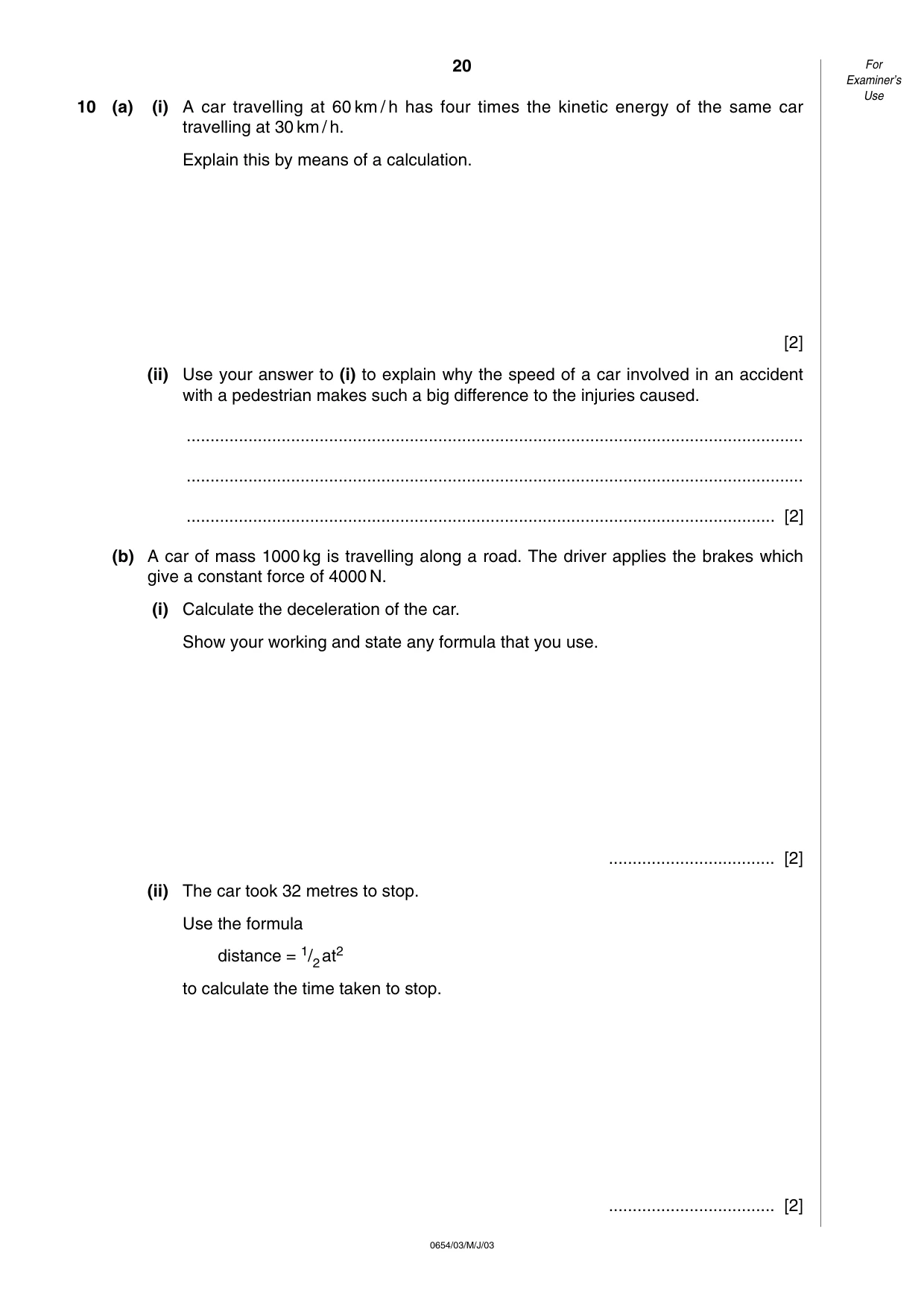
10 (a) (i) A car travelling at 60 km / h has four times the kinetic energy of the same car travelling at 30 km / h. Explain this by means of a calculation. [2] (ii) Use your answer to (i) to explain why the speed of a car involved in an accident with a pedestrian makes such a big difference to the injuries caused. … … … [2] (b) A car of mass 1000 kg is travelling along a road. The driver applies the brakes which give a constant force of 4000 N. (i) Calculate the deceleration of the car. Show your working and state any formula that you use. … [2] (ii) The car took 32 metres to stop. Use the formula distance = 1/2at2 to calculate the time taken to stop. … [2] 20 0654/03/M/J/03 For Examiner’s Use
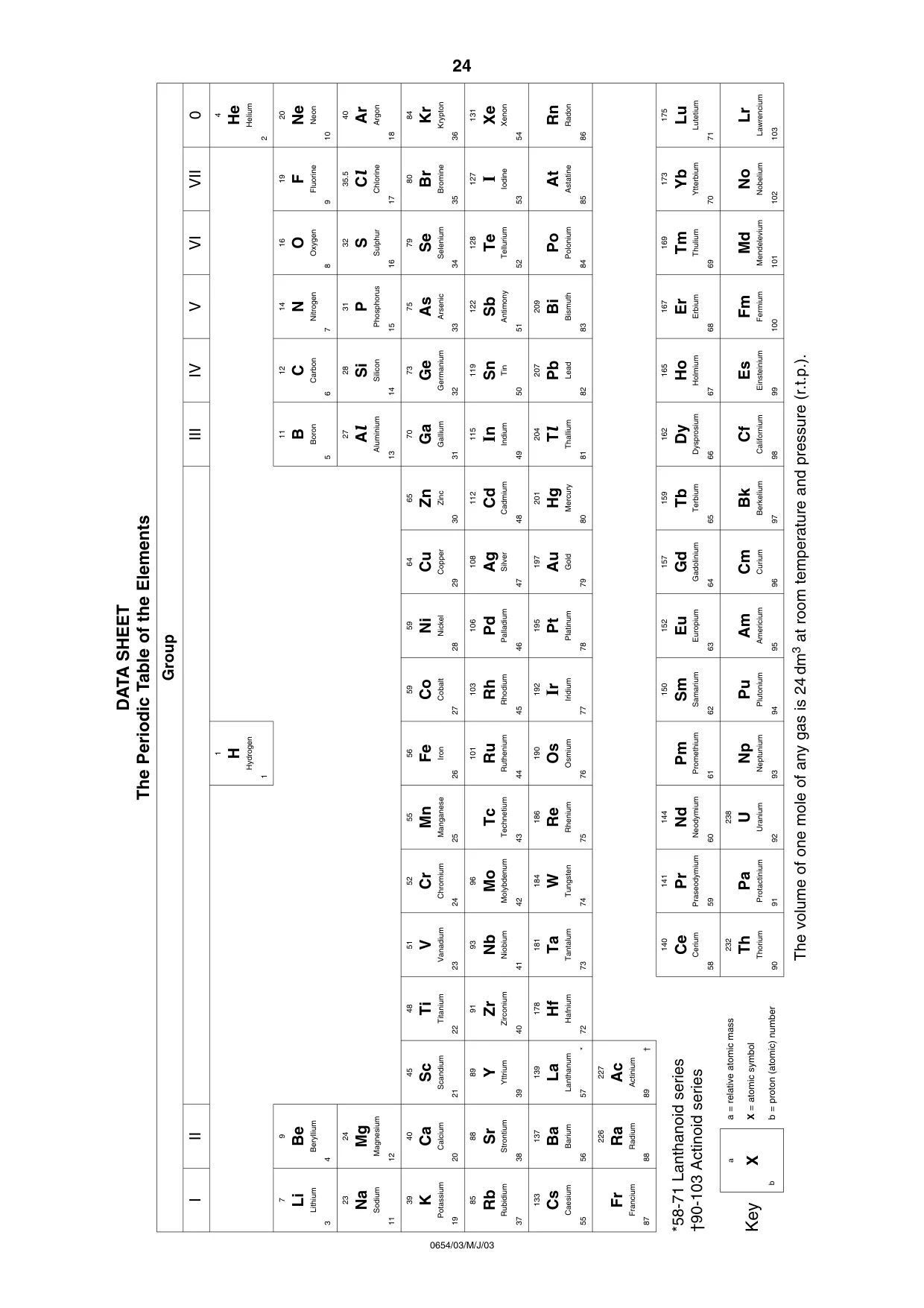
Question paper, page 24
24 0654/03/M/J/03 DATA SHEET The Periodic Table of the Elements The volume of one mole of any gas is 24 dm3 at room temperature and pressure (r.t.p.). *58-71 Lanthanoid series †90-103 Actinoid series Key a = relative atomic mass X = atomic symbol b = proton (atomic) number Group I 7 Li Lithium 3 9 Be Beryllium 4 23 Na Sodium 11 24 Mg Magnesium 12 39 K Potassium 19 40 Ca Calcium 20 45 Sc Scandium 21 48 Ti Titanium 22 51 V Vanadium 23 52 Cr Chromium 24 55 Mn Manganese 25 56 Fe Iron 26 59 Co Cobalt 27 59 Ni Nickel 28 64 Cu Copper 29 65 Zn Zinc 30 70 Ga Gallium 31 27 Al Aluminium 13 11 B Boron 5 73 Ge Germanium 32 28 Si Silicon 14 12 C Carbon 6 75 As Arsenic 33 31 P Phosphorus 15 14 N Nitrogen 7 79 Se Selenium 34 32 S Sulphur 16 16 O Oxygen 8 80 Br Bromine 35 35.5 Cl Chlorine 17 19 F Fluorine 9 84 Kr Krypton 36 40 Ar Argon 18 20 Ne Neon 10 4 He Helium 2 85 Rb Rubidium 37 88 Sr Strontium 38 89 Y Yttrium 39 91 Zr Zirconium 40 93 Nb Niobium 41 96 Mo Molybdenum 42 Tc Technetium 43 101 Ru Ruthenium 44 103 Rh Rhodium 45 106 Pd Palladium 46 108 Ag Silver 47 112 Cd Cadmium 48 115 In Indium 49 119 Sn Tin 50 122 Sb Antimony 51 128 Te Tellurium 52 127 I Iodine 53 131 Xe Xenon 54 133 Cs Caesium 55 137 Ba Barium 56 139 La Lanthanum 57 * 178 Hf Hafnium 72 181 Ta Tantalum 73 140 Ce Cerium 58 a X b 232 Th Thorium 90 Pa Protactinium 91 238 U Uranium 92 Np Neptunium 93 Pu Plutonium 94 Am Americium 95 Cm Curium 96 Bk Berkelium 97 Cf Californium 98 Es Einsteinium 99 Fm Fermium 100 Md Mendelevium 101 No Nobelium 102 Lr Lawrencium 103 141 Pr Praseodymium 59 144 Nd Neodymium 60 Pm Promethium 61 150 Sm Samarium 62 152 Eu Europium 63 157 Gd Gadolinium 64 159 Tb Terbium 65 162 Dy Dysprosium 66 165 Ho Holmium 67 167 Er Erbium 68 169 Tm Thulium 69 173 Yb Ytterbium 70 175 Lu Lutetium 71 184 W Tungsten 74 186 Re Rhenium 75 190 Os Osmium 76 192 Ir Iridium 77 195 Pt Platinum 78 197 Au Gold 79 201 Hg Mercury 80 204 Tl Thallium 81 207 Pb Lead 82 209 Bi Bismuth 83 Po Polonium 84 At Astatine 85 Rn Radon 86 Fr Francium 87 226 Ra Radium 88 227 Ac Actinium 89 † 1 H Hydrogen 1 II III IV V VI VII 0