Cambridge IGCSE Sciences - Co-ordinated (Double) 0654 — 2003 May/June Paper 1 · Variant 1
0654/11/M/J/03
The question paper and its mark scheme, free to read here and free to download. This is Cambridge’s own paper, exactly as it was sat.
Question paper20 pages



Mark scheme
No mark scheme is in the library for this paper.
Paper as text
Question paper, page 1
This document consists of 17 printed pages and 3 blank pages. MML 3541 6/02 S41636/2 © CIE 2003 [Turn over CAMBRIDGE INTERNATIONAL EXAMINATIONS International General Certificate of Secondary Education CO-ORDINATED SCIENCES 0654/01 Paper 1 Multiple Choice May/June 2003 45 minutes Additional Materials: Multiple Choice Answer Sheet Soft clean eraser Soft pencil (type B or HB is recommended) READ THESE INSTRUCTIONS FIRST Write in soft pencil. Do not use staples, paper clips, highlighters, glue or correction fluid. Write your name, Centre number and candidate number on the answer sheet in the spaces provided unless this has been done for you. There are forty questions on this paper. Answer all questions. For each question there are four possible answers A, B, C, and D. Choose the one you consider correct and record your choice in soft pencil on the separate answer sheet. Read the instructions on the Answer Sheet very carefully. Each correct answer will score one mark. A mark will not be deducted for a wrong answer. Any rough working should be done in this booklet. A copy of the Periodic Table is printed on page 20. Centre Number Candidate Number Name UNIVERSITY of CAMBRIDGE Local Examinations Syndicate www.XtremePapers.com
Question paper, page 2
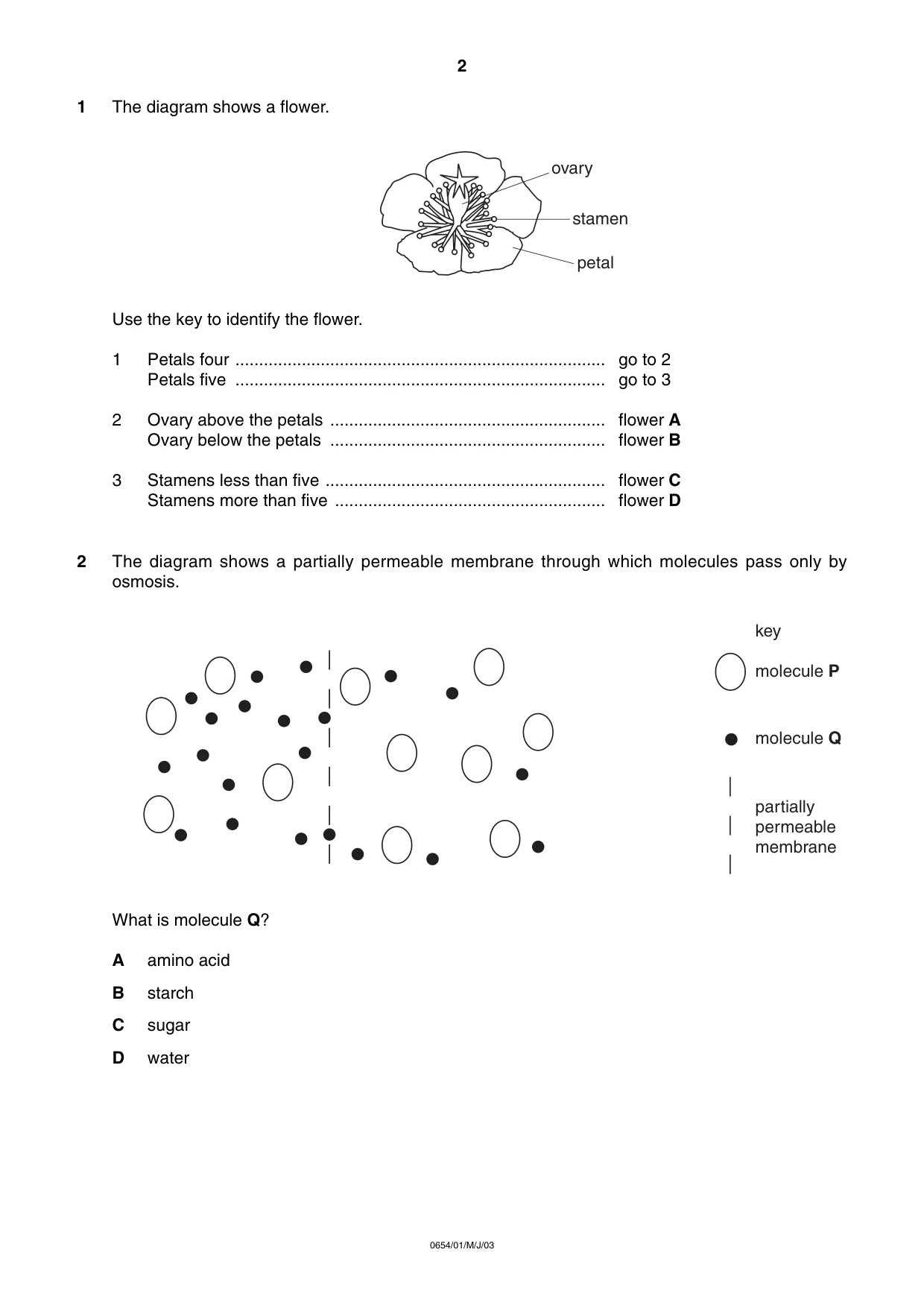
1 The diagram shows a flower. Use the key to identify the flower. 1 Petals four … go to 2 Petals five … go to 3 2 Ovary above the petals … flower A Ovary below the petals … flower B 3 Stamens less than five … flower C Stamens more than five … flower D 2 The diagram shows a partially permeable membrane through which molecules pass only by osmosis. What is molecule Q? A amino acid B starch C sugar D water key molecule P molecule Q partially permeable membrane ovary stamen petal 2 0654/01/M/J/03
Question paper, page 3
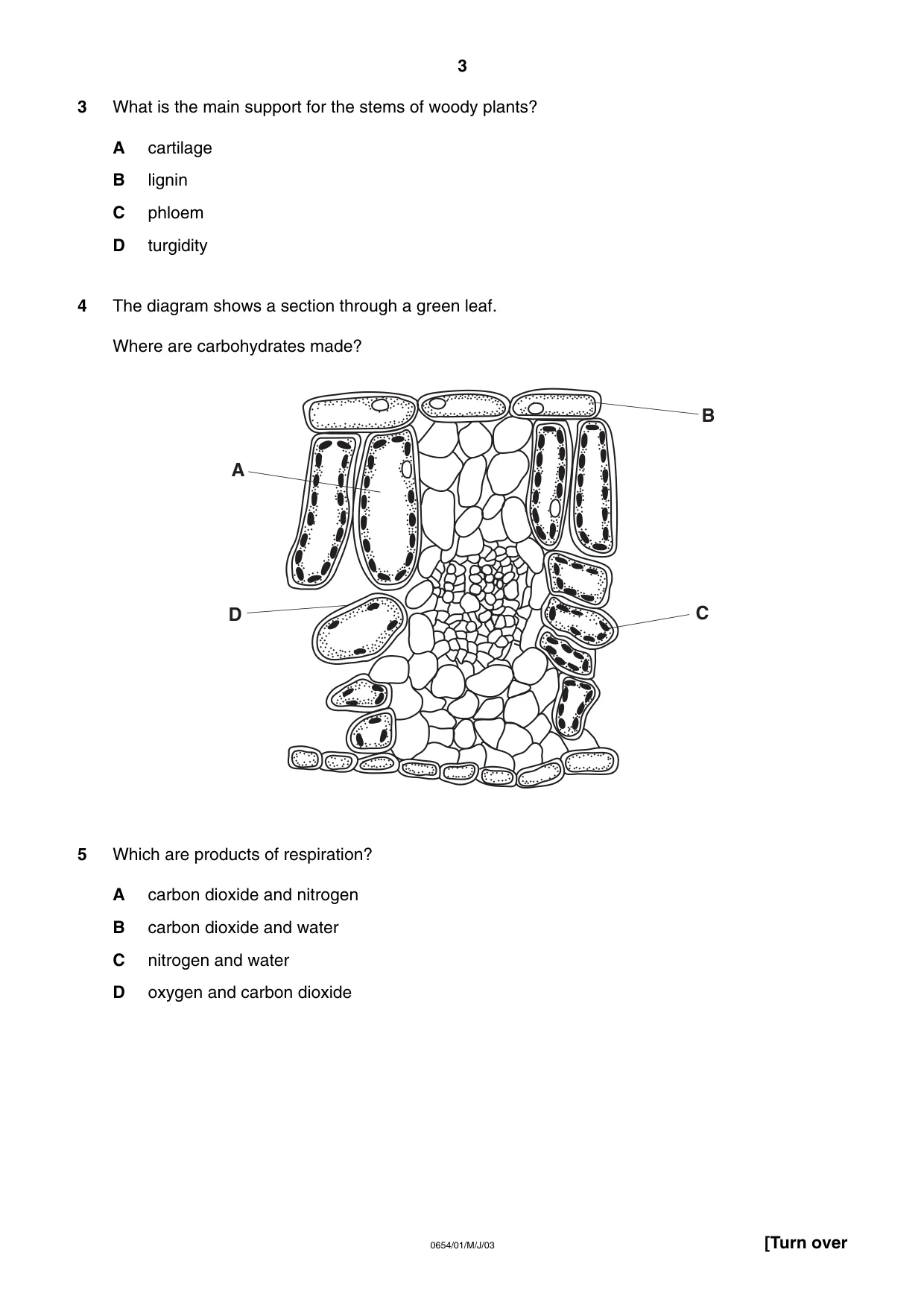
3 What is the main support for the stems of woody plants? A cartilage B lignin C phloem D turgidity 4 The diagram shows a section through a green leaf. Where are carbohydrates made? 5 Which are products of respiration? A carbon dioxide and nitrogen B carbon dioxide and water C nitrogen and water D oxygen and carbon dioxide A B C D 3 0654/01/M/J/03 [Turn over
Question paper, page 4
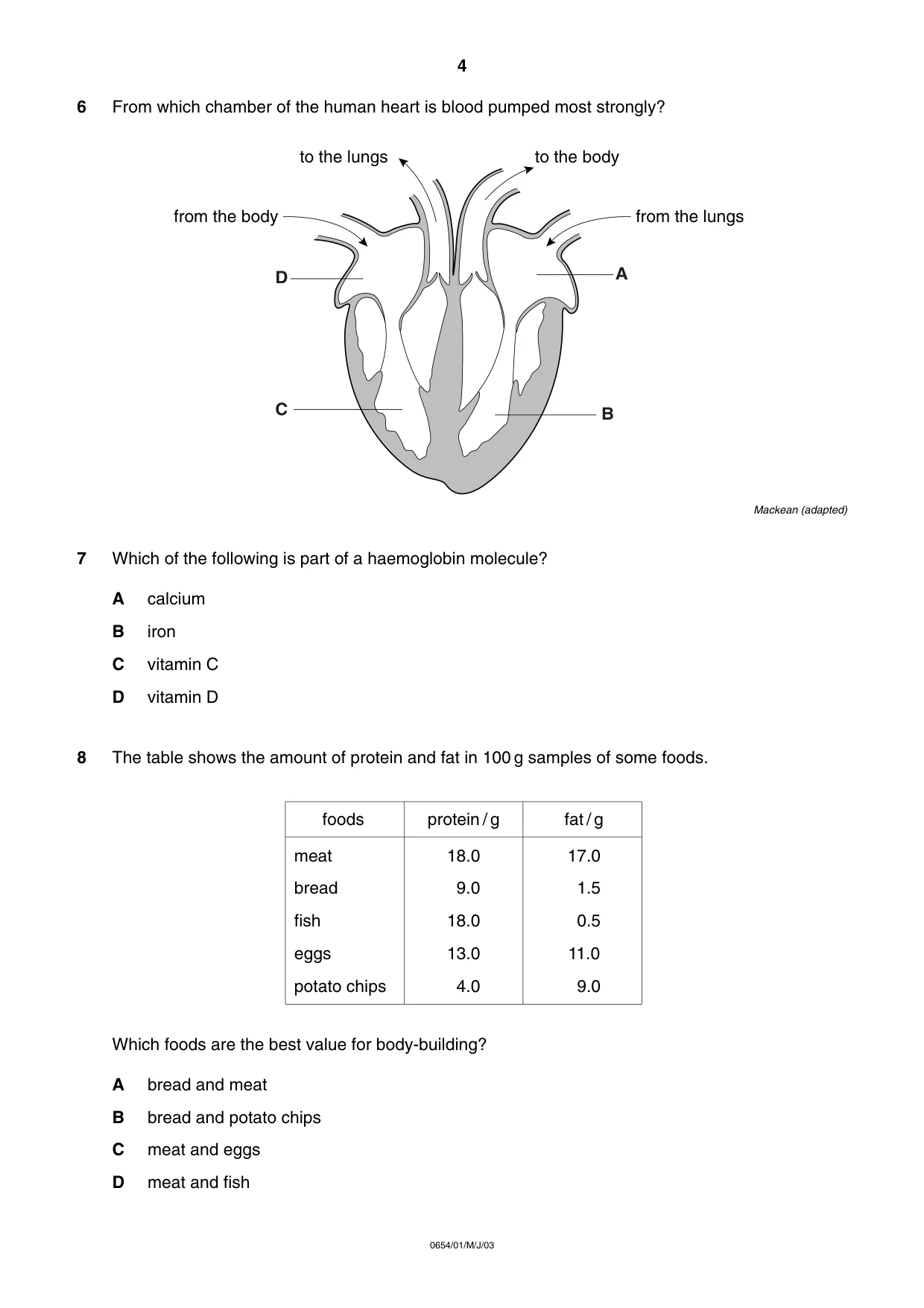
6 From which chamber of the human heart is blood pumped most strongly? Mackean (adapted) 7 Which of the following is part of a haemoglobin molecule? A calcium B iron C vitamin C D vitamin D 8 The table shows the amount of protein and fat in 100 g samples of some foods. Which foods are the best value for body-building? A bread and meat B bread and potato chips C meat and eggs D meat and fish D C A B from the body from the lungs to the lungs to the body 4 0654/01/M/J/03 foods protein / g fat / g meat bread fish eggs potato chips 18.0 9.0 18.0 13.0 4.0 17.0 1.5 0.5 11.0 9.0
Question paper, page 5
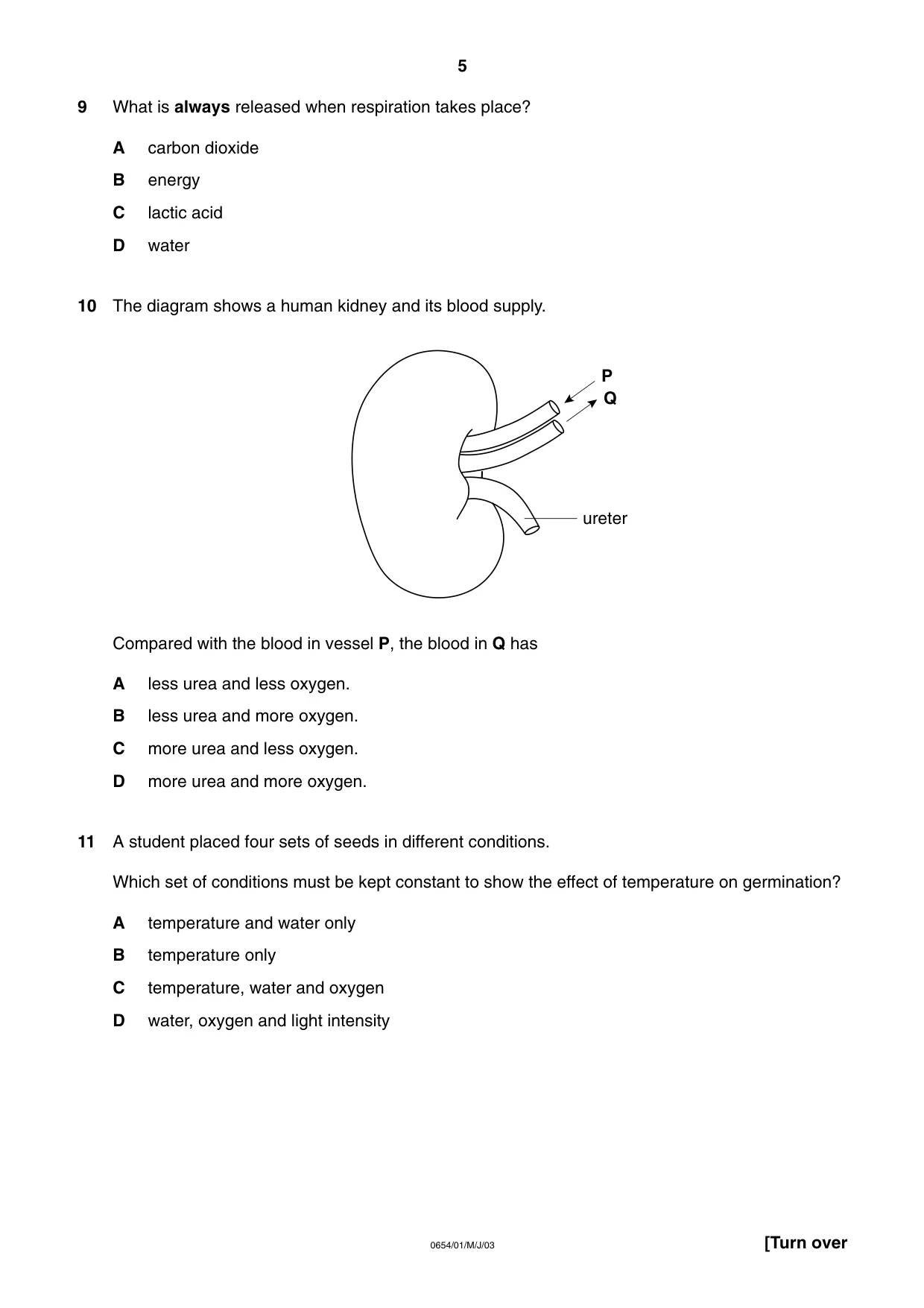
9 What is always released when respiration takes place? A carbon dioxide B energy C lactic acid D water 10 The diagram shows a human kidney and its blood supply. Compared with the blood in vessel P, the blood in Q has A less urea and less oxygen. B less urea and more oxygen. C more urea and less oxygen. D more urea and more oxygen. 11 A student placed four sets of seeds in different conditions. Which set of conditions must be kept constant to show the effect of temperature on germination? A temperature and water only B temperature only C temperature, water and oxygen D water, oxygen and light intensity P Q ureter 5 0654/01/M/J/03 [Turn over
Question paper, page 6
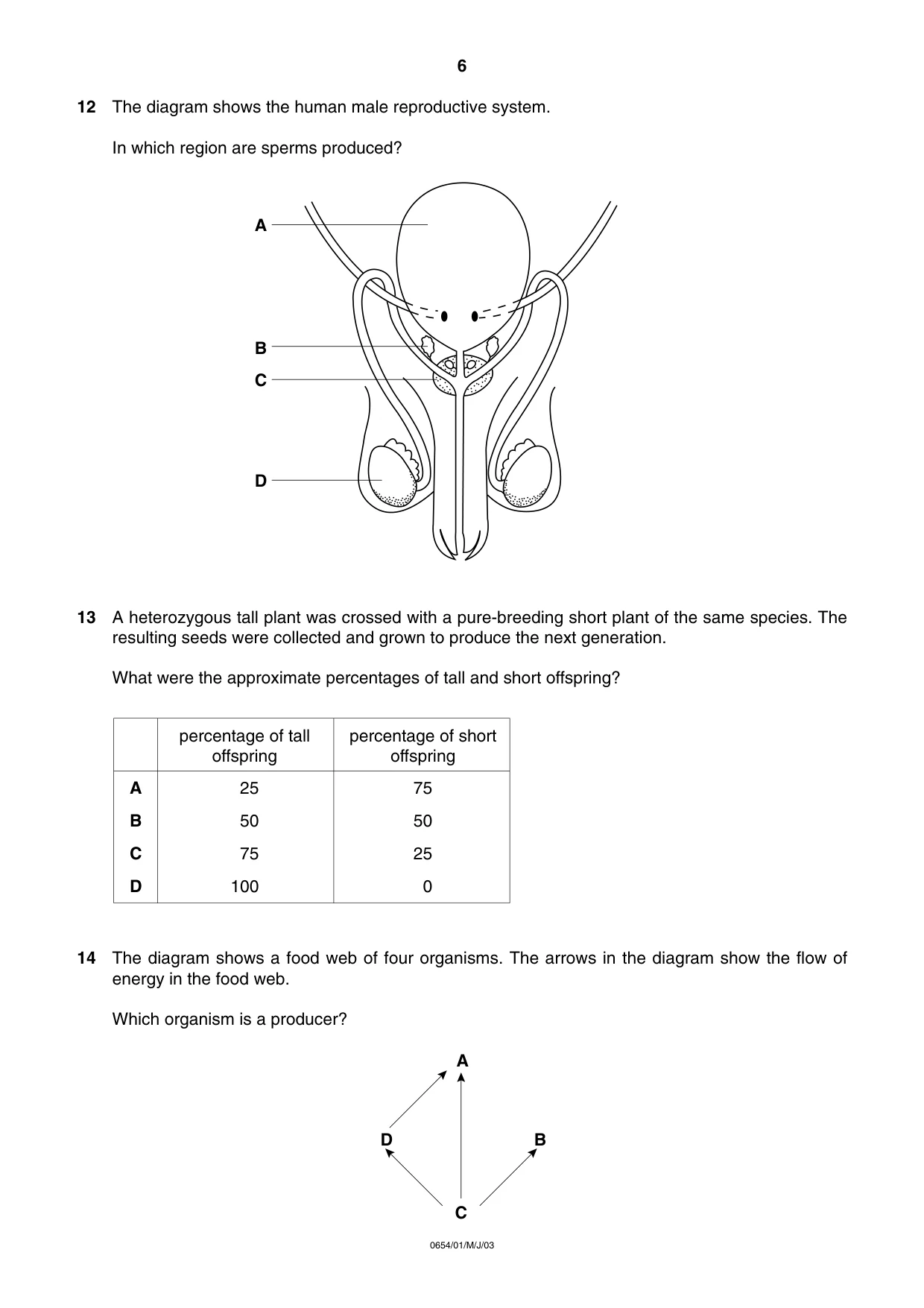
12 The diagram shows the human male reproductive system. In which region are sperms produced? 13 A heterozygous tall plant was crossed with a pure-breeding short plant of the same species. The resulting seeds were collected and grown to produce the next generation. What were the approximate percentages of tall and short offspring? 14 The diagram shows a food web of four organisms. The arrows in the diagram show the flow of energy in the food web. Which organism is a producer? A D C B A B C D 6 0654/01/M/J/03 A B C D percentage of tall offspring 25 50 75 100 percentage of short offspring 75 50 25 0
Question paper, page 7
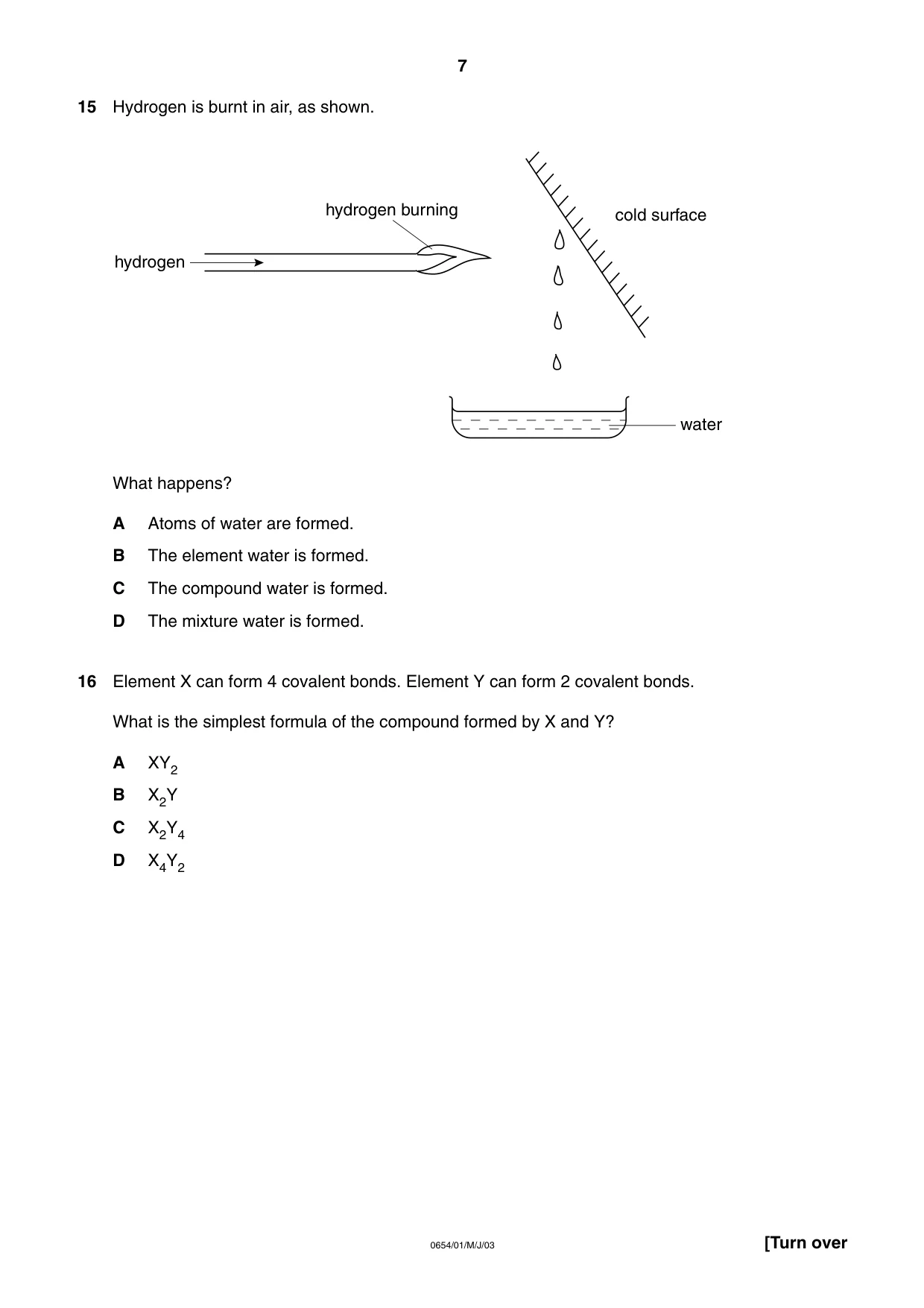
15 Hydrogen is burnt in air, as shown. What happens? A Atoms of water are formed. B The element water is formed. C The compound water is formed. D The mixture water is formed. 16 Element X can form 4 covalent bonds. Element Y can form 2 covalent bonds. What is the simplest formula of the compound formed by X and Y? A XY2 B X2Y C X2Y4 D X4Y2 hydrogen burning hydrogen cold surface water 7 0654/01/M/J/03 [Turn over
Question paper, page 8
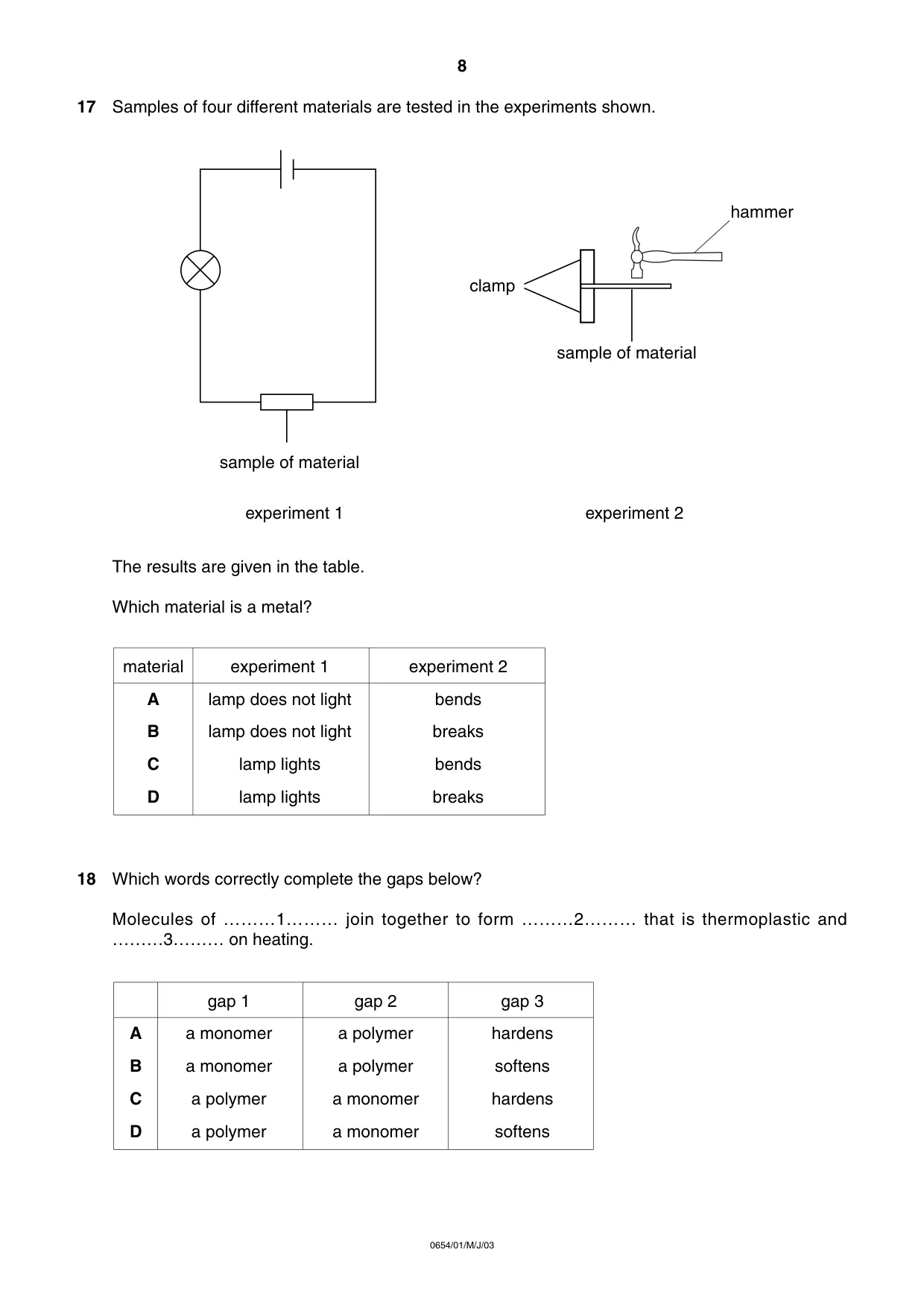
17 Samples of four different materials are tested in the experiments shown. The results are given in the table. Which material is a metal? 18 Which words correctly complete the gaps below? Molecules of ………1……… join together to form ………2……… that is thermoplastic and ………3……… on heating. sample of material clamp hammer sample of material experiment 1 experiment 2 8 0654/01/M/J/03 material A B C D experiment 1 lamp does not light lamp does not light lamp lights lamp lights experiment 2 bends breaks bends breaks A B C D gap 1 a monomer a monomer a polymer a polymer gap 2 a polymer a polymer a monomer a monomer gap 3 hardens softens hardens softens
Question paper, page 9
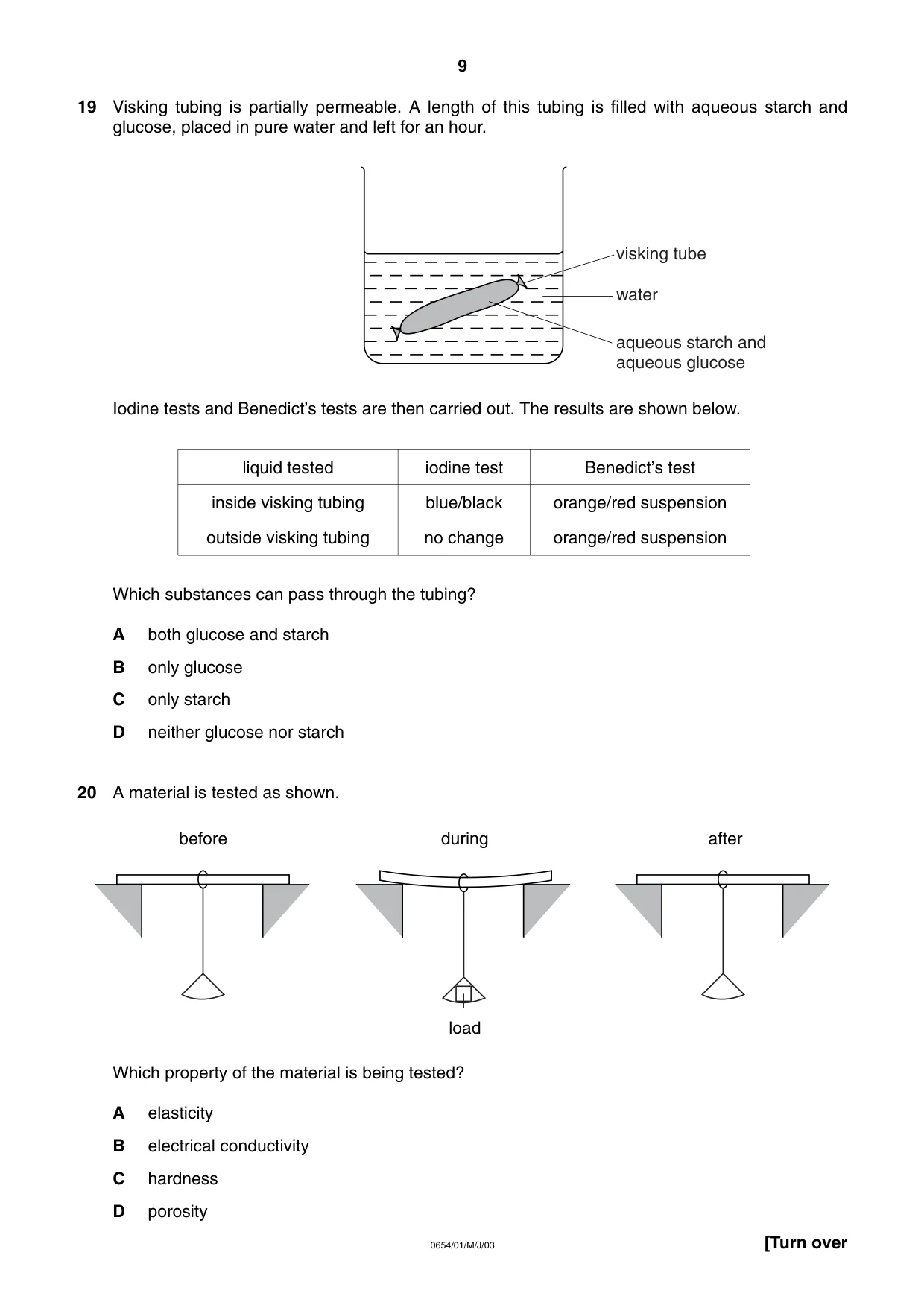
19 Visking tubing is partially permeable. A length of this tubing is filled with aqueous starch and glucose, placed in pure water and left for an hour. Iodine tests and Benedict’s tests are then carried out. The results are shown below. Which substances can pass through the tubing? A both glucose and starch B only glucose C only starch D neither glucose nor starch 20 A material is tested as shown. Which property of the material is being tested? A elasticity B electrical conductivity C hardness D porosity before after during load visking tube water aqueous starch and aqueous glucose 9 0654/01/M/J/03 [Turn over liquid tested iodine test blue/black no change Benedict’s test orange/red suspension orange/red suspension inside visking tubing outside visking tubing
Question paper, page 10
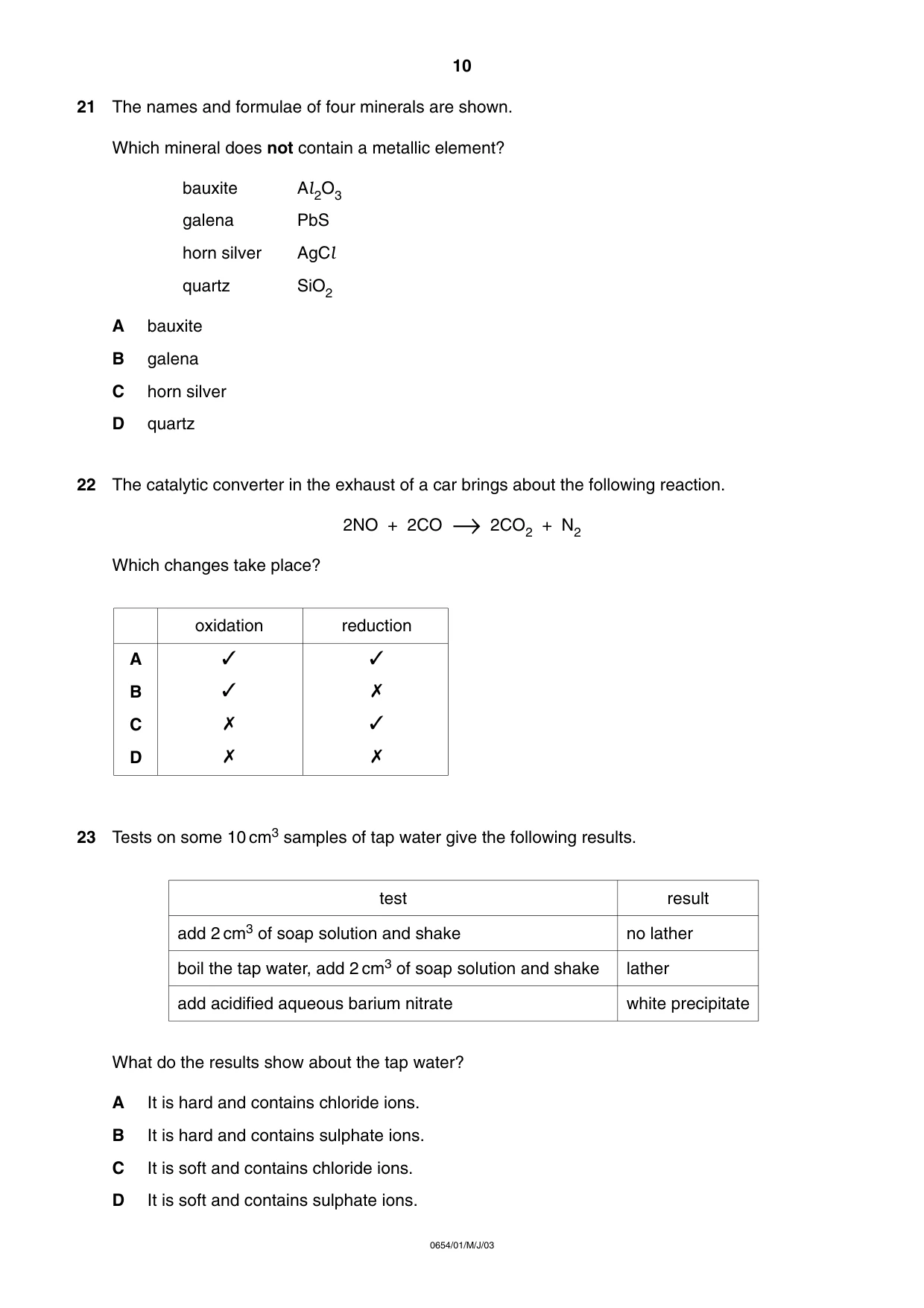
21 The names and formulae of four minerals are shown. Which mineral does not contain a metallic element? bauxite Al2O3 galena PbS horn silver AgCl quartz SiO2 A bauxite B galena C horn silver D quartz 22 The catalytic converter in the exhaust of a car brings about the following reaction. 2NO + 2CO →2CO2 + N2 Which changes take place? 23 Tests on some 10 cm3 samples of tap water give the following results. What do the results show about the tap water? A It is hard and contains chloride ions. B It is hard and contains sulphate ions. C It is soft and contains chloride ions. D It is soft and contains sulphate ions. 10 0654/01/M/J/03 A B C D oxidation ✓ ✓ ✗ ✗ reduction ✓ ✗ ✓ ✗ test result no lather lather white precipitate add 2 cm3 of soap solution and shake boil the tap water, add 2 cm3 of soap solution and shake add acidified aqueous barium nitrate
Question paper, page 11
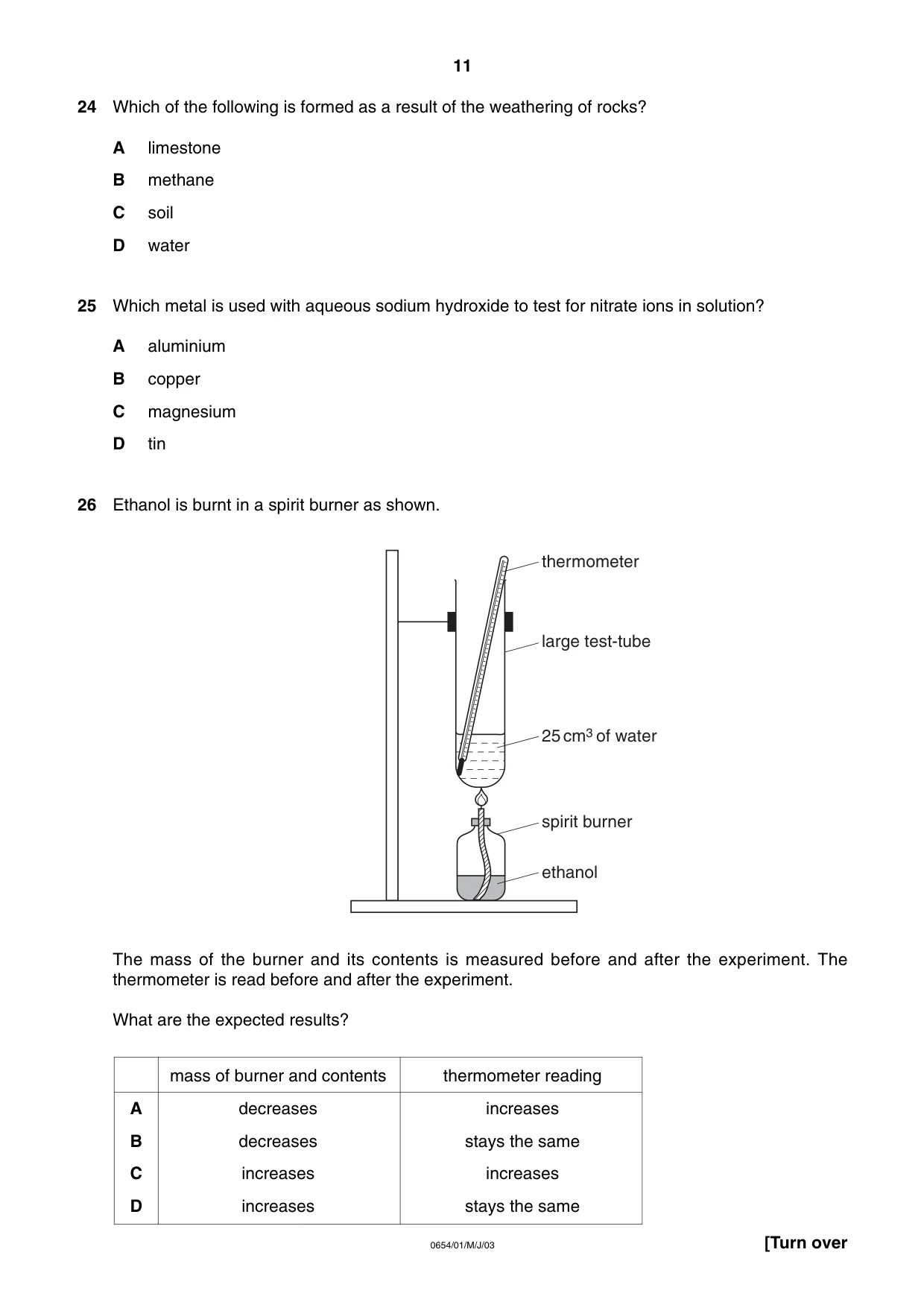
24 Which of the following is formed as a result of the weathering of rocks? A limestone B methane C soil D water 25 Which metal is used with aqueous sodium hydroxide to test for nitrate ions in solution? A aluminium B copper C magnesium D tin 26 Ethanol is burnt in a spirit burner as shown. The mass of the burner and its contents is measured before and after the experiment. The thermometer is read before and after the experiment. What are the expected results? thermometer large test-tube 25cm3 of water spirit burner ethanol 11 0654/01/M/J/03 [Turn over A B C D mass of burner and contents decreases decreases increases increases thermometer reading increases stays the same increases stays the same
Question paper, page 12
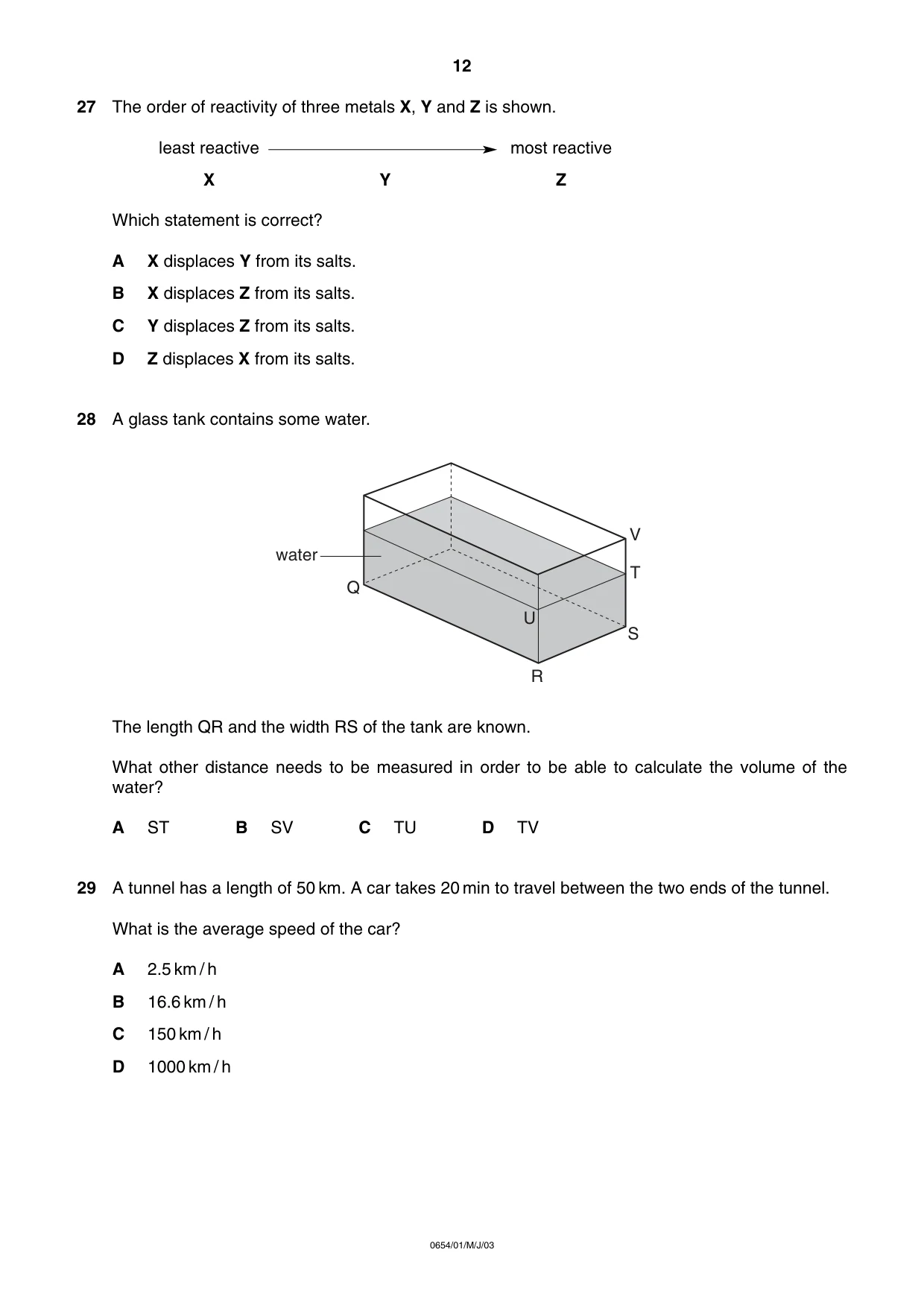
27 The order of reactivity of three metals X, Y and Z is shown. least reactive most reactive X Y Z Which statement is correct? A X displaces Y from its salts. B X displaces Z from its salts. C Y displaces Z from its salts. D Z displaces X from its salts. 28 A glass tank contains some water. The length QR and the width RS of the tank are known. What other distance needs to be measured in order to be able to calculate the volume of the water? A ST B SV C TU D TV 29 A tunnel has a length of 50 km. A car takes 20 min to travel between the two ends of the tunnel. What is the average speed of the car? A 2.5 km / h B 16.6 km / h C 150 km / h D 1000 km / h water Q R S T V U 12 0654/01/M/J/03
Question paper, page 13
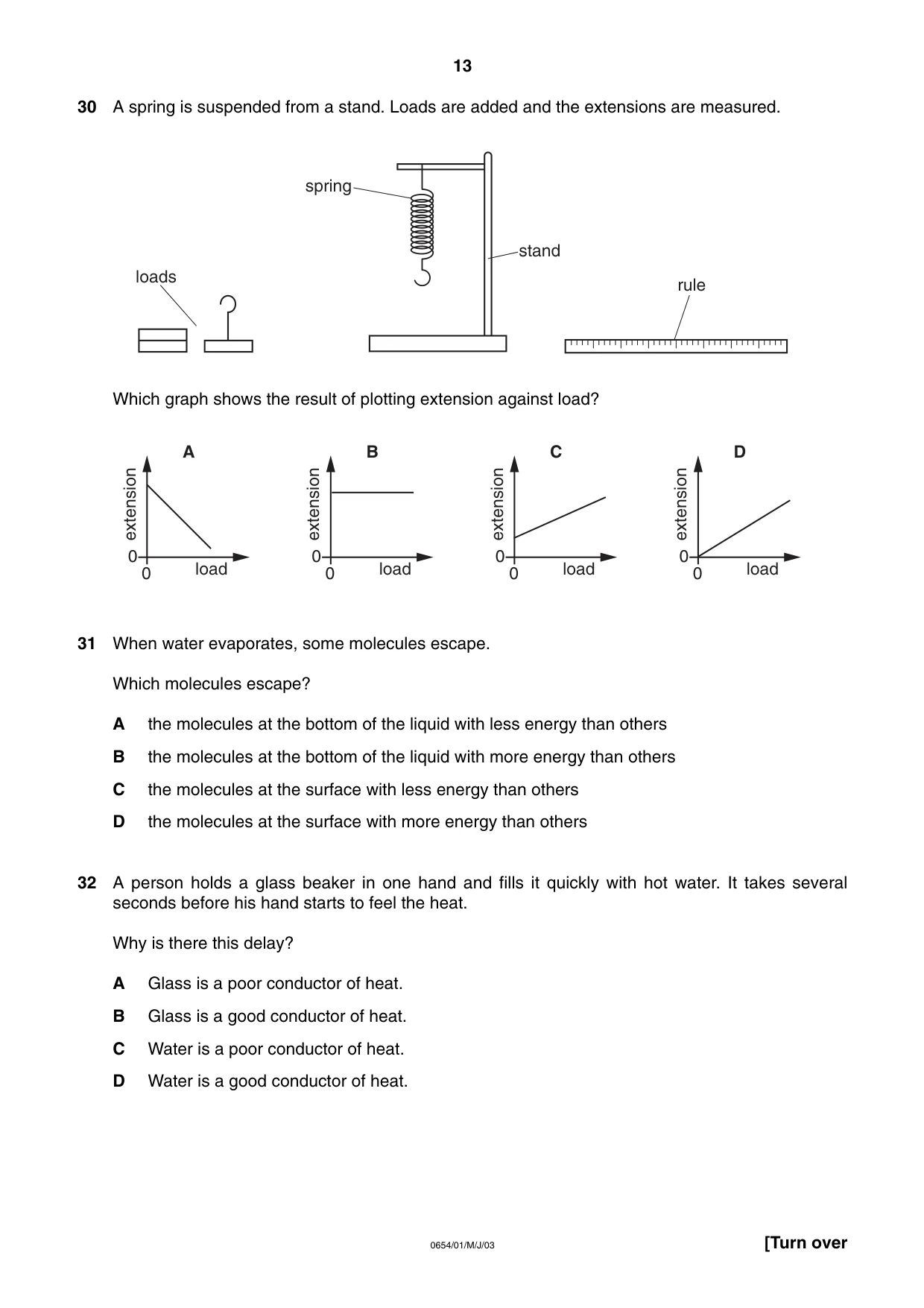
30 A spring is suspended from a stand. Loads are added and the extensions are measured. Which graph shows the result of plotting extension against load? 31 When water evaporates, some molecules escape. Which molecules escape? A the molecules at the bottom of the liquid with less energy than others B the molecules at the bottom of the liquid with more energy than others C the molecules at the surface with less energy than others D the molecules at the surface with more energy than others 32 A person holds a glass beaker in one hand and fills it quickly with hot water. It takes several seconds before his hand starts to feel the heat. Why is there this delay? A Glass is a poor conductor of heat. B Glass is a good conductor of heat. C Water is a poor conductor of heat. D Water is a good conductor of heat. 0 0 extension load A 0 0 extension load B 0 0 extension load C 0 0 extension load D spring stand loads rule 13 0654/01/M/J/03 [Turn over
Question paper, page 14
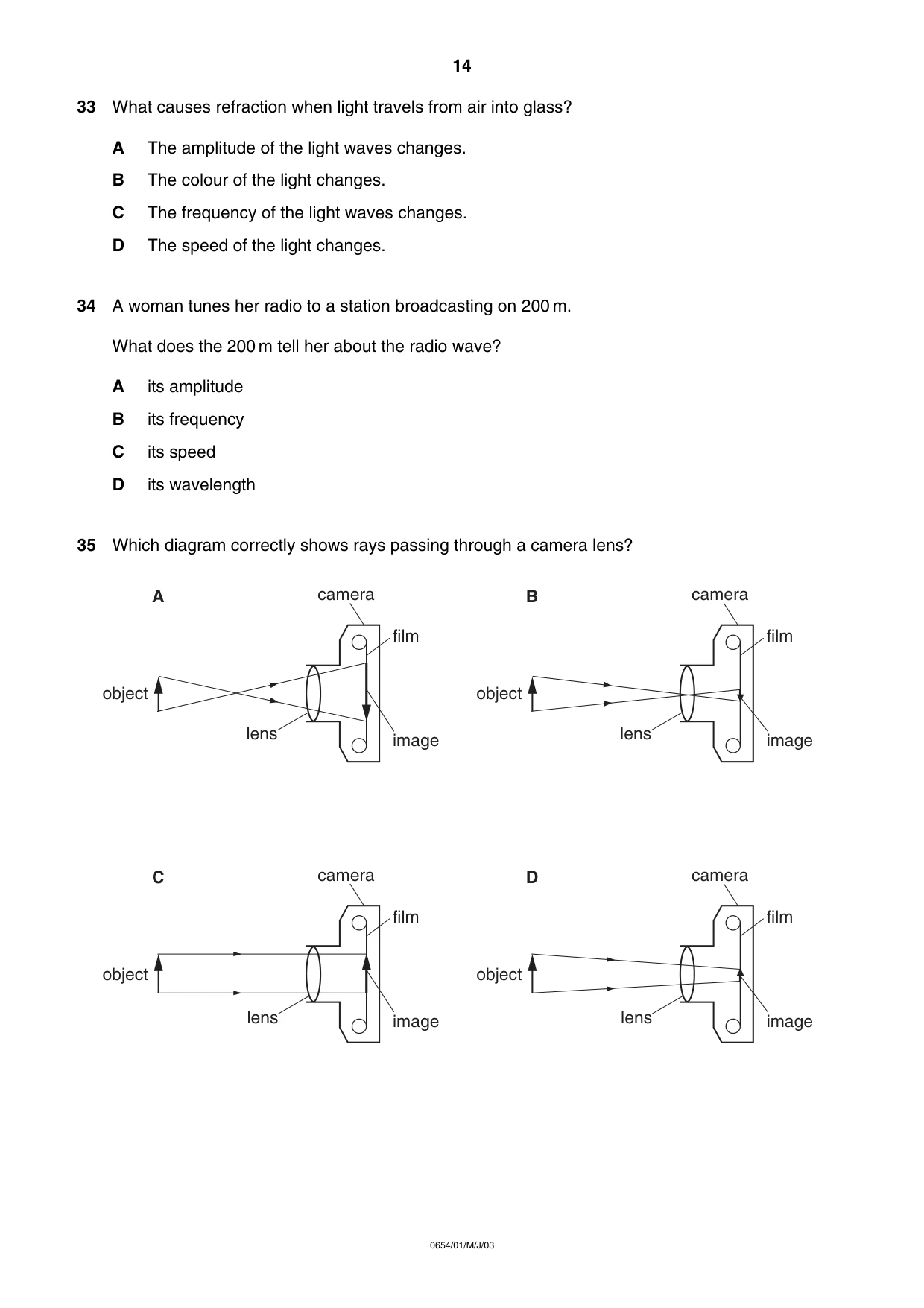
33 What causes refraction when light travels from air into glass? A The amplitude of the light waves changes. B The colour of the light changes. C The frequency of the light waves changes. D The speed of the light changes. 34 A woman tunes her radio to a station broadcasting on 200 m. What does the 200 m tell her about the radio wave? A its amplitude B its frequency C its speed D its wavelength 35 Which diagram correctly shows rays passing through a camera lens? camera film image lens object A camera film image lens object C camera film image lens object B camera film image lens object D 14 0654/01/M/J/03
Question paper, page 15
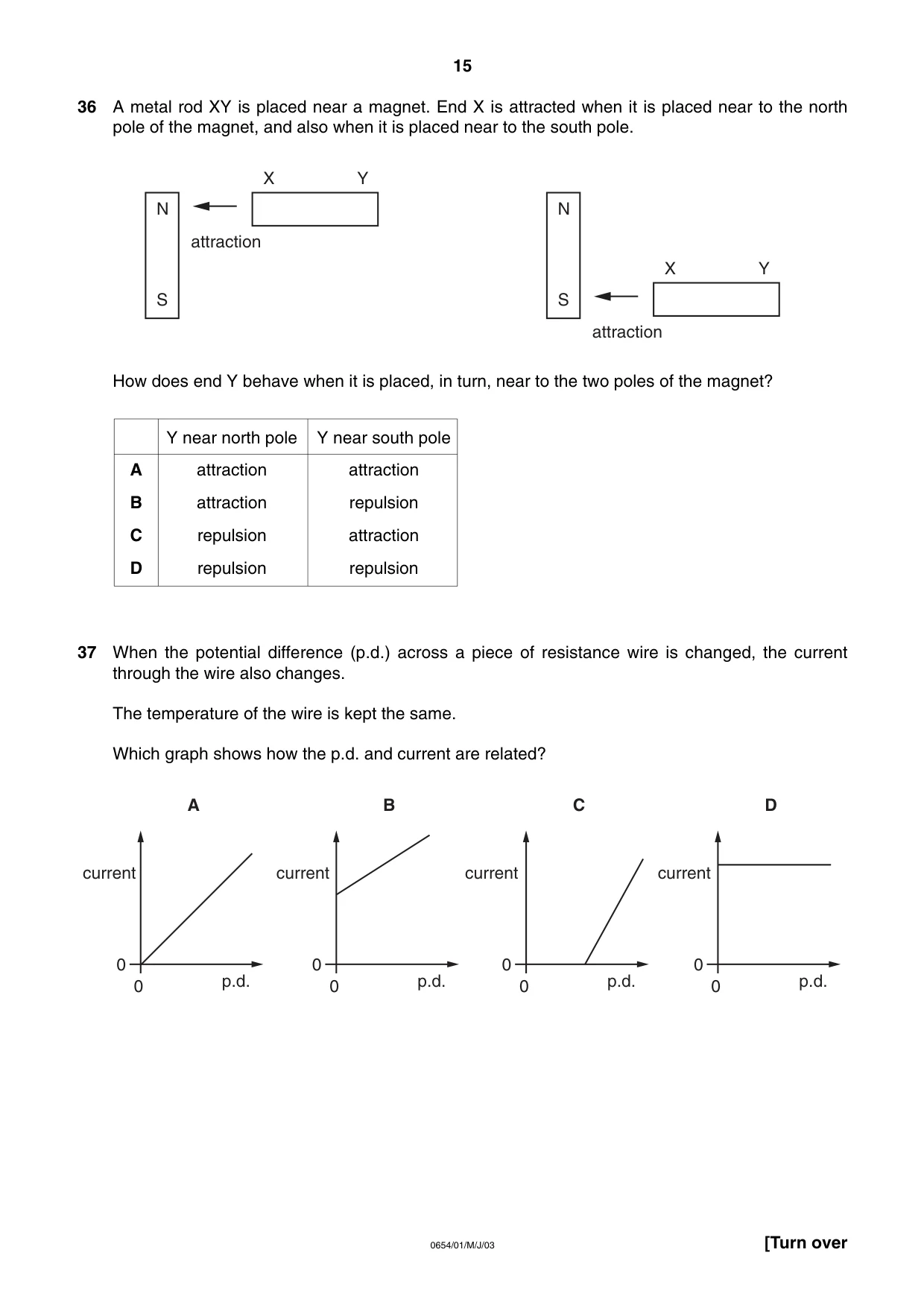
36 A metal rod XY is placed near a magnet. End X is attracted when it is placed near to the north pole of the magnet, and also when it is placed near to the south pole. How does end Y behave when it is placed, in turn, near to the two poles of the magnet? 37 When the potential difference (p.d.) across a piece of resistance wire is changed, the current through the wire also changes. The temperature of the wire is kept the same. Which graph shows how the p.d. and current are related? 0 0 p.d. A 0 0 p.d. B 0 0 p.d. C 0 0 p.d. D current current current current X Y N S attraction X Y N S attraction 15 0654/01/M/J/03 [Turn over A B C D Y near north pole attraction attraction repulsion repulsion Y near south pole attraction repulsion attraction repulsion
Question paper, page 16
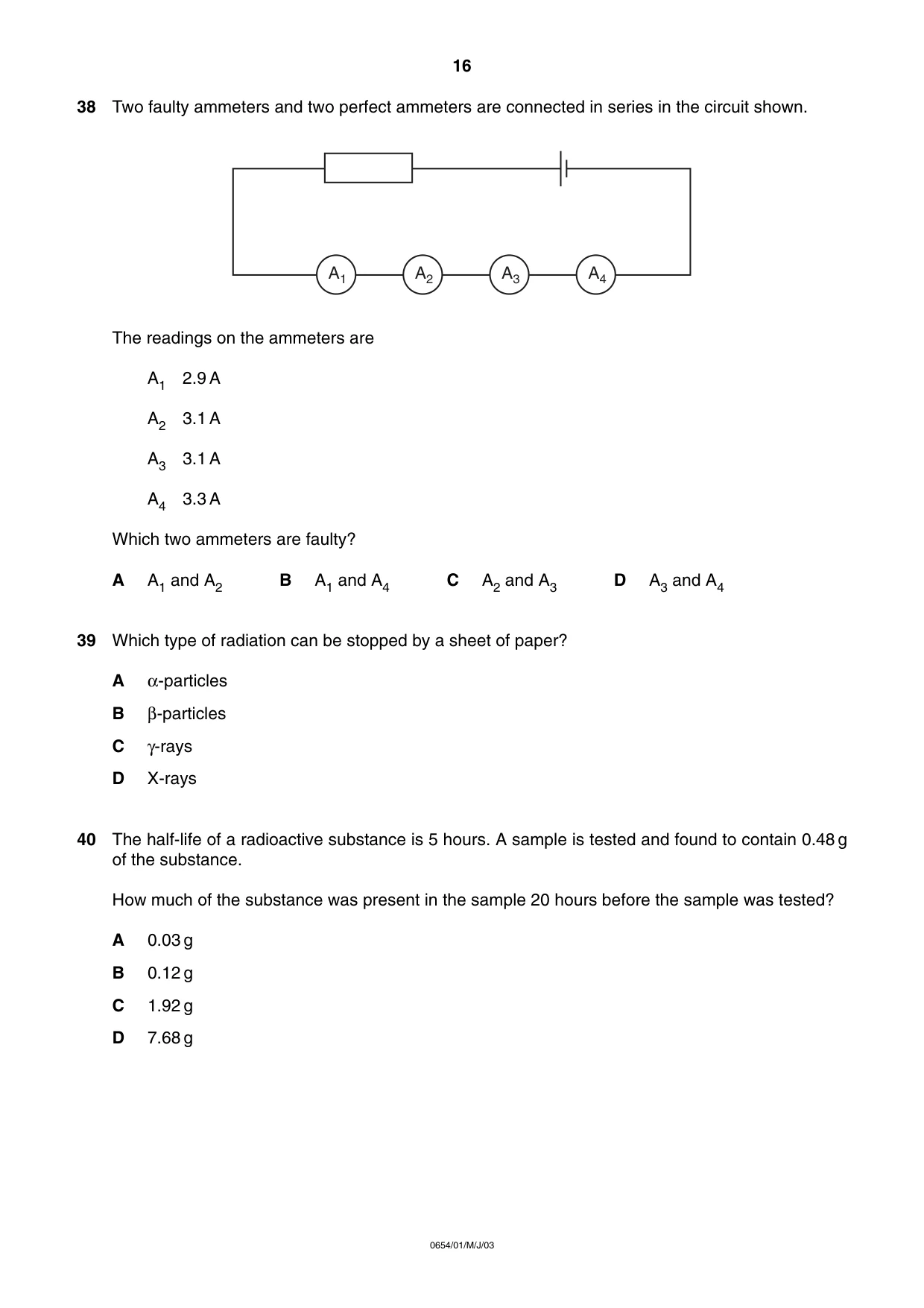
38 Two faulty ammeters and two perfect ammeters are connected in series in the circuit shown. The readings on the ammeters are A1 2.9 A A2 3.1 A A3 3.1 A A4 3.3 A Which two ammeters are faulty? A A1 and A2 B A1 and A4 C A2 and A3 D A3 and A4 39 Which type of radiation can be stopped by a sheet of paper? A α-particles B β-particles C γ-rays D X-rays 40 The half-life of a radioactive substance is 5 hours. A sample is tested and found to contain 0.48 g of the substance. How much of the substance was present in the sample 20 hours before the sample was tested? A 0.03 g B 0.12 g C 1.92 g D 7.68 g A1 A2 A3 A4 16 0654/01/M/J/03
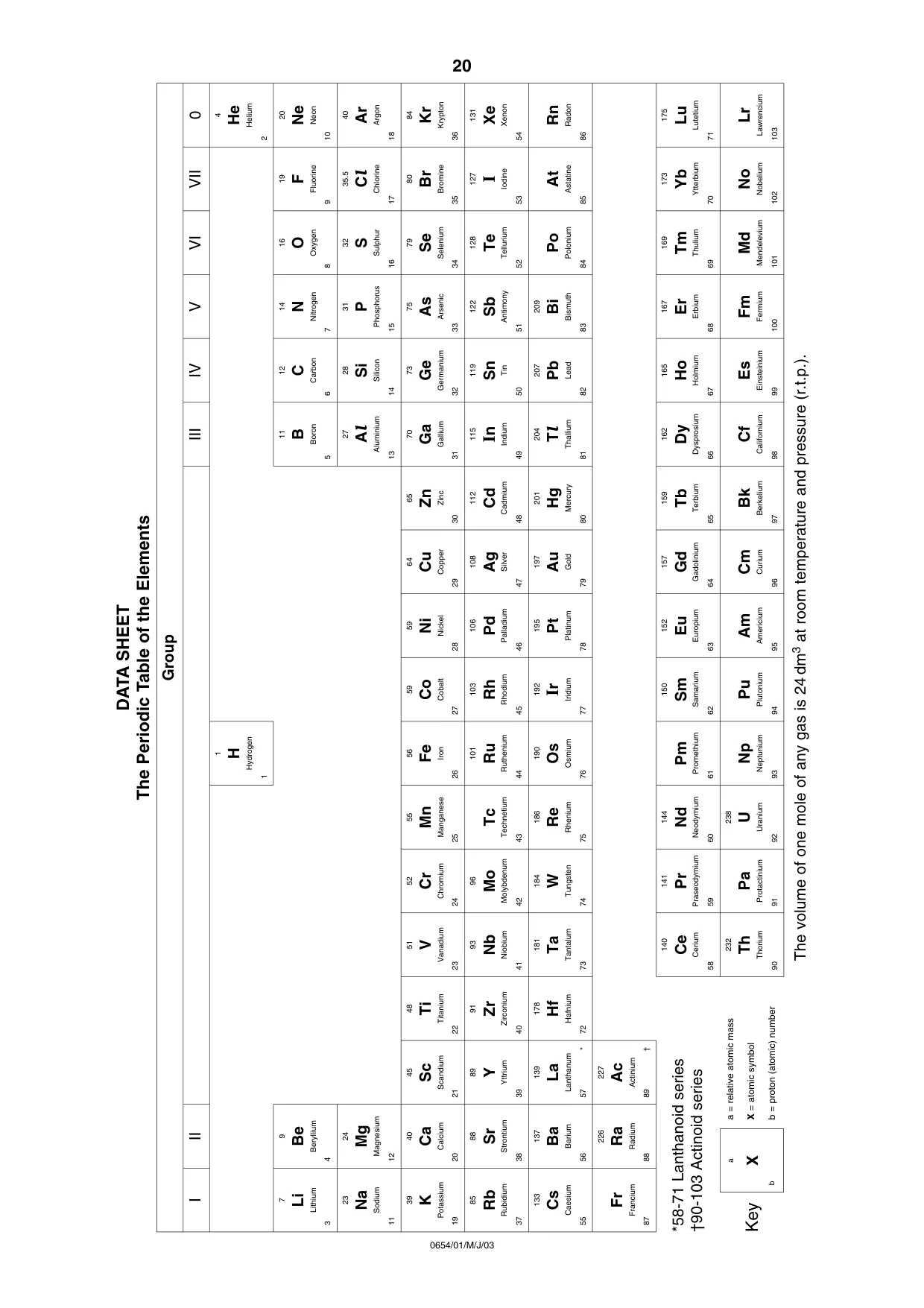
Question paper, page 20
20 0654/01/M/J/03 DATA SHEET The Periodic Table of the Elements The volume of one mole of any gas is 24 dm3 at room temperature and pressure (r.t.p.). *58-71 Lanthanoid series †90-103 Actinoid series Key a = relative atomic mass X = atomic symbol b = proton (atomic) number Group I 7 Li Lithium 3 9 Be Beryllium 4 23 Na Sodium 11 24 Mg Magnesium 12 39 K Potassium 19 40 Ca Calcium 20 45 Sc Scandium 21 48 Ti Titanium 22 51 V Vanadium 23 52 Cr Chromium 24 55 Mn Manganese 25 56 Fe Iron 26 59 Co Cobalt 27 59 Ni Nickel 28 64 Cu Copper 29 65 Zn Zinc 30 70 Ga Gallium 31 27 Al Aluminium 13 11 B Boron 5 73 Ge Germanium 32 28 Si Silicon 14 12 C Carbon 6 75 As Arsenic 33 31 P Phosphorus 15 14 N Nitrogen 7 79 Se Selenium 34 32 S Sulphur 16 16 O Oxygen 8 80 Br Bromine 35 35.5 Cl Chlorine 17 19 F Fluorine 9 84 Kr Krypton 36 40 Ar Argon 18 20 Ne Neon 10 4 He Helium 2 85 Rb Rubidium 37 88 Sr Strontium 38 89 Y Yttrium 39 91 Zr Zirconium 40 93 Nb Niobium 41 96 Mo Molybdenum 42 Tc Technetium 43 101 Ru Ruthenium 44 103 Rh Rhodium 45 106 Pd Palladium 46 108 Ag Silver 47 112 Cd Cadmium 48 115 In Indium 49 119 Sn Tin 50 122 Sb Antimony 51 128 Te Tellurium 52 127 I Iodine 53 131 Xe Xenon 54 133 Cs Caesium 55 137 Ba Barium 56 139 La Lanthanum 57 * 178 Hf Hafnium 72 181 Ta Tantalum 73 140 Ce Cerium 58 a X b 232 Th Thorium 90 Pa Protactinium 91 238 U Uranium 92 Np Neptunium 93 Pu Plutonium 94 Am Americium 95 Cm Curium 96 Bk Berkelium 97 Cf Californium 98 Es Einsteinium 99 Fm Fermium 100 Md Mendelevium 101 No Nobelium 102 Lr Lawrencium 103 141 Pr Praseodymium 59 144 Nd Neodymium 60 Pm Promethium 61 150 Sm Samarium 62 152 Eu Europium 63 157 Gd Gadolinium 64 159 Tb Terbium 65 162 Dy Dysprosium 66 165 Ho Holmium 67 167 Er Erbium 68 169 Tm Thulium 69 173 Yb Ytterbium 70 175 Lu Lutetium 71 184 W Tungsten 74 186 Re Rhenium 75 190 Os Osmium 76 192 Ir Iridium 77 195 Pt Platinum 78 197 Au Gold 79 201 Hg Mercury 80 204 Tl Thallium 81 207 Pb Lead 82 209 Bi Bismuth 83 Po Polonium 84 At Astatine 85 Rn Radon 86 Fr Francium 87 226 Ra Radium 88 227 Ac Actinium 89 † 1 H Hydrogen 1 II III IV V VI VII 0