Cambridge IGCSE Sciences - Co-ordinated (Double) 0654 — 2002 Oct/Nov Paper 3 · Variant 1
0654/31/O/N/02
The question paper and its mark scheme, free to read here and free to download. This is Cambridge’s own paper, exactly as it was sat.
Question paper20 pages

Mark scheme7 pages
Answers below. Sit the paper first if you are practising.
Paper as text
Question paper, page 1
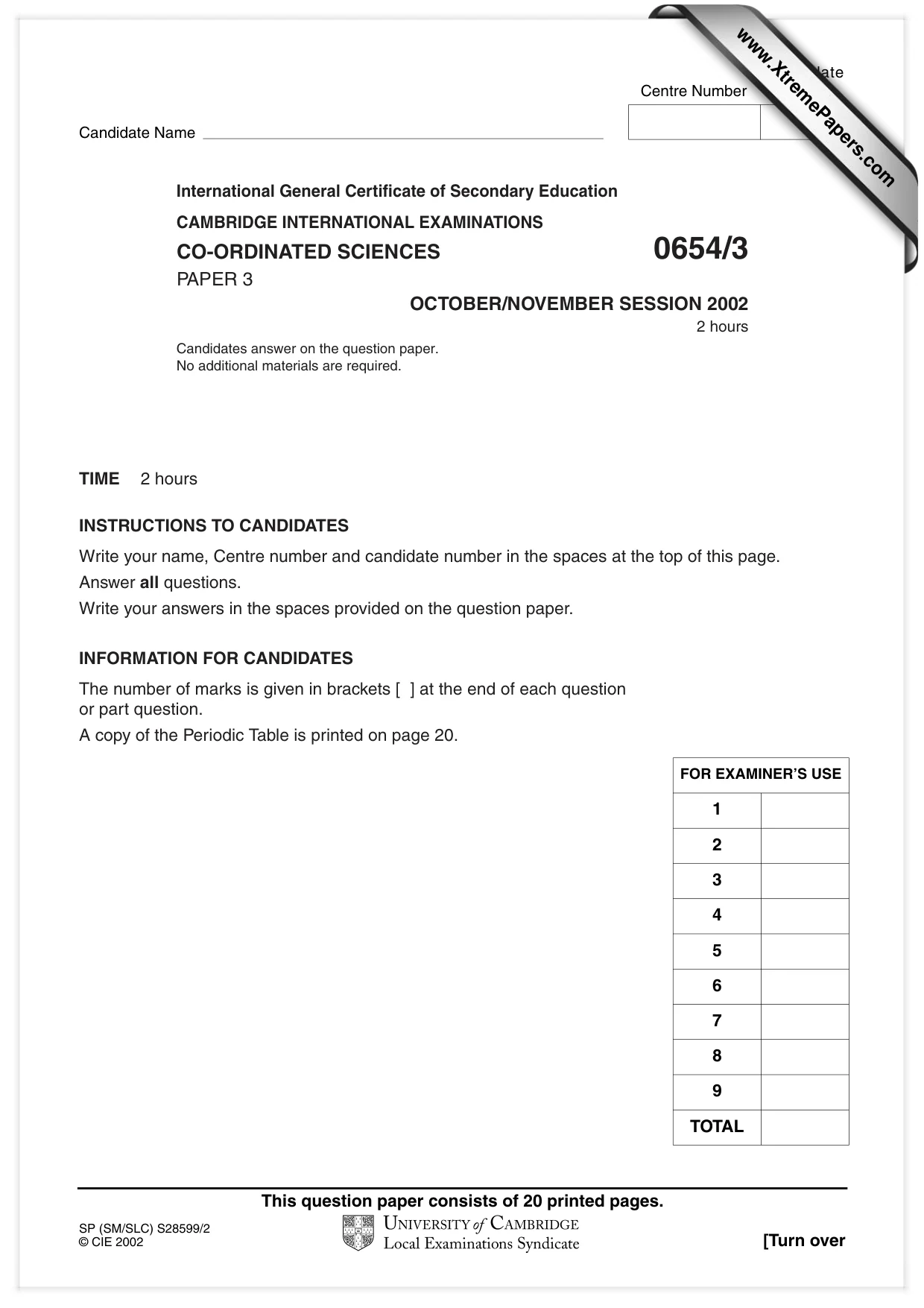
TIME 2 hours INSTRUCTIONS TO CANDIDATES Write your name, Centre number and candidate number in the spaces at the top of this page. Answer all questions. Write your answers in the spaces provided on the question paper. INFORMATION FOR CANDIDATES The number of marks is given in brackets [ ] at the end of each question or part question. A copy of the Periodic Table is printed on page 20. International General Certificate of Secondary Education CAMBRIDGE INTERNATIONAL EXAMINATIONS CO-ORDINATED SCIENCES 0654/3 PAPER 3 OCTOBER/NOVEMBER SESSION 2002 2 hours Candidates answer on the question paper. No additional materials are required. This question paper consists of 20 printed pages. SP (SM/SLC) S28599/2 © CIE 2002 [Turn over Candidate Centre Number Number Candidate Name FOR EXAMINER’S USE 3 2 1 4 TOTAL 6 7 8 9 5 www.XtremePapers.com
Question paper, page 2
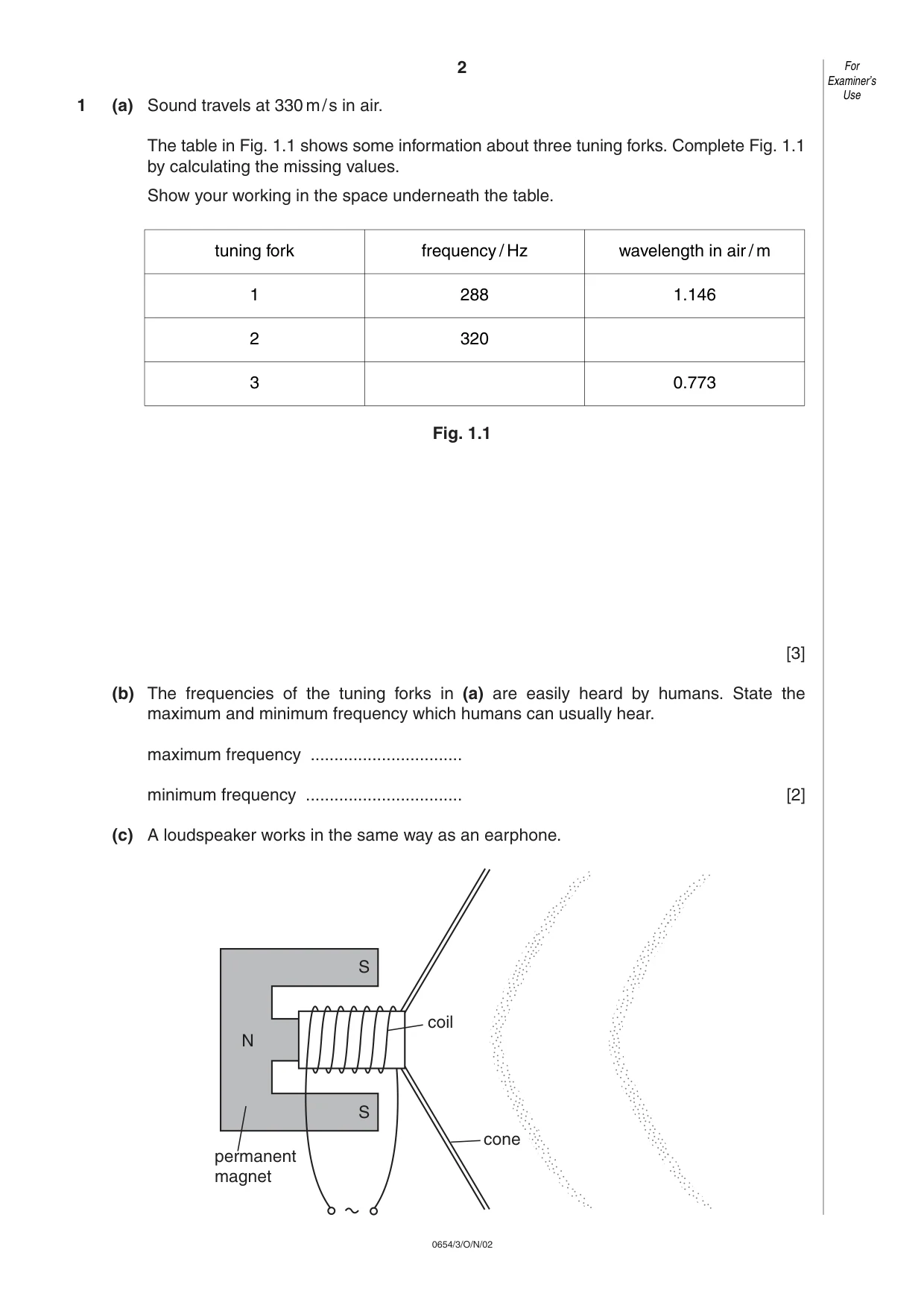
2 0654/3/O/N/02 1 (a) Sound travels at 330 m/s in air. The table in Fig. 1.1 shows some information about three tuning forks. Complete Fig. 1.1 by calculating the missing values. Show your working in the space underneath the table. Fig. 1.1 [3] (b) The frequencies of the tuning forks in (a) are easily heard by humans. State the maximum and minimum frequency which humans can usually hear. maximum frequency … minimum frequency … [2] (c) A loudspeaker works in the same way as an earphone. S S N permanent magnet coil cone For Examiner’s Use tuning fork 1 2 3 frequency / Hz 288 320 wavelength in air / m 1.146 0.773
Question paper, page 3
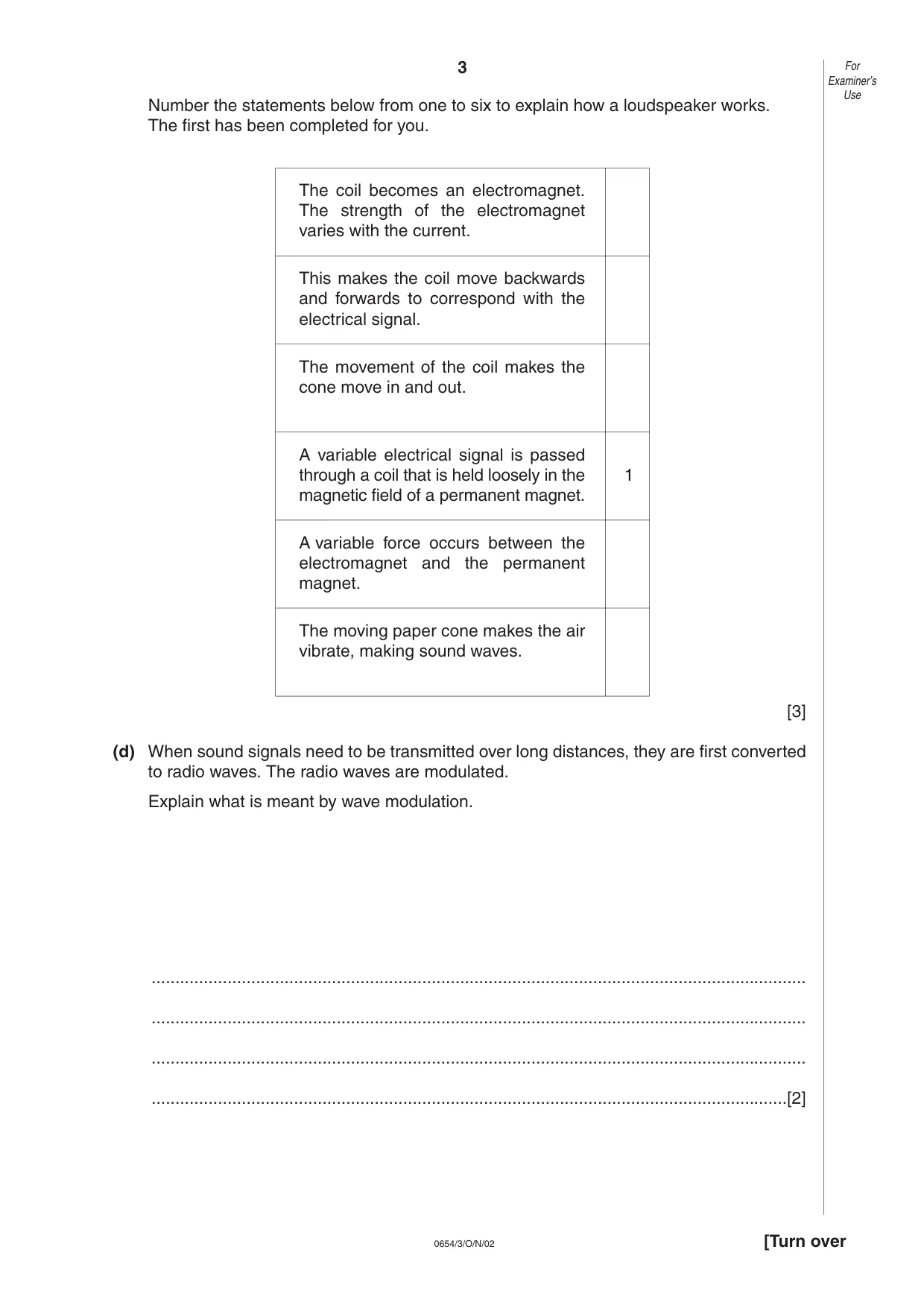
3 0654/3/O/N/02 [Turn over Number the statements below from one to six to explain how a loudspeaker works. The first has been completed for you. [3] (d) When sound signals need to be transmitted over long distances, they are first converted to radio waves. The radio waves are modulated. Explain what is meant by wave modulation. … … … …[2] For Examiner’s Use The coil becomes an electromagnet. The strength of the electromagnet varies with the current. This makes the coil move backwards and forwards to correspond with the electrical signal. The movement of the coil makes the cone move in and out. A variable electrical signal is passed through a coil that is held loosely in the magnetic field of a permanent magnet. 1 A variable force occurs between the electromagnet and the permanent magnet. The moving paper cone makes the air vibrate, making sound waves.
Question paper, page 4
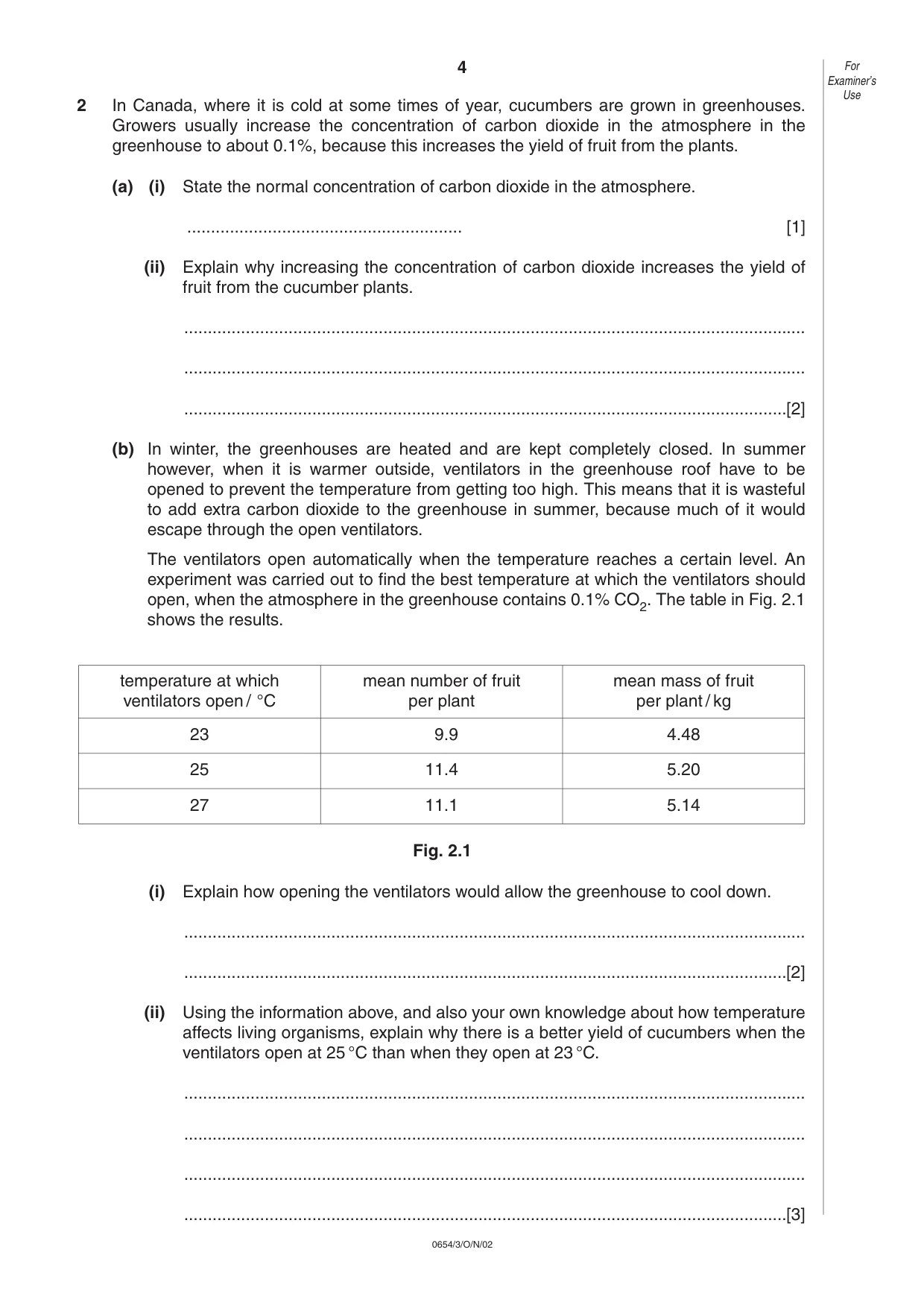
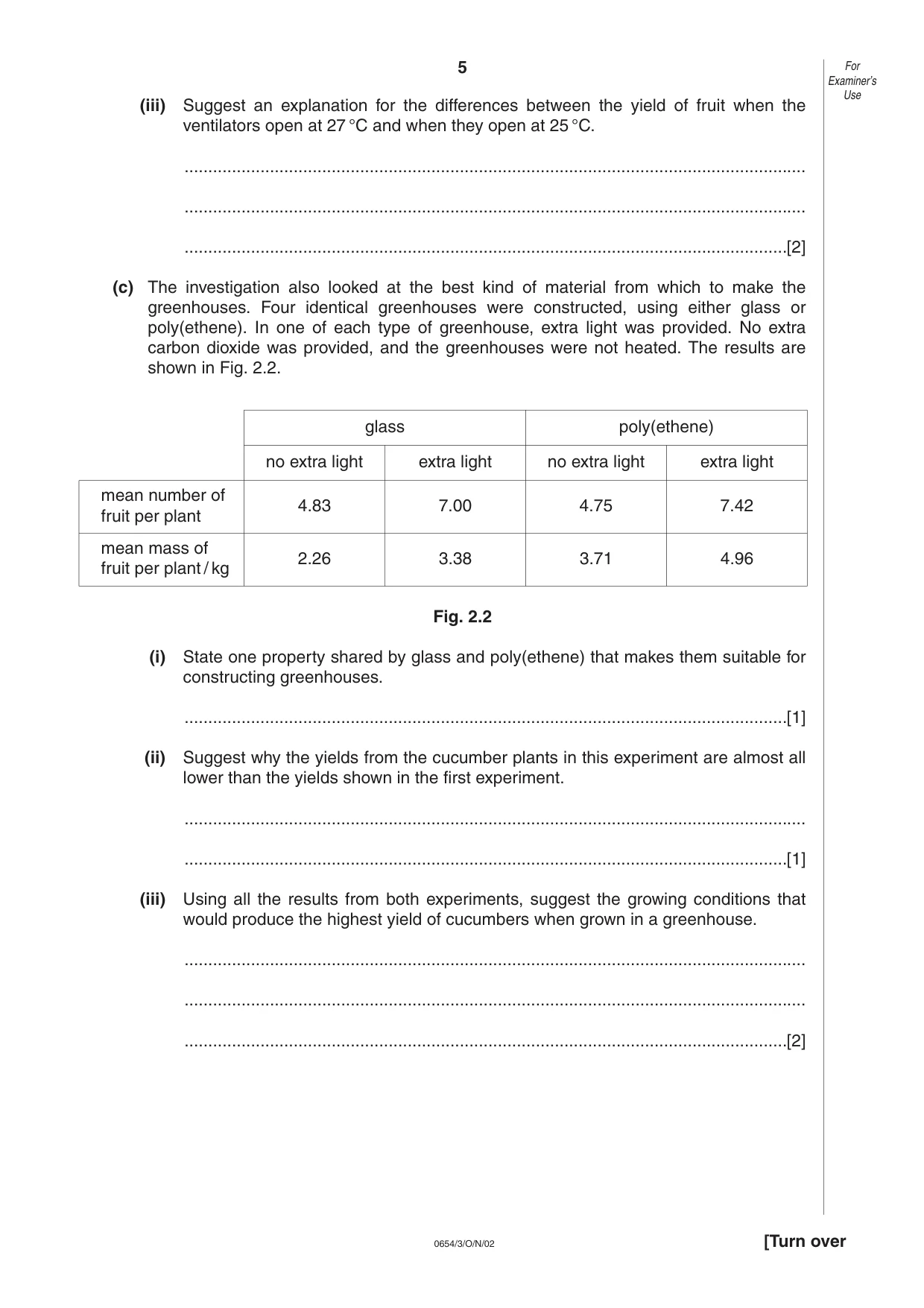
4 0654/3/O/N/02 2 In Canada, where it is cold at some times of year, cucumbers are grown in greenhouses. Growers usually increase the concentration of carbon dioxide in the atmosphere in the greenhouse to about 0.1%, because this increases the yield of fruit from the plants. (a) (i) State the normal concentration of carbon dioxide in the atmosphere. … [1] (ii) Explain why increasing the concentration of carbon dioxide increases the yield of fruit from the cucumber plants. … … …[2] (b) In winter, the greenhouses are heated and are kept completely closed. In summer however, when it is warmer outside, ventilators in the greenhouse roof have to be opened to prevent the temperature from getting too high. This means that it is wasteful to add extra carbon dioxide to the greenhouse in summer, because much of it would escape through the open ventilators. The ventilators open automatically when the temperature reaches a certain level. An experiment was carried out to find the best temperature at which the ventilators should open, when the atmosphere in the greenhouse contains 0.1% CO2. The table in Fig. 2.1 shows the results. Fig. 2.1 (i) Explain how opening the ventilators would allow the greenhouse to cool down. … …[2] (ii) Using the information above, and also your own knowledge about how temperature affects living organisms, explain why there is a better yield of cucumbers when the ventilators open at 25 °C than when they open at 23 °C. … … … …[3] For Examiner’s Use temperature at which ventilators open / °C 23 25 27 mean number of fruit per plant 9.9 11.4 11.1 mean mass of fruit per plant / kg 4.48 5.20 5.14
Question paper, page 5
5 0654/3/O/N/02 [Turn over (iii) Suggest an explanation for the differences between the yield of fruit when the ventilators open at 27 °C and when they open at 25 °C. … … …[2] (c) The investigation also looked at the best kind of material from which to make the greenhouses. Four identical greenhouses were constructed, using either glass or poly(ethene). In one of each type of greenhouse, extra light was provided. No extra carbon dioxide was provided, and the greenhouses were not heated. The results are shown in Fig. 2.2. Fig. 2.2 (i) State one property shared by glass and poly(ethene) that makes them suitable for constructing greenhouses. …[1] (ii) Suggest why the yields from the cucumber plants in this experiment are almost all lower than the yields shown in the first experiment. … …[1] (iii) Using all the results from both experiments, suggest the growing conditions that would produce the highest yield of cucumbers when grown in a greenhouse. … … …[2] For Examiner’s Use glass no extra light 4.83 2.26 3.38 3.71 4.96 7.00 4.75 7.42 extra light no extra light extra light poly(ethene) mean number of fruit per plant mean mass of fruit per plant / kg
Question paper, page 6
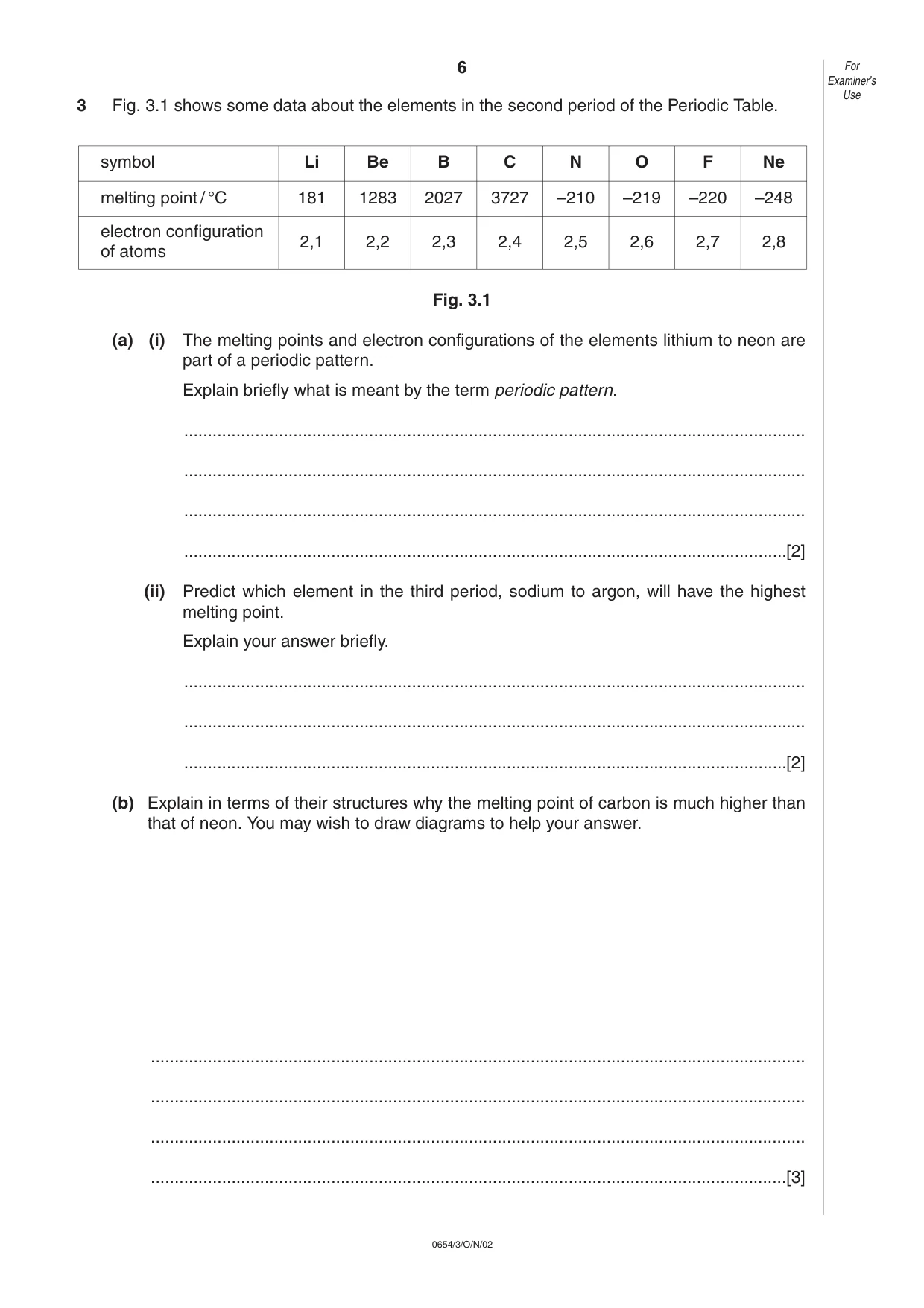
6 0654/3/O/N/02 3 Fig. 3.1 shows some data about the elements in the second period of the Periodic Table. Fig. 3.1 (a) (i) The melting points and electron configurations of the elements lithium to neon are part of a periodic pattern. Explain briefly what is meant by the term periodic pattern. … … … …[2] (ii) Predict which element in the third period, sodium to argon, will have the highest melting point. Explain your answer briefly. … … …[2] (b) Explain in terms of their structures why the melting point of carbon is much higher than that of neon. You may wish to draw diagrams to help your answer. … … … …[3] For Examiner’s Use symbol melting point / °C electron configuration of atoms Li Be B C N O F Ne 181 2,1 2,2 2,3 2,4 2,5 2,6 2,7 2,8 1283 2027 3727 –210 –219 –220 –248
Question paper, page 7
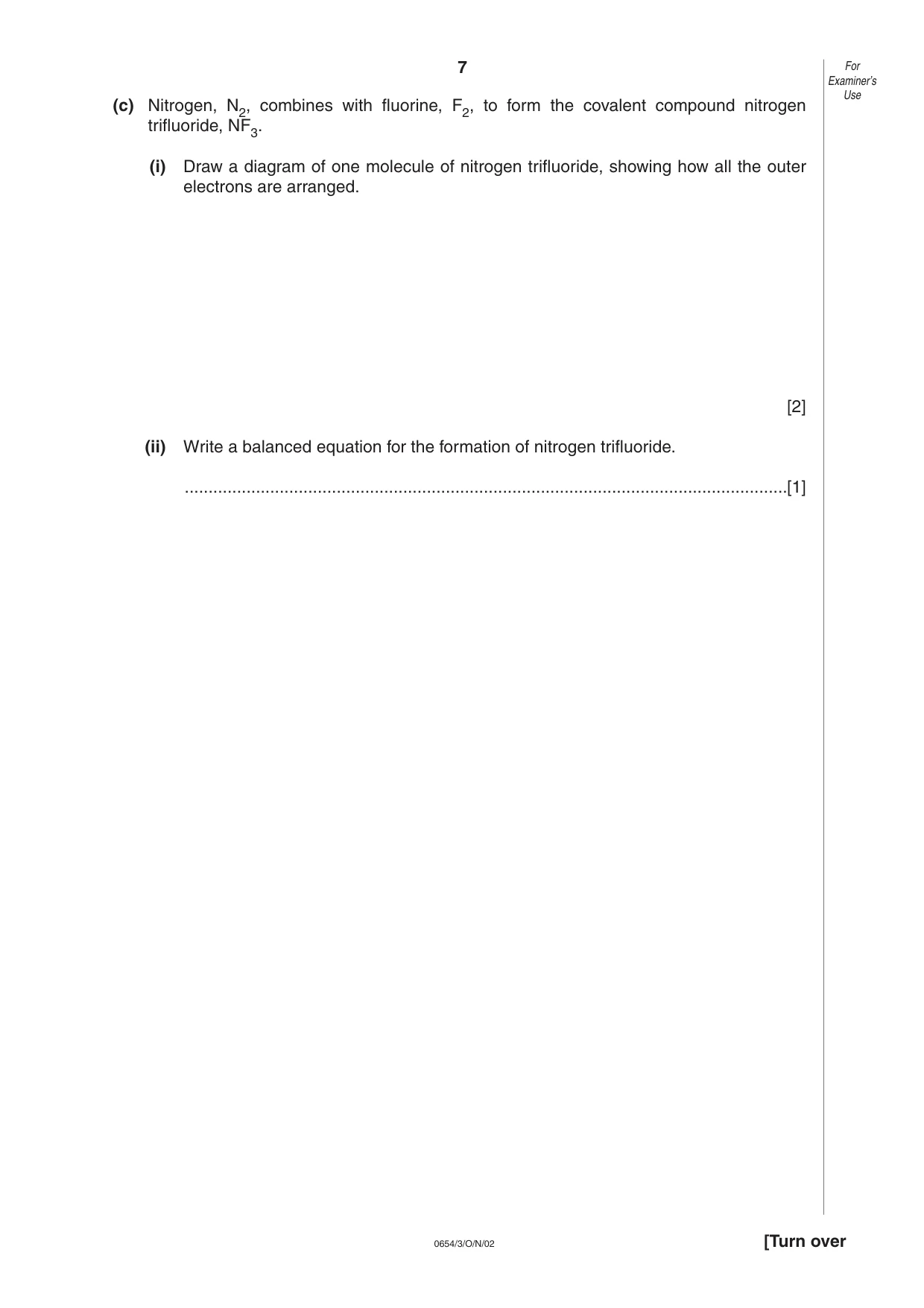
7 0654/3/O/N/02 [Turn over (c) Nitrogen, N2, combines with fluorine, F2, to form the covalent compound nitrogen trifluoride, NF3. (i) Draw a diagram of one molecule of nitrogen trifluoride, showing how all the outer electrons are arranged. [2] (ii) Write a balanced equation for the formation of nitrogen trifluoride. …[1] For Examiner’s Use
Question paper, page 8
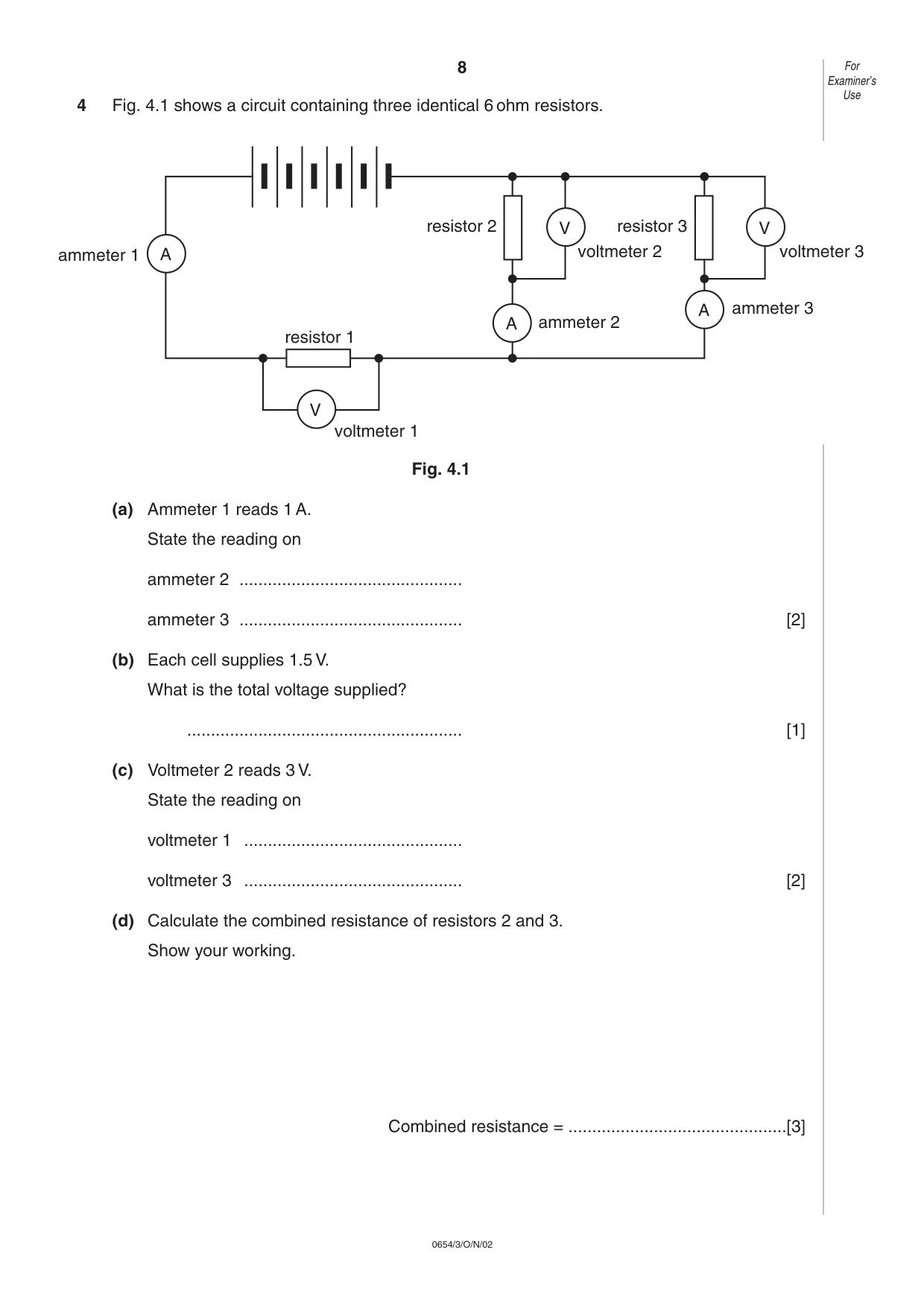
8 0654/3/O/N/02 4 Fig. 4.1 shows a circuit containing three identical 6 ohm resistors. Fig. 4.1 (a) Ammeter 1 reads 1 A. State the reading on ammeter 2 … ammeter 3 … [2] (b) Each cell supplies 1.5 V. What is the total voltage supplied? … [1] (c) Voltmeter 2 reads 3 V. State the reading on voltmeter 1 … voltmeter 3 … [2] (d) Calculate the combined resistance of resistors 2 and 3. Show your working. Combined resistance = …[3] For Examiner’s Use A A V V V A ammeter 1 voltmeter 1 voltmeter 2 voltmeter 3 ammeter 2 ammeter 3 resistor 1 resistor 2 resistor 3
Question paper, page 9
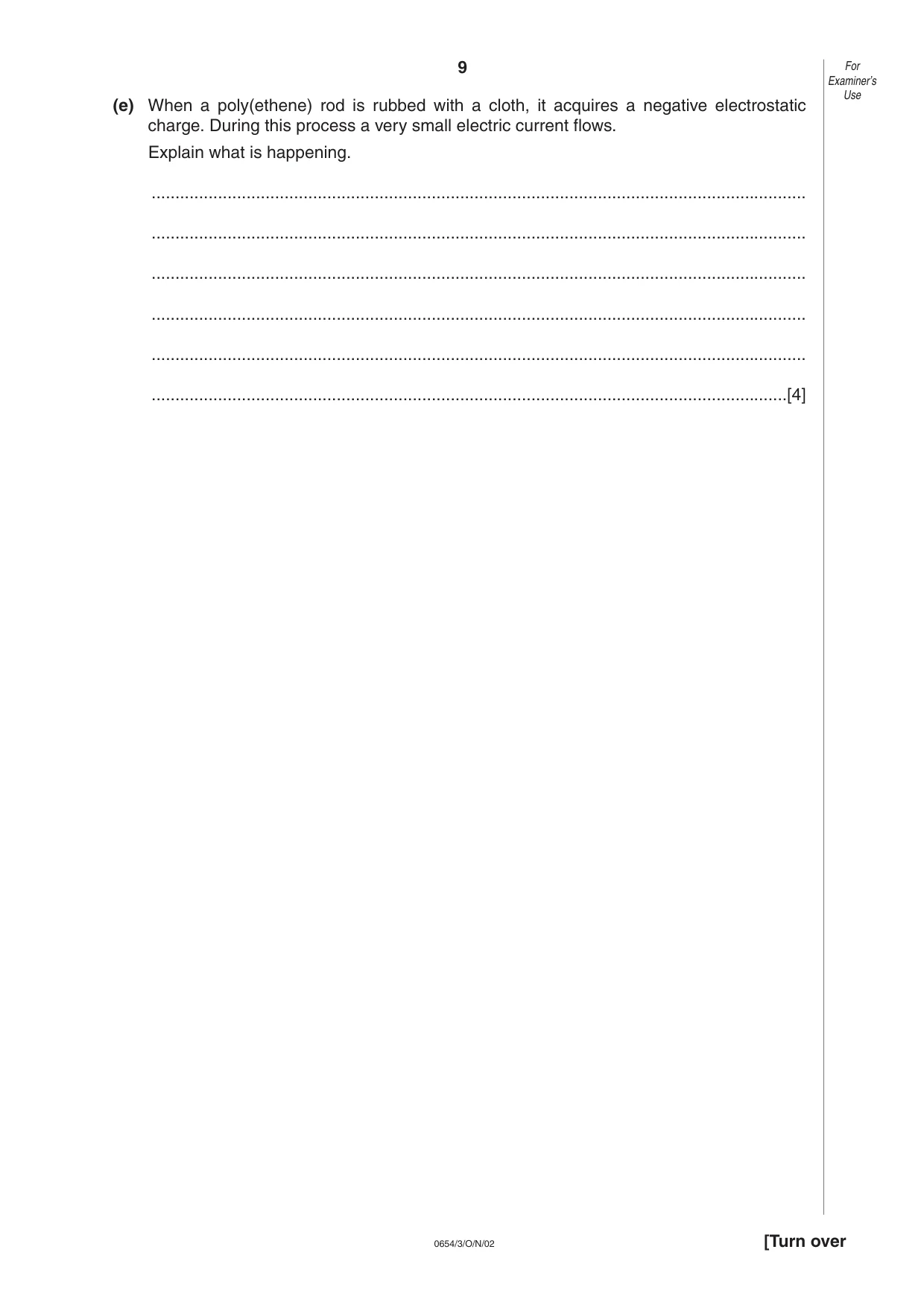
9 0654/3/O/N/02 [Turn over (e) When a poly(ethene) rod is rubbed with a cloth, it acquires a negative electrostatic charge. During this process a very small electric current flows. Explain what is happening. … … … … … …[4] For Examiner’s Use
Question paper, page 10
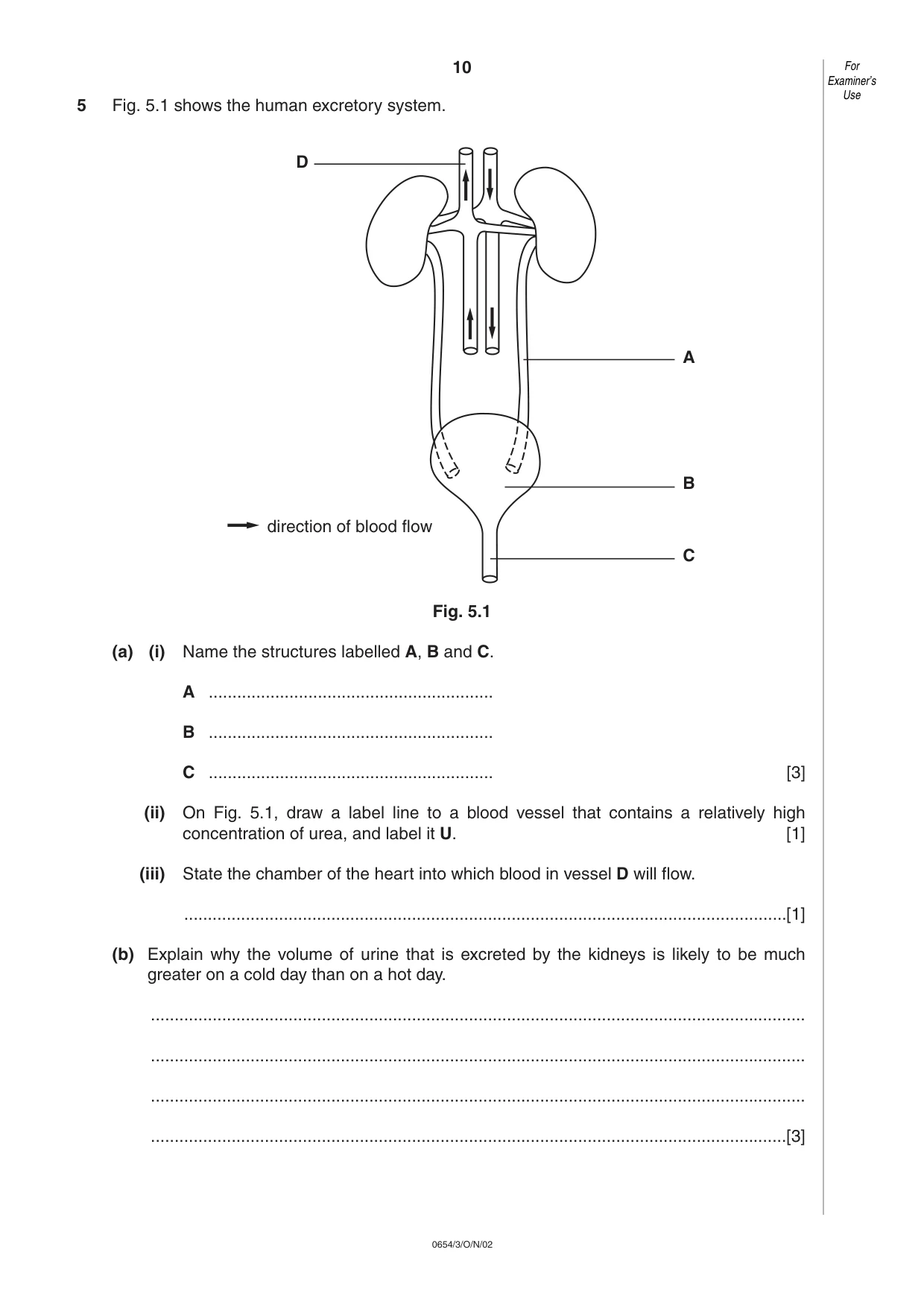
10 0654/3/O/N/02 5 Fig. 5.1 shows the human excretory system. Fig. 5.1 (a) (i) Name the structures labelled A, B and C. A … B … C … [3] (ii) On Fig. 5.1, draw a label line to a blood vessel that contains a relatively high concentration of urea, and label it U. [1] (iii) State the chamber of the heart into which blood in vessel D will flow. …[1] (b) Explain why the volume of urine that is excreted by the kidneys is likely to be much greater on a cold day than on a hot day. … … … …[3] A D B C direction of blood flow For Examiner’s Use
Question paper, page 11
11 0654/3/O/N/02 [Turn over (c) Waste liquid from a house, including urine, is carried to a sewage works where it is treated and then released into the sea. With reference to the processes taking place in the water cycle, explain how some of the water in urine could become part of a tree many miles away from the sea. … … … …[3] For Examiner’s Use
Question paper, page 12
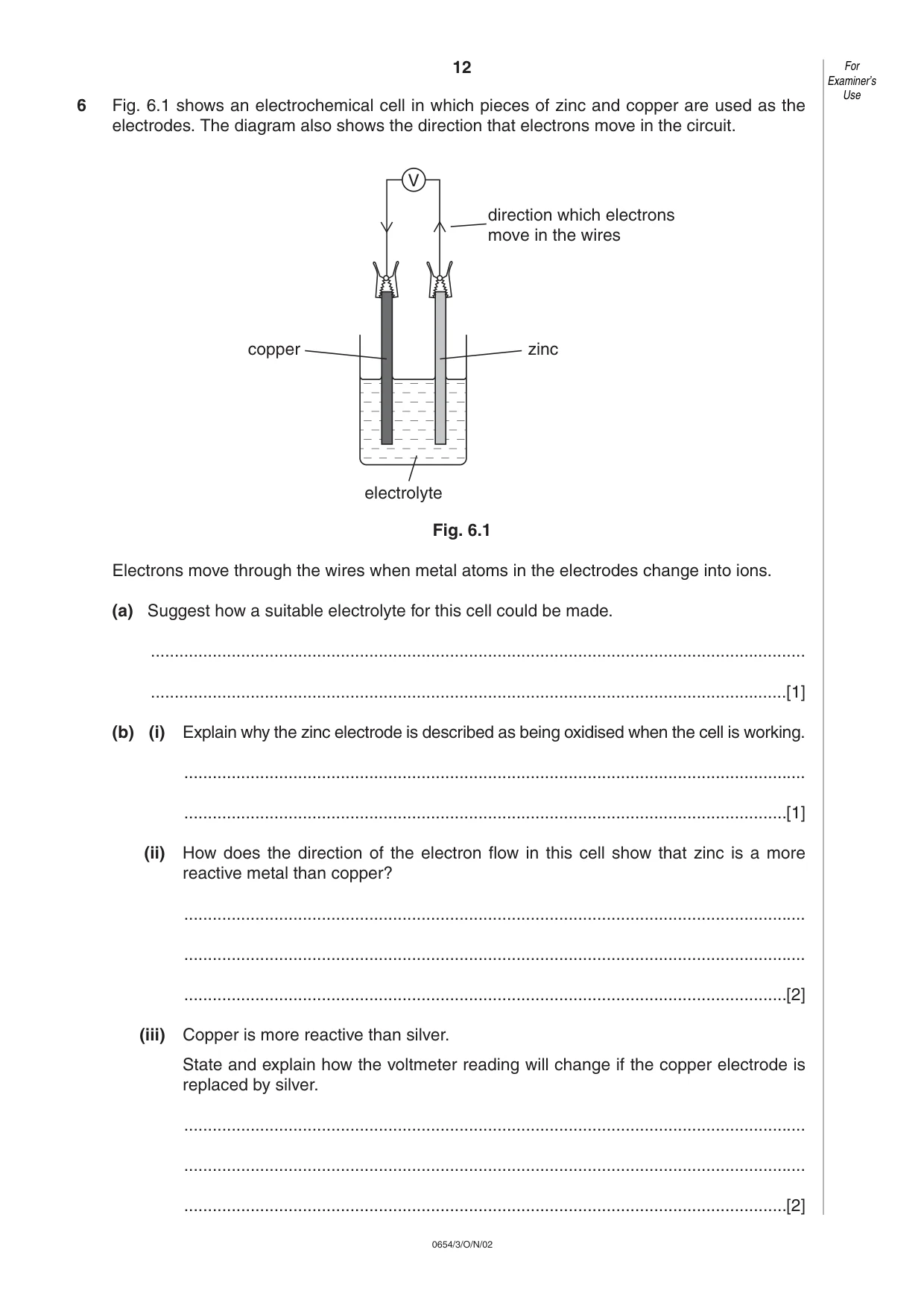
12 0654/3/O/N/02 6 Fig. 6.1 shows an electrochemical cell in which pieces of zinc and copper are used as the electrodes. The diagram also shows the direction that electrons move in the circuit. Fig. 6.1 Electrons move through the wires when metal atoms in the electrodes change into ions. (a) Suggest how a suitable electrolyte for this cell could be made. … …[1] (b) (i) Explain why the zinc electrode is described as being oxidised when the cell is working. … …[1] (ii) How does the direction of the electron flow in this cell show that zinc is a more reactive metal than copper? … … …[2] (iii) Copper is more reactive than silver. State and explain how the voltmeter reading will change if the copper electrode is replaced by silver. … … …[2] V zinc copper electrolyte direction which electrons move in the wires For Examiner’s Use
Question paper, page 13
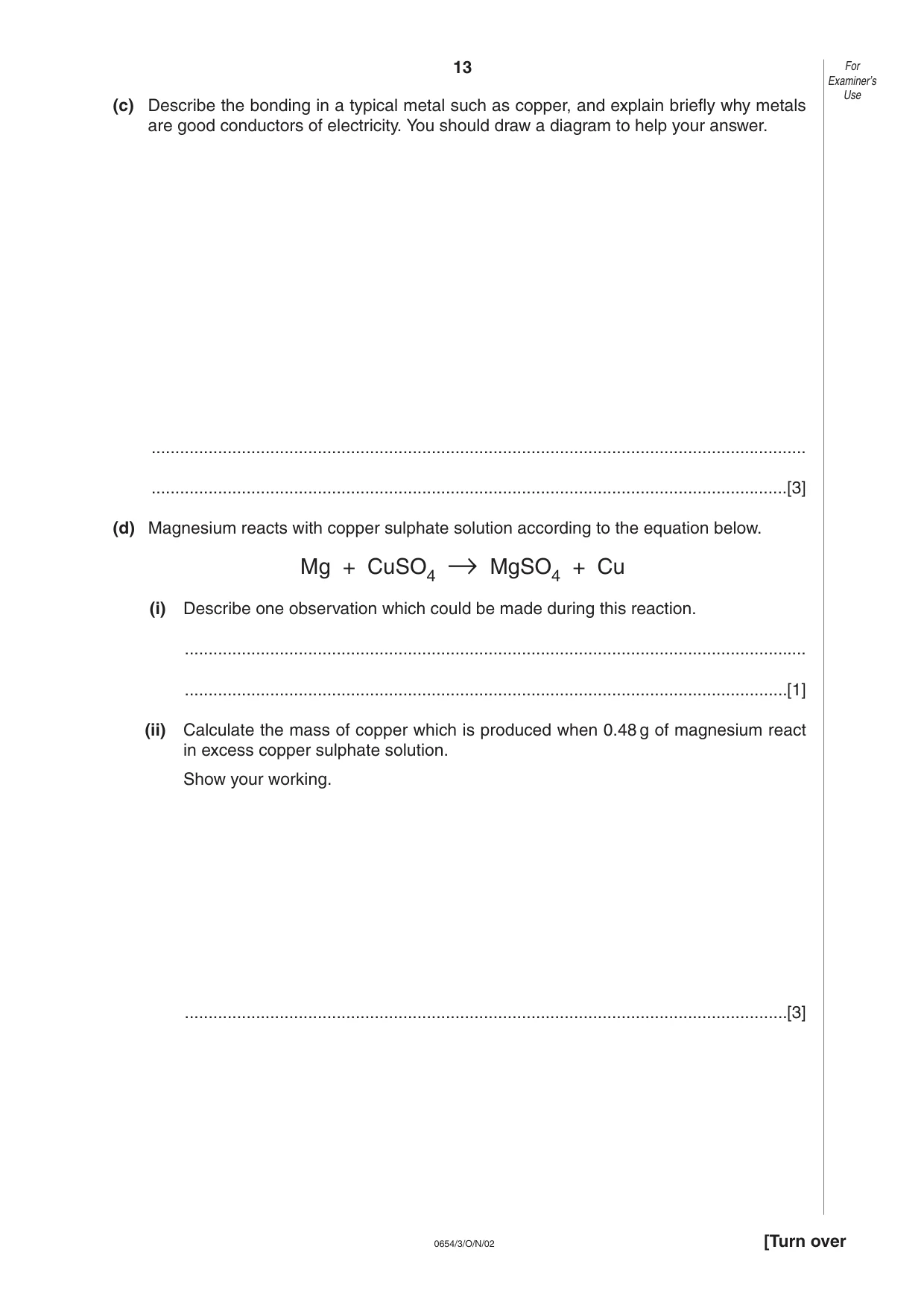
13 0654/3/O/N/02 [Turn over (c) Describe the bonding in a typical metal such as copper, and explain briefly why metals are good conductors of electricity. You should draw a diagram to help your answer. … …[3] (d) Magnesium reacts with copper sulphate solution according to the equation below. Mg + CuSO4 →MgSO4 + Cu (i) Describe one observation which could be made during this reaction. … …[1] (ii) Calculate the mass of copper which is produced when 0.48 g of magnesium react in excess copper sulphate solution. Show your working. …[3] For Examiner’s Use
Question paper, page 14
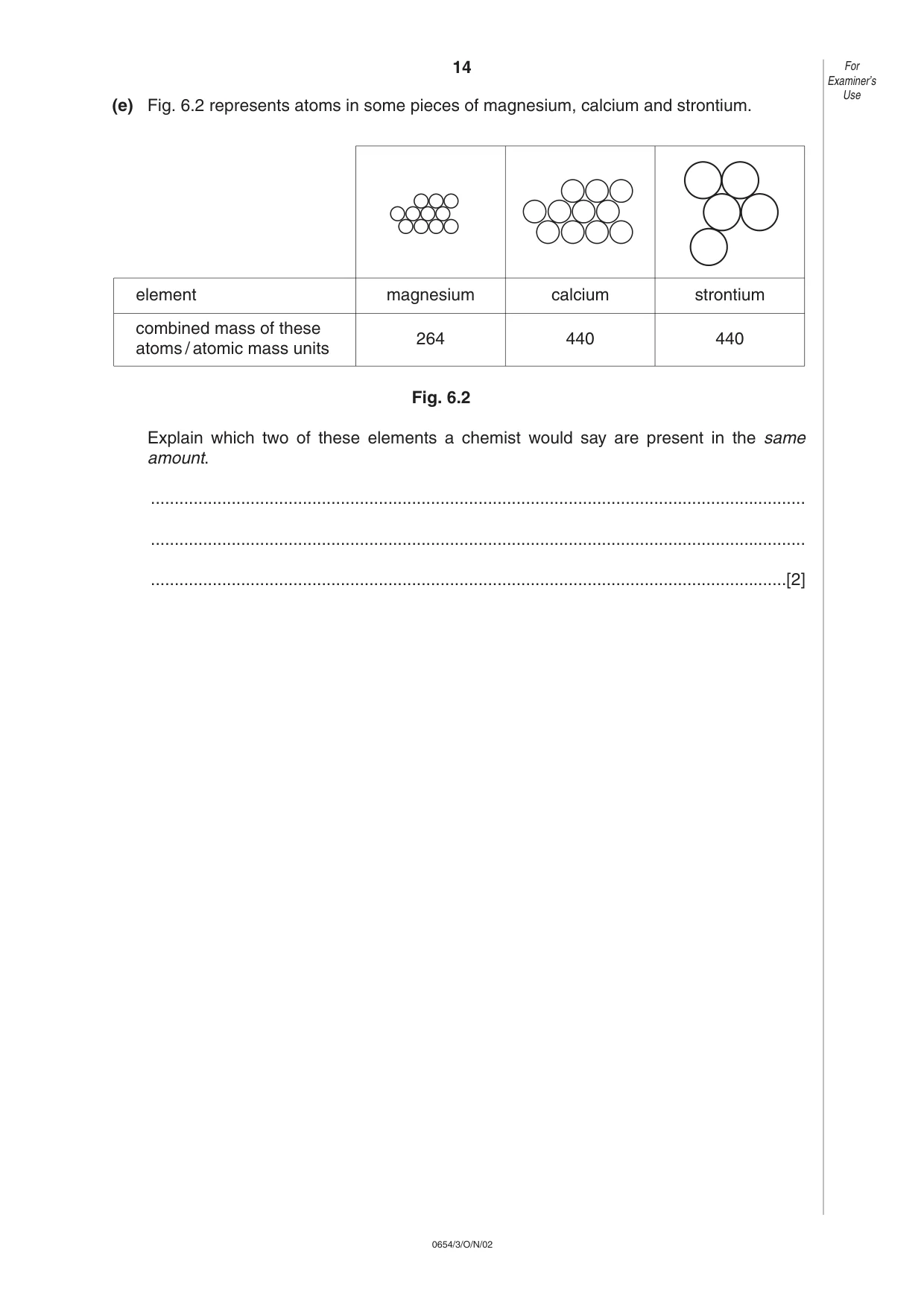
14 0654/3/O/N/02 (e) Fig. 6.2 represents atoms in some pieces of magnesium, calcium and strontium. Fig. 6.2 Explain which two of these elements a chemist would say are present in the same amount. … … …[2] For Examiner’s Use element magnesium calcium strontium combined mass of these atoms / atomic mass units 264 440 440
Question paper, page 15
15 0654/3/O/N/02 [Turn over 7 (a) For each of the four proteins listed below, describe where they are found and explain their functions. (i) haemoglobin … … …[2] (ii) antibody … … …[2] (iii) protease … … …[2] (iv) insulin … … …[2] (b) Describe how you would find out if a sample of food contained protein. … … … …[3] For Examiner’s Use
Question paper, page 16
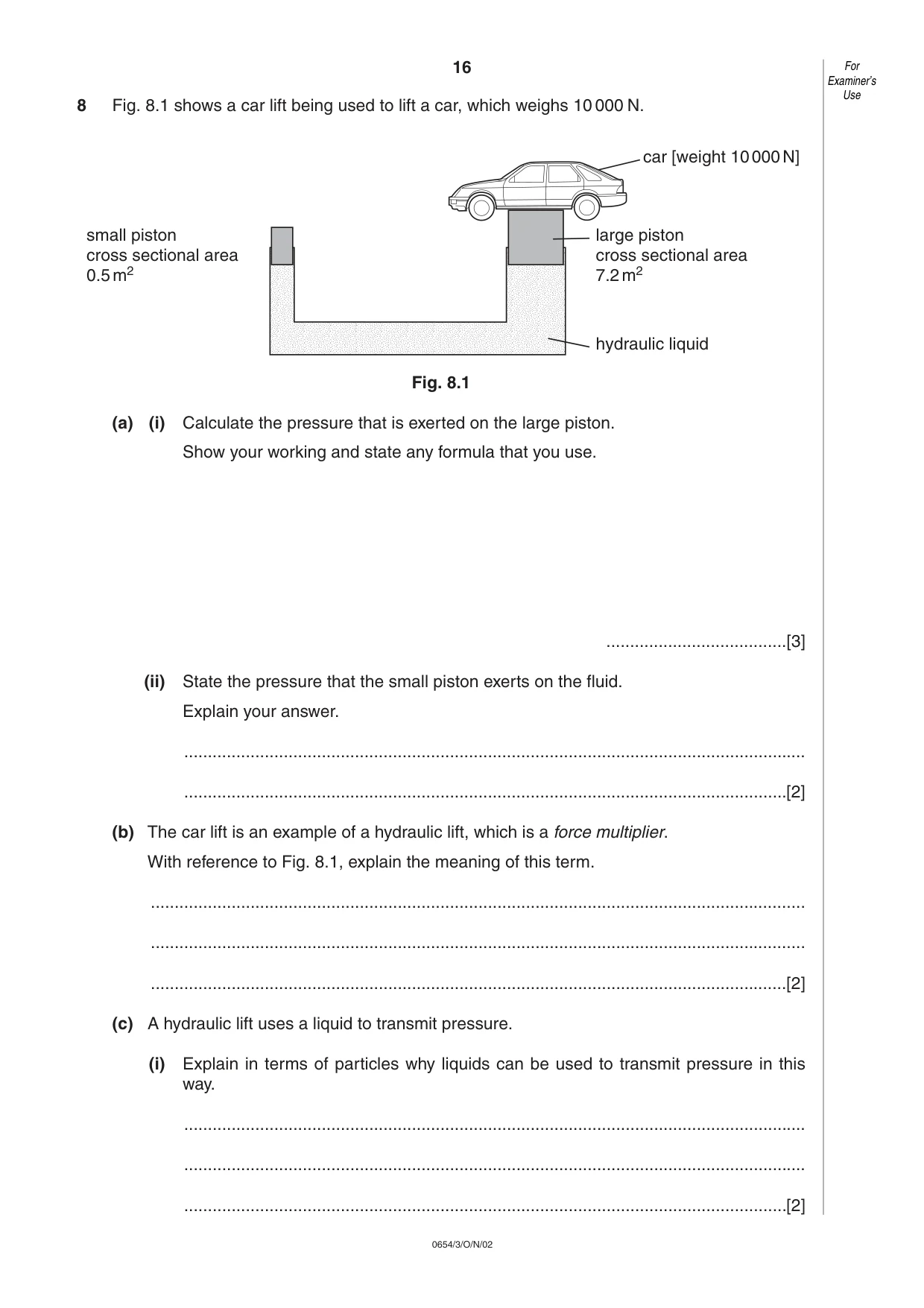
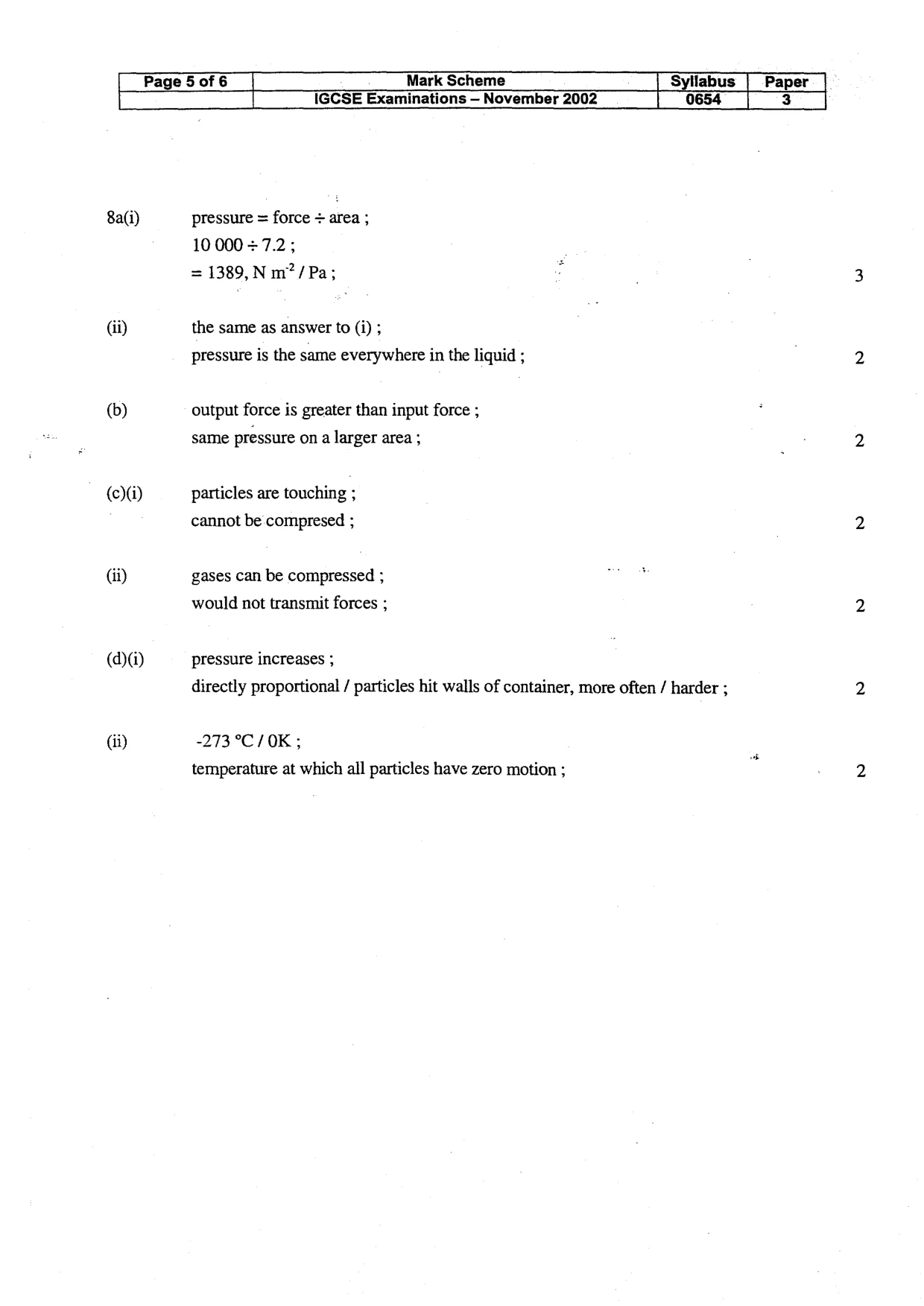
16 0654/3/O/N/02 8 Fig. 8.1 shows a car lift being used to lift a car, which weighs 10 000 N. Fig. 8.1 (a) (i) Calculate the pressure that is exerted on the large piston. Show your working and state any formula that you use. …[3] (ii) State the pressure that the small piston exerts on the fluid. Explain your answer. … …[2] (b) The car lift is an example of a hydraulic lift, which is a force multiplier. With reference to Fig. 8.1, explain the meaning of this term. … … …[2] (c) A hydraulic lift uses a liquid to transmit pressure. (i) Explain in terms of particles why liquids can be used to transmit pressure in this way. … … …[2] car [weight 10000N] large piston cross sectional area 7.2m2 small piston cross sectional area 0.5m2 hydraulic liquid For Examiner’s Use
Question paper, page 17
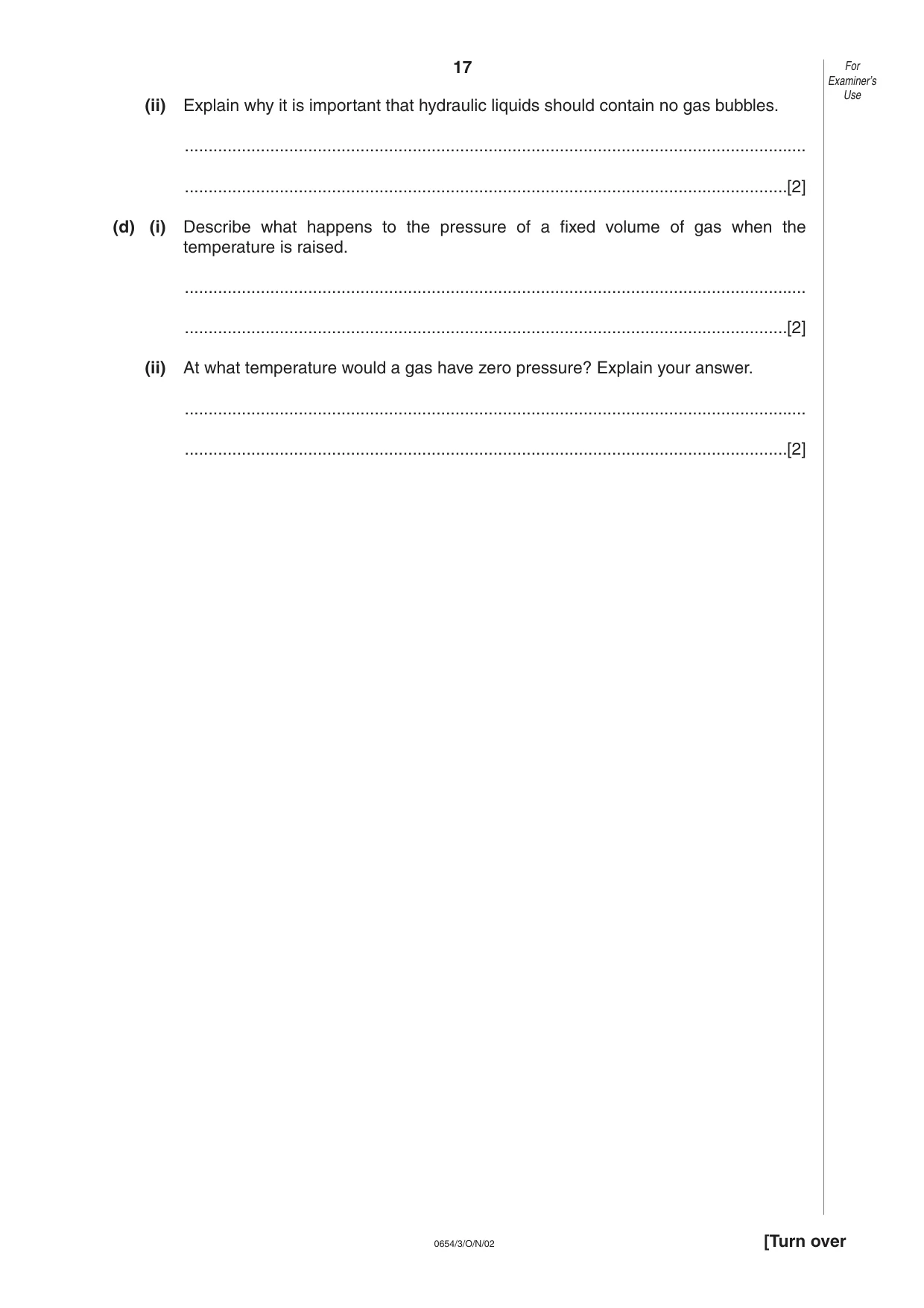
17 0654/3/O/N/02 [Turn over (ii) Explain why it is important that hydraulic liquids should contain no gas bubbles. … …[2] (d) (i) Describe what happens to the pressure of a fixed volume of gas when the temperature is raised. … …[2] (ii) At what temperature would a gas have zero pressure? Explain your answer. … …[2] For Examiner’s Use
Question paper, page 18
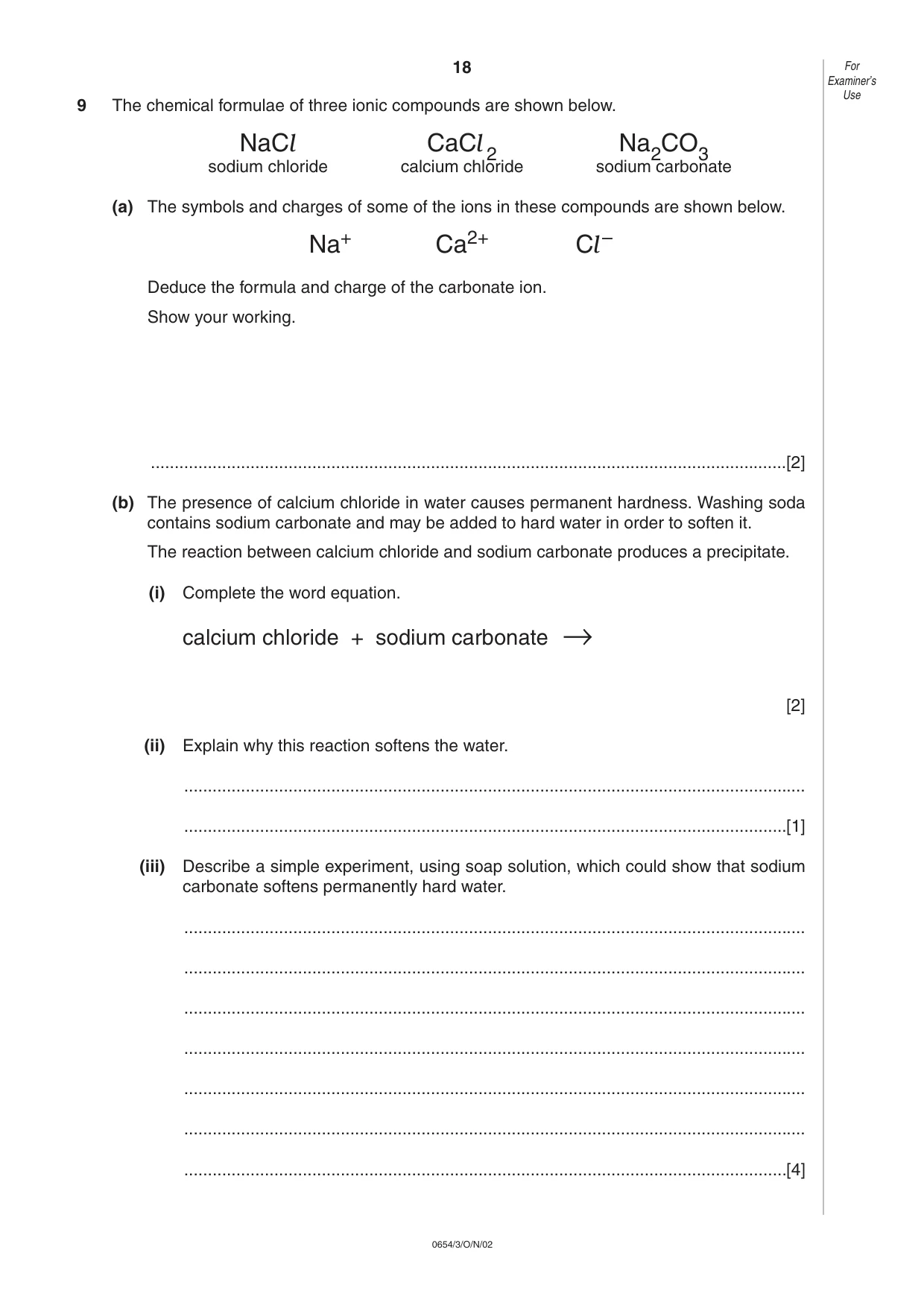
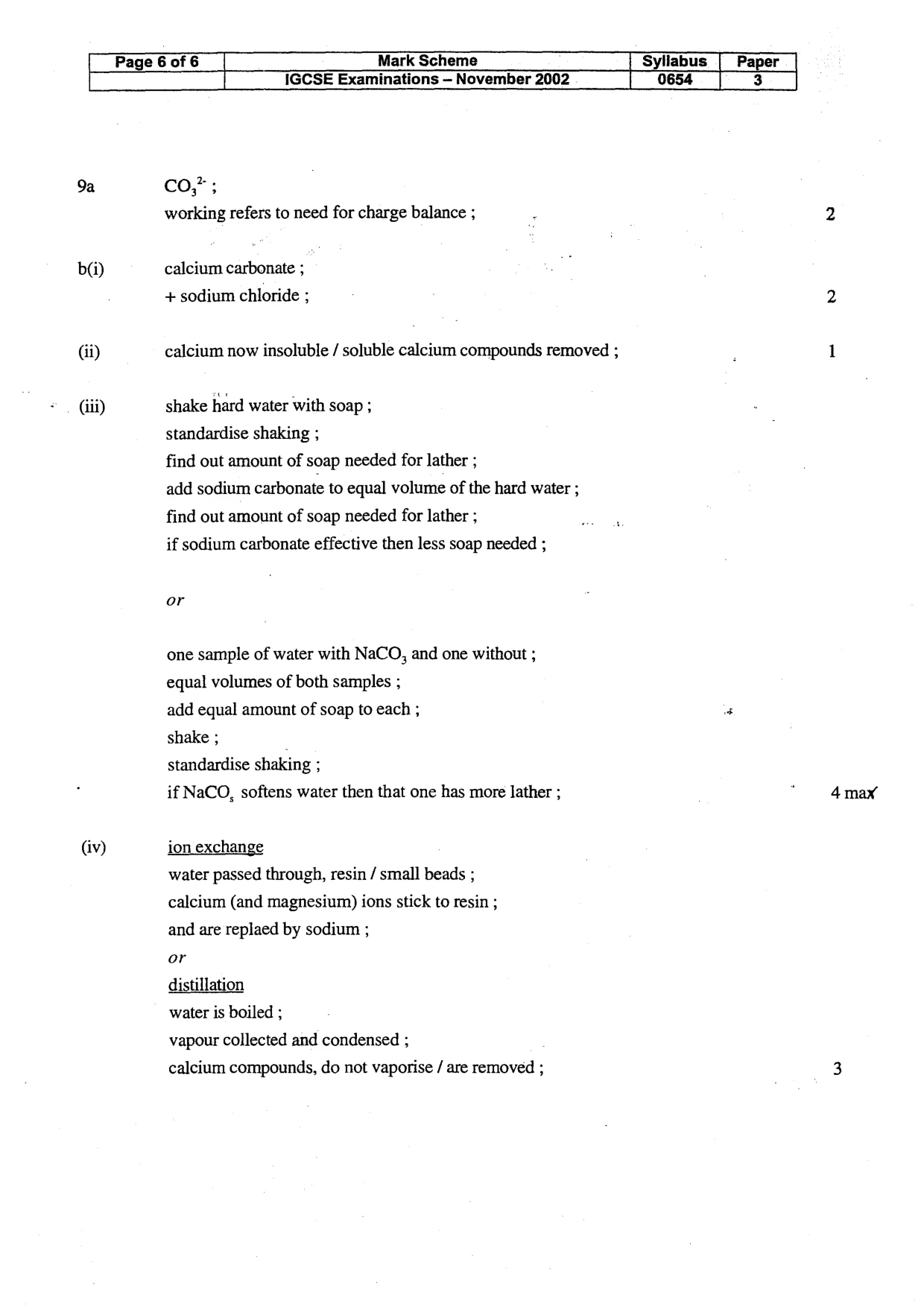
18 0654/3/O/N/02 9 The chemical formulae of three ionic compounds are shown below. NaCl CaCl 2 Na2CO3 sodium chloride calcium chloride sodium carbonate (a) The symbols and charges of some of the ions in these compounds are shown below. Na+ Ca2+ Cl– Deduce the formula and charge of the carbonate ion. Show your working. …[2] (b) The presence of calcium chloride in water causes permanent hardness. Washing soda contains sodium carbonate and may be added to hard water in order to soften it. The reaction between calcium chloride and sodium carbonate produces a precipitate. (i) Complete the word equation. calcium chloride + sodium carbonate → [2] (ii) Explain why this reaction softens the water. … …[1] (iii) Describe a simple experiment, using soap solution, which could show that sodium carbonate softens permanently hard water. … … … … … … …[4] For Examiner’s Use
Question paper, page 19
19 0654/3/O/N/02 (iv) State one other method of softening permanently hard water and explain briefly how it works. … … … … …[3] For Examiner’s Use
Question paper, page 20
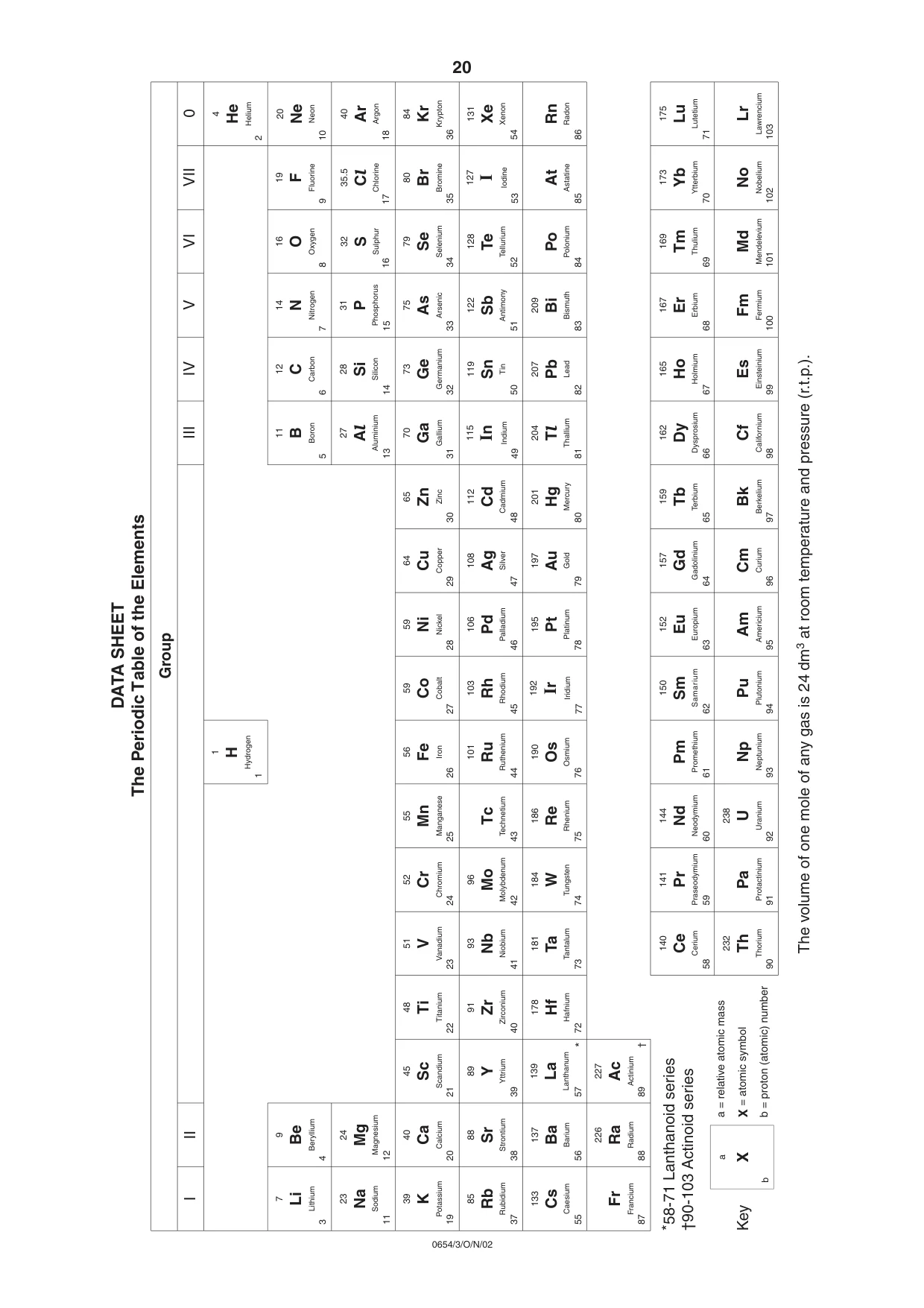
20 0654/3/O/N/02 Group DATA SHEET The Periodic Table of the Elements 140 Ce Cerium 58 141 Pr Praseodymium 59 144 Nd Neodymium 60 Pm Promethium 61 150 Sm Samarium 62 152 Eu Europium 63 157 Gd Gadolinium 64 159 Tb Terbium 65 162 Dy Dysprosium 66 165 Ho Holmium 67 167 Er Erbium 68 169 Tm Thulium 69 173 Yb Ytterbium 70 175 Lu Lutetium 71 232 Th Thorium 90 Pa Protactinium 91 238 U Uranium 92 Np Neptunium 93 Pu Plutonium 94 Am Americium 95 Cm Curium 96 Bk Berkelium 97 Cf Californium 98 Es Einsteinium 99 Fm Fermium 100 Md Mendelevium 101 No Nobelium 102 Lr Lawrencium 103 1 H Hydrogen 1 7 Li Lithium 3 23 Na Sodium 11 24 Mg Magnesium 12 40 Ca Calcium 20 45 Sc Scandium 21 48 Ti Titanium 22 51 V Vanadium 23 52 Cr Chromium 24 55 Mn Manganese 25 56 Fe Iron 26 59 Co Cobalt 27 59 Ni Nickel 28 64 Cu Copper 29 65 Zn Zinc 30 70 Ga Gallium 31 27 Al Aluminium 13 11 B Boron 5 12 C Carbon 6 14 N Nitrogen 7 16 O Oxygen 8 19 F Fluorine 9 28 Si Silicon 14 31 P Phosphorus 15 32 S Sulphur 16 35.5 Cl Chlorine 17 40 Ar Argon 18 20 Ne Neon 10 4 He Helium 2 73 Ge Germanium 32 75 As Arsenic 33 79 Se Selenium 34 80 Br Bromine 35 84 Kr Krypton 36 39 K Potassium 19 88 Sr Strontium 38 89 Y Yttrium 39 91 Zr Zirconium 40 93 Nb Niobium 41 96 Mo Molybdenum 42 Tc Technetium 43 101 Ru Ruthenium 44 103 Rh Rhodium 45 106 Pd Palladium 46 108 Ag Silver 47 112 Cd Cadmium 48 115 In Indium 49 119 Sn Tin 50 122 Sb Antimony 51 128 Te Tellurium 52 127 I Iodine 53 131 Xe Xenon 54 137 Ba Barium 56 139 La Lanthanum 57 * 178 Hf Hafnium 72 181 Ta Tantalum 73 184 W Tungsten 74 186 Re Rhenium 75 190 Os Osmium 76 192 Ir Iridium 77 195 Pt Platinum 78 197 Au Gold 79 201 Hg Mercury 80 204 Tl Thallium 81 207 Pb Lead 82 209 Bi Bismuth 83 Po Polonium 84 At Astatine 85 Rn Radon 86 Fr Francium 87 227 Ac Actinium 89 † 9 Be Beryllium 4 I II III IV V VI VII 0 85 Rb Rubidium 37 133 Cs Caesium 55 226 Ra Radium 88 The volume of one mole of any gas is 24 dm3 at room temperature and pressure (r.t.p.). a X b a = relative atomic mass X = atomic symbol b = proton (atomic) number Key *58-71 Lanthanoid series †90-103 Actinoid series
Mark scheme, page 1
CAMBRIDGE INTERNATIONAL EXAMINATIONS NOVEMBER 2002 INTERNATIONAL GCSE UNIVERSITY of CAMBRIDGE Local Examinations Syndicate
Mark scheme, page 2
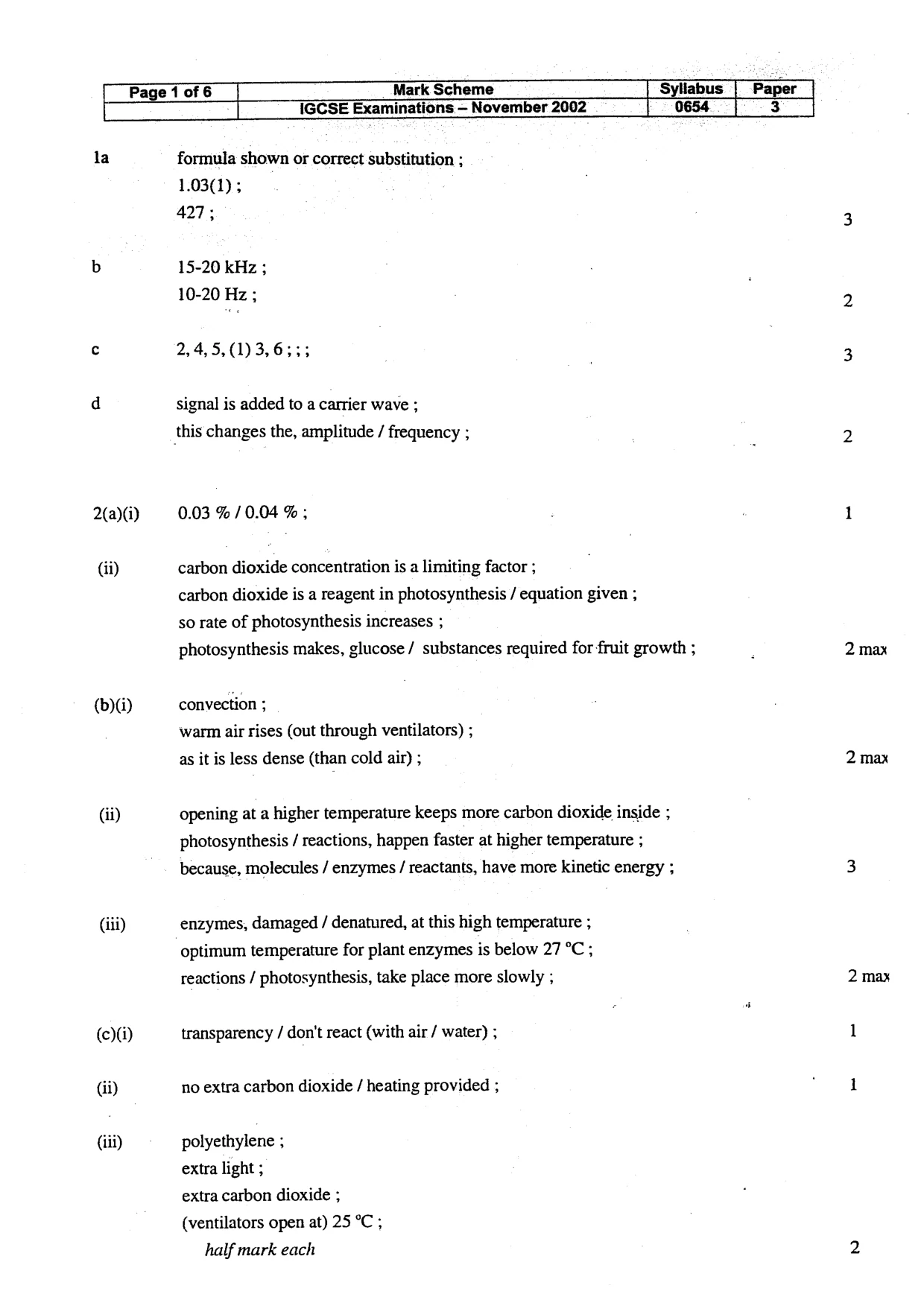
("Page Tore | Mark Scheme Syllabus , { “| IGCSE Examinations — November 2002 0654 la 2(a)(i) Gi) (b)@) Gi) (iii) ©wW Gi) (iii) formula shown or correct substitution ; 1.03(1) ; 427; 15-20 kHz ; 10-20 Hz; 2,4, 5,(1) 3,6535 signal is added to a carrier wave ; this changes the, amplitude / frequency ; 0.03 % / 0.04 % ; carbon dioxide concentration is a limiting factor ; carbon dioxide is a reagent in photosynthesis / equation given ; so rate of photosynthesis increases ; photosynthesis makes, glucose / substances required for fruit growth ; convection ; warm air rises (out through ventilators) ; as it is less dense (than cold air) ; opening at a higher temperature keeps more carbon dioxide inside ; photosynthesis / reactions, happen faster at higher temperature ; because, molecules / enzymes / reactants, have more kinetic energy ; enzymes, damaged / denatured, at this high temperature ; optimum temperature for plant enzymes is below 27 °C ; reactions / photosynthesis, take place more slowly ; transparency / don't react (with air / water) ; no extra carbon dioxide / heating provided ; polyethylene ; extra light 3 extra carbon dioxide ; (ventilators open at) 25 °C ; half mark each 2 max 2 max
Mark scheme, page 3
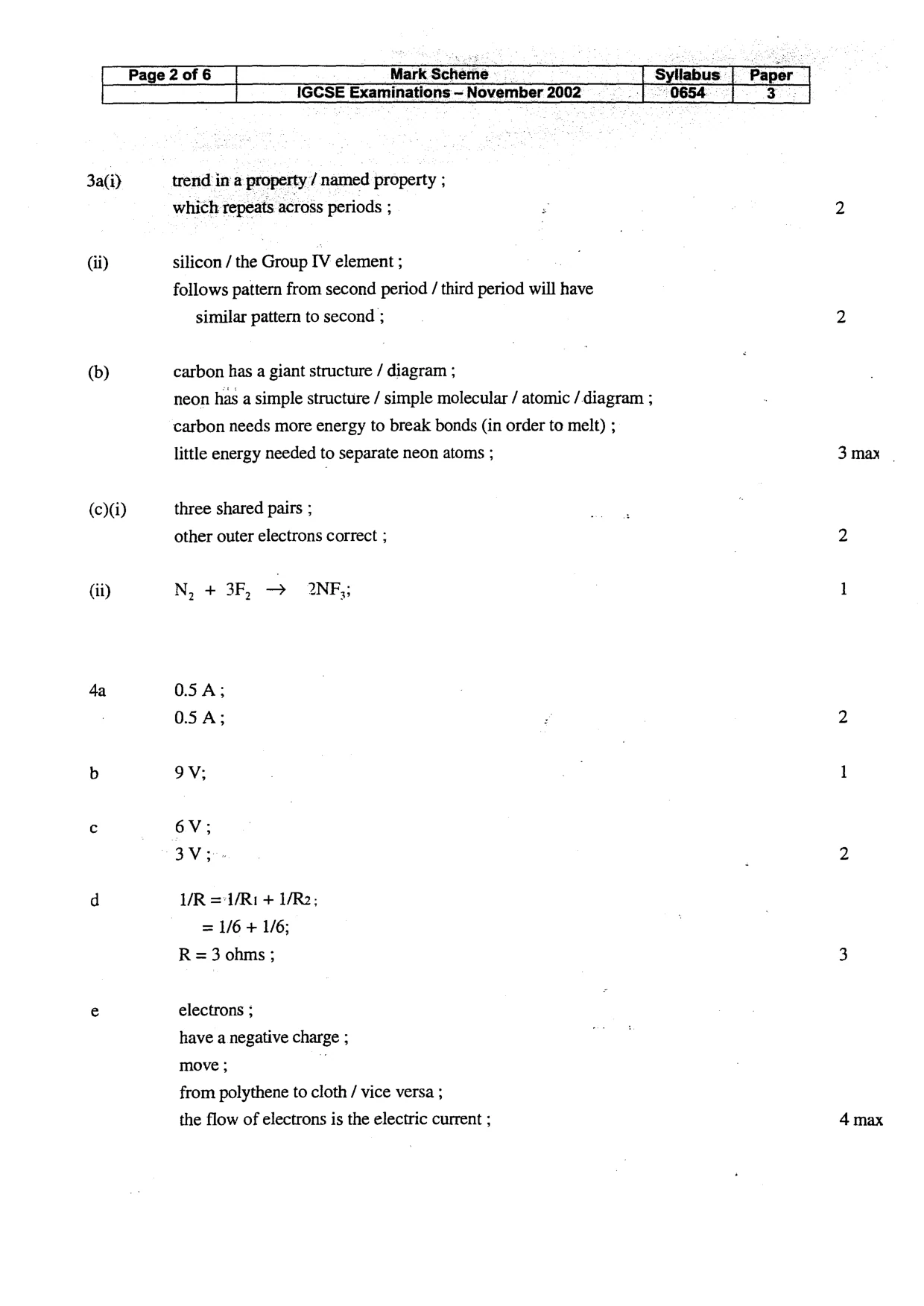
[Page2of6é |_ Mark Scheme [Syllabus l IGCSE Examinations — November 2002 I 0654 3 3a(i) Gi) (b) OW (it) trend in a property / named property ; which repeats across periods ; silicon / the Group IV element ; follows pattern from second period / third period will have similar pattern to second ; carbon has a giant structure / diagram ; neon has a simple structure / simple molecular / atomic / diagram ; carbon needs more energy to break bonds (in order to melt) ; little energy needed to separate neon atoms ; three shared pairs ; other outer electrons correct ; N, + 3F) 3 2NF; OSA; OSA; OV; 6V; 3V;3 V/R =1/Ri + V/R2; = 1/6 + 1/6; R=3 ohms; electrons ; have a negative charge ; move ; : from polythene to cloth / vice versa ; the flow of electrons is the electric current ; 4 max
Mark scheme, page 4
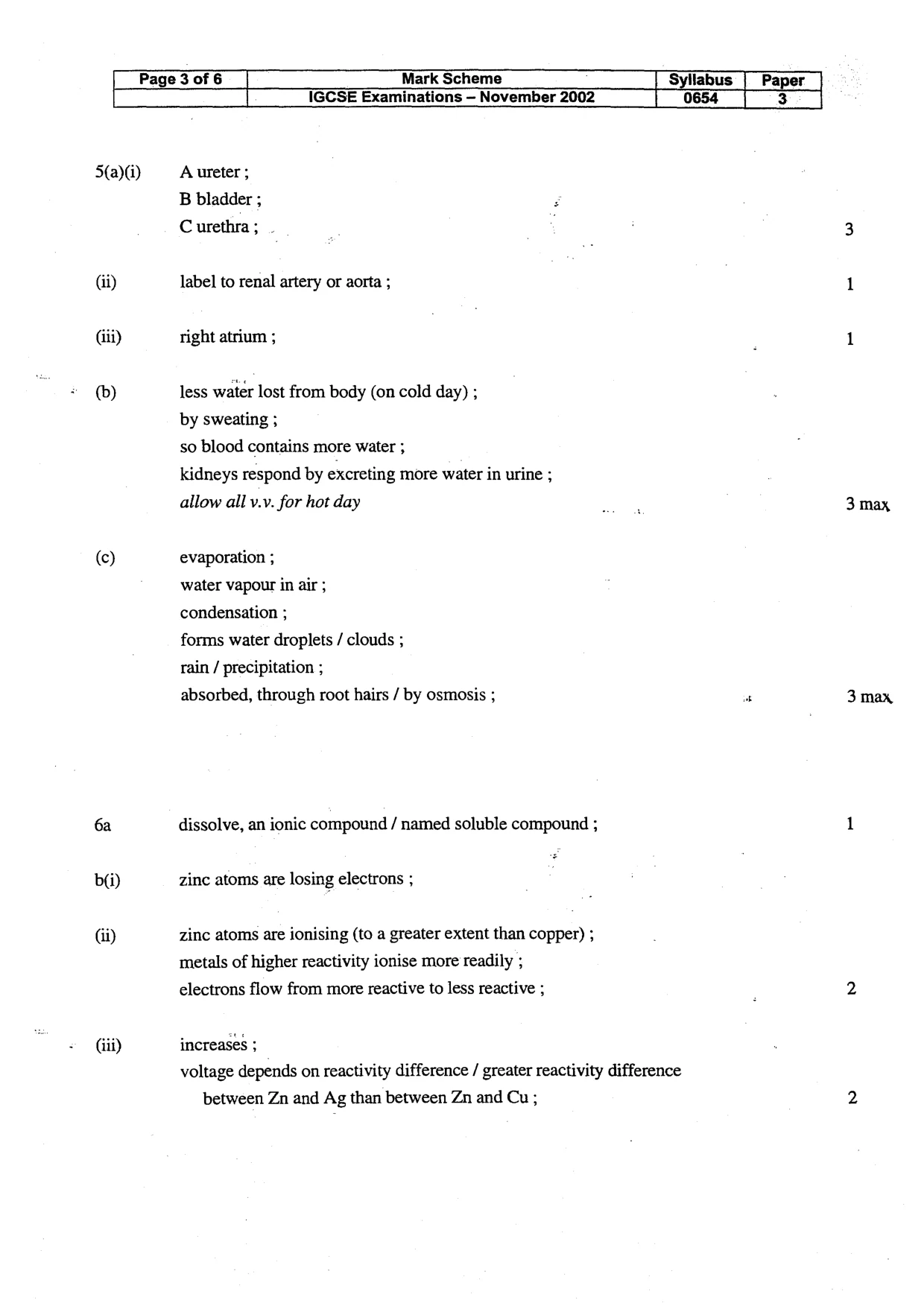
Page 3 of 6 Mark Scheme Syllabus | Paper IGCSE Examinations — November 2002 0654 3 5(a)(i) Gi) Gi) (b) (©) 6a bi) Gi) Gi) A ureter ; B bladder ; é Curethra; ~ : 3 label to renal artery or aorta ; 1 right atrium ; 1 less water lost from body (on cold day) ; by sweating ; so blood contains more water ; kidneys respond by excreting more water in urine ; allow all v.v. for hot day ok 3 max evaporation ; water vapour in air ; condensation ; forms water droplets / clouds ; rain / precipitation ; absorbed, through root hairs / by osmosis ; - 3 max dissolve, an ionic compound / named soluble compound ; 1 zinc atoms are losing electrons ; zinc atoms are ionising (to a greater extent than copper) ; metals of higher reactivity ionise more readily ; electrons flow from more reactive to less reactive ; 2 increases ; voltage depends on reactivity difference / greater reactivity difference between Zn and Ag than between Zn and Cu ; 2
Mark scheme, page 5
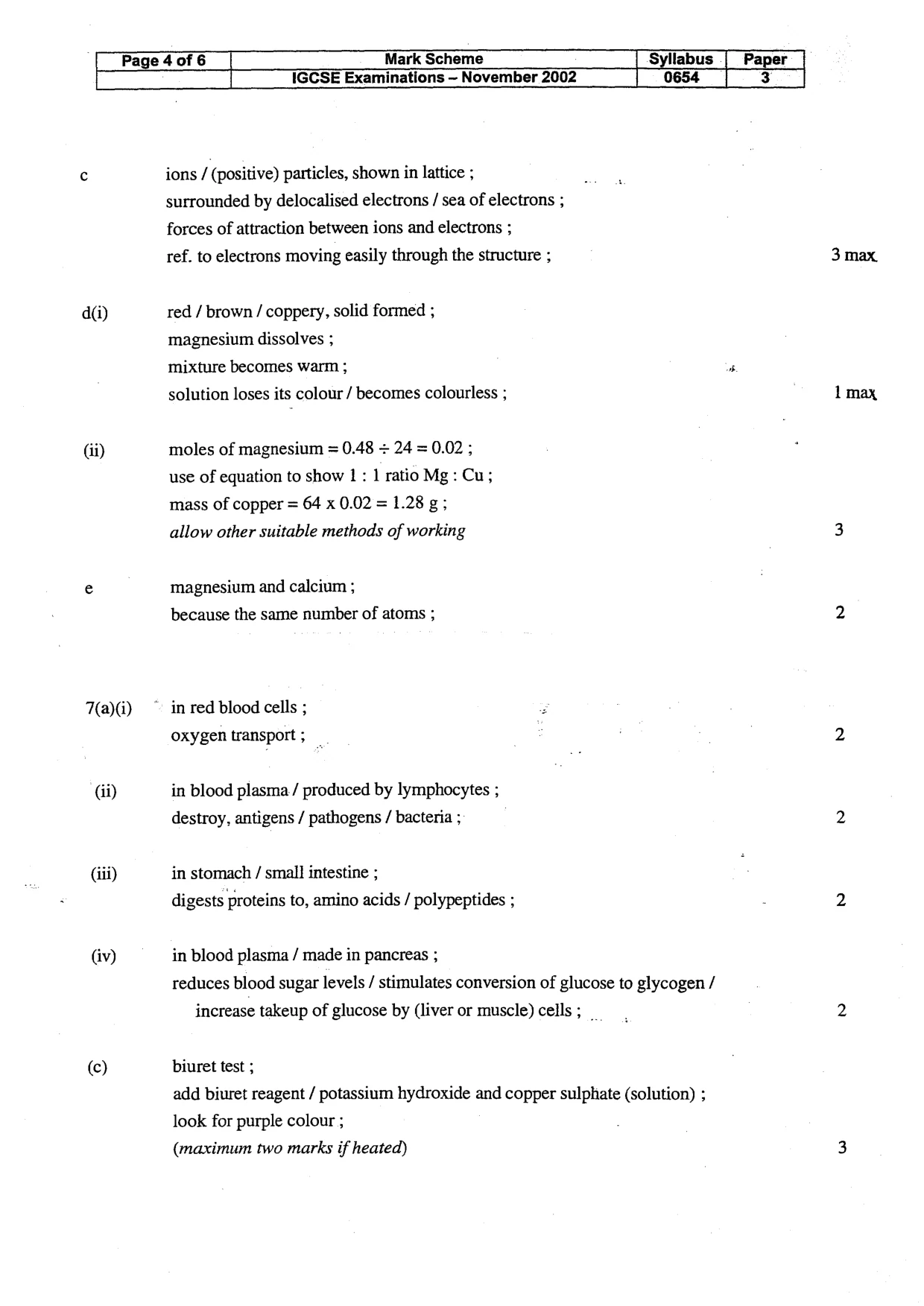
Page4ofé | Mark Scheme Syllabus I IGCSE Examinations ~ November 2002 0654 d(i) Gi) Taya) Gi) (iii) Gv) (©) ions / (positive) particles, shown in lattice ; surrounded by delocalised electrons / sea of electrons ; forces of attraction between ions and electrons ; ref. to electrons moving easily through the structure ; red / brown / coppery, solid formed ; magnesium dissolves ; mixture becomes warm ; solution loses its colour / becomes colourless ; moles of magnesium = 0.48 + 24 = 0.02 ; use of equation to show 1 : 1 ratio Mg: Cu; mass of copper = 64 x 0.02 = 1.28 g; allow other suitable methods of working magnesium and calcium ; because the same number of atoms ; in red blood cells ; oxygen transport ; _ in blood plasma / produced by lymphocytes ; destroy, antigens / pathogens / bacteria ; in stomach / small intestine ; digests proteins to, amino acids / polypeptides ; in blood plasma / made in pancreas ; reduces blood sugar levels / stimulates conversion of glucose to glycogen / increase takeup of glucose by (liver or muscle) cells ; biuret test ; add biuret reagent / potassium hydroxide and copper sulphate (solution) ; look for purple colour ; (maximum two marks if heated) 3 max 1 max
Mark scheme, page 6
Page 5 of 6 Mark Scheme __|_ Syllabus | Paper L IGCSE Examinations — November 2002 [0654 3 8a(i) pressure = force + area ; 10 000 + 7.2; = 1389, N m?/Pa; ° (ii) the same as answer to (i) ; pressure is the same everywhere in the liquid ; (b) output force is greater than input force ; same pressure on a larger area ; (c)(i) particles are touching ; cannot be.compresed ; (ii) gases can be compressed ; would not transmit forces ; (da) pressure increases ; directly proportional / particles hit walls of container, more often / harder ; (ii) -273 °C/ 0K; temperature at which all particles have zero motion ;
Mark scheme, page 7
Page 6of6 | Mark Scheme ‘Syllabus | Paper I IGCSE Examinations — November 2002 0654 3 9a CO,’ ; working refers to need for charge balance ; : 2 b(i) calcium carbonate ; + sodium chloride ; 2 (ii) calcium now insoluble / soluble calcium compounds removed ; . 1 (iii) shake hard water with soap ; standardise shaking ; find out amount of soap needed for lather ; add sodium carbonate to equal volume of the hard water ; find out amount of soap needed for lather ; if sodium carbonate effective then less soap needed ; or one sample of water with NaCO, and one without ; equal volumes of both samples ; add equal amount of soap to each ; + shake ; standardise shaking 3 if NaCO, softens water then that one has more lather ; . 4max (iv) ion exchange water passed through, resin / small beads ; calcium (and magnesium) ions stick to resin ; and are replaed by sodium ; or distillation water is boiled ; vapour collected and condensed ; calcium compounds, do not vaporise / are removed ; 3