Cambridge IGCSE Science - Combined 0653 — 2009 Oct/Nov Paper 6 · Variant 1
0653/61/O/N/09 · 60 marks · ≈68 min
The question paper and its mark scheme, free to read here and free to download. This is Cambridge’s own paper, exactly as it was sat.
Question paper20 pages
Mark scheme4 pages
Answers below. Sit the paper first if you are practising.
Paper as text
Question paper, page 1
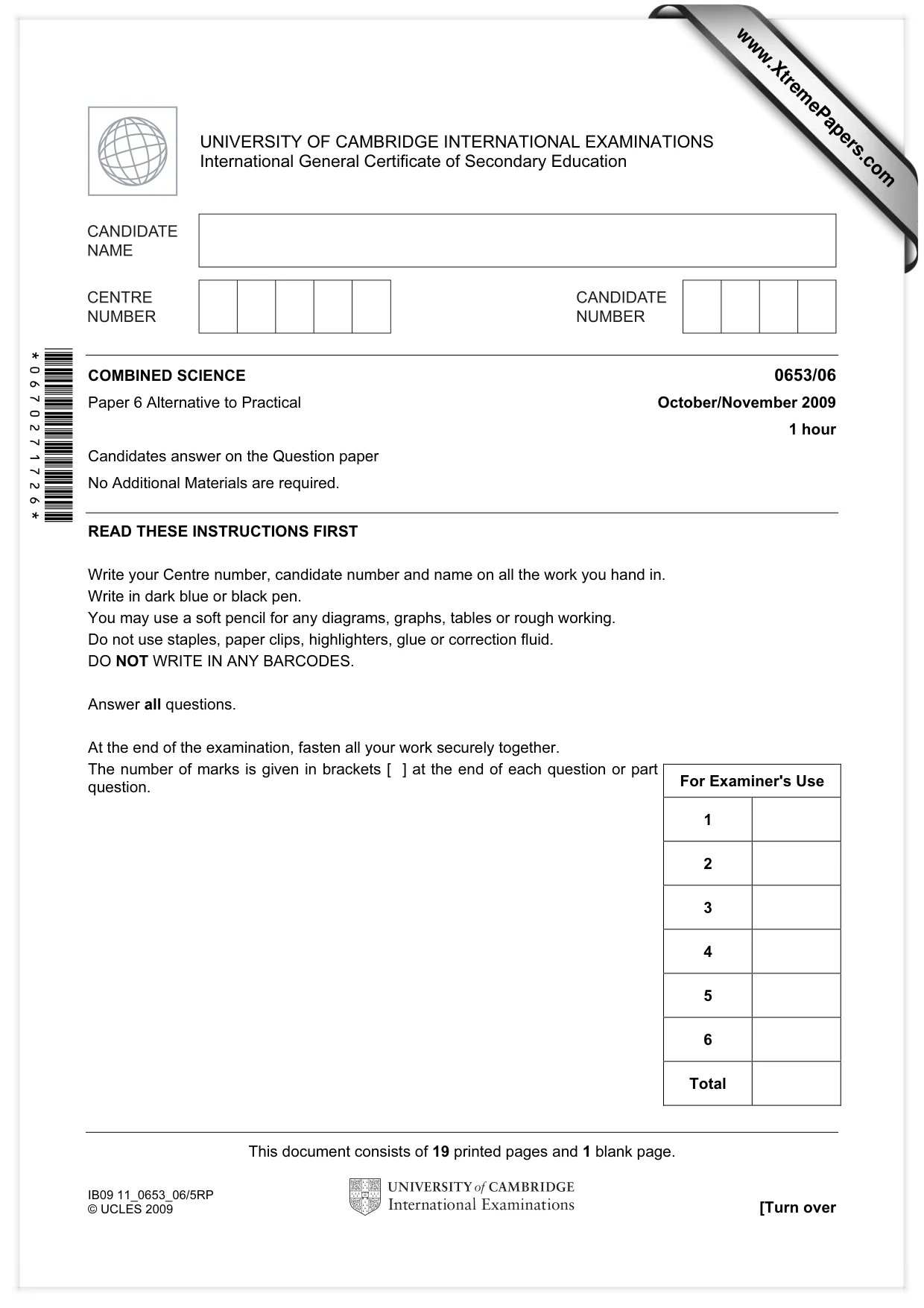
This document consists of 19 printed pages and 1 blank page. IB09 11_0653_06/5RP © UCLES 2009 [Turn over *0670271726* For Examiner's Use 1 2 3 4 5 6 Total UNIVERSITY OF CAMBRIDGE INTERNATIONAL EXAMINATIONS International General Certificate of Secondary Education COMBINED SCIENCE 0653/06 Paper 6 Alternative to Practical October/November 2009 1 hour Candidates answer on the Question paper No Additional Materials are required. READ THESE INSTRUCTIONS FIRST Write your Centre number, candidate number and name on all the work you hand in. Write in dark blue or black pen. You may use a soft pencil for any diagrams, graphs, tables or rough working. Do not use staples, paper clips, highlighters, glue or correction fluid. DO NOT WRITE IN ANY BARCODES. Answer all questions. At the end of the examination, fasten all your work securely together. The number of marks is given in brackets [ ] at the end of each question or part question. www.XtremePapers.com
Question paper, page 2
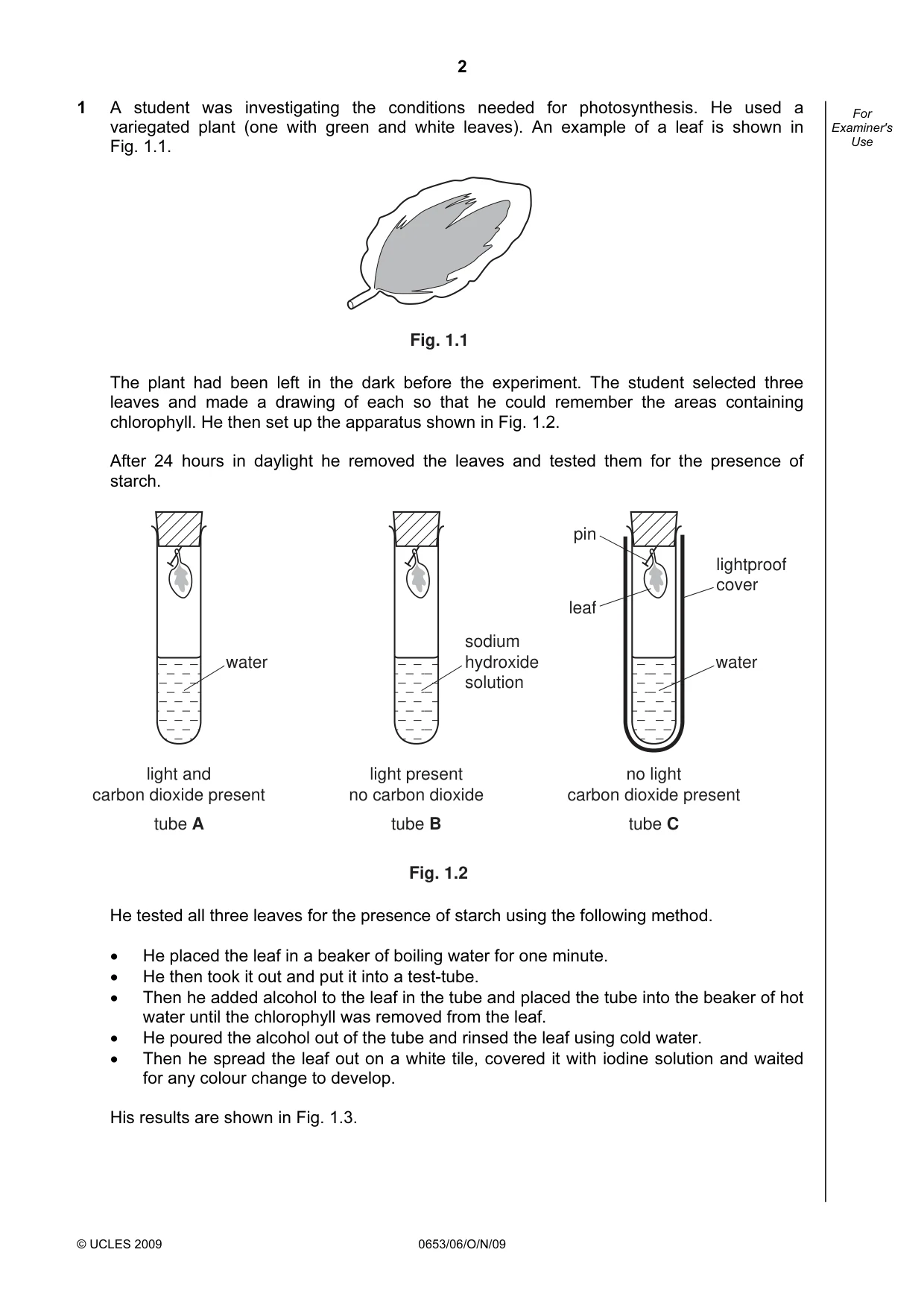
2 © UCLES 2009 0653/06/O/N/09 For Examiner's Use 1 A student was investigating the conditions needed for photosynthesis. He used a variegated plant (one with green and white leaves). An example of a leaf is shown in Fig. 1.1. Fig. 1.1 The plant had been left in the dark before the experiment. The student selected three leaves and made a drawing of each so that he could remember the areas containing chlorophyll. He then set up the apparatus shown in Fig. 1.2. After 24 hours in daylight he removed the leaves and tested them for the presence of starch. light and carbon dioxide present tube A water light present no carbon dioxide tube B sodium hydroxide solution no light carbon dioxide present tube C water leaf pin lightproof cover Fig. 1.2 He tested all three leaves for the presence of starch using the following method. • He placed the leaf in a beaker of boiling water for one minute. • He then took it out and put it into a test-tube. • Then he added alcohol to the leaf in the tube and placed the tube into the beaker of hot water until the chlorophyll was removed from the leaf. • He poured the alcohol out of the tube and rinsed the leaf using cold water. • Then he spread the leaf out on a white tile, covered it with iodine solution and waited for any colour change to develop. His results are shown in Fig. 1.3.
Question paper, page 3
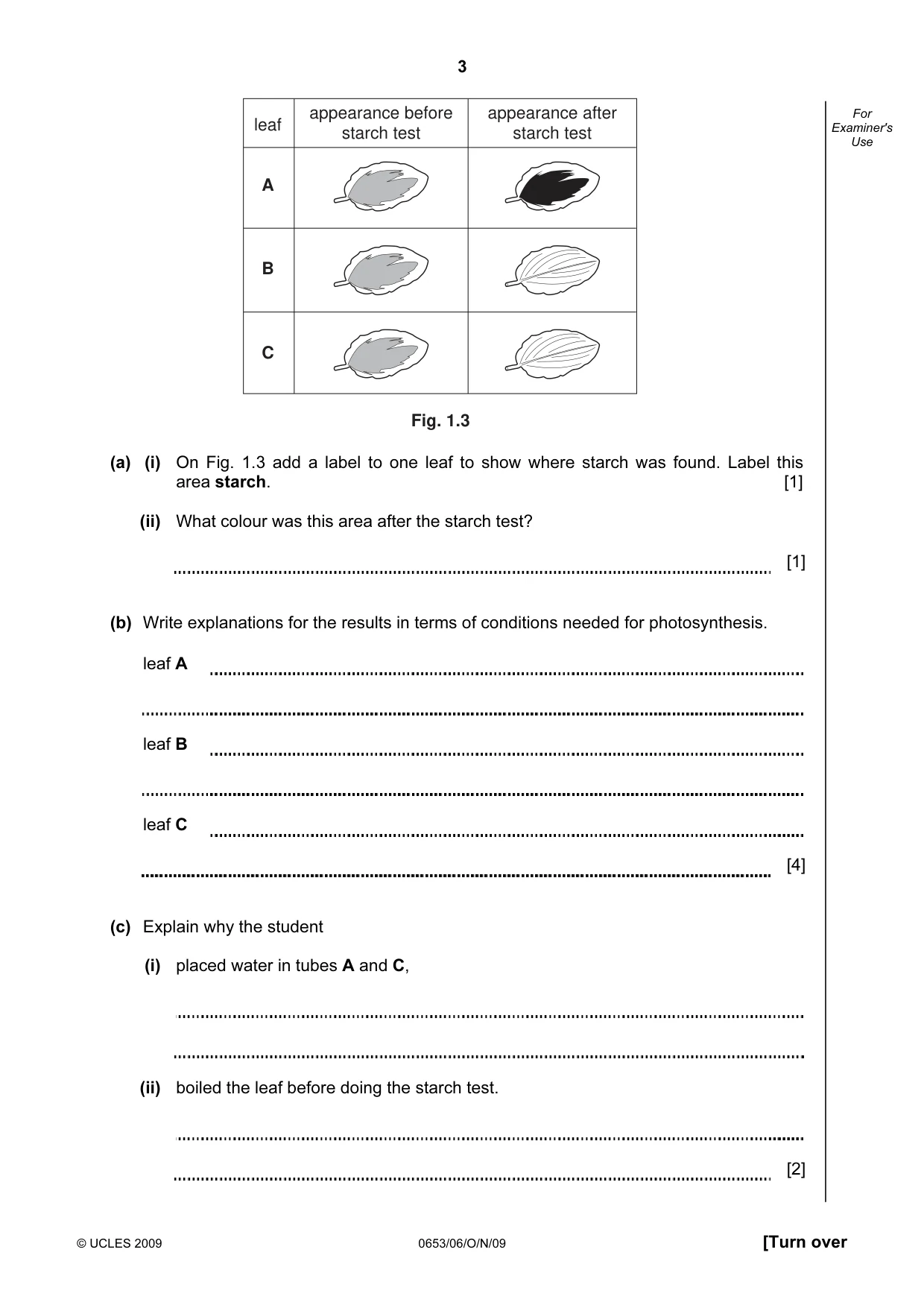
3 © UCLES 2009 0653/06/O/N/09 [Turn over For Examiner's Use A B C leaf appearance before starch test appearance after starch test Fig. 1.3 (a) (i) On Fig. 1.3 add a label to one leaf to show where starch was found. Label this area starch. [1] (ii) What colour was this area after the starch test? [1] (b) Write explanations for the results in terms of conditions needed for photosynthesis. leaf A leaf B leaf C [4] (c) Explain why the student (i) placed water in tubes A and C, (ii) boiled the leaf before doing the starch test. [2]
Question paper, page 4
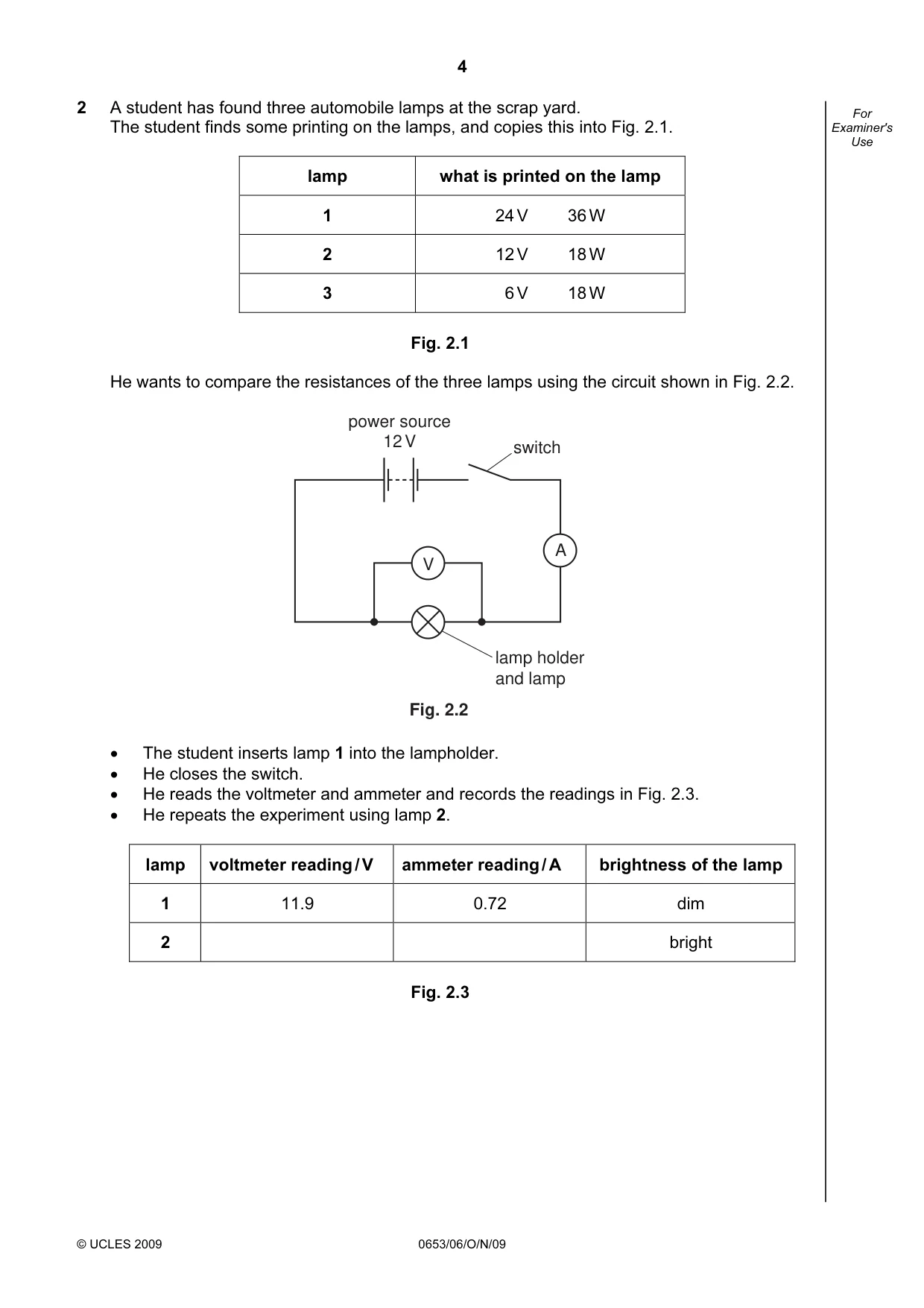
4 © UCLES 2009 0653/06/O/N/09 For Examiner's Use 2 A student has found three automobile lamps at the scrap yard. The student finds some printing on the lamps, and copies this into Fig. 2.1. lamp what is printed on the lamp 1 24 V 36 W 2 12 V 18 W 3 6 V 18 W Fig. 2.1 He wants to compare the resistances of the three lamps using the circuit shown in Fig. 2.2. A V power source 12 V lamp holder and lamp Fig. 2.2 switch • The student inserts lamp 1 into the lampholder. • He closes the switch. • He reads the voltmeter and ammeter and records the readings in Fig. 2.3. • He repeats the experiment using lamp 2. lamp voltmeter reading / V ammeter reading / A brightness of the lamp 1 11.9 0.72 dim 2 bright Fig. 2.3
Question paper, page 5
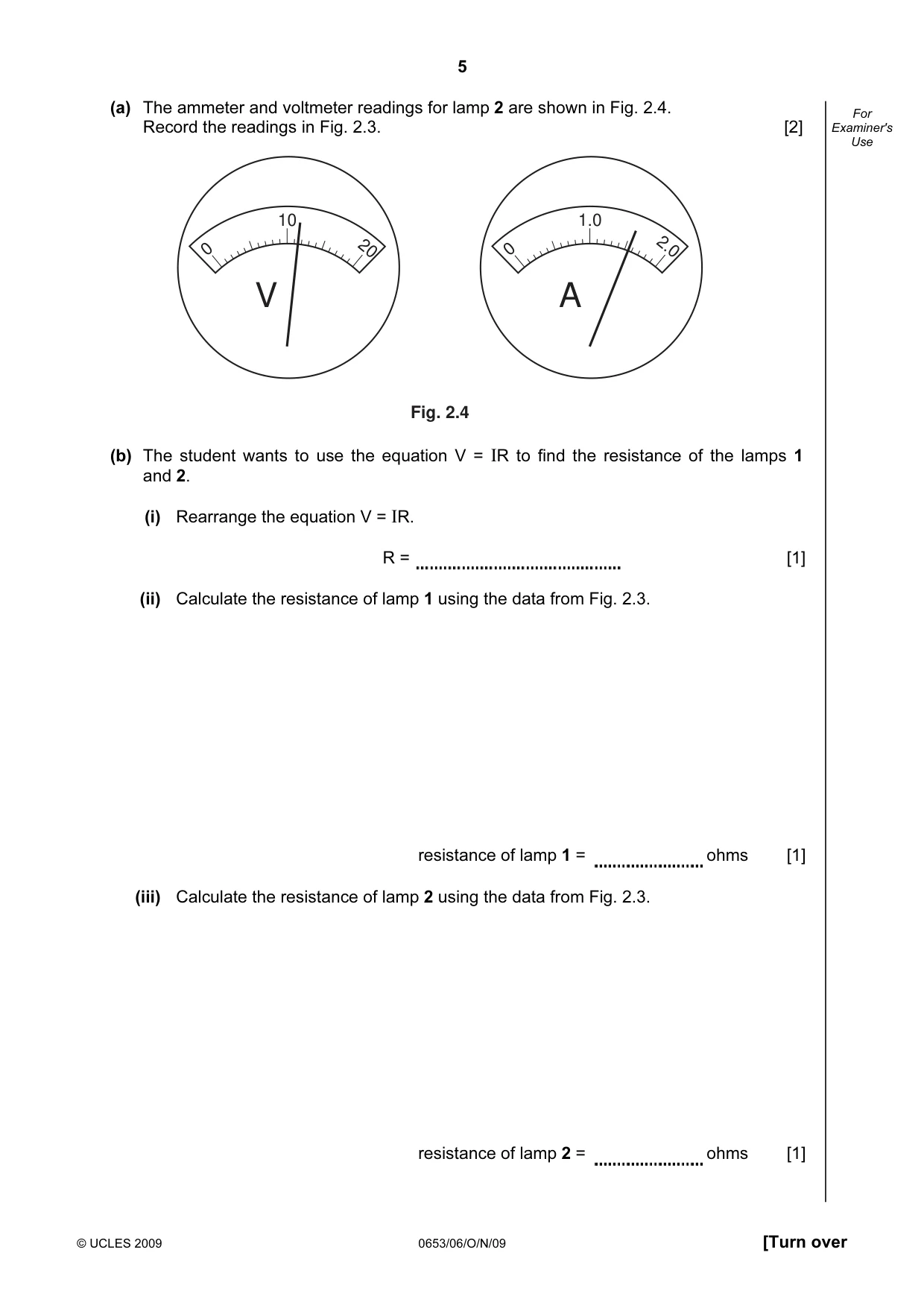
5 © UCLES 2009 0653/06/O/N/09 [Turn over For Examiner's Use (a) The ammeter and voltmeter readings for lamp 2 are shown in Fig. 2.4. Record the readings in Fig. 2.3. [2] 10 20 0 1.0 2.0 0 V A Fig. 2.4 (b) The student wants to use the equation V = IR to find the resistance of the lamps 1 and 2. (i) Rearrange the equation V = IR. R = [1] (ii) Calculate the resistance of lamp 1 using the data from Fig. 2.3. resistance of lamp 1 = ohms [1] (iii) Calculate the resistance of lamp 2 using the data from Fig. 2.3. resistance of lamp 2 = ohms [1]
Question paper, page 6
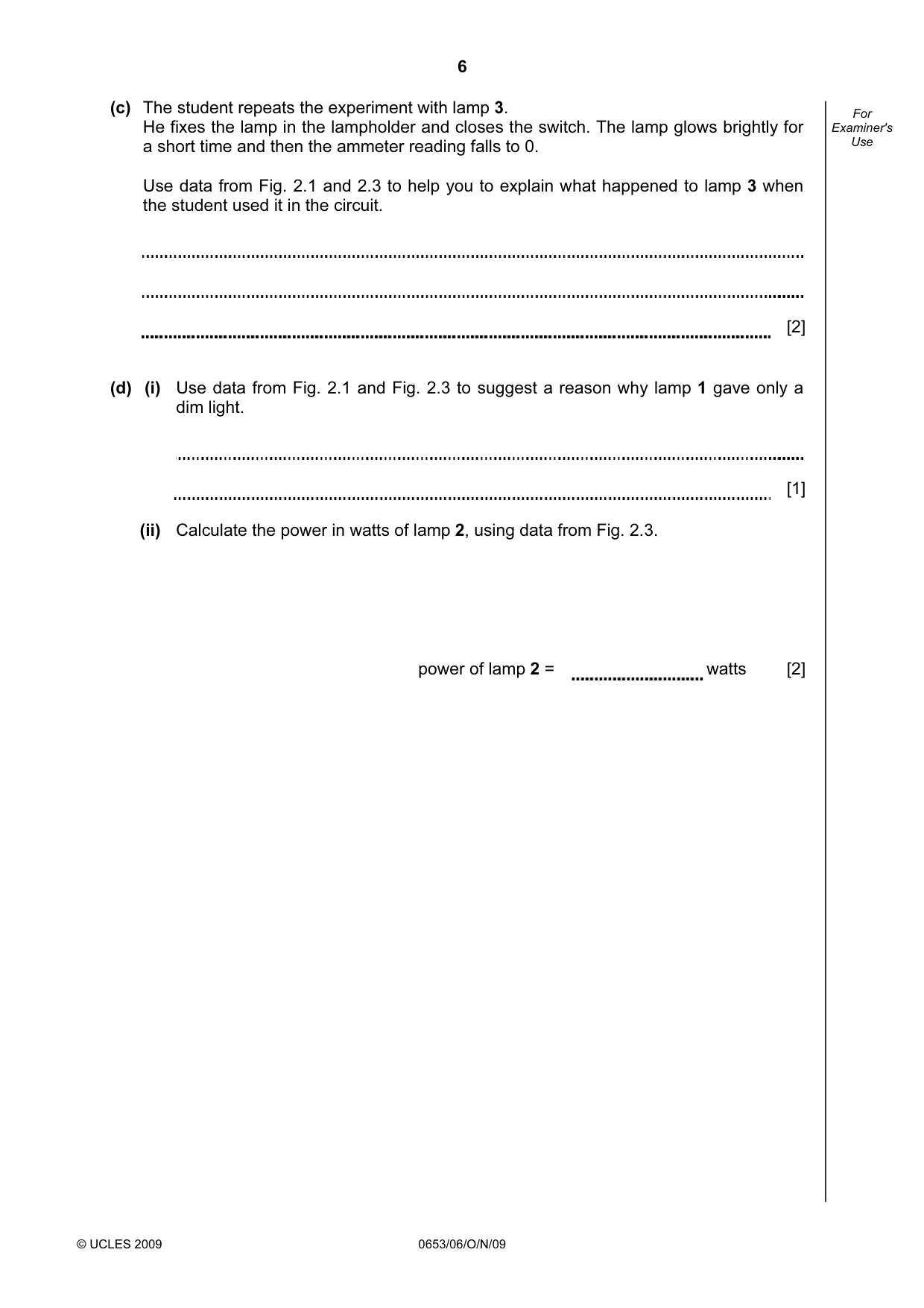
6 © UCLES 2009 0653/06/O/N/09 For Examiner's Use (c) The student repeats the experiment with lamp 3. He fixes the lamp in the lampholder and closes the switch. The lamp glows brightly for a short time and then the ammeter reading falls to 0. Use data from Fig. 2.1 and 2.3 to help you to explain what happened to lamp 3 when the student used it in the circuit. [2] (d) (i) Use data from Fig. 2.1 and Fig. 2.3 to suggest a reason why lamp 1 gave only a dim light. [1] (ii) Calculate the power in watts of lamp 2, using data from Fig. 2.3. power of lamp 2 = watts [2]
Question paper, page 7
7 0653/06/O/N/09 BLANK PAGE Please turn over for Question 3.
Question paper, page 8
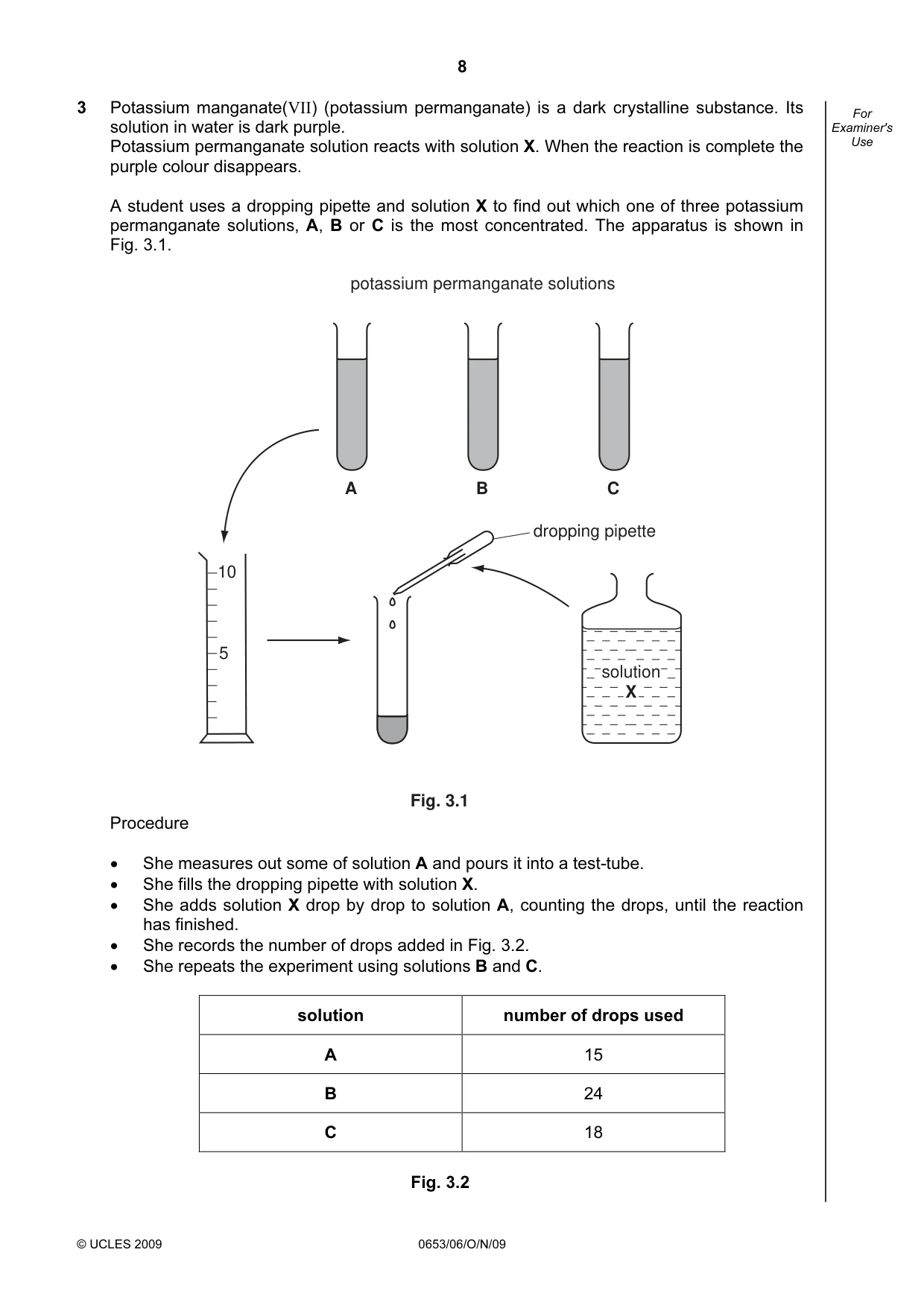
8 © UCLES 2009 0653/06/O/N/09 For Examiner's Use 3 Potassium manganate(VII) (potassium permanganate) is a dark crystalline substance. Its solution in water is dark purple. Potassium permanganate solution reacts with solution X. When the reaction is complete the purple colour disappears. A student uses a dropping pipette and solution X to find out which one of three potassium permanganate solutions, A, B or C is the most concentrated. The apparatus is shown in Fig. 3.1. A B C potassium permanganate solutions 10 5 dropping pipette solution solution X solution X Fig. 3.1 Procedure • She measures out some of solution A and pours it into a test-tube. • She fills the dropping pipette with solution X. • She adds solution X drop by drop to solution A, counting the drops, until the reaction has finished. • She records the number of drops added in Fig. 3.2. • She repeats the experiment using solutions B and C. solution number of drops used A 15 B 24 C 18 Fig. 3.2
Question paper, page 9
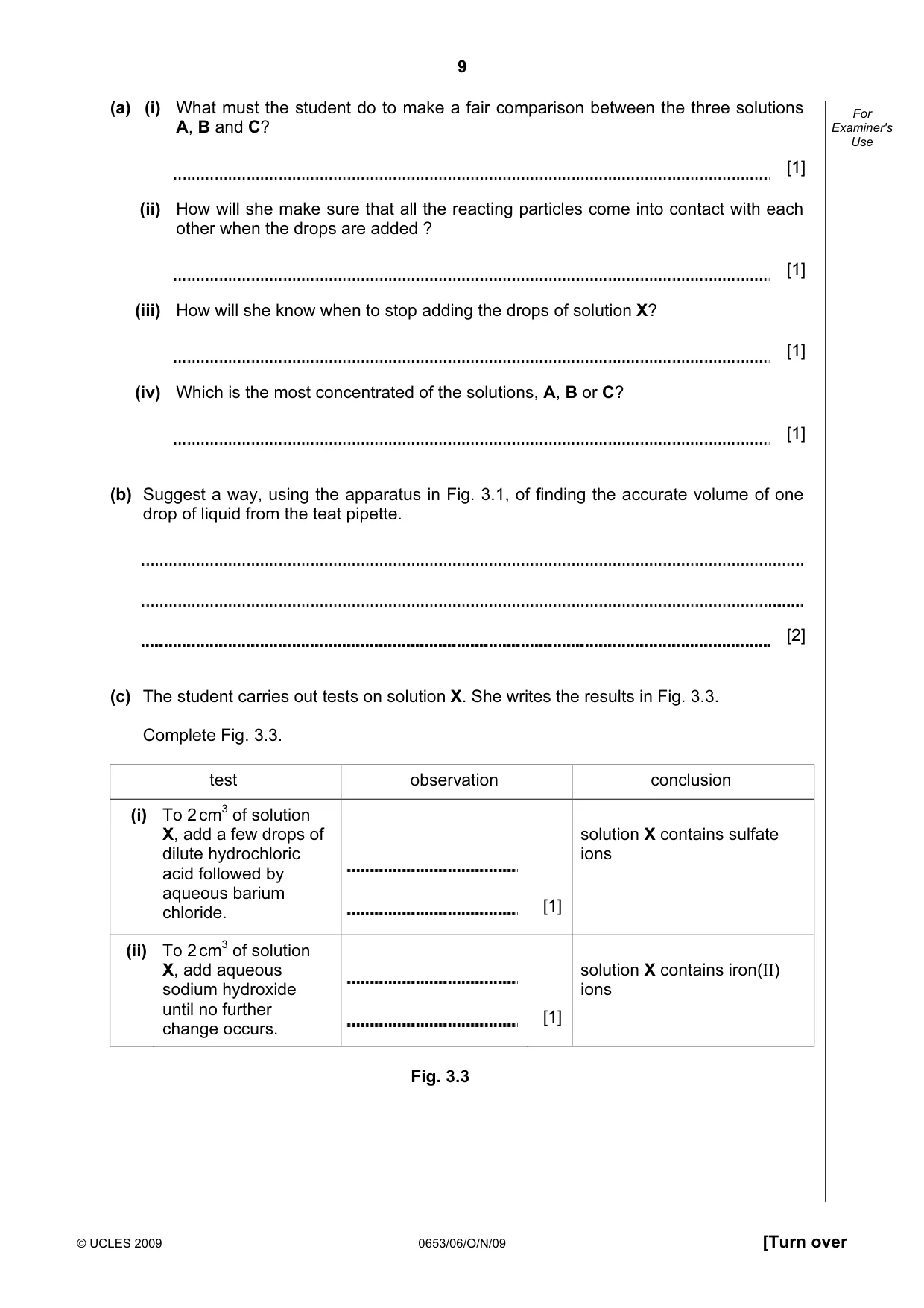
9 © UCLES 2009 0653/06/O/N/09 [Turn over For Examiner's Use (a) (i) What must the student do to make a fair comparison between the three solutions A, B and C? [1] (ii) How will she make sure that all the reacting particles come into contact with each other when the drops are added ? [1] (iii) How will she know when to stop adding the drops of solution X? [1] (iv) Which is the most concentrated of the solutions, A, B or C? [1] (b) Suggest a way, using the apparatus in Fig. 3.1, of finding the accurate volume of one drop of liquid from the teat pipette. [2] (c) The student carries out tests on solution X. She writes the results in Fig. 3.3. Complete Fig. 3.3. test observation conclusion (i) To 2 cm3 of solution X, add a few drops of dilute hydrochloric acid followed by aqueous barium chloride. [1] solution X contains sulfate ions (ii) To 2 cm3 of solution X, add aqueous sodium hydroxide until no further change occurs. [1] solution X contains iron(II) ions Fig. 3.3
Question paper, page 10
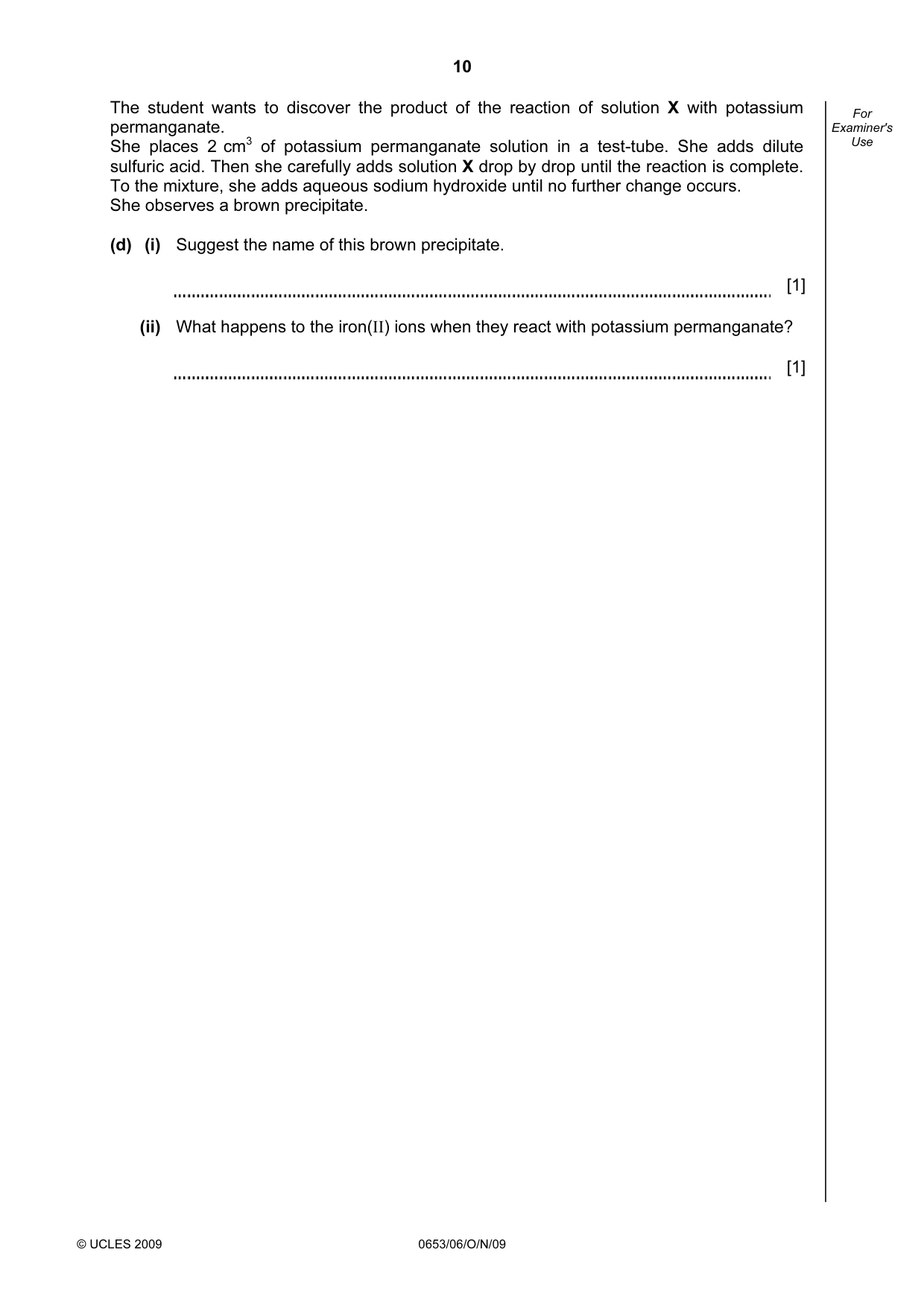
10 © UCLES 2009 0653/06/O/N/09 For Examiner's Use The student wants to discover the product of the reaction of solution X with potassium permanganate. She places 2 cm3 of potassium permanganate solution in a test-tube. She adds dilute sulfuric acid. Then she carefully adds solution X drop by drop until the reaction is complete. To the mixture, she adds aqueous sodium hydroxide until no further change occurs. She observes a brown precipitate. (d) (i) Suggest the name of this brown precipitate. [1] (ii) What happens to the iron(II) ions when they react with potassium permanganate? [1]
Question paper, page 11
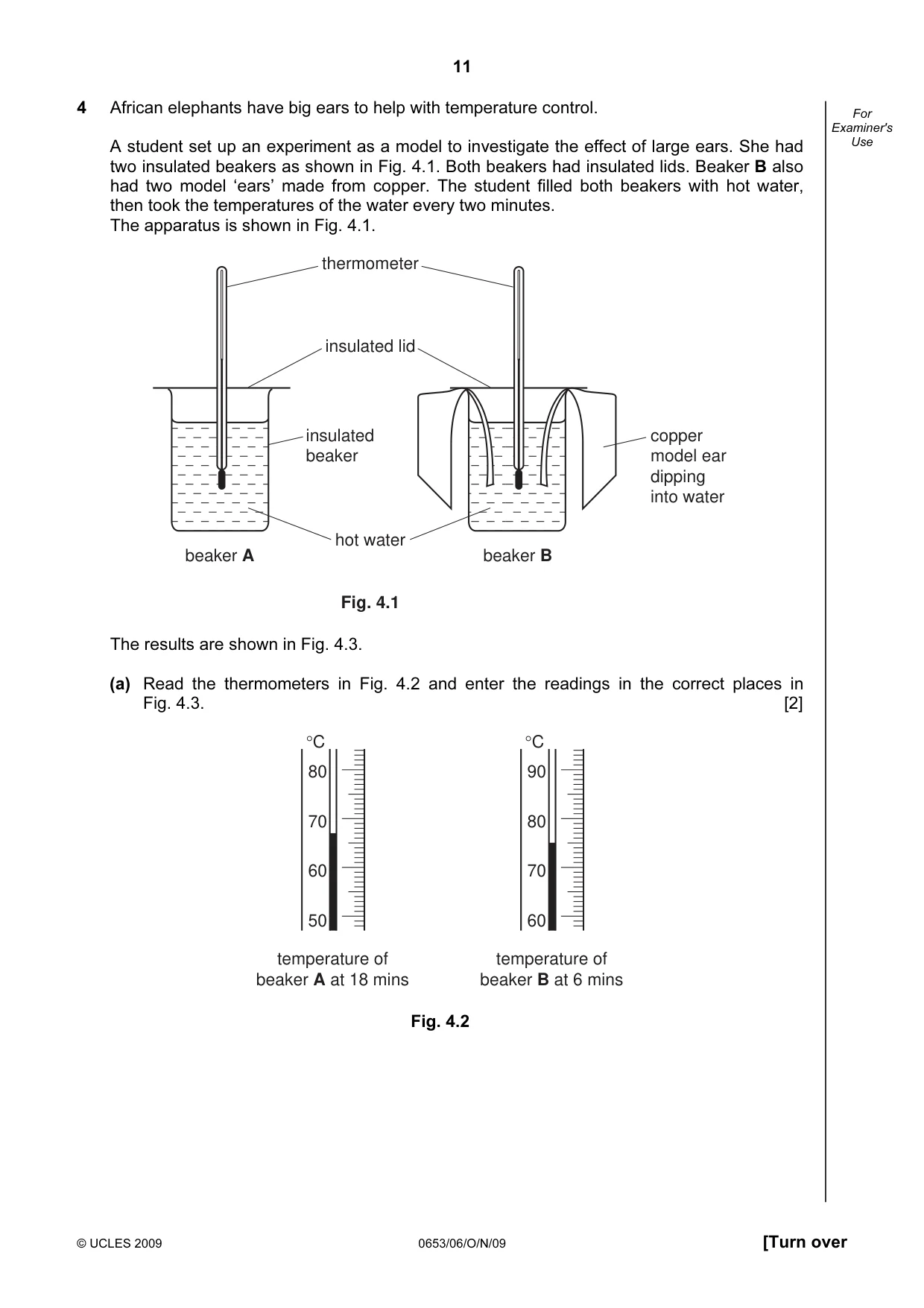
11 © UCLES 2009 0653/06/O/N/09 [Turn over For Examiner's Use 4 African elephants have big ears to help with temperature control. A student set up an experiment as a model to investigate the effect of large ears. She had two insulated beakers as shown in Fig. 4.1. Both beakers had insulated lids. Beaker B also had two model ‘ears’ made from copper. The student filled both beakers with hot water, then took the temperatures of the water every two minutes. The apparatus is shown in Fig. 4.1. thermometer insulated lid hot water Fig. 4.1 insulated beaker copper model ear dipping into water beaker A beaker B The results are shown in Fig. 4.3. (a) Read the thermometers in Fig. 4.2 and enter the readings in the correct places in Fig. 4.3. [2] 80 70 60 50 °C temperature of beaker A at 18 mins 90 80 70 60 °C temperature of beaker B at 6 mins Fig. 4.2
Question paper, page 12
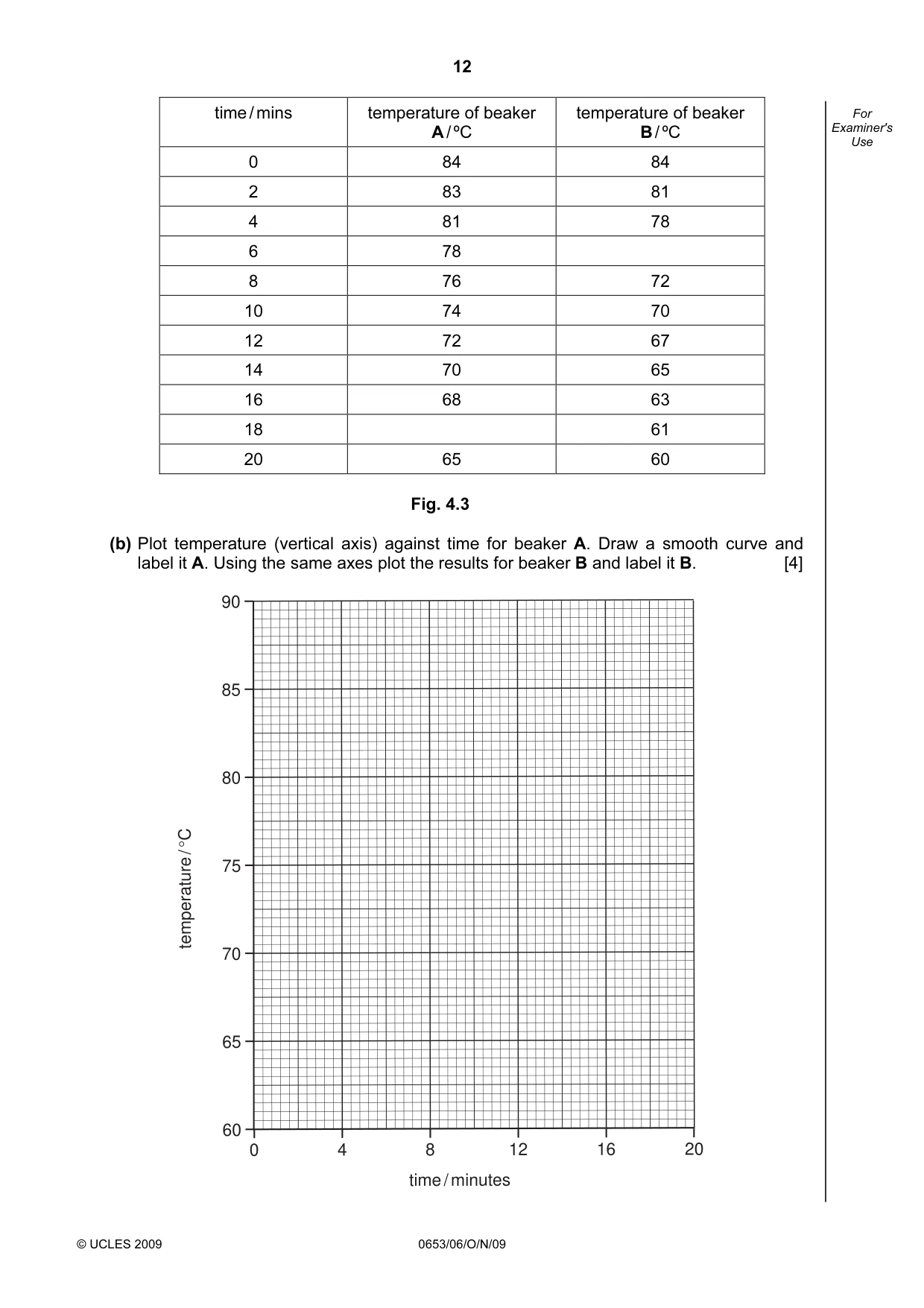
12 © UCLES 2009 0653/06/O/N/09 For Examiner's Use time / mins temperature of beaker A / ºC temperature of beaker B / ºC 0 84 84 2 83 81 4 81 78 6 78 8 76 72 10 74 70 12 72 67 14 70 65 16 68 63 18 61 20 65 60 Fig. 4.3 (b) Plot temperature (vertical axis) against time for beaker A. Draw a smooth curve and label it A. Using the same axes plot the results for beaker B and label it B. [4] 90 85 80 75 70 65 60 0 4 8 12 16 20 time / minutes temperature / °C
Question paper, page 13
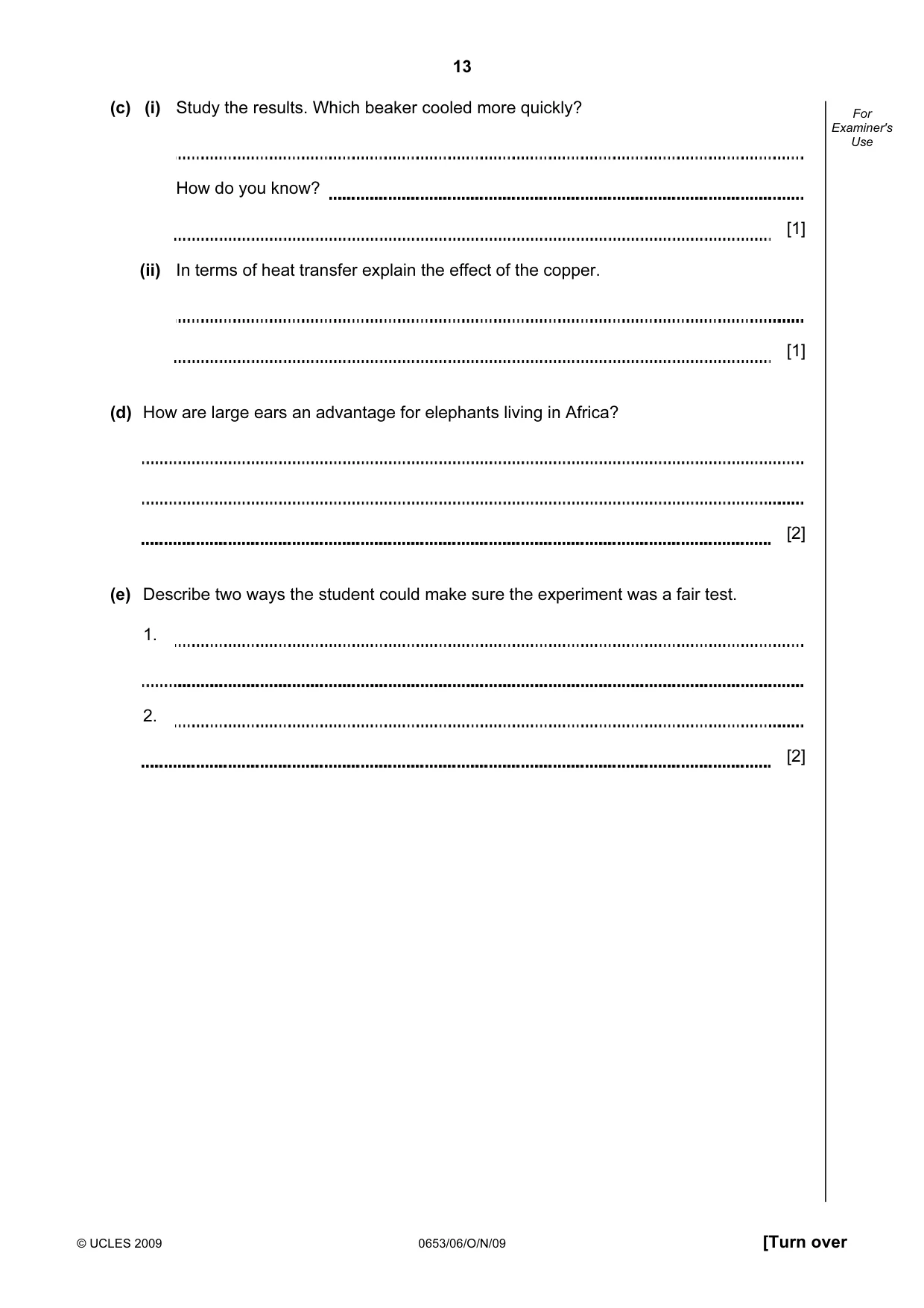
13 © UCLES 2009 0653/06/O/N/09 [Turn over For Examiner's Use (c) (i) Study the results. Which beaker cooled more quickly? How do you know? [1] (ii) In terms of heat transfer explain the effect of the copper. [1] (d) How are large ears an advantage for elephants living in Africa? [2] (e) Describe two ways the student could make sure the experiment was a fair test. 1. 2. [2]
Question paper, page 14
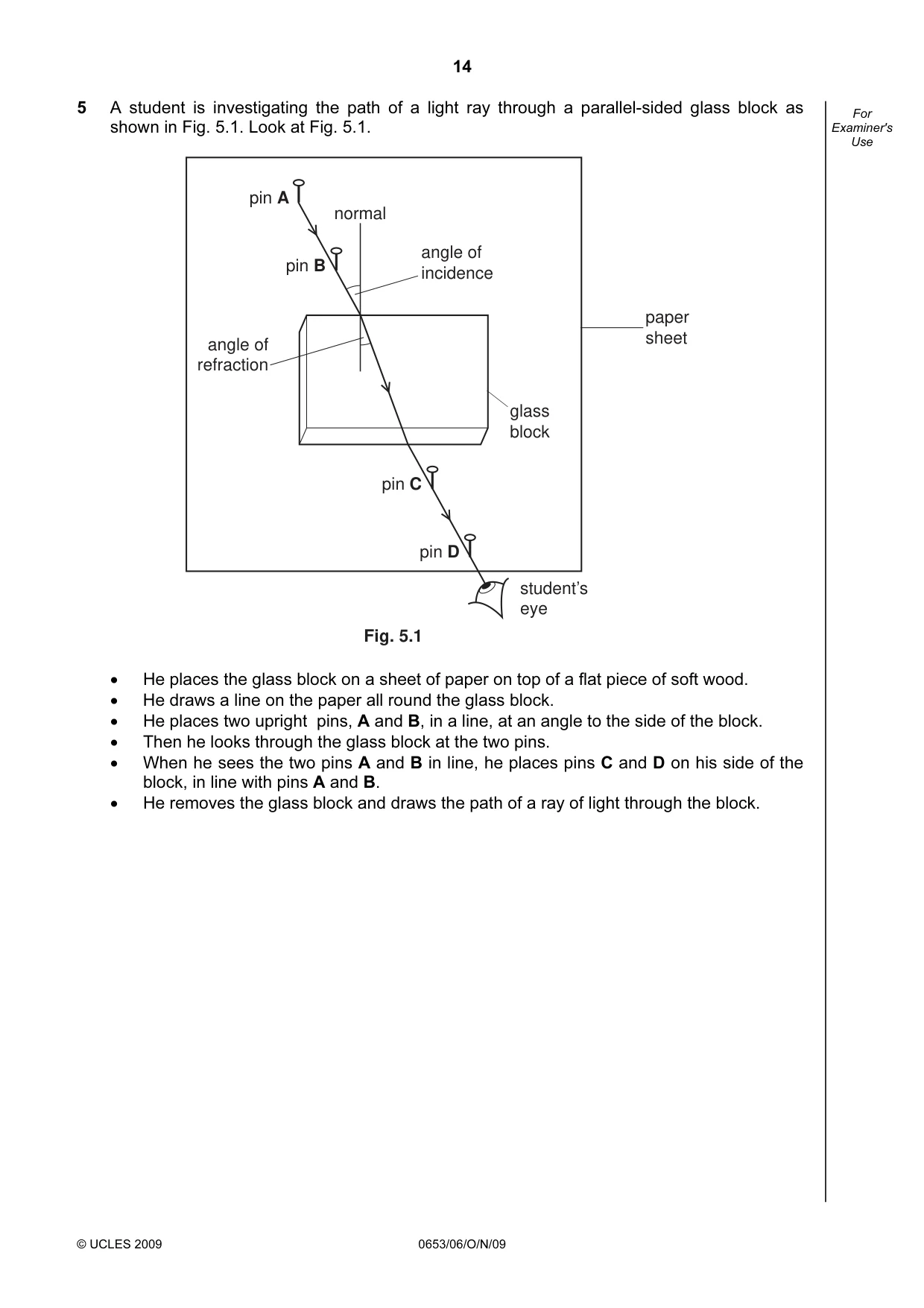
14 © UCLES 2009 0653/06/O/N/09 For Examiner's Use 5 A student is investigating the path of a light ray through a parallel-sided glass block as shown in Fig. 5.1. Look at Fig. 5.1. pin A pin B pin C pin D Fig. 5.1 angle of incidence angle of refraction normal student’s eye paper sheet glass block • He places the glass block on a sheet of paper on top of a flat piece of soft wood. • He draws a line on the paper all round the glass block. • He places two upright pins, A and B, in a line, at an angle to the side of the block. • Then he looks through the glass block at the two pins. • When he sees the two pins A and B in line, he places pins C and D on his side of the block, in line with pins A and B. • He removes the glass block and draws the path of a ray of light through the block.
Question paper, page 15
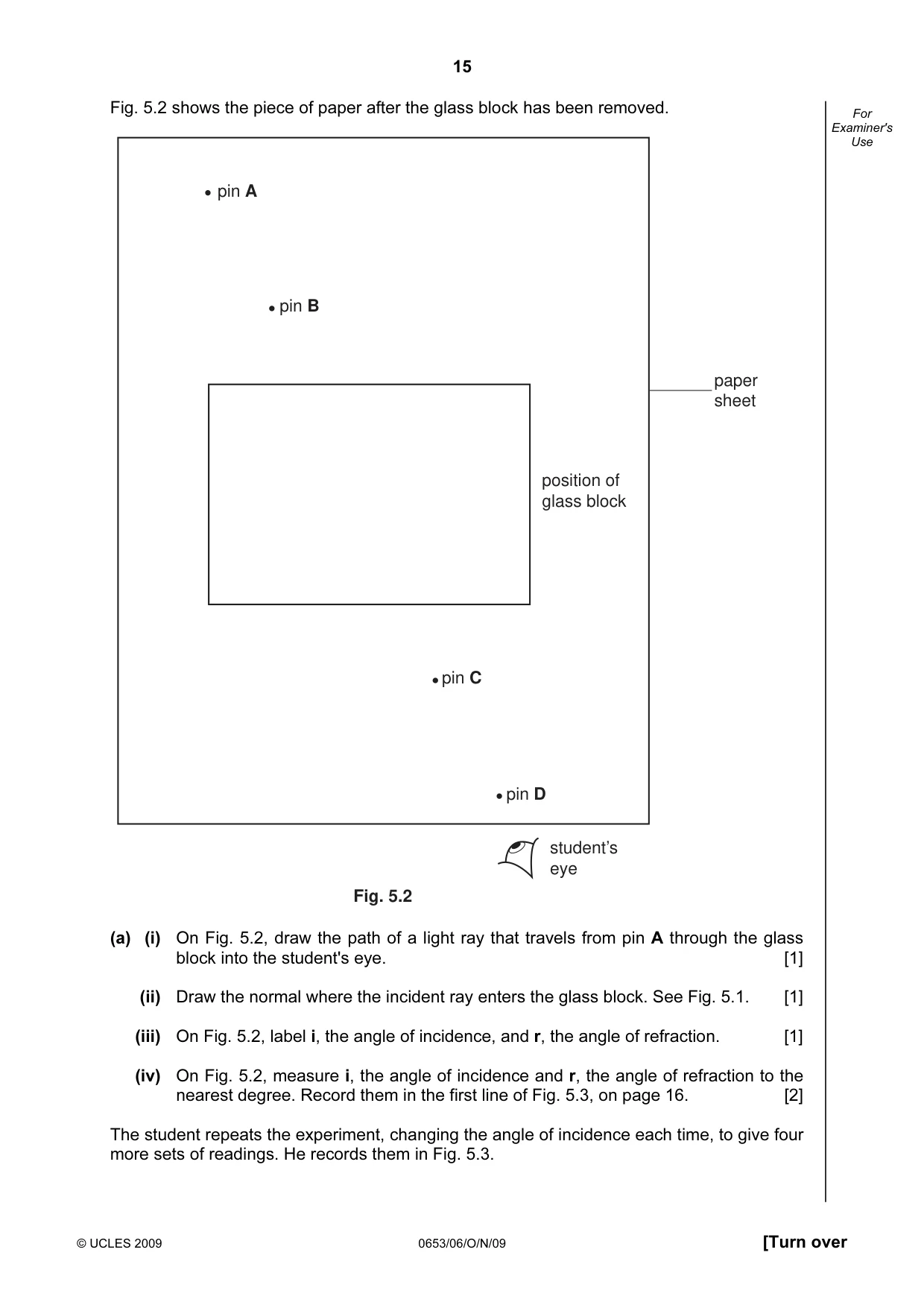
15 © UCLES 2009 0653/06/O/N/09 [Turn over For Examiner's Use Fig. 5.2 shows the piece of paper after the glass block has been removed. pin A pin B pin C pin D position of glass block paper sheet Fig. 5.2 student’s eye (a) (i) On Fig. 5.2, draw the path of a light ray that travels from pin A through the glass block into the student's eye. [1] (ii) Draw the normal where the incident ray enters the glass block. See Fig. 5.1. [1] (iii) On Fig. 5.2, label i, the angle of incidence, and r, the angle of refraction. [1] (iv) On Fig. 5.2, measure i, the angle of incidence and r, the angle of refraction to the nearest degree. Record them in the first line of Fig. 5.3, on page 16. [2] The student repeats the experiment, changing the angle of incidence each time, to give four more sets of readings. He records them in Fig. 5.3.
Question paper, page 16
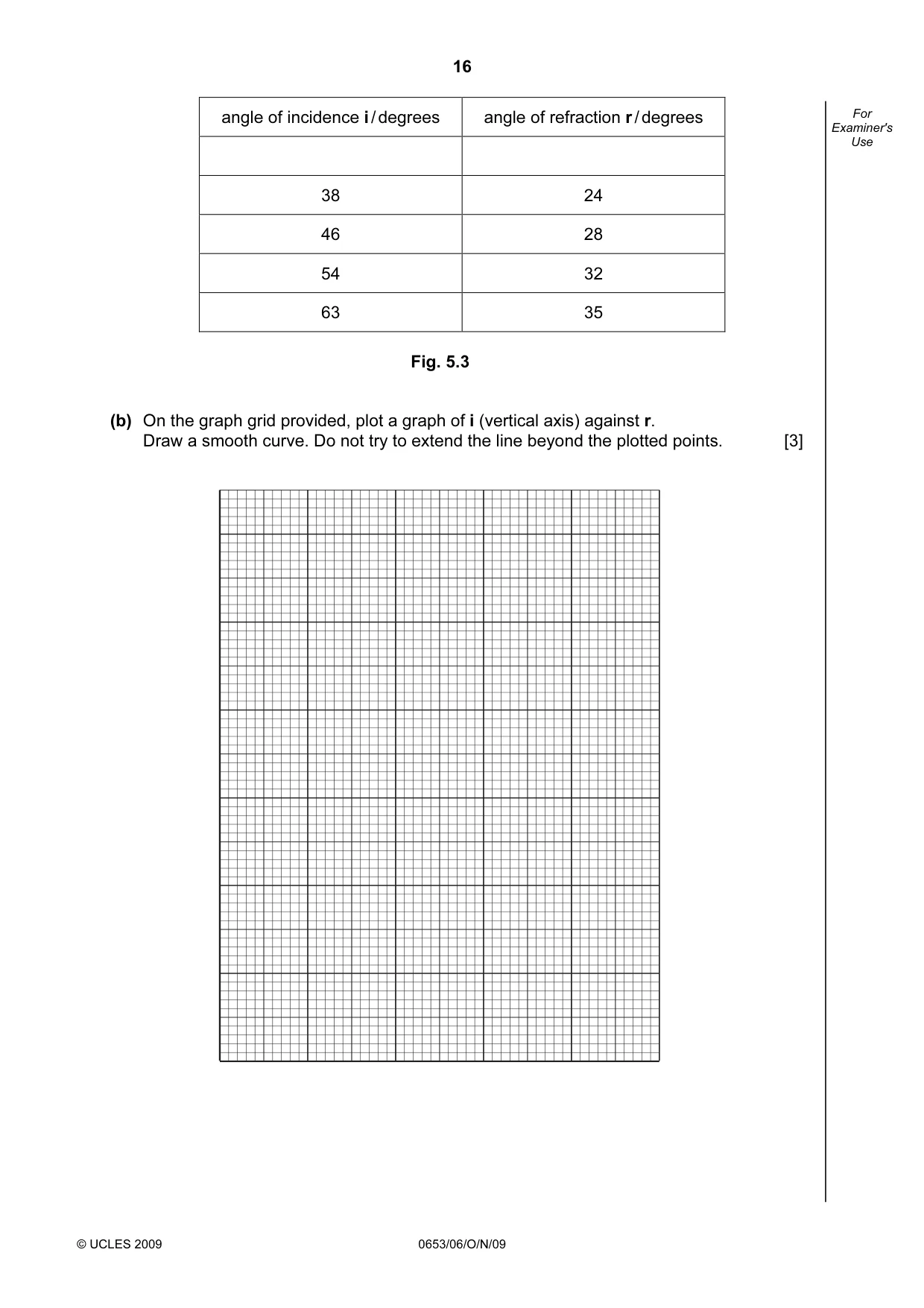
16 © UCLES 2009 0653/06/O/N/09 For Examiner's Use angle of incidence i / degrees angle of refraction r / degrees 38 24 46 28 54 32 63 35 Fig. 5.3 (b) On the graph grid provided, plot a graph of i (vertical axis) against r. Draw a smooth curve. Do not try to extend the line beyond the plotted points. [3]
Question paper, page 17
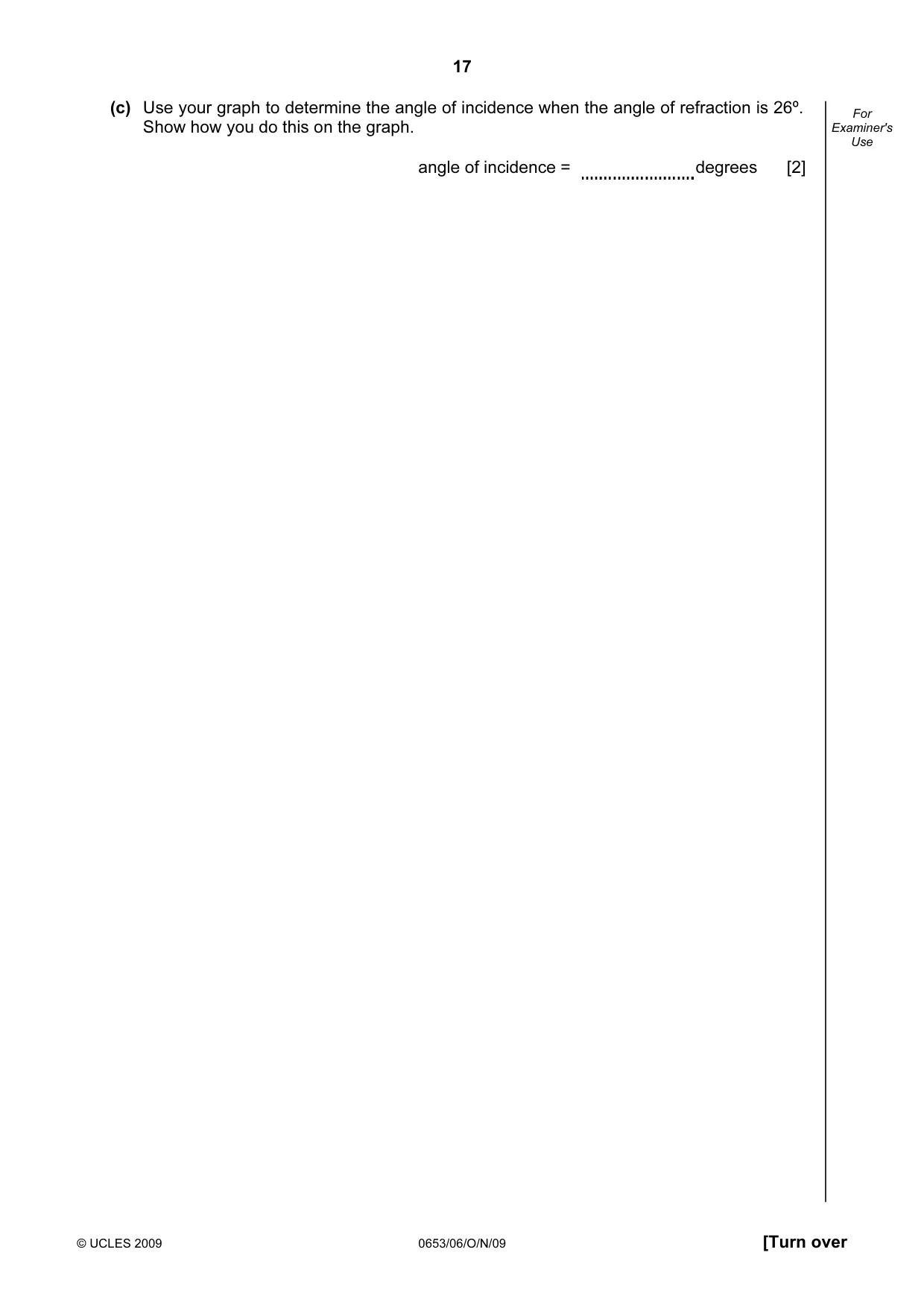
17 © UCLES 2009 0653/06/O/N/09 [Turn over For Examiner's Use (c) Use your graph to determine the angle of incidence when the angle of refraction is 26º. Show how you do this on the graph. angle of incidence = degrees [2]
Question paper, page 18
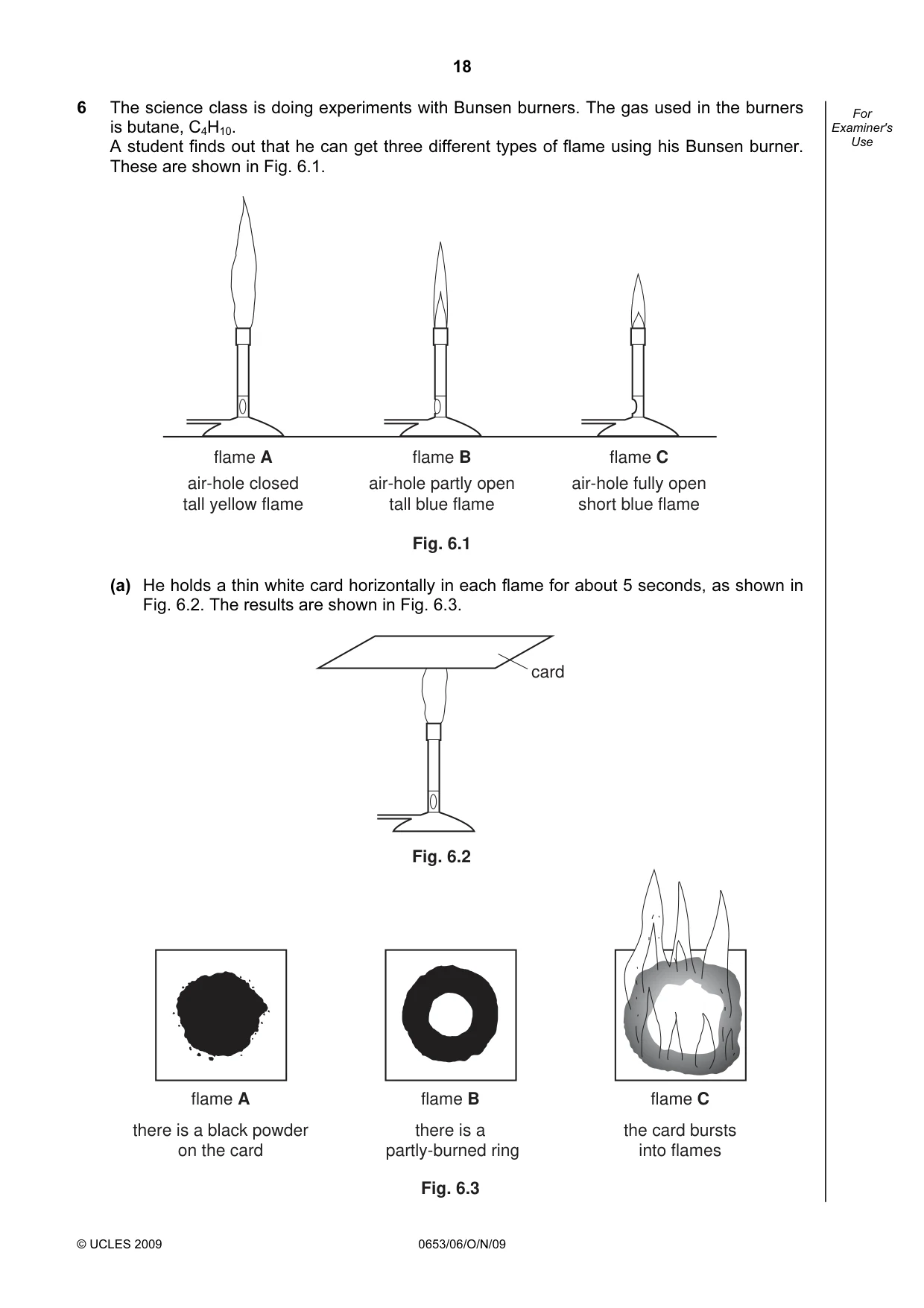
18 © UCLES 2009 0653/06/O/N/09 For Examiner's Use 6 The science class is doing experiments with Bunsen burners. The gas used in the burners is butane, C4H10. A student finds out that he can get three different types of flame using his Bunsen burner. These are shown in Fig. 6.1. flame A air-hole closed tall yellow flame flame B air-hole partly open tall blue flame Fig. 6.1 flame C air-hole fully open short blue flame (a) He holds a thin white card horizontally in each flame for about 5 seconds, as shown in Fig. 6.2. The results are shown in Fig. 6.3. card Fig. 6.2 flame A there is a black powder on the card flame B there is a partly-burned ring Fig. 6.3 flame C the card bursts into flames
Question paper, page 19
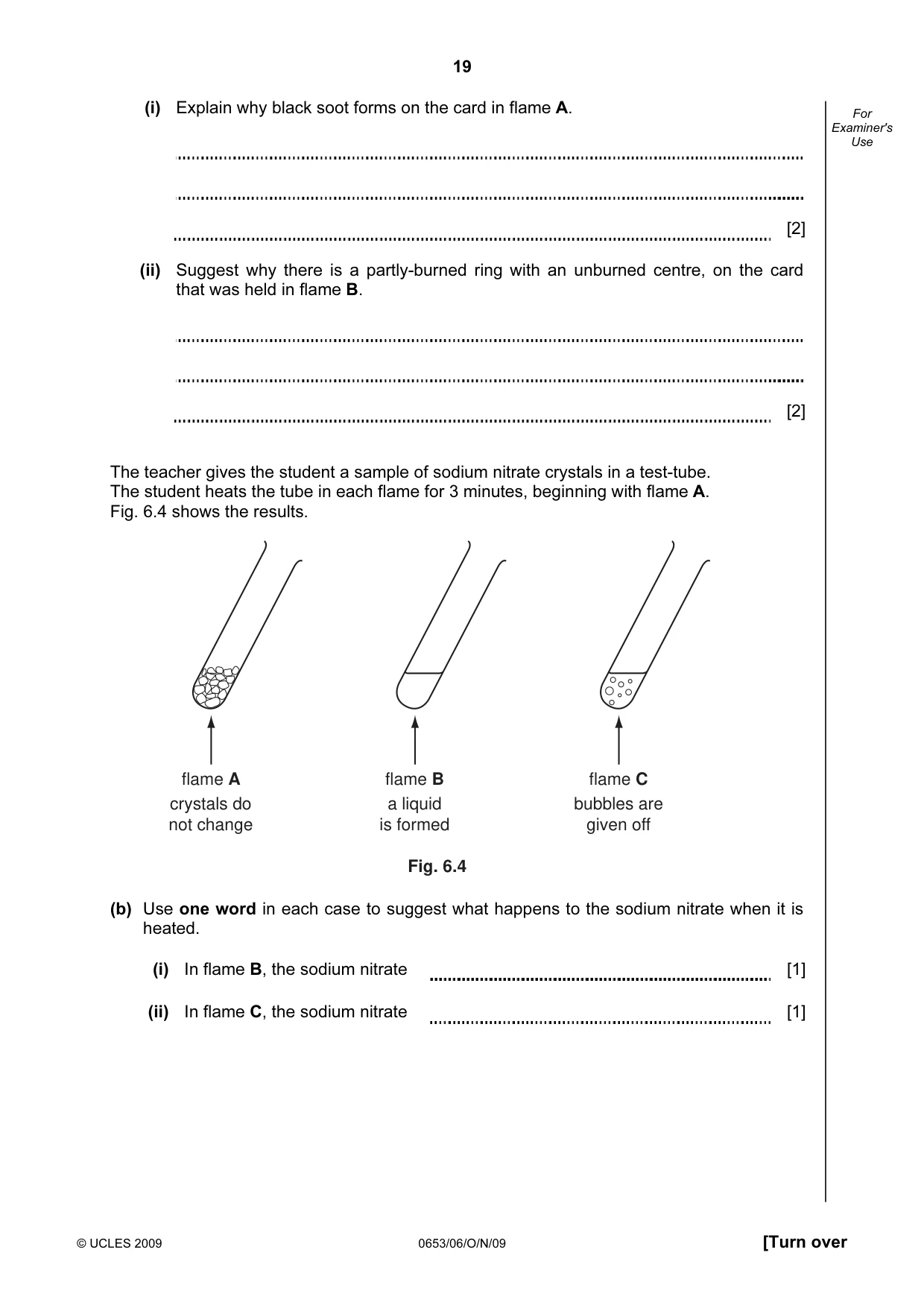
19 © UCLES 2009 0653/06/O/N/09 [Turn over For Examiner's Use (i) Explain why black soot forms on the card in flame A. [2] (ii) Suggest why there is a partly-burned ring with an unburned centre, on the card that was held in flame B. [2] The teacher gives the student a sample of sodium nitrate crystals in a test-tube. The student heats the tube in each flame for 3 minutes, beginning with flame A. Fig. 6.4 shows the results. flame A crystals do not change flame B a liquid is formed flame C bubbles are given off Fig. 6.4 (b) Use one word in each case to suggest what happens to the sodium nitrate when it is heated. (i) In flame B, the sodium nitrate [1] (ii) In flame C, the sodium nitrate [1]
Question paper, page 20
20 Permission to reproduce items where third-party owned material protected by copyright is included has been sought and cleared where possible. Every reasonable effort has been made by the publisher (UCLES) to trace copyright holders, but if any items requiring clearance have unwittingly been included, the publisher will be pleased to make amends at the earliest possible opportunity. University of Cambridge International Examinations is part of the Cambridge Assessment Group. Cambridge Assessment is the brand name of University of Cambridge Local Examinations Syndicate (UCLES), which is itself a department of the University of Cambridge. © UCLES 2009 0653/06/O/N/09 For Examiner's Use (c) The student thinks that oxygen is being given off from the sodium nitrate in flame C. Explain how he can show that the gas given off is oxygen. Give all necessary details of the test. [2] (d) The teacher asks the student to explain why flame C is hotter than the other flames. Suggest why flame C is the hottest. [2]
Mark scheme, page 1
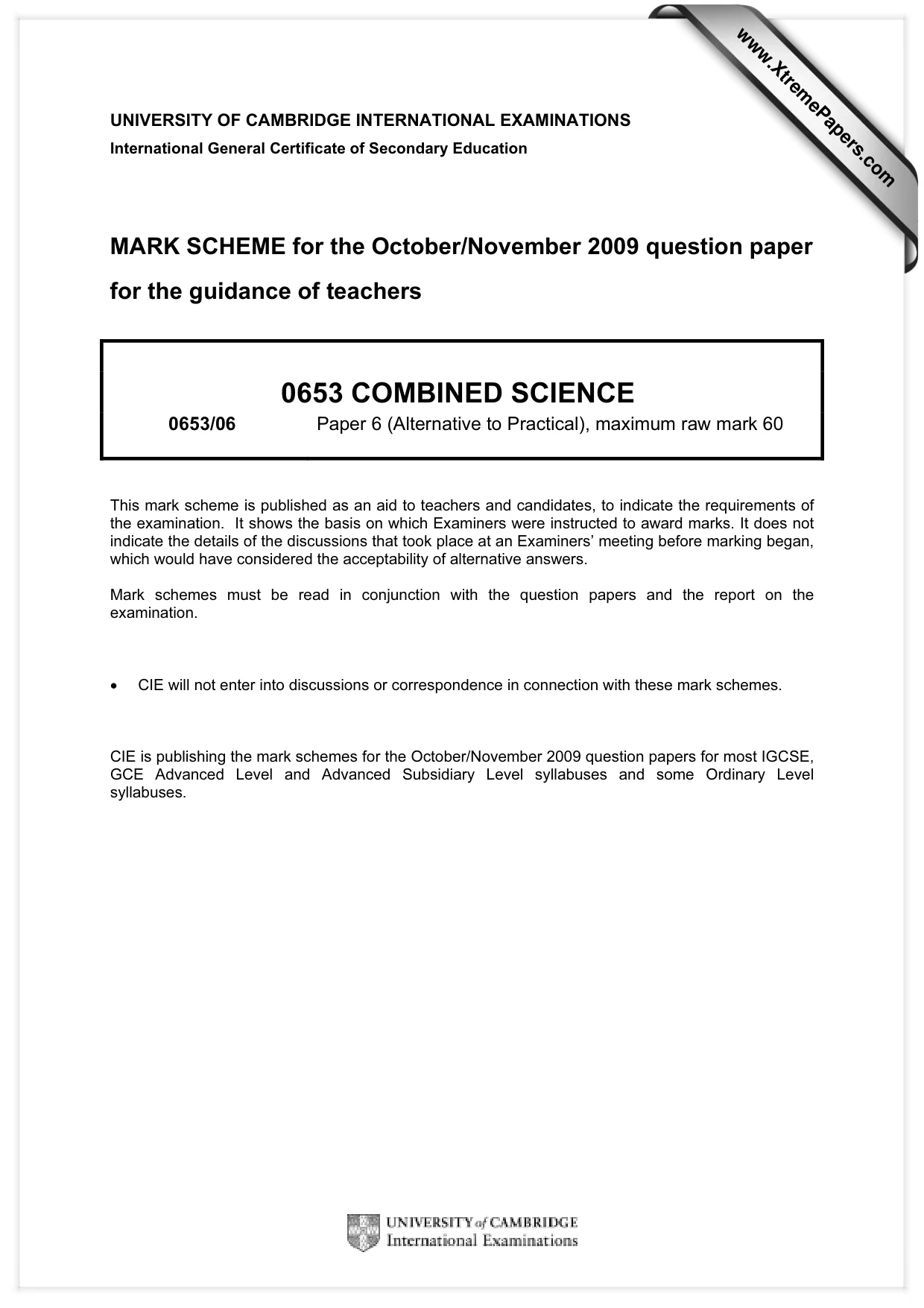
UNIVERSITY OF CAMBRIDGE INTERNATIONAL EXAMINATIONS International General Certificate of Secondary Education MARK SCHEME for the October/November 2009 question paper for the guidance of teachers 0653 COMBINED SCIENCE 0653/06 Paper 6 (Alternative to Practical), maximum raw mark 60 This mark scheme is published as an aid to teachers and candidates, to indicate the requirements of the examination. It shows the basis on which Examiners were instructed to award marks. It does not indicate the details of the discussions that took place at an Examiners’ meeting before marking began, which would have considered the acceptability of alternative answers. Mark schemes must be read in conjunction with the question papers and the report on the examination. • CIE will not enter into discussions or correspondence in connection with these mark schemes. CIE is publishing the mark schemes for the October/November 2009 question papers for most IGCSE, GCE Advanced Level and Advanced Subsidiary Level syllabuses and some Ordinary Level syllabuses. www.XtremePapers.com
Mark scheme, page 2
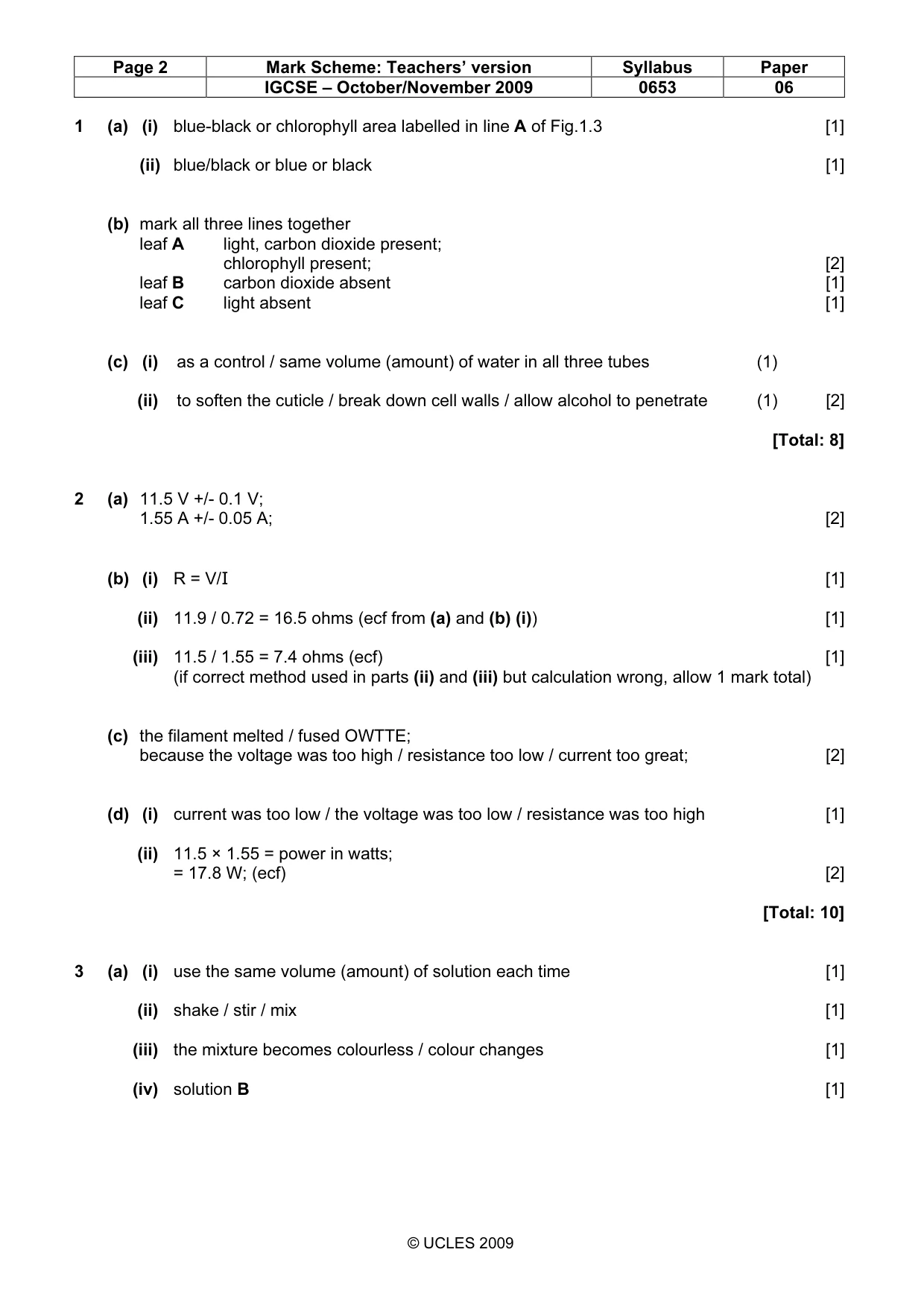
Page 2 Mark Scheme: Teachers’ version Syllabus Paper IGCSE – October/November 2009 0653 06 © UCLES 2009 1 (a) (i) blue-black or chlorophyll area labelled in line A of Fig.1.3 [1] (ii) blue/black or blue or black [1] (b) mark all three lines together leaf A light, carbon dioxide present; chlorophyll present; [2] leaf B carbon dioxide absent [1] leaf C light absent [1] (c) (i) as a control / same volume (amount) of water in all three tubes (1) (ii) to soften the cuticle / break down cell walls / allow alcohol to penetrate (1) [2] [Total: 8] 2 (a) 11.5 V +/- 0.1 V; 1.55 A +/- 0.05 A; [2] (b) (i) R = V/I [1] (ii) 11.9 / 0.72 = 16.5 ohms (ecf from (a) and (b) (i)) [1] (iii) 11.5 / 1.55 = 7.4 ohms (ecf) [1] (if correct method used in parts (ii) and (iii) but calculation wrong, allow 1 mark total) (c) the filament melted / fused OWTTE; because the voltage was too high / resistance too low / current too great; [2] (d) (i) current was too low / the voltage was too low / resistance was too high [1] (ii) 11.5 × 1.55 = power in watts; = 17.8 W; (ecf) [2] [Total: 10] 3 (a) (i) use the same volume (amount) of solution each time [1] (ii) shake / stir / mix [1] (iii) the mixture becomes colourless / colour changes [1] (iv) solution B [1]
Mark scheme, page 3
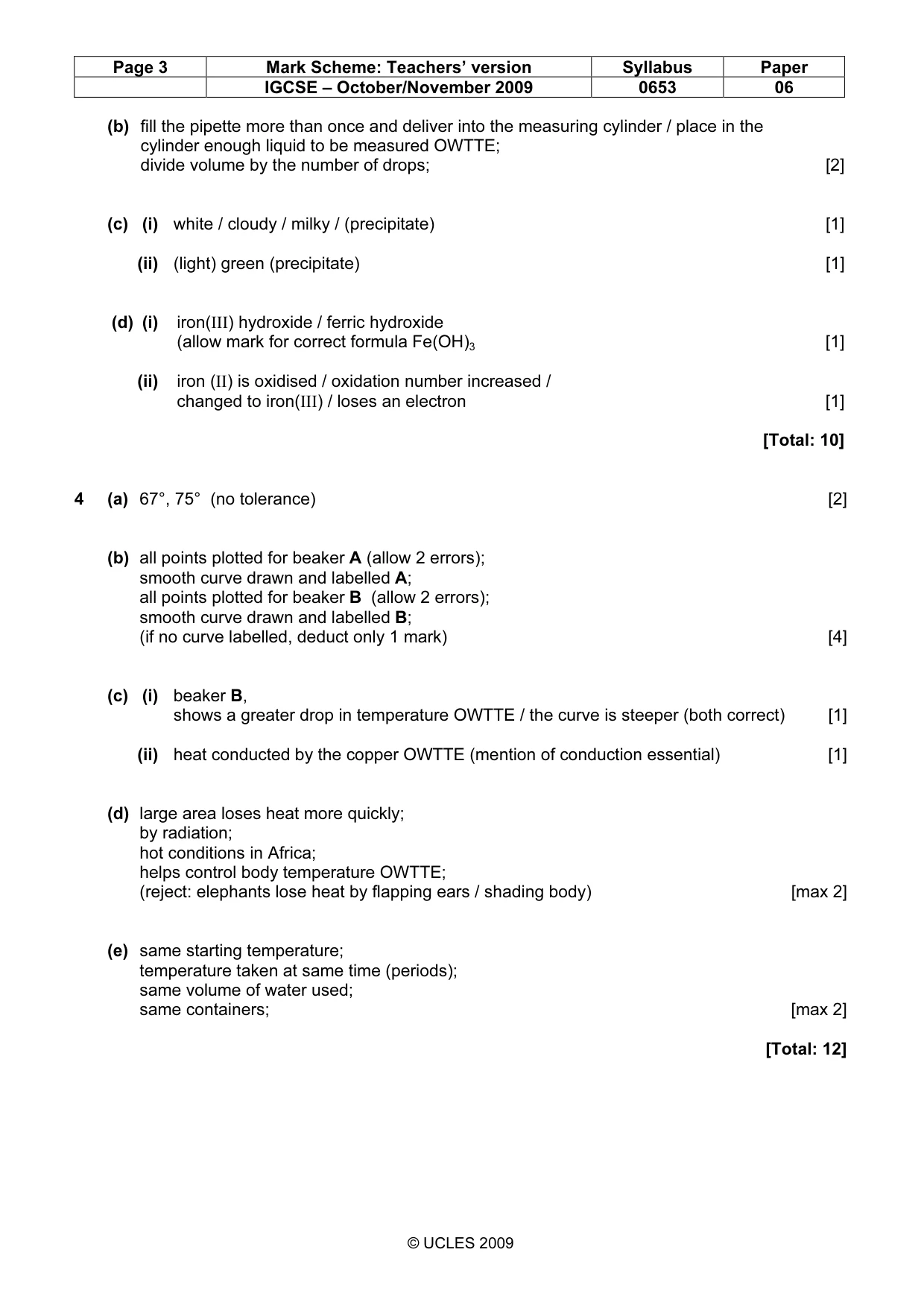
Page 3 Mark Scheme: Teachers’ version Syllabus Paper IGCSE – October/November 2009 0653 06 © UCLES 2009 (b) fill the pipette more than once and deliver into the measuring cylinder / place in the cylinder enough liquid to be measured OWTTE; divide volume by the number of drops; [2] (c) (i) white / cloudy / milky / (precipitate) [1] (ii) (light) green (precipitate) [1] (d) (i) iron(III) hydroxide / ferric hydroxide (allow mark for correct formula Fe(OH)3 [1] (ii) iron (II) is oxidised / oxidation number increased / changed to iron(III) / loses an electron [1] [Total: 10] 4 (a) 67°, 75° (no tolerance) [2] (b) all points plotted for beaker A (allow 2 errors); smooth curve drawn and labelled A; all points plotted for beaker B (allow 2 errors); smooth curve drawn and labelled B; (if no curve labelled, deduct only 1 mark) [4] (c) (i) beaker B, shows a greater drop in temperature OWTTE / the curve is steeper (both correct) [1] (ii) heat conducted by the copper OWTTE (mention of conduction essential) [1] (d) large area loses heat more quickly; by radiation; hot conditions in Africa; helps control body temperature OWTTE; (reject: elephants lose heat by flapping ears / shading body) [max 2] (e) same starting temperature; temperature taken at same time (periods); same volume of water used; same containers; [max 2] [Total: 12]
Mark scheme, page 4
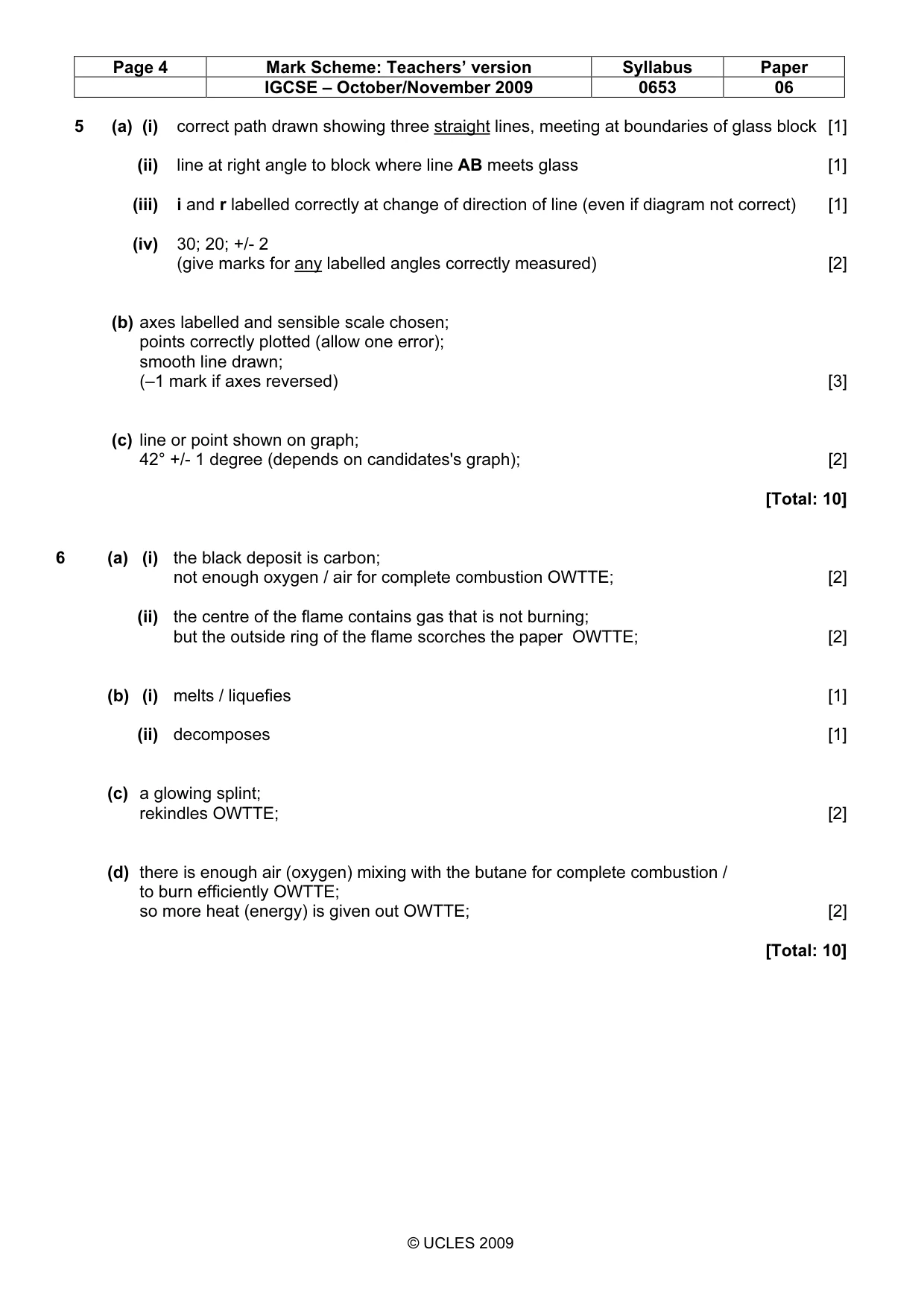
Page 4 Mark Scheme: Teachers’ version Syllabus Paper IGCSE – October/November 2009 0653 06 © UCLES 2009 5 (a) (i) correct path drawn showing three straight lines, meeting at boundaries of glass block [1] (ii) line at right angle to block where line AB meets glass [1] (iii) i and r labelled correctly at change of direction of line (even if diagram not correct) [1] (iv) 30; 20; +/- 2 (give marks for any labelled angles correctly measured) [2] (b) axes labelled and sensible scale chosen; points correctly plotted (allow one error); smooth line drawn; (–1 mark if axes reversed) [3] (c) line or point shown on graph; 42° +/- 1 degree (depends on candidates's graph); [2] [Total: 10] 6 (a) (i) the black deposit is carbon; not enough oxygen / air for complete combustion OWTTE; [2] (ii) the centre of the flame contains gas that is not burning; but the outside ring of the flame scorches the paper OWTTE; [2] (b) (i) melts / liquefies [1] (ii) decomposes [1] (c) a glowing splint; rekindles OWTTE; [2] (d) there is enough air (oxygen) mixing with the butane for complete combustion / to burn efficiently OWTTE; so more heat (energy) is given out OWTTE; [2] [Total: 10]
What you needed in this session
Cambridge’s own grade thresholds for 2009 Oct/Nov, Paper 6 · Variant 1. A higher threshold means an easier paper — the bar moves with how the cohort did.