Cambridge IGCSE Science - Combined 0653 — 2007 May/June Paper 5 · Variant 1
0653/51/M/J/07 · 30 marks · ≈34 min
The question paper and its mark scheme, free to read here and free to download. This is Cambridge’s own paper, exactly as it was sat.
Question paper8 pages

Mark scheme3 pages
Answers below. Sit the paper first if you are practising.
Paper as text
Question paper, page 1
This document consists of 7 printed pages and 1 blank page. IB07 06_0653_05/FP © UCLES 2007 [Turn over *8653024441* For Examiner's Use 1 2 3 Total UNIVERSITY OF CAMBRIDGE INTERNATIONAL EXAMINATIONS International General Certificate of Secondary Education COMBINED SCIENCE 0653/05 Paper 5 Practical Test May/June 2007 1 hour 30 minutes Candidates answer on the Question Paper. Additional Materials: As listed in Instructions to Supervisors. READ THESE INSTRUCTIONS FIRST Write your Centre number, candidate number and name on all the work you hand in. Write in dark blue or black pen. You may use a pencil for any diagrams, graphs or rough working. Do not use staples, paper clips, highlighters, glue or correction fluid. DO NOT WRITE IN ANY BARCODES. Answer all questions. Chemistry practical notes for this paper are printed on page 8. At the end of the examination, fasten all your work securely together. The number of marks is given in brackets [ ] at the end of each question or part question. www.XtremePapers.com
Question paper, page 2
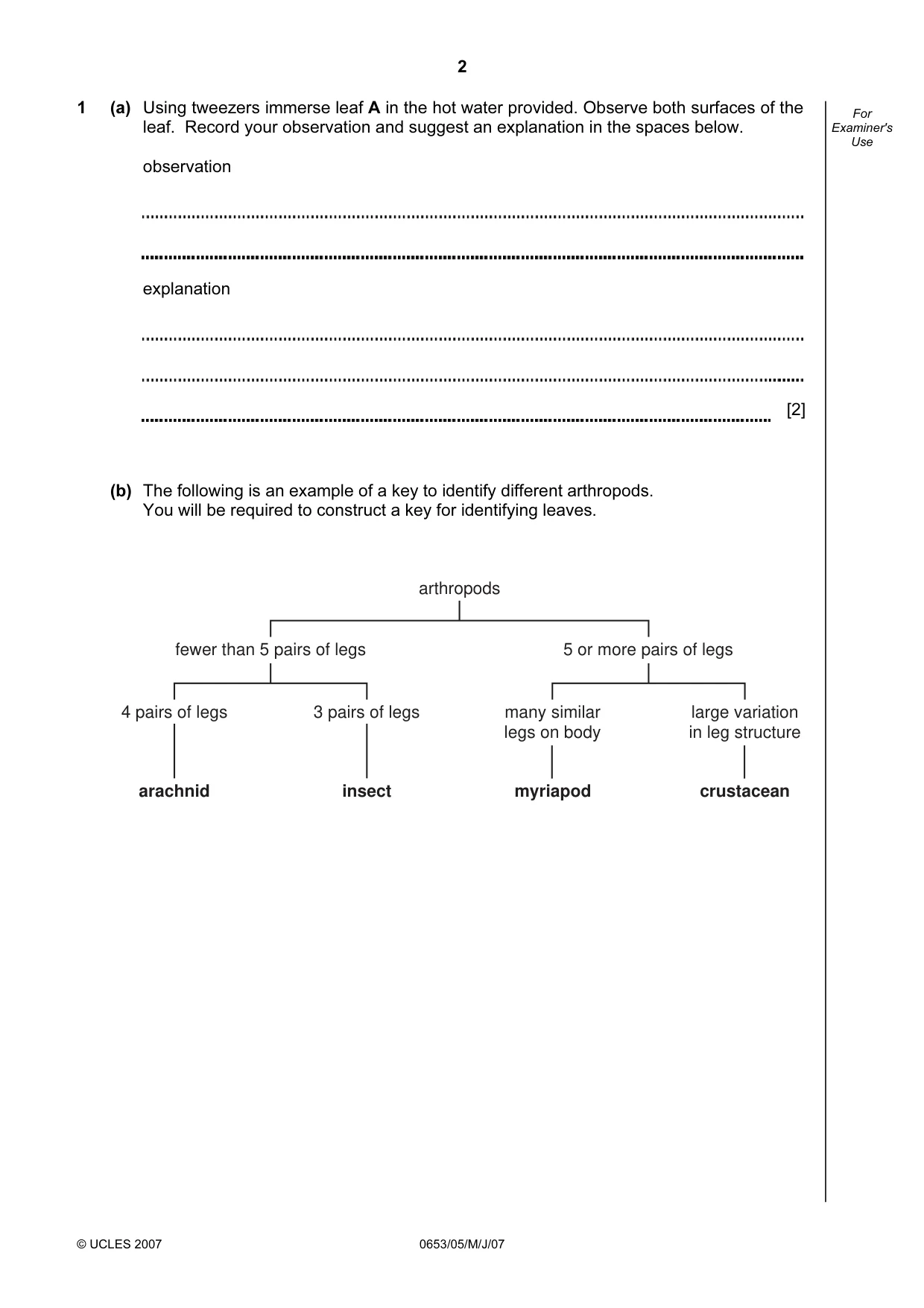
2 © UCLES 2007 0653/05/M/J/07 For Examiner's Use 1 (a) Using tweezers immerse leaf A in the hot water provided. Observe both surfaces of the leaf. Record your observation and suggest an explanation in the spaces below. observation explanation [2] (b) The following is an example of a key to identify different arthropods. You will be required to construct a key for identifying leaves. arthropods fewer than 5 pairs of legs 4 pairs of legs 3 pairs of legs many similar legs on body large variation in leg structure arachnid insect myriapod crustacean 5 or more pairs of legs
Question paper, page 3
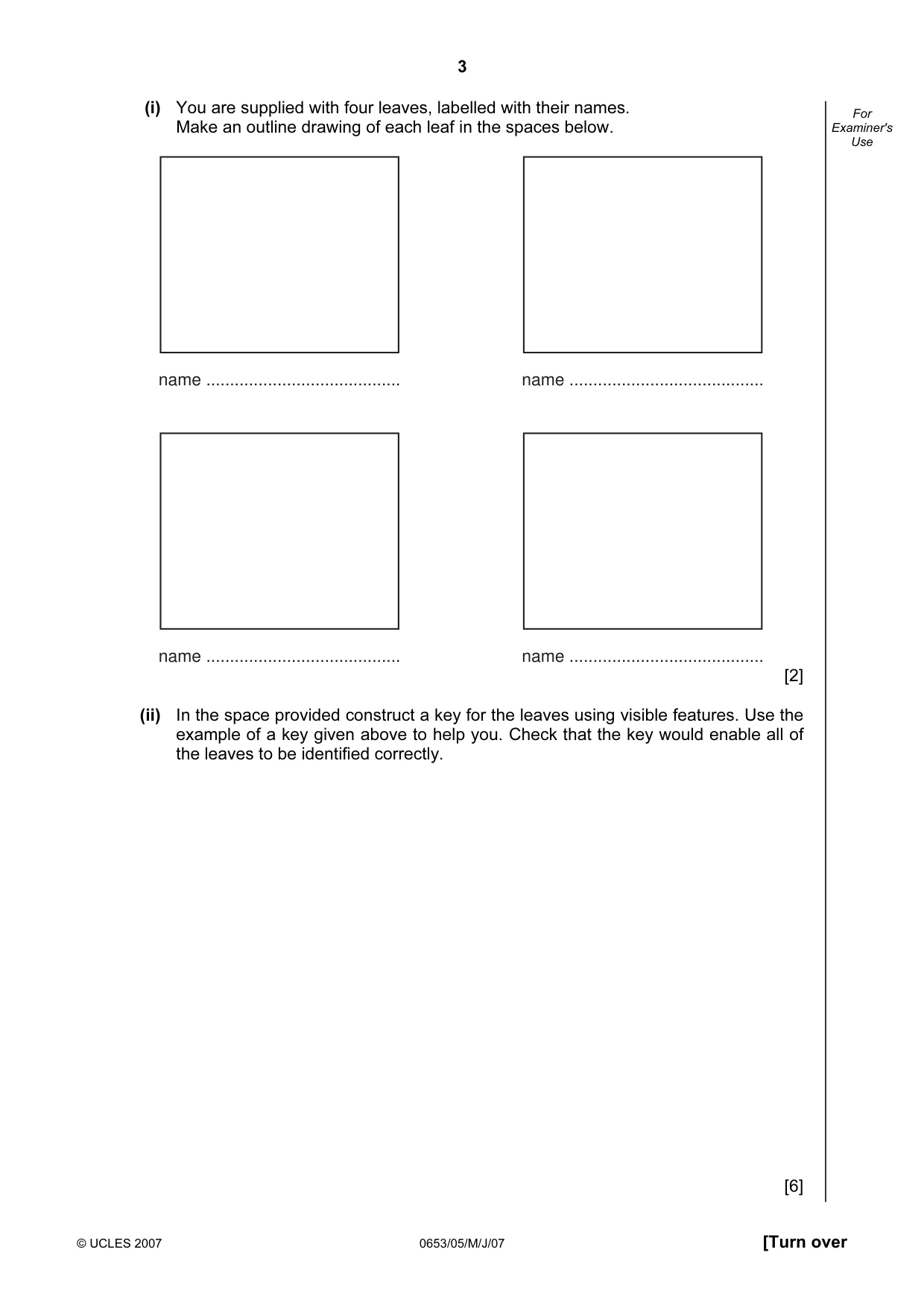
3 © UCLES 2007 0653/05/M/J/07 [Turn over For Examiner's Use (i) You are supplied with four leaves, labelled with their names. Make an outline drawing of each leaf in the spaces below. name … name … name … name … [2] (ii) In the space provided construct a key for the leaves using visible features. Use the example of a key given above to help you. Check that the key would enable all of the leaves to be identified correctly. [6]
Question paper, page 4
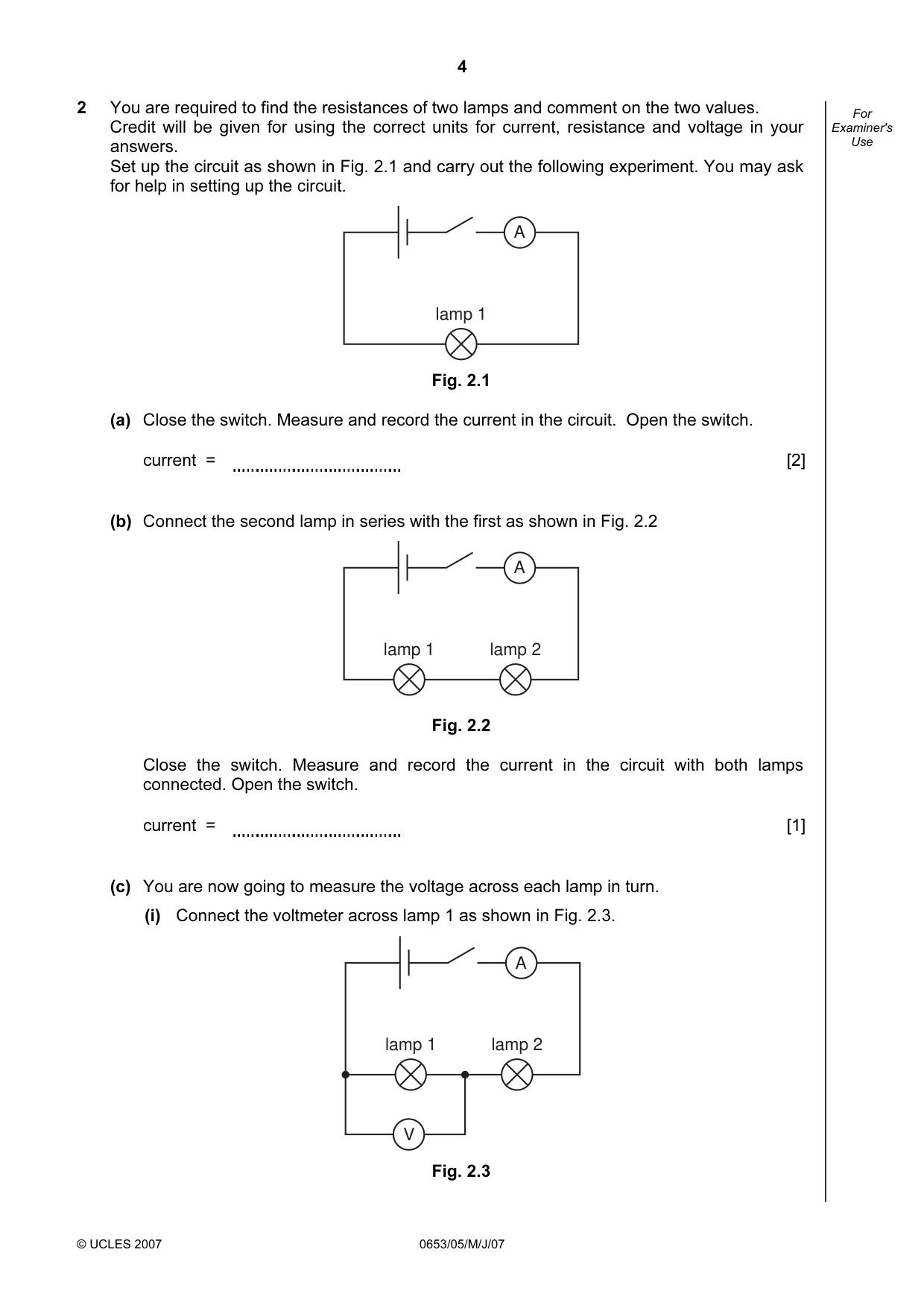
4 © UCLES 2007 0653/05/M/J/07 For Examiner's Use 2 You are required to find the resistances of two lamps and comment on the two values. Credit will be given for using the correct units for current, resistance and voltage in your answers. Set up the circuit as shown in Fig. 2.1 and carry out the following experiment. You may ask for help in setting up the circuit. A lamp 1 Fig. 2.1 (a) Close the switch. Measure and record the current in the circuit. Open the switch. current = [2] (b) Connect the second lamp in series with the first as shown in Fig. 2.2 A lamp 1 lamp 2 Fig. 2.2 Close the switch. Measure and record the current in the circuit with both lamps connected. Open the switch. current = [1] (c) You are now going to measure the voltage across each lamp in turn. (i) Connect the voltmeter across lamp 1 as shown in Fig. 2.3. A lamp 1 lamp 2 V Fig. 2.3
Question paper, page 5
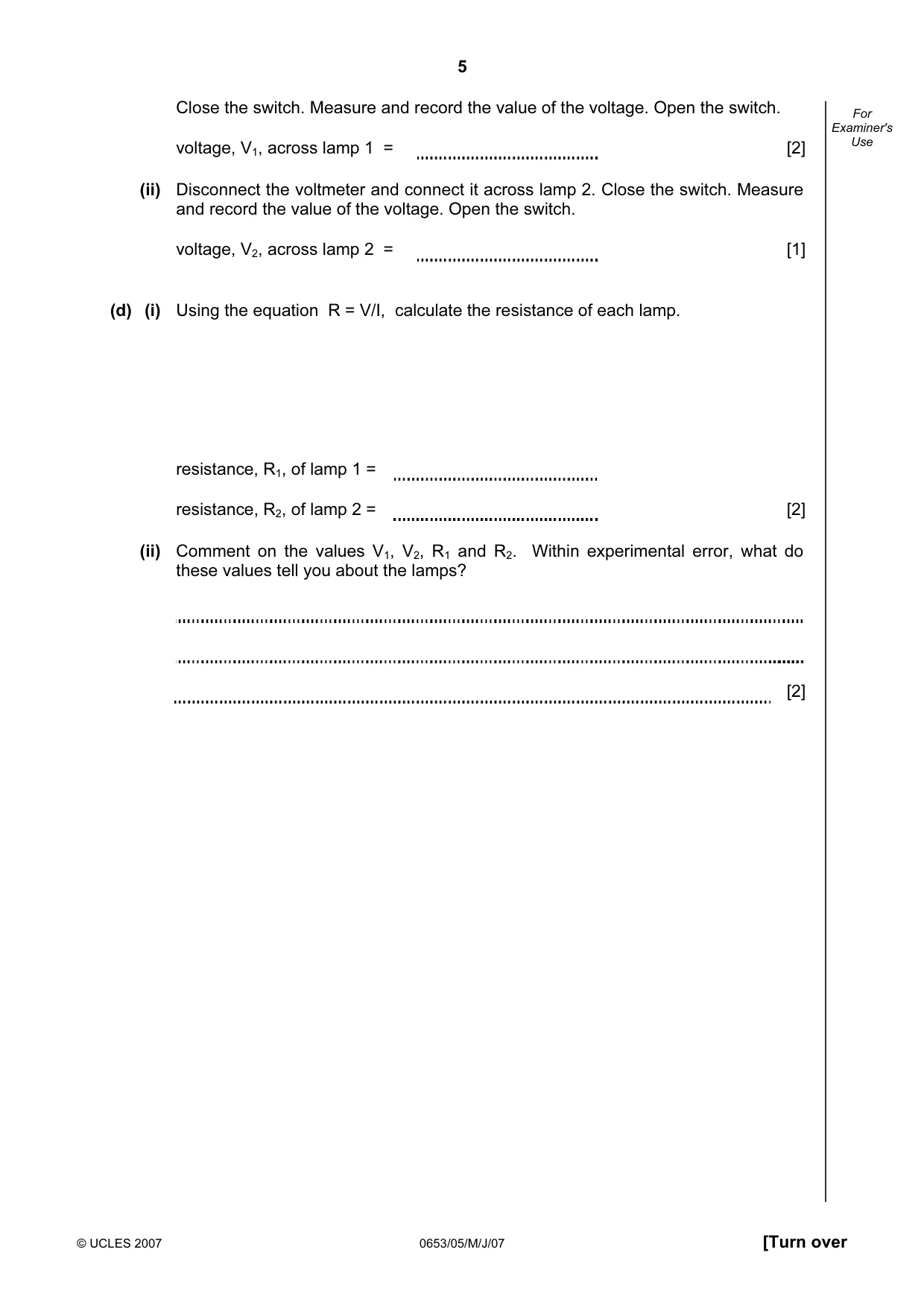
5 © UCLES 2007 0653/05/M/J/07 [Turn over For Examiner's Use Close the switch. Measure and record the value of the voltage. Open the switch. voltage, V1, across lamp 1 = [2] (ii) Disconnect the voltmeter and connect it across lamp 2. Close the switch. Measure and record the value of the voltage. Open the switch. voltage, V2, across lamp 2 = [1] (d) (i) Using the equation R = V/I, calculate the resistance of each lamp. resistance, R1, of lamp 1 = resistance, R2, of lamp 2 = [2] (ii) Comment on the values V1, V2, R1 and R2. Within experimental error, what do these values tell you about the lamps? [2]
Question paper, page 6
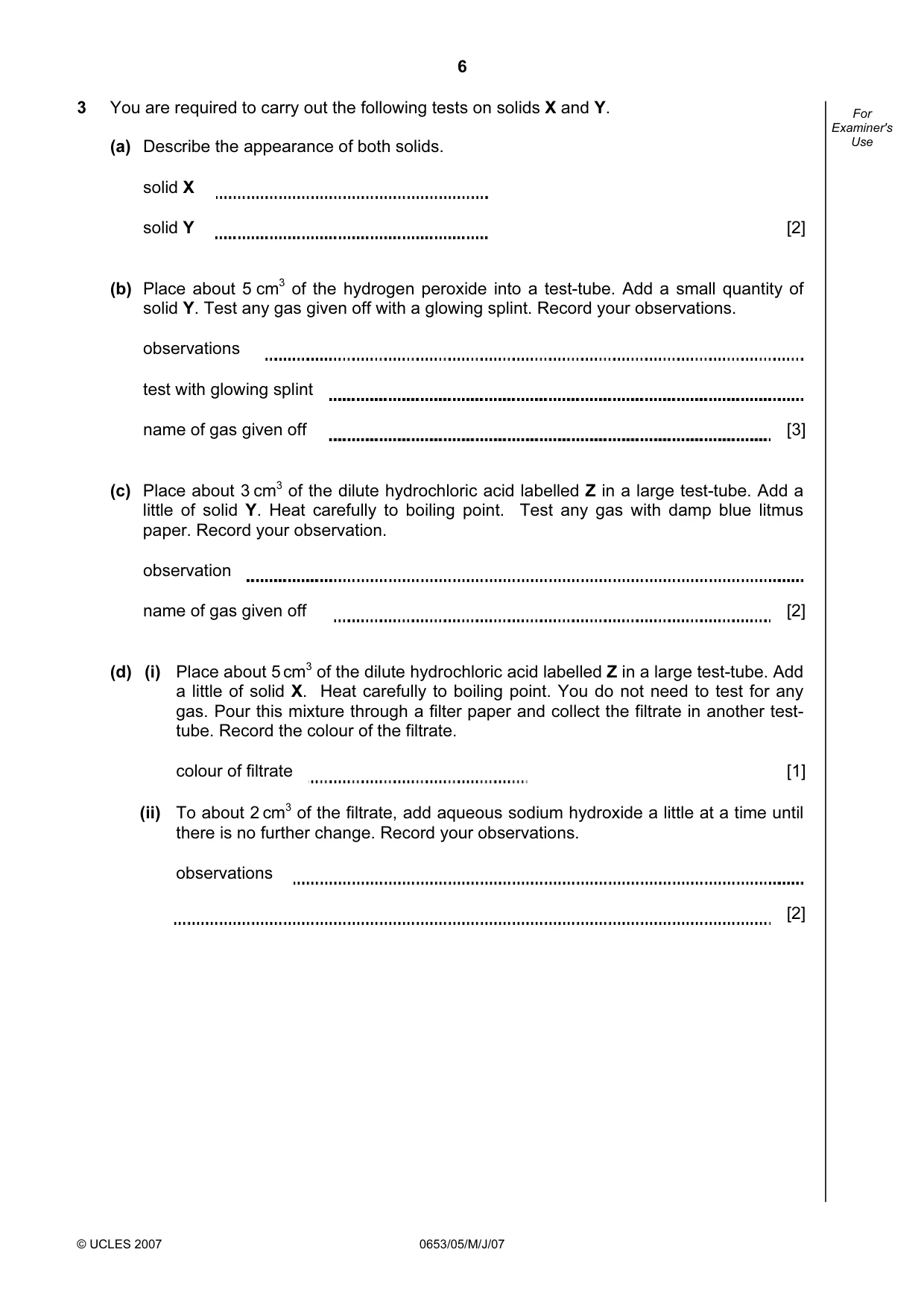
6 © UCLES 2007 0653/05/M/J/07 For Examiner's Use 3 You are required to carry out the following tests on solids X and Y. (a) Describe the appearance of both solids. solid X solid Y [2] (b) Place about 5 cm3 of the hydrogen peroxide into a test-tube. Add a small quantity of solid Y. Test any gas given off with a glowing splint. Record your observations. observations test with glowing splint name of gas given off [3] (c) Place about 3 cm3 of the dilute hydrochloric acid labelled Z in a large test-tube. Add a little of solid Y. Heat carefully to boiling point. Test any gas with damp blue litmus paper. Record your observation. observation name of gas given off [2] (d) (i) Place about 5 cm3 of the dilute hydrochloric acid labelled Z in a large test-tube. Add a little of solid X. Heat carefully to boiling point. You do not need to test for any gas. Pour this mixture through a filter paper and collect the filtrate in another test- tube. Record the colour of the filtrate. colour of filtrate [1] (ii) To about 2 cm3 of the filtrate, add aqueous sodium hydroxide a little at a time until there is no further change. Record your observations. observations [2]
Question paper, page 8
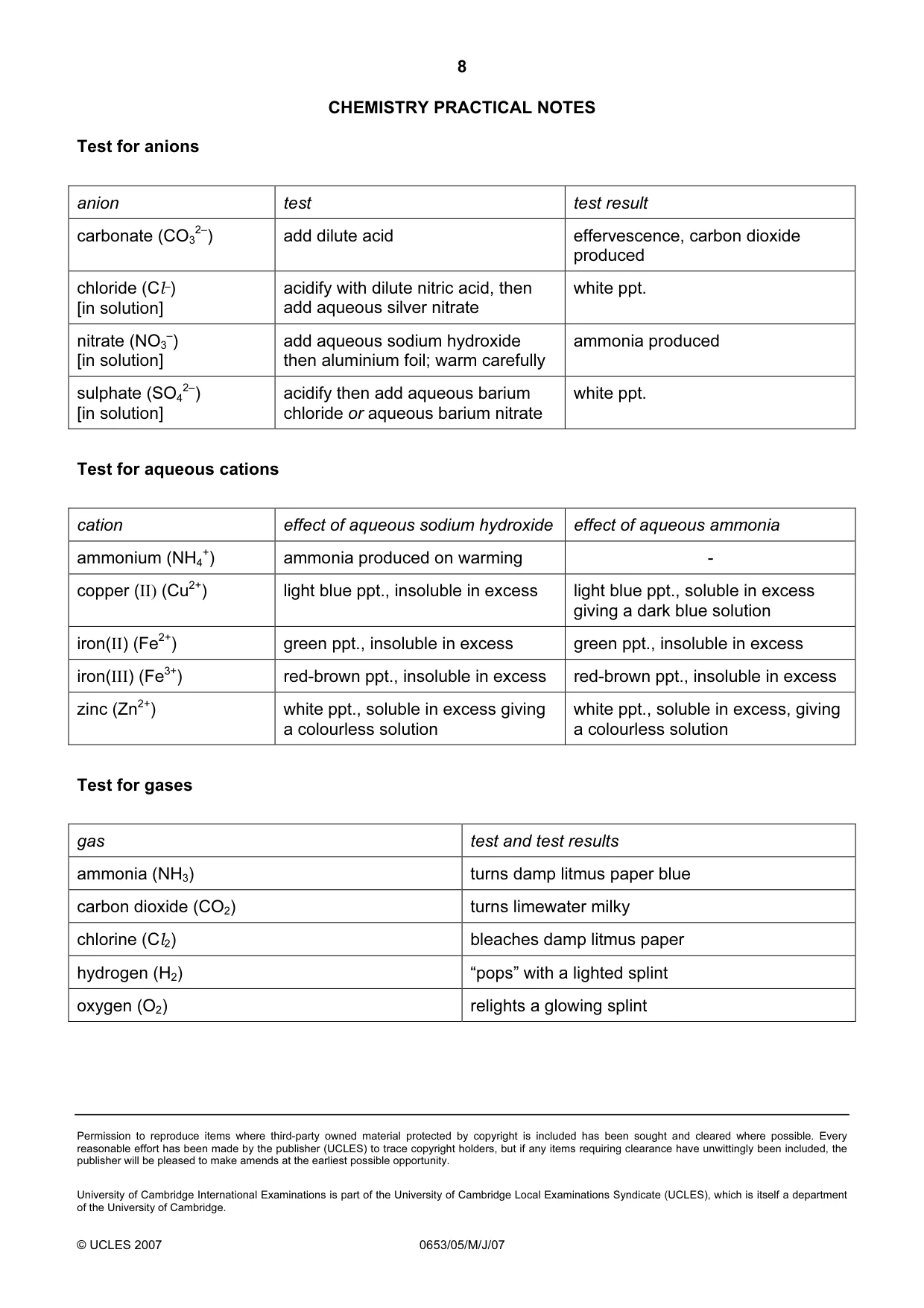
8 Permission to reproduce items where third-party owned material protected by copyright is included has been sought and cleared where possible. Every reasonable effort has been made by the publisher (UCLES) to trace copyright holders, but if any items requiring clearance have unwittingly been included, the publisher will be pleased to make amends at the earliest possible opportunity. University of Cambridge International Examinations is part of the University of Cambridge Local Examinations Syndicate (UCLES), which is itself a department of the University of Cambridge. © UCLES 2007 0653/05/M/J/07 CHEMISTRY PRACTICAL NOTES Test for anions anion test test result carbonate (CO3 2–) add dilute acid effervescence, carbon dioxide produced chloride (Cl–) [in solution] acidify with dilute nitric acid, then add aqueous silver nitrate white ppt. nitrate (NO3 –) [in solution] add aqueous sodium hydroxide then aluminium foil; warm carefully ammonia produced sulphate (SO4 2–) [in solution] acidify then add aqueous barium chloride or aqueous barium nitrate white ppt. Test for aqueous cations cation effect of aqueous sodium hydroxide effect of aqueous ammonia ammonium (NH4 +) ammonia produced on warming - copper (II) (Cu2+) light blue ppt., insoluble in excess light blue ppt., soluble in excess giving a dark blue solution iron(II) (Fe2+) green ppt., insoluble in excess green ppt., insoluble in excess iron(III) (Fe3+) red-brown ppt., insoluble in excess red-brown ppt., insoluble in excess zinc (Zn2+) white ppt., soluble in excess giving a colourless solution white ppt., soluble in excess, giving a colourless solution Test for gases gas test and test results ammonia (NH3) turns damp litmus paper blue carbon dioxide (CO2) turns limewater milky chlorine (Cl2) bleaches damp litmus paper hydrogen (H2) “pops” with a lighted splint oxygen (O2) relights a glowing splint
Mark scheme, page 1
UNIVERSITY OF CAMBRIDGE INTERNATIONAL EXAMINATIONS International General Certificate of Secondary Education MARK SCHEME for the May/June 2007 question paper 0653 COMBINED SCIENCE 0653/05 Paper 5 (Practical), maximum raw mark 30 This mark scheme is published as an aid to teachers and candidates, to indicate the requirements of the examination. It shows the basis on which Examiners were instructed to award marks. It does not indicate the details of the discussions that took place at an Examiners’ meeting before marking began. All Examiners are instructed that alternative correct answers and unexpected approaches in candidates’ scripts must be given marks that fairly reflect the relevant knowledge and skills demonstrated. Mark schemes must be read in conjunction with the question papers and the report on the examination. • CIE will not enter into discussions or correspondence in connection with these mark schemes. CIE is publishing the mark schemes for the May/June 2007 question papers for most IGCSE, GCE Advanced Level and Advanced Subsidiary Level syllabuses and some Ordinary Level syllabuses. www.XtremePapers.com
Mark scheme, page 2
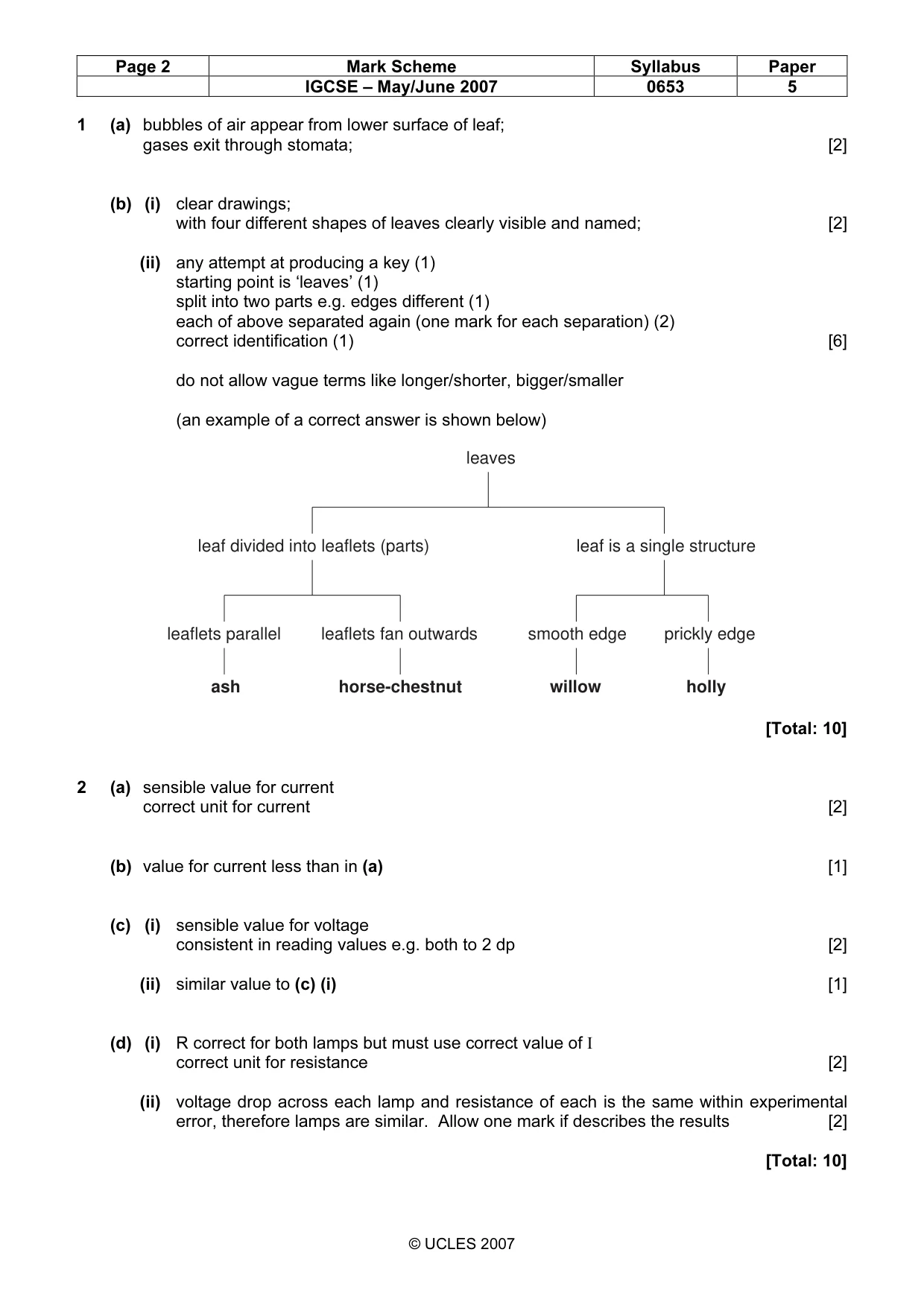
Page 2 Mark Scheme Syllabus Paper IGCSE – May/June 2007 0653 5 © UCLES 2007 1 (a) bubbles of air appear from lower surface of leaf; gases exit through stomata; [2] (b) (i) clear drawings; with four different shapes of leaves clearly visible and named; [2] (ii) any attempt at producing a key (1) starting point is ‘leaves’ (1) split into two parts e.g. edges different (1) each of above separated again (one mark for each separation) (2) correct identification (1) [6] do not allow vague terms like longer/shorter, bigger/smaller (an example of a correct answer is shown below) leaves leaf divided into leaflets (parts) leaf is a single structure leaflets parallel smooth edge leaflets fan outwards prickly edge ash willow horse-chestnut holly [Total: 10] 2 (a) sensible value for current correct unit for current [2] (b) value for current less than in (a) [1] (c) (i) sensible value for voltage consistent in reading values e.g. both to 2 dp [2] (ii) similar value to (c) (i) [1] (d) (i) R correct for both lamps but must use correct value of I correct unit for resistance [2] (ii) voltage drop across each lamp and resistance of each is the same within experimental error, therefore lamps are similar. Allow one mark if describes the results [2] [Total: 10]
Mark scheme, page 3
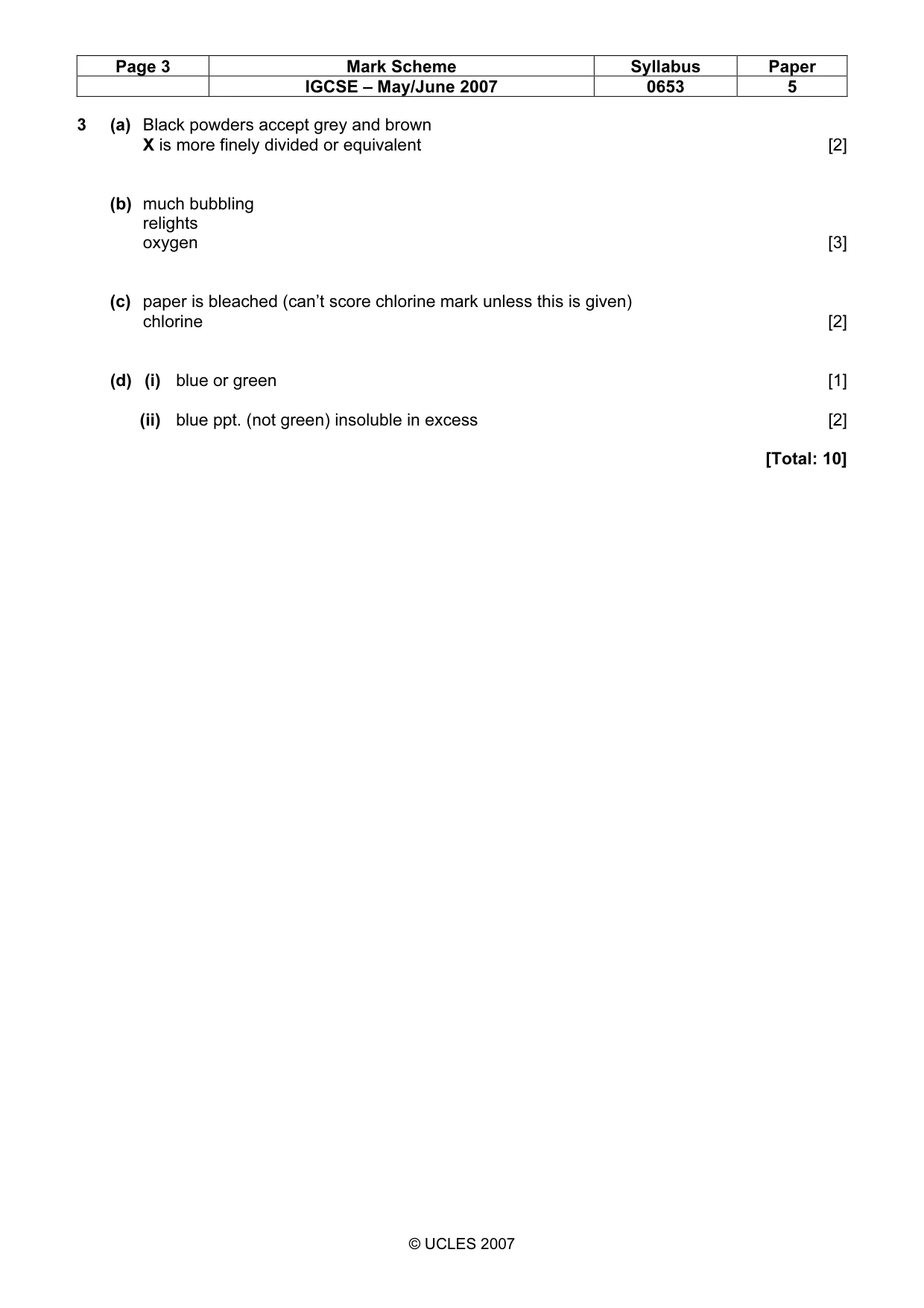
Page 3 Mark Scheme Syllabus Paper IGCSE – May/June 2007 0653 5 © UCLES 2007 3 (a) Black powders accept grey and brown X is more finely divided or equivalent [2] (b) much bubbling relights oxygen [3] (c) paper is bleached (can’t score chlorine mark unless this is given) chlorine [2] (d) (i) blue or green [1] (ii) blue ppt. (not green) insoluble in excess [2] [Total: 10]
What you needed in this session
Cambridge’s own grade thresholds for 2007 May/June, Paper 5 · Variant 1. A higher threshold means an easier paper — the bar moves with how the cohort did.