Cambridge IGCSE Science - Combined 0653 — 2005 May/June Paper 5 · Variant 1
0653/51/M/J/05
The question paper and its mark scheme, free to read here and free to download. This is Cambridge’s own paper, exactly as it was sat.
Question paper8 pages
Mark scheme5 pages
Answers below. Sit the paper first if you are practising.
Paper as text
Question paper, page 1
Centre Number Candidate Number Name UNIVERSITY OF CAMBRIDGE INTERNATIONAL EXAMINATIONS International General Certificate of Secondary Education COMBINED SCIENCE 0653/05 Paper 5 Practical Test May/June 2005 1 hour 30 minutes Candidates answer on the Question Paper. Additional Materials: As listed in Instructions to Supervisors READ THESE INSTRUCTIONS FIRST Write your Centre number, candidate number and name on all the work you hand in. Write in dark blue or black pen in the spaces provided on the Question Paper. You may use a soft pencil for any diagrams, graphs or rough working. Do not use staples, paper clips, highlighters, glue or correction fluid. Answer all questions. The number of marks is given in brackets [ ] at the end of each question or part question. Chemistry practical notes for this paper are printed on page 8. For Examiner’s Use 1 2 3 Total This document consists of 8 printed pages. IB05 06_0653_05/FP UCLES 2005 [Turn over If you have been given a label, look at the details. If any details are incorrect or missing, please fill in your correct details in the space given at the top of this page. Stick your personal label here, if provided. www.XtremePapers.com
Question paper, page 2
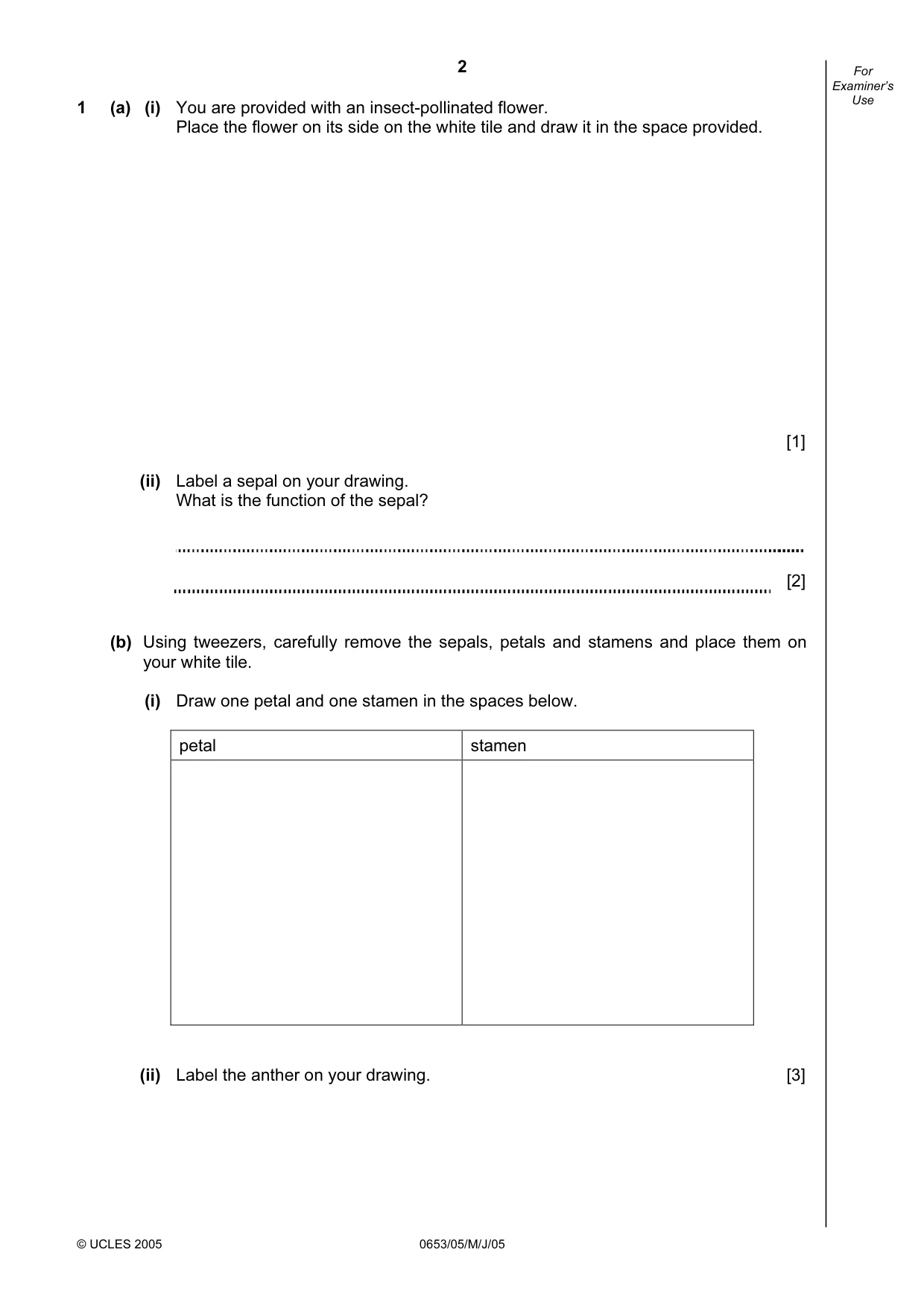
2 © UCLES 2005 0653/05/M/J/05 For Examiner’s Use 1 (a) (i) You are provided with an insect-pollinated flower. Place the flower on its side on the white tile and draw it in the space provided. [1] (ii) Label a sepal on your drawing. What is the function of the sepal? [2] (b) Using tweezers, carefully remove the sepals, petals and stamens and place them on your white tile. (i) Draw one petal and one stamen in the spaces below. petal stamen (ii) Label the anther on your drawing. [3]
Question paper, page 3
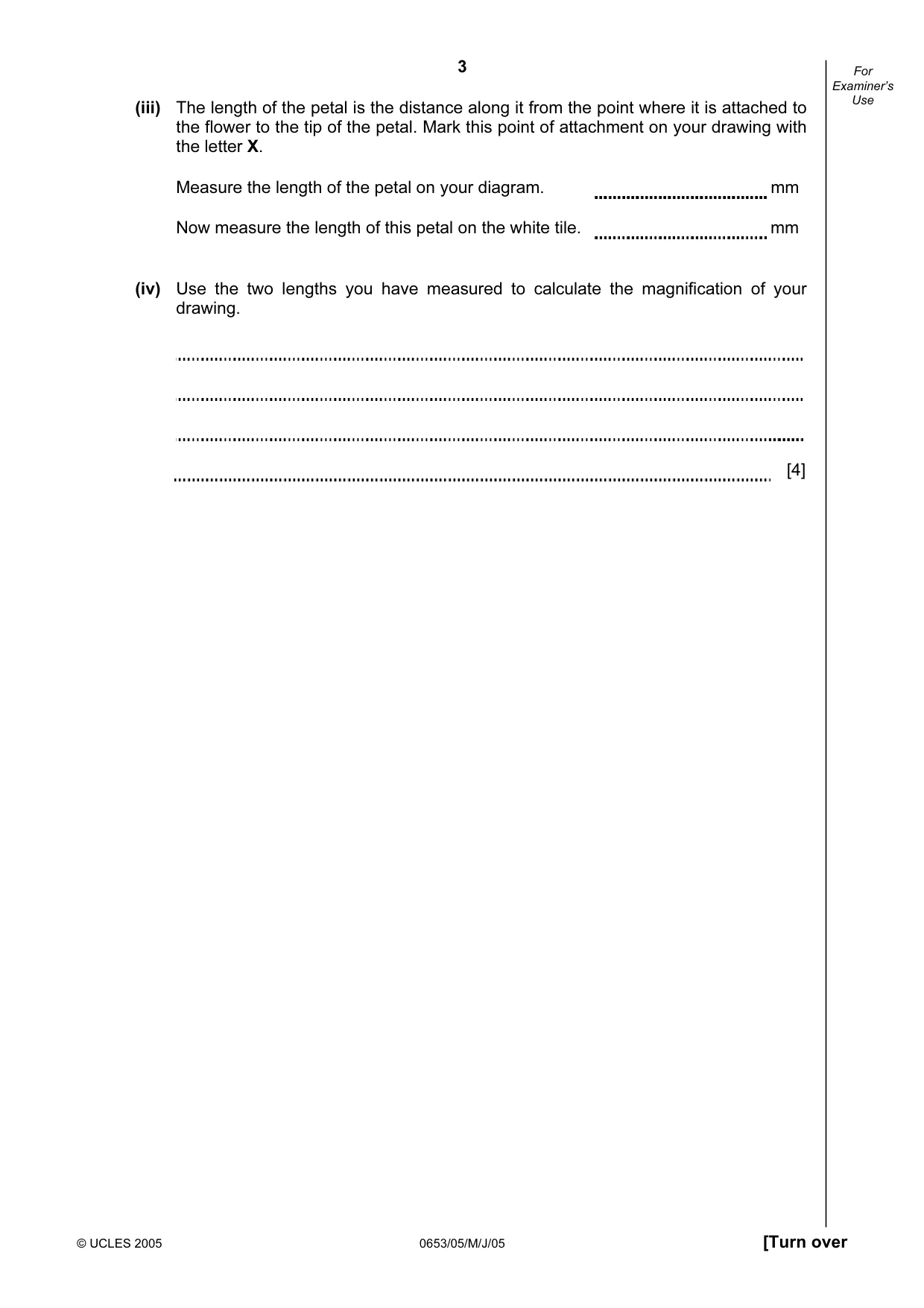
3 © UCLES 2005 0653/05/M/J/05 [Turn over For Examiner’s Use (iii) The length of the petal is the distance along it from the point where it is attached to the flower to the tip of the petal. Mark this point of attachment on your drawing with the letter X. Measure the length of the petal on your diagram. mm Now measure the length of this petal on the white tile. mm (iv) Use the two lengths you have measured to calculate the magnification of your drawing. [4]
Question paper, page 4
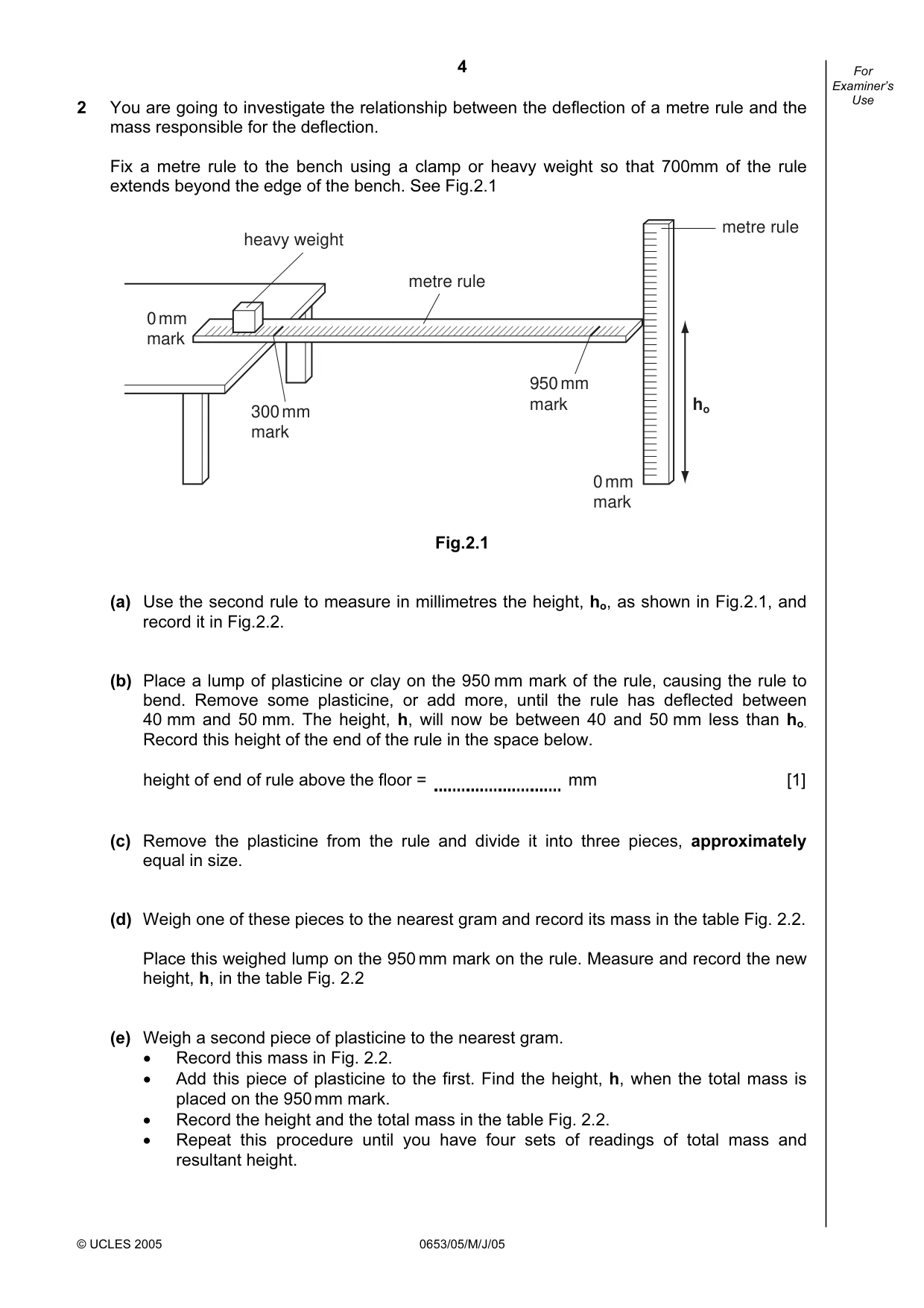
4 © UCLES 2005 0653/05/M/J/05 For Examiner’s Use 2 You are going to investigate the relationship between the deflection of a metre rule and the mass responsible for the deflection. Fix a metre rule to the bench using a clamp or heavy weight so that 700mm of the rule extends beyond the edge of the bench. See Fig.2.1 heavy weight metre rule metre rule 300 mm mark 950 mm mark 0 mm mark 0 mm mark ho Fig.2.1 (a) Use the second rule to measure in millimetres the height, ho, as shown in Fig.2.1, and record it in Fig.2.2. (b) Place a lump of plasticine or clay on the 950 mm mark of the rule, causing the rule to bend. Remove some plasticine, or add more, until the rule has deflected between 40 mm and 50 mm. The height, h, will now be between 40 and 50 mm less than ho. Record this height of the end of the rule in the space below. height of end of rule above the floor = mm [1] (c) Remove the plasticine from the rule and divide it into three pieces, approximately equal in size. (d) Weigh one of these pieces to the nearest gram and record its mass in the table Fig. 2.2. Place this weighed lump on the 950 mm mark on the rule. Measure and record the new height, h, in the table Fig. 2.2 (e) Weigh a second piece of plasticine to the nearest gram. • Record this mass in Fig. 2.2. • Add this piece of plasticine to the first. Find the height, h, when the total mass is placed on the 950 mm mark. • Record the height and the total mass in the table Fig. 2.2. • Repeat this procedure until you have four sets of readings of total mass and resultant height.
Question paper, page 5
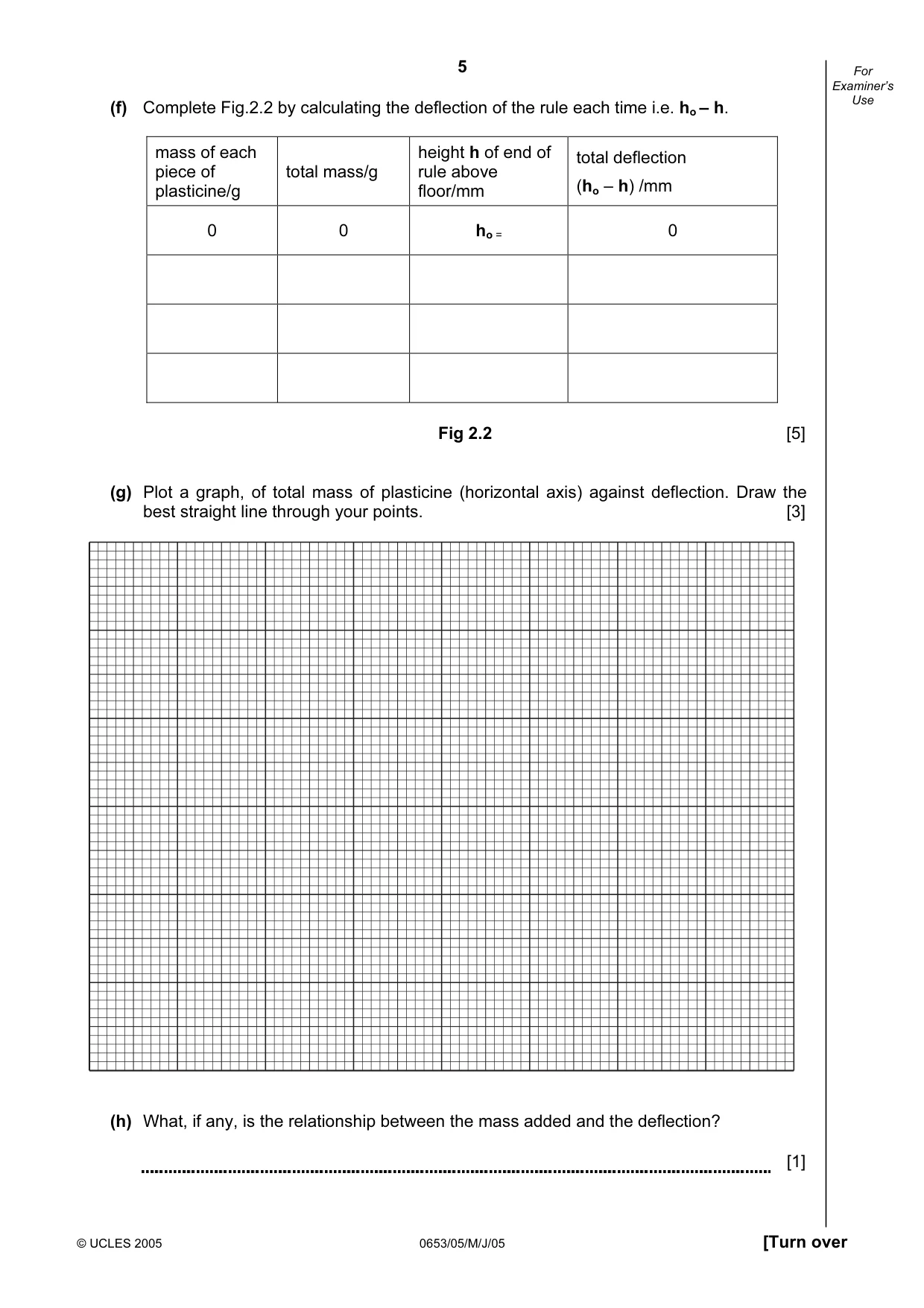
5 © UCLES 2005 0653/05/M/J/05 [Turn over For Examiner’s Use (f) Complete Fig.2.2 by calculating the deflection of the rule each time i.e. ho – h. mass of each piece of plasticine/g total mass/g height h of end of rule above floor/mm total deflection (ho – h) /mm 0 0 ho = 0 Fig 2.2 [5] (g) Plot a graph, of total mass of plasticine (horizontal axis) against deflection. Draw the best straight line through your points. [3] (h) What, if any, is the relationship between the mass added and the deflection? [1]
Question paper, page 6
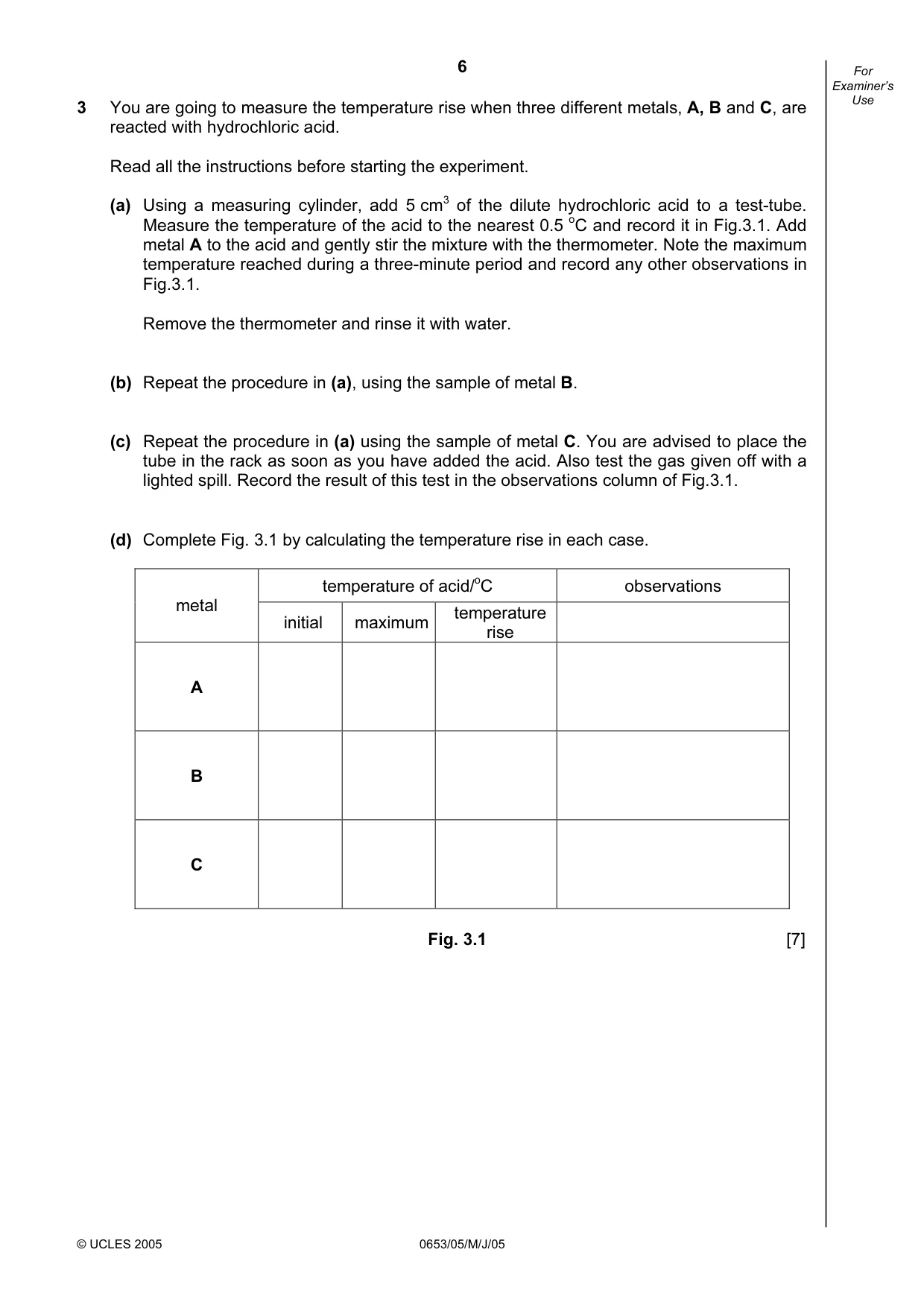
6 © UCLES 2005 0653/05/M/J/05 For Examiner’s Use 3 You are going to measure the temperature rise when three different metals, A, B and C, are reacted with hydrochloric acid. Read all the instructions before starting the experiment. (a) Using a measuring cylinder, add 5 cm3 of the dilute hydrochloric acid to a test-tube. Measure the temperature of the acid to the nearest 0.5 oC and record it in Fig.3.1. Add metal A to the acid and gently stir the mixture with the thermometer. Note the maximum temperature reached during a three-minute period and record any other observations in Fig.3.1. Remove the thermometer and rinse it with water. (b) Repeat the procedure in (a), using the sample of metal B. (c) Repeat the procedure in (a) using the sample of metal C. You are advised to place the tube in the rack as soon as you have added the acid. Also test the gas given off with a lighted spill. Record the result of this test in the observations column of Fig.3.1. (d) Complete Fig. 3.1 by calculating the temperature rise in each case. temperature of acid/oC observations metal initial maximum temperature rise A B C Fig. 3.1 [7]
Question paper, page 7
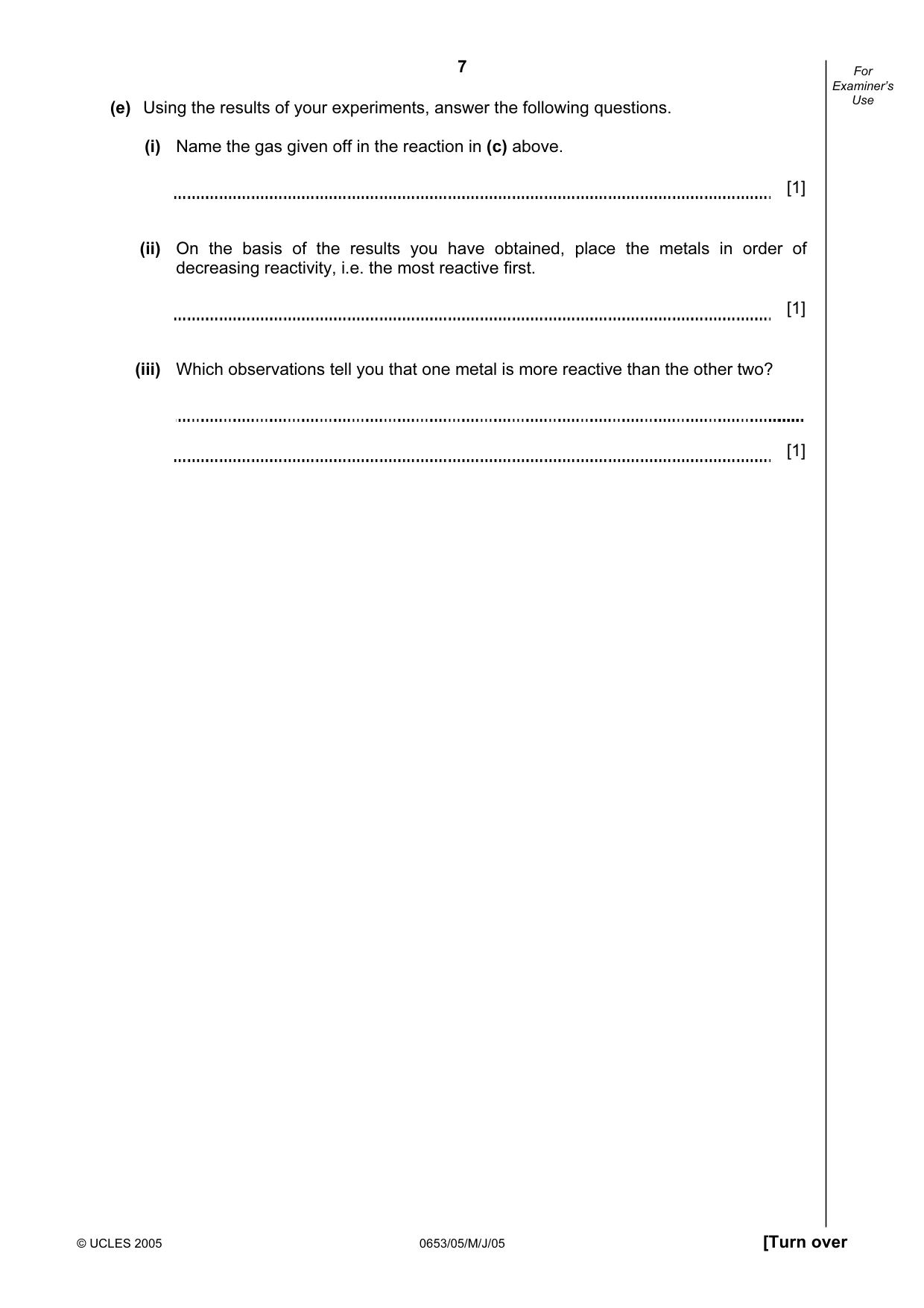
7 © UCLES 2005 0653/05/M/J/05 [Turn over For Examiner’s Use (e) Using the results of your experiments, answer the following questions. (i) Name the gas given off in the reaction in (c) above. [1] (ii) On the basis of the results you have obtained, place the metals in order of decreasing reactivity, i.e. the most reactive first. [1] (iii) Which observations tell you that one metal is more reactive than the other two? [1]
Question paper, page 8
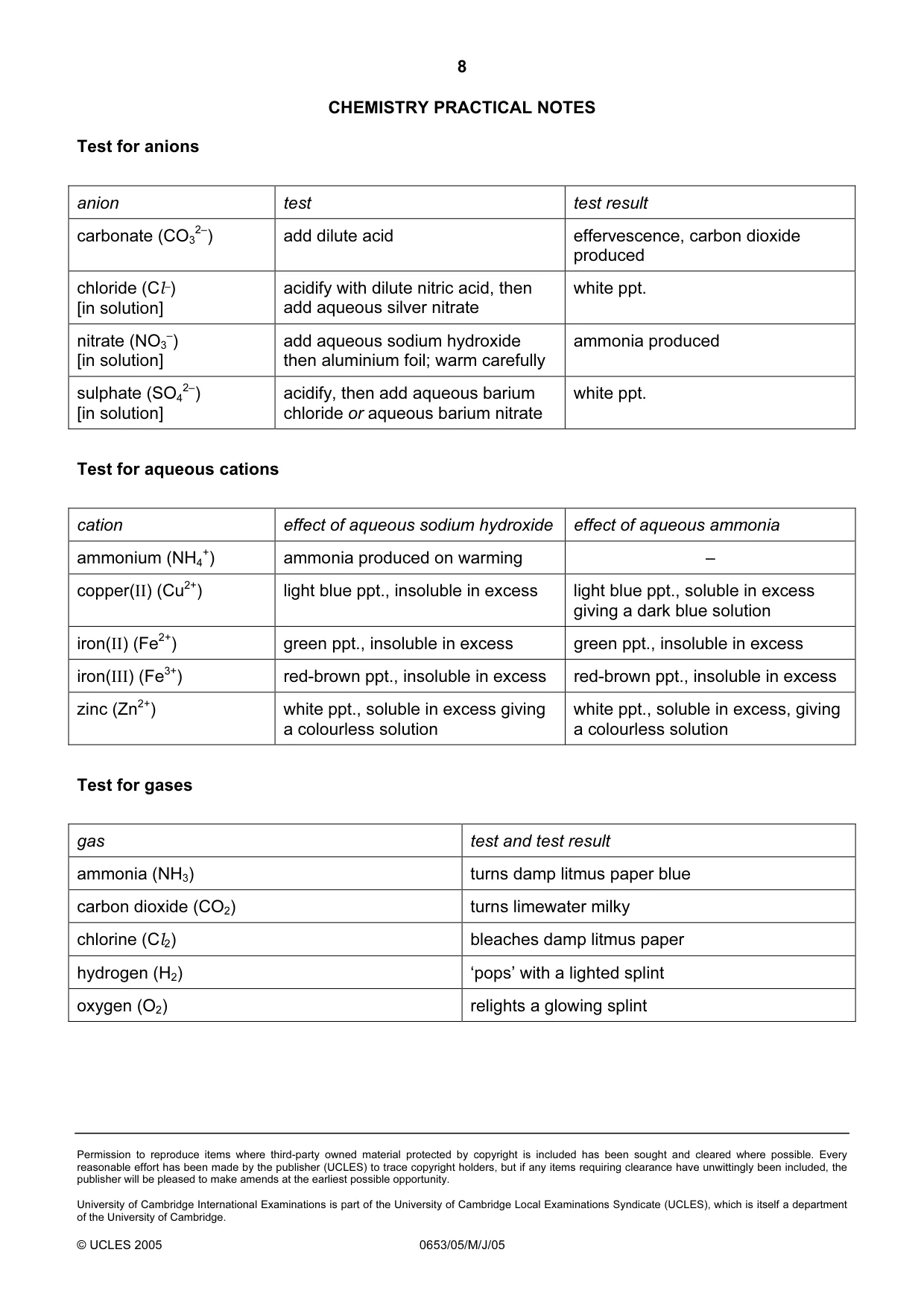
8 Permission to reproduce items where third-party owned material protected by copyright is included has been sought and cleared where possible. Every reasonable effort has been made by the publisher (UCLES) to trace copyright holders, but if any items requiring clearance have unwittingly been included, the publisher will be pleased to make amends at the earliest possible opportunity. University of Cambridge International Examinations is part of the University of Cambridge Local Examinations Syndicate (UCLES), which is itself a department of the University of Cambridge. © UCLES 2005 0653/05/M/J/05 CHEMISTRY PRACTICAL NOTES Test for anions anion test test result carbonate (CO3 2–) add dilute acid effervescence, carbon dioxide produced chloride (Cl–) [in solution] acidify with dilute nitric acid, then add aqueous silver nitrate white ppt. nitrate (NO3 –) [in solution] add aqueous sodium hydroxide then aluminium foil; warm carefully ammonia produced sulphate (SO4 2–) [in solution] acidify, then add aqueous barium chloride or aqueous barium nitrate white ppt. Test for aqueous cations cation effect of aqueous sodium hydroxide effect of aqueous ammonia ammonium (NH4 +) ammonia produced on warming – copper(II) (Cu2+) light blue ppt., insoluble in excess light blue ppt., soluble in excess giving a dark blue solution iron(II) (Fe2+) green ppt., insoluble in excess green ppt., insoluble in excess iron(III) (Fe3+) red-brown ppt., insoluble in excess red-brown ppt., insoluble in excess zinc (Zn2+) white ppt., soluble in excess giving a colourless solution white ppt., soluble in excess, giving a colourless solution Test for gases gas test and test result ammonia (NH3) turns damp litmus paper blue carbon dioxide (CO2) turns limewater milky chlorine (Cl2) bleaches damp litmus paper hydrogen (H2) ‘pops’ with a lighted splint oxygen (O2) relights a glowing splint
Mark scheme, page 1
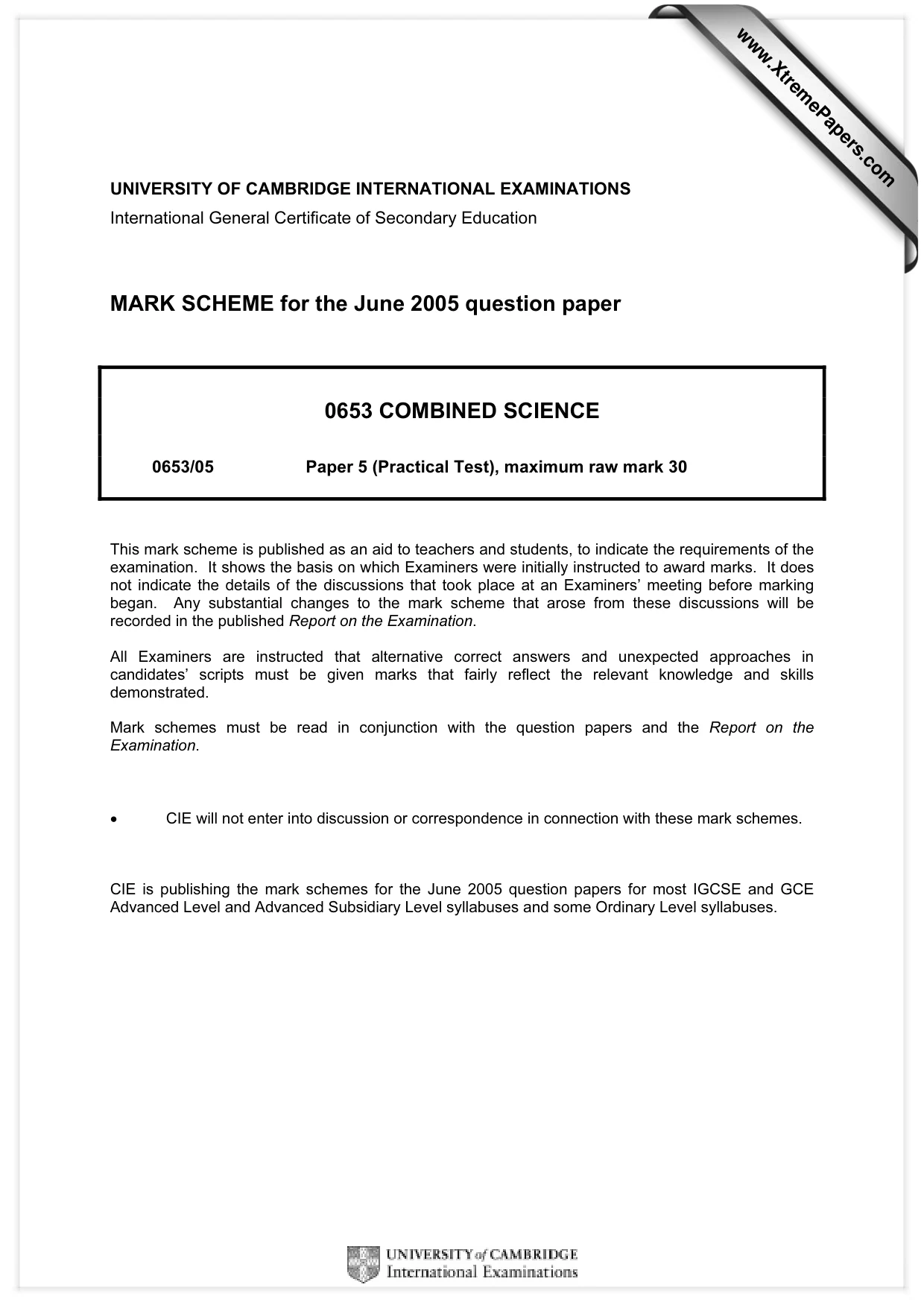
UNIVERSITY OF CAMBRIDGE INTERNATIONAL EXAMINATIONS International General Certificate of Secondary Education MARK SCHEME for the June 2005 question paper 0653 COMBINED SCIENCE 0653/05 Paper 5 (Practical Test), maximum raw mark 30 This mark scheme is published as an aid to teachers and students, to indicate the requirements of the examination. It shows the basis on which Examiners were initially instructed to award marks. It does not indicate the details of the discussions that took place at an Examiners’ meeting before marking began. Any substantial changes to the mark scheme that arose from these discussions will be recorded in the published Report on the Examination. All Examiners are instructed that alternative correct answers and unexpected approaches in candidates’ scripts must be given marks that fairly reflect the relevant knowledge and skills demonstrated. Mark schemes must be read in conjunction with the question papers and the Report on the Examination. • CIE will not enter into discussion or correspondence in connection with these mark schemes. CIE is publishing the mark schemes for the June 2005 question papers for most IGCSE and GCE Advanced Level and Advanced Subsidiary Level syllabuses and some Ordinary Level syllabuses. www.XtremePapers.com
Mark scheme, page 2
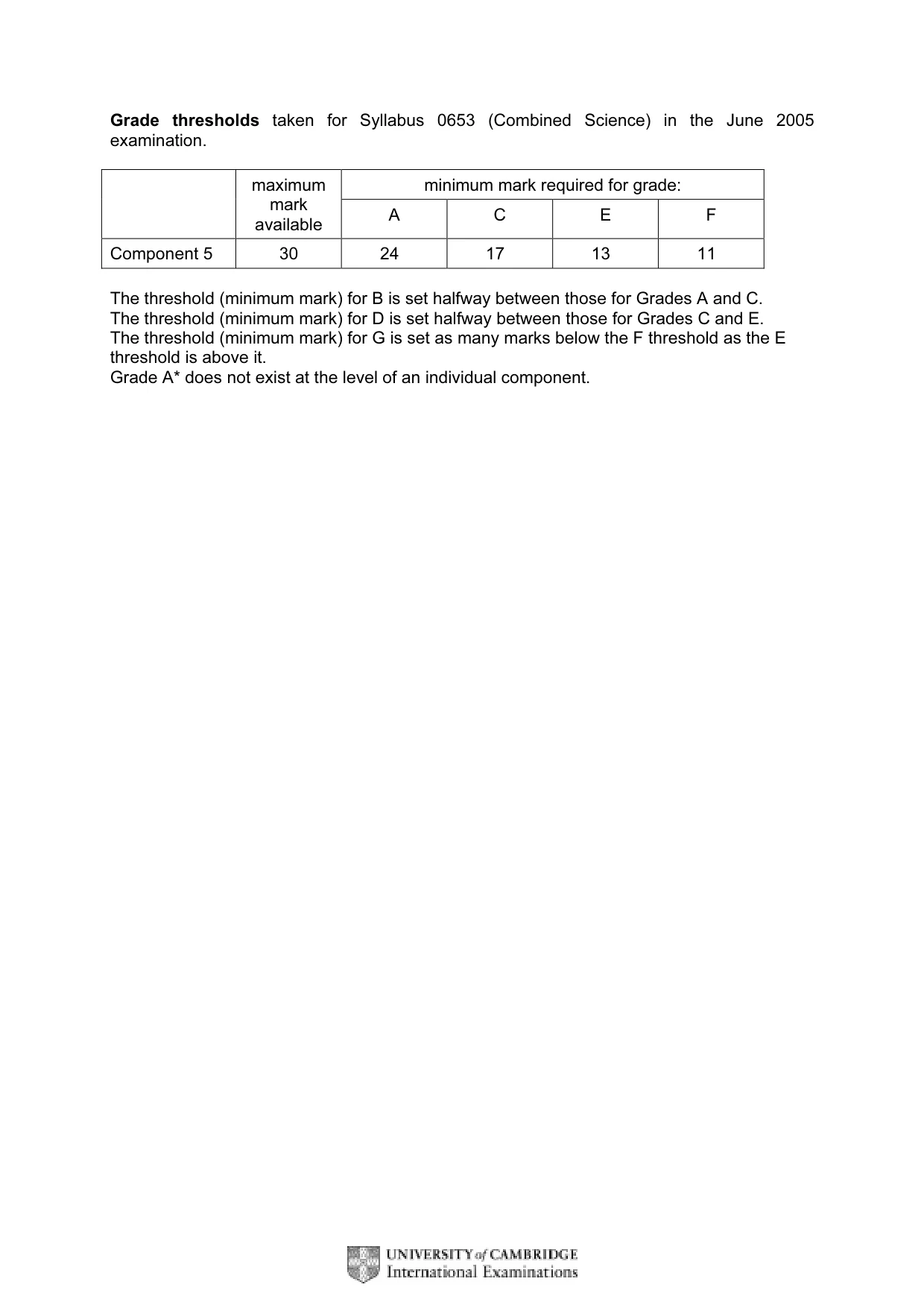
Grade thresholds taken for Syllabus 0653 (Combined Science) in the June 2005 examination. minimum mark required for grade: maximum mark available A C E F Component 5 30 24 17 13 11 The threshold (minimum mark) for B is set halfway between those for Grades A and C. The threshold (minimum mark) for D is set halfway between those for Grades C and E. The threshold (minimum mark) for G is set as many marks below the F threshold as the E threshold is above it. Grade A* does not exist at the level of an individual component.
Mark scheme, page 3
June 2005 IGCSE MARK SCHEME MAXIMUM MARK: 30 SYLLABUS/COMPONENT: 0653/05 COMBINED SCIENCE Paper 5 (Practical Test)
Mark scheme, page 4
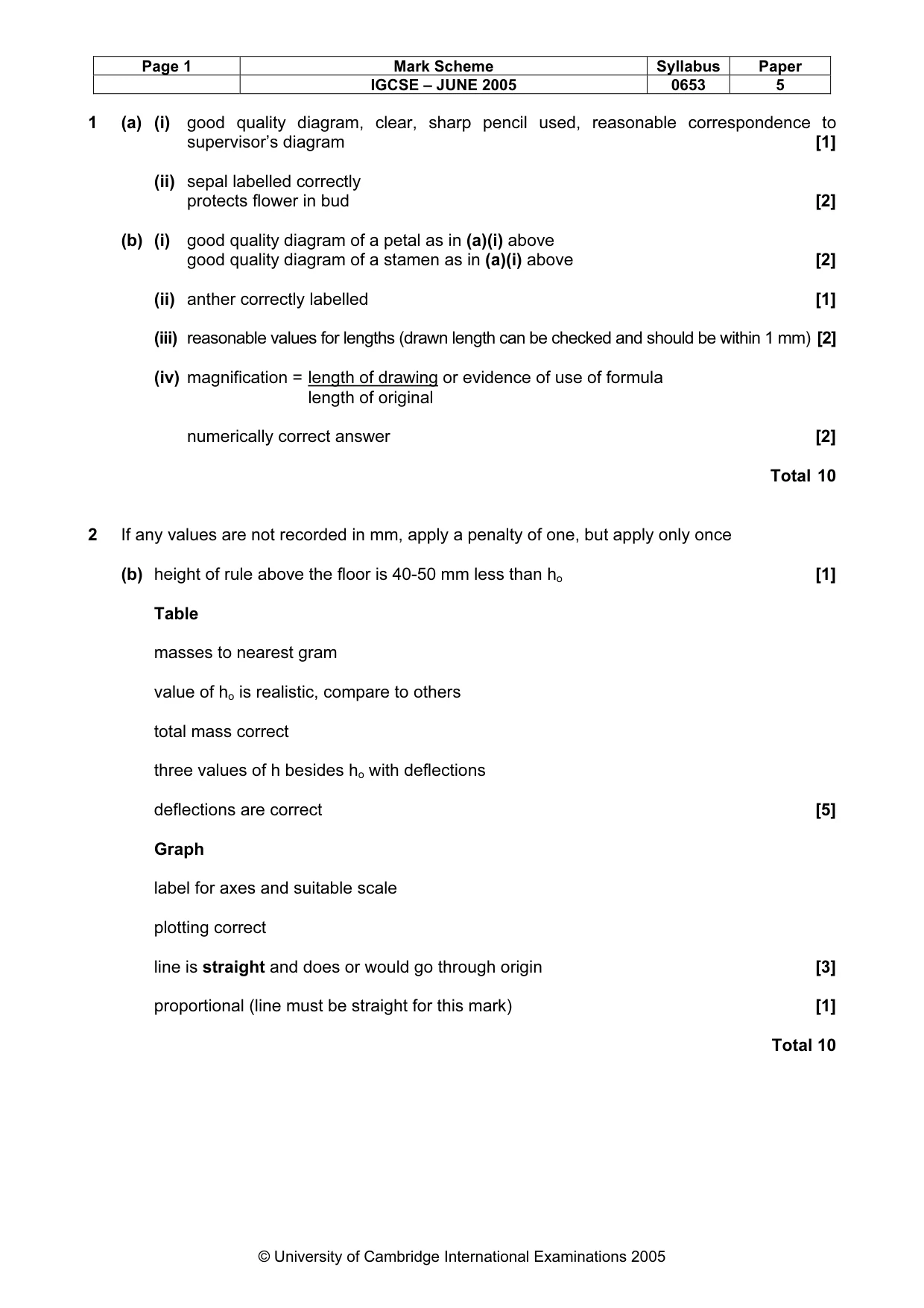
Page 1 Mark Scheme Syllabus Paper IGCSE – JUNE 2005 0653 5 © University of Cambridge International Examinations 2005 1 (a) (i) good quality diagram, clear, sharp pencil used, reasonable correspondence to supervisor’s diagram [1] (ii) sepal labelled correctly protects flower in bud [2] (b) (i) good quality diagram of a petal as in (a)(i) above good quality diagram of a stamen as in (a)(i) above [2] (ii) anther correctly labelled [1] (iii) reasonable values for lengths (drawn length can be checked and should be within 1 mm) [2] (iv) magnification = length of drawing or evidence of use of formula length of original numerically correct answer [2] Total 10 2 If any values are not recorded in mm, apply a penalty of one, but apply only once (b) height of rule above the floor is 40-50 mm less than ho [1] Table masses to nearest gram value of ho is realistic, compare to others total mass correct three values of h besides ho with deflections deflections are correct [5] Graph label for axes and suitable scale plotting correct line is straight and does or would go through origin [3] proportional (line must be straight for this mark) [1] Total 10
Mark scheme, page 5
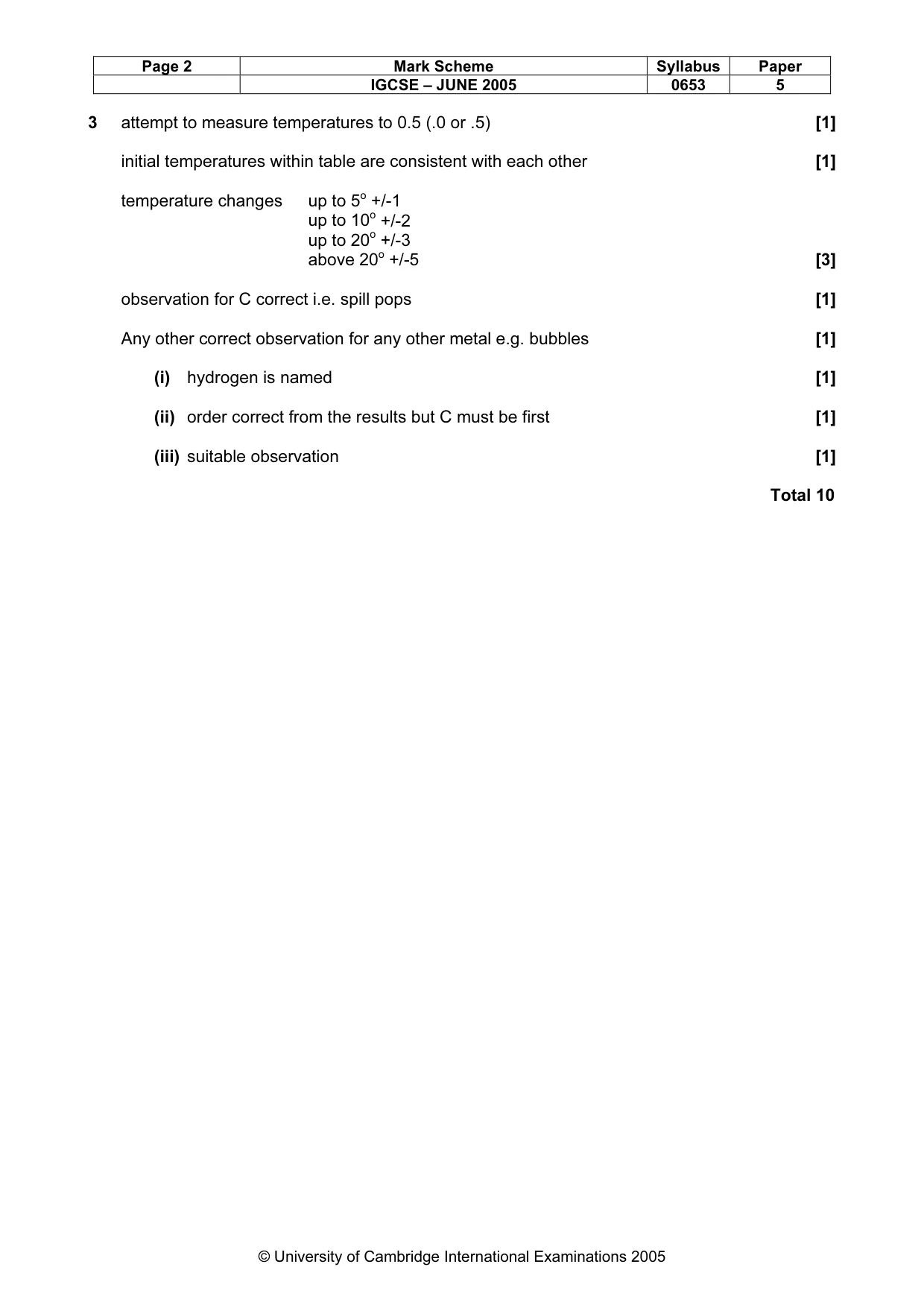
Page 2 Mark Scheme Syllabus Paper IGCSE – JUNE 2005 0653 5 © University of Cambridge International Examinations 2005 3 attempt to measure temperatures to 0.5 (.0 or .5) [1] initial temperatures within table are consistent with each other [1] temperature changes up to 5o +/-1 up to 10o +/-2 up to 20o +/-3 above 20o +/-5 [3] observation for C correct i.e. spill pops [1] Any other correct observation for any other metal e.g. bubbles [1] (i) hydrogen is named [1] (ii) order correct from the results but C must be first [1] (iii) suitable observation [1] Total 10