Cambridge IGCSE Sanskrit 0499 — 2024 May/June Paper 2 · Variant 2
0499/22/M/J/24 · 4 questions · 90 marks · ≈101 min
The question paper and its mark scheme, free to read here and free to download. This is Cambridge’s own paper, exactly as it was sat.
Question paper8 pages


Mark scheme6 pages
Answers below. Sit the paper first if you are practising.
Questions as text
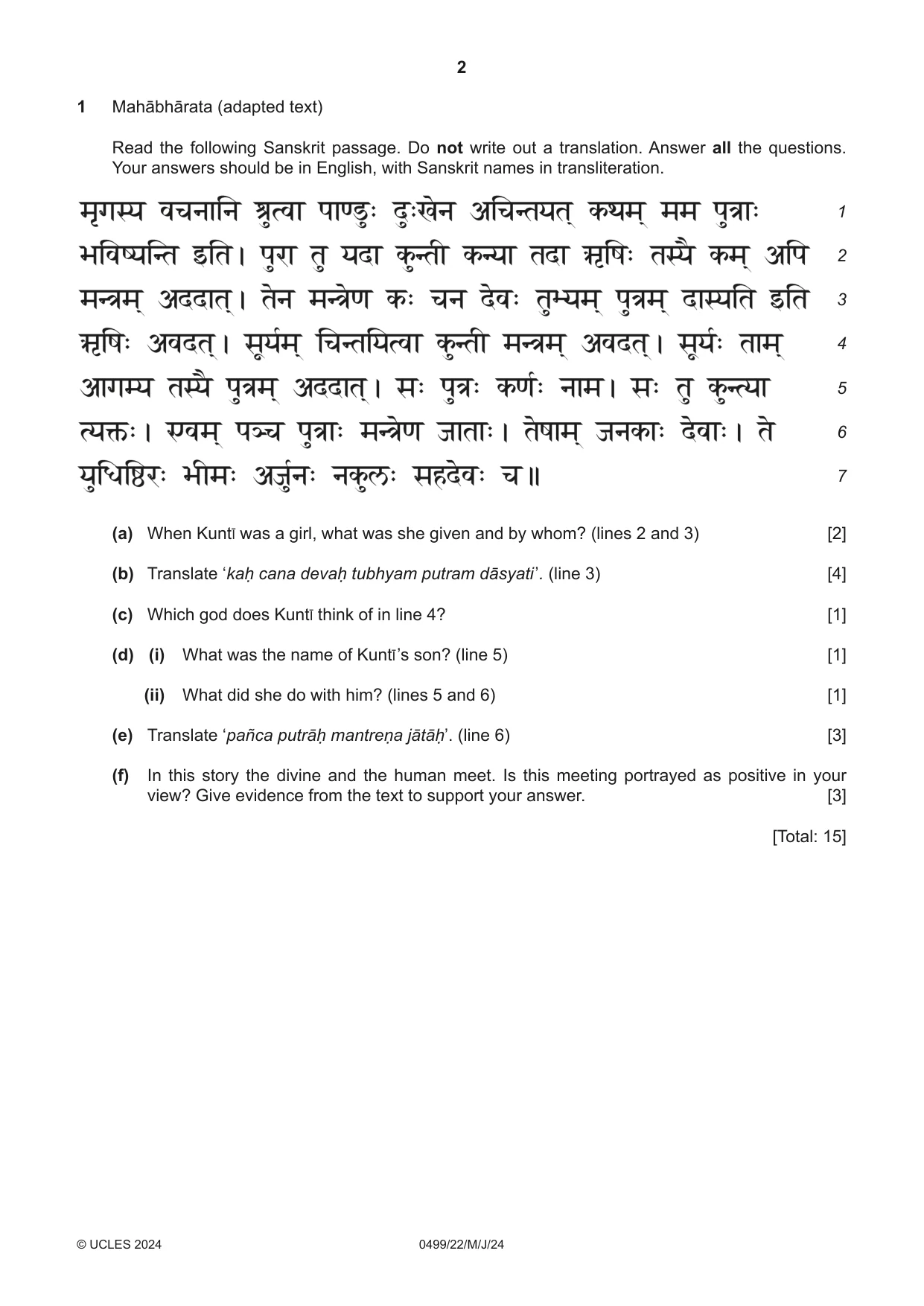
Q1 · Mahābhārata (adapted text) Read the following Sanskrit passage
1 Mahābhārata (adapted text) Read the following Sanskrit passage. Do not write out a translation. Answer all the questions. Your answers should be in English, with Sanskrit names in transliteration. 1 2 3 4 5 6 7 (a) When Kuntī was a girl, what was she given and by whom? (lines 2 and 3) [2] (b) Translate ‘kaḥ cana devaḥ tubhyam putram dāsyati ’. (line 3) [4] (c) Which god does Kuntī think of in line 4? [1] (d) (i) What was the name of Kuntī ’s son? (line 5) [1] (ii) What did she do with him? (lines 5 and 6) [1] (e) Translate ‘pañca putrāḥ mantreṇa jātāḥ’. (line 6) [3] (f) In this story the divine and the human meet. Is this meeting portrayed as positive in your view? Give evidence from the text to support your answer. [3] [Total: 15]
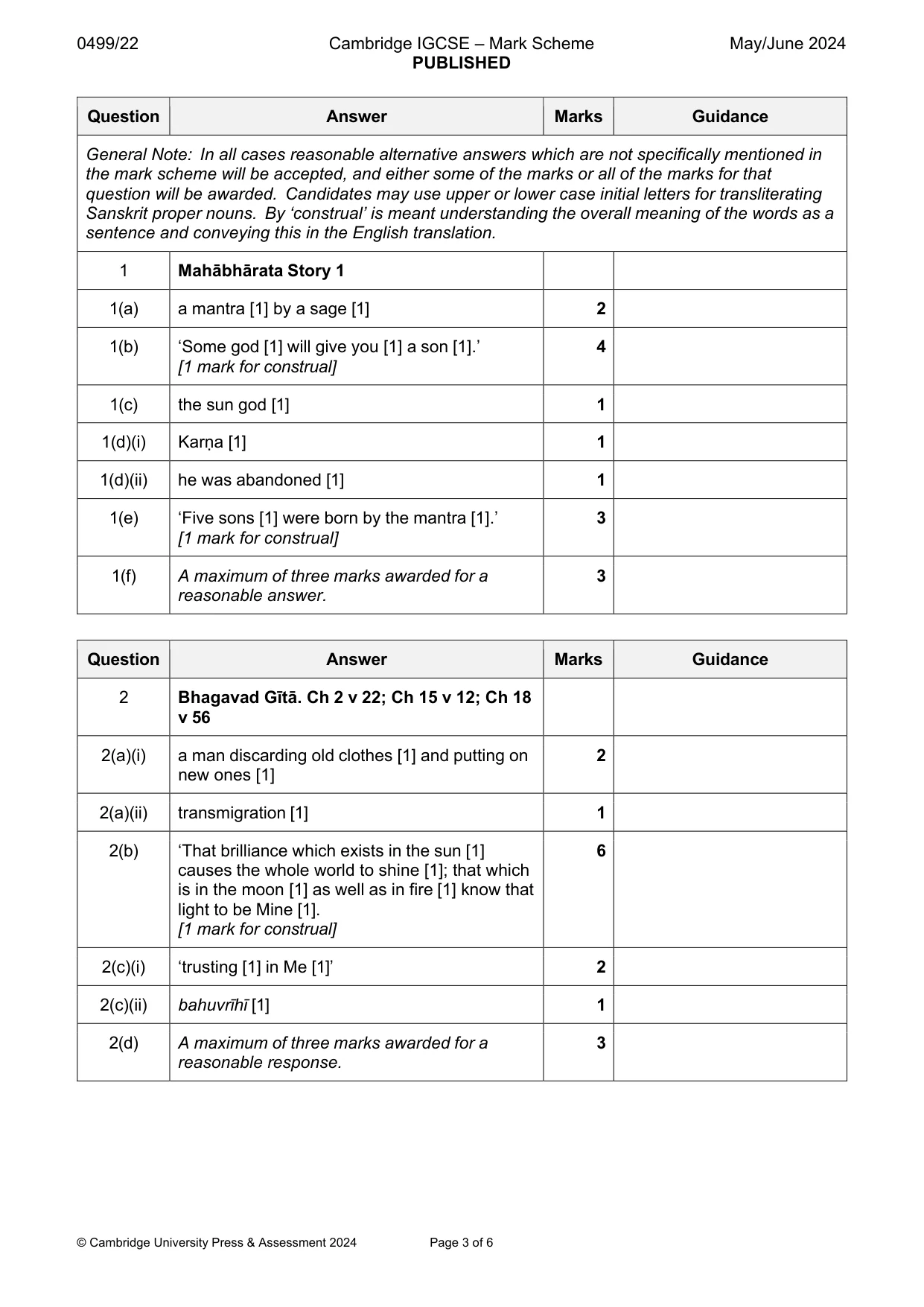
Mark scheme: question will be awarded. Candidates may use upper or lower case initial letters for transliterating Sanskrit proper nouns. By ‘construal’ is meant understanding the overall meaning of the words as a sentence and conveying this in the English translation. 1 Mahābhārata Story 1 1(a) a mantra [1] by a sage [1] 2 1(b) ‘Some god [1] will give you [1] a son [1].’ 4 [1 mark for construal] 1(c) the sun god [1] 1 1(d)(i) Karṇa [1] 1 1(d)(ii) he was abandoned [1] 1 1(e) ‘Five sons [1] were born by the mantra [1].’ 3 [1 mark for construal] 1(f) A maximum of three marks awarded for a 3 reasonable answer.
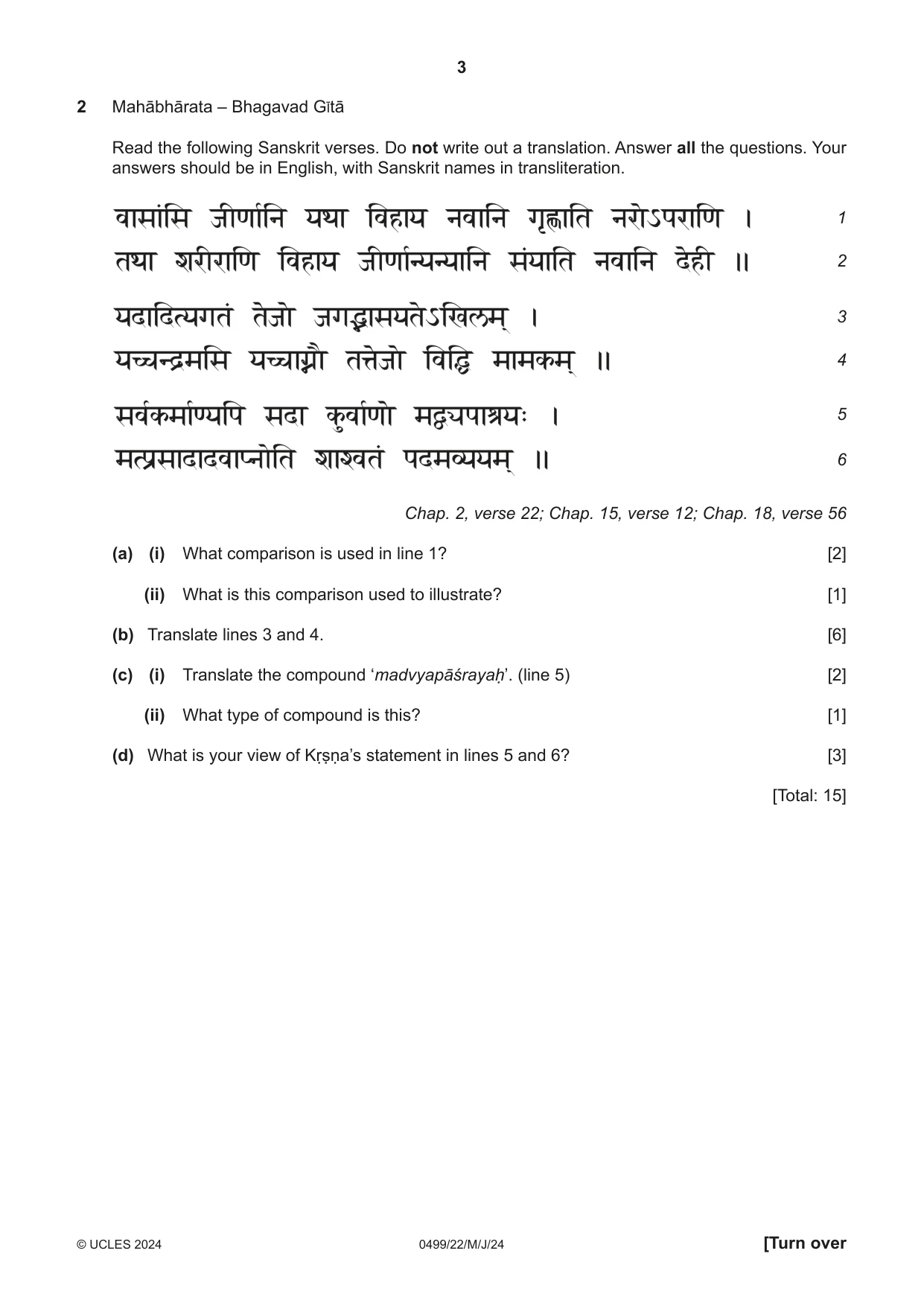
Q2 · Mahābhārata – Bhagavad Gītā Read the following Sanskrit verses
2 Mahābhārata – Bhagavad Gītā Read the following Sanskrit verses. Do not write out a translation. Answer all the questions. Your answers should be in English, with Sanskrit names in transliteration. 1 2 3 4 5 6 Chap. 2, verse 22; Chap. 15, verse 12; Chap. 18, verse 56 (a) (i) What comparison is used in line 1? [2] (ii) What is this comparison used to illustrate? [1] (b) Translate lines 3 and 4. [6] (c) (i) Translate the compound ‘madvyapāśrayaḥ’. (line 5) [2] (ii) What type of compound is this? [1] (d) What is your view of Kṛṣṇa’s statement in lines 5 and 6? [3] [Total: 15]
Mark scheme: 2 Bhagavad Gῑtā. Ch 2 v 22; Ch 15 v 12; Ch 18 v 56 2(a)(i) a man discarding old clothes [1] and putting on 2 new ones [1] 2(a)(ii) transmigration [1] 1 2(b) ‘That brilliance which exists in the sun [1] 6 causes the whole world to shine [1]; that which is in the moon [1] as well as in fire [1] know that light to be Mine [1]. [1 mark for construal] 2(c)(i) ‘trusting [1] in Me [1]’ 2 2(c)(ii) bahuvrīhī [1] 1 2(d) A maximum of three marks awarded for a 3 reasonable response.
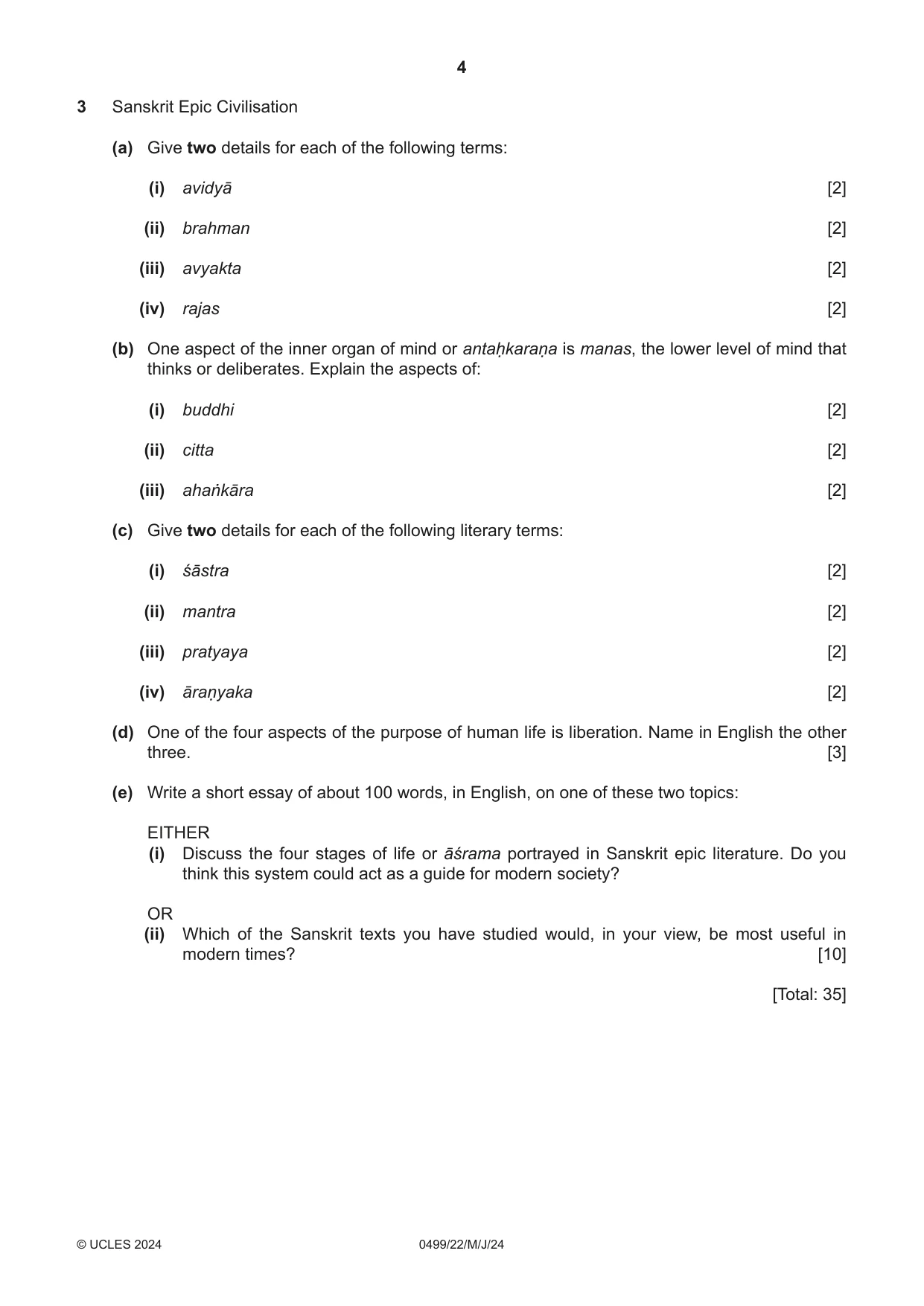
Q3 · Sanskrit Epic Civilisation (a) Give two details for each of the following terms: (i)…
3 Sanskrit Epic Civilisation (a) Give two details for each of the following terms: (i) avidyā [2] (ii) brahman [2] (iii) avyakta [2] (iv) rajas [2] (b) One aspect of the inner organ of mind or antaḥkaraṇa is manas, the lower level of mind that thinks or deliberates. Explain the aspects of: (i) buddhi [2] (ii) citta [2] (iii) ahaṅkāra [2] (c) Give two details for each of the following literary terms: (i) śāstra [2] (ii) mantra [2] (iii) pratyaya [2] (iv) āraṇyaka [2] (d) One of the four aspects of the purpose of human life is liberation. Name in English the other three. [3] (e) Write a short essay of about 100 words, in English, on one of these two topics: EITHER (i) Discuss the four stages of life or āśrama portrayed in Sanskrit epic literature. Do you think this system could act as a guide for modern society? OR (ii) Which of the Sanskrit texts you have studied would, in your view, be most useful in modern times? [10] [Total: 35]
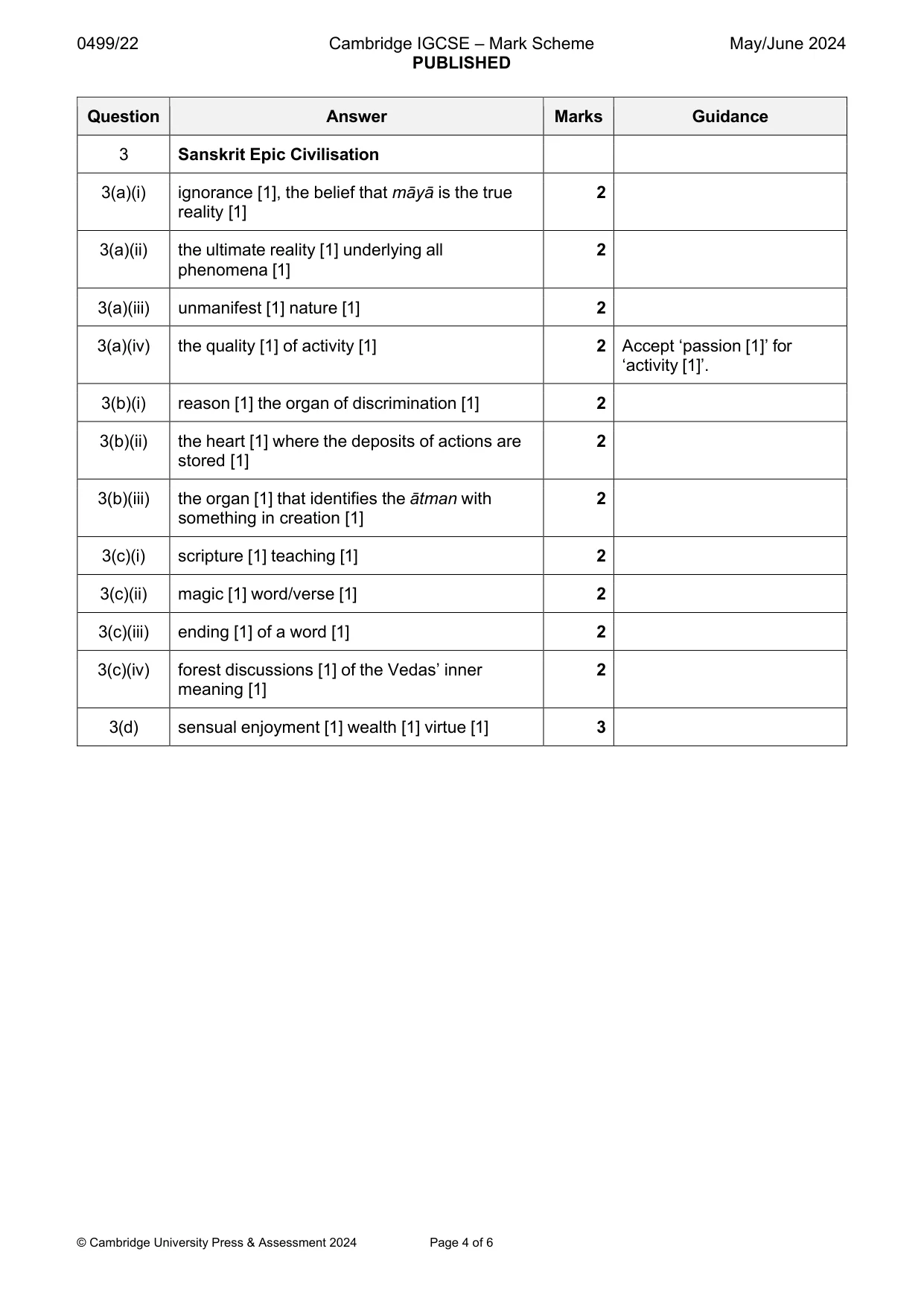
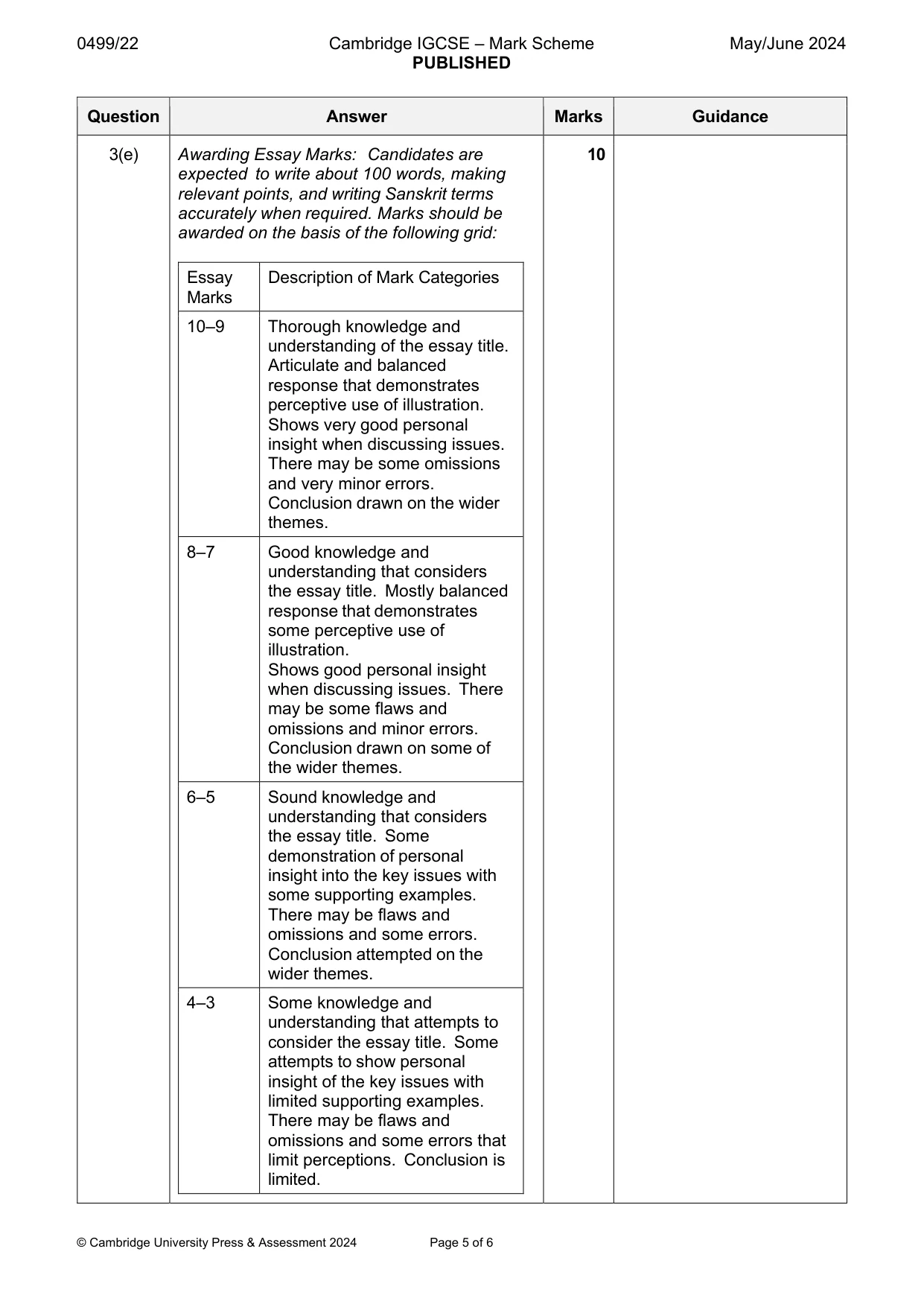
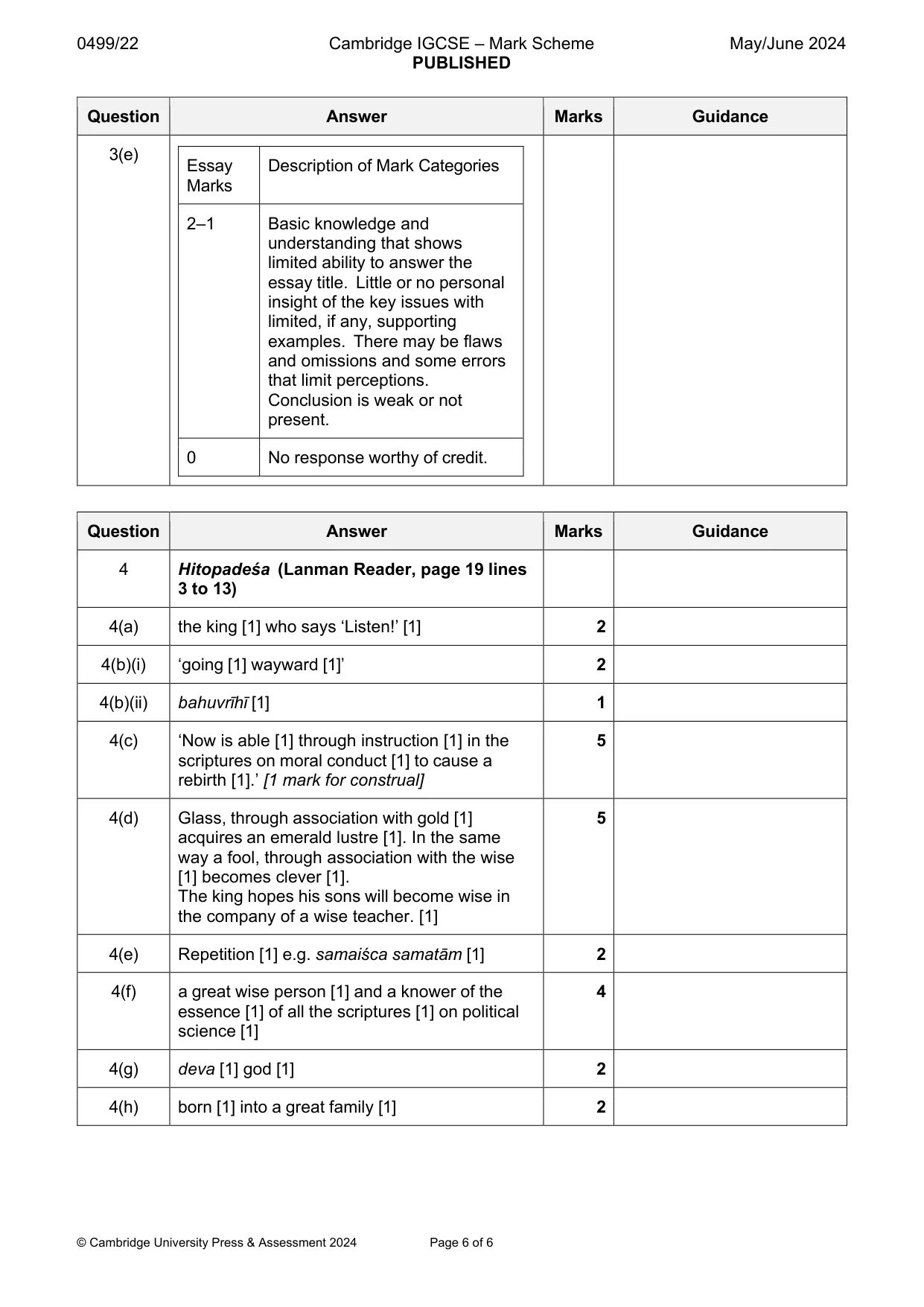
Mark scheme: 3 Sanskrit Epic Civilisation 3(a)(i) ignorance [1], the belief that māyā is the true 2 reality [1] 3(a)(ii) the ultimate reality [1] underlying all 2 phenomena [1] 3(a)(iii) unmanifest [1] nature [1] 2 3(a)(iv) the quality [1] of activity [1] 2 Accept ‘passion [1]’ for ‘activity [1]’. 3(b)(i) reason [1] the organ of discrimination [1] 2 3(b)(ii) the heart [1] where the deposits of actions are 2 stored [1] 3(b)(iii) the organ [1] that identifies the ātman with 2 something in creation [1] 3(c)(i) scripture [1] teaching [1] 2 3(c)(ii) magic [1] word/verse [1] 2 3(c)(iii) ending [1] of a word [1] 2 3(c)(iv) forest discussions [1] of the Vedas’ inner 2 meaning [1] 3(d) sensual enjoyment [1] wealth [1] virtue [1] 3 3(e) Awarding Essay Marks: Candidates are 10 expected to write about 100 words, making relevant points, and writing Sanskrit terms accurately when required. Marks should be awarded on the basis of the following grid: Essay Description of Mark Categories Marks 10–9 Thorough knowledge and understanding of the essay title. Articulate and balanced response that demonstrates perceptive use of illustration. Shows very good personal insight when discussing issues. There may be some omissions and very minor errors. Conclusion drawn on the wider themes. 8–7 Good knowledge and understanding that considers the essay title. Mostly balanced response that demonstrates some perceptive use of illustration. Shows good personal insight when discussing issues. There may be some flaws and omissions and minor errors. Conclusion drawn on some of the wider themes. 6–5 Sound knowledge and understanding that considers the essay title. Some demonstration of personal insight into the key issues with some supporting examples. There may be flaws and omissions and some errors. Conclusion attempted on the wider themes. 4–3 Some knowledge and understanding that attempts to consider the essay title. Some attempts to show personal insight of the key issues with limited supporting examples. There may be flaws and omissions and some errors that limit perceptions. Conclusion is limited. 3(e) Essay Description of Mark Categories Marks 2–1 Basic knowledge and understanding that shows limited ability to answer the essay title. Little or no personal insight of the key issues with limited, if any, supporting examples. There may be flaws and omissions and some errors that limit perceptions. Conclusion is weak or not present. 0 No response worthy of credit.
Q4 · Hitopadeśa Read the following Sanskrit passage
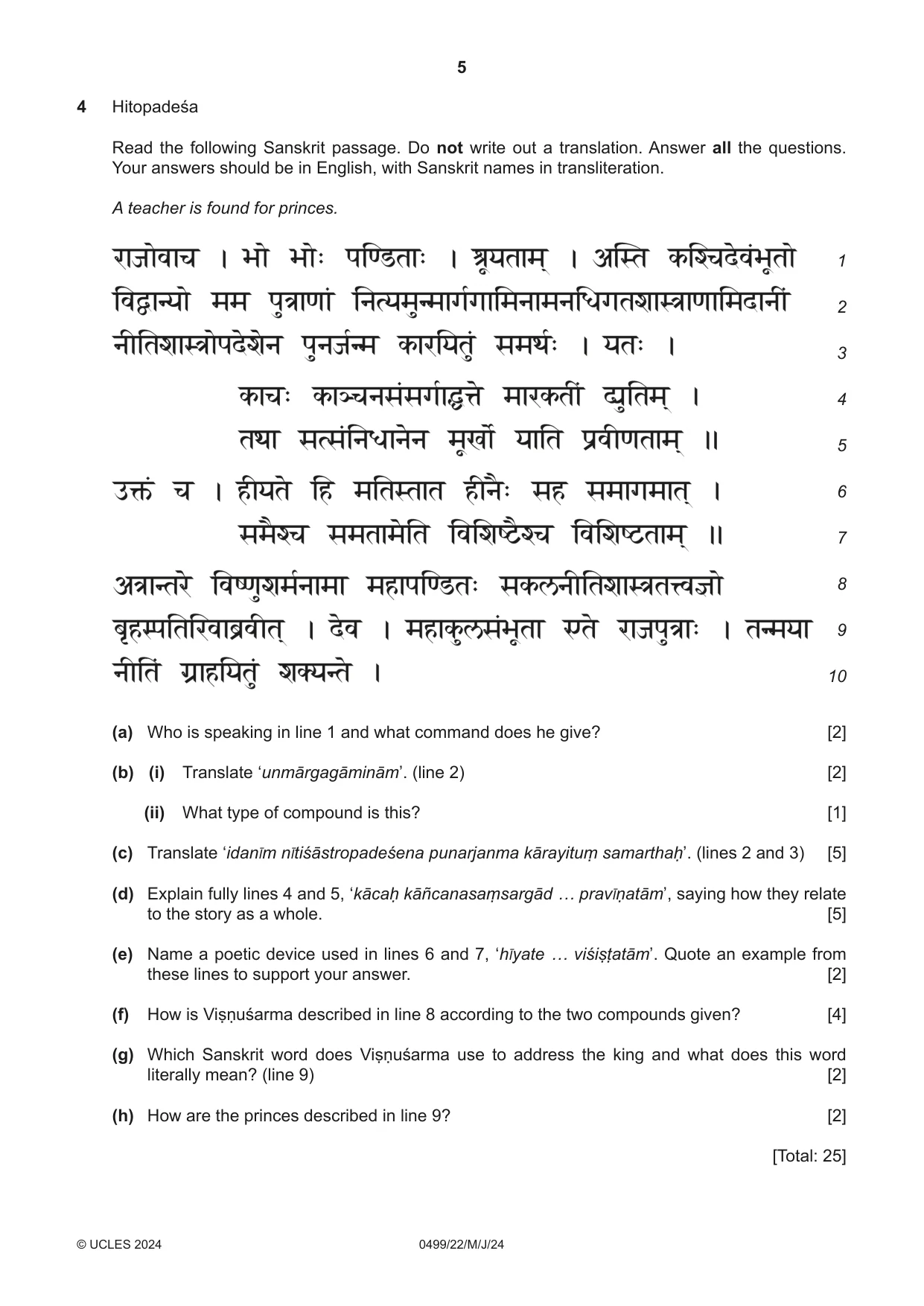
4 Hitopadeśa Read the following Sanskrit passage. Do not write out a translation. Answer all the questions. Your answers should be in English, with Sanskrit names in transliteration. A teacher is found for princes. 1 2 3 4 5 6 7 8 9 10 (a) Who is speaking in line 1 and what command does he give? [2] (b) (i) Translate ‘unmārgagāminām’. (line 2) [2] (ii) What type of compound is this? [1] (c) Translate ‘idanīm nītiśāstropadeśena punarjanma kārayituṃ samarthaḥ’. (lines 2 and 3) [5] (d) Explain fully lines 4 and 5, ‘kācaḥ kāñcanasaṃsargād … pravīṇatām’, saying how they relate to the story as a whole. [5] (e) Name a poetic device used in lines 6 and 7, ‘hīyate … viśiṣṭatām’. Quote an example from these lines to support your answer. [2] (f) How is Viṣṇuśarma described in line 8 according to the two compounds given? [4] (g) Which Sanskrit word does Viṣṇuśarma use to address the king and what does this word literally mean? (line 9) [2] (h) How are the princes described in line 9? [2] [Total: 25]
Mark scheme: 4 Hitopadeśa (Lanman Reader, page 19 lines 3 to 13) 4(a) the king [1] who says ‘Listen!’ [1] 2 4(b)(i) ‘going [1] wayward [1]’ 2 4(b)(ii) bahuvrīhī [1] 1 4(c) ‘Now is able [1] through instruction [1] in the 5 scriptures on moral conduct [1] to cause a rebirth [1].’ [1 mark for construal] 4(d) Glass, through association with gold [1] 5 acquires an emerald lustre [1]. In the same way a fool, through association with the wise [1] becomes clever [1]. The king hopes his sons will become wise in the company of a wise teacher. [1] 4(e) Repetition [1] e.g. samaiśca samatām [1] 2 4(f) a great wise person [1] and a knower of the 4 essence [1] of all the scriptures [1] on political science [1] 4(g) deva [1] god [1] 2 4(h) born [1] into a great family [1] 2
What you needed in this session
Cambridge’s own grade thresholds for 2024 May/June, Paper 2 · Variant 2. A higher threshold means an easier paper — the bar moves with how the cohort did.