Cambridge IGCSE Sanskrit 0499 — 2025 May/June Paper 2 · Variant 2
0499/22/M/J/25 · 4 questions · 90 marks · ≈101 min
The question paper and its mark scheme, free to read here and free to download. This is Cambridge’s own paper, exactly as it was sat.
Question paper8 pages


Mark scheme7 pages
Answers below. Sit the paper first if you are practising.
Questions as text
Q1 · Mahābhārata (adapted text) Read the following Sanskrit passage
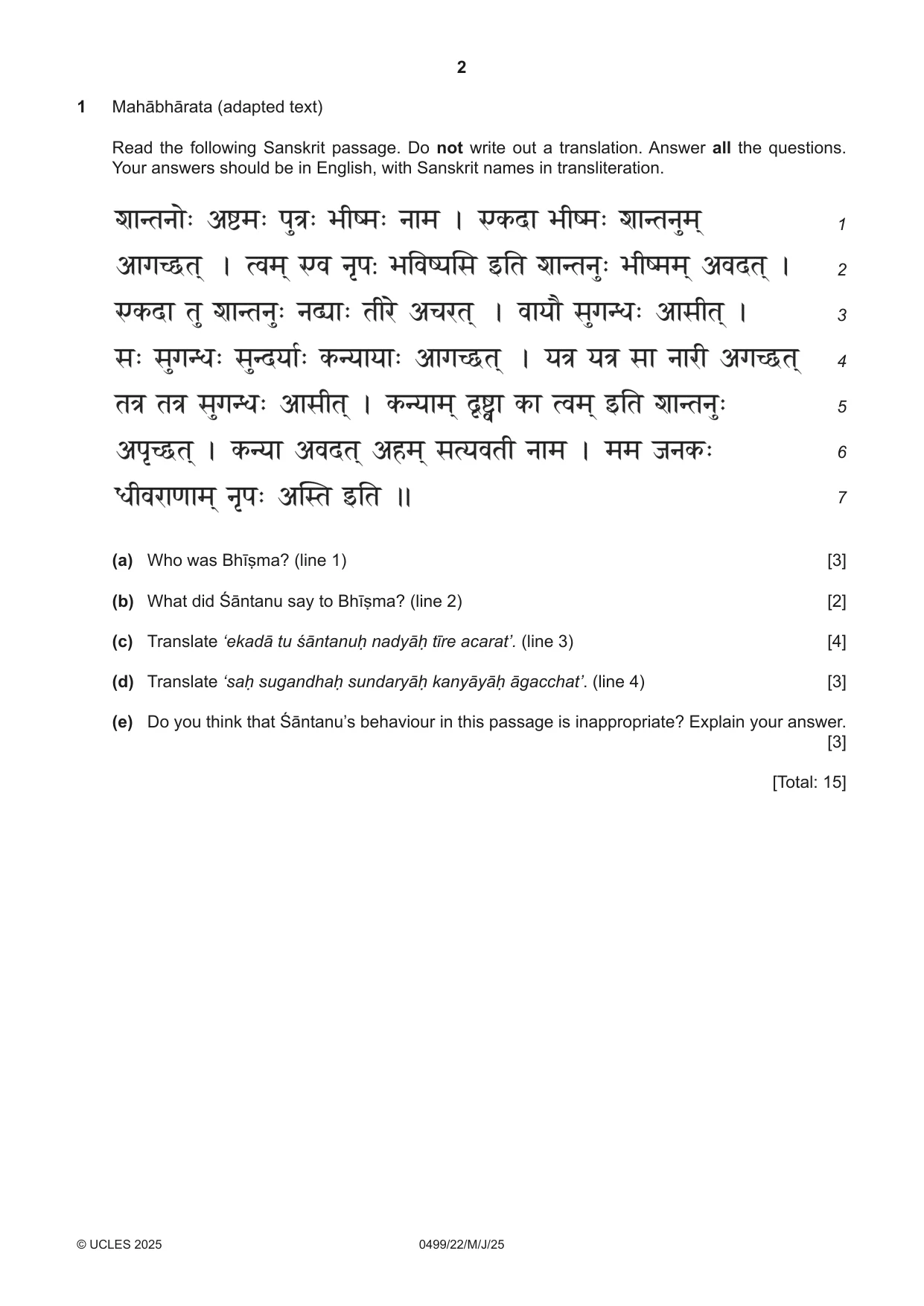
1 Mahābhārata (adapted text) Read the following Sanskrit passage. Do not write out a translation. Answer all the questions. Your answers should be in English, with Sanskrit names in transliteration. 1 2 3 4 5 6 7 (a) Who was Bhīṣma? (line 1) [3] (b) What did Śāntanu say to Bhīṣma? (line 2) [2] (c) Translate ‘ekadā tu śāntanuḥ nadyāḥ tīre acarat’. (line 3) [4] (d) Translate ‘saḥ sugandhaḥ sundaryāḥ kanyāyāḥ āgacchat’. (line 4) [3] (e) Do you think that Śāntanu’s behaviour in this passage is inappropriate? Explain your answer. [3] [Total: 15]
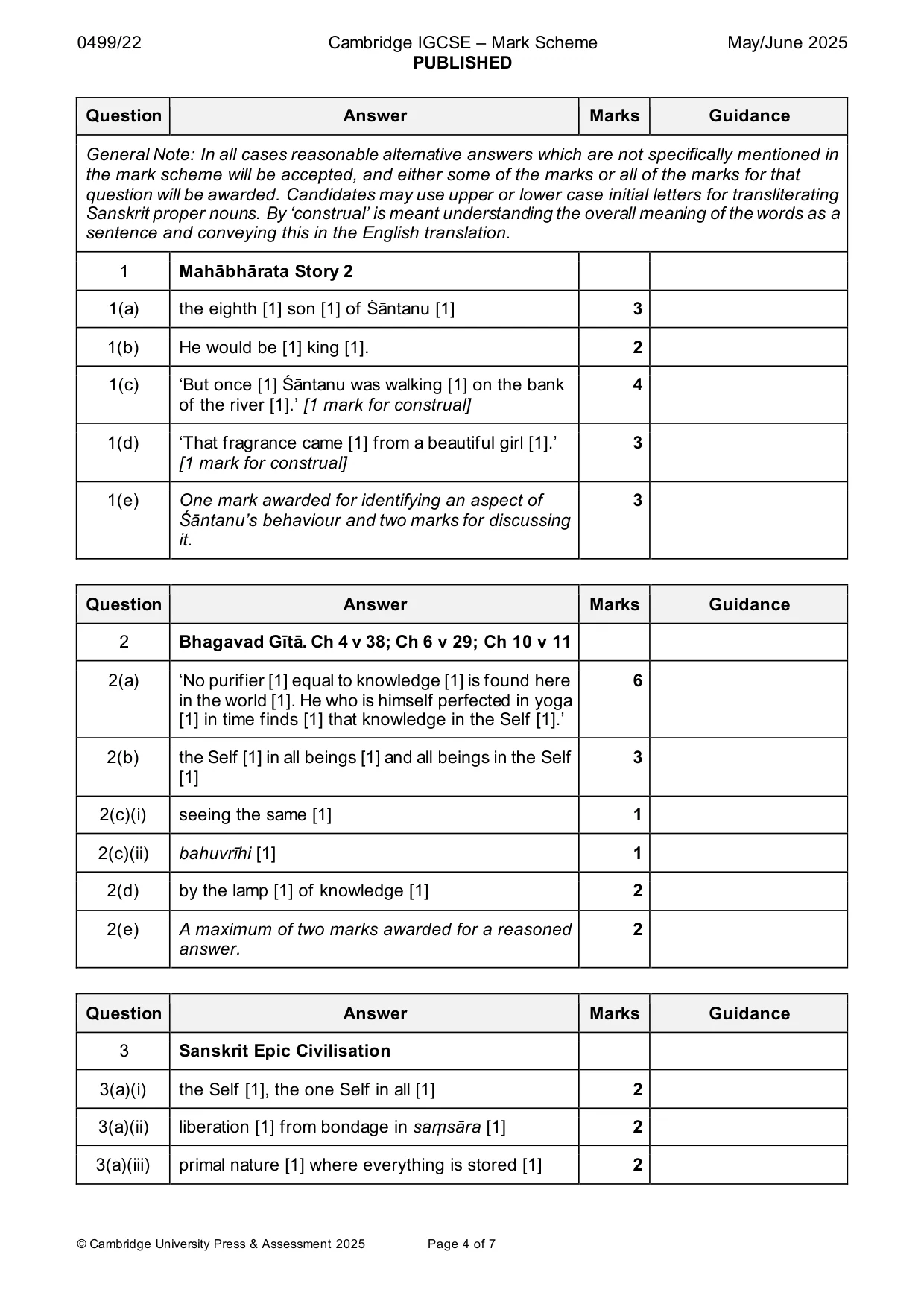
Mark scheme: question will be awarded. Candidates may use upper or lower case initial letters for transliterating Sanskrit proper nouns. By ‘construal’ is meant understanding the overall meaning of the words as a sentence and conveying this in the English translation. 1 Mahābhārata Story 2 1(a) the eighth [1] son [1] of Śāntanu [1] 3 1(b) He would be [1] king [1]. 2 1(c) ‘But once [1] Śāntanu was walking [1] on the bank 4 of the river [1].’ [1 mark for construal] 1(d) ‘That fragrance came [1] from a beautiful girl [1].’ 3 [1 mark for construal] 1(e) One mark awarded for identifying an aspect of 3 Śāntanu’s behaviour and two marks for discussing it.
Q2 · Mahābhārata – Bhagavad Gītā Read the following Sanskrit verses
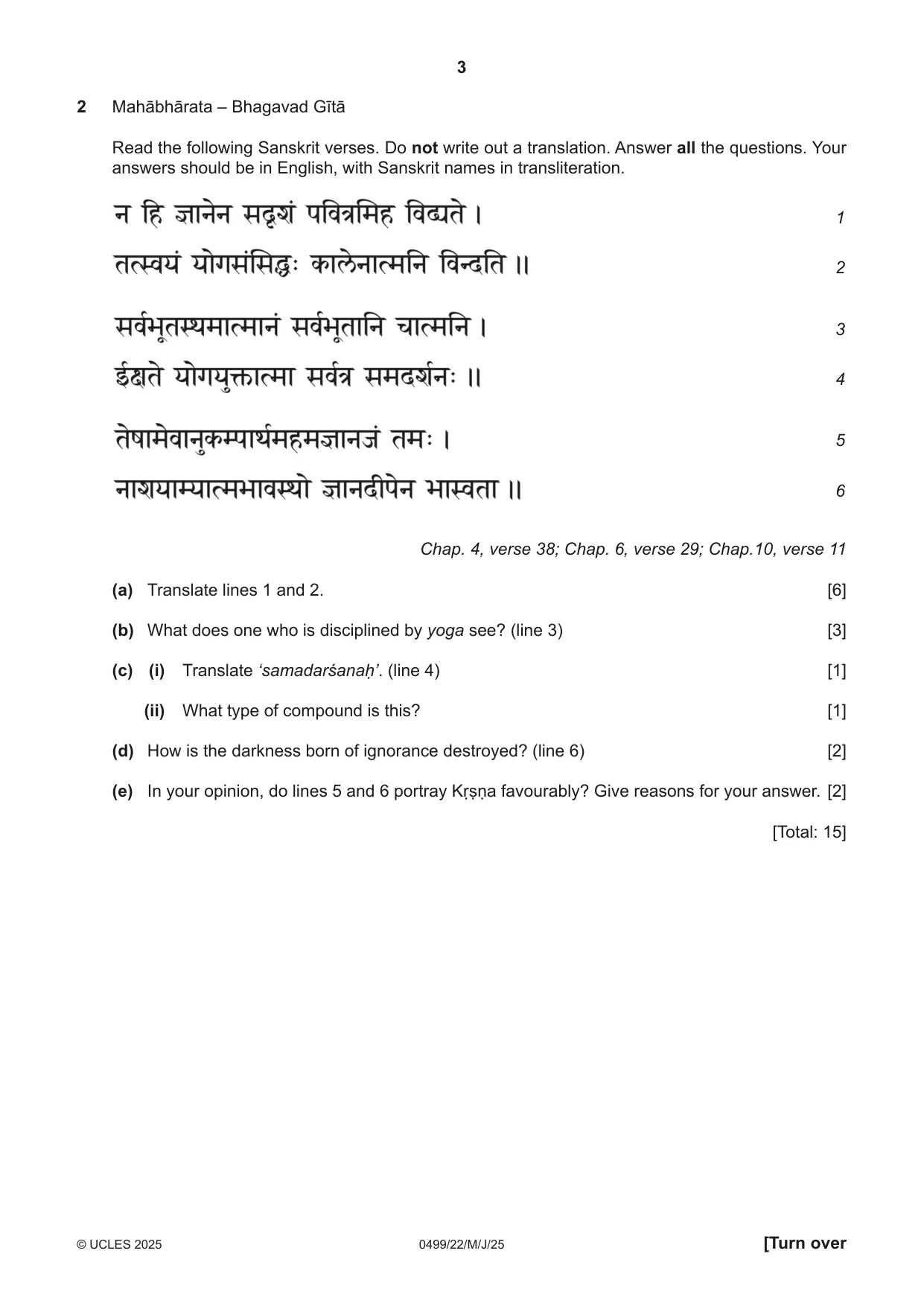
2 Mahābhārata – Bhagavad Gītā Read the following Sanskrit verses. Do not write out a translation. Answer all the questions. Your answers should be in English, with Sanskrit names in transliteration. 1 2 3 4 5 6 Chap. 4, verse 38; Chap. 6, verse 29; Chap.10, verse 11 (a) Translate lines 1 and 2. [6] (b) What does one who is disciplined by yoga see? (line 3) [3] (c) (i) Translate ‘samadarśanaḥ’. (line 4) [1] (ii) What type of compound is this? [1] (d) How is the darkness born of ignorance destroyed? (line 6) [2] (e) In your opinion, do lines 5 and 6 portray Kṛṣṇa favourably? Give reasons for your answer. [2] [Total: 15]
Mark scheme: 2(a) ‘No purifier [1] equal to knowledge [1] is found here 6 in the world [1]. He who is himself perfected in yoga [1] in time finds [1] that knowledge in the Self [1].’ 2(b) the Self [1] in all beings [1] and all beings in the Self 3 [1] 2(c)(i) seeing the same [1] 1 2(c)(ii) bahuvrīhi [1] 1 2(d) by the lamp [1] of knowledge [1] 2 2(e) A maximum of two marks awarded for a reasoned 2 answer.
Q3 · Sanskrit Epic Civilisation (a) Give two details for each of the following terms: (i)…
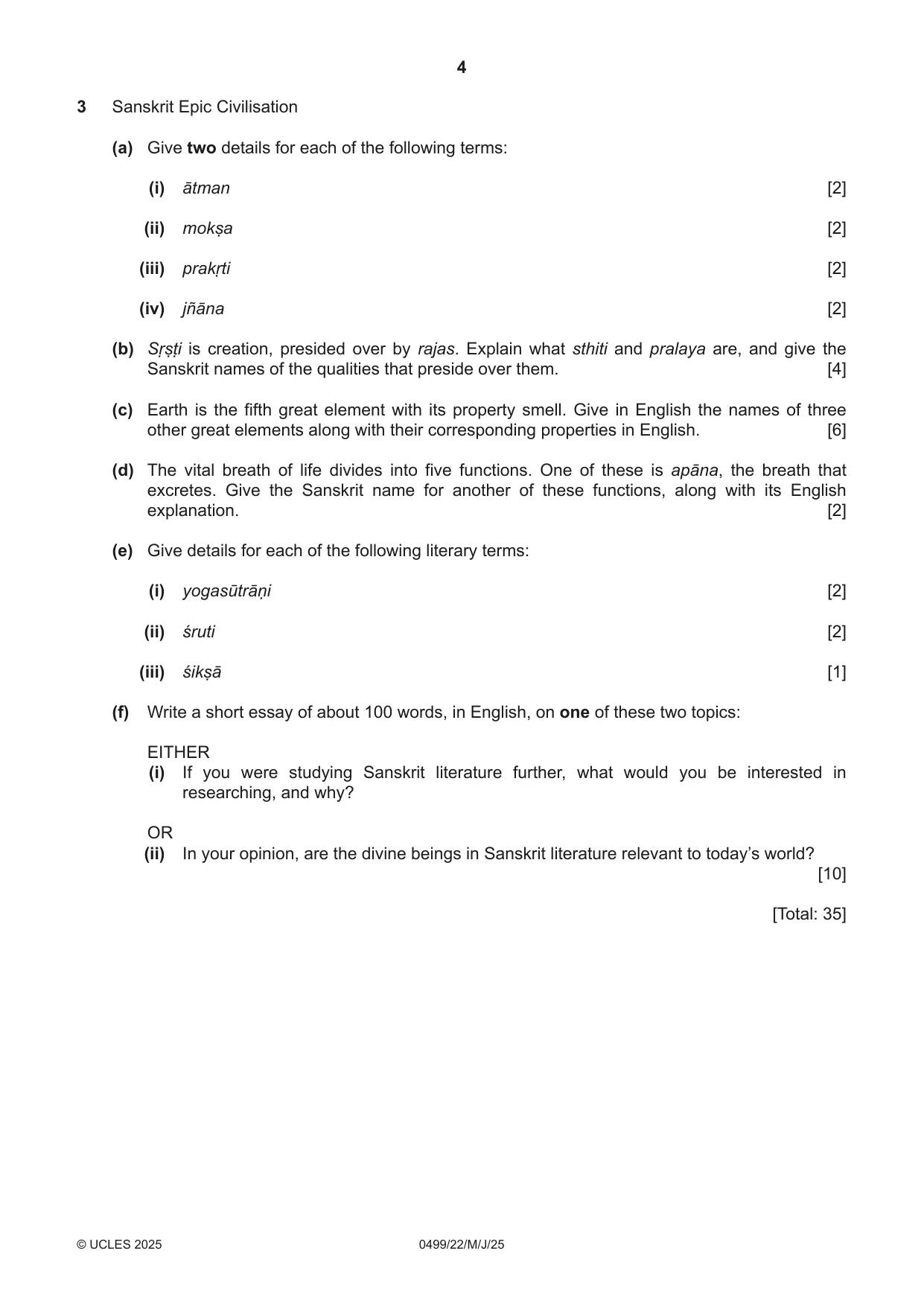
3 Sanskrit Epic Civilisation (a) Give two details for each of the following terms: (i) ātman [2] (ii) mokṣa [2] (iii) prakṛti [2] (iv) jñāna [2] (b) Sṛṣṭi is creation, presided over by rajas. Explain what sthiti and pralaya are, and give the Sanskrit names of the qualities that preside over them. [4] (c) Earth is the fifth great element with its property smell. Give in English the names of three other great elements along with their corresponding properties in English. [6] (d) The vital breath of life divides into five functions. One of these is apāna, the breath that excretes. Give the Sanskrit name for another of these functions, along with its English explanation. [2] (e) Give details for each of the following literary terms: (i) yogasūtrāṇi [2] (ii) śruti [2] (iii) śikṣā [1] (f) Write a short essay of about 100 words, in English, on one of these two topics: EITHER (i) If you were studying Sanskrit literature further, what would you be interested in researching, and why? OR (ii) In your opinion, are the divine beings in Sanskrit literature relevant to today’s world? [10] [Total: 35]
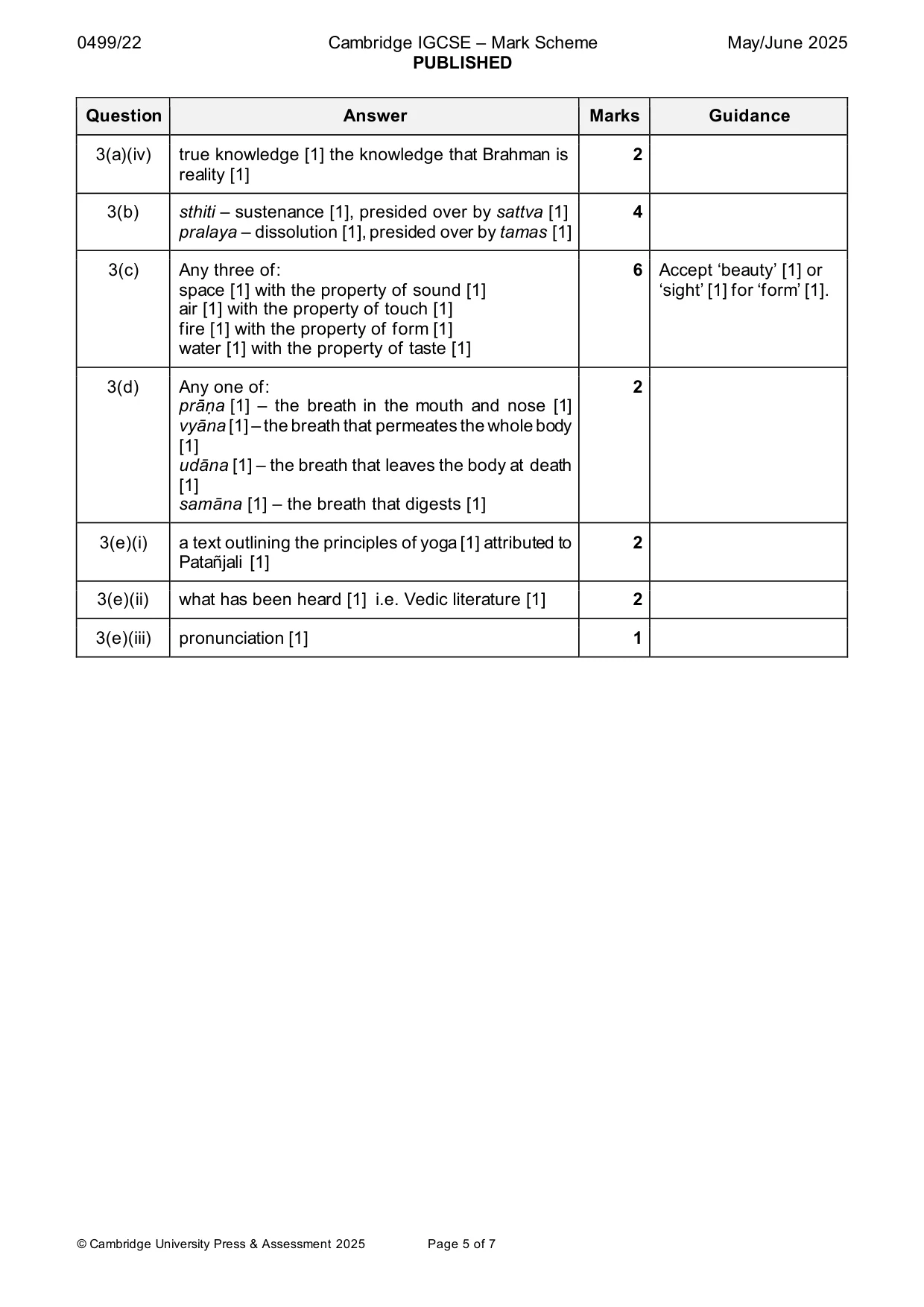
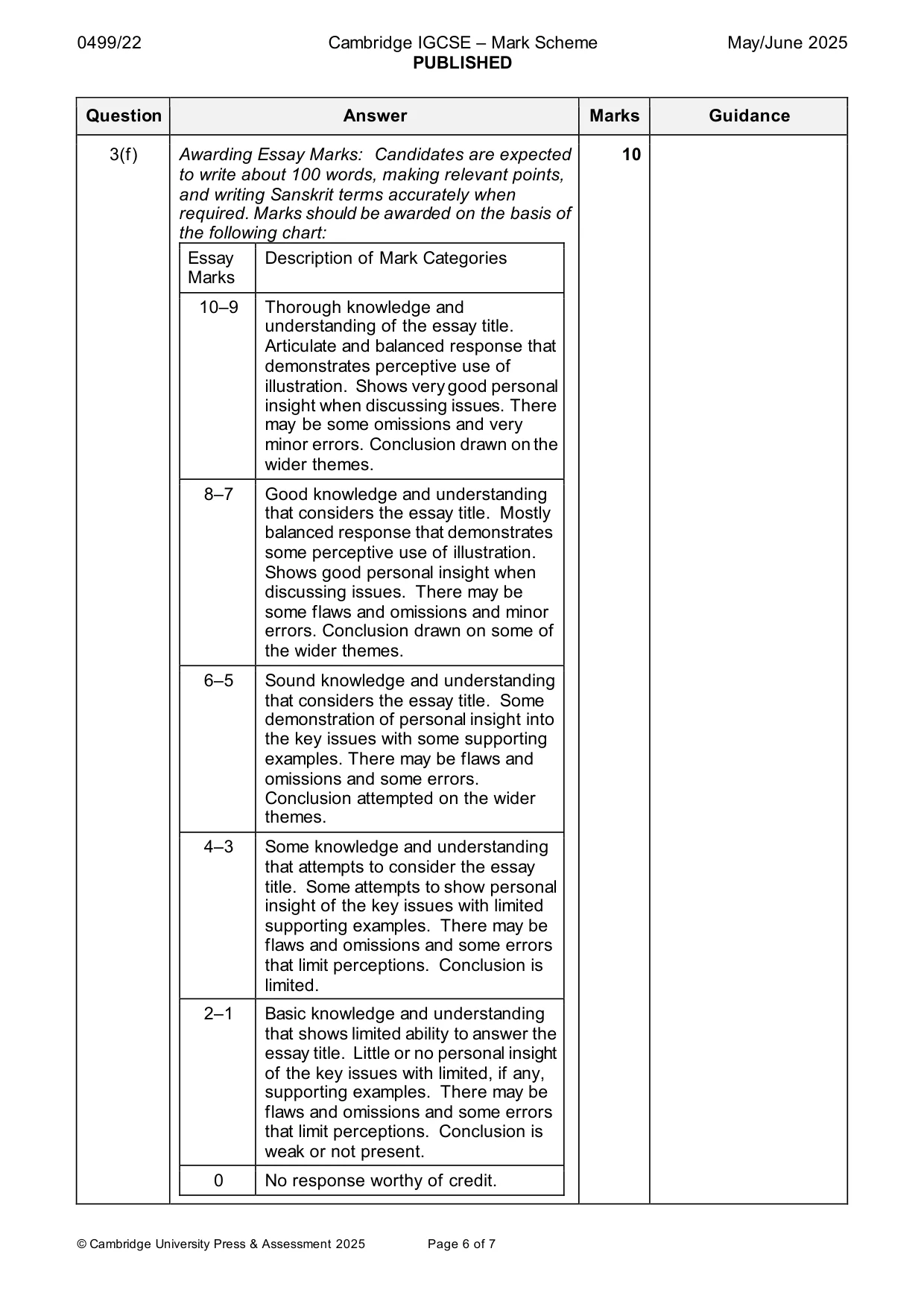
Mark scheme: 3 Sanskrit Epic Civilisation 3(a)(i) the Self [1], the one Self in all [1] 2 3(a)(ii) liberation [1] from bondage in saṃsāra [1] 2 3(a)(iii) primal nature [1] where everything is stored [1] 2 3(a)(iv) true knowledge [1] the knowledge that Brahman is 2 reality [1] 3(b) sthiti – sustenance [1], presided over by sattva [1] 4 pralaya – dissolution [1], presided over by tamas [1] 3(c) Any three of: 6 Accept ‘beauty’ [1] or space [1] with the property of sound [1] ‘sight’ [1] for ‘form’ [1]. air [1] with the property of touch [1] fire [1] with the property of form [1] water [1] with the property of taste [1] 3(d) Any one of: 2 prāṇa [1] – the breath in the mouth and nose [1] vyāna [1] – the breath that permeates the whole body [1] udāna [1] – the breath that leaves the body at death [1] samāna [1] – the breath that digests [1] 3(e)(i) a text outlining the principles of yoga [1] attributed to 2 Patañjali [1] 3(e)(ii) what has been heard [1] i.e. Vedic literature [1] 2 3(e)(iii) pronunciation [1] 1 3(f) Awarding Essay Marks: Candidates are expected 10 to write about 100 words, making relevant points, and writing Sanskrit terms accurately when required. Marks should be awarded on the basis of the following chart: Essay Description of Mark Categories Marks 10–9 Thorough knowledge and understanding of the essay title. Articulate and balanced response that demonstrates perceptive use of illustration. Shows very good personal insight when discussing issues. There may be some omissions and very minor errors. Conclusion drawn on the wider themes. 8–7 Good knowledge and understanding that considers the essay title. Mostly balanced response that demonstrates some perceptive use of illustration. Shows good personal insight when discussing issues. There may be some flaws and omissions and minor errors. Conclusion drawn on some of the wider themes. 6–5 Sound knowledge and understanding that considers the essay title. Some demonstration of personal insight into the key issues with some supporting examples. There may be flaws and omissions and some errors. Conclusion attempted on the wider themes. 4–3 Some knowledge and understanding that attempts to consider the essay title. Some attempts to show personal insight of the key issues with limited supporting examples. There may be flaws and omissions and some errors that limit perceptions. Conclusion is limited. 2–1 Basic knowledge and understanding that shows limited ability to answer the essay title. Little or no personal insight of the key issues with limited, if any, supporting examples. There may be flaws and omissions and some errors that limit perceptions. Conclusion is weak or not present. 0 No response worthy of credit.
Q4 · Pañcatantra Read the following Sanskrit passage
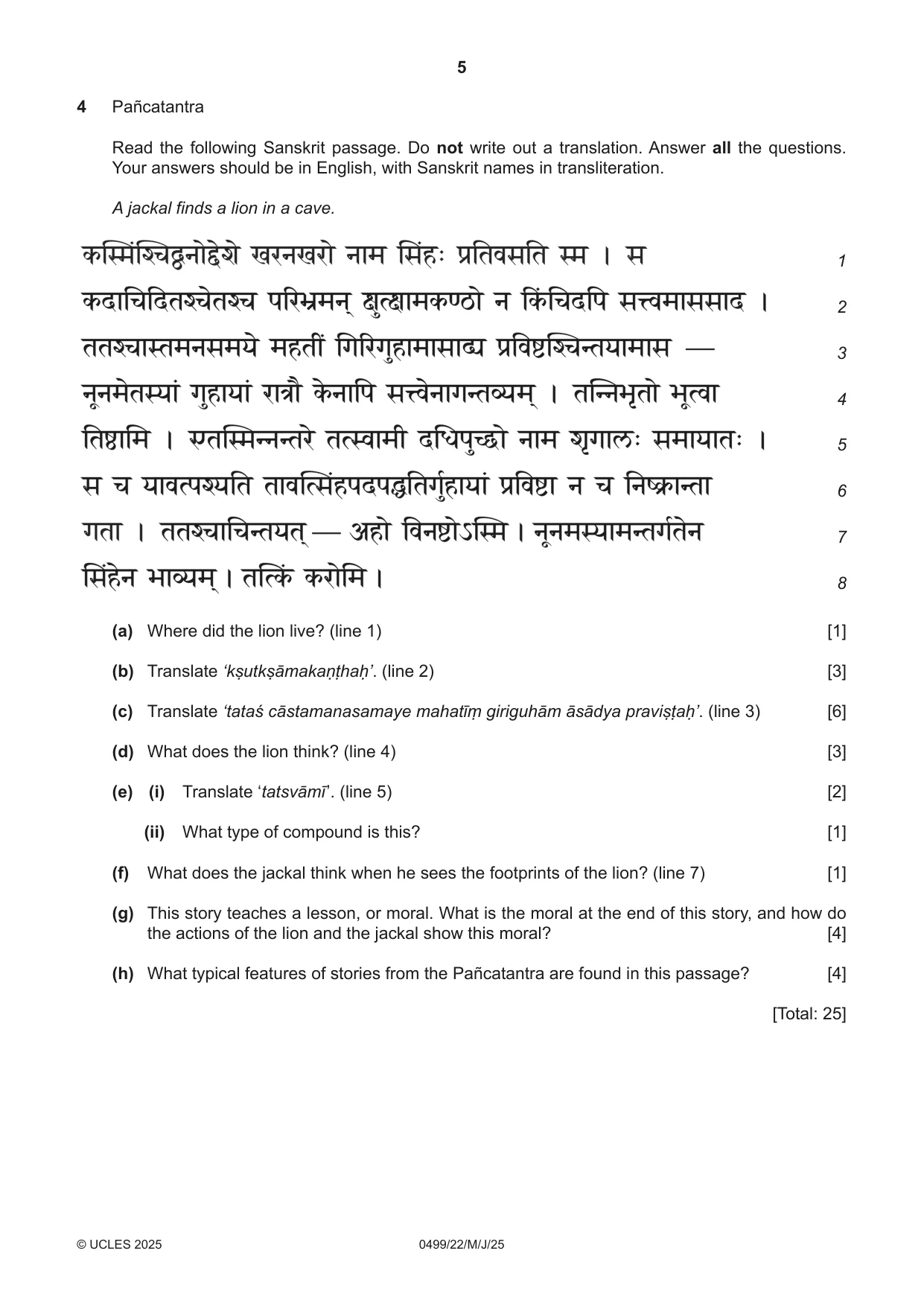
4 Pañcatantra Read the following Sanskrit passage. Do not write out a translation. Answer all the questions. Your answers should be in English, with Sanskrit names in transliteration. A jackal finds a lion in a cave. 1 2 3 4 5 6 7 8 (a) Where did the lion live? (line 1) [1] (b) Translate ‘kṣutkṣāmakaṇṭhaḥ’. (line 2) [3] (c) Translate ‘tataś cāstamanasamaye mahatīṃ giriguhām āsādya praviṣṭaḥ’. (line 3) [6] (d) What does the lion think? (line 4) [3] (e) (i) Translate ‘tatsvāmī ’. (line 5) [2] (ii) What type of compound is this? [1] (f) What does the jackal think when he sees the footprints of the lion? (line 7) [1] (g) This story teaches a lesson, or moral. What is the moral at the end of this story, and how do the actions of the lion and the jackal show this moral? [4] (h) What typical features of stories from the Pañcatantra are found in this passage? [4] [Total: 25]
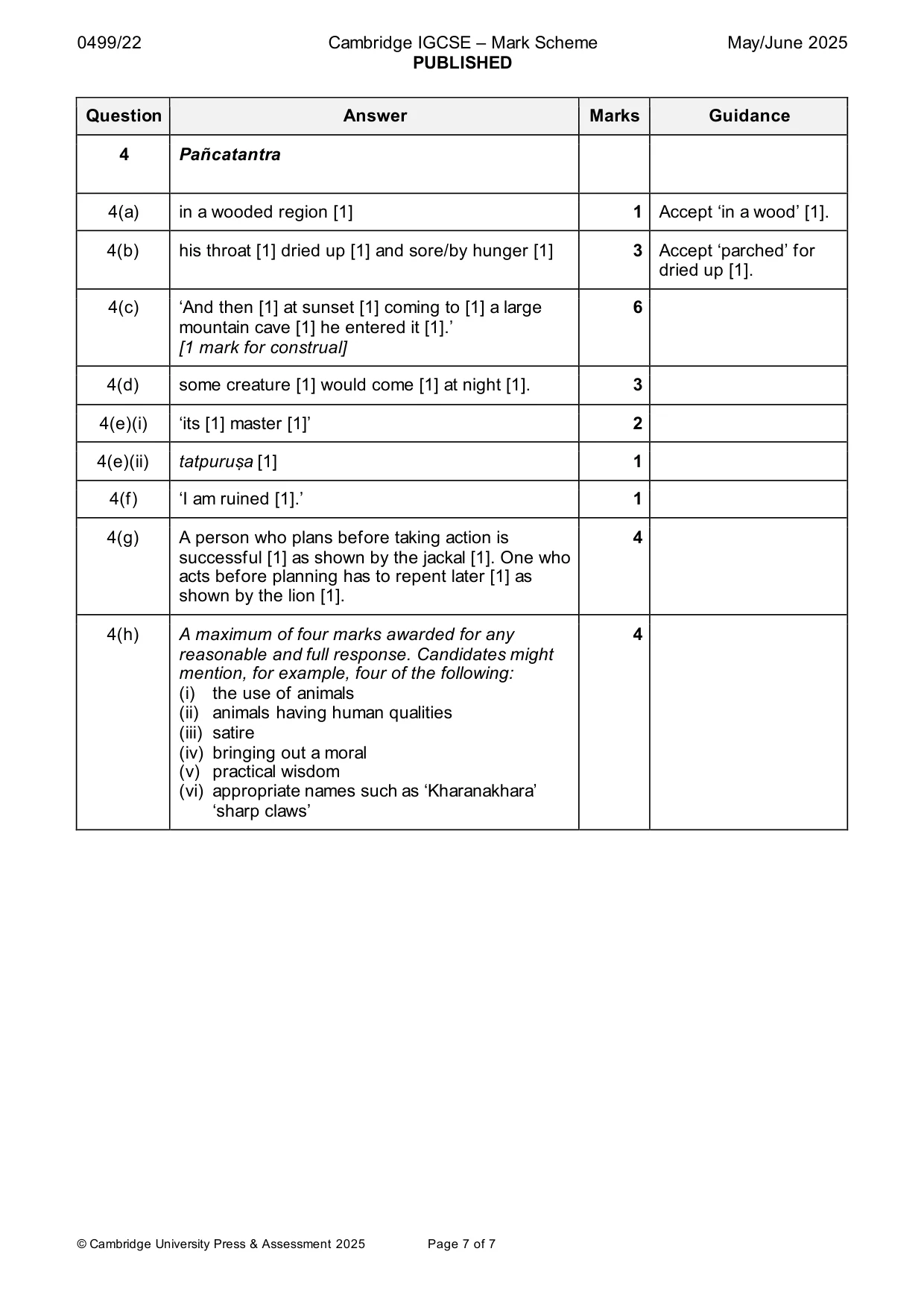
Mark scheme: 4 Pañcatantra 4(a) in a wooded region [1] 1 Accept ‘in a wood’ [1]. 4(b) his throat [1] dried up [1] and sore/by hunger [1] 3 Accept ‘parched’ for dried up [1]. 4(c) ‘And then [1] at sunset [1] coming to [1] a large 6 mountain cave [1] he entered it [1].’ [1 mark for construal] 4(d) some creature [1] would come [1] at night [1]. 3 4(e)(i) ‘its [1] master [1]’ 2 4(e)(ii) tatpuruṣa [1] 1 4(f) ‘I am ruined [1].’ 1 4(g) A person who plans before taking action is 4 successful [1] as shown by the jackal [1]. One who acts before planning has to repent later [1] as shown by the lion [1]. 4(h) A maximum of four marks awarded for any 4 reasonable and full response. Candidates might mention, for example, four of the following: (i) the use of animals (ii) animals having human qualities (iii) satire (iv) bringing out a moral (v) practical wisdom (vi) appropriate names such as ‘Kharanakhara’ ‘sharp claws’
What you needed in this session
Cambridge’s own grade thresholds for 2025 May/June, Paper 2 · Variant 2. A higher threshold means an easier paper — the bar moves with how the cohort did.