Cambridge IGCSE Sanskrit 0499 — 2024 May/June Paper 2 · Variant 1
0499/21/M/J/24 · 4 questions · 90 marks · ≈101 min
The question paper and its mark scheme, free to read here and free to download. This is Cambridge’s own paper, exactly as it was sat.
Question paper8 pages


Mark scheme7 pages
Answers below. Sit the paper first if you are practising.
Questions as text
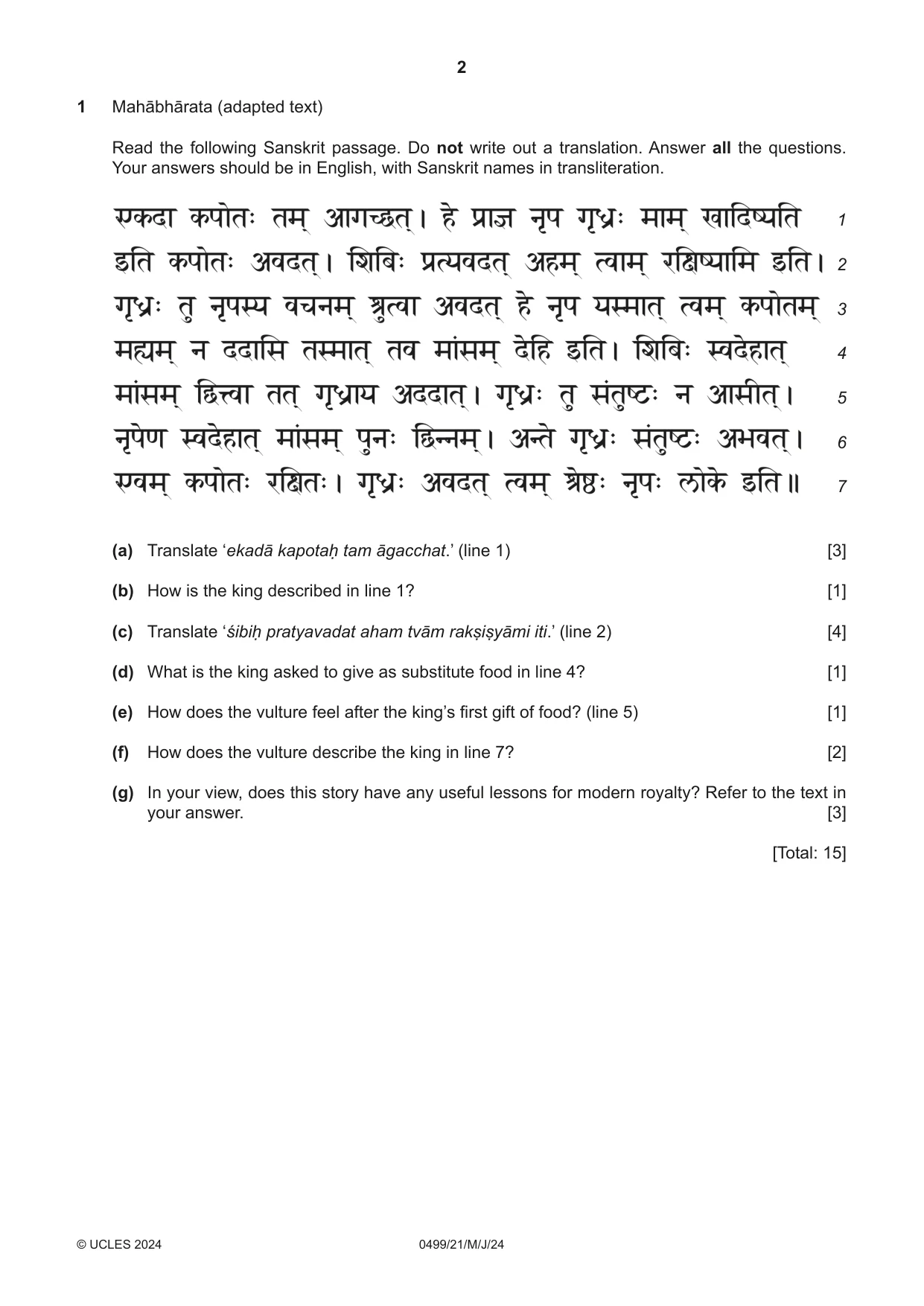
Q1 · Mahābhārata (adapted text) Read the following Sanskrit passage
1 Mahābhārata (adapted text) Read the following Sanskrit passage. Do not write out a translation. Answer all the questions. Your answers should be in English, with Sanskrit names in transliteration. 1 2 3 4 5 6 7 (a) Translate ‘ekadā kapotaḥ tam āgacchat.’ (line 1) [3] (b) How is the king described in line 1? [1] (c) Translate ‘śibiḥ pratyavadat aham tvām rakṣiṣyāmi iti.’ (line 2) [4] (d) What is the king asked to give as substitute food in line 4? [1] (e) How does the vulture feel after the king’s first gift of food? (line 5) [1] (f) How does the vulture describe the king in line 7? [2] (g) In your view, does this story have any useful lessons for modern royalty? Refer to the text in your answer. [3] [Total: 15]
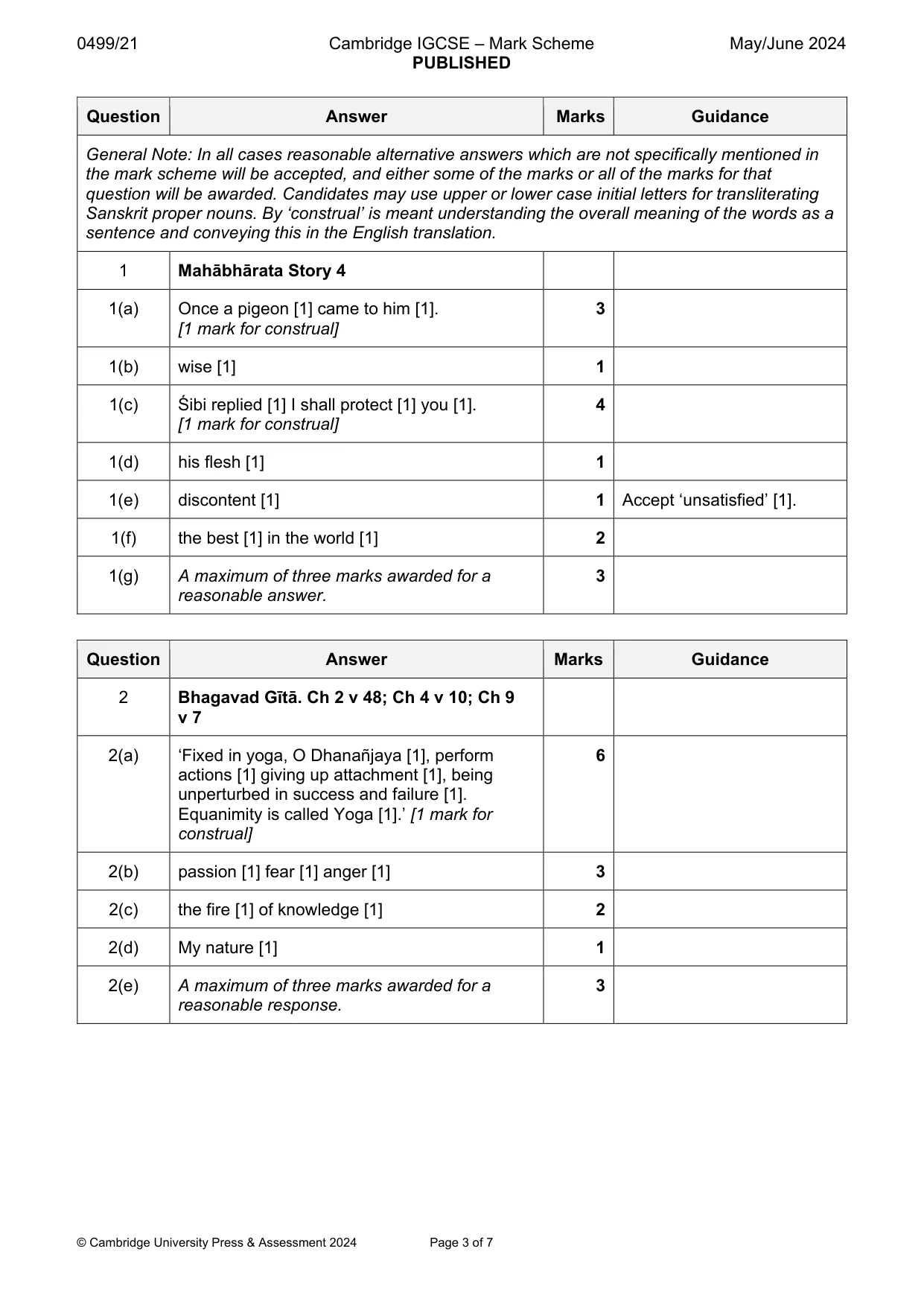
Mark scheme: question will be awarded. Candidates may use upper or lower case initial letters for transliterating Sanskrit proper nouns. By ‘construal’ is meant understanding the overall meaning of the words as a sentence and conveying this in the English translation. 1 Mahābhārata Story 4 1(a) Once a pigeon [1] came to him [1]. 3 [1 mark for construal] 1(b) wise [1] 1 1(c) Śibi replied [1] I shall protect [1] you [1]. 4 [1 mark for construal] 1(d) his flesh [1] 1 1(e) discontent [1] 1 Accept ‘unsatisfied’ [1]. 1(f) the best [1] in the world [1] 2 1(g) A maximum of three marks awarded for a 3 reasonable answer.
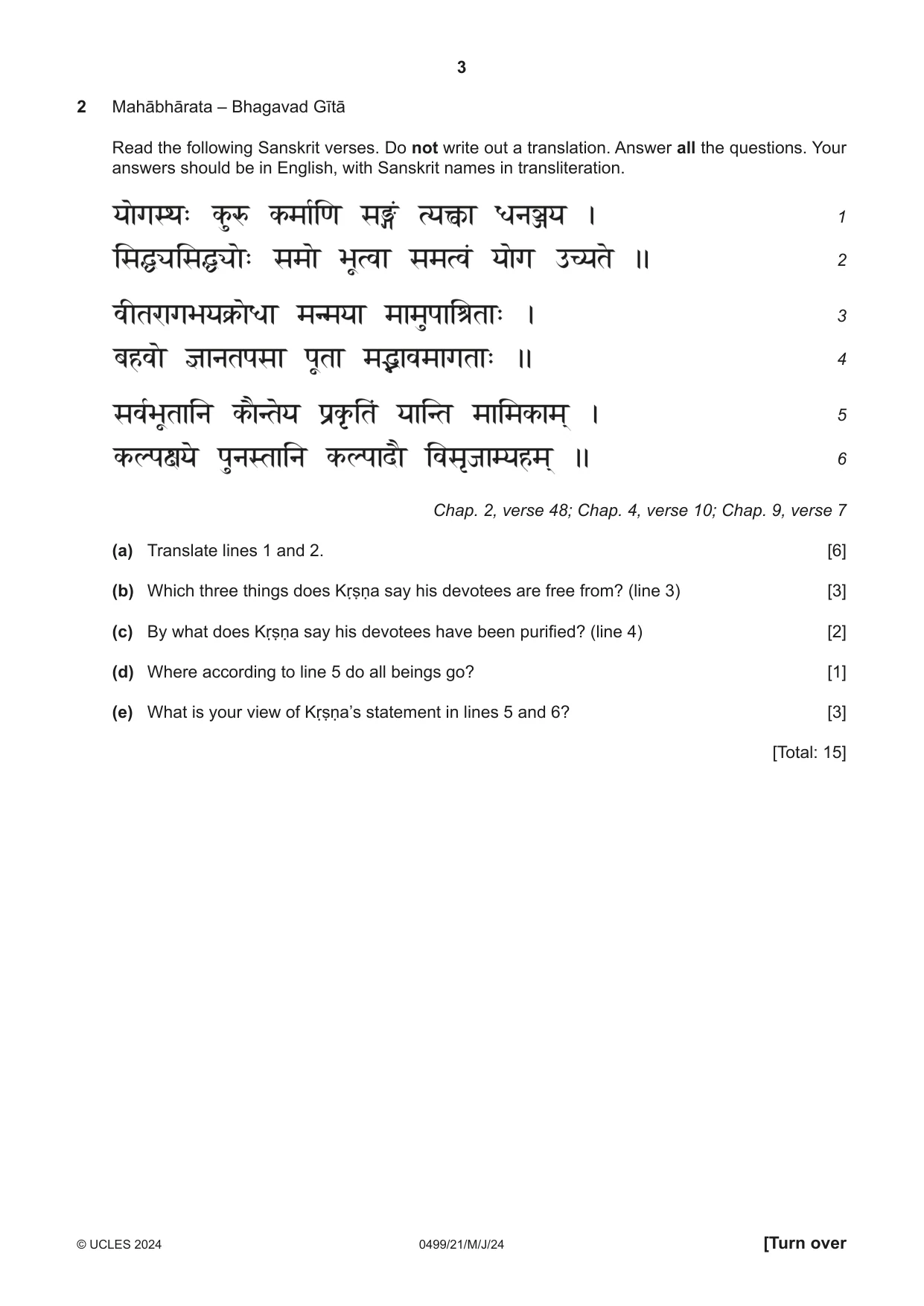
Q2 · Mahābhārata – Bhagavad Gītā Read the following Sanskrit verses
2 Mahābhārata – Bhagavad Gītā Read the following Sanskrit verses. Do not write out a translation. Answer all the questions. Your answers should be in English, with Sanskrit names in transliteration. 1 2 3 4 5 6 Chap. 2, verse 48; Chap. 4, verse 10; Chap. 9, verse 7 (a) Translate lines 1 and 2. [6] (b) Which three things does Kṛṣṇa say his devotees are free from? (line 3) [3] (c) By what does Kṛṣṇa say his devotees have been purified? (line 4) [2] (d) Where according to line 5 do all beings go? [1] (e) What is your view of Kṛṣṇa’s statement in lines 5 and 6? [3] [Total: 15]
Mark scheme: 2 Bhagavad Gῑtā. Ch 2 v 48; Ch 4 v 10; Ch 9 v 7 2(a) ‘Fixed in yoga, O Dhanañjaya [1], perform 6 actions [1] giving up attachment [1], being unperturbed in success and failure [1]. Equanimity is called Yoga [1].’ [1 mark for construal] 2(b) passion [1] fear [1] anger [1] 3 2(c) the fire [1] of knowledge [1] 2 2(d) My nature [1] 1 2(e) A maximum of three marks awarded for a 3 reasonable response.
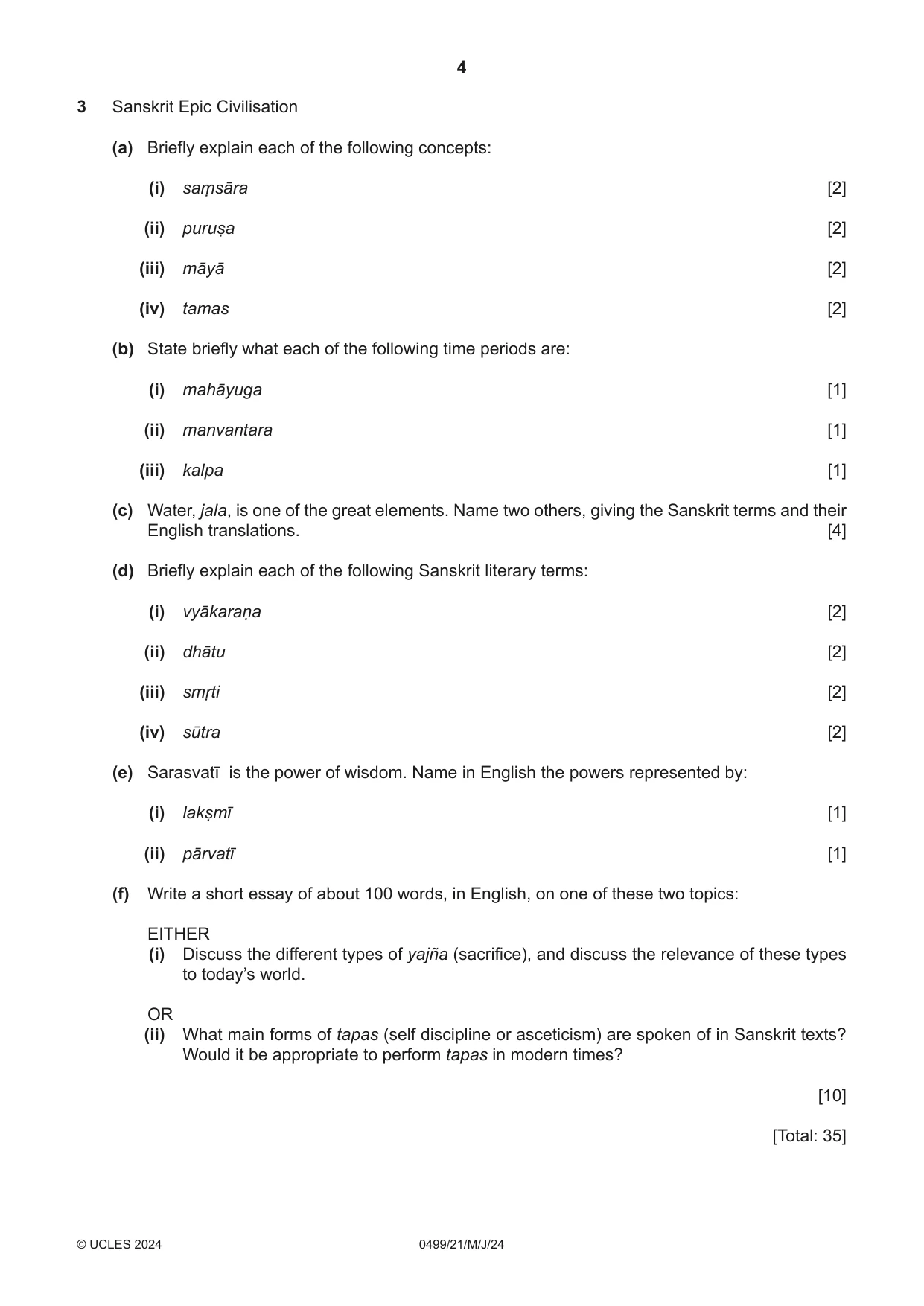
Q3 · Sanskrit Epic Civilisation (a) Briefly explain each of the following concepts: (i)…
3 Sanskrit Epic Civilisation (a) Briefly explain each of the following concepts: (i) saṃsāra [2] (ii) puruṣa [2] (iii) māyā [2] (iv) tamas [2] (b) State briefly what each of the following time periods are: (i) mahāyuga [1] (ii) manvantara [1] (iii) kalpa [1] (c) Water, jala, is one of the great elements. Name two others, giving the Sanskrit terms and their English translations. [4] (d) Briefly explain each of the following Sanskrit literary terms: (i) vyākaraṇa [2] (ii) dhātu [2] (iii) smṛti [2] (iv) sūtra [2] (e) Sarasvatī is the power of wisdom. Name in English the powers represented by: (i) lakṣmī [1] (ii) pārvatī [1] (f) Write a short essay of about 100 words, in English, on one of these two topics: EITHER (i) Discuss the different types of yajña (sacrifice), and discuss the relevance of these types to today’s world. OR (ii) What main forms of tapas (self discipline or asceticism) are spoken of in Sanskrit texts? Would it be appropriate to perform tapas in modern times? [10] [Total: 35]
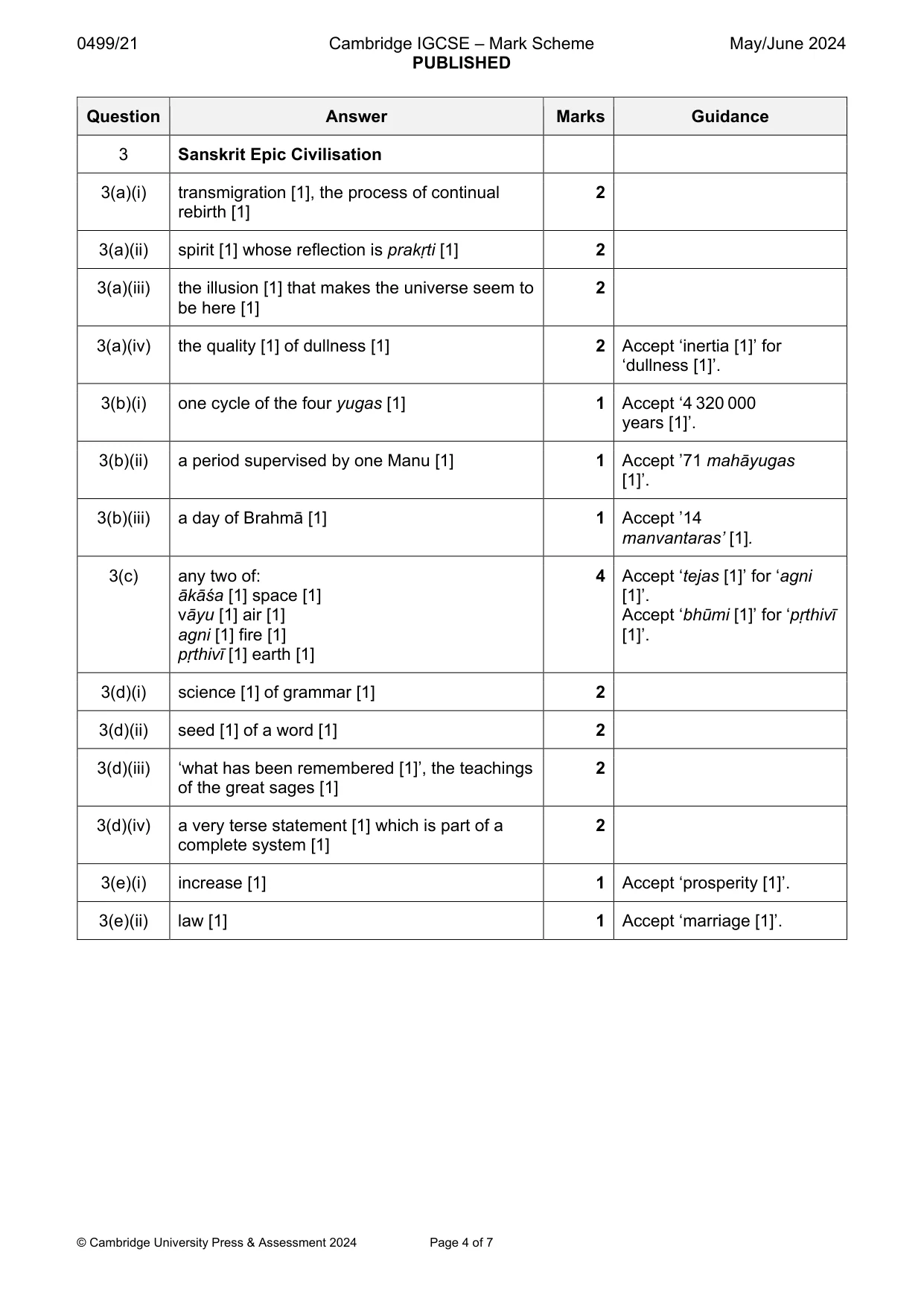
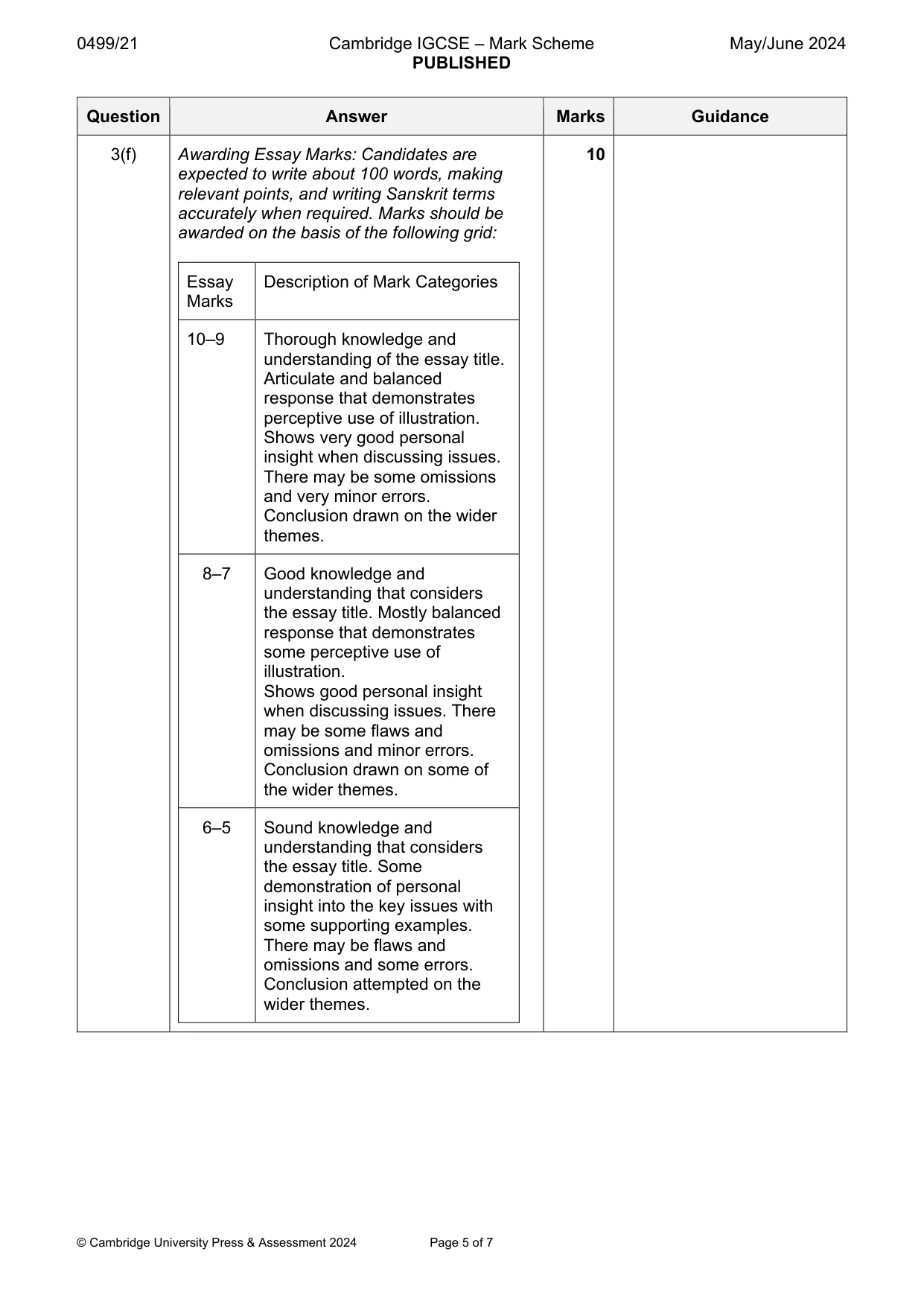
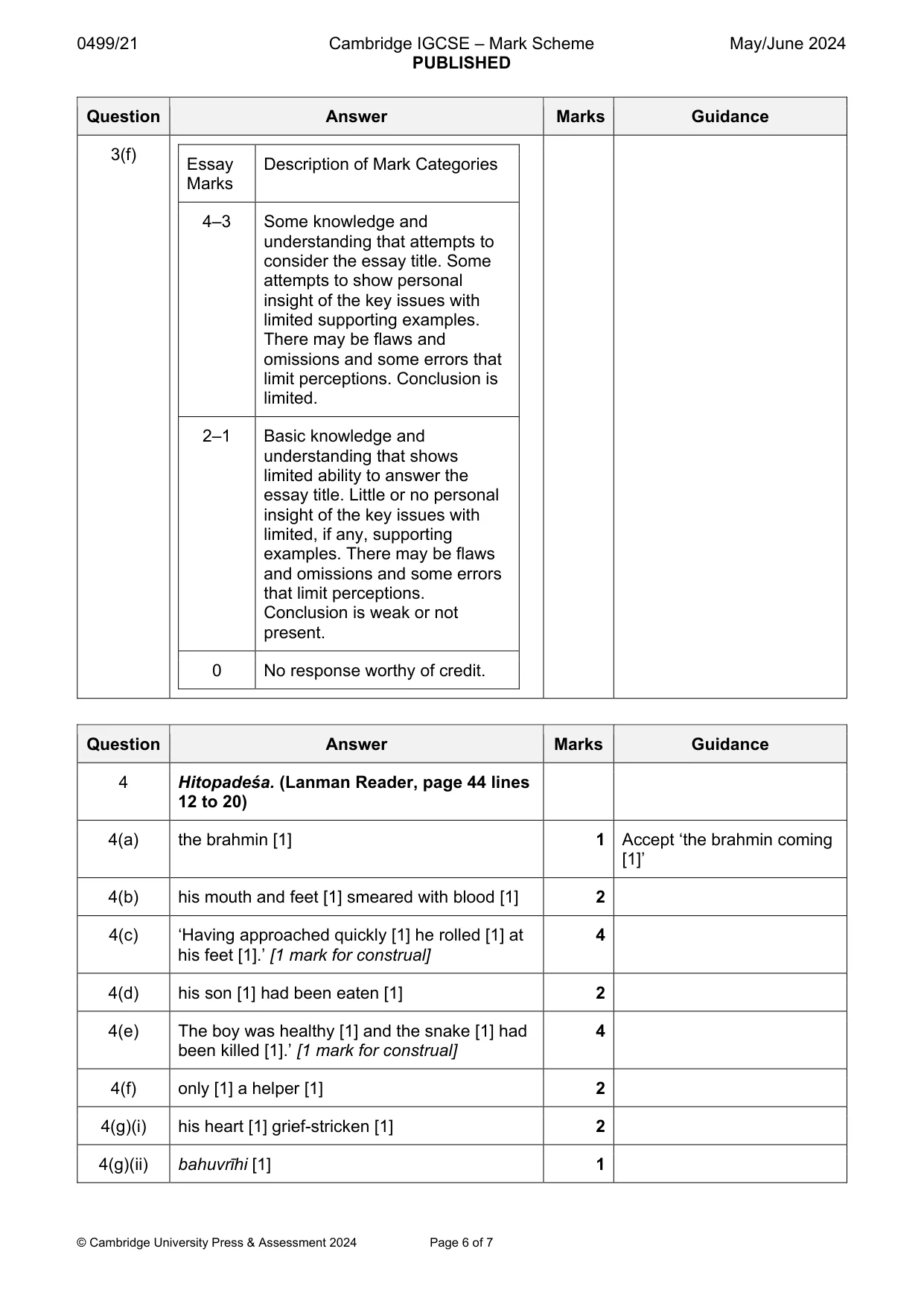
Mark scheme: 3 Sanskrit Epic Civilisation 3(a)(i) transmigration [1], the process of continual 2 rebirth [1] 3(a)(ii) spirit [1] whose reflection is prakṛti [1] 2 3(a)(iii) the illusion [1] that makes the universe seem to 2 be here [1] 3(a)(iv) the quality [1] of dullness [1] 2 Accept ‘inertia [1]’ for ‘dullness [1]’. 3(b)(i) one cycle of the four yugas [1] 1 Accept ‘4 320 000 years [1]’. 3(b)(ii) a period supervised by one Manu [1] 1 Accept ’71 mahāyugas [1]’. 3(b)(iii) a day of Brahmā [1] 1 Accept ’14 manvantaras’ [1]. 3(c) any two of: 4 Accept ‘tejas [1]’ for ‘agni ākāśa [1] space [1] [1]’. vāyu [1] air [1] Accept ‘bhūmi [1]’ for ‘pṛthivī agni [1] fire [1] [1]’. pṛthivī [1] earth [1] 3(d)(i) science [1] of grammar [1] 2 3(d)(ii) seed [1] of a word [1] 2 3(d)(iii) ‘what has been remembered [1]’, the teachings 2 of the great sages [1] 3(d)(iv) a very terse statement [1] which is part of a 2 complete system [1] 3(e)(i) increase [1] 1 Accept ‘prosperity [1]’. 3(e)(ii) law [1] 1 Accept ‘marriage [1]’. 3(f) Awarding Essay Marks: Candidates are 10 expected to write about 100 words, making relevant points, and writing Sanskrit terms accurately when required. Marks should be awarded on the basis of the following grid: Essay Description of Mark Categories Marks 10–9 Thorough knowledge and understanding of the essay title. Articulate and balanced response that demonstrates perceptive use of illustration. Shows very good personal insight when discussing issues. There may be some omissions and very minor errors. Conclusion drawn on the wider themes. 8–7 Good knowledge and understanding that considers the essay title. Mostly balanced response that demonstrates some perceptive use of illustration. Shows good personal insight when discussing issues. There may be some flaws and omissions and minor errors. Conclusion drawn on some of the wider themes. 6–5 Sound knowledge and understanding that considers the essay title. Some demonstration of personal insight into the key issues with some supporting examples. There may be flaws and omissions and some errors. Conclusion attempted on the wider themes. 3(f) Essay Description of Mark Categories Marks 4–3 Some knowledge and understanding that attempts to consider the essay title. Some attempts to show personal insight of the key issues with limited supporting examples. There may be flaws and omissions and some errors that limit perceptions. Conclusion is limited. 2–1 Basic knowledge and understanding that shows limited ability to answer the essay title. Little or no personal insight of the key issues with limited, if any, supporting examples. There may be flaws and omissions and some errors that limit perceptions. Conclusion is weak or not present. 0 No response worthy of credit.
Q4 · Hitopadeśa Read the following Sanskrit passage
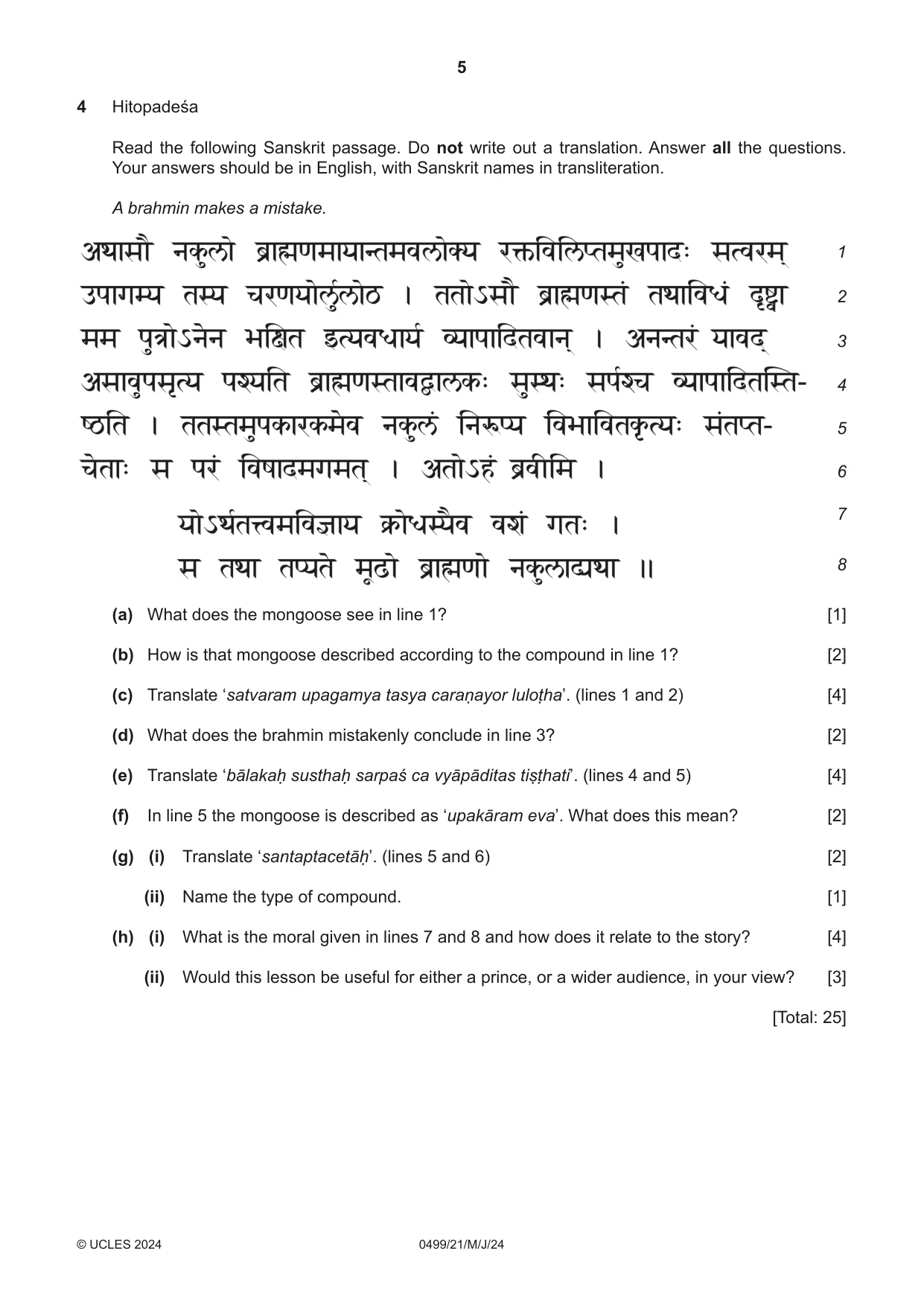
4 Hitopadeśa Read the following Sanskrit passage. Do not write out a translation. Answer all the questions. Your answers should be in English, with Sanskrit names in transliteration. A brahmin makes a mistake. 1 2 3 4 5 6 7 8 (a) What does the mongoose see in line 1? [1] (b) How is that mongoose described according to the compound in line 1? [2] (c) Translate ‘satvaram upagamya tasya caraṇayor luloṭha’. (lines 1 and 2) [4] (d) What does the brahmin mistakenly conclude in line 3? [2] (e) Translate ‘bālakaḥ susthaḥ sarpaś ca vyāpāditas tiṣṭhati’. (lines 4 and 5) [4] (f) In line 5 the mongoose is described as ‘upakāram eva’. What does this mean? [2] (g) (i) Translate ‘santaptacetāḥ’. (lines 5 and 6) [2] (ii) Name the type of compound. [1] (h) (i) What is the moral given in lines 7 and 8 and how does it relate to the story? [4] (ii) Would this lesson be useful for either a prince, or a wider audience, in your view? [3] [Total: 25]
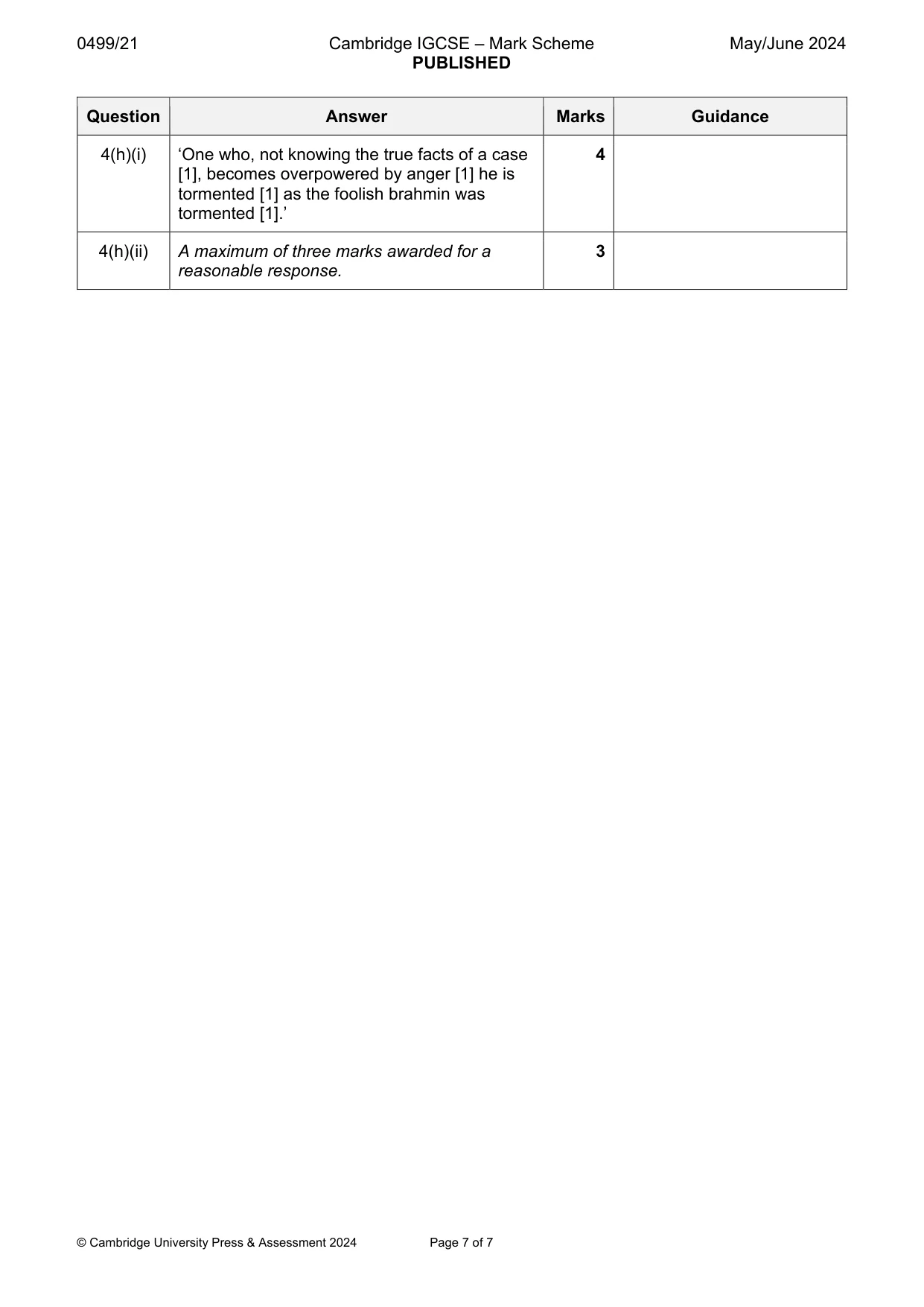
Mark scheme: 4 Hitopadeśa. (Lanman Reader, page 44 lines 12 to 20) 4(a) the brahmin [1] 1 Accept ‘the brahmin coming [1]’ 4(b) his mouth and feet [1] smeared with blood [1] 2 4(c) ‘Having approached quickly [1] he rolled [1] at 4 his feet [1].’ [1 mark for construal] 4(d) his son [1] had been eaten [1] 2 4(e) The boy was healthy [1] and the snake [1] had 4 been killed [1].’ [1 mark for construal] 4(f) only [1] a helper [1] 2 4(g)(i) his heart [1] grief-stricken [1] 2 4(g)(ii) bahuvrīhi [1] 1 4(h)(i) ‘One who, not knowing the true facts of a case 4 [1], becomes overpowered by anger [1] he is tormented [1] as the foolish brahmin was tormented [1].’ 4(h)(ii) A maximum of three marks awarded for a 3 reasonable response.
What you needed in this session
Cambridge’s own grade thresholds for 2024 May/June, Paper 2 · Variant 1. A higher threshold means an easier paper — the bar moves with how the cohort did.