Cambridge IGCSE Sanskrit 0499 — 2022 May/June Paper 2 · Variant 2
0499/22/M/J/22 · 4 questions · 90 marks · ≈101 min
The question paper and its mark scheme, free to read here and free to download. This is Cambridge’s own paper, exactly as it was sat.
Question paper8 pages


Mark scheme6 pages
Answers below. Sit the paper first if you are practising.
Questions as text
Q1 · Mahābhārata (adapted text) Read the following Sanskrit passage
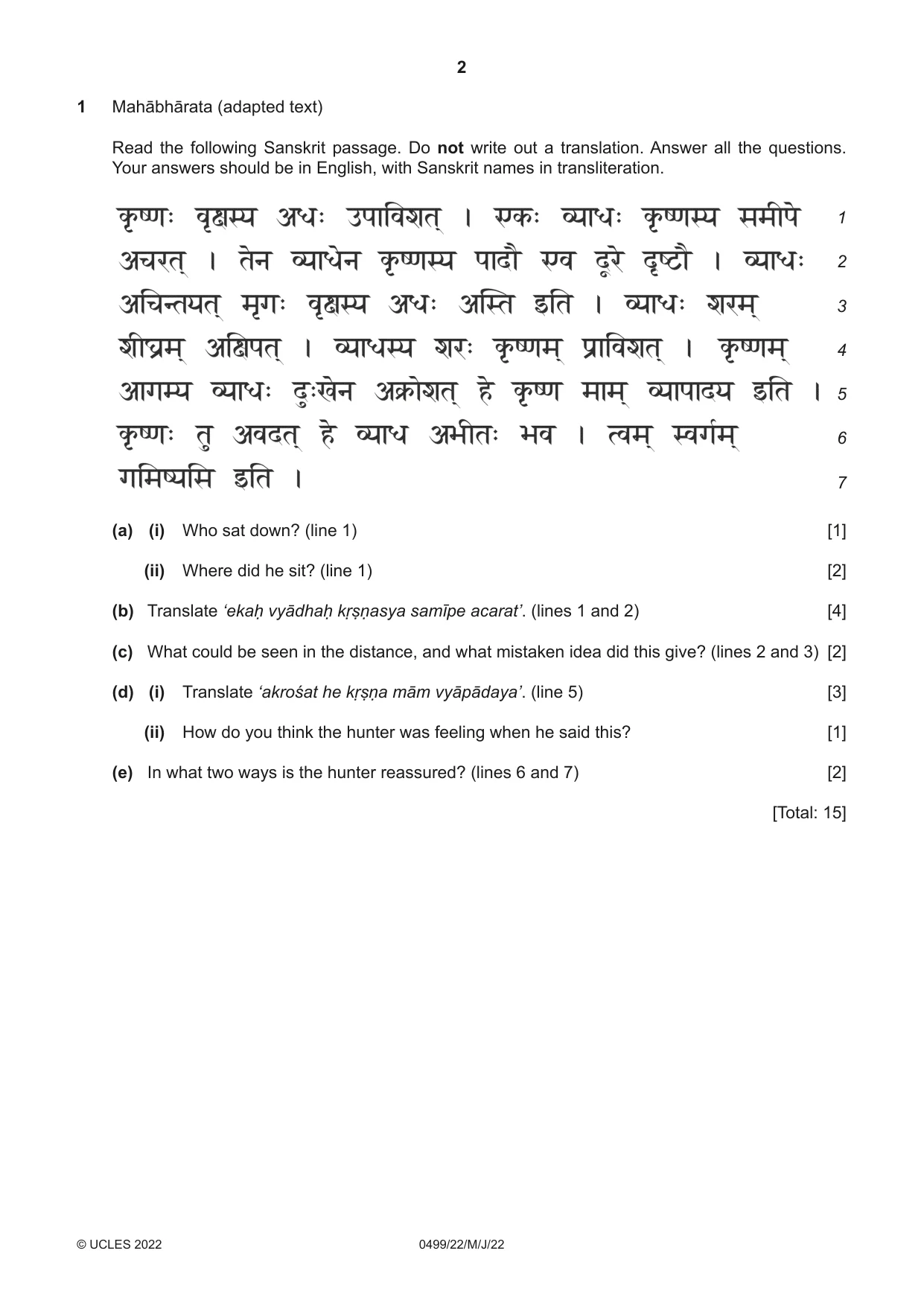
1 Mahābhārata (adapted text) Read the following Sanskrit passage. Do not write out a translation. Answer all the questions. Your answers should be in English, with Sanskrit names in transliteration. 1 2 3 4 5 6 7 (a) (i) Who sat down? (line 1) [1] (ii) Where did he sit? (line 1) [2] (b) Translate ‘ekaḥ vyādhaḥ kṛṣṇasya samīpe acarat’. (lines 1 and 2) [4] (c) What could be seen in the distance, and what mistaken idea did this give? (lines 2 and 3) [2] (d) (i) Translate ‘akrośat he kṛṣṇa mām vyāpādaya’. (line 5) [3] (ii) How do you think the hunter was feeling when he said this? [1] (e) In what two ways is the hunter reassured? (lines 6 and 7) [2] [Total: 15]
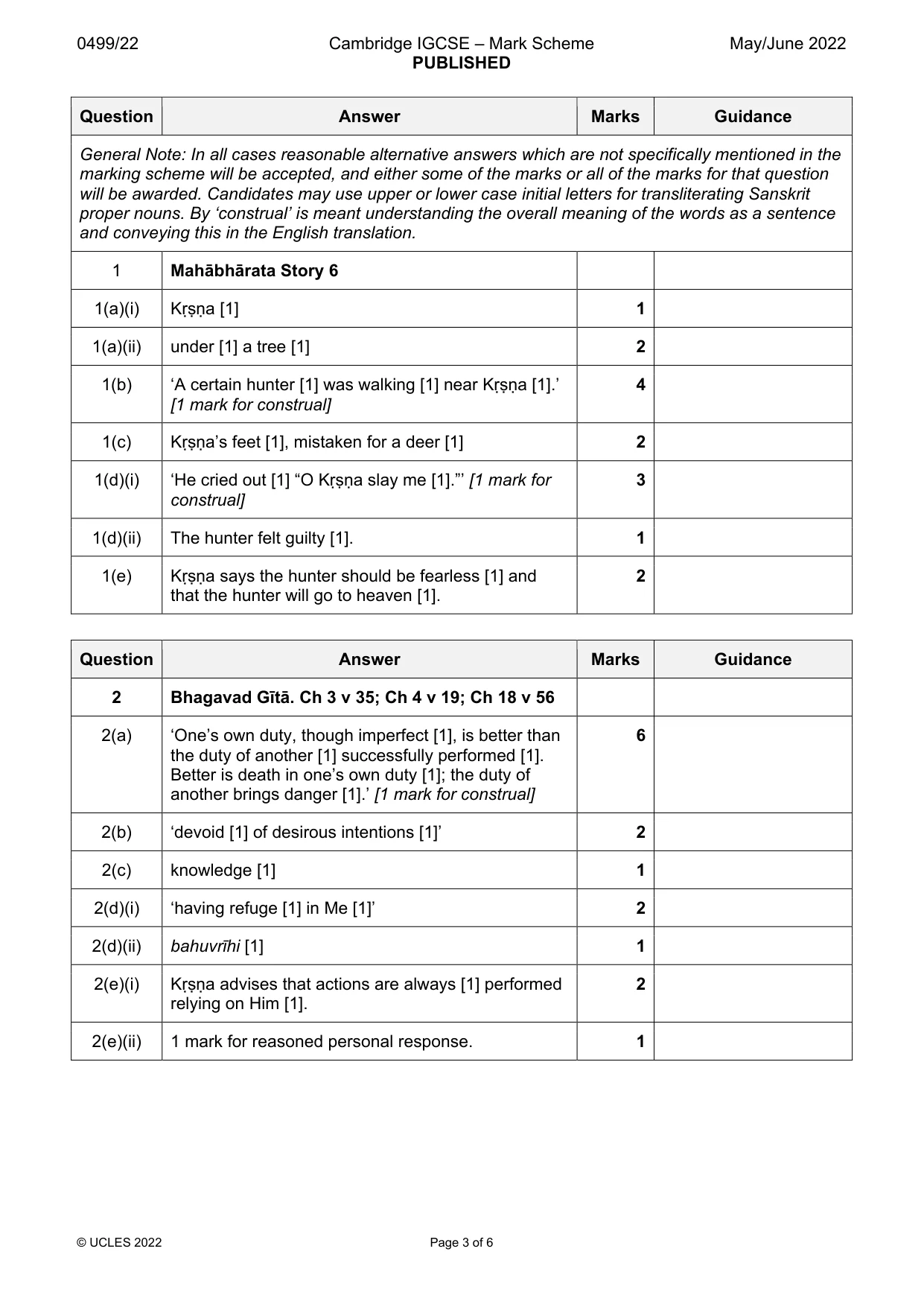
Mark scheme: Question Answer Marks Guidance General Note: In all cases reasonable alternative answers which are not specifically mentioned in the marking scheme will be accepted, and either some of the marks or all of the marks for that question will be awarded. Candidates may use upper or lower case initial letters for transliterating Sanskrit proper nouns. By ‘construal’ is meant understanding the overall meaning of the words as a sentence and conveying this in the English translation. 1 Mahābhārata Story 6 1(a)(i) Kṛṣṇa [1] 1 1(a)(ii) under [1] a tree [1] 2 1(b) ‘A certain hunter [1] was walking [1] near Kṛṣṇa [1].’ 4 [1 mark for construal] 1(c) Kṛṣṇa’s feet [1], mistaken for a deer [1] 2 1(d)(i) ‘He cried out [1] “O Kṛṣṇa slay me [1].”’ [1 mark for 3 construal] 1(d)(ii) The hunter felt guilty [1]. 1 1(e) Kṛṣṇa says the hunter should be fearless [1] and 2 that the hunter will go to heaven [1].
Q2 · Mahābhārata – Bhagavad Gītā Read the following Sanskrit verses
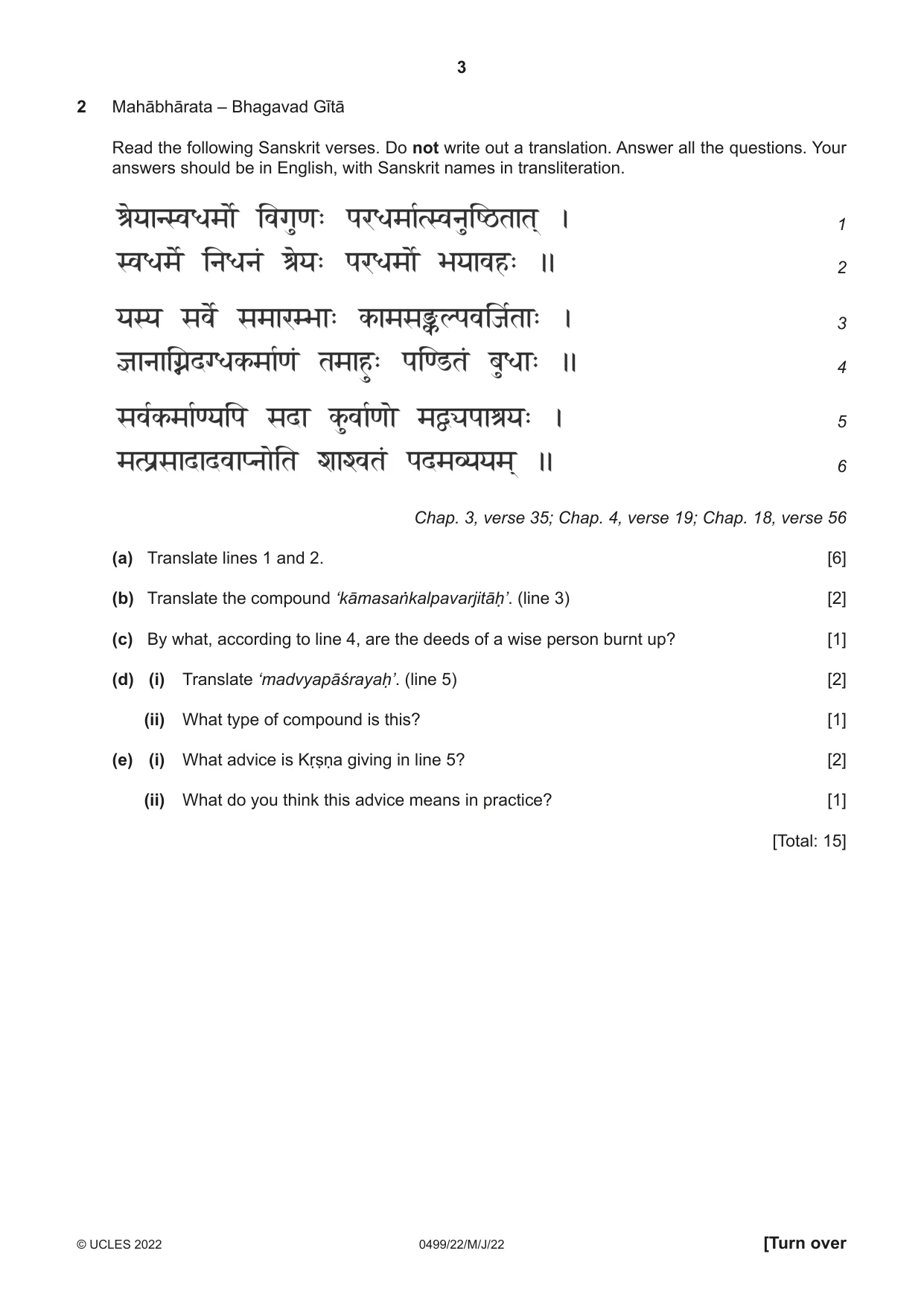
2 Mahābhārata – Bhagavad Gītā Read the following Sanskrit verses. Do not write out a translation. Answer all the questions. Your answers should be in English, with Sanskrit names in transliteration. 1 2 3 4 5 6 Chap. 3, verse 35; Chap. 4, verse 19; Chap. 18, verse 56 (a) Translate lines 1 and 2. [6] (b) Translate the compound ‘kāmasaṅkalpavarjitāḥ’. (line 3) [2] (c) By what, according to line 4, are the deeds of a wise person burnt up? [1] (d) (i) Translate ‘madvyapāśrayaḥ’. (line 5) [2] (ii) What type of compound is this? [1] (e) (i) What advice is Kṛṣṇa giving in line 5? [2] (ii) What do you think this advice means in practice? [1] [Total: 15]
Mark scheme: 2 Bhagavad Gῑtā. Ch 3 v 35; Ch 4 v 19; Ch 18 v 56 2(a) ‘One’s own duty, though imperfect [1], is better than 6 the duty of another [1] successfully performed [1]. Better is death in one’s own duty [1]; the duty of another brings danger [1].’ [1 mark for construal] 2(b) ‘devoid [1] of desirous intentions [1]’ 2 2(c) knowledge [1] 1 2(d)(i) ‘having refuge [1] in Me [1]’ 2 2(d)(ii) bahuvrīhi [1] 1 2(e)(i) Kṛṣṇa advises that actions are always [1] performed 2 relying on Him [1]. 2(e)(ii) 1 mark for reasoned personal response. 1
Q3 · Sanskrit Epic Civilisation (a) Give two details for each of the following terms: (i)…
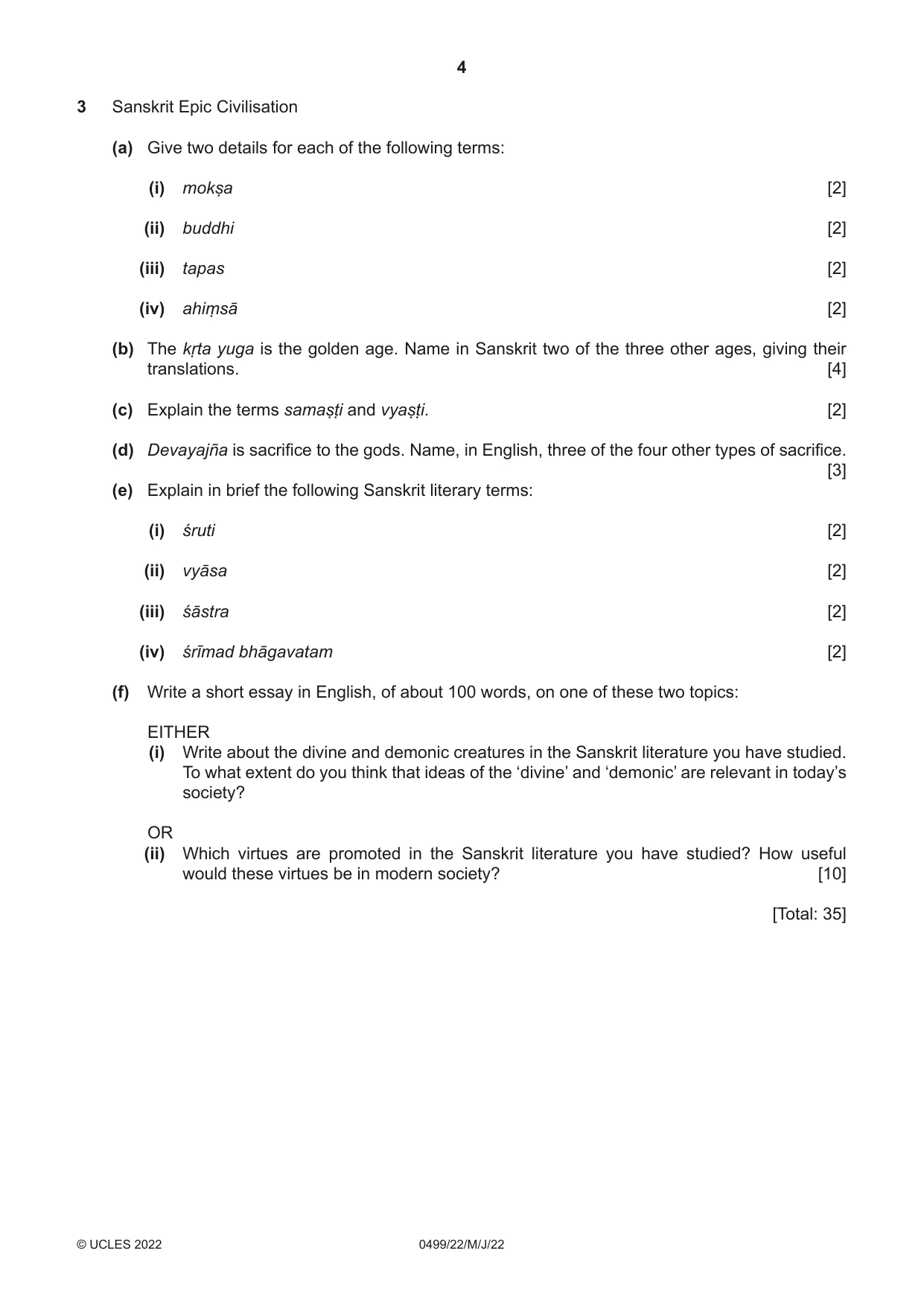
3 Sanskrit Epic Civilisation (a) Give two details for each of the following terms: (i) mokṣa [2] (ii) buddhi [2] (iii) tapas [2] (iv) ahiṃsā [2] (b) The kṛta yuga is the golden age. Name in Sanskrit two of the three other ages, giving their translations. [4] (c) Explain the terms samaṣṭi and vyaṣṭi. [2] (d) Devayajña is sacrifice to the gods. Name, in English, three of the four other types of sacrifice. [3] (e) Explain in brief the following Sanskrit literary terms: (i) śruti [2] (ii) vyāsa [2] (iii) śāstra [2] (iv) śrīmad bhāgavatam [2] (f) Write a short essay in English, of about 100 words, on one of these two topics: EITHER (i) Write about the divine and demonic creatures in the Sanskrit literature you have studied. To what extent do you think that ideas of the ‘divine’ and ‘demonic’ are relevant in today’s society? OR (ii) Which virtues are promoted in the Sanskrit literature you have studied? How useful would these virtues be in modern society? [10] [Total: 35]
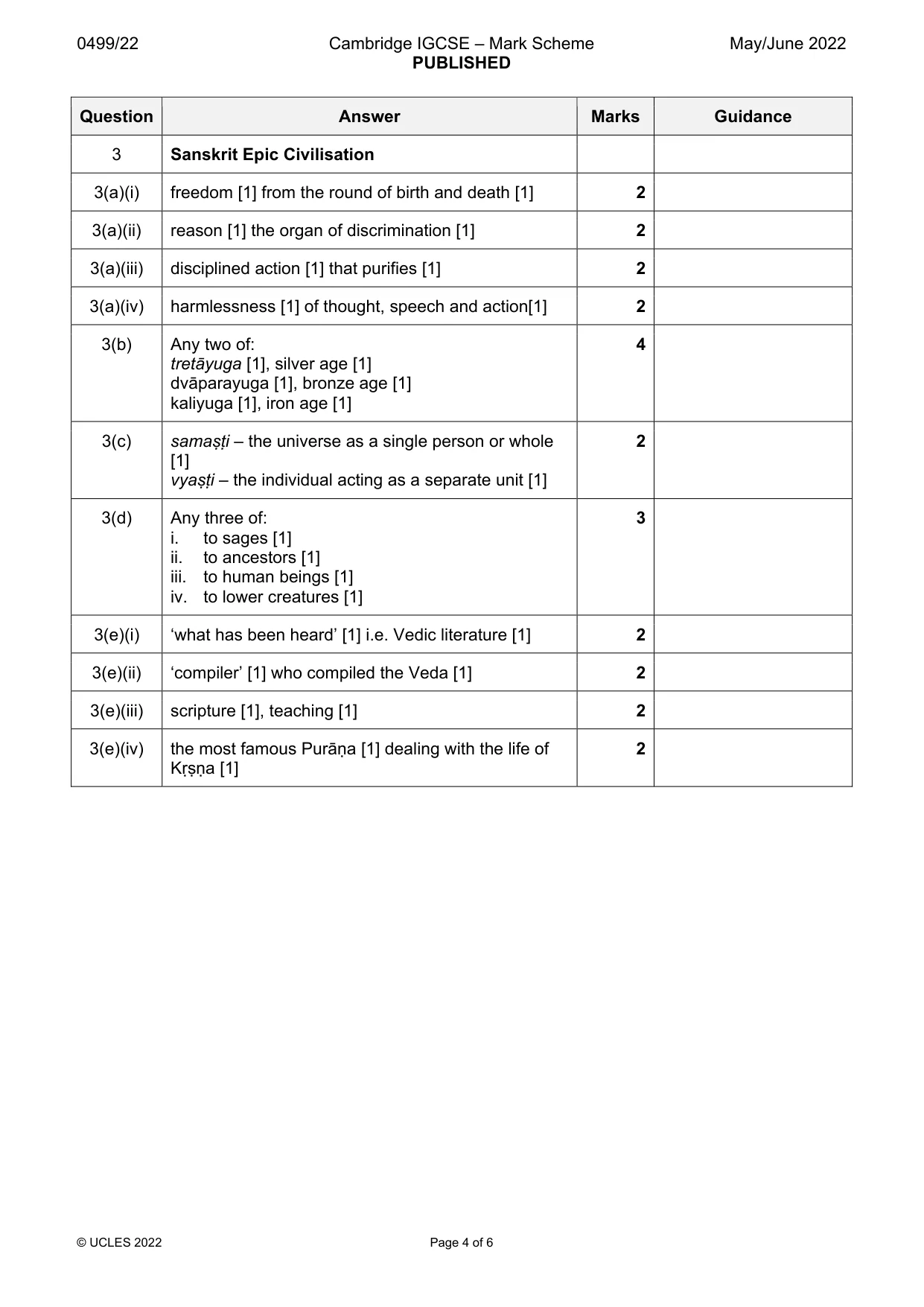
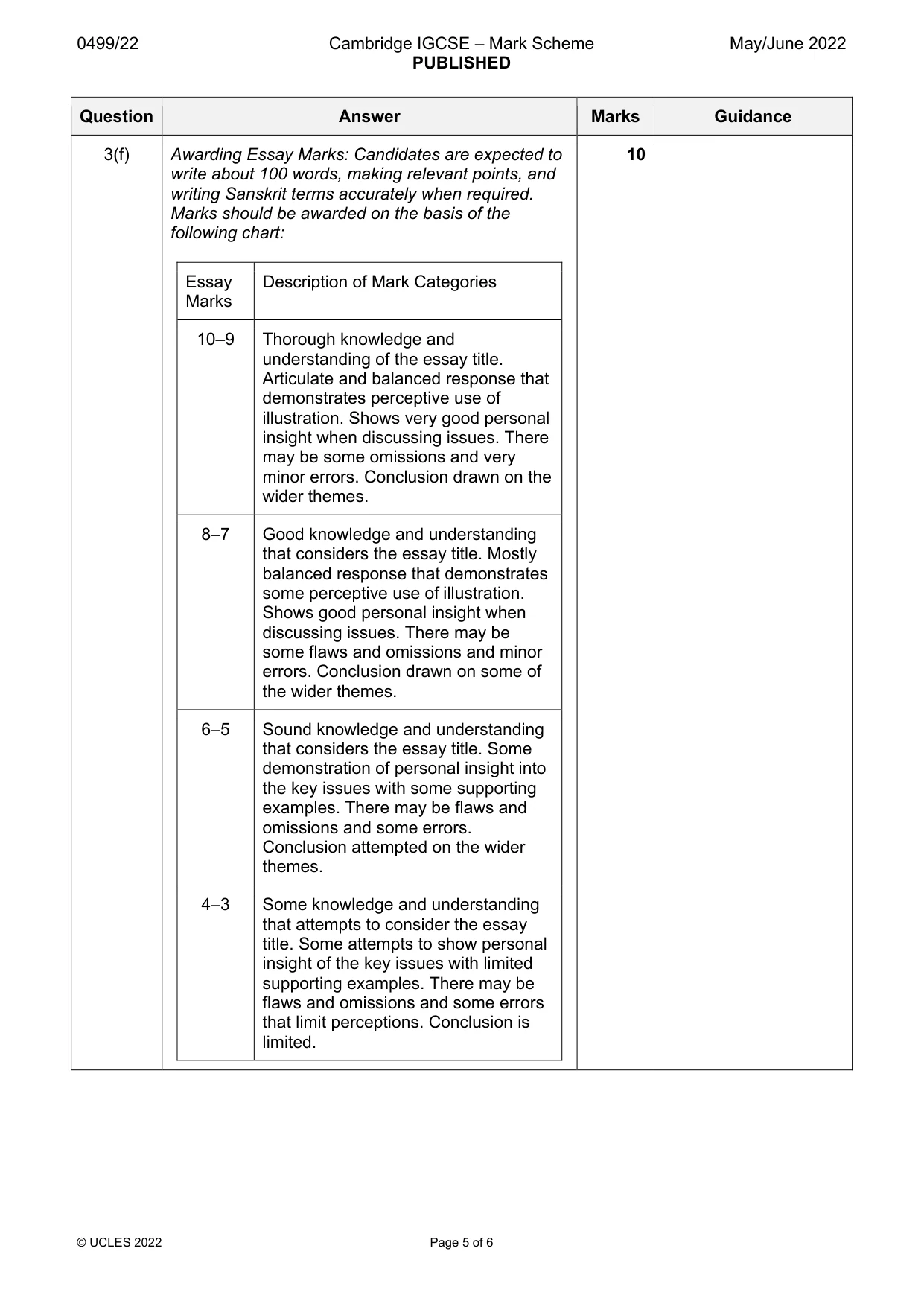
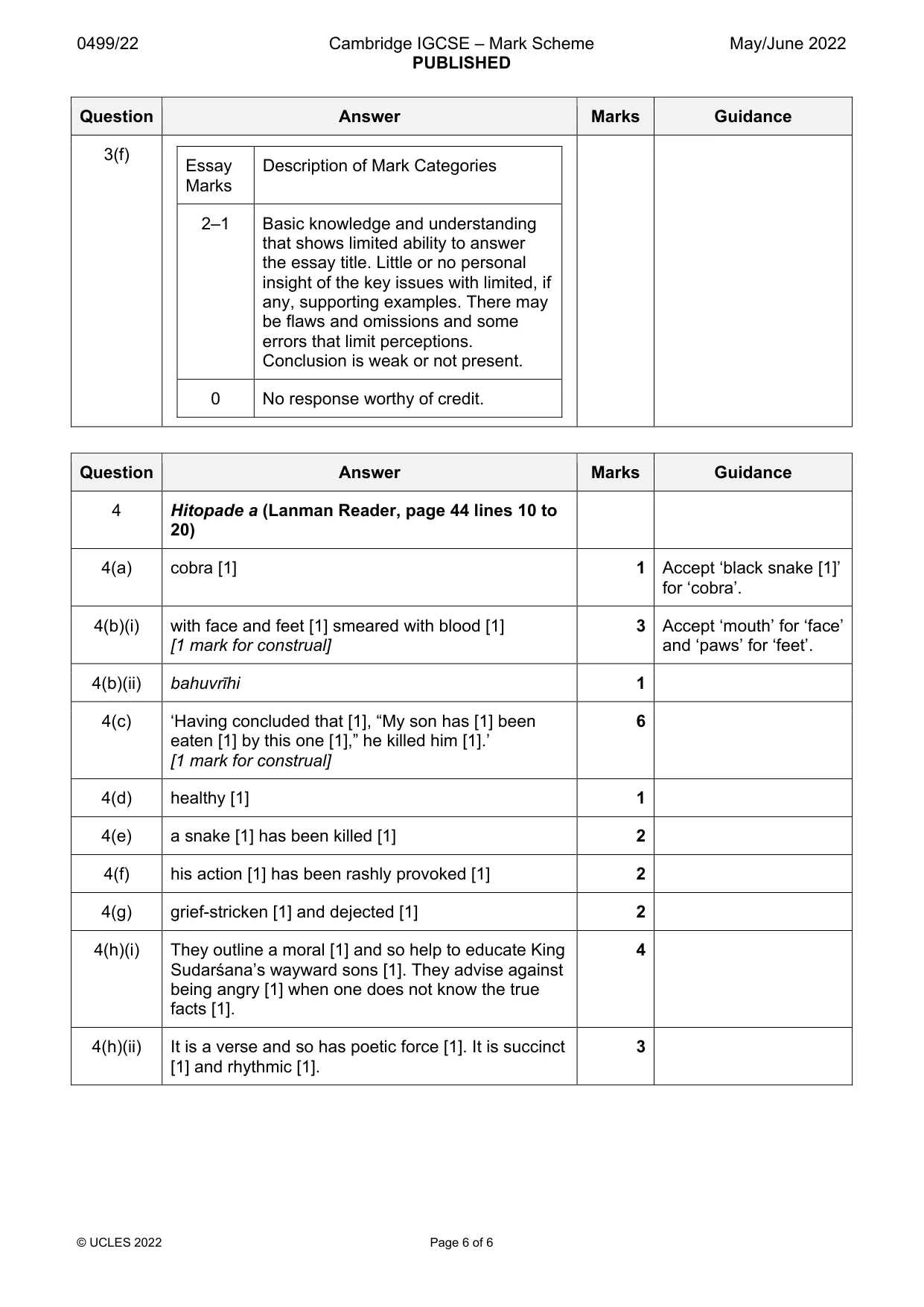
Mark scheme: 3 Sanskrit Epic Civilisation 3(a)(i) freedom [1] from the round of birth and death [1] 2 3(a)(ii) reason [1] the organ of discrimination [1] 2 3(a)(iii) disciplined action [1] that purifies [1] 2 3(a)(iv) harmlessness [1] of thought, speech and action[1] 2 3(b) Any two of: 4 tretāyuga [1], silver age [1] dvāparayuga [1], bronze age [1] kaliyuga [1], iron age [1] 3(c) samaṣṭi – the universe as a single person or whole 2 [1] vyaṣṭi – the individual acting as a separate unit [1] 3(d) Any three of: 3 i. to sages [1] ii. to ancestors [1] iii. to human beings [1] iv. to lower creatures [1] 3(e)(i) ‘what has been heard’ [1] i.e. Vedic literature [1] 2 3(e)(ii) ‘compiler’ [1] who compiled the Veda [1] 2 3(e)(iii) scripture [1], teaching [1] 2 3(e)(iv) the most famous Purāṇa [1] dealing with the life of 2 Kṛṣṇa [1] 3(f) Awarding Essay Marks: Candidates are expected to 10 write about 100 words, making relevant points, and writing Sanskrit terms accurately when required. Marks should be awarded on the basis of the following chart: Essay Description of Mark Categories Marks 10–9 Thorough knowledge and understanding of the essay title. Articulate and balanced response that demonstrates perceptive use of illustration. Shows very good personal insight when discussing issues. There may be some omissions and very minor errors. Conclusion drawn on the wider themes. 8–7 Good knowledge and understanding that considers the essay title. Mostly balanced response that demonstrates some perceptive use of illustration. Shows good personal insight when discussing issues. There may be some flaws and omissions and minor errors. Conclusion drawn on some of the wider themes. 6–5 Sound knowledge and understanding that considers the essay title. Some demonstration of personal insight into the key issues with some supporting examples. There may be flaws and omissions and some errors. Conclusion attempted on the wider themes. 4–3 Some knowledge and understanding that attempts to consider the essay title. Some attempts to show personal insight of the key issues with limited supporting examples. There may be flaws and omissions and some errors that limit perceptions. Conclusion is limited. 3(f) Essay Description of Mark Categories Marks 2–1 Basic knowledge and understanding that shows limited ability to answer the essay title. Little or no personal insight of the key issues with limited, if any, supporting examples. There may be flaws and omissions and some errors that limit perceptions. Conclusion is weak or not present. 0 No response worthy of credit.
Q4 · Hitopadeśa Read the following Sanskrit passage
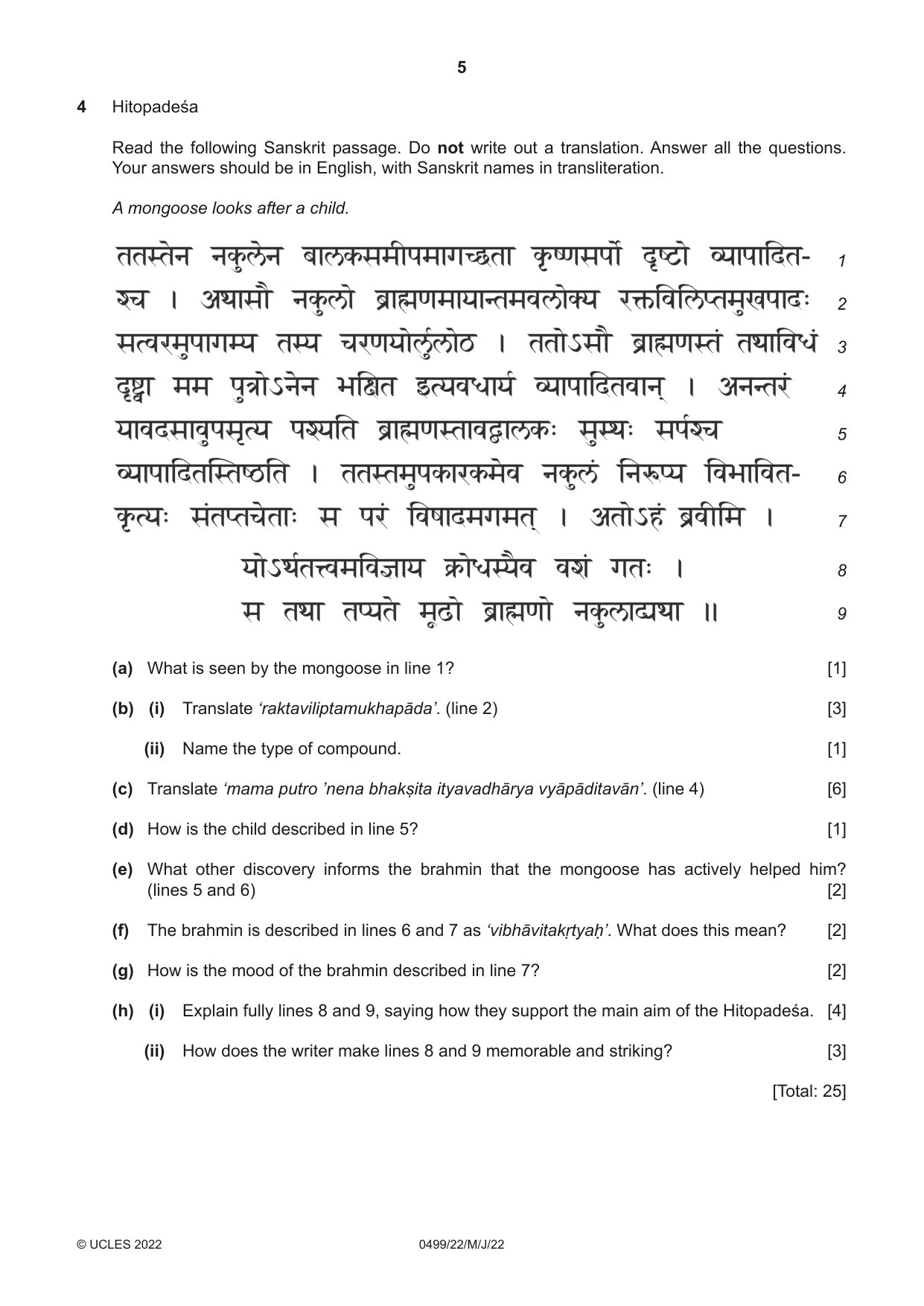
4 Hitopadeśa Read the following Sanskrit passage. Do not write out a translation. Answer all the questions. Your answers should be in English, with Sanskrit names in transliteration. A mongoose looks after a child. 1 2 3 4 5 6 7 8 9 (a) What is seen by the mongoose in line 1? [1] (b) (i) Translate ‘raktaviliptamukhapāda’. (line 2) [3] (ii) Name the type of compound. [1] (c) Translate ‘mama putro ’nena bhakṣita ityavadhārya vyāpāditavān’. (line 4) [6] (d) How is the child described in line 5? [1] (e) What other discovery informs the brahmin that the mongoose has actively helped him? (lines 5 and 6) [2] (f) The brahmin is described in lines 6 and 7 as ‘vibhāvitakṛtyaḥ’. What does this mean? [2] (g) How is the mood of the brahmin described in line 7? [2] (h) (i) Explain fully lines 8 and 9, saying how they support the main aim of the Hitopadeśa. [4] (ii) How does the writer make lines 8 and 9 memorable and striking? [3] [Total: 25]
Mark scheme: 4 Hitopade a (Lanman Reader, page 44 lines 10 to 20) 4(a) cobra [1] 1 Accept ‘black snake [1]’ for ‘cobra’. 4(b)(i) with face and feet [1] smeared with blood [1] 3 Accept ‘mouth’ for ‘face’ [1 mark for construal] and ‘paws’ for ‘feet’. 4(b)(ii) bahuvrīhi 1 4(c) ‘Having concluded that [1], “My son has [1] been 6 eaten [1] by this one [1],” he killed him [1].’ [1 mark for construal] 4(d) healthy [1] 1 4(e) a snake [1] has been killed [1] 2 4(f) his action [1] has been rashly provoked [1] 2 4(g) grief-stricken [1] and dejected [1] 2 4(h)(i) They outline a moral [1] and so help to educate King 4 Sudarśana’s wayward sons [1]. They advise against being angry [1] when one does not know the true facts [1]. 4(h)(ii) It is a verse and so has poetic force [1]. It is succinct 3 [1] and rhythmic [1].
What you needed in this session
Cambridge’s own grade thresholds for 2022 May/June, Paper 2 · Variant 2. A higher threshold means an easier paper — the bar moves with how the cohort did.