Cambridge IGCSE Sanskrit 0499 — 2023 May/June Paper 2 · Variant 1
0499/21/M/J/23 · 4 questions · 90 marks · ≈101 min
The question paper and its mark scheme, free to read here and free to download. This is Cambridge’s own paper, exactly as it was sat.
Question paper8 pages


Mark scheme6 pages
Answers below. Sit the paper first if you are practising.
Questions as text
Q1 · Mahābhārata (adapted text) Read the following Sanskrit passage
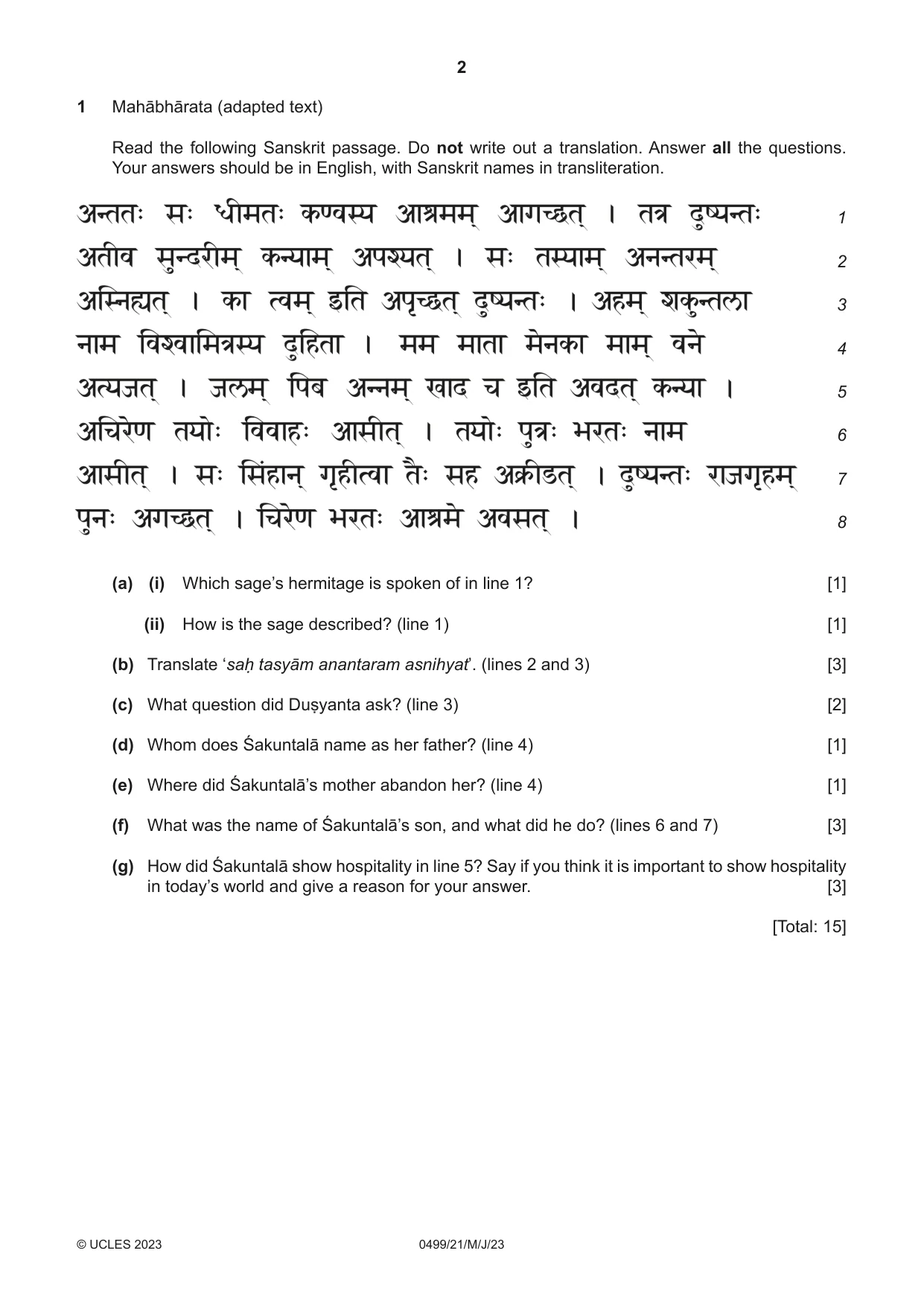
1 Mahābhārata (adapted text) Read the following Sanskrit passage. Do not write out a translation. Answer all the questions. Your answers should be in English, with Sanskrit names in transliteration. 1 2 3 4 5 6 7 8 (a) (i) Which sage’s hermitage is spoken of in line 1? [1] (ii) How is the sage described? (line 1) [1] (b) Translate ‘saḥ tasyām anantaram asnihyat’. (lines 2 and 3) [3] (c) What question did Duṣyanta ask? (line 3) [2] (d) Whom does Śakuntalā name as her father? (line 4) [1] (e) Where did Śakuntalā’s mother abandon her? (line 4) [1] (f) What was the name of Śakuntalā’s son, and what did he do? (lines 6 and 7) [3] (g) How did Śakuntalā show hospitality in line 5? Say if you think it is important to show hospitality in today’s world and give a reason for your answer. [3] [Total: 15]
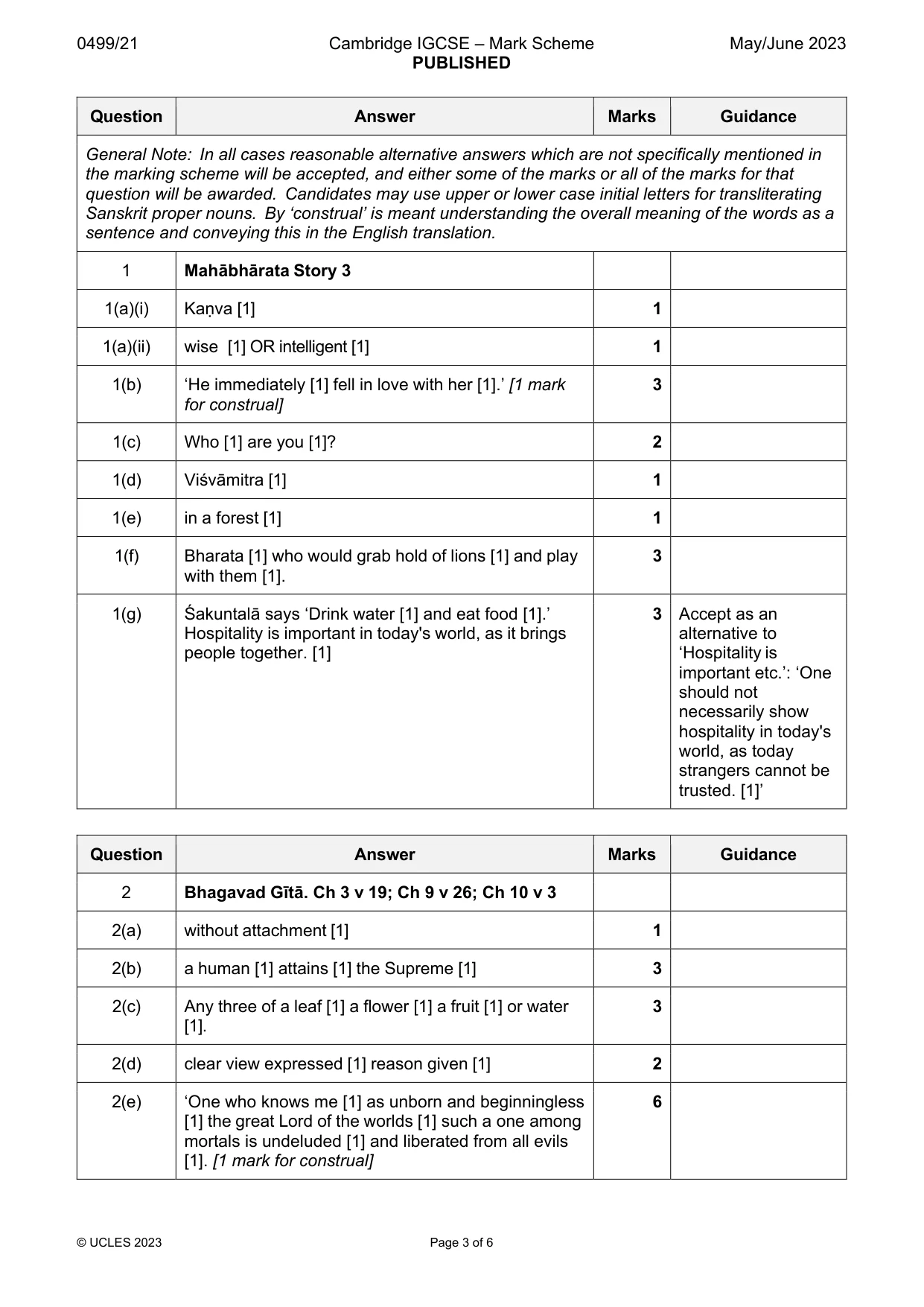
Mark scheme: Question Answer Marks Guidance General Note: In all cases reasonable alternative answers which are not specifically mentioned in the marking scheme will be accepted, and either some of the marks or all of the marks for that question will be awarded. Candidates may use upper or lower case initial letters for transliterating Sanskrit proper nouns. By ‘construal’ is meant understanding the overall meaning of the words as a sentence and conveying this in the English translation. 1 Mahābhārata Story 3 1(a)(i) Kaṇva [1] 1 1(a)(ii) wise [1] OR intelligent [1] 1 1(b) ‘He immediately [1] fell in love with her [1].’ [1 mark 3 for construal] 1(c) Who [1] are you [1]? 2 1(d) Viśvāmitra [1] 1 1(e) in a forest [1] 1 1(f) Bharata [1] who would grab hold of lions [1] and play 3 with them [1]. 1(g) Śakuntalā says ‘Drink water [1] and eat food [1].’ 3 Accept as an Hospitality is important in today's world, as it brings alternative to people together. [1] ‘Hospitality is important etc.’: ‘One should not necessarily show hospitality in today's world, as today strangers cannot be trusted. [1]’
Q2 · Mahābhārata – Bhagavad Gītā Read the following Sanskrit verses
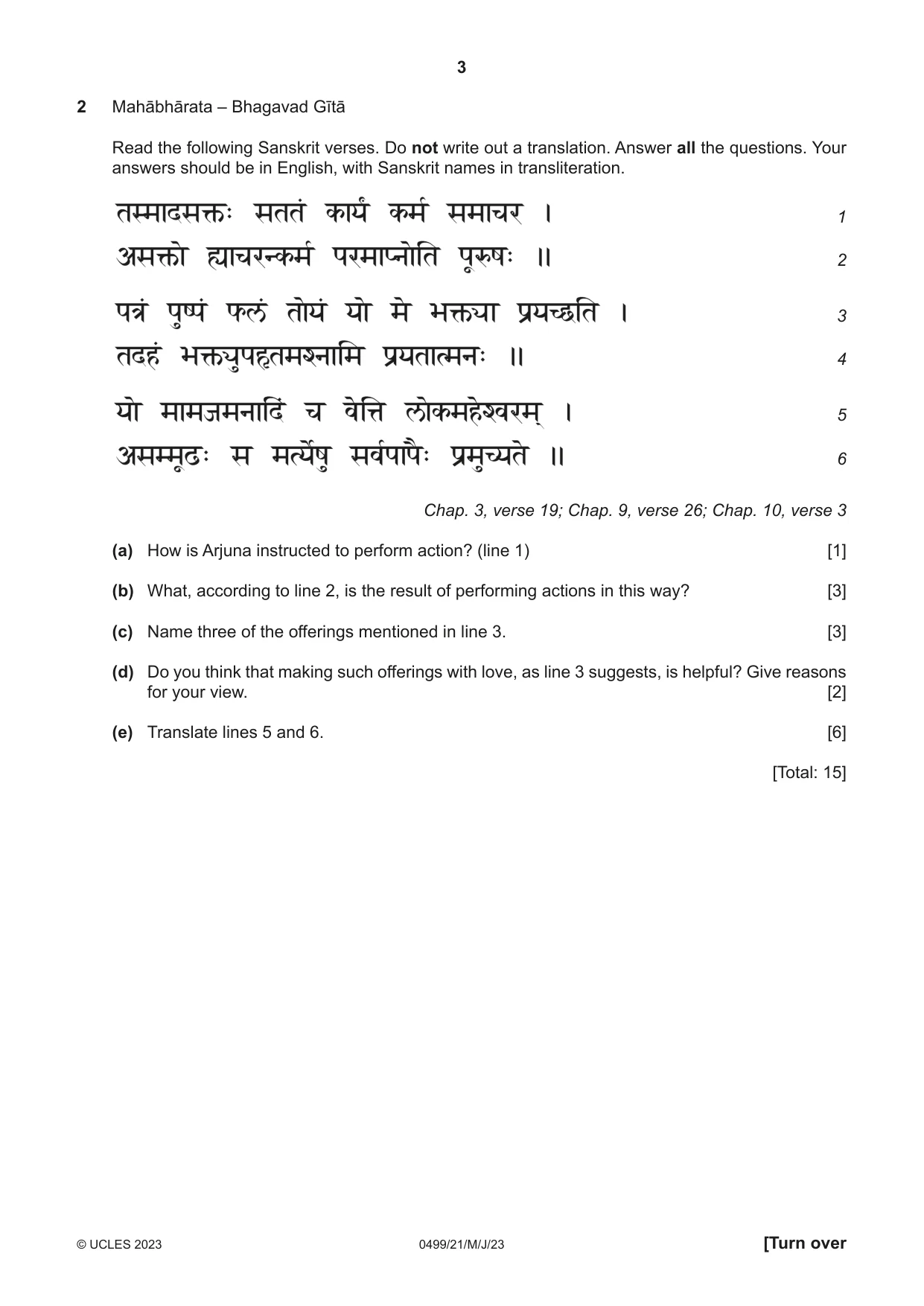
2 Mahābhārata – Bhagavad Gītā Read the following Sanskrit verses. Do not write out a translation. Answer all the questions. Your answers should be in English, with Sanskrit names in transliteration. 1 2 3 4 5 6 Chap. 3, verse 19; Chap. 9, verse 26; Chap. 10, verse 3 (a) How is Arjuna instructed to perform action? (line 1) [1] (b) What, according to line 2, is the result of performing actions in this way? [3] (c) Name three of the offerings mentioned in line 3. [3] (d) Do you think that making such offerings with love, as line 3 suggests, is helpful? Give reasons for your view. [2] (e) Translate lines 5 and 6. [6] [Total: 15]
Mark scheme: 2 Bhagavad Gῑtā. Ch 3 v 19; Ch 9 v 26; Ch 10 v 3 2(a) without attachment [1] 1 2(b) a human [1] attains [1] the Supreme [1] 3 2(c) Any three of a leaf [1] a flower [1] a fruit [1] or water 3 [1]. 2(d) clear view expressed [1] reason given [1] 2 2(e) ‘One who knows me [1] as unborn and beginningless 6 [1] the great Lord of the worlds [1] such a one among mortals is undeluded [1] and liberated from all evils [1]. [1 mark for construal]
Q3 · Sanskrit Epic Civilisation (a) Give two details for each of the following: (i) karman [2]…
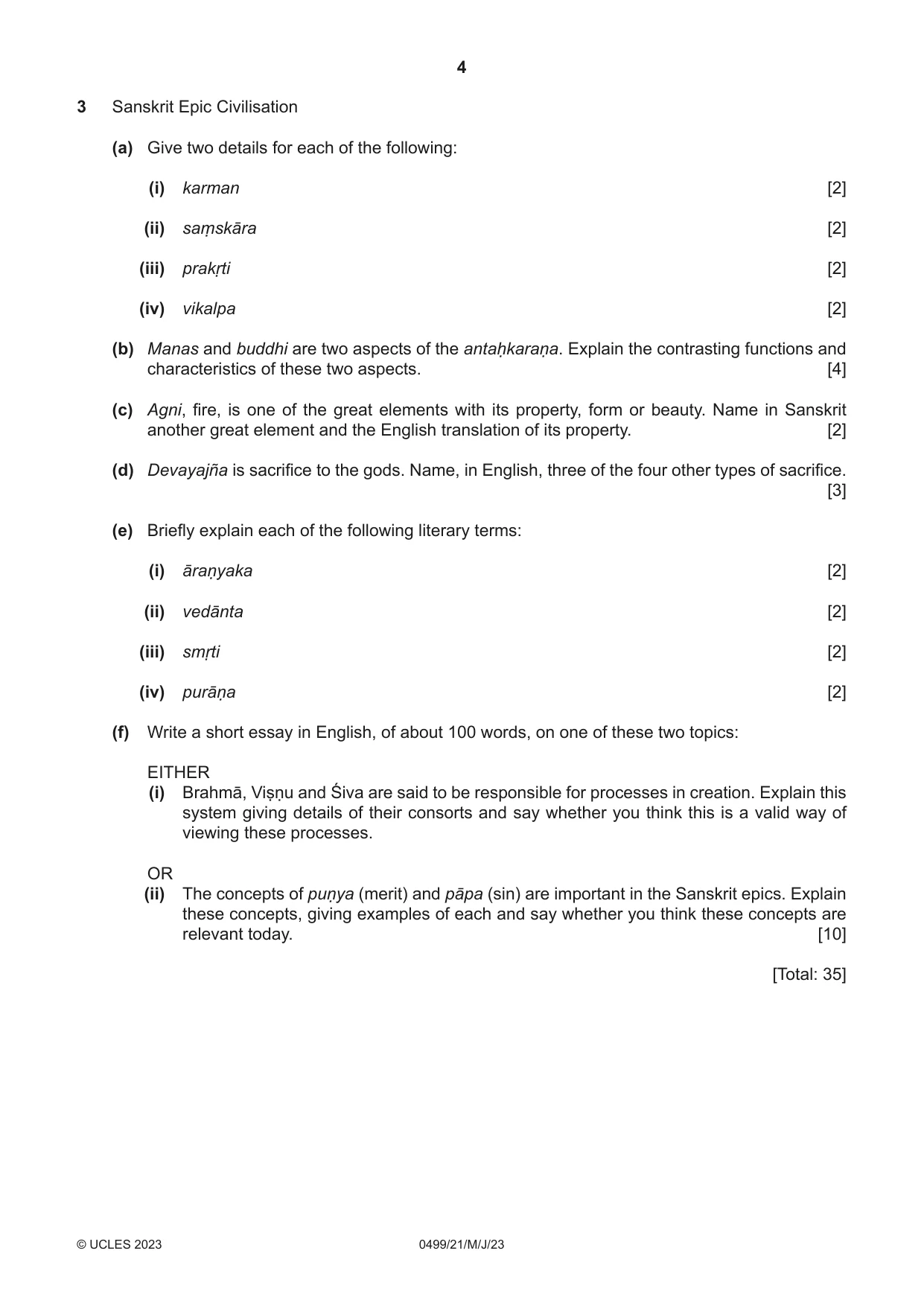
3 Sanskrit Epic Civilisation (a) Give two details for each of the following: (i) karman [2] (ii) saṃskāra [2] (iii) prakṛti [2] (iv) vikalpa [2] (b) Manas and buddhi are two aspects of the antaḥkaraṇa. Explain the contrasting functions and characteristics of these two aspects. [4] (c) Agni, fire, is one of the great elements with its property, form or beauty. Name in Sanskrit another great element and the English translation of its property. [2] (d) Devayajña is sacrifice to the gods. Name, in English, three of the four other types of sacrifice. [3] (e) Briefly explain each of the following literary terms: (i) āraṇyaka [2] (ii) vedānta [2] (iii) smṛti [2] (iv) purāṇa [2] (f) Write a short essay in English, of about 100 words, on one of these two topics: EITHER (i) Brahmā, Viṣṇu and Śiva are said to be responsible for processes in creation. Explain this system giving details of their consorts and say whether you think this is a valid way of viewing these processes. OR (ii) The concepts of puṇya (merit) and pāpa (sin) are important in the Sanskrit epics. Explain these concepts, giving examples of each and say whether you think these concepts are relevant today. [10] [Total: 35]
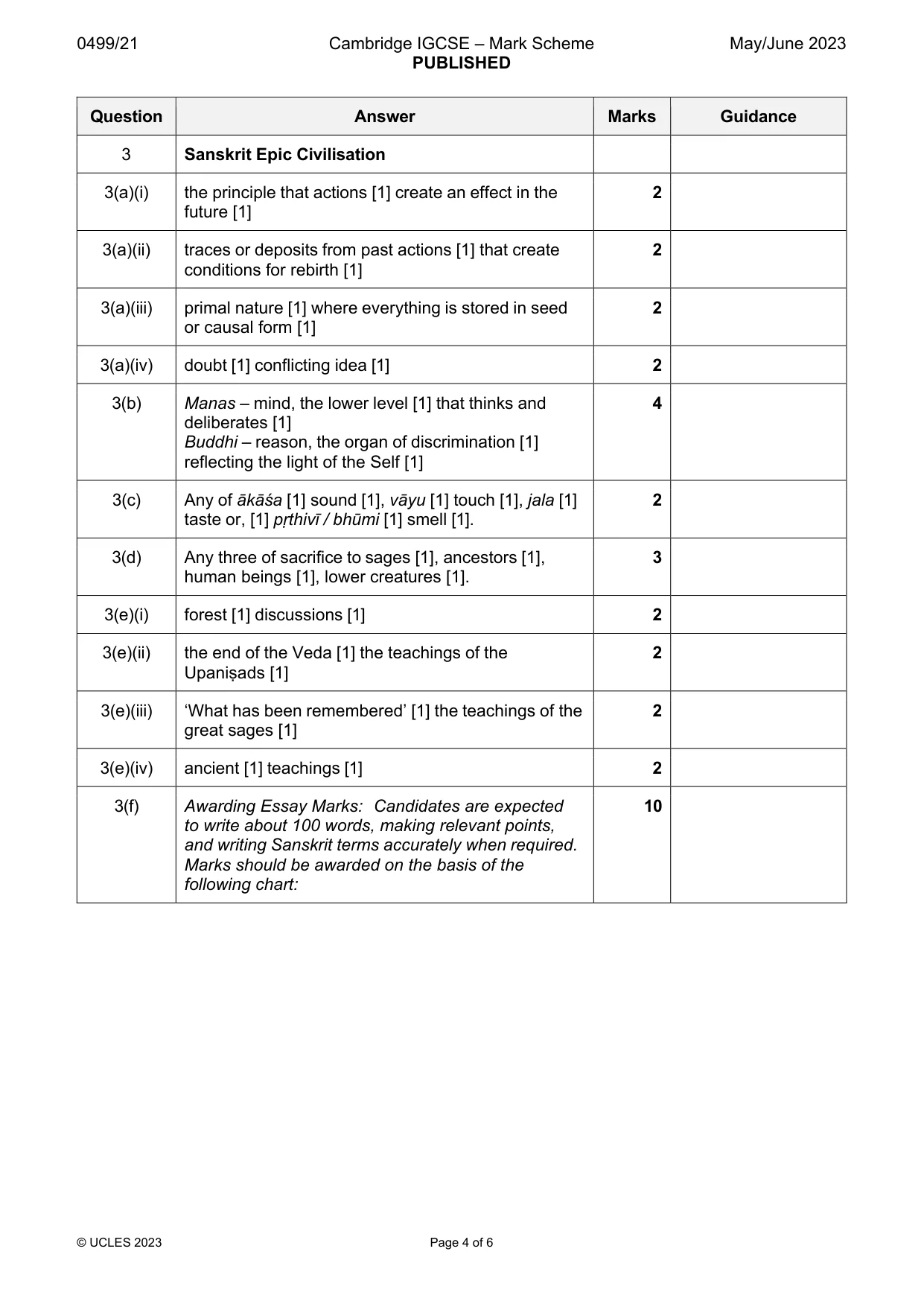
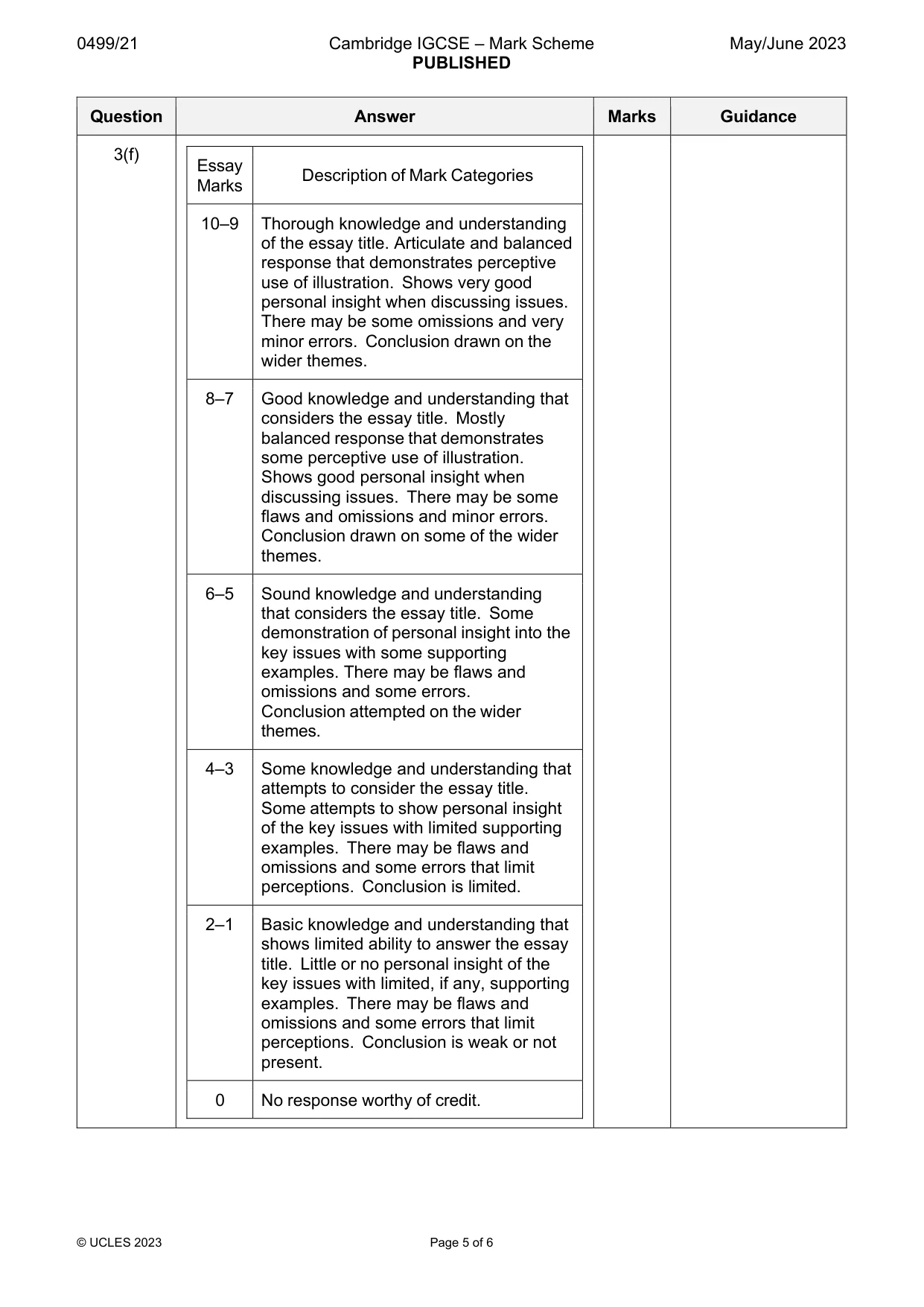
Mark scheme: 3 Sanskrit Epic Civilisation 3(a)(i) the principle that actions [1] create an effect in the 2 future [1] 3(a)(ii) traces or deposits from past actions [1] that create 2 conditions for rebirth [1] 3(a)(iii) primal nature [1] where everything is stored in seed 2 or causal form [1] 3(a)(iv) doubt [1] conflicting idea [1] 2 3(b) Manas – mind, the lower level [1] that thinks and 4 deliberates [1] Buddhi – reason, the organ of discrimination [1] reflecting the light of the Self [1] 3(c) Any of ākāśa [1] sound [1], vāyu [1] touch [1], jala [1] 2 taste or, [1] pṛthivī / bhūmi [1] smell [1]. 3(d) Any three of sacrifice to sages [1], ancestors [1], 3 human beings [1], lower creatures [1]. 3(e)(i) forest [1] discussions [1] 2 3(e)(ii) the end of the Veda [1] the teachings of the 2 Upaniṣads [1] 3(e)(iii) ‘What has been remembered’ [1] the teachings of the 2 great sages [1] 3(e)(iv) ancient [1] teachings [1] 2 3(f) Awarding Essay Marks: Candidates are expected 10 to write about 100 words, making relevant points, and writing Sanskrit terms accurately when required. Marks should be awarded on the basis of the following chart: 3(f) Essay Description of Mark Categories Marks 10–9 Thorough knowledge and understanding of the essay title. Articulate and balanced response that demonstrates perceptive use of illustration. Shows very good personal insight when discussing issues. There may be some omissions and very minor errors. Conclusion drawn on the wider themes. 8–7 Good knowledge and understanding that considers the essay title. Mostly balanced response that demonstrates some perceptive use of illustration. Shows good personal insight when discussing issues. There may be some flaws and omissions and minor errors. Conclusion drawn on some of the wider themes. 6–5 Sound knowledge and understanding that considers the essay title. Some demonstration of personal insight into the key issues with some supporting examples. There may be flaws and omissions and some errors. Conclusion attempted on the wider themes. 4–3 Some knowledge and understanding that attempts to consider the essay title. Some attempts to show personal insight of the key issues with limited supporting examples. There may be flaws and omissions and some errors that limit perceptions. Conclusion is limited. 2–1 Basic knowledge and understanding that shows limited ability to answer the essay title. Little or no personal insight of the key issues with limited, if any, supporting examples. There may be flaws and omissions and some errors that limit perceptions. Conclusion is weak or not present. 0 No response worthy of credit.
Q4 · Hitopadeśa Read the following Sanskrit passage
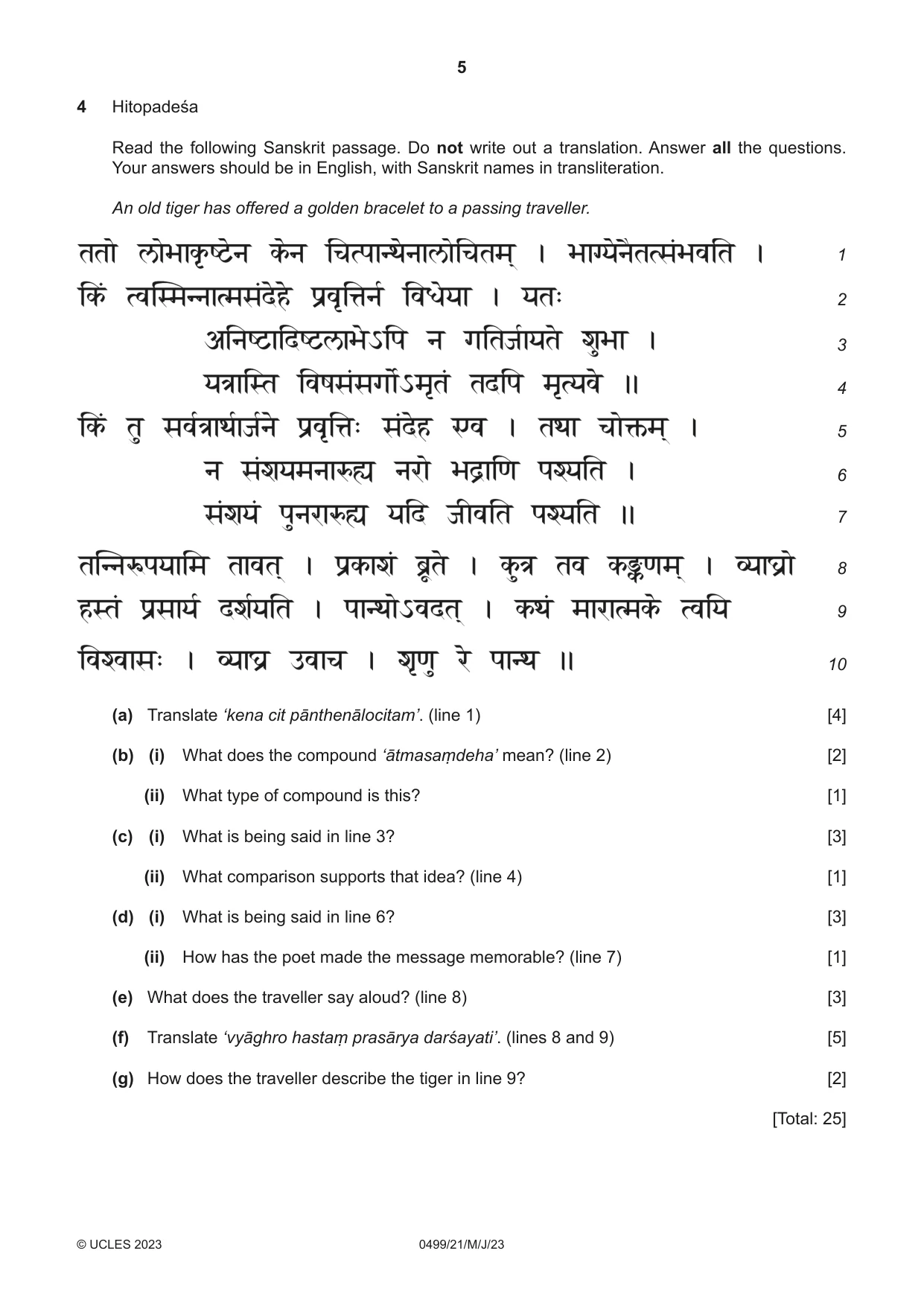
4 Hitopadeśa Read the following Sanskrit passage. Do not write out a translation. Answer all the questions. Your answers should be in English, with Sanskrit names in transliteration. An old tiger has offered a golden bracelet to a passing traveller. 1 2 3 4 5 6 7 8 9 10 (a) Translate ‘kena cit pānthenālocitam’. (line 1) [4] (b) (i) What does the compound ‘ātmasaṃdeha’ mean? (line 2) [2] (ii) What type of compound is this? [1] (c) (i) What is being said in line 3? [3] (ii) What comparison supports that idea? (line 4) [1] (d) (i) What is being said in line 6? [3] (ii) How has the poet made the message memorable? (line 7) [1] (e) What does the traveller say aloud? (line 8) [3] (f) Translate ‘vyāghro hastaṃ prasārya darśayati’. (lines 8 and 9) [5] (g) How does the traveller describe the tiger in line 9? [2] [Total: 25]
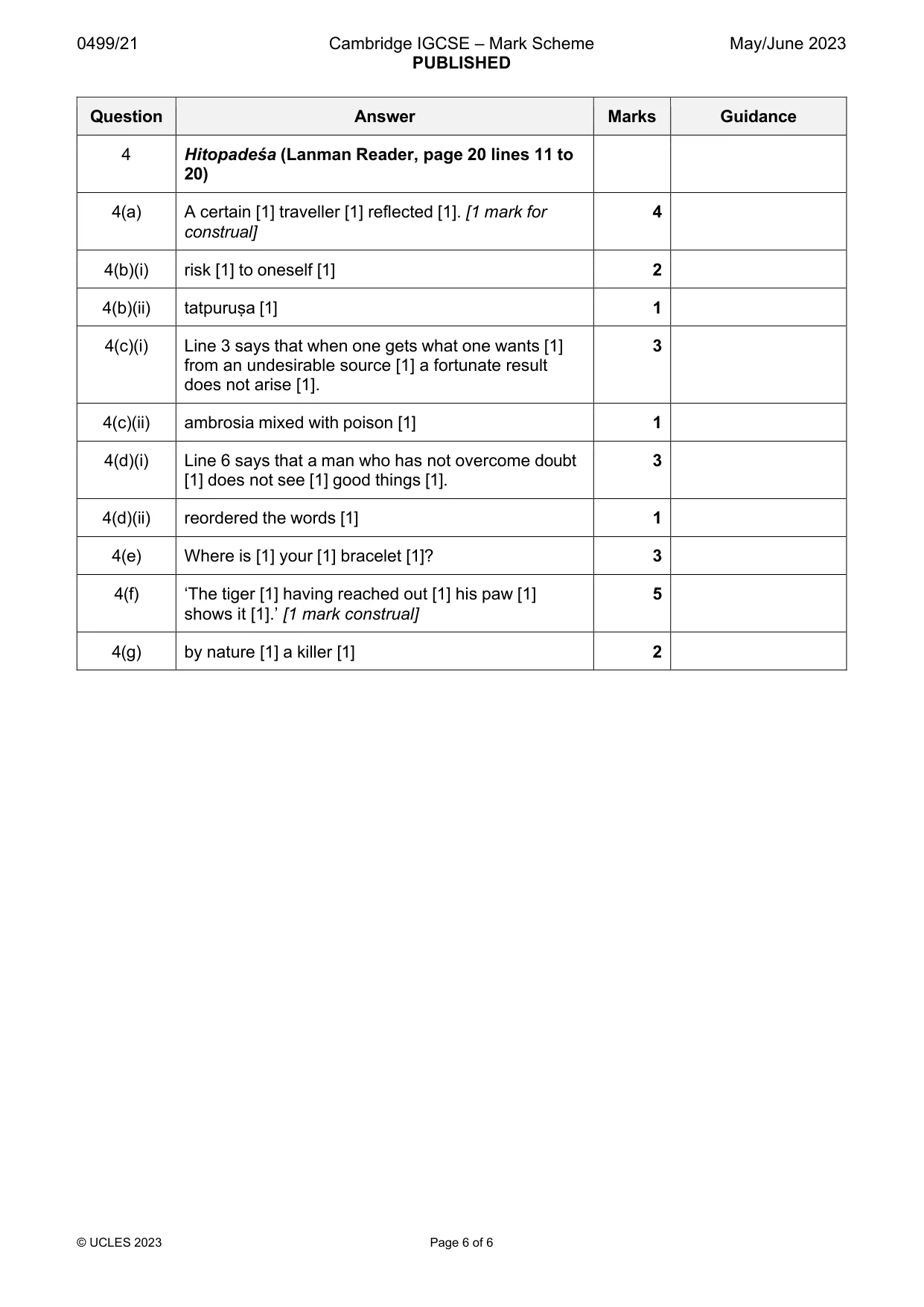
Mark scheme: 4 Hitopadeśa (Lanman Reader, page 20 lines 11 to 20) 4(a) A certain [1] traveller [1] reflected [1]. [1 mark for 4 construal] 4(b)(i) risk [1] to oneself [1] 2 4(b)(ii) tatpuruṣa [1] 1 4(c)(i) Line 3 says that when one gets what one wants [1] 3 from an undesirable source [1] a fortunate result does not arise [1]. 4(c)(ii) ambrosia mixed with poison [1] 1 4(d)(i) Line 6 says that a man who has not overcome doubt 3 [1] does not see [1] good things [1]. 4(d)(ii) reordered the words [1] 1 4(e) Where is [1] your [1] bracelet [1]? 3 4(f) ‘The tiger [1] having reached out [1] his paw [1] 5 shows it [1].’ [1 mark construal] 4(g) by nature [1] a killer [1] 2
What you needed in this session
Cambridge’s own grade thresholds for 2023 May/June, Paper 2 · Variant 1. A higher threshold means an easier paper — the bar moves with how the cohort did.