Cambridge IGCSE Sanskrit 0499 — 2019 May/June Paper 2 · Variant 1
0499/21/M/J/19 · 4 questions · 90 marks · ≈101 min
The question paper and its mark scheme, free to read here and free to download. This is Cambridge’s own paper, exactly as it was sat.
Question paper8 pages
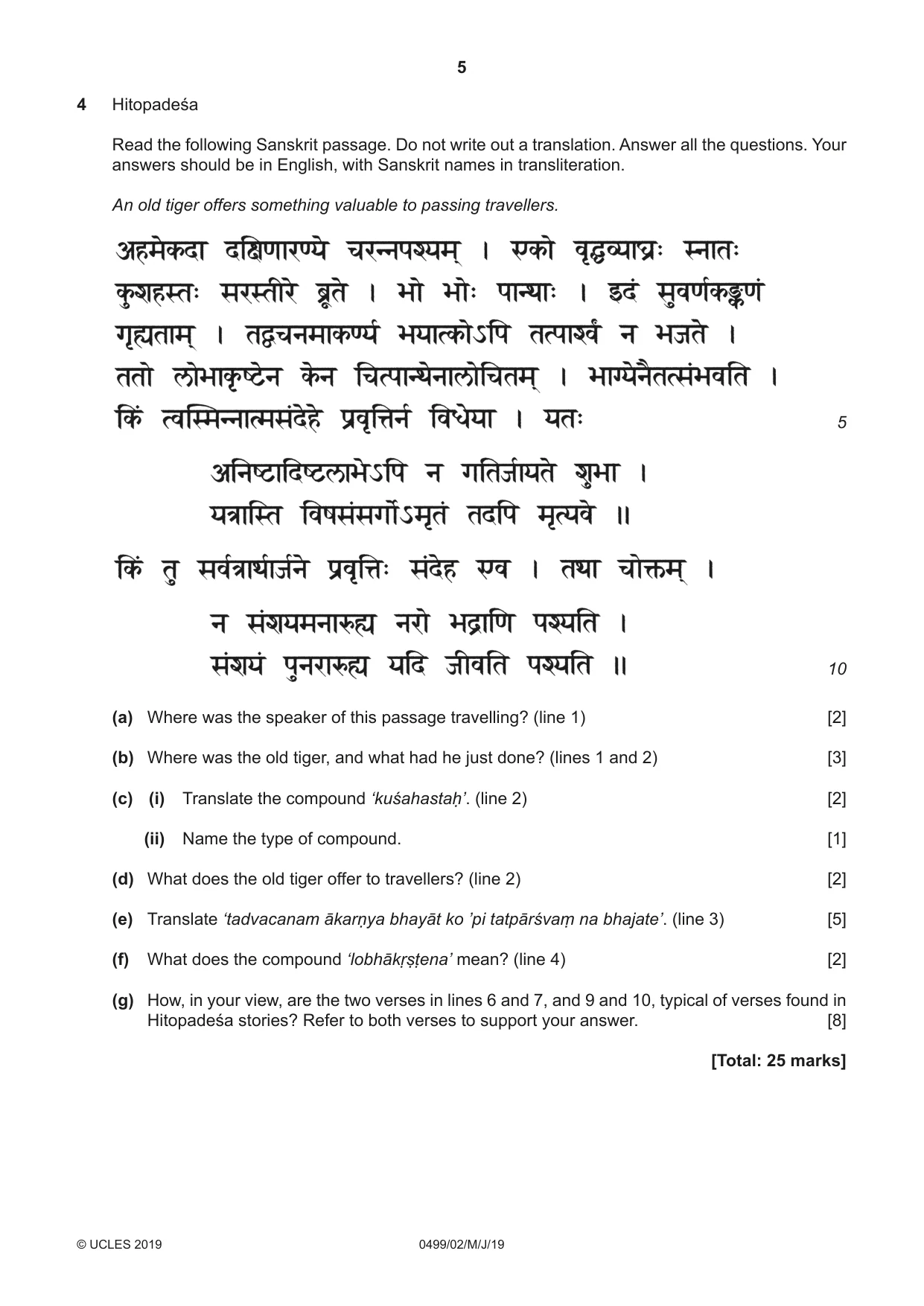



Mark scheme7 pages
Answers below. Sit the paper first if you are practising.
Questions as text
Q1 · Mahābhārata (adapted text) Read the following Sanskrit passage
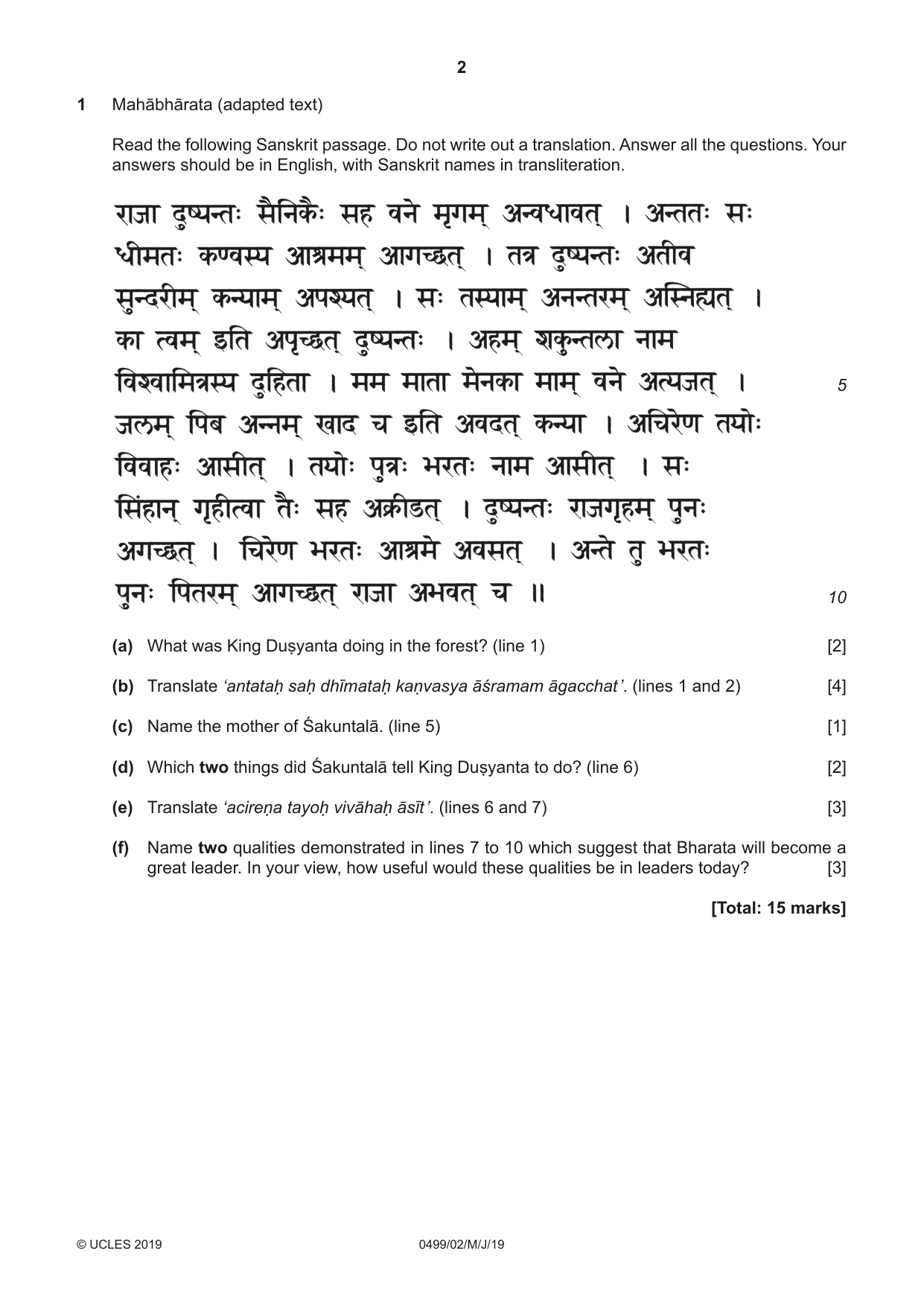
1 Mahābhārata (adapted text) Read the following Sanskrit passage. Do not write out a translation. Answer all the questions. Your answers should be in English, with Sanskrit names in transliteration. 5 10 (a) What was King Duṣyanta doing in the forest? (line 1) [2] (b) Translate ‘antataḥ saḥ dhīmataḥ kaṇvasya āśramam āgacchat’. (lines 1 and 2) [4] (c) Name the mother of Śakuntalā. (line 5) [1] (d) Which two things did Śakuntalā tell King Duṣyanta to do? (line 6) [2] (e) Translate ‘acireṇa tayoḥ vivāhaḥ āsīt’. (lines 6 and 7) [3] (f) Name two qualities demonstrated in lines 7 to 10 which suggest that Bharata will become a great leader. In your view, how useful would these qualities be in leaders today? [3] [Total: 15 marks]
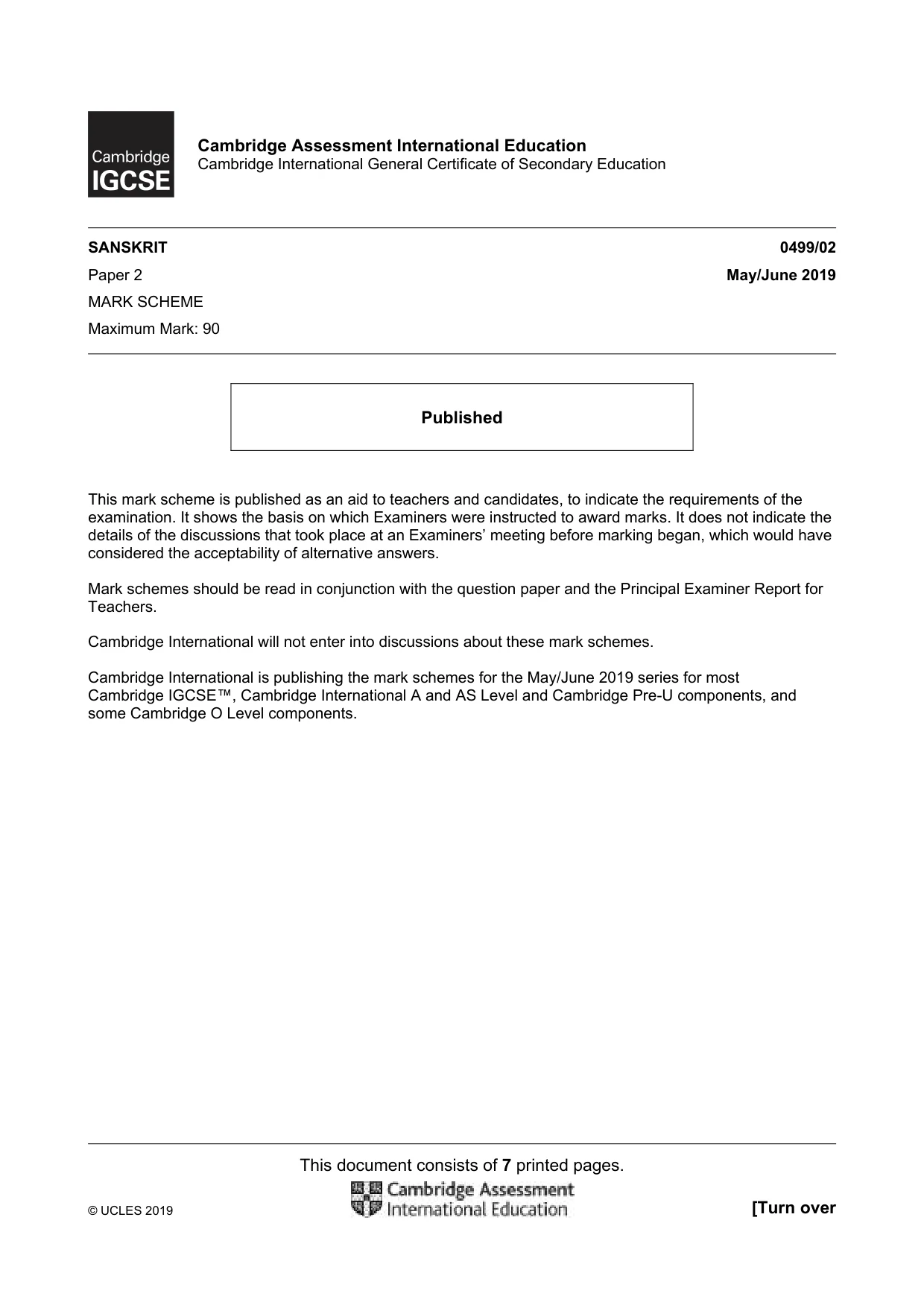
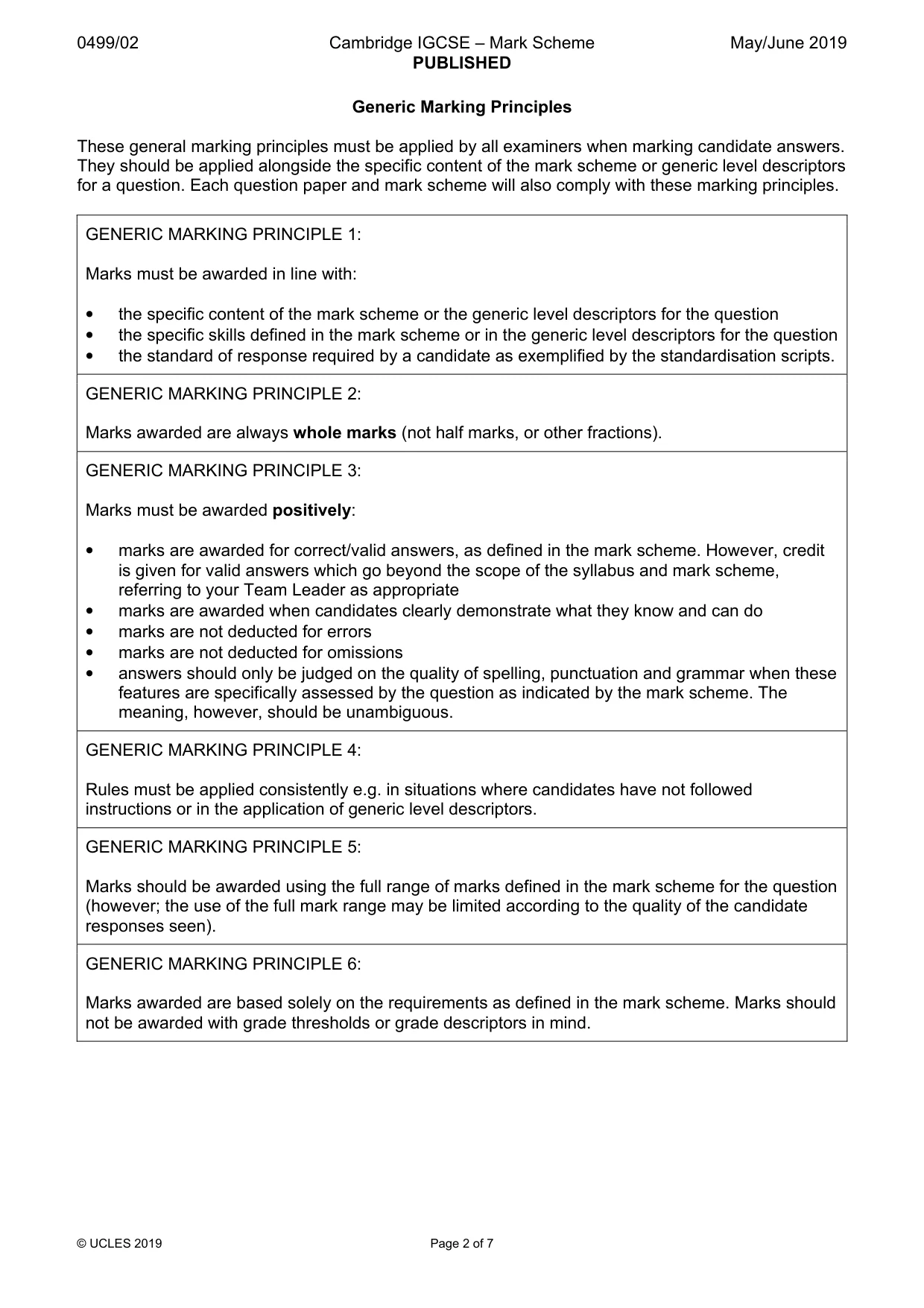
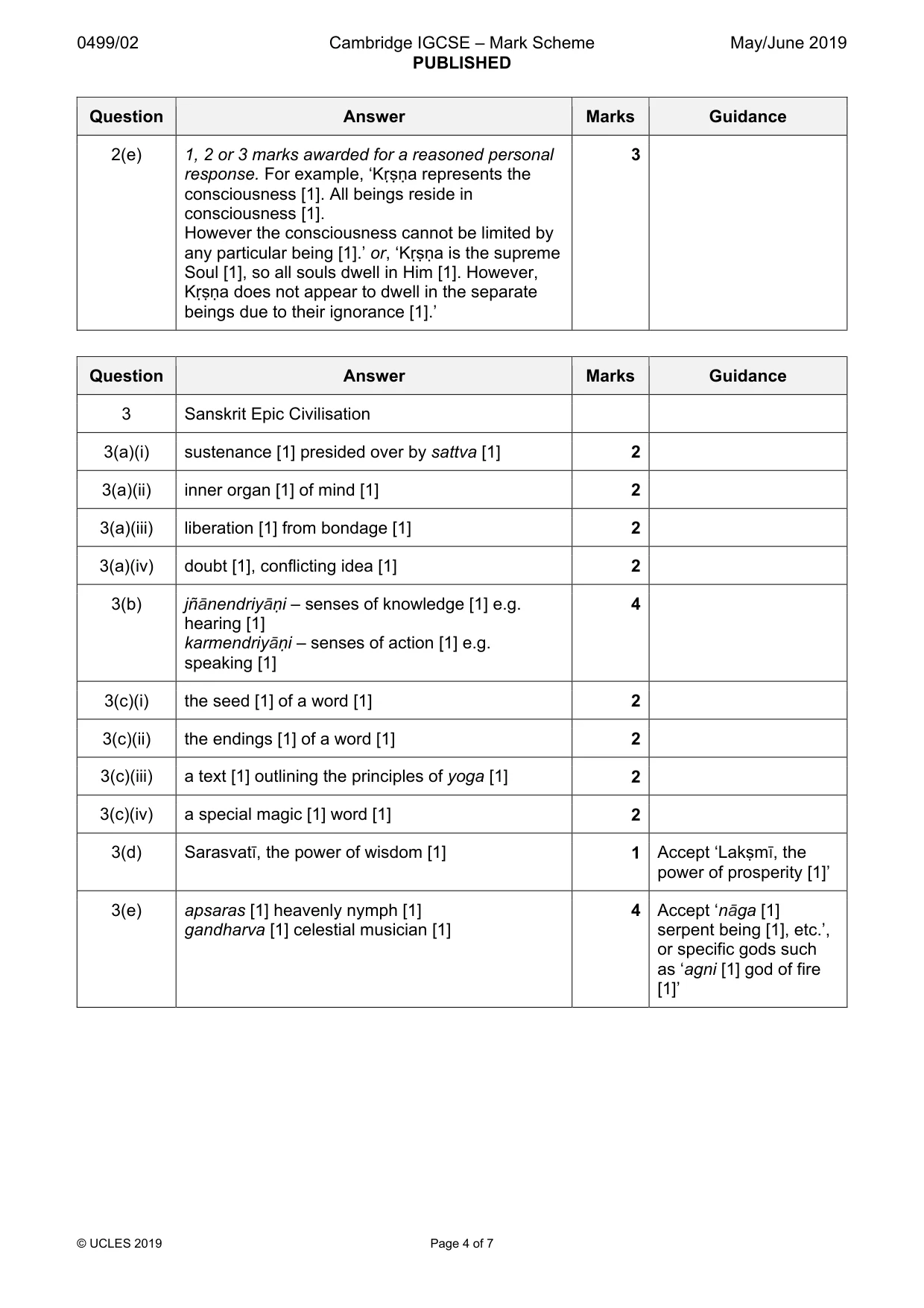
Mark scheme: Question Answer Marks Guidance General Note: In all cases reasonable alternative answers which are not specifically mentioned in the marking scheme will be accepted, and either some of the marks or all of the marks for that question will be awarded. Candidates may use upper or lower case initial letters for transliterating Sanskrit proper nouns. By ‘construal’ is meant understanding the overall meaning of the words as a sentence and conveying this in the English translation. 1 Mahābhārata Story 3. 1(a) pursuing [1] a deer [1] 2 Accept ‘chasing/ hunting [1] a deer [1]’ 1(b) ‘Finally he [1] came to the hermitage [1] of the 4 Accept ‘of the intelligent wise Kaṇva [1].’ [plus 1 mark for construal] Kaṇva [1]’ instead of ‘of the wise Kaṇva [1]’. 1(c) Menakā [1] 1 1(d) to drink water [1] and eat food [1] 2 Accept ‘to drink [1] and eat [1]’ 1(e) ‘Soon [1] they [1] were married [1].’ 3 Accept ‘Soon [1] there was [1] a marriage of those two. [1]’ 1(f) Any two qualities indicated in the text, e.g. 3 courage [1], strength [1], duty [1], loyalty [1]. 1 mark awarded for relevant, reasoned personal response.
Q2 · Mahābhārata – Bhagavad Gītā Read the following Sanskrit verses
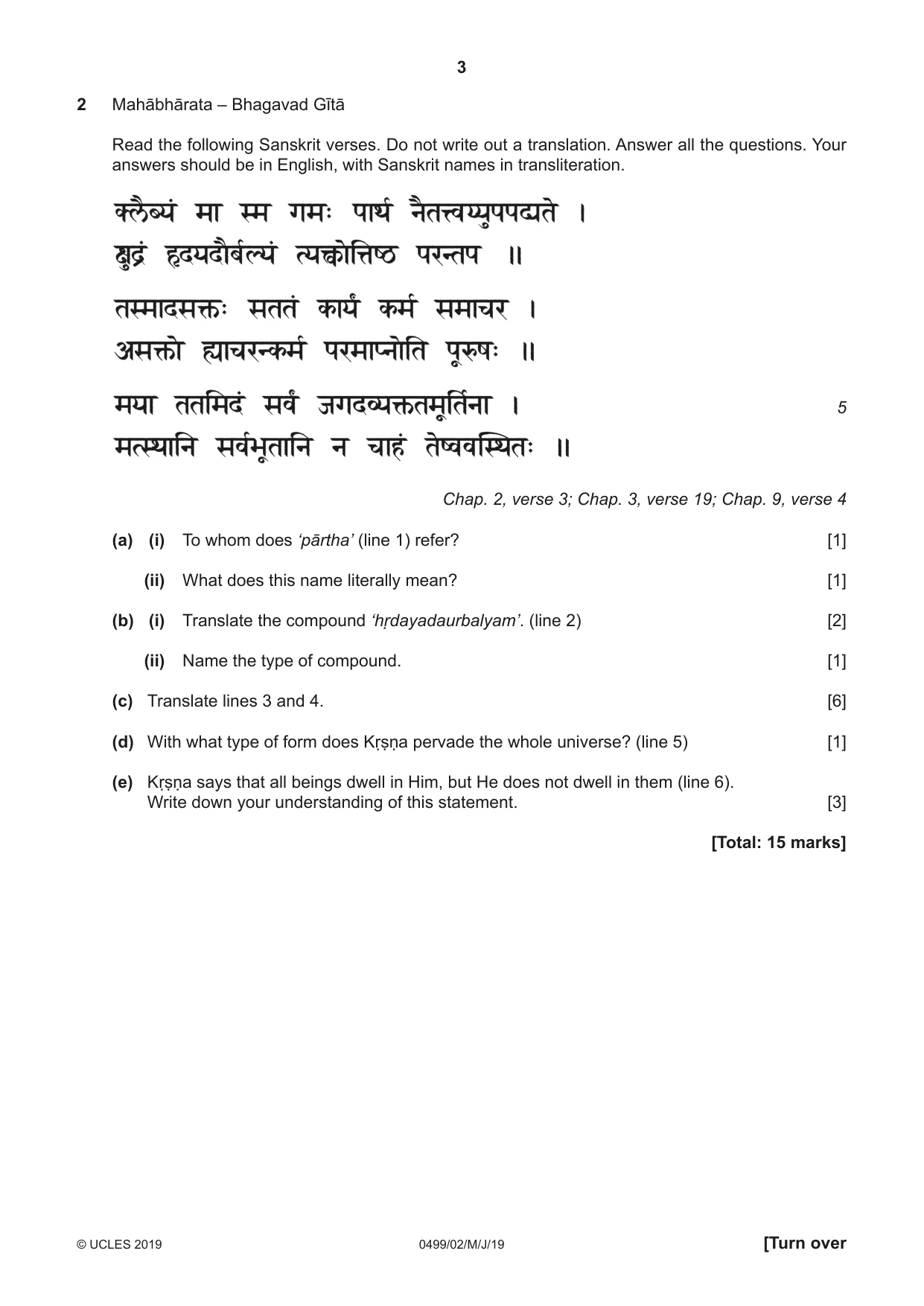
2 Mahābhārata – Bhagavad Gītā Read the following Sanskrit verses. Do not write out a translation. Answer all the questions. Your answers should be in English, with Sanskrit names in transliteration. 5 Chap. 2, verse 3; Chap. 3, verse 19; Chap. 9, verse 4 (a) (i) To whom does ‘pārtha’ (line 1) refer? [1] (ii) What does this name literally mean? [1] (b) (i) Translate the compound ‘hṛdayadaurbalyam’. (line 2) [2] (ii) Name the type of compound. [1] (c) Translate lines 3 and 4. [6] (d) With what type of form does Kṛṣṇa pervade the whole universe? (line 5) [1] (e) Kṛṣṇa says that all beings dwell in Him, but He does not dwell in them (line 6). Write down your understanding of this statement. [3] [Total: 15 marks]
Mark scheme: 2(a)(i) Arjuna [1] 1 2(a)(ii) son of Pṛthā [1] 1 Accept ‘son of Kuntī [1]’ 2(b)(i) ‘weakness [1] of heart [1]’ 2 2(b)(ii) tatpuruṣa [1] 1 2(c) ‘Therefore always perform [1] the actions which 6 Accept singular or should be done [1] without attachment [1] for, plural for ‘action’ in this performing action without attachment [1], man verse. attains the Supreme [1].’ [plus 1 mark for construal] 2(d) unmanifest [1] 1 2(e) 1, 2 or 3 marks awarded for a reasoned personal 3 response. For example, ‘Kṛṣṇa represents the consciousness [1]. All beings reside in consciousness [1]. However the consciousness cannot be limited by any particular being [1].’ or, ‘Kṛṣṇa is the supreme Soul [1], so all souls dwell in Him [1]. However, Kṛṣṇa does not appear to dwell in the separate beings due to their ignorance [1].’
Q3 · Sanskrit Epic Civilisation (a) Briefly explain the following: (i) sthiti [2] (ii)…
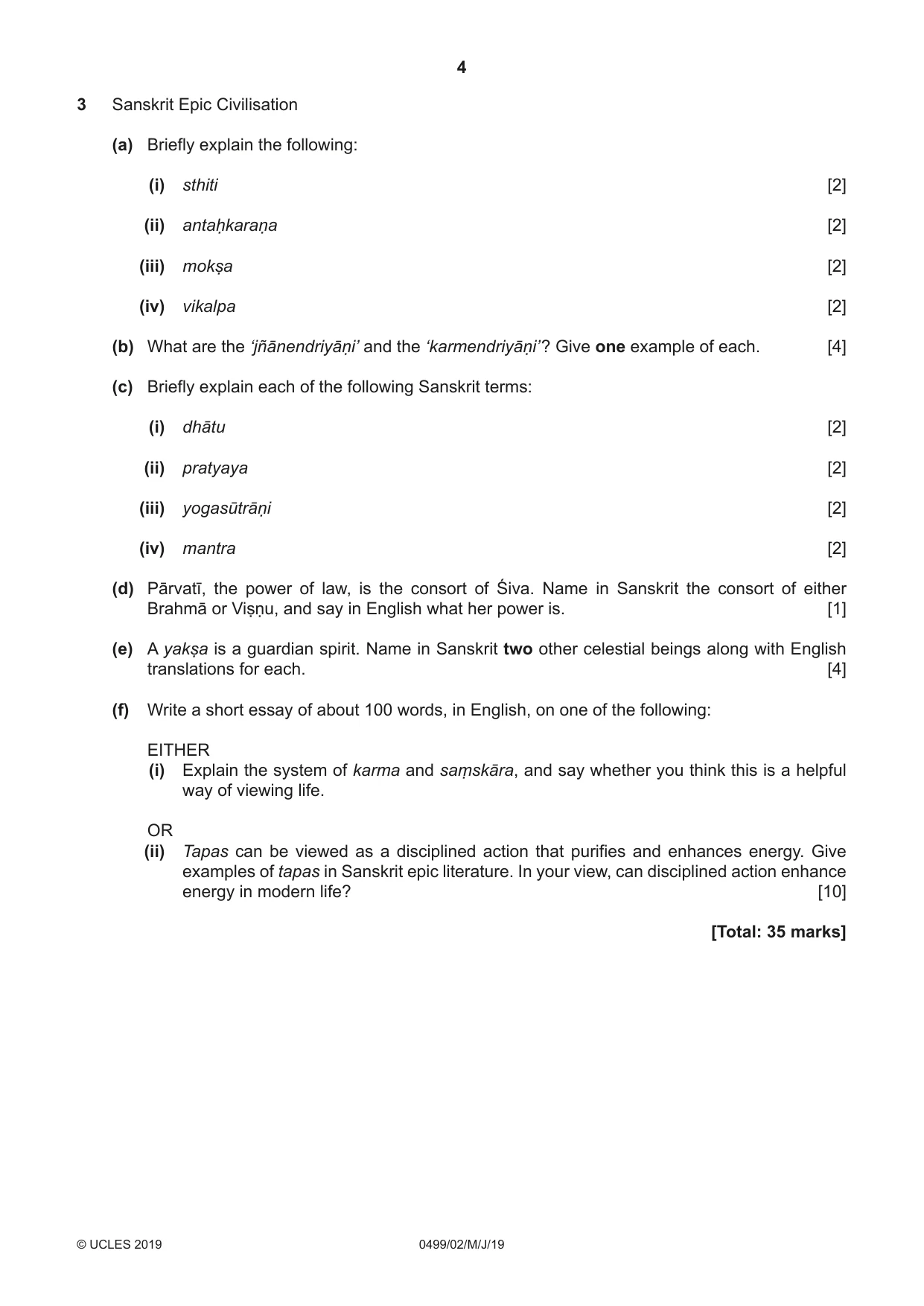
3 Sanskrit Epic Civilisation (a) Briefly explain the following: (i) sthiti [2] (ii) antaḥkaraṇa [2] (iii) mokṣa [2] (iv) vikalpa [2] (b) What are the ‘jñānendriyāṇi’ and the ‘karmendriyāṇi’ ? Give one example of each. [4] (c) Briefly explain each of the following Sanskrit terms: (i) dhātu [2] (ii) pratyaya [2] (iii) yogasūtrāṇi [2] (iv) mantra [2] (d) Pārvatī, the power of law, is the consort of Śiva. Name in Sanskrit the consort of either Brahmā or Viṣṇu, and say in English what her power is. [1] (e) A yakṣa is a guardian spirit. Name in Sanskrit two other celestial beings along with English translations for each. [4] (f) Write a short essay of about 100 words, in English, on one of the following: EITHER (i) Explain the system of karma and saṃskāra, and say whether you think this is a helpful way of viewing life. OR (ii) Tapas can be viewed as a disciplined action that purifies and enhances energy. Give examples of tapas in Sanskrit epic literature. In your view, can disciplined action enhance energy in modern life? [10] [Total: 35 marks]
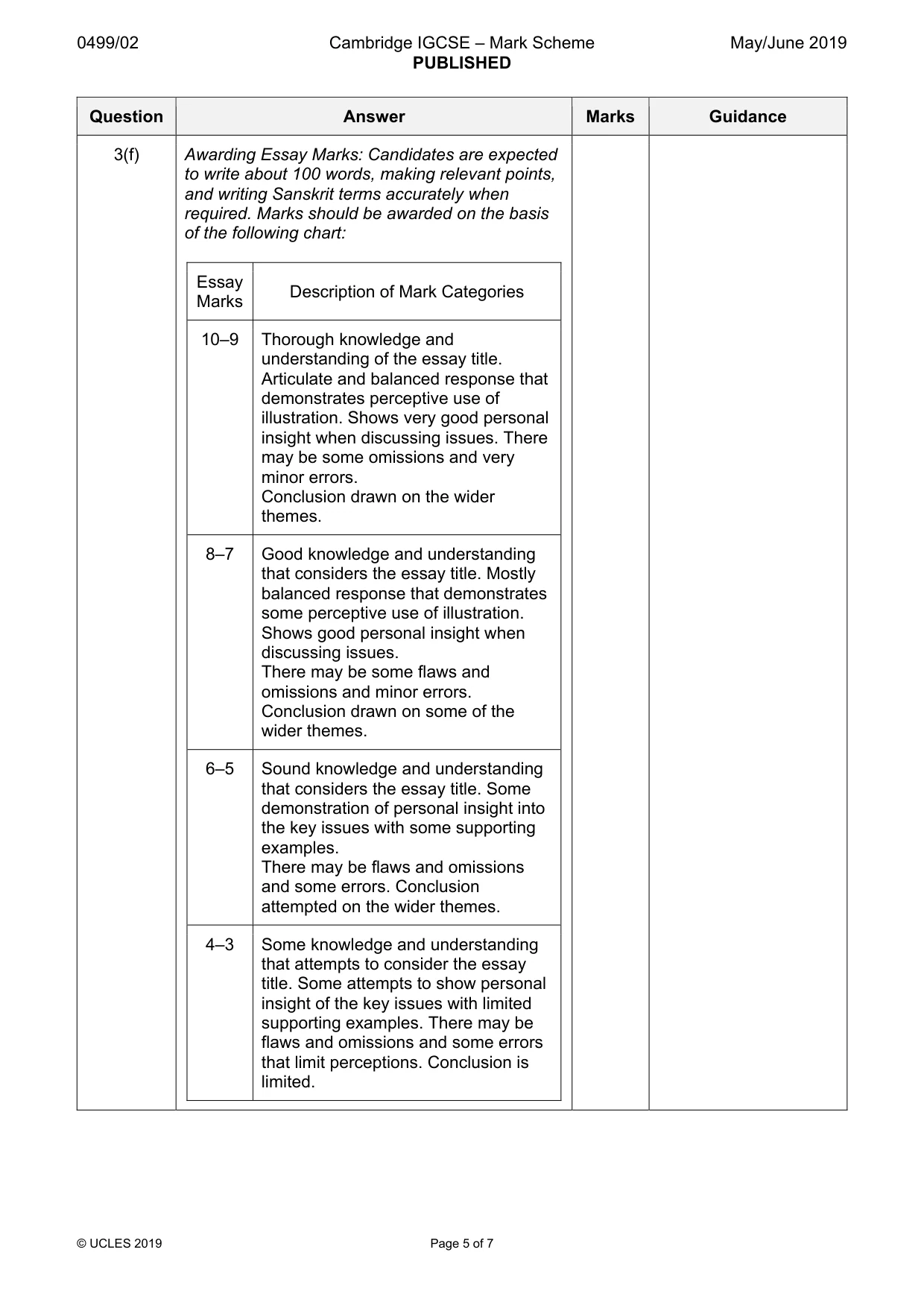
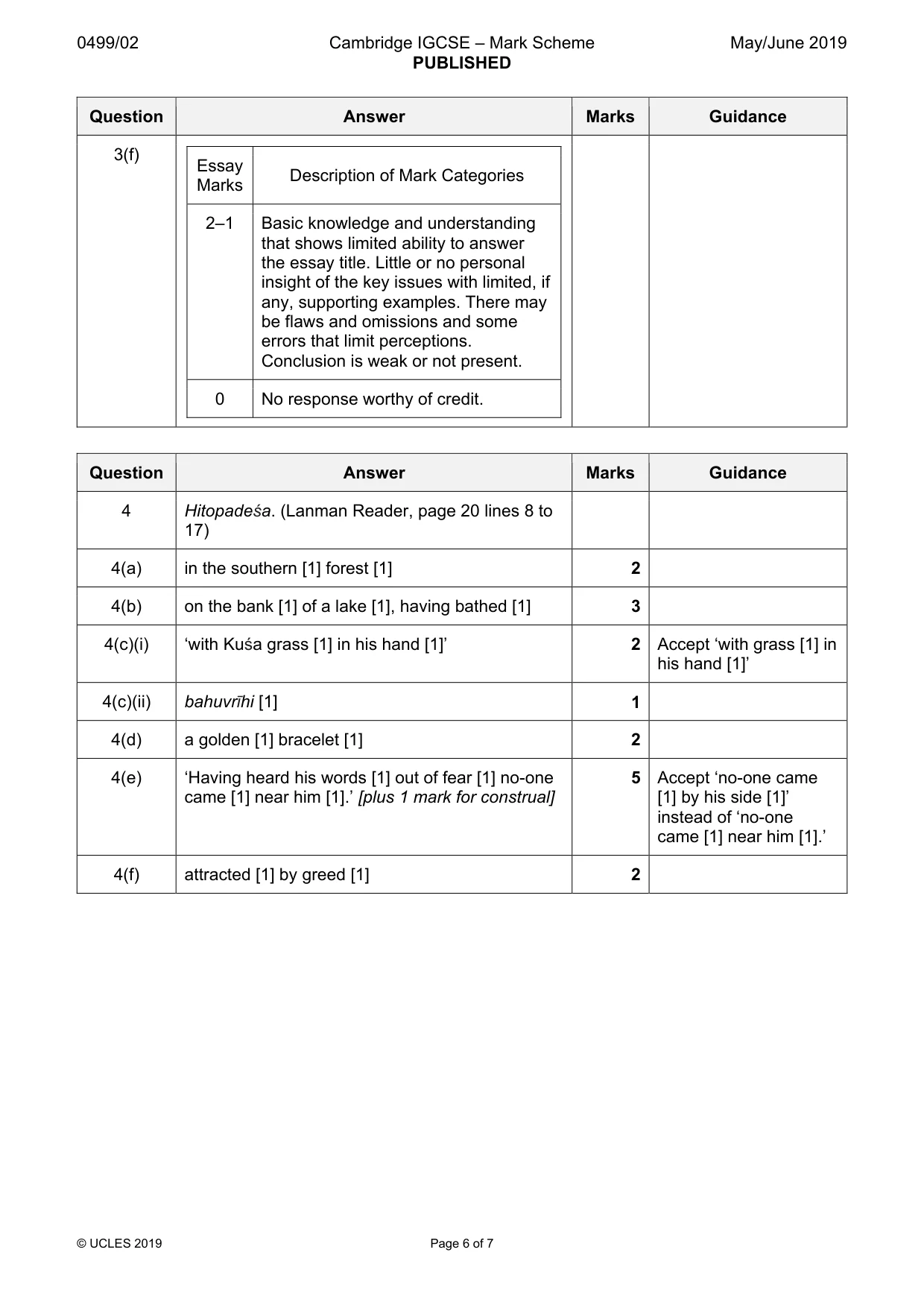
Mark scheme: 3(a)(i) sustenance [1] presided over by sattva [1] 2 3(a)(ii) inner organ [1] of mind [1] 2 3(a)(iii) liberation [1] from bondage [1] 2 3(a)(iv) doubt [1], conflicting idea [1] 2 3(b) jñānendriyāṇi – senses of knowledge [1] e.g. 4 hearing [1] karmendriyāṇi – senses of action [1] e.g. speaking [1] 3(c)(i) the seed [1] of a word [1] 2 3(c)(ii) the endings [1] of a word [1] 2 3(c)(iii) a text [1] outlining the principles of yoga [1] 2 3(c)(iv) a special magic [1] word [1] 2 3(d) Sarasvatī, the power of wisdom [1] 1 Accept ‘Lakṣmī, the power of prosperity [1]’ 3(e) apsaras [1] heavenly nymph [1] 4 Accept ‘nāga [1] gandharva [1] celestial musician [1] serpent being [1], etc.’, or specific gods such as ‘agni [1] god of fire [1]’ 3(f) Awarding Essay Marks: Candidates are expected to write about 100 words, making relevant points, and writing Sanskrit terms accurately when required. Marks should be awarded on the basis of the following chart: Essay Description of Mark Categories Marks 10–9 Thorough knowledge and understanding of the essay title. Articulate and balanced response that demonstrates perceptive use of illustration. Shows very good personal insight when discussing issues. There may be some omissions and very minor errors. Conclusion drawn on the wider themes. 8–7 Good knowledge and understanding that considers the essay title. Mostly balanced response that demonstrates some perceptive use of illustration. Shows good personal insight when discussing issues. There may be some flaws and omissions and minor errors. Conclusion drawn on some of the wider themes. 6–5 Sound knowledge and understanding that considers the essay title. Some demonstration of personal insight into the key issues with some supporting examples. There may be flaws and omissions and some errors. Conclusion attempted on the wider themes. 4–3 Some knowledge and understanding that attempts to consider the essay title. Some attempts to show personal insight of the key issues with limited supporting examples. There may be flaws and omissions and some errors that limit perceptions. Conclusion is limited.
Q4 · Hitopadeśa Read the following Sanskrit passage
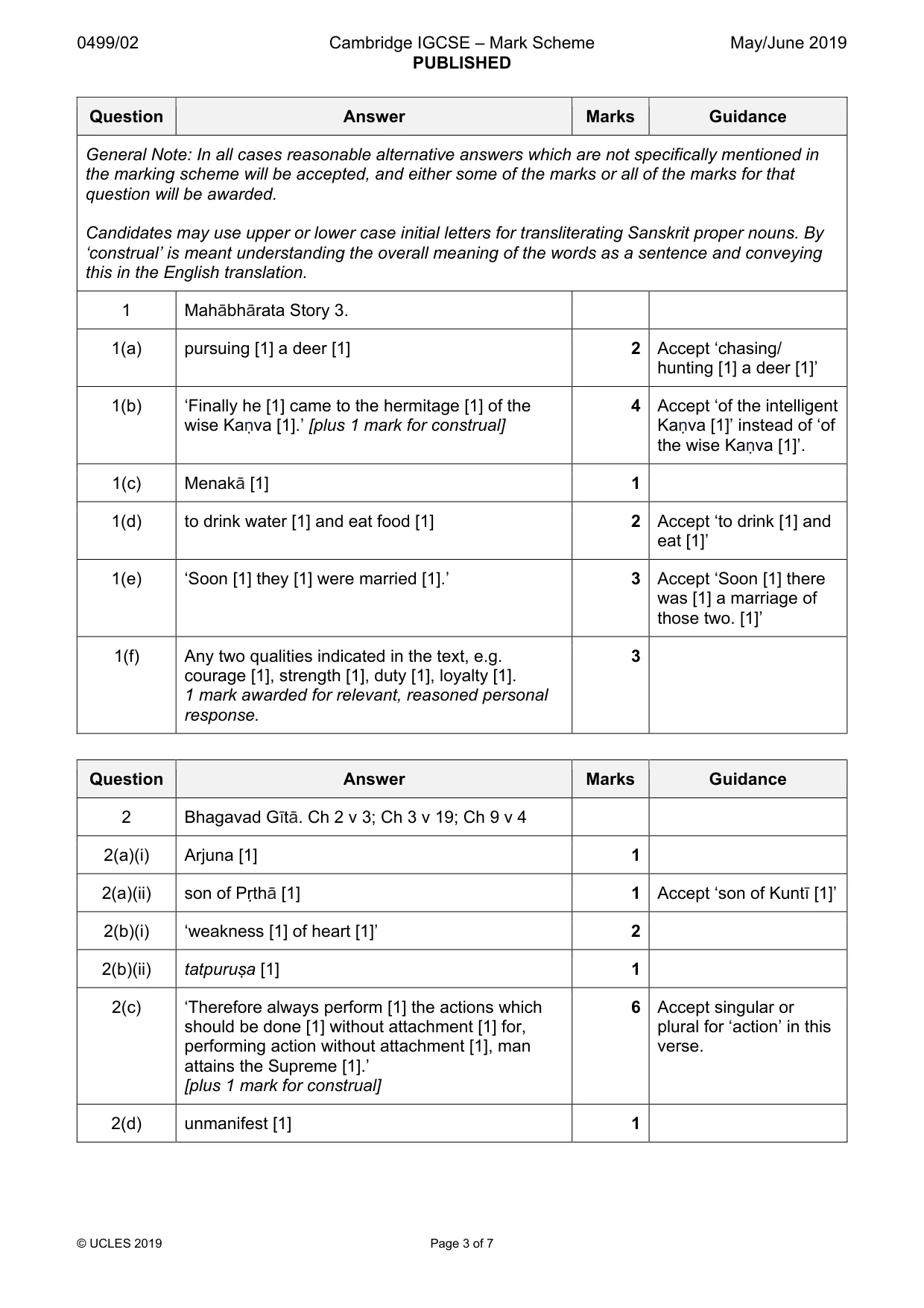
4 Hitopadeśa Read the following Sanskrit passage. Do not write out a translation. Answer all the questions. Your answers should be in English, with Sanskrit names in transliteration. An old tiger offers something valuable to passing travellers. 5 10 (a) Where was the speaker of this passage travelling? (line 1) [2] (b) Where was the old tiger, and what had he just done? (lines 1 and 2) [3] (c) (i) Translate the compound ‘kuśahastaḥ’. (line 2) [2] (ii) Name the type of compound. [1] (d) What does the old tiger offer to travellers? (line 2) [2] (e) Translate ‘tadvacanam ākarṇya bhayāt ko ’pi tatpārśvaṃ na bhajate’. (line 3) [5] (f) What does the compound ‘lobhākṛṣṭena’ mean? (line 4) [2] (g) How, in your view, are the two verses in lines 6 and 7, and 9 and 10, typical of verses found in Hitopadeśa stories? Refer to both verses to support your answer. [8] [Total: 25 marks]
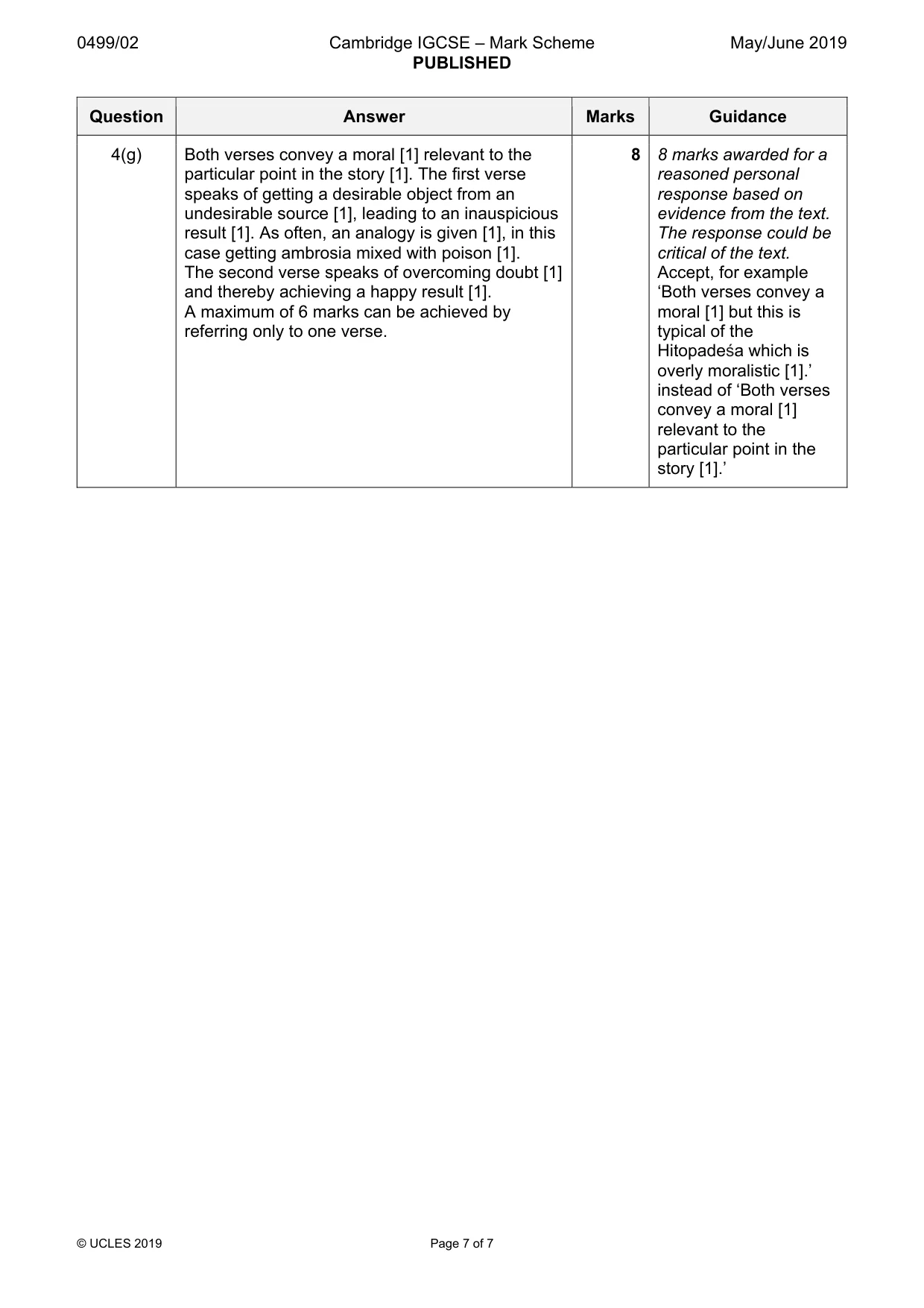
Mark scheme: 4(a) in the southern [1] forest [1] 2 4(b) on the bank [1] of a lake [1], having bathed [1] 3 4(c)(i) ‘with Kuśa grass [1] in his hand [1]’ 2 Accept ‘with grass [1] in his hand [1]’ 4(c)(ii) bahuvrīhi [1] 1 4(d) a golden [1] bracelet [1] 2 4(e) ‘Having heard his words [1] out of fear [1] no-one 5 Accept ‘no-one came came [1] near him [1].’ [plus 1 mark for construal] [1] by his side [1]’ instead of ‘no-one came [1] near him [1].’ 4(f) attracted [1] by greed [1] 2 4(g) Both verses convey a moral [1] relevant to the 8 8 marks awarded for a particular point in the story [1]. The first verse reasoned personal speaks of getting a desirable object from an response based on undesirable source [1], leading to an inauspicious evidence from the text. result [1]. As often, an analogy is given [1], in this The response could be case getting ambrosia mixed with poison [1]. critical of the text. The second verse speaks of overcoming doubt [1] Accept, for example and thereby achieving a happy result [1]. ‘Both verses convey a A maximum of 6 marks can be achieved by moral [1] but this is referring only to one verse. typical of the Hitopadeśa which is overly moralistic [1].’ instead of ‘Both verses convey a moral [1] relevant to the particular point in the story [1].’
What you needed in this session
Cambridge’s own grade thresholds for 2019 May/June, Paper 2 · Variant 1. A higher threshold means an easier paper — the bar moves with how the cohort did.